Wisconsin Weekly Advocate
Thursday, December 8, 1904
Milwaukee, Wisconsin
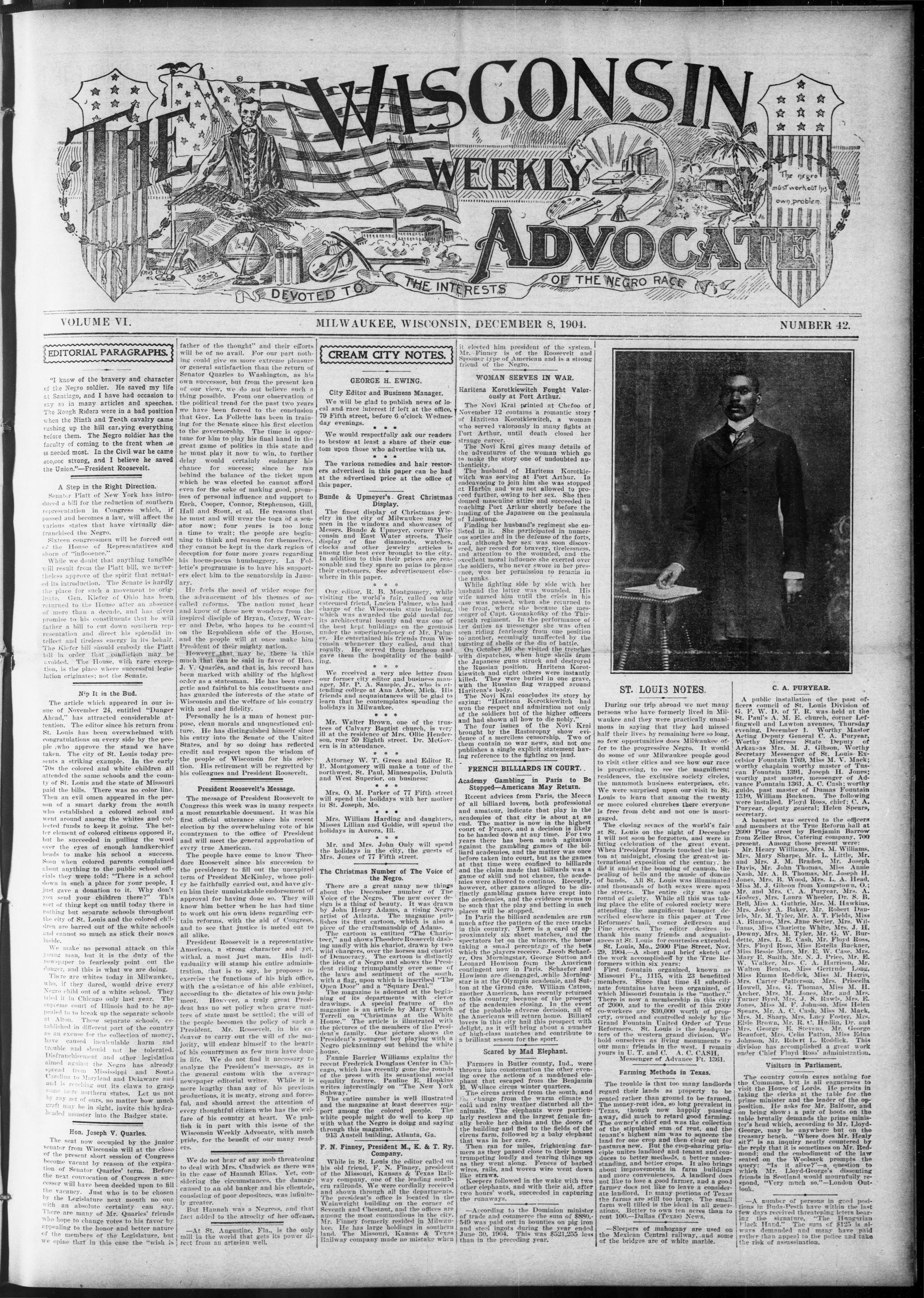
Page text (machine-generated)
WISCONSIN
WEEKLY
ADVOCATE
DEVOTED TO
THE INTERESTS
OF THE NEGRO RACE
"I know of the bravery and character of the Negro soldier. He saved my life at Santiago, and I have had occasion to say so in many articles and speeches. The Rough Riders were in a bad position when the Ninth and Tenth cavalry came rushing up the hill carrying everything before them. The Negro soldier has the faculty of coming to the front when he is needed most. In the Civil war he came 400,000 strong, and I believe he saved the Union."—President Roosevelt.
A Step in the Right Direction.
Senator Platt of New York has introduced a bill for the reduction of southern representation in Congress which, if passed and becomes a law, will affect the various states that have virtually disfranchised the Negro. Sixteen congressmen will be forced out of the House of Representatives and shorn of "inflloence."
While we doubt that anything tangible will result from the Platt bill, we nevertheless approve of the spirit that actuated its introduction. The Senate is hardly the place for such a movement to originate. Gen. Kiefer of Ohio has been returned to the House after an absence of more than a decade, and has given promise to his constituents that he will father a bill to cut down southern representation and direct his splendid intellect and tireless energy in its behalf. The Kiefer bill should embody the Platt bill in order that confliction may be avoided. The House, with rare exception, is the place where successful legislation originates; not the Senate.
Nip It in the Bud.
The article which appeared in our issue of November 24, entitled "Danger Ahead," has attracted considerable attention. The editor since his return from St. Louis has been overwhelmed with congratulations on every side by the people who approve the stand we have taken. The city of St. Louis today presents a striking example. In the early '70s the colored and white children all attended the same schools and the county of St. Louis and the state of Missouri paid the bills. There was no color line. Then an evil omen appeared in the person of a smart darky from the south who established a colored school and went around among the whites and collected funds to keep it going. The better element of colored citizens opposed it, but he succeeded in pulling the wool over the eyes of enough handkerchief heads to make his school a success. Soon when colored parents complained about anything to the public school officials they were told: "There is a school down in such a place for your people, I just gave a donation to it. Why don't you send your children there?" This sort of thing kept on until today there is nothing but separate schools throughout the city of St. Louis and the colored children are barred out of the white schools and cannot so much as stick their noses inside.
We make no personal attack on this young man, but it is the duty of the newspaper to fearlessly point out the danger and this is what we are doing.
There are whites today in Milwaukee, who, if they dared, would drive every Negro child out of a white school. They tried it in Chicago only last year. The supreme court of Illinois had to be appealed to to break up the separate schools at Alton. These separate schools, established in different part of the country as an excuse for the collection of money, have caused incalculable harm and trouble and should not be tolerated. Disfranchisement and other legislation aimed against the Negro has already spread from Mississippi and South Carolina to Maryland and Delaware and and is reaching out its claws to grasp some more northern states. Let us not by any act of ours, no matter how much graft may be in sight, invite this hydraheaded monster into the Badger state.
Hon. Joseph V. Quarles.
The seat now occupied by the junior senator from Wisconsin will at the close of the present short session of Congress become vacant by reason of the expiration of Senator Quarles' term. Before the next convocation of Congress a successor will have been decided upon to fill the vacancy. Just who is to be chosen by the Legislature next month no one with an absolute certainty can say. There are many of Mr. Quarles' friends who hope to change votes to his favor by appealing to the honor and better nature of the members of the Legislature, but we opine that in this case the "wish is
father of the thought" and their efforts will be of no avail. For our part nothing could give us more extreme pleasure or general satisfaction than the return of Senator Quarles to Washington, as his own successor, but from the present ken of our view, we do not believe such a thing possible. From our observation of the political trend for the past two years we have been forced to the conclusion that Gov. La Follette has been in training for the Senate since his first election to the governorship. The time is opportune for him to play his final hand in the great game of politics in this state and he must play it now to win, to further delay would certainly endanger his chance for success; since he ran behind the balance of the ticket upon which he was elected he cannot afford even for the sake of making good, promises of personal influence and support to Esch, Cooper, Connor, Stephenson, Gill, Hall and Stout, et al. He reasons that he must and will wear the toga of a senator now; four years is too long a time to wait; the people are beginning to think and reason for themselves, they cannot be kept in the dark region of deception for four more years regarding his hocus-pocus humbuggery. La Follette's programme is to have his supporters elect him to the senatorship in January.
He feels the need of wider scope for the advancement of his themes of so-called reforms. The nation must hear and know of these new wonders from the inspired disciple of Bryan, Coxey, Weaver and Debs, who hopes to be counted on the Republican side of the House, and the people will at once make him President of their mighty nation. However that may be, there is this much that can be said in favor of Hon. J. V. Quarles, and that is, his record has been marked with ability of the highest order as a statesman. He has been energetic and faithful to his constituents and has guarded the interests of the state of Wisconsin and the welfare of his country with zeal and fidelity.
Personally he is a man of honest purpose, clean morals and unquestioned culture. He has distinguished himself since his entry into the Senate of the United States, and by so doing has reflected credit and respect upon the wisdom of the people of Wisconsin for his selection. His retirement will be regretted by his colleagues and President Roosevelt.
President Roosevelt's Message.
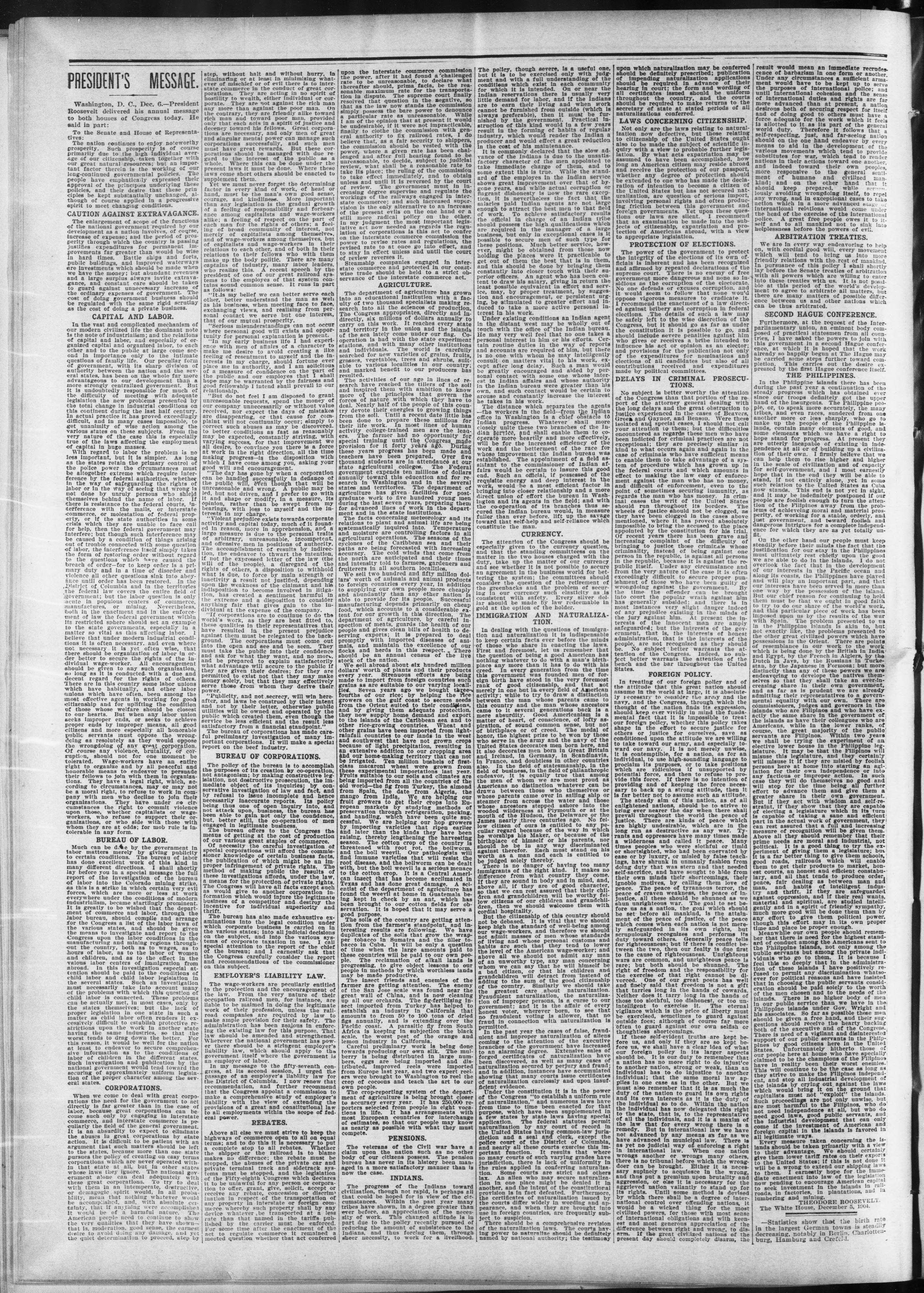
The message of President Roosevelt to Congress this week was in many respects a most remarkable document. It was his first official utterance since his recent election by the overwhelming vote of his countrymen to the office of President and will meet the general approbation of every true American.
The people have come to know Theodore Roosevelt since his succession to the presidency to fill out the unexpired term of President McKinley, whose policy he faithfully carried out, and have given him their unmistakable endorsement of approval for having done so. They will know him better when he has had time to work out his own ideas regarding certain reforms, with the aid of Congress, and to see that justice is meted out to all alike.
President Roosevelt is a representative American, a strong character and yet, withal, a most just man. His individuality will stamp his entire administration, that is to say, he proposes to exercise the functions of his high office, with the assistance of his able cabinet, according to the dictates of his own judgment. However, a truly great President has no set policy when grave matters of state must be settled; the will of the people becomes the policy of such a President. Mr. Roosevelt, in his endeavor to carry out the will of the majority, will endear himself to the hearts of his countrymen as few men have done in life. We do not find it necessary to analyze the President's message, as is the general custom with the average newspaper editorial writer. While it is more lengthy than any of his previous productions, it is meaty, strong and forceful, and should arrest the attention of every thoughtful citizen who has the welfare of his country at heart. We publish it in part with this issue of the Wisconsin Weekly Advocate, with much pride, for the benefit of our many readers.
We do not hear of any mob threatening to deal with Mrs. Chadwick as there was in the case of Hannah Elias. Yet, considering the circumstances, the damage caused to an old banker and his clientele, consisting of poor depositors, was infinitely greater.
But Hannah was a Negress, and that fact added to the atrocity of her offense.
At St. Augustine, Fla., is the only mill in the world that gets its power direct from an artesian well.
MILWAUKEE, WISCONSIN. DECEMBER 8, 1904.
CREAM CITY NOTES.
GEORGE H. EWING.
City Editor and Business Manager.
We will be glad to publish news of local and race interest if left at the office, 79 Fifth street, before 6 o'clock Wednesday evenings.
We would respectfully ask our readers to bestow at least a share of their custom upon those who advertise with us.
The various remedies and hair restorers advertised in this paper can be had at the advertised price at the office of this paper.
Bunde & Upmeyer's Great Christmas Display.
The finest display of Christmas jewelry in the city of Milwaukee may be seen in the windows and showcases of Messrs. Bunde & Upmeyer, corner Wisconsin and East Water streets. Their display of fine diamonds, watches, clocks and other jewelry articles is among the best ever brought to the city. In addition to this their prices are reasonable and they spare no pains to please their customers. See advertisement elsewhere in this paper.
* * *
Our editor, R. B. Montgomery, while visiting the world's fair, called on our esteemed friend, Lucien Palmer, who had charge of the Wisconsin state building, which was awarded the gold medal for its architectural beauty and was one of the best kept buildings on the grounds under the superintendency of Mr. Palmer. He entertained his friends from Wisconsin whenever they called, and that royally. He served them luncheon and gave them the hospitality of the building.
* * *
We received a very nice letter from our former city editor and business manager, Mr. P. A. Sample, Jr., who is attending college at Ann Arbor, Mich. His friends and acquaintances will be glad to learn that he contemplates spending the holidays in Milwaukee.
* * *
Mr. Walter Brown, one of the trustees of Calvary Baptist church, is very ill at the residence of Mrs. Ollie Henderson, rear 59 Eighth street. Dr. McGovern is in attendance.
* * *
Attorney W. T. Green and Editor R. E. Montgomery will make a tour of the northwest, St. Paul, Minneapolis, Duluth and West Superior, on business:
* * *
Mrs. O. M. Parker of 77 Fifth street will spend the holidays with her mother in St. Joseph, Mo.
* * *
Mrs. William Harding and daughters, Misses Lillian and Goldie, will spend the holidays in Aurora, Ill.
Mr. and Mrs. John Only will spend the holidays in the city, the guests of Mrs. Jones of 77 Fifth street.
The Christmas Number of The Voice of the Negro.
There are a great many new things about the December number of The Voice of the Negro. The new cover design is a thing of beauty. It was drawn by John Henry Adams, a rising Negro artist of Atlanta. The magazine publishes its first cartoon, which is also a piece of the craftsmanship of Adams. The cartoon is entitled "The Charioteer," and shows Theodore Roosevelt dashing madly with his chariot, drawn by two wild chargers, over the horses and chariot of Democracy. The cartoon is distinctly the idea of a Negro and shows the President riding triumphantly over some of the laws and sentiment of the south, with a flag, upon which is inscribed "The Open Door," and a "Square Deal."
The magazine is adorned at the beginning of its departments with clever drawings. A special feature of the magazine is an article by Mary Church Terrell on "Christmas at the White House." The article is illustrated with the pictures of the members of the President's family. One picture shows the President's youngest boy playing with a Negro pickanninny out behind the white house. Fannie Barrier Williams explains the recent Frederick Douglass Center in Chicago, which has recently gone the rounds of the press with its sensational social equality feature. Pauline E. Hopkins writes interestingly on "The New York Subway."
The entire number is well illustrated and the magazine at least deserves support among the colored people. The white people might do well to keep up with what the Negro is doing and saying through this magazine.
913 Austell building, Atlanta, Ga.
F. N. Finney, President M., K. & T. Ry. Company.
While in St. Louis the editor called on his old friend, F. N. Finney, president of the Missouri, Kansas & Texas Railway company, one of the leading southern railroads. We were cordially received and shown through all the departments. The president's office is located in the Wainwright building on the corner of Seventh and Chestnut, and the offices are among the most commodious in the city. Mr. Finney formerly resided in Milwaukee. He has large holdings in southern land. The Missouri, Kansas & Texas Railway company made no mistake when
it elected him president of the system. Mr. Finney is of the Roosevelt and Spooner type of American and is a strong friend of the Negro.
WOMAN SERVES IN WAR
Haritena Korotkiewitch Fought Valorously at Port Arthur.
The Novi Krai printed at Chefoo of November 12 contains a romantic story of Haritena Korotkiewitch, a woman who served valorously in many fights at Port Arthur, until death closed her strange career.
The Novi Krai gives many details of the adventures of the woman which go to make the story one of undoubted authenticity.
The husband of Haritena Korotkiewitch was serving at Port Arthur. In endeavoring to join him she was stopped at Harbin and was not allowed to proceed further, owing to her sex. She then donned masculine attire and succeeded in reaching Port Arthur shortly before the landing of the Japanese on the peninsula of Liaotung.
Finding her husband's regiment she enlisted in it. She participated in numerous sorties and in the defense of the forts, and, although her sex was soon discovered, her record for bravery, tirelessness, and attention to the wounded, and the excellent moral influence she exerted over the soldiers, who never swore in her presence, won her permission to remain in the ranks.
While fighting side by side with her husband the latter was wounded. His wife nursed him until the crisis in his case was passed, when she returned to the front, where she became the messenger of Capt. Gouzakofik of the Thirteenth regiment. In the performance of her duties as messenger she was often seen riding fearlessly from one position to another, seemingly unaffected by the bursting of shells or the din of battle.
On October 16 she visited the trenches with dispatches, when huge shells from the Japanese guns struck and destroyed the Russian position. Haritena Korotkiewitch and eight others were instantly killed. They were buried in one grave, with the Russian flag wrapped around Haritena's body.
The Novi Krai concludes its story by saying: "Haritena Korotkiewitch had won the respect and admiration not only of the soldiers but of the higher officers and had shown all how to die nobly."
The four issues of the Novi Krai brought by the Rastoropny show evidence of a merciless censorship. Two of them contain no war news, and not one publishes a single explicit statement having reference to the fighting on land.
FRENCH BILLIARDS IN COURT.
Academy Gambling in Paris to Be
Stopped—Americans May Return.
Recent advices from Paris, the Mecca of all billiard lovers, both professional and amateur, indicate that play in the academies of that city is about at an end. The matter is now in the highest court of France, and a decision is likely to be handed down at any time. For two years there has been much agitation against the gambling games of the billiard academies, and the matter was once before taken into court, but as the games at that time were confined to billiards and the claim made that billiards was a game of skill and not chance, the academies were allowed to continue. Recently, however, other games alleged to be distinctly gambling games have crept into the academies, and the evidence seems to be such that the play and betting in such places will be stopped.
In Paris the billiard academies are run much after the pattern of the race tracks in this country. There is a card of approximately six short matches, and the spectators bet on the winners, the house taking a small percentage of the bets which the players receive. Jacob Schaefer, Ora Morningstar, George Sutton and Leonard Howison form the American contingent now in Paris. Schaefer and Howison are disengaged, while Morningstar is at the Olympia academie, and Sutton at the Grand cafe. William Catton, another American, has recently returned to this country because of the prospect of the academies closing. In the event of the probable adverse decision, all of the Americans will return home. Billiard lovers in this city hail this prospect with delight, as it will bring about a number of high-class matches and contribute to a brilliant season for the sport.
Scared by Mad Elephant.
Farmers in Butler county, Ind., were thrown into consternation the other evening over the actions of a maddened elephant that escaped from the Benjamin E. Wallace circus winter quarters. The circus arrived from the south, and the change from the warm climate to cold and rainy weather disturbed all the animals. The elephants were particularly restless and the largest female finally broke her chains and the doors of the building and fled to the fields of the circus farm, followed by a baby elephant that was in her care. Then ran for miles, frightening farmers as they passed close to their houses trumpeting loudly and tearing things up as they went along. Fences of barbed wires, rails, and woven wire went down like straws.
Keepers followed in the wake with two other elephants, and with their aid, after two hours' work, succeeded in capturing the runaways.
According to the Dominion minister of trade and commerce the sum of $880,549 was paid out in bounties on pig iron and steel ingots during the year ended June 30, 1904. This was $521,255 less than in the preceding year.
[Portrait of a man in formal attire, standing with a book on a table. The background is plain and dark.]]
ST. LOUIS NOTES.
During our trip abroad we met many persons who have formerly lived in Milwaukee and they were practically unanimous in saying that they had missed half their lives, by remaining here so long, so few opportunities does Milwaukee offer to the progressive Negro. It would do some of our Milwaukee people good to visit other cities and see how our race is progressing, to see the magnificent residences, the exclusive society circles, the mammoth business enterprises, etc. We were surprised upon our visit to St. Louis to learn that among the twenty or more colored churches there everyone is free from debt and not one is mortgaged.
The closing scenes of the world's fair at St. Louis on the night of December 1 will not soon be forgotten, and were in fitting celebration of the great event. When President Francis touched the button at midnight, closing the greatest international exposition of the century, he did it amidst the booming of cannon, the pealing of bells and the music of dozens of bands. All St. Louis was illuminated and thousands of both sexes were upon the streets. The entire city was one round of gaiety. While all this was taking place the elite of colored society were attending the magnificent banquet described elsewhere in this paper at True Reformers' hall, corner Jefferson and Pine streets. The editor desires to thank his many friends and acquaintances at St. Louis for courtesies extended. St. Louis, Mo., 2600 Pine Street, Nov. 29, 1904.—A short and brief sketch of the work accomplished by the True Reformers within six years:
First fountain organized, known as Missouri Ft., 1115, with 23 benefitted members. Since that time 41 subordinate fountains have been organized, of which Missouri fountain is the "mother." There is now a membership in this city of 2000, and to the credit of this 2000 co-workers are $30,000 worth of property, owned and controlled solely by the Grand Fountain United Order of True Reformers. St. Louis is the headquarters of the western grand division. We hold ourselves as living monuments to our many friends in the west. I remain yours in U. T. and C. A. C. CASH,
Messenger of Advance Ft. 1361.
Farming Methods in Texas.
The trouble is that too many landlords regard their lands as property to be rented rather than ground to be farmed. The money-rent idea, so long prevalent in Texas, though now happily passing away, did much to retard good farming. The owner's chief end was the collection of the stipulated sum of rent, and the tenant's highest aim was to squeeze the land for one crop and then clear out for pastures new. But the crop-sharing principle unites landlord and tenant and conducts to better methods, a better understanding, and better crops. It also brings about improvements in farm buildings and more conveniences. A landlord does not like to lose a good farmer, and a good farmer does not like to leave a considerate landlord. In many portions of Texas the farms are still too large. The small farm well tilled is the ideal in all generations. Better to own ten acres than to rent 100.—Dallas (Texas) News.
-Sleepers of mahogany are used on the Mexican Central railway., and some of the bridges are of white marble.
A public installation of the past officers council of St. Louis Division of G. F. W. D. of T. R. was held at the St. Paul's A. M. E. church, corner Leffingwell and Lawton avenues, Thursday evening, December 1. Worthy Master Acting Deputy General C. A. Puryear, Worthy Mistress State Deputy of Arkansas Mrs. M. J. Gibson, Worthy Secretary Messenger of St. Louis Excelsior Fountain 1769, Miss M. V. Mack; worthy chaplain worthy master of Tuscan Fountain 1391, Joseph H. Jones; worthy past master, messenger of Advance Fountain 1361, A. C. Cash; worthy guide, past master of Dumas Fountain 1310, William Buckuen. The following were installed. Floyd Ross, chief; C. A. Puryear, deputy general; Helen Spears, secretary.
A banquet was served to the officers and members at the True Reform hall at 2600 Pine street by Benjamin Barrow from Zeller Bros. Catering company, 700 present. Among those present were:
Mr. Henry Williams, Mrs. M. Williams, Mrs. Mary Sharpe, Mr. L. Little, Mr. and Mrs. J. M. Braden, Mr. Joseph Davis, Mr. John Thomas, Miss Annie Nash, Mr. A. B. Thomas, Mr. Joseph H. Jones, Mrs. B. Wood, Mrs. L. A. Head, Miss M. J. Gibson from Youngstown, O.; Mr. and Mrs. C. A. Puryear, Mrs. A. Godsey, Mrs. Laura Wheeler, Dr. S. B. Bell, Miss A. Guthrie, Mrs. M. Hawkins, Mrs. Joicy A. Baker, Mr. Robert Daniels, Mr. M. Tyler, Mr. A. T. Fields, Miss A. Blanton, Mrs. Jane Sevier, Mrs. Williams, Miss Charlotte White, Mrs. J. H. Downy, Mrs. M. Tyler, Mr. G. W. Burdette, Mrs. L. E. Cash, Mr. Floyd Ross, Mrs. Floyd Ross, Miss Estella Buckner, Miss Bessie More, Mr. E. W. Case, Mrs. Mary E. Smith, Mr. N. J. Price, Mr. E. W. Walker, Mrs. C. A. Harrison, Mr. Walton Benton, Miss Gertrude Long, Miss Emma Reddick, Miss M. Harris, Mrs. Carter Patterson, Mrs. Priscella Howell, Mrs. G. Thomas, Miss M. H. Archer, Mrs. M. Jones, Mr. and Mrs. Turner Byrd, Mrs. J. S. Rawls, Mrs. E. Jones, Miss M. F. Johnson, Miss Helen Spears, Mr. A. C. Cash, Miss M. Mack, Mrs. M. Sharp, Mrs. Lucy Foster, Mrs. Elsie Brown, Mr. R. C. Hudlin, Dr. and Mrs. George E. Stevens, Mr. George Beaufort, Mrs. Celia Patton, Miss Edna Johnson, Mr. Robert L. Roddick. This division has accomplished a great work under Chief Floyd Ross' administration.
Visitors in Parliament.
The country cousin cares nothing for the Commons, but is all eagerness to visit the House of Lords. He persists in taking the clerks at the table for the prime minister and the leader of the opposition. He asks for Mr. Balfour, and on being shown a pair of boots on the table brutally demands the prime minister's head which, according to Mr. Lloyd-George, may be anywhere but on the treasury bench. "Where does Mr. Healy sit?" is an inquiry neatly countered by the reply that it is sometimes on Mr. Redmond; and the embodiment of the law seated on the Woolsack prompts the query: "Is it alive?"—a question to which Mr. Lloyd-George's dissenting friends in Scotland would mournfully respond, "Very much so."—London Outlook.
A number of persons in good positions in Buda-Pesth have within the last few days received threatening letters bearing the signature, "The Hungarian Black Hand." The sum of $125 is always demanded and many have paid rather than appeal to the police and take the risk of assassination.
.Had His Choice.
Judge Julius M. Mayer tells a story about a white man who was arraigned before a colored justice of the peace during reconstruction times for killing a man and stealing his mule. It was in Arkansas, near the Texas border, and there was some rivalry between the states, but the colored justice tried always to preserve an impartial frame of mind.
"We're got two kinds ob law in disyere co't," he said. "Texas law an' Arkansas law. Which will you hab?"
The prisoner thought a minute and then guessed that he would take the Arkansas law.
"Den I discharge you fo' stealin' de mule an' hang you fo' killin' de man."
"Hold on a minute, judge," said the prisoner. "Better make that Texas law."
"All right, under de law ob Texas I fine you fo' killin' de man an' hang you fo' stealin' de mule."—New York Times.
Greatest in the World.
Arlington, Ind., Dec. 5.—(Special.)—Mr. W. A. Hysong, the photographer, who moved here recently from Sapp, Ky., is firmly of the opinion that Dodd's Kidney Pills are the greatest Kidney Remedy the world has ever known.
"In the years 1901 and 1902," says Mr. Hysong, "and for some time before I was afflicted with Kidney Trouble. My joints were sore and stiff and I finally got so bad I could not turn in bed without assistance. In the spring of 1903 I was induced, by a friend, to try Dodd's Kidney Pills, and after using one and one-half boxes I was and am still completely cured. Several of my neighbors, too, used Dodd's Kidney Pills and in every case they did as recommended."
Cure the early symptoms of Kidney Disease, such as Backache, with Dodd's Kidney Pills and you will never have Bright's Disease.
Old War Horses.
These old horses never forget the calls, no matter how long it has been since they last heard them.
One day some years ago, when I was passing an open lot in the outskirts of Chicago, I found a boy trying to play an old cornet. While the boy and I were at work on the cornet, an old negro ash hauler came along driving an animal that had once been a good horse but was now only a collection of skin and bones. The horse stopped when he heard us and stuck up his ears. I came to the conclusion that he had once been a cavalry horse and asked the old negro where he had got him. "From a farmer," he said. I could not find a "U. S." on the horse; he had probably been discharged so long ago that his brand had been worn off. But taking the cornet I sounded the stable call, and the horse began to dance.
"Hold fast to your lines, now, uncle," I warned the old negro, "I am going to make that old horse do some of the fastest running he has ever done since he left the cavalry." Then, beginning with the call for the gallop, I next sounded the charge, and the old plug went plunging up the road at his fastest gait, dragging his wagon after him. I gave him the recall next, and he came down to a walk, much to the relief of the old negro. He said that this was the first time he had ever seen the horse run. He had never been able to get him to go faster than a slow walk before. "You don't feed him well enough to get him to do much running," I told him. "That horse, when he did have to run, got his twelve pounds of corn and all the hay he could eat every day."—Forest and Stream.
The "Traveler Returns."
Johnny Poe, of the "Tiger Poes, of Maryland and Princeton," is the authority for a brand-new "return-trip" story, which, he says, was played out in the Baltimore station of the Pennsylvania road between the ticket agent and a very provident colored man. The latter had asked what it would cost to send a corpse out to Birmingham, Ala.
"The same as we charge an adult live person," was the reply.
The negro studied a moment and then asked, "Say, boss, what would hit cost fer a retu'n ticket?"
"A return?" queried the surprised official. "We don't usually sell returns in such cases, but, if you really want one, it would be $32—just as it would for a live adult. But why in the world do you want a return for a corpse?"
"Well, suh," explained the colored man, "hit's dis a-way; I's bin a-wonderin' wheder hit wouldn't be cheaper to took hit down dar, an' let all de folks hab a look, an' den bring hit back, rudder dan hab 'em all up hyar a'boa'din' on me fer a week."—Warwick James Price in Lippincott's.
HAPPY CHILDHOOD.
Right Food Makes Happy Children Because They Are Healthy. Sometimes milk does not agree with children or adults. The same thing is true of other articles of food. What agrees with one sometimes does not agree with others.
But food can be so prepared that it will agree with the weakest stomach. As an illustration—anyone, no matter how weak the stomach, can eat, relish and digest a nice hot cup of Postum coffee with a spoonful or two of Grape-Nuts poured in, and such a combination contains nourishment to carry one a number of hours, for almost every particle of it will be digested and taken up by the system and be made use of.
A lady writes from the land of the Magnolia and the mockingbird way down in Alabama, and says: "I was led to drink Postum because coffee gave me sour stomach and made me nervous. Again Postum was recommended by two well-known physicians for my children, and I feel especially grateful for the benefit derived. "Milk does not agree with either child, so to the eldest, aged four and one-half years, I give Postum with plenty of sweet cream. It agrees with her splendidly, regulating her bowels perfectly, although she is of a constipated habit.
"For the youngest, aged two and one-half years, I use one-half Postum and one-half skimmed milk. I have not given any medicine since the children began using Postum, and they enjoy every drop of it.
"A neighbor of mine is giving Postum to her baby lately weaned, with splendid results. The little fellow is thriving famously." Name given by Postum Co., Battle Creek, Mich.
Postum agrees perfectly with children and supplies adults with the hot, invigorating beverage in place of coffee. Literally thousands of Americans have been helped out of stomach and nervous diseases by leaving off coffee and using Postum Food Coffee. Look in pkg. for the little book, "The Road to Wellville."
Miscellaneous Items.
The enforced Sunday rest which has been introduced into Spain is causing much dissatisfaction in all commercial and industrial centers. It is considered likely that the Cortes will repeal the law. Machinery for paper manufacture is in demand in Japan, as the trade in paper is largely increasing, owing to exportation to China and enlarged home consumption, due to the growth of Japanese newspapers. A certain prince, says the South China Post, has engaged a foreign circus troupe to perform for the delectation of the Empress dowager and her retinue. The troupe has been engaged for ten days at a cost of $14,000.
There is a boat in a canal north of London which is entirely "manned" by women. The last English census reported several hundred women doing the work of seamen.
The first lead pipe ever made in Canada from Canadian lead is now being produced at Trail by the Canadian Smelting works. Any dimensions required are made up to 4 inches in diameter.
On exhibition at Coventry, England, is a pile carpet, $24\times 7\frac{1}{2}$ feet, which was made in Lahore in 1634 for a director of the old East India company. The beautiful coloring is still perfect.
Rev. Thomas Bates, who has just completed twenty-five years' work at St. Mary's, Balham, a suburb of London, has kept a record of the number of times he has preached during that time, and finds that he has delivered 3750 sermons.
—Pipe lines are to be laid by the Stanard Oil company fro Red Fork, I. T., to the oil fields near Florence and Boulder, Colo. If the plan works with success, extensions will be made from Denver to the Wyoming oil fields.
—Copper mining once flourished in Ireland. The Ballymurtagh mine, in Wicklow county, averaged 6000 tons of copper pyrite per annum between 1840 and 1843. Desultory prospecting is going on at the present day in several localities.
—The largest British submarine was launched recently. It is called the R. I. It is 150 feet in length and 86 feet in girth—submarines have no beam—and is about 50 feet longer and 20 feet greater in girth than any of its predecessors.
There are 1000 American teachers in the Philippines, centered in 338 larger towns out of 934 towns in the entire archipelago. Two thousand primary schools are in operation, and they employ the services of 3000 native teachers.
Jesse Wood of Haywards, Cal., is trying to raise funds for a monument to the memory of Juan Rodriguez Cabillo, the Portuguese explorer and navigator, who discovered California, landing in the bay of San Dregosin, September, 1852.
Every October 21 at the base of Nelson's monument, Trafalgar square, London, is covered with memorial wreaths and always among them is one to the memory of "the gallant sailors of France and Spain," who fell in the battle of Trafalgar.
Arrangements are being completed by the City of London International Commercial association for the holding of an "International Society Dance" in December, at which a thousand guests from the various trading centers of Europe will be present.
Timothy J. Lee, an American locomotive engineer, has been held responsible for the wrecking of a train he was driving near Zacatecas, Mexico, and sentenced to hard labor in the salt mines for four years. He was badly hurt in the wreck.
Mount Sopris, near Glenwood Springs, Colo., 14,200 feet above sea level, is to be made into a summer resort. Among the unique attractions will be the perfection of a natural toboggan slide which may be used all through the summer months.
In Italy there are 172,000 skilled workmen engaged in the manufacture of silk. In 1902 800,000 of her people emigrated. More than 3,000,000 of her people have left their country during the last ten years, yet there is a gradual increase in population.
After three months' trial of the results of blacking out the betting news from the newspapers in Bermondsey (London) public library, it has been decided to continue the practice, on the ground that it excludes an undesirable class of readers.
A modern church, built upon the site of an ancient one at Llanderand, Wales, had no bell. A farmer offered one that was lying in one of his barns. It turned out to be one that had hung in the tower of the ancient church and had not been rung for 300 years.
—Hearing one of his officers say at dinner that "half a dozen Russians could drive the English out of Thibet," a soldier in Manchuria, who had been serving as a waiter at the table, asked some people where Thibet was, and learning that it was somewhere southwest, persuaded seven comrades to join him in an expedition. They had not gone far when they were attacked and seized by Chinese bandits, from whom they were afterward rescued.
The coal mine owners in the south of Austria have been obliged to reduce the price of coal because English ships on their way to the Black sea for corn have taken British coal from Cardiff to Trieste at the rate of $1 a ton, whereas the usual rate is between $1.60 and $2 and has even been as much as $3.75. The price of British coal is so low that unless Austrian mine owners reduce their prices British coal will find its way into Austria in large quantities.
The Japanese have a number of customs which are jewels, and it is too bad that they cannot be adopted in the western world. One of the best is the manner in which one hostess gets rid of an unwelcome guest. She does not hint that the time is about up for his stay or that she is going visiting soon, but sets to work preparing a dainty luncheon which she packs in a little box, ties up with ribbon and paper and hands to the guest some morning. It isn't an insult, either; it's just a hint and one that is always taken.
The Use of Alcohol.
Dr. Charles Baskerville, who recently discovered a new element which he named Carolinium, put up an examination in chemistry at the College of the City of New York a few days ago. One of the questions which he asked was: "Give the uses of ethyl alcohol." The next evening he examined the papers. The first he chose out of a big pile belonged to a man who was notorious for never having given a correct answer in all his career at the college. But now he broke his record. Here's what Dr. Baskerville saw: "Give the uses of ethyl alcohol.' Answer—It is often used to excess."
swer—it is often used to excess. "That was too good," said the scientist to a fellow teacher the day after. "I gave him a hundred."—New York Times.
Municipal Medicine.
Switzerland contemplates a curious object-less in municipal Socialism. The city of Zurich is making an experiment in the communising of the medical services of the town. The conditions of the experiment are that each inhabitant pays a year's tax of about 85 cents, and that the product of $100,000 is divided in salaries of $2000 a year among forty medical men, who will attend the inhabitants gratuitously.
WHEN CHRISTMAS COMES.
Have you any old grudge you'd like to pay,
Any wrong laid up from a bygone day?
Gather them all now, and lay them away
When Christmas comes.
Hard thought are heavy to carry, my
friend,
And life is short from beginning to end;
Be kind to yourself, leave nothing to mend
When Christmas comes.
Do you know some fellow stranded and
poor,
As good as you, but with much to endure?
Do not forget him, however obscure,
When Christmas comes.
Are there not some little ones, fair and
sweet,
Who know not as yet what they have to
meet?
Ferhaps with joy you could make their
Any cloud you can lift from hearts of care,
Any kind word needed?—try to be there,
And always add help to sympathy's prayer
When Christmas comes.
Fear not, my friend, giving more than your
due.
Remember the gift presented to you
In the long ago, and try to be true
When Christmas comes.
—William Lytle.
NOEL CLAYTON'S CHRISTMAS
Noel Clayton was tall and gaunt, with clear, candid, blue eyes, and his white hands, small and nervous-looking, were as well kept as those of a woman.
He was 30, and a splash of gray on either temple, a strand or two of white in his mustache, made him look older.
He was broad-chested and muscular—by all rules—he should have been a soldier—he looked an "open air" man, but for five years he had been writing short stories, novelettes and serials for the weekly press.
It was good, nervous work. His name was becoming known, for he had the happy knack of blending pathos with humor. He had traveled widely, and an Australian bush idyl at the beginning of the week would be followed by a London society story, to be followed again by a story of rustic life in the dear west country that he loved so well.
He lived quite alone, worked—and smoked—from morning to night, loved his profession, and had practically dropped all his friends—male and female—and wher a fit of the not infrequent blues got him by the threat, threw his pen into the grate and ordered up his landlady's children, and pandemonium reigned for an hour.
Sometimes he gave them pennies, but not always—small coin of the realm is not always available to authors—but the romps were huge, and he enjoyed them.
Of course there was a woman at the bottom of the tangle of the man's life, and women complicate things sometimes—he would have said "always."
On one particular evening he was alone and writing, when Jim Courtenay was shown in—and Jim was an old and tried friend—about the only friend the lonely, self-absorbed man had, and so the incomer sat down and lighted his pipe, and did not bother the author for quite a quarter of an hour and then Noel rose and stretched himself.
"What is it this time. Noel?"
"Oh, the usual thing—love; and candidly I am getting so sick of writing love stories."
"Ah! you feel like that?"
"Man alive, this is Christmas eve, and somehow—somehow—my thoughts went back with a jump, and I remembered one Christmas eve when—"
"Your pipe's out, Noel!"
"Aye, so it is. Well there was one Christmas eve when----"
"My dear boy, are you worrying about her still?"
"Yes," and then a long pause——
It is the privilege of chums to sit silent for a spell.
"And all this happened four or five years ago. I never heard the rights or wrongs of the story."
Noel crossed the room, and digging both hands into his pockets, looked at his chum.
"There is nothing to know. After the four happy years of married life, trouble came between us, lies came between us; and—and—here I am and it's Christmas eve. Of course our baby was only a mite—a wee, blue-eyed, golden-haired mite; couldn't walk, crawled, you know; but we were awful chums, and when she went and took our mite—well," and the man's laugh hurt his own ears. "Well, then I took to writing love stories—love, old chap, with a happy ending—bishops, bridesmaids, bouquets and blessings, and"—i is temporary excitement had left him—he added drily:
"And it pays! Now go, old chap. I must get my stuff done for the early post," and Chum went out while Noel turned again to his interrupted work.
Between each line on every page quaint thoughts haunted him, a dead past spoke to him.
The girl-wife had been very sweet, very lovable, very beautiful—and had marred two lives.
There should be a special place of torment for the person who deliberately comes between two people who love each other and smilingly warps two lives.
Pearl Clayton was as easily led as a child, a soft, emotional weak little woman, and when Noel returned from a few days' holiday he found the house closed and Pearl and Baby had departed.
Noel drifted for a little bit, the shock unmanned him terribly, but his pen was his sole source of income, and it had to be plied if body and soul were to be kept together, and in a very few weeks he had, to some extent, regained his mental balance, and his work improved. The eve of Christmas and the day itself appeals to most hearts, and on this particular eve Noel kept thinking back and thinking back while he wrote. How well he remembered the extrasized stocking he induced the nurse to knit, and how bulky it looked and felt on Christmas morning. And then came school, college, and then married life.
When then scribbling fit was on him Pearl used to draw her low wicker chair close to his writing table, knitting, or daintily fingering white material, soft and downy and fluffy for, the prospective wearer, and the few remarks she made seemed to chime in and identity themselves with what he was writing; but, of course, all this happened five years ago.
One odd little trick Pearl had, and Noel remembered it this evening—and missed it.
When his pen was working extra busily she used to lay the tips of her fingers upon his right hand—just where hand meets wrist. She did not incommode him in the least. He declared her touch inspired him; they were such pink-
tipped fingers, and so small, and he had often written with the tiny touch on his wrist almost unconsciously—only peeping up from time to time at a sweet oval face, into deep violet eyes love lit. But, of course, this was five years ago. So he wrote on, feeling a little bit serry that Chum had not stayed, for after all he only had another half-hour's work before him, and then they could sit and chat, and perhaps drown the sound of the belis that he knew would ring out in a few hours. He was just in the frame of mind to summon his landlady's children, but except for himself, the house was empty. There was a Christmas eve party going on, and Mrs. Marsh and her progeny were attending it.
He had been writing for half an hour since Chum had left him, and felt the old familiar touch on his wrist. It was imagination of course, he did not even turn his head, and then he was looking into blue eyes, in the round golden-curled framed face of a boy of four, who laughed up at him and presented a rosebud to be kissed.
"Goodness, child—where on earth do you come from? and who—who brought you. What is your name?"
"Eric," and the child began to make preparations for climbing a lofty knee.
"Who brought you here, Baby Eric? How did you come."
Noel felt like an Irish member of Parliament, for "no answer was given," but a wee form, full of hugs and kisses, got fast hold upon him, and said gravely, and yet with a sweet air of command:
"Just come'd—and now if you're not too busy, mister Father——"
"Yes, my son."
"P'raps—I'd better go to bed."
"But, my child—my little son—who brought you here? where is your mother?" and the tall man, suddenly releasing his first-born, paced up and down. Of course, Chum had left the door open, and someone had told the child to walk straight in—and the child had—straight in.
The author—his tiny son was on the floor now, saying things to the cat, and it deserved every word, being a cat that licks stamps off letters, and loves bacon and boiled eggs—thrust his hands deep into his pockets and looked down, sad eyed, at little Sunny-face."
"Yes, perhaps you had better come to bed."
* * * * *
If Chum would only come, if something would only happen to break the silence, a silence only cleft by the sigh of a child.
The church was only at the end of the street.
He could hear the bell-ringers shuffling along the frosty pavement, in a few minutes—and he bent to his work.
Half asleep, half awake, he was conscious of the old, almost forgotten touch upon his wrist—a dream doubtless—but he could not shake it off, and then he looked down.
Kneeling as of yore beside him, blue eyes tear-dimmed, was Pearl.
"I have returned, Noel." It was a quavering little voice, but it thrilled him.
How like she was in their child.
And then the bells clashed forth their message, "Peace on Earth, Goodwill towards Men," and to two hearts they carried a sweeter, deeper message still.
No word was spoken. A small figure, in a smoking jacket that reached to his heels, stood at the dividing door, an eager face turned to either.
And husband and wife kissed silently. New York News.
TIGERS BESIEGE A VILLAGE
The Maneaters Have Killed Several of the Inhabitants.
The police station at Katigora was a few days ago the scene of great excitement and horror when the corpse of unfortunate Nidan Patni, who met his lamentable death from the claws of a tiger, was carried there for inspection.
Four persons were killed during the course of a few weeks, besides a number of persons mauled; while carrying away of cattle is going on almost every day. The tigers that have caused so great a havoc here are now proved to be four in number—one tiger, one tigress and two big cubs—and our sympathetic deputy commissioner is said to have offered a reward for the destruction of each of them.
The ferocious brutes, having taken their abode by the side of the only important road leading from Katigora to the village Gangapur, have practically laid siege to the village, with the result that communication on foot has been stopped. Several attempts that had been made to afford relief to the unfortunate villagers were all unsuccessful.
A party of local shikaries, mustering strong and equipped with firearms, marched into the jungle at the head of our energetic Naib Tehsildar Maulvi Mahommed Israil to hunt the tigers, but with all their efforts they could not make the master stripes come out of their recess. The next day, however, another party, consisting of four European gentlemen, with a large number of cookies, surrounded the jungle and succeeded in arousing the tigers, which managed to escape through the line without giving the hunters an opportunity of discharging bullets.
They pursued the animals and made them swim across a beel. It is a matter of regret that the brave hunters failed to hit the animals, while they were struggling in the water, although a good number of shots were fired. The tigers got to the other side of the beel without encountering further opposition and fell upon the said Nidan Patni, who was grazing cattle near his house, and killed him on the spot.—Weekly Indian Chronicle.
A Dog with "Convictions"
At the disruption of 1843 the bulk of the shepherds poined the Free kirk. But one colle held by the Establishment principle, and refused to "come out." Every Sabbath he went alone to the Established church, where he had been wont to accompany his master. His master refused to coerce him. "Na, na," he said; "he's a wise dowg; I'll no meddle wi' his convictions." The collie's adherence to the Establishment had, however, a disastrous end. He was accustomed to lie on the pulpit stair during the sermon, no doubt better to hear the discourse. Below him were placed the long stovepipe hats of the elders. On one unfortunate day he fell asleep, rolled off his step, and managed to get his head firmly fixed inside one of the hats. Bitterly mortified, the dog fled from the kirk, and ever afterwards, as his master said, "had nae trokings wi' relegion."—London Spectator.
A Prolific Writer
We were interviewing Carvel Crisis McFlub, the famous novelist.
"Does it annoy you," we inquired, "to have your wife keep you waiting while she is dressing for the theater or other place of amusement?"
"Not at all," replied the great man, cordially, "for I invariably employ that time in turning out a complete novel."—Louisville Courier-Journal
A REMARKABLE TEST
APPLIED BY A TEACHER IN A LEADING UNIVERSITY.
Demonstrates the Power of Dr. Williams Pink Pills to Restore Vigor to Shattered Nerves.
Mrs. Leander Lane, wife of the minister of the Christian Church, of No. 2010 I street, South Omaha, Neb., tells how her daughter has been enabled to resume her professional work as a teacher after suffering for nearly three years from severe nervous prostration:
"When she was passing from girlhood to womanhood," says Mrs. Lane, "she suffered greatly from difficulties peculiar to her sex. The physician did not help her, but a few boxes of Dr. Williams' Pink Pills brought about the perfect regulation of her system.
"While she had escaped from one grave trouble, she unfortunately began to overwork, first as a student and then as a teacher in a large Iowa institution for orphan boys. She enjoyed her work and was very enthusiastic, but the strain finally told on her. She became pale, weak, nervous, unable to sleep; she had no appetite and she suffered from severe headaches. Then came a complete breakdown and her work had to be given up.
"In this emergency we again tried Dr. Williams' Pink Pills. Improvement came at first slowly and we sometimes doubted whether she was gaining, but we noticed that whenever she stopped taking the pills she fell back, and whenever she resumed the use of them she revived and so we kept up the treatment until she recovered her usual health and was able to take a position in one of our universities where she is happily at work. My mother, my daughter and myself have a well-founded confidence in the merits of Dr. Williams' Pink Pills and are always ready to recommend them."
This is simply one more proof that these pills seek disease at its source and effect fundamental cures. They cure various diseases because these have a common origin in impaired blood or nerves. They put the entire system in a healthy condition, because they introduce vigor that is distributed to every part. They arrest physical decay when it seems inevitable and find a road to restoration when the doctor misses it. They are sold by all druggists throughout the world.
Bishop Olmsted of Denver is interested in a number of charities and obtains many generous contributions on their behalf from rich Episcopalians. There is in Denver, however, a millionaire who will rarely consent to help Bishop Olmsted's pet projects. He is a generous man, and in his own way he assists the poor, but to organized charity, for some reason, he heartily objects. The bishop often asks him for subscriptions, but these requests are almost invariably refused. Recently the millionaire had his portrait painted. Bishop Olmsted met him the other day and said: "I saw this morning your admirable portrait."
And did you ask it for a subscription?" said the millionaire smiling. "No," said Bishop Olmsted. "I saw there was no use—it was so like you."—New York Tribune.
Not long ago, apropos of the humors of the lecture room, Dr. Woodrow Wilson told of an instructor in astronomy at Vassar college, who in elucidation of a certain point made the following observation: "In astronomy, to determine the motions of three bodies that attract one another is admittedly difficult."
At this juncture the lecturer was annoyed by half-suppressed laughter in the rear of the class-room. "May I inquire," remarked the instructor, sarcastically, "what unconscious humor lay in my last statement?"
"I beg pardon," exclaimed the fair student who was responsible for the interruption. "It merely struck me that the difficulty was nothing compared with the same problem in love."—Woman's Home Companion.
A. A. Boyce, a farmer, living three and a half miles from Trenton, Mo.,
says: "A severe cold settled in my kidneys and developed so quickly that I was obliged to lay off work on account of the aching in my back and sides. For a time I was unable to walk at all.
and every makeshift I tried and all the medicine I took had not the slightest effect. My back continued to grow weaker until I began taking Doan's Kidney Pills, and I must say I was more than surprised and gratified to notice the backache disappearing gradually until it finally stopped."
Doan's Kidney Pills sold by all dealers or mailed on receipt of price, 50 cents per box. Foster-Milburn Co., Buffalo, N. Y.
—For serving rabbit as hare a restaurant keeper of Louvain, France, has been fined $25.
—Ireland has two annual Celtic gatherings, the Oireachtas and the Feis Ceoil.
DO YOU
COUGH
DON'T DELAY
TAKE
KEMP'S
BALSAM
THE BEST COUGH CURE
It Cures Colds, Conghs, Sore Throat, Croup, Influenza, Whooping Cough, Bronchitis and Asthma. A certain cure for Consumption in first stages, and a sure relief in advanced stages. Use at once. You will see the excellent effect after taking the first dose. Sold by dealers everywhere. Large bottles 25 cents and 50 cents.
The Dust.
The dust blows up and down
Within the lonely town;
Vague, hurrying, dumb, aloof,
On sill and bough and roof.
What cloudy shapes do fleet
Along the parched street;
Clerks, bishops, kings go by—
Tomorrow so shall I!
-Lizette Woodworth Reese in Lippincott's.
GARDEN CRAZE IN ENGLAND
It Has Brought About the Cult of the Garden Ornament.
The garden craze of the last few years, for which we predicted a brief life, although a merry one, has become what its real votaries thought it would—a source of permanent interest.
This emphasis of enthusiasm has brought about the cult of the garden ornament, and those who are able to afford to do so are searching far and wide for some piece of sculpture that shall harmonize with the style of the gardens, be they Elizabethan, Jacobean or of the Georgian period.
Until one remembers the depredations of the Puritans during the civil wars in this country it is difficult to understand how it is that the Elizabethan and Jacobean periods did not produce a greater number of pieces of garden sculpture than they did. Most of the images of the Jacobean gardens the Puritans demolished, particularly if they were lead, a very favorite metal in those days for the manufacture of such ornaments. Lead of every kind was precious for the formation of bullets. Lead images are now very highly prized for garden ornaments, and so are those made of terra cotta, and, of course, of marble and stone.
There were many quaint conceits in garden ornaments in the days of long ago that did not appeal alone to the beauty loving eye, but aroused the practical joker of the period. Any one who has visited the Czar's summer palace at Peterhof, near St. Petersburg, will remember in the garden of one of the small villas adjacent to the palace trick fountains, as they are called, innocent looking marble seats, upon which no sooner has the visitor sought repose than he is drenched with a shower of water. Such trick arbors and trick seats were quite a feature of the gardens of long ago.—London Mail.
A Tennessee Senator's Thanksgiving.
The greatest dinner that McMillin ever enjoyed was at a log-house, when he was a callow youth just returning from a Kentucky university. A very large turkey had been secured, and it had been carefully plucked and drawn on the day before Thanksgiving. That night, however, some appreciative colored man had thrown the family into consternation by abstracting the bird, and the theft was discovered about 9 o'clock in the evening. Meanwhile a terrific gale had arisen, and it almost reached the fury of a tornado. The log-house stood the blast, but it shivered and groaned. The wooden shutters were firmly locked, and the howling wind outside made the log-wood fire dance with glee, sending showers of sparks up the chimney. Suddenly there was a smash against one of the wooden shutters. A blood-curdling sound was heard. Securing a lantern, the head of the household went out quickly, and as quickly returned. He held in his hands two huge turkeys with bronzed legs and ruffled feathers. One was a gobbler and the other was a hen. They had been torn from their roosts in the mountains, borne miles by the gale, and thrown against the rude cabin by the hand of Providence, to take the place of the turkey that had been stolen. Providence had made no mistake in this case, for the family were good, old-fashioned, hard-shell Baptists, and they returned thanks on the spot. The next day they enjoyed the finest Thanksgiving dinner ever given in Tennessee. Gov. McMillin had no affidavits to accompany this story, but it is easier to believe it than to seek to disprove it.—Leslie's Weekly.
Hard to Be Identified.
A stranger came into an Augusta bank the other day and presented a check for which he wanted the equivalent in cash. "Have to be identified," said the clerk. The stranger took a bunch of letters from his pocket all addressed to the same name as that on the check. The clerk shook his head. The man thought a minute and pulled out his watch, which bore the name on its inside cover.
Clerk hardly glanced at it.
Clerk hardly glanced at it. The man dug into his pockets and found one of those "If-I-should-die-to-night-please-notify-my-wife" cards, and called the clerk's attention to the description, which fitted to a T.
But the clerk was still obdurate. "Those things don't prove anything," he said. "We've got to have the word of a man that we know." "But, man, I've given you an identification that would convict me of murder in any court in the land." "That's probably very true," responded the clerk, patiently, "but in matters connected with the bank we have to be more careful."—Pittsburg Index
Christmas Cards.
The Christmas card, as we know it, has an origin easily traceable, and it is not more than fifty-five years ago since the first was designed. The artist who claimed to be its originator, and who was, at any rate, the first to see its possibilities, was W. C. T. Dobson, R. A., who, when quite a young man, in 1844, was prompted at Christmas to make a little sketch symbolic of the season's joys and festivities, and to send it to a friend. It seemed to give great pleasure, and the next year Mr. Dobson determined to follow up the idea on a large scale, and by having his card photographed was enabled to send copies to twenty-five or thirty friends. The delight with which they were received was so great that Mr. Dobson was quick to perceive that he had found out a new pleasure for Christmas.—Exchange.
Neighbor Merely to Look At.
A Lincoln woman with a love for color and curves not only expects her neighbors to keep their premises and themselves in a state of continuous neatness, but has also expressed a preference for neighbors who are personally attractive to the eye.
"Just look there, now," she exclaimed one day. "Isn't that the dearest, sweetest soul of a neighbor? Her coloring is exquisite and her gowns trail so gracefully that I love to see her on the lawn. How I shall miss her if she ever moves away."
"Do you visit back and forth much?" was asked.
"Never! I don't want to talk to her, only to feast my eyes."—Nebraska State Journal.
Endurance and Loss of Sleep.
The length of time it is possible to keep awake is surprising. A prominent American physician tells of a medical man who went without sleep for eight days and nights, and another who did not go to bed for eighteen days, but got all the sleep he had while on horseback. A third did not sleep for fifteen days and nights, but permanently injured his health.
—New blast furnaces are being erected on the Island of Elba, in the Mediterranean. The isle is famous for its wonderful iron ore.
Too Great a Resemblance.
Those Vassar Girls.
Every Walk in Life.
A.
GOSSIP FOR THE LADIES.
In the Heart of the Fire.
From the heart of the fire doth the vision rise,
It is good to sit in the after-glow,
While some one's hand in your big one lies,
And nobody there to know.
Ah, golden gleaming its many towers,
The palace ve build, ve twain.
In a golden castle in Spain.
And the end of the dream be fair?
Ah, boy and girl, with the love-lit eyes!
Will the faith and the love remain
When only a crumbling ruin lies—
Your fallen castle in Spain?
A Business Woman's Axiom
Mrs. Mary Phelps Montgomery of Portland, Ore., is thoroughly representative of the best type of the conservative business woman of today.
When you ask her a question she thinks deliberately, studying you with level, cool eyes, and when she speaks her words are well chosen and convey the impression that she means everything she says and is willing to abide by it. She is one of the very wealthy women of the west and her interests are all under her immediate personal control.
"Can't you give me some axiom for the business woman?" I asked her. She thought a moment, weighing her words well before she answered.
"I believe I can. The business woman should forget her sex and demand no consideration that a business man is not entitled to. Her office should not extend to her drawing room, nor should her social life be an element in her business affairs."—From "The Ladies of the World's Fair," by Ben Blow in National Magazine.
Friendships.
In friendship, dear girls, you must not idealize too much; that is the rock on which so many friendships have split. I think this tendency to idealize our friends is one that Emerson recognized as a necessity but also feared. He advised that we should not grow too intimate. This friendship is too good for human nature's daily food. You must love your friend for what she is and what you feel she can be; then you will be spared the discovery that she does not possess all the virtues with which you have adorned her. If we feel that some one trusts us it is marvelous the effect that this has upon us. The incomparable service which true friendship renders is that it helps us to believe in ourselves, to believe because another believes in us. But that is also the reason why we must not be lavish of friendship, for on all God's earth there are not more than two or three souls so attuned to ours that they guess and respond to all our timidities, to all our secret aspirations. Acquaintances we can have, but the friend of our girlhood whose friendship will last through life is a rare and precious possession.—Pictorial Review.
Consider What It May Cost
To Woo the Girl Who Loves You.
Lovers are enthusiastic creatures because they see everything through rose-colored spectacles, so they often become engaged before the prospective bridegroom has attained a position that will warrant marriage, and he lives in hopes that this desideratum will be fulfilled in the natural course of things in due time. As a rule disappointment awaits him, the struggle is very keen, and a position is attained only as a result of hard work and the display of considerable ability. Instead of devoting his time to the acquisition of knowledge, he spends it with his adored one, and so decreases his chances of securing the position.
So much for his time; now for his cash. You cannot take a young woman about two or three times a week without considerable expense, and money spent is, naturally, so much less saved. The result is that marriage has often to be delayed because there is not enough in the bank to purchase a fitting home—or it may be that an ill-furnished home has to do for the start, or a loan may be negotiated to make up the deficiency. In any of these three cases the start is a bad one and does not tend to make things smooth during the first portion of the married career.—Columbus Dispatch.
Worrying Woman.
A woman who never worries declares that there is nothing more detrimental to beauty in woman than worry. The worrying woman does nobody any good. She simply invites the hand of Time, which writes plenty of wrinkles on her brow, around her eyes and mouth, paints her face a yellow, and gives a lack-luster eye that no artifice can brighten.
It is quite unnecessary to worry, and it is a total waste of energy which could be better employed in doing something useful. The man who wrote (it must have been a man) "it is not work but worry that kills" knew something. He had a wife, or a sister, or a cousin, or an aunt who worried him by the hour, and so killed him by inches. That is the worst of a worrying woman. She not only worries, but she worries you.
You know a worrying woman the moment you see her. Her character is written in her face in wrinkles which you would think nothing short of a miracle would obliterate.
Downright ugliness is a heavy price to have to pay for the possession of a bad habit, but there it is. And not only does worry directly influence the complexion for evil; its more remote effects are no less potent in robbing the face of the peach-bloom tints, which are the admiration of the noet, the painter, and the general public. Worry affects the entire nervous system, and through it the liver and organs of digestion and the heart.
The things a woman thinks have more than anything else the power to make or mar her beauty, so let her beware of worrying ever much, lest she lose that greatest or all the gifts of the good fairies.—Health Culture.
Etiquette of the House Party.
In many of the homes in which the now agreeably common Christmas house party is held are plenty of servants, and any offer of assistance in the enormous amount of work which such a festivity entails would be considered an impertinence. When enough maids are provided to open and unpack and put neatly away the contents of every trunk and even traveling bag, any girl may feel relieved of the responsibility, and may devote herself to the unrestrained pursuit of amusement. But in not a few of the homes which are thrown open for these delightful companies, of from one to a dozen or more young people, the mother of the youth at whose invitation the party is assembled, or of the girl who has the pleasure of playing the part of hostess, is afflicted with servants who are too few in number, or too inefficient, to do the work properly. One such mother wrote last summer: "We had, finally, a hilarious time during the visit of the six young people whom Harold had invited, but for a time things looked black. The cook was suddenly taken ill. I was not feeling as strong as usual myself, and for four or five days we could not get anyone in her place. I wish you
could have seen the way in which the three young college girls in the party took up the task of helping me. Neither one of the two other housemaids understood cooking. I had heard that the modern college maiden knew nothing of it, either. If you have heard this same discouraging report, believe it no longer. One of these girls made the mayonnaise and a delicious dessert. Another baked little cakes which melted in our mouths. All of them knew how to make several kinds of candy—the like of which cannot be bought in the shops. Every day they begged to be allowed to help me, and they proved themselves most capable. The boys put on aprons and waited on the girls. They made good fun out of what promised to be a catastrophe, and did it all in a beautiful way."
A different story was told by the hostess of an Easter party given for her son at a country house which had been closed all the season. The house was very large, containing twenty bedrooms alone. Any one who has ever opened such a house for the reception of guests in the chilly months knows what a vast amount of labor and intelligent oversight is required to do it wisely. Fires must be built, linen aired, unless a great deal is taken in with the family, and there must be a prodigious cleaning and scrubbing throughout. Two men-servants and two women-servants went to accomplish the feat, but the mother had to go too to direct matters. The force of assistants proved quite inadequate. The mother, a delicate woman, who knew how proud and fastidious her son was, was obliged to work far beyond her strength in order that all should pass off as he desired. Of the five young girls, all supposed to be carefully brought up, who formed the feminine section of the company, not one offered to "lift a finger," as the saying goes, to lighten the labors of this overburdened hostess. She kept them out on drives and walks as much as possible, and during their absence managed to do the work which the servants could not do. But those girls ought to have observed and weighed the situation. At least they might have unobtrusively offered to help. This mother once said: "I have entertained for my two sons at least thirty different girls during the past five years, but never one has offered to help me in any way. They have given me little gifts—sometimes very expensive ones—but they never offer to help." The etiquette of the house-party is rather new, but every mother ought to teach it to her young people.—Harper's Bazaar.
Concerning Christmas Gifts.
"I'll attend to it after the holidays."
"Just as soon as Christmas is over, I'll take the matter up."
"Oh, I can't go to any committee meetings in December! I'm so dreadfully busy."
"Calls? No, indeed! I don't make calls at this time of year. I have too much to do."
And what is she doing, this busy woman? She is making out long lists of names, and writing against each name a "present" of one kind or another; she is lying awake at night, jaded with a day's shopping, and thinking who has been forgotten. Heavens! There is Mary Robinson! Mary sent a sachet bag last Christmas, and, of course, something must be sent her this Christmas; and then this giver of gifts groans and turns on her sleepless pillow, and wishes Mary and her sachet bag in ballyhack! So writes Margaret Deland in the Christmas number of Harper's Bazar, and many are the weary women just at this season who can understand the sleeplessness of the giver-of-gifts.
Twenty-five years ago, says Mrs. Deland, Christmas was not the burden that it is now; there was less haggling and weighing, less quid pro quo, less fatigue of body, less weariness of soul; and, most of all, there was less loading up with trash.
Let the Christmas gift, she urges, be something that does not last; that brings the meaning and vanishes—something that never will know the indignity of the top shelf of the spare room closet!
A knock at a friend's door on Christmas morning and the clasp of a hand do this. A growing plant does it. Yes, the loaf of bread, the jug of wine—but, most of all, thou beside me, singing in the wilderness!—the personal revelation does it. Suppose a letter came on Christmas morning, to say—not "you are perfectly dear to have sent me a spool-box," but "I want you to know that your patience or courage, or tenderness, during this last year, will help me to live more bravely and courageously and lovingly this next year!" What a Christmas present the receipt of such a letter would be to any one of us! How we would take heart to live ourselves! What a Christmas present for any one of us to send to the human heart that has given us courage for the burden and heat of the day! Compare it with the contents of the spare room closet.—Philadelphia Evening Bulletin.
Children and Studies
"Most mothers experience the temptation to push their children forward in their studies," says a mother with various interesting theories on the upbringing of children. "This is a great mistake, for undeveloped brains should not be strained with work, any more than undeveloped muscles. A little child should not be hurried, and no mother should be worried if her child does not show great brilliancy. It is really better for him to grow slowly, if steadily, in intellect.
"And the same is true of boys and girls in their teens. Many a 'young phenomenon' in school has turned into an unmitigated bore in later life, without any originality of any kind, while some of the greatest men in art, literature, etc., were considered dunces in school. Though they seemed at the time to be stupid, they were really growing, and their minds were stronger for this slow, steady growth. Our colleges and schools are beginning to recognize this when they refuse to admit pupils under a stated age.
"It is the height of folly and cruelty to ridicule stupid children, as some teachers often do. Their slowness does not always mean natural stupidity, and even if it does it is none the less brutal, for a person can no more help having a weak brain than he can help having a weak body or deformed features.
"The feelings of children are apt to be much more sensitive than grown people think they are. Kindness and sympathy will often bring out the latent intelligence and quickness of a young mind where harshness would only succeed in stupefying it.
"A mother must also see that her children are growing as strong physically as they are mentally. They must have a suitable amount of nourishing food. This is even more important than when they are grown up. Do not refuse them too many bonbons. A few sugary things are good for them occasionally, especially in the bitter winter. Although grain foods are good do not give them too many, nor think that oatmeal gruel will fill every want. Provide plenty of hot meat broths, Irish stews, etc., and put sandwiches of minced meat and of mayonnaise dressing in the luncheon baskets. Pies and rich pastry should, of course, be avoided, but fruit tarts are an occasional surprise. Let the crust be the brownest and only made with butter, never with lard. All boys and girls ought to have some kind of hot broth for their school
luncheons, and when this is not practicable let them have it on reaching home
runcleous, and when this is not practicable let them have it on reaching home. One cannot expect a child to make a success in after life if his physical health has been sacrificed to his intellectual development. This statement cannot be too often repeated. It is sometimes wise to keep a delicate girl or a child who has lately recovered from a serious illness entirely out of school for a year. Make her live outdoors in the sunshine until she is thoroughly strong. The nervous strength thus gained will enable her to more than make up the time lost.
"A great mistake which some parents make is to let their growing children sit up to all hours of the night. The result is that they come to school so sleepy that they cannot work. This is quite a common occurrence in many public schools in and around New York. Sometimes a little boy of ten or twelve will fall fast asleep in school, and perhaps a kind-hearted teacher will let him alone, knowing that sleep is a physical necessity to him. Mothers must see that their children go to bed early, so that they can have their full amount of rest. The old-fashioned boarding schools had many mistaken methods, but in some ways had much to commend them. They sent the children to bed at 8:30 or 9 o'clock, and they were graduated with rosy cheeks and healthy digestions. Formal dances, fudge parties and theaters are all very well for young women of eighteen and twenty years, but not for school children. Of course, these younger girls want some good times, too, for all work and no play makes any one dull, but these pleasures need not be such as will injure their health."—Selected.
One Mother's Way.
She had noticed at the church services the disposition on the part of so many of the young people who had not reached the real thinking age to whisper and laugh during the sermon. Even those who were quiet and respectful hardly seemed to be listening but were gazing at different things with their minds evidently far from the subject.
She had two boys and a girl of her own who would be reaching that age in a few years and she did want them to learn to listen—not only because there would be less temptation to unbecoming conduct, but for the immense gain it would be to them all through their lives mentally, morally, and spiritually.
Precept was good—example was better—but both of these together were not sufficient to induce the children to listen attentively when there was really much in the sermon that was beyond them. So she hit upon this plan: At the beginning of a month she told them on Sunday morning that if they would listen carefully to the sermon and write down after they came home all they could remember of it on every Sunday of that month she would give them each a present. And she would do the same thing every month, but they must be honest, listen earnestly, and write all they could remember. The children accepted the proposition enthusiastically and during the sermon that morning they scarcely took their eyes from the minister's face. As soon as they reached home they began their writing, while the mother was getting dinner ready. Sometimes one would have the best report, sometimes another, but there was no prize for the best account but for each one if he did his own best. When the last Sunday in the month came, after dinner, when the sermon for that day had been reported, the mother told the children they might search for their gifts, which she had hidden about the room plainly marked with each one's name. They had a fine time hunting them, and the little girl had the colored crayons she had been wishing for; the older boy a book, not expensive, he had been wanting to read; and the younger one a delightful picture puzzle. They were all happy over their gifts and anxious to try again the next month, and so it went on. The mother tried to keep as much variety about the rewards as possible, and they were always great surprises. Sometimes there was a pretty little paper box of candy for each one. Always the presents were simple, and often home-made, for money was by no means plentiful in that home, and the mother's ingenuity was often taxed to the utmost.
It took thought, time, and sometimes real sacrifice, but as the children grew and she saw their quiet attention, which in time grew into a real interest in the sermon, and as one by one they came out boldly on the Lord's side and were known as His followers, she felt repaid an hundred fold for all that the carrying out of the plan had cost her. Of course, in time the rewards were dropped, but the habit remained, and not one of those children as they grew to maturity but thanked their mother in the depths of their hearts for helping them to form a habit that had broadened all their lives and increased their usefulness in the vineyard of the Lord.—Wallace Farmer.
A Novel Addition to a Dinner.
"Nuts to crack," if not to eat, are a nice addition to a dinner menu. These are to be served, not at the close of the meal with bonbons, but with an ice just before the meal course. Select nice large English walnuts, and, with a sharp knife, open the shell, keeping the two halves unbroken. Roll up a slip of paper, upon which is written a question, and place in the shell after removing the kernel. Then fasten the edges of the shell together. This can casily be done with a little liquid glue on a toothpick. The maid will serve the nuts, placing two or more upon the plate holding the sherbet cup. To further carry out the deception nut picks are placed next the sherbet spoons. Nut crackers are passed and, of course, the first one using them, who would probably be the guest of honor, would discover that the nuts were "food for thought." Cards with pencils are then to be passed, upon which to write the answers. All stiffness disappears, and conversation becomes general as the different questions are read off.
After the dinner the cards are corrected. The gentleman and lady having the greatest number of answers right are each given a child's book of prose or verse with brilliant illustrations more striking than artistic. A reward of merit card may also be attached to the fly leaf, and the name of the recipient filled in, as was the custom years ago. The following list of questions was used at a dinner given for a bride and groom; the answers are all names of authors:
1. What author conveys messages across the ocean? Cable.
2. What author is like the houses in which we live? Holmes.
which we live? Holmes.
3. With the name of what author is a fireman most familiar? Burns.
4. The name of which author does a deaf or inattentive person often use? Howe.
5. What author is a plural numeral? Twain.
6. What author is always almost burning? Browning.
7. What author is a small body of water? Pool.
8. What author's productions are upon our table every meal? Miller.
9. What author is a close companion of liver? Bacon.
10. What author appears upon the pedal extremity? Bunyan.
11. What author makes barrels?
Cooner.
12. What author's headquarters are in the kitchen? Cooke.
13. The name of what author would you use in calling for an encore? Moore.
14. What author inhabits the highlands? Scott.
15. What author tells you to peruse literature? Reade.
16. What author may often be found in European hedges? Hawthorne.
17. What author never grows old? Young.
18. What author's name does a child often use in calling for entertainment? Story.
19. What author's name tells you what course to pursue to avoid a snowball? Dodge.
20. What author do we try to keep out of our flower beds? Weed.
21. What author may be seen upon a child's head in winter? Hood.
22. What author is part of the stock in trade of a plumber? Fawcett.
23. What author is hailed with joy by all members of the colored race? Mellen.
24. What author is is evidence in every mill? Saxe.
25. What humorous author finds the counterpart of his name in the human body? Harte.
26. What author may be found in livery and yet telling of "Nothing to wear?" Butler.
27. What popular author do we find at the forge? Smith.
28. What author's name describes a Hebrew's course in a business transaction? Jewett.
29. What author do we find upon the ocean? Seaman.
30. What author uses the iron goose? Taylor.
A few personal questions referring to characteristics of different guests adds to the amusement. Several of these were used at the bride's dinner, among them were:
"What author does Mr. Smith resemble?" Longfellow.
"The name of what author is the present state of our bride and groom?" Bliss. —Mrs. A. R. Knight in Vick's Magazine.
BETHLEHEM'S CHRISTMAS.
Natal Day of Christ Is Celebrated with omp and Splendor in Historic Town of Palestine.
Bethlehem, the real home of Christmas, celebrates the natal day of the Saviour with pomp and splendor. On Christmas day, at this little town in Palestine, so replete with historic interest, the religions of the world unite in paying homage to the birthplace of Christ.
The celebration of Christmas in Bethlehem reverses the order of the life of the great prophet whose birth it commemorates. Christ was born in Bethlehem, died in Jerusalem, whereas observances begin in the city of the crucifixion and end in the city of nativity.
The five-mile pilgrimage is one of the chief features of the celebration. It is marked by the greatest pomp, for all the patriarchs of the Roman Catholic, Greek and Oriental churches reside in Jerusalem, and their solemn passage from one city to another is an event of the most solemn importance.
The great procession starts from Jerusalem at 2 o'clock in the afternoon. It is headed by a picked company of several hundred mounted young men, native inhabitants and members of the Roman Catholic church.
A body of Turkish cavalry, in picturesque garb, carrying a whole arsenal of guns and pistols and lances in rest, comes next, on fine horses, with bright and numerous trappings. Behind these ride special guards of the patriarch, in glittering jasminary costume.
Directly behind this special guard comes the patriarch, with his suite of priests, forming a contrast in their broad low crowned hats and somber black cloaks to the gorgeous mass of color preceding them. To the western eye the striking feature about these priests is that in defiance of all the Oriental canons of the Catholic church they wear full black beards. As France is protector of the Catholic church in Palestine, the French consul, consular attaches and suite in full uniform form the official position of the procession.
Next in order come the guests of the convent, noble foreign pilgrims, consuls and consular attaches from Jerusalem. The church is brilliant with the light of thousands of wax candles and olive oil lamps of gold and silver, suspended by chains.
A sudden cessation of the organ tones and the chanting causes silence throughout the vast crowd. It is midnight, the hour of the Holy Nativity. A clock begins to ring out twelve rich, clear strokes. The seventh candle is lighted on the altar. A velvet curtain, heavy with gold, is drawn back; the image of an infant wrapped in cloth becomes visible. The big bell in the convent tower rings; acalytes swing censers of begemmed gold and silver; clouds of fragrant incense fill the church; priests, friars and choristers chant in unison, "Gloria, Gloria, in Excelsis." After this the procession to the grotto of the nativity, the actual spot, the lowly manger where, nineteen centuries ago, the Christ child came to earth.
During the rest of the night masses are held in the grotto by the Franciscan fathers, who are guardians of this as well as every other sanctuary which the Catholic church possesses in Palestine.—New York Evening Mail.
On Christmas Giving.
Where any uncertainty exists let us give as a token of love, or friendship, or human kindness, something that, while expressing these things, will, at least, be harmless. Let it be something that does not last—that brings the meaning and vanishes—something that never will know the indignity of the top shelf of the spare room closet!
A knock at a friend's door on Christmas morning and the clasp of a hand do this. A growing plant does it. Yes, the loaf of bread, the jug of wine—but, most of all, thou beside me, singing in the wilderness—the personal revelation does it. Suppose a letter came on Christmas morning, to say—not "you are perfectly dear to have sent me a spool box," but "I want you to know that your patience, or courage, or tenderness, during this last year, will help me to live more bravely and courageously and lovingly this next year!" What a Christmas present the receipt of such a letter would be to any one of us, how we would take heart to live ourselves! what a Christmas present for any one of us to send to the human heart that has given us courage for the burden and heat of the day!—Harper's Bazar.
The Mexican Christmas Jar.
Novel is the method of distributing the Christmas presents at the Mexican embassy. Following the custom which prevails in the land to the south of us there is suspended from the ceiling a huge open-mouth jar in which have been placed all the presents, each neatly tied and addressed to the intended recipient. The children and grown people of the party are armed with long slender canes, and with these first one and then another makes a dash for the swinging jar, striking it or at it as they pass. Of course it is only a matter of time until the frail treasure house is demolished, and then ensues a grand scramble for the gifts.—Washington Times.
'Twas the night before Christmas,
In each little house
The children were waiting
As still as a mouse
To hear the puff puff
And the pish, chugg, and squeal
Of good old St. Nicholas'
Automobile! —Illustrated Bits.
Young Folks' Column.
Dad and Mother and Me
With his red and jolly face;
There's not another around the globe
Can travel so swift a pace.
His twinkling eyes, and his merry laugh,
His chuckle of bubbling glee—
Nobody else is so dear by half
To Dad and Mother and Me.
He doesn't forget the baby sweet
He has gifts and gifts for the young and gay.
Who encircle the Christmas Tree;
And he has the love to his latest day
Of Dad and Mother and Me.
The frost is chill in the nipp.. g blast,
Smooth is the icy mere;
The short feet days go hurrying past
To the last of the waning year.
And never was rose of the summer's prime
So royally fair to see
As the rose that blooms in the winter's rime
For Dad and Mother and Me.
—Collier's Weekly.
The Christmas Fairy.
"Sure it's a small bit o' Christmas they'll be after having, the craythers," said Mrs. O'Dooligan, wiping the tears from her eyes with a corner of her apron, "for it's neither bite nor sup we've got about the place beyant just bread and butter and a dish o' tay."
And the neighbor into whose sympathetic ears she poured this tale of woe was sorry enough for poor Widow O'Dooligan, but what could she do with only a goose to go the rounds of her own big family? As she went out through the dooryard, on her way to her own home cabin, she saw the three little O'Dooligan children playing with the pig by the steps.
"it's a wonder she doesn't have the pig for Christmas," thought the neighbor. But that was because she did not know that piggie must be saved to pay next month's rent and to buy Tim's shoes and Nora's hood and Sarah's cloak and many more things that would never come their way if they should have the pig for Christmas dinner.
"Come in, all of yez," called Mrs. O'Dooligan to her brood, as the dusk crept up from the sea, "or its the rheumatiz ye'll all be a-getting."
But little the three cared for rheumatism. They were having a glorious good time chasing piggie around the yard, and it was not until their mother had come out after them that they at last crept into the cabin and remembered that tomorrow would be Christmas day.
"And it's our stockings we'll be hanging up there," said Tim, pointing to the chimney corner.
"And all full of holes they be," sighed motherly little Sarah, who, though only 11, was "all of a woman, and would make two of yez ony day," as her mother was wont to say to Tim when he lagged with his work.
"But you can cobble thim up so so as nothing'll drop out o' thim," wheedled Tim, "'cause we just must hang thim up."
So Sarah cobbled as best she could till the holes were so small that a gumdrop could not have slipped through them.
"And nothing'll be dropping out of thin, sure," thought their mother, "for nothing'll ever go into thim, begorra!" "And there's three nails a'ready for them," laughed Tim. "The fairies won't care if they're rusty, will they, and bent? Now make a hole near the top of me stocking. There, over it goes—that's it." "And mine," begged Baby Norah, her big, blue eyes dancing, "and will it be full, full in th' morning?" Their scant supper of potatoes over, they were soon fast asleep, Norah in Sarah's arms, and Tim on his heap of straw on the floor, and dreaming of all the fairies would bring them before morning. But Tim was just in the middle of his dream when something woke him up, and looking over toward the chimney place, where the peat fire still smouldered, he saw his mother weeping, and rocking herself to and fro.
"And what ails ye?" he asked anxiously, running over to her. "Is it looking for the fairies ye are?"
"It's looking at thim little stockings, I am," she sobbed, "and we wid never an orange or an apple to put inside o' thim—and the baby, too, widout so much as a bit of candy for her Christmas, at all, at all."
"Do ye put things in our stockings and not the fairies?" cried Tim in disappointment.
"Sure and there's no fairies I ever saw," answered his mother, "nor you, nor any wid mortal eyes, as I ever heard of. but get back into yer bed, Tim, mavourneen. It's no better ye'll make a black Christmas be catching yer death o' cold."
It was a very surrowful little boy that crept back to the heap of straw, and he could not sleep, though after a while his mother did, and Tim wondered how she could, when he heard her heavy, regular breathing. No fairies, no Christmas, or worse yet—a black one—and yet his mother could sleep! Tim could not understand it.
Presently he sat up and looked out of the window. The moonlight streamed in though the dingy panes. Oh, there must be fairies outside there in the shadows. The night was mild and "muggy." Tim tiptoed to the door and lifted the latch. But there were no fairies dancing there in the moonbeams. All was still and deserted. Far away to the right stretched the road that led to Illinglae, the nearest town, where strangers often stopped. Tim knew, for he had sometimes earned pennies by holding horses for them. But the road was empty now, and as far as his eyes could see there were neither folk nor fairies awake in the world that night. A light wind hurried thin clouds across the moon's face and shadows filled the fields and crept up around the cold steps where Tim stood. No fairies! It must be true, then! And he was slipping back through the half-opened door, when a low laugh sounded around the corner of the cabin and in a minute more a tiny creature, about the size of his own baby sister, danced up to him.
There were sparkling jewels among her soft furs and on her wide white plumed hat. There were dimples in her pink cheeks and sunlight and blue sky in her laughing eyes.
"The saints be good to us!" whispered Tim. "It's a fairy! For sure it is!" "Why, yes, I'm Fairy," said the wonderful little creature before him, "but how did you know?" "Sure, and wouldn't I know ye were too pretty for anything else," answered Tim, with true Irish gallantry. And ye can come right inside; the stockings is all ready for ye. Oh, it's true; it's true; and there's fairies, after all!" he cried, hugging himself with delight. But before the fairy could answer there were sounds of carriage wheels and footsteps and cries of "Fairy, Fairy, where are you?"
"Here I am," laughed the little girl, "and here's a boy that knows me, but I don't know him." And then she was caught up in the arms of a tall man and hugged and kissed by a handsome woman, and lastly petted and scolded by a fat woman such as Tim had never seen before, with a very black face and very white teeth that glistened in the moonlight. This strange woman kept calling the fairy "Honey" and saying over and over again something about thinking "the blessed darlin' was asleep" and that she herself would "nebber sleep no mo' for
thinkin' of dis night." Then they all started for the carriage again and Tim's heart sank. The fairy was going away and the stockings were still empty.
"But I want to tell the boy good night," cried the tiny creature just as they were lifting her in. She scrambled down again and held out her hand to the forlorn little boy on the steps.
"How did you know my name?" she said.
"Oh, ye will come in, won't ye, and fill the stockings?" pleaded Tim.
"He thinks her a real fairy," whispered the woman in the carriage. "Let her give him something." And from under the seat the man pulled an armful of parcels of all sizes and shapes.
"We can get her more things before morning," the woman was saying, and before Tim could more than blink his eyes his arms were full of things and in his hand shone a bit of gold.
And all the next day the children never weared of hearing Tim tell of the fairy that had come to the door the night before. They had no ears for the foolish things their mother and the neighbors said about American tourists and broken down carriages and straying children and negro nurses. Hadn't Tim really and truly seen the fairy with his own eyes? Of course there were fairies in the world at Christmas time!-New York Tribune.
SAILOR AND DEVIL FISH.
SAILOR AND DEVIL FISH.
All Alone a Kanaka Successfully Tackles an Eight-Pronged Demon of the Deep.
D. J. Taber, an ordinary seaman on the Bath ship Benjamin Sewall, who has arrived here, described yesterday a unique and terrific fight between a Sandwich Islander and a devil fish, of which he was a witness at Waha, off Panalun island, when the ship was in the Hawaiian group. So far as known it is the only recorded conflict between an octopus and a man armed with no weapon except such as nature has given him.
"The steamer Mauna Loa having touched at Waha in her round of the islands, one of the Kanaka sailors saw the octopus alongside" said Taber.
"He jumped overboard and grabbed the devil fish, which was of great size. It didn't take the octopus long to wake up, and in a second two of the long arms had the nearly naked Kanaka in a tight hold around his legs.
"The sailor gripped the two tentacles near the beak of the cuttle fish. The only weapons the man had left were his teeth. He bit at the big eyes of the beast, which quivered, swelled and heaved with rage.
"Drawing himself up as much as he could, the sailor tried to grip the horrible, staring, glassy eyes of the creature in his teeth. He made his attacks first at the right eye, so as not to waste effort in changing from one to the other, and if he should wound one eye he would follow up his advantage and finish the job before gripping the other eye.
"Suddenly a fifth long and winding arm, with two rows of suckers, shot around the man's waist, placing him in a viselike grip. Had the Kanaka not seized the tentacles next the head of the demon at the beginning of the duel it would have been all day with the sailor at this stage of the battle.
"The human enemy of the cuttle fish had not only to fight with all his strength and nerve, but also to hold his breath at such times as the enraged jelly monster, with its powerful muscles and vibrating, wart-covered membranes drew him beneath the surface. It was a submarine battle, in which no human being could have engaged but one who had been brought up in the water from the age of 3 years.
"The tentacles of the devil fish still at liberty and which had been drawn up beneath the body, were swinging and wiggling as if awaiting an opening to fasten upon some other portion of the Kanaka's body, held in the embrace of the sea devil.
The clasp of the octopus around the man afforded him a purchase with his neck and teeth, for he didn't have to bother about his footing.
At last he succeeded in seizing the right eye of the octopus between his teeth, but could not retain his hold upon the wounded organ.
The madder the devil-fish grew the bigger and more bulging its optics grew, giving a better mark for the teeth. The innumerable suckers on its tentacles were drawing upon the strenth and vitality of the Kanaka, while its parrot beak was seeking to imbed itself in the man's breast.
As the sixth arm, slimy and quivering, made to encircle the shoulders of its antagonist, the Kanaka fastened his jaws again on the right bulging and bleeding optic and completely disabled it.
Quick to follow up this advantage the man-fish summoned all his energy and tore at the left eye, repeatedly missing and biting it. The nerve centers of the cuttle fish were so nearly paralyzed that the seventh and eighth tentacles could not be brought into action. By a last Herculean effort the Sandwich islander seizezd the left eye and tore it out bodily, upon which the monster relaxed and its tentacles were disengaged and hung limp, the sailor, exhausted, having to be hauled aboard the steamer. The octopus measured 15 feet across. New York World.
Fortune Saved from Dust
The money-counters in the United States treasury were startled one day, says Theodore Waters in Everybody's Magazine, by the appearance of a remarkable looking "fat man" who entered the department and told a strange tale. He said he was an Ohio farmer and did not believe in banks, and so had buried his money in the ground for safe keeping. He had dug it up, and was horrified to find that it was slowly turning to dust, as notes will when long buried.
Panic-stricken, he gathered the dis-integrated money into an old pillow case, bound it around his waist beneath his clothes, and started for Washington. He traveled part of the way on horseback, part of the way on an Ohio river steamboat and part of the way by train. During the journey he never once took off the pillow case. He even slept with it on. The officials of the treasury department found it difficult to make him part with it.
He did not want to go with a clerk to a hotel for fear the clerk might rob him, but as it was manifestly impossible for him to disrobe in the office he had finally to submit. They got the money at last, and the condition of it was so bad that Mrs. Leonard, the treasury expert, had to be called to decipher it. So great was her skill that the farmer lost only a few hundred dollars out of $19,000.
The Mule That Kicked.
"You are an hour late this morning, Sam."
"Yes, sah, I know it, sah."
"Well, what excuse have you?"
"I was kicked by a mule on my way here, sah."
"That ought not to have detained you an hour: Sam."
"Well, you see, boss, it wouldn't have if he'd only have kicked me in dis direction, but he kicked me de other way!"—Yonkers Statesman.
The exports of palm seeds from the Netherlands amounted to 50,452,600 pounds, 52,498,600 pounds and 57,043,800 pounds in 1901, 1902 and 1903, respectively.
Sliced Tomatoes, 10c. Radishes, 10c.
Cucumbers, 10c. Green Onions, 10c.
Lettuce, 10c.
BEAN SOUP.
Boiled Trout and Mint Sauce, 25c.
Boiled Leg of Mutton, Egg Sauce, 25c.
Roast Pork and Apple Sauce, 25c.
Short Ribs of Beef with Brown Potatoes, 25c.
Fricasseed Chicken, 25c.
ENTREES.
String Beans. Green Peas.
Boiled and Mashed Potatoes.
Apple and Lemon and Custard Pie.
Rice Pudding.
Coffee and Tea and Milk.
Anything ordered not mentioned on this
bill will be charged for extra.
MONROE BROS., Prop's.
194 THIRD ST.
MONON ROUTE
NORTH OR SOUTH
Always ask for tickets
via the
MONON ROUTE
THE SHORT LINE BETWEEN
Chicago,
Indianapolis,
Cincinnati,
Louisville
Six trains daily between Chicago and
the Ohio river.
For folders, rates, etc., call at any
Monon ticket office or address
FRANK J. REED,
Gen'l Pass. Agent, Chicago.
S. B. JONES,
C. P. Agent, 232 Clark St., Chicago.
MILWAUKEE...
VERTECTION
OF THE CHEF'S TABLE
PERFECTION GAS RANGES
AND SPECIALTIES
Instantaneous Cleanable Star Burners,
Adjustable Needle Valve,
For Natural, Artificial or Gasoline Gas.
139 Burrell St., Milwaukee, WI.
While in city visit . . .
STEPHENS'
HOTEL and RESTAURANT
First-Class Accommodations Home Cooking a Specialty...
No. 2832 State St., CHICAGO, ILL.
S. F. PEACOCK & SON
Funeral Directors
AND
EMBALMERS
431 Broadway. MILWAUKEE, WIS
WONDERFUL
DISCOVERY
Curly Hair Made Straight By
TAKEN FROM LIFE
BEFORE AND AFTER TREATMENT.
ORIGINAL
OZONIZED OX MARROW
(Copyrighted.)
This wonderful hair pomade is the only safe preparation in the world that makes kinky or curly hair straight as shown above. It nourishes the scalp, prevents the hair from falling out or breaking off, cures dandruff and makes the hair grow long and silky. Sold over forty-five years and used by thousands. Warranted by the manufacturer. Sold for straightening kinky hair. Beware of imitations. Remember that the Original Ozonized Ox Marrow is put up only in fifty cent size. Do not be misled by substitutes that claim to be just as good—but always insist upon getting the genuine, as it never fails to keep the hair straight, soft and beautiful, giving it that healthy, lifelike appearance so much better. A lifelike and beautiful declemen and children. Elegantly perfumed. Owing to its superior and lasting qualities it is the best and most economical. It is not possible for anybody to produce a preparation equal to it. Full directions with every bottle. Only 50 cents. Sold by drugstores and dealers, or send us 50 cents for one bottle, postpaid, or $1.40 for three bottles, express payment, or $1.80 for three bottles, charges. Send postal or express money order. Please enclose name of this paper when ordering. Write your name and address plainly to OZONIZED OX MARROW CO., 76 Wabash Ave., Chicago, Illinois. Agents wanted everywhere.
---
THE WISCONSIN WEEKLY ADVOCATE.
R. B. Montgomery, Editor and Publisher. George H. Ewing, Associate Editor and Business Manager.
The Wisconsin Weekly Advocate after three years' residence at 79 Fifth street, has moved its headquarters to 729 St. Paul Ave., where we will receive our guests and trans-act our business in future.
A Representative Journal Devoted to the Interest of All the People.
ADVERTISING RATES.
One inch, one year.....$15.00
Two inches, one year.....25.00
Three inches, one year.....35.00
Four inches, one year.....42.00
For larger space, special rates.
Locals, 10 cents per line.
TERMS OF SUBSCRIPTION.
One year.....$2.00
Six months.....1.00
Three months......50
Direct all communications to
R. B. MONTGOMERY,
79 Fifth Street.
HOW TO SEND MONEY.—Post Office Order, Express Order, Draft or Registered Letter. R. B. Montgomery will not be responsible for loss when sent in any other way.
TO CONTRIBUTORS:
All communications must be sent with the name and address of the sender as an evidence of good faith, but not necessarily for publication. No manuscript returned if not accepted, unless accompanied by stamps.
During last season Australia and Tasmania exported 703,000 cases of apples to London, and lost by their enterprise $250,000.
---
Ants are the most brainy of all creatures. In proposition to its size an ant's brain is larger than that of any other living being.
Electric railways are getting to be the fashion in Japan. Tokio has them in abundance, and now Osaka, the commercial center of Japan, is preparing to follow suit.
The graders on the Alaska Central railroad, fourteen miles inland from Seward, have run into what seems to be an extremely valuable deposit of copper and gold ore.
It is said that a plant has been found in Nigeria which will drive away mosquitoes. English army officers say that a branch or two placed in a tent will keep out all insects.
At a recent conference of the trade in Leicester the president of the institute of Carriage Builders said that practically the whole of the wheel-making industry of England had been captured by America.
---
While women are invading nearly all of the employments heretofore belonging to men, milliners, both here and abroad, report a growing difficulty in finding girls willing to devote themselves to the art of making hats.
Ten years ago in England and Wales there was one insane person to each 324 of the population; now the ratio is one to each 288. The increase in lunacy is attributed to a considerable degree to the intense strain of modern life.
Brazilian ants make little gardens in the tree tops and sew them with pineapple and other seeds. The gardens are found of all sizes, some containing only a single sprout and others a densely grown ball as large as a man's head.
---
Swedish restaurant keepers of the old-fashioned sort charge less for a woman's meal than a man's, on the theory that she is physically unable to eat so much. A married couple traveling together are debited at many hotels as one person and a half.
---
One of the results of the expose in the case of Adolph Beck, who was twice sent to prison in England, though innocent, and was denied an opportunity to prove his innocence, is a revival of the demand for the establishment of a court of criminal appeal.
Owing to the scarcity of labor and to save the fast ripening crop, planters at Augusta, Ga., have put laborers to work picking cotton by moonlight. It is feared that the labor problem in the cotton states will cause much cotton to go to waste in the fields.
The navy department is after good watches for the men and officers who man our torpedo boats. It is said that from $75 to $150 is offered for an American watch which can stand the constant shaking which it must receive on these unstable little craft.
California's space in Statuary hall, Washington, has not been filled, but, at the suggestion of United States Senator Perkins, the Pioneer Women of the State are going to take the matter up and decide whose statues are most worthy for niches in the hall of fame.
As a result of experiments made in some of the hospitals in Paris it is stated that vaccination performed under a red light leaves no scar and causes less pain. The patient is vaccinated in a room where the only light is an incandescent lamp with a red globe.
The Electrician announces that a congress for the purpose of discussing the production and application of Roentgen rays will be held in Berlin on April 30, 1905. The occasion is the tenth anniversary of the discovery, and Prof. Roentgen will be present as the guest of honor.
The breadstuffs exports from the United States for the ten months ended with October, 1904, fell $83,000,000 below those of the corresponding period a year ago and $158,000,000 below those for the corresponding period of 1901. Notwithstanding this the total exports for the twelve months ended with October, 1904,
were $60,000,000 in excess of those for the twelvemonth ended with October, 1903, and $10,000,000 in excess of any preceding year ending with that month. Exports of manufactures go far to account for the gratifying result. Exports of cotton help.
The Indian bureau at Washington has decided that the Indian appropriations are made for the sole benefit of the Indians "of the United States proper," and therefore no more Alaskan Indians are to be accepted at any of its schools, and those already enrolled are to be gradually eliminated.
There are no more miracles, it is often asserted; but many good people will cling to belief in Providence. That is an interesting story about the La Crosse county congregation which was enabled to keep its church out of the hands of creditors by the sale of honey deposited by vagrant bees which had made a hive within the walls.
Along the international boundary of the Canadian Northwest, twenty years ago, was an acreage of 250,000 under crop, yielding 1,200,000 bushels of wheat Now the acreage is over 4,000,000, and the annual yields 110,000,000 bushels, while population, acreage and output are augmented at a rate no other country can approach.
At present the offices of fourteen agents general of British colonies are scattered all over London. A proposal to have them all in one great colonial building has been favorably received in colonial circles. Such a building would be less expensive for the colonies than the present offices, the total rent of which is over $50,000 a year.
---
Prof. Nitti, the celebrated economist, estimates Italy's national wealth at $13,000,000,000, which shows a gain of $3,000,000,000 since 1889. This would give about $400 as the average wealth per head of population, which is less than one-third of the average amount per capita in the United States and Great Britain.
The Grand Mulets is a mass of granite on Mount Blanc "rising up like an island in a tremendous billowy ocean of ice and snow." In the face of the rock a rough shielding of stone and boards has been built where a bed and refreshments can be had. It is in charge of a woman who ascends in the beginning of the season and remains there three months.
Reports from Canada are to the effect that the lumber cut this winter will be small. The cut on the headwaters of the St. John river will not be more than half that last year, and wages in the woods will be $8 to $10 a month lower than a year ago. The increased cost of production, coupled with a poor market and a large cut, consumed this year's profits.
At a meeting of the Frankfort Gardeners' association a lecture was delivered on the subject of Germany's canning industry, from which it appears that in 1903 there were in the German empire 311 canning establishments which produced conserves to the value of $76,000,000. This industry has made great progress in recent years. The conserves consist mainly of vegetables, fruits and jams.
Experts are wondering how the Japanese will recruit their supply of big cannon if the war drags on. The life of these weapons is known to be limited to comparatively few rounds, and the famous Shimose powder of the Japanese puts a terrific strain on them. The Japanese, however, say they have a reserve supply, and their artillery factory at Sasebo could doubtless fill the needs in
The recent census of the natives in the Transvaal was taken with beads. Each headman was furnished with a number of beads of different colors, and twine on which to string them. A big black bead represented an adult married native, a big yellow bead a grown up single man, a big blue bead a married woman, and a white bead a single woman over 15 years old. A small yellow bead stood for a boy and a small white bead for a girl.
Independent Fisherman's Last Trip.
The following story is related by one of the old sea tars recently returned from a fishing voyage to the Behring sea. "A day before we were ready to sail we discovered a small dory, quite heavily loaded with codfish. A wind was coming up from the northwest, and it could easily be seen that the small boat would last but a short time in such a sea. We offered our assistance to the lone occupant of the boat in getting his catch aboard his fishing schooner, which was a couple of miles distant, but this he refused, saying at the same time that he had been able to get along alone all his past life, and that he could get along very well without our assistance. We left the fisherman with this, and thought no more about the matter until the next morning a small boat was discovered upturned, floating on the water. After a careful examination we decided that it was the one we had seen the night before. A few hours later we discovered the dead body of the fisherman, who had been drowned. The identity of the man could not be learned up to the time we left. It is quite a common thing to find boats floating on the water, with nothing to indicate who the owners were." The narrator pointed, as he said this, to one lying on the deck which had been picked up in Unimak pass.—Seattle (Wash.) Post-Intelligencer.
Animals in Art.
"Sheep are in strong demand in the picture cattle market," said the manager of a department store art gallery. "If I were a painter of animal studies I would confine my work entirely to pictures of sheep. They sell better than any other animal pictures. I suppose the reason is that sheep lend themselves to more artistic poses than other quadruped subjects. They can be more effectively grouped, and the contour of their bodies is in soft and rounded lines well adapted to artistic work. Then sentiment is a factor in the popularity of these pictures. The women and children always are attracted by them, especially by pictures of sheep lost in a storm, which appeal to their sympathies. Cows are a poor second to sheep in popularity, and the demand for horses is very light. The horse is a somewhat conventional subject and one very difficult to portray artistically, while the sheep can be easily and effectively introduced into a picture."—Philadelphia Record.
HORSE
'Phone North 69.
Open Day and Night.
The Tu
Oysters, Game, Fish, S
Delicacy the S
Banquet Rooms for Dinner Parti
Table I
NOTE—We have neither private rooms
he Turf Caf
ame, Fish, Steaks, Chops
Delicacy the Seasons Afford
s for Dinner Parties, Etc. Cuisine
Table D'Hote.
neither private rooms, nor "private" people
general public.
The Turf Cafe Oysters, Game, Fish, Steaks, Chops and Every Delicacy the Seasons Afford.
Banquet Rooms for Dinner Parties, Etc. Cuisine Par Excellent. Table D'Hote.
NOTE- We have neither private rooms, nor "private" people, but cater to the general public.
DINNER FROM 5:30 TO 8:00; 35c.
MONROE B
194 Third Street, Milwaukee
MR. JAMES EDWARDS,
Mo., would like to find h
THOMAS, who belonged to
in Lynchburg, Va., Halifax o
her that she left St. Louis,
information concerning he
WISCONSIN WEE
729 ST. PAU
NOT
We are making a special
and from all depots for
9 A. M., 1 P. M. and 5 P.
We Also Handle
All Kinds of HARD AN
WM. C. LOO
'PHONE
MONROE BROS., Pro-
street, Milwaukee, Wis.
JAMES EDWARDS, 1622 Gay St., St.
should like to find his niece, MISS P.
S, who belonged to Bob Thomas during
Burg, Va., Halifax county. The last ac-
she left St. Louis, Mo., aad went wes-
tion concerning her, please write to u.
WISCONSIN WEEKLY ADVOCAC
729 ST. PAUL AVENUE.
NOTICE
making a specialty of hauling
all depots for 25c. Three tr
P. M. and 5 P. M. Special
of HARD AND SOFT CO.
C. LOGAN
'PHONE GREEN 91
2807 ST.
226 E.
194 Third Street, Milwaukee, Wis.
MR. JAMES EDWARDS, 1622 Gay St., St. Louis, Mo., would like to find his niece, MISS PHOEBE THOMAS, who belonged to Bob Thomas during slavery in Lynchburg, Va., Halifax county. The last account of her that she left St. Louis, Mo., aad went west. Any information concerning her, please write to us WISCONSIN WEEKLY ADVOCATE 729 ST. PAUL AVENUE.
NOTICE!
We are making a specialty of hauling Trunks to and from all depots for 25c. Three trips daily, 9 A. M., 1 P. M. and 5 P. M. Special trips 35c.
We Also Handle HARD AND SOFT COAL Sold by the Ton or Basket.
WM. C. LOGAN 2807 STATE STREET. 226 E. 28th STREET. PHONE GREEN 91
SPECIAL NOTICE
MR. JAMES EDWARDS, of which would like to find his niece, MI belonged to Bob. Thomas, of Ly during slavery. The last account Louis, Mo., and went west. At will be rewarded. Please write WISCONSIN WEB 729 ST. PAU
S EDWARDS, of 1622 Gay St., St. Louis, find his niece, MISS PHOEBE THE BOB. Thomas, of Lynchburg Va., Halton Bay. The last account of her is that and went west. Any information could be asked. Please write us
WISCONSIN WEEKLY ADVOCATE
729 ST. PAUL AVENUE.
MR. JAMES EDWARDS, of 1622 Gay St., St. Louis, Mo., would like to find his niece, MISS PHOEBE THOMAS, who belonged to Bob. Thomas, of Lynchburg Va., Halifax County, during slavery. The last account of her is that she left St. Louis, Mo., and went west. Any information concerning her will be rewarded. Please write us WISCONSIN WEEKLY ADVOCATE 729 ST. PAUL AVENUE.
How to Take Care of a Razor.
"The average man who shaves himself doesn't know how to take care of his razor, despite all the advice that has been given to him in the public prints from time to time," says G. A. Heilglass, expert barber.
"He will get a good razor and use it day after day, then wonder why at the end of a short time it loses its edge, even though he strops it most carefully. A razor needs brief intervals of rest or it will grow dull, no matter what efforts are made to keep it sharp. If you have a good razor and it appears to be losing its edge, just try a rest for it instead of having it sharpened up again. The chances are that when you put it into use again, at the expiration of three or four days, it will prove as sharp as if it had been carefully honed.
"A man who shaves himself ought to have at least two razors, and use these on alternate mornings; then, if his razors are all right, he will have but little trouble with them. It is also possible to strop a razor too much. It should not be stropped for more than half a minute before shaving, and care should be taken never to bear heavily on the strop while doing this. Let the razor rest lightly on the leather and the best results will be gained. After finishing a shave, strop the razor once more for a few seconds and this will insure a much better condition for it."—St. Louis Globe-Democrat.
Settled Society in Kansas.
After the war a Boston man was stopping at the Planters' house, the principal hotel of Leavenworth, and coming down to breakfast late one morning he partook of that meal with the landlord.
"Well, Mr. ——," said the landlord, "how do you like our western country?"
"I like it very well," said the Boston man, "or would if society were in a more settled state."
"Nonsense," said the landlord, "our society is as settled as that of Boston."
Just then Anthony burst into the dining room and out of a back door, with Jennison pumping lead at every jump, and following him out into the outbuildings in the rear of the hotel.
"How about society being as settled here as Boston?" said the Boston man as he and the landlord crawled out from under opposite sides of the table.
"I had forgotten about that Anthony-Jennison matter." said the landlord, "but if 'Doc' Jennison has caught up with Anthony that is settled by this time." Boston Herald.
---
For Ladies and Gentlemen
rf Cafe
steaks, Chops and Every
seasons Afford.
es, Etc. Cuisine Par Excellent.
O'Hote.
nor "private" people, but cater to the
public.
ROS., Prop's.
ee, Wis.
1622 Gay St., St. Louis,
his niece, MISS PHOEBE
Bob Thomas during slavery
county. The last account of
Mo., aad went west. Any
, please write to us
KLY ADVOCATE
L AVENUE.
ICE!
alty of hauling Trunks to
25c. Three trips daily,
P. M. Special trips 35c.
D SOFT COAL Sold by
the Ton or
Basket.
AN
2807 STATE STREET.
226 E. 28th STREET.
GREEN 91
622 Gay St., St. Louis, Mo., ASS PHOEBE THOMAS, whoanchburg Va., Halifax County,at of her is that she left St.ay information concerning heras
KLY ADVOCATE
L AVENUE.
WE WIN SUCCESS
Bunde & Upmeyer Co.
Jewelers
MILWAUKEE
BY DESERVING IT
Christmas Presents
We make these two statements
—and the statements are backed
up in the store:
(1) Qualities being
equal, we sell at
infinitely lower
prices than does
anybody else in our
line; (2) Our big
HOLIDAY STOCK
was never so complete, and never
so satisfactory, as it is this season.
Ask us to send to you our new
Booklet and Price-List. It's free.
Bunde & Upmeyer Co.
MILWAUKEE, WISCONSIN.
Libraries for Canadian Northwest.
A meeting of the central board of the Aberdeen association was held at Government house recently, when her excellency, the Countess of Minto, presented a scheme for establishing lending libraries in the northwest, a proposal which was adopted and will be put into operation as soon as the details are perfected. The libraries will be supplied by the Victoria league, through the Aberdeen association. The Victoria league, of which Mrs. Drummond is the London president of the Canadian branch, is, it will be remembered, an English organization for supplying good English literature to the sparsely settled districts of the colonies, and it is the main source of the supply of the Central Branch of the Aberdeen association.—Ottawa (Canada) Free Press.
---
Don't Trust to Luck
when you go to buy lumber and building material, but come where you know the grades and prices are right.
North Milwaukee, Wis.
The American Steam Laundry
173 SECOND STREET
HELLO, MAIN 1524.
Our wagons speed all over town,
All hours of every day,
Depositing and picking up
Big bundles on the way.
We've got the best machinery,
And expert help galore;
We make your linen glisten and gleam.
Like sea-foam on the shore!
We do not slight an article,
However coarse or fine;
Oh, everything's immaculate
On The American Laundry Line.
And so we bid for patronage,
At least a wholesome share
Of collars, cuffs and shirts and gowns,
And rumpled underwear.
We set the pace and from our point
Our banner shall not fall,
We fling it to the breeze and reach
Going higher than them all.
Laundry left before 8 a. m. can be
called for at 6:30 p. m. same
day, Saturdays excepted.
We Spend Money With Those Who Spend Money With Us.
L. DEUSTER & CO.
—DEALERS IN—
Fancy Groceries and Meats
GAME A SPECIALTY.
Tel. Black 8692 46 Martin Street.
50 YEARS' EXPERIENCE
PATENTS
TRADE MARKS
DESIGNS
COPYRIGHTS & C.
Anyone sending a sketch and description may quickly ascertain our opinion free whether an invention is probably patentable. Communications strictly confidential. Handbook on Patents sent free. Oldest agency for securing patents.
Patents taken through Munn & Co. receive special notice, without charge, in the
Scientific American.
A handsomely illustrated weekly. Largest circulation of any scientific journal. Terms, $3 a year four months, $1. Sold by all newsdealers.
MUNN & Co. 361 Broadway. New York
Branch Office. 125 F St., Washington, D. C
COAL! COAL! COAL!
Get Your Coal from
B. M. GLASPY,
2609----13 State St.,
CHICAGO.
Best in the City.
WANTED--AGENTS
We want 100 agents in every city, town and hamlet in the U. S. for the Wisconsin Weekly Advocate. It will be devoted to the interest of the Negro race and will contain the news of their sayings and doings throughout the world.
50 Per Cent. Commission
ADDRESS
WISCONSIN WEEKLY ADVOCATE
MILWAUKEE, WIS.
Before Starting on Your Travels
CALL ON
Geo. Burroughs & Sons
MANUFACTURERS OF
PREMIUM TRUNKS
YALISES, SAMPLE CASES, Etc.
424 Y 426 East Water St., Milwaukee.
ELK EXPRESS CO.
G. J. CHARLESTON, Mgr.
63 E. Sixth Street,
ST. PAUL, MINN.
Calvary Baptist Church
221 Seventh St., Milwaukee
Morning service, 11 a. m.; Sunday school, 1 p. m.; evening service, 7:45.
B. P. Robinson, pastor.
Luke 19:13—Be busy till I come.
WANTED—NURSE GIRL FOR FAMILY of two. Children attend klundergarten during the forenoon. Apply office of Advocate, 79 Fifth street.
WE CONTINUE TO WARN THE BENEVOLENT PUBLIC AGAINST THE NUMEROUS BEGGARS FOR ALLEGED CHARITABLE INSTITUTIONS IN BEHALF OF THE NEGRO RACE. LOOK WELL TO THE CREDENTIALS OF SUCH MENDICANTS AND INQUIRIE OF SOME REPUTABLE NEGRO CITIZEN REGARDING THE TRUTHFULNESS OF THEIR STATEMENTS.
Why do you use paint?
To preserve and beautify your home, of course.
But if the paint you use comes off, it affords no protection and the ugliness would appeal to a blind man.
Why not use paint that won't come off?
It's cheaper in the end, it certainly looks better, and the first cost is only a trifle more.
M. P. V. Paint Won't Come Off
Milwaukee Paint & Varnish Co.
W. T. GREEN
LAWYER
NOTARY PUBLIC
Rooms 216-217-218 Empire Building
TELEPHONE BLACK 8633
14 Grand Ave., Milwaukee, Wis.
A.
Positively cures Rheumatism, Locomotor-Ataxia, all Stomach, Liver and Kidney Troubles and all Nerve and Blood Diseases. Send us your name and address and we will mail you absolutely free a ten days' trial treatment of this wonderful medicine together with a scientific booklet, "How to Secure Perfect Physical Health." Address
ALFALFA-NUTRIENT CO.
Room 8, 59 Dearborn St., Chicago.
If You Need Anything in Our Line Give Us a Call
WM. LOGAN
Cash Feed Store Coal, Wood and Ice
EXPRESSING AND MOVING
2807 State Street, CHICAGO, ILL.
PHONE GREEN 976.
Cures Chronic Ulcers, Scrofulous Ulcers, Indolent Ulcers, Fever Sores, Piles, Cuts, Burns, Bruises and all old sores of long standing. No failures.
HOUSEHOLD DEPARTMENT
Dissolve gently by the side of the fire one and one-half ounces of best chocolate in rather more than a wineglassful of water. Then boil it till perfectly smooth, mix with it one pint of milk nicely flavored with lemon, orange, vanilla or almond. Add two ounces of fine white sugar, and when the whole of this bolls stir in three well-beaten eggs, which have been strained. Put the custards into a jar or jug set in a pan of boiling water. Stir one way until it thickens. When cold put into glasses or dishes. It is an improvement to use only the yolks of eggs, but in this case a larger quantity would be required.
Baked Apple Cake.
Mix together two cupfuls of flour, one-half teaspoonful of salt, one-half teaspoonful of soda, one teaspoonful cream of tartar. Beat one egg and mix it with one scant cupful of milk. Rub one-fourth cupful of butter into the dry materials, add the milk and egg. Spread it one-half inch thick over a buttered biscuit tin. Have ready four sour apples, pared, cored and cut into eighths. Lay them in rows on top of the dough, with the sharp edge down, press them lightly. Sprinkle two tablespoonfuls of sugar and a little cinnamon over the apples, bake twenty to thirty minutes, and serve with cream.
Creamed Oysters.
Cook together a tablespoonful of butter and one of flour and when they bubble pour upon them a large cup of cream or very rich milk to which a pinch of baking soda has been added and a gill of oyster liquor. Stir to a smooth sauce, lay in the oysters, season with salt and white pepper and cook until the edges just begin to curl, then pour in gradually, stirring all the time, two well-beaten eggs. Cook for only a half minute and serve.
French Apple Pudding.
Peel, core and cut into quarters four medium-sized apples. Put into a saucepan with four tablespoonfuls of water and let it simmer very gently until tender. Set aside to cool. Squeeze the juice of three lemons into a cup and a half of powdered sugar, add the grated rind of two lemons, mix well with the cooked apples, then add the beaten yolks of eight eggs. Mix well and put into a pudding dish. Bake in a moderate oven for half an hour.
Molasses Cake.
Three cupfuls of flour, one cupful of brown sugar, one-third of a cupful of butter; cut the butter up into the flour, then add the sugar and mix well with the hands; then add one cupful of molasses, one cupful of boiling water, and a teaspoonful of soda dissolved in a little vinegar. Stir until perfectly smooth, and then bake in a square, shallow pan for three-quarters of an hour, in a moderate oven.
Cranberry Mince Pie.
Chop finely one cupful of cranberries and one-half cupful of stoned raisins. Place half of this mixture in a plate lined with pastry, cover with one-half cupful of sugar and one tablespoonful of flour. Spread on the rest of the fruit and another half cupful of sugar; lastly add one-half cupful of water in which is one-half teaspoonful of vanilla and a pinch of salt. Add the upper crust and bake.
Corn Bread.
One cupful of corn meal, one cupful of wheat flour, two tablespoonfuls of sugar, one-half teaspoonful of salt, two teaspoonfuls of baking powder, one beaten egg, one cupful of milk, one tablespoonful of melted butter. Mix in the order given and bake for twenty to thirty minutes in a biscuit tin or in a hot, buttered gem iron if individual muffins are preferred.
Hints for the Housewife.
Clean plaster ornaments by dipping in cold starch, brushing the powder off lightly when dry.
Tubs will not warp or crack open if the precaution is taken to put a pail of water into each directly after use.
If tea is ground like coffee or crushed immediately before hot water is poured on it it will be nearly twice as strong.
Every saucepan that has been used and is finished with should be filled with cold water and put on the stove to boil out.
To clean nickel scour with pulverized borax, use hot water and very little soap. Rinse in hot water and rub dry with clean cloth.
To cut fresh bread easily and neatly heat the blade of the breadknife by laying first one side and then the other across the hot range.
Buttermilk is excellent for cleaning sponges. Steep the sponge in milk for some hours, then squeeze it out and wash it in cold water. Lemon juice is also good.
Conveniently near the range in the kitchen should be placed the sink and the dresser, not too far from the table and range. You have then the principal articles so placed that the labor will be much lightened.
To extinguish burning oil do not throw water on the flames, for it will spread them by causing the oil to float. The right plan is to throw on flour, earth or sand. Any of these things will soak up the oil—generally paraffin from an overturned lamp—and quickly extinguish the fire.
LA MODE IMPORTING CO. PARISIAN MILLINERY
BARGAIN HUNTERS
Clothing to fit without being measured for. Prices less than you ever bought them for. Our specialty is misfit and uncalled-for custom tailormade clothing. Tailors' prices for full dress or Tuxedo Suits from $30 to $50; our price from $15 to $18. English Walking or good Business Suits made to measure by best of tailors from $18.00 to $35.00. Our price $8.00 to $18.00. Every suit bears our guarantee label. All garments bought of us are kept repaired and pressed free of charge for one year. To be convinced see our window display.
MILLER BROS.
213-15-17 West Water St., Milwaukee, Wis. Open Evenings Till 9 P. M. Sundays Till 12 M.
One-Third Saving Sale
Warranted Watches, Jewelry. Silverware, Clocks, Opera Glasses, Cutlery, etc.
C. J. DEW
A. CLARK.
When You Need Anything
GROCERIES
FRESH I
Cigars,
Tel. Douglas 2474.
A. CLARK. J. CLARK.
When You Need Anything in Our Line Call on
CLARK BROS.
DEALERS IN
GROCERIES, SALT MEATS,
FRESH EGGS AND BUTTER
Cigars, Tobacco and Candies.
Tel. Douglas 2474. 3233 STATE ST., CHICAGO.
G. Schiller, Jr.
Not
Fish and Oysters
Trust
Packing
Gents, in Need of H
able Pr
LOUI
Men's Fu
Hat
Packing House & Freezers, Foot
Need of First-Class Goods and
able Price Should Call on
LOUIS COHE
s Furnishing
Hats and Caps.
213-217 West Water St.,
LE'S TAILORING
JOS. POLACHECK, Prop.
to Order $1.
s for This Week
LED FOR SUITS AT HAL
Packing House & Freezers, Foot of N. Jefferson St
Gents, in Need of First-Class Goods at a Reasonable Price Should Call on
PEOPLE'S
JOS. P
Suits to
Leaders for Th
UNCALLED FO
Suits to Order $15.00 Leaders for This Week UNCALLED FOR SUITS AT HALF PRICE.
M
TROF HARR
MINNABEE WIL
6 7
---
---
T
Tel. Black 8974.
...WHOLESALE...
Green Bay, Wis.
First-Class Goods at a Reason-
ice Should Call on
S COHEN
Furnishing Goods
s and Caps.
13-217 West Water St., MILWAUKEE
TAILORING CO.
OLACHECK, Prop.
Order $15.00
is Week
FOR SUITS AT HALF PRICE.
J. MUNKO
PRACTICAL SHOEMAKER
126 2nd Street, Milwaukee.
...REPAIRS NEATLY DONE...
Milwaukee
Rubber Heels 50c
a pair a Specialty.
Orders Promptly
Attended
---
Long Distance Phone 80
Beware of Impostors
ot different professions soliciting money in Wisconsin for purposes unknown to any person in that state and for use elsewhere. Driven out of other states they are overrunning this. We think it an imperative duty on us as being the only negro paper in the state, to protect its generous philanthropists. From now on, we shall warn the mayor and chief of police of every city in Wisconsin against such adventurers.
The Oliver
Typewriter...
The Standard Visible Writer
GOLD MEDALS AND FIRST AWARDS.
Philadelphia, 1899. Earls Court, London, 1899. Omaha, 1899. Paris 1900 Venice, 1901. Lille (France), 1902 Buffalo, 1901. It is displacing old style machines everywhere, and holds first place in the estimation of the majority of leading representative business and professional men. Write for Catalogue.
434-436 Broadway, Corner Mason Street
MILWAUKEE
RAILWAYS.
CHICAGO & NORTH-WESTERN R.C.
Office 99 Wisconsin St. Station Foot of Wisconsin St.
*Daily, ix. Sat, zMon. only, †ex. Sun, §Sun. only.
LEAVE ARRIVE
Chicago, Racine, Kenosha and Waukegan..... 5:10 am †5:00 am
†7:15 am †6:15 am
†7:40 am †9:45 am
†9:00 am †11:00 am
*11:00 am †1:45 am
*11:45 am †4:30 pm
*4:00 pm †4:55 pm
*7:15 pm †7:15 pm
*10:10 pm
*12:30 pm
*7:45 am †11:20 am
*11:35 am †1:55 pm
*8:35 pm †8:35 pm
*7:20 pm †7:35 am
*7:30 pm †7:50 am
*8:00 pm †8:50 am
*9:40 am †7:50 am
*7:20 pm †8:50 am
*8:00 pm †8:50 am
*4:55 am †7:50 am
*6:20 am †8:05 am
Madison and Waukesha..... 9:40 am †11:50 am
†5:30 am †8:55 pm
†8:00 pm †8:50 pm
Freeport..... 4:55 am †3:55 pm
*4:55 am †10:55 am
*9:40 am †8:55 pm
*5:30 pm †8:55 pm
*5:15 am †4:55 am
Rockford, Janesville and Beloit..... 7:55 am †10:55 am
†9:40 am †8:55 pm
*5:30 pm †8:55 pm
*5:15 am †4:55 am
Fond du Leo, Oshkosh, Neenah, Appleton and Green Bay..... 7:55 am †10:45 am
†10:05 am †1:25 pm
*2:10 pm †3:35 pm
*5:00 pm †7:05 pm
*10:15 pm *12:45 am
Appleton only via Fond du Leo and Oshkosh..... 7:20 pm †8:50 am
†5:15 am †4:55 am
*6:55 am †1:25 pm
*11:05 am †7:05 pm
*5:00 pm *12:45 am
Marinette and Menominee, Mich..... 7:05 pm †12:45 am
*11:05 am †7:05 pm
*5:00 pm *12:45 am
Marquette, Houghton and Calumet..... 7:15 pm †4:55 am
*10:15 pm †7:05 pm
*5:15 am †4:55 am
Negaunee and Ishpeming..... 7:05 pm †7:50 am
*4:55 am †7:50 am
*9:40 am †8:55 pm
*8:00 pm †8:50 am
La Crossie, Winona, Minnesota and South Dakota..... 7:35 pm †8:50 am
*8:00 pm †7:35 pm
Ashland, Rhinelander, Ironwood and Hurley..... 7:35 pm †8:30 pm
Iron Mountain and Florence..... 7:15 pm †7:05 pm
*7:10 am †7:35 pm
*6:55 am †10:55 am
*9:55 am †3:50 pm
*1:50 pm †6:40 pm
Ripon, Green Lake and Princeton..... 7:55 am †10:45 am
*7:05 pm †7:05 pm
CHICAGO,MILWAUKEE& ST,PAULRY
TICKET OFFICE, 400 EAST WATER ST. Tel. 624.
TO AND FROM LEAVE ARRIVE
St. Paul, Minneapolis, Iron Towns, Ashland, Superior, Duluth, Pacific Coast ... *5:00 am *7:15 am
Marshfield, Chippewa Falls, Eau Claire ... *8:45 pm *8:00 pm
Fond du Lac, Oshkosh, Nee-nah, Menasha ... *5:00 am *7:15 am
*12:01 pm *3:20 pm
*8:45 pm *8:00 pm
*5:00 am *7:15 am
*7:35 am *10:15 am
*12:01 pm *3:20 pm
*4:35 pm *6:15 pm
*8:45 pm *8:00 a
*Daily. *Daily except Sunday.
IN\ ok ACT on COE he TIN
Sova Bee nde. £ lor
Sathana: : eg av nie
1 8 SS )
nee a <a
SGELE “4 >) .
BD r WO y AE
a Ga
i. s\School Shoes
«“« “i \ gaey ) Made expressly for romping, tearing school
Seas gets children. The sole leather used in these shoes
They 2 aee/ Hf is the toughest in the world. Uppers made of
wear Gy on A specially tanned calf—every seam sewed to hold.
like Vee Ie Ask your dealer for Mayer school shoes and
Irony Pa = look for the trade-mark stamped on the sole.
ay) %, We also make “‘Honorbiit’" shoes for men
pe ie i and “Western Lady" shoes for women.
fs Diy F. Mayer Boot & Shoe Co.
NS OE aan ¥
hae lwaukee, Wis.
£ SF a a ee emai bs >
7 Sale Ten Million Boxes a Year.
d EF 2a THE FABILY’S FAVORITE MEDICINE :
4 ep * CANDY CATHARTIC
he, {Sa ae)
| Pome THEY WORK WHILE YOU St cae
. BEST FOR THE BOWELS y
.
<e WIN SUCcee, i
P05
ee
®F DeseRVINC ™
Christmas Presents
@ We make these two Statements
—and the statements are backed
He the store:
DIAMONDS pS er — a
WATCHES infinitely lower
SILVERWARE prices than does
STATIONERY anybody else in our
JEWELRY Fil line; (2) Our big
NOVELTIES "} HOLIDAY STOCK
was never so complete, and never
so satisfactory, as it is this season.
@ Ask us to send to you our new
Booklet and Price-List. It’s free.
eee
Bunde & Upmeyer Co.
MILWAUKEE, WISCONSIN.
hes eta aD) |
Sica
SOLE
RHEUMATISM —
DON’T TAKE MEDICINE.
Our medicated soles, the wonderful external
cure. Banishes pains. | Hemoves, stiffness
end swelling, and expels the acid. They
prevent relapses, oF new attacks. A gudsand
fo the sufferer of RHEUMATISM, ©)
PLAINS, STIFF LIMBS, COLD’ FEDT,
foie FEET, and the TIRED FEELING in
| the Hmbs,
a9 ADVERTISH THIS VALUABLE REM.
EHY FOR THE NEXT Bion DAYS, ON
KECEIPT OF 60 CENTS, MONEY OR POS. |
TAL ORDER, WE WILL SEND YOU &
PAI POSTPAID, Mention size of Bhoe,
and If for gent or lady.
THE CUSHION SOLE CO.
34 Cawker Bullding
Agents Wanted Milwaukeo, Wis.
Eee nh MIXED FARMING
Resign Wheat Raising
¥ Alea Ranching
‘Three Great Pursuits have again
shown wonderful results on the
OF WESTERN CANADA
Magnificent climate—farmersplowing in thelr shirt,
Perse in the maida iain cue nel results of che pant
peason’s harvests '"—Extract. Coal, ocd, Water Frey
in Bence scheeles Cee emer preg eee
See ee tee orto Ae 0, Curtis, foam Le B
alluhan Block, Milwaukee, Wis,, Authorized Govern-
ment Agents.
Please say where you saw thia advertisement.
‘caiaieh oe ie eae Ba ae aii ae mee es =
| TheRecentl-Bnlagsed Edition es
WEBSTER'S |
i Vania ;
INTERNATIONAL
iB) (C4 BLO NAN KS Ge
CONTAINS
25,000 NEW WORDS, Etc.
New Gagetteer of the World
New Biographical Dictionary
New Piatee ne RTE? EAE eoteations,
Should be in Every
Home, Scheel, and Office
mus Balects eevee Wass’ hea niregs
been the favorite in our howkeboldyand T-Have
seen no feason to transfer my allegianico tb any
of his competitors,
Dieter inion
G. 6 C. MERRIAM CO.;
Publishers, Springfield, Mase.
sei a
Mustang Liniment
cures Sprains and Strains.
An Invitine Prosvect.
‘Will Canada in the next quarter of
@ century take the place of the United
States as the great wheat exporting
section of the western hemisphere?
Everything points that way. In the
opinion of experts the United States
has reached high water mark as a
-wheat exporting country. ~The increas-
ing population over there has reached
the point when home consumption is
becoming annually greater in propor-
tion than the increase in wheat pro-
duction. As a matter of fact, wheat
production is decreasing over there as
the land becomes more valuable and
by reason of the demand for other
forms of produce for home consump-
tion. It is said that the wheat crop
this year is not more than 70 per cent
of the crop of 1901 and much below
the crops of 1902 and 1903. It is esti-
mated that this year the United States
surplus for export will not be over
100,000,000, which is less than any year
since 1878 with two exceptions. Not
only is this the case, but a considera-
ble quantity of the best Canadian
wheat is being imported into Minne-
sota and also Chicago.
All this tends to keep the price of
wheat near the dollar mark, and “dol-
lar wheat” is the loadstone that will
attract farmers to the Canadian North-
west, where land is cheap and can be
farmed on a wholesale basis, particu-
lars of which may be had from any
agent of the Canadian government.
The reduction of American exports
will have the double influence of in-
creasing Canadian production and
keeping up the price. It constitutes
& roseate prospect for this country,
and needs no optimistic enthusiasm to
foresee the near expansion of the
Dominion into the actual position of
the “granary of the empire.”
Fruit Culture in Teland.
Sir Horace Plunkett, presiding at a
conference of fruit growers held at Balls-
bridge, Dublin, said that the farmers of
the north of Ireland, where the soil was
not the most suitable, had built up a
fruit industry which was an object les-
son to the rest of the country. From the
one station at Annamore, County
Armagh, the strawberries dispatched by
rail had risen from 100 tons to 700 tons
in the course of a few years,
———_—_—
Keware of Ointments for Catarrh that
Contain Mercury,
as mercury will surely destroy the sense of
smell and ‘completely derange the whole systesn
uy Signe it through the mucous surraces.
Sue ies should never be used except on
preeytnos from reputedly pryeieeue arene
lamage they will do Is terifold to the good you
Pepe corre, from them. Hall’s Catarrh
Git, manufactured by F. J. Cheney & Co., Tole-
do, 0., oo no mercury, and {3 taken inter-
nally,’ acting directly upon the blood and_nm-
cous surfaces of the system. In buying Hall’s
Catarrh Cure be sure you get the genuine. It is
taken internally, and made in Toledo, Ohio, by
F, J, Cheney & bo. Testtmontals free.
Sold by Druggists, price 75¢. per bottle.
Hall's Family Pills are the best.
ge
EKnoland’s Millinne.
The British empire today numbers 400,-
543,713 citizens. The recent copious
of the Cape census enables the total to be
made up. Over 11,876,745 square miles
of British citizens are dotted to the num-
ber of about 86 per square mile.—London
Mail.
ee
To the Readers of Daily Newspapers.
This year will be an eventful one in
the history of our country. The presi-
dential and state campaigns will create
a neat see news feature. The
Evening ‘isconsin is the one paper of
the state that can keep you Poe on all
national and state news. Terms, $1.00
for three months by mail. Subscribe for
it by addressing the Dvening Wisconsin
Company, Milwaukee, Wis.
oe
—The Kaiser aives a prize each year to
the officer who does the best work at the
annual maneuvers. This year the prize
was a complete field kit, uniforms, mess
chest and everything.
eee ees
I have used Piso’s Cure tor Consump-
tion aes results. It is all right.—
John W. Henry, Box 642, Fostoria, Ohio,
Oct. 4, 1901.
—Over forty wireless telegraph stations
are in use in the military establishments
on the other side of the Atlantic.
a
MRS. WINSLOW'S SOOTHING SYRUP for
Children teething; softens the gums, reduces in-
flammation, allays pain, cures wind colic. 25
cents a bottle.
ae
—The regent of which the baby
ne is colonel has left for the
‘ront.
A CHRISTMAS LEGEND.
A soldier, in a scarlet coat
One winter long ago,
Went out and met a peony maid
In woodlands white with snow;
She stood beneath an ancient oak;
Her name was Mistletoe.
Her cheeks and lips were glowing red,
Like pesnles in the wheat;
Her locks were twined with milky pearls,
Her eyes were blue and sweet;
He looked and loved, and, kneeling, laid
His saber at her feet.
From icy regions of the Pole
The norther blew all mat
And hung the branches of the pine
‘With tinkling fringes bright,
And made beneath the co oak
A frozen mound of white.
But when the panes are thick with frost
And nights are bitter chill,
And silence, in a crystal coat,
Has eased the silver rill,
The pair of faithful lovers haunt
‘The wintry woodland still. -
When with the burden of its years
The oak is bending low,
‘The soldier-holly, stiff and straight,
Stands bravely in the snow,
Its slender saber still unsheathed
‘fo guard the mistletoe.
—Minna Irving, in the Criterion.
DUSKY.
she didnt Know that she was a race
problem nor think of anything, just then,
but that her little head, with its spikes
of tightly braided hair, was so_ tired.
Poor little Dusky! Somebody’s careless-
ness had made her a cripple. Unless her
head was fastened to her chair it would
fall forward, and so Mammy tied it se-
curely before going off to her scrubbing
and cleaning. Sometimes there was a
good, hot supper, but more often only
bread, and a seant pattern of that. It
vsed to be good times when Mammy had
regular work, but since she took cold and
then had the misery in her bones she
could only go out for edd jobs.
lf there was only something to see out
of the one window! But, no, it looked
crt on the blank, brick wall of the next
he itse, Dusky knew every crack in the
old ceiling and every crevice in the smoky
wall. Every day it was just the same—
nothing different. She thought of the
days when she hopped and skipped like
ether children and about the mission
chapel, and oh! once the Christmas tree
and dear Miss Van Arsdale. Dusky loved
her sweet teacher with all her heart.
When the dark came early she would fall
asleep and dream of angels; sometimes
they had a bright nimbus about their
heads, and again long, sweeping feathers
iike those on Miss Van Arsdale’s hat. It
was ever and ever so long ago since she
had any good times. ri
Now the wintry days seemed longer
than ever to the little girl, though Mam-
uy kept saying how short they were and
that it was almost Christmas. Could it
be that the Christ-child had forgotten
Dusky? She thought all one long day in
the dreary room of what Miss Van Ars-
dale had said, that Christmas meant
Christ’s love in her heart that set one
doing something to make others better
and happier.
Just as soon as Mammy had climbed
the long, stcep stairs and caught ler
breath, Dusky cried out: “Ch, Mammy!
Lemme mek a Christmas for de poor
chilluns.”
“Gway, chile, mammy’s got no money.
De Lawd clean forget yo’.”
“But 1 sho’ly kin,” persisted the child.
“Jes’ yo’ cut de ole broom handle, an’
Vil mek some dollies, an’ yo’ wash de
pillarcase fer der dresses.”
Good old manumy eut the broem hanille
into a half dozen pieces, and then there
was something for Dusky to do.
Not lonely the least bit now, working
and humming little snatches of songs,
the bare room all forgotten, she whitthd
the tops of the sticks into heads and
marked the most wonderful eyes and
noses and mouths with an old stump of
a pencil. She coaxed Mammy to cut off
her little stiff braids to furnish hair for
the dollies, and glued it on with her own
eager, trembling fingers. Then they were
ready for their dresses, made out of the
clean, white pillow ease, and each one was
tied around the waist with a bit of bright
ribbon—nice, new ribbon, and Dusky
went without her supper twice to save
the money for it.
‘The days now fairy fly, and Christmas
morn kas come. She hears the sweet
bells chiming, and ties the dollies to a
little green branch that mammy has
found in the street. ‘The door opens, and
lo! an angel crosses yer swiftly to
Dusky. Is she dreaming again? It is
the picture-hat-angel, her own Miss Van
Arsdale, and 2 moment later comes 2
tall, kind-faced man whom she calls doc-
tor.
“Merry Christmas!” they both exclaim
in a breath, “And what have we here?”
says Miss Van Arsdale, taking up the
green branch with its precious burden.
“Oh, I mek ’em for de poor chilluns.
Use drefful sorry for *em—dey don’ hab
no Christmas.”
“Of such is the kingdom,” Miss Van
Arsdale murmurs, reverently touching
Dusky’s bandaged head. The doctor
iraws his hand across his eyes, and Miss
Van Arsdale turns to nim, asking in her
sweet voice, “What can you do for her?”
“Make her well and strong, as she used
to be,” he answers. “I meant to do it
for your sake, but now I shall do it for
her own—the brave, unselfish child.”
Mammy draws near, trembling with
joy, and as the truth of it all dawns
upon her, falters, Bress de Lawd! He
done ’membered Dusky.”—Mary Wil-
loughby in Primary Education.
What’s His Name Registers.
This is the record of an actual occur:
rence at the Sixty-third election district
of the Thirty-fifth Assembly district. An
elector, being asked his name, replied:
“My name is Johnson.”
The fact was recorded, and then the
chairman said:
“Now, what is your Christian name?”
“Watt,” responded the elector.
“[ say, what is your first name?” re-
peated the chairman.
“Watt is my first name.”’
“Yes, that’s what we're trying to get
at. OS name is Johnson, is it not?”
ives.”
“Now, what Johnson?”
“Watt Johnson.”
The point is obvious enough to the
reader, but it took the inspectors some
time to gather the fact that the man’s
name was Wattson Johnson—Watt fo1
short.—New York Times.
gee.
$<0.000.000 Yearly for Golf.
Would you imagine that something like
$50,000,G00 could be spent yearly on the
zame of golf? To begin with, there are
379 bolf clubs in England, 769 in the
United States, 632. in canny Scotland,
134 in Ireland, 43 in Wales, and 63 in
lifferent parte of the continent. There
ire, all told, probably not less than 3000
organizations devoted to golf playing.
These clubs, counting their grounds,
buildings and preliminary expenses, rep-
resevt a permanent investment of $id.
000,000 or $50,000,000; and comparative
ly few of them can be run at a yearly
expense of less than $5000. The averag:
membership is about 200 and the average
yearly subscriptions of these 600,000 golf
players amounts to nearly $20,000,000.
Each of the players is equipped with an
outfit that costs on an average about $20
and the yearly purehase of golf clubs, ai!
over the world, amounts, therefore, to
arcs millions of dollars.—Springfield
hion,
i HUMOROUS ITEMS. j
Ted—Would you marry a girl who was
worth her weight in gold?
Ned—That would depend on how fut
she is.—Town Topics.
Bill—A man wouldn’t expect to be
cheated in church; now, would he?
Jill—No,’ not unless he was married
there.—Yonkers Statesman.
_“‘Ilas he enough money to get into so-
ciety 7”
“He has enough to stay out of society
if he wants to.’—Philadelphia Public
Ledger.
Directly Opposite.
‘They say that opposites should wed:
Too much alike, you'll elash;
And so I'm looking for a girl
Possessed of lots of cash!
—Haroid Melbourne in Lippincott’s.
rs
Church—I suppose you've read “A
Tale of Two Cities?”
Gotham—Oh, yes; and today I’m read-
ing the tale of a two-story city.—Yonkers
‘Statesman,
Lady Maude Bareacres—“But you
have no ancestors, you know.”
Miss Vassargurl—“No; I have the ad-
vantage of you there.”—Woman’s Home
Companion,
Wiiby—There goes that beautiful Mrs.
Kofure, with her wealth ef auburn hair,
She wasn't always so rich, was she?
Nash—Oh, no. I knew her when she
was red-headed.—Boston Transcript.
A Rhyme Reversed.
“Tis the first rose of Winter
Left blooming—because
‘The price of quotations
Is “tifteen per doz.”
~—Henry Cleveiand Wocd in Lippincott’s.
Markiey—See here! you've owed me
$25 for two years now. Don’t you think
it’s time to liquidate that debt?
Borroughs—Sure! I'll buy you a drink
if that’s what you mean.—Philadelphia
Press.
Recent Tnvestor--Well, if we did pay
too much for the property we have a lot
to_be thankful for.
Mrs. Recent Inyestor—Yes, a lot, but
they ain’t any house on it.—Baitimore
American.
Beatrice—“Didn’t it take Mr. Fargone
a long time to shake your hand when he.
was bidding you good night?”
Rosalind—“He wasn’t shaking my
hand; he was ringing my finger.”—Woin-
an'’s Home Companion.
She Kicked.
I wanted her to toe the mark;
She would not toe it. Why?
It was because—but keep it dark—
I made the mark too high.
—Yown Topics.
“I want to know,” thundered the harsh
father, “whether or not you. intend to
keep that young lawyer hanging around
here all the time. Answer me, Miss.”
“Father,” returned the imperious beau-
ty. “I prefer to keep my own counsel.”—
Princeton Tiger.
Hubby—Bah! This paper is perfectly
stupid. I feel in the mood for reading
something sensational; something that
will make my hair stand on end.
Wife—I've just got it in the bill for
my summer frocks. Shall I fetch it?—
Philadelphia Bulletin.
Harry—Do you really think whisky is
harmful?
Dick—Well, I don’t know what to
think. I've known people to die who
drank it, but then as for that matter I've
known people to die who never touched
a drop.—Boston Transcript.
It was in a Maine Sunday school that
a teacher recently asked a Chinese pupil
she was teaching to read if he under-
stood the meaning of the words “an old
cow.”
“Been cow a_long time,” was the
prompt answer.—Lippincott’s.
Mrs. Skite—Mrs. Nipper had an awfu!
accident yesterday. She was going
through a grocery store and a kerosene
can tipped over somehow or other and
just drenched her new gown!
Mrs. Mildmay—Oh, well, it won't be so
bad, after all. For the next six months
she will wear that gown just to make
people believe she has an automobile.” —
Boston Transcript.
| “Bliggins talked to his wife so harshly
the other day,” said the gossip, “that she
actually wept.”
“The monster! Did he relent then?”
“No. He merely said it was cheaper
than sending her to an emotional drama
to have a good cry.”—Washington Star.
Weary Willie—I'd like to be President
for a little while.
Huugry Hawkes—What! Ar’ work
like he does?
Weary Willie—Oh, I'd on'y want de
job about a day—just long enough ter
pass a law compellin’ people ter keep free
lunch at deir front gates all day.—Phila-
delphia Press.
Mr. Kloseman--My dear, I'm afraid
that sealskin sacque I promised you—
Mrs. IXKloseman—That’s enough, John;
you promised it, and——
Mr, Kloxeman—But we've got to econo-
mize. You must make some sacrifice.
Mrs. loseman (determinedly)—Yes,
but it won't be a sealskin sacque-rifice.—
Philadelphia Press.
————_———-
Gave the Bride His Umbrella.
Congressman Perkins was in the office
of a friend, a justice of the peace, when
a couple came in to be married. After
the ceremony the justice accepted a mod-
est fee and handed the bride an umbrella
as she went out.
Mr. Perkins looked on gravely and
asked:
“Do you always do that, Charles?”
“Do what? Marry them’ Oh, yes.”
“No, I mean bestow a present on the
bride.”
“A present? Why, wasn’t that her um-
brella?”” gasped the justice.
“No; it was mine,” replied the congress-
man sadly.—Christian Register.
oe
. Breakfast in London.
Breakfast is perhaps the only unpleas-
‘ant item of a London winter. You come
down every morning to the same yellow
eggs on the table and the same yellow
‘og outside, while the male thing oppo
site makes the same gloomy comment-
ipon what is in the papers, until th:
average woman is reduced to the lowest
Jepths of depression.—Ladies’ Field.
4 BP ratte te etek, ho
Aaa as BE SPN NS, Soe
t Pie OS SE Ek Be
Paeciesg OS NON Se anes foe
PRE NR CER
os ONS nt Se ai sbSF
foes, Ses ea
Bo sc te 5
Se ee
Bane or fos cs ee a
Hee EON a ete
Ae ey A srg espe 5 e | egies
2. We e : CA
eee ae = eo SoA
E A GN Pes 4 :
a 5
PSs a #3
& Sata i ee oF
> “ee eM
i ety, 2S “ gin See oe fF
“Sah pov a geeven® é
\ . yo (i s
ft
a az
° . - . .
Miss Nettie Blackmore, Minneapolis,
tells how any young woman may be per-,
manently cured of monthly pains by taking
* * t: :
Lydia E. Pinkham’s Vegetable Compound.
“Youna Womren:—I had frequent headaches of a severe see
dark spots before my eyes, and at my menstrual periods I suffe: '
untold agony. A member of the lodge advised me to try Lydia E.
Pinkham’s Vegetable Compound, but I only scorned good advice and
felt that my case was hopeless, but she kept at me until I bought a
bottle and started taking it. I soon had the best reason in the world to
change my opinion of the medicine, as each day my health improved, and
finally I was entirely without pain at my menstruation periods. Iam most
grateful,"—Nerrm Brackmone, 28 Central Ave. Minneapolis, Minn.
a nie ant e e oe }
i. _* Painful Periods ~~" —__4
are quickly and ere ee by Lydia E. Pinkham’s
Vegetable Compound The above letter is only one of hundreds of
thousands which prove this statement to be a fact. Menstruation
is a severe strain on a woman’s vitality, —if it is painful something
is wrong. Don’t take narcotics to deaden the pain, but remove:
the cause — perhaps it is caused by ered iin womb a
ments, or the development of a tumor. tever it is, Lydia.
B. Pinkham’s Vegetable Compound is guaranteed to cure it. 4
If there is anything about your case about which you would like special
advice, write freely to Mrs. Pinkham. She will treat your letter as strictl
confidential. She can surely help you, for no person in America can arieak
from a wider experience in treating female ills. She has helped hundreds of
thousands of women back to health. Her address is Lynn, Mass., and her
advice is free. You are very foolish if you do not accept her kind invitation.
ee Details of Another Case. “4
i eae “Dear Mrs. Prxxnam:—lIgnorance and
(Cees carelessness is the cause of most of the suffer-
epee ings of women. I believe that if we pe
: Sea understood the laws of health we would all be
E oF] eee but if the sick women only_knew the
— Strath about Lydia E. Pinkham’s Vegetable
Compound, they would be saved much suffer-
ing and would soon be cured. exis
“T used it for five months for a local diffi-
culty which had troubled me for years,
and for which I had spent hundreds.
2) Sos of dollars in the vain endeavor to rec-
Z Z bee ae tify. My life forces were being senped,.
pga yyy, Yl and I was daily losing my vitality.
Cea Yor” “Lydia E. Pinkham’s Vegetable
2 Compound cured me completely, and
I am now enjoying the best of health, and am most gratetul, oo only
too Pee to endorse such a great remedy.” — Miss Jennie L. Epwarps,,
604 H St., N. W., Washington, D. C.
Mrs. Pinkham, whose address is Lynn, Mass., willanswer cheer=
fully and without cost all letters addressed to her by sick women.
a
Ay) ceEATER;
9 I k é ‘ So,
AAR. he bag yy a
e 2 ti re A %
as does ge leat acm ane taen atectercclatell Xo a Sy
ears ORS) ch: RE evenly wD f/ &
eer rsh eerste er ier iy 5
eee ATV fees +) (trae Wee rN eat (I 7
Pate aR a ;
(PS) (yee oot Nel fms 7 = f x j
ey NAS ) eZ
RA Tae WANS Ve
~ ———— Za
- Douglas makes and more men’s 3.59 (>
= oe than ‘any other at orantaror ee works. S— Mcweckn:
lent easiereney Withia oad auserion wearing gunlities, if could show you ite difference bet een the
shoes made in my factory and those of other makes arid the | High-grade leathers used. rou would ae
ionee wy Wee ironlot intrinsie valne than, say gther $2.00 ‘ice on the market to-day, and why the
oales er sBougine guaran toes, tielr'itlue by stamping his ‘Tame and price on the bottom. Look for it~
take no substitute, Sold by show dealers everywaere. R
SUPERIOR IN FIT, COMFORT AND WEAR..
eceinceinel” Mad noounetor tn ti ebears and wear 1 cther, Costin,
$08 to itn ERS Be UIUE. Depl. CLE, 8: Int Revenue, Richmond, Var ag
Wi-ika RODSIG Set Cores, Soles Ja nis 62.88 shoes, Coreen Orit ip consetes
ere W. L. DOUGLAS, Brockton, Massachusetts.
RAWINCHESTER
i “LEADER” AND “REPEATER” SHOTGUN SHELLS
The proof of the shell is its shooting. Be-
F cause they shoot so well, Winchester Factory
if | Loaded ‘‘Leader” and “‘ Repeater”” Smoke-
FAI ES less Powder Shotgun Shells have won almost
Ball every important prize shot for in years.
Sees Good shots shoot them because they give bet-
ee ter results, shoot stronger and more uniformly
Nw | \. and are more reliable than any other make
MK Ni ALWAYS SPECIFY WINCHESTER MAKE OF SHELLS
ou should
This Time of Year Zever $2 Siew
out a bottie of pemgerand Apa ge Balsam.
It willcure your cough and cold. Get
the ae with the name “Lemke” on
the bottle. At all druggists, or sent
upon Eocene of B0cents. F, A. SABINE
MEDICINE CO., 300 12th St., Milwaukee.
GIRL WANTED—Immediately, copying evenings.
Enclose stamped envelope. MUSCATINE W.
SUPPLY CO., Muscatine, Iowa.
be NEDY’S FAVORITE
FREE estit: ienseevareianie
v PISO'’S CURE: FOR (%
a URES EF il y ri
I seat Sonehs Beran, Partes Cond. Use ma
CONSUMPTION (7
‘The Milwaukee Co. hari ec Training School
for Nurses (Incorporated under the laws of os
State of Wisconsin) Offers s Superior Course
Training to bright, ambitious women who de
sire to enter the profession of Nursing; instruo-
tion in hospital wards, (400 beds), Teotures by
eminent physicians. e nurses home but
ing separated froin the hospital, is large, com-
modious and affords all modern sanitary im-
Booklet and application Wrrtte wecretery Mir
4 D -
waukee County Hospital Training School for
Nurses, Wanwatosa, Wisconsin.
er
SELL AUTO-GUITARS $10.00.
Special prices to Agents and Clubs |
621 Cedar St., Milwaukee, Wis.
Send stamp for Catalogue.
MEW. Mises S56 0 -.-.-.N0. 50, 1904.
Be WHEN WEEING To. ADvenmisars HEN WRITING TO ADVERTISERS.
Diease say you saw the Advertisemeut
la this paper. Se oie ae
PRESIDENT'S MESSAGE.
Washington, D. C., Dec. 6.—President Roosevelt delivered his annual message to both houses of Congress today. He said in part:
To the Senate and House of Representatives:
The nation continues to enjoy noteworthy prosperity. Such prosperity is of course primarily due to the high individual average of our citizenship, taken together with our great natural resources; but an important factor therein is the working of our long-continued governmental policies. The people have emphatically expressed their approval of the principies underlying these policies, and their desire that these principles be kept substantially unchanged, although of course applied in a progressive spirit to meet changing conditions.
CAUTION AGAINST EXTRAVAGANCE.
The enlargement of scope of the functions of the national government required by our development as a nation involves, of course, increase of expense; and the period of prosperity through which the country is passing justifies expenditures for permanent improvements far greater than would be wise in hard times. Battle ships and forts, public buildings, and improved waterways are investments which should be made when we have the money; but abundant revenues and a large surplus always invite extravagance, and constant care should be taken to guard against unnecessary increase of the ordinary expenses of government. The cost of doing government business should be regulated with the same rigid scrutiny as the cost of doing a private business.
CAPITAL AND LABOR
In the vast and complicated mechanism of our modern civilized life the dominant note is the note of industrialism; and the relations of capital and labor, and especially of organized capital and organized labor, to each other and to the public at large come second. In importance only to the intimate questions of family life. Our peculiar form of government, with its sharp division of authority between the nation and the several states, has been on the whole far more advantageous to our development than a more strongly centralized government. But it is undoubtedly responsible for much of the difficulty of meeting with adequate legislation the new problems presented by the total change in industrial conditions on this continent during the last half century. In actual practice it has proved exceedingly difficult, and in many cases impossible, to get unanimity of wise action among the various states on these subjects. From the very nature of the case this is especially true of the laws affecting the employment of capital in huge masses.
With regard to labor the problem is no less important, but it is simpler. As long as the states retain the primary control of the police power the circumstances must be altogether extreme which require interference by the federal authorities, whether in the way of safeguarding the rights of labor or in the way of seeing that wrong is not done by unruly persons who shield themselves behind the name of labor. If there is resistance to the federal courts, interference with the mails, or interstate commerce, or molestation of federal property, or if the state authorities in some crises which they are unable to face call for help, then the federal government may interfere; but though such interference may be caused by a condition of things arising out of trouble connected with some question of labor, the interference itself simply takes the form of restoring order without regard to the questions which have caused the breach of order—for to keep order is a primary duty and in a time of disorder and violence all other questions sink into abeyance until order has been restored. In the District of Columbia and in the territories the federal law covers the entire field of government; but the labor question is only acute in populous centers of commerce, manufactures, or mining. Nevertheless, both in the enactment and in the enforcement of law the federal government within its restricted sphere should set an example to the state governments, especially in a matter so vital as this affecting labor. I believe that under modern industrial conditions it is often necessary, and even where there should be organization of labor in order better to secure the rights of the individual wage-worker. All encouragement should be given to any such organization, so long as it is conducted with a due and decent regard for the rights of others. There are in this country some labor unions which have habitually, and other labor unions which have often, been among the most effective agents in working for good citizenship and for uplifting the condition of those whose welfare should be closest to our hearts. But when any labor union seeks improper ends, or seeks to achieve proper ends by improper means, all good citizens and more especially all honorable public servants must oppose the wrongdoing as resolutely as they would oppose the wrongdoing of any great corporation. Of course any violence, brutality, or corruption, should not for one moment be tolerated. Wage-workers have an entire right to organize and by all peaceful and honorable means to endeavor to persuade their fellows to join with them in organizations. They have a legal right, which, according to circumstances, may or may not be a moral right, to refuse to work in company with men who decline to join their organizations. They have under no circumstances the right to commit violence upon those, whether capitalists or wage-workers, who refuse to support their organizations, or who side with those with whom they are at odds; for mob rule is intolerable in any form.
BUREAU OF LABOR
Much can be done by the government in labor matters merely by giving publicity to certain conditions. The bureau of labor has done excellent work of this kind in many different directions. I shall shortly lay before you in a special message the full report of the investigation of the bureau of labor into the Colorado mining strike, as this is a strike in which certain very evil forces, which are more or less at work everywhere under the conditions of modern industrialism, became startlingly prominent. It is greatly to be wished that the department of commerce and labor, through the labor bureau, should compile and arrange for the Congress a list of the labor laws of the various states, and should be given the means to investigate and report to the Congress upon the labor conditions in the manufacturing and mining regions throughout the country, both as to wages, as to hours of labor, as to the labor of women and children, and as to the effect in the valuable labor centers of immigration from abroad. In this investigation especial attention should be paid to the conditions of child labor and child labor legislation in the several states. Such an investigation must necessarily take into account many of the problems with which this question of child labor is connected. These problems can be actually met, in most cases, only by the states themselves; but the lack of proper legislation in one state in such a matter as child labor often renders it excessively difficult to establish protective restrictions upon the work in another state having the same industries, so that the worst tends to drag down the better. For this reason, it would be well for the nation at least to endeavor to secure comprehensive information as to the conditions of labor of children in the different states. Such investigation and publication by the national government would tend toward the securing of approximately uniform legislation of the proper character among the several states.
CORPORATIONS.
When we come to deal with great corporations the need for the government to act directly is far greater than in the case of labor, because great corporations can become such only by engaging in interstate commerce, and interstate commerce is peculiarly the field of the general government. It is an absurdity to expect to eliminate the abuses in great corporations by state action. It is difficult to be patient with an argument that such matters should be left to the states, because more than one state pursues the policy of creating on easy terms corporations which are never operated within that state at all, but in other states whose laws they ignore. The national government alone can deal adequately with these great corporations. To try to deal with them in an intemperate, destructive, or demagogic spirit would, in all probability, mean that nothing whatever would be accomplished, and, with absolute certainty, that if anything were accomplished It would be of a harmful nature. The American people need to continue to show the very qualities that they have shown—that is, moderation, good sense, the earnest desire to avoid doing any damage, and yet the quiet determination to proceed, step by
step, without halt and without hurry, in eliminating or at least in minimizing whatever of mischief or of evil there is to interstate commerce in the conduct of great corporations. They are acting in no spirit of hostility to wealth, either individual or corporate. They are not against the rich man any more than against the poor man. On the contrary, they are friendly alike toward rich man and toward poor man, provided only that each acts in a spirit of justice and decency toward his fellows. Great corporations are necessary, and only men of great and singular mental power can manage such corporations successfully, and such men must have great rewards. But these corporations should be managed with due regard to the interest of the public as a whole. Where this can be done under the present laws it must be done. Where these laws come short others should be enacted to supplement them.
Yet we must never forget the determining factor in every kind of work, of head on hand, must be the man's own good sense, courage, and kindness. More important than any legislation is the gradual growth of a feeling of responsibility and forbearance among capitalists and wage-workers alike; a feeling of respect on the part of each man for the rights of others; a feeling of broad community of interest, not merely of capitalists among themselves, and of wage-workers among themselves, but of capitalists and wage-workers in their relations to each other, and of both in their relations to their fellows who with them make up the body politic. There are many captains of industry, many labor leaders, who realize this. A recent speech by the president of one of our great railroad systems to the employees of that system contains sound common sense. It runs in part as follows:
"It is my belief we can better serve each other, better understand the man as well as his business, when meeting face to face, exchanging views, and realizing from personal contact we serve but one interest, that of our mutual prosperity.
"Serious misunderstandings can not occur where personal good will exists and opportunity for personal explanation is present.
"In my early business life I had experience with men of affairs of a character to make me desire to avoid creating a like feeling of resentment to myself and the interests in my charge, should fortune ever place me in authority, and I am solicitous of a measure of confidence on the part of the public and our employees that I shall hope may be warranted by the fairness and good fellowship I intend shall prevail in our relationship.
"But do not feel I am disposed to grant unreasonable requests, spend the money of our company unnecessarily or without value received, nor expect the days of mistakes are disappearing, or that cause for complaint will not continually occur; simply to correct such abuses as may be discovered. to better conditions as fast as reasonably may be expected, constantly striving, with varying success, for that improvement we all desire, to convince you there is a force at work in the right direction, all the time making progress—is the disposition with which I have come among you, asking your good will and encouragement.
"The day has gone by when a corporation can be handled successfully in defiance of the public will, even though that will be unreasonable and wrong. A public may be led, but not driven, and I prefer to go with it and shape or modify, in a measure, its opinion, rather than be swept from my bearings, with loss to myself and the interests in my charge.
"Violent prejudice exists towards corporate activity and capital today, much of it founded in reason, more in apprehension, and a large measure is due to the personal traits of arbitrary, unreasonable, incompetent, and offensive men in positions of authority. The accomplishment of results by indirection, the endeavor to thwart the intention, if not the expressed letter of the law (the will of the people), a disregard of the rights of others, a disposition to withhold what is due, to force by main strength or inactivity a result not justified, depending upon the weakness of the claimant and his indisposition to become involved in litigation, has created a sentiment harmful in the extreme and a disposition to consider anything fair that gives gain to the individual at the expense of the company.
"If corporations are to continue to do the world's work, as they are best fitted to, these qualities in their representatives that have resulted in the present prejudice against them must be relegated to the background. The corporations must come out into the open and see and be seen. They must take the public into their confidence and ask for what they want, and no more, and be prepared to explain satisfactorily what advantage will accure to the public if they are given their desires; for they are permitted to exist not that they may make money solely, but that they may effectively serve those from whom they derive their power.
"Publicity, and not secrecy, will win hereafter, and laws be construed by their intent and not by their letter, otherwise public utilities will be owned and operated by the public which created them, even though the service be less efficient and the result less satisfactory from a financial standpoint." The bureau of corporations has made careful preliminary investigation of many important corporations. It will make a specia report on the beef industry.
BUREAU OF CORPORATIONS.
The policy of the bureau is to accomplish the purposes of its creation by co-operation, not antagonism; by making constructive legislation, not destructive prosecution, the immediate object of its inquiries; by conservative investigation of law and fact, and by refusal to issue incomplete and hence necessarily inaccurate reports. Its policy being thus one of open inquiry into, and not attack upon, business, the bureau has been able to gain not only the confidence, but, better still, the co-operation of men engaged in legitimate business.
The bureau offers to the Congress the means of getting at the cost of production of our various great staples of commerce. Of necessity the careful investigation of special corporations will afford the commissioner knowledge of certain business facts, the publication of which might be an improper infringement of private rights. The method of making public the results of these investigations affords, under the law, a means for the protection of private rights. The Congress will have all facts except such as would give to another corporation information which would injure the legitimate business of a competitor and destroy the incentive for individual superiority and thrift.
The bureau has also made exhaustive examinations into the legal condition under which corporate business is carried on in the various states; into all judicial decisions on the subject, and into the various systems of corporate taxation in use. I call special attention to the report of the chief of the bureau; and I earnestly ask that the Congress carefully consider the report and recommendations of the commissioner on this subject.
EMPLOYER'S LIABILITY LAW
The wage-workers are peculiarly entitled to the protection and the encouragement of the law. From the very nature of their occupation railroad men, for instance, are liable to be malmed in doing the legitimate work of their profession, unless the railroad companies are required by law to make ample provision for their safety. The administration has been zealous in enforcing the existing law for this purpose. That law should be amended and strengthened. Wherever the national government has power there should be a stringent employer's liability law, which should apply to the government itself where the government is an employer of labor.
In my message to the fifty-seventh congress, at its second session, I urged the passage of an employer's liability law for the District of Columbia. I now renew that recommendation, and further recommend that the Congress appoint a commission to make a comprehensive study of employer's liability with the view of extending the provisions of a great and constitutional law to all employments within the scope of federal power.
REBATES
Above all else we must strive to keep the highways of commerce open to all on equal terms; and to do this it is necessary to put a complete stop to all rebates. Whether the shipper or the railroad is to blame makes no difference; the rebate must be stopped, the abuses of the private car and private terminal track and sidetrack systems must be stopped, and the legislation of the Fifty-eighth Congress which declares it to be unlawful for any person or corporation to offer, grant, give, solicit, accept or receive any rebate, concession or discrimination in respect of the transportation of any property in interstate or foreign commerce whereby such property shall by any device whatever, be transported at a less rate than that named in the tariffs published by the carrier must be enforced. For some time after the enactment of the act to regulate commerce it remained a mooted question whether that act conferred
upon the interstate commerce commission the power, after it had found a challenged rate to be unreasonable, to declare what thereafter should, prima facia, be the reasonable maximum rate for the transportation in dispute. The supreme court finally resolved that question in the negative, so that as the law now stands the commission simply possess the bare power to denounce a particular rate as unreasonable. While I am of the opinion that at present it would be undesirable, if it were not impracticable, finally to clothe the commission with general authority to fix railroad rates. I do believe that, as a fair security to shippers, the commission should be vested with the power, where a given rate has been challenged and after full hearing found to be unreasonable, to decide, subject to judicial review, what shall be a reasonable rate to take its place; the ruling of the commission to take effect immediately, and to obtain unless and until it is reversed by the court of review. The government must in increasing degree supervise and regulate the workings of the railways engaged in interstate commerce; and such increased supervision is the only alternative to an increase of the present evils on the one hand or a still more radical policy on the other. In my judgment the most important legislative act now needed as regards the regulation of corporations is this act to confer on the interstate commerce commission the power to revise rates and regulations, the revised rate to at once go into effect, and to stay in effect unless and until the court of review reverses it.
Steamship companies engaged in interstate commerce and protected in our consti-wise trade should be held to a strict observance of the interstate commerce act.
AGRICULTURE.
The department of agriculture has grown into an educational institution with a faculty of two thousand specialists making research into all the sciences of production. The Congress appropriates, directly and indirectly, six millions of dollars annually to carry on this work. It reaches every state and territory in the union and the islands of the sea lately come under our flag. Cooperation is had with the state experiment stations, and with many other institutions and individuals. The world is carefully searched for new varieties of grains, fruits, grasses, vegetables, trees and shrubs, suitable to various localities in our country; and marked benefit to our producers has resplited.
The activities of our age in lines of research have reached the tillers of the soil and inspired them with ambition to know more of the principles that govern the forces of nature with which they have to deal. Nearly half of the people of this country devote their energies to growing things from the soil. Until a recent date little has been done to prepare these millions for their life work. In most lines of human activity college-trained men are the leaders. The farmer had no opportunity for special training until the Congress made provision for it forty years ago. During these years progress has been made and teachers have been prepared. Over five thousand students are in attendance at our state agricultural colleges. The Federal government expends ten millions of dollars annually toward this education and for research in Washington and in the several states and territories. The department of agriculture has given facilities for postgraduate work to five hundred young men during the last seven years, preparing them for advanced lines of work in the department and in the state institutions.
The facts concerning meteorology and its relations to plant and animal life are being systematically inquired into. Temperature and moisture are controlling factors in all agricultural operations. The seasons of the cyclones of the Caribbean sea and their paths are being forecasted with increasing accuracy. The cold winds that come from the north are anticipated and their times and intensity told to farmers, gardeners and fruiters in all southern localities.
We sell two hundred and fifty million dollars' worth of animals and animal products to foreign countries every year, in addition to supplying our own people more cheaply and abundantly than any other nation is able to provide for its people. Successful manufacturing depends primarily on cheap food, which accounts to a considerable extent for our growth in this direction. The department of agriculture, by careful inspection of meats, guards the health of our people and gives clean bills of health to deserving exports; it is prepared to deal promptly with imported diseases of animals, and maintain the excellence of our flocks and herds in this respect. There should be an annual census of the live stock of the nation.
We sell abroad about six hundred million dollars' worth of plants and their products every year. Strenuous efforts are being made to import from foreign countries such grains as are suitable to our varying localities. Seven years ago we bought three-fourths of our rice; by helping the rice growers on the gulf coast to secure seeds from the Orient suited to their conditions, and by giving them adequate protection, they now supply home demand and export to the islands of the Caribbean sea and to other rice-growing countries. Wheat and other grains have been imported from light-rainfall countries to our lands in the west and southwest that have not grown crops because of light precipitation, resulting in an extensive addition to our cropping area and our home-making territory that can not be irrigated. Ten million bushels of first-class macaroni wheat were grown from these experimental importations last year. Fruits suitable to our soils and climates are being imported from all the countries of the old world—the fig from Turkey, the almond from Spain, the date from Algeria, the mango from India. We are helping our fruit growers to get their crops into European markets by studying methods of preservation through refrigeration, packing, and handling, which have been quite successful. We are helping our hop growers by importing varieties that ripen earlier and later than the kinds they have been raising, thereby lengthening the harvesting season. The cotton crop of the country is threatened with root rot, the bollworm, and the boll weevil. Our pathologists will find immune varieties that will resist the root disease, and the bollworm can be dealt with, but the boll weevil is a serious menace to the cotton crop. It is a Central American insect that has become acclimated in Texas and has done great damage. A scientist of the department of agriculture has found the weevil at home in Guatemala being kept in check by an ant, which has been brought to our cotton fields for observation. It is hoped that it may serve a good purpose.
The soils of the country are getting attention from the farmer's standpoint, and interesting results are following. We have duplicates of the soils that grow the wrapper tobacco in Sumatra and the filler tobacco in Cuba. It will be only a question of time when the large amounts paid to these countries will be paid to our own people. The reclamation of alkali lands is progressing, to give object lessons to our people in methods by which worthless lands may be made productive.
The insect friends and enemies of the farmer are getting attention. The enemy of the San Jose scale was found near the great wall of China, and is now cleaning up all our orchards. The fig-fertilizing insect imported from Turkey has helped to establish an industry in California that amounts to from 50 to 100 tons of dried figs annually, and is extending over the Pacific coast. A parasitic fly from South Africa is keeping in subjection the black scale, the worst pest of the orange and lemon industry in California.
Careful preliminary work is being done towards producing our own silk. The mulberry is being distributed in large numbers, eggs are being imported and distributed, improved reels were imported from Europe last year, and two expert reelers were brought to Washington to reel the crop of cocoons and teach the art to our own people.
The crop-reporting system of the department of agriculture is being brought closer to accuracy every year. It has 250,000 reporters selected from people in eight vocations in life. It has arrangements with most European countries for interchange of estimates, so that our people may know as nearly as possible with what they must compete.
PENSIONS.
The veterans of the Civil war have a claim upon the nation such as no other body of our citizens possess. The pension bureau has never in its history been managed in a more satisfactory manner than is now the case.
INDIANS.
The progress of the Indians toward civilization, though not rapid, is perhaps all that could be hoped for in view of the circumstances. Within the past year many tribes have shown, in a degree greater than ever before, an appreciation of the necessity of work. This changed attitude is in part due to the policy recently pursued of reducing the amount of subsistence to the Indians, and thus forcing them, through sheer necessity, to work for a livelihood.
The policy, though severe, is a useful one, but it is to be exercised only with judgment and with a full understanding of the conditions which exist in each community for which it is intended. On or near the Indian reservations there is usually very little demand for labor, and if the Indians are to earn their living and when work cannot be furnished from outside (which is always preferable), then it must be furnished by the government. Practical instruction of this kind would in a few years result in the forming of habits of regular industry, which would render the Indian a producer and would effect a great reduction in the cost of his maintenance.
It is commonly declared that the slow advance of the Indians is due to the unsatisfactory character of the men appointed to take immediate charge of them, and to some extent this is true. While the standard of the employees in the Indian service shows great improvement over that of bygone years, and while actual corruption or flagrant dishonesty is now the rare exception, it is nevertheless the fact that the salaries paid Indian agents are not large enough to attract the best men to that field of work. To achieve satisfactory results the official in charge of an Indian tribe should possess the high qualifications which are required in the manager of a large business, but only in exceptional cases is it possible to secure men of such type for these positions. Much better service, however, might be obtained from those now holding the places were it practicable to get out of them the best that is in them, and this should be done by bringing them constantly into closer touch with their superior officers. An agent who has been content to draw his salary, giving in return the least possible equivalent in effort and service, may, by proper treatment, by suggestion and encouragement, or persistent urging, be stimulated to greater effort and induced to take a more active personal interest in his work.
Under existing conditions an Indian agent in the distant west may be wholly out of touch with the office of the Indian bureau. He may very well feel that no one takes a personal interest in him or his efforts. Certain routine duties in the way of reports and accounts are required of him, but there is no one with whom he may intelligently consult on matters vital to his work, except after long delay. Such a man would be greatly encouraged and aided by personal contact with some one whose interest in Indian affairs and whose authority in the Indian bureau were greater than his own, and such contact would be certain to arouse and constantly increase the interest he takes in his work.
The distance which separates the agents—the workers in the field—from the Indian office in Washington is a chief obstacle to Indian progress. Whatever shall more closely unite these two branches of the Indian service, and shall enable them to cooperate more heartily and more effectively, will be for the increased efficiency of the work and the betterment of the race for whose improvement the Indian bureau was established. The appointment of a field assistant to the commissioner of Indian affairs would be certain to insure this good end. Such an official, if possessed of the requisite energy and deep interest in the work, would be a most efficient factor in bringing into closer relationship and a more direct union of effort the bureau in Washington and its agents in the field; and with the co-operation of its branches thus secured the Indian bureau would, in measure fuller than ever before, lift up the savage toward that self-help and self-reliance which constitute the man.
CURRENCY.
The attention of the Congress should be especially given to the currency question, and that the standing committees on the matter in the two houses charged with the duty, take up the matter of our currency and see whether it is not possible to secure an agreement in the business world for bettering the system; the committees should consider the question of the retirement of the greenbacks and the problem of securing in our currency such elasticity as is consistent with safety. Every silver dollar should be made by law redeemable in gold at the option of the holder.
IMMIGRATION AND NATURALIZATION
In dealing with the questions of immigration and naturalization it is indispensable to keep certain facts ever before the minds of those who share in enacting the laws. First and foremost, let us remember that the question of being a good American has nothing whatever to do with a man's birthplace any more than it has to do with his creed. In every generation from the time this government was founded men of foreign birth have stood in the very foremost rank of good citizenship, and that not merely in one but in every field of American activity; while to try to draw a distinction between the man whose parents came to this country and the man whose ancestors came to it several generations back is a mere absurdity. Good Americanism is a matter of heart, of conscience, of lofty aspiration, of sound common sense, but not of birthplace or of creed. The medal of honor, the highest prize to be won by those who serve in the army and the navy of the United States decorates men born here, and it also decorates men born in Great Britain and Ireland, in Germany, in Scandinavia, in France, and doubtless in other countries also. In the field of statesmanship, in the field of business, in the field of philanthropic endeavor, it is equally true that among the men of whom we are most proud as Americans no distinction whatever can be drawn between those who themselves or whose parents came over in sailing ship or steamer from across the water and those whose ancestors stepped ashore into the wooded wilderness at Plymouth or at the mouth of the Hudson, the Delaware or the James nearly three centuries ago. No fellow citizen of ours is entitled to any peculiar regard because of the way in which he worships his Maker, or because of the birthplace of himself or his parents, nor should he be in any way discriminated against therefor. Each must stand on his worth as a man and each is entitled to be judged solely thereby.
There is no danger of having too many immigrants of the right kind. It makes no difference from what country they come. If they are sound in body and in mind, and, above all, if they are of good character, so that we can rest assured that their children and grandchildren will be worthy fellow citizens of our children and grandchildren, then we should welcome them with cordial hospitality.
But the citizenship of this country should not be debased. It is vital that we should keep high the standard of well-being among our wage-workers, and therefore we should not admit masses of men whose standards of living and whose personal customs and habits are such that they tend to lower the level of the American wage-worker; and above all we should not admit any man of an unworthy type, any man concerning whom we can say that he will himself be a bad citizen, or that his children and grandchildren will detract from instead of adding to the sum of the good citizenship of the country. Similarly we should take the greatest care about naturalization. Fraudulent naturalization, the naturalization of improper persons, is a curse to our government; and it is the affair of every honest voter, wherever born, to see that no fraudulent voting is allower, that no fraud in connection with naturalization is permitted.
In the past year the cases of false, fraudulent and improper naturalization of allens coming to the attention of the executive branches of the government have increased to an alarming degree. Extensive sales of forged certificates of naturalization have been discovered, as well as many cases of naturalization secured by perjury and fraud; and in addition, instances have accumulated showing that many courts issue certificates of naturalization carelessly and upon insufficient evidence.
Under the constitution it is in the power of the Congress "to establish a uniform rule of naturalization." and numerous laws have from time to time been enacted for that purpose, which have been supplemented in a few states by state laws having special application. The federal statutes permit naturalization by any court of record in the United States having common-law jurisdiction and a seal and clerk, except the police court of the District of Columbia, and nearly all these courts exercise this important function. It results that where so many courts of such varying grades have jurisdiction, there is lack of uniformity in the rules applied in conferring naturalization. Some courts are strict and others lax. An allen who may secure naturalization in one place might be denied it in another, and the intent of the constitutional provision is in fact defeated. Furthermore, the certificates of naturalization issued by the courts differ widely in wording and appearance, and when they are brought into use in foreign countries, are frequently subject to suspicion.
There should be a comprehensive revision of the naturalization laws. The courts having power to naturalize should be definitely named by national authority; the testimony
upon which naturalization may be conferred should be definitely prescribed; publication of impending naturalization applications should be required in advance of their hearing in court; the form and wording of all certificates issued should be uniform throughout the country, and the courts should be required to make returns to the secretary of state at stated periods of all naturalizations conferred.
LAWS CONCERNING CITIZENSHIP.
LAWS CONCERNING CITIZENSHIP.
Not only are the laws relating to naturalization now defective, but those relating to citizenship of the United States ought also to be made the subject of scientific inquiry with a view to probable further legislation. By what acts expatriation may be assumed to have been accomplished, how long an American citizen may reside abroad and receive the protection of our passport, whether any degree of protection should be extended to one who has made the declaration of intention to become a citizen of the United States but has not secured naturalization, are question of serious import, involving personal rights and often producing friction between this government and foreign governments. Yet upon these questions our laws are silent. I recommend that an examination be made into the subjects of citizenship, expatriation and protection of Americans abroad, with a view to appropriate legislation.
PROTECTION OF ELECTIONS
The power of the government to protect the integrity of the elections of its own officials is inherent and has been recognized and affirmed by repeated declarations of the supreme court. There is no enemy of free government more dangerous and none so insidious as the corruption of the electorate. No one defends or excuses corruption, and it would seem to follow that none would oppose vigorous measures to eradicate it. I recommend the enactment of a law directed against bribery and corruption in federal elections. The details of such a law may be safely left to the wise discretion of the Congress, but it should go as far as under the constitution it is possible to go, and should include severe penalties against him who gives or receives a bribe intended to influence his act or opinion as an elector; and provisions for the publication not only of the expenditures for nominations and elections of all candidates but also of all contributions received and expenditures made by political committees.
DELAYS IN CRIMINAL PROSECUTIONS.
No subject is better worthy the attention of the Congress than that portion of the report of the attorney general dealing with the long delays and the great obstruction to justice experienced in the cases of Beavers, Green and Gaynor, and Benson. Were these isolated and special cases, I should not call your attention to them; but the difficulties encountered as regards these men who have been indicted for criminal practices are not exceptional; they are precisely similar in kind to what occurs again and again in the case of criminals who have sufficient means to enable them to take advantage of a system of procedure which has grown up in the federal courts and which amounts in effect to making the law easy of enforcement against the man who has no money, and difficult of enforcement, even to the point of sometimes securing immunity, as regards the man who has money. In criminal cases the writ of the United States should run throughout its borders. The wheels of justice should not be clogged, as they have been clogged in the cases above mentioned, where it has proved absolutely impossible to bring the accused to the place appointed by the constitution for his trial. Of recent years there has been grave and increasing complaint of the difficulty of bringing to justice those criminals whose criminality, instead of being against one person in the republic, is against all persons in the republic, because it is against the republic itself. Under any circumstance and from the very nature of the case it is often exceedingly difficult to secure proper punishment of those who have been guilty of wrongdoing against the government. By the time the offender can be brought into court the popular wrath against him has generally subsided; and there is in most instances very slight danger indeed of any prejudice existing in the minds of the jury against him. At present the interests of the innocent man are amply safeguarded; but the interests of the government, that is, the interests of honest administration, that is the interests of the people, are not recognized as they should be. No subject better warrants the attention of the Congress. Indeed, no subject better warrants the attention of the bench and the bar throughout the United States.
FOREIGN POLICY.
In treating of our foreign policy and of the attitude that this great nation should assume in the world at large, it is absolutely necessary to consider the army and the navy, and the Congress, through which the thought of the nation finds its expression, should keep ever vividly in mind the fundamental fact that it is impossible to treat our foreign policy, whether this policy takes shape in the effort to secure justice for others or justice for ourselves, save as conditioned upon the attitude we are willing to take toward our army, and especially toward our navy. It is not merely unwise, it is contemptible, for a nation, as for an individual, to use high-sounding language to proclaim its purposes, or to take positions which are ridiculous if unsupported by potential force, and then to refuse to provide this force. If there is no intention of providing and of keeping the force necessary to back up a strong attitude, then it is far better not to assume such an attitude.
The steady aim of this nation, as of all enlightened nations, should be to strive to bring ever nearer the day when there shall prevail throughout the world the peace of justice. There are kinds of peace which are highly undesirable, which are in the long run as destructive as any war. Tyrants and oppressors have many times made a wilderness and called it peace. Many times peoples who were slothful or timid or shortsighted, who had been enervated by ease or by luxury, or mlsled by false teachings, have shrunk in unmanly fashion from doing duty that was stern and that needed self-sacrifice, and have sought to hide from their own minds their shortcomings, their ignoble motives, by calling them love of peace. The peace of tyrannous terror, the peace of craven weakness, the peace of injustice, all these should be shunned as we shun unrighteous war. The goal to set before us as a nation, the goal which should be set before all mankind, is the attainment of the peace of justice, of the peace which comes when each nation is not merely safeguarded in its own rights, but scrupulously recognizes and performs its duty toward others. Generally peace tells for righteousness; but if there is conflict between the two, then our fealty is due first to the cause of righteousness. Unrighteous wars are common, and unrighteous peace is rare; but both should be shunned. The right of freedom and the responsibility for the exercise of that right cannot be divorced. One of our great poets has well and finely said that freedom is not a gift that tarries long in the hands of cowards. Neither does it tarry long in the hands of those too slothful, too dishonest, or too unintelligent to exercise it. The eternal vigilance which is the price of liberty must be exercised, sometimes to guard against outside foes; although of course far more often to guard against our own selfish or thoughtless shortcomings.
If these self-evident truths are kept before us, and only if they are so kept before us, we shall have a clear idea of what our foreign policy in its larger aspects should be. It is our duty to remember that a nation has no more right to do injustice to another nation, strong or weak, than an individual has to do injustice to another individual; that the same moral law applies in one case as in the other. But we must also remember that it is as much the duty of the nation to guard its own rights and its own interests as it is the duty of the individual so to do. Within the nation the individual has now delegated this right to the state, that is, to the representative of all the individuals, and it is a maxim of the law that for every wrong there is a remedy. But in international law we have not advanced by any means as far as we have advanced in municipal law. There is as yet no judicial way of enforcing a right in international law. When one nation wrongs another or wrongs many others, there is no tribunal before which the wrong-doer can be brought. Either it is necessary supinely to acquiesce in the wrong, and thus put a premium upon brutality and aggression, or else it is necessary for the aggrieved nation valiantly to stand up for its rights. Until some method is devised by which there shall be a degree of international control over offending nations, it would be a wicked thing for the most civilized powers, for those with most sense of international obligations and with keenest and most generous appreciation of the difference between right and wrong, to disarm. If the great civilized nations of the present day should completely disarm, the
result would mean an immediate recrudescence of barbarism in one form or another. Under any circumstances a sufficient armament would have to be kept up to serve the purposes of international police; and until international cohesion and the sense of international duties and rights are far more advanced than at present, a nation desirous both of securing respect for itself and of doing good to others must have a force adequate for the work which it feels is allotted to it as its part of the general world duty. Therefore it follows that a self-respecting, just, and far-seeing nation should on the one hand endeavor by every means to aid in the development of the various movements which tend to provide substitutes for war, which tend to render nations in their actions toward one another, and indeed toward their own peoples, more responsive to the general sentiment of humane and civilized mankind; and on the other hand that it should keep prepared, while seriously avoiding wrongdoing itself, to repel any wrong, and in exceptional cases to take action which in a more advanced stage of international relations would come under the head of the exercise of the international police. A great free people owes it to itself and to all mankind not to sink into helplessness before the powers of evil.
ARBITRATION TREATIES
We are in every way endeavoring to help on, with cordial good will, every movement which will tend to bring us into more friendly relations with the rest of mankind. In pursuance of this policy I shall shortly lay before the Senate treaties of arbitration with all powers which are willing to enter into these treaties with us. It is not possible at this period of the world's development to agree to arbitrate all matters, but there are many matters of possible difference between us and other nations which can be thus arbitrated.
SECOND HAGUE CONFERENCE
Furthermore, at the request of the Inter-parliamentary union, an eminent body composed of practical statesmen from all countries, I have asked the powers to join with this government in a second Hague conference, at which it is hoped that the work already so happily begun at The Hague may be carried some steps further toward completion. This carries out the desire expressed by the first Hague conference itself.
THE PHILIPPINES.
In the Phillipine islands there has been during the past year a continuation of the steady progress which has obtained ever since our troops definitely got the upper hand of the insurgents. The Phillipine people, or, to speak more accurately, the many tribes, and even races, surrendered from one another more or less sharply, who go to make up the people of the Phillipine islands, contain many elements of good, and some elements which we have a right to hope stand for progress. At present they are utterly incapable of existing in independence at all or of building up a civilization of their own. I firmly believe that we can help them to rise higher and higher in the scale of civilization and of capacity for self-government, and I most earnestly hope that in the end they will be able to stand, if not entirely alone, yet in some such relation to the United States as Cuba now stands. This end is not yet in sight, and it may be indefinitely postponed if our people are foolish enough to turn the attention of the Filipinos away from the problems of achieving moral and material prosperity, of working for a stable, orderly, and just government, and toward foolish and dangerous intrigues for a complete independence for which they are as yet totally unfit.
On the other hand our people must keep steadily before their minds the fact that the justification for our stay in the Philippines must ultimately rest chiefly upon the good we are able to do in the islands. I do not overlook the fact that in the development of our interests in the Pacific ocean and along its coasts, the Philippines have played and will play an important part, and that our interests have been served in more than one way by the possession of the island. But our chief reason for continuing to hold them must be that we ought in good faith to try to do our share of the world's work, and this particular piece of work has been imposed upon us by the results of the war with Spain. The problem presented to us in the Philippines islands is akin to, but not exactly like, the problems presented to the other great civilized powers which have possessions in the Orient. There are points of resemblance in our work to the work which is being done by the British in India and Egypt, by the French in Algiers, by the Dutch in Java, by the Russians in Turkestan, by the Japanese in Formosa; but more distinctly than any of these powers we are endeavoring to develop the natives themselves so that they shall take an ever-increasing share in their own government, and as far as is prudent we are already admitting their representatives to a governmental equality with our own. There are commissioners, judges and governors in the islands who are Filipinos and who have exactly the same share in the government of the islands as have their colleagues who are Americans, while in the lower ranks, of course, the great majority of the public servants are Filipinos. Within two years we shall be trying the experiment of an elective lower house in the Philippine legislature. It may be that the Filipinos will misuse this legislature, and they certainly will misuse it if they are misled by foolish persons here at home into starting an agitation for their own independence or into any factious or improper action. In such case they will do themselves no good and will stop for the time being all further effort to advance them and give them a greater share in their own government. But if they act with wisdom and self-restraint, if they show that they are capable of electing a legislature which in its turn is capable of taking a sane and efficient part in the actual work of government, they can rest assured that a full and increasing measure of recognition will be given them. Above all they should remember that their prime needs are moral and industrial, not political. It is a good thing to try the experiment of giving them a legislature; but it is a far better thing to give them schools, good roads, railroads which will enable them to get their products to market, honest courts, an honest and efficient constabulary, and all that tends to produce order, peace, fair dealing as between man and man, and habits of intelligent industry and thrift. If they are safeguarded against oppression, and if their real wants, material and spiritual, are studied intelligently and in a spirit of friendly sympathy, much more good will be done them than by any effort to give them political power, though this effort may in its own proper time and place be proper enough.
Meanwhile our own people should remember that there is need for the highest standard of conduct among the Americans sent to the Philippine islands, not only among the public servants but among the private individuals who go to them. It is because I feel this so deeply that in the administration of these islands I have positively refused to permit any discrimination whatsoever for political reasons and have insisted that in choosing the public servants consideration should be paid solely to the worth of the men chosen and to the needs of the islands. There is no higher body of men in our public service than we have in the Philippine islands under Gov. Wright and his associates. So far as possible these men should be given a free hand, and their suggestions should receive the hearty backing both of the executive and of the Congress. There is need of a vigilant and disinterested support of our public servants in the Philippines by good citizens here in the United States. Unfortunately hitherto those of our people here at home who have specially claimed to be the champions of the Filipinos have in reality been their worst enemies. This will continue to be the case as long as they strive to make the Filipinos independent, and stop all industrial development of the islands by crying out against the laws which would bring it on the ground that capitalists must not "exploit" the islands. Such proceedings are not only unwise, but are most harmful to the Filipinos, who do not need independence at all, but who do need good laws, good public servants, and the industrial development that can only come if the investment of American and foreign capital in the islands is favored in all legitimate ways.
Every measure taken concerning the islands should be taken primarily with a view to their advantage. We should certainly give them lower tariff rates on their exports to the United States; if this is not done it will be a wrong to extend our shipping laws to them. I earnestly hope for the immediate enactment into law of the legislation now pending to encourage American capital to seek investment in the islands in railroads, in factories, in plantations, and in mining.
THEODORE ROOSEVELT.
The White House, December 5, 1904.
—Statistics show that the birth rate in the largest German towns is steadily decreasing, notably in Berlin, Charlottenburg, Hamburg and Crefeld.