Wisconsin Weekly Advocate
Thursday, March 16, 1905
Milwaukee, Wisconsin
Page text (machine-generated)
WISCONSIN
WEEKLY
ADVOCATE
DEVOTED TO THE INTERESTS OF THE NEGRO RACE
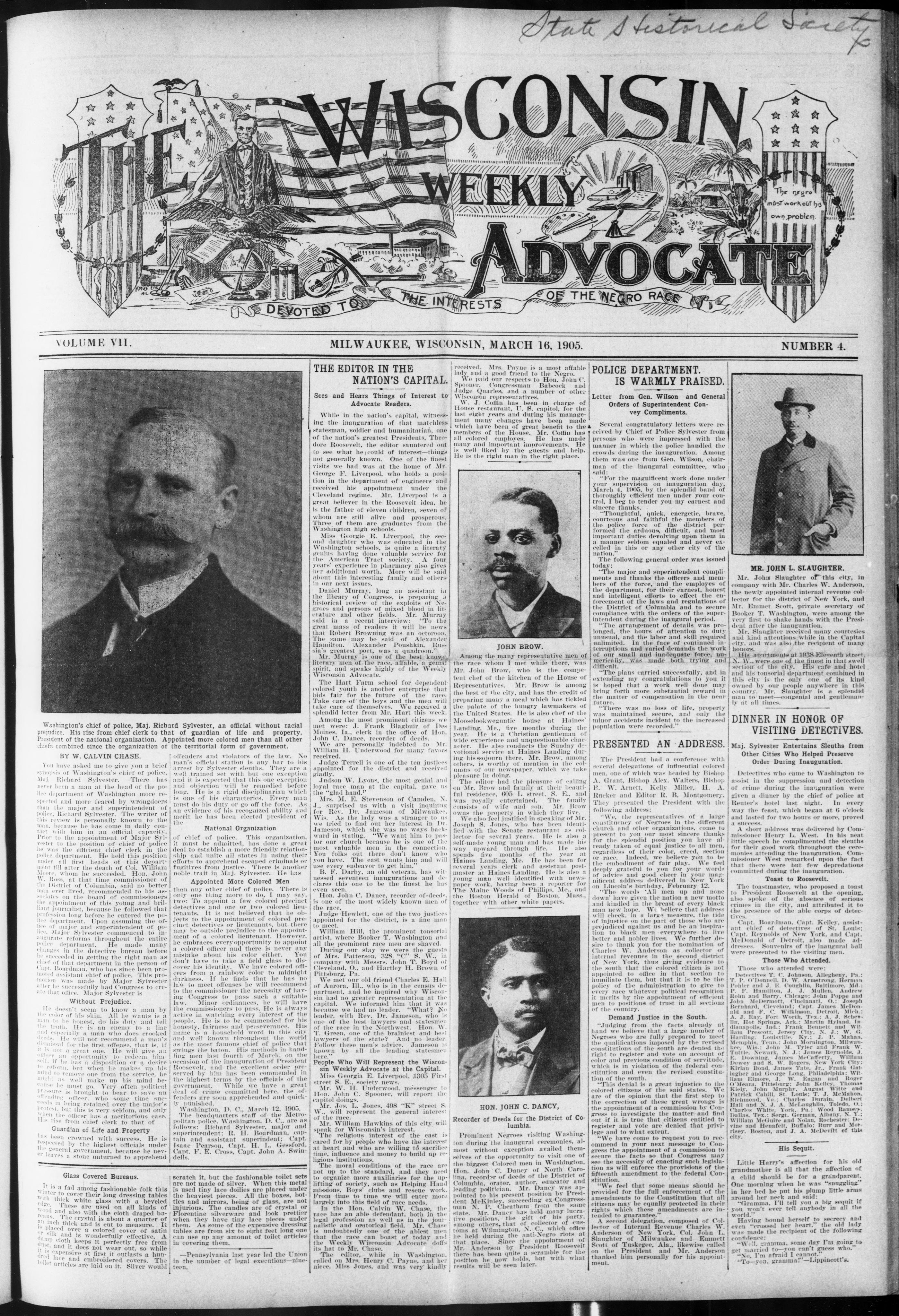
Washington's chief of police, Maj. Richard Sylvester, an official without racial prejudice. His rise from chief clerk to that of guardian of life and property. President of the national organization. Appointed more colored men than all other chiefs combined since the organization of the territorial form of government.
Washington's chief of police, Maj. Richard Sylvester, an official without racial prejudice. His rise from chief clerk to that of guardian of life and property. President of the national organization. Appointed more colored men than all other chiefs combined since the organization of the territorial form of government.
VOLUME VII.
Washington's chief of police, Maj. Rich prejudice. His rise from chief clerk to the President of the national organization. A chiefs combined since the organization of
BY W. CALVIN CHASE
You have asked me to give you a brief synopsis of Washington's chief of police, Maj. Richard Sylvester. There has never been a man at the head of the police department of Washington more respected and more feared by wrongdoers than the major and superintendent of police, Richard Sylvester. The writer of this review is personally known to the man, because he has come in daily contact with him in an official capacity. Prior to the appointment of Major Sylvester to the position of chief of police he was the efficient chief clerk in the police department. He held this position under all first heads of this department till after the death of Col. William Moore, whom he succeeded. Hon. John W. Ross, at that time commissioner of the District of Columbia, said no better man ever lived, recommended to his associates on the board of commissioners the appointment of this young and brilliant journalist, because he followed that profession long before he entered the police department. Upon assuming the office of major and superintendent of police, Major Sylvester commenced to inaugurate reforms throughout the entire police department. He made many changes in the detective bureau before he succeeded in getting the right man as chief of that department in the person of Capt. Boardman, who has since been promoted assistant chief of police. This promotion was made by Major Sylvester after he successfully had Congress to create that office. Major Sylvester is
Without Prejudice
He doesn't seem to know a man by the color of his skin. All he wants is a man to be honest, do his duty and tell the truth. He is an enemy to a liar and especially a man who does crooked deeds. He will not recommend a man's dismissal for the first offense, that is, if it is not a great one. He will give an officer an opportunity to redeem himself, if he has a disposition or a desire to reform, but when he makes up his mind to remove one from the service, he might as well make up his mind because he must go. Very often political pressure is brought to bear to save an offending officer, who some time succeeds in being retained over the major's protest, but this is very seldom, and only when the officer has a meritorious case. His rise from chief clerk to that of
Guardian of Life and Property
has been crowned with success. He is respected by the highest officials under the general government, because he never leaves a stone unturned to apprehend
Glass Covered Bureaus.
It is a fad among fashionable folk this winter to cover their long dressing tables with thick white glass with a beveled edge. These are used on all kinds of wood and also with the cloth draped bureaus. The crystal is about a quarter of an inch thick and is cut to measure. It is placed over a colored cover of satin or silk and is wonderfully effective. A damp cloth keeps it perfectly free from dust, and it does not wear out, so while it is expensive at first it outlasts a hundred lace and embroidered covers. The toilet articles are laid on it. Silver would
offenders and violators of the law. No man's official station is any bar to his arrest by Sylvester sleuths. They are a well trained set with but one exception and it is expected that this one exception and objection will be remedied before long. He is a rigid disciplinarian which is one of his characteries. Every man must do his duty or go off the force. As an evidence of his recognized ability and merit he has been elected president of
National Organization
of chief of police. This organization, it must be admitted, has done a great deal to establish a more friendly relationship and unite all states in using their efforts to apprehend escaped criminals or fugitives from justice. There is another noble trait in Maj. Sylvester. He has
Appointed More Colored Men
than any other chief of police. There is only one thing more to do, I may say, two: To appoint a few colored precinct detectives and one or two colored lieutenants. It is not believed that he objects to the appointment of colored precinct detectives or lieutenants, but there may be outside prejudice to the appointment of a colored lieutenant. However, he embraces every opportunity to appoint a colored officer and there is never any mistake about his color either. You don't have to take a field glass to discover his identity. We have colored officers from a rainbow color to midnight darkness. If he finds that he has no law to meet offenses he will recommend to the commissioner the necessity of having Congress to pass such a suitable law. Minor ordinances, he will have the commissioners to pass. He is always active in watching every interest of the people. He is to be commended for his honesty, fairness and perseverance. His name is a household word in this city and well known throughout the world as the most famous chief of police that swings the baton. His methods in handling men last fourth of March, on the occasion of the inauguration of President Roosevelt, and the excellent order preserved by him has been commended in the highest terms by the officials of the government. While we have a great deal of crime committed here, the offenders are soon apprehended and quickly punished.
Washington, D. C., March 12, 1905. The headquarters staff of the Metropolitan police. Washington, D. C., are as follows: Richard Sylvester, major and superintendent; R. H. Boardman, captain and assistant superindent; Capt. Isaac Pearson, Capt. H. L. Gessford, Capt. F. E. Cross, Capt. John A. Swindells.
scratch it, but the fashionable toilet sets are not made of silver. When this metal is used tiny lace doilies are placed under the heaviest pieces. All the boxes, bottles and mirrors, being of glass, are not injurious. The candles are of crystal or Florentine silverware and look prettier when they have tiny lace pieces under them. As some of the expensive dressing tables are from six to eight feet long one can use up any amount of toilet articles in covering them.
Pennsylvania last year led the Union in the number of legal executions—nine teen.
THE EDITOR IN THE NATION'S CAPITAL.
Sees and Hears Things of Interest to Advocate Readers.
While in the nation's capital, witnessing the inauguration of that matchless statesman, soldier and humanitarian, one of the nation's greatest Presidents, Theodore Roosevelt, the editor sauntered out to see what he could of interest—things not generally known. One of the finest visits we had was at the home of Mr. George F. Liverpool, who holds a position in the department of engineers and received his appointment under the Cleveland regime. Mr. Liverpool is a great believer in the Roosevelt idea, he is the father of eleven children, seven of whom are still alive and prosperous. Three of them are graduates from the Washington high schools.
Miss Georgie E. Liverpool, the second daughter who was educated in the Washington schools, is quite a literary genius having done valuable service for the American Tract society. A four years' experience in pharmacy also gives her additional worth. More will be said about this interesting family and others in our next issues.
Mr. Murray is one of the best known literary men of the race, affable, a genial spirit, and speaks highly of the Weekly Wisconsin Advocate.
The Hart Farm school for dependent colored youth is another enterprise that bids fair for the future of the race. Take care of the boys and the men will take care of themselves. We received a splendid letter from Mr. Hart this week.
Among the most prominent citizens we met were: J. Frank Blagbuir of Des Moines, Ia., clerk in the office of Hon. John C. Dance, recorder of deeds.
We are personally indebted to Mr. William H. Underwood for many favors received.
Judge Terrell is one of the ten justices appointed for the district and received gladly.
Judson W. Lyons, the most genial and loyal race man at the capital, gave us the "glad hand."
Mrs. M. E. Stevenson of Camden, N. J., surprised us with a visit inquiring for Rev. Dr. Jameson of Milwaukee. Wis. As the lady was a stranger to us we tried to find out her interest in Dr. Jameson, which she was no ways backward in stating. "We want him to pastor our church because he is one of the most valuable men in the connection. You folks out there don't know who you have. The east wants him and will use every endeavor to get him."
B. F. Darby, an old veteran, has witnessed seventeen inaugurations and declares this one to be the finest he has even seen.
Hon. John C. Dance, recorder of deeds, is one of the most widely known men of the race.
Judge Hewlett, one of the two justices appointed for the district, is a fine man to meet.
William Hill, the prominent tonsorial artist, where Booker T. Washington and all the prominent race men are shaved.
During our stay we were the guests of Mrs. Patterson, 328 "C" S. W., in company with Messrs. John T. Boyd of Cleveland, O., and Hartley H. Brown of Pittsburgh, Pa.
We met our old friend Charles E. Hall of Aurora, Ill., who is in the census department, and he inquired why Wisconsin had no greater representation at the capital. We informed him that it was because we had no leader. "What? No leader, with Rev. Dr. Jameson, who is one of the best lawyers and statesmen of the race in the Northwest. Hon. W. T. Green, one of the brainiest and best lawyers of the state? And no leader. Follow these men's advice. Jameson is known by all the leading statesmen here."
People Who Will Represent the Wisconsin Weekly Advocate at the Capital.
Miss Georgia E. Liverpool, 1305 First street S. E., society news.
Mr. W. H. Underwood, messenger to Hon. John C. Spooner, will report the capitol doings.
Mr. Jos. L. Jones, 498 "K" street S. W., will represent the general interest of the race.
Mr. William Hawkins of this city will speak for Wisconsin's interest.
The religious interest of the east is cared for by people who have the interest at heart and who are willing to sacrifice time, influence and money to build up religious institutions.
The moral conditions of the race are not up to the standard, and they need to organize more auxiliaries for the uplifting of society, such as Helping Hand missions, Boys' clubs and rescue work. From time to time we will enter more largely into this field of race needs. In the Hon. Calvin W. Chase, the race has an able defendant, both in the legal profession as well as in the journalistic and oratorical field. Mr. Chase is undoubtedly one of the ablest men that the race can boast of today and the Weekly Wisconsin Advocate doffs its hat to Mr. Chase. The editor, while in Washington, called on Mrs. Henry C. Payne, and her niece, Miss Jones, and was very kindly
received. Mrs. Payne is a most affable lady and a good friend to the Negro. We paid our respects to Hon. John C. Spooner, Congressman Babcock and Judge Quarles, and a number of other Wisconsin representatives. W. J. Coffin has been in charge of House restaurant, U. S. capitol, for the last eight years and during his management many changes have been made which have been of great benefit to the members of the House. Mr. Coffin has all colored employees. He has made many and important improvements. He is well liked by the guests and help. He is the right man in the right place.
A. E.
Among the many representative men of the race whom I met while there, was Mr. John Brow, who is the competent chef of the kitchen of the House of Representatives. Mr. Brow is among the best of the city, and has the credit of preparing many a meal which has tickled the palate of the hungry lawmakers of the United States. He is also chef of the Mooselookweguntic house at Haines' Landing, Me., five months during the year. He is a Christian gentleman of wide experience and unquestionable character. He also conducts the Sunday devotional service at Haines Landing during his sojourn there. Mr. Brow, among others, is worthy of mention in the columns of our newspaper, which we take pleasure in doing.
The editor had the pleasure of calling on Mr. Brow and family at their beautiful residence, 605 L street, S. E., and was royally entertained. The family consists of wife and son. Mr. Brow owns the property in which they live. We also feel justified in speaking of Mr. Joseph S. Jones, who has been identified with the Senate restaurant as collector for several years. He is also a self-made young man and has made his way upward through life. He also spends five months of the year at Haines Landing, Me. He has been for several years clerk and assistant postmaster at Haines Landing. He is also a young man well identified with newspaper work, having been a reporter for The Maine Woods of Phillips, Me., and the Boston Herald of Boston, Mass., together with other white papers.
[Picture of a man in a suit and bow tie].
Recorder of Deeds for the District of Columbia.
Prominent Negroes visiting Washington during the inaugural ceremonies, almost without exception availed themselves of the opportunity to visit one of the biggest Colored men in Washington, Hon. John C. Dancy of North Carolina, recorder of deeds of the District of Columbia, orator, author, educator and leading politician. Mr. Dancy was appointed to his present position by President McKinley, succeeding ex-Congressman N. P. Cheatham from the same state. Mr. Dancy has held many lucrative positions, the gift of his party, among others, that of collector of customs at Wilmington, N. C., which office he held during the anti-Negro riots at that place. Since the appointment of Mr. Anderson by President Roosevelt there has been quite a scramble for the position he now holds, but with what results will be seen later.
POLICE DEPARTMENT. IS WARMLY PRAISED.
Letter from Gen. Wilson and General Orders of Superintendent Convey Compliments.
Several congratulatory letters were received by Chief of Police Sylvester from persons who were impressed with the manner in which the police handled the crowds during the inauguration. Among them was one from Gen. Wilson, chairman of the inaugural committee, who said: "For the magnificent work done under your supervision on inauguration day, March 4, 1905, by the splendid band of thoroughly efficient men under your control, I beg to tender you my earnest and sincere thanks.
"Thoughtful, quick, energetic, brave, courteous and faithful the members of the police force of the district performed the arduous, difficult, and most important duties devolving upon them in a manner seldom equaled and never excelled in this or any other city of the nation."
The following general order was issued today:
"The major and superintendent compliments and thanks the officers and members of the force, and the employees of the department, for their earnest, honest and intelligent efforts to effect the enforcement of the laws and regulations of the District of Columbia and to secure compliance with the orders of the superintendent during the inaugural period.
"The arrangement of details was prolonged, the hours of attention to duty unusual, and the labor and skill required unlimited. In the face of continued interruptions and varied demands the work of our small and inadequate force, numerically, was made both trying and difficult.
"The plans carried successfully, and in extending my congratulations to you it is hoped that a work well done may bring forth more substantial reward in the matter of compensation in the near future.
"There was no loss of life, property was maintained secure, and only the minor accidents incident to the increased population were recorded."
PRESENTED AN ADDRESS.
The President had a conference with several delegations of influential colored men, one of which was headed by Bishop A. Grant, Bishop Alex. Walters, Bishop B. W. Arnett, Kelly Miller, H. A. Rucker and Editor R. B. Montgomery. They presented the President with the following address:
"We, the representatives of a large constituency of Negroes in the different church and other organizations, come to present to you our most sincere thanks for the splendid position you have already taken of equal justice to all men, regardless of their color, creed, section or race. Indeed, we believe you to be the embodiment of fair play. We feel deeply grateful to you for your words of advice and good cheer in your magnificent address delivered in New York on Lincoln's birthday, February 12.
"The words 'All men up and none down' have given the nation a new motto and kindled in the breast of every black man new hope. We believe that address will check, in a large measure, the tide of injustice on the part of those who are prejudiced against us and be an inspiration to black men everywhere to live better and nobler lives. We further desire to thank you for the nomination of Charles W. Anderson as collector of internal revenues in the second district of New York, thus giving evidence to the south that the colored citizen is not appointed to office in that section to humiliate them, but that it is to be the policy of the administration to give to every race whatever political recognition it merits by the appointment of efficient men to positions of trust in all sections of the country.
Demand Justice in the South.
"Judging from the facts already at hand we believe that a large number of Negroes who are fully prepared to meet the qualifications imposed by the revised constitutions of the south are denied the right to register and vote on account of color and previous condition of servitude, which is in violation of the federal constitution and even the revised constitution of the south.
"This denial is a great injustice to the colored citizens of the said states. We are of the opinion that the first step to the correction of these great wrongs is the appointment of a commission by Congress to investigate the matter and find out if it is true that citizens entitled to register and vote are denied that privilege and to what extent.
"We have come to request you to recommend in your next message to Congress the appointment of a commission to secure the facts so that Congress may see the necessity of enacting such legislation as will enforce the provisions of the fifteenth amendment to the federal Constitution.
"We feel that some means should be provided for the full enforcement of the amendments to the Constitution that all citizens may be equally protected in their rights which these amendments are intended to guarantee."
A second delegation, composed of Collector of Internal Revenue Charles W. Anderson of New York, Col. John L. Slaughter of Milwaukee and Emmett Scott of Tuskegee, Ala., likewise called on the President and Mr. Anderson thanked him personally for his appointment.
A. B.
MR. JOHN L. SLAUGHTER. Mr. John Slaughter of this city, in company with Mr. Charles W. Anderson, the newly appointed internal revenue collector for the district of New York, and Mr. Emmet Scott, private secretary of Booker T. Washington, were among the very first to shake hands with the President after the inauguration. Mr. Slaughter received many courtesies and kind attentions while in the Capital city, and was also the recipient of many honors.
His apartments at 1938 Eleventh street N.W., were one of the finest in that swell section of the city. His cafe and hotel and his tonsorial department combined in this city is the only one of its kind owned by our people anywhere in this country. Mr. Slaughter is a splendid man to meet—congenial and gentlemanly at all times.
DINNER IN HONOR OF VISITING DETECTIVES.
DINNER IN HONOR OF VISITING DETECTIVES.
Maj. Sylvester Entertains Sleuths from Other Cities Who Helped Preserve Order During Inauguration. Detectives who came to Washington to assist in the suppression and detection of crime during the inauguration were given a dinner by the chief of police at Reuter's hotel last night. In every way the feast, which began at 6 o'clock and lasted for two hours or more, proved a success.
A short address was delivered by Commissioner Henry L. West. In his neat little speech he complimented the sleuths for their good work throughout the ceremonies attending the inauguration. Commissioner West remarked upon the fact that there were but few depredations committed during the inauguration.
Toast to Roosevelt.
The toastmaster, who proposed a toast to President Roosevelt at the opening, also spoke of the absence of serious crimes in the city, and attributed it to the presence of the able corps of detectives. Capt. Boardman, Capt. Kelley, assistant chief of detectives of St. Louis; Capt. Reynolds of New York, and Capt. McDonald of Detroit, also made addresses. Souvenirs of the inaugural ball were presented to the visiting men.
Those Who Attended
Those who attended were.
Detectives T. C. Johnson, Allegheny, Pa.; T. P. O'Donnell, D. W. Armstrong, Herman Pohler and J. E. Coughlin, Baltimore, Md.; P. F. Hamilton, J. J. Mullen, Andrew Rohn and Barry, Chicago; John Poppe and John McDermott, Cincinnati, O.; Joseph Bernhard, Cleveland; Capt. James McDonald and F. C. Wilkinson, Detroit, Mich.; A. J. Ray, Fort Worth, Tex.; A. J. Schellin, Hot Springs, Ark.; Martin Hyland, Indianapolis, Ind.; Frank Bennett and William Prescott, Jersey City, N. J.; W. G. Harding, Louisville, Ky.; J. P. Mahan, Memphis, Teen; John Mornington, Milwaukee, Wis.; John M. Tyler and Frank W. Tuttle, Newark, N. J.; James Reynolds, J. E. Downing, James McCafferty, William Dewey and S. W. Rogers, New York City; Kirlan Bond, James Tate, Jr., Frank Galagher and George Long, Philadelphia; William Elmore, J. W. Eagan and Roger O'Meara, Pittsburg; John Kelley, Thomas Kiely, John Murphy, August Witte and Patrick Cahill, St. Louis; T. J. McMahon, Richmond, Va.; Charles Durain, Delbert Hall and N. J. A. McLaughlin, Toledo, O.; Charles White, York, Pa.; Wood Ramsey, Dallas, Tex.; Sergt. German, Albany, N. Y.; William McGuire and Nolan, Rochester; Devine and Henafelt, Buffalo; Burr and Morrisey, Boston, and J. A. McDevitt of this city.
His Sequit
Little Harry's affection for his old grandmother is all that the affection of a child should be for a grandparent. One morning when he was "snuggling" in her bed he put his plump little arms around her neck and said: "Gramma, I'll tell you a big sequit if you won't ever tell anybody in all the world." Having bound herself to secrecy and even "crossed her heart," the old lady was made the recipient of the following confidence:
"Well, gramma, some day I'm going to get married to—you can't guess who." "No, I'm afraid I cannot." "To—you, gramma!"—Lippincott's.
Miscellaneous Items.
—In Norway the average length of life is greater than in any other country on the globe.
—Twelve hitherto unknown minuets by Beethoven have been discovered in the Vienna Court library. They are to be played in Paris shortly.
—The municipal council of Paris is thinking of renaming the Pont des Invalides the "Pont d'Eduard VII." in honor of the English King.
—The British postoffice, which controls the telegraph system of that country, has decided to adopt the name "radie" for wireless telegraph messages.
—The British consul at Chifoo reports that the Japanese make matches cheaper than the Chinese and are driving the native match from the Chinese market.
—Mexican mints turn out more silver money than those of any other country in the world. Last year Mexico shipped several million silver dollars to China.
—Rubies are found in large quantities in the Brazilian diamond fields, but they are so small that they are only of use for watch jewels and are seldom exported.
—An eight-foot steel chimney, 230 feet in height, has just been completed and will be erected in Mexico. This will be the highest steel chimney in America.
—One of the latest ideas to be propounded and which will be brought forward at a future international postage congress is a suggestion for an international stamp.
—Tourists in Egypt are supposed to be provided with passports, but the law is not strictly enforced; a visiting card suffices.
—Fireworks on the mainland, mistaken for signals of distress from sea, caused the lifeboat men of Totland bay, Isle of Wight, to spend four hours at sea in stormy weather.
—Leaflets have been distributed in the streets of Berlin in which the notorious anti-Semite, Count Puckler, calls on the inhabitants to attack the Jews and destroy Jewish property.
—Thieves have carried off from the Church of Sauvetat, in the French department of Puy de Dome, a massive and artistic copper statue of the Virgin which is said to date from 1319.
The art treasures of Windsor castle are said to be worth over $60,000,000. The King has had them rearranged, but has not been able to insure them as yet, owing to their great value.
Capital punishment has been abolished in the state of Nuevo Leon, Mexico, for ordinary crimes, but is reserved for highway robbers, traitors, revolutionists and such other offenders.
Lecturing the other night at Liverpool, Rev. Ian Maclaren said: "No man is justified in marrying who cannot obtain a first-class life certificate from a really good insurance company."
The amount of money advanced to Irish tenants for the purchase of their lands under the various acts of Parliament passed since 1886 is, according to a parliamentary paper, $128,866,015.
—The Columbia (S. C.) state notes that "the dispensary sales in Sumter (population 5680) for the six days ending December 24, aggregate $6422"—more than $1 worth of rum for each inhabitant.
—After a club dinner at a hotel in Stockholm, says the Frankfurter Zeitung, several hundred persons fell ill of typhoid, due to unfiltered river water being used for washing the vegetables.
—The precise number of words in the Old and New Testaments is 773,692, and by reading something like 10 minutes a day at the pace of 200 words a minute one could read the Bible through in a year.
Berlin municipality has refused a legacy of $125,000, left by a professor, wherewith, says a Paris newspaper, to found an orphanage where children should be brought up on an exclusively vegetarian diet. When leaving Sydney for America, the London Mail says, Paderewski ordered 10,000 large panel photographs of himself for sale during his American tour, the largest order of the kind ever known in Sydney. A plan is now on foot to connect some of the scattered islands in the South sea by wireless telegraph. It is thought that it will be of great benefit, as there is now no means of communication between them.
When the electrification of the railways which run underground in London is completed the traveler will be able to traverse sixty miles underground by electric traction without running twice over the same piece of track.
Many pieces of the best statuary used on the grounds and buildings at the world's fair have been donated by the St. Louis management to the Lewis and Clark exposition, where they will grace the grounds next summer.
Gov. Sparks of Nevada and some other wealthy men intend to establish an oasis in Death valley, 75 miles south of Goldfield, for the benefit of travelers. Artesian wells will transform it, and it is to be stocked with game.
Before a Scotch judge may take his seat on the bench he must conduct a probationary trial to the satisfaction of his brother judges. Lord Ardwell, appointed bill chamber judge by the King, has just undergone the ordeal. London is steadily growing worse, if the police records may be used as a criterion, as during the past year the number of drunk and disorderly cases amounted to 8.67 per 1000 population, "the largest percentage since 1853." According to the annual report of the Volunteers of America, of whom Ballington Booth is the leader, the congregations at the 35,000 services during the year within the volunteer halls and buildings reached 1,060,955 persons.
The National Union of Telephone Operators, formed by English hello-girls, has won a great victory. The National Telephone company, threatened with a strike, has consented to allow the members to wear colored combs and beads and shirtwaists other than black.
Upon Emperor William's request the so-called equestrian festival planned by aristocratic society of Berlin, has been given up. The costumes were to be of so rich a character that the Emperor thought it would be too expensive for the officers to participate. The Kaiser is endeavoring to lessen luxury in the army.
In Denmark there are 224,000 rural land owners. More than half have not more than one acre. 96,000 have less than four acres and only 2000 have more. The small landowners mainly occupy themselves with the egg and fowl industry. Of the three brides now offered to King Alfonso the daughter of the Archduke Frederick is approved by the Queen mother, Princess Maria of Mecklenburg is preferred by the Kaiser, and the Princess Patricia of Connaught is favored by the Spanish cabinet.
Swiss funeral customs are most peculiar. At the death of a person the family inserts a black-edged announcement in the papers that "the mourning urn" will be exhibited within certain hours on a special day. In front of the house where the person died there is placed a little black table, covered with a black cloth, on which stands a black jar. Into this the friends and acquaintances of the family drop small black-margined visiting cards, sometimes with a few words of sympathy on them. The urn is put on the table on the day of the funeral. Only men go to the churchyard, and they generally follow the hearse on foot.
RELINQUISHMENT.
The hardest gift that any man may give Is to give back the heart he wins in vain;
To yield with grace what he may not retain
When low consent turns pleading negative—
To slip the latch where Joy had come to live—
Sweet singing Joy, that with so dear disdain
Flooded with melody its small domain.
It seemed love could for liberty retrieve.
But liberty weighed more than love's exchange
change, And such a longing did the song betray. Regretful, tender; tender, appealing, strange—
What could the soul of any captor say?
Go, beauteous, winged, singing Joy, go
range:
Your cage is open, little bird, away!
-Marshall Isley in the Century.
LADY MIRFIELD'S DENTIST.
Dolly Mirfield, if her general intentions could be accurately added up (a sum which would tax the arithmetic of the recording angel, and pave the way for miles in various directions), did not probably add up on the wrong side.
In other words, she intended to be kind and to make things pleasant more than she intended to be malicious and make them unpleasant. But it is doubtful whether any one ever succeeded in the course of the ordinary day's work in doing more harm than she did without actually intending it. But one day she had a lesson, and what was bitter, a woman not nearly so clever as she, nor nearly so popular or pretty or socially important, taught it her.
Dolly never, or hardly ever, even when she meant to be nasty, actually said an unkind thing. Supposing—on those occasions when she meant to be nasty—some friend made a disparaging and perhaps slightly libelous remark, in strict confidence about a mutual friend, Dolly would never, or hardly ever, distinctly indorse it. Instead, she would say, "Yes, poor thing" and give a beautiful sigh.
And having sighed, Dolly always changed the subject, and talked about the opera, or the creation of the world, or Christian Science. Chiefly by her own cleverness she had built herself a very tall pinnacle indeed in society, and she sat serenely on the top of it while other people climbed up on ladders to talk to her. Her husband, Lord Mirfield, was extremely rich, but otherwise of no importance, while his wife, much younger than himself, had managed to make herself very important indeed.
She entertained largely, she was extremely strict and proper (a social factor the value of which is often overlooked), and all those who were in the slightest danger of being tarred came to her, as to a kind of River Jordan, for social baptism. She had a good cook, and her husband excellent shooting. Yet, even all this equipment did not make her invulnerable. And the manner of the lesson that was taught her was as follows:
London was all agog about a certain event which was supposed to have happened. There had been a dreadful subaqueous scandal, a scandal, that is, which everybody is rather afraid to talk about at first, waiting for somebody else to begin, and, as a rule, not having to wait long. The exact details of it are of no importance, but it concerned Lord Mirfield's sister, whom Dolly detested. She was supposed to have "carried on," and had quite certainly left England rather suddenly. So everybody wanted to know if it was true that she had gone to meet Him. Dolly herself knew no more, but at this juncture the sister of Him called one afternoon at Lady Mirfield's.
Now, Dolly was less well informed about this particular affair than she liked. Therefore, she was most eager to learn what the true state of the case was, and made no doubt that Mrs. Armytage, this sister of Him, had come to talk things over with her, and see what could be done to save the situation. So she told the footman there had been a mistake, and she would be down in a moment.
Mrs. Armytage did things impulsively.
"Of course, you gugess what I have come about?" she said. "It has only just reached me that people are saying scandalous things about Jack and your sister-in-law. Aren't they brutes? And what is to be done, do you think?"
Now this was not quite the attitude which Dolly expected, nor was it reasonable to suppose that she would help unless she was told all the real facts. So to begin with she was vaguely sympathetic.
"You look dreadfully upset, dear Mrs. Armytage," she said.
"I know, I am hideous. But there is all this worry, and I have been in the dentist's chair half the morning. He hurt me frightfully."
Dolly was always kind over this sort of thing. "Ah, I am sorry," she said. "You should go to my dentist. He never hurts."
"I'm in agonies now," said Mrs. Armytage. "Do tell me whom you go to."
"Ampthill, in Sloane square," said Dolly.
Mrs. Armytage paused a moment, as if an idea had struck her. But her large, heavy face reflected nothing whatever of it, and Dolly hardly wondered at all what she was thinking about.
"And then there's this dreadful worry about poor Jack," Mrs. Armytage went on. "Of course, it is perfectly true that he was madly in love with her. It is also true that he is a dear, honest old boy, and so he left England, as perhaps you have heard."
"Yes, I heard," cooed Dolly, who as a matter of fact had not.
"That he left England for fear of himself. Now, was there ever anything so unfortunate? For on the very day on which he crossed from Dover to Calais, your sister-in-law crossed from Folkestone to Boulogne! And now, of course, a hundred tongues in London are wagging about it. And—it's so like Jack—he has left no address, and it is impossible to communicate with him, and tell him to come back at once. So I want you to help me to stop people talking; you can do so much. That is why I came here."
Then Lady Mirfield gave her beautiful sigh. She detested her sister-in-law.
"You mean you won't do what you can to stop people saying these things?" asked Mrs. Armytage. "I have told you that it is all an infamous libel."
"Yes, dear," she said; "but other people will tell me that it is true!"
"But I who know tell you it is not true," said Mrs. Armytage.
Dolly sighed once more. There was really no need to say anything, but the sigh was dreadfully expressive. Then Mrs. Armytage spoke in a detached, unbiased voice. "I went to my dentist's this morning."
she said, "who is Mr. Ampthill, of Sloane square. I came into the room before he was quite ready for me, and saw him putting into a box a beautiful complete set of false teeth. And on the table outside when I went out there was a package addressed to you. Now I have a disengaged day tomorrow, and I intend to devote it to making myself disagreeable to any who, by speech or silence, or—or sigh, tend to encourage this scandal and make it believed."
Dolly sat bolt upright in her chair. "But it isn't true," she said. "I have thirty-two teeth of my own." "Nor is it true that Jack left England with your sister-in-law," said Mrs. Army-tage.
There was a pause, then Dolly laughed, laughed properly with her head back
"Just to say that this is all a wicked scandal--you can leave out the 'wicked' if you like--instead of admitting its truth by sighing," said Mrs. Armytage. "And if I don't?" "I shall mention casually and constantly what I saw at Mr.—Mr. Ampthill's, of Sloane square." "But no one will believe you," said Dolly. "Besides, it isn't true." Mrs. Armytage finished her tea. "No, it isn't true," she said. "But you have such beautiful teeth, dear, that people will wonder if it isn't." Dolly again devoted a few moments' thought to the consideration of this.
"Aren't you rather a beast?" she asked. "Very likeiy. But so, you know, are you, when you sigh away my brother's character like that." Dolly put her head on one side and smiled charamingly. "Yes, I'm cornered," she said. "You really managed it very well. Now you must have some more tea, and tell me more about it all. I must be well informed, if I am to be convincing."—E. B. Benson in London Daily Mail.
Recent Legal Decisions.
Several members of a municipal legislative body, who join in making a corrupt agreement to vote for a measure which is to come before them, in consideration of a promise to place a sum of money at their disposal, are held, in State versus Lehman (Mo.) 66 L. R. A. 490, to be properly joined in one indictment for bribery.
In granting an easement across his premises for the purpose of a public highway, the owner of property is held, in L. Realty Co. versus Johnson (Minn.) 66 L. R. A. A. 439, not to surrender to the public his right to foster and protect wild game on the land, and the public is held to have no right to pursue and kill the game while temporarily passing to and fro across the highway.
A conveyance by an insolvent of practically all his property to his wife in trust, to manage and pay such of his debts as may seem judicious to her, and at his decease to distribute the estate as he shall appoint, and, in the absence of appointment, among his heirs at law, is held, in Matthews versus Thompson (Mass.) 66 L. R. A. 421, to be void as against his creditors.
That the primary purpose of a branch track to a stone quarry is the accommodation of the owner of the quarry is held, in Ulmer vs. Lime Rock R. Co. (Me.) 66 I. R. A. 387, not to prevent the exercise of the right of eminent domain for the acquisition of a right of way if the track is in fact intended for the use of the public, which will be entitled to its use whenever the necessity therefor arises.
The intentional kicking, without just cause or excuse, by a street car conductor, of a boy who was attempting to board the car to become a passenger is held, in McNamara vs. St. Louis Transit Co. (Mo.) 66 L. R. A. 486, to justify an award of exemplary damages against the street car company, although the conductor honestly believed that the boy was attempting to steal a ride.
The liability of a landlord for injury to a tenant because of defects in the construction of the building on the leased premises, of which he had no knowledge, and which were so hidden that there was no way of discovering them without undoing a portion of the construction work, is denied in Whitley versus McLaughlin (Mo.) 66 L. R. A. 484.
The right of an employee to recover damages of a railroad company for an injury proximately caused by his violation of a penal statute or municipal ordinance is denied in Little versus Southern Railway company (Ga.,) 66 L. R. A. 509, even though the employer may have directed the employee to violate the law, or may have sanctioned the continuance of a custom amounting to a contravention of the law.
A distribution of prizes to those who shall make the closest estimate of the number of cigars in a box on which a tax is paid during a specified month is held, in People ex rel. Ellison versus Lavin (N. Y.) 66 L. R. A. 601, to be made by chance, within the meaning of a statute defining a lottery as a scheme for the distribution of property by chance to persons who have paid or agreed to pay a valuable consideration for the chance.
The injury inflicted upon a street car passenger through mental suffering, humiliation, wounded pride and disgrace because of the act of the conductor in calling her a deadbeat when she asked for the proper change for money she had tendered in payment of fare is held, in Gillespie vs. Brooklyn Heights R. Co. (N. Y.) 66 L. R. A. 618, to be properly considered in assessing the damages for breach of the carrier's contract to return the proper change for money tendered.
Longest Span Bridge.
There is now under construction across the St. Lawrence at Quebec a cantilever bridge which, when completed, will contain the longest span of any bridge yet erected, not even excluding the great cantilevers of the Forth bridge in Scotland. The structure consists of two approach spans of 210 feet each, two shore arms, each 500 feet in length, and a great central span 1800 feet in length. The total length of the bridge is 4220 feet, and although in extreme dimensions it does not compare with the Firth of Forth bridge, which is about one mile in total length, it has the distinction of having the longest span in the world by 90 feet, the two cantilevers of the Forth bridge being each 1710 feet in length.—Scientific American.
Donkeys in Trousers
The only water to be obtained at Paita, Peru, has to be brought from Piura on donkeys, and to protect them from the mosquitoes which infest the country they are obliged to wear trousers.
SIR MARCH.
Sir March, you're a blustering fellow With riotous, rollicking ways!
And it's ho, for a charge from the Northland
And a battle with forces unseen.
You rattle our doors and our windows.
You butter and beat as about.
And you smile with a glimmer of sunshine,
Then pelt us with snow and with sleet.
Till we shrink from your bolsterous caresses
And hastily beat a retreat.
And it's ho, for a romp and a frollie,
And it's ho, for a rout and a roar.
But we know that for all of your bluster
You are friendly and true to the core,
And though April is tearful and tender,
And May is both charming and arch.
By the bloodstone that glows in your helmet,
We pledge you allegiance, Sir March.
—Ellizabeth Clarke Hardy in The Ladies' World.
New York Every Day.
A strike of a few women employed as trimmers in hat factories at Orange, N. J., has been settled. Several thousand employees who were thrown out of work a week ago by the action of the women will return to their benches today.
The will of former Mayor Edward Cooper was filed in the surrogate's office. Cooper Union, for the advancement of science and arts, receives $100,000. The testator made complete provisions in the will for his wife, but she died before him. He left the residue of his estate to his daughter, Edith Cooper Bryes.
The United States Steel corporation, with a capitalization of $1,100,000, was assessed for $10,000,000 personal property by the New York tax officials this year. This $10,000,000 was in excess of its real estate and debts. The company made its formal answer, or return, on the assessment, and its attorney has sworn off all save $2,000,000 of the assessment.
The New York Telephone company has made arrangements to reduce rates in that city about 20 per cent. As a consequence the resolution now pending in the finance committee of the Senate and the ways and means committee of the Assembly at Albany providing for an investigation of telephone charges and the bill providing for a reduction of the charges are likely to be dropped.
Col. Joseph J. Slocum, brother-in-law of Russell Sage, has filed petition in bankruptcy to get rid of a lot of debts contracted twenty-three years ago through losses on stock transactions. His schedules show liabilities of $77,105 and assets of $75 cash in bank. He has a gold watch and chain valued at $25, for which he asks exemption. His life is insured for $10,000 for the benefit of his children.
The romance that led to the arrest and unfrocking of Rev. Father Evan Dobinac, a young Austrian priest, at one time laboring in Chicago, culminated in his marriage to Anna Fratter, a young country woman, with whom he eloped to Chicago, where the young woman's father had the priest arrested. The priest was locked up in New York city for three days and then released, unfrocked and banished from the church.
Timely discovery has been made that the roof timbers of the Fifth Avenue Baptist church are weakened and that the building which usually is filled each Sunday with a large and fashionable congregation, is unsafe. Services will be held elsewhere until repairs are made. The church is known as the Rockefeller church, from the fact that John D. Rockefeller attends services there and the Bible class is conducted by John D. Rockefeller, Jr.
Eighteen cases of matrimonial mistakes were tried by Judge Traux in the supreme court. He had fifty-three on his calendar. It took on an average about thirteen minutes to hear each case, the total time consumed being 234 minutes. In the majority of instances these mismated couples did not have children. As near as could be learned only five had children, the aggregate number of which did not amount to a dozen. Most of those concerned were of foreign birth. Decision was reserved in nearly all the cases.
Whitelaw Reid's retirement from the editorship and direction of the New York Tribune in consequence of his having taken office abroad under the government makes necessary a reorganization of the editorial department. Hart Lyman, long a member of the editorial staff, succeeds Mr. Reid as editor. Donald Nicholson, who has been connected with the Tribune for thirty-five years, retires at his own request from the managing editorship, and is succeeded by James Martin, who has been news editor since 1900.
Mrs. Blank and her there fellow tenants who have been adding to the population of the furthest east side of New York city at the rate of one a year each must move from their happy home. In the language of Mr. Russ, their landlord, they must "ged onidt." The great principle of the 50 cent raise in rent for every additional baby has been vindicated. Mrs. Blank, with her four children, Mrs. Frank with eight, Mrs. Friedman with one, and Mrs. Crouch with four must go out in the world to find a tenement run on the Roosevelt principle.
Opposition to the prosposed sait water fire system which Fire Chief Croker has so vigorously denounced, has reached the sensational stage. It was learned that the board of fire underwriters and the chamber of commerce had caused letters to be sent to Mayor McClellan warning him not to accept bids on the present plans, which call for an expenditure of $5,000,000 already appropriated. They have communicated with the mayor direct with a view to having the bids for the seven large contracts for this work held back until further light can be thrown upon the proposed system.
Bishop Burgess of the Episcopal church said at a noonday meeting in the Church of the Holy Trinity that parents have no right to pray for their children's lives until they first have done all they could to save them through the science of medicine and surgery. He said: "Jesus never performed a miracle when the natural means would do as well. You have the right to pray for your child's life, if you are doing all you can to save it, but you have no right to sit in idleness and let fever take its course or blood flow from an unstanched wound. Let us remember the sanity of Jesus."
Hazers at Columbia university have, it is reported, finally succeeded in exercising their arts on Kingdon Gould, son of George Gould, who caused considerable excitement some time ago by drawing a revolver and driving off a band of sophomores when they attempted to capture him. Six sophomores, representing a secret organization of the sophomores, are said to have taken young Gould by sur-
prise as he was leaving the university. They placed him under parole until night, when he was duly hazed, and the class was avenged for the manner in which he spoiled their plans to make him an unwilling guest at their dinner.
With physicians, nurses and her family about her in her home at 451 West End avenue, Miss Grace Carpenter, a handsome young woman, 25 years old, is raving mad, due, her family says, to her infatuation for Christian Science, the study of which she took up two years ago. So violent did the young woman become today that before daylight her family was forced to send for the police and an ambulance from Roosevelt hospital. Miss Carpenter became a convert to the theory of Christian Science two years ago. She had no ailment of her own, but it is said a friend had been cured of an illness and the girl became an advocate of its use in disease to replace medicine.
Concert giving in Carnegie Music hall will be so much more expensive next year than heretofore it is possible several organizations accustomed to use the big auditorium will abandon or greatly modify their series. The music hall company has notified managers of the increase in rent for the auditorium, in some cases amounting to 60 per cent. The one-night rate of $400 next season will be enforced on every occasion. There will be no reduction, as heretofore, for a series of performances. The present rates are: One night, $400; two engagements, $700; three, $1000; four, $1250; five or six, $1500; every additional time, $250 more. Further, the hall no longer may be used free for orchestral rehearsals. The charge next year will be $10 a time, plus the cost of arranging the stage, a considerable item.
Three men arrived on the Oceanic whom the officers of the ship declared to be card sharpers. They sailed from New York on the Oceanic February 15 and returned on the same ship under the names, according to the ship's officers, of J. H. Connell, G. W. Simonds and E. A. Willard. On the eastward trip, it is said, they won money at cards. After the arrival of the ship on the other side an army officer wrote to the company that he had lost quite a sum. On the return trip a warning against gamblers was posted in the smoking room and Capt. Cameron stationed stewards outside the staterooms of the three men to prevent them from taking passengers into them. They were indignant, but Purser Russell warned them if they attempted to play cards he would have them arrested, and they did not play.
Mabel Spang, daughter of Charles H. Spang, a wealthy manufacturer of Pittsburg, Pa., who was remanded to a private sanitarium in Yonkers January 19 by order of Supreme Court Judge Marean, has been released and is now said to be in Brussels. Miss Spang's case attracted considerable notice early in January, when a man in New York city whom she did not even know brought habeas corpus proceedings before Judge Marean seeking to have the young woman released from confinement, alleged to be uncalled for by any mental ailment. Her restraint in the sanitarium was the result of proceedings which the court refused to make public and after several lengthy hearings Judge Marean refused to order her release. It is stated that she was released, however, two weeks later, the entire affair remaining a mystery.
When the Manhattan club elects its class of five governors an attempt will be made to defeat Perry Belmont, who has been a governor several years. The club has fifteen governors, who are elected in classes of five for three year terms. The committee on nominations recently chose the following regular ticket: John Hone, William S. Rodie, Pierre F. MacDonald, Louis J. Conlan and Perry Belmont. All are now governors except Conlan. Some members who frequent the club a great deal are not entirely satisfied with the ticket. They specially are displeased by the renomination of Belmont, who, they say, has not visited the clubhouse often. The upshot has been that the younger and more clubbish element have put up an opposition ticket. It differs from the regular ticket only in that the name of George F. Harriman appears instead of that of Perry Belmont.
There are no negro millionaires in New York nor probably in any other city, but there are many negroes here who are worth upward of $100,000. The five richest men of the African race are James C. Thomas, William H. Smith, James Barefield, Dr. P. W. Ray and L. S. Wiliams. All these men are above the $100,000 mark. There are in this city a large number of negro women of independent means. Mrs. Lulu M. Shepherd owns an apartment building in West 134th street, Mrs. Hannah Walker possesses a fine residence in West 135th street, Mrs. Charles Gale owns an expensively furnished home in Penn street, Brooklyn, and in the same block Mr. and Mrs. Daniel Brooks have an elegant residence. Mrs. Brooks also owns two apartment houses in Brooklyn. Mrs. Philip A. White, the widow of a negro druggist formerly in business at William and Frankfort streets, owns property to the assessed value of nearly $60,000.
---
Women complaining that they lack wholesome diversion, owing to the fact that they are engaged six days a week in business pursuits, have effected an organization called the Business Women's New York league, which will seek to bring the members into touch for mutual helpfulness and to provide pleasurable recreation. This is the first eastern branch of an organization, the Business Women's National league, which was formed in St. Louis, after the last meeting of the General Federation of Women's Clubs, with headquarters in Denver. Social meetings will be held once weekly and the promoters are endeavoring to work out a plan broad enough and sufficiently interesting to prove beneficial and attractive to saleswomen, stenographers and others engaged in commercial pursuits; also teachers, artists, lawyers, physicians, writers and other professional women. Among the schemes under discussion is one for purchasing a place distant from the city, where members of the league needing rest can live for a time at small expense.
In swell cafes and hotel bars uptown and downtown in New York city one sees waiters apparently indifferent to tips, although they take them with a mild nod when proffered. But they do not make a patron feel uncomfortable if a tip is not forthcoming. "These men get fairly good wages," said the proprietor of a popular Broadway cafe, "and their tips come to them all in a lump on a certain day in the year. One day in each year the total receipts of every department in the cafe—bar, luncheon counter and cigar stand—are divided among the employees. The receipts from liquor do not mean exclusively beverages sold over the bar, but wines and liquors sold in bulk. I was with the late Theodore Stewart when he began this system in his cafes in John street and Warren street some years ago. The first year he had $1920 to divide up between thirty employees in both places. Next year, after the regular patrons found out what was going on, nearly three times that sum was divided."
COMMISSIONER GARFIELD'S REPORT.
It Is Found to Be Favorable to the Great Packers.
The report of Commissioner of Corporations Garfield on the beef industry, after about eight months' investigation in Chicago and elsewhere, shows that there has been an enormous amount of exaggeration in the statements that have appeared for some time past in regard to the beef business. This investigation was set on foot by a resolution of the House of Representatives adopted March 7, 1904, and the ascertained facts after a most rigid examination of the methods and general conduct of the business are contained in a report covering 308 pages. Its figures and tables conclusively show that the popular belief in enormous profits made by the large packers, such as Armour & Co., Swift & Co. and Nelson Morris & Co., and in the exclusive control of the business which many think they enjoy, is really without foundation.
The report made to President Roosevelt by Commissioner Garfield is really the first official statement of the actual conditions of the beef business that has been made, and as all the conclusions arrived at are based, as shown by him, upon data officially obtained, there seems to be no reason why they should not be regarded as reliable and in all respects trustworthy.
This report shows why the price of both cattle and beef advanced to the highest level ever known after the short corn crop of 1901, and states that because of the decrease in number of cattle and also in decreased weight, "the high prices of beef which caused so much complaint among consumers at this time were attributable wholly to these abnormal cattle prices."
All the figures of the live weight and live cost of all dressed beef cattle were obtained from actual killing records and all information of every kind obtained by the Commissioner was voluntarily and freely offered by the packers, all books of record and papers connected with the business having placed at his disposal.
To make certain that the results of the investigation should be absolutely accurate, the Commissioner states that a double method of ascertaining profits was adopted, and, without going into detail here, it is found that the conclusion arrived at shows an average profit of 99 cents per head. The Commissioner says "the close parallelism in the results of the two methods of ascertaining the profits confirms completely the correctness of the general conclusions." It is clearly established that "western packers do not control more than half of the beef supply of the United States," the conclusion of the Commissioner being that the business done by them amounts to "about 45 per cent" of the total slaughter of the country.
The whole report is extremely interesting and well worthy of careful perusal. As an official report it may be regarded as worthy of confidence and it certainly leads the reader to the conclusion arrived at by the Commissioner when he states that "the capitalization of none of these concerns is excessive as compared with its actual investment" and that from thorough and rigid examination of original entries in books and papers to which he had access there was also "indirect evidence that the profits of the packers in their beef business are less than is frequently supposed," as shown by comparison between the total profits and the total amount of sales.
DOUBLE SKIRTS TO BE THE "GO."
Dressmakers of Paris Decide One Feature for New Models.
The secrets of Paris dressmakers in novelties still are jealously guarded. However, double skirts will be the feature of the new season's models. The sleeves will be short and very full at the shoulder.
Billion Dollar Grass
When the John A. Salzer Seed Co., of La Crosse, Wis., introduced this remarkable grass three years ago, little did they dream it would be the most talked of grass in America, the biggest, quick, hay producer on earth, but this has come to pass.
Agricultural Editors wrote about it, Agr. College Professors lectured about it, Agr. Institute Orators talked about it, while in the farm home by the quiet fire-side, in the corner grocery, in the village post-office, at the creamery, at the depot, in fact wherever farmers gathered, Salzer's Billion Dollar Grass, that marvelous grass, good for 5 to 14 tons hay per acre and lots of pasture besides, is always a theme worthy of the farmer's voice. Then comes Bromus Inermis, then which there is no better grass or better permanent hay producer on earth. Grows wherever soil is found. Then the farmer talks about Salzer's Teosinte, which produces 100 stocks from one kernel of seed, 11 ft. high, in 100 days, rich in nutrition and greedily eaten by cattle, hogs, etc., and is good for 80 tons of green food per acre.
Victoria Rape, the luxuriant food for hogs and sheep, which can be grown at 25c a ton, and Speltz at 20c a bu., both great food for sheep, hogs and cattle, also come in for their share in the discussion.
JUST SEND 10C IN STAMPS and this notice to John A. Salzer Seed Co., La Crosse, Wis., for their big catalog and many farm seed samples. [C. N. U.]
Fashion Note from Kansas.
It is a pleasure to note the decrease in the number of celluloid collars at the state house this session.—Topeka Capital.
Mother Gray's Sweet Powders for Children.
Successfully used by Mother Gray, nurse in the Children's Home in New York, cure Constipation, Feverishness, Bad Stomach, Teething Disorders, move and regulate the Bowels and Destroy Worms. Over 80,000 testimonials. At all Druggists, 25c. Sample FREE. Address A. S. OLMSTED, LeRoy, N. Y.
At the present moment there are 194 monuments in Germany that have been completed to Prince Bismarck, while forty-four others are in process of construction, or are planned.
CASTORIA
For Infants and Children.
The Kind You Have Always Bought
Bears the
Signature of
Charles H. Hutchins
GOSSIP FOR THE LADIES.
```markdown
```
When I consider Life and its few years—
A wisp of fog betwixt us and the sun;
A call to battle, and the battle done
Ere the last echo dies within our ears;
A rose choked in the grass; an hour of
A rose choked in the grass; an hour of
fears.
The gusts that past a darkening shore to beat.
The burst of music down an unlistening
I wonder at the idleness of fears. Ye old, old dead, and ye of yesternight. Chieftains, and bards, and keepers of the sheep!
By every cup of sorrow that you had. Loose me from tears, and make me see
How each hath back what once he stayed to weep:
Homer his sight. David his little lad!!
—Lisette Woodward Recse in the Exchange.
Why Don't You?
Why don't you answer your friend's letter at once? It will have double value if written promptly, and will take no more time now than by and by. Why don't you make the promised visit to that invalid? She is looking for you day after day, and "hope deferred maketh the heart sick." Why don't you send away that little gift you've been planning to send? Mere kind intentions never accomplish any good. Why don't you speak out the encouraging words that you have in your thoughts? Unless you express them they are of no use to others.
Why don't you try to share the burden of that sorrowful one who works beside you? Is it because you are growing selfish? Why don't you take more pains to be self-sacrificing and loving in the every-day home life? Time is rapidly passing. Your dear ones will not be with you always. Why don't you create around you an atmosphere of happiness and helpfulness, so that all who come in touch with you may be made better? Is not this possible?—Selected.
Under the Roof-Tree.
Domestic training for girls seems to be engaging the intelligent attention in all civilized countries, says the Newark News. Never were the people of this country so intent upon teaching all branches of domestic science as they are today, and they are willing to spend time and money so that the housekeepers and homemakers of the future may be more fittingly trained for their duties. We learn from one of our foreign contemporaries that this subject has been greatly agitated of late in Switzerland, and no expense is spared in the equipment of their schools. They teach everything, including the proper way to lay a cloth and set a table and washing and ironing, so that a graduate understands the work of a house from attic to cellar.
Paris has given up the "green hour," according to a correspondent of the Boston Transcript, for a mild and virtuous devotion to "tilleul." Every tearoom has it, the true "silvered tilleul," the Hungarian lime or linden tree young leaves and blossoms. That is what it is. It looks like tea leaves mingled with dried blossoms, and it is infused and drunk exactly like plain tea. It is highly sudorific, calming and antispasmodic. It irritates no stomach. It is grateful and warming. It produces no nervousness. Indeed, it calms nervousness. And there you are! Tilleul! The latest, most fashionable Paris beverage. Tilleul, a grandmother's specialty like catnip tea! The rounders of Paris order tilleul! They want their heads clear to play poker. They want their heads clear to talk to the women!
He's a Social Creature.
"It's funny," she mused, "that a man's idea of entertaining a woman is always to get her something to eat. He seems to feel that he hasn't done the thing proper at all if he hasn't fed her. He regards with amazement her protests that she isn't hungry, that she never eats at irregular hours, and such other excuses as she can make to protect herself from eating when she really doesn't want to eat. That she is not in a constant state of starvation appears to strike him as unbelievable.
"When he takes her out to lunch he thinks it funny if she won't have a full dinner, from oysters and soup clean through the multitudinous courses. If he has had her on an afternoon jaunt he always finishes it with, 'Now, let's get something to eat.' And if they've been to the theater he considers it an unpardonable sin if they don't go somewhere and eat at midnight things that wouldn't be good for them at any time of day.
"They say a way to a man's heart lies through his stomach, and young wives are always advised to 'feed the brute' if they wish to retain his affections forever. And it may be true. Men may be nineteenth stomach and one-tenth heart, for all I know."
"But women are less material—at least, the women I know best. With them it's nine-tenths heart and one-tenth stomach. They like a man to recognize this ethereal fact, and the nicest of them experience just a little shade of resentment if he doesn't.
"Yet a woman likes a generous man. Oh, yes. And dislikes a mean one with equal fervor. And she likes to feel that a man wants to be nice to her. But in her heart she has to smile a little bit at the importance he attaches to her appetite, as if eating were the main business in life.
"When, really," she finished, dreamily, "there are other things ten thousand times more important—at least to a woman."—Philadelphia Evening Bulletin.
Go West, Young Woman, to Marry!
Mrs. Charlotte Perkins Gilman, whose trenchant pen is constantly busy emancipating women from the traditions of the past, promulgates in a recent number of The Independent a novel solution of the "old maid" problem. Mrs. Gilman admits that it is a problem. The census proves that there are nearly 2,000,000 more males than females in these United States, so that there ought to be a fair show for every woman to get a husband leaving over a million extras to serve as a "second helping" for widows. Why, then, do spinsters exist? The difficulty is that they are not distributed around in the right places. In Massachusetts, for example, there are 70,398 more women than men, while Tennessee, California and Colorado, just by way of instance, have a magnificent surplus of the sterner sex.
Now, says Mrs. Gilman, why don't all these surplus ladies pack up and emigrate to the sections where men abound? Why do they sit "waiting and waiting for an arithmetical impossibility? Perhaps they think their charms and virtues are such that the men of Alaska and California will seek them out. * * * Perhaps they think it is a woman's place to wait—that it would be 'unwomanly' to move hand or foot to meet him."
Yet they go to considerable length to meet the possible mate when he is in sight. So do their parents. And why "is it less 'womanly' to go to Colorado because he may be there than to go to a ball because he may be there?"
It isn't one bit unwomanly, avers Mrs. Gilman. The trouble is that women don't frankly recognize their right to be married. "There is no large, bold facing of the problem; no frank recognition of
their own desire and hope. * * * They have a right to independence, surely, to education, to self-support, to all manner of freedom and opportunity, to full and absolute equality with men in the wide field of human activity, but they have also a right to motherhood, and civilized motherhood means marriage. Our single women need feel no shame in frankly facing the fact that marriage is more desired than celibacy. Every one knows that it is—other things being equal. If marriage laws are wrong, mend them. If other people's marriages do not please, improve on them. But marriage itself remains a good thing—one of the best things in the world.
What, then, should be the attitude of the single woman who "naturally and rationally wishes to marry, and who lives where there are not enough men to go round? Something like this:
"Here am I, free, white and 21 (or over!) I intend to marry if I'm suited—hereabouts no one suits me—and of such as I do see there aren't enough to go around. I also intend to earn my living, and in that, as in marrying, I am impeded by the number of my sisters. There are places where women are scarce—where they do not go around—and where, consequently, both in my opportunities for work and for marriage I should be better off. Now, I am not a tree, nor a boulder. I can move. My brother has gone to Oregon, to do lumbering. My cousin Jim has gone to Alaska, to dig gold. Neither of these purposes is so noble or important as mine. I will arise and go hence, to the place that suits me best, where there are enough men to choose from.'
"Then she should consider the map of her country, choose the state that suits her best—there are forty-four, remember, to choose from—select her location, and betake herself forthwith. She needn't wear a label."
Should lack of funds prevent the carrying out of this pioneer scheme, Mrs. Gilman suggests the open door into domestic service, as a means of earning a couple of hundred dollars to start on. This course of applied science would also prove handy later.
"To the young girl today," declares Mrs. Gilman, "there is open the same road as to the boy. She may look forward to an honorable independence, to success in business, to as good a living as her brother. And she may look forward to a marriage, a wise and happy marriage, if she will simply open her eyes to the use and beauty of it, and realize that brains were given her to use."
This, then, is the original scheme offered to all ladies desirous of shaking off their single state. They are advised to set out on the daring venture in groups, or at least with a girl comrade. All they need is the "spirit of enterprise, the light-hearted daring, the ability to get up and do something instead of forever twiddling their thumbs inertly. * * * It is spirit that is lacking, and lacking not because our girls do not have it, but because they have been educated not to show it."
The Best Career for Women.
On every hand, the American woman is conceded to be remarkable. Her quickness, her keen intelligence, her wonderful adaptability, her unusual charm, are undeniable. If ever a woman needed and deserved a career, she does—a career open to her talents. There is a career, too, in America, that especially needs the best gifts of the American woman, her wisest thought her highest executive ability, her finest endowments. Yet it is so neglected a career that most women never think of it as a career at all. As an opportunity for vitality and really influencing the world, they refuse to consider it.
"The greatest field now offered to the educated woman," says one college woman, famous for her ability and experience, "is the elevation of the home into its place in American life. The home and the school are the two pillars upon which American institutions stand. The proper correlation of these is the work of the coming year. The school can do much, but it cannot undo all the mischief in the home."
The home-maker who does not know how to provide nourishing food, of the best variety and quality, for her household, the woman who cannot manage servants and cannot do without them, the woman who does not train her children in the line of their best possible development, the housekeeper who is neither economical nor efficient, is so common in America that we have almost ceased to expect her to learn. The American woman who makes a career of a home, who brings brains to house-cleaning and to bills of fare, who knows how to manage her subordinates because she knows their work thoroughly herself, who has definite aims as to her children's manners and ideals, is the exception, not the rule. The woman who complains of home conditions, instead of creating them, and who wants a career without seeing the one at hand, is increasingly heard in the land. It is all very well to smile at the German savant's ideal wife, "who had seventeen children and no opinions," but the American variety with seventeen clubs and no children certainly shows up badly by comparison. The woman who can make and keep an ideal home—clean, comfortable, simple, restful, cultivated, hospitable—has achieved the best career, after all. No woman can make such a home without being intelligent and ambitious of excellence. "There is no stupid work; there are only stupid workers," says the French philosopher. Nowadays, when so many women find home-making stupid, is the trouble in home itself, or in the stupidity that fails to recognize the most beautiful opportunities of life?—Harper Bazar.
Nervousness Silly.
Nerves and nervousness furnished the text for Mrs. Vance Cheney's lecture in New York a few days ago. As "nerves" are said to be the great modern disease, and nearly every woman present owned up to a more or less intimate acquaintance with them, Mrs. Cheney's words fell on fertile soil.
"If we would only devote the same amount of time to it that we give to acquiring a new language or mastering a new instrument," she told her followers, "we could drill our nerves into health. It is simply a question of drooping our selfishness. There is no excuse for an adult with a complete mental equipment being nervous; the prevention and cure of nervousness lie entirely in our own hands. The prevention and cure of nervousness—and the only one—is self-revelation.
"As the nation has accumulated health and increased in culture it has deteriorated nervously, following the physiological law that as a race of animals or men develops and progresses it tends to take on disorders of a more refined and complicated type.
"Today among our highest classes nervous derangements are common. They lead to manifestations which have been treated as diseases in themselves, although in reality they are but the reflex action of the nerves.
"Intelligent physicians no longer attempt to cure them by means of drugs. They have recourse to change of climate, osteopathy, massage—anything that will change the polarities.
"There is no permanent cure for the
nervously deranged except in a new attitude toward life." The Quakers understand all this. Living in the same climate and under the same pressure as we, they are yet the most unnervous of people, because they have mastered the art of right thinking.
"Until we go to the mind for the cure of nervousness we are dealing with secondary conditions. Man is a psychophysical being. But while every one would grant that we walk because the mind bids us walk, weep because it bids us weep, smile when it tells us to smile, few realize that the subtler forms of disease—neuralgia, nervousness, grippe—are quite as much due to the bidding of the mind as walking, weeping, smiling. There is no case of nervous prostration so severe that the mind, if used persistently and intelligently, cannot cure it."
Nervousness and selfishness are principally synonymous in Mrs. Cheney's mind. "If selfishness did not exist, nervousness would be unknown. Nervousness, when not due to heredity, is largely the result of a mind fixed on itself. The Bible is full of innocent little sayings that if practiced would make nervousness impossible."
After quoting with approval the words of a Boston preacher that he could forgive a young woman for being ugly, but not an old woman, for she had had time enough to make herself beautiful, Mrs. Cheney went on:
"Man has considered his nerves in the light of enemies, to be quited with opiates. He forgets that every time he quiets his nerves with opiates he quiets the divinity with them. Nerves are our servants, strong to do our bidding, unless we let them become our masters. If the nerves become deranged it is because of the quality of the messages we have sent over the wires, our nerves, from the central office, our brain. All disease has its origin in the nerves."
When Women Stop In to Chat
Tea is particularly inviting, especially if the hostess knows how to furnish forth her table and drawing room so those who come perfunctorily remain to chat over the teacups and forget the time of day. A bright open fire is one of the things to have, if possible, and cozily near it should stand the prettiest of tea tables, good sized and perfectly capable of practical service. In the center should be a bowl of flowers, and about it two candelabra or several individual candlesticks with or without shades. Scattered between will be room for plates of bonbons and salted nuts, or crystallized fruits, while at one side the tea or coffee urn may stand, or the chocolate pot, and at the other side may be a large punch bowl of lemonade or tea punch.
The refreshments in their quantity and variety depend on the size of the gathering, of course. If only a dozen or two are invited then the simplest things are the better, of course, but if the so-called "tea" is really a function, something more elaborate is in keeping.
Tea made with a kettle of boiling water and a tea ball is convenient for three or four persons, but the urn is the best thing to use for a number. Have the tea made in the kitchen and carefully strained; then put it in the urn and light the lamp, and it will keep fresh for hours.
Have cream, sugar and sliced lemons on the table, and, if you fancy a novelty, try putting two cloves in each cup pouring the hot tea upon them, removing them before passing the cup.
Coffee and bouillon should be served from an urn, and the cups used for either of these, and for the tea as well, should be the small flaring teacups, not after dinner cups.
A Russian samovar makes the best tea of all. With it tall slender glasses take the place of cups and are passed on small plates, with a slice of lemon in each glass.
When chocolate is served at a tea whipped cream is put on it when served.
For lemonades, bananas, pineapples and shredded oranges may be used. These are strained before being put in the bowl and a few maraschinos or preserved cherries are added.
A small ladle is used for filling the glass cups which accompany a punch bowl.
Tea punch is made by using hot tea instead of water for lemonade, adding the fruits as before, but putting it when ice cold into a glass pitcher instead of a bowl and placing a large bunch of sugared mint in the mouth.
Cafe frappe is strong coffee, well sweetened, and with a good deal of cream, which is frozen to the consistency of wet snow. It is served from the bowl in glasses.
Sandwiches for afternoon teas are sometimes filled with a salad mixture, sometimes with a sweet, and often with some sort of nuts with cream or fruit. They are cut in circles, or triangles, or hearts or else rolled.
Sweet sandwiches are filled with orange marmalade, or peach or apricot jam, or peas conserve.
Boston brown bread or whole wheat bread two days old, sliced thin, spread with a little butter and then with cream cheese mixed with chopped peanuts, is one of the best of sandwiches.
Raisins and chopped English walnuts, or a mixture of chopped dates and almonds are good fillings. Whipped cream may be used with either to bind the parts.
For salad sandwiches chicken or turkey is pounded to a paste and mixed with mayonnaise, or crisp lettuce leaves are spread with mayonnaise, or olives are chopped and used with or without a dressing.
The thinnest possible shavings of lemon are a delicious sandwich filling, also cucumbers with French dressing.
Cake at afternoon tea is always of the lightest variety and never layer or fruit. Strips of puff paste may be covered with chopped almonds mixed with the slightly beaten white of one egg, and just browned in the oven. Lady fingers may be rolled in boiled frosting and allowed to dry. Saltines may be covered with sweet melted chocolate, with a little butter mixed in. Ice cream sandwiches are made by slicing on a marble slab firmly packed white brick ice cream. With a round biscuit cutter circles are cut from the slices and put between macaroons or sugar wafers. Serve on small plates with forks.—Philadelphia Inquirer.
Bird Hatched in Polar Winter
Dr. E. F. Wilson's lecture at the Royal institution, on the emperor penguin was illustrated by skins, eggs and a number of lantern pictures of the birds and their rookeries. This fine species, larger than the king penguin which has been exhibited in the zoological gardens, was discovered during Capt. Cook's second expedition, but until the return recently of the Antartic expedition, nothing was known of its life history or habits. The curious thing is that the birds are hatched in the depth of the Polar winter. A single egg is laid, which is brooded between the bird's feet and the soft plumage of the body. The chick is clothed in grayish white down, which is moulled after five months, and when about a year and a half old the immature plumage is exchanged for that of the adult. One young bird was taken on board the Discovery, and kept alive for five months. London Telegraph.
YOUNG FOLKS' COLUMN.
---
The Flag Above the Schoolhouse Door.
In cities and in villages, in country districts scattered wide,
Abave the schoolhouse door it floats—a thing of beauty and of pride;
The poorest child, the richest heir—'tis theirs in common to adore,
For 'tis their flag that proudly floats—the flag above the schoolhouse door!
What does it mean, O careless boy, O thoughtless girl at happy play?
Red for the blood of your fathers shed on some far-off eventful day—
White for the loyalty and faith of countless women who forbore
To mourn, but gave their all to save the flag above the schoolhouse door.
And blue—sweet hope's ethereal hue—the color of true loyalty—
Red, white and blue, united in one grand, harmonious trinity!
In yours to love, us yours to serve, us yours to cherish evermore!
God keep it ever floating there—the flag above the schoolhouse door!
—Harriet Crocker Le Roy, in Youth's Companion.
The Two Diplomas.
"Look, mother, here it is at last! Listen: 'The principal of the normal school hereby declares that Miss Mary Beaumont is fitted and prepared to receive a position as teacher in the primary grades of any school to which she may be called.' Oh, do put away your work for a minute and look at what I have studied so hard to get."
"Yes, little daughter, I see, and I am very happy and very proud of you—but these last dozen stocks must be finished and delivered tonight. I must hurry."
"Ah! but it won't be long now before you can drop this constant sewing. As soon as I get my position as teacher you will no longer need to slave at this ungrateful work."
"Yes, I can no longer see as I used to, and my fingers are growing stiff. But, Mary, you must not call my work ungrateful."
"Why, what interest can you possibly take in it?" asked the young girl, unconsciously disdainful in her surprise.
"A person soon begins to love the work that she does day after day," replied her mother with a patient smile.
"My pretty stocks and collars bring back so many memories!
"First, when I was still a timid beginner in the store your father used to court me on my way to and from the store with my work. Ah, those were happy days! Then came our housekeeping, with its joys and sorrows, for soon after you came to make us still happier than before my dear, good husband died.
"What would have become of us then, if it had not been for my needle? It flew swiftly through the cloth in spite of the tears that blinded me. It has educated you, Mary, dear. I wish you could have seen what a dear little girl you were!"
"Mother," interrupted Mary, interested only in the present, "I mean to have my diploma framed. "You'll hang it in a good place, won't you?"
"Certainly, dear. A diploma is a thing to be very proud of. I shall have one, too, before long."
"What!"
"Oh, not a teacher's diploma! I do not mean that. Mine will be simply my certificate of thirty years' work in the store."
"Oh, yes," carelessly. "I have heard of that. I think it is really a stupid thing to do. The owners give them to their old workers as a kind of receipt for the work they have done. But what could it possibly mean to you?" "It would be a great moral satisfaction." "Well, I should be ashamed of it myself."
"Ashamed? Oh, Mary, why?"
"It would not stand for any intellectual superiority. It would be merely a sign of good conduct. Anyway, mother, I hope you'll have the good sense not to exhibit it."
Mrs. Beaumont's hands trembled as she bent over the work in her lap. She understood now that her daughter was ashamed of her. Mary's words came back to her, the young girl's invariable reply to the questions of her schoolmates, "My mother?" Oh, she doesn't do anything." "Because," as she later explained to her mother, "there is no use in telling the whole world of our private affairs."
---
"Have you not some friend or relative who can come and stay with you?" asked the doctor as he wrote out several prescriptions.
"No, sir, but I am able to take care of my mother myself."
"You are very young, Miss Mary, to be alone at such a time."
"Oh, sir, you—you do not mean that—that mother is worse?"
"Her condition is very grave," replied the doctor, with a kind smile. "Serious, but not desperate. People recover from worse things than congestion of the lungs."
"Oh! doctor, when I think that it has been for me that she has made herself ill: I begged her to rest, but she would work late, late into the night, that my clothes might be in perfect order before I went away to take my position as school teacher—the position that I hoped would make her life so much easier. For she is tired out, is she not?"
"It is certain that your mother has reached the end of her strength, that she has even deprived herself of necessary rest and relaxation for too many years, and this will, of course, render it more difficult for her to get well."
"Oh! my mother," moaned Mary, hiding her scarlet cheeks in her hands. "It was for me that she deprived herself! For me!"
Day and night the young girl watch: tirelessly at her mother's bedside trying to read some sign of encouragement in the doctor's sober face. Mrs. Beaumont's weak voice rang in her ears:
"Mary—I must get up—there is work that I must finish!"
"Rest quietly, little mother, it is all done. I assure you."
But the weak, delirious voice would continue: "You must take it to the store. Ask for the lady in charge of the working department. You can pretend that you are doing it for a sick neighbor. I know it is hard for you, a teacher with a diploma, to have a mother like me—only a poor working woman. I never thought of it before, but I saw it the day you brought your diploma home. I think my heart broke that day."
"Mother, mother," implored Mary, "be merciful, do not speak so——
The sick woman smiled gently, her thoughts turning now to the diploma of her thirty years' work.
"Thirty years," she whispered. "I was young then, I am an old woman now! she asked me what my diploma would stand for; it isn't much, only my whole life. Oh! I should have liked to have had it—three months more—but now, I cannot do it!"
Once more she would beg for her work, and it was with difficulty that Mary kept her in the bed.
At other moments she believed that she was back in the years of her daughter's babyhood, and the pale lips framed
forgotten lullabies and the childish words that a mother's heart treasures.
At last Mary understood clearly what the devoted heart would never have confessed—the long nights divided between the work to be completed and the cradle where the child, sick with a child's ailments, lay tossing and fretting, the daily, unheeded privations by which the mother robbed herself of strength and vitality that she might give it to her daughter.
The young girl understood now why her mother seemed so prematurely old, why her shoulders were bent and her rosy cheeks faded. But she must stifle her sobs lest she disturb her mother.
Just then some one knocked at the door. Mary ran to open it.
A woman stepped in, saying with real concern in her voice:
"I am in charge of the workers' department of the store and I wanted to inquire for Mrs. Beaumont."
"Alas! madam, my mother is very ill."
"I am truly sorry to hear it. Mr. Gray, the owner of the store, desirous of bestowing a well-deserved compensation for her work, asked me to bring it to her, but now, now——"
"Oh! madam, my mother has asked for it so often in her delirium, perhaps the sight of it would quiet her. Would you come in very quietly, please?"
The visitor entered noiselessly, and without a word laid the diploma on the sick woman's bed. Mrs. Beaumont did not appear to see it.
"My diploma," she repeated, in a voice that was scarcely audible. "I should never have shown it—because of Mary—but I should have been so glad—to have had it."
Fortunately the visitor did not understand the meaning of her words, but Mary blushed scarlet.
A moment later, as the young girl turned once more to her mother's bedside, it seemed to her sorrowful fancy that the diploma lay like an epitaph on the white bed.
Three weeks later Mrs. Beaumont, very feeble, very pale, left her room for the first time. The doctor had at last given his consent. She had been near, very near, to the gates of death, but, thanks to her daughter's devoted care, she would still live many years.
Mary, too, was no longer the same girl she was before her mother's illness. In her turn now she had watched the long night change to day, each hour more thankful that she could thus repay some part of her childhood's debt. A new expression shone in her white face as she helped her mother to dress and presently drew the thin arm under her own.
"Come, mamma, I have a surprise for you."
With slow steps Mrs. Beaumont achieved the long journey from her room to the little parlor. The bright autumn sunlight filled the cosy sitting room, shining like a smile of welcome on all the familiar objects.
"Your teacher's diploma—framed! Indeed, I am proud to see that!"
"Yes, I had forgotten; but this is what I wanted you to see, mother."
And Mary pointed to the place of honor above the mantel, where a second diploma hung, this one much more beautifully framed than the other. Trembling with delight, Mrs. Beaumont read in a voice filled with happiness:
This diploma of honor has been presented to Mrs. Mary Beaumont for her thirty years' consecutive good work in our store.
THOMAS GRAY.
"Oh! Mary—"
It was all she could say as she turned, her face radiant, to her daughter.
"You see, I am so proud of it, mother dearest!" replied Mary, stooping to kiss the hands, that had worked so hard for her.—From the French.
HUMOROUS ITEMS.
Dumley—I suppose she didn't like my making sheep's eyes at her, eh?
Synnex—She didn't like your using sheep's eyes the way you did.—Boston Transcript.
Tom—But wasn't she angry when you called on her with a four days' old beard on your face?
Dick—Yes, she said she felt it very much.—London Tit-Bits.
First Book—Why do you consider me unfashionable?
Second Book—My dear fellow, how can you ask? Have you not an appendix?—Louisville Courier-Journal.
Baby Vindicated.
—Cueveland Leader.
A magazine writer inquires if the stars explode.
Perhaps they don't exactly explode, but they have been known to appear in several pieces.—Cleveland Leader.
Mrs. Blox—Miss Blank says she always uses lemon juice on her face; it's good for the complexion.
Miss Knox—I wondered what gave her that sour look.—Detroit Free Press.
A Blizzard Chorus
From Greenland's ley mountains
A biting blizzard blows,
And Afric's shivering citizens
Are hollerin' for cloze!
—Atlanta Constitution.
"And why do you think you should be admitted here?"
"This is heaven, isn't it?"
"Yes, but—"
"Then it's all right. I died after eating a piece of angel cake."—Houston Post.
"The responsibilities of a parent are very great."
"Yes," answered Mr. Sirius Barker. "It requires a great deal of self-command for a man to refrain from telling all the bright things his children say."—Washington Star.
"You wouldn't sell your vote, would you?"
"No, suh," answered Erastus Pinkley.
"But if a gemmen what's runnin' foh office was to give me two dollahs, common gratitude would make me vote foh him."—Washington Star.
Football Material
General Stoessel! Valiant Stoessel!
Let your hair grow thick and black,
Then come over next November
And we'll make you quarterback.
—Yonkers Statesman.
They were sitting by the window, and
he was holding her ring-bedecked hand.
"Why does the wind out there sigh
so?" she asked.
"I suppose, love, because it can't kiss
your cheek!" he answered, gazing into
her eyes.—Yonkers Statesman.
"No matter what purse-proud individuals may say to the contrary," remarked Dixett oracularly, "all are born equal."
"Don't you believe it," replied Popley: "our baby, for instance, weighed thirteen
pounds and mighty few can equal that." —Philadelphia Press.
"I wish you were a good deal smaller; Mr. Slowleigh."
"Why so, Johnnie?"
"Cause then I could put you in my corn popper an' hold you over a hot fire. Sis says she's been waiting for you-to pop for most a year."—Cleveland Plain Dealer.
Editor—What's the matter with the shoe dealer who just went out?
Business Manager—Something wrong in his advertisement.
"What was it?"
"Well, he says he wrote 'Our shoes speak for themselves,' and in the paper says, 'Our shoes squeak for themselves,' that's all."—Yonkers Statesman.
'TWAS HER BROTHER
Jealous Parisian Lover Slays a Supposed Interloper.
A romantic and tragic story was told at the police station of the Villette quarter, Paris. A young girl, Pauline Grandjean, employed in a dressmaking establishment, made the acquaintance of a young man named Drouant, to whom she became engaged. She told her fiance, however, that the name she went under was not her real name, and that there were secret reasons for this fact, which she refused to divulge. Drouant apparently accepted this, but seemed suspicious. Calling unexpectedly upon the girl he found in her flat a postcard bearing these words: "I shall come and see you this morning. You have my love in spite of all that has happened, and we will try and forget the past."
Mad with jealousy Drouant determined to be avenged on what he regarded as the treachery of his fiancee. He hid himself in the flat and waited for the arrival of the author of the postcard. An hour or two afterward the girl returned and was soon followed by a man, who immediately upon seeing her fell into her arms. Drouant sprang from his hiding place, and, tearing the man from the girl's embrace, plunged a knife into his back. The man fell in a dying condition.
Murderer!" screamed the girl. "you have killed my brother!" The mystery to which the girl had referred was this: Her brother had been condemned to two years' imprisonment and had been released the day that he wrote the postcard. The two had changed their name in order to start life afresh, and the man had come to see his sister for an hour before going out into the world to search for work. The injured man was taken to the hospital in a dying condition, though he still lingers on. He refused to formally charge his aggressor.
Beef Tea Not a Success.
This story was told by an old physician who had practiced for nearly fifty years in a small country town. One day he was summoned to a farmhouse where he found a woman in a high fever and evidently exceedingly ill. He said to her husband, who was the only other person in the house:
"Your wife is very sick and must have nothing to eat except milk and beef tea, but I want you to give her a cup of one or the other every two hours."
"That beef tea don't agree with her, doctor. It certainly don't. She began to feel bad as soon as she took it." "That's odd," said the doctor. "You didn't give her any little bits of the meat in it, did you?" "No, sir. I strained it first on account of the grounds."
of the grounds. "Grounds!" roared the doctor. "What did you make that beef tea out of?"
did you make that beet tea out of? "Corn beef and the best green tea. I boiled 'em together all yesterday afternoon to get the strength out. But it don't agree with her, doctor. It certainly don't."—Youth's Companion.
Circumstantial Evidence.
Senator Depew, at a lawyer's dinner, talked about circumstantial evidence.
"Circumstantial evidence may be conclusive enough," he said. "There is, for instance, the old case of the frog that hopped out of the pail of milk, thus affording conclusive circumstantial evidence of the milk's watering, and the other day I heard of a new case of positive proof that circumstantial evidence had afforded.
"A young and pretty girl had been out walking.
"On her return her mother said:
"'Where have you been, my dear?'
"'Only walking in the park,' she replied.
"'Who with?' pursued her mother.
"'No one, mamma,' said the young girl.
"'No one?' her mother repeated.
"'No one?' was the reply.
"Then,' said the older lady, 'explain how it is that you have come home with a walking stick instead of an umbrella.'" —Cincinnati Enquirer.
The Gunner's Praver
"T. P." recalls a good story of British piety on the eve of battle: A lieutenant of H. M. S. Revenge, just before the battle of Trafalgar, discovered one of the gunners on his knees before his gun.
"What the _____ are you doing?" shouted the amazed and angry lieutenant. "You're not afraid, are you?
"Afraid!" cried the gunner, scornfully, rising from his knees; "no, I'm not afraid; I was praying."
"What were you praying for if you're not afraid?" retorted the lieutenant.
not afraid? retorted the lieutenant. "I was praying, sir," was the response, "that the enemy's shot may be distributed in the same proportion as the prize money—almost all of it among the officers"—Harper's Weekly.
Conceit of the Rooster
Were it not for the disgusting self-conceit of the roosters we might enjoy the poultry show next week. The rooster is near to nature's heart. He has not civilization enough to veneer his opinions with common politeness and savoir faire, and his disgusting exhibition of the art of being it offends good taste and refinement. How the hen manages to put up with it is certainly one of the mysteries of the coop. If six or eight hens would joint a hens' club modeled after Sorosis and throw the rooster down good and hard once or twice he would soon discover that he was not the only kernel on the cob.—Minneapolis Journal.
Dog-Watch.
Dog watch is a corruption of dodge watch, and is the name given to two short watches of two hours each on shipboard—one from 4 to 6 p. m. and the other from 6 to 8 p. m. The dog watches were introduced to prevent the same men from always keeping watch at the same hours of the day; hence on these occasions the sailors are said to dodge the routine, or to be doing dodge watch.—Boston Globe.
How to Mend Amber.
To mend amber requires a certain amount of care, though the process is a simple one. Apply some linseed oil to the broken edges, and then hold the oiled parts over a gas jet, covering the rest of the amber meanwhile with a cloth. As soon as the oiled parts become sticky with the heat press the edges which are to be united together and hold them very carefully till cold—Jewelers' Circular-Weekly.
THE WISCONSIN WEEKLY ADVOCATE
R. B. Montgomery, Editor and Publisher. The Wisconsin Weekly Advocate after three years' residence at 79 Fifth street, has moved its headquarters to 720 St. Paul Ave., where we will receive our guests and trans- act our business in future.
ADVERTISING RATES.
One inch, one year.....$15.00
Two inches, one year.....25.00
Three inches, one year.....35.00
Four inches, one year.....42.00
For larger space, special rates.
Locals, 10 cents per line.
TERMS OF SUBSCRIPTION.
One year .....$2.00
Six months .....1.00
Three months .....50
HOW TO SEND MONEY.—Post Office Order, Express Order, Draft or Registered Letter. R. B. Montgomery will not be responsible for loss when sent in any other way.
TO CONTRIBUTORS:
All communications must be sent with the name and address of the sender as an evidence of good faith, but not necessarily for publication. No manuscript returned if not accepted, unless accompanied by stamps. EDITORIAL PARAGRAPHS.
"I know of the bravery and character of the Negro soldier. He saved my life at Santiago, and I have had occasion to say so in many articles and speeches. The Rough Riders were in a bad position when the Ninth and Tenth cavalry came rushing up the hill carrying everything before them. The Negro soldier has the faculty of coming to the front when he is needed most. In the Civil war he came 400,000 strong, and I believe he saved the Union."—President Roosevelt.
The Peonage Decision.
The much looked for decision of the United States supreme court in the case of one Clyatt charged with returning two Negroes to bondage under the "peonage" law of Georgia was rendered this week. The court upon a technicality reversed the circuit court of appeals, which had sustained the district court's conviction and sent the case back for retrial. The supreme court, however, distinctly upheld the constitutionality of the statute under which Clyatt was convicted. The point raised by Justice Brewer was on the ground that there was no evidence to show that the Negroes had been returned to bondage. Justice Harlan, dissenting, claimed that by implication the evidence was sufficient and complete; that the two lower courts had in their finding ample evidence to that effect. Inasmuch as this decision enables the federal courts to afford full protection to Negroes whom the peonage laws of some of the southern states would oppress, it is probable that no further attempts to enforce these laws will be made.
Charles W. Anderson, who was nominated by President Roosevelt to be collector of internal revenue at New York, was reported favorably from the committee and confirmed promptly by the Senate Monday. It had been reported that Senators Platt and Depew would oppose and defeat the nomination of Anderson, but such proved not to be the case. The new collector will have under him upward of 200 white employees in the internal revenue service.
Great shades of Taylor! Doesn't Milt. Turner know that this is a Republican administration and the "loaves and fishes" belong to the faithful? We have never regarded Turner's professed Democracy with seriousness. He is at best a spoilsman and plays the game of politics for what he can get out of it. Men of the stamp of Turner, inconsistent and disreputable, retard the progress of the race and do it harm. They should be relegated to the bone-yard of "hasbeens." Turner, while a man of much ability, has been tried and found wanting in too many respects to make him eligible for presidential consideration.
---
If any one living in Wisconsin doubts he bigness of Senator John C. Spooner et them go down to Washington and see what a swath he cuts in the matter of legislation. Despite the efforts of he "half-breed" organ and even La Folette himself to discredit the ability and prestige of Senator Spooner the fact remains nevertheless that he is regarded as one of the great men of the nation by he people who have intelligence and do their own thinking. The counsel and advice of the senior senator are eagerly ought by public men at the nation's capital. He is actually looked up to by is colleagues who have long since earned to appreciate him for his sagacity. But 'twas ever thus. The prophet as always been discredited by his neighbor.
So the scheme to subsidize the local organ of executive mendacity by making it the official state paper was killed. is just possible that the reigns of conol are passing from his excellency'sasp and he will awaken to the fact at after all he is not the state of Wisconsin.
With the loss of the state printing absidy what other hope can be held out your Uncle Isaac to prevent his foreseeing the mortgage on the local organ executive mendacity by the buncing of peanut politicians? Uncle Ike god for the throwdown that La Follette ve him for the senatorship, aft the latter had solemnly promised his emissaries that he would not under any circumstances accept it, and litters were compromised by a promise of reward to be saddled upon the taxyers—"God's patient poor"—by mak-
ing the organ the official paper of the state. To a fellow up a tree it looks as though the days of the "Only English Republican Newspaper in Milwaukee" were numbered.
ENLARGES ITS WORK.
The officers of the Tuskegee Normal and Industrial institute of Tuskegee, Ala., have gradually matured a plan which should very deeply interest the young men and women of the race who are seeking an education. This plan enables young men and young women to attend school at night and work at an industry or trade during the day, or in the case of those who are able to pay a small monthly sum, to attend school during the day and at the same time learn a trade or work at some industry. This improved plan gives superior opportunity for literary and academic training and at the same time gives equal opportunity for the learning of a trade. Last year thirty-six states were represented by students at Tuskegee, and nine foreign countries. The attendance during the coming year promises to be very large and the class of students promises to be of a high grade.
DOGS. CATS. BIRDS. ETC.
Dog Market.—All kinds of pups; broken Llewellen setter; also hounds for sale. D. P. REDD. 317 State street. Send stamp for reply.
For Rent—Room.
A well furnished room with heat, suitable for either one or two gentlemen of good repute, with a quiet and respectable colored family in a fine locality may be had through this office. Wisconsin Weekly Advocate.
WHO SHOULD BE INTRODUCED.
Some of the Laws Laid Down by Common Usage.
To introduce or not to introduce. There is a discussion of this subject in a recent magazine, referring especially to the introducing in street, car or in shops. It is often difficult to know just what to do in this matter, for as said in this particular article one girl found fault with a friend because she was always introducing every one, and with another because she never did so. One girl thought the other impolite because they came downtown in a car together and her friend talked to a girl they met and did not introduce her. Then, on the other hand, another was complained of because she always introduced persons who merely met casually.
This is a difficult subject upon which to lay down any arbitrary rules, but it is perhaps safer to err on the side of not introducing than that of indiscriminate introductions right and left. Much, however, must be left to circumstances and to individual tact. When two persons are joined in the street or store by a third, an introduction is sometimes unavoidable; but if a woman merely stops to speak to a friend when she is with some one else, it is not really necessary to introduce them. Some women make it a rule never to introduce those who meet in street or car, and a woman once in a while goes so far as not to introduce two strangers in her own drawing room. Others never introduce a friend without asking the other whether it is agreeable. This may be a good rule, but it is not always possible to follow it. The article on introducing already referred to says that a hostess should always introduce two women who are unaecquainted and happen to be calling at the same time. It also refers to what is called Anglomania, which took possession of society some years ago and would have done away with introducing altogether on the theory that everyone who was anybody knew everyone worth knowing! This is mainly nonsense, and there seems to be much more common sense in introducing than not.
The tactful woman in making one friend known to another can almost always think of something to say which will put the two on common ground, or give them a topic with which to begin a conversation. But when two persons are introduced by the mere mention of their names and they know nothing else of each other, there is not much to be said save the usual platitudes. A fund of small talk is not only a gift, but a positive boon, and those who are able to converse solely upon ponderous subjects are never likely to get on socially. Tact is, after all, the saving grace and part of this great gift, or rather an element in it, is small talk. To be able to converse lightly and continually about nothing until strangers are completely at their ease, has concealed many an awkward moment.
Introductions in cars, shops or on street corners are hardly necessary, but a wise woman will know when they are and those introduced will act accordingly. It has been said somewhere that when a man is introduced to a woman outside of a friend's house, it is not necessary for the acquaintance to be acknowledged afterwards. But this must be left to the individual and to circumstances. It is customary and proper to ask the permission of a woman before introducing men to her, but this wise rule is too often disregarded.—St. Paul Globe.
Easy to Shoot Rattiesnake's Head Off.
In this wide world there are several things that are swifter than a rattlesnake, but they can probably be counted on the fingers of one hand. One of these things is a bullet, whereby hangs the explanation why it is easy to shoot the head off a rattler although a marksman finds it difficult to place a bullet along the fat, seven-foot line between the neck of the reptile and the tip of its tail. It has long been regarded as a curious coincidence that even the man not famed for accuracy has had no trouble in blowing the head off a diamond back. In the diamond-back country only one explanation is offered for this—it is the snake and not the man that does the aiming.
At close quarters, the instant the muzzle of a six-shooter is thrust toward a rattlesnake, the infallible eye catches the range and in the fraction of a twinkle the deadly head has aligned itself. As the gun roars and darts its tongue of flame, the head of the creature is torn clean as if severed with a knife and the viper lies writhing, emitting a defiant rattle even as its grim, relentless heart ceases its beat.—Pearson's Magazine.
Slap Restores His Speech.
A marvelous instance of the recovery of speech is reported from Newcastle, Eng., Thomas Willy, an orange seller, fifteen months ago woke up to find himself deprived of speech, and his means of obtaining a livelihood failed. The other day he went out to sell oranges, taking his son with him to do the shouting. A man gave him a terrific slap on the shoulder, asking at what price he was selling his wares. "Four a penny," he promptly replied, and then, realizing his recovery of speech, dispatched his son home with the joyful news. Willy now speaks quite clearly, and suffers no inconvenience save a soreness of the throat.
Mexico and the United States together furnish about 72 per cent. of the silver output of the world. British India, Straits Settlements and China take nearly two-thirds of the total in a good year.
CREAM CITY NOTES.
We will be glad to publish news of local and race interest if left at the office, 729 St. Paul avenue, before G o'clock Wednesday evenings.
We would respectfully ask our readers to bestow at least a share of their custom upon those who advertise with us.
The various remedies and hair restorers advertised in this paper can be had at the advertised price at the office of this paper.
Washington's Police Force.
We publish in another column a biographical sketch of Washington's great chief of police, Maj. Richard Sylvester.
It contains much that our own police department might read and ponder with great profit to themselves. When we contrast the high-souled and magnanimous treatment of Washington's police officials with the despicable and outrageous conduct of our own police officials particularly toward poor but honest white women who are married to colored men, we sometimes think surely the points of the compass must have been reversed. Every white woman, who is married to a Negro is compelled to stand and hear herself and her husband abused whenever she has occasion to visit headquarters. "Pfwhat did yez marry the naygur for?"
"Ain't you ashamed to call a naygur yer husband," are words very ill becoming to be spoken by an officer whose salary is paid in part by colored taxpayers.
While in Washington the editor visited Maj. Sylvester and had a pleasant interview and notwithstanding the fact that Washington is a southern city, every officer on the force from the chief down is a gentleman.
The editor acknowledges an invitation to attend the Bland-Thomas nuptials, which occur at the residence of the bride's parents, 530 Columbine street, Denver, Colo., on the 27th inst.
Mrs. Elizabeth McDonald, probation officer, of Chicago, who visited our city and assisted Rev. Jameson, left a splendid influence for good which is still hovering over the city.
Mrs. Josephine Peoples is a most valuable addition to the membership of St. Mark's church.
Mr. Henry Burnell of S21 Hibernia street was smothered to death under many tons of coal at the North-Western Fuel company's yards on Tuesday. We extend our sympathy to the bereaved family.
Mr. and Mrs. William Nelson of Chicago, who are prominently known in the Cream City, will leave soon for California, where they will make their future home. Both will be greatly missed by their many friends in both cities.
The editor addressed an appreciative audience at Calvary Baptist last Sunday on his trip to the nation's capital. Mr. and Mrs. A. G. Burgette gave a birthday party Wednesday, March 1, in honor of little Wilhelmine's third anniversary. The little one was the recipient of many useful presents from her little friends. Those who were present were: Annie Macklin, Rosa Barnes, Josephine Peeples, Benice and Ruth Harrison, Syble Duncan, Addie Taylor, Bertha Hughes, Johnnie Peeples, Lescher Logan, Willie Lawrence. Lescher Logan served the punch, while the Misses Mamie Howard, Madaline Callender, Marie and Jessie Burgette. Mr. and Mrs. A. G. Burgette acknowledged their thanks to God for His great blessing to them in sparing their little Wilhelmine.
WOULDN'T GROW.
The Trouble Was That the Seeds Had Been Roiled.
Several years ago Uncle Sam was "snagged" by as sharp a swindler as ever swindled, and who afterward managed in some clever manner to keep without the precincts of the penitentiary. The sharper in this particular case worked his wiles on the authorities of the department of agriculture, it is stated, and put the free garden seed division of that department in bad odor with numerous agriculturists for many moons thereafter.
He was a grafter from Graftsburg, this fellow was, and his particular graft was boiled tomato seed. He conceived the brilliant idea of furnishing the department of agriculture with large quantities of these seeds from the vegetable canneries of Maryland, Delaware and New Jersey, representing them to be the fresh product of the tomato vine and excellent for propagating purposes. The fact that the tomato seeds had passed through boiling water in the process of canning and were therefore practically cooked and rendered unproductive did not bear a feather's weight on the fellow's conscience, for was not Uncle Sam regarded as common prey for all manner of grafters? He was backed by influence and the government bought liberal quantities of his boiled seeds.
When these were sent out in little manila envelopes broadcast by members of Congress and others to farmers and even back yard gardeners in all parts of the land, labeled "Early Duchess Tomato Seeds," with full directions for planting, the government agents acted in perfect good faith. But at the expiration of the proper period and tomato vines failing to rear their heads from the soil where the cooked seed had been planted, there arose a howl long, loud and bitter. The tomato crop is said to have been short that season, and so many protests were hurled at the department of agriculture by the injured ones that it became necessary, old employees say, to establish a new division temporarily in the department, known as "the division of protests and tomato seed inquiry," and for a time it was the busiest branch in the building of agriculture. Washington Star.
Courage of the Boar.
Per contra, no sport in the world is more thoroughly enjoyable than boar hunting, or pig sticking, as it is done in India, for this is the pluckiest brute on earth. No beast has more courage than he; in fact, an old wild boar knows no fear, not even of a tiger. The wild boar never loses his head—or his heart; such courage I have never beheld in any four-footed creature. He has all the cunning commonly accredited to the devil, and in his rage is a demon that will charge anything of any size. I have seen a small boar work his way through a pack of dogs, and his smaller brother, the pecary, in Brazil, send a man up a tree and keep him there. The boar looks ungainly, but the Indian species is fleet as a horse for about three-quarters of a mile. He begins with flight, shifts to cunning, and finally stands to the fight with magnificent courage, facing any odds. As, riding upon him, you are about to plant your spear, he will dart—"jink" as they call it in India—to one side, repeating the performance several times, until he finds he cannot shake you, when, turning suddenly with ears cocked and eyes glittering, he will charge furiously. If not squarely met with a well aimed and firmly held spear, he will upset both horse and rider. Hurl-
HORSE
SPOINCHER
FOOT
WAUSAU LUMBER AND COAL CO.
ing himself again and again against the surrounding spears, he will keep up his charge until killed, when he dies without a groan.—Outing.
HOW SHOULD SHE DRESS?
Some Serious Questions Confronting Business Girl Answered by an Eastern Writer.
Have you ever watched the people in the trolley cars? It's a liberal education in the art of dressing, if you will notice these men and women who day by day travel in the same car with you, presumably to business, and more than that, it is a liberal education in the art of proper deportment.
Conspicuous is the girl in flashy clothes—the girl who wears her worn-out finery to the office, unconscious, perhaps, that she is day by day an eyesore to those with whom she is affiliated in that office. She wears a train and heels on her shoes that almost make you dizzy. More than likely she has open-work stockings, even in the winter. It is surprising how many girls take the opportunity of wearing out their "dressy" clothes, too old to appear among their social friends, at work in store or office. One wonders if perchance they think their employers are blind, or that they are sufficiently clever and capable to have their shortcomings in appearance overlooked. A man seldom makes remarks upon a woman's dress—unless it is the dress of some one near and dear to him, and so many a much-needed scolding goes unsaid. And yet, for all he says little, a man usually has large ideas about the way woman ought to dress when she is at work.
Compare the girl so conspicuously dressed with the one who wears plain, ncat clothes. Compare the trim skirt, short enough to escape the dust and dirt of the sidewalk and the office floor, with the trained frock; compare the neat, clean linen collar with the bedraggled frills and ruchings; the hat that is unassuming and becoming, with the feathered and wide-brimmed picture hat; the stout, serviceable dark gloves, with the solied white ones; the heavy, sturdy shoes with the high beeled ties.
You can read the character of those girls whom you see daily in the trolley almost unerringly. Of course, the girl with the worn-out fussy clothes may be obliged to wear such things because of her inability to get others. She may not be able to afford new clothes until the others are worn out. Still, if she has even one-half the wisdom usually attributed to womankind, she should know that her clothes ought to be chosen with a view of doing double service. She certainly knows when she buys a pair of shoes that after they have had their newness worn off she must wear them to business, and she should choose her shoes with that end in view. Surely she would look better at her social gatherings in shoes of modest and comfortable shape than at business in high French heels. She should know when she selects her evening bodice that when it is half worn she must wear it to the office. Would she not feel better at the card party in a waist of dark color, relieved by dainty stock and cuffs, than at her typewriter in a bedraggled chiffon and lace affair?
The working woman must have that second sense of what is appropriate if she is going to succeed. Almost every employer instinctively wants his clerks and his typewriters to show good taste. He wants them to look well-paid and contented; he wants them to hold up their end of the contract. "Nothing succeeds like success" has been said many a time; the girl who really would succeed must try to look as though she were a success. Put yourself in the place of the head of an establishment and you will soon see why he does not want his employees to look underpaid. In some stores there is a rule that the girls must dress in black. There were hard feelings in some quarters when that edict went forth, and friends of the saleswomen all over declared they had a right to dress as they pleased. Who knows but that some employer was goaded to it by seeing his saleswomen wearing their wornout finery and clothes that were never in the wide world intended for business? It is not easy to dictate to a woman in regard to what she shall wear, and the general rule for black clothes was probably the simplest way out of the difficulty.
If women would recognize that they have a duty to their employers more than simply doing the work they have been assigned, and that it is "up to them" to give to store or office that air of quiet prosperity which every employer must have, they would be far more sure of success and their employers' confidence.—New York Evening News.
Watch Vehicle's Front Wheel
"Watch the front wheel," said a venerable citizen the other day, just after he had witnessed a serious accident on Pennsylvania avenue, in which a man had been knocked down and run over by a wagon.
"Those four words constitute a whole warning chapter, and if persons in their hurry and scurry would only heed them there would be fewer broken bones, cripples and fatalities."
"Do not," he cautions, "look at the horses or the driver. The animals may be turned suddenly in your direction by a quick jerk of the reins or some other cause, and the driver's gaze rarely indicates the direction his team is going to move in. The attention of the average driver is usually attracted by matters that are happening about him—passing teams, pretty girls and the like. But watch the near front wheel and you will find it an easy matter to avoid an approaching team, even though it be a runaway. The next time you go across the avenue try the experiment of watching the front wheel and you will agree with me that it is 'a saving clause,' as they say in Congress."—Washington Star.
Twin Calves a Second Time.
A cow, the property of Frank Schroeder of Calumet, Mich., has given birth to twin calves for the second time within a year. The first pair were successfully raised. The cow is almost a Jersey.
Ladies' and Gents' Clothes Cleaned, Pressed and Repaired 510 GRAND AVENUE, MILWAUKEE. TELEPHONE BLACK 8221.
WANTED 500 FAMILIES TO COME WEST
To Illinois, Wisconsin, Minnesota, North and South Dakota, Montana, Idaho, Washington and Wyoming. By reading the Wisconsin Weekly Advocate you will find all the information needed.
Our paper has the largest circulation of any Negro Journal in the West. Address
WISCONSIN WEEKLY ADVOCATE
729 St. Paul Ave. Mi waukee, Wis.
WE CONTINUE TO WARN THE BENEVOLENT PUBLIC AGAINST THE NUMEROUS BEGGARS FOR ALLEGED CHARITABLE INSTITUTIONS IN BEHALF OF THE NEGRO RACE. LOOK WELL TO THE CREDENTIALS OF SUCH MENDICANTS AND INQUIRE OF SOME REPUTABLE NEGRO CITIZEN REGARDING THE TRUTHFULNESS OF THEIR STATEMENTS.
---
ROOMS Give him a call.
when you go to buy lumber and building material, but come where you know the grades and prices are right. AND COAL CO. North Milwaukee, Wis.
venue Tailoring Co.
and Gents' Clothes
Pressed and Repaired
VENUE, MILWAUKEE.
TELEPHONE BLACK 8221.
MR. C. C. THOMPSON, has rented the 8-room house, 223 Sixth St., beautifully furnished for roomers. all. Tel. White 9343
EAVESDROPPING IS CUT OFF.
Telephone Device Patented to Protect Subscribers on Party Lines. A. W. Hammer of Newcastle, Ind., has received word from the patent office at Washington that his application for a patent, submitted some time ago, has been favorably passed upon. The patent is on a device which promises almost to revolutionize the telephone service, especially that of the rural districts, where more than one and as high as fifteen subscribers use one line, known as a "party line."
While these telephone lines have proved a good thing for the people generally, there has been one great drawback—namely, the habit of people "eavesdropping" while others were talking. This has become so general that in this section business men will no longer talk business over the line for fear someone is listening. Mr. Hammer's device will change all this. It is so arranged that when one party on a telephone line calls another all other subscribers are automatically cut off and cannot hear what is being said. When the parties are through talking the device again opens the line. It is understood that an offer of $50,000 has been made for the exclusive right to the patent. Mr. Hammer is a local business man.
Found at Last
Alston, Mich., March 13th.—(Special.)—After suffering for twenty years from Rheumatism and Kidney Troubles, and spending a fortune in doctors and medicines that brought him no relief, Mr. James Culet of this place has found a complete cure for all his aches, pains and weakness, in Dodd's Kidney Pills. Naturally Mr. Culet feels much elated over his cure and gives great credit to the remedy that gave him health.
"Yes," Mr. Culet says, "My Rheumatism and Kidney Troubles are all gone and I feel like a new man. Dodd's Kidney Pills did it. Before I used them I spent a small fortune on doctors and one remedy and another. I cheerfully recommend Dodd's Kidney Pills to anyone suffering from Rheumatism or Kidney Trouble.' Dodd's Kidney Pills always cure sick kidneys. Healthy kidneys take all uric acid—the cause of Rheumatism—out of the blood. That's why Dodd's Kidney Pills always cure Rheumatism.
NEW TYPE OF ENGINE.
"Monkey Motion" Designed by Employee of Southern Pacific.
A new type of engine, known as the "monkey motion" pattern, which, it is claimed, will revolutionize steam locomotion on railroads, has been successfully operated on the Southern Pacific. A train of 1500 tons was run from Ogden to Wadsworth, Nev., hauled by one of the new engines. The new type of engine was designed by an employee of the Southern Pacific. All the driving mechanism is located on the sides of the engine, making it easy of access. The steam exhausts very rapidly, and there is no back pressure. It is estimated that the new engine will save from 25 to 40 per cent. in coal consumption, being able to run fifty-four miles with one ton of coal, as against twenty-five to twenty-eight miles under the present system. The standard engines now in use can be changed to the "monkey motion" with but little cost.
CUTICURA PILLS
For Cooling and Cleansing the Blood in
Torturing, Disfiguring Humors - 60
Chocolate Pills 25c
Cuticura Resolvent Pills (chocolate coated) are the product of twenty-five years' practical laboratory experience in the preparation of remedies for the treatment of humors of the skin, scalp and blood, with loss of hair, and are confidently believed to be superior to all other blood purifiers, however expensive. Complete external and internal treatment for every humor may now be had for $1.00, consisting of Cuticura Soap to cleanse the skin, Cuticura Ointment to heal the skin, and Cuticura Resolvent Pills to cool and cleanse the blood. A single set is often sufficient to cure.
Dog Acts as the Stork
When John La Connon of Kokomo, Ind., opened his door one morning, a large dog with a basket in his mouth jumped upon the porch and set the basket down in the doorway. The dog looked up at La Connon, wagged his tail and seemed willing to stay if invited. La Connon examined the basket and found a new-born sleeping baby boy wrapped in a blanket with a bottle of milk beside it. A card was tied to the dress and contained these words:
* Born February 10, 1905, at 11:30
* o'clock. Please keep both baby and dog. The dog will be a faithful friend to the child.
Mr. and Mrs. La Connon are the parents of five grown children, but they have decided to keep the baby and the dog.
Deafness Cannot Be Cured
by local applications, as they cannot reach the diseased portion of the ear. There is only one way to cure Deafness, and that is by constitutional remedies. Deafness is caused by an inflamed condition of the mucous lining of the Eustachian Tube. When this tube gets inflamed you have a rumbling sound or imperfect hearing, and when it is entirely closed Deafness is the result, and unless the inflammation can be taken out and this tube restored to its normal condition, hearing will be destroyed forever; nine cases out of ten are caused by Catarrh, which is nothing but an inflamed condition of the mucous surfaces.
We will give One Hundred Dollars for any case of Deafness (caused by catarrh) that cannot be cured by Hall's Catarrh Cure. Send for circulars, free.
F. J. CHENEY & CO., Toledo, O.
Sold by Druggists, 75c.
Hall's Family Pills are the best.
Heredity
A Virginia representative in Congress says that two ladies in Richmond with whom he is well acquainted were one day discussing the relative longevity of the members of their respective families.
"I have no doubt," said one of the ladies. "that, everything considered, we Blanks are the most notable family in Virginia when it comes to a question of longevity. Do you know, my father died at 89; while my grandfather reached the advanced age of 97."
"Is that so?" queried the other lady. "And which grandfather was that?"
"Oh," replied the first speaker, "that was the grandfather by my first husband."—Harper's Weekly.
A Pardonable Offense
Sentence was suspended on John Tuczynski for having shouted for Roosevelt when drunk Thursday.
The London county council has decided that seats cannot be provided for drivers of street cars, as it would endanger the lives of pedestrians.
MUKDEN, WRESTED FROM THE CZAR BY OYAMA'S CONQUERING HOSTS.
TOMBS OF THE MANCHU RINGS.
CORN FIELDS.
CORN FIELDS.
CORN FIELDS.
PARK
GREAT TOMBS.
RAILWAY STATION.
RAILROAD.
CORN FIELDS.
PARADE GROUND
VEGETABLE GARDENS
VILLAGE
VEGETABLE GARDENS
GRAVE YARD
WASTE LAND
VINEYARD
VEGETABLE GARDENS
ORCHARD AND TER HOUSE.
VEGETABLE GARDENS
SMALL LAKE FLD.
BY PERENNIAL SPRUNG.
TEMPLE AND CEMETERY.
RTHEN RAMPART
15
FEET HIGH
CORN FIELDS.
VILLAGE.
CORN FIELDS.
MILE
1. Inclosure and buildings of imperial palace, much of it in ruins.
2. Granaries of the government of southern Manchuria.
3. City and provincial prisons.
4. Imperial Chinese postoffice.
5. Treasury of southern Manchuria.
6. Russo-Chinese bank.
Causes that Brought on the War. Russia's refusal to recognize China's complete sovereignty over Manchuria
plete sovereignty over Manchurla. Russia's refusal to recognize the full commercial rights of other nations in Manchurla.
Russia's refusal to recognize Japan's paramount interests in Korea.
Japan's dependence upon Korea for food supply and upon Manchuria for a market for her manufactured products. Russia's efforts to close Manchuria to the commerce of all nations upon equal terms, and her encroachment on territory along the Yalu.
Principal Battles in the War.
Cheng-ju, Korea (first land skirmish), March 28, 1904.
Yalu River (Kiulllencheng), May 1, 1904. Fengwangcheng, May 7, 1904.
Safjatze, June 8, 1904.
Vafangow, or Telissu, June 14-16, 1904.
Motlen Pass, June 26, 1904.
Kaiping, July 9, 1904.
NOT AN ILLUSION
W HEN Marjorie Mervin first intimated to her friends that she intended to become a hospital nurse, they one and all, with the exception of one person who proved the rule, declared to her that she was mad.
But Marjorie only smiled, and quietly went on with her preparations, aided and abetted therein by the exception, Frank Ashton, a medical student, at St. Pauls', the hospital Marjorie proposed entering. And not to a living soul did she explain the true reason for the step she was taking.
Time went on and Marjorie struggled bravely against the inclination to go home at the end of the first week, when footache and backache made life scarcely worth living, and, finally, in her fourth year, gained distinction in the shape of a gold medal and the sistership of a ward.
Although Frank Ashton was long since qualified he still remained at the hospital, ostensibly to specialize, but in reality to watch over sunny-haired, brown-eyed Sister Marjorie, whom he had loved for years. Marjorie frankly told him that she liked him, but that was all.
Marjorie was taking a well-earned rest in her large sitting room one day when a nurse tapped at the door.
"Come in," said Marjorie sleepily. The nurse entered—a pretty blue-eyed girl in neat cap and apron.
"There's a letter for you, sister, and I don't like the look of sixteen; his temperature has risen two degrees since one o'clock. Marjorie looked at the patient, gave the nurse some directions, and returned to rest and her letter. An invitation for an At Home fell out. With it was a hasty note:
"Dearest Marjorie—Do make a special effort to come to this function. Several nice people are coming—among them Paul Burton, the poet, who was so gone on you at Lympstone. He asked after you the other day, and would like to renew acqaintanceship. Ever yours, Bee Paget." For a minute her heart beat to suffocation. Her memory carried her back to the year before she entered the hospital and an episode that only Bee Paget knew of, and even Bee did not know how deeply it had affected her and treated it merely as a joke.
How long ago it seemed, that summer which she had spent with Bee before her marriage! Mr. Paget was staying there, too, and his absorption
Number of Big Japanese war ships sunk or destroyed..... 4
Port Arthur ships sunk or destroyed..... 13
Vladivostok ship sunk..... 1
Russian ships that have taken refuge in foreign ports..... 4
Cost of the war thus far to Russia..... $475,000,000
Cost to Japan..... 365,000,000
7. Imperial pavillions, where receptions were once held.
8. Large drum tower.
9. Cattle market.
10. "Bring Peace" street, rich and busy shops.
11. Fruit, vegetable and meat markets.
12. Clothing market.
FACTS AND FIGURES ABOUT THE WAR.
Tatcheklao, July 25, 1904.
Halcheng, Aug. 1, 1904.
Liao-Yang, Aug. 24-Sept. 4, 1904; this includes the desperate engagements at Anpling, Anshanshan and Hlatun and the final capture of Liao-Yang.
Sha River, Oct. 6-13, 1904; Russians make a descent against the Japanese, but are driven back with great loss. Lone Tree Hill, Dec. 2, 1904; Japanese suffer a severe repulse. Rald made by Russian troops to Newchwang and Tatcheklao, Jan. 9-10, 1905. Siege guns from Port Arthur reach the Oyama forces on the Sha River, Jan. 18, 1905.
Sandepas and Hekoutal, Jan. 30-Feb. 3, 1905, resulting in heavy losses to both sides. Slmintint, Feb. 22, 1905, Russians outflanked and driven out.
Mukden—Actual movement in the fight began Feb. 19, when General Kuroki began his northern movement against Rennenkampff's corps; Japanese enter the old Manchu capital March 10.
Losses in Big Battles.
in Bee threw Marjorie into the society of the only other guest, Paul Burton, the rising poet. Marjorie was young, pretty and impressionable, and Paul Burton did not neglect his opportunity of instructing Marjorie in the lesson of love, and he found her an apt pupil. With the refinement of cruelty, Burton made Marjorie understand he was wedded to his art, and to art alone, and poor Marjorie's love was such that she thought it a noble thing, and loved him all the better for it.
And for all these years she had remained true to her ideal, though Paul had passed out of her life completely. And now there was an invitation from Bee inviting her to meet him.
How Marjorie lived through the day which intervened she never knew. Her nurses found her a trifle hard to work for, and Frank Ashton was severely snubbed more than once, which did not, however, prevent him from knocking at Marjorie's door on the eventful evening with a huge bunch of parma violets.
She blushed as Frank entered, and, murmuring thanks, fastened the violets into the belt of her gown, saying: "You are a good boy to remember my favorite flowers."
"Why, Marjorie," he said, delightfully, "you look altogether radiant. What has happened to you "
"Don't be stupid, Frank; its useless telling a woman who has been nursing all these years she looks radiant—its nonsense!"
"It isn't Marjorie. I've never seen you look better; and what a jolly frock."
"I'll look in and fetch you if I can, old lady," he said, as he tucked her into a hansom; for Frank Ashton knew the Pagets also.
Arrived at the Pagets', Marjorie made her way up the large staircase, and having greeted Bee, passed on into the crowded room. At the far end seated on a luxurious divan, was Paul holding a small court. When he caught sight of Marjorie he advanced to meet her.
"Marjorie," he whispered, "can it be Marjorie? Come with me away from these people. I have much to tell you."
Together they strolled into the dimly-lighted conservatory.
"Ah, Marjorie," he was beginning to say, when a high-pitched voice was heard, and a stout, plain woman, whose personal appearance bore more evidence of dollars than refinement, stood before them.
"Paul," the woman said, "I have been looking for you everywhere, as we were due at the Duchess' in ten minutes."
"All right, Clinda. Allow me"—
13. Coal, coke and lime markets.
14. Russian church and school.
15. Residence of Chinese imperial ambassadors, now used as a Russian telegraph and postoffice.
16. Banks of great Shansi.
17. Residence of Russian diplomatic agent.
18. Road to Liao Yang.
Japanese war ships sunk or destroyed... 4
sunk or destroyed... 13
sunk... 1
have taken refuge in foreign ports... 4
is far to Russia... $475,000,000
... 365,000,000
on both sides in the principal land battles
fought thus far in Manchuria:
MUKDEN.
Japanese, Russians.
Forces engaged... 500,000 325,000
Losses... 30,000 120,000
SHA RIVER.
Forces engaged... 250,000 275,000
Losses... 35,000 56,000
LIAO-YANG.
Forces engaged... 200,000 180,000
Losses... 18,000 22,000
PORT ARTHUR.
Forces engaged... 100,000 32,000
Losses... 47,000 15,000
YALU RIVER.
Forces engaged... 60,000 10,000
Losses... 1,000 2,500
Distances at the Theater of War.
Miles.
Liao-Yang to Mukden ..... 50
Mukden to Sinmintun (west) ..... 37
Mukden to Tliing, or Tlo Pass ..... 37
Tliing to Kalyuen ..... 30
Kaiyuen to Klrin (northeast) ..... 175
Kaiyuen to Harbin ..... 275
Harbin to Vladivostok ..... 400
St. Petersburg to Harbin ..... 5,307
St. Petersburg to Mukden ..... 5,632
turning to Marjorie—"to introduce my wife."
For a moment Marjore's senses reeled. Then the long habit of self-control came to her aid. But, to her surprise, the pain was not what she imagined it would be—disgust, rather, that the man who had talked so much about marriage of soul with soul, and of affinities, should have married the almighty dollar.
The shallowness of his nature came before her. His small affectations and conceits, unnoticed in the old days of infatuation, impressed themselves on her; and how insignificant his appearance was, compared with Frank Ashton's, for instance.
In the doorway she met Frank Ashton, who looked at her curiously. "Hello, Marjorie," he said; "you look a little pale. Can I get you anything?"
"You might get me a hansom, Frank; I'm a bit tired. Nursing and frivolity don't go well together."
Frank complied, and stepped into the cab after her, when, to his surprise, Marjorie, the calm and self-controlled, buried her face in her slim, white hands and fairly sobbed.
"Marjorie, darling," he said, as he slipped an arm around her unresisting waist and drew her sunny head on to his broad shoulder—"my precious darling, tell me what is wrong."
"Oh, Frank," she sobbed, "I had such a beautiful illusion! I loved it so! I made such a dear little shrine for it; and I've lost my poor little illusion, and it hurts—oh! it hurts." And then the cab drew up at the great hospital gates, and Frank took Marjorle to the ward door, and there had to leave her. The gas in the great corridor shone on her wet eyes and sunny hair.
"Good night, Frank," she said. And then the love-light or something in his brave, gray eyes touched her, and with a sudden impulse she unfastened the bunch of parma violets from her belt, and, handing them to Frank, vanished into her ward, saying: "Thank heaven, Frank, you are not an illusion!"—Forget-Me-Not.
The End.
Downs—The worst in the world. Fickleson nearly died with it.
Upson—What cured him?
Downs—Marriage. — Detroit Free Press.
State Owns Car Line.
The State of North Dakota owns a street railway at Bismarck to carry members of the legislature to and from the capitol. The system owns and operates one car.
A homely figure in petticoats may have a handsome figure in the bank.
JUDGE JOHN H. REAGAN.
Last Survivor of Cabinet of Confederacy Passes Away.
In the death of Judge John Henninger Reagan, which occurred at his home in Palestine, Texas, there passed from earth the last surviving member of the Confederate cabinet. Judge Reagan was 86 years old and had been in ill-health for a year or more.
PETER H.
The late Judge was the only cabinet officer captured with Jefferson Davis and for
JUDGE REAGAN.
JUDGE REAGAN, son Davis, and for many months he was confined in Fort Warren. He was born in Sevier County, Tenn., and, like so many American youths who have grown to famous men, as a boy he worked very hard and had little time to indulge in the gayety and sports dear to young people. Among his occupations were plowing, chopping wood, running a flatboat and bookkeeping. As a mill owner he earned money, which he devoted to his education. He went to Texas when a young man. He became a lawyer, colonel of militia, probate judge, legislator and district judge, in which latter position he was a terror to the desperate evil-doers of the frontier.
In 1856 Judge Reagan was sent to Congress, and in 1861 was elected to the State Convention, where he voted for secession and where he was elected to the Provisional Congress. He was appointed Postmaster General of the Confederacy, was reappointed to that place and was acting secretary of the treasury for a short time near the close of the war.
Judge Reagan took an active part in the reconstruction, counseling protection and rights for the negro. He was returned to the Federal Congress, serving there for ten years, and took his seat in the United States Senate in 1887. After leaving the Senate he became chairman of the State Railroad Commission of Texas, from which position he retired two years ago. At the time of his death Judge Reagan was engaged in writing his autobiography.
STUDYING OUR METHODS.
H. Rider Haggard, the Novelist, on a Mission to This Country. H. Rider Haggard, the English author, whose stories of African life long ago gave him an international
reputation, is now in this country on a special mission. He has come as an agent of the British government to study the conditions and character of the agricultural and industrial land settlements organized in this country by the Salvation Army, with the view of applying the system, if it is found satisfactory, to South Africa. The trustees of the estate of the late Cecil Rhodes are defraying the expenses of the inquiry.
Her Ense Was Successful.
Miss Oakley was serving tea in her studio one afternoon when the word "ruse" came up, says the Philadelphia Record. Every one had some episode about an odd and successful ruse to narrate. Miss Oakley said: "I, too, recall a ruse that succeeded wonderfully, an unexpected and original ruse that a friend of mine employed. "My friend, a Philadelphia woman, had recently for a visitor an elderly uncle from the country. He was a good old man, an intelligent and sensitive old man, but his table manners were not—ahem—up to the mark.
"My friend could not think of taking her uncle to task about his table manners; if she had it would have broken the poor old gentleman's heart. Instead of taking him to task she employed a ruse upon him. Her ruse, which was quite successful, culminated like this:
'Mary,' says the uncle at dinner, 'this here knife of mine tastes soapy.'
'Very well, uncle. You shall have another.'
"The second knife came.
"The second knife came. The uncle, with a grimace, again remarks:
"'Soapy, too, Mary, just like the first knife was.'
"My friend frowned.
"It's too bad, uncle,' she said. 'But city servants are so careless. Try eating with your fork. Maybe that's clean.'"
In Water Ten Hours
A Belgian swimmer made a wager recently that he could stay in the water ten hours, swimming the whole time. He won the bet, performing the feat at the Antwerp baths.
A man may have enough money to keep him out of heaven and still not have enough to get him into society.
NERVOUS HEADACHE
MABRED A YOUNG WOMAN'S HAPPINESS FOR SEVEN YEARS.
Interfered With Her Social Duties and Threatened to Cause Her Retirement—How She Was Cured.
Every sufferer from nervous headache knows how completely it unfits one for the duties and pleasures of life. Any little excitement, or over-exertion, or irregularity brings it on. Sometimes the pain is over the whole head. Again it is like a nail driven into the brain, or a wedge splitting it open, or a band tightening about it. At one time it is all in the top of the head, at another it is all at the base of the skull.
Most headaches can be traced to some faulty state of the blood. When the blood is scanty or charged with poison, and the nerves are imperfectly nourished and the digestion weak, one of the commonest results is frequent and severe headaches.
The important thing is to get rid of the diseased condition of the blood that causes the attack by the use of a remedy that will do the work quickly and thoroughly. What is that remedy? The experience of Miss Ellen McKenna furnishes the answer. She says:
"For more than seven years I was a great sufferer from nervous headache and dizziness. My stomach was disordered, and I became so restless that I could not sit still any length of time. Dizziness interrupted my work greatly. At first the attacks were not so severe, but they gradually grew more violent, and finally became so acute that I was on the point of relinquishing my membership in the different organizations to which I belonged."
"What saved you from that necessity?"
"A very simple thing; the call of a member of one of the clubs, who strongly advised me to try Dr. Williams' Pink Pills before giving up. I acted on her suggestion at once, and after steadily using this great blood and nerve remedy for two months, my headaches and my dizziness entirely disappeared.
Miss McKenna is secretary of the Associated Ladies' Guild, and resides at No. 48 Wait street, Roxbury, Mass. Dr. Williams' Pink Pills have cured many hundreds of similar cases, and can be confidently recommended to drive all poisons from the blood and to give needed strength to the nerves. Every druggist keeps them.
BEECHER'S CHURCH DISRUPTED.
Christian Science Is Question Which Causes the Breach.
Plymouth Congregational church, in Brooklyn, Henry Ward Beecher's former charge, of which Rev. Dr. N. D. Hillis is pastor, is split into two factions on the question of Christian science.
Former State Senator Griswold, who has been an usher in the church for fifty three years and who is president of the Union bank and former president of the New York Bankers' association, accepted an invitation to preside over a Christian Science meeting in the Orpheum theater yesterday.
After the meeting Frank H. Leonard of the First science church, Boston, delivered an address full of such remarks as "death is the idlest of fancies," and Mr. Griswold endorsed these sentiments.
Many members of the church advised him not to accept the invitation, and his speech has aroused hostile criticism in the congregation. Mr. Griswold says his supporters number as many as those who oppose him.
HAD TO GIVE UP.
Suffered Agonies from Kidney Disorders Until Cured by Doan's Kidney Pills. George W. Renoff, of 1953 North Eleventh street, Philadelphia, Pa., a
man of good reputation and standing, writes: "Five years ago I was suffering so with my back and kidneys that I often had to lay off. The kidney secretions were unnatural, my legs and stomach were swollen, and I had no appetite. When doctors failed to help me I
GEORGE W. RENOFF.
began using Doan's Kidney Pills and improving until my back was strong and my appetite returned. During the four years since I stopped using them I have enjoyed excellent health. The cure was permanent." (Signed) GEORGE W. RENOFF. A TRIAL FREE—Address Foster-Milburn Co., Buffalo, N. Y. For sale by all dealers. Price, 50 cents.
IOWA OFFICES EXTENDED.
Judge Evans Upholds Biennial Election Amendment Against "Stand-patters." Every office holder in Iowa has had his term of office extended by a decision of Judge Evans in sustaining the validity of the biennial elections amendment. The "stand pat" element of the Republican party has opposed the amendment. Its defeat means that there will be no state conventions this year and that Cummins will defer his campaign for United States senator a year.
Salmon Home Builder Corn.
So named because 50 acres produced so heavily, that its proceeds built a lovely home. See Salzer's catalog. Yielded in Ind. 157 bu., Ohio 160 bu., Tenn. 198 bu., and in Mich. 220 bu. per acre. You can beat this record in 1905.
WHAT DO YOU THINK OF THESE YIELDS?
120 bu. Beardless Barley per acre.
310 bu. Salzer's New National Oats per A.
80 bu. Salzer Speltz and Macaroni Wheat.
1,000 bu. Pedigree Potatoes per acre.
14 tons of rich Billion Dollar Grass Hay.
60,000 lbs. Victoria Rape for sheep-per A.
160,000 lbs. Teosinte, the fodder wonder.
54,000 lbs. Salzer's Superior Fodder Corn
rich, juncy lodder, per A.
Now such yields you can have in 1905,
if you will plant my seeds.
JUST SEND THIS NOTICE AND 100
in stamps to John A. Salzer Seed Co., La
Crosse, Wis., and receive their great catalog and lots of farmseed samples. [C. N. U.]
Until recently the smallest coin in circulation in South Africa had the value of 6 cents; now 3-cent pieces have been introduced.
Woman's Kidney Troubles
Lydia E. Pinkham's Vegetable Compound is Especially Successful in Curing This Fatal Disease.
Mrs. J. W. Lang and Mrs. S. Frake
Mrs. J.W. Lang and Mrs. S. Frake
W. L. Douglas $3.50 shoes are the greatest sellers in the world because of their excellent style, easy fitting and superior wearing qualities. They are just as good as those that cost from $5.00 to $7.00. The only difference is the price. W. L. Douglas $3.50 shoes cost more to make, hold their shape better, wear longer, and are of greater value than any other $3.50 shoe on the market to-day. W. L. Douglas guarantees their value by stamping his name and price on the bottom of each shoe. Look for him at the store through his own retail stores in the principal cities, and by shoe dealers everywhere. No matter where you live, W. L. Douglas shoes are within your reach.
BETTER THAN OTHER MAKES AT ANY PRICE.
"For the last three years I have worn W. L. Douglas $3.50 shoe and found it not only as good, but better than any shoe that I ever had, regardless of price."
Chas. L. Kerrall, Asst. Cashier The Capital National Bank, Indianapolis, Ind.
Boys wear W. L. Douglas $2.50 and $2.00 shoes because they fit
W. L. Douglas uses Corona Coltskin in his $3.50 shoes. Corona
Coll is considered to be the finest patent leather produced.
FAST COLOR EYELETS WILL NOT WEAR BRASSY
W. L. Douglas has the largest shoe mail order business in the world.
No trouble to get a fit by mail. 25c. extra prepays delivery. If you desire
further information, write for Illustrated Catalogue of Spring Styles.
W. L. DOUGLAS, BROCKTON, MASSACHUSETTS
Of all the diseases known, with which women are afflicted, kidney disease is the most fatal. In fact, unless early and correct treatment is applied, the weary patient seldom survives.
Being fully aware of this, Mrs. Pinkham, early in her career, gave exhaustive study to the subject, and in producing her great remedy for woman's ills—Lydia E. Pinkham's Vegetable Compound—was careful to see that it contained the correct combination of herbs which was sure to control that fatal disease, woman's kidney troubles. The Vegetable Compound acts in harmony with the laws that govern the entire female system, and while there are many so called remedies for kidney troubles, Lydia E. Pinkham's Vegetable Compound is the only one especially prepared for women, and thousands have been cured of serious kidney derangements by it. Derangements of the feminine organs quickly affect the kidneys, and when a woman has such symptoms as pain or weight in the loins, backache, bearing down pains, urine too frequent, scanty or high colored, producing scalding or burning, or deposits like brick dust in it; unusual thirst, swelling of hands and feet, swelling under the eyes or sharp pains in the back running down the inside of her groin, she may be sure her kidneys are affected and should lose no time in combating the disease with Lydia E. Pinkham's Vegetable Compound, the woman's remedy for woman's ills.
The following letters show how marvelously successful it is.
Lydia E. Pinkham's Vegetable Compound
W. L. DOUGLAS
UNION MADE
$3.50 & $3.00 SH
W. L. Douglas $3.50 shoes are the great world because of their excellent style, easier wearing qualities. They are just as easy to cost from $5.00 to $7.00. The only difference W. L. Douglas $3.50 shoes cost more to shape better, wear longer, and are of great other $3.50 shoe on the market to-day. Wantees their value by stamping his name bottom of each shoe. Look for it. Take note Douglas $8.50 shoes are sold through his the principal cities, and by shoe dealers even where you live, W. L. Douglas shoes are
BETTER THAN OTHER MAKES AT
"For the last three years I have worn W. L. Douglas $8.50 only as good, but better than any shoe that I ever had. Chas. L. Farrell, Ast. Cashier The Capital National Boys wear W. L. Douglas $2.50 and $2.00 shoes better, hold their shape, and wear longer in W. L. DOUGLAS $4.00 SHOES CANNOT BE EQUAL
W. L. Douglas uses Corona Coltskin in his $3.00 Colt is considered to be the finest patent in FAST COLOR EYELETS WILL NOT BE FAST
W. L. Douglas has the largest shoe mail order No trouble to get a fit by mail. 25c. extra prepays further information, write for Illustrated Catalog W. L. DOUCLAS, BROCKTON, MA
-The pauperism of England and Wales costs the whole population $2.38 a head yearly.
THE BEST
WATERPROOF CLOTHING
IN THE WORLD
BEARS THIS TRADE MARK
TOWER'S
FISH BRAND
MADE IN BLACK OR YELLOW
TAKE NO SUBSTITUTES
ON SALE EVERYWHERE
CATALOGUES FREE
SHOWING FULL LINE OF
GARMENTS AND HATS
A. J. TOWER CO., BOSTON, MASS., U.S.A.
TOWER CANADIAN CO., LTD., TORONTO, CANADA
DO YOU
COUGH
DON'T DELAY
TAKE
KEMP'S
BALSAM
THE BEST COUGH CURE
It Cures Colds, Coughs, Sore Throat, Croup, Influenza, Whooping Cough, Bronchitis and Asthma. A certain cure for Consumption in first stages, and a sure relief in advanced stages. Use at once. You will see the excellent effect after taking the first dose. Sold by dealers everywhere. Large bottles 25 cents and 50 cents.
LADY AGENTS WANTED to sell in their locality the "COMMON SENSE DILATOR"
An indispensable article, simple, safe and sanitary. It sells on sight. Liberal Terms to Agents. Write at once for terms and further information.
Address Common Sense Improvement Co. Milwaukee, Wis.
HUNTERS AND TRAPPERS' GUIDE. How to train coon, fox and skunk dogs; tan furs; hunt young wolves; skunk farming; bee hunting. How to trap mink, fox, wolves, otter, coon, etc., giving methods and scent bates that will enable you to more than double your catch. Price 30c, postpaid; send stamps, coin or money order. Send for fur circular. F. W. HOWARD, Baraboo, Wisconsin.
---
Mrs. Samuel Frake, of Prospect Plains, N. J., writes:
Dear Mrs. Pinkham:—
I cannot thank you enough for what Lydia E. Pinkham's Vegetable Compound has done for me. When I first wrote to you I had suffered for years with what the doctor called kidney trouble and congestion of the womb. My back ached dreadfully all the time, and I suffered so with that bearing-down feeling I could hardly walk across the room. I did not get any better, so decided to stop doctoring with my physician and take Lydia E. Pinkham's Vegetable Compound and I am thankful to say it has entirely cured me. I do all my own work, have no more backache and all the bad symptoms have disappeared.
-- I cannot praise your medicine enough, and would advise all women suffering with kidney trouble to try it.
Mrs. J. W. Lang, of 626 Third Avenue, New York, writes:
Dear Mrs. Pinkham:—
I have been a great sufferer with kidney trouble. My back ached all the time and I was discouraged. I heard that Lydia E. Pinkham's Vegetable Compound would cure kidney disease, and I began to take it; and it has cured me when everything else had failed. I have recommended it to lots of people and they all praise it very highly.
Mrs. Pinkham's Standing Invitation.
Women suffering from kidney trouble, or any form of female weakness are invited to promptly communicate with Mrs. Pinkham, at Lynn, Mass. Out of the great volume of experience which she has to draw from, it is more than likely she has the very knowledge that will help your case. Her advice is free and always helpful. : a Woman's Remedy for Woman's Ills.
W. L. Douglas
makes and sells
more Men's
$3.50 snor-
than any other
manufacturer
in the world.
$10,000 the bid to
buying who
can disrove this statement.
Rare Collection Discovered in Tomb.
Particulars regarding Theodore M. Davis' discovery of the Luxor tomb show that it is that of the daughter of King Amenhoteb and that of the father and mother and of the queen. The mummies of the father and mother have been unwrapped and searched for jewels, possibly by the ancient Romans. Nothing has been disturbed beyond this. The tomb is crowned with coffins covered with gold leaf. There also are carved and gilded chairs, jars, religious symbols of the finest quality, and a complete chariot, the body of the chariot being covered with gold leaf. The collection is regarded as the most beautiful and extensive yet discovered in one tomb.
Took Something Easy.
He was seated in the dining room of one of the well known uptown hotels. The cut of his clothes would have shown that he was a country cousin, even if his air of unfamiliarity with his surroundings had not made the fact apparent. His city bred companion threw over to him a dinner card, with its bewildering list of dishes, and asked, "What will you have?" After one glance down the rows of unfamiliar names, the answer came. "Well, I guess salt mackerel's good enough for me."—New York Tribune.
A GUARANTEED CURE FOR PILES. Itching, Blind, Bleeding or Protruding Piles. Your druggist will refund money if PAZO OINTMENT fails to cure you in 6 to 14 days. 500.
Kerosene to Be Red.
Red as the distinguishing color for kerosene is required in a bill introduced in the Illinois Legislature by Representative Sheen of Peoria. This coloring of kerosene is designed to prevent accidents by the mistaken use of gasoline, naphtha, and other highly inflammable and explosive fluids for kerosene.
Two bottles of Piso's Cure for Consumption cured me of a terrible cough. Fred Hermann, 209 Box avenue, Buffalo, N. Y., Sept. 24, 1901.
A theater especially for the east side children of New York has been organized. East side boys and girls will be the players.
Dr. David Kennedy's Favorite Remedy is adapted to both sexes, all ages. Cures Kidney and Liver complaint, and parifies the blood. $1, all druggists.
—France has issued a new 25-centime piece of nickel, struck off in polygonal form, to avoid the resemblance to silver coins of about the same size.
MRS. WINSLOW'S SOOTHING SYRUP for Children teething; softens the gums. reduces inflammation, allays pain, cures wind colle. 25 cents a bottle.
—An eel has two separate hearts. One beats 60, the other 160 times a minute.
VILLANELLE.
Tell me, do you love me, dear?
Tell me with your eyes of blue—
Speak the word I love to hear.
This the word that gives me cheer—
Heart to dare and strength to do—
Tell me, do you love me, dear?
Make the storm-clouds disappear,
Give the sky a purple hue,
Speak the word I love to hear.
Eyes whose glance is wondrous clear,
Lips that whisper, tell me true—
Tell me, do you love me, dear?
Love me, Love, when I am near—
When I am far distant, too,
Speak the word I love to hear.
Sweetheart mine, dispel my fear,
Grant the boon for which I sue.
Tell me, do you love me, dear?
Speak the word I love to hear!
-Franklin P. Adams in Lippincott's.
A MIXED ORDER.
Tom and Polly had been occupying the left to broken silence for a little time. Then Polly spoke with the utmost or duality.
"The violets were perfectly lovely, Tommy, darling."
"They were beauties," said Tom. "You must have the best there are, Polly."
must have the best there are, Polly.
"That's sweet of you, Tommy," remarked Polly, tenderly. "And it's nice to think you don't send flowers to any other girl."
"I've got the one girl," said Tom, with great content in his voice.
"It's nice to think you don't send flowers to any other girl," persisted Polly.
"Why should I?" asked Tom, lazily, "when the girl I send them to can use them up faster than any other girl I ever knew?"
"But it's nice to think," persisted Polly, softly, "that not another girl in all the world is getting violets—or roses, perhaps. Not from you."
Tom removed his cigar from his mouth and shot one keen glance at Polly. Then he looked lazily serene once more and sat still. Polly spoke again.
"Do you think I eat too much beef, Tommy, nowadays?"
"How often do you eat beef, Polly?" asked Tom.
"Never oftener than once a day, and just one helping then. And not always once a day."
"Then that's not enough," said Tom, promptly. "That accounts for your pale chicks."
"I thought you said they were lovely, peaches-and-creamy and too sweet for anything," said Polly, sternly.
"Well, if you don't eat more beef, it's pure paleness," said Tom, decisively.
"Now, Polly, promise me you'll eat beef every lunch-time at least, and every night when they have it."
"It makes people red and positively purple," said Polly, "if they eat too much of it. That was what I was afraid of—that my cheeks were getting an awful purplish red. I was afraid people were beginning to notice it—that you'd notice it. And I didn't like that. Nobody would, you know."
"Well, you have a long way ahead of you," said Tom, "before you need be afraid of getting purplish red. Purplish red!"
Tom rolled in his chair with an attack of hearty laughter.
Suddenly Polly began to laugh, too. At first she seemed to be laughing with Tom, but after a minute or two that young gentleman sat slowly up and surveyed her in great doubt. Was it possible she was laughing at him instead of with him?
The doubt grew to a certainty as Polly began to mop her eyes helplessly and throw a succession of wicked glances at him.
"I was thinking—of—the other girl," she gasped when Tom's repeated commands brought a certain sort of speech out of her. "The girl who got the roses, Tommy; the girl who got the roses!"
Tom dropped heavily into a chair.
"Oh! that girl! Why, Polly, she was just—a girl," he stammered, in continent surrender, "an ordinary girl—cousin of Jimmy Reynolds. A fellow has to be decent—"
"Because," gurgled Polly, "she's feeling badly. No girl likes to be told that she's got pink eyes. Oh! yes, I got the violets and a card with this on it—These stole their gorgeous color from your cheeks and lips and warm, great heart.'"
"No!" thundered Tom.
"Yes," declared Polly. "And it hasn't been a bit cold yet, and who ever heard of a purple heart! And I want to know what really and truly went on the other card."
"The card that Jimmy Reynolds' cousin got," admitted Tom, "read as follows: 'I kiss these blossoms, one by one, for your dear eyes, whose color outshines them as the sun the stars.' And if you'll tell me how I'm ever going to put it right about those flowers——"
"Kiss 'em!" said Polly, brutally.—Illustrated Bits.
Taking Time by the Forelock
It was late in the afternoon, just at dusk, when a carriage, evidently from the country, drove up to the door of "Anson King, Stationer," and a young woman alighted and entered the little shop.
She asked to see some thin stationery, and after selecting what she desired she hesitated for a moment.
"Do you make any reduction to clergymen?" she asked, softly.
"Certainly, madam," said the stationer, with great promptness. "Are you a clergyman's wife?
"N-no," said the young woman.
"Ah, a clergyman's daughter, then," said the stationer, as he began to tie up the paper in a neat package.
"N-no," said the young woman. Then she leaned across the counter and spoke in a confidential and thrilling whisper: "But if nothing happens I shall be engaged to a theological student as soon as he comes home this autumn."—Youth's Companion.
Luxuries in Alaska.
A side light upon the mode of living in Alaska is given by stateing the fact that in Seattle recently 7500 cases of canned cream, fifteen freight car loads, was ordered by one Seattle firm from a single cannery for shipment to Alaska. This cream is really milk condensed to about half its volume, and it is very popular in Alaska. The Alaskans drink it as they eat bacon. In Juneau the cold or so-called "shutin" months are enlivened with club affairs, dances and social functions at which the men are required to wear dress suits. There are carpets on the floors of the Alaskan log huts, and the more pretentious houses have almost all American luxuries.-Binghamton Press.
Fourteen large houses in Bloomsbury, London, have been demolished for the British museum extension.
Japanese and Russians Have Different Map Nomenclature.
A great deal of the difficulty which the ordinary reader experiences in following the reports of the operations in Manchuria is caused by the employment in them of different names for the same places, according to the sources from which they come. An example is to be found in this morning's dispatches, in which Pensihu is called in the Russian account Bentsiaputse, the one being Manchu and the other Chinese. The endless Talings to be found scattered over the maps are not names proper, but the designation of a natural feature, a mountain pass, the "Ta" being apparently the Manchu form of the Turkoman "Tagh" and the Turkish "Dagh," and the "ling" being the word for pass. The "ling" follows a name proper generally where the pass takes its designation from an adjoining village, or the mountain on which it is has some feature distinguishing it from others, which has caused it to be given some descriptive name. Another cause of confusion is the different spelling of names according as they are taken from English, Russian, French or German maps.
The Japanese have a map nomenclature of their own, and have already begun to rename numbers of places in Korea; and in their reports from Manchuria they have adopted designations of their own, in the same way that the Russians speak of Poutiloff hill, Beresneft hill, etc. The great number of passes referred to in the accounts of the fighting arises from the peculiarly broken and tumbled topography of the region in which it is taking place. There are few regular mountain ranges of any considerable length, the country presenting the appearance rather of a concentration of South African kopjes irregularly distributed. To this fact may be attributed in a great measure the advantage which the Japanese have had over the Russians, most of whom have come from a comparatively flat country, while the Japanese have been habituated all their lives to hills and mountains. The best hill fighting yet done by the Russians has been by the troops from the Caucasus and the levies from east of Lake Baikal.
In the immediate vicinity of the Hun river and to the westward of it and the Liao the country is comparatively level until Tieling is reached, where a series of mountain ranges cover the triangle of country to the northeast as far as Kirin, with the upper Sungari as its eastern side.—Communication in New York Sun.
SOFT WATER FOR ENGINES.
Pennsylvania Railroad to Improve the Supply for Its Locomotives.
The Pennsylvania road has decided to have improved water at all seasons of the year for its locomotives and with that object in view there have been let contracts for two great water softening plants. The announcement was made recently from the offices here that plants would be established at Bradford, O., west of Columbus, and at Richmond, Ind. It is the intention to have great reservoirs of the improved water and have it piped along the lines to different places where locomotives can load up with it and not be ruined by all kinds of water, which was the case during the late drought. For some time the Pennsylvania has been investigating the idea in this neighborhood.—New York Sun.
FOR CONSIDERATION BY THE THOUGHTFUL.
A Tribute to Weather Conditions in Western Canada. During the early portion of February, of this year, the Middle and Western States suffered severely with the intense cold and winter storms. Trains were delayed, cattle suffered, and there was much general hardship. While this was the case, throughout Western Canada, now attracting so much attention, the weather was perfect.
One correspondent writes: "We are enjoying most beautiful weather, the gentlemen are going to church without top coats, while the ladies require no heavier outer clothing than that afforded by light jackets. In contrast with this it is interesting to read in a St. Paul paper of Feb. 13th, the following, in double head lines and large bold-faced type:
"Warm Wave Near Arctic Zone.
"Calgary Much Warmer Than St. Paul.
"Balmy Breezes are Blowing in Northwestern Canada While People are Freezing to Death in Texas and Other Southern States."
Warm in Canada.
Freezing in Texas.
St. Paul ..... 24
Omaha ..... 16
St. Joseph ..... 16
Fort Worth, Texas ..... Zero
Burlington ..... 7
Moorhead ..... 10
Duluth ..... 6
Havre, Mont. ..... 18
Williston, N. D. ..... 18
Miles City, Mont. ..... 2
Medicine Hat, Can. ..... Zero
Calgary, Can. ..... 24
Edmonton, Can. ..... 20
Leadville, Col. ..... 32
During the month of January, of this year, the number of settlers who went to Canada was greater than any previous January. The movement northward is increasing wonderfully. The vacant lands of Western Canada are rapidly filling with an excellent class of people. The Government Agents, located at different points in the States, whose duty it is to direct settlers, are busier than ever; they have arranged for special excursions during the months of March and April, and will be pleased to give intending settlers any desired information.
President Rejects Sultan's Horses.
President Roosevelt has rejected the horses recently shipped to this country by the Sultan of Turkey as a present to the President. It is understood the animals were refused because they were of inferior breed.
TO CURE A COLD IN ONE DAY
Take Laxative Bromo Quinine Tablets. All druggists refund the money if it fails to cure. E. W. Grove's signature is on each box. 250.
—A fine "Strad." violin, bought in 1886 for £1200 by a Berlin dealer, was sold in London the other day for $3000.
PENSION JOHN W. MORRIS
Washington, D.C.
Successfully Prosecutes Claims.
Late Principal Examiner U.S. Pension Bureau
3 yrs in civil war. 15 adjudicating claims, atty since
PISO'S CURE FOR
CURES WHERE ALL ELSE FAILS.
Best Cough Syrup. Tastes Good. Use
in time. Sold by druggists.
CONSUMPTION
This Pretty Girl Saved From Catarrh of the Lungs By Pe=ru=na
MISS FLORENCE KENAH
Miss Florence E. Kenah, 434 Maria street, Ottawa, Ont., writes:
"A few months ago I caught a severe cold, which settled on my lungs and remained there so persistently that I became alarmed. I took medicine without benefit, until my digestive organs became upset, and my head and back began to ache severely and frequently.
"I was advised to try Peruna, and although I had little faith I felt so sick that I was ready to try anything. It brought me blessed relief at once, and I felt that I had the right medicine at last. Within three weeks I was completely restored and have enjoyed perfect health since.
Facts Are Stubborn Things
Uniform excellent quality for over a quarter of a century has steadily increased the sales of LION COFFEE, The leader of all package coffees.
the possibility of adulteration or contact with germs, dirt, dust, insects or unclean hands. The absolute purity of LION COFFEE is therefore guaranteed to the consumer.
Sale Ten Million Boxes a Year.
THE FAMILY'S FAVORITE MEDICINE
Cascarets
CANDY CATHARTIC
10c.
25c, 50c.
THEY WORK WHILE YOU SLEEP
600
AB
Druggists
BEST FOR THE BOWELS
MISS FLORENCE KENAH
Miss Florence E. Kenah, 434 Maria street,
"A few months ago I caught a severe cold, we mained there so persistently that I became alas benefit, until my digestive organs became upset to ache severely and frequently.
"I was advised to try Peruna, and although I I was ready to try anything. It brought me blu that I had the right medicine at last. Within the restored and have enjoyed perfect health since.
"I now have the greatest faith in Peruna."
WOMEN SHOULD BEWARE OF CONTRACTING CATARRH The cold wind and rain, slush and mud of winter are especially conducive to catarrhal derangements. Few women escape. Upon the first symptoms of catching cold Peruna should be taken. It fortifies the system against colds and catarrh. Pe-ru-na for Colds and Catarrh.
The following interesting letter gives one young woman's experience with Peruna:
Miss Rose Gerbing, a popular society woman of Crown Point, Ind., writes:
"Recently I took a long drive in the country, and being too thinly clad I caught a bad cold which settled on my lungs, and which I could not seem to shake off. I had heard a great deal of Peruna for colds and catarrh and I bought a bottle to try. I am pleased that I did, for it brought speedy relief. It only took about two bottles, and I consider this money well spent.
"You have a firm friend in me, and I not only advise its use to my friends,
Facts Are Stubb Uniform excellent quality for century has steadily increased the The leader of all pac
Lion Coffee
is now used in millions of homes. Such popular success speaks for itself. It is a positive proof that LION COFFEE has the Confidence of the people. The uniform quality of LION COFFEE survives all opposition. LION COFFEE keeps its old friends and makes new ones every day.
LION COFFEE
LION COFFEE has even more than its Strength, Flavor and Quality to commend it. On arrival from the plantation, it is carefully roasted at our factories and securely packed in 1 lb. sealed packages, and not opened again until needed for use in the home. This precludes
the possibility of adulteration or co-
dust, insects or unclean hands. T
LION COFFEE is therefore guar-
antee
Sold only in 1 lb. packages. Lion-b
Save these Lion-heads for va
SOLD BY GROCERS B
WOOLSO
Sale Ten Million B
THE FAMILY'S FAVORITE
CANDY CATHA
10c.
25c. 50c.
THEY WORK WHILE Y
BEST FOR THE
EXCURSIONS TO THE FREE GRANT LANDS OF WESTERN CANADA
During the months of March and April, there will be Excursions on the various line of railway to the Canadian West. Hundreds of thousands of the best Wheat and Grazing lands on the Continent free to the settler. Adjoining lands may be purchased from railway and land companies at reasonable prices, at to route, etc. Apply for information to Superintendent of Immigration, Ottawa, Canada, or to T. O. Currie, Room 12. B. Callahan Block, Milwaukee, Wis., Authorized Government Agents.
Please say where you saw this advertisement.
Milwaukee Newsp Union & Madison Lists.
FOR SALE-FARMS
A highly improved farm of 160 acres, 120 acres under plow. All level, no stone, all fenced, small running stream. Splendid large house and good substantial barns, etc. Main road R. F. D. Soll, clay loam; 2 heavy horses, all stock, machinery, wagons, tools, hay, grain, etc. School $ \frac{1}{4} $ mile, creamery nearby. Good neighborhood and in a community where land is steadily advancing in price. Price for farm complete $35 per acre. One half cash. Three miles from Stevens Point, 10,000 population. No better bargain can be had in farm property. S. CORNELIUS, 730 Strongs Ave., Stevens Point, Wis.
---
una." Florence E. Kenah. but have purchased several bottles to give to those without the means to buy, and have noticed without exception that it has brought about a speedy cure wherever it has been used."—Rose Gerbing.
Pe-ru-na Contains no Narcotics.
One reason why Peruna has found permanent use in so many homes is that it contains no narcotic of any kind. Peruna is perfectly harmless. It can be used any length of time without acquiring a drug habit. Peruna does not produce temporary results. It is permanent in its effects.
It has no bad effect upon the system, and gradually eliminates catarrh by removing the cause of catarrh. There are a multitude of homes where Peruna has been used off and on for twenty years. Such a thing could not be possible if Peruna contained any drugs of a narcotic nature.
Address Dr. Hartman, President of The Hartman Sanitarium, Columbus, Ohio.
All correspondence held strictly confidential.
bborn Things
for over a quarter of a
d the sales of LION COFFEE,
l package coffees.
LION
LION
COFFEE
WOOLLSON SPICE CO.
WOOLLSON SPICE CO. OF O
In or contact with germs, dirt,
bands. The absolute purity of
guaranteed to the consumer.
Lion-head on every package
for valuable premiums.
RS EVERYWHERE
OOLSON SPICE CO., Toledo, Ohio.
On Boxes a Year.
Favorite Medicine
Avenets
ATHARTIC
WILE YOU SLEEP
All
Druggists
THE BOWELS
10,000 Plants for 16c.
More gardens and farms are planted to Salzer's Seeds than any other in America. There is reason for this. We own over 5,000 seeds for the production of our warranted seeds. In order to induce you to try them, we make you the following unprecedented offer:
For 18 Gents Postpaid
1000 Early, Medium and Large Cabbages,
2000 Flue Juicy Turals,
2000 Blanching Celery,
2000 Irish Nutty Lettuce,
1000 Spleebld Onions,
1000 Kara Luschelw Haddish,
1000 Glorious Beautiful Flowers.
Above seven packages contain sufficient seed to grow 10,000 plants, furnishing bushels of brilliant flowers and lots and lots of choice vegetables, together with our great catalog, telling all about Flowers, Roses, Small Fruits, etc., all for 16c in stamps and this notice.
Big 140-page catalog alone, 4c.
JOHN A. SALZER SEED CO.
CNU. La Crosse, Wis.
CRANALOUSE
FREE
STUMP PULLERS
17 1/2 UP WE PAY THE FREIGHT
W. SMITH GRUBBER C
LA CROIX
W. U.S.A.
WHEN WRITING TO ADVERTISERS please say you saw the Advertisement in this paper.
SPECIAL NOTICE THE "TURF" CAFE
DINNER BILL
Regular Dinner 25c
Dinner 11:30 to 2 p. m. and 5 to 8 p. m.
Sliced Tomatoes, 10c. Radishes, 10c.
Cucumbers, 10c. Green Onions, 10c.
Lettuce, 10c.
BEAN SOUP.
Boiled Trout and Mint Sauce, 25c.
Boiled Leg of Mutton, Egg Sauce, 25c.
Roast Pork and Apple Sauce, 25c.
Short Ribs of Beef with Brown Potatoes, 25c.
String Beans. Green Peas.
Boiled and Mashed Potatoes.
Apple and Lemon and Custard Pie.
Rice Pudding.
Coffee and Tea and Milk.
Anything ordered not mentioned on this bill will be charged for extra.
MONROE BROS., Prop's.
194 THIRD ST.
MONON ROUTE NORTH OR SOUTH Always ask for tickets via the
THE SHORT LINE BETWEEN Chicago.
Indianapolis,
Cincinnati,
Louisville
Six trains daily between Chicago and
the Ohio river.
For folders, rates, etc., call at any
Monon ticket office or address
FRANK J. REED,
Gen'l Pass. Agent, Chicago.
S. B. JONES,
O. P. Agent, 232 Clark St., Chicago.
MILWAUKEE...
GAS STOVE CO.,
MANUFACTURERS OF
PERFECTION
AND SPECIALTIES
Instantaneous Cleanable Star Burners,
Adjustable Needle Valve,
For Natural, Artificial or Gasoline Gas.
139 Burrell St., Milwaukee, WI
While in city visit . . .
STEPHENS'
HOTEL and RESTAURANT
First-Class Accommodations Home Cooking a Specialty...
No. 2832 State St., CHICAGO, ILL.
S. F. PEACOCK & SON
Funeral Directors
AND
EMBALMERS
431 Broadway. MILWAUKEE WIS
WONDERFUL
DISCOVERY
Curly Hair Made Straight By
TAKEN FROM LIFE
BEFORE AND AFTER TREATMENT.
FORD'S ORIGINAL
OZONIZED OX MARROW
This wonderful hair pomade is the only safe preparation in the world that makes kinky or curly hair straight as shown above. It nourishes the scalp, prevents the hair from falling on the scalp and maintains the hair grow long and silky. Sold over 45 years, and used by thousands Warranted harmless. It was the first preparation ever sold for straightening kinky hair. Bowie of imitations. Remember that Ford's Original Oxonized Ox Marrow is put up only in fifty cent size, made only in Chicago and by us. See that "Oxonized Ox Marrow Co., Chicago, U.S. A." is printed on the package. Do not be misled by substitutes that claim to be just as good—but always insist upon getting the genuine, as it never fails to keep the hair straight and maintains the hair that is healthy, life-like appearance so much desired. A toilet necessity for ladies, gentlemen and children. Elegantly perfumed. Owing to its superior and lasting qualities it is the best and most economical. It is not possible for anybody to produce a preparation equal to it. Full directions with every bottle. Only 50 cents. Sold by druggists and dealers, or send us 50 cents for one bottle, postpaid, or $1.40 for three bottles, express paid. We pay all postage and express charges. Send postal or express money order. Please mention name of this paper when ordering. Write your name and address plainly to
OZONIZED OX MARROW CO..
Charles Ford Prest
76 Wabash Ave., Chicago, Illinois.
Agents wanted everywhere.
THE POP
THE SOVEREIGN SERVANT.
He took a towel and girded himself. —John 13:4
Never was the greatest of all greater than when he put about him the oadge of the servant. His example has made the towel, the apron, the badge of true honor. Nothing could have surprised those men who were quarreling over their precedence more than that this great Master should stoop to perform this menial service of washing their feet. Like many who call themselves His to-day they strove over chief seats, honors, titles, dignities. They were seeking the chief places and by their strife showing themselves fit only for the lowest. Nowhere is the sense of honor more easily slain than in the search for honors.
The only dignity that really adorns a man is that which comes without his demanding it. But how often have the servants of the meek and lowly Jesus turned the world away from Him by their examples of vanity, greed, lust for power, their pomp and pride of self-glory. They who were sent to be shepherds of men have fleeced the flock for their own adorning and then fought amongst themselves to see who should wear the choicest robes. But history has shown that they were wrong and their Master right. The greater their greedy ambition the greater their shape: the higher the place they have claimed the lower has been that whilst the voice of humanity has awarded them.
On the other hand there shine forth those who have followed Him in lowly service; theirs is the honor to-day. Because He took upon Him the form of a servant then now is the kingdom and the power and the glory.
So it has always been, sovereignty comes by way of service; heaven and earth unite in honoring those who have not scorned the humble place of helpfulness. John says that it was because Jesus was conscious of His divine origin and His glorious destiny that He took the towel and did the work of the slave. Only those who realize their true greatness can ignore the littleness of man's petty dignities, can lose all sense of stooping, of condescension when they serve others, and so can be of service to mankind. A man proves that he is the son of a heavenly Father by his service for his least brother. When that dignity, heaven born, is in a man's heart there is nothing in the dirt he may touch by deeds of kindness that can defile him; contact does not contaminate.
Love never thinks of any of its services as loathsome. That from which a superficial dignity would revolt love does with rejoicing. It thinks nothing of the honor or the dishonor, but only of the helpfulness it may render. It is not asking whether men are approving or whether promotion is coming. It needs no promotion or approval; the work itself is the highest reward; the service elevates to the loftiest of all positions.
The world's sovereigns are its servants. He makes an alliance with God who helps a fellow-man. Work is that by which the Creator has lifted man above the creatures of the field, and the work that sacrifices that it may serve is that by which God lifts man to himself. The heavenly gate may be shut to robes and miters, epaulettes and crowns; but it shall be open wide to that great throng who bear the stains of toil, who have served their fellows, who wear the apron of sacrificing service; and the son of the carpenter shall lead them in.
ERROR IN OSLER THEORY.
The distinguished scientific writer, Elie Metchinkoff, concurs in the declaration made in Genesis that the days of man are 120 years. The latest physiological investigations prove this to be the case. By a proper understanding of the Hebrew the correct ages of the patriarch are brought near this estimate. Adam was 130 years old, Seth 121, Enoch 114, Methusaleh 124, Noah 150. The average ages of ten of these Old Testament worthies are a little more than 120 years.
It is a significant fact that the average duration of life is continually growing greater. Correct living will yet bring the race to the normal figure. In the light of these facts the contention of Professor Osler that the creative period of man's intellect is between 25 and 40 and that there is a steady decline until the comparatively worthless age of 60 is reached, must be taken with considerable allowance. We must push the natural age limit to at least 100 years. A man of 85 ought to be as active as the ordinary man at 65. The period of creative intellect ought to be advanced to 70 years.
The men of the Bible who have made a most profound impression upon the ages were in their zenith at an advanced age. Moses was in his prime when over 90 years old. Issiah was uttering his sublime prophecies when he was more than 60. Hosea and Amos were active at a still greater age. Both Elijah, and Elisha were potent factors in history when over 70. The Apostle Paul was about 90 when he wrote the most forceful of his epistles,
and St. John was about the same age when he gave his letters to the churches and wrote the book of Reyelation.
Men must be encouraged to prolong the period of productive labor. No artificial dead line should be established. Some persons are younger at 60 than many of their contemporaries at 40. 'Temperate in all things' as the rule of life will push old age far toward the scriptural and divine limit. The world's work will thus be done by the young men of 70.
WHAT INAUGURATION MEANS.
The preparation for the inauguration ceremony of the President which took place at Washington has given rise to the thought among some citizens as to whether this is not an occasion of useless expense and time. It has been remarked that the matter of the selection of Mr. Roosevelt, the citizen, to be the chief executive of this nation was decided once for all at the popular ballot taken last November. "Why, then," it has been asked, "should there be these post-climaxes?" "Why should there be, a number of months after the recording of the popular vote, a ceremony like that of the electoral college?" "And what, indeed, still later, is the use of this public ado about the inauguration?" "So much pomp and display," it has been said, "seems almost ludicrous when it is associated with a government that is considered to be purely democratic."
Let us consider the question fairly. Let us endeavor to see if there is any significance in this ceremony other than in the glitter and glory of it. Now, the careful student and the unbiased mind will admit that there are certain laws back of social and political happenings of the human kind. That there have been such laws becomes more and more apparent as one studies history and sees how the affairs of men have been shaped up as if by some guiding hand. Recall the apparent arrangement of the great world stage for the advent of God upon earth. How else can we think of such arrangement and combination of race forces than that they have been somehow guided by an unseen hand?
The fact of this influx of the divine power into the office explains how it may be that men chosen for offices, such as judges, magistrates or ministers, may, although in their personal lives be not exemplar, still in the actual work of their respective offices conduct themselves wisely and usefully and with regard to the good of those to whom they minister.
Such a ceremonial as the inauguration is and should be in intent a recognition of Divine Providence in the affairs of this nation. It should mean and does mean that by his induction thus formally and orderly into office the President of the United States is placed in the way of receiving a more direct and more helpful influence from the divine power while he is in the administration of his public duties.
NEED OF A SIMPLE GOSPEL
The world of to-day needs the simple gospel rather than the simple life. The question is not so much, Is life "simple" or "complex"? as Is life pure and righteous and divine?
What men need to-day, just the same as they ever have and ever will need, is not impulses from within, but help from without. Healing can never come from beneath, but from above. It will require something more than reform in dress, reform in eating and reform in the matter of conducting "social functions" to save society and the world.
The church is so loaded down with organizations and committees that there isn't anybody left to do the work. In our haste to reform society we have forgotten and neglected the individual.
Piety never parades itself.
The self-satisfied need to be shortsighted.
There are no wolves in the empty sheep-fold.
A man may be measured by the things he seeks.
You cannot hoodwink heaven with a holy aspect.
Love gives no license to dispense with courtesy.
They who walk with God do not walk away from men.
He can bear a great trust who can bear little trials.
It is better to lose your joys than to escape his sorrows.
It is slow work getting rich in grace at a penny a week.
A veneer of religiosity has none of the virtues of religion.
It takes less than two half truths to make a full sized lie.
Men are not drawn to the church by using the creed as a club.
It's a poor religion that lets the prayer meeting hide the poor.
Habit may be one of our best allies as well as one of our worst enemies.
The men who have lifted the world have never been too great to touch it with their hands.
The great trouble with many a church is that it is more anxious about the steam that runs to its whistle than about that which runs the works.
HOUSEHOLD TALKS
One-half pound of the white breast of a fowl, boiled, chopped very fine, and rubbed to a paste with a potato pounder. Season with salt, pepper and celery salt. Mix with it one pint of white sauce. It must be thoroughly chilled before it can be molded into shape. When cold, dip up a tablespoonful and roll lightly into a ball between the palms of the hands, then roll with the palms on the molding board until it is elongated, flattening evenly each end by reversing and patting gently on the board. Next roll in sifted bread crumbs, than in beaten egg, and again in bread crumbs. Dip into very hot fat for only a minute—literally. It kept longer they might melt.
Oyster Pie.
Cook together in a saucepan a tablespoonful of butter and one of flour and when they bubble pour upon them a gill of oyster liquor and a cup of rich milk to which a pinch of soda has been added. Stir to a smooth white sauce, then drop in the oysters and cook until they just begin to curl at the edges. Now stir in slowly the beaten yolk of an egg, add salt and pepper to taste and take from the fire. When cold line a deep pie plate with puff paste, fill with the oyster mixture, cover with an upper crust, cut slashes in this and set in the oven to bake to a golden brown. Serve hot.
Candied Pineapple.
To each pound of peeled and sliced pineapple allow a pound and a half of granulated sugar. Put fruit and sugar into a porcelain lined kettle and add just enough water to cover the fruit. Boil until tender, then spread the slices on a platter to cool while you boil the syrup until very thick. Lay in the pineapple, cook and stir for five minutes more, then spread the fruit on platters to cool and "candy."
Fried Graham Muffins.
Fried Graham Muffins.
For them mix one and a half pints of graham flour with half a cup of sugar, a cup of wheat flour and a teaspoonful of salt. Sift with two teaspoonfuls of cream of tartar and one of soda, or two "rounded" teaspoonfuls of baking powder. Then add two well beaten eggs and a pint of milk. Dip large spoonfuls of the dough in hot lard, and fry them a golden brown. Serve hot.
French Toast.
Break two eggs into shallow dish, and beat well, and, dipping stale or fresh slices of bread in them, fry in lard or butter, to a nice golden brown. To be a little more economical, a tablespoonful of milk to each egg may be used. And for a wholesome, very plain dessert, the slices may be sprinkled with sugar. Children often enjoy it served in this way.
Baked Turnips.
Wash and pare a good sized turnip, and then cut in cross-wise slices about a quarter of an inch thick; boil until tender, but not too soft; then remove carefully, and place in a pan with a spoonful of butter, three tablespoonfuls of water and a little salt, and bake until a nice brown. When done place in a vegetable dish and cover with melted butter. Serve hot.
Cornmeal Griddle Cakes.
Sift together a cup each of flour and cornmeal, two teaspoonfuls of baking powder, and a half teaspoonful of salt. Beat the yolks of three eggs until thick, and add enough milk to make a good batter, with meal and flour. Stir in a tablespoonful of melted butter and the whites of three eggs. Bake on a soapstone griddle.
Lemon Wafers.
Cream a cup of butter with two cupfuls of powdered sugar. Work to a smooth cream, add three beaten eggs and flavor with lemon juice. Sift into the mixture enough flour to make a dough that can be rolled out very thin. Roll as thin as possible, cut into rounds and bake.
Short Suggestions.
Stand pancake batter for two hours before frying. Beat it up again just before using.
When cooking sausages let them heat very gradually and the skins will not burst.
To keep milk sweet for several days add a teaspoonful of fine salt to every quart of milk.
Bones and bacon rind should never be thrown away, but added to the stock pot when making soup.
When making sauces dissolve the butter in the stewpan, add the flour, stir well, and then gradually add the liquor.
Glue that is both damp and waterproof is easily made. Take ordinary glue, soak it in water till quite soft, then put it in a jar with a little linseed oil and stand on the stove till melted.
Soap and candles are improved by keeping, so buy them in fairly large quantities. Cut the soap, either with a wire or a piece of string, while new, for it hardens with age, and then it is more difficult to do so.
MR. JAMES EDWARDS, 1622 Gay St., St. Louis, Mo., would like to find his niece, MISS PHOEBE THOMAS, who belonged to Bob Thomas during slavery in Lynchburg, Va., Halifax county. The last account of her that she left St. Louis, Mo., aad went west. Any information concerning her, please write to us
LA MODE IMPORTING CO.
PARISIAN MILLINERY
573 Fourth St. MILWAUKEE, WIS.
BARGAIN HUNTERS
BARGAIN HUNTERS
Clothing to fit without being measured for. Prices less than you ever bought them for. Our specialty is misfit and uncalled-for custom tailormade clothing. Tailors' prices for full dress or Tuxedo Suits from $30 to $50; our price from $15 to $18. English Walking or good Business Suits made to measure by best of tailors from $18.00 to $35.00. Our price $8.00 to $18.00. Every suit bears our guarantee label. All garments bought of us are kept repaired and pressed free of charge for one year. To be convinced see our window display.
MILLER BROS.
213-15-17 West Water St., Milwaukee, Wis. Open Evenings Till 9 P.M. Sundays Till 12 M.
One-Third Saving Sale
Warranted Watches, Jewelry, Silverware, Clocks, Opera Glasses, Cutlery, etc.
C. J. DEW
A. CLARK.
When You Need Anyth
CLAR
GROCERIES
FRESH
Cigars,
Tel. Douglas 2474.
C. J. DEWEY, 234 WEST WATER ST.
A. CLARK. J. CLARK.
When You Need Anything in Our Line Call on
CLARK BROS.
DEALERS IN
GROCERIES, SALT MEATS,
FRESH EGGS AND BUTTER
Cigars, Tobacco and Candies.
Tel. Douglas 2474. 3233 STATE ST., CHICAGO.
G. Schiller, Jr.
Not
...WHOLESALE... Fish and Oysters
Trust Packing PEOPLE'S
Green Bay, Wis.
Packing House & Freezers, Foot
LE'S TAILORING
Packing House & Freezers, Foot of N. Jefferson St
JOS. POLACHECK, Prop.
Suits to Leaders for THE UNCALLED F
to Order $15
s for This Week
LED FOR SUITS AT HALF
Suits to Order $15.00 Leaders for This Week UNCALLED FOR SUITS AT HALF PRICE.
M
TRADE BANK
MILWAUKEE, MIS
6
7
---
---
```markdown
```
Green Bay, Wis.
House & Freezers, Foot of N. Jefferson S
TAILORING CO.
Order $15.00 is Week OR SUITS AT HALF PRICE.
J. MUNKO
PRACTICAL SHOEMAKER
126 2nd Street, Milwaukee.
...REPAIRS NEATLY DONE...
Milwaukee
Rubber Heels 50c
a pair a Specialty.
Orders Promptly
Attended
---
Long Distance Phone 80