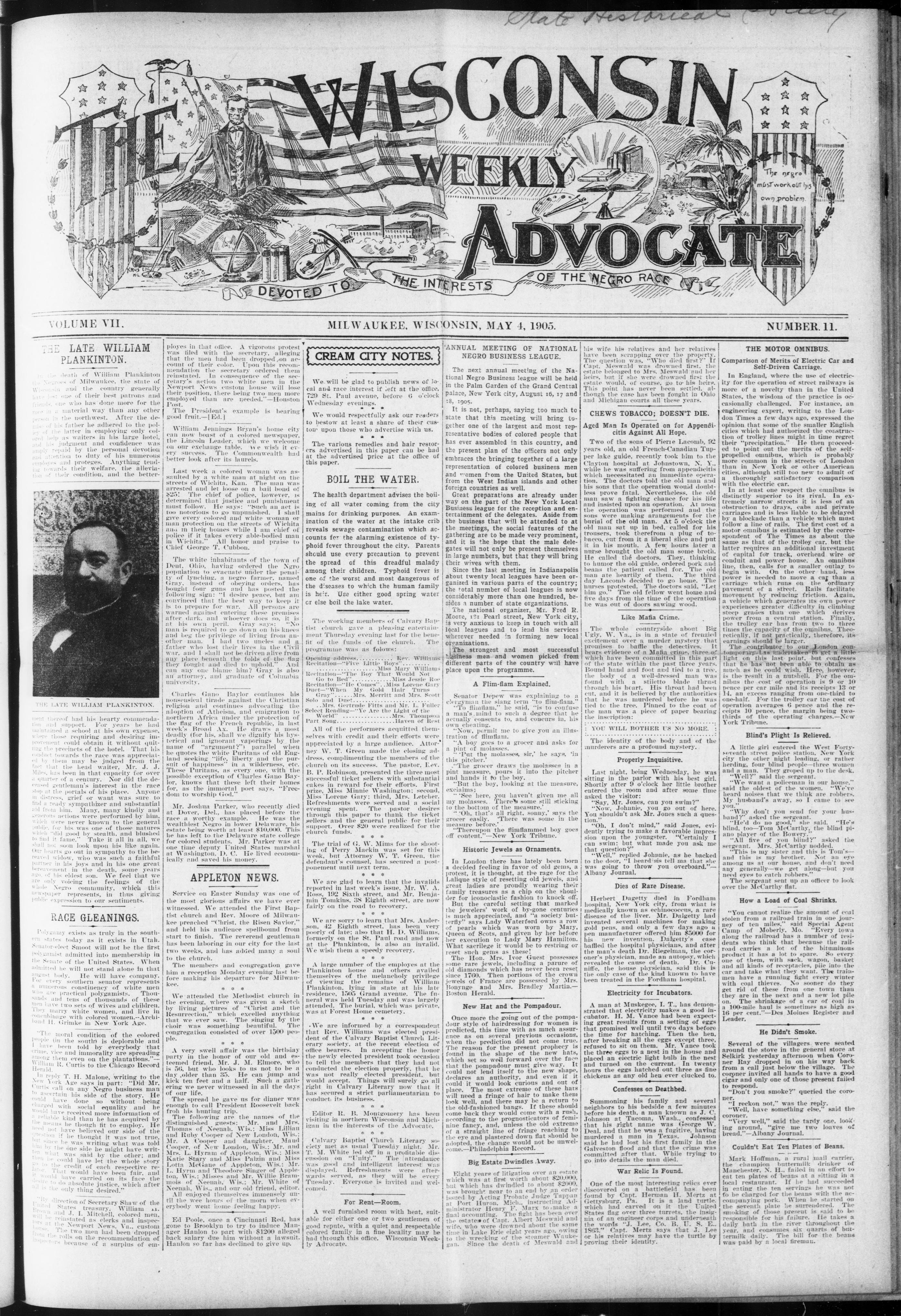
Wisconsin Weekly Advocate
Thursday, May 4, 1905
Milwaukee, Wisconsin
Page text (machine-generated)
WISCONSIN
WEEKLY
ADVOCATE
DEVOTED TO THE INTERESTS OF THE NEGRO RACE
THE LATE WILLIAM PLANKINTON.
In the death of William Plankinton the Negroes of Milwaukee, the state of Wisconsin and the country generally have lost one of their best patrons and friends, one who has done more for the race in a material way than any other person in the northwest. After the demise of his father he adhered to the policy of the latter in employing only colored help as waiters in his large hotel, and his judgment and confidence was amply repaid by the personal devotion and attention to duty of his numerous employees and proteges. Anything tending towards their welfare, the alleviation of their condition, and the better-
P.
THE LATE WILLIAM PLANKINTON.
ment thereof had his hearty commendation and support. For years he had maintained a school at his own expense, where those requiring and desiring improvement could obtain it without quitting the precincts of the hotel. That his conduct towards the race was appreciated by them may be judged from the fact that the head waiter, Mr. J. J. Miles, has been in that capacity for over a quarter of a century. Nor did the deceased gentleman's interest in the race stop at the portals of his place. Anyone in distress, grief or want was sure to find a ready sympathizer and substantial aid from him. Many, many kindly and generous actions were performed by him, which were never known to the general public, for his was one of those natures which "did good by stealth, and blushed to find it fame." Take it all in all, we shall not soon look upon his like again. Our hearts go out in sympathy to the bereaved widow, who was such a faithful partner in his joys and in his one great bereavement in the death, some years ago, of his eldest son. We feel that we are only voicing the feelings of the whole Negro community, which this newspaper represents, in thus giving public expression to our sentiments.
RACE GLEANINGS.
Polygamy exists as truly in the southern states today as it exists in Utah. Senator-elect Smoot will not be the first polygamist admitted into membership in the Senate of the United States. When admitted he will not stand alone in that august body. He will have company. For every southern senator represents a numerous constinency of white men who are practical polygamists. Thousands and tens of thousands of these men have two sets of wives and children. They marry white women, and live in concubinage with colored women.--Archiband H. Grimke in New York Age.
"The moral condition of the colored people (in the south) is deplorable and I have been told by everybody that crime, vice and immorality are spreading among them even on the plantations." William R. Curtis to the Chicago Record Herald.
In reply T. H. Malone, writing to the New York Age says in part: "Did Mr. Curtis call on any Negro business man to ascertain his side of the story. He could have done so without being charged with social equality and he would have received more information of a reliable kind than he has acquired by the means he though fit to employ. He need not have believed our side of the question if he thought it was not true, but since he was writing what was told him by the one side he might have written what was said by the other; and then he could have let the whole story go to the credit of each respective rehorr. That would have been fair, and it would have carried on its face the desire to do absolute justice, which after all is the only thing desired."
By direction of Secretary Shaw of the United States treasury, William Brown and J. I. Mitchell, colored men, will be reinstated as clerks and inspectors at the Newport News, Va., custom house. The two men had been dropped from the rolls on the recommendation of inspectors because of a surplus of em-
ployes in that office. A vigorous protest was filed with the secretary, alleging that the men had been dropped on account of their color. Upon this recommendation the secretary ordered them reinstated. In consequence of the secretary's action two white men in the Newport News custom house will lose their position, there being two men more employed than are needed."—Houston Post.
The President's example is bearing good fruit.—[Ed.]
William Jennings Bryan's home city can now boast of a colored newspaper, the Lincoln Leader, which we welcome on our exchange table. We wish it every success. The Commonwealth had better look after its laurels.
Last week a colored woman was assaulted by a white man at night on the streets of Wichita, Kan. The man was arrested and let loose on a bail bond of $25! The chief of police, however, as determined that justice and punishment must follow. He says: "Such an act is too notorious to go unpunished. I shall give every colored and white woman or man protection on the streets of Wichita and in their homes while I am chief of police if it takes every able-bodied man in Wichita." All honor and praise to Chief George T. Cubbon.
The white inhabitants of the town of Dent, Ohio, having ordered the Ngro population to evacuate under the penalty of lynching, a negro farmer, named Gray, instead of obeying orders, has bought four guns and has posted the following sign: "I desire peace, but am convinced that the best way to keep it is to prepare for war. All persons are warned against entering these premises after dark, and whoever does so, it is at his own peril. Gray says: "No man is required to go down on his knees and beg the privilege of living from another man. I had two uncles and a father who lost their lives in the Civil war, and I shall not be driven alive from any place beneath the folds of the flag they fought and died to uphold." And can any one blame him? Gray is also an attorney, and graduate of Columbia university.
Charles Gano Baylor continues his nonsensical tirade against the Christian religion and continues advocating the adoption of Atheism, and emigration to northern Africa under the protection of the flag of the French republic, in last week's Broad Ax. He draws a most deadly (for his, shall we dignify his hysterical and ignorant vaporings by the name of "argument?") parallel when he quotes the white Puritans of old England seeking "life, liberty and the pursuit of happiness" in a wilderness, etc. These Puritans, as every one, with the possible exception of Charles Gano Baylor, knows that these left their homes for, as the immortal poet says, "Freedom to worship God."
Mr. Joshua Parker, who recently died at Dover, Del., has placed before the race a worthy example. He was the wealthiest Negro in lower Delaware, his estate being worth at least $10,000. This he has left to the Delaware state college for colored students. Mr. Parker was at one time deputy United States marshal at Washington, D.C. He lived economically and saved his money.
APPLETON NEWS.
Service on Easter Sunday was one of the most glorious affairs we have ever witnessed. We attended the First Baptist church and Rev. Moore of Milwaukee preached "Christ, the Risen Savior," and held his audience spellbound from start to finish. The reverend gentleman has been laboring in our city for the last two weeks, and has added many a soul to the church.
The members and congregation gave him a reception Monday evening last before making his departure for Milwaukee.
\* \* \*
We attended the Methodist church in the evening, where was given a sketch by living pictures of "Christ and the Resurrection," which excelled anything that we ever saw. The singing by the choir was something beautiful. The congregation consisted of over 1500 people.
* * *
A very swell affair was the birthday party in the honor of our old and esteemed friend, Mr. J. M. Elmore, who is 56, but who looks to us not to be a day, older than 35. He can jump and kick ten feet and a half. Such a gathering we never witnessed in all the days of our life. The spread he gave us for dinner was enough to call President Roosevelt back froh his hunting trip.
The following are the names of the distinguished guests: Mr. and Mrs. Thomas of Neenah, Wis.; Miss Lillian and Ruby Cooper of New London, Wis.; Mr. A Cooper and daughter, Maud Cooper, of New London, Wis.; Mr. and Mrs. L. Hyram of Appleton, Wis.; Miss Katie Stary and Miss Palzin and Miss Lotta McGane of Appleton, Wis.; Mr. L. Hyrm and Theodore Singer of Appleton, Wis.; Misses and Mr. Willie Brammois of Neenah, Wis.; Mr. White of Neenah, Wis., and our old friend, editor. All enjoyed themselves immensely until the wee hours of the morn when everybody went home feeling happy.
Ed Poole, once a Cincinnati Red, has gone to Brooklyn to try to induce Manager Hanlon to part with $1200 alleged back salary due him without a lawsuit. Hanlon so far has declined to give up.
CREAM CITY NOTES.
---
We will be glad to publish news of local and race interest if left at the office, 729 St. Paul avenue, before 6 o'clock Wednesday evenings.
We would respectfully ask our readers to bestow at least a share of their custom upon those who advertise with us.
The various remedies and hair restorers advertised in this paper can be had at the advertised price at the office of this paper.
BOIL THE WATER
The health department advises the boiling of all water coming from the city mains for drinking purposes. An examination of the water at the intake crib reveals sewage contamination which accounts for the alarming existence of typhoid fever throughout the city. Parents should use every precaution to prevent the spread of this dreadful malady among their children. Typhoid fever is one of the worst and most dangerous of the diseases to which the human family is heir. Use either good spring water or else boil the lake water.
The working members of Calvary Baptist church gave a pleasing entertainment Thursday evening last for the benefit of the funds of the church. The programme was as follows:
Opening address..... Rev. Williams Recitation—"Five Little Boys".....
Gray ..... Mrs. Merritt and Mrs. Scott
Solo and Duet ..... Mrs. Gertrude Fitts and Mr. L. Fuller
Select Reading—"Ye Are the Light of the
World" ..... Mrs. Thompson
Part Song ..... Haven of Rest
All of the performers acquitted themselves with credit and their efforts were appreciated by a large audience. Attorney W. T. Green made the closing address, complimenting the members of the church on its success. The pastor, Rev. B. P. Robinson, presented the three most successful ticket sellers with substantial cakes in reward for their efforts. First prize, Miss Minnie Washington; second, Miss Lorene Gary; third, Mrs. Letcher. Refreshments were served and a social evening spent. The pastor desires through this paper to thank the ticket sellers and the general public for their support. Over $20 were realized for the church funds.
The trial of G. W. Mims for the shooting of Perry Mackin was set for this week, but Attorney W. T. Green, the defendant's counsel, has secured a postponement until next term.
\* \* \*
We are glad to learn that the invalids reported in last week's issue, Mr. W. A. Ross, 192 Sixth street, and Mr. Benjamin Tomkins, 38 Eighth street, are now fairly on the road to recovery.
* * *
We are sorry to learn that Mrs. Anderson, 42 Eighth street, has been very poorly of late; also that H. D. Williams, formerly on the St. Paul road and now at the Plankinton, is also an invalid. We wish them a speedy recovery.
```markdown
```
A large number of the employes at the Plankinton house and others availed themselves of the melancholy privilege of viewing the remains of William Plankinton, lying in state at his late residence, 1505 Grand avenue. The funeral was held Tuesday and was largely attended. The burial, which was private, was at Forest Home cemetery.
\* \* \*
We are informed by a correspondent that Rev. Williams was elected president of the Calvary Baptist Church Literary society, at the recent election of office bearers. In accepting the honor the newly elected president took occasion to tell the members that they had not conducted the election properly, that he was not really elected president, but would accept. Things will surely go all right in Calvary Literary now that it has secured a strict parliamentarian to conduct its business.
* * *
Editor R. B. Montgomery has been visiting in northern Wisconsin and Michigan in the interests of the Advocate.
* * *
Calvary Baptist Church Literary society met as usual Tuesday night. Mr. T. M. White led off in a profitable discussion on "Unity." The attendance was good and intelligent interest was displayed. Refreshments were afterwards served, as they will be every Tuesday. Everyone is invited and welcomed.
For Rent—Room.
A well furnished room with heat, suitable for either one or two gentlemen of good repute, with a quiet and respectable colored family in a fine locality may be had through this office. Wisconsin Weekly Advocate.
ANNUAL MEETING OF NATIONAL NEGRO BUSINESS LEAGUE. The next annual meeting of the National Negro Business league will be held in the Palm Garden of the Grand Central palace, New York city, August 16, 17 and 18, 1905.
It is not, perhaps, saying too much to state that this meeting will bring together one of the largest and most representative bodies of colored people that has ever assembled in this country, and the present plan of the officers not only embraces the bringing together of a large representation of colored business men and women from the United States, but from the West Indian islands and other foreign countries as well.
Great preparations are already under way on the part of the New York Local Business league for the reception and entertainment of the delegates. Aside from the business that will be attended to at the meetings, the social features of the gathering are to be made very prominent, and it is the hope that the male delegates will not only be present themselves in large numbers, but that they will bring their wives with them. Since the last meeting in Indianapolis about twenty local leagues have been organized in various parts of the country; the total number of local leagues is now considerably more than one hundred, besides a number of state organizations.
The national organizer, Mr. Fred R. Moore, 181 Pearl street, New York city, is very anxious to keep in touch with all local leagues and to lend his services wherever needed in forming new local organizations. The strongest and most successful business men and women picked from different parts of the country will have place upon the programme.
A Flim-flam Explained
Senator Depew was explaining to a clergyman the slang term "to flim-flam." "To flim-flam," he said, "is to confuse a man's mind to such a degree that he actually consents to, and concurs in, his own cheating.
"Now, permit me to give you an illustration of flimflam.
"A boy goes to a grocer and asks for a pint of molasses. 'Put the molasses, sir,' he says, 'in this pitcher.'
"The grocer draws the molasses in a pint measure, pours it into the pitcher and hands it to the boy.
"But the boy, looking at the measure, exclaims;
"See here, you haven't given me all my molasses. 'There's some still sticking to the bottom of the measure.' "Oh, that's all right, sonny,' says the grocer easily. 'There was some in the measure before.' "Thereupon the flimflammed boy goes off content."—New York Tribune.
Historic Jewels as Ornaments.
In London there has lately been born a decided feeling in favor of old gems, a protest, it is thought, at the rage for the Lalique style of resetting old jewels, and great ladies are proudly wearing their family treasures as a chip on the shoulder for iconoclastic fashion to knock off. But the careful setting that marked the jewelers' work of by-gone centuries is much appreciated, and "a society butterfly" says Lady Waterford owns a row of pearls which was worn by Mary, Queen of Scots, and given by her before her execution to Lady Mary Hamilton. What sacrilege it would be to restring or reset such gems as these!
The Hon. Mrs. Ivor Guest possesses some rare jewels, including a parure of old diamonds which has never been reset since 1760. Then portions of the crown jewels of France are possessed by Mrs. Bonynge and Mrs. Bradley Martin.—Boston Herald.
New Hat and the Pompadour.
Once more the going out of the pompadour style of hairdressing for women is predicted, this time with as much assurance as on several previous occasions, when the prediction did not come true. The reason for the present prophecy is found in the shape of the new hats, which set so well forward over the face that the pompadour must give way. It could not lend itself to the new shape, declares an authority, and even if it could it would look curious and out of place. The most extreme of these hars will need a fringe of hair to make them look well, and there may be a return to the old-fashioned bangs. If these should come back they would come with a rush, according to the prognosticators of feminine fancy, and, unless the old extreme of a straight line of fringe reaching to the eye and plastered down flat should be adopted, the change would not be unwelcome.—Philadelphia Record.
Big Estate Dwindles Away.
Eight years of litigation over an estate which was at first worth about $20,000, but which has dwindled to about $2000, was brought near to an end by an order issued by Acting Probate Judge Tappan at Port Huron, Mich., instructing Administrator Henry F. Marx to make a final accounting. The fight has been over the estates of Capt. Albert Meswald and wife, who were drowned about the same time in Lake Erie eight years ago, owing to the wrecking of the steamer Waukegan. Since the death of Meswald and
his wife his relatives and her relatives have been scrapping over the property. The question was, "Who died first?" If Capt. Meswald was drowned first, the estate belonged to Mrs. Meswald and her heirs, but if she were drowned first the estate would, of course, go to his heirs. This point has never been settled, although the case has been fought in Ohio and Michigan courts all these years.
CHEWS TOBACCO; DOESN'T DIE.
Aged Man Is Operated on for Appendicitis Against All Hope.
Two of the sons of Pierie Lacomb, 92 years old, an old French-Canadian Tupper lake guide, recently took him to the Clayton hospital at Johnstown, N. Y., while he was suffering from appendicitis which necessitated an immediate operation. The doctors told the old man and his sons that the operation would doubtless prove fatal. Nevertheless, the old man saw a fighting chance for his life and insisted upon an operation. At noon the operation was performed and the sons were making arrangements for the burial of the old man. At 5 o'clock the old man sat up in bed, called for his trousers, took therefrom a plug of tobacco, cut from it a liberal slice and put it in his mouth. A few hours later a nurse brought the old man some broth. He called the doctors. They, thinking to humor the old guide, ordered pork and beans the patient called for. The old man ate heartily of them. The third day Lacomb decided to go home. The nurses protested. The doctors said, "Let him go." The old fellow went home and five days from the time of the operation he was out of doors sawing wood.
Like Mafia Crime.
The whole countryside about Big Ugly, W. Va., is in a state of frenzied excitement over a murder mystery that promises to baffle the detectives. It bears evidence of a Mafia crime, three of which have been committed in this part of the state within the past three years. Bound hand and foot and tied to a tree, the body of a well-dressed man was found with a stiletto blade thrust through his heart. His throat had been cut, and it is believed by the authorities that he was murdered before he was tied to the tree. Pinned to the coat of the man was a piece of paper bearing the inscription:
YOU WILL BOTHER US NO MORE.
The identity of the body and of the murderers are a profound mystery.
Properly Inquisitive
Last night, being Wednesday, he was sitting in the parlor with his best girl. Shortly after 9 o'clock her little brother entered the room and after some time asked the visitor:
"Say, Mr. Jones, can you swim?"
"Now, Johnnie, you go out of here. You shouldn't ask Mr. Jones such a question."
"Oh, I don't mind," said Jones, evidently trying to make a favorable impression upon the youngster. "Certainly I can swim; but what made you ask me that question?"
"Well," replied Johnnie, as he backed to the door, "I heard sis tell ma that she was going to throw you overboard."—Albany Journal.
Dies of Rare Disease.
Herbert Dagetty died in Fordham hospital. New York city, from what is medically known as echinococcus, a rare disease of the liver. Mr. Dalgetty had invented several machines for making gold pens, and only a few days ago a pen manufacturer offered him $5000 for his new invention. Dalgetty's case baffled the hospital physicians, and after the man's death Dr. Riegelman, the coroner's physician, made an autopsy, which revealed the cause of death. Dr. Cuniffe, the house physician, said this is the only case of the kind known to have been treated in the Fordham hospital.
Electricity for Incubators.
A man at Muskegee, I. T., has demonstrated that electricity makes a good incubator. H. M. Vance had been expecting great results from a setting of eggs that promised well until two days before the time for hatching. Then the hen, after breaking all the eggs except three, refused to sit on them. Mr. Vance took the three eggs to a nest in the house and placed an electric light bulb in the nest and turned on the current. In twenty hours the eggs hatched out three as fine chickens as any old hen ever clucked to.
Confesses on Deathbed
Summoning his family and several neighbors to his bedside a few minutes before his death, a man known as J. C. Johnson at Tacoma, Wash., confessed that his right name was George W. Deal, and that he was a fugitive, having murdered a man in Texas. Johnson said he had lost his first family in the Galveston flood and that the crime was committed after that. While trying to go into details the man died.
War Relic Is Found.
One of the most interesting relics ever discovered on a battlefield has been found by Capt. Herman H. Mertz at Gettysburg, Pa. It is a land turtle, which had carved on it the United States flag over three turrets, the insignia of an engineer corps and underneath the words "J. Lee, Co. B. U. S. E.. 1863." Capt. Mertz says that J. Lee or his relatives may have the turtle by proving their identity.
THE MOTOR OMNIBUS.
Comparison of Merits of Electric Car and Self-Driven Carriage. In England, where the use of electricity for the operation of street railways is more of a novelty than in the United States, the wisdom of the practice is occasionally challenged. For instance, an engineering expert, writing to the London Times a few days ago, expressed the opinion that some of the smaller English cities which had authorized the construction of trolley lines might in time regret their "precipitation." He then proceeded to point out the merits of the self-propelled omnibus, which is probably more common in the streets of London than in New York or other American cities, although still too new to admit of a thoroughly satisfactory comparison with the electric car.
In at least one respect the omnibus is distinctly superior to its rival. In extremely narrow streets it is less of an obstruction to drays, cabs and private carriages and is less liable to be delayed by a blockade than a vehicle which must follow a line of rails. The first cost of a motor omnibus is estimated by the correspondent of The Times as about the same as that of the trolley car, but the latter requires an additional investment of capital for track, overhead wire or conduit and power house. An omnibus line, then, calls for a smaller outlay to begin with. On the other hand, less power is needed to move a car than a carriage which runs on the ordinary pavement of a street. Rails facilitate movement by reducing friction. Again, a vehicle which generates its own power experiences greater difficulty in climbing steep grades than one which derives power from a central station. Finally, the trolley car has from two to three times the capacity of the omnibus. Theoretically, if not practically, therefore, its earnings should be larger.
The contributor to our London contemperary Las undertaken to get a little light on this last point, but confesses that he has not been able to obtain as much as he could wish. Here, however, is the result in a nutshell. For the omnibus the cost of operation is 9 or 10 pence per car mile and its receipts 13 or 14, an excess ranging from one-third to one-half. For the trolley car the cost of operation averages 6 pence and the receipts 10 pence, the margin being two-thirds of the operating charges.—New York Tribune.
Blind's Plight Is Relieved
A little girl entered the West Forty-seventh street police station. New York city the other night leading, or rather herding, four blind people—three women and a man. They groped up to the desk. "Well?" said the sergeant.
"We want a policeman in our house." said the oldest of the women. "We've heard noises that we think are robbers. My husband's away, so I came to see you."
"Why don't you send for your husband?" asked the sergeant.
"He'd do no good," she said. "He's blind, too—Tom McCarthy, the blind piano player of the Bowery."
"All five of you blind?" asked the sergeant. Mrs. McCarthy nodded.
"This is my sister and this is Tom's—and this is my brother. Not an eye among us at our house, and don't need any generally—we get along—but you need eyes to catch robbers."
The sergeant sent an officer to look over the McCarthy flat.
How a Load of Coal Shrinks.
"You cannot realize the amount of coal stolen from a railroad train in one journey of ten miles," said Special Agent Camp of Moberly, Mo. "Every town along the railroad has a number of residents who think that because the railroad carries a lot of the bituminous product it has a lot to spare. So every one of them, with sack, wagon, basket and all kinds of receptacles, pile into the car and take what they want. The trainmen have a running fight every winter with coal thieves. No sooner do they get rid of these from one town than they are in the next and a new lot pile on. The shrinkage of a car of coal in a 100-mile haul is sometimes as high as 16 per cent."—Des Moines Register and Leader.
He Didn't Smoke.
Several of the villagers were seated around the stove in the general store at Selkirk yesterday afternoon when Coroner Ray dropped in on his way back from a call just below the village. The coroner invited all hands to have a good cigar and only one of those present failed to respond.
"Don't you smoke?" queried the coroner.
"I reckon not," was the reply.
"Well, have something else," said the coroner.
"Very well," said the tardy one, looking around, "give me two loaves of bread."—Albany Journal.
Couldn't Eat Ten Plates of Beans.
Mark Hoffman, a rural mail carrier, the champion buttermilk drinker of Manchester, N. H., failed in an effort to eat ten plates of beans at a sitting in a local restaurant. If he had succeeded in eating the ten servings he was not to be charged for the beans with the accompanying pork. When he started on the seventh plate he surrendered. The smoking of those present is said to be responsible for his failure. He takes a daily bath in the river throughout the year, and consumes six quarts of buttermilk daily. The bill for the beans was paid by a local fireman.
SUICIDE BY MISTAKE.
Salt Lake City Woman Amused Children by Playing at It.
Mrs. Jane Maynard of Salt Lake city, who had been accustomed to "play suicide" to make her children "be good," is dead as a result of strychnine, which her neighbors believe she took by mistake in an effort to frighten her son. Mrs. Maynard was the mother of several small children, and frequently pretended to kill herself for the purpose of frightening the children into obedience. Making some remark to the effect that she couldn't bear to live with such bad children, she would mix sugar and water and swallow the draught in the presence of the little ones. Her pretended illness always had the effect of bringing the children to a mood of tearful repentance. During the absence of her husband, Mrs. Maynard had some trouble with one of her little sons. The other children, all of whom are small, are unable to tell a connected story of what took place except that their little brother was "bad," and that their mother threatened to kill herself. Some neighbors who called at the Maynard home found the woman dead, and a doctor, who was called, pronounced it a case of strychnine poisoning. Residents of South Jordan, a suburb of Salt Lake, where the family lived, are firm in their belief that the poison was taken by mistake.
HOW TO SIZE UP STRANGER.
Man Who Leans Forward and Shakes Certain Way Is Dangerous.
When the meeting of the Chicago Self-Culture club adjourned the other night in the Masonic temple the members had learned from Dr. V. G. Lundquist "How to Sum up a Stranger." The doctor said: "When you meet a stranger pay close attention to his voice, motions and build. If you quarrel with him and he leans backward, shaking his head from side to side, or holds his hands in his pockets, don't be afraid of him. He is a coward and won't fight. But beware of the man who steps forward, holds his head down and shakes it from left to right. Long, angular people can always work. They have capacity, and, like the mule and ox, will get there. If a stranger has a hard, stiff hand you can depend upon him as a friend and fear him as an enemy. Vital people are not so reliable and don't like hard work. They enjoy banquets and will talk to the cook. Osseous people will eat food like sticks of wood. Good natured people are always fat. Fat people are excellent salesmen."
One Guess Deserves Another
James R. Keene said recently: "I was walking in the country one day in my youth, and toward sundown I lost my way. As I plodded on, tired and hungry, I met a farmhand.
"Jack," I said, 'what is the way to Berenda?'
"The farmhand looked at me with a frown.
"'How did you know,' he said, 'that my name was Jack?'
my name was back.
"'Oh,' I said, I guessed it.'
"'Then,' said the farmhand, 'guess your way to Berenda.'"—New York Tribune.
New York Is Growing
That the population of New York city will have reached 6,760,000 twenty years hence and that the city will be driven to draw a water supply from Lake Erie or the Adirondacks region is the opinion of the joint committee on city affairs and forests of the New York board of trade and transportation, which has been investigating, and made its report to the full board. The committee found that in 1925 the water power of the Catskill region will be entirely exhausted if the population of this city continues to increase at the present ratio.
Married by Telegraph
Mary C. Slaughter of Bowling Green, Ky., and James Murrell of Fort Mackenzie, Wyo., although separated by 3000 miles, were united in marriage through the medium of a telegraph company. A minister was at each end of the line. The bride was attired in a white wedding gown and the usual veil. She was accompanied by a number of friends, who witnessed the novel ceremony. Murrell's regiment will leave in a few days for the Philippine islands. His wife will leave at once to accompany him.
Steam Automobiles on Rails.
The Hanover Railway company is making trial trips from Hanover to Soltau with steam automobiles. The third-class carriages can take thirty-three passengers; the second-class have seven seats, and there are also seven standing places. There is no locomotive for driving these cars, but machinery in the carriage, which can be driven by one man. If these trial trips should prove satisfactory the scheme will be tried on a larger scale. English World's Work.
Student's Prank Is Costly
The Yale faculty have condemned Frank G. Potter to exile for the rest of the school year because he burst into the annual banquet of the professors at the Phi Beta Kappa society at the University club and shouted an epithet at them. He is a junior and a cousin of Anson Phelps Stokes, Jr., the Yale secretary. Potter's home is in New York city. He was intoxicated, it is said.
Woodtick in Body 40 Years.
William H. Lawrence of Sheffield, Conn., was much gratified at the reappearance of a woodtick which had imbedded itself in his body forty-nine years ago. Although it had never greatly troubled him, it had produced a knot on his side as large as a walnut, and when extracted was found to be an inch and one-quarter long.
Identifying Dead Soldiers
The Russian method of identifying soldiers killed in battle is by means of little metal ikons—sacred picture images—found on the bodies. On the back of each of these ikons is stamped the wearer's name, regiment and commission. Every nation labels its soldiers in one way or another with a view to just such eventualities.
Explaining It
"This talk about millions of dollars fur the Panama canal gits me." remarked Si Slocum. "Thet's a power of money fur jist a canal."
"Mebbe," suggested Rube Robbins, "ther're goin' ter have the towpath asphalted. That runs inter a heap o' money."—Philadelphia Press.
His Wedding Garment.
He (reading about the latest society wedding)—They have a lot to say about what the bride wears, but they have nothing to say about the poor bride-groom.
She—They have no need to, because it is a well known fact that he usually wears a worried look.—Boston Globe.
Bankers Celebrate in Colors
The Warren County National bank have about completed their improvements to their banking rooms, which now present as fine an appearance as any in the county. The walls of the banking room are done in green burlap and the directors' in red.—Belvidere Apollo.
CANADIAN BOAT SONG
[From the Gaellic.]
Listen to me, as when ye heard our father Sing long ago the song of other shores— Listen to me, and then in chorus gather All our deep voices, as ye pull your oars: Fair these broad meads—these hoary woods are grand; But we are oxiles from our fathers' land.
But we are exiles from our fathers' land. From the lone shiing of the misty island Mountains divide us, and the waste of
And we in dreams behold the Hebrides.
Fair these broad meads—these hoary woods are grand;
But we are exiles from our fathers' land.
We ne'er shall tread the fancy-haunted valley.
Where 'tween the dark hills creeps the small deer stream.
In arms around the patriarch banner rally.
Nor see the moon on royal tombstones
gleam.
Fair these broad meads—these hoary
woods are grand;
But we are spies from air fathers' land.
But we are exiles from our fathers' land. When the bold kindred, in the time long vanished,
Conquer'd the soil and fortified the keep. Nor seer foretold the children would be hauished
palmished.
That a degenerate lord might boast his sheep.
Fair these broad meads—these hoary woods are grand:
woods are grand;
But we are exiles from our fathers' land.
Come foreign rage, let discord burst in
slaughter!
O! then, for clansmen true, and stern
claymore—
The hearts that would have given their
blood like water
Beat heavily beyond the Atlantic roar.
Fair these broad meads—these hoary woods are grand:
PETE'S PULL WITH THE POWERS.
On the dry, sun-parched crest of the mountain, four thousand feet above the desert dust, reposed the Nymph, the "Sea Nymph," little scow schooner, twenty tons burden, Pete Nicholson, master; master and builder, mate and owner, crew and cook, in one. The ship's cat alone shared watch with Pete. She was crouched on the end of the bowsprit, alertly watching a bevy of quail, scratching in the shade of the prow. Suddenly she pricked up her ears, her eyes dilated, and without further hesitation she scrambled aloft, upsetting in her flight a stack of survey maps. Pete was mending sails by the cabin door. "What's ahoy, Matilda?" he cried. "What's ahoy?"
Then he listened. He caught the sound of horse-hoofs on the flinty rocks. He heard the cracking of a twig, and then the creaking of a saddle. The next instant a cowboy rode into view.
"Hello, there, captain. Seen any stray steers up this way?"
"Nary a steer, Antonio; nary a steer. How's things down the canyon?" "Hotter than ever. Water holes all dry except old 'Olla.' Grady's lost thirty head in the last week." "It won't last, it won't last. Mark my word, Antonio, we'll have water; plenty of it." "You've preached water for the last five years, and it's getting scarcer all the time." Antonio slid off his horse, tied it to a tree, and clearing a space on deck among the scattered papers, he sat down to a chew with Pete. "Good tobac, that. Got any more in the hold?"
"Plenty, so long as it lasts."
The two chewed in silence for a while. Pete continued his mending, his strong frame bent to the task, his brown hands deft with the needle. Antonio flipped pebbles at the cat till she came down and disappeared aft.
"Say, Pete, what's the use wasting time on them sails?"
"Wasting time, you call it. Well, I'm not going to be caught with torn sails. Port's the place to get ready in. I've been laid up here for five years waiting for a favorable breeze, and it'll come, mark my word, it'll come."
"Breeze enough, captain, but don't you think you need a little moisture; just a little?"
Pete shifted his tobacco uneasily, spat overboard and replied:
"That's just it, Antonio. You've struck it right. I was telling Matilda last night that was all was lacking for smooth sailing. And we'll get it, too."
His eyes grew bright with enthusiasm. "We'll get it," he continued. "That blasted hole of a desert down there was once the bottom of the sea, and what was once is going to be again. God Almighty's too economical to waste a good basin like that. We're partial to water. He and I. Didn't He make three-quarters sea and only one-quarter land? That's proof enough, Antonio. He's mighty partial to oceans, and He won't waste such a chance as that," waving his hand toward the hazy desert. His face was glowing with conviction. "So, you see, I keep things ship-shape, ready to sail."
"Well, good luck to you, Pete. You don't want water more than we do down in the canyon there. But if you've got a pull with the powers, Pete, have it fresh. It's better for drinking purposes."
Antonio remounted, and rode down the steep, shifting trail, leaving the bright-eyed captain sewing industriously in the sunlight.
"Poor old luny," said the cowboy to himself. "He's too smart to be wasted. What with his surveying and planning, he might be of some use. Must be mighty lonesome up there, alone; enough to turn any man's brain."
He spurred his horse and hurried on toward the ranch. The boys were there, and they were not luny.
A few days later they were all at breakfast in the adobe outhouse. At that early hour the sunshine gave promise of intense heat to come. The air was still and stifling. Occasionally the hoarse bellowing of a thirsty cow mingled with the rattling of tin cups and plates, and a smell of yucca blossoms mixed with the bacon fumes. Over the rocky shoulder of the mountain a great white cloud appeared.
"There's a thunder shower coming," said Antonio.
"Maybe, if it don't change its mind," said another. "The clouds all blow away this year."
"That one's coming all right. Hear it bang!"
Cloud after cloud massed in the blue great soft puffs of white, until, covering the sun, their glory changed to somber gray, deepening on the horizon to violet. Flashes of lightning streaked the blackness, and distant rumbling blended with nearer reports.
"It's a tough old storm, boys, but it's bringing water."
And then, with a suddenness which left no time for words, a great black blanket-like cloud descended on the mountain above the camp. Instinctively the men ran for higher ground. They knew the peculiarities of the cloudburst. They knew that landslides were imminent, and their canyon the vehicle of escaping waters. But, to the usual characteristics of such occurrences, was now added a phenomenon such as man had never seen.
The terrific force of the cloudburst had shattered the top of the peak, washing it, with a mighty volume of water, down the mountain side, converting the canyon into a veritable river. In midstream, sails set to the wind, danced the Sea Nymph. At her bow, Matilda, howling in terror; at the halyards, Pete Nicholson, plying his long-unused skill as sailor—his huge muscles straining at the ropes, his long hair flying in the wind, his face ecstatic, and his voice raised in jubilant cries.
"Heave ho, my lads," he yelled, as he passed the shivering group of men huddled on the hill.
"Heave ho, heave ho, heave ho!"
The torrent bore him round a curve, and his voice was lost in the roaring storm.
"Get the horses," cried Antonio, and the men with one accord rushed for their broncos. Over the sliding trails they chased—now catching sight of the plunging Sea Nymph, now losing her in a bend. On, on they rode by the racing river.
"She's give out, boys! She can't stand the strain. On! on! She's foundered!"
It was a tough work of rescue, but the lariats did their part. The storm had spent itself, and the waters were subsiding. They found Pete unconscious, and they took him to camp. The Sea Nymph was bottom up on the rocks, and Matilda was safe on top.
When Pete opened his eyes, he looked for Antonio. "Plenty of water, eh?" he said. Then he sat up excitedly. "The maps, the drawings, boys! Save them! Never mind me, but get the maps!" He closed his eyes again in a stupor which lasted for weeks. Things were straightened out in that time. His brain had rested, and he awoke to sanity and to his rescued maps.
That was twenty years ago. Today the cattle have gone from the range, and with them the cowboys, and in their place orchards thrive, vineyards yield, and settlers irrigate their lands from the great reservoirs, built by the government, under the supervision of the eminent civil engineer, Peter Nicholson. The water has come to stay, for "Pete had a pull with the powers."—Laura Adams Armer in San Francisco News Letter.
MUZZLE ON THE FINGERS
To Compel Pupils to Hold the Hand Properly While Writing.
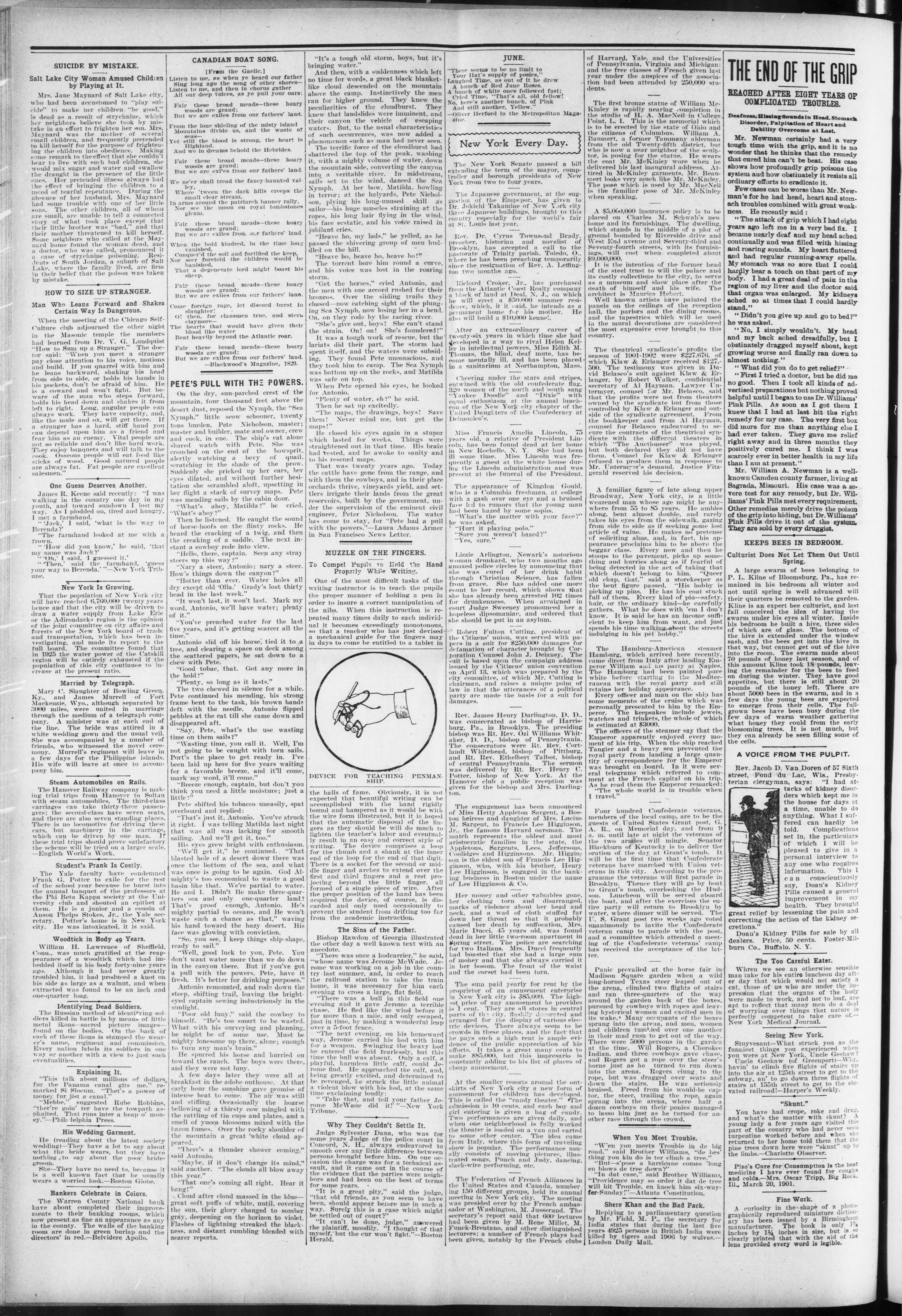
One of the most difficult tasks of the writing instructor is to teach the pupils the proper manner of holding a pen in order to insure a correct manipulation of the nibs. When this instruction is repeated many times daily to each individual it becomes exceedingly monotonous, so that a teacher who has just devised a mechanical guide for the fingers may in days to come be entitled to a tablet in
DEVICE FOR TEACHING PENMAN SHIP.
DEVICE FOR TEACHING PENMANSHIP.
the halls of fame. Obviously, it is not expected that beautiful writing can be accomplished with the hand rigidly bound and hampered as it would be with the wire form illustrated, but it is hoped that the automatic disposal of the fingers as they should be will do much to lighten the teacher's labor and eventually result in an easy and correct style of writing. The device comprises a loop for the thumb and a shank at the inner end of the loop for the end of that digit. There is a socket for the second or middle finger and arches to extend over the first and third fingers and a rest projecting beyond the little finger, all formed of a single piece of wire. After the proper position of the hand has been acquired the device, of course, is discarded and only used occasionally to prevent the student from drifting too far from the academic instruction.
The Sins of the Father.
Bishop Rawdon of Georgia illustrated the other day a well known text with an anecdote.
"There was once a hodcarrier," he said, "whose name was Jerome McWade. Jerome was working on a job in the country last summer, and, in order to reach the railroad station to take the train home, it was necessary for him each evening to cross a large, flat field.
"There was a bull in this field one evening and it gave Jerome a terrible chase. He fled like the wind before it for more than a mile, and only escaped, just in time, by making a wonderful leap over a 5-foot fence.
"The next evening, on his homeward way, Jerome carried his hod with him for a weapon. Swinging the heavy hod he entered the field fearlessly, but this time the bull was absent. Only a calf, a playful, harmless little calf, could Jerome find. He approached the calf, and, being greatly excited, and determined to be revenged, he struck the little animal a violent blow with his hod, at the same time exclaiming loudly:
"'Take that, and tell your father Jerome MeWade did it!"'—New York Tribune.
Why They Couldn't Settle It
Judge Sylvester Dana, who was for some years Judge of the police court in Concord, N. H., always endeavored to smooth over any little difference between persons brought before him. On one occasion the charge was for a technical assault, and it came out in the course of the evidence that the parties were neighbors and had been on the best of terms for some years.
"It is a great pity," said the judge, "that old friends, as you seem to have been, should appear before me in such a way. Surely this is a case which might be settled out of court?"
"It can't be done, judge," answered the plaintiff, moodily. "I thought of that myself,' but the cur won't fight."—Boston Herald.
"There seems to be no limit to Your Hat's supply of posies," Laughed Time, as out of it he drew A bunch of Red June Roses. A bunch of white ones followed fast; Cried Time, "That's all, old fellow! No, here's another bunch, of Pink And still another, Yellow."
-Oliver Herford in the Metropolitan Magazine.
The New York Senate passed a bill extending the term of the mayor, comptroller and borough presidents of New York from two to four years.
The Japanese government, at the suggestion of the Empepor, has given to Dr. Jokichi Takamine of New York city three Japanese buildings, brought to this country especially for the world's fair at St. Louis last year.
Rev. Dr. Cyrus Townsend Brady, preacher, historian and novelist of Brooklyn, has accepted a call to the pastorate of Trinity parish. Toledo, O., where he has been preaching temporarily since the resignation of Rev. A. Leffington two months ago.
Richard Croker, Jr., has purchased from the Atlantic Coast Realty company a block of land at Deal, N. J., on which he will erect a $50,000 summer residence, which, it it said, he intends as a permanent home for his mother. He also will build a $10,000 kenne!.
After an extraordinary career of twenty-six years in which time she had developed in a way to rival Helen Keller in intellectual powers, Miss Edith M. Thomas, the blind, deaf mute, has become mentally ill, and has been placed in a sanitarium at Northampton, Mass.
Cheering under the stars and stripes, entwined with the old confederate flag, 320 women of the north and south sang "Yankee Doodle" and "Dixie" with equal enthusiasm at the annual lunchcon of the New York city chapter of the United Daughters of the Confederacy at Delmonico's.
Miss Francis Amelia Lincoln, 75 years old, a relative of President Lincoln, has been found dead at her home in New Rochelle, N. Y. She had been ill some time. Miss Lincoln was frequently a guest at the white house during the Lincoln administration and was present at the funeral of the President.
The appearance of Kingdon Gould, who is a Columbia freshman, at college with a gash over one eye and a bruised face led to rumors that the young man had been hazed by some sophs.
"What's the matter with your face?" he was asked. ' "Hurt it playing polo." "Sure you weren't hazed?"
Lizzie Arlington, Newark's notorious woman drunkard, who two months ago amazed police circles by announcing that she was cured of her drink habit through Christian Science, has fallen from grace. She has added one more count to her record, which shows that she has already been arrested 102 times for drunkenness. When arraigned in court Judge Sweeney pronounced her a hopeless dipsomaniac, and ordered that she should be put in an asylum.
Robert Fulton Cutting, president of the Citizens' union, was served with papers in a suit for $250,000 damages for defamation of character brought by Corporation Counsel John J. Delaney. The suit is based upon the campaign address issued by the Citizens' union convention on April 13, which was prepared by the city committee, of which Mr. Cutting is chairman, and raises a unique point of law in that the utterances of a political party are made the basis for a suit for damages.
Rev. James Henry Darlington, D. D., was consecrated as bishop of Harrisburg, Pa., in Brooklyn. The presiding bishop was Rt. Rev. Ozi Williams Whitaker, D. D., bishop of Pennsylvania. The consecrators were Rt. Rev. Cortlandt Whitehead, bishop of Pittburg, and Rt. Rev. Ethelbert Talbot, bishop of central Pennsylvania. The sermon was delivered by Rt. Rev. Henry C. Potter, bishop of New York. At the Hanover club a public reception was given for the bishop and Mrs. Darlington.
The engagement has been announced of Miss Hetty Appleton Sargent, a Boston heiress and daughter of Mrs. Lucius M. Sargent, to Francis Lee Higginson, Jr., the famous Harvard oarsman. The match represents the oldest and most aristocratic families in the state, the Appletons, Sargents, Lees, Jeffersons, Coolidges and Higginsons. Mr. Higginson is the eldest son of Francis Lee Higginson, who, with his brother, Henry Lee Higginson, is engaged in the banking business in Boston under the name of Lee Higginson & Co.
Her money and other valuables gone, her clothing torn and disarranged, marks of violence about her head and neck, and a wad of cloth stuffed far down her throat so that it probably caused her death by suffocation. Mrs. Marie Ducci, 45 years old, was found dead in her little two-room apartment in Spring street. The police are searching for two Italians. Mrs. Ducci frequently had boasted that she had a large sum of money and that she always carried it in her bosom. The front of the waist and the corset had been torn.
The sum paid yearly for rent by the proprietor of an amusement enterprise in New York city is $85,000. The highest price of any amusement he provides is 1 cent. They are all stores in central parts of the city, flashily decorated and arranged for the display of various electric devices. There always seem to be crowds in these places, and the fact that he pays such a high rent is ample evidence of the public appreciation of his efforts. It takes a great many cents to make $85,000, but this impresario is constantly adding to his list of places of cheap amusement.
At the smaller resorts around the outskirts of New York city a new form of amusement for children has developed. This is called the "candy theater." The admission is 10 cents, and each boy and girl entering is given a bag of candy. Two performances are given daily, and when one neighborhood is fully worked the theater is loaded on a van and carted to some other center. The idea came from Italy, where this form of traveling show is popular. The performance usually consists of moving pictures, illustrated songs, Punch and Judy, dancing, slack-wire performing, etc.
The Federation of French Alliances in the United States and Canada, numbering 150 different groups, held its annual meeting in New York city. The meeting was presided over by the French ambassador at Washington, M. Jusserand. The secretary's report said that 600 lectures had been given by M. Rene Millet, M. Funck-Brentano, and other distinguished lecturers; a number of French plays had been given, notably by the French clubs
of Harvard, Yale, and the Universities of Pennsylvania, Virginia and Michigan: and the free classes of French given last year under the auspices of the association had been attended by 250,000 students.
The first bronze statue of William McKinley is rapidly nearing completion in the studio of H. A. MaeNeil in College Point, L. I. This is the memorial which is to be erected by the state of Ohio and the citizens of Columbus. William A. Baumert, a former Tammany alderman from the old Twenty-fifth district, but who is now a near neighbor of the sculptor, is posing for the statue. He wears the coat Mr. McKinley wore when he delivered his last inaugural address. Attired in McKinley garments, Mr. Beaumert looks very much like Mr. McKinley. The pose which is used by Mr. MaeNeil is the familiar pose of Mr. McKinley when speaking.
A $5,060,000 insurance policy is to be placed on Charles M. Schwab's new home and its furnishings. The dwelling, which stands in the middle of a plot of ground bounded by Riverside drive and West End avenue and Seventy-third and Seventy-fourth streets, with its furnishings, will cost when completed about $9,000,000.
It is the intention of the former head of the steel trust to will the palace and its costly collections to the city, to serve as a museum and show place after the death of himself and his wife. The architect is Maurice Heert.
Well known artists have painted the panels on the ceilings of the reception hall, the parlors and the dining rooms, and the tapestries which will be used in the mural decorations are considered the most expensive ever brought to this country.
The theatrical syndicate's profits the season of 1901-1902 were $227,676, of which Klaw & Erlanger received $127,-500. The testimony was given in David Belasco's suit against Klaw & Erlanger, by Robert Walker, confidential secretary of Al Hayman. Lawyer Untermyer, counsel for Mr. Belasco, said that the profits were not from theaters owned by the syndicate but from those controlled by Klaw & Erlanger and outside of the syndicate agreement. From the bookkeeper and from Al Hayman, counsel for Belasco endeavored to secure the contracts of the theatrical syndicate with the different theaters in which "The Auctioneer" was played, but both declared they did not have them. Counsel for Klaw & Erlanger refused to produce them in response to Mr. Untermyer's demand. Justice Fitzgerald reserved his decision.
A familiar figure of late along upper Broadway, New York city, is a little weazened man whose age might be anywhere from 55 to 85 years. He ambles along, bent almost double, and rarely takes his eyes from the sidewalk, gazing from side to side as if seeking some lost article of value. He makes no pretense of soliciting alms, and, in fact, his appearance proclaims him to be above the beggar class. Every now and then he stoops to the pavement, picks up something and hurries along as if fearful of being detected in the act of taking that which doesn't belong to him. "Queer old chap, that," said a storekeeper as the bent figure passed. "His hobby is picking up pins. He has his coat stuck full of them. Every kind of pin—safety, hair, or the ordinary kind—he carefully gathers. What he does with 'em I don't know. It is said he has an income sufficient to keep him from want, and just spends his time walking about the streets indulging in his pet hobby."
The Hamburg-American steamer Hamburg, which arrived here recently, came direct from Italy after landing Emperor William and his party at Naples. The Hamburg had been painted pure white before starting to the Mediterranean with the royal party and still retains her holiday appearance. Every officer and man on the ship has some memento of the cruise which was personally presented to him by the Emperor. The keepsakes include jewels, watches and trinkets, the whole of which is estimated at $3000.
The officers of the steamer say that the Emperor apparently enjoyed every moment of his trip. When the ship reached Tangier and a heavy sea prevented the royal party from landing a large quantity of correspondence for the Emperor was brought on board. In it were several telegrams which referred to comment at the French capital on his trip. As he read them the Emperor remarked: "The whole world is in trouble when I travel."
Four hundred Confederate veterans, members of the local camp, are to be the guests of United States Grant post, G. A. R., on Memorial day, and from 9 a. m. until late at night the veterans of the two armies will mingle. Senator Blackburn of Kentucky is to deliver the oration of the day at Grant's tomb. It will be the first time that Confederate veterans have marched with Union veterans in this city. According to the programme the veterans will first parade in Brooklyn. Thence they will go by boat to Grant's tomb, overlooking the Hudson. Luncheon will be served aboard the boat, and after the exercises the entire party will return to Brooklyn by water, where dinner will be served. The U. S. Grant post two weeks ago voted unanimously to invite the Confederate veteran camp to parade with the post, and a committee which attended a meeting of the Confederate veterans' camp has received the acceptance of the latter.
---
Panic prevailed at the horse fair in Madison Square garden when a wild long-horned Texas steer leaped out of the arena, climbed two flights of stairs and ran three-quarters of the way around the garden back of the boxes, pursued by cowboys with ropes and leaving hysterical women and excited men in its wake. Many occupants of the boxes sprang into the arena, and men, women and children tumbled over one another in their mad rush to get out of the way. There were 5000 persons in the garden at the time. Will Rogers, a Cherokee Indian, and three cowboys gave chase, and Rogers got a rope over the steer's horns just as he turned to run down into the arena. Rogers clung to the rope, but was dragged over seats and down the stairs. He was seriously bruised. Freed from his would-be captor, the steer, trailing the rope, again sprang into the arena, where half a dozen cowboys on their ponies managed to lasso him just as he turned for another race through the crowd.
When You Meet Trouble
"W'en you meets Trouble in de big road," said Brother Williams, "de best thing you kin do is ter climb a tree." "But—s'pose a harricane comes 'long en blows de tree down?" "In dat case," said Brother Williams, "Providence may so order it dat de tree will hit Trouble, en knock him six-wayfer-Sunday!"—Atlanta Constitution.
Shere Khan and the Bad Pack
Replying to a parliamentary question by Mr. Field, M. P., the secretary for India states that during the last five years 4925 persons in British India were killed by tigers and 1906 by wolves.—London Daily Mail.
THE END OF THE GRIP
REACHED AFTER EIGHT YEARS OP COMPLICATED TROUBLES.
Deafness; Hissing Sounds in Head. Stomach Disorder, Palpitation of Heart and Debility Overcome at Last.
Mr. Newman certainly had a very tough time with the grip, and it is no wonder that he thinks that the remedy that cured him can't be beat. His case shows how profoundly grip poisons the system and how obstinately it resists all ordinary efforts to eradicate it.
Few cases can be worse than Mr. Newman's for he had head, heart and stomach troubles combined with great weakness. He recently said:
"The attack of grip which I had eight years ago left me in a very bad fix. I became nearly deaf and my head ached continually and was filled with hissing and roaring sounds. My heart fluttered and had regular running-away spells. My stomach was so sore that I could hardly bear a touch on that part of my body. I had a great deal of pain in the region of my liver and the doctor said that organ was enlarged. My kidneys ached so at times that I could hardly stand."
"Didn't you give up and go to bed?" he was asked.
"No, I simply wouldn't. My head and my back ached dreadfully, but I obstinately dragged myself about, kept growing worse and finally ran down to almost nothing."
"What did you do to get relief?"
"First I tried a doctor, but he did me no good. Then I took all kinds of advertised preparations but nothing proved helpful until I began to use Dr. Williams' Pink Pills. As soon as I got them I knew that I had at last hit the right remedy for my case. The very first box did more for me than anything else I had ever taken. They gave me relief right away and in three months they positively cured me. I think I was scarcely ever in better health in my life than I am at present."
Mr. William A. Newman is a wellknown Camden county farmer, living at Sagrada, Missouri. His case was a severe test for any remedy, but Dr. Williams' Pink Pills met every requirement. Other remedies merely drive the poison of the grip into hiding, but Dr. Williams' Pink Pills drive it out of the system. They are sold by every druggist.
KEEPS BEES IN BEDROOM
Culturist Does Not Let Them Out Until Spring.
A large swarm of bees belonging to P. L. Kline of Bloomsburg, Pa., has remained in his bedroom all winter and not until spring is well advanced will their quarters be removed to the garden. Kline is an expert bee culturist, and last fall conceived the idea of having the swarm under his eyes all winter. Inside his bedroom he built a hive, three sides of which are of glass. The bottom of the hive is extended under the window sash, and the bees get into the hive in that way, but cannot get out of the hive into the room. The swarm made about 70 pounds of honey last season, and of this amount Kline took 18 pounds, leaving the remainder for the bees to feed on during the winter. They have good appetites, but there is still about 20 pounds of the honey left. There are about 5000 bees in the swarm, and in a few days the young bees are expected to emerge from their cells. The full-grown bees have been busy during the few days of warm weather gathering what honey they could from the early blossoming trees. It is not much, but they can already be seen filling some of the cells.
A VOICE FROM THE PULPIT.
Rev. Jacob D. Van Doren of 57 Sixth street, Fond du Lac, Wis., Presbyterian clergyman, says: "I had at-
tacks of kidney disorders which kept me in the house for days at a time, unable to do anything. What I suffered can hardly be told. Complications set in, the particuliers of which I will be pleased to give in a personal interview to any one who requires information. This I can conscientiously say, Doan's Kidney Pills caused a general improvement in my health. They brought
A man in a hat and coat walking on a paved street.
great relief by lessening the pain and correcting the action of the kidney secretions." Doan's Kidney Pills for sale by all dealers. Price, 50 cents. Foster-Milburn Co., Buffalo, N. Y.
The Too Careful Eater
Whren we see an otherwise sensible man take for his entire luncheon day after day that which would not satisfy a cat, those of us who are under the impression that the organs of the body were made to work, and not to loaf, are apt to reflect that many men do a deal of worrying over things that nature is perfectly competent to take care of. New York Medical Journal.
Seeing New York.
Stuyvesant—What struck you as the funniest things you experienced when you were at New York, Uncle Geehaw? Uncle Geehaw (of Greenport)—Why, havin' to climb five flights of stairs up into the air at 125th street to get to the subway, an' to go down three flights of stairs at 155th street to get to the elevated railroad!—Harper's Weekly.
"Skunt"
You have had crope, roke and drug, and what's the matter with skunt? A young lady a few years ago visited this part of the country who had never seen turpentine worked before and when she returned to her home told them that the pine trees down here were "skunt" up to the limbs.—Charlotte Observer.
Piso's Cure for Consumption is the best medicine I have ever found for coughs and colds.—Mrs. Oscar Tripp, Big Rock, Ill. March 20, 1901.
Fine Work.
A curiosity in the shape of a photographically reproduced miniature dictionary has been issued by a Birmingham manufacturer. The book is only $1 \frac{1}{4}$ inches by $1 \frac{1}{4}$ inches in size, but is so clearly printed that with the aid of the lens provided every word is legible.
GOSSIP FOR THE LADIES.
Spring.
I dreamed today of those far hills,
Green spaces that the glad, sun fills,
Beyond the gray of square and street,
Where spring comes now with hurrying
feet,
Lavish of bud and blossoming.
And stir of soft things on the wing.
In wooded noeks and wind-swept hills
Spreads the gold glint of daffodils,
And wild and white, like scattered snow,
The delicate, pale wind-flow's blow,
And silver chalices unfold
Mid woven webs of rose and gold.
And from those spacious silences I hear the sob of swaying trees, Like magic strains and wind-played lute; I hear the throstle's fairy flute, The whisper of the falling rain On grawing grass of wold and plain. And murmuring across my dream The music of the swelling stream— Sweet sounds that dulc the city's stir To me—the city's prisoner! [shel] Clarke in English Country Life.
Engagements and Their Keeping
Some women are bitter in their resentment toward a man who breaks an engagement with them (not a marriage engagement, but social), never pausing to think that there must be some good and sufficient reason for such an act. The fact of the man proffering any attention to a woman presupposes that he finds pleasure in doing so, it being purely a matter of choice with him.
An invitation to the theater, to dinner, a drive, or the sharing of any pleasure is entirely gratuitous on a man's part, when it is presumable that he really wanted the companionship of the woman in question, otherwise he would not have invited her. This being the case he would hardly break the engagement did not some good reason exist or arise for so doing. The woman who lashes herself into a rage because she has either been kept waiting or disappointed in toto is both unkind and unreasonable. A thousand and one things may have occurred making the keeping of the engagement impossible, says Kate Tyson Marr in the St. Louis Star.
Perhaps one of the saddest instances ever recorded of this kind was that wherein a high-spirited girl figured, and the circumstances scared her for life. The man was a confirmed bachelor of the most cynical type before he met the handsome girl in question, to whom, although a very busy man, he devoted much attention. On one particular evening they were to dine together, when he telephoned it was impossible for him to go, deferring the invitation until the next night, when again he failed to appear, and no telephone or telegraph explained. In a rage she wrote and mailed a bitterly denunciatory letter breaking the friendship and telling him she would never receive him again. It so happened that the man met with a peculiar accident while on his way to meet her, and at the very moment of her writing his dead body lay in a drug store awaiting removal home. Unfortunately, the letter fell into the hands of the heartbroken mother. The girl went to his home, but was refused admittance. Among the man's effects was an unsigned will in which this girl, having little of the world's goods, was most substantially remembered. The family was wealthy and would have carried out his wishes to the letter, but instead the family lawyer was directed to send her a copy of this will, together with one of her letter and a note from the brother. They never forgave her. Such tragic sequels do not always follow yet one can never tell.
The man who invites a woman in the hope that she will refuse, or with no intention of keeping the engagement is a cad. He should not invite her unless sincerely wishing to have her enjoy with him. As for being on time, there are a thousand and one delays against which it is impossible to guard, and where an engagement is positive, with mutual benefit to each, or a pleasure trip, a little patience will not infringe the dignity of either.
There is, however, another class of invitations where a man is placed in such a position that he cannot decline or get away from them without being absolutely rude. When a woman forces herself upon a man's notice and insists upon his society. Such women are not only devoid of tact but also of the commonest instincts of delicacy, and yet what can the poor man do? He is martyred to his politeness. A married man who is forced into such a position is to be pitied; that is, of course, when he is free from flirtatious proclivities.
It is always a matter of good breeding to wait until one has a chance to learn whether a slight was voluntary or involuntary, and if the latter, an explanation with expressions of regret should win forgiveness at once. But if no apology or explanation follows the slight a woman is justified in allowing the acquaintance to drop. To show any feeling or pique in the matter is to acknowledge herself slighted and to betray that she has felt it. Indifference and a firm resolve never to allow the same thing to happen again is the most dignified course. To resent in any way shows that a man has power to wound.
The woman who will not listen to explanations or apologies is often very trying. A man may exert himself to the utmost—may strain every nerve, and fairly go the limit of human possibilities to keep an engagement, and fail utterly to do so. If he is welcomed later by a storm of reproaches he feels that he does not deserve it and is angry and embittered. If, on the other hand, the woman whom he loves shows some anxiety, and the fear that something dreadful had happened him, it warms his heart and draws him closer to her.—Boston Traveler.
A Right Beginning Will
Obviate Many Misunderstandings
If women in engaging a servant would make a definite statement of the duties the new maid is expected to perform, half of the misunderstandings and unpleasantnesses which arise would be avoided. There could be no recriminations afterward. Another thing that should be borne in mind is, when you arrange to take a servant you are making a contract. It isn't easy to get good servants, but, once having secured them, it may be a mistress' own fault if she doesn't keep them. And this can only be done by treating them with a certain consideration.
One of the main points to be considered is to try and make your servant comfortable, and do not think "anything" will be good enough for her. A decently furnished room will go a long way toward making a girl happy, and always remember that respect commands respect. To secure the best service a girl must feel that the place is her home, that an interest is taken in her welfare, and that it is not a place where she must everlastingly keep her nose to the grindstone.
A woman who always keeps her servants for years observes a set of rules which she has found to be most satisfactory in securing and retaining good help.
She gives as liberal wages as she can and is puctual in payment. She is liberal with food and never grudges her servants a share of the dainties which are pressed upon the family and visitors
Kindness is shown to every servant, although if the occasion demands criticism it is given from the start. But criticism is not faultfinding. All the servants in the household are given a reasonable time out and nothing is allowed to infringe upon this privilege, nor are errands put upon the girl to do when she is out upon her own pleasure.
She thinks it isn't well to be too familiar, though she is always courteous. Give praise where praise is due is her motto. See that servants have a sufficient number of outings and a chance to visit a place of worship once a fortnight at least and weekly if possible. Avoid patronage, fault-finding and inconsideration; encourage cleanliness, method and tidiness and discipline with consideration; allow servants a reasonable time to themselves daily for sewing and reading; give them one night off weekly, and morning, afternoon, or evening, on alternate Sabbaths.
If a servant's work is well done, give a word of praise. A few kind words and a bit of advice from a mistress will go further toward making a good maid than all the grumbling in the world. Never give your servant notice when in a fit of anger. Allow sufficient time to think the matter over calmly before deciding definitely in the matter.
If something goes wrong in the kitchen, or if the servant oversteps the bounds, pay no attention until the matter has been carefully considered. Then when a plan of action is thought out calmly and maturely definite action is taken.
This woman's friends often wonder how it is she has such success in keeping her servants, but it is all owing to her living the golden rule and "doing unto others."—Selected.
Guard Against Moths.
The eastern housewife has a decided advantage over her sister on the Pacific slope, in that she can put away her furs and winter clothing in May-before the busy little tinea gets in its deadly work-with the assurance that she need not take them out again until the following November.
The California woman, on the contrary, must protect her furs from the ravages of the moth without putting them away, for she is just as likely to need them in July and August as in December and January. As for underclothing, the sensible Californian, in the bay districts, wears the same weight all the year; so there is, of course, no fear of moths as far as that is concerned. To the California woman, then, "eternal vigilance is the price of peace." Since her furs and heavy cloth coat cannot be put away, she must frequently and assiduously air and (except in the case of sealskin) sun and beat them, at least during the moth season, which seems to be an unusually long one on this coast.
Where such garments are to be stored it is not enough to hermetically seal the packages containing them; for if you seal up any of Mme. Moth's eggs, the larvae will make sad havoc with your finery. Nor will any quantity of ill-smelling moth balls or powders or of cayenne pepper suffice to prevent the eggs already deposited from hatching. In this case you must rely solely on the "ounce of prevention." See that the furs are well aired (a hot sun is disastrous to a fine seal garment) and thoroughly beaten with a slender switch. It will be to advantage to use a regular fur comb also. Furs will be benefited by the following treatment:
Heat a quantity of fine white sand—which can be obtained at bird stores—in the oven until it is as hot as the hand can be borne in it; scatter this through the fur; whip lightly with a switch, and finish by brushing softly, both up and down, with a little whisk broom. This will give lustre to the fur. If there are pockets, turn them inside out and brush the corners well before turning them back smoothly.
My experience has taught me not to rely on mothproof bags. If you have a spare dark closet, paper it top, sides and bottom with tar paper, covering this with a second coat of newspapers, and hang the garments on coat hooks, examining them regularly once a month. If a chest or box must be used, line with the tar and newspaper in the same way, and make a bag of several thicknesses of newspaper; incase each garment in one of these, paste shut tightly, and if the cleaning process has been thorough you need not open the package until you are ready to wear it. After sealing up such a package, write the name of the garment and its owner legibly on a label and paste securely to the bag. Where coats or furs must be hung in a closet to which you must have daily access, make bags for each garment a little longer than the article to be protected; stitch closely, turn and stitch again; leave it long enough at the top to be turned and tied down.
Woolen undergarments, if put away just after being washed, can be considered free from the eggs. Cloth garments must be thoroughly brushed, aired, sunned and cleaned, special attention being paid to the pockets by turning them inside out and getting at every bit of the dust secreted in the corners. An excellent cleaning fluid, which I have used with the best results for years, is made as follows:
Shave fine four ounces of castile soap (the druggist will do this for you), and let it soak over night in a quart of soft rain water. In the morning set where it will dissolve but not boil; add an ounce of liquid ammonia, one-fourth ounce of spirits of wine and one ounce of ether. Shake the bottle, and when about to use, dilute a small quantity of this with four times as much boiling water. Spread the garment to be cleaned on an ironing board whose cover is protected by several thicknesses of newspaper tied on; make a soft pad of cloth, dip in the fluid and rub on the spots. Afterward go over the spots with clean hot water.
Put each garment away in a separate newspaper, carefully labelled, and whether they be stored in boxes, chests, bureau drawers or on shelves, if they were perfectly clean and the paper package is not broken, the moths will have to look elsewhere for the means of bringing up their broods.—Table Talk.
If Women Only Knew.
No man is ever really in love who can say so with all the ease, ardor and eclat of a stage lover.
No man ever loved a woman just because she was good.
The man who says pretty things to his wife all the time must have had lots of practice either before or since his marriage.
The husband who never gives his wife a decent word or a compliment, would knock down any other man who would treat her in the same way.
The sincerest lovers are those who are tongue-tied, and don't know where to put their feet.
A man who seems very stupid in a crowd can often be extremely interesting in a dimly lit cozy corner with only one other person present.
There are two kinds of courage—the courage of the limelight, which prompts a nice young man in white ducks to jump overboard after a girl's handkerchief, and the real courage that makes a man face the horrors of a fashionable wedding,' the torture of meeting the bills of a housekeeping apartment, and the agonies of walking the floor all night
with a baby. The two are seldom coupled in one young man. The first wife of a widower never was such an angel as she seems to him after his second marriage. A man doesn't mean all he says after he has had the fourth bottle of champagne. A man is like a piece of cloth—warranted to wash—and matrimony is the laundry. It may improve him, give him starch and freshen him up, or it may take all the color out of him. You have to take the chances.—Cincinnati Commercial Tribune.
A Woman's Advice.
A woman who has had a very unhappy married life gives this advice to young women:
Don't marry a man to reform him. It can't be done unless he is under "?"
rule her head makes a sad mistake.
If a girl loves a man no matter how dissipated or selfish he may be, she plunges into matrimony with her eyes closed.
No woman should ever depend entirely on her husband for happiness. It is folly and leads always to heartache. A married woman should have a life apart from her husband.
Let her keep sweet and true and lovable, but beyond a certain point she should not venture, lest she lose her individuality in her husband's, with the result that he will impose upon her.
Beware-of a man with an ungovernable temper; and almost all men are endowed with this quality.
Shun the man who drinks to excess, for it is a habit that leads to wretchedness.
Avoid also the man who is selfish, the man who considers always his own interests before those of his wife. All men are fickle, and it depends on the wife's power to hold them.—New Yorker.
Clean Cellars. Less Illness.
Whether the children are robust and delicate, whether the grown people are healthy or grunting invalids, depends much upon the housewife. Often a cellar is full of death germs.
If the cellar is damp, see to it that it is properly drained. If you own the house, it is worth the cost many times over. If you rent, make the landlord attend to it, or move elsewhere. When renting, always first inspect the cellar, always be sure of the cellar. A cellar lined with cement is much drier than when finished in any other manner, says Dorothy North.
If there are windows in the cellar, open them frequently to let a draught through to keep the air fresh. If there are no windows open the cellar doors frequently and let the foul air out.
Keep the windows washed, so that the light can get through. Many cellar windows look like smoked glass. Open the door for light if it can be obtained in this way.
Is the cellar clean?
is the cellar clean.
Whitewash the walls and the ceiling. This makes it possible to see the dirt and makes it a pleasure to keep the dirt out and the cobwebs down. Here is a formula for making whitewash that will stick well:
Pour into a good sized pail or kettle lime enough to whitewash the cellar. Over the lime pour buttermilk enough to cover it. Let the lime and buttermilk stand for five or six days. Then, without stirring the bottom, turn off the surface of the buttermilk, add fresh buttermilk and stir up. Add buttermilk until the whitewash is thin enough to use. Dash in a liberal amount of salt and the whitewash is ready.
A clean, whitewashed cellar is a thing of beauty and a spot of which any housewife may be justly proud.
If there are odors, search for decaying vegetables, find them and burn them. Decayed vegetables are dead. We cannot breathe dead odors and be healthy. A cellar is clean only when the walls, ceiling, boxes, cupboards, floors and windows are well cared for. Look to the cellar, if anyone in the family is sick or ailing; make it sweet, clean, dry and as light and airy as possible, and see if the general health of the family is not improved.
What Is Expected of a Mother.
In thinking over what is expected of the average woman who becomes a housekeeper, wife or mother, it occurs to a recent writer that she must be master of all the arts and sciences in order to properly fill her position. Her education, to be complete, must be perfect along many lines. She must be entertaining and accomplished, to charm her husband and her husband's friends; she must be a well-rounded housekeeper, understand cooking thoroughly, else how can she direct the energies of her domestic in that line? She must be well acquainted with the sanitary code, to see that her house is well ventilated, properly heated and the plumbing in good condition; must know how to attend to the marketing and general buying, so that sufficient economy may be practiced; must make all her own calls and her husband's as well, to keep in touch with her social duties; her knowledge of sewing must be such as to keep the family mending done, if not to fashion the clothes; then, when the children come, she must be a trained kindergartener, and then, later on, she must remember all she ever learned at school or college, so as not to be put to shame by the girl or boy of the Twentieth century, while at the same time she must be young again to enter into their joys and sentiments and see that their companions are what they should be, and when sickness comes mother is expected to be a trained nurse, ready to be up day and night, taking the temperature, giving the medicine.—Exchange.
For Girls Who Fret.
Here is a suggestion for you to think of. The next time that the bogy "worry" pops up its head on your horizon, turn your back upon it and go as fast as ever you can away down the track toward peace and happiness. Some girls fret enough to move mountains. If the fretting faces were put together the obstacles that imagination puts in the way of the contented mind would speedily be removed. The world and its mistakes will take care of itself. Just remember to live today and live your best. Don't worry about yesterday because it has gone. You cannot reach tomorrow. It never comes, for tomorrow is today. That only is yours. We all have our little annoyances and vexations, because, forsooth, people do not always say and do the thing we wish they would, but somewhere there is the quiet corner, where we can run to, and get back our sweet happiness of mind, when everything seems to go wrong. Whenever you think a terrible trouble is on the way to you, stop and assure yourself that for this hour at least all is well—and be at peace.—Brown Book.
Health and Beauty Chats.
Join a walking club. It's quite the style, and the purpose of the club is health.
The members meet every morning, and walk one, or two, or three miles, as all agree.
If you are busy during the day—if you have to be on tick of time in a place of employment—walk in the evening.
Of course, it is best to walk in the open, out in the suburbs. But, if you can walk only over populated pavements—walk just the same—walk.
Don't forget that spring walks are sources of renovating beauty ravaged by
the frosts of winter—and sources of cultivating physical vigor. Heed, the year's early balmness is a tonic-if taken properly.
A MEMORY RING.
Has an Expansible Setting on Which to Make Notes.
If people persist in forgetting the things they want to do it is not the fault of the horde of inventors, who have furnished innumerable devices for making such lapses of memory inexcusable. You can have this memory prodder attached to your watch itself. The time-honored custom of tying a string around the finger is quite obsolete. One form of such device is a ring formed of wire much after the style of the now almost
REMINDERS ON THE WATCH AND RING.
forgotten flexible wire garters and sleeveholders. The ring, which is comparatively inconspicuous, will, by reason of its design, fit anyone's finger. It carries a setting designed to afford space for making notation of the specific details to be executed. Another such reminder takes the form of an attachment to cover the case of your watch, it being presumed that sometime during the day you will consult your timepiece and so be confronted with the memorandum which is written on a round disc fitted to the watch case and carried by the stem. These two illustrations merely represent two recently patented ideas among the many dozens of this class that appear during the course of each year.
LEW WALLACE AND LINCOLN
First Meeting of Two Famous American Men
The few uneventful years he spent in Covington were distinguished by one important event. It was there that he saw Abraham Lincoln for the first time. The Indiana bar had even then some brilliant and notable men among its members, and a case of extraordinary interest had called them together at the fall term of the circuit court. In relating the circumstances, Gen. Wallace said: "During the session we were in the habit of gathering at the old tavern in the evening, after adjournment. It was a brilliant company, whose talk was well worth hearing. One evening there appeared suddenly in our midst a tall, ungainly man, homely of visage, and rather shabbily dressed. He did not intrude himself, but sat on the outskirts of the company, neither proffering opinions nor taking sides in the controversies that, occasionally, became pretty warm. No one seemed to know anything about him, and when I asked a friend who he was he replied, carelessly, 'Oh that is some third-rate lawyer; a man named Lincoln from somewhere in Illinois.' One evening, however, after he had been there some time," Gen. Wallace continued, "something moved him to speak, and then he began to talk. We all sat snellbound.
"I have never," Gen. Wallace said, "heard anything that approached it; the logic, the wit, the pertinent anecdote that poured out in an unceasing stream. He talked thus for three solid hours. Someone said, 'Whoever that fellow is, we shall hear from him again some day.' It was my first meeting with Abraham Lincoln," he said, "and the prophecy that we should hear from him again, it must be admitted, was abundantly verified."—Harper's Weekly.
Can't Fool Them.
It is a common experience of American tourists to be recognized as Americans when in England, and the readiness of the English in letting one know that he is stamped, as it were, with the word America is often annoying, no matter how patriotic one may be. For this reason it often happens that tourists affect an English accent for the time being. When Mr. and Mrs. Otis Skinner were abroad last summer they grew very weary of having things explained to them as though they were foreigners and unable to understand the English language. Mr. Skinner was not inclined to go into a shop in Warrick one day so that Mrs. Skinner might inquire the price of something in the window which caught her fancy; he insisted that the clerk would instantly class his voice as American, or his clothes, or something, and it was all so tiresome.
"Why don't you use that wonderful stage English accent of yours and fool the man?" suggested the clever wife. The idea was a good one, and Mr. Skinner smiled and went in confidently, asking—with the rising inflection and true British casual manner—the price of his wares. Mrs. Skinner was charmed with the art of the performance.
"This 'ere one, sir?" asked the shopkeeper. "Well, sir, hit sells for 4 shillings, sir, which is habout $1 in your money, sir."—Ethel Shackleford in Lippincott's.
A. Possible Compromise.
Mark Hanna's successor, Gen. Dick, was in his youth a teller in an Akron bank. Of his banking experience he says:
"One of the depositors with our firm had the reputation of being a miser. I don't know whether he was a miser or not, but I do know that he would sometimes make in one day three or four deposits—now $1, now $2, now 10 cents. Did you ever hear of such a thing?"
"They used to tell a queer story about this old fellow. They declare that a man once went to him and said: "I'm a doctor, and I'll give you $10,000 if you'll let me kill you. I want to see how, cut in a certain vein, a man dies."
"The old miser wrinkled his forehead.
"Let me think a bit,' he said.
"There was a long silence.
"Well?' said the visitor.
"Give me till tomorrow,' said the miser. 'I'll think this business out thoroughly and tomorrow I'll give you a decisive answer, yes or no.'
"So the man went away, and the next day he returned. The miser said to him:
"I can't let you kill me for $10,000.
friend. I've figured it all out, and I find that your money would be no good to me after I was dead. I'll tell what I will do, though: I'll let you half kill me for $5000.'"—Minneapolis Journal.
Ancient, but Readable.
A farmer recently paid a visit to a neighbor, and as he passed along by the side of the fields he made a mental note of the fact that no scarecrows were visible. Meeting his neighbor almost immediately, he opened conversation as follows:
"Good morning, Mr. Oates. I see you have no scarecrows in your fields. How do you manage to do without them?" "Oh, well enough," was the innocent reply. "You see, I don't need 'em, for I'm in the fields all day myself."
Young Folks' Column.
Tommy's Mistake
"I care for nobody,
And nobody cares for me,"
Says Tommy at play in the sweet new hay
Where nobody could see.
She niled the water pan,
And picked the berries for tea.
And wondered down in her tender heart
Where her little boy could be.
Alone in the dim old barn,
Tommy grew tired of play.
When the cows came home and the shadows fell
Over the new-mown hay.
So into the kitchen he ran,
With a noisy 'HI! yi! yi!'
His mother had made him a frosted cake;
She had made him a saucer pie.
So he gave her a loving hug—
"I will help next time," said he;
"I care for somebody,
And somebody cares for me."
One on the Admiral.
Rear Admiral Casper F. Goodrich, a Connecticut officer, who was the guest of honor at the banquet of the naval division in May, 1904, has contributed to the proceedings of the United States Naval institute some very interesting anecdotes of the late Rear Admiral Goldsborough. Admiral Goodrich prefaces his amusing stories of the old sailor by saying that Admiral Goldsborough was a very large man, reported to be 6 feet 4 inches tall and weighing nearly 400 pounds; he was a close student of his profession and a most able officer. As a flag officer he took a keen interest in the midshipmen under his command, and had—to them—the reprehensible habit of calling them into his cabin and submitting them to a close examination as to the working of the ship, the state of the barometer, etc., and laughing at their discomfiture when they were unable to answer shrewd questions.
But once the youngsters had the joke on the "old man" and felt that their unjust treatment, as they considered it, was squared. Listen to this:
was squared. Listen to this:
"One day, during the summer of 1866, we were steaming down the English channel over a sea as smooth as a milipond, under a cloudless sky. The ship was under all plain sail, the breeze quartering and light. Nothing could have been more peaceful than the scene. It was the hour in the afternoon when the flag officer was accustomed to taking his constitutional on the quarterdeck. Passing out of the gundeck cabin, he glanced at the mercurial barometer mounted just inside the cabin door, and, following his invariable practice, read the height of the mercury, something over thirty inches. With a serene mind he mounted the companionway to the spardeck, where he proceeded to pace up and down, throwing some of the luster of his dignity upon everything which happened within his view. Shortly afterwards, the captain, whose stateroom adjoined the general cabin, for at this time the commander-in-chief, his fleet captain and the commanding officer of the Colorado messed together, being moved by the beauty of the glorious day, thought that he, too, would go up and see how things were getting along on deck. In his turn he also approached the barometer. He read its vernier and then began to examine more particularly into the construction of the instrument. Possibly some parts of the mechanism had never appealed to him before. However that may be, his evil genius directed his glance toward the screw at the bottom of the admiralty pattern by which the pressure on the leather bulb containing the mercury is varied for the purpose of initial adjustment. Curious to know the purpose of this screw, the captain ran it up and down two or three times, seeking in vain a solution of the mystery, when, unhappily, turning it too far to the left, a quantity of the mercury spilled out and ran over the cabin carpet. In dismay, but with great promptness, he hastily ran the screw up before very much of the liquid had escaped. After vainly endeavoring to make it read more than twenty-eight inches, he went on deck, doubtless in great perturbation of spirit. An hour or so later, old Goldsborough descended to the cabin and, as he entered the door, mechanically swung to the left to read the barometer afresh. To his horror, during his brief absence the mercury had fallen two inches. Then there arose a clamor which pervaded every part of the ship, waking the captains of the holds and even arousing us midshipmen from our afternoon naps on the transome in the steerage. Call bells were ringing in all directions, orderlies were yelled for and sent on the run to the captain of the ship, to the first lieutenant directing the immediate calling of all hands to shorten sail, husty orders reached the officer of the deck to take in all canvas at once, put on sea gaskets, and prepare for a gale, etc.—in fact, in about two minutes the whole ship was a perfect bedlam and no one outside of the admiral knew what it all meant. In the meanwhile he was pacing up and down the cabin, wanting, in stentorian tones, to know why something was not done before the fearful cyclone should strike us and carry us to the bottom. "God bless my soul!" he ejaculated, 'I never knew such a drop in the barometer in all my sea going. It's horrible. In this turmoil the captain of the ship and the fleet captain took no special interest, except that the former was zealously seconding his chief's efforts to make everything snug and to batten down the hatches while there was yet time, and the latter, writing in his stateroom at the time, had observed the mishap to the barometer occasioned by the inquisitiveness of the captain, and being fond of a jest was inwardly chuckling over the whole commotion. It so happened that, on one of his excursions to the forward bulkhead in the cabin, old Goldsborough observed some globules of mercury lying on the cabin carpet and a moment's investigation revealed the true cause of his alarm. Mad as a hatter, he turned toward the fleet captain and beloved out in a voice that would have done credit to a bull of Bashan case. 'What d—d fool has been meddling with my barometer?' The captain, stepping from his room and pulling his long beard in a nervous manner in which his habitual hauteur was strongly tempered with deprecation, replied: "It was I, Admiral; it was I."
Gateway of Bones.
An English farmer has erected a gateway, the front entrance to his yard, which is composed of bones of various kinds, all of which belonged to favorite animals of his stock. His fondness for these relics is evidenced in other parts of his dwelling, the name on the front of the residential portion being marked out with knuckle-bones. Pairs of white horns and silver-mounted hoofs are the chief ornaments in the rooms.
Big Boy Is Whipped by Small One
Thomas Madden, a tall but piny youth, caused the arrest of Richard Williams, a younger and shorter boy, who whipped him at Utica, N. Y. "You ought to whip two like Williams," said the judge to Madden. Mrs. Madden explained that her boy was never allowed
out at night, and could not fight like street boys in Williams' class. "That's just where a mistake is made," said Judge O'Connor; "boys should be allowed out at night and made to fight their own battles. The boy who plays outdoors at night as the leader of his gang, and rough and tumbles with the rest of the boys instead of being tied to mamma's apron strings, is the political boss of the coming generation and will own the town. A boy who does not rough it when young finds the world cruel when he grows up. What you should do is to inject a little more backbone into your boy and teach his to fight his own battles."
HOW TO LOCATE SPRINGS.
Indians and Frontiersmen Learn Much from Signs and Observations.
There is undoubtedly a practical art of discovering springs. Indians or frontiersmen can find water in the desert where a "tenderfoot" cannot. Mexicans and experienced prospectors can similarly find ore. These arts consist mainly in the recognition of superficial signs which escape the ordinary observer. It is not necessary that the operator should consciously note these signs separately and reason upon them. No doubt he frequently does so, though he may not give away the secret of his method to others. But in many instances he recognizes by association and memory the presence of a group of indications, great or small, which he has repeatedly found to attend springs or ore deposits.
This skill, due to habit, is often almost unerring for a given limited district, but under new conditions it breaks down. Old miners from California or Australia have often made in other regions the most foolish and hopeless attempts to find gold, because they thought this or that place "looked just like" some other place in which they had mined successfully.
Apart from the magnetic minerals, there is no proof that ore deposits exhibit their presence and nature by any attraction or other active force. With regard to water, however, there may be an action affecting the temperature and moisture of the overlaying surface. Even here, however, it seems more likely that such effects are manifested visibly to a close observer than by a direct system. The favorable fields for water diviners are regions in which water is abundant, but not gathered upon given horizons of impermeable strata underlying porous rock.—Cassier's Magazine.
Mackave and Barrymore
When the late Maurice Barrymore and the late Steele Mackaye, actor, playwright, manager, got together, there was invariably a clash of rapier-like wit that relegated the other men at the tables to voluntary silence.
One night at a dinner at the Lambs' club the versatile Mackaye, who was an excellent actor and a splendid reader, rendered the main scene from a part which he had himself written and played with immense success.
When Mackaye finished the rendition Barrymore seemed to be the most enthusiastic man around the table. He clanked his knife against his plate and shouted:
"Bravo! A hundred times, bravo! Mackaye, you ought to be an actor!"—New York Sun.
Colonel by Marriage.
While John W. Gates was down in Florida a few weeks ago he met a great many people, and it seemed as though every native had a military title, such as "Major," "Captain," or "Colonel." One morning Mr. Gates said to a southern gentleman: "Say, Mr. Hillson, that gentleman you introduced me to last evening looked pretty young for a colonel, don't you think?" "Who, Col. Leonard? Yes, he is kind of young." "Was he in the Civil war?" inquired Mr. Gates, "No. I don't think so." "In the Spanish war?" "No." "Well, how does he get the title of 'Colonel' then?" "Oh, he's a colonel by marriage. You see, he married Col. Andrew's widow, so he's a colonel himself now, major."
Mixed Pickles
One of our exchanges made an unfortunate error in its "Anwers to Correspondents" last week.
"Fond Mother" wrote in to find out what she should do for her children who had the whooping cough. In the makeup the compositor got some items transposed and the answer read: "If not too young, skin them thoroughly; immerse in scalding water, sprinkle plentifully with salt, and leave for a week in strong brine." Horrors! He misplaced the answer to "Anxious Housekeeper's" query for a pickled onion recipe.—Washington Life.
She Needed Some.
Thomas F Somers brings a tale from his old home in New England of an old lady who cannot resist the temptation of buying from peddlers. Her grandson has been studying the history of Luther, and the naughty youngster hurried in one day with the news that John Tetzel was in the kitchen and wanted to sell her some indulgences.
"Dear me! Wait till I find my glasses," she said, as she dropped her knitting. "I'm sure I need some right away." The small boy stayed away until late that night, but he found the old lady sitting up with a slipper.—New York Times
Sure Cure for Gout.
A well known Wall street operator who is a great sufferer from gout was complaining of his affliction to Russell Sage, who listened patiently to a recounting of the full lists of medicines and treatments his friend had tried.
"The worst of it all is," said the victim, "every one seems to agree that there is no cure for it."
"Oh, yes, there is," replied Mr. Sage.
"Tell me what."
"Live on 50 cents a day, and earn it."
—Denver Republican.
Just as He Thought.
A small boy was reciting in a geography class, say The Ladies' Home Journal. The teacher was trying to teach him the points of the compass. She explained: "On your right is the south, your left the north, and in front of you is the east. Now, what is behind you?" The boy studied for a moment, then puckered up his face and bawled: "I knew it. I told ma you'd see that patch in my pants."
Trades Unions Are Expensive.
In the last 10 years $75,000,000 has been distributed by 100 principal trade unions in England to support members in time of trade depression and misfortune. Of this sum nearly $17,500,000 has been disbursed to relieve unemployed members, while in providing for sick and accident benefits $13,530,000 has been disbursed. In addition $7,500,000 has been used in paying old age pensions.
The Art of Letter Writing.
A man dictating a letter to another man with whom he had quarreled wrote thus:
"Owing to the fact that my typist is a lady, I cannot say to you what I think of you; and, as I am a gentleman, I would not. But you, being neither, can readily guess what is in my mind."—Novel Magazine.
THE WISCONSIN WEEKLY ADVOCATE
R. B. Montgomery, Editor and Publisher.
The Wisconsin Weekly Advocate after three years' residence at 79 Fifth street, has moved its headquarters to 729 St. Paul Ave., where we will receive our guests and transact our business in future.
A Representative Journal Devoted to the Interest of All the People.
ADVERTISING RATES.
One inch, one year.....$15.00
Two inches, one year.....25.00
Three inches, one year.....35.00
Four inches, one year.....42.00
For larger space, special rates.
Locals, 10 cents per line.
TERMS OF SUBSCRIPTION.
One year ..... $2.00
Six months ..... 1.00
Three months ..... 50
Direct all communications to
R. B. MONTGOMERY.
729 St. Paul Avenue.
HOW TO SEND MONEY.—Post Office
Order, Express Order, Draft or Registered
Letter. R. B. Montgomery will not be
responsible for loss when sent in any other
way.
TO CONTRIBUTORS:
All communications must be sent with the name and address of the sender as an evidence of good faith, but not necessarily for publication. No manuscript returned if not accepted, unless accompanied by stamps.
EDITORIAL PARAGRAPHS.
---
"I know of the bravery and character of the Negro soldier. He saved my life at Santiago, and I have had occasion to say so in many articles and speeches. The Rough Riders were in a bad position when the Ninth and Tenth cavalry came rushing up the hill carrying everything before them. The Negro soldier has the faculty of coming to the front when he is needed most. In the Civil war he came 400,000 strong, and I believe he saved the Union."—President Roosevelt.
The Gasoline Motor Car.
The successful test of a gasoline motor car over a 200-mile stretch of the Union Pacific railway is of importance to future interurban transit enterprises. It foreshadows the operation of short spur lines into rural districts without the need of locomotives, or of power plants and trolley equipment. The car tried on the Union Pacific road is capable of seating twenty persons. It is equipped with a gasoline motor at its forward end, and also has a baggage compartment adjoining the motor room. During the test run it was operated with much ease, and with comparatively small expense, and the railroad officials were so well pleased with it that they ordered the institution of immediate gasoline motor service, for which cars will be built having a length of fifty feet, and a capacity of fifty-one passengers. These cars will have motors strong enough to haul two trailers.
The advent of the gasoline motor car is the result of the development of the automobile and the auto-boat, and of the increasing efficiency of the internal combustion engine for stationary power plants. It will simplify urban as well as interurban transit, and cause the further extension of transit facilities everywhere.
With gasoline motors of sufficient power to operate crowded street cars there would be accomplished even more than is aimed at by the inventors who are trying to perfect the storage electric battery, because all that is necessary to replenish a gasoline motor with fuel is a gasoline tank, whereas the storage battery requires a big electric plant to develop the electricity.
There is a shade of error in the report of the launching of a target at the Brooklyn navy yard. It is said that the contrivance is the first of its kind ever built. Warships are generally built and armored with a view to service as targets while they are making targets of "the other fellows."
In an article contributed to the Ladies' Home Journal, ex-President Grover Cleveland defines a good wife as "a woman who loves her husband and her country, with no desire to run either." This is a platform upon which Susan B. Anthony will positively refuse to stand.
The killing of a Texas congressman in a volley which constituted the climax of a street melee at Hempstead, can be explained by the fact that in the Lone Star State all public men have to be on the firing line.
The statement that Dr. Osler will read a paper before the National Association for the Study and Prevention of Tuberculosis may lead some people to expect another installment of chloroform literature.
```markdown
```
Autoboats seem to be fast under all circumstances. A fast boat sprung a plank when going full speed in French waters, the other day, and was under water in two seconds.
A girl porch-climber has been arrested at Lakewood, New Jersey. She deserved to be arrested. Are there to be no occupations in which woman does not compete with man?
The desire on the part of all the aging "has beens" of the prize ring to go inside the ropes for one more fight indicates a scarcity of ready money among pugilists.
The capture of a forty-one pound bass in the vicinity of New York will make it harder than ever to be reconciled by a minnow when the game has been hooked. The sausage casing investigation at Chicago may reveal the hiding place of certain beef trust secrets.
WELCOME LADY CURZON.
A Milwaukee Woman Witnesses Brilliant Scene in Calcutta.
SHE IS MUCH BELOVED.
Impressive Combination of Native and British Soldiery in the Parade— An Obtrusive Goat
Little did we think when the dispatches were coming to America in regard to the severe illness in London of Lady Curzon, vicerine of India, that we should be in Calcutta when she returned to her adopted country, writes Mrs. McCan to the Evening Wisconsin, but we were and standing right on the red carpet which was stretched from her private car and train to her carriage.
Sunday, the 5th of March, the streets of Calcutta were gay with flags and streamers in honor of the home coming of this American woman to her palace in the Orient. The railway station is about half a block up a semi-private road, off from the main thoroughfare. This half block of road, as well as the station, was one mass of green, and arches, wound with the colors of India. We were pleased to see on the main entrance arch, the Indian flag in the center, with the Union Jack on one side and the Stars and Stripes on the other. The vulgar herd were not permitted in this enclosure. The populace on the outside was a curious sight, for, of course, there were all sorts and conditions of men and all kinds of costumes. In the crowd there were, Hindus, Mohammedans, Greeks, Armenians, Jews, Turks, Chinese and Europeans, all waiting to pay homage to a woman from the new world.
Lady Curzon Very Popular.
Lady Curzon is very popular and much beloved, we have heard nothing but praise of her ever since we reached India. Long before the private train, which was on its way from Bombay across India, at fifty-five miles an hour, and which congisted of an engine and two cars, reached the station at Calcutta, preparations were begun for the distinguished arrival. The station master and his assistants measured off the correct place where her car would stop, and the red carpet was put down. One by one the ministers and consuls, the representatives from every country, arrived in their carriages. There were East Indian diplomats, with satin turbans, coats made of materials like the fine cashmere shawls, and which had an odor of sandal wood.
The lieutenant governor, secretary of state, and all the great men of state affairs awaited the coming of Lady Curzon. A company of heavy cavalry were drawn in line opposite the waiting carriage, the horses being the finest and largest I have ever seen, next to them was a company of native lancers. There is nothing more solemn and dignified than a native Indian soldier, or nothing finer looking, in their own estimation at least, than an English soldier, so the combination was quite impressive. The state carriage is a large landeau drawn by four big bay horses, on two of which sat a postillion in bright red uniform, and much gold braid, and many gold buttons, on their heads they wore a black velvet cap covered with gold fringe. The two outriders were dressed in the same costume. The coachman and the three footmen wore bright scarlet uniforms also, but with large red and gold turbans.
A Spectator Who "Butted In."
Just before the arrival of the train when everybody was on the alert for the signal, amidst all the grandees, and grandeur, one spectator appeared who was no respector of persons, it was none other than a sad, forlorn goat, who walked majestically up the private way, by the mounted soldiers, in all their magnificence and headed straight for the bright red carpet. He reached his destination and was beginning to look pleased over the prospects of the cheerful meal he was about to have, when he was forcibly removed by one of the native police. The waiting diplomats, soldiers and courtiers, smiled nothing more, but we had hard work to keep from laughing.
After a wait of nearly an hour the long-looked for train pulled in, and Lord and Lady Curzon had arrived. The Vicerine looks exactly like her pictures and has without doubt one of the sweetest faces I have ever seen. She wears her hair in the same soft way, rolled back from her face, and low in the neck, there is no attempt to follow the English woman who still wears that hideous low frizzled bang. Lady Curzon was extremely gracious in her manner and seemed to have a pleasant word and smile for all.
No Noisy Demonstration.
Two English army officers who were standing next to us, and were evidently detailed to guard the place, were much pleased when Lady Curzon advanced and shook hands with them. There was of course no noisy demonstration of any kind, as it would not be English to show any feeling.
Lady Curzon wore a large hat of pale gray chiffon, which was covered with a white lace veil. Her dress was of the same soft gray, as was also the long cloak, both being trimmed with white lace. She wore around her neck a string of pearls from which hung a large ruby surrounded with pearls. Lady Curzon has nothing of the new woman about her, she is distinctly feminine and altogether lovable. We were proud of our country woman, and added our thanks to those of the people of India for her safe return.
Don't Turn Out Toes.
Don't turn out your toes, if you wish to walk or dance in the only proper and classic way, as both explained and exhibited before the Physical Education association at Teachers' college, New York city. In a talk on "The Dancing Foot," Dr. Henry Ling Taylor, professor of orthopedic surgery at the postgraduate medical school, explained why the weight-bearing foot always should extent out straight and not to the side. "That the straight posture for the weight-bearing foot is the natural one might seem to be indicated by the fact that it is the posture always represented in Greek art. It is an interesting fact that though soldiers have been trained for centuries to stand at attention with everted toes, they immediately reverted to the straight foot posture as soon as they go into action. So athletes at the start or during exertion keep the straight foot posture."
Believes in the Bible
"I am an intense believer in every portion of the old Bible. I even believe that part telling the story of Jonah and the whale. There are many more wonderful things than that happening in the world, and I fail to see why that should be singled out by unbelievers as a weak point in the Bible." Thus spoke E. W. Hoch, governor of Kansas, at a dedicatory exercise at the Central Park Christian church, Topeka, Kan. "There are many things about the Bible I do not
understand," he added. "I never will understand them, but I believe them all without an exception." Gov. Hoch is an ardent Methodist. Since his coming to Topeka as governor he has been much in demand as a speaker at church affairs of different denominations. The governor feels even more at home in a church affair than he does at a political convention.
FOR EASTIDIOUS MAN
Apparatus to Keep the Trousers in Perfect Shape.
Mankind's lofty intolerance of woman's vanity foibles, known best to the feminine world, apparently is founded on not so much his disinclination to countenance secret dress accessories as the lack of opportunity to do so. Every once and a while the invention records reveal the inner secret desire of mankind to assist nature and the best efforts of
TO IMPROVE THE SET OF THE
the tailor. The latest claimants for honors in this particular field are two ingenious sartorial artists from the backwoods of Minnesota. The particular function which their device is designed to fill is the prevention of the trouser leg from resting against the rear portion of the shoe, and presumably thereby wearing more rapidly than the rest of the garment. Specifically they obtain this unique effect by means of a spring tackle attached at one end to the upper rear portion of the shoe, and at the other to the lower rear portion of the trouser leg. It is even made adjustable, so as to accommodate itself to all styles of footwear and the varying fashions in trouser cuts.
SKIRTS HIDE UGLY KNEES.
Gymnasium Director Says Some Pointed Things About Women.
Women are far less graceful than men, have a poorer anatomical mechanism, and skirts are chiefly used to hide the ugly angles at the female knee, according to the opinion of Dr. E. H. Arnold, director of the New Haven Normal School of Gymnastics, as expressed at the convention of the American Physical Education association, recently held in New York. He thought dancing was very much more valuable scientifically for women than for men, strengthening the weakest portions of their frames. Dr. Arnold denounced the social etiquette which bade women trip with mincing steps and forbade them to run and jump, so that the circulation of the blood in the lower limbs was impeded. He advocated the hopping dance, saying that the social dance, with its glide or walk, is useless hygienically.
"Some of the men use language strenuous, if not biblical, about dancing." said Dr. W. G. Anderson about the introduction of dancing at Yale. He was not sure of its success there, but gave a number of statistics proving its widespread use in gymnasiums throughout the United States. He said that Murphy, the Yale trainer, sends his men to the dancing class, as it makes them quicker and surer on their feet.
Big Monkey a Thief.
China, one of the largest monkeys in Madison Square garden. New York city, is the envy of its fellows and the despair of the management. Incidentally the monk made Mrs. John D. Barton of Mount Vernon unhappy and convinced her that monks not only are amusing but thieving rascals. Mrs. Barton went to the garden with a party of friends. The guard rail in front of the monkeys' cage had been taken down, and Mrs. Barton got within reach of China's long paw. It reached quickly for a bright, shiny thing at her throat and got it. It put it in its mouth in the presence of its owner, and that was the last she saw of it. The bright, shiny thing happened to be a $300 diamond pin, Mrs. Barton declared. The monkey had swallowed her jewel before she called the attention of her friends to what had happened. When China didn't cough up the jewel Mrs. Barton complained to the management. The keeper of the monkeys was called and shook China to see if any trace of the pin could be found in its inwards. China made serious objection to this treatment and the monkey man retired in confusion. Mrs. Barton had the sympathy of the management over her loss, but it was her pin she wanted and not sympathy.
Too Hard on Rheumatics.
It was a matter of course that the doctors should come to regard consumption as communicable, and it would not be surprising should they seek the microbe of cold feet; but it is going a little too far when they persist in the assertion that rheumatism is infectious. The great antiquity of this malady is undoubted, yet it still remains a stupendous and baffling mystery. Now, as before the Christian era, its treatment is empirical and ineffectual. Of all the manifold afflictions which restrain the hilarity of mankind, it is the last about which the doctors should dogmatize. Their proper attitude toward rheumatism is one of humility and awe.
It may be true, as the doctors affirm, that rheumatism is "catching"—that a person of blameless life may acquire its seeds by consorting with a friend or neighbor; but considering their appalling ignorance of its causes, its nature, the tissues it involves and its proper treatment, they can show no warrant for so distinct and alarming an announcement. Surely it is enough that the rheumatic sufferer is without hope of human aid, is the victim of the physician's impotence, and is already shunned by the timid as a center of moral pestilence, without his being proscribed as a source of physical infection.—Philadelphia Public Ledger.
Remedy for Insomnia
Take a card about the size of a sheet of foolscap and obtain a bottle of luminous paint. Write with the paint upon the card the words "Sleep! Sleep! Sleep! large and clear. Place this card in the daytime where the light will get at it, and at nighttime in such a position on the wall or on a screen that you will have to lift up your eyes in order to look at it while you are lying in your easiest position on the bed—that is to say, the position in which you generally go to sleep.
As you see the illuminated words, repeat them to yourself in a monotonous manner. As the eyelids become tired let them close. You will not in most cases repeat the words very often before sleep brings on forgetfulness.—Humanitarian.
Horseshoe
WAUSAU LUMBER AND COAL CO.
'Phone North 69.
MADAM LOTTIE HOLMES THE HINDOO WONDER
And 7th Daughter Trance Medium and Palmist
940 College Ave., Appleton, Wis.
L. D. Phone 4384
If you are in trouble of any kind, this lady can help you and place you on the road to prosperity and success.
Read What She Can Do for You
In matters concerning LOVE, MARRIAGE or DIVORCE, she can and will assist you. Also in regard to LAWSUITS.
Will describe your Enemies, or anyone whom you think is dealing falsely with you.
Will tell about your Travels, in the states or across the waters.
If you have Sickness, or Bodily Complaints, she will describe them to you without you telling her a word; or, if you are doctoring or not, whether you can be cured or not.
If you want to invest in real estate or in mines, or make a change in business, or join with some partner in business, she will tell you all.
Any questions you wish to ask the MADAM, after she is through working for you, write them down before you call. Don't fail to give her a call, as you will miss a rare treat in your future happiness. She has no equal as a Trance Medium, telling the truth—and nothing but the TRUTH.
PRICES REASONABLE.
Before Starting on Your Travels
CALL ON
Ceo. Burroughs & Sons
MANUFACTURERS OF
PREMIUM TRUNKS
VALISES, SAMPLE CASES, Etc.
424 1 426 East Water St.. Milwaukee.
Montreal Widower Will Wed Pretty but Poor Woman.
To be a telephone girl working for a small salary one day and to have a man hand her a check for $100,000 the next has been the unique experience of Miss Anna Bennett, whose engagement to E. R. Whitney of Montreal, a widower for two years, has been announced. Mr. Whitney gave that sum to his fiancee, telling her to be generous with the money in the purchase and preparation of her trousseau. He also told her that he had ordered an automobile of special design to cost $9000 and a large sunburst of diamonds as betrothal gifts. Miss Bennett was employed at the switchboard of the Grand Union hotel, and it was there that her acquaintance with Mr. Whitney began and ripened into a warmer attachment. As Miss Bennett is a Roman Catholic and Mr. Whitney a Protestant, a dispensation for their marriage will be obtained from the Pope and it will then take place in St. Cecilia's church, North Henry street, Brooklyn. Another telephone girl, Miss Ida Schwindt, who is employed in the Park Avenue hotel, has shared in the good fortune of her lifelong friend, Miss Bennett. To her Mr. Whitney presented a check for $500 for the purchase of a gown to be worn as bridesmaid at the wedding and a diamond cluster ring. Mr. Whitney's son will be the best man.
President's Class at Harvard.
Roosevelt's class of '80, that will figure with the President at Harvard, commencement this year, contains an interesting set of names. Col. Gaston of '80 is in control of the Democratic organization, Quincy of '80 has been mayor of Boston. Andrews of '80 is a justice of the New York supreme court, so called. Almny Lee and Wendell of '80 are philanthropic sociologists. Brackett of '80 writes sacred music, Hibbard of '80 writes (prolifically) short stories. Opdycke of '80 translates from the Romance languages, and has been decorated by the King of Italy. Billings of '80 is Rev. Endicott Peabody's first assistant at Groton school, where the older Roosevelt boys are students. Woodbury of '80 is secretary of the Boston park commission. Keene of '80 is consul at Florence.
Gilman has just been settled as pastor at Canton, Mass., Bob Bacon has retired after making a fortune in State street and Wall street. H. N. Fowler is Greek professor at Western Reserve, A. B. Hart is Harvard's leading professor of history and a voluminous author, R. M. Saltonstall is one of the Suffolk bar's best known attorneys, F. A. Tupper is head master of the Brighton high school, F. E. Whiting was formerly associate business manager of the Boston Herald, and Robert Winsor is the executive man at Kidder, Peabody & Co.'s banking house, W. G. L. Taylor is professor of political science at Nebraska university.—Boston Record.
---
ER AND COAL CO.
GOODS,
MILLINERY,
USEHOLD GOODS,
CLOAKS
MILLINERY, HOUSEHOLD GOODS, CLOAKS
HENRY GEHRIG, Mgr.
We Have Them"
Ready Made or Made to Order
CLOTHING
Broad Extension Shoulder, Hand-Padded and breakable Fronts in All of Our Garments.
POPULAR PRICES AT
FAULTLESS CLOTHING HOUSE
11 GRAND AVENUE, BETWEEN FOURTH AND FIFTH STS.
Full Line of Up-to-Date Furnishing Goods. 1/4 Size Collars.
Cor. Third and Prairie Sts. MILWAUKEE, = = WIS.
Avenue Tailoring Co.
lies' and Gents' Clothes
ined, Pressed and Repaired
ND AVENUE, MILWAUKEE.
TELEPHONE BLACK 8221.
Grand Avenue Tailoring Co.
Ladies' and Gents' Clothes Cleaned, Pressed and Repaired 510 GRAND AVENUE. MILWAUKEE TELEPHONE BLACK 8221.
JAMES, EDWARDS, 1622 Gay St., St. Louis, should like to find his niece, MISS PHOEBE MAS, who belonged to Bob Thomas during slavery Hamburg, Va., Halifax county. The last account of her she left St. Louis, Mo., aad went west. Any question concerning her, please write to us
WISCONSIN WEEKLY ADVOCATE
729 ST. PAUL AVENUE.
MR. JAMES, EDWARDS, 1622 Gay St., St. Louis, Mo., would like to find his niece, MISS PHOEBE THOMAS, who belonged to Bob Thomas during slavery in Lynchburg, Va., Halifax county. The last account of her that she left St. Louis, Mo., aad went west. Any information concerning her, please write to us WISCONSIN WEEKLY ADVOCATE 729 ST. PAUL AVENUE.
Cor. Thir
MILWAUK
"We H
Ready M
CLO
With the Broad Ex
Unbreakable
POP
THE FAULTL
411 GRAN
N. B. A Full Line of U
ROOMS
Give him a call
Grand Ave
Ladies' a
Cleaned, P
510 GRAND AVE
TELI
M
TRADFORD PARK
MILWAUKEE, WIS
6 7
MR. JAMES, EDW
Mo., would like the
THOMAS, who belo
in Lynchburg, Va.,
her that she left S
information concern
WISCONSIN
729
when you go to buy lumber and building material, but come where you know the grades and prices are right.
North Milwaukee, Wis.
MR. C. C. THOMPSON, has rented the 8-room house, 223 Sixth St., beautifully furnished for roomers.
J. MUNKO
PRACTICAL SHOEMAKER
126 2nd Street, Milwaukee.
...REPAIRS NEATLY DONE...
Milwaukee
Rubber Heels 50c
a pair a Specialty.
Orders Promptly
Attended
Our wagons speed all over town,
All hours of every day,
Depositing and picking up
Big bundles on the way.
We've got the best machinery,
And expert help galore;
We make your linen glisten and gleam
Like sea-foam on the shore!
We do not slight an article,
However coarse or fine;
Oh, everything's immaculate
On The American Laundry Line.
And so we bid for patronage,
At least a wholesome share
Of collars, cuffs and shirts and gowns,
And rumpled underwear.
We set the pace and from our point Our banner shall not fall. We fling it to the breeze and reach Going higher than them all.
Laundry left before 8 a. m. can be called for at 6:30 p. m. same day. Saturday excepted.
Beware of Impostors
of different professions soliciting money in Wisconsin for purposes unknown to any person in that state and for use elsewhere. Driven out of other states they are overrunning this. We think it an imperative duty on us as being the only negro paper in the state, to protect its generous philanthropists. From now on, we shall warn the mayor and chief of police of every city in Wisconsin against such adventurers.
The Oliver
Typewriter . .
The Standard Visible Writer
GOLD MEDALS AND FIRST AWARDS.
Philadelphia, 1899. Earls Court, London, 1899. Omaha, 1899. Paris 1900
Venice, 1901. Lille (France), 1901
Buffalo, 1901.
It is displacing old style machines everywhere, and holds first place in the estimation of the majority of leading representative business and professional men. Write for Catalogue.
Wm. C. Kreul
484-430 Broadway. - Corner Mason Street
MILWAUKEE
COAL! COAL! COAL!
Get Your Coal from
B. M. GLASPY,
2609-13 State St.,
CHICAGO.
Best in the City.
We Spend Money With Those Who Spend Money With Us.
L. DEUSTER & CO.
—DEALERS IN—
Fancy Groceries and Meats
GAME A SPECIALTY.
Tel. Black 8692 46 Martin Street.
CHR. RITTER FRED. RITTER
Christian Ritter & Son
UNDERTAKERS
AND
EMBALMERS
276 Fifth St. Milwaukee, Wis.
Telephone 1631 Main.
50 YEARS EXPERIENCE
PATENTS
TRADE MARKS
DESIGNS
COPYRIGHTS & C.
Anyone sending a sketch and description may
quickly ascertain our opinion free whether an
invention is probably patentable. Communications
strictly confidential. Handbook on Patents
sent free. Oldest agency for securing patents.
Patents taken through Munn & Co. receive
special notice, without charge, in the
Scientific American.
A handsomely illustrated weekly. Largest circulation of any scientific journal. Terms, $3 a year four months, $1. Sold by all newsdealers.
MUNN & Co. 361 Broadway. New York
Branch Office. 625 F St., Washington, D. C.
THE POP
THE MIRACLE OF MIRACLES.
Then certain of the scribes and of the Pharisees answered, saying: Master, we would see a sign from thee.—Matt. xii. 38.
The scribe and the Pharisee are still with us. "Establish the credibility of the miracles of Jesus, or, better still, let him work a miracle to-day, and we will believe," they say. This age is credulous; it hungers to believe the extraordinary. Yet, while it is running after folly, it is blind to the most extraordinary fact, the most stupendous miracle that ever took place, although it goes on right before its eyes and is open to every kind of proof. It cannot see the miracle of Jesus in the world to-day, the miracle beside which all the works he did in his lifetime sink into insignificance.
Here is the sign to-day offered to the skeptic: Once, nearly twenty centuries ago, a young preacher traveled and taught through the villages and by the wayside in an obscure oriental country. He addressed a subject race, insular in their prejudices, lacking in political genius and in artistic culture. He lived in days calculated to chill the most fervid religious enthusiasm. He was at first ignored and then hated by his own people; the religious leaders became nis implacable foes. His work ended in apparent failure, in a death of shame.
But that was not the end. It is strange that the world remembers anything about that young preacher; but stranger still is the fact that to-day he influences more than half the population of the globe, more than all other teachers, more people are under his sway now than the whole world held when he lived. These millions make him the object of their worship and devotion; in his name they gather regularly all over the world, without regard to language or race.
More than this, this one whom the wise men of his day ignored has been the inspiration of the works of genius and art, of the deeds of heroism, of the lofty endeavors of the world since he died. He has changed the mind, he has changed the appearance of the world; by him nations have fallen and risen. The humble, the despised, the rejected has become the world's hero, the mightiest of all the sons of men, the savior of his race.
Once he touched a few who were blind and lame and they were healed; to-day in his name, in every city, a thousand suffering ones are made whole. Science does the work; but the opportunity for its development and the inspiration for its application came from him.
Nor is this all. He made the world to see; he touched the blind eyes of the people, as they groped in superstition, and has given them sight; he has made the ages, once limping and halting, to arise and march forward with magnificent tread; he found the world a babel of jarring voices and fretting purposes, and his touch gave peace and singleness of purpose until men could discern that "through the ages one unceasing purpose runs." He did for man and mind what was first done for matter, brought the cosmos out of chaos. This is the miracle indeed.
It goes right on before our eyes. They take his name to a dead people, and soon there is life there. Light, and love, and larger life spring up everywhere in his name. From this modern miracle of the power, the growing authority, the kingship of the once despised Jesus we cannot escape; we are perforce participants in its benefits, its conditions all our lives.
If all the gospel stories could be proved myths and the miracles but inventions, there would still remain the greater, the insuperable miracle of the world's picture of the perfect and all glorious personality of Jesus and the fact of his pre-eminent power in the world to-day. This is the sign he gives this age, and to this the open mind answers: "Thou art the Christ, the savior of the world."
SHINING AS THE STARS.
By Rev. Russell H. Conwell, D. D. Text—"And they that turn many to righteousness shall shine as the stars for ever and ever."—Daniel xii., 3. Gone wrong! Gone wrong! are the words heard continuously in the courts of law. The lawyer sits at the bar and listens to the cases, as one after another of those criminals appear, and repeats the well-worn phrase, "Gone wrong!"
I do not know a sadder thing than the facts concerning the people in the city of New York. A little over one in ten are buried in the potter's field. Every tenth person in all that great city has no one to pay his funeral expenses, no friend to bury him, not money enough to pay for his own funeral. What a dreadful thing it is to meditate upon the disgrace, the poverty, the crime that is covered by the graves in the potter's field! Gone wrong! Gone wrong! Somewhere in life the direct path was lost that would lead to success and happiness; honesty, peace and everlasting life, and went wrong.
A Boston paper says that Father Gopon came to Philadelphia three or
four years ago, and that he visited Independence Hall. When he looked upon the cracked Liberty Bell, he said, "Russia needs a bell like that." He returned to his native country in deeper sympathy with the common people. The war with Japan and the loss of Port Arthur by the Russians showed to the common people that their government was so weak that perhaps they themselves might be able to break the chains that bound them. They desired to do so by peaceful means, and, on the occasion of the great riot, Father Gopon led his followers in St. Petersburg, holding up the crucifix, marching with the sign of peace toward the palace of the Czar to petition him for a redress of their grievances.
But the greater illustrations must not obscure the lesser ones that come practically into our lives. I was present at a railroad Y. M. C. A. meeting the other evening, and a young man was invited to give an address. When he arose he could say nothing more than this: "My business has been to put cars on the track; those off the track I try to put back." He meant by that that whenever a young man had gone astray from righteousness and the straight road, he tried to put him back on the track of righteousness. It is the duty of those who would serve God and inherit this magnificent promise of God to try to turn some one or more to righteousness. Men love such. We love the rescuers among the sailors. Our reverence for them is great, and our hearts beat more quickly as we read of their brave deeds—the rescuers from death on the mighty ocean. How we love them and reverence them. They shall shine as the stars forever and ever. God seems to look upon such acts much in the same way that we do. But the greatest rescuer in the world is not the miner, is not the warrior, nor the sailor. The greatest savior is he who rescues men from moral, physical and spiritual death.
"They that turn many to righteousness shall shine as the stars for ever and ever" applies not only to those who see the result of their labor, but to every one who undertakes the magnificent work of setting straight those who have gone wrong, making straight the pathway of God, as John the Baptist said he came to do. When Christ was speaking of John the Baptist as distinguished for having turned so many to ways of righteousness he said there never was a prophet to equal John the Baptist, and yet the least in the kingdom of heaven—that is, he who seems to be succeeding the least—is greater than John the Baptist. Hence the promise is not only to those who seem to turn many to righteousness, but to every soul who endeavors to engage in this good work. Come! Let us go to the work now!
SERMONETTES
Charity.—How seldom in our estimates and condemnations of one another we make allowance for the mitigating circumstances of life. We see only the wrong, but we do not see, perhaps, will not see, sometimes cannot see, the black, rank soil in which the wrong flourished, and for which the wrong doer himself was not responsible.—Rev. D. S. Mackey, Congregationalist, New York City.
Responsibility.—The effort to shirk responsibility is one of the characteristics of our time. Instead of recognizing the fact that sin makes a fool of a man, too frequently we place the responsibility of our sinful and licentious lives upon the law of nature or the influence of society. A man comes into the world by himself, and by himself he must stand in judgment before God and bear his own burden of guilt or glory.—Rev. S. G. Neil, Baptist, Philadelphia.
Purity does not rest on a plebiscite. It takes more than a syllogism to save men. Hot air is always succeeded by a cold wave. Deeper science is the cure for scientific doubt.
A form of faith is apt to be a figure of speech.
The sun that shines in the face rises in the heart.
There's always room for two on the narrow way.
A ready made creed is like any other hand me down.
God never visits one church in order to vanquish another.
Many prayers for blessings are but requests for burdens.
No man can sacrifice himself until he appreciates himself. Prayers would be shorter if desires were measured by deserts. Nothing helps men to see together better than serving together. It's the cooks that make the recipes
It's the cooks that make the recipes and not the recipes the cooks.
always have work for his hands. It is better to make God your wealth than to make wealth your god. Political iniquity can only develop by permission of private indifference. There are a lot of people who would rather gather to-morrow's thistles than to-day's figs.
THE LIQUOR TRAFFIC
SHORT, IMPRESSIVE TEMPERANCE SERMONS.
Dangers that Lurk in the Flowing Bowl-How Bright and Influential Men Have Been Dragged Down by the Demon Drink-Suppress the Traffic.
No, comrades, I thank you-not any for me;
My last chain is riven-henceforward I'm free!
With no fumes of liquor their spirits to blight;
And, with tears in my eyes, I will beg my poor wife
To forgive me the wreck I have made of her life!
"I have never refused you before!" Let that pass.
Just look at me now, boys, in rags and disgrace,
With my bleared, haggard eyes and my red, bloated face;
Mark my faltering step and my weak, palsied hand. And the mark on my brow that is worse than Cain's brand.
Alike warmed by the sun or chilled by the breeze. Why, even the children will hoot as I pass;
You would hardly believe, boys, to look at me now,
When she kissed me and blessed me, her darling, her pride.
Ere she lay down to rest by my dead father's side.
But with love in her eyes she looked up to the sky—
Bidding me meet her there and whispered "Good-by."
And I'll do it, God helping! Your smile I let pass:
Ah! I reeled home last night—it was not very late,
For I'd spent my last sixpence, and landlords won't wait
On a fellow who's left every cent in their till
And pawned his last bed their coffers to fill.
Oh, the torments I felt and the pangs I endured!
But they kicked me out doors! I let that, too, pass;
For I've drunk my last glass, boys,
I have drunk my last glass.
At home, my pet Susie, with her golden hair,
I saw through the window, just kneeling in prayer;
From her pale, bony hands her torn sleeves were strung down,
While her feet, cold and bare, shrank beneath her scant gown;
And she prayed for bread—just a poor crust of bread,
For one crust—on her knees my pet darling plead!
But I've drunk my last glass, boys,
I have drunk my last glass.
For Susie, my darling, my wee six-year-
old,
Though fainting with hunger and shivering with cold,
There, on the bare floor, asked God to bless me!
I believe what I ask for!" Then, sobered, I crept
Next my heart lay the pledge! You smile! Let it pass!
For I've drunk my last glass, boys,
I have drunk my last glass.
My darling child saved me! Her faith and her love
Are akin to my dear sainted mother's above!
I will make her words true, or I'll die in the race.
And sober I'll go to my last resting place;
And she shall kneel there, and, weeping, thank God
No drunkard lies under the daisy-strewn sod!
Not a drop more of poison my lips shall e'er pass,
For I've drunk my last glass, boys,
I have drunk my last glass.
—National Advocate.
Upwards of 40,000 copies have been sold of the English edition of John Burns' great lecture, "Labor and Drink."
Of every 100 alcoholics attacked by pneumonia 70 die, while of every 100 non-alcoholics so attacked only 23 die.
The Brahmin, Buddhist and Mohammedan religions absolutely forbid the manufacture, sale and use of intoxicating drinks, the curse of nations and religions.
Every saloonkeeper in Marion, Indiana, was arrested recently on the charge of violating the Nicholson law, and the total of their fines and costs amounted to $4,185.
German newspapers report that during the fiscal year ending March 31, 1904, British East India imported 4,069,000 gallons of beer, of which 3,830,000 gallons came from England. In addition to this the 27 breweries in India produced 6,474,860 gallons.
Dr. Albert Brunner, in his annual report of the patients received in 1902 at the hospitals for tuberculosis at Trieste, Italy, makes this statement: "Of 506 patients received during the year, 371 were inebriates, 133 moderate drinkers, and only two total abstainers."
and get good results. Just mix it with cold water to the consistency of whitewash, and apply with any kind of a brush.
A Package to a Room 35c Per Package
Milwaukee
191-193
aukee Paint & Varnish
191-193 THIRD STREET.
Milwaukee Paint & Varnish Co. 191-193 THIRD STREET.
SPECIAL NOTICE
MR. JAMES EDWARD would like to find his nie belonged to Bob. Thomas during slavery. The last Louis, Mo., and went will be rewarded. Please WISCONSIN 729 5
EDWARDS, of 1622 Gay St., St.
find his niece, MISS PHOEBE TH.
Bob. Thomas, of Lynchburg Va., Hal-
ley. The last account of her is that
and went west. Any information co-
died. Please write us
WISCONSIN WEEKLY ADVOCA-
729 ST. PAUL AVENUE.
FREE
Any Suffer from Disease
Jason's Alfalfa-Nut
uses Rheumatism, Locomotor-Ataxi-
dney Troubles and all Nerve a-
cus your name and address and
may free a ten days' trial treatment
together with a scientific boo-
t Physical Health." Address
ALFFA-NUTRIENT
from 8, 59 Dearborn St., Chicago
MR. JAMES EDWARDS, of 1622 Gay St., St. Louis, Mo., would like to find his niece, MISS PHOEBE THOMAS, who belonged to Bob. Thomas, of Lynchburg Va., Halifax County, during slavery. The last account of her is that she left St. Louis, Mo., and went west. Any information concerning her will be rewarded. Please write us WISCONSIN WEEKLY ADVOCATE 729 ST. PAUL AVENUE.
FREE
Why Suff
Robinson's
Positively cures Rheuma
Liver and Kidney Trou
eases. Send us your
you absolutely free a ten
ful medicine together
Secure Perfect Physical
ALFALFA
Room 8, 59
Why Suffer from Disease? Robinson's Alfalfa-Nutrient
Positively cures Rheumatism, Locomotor-Ataxia, all Stomach, Liver and Kidney Troubles and all Nerve and Blood Diseases. Send us your name and address and we will mail you absolutely free a ten days' trial treatment of this wonderful medicine together with a scientific booklet, "How to Secure Perfect Physical Health." Address
ALFALFA-NUTRIENT CO.
Room 8, 59 Dearborn St., Chicago.
Open Day and Night.
The
Oysters, Game, Fish
Delicacy
Banquet Rooms for Dinner
NOTE—We have neither priva
the Turf Caf
ame, Fish, Steaks, Chops
Delicacy the Seasons Afford
s for Dinner Parties, Etc. Cuisine
Table D'Hote.
neither private rooms, nor "private" peop
general public.
Banquet Rooms for Dinner Parties, Etc. Cuisine Par Excellent. Table D'Hote.
NOTE—We have neither private rooms, nor "private" people, but cater to the general public.
DINNER FROM 5:30 TO 8:00; 35c.
194 Third Street, MONROE NO
ONROE BROS., Pre
street, Milwaukee, Wis.
MONROE BROS., Prop's.
194 Third Street, Milwaukee, Wis.
NOTICE!
We are making a specialty of hauling Trunks to and from all depots for 25c. Three trips daily, 9 A. M., 1 P. M. and 5 P. M. Special trips 35c.
We Also Handle HARD AND SOFT COAL Sold by the Ton or Basket.
WM. C. LOGAN 2807 STATE STREET. 226 E. 28th STREET.
A.
Varnish Co. STREET.
Gay St., St. Louis, Mo., PHOEBE THOMAS, who burg Va., Halifax County, of her is that she left St. information concerning her
LY ADVOCATE
VENUE.
FREE
from Disease?
alfa-Nutrient
omotor-Ataxia, all Stomach, all Nerve and Blood Dis-address and we will mail actual treatment of this wonder-cientific booklet, "How to Address
NUTRIENT CO.
Burn St., Chicago.
For Ladies and Gentlemen
of Cafe
breaks, Chops and Every
seasons Afford.
Etc. Cuisine Par Excellent.
ote.
"private" people, but cater to the
olic.
OS., Prop's. Wis. ICE!
10
A correspondent in the Russian province of Orel, writing in the London Graphic, says: "The agrarian rising in this province has assumed alarming proportions, and at several places has already developed into open revolution. Scenes of the wildest disorder are common, and robberies are of almost daily occurrence. The country houses of the well-to-do are besieged by crowds of peasants, who demand bread, and corn to sow in their fields. For hours they stand, and sometimes landlords who are well disposed towards them give them money and grain. But I have witnessed cases in which the estate agent or some other official has come out and denounced the people, and had many of them beaten as if they were slaves. The day following one of these incidents the infuriating with them a number of armed with clubs, sticks, chopper was obvious that trouble was in demanded an immediate supply of reply, the manager of the estate, enough to overpower the mob, or upon the crowd with rifles and numbers the defenders of the hot peasants broke down the door of themselves to all the grain they ransacked the house, and other hood, and many of the landlords killed."
WHEN EVENING BRINGS US HOME
When twilight shadows softly fall Across a fading light,
To those who sadly team, Hour that is dearest, sweetest, best, When evening brings us home!
Forgot the trials of the day,
The toil, the grief, the care
All seemed to fade at sunset ray,
The world grow bright and fair;
And yet the shadow deeper falls,
And weary wanderers roam;
But through the gloom a loved voice calls,
When evening brings us home.
And lagging feet quick onward press
To meet those at the door,
Where love in answering caress
Waits loyal evermore.
Most blessed hour of all the day
To those who toil and roam!
Love is the star that lights our way
When evening brings us home.
And, if it be that no one waits
In earthly home to greet,
There is a home beyond the gates
Where all who love shall meet;
So we may say in truth alway
To those who sadly roam;
Each heart shall find its own some day,
When evening brings us home.
—New York Tribune.
THE HOLE IN THE WALL
HIS neighbors called old Sir Giles Travis a misanthrope and a miser. Not that they knew him, for he never left the high walls which surrounded his estate, and on no account was anyone allowed to enter his domain, save the necessary servants and tradesmen.
One warm summer's afternoon Sir Giles was being drawn in his bath chair across the lawn, thence along a narrow pathway until the wall was reached. Under the tree there was a comfortable lounge chair, in which, with the help of his footman, Sir Giles took his seat.
"Push me a little nearer the wall," he cried, irritably. "Now you can go. Come back at 4 o'clock."
The baronet gazed after the footman until he disappeared among the trees. He then proceeded to displace a stone near the bottom of the wall. His fingers groped around, and he gave a sign of deep satisfaction.
"No letter. They will come, then."
A quarter of an hour passed, and he tapped his fingers impatiently on the magazine which lay on his lap.
"That's the boy," he muttered, as there came a soft rustling of dried leaves.
"She is late." The voice was impatient. Sir Giles chuckled softly. "The impatience of youth." A glad cry was heard, the sound of of a kiss, then another kiss. "The girl now," the old man said softly. Twenty years of solitude had left their marks on his face. As he listened to the love chatter of the young couple on the other side of the wall his face gradually softened.
Not always had he been the recluse and misanthrope. There was no prouder and happier man than Sir Giles had been some twenty years ago. His life and hopes were centered in his son Jack, a fine, manly young fellow, such as would gladden any father's heart.
The quarel was a sudden one. The reason—a woman. Hard words were exchanged, for they were both possessors of the Aravis temper. A parting in anger and two months afterward news came of Jack's death. Not a line or message had been left for his father.
The blow was a terrible one to Sir Giles. He closed his heart to all
---
one of these incidents the infuriated peasants returned, bringing with them a number of sympathizers. They were armed with clubs, sticks, choppers and pitchforks, and it was obvious that trouble was in the wind. The leaders demanded an immediate supply of bread and corn, and, in reply, the manager of the estate, thinking he was strong enough to overpower the mob, ordered his servants to fire upon the crowd with rifles and revolvers. By force of numbers the defenders of the house were beaten, and the peasants broke down the door of the granary, and helped themselves to all the grain they could find. Later they ransacked the house, and other houses in the neighborhood, and many of the landlords and their managers were killed."
human sympathy and retired to the seclusion of Travis towers. A few months afterward he was stricken with paralysis, and the long years had been wearisome with suffering and ennui. For the last two or three months a new interest had come into his life. The whole pretty love comedy seemed to have been played within earshot.
When first they met there was the difference of youth. Their voices at first were louder, but as their love increased their seats on the fallen tree without the wall grew closer together, and their voices were lowered when they began to exchange sweet loving nothings.
A week ago the boy had declared his passion. The old man's heart seemed to unfreeze and grow human again as he listened to the passionate pleading of the lover, the shy, timid answer, and the frenzied kises that were exchanged.
Only twice since that day had they met, and a cloud had appeared on love's horizon.
"What did he say?" she asked eagerly.
"He refused absolutely," he answered, mournfully.
"What reason did he give, Jack?" she demanded, indignantly.
"Your guardian told me that I was a penniless adventurer, and that it was your money I was after," he replied, moodily.
"The wretch! But it doesn't matter. We can marry without him."
"I did not know you had so much money, dear one. You are rich and I have nothing."
"But we have love."
"We can't live on that. It is true, I have my profession, but I have only just become a doctor, and it is an uphill game unless one has money to buy a practice. I have none."
"Did he not hold out any hope?" she asked, tremulously.
"Yes. He said that if I could prove to him that I had a practice which would bring in five hundred a year he would give his consent. I must say that he is reasonable, but——"
"Will it take you very long to gain such a practice?"
"Years."
"Let us marry at once," she crled, impulsively. "I don't mind being poor."
"If you marry without his consent you get none of the money, and I couldn't let you do that, darling Joan."
There was a silence and Sir Giles looked irritably at the hole.
"I have made up my mind, dear."
"Yes."
"I am going away at once—to-morrow. You must forget me. It is not fair to you."
There was a sound of sobbing.
"Don't cry, darling," he said, pleadingly.
"The fool!" the baronet muttered.
"I can't let you go!" she cried, miserably.
"I will work hard—and—in time, perhaps——"
The boy's voice broke.
"Don't go to-morrow. Stay till Saturday. It is only four days," she asked, pleadingly.
There was the sound of a passionate farewell, the rustle of leaves, and all was silence.
Saturday afternoon came and Sir Giles looked anxiously at the hole in the wall. He took a large envelope and placed it in the hole.
They came at last. Their words were few and their voices tremulous.
"The last time, Jack, that we shall meet here," she said, brokenly.
"In the future, perhaps——"
"And I shall have no more use for that dear little hole in the wall, where I have found so many love messages from my darling."
She leaned down as she spoke.
"Jack, there is a letter here," she cried, excitedly.
"To Jack and Joan, with a lonely
old man's love," she read in wonder. "Open it at once."
With trembling fingers he broke the seal.
From the other side of the wall there came a hoarse but gleeful chuckle.
Jack drew a legal-looking document from the envelope, which he began to read.
"Good heavenus!" he cried at last. "Am I mad?"
"What is it?"
"Old Dr. Rutherford has sold his practice to me."
"Yes, and the money has been paid
—£2,000."
Jack, what does it mean??"
Again they heard the hoarse chuckle.
There was even more glee in it.
Jack's most valuable patient is Sir Giles Travis,and once or twice a week the old man sits in his chair near the hole in the wall, while a fair and happy girl plays with her baby on the lawn beside the old baronet.—E. Platt, in Illustrated Bits.
RED ANTS IN WHITE HOUSE
Novel Method by Which Mrs. Harrison Disposed of Little Pests.
When Mrs. Caroline Harrison was the first lady of the land she gave the renovation of the White House her personal supervision, and some of her methods were unique. Mrs. Ben Butterworth tells a story of one of her ideas, says a writer in the Housekeeper, the working of which she witnessed once upon making an early morning call. Finding Mrs. McKee in the red parlor alone she inquired for her mother.
"Where is mamma? Why, in the basement. You will generally find her in the basement, too, until she is perfectly sure there are no more worlds to conquer."
"Well, I will look for her," said the visitor, and descending to the lower corridor, she soon located her in the kitchen.
"Come in," said Mrs. Harrison, "that is, if you can cross the chasm of dirt and creeping things of all kinds," pointing to the floor where lay, in evidence of her prowess, myriads of defunct water bugs, etc., that had been slaughtered under her direction.
"And now come into the dining room," she said, after she had explained certain of her contemplated improvements; "I want to show you something else."
Going upstairs they entered the family dining room and the visitor, standing in front of the mantel said: "What is it? I do not see anything new."
"Turn around," said the President's wife, and doing so Mrs. Butterworth at last noticed two good-sized sponges hanging over the mantel piece.
"Well, I see some sponges; what are they for?" But just then she observed two thick brown streaks, about an inch wide, reaching from the mantel to the sponges, and they seemed to be in motion. "Why, what is that?" she asked.
"That is two solid armies of red ants," said Mrs. Harrison. "Those sponges have been saturated with sweetened water and the ants are traveling up to them for a feast and as soon as they have pretty well covered the sponges they will be plunged into hot water, ants and all; then washed and sweetened again. They have been changed four times already this morning and as yet there seems no perceptible diminution of their number; but time and patience work wonders sometimes and it is a sure remedy if kept up long enough."
Complaint is made of the practice of permitting agents to throw samples of patent medicines on doorsteps. The danger is not confined to children getting it in their mouths: grown people are also liable to try it.
ROMANCE OF GARIBALDI.
His Wife Anita Clung to Him Amid Many Hardships.
There is in the life's history of every man of great and true achievement one passage which outvies all the rest in its beauty and passion. For Garibaldi that supreme romance came in the love of his youthful wife, Anita, says a writer. Their companionship endured through the most remarkable hardships, for twenty years, and there does not seem to have been a cloud between them from the time he first met her in Brazil (in 1839), until her death on the shore of the Adriatic, after the siege of Rome. Garibaldi was 32 before he thought of marriage.
He had been three years in South America fighting with the revolutionists of Brazil, and had seen his earliest and best friends slain in battle. His heart empty, isolated and feeling the need of companionship, he met the lovely Anita de Silva, the 19-year-old daughter of a good family, near Rio Janeiro, and they were married.
Anita accompanied her warlike spouse on his naval expeditions along the Brazilian coasts, assisting in several severe engagements, distributing weapons during the fight, and even pointing the cannon. In the struggle for Montevidean liberty she was, on one occasion, taken prisoner by a band of the enemy, and carried to the interior. Escaping, she rode on horseback for four days; a cup of coffee
GENERALE GUSIEPPE GARIBALDI. being her only nourishment, and during her escape swam a deep river, holding the tail of her horse.
After they returned to Italy, in 1848, she lived for a time with his mother at Nice, but when the revolt at Rome broke out the next year, she insisted on joining him during the conflict. When, finally, the soldiers of Napoleon III. drove Garibaldi from the Sacred City, he retreated with 4,000 soldiers into Tuscany, taking Anita with him. She was in poor health, but would not leave her husband in danger. They retreated to the little republic of San Marino, among the Apennines, and there the Austrians, with overpowering numbers, broke Garibaldi's little army to pieces. Continuing their flight, Garibaldi, with a few companions and at times carrying Anita in his arms, hastened through the mountains to the Adriatic coast. Here they found a few boats and embarked, although the weather was stormy. Anita grew rapidly worse, and they landed again near the mouth of the Po.
Here for a day, with the pursuing Austrians all about, they lay amid the tall sheafs of a corn field, and Garibaldi watched the life of his companion ebb slowly out. Late at night they bore her in a rude cart through the hills to a little cottage, and the next morning she expired, her head resting on Garibaldi's shoulders. In after years Garibaldi erected a beautiful memorial to Anita at the spot where she died and was buried. And thereafter he gave his love to none but to Italy.
Strange Underground Noises.
A singular phenomenon occurs on the borders of the Red Sea at a place called Nakous, says the Philadelphia Record, where intermittent underground sounds have been heard for an unknown number of centuries. It is situated at about a half mile distant from the shore, whence a long reach of sand ascends rapidly to a height of 300 feet. This reach is about 800 feet wide, and resembles an amphitheater, being walled by low rocks.
The sounds coming up from the ground at this place recur at intervals of about an hour. They at first resemble a low murmur, but ere long there is heard a loud knocking something like the strokes of a bell, and which at the end of about five minutes becomes so strong as to agitate the sand. The explanation of this curious phenomenon given by the Arabs is that there is a convent under the ground here and that these monks ring for prayers. So they call it Nakous, which means a bell.
The Arabs affirm that the noise so frightens their camels when they hear it as to render them furious. Philosophers attribute the sound to suppressed volcanic action—probably to the bubbling of gas or vapor underground.
Cholly Sappey—Such an odd girl, don't y' know. When she was introduced to me she burst out laughing.
Miss Pepprey—Yes, she's hysterical.
Cholly Sappey—Aw—really?
Miss Pepprey—Yes, she frequently laughs at nothing.—Philadelphia Press.
You have seen the musical terms on the Real Thing program? Well, the terms on a menu of late are arranged so much like them that a reader doesn't know whether he is eating or hearing music.
A woman seldom means the mean things she says.
ROMANCE OF A BANKNOTE.
Refused at the Bank of England After Twenty-three Years.
A man who walked into the Bank of England the other day and laid a £10 note on the counter was surprised to hear the clerk say: "We can't cash this. The note was stopped twenty-three years ago."
Over twenty years back the note was stopped by a clerk then in the employ of one of the provincial branches of the London and County bank. It had been brought in by an employee of one of the bank's clients in order to be paid into the client's account, with some loose change.
By a strange oversight the clerk, after jotting down the number of the note and after counting the change, omitted to take the banknote. When he discovered his error note and messenger had disappeared. Neither was seen again.
The clerk took counsel with a colleague at the counter, and for the sake of their own prospects the two young men determined to say nothing about the affair, but to bear the loss themselves. Each paid £5 to make good the loss and stopped the number.
The man who presented the note for payment the other day had found it among the papers of his father, who recently died.
The two clerks instrumental in stopping the note were traced, and though both had left the employ of the London and County bank long ago, each has received back his £5 after the lapse of twenty-three years.—London Mail.
A Great Discovery.
Clayton, Texas, May 1.—(Special.) That a genuine cure for Diabetes has been discovered is the opinion of Mr. J. H. Bailey of this place. Speaking of the matter Mr. Bailey says:
"I believe Dodd's Kidney Pills is the best remedy for Diabetes and the only one that has ever been discovered that will cure Diabetes.
"I have a genuine case of Diabetes. I have taken seven boxes of Dodd's Kidney Pills and am still taking them. They have helped me so much that I am now up and able to work some. I believe that if I had conformed strictly to a Diabetes diet I would now have been completely cured."
Dodd's Kidney Pills have cured hundreds of cases of Diabetes and never once failed. It is an old saying that what will cure Diabetes will cure any form of Kidney Disease and that's just exactly what Dodd's Kidney Pills do. They cure all kidney diseases from Backache to Bright's Disease.
Devoted to New Guinea
It is stated in science that A. E. Pratt, who lately returned to England from a two-year expedition in the remote interior of British New Guinea, chiefly along the Owen Stanley Range, has sailed on a new scientific expedition, which is expected to last for two and a half years. Mr. Pratt, accompanied by his two sons, proceeds directly to Batavia, where he will make final arrangements for his journey. After conferring with the Dutch government officials he will cross to Dobo, the chief town of the Aru islands, a group unknown to Europeans. After making collections there the expedition will cross to Dutch New Guinea and will immediately strike into the interior, with the object of reaching the highest possible point of the Charles Louis range, a snow region running east and west of Dutch New Guinea never before explored. Valuable geographical results are expected, and a map will be made, but the special work of the expedition will be the collecting of natural history specimens.
Tunes Serve as Reminders.
"Have you ever noticed how a person will associate music with different scenes or incidents of his life?" asked a man on a street car Saturday. "Now, in my case, every time I hear 'The Holy City' I am reminded of a girl I was once in love with. She used to sing it. 'Hiawatha' reminds me of a time when I was 'busted' in Portland, Ore. Everybody was whistling it then. And that's the way it goes." "Yes," the man addressed said, "I've found it that way. A few years ago, when I was hard up, I owed a tailor bill. The tailor used to send a collector to see me about every week, and that fellow had the habit of whistling 'Goo Goo Eyes.' Whenever I hear that tune now I find myself getting ready to dodge somebody unconsciously."—Kansas City Times.
Mail Car Used as Barber Shop.
A trolley mail car was put to an unusual use early the other morning, having been temporarily turned into a barber shop while standing on a switch on Market street in front of the postoffice.
The hair and beard of one of the conductors needed trimming, so a colored employee who knows something of the barber trade was called upon, a stool was procured and in full view of late pedestrians the act was done.
When his hair and beard had been trimmed the "barber" vigorously wielded a whisk, and once more the car became a mail car instead of a barber shop.—Philadelphia Record.
Too Many Prisoners.
A curious state of affairs exists in the army post on Governor's island, New York bay. The number of prisoners confined in Castle William exceeds by more than 100 the number of men garrisoned on the island. The military prisoners from all the posts of the department of the east are confined in Castle William, and lately the prison of the department of the lakes in Chicago became so crowded that many western prisoners have been sent here. Castle William holds 332 prisoners, 112 more than the number of men garrisoned on the island.
Another Russian "Mary Ambree."
Among the prisoners of war who have arrived at Ninoshima is a woman. How the fact was discovered is not related, but she arrived among her comrades in the ordinary way. Her name is given as Ekaterina Bagdanao, and she is stated to have first joined the expedition which dealt with the Boxers. She declares that she adopted male attire with the object of being included among the Russian prisoners and so coming to Japan, her object being to nurse the wounded who are prisoners.—Kobe (Japan) Chronicle.
Catches Diamond in Creek
William Reese of West Scranton, Pa... was fishing along Broadhead creek when he saw something sparkling at the bottom. It proved to be a diamond ring, and it was valued by an expert at $150. Reese supposes that some fisherman lost it.
White Mice Necessary.
A cage of white mice is, according to a naval expert, a necessary adjunct to the submarine. These little animals quickly detect the presence of petrol fumes, or dangerously foul air, and when they show signs of exhaustion, it is time for the boat to be raised and ventilated.
$40,000 in Tips.
Francois. Dumon, a young French waiter, recently left Denver on his way home to France, made $40,000 in tips in five years. Of this he made $8000 last year at St. Louis. He speaks six languages and his father and grandfather were waiters all their lives.
Indian Head, N. W. T. Jan. 20th, 1904. Immigration Branch, Department of the Interior, Ottawa, Canada. Am sending you the return of two fields of wheat grown on my home farm last year. These returns are perfectly accurate, and not over-estimated.
I summer-fallow about one-third of my farm every year, and afterward take off two crops and summer-fallow again. The summer-fallow is ploughed twice during the summer, first shallow afterwards deep and no weed allowed to grow. The stubble is left as long as possible when cutting the first crop, and is burned the following spring, drilled directly afterwards, and harrowed after drilling. This gives much better result than fall-ploughing.
Field No. 1. Quarter-section followed 1903, yield 37 bushels per acre. This wheat is netting at present time 88c per bushel.
For 37 bushels, per acre.....$32.56
Per acre.
Cost of summer-fallowing in
1903 .....$ 4.20
Seed wheat and seeding.....1.50
Harvesting ..... .65
Threshing (owner's machine), 2c
per bushel ..... .74
Hauling to elevators at 2c per
bushel ..... .74
$7.63
Profit after allowing expenses..$24.83
Field No. 2. Stubble field, 80 acres.
Have sold the wheat at 88c per bushel.
Yield per acre 25 bushels .....$22.00
Cost—
Per acre.
Seed wheat and seeding .....$ 1.50
Cutting, stooling ..... .65
Threshing (owner's machine), 2c
per bushel ..... .50
Hauling to elevator, 2c per
bushel ..... .50
$ 3.15
Profit after expenses .....$18.85
Profit from one ploughing.....$43.78 I am sending you the yield of these two fields which are both in my home farm. I thought they might be interesting reading for you. Had 19,500 bushels of wheat on my different farms, and between 5,000 and 6,000 of oats and barley. I remain, yours very truly, (Signed.) ALFRED WILSON. Agents of the Canadian Government will be pleased to furnish all information as to rates.
Graham Land Outlined.
A telegram has been received, says a London paper, from M. Jean Charcot, the explorer in command of the French Antarctic expedition, dated Puerto Madryn, March 4. It is stated that scientific work was carried on under favorable conditions while wintering on Wandel island. Several parts of Graham Land, hitherto unknown, have been explored, and by following the coast continuously its outline has been determined.
Alabastine Your Walls
Typhoid Fever, Diphtheria, Small Pox—the germs of these deadly diseases multiply in the decaying glue present in all kalsomines, and the decaying paste under wall paper.
ALABASTINE is a disinfectant; it destroys disease germs and vermin; is manufactured from a stone cement base, hardens on the walls, and is as enduring as the wall itself. ALABASTINE is mixed with cold water, and any one can apply it.
Ask for sample card of beautiful tints and information about decorating. Take no cheap substitute.
Buy only 5 pound packages properly labeled.
ALABASTINE COMPANY
Grand Ave., Grand Rapids, Mich.
"All Signs Fail in a Dry Time"
THE SIGN OF THE FISH
NEVER FAILS IN A WET TIME
In ordering Tower's Slickers,
a customer writes: "I know
they will be all right if they
have the 'FISH' on them."
This confidence is the outgrowth of sixty-aine years of careful manufacturing.
Highest Award World's Fair, 1904.
A. J. TOWER CO. The Sign of the Fish
Boston, U.S.A.
TOWER CANADIAN Co.
Limited
Toronto, Canada
Makers of Warranted Wet Weather Clothing
857
100 ACRE
FARMS IN
WESTERN
CANADA
FREE
THE FARMERS
ON THE
carry the banner for yields of Wheat and other grain for 1904. 100,000 FARMERS receive $55,000,000 as a result of their Wheat Crop alone. The farmer earns as well as cattle and horses and considerably to this.
at once, or purchase from some reliable dealer whose lands are selling at present low prices. Apply for information to Superintend, utf of Immigration, ottawa, Canada, or to T. O. Currie, Room 12, B. Callahan Block, Milwaukee, Wis., Authorized Government Agent.
FOR SALE-Fine 80-acre fruit farm, good buildings, near Lake Michigan; big crop; must be sold, $4000, half cash. JAMES CAMPBELL. Administrator, R. F. D. No. S, Holland, Mich.
If afflicted with Thompson's Eye Water sore Eyes, use
Take-Down Repeating Shotguns Don't spend from $50 to $200 for a gun, when for so much less money you can buy a Winchester Take-Down Repeating Shotgun, which will outshoot and outlast the highest-priced double-barreled gun, besides being as safe, reliable and handy. Your dealer can show you one. They are sold everywhere. FREE: Our 160-Page Illustrated Catalogue. WINCHESTER REPEATING ARMS CO. NEW HAVEN CONN.
INSTANTLY STOPS THE PAIN. THINK WHAT THIS MEANS TO THE LITTLE ONES
Rev A. L. Tull, pastor M. E. church, Darlington, Wis., says, "Cole's Carbolisalve is invaluable for severe burns. It acts like magic, relieving the pain almost instantly, and it cures without tears." Don't wait until someone gets burned, but keep a box handy. 25c and 50c at drunkists or by mail. Write for free sample to J. W. Cole & Co., Black River Falls, Wis.
Dyspepsia of Women ABSOLUTELY NEEDLESS AGONY
Caused by Uterine Disorders and Cured by Lydia E. Pinkham's Vegetable Compound
A great many women suffer with a form of indigestion or dyspepsia which does not seem to yield to ordinary treatment. While the symptoms seem to be similar to those of ordinary indigestion, yet the medicines universally prescribed do not seem to restore the patient's normal condition.
Mrs. M. Wright
Mrs. Pinkham claims that there is a kind of dyspepsia that is caused by a derangement of the female organism, and which, while it causes a disturbance similar to ordinary indigestion, cannot be relieved without a medicine which not only acts as a stomach tonic, but has peculiar uterine-tonic effects also.
As proof of this theory we call attention to the case of Mrs. Maggie Wright, Brooklyn, N. Y., who was completely cured by Lydia E. Pinkham's Vegetable Compound after everything else had failed. She writes:
"For two years I suffered with dyspepsia which so degenerated my entire system that I was unable to attend to my daily duties. I felt weak and nervous, and nothing that I ate tasted good and it caused a disturbance in my stomach. I tried different dyspepsia cures, but nothing seemed to help me. I was advised to give Lydia E. Pinkham's Vegetable Compound a trial, and was happily surprised to find that it acted like a fine tonic, and in a few days I began, to enjoy and properly digest my food. My recovery was rapid, and in five weeks I was a well woman. I have recommended it to many suffering women."
No other medicine in the world has received such widespread and unqualified endorsement, or has such a record of cures of female troubles, as has Lydia E. Pinkham's Vegetable Compound.
AT
BED TIME
I TAKE
A
PLEASANT
HERB
DRINK
THE NEXT MORNING I FEEL BRIGHT AND NEW
AND MY COMPLEXION IS BETTER.
My doctor says it acts gently on the stomach, liver
and kidneys and is a pleasant laxative. This drink is
made from herbs, and is prepared for use as easily as
tea. It is called "Lane's Tea" or
All dringlists or by mail 25 cts, and 60 cts. Buy it to day. Jane's Family Medicine moves the bowels each day. In order to be healthy this is necessary. Address, O. F. Woodward, Le RoY, N. Y.
EVERY YEAR OF USE
Over All Gravity Setting Systems
And $3. to $5. Per Cow
Over All Imitating Separators.
Now is the time to make this most
important and profitable of dairy farm
investments. Send at once for new 1905
catalogue and name of nearest agent.
THE DE LAVAL SEPARATOR CO.
Randolph & Canal Sts.
74 Cortlandt Street
CHICAGO
NEW YORK
SICK HEADACHE
Positively cured by these Little Pills. They also relieve Distress from Dyspepsia, Indigestion and Too Hearty Eating. A perfect remedy for Dizziness, Nausea, Drowsiness, Bad Taste in the Mouth, Coated Tongue, Pain in the Side, TORPID LIVER. They Purely Vegetable.
CARTER'S
LITTLE
IVER
PILLS.
CARTERS
LITTLE
IVER
PILLS.
Genuine Must Bear
Fac-Simile Signature
Brew Good
REFUSE SUBSTITUTES.
SALESMEN WANTED EXPERIENCE NOT
NECESSARY. Exclu-
sion territory. OUTFIT FREE. Write at once for terms,
testimonials and list of what some men make. For particu-
laries address THE R. G. CHASE CO., Geneva, N. Y.
The Music-Master's Ruse.
A very rich lady offered Garcia any price if he would only teach her daughter. He refused, knowing well he could never obtain serious work from her, but, as the mother persisted, he hit upon a compromise. He asked the ladies to be present during a lesson, and he undertook if the girl still wished to learn singing after hearing it taught to teach her. The lesson began. The pupil, who seemed to the listeners an already finished singer, had to repeat passage after passage of the most difficult exercises before the master was satisfied. He insisted upon the minutest attention to every detail of execution. Mother and daughter exchanged horrified glances and looked on pityingly. The lesson finished, the master bowed the ladies out, and in passing the pupil the young girl whispered to her, "It would kill me!" Senior Garcia, returning from the door, said contentedly: "They will not come again; thank you, mon enfant, you sang well."—London Mail.
ITCHING SCALP HUMOR.
Suffered Tortures Until Cured by Cuticura—Scratched Day and Night. "My scalp was covered with little pimples and I suffered tortures from the itching. I was scratching all day and night, and I could get no rest. I washed my head with hot water and Cuticura Soap and then applied the Cuticura Ointment as a dressing. One box of the ointment and one cake of Cuticura Soap cured me. Now my head is entirely clear and my hair is growing splendidly. I have used Cuticura Soap ever since and shall never be without it. (Signed) Ada C. Smith, 309 Grand St., Jersey City, N. J."
Nerve of a Wounded Soldier.
One day an army surgeon was dressing the wound of a soldier who had been shot in the neck near the carotid artery. Suddenly the bloodvessel gave way, and just as quickly the surgeon thrust his finger into the hole to stop the flow. "Doctor," said the soldier, "what does that mean?" "It means death," said the surgeon calmly. "How long can I live?" said the soldier, whose mind was perfectly clear. "Until I remove my finger," said the doctor. The soldier asked for pen and paper, wrote his will and an affectionate letter to his wife, and when the last thing was done said quietly:
The surgeon withdrew his finger, the blood rushed out, and in a few moments the man was dead.—Cleveland Plain Dealer.
Protesting Against Rate Reduction. Atlanta, Ga.
The recent proposition of J. Pope Brown, Chairman of the Georgia Railroad Commission, to reduce the passenger rate in Georgia from three to two cents per mile was protested against by the Brotherhood of Locomotive Engineers, the Order of Railway Conductors, and unions of the blacksmiths, machinists, telegraphers, boilermakers, railway train men, carpenters and joiners, clerks and car men. These organizations employed an attorney especially to represent them, who urged that such a reduction would work against the prosperity of the State and lead to reduction in the number of railroad employees, as well as of their wages. The Travelers' Protective Association also protested that a reduction as proposed would result in fewer trains and poorer service.
Two Monster Rattlers
As a trophy of their prowess, Messrs. Wilfred and Harry Masters brought home from a hunting trip Wednesday two monster rattlesnakes, one measuring 6 feet 6 inches, and the other 6 feet 4 inches. The larger snake had twelve rattles and a button, and the other ten rattles and a button. The reptiles were killed near Hulett swamp.—Augustine Record.
How's This?
We offer One Hundred Dollars Reward for any case of Catarrh that cannot be cured by Hall's Catarrh Cure.
F. J. CHENEY & CO., Props., Toledo, O.
We, the undersigned, have known F. J. Cheney for the last 15 years, and believe him perfectly honorable in all business transactions and financially able to carry out any obligations made by their firm.
West & Truax, Wholesale Druggists, Toledo, O. Walding, Kinnan & Marvin, Wholesale Druggists, Toledo, Ohio. Hall's Catarrh Cure is taken internally, acting directly upon the blood and mucous surfaces of the system. Price 75c. per bottle. Sold by all Druggists. Testimonials free.
Hall's Family Pills are the best.
Rescue Starving Cat from Pole.
Impelled by pity, several residents of the east side at Superior, Wis., rescued a cat from the top of a telephone pole, after starving there for two days and nights. Humane officers say that a cat will not attempt to descend from the top of a pole.
Mrs. J. H. Giles, Everett, Pa., suffered years with kidney and gravel trouble. Cured by Dr. David Kennedy's Favorite Remedy, Rondout, N. Y. $1.00.
Hermit Eats Berries and Acorns.
A hermit has been discovered living in the wilds of Wyoming hill, five miles above Muscatine, Ia. He has a menagerie of wild animals, lives in a cave and eats wild berries and acorns. He claims he is a friend of Buffalo Bill.
MRS. WINSLOW'S SOOTHING SYRUP for Children teething; softens the gums, reduces inflammation, allays pain, cures wind colic. 25 cents a bottle.
Fad in Millinery.
A fad in millinery is the introduction of very long stalked flowers, a welcome relief from the rosettelike button roses and other close set flowers, like camelias and dahlias.—New York Tribune.
SOLILOQUY OF A RUSSIAN ADMIRAL
Togo or not Togo—that is the question,
For if to go be not Togo, yet still
To stay may be Togo—so there's the rub.
Say, is it nobler in our hulls to take
The shells and mines of these unerring
Japs,
And being rattled in the thick of fight
To add our own to help the work along,
Or show clean heels across the Chinese sea,
To rest in peace secure, perchance to dream
Of trawlers that we think topedo boats?
And yet to go may be Togo, alas!
His very name by losing is not lost.
His multifarious spirit walks abroad
O'er all the world-wide seas. And should
we flee,
The undiscovered Togo, from whose trail
No mariner escapes, confuses the will
And makes us rather face the Japs we
know
Than heedless fly to those we know not of.
'Tis thus these Japs make cowards of us
all.
Could I once set a steady foot on land,
I'd hit the trail across Siberia's plain.
Where Togo's not allowed to go; and hasto
To throw my sword before the mighty Czar
And hear with joy his word of punishment:
"Back to the mines!"—be they not Japanese.
—Garret Smith in New York Tribune.
THE DUCHESS AT THE THEATER.
She sat quite motionless, her beautiful hands lying idly in her lap, her eyes, more beautiful still, fixed with an icy indifference on space. She was aware that people were looking at her, far more earnestly than at the stage, but the knowledge did not change her attitude by so much as the flicker of an eyelid. She was used to being looked at, and bore it with a haughty patience, a magnificent resignation. What were such looks to her?
She had a quiet manner, in a century when manners, as a rule, are not quiet—are, perhaps, indeed, hardly manners at all—a slow way of speaking, and that type of beauty which is so delicate that it seems cold. It was impossible to imagine any vulgar passion ruffling the exquisite serenity of her features. She was always serene, always, in a sense, gracious and graceful. She was not, possibly, amusing, but then that would have been out of drawing for her. She never laughed, she seldom smiled. She had a way of lifting her eyebrows when people made jokes in her presence which was so indescribably disconcerting that the offense was never repeated. Not that her look suggested anger—far from it. It held, however, a mild but measureless wonder at the absurdity of human nature which would have gallled a rock.
People called her stupid, but that was merely ill-nature. It was not her metier to be brilliant. She had been a beauty ever since she could remember. She provided the world with something to look at—something emphatically worth looking at—and she suffered their regard with a silence which just missed being contemptuous, as it did tonight.
The play was going on, but she did not look at the stage. She had seen it before. She did not know why she had come, unless it had been—yes, that was it. She wanted to think, to meditate, to understand, before—— Tomorrow it would be too late to understand.
Tomorrow it would all be different. The pedestal would be empty—her pedestal, from which she looked down unsmilingly upon the homage of an admiring world. She breathed a shade more quickly, and the diamonds at her throat made a sudden glitter of fire. She was so tired of it all—so terribly, deadly tired; and tomorrow she would be free. * * * A little shop girl in the pit was looking up at her with round, childish eyes of admiration, and trying to make out how her hair was done. How beautiful she was, this white goddess, with her pale, lovely face, and her aureole of diamonds! How heavenly, to be like her. beautiful and happy!
Tomorrow, her thought went on, she would be free. This was, in a sense, the last night of her life—the life that had been hers until now. It had been a happy life, according to most people's ideas of happiness—the little shop girl's eyes were still upon her!—it had, most certainly, been prosperous, successful—even dazzling in its success. Everybody envied her, she knew. With a shiver, she realized, as she sat there, how little she was to be envied if they had understood.
And now she was going to throw it all to the winds—this good fortune, this success which was boring her to death. She was going to be alive instead of a white goddess on a pedestal. She was going to descend from her pedestal forever and find humanity—in the mud, perhaps. She smiled faintly, a little, scornful smile. Oh, she was not a fool—she understood.
She sat motionless, and her eyes fell on the stage. The play was going on—it was an irreally stupid play. The hero was just making love to the heroine, and talking the most supreme nonsense—the usual nonsense. A faint sensation of wonder seized her as she thought of all the people in this great building who were sitting watching so stupid a scene.
It was stupid, of course. The duke had once—but that was long ago. She had snubbed him gently, she remembered. She had married him, and that was quite enough. She was not going to submit to being made love to as well. Besides, his love-making did not interest her in the least.
And yet now, for St. Charles' sake—her diamonds flashed again—for St. Charles' sake she was going to step down from the pedestal. It was very curious, for until a few days ago she had not taken much notice of St. Charles. He was clever, she knew; and she did not care for clever men, nor they for her. She had listened once or twice when he was talking, and had wondered at his animation, his earnestness, in a world where it really did not seem of much use to be earnest. He had appeared to be enthusiastic, and enthusiasm bored her. She had remembered thinking what a very exhausting young man he was.
Then—that evening. She paused in her meditations and tried to remember how it had happened. She was forced to confess that she did not know. He had taken her by surprise, he had frightened her, and bewildered her, and—yes—fascinated her. That was the word. He was so terribly in earnest, so terribly alive, and human, and—of course—so madly in love with her. The duke, well, this was quite different from the duke. The white goddess, on her pedestal, looked down and trembled with a vague unrest.
And then, quite suddenly, it came—the revolt, the inevitable revolt from this frozen, unnatural life which she had lived for so long; the desire for freedom, for that freedom which had never been hers. She remembered once seeing a lark in a cage beating passionate wings against the bars. For a moment she understood the mad, blind longing of the
bird's heart and the terrible meaning of captivity.
For a moment—just while St. Charles' influence was upon her, St. Charles' voice sounded in her ear, St. Charles' touch woke her to life. Oh, it was very mad and bad, no doubt, but just while it lasted she felt immeasurably superior to the prim, beautiful being whose empty eyes smiled at her each morning from her mirror.
And now—tomorrow.
She sat very still. Under her eyes the play was going on. A little, scornful smile crept across her lips. Oh, it was all a play—a make-believe, a pretense!
She herself * * *
Sitting there, cool and quiet, she saw suddenly the folly of her brief excursion in romance. She did not love St. Charles. For a moment, perhaps, she had been in love, as she understood the word—not with St. Charles, but with liberty, with youth, with the scent of the roses on the terrace, and the warm air of spring. St. Charles was merely the medium through which a momentary madness had affected her. And the madness had passed.
She looked down, with eyes grown oddly wistful, at the lighted stage. Why was nothing real? she asked herself. Was it the world which was a pretense, or she? Was it St. Charles, or the duke, or the audience, or the players?
The little shop girl was staring at her still. How beautiful she was! It must be like a fairy tale to look like that!
The woman who looked like a fairy tale drew her cloak up suddenly over her white shoulders. Tomorrow—no, there would be no tomorrow. With a shiver, she realized the futility of her folly, and understood the coldness of her own heart.
—Nellie K. Blissett in the Sketch.
Adjusting the Rates
The stage route from the Boston & Maine railroad station at Meredith, N. H., to Center Harbor and Sandwich is one of the few remaining links of the system that formerly extended all over New England. Forty years ago John Little of Laconia, N. H., was a driver on this route. One day a fussy individual approached him with numerous inquiries regarding the route, and wound up by asking the rates of fare.
"Well," said John, "we charge $1 for first class, 75 cents for second, and 50 cents for third class passage."
The man looked over the stage and inquired where the third class passengers were seated.
"Oh," said John, sit anywhere; we don't make any difference about that." And, thinking that he had struck a country crank, the man paid his 50 cents for a third class passage. Everything went smoothly until they reached the foot of one of the long hills which extend over nearly one-half the distance, when the driver pulled up with the announcement: "First class passengers will remain seated, second class passengers will get out and walk, and third class passengers will get out and push."—Boston Herald.
In the Bureau of Sewers.
William H. Michales, superintendent of the bureau of sewers of New York, said the other day:
"We hear some strange things in this office sometimes. Some of the stories our inspectors bring in to us are hardly credible.
"For instance, in the matter of ignorance of the most elementary kind of sanitation:
"An inspector went one day to inspect an old house in the country. There was a good deal of smell about the old place. The inspector walked about sniffing.
"Dear me,' he said, 'what an unpleasant odor. Can it be the drains?"
" 'It can't be the drains,' he said, because there ain't none.'"—Salt Lake Tribune.
Told by Gus Pixley.
Gus Pixley of the "Babes in Toyland" company tells a story of an Irishman who went into a barroom and called for a glass of beer, at the same time putting down a piece of metal the size of a dime. The beer was served and the Irishman drank it, and was about to depart when the barkeeper noticed the bogus coin. He called to the son of Erin to return. "Phwat's the matter?" inquired Pat, "didn't vez get ver money?"
"This is tin," said the dispenser of refreshments, severely. "All right, have a drink yourself," returned the Irishman, and out he went. New York World.
Missed None of Them.
The president of a certain athletic club in Baltimore which has a fondness for amateur exhibitions of the "manly art" tells of the trials of an Irish boxer imported from Philadelphia to meet a local artist.
It appears that the Philadelphia man was getting the worst of the argument when one of his friends whispered in his ear.
"Brace up, old man, an' stop some of them blows."
"Stop 'em?" murmured the unfortunate man. "Do you see anny of thim gittin' by?"—Harper's Weekly.
Too Much Absorption.
Congressman Mudd of Maryland tells of a baptism in a village in the black belt of that state. "What is the name?" asked the minister of the child's father. "John James George Washington Fitzhugh Lee Blaine Harrison Smith," answered the father. The old minister jotted down the names, and then, walking to the baptismal font, a crockery washbasin, said to the janitor: "Mose, get some more water. There ain't half enough to baptize this child if we have to take in all his names."
Subject to Approval.
William F. King of the Merchants' association tells a story of a boy who had a faculty of losing one job and getting another almost simultaneously. Meeting him on the street one day, a friend said to him: "Well, Jack, who are you with now?"
"I'm with John Smith & Co."
"I'm with John Smith & Co.
"Is this a permanent connection at last?" asked the friend.
"I can't tell about that yet," replied Jack. "I'm only there on memorandum, you see."—New York Times.
Getting Acquainted.
"What a sweet little girl!" exclaimed Mrs. Societie, coming down the front steps. "Haven't I seen you before, dear?"
"Yes'm."
"I thought so. Where?"
"In your house."
"Oh, to be sure! You come to play with my little Gladys sometimes, I presume?"
"No'm; I'm Gladys."—Houston Post.
A New Variety.
A New York woman tells of an experience which she had recently in one of the large department stores. She was looking for some house furnishings, and, walking up to one of the floorwalkers, asked where she could see the candelabra. "All canned goods two counters to the left," answered the official guide, briefly. Harper's Weekly.
FAMOUS ATHLETES PAY GLOWING TRIBUTE TO PE-RU-NA
"I advise all Athletes who are about to go in training to try a bottle of Pe-ru-na." —J. W. Glenister.
John Glenister, Champion Swimmer and Only Athlete to Successfully Swim Through the Michigan Whirlpool Rapids.
Let Common Sense Decide
Do you honestly believe, that coffee sold loose (in bulk), exposed
This has made LION COFFEE the LEADER OF ALL PACKAGE COFFEES. Millions of American Homes welcome LION COFFEE daily. There is no stronger proof of merit than continued and increasing popularity. "Quality survives all opposition."
Sale Ten Million Boxes a Year.
THE FAMILY'S FAVORITE MEDICINE
Cascarets
CANDY CATHARTIC
10c,
25c, 50c.
THEY WORK WHILE YOU SLEEP.
590
AB
Druggists
BEST FOR THE BOWELS
Renovates, Regulates, Restores a System Depleted By Catarrh.
John W. Glenister, of Providence, R. I., champion long distance swimmer of America, has performed notable feats in this country and England. He has used Peruna as a tonic and gives his opinion of it in the following letter:
New York.
The Peruna Medicine Company,
Columbus, Ohio:
Gentlemen—"This spring for the first time I have taken two bottles of Peruna, and, as it has done me a great deal of good, I feel as if I ought to say a good word for its worth.
"During the springtime for the last few years, I have taken several kinds of spring tonics, and have never received any benefit whatever. This year, through the advice of a friend, I have tried Peruna and it has given satisfaction.
"I advise all athletes who are about to go in training to try a bottle, for it certainly gets the system in good shape." Yours truly,
JOHN W. GLENISTER.
Let Common
Do you honestly believe, that
HOT
This has made LION COFFEE
Millions of American Home
There is no stronger proof of m
ing popularity. "Quality surv
(Sold only in 1 lb. packages
(Save your Lion-head
SOLD BY GROCH
Sale Ten Milli
THE FAMILY'S F
CANDY C
10c,
25c, 50c.
THEY WORK W
BEST FOR T
Prize Hen Egg at Banquet.
McKeesport's prize hen egg that measured 8 inches and weighed 14 ounces served on the principal delicacy on the menu at a banquet given in McKeesport recently by Ernest Herklotz.
The prize egg contained four yolks, and its contents almost filled a quart measure.—Pittsburg Dispatch.
In a Pinch, Use Allen's Foot-Ease.
It is the only cure for Swollen, Smarting, Tired, Aching, Hot, Sweating Feet, Corns and Bunlons. Ask for Allen's Foot-Ease, a powder to be shaken into the shoes. Cures while you walk. At all Druggists and Shoe Stores, 25c. Don't accept any substitute. Sample sent FREE. Address, Allen S. Olmsted, LeRoy, N. Y.
Baseball Club Copyrights Name.
Though the old Malden Baseball club, Malden, Mass., has been reorganized, it will not be allowed to use that name, for the Belmont nine, of that city, secured a copyright last fall and will use it themselves. This is the first instance, probably, of a baseball club copyrighting its name.
A THLETES realize the importance of keeping in good bodily trim
The digestion must be good, the circulation perfect, sleep regular and enough of it. If the slightest catarrhal condition of lungs or stomach is allowed to remain, neither digestion nor sleep will be strength-sustaining. Those who lead very active lives, like athletes, with good muscular development, find the spring months especially trying. Athletes everywhere praise Peruna because they, of all men, appreciate the value of a tonic that dispels physical depression.
The vocation of some men may allow them to endure the depressing feelings incident to spring weather, but the athlete must never allow himself to get "under the weather."
He must keep in the "pink of condition" all the time.
In order to do this he must avail himself of a spring tonic upon which he can rely.
Therefore athletes are especially friendly toward Peruna.
Peruna never fails them.
In Sense Decide
it coffee sold loose (in bulk), exposed
to dust, germs and insects, passing
through many hands (some of
them not over-clean), "blended,"
you don't know how or by whom,
is fit for your use? Of course you
don't. But
LION COFFEE
is another story. The green berries, selected by keen judges at the plantation, are skillfully roasted at our factories, where precautions you would not dream of are taken to secure perfect cleanliness, flavor, strength and uniformity.
From the time the coffee leaves the factory no hand touches it till it is opened in your kitchen.
CEE the LEADER OF ALL PACKAGE COFFEES. Times welcome LION COFFEE daily. Of merit than continued and increas- survives all opposition." Res. Lion-head on every package.) Reads for valuable premiums.) CERS EVERYWHERE WOOLSON SPICE CO., Toledo, Ohio.
ion Boxes a Year.
FAVORITE MEDICINE
arets
CATHARTIC
WHILE YOU SLEEP.
590
AB
Druggists
THE BOWELS
FOR SALE FARM
THREE MILES FROM STEVENS POINT
THREE MILES FROM STEVENS POINT
(10,000 population) is situated a highly improved
farm of 205 acres, 120 acres under cultivation,
balance being fine woodland, pasture and hay
meadow (cuts 75 tons). Fine large dwelling, in
three wings, three large barns, granary, machine
sheds, corn cribs, hog house, poultry house, etc.
Three good horses, 13 head stock, all machinery
necessary to work farm, wagons, sleighs, tools,
etc. School on place. Main road, all level,
fenced and no stone. R. F. D. Soll is a heavy
fertile loam and produces excellent crops.
I invite careful examination. Price for farm
complete, $35 per acre.
S. CORNELIUS, Owner,
730 Strongs Ave., STEVENS POINT, WIS.
WHEN WRITING TO ADVERTISERS please say you saw the Advertisement in this paper.
PISO'S CURE FOR
CURES WHERE ALL ELSE FAILS.
Best Cough Syrup. Tastes Good. Use in time. Sold by druggists.
CONSUMPTION
---
THE "TURF" CAFE
DINNER BILL
Regular Dinner 25c
Dinner 11:30 to 2 p. m. and 5 to 8 p. m.
Sliced Tomatoes, 10c. Radishes, 10c.
Cucumbers, 10c. Green Onions, 10c.
Lettuce, 10c.
BEAN SOUP.
Boiled Trout and Mint Sauce, 25c.
Boiled Leg of Mutton, Egg Sauce, 25c.
Roast Pork and Apple Sauce, 25c.
Short Ribs of Beef with Brown Potatoes, 25c.
Fricasseed Chicken, 25c.
ENTREES.
String Beans. Green Peas.
Boiled and Mashed Potatoes.
Apple and Lemon and Custard Pie.
Rice Pudding.
Coffee and Tea and Milk.
Anything ordered not mentioned on this bill will be charged for extra.
MONROE BROS., Prop's.
194 THIRD ST.
MONON ROUTE
NORTH OR SOUTH
Always ask for tickets
via the
MONON ROUTE
THE SHORT LINE BETWEEN
Chicago,
Indianapolis,
Cincinnati,
Louisville
Six trains daily between Chicago and
the Ohio river.
For folders, rates, etc., call at any
Monon ticket office or address
FRANK J. REED,
Gen'l Pass. Agent, Chicago.
S. B. JONES,
C. P. Agent, 232 Clark St., Chicago.
While in city visit . . .
STEPHENS'
HOTEL and RESTAURANT
First-Class Accommodations
Home Cooking a Specialty...
No. 2832 State St., CHICAGO, ILL.
S. F. PEACOCK & SON
Funeral Directors
AND
EMBALMERS
43' Broadway. MILWAUKEE, WIS
WANTED--AGENTS
We want 100 agents in every city, town and hamlet in the U.S. for the Wisconsin Weekly Advocate. It will be devoted to the interest of the Negro race and will contain the news of their sayings and doings throughout the world.
WISCONSIN WEEKLY ADVOCATE
MILWAUKEE, WIS.
ELK EXPRESS CO.
G. J. CHARLESTON, Mgr.
63 E. Sixth Street,
ST. PAUL. MINN.
WONDERFUL
DISCOVERY
Curly Hair Made Straight By
TAKEN FROM LIFE
BEFORE AND AFTER TREATMENT. FORD'S ORIGINAL OZONIZED OX MARROW (Copyrighted)
This wonderful hair pomade is the only safe preparation in the way we tha. makes kinky or curly hair straight or chinny. It murs it pushes the scalp, prevents the hair from falling out or breaking off, cures dandruff and makes the hair grow long and silky. Sold over 45 years, and used by thousands Warranted harmless. It was the first preparation ever sold for straightening kinky hair. Beware of imitations. Remember that Ford's Original Ozonized Ox Marrow is put up only in fifty cent size, made only in Chicago and by us. See that Ozonized Ox Marrow Co., Chicago. It is printed on the package. Do not be misled by bothtimate. It must just as good-but always insist upon getting the genuine, as it never fails to keep the hair straight, soft and beautiful, giving it that healthy, life-like appearance so much desired. A toilet necessity for ladies, gentlemen and children. Elegantly perfumed. Owing to its superior and lasting qualities it is the best and most economical. It is not possible for anybody to produce a preparation equal to it. Full directions with every bottle. Only 50 cents. Sold by drummgists and dealers, or send us 50 cents for one bottle, postpaid, or $1.40 for three bottles, express paid. We pay all postage and express charges. Send postal or express money order. Please mention name of this paper in ordering. Write your name and address plainly to OZONIZED OX MARROW CO.,
Charles Ford Prest
76 Wabash Ave., Chicago, Illinois.
Agents wanted everywhere.
THE WHEELS OF THE WAGON
As may be seen from the sketch, the conveniences for transporting the wounded on some of the Manchurian battlefields have not always been everything that could be desired. Owing to the rapid movements of the forces it sometimes happened that the ambulance corps was left far in the rear, and it was necessary for the Red Cross workers to impress into service some of the rough Manchurian carts, which are innocent of springs and afford about as crude a means of locomotion as has ever been devised by the hand of man. They are at best only the most indifferent makeshifts and were used only when there was absolutely nothing else available.
NEW NAVAL STATION.
Galapagos Islands to Be Important Pacific Base for Uncle Sam.
The persistent rumor that the United States government has decided to purchase the Galapagos islands has recently derived additional strength from certain semi-official admissions made at Washington. The probability of such action on the part of the government is demonstrated still further by the announcement that diplomatic negotiations of importance are in progress between the Washington authorities and Ecuador, the owner of the property in question. Since the acquisition of the Panama canal by the United States the islands seem to be nec-
PINTA
ABINGDON I.
MARCHENA
BINDLOK I.
TOWER I.
SAN SALVADOR
JAMES I.
SANTA CRUZ
INDEPENDABLE I.
SANTA FE.
BARRINGTON I.
SAN CRISTOBAL
SANTA MARIA
CHATHAM I.
CHARLES
PAGRIZANA I.
ISABELLA
ALBEMARLE I.
JOSAROLA
HOOD I.
essary as a base for naval safeguarding.
The Galapagos group lies about 600 miles west of Ecuador, and it is of no actual value to that republic. She has never made but one attempt to colonize it, and that was a dismal failure. About sixty-five years ago a penal colony of 200 convicts, all negroes, was established on one of the islands, but in the course of time all of these unwilling settlers managed to return to the mainland. Since then the islands have been practically deserted,
```markdown
```
A village in the countryside, with a few houses and a few people. The landscape is rural, with a river running through the valley. The sky is cloudy, and the hills are covered with trees.
SCENE ON CHATHAM ISLAND
except Chatham, the property of Senor Cobos, who has established a plantation there and peopled it with Guayaquil laborers. If the Galapagos were inhabited they would become the stopping place for all the vessels plying between North and South American ports. They lie about ninety miles on either side of the equator and consist of eleven good-sized islands and a host of unimportant satellites. They are of unmistakable volcanic origin.
All of the islands are barren along their coast line, the landscape showing only a waste of shattered masses of lava. In the wet season, however, they do not appear to be so infertile when viewed from the sea. The lava is half hidden by masses of verdure which on closer inspection proves to be a variety of cactus which flourishes during the rainy season and then withers and turns black. Toward the interior the prospect grows quite different. Ascending from the coast to an elevation of from 800 to 1,000 feet, one enters a region of the most luxuriant vegetation. In the craters of the extinct volcanoes the decomposed lava soil is extremely rich, and all forms of tropical plant life are developed rapidly. Numerous springs are found in
---
these basins, and showers are frequent. The Galapagos archipelago is the habitat of the most gigantic species of land tortoise known to naturalists. It was from this animal—the galipago that the name of the group was derived. Single specimens of this huge creature frequently weigh 400 pounds and over.
Chatham island, one of the group which has been most frequently explored, now the scene of Senor Cobos' hacienda, is populated by thousands of domestic cats, all of them perfectly black. It is believed that they are descendants from cats which have escaped from ships that have stopped at the island. They live in crevices between the lava masses near the shore and subsist on crabs and fish. Other animals derived from domestic progenitors are numerous.
WOMAN SPANISH WAR VETERAN
Dr. Anita Newcomb McGee Only Female Member of Body.
Women are winning place in so many different directions these days one hardly is astonished to see them anywhere, yet even in this progressive age it is unusual to hear of a veteran in skirts, says the New York Press. Those who really are veterans, in the chronological sense, don't like to talk about it as a rule—witness the increasing care taken by the "certainly aged" to hark back like so many petticoated Ponce de Leons to the youth that once was there—through fountains or otherwise.
The average woman would drain an artesian well if she thought it would rejuvenate her. Even those so emphatically young they don't have to celebrate their birthdays surreptitiously would like to lop off a few years. Therefore it argues favorably for the candor of Dr. Anita Newcomb McGee that she permits herself to be enrolled as a member of the united Spanish
3
war veterans, although the honor is conferred on her by right of achievement and not because of the passage of time. Few of her sisters would have the courage to saddle themselves with so ominous a name. Dr. McGee is the only woman member of the organization and she is one of the few women in the world's history who have borne commissions. She is entitled to membership because when Uncle Sam was making dents in the Don she was commissioned acting assistant surgeon. Had she liked she might have worn a lieutenant's shoulder straps on her eminently practical hospital frock.
Where to Look for it.
"No," said Subbubs, "he's not living in Swamphurst now. He's been in Florida all winter, and now he's in California for his health."
"I should think he'd go back to Swamphurst for it," remarked Citiman.
"Really?"
"Of course. That's where he lost it."
—Philadelphia Press.
There was a time when every western man had a buffalo robe and a moss agate. Both seem to have passed out of existence.
---
HOUSEHOLD
DEPARTMENT
Sort out the perfect berries and those of the same size and lay to one side. Mash the imperfect ones, and squeeze through a jelly-bag. Measure the juice, and to a pint of this allow a pound of granulated sugar. Boil the sugar and juice together until they begin to jelly when a little is poured on a cold plate. Weigh the perfect berries, put them into the sirup with their weight in sugar, and simmer until a little, tried as before, begins to stiffen. Fill jelly glasses and seal. Raspberries may be preserved in the same way.
Rock Candy.
Boil two pounds of granulated sugar with a half-pint of water and add a half-teaspoonful of cream of tartar. Boil ten minutes and add a half-pound of best butter. When the "soft-crack" degree has been reached, turn into a buttered platter and as soon as cool enough to handle turn up the edges, add two teaspoonfuls of vanilla or one of lemon juice. Work in this flavoring and pull until it becomes very white. Return it to the dish and pull into long strips about an inch thick.
Boston Brown Bread.
Mix together a cup each of wheat and graham flour and cornmeal, adding a teaspoonful of salt. Dissolve a small teaspoonful of baking soda in a cup of milk and add a cup of molasses. Scald the flours and meal with a cup of boiling water, then add the warmed milk and molasses. Beat very hard and turn into a greased mold with a tightly fitting top. Steam for three hours in an outer vessel of boiling water. Take from the mold and set in the open oven for ten minutes to dry.
Tomato Pie.
Line a pie plate (one of the deep kind) with a good and not too rich crust. Turn the contents of a can of tomatoes into a stewpan and set over the fire. When boiling hot, add a little flour and allow the mixture to simmer until it begins to thicken, then remove from the fire, stir until cool and turn into the pie plate. Cover thickly with coarse cracker crumbs, drop bits of butter over it and a dash of pepper, salt and sugar, and bake.
Prune Cornstarch.
Set a quart of milk over the fire in a double boiler; beat up two eggs with three tablespoonfuls of sugar, two of cornstarch, and make thin with a little milk. Add this to the milk, stir until it thickens; taks from the fire, adding a little vanilla, and stir in some chopped prunes which have been soaked over night. Stir well and pour into a mold to cool.
Orange Cream.
Into a pint of boiling water mix two tablespoonfuls of arrowroot. Add a cupful of sugar and the juice of two lemons; boil five minutes and remove from the fire. Beat in thoroughly the yolks of two eggs, turn into a mold and when cold serve with the whites of the eggs beaten to a froth with four tablespoonfuls of powdered sugar, and spread over it.
Whole-Wheat Gems.
Two scant cups of sour milk, two cups of unsifted whole-wheat flour, one rounded teaspoonful of baking soda dissolved in a little hot water, two tablespoonfuls of sugar, one-half teaspoonful of salt, one egg, one tablespoonful of melted shortening. Beat all hard for several minutes and bake in a quick oven in heated gem-pans.
When There Is No Soft Water:
Follow this suggestion and see how well you do your laundry work without the aid of soda. Draw sufficient water for the washing three or four days before it is required, and expose it in tubs, etc., to the action of the air and sun, which render it soft and fit for use.
Steamed Chocolate Pudding:
Steamed Chocolate Pudding. Beat one egg light and a half-cup of sugar, a half-cup of milk, a teaspoonful of melted butter, one and one-half squares of grated chocolate and a cup of flour sifted with a teaspoonful of baking powder. Steam for an hour and serve with whipped cream.
Short Suggestions.
Shake plenty of lime about your cellar—it's a great purifier.
To wash anything that is greasy, use hot soda water. The alkali turns the grease into soap, which will do its own cleansing.
Once a week every pipe and drain in the house should be flushed with copperas solution to remove all odors and sediment.
Every pot and pan and bit of china and glass should be thoroughly washed or scoured, according to its kind, and brasses should be polished.
Until the plumber can come, a leak can be temporarily stopped with a mixture of yellow soap, whiting and a very little water. Carpets and rugs should be beaten with the side that has been next the floor on top. In this way the dust that has worked into the pile is loosened. Mildew may be treated with the chloride of lime by means of soaking in buttermilk and spreading in bright sun and by grass bleaching. There is nothing known to remove a very bad case of mildew
WE CONTINUE TO WARN THE BENEVOLENT PUBLIC AGAINST THE NUMEROUS BEGGARS FOR ALLEGED CHARITABLE INSTITUTIONS IN BEHALF OF THE NEGRO RACE. LOOK WELL TO THE CREDENTIALS OF SUCH MENDICANTS AND INQUIRE OF SOME REPUTABLE NEGRO CITIZEN REGARDING THE TRUTHFULNESS OF THEIR STATEMENTS.
WANTED 500 FAMILIES TO COME WEST
To Illinois, Wisconsin, Minnesota, North and South Dakota, Montana, Idaho, Washington and Wyoming. By reading the Wisconsin Weekly Advocate you will find all the information needed.
Our paper has the largest circulation of any Negro Journal in the West. Address
WISCONSIN WEEKLY ADVOCATE
729 St. Paul Ave. Mi waukee. Wis.
The Place to Meet All Prominent Race Men When in Washington
Hair Cutting, Shaving, Sham=pooing and Massaging.
In Porters' Exchange, 105 6th Street, N. W.
Phone Main 4122-R
Politeness. Attentiveness.
BARGAIN HUNTERS
Clothing to fit without being measured for. Prices less than you ever bought them for. Our specialty is misfit and uncalled-for custom tailormade clothing. Tailors' prices for full dress or Tuxedo Suits from $30 to $50; our price from $15 to $18. English Walking or good Business Suits made to measure by best of tailors from $18.00 to $35.00. Our price $8.00 to $18.00. Every suit bears our guarantee label. All garments bought of us are kept repaired and pressed free of charge for one year. To be convinced see our window display.
213-15-17 West Water St., Milwaukee, Wis. Open Evenings Till 9 P.M. Sundays Till 12 M.
One-Third Saving Sale
Warranted Watches, Jewelry, Silverware, Clocks, Opera Glasses, Cutlery, etc.
T
C. J. DEWEY, 234 WEST WATER ST.
GROCERIES, SALT MEATS, FRESH EGGS AND BUTTER Cigars, Tobacco and Candies. Tel. Douglas 2474. 3233 STATE ST., CHICAGO.
PEOPLE'S TAILORING CO.
JOS. POLACHECK, Prop. Suits to Order $15.00 Leaders for This Week UNCALLED FOR SUITS AT HALF PRICE.