Wisconsin Weekly Advocate
Thursday, June 1, 1905
Milwaukee, Wisconsin
Page text (machine-generated)
State Historical Society
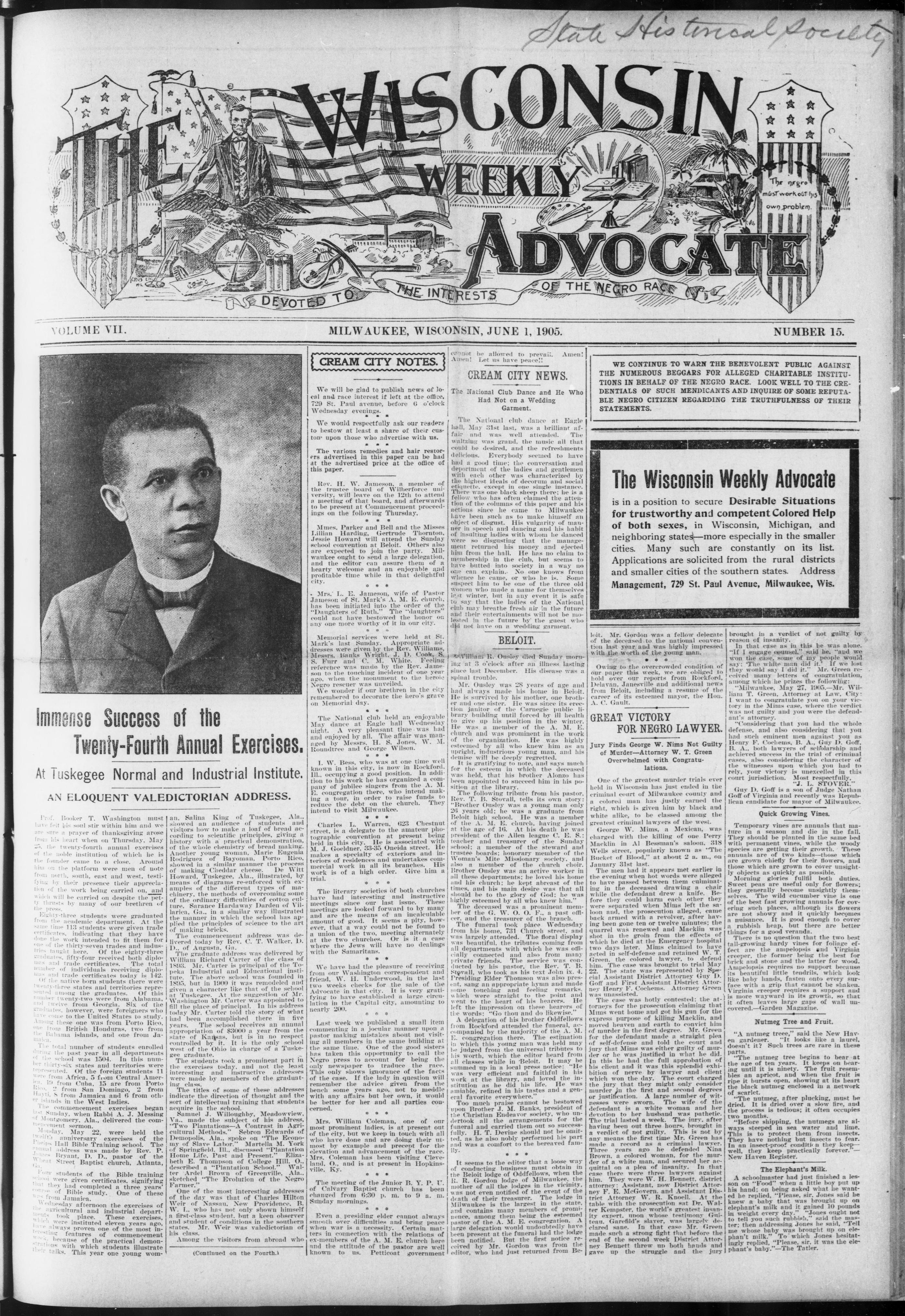
WISCONSIN
WEEKLY
ADVOCATE
DEVOTED TO THE INTERESTS OF THE NEGRO RACE
Immense Success of the Twenty-Fourth Annual Exercises.
AN ELOQUENT VALEDICTORIAN ADDRESS.
VOLUME VII.
Immense Success
Twenty-Fourth
At Tuskegee Normal
AN ELOQUENT VALE
Prof. Booker T. Washington must have felt his soul stir within him and we are sure a prayer of thanksgiving arose from his heart when on Thursday, May 25, the twenty-fourth annual exercises of the noble institution of which he is the founder came to a close. Around him on the platform were men of note from north, south, east and west, testifying by their presence their appreciation of the work being carried on, and which will be carried on despite the petty thrusts by many of our brethren of the press.
Eighty-three students were graduated from the academic department. At the same time 113 students were given trade certificates, indicating that they have done the work intended to fit them for one of the thirty-seven trades and industries taught here. Of the eighty-three graduates, fifty-four received both diplomas and trade certificates. The total number of individuals receiving diplomas and trade certificates today is 142. Of the native born students there were twenty-three states and territories represented among the graduates. Of this number twenty-two were from Alabama, and twelve from Georgia. Six of the graduates, however, were foreigners who have come to the United States to study. Among these one was from Porto Rico, one from British Honduras, two from the Bahama islands, and one from Jamaica.
The total number of students enrolled during the past year in all departments of the school was 1504. In this number thirty-six states and territories were represented. Of the foreign students 11 were from Africa, 5 from Central America, 19 from Cuba, 15 are from Porto Rico, 2 from San Domingo, 2 from Hayti, 8 from Jamaica and 6 from other islands in the West Indies.
The commencement exercises began last Sunday, when Rabbi A. J. Messing of Montgomery, Ala., delivered the commencement sermon.
Monday, May 22, were held the twelfth anniversary exercises of the Phelps Hall Bible Training school. The annual address was made by Rev. P. James Bryant, D. D., pastor of the Wheat Street Baptist church, Atlanta, Ga.
Fony students of the Bible training school were given certificates, signifying that they had completed a three years' course of Bible study. One of these was from Jamaica. Wednesday afternoon the exercises of the agricultural and industrial departments took place. These exercises, which were instituted eleven years ago, have always proven one of the most interesting features of commencement week, because of the practical demonstrations with which students illustrate their talks. This year one young wom-
---
an, Salina King of Tuskegee, Ala., showed an audience of students and visitors how to make a loaf of bread according to scientific principles, giving a history with a practical demonstration, of the whole chemistry of bread making. Another young woman, Marie Eugenia Rodriguez of Bayoman, Porto Rico, showed in a similar manner the process of making Cheddar cheese. De Witt Howard, Tuskegee, Ala., illustrated, by means of diagrams re-enforced with examples of the different types of machinery, the methods of overcoming some of the ordinary difficulties of cotton culture. Sarance Hardaway Darden of Vilarica, Ga., in a similar way illustrated the manner in which the school has applied the principles of science to the art of making bricks.
The commencement address was delivered today by Rev. C. T. Walker, D. D., of Augusta, Ga.
The graduate address was delivered by William Richard Carter of the class of 1893. Mr. Carter is principal of the Topeka Industrial and Educational institute. The above school was founded in 1895, but in 1900 it was remodeled and given a character like that of the school at Tuskegee. At the suggestion of Mr. Washington Mr. Carter was appointed to fill the place of principal. In his address today Mr. Carter told the story of what had been accomplished there in five years. The school receives an annual appropriation of $3000 a year from the state of Kansas, but is in no respect controlled by it. It is the only school west of the Ohio in charge of a Tuskegee graduate.
The students took a prominent part in the exercises today, and not the least interesting and instructive addresses were made by members of the graduating class. The titles of some of these addresses indicate the direction of thought and the sort of intellectual training that students acquire in the school.
Samuel J. Willoughby, Meadowview, Va., made the subject of his address, "Two Plantations—A Contrast in Agricultural Methods." Sebron Edwards of Demopolis, Ala., spoke on "The Economy of Slave Labor." Martael M. York of Springfield, Ill., discussed "Plantation Home Life, Past and Present." Elizabeth E. Thompson of College Hill, O., described a "Plantation School." Walter Ardel Brown of Greenville, Ala., sketched "The Evolution of the Negro Farmer."
One of the most interesting addresses of the day was that of Charles Hilton Weir of Nassau, New Providence, B. W. I., who has not only shown himself a first-class student, but a keen observer and student of conditions in the southern states. Mr. Weir was valedictorian of his class.
Among the visitors from abroad who
(Continued on the Fourth.)
CREAM CITY NOTES.
---
We will be glad to publish news of local and race interest if left at the office, 729 St. Paul avenue, before 6 o'clock Wednesday evenings.
We would respectfully ask our readers to bestow at least a share of their custom upon those who advertise with us.
The various remedies and hair restorers advertised in this paper can be had at the advertised price at the office of this paper.
Rev. H. W. Jameson, a member of the trustee board of Wilberforce university, will leave on the 12th to attend a meeting of that board, and afterwards to be present at Commencement proceedings on the following Thursday.
※ ※ ※
Mmes. Parker and Bell and the Misses Lillian Harding, Gertrude Thornton, Jessie Howard will attend the Sunday school convention at Beloit. Others also are expected to join the party. Milwaukee ought to send a large delegation, and the editor can assure them of a hearty welcome and an enjoyable and profitable time while in that delightful city.
☆ ☆ ☆
- Mrs. L. E. Jameson, wife of Pastor Jameson of St. Mark's A. M. E. church, has been initiated into the order of the "Daughters of Ruth." The "daughters" could not have bestowed the honor on any one more worthy of it in our city.
* * *
Memorial services were held at St. Mark's last Sunday. Appropriate addresses were given by the Rev. Williams, Messrs. Banks Wright, J. D. Cook, S. S. Furr and C. M. White. Feeling reference was made by the Rev. Jameson to the touching incident of one year ago, when the monument to the heroic Negro rescuer was unveiled. We wonder if our brethren in the city remembered to decorate the hero's grave on Memorial day.
家宅
The National club held an enjoyable May dance at Eagle hall Wednesday night. A very pleasant time was had and enjoyed by all. The affair was managed by Messrs. H. S. Jones, W. M. Roundtree and George Wilson.
※ ※ ※
I. W. Bess, who was at one time well known in this city, is now in Rockford. Ill. occupying a good position. In addition to his work he has organized a company of jubilee singers from the A. M. E. congregation there, who intend making a tour, in order to raise funds to reduce the debt on the church. They intend to visit Milwaukee.
***
Charles L. Warren, 623 Chestnut street, is a delegate to the amateur photographic convention at present being held in this city. He is associated with M. J. Goeldner, 33-35 Oneida street. He makes a specialty of exteriors and interiors of residences and undertakes commercial work in all its branches. His work is of a high order. Give him a trial.
* * *
The literary societies of both churches have had interesting and instructive meetings since our last issue. These meetings are looked forward to by many and are the means of an incalculable amount of good. It seems a pity, however, that a way could not be found to a union of the two, meeting alternately at the two churches. Or is it a case where the Jews will have no dealings with the Samaritans.
***
We have had the pleasure of receiving from our Washington correspondent and friend, W. H. Underwood, in the last two weeks checks for the sale of the Advocate in that city. It is very gratifying to have established a large circulation in the Capital city, amounting to nearly 200.
\* \* \*
Last week we published a small item commenting in a jocular manner upon a pastor making mistakes about not visiting all members in the same building at the same time. One of the good sisters has taken this opportunity to call the Negro press to account for being the only newspaper to traduce the race. This only shows ignorance of the facts of the case. If the lady in question will remember the advice given from the bench some years ago, not to meddle with any affairs but her own, it would be better for her and all parties concerned.
```markdown
```
Mrs. William Coleman, one of our most prominent ladies, is at present out of the city, but we keep in touch with all who have done and are doing their utmost by example and precept for the elevation and advancement of the race. Mrs. Coleman has been visiting Cleveland, O., and is at present in Hopkinsville, Ky.
* * *
The meeting of the Junior B. Y. P. U. of Calvary Baptist church has been changed from 6:30 p. m. to 9 a. m. Sunday mornings.
Even a presiding elder cannot always smooth over difficulties and bring peace when war is a necessity. Certain matters in connection with the relations of ex-members of the A. M. E. church here and the attitude of the pastor are well known to us. Petticoat government
cannot be allowed to prevail. Amen!
Amen! Let us have peace!!
CREAM CITY NEWS.
The National Club Dance and He Who Had Not on a Wedding Garment.
The National club dance at Eagle hall, May 31st last, was a brilliant affair and was well attended. The waltzing was grand, the music all that could be desired, and the refreshments delicious. Everybody seemed to have had a good time; the conversation and deportment of the ladies and gentlemen with each other was characterized by the highest ideals of decorum and social etiquette, except in one single instance. There was one black sheep there; he is a fellow who has often claimed the attention of the columns of this paper and his actions since he came to Milwaukee have been such as to make himself an object of disgust. His vulgarity of manner in speech and dancing and his habit of insulting ladies with whom he danced were so disgusting that the management returned his money and ejected him from the hall. He has no claim to membership in the club, but seems to have butted into society in a way no one can explain. No one knows from whence he came, or who he is. Some suspect him to be one of the three old women who made a name for themselves last winter, but in any event it is safe to say that the ladies of the National club may breathe fresh air in the future and their entertainments will not be molested in the future by the guest who did not have on a wedding garment.
BELOIT.
William R. Ousley died Sunday morning at 3 o'clock after an illness lasting since last December. His disease was a spinal trouble.
Mr. Ousley was 28 years of age and had always made his home in Beloit. He is survived by his mother, one brother and one sister. He was since its erection janitor of the Carnegie public library building until forced by ill health to give up his position in the winter. He was a member of the A. M. E. church and was prominent in the work of the organization. He was highly esteemed by all who knew him as an upright, industrious young man, and his demise will be deeply regretted.
It is gratifying to note, and says much for the esteem in which the deceased was held, that his brother Alonzo has been appointed to succeed him in his position at the library.
The following tribute from his pastor, Rev. T. B. Stovall, tells its own story: "Brother Ousley was a young man only 26 years old; he was a graduate from Beloit high school. He was a member of the A. M. E. church, having joined at the age of 16. At his death he was president of the Allen league C. E. S.; teacher and treasurer of the Sunday school; a member of the steward and trustee boards; honorary member of the Woman's Mite Missionary society, and also a member of the church choir. Brother Ousley was an active worker in all these departments; he loved his home and his church; he kept abreast of the times, and his main desire was that all should be to the glory of God; he was highly esteemed by all who knew him."
The deceased was a prominent member of the G. W. O. O. F., a past officer and the treasurer of the branch
cott, and the treasurer of the branch.
The funeral took place Wednesday from his home, 731 Church street, and was largely attended. The floral display was beautiful, the tributes coming from all departments with which he was officially connected and also from many private friends. The service was conducted by his pastor, the Rev. T. B. Stovall, who took as his text John ix. 4. Presiding Elder Thomson was also present, sang an appropriate hymn and made some touching and feeling remarks, which were straight to the point and went to the heart of his hearers. He left the impression on these hearers of the words: "Go thon and do likewise."
A delegation of his brother Oddfellows from Rockford attended the funeral, accompanied by the majority of the A. M. E. congregation there. The estimation in which this young man was held may be judged from the universal tributes to his worth, which the editor heard from all classes while in Beloit. It may be summed up in a local press notice: "He was very efficient and faithful in his work at the library, and loved the institution as he did his life. He was amiable, refined in his tastes and a general favorite everywhere."
Too much praise cannot be bestowed upon Brother J. M. Banks, president of the Christian Endeavor society, who undertook all the arrangements for the funeral and carried them out so successfully. H. T. Devine should not be omitted, as he also nobly performed his part and was a comfort to the bereaved family.
* * *
It seems to the editor that a loose way of conducting business must obtain in the Beloit lodge of Oddfellows, when the R. R. Gordon lodge of Milwaukee, the mother of all the lodges in the vicinity, was not even notified of the event of the death of their treasurer. The lodge in Milwaukee is the largest in the state, and contains many members of prominence, among them being the esteemed pastor of the A. M. E. congregation. A large delegation would undoubtedly have been present at the funeral had the lodge been notified. But the first notice received by Mr. Gordon was from the editor, who had just returned from Be-
WE CONTINUE TO WARN THE BENEVOLENT PUBLIC AGAINST THE NUMEROUS BEGGARS FOR ALLEGED CHARITABLE INSTITUTIONS IN BEHALF OF THE NEGRO RACE. LOOK WELL TO THE CREDENTIALS OF SUCH MENDICANTS AND INQUIRE OF SOME REPUTABLE NEGRO CITIZEN REGARDING THE TRUTHFULNESS OF THEIR STATEMENTS.
The Wisconsin Weekly Advocate
is in a position to secure Desirable Situations for trustworthy and competent Colored Help of both sexes, in Wisconsin, Michigan, and neighboring states more especially in the smaller cities. Many such are constantly on its list. Applications are solicited from the rural districts and smaller cities of the southern states. Address Management, 729 St. Paul Avenue, Milwaukee, Wis.
loit. Mr. Gordon was a fellow delegate of the deceased to the national convention last year and was highly impressed with the worth of the young man.
Owing to the overcrowded condition of our paper this week, we are obliged to hold over our reports from Rockford, Delavan, Janesville and additional news from Beloit, including a resume of the career of its esteemed mayor, the Hon. A. C. Gault.
GREAT VICTORY FOR NEGRO LAWYER
Jury Finds George W. Nims Not Guilty of Murder—Attorney W. T. Green Overwhelmed with Congratulations.
One of the greatest murder trials ever held in Wisconsin has just ended in the criminal court of Milwaukee county and a colored man has justly earned the right, which is given him by black and white alike, to be classed among the greatest criminal lawyers of the west.
George W. Mims, a Mexican, was charged with the killing of one Perry Macklin in Al Bessman's saloon, 318 Wells street, popularly known as "The Bucket of Blood," at about 2 a. m., on January 31st last.
The men had it appears met earlier in the evening when hot words were alleged to have passed between them culminating in the deceased drawing a chair while the defendant drew a knife. Before they could harm each other they were separated when Mims left the saloon and, the prosecution alleged, came back armed with a revolver, after having been gone ten or twelve minutes; the quarrel was renewed and Macklin was shot in the groin from the effects of which he died at the Emergency hospital two days later. Mims claimed to have acted in self-defense and retained W. T. Green, the colored lawyer, to defend him. The case was brought to trial May 22. The state was represented by Special Assistant District Attorney Guy D. Goff and First Assistant District Attorney Henry F. Cochems. Attorney Green was unassisted.
The case was hotly contested: the attorneys for the prosecution claiming that Mims went home and got his gun for the express purpose of killing Macklin, and moved heaven and earth to convict him of murder in the first degree. Mr. Green for the defendant made a straight plea of self-defense and told the court and jury that Mims was either guilty of murder or he was justified in what he did. In this he had the full approbation of his client and it was this splendid exhibition of nerve by lawyer and client which won the day. The court charged the jury that they might only consider murder in the first and second degrees or justification. A large number of witnesses were sworn. The wife of the defendant is a white woman and her devotion to her husband was pathetic. The trial lasted a week. The jury, after having been out three hours, brought in a verdict of not guilty. This is not by any means the first time Mr. Green has made a record as a criminal lawyer. Three years ago he defended Nina Brown, a colored woman, for the murder of a white man, and secured her acquittal on a plea of insanity. In that case there were three lawyers against him. They were W. H. Bennett, district attorney: Assistant, now District Attorney F. E. McGovern, and Assistant District Attorney W. R. Knoell. At the table with the prosecution sat Dr. Walter Kempster, the world's greatest insanity expert, upon whose testimony Guiteau, Garefild's slayer, was largely declared sane. In that case Mr. Green made such a strong fight that before the end of the second week District Attorney Bennett threw up both hands and gave up the struggle and the jury
NUMBER 15.
BENEVOLENT PUBLIC AGAINST ALLEGED CHARITABLE INSTITUED RACE. LOOK WELL TO THE CREATIONS AND INQUIRE OF SOME REPUTA- THE TRUTHFULNESS OF THEIR
Weekly Advocate
Desirable Situations Competent Colored Help
Wisconsin, Michigan, and especially in the smaller constantly on its list.
from the rural districts southern states. Address Avenue, Milwaukee, Wis.
brought in a verdict of not guilty by reason of insanity.
In that case as in this he was alone. "If I engage counsel," said he, "and we won the case, some of my people would say: 'The white man did it.' If we lost they would say I did it." Mr. Green received many letters of congratulation, among which he prizes the following:
"Milwaukee, May 27, 1905.—Mr. William T. Green, Attorney at Law, City: I want to congratulate you on your victory in the Mims case, where the verdict was not guilty and you were the defendant's attorney.
"Considering that you had the whole defense, and also considering that you had such eminent men against you as Henry F. Cochems, B. A., Guy D. Goff, B. A., both lawyers of scholarship and achieved success in the trial of criminal cases, also considering the character of the witnesses upon which you had to rely, your victory is unexcelled in this court jurisdiction. Most respectfully, "J. L. STOVER." Guy D. Goff is a son of Judge Nathan Goff of Virginia and recently was Republican candidate for mayor of Milwaukee.
Quick Growing Vines.
Temporary vines are annuals that mature in a season and die in the fall. They should be planted in the same bed with permanent vines, while the woody species are getting their growth. These annuals are of two kinds—those which are grown chiefly for their flowers, and those which are grown to cover unsightly objects as quickly as possible. Morning glories fullfil both duties. Sweet peas are useful only for flowers; they generally become unsightly themselves. The wild cucumber vine is one of the best fast growing annuals for covering such places, although its flowers are not showy and it quickly becomes a nuisance. It is good enough to cover a rubbish heap, but there are better things for a good veranda.
There is no question that the two best tall-growing hardy vines for foliage effect are the ampelopsis and Virginia creeper, the former being the best for brick and stone and the latter for wood. Ampelopsis requires no support because its beautiful little tendrils, which look like baby hands, fasten onto every surface with a grip that cannot be shaken. Virginia creeper requires a support and is more wayward in its growth, so that it often leaves large gaps of wall uncovered.—Garden Magazine.
Nutmeg Tree and Fruit
"A nutmeg tree," said the New Haven gardener. "It looks like a laurel, doesn't it? Such trees are rare in these parts.
"The nutmeg tree begins to bear at the age of ten years. It keeps on bearing until it is ninety. The fruit resembles an apricot, and when the fruit is ripe it bursts open, showing at its heart the black nutmeg enclosed in a network of scarlet.
"The nutmeg, after plucking, must be dried. It is dried over a slow fire, and the process is tedious; it often occupies two months."
"Before shipping, the nutmegs are always steeped in sea water and lime. This is to protect them from insects. They have nothing but insects to fear. In an insect-proof condition they keep well, they keep practically forever." New Haven Register.
The Elephant's Milk
A schoolmaster had just finished a lesson on "Food" when a little boy put up his hand; on being asked what he wanted he replied, "Please, sir. Jones said he knew a baby that was brought up on elephant's milk and it gained 10 pounds in weight every day." "Jones ought not to tell you such rubbish," said the master; then addressing Jones he said, "Tell me whose baby was brought up on elephant's milk." To which Jones hesitatingly replied, "Please, sir. it was the elephant's baby."—The Tatler.
---
NOTES OF INTEREST.
The lighthouse at Corunna, Spain, is believed to be the oldest one now in use. It was erected during the reign of Trajan, and rebuilt in 1634.
The quantity of foreign and colonial cheese consumed by the British people is enormous and is growing, with some fluctuations, from year to year.
A Paris bank clerk, carrying $400 in gold in a bag, dropped a piece of money worth $2. To search for it he set his bag down on the sidewalk. When he found the piece he had lost his bag was gone.
Recent travelers in Thibet have noticed that while effects of the rarified air are severely felt at altitudes of between 14,000 and 16,000 feet, on going yet higher all disagreeable sensations pass off.
A British fleet of eight battleships and five cruisers will visit Brest next July and in August a French fleet of five battleships, nine cruisers, five destroyers and six torpedo boats will pay a return visit to Portsmouth.
The legislative assembly of New Mexico is considering the passage of an act compelling the Santa Fe and Rock Island railways to have separate cars for consumptives, while they are passing through the territory.
"Sulphur, which is a nuisance and an impudent adulteration among the metals," says the American Machinist, "still has a way of keeping itself uncontaminated. American producers of sulphur offer it 99.9 per cent pure."
According to the annual report of the Volunteers of America, of whom Ballington Booth is the leader, the congregations at the 35,000 services during the year within the Volunteers' halls and buildings reached 1,060,955 persons. A house lease produced in a Montreal court recently had a clause prohibiting the tenant from having relatives to visit him and also forbidding dancing. The judge refused to grant an ejection for breach of such a contract. South Carolina is making a methodical and hopeful effort to divert the stream of immigration to her territory. The state has about 14,000,000 acres of unoccupied land, and desires new white blood to develop the fields and mines.
John Pearce, who now employs 1500 persons in his eighty-one London restaurants, all labeled "Pearce and Plenty," began life on a capital of 62 cents and started his first "restaurant" with a pushcart, a tin urn and a little crockery.
Statistics for the German empire show a further increase in the number of cremations, there having been cremated 1381 bodies in 1904 against 1074 bodies in 1903, an increase of 28 per cent, and double the number cremated in 1901.
The superior board of health of Mexico informs dealers in food products, especially milk dealers, that the use of preservatives in food is prohibited and punishable by the board as food adulteration. inger, 7:40; Corona, 8. Wind west, 12 miles; cloudy.
Walnuts in Washington State
Ten prominent farmers of the Wenatchee valley have decided to conduct a series of experiments in the cultivation of English walnuts. They have secured sufficient seed to plant forty-five acres. One man proposes to devote twenty acres to nut trees. The promoters hope to demonstrate that the soil and climatic conditions of that section are adapted to successful nut culture. The market is at their doors, and success is assured when the crops are harvested. The new industry promises a profitable investment, and will add much to advertising the country as a desirable location for diversified tree culture. Walnut growing is comparatively new to the orchardists of this state. It is not in the experimental stage. One farm in Chelan county has produced excellent nuts. The trees were grown from seed and began bearing nuts when five years old. Last season they gave better profits than any fruits in that section. Similar results have been attained in Clarke county and other localities in the Puget Sound region. The only reason why home-grown nuts have not been placed on the general market is that no large areas have been planted. Now that Wenatchee has made a beginning it remains for other districts to follow.
The use of nuts as food is increasing every year throughout the United States. Physicians recommend a nut diet in many instances as a meat substitute. Scientists claim that much of the sickness of the people originates in the use of improper foods that can be remedied by eating more nuts. To supply the increasing demand our country must import large quantities of nuts from foreign lands every year. The money sent to South America and other places for these necessities could be used at home in building up the farms and beautifying the residences if the farmers produced the nuts. Here, then, is one of the opportunities.—Seattle Post;Intelligencer.
Unimportant.
A Princeton man tells of a conversation that took place between the coach of a football eleven and one of the players. An important game was soon to be played; and the coach was, of course, most anxious that every player should be in the best of physical condition. But to his disgust one of the men, upon whom a great deal depended if the great game were to be won, seemed to be in "bad form." Taking him aside, the coach had the following "heart to heart talk" with the recalcitrant:
"See here, you're not looking so good! Muscles flabby and wind bad—awful bad. What's the matter? Been drinking anything?"
"Not a drop."
"Then you must be smoking."
"Haven't touched a pipe, cigar, or cigarette since the training began."
"Studying?"
"Well, yes—a little."
Whereupon the coach gave vent to a snort of disgust. "See here! You've got to stop that! Do you want us to lose the game?"—Harper's Weekly.
Rich Men Long Lived.
Unfortunately for the chancellor of the British exchequer, the financial year ending March 31, was marked by the death of only one millionaire. For a long time past the average number of wills probated in each year which exceeded in value £1,000,000 has been between five and six. This year a Bolton cotton spinner alone left a million, the exact sum being £1,151,378. Of the last six years 1900 was the best from this point of view, when nine estates of the aggregate value of £19,032,695 paid death duties. Looking over the list of the twenty-four richest people who died in the financial year just ended, it might be deduced that wealth is the surest means to long life. Only one of this number was under sixty, one was ninety-nine, fourteen were over seventy, and six were over eighty. The average age was seventy-four years and six months.—New York Sun.
Joe Bowker is still champion bantam of the world. At the National Sporting club in London the contest between Bowker, the present champion of England, and Pinkey Evans of Yonkers, N. Y., for the championship and a purse of $3750, went the full twenty rounds. Bowker being an easy winner on points. Evans received much punishment, but gamely contested every round.
JUNE.
I feel a stirring in the blood
I cannot quite explain,
Although I've felt it many times,
And feel it now again.
There's something in the earth and sky,
That sets my heart attune.
And sends me to the open fields
To drink the air of June.
I'm getting well along in years,
And yet, I can't complain.
For, with the scents and scenes of June
My youth comes back again.
And so with friends that long are gone,
I still hold sweet commune.
Along the lanes and through the fields
Of iridescent June.
—J. H. Rockwell in Four-Track News.
WET PAINT.
"Yes," said Detective Hunter, "we must all admit that if circumstantial evidence be inadmissible nine-tenths of our murderers would escape the gallows, since few men commit so serious a crime in full view of their fellows. At the same time I must admit that circumstantial evidence alone, however conclusive it may appear, can be, and has been, entirely dissipated by the proving of facts that go to contradict all the former and more imaginary evidence. Still, we cannot dispense with circumstantial evidence, and it is left to the trained detective to discover if there be any fact more tangible to refute it."
He paused for a moment or two and then continued:
"I was in the Yard one morning a few years ago when I was summoned by the chief. Proceeding at once to his office I found him reading a telegram which had just come in.
'Ah, Hunter,' he said, seeing me, 'here is a little case for you. You had better go down immediately.'
"He handed me the wire, upon which I read the following message: 'Man named Frederick Flint murdered here during the night. We are on the track of the man who committed the crime and hope to arrest him today.—Sergeant Walters, Brindlewood, Hampshire.'
"I laid the telegram on the chief's writing table.
"Looks as if Sergeant Walters can dispense with our assistance,' I said, dryly.
The chief smiled.
"Yes, I know.' he said good humoredly, 'but we'll have to put up with it all the same. The case is too serious to be left in untrained hands. Get there as soon as you can, Hunter, and see that he makes no blunders.'
"I nodded, and in a little more than an hour was on my way to the little village of Brindlewood. Sergeant Walters received me without the smallest display of cordiality. A couple of inspectors, he told me, had been in from the neighboring town. But the village force, of which he was the honored head and which comprised a couple of police constables besides himself, was quite adequate to the emergencies of the case. And what was much more to the point, the murderer of Frederick Flint was already in custody at the village lock-up. I knew as yet nothing whatever of the case, so it was not my province to censure where very possibly no censure was due. I contented myself with requesting him to give me the particulars of the case and the nature of the evidence against the suspected man, and I confess he staggered me.
"Well,' he said, 'I can do that easily enough. This, then, is what we have discovered. Frederick Flint was reputed to be a tolerably rich man. The house in which he lived and several others in the village were his own. He also owned two farms in the neighborhood, both occupied by tenants, and a great wood close to his house, which he allowed no one to enter, was likewise his property. But he was a mean man and always went by the name of Miser Flint. No one lived with him except his daughter, Mary, whom he watched with jealous eyes and kept almost a prisoner in the dull old house. But Mary Flint managed to elude the old man's vigilance, and it was currently believed that she was secretly engaged to a young farmer named George Drake. The villagers have seen them together more than once, and their attitude towards each other told its own tale.
"But George Drake was comparatively poor, and his chances looked proportionately remote. Two days ago, however, he went to the old miser and boldly asked him for his daughter Mary. The old man, foaming with passion, followed him out to the door. A laborer chanced to be passing at the time, and both saw and heard all that happened outside. The old man was loading the other with every kind of abuse, and when George Drake, stung into replying, turned to confront the enraged miser, the latter struck him savagely in the face. For a moment George Drake never moved, though his clenched hands were trembling visibly. Then he said, 'By ——, Frederick Flint. I'll be even with you for this before the week's out!" Early this morning we found the dead body of the old miser stretched on the ground just outside the fence of the enclosed wood I mentioned just now.
"A gun lay on the grass beside him and there are a dozen people in the village who are ready to swear it is the property of George Drake. We had a smart shower early last evening which made the ground more than usually liable to impression, and we have traced footprints from the door of George Drake's house into the very wood in which old Flint was evidently shot. Suicide is quite out of the question since the bullet wound is in the back, and proceeds, so Dr. Hutchinson affirms, right through the heart of the murdered man. Lastly, and most conclusive of all, George Drake has lately worn a tweed coat of very light pattern and quite unlike any other in the village. Mr. Gray, the village postmaster, says emphatically that he saw a man at 8 o'clock last night climbing the fence of the wood. There was a good moon and he noticed that the man carried a gun and that he was wearing George Drake's light coat. It struck him as strange at the time, but thought no more about it until he heard this morning of Miser Flint's death. That is all I have to tell you, Mr. Hunter, and I trust you are satisfied with the manner in which I have conducted the inquiry.'
"Quite,' I said if all this is true you have a very clear case indeed.'"
Detective Hunter paused.
"Well," he said, "and what do you think of that? Will you not admit now that circumstantial evidence be as convincing as the evidence of the senses?"
"It certainly seems like it," I said reluctantly. "I suppose George Drake ended his career on the scaffold. He
richly deserved it, if all you say is true, in spite of the provocation he received." Detective Hunter smiled. "No," he said quietly. "I wasn't quite satisfied and made a few inquiries on my own account. Let me relate them to you." Once more he paused to recollect all the complicated circumstances of the case. Then he proceeded as before:
"First I asked to see the gun. The moment I saw it I knew that I held in my hand a piece of evidence which would either confirm or refute the theory of Sergeant Walters. Eight round the lower part of the gun was the imprint of a man's left hand clearly marked in white paint, while similar patches were to be seen along the barrel and upon the trigger. I pointed this out to Sergeant Walters.
"Oh,' he said, 'that's of small importance and very easily accounted for. The fence surrounding the wood was newly painted white, and the work not being finished until last evening the man who held the gun and got over the fence into the wood probably got himself in a nice mess."
"Yes, but don't you see,' I said, 'you have here the print of a man's hand!'
"Oh, that would be well enough,' retorted the sergeant with a superior smile, 'if there was a dearth of other and more important evidence.'
"But,' I protested, 'you can't have too much evidence. And supposing this should go to disprove the rest?"
"At that instant a policeman dashed in at the door.
"Beg pardon, Mr. Walters,' he said excitedly, 'but I've made another discovery. Just inside the fence where the paints been rubbed off I found what was left of the wad the murderer used. It's a bit of charred paper, but it isn't all burnt, and there's some writing on it."
"He held it out and we all looked at it eagerly. As the man had affirmed, several words could still be distinguished. There were but few, it is true, but it was clear the charred scrap of paper was all that was left of a letter—an angry letter—sent by Frederick Flint to George Drake. The latter surname was still traceable, and as the sergeant saw it he glanced at me with a smile.
"You're right, Mr. Hunter,' he said, angrily, 'we can't have too much evidence.'
"The remark nettled me, and after taking a careful impression in wax of the hand of the gun-brutt I went off to look at the scene of the tragedy. Arrived there I found everything as the sergeant had represented. After a little difficulty I discovered the footprints where they entered the wood, and, tracing them back to their starting point, found myself at George Drake's farmhouse. The household was in a state of confusion. The young man's mother and sister were almost prostrate with grief and horror at what had befallen them, and it was with difficulty I could persuade them into giving me a coherent explanation of the tragedy. They were firm in the belief that George was the victim of circumstances and not the murderer of old Miser Flint, but they admitted the gun to be the property of George, and also declared that his light coat was missing from the hall where it had hung, though he was wearing another at the time of his arrest.
"Next I went to see Miss Flint, but could gain no greater information in that quarter than that her dead father had made another enemy in the person of a poacher in the neighborhood, whom he had threatened with the law, and who had in turn threatened him with something worse. Finally I returned to Sergeant Walters and demanded a private interview with the suspected man. I found him in a dark, narrow cell, with his head buried in his hands. He rose as I entered and looked me full and fearlessly in the face. Quite as searchingly I eyed him, but he never once flinched. If George Drake was a murderer, I decided, he certainly did not look like one. "'Well,' I said, briskly, 'I suppose you do not know me. I am Detective Hunter, of New Scotland Yard, and I want you to answer a few questions.' He bowed and I continued: 'Are you, first of all, in the habit of wearing boots with large nails in the soles?'
'No,' was the reply. 'I do not do the hard work on my farm, and my boots are, therefore, of a lighter make.'
'Did you wear your light tweed coat last evening?' I asked.
'No,' he said. 'I left it in the hall and, feeling out of sorts, went for a long walk across country. I did not get back till 10 o'clock, and met no one on the way whom I knew. I did not know the light coat was missing from its usual place until I was arrested this afternoon.'
'Thanks,' I said. 'Now, let me look at your left hand.'
"He held it out to me without hesitation, and, taking it, I compared it with the impression I had made. It was dissimilar in every way. Presently I looked up into his face
"Don't let this worry you,' I said. 'There's another side to this business which Sergeant Walters doesn't see.'
"He shot me a quick glance of gratitude, and I left him to return once more to the sorrow-stricken farmhouse. Arrived there, I made a careful and systematic search of the ground in front of the house. It was a long and troublesome task, for it was rapidly growing dark, but at last I found what I wanted. There were other prints of the nailed boots beside those that led from the porch of the low veranda to the wood where the murder had been committed, and these led up to the side of the house. There they turned and, following the side wall, turned again at the western edge of the veranda and disappeared. It was clear that the owner of the boots had stepped on to the tiled veranda at this point, and, traversing it half-way, had entered the front door, which, as is usual in country villages, could be opened from without. As quickly as I could I followed up this new line of footprints to its starting point; but in this I was not as successful as I could have wished. Still, I was beginning to see daylight, for when at last my search had to be abandoned, owing to hard and rocky soil where no footprints were visible, I was within 300 yards of the house of the identical poacher of whom Miss Flint had spoken. At last I was compelled to abandon the search out of doors. Returning to the village, I mingled with the curious and excited population, listened to their discussion of the great event of the year, and passed myself off as a mere idler about the country, who chanced to find myself at that opportune moment in the little village of Brindlewood.
"Early the following morning I was again afoot. Going straight to the scene
of the tragedy I climbed the fence and made my way slowly through the wood in the direction I supposed the murderer had taken after firing the shot. Presently I emerged on a little stream or brook where there was a wide space in the thick growth of trees. All at once my eye lit on an object lying at the side of the brook. It was a large red handkerchief such as men use in which to tie a midday meal. Picking it up I gave a start of surprise, for it was bedaubed with white paint and had evidently been used to remove the sticky substance from the hands of its owner.
"Following the stream to the right I emerged on to the high road not a hundred yards from the house of the poacher. For a moment I stood still, debating within myself whether a visit to the house thus early in the day would damage my chances of success and put the wary old poacher on his guard, but I made up my mind to run the risk and to that end approached the house without showing myself in doing so. Leaving the front of the cottage I passed round to the back. There was a scullery adjoining the house, the door of which was shut, but I caught the sound of scrubbing within and saw a column of smoke issuing from the chimney.
"My first thought was that it was washing day. The poacher's wife would not welcome me very heartily, I thought, but I couldn't help that. Lifting the latch of the door I pushed it open and entered. A man was standing at a long washing stool, upon which lay a pair of trousers. He was engaged at the moment in attempting to remove some white patches from the garment in question, and my eyes lit up at the sight. The fireplace of the copper was sending out a suffocating gray smoke, and a piece of light-colored tweed projected from the doorway from which the smoke was curling. In an instant the man saw that he was trapped. With a fierce cry he hurled himself upon me, and I had as fierce a fight as I have ever had in all my life. But I have not mastered the art of wrestling in vain, and in ten minutes I had the handcuffs on his wrists and was marching him down to the little police station.
"To depict the astonishment of Sergeant Walters when he saw me is more than I can do. But he was not so vain as some. When I took him over the ground and showed him the nails in the boots, the second track of footprints leading up to the house, the similarity of the poacher's hand with the impression I had taken from the gun, the red handkerchief, and last, but not least, the paint-smudged trousers and the smouldering remains of George Drake's tweed coat which I had taken from the poacher's scullery, he admitted the folly of his own theory in spite of the seemingly indisputable nature of his chain of evidence. And to crown all the poacher, realizing how strong was the evidence against him, confessed to the murder the very next day.—Walter J. Mowbray in the Tattler.
Worth Remembering.
There are three entirely different kinds of ingredients used in making the three different varieties of baking powders on the market, viz.:(1) Mineral-Acid or Alum, (2) Bone-Acid or Phosphate, and (3) Cream of Tartar made from grapes. It is important, from the standpoint of health, to know something about these ingredients, and which kind is used in your baking powder.
(1) Mineral-Acid, or Alum, is made from a kind of clay. This is mixed with diluted oil of vitrol and from this solution a product is obtained which is alum. Alum is cheap; costs about two cents a pound, and baking powder made with this Mineral-Acid sells from 10 to 25c a pound.
(2) Bone-Acid, or Phosphate, is the basis of phosphate baking powders and the process is fully described in the patients issued to a large manufacturer of a phosphate powder. The U. S. Patent Office Report gives a full and exact description, but the following extract is enough: "Burned bones, after being ground, are put into freshly diluted oil of vitriol and with continual stirring and in the following proportion." etc. From this Bone-Acid phosphate baking powders are made; such powders sell from 20 to 30 cents a pound.
(3) Cream of Tartar exists in all ripe grapes, and flows with the juice from the press in the manufacture of wine. After the wine is drawn off the tartar is scraped from the cask, boiled with water, and crystals of Cream of Tartar, white and very pure, separate and are collected. It differs in no respect from the form in which it originally existed in the grape. Cream of Tartar, then, while the most expensive, is the only ingredient that should be used in a baking powder to act upon the soda, as its wholesomeness is beyond question. Cream of Tartar baking powders sell at about 40 to 50 cents a pound.
Such are the facts, and every one, careful of the health of the family, should remember this rule—Baking powders selling from 10 to 25 cents a pound are made of Mineral-Acids; those selling from 20 to 30 cents of Bone-Acid; and those from 40 to 50 cents of Cream of Tartar made from grapes.
Wealthy Men in Colorado.
David Moffatt of Denver is the wealthiest man in Colorado, which outranks all other states in per capita wealth. Colorado has the further distinction that most of its vast fortunes were made within its boundaries, not alone in mining, but in the cattle industry, in reality speculation, in fruit, sugar-beet culture, potato farming and in manufacturing, and other mercantile pursuits. There are 108 resident millionaires in Colorado, their total wealth being about $260,000,-000. Mr. Moffatt is worth from $25,-000,000 to $30,000,000. About 100 men worth seven or more figures made their money in the state and reside elsewhere.—Kansas City Journal.
Filipinos Eat Locusts
Locusts form an important article of diet in the Philippine islands. Annually these pests rise in swarms and devastate large areas, denuding trees and devouring every green thing down to the very earth. The poorer classes welcome the advent of these pests, as they not only secure a bounty for their destruction, but as well gather what is to them a succulent dainty. They catch the locusts in nets, and parch them over a slow fire or mix them in a sweetened batter and make a kind of seed cake, which they eat with great zest.
Subtraction.
A teacher in a western public school was giving her class the first lesson in subtraction, says Harper's Weekly. "Now, in order to subtract," she explained, "things have to always oe of the same denomination. For instance, we couldn't take three apples from four pears nor six horses from nine dogs." A hand went up in the back part of the room. "Teacher." shouted a small boy, "can't you take four quarts of milk from three cows?—Detroit News and Tribune.
THE KICKER.
Away daown East, in a backwoods taown,
Lived a lanky critter, named Jabez Braown;
'Nd nothin' suited him under the sun—
Whatever wuz sed or whatever wuz done,
By gum, he'd kick.
Ef he went ter meetin' on the Sabbath day
Ter hear aour minister preach 'nd pray,
The sarmon warnn't good, 'nd the pran
warn't right
He'd jest pitch in with all his might
'Nd kick, 'nd kick.
He'd kick at the rain, 'and he'd kick at the snow
'Twas either too wet er too bloomin' dry— To be contented he never would try, But jest kick.
Complainin' of everything under the sun—
Haow this wuz sed er that wuz done—
'Nd so he'd kick.
Till one day he met Aunt Nancy Green.
The pleasantest critter that ever you seen.
She see on his brawn that turrible fraown.
Nd she sez, sez she, "Naw, Jabez Braow:,
You needn't kick.
"Jest take a little advice frum me,
'Nd practice it allurs, wherever ye be;
Whatever folks do er whatever they say.
Onless yeou can do it much better'n they,
Don't yeou kick."
MONEY IN BROOK TROUT
Vermont Farmer Gets Good Returns for His Labor in Raising Them.
That a farmer can derive more profit from raising brook trout for the market than from most any other source, of like requirements of money and time, has been clearly demonstrated by Lewis J. Johnson, who has a fish preserve on his farm two miles out of West Brattleborough, Vt. By utilizing the clear spring water running through his farm, by his own ingenuity and with a very little hired assistance, within a few years he has established an inexpensive hatchery where he has succeeded in hatching and growing a large number of brook trout with which he has, partly at least, supplied the local markets, besides furnishing thousands of small fish for stocking different streams in the adjoining towns. All these have netted Mr. Johnson a handsome return upon his capital invested aside from the pleasure afforded, and incidental diversion from the usual farm labor, which, however, it has not been necessary to slight because of the fish culture.
From a modest beginning Mr. Johnson has gone on with his fish establishment, adding new and inexpensive ponds, miniature falls by dividing and diverting the spring-fed rills, till today he has a succession of long pools stocked with thousands of sportive trout of all sizes, strong and flourishing in the purest and coldest water. In connection with his plant Mr. Johnson has constructed at an expense of a few dollars modest hatching houses with their numerous troughs in which to propagate the trout from eggs. Here he has hatched this season 800,000 trout, all of which are alive and thrifty, and most of which he hopes to raise for the market. Already he has orders for part of this fry at $2 per 1000.
It takes, on an average, two years to rear the fry to the fishing size, though, of course, some fish grow slower than others. Mr. Johnson has a few two-pounders which are not much more than two years old. After the first year trout, under favorable circumstances, grow rapidly, in fact more so than in early life. Last year Mr. Johnson sold, in the home market, several hundred pounds of trout to people who came with rod and reel, taking them from the larger ponds and paying from 50 cents to $1 a pound. These with a liberal supply for private and club suppers brought in a handsome revenue to the propagator, who expects to exceed that revenue from this season's sales.—Springfield Republican.
Sherman and Jefferson.
Joseph Jefferson, the actor, and Gen. Sherman were great friends. Upon a certain occasion Jefferson called upon the general. After a pleasant chat Jefferson rose to go, and Gen. Sherman caught sight of a sheet of paper under the chair where the actor had been sitting.
"Jefferson," he called, picking up the paper and carrying it to the door, "you dropped this, I think."
Jefferson took the sheet with an effusion of thanks that was astonishing.
"My dear general," he exclaimed, "you have saved my life!"
"It seems to me you're rather careless to carry such valuable papers around so loosely," replied the general in surprise. Jefferson laughed, and unfolding the paper revailed its contents. It was the manuscript of the opening pages of the great actor's autobiography. — Helen Sherman Griffith in Lippincott's.
Whistler as a Critic
A new Whistler story is told by friends of Miss Pamela Smith, the young American artist who has made a reputation abroad by her original work in color and black and white. Miss Smith's designs, while they show uncommon imagination, are technically crude, and a friend of hers who knew Whistler was anxious to get his opinion of them. She took the portfolio of Miss Smith's illustrations to the painter and waited anxiously as Whistler examined them.
He looked them over carefully, and remarked gruffly, "She can't paint." Then he went through them again. "And she can't draw."
A third time he looked through the portfolio, pausing thoughtfully over each sketch. "But she doesn't need to," he concluded.—Harper's Weekly.
Cards to Church Weddings Improper
While it is a popular custom to issue cards of invitation to attend a church wedding, it is entirely contrary to the teaching understood to be implied by the church edifice. No private family has a right to issue invitation to the "House of God" to witness the performance of a rite within the said house as though for the time being the latter had been given over to them for their own particular use. A wedding in a church is not a private, but rather a public rite, at which any parishioner who wishes may be present without an invitation from any one God's House is at all times a public place of worship, the very spirit of which is utterly opposed to "cards of invitation."—Church Eclectic.
Origin of the Crescent-Shaped Roll
The little horse shoe shaped rolls to be seen in every baker's shop in the world have an interesting history. In 1687 Vienna was besieged by the Turks. They were about to enter the town by an underground passage that they had dug, when the bakers (who worked all night in order to deliver hot bread in the morning) gave the alarm. The authorities were so grateful they allowed them to manufacture a breakfast roll in the shape of the crescent moon, which is a device of the Turkish banner.
PENSIONING THE AGED
What the French Government Has Done in the Matter.
"The aged are generally held in respect, but not more so than in the United States." So says United States Consul General Gowdy at Paris, in a report in regard to the care of the aged in France. For more than half a century the French government has been experimenting with schemes for pensioning the aged, but not with entire success. The law now in force, which was adopted in 1895, is not altogether satisfactory and will probably be amended in the near future.
At the present time deposits are received from any person, regardless of age, but the amount may not exceed 500 francs ($96.50) in the course of a year. An account may be opened for a child of 3 years of age; a married woman may deposit money without her husband's consent. At any age between 50 and 65 (or earlier in case of permanent disability to work) the depositor may claim his annuity, which is calculated according to the amount of his deposit and interest and the probabilities of life, but the annuity may not exceed 1200 francs ($231.60).
In rural districts the tax gatherer is empowered to receive deposits, and in many factories a certain percentage is deducted from the wages and paid to the Caisse in the workman's name. A branch of the Caisse may be founded in any town or village, with the permission of the prefect of the department, and there are about 2300 of such branches, with nearly 340,000 depositors. There are several large institutions for the care of the indigent aged. Some of these are free and at others a small charge is made for board and lodging. At Issy, near Paris, is an institution for widowers, widows or married couples, of whom both are over 65 years of age and who have been married at least fifteen years.
There are many small institutions founded by private persons for old officials, at some of which the charge is as high as $250 a year. Some religious orders still shelter a few aged persons, either gratuitously or at a small sum per annum.
HARD TASK, THE TOASTMASTER'S
Work, but Not the Credit of Making the Dinner Lively, Falls on Him.
"My sympathy goes out to the toastmaster," said one of the best after-dinner speakers in New York in recalling a dinner which he recently attended.
"The toastmaster," he explained, "ought to, and must, know the speakers, but after his list is exhausted there are always others who are to be called upon, the impromptu talkers. It requires good judgment to know how to get them on their feet at the proper moment. A break by the toastmaster will undo all the good of the evening and leave unpleasant recollections.
"The toastmaster not only must keep the reins well in hand, but he must keep a clear head. That means that he must not do much more than look at the cup before him. As the evening wears on the timid become more courageous. Good fellowship is contagious. Men who swore that they never could make a speech ask to be called on.
"The speakers warm up and say the things which are remembered. The toastmaster gives the cue. Necessarily he must be brief. Necessarily, also, he must show versatility. That is where his knowledge of men counts. And as he should know how to get a speaker started, he should, above all, know how to head him off. There is where he plays up his diplomacy.
"After all is over and the participants recall the event on the next day and the days to come the toastmaster is only remembered as such. He is the burnt out taper in the cold dawn of the morning after."—New York Sun.
A Young Hunter's "Bag."
Daniel McGillicuddy is a 16-year-old Aberdeen boy who has won a name for himself on Gray's Harbor for his intrepidity as a hunter. This year he has killed two large bears in the foothills of the Olympics and expects to tackle a cougar at the first opportunity. He attacked both animals at the foot of cedar trees in which they had their cubs and killed each with one well-directed shot into the brain. The cubs were carried thirty miles to this city, the tramp including an all-night journey through the dense forests which lie between here and the Olympic mountains. The-clubs cried nearly all the way, but young McGillicuddy got them safely through. They are now on exhibition in one of the store windows of Aberdeen. The pelts of the bears hang in the barn at his home. The accounts of McGillicuddy's prowess have brought him many letters from all parts of the coast and east, mainly offers of money for the hides.—Portland Oregonian.
Bees Busy Between Old Rafters
Workmen engaged in overhauling the McMahon mansion, on Elm avenue, Rohway, N. Y., discovered that the walls of a room in the third story were dripping with honey, which was oozing from between the plaster and the outside boards. A dozen large pailfuls of honey were taken out, and more remains. The bees swarmed the room while the honey was being removed and severely stung Moses Reed. The house has been unoccupied two years. Roses and wistaria vines grow over it. Mrs. Murray, formerly Miss McMahon, says she had noticed bees flying about the house for years and had heard their hum and whirr in the walls.
Automatic Advice in Fog.
An automatic machine that shouts out the points of the compass and other warnings to vessels pounding around in impenetrable fog is one of the latest devices to be tried by the United States lighthouse board. Of the dozens of contrivances that have been invented to give fog signals to the endangered mariner the one now being experimented with, which grinds out advice and instructions night and day, probably is unique. The apparatus is known as Foster's system of fog signaling, and was installed some time since on Falkner's island, in Long Island sound, some distance from New Haven.—New York Letter to Pittsburg Dispatch.
Crows' Gold and Silver Nest
A pair of crows have constructed a nest out of gold and silver spectacle frames purloined from the factory of Messrs. Lawrence & Mayor in Bombay. The materials for this nest (of which the value was about £30) were stolen by the wily crows during the luncheon hour. It was noticed that the spectacle frames were disappearing from the factory in a mysterious manner, but it was some time before the thief was discovered. Allahabad Pioneer.
Deathbed Marriage.
Miss Adelaide Frank of Jersey City, N. J., was married to John W. Closserman beside the deathbed of her mother, and her bridal costume was at once changed for mourning garb. "God bless you," were the last words that the bride's mother uttered before death claimed her. The date for the marriage had been set for the end of June, but Mrs. Frank had set her heart on seeing her daughter married, and, realizing that death was near, she insisted that the ceremony be performed at her bedside.
In the Season.
It is the season now to go
About the country high and low,
Among the iliacs hand in hand,
And two by two in fairyland.
The brooding boy, the singing maid,
Whelly fain and half-afraid,
Now meet along the hazeled brook
To pass and linger, pause and look.
A year ago, and blithely paired,
Their rough-and-tumble play they shared;
They kissed and quarreled, laughed and
cried.
A year ago at Eastertide.
With bursting heart, with fiery face,
She strove against him in the race;
He unabashed her garter saw,
That now would touch her skirts with awe.
Now by the stile ablaze she stops,
And his demurer eyes he drops;
Now they exchange averted sighs
Or stand and marry silent eyes.
And he to her a hero is,
And sweeter she than primroses;
Their common silence dearer far
Than nightingale and mavis are.
Now when they sever wedded hands,
Jor trembles in their bosom-strands,
And lovely laughter leaps and falls
Upon their lips in madrigals.
—Robert Louis Stevenson.
Tales and Comment
Ot Interest to Women.
a northern woman who has just returned to New York after a visit of some months "'way down south" says that nothing surprised her so much as the indifference with which the negro servants of the relative with whom she was staying regarded the violation of the commandment forbidding stealing. There were several servants in the house, and when Chloe or Mandy or Jake felt inclined to appropriate anything, particularly in the eating line, he or she just did it, and never thought of such a thing as repenting the deed. One day Chloe, the waitress, walked off with a nice fat turkey that her mistress had been counting upon to fill out a certain menu, but when an investigation was started she pretended complete ignorance. Her mistress did not press the case, knowing it was useless. About a week later Chloe asked to get off at a certain time to attend the special communion service in the church. She talked glibly about the spiritual uplift that she had experienced, but made no mention of the stolen turkey.
"Chloe, don't you remember what you did last week and then denied it?" asked her mistress.
"Mah goodness, Miss Nell," was the reply. "Does yuh 'spose Ah's gwine ter let a miser'ble turkey stan' between me an' mah glorious Lawd?"—Brooklyn Eagle
The Girl of Today
The girl of today is full and robust. One would almost call her heavy. She is a great big girl.
There is a new measurement for this big girl; and she must be built in proportion. It will not do to have her a big girl only. She must be a very well-shaped big girl. There are new proportions for her, and she must conform to them or she will be grotesque.
Her height is just five feet eight inches. That is the height of the new woman. It is as tall as a man, and she measures shoulder to shoulder with the average man.
Her weight is about 140 pounds. The new woman can vary in weight from 135 to 160. There is a difference in mortals, in the texture of the bone and muscle, the sinew and the hardness of the flesh, which will account for the difference in weight of different persons of the same size. There are girls who look apparently the same weight, yet who weigh vastly different. But it is safe to say that 140 pounds is about right for a woman of five feet eight inches. The bust measurement of this new ideal woman is 38 inches. This is the ideal bust measure, so shirtwaist makers tell one. Thirty-six is rather slight and 40 is much too large. But 38 strikes the happy medium.
A 38-inch bust measurement may seem rather large for the ideal figure, but the new Venus de Milo, if she were carved in marble and placed upon a pedestal, would measure just that number of inches. She would be full in the chest and her shoulders would be broad. There is no place in the canons of art for the slender-shoumered girl of today.—New Orleans Picayune.
Tact Means Thoughtfulness
The secret of that marvellous influence certain persons possess over both men and women is usually to be found in their tact. And tact means thoughtfulness; not an appearance of it, but a real interest, a quick sympathy expressed in the grace of word and deed. We are all influenced by that charm; so deeply influenced that it might be wise to consider its equal power upon others. For, although it has its root in unselfishness and can only grow with painstaking care, it may be a matter of cultivation. Those who proclaim: "I haven't a particle of tact" simply acknowledge that they are utterly self-absorbed. It need not develop into fussiness, which is tiresome; it should avoid inquisitiveness while it shows regard. It should not manifest itself in open flattery, though merited praise should be generously given. In speech tact avoids argument, contention, contradiction, unless truth itself is at stake, and then it may be gently uttered. Neither does it ruthlessly shatter ideals or dispel illusions. It represses egotism, feeble joking, or silly irrelevancy, the flippant, the profane, the coarse, the cynical, and the sneer. It does not parade—while far from effacing—its owner's personality; it never teases, nor "quizzes" as the English say, nor, to go from speech to act, does it ever perpetrate a practical joke. Tact involves consideration, and yet more than that. It means neither soaring above nor sinking below the situation. It has a show of ease, hiding fatigue, neglect, or watchfulness. In short, a coarse-grained person is hard to teach some of its ways, as the high-strung find it as difficult to display yet other qualities.—Margaret Hamilton Welch in Exchange.
Cotton Rugs. Woven and Printed.
Whatever outward shabbiness a summer cottage may be obliged to confess to, if its interior is well painted and papered, and its floors dressed up by those delightfully dainty white cotton rugs, patterned over in single colors, green, blue, pink, terra-cotta, dahlia red and beige browns, a princess would not disdain to take up her habitat within. These rugs are from Japan and have for several years been both popular and satisfactory as to their reasonableness of price, and equally admirable for their sanitary cleanliness. No need, then, to praise them for the purpose of enlisting favor. They rest on their own beauty and merits, whether large or small.
Quite a novelty has lately stepped in, however, and one that is gaining every day a large share of popularity. This new rug is called the Formosa, and is of American manufacture, woven both in cotton and in hemp. The woven ground of one of these rugs has its design printed in, instead of being woven
in. This is one of the latest inventions. The rugs are said to wear well and clean well. Square rugs for bedroom floors have little spaces woven in mottled mixtures of two shades of a single color. This gives a most pleasing and soft blending of shades, with, besides, a white underthread, which comes out again and is seen in a broad solid white border upon the ends, upon which there is a printed design in shades of the same single color. In greens, pinks, reds, blues, grays, golden browns, the effect is charmingly suggestive of the kind of pretty wall papers that may be used in connection with them, so as to give an artistic harmony between them and the walls. The whole cottage, in fact, could have the flooring of its living rooms covered with perfect fitness by a series of these cotton rugs. For verandas and halls the hemp rugs may be used in darker colors, having somewhat Oriental effects, and thus presenting a most inviting appearance. They will be found also to prove eminently satisfactory. A very desirable feature of both hemp and cotton rugs is that the prices are extremely reasonable, so much so that many persons might readily be tempted to buy such furnishings for a cottage which they have hired for the season only, merely to please their fastidious tastes. Others intending to furnish a new permanently, at a very moderate expense, could not find economy so well disguised in any other direction.
As for suburban cottage furnishing, now in the throes of greatest activity, everything that is possible in this line awaits both owner and tenant, whenever inclined to economical expenditure. In this direction, prices for wall papers, curtains, rugs, bamboo and wicker furniture are offered with a special reference to slender purses, and yet such furnishings will prove quite worthy of never departing from the boundaries of good taste. Therein consists their charm, made possible in these days by the manufacturers keeping in touch with the advance of a general appreciation of quiet designs and coloring in the best taste, rather than showy and offensive ones.—New York Evening Sun.
Happy Even as an Old Maid
It is not such a dreadful calamity to be an "old maid." It is much better than to marry where there is not deep and abiding love.
The general opinion among girls of today seems to be that the life of an old maid is a distinctly unenviable one, and therefore to be avoided at all costs. They shudder at the bare thought of being "left on the shelf," and ending their days without having realized the natural ambition of most women, i. e., to have a home of their own. The dread of remaining a spinster is, in fact, so great in their minds as to actually lead some of them to marry a man just for the sake of changing their name and showing their friends that they have not failed to win something in the great matrimonial market.
One does not know whether to upbraid such girls for their foolishness or pity them on account of the great unhappiness which is bound to follow their marriages. For a girl who allows the fear of becoming an old maid to urge her into marrying the first man who asks her hand, irrespective of all other considerations, will assuredly live to rue the day she became a bride. The life of the sourest old spinster in the kingdom would, in nine cases out of ten, be preferable to hers.
But the sensible girl who is in danger of being "left on the shelf" will look around her and notice the happy lives which old maids lead nowadays. The term "old maid" does not cause them the slightest unhappiness. They are not disappointed women who, having failed to win a husband, pass their time in lamenting that fact, or saying disagreeable or nasty things about more fortunate female friends and the sterner sex. Instead, they just come to the philosophical conclusion that they are not of the marrying sort, to use a phrase common among spinsters, and settle down to enjoy life by helping others to do the same. In fact, there is a charm about the life of an old maid which very few other women experience. She has such peculiar advantages of becoming a pleasant and entertaining person, and all the little happinesses which she obtains lead her to forget what may have been a little reverse in a love affair years ago.
And if she lacks the love and care of a husband she is more than recompensed by the love of other relatives, which she wins on account of her goodness and kindness of heart. As a happy old maid once remarked, "I feel sometimes as if I loved everybody and everybody loved me. I am the recipient of many secrets, and I hope I have fulfilled the compliment once passed on me by one boy cousin to another, who said that I was not a bit pretty, but someone to love and someone to trust."
How could an old maid possibly be unhappy under such circumstances?—Boston Transcript.
Educate the Boys to Help the Parents.
Two mothers are anxious to earn money and pay debts accumulated during times of misfortune. Both women have good, industrious husbands who are earning small salaries, and both are the mothers of sons—one fifteen, one sixteen years of age.
These sons are in school, and it has not occurred to either mother that the son would be the proper person to share her anxieties and to aid in lifting her burdens. One woman wishes me to find a kind-hearted person who will lend her money to pay her old debts—thus incurring a new one.
The other asks me to suggest work she can do at home where she is tied by five younger children.
To educate these sons and fit them for useful positions in later life is the commendable desire of both mothers.
But there is an education of heart, more important in the development of character, than the education of the head. Any boy of fifteen will be made more of a man—the kind of a man the world needs—by giving up school for one or two years and aiding his parents to lift a burden of debt than by remaining at his books, conscious that they are troubled and distressed over bills, and that he is adding to their expenses.
The parents who shield a boy from any knowledge of their difficulties do him a great wrong. However they may desire to give him a happy boyhood, they must remember that a sense of personal responsibility is one of the greatest factors in the development of character. The sooner a child begins to realize his responsibilities in life the better for him, after he has begun to reason and understand that human existence is something more than a playground. Benjamin Franklin and Abraham Lincoln were not pampered darlings of parents who shielded them from all care. Both were doing their share of self-support and aiding others at the age of 16. Innumerable other cases could be cited, among the greatest men of history.
To both of these mothers I say, "Take your son out of school for one or two years. Tell him your troubles, and let him understand the necessity of lending a hand." Put him in a shop, on a farm, or any-
where that he may earn his own livelihood and a few dollars to swell your savings. Impress upon him the ignominy of debt and the nobility of independence. Give him histories to read of great men who have been obliged to work up from poverty and obscurity to position and power. Such books are a better education than all he will acquire at school, shielded from serious care and protected by you from the responsibilities which are wearing you into premature old age. Away out in Minnesota a man has just been elected governor by an almost unanimous vote of the people. This man left school at the age of 12 because his father was a victim of alcohol and the mother was wearing her life away in hard toil to support her family.
The boy left school determined to lighten his mother's burden and in a few years he attained a position which enabled him to give his mother the comforts of life.
Meantime he educated himself in the great school of experience and today the people of his state are proud to call him governor.
These are the men that are deserving the honors of the world.
Put your boy to work, madam, if you are burdened with care and debts. Do not appeal to others to assist you until you have awakened in your own children the spirit of helpfulness, which will do more for them than all the colleges.—Ella Wheeler Wilcox in Philadelphia Evening Bulletin.
A Word of Good Counsel.
If fate so ordains your life that you are forced to take rooms in a hotel or boarding house, do there as the Romans do, but be sure to make yourself, if possible, the noblest Roman of them all. It is not in the least necessary to go in for popularity founded on an intimacy with fellow boarders whom you may not like, or may not esteem as your intellectual or social equals. There is a sounder basis on which to establish your good reputation, and this is an unfailing good-natured willingness to be polite to everybody. When you go aboarding, do not assume superior airs because of anything you are or you possess. Cultivate a gracious way that is perfectly simple and never condescending nor patronizing. If you live in a big hotel where there are dwelling for the season other residents whom you repeatedly encounter in the halls, the elevators, and the dining room, bow to them and smile after a little in a friendly way, provided they are of your own age and sex. The acquaintance need go no further than this, but such an acknowledgment of the existence of others is graceful and most essential.
In a boarding house it is permissible to speak to any of the residents without introduction, and don't make the large and almost irremediable mistake of staring in haughty surprise as some newcomer, who, unaware that formal introductions are the custom of the house, ventures to speak before the performance of the introductory rite.
The philosophy of the gracious and discreet boarder exacts that outside the sanctity of your own rooms you bear a cheerful countenance. Don't carry your troubles, your disappointments, or your disgusts into the public assemblage. You will soon find, when living with strangers, that a buoyant, amiable demeanor excites interest and admiration. You need talk but little and laugh but seldom, if the company and conversation fail to inspire your eloquence or laughter, but be ready to nod with a smile, give "Good morning" with a pleasant glance and answer when addressed as though you found it a pleasure to grant a reply.
Furthermore, when living among strangers, do not deliver your mind of emphatic opinions and make your preferences and prejudices unmistakably evident. Maintain a good large margin of discreet reserve to your credit, and if the lady across the table asks you if you don't adore Miss Mary Ellen Blank's book, or if you don't think Doctor Joshua Goodman is the most eloquent preacher in town, give your judgment cautiously.
The Value of the Settle.
There is to be found in all the department stores an article of kitchen furniture not generally appreciated in proportion to its usefulness. In an inventory of stock it is probably listed as a laundry table, but in reality it is an inexpensive reproduction of the old colonial settle with modern improvements that add to its utility, but do not lessen its attractive appearance. It is made of plain white pine and comes in four sizes from 3 to 6 feet in length, ranging in price from $4.30 to $7.20. The diversity of uses to which it may be put is known only to those who have discovered for themselves its adaptability to various kinds of service. In the laundry it is a most desirable article, forming as it does a stout ironing table that may be set back against the wall when not in use, and having a compartment where clothespins, iron holders and ironing blankets may be kept. But it is the more showy, if not the more important uses, of the inexpensive piece of furniture that are to be set forth here.
Given one of these settles with a pot of stain or paint, and a clever person may have a bench, a table and a small chest all in one, the color of which may be made to harmonize perfectly with the woodwork or the general scheme of the room in which it is used. Primarily it is a plain straight bench with high side pieces. About six inches below the cross section which forms the seat there is another cross section, and they form the top and bottom of the chest; its ends are formed by the two ends of the bench and the sides are nailed on separately. The top, or rather the seat, is hinged so that it is easily lifted up, thus effectually utilizing space. The large top piece forming the table is entirely separate, and is attached by means of heavy wooden pegs thrust through holes in the side pieces of the bench and through corresponding holes in the under pieces of the top. When not in use as a table the pegs on either side of the front may be removed and the top turned back, forming the high back to the settle.
As a useful article of furniture in a studio or a small apartment the value of this settle cannot be overestimated. Its simplicity of design, by reason of which it seems appropriate in any surroundings, and its adaptability to any color scheme, make is peculiarly attractive, not to mention the small amount of space that it occupies in proportion to its many sided usefulness.
The soft white pine of which it is made lends itself readily to treatment with paint or stain, and most satisfactory results may be obtained by the use of a dull green or reddish brown stain put on with a wash effect. Good colors, too, may be had in paints, though after one coat paint is apt to give a shiny surface, which is not so effective as the dull finish of the stain. A few ambitions enthusiasts have even gone so far as to decorate settles with elaborate designs in burnt wood, the white pine again being an appropriate material for ornamentation of this sort. Settles such as these are in some cases very attractive, but all are not endowed with skill with the pyrographic needle sufficient for work of this kind, and in many ways the easily handled paint brush is more satisfactory.
A settle done in a golden hue toning in well with the brown of the walls and hangings was seen and admired the other day in the studio of a successful woman artist. "That settle," she said. "would be the last article of furniture I have that I would be willing to part with. In doing illustrations I can get no end
of good poses on it; it means a place for two extra people to sit when my visitors outnumber my chairs. I have my breakfast on it every morning; it is of ample size for little suppers or chafing dish parties and see," she continued, lifting up the cover, "my entire culinary outfit is concealed here," and snugly stowed away were the pots and pans necessary in any kind of housekeeping, however light. These settles may be effectively used for porch and out-of-door furniture, too. The chest will be found useful as a receptacle for magazines and newspapers, and a medium size settie if painted a brick red or a dull green, with one or two gay colored pillows, will make an ornamental as well as an indispensable addition to the furnishings of a piazza.—Brooklyn Eagle.
· Duck Hunting in Japan.
Marquis Kuroda's pond is some ten acres in extent. Around its entire circumference a great moundlike wall some fifteen feet in height has been thrown up, and upon its summit and slopes a dense canebrake has been planted, which rises some thirty feet more in the air, and absolutely cuts off all vision of the interior expanse of water. At intervals of some thirty yards, for half the circumference of the circle and on the landward side, ditches about six feet deep and five feet wide have been dug. These ditchs, with the waters of the lake some eighteen inches deep in them, are about a hundred feet long, banked with earth and sodded on each side, some three feet above the surface of the surrounding land. Where they enter the lake two right-angled turns are made, which assure a complete screening of the lake from any outside view, or vice versa.
A thousand tame ducks are kept in this lake to decoy the wild ones into the byway feeding ditches.
When the ducks once enter the ditch and begin feeding, the warden pulls the bell-wire and warns the host and his guests at the house several hundred yards away, and, as the birds approach, he pulls a second string, which connects with and closes a light wire gate where the ditch debouches into the lake. The ducks are thus trapped in a deep, narrow ditch, from which they have no escape, except in upward flight.
The netsmen hurry to either side of the bank-protected ditch, and line up along its entire length, with their long-poled nets held rigidly and their eyes fixed on the cut in the earth. A warden creeps to the rear end of the ditch and cautiously peeps over. With a series of frightened squawks and a splashing and flapping of many wings, the terrified birds rise like bullets from the water; the nets sweep through the air and are brought bottom side up on the rearward side, when a few of the most lucky and skillful are found to have a threshing, loudly quacking duck enmeshed therein. William Dinwiddie in Harper's Weekly
Where Vegetarians Eat
He sat at the lunch counter in the city market at noon today awaiting his turn. The man on his right mumbled something to the waiter. "A bale of hay!" shouted the waiter to some one in the rafters.
The hungry man watched, saw the dumb waiter descend and the waiter served his neighbor with a shredded wheat biscuit and a jar of cream.
A customer on his left then said something unintelligible to the waiter and this time the waiter turned and yelled in a voice that could be plainly heard in every corner of the market.
"A bale of straw!"
Again the man watched and anxiously waited to see the result of this order. In due time he saw the man on the left served with strawberry short cake.
"Have you ordered yet?" asked the waiter of the man.
"No. I want a quart of oats and about
"No. I want a quart of oats and about half a ton of alfalfa."
He was served with a dish of spinach and a bowl of breakfast food.—Kansas City Star.
Break Eggs for a Living
A correspondent of a contemporary who has been searching for the most monotonous method of earning a living, decides in favor of that of cracking eggs.
"I met a man who said he was a biscuit manufacturer on a large scale, and was rather inclined to boast about the number of eggs—continental eggs—which his firm bought in the course of a year. Now, it seems that to avoid calamity, five eggs are broken into a bowl at a time before being added to the common stock. There are men, he told me, who do nothing else but crack eggs. They become so expert that a man can dispose of 1000 an hour, or 10,000 a day."—Tit-Bits.
The Pay of a Rose Grower
"A good rose grower—that is, one who can show good results," says a well-known florist, "receives as much pay as a college professor. As a rule, his knowledge has cost him about as much. By a rose grower I mean a specialist who can produce heavy-headed beauties with strong, yard-long stems. Growing roses in pots or in the open is another matter. It requires skill to grow them well, but it requires something more to show cut flowers of the quality that has come to be considered the first grade. That is a business by itself. Good rose growers get from $2000 to $5000 a year, and some of them receive much more, notably a few who cater to the New York market."—Philadelphia Record.
Curious Things Found in Flowers.
The most wonderful of all are the symbols found in the passion flower. If a stalk of brake fern is cut low down in September, a spreading oak tree will be found. In the midst of the periwinkle is a neat little brush. The pansy contains the picture of a man in a pulpit. The poppy can easily be turned into an old woman in a red gown; the snap-dragon can be made to yawn in the funniest way if its sides are pinched; the mallow contains the most attractive little cheeses, just the thing to serve with your poached eggs (heads of daisies) when you are playing tea party with flowers for provisions.
The Rajah's Guest.
It is the custom in Sarawak that the Rajah's house shall be open to his subjects at any time. That same Kayan chief from Baram who visited me, Dian by name, presented himself one night at Astana when the Rajah had a dinner party. His appearance, clad simply in a chawat (waistcloth), with five followers in equally full dress, among a dozen people conventionally attired was a piquant reminder that I was "east of Suez." Dian pulled a pipe—I was going to say from his pocket—lit up, and bore his part gallantly in the social amenities of the evening.—London Express.
New Death Test.
A new death test has been discovered by a German physician. Experiments have demonstrated that if circulation exists an injection of a solution of fluorescein deep into the tissues will cause the skin and mucous membranes to become very yellow and the eyes to assume the color of emeralds. If circulation has ceased none of these results occurs. The test, to be absolutely certain, its inventor says, should be made two hours before bodies are interred.
New York Every Day.
Manuel Fernandez del Valle, Jr., a mining promoter, shot himself in his room, after making preparations for his death. His home was in Guadalajara, Mex., where were his wife and four children.
Edward Whelan, last survivor of the jury which served in the famous Beecher-Tilton case, is dead at his home in Brooklyn from apoplexy. At the time of the trial he was one of the leading architects and builders in Brooklyn, but retired years ago.
Louis Levin, at one time a lace merchant in New York city, was sentenced to three years in state prison for grand larceny. The charge was that he gave to a mercantile agency a false statement as to his financial standing, and contracted debts aggregating $65,000.
Judgment for $11,968 has been entered against Frederick Gebhard in favor of Black, Starr & Frost, jewelers. The judgment went by default. It is for jewelry, merchandise and services between May 1, 1901, and July 1, 1903. The entire bill was something like $25,000, but Gebhard paid the larger part of it.
Charles Henry Webb, author and inventor, is dead at his home here. He was 71 years old. Webb went to Illinois in his youth and worked for a time on newspapers, became a trader along the Mississippi for some years and then a wheat speculator in Chicago. In 1860 he took up humorous writing over the name "John Paul." Several of his books and short plays became well known.
"Eat-'em-up-Jack" McManus, a notorious Bowery character, former "bouncer" for McGurk's "Suicide Hall," the Tivoli, Gotham and many other suppressed dives on the Bowery, died in Bellevue from the effects of a beating with an iron bar which crushed his skull, the force of the blows bending the bar. John Griffo, known as "Kid," is detained on suspicion by the police, who say he was with McManus just before the fatal blows were struck.
While resisting a robber who had entered her home in Brooklyn when she was alone and demanded her jewelry, Mrs. Jennie Meisel, wife of a shirtwaist manufacturer, was shot and probably mortally wounded. The robber escaped. Mrs. Meisel was working in her kitchen when the man confronted her with a revolver. The woman grappled with him. Mrs. Meisel, who is a large woman, was getting the better of the encounter when the man fired with the barrel of the weapon against his opponent's back.
Although Stuyvesant Fish swore that he never paid for any of his wife's clothing, a jury gave a judgment against him for $1600 for furs Mrs. Fish had ordered and rejected. As the president of the Illinois Central railroad also testified that his income was about $150,000 a year, this judgment will not be a serious burden on his purse. Mrs. Fish, who testified that she "thought" she was the wife of Mr. Fish, was quite indignant when asked if she did not consult that gentleman about her financial transactions.
After lying in a Brooklyn hospital for almost ten months with a broken neck and injuries to his spine, in which time physicians from all parts of the country have visited him. Thomas O'Brien is dead. When O'Brien, who was 22 years old and received his injuries in a fall, arrived at the hospital the surgeons ventured an opinion that he might live for a day or so, but instead of dying when they predicted he grew stronger and made a fight for life which attracted much attention among members of the medical fraternity.
Nan Patterson has done the elaborately courteous thing in writing the keeper of the Tombs, thanking him for the treatment accorded her there. She says: "Permit me to tender my heartfelt thanks to you and your assistants for the many kindnesses extended to me during the time I was an inmate of the Tombs. I can assure you that I should have written long ago, but, as you understand, the great mental strain under which I had been laboring unfitted me for any correspondence, and I know you will excuse me for not earlier making mention of my appreciation."
John D. Rockefeller, who was recently caught again trying to give away money and who was severely lectured for it by some of the beneficiaries, is spending his time in the Pocantico hills, where he has a dugout to which he occasionally flies for refuge. Despite his efforts to keep privacy there all the cranks are after him with requests for money ranging between a quarter and a million dollars. He cannot even go out before breakfast to play golf without being annoyed by importunities. This has become so bad that Mr. Rockefeller has employed a regular "buffer" to keep the beggars off.
Capt. Coffin of the steamship British Prince, which sailed for Pernambuca, took his bride with him. He feared for a time that the liner Teutonic, aboard which his sweetheart took passage from Liverpool, might not arrive in time to let him get married. His doubts were set at rest when he learned that the liner signaled at Nantucket and would get here in time for the wedding before he would have to sail. He had a revenue cutter permit and met the Teutonic and the young woman at quarantine. A clergyman was at the dock waiting for him and the knot was tied in record time so the skipper and his wife could sail on time. The bride and bridegroom were childhood friends in England.
In the twenty-first annual report of the Working Girls' Vacation society, recently issued, attention is again directed to an organization which is doing work of a kind to appeal to all who themselves enjoy vacations at mountain or seashore resorts. At the seven houses of the society in the Adirondacks 751 girls, employed as clerks, saleswomen, dressmakers and factory hands in the city, were cared for and "mothered" last year for periods ranging from a fortnight to two months. A few of them paid for their board at a reduced rate, others paid in part, but the majority was composed of those whose expenses, including transportation to and from the resorts, were paid by the society.
Three men were seriously injured and another may die, as a result of being trampled on in the charge of the New South Wales Lancers and the New Highland brigade at the Boer spectacle at Brighton Beach. The accident occurred in the tableau representing the battle of Paardeberg when more than 800 men are on the field. After the fight is over the nurses and the Red Cross orderlies go over the field to pick up the dead and injured. On this occasion when the nurses ran out on the field with their stretchers they found Charles Stewart and James Hardinger, British gunners: John Barlow, a cavalryman, and Piet. Gonner, one of the Boer horsemen, badly trampled by the British horses. They were picked up and carried to the emergency hospital on the
grounds, where it was said that Barlow was probably fatally hurt.
Announcement is made by a public administrator of New York city, settling up the affairs of Alexander Russell, who was supposed to have died almost destitute, that he was a wealthy man, and a silent partner in the wholesale dry goods firm of D. Crawford & Co. of St. Louis. Russell, who was 65 years old, died suddenly of heart disease on November 3. He was a recluse and nothing was known of him or his affairs. The administrator found in a trunk and hand bag in his apartments papers showing that he had $260,000 in bonds on deposit in a New York trust company, and also had $84,000 in cash in a New York bank. His will appointed David B. Blair of Scotland his executor. Russell had a sister in Dumfernline, Scotland.
It is pointed out by the racing experts in New York that the racing associations have little to fear in copying English methods in the conduct of their tracks. The cry that recent innovations will kill the sport has been raised largely by interested parties. Attention has been called to the throngs of 25,000 or 30,000 persons who saw the recent races here and also to the crowds of perhaps 40,000 who cheered the winners at Chicago. It is undoubtedly a fact the attendance at the big handicap this year has been remarkable, but when it is compared with the rush to see the English derby it makes us feel rather small, so far as turf matters go. Against our 40,000 200,000 or 300,000 Britons journey to Churchill Downs to see the derby. Derby day is one great holiday in London, in which everybody and all his relatives go to the races. The affair resolves itself into a huge picnic, and John Bull devotes his entire attention to having a good time.
A story is going the rounds of Harry Lehr's fight with a bear on board the Kaiser Wilhelm H. the night she sailed out of Cherbourg a week ago. It seems the passengers not yet asleep, members of the crew about and the watchman were greatly startled about 11 o'clock at night by a howl from Mr. Lehr's room. He rushed out in his "evening clothes," and after composing himself announced that he had to fight for his life with a bear in his room, being saved only by being able to reach the door before the bear got him. He concluded with a tirade against letting an animal show travel on a first-class liner, thinking that Frank C. Bostock, a fellow passenger, had brought all his wild animal show with him, when they really had been shipped on a separate boat. A line formed and went in to oust Bruin from his luxurious resting place. The bear was there, but proved to be a large stuffed imitation. Some friend had put it into Mr. Lehr's berth as a joke.
Trial of the suit brought by Ernest Blondi, the Italian sculptor, and member of the Legion of Honor, against the directors and trustees of the Metropolitan Museum of Art to compel them to account to him for damages which he claims to have suffered because his group, "Saturnalia," was not exhibited in the museum as agreed, is in progress before Justice Leventritt in the state supreme court. Former Secretary of War Elihu Root appeared as counsel for the museum. Blondi was not in court when the case opened. Mr. Blondi's counsel said an offer from the Metropolitan Museum of Art and the late director, Gen. Di Cesnola, entered into a contract to exhibit it for a year. It was then to be returned to the owner and the consideration he was to receive for its exhibition was the publicity resulting. Blondi alleges that this agreement was violated, that the group was relegated to obscurity and that his loss has been so serious as to be almost irreparable. At first he claimed $200,000, but an action in equity was brought instead.
The "gentleman burglars" who took Mrs. George W. Wright's baby from the cradle and soothed it with a lullaby when they visited her house four years ago are furnishing fresh proof of their acquaintance with the etiquette of their profession. The three of them, Louis and Thomas Croughan and James Cody, were sent to prison. Louis was pardoned a year ago. His brother was released a few days ago. Last week a neatly dressed young man asked for Mrs. Wright, and gave his card to Mrs. Wright's brother, who did not recognize "Thomas Croughan."
"I'm one of the 'gentleman burglars,' he said. "I have come to pay my respects to Mrs. Wright and to apologize to her for waking the kid the night me and my partner called uninvited. I should a been so delighted to see her, but I can't wait. Please assure her that I've gone out of the business."
The burglar bowed and retired.
"He is the second of the three," said Mrs. Wright. "to pay me a visit to apologize. I'm glad I was not at home."
Thev All Wept.
Many and elaborate are the practical jokes which have been played upon helpless victims by a well-known actor, but the following is surely one of his best. A rival comedian, with whom he was on very friendly terms, was to appear in a new play, and on the opening night X——, our humorist, and nineteen friends secured seats in the front of the dress circle. Just when the comedian was in the middle of his best scene X—— pulled out a handkerchief and burst into tears.
The effect was electrical. The man next to him also fell to weeping and took hold of the handkerchief. The epidemic of tears thereupon extended all along the line, and as each man gave way to his emotions he took hold of the end of the handkerchief, until all the confederates were weeping in it. The handkerchief was twenty yards long, and had been specially prepared for the occasion. The comedian on the stage struggled gamely with this woe, but his witticisms were unavailing, for the funnier he became the more frequent were the sobs of the sorrowing twenty. Only when he left the footlights did the weeping cease, and the handkerchief disappear.—Tit-Rits.
A. Plagiarist and Mr. Howells.
"When W. D. Howells," said a publisher, "was the editor of Harper's a young man of humble and rough exterior one day submitted personally to him a poem.
"Mr. Howells looked over the poem. Then he said to the young man:
'Did you write this poem yourself?
'Yes, sir. Do you like it?' the youth asked.
'I think it is magnificent,' said Mr. Howells. 'Did you compose it unaided?
'I certainly did,' said the young man firmly; 'I wrote every line of it out of my own head.'
Mr. Howells rose and said:
"Mr. Howellis rose and said:
"Then, Lord Byron, I am glad to meet you. But I was under the impression that you had died at Missalonghi a good many years ago.'"—San Antonio Express.
Curious Insects.
There are two insects in the Malayan states of form so peculiar as to gain them the peculiar title of "spectres." One is the "leaf" insect, which exactly resembles a leaf of the mango tree in size and thickness, bearing all its delicate markings and veinings. The other is the "stick" insect, which is an exact duplicate of a small piece of dried twig, some seven or eight inches long.
THE WISCONSIN WEEKLY ADVOCATE.
R. B. Montgomery, Editor and Publisher.
The Wisconsin Weekly Advocate after three years' residence at 79 Fifth street, has moved its headquarters to 729 St.
Paul Ave., where we will receive our guests and trans-act our business in future.
A Representative Journal Devoted to the Interest of All the People.
ADVERTISING RATES.
One inch, one year.....$15.00
Two inches, one year.....25.00
Three inches, one year.....35.00
Four inches, one year.....42.00
For larger space, special rates.
Locals, 10 cents per line.
TERMS OF SUBSCRIPTION
One year ..... $2.00
Six months ..... 1.00
Three months ..... .50
Direct all communications to
R. B. MONTGOMERY.
729 St. Paul Avenue.
HOW TO SEND MONEY.—Post Office
Order, Express Order, Draft or Registered
Letter. R. B. Montgomery will not be
responsible for loss when sent in any other
way.
TO CONTRIBUTORS:
All communications must be sent with the name and address of the sender as an evidence of good faith, but not necessarily for publication. No manuscript returned if not accepted, unless accompanied by stamps. EDITORIAL PARAGRAPHS.
"I know of the bravery and character of the Negro soldier. He saved my life at Santiago, and I have had occasion to say so in many articles and speeches. The Rough Riders were in a bad position when the Ninth and Tenth cavalry came rushing up the hill carrying everything before them. The Negro soldier has the faculty of coming to the front when he is needed most. In the Civil war he came 400,000 strong, and I believe he saved the Union."—President Roosevelt.
A Missouri man 71 years of age who has recently entered the university of that state, to take the engineering course, has evidently more fear of ignorance than of Dr. Osler.
Rev. H. L. E. Luering, the German Methodist Episcopal church missionary to Malaysia, will shortly visit the United States. He has lived for years in the recesses of the Bornean jungle.
Miss Helen A. Knowlton of Rockland, Me., is the only woman lawyer in that state. She was admitted to the bar of Knox county six years ago, and has acquitted herself well in the practice of law.
The British admiralty has just made its first dental appointment. A dental surgeon has been appointed for the sailors and marines at Portsmouth. He will rank as a civil servant, and so will not wear uniform.
From letters received by the Church Missionary society from Japan, it seems that the severe trial through which the island empire is passing is finding expression in greater earnestness in the performance of heathen rites.
According to the figures compiled by the Publishers' Weekly, the number of new novels and volumes of stories published in the United States in 1904 was 1007, nearly 200 more than were reported in 1903. The number of new editions of fiction published in the same period was 814.
The number of petitions filed for dissolution of marriage in England and Wales in 1902 was 1050, against 900 in 1901. The annual average number of petitions filed in five years (1898-1902) was 853. The number of petitions filed in 1902 by husbands was 609; by wives, 441; total, 1050.
A Manchester (England) man asked a Japanese what struck him most about the European face. He replied that it was the horrible round eyes. A Hindoo, to whom he put the same question, said that it was the glimmering eyes of the European that he noticed—meaning, presumably, half-closed.
---
China has just granted its first patent. It is for an electric lamp, the inventor of which is an inhabitant of Nankin, the old capital of the Chinese empire, who calls his lamp the "bright moonlight," and asserts that it is far superior to foreign glow lights that hitherto have been sold at Shanghai and other Chinese cities.
London, which has 15,000 street accidents in a year, is still only talking of horsed ambulances and an ambulance system. At present the police trundle the wounded in a push-cart to the nearest hospital, where they get the first surgical attention. The Standard is trying to stimulate the authorities by quoting New York to them.
Sir Thomas Lipton having declared that while life lasts he will persist in trying to win the America's cup, loyal American yachtsmen must be prepared to see the famous trophy going across "the blue," some of these days. If he has money enough for the task, Sir Thomas can continue until he wins in accordance with the "law of chance."
---
The exports of Australia in 1904 were $280,042,056, an increase of $88,195,636 over those of 1901, the banner year previously. It is estimated that Australia has to remit annually upon its external indebtedness and the capital it has imported, some $72,997,500, and seldom have the exports exceeded the imports by anything approaching that amount, yet last year the exports exceeded the imports by $100,191,502, so that the external tribute was not only paid in full, but some $26,765,750 in excess thereof.
Immense Success of the Twenty-Fourth Annual Exercises.
CONTINUED FROM FIRST PAGE.
attended the closing exercises today was a party of business men from Atlanta, headed by J. E. Wooten, general passenger agent of the Atlanta & West Point railway. Among the members of this party were:
From La Grange: Maj. J. M. Barnard, president La Grange Mills; Mr. C. V. Truitt, president Unity Cotton Mills and Milstead Mills; Prof. C. L. Smith, superintendent La Grange schools; Hon. H. T. Woodyard, Ordinary, Troup county, Ga.; L. J. Marbry, agent Atlanta and West Point railroad; E. A. Williams, live stock dealer; C. M. Awtrey, agent Macon and Birmingham railroad; O. A. Dunson, president Dixie Cotton mills; Prof. R. W. Smith, president La Grange Female college; Mr. F. E. Calloway, president La Grange National bank; Mr. J. G. Truitt, farmer, La Grange, Ga.; Mr. A. H. Carey, farmer, La Grange, Ga.; Mr. J. E. Dunson, supply merchant.
From Atlanta; Mr. F. H. Hill, treasurer "The West Point Route:" Col. P. H. Brewster of the law firm of Dorsey, Brewster & Harwell; Mr. J. D. Bradwell, attorney at law; Mr. H. E. Williamson, route agent Southern Express company; Mr. H. F. Askew, Mr. James Welford, banker, Memphis, Tenn.; Mr. L. Lanier, president various cotton mills at West Point; Mr. James Lanier, with the West Point Iron works; Mr. J. A. Bradbury, district manager Southern Weighing and Inspection bureau.
The exercises closed with a few remarks from Principal Washington, and the distribution of diplomas.
The number of students who have graduated and received trade certificates from the school at Tuskegee since its foundation amounts now to 888.
Address of the Class Valedictorian.
There was a time in the history of the south when free Negroes despised the fields where their enslaved fathers had worked, and flocked to the cities of the north, in search of what they deemed more genteel employment. The census of 1860 reported that there were in the city of Washington 10,783 Negroes. In 1900 there were 86,702. In 1860 there were in New York city 16,785. In 1900 there were 60,666. In 1860 there were only 955 Negroes in the city of Chicago. In 1900 there were 30,150. These figures show an enormous increase in the Negro population in the cities of the north, that is due very largely to an extensive immigration. A similar increase is true to a large extent of every city of the north or west.
The Negro, whether engaged in agriculture, or in any other form of industry, has always thrived best in the southern section of the United States. He has for so long been the only labor factor best adapted to the south. Moreover, today the new south offers the colored man better educational, commercial and industrial advantages than did the south of long ago.
Thus the soundest advisers of the young Negro counsel him to remain in this section; not as a floating, shifting population, carried hither and thither by some temporary interest, but as a landholder, rooting his fortunes in the soil. Observation has shown that the men who ignore the resources of their own section and immigrate to the north in search of better conditions, court for themselves disappointment and ruin. The unfortunate fall naturally into two classes—the skilled tradesman and the common laborer.
Let us see what immigration to the north means to the colored man with a trade! In the northern cities he finds thousands of skilled workmen, many of whom are without employment. Among these native born, or naturalized Americans, the Negro tradesman will meet prejudice, trades unions bar him out, employers close the doors of the factories and workshops against him, thus making it exceedingly difficult for him to secure employment at his trade. Not only is this competition with American workingmen severe, but skilled foreign workmen render his chances of employment increasingly less.
In 1903 there came to this country 31,661 Italian tradesmen. There were carpenters, blacksmiths, masons, gardeners, tailors, barbers, shoemakers, in fact, men representing almost every trade. These men are able to live upon little, and work for small pay, consequently they secure work easily. With such prejudice, and sharp competition as exists in the north, the southern Negro tradesman cannot compete, and it is folly for him to enter these fields in search of work.
But the greatest exodus to the northern cities is not on the part of the skilled Negro tradesman, but rather the class of unskilled, common laborers. The skilled tradesman we have seen, finds many obstacles against him. What chance has the Negro without a trade?
When the unskilled laborer starts in search of work, he finds that for every possible task there are numbers of idle men eager to apply. He also meets with deadly foreign competition. There come to this country annually, 165,000 Italians, two-thirds of whom are common laborers. They are strong, patient, and determined to succeed; therefore, thousands of them eagerly take work as street sweepers, bootblacks, hod carriers, dish-washers, windowcleaners. Large numbers secure work in the coal mines, in the subways, and in grading the railroads. As they will take any kind of labor, and will work harder, and for longer hours than laborers of any other nationality, they are preferred by many employers.
Such are the labor conditions that Negro laborers, skilled and unskilled, meet in the northern cities. If they obtain a foothold, the foreigners have taken up almost every available habitation, therefore, the Negro is compelled to settle in morally unwholesome and physically unsanitary places. Such environment accounts for the number of criminal cases and high death rate of the city Negro.
Now what remedy must be offered to check this insane ambition to enter the cruel environment of the northern city, with its fierce industrial competition, its unsanitary homes, its degradation? The solution is obvious. Both classes, skilled and unskilled, must be brought to see the wisdom of possessing the soil of the south. Here lies the hope of their existence. But a danger nearer and more startling than the far-off competition of a northern metropolis is threatening the Negro on his own ground. The immense resources of the south have drawn immigrants from other sections of the country. Uncultivated lands are being taken already. A great influx of sturdy farmers from the west is setting in toward the southern states. In Florida large areas are being granted to various companies, with special inducements to settlers. Land is sold, tax free for ten years, at the rate of $0.25 per acre. Every month immigrants leave the
west in colonies of from 390 to 1000 bent on availing themselves of the opportunities which the state has extended in the hope of drawing to itself a sturdy farming population.
Far greater than the menace from the native immigration, however, is the danger from thousands of thrifty industrious Europeans, whose faces are turned towards America and the south. Already in the forests of Maine and New Hampshire, on the deserted farms of Connecticut and Massachusetts, the Italians are hard at work. In Delaware, New Jersey, Arkansas, Tennessee and various parts of Texas, they are carrying on extensive business in agriculture. In California they own more than 2720 farms that supply all parts of the United States with trifits and vegetables. In Louisiana, there are more than 60,000 Italians at work on the cotton and sugar plantations, and what is more serious, these people are gradually crowding the Negroes off the plantations. They are found in Mississippi; in fact, all over the United States, striving to own every piece of land possible.
Just a few days ago an Italian commissioner came south for the purpose of finding out what prospects were offered the Italian immigrant. After visiting Atlanta, Birmingham and places in Mississippi, he departed greatly pleased with the south as a home for his countrymen.
In view of these facts, every thinking man much conclude that if the Negro would survive on his own grounds he must get hold of the land. Land holding will keep him from the strange environment of the northern city, where he becomes disheartened and degraded. Land holding will enable him to sustain himself when the south becomes crowded with thrifty thousands and the shiftless, landless man is forced to the wall. Already the colored man pays taxes on 16,000,000 acres, but this represents the holdings of very few of the 9,000,000 Negroes. There is still a great cause for alarm. There is yet throughout the south, a great landless class.
Realizing the dangers that menace his people and their only safeguard, it should be the duty of every leader to insist that those of his race whom he influences as teacher, preacher, employee or what not, shall strive to get land before the day of opportunity is past.
LOSES FORTUNE BY TEMPER
Got Angry at Custom House Officers and Loses Pictures.
Apropos of the woman with the ability to plan a big coup and who then loses it and her head at the last moment, an auctioneer in New York tells an interesting story. The woman was an American who had been living abroad with her husband for many years. Upon his death she returned, bringing with her a large collection of valuable paintings which had been his property, and which she hoped to sell. She made arrangements with the auctioneer to handle them for her, and he was delighted with the cleverness with which she had obtained vouchers for each one. It showed enterprise and thoroughness seidom found in men or women, and made it certain that the pictures, which were really good ones, would bring good prices.
To every one living who had been in any way connected with the pictures, owned them or handled them, the woman had gone for a written guarantee, and in addition to the names obtained in this way she had been to the American consul and he in his turn had guaranteed their signatures. They were all sworn to and duly witnessed, and the auctioneer congratulated the woman.
That was all right until Uncle Sam stepped in. The custom house authorities, though unable to obtain possession of the guarantees, appreciated the pictures, estimated them to be worth their full value as understood by the owner, and put duties upon them entirely beyond the woman's power to pay. She was greatly distressed at first, then annoyed, and finally furiously angry at what she considered an imposition. The auctioneer endeavored to console her.
"They will be sold for little or nothing at the custom house sale," he said, "and the best thing to do is to buy them in. They will go for $10 or $15 apiece, and we will have the sale after all. I will buy them in for you, and we will both make a 'pot of money' out of them."
But by that time the woman was too angry to listen to advice. She considered that she had been badly treated. If the custom house wished to keep her pictures from her, very well, they might have them. She tore up the guarantees, the pictures were sold for next to nothing and scattered no one knows where now, and the woman lost a small fortune.—New York Times.
A tombstone censor is employed by most large cemeteries. It is the duty of this man to see that nothing unseemly in the way of a tombstone is put up. A young engineer in a Norristown mill was killed by the explosion of a boiler, and the family of this young man, believing that the mill-owners had known all along that the boiler was defective, actually had carved on the tombstone the sentence, "Murdered by his masters." The tombstone censor, of course, refused to sanction such an epitaph. On the death of a certain noted prizefighter, the surviving brother of the man wanted to put in a glass case beside the grave a championship belt, four medals, a pair of gloves and other trophies of the ring. But the censor's negative was firm.
A widow who believed that the physician was responsible for her husband's death wished to put on the tomb, "He employed a cheap doctor," but the tombstone censor showed her that such an inscription would lay her open to heavy damages for libel.
Atheists sometimes direct in their wills that shocking blasphemies be carved on their monuments. The censor, however, sees to it that these blasphemies do not disfigure the cemetery.—Philadelphia Bulletin.
While fishing for perch in Swan Lake, Ala., Edward A. Scott, a prominent merchant of Decatur, lost a shotgun under peculiar circumstances. Scott was seated in his boat and had carried his gun with him, resting the barrel across the bow of the boat when he reached the fishing grounds. Suddenly a large fish leaped up and in an instant snapped the stock of the gun from the barrel. Mr. Scott says the fish was of the species known to southern waters as the snowel-nose catfish and that it was 6 feet in length. The shovel-nose catfish has been known to attack boys while in swimming in Swan Lake, but this is the first time a hunter has been deprived of his gun.
The Tombstone Censor
Fish Snatches Gun
HORSE
WAUSAU LUMBER AND COAL CO.
'Phone North 69.
[Picture of a woman with a large feathered hat and a dark dress. She is looking slightly to the side.]
MADAM
LOTTIE HOLMES
THE
HINDOO WONDER
And 7th Daughter Trance
Medium and Palmist
940 College Ave., Appleton, Wis.
L. D. Phone 4384
If you are in trouble of any kind, this lady can help you and place you on the road to prosperity and success.
Read What She Can Do for You
In matters concerning LOVE, MARRIAGE or DIVORCE, she can and will assist you. Also in regard to LAWSUITS.
Will describe your Enemies, or anyone whom you think is dealing falsely with you.
Will tell about your Travels, in the states or across the waters.
If you have Sickness, or Bodily Complaints, she will describe them to you without you telling her a word; or, if you are doctoring or not, whether you can be cured or not.
If you want to invest in real estate or in mines, or make a change in business, or join with some partner in business, she will tell you all.
Any questions you wish to ask the MADAM, after she is through working for you, write them down before you call. Don't fail to give her a call, as you will miss a rare treat in your future happiness. She has no equal as a Trance Medium, telling the truth and nothing
PRICES REASONABLE.
Before Starting on Your Travels
CALL ON
Ceo. Burroughs & Sons
MANUFACTURERS OF
PREMIUM TRUNKS
VALISES, SAMPLE CASES, Etc.
424 426 East Water St., Milwaukee
Ingalls' Meeting with the Man Who "Made" Him.
An item from the Pomeroy bribery case, recently published, recalled to the mind of Batie Waggener a scene he witnessed in the old Teft house the day of Pomeroy's defeat and Ingall's election.
A great crowd of politicians and others gathered at the Teft house to extend the glad hand to Ingalls. Senator A. M. York, who had exposed Pomeroy, appeared upon the scene all smiles, for he felt that he had "made" Ingalls, and was proud of the job. Ingalls was talking with a group of men in the center of the room. York approached him with outstretched hand.
"My dear Ingalls," York said, "I want to offer——"
He got no further. "Ingalls froze him with a look," Mr. Waggener said, in relating the incident. "York stood paralyzed with his hand extended. Ingall's face showed the scorn and contempt he felt. The buzz of voices ceased and all eyes were upon these two conspicuous figures. Ingalls looked York over from head to foot, then, deliberately placing his hands behind him, he turned his back upon the man who had made him senator, and in the most gracious manner asked his old neighbor. John M. Price of Atchison, how things were at home.
"York's jaw fell; his extended arm fell to his side; perspiration rolled from his face; his pride, hopes and ambitions shattered in an instant, he was the picture of despair. He gave one long sigh, and then, facing about, walked slowly out of the room.
"In five minutes the crowd was as lively as before, but York, enshrouded in gloom impenetrable, never recovered from the blow."—Topeka Capital.
Don't Trust to Luck
when you go
lumber and
material, but
where you kn
grades and prices
LUMBER AND COAL
North Milwauk
when you go to buy lumber and building material, but come where you know the grades and prices are right. AND COAL CO. North Milwaukee, Wis.
when you go to buy lumber and building material, but come where you know the grades and prices are right.
North Milwaukee, Wis.
SPECIAL NOTICE
MR. JAMES EDWARDS, of 1022 Gav St., St. would like to find his niece, MISS PHOEBE THAT belonged to Bob. Thomas, of Lynchburg Va., Hall during slavery. The last account of her is that Louis, Mo., and went west. Any information co will be rewarded. Please write us
WISCONSIN WEEKLY ADVOCA
729 ST. PAUL AVENUE.
NOTICE
We are making a specialty of hauling and from all depots for 25c. Three tr 9 A. M., 1 P. M. and 5 P. M. Special
We Also Handle All Kinds of HARD AND SOFT CO
WM. C. LOGAN
'PHONE GREEN 91
A Good Place to Have Your Work
CHAS. L. WARRE
PHOTOGRAPHE
623 Chestnut St. (Telephone) Milwau
EXTERIORS AND INTERIORS OF RESIDEN
COMMERCIAL WORK IN ALL BRANCHES
ARDS, of 1022 Gav St., St. Louis, Mo., niece, MISS PHOEBE THOMAS, who Thomas, of Lynchburg Va., Halifax County, last account of her is that she left St. west. Any information concerning her please write us
IN WEEKLY ADVOCATE
ST. PAUL AVENUE.
NOTICE!
a specialty of hauling Trunks to boots for 25c. Three trips daily, and 5 P. M. Special trips 35c.
RD AND SOFT COAL Sold by the Torn or Basket.
LOGAN
'PHONE GREEN 91
2807 STATE STREET.
226 E. 28th STREET.
to Have Your Work Done Is
L. WARREN'S
TOGRAPHER
St. (Telephone) Milwaukee, Wis.
S AND INTERIORS OF RESIDENCES
AL WORK IN ALL BRANCHES
MR. JAMES EDWARDS, of 1022 Gav St., St. Louis, Mo., would like to find his niece, MISS PHOEBE THOMAS, who belonged to Bob. Thomas, of Lynchburg Va., Halifax County, during slavery. The last account of her is that she left St. Louis, Mo., and went west. Any information concerning her will be rewarded. Please write us
NOTICE!
We are making a specialty of hauling Trunks to and from all depots for 25c. Three trips daily, 9 A.M., 1 P.M. and 5 P.M. Special trips 35c. We Also Handle All Kinds of HARD AND SOFT COAL Sold by the Toor or Basket
623 Chestnut St. (Telephone) Milwaukee, Wis. 5372 Main EXTERIORS AND INTERIORS OF RESIDENCES COMMERCIAL WORK IN ALL BRANCHES
WITH J. GOELDNER, 33-35 ONEIDA STREET.
MR. JAMES EDWARDS, 1622 Gay St., St. Mo., would like to find his niece, MISS P. THOMAS, who belonged to Bob Thomas during in Lynchburg, Va., Halifax county. The last acco her that she left St. Louis, Mo., aad went west information concerning her, please write to us
WISCONSIN WEEKLY ADVOCA
729 ST. PAUL AVENUE.
WARDS, 1622 Gay St., St. Louis,
to find his niece, MISS PHOEBE
elonged to Bob Thomas during slavery
Halifax county. The last account of
St. Louis, Mo., aad went west. Any
warning her, please write to us
IN WEEKLY ADVOCATE
ST. PAUL AVENUE.
MR. JAMES EDWARDS, 1622 Gay St., St. Louis, Mo., would like to find his niece, MISS PHOEBE THOMAS, who belonged to Bob Thomas during slavery in Lynchburg, Va., Halifax county. The last account of her that she left St. Louis, Mo., aad went west. Any information concerning her, please write to us WISCONSIN WEEKLY ADVOCATE 729 ST. PAUL AVENUE.
if nature continues to shower the community with uncouth curiosities in animal and vegetable life. A two-headed calf is the latest freak of nature developed in the county. It is declared to be the most perfect example of a two-headed calf in existence. It is alive and shows every indication of continuing in that state at least until sufficient other freaks have been gathered to make it the center of a show. Already the farmer who is the possessor of the freak has seen its financial possibilities and has established a ticket office at the entrance to the barn where the calf came into the world. If the calf lives long enough and the interest of the countryside continues the farmer who owns it declares he will be able to retire.
A Plate Arranged to Fit Over the Cut End. There is no field of inventive activity that is so thoroughly worked as that pertaining to the household, and particularly to the culinary department. A week never passes but some observant man or woman does not hit upon some kink or device for lightening labor in this department of the household or avoiding waste and economizing materials. One of the most original that has appeared
BUBBLES OF WISDOM.
Accidents will happen in the best regulated machines.
A man is known by 'the chauffeur he keeps.
A fool and his auto are soon parted.
In a multitude of counsellors there is trouble.
A little bubble is a dangerous thing.
An automobile is the route of all evil.
A toot to the guys is sufficient.
A good road is rather to be chosen than great ditches.
The automobile is the mother of detention.
An automobile now and then Is purchased by the wisest men. Only a fool never changes his machine.
No man is a hero to his chauffeur.
Autos are stubborn things.
An automobile by any other name would smell as sweet.
The automobile levels all cranks.
Never trouble bubbles till bubbles trouble you.
Automobiles corrupt good manners.
He whose auto runs away
for some time is a protecting plate to exclude air from the cut surface of the bread loaf. Everyone is familiar with the phenomena of broad drying out and becoming stale when exposed to air, particularly observed at the end of a cut loaf. The crust forms a natural covering which prevents rapid loss of moisture, so that if the end of the loaf is protected the bread will keep in good condition for a much longer period than if left exposed. The device referred to consists of a flat plate of a contour conforming to the usual loaf shape, and attached to it are two arms, provided with points, adapted to penetrate the crust surface and hold the plate in position. These arms are quite elastic, so that they can readily be sprung to allow the loaf cover to be removed.
There is no fool like an auto fool. The safest way round is the shortest way home. Prove all machines. Hold good that which is fast.—Carolyn Wells in Saturday Evening Post.
Died of Sleeping Sickness.
Dr. Erwin Fischer, one of Pittsburg's best known physicians, died after a sleeping sickness, which caused his prostration a few weeks ago. There were no indications of paralysis, for the patient could feel move and speak. In the few awakenings of the patient his mind was clear and he asked and answered questions intelligently. In one of these brief lucid spells he said he believed he had contracted cerebro-spinal meningitis from his own patients. An operation of trephining was performed, when Dr. Emmerling, Sr., announced the case as meningitis, but of an entirely different nature from cerebro-miningitis.
in the road
---
KEEPS THE LOAF MOIST.
A
PREVENT BREAD FROM DRYING
Farmers to Run Freak Show.
Farmers of Muskegon county, Mich., will form a stock company to put a traveling aggregation of freaks on the road
Dinner 11:30 to 2 p. m. and 5 to 8 p. m.
Sliced Tomatoes, 10c. Radishes, 10c.
Cucumbers, 10c. Green Onions, 10c.
Lettuce, 10c.
BEAN SOUP.
Boiled Trout and Mint Sauce, 25c.
Boiled Leg of Mutton, Egg Sauce, 25c.
Roast Pork and Apple Sauce, 25c.
Short Ribs of Beef with Brown Potato
toes, 25c.
Fricasseed Chicken, 25c.
ENTREES.
String Beans. Green Peas.
Boiled and Mashed Potatoes.
Apple and Lemon and Custard Pie.
Rice Pudding.
Coffee and Tea and Milk.
Anything ordered not mentioned on this
bill will be charged for extra.
MONROE BROS., Prop's. 194 THIRD ST.
MONON ROUTE
NORTH OR SOUTH
Always ask for tickets
via the
MONON ROUTE
THE SHORT LINE BETWEEN
Chicago,
Indianapolis,
Cincinnati,
Louisville
Six trains daily between Chicago and the Ohio river.
For folders, rates, etc., call at any Monon ticket office or address
FRANK J. REED,
Gen'l Pass. Agent, Chicago.
S. B. JONES,
C. P. Agent, 232 Clark St., Chicago.
While in city visit . . .
STEPHENS'
HOTEL and RESTAURANT
First-Class Accommodations
Home Cooking a Specialty...
No. 2832 State St., CHICAGO, ILL.
S. F. PEACOCK & SON
Funeral Directors
AND
EMBALMERS
431 Broadway. MILWAUKEE, ILL.
WANTED--AGENTS
We want 100 agents in every city, town and hamlet in the U. S. for the Wisconsin Weekly Advocate. It will be dovoted to the interest of the Negro race and will contain the news of their sayings and doings throughout the world.
50 Per Cent. Commission
ADDRESS
WISCONSIN WEEKLY ADVOCATE MILWAUKEE, WIS.
ELK EXPRESS CO.
G. J. CHARLESTON, Mgr.
63 E. Sixth Street,
ST. PAUL. MINN.
WONDERFUL
DISCOVERY
Curly Hair Made Straight By
TAKEN FROM LIFE
BEFORE AND AFTER TREATMENT.
FORD'S ORIGINAL
OZONIZED OX MARROW
This wonderful hair pomade is the only safe preparation in the world that, makes kinky or curly hair light as shown above. It nourishes the scalp, helps out or breaking off, cures dandruff and makes the hair grow long and silky. Sold over 45 years, and used by thousands Warranted harmless. It was the first preparation ever sold for straightening kinky hair. Beware of imitations. Remember that Ford's Original Ozonized Ox Marrow is put up only in fifty cent size, made only in Chicago and by us. See that "Ozonized Ox Marrow Co., Chicago, U. S. A." is printed on the package. Do not be misled by substitutes that claim to be just as good—but always insist upon getting the genuine, as it never fails to keep the hair straight, soft and beautiful, giving it that healthy, life-like appearance so much desired. A toilet necessity for ladies, gentlemen and children. Elegantly perfumed. Owing to its superior and lasting quality, it is the best and most economical. It is not possible for anybody to produce a preparation coated with every bottle. Only 50 cents. Sold by druggists and dealers, or send us 50 cents for one bottle, postpaid, or $1.40 for three bottles, express paid. We pay all postage and express charges. Send postal or express money order. Please mention name of this paper when ordering. Write your name and address plainly to
OZONIZED OX MARROW CO.
Charles Ford Prest
76 Wabash Ave., Chicago, Illinois.
Agents wanted everywhere.
THE BOOMING CANNON
RECITALS OF CAMP AND BATTLE INCIDENTS.
Survivors of the Rebellion Relate Many Amusing and Startling Incidents of Marches, Camp Life, Foraging Experiences and Battle Scenes.
"Mayor Dunne," remarked the Colonel, "said one day during the teamsters' strike in May, that he had been informed that there were in the city thousands of men who had seen military service, and who in case of outlawry would be very useful. This is correct, and in the riots of 1877 and 1886 a good many of them were called into service. They were younger then than they are now, but they are probably as cool headed now as they were then.
"In 1877 the State troops were not as well organized as they are now. The young men in the regiments, with rifles in their hands, were disposed to shoot recklessly, and as a rule at the wrong time, and the Mayor of that day was heard to say that he would like to have a hundred or two hundred of old soldiers that he might put under fire, just to show some of the men on duty how much coolness and courage counted in intimidating a mob.
"A Grand Army man standing near said his post had voted to offer the services of the members when needed, and they were ready to appear on the street at any time. They were ordered out the next morning, and not many men who saw the march of the company into the worst mob of the day will ever forget it. When the old soldiers came down the street at a swinging quickstep, arms at a right shoulder shift, eyes looking straight ahead, the hoodlums yelled and got ready to throw stones.
"A few stones were thrown, but not a head among the marchers turned, not a gun left a shoulder, not a word was said. The company marched straight into the crowd and toward the center of disturbance. Some one said, 'These are old soldiers,' and no more stones were thrown. Not a snot was fired, but the crowd dispersed, and the G. A. R. men had no difficulty in keeping peace in one of the storm centers of the day before. The mere fact that they were soldiers of experience exercised a restraining influence on the disorderly elements taking advantage of the strike.
"In addition to this, the simple soldierly dignity of the men and the quiet assertion of their unqualified right to act in the name of law and order disarmed even the fomenters of mischief. The regulars, when they came, affected the crowd the same way. They had been engaged in a long Indian campaign, and were hurried by special train to Chicago. They were rugged and brown, each man the personification of readiness to fight. They were unexcited, cool-headed, clear-eyed, and seemed absolutely indifferent to the hubbub about them.
"A great crowd met them at the Alton station, and the companies formed quietly and awaited orders, contemptuous meantime of the demonstrations, friendly and hostile. When they were ordered to march there was no preliminary ceremony, no warning to the crowd. The officer in command did not ask the crowd to make way. He simply ordered his men to forward march, and they marched in a resistless but impersonal manner right through the crowd. The conscious dignity of the veteran was in the step, the bearing, the eye of every man, and the mere presence of the battalion enforced order."
"Speaking of soldier dignity," said the Major, "reminds me of some very trying experiences in the old army in the first year of the war. The day before Buell's army was to march through Nashville about half of the men in my company got silly drunk. Up to that time my company was a thing to be proud of, and I had looked forward to the march through Nashville with pleasurable anticipations, and the Colonel had told me that he expected my company to head the regiment and brigade.
"When I found so many of the men were drunk I was furious, and I went to the Colonel with a tale of woe. I was intent on tying up every delinquent, but the Colonel, who indulged himself, took another view. The next morning he insisted that I should put every man in line, and I was ashamed of them, they seemed so nerveless and unmartial after their spree. The Colonel smiled as my poor fellows scrambled into position at platoon front like a lot of spavined horses, but the band began to play, the bugle corps did it best, the Colonel roared out the command to march and forward we went.
"We had a mile to march before we entered the city, and when we struck the main street, along which our division was to pass in review, my men were alert, self poised, and dignified. The soldier spirit was in control, and as they marched they warmed to the work, and did better than usual because of the unsoldierly record of the night before. As luck would have it, the supreme test came just as we passed General Buell. Some one threw crockery at my company from the upper windows of a large house, and even the dignified General lost his composure. I knew my men must be in ugly mood, and I expected a demonstration.
"I did not know them then as well as I did later. Not a man batted an eye or lost step. Buell looked at them a moment, the soldier's pride in soldiers shining in his eye. Then he said quietly to one of his staff: 'Arrest ev-
ery person in that house, and hold all subject to my orders.' I expected this to cause a commotion in the ranks, but only one man said, 'Bully for Buell,' and he didn't turn his head. I was never prouder in my life than when we marched past the General Commanding, and I knew that the soldierly spirit under the influence of martial music and scene had triumphed over the weakness imposed by debaunchery. But it was a narrow escape."
"I remember," said the Sergeant, "some queer things that happened when Buell's army returned to Louisville in the fall of 1862. We had made a long march under most discouraging circumstances and the men were ragged and dirty. We met there new regiments from Ohio and Indiana, most of them splendidly equipped, with men in new uniforms and punctilious as to military forms and camp regulations. The men of the new regiments regarded the shabby men of the old regiments with disappointment if not contempt, and the men of the old regiments didn't care.
"Our division, it so happened, was quartered on the island formed by the canal and river, in what seemed to have been a potato field or truck farm. The first thing the tired men thought of was rest, and they proceeded to take it in a very informal way. Friends from the new regiments came to see us, and there was pity in their eyes as they looked over the loosely organized camp with men lounging and sleeping without regard for order. One officer, an old school friend, told me plainly that he was greatly disappointed—our men seemed so callous and so incapable of deep feeling.
"While he was talking there was a commotion in camp. General Nelson, who had been shot, and the men of our regiment and others were on the instant in the wildest excitement. Hundreds of men caught up their rifles and hurried toward the bridge across the canal, bent on forcing a passage into the city. Meantime, the adjutant came with an order for our company to hold the bridge. When the order to fall in was given the men of the company were swearing and threatening what they would do.
"My friend of the new regiment regarded the situation with alarm. The new men did not like Nelson. The demonstration of affection among these veterans was a revelation to them, but they were asking who could control such a mob. Our company wag formed and was double quicking to the bridge in five minutes. In ten minutes we had turned back all the excited soldiers except those who elected to swim across the canal. Here was another revelation. Against the strongest possible feeling, duty and discipline prevailed.
"My friend of the new regiment said he never saw a finer sight than when the company formed across the bridge to check their own excited comrades, with whom they sympahized, but against whose appeals and threats they stood like a wall, as silent, as immovable as stone. Here was an exhibition of soldier dignity and sense of duty, touching in the extreme, and when a few days later the division took the road on ten minutes' notice the new regiments had an illustration of the difference between seasoned soldiers and others which they never forgot."—Chicago Inter Ocean.
Turners in the Civil War.
The first turner societies in the United States were founded in Philadelphia and Cincinnati in 1848 and shortly after the New York Turnverein had its start in Hohoken. Two years later ten societies were flourishing, and these were formed into a national turner union. The revolutionary spirit which blazed fiercely in Germany in 1848 was crushed for the time and many patriots of superior education and intelligence fled to this country as an asylum. They were strangers in a strange land, unable to communicate with the native-born, and sociability was limited to intercourse with their own countrymen.
They had been turners at home, using this organization as a nursery of patriotism, in which high ideals of political, social and religious progress were cherished, together with the training of the body for the hardships of the field and camp. This ideal of classic times, wisely reincarnated in modern Germany to serve a nation's needs, was transplanted to the United States by the fortune of war. The turner societies aroused some antagonism, based on the specious claim that they were an attempt to create a state within a state and to keep the Germans apart from the life around them. This contention was magnificently shattered a little more than a decade after the first turners were organized in this country.
When the civil war began these German citizens of the United States volunteered in such numbers that in New York a turner regiment was enlisted and sent to the front under Colonel Max Webber. The Ninth Ohio was another regiment of turners, from Cincinnati, and in Philadelphia and St. Louis turners filled the ranks of regiments which did not have the distinctive name. General Sigel commanded several thousand turners in his force and was their idol, for he had been a leader of the turner bund in his own land and was one of the fighting revolutionary commanders who led his army into Switzerland and there disbanded it after the cause was lost. Ralph D. Paine in Outing.
Picture postcards are subjected to a stern censorship in some continental countries. In Russia those bearing the portrait of Tolstoi have been suppressed.
THE
HOUSEHOLD
One large carrot, two onions, two turnips, one teaspoonful of salt, pepper to suit taste, a little parsley and marjoram; chop one-fourth of a pound of salt pork, put it on to boil in one quart of water; cut all the vegetables into small pieces and add them after the pork has simmered twenty minutes, adding boiling water enough to make two quarts of liquor; cook slowly two hours. Boil half a pound of macaroni in milk until it is very tender, adding salt and one tablespoonful of butter; put into the tureen and pour the soup upon it through a colander; add a gill of cream or milk, the parsley and marjoram the last thing, and serve.
Preserved Quinces.
Peel, core and quarter the quinces. Weigh them and put in a preserving kettle with enough water barely to cover them. Stew slowly until very soft. When soft, but not broken, take them out with a skimmer and lay carefully on platters. Add to the liquor left in the kettle one pound of sugar to each pint of fruit. Bring this to a boil, skim it and when it has boiled for twenty minutes return the quinces to it. Cook for fifteen minutes after the syrup again boils. Now pack the quinces in wide-mouthed jars, pour in the boiling syrup and seal.
Ham Patty.
10 use up the remains of ham, take fat and lean together, pass through the mincing machine, or finely chop. Afterward pound to a smooth paste in a mortar, soak a slice of bread in milk and beat up to a cream; then mix in the ham, and beat both together. Now beat to a froth an egg and stir it into the ham, season with salt and pepper, and a little chopped parsley. Put the whole into a well-greased mold, and bake until a rich golden brown.
Egg Pudding.
Boil three eggs till quite hard, shell them and cut in slices; lay them in a pie dish. Then make a custard with two whole eggs, one and a quarter breakfast-cupfuls of milk, salt, cayenne and a little grated nutmeg. Beat the eggs, add the other things, and pour over the slices of the egg in the pie dish. Strew some grated cheese on the top, and bake in a moderate oven till quite firm; if the top is not brown, put in front of the fire for a few minutes.
Rhubarb Betty.
Mix together three cupfuls of fine stale bread crumbs, one cupful of sugar, a pinch of salt, one teaspoonful of mixed ground spice and one-half of a cupful of melted butter. In a baking dish, put alternate layers of crumbs and finely cut rhubarb, adding more sugar if the fruit is thought to be very tart. Bake three-quarters of an hour in a hot oven and serve with sweetened cream.
Hashed Calf's Head.
Heat and flavor delicately some of the stock from a calf's head with mace, lemon peel, herbs and vegetables, strain and thicken it, adding a flavoring of mushroom ketchup, salt and cayenne. Put in some slices of boiled calf's head, and let it gradually warm through, allowing it just to boil up before serving. Garnish with fried seasoning balls and curls of bacon.
Sweet Potatoes.
Cut cold baked sweet potatoes into $ \frac{1}{4} $ -inch slices and put them in an earthen dish. Spread each layer with butter and sprinkle slightly with sugar; bake until hot and slightly browned. Sweet potatoes are much richer when twice cooked.
Canned Pumpkin.
Peel the pumpkin and cut into pieces. Put over the fire with enough water to cover it and boil until tender. Rub through a colander, return to the fire, bring to a hard boil and pour immediately into heated jars. Seal at once.
Short Suggestions.
A good cement for mending glass is made by boiling isinglass in spirits of wine.
Tea leaves moistened with vinegar will remove the discoloration in glass caused by flowers.
A common screw with a stout string tied around the top makes a fair substitute for a corkscrew.
Absorbent bath towels which have a smooth surface on one side and a rough one on the other are now made.
By covering the bottom of a bureau of chiffonier with a sheet of tin or zinc protection from mice is secured.
If palms are sponged occasionally with equal parts of milk and lukewarm water they will retain a healthy gloss.
The white substance that accumulates in the tops of fruit jars can be removed by boiling the tops in strong soda water.
Once a week every pipe and drain in the house should be flushed with copperas solution to remove all odors and sediment.
A man suggests that a little lard or vaseline be applied on a door or window to the part which rubs and prevents opening.
An old tin teakettle with the bottom cut out makes an excellent cover to place over irons heating on gas or gasoline stoves.
WANTED 500 FAMILIES TO COME WEST
To Illinois, Wisconsin, Minnesota, North and South Dakota, Montana, Idaho, Washington and Wyoming. By reading the Wisconsin Weekly Advocate you will find all the information needed.
Our paper has the largest circulation of any Negro Journal in the West. Address
WISCONSIN WEEKLY ADVOCATE
729 St. Paul Ave. Mi waukee, Wis.
The Place to Meet All Prominent Race Men When in Washington
---
BARGAIN HUNTERS
Clothing to fit without being measured for. Prices less than you ever bought them for. Our specialty is misfit and uncalled-for custom tailormade clothing. Tailors' prices for full dress or Tuxedo Suits from $30 to $50; our price from $15 to $18. English Walking or good Business Suits made to measure by best of tailors from $18.00 to $35.00. Our price $8.00 to $18.00. Every suit bears our guarantee label. All garments bought of us are kept repaired and pressed free of charge for one year. To be convinced see our window display.
MILLER BROS.
213-15-17 West Water St., Milwaukee, Wis. Open Evenings Till 9 P.M. Sundays Till 12 M.
One-Third Saving Sale
Warranted Watches, Jewelry Silverware, Clocks, Opera Glasses Cutlery, etc.
```markdown
```
"We Have Them"
Ready Made or Made to Order
CLOTHING
With the Broad Extension Shoulder, Hand-Padded and
Unbreakable Fronts in All of Our Garments.
POPULAR PRICES AT
THE FAULTLESS CLOTHING HOUSE
411 GRAND AVENUE, BETWEEN FOURTH
AND FIFTH STS.
N. B. A Full Line of Up-to-Date Furnishing Goods. 1/4 Size Collars.
PEOPLE'S TAILORING CO.
JOS. POLACHECK, Prop.
Suits to Order $15.00
Leaders for This Week
UNCALLED FOR SUITS AT HALF PRICE.
This Pretty Matron Had Headache and Backache, and Her Condition Was Serious.
MRS. M. BRICKNER.
99 Eleventh Street,
Milwaukee, Wis.
"A short time ago I found my condition very serious. I had headaches, pains in the back, and frequent dizzy spells which grew worse every month. I tried two remedies before Peruna, and was discouraged when I took the first dose, but my courage soon returned. In less than two months my health was restored."---Mrs. M. Brickner.
FEMALE TROUBLE NOT RECOGNIZED AS CATARRH
cure cases similar to the above is the fact that diseases peculiar to the female sex
are not commonly recognized as being caused by catarrh.
Catarrh of one organ is exactly the same as catarrh of any other organ. What will cure catarrh of the head will also cure catarrh of the pelvic organs. Peruna cures these cases simply because it cures the catarrh.
If you have catarrh write at once to Dr. Hartman, giving a full statement of your case, and he will be pleased to give you his valuable advice gratis.
Address Dr. Hartman, President of The Hartman Sanitarium, Columbus, O.
"Yes"
Churches
School Houses
and Homes
ought to be decorated and made beautiful
and healthful by using
Alabastine
THE SANITARY WALL COATING
A Rock Cement in white and beautiful tints. Does not rub or scale. Destroys disease germs and vermin. No washing of walls after once applied. Any one can brush it on-mix with cold water. Plain tinting and whitening, and the most elaborate relief, stencil work and frescoing may be done with it. Other finishes (bearing fanciful names and mixed with hot water) do not have the cementing property of Alabastine. They are stuck on with glue or other animal matter, which rets, feeding disease germs, rubbing, scaling and spoiling walls, clothing, etc. Such finishes must be washed off every year—costly, flithy work. Buy Alabastine only in five-pound packages, properly labeled. Tint card, pretty wall and ceiling design, "Hints on Decorating, and our artists' services in making color plans, free.
ALABASTINE COMPANY,
Grand Rapids, Mich., or 105 Water St., N. Y.
Dwarf of the Ox Family
One of the greatest curiosities among the domesticated animals of Ceylon is a breed of cattle known to the zoologist as the "sacred running oxen." They are the dwarfs of the whole ox family, the largest specimens of the species never exceeding 30 inches in height.—Lahore Tribune.
AT
BED TIME
I TAKE
A
PLEASANT
HERB
DRINK
THE NEXT MORNING I FEEL BRIGHT AND NEW
AND MY COMPLEXION IS BETTER.
My doctor says it acts gently on the stomach, liver and kidneys and is a pleasant laxative. This drink is made from herbs, and is prepared for use as easily as tea. It is called "Lane's Tea" or
LANE'S FAMILY MEDICINE
ALL DRUGGISTS or by mail 25 cts, and 50 cts. Buy it to day. Lane's Family Medicine moves the bowels each day. In order to be healthy this is necessary. Address, O. F. Woodward, Le Roy, N.Y.
Positively cured by these Little Pills. They also relieve Distress from Dyspepsia, Indigestion and Too Hearty Eating. A perfect remedy for Dizziness, Nausea, Drowsiness, Bad Taste in the Mouth, Coated Tongue, Pain in the Side, TORPID LIVER. They Purely Vegetable.
CARTER'S LITTLE LIVER PILLS.
CARTER'S
LITTLE
LIVER
PILLS.
Genuine Must Bear
Fac-Simile Signature
Brew Good
REFUSE SUBSTITUTES.
25 CTS
PISO'S CURE FOR
CURES WHERE ALL ELSE FAILS.
Best Cough Syrup. Tastes Good. Use
in time. Sold by druggists.
CONSUMPTION
FOR MEN'S SUMMER WEAR.
Fancy Hat Bands, Golf Handkerchiefs Popular Belts and Collars.
Fancy hat bands will be more generally worn during the coming summer than ever before. All straw hats are now offered trimmed with plain black or fancy colored bands. Young men will desire to possess a variety of bands, and every retailer should carry a stock. The bands appear in all colors, have tiny hooks for fastening, and can be put on or taken off in a jiffy. Golf handkerchiefs, which are on the old style bandanna order, but in madder colors, will be worn about the neck and around the waist this summer. This is an English fad, and is quite attractive, and, where many happen to be playing, even picturesque.
The "coatless' brace is one which most likely is destined to become popular. It is worn under the overshirt and over the undershirt, and is not seen when a man is divested of coat and waistcoat. Shepherd plaid neckwear seems to have become quite the thing. The most attractive is a half inch check in two toned effects. Brown, a shade which has had quite a run in men's scarfs, suspenders, etc., seems to be going out. Reseda, cadet blue, Quaker gray, soft tan and medium fancy tints are much worn. The popular width in belts will be one inch. The proper buckle will be square and made of gold plate, gun metal and oxidized, and the leather black calf, pigskin and seal.
The turndown collar which is gaining in favor by those who do not wear the standing is much lower than the one that has been worn for several years. It is cut back more in front and has about a half inch space; in fact, it much resembles the style worn ten years ago. —Clothier and Furnisher.
GIVE UNCLE SAM A CONCERT
Thirty-four Hungarians Held Up at Ellis Island.
Held up at Ellis island, thirty-four Hungarian lads charmed with music those who would bar their entrance to the United States. They also gave the immigration officials, employes and about 3500 men, women and children from across the sea a band concert, the first at Ellis island for ten years. The boys are from 14 to 18 years old, and under the management of Johann Weber, who trained them and brought them to America. The officials wanted proof that they were not contract laborers and were not liable to become a charge on this country. So the concert was ordered in the office of the board of inquiry presided over by Maj. Charles Semsey, who served on Kossuth's staff and fled with him to America. The boys played without notes and with dash and brilliancy several Hungarian marches. When told that they had qualified as musicians and might enter America they cheered and then appropriately played Sousa's "Stars and Stripes Forever."
Ben Butler's Easy Conscience.
One of the best as well as the neatest hits made by Gen. Ben Butler occurred during the famous deadlock on the civil rights bill. The question of adjournment was under consideration, and General Butler had stepped over to Mr. Randall's desk for a private consultation. Butler favored a Sunday session. Randall opposed it.
"Bad as I am, I have some respect for God's day," said the Democrat, "and I don't think it proper to hold a session of Congress on that day."
"Oh, pshaw!" responded Butler, "don't the Bible say that it is lawful to pull your ox or your ass out of a pit on the Sabbath day? You have seventy-three asses on your side of this House that I want to get out of this ditch tomorrow, and I think I am engaged in a holy work."—Boston Herald.
"Raise Cain and Holler."
District Attorney Jerome of New York visited Philadelphia not long ago, and delivered a lecture for the benefit of the men who are trying to reform the politics of the Quaker City. At the conclusion of his discourse, which was eminently practical, one of the local reformers went up to him and said, with the air of a man who was about to put a poser:
"Your remarks were very iteresting, but what would you do if what is known as the 'organization' was composed of the machines of both political parties?"
The pugnacious district attorney from New York did not even pause to think, but exclaimed.
"Raise hades and holler murder."—Harner's Weekly.
BOOK OF BOOKS.
Over 30,000,000 Published
An Oakland lady who has a taste for good literature tells what a happy time she had on "The Road to Wellville."
"I drank coffee freely for eight years before I began to perceive any evil effects from it. Then I noticed that I was becoming very nervous, and that my stomach was gradually losing the power to properly assimilate my food. In time I got so weak that I dreaded to leave the house—for no reason whatever but because of the miserable condition of my nerves and stomach. I attributed the trouble to anything in the world but coffee, of course. I dosed myself with medicines, which in the end would leave me in a worse condition than at first. I was most wretched and discouraged—not 30 years old and feeling that life was a failure!
"I had given up all hope of ever enjoying myself like other people, till one day I read the little book, "The Road to Wellville." It opened my eyes, and taught me a lesson I shall never forget and cannot value too highly. I immediately quit the use of the old kind of coffee and began to drink Postum Food Coffee. I noticed the beginning of an improvement in the whole tone of my system, after only two days' use of the new drink, and in a very short time realized that I could go about like other people without the least return of the nervous dread that formerly gave me so much trouble. In fact, my nervousness disappeared entirely and has never returned, although it is now a year that I have been drinking Postum Food Coffee. And my stomach is now like iron—nothing can upset it!
"Last week, during the big Conclave in San Francisco, I was on the go day and night without the slightest fatigue; and as I stood in the immense crowd watching the great parade that lasted for hours, I thought to myself, 'This strength is what Postum Food Coffee has given me!'" Name given by Postum Co., Battle Creek, Mich. There's a reason. The little book, "The Road to Wellville," may be found in every pkg.
OUR OWN PRIMER.
First Lesson.
A is for Andy,
Our library brother,
If you raise a million
He'll give you another.
B is for Booker
Of Washington fame,
A shining example
Of what's in a name.
C is for Cassie,
A lady of note,
Accused by the bankers
Of rocking the boat.
D is for Douglas,
Who never once finches
And tells Massachusetts
Just where the shoe pinches.
—New York Mail and Express
FACTS AND FANCIES.
Affliction a Habit.
Squire (to John, who has just buried his third wife)—Sorry to hear you have lost your wife, John.
John—Ou, aye, they do keep goin'.— The Tatler.
An Authority
Mrs. Styles—Do you think wearing hats makes one's hair gray?"
Mr. Styles—Why, yes; wearing the expensive ones you do has made my hair gray!—Yonkers Statesman.
Naturally.
Binks—I never could remember the flag signals of the weather bureau. Now, what's the color of the flag that means wind?
Spinks—Blew, I guess.—Cleveland Leader.
A Logical Reason
The Meenister—Can ye tell me, Donald, ma man, why the Shepherd left the ninety and nine sheep to seek for the one that was lost?
Donald—It maun ha' been a prize winner.—The Tatler.
Sudden Changes.
Mrs. Grogan—An' how's Mike gettin' along?
Mrs. Hogan—Sure, I can't tell anything about it; wan day the doctor says he's doin' all right and the next day he's convalescent.—New York Mail and Express.
A Scientific Explanation
Teacher—How do you account for the phenomena of dew?
Boy—Well, you see the earth revolves on its axis every twenty-four hours, and in consequence of this tremendous pace it perspires freely.—Detroit News and Tribune.
Something Had to Give.
The Sufferer-Wow! I'm going to a dentist and have this tooth out.
Christian Scientist—Your tooth doesn't ache. You only imagine it does.
acute. I won't only imagine it does.
The Sufferer—Then I'll have the dentist extract my imagination.—Chicago Journal.
Bearing Out Her Suspicion
Uncle George—Harry declares his wife is a model woman. Aunt Jane—There! I always suspected there was something about that woman. They say these models appear in scandalous condition, and don't think nothing of it.-Boston Transcript.
Excusable.
"It seems to me that Bliggins doesn't know his own mind." "Well, you can't blame the man. He has been on the jury and has listened to arguments of opposing lawyers so much that he doesn't feel sure of anything."—Washington Star.
Took Several Degrees
Hospital Visitor—What's the matter with that young man over there in the further bed?
Hospital Doctor—Collision.
Visitor—Railroad wreck?
Doctor—No; goat. He's joined the lodge.-Cincinnati Commercial Tribune.
Meow!
"Yes," she said, "the major paid me a compliment last night."
"Really?" rejoined the other girl.
"What did he say, pray?"
"What did he say, pray?" "Eh? Oh, he said I was among the
"Eh? Oh, he said I was among the prettiest women he'd ever seen."
"Well, so you were, dear. I saw where you were."—The Sketch.
And There You Are.
"Now about these noomerous scandals," observed the Pohick philosopher, as he bit off a fresh chew of navy plug, "the situation is jest this: The papers say they wouldn't print 'em if the people didn't read 'em, and the people say they wouldn't read 'em if the papers didn't print 'em, and there ye be."—Louisville Courier-Journal.
Seasonable.
A speeding automobile met a smoothly gliding cutter on the road.
"Ah!" it said to the cutter, "where are you going?"
"Sleighing, of course," replied the cutter.
"And you?"
"Slaying!" shouted back the automobile with a horseless laugh.—Lippincott's Magazine.
Of Course.
"Keeps very cold, doesn't it?" he queried, as he sat down beside an acquaintance.
"Very," was the brief reply.
"Can you understand it?"
"Yes, sir."
"Oh, you can? What is it?"
"The weather!"
And then the temporary truce which had been patched up after twenty years of bitter hostility was declared off, and they hated each other again.—Pick-Me-Up.
Little Love Taps.
At one of the recent white house receptions there was a little case of rapier thrusting between two ladies, and it was delightfully entertaining to those who saw and heard.
There is a famous man in Washington, one who came from the plain people and who continues as one of them. He has a beautiful daughter of aristocratic tendencies, who has dug up a family tree, somehow or other, and who affects superiority which she does not possess in any sense.
The wife of a congressman from a western state was introduced to the young lady and pleasantly said:
"I have met your distinguished father. Miss ____"
"I dare say," replied the young lady languidly. "Papa in his position meets all sorts of people."
The western lady flushed and flashed back instantly: "I should suppose so. Especially when he is at home."—Smith D. Fry in Lippincott's.
Babe Imitates Taft: Scalded
Geraldine, the 4-year-old daughter of Bernie Evans, a farmer of Davies county, Ind., heard her father reading about Secretary of War Taft sitting on the lid
while President Roosevelt was away. The child seemed greatly interested in the story and asked a number of questions concerning it, to all of which the parent replied by explaining what was meant. The other morning Mrs. Evans, who was gathering vegetables in the garden, heard her infant child screaming, and when she ran into the kitchen Geraldine was holding it on a hot stove. Its limbs were cooked and a physician pronounced its injuries fatal. The parents think the child had the Taft story in mind when she placed her brother on the hot stove lid.
SERPENT-EATING SNAKE.
Venomous Reptile That Attacks Man or Beast.
A few days ago a serpent-eating snake or king of serpents (Ophiophagus elaps), was found swimming in the water of the Royal lakes at Rangoon and was killed before it could endanger the safety of the people sculling on the lakes.
It is among the most interesting of our venomous snakes, and the only really aggressive member of the ophidians, readily attacking any man or animal that happens its way. The female is especially irritable during the season of modification, and as the adult snake attains a length of from twelve to fifteen feet, is superlatively swift and active, and possesses a poison fang three inches in length and charged with a very powerful venom, it will be admitted that Ophiophagus elaps, naia bungarus or serpentivore, as it is also called, is a foe that had better be avoided.
While being neither an arboreal nor a water snake, the Ophiophagus elaps climbs trees with facility and takes to water readily, swimming with great ease and skill. Its poison is as deadly in its effect as that of the lesser nooded snake (the Ophiophagus elaps also carries a hood) the cobra; but it is believed that the action of the venom is not quite so rapid.
The shortest period within which it proved fatal to a fowl was fourteen minutes, while a dog expired in two hours and eighteen minutes. Nicholson relates an account of an elephant which succumbed to a bite in three hours.—Amrita Bazar Patrika.
PROFESSOR IS A FREAK.
Oscar Eckstein Prefers Fisherman's Hut to Flat.
Oscar Eckstein, an instructor in the department of chemistry at the University of Chicago, is attracting considerable attention in faculty circles on account of his eccentric habits. He has refused quarters in the dormitories on the campus and is living in a fisherman's hut on the lake front. When he was called before an official of the university to explain why he adopted this peculiar life he said that he disliked to live in the flats on account of the noise and preferred the lake for its pure air. Moreover, he explained his dislike for most company. "To live alone is to be in good company," he said, "and to live with somebody is usually unsatisfactory. The air is chemically much better where I live, too. It has no more oxygen in it but it has less dirt. My habits, too, are not restricted. Every morning I take a plunge in the lake. I eat when I please and what I please. I have no regular hours for meals nor any certain diet. I prefer the simple life in my hut to the life in the city." Eckstein is a graduate of the universities of Munich and Geneva. He was born in Munich thirty-five years ago and at the age of 16 left home to tramp about the world. He traveled over many of the European countries and through Africa. Three years ago he lived for six months with the Crow Indians in Montana and last year he lived with the Pueblos. He came to the University of Chicago as an instructor last fall. He is unmarried.
His Reason.
A favorite story of a relative of the late George De Forest Grant was of a correspondence which took place between him and Mrs. Bradley Martin at a California hotel. Mr. Grant was the first to arrive and had secured satisfactory accommodations on the first sleeping room floor, which were desirable because the house was not supplied with elevator service.
A few days later Mrs. Martin came and got a room for herself on the first floor, but her daughter had to go to the floor above. Learning that her neighbor was a New Yorker, Mrs. Martin addressed a note to him thus:
"Mrs. Bradley Martin presents her compliments to George De Forest Grant and begs that he will exchange rooms with her daughter."
Mr. Grant was not disposed to be gallant at the moment and sent this reply: "Mr. Grant presents his compliments to Mrs. Bradley Martin and would like to ask if her daughter drinks." His answer was followed by an indignant note assuring Mr. Grant that her daughter's habits were altogether correct. To which Mr. Grant sent his regrets that he could not comply with the request, since her daughter did not drink and be did, and consequently the stairs would be easier for her than for him.—New York Sun.
Found Through Collar Button
A collar button on the sidewalk in Chicago caused the meeting of Fred and John Holbert, brothers, who had not seen each other for twenty years. Fred, the elder of the brothers, who is a stock raiser near Dolton, Ill., had taken a load of cattle to the stockyards and was waiting for a car, when he saw the collar button. John, the other brother, who lives in Denver, had just finished a visit at the stockyards, and he went to the same corner to get a car. He, too, saw the collar button, and as the brothers reached for it at the same time, their heads bumped. "It's a wonder you wouldn't look what you're doing!" growled Fred. "The same to you, sir!" said John, rubbing his head. A moment and they recognized one another. Both landed in New York from Liverpool twenty years ago, but soon parted and lost each other's address.
The Difference.
A white-faced cashier met the astute company promoter at the door of the office when he alighted from his gold-plated motor car.
"Oh. sir," he blurted out. "the office has been robbed! Burglar broke in last night!"
"Indeed! What did they take?"
"The whole of the £2000 which I was to send out to the shareholders today."
"Ah, shareholders' money—eh? Clever scamps, these burglars. Did they take anything else?"
"Your gold-mounted umbrella, sir."
"Oh. the villainous, cold-blooded thieves! Send for the police at once!"—Indy.
New Georgia Industry.
"Any rattlesnakes today?" asked the man with the box. "Want any rattlesnakes?"
"Rattlesnakes"
That was the exclamation of the crowd as several edged further off from him.
"Finest in the country!" said the man. But I see you don't want 'em. And as he shuffled down the street they heard him advertising his goods:
"Here's Georgy rattlesnakes! Three for a dollar! Every one with ten rattles and a button!"—Atlanta Constitution
Say Plainly to Your Grocer
That you want LION COFFEE always, and he being a square man, will not try to sell you anything else. You may not care for our opinion, but What About the United Judgment of Millions of housekeepers who have used LION COFFEE for over a quarter of a century? Is there any stronger proof of merit, than the
Sale Ten Million Boxes a Year.
THE FAMILY'S FAVORITE MEDICINE
CASCADETS
CANDY CATHARTIC
10c.
25c, 50c.
THEY WORK WHILE YOU SLEEP.
AD
Druggists
BEST FOR THE BOWELS
.00 FOR A FEW HOURS' WORK
WE WILL PAY any man, woman, or boy or girl over 18 years of age $10,00 IN CASH, or your choice of any one of many valuable articles of merchandise, such as Sewing Machines, Guns, Stoves, Musical Instruments, Saddles, Harness, Watches, Furniture, Bicycles and similar valuable articles, all given free of any cost to any man, woman, or boy or girl over 18 years of age, who will hand out 25% of our large general merchandise catalogues free to their friends and neighbors, subject to the very easy conditions explained in our special booklet.
WE SEND YOU 25 CATALOGUES by freight prepaid. You haven't one penny to pay to the parties to whom you give the catalogues pay nothing for them; they are absolutely free. You simply distribute the 25 books as we direct, and for the few hours' work and the little bit of your spare time it requires, we will give you either $10.00 in cash or your choice of many equally or more valuable articles, subject only to the very liberal conditions our booklet explains for men who are calling on farmers and others, dry vermilion manufacturers, teachers, school teachers, preachers, doctors and others who are constantly calling or being called upon; an exceptional opportunity for any man or woman in any position to get a WATCH, GUN, SEWING MACHINE, other valuable article or $10.00 IN CASH for a very little effort, for only handing out 25 of our Big Free CATALOGUES, subject to the directions and conditions explained in our FREE BOOKLET.
OUR FREE OFFER. Cut this ad out and send to us, and we will send you a special booklet by return mail. by which we pay $10.00 in cash, or give various valuable articles for each 25 catalogues that are distributed for us.
Address. SEARS, ROEBUCK & CO., CHICAGO, ILL.
LAST OF HUMAN WRECKAGE.
Mark Twain Writes for an Unfortunate Girl.
Miss Madelaine Sinsheimer, the last of the human wreckage of the grade crossing trolley car disaster in Newark two years ago, has been taken to a private hospital in Philadelphia. Nine of her schoolmates were killed and many others hurt when the car full of high school pupils was struck by the train. She alone has lingered on, bedridden. It was during the early days of her sickness Miss Sincheimer took to reading Mark Twain's books. About that time the humorist was in New York and her brother called on him to ask him to write his name for her in one of his books. Mark Twain heard her story and wrote both a "sentiment" and a letter. In the book he inscribed: "One of the most remarkable differences between a lie and a cat is that a cat has only nine lives." In the letter he said: "I wish I could take you, sound and whole, out of your bed and break the legs of those officials and put them in it—to stay there."
MERCILESS ITCHING
Another Speedy Cure of an Itching Humor with Loss of Hair by the Cuticura Remedies.
"For two years my neck was covered with sores, the humor spreading to my hair, which fell out, leaving an unsightly bald spot, and the soreness, inflammation, and merciless itching made me wild. Friends advised Cuticura Soap and Cuticura Ointment, and after a few applications the torment subsided, to my great joy. The sores soon disappeared, and my hair grew again, as thick and healthy as ever. I shall always recommend the Cuticura Remedies. (Signed) Harry J. Spalding, 104 West 104th street, New York City."
'Sdeath!
The doughty buccaneer has boarded the private yacht. Now, the private yacht carries no great treasure, whereat the doughty buccaneer is wroth. He goes from stem to stern and from hatches to hold in serach of plunder. As he rushes into the cabin he is confronted by a pale young girl, whose patrician lips curl with scorn. Taken aback, he essays a courtly bow, such as was practiced by Capt. Kill and others; but the unfamiliar surface of the heavy carpet proves too much for his feet and he stumbles ungracefully.
"Ha, ha!" comes in a high treble from between the patrician lips.
"Why do you 'ha, ha?' demands the angry buccaneer. "You claim to be a freebooter, but you are only a carpet slipper." And she walked the plank like the lady she was. —Judge.
Do Your Feet Ache and Burn?
Shake into your shoes Allen's Foot-Ease, a powder for the feet. It makes tight or new shoes feel easy. Cures Corns, Bunlons, Swollen, Hot and Sweating Feet. At all Druggists and Shoe Stores, 25c. Sample sent FREE. Address Allen S. Olmsted, Le Roy, N. Y.
—So fashionable is appendicitis in British society circles that, says London Opinion, many women would rather have it "than a three-quarter length photograph in a magazine."
We use Piso's Cure for Consumption in preference to any other cough medicine. —Mrs. S. E. Borden, 442 P street, Washington, D. C., May 25, 1901.
—Nearly 1,300,000 new cases were brought before the county courts of England, the so-called "poor man's courts," last year.
Say Plainly to
That you want LION O
being a square man, will
thing else. You may no
What About the United
of housekeepers who ha
for over a quarter
Is there any stronger p
THE LION
Lion-head on
Save these Lion-heads
SOLD BY GROCER
Sale Ten Million
THE FAMILY'S FA
CANDY CA
10c.
25c, 50c.
THEY WORK WH
BEST FOR T
$10.0
few hours' work and the little bit of your spare time it
choice of many equally or more valuable articles, subject
A RARE OPPORTUNITY for men who are call
men, cattlemen, express and railroad agents, school teac
calling or being called upon; an exceptional opportunity
GUN. SEWING MACHINE or other valuable article or S
out 25 of our Big Free CATALOGUES, subject to the dir
OUR FREE OFFER. Cut this ad out and send to
postpaid, free with our com
by which we pay $10.00 in cash. Give various valuable
Address, SEARS, ROEBUC
—Out of every 10,000 work people about seven are killed in the year by industrial accidents. In the case of seamen the number killed to the 10,000 is about sixty-two.
"Dr. David Kennedy's Favorite Remedy cured my wife of a terrible disease. With pleasure I testify to its marvelous efficacy." J. Sweet, Albany, N. Y.
—A London electrician has established the "wireless" in his house and summons his servant to his presence by means of it.
MRS. WINSLOW'S SOOTHING SYRUP for Children teething; softens the gums, reduces inflammation, allays pain, cures wind colic. 25 cents a bottle.
The hottest and coldest months for the ocean are August and February.
LIVING TOO HASTILY
AMERICAN WOMEN BREAKDOWN
Irregularities and Female Derangements Result—Cured by Lydia E. Pinkham's Vegetable Compound.
Owing to our mode and manner of living, and the nervous haste of every woman to accomplish just so much each day, it is said that there is not
Mrs. Chester Curry
one woman in twenty-five but what suffers with some derangement of the female organism, and this is the secret of so many unhappy homes. No woman can be amiable, lighthearted and happy, a joy to her husband and children, and perform the duties incumbent upon her, when she is suffering with backache. headache, nervousness, sleeplessness, bearing, down pains, displacement of the womb, spinal weakness or ovarian troubles. Irritability and snappy retorts take the place of pleasantness, and all sunshine is driven out of the home, and lives are wrecked by woman's great enemy—womb trouble.
"I was troubled for eight years with irregularities which broke down my health and brought on extreme nervousness and despondency. Lydia E. Pinkham's Vegetable Compound proved to be the only medicine which helped me. Day by day I improved in health while taking it until I was entirely cured. I can attend to my social and household duties and thoroughly enjoy life once more, as Lydia E. Pinkham's Vegetable Compound has made me a well woman, without an ache or a pain." Mrs. Chester Curry, 42 Saratoga Street, East Boston, Mass. At the first indication of ill health, painful or irregular menstruation, pain in the side, headache, backache, bearing-down pains, nervousness or "the blues," secure at once a bottle of Lydia E. Pinkham's Vegetable Compound and begin its use.
to Your Grocer
ON COFFEE always, and he
will not try to sell you any-
y not care for our opinion, but
United Judgment of Millions
to have used LION COFFEE
mer of a century?
long proof of merit, than the
Confidence of the People
and ever increasing popularity? LION COFFEE is carefully selected at the plantation, shipped direct to our various factories, where it is skillfully roasted and carefully packed in sealed packages-unlike loose coffee, which is exposed to germs, dust, insects, etc. LION COFFEEreaches you as pure and clean as when it left the factory. Sold only in 1 lb. packages.
on every package.
leads for valuable premiums.
CERS EVERYWHERE
WOOLSON SPICE CO., Toledo, Ohio.
The American Steam Laundry
173 SECOND STREET
Our wagons speed all over town,
All hours of every day,
Depositing and picking up
Big bundles on the way.
We've got the best machinery,
And expert help galore;
We make your linen glisten and gleam
Like sea-foam on the shore!
We do not slight an article,
However coarse or fine;
Oh, everything's immaculate
On The American Laundry Line.
And so we bid for patronage,
At least a wholesome share
Of collars, cuffs and shirts and gowns,
And rumpled underwear.
We set the pace and from our point Our banner shall not fall. We fling it to the breeze and reach Going higher than them all.
Laundry left before 8 a.m. can be called for at 6:30 p.m. same day. Saturdays excepted.
Beware of Impostors
of different professions soliciting money in Wisconsin for purposes unknown to any person in that state and for use elsewhere. Driven out of other states they are overrunning this. We think it an imperative duty on us as being the only negro paper in the state, to protect its generous philanthropists. From now on, we shall warn the mayor and chief of police of every city in Wisconsin against such adventurers.
The Oliver Typewriter . .
OUVER
MACHINE
Philadelphia, 1899. Earls Court, London, 1899. Omaha, 1899. Paris 1900 Venice, 1901. Lille (France), 1901 Buffalo, 1901.
It is displacing old style machines everywhere, and holds first place in the estimation of the majority of leading representative business and professional men. Write for Catalogue.
Wm. C. Kreul
434-436 Broadway, Corner Mason Street
MILWAUKEE
COAL! COAL! COAL!
Get Your Coal from
B. M. GLASPY,
2609-13 State St.,
CHICAGO.
Best in the City.
We Spend Money With Those Who Spend Money With Us.
L. DEUSTER & CO.
DEALERS IN
Fancy Groceries and Meats
GAME A SPECIALTY.
Tel. Black 8692 46 Martin Street.
CHR. RITTER FRED. RITTER
Christian Ritter & Son
UNDERTAKERS
AND
EMBALMERS
276 Fifth St. Milwaukee, Wis.
Telephone 1631 Main.
50 YEARS EXPERIENCE
PATENTS
TRADE MARKS
DESIGNS
COPYRIGHTS & C.
Anyone sending a sketch and description may quickly ascertain our opinion free whether an invention is probably patentable. Communications strictly confidential. Handbook on Patents sent free. Oldest agency for securing patents.
Patents taken through Munn & Co. receive special notice, without charge, in the
Scientific American. A handsomely illustrated weekly. Largest circulation of any scientific journal. Terms, $3 a year four months, $L. Sold by all newsdealers. MUNN & Co., 361 Broadway. New York Branch Office, 625 F St., Washington, D. C.
By Rev. John Watson, D. D.
"Then took Mary a pound of ointment of splkenard, very costly, and anointed the feet of Jesus, and wiped His feet with her hair. And the house was filled with the odor of the ointment."—John 12:3.
It is always to be remembered that Jesus did not come into this world upon an industrial, but upon a religious mission. He was concerned not to secure bodily comfort for men's bodies and to establish a bread-and-butter paradise, but to secure salvation for their souls and to make them partakers of the riches of the kingdom of God. If He has been a reformer of society, and as the ages go on it will be seen more and more clearly that He has been such a reformer, it is because He has been a Saviour of the soul. And Christ's idea of how to arrange the great difference between man and man is so to possess men with the spirit of the Father that they will treat their fellow-men as brethren.
I will say a word of a law to which great importance should be attached, and which illustrates the grace of Jesus' teaching. It is the law of beauty, which was illustrated in that hour when a pious and devout woman, touched with the romance which ever clings round the person of Christ and the kingdom of heaven, took that precious ointment, and instead of distributing it in alms at the door, poured it forth on the person of our Lord; so that although a little later they struck Him, they put Him to shame, and they crucified Him. He died bearing the fragrance of that ointment upon His body. Waste? Ah, glorious waste, the fragrance of which has filled not that room alone, but the whole history. So that if a man, having discharged his duties to his home and to his workmen, shall hold in his hand a surplus, what magnificent and beautiful things he can do with it! He can purchase pictures and statuary, and lovely metalwork, and specimens of the binder's art, and place them where the poorest of the people can have a vision of beauty. He can erect some great building in his city, whereon shall be written in stone the thoughts of ages; and in that building can allow the poorest of the people to hear the greatest artists in the subtlest of all arts—I mean music—the great players and the great singers. They are to-day the monopoly of the rich; they might be given for the service of the poor. He can secure open spaces in the crowded districts of the city, by pulling down a few houses and making there a little circle of quietness, where working women can go in the afternoons with their children, away from the noise and danger of the streets. He can give great parks, as men are giving—where the people can go on Sunday, and where the young men can have their games; where public functions, can be held. Any man who gives an art gallery, or gymnasium, or music room, or an hospital, or a school, or a university, or a park, or a playground to his fellow citizens, has given that which it honors him to give and which they receive without dishonor. Riches may be a sordid thing, and used basely they are the corruption of character, and they are the nurse of revolution. Used Christianly they are servants of peace and righteousness, and establish the kingdom of God by laying the foundation safe and strong of innumerable homes, and brighten with the joy of beauty the inevitable greyness of innumerable lives, all to the good of human souls and the glory of Jesus Christ our Lord.
HOME AND WOMAN'S DUTY.
By Bishop Samuel Fallows.
President Roosevelt has called the attention of the country to the supreme importance of motherhood. He is but following in the footsteps of Napoleon, who, when asked what is the great need of France, answered, "Mothers."
Whatever is most excellent in the nation must begin at the fireside. Woman is the queen of the home. She rules there by divine right. She is the anointed priestess to keep the sacred fire of love to God and love to man ever burning on the home altar. That throne she can never abdicate to another. That holy office she can never forsake.
The home is the imperium in imperio of the State. It is the center and source of its human beginning and authority. In it is infolded the church in which the eternal father first speaks to the child through the mother's heart and lips. But woman's sphere is not confined to the home. Multitudes of the gentle sex are not permitted to ascend the royal throne of motherhood. For them the gates of opportunity were opened in the nineteenth century so numerously and so widely that Victor Hugo might well call it "the woman's century."
It took the world thousands of years to learn that woman had a soul. It required 2,000 years more before it could learn that she had a mind, and this knowledge is among the supreme gifts the century just closed gave to mankind. It is a serious question whether it has been an advantage to society or
not to have several millions of women enter into the industrial ranks, as they have done within the last thirty years. It has important bearings in many directions, and especially upon marriage and the home. But we must believe that, all things considered, it is for the best.
It is not the number of children in a home that is of paramount importance, but the quality. Reason and not recklessness must rule in settling the question. Parenthood must be largely determined by ability to take care of offspring, to say nothing of the health and well-being of the mother.
Former President Cleveland has criticised women's clubs as being inimical to the home. But I believe on the contrary that these clubs, whether for purely social, literary or philanthropic purposes or for extending the rights of woman so persistently and insolently denied her through all the ages, are not a menace but a blessing to the community.
From a somewhat careful examination of the constituency of these clubs I find that a large number of the members are women, who have done their duty faithfully at the fireside and whose children are the crown jewels of their homes. Other members are younger women who are devoting their energies to the betterment of society and are not losing their attractiveness and domesticity by their relationship to such organization.
MINISTER AND PEOPLE.
The failure to scrutinize accurately and sympathetically the conditions in the pew and thus get into the life of the people with a message adapted to their needs is at the bottom of the restlessness of many pastoral relations. The minister sees an altogether different audience mentally and spiritually from what his fathers saw forty years ago. Then the pastor was one among the few educated men of the community. An oracle of unchallenged wisdom. To-day with the books and periodicals rolling from the presses in great avalanches a new learning has come and with it a new capacity for judgment and independent thinking.
A great spiritual change has come over the modern church audience. This is the most susceptible and approachable era that truth ever had. The minister sees a company of distracted men and women before him. Life is overcharged with energy. A minister who undertakes to gain a hearing for the truth must overmaster thousands of obstacles. There are diverse religious tastes and experiences before him. Some want the suggestion of a finished product in a written sermon, others ask for the opportunity of closer personal contact in extempore address. Some want "pure gospel" sermons, by which they mean sermons that have no reference to the great live issues in politics and society. Some want their emotions stirred, others plead the insubstantial character of emotional appeals. The preacher must survey the field like an army surgeon on the fighting line and go at once to the grievously wounded with his help and healing.
DESIRE FOR BIGNESS.
By Dr. A. H. Stephens. The lust for big things has led many men and nations far out into the desert to perish, forgetting tenderness and looking only to the accomplishment of the ambition for greatness. In our life, military and civic, we are cursed with an overwhelming desire for bigness. May God call us back from our following after this mirage that has led so many men and nations far out into the desert to perish, simply of their own lust for big things. It is still true that the victories of peace are greater than the victories of war.
In the bitter competitions and deadly strifes by which society is beset we have come to emphasize power, might and magnitude, forgetting that the race is not always to the swift nor the battle to the strong. Have men come to believe that God is always on the side of the largest navies and strongest armies? Do we, like Napoleon, see as important only cavalry, infantry and artillery?
The true disciple of Christ will learn from his Master, who found in a cup of cold water a ministry, tender and sweet, to human thirst. Sad is that heart to which want and suffering make no appeal, and sadder is that life that gives out none of itself in tenderness for the benefit of its kind.
The church to fulfill her true mission to men must not allow herself to be led into the riotous assembly that thunders in the theater at Ephesus, but must rather go to the upper room in Jerusalem, where she may for a time be alone with her Lord to gain power for her ministry of tenderness.
Short Meter Sermons.
Whining pliey wins no one.
Faith always goes forward.
The worst sins have many aliases.
Love counts its wealth by its losses.
Shortening the face lengthens the life.
It is easy to be resigned to another's woes.
Weeping over your weeds only watters them.
The best way to keep his day is to do his deeds.
TEMPERANCE TOPICS
HOMES ARE RUINED BY STRONG DRINK.
Chousands of Lives, Characters and Fortunes Are Annually Wrecked Along the Gilded Pathway, Having Its Beginning in the Wine Room.
The Chicago and Alton Railroad Company has issued rules for its employees forbidding them to visit saisons, race tracks, dance halls or other resorts where liquor is sold or gambling permitted.
A cranky idea of some official? Not at all. General Passenger Agent Charlton says: "All the things which are prohibited either tend or might tend permanently or temporarily to impair a man's physical and mental powers." It is a business matter. The railroad requires the best service the man can give. The service depends upon the habits of the man. Therefore the prohibition.
The railroad company is not trying to reform men. It is not heading a crusade against vice or immorality. It is engaged in the railroad business. If that business is injured or affected by the bad habits of an employee, either the employee must quit his bad habits or quit the employment of the company. And thus does the strenuous requirement of this commercial age minister to morals.
A man may pooh pooh sentiment about temperance and morality. He may say he will drink what he pleases and go where he pleases. He may say the company is interfering with his personal liberty. It matters not. Everywhere he goes the necessity for sobriety and steadinessof habits confronts him. The employee is free to do as he pleases so long as he pleases to be decent. Which is after all the true measure of personal liberty.
Any one, however obtuse, can grasp the significance of ethical principles when expressed in terms of dollars and cents.—Kansas City World.
The Wales Revival on Temperance.
The bearing of this great revival on the temperance question is tremendous, but not surprising, for have we not long felt that strong drink is the deadliest foe of the Church of Christ and of the spiritual life of its members? Never since the temperance reformation began has the drink traffic received so mighty a check as now. Converts are everywhere abandoning strong drink, public houses are in many cases nearly deserted, many publicans are groaning over the diminished sale of beer and others are abandoning their trade, and the magistrates in the districts affected are finding but little to do in the courts. The Rev. J. Tertius Phillips, of Cardiff, testifies that "the churches have never been so deeply moved on the drink question as now. They have learned beyond any possible dispute that drink has been the slaveholder of the masses of the people. Churches that have long discussed, yea, even quarrelled and divided over, the communion wine, have now agreed to banish intoxicating wine from the Lord's table, and replace it by unfermented wine. Ministers and church officers who, if not opposed to the temperance cause, never did or said anything in advocacy of total abstinence, now urge their churches to sign the pledge as a safe example to the new converts—now numbering some 70,000 in the aggregate. The vast majority of the converts have been rescued from drink."
A Dangerous Calling.
George B. Wilson contributes to the London Daily News an interesting article, in which he submits an estimate of the number of persons engaged in the liquor traffic in Great Britain and Ireland. The total number, including malsters, brewers, distillers, merchants, bar-keepers, domestic servants, and all others connected with the work of supplying strong drink, he figures out at 423,452.
In another article he discusses the death rate in this class of the population, and finds from the fifty-fifth report of the Registrar-General that some years ago when the number of male persons in these occupations was 108,660, the annual mortality of the class was 2,921.
The same report shows that the annual mortality in the same number of persons of the population at large was 1,721.
This means that among 108,660 persons engaged in the liquor business, there was an annual excess of 1,200 deaths more than among the same number of the average population.
Temperance Notes.
Mrs. Dr. Marsh, president of the W. C. T. U., work in Bulgaria, writes that "in a small village near Sofia the women became distracted over the drinking habits of their husbands, and, unable to persuade the saloonkeeper not to sell to them, petitioned the National Assembly to protect them by closing the saloon, which has actually just been done; a great triumph for the petitioners."
A special cablegram from London to the Omaha Bee says: "If the consumption of wine continues to decrease at the same rate as it did last year none at all will be drunk in this country in six years' time. This fact appears in the Board of Trade returns just issued, showing the clearance of wine for home consumption during the last few years. The figures are as follows: Total clearance of wine for home consumption, 1902. 15,348,236 gallons; 1903. 13,946,191; 1904. 11,900,000."
---
Why Suffer from Disease? Robinson's Alfalfa-Nutrient
Positively cures Rheumatism, Locomotor-Ataxia, all Stomach, Liver and Kidney Troubles and all Nerve and Blood Diseases. Send us your name and address and we will mail you absolutely free a ten days' trial treatment of this wonderful medicine together with a scientific booklet, "How to Secure Perfect Physical Health." Address
ALFALFA-NUTRIENT CO.
Room 8, 59 Dearborn St., Chicago.
Open Day and Night.
ne Turf C
me, Fish, Steaks, Ch
licacy the Seasons Af
for Dinner Parties, Etc. C
Table D'Hote.
other private rooms, nor "private"
general public.
Oysters, Game, Fis Delicacy Banquet Rooms for Dinner NOTE-We have neither private
Banquet Rooms for Dinner Parties, Etc. Cuisine Par Excellent. Table D'Hote.
NOTE-We have neither private rooms, nor "private" people, but cater to the general public.
DINNER FROM 5:30 TO 8:00; 35c.
194 Third Street, Mil
NROE BROS., Street, Milwaukee, Wis.
194 Third Street, Milwaukee, Wis.
Give him a call.
Grand Avenue
Ladies' and
Cleaned, Pre
510 GRAND AVENUE
TELEPHONE
A. CLARK.
When You Need Anything
CLARK
GROCERIES
FRESH E
Cigars, T
Tel. Douglas 2474.
Avenue Tailor
es' and Gents' Co
ed, Pressed and R
D AVENUE,
TELEPHONE BLACK 8221.
ed Anything in Our Line Ca
ARK BR
DEALERS IN
RIES, SALT M
SH EGGS AND
gars, Tobacco and Cam
74.
3233 STATE
J. MU
PRACTICAL
Grand Avenue Tailoring Co.
Ladies' and Gents' Clothes Cleaned, Pressed and Repaired 510 GRAND AVENUE, MILWAUKEE. TELEPHONE BLACK 8221.
A. CLARK. J. CLARK.
When You Need Anything in Our Line Call on
CLARK BROS.
DEALERS IN
GROCERIES, SALT MEATS,
FRESH EGGS AND BUTTER
Cigars, Tobacco and Candies.
Tel. Douglas 2474. 3233 STATE ST., CHICAGO.
M
TRADE PARK
MILWAUKEE, WIS
6 7
T. GRE
LAWYER
W. T.
W. T. GREEN
LAWYER
NOTARY PUBLIC
Rooms 216-217-218 Empire Building
TELEPHONE BLACK 8633
14 Grand Ave., Milwaukee, Wis.
ROOMS
For Ladies and Gentlemen
Turf Cafe
fish, Steaks, Chops and Every
day the Seasons Afford.
ner Parties, Etc. Cuisine Par Excellent.
Table D'Hote.
private rooms, nor "private" people, but cater to the general public.
DE BROS., Prop's. Milwaukee, Wis.
MR. C. C. THOMPSON, has rented the 8-room house, 223 Sixth St., beautifully furnished for roomers. II. Tel. White 9343
venue Tailoring Co.
and Gents' Clothes
Pressed and Repaired
ENUE, MILWAUKEE.
TEPHONE BLACK 8221.
J. CLARK.
thing in Our Line Call on
RK BROS.
DEALERS IN
S, SALT MEATS,
EGGS AND BUTTER
Tobacco and Candies.
3233 STATE ST., CHICAGO.
J. MUNKO
PRACTICAL SHOEMAKER
126 2nd Street, Milwaukee. ..REPAIRS NEATLY DONE.. Milwaukee Orders Promptly Rubber Heels 50c a pair a Specialty. Attended
T. GREEN LAWYER