Wisconsin Weekly Advocate
Thursday, July 6, 1905
Milwaukee, Wisconsin
Page text (machine-generated)
WISCONSIN
WEEKLY
ADVOCATE
DEVOTED TO THE INTERESTS OF THE NEGRO RACE
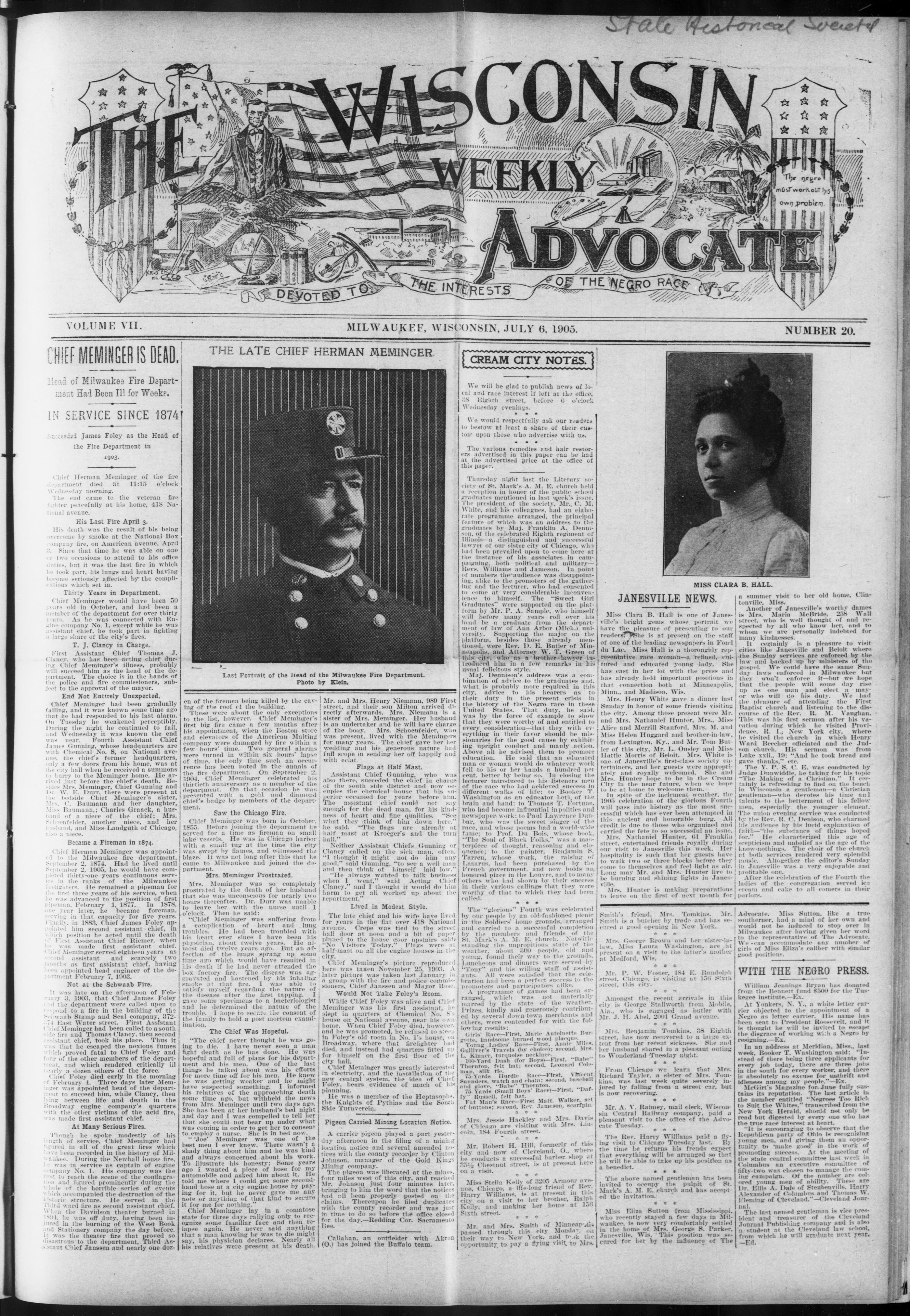
CHIEF MEMINGER IS DEAD.
Head of Milwaukee Fire Department Had Been Ill for Weeks.
Succeeded James Foley as the Head of the Fire Department in
Chief Herman Meminger of the fire department died at 11:15 o'clock Wednesday morning. The end came to the veteran fire fighter peacefully at his home, 418 National avenue.
His Last Fire April 2.
His death was the result of his being overcome by smoke at the National Box company fire, on American avenue, April 3. Since that time he was able on one or two occasions to attend to his office duties, but it was the last fire in which he took part, his lungs and heart having become seriously affected by the complications which set in.
Thirty Years in Department.
Chief Meminger would have been 50 years old in October, and had been a member of the department for over thirty years. As he was connected with Engine company No.1, except while he was assistant chief, he took part in fighting a large share of the city's fires.
T. I. Clancy in Charge.
First Assistant Chief Thomas J. Clancy, who has been acting chief during Chief Meminger's illness, probably will succeed him as the head of the department. The choice is in the hands of the police and fire commissioners, subject to the approval of the mayor.
End Not Entirely Unexpected.
End Not Entirely Suspected.
Chief Meminger had been gradually failing, and it was known some time ago that he had responded to his last alarm. On Tuesday he weakened perceptibly. During the night he continued to fail, and Wednesday it was known the end was near. Fourth Assistant Chief James Gunning, whose headquarters are with Chemical No. 8, on National avenue, the chief's former headquarters, only a few doors from his home, was at the city hall when he received a summons to hurry to the Meminger home. He arrived just before the chief's death. Besides Mrs. Meminger, Chief Gunning and Dr. W. E. Durr, there were present at the bedside Chief Meminger's sister, Mrs. C. Baumann and her daughter, Miss Baumann; Charles Graack, a husband of a niece of the chief; Mrs. Schoenfelder, another niece, and her husband, and Miss Landguth of Chicago, also a niece.
Became a Fireman in 1874.
Chief Herman Meminger was appointed to the Milwaukee fire department, September 2, 1874. Had he lived until September 2, 1905, he would have completed thirty-one years continuous service in the ranks of the Milwaukee firefighters. He remained a pipeman for the first three years of his service, when he was advanced to the position of first pipeman, February 1, 1877. In 1878, one year later, he became foreman, serving in that capacity for five years. Finally, in 1883, Chief James Foley appointed him second assistant chief, in which position he acted until the death of First Assistant Chief Riemer, when he was made first assistant chief. Chief Meminger served eighteen years as second assistant and scarcely two months as first assistant chief, having been appointed head engineer of the department February 7, 1903.
Not at the Schwaab Fire.
It was late on the afternoon of February 3, 1903, that Chief James Foley and the department were called upon to respond to a fire in the building of the Schwaab Stamp and Seal company, 372-374 East Water street. First Assistant Chief Meminger had been called to a south side fire and Thomas Clancy, then second assistant chief, took his place. Thus it was that he escaped the noxious fumes which proved fatal to Chief Foley and four of the other members of the department, and which rendered critically ill nearly a dozen others of the force.
Chief Foley died early in the morning of February 4. Three days later Meminger was appointed head of the department to succeed him, while Clancy, then lying between life and death in the Broadway engine company's quarters with the other victims of the acid fire, was made first assistant chief.
At Many Serious Fires
Though he spoke modestly of his length of service, Chief Meminger had figured in all of the great fires which have been recorded in the history of Milwaukee. During the Newhall house fire, he was in service as captain of engine company No. I. His company was the first to reach the scene of the conflagration and figured prominently during the whole of the horrible series of events which accompanied the destruction of the historic structure. He served in the Third ward fire as second assistant chief. When the Davidson theater burned in 1894, he was off duty, having been injured in the burning of the West Book and Stationery company the day before. It was the theater fire that proved so disastrous to the department, Third Assistant Chief Janssen and nearly one doz
THE LATE CHIEF HERMAN MEMINGER
Last Portrait of the Head of the Milwaukee Fire Department. Photo by Kleln.
en of the firemen being killed by the caving of the roof of the building. These were about the only exceptions to the list, however. Chief Meminger's first big fire came a few months after his appointment, when the Boston store and elevators of the American Malting company were damaged by fire within a few hours' time. Two general alarms were turned in within six hours' laps of time, the only time such an occurrence has been noted in the annals of the fire department. On September 2, 1904. Chief Meminger celebrated his thirtieth anniversary as a member of the department. On that occasion he was presented with a gold and diamond chief's badge by members of the department.
Saw the Chicago Fire.
Chief Meminger was born in October, 1855. Before joining the department he served for a time as fireman on small lake vessels. He was in Chicago harbor with a small tug at the time the city was swept by flames, and witnessed the blaze. It was not long after this that he came to Milwaukee and joined the department.
Mrs. Meminger Prostrated.
Mrs. Meminger was so completely prostrated by the death of her husband that she was unconscious for nearly two hours thereafter. Dr. Durr was unable to leave her with the nurse until 1 o'clock. Then he said:
"Chief Meminger was suffering from a complication of heart and lung troubles. He had been troubled with his heart ever since I have been his physician, about twelve years. He almost died twelve years ago. But an affection of the lungs sprang up some time ago which would have resulted in his death if he had never attended the box factory fire. The disease was aggravated and hastened by his inhaling smoke at that fire. I was able to satisfy myself regarding the nature of the disease after the first tapping. I gave some specimens to a bacteriologist and he determined the nature of the trouble. I hope to secure the consent of the family to hold a post mortem examination.
The Chief Was Hopeful.
"The chief never thought he was going to die. I have never seen a man fight death as he has done. He was hopeful and full of plans for his department and his men. One of the last things he talked about was his efforts for more time off for his men. He knew he was getting weaker and he might have suspected something. I informed his relatives of the approaching death some time ago, but withheld the news from Mrs. Meminger until two days ago. She has been at her husband's bed night and day and I was compelled to tell her that she could not bear up under what was coming in order to get her to consent to employ a nurse. She is in bed now.
"Joe' Meminger was one of the best men I ever knew. There wasn't a shady thing about him and he was kind and always concerned about his work. To illustrate his honesty: Some years ago I wanted a piece of hose for my automobile and asked him about it. He told me where I could get some secondhand hose at a city engine house by paying for it, but he never gave me any note or anything of that kind to secure it for me for nothing."
Chief Meminger lay in a comatose state for three days rallying only to recognize some familiar face and then relapse again. He never said anything that a man knowing he was to die might say, his physician declares. Nearly all his relatives were present at his death.
MILWAUKEE, WISCONSIN, JULY 6, 1905.
Mr. and Mrs. Henry Niemann, 989 First street, and their son Milton arrived directly afterwards. Mrs. Niemann is a sister of Mrs. Meminger. Her husband is an undertaker and he will have charge of the body. Mrs. Schoenfelder, who was present, lived with the Memingers for many years. The chief gave her her wedding and his generous nature had full scope in sending her off happily and with eelat.
Flags at Half Mast.
Assistant Chief Gunning, who was also there, succeeded the chief in charge of the south side district and now occupies the chemical house that his superior occupied for years before him. The assistant chief could not say enough for the dead man, for his kindness of heart and fine qualities. "See what they think of him down here." he said. "The flags are already at half mast at Kroeger's and the turn hall."
Neither Assistant Chiefs Gunning or Clancy called on the sick man, often. "I thought it might not do him any good," said Gunning, "to see a well man and then think of himself laid low." "He always wanted to talk business when I went," said Acting Chief Clancy," and I thought it would do him harm to get all worked up about the department."
Lived in Modest Style.
The late chief and his wife have lived for years in the flat over 418 National avenue. Crepe was tied to the street hall door at noon and a bit of paper pinned to the house door upstairs said "No Visitors Today." Flags were at half-mast on all the engine houses in the city. Chief Meminger's picture reproduced here was taken November 25, 1903. A later picture was taken last January in a group with the fire and police commissioners, Chief Janssen and Mayor Rose.
While Chief Foley was alive and Chief Meminger was his first assistant, he slept in quarters at Chemical No. S's house on National avenue, near his own home. When Chief Foley died, however, and he was promoted, he refused to sleep in Foley's old room in No. I's house, on Broadway, where that firefighter had died, and instead had quarters fitted up for himself on the first floor of the city hall.
Chief Meminger was greatly interested in electricity, and the installation of the new central system, the idea of Chief Foley, bears evidence of much of his planning.
He was a member of the Heptasophis, the Knights of Pythias and the South Side Turnverein.
Pigeon Carried Mining Location Notice.
A carrier pigeon played a part yesterday afternoon in the filing of a mining location notice and several amended notices with the county recorder by Clinton Johnson, manager of the Gold Kings Mining company. The pigeon was liberated at the mines, four miles west of this city, and reached Mr. Johnson just four minutes later, bringing to him the word that the notices had all been properly posted on the claims. Thereupon he filed duplicates with the county recorder and was just in time to do so before the office closed for the day.—Redding Cor. Sacramento Bee.
Callahan, an outfielder with Akron (O.) has joined the Buffalo team.
CREAM CITY NOTES.
We will be glad to publish news of local and race interest if left at the office, 38 Eighth street, before 6 o'clock Wednesday evenings.
We would respectfully ask our readers to bestow at least a share of their custom upon those who advertise with us.
The various remedies and hair restorers advertised in this paper can be had at the advertised price at the office of this paper.
Thursday night last the Literary society of St. Mark's A. M. E. church held a reception in honor of the public school graduates mentioned in last week's issue. The president of the society, Mr. C. M. White, and his colleagues, had an elaborate programme arranged, the principal feature of which was an address to the graduates by Maj. Franklin A. Dennison, of the celebrated Eighth regiment of Illinois—a distinguished and successful lawyer of our sister city of Chicago, who had been prevailed upon to come here at the instance of his associates in campaigning, both political and military—Revs. Williams and Jameson. In point of numbers the audience was disappointing, alike to the promoters of the gathering and the lecturer, who had consented to come at very considerable inconvenience to himself. The "Sweet Girl Graduates" were supported on the platform by Mr. P. A. Sample, who himself will before many years roll over his head be a graduate from the department of law of Ann Arbor (Mich.) university. Supporting the major on the platform, besides those already mentioned, were Rev. D. E. Butler of Minneapolis, and Attorney W. T. Green of this city, who as a brother lawyer introduced him in a few remarks in his usual felicitous style.
Maj. Dennison's address was a combination of advice to the graduates and, what is probably more required in this city, advice to his hearers as to their duty in the present crisis in the history of the Negro race in these United States. That duty, he said, was by the force of example to show that they were worthy of and entitled to every consideration—that they with everything in their favor should be missionaries for the good cause by exhibiting upright conduct and manly action. Above all he advised them to promote education. He said that an educated man or woman would do whatever work fell to his or her hands a hundred per cent, better by being so. In closing the lecturer introduced to his listeners men of the race who had achieved success in different walks of life; to Booker T. Washington as an educator both, of the brain and hand; to Thomas T. Fortune, who had become influential in politics and newspaper-work; to Paul Lawrence Dumbar, who was the sweet singer of the race, and whose poems had a world-wide fame; to Prof. Du Bois, whose book, "The Soul of Black Folks," was a masterpiece of thought, reasoning and eloquence; to the painter, Benjamin S. Tarren, whose work, the raising of Lazarus, had been purchased by the French government, and now holds an honored place in the Louvre, and to many others who had shown by their success in their various callings that they were worthy of that to which they had been called.
```markdown
```
The "glorious" Fourth was celebrated by our people by an old-fashioned picnic in the Soldiers' home grounds, arranged and carried to a successful completion by the members and friends of the St. Mark's A. M. E. church. Notwithstanding the unpropitious state of the weather, about 300 people, old and young, found their way to the grounds. Luncheons and dinners were served by "Tony" and his willing staff of assistants. All were satisfied that the celebration had been a perfect success to the promoters and participants alike.
A programme of games had been arranged, which was not materially marred by the state of the weather. Prizes, kindly and generously contributed by several down-town merchants and others, were contended for with the following results:
Girls' Race—First, Marie Antoinette Burgette, handsome burned wood placque. Young, Ladies' Race—First, Annie Miles, Gulliver's Travels (by choice); second, Mrs. L. Kinner, turquoise necklace. 100-Yard Dash (for Boys)—First, "Babe" Thornton, felt hat; second, Leonard Coleman, silk tie.
hail, sink the
75-Yards Hurdle Race—First, Vincent
Saunders, watch and chain; second, baseball
and glove "Babe" Thornton.
and glove, "Babe Thornton," First, "Daf-
frry, Russell, felt, hat."
fy" Russell, felt hat.
Fat Man's Race—First Matt. Walker, set of buttons; second, Rev. Jameson, scarfpin.
* * *
Mrs. Jessie Hackley and Mrs. Davis of Chicago are visiting with Mrs. Lincoln, 184 Fourth street.
* * *
Mr. Robert H. Hill, formerly of this city and now of Cleveland, O., where he conducts a successful barber shop at $35\frac{1}{2}$ Chestnut street, is at present here on a visit.
* * *
Miss Stella Kelly of 3205 Armour avenue, Chicago, a life-long friend of Rev. Harry Williams, is at present in this city on a visit to her brother, Ralph Kelly, and making her home at 156 Sixth street.
Mr. and Mrs. Smith of Minneapolis passed through this city Monday on their way to New York, and took the opportunity to pay a flying visit to Mrs.
Mary E.
MISS CLARA B. HALL.
JANESVILLE NEWS.
Miss Clara B. Hall is one of Janesville's bright gems whose portrait we have the pleasure of presenting to our readers. She is at present on the staff of one of the leading newspapers in Fond du Lac. Miss Hall is a thoroughly representative race woman—a refined, cultured and educated young lady. She has cast in her lot with the press and has already held important positions in that connection both at Minneapolis, Minn., and Madison, Wis.
Mrs. Henry White gave a dinner last Sunday in honor of some friends visiting the city. Among those present were Mr. and Mrs. Nathaniel Hunter, Mrs., Miss Alice and Merrill Stanford, Mrs. M. and Miss Helen Huggard and brother-in-law, from Lexington, Ky., and Mr. Tom Butler of this city, Mr. L. Ousley and Miss Hattie Morris of Beloit. Mrs. White is one of Janesville's first-class society entertainers, and her guests were appropriately and royally welcomed. She and Mrs. Hunter hope to be in the Cream City in the near future, when we hope to be at home to welcome them.
In spite of the inclement weather, the 1905 celebration of the glorious Fourth will pass into history as the most successful which has ever been attempted in this ancient and honorable burg. All credit is due to those who organized and carried the fete to so successful an issue. Mrs. Nathaniel Hunter, 61 Franklin street, entertained friends royally during our visit to Janesville this week. Her hospitality is such that her guests have to walk two or three blocks before they come to themselves and feel light as air. Long may Mr. and Mrs. Hunter live to be burning and shining lights in Janesville. Mrs. Hunter is making preparations to leave on the first of next month for
Smith's friend, Mrs. Tomkins. Mr. Smith is a butcher by trade and has secured a good opening in New York.
Mrs. George Brown and her sister-in-law, Miss Laura Washington, are at present on a visit to the latter's mother at Medford, Wis.
Mr. P. W. Foster, 184 E. Randolph street, Chicago, is visiting at 156 Sixth street, this city.
Amongst the recent arrivals in this city is George Stallworth from Mobile, Ala., who is engaged as butler with Mr. J. H. Abel, 2001 Grand avenue.
Mrs. Benjamin Tomkins, 38 Eighth street, has now recovered to a large extent from her recent sickness. She and her husband shared in a pleasant outing to Wonderland Tuesday night.
From Chicago we learn that Mrs. Richard Taylor, a sister of Mrs. Tomkins, was last week quite severely injured by falling from a street car, but is now recovering.
Mr. A. V. Raimey, mail clerk, Wisconsin Central Railway company, paid a pleasant visit to the office of the Advocate Tuesday.
The Rev. Harry Williams paid a flying visit to Chicago Tuesday last. By the time he returns his frends expect that everything will be arranged so that he will be able to take up his position as a benedict.
* * *
The above named gentleman has been invited to occupy the pulpit of St. Mark's A. M. E. church and has accepted the invitation.
* * *
Miss Eliza Sutton from Mississippi, who recently stayed a few days in Milwaukee, is now very comfortably settled in the home of Mrs. George S. Parker, Janesville, Wis. This position was secured for her by the influence of The
```markdown
```
```markdown
```
* * *
a summer visit to her old home, Clintonville, Miss. Another of Janesville's worthy dames is Mrs. Maria McBride, 258 Wall street, who is well thought of and respected by all who know her, and to whom we are personally indebted for many kindnesses.
It certainly is a pleasure to visit cities like Janesville and Beloit where the Sunday services are enforced by the law and backed up by ministers of the gospel. We could have the same Sunday laws enforced in Milwaukee but they won't enforce it—but we hope that the people will some day rise up as one man and elect a mayor who will do his duty. We had the pleasure of attending the First Baptist church and listening to the discourse of the Rev. R. M. Vaughan. This was his first sermon after his vacation during which he visited Providence, R. L.; New York city, where he visited the church in which Henry Ward Beecher officiated and the Judson church. His sermon was from Luke xxii., 19: "And he took bread and gave thanks." etc.
The Y. P. S. C. E. was conducted by Judge Dunwiddie, he taking for his topic "The Making of a Christian." It certainly is refreshing to find on the bench in Wisconsin a gentleman—a Christian gentleman—who devotes his time and talents to the betterment of his fellow men, especially the younger element. The union evening service was conducted by the Rev. R. C. Denison, who charmed his audience by his lucid explanation of faith—"the substance of things hoped for." He characterized this age of scepticism and unbelief as the age of the know-nothings. The choir of the church at both services rendered very splendid music. Altogether the editor's Sunday in Janesville was a very enjoyable and profitable one.
After the celebration of the Fourth the ladies of the congregation served ice cream and cake to all comers in their parlors.
Advocate. Miss Sutton, like a true southerner, had a mind of her own and would not be induced to stop over in Milwaukee after having given her word to the representative of The Advocate. We can accommodate any number of girls of Miss Eliza's caliber with similar good positions.
WITH THE NEGRO PRESS.
William Jennings Bryan has donated from the Bennett fund $500 for the Tuskegee institute.—Ex.
At Yonkers, N. Y., a white letter carrier objected to the appointment of a Negro as letter carrier. His name has been sent to President Roosevelt, and it is thought he will be invited to escape the disgrace of working with a Negro by resigning.—Ex.
In an address at Meridian, Miss., last week, Booker T. Washington said: "Instead of there being three applicants for every job today, there are three jobs in the south for every worker, and there is absolutely no excuse for unthrift and idleness among my people."—Ex.
McGirt's Magazine for June fully sustains its reputation. The last article in the number entitled "Negroes Too Rich to Suit the Whites," transcribed from the New York Herald, should not only be read but digested by every one who has the true race interest at heart.
"It is encouraging to observe that the Republican party of Ohio is recognizing young men, and giving them an opportunity to 'make good' in the work of promoting success. At the meeting of the state central committee last week in Columbus an executive committee of fifty-two was chosen to manage the coming campaign. Of the number are colored young men of ability. These are Dr. Ellis A. Dale of Steubenville, Harry Alexander of Columbus and Thomas W. Fleming of Cleveland."—Cleveland Journal
The last named gentleman is vice president and treasurer of the Cleveland Journal Publishing company and is also a student at the Cleveland law school, from which he will graduate next year. Ed.
NUMBER 20.
Miscellaneous Items.
Two thousand vessels of all descriptions disappear every year.
The giraffe is the only animal unable to swim. This is on account of its long neck.
Abraham Soninski, 40 years old, died of injuries in the Englewood Union hospital. Soninski was struck by a Chicago and Erie railroad train.
The baobab trees of Senegambia are believed to be the oldest living trees on earth. Some scientists have put the age of one of these trees at 6000 years.
New Zealand's scenery is so beautiful and so varied that it has been termed a combination of Switzerland, southern France, Norway, the Tyrol and North Italy.
The largest white sapphire in the world is supposed to be now at Berlin, having been taken there from Brazil a short time ago by a mine owner. It weighs 418 carats.
Again the University of Chicago is getting a bit of free advertising. This time one of its professors has gone to live in the woods to get away from the noise of piano players who disturb his heavy thoughts.
- In the mountains of Tyrol it is the custom of the women and children to come out when it is the close of day and sing. Their husbands, fathers and brothers answer them from the hills on their way homeward.
- Addison Ballard, who settled in Chicago when it was a village and wagons were abandoned in the mud of Lake street and who has long been a leading citizen, died at his home, from a stroke of paralysis, aged 81.
- Berlin has erected a huge building resembling a factory, where the unemployed—whole families—are received and provided for. But no one must take advantage of this hospitality more than five times in three months.
—In London is a man who has been "best man" at 300 weddings. The explanation is that he has been a city missionary for many years and in that time has befriended hundreds of young couples, helping them to enter the married state.
—The Zunni Indians will not eat bread that has not been crushed and ground up by stone implements. They say that the grain by itself denotes goodness and the stone means truth, so that it is by a meeting of the two that the fullest benefit comes.
—Every Japanese barrack has a gymnasium, and the Japanese soldiers rank among the best gymnasts in the world. In half a minute they can scale a 14-foot wall by simply bounding on each other's shoulders, one man supporting two or three others.
An enormous addition will be made to the entomological collections in the British museum by the bequest of the late A. Fry to the museum of his collection of coleopterous insects, undoubtedly the largest collection of the kind in the United Kingdom.
There are several wooden railways in Canada and the United States. One of them is in the province of Quebec and is thirty miles long. The rails are of maple and trains are run over them with remarkable smoothness at the rate of 25 miles an hour.
Prof. Stadelman, principal physician of a great hospital in Berlin, estimates that between one-quarter and one-third of the diseases afflicting workingmen in the great and crowded districts in the Prussian capital are caused by the improper use of alcohol.
-Paris is just now infested by rats. In the more secluded streets they make the evenings hideous, emerging in groups of half a dozen or so from every drain and grid, or other ground opening, and dispersing over the pavement in all directions, to the terror of all women and some men.
-Canadian emigration agents in the United States expect a great increase in the number of American farmers who will migrate to the Canadian northwest this year. Fully 60,000 persons from the United States are expected to settle in the Dominion. Last year the number was 45,000.
A zirconium incandescent lamp for electric lighting has been invented in Germany which gives much more brilliant effects than carbon lamps in common use. Its cost is greater, but the saving in the consumption of electricity to get the same amount of light is said to be very important.
The Pennsylvania railroad has recently installed in its New York ferry house a novelty in the way of a penny-in-the-slot machine. A device vends ice-cooled soda water. A distinctive feature of the machine is a tumbler washer, by means of which each patron can insure himself a clean and sanitary drink.
An expert on eastern affairs says that when the war is over China will flood Manchuria with a horde of colonists and so make a barrier that Russia will forever be unable to surmount. The writer goes on to say that if this had been done some years ago Russia would never have been able to push her forces southward.
An Austrian meteorologist, J. N. Nowak, who forecasts the weather by means of a plant called "abrus precatorius," discovered by him in Mexico many years ago, will erect his first weather stations in Vienna and London. Nowak maintains that his forecasts are obtainable from three to eight days ahead.
—Dismal weather is prophesied for Europe as an aftermath of the recent Indian earthquake. It is recalled that after the eruption of Mount Pelee England had two disastrously bad summers from a meteorological point of view, and the inhabitants of that island are now warned to expect a wet and cold year. Almost continual rain and even snow has been England's portion since the earthquake occurred.
—While lying on what is expected to prove his deathbed at the Provident hospital, Harry Bernstein, a bartender, told a coroner's jury that he was compelled to shoot James Gray, in a race riot on May 21. Bernstein was exonerated by the jury. He shot Gray when the latter, with several hundred negro companions, attacked him. After shooting down Gray, Bernstein was shot by Robert Tinsley, a newly appointed patrolman.
—Prof. Flinders Petrie, the Egyptologist, has made important discoveries in the Sinai peninsula. The ancient temple of Seabit el Khadem, five days' camel journey south of Suez, he found to be of a Semitic type, different from any other known Egyptian temple, possessing two courts for ablution and a long series of subterranean chambers. These had been added by successive kings from the Eighteenth to the Twentieth dynasties.
The importation of opium in the Philippines has shown considerable increase during the period of American occupation. The large amount of $619,020 worth of opium was imported by these islands during the fiscal year of 1902 just prior to the taking effect of the increased tariff on opium. During the past six years the aggregated value of opium imported amounted to $3,662,059, and it is stated that this sum is $195,407 greater than the value of flour imported during the same period.
According to a recent issue of a Chinese newspaper upward of forty deaths have taken place lately in the vicinity of Amoy through morphine poisoning. The drug, which is subject to a heavy duty,
had been smuggled into the port and stowed amid a shipment of flour. By some mischance some of the packages were broken open and the drug thus became mixed with the flour. When the flour was launder instead of being destroyed it was sold to customers, the result being that most of the persons who used it were poisoned.
An ingenious machine has been invented by a young Italian—Signor Ercole Pagnini—for registering the speed of trains. The "Oscillograph Pagnini," as it is called, is contained in a box weighing about 24 pounds which is placed on the floor of the railway carriage. Part of the mechanism consists of three pendulums, each working in a plane at right angles to the two others. Pencils attached to the pendulums trace lines on a slip of paper, and in this manner all movements, whether horizontal, vertical or longitudinal, are duly registered. Thus, in addition to indicating the speed of a train at any moment in its journey, the apparatus records all stoppages, irregularities of the road, oscillations of bridges, and, in fact, forms a complete report of the run and of the line over which it is performed.
Wonderful.
A tourist who sat behind a bridal couple on the Pike's Peak railway last summer says that he overheard the bridegroom giving his bride information regarding the difficulties that had been overcome in constructing some of the Rocky Mountain railroads.
"Do you know, dear," he said, "that the grade of this road we are riding over is more than 13,000 feet to the mile?"
"How wonderful!" she said languidly.
"Yes, and there is a line of road in this state where there is what they call the 'loop,' and they say that when a long train of cars is going over it they have to run very slow to keep the cowcatcher from shoving the last car of the train off the track, for it is right in front of the engine."
"How wonderful!"
"Isn't it, though? And there is one place here where if you drop a stone from the car window it will fall in a straight line 19,000 feet before it strikes anything."
"How wonderful!"
"Yes, and they say that the velocity of the wind on Pike's Peak sometimes reaches 46,000 miles an hour."
"Just think! Isn't it wonderful?"
"And the ties and rails for some of these Rocky Mountain railroads had to be brought away up here on the tops of the mountains on the backs of some of those little burros we saw down below."
"How remarkable! And how sweet of you, dear; to bring me out here where such wonderful things have happened. It's ever so educational and awfully interesting. You are sure we will get down all right, dear?"
"Oh, yes, there's no danger. They say they never had but one accident on this road, and that was a mighty curious one. They had a big mountain landslide once, and a section of track a quarter of a mile long with a passenger train on it slid half a mile right down the side of the mountain, and the train never left the track, and not a person was hurt."
"How wonderful! And how jolly to have been in an accident of that kind. It would be something to remember all one's life. What a lot one can learn by traveling!"—Lippincott's.
A Very Brave Man.
Mrs. Emma E. Porter of Marysville, sister of Congressman Calderhead, tells this story: Evelyn is the little daughter of a Marshall county family. She is very cowardly. Her father, finding that sympathy only increases this unfortunate tendency, decided to have a serious talk with his little daughter on the subject of her foolish fears.
"Papa," she said, at the close of his lecture, "when you see a cow ain't you 'fraid?"
"No; certainly not, Evelyn."
"When you see a horse ain't you 'fraid?"
"No, of course not, Evelyn."
"When you see a dog ain't you 'fraid?"
"No!" with emphasis.
"No." with emphasis.
"When you see a bumblebee ain't you
'fraid?"
"No!" with scorn.
"Ain't you 'fraid when it thunders?" "No!" with loud laughter. "Oh, you silly, silly child!" "Papa," said Evelyn, solemnly, "ain't you 'fraid of nothin' in the world but mamma?"—Short Stories.
A Subtle Flatterer.
A Scotch divine, who was a bachelor, and whose manse was in the keeping of an old housekeeper called Janet, was constantly annoyed by the fact that the good dame always fell fast asleep as soon as he entered the pulpit, whereas she kept wide awake whenever a stranger was the preacher.
One day he summoned his courage to the sticking-point and tackled the old lady on the subject. "Janet," said he, "ye ken when I preach you're almost always fast asleep before I've well given out my text; but when any of these young men from St. Andrew's preach for me, I see you never sleep a wink. Now, that's what I call no using me as you should do."
"Hoots, sir," was the reply, "is that a'? I'll soon tell ye the reason of that. When you preach, we a' ken the Word of God is safe in your hands; but when thae young 'birkies' tak' it in hand-ma certie' but it tak' us a' to look after them.—Glasgow Evening Times.
Step in the Right Direction.
Representative Gaines of Tennessee has a young friend in Memphis who has embarked in the field of dispensing pills and potions. One day not long ago the representative was in Memphis and was called on by the young doctor.
"I suppose you know that I am actively engaged in my profession, Mr. Gaines?" said the young M. D.
"Oh, yes," was the answer, "I noticed it in the newspapers."
"Saw it in the papers?"
"Yes."
"When?"
"This morning."
"What did it say?"
"As well as I can remember. There were seventy interments last month over the month previous."—Philadelphia Ledger.
An Ingersollian Roast
Frederick Trevor Hill has gathered many anecdotes during his sixteen years of activity at the New York bar. He told a good story the other day of the most severe arraignment he ever heard in a courtroom. "It was uttered by Col. Robert Ingersoll, who was usually the soul of good nature," he said. "In a case which aroused his indignation he requested the jury to study the defendant's face. 'I mark out in him,' he exclaimed, 'the meanest man I know—a man so mean that Nature wasted her time in making him, and the dirt of which he is composed would have been better employed in filling the grave of some other such man, if such another ever lived'"—Omaha Bee.
An Artificial Face.
An old soldier of 1870 has been going about Paris for thirty years with no features, eyes, cheeks, lips and nose, having suffered severally by the explosion of a shell. Modern science has restored his face. A mask was made, part of silver, part of wax, neatly tinted, two eyes in enamel, an excellent nose and serviceable lips in rubber.
A PASTORAL.
When a little farm I keep,
I shall my kine and sheep,
And my pretty lambs shall fold
In deep pastures starred with gold.
On green carpets they shall tread,
Gold and purple be their bed,
Honeyed clover make their food
In a watered solitude.
Garden places I shall tend,
For a welcome to a friend
Make for him a roomy seat
Fy the box and privet sweet.
And my kitchen garden shall
Grow me fruits on trees and wall,
Give me blossoms in the spring
And an autumn gathering.
An old dial and a cote
Where the pigeons fly and float.
And a well so green and dim
Where the little fishes swim.
Hives of honey I shall own,
Bees with drowsy monotone
Toll all day to bring me home
Heather honey at the gloam.
Twixt the mountains and the sea
There my little farm will be.
In a heart remembered spot
I shall have my happy lot.
In the heart remembered place.
Where the mountains lift their face,
I shall tend my sheep and kine,
And a thankful heart be mine.
When a little farm I keep
I shall sleep the happiest sleep,
To my simple meals invite
Thanksgiving and appetite.
In the heart remembered place
I shall wear a shinning face,
And my quiet nights be praise,
And a prayer my innocent days.
—Katharine Tynan in the Spectator.
THAT TEN-POUND NOTE.
My case may be an exceptional one, but at all events I am not in the least desirous of picking up any more Bank of England notes which do not belong to me. Of course, if I had been a dishonest man I should have pocketed the money and said nothing to anybody, but it so happens that I am not built that way. Consequently there appeared in one of the daily journals the following announcement: "Ten pounds—Found in the city, on Tuesday last a £10 note. The owner can have it on giving the necessary particulars and paying for this advertisement. Apply, etc."
I further specified that I was to be seen from 11 to 12. The day the notice was published I got to my office at the usual time, about 10 o'clock, and found to my surprise a number of strangers awaiting my arrival.
"I am first, sir," said a tall, half-pay captain-looking man, extra brushed up for the occasion. There was no mistake about his nationality; his accent proved that he was from the sister isle. "And that is my friend and old fellow officer, Capt. Macgillicuddy," he added, introducing me to a counterpart of himself, "who will satisfy you that the note you have found belongs to your humble servant," at the same time handing me a card, on which I saw:
CAPTAIN BARRY,
Junior Army and Navy Club.
I beckoned to the two captains to follow me to my room.
When we were seated I said:
"It will bring the matter to a conclusion at once if you tell me the number of the note."
"Oh, it is only the number you want; did you hear that, Gil?" Turning to me, and raising his voice, he said: "I must inform you, sir, that I have never taken the number of a note in the whole course of my life, eh, Gil?"
"But how, then, are you to convince me that the note is yours?" I asked.
"By giving you the word of an officer and a gentleman who has served his Queen and country in all parts of the world. If that is not enough I don't know what will satisfy you."
"Where did you lose the note?"
"Oh, where did I drop that bit of paper? It would be somewhere near the bank. I'm thinking. To tell you the truth" (this confidentially), "my friend here and myself came down to the city yesterday to have some turtle soup at Birch's, and the milk punch got a little the better of us. You saw I had the note when I left Birch's, Gil?"
"I should think I did. You were going to change it to pay for the luncheon, when I stopped you."
"That may all be quite true," I said, "but as you saw yourselves there are other claimants waiting outside. I must see whether any one of them can give me the correct number."
I opened the door to let them out and was astonished to see the ante-room was empty. The other claimants had disappeared. Barry and his compatriot burst out laughing.
"They were quite right to vanish," said Barry. "They knew what to expect from the toe of my boot."
I asked the Irishman in again, and not without a considerable amount of reluctance, gave up the note.
During the day I had several other visitors and half a dozen letters, but as the number of the note was not in any case stated I dismissed the former in summary fashion and paid no attention to the latter. Between 5 and 6, when I thought of going home, a telegram arrived respecting the troublesome note. It read as follows:
"Pleased to hear you have found my note. Am on my way to see you.
"EDITH WARBURTON."
The sender of the telegram was soon ushered in. She did not look more than 16 or 17 years of age. "I am so glad it has been found," she said.
"But I have paid away your note to a man who said it was his, and who brought a witness to prove it," I said.
"My note! Oh, how terrible! But, sir, how could the note be his and mine, too?"
"You have the number of your note?"
"Certainly, here it is," she said, handing me a scrap of paper.
There could be no question about it. She had the correct number of the note, and I had been done by the two Irishmen. There was nothing for it but to pay her another £10.
One morning a day or two afterwards, I received a visit from a city merchant whom I slightly knew.
"You have been finding a £10 note, I hear," he said in a jovial way, "and it will be a lucky thing for my clerk if yours is the one he says he lost."
"But the one I found was claimed, and when the number was shown to me I, of course, paid the money. What would you have done?"
"The same thing decidedly. It is so much the worse for my clerk: he will
have to be dismissed; it must have been a different note. Would have looked you up before, but have been to Bournemouth for a couple of days. By the way, what was the number of your note?"
I told him.
"By Jove, sir, it is the number of my missing note! Put on your hat for five minutes and come around to the bank with me."
I did so, and it was proved beyond the shadow of a doubt that on the particular Tuesday the note in question was issued along with others to meet a check of the merchant's.
The clerk had been sent out with it to get small change, and had dropped it. The other notes were all accounted for. After paying the £10 I thought it necessary, for the sake of my character, to explain how I had been done. His sympathy took the form of shouts of laughter. I thought he was going to have a fit or burst a blood vessel.
"Excuse me," he said, "but that is the best joke I ever heard for a long time. Your two Irishmen and the ladylike young person in deep mourning were confederates."
Evidently, and when I saw the next day the genuine Capts. Barry and Macgillicuddy at their club there could be no question about my having been done—not only once, but twice.
The picking up of the confounded £10 note caused me not only a great deal of annoyance, but cost me £20 pounds in hard cash. How I shall deal with a similar find is a secret known only to myself.—Henry Brown in Pittsburg Dispatch.
ROLLING WINDOW SCREEN
Conveniently Disposed of When Not in Use: Just about the time the fly screen with its wooden frame was reduced to a standard form, except, of course, as regards the minor details of construction, an iconoclastic Chicagoan inventor pro-
```markdown
```
poses the substitution of roller screens. He has a plan whereby screens may be mounted on rollers arranged at the bottom of the window and adapted to be raised to any desired height as occasion may require, but which fold up out of the way when not in actual service. The general plan of the scheme is indicated in the accompanying cut.
PUNCH BOWL OF GRANITE.
Massive Present to Sea Captain Now a Town Watering Trough.
The watering trough in Pickering square at Bangor, Me., was once a punch bowl. Years ago, when Capt. Charles Sanford owned a steamboat line between Bangor and Boston, his friends decided that they would make him an original present on an anniversary, and they ordered a punchbowl 5 feet high and 10 feet in diameter, of rough granite, without inscriptions.
The bowl was shipped from the quarry to Bangor on a schooner, on board which vessel the formal presentation took place. Capt. Sanford was surprised, but he managed to make a speech and the bowl was christened then and there—a ceremony the like of which has never been witnessed on the Penobscot river. It is said that about four barrels of punch was stirred up in the granite bowl and the entire water front population was invited to have something. The bowl was kept on board the craft for a week or more until one day the owner thought he would put it on the wharf, and with all sorts of tackle the task was begun. At the critical moment a rope parted and punchbowl and tackle and nearly the whole crew went into the river at once. The bowl stayed where it sank for a number of years.
Capt. Sanford finally decided that the bowl must come up, and he offered it to the city as a watering trough if the citizens cared enough about it to move it from where it lay. They did, and it was put where it stands now to delight the hearts of dust-covered horses down in the square. It is a strong, well-behaved trough and looks as if it might wear for centuries to come.
Evidence
A green subaltern, who was smoking while on duty, was reminded by a sentry who had seen many years' service that it was against the regulations to smoke near his post, and he advised the subaltern to throw his cigar away. He did so, and went on his rounds. The soldier then picked up the cigar, and was enjoying it quietly when the subaltern returned.
"Why, how is this?" he asked. "I thought no smoking was allowed near your post?"
"That's true," replied the sentry. "I'm merely keeping this alight for evidence against you in the morning."—Harper's Weekly.
Who Could Blame Them?
A Paris newspaper relates an amazing story, which most people will probably regard rather as an example of the ben trovato than of strict fact. According to the story, an automobile proceeding from Mantes to Rosny met a herd of fifty horses being led to a neighboring fair, and stopped so as not to cause a stampede. But the horses seem to have instinctively recognized the rival of their species, and without more ado set on the machine in a body, kicking it to pieces. The chauffeur was with difficulty got out of the melee uninjured.—London Globe.
Sell $900,000 Papers for $500.
An auction sale of securities of a face value of $900,000 for less than $500 revealed that an estate of more than $1,000,000 has dwindled to almost nothing through the wild-cat investments of S. Philip J. Larrabee, executor of Robert Trickey of South Portland, Me. It was not discovered until recently that Larrabee had lost most of the Trickey estate and he was disbarred as the only punishment possible. At the auction $9,000 shares of one mining company brought 67 cents.
Ethel Barrymore will return to New York in August. She is delighted with the new play that Charles Frohman has secured for her. During the early part of the season she will be seen in last season's success, "Sunday."
Sir Caspar Purdon Clark, director of the Metropolitan Museum of Art at New York, was given a farewell banquet at the Criterion restaurant, London. He was presented with a souvenir in the form of a massive silver bowl on an ebony plinth.
New York friends of Mr. and Mrs. Robert S. Hitt have received news of the birth of a son June 20 in Rome, where Hitt is stationed as first secretary of the American embassy. Mrs. Hitt formerly was Miss Edith Gray, daughter of Justice John Clinton Gray of the court of appeals in New York city.
Miss Ada Rehan, the American actress, who was taken ill in London with supposed appendicitis, will not be operated upon, as the surgeons who had made preparations to perform the operation at the last moment decided not to do so. Miss Rehan is improving, and probably will recover without the necessity of resorting to the knife.
Mrs. Joseph Siegel, the young wife of the nephew of Henry Siegel, the dry goods merchant, is going upon the stage. She has arranged to appear in a vaude-ville sketch with Mr. and Mrs. Gene Hughes. Before her marriage Mrs. Siegel was Miss Cochrane of Rochester. She has been popular in fashionable circles of Chicago and New York.
Charles Frohman has secured "The Heart of the Sparrow," the most successful comedy of recent years in Paris, where it was recently produced under the title of "Le Coeur de Moineau." He will produce it at a prominent London theater in September. With "Le Duel" and "La Belle Marseillaise" this gives Mr. Frohman the three notable hits of the Paris season.
Announcement is made that a series of Sunday afternoon excursions will be personally conducted this summer by Rev. Dr. Henry Mottet, rector of the Church of the Holy Communion, New York city. Members of the Carolyn club, which includes about 400 working girls, will be taken on sight-seeing trips by yacht and automobile, as well as to such points of interest as the Metropolitan museum.
Charged with conducting a pool room in a synagogue in Grand street. New York city, of which he told the police he was rabbi, Henry Jacobs has been held for trial. It was allledged by the police that after having been refused admittance on the ground that religious services were going on, they broke the door. The walls of the synagogue were, they said, adorned with racing charts and other paraphernalia used in pool rooms.
Josph A. Boody, employed in Bellevue hospital, recently found a woman's pocketbook which contained two pennies and the owner's card. He sent the pocketbook to its owner by mail and recently received this letter:
Dear Sir: I have received the pocketbook I lost Saturday evening. Allow me to offer you this reward for your unusual honesty.
The letter contained one of the two pennies.
Arrangements have been perfected between officials of the Interborough Rapid Transit company and of the rapid transit commission whereby large fans, revolving at a high rate of speed, are to be placed in manholes in the roof of the New York subway at frequent intermals to cool the air, which in recent weeks has become extremely oppressive in the downtown sections of the underground. Provisions were made when the tunnel was built for such a contingency and installation of the fans will be comparatively an easy task. Power for operating the fans will be easily obtained from the third rail.
A vaudeville manager is said to have enlisted Lillian Russell for next season. According to the Rialto gossip the terms are $100,000 for thirty weeks. The reported duration of the contract is no doubt accurate, but it is likely that about two-thirds of the price is in stage money. Vaudeville is to have some great stars next season. Mrs. Langtry is to play ten weeks for $30,000. Mrs. Potter is considering an offer of $25,000 for the same period, and Cissie Loftus has the refusal of $1500 a week for twenty weeks. In the meantime sidewalk conversationalists, slapstick comedians, musical prodigies, etc., will continue to pull down their little old 40 a week.
Although Russell Sage owns as many miles of railroad as any individual in the world, he never avails himself of the joys of traveling. His oldest friends cannot remember when he was farther west than Philadelphia, and some of them claim he has never seen the Pacific ocean. No person in New York can remember Russell Sage ever going to Europe or to Canada or to Mexico. Nearly all the railroad traveling he has done in the last twenty-five years has been on the Metropolitan elevated, on which he has a pass. Mr. Sage has not lately been seen on the road coming down to business, and in Wall street no one remembers having observed him on the street in three months. For business Sage seems to be about "all in."
It seems the automobile club of New York city has come to the conclusion that being arrested for speeding is a necessary incident to the ownership of a machine. The members cooked up a fine little plan the other day to make things easy for those who fall into the hands of the bicycle cops. With the National Surety company they arranged for an "auto bond." When the speeder was arrested all he had to do was to affix his signature to a blank bond and the company immediately became liable for his appearance the next day for trial. The plan looked pretty, and District Attorney Jerome approved it. The magistrates, however, in their regular board meeting said they would not accept the "auto bond," because it made things too easy for the violators of the speed ordinance.
Lawyers who have followed the case of Albert Patrick, convicted of the murder of William Marsh Rice, the aged New York millionaire, have made the curious discovery that the Equitable Life muddle has created a situation that is of vital interest to Patrick, and which may result in his execution, set for August S. Part IV. of the court of general sessions was to be adjourned for the summer at the end of the June term. Recorder Goff was presiding in that part. District Attorney Jerome asked the recorder that his part of the court be continued until such time as the district attorney should have an opportunity to decide if he would institute criminal proceedings against Equitable officers. Recorder Goff granted the request. As Patrick was tried in the first instance before Goff, any motion for a new trial must be made before that judge while his court is in session. But for that David B. Hill, Patrick's counsel, would certainly have made a motion for a new trial last week, as he would then be sure of a new trial judge.
WOULD SELL HIS HEART.
New York Man Kept Busy with Answers to His Advertisement.
Telegrams and telephone messages in answer to an advertisement to sell his body and two hearts after death have kept A. Durr of New Rochelle, N. Y., busy. Although it is known that Durr has been offered large sums of money for his body, which is equipped with two hearts, he refuses to state the amounts. He is keeping these a secret in hope that a larger sum might be offered. None of the offers received so far has been accepted nor is it likely that a choice will be made for some days in order to give the entire medical profession of the country a chance to entertain the proposition. By trade Durr is a carpenter. He is 35 years old, single and the picture of health. He works every day and leads a regular life. Up to a few years ago Durr didn't know that he possessed two hearts. This was discovered when he called a physician to treat him for a slight attack of illness. Since then he has submitted to examinations by many of the most celebrated heart specialists in the country.
Proved Beyond a Doubt.
Middlesex, N. Y., July 3.—(Special.)—That Rheumatism can be cured has been proved beyond a doubt by Mrs. Betsey A. Clawson, well known here. That Mrs. Clawson had Rheumatism and had it bad, all her acquaintances know. They also know she is now cured. Dodd's Kidney Pills did it. Mrs. Clawson tells the story of her cure as follows:
"I was an invalid for most five years caused by Inflammatory Rheumatism, helpless two-thirds of the time. The first year I could not do as much as a baby could do; then I rallied a little bit and then a relapse. Then a year ago the gout set in my hands and feet. I suffered untold agony and in August, 1903, when my husband died, I could not ride to the grave.
"I only took two boxes of Dodd's Kidney Pills and in two weeks I could wait on myself and saw my own wood. I dug my own potatoes and gathered my own garden last fall. Dodd's Kidney Pills cured me."
Rheumatism is caused by uric acid in the blood. Dodd's Kidney Pills put the Kidneys in shape to take all the uric acid out of the blood.
How the Moonshiners Got Even.
The moonshiners in sight of Glassy Mountain have a little sly humor about them. They do not skip around over the hills and through the ivy thickets with long, lugubrious faces as though they expected the terrors of the law to break in on them any day.
Some of them are chock full of fun. A day or two ago Chief Constable Grady, with several others, went to the dark corner to investigate whether or not there was a reduction in the manufacture of "mountain dew." They hired a team in Spartanburg, and on reaching the country where the moon shines day and night they hitched their horses and proceeded on foot.
They reported that their search for the copper fountains of perpetual death was made interesting by the frequent firing of guns which seemed to be aimed at them. On their return their vehicle had been taken apart and piled up with some wood and fired. The tires and axles were not burned. Horses and harness were not hurt.—Spartanburg Cor. Charleston News.
Help from Father.
H. C. Cornett of this place has just returned from a trip to Laurel county, where he visited his father, Col. Cornett, in order to get assistance to tend a new ground that he has recently cleared, the assistance that were give was a cow and calf, a wagon load of provision that his father gave him, which was flour, meal, meat, lard and coffee; some house plunder, a set of farming tools and some fire arms and in addition to all this he brought one niger with him to tend the ground and a varments to keep the rest scard off. He was contemplating on teaching school when he came back but he recieved a note from Carr Couch Jr., telling him to hold up as there was no place to teach.—Hyden Thousandsticks.
The Crab in the Mail Box
When Postmaster Robinson opened the mail box located outside the postoffice one morning he found a large live crab in the box, which had evidently been placed there by some one during the night, with the opinion, likely, that they were playing a smart trick. But as there is a law against placing any live animals in a mail box, and a fine of from $50 to $100 if the person who committed this deed is found, he will yet find there is no "joke" in it. There was a large number of letters in box and while the addresses could all be made out, the appearance of the letters was not improved, by a long ways, by the presence of the crab.—Port Clinton Herald.
IN COLONEL'S TOWN
Things Happen.
From the home of the famous "Keyhnel Keeyartah of Cartersville," away down South, comes an enthusiastic letter about Postum.
"I was in very delicate health, suffering from indigestion and a nervous trouble so severe that I could hardly sleep. The doctor ordered me to discontinue the use of the old kind of coffee, which was like poison to me, producing such extreme disturbance that I could not control myself. But such was my love for it that I could not get my own consent to give it up for some time, and continued to suffer, till my father one day brought home a package of Postum Food Coffee.
"I had the new food drink carefully prepared according to directions, and gave it a fair trial. It proved to have a rich flavor and made a healthy, wholesome and delightful drink. To my taste the addition of cream greatly improves it.
"My health began to improve as soon as the drug effect of the old coffee was removed and the Postum Coffee had time to make its influence felt. My nervous troubles were speedily relieved and the sleep which the old coffee drove from my pillow always came to soothe and strengthen me after I had drunk Postum—in a very short time I began to sleep better than I had for years before. I have now used Postum Coffee for several years and like it better and find it more beneficial than when I first began. It is an unspeakable joy to be relieved of the old distress and sickness." Name given by Postum Company, Battle Creek, Mich.
Read the little book, "The Road to Wellville," in each pkg.
GOSSIP FOR THE LADIES.
```markdown
```
A June Song.
I've kept the June-way in my heart of hearts,
And never lost the path, whatever star
Lured me across the deeps, however far.
I've kept the June-way, and I need no chart
To point me where my safest path of all
still dreams beside my hedge and pasture
wall.
There are so many signs that cannot fail—
Kept in my heart are they; and now and
then
some far hullo from some dear June-tide
alen
Rouses them swiftly to an answering hail;
And these will call to one another, till
I and again my valley and my hill.
There are so many joys that reappear
Along with June-time, that it seems to me
A heart of welcome beats in every tree,
And every homely wayside gives a cheer
When I go singing, of a summer day,
All down my unforgetten June-time way.
—Frank Walcott Hutt, in Broadway Magazine.
Babes Know Right from Wrong.
"So soon as he is old enough"—this is repeated upon all occasions. The baby is to be taught at that remote period a multitude of things. The foolish mother finds too late that the babe has learned, too thoroughly to forget, many bad habits, some of which will cling to him all his life.
Sometimes children persist, as if it were a good joke, to do a forbidden thing, laughing and crowing with glee at success at achieving the objectionable, and sometimes they storm and resist passionately.
Severe punishment is rarely necessary if the parent has been wise, kind and has wisely taught from the first that "no" meant no. It is more trouble at the time to do this than to permit things to run easy, but it is a mercy to one's self and the child to train him in the path he ought to walk. Foolishly fond mothers call this martial law, but obedience does not imply anything of the kind. The indulged child is likely to need the restraint of the military in the future.
The babe allowed to grasp all he sees, to slap manima when a plaything is taken away, and to force its return, has neither such love nor respect as the babe who early learns that mamma loves to give him all that is good for him, but that no temper on his part can force from her that which he ought not to have. At 4 years of age the question is decided who is the head of the house. If the mother has been too fondly foolish to teach the boy to respect her, he will not begin later on. Good common sense may help him in after years, but in his heart he will recognize her real inferiority of character and will show it in his general ideas of the competency of woman
Self-restraint from unwise indulgence should be taught the child by example as well as precept. Do not punish a child for doing or saying what he learns from his instructors. Often the child obeys one parent and wheedles the other out of anything he fancies; he has weighed them in his young mind and found who is light. It is too late to make him respect the one found wanting.
A child daily proves that he knows much and early connects persons with things, causes and effects. One cannot be too careful what baby hears long before he can speak. When he learns to use his vocal organs these obnoxious sounds and words will be reproduced. Baby doesn't know? Then why does he use the nurse's wicked words when he is angry? Why does he not mix with them his good-natured prattle also? Baby doesn't know any better than to scratch, bite and kick, yet his only desire to do it is when made to give up some evil habit or loose his grasp upon some forbidden thing. Baby does know. —Exchange.
Qualities in Which
Woman Should Excel
Dr. Henry Van Dyke, discussing "The Way to Womanhood" in a series of papers in Harper's Bazar, thus voices his personal views on the subject:
"It seems to me," he says, "that woman's excellence, (and I have been using the word always in its proper meaning to denote superiority), lies in three things; a certain fineness and delicacy of physical organization and balance; a certain deep and sensitive power of intellectual and moral sympathy; and a certain firm and gentle faculty of social order and rule. I believe that nature gives the germ and potency of these things to her more fully and more richly than to man, at the beginning of life. They fit and adorn a woman for the place and the privileges which belong to her civilized society. And the course of life, the method of training and education which develops these things in a girl is the way to womanhood."
Dr. Van Dyke thinks "for most girls the true purpose and the best result of education is not the mastery of some special branch, nor the acquisition of the encyclopedia of learning, but the training of the intelligence and the quickening of the imagination, so that they shall be able to comprehend more clearly and to sympathize more deeply.
"They are not going to be inventors, or discoverers, or lawyers, or philosophers, or chemists, or theologians—at least not in the majority of cases. They are going to be women; and that means that they will have a special need and use for the power of thinking in companionship. The man who is intellectual, who has some hard work of brain to do, or who is engaged with some knotty problem of knowledge, does not want a woman to take the place of a lexicon or a library of scientific reference; he wants her to be a friend to his laboring, and often bewildered and weary, mind; he wants her to see the meaning of his effort, and to encourage and enlighten it by her sympathy. And the man who is dull and stupid does not want a scornful critic on the hearth, or a professor in skirts beside him; he wants, or at all events he needs, the bright comradeship of a more thoughtful woman who will gently surprise him out of his dullness and refresh his starved intelligence with the fruits of her thinking and reading—not in the form of solid chunks of information, but in the fine cordial of distilled wisdom. * * *
"For, mark you, what the world asks of her is not that she should carry a heavier load of learning than man carries, nor that she should take the lead in what may be called the aggressive and constructive intellectual work of the race; but that she should have the excellent power of understanding and appreciating, of interpreting and comparing, so that she may not only be the encourager of noble efforts, but also the judge and rewarder of true success."
Women Are Beings on a Superior Level.
Women should never forget that they stand on a superior level, and when they place themselves on an equality with man, they do but descend from those heights, writes her majesty the Queen of Roumania in The National Review. It is the natural instinct of man to venerate woman, first in the person of the mother who bore him, next in that of his wife, then again of the daughter, or it may be of the sister or sisterly friend who watches over his children. It is not too much to say that in all times and places and under all circum-
stances soever a truly womanly woman will hardly fail to obtain proper deference from men. And if the latter sometimes assume too lordly an air toward the weaker sex, that is perhaps altogether unintentional. For men are in some respects just like children, who are quite unconsciously the greatest tyrants to those they love best. Our little ones feel that they require much care and attention, and they quietly demand it of us. In the same way, in the hour of trouble, in sickness and fatigue, our husbands and our sons seem to us just such dear spoiled children, whom we must do our best to help and comfort, however inordinate the claims may be which they make on our sympathy and indulgence.
Some women have quite marvellous and special gifts in this direction, and I do not suppose they have ever found out that in exercising them they were in any danger of sacrificing their dignity. Those wives, on the contrary, endanger their position from the very first who are so foolish as to stand on their dignity, opposing, as it were, their own fancied importance to that of their husbands, and always fearing being thrown into the shade by them.
To women who feel like this I can only give the advice to remain unmarried; that is by far the most rational solution of the problem. They are then certain to escape the chief worries as well as the greatest sorrows of life; it is true that at the same time they miss the chief blessings it can bring. But the argument that one must needs marry in order to escape the loneliness in one's old age rests on an absolutely false foundation.
For, whether married or single, one is always more or less lonely as the years roll on, both on account of the gaps which death leaves in the ranks of our friends, or through the circumstances which call away the young to some distant land and to new duties, to a new and wider sphere of action. Even the fullest, richest existence has its lonely hours, and it is impossible that the happiest wedded life should be without such.
Timely Hints for Summer Travelers.
An experienced traveler frequently endures many little inconveniences which could be easily avoided if care were exercised.
If going on a long journey in the summer when travel is at its height, secure your ticket and sleeping car reservation well in advance. Do not postpone this duty until you arrive at the depot.
If you have a through ticket to your destination and you live in a large city, you can generally have your trunk checked from your house to your final destination.
In traveling in a sleeping car whether you have an upper or a lower berth, you are entitled to one full seat during the day. If you want to get the best ventilation at night select an upper berth. If you have a lower berth, insist upon having both windows open and fitted with double screens.
The usual fee for the porter is 25 cents for each day or fraction thereof of your journey.
If you are of an economical mind, learn in advance the dining car and lunch counter facilities of the train on which you travel. If the service in the diner is on the table d'hote plan, $1 a meal, you can carry with you fruit, crackers and sweet chocolate for your lunch, and eat only your breakfast and dinner in the diner. The tip for the dining car waiter varies from 10 to 25 cents for a woman. Men are by far the most extravagant tippers.
Do not allow your pretty light traveling hat to be exposed to the dust. Give it to the porter when you pay him his first tip on entering the train, and he will put it away in a locker or tie it up in a pillow case for you.
Carry your own toilet equipment in your handbag, particularly your soap and sponge, which may be kept in an oil silk bag. Do not use the soap supplied on the train if you value your complexion. Many women do not use water while traveling, but simply cold cream or a cleansing lotion. You will find your hands in better condition at the end of the journey if you wear an old pair of soft, supple gloves all the time you are on the train. If friends fail to meet you at your designation, do not be alarmed because you find yourself in a strange city. Inquire of a man in uniform about hotels suitable for women. Take the hotel omnibus or cab, go to the hotel, register quietly and inconspicuously at the desk. Then communicate with your friend by long distance telephone or wire.
If they live in the city and fail to meet you, after waiting a reasonable time, hire a cab, making a distinct bargain with the driver, and you will reach their home in safety.
A Woman Needs Individual Work.
"Many a woman who thinks her husband a brute and life a failure would find that husband quite as good as most and very easy to be got along with if she herself had enough active work in the world to stand brave and strong and find some satisfaction in the rest of life. Marriage is not the whole of it. Marriage is a most beautiful, happy and right relation; but a modern woman can no more content herself with marriage as a profession—plus housework—than could a modern man. Marriage is a status—not a trade. Housework is a trade; or rather, several trades; and these trades should be performed by the several professions to whom they belong."
Thus writes Charlotte Perkins Gilman in Public Opinion, under the heading "A Woman's View of Divorce."
Divorces increase, says this clever and pungent writer, because women are waking to the need of something more satisfying in life than a daily round of household duties, for which many a modern woman is no more fitted, by nature and inclination, than she is to make shoes or dig ditches. "Yet our marriage customs still tacitly requires the woman to renounce her profession if she has one, and become not only a wife and a mother but a house servant.
"Many of our finest women today find their hard-won and dearly-loved professions incompatible with marriage, and give up marriage for the sake of 'their art,' or their business, or some 'cause.' We seem bound that women shall give up something. If they will not give up everything else in the world for the sake of marriage, then they must give up that. Womanhood is not naturally a condition of chronic renunciation. It has grown to be so considered because it is not so many centuries that women have been cut off from their position as human beings. It has been represented to them in good set terms, with every kind of emphasis and compulsion, that because they were by nature mothers and by law wives, therefore they could be nothing more.
"Our present age is changing all that, and so rapidly that an existing grandmother may see her descendant strong, vigorous, educated, skilled in her chosen trade, yet still a woman, having the full place and power belonging to her nation and her time and also the place and power belonging to her sex. Freedom—education—her own special work—with marriage and motherhood besides; this is the claim of the Twentieth century woman, and she is making it good at a great rate." Mrs. Gilman is sure that when this
position is assured to women, the time of unrest and discord, resulting in the present divorce era, will pass. Instead of making marriage a "renunciation, a sacrifice, a surrender" on the woman's part, it must be made an "added joy and power to the woman as well as the man." And until we learn how to insure these "wiser marriages," in which a woman will be free as a man to follow her own special work, "divorce will increase rather than decrease."
Women Who Worry.
A woman who never worries declares that there is nothing more detrimental to beauty in woman than worry. The worrying woman does nobody any good. She simply invites the hand of Time, which writes plenty of wrinkles on her brow, around her eyes and mouth, paints her face a yellow and gives a lack-luster eye that no artifice can brighten.
It is quite unnecessary to worry, and it is a total waste of energy which could be better employed in doing something useful. The man who wrote (it must have been a man.) "it is not work, but worry, that kills," knew something. He had a wife, or a sister, or a cousin, or an aunt who worried him by the hour, and so killed him by inches. That is the worst of a worrying woman. She not only worries, but she worries you.
You know a worrying woman the moment you see her. Her character is written in her face in wrinkles which you would think nothing short of a miracle would obliterate.
Downright ugliness is a heavy price to have to pay for the possession of a bad habit, but there it is. And not only does worry directly influence the complexion for evil; its more remote effects are no less potent in robbing the face of the peach bloom tints which are the admiration of the poet, the painter, and the general public. Worry affects the entire nervous system, and through it the liver and organs of digestion and the heart. The things a woman thinks have more than anything else the power to make or mar her beauty, so let her beware of worry overmuch, lest she lose the greatest of all gifts.—Louisville Courier-Journal.
Vacation Opportunities.
At the mothers' club, there was a discussion as to the management of children during vacation. One wise little mother said: "I always welcome vacation time, as that is my best opportunity of coming into close touch with my children. Necessarily I am crowded out from much of their daily life and interests. I try to keep so in touch with them that they will come to me first of all if they are in any perplexity or trouble; but they do get away from me somehow, so I use vacation time to catch up again and regain personal intimacy. I allow the children to do exactly as they please the first week of their vacation. By the end of this time they have had such an abounding sense of freedom that they are quite willing to have me plan for them. I make it half play and half work, the mornings to be devoted to work. That work is soon recognized by their little friends, so our time is not encroached upon by morning visiting. The regular outdoor and indoor work is divided up between two daughters and three sons. I let them decide how they will take turns in doing it, and the boys do not consider it unmanly to wash dishes, make beds, pare potatoes and other domestic duties, any more than they do to milk the cow, weed the garden and the like. On clear days, our afternoons are always spent outdoors; we take rambles and rides in different directions in quest of nature's treasures; we make frequent trips to the seashore, five miles away, and we plan and carry out delightful, whole day picnics, with our neighbors and friends." The wisdom of this mother's method is self-evident. The healthful work of the morning hours but gives an added zest to the anticipated pleasure of the afternoon.—T. Celestine Cummings in Good Housekeeping.
Girls Making a Social Mistake.
Col. X. was one of the most popular army officers of his day, loved by his fellow officers and much sought after in social life. At the age of 80 he is still a fascinating man with hosts of friends among young and old. He looks out upon life with a kindly tolerance, giving way to none of the usual prejudices of age. Recently, in speaking of the girls of today, he said: "I am not one of those who think that there are no beauties now to compare with those of the past, nor do I think that the manners of the young people have undergone as much deterioration as is usually ascribed to them. There were rude and ill-bred girls fifty years ago, and young people were as heedless then as now. What I am struck with is the change in attitude between the sexes. In these days the young men I know are so run after, so courted, so feted, that they have no opportunity to do anything of their own initiative. They are no longer even expected to call after a social occasion.
The natural consequence is that they are spoiled darlings. Girls, on the contrary, receive much less attention than they did. How can young men find time to entertain their young women friends when these same girls are spending all their time in arranging for the amusement of their masculine friends? No! it seems to me that girls are making a social mistake. If they would let the young men feel that they must exert themselves to win their smiles, it would be much better for both sides. Man is naturally a selfish creature, and as long as he has nothing to do but to accept he will do nothing else. This is not good for him, and to an old-fashioned observer there is something painful in having a charming girl descend from her pedestal and become the adorer instead of being adored"—Harner's Bazar.
For a Summer: Abroad.
Six simple tailor shirtwaists.
A simple tailor suit, coat and skirt made with skirt to clear the ground and of serviceable material, such as serge, brilliantine or lightweight cheviot, for traveling.
A silk tailor suit; with this three fancy blouses.
A veiling gown, made rather elaborately, to wear with a pretty hat on more ceremonious occasions.
A white serge skirt, made simply, which can be worn with the fancy blouses, and perhaps one ecru linen gown.
It is a good plan to take a rain skirt and a covert coat, or the coat may be made of the same stuff as the skirt. This is useful for the steamer; also saving the better traveling gown on rainy days, climbing, etc.
A simple hat to wear with traveling gown, another for steamer wear, and a dress hat are sufficient, for if they become shabby you can easily buy others. A long traveling coat is a convenience, a simple dressing gown is a necessity. Six sets of underwear are enough, as you can easily add to your supply. Enough shoes and slippers of different weights should be taken, as they cannot be bought nearly as well in Europe.
The Shake-Hand-Less Salute
Dr. Nalpasse is preaching in Paris the gospel of the shake-hand-less salute, which he declares partly responsible for the excellent health prevailing in unhygienic Turkey. You put your hand to your heart, lips and forehead successively to express that your friend is always in the heart, on the lips and in the thoughts. It is pretty and you neither give nor take microbes.
The Vandals.
Down beyond the garden wall
They have cut down the maple tree;
But they who cut it cannot know
The loss to you and me.
They think to build themselves a house
Where long our tree has stood—
Our tree that was a house of leaves,
Fairer than house of wood.
Will they see the wondrous sights we saw,
From their windows made of glass?—
The winged clouds, the marching sun,
The shadow-ships that pass?
We saw the spring come up the land,
The autumn's flags hung out;
We felt the south wind kiss our hair,
And answered the wind's shout.
Their house of wood will higher be
Than our tree-house in the air;
Yet they will not live so near the sky,
Nor see what we saw there!
A Chuckie Wuckie Story.
The first thing everybody says when meeting Chuckie Wuckie is, "Why, what a funny name! Who gave it to you?" And Chuckie Wuckie always answers.
And Chuckie Wuckie always answers,
"My papa found it for me."
"Why did he give it to you?" they ask.
"Because he says I look just like a Chuckie Wuckie."
"But what is a Chuckie Wuckie?"
everybody persists in asking.
"I don't know," Chuckie Wuckie answers gravely. "My papa says there isn't any other Chuckie Wuckie in the world—that he knows of, at least."
When "old peoples"—that is what Chuckie Wuckie calls her mamma and papa—when "old peoples" let their memories go back to the days when they were "very little peoples," they always remember that it was the "really, truly stories" they loved best. Fairy tales were beautiful and giant stories were exciting, but it was the stories mother and father told of little boys and girls they had once known, and of little cats and big dogs they had loved, which were the very best of all. For this reason I want to tell you, before you read any of the Chuckie Wuckie stories, that Chuckie Wuckie herself is real, and her papa and mamma are real, and everything I have written about her is true.
One summer it grew very, very hot, and the doctor advised Chuckie Wuckie's mamma to take her up in the mountains where the air was cool. Papa could not go with them, because he had work to do at his office, so mamma and Chuckie Wuckie prepared to go alone.
"Dear, dear!" said Chuckie Wuckie one afternoon, winnie she sat watching her mamma pack the trunks—"dear, dear! Poor papa will be so lonesome!"
"Yes, we do wish he could go with us. We would enjoy all our holiday so much better," said mamma.
"He won't forget we love him just as much, will he, if he thinks we are having a good time where we are and he is working down in the dusty old city, all alone where it is hot?"
"No, indeed," said mamma; "he won't ever forget we love him. We will write a long letter every day and tell him everything we do."
Mamma went on folding little frocks and petticoats, rolling stockings into little balls, and tucking wads of tissue paper about little hats. Chuckie Wuckie sat very quiet for a long time; then she said, "Mamma, will you please show me how to print, 'I love you?' You know I can make all the letters nicely, only I don't know how to put them together into any words, except 'dog' and 'cat' and my name."
Mamma laughed. "Of course I will, dear," she said. "It is a very easy little sentence and you can write it without any trouble."
Chuckie Wuckie brought a pencil and paper; then mamma sat down beside her and printed "I love you" in beautiful, clear, big letters.
"Now suppose I print it in French. Here it is: 'Je t'aime,' just as Georgie would say it."
"Georgie wouldn't say it, though mamma, because you know we haven't been friends since he poked my doll Jessie's eyes out."
"I had forgotten that," said mamma. Chuckie Wuckie went away to her own little desk in her own little room. For two hours, while mamma was packing and arranging things round the house, the little girl sat cutting out bits of paper and writing on them. Mamma was glad to have her busy, because she had so much to do.
Next morning they went away on an early train to the mountains, and with the last hug and kiss which Chuckie Wuckie gave to her papa, she whispered, "You won't forget how much I love you?" "Papa can never forget that," said her father, with a big laugh and a tight squeeze. Then the choo-choo cars came along with their great noise, and papa was left on the platform waving to a little girl who was throwing kisses at him from the window of a car. On Monday morning Chuckie Wuckie received her first letter from papa. Here is what he said:
At Home, July 15.—My Darling Chuckie Wuckie: I have been very busy since you went away; but I must tell you what happened after you had gone. When I came home Tuesday night. I found, under my ink bottle on the library table, a little slip of paper, and printed on it in great, big letters was. "I love you." Tucked into my pen wiper was another little "Je t'aime." Inside each slipper I found a little "I love you." Tucked under my blotter was another "I love you." I had to open the telephone book, and a little "I love you" fell out of it. There was a dear little "Je t'aime" in all my dressing gown pockets; "I love you" curled about the handle of my tooth brush, and another was in my match box. When I went to bed I found "Je t'aime" and "I love you" all over my room—in the bed, under the pillows, everywhere! Why, there was a "Je t'aime" among my collars, and "I love you" through my neckties. It rained the next morning, and a tiny "Je t'aime" fell out of my umbrella. There were bits of paper which said "I love you" in my rubbers. I'll keep finding "I love you" in some new spot every day till you come home, and every one of them printed by your own dear little hand. What a clever little thought it was to make a poor, lonely some old papa feel happier! No other little 5-year-old girl but my Crückie Wuckie would have thought of it. Now, I must say good-bye, with a great, big "I LOVE YOU." From PAPA.
—Isabel Gordon Curtis, in St. Nicholas.
What Japanese Fans Mean.
The fans used by the Japanese mean a great deal more than is commonly supposed. Those who have studied the subject say that they represent the history, religion, etiquette, daily manners and customs, peace and war, trade, games and literature—in fact, the whole civilization and art of Japan. From the Sixth century fans were a part of the national costume. Every fan belonging to every rank had its meaning, and was used according to a strict code of etiquette. The flat fan, or "nuchiwa," was introduced into Japan by the Chinese, and has been made and used in many different ways. The cheapest and most usual forms are familiar to every one. One of its most curious varieties is the iron war fan. This was invented in the Eleventh century for the use of military commanders, either for direction of their soldiers or as a shield for defense. It is made of leather or iron. The water fans are made of bamboo and are thinly
lacquered, so that they may be dipped in water to secure extra coolness while fanning. Another kind of "uchiwa" is the revolving white fan, which rolls around its stick and can be rolled up. Another strong, flat paper fan is used as bellows to blow the charcoal fire in the kitchen. The "agi" are folding fans. They are painted with flowers and tied with white silk. These are the court fans, and different flowers are appropriated by different great families. Thus, the fans of the Japanese answer the purpose that armorial bearings do among other nations. Enormous fans, "mila agi," are carried in processions in honor of the sun goddess. Children and dolls have fans of their own. So do dancers and jugglers. The tea fan, "Rikun," is used at the ceremony of handling little cakes. Sometimes an innocent looking fan case holds a dagger, while preachers carry notes on their sermons in theirs. All the old legends are told by the arrangement of houses, flowers, figures and birds painted on the faces of fans. An endless etiquette is involved in the use of fans. With the Japanese, in fact, the fan is an emblem of life. The rivet end is the starting point, and as the rays of the fan expand, so the road of life widens out toward a prosperous future. The "agi" is said to have originally taken its shape from the remarkable mountain Fusiyama, which represents to the Japanese all that is beautiful, high and holy.—Washington Star.
TO MEET HOT WEATHER.
Essentials Must Be Separated from Trivial Matters.
While very few of use come up to the standard outlined for the "ideal woman," it is none the less wel lto have our mark set high, even though weakness of the flesh often militates against the willingness of the spirit. Every conscientious woman sees so much to be done, so much she would like to do, so much more than she is ever able to accomplish. Just here is where a clear vision is required, to distinguish between essentials and non-essentials, and no two women's horoscope is the same.
To one the fates have been generous in the matter of worldly possessions and happy environment; to another, in the size of her family and not much else; yet upon each rests the same responsibility of making every one within her sphere of influence a little happier and better for having lived. In order to do this there must be a conservation of energy, a wise saving of self. This is not selfish. A woman tired to death all the time, nervous and cross, is absolutely incapacitated for making those about her comfortable. With the heated term at the door, and energies flagging, the wise woman is she who learns to simplify the daily routine. Banish all the dust collecting draneries, fripperies and bric-a-brac possible. Throw open your house to the fresh air, but live out of doors all the same.
Don't stint the table, but go back to the natural' foods in large measure. Have plenty of fresh fruits and salads, and if you are doing your own work, plan to have one meal at least each day of bread and milk, or berries and milk, so as to avoid being over the fire more than is absolutely necessary. Do the most of your cooking in the early morning, before the air gets oppressive. Wear plain underclothing and things so easy to "do up" that you can afford to change often without making hard washing and ironing. Let some of the plain things go rough dry. Sheets, bath towels and much of the underwear, when dried out of doors, retain a sweet fresh odor unironed that many fastidious people are exceedingly partial to.
Do as much of your work as you can out of doors, and eat out there if you have porch or yard that admits of privacy. There is a growing tendency to do this even in the large cities. Simple rustic summer houses are being put up in many a back yard to serve as summer dining rooms.
A pretty way of lighting these summer houses or the piazza, when artificial lights are needed, is with candles in Japanese lanterns. A large Japanese umbrella costing from 35 to 75 cents, according to size and quality, is inverted and suspended from the center of the ceiling by its handle; then from the upturned pointed bamboo ribs are hung the small lanterns, which are sold at a dollar a dozen in the Chinese shops. These are very decorative and barring accident will last a season.—Selected.
Tommy's Cruel Joke
The other evening Miss Passee stayed to dinner and Tommy as a great favor was allowed to have dinner with the company. Growing restless at dessert he was sent out of the room, but in a few seconds he returned with a little Dresden clock from the sitting room mantelpiece. "Gracious, child," exclaimed the mother, "what mischief are you up to now?" "Goin' to try a speriment," replied Tommy with importance. Miss Passee tittered. "The dear little fellow is going to try an experiment," she gushed. "How clever of him." While Miss Passee was speaking Tommy had carefully placed the clock on the table in front of her. With a mysterious gesture he laid his finger on his lips and enjoined silence. No one stirred. After about two minutes Tommy's strained expression relaxed and he clapped his hands in exultation. "It goes!" he cried triumphantly; "it goes! You were wrong, papa." Tommy's father said nothing but looked apprehensive. "Of course it goes, child," laughed Miss Passee. "What made your father think it wouldn't?" "Well," replied the little fellow simply, "he said your face would stop a clock."—Tatler.
Blaine Bust Not Paid For
Not a penny has been paid for the marble bust of James G. Blaine, now in the corridors of the state capitol at Augusta, Me., according to a letter received by Gov. W. T. Cobb from the sculptor Trentanove of Florence, Italy. The bust was made in 1898 by order of "Joe" Manley, then chairman of the Republican national committee, and a life-long friend of the former secretary of state. It was Mr. Manley's intention, according to some of his friends, to have a bill passed by the Legislature appropriating money for the sculptor's work, but no bill has yet been introduced in that body to settle the account. Gov. Cobb has written Trentanove that the matter may be presente dat the next Legislature.
Explosions on Old Battlefields
The forests in the mountains known as Loudon Heights, opposite Harper's Ferry, took fire recently and burned with great intensity. After some time a series of explosions were heard which startled the inhabitants, and the concussion was so great that it broke windows in some houses in Harper's Ferry, across the Shenandoah. The explosions were caused by the bursting of shells which had been thrown on the heights at the time when Gen. Mills surrendered to Stonewall Jackson in 1862. These had failed to explode when they were fired, and had remained there for more than forty years. New York World.
Bird's Nest on Fifth Wheel.
Edwin Geissler, a school director of Pike township, this county, left his team at Lobaschville while he attended a school directors' convention. It was late in the evening when he arrived home. He left the buggy standing in the shed
in his yard until the next day. When he came to put the vehicle away he was surprised to find that a robin had taken possession of the vehicle. He did not disturb the bird, as it had started to build a nest on the fifth wheel of the buggy. In five days the nest was completed and in it were four eggs laid by the robin. Today the eggs hatched out, and now mother robin is carefully guarding her young ones.—Reading Cor. Philadelphia Public Ledger.
GIOVANN'S OUTING
I take-a da monk
An' two-a t'ree plonk,
Da litta kid an' Maria,
Da good-a baloguy,
An' macadarony,
We make-a da trip to da sea-a.
II.
We sit on a da pier
Da music to hear,
"Somnambula" an' "Masaniella."
Da nigga man sneer
'Cause I no buy da beer;
He say I no good-a da fellah.
III.
Da Irish-a Mick
Dey keep pic-a-nic;
One say da monk make-a da face-a.
At dere race he make mock,
So dey heave-a da rock
An' bust all da glass in da place-a.
One Irish-a mug
He trow-a da jug
An' knock da monk into da wata'.
When I make-a da swim
To get-a da him
For da bath dey soak-a da quatah!
But I no min' dat 'tall,
When da peep' dey all call.
"Viva Brav' Tallana man-a,
Who save-a hees monk,
When in wat' he kaplonk.
Viva! Glovanni Banana!"
—E. D. Pierson in New York Herald
HUMOROUS ITEMS.
Feminine Amenities.
Clare—But, my dear, it is a secret. I vowed on my honor never to tell. Marie—Well, I'm listening!—Translated for Tales from Le Frou-Frou.
The Old Trouble.
Adam—They tell me we shall have to move out of the garden.
In Harmony
"What color does madame wish me to give her hair today?"
"Black, please; I am going to a funeral."—Translated for Tales from Les Annales.
Discriminating
Authoress—How is it, Anne, I find you reading novels, instead of working? Servant—Oh, mum, but I never read yours!—Translated for Tales from Fillegende Blætter.
After the Divorce.
"Well, what will you do now? Marry again?"
"No, I shall have a lover. I want something that will last."—Translated for Tales from Simplicissimus.
Estimated Value
Heiress—Do you like my fiance's looks?
Friend (examining photograph)—Yes—he's worth the price.—Translated for Tales from Meggendorfer Blaetter.
Unnecessary.
Father—Why don't you go to work and earn money, as I did at your age? Gilded Son—Dear father, if I were to go ahead and work, what would be the use of your having done so?—Tit-Bits.
De Mortuis
Mr. Newlywed—This roast chicken is tough as the devil! Mrs. Newlywed—Oh, George, you shouldn't speak so of the dead!—Translated for Talea for Meggendorfer Blatter.
His Was Permanent.
"I say, Jenkins, I'm in a temporary embarrassment. Can you lend me $10?" "Only a temporary embarrassment? You're much luckier than I am." —Translated for Takes from Friegende Blatter.
Complimentary
"What a beautiful hat you're wearing today."
cony.
"I'm so glad you like it. You have such good taste."
"Yes, I had one just like it—last ear."—Translated for Tales from Meagendorfer Blatter.
His Worry.
"I say Sambo," said a gentleman to an improvident negro who had just lost a job for the third or fourth time. "aren't you worried over the question of wherewithal to support you?" "Lordy, Marse, Henry," was the reply, "I ain't worryin' about wherewithal; I'm worryin' about de wherefore fur de herein."—Harper's Weekly.
Innocent Irreverence.
Oliver was in the front yard one day when a gentleman passed by on the street. Oliver asked his nurse who it was.
"That was Mr. Lord," she responded. Oliver flew to his mother in great excitement.
"Muvver, oh muvver, God has just gone past—and he had a hard hat on!"—Lippincott's.
In the Wrong Place.
The tourist left the train at every station and went ahead to the baggage-car to ask if his trunk was safe.
"Are you quite sure," he asked the baggage officer for the sixth time, "that my trunk is safe?"
"Begorra. I wish the Lord had made ye an elephant, instead of an ass," was the exasperated reply, "an' then you'd always have your trunk in front of you."
—Harper's Weekly.
Saves Train: Rewarded.
The bravery of Nannie Gibson, au 11-year-old North Carolina mountain girl, who by waving a red petticoat saved a train from plunging into a heavy landslide and falling hundreds of feet down the mountain side, has been substantially rewarded by the Southern railway. When Nannie was asked what she desired she said she wished to go to school. The railway has sent her a check and a letter, agreeing to provide for her education and afterward to see that she is well provided for.
Creme Peau-Sante.
Mr. Benjamin Crane, representative of the Philo Hays Specialties Co., Newark, N. J., is in the city. The company manufactures Hays' Hair Health, Hartfina Soap, Skinhealth, etc., and is now introducing Creme Peau-Sante, a new massage cream, skin and flesh food, distinguished by its exquisite violet odor, extracted from French Violets, and by its especially artistic jar, a fitting adornment to any dressing table.
THE WISCONSIN WEEKLY ADVOCATE.
R. B. Montgomery, Editor and Publisher.
The Wisconsin Weekly Advocate after three years' residence at 79 Fifth street, has moved its headquarters to 729 St. Paul Ave., where we will receive our guests and trans- act our business in future.
A Representative Journal Devoted to the Interest of All the People.
ADVERTISING RATES.
One inch, one year. $15.00
Two inches, one year. 25.00
Three inches, one year. 35.00
Four inches, one year. 42.00
For larger space, special rates.
Locals, 10 cents-per line.
One year ..... $2.00
Six months ..... 1.00
Three months ..... .50
Direct all communications to
R. B. MONTGOMERY.
38 Eighth Street.
HOW TO SEND MONEY.—Post Office
Order, Express Order, Draft or Registered
Letter. R. B. Montgomery will not be re-
sponsible for loss when sent in any other
way.
TO CONTRIBUTORS:
All communications must be sent with the name and address of the sender as an evidence of good faith, but not necessarily for publication. No manuscript returned if not accepted, unless accompanied by stamps.
THE LATE FIRE CHIEF HERMAN MEMINGER.
By the death of Chief Meminger we feel that not only have we lost a patron and friend, but that the city is one good man poorer. Chief Meminger was as true a hero and as noble a martyr as those who have died for their country on the battlefield. In two short years Milwaukee has lost two chiefs—men who sacrificed their lives for others. We often think that the merits of the fire laddies are not sufficiently recognized. The whole city mourns for Chief Meminger and deeply sympathizes with his widow and family.
TROTTERS AND CHASERS.
The Boston Guardian has favored us with a specially marked copy of its latest issue containing its strictures on Prof. Booker T. Washington's recent address to the public school graduates of Washington. The Guardian quotes for its own purposes the following sentences in that address:
"In the education of any people regardless of race, the main question to be kept in mind is where the emphasis should be placed.
"This question should be determined very largely by, first, chronological needs; second, geographical and climatic needs; third, racial needs growing out of past conditions and customs; fourth, local needs and considerations."
It then proceeds to twist and turn the expressions in such a manner as might be apt to confuse any casual reader, especially those of an illogical trend of mind. Prof. Washington is amply able and may be trusted to take care of himself and can afford to ignore unjust and prejudiced criticism of his acts and expressions. He is too firmly enthroned to be harmed by any such waspish attacks. He can stand on his record and by the good old saying, "By their fruits ye shall know them." Mr. Washington needs no apologist. Any intelligent, unbiased man can clearly see what is meant by the sentences quoted. But we believe that even if Jesus Christ were to come on earth again, be a Negro, achieve the success and do for his people what Washington has done, there would still be Trotters and Chasers and minor followers to envy, malign, abuse and even recrucify him.
GET BUSY!
What is Wisconsin going to do as regards representation to the National Negro Business league meeting to be held in New York August 16, 17 and 18? Is it to be unrepresented? Is it possible that in a state where every condition is favorable the business men will not see that it is their imperative duty to combine with their brethren and show to the public at large that things have been and are being accomplished? In Milwaukee there are many men who would reflect honor on the race if only they would take the initiative. In Oshkosh, in Appleton, in Racine, in West Superior, in Janesville, in Beloit, in Eau Claire, in La Crosse—from the north to the south—from the east to the west, the colored business man, and successful at that, can show that he has done something—that he is THERE. Why, then, should not he show himself outside of his environment? Is he afraid? That cannot possibly be so, for cowardice has never been an accusation that even the enemies of the race could bring against it. Is it difficiency? That characteristic certainly cannot be charged against it.
Something else then must be charged, and we cannot believe that this is so indifference. The Negro of Wisconsin must be alive to the fact that it is a long pull, a strong pull, and a pull altogether, that accomplishes its object—the elevation of the race as a whole, and that they must play their part. And no better part can, in our opinion, be played than by showing their strength at the National Business league five weeks hence in New York city.
Rockefeller Taxes Himself.
When John D. Rockefeller reaches for that yellow wrapped roll in his left hip pocket, digs into the middle of it, exhumes a $5 note, and deposits it in the plate at the Euclid Avenue Baptist church, Cleveland, O., he taxes himself $3.75 besides giving up the five. The fiscal arrangements existing between Rockefeller and his Cleveland church stipulate that for every dollar of income received by the church through collection or other sources, Rockefeller shall give 75 cents. This plan means that approximately 43 per cent. of the cost of maintaining the church and its various institutions and benevolences falls on Rockefeller. The revenue of Euclid Avenue Baptist church last year was nearly $35,000, of which about $17,000 was spent in the support of the foreign missions and other benevolences. The other half went to the support of the church itself.
COLORED CENTENARIANS CELEBRATE ON JULY 4.
V
Col. and Mrs. Francis Davis of Footville, Wis.
Janesville, Wis., July 5.—[Special.]—Col. and Mrs. Francis Davis, aged 108 and 105 years, respectively, who live at Footville. Rock county, celebrated July 4 here yesterday. They rode in the parade as guests of honor of Janesville's colored population.
Despite the rain an industrial and military parade was held in the morning and a burlesque circus parade in the afternoon. Charles Bostwick as Lady Cur-
zon in the "Durbar of the honors of the parade mounted on a street forty outriders. Graaf of the state fair board state veterinarian, a taker, secretary of board, took importa McKey took the parity in the parade.
One hundred and five persons took part in was viewed by 15,000
IF IT MIGHT BE.
If the blind could suddenly see,
And the deaf man hear;
If the watching mother could be
gid of her fear;
If the cripple who never moved
Could spring up and run;
If those who never were loved
Could feel love's sun—
What happiness might there be!
Then sorrows should rise and flee
Away through the warm glad air,
For the earth, the earth is fair!
—Mary Scott in the Living Age.
DAINTY PORCH WORK.
Outing Girl Plans to Do Neglected Needlework During the
Whatever outings a girl may plan for the warm weather and vacation months, she thoroughly expects that the fancy needlework so neglected during winter's social rush will fill a goodly part of her time. The greater portion of her summer's fancy work in this year of 1905 will undoubtedly be articles to adorn her own apparel, for every accessory of feminine attire has somewhere about it a bit of hand embroidery.
How often in ransacking old trunks and bundles of laces has she come across strips of yellowed muslin, carefully embroidered in eyelet work! She has marveled at her grandmother's patience and wonderful exactness; yet now she herself is engrossed in the self-same delicate stitchery with perhaps more elaboration and intricacy of design. Collars and dickies for her neck, puffs and halt sleeves for her arms, belts for her waist. straps for her shoulders and ruffles for her petticoats—all these, and more, too, come in for their share of the fashionable broderie Anglais.
Aside from these necessities—as she considers them—scarcely a shopping tour passes that she does not pick up some bit of fancy work to be fashioned for a future birthday gift or the ever-to-be-remembered Christmastide, and there are no end of varieties from which she can choose.
Most effective among the new embroideries for bureau scarfs and table covers is Bulgarian work. Coarse linen or crash is stamped with conventionalized pansies and spatulate-shaped leaves, among which are scattered discs as large as a finger nail. These designs are filled in with close embroidery in rich shades of red and blue, porcelain and baby blue or apple and Nile green. The edges are finished in buttonhole scallons.
Especially desirable for porch work is Hardanger embroidery, done in the lightest shades of green or pink or blue. This work is less taxing for warm weather than any form of embroidery, as the designs are geometrical and the scrim or which they are stamped supplies an accurate guide to the eye in its square, open mesh. The edges of the articles are buttonholed in tooth shape and the scrim comes stamped in exact shape and size for any and all boudoir fittings.
The most popular fancy work of the year, however, is Louis ribbon embroidery, and for the nonce it has quite supplanted silk floss embroidery. The girl who has not already learned how to fashion it should not fail to devote some of her leisure hours to acquiring the art. Picture frames, pin cushions, veil rolls, handkerchief boxes and bags are each decorated with some delicate design of primroses or empire garlands done in pastel blues and greens and browns, or pinks and blues and greens. Big articles, such as pillow covers, table squares, etc., show larger designs of orchids or conventionalized poppies. Crinkly split silk two or three inches in width is employed in effecting these large patterns, but with the same inexpressibly lovely blending of colors as in the finer appliqué.
The present fad of French matrons for filling in odd moments is tapestry embroidery. Charming sylvan scenes are stamped in colors on very coarse tarlatan. The tarlatan is securely fastened to linen, silk or tapestry cloth, and after the pattern has been darned into the material the coarse mesh of the tarlatan is pulled out thread by thread. American women are just taking this up.
One of the daintiest receptacles for holding these linens and silks is a box covered with pompadour ribbon. Three oblong pieces of cardboard eight or ten inches in length show a covering of pretty flowered ribbon on the outside with a plain harmonizing silk on the inside. The four lower edges are joined by narrow satin ribbon, leaving the ends of the box without any cover. Filling in each of these spaces is a sort of bag built from a gathering of pompanour ribbon and a gathering of the lining silk. These are finished with a half-inch heading and serve as pockets in which silk and needles may be deposited so that the box proper is left free for stamped linens. Washington Star.
—From time immemorial in Cambridge, England, the dairymen roll the butter so as to form a long stick weigh-
zon in the "Durbar of India" carried off the honors of the parade. Bostwick was mounted on a street roller with some forty outriders. Grant Fisher, member of the state fair board; E. D. Roberts, state veterinarian, and Marion Whittaker, secretary of the state barbers' board, took important parts. George McKey took the part of Col. Nonesuch in the parade. One hundred and fifty wagons and 500 persons took part in the parade, which was viewed by 15,000 people.
ing a pound, which they sell in slices as if it were sausage. In the market the butter merchants do not need to use either weights or scales. A simple glance is sufficient for these merchants accustomed to the time-honored practice. A very neat cut with the knife divides the yard into halves, quarters or eighths very exactly. And it appears that the customer is never given short measure.
THREE SISTERS WED SAME DAY.
Big Celebration and Three Ceremonies in Connecticut Home
The three daughters of Mr. and Mrs. George Henry Gillette were married the same afternoon at Waterbury, Conn. Helen, Maud, Mabel Electa and Annie Laura are the only children of Mr. and Mrs. Gillette and from their earliest recollection have been inseparable. There is little more than a year's difference in their ages. The services of two ministers were required to perform the three ceremonies. As Miss Helen is a member of the First Methodist church, Rev. F. D. Walter, pastor of that church, married her, while Miss Mabel and Miss Annie, being members of the First Baptist church, were married by Rev. Dr. Oscar Haywood, pastor of the First Baptist church. The wedding party entered the parlor of the house, preceded by the two clergymen. Then came Miss Helen with Julius Skilton, Miss Mabel with Morton R. Chipman and Miss Annie with James R. Ranslow. They were married in that order. Three distinct ceremonies were performed. The three brides wore gowns exactly alike of white silk trimmed with duchess lace. They all carried bouquets of bride roses. They drove to the railroad station together, where their first separation began, the three couples going in different directions for their honeymoons.
Mistakes in Encyclopedias.
A man who has done a great deal of work in correcting some large dictionaries, encyclopedias and historical reference works. who has studied ten languages and who is well posted on a number of foreign lands, examined over 15,000 pages of an encyclopedia recently published in this country. Much of the work he did without the publishers' knowledge. Though this encyclopedia was considered to have been edited very carefully, he discovered over 1000 mistakes on the first volume alone. In the following volume he found many thousands.
In speaking of one of the most famous violin virtuosos who ever lived, it was stated that in his youth he fell out with his parents and ran away to Cassel, Germany, twelve years after he died. In giving a sketch of a living European author, the statement was made that he wrote and published his first book nine years before he was born. In calling an editor's attention to this error, the editor replied: "Verily, a bright kid this! What precocity!"—Success.
Eternal Hell Is Scouted
The doctrine that there is an everlasting punishment was excoriated in an address delivered at Philadelphia by Rev. Charles T. Russell of Allegheny, Pa. "To Hell and Back," was the subject announced and the hall was crowded with people anxious to hear the man who has so strenuously opposed the belief in eternal punishment. "There are thousands of people in insane asylums today because they were taught to have faith in the doctrine of an everlasting hell, where millions suffer roasting," said Mr. Russell. "The common doctrine is simply this: God first prepared great abysses, stocked with fuel to last through the eternal ages, some fireproof devils with pitchforks. He then created man and condemned the greater portion of mankind to roast forever in this place. The ministers are responsible for this error. They know that that doctrine is false, but it suits their purpose and they do not care to tell the truth."
Tales of Thrilling Travel.
The Scandinavian-American steamship United States, from Copenhagen and Christiansand, brings a tale of whales and icebergs, swordfish and sea battles. The United States, Capt. John Wulff, steamed out of Copenhagen June 14. She touched at Christiansand the next day, and then started her engines for the run home. The trip was fairly quiet until she got along about latitude 43.20 north and longitude 43.58 west, when the ship cruising at a 14-knot clip, the look-out shouted that a sail was coming up on the port bow. The "sail" proved to be a monster iceberg. Hardly had the iceberg passed beneath the horizon when the look-out reported a school of whales. As the vessel came near the outer edge of the school a violent commotion suddenly began in the water near by. A whale and a swordfish were engaged in a terrific encounter. They fought until the whale was dead.
HORSE
WAUSAU LUMBER AND COAL CO.
New Garbage Bag Is an Up-to-Date Affair.
With modern ideas of sanitary requirements and the development of what might be designated as a hygienic conscience the disposition of the household refuse can no longer be carried out on the original primitive lines practiced by the past generation. The up-to-date
```markdown
```
BAG FOR THE GARBAGE.
housewife expects to maintain her garbage pail in just as cleanly condition as she does any other of her kitchen utensils or accessories. This means constant care and adds considerably to the burden of the household duties. It was probably with a clear realization of this fact that a McKeesport inventor proposes the substitution of a garbage bag instead of the universal pail. This is to be supported on a tripod framework and to have a metallic cover. The bag may be of paper, in which case it is daily removed by the collector and a new bag inserted in the spring holder provided for this purpose. Paper sacks of this character are not expensive, and this disposition of garbage is practically ideal. Of course, it is assumed that every housewife in any event properly drains her garbage, depositing in the pail only solid materials. It is quite conceivable that a canvas or other fabric bag could be employed to good advantage in connection with this plan, a number of these being used, and soiled bags being washed, which effects a complete sterilization. Such plan would obviate the undesirable visits of prowling felines and canines.
AN IDEAL SUBURBAN HOME.
Cozy Dove Cot Is Not Necessarily Costly.
Our suburban home is an amplified dove cote, cozy, but not costly. The garden is full of fragrance and color, the kitchen temptingly clean and the sleeping rooms in the English style, only for repose. No pictures are on the flowery wall of the bed chambers, only warmth and light, and peace greeting you as you enter. The living room is broad and low and roomy, opening out upon the garden.
The curtains at the corner windows are of plain muslin at 8 cents a yard hanging straight with narrow ruffles. Another set is at both ends of fisured calico, green and brown palm leaves in small design, bought at the country store for 5 cents a yard. It resembles the oriental prints and is made double without ruffles; the cushions and divans are made of the same quaint stuff.
The fireplace is of brick with wrought iron andirons. The lamp on the low, broad table is of Japanese earthenware, with a shade of pale yellow, and frame work of iron. The floor is stained a weather beaten brown, like the shingles of Nantucket. Over this is a rag carpet plain and quaint.
The portieres at the door leading to the sunny hall are of creamy material, seersucker, with a crinkled stripe. They hang straight and are edged with "everlasting trimming"—coarse linen braid so cheap that the price is a mere song. The hanging bookshelves and plate racks are of natural birchwood, the boards colored green and the posts left with the bark on.
Outside the window wooden boxes sold at the department stores hold rich "leaf mold" and are full of a tangle of flowers. Mignonette spikes rise high and pansies, daisies and verbenas shine out of the green. A neighboring pantry contains all the dishes and silver. The table, divested of the cloth and centerpiece, is covered with a square of gray linen crash worked with cross stitch border in blue, green and yellow, a Russian design. Inexpensive etchings and copies of the classics line the walls, interspersed with plaster casts.—Washington Star.
Department Needs New Rule.
The law officers of the war department have recently discovered, to their great surprise and disgust, that there is no law under which they can prohibit any person from wearing the regulation uniform of the army or navy if he cares to wear it. The war department has been wrestling with the case of an army officer who was permitted to resign "for the good of the service," but who still persists in wearing the uniform of his rank. It was first believed he could be compelled to discard the honorable shoulder straps, but after the law was carefully studied it was found there was no provision under which such action could be taken. As the matter now stands, any civilian with the bad taste so to do, and the money with which to pay for it, can wear the uniform of the lieutenant general of the army, although there is but one man in the country entitled to wear that particular kind of apparel.
Tame Pigeon' Nest in Trees.
I noted with interest the account of your correspondent from Rockland. Me., of tame pigeons nesting in an elm tree, and it brought to mind an occurrence
Don't Trust to Luck
Don't Trust to Luck
when you go to buy lumber and building material, but come where you know the grades and prices are right. AND COAL CO.
when you go to buy lumber and building material, but come where you know the grades and prices are right.
North Milwaukee, Wis.
Wetmore's Improvement
A Tonic Made to Cure
The Safest and Clean
Earth. Buy It! Tr
WETMORE'S LEMON
This combination has been
shampoo known for cleansing
the hair, making it soft and
It is the only and origi
on the market today. 6 oz.
N. B.—Mr. "Barber," w
that will interest you and pri
mailed upon request.
FREDK. S. W
Barbers' Supplies and
JANESVILLE, WIS
BUYERS PLEASE MENTION W
The Wisconsin W
is in a position to secure
for trustworthy and c
of both sexes, in W
neighboring states—more
cities. Many such are
Applications are solicited
and smaller cities of the s
Management, 729 St. Paul
Improved Hair Tonic
Made to Cure and It Does It.
Best and Cleanest Hair Tonic on
Buy It! Try It! 4 oz. 50c
LEMON AND EGG SHAMPOO
It has been proven to be the greatest
for cleansing the scalp and beautifying
it soft and pliable.
Buy and original Lemon and Egg Shampoo
day. 6 oz. 50c.
"Barber," we have a Supply Catalogue
you and prices that will suit you. A copy
rest.
S. WETMORE CO.
Supplies and High-Grade Furniture
VILLE, WISCONSIN, U. S. A.
MENTION WISCONSIN WEEKLY ADVOCATE
Wisconsin Weekly Advocate
to secure Desirable Situations
healthy and competent Colored Help
uses, in Wisconsin, Michigan, and
states—more especially in the smaller
such are constantly on its list.
Be solicited from the rural districts
of the southern states. Address
9 St. Paul Avenue, Milwaukee, Wis.
Wetmore's Improved Hair Tonic
A Tonic Made to Cure and It Does It. The Safest and Cleanest Hair Tonic on Earth. Buy It! Try It! 4 oz. 50c
WETMORE'S LEMON AND EGG SHAMPOO
This combination has been proven to be the greatest shampoo known for cleansing the scalp and beautifying the hair, making it soft and pliable.
It is the only and original Lemon and Egg Shampoo on the market today. 6 oz. 50c.
N. B.—Mr. "Barber," we have a Supply Catalogue that will interest you and prices that will suit you. A copy mailed upon request.
FREDK. S. WETMORE CO.
Barbers' Supplies and High-Grade Furniture JANESVILLE, WISCONSIN, U. S. A. BUYERS PLEASE MENTION WISCONSIN WEEKLY ADVOCATE
The Wisconsin Weekly Advocate
is in a position to secure Desirable Situations for trustworthy and competent Colored Help of both sexes, in Wisconsin, Michigan, and neighboring states—more especially in the smaller cities. Many such are constantly on its list. Applications are solicited from the rural districts and smaller cities of the southern states. Address Management, 729 St. Paul Avenue, Milwaukee, Wis.
similar to this. When I was a boy in the south I took several pairs of pigeons from New Orleans to Pass Christian and built a cote large enough for six pairs of birds and placed it on the branch of a water oak about fifty feet high. In time the progeny so increased there was no more room in the cote, and they resorted to the branches of these immense oaks, where they constructed nests on the main branches and reared their broods as contentedly as if in a pigeon loft.
Before Starting on Your Travels
CALL ON
Geo. Burroughs & Sons
MANUFACTURERS OF
PREMIUM TRUNKS
VALISES, SAMPLE CASES, Etc.
The pigeon incident calls to mind also a case that occurred here within the last few months. Last winter on Lake Merced I caught three wounded male canvasbacks to use as decoys. One of them died, another recovered and flew away from the pen, but the third, which had a broken wing and a crippled foot, was kept until spring, when the hired man, to make room for some goslings, returned the duck to the lake, which is down below us thrity feet.
Several weeks afterward the crippled canvasback was found one morning between the woodshed and his old stamping ground, the chicken yard, having in some manner climbed or hobbled up the steep bank to get his accustomed ration of wheat, which was fed to him in his swimming tank.—California Cor, in Forest and Stream.
Mrs. M. J. Moore of New York bought a house at Monticello five years ago and fitted it up in fine style. She bought a horse, chickens, and a cow. The cow was of high breed and cost a snug sum. When Mrs. Moore went to New York recently for a short stay she left her brother in charge of the place. He fed the cow a hot mash on the recommendation of a neighbor. Next day he was astonished to find that she had no upper front teeth. On Mrs. Moore's return she was much incensed that her brother should have been fooled into feeding the cow the hot mash and destroying her upper teeth. "Poor Bossy," said she. "how will she eat now?"
She sold the cow and went out to find another. Much to her astonishment she found that every cow she saw had no upper front teeth. "They all must have been fed hot mash," said she.
She told her troubles to George Armstrong, a veterinarian.
"Why," Mr. Armstrong told her, "no cow has upper front teeth." Mrs. Moore bought Bossy back
All diamonds will not shine in the dark after exposure to sunlight or electric light, but some possess that power. A diamond rubbed with a woolen cloth or against a hard surface will at times shine brilliantly. The emission of light is a property belonging to many, if not all, kinds of crystals. A species of white marble found at Hastings-on-Hudson gives out a flame-colored glow when pounded, and bright flashes when scratched with steel. In northern New York is found a kind of stone known locally as "hell-fire rock," which exhibits bright sulphur-colored streaks when scratched in the dark. Pieces of rose quartz rubbed together exhibit brilliant flashes, sometimes bright enough to illuminate the hands of the person holding them. Smoked quartz and other varieties sometimes show a similar phenomenon.
---
---
Cow Had No Upper Front Teeth.
Light-giving Crystals,
1000 Business Cards $1
Circulars, Envelopes, Note,
Letter and Bill Heads
GLOBE PRINTING
CO. 232 WEST WATER ST.
Opposite Daily News.
424 426 East Water St.. Milwaukee.
Most Sinful Trait of Man, Says Margaret Deland.
Just see how it is, in these respectable lives of ours: See how almost all our trivial short-comings have their root back in this one shameful sin of cowardice. * * * Take extravagance, which means theft; take affectation, which means untruthfulness; take worry, which means distrust—and is not distrust an irreverence of the mind, if not of the lips? take concern about small physical ills, which means selfish narrowness;—ah, well; the list grows as long as the Ten Commandments as we think it over. Indeed, it is a most disagreeable line of thought, and far pleasanter and easier to work out for other people, say, Mmes. X., Y. and Z., than for ourselves. For instance, we can all see clearly enough Mrs. X.'s cowardice
—in her extravagance. That woman, if you will believe it, buys a new carpet, though she hasn't paid her butcher for two months, because she is ashamed of the worn spot in front of the window! A rug would look queerly in such a place, so she can't cover the spot, but she is afraid to have people see it, so she buys the new carpet. Of course, she could perfectly well pull the old carpet up and have decent, clean boards, but, heavens, no! she has not the courage for realities. Hence, Mr. X. sighs, and the butcher, when another month goes by and he is still unpaid, swears, and Mrs. X.'s forehead takes a new wrinkle. Coward! and thief, too, from the butcher's point of view; for, of course, the price of that carpet has come out of his pocket. (And fool, the Sinner adds, severely. For, being a woman of more cultivation than Mrs. X., she understands the dignity and refinement of economy.)—Margaret Deland in Harper's Bazar.
-At Sligo the other day a crowd watched nearly 150 rats cross high above the ground, upon an electric wire, from the Town hall to a flour mill over 200 yards away. The rats used their tails as the professional walker on the lofty wire uses his balancing pole, and not one made a misstep.
THE POP
WANTED 500 FAMILIES TO COME WEST
To Illinois, Wisconsin, Minnesota, North and South Dakota, Montana, Idaho, Washington and Wyoming. By reading the Wisconsin Weekly Advocate you will find all the information needed. We Find Homes and Employment to All Our Subscribers
By Rev. W. L. Watkinson. Text.—"And Elisha said unto them, This is not the way, neither is this the city: follow me, and I will bring you to the man whom ye seek. But he led them to Samaria."—II Kings 6:19.
Our paper has the largest circulation of any Negro Journal in the West. Address
The King of Syria had sent his bands into Israel, and Elisha prayed that illusion and blindness might happen to them there. The prophet went boldly into their midst, as Alfred went into the camp of the Danes, and to the confused men he said, "This is not the place, and this is not the city." He misdirected them, and led them to Samaria, exactly the place where they did not wish to be. Elisha did all this with a generous purpose, and his action stands redeemed by the magnanimity that he cherished. But isn't it a picture of much of that misleading and misdirection that is perpetually befalling us in life? I don't put it any further than that, but it stands there as a picturesque representation of the misconception and misdirection of human life.
WISCONSIN WEEKLY ADVOCATE 729 St. Paul Ave. Mi waukee, Wis.
```markdown
```
The Place to Meet All Prominent Race Men When in Washington
WILLIAMHILL TONSORIAL PARLOR All the Latest That Can Be Obtained
Mistaken routes! "This is not the way, and this is not the city!" Isn't it true of thousands of men that they are under an illusion on that point? You know there must be the one path for a man. We are all shut up to that conclusion. There must be one path for a man through this world that is better than any other, a path that suits him better, in which he realizes his personality, and in which he will render the best service to the community. There must be one path that is best. But is anything more clear than the fact that a great number of men in this world have never got into that path, and live without purpose? Isn't it true of multitudes of lives that they are altogether misdirected, aimless, purposeless?
Hair Cutting, Shaving, Sham=pooing and Massaging. In Porters' Exchange, 105 6th Street, N. W. Phone Main 4122-R Politeness. Attentiveness.
BARGAIN HUNTERS
BARGAIN HUNTERS
Look at all nature to-day! It is a wonderful assistance to us. Look at inanimate nature! Look at the great beautiful world! How is it that this world is such a vision of order and loveliness? Oh, you say, it is because every atom has its place, has its task, and the world at large is so magnificent, so superb, so musical, because the individual atoms on which it is built are properly adjusted and rightly ordered. The magnificence of the whole is the consequence of a just disposition of the atom. Scientists tell us, and so there can be no doubt of it, that every atom has its characteristics, its place, its service, and the grandeur of the world is the result of the well ordered atom.
Clothing to fit without being measured for. Prices less than you ever bought them for. Our specialty is misfit and uncalled-for custom tailormade clothing. Tailors' prices for full dress or Tuxedo Suits from $30 to $50; our price from $15 to $18. English Walking or good Business Suits made to measure by best of tailors from $18.00 to $35.00. Our price $8.00 to $18.00. Every suit bears our guarantee label. All garments bought of us are kept repaired and pressed free of charge for one year. To be convinced see our window display.
MILLER BROS.
In all things seek guidance. As to your vocation. Every man comes on this planet with some particular work. Some men are born musicians, some born merchants, some born orators, some born mariners, some born preachers, and some not, as you know very well. Each one of us has been fitted for a particular work. Now, is there anything more melancholy than the way in which people don't seem to find their vocation? "The square peg in the round hole, the round peg in the square hole"—what is that but a picturesque way of saying that many men and women have for one reason or another never found their vocation, and set their hand to tasks which nature forbids they shall excel in. Go to God, who gave your singular faculties, and ask Him to give you your place, and I dare believe that He will not leave any of us to stumble through life with a mistaken vocation, and an eccentric bias.
213=15=17 West Water St., Milwaukee, Wis. Open Evenings Till 9 P.M. Sundays Till 12 M.
One-Third Saving Sale
Warranted Watches, Jewelry, Silverware, Clocks, Opera Glasses, Cutlery, etc.
```markdown
```
C. J. DEWEY. 234 WEST WATER ST.
THE KINGDOM
By Rev. Harrington H. Harris. "Seek ye first the kingdom of God." —Matt. 6:33. That is all very well for the preacher, say the people; we hire him to make religion his business; but what would become of the world if we all gave up our trades and our trading in order to seek this kingdom?
We are making a specialty of hauling Trunks to and from all depots for 25c. Three trips daily, 9 A. M., 1 P. M. and 5 P. M. Special trips 35c. We Also Handle All Kinds of HARD AND SOFT COAL Sold by the Ton or Basket.
Certainly the people are right if the term "kingdom of God" means church and meetings and religious exercises. The world has already too many who think they ought to do nothing but what they call sacred service. By this they mean abstinence from anything that would callous the hands or soil the clothes, and the ordination of themselves to the business of teaching other people how to do the things they are too tired to do. If Jesus meant that the welfare of this world hinged on the conversion of all men into preachers and professional religionists, we can only count ourselves happy that the world has managed to worry along so far without such a revolution.
PEOPLE'S TAILORING CO.
JOS. POLACHECK, Prop.
Suits to Order $15.00
Leaders for This Week
UNCALLED FOR SUITS AT HALF PRICE.
But He did not mean that; the kingdom of heaven is not to come by preaching alone, nor by teaching alone, and still less by the practice of meddling in other people's business or the superintendence of the affairs of others. The people who make orations and write books about any kingdom often have least to do with creating it; the philosophers usually make sorry soldiers, whether of the kingdoms of earth or of heaven.
WE CONTINUE TO WARN THE BENEVOLENT PUBLIC AGAINST THE NUMEROUS BEGGARS FOR ALLEGED CHARITABLE INSTITUTIONS IN BEHALF OF THE NEGRO RACE. LOOK WELL TO THE CREDENTIALS OF SUCH MENDICANTS AND INQUIRE OF SOME REPUTABLE NEGRO CITIZEN REGARDING THE TRUTHFULNESS OF THEIR STATEMENTS.
It is not a question of seeking the kingdom at the expense of other occupations, but it is a matter of making
all our daily work, our life interests and activities, the means through which we seek to express and realize the reign of God in the affairs of men. The citizen is best seeking the glory of America when his daily conduct is actuated by the distinguishing spirit of his land, and when his life becomes an exposition of the unique underlying principles of Americanism. He commonly seeks the kingdom better as a civilian than as a soldier. He does more for his land if he be an honest workman, a diligent servant, or a wise master, if he make good cloth, or build enduring houses, or train a worthy family, than if he should write books or make speeches about the American constitution.
Neither is this a kingdom that is going to dawn full orbed in some other world. It may have no relation to popular conceptions of heaven. Many are willing to endure a dritty city, and even to profit by a world where sin and misery reign, in the expectation of a fairer world to be theirs after death. But Christ never taught men to pray for or to seek death; He told them to seek the kingdom in their midst. He told them it had come. It dawned the moment one human heart conceived the glorious idea that the will of the Allwise was the way of love, and joy, and peace; that the most desirable thing in this world was to find and do that will. It comes constantly whenever a man is ruled from within by the spirit of the Most High, whenever he seeks harmony with the best.
The Teacher taught men to put the petition for the kingdom first in their prayers, that they might learn to put the pursuit of it first in their practice. He truly prays for this kingdom who practices its laws, who seeks to obey them in all his dealings, who not only dreams about another world, where everything will be made right, but who seeks to straighten out a few things in this one, who serves his brothers, makes life easier, sweeter, cleaner, healthier, brighter, who enriches us either in thoughts or in things. He seeks the kingdom who sends good cheer to the sad; he seeks the kingdom who combats disease or dispels ignorance. The inventor serves the kingdom as well as the preacher; the merchant as truly as the minister. The test of your service of the kingdom of God is not the peculiar sanctity either of your language or your looks; it is the helpfulness of your living. Whoever helps answer the first petition of the great prayer in making men cry "Our Father" with one common sense of "my brothers" helps answer also the second petition, "Thy kingdom come."
MUSCLE BOWS TO BRAIN.
By Bishop Samuel Fallows. It has been the current theory, held to be correct by history, science and philosophy, that the weakest must go
to the wall; that the lower races must serve, sacrifice and be sacrificed for the higher. Brawn with brain always has been a potent factor in the evolution of dominant peoples. Without brain, however, muscle has been to intellect
PETER H. BURGESS
compelled to bow to intellect. Nearly twenty years ago Professor Marsh, of Yale University, claimed that the Japanese had larger and more compact brains that even the Anglo-Saxon race, and would, in consequence, play an important part in the coming history of mankind. Events have proved the truth of his prediction.
But it is the fact that, since the coming of Christianity in the world, the nobler sentiments of pity, sympathy, compassion and all the other royal virtues of the heart have made themselves felt in the stronger nations. They have been imperfectly expressed, it is true, but their evolution in the family, where mother love is the predominant element, has been increasingly conspicuous.
The Christian principle now must reign supreme. The higher must serve the lower. The strong must bear the infirmities of the weak. The weak must overcome their infirmities by well directed intellectual and moral education.
SHORT METER SERMONS
You cannot lead a man with a club.
A shepherd is not known by his shears.
Backbiting indicates lack of backbone.
The double minded are but half witted.
Praise is blame where it is not deserved.
The fear of to-morrow is the foe of to-day.
Piety is more than a nice little line of patter.
No creed may be more bigoted than one creed.
It's hard to find heaven by looking down your nose.
Borrowing trouble never strengthens a man's credit.
Satan agrees with the man who is satisfied with himself.
Ridicule is but a sword of lead when it strikes at righteousness.
HOUSEHOLD
DEPARTMENT
Required: One and one-half pounds of finely chopped beef suet, half pound of fresh bread crumbs, half pound glace cherries cut in halves, six ounces of flour, one pound stoned and finely chopped raisins, one pound clean and stalked sultanas, one pound cleaned and stalked currants, one pound chopped peel, one pound sugar, six ounces chopped almonds, one pound finely chopped apples and one grated nutmeg, quarter pound corn flour, the strained juice and grated rind of four lemons, one ounce baking powder, ten beaten eggs mixed with one gill of milk and one gill of brandy. Mix together the dry ingredients. Beat up the eggs and mix them with the milk and brandy, and stir into the other ingredients thoroughly. Put into the molds or basins, which should be well greased, or into pudding cloths, which should be scalded and floured. Boil them from ten to twelve hours.
Cream of Fish Soup.
Rid cold-cooked fish (fresh), of any kind, of bones, fat and skin, and mince fine; season to taste. For each cupful of this allow two cupfuls of boiling water, in which a sliced onion has been boiled, and set over the fire to cook. Heat in another saucepan a cup of milk (not forgetting the pinch of soda). When boiling stir into it a tablespoonful of butter rubbed smooth with a teaspoonful of flour. Add half a cupful of bread dust, already soaked soft in the same quantity of cold milk. Beat well together over the fire with a raw egg whipped light, pour into a tureen, turn in upon it, stirring all the while, the boiling fish and water. As soon as it is thoroughly mixed send to table.
Brown Suet Pudding.
You will find this a very inexpensive as well as an extremely wholesome pudding. You first warm half a pound of molasses, mince a quarter of a pound of suet, and mix into a pound of flour a pinch of salt, a teaspoonful of cream of tartar, a teaspoonful of carbonate of soda, a teaspoonful of cinnamon, and a teaspoonful of grated nutmeg. Now stir in the treacle, add the suet and a half pound of raisins, stir well until all these ingredients are thoroughly mixed, add a little milk, tie in a scalded and floured cloth and boil for three hours.
Strawberry Fritters.
One pint of flour, one-half pint of milk, one teaspoonful of salt, one tablespoonful of butter and two eggs. Beat the eggs well, add the milk and salt, then pour the mixture on the flour and mix thoroughly. Roll good, ripe strawberries in granulated sugar and add one by one to the fritter batter; mix lightly and drop in large spoonfuls in hot lard. Serve with the following sauce: One tablespoonful of flour, one tablespoonful of butter, six tablespoonfuls of sugar and one-half pint of boiling water. Cook this until it thickens, and serve, pouring it hot over the fritters.
Belgian Buns.
Six ounces of ground rice, six ounces of flour, quarter of a pound of butter or lard, quarter of a pound sugar, one teaspoonful of baking powder, one egg and a little milk. Mix all the ingredients together, add the yolk of the egg, and divide into small balls. Make a hole in the center of each ball and put a little jam in, then close up neatly, and dip each into the white of the egg, with a little sugar. Flatten them put a little and bake on a tin in a hot stove.
Pink Lemonade.
A change from the ordinary lemonade may be made by coloring it a pretty shade of pink with cochineal coloring, made in the following manner: Boil together, for twenty minutes, one ounce of cochineal, one ounce of cream of tartar, one-fourth of an ounce of alum, one-half pint of water. A small quantity will suffice to color the lemonade, and will not materially change the taste.
Little Hints.
A spoonful of vinegar put into the water in which meat or fowls are boiled makes them tender.
The application of a bit of soap on the point of a lead pencil to a creaky hinge will cure its stiffness and silence its complaints.
When chopping suet, if it is sprinkled with a little ground rice it will not stick to the knife and will chop quite easily.
Medicine stains on silver spoons may be displaced if rubbed with sulphuric acid; wash with soapsuds, and then clean in the usual way.
Stains on knives, however obstinate or of long standing, will disappear if rubbed with a piece of raw potato dipped in brick dust.
Before frying bacon soak it in water for three or four minutes. This will prevent the fat from running, and will make the bacon go further.
The stains of sea water on silk or any delicate material are very difficult to erase, but in some cases sponging with soft water and then with ammonia and water will act well. This is worth trying on one corner of your parasol first, and, if successful, you an subject the whole to the treatment
Sliced Tomatoes, 10c. Radishes, 10c.
Cucumbers, 10c. Green Onions, 10c.
Lettuce, 10c.
BEAN SOUP.
Boiled Trout and Mint Sauce, 25c.
Boiled Leg of Mutton, Egg Sauce, 25c.
Roast Pork and Apple Sauce, 25c.
Short Ribs of Beef with Brown Potatoes, 25c.
Fricasseed Chicken, 25c.
ENTREES.
String Beans. Green Peas.
Boiled and Mashed Potatoes.
Apple and Lemon and Custard Pie.
Rice Pudding.
Coffee and Tea and Milk.
Anything ordered not mentioned on this bill will be charged for extra.
MONROE BROS., Prop's.
194 THIRD ST.
MONON ROUTE
NORTH OR SOUTH
Always ask for tickets
via the
MONON ROUTE
THE SHORT LINE BETWEEN
Chicago,
Indianapolis,
Cincinnati,
Louisville
Six trains daily between Chicago and the Ohio river. For folders, rates, etc., call at any Monon ticket office or address FRANK J. REED, Gen'l Pass. Agent, Chicago. S. B. JONES,
While in city visit . . .
STEPHENS'
HOTEL and RESTAURANT
First-Class Accommodations
Home Cooking a Specialty...
No. 2832 State St., CHICAGO, ILL.
S. F. PEACOCK & SON
Funeral Directors
AND
EMBALMERS
431 Broadway. MILWAUKEE, WIS.
WANTED--AGENTS
We want 100 agents in every city, town and hamlet in the U. S. for the Wisconsin Weekly Advocate. It will be devoted to the interest of the Negro race and will contain the news of their sayings and doings throughout the world.
50 Per Cent. Commission
ADDRESS
WISCONSIN WEEKLY ADVOCATE
MILWAUKEE, WIS.
ELK EXPRESS CO.
G. J. CHARLESTON, Mgr.
63 E. Sixth Street,
ST. PAUL, MINN.
WONDERFUL
DISCOVERY
Curly Hair Made Straight By
TAKEN FROM LIFE
BEFORE AND AFTER TREATMENT.
FORD'S ORIGINAL
OZONIZED OX MARROW
(Copyrighted)
This wonderful hair pomade is the only safe preparation in the world that makes kinky or curly hair straight as shown above. It nourishes the scalp, prevents the hair from falling out or breaking off, cures dandruff and makes the hair grow long and silky. Sold over 45 years, and used by thousands Warranted harmless. It was the first preparation ever sold for straightening kinky hair. Beware of imitations. Remember that Ford's Original Ozonized Ox Marrow is put up only in fifty cent size, made only in Chicago and by us. So much better than U.S. A." is printed on the package. Do not be misled by substitutes that claim to be first as good—but always insist upon getting the genuine, as it never fails to keep the hair straight, soft and beautiful, giving it that healthy, life-like appearance so much desired. A toilet necessity for ladies, gentlemen and children. Elegantly perfumed. Owing to its superior quality and economical. It is not possible for anybody to produce a preparation equal to it. Full directions with every bottle. Only 50 cents. Sold by druggists and dealers, or send us 50 cents for one bottle, postpaid, or $1.40 for three bottles, express paid. We pay all postage and express charges. Send postal or express money order. Please mention name of this paper when ordering. Write your name and address plainly to
OZONIZED OX MARROW CO.,
Charlie Ford Past
76 Wabash Ave., Chicago, Illinois.
Agents wanted everywhere.
THE MONTHLY TRIAL
HEADACHE, DIZZINESS, BEARING-DOWN PAINS.
A Woman Tells How She Has Become Well and Strong after Years of Misery Due to Irregular Functions.
The fact that one woman is bright-eyed, rosy-cheeked, strong and cheerful, while another is pale, weak and depressed, is due more often than otherwise to the regularity in the one case and the irregularity in the other of the functions that are peculiar to the sex. When these are disturbed everything goes wrong; pain and discomfort are felt all over the body; the sensations are often terrifying.
"For four years." said Mrs. Davis recently, "I suffered indescribable misery from sick headache every month, accompanied by fainting spells, shortness of breath and severe pain in my left side. There were also bearing-down pains, at times so acute that I could not stand up, and my head was full of ringing sounds. It seemed as if everything was going to hit me in the eyes. I was compelled to lie down with closed eyes for hours to get a little relief. When I attempted to arise everything would whirl around and it would grow so dark that I could scarcely see any object."
"Couldn't your doctor help you?"
"Five doctors in all treated me, but I got no lasting benefit. Besides I used a lot of advertised remedies. The only medicine, however, that had the desired effect was Dr. Williams' Pink Pills and they are truly a godsend to women. I did not have much faith in them when I began to take them. I found myself, however, so much better after using two boxes that I began to believe in them. They checked right away the decline into which I was going. My troubles kept lessening and finally disappeared altogether."
"How long did it take for a cure?"
"After I had used several boxes my health was all right. I had taken on flesh and was strong and hearty. I feel today in spirits more like a girl of sixteen than a woman of my years."
Mrs. C. H. Davis' address is Carmel, Maime, R. F. D., No. 2. Dr. Williams' Pink Pills are confidently offered to women for the cure of anemia, chlorosis, painful and irregular periods, and all forms of weakness. They are sold by every druggist.
Pretty "Grudely."
The venerable economist, Edward Atkinson, who recently told woman how much she ought to spend on dress each year, met in Brookline the other day a young girt.
The gown of this girl was simple and beautiful, and Mr. Atkinson, in his capacity of dress expert, admired it.
"A grudely gown," he said. "A pretty grudely gown."
"But I don't know what 'grudely' means," the young girl objected.
"'Grudely' is an epithet of eulogy," said Mr. Atkinson. "It is an obsolete word, preserved in the story of the northern farmer as extinct flies are sometimes preserved in amber."
"But what is the story of the northern farmer?"
"I'll tell you," said Mr. Atkinson, smiling. "There was a northern farmer of the old school who, as he rode Londonward on his gray mare, espied one morning a cozy inn. He stopped before the inn door, and rapped with his crop-stick. A pretty maid appeared.
"Has t'ou gotten any grudely good beer?' the farmer asked.
"Yes, sir,' said the maid, and she dropped a courtesy.
"Then fetch a quart, lass,' said the farmer.
"The quart was brought in a mug of polished pewter, and the farmer tossed it off, smacked his lips, and said, in a hesitating way:
"It seems pretty grudely. Fetch another quart.'
"This, too, was brought, and the farmer, after draining it, smiled.
"‘It is grudely,’ he said. ‘A grudely beer. I'll get down and have some.’"—New York Tribune.
Profits of the Packers
There has been a great deal of disappointment because the Garfield report shows that the profits of the packing industry only amount to about two per cent on the volume of business transacted. There is no doubt, however, that the report is correct.
The census reports compiled by the government in 1900, before the agitation regarding the "beef trust" began, throw considerable light on this question. It appears from the census that the packing industry is conducted on a smaller margin of gross profit than any other industry in America. The gross margin of profit of 871 flour and grist mills in Illinois, in the census year, was nearly seven per cent on the volume of business. The gross margin of fifty-one wholesale slaughtering and meat packing establishments in Illinois was only about one-third as large, or a little more than two per cent on the volume of business.
The millers have not been accused of being in a "trust," and combinations would seem impossible in a business where there are several thousand mills in the United States competing actively for the flour trade, but it appears that the gross profits of the millers are larger than the gross profits of the packers. It may turn out that the agitation regarding the packing industry will show the same result as the devil found in shearing the pig: "All squeal and no wool."
Mars Was Mystery to Him.
A census enumerator in Jersey City, N. J., reported to his chief that an Irishman whom he had asked for information as to his place of birth said that he first saw the light of day on Mars. The enumerator made the entry in his books. He explained that he never heard of the country and had been unable to find Mars on any maps in his son's geography.
Wanted $15,000 for Title.
Prince Edward Lamberg, former chancellor to the Emperor of Austria, who is now bankrupt at San Francisco, Cal. has offered to sell his title for $15,000 cash and $150 a month for life. One woman in this city already has received an offer of marriage.
A woman has been elected as local magistrate in the commune of Rank Herlein, Hungary, because the whole adult male population of the place had engrated to America and not a man was left to fill the position.
DARING FEAT OF A NERVY WOMAN.
MLLE
DE TIERS
LOOPS THE GAP IN AN AUTO, UPSIDE DOWN.
An American circus, catering to the "thrillers," has engaged an act that for dare-devil recklessness surpasses anything yet attempted. To make the thrills chase themselves up and down each individual spine in the huge audience all the faster the performer is a woman known as Mlle. De Tiers.
Her act is to loop the gap in an automobile, upside down. The picture explains the act better than words can. The start is made from a high platform. The car rushes down an incline, turns completely over, then leaps through the air upsidedown, strikes the other side of the loop and swishes at incredible speed down to the ground, right side up. Mlle. De Tiers shrugs her shoulders and smiles when asked about her act. Evidently the young woman cares little for an extended existence.
ODESSA RIOTS, WHY?
ODESSA RIOTS, WHY?
DOG AT TOP AND DOG AT BOTTOM IN RUSSIA.
Horrible Inhumanities of Upper Classes Toward Lower Give Rise to Fierce Hatred that Breaks Out Periodically Here or There.
Men of the Knlaz Potemklin of the Black Sea fleet mutinied because of the quality of the food given them. One, Omiltchuk, speaking to his superior officer of this food, was shot dead.
Russian officers are the heaviest champagne and spirits drinkers of any naval service of the world. One need not add that habits like this produce in moments of temporary aberration quick use of the pistol or sword. One of two things marks a man drunk—he is superlatively a gentleman or a brute. His honor or his streak of yellow then shines conspicuously.
In the northern woods of Minnesota many Russians live—pure Slavs and the Jew type of whom Gautier wrote: "They belong to every nation and—to none." When acting in that region as a deputy revenue officer of the United States government I met Joseph Hanson, a native Russian, whose name had been changed for convenience's sake when he arrived in this country. His original title bore at least sixteen syllables and ten "j's," "y's" and "z's." Hanson recognized that this was a country of action—time-saving. He cut off syllables and unpronounceable things.
On a night we met in a cabin on the shores of Mille Lac, writes H. I. Cleveland in the Chicago Post, and while we talked he said to me some things of what discipline in the Russian army and navy means—he had served in both—and why in both there is a dog at the bottom and a dog at the top. Hanson was intelligent and already in touch with American ways. He had even forgotten to touch his fingers to the rim of his cap when he met, say, a State Senator, or a Congressman, or a land surveyor.
Thus he spoke of the change: "In Russia we have two dogs—the man at the bottom, who is not allowed to think even if he wishes to, and the man at the top, who is master, without thinking.
"Let me explain, for you are an American and cannot understand. One third of Russia is born by the grace of God and the blessing of the government and the church; two-thirds are born because they cannot help it, without the grace of God or the blessing of government and church. That is the theory of all control in the empire.
"For every one born two are created to serve, blindly. Are you of the ditch and you have a daughter, young, cleanfaced? One of the upper class sees the light in her eyes. She is then no longer yours. Some day she may crawl home to die at her mother's breast. You forgive, but you cannot forget.
"I am not telling impossible things I was put as a common soldier in the ranks at Moscow. Food came to me and my comrades as they chose to give it to us—what the dogs above swept from their tables for the dogs underneath. I stumbled one day in the presence of an officer—caught my foot unfortunately. He kicked me full in the face—the mark is yet there. That night I was knotted for having protested and given three months in the prison on foul bread and water. See!"
He held up three twisted and knotted fingers on his left hand.
"The cold and misery of that prison bound those fingers that way. Still I loved my native land and I respected the czar. I thought he could not know such things were done. Yet I could not show him what I had suffered.
"I was transferred to the navy for duty in the mess of a Black Sea battle ship. My injured hand took me out of the active list. One day, being lonesome, I asked my superior for leave of absence to visit my family. He struck me full in the face before all about him, and I was again sent to prison.
"Six months I lay in that prison for having only asked for the right to see my wife and child. When I came out I was apparently no good to either navy or arm. I was given a qualified
discharge—that is, they could call me back whenever they saw fit. Transportation to my home was furnished me, but no food or money.
"For nine months after I reached my home I figured how to get out of Russia. Through the agents of a steamship company I finally made my flight, taking my wife and child with me. The wife had been patient while I was in the service and had saved a little. At New York we found old friends who sent us here—now I am prosperous and a man. I need be afraid of nothing but my own conscience.
"But on the other side, as I have told you, there are two dogs—one hungry, starved, not daring to think, at the bottom, and one on the top who has everything. We have no middle class in Russia as you have here; everything there is an extreme—very bad or very unhappy. If I were to go back I would be sent to prison. Or they might put me in the army or navy again. I shall never see again my birthplace. I shall build here new thoughts, new hopes."
Of this is Odessa.
According to a bulletin of the Federal Census, California, the second largest State in the Union, has a land surface of 99,827,200 acres, of which a little more than 1.7 per cent was irrigated in 1902. In the number of irrigated farms and the total construction cost of irrigation systems, California holds first rank; in total area irrigated it is second only to Colorado.
In 1902 the area irrigated from all sources of water supply aggregated 1,708,720 acres, an increase of 262,848 acres, or 19.2 per cent since 1899. This is an average increase of 87,616 acres per year, while the average increase per year for the decade 1889-99 was only 44,164 acres. In 1902 there were in operation 6,017 systems with an aggregate of 7,010 miles of main canals and ditches, the total construction cost of which was $23,772,157, or $13.91 for each acre irrigated. Irrigation was reported on 30,404 farms.
Of the total irrigated area, 1,526,509 acres belonging to 23,383 farms were watered from streams; 17,928 acres on 377 farms from springs; and 164,283 acres, representing 6,644 farms, from wells. The construction cost of the 2,419 stream-systems, including 6,831 miles of main canals and ditches, was $18,280,580, an average of $11.24 per irrigated acre; the 304 spring systems, with 179 miles of main canals and ditches, cost $101,504, or $5.66 per irrigated acre; while the 3,294 well systems represented a construction outlay of $5,390,093, an average of $32.81 for each acre irrigated.
Since the census bulletin there has been a great increase in irrigation in California. Several large canals in the Sacramento Valley have been opened for use within the past twelve months, and there has also been a large increase in the number of wells.
Might Give Him a Chance.
A story is related of a man who, on a visit to Scotland, went to the kirk on the "Sawbath." Feeling very drowsy, he succumbed entirely after the first sentence or so of the sermon. An elderly man, who had been watching with rising wrath the obviously "irreleegious" attitude of the stranger, bent forward, shook him and whispered in his ear:
"Gle the mon a chance. Wait till he gets along a bit, and then if he's no worth listening to gang to sleep, but d'nna gang before he gets commenced."
Mercenary.
"Yes," tittered the homely heiress,
"Mr. Skeem proposed to me last night
and kissed me——"
"Oh!" interrupted Miss Snappe,
"he'd do anything for money."—Philadelphia Ledger.
A Conundrum.
"What is it that is always laid
downside up?"
"Don't know. Spring it."
"A fur rug."—Cleveland Leader.
Little Lessons in Patriotism
It was of George Peabody that Gladstone said: "He taught the world how a man may be the master of his
fortune, and not its slave." Peabody set an example by which many of his successors in great enterprises might well profit. He gave while in the vigor of his life—not unlike Carnegie in this—able to direct his benefactions wisely. Nor did he withhold his giving until his work of accumulating a fortune was ended. His
GEO. PEABODY.
benefactions were oft-recurring incidents and not a supplement to his career.
In patriotic and philanthropic ways he distributed a large part of his wealth. It is estimated that of the $15,000,000 he made he gave away more than $10,000,000 to wisely directed philanthropy. He labored long to make his work lastingly productive of good and exercised as much thought to the giving as to the securing.
It is not too much to say that Geo. Peabody was the greatest philanthropist of the world, giving freely of his time and experience as well as of his money. Great Britain put aside all her traditions to do honor to him when he died. She offered for Peabody a grave in Westminster Abbey. There his funeral was celebrated, but according to his own wish in life, his body was brought back to his native America and buried in Massachusetts.
A member of the famous West Point class of 1837 was Gen. Joseph Hooker, afterward the head of the Army of the
Potomac. He, too, like so many of his class fellows, served with distinction in the war with Mexico. Upon the beginning of the civil war Hooker at once hurried to Washington in order to be prepared for service.
At the battle of Williamsburg the single division under the command of Hooker held the
the command of GEN. HOOKER. Hooker held the whole Confederate army in check until Kearny and Hancock came to his relief. At the battles of Fair Oaks, Glendale and Malvern the conduct of Gen. Hooker was of the greatest gallantry.
After having been placed in command of the Army of the Potomac to supersede Burnside, he found great difficulty in the organization of the troops. Hooker had the feeling that he had been placed upon probation by the Washington authorities to retrieve a failure and that some of his own radical utterances had been repeated there to his own detriment. It can not be said that as commander of the army Hooker was as brilliant a success as might have been hoped for. But his worst enemy had to acknowledge that he did his very best for his country.
Desperately wounded in the terrible battle of Chancellorsville, Hooker nevertheless kept up as few men would have had the courage to do and won victory from defeat.
DEERNG MAKES LARGE GIFT
TO NORTHWESTERN UNIVERSITY.
V. 2. 3.
William Deering, who has just given an additional $350,000 to Northwestern University, a Methodist institution, is a retired manufacturer, who formerly was president of the Deering Harvester Company. He was born in Paris, Me., in 1826, and was educated in Readfield Seminary. He first engaged in business as a woolen mill owner, but subsequently entered the dry goods trade, becoming a member of the wholesale dry goods house of Deering, Milliken & Co., of Portland, Me., and New York. Mr. Deering established a harvester plant at Plano, Ill., in 1873, but removed to Chicago in 1880. He became a Methodist in boyhood, and his benefactions to the church have been numerous.
The poet laureate's latest effort is called: "Come, Let Us Go Into the Lane."
And the average reader will not know from the title whether it is a sentimental tryst or the laureate's equivalent of the pugnacious invitation to "come out in the alley."—Cleveland Plain Dealer.
Lazy men are always harping on the luck of fools.
THE COSSACK AND HIS WHIP.
How Russians Gave "Lessons in Good
Manners" to People in Manchuria
Manners" to People in Manchuria. It is doubtful if either the Japanese or Russians will welcome peace with greater pleasure than the unfortunate inhabitants of Manchuria. Since the beginning of the war the people of that province have been at the absolute mercy of one, or other, or both of the hostile forces contesting for supremacy. Neither side cared anything for their rights and property was ruthlessly wiped out. The Russians treated them as an inferior, if not subject, race and the slightest manifestation of independence was harshly punished. This is manifest as seen in the accompanying picture
A
taken from the London Graphic. A Manchurian had refused to be photographed, having, as many primitive people have, a superstitious dread of the camera. Whereupon a Cossack whipped the man unmercifully with a thonged whip. Such independence could not be tolerated by the hired minions of the Czar.
THE FAMILY DOCTOR
Dyspepsia.—A late cure is to eat wheat bran, fixing it up into a mash, as for milch cows. Some enthusiasts eat it without the addition of hot water. We do not know whether we would rather have the disease or the remedy and are inclined to look upon the proposition as a short lived fad.
Whooping Cough.—Inhaling steam charged with camphor and naphthalin is the newest remedy. The child sits in the vapor for three-quarters of an hour daily and immediate relief follows, while mild cases are cured in three or four weeks and severe cases in four to six weeks. The early trials showed no unfavorable or harmful results.
Burns.—The skin of an egg, that is the covering next the shell, is alive as much perhaps as the skin on our hand. Formerly when a person was burned or had lost a portion of the skin from the body that of another individual was taken from an arm or leg and grafted upon the burned surface. Now it has been discovered in case of burns or similar injuries, if the wound is properly disinfected and quickly covered with the skin of an egg taken from a fresh egg it will cause the wound to heal and new skin will appear the same as if from the arm of an individual. The skin of an egg actually grows over the wound and new skin is formed over and through it.
Cold in the Head.—The hot foot bath should not be allowed to become old-fashioned as a remedy for a cold—especially in the head. It must be properly given to be effective. The patient's body should be well covered, the receptacle for the water should be deep and preferably narrow, for the higher the water reaches up the calves of the legs the better. A heaping teaspoonful of mustard should be added and the feet should go into the water as hot as can be borne, fresh hot water being slowly added as that in the bath cools. The whole process should last twenty minutes to half an hour, and during this time a glass of hot water or lemonade should be slowly sipped. When the feet are removed from the water five minutes' attention is needed from a second person, as it is most important that the feet should be quickly dried and the patient immediately covered up very warm, preferably with a hot water bottle to the feet in order that profuse perspiration, which is the principal result to be desired, should not be checked.
The Commercial Spirit.
"I notice that William Waldorf Astor is spending $6,000,000 in restoring an English castle."
"Bosh! Such a waste of good money! Why, for $6,000,000 he could put up two more hotels in giddy old New York!"—Cleveland Plain Dealer.
Premium on the Single Life.
She—I see by this paper that a single Greenland whale is worth $13,000.
He—I judge from that statement that a single whale is worth more than a married one.—Yonkers Statesman.
Those we like are "well informed," and those we dislike are "gossipers."
After Fair Warning.
Senator Deboe of Kentucky tells an interesting story concerning a school teacher in his state who was also a preacher. He loved horses and dogs and he was the owner of a trotter with a good record for speed. One Friday afternoon before dismissing the school he addressed the boys thus:
"Now, boys, I suppose you all know that there will be some horse racing tomorrow. Now, don't you go to the races. The race track is no place for boys. But, boys, if you go to the races don't do any betting. It is not right to wager money on horses. But, boys, if you do go and if you do bet, mind what I tell you—bet on Deacon Abernathy's mare. This is a straight tip."
And the mare won, too. She was the old preacher-school teacher's thoroughbred under another name.—Kansas City Star.
A FREE BOTTLE OF MULL'S Grape Tonic
Indigestion, Diseased Stomach, Impure Blood, Sores, Pimples and Bad Complexion come from CONSTIPATION
Poison in the intestines—Dysentery, Cholera and terrible gripping pains are symptoms of typhoid fever and decaying intestines which are the result of Constipation. A Constipated person is liable to Heat Prostration or Sun Stroke. A physic won't cure Constipation, you know this from experience. Your intestines and digestive organs are practically dead or you would not be Constipated. Unless they are revived and strengthened serious Diseases of the Blood must follow, as no one can live and have health with decayed Stomach and Bowels. Physics don't revive or build up—they drain and weaken. MULL'S GRAPE TONIC is a tissue builder, a food especially prepared for the intestines. We will prove to you at our own expense that it cures Constipation and Bowel Trouble because it revives the intestines, cleanses the system, heals the stomach and renews the blood. Until it was introduced in this country there was no cure for Constipation. A wonderful Tonic, a protection against hot weather dangers,
FREE COUPON
Send this coupon with your name and address and druggist's name, for a free bottle of Mull's Grape Tonic for Stomach and Bowels, to
MULL'S GRAPE TONIC CO.,
21 Third Avenue, Rock Island, Illinois
Give full address and write plainly.
The $1.00 bottle contains nearly three times the 50c size. At drug stores.
The genuine has a date and number stamped on the label—take no other from your druggist.
SKIN
HUMORS
Complete External and
Internal Treatment
ONE DOLLAR
Consisting of warm baths with
Cuticura
SOAP
to cleanse the skin of crusts and scales, and soften the thickened cuticle; CUTICURA Ointment to instantly allay itching, irritation, and inflammation and soothe and heal; and CUTICURA Pills to cool and cleanse the blood.
A Single Set, costing but One Dollar, is often sufficient to cure the most torturing, disfiguring skin, scalp, and blood humors, eczemas, rashes, itchings, and irritations, with loss of hair, from infancy to age, when all else fails.
Sold throughout the world. Cuticure Soap, 25c., Ointment, 60c., Resolvent, 50c. (in form of Chocolate Coated Fills, 25c. per vial of 60). Depots: London, 27 Charterhouse Sq.; Paris, 5 Rue de la Faix; Boston, 137 Columbus Ave. Potter Drug & Chem. Corp. Sole Props.
Send for "How to Cure Torturing, Disfiguring Humors from Infancy to Age."
$25.00 Cream Separator
FOR $25.00 we sell the celebrated DUNDEE CREAM SEPARATOR, capacity, 200 pounds per hour; $50 pounds capacity per hour for $29.00; 500 pounds capacity per hour for $34.00. Guaranteed equal of Separators that RETAIL EVERYWHERE at from $78.00 to $125.00.
OUR OFFER. We will ship separator on our 30 days' free trial plan, with the binding understanding and agreement if you do not find by comparison, test and use that it will skim closer, skim colder milk, skim easier, run lighter and skim one-half more milk than any other Cream Separator made, you can return the separator to us at our expense and we will immediately return any money you may have paid for freight charges or otherwise. Cut this ad, out at once and mail to us, and you will receive
by return mail, post, postpaid, our LATEST GREAM SEPARATOR CATALOGUE. You will get our big offer and our free trial proposition and you will receive the MOST ASTONISHING GREAL GREAM SEPARATOR OFFER EVER HARD OF. Address, SEARBS, ROEBUCK & CO., CHICAGO.
Loose Business Morals.
An Arctic explorer was praising the late William Ziegler, whose great wealth went in the past to fit out so many expeditions of discovery in the White North.
"He was a man of the alertest wit," the explorer said. "I never saw his equal in the hitting off of a person's character with an opposite story. Once, I remember, he was describing a flour manufacturer of loose business morals.
"Mr. Ziegler said this manufacturer was like a certain grocer who called his clerk up before him one day and said:
"That lady who just went out—didn't I hear her ask you for fresh laid eggs?"
"The grocer, purple with rage, yelled; 'Didn't you see me lay those eggs myself on the counter not ten minutes ago? You are discharged, you mendacious scoundrel, and see that you don't look to me for a reference, either.'"—San Antonio Express.
The will of an Australian detective provided an unusual way for dividing his property among his six children. His estate, about $35,000, consisted most of reality. He ordered that six envelopes should be placed in a box, each child to draw one and have the portion of the property described on the paper inside the envelope.
A crow hunt was recently held by thirty-nine hunters of Elgin and Kane counties, Ill., lasting two days. Their record was 1131 crows, besides fifty butcher birds and five hawks. The score of sides was 571 to 560.
Yours for Health
Lydia E. Pinkham
Lydia E. Pinkham's
Vegetable Compound
is a positive cure for all those painful ailments of women. It will entirely cure the worst forms of Female Complaints, all Ovarian troubles, Inflammation and Ulceration. Falling and Displacements of the Womb and consequent Spinal Weakness, and is peculiarly adapted to the Change of Life. Every time it will cure
Backache.
It has cured more cases of Leucorrhoea than any other remedy the world has ever known. It is almost infallible in such cases. It dissolves and expels Tumors from the Uterus in an early stage of development. That
Bearing-down Feeling.
causing pain, weight and headache, is instantly relieved and permanently cured by its use. Under all circumstances it acts in harmony with the female system. It corrects
Irregularity.
Suppressed or Painful Menstruation, Weakness of the Stomach, Indigestion, Bloating, Flooding, Nervous Prostration, Headache, General Debility. Also
Dizziness. Faintness.
Extreme Lassitude. "don't-care" and "want-to-be-left-alone" feeling, excitability, irritability, nervousness, sleeplessness, flatulency, melancholy or the "blues," and backache. These are sure indications of Female Weakness, some derangement of the Uterus. For
Kidney Complaints
and Backache of either sex the Vegetable Compound is unequaled,
You can write Mrs. Pinkham about yourself in strictest confidence.
LIDIA E. PINKHAM MED. CO. LYNN MESS
THE GREAT SKIN REMEDY
COLE'S
Carbolisalve
TRADE MARK
J.W. COLE & CO.
Keep a
Box
Handy
Cole's Carbolisalve is counterfeited—so are gold dollars. Be sure you get Cole's, with the black and green wrapper. 25c and 50c by druggists everywhere. Write for a free sample to J. W. Cole & Co., Black River Falls, Wis.
LOVE LIES MUTE.
Where true lovers find a grave
Joyous spring shall reappear;
Buds shall be, and flowers shall wave,
And the face of earth look brave.
Drop no tear!
Here, in one most quiet bed,
Naught to hide
Where twain abide:
Hand and heart in dust are wed.
Now to sever their repose
Rides no wave, and no wind blows;
Others pass, but these abide.
Nay, take courage! Well is well.
Better cheer
Doth greet you here
Than in hearts of louder living,
Broken parts and past forgiving.
Mute's the better tale they tell:
All ends well.
Love is an immortal root:
Yet its bliss
All comes to this—
Earth must take the final kiss.
Stops the note amid the flute.
Sleeps the flower within the fruit,
Love lies mute.
—Laurence Housman in Pall Mall Magazine
MARRY AT EIGHT YEARS.
British Explorer Astonishes London with Band of Dwarfs from Africa.
The six pigmies brought by Col. Harrison from the great unknown forest of central Africa have arrived in Loudon.
A few years ago Stanley set the world talking of the strange little men whom he discovered on his great march across Africa. Yesterday the six pigmies, first of their race to leave the swamps and forests of central Africa, rode through London in a couple of four-wheeled cabs, one of them smoking a Havana cigar as naturally as a stock broker.
Since Sir Walter Raleigh brought his red Indians to England over 300 years ago there have been no such strange visitors as these little human monkeys from the darkest depths of darkest Africa. Of the six pigmies four are men and two are women, but even Col. Harrison, who discovered them in their forest home, knows of no relationship between them. The little men treat the little women as inferior beings, who ought to do as they are told. There are no signs of affection among them, save, perhaps, that Gorrigi, the younger and better looking of the women, spends most of her time in gazing upon Mongogo, the youngest, smallest and liveliest of the little men, who is one yard tall in his bare feet.
Magani (man) ..... about 55
Mafanti (man) ..... about 50
Mattuka (man) ..... about 28
Mongogo (man) ..... about 23
Moroupi (woman) ..... about 39
Gorrigi (woman) ..... about 16
Magani, the "chief," is 4 feet high, and the tallest of the six. He is a spiendily developed pigmy, with broad shoulders, deep chest, and grizzly gray whiskers. He walks with a dignified swagger, gets most of the cigars, and generally comports himself like a forest king.
The pigmies have little more intelligence than had Consul, the educated ape, and when at home in the African forest they do nothing but hunt with tiny spears, eat what they kill, sleep off the effects, and occasionally chant a mournful dirge and dance a solemn jig.
In appearance they are less like apes than like diminutive negroes. The 'beauty," Gorrigi, has an oval face, rather of the Nubian type. Living near the equator—Col. Harrison found them in the forest southwest of Lake Albert, at the head of the Nile they reach maturity at an earlier age even than Hindus. They marry at S have grown up children at 20, and are too old at 40 for anything but the grave. The only language they speak is Swahili, the tongue of the Uganda folk.
The little men look as harmless as boys as they lay about in the cabin of a Thames launch, which brought them from the Orestes, at Albert dock, to Charing Cross pier. Dressed in thick woolen combinations, blue cloth "shorts," and black overcoats, with tall conical monks' hoods, they lolled happily on the cushioned seats, alternately sleeping, nibbling penny cakes, and gazing at nothing in particular.
They followed Col. Harrison off the launch at Charing Cross with the simplicity of children, climbed into cabs, and not a gleam of intelligence lit up their faces as they drove away.
They are in excellent health, and apear to be thriving on plain European food.
WHEELS ON THE ROCKER
A New Addition Made to the Great American Institution.
The proverbial fondness of the American for that peculiar American institution, the rocking chair, has given the imaginative inventor an inexhaustible field for his endeavors. Apparently, the farther west one goes the more essential the rocking chair becomes, and some of the latest contrivances of the western inventors are beginning to destroy the characteristic outlines of such chairs. One of the latest aspirants for favor in
this line has devised some half dozen leg-rest attachments for rocking chairs, the most practical of which is shown in the illustration. This shows a chair combined with a leg-rest mounted on wheels and attached to a neck projecting beyond the chair seat. It is apparent that the occupant in oscillating back and forth will cause the leg supporting member to travel to and fro in like manner. To make the attachment still more convenient the extension is padded or cushioned near its upper portion and is provided with a depressed foot receiving portion below such cushion.
The Hard Hearted Count.
"Selfishness, a ruthless selfishness, consideration for none but themselves, is the great trouble with many of our captains of industry," said William Jennings Bryan at a dinner in Milwaukee. "If the thing keeps on, we shall develop
an aristocracy as hard and unsympathetic and cruel as that which a certain count once typified."
Mr. Bryan paused and smiled. Then he went on:
"This count traveled by the train de luxe from Paris to Monte Carlo, and on his arrival at the gayest and most beautiful of the Riviera towns he sent for his valet.
"The valet, it seems, had preceded him on the journey, but the train had been wrecked and the poor fellow killed. This was explained to the count by his courier who ended the sad tale with the words:
"‘Alas, sir, I looked my last upon poor Francois two hours ago. His corpse lies on the outskirts of Mentone, cut in a hundred pieces.'
“‘Oh, very well,’ said the count. 'Just go back and fetch me the piece that contains my trunk keys.'”—Buffalo Enquirer.
BUSY PRESERVING SEASON.
Annual Kitchen Activity May Be Looked for Next Summer
The crusade of the pure food authorities and the educational campaign being conducted by the government's experts in Washington have brought about a change in attitude toward the one-time indispensable preserve closet, and a new vogue is promised for it during the coming year. It is to be expected, therefore, that the summer crop of preserving jar inventions and accessory contrivances will be unusually large. The one-time
1
universal screw-top jar is to have a rival in the shape of patent cover, flat-top jar, with automatic fastener. One style is illustrated herewith and is the work of a Canadian inventor. In connection therewith a fruit jar holder is shown which is intended for use with the old style jar both for screwing and unscrewing the top. This is a simple wooden collar that clamps the jar securely, while the lid is being removed or fastened. Tension is obtained by the use of set screws. As the pressure is applied at the base of the jar, where it is best able to resist same, the danger of breakage is reduced to a minimum.
THE SAND IN A CAN
Spout Has a Wheel Guide to Prevent Waste of Material.
The sanding of car tracks has been found to be one of the greatest economies in street railway operation, as this practice has almost entirely obviated the flat, slid wheels which at one time constituted such an item of care account. Despite the use of sand cars, which do nothing else but treat the whole circuit
```markdown
```
of tracks, each car is fitted with its own sanding appliances in addition. A rather convenient scheme for sanding rails, where this is done by a switchman or special employee, is shown in the illustration. It is not unlike a watering can with the sprinkling nose removed and the addition of a guiding wheel attached to the spout. In use the guide wheel is placed on the rail and the can tilted at the proper angle to discharge the sand, which is disposed uniformly at such points as to affect the greatest braking power.
Made a Bargain First.
Representative Julius Kahn of California tells a grimly humorous tale illustrative of the guile of "the heathen Chinese."
One day it appears that Dennis Spencer, a prominent criminal attorney of Napa, in the state mentioned, was the recipient of a call from a Chinese, who without circumlocution at once put this question:
"S'plose, Mr. Spencer, one Chinaman kill 'nother Chinaman with hatchet. How much you chlarge make him clear?" "Oh," exclaimed the lawyer carelessly, "I'd take the case for $500."
The Chinaman vanished without a word. In about a week he returned and laid the sum of $500 on Mr. Spencer's desk.
"What's this for?" asked the lawyer. "You say you take case for $500," explained the Oriental.
A light burst upon Mr. Spencer. Horrified, he exclaimed:
"You mean to tell me that since I saw you last one of your countrymen has been killed?"
"Certlainly," calmly answered the Chinaman, "I kill him last night."—New York Times.
Burglars in Paris Catacombs.
Part of the catacombs of Paris beyond the Luxembourg have also been invaded by burglars, who were on the lookout, not for loot, but for skulls. The thieves, four in number, did not venture far into the subterranean place of the dead, as they were evidently afraid of the labyrinths of the catacombs. They attacked the first pile of bones which they saw after having effected an entrance, and carried away several skulls. The four catacomb burglars were arrested and tried. They stated in the police court that they wanted the skulls to decorate the rooms of their lodgings. In reality they proposed to sell them to medical students. The four were condemned to fines of 25 francs each and to terms of imprisonment.—London Telegraph.
The Japs as Physicians.
In speaking of the medical and surgical ability of the Japanese, Sir Frederick Treves is reported to have said, before the meeting of the Japan society in England, that nothing astounded him more in his recent visit to Japan than the way in which the Japanese have inquired into the medicine and surgery of the western world and the marvelous thing they are making out of it. It is difficult to credit the astonishing advance made by the Japanese in medical equipment in the army. Many of the problems which have been the serious problems of war in European countries are or have been solved by the Japanese. British troops enter a war with many determinations—one of which is to have 10 per cent. of sick, and they get it. The Japanese are quite content with 1 per cent. of sick, and they get it. The Japanese have all the qualities of a surgeon. They have infinite patience and infinite tenderness. Sir Frederick Treves is confident that not many years hence there will be seen in Japan one of the most progressive schools of medicine the world has ever known.
LASTING RELIEF.
J. W. Walls, Superintendent of Streets of Lebanon, Ky., says:
"My nightly rest was broken, owing to irregular action of the kidneys. I was suffering intensely from severe pains in the small of my back and through the kidneys and annoyed by painful passages of abnormal secretions. No amount of doctoring relieved this condition. I took Doan's Kidney Pills and experienced quick and lasting relief. Doan's Kidney Pills will prove a blessing to all sufferers from kidney disorders who will give them a fair trial."
Foster Milburn Co., Buffalo, N. Y., proprietors. For sale by all druggists, price 50 cents per box.
Exact Hour of Death Decides
The result of a contest for $2,500,000 which was begun in the New York supreme court the other day depends upon the determination of the exact time of the death of Wallace Green and his wife. The two were burned to death in their home in New York city in 1899. Green directed his executors to use all but $500,-000 of his $3,000,000 estate to found a home for girls. The heirs claim Green's death occurred before that of his wife and that the will is invalid, as a state law provides a man with a wife and child may not give more than half his estate to charity.
NO TONGUE CAN TELL
How I Suffered with Itching and Bleeding Eczema - Until Cured by Cuticura.
"No tongue can tell how I suffered for five years with a terribly painful, itching, and bleeding eczema, my body and face being covered with sores. Never in my life did I experience such awful suffering, and I longed for death, which I felt was near. I had tried doctors and medicines without success, but my mother insisted that I try Cuticura. I felt better after the first bath with Cuticura Soap and one application of Cuticura Ointment, and was soon entirely well. Any person having doubt about this wonderful cure may write to me. (Signed) Mrs. Altie Etson, Bellevue, Mich."
Anti-toxin Kills Immediately.
Yetta Green, 7 years old, daughter of Morris Green of New York city, died fifteen minutes after receiving an injection of diphtheria anti-toxin administered by a health inspector. According to her father, the child was perfectly well when anti-toxin was given her. Dr. Darlington, health commissioner, admits anti-toxin caused the girl's death, but could give no explanation except that an air bubble might have been in the syringe. It is the first death from anti-toxin in New York.
Railroad Regulation.
(From the Brotherhood of Locomotive Engineers Journal, May, 1905.)
The congressional committee authorized to investigate railroad practices so as to give the Senate more information when the Esch-Townsend bill, passed by the House, comes up at the next session, probably in October, began their inquiry on April 17. We believe the Esch-Townsend bill will have to be very much modified before it can pass the Senate; but every subdivision of the B. of L. E. in the States should take an interest in this subject, which they ought to feel is very near to them, for the interest of the railroads in a large sense, is their interest; not that it would result in the reduction of wages, but would, in all probability, deter any advance and would likely make it more difficult to sustain what we have, and it would be a good move either to see or write each congressman or senator, and express disapproval of any measure which would take from the railroad management the rate-making power. Let the law be amended, if necessary, to give the commission power to cure such evils as are complained of, and give it unqualified authority to enforce the interstate commerce law.
It is very difficult for a layman to see wherein the government can infringe at will upon the liberty of contract of railroads in the interest of the shipper, when there can be no legal restriction placed on bakeshops in the interest of the journeyman baker or the public.
The rails on the Belt line road around Philadelphia are the heaviest rails used on any railroad in the world. They weigh 142 pounds to the yard, and are seventeen pounds heavier than any rails ever used before.
You Can Get Allen's Foot-Ease FREE.
Write to-day to Allen S. Olmsted, Le Roy.
N. Y., for a FREE sample of Allen's Foot-
Ease, a powder to shake into your shoes.
It cures tired, sweating, hot, swollen, ach-
ing feet. It makes new or tight shoes easy.
A certain cure for Corns and Bunlons. All
Druggists and Shoe stores sell it. 25c.
—"Happy, though married two days," was one of many labels attached by practical jokers to the luggage of a newly married couple who left an English railway station the other day on their way to Canada.
CASTORIA
For Infants and Children.
The Kind You Have Always Bought
Bears the
Signature of
Charles H. Fitchin.
Conviction Follows Trial
When buying loose coffee or anything your grocer happens to have in his bin, how do you know what you are getting? Some queer stories about coffee that is sold in bulk, could be told, if the people who handle it (grocers), cared to speak out. Could any amount of mere talk have persuaded millions of housekeepers to use
Lion Coffee.
the leader of all package co of a century, if they had not found it su Purity, Strength, Flavor
ader of all package coffees for over injury, if they had not found it superior to all other city, Strength, Flavor and Uniform
the leader of all package coffees for over a quarter of a century, if they had not found it superior to all other brands in Purity, Strength, Flavor and Uniformity? This popular success of LION COFFEE can be due only to inherent merit. There is no stronger proof of merit than continued and increasing popularity.
If the verdict of MILLIONS OF HOUSEKEEPERS does not convince you of the merits of LION COFFEE, it costs you but a trifle to buy a package. It is the easiest way to convince yourself, and to make you a PERMANENT PURCHASER. LION COFFEE is sold only in 1 lb. sealed packages, and reaches you as pure and clean as when it left our factory.
Lion-head on every package.
Save these Lion-heads for valuable premiums.
SOLD BY GROCERS
EVERYWHERE
WOOLSON SPICE CO., Toledo, Ohio.
Libby's
Natural Flavor
FoodProducts
Litby's
Natural Flavor
odProducts
Litty's
Natural Flavor
FoodProducts
Dainty—Delicious—Attractive to the Eye and satisfying to the appetite
Libby's (Natural Flavor) Food
Ox Tongue, Potted Chicken
Dried Beef, Brisket Beef, L
Soups, Corned Beef Hash
they are wholesome. Easy
The Booklet, "How to Make Good Thin
Address Libby, McNeill &
WINCHESTER
REPEATING
No matter how big the bird, no matter
flight, you can bring it to bag with
Winchester Repeating Shotgun. Resu
give the best results in field, fowl or
reach of everybody's pocketbook.
FREE: Send name and address on a posta
WINCHESTER REPEA
Sale Ten Million B
THE FAMILY'S FAVORITE
CANDY CATHA
10c,
25c, 50c
THEY WORK WHILE Y
BEST FOR THE
Baby's (Natural Flavor) Food Product
Tongue, Potted Chicken, Deviled H
and Beef, Brisket Beef, Lunch Tong
ops, Corned Beef Hash—all as good
ly are wholesome. Easy to serve
The Booklet, "How to Make Good Things to Eat" sent free.
Libby, McNeill & Libby
WINCHESTER
REPEATING SHOTGUN
no matter how big the bird, no matter how heavy its plumage
right, you can bring it to bag with a long, strong, strong
Winchester Repeating Shotgun. Results are what count,
have the best results in field, fowl or trap shooting, and a
each of everybody's pocketbook.
FREE: Send name and address on a postal card for our large illu-
WINCHESTER REPEATING ARMS CO., NEW
The Ten Million Boxes a Y
THE FAMILY'S FAVORITE MEDICINE
Tascaret
CANDY CATHARTIC
THEY WORK WHILE YOU SLEEP
590
BEST FOR THE BOWELS
Ox Tongue, Potted Chicken, Deviled Ham, Dried Beef, Brisket Beef, Lunch Tongues, Soups, Corned Beef Hash-all as good as they are wholesome. Easy to serve
WINCHESTER
REPEATING SHOTGUNS
No matter how big the bird, no matter how heavy its plumage or swift its flight, you can bring it to bag with a long, strong, straight shooting Winchester Repeating Shotgun. Results are what count. They always give the best results in field, fowl or trap shooting, and are sold within reach of everybody's pocketbook.
FREE: Send name and address on a postal card for our large illustrated catalogue.
WINCHESTER REPEATING ARMS CO., NEW HAVEN, CONN.
Sale Ten Million Boxes a Year.
THE FAMILY'S FAVORITE MEDICINE
CANDY CATHARTIC
THEY WORK WHILE YOU SLEEP
10c.
25c. 50c.
AD
Druggists
BEST FOR THE BOWELS
Bible Lesson for Chauffeurs.
"The chariots shall race in the streets; they shall jostle one against another in the broad ways; they shall seem like torches; they shall run like the lightnings.' This utterance of Nahum, chapter 2, verse 4, was the biblical prophecy of the modern automobile," declared Rev. G. L. Morrill, in a sermon at St. Paul, Minn., directed almost exclusively to reckless chauffeurs.
Hot Weather Hint.
Do you know that the two essentials for good health in hot weather are—keeping the system clean and regular and a tonic for the stomach and bowels?
Mull's Grape Tonic is a valuable remedy for hot weather. It cleanses the system of all impurities and poisons. It contains nearly 50 per cent grape, which is the best hot weather tonic known. It is an ideal preparation for heat debility and the many dangerous ills prevailing during summer weather. It fortifies the system thoroughly.
Heat prostrations, summer bowel and stomach troubles are rare in families where Mull's Grape Tonic is employed. There is nothing so dangerous in hot weather as constipation, which is the result of the more serious hot weather diseases. Mull's Grape Tonic is the one successful constipation cure a splendid stomach and bowel tonic.
The Jeath rate last year in the city of London-viz, 12.9—was the lowest ever recorded, and the number of cases of infectious diseases was the smallest since notification has been made compulsory.
Have used Piso's Cure for Consumption nearly two years, and find nothing to compare with it.—Mrs. Morgan, Berkeley, Cal., Sept. 2. 1901.
—The lighthouse at Corunna, Spain, is believed to be the oldest one now in use. It was erected during the reign of Trajan and rebuilt in 1634.
```markdown
```
age coffees for over a quarter and it superior to all other brands in flavor and Uniformity?
LION
LION
FIND THE SA
FIND THE SA
COFFEE
WOOLSON SPICE CO
WOOLSON SPICE CO
or
Food Products
Chicken, Deviled Ham,
Beef, Lunch Tongues,
Hash—all as good as
Easy to serve
Good Things to Eat" sent free.
Mill & Libby Chicago
WESTER
ING SHOTGUNS
Do matter how heavy its plumage or swift its
lag with a long, strong, straight shooting.
Results are what count. They always
fowl or trap shooting, and are sold within
k.
On a postal card for our large illustrated catalogue.
ER REPEATING ARMS CO., NEW HAVEN, CONN.
In Boxes a Year.
Favorite Medicine
AUTHARTIC
SLEEP YOU SLEEP
ALL Druggists
THE BOWELS
The Town Council of Neuchatel has unanimously adopted a scheme by which water for drinking, taken from Lake Neuchatel at a depth of 260 feet, is to be convened to Paris, a distance of 250 miles.
"I Went Home to Die from Gravel Trouble. Doctors failed. Dr. David Kennedy's Favorite Remedy cured me." Mrs. C. W. Brown, Petersburg, N. Y.
There are domestic fires burning in Yorkshire, England, today which have never been out for hundreds of years.
MRS. WINSLOW'S SOOTHING SYRUP for Children teething; softens the gums, reduces inflammation, allays pain, cures wind colic. 25 cents a bottle.
American insects annually eat up $700,000,000 worth of property.
BOYS AND CIRLS
wanted in every locality in the United States to take
subscriptions for liberal cash commissions to
ADAMS'S MAGAZINE
(A whole year for 10 cents)
The best and cheapest monthly magazine in the
world, containing 32 pages, 10 x 14 inches, of selected
reading matter of unusual interest in every home.
Liberal commission to solicitors. Send postal card for
full particulars and subscription blank book ATONCE.
ADAMS'S MAGAZINE, 131 W. 24th ST. N. Y. City
DON'T TELL YOUR TROUBLES TO A DOCTOR
or dose yourself with noxone drugs. Try Nature's way and use
Buntah Vegetable Compound. For the liver, kidneys
and stomach. Purifies the blood and curse all blood diseases.
Best spring tonic and health builder known. At all druggists or
mailed post paid by C. T. NELSON, 4813 N. Clark
Street, Chicago, IL. 12 days treatment 25 cents; one
month's treatment 50 cents. Send for FREE Sample.
PENSION JOHN W. MORRIS
Washington, D.C.
Successfully Prosecutes Claims.
Late Principal Examines U.S. Pension Bureau
Jyrs in civil war. Is adducing claims, atty since
M. N. U.....No. 27, 1905.
WHEN WRITING TO ADVERTISERS
please say you saw the Advertisement
in this paper.
PISO'S CURE FOR
CURES WHERE ALL ELSE FAILS.
Best Cough Syrup, Tastes Good. Use
in time. Sold by druggists.
CONSUMPTION
```markdown
```
Our wagons speed all over town,
All hours of every day,
Depositing and picking up
Big bundles on the way.
We've got the best machinery,
And expert help galore;
We make your linen glisten and gleam
Like sea-foam on the shore!
We do not slight an article,
However coarse or fine;
Oh, everything's immaculate
On The American Laundry Line.
And so we bid for patronage,
At least a wholesome share
Of collars, cuffs and shirts and gowns,
And rumpled underwear.
We set the pace and from our point Our banner shall not fall. We fling it to the breeze and reach Going higher than them all.
Laundry left before 8 a.m. can be called for at 6:30 p.m. same day. Saturdays excepted.
Beware of Impostors
of different professions soliciting money in Wisconsin for purposes unknown to any person in that state and for use elsewhere. Driven out of other states they are overrunning this. We think it an imperative duty on us as being the only negro paper in the state, to protect its generous philanthropists. From now on, we shall warn the mayor and chief of police of every city in Wisconsin against such adventurers.
The Oliver Typewriter ..
The Standard Visible Writer
GOLD MEDALS AND FIRST AWARDS.
Philadelphia, 1899. Eurls Court, London, 1899. Omaha, 1899. Paris 1900
Venice, 1901. Lille (France), 1901
Buffalo, 1901.
It is displacing old style machiner
everywhere, and holds first place in
the estimation of the majority of lead-
ing representative business and pro-
fessional men. Write for Catalogue.
Wm. C. Kreul
434-436 Broadway. Corner Mason Street
MILWAUKEE
COAL! COAL! COAL!
Get Your Coal from
B. M. GLASPY,
2609-13 State St.,
CHICAGO.
Best in the City.
We Spend Money With Those Who Spend Money With Us.
L. DEUSTER & CO.
—DEALERS IN—
Fancy Groceries and Meats
GAME A SPECIALTY.
Tel. Black 8692 46 Martin Street.
CHR. RITTER FRED. RITTER
Christian Ritter & Son
UNDERTAKERS
AND
EMBALMERS
276 Fifth St. Milwaukee, Wis.
Telephone 1631 Main.
50 YEARS EXPERIENCE
PATENTS
TRADE MARKS
DESIGNS
COPYRIGHTS & C.
Anyone sending a sketch and description may quickly ascertain our opinion free whether an invention is probably patentable. Communications strictly confidential. Handbook on Patents sent free. Oldest agency for securing patents.
Patents taken through Munn & Co. receive special notice, without charge, in the
A handsomely illustrated weekly. Largest circulation of any scientific journal. Terms, $3 a year four months, $L. Sold by all newsdealers. MUNN & Co. 261Broadway. New York Branch Office, CZ F. L. Washington D.C.
MUSCLE
GRAND FIRST PRIZE
PUBLIC OPINION
COLLEGE DEGREE
BRAINS
Can you guess who will get it?—Chicago Tribune.
AUSTRIA
RUSSIA
ODESSA
NICOLAELT
AZOV
RUMANIA
BUKHAREST
SERVIA
SOFIA
BULGARIA
and
E. RUMELIA
INTADA
BLACK SEA
POTT
TURKEY
CONSTANTINO
BINOPE
TURKEY
ASIA
BATUM
TREBIZOND
BLACK SEA AND SURROUNDING TERRITORY.
GREAT RUSSIAN WATERWAY. Czar's Government Planning for Baltic-Black Sea Ship Canal.
The recent appointment of a commission to examine the question of constructing a canal to unite the Baltic and Black Seas revives interest in this tremendous project, which is no less than digging a canal equal in length to most of the so-called canals on Mars. It is by all odds the greatest canal scheme of modern times, and while it presents difficulties, such as passing the Cataracts of the Dnieper River, which have a total fall of 107 feet, it is not considered by any means impracticable.
While the canal is primarily a strategic work, for Russia has a large fleet in the Black Sea which is rusting from inertia, it is just as important commercially, for, as no other agency
Stockholm St. Petersburg SCALE OF MILES 0 50 100 150 200
Novgorod Polga
Libau Riga
Duneburg Polotzh Moscou
Kosimov
Vilna Smolensk
Bobruisk Grein
Warsaw Pińsk
Kiever SAMAR Kharkov
Tarnopol Dninyrkiv Stareoblash
Dobrecin Niapol
Davast Kherson Chesterliner
Ducharest Naitha
could, it will open up trade in the interior of the Tsar's European domains, and by its tolls be not only self-supporting but a source of revenue to the government.
Longest Canal in World.
From Riga, on the Baltic, to Kherson, at the entrance to the Black Sea, is only 800 miles in a straight line, but the canal, as mapped by Mr. Ruckteschell, who, it is said, will possibly be intrusted with its building, will be almost twice as long, or between 2,410 and 1,468 miles, according to the route selected. When completed it will be the longest canal in the world, but in spite of these superla-
AUSTRIA
RUMANIA
BUKHAEST
SERVIA
BULGARIA
and
E. RUMELIA
INTADA
TURKEY
CONSTANTINO
BLACK SEA AND SUR
tives, its cost will, comparatively speaking, not be great. An American syndicate has offered to construct the work for $515,000,000, or for about three-fifths the bid made by a Russian syndicate.
These bids were made a year ago on the favorite route mentioned. Since then, however, a scheme has been prepared by a Belgian engineer, Comte Gustave Defosse, in which J. King & Co., of London, are interested. The details of this proposal have not yet been made public, but they are said to apply to a waterway about 400 miles shorter and having a uniform depth of 28 feet and a breadth on the surface of 208 feet, and at bottom of 114 feet. If this plan is followed, the engineer states the canal can be completed in about six years. With a speed of eight knots, the passage would occupy about five days.
The original plan, which, in view of the rapidly increasing size of vessels, is more accommodating, was for a waterway $31\frac{1}{2}$ feet deep, 140 feet wide at bottom and 266 feet wide at surface. Included in this plan is a broad, well-paved roadway, built at the side of the canal for its whole length. As Russia is not famed for its good roads, this improvement will be
```markdown
```
of almost as much importance as the canal itself.
Apart from the extensive works to be built at the cataracts and the actual digging of only twelve miles through a country presenting no great difficulty to the operation, the canal building will very largely be the simple work of dredging a deep channel in the rivers and the existing canal and the widening of the latter.
No one familiar with Russia's humiliating position on the Black Sea need be told that the subject is an old one and a recognized necessity, for while the Tsar has been permitted to build a powerful fleet of warships on the Black Sea, treaties and conventions extending back almost a century, or since 1809, have closed the gates of the Dardaneiles upon them.
The Black Sea fleet, which consists of about 150 ships, has been "locked" in the Black Sea principally through British action, although Russia is a party to most of the treaties, recognizing the fact that it is some consolation to know that no other force, not even a British fleet, may pass through the straits, "the key to the Tsar's home," as Napoleon described it.
During the last year, however, Russia has felt the need of her caged fleet, which, if it could have been dispatched to the Far East at an opportunity time, might have changed the history of the war. At present the Black Sea fleet can only be used to menace the "sick man of the East," whom most of the powers do not desire disturbed, for fear of the awful contention for th "remains" if the Turk were driven out of Europe.
While Great Britain is distributing her fleets has always made due allowance for the ineffective character of the Black Sea fleet, and consequently has been able to curtail the size of her Mediterranean squadron, there is a general impression that Russia would by means characteristic be able to send her Black Sea fleet past the Dardanelles if a European war were forced upon her and made such a coup desirable.
The canal from the Baltic to the Black Sea would bring St. Petersburg 3,000 miles nearer the Far East, and what is more to the point, would bring it so much nearer Egypt and India. It is no secret that notwith-
RUSSIA
NICOLAELT
AZOV
CRIMDA
BLACK SEA
POTT
BATUM
GINGPE
URKEY
TA ASIA
TREBIZOND
ROUNDING TERRITORY.
standing the disastrous outcome of the war in the Far East, Russia will strike for an outlet on the Indian Ocean. The British have been guarding the northern boundary of India for years, in anticipation of any Russian movement on the frontier. A quarter of a century ago the Russians were at the "gate of India," within a few miles of Herat. There they still are, but it is beyond belief to think they are content to stay there.
The great headquarters of the natural warren of England is in Norfolk, and more especially in the neighborhood of Thetford. There for mile after mile rabbits are the main "crop" of the country, and a paying one, for the only labor involved is that of catching them. You can walk for miles and see nothing but rabbit warrens on every side. The woods and parks are warrens, and so are the heaths. The only houses in sight are warreners' cottages, and instead of plowmen at work, or men sowing corn, or shepherds and their collies, the only workmen visible are all warreners.—London Country Gentleman.
For every mean man who dies at least two more are born.
THE LIQUOR TRAFFIC
SHORT, IMPRESSIVE TEMPERANCE SERMONS.
Dangers that Lurk in the Flowing Bowl—How Bright and Influential Men Have Been Dragged Down by the Demon Drink—Suppress the Traffic.
"Be ye sober."—St. Peter.
Who shall talk of strength and freedom,
With a loud and fevered breath,
While they let a full cup lead 'em
To the slavery of death?
Men of labor, wake to thinking,
Shout not with a reeling brain!
Lips that argue o'er deep drinking
Ever yield more chaff than grain.
Bravery that needs inspiring
By the grape and barley-corn,
Only gives the random firing
Cunning folks may laugh to scorn.
Do ye hope to march the faster
To the summit of your claim,
While ye let such tyrant-master
Strike your limbs in staggering shame?
Do ye find the hot libation,
Poured so wildly on the heart,
Make it fitter for its station,
Whatsoe'er may be its part?
Father, husband, wife or mother!
Can ye do the work ye should,
While the fumes of madness smother
Human love and human good?
Wonder not that children trample
All fair precept in the dust,
When a parent's foul example
Robs a home of peace and trust.
Who shall reckon all the anguish,
Who shall dream of all the sin,
Who shall tell the souls that languish
At the spectral-shrine of Gin?
Never shall we find a surer
Portal to the beam and cell,
Where the poor becometh poorer,
Where earth seems akin to hell.
God sent all things for our pleasure,
Food for man and food for beast;
Say, which takes the surfeit measure
At the board of Nature's feast?
"Be ye sober"—if ye covet
Healthy days and peaceful nights;
Strong drink warpeth those who love it
Into sad and fearful sights.
"Be ye sober,"—cheeks grow haggard, Eyes turn dim, and pulse-tide blood Runs too fast, or crawleth laggard, When there's poison in the flood. National Advocate.
Temperance Lessons from the War. That chronic alcoholism among the Russians may explain, in part, at least, some of the results of the war in Manchuria, is the editorial opinion of American Medicine. Says this paper:
"On the Japanese side the reports are all of one tenor, and depict an almost universal abstinence. What drinking is done is in extreme moderation. Upon the Russian side we hear of immense stores of vodki, champagne by car-load lots, and orgies innumerable. The Russian officer is notorious, by general report of course, for the large quantities of alcohol he daily consumes, and it is impossible for any brain to submit to such insults without undergoing the changes long known to take place in heavy drinkers. It is not remarkable then than the older officers, who are managing the campaign, are constantly outwitted by the healthy-minded Japanese. It is apparently not so much a question of drunkenness as it is one of the pathologic results of long-continued excessive drinking without drunkenness. The alcoholic lesson of the Japanese war will no doubt be appreciated by the American people, who are particularly sensitive to such matters. They will take it to heart and will speak in no uncertain terms when they learn how dangerous to the nation's welfare it is to trust military power to a chronic alcoholic. Particularly in isolated places are the false ideas, perverted reasoning powers, and enfeebled judgment of such men sure to bring disaster when coupled with arbitrary authority."
Temperance Work in Denmark. Cheering news comes from the kingdom of Denmark. A total abstinence society has been formed among the medical men of Denmark. A placard has been prepared, and is being posted in all railway stations in the following terms:
TO THE DANISH PEOPLE.
Alcohol is a stupefying poison. Alcohol is the cause of many mental diseases and of most of the crimes. Every seventh man in Denmark dies of drink. Never give children alcoholic drinks. Alcoholism breeds tuberculosis and sexual diseases. In the struggle for temperance, abstinence is the safest weapon. Abstinence never injured a man. Sure is the hand and clear is the thought of him who never drank spirits. If you wish to make your people happy, increase its prosperity, build up its homes, advance the interests of your country, and make the race sound in body and mind.
BECOME A TOTAL ABSTAINER. Temperance Notes. A sufficient number of persons have petitioned for a local option election in Los Angeles, and sometime before July the strength for and against the saloon in that city will be registered.
Indiana saloonkeepers are suddenly beginning to realize that they are amenable to the law, the same as other American citizens, and that it pays to obey the law. Not only in the great cities, but in the little towns, and crossroads, and not only the fine hotel bars but the roadhouses, are obeying the law. They close on time, close on Sunday, and obey the screen law.
Why Suffer
Robinson's
Positively cures Rheumat
Liver and Kidney Trou
eases. Send us your n
you absolutely free a ten
ful medicine together w
Secure Perfect Physical I
ALFALFA-
Room 8, 59
Positively cures Rheumatism, Locomotor-Ataxia, all Stomach, Liver and Kidney Troubles and all Nerve and Blood Diseases. Send us your name and address and we will mail you absolutely free a ten days' trial treatment of this wonderful medicine together with a scientific booklet, "How to Secure Perfect Physical Health." Address
Room 8, 59 Dearborn St., Chicago.
Open Day and Night.
the Turf Cafe
Game, Fish, Steaks, Chops and Every
Delicacy the Seasons Afford.
for Dinner Parties, Etc. Cuisine Par Excellent.
Table D'Hote.
neither private rooms, nor "private" people, but cater to the
general public.
DINNER FROM 5:30 TO 8:00; 35c.
MONROE BROS., Prop's.
Street, Milwaukee, Wis.
The T
Oysters, Game, Fish
Delicacy t
Banquet Rooms for Dinner
NOTE—We have neither private
DINNER F
MONROE
194 Third Street, Mil
Banquet Rooms for Dinner Parties, Etc. Cuisine Par Excellent. Table D'Hote. NOTE-We have neither private rooms, nor "private" people, but cater to the general public.
Give him a call.
---
SPECIAL NOTICE
MR. JAMES EDWARD
would like to find his niece
belonged to Bob. Thomas
during slavery. The last
Louis, Mo., and went we
will be rewarded. Please
WISCONSIN
729 ST
A. CLARK.
When You Need Anything
CLARK
GROCERIES,
FRESH E
Cigars, T
Tel. Douglas 2474.
S. EDWARDS, of 1622 Gay St., St. Louis, Mo., to find his niece, MISS PHOEBE THOMAS, who Bob. Thomas, of Lynchburg Va., Halifax County, say. The last account of her is that she left St. and went west. Any information concerning her added. Please write us
WISCONSIN WEEKLY ADVOCATE
729 ST. PAUL AVENUE.
J. CLARK.
Need Anything in Our Line Call on
LARK BROS.
DEALERS IN
ERIES, SALT MEATS,
FRESH EGGS AND BUTTER
Cigars, Tobacco and Candies.
2474.
3233 STATE ST., CHICAGO.
MR. JAMES EDWARDS, of 1622 Gay St., St. Louis, Mo., would like to find his niece, MISS PHOEBE THOMAS, who belonged to Bob. Thomas, of Lynchburg Va., Halifax County, during slavery. The last account of her is that she left St. Louis, Mo., and went west. Any information concerning her will be rewarded. Please write us WISCONSIN WEEKLY ADVOCATE 729 ST. PAUL AVENUE.
A. CLARK. J. CLARK.
When You Need Anything in Our Line Call on
CLARK BROS.
DEALERS IN
GROCERIES, SALT MEATS,
FRESH EGGS AND BUTTER
Cigars, Tobacco and Candies.
Tel. Douglas 2474. 3233 STATE ST., CHICAGO.
T. T. GREEN LAWYER
W. T.
NOTA
Rooms 216=2
TELE
W. T. GREEN
LAWYER
NOTARY PUBLIC
Rooms 216-217-218 Empire Building
TELEPHONE BLACK 8633
14 Grand Ave., Milwaukee, Wis.
A.
ROOMS
M
TRADE MARK
MINNABEE, WIS
6 7
For Ladies and Gentlemen
MR. C. C. THOMPSON, has rented the 8-room house, 223 Sixth St., beautifully furnished for roomers. II. Tel. White 9343
J. MUNKO
PRACTICAL SHOEMAKER
125 2nd Street, Milwaukee.
...REPAIRS NEATLY DONE...
Milwaukee
Rubber Heels 50c
a pair a Specialty.
Orders Promptly
Attended