Wisconsin Weekly Advocate
Thursday, December 7, 1905
Milwaukee, Wisconsin
Page text (machine-generated)
WISCONSIN
WEEKLY
ADVOCATE
DEVOTED TO THE INTERESTS OF THE NEGRO RACE
VOLUME VII.
P.
P.
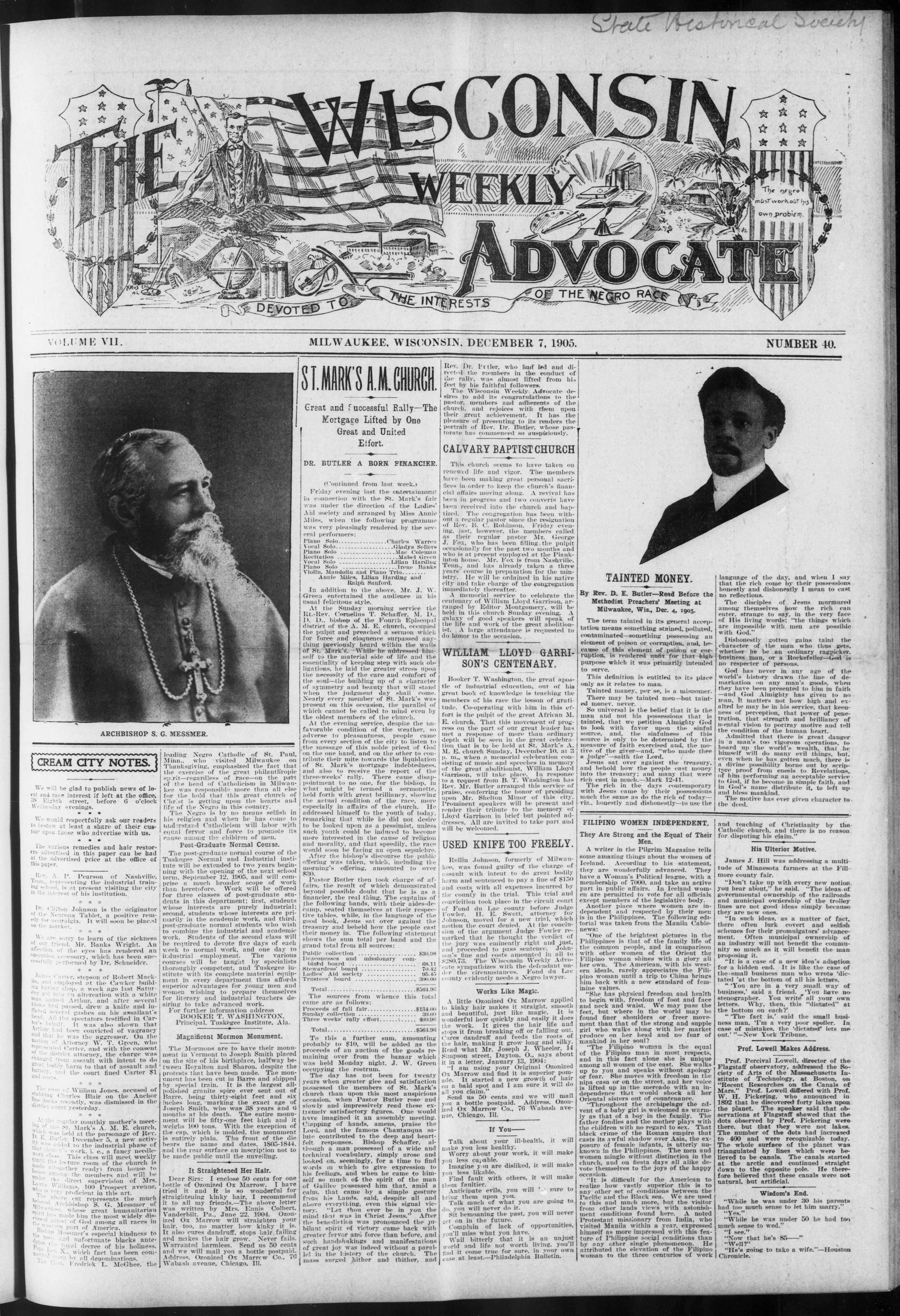
ARCHBISHOP S. G. MESSMER.
CREAM CITY NOTES.
We will be glad to publish news of local and race interest if left at the office, 38 Eighth street, before 6 o'clock Wednesday evenings.
We would respectfully ask our readers to bestow at least a share of their custom upon those who advertise with us.
The various remedies and hair restorers advertised in this paper can be had at the advertised price at the office of this paper.
Rev. A. P. Pearson of Nashville, Tenn., representing the industrial training school, is at present visiting the city in the interest of his institution.
Dr. Clifton Johnson is the originator of the Neurona Tablet, a positive remedy for neuralgia. It will soon be placed on the market.
We are sorry to learn of the sickness of our friend, Mr. Banks Wright. An affection of the eyes has rendered an operation necessary, which has been successfully performed by Dr. Schneider.
James Carter, stepson of Robert Mackin, and employed at the Cawker building barber shop, a week ago last Saturday got into an altercation with a white man named Arthur, and after several blows had passed, drew a knife and inflicted severed gashes on his assailant's head. All the spectators testified in Carter's behalf. It was also shown that Arthur had been convicted of vagrancy and that he was the aggressor. On the motion of Attorney W. T. Green, who represented Carter, and with the consent of the district attorney, the charge was changed from assault with intent to do great bodily harm to that of assault and battery, and the court fined Carter $1 and costs.
The case of William Jones, accused of stabbing Charles Blair on the Anchor line docks recently, was dismissed in the district court yesterday.
At the regular monthly mother's meeting of the St. Mark's A. M. E. church, which was held at the parsonage of Rev. D. E. Butler. December 5, a new activity was added to the industrial phase of that church's work. i. e., a fancy needlework class. This class will meet weekly until the lecture room of the church is made altogether ready) from house to house among the members and will be under the direct supervision of Mrs. Laura Williams. 100 Prospect avenue, who is very proficient in this art.
The above cut represents the much beloved Archbishop S. G. Messmer of Milwaukee, whose great humanitarian spirit has made him the most widely discussed priest of God among all races in the western part of America.
Bishop Messmer's especial kindness to the poor and unfortunate blacks ante-dates the royal decree of his holiness, Pope Leo X., which fact has been commented upon by all denominations.
The Hon. Fredrick L. McGhee, the
---
☆ ☆ ☆
leading Negro Catholic of St. Paul, Minn., who visited Milwaukee on Thanksgiving, emphasized the fact that the exercise of the great philanthropic spirit—regardless of race—on the part of the head of Catholicism in Milwaukee was responsible more than all else for the hold that this great church of Christ is getting upon the hearts and life of the Negro in this country. The Negro is by no means selfish in his religion and when he has come to understand Catholicism will labor with equal fervor and force to promote its cause among the children of men.
Post-Graduate Normal Course.
The post-graduate normal course of the Tuskegee Normal and Industrial institute will be extended to two years beginning with the opening of the next school term, September 12, 1905, and will comprise a much broader scope of work than heretofore. Work will be offered for three classes of post-graduate students in this department; first, students whose interests are purely industrial; second, students whose interests are primarily in the academic work, and third, post-graduate normal students who wish to combine the industrial and academic work. Students of the second class will be required to devote five days of each week to normal work, and one day to industrial employment. The various courses will be taught by specialists thoroughly competent, and Tuskegee institute with its complete material equipment in every department thus affords superior advantages for young men and women wishing to prepare themselves for literary and industrial teachers desiring to take advanced work.
or further information address BOOKER T. WASHINGTON, Principal, Tuskgee Institute, Ala.
Magnificent Mormon Monument.
The Mormons are to have their monument in Vermont to Joseph Smith placed on the site of his birthplace, halfway between Royalton and Sharon, despite the protests that have been made. The monument has been cut in Barre and shipped by special train. It is the largest all-polished granite spire ever sent out of Barre, being thirty-eight feet and six inches long, marking the exact age of Joseph Smith, who was 38 years and 6 months at his death. The entire monument will be fifty-one feet high and it weighs 100 tons. With the exception of the cap, which is molded, the monument is entirely plain. The front of the die bears the name and dates, 1805-1844, and the rear surface an inscription not to be made public until the unveiling.
Dear Sirs: I enclose 50 cents for one bottle of Ozonized Ox Marrow. I have tried it and it is so wonderful for straightening kinky hair. I recommend it to all my friends.—The above letter was written by Mrs. Ennis Colbert, Vanderbilt. Pa., June 22. 1904. Ozonized Ox Marrow will straighten your hair, too, no matter how kinky it is. It also cures dandruff, stops hair failing and makes the hair grow. Never fails. Warranted harmless. Send us 50 cents and we will mail you a bottle postpaid. Address, Ozonized Ox Marrow Co., 79 Wabash avenue, Chicago, Ill.
It Straightened Her Hair
MILWAUKEE, WISCONSIN, DECEMBER 7, 1905.
ST. MARK'S A.M. CHURCH
Great and Successful Rally-The Mortgage Lifted by One Great and United Effort.
DR. BUTLER A BORN FINANCIER
(Continued from last week.)
Friday evening last the entertainment in connection with the St. Mark's fair was under the direction of the Ladies' Aid society and arranged by Miss Annie Miles, when the following programme was very pleasingly rendered by the several performers:
Piano Solo.....Charles Warren
Vocal Solo.....Gladys Sellers
Piano Solo.....Mac Coleman
Recitation.....Mabel Green
Vocal Solo.....Lillian Harding
Piano Solo.....Irene Banks
Violin, Mandolin and Piano Trio.....
In addition to the above. Mr. J. W. Green entertained the audience in his usual felicitous style.
At the Sunday morning service the Rt.-Rev. Cornelius T. Schaffer, M. D. D. D., bishop of the Fourth Episcopal district of the A. M. E. church, occupied the pulpit and preached a sermon which for force and eloquence surpassed anything previously heard within the walls of St. Mark's. While he addressed himself to the material side of life and the essentiality of keeping step with such obligations, he laid the greater stress upon the necessity of the care and comfort of the soul—the building up of a character of symmetry and beauty that will stand when the judgment day shall come. Nearly every member of St. Mark's was present on this occasion, the parallel of which cannot be called to mind even by the oldest members of the church.
At the evening service, despite the unfavorable condition of the weather, so adverse to pleasantness, people came from every section of the city to listen to the message of this noble priest of God on the one hand, and on the other to contribute their mite towards the liquidation of St. Mark's mortgage indebtedness, and also to receive the report of the three-weeks' rally. There came disappointment to no one, for the bishop, in what might be termed a sermonette, held forth with great brilliancy, showing the actual condition of the race, more especially in affairs of the church. He addressed himself to the youth of today, remarking that while he did not desire to be looked upon as a pessimist, unless such youth could be induced to become more interested in the cause of religion and morality, and that speedily, the race would soon be facing an open sepulchre. After the bishop's discourse the public offering was taken, which, including the morning's offering, amounted to over $30.
Pastor Butler then took charge of affairs, the result of which demonstrated beyond possible doubt that he is as a financier, the real thing. The captains of the following bands, with their aides-de-camp, seated themselves at their respective tables, while, in the language of the good book, Jesus sat over against the treasury and beheld how the people cast their money in. The following statement shows the sum total per band and the grand total from all sources:
Public collection ..... $30.98
Deaconesses and missionary com-
binned board ..... 68.11
Stewardess' board ..... 70.42
Ladies' Aid society ..... 95.45
Trustees' board ..... 300.00
Total ..... $561.96
The sources from whence this total came are as follows:
Proceeds of fall fair ..... $134.00
Sunday collection ..... 30.00
Three weeks' rally effort ..... 400.96
Total ..... $561.96
To this a further sum, amounting probably to $10, will be added as the proceeds of an auction of the goods remaining over from the bazaar which was held Monday night, J. W. Green occupying the rostrum.
The day has not been for twenty years when greater glee and satisfaction possessed the members of St. Mark's church than upon this most auspicious occasion, when Pastor Butler rose and slowly and impressively read these extremely satisfactory figures. One would have imagined it an assembly meeting. Clapping of hands, amens, praise the Lord, and the famous Chautauqua salute contributed to the deep and heartfelt responses. Bishop Schaffer, although a man possessed of a wide and technical vocabulary, simply arose and looked on, seemingly, for a time to find words in which to give expression to his feelings, and when he came to himself so much of the spirit of the man of Galilee possessed him that, amid a calm, that came by a simple gesture from his hands, said, despite all and above everything, even this signal victory. "Let thou ever be in you the mind that was in Christ Jesus." After the benediction was pronounced the jubilant spirit of victory came back with greater fervor and force than before, and such handshakings and manifestations of great joy was indeed without a parallel in the history of the church. The mass surged hither and thither, and
Rev. Dr. Prtler, who had led and directed the members in the conduct of the rally, was almost lifted from his feet by his faithful followers. The Wisconsin Weekly Advocate desires to add its congratulations to the pastor, members and admixtures of the church, and rejoices with them upon their great achievement. It has the pleasure of presenting to its readers the portrait of Rev. Dr. Butler; whose pastorate has commenced so auspiciously.
CALVARY BAPTIST CHURCH
This church seems to have taken on renewed life and vigor. The members have been making great personal sacrifices in order to keep the church's financial affairs moving along. A revival has been in progress and two converts have been received into the church and baptized. The congregation has been without a regular pastor since the resignation of Rev. B. C. Robinson. Friday evening, last, however, the members called as their regular pastor Mr. George J. Fox, who has been filling the pulpit occasionally for the past two months and who is at present employed at the Plankinton house. Mr. Fox is from Nashville, Tenn., and has already taken a three years' course in preparation for the ministry. He will be ordained in his native city and take charge of the congregation immediately thereafter.
A memorial service to celebrate the centenary of William Lloyd Garrison, arranged by Editor Montgomery, will be held in this church Sunday evening. A galaxy of good speakers will speak of the life and work of the great abolitionist. A large attendance is requested to do honor to the occasion.
WILLIAM LLOYD GARRISON'S CENTENARY.
Booker T. Washington, the great apostle of industrial education, out of his great book of knowledge is teaching the members of his race the lesson of gratitude. Co-operating with him in this effort is the pulpit of the great African M. E. church. That this movement of progress on the part of our great leader has met a response of more than ordinary depth will be seen in the great celebration that is to be held at St. Mark's A. M. E. church Sunday, December 10, at 3 p. m., when a memorial celebration consisting of music and speeches in memory of the great abolitionist, William Lloyd Garrison, will take place. In response to a request from B. T. Washington has Rev. Mr. Butler arranged this service of praise, conferring the honor of presiding upon Mr. Shelton Minor of this city. Prominent speakers will be present and render their tribute to the memory of Lloyd Garrison in brief but pointed addresses. All are invited to take part and will be welcomed.
USED KNIFE TOO FREELY
Rollin Johnson, formerly of Milwaukee, was found guilty of the charge of assault with intent to do great bodily harm and sentenced to pay a fine of $150 and costs with all expenses incurred by the county in the trial. This trial and conviction took place in the circuit court of Fond du Lac county before Judge Fowler. H. E. Swett, attorney for Johnson, moved for a new trial, which motion the court denied. At the conclusion of the argument Judge Fowler remarked that he thought the verdict of the jury was eminently right and just, and proceeded to pass sentence. Johnson's fine and costs amounted in all to $280.73. The Wisconsin Weekly Advocate sympathizes with the defendant under the circumstances. Fond du Lac county evidently needs a Negro lawyer.
Works Like Magic.
A little Ozonized Ox Marrow applied to kinky hair makes it straight, smooth and beautiful, just like magic. It is wonderful how quickly and easily it does the work. It gives the hair life and stops it from breaking off or fallling out. Cures dandruff and feeds the roots of the hair, making it grow long and silky. Read what Mr. Joseph J. Wheeler, 14 Simpson street, Dayton, O., says about it in a letter, January 13, 1904: "I am using your Original Ozonized Ox Marrow and find it is superior pomade. It started a new growth of hair on a bald spot and I am sure it will do all you claim." Send us 50 cents and we will mail you a bottle postpaid. Address, Ozonized Ox Marrow Co., 76 Wabash avenue, Chicago, Ill.
If You——
Talk about your ill-health, it will make you less healthy.
Worry about your work, it will make you less capable
Imagine you are disliked, it will make you loss, likable.
Anticipate evils, you will be sure to bring them upon you. Talk much of what you are going to do, you will never do it. Sit bemoaning the past, you will never get on in the future. Complain of lack of opportunities, you'll miss what you have. Wail bitterly that it is an unjust world and life not worth living. you'll find it come true for sure, in your own ease at least.—Philadelphia Bulletin.
J.
TAINTED MONEY.
By Rev. D. E. Butler—Read Before the Methodist Preachers' Meeting at Milwaukee, Wis., Dec. 4, 1905.
The term tainted in its general acceptance means something stained, polluted, contaminated—something possessing an element of poison or corruption, and, because of this element of poison or corruption, is rendered unfit for that high purpose which it was primarily intended to serve.
This definition is entitled to its place only as it relates to man.
Tainted maney, per se, is a misnomer.
There may be tainted men—but tainted money, never
So universal is the belief that it is the man and not his possessions that is tainted, that we petition Almighty God to look with favor upon the sinful source, and, the sinfulness of this source is only to be determined by the measure of faith exercised and, the motive of the giver—and, "who made thee a judge"—saith the Lord.
Jesus sat over against the treasury, and behold how the people cast money into the treasury; and many that were rich cast in much.—Mark 12-41.
The rich in the days contemporary with Jesus came by their possessions much the same as do the rich of today—viz., honestly and dishonestly—to use the
FILIPINO WOMEN INDEPENDENT.
They Are Strong and the Equal of Their Men.
A writer in the Pilgrim Magazine tells some amazing things about the women of Iceland. According to his statement, they are wonderfully advanced. They have a Woman's Political league, with a membership of 7000, and take an active part in public affairs. In Iceland women are permitted to vote for all officials except members of the legislative body. Another place where women are independent and respected by their men is in the Philippines. The following editorial was taken from the Manila Cablenews:
"One of the brightest pictures in the Philippines is that of the family life of the common people, and in comparison with other women of the Orient the Filipino woman shines with a glory all her own. The American, with his western ideals, rarely appreciates the Filipino woman until a trip to China brings him back with a new standard of feminine values.
"She has physical freedom and health to begin with, freedom of foot and face and neck and waist. We may pass the feet, but where in the world may be found finer shoulders or freer movement than that of the strong and supple girl who walks along with her market produce on her head and no fear of mankind in her soul?"
"The Filipino woman is the equal of the Filipino man in most respects, and in this fact alone she is unique among all women of the east. She walks up to you and speaks without apology or fear. She moves with freedom in the nipa casa or on the street, and her voice is lifted up in the mercado with an independence that would shock all her Oriental sisters out of countenance.
"Throughout the archipelago the advent of a baby girl is welcomed as warmly as that of a boy in the family. The father fondles and the mother plays with the children with no regard to sex. That black crime of the Roman empire that casts its awful shadow over Asia, the exposure of female infants, is utterly unknown in the Philippines. The men and women mingle without distinction in the church, and on fiesta days all alike devote themselves to the joys of the happy occasion
"It is difficult for the American to realize how vastly superior this is to any other set of conditions between the Pacific and the Black sea. We are used to this and much more, but the visitor from other lands views with astonishment conditions found here. A noted Protestant missionary from India, who visited Manila within a year, expressed himself as more impressed with this feature of Philippine social conditions than by any other single phenomenon. He attributed the elevation of the Filipino woman to the three centuries of work
language of the day, and when I say that the rich come by their possessions honestly and dishonestly I mean to cast no reflections.
The disciples of Jesus murmured among themselves how the rich can enter, strange to say, in the very face of His living words; "the things which are impossible with men are possible with God."
Dishonestly gotten gains taint the character of the man who thus gets, whether he be an ordinary ragpicker, business man, or a Rockefeller--God is no respecter of persons.
God has never in any age of the world's history drawn the line of markation on any man's goods, when they have been presented to him in faith
and God Almighty has given to no man, it matters not how high and exalted he may be in his service, that keenness of perception, that power of penetration, that strength and brilliancy of mental vision to portray motive and tell the condition of the human heart.
Admitted that there is great danger in a man's too vigorous operations, to board up the world's wealth, that he himself will do many evil things, but, even when he has gotten much, there is a divine possibility borne out by scripture proof from enesis to Revelations, of him performing an acceptable service to God, if he become in simple faith, and in God's name distribute it, to left up and bless mankind.
The motive has ever given character to the deed.
and teaching of Christianity by the Catholic church, and there is no reason for disputing his claim."
His Ulterior Motive.
James J. Hill was addressing a multitude of Minnesota farmers at the Fillmore county fair.
"Don't take up with every new notion you hear about," he said. "The ideas of governmental ownership of the railroads and municipal ownership of the trolley lines are not good ideas simply because they are new ones.
"In such ideas, as a matter of fact, there often lurk covert and selfish schemes for their promulgators' advancement. Often municipal ownership of an industry will not benefit the community so much as it will benefit the man proposing it.
"It is a case of a new idea's adoption for a hidden end. It is like the case of the small business man who wrote 'dictated' at the bottom of all his letters.
"You are in a very small way of business,' said a friend. 'You have no stenographer. You write all your own letters. Why, then, this "dictated" at the bottom on each?' "The fact is,' said the small business man, 'I'm a very poor speller. In case of mistakes, the 'dictated' lets me out.'"—New York Tribune.
Prof. Lowell Makes Address.
Prof. Percival Lowell, director of the Flagstaff observatory, addressed the Society of Arts of the Massachusetts Institute of Technology, at Boston, on "Recent Researches on the Canals of Mars." Prof. Lowell differed with Prof. W. H. Pickering, who announced in 1892 that he discovered forty lakes upon the planet. The speaker said that observations at Flagstaff showed that the dots observed by Prof. Pickering were there, but that they were not lakes. The number of the dots had increased to 400 and were recognizable today. The whole surface of the planet was triangulated by lines which were believed to be canals. The canals started at the arctic and continued straight down to the opposite pole. He therefore believed that these canals were not natural, but artificial.
Wisdom's End.
"While he was under 30 his parents had too much sense to let him marry." "Yes."
"He's going to take a wife."—Houston Chronicle.
NUMBER 40.
Good paper can be made from the hops thrown out as refuse from the breweries. The thinnest and, comparatively speaking, the toughest of all leathers is frogskin. The Alsatian city of Malhausen not only provides free baths for its school children, but free medical inspection and dental treatment. Floating islands, the largest being about three-quarters of a mile in area, form an interesting feature of a lake in Mindanao. London has fewer suicides than any other great capital. While Paris has 400 suicides for each 1,000,000 a year London has only 90. The most elevated river in the world is the Desaguadero, in Bolivia. The average elevation above the level of the sea is about 13,000 feet.
Stockholm has the largest death rate from the use of alcohol in any city in the world. The number of deaths from this cause is 90 in 1000.
The "message stick" is a sort of flag of truce used by the natives of Western Australia when traveling beyond the boundaries of their own tribe.
For saying that the Kaiser had an "ugly face" Mathias Rohrmann of Phaisbourg, Alsace-Lorraine, has been sent to prison for two months.
The strike on the Russian railways stopped 40,000 geese from making their trip to Germany; that is the monthly export to the neighboring empire.
About 2000 vessels of all kinds disappear in the sea every year, carrying down 12,000 human beings, and involving a loss of about $100,000,000 in property. Many Chinese Christians have given up their work at home in order to go to the Transvaal to labor as evangelists among the 40,000 Chinese coolies there. Missionaries of the American Methodist church speak no fewer than thirty-seven languages. There are 5000 of these workers and 150,000 Christians under them. The capacity of air for holding moisture is twice as great at 52 degrees as at 32, and four times as great at 72 degrees as at the freezing point of water—32 degrees Fahrenheit.
The use of the blue uniform faced with white, which originated with the British navy but which has been widely copied, was suggested by a riding habit worn by the Duchess of Bedford.
The dead bodies of prospectors are found day after day in Death Valley, southern California. Always the unfortunates have discarded all their clothing in the agonies of heat and thirst.
Shectiron can now be rolled so thin that it takes 15,000 sheets to make a single inch in thickness. Light shines as clearly through one of these sheets as through ordinary tissue paper.
According to German scientists fish destroy many annoying insects, especially mosquitoes. In Germany the common carp, the crucian carp and the red-eye are considered the best insect-destroying fish.
On a seismograph at Simla, India, presented to the meteorological department by Prof. Ormori, the Japanese earthquake expert, the shock caused by the blowing up of the steamship Chatham, in the Suez canal, 2500 miles away, was recorded.
The Nelson centennial has called attention to the age of Nelson's captains at Trafalgar. It averaged not quite 40. Nelson's flag captain was 36. One of the commanders was only 20. The commander of one of the finest battleships was 31.
Japanese children have the most wonderful dolls' houses in the world. These are most completely furnished, have little cages for chirruping insects instead of birds, and even tiny bookcases filled with dolls' poetry books about the size of an ordinary postage stamp.
English inhabitants of the Transvaal are much worried over the increase in the Asiatic elements in the population. Already in Natal the Asiatics outnumber the Europeans. In Natal, too, the white retail trade has been almost eliminated as a result of Asiatic competition. The British ship William Mitchell took recently thirty-five days to make the trip from San Francisco to Tacoma, which is the record for slowness. In five days she made five miles. The captain declares that some San Francisco seagulls swam ahead of or beside the ship all the way.
The Japanese are experts on smoke rings, and it is said in Japan it is considered no uncommon trick to blow three rings of smoke in succession, the second traveling through the first and the third through both. Some stage performers are credited with becoming so expert in smoke-blowing that they are not only able to multiply the number of rings thus made, but actually form Japanese characters representing words and sentences.
AFLOAT WITH CORPSE IN BOAT.
Affloat in a launch, with a corpse as his sole companion, and not knowing how to stop the boat, was the experience of James Parker of Findlay, O., in the north channel of St. Clair river one night recently. Parker had been visiting Dennis Gebeau, a Detroit contractor. Gebeau offered to take him in his launch to Pearl beach to catch a car for Detroit. About two miles below Pearl beach Gebeau turned around to adjust the engine. When he turned to the wheel again he suddenly collapsed and died almost instantly.
All this time the launch was speeding on and Parker did not understand the machinery. He had seen his dead companion work the wheel. He grasped it, and after a couple of turns succeeded in getting the little craft into deep water, but was unable to stop it. Near Pearl beach the problem of stopping the launch was still unsolved. Inshore the boat circled around and came back only to repeat the performance. Its strange actions attracted attention and a launch was sent out to ascertain the trouble. After an exciting chase the other boat, bearing the corpse, was overtaken, a man clambered on board, and shut off the engine, after which it was towed ashore. Heart disease is supposed to have been the cause of Gebeau's death.
English Sparrows as Delicacy.
English sparrows for Sunday dinners is the food placed upon William Haase's table in the Fourth ward in Appleton, Wis. He says it is one of the choicest of meats. During the week he ensnares the birds in a trap and keeps them until Sunday. They are served by putting the body of the bird in an apple.
No Dancing at Ball.
From Cincinnati comes word that the Ohio inaugural ball at the capital city is not to be a ball at all. There will be no dancing. That is the decree of Gov-elect and Mrs. Pattison. And there will be no "spike" in the punch, either. The Pattisons are members of the Methodist church and the Methodist discipline prohibits dancing.
THE GREEN SINGING BOOK
I don't know how to read the words,
Nor how the black things go.
But if you stand it up, and sing,
You never have to know.
The music sounds alike each time
When grown-up people play;
But every time I sing myself,
It sounds a different way.
And when I've sung the book all through
And every page all round.
I stand it upside down and sing,
To hear how that will sound.
I sing how all the things outside
The window look to me;
The shiny wrinkles in the road,—
And then about my Tree.
I sing about the city, too;
The noises, and the wheels.
And windows blinking at the sun:—
I sing the way it feels.
And if a sparrow flies across,
I put him in the song.
I sing whatever happens in.
To make it last for long.
I'll I begin to sing.
Josephine Preston Peabody in Harpe's Magazine.
LAST LIVING MEMBER OF PRESIDENT GRANT'S CABINET
By Lieut.-Col. J. A. Watrous. U. S. Army. Only one cabinet minister who was intimately associated with Gen. Grant while he was President is still living. Ex-Senator George H. Williams of Portland, Ore., was attorney general. I had a pleasant talk with Judge Williams. He told me many things about Gen. Grant which deserve to be given to the public.
First let me tell something about Judge Williams. He is a native of New York, where he grew to manhood, was educated in the public schools and admitted to the bar. At 21 he went to Iowa and practiced his profession. In 1847 he was elected a circuit judge. Not long after Mr. Pierce became President. In 1852 Judge Williams was appointed chief justice of the territory of Oregon. Stephen A. Douglas, a personal friend, having requested the appointment. President Buchanan reappointed him in 1857, but not being in accord with some of Mr. Buchanan's slavery ideas, he tendered his resignation and resumed his law practice becoming a Republican.
In 1864 Mr. Williams was elected to the United States Senate. It was Senator Williams who drew the reconstruction bill and had charge of it in the Senate. President Grant appointed him a member of the joint high commission which negotiated the treaty of Washington, and soon after his duties in that connection enced selected him as attorney general.
When Chief Justice Salmon P. Chase died Gen. Grant found great difficulty in selecting his successor. Great pressure was brought to bear to promote one of the associate justices. Gen. Grant desired to do that, but was not long in discovering that wname he would greatly please one of the justices by such a course, he would seriously displease all of the others, and their friends, and the idea was abandoned. It was finally decided to name Roscoe Conkling, who had recently been elected to the Senate. Senator Conkling declined. There were two or three cabinet meetings, largely devoted to discussing candidates for chief justice. One of these meetings was held without the knowledge of the attorney general. Gen. Grant settled upon Judge Williams, and his name was sent to the Senate.
"I knew nothing about it until my name was sent to the Senate. It was my greatest surprise," said Judge Williams. "The next day, when I met Gen. Grant, I said, 'Mr. President, I am under many obligations for your kindness in this matter.' "He replied, 'It was the proper thing to do.'"
The history of that appointment is very interesting. As will be remembered; the Senate did not act upon it. The desire of many senators to see an associate justice promoted was a marked factor in preventing prompt confirmation, but there was a still greater factor. Mrs. Williams was a talented, beautiful woman; she was a leader in Washington society; few equaled her and none excelled. This distinguished society leader, while very popuplar with a large element, was unpopular with an influential element. That element consisted of the wives of some senators, representatives, judges and other high officials.
Mrs. Williams greatly surpassed these classes. It was a thorn in their sides to have her the wife of a cabinet minister; what would it be when she was the wife of the chief justice? The pill was a very bitter one for them. The idea of this lady from far away Oregon, the backwoods, as they said, ranking them! It must not be.
And they united, almost as one, in the most bitter warfare upon Judge Williams that has ever been known at the national capital.
Every newspaper that opposed the Grant administration made it its special business to traduce and besmirch the attorney general, Grant's choice for chief justice. And every Republican paper that could be reached by the pressure, which was most powerful, joined in the loud baying.
The Senate hesitated.
Some of its members clamored for a different appointment.
The delay and the wholesale and vicious attacks had a most depressing effect upon Judge Williams.
He finally said to Gen. Grant, "This bitter, cruel, unjust opposition is too much for me; I cannot bear it any longer; I want you to withdraw my name."
"I will do so, Mr. Williams, if you insist, but I do not want to. I am prepared to stand by you to the bitter end." "No, Mr. President, please withdraw my name; the tension is too great, the load is too heavy."
The name was withdrawn.
That Judge Williams made a serious mistake in asking the President to withdraw his name is undoubted. The tide had begun to turn in the Senate; the attacks of the press and of society leaders had disgusted many of the senators. Several senators went to Judge Williams and expressed regret that he had withdrawn, telling him that it was only a question of time when he would have been confirmed.
"After my name had been withdrawn, other cabinet sessions were devoted to selecting a chief justice. Many names were suggested. Caleb Cushing of Massachusetts was chosen. The appointment
was referred and there it remained, as mine had. Cushing's famous letter to Jefferson Davis, in which he virtually sympathized with the Confederate president, was printed. That settled Mr. Cushing; the Senate would not confirm. "It finally dawned upon the President that it would be necessary to select a dark horse. Some one suggested Morrison P. White of Ohio. He seemed to fill the bill as a dark horse candidate. Not much was known about him by any one outside of Ohio. He had only visited Washington once, and had never had a case before the supreme court. President Grant asked me to telegraph him asking if he would accept.
"Of course he would, and did, and he was appointed and confirmed." Not long after that Judge Williams tendered his resignation as attorney general. For a time he practiced law in Washington and then returned to Oregon and resumed his law practice, interrupted in 1864. A movement was set on foot the year of a senatorial election, over twenty-five years ago, to return Judge Williams to the Senate. A majority of the Republicans were favorable to his election, but the Republican minority united with the Democrats and elected John H. Mitchell, recently found guilty of defrauding the government.
Since then Judge Williams has been besought by parties and individuals to consent to the use of his name for various offices of honor and trust, but has invariably declined, until a few years since, when he was elected mayor.
---
I know that millions would listen, as I did, with deep interest, to what this distinguished ex-member of his cabinet said about President Grant, if they had a chance. Let me give them a chance to read what he said: "Was it Gen. Grant's habit to take an active part in discussing questions which came before the cabinet?"
"If the question was one which should be settled by the head of a department, the general would refer the matter to that cabinet minister. In a question like the inflation bill, for instance, Gen. Grant always listened attentively to the opinions of the cabinet, now and then making a question or suggesting an idea. That bill passed, as you remember. After a prolonged session of the cabinet, when the question veto or no veto was discussed from every standpoint, Gen. Grant closed the meeting by saying, 'Gentlemen, it is my plain duty to veto that bill; I shall veto it.'"
"Did the President generally approve of the acts of his cabinet officers, in the management of their respective departments, and did he appoint to office the men recommended by cabinet officers?"
"Generally, yes. Gen. Grant was very good in the matter of appointing men recommended by the heads of departments. He never failed to appoint any one that I recommended, and I cannot recall more than an instance or two where he failed to comply with the requests of other cabinet officers. He did not always approve of our actions. I refer to one case, without using names. A federal official had been found guilty of embezzlement, was tried, convicted and imprisoned. He had many influential friends and they besought the President for a pardon. Grant referred them to the attorney general and in every instance I reported unfavorably. At last the wife of the prisoner came to my office and pleaded that her husband be liberated. She was a beautiful woman, refined, highly educated and intelligent, and her appeal was the most pathetic that I ever listened to. It was a hard task to do, but I had to say to the lady, 'I cannot help you; your husband was guilty, and if I favor a pardon for him, how can I refuse others whose offenses were not so great as his?'
"In those days Gen. Grant had a rule that no woman seeking pardon for friends should be admitted to his office, but by some means this lady reached his room and made her plea. When he said he did not see how he could comply with her request she fell upon her knees and with tear-sprinkled cheeks begged the President to give her back her husband. 'If not for my sake, for the sake of my children; for the sake of an unborn child.' That day Gen. Grant sent a note directing me to take the necessary steps to pardon the man, and it was done. When I met him I said, 'Mr. President, you made a mistake in that case. That man was an embezzler; it was a perfectly clear case. He ought to have remained in prison.'
"Mr. Williame, I know it was a mistake; I know the man was guilty; I know he ought to have been kept in prison, but what is a man to do when such a woman falls upon her knees and pleads that her life and that of her unborn child depended on my saying yes? There was a sign of tears in the President's eyes as he said it."
"Was Gen. Grant cordial, jovial and friendly with the cabinet?"
"At times, very much so. When there was any important work to do at cabinet meetings, the general always gave close and serious attention. When we met and there was nothing to do, I have known him to talk for two hours, and most entertainingly. Usually at those social gatherings he would talk of the Mexican and Civil wars and the men he served with, but never about things that he did. He frequently told us of great movements made by Sherman, Thomas or Faragut; or by Lee, Stonewall Jackson or Longstreet. He was always very cordial in greeting cabinet members, but the class that was most warmly greeted was his old comrades of the Mexican and Civil wars. Those he met with both hands extended to grasp the two hands of the visitor."
"How did the savage newspaper criticism affect Gen. Grant?"
"I guess no one could tell. He never used to say anything about them, and he did not care to listen to anyone else talk about them; but he was a sensitive man and I have no doubt that some of the harsh things wounded him deeply."
"I knew, Mr. Williams, that Gen. Grant was a most industrious man in the field, as a commander. Did he carry his habits of industry to the white house?"
"He certainly did. He was a tireless worker. If there was anything that the President had to do, he always did it at the earliest possible moment, and the best he knew how. He very seldom called upon a stenographer to help him in his correspondence, and never in the preparation of his state papers. Whatever he prepared was in his own hand-writing."
"Did Gen. Grant evince much interest in the campaign of 1872?"
"Apparently none. The night after election I was with him. While all others in the room were greatly excited and pleased as the reports came in. Gen. Grant
sat in his chair as unconcerned as if it was a matter of no moment." It may be interesting to give the names of all the men who served in the cabinet during Grant's two terms:
Secretary of state, Clihu B. Washburn and Hamilton Fish; secretary of the treasury, George S. Boutwell, William A. Richardson, Benjamin H. Bristown and Let M. Merrill; secretary of war, John A. Rawlins, William T. Sherman, William W. Belknap, Alonzo Taft and J. D. Cameron; secretary of the interior, Jacob D. Cox, Columbus Delano and Zachariah Chandler. Secretary of the navy, Adolph A. Borie and George M. Robeson; postmaster general, John A. J. Croswell, James W. Marshall, Marshall Jewell and James N. Tyner; attorney general, E. R. Hoar, Amos T. Ackerman, George H. Williams, Edward S. Pierpont and Alfonso Taft.
Judge Williams is still practicing law in the city he has seen grow from a small place to a population of 140,000. Evening Wisconsin.
VENTILATED BARREL
Designed Particularly for Shipping Garden Produce.
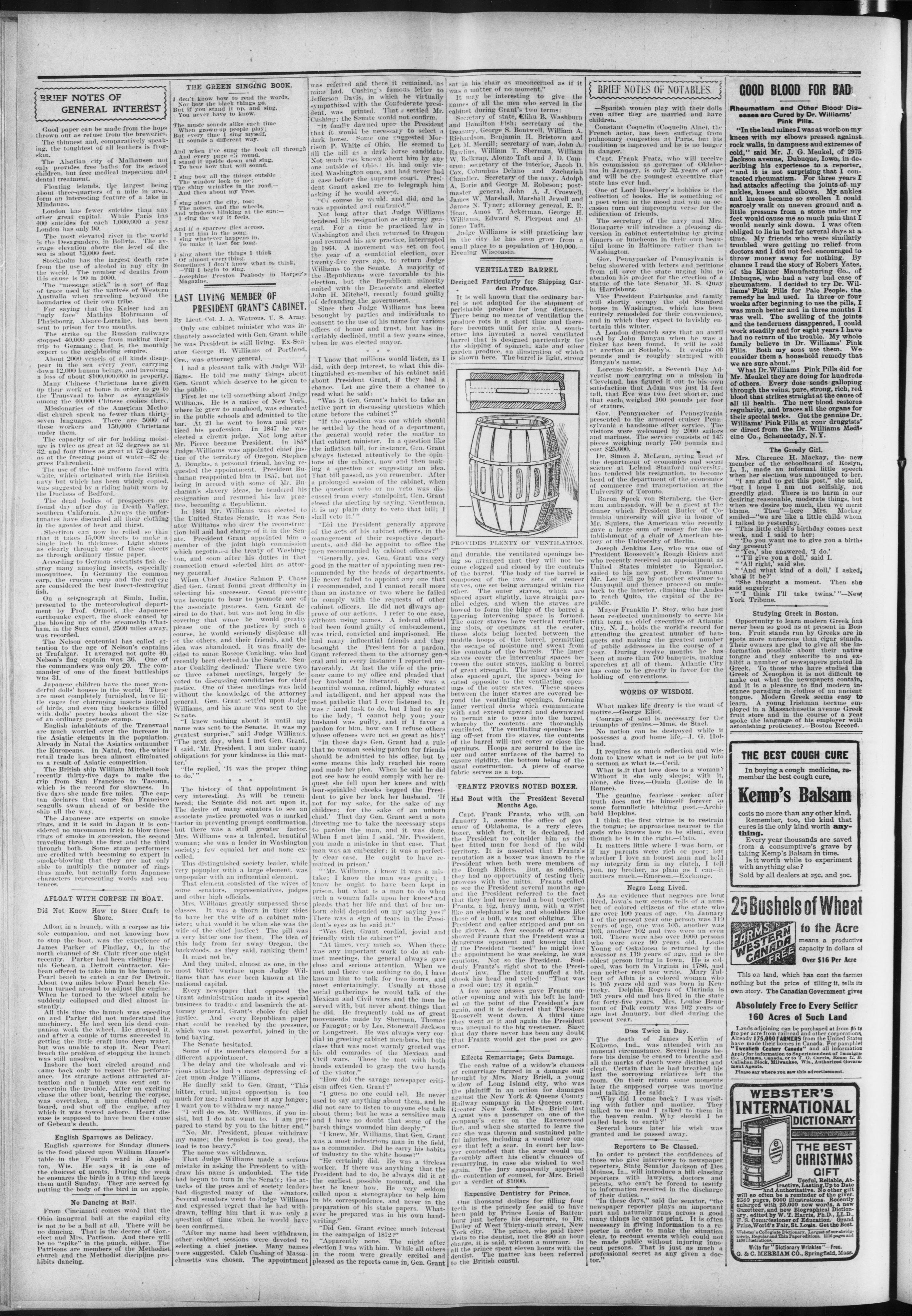
It is well known that the ordinary barrel is not adapted for the shipment of perishable produce for long distances. There being no means of ventilation the produce rots in a short time and therefore becomes unfit for sale. A southerner has invented a novel ventilated barrel that is designed particularly for the shipping of spinach, kale and other garden produce, an illustration of which is shown here. The barrel is light, strong
[Diagram of a wooden barrel with a metal band around it.]
PROVIDES PLENTY OF VENTILATION
and durable, the ventilated openings being so arranged that they will not become clogged and closed by the contents of the barrel. The body of the barrel is composed of the two sets of veneer staves, one set being arranged within the other. The outer staves, which are spaced apart slightly, have straight parallel edges, and when the staves are bowed to form the bilge of the barrel a tapering intervening space is formed. The outer staves have vertical ventilating slots, or openings, at the center, these slots being located between the middle hoops of the barrel, permitting the escape of moisture and sweat from the contents of the barrels. The inner staves cover the intervening spaces between the outer staves, making a barrel of great strength. The inner staves are also spaced apart, the spaces being located opposite to the ventilating openings of the outer staves. These spaces between the inner staves are covered beyond the ventilating openings, forming inner vertical ducts which communicate with and extend upward and downward to permit air to pass into the barrel, whereby the contents are thoroughly ventilated. The ventilating openings being off-set from the staves, the contents of the barrel will not cover or close the openings. Hoops are secured to the inner and outer surfaces of the barrel to ensure rigidity, the bottom being of the usual construction. A piece of coarse fabric serves as a top.
FRANTZ PROVES NOTED BOXER
Had Bout with the President Several Months Ago.
Capt. Frank Frantz, who will, on January 1, assume the office of governor of Oklahoma, is a very clever boxer, which fact, it is declared, led the President to consider him as the best fitted man for head of the wild territory. It is asserted that Frantz's reputation as a boxer was known to the President when both were members of the Rough Riders. But, as soldiers, they had no opportunity of testing their prowess with the mitts. Frantz called to see the President several months ago and the President referred to the fact that they had never had a bout together. Frantz, a big, heavy man, with a wrist like an elephant's leg and shoulders like those of a bull, was most obliging. The President and caller stripped and put on the gloves. A few seconds of sparring showed Frantz that the President was a dangerous opponent and knowing that if the President "bested" he might lose the appointment he was seeking, he was cautious. Not so the President. Suddenly Frantz's right shot to the Presidents' jaw. The latter snuffed a bit, shook his head and yelled: "That was a good one; try it again."
A few more passes gave Frantz another opening and with his left he landed on the point of the President's jaw again, and it is declared that Theodore Roosevelt went down. A third time they went at it and again the President was unequal to the big westerner. Since that day there never has been any doubt that Frantz would get the post as governor.
Effects Remarriage: Gets Damage.
The cash value of a widow's chances of remarriage figured in a damage suit brought by Mrs. Mary Briell, a young widow of Long Island city, who was the plaintiff in an action for damages against the New York & Queens County Railway company in the Queens court, Greater New York. Mrs. Briell last August was a passenger on one of the company's cars on the Ravenswood line, and when she started to leave the car she was thrown and sustained painful injuries, including a wound over one eye that left a scar. In court her lawyer contended that the scar would unfavorably affect his client's chances of remarrying, in case she wished to wed again. The jury apparently approved the contention of counsel, for Mrs. Briell got a verdict of $1000.
Expensive Dentistry for Prince.
One thousand dollars for filling four teeth is the princely fee said to have been paid by Prince Louis of Battenburg just before his departure, to Dr. Dailey of West Thirty-ninth street, New York city. The prince, who paid three visits to the dentist, met the $90 an hour charge, it is said, without a murmur. In all the prince spent eleven hours with the dentist. The matter has been referred to the British consul.
Spanish women play with their dolls even after they are married and have children.
Constant Coquelin (Coquelin Aine), the French actor, has been suffering from pulmonary congestion at Paris, but his condition is improved and he is no longer in danger.
Capt. Frank Fratz, who will receive his commission as governor of Oklahoma in January, is only 32 years of age and will be the youngest executive that state has ever had.
One of Lord Rosebery's hobbies is the collection of books. He is something of a poet when in the mood and will on occasion turn out impromptu verse for the edification of friends.
The secretary of the navy and Mrs. Bonaparte will introduce a pleasing diversion in cabinet entertaining by giving dinners or luncheons in their own beautiful home in Baltimore rather than in Washington.
Gov. Pennypacker of Pennsylvania is being showered with letters and petitions from all over the state urging him to abandon his project for the erection of a statue of the late Senator M. S. Quay in Harrisburg.
Vice President Fairbanks and family will shortly occupy the old Stanford house in Washington, which has been entirely remodeled for their convenience, and in which they expect to lavishly entertain this winter.
A London dispatch says that an anvil used by John Bunyan when he was a tinker has been found. It will be sold at auction at Sotheby's. It weighs 60 pounds and is roughly stamped with Bunyan's name.
Lorenzo Schmidt, a Seventh Day Adventist now carrying on a mission in Cleveland, has figured it out to his own satisfaction that Adam was just 14 feet tall, that Eve was two feet shorter, and that each weighed 100 pounds per foot of stature.
Gov. Pennypacker of Pennsylvania presented to the armored cruiser Pennsylvania a handsome silver service. The visitors were welcomed by 2000 sailors and marines. The service consists of 143 pieces weighing nearly 750 pounds and cost $25,000.
Dr. Simon J. McLean, acting head of the department of economics and social science at Leland Stanford university, has tendered his resignation, to become head of the department of the economics of commerce and transportation at the University of Toronto.
Baron Speck von Sternberg, the German ambassador, will be a guest at the dinner which President Butler of Columbia university will give in honor of Mr. Squiers, the American who recently gave a large sum of money for the establishment of a chair of American history at the University of Berlin.
Joseph Jenkins Lee, who was one of President Roosevelt's Rough Riders and who recently received an appointment as United States minister to Equador, sailed to his new post. From Panama Mr. Lee will go by another steamer to Guayaquil and thence proceed on muleback to the interior, climbing the Andes to reach Quito, the capital of the republic.
Mayor Franklin P. Stoy, who has just been re-elected unanimously to serve his fifth term as chief executive of Atlantic City, N. J., holds the world's record for attending the greatest number of banquets and making the greatest number of public addresses in the course of a year. During twelve months he has been at more than 700 banquets, making speeches at all of them. Atlantic City has come to be greatly in favor for the holding of conventions.
WORDS OF WISDOM.
What makes life dreary is the want of motive.—George Eliot.
Courage of soul is necessary for the triumphs of genius.-Mme. de Stael.
No nation can be destroyed while it possesses a good home life.—J. G. Holland.
It requires as much reflection and wisdom to know what is not to be put into a sermon as what is.—Cecil.
What is it that love does to a woman? Without it she only sleeps; with it, alone, she lives.—Ouida (Louise de la Ramee).
The genuine, fearless seeker after truth does not tie himself forever to some formulistic hitching post.—Archibald Hopkins.
I think the first virtue is to restrain the tongue; he approaches nearest to the gods who knows how to be silent, even though he is in the right.—Cato.
It matters little where I was born, or if my parents were rich or poor; but whether I love an honest man and hold my integrity firm in my clutch, I tell you, my brother, as plain as I can—it matters much.—Emerson.—Exchange.
Negro Long Lived
As an evidence that negroes are long lived, Iowa's new census tells of a number of colored citizens of the state who are over 100 years of age. On January 1 of the present year one person was 119 years of age, one was 105, another was 103, another 102 and two were an even 100. There were also over 1000 persons who were over 90 years old. Louis Young of Oskaloosa is returned by the assessor as 119 years of age, and is the oldest person living in Iowa. He is colored, was born in Virginia in 1786, and can neither read nor write. Mary Talbert of Albia is a colored woman who is 105 years old and was born in Kentucky. Delphia Rogers of Clarinda is 103 years old and has lived in the state for forty-five years. Mrs. Louise Beamont of Polk county was 102 years of age last January, but died during the present year.
Dies Twice in Day.
The death of James Kerlin of Kokomo, Ind., was attended with an unusual circumstance. Several hours before his demise he ceased to breathe and all the marks of death were distinct and clear. Certain that he had breathed his last the sorrowing relatives left the room. On their return some moments later the supposed corpse was moving and talking. He said:
"Why did I come back? I was visiting with father and mother. They talked to me and I talked to them in the heaven realm. Why should I be called back to earth?"
Several hours later his wish was granted and he passed away.
Reporters to Be Classed
In order to protect the confidences of those who give interviews to newspaper reporters, State Senator Jackson of Des Moines, Ia., will introduce a bill classing reporters with lawyers, doctors and priests, who can't be forced to testify to information received in the discharge of their duties.
"In these days," said the senator, "the newspaper reporter plays an important part and naturally runs across a good many things he cannot print. It is often necessary in giving information to a reporter in order to make the situation clear, to recount events which could not be made public without injuring innocent persons. That is just as much a professional secret as any given a doctor."
GOOD BLOOD FOR BAD
Rheumatism and Other Blood Diseases are Cured by Dr. Williams' Pink Pills.
"In the lead mines I was at work on my knees with my elbows pressed against rock walls, in dampness and extremes of cold," said Mr. J. G. Meukel, of 2975 Jackson avenue, Dubuque, Iowa, in describing his experience to a reporter, "and it is not surprising that I contracted rheumatism. For three years I had attacks affecting the joints of my ankles, knees and elbows. My ankles and knees became so swollen I could scarcely walk on uneven ground and a little pressure from a stone under my feet would cause me so much pain that I would nearly sink down. I was often obliged to lie in bed for several days at a time. My friends who were similarly troubled were getting no relief from doctors and I did not feel encouraged to throw money away for nothing. By chance I read the story of Robert Yates, of the Klauer Manufacturing Co., of Dubuque, who had a very bad case of rheumatism. I decided to try Dr. Williams' Pink Pills for Pale People, the remedy he had used. In three or four weeks after beginning to use the pills, I was much better and in three months I was well. The swelling of the joints and the tenderness disappeared, I could work steadily and for eight years I have had no return of the trouble. My whole family believe in Dr. Williams' Pink Pills. Both my sous use them. We consider them a household remedy that we are sure about."
What Dr. Williams Pink Pills did for Mr. Meukel they are doing for hundreds of others. Every dose sends galloping through the veins, pure, strong, rich, red blood that strikes straight at the cause of all ill health. The new blood restores regularity, and braces all the organs for their special tasks. Get the genuine Dr. Williams' Pink Pills at your druggists' or direct from the Dr. Williams Medicine Co., Schenectady, N.Y.
The Greedy Girl.
Mrs. Clarence H. Mackay, the new member of the schoolboard of Roslyn, L. I., made an informal little speech when her election was announced to her.
"I am glad to get this post," she said,
"but I hope I am not selfishly, not greedily glad. There is no harm in our desiring reasonable, moderate things, but when we desire too much, then we merit blame. Then"—here Mrs. Mackay smiled—"we are like a little child whom I talked to yesterday.
"This little child's birthday comes next week, and I said to her:
"Do you want me to give you a birthday present?"
"‘All right,’ said she.
"‘And what kind of a doll,’ I asked,
‘shall it be?’
"She thought a moment. Then she said eagerly:
said eagerly:
“‘I think I'll take twins.’”—New York Tribune.
Studying Greek in Boston
Opportunity to learn modern Greek has never been so good as at present in Boston. Fruit stands run by Greeks are in spots more numerous than cigar stands. Their owners are glad to give all the information possible about their native tongue and they subscribe to and exhibit a number of newspapers printed in Greek. To those who have studied the Greek of Xenophon it is not difficult to make out what the newspapers contain, and it is a pleasure to find modern instance parading in clothes of an ancient tongue. Modern Greek seems easy to learn. A young Irishman became employed in a Massachusetts avenue Greek fruit store and in the course of a year spoke the language of his employer with astonishing proficiency.—Boston Record.
In buying a cough medicine, remember the best cough cure,
costs no more than any other kind. Remember, too, the kind that cures is the only kind worth anything. Every year thousands are saved from a consumptive's grave by taking Kemp's Balsam in time. Is it worth while to experiment with anything else? Sold by all dealers at 25c, and 50c.
25Bushels of Wheat
WESTERN
CANADA
FARMS IN WESTERN CANADA FREE to the Acre means a productive capacity in dollars of Over $16 Per Acre This on land, which has cost the farmer nothing but the price of tilling it, tells its own story. The Canadian Government gives
Absolutely Free to Every Settler 160 Acres of Such Land
Lands adjoining can be purchased at from $6 to $10 per acre from railroad and other corporations. Already 175,000 FARMERS from the United States have made their homes in Canada. For pamphlet "Twentieth Century Canada" and all information Apply for information to Superintendent of Immigration, Ottawa, Canada, or to T. O. Currie, Room 12, B. Callahan Block, Milwaukee, Wis., Authorized Government Agents.
Please say where you saw this advertisement.
WEBSTER'S
INTERNATIONAL
DICTIONARY
THE BEST
CHRISTMAS
GIFT
Useful, Reliable, At-
tractive. Lasting Unto Date
tractive, Lasting, Up to Date
and Authoritative. No other gift
will so often be a reminder of the giver.
2280 pages, 5000 illustrations. Recently
enlarged with 25,000 new words, a new
Gazetteer, and new Biographical Dictionary,
edited by W. T. Harris, Ph.D., LL.D.
U. S. Commissioner of Education. Grand
Prize, World's Fair, St. Louis. Get the Best.
Webster's Collegiate Dictionary. Largest of our abridgments. Regular and Thin Paper editions. 1116 pages and
1400 illustrations.
Write for "Dictionary Wrinkles"—Free.
G. & C. MERRIAM CO., Springfield, Mass.
GOSSIP FOR THE LADIES.
When glad-eyed June went singing on her way.
Like watchful sentinels the tall trees stand,
They know no haste, they fret not at delay.
Sure faith is theirs that, some day, Love will come,
And where Love is, there abideth Spring alway.
What matters, then, gray sky and leafless bough?
Some day her throbbing heart will pulse in tune
With springing grasses and wee, downy
Chocolate Cream.
Break one-half pound of chocolate and put it while beating into a quart of boiling milk. Mix in another saucepan the yolks of six eggs, with six tablespoonfuls of granulated sugar, and pour the chocolate and two tablespoonfuls of cornstarch in while stirring. Pour this mixture into a buttered mold and cook over hot water for half an hour. Cool in the ice box and serve iced with the following sauce: Melt one-quarter of a pound of chocolate in a cupful of water. Place the yolks of four eggs in a saucepan with one-half cupful of cream and warm; add one tablespoonful of cornstarch mixed with one-half cupful of cream, and add the chocolate while stirring; warm again, but be careful not to let it boil; then cool and serve with chocolate cream alone.
A coffee cream and sauce may be made by following the above directions, using in place of the chocolate four tablespoonfuls of coffee for the cream and two tablespoonfuls for the sauce.
Training the Girl.
There are still some mothers left, says a writer in the New York Tribune, who do not realize that a girl of 14, 15 or 16 is a good deal more difficult and delicate proposition to handle than one of 5 or 10. The girl's ambitions are at their height then; social and school ambitions. She has little more sense, judgment or knowledge of the world than her sister of 10, but her ideas are beginning to be those of a young woman. Her studies are hard and her still growing body saps her strength. She is sensitive, secretive, hard to understand and sometimes disagreeable to live with. She doesn't understand herself and she is absorbingly self-centered. Never since her infancy has she required such careful watching and good care. Her clothes need to be watched to see that they are comfortable. Her food needs to be watched to see that it is nutritious. Her sleep needs to be watched to see that she gets enough. She needs to be kept in a cheerful, loving, normal atmosphere, free from all suspicion, prying, hysteria or emotionalism. Check her in indoor sports if necessary, but never in outdoor sports. These are her last years of growth. If she finishes them a big, strong, healthy girl, it is likely that she will be that kind of a woman all her life.
Teach Children to Make Friends.
Teach the child, indirectly, yet forcibly, that friendships are to be sought; that he must do something to win the favor of those about him; that neither good looks nor clothes, nor station, will do it—nothing but deeds and kindly words. See to it that the little one tries to please his playmates, and show him that he is partly to blame when others dislike him. The little girl who learns to entertain during her doll days will be past mistress of the art when she opens her doors to society. Parties are not necessary; in fact, it is better learned in the informal visiting, when she endeavors to make her playmates "have a good time" at her home.
Reverting to the first principle, it is easy to see that, since all people want friends, we have only to be a friend to be appreciated. Love, in all its degrees from liking up, attracts. "Do not even the publicans love those who love them?" said the Friend of the world. Indeed, it is almost impossible for us to dislike one who manifests a friendship for us. Hence, a popular person is one of many likes and few dislikes. But this is only the primer page. Making acquaintances is not making friends, alas! One may be for the day only, the other is for "keeps."
Hold the acquaintance by putting him in the foreground, yet not eliminating self; bow graciously to the egotism that dwells in others; be interested in their interests, and show regard for their opinions, although you may openly and politely differ from them. This is not necessarily talking of their affairs. Persons of refinement resent personal questions, out being interested in matters which engross them is always pleasing, while the art of conversation is the finding of "common ground" and the making it a dialogue, not a monologue.—New Idea Magazine.
With the Flowers.
Growers should be careful, not to place too many flowers in one window. It is claimed that a great number of plants in a small breathing space thrive but poorly, and in many cases have been known to die. If the plants are set in a room where there is no heat it is essential that some warmth be provided by means of a stove throughout the winter, and it also proves beneficial to place a basin of water near the plants. By so doing this furnishes a vapor bath, which the flowers are greatly in need of. It is also advisable to use care in airing the room in which the plants are growing. Of course, they will need air, but they must be protected when the windows are raised by means of a screen. Spray them with water at least once a week to keep them free from dust.
From now on a close watch should be kept on all plants. The oxalis and heliotrope, if included in the list of winter plants, require plenty of sunshine, and should be placed in a window where the warm rays will strike them most of the time. It is also essential that the latter plant be watered daily, as it requires a great deal of moisture at the roots. In the case of the Chinese primrose, this should be doing well in the pots, and water should be applied rather sparingly. In potting, the crown of the plant should have been set well above the soil. If the water runs toward the crown the plant is liable to decay.
The drowallia is also included in the list of indoor plants which demands much attention from the housewife. This is one of the prettiest blue flowers that can be raised. See to it that the plant is aired daily. At this time of the year the palm should be examined at least three times a week. If any scales or mealy bugs are seen, use the fir-tree oil soap application freely. By no means allow the ferns now growing indoors to become dry at the
the fashion to paint woman in aluminous foreground with the devil behind her in the shape of man.
In very truth it is man who is the illuminating power in woman's life, as she will readily agree if she only stops to think about it.
In the first place, he is the father of her children, and no woman can deny that the rearing of a child is the most softening and civilizing and engentling phase of a woman's life. In the second place, he has moulded for her certain ideals of purity and virtue, of spiritual health and bodily exquisiteness, and he demands that she keep to these ideals or forfeit all claim to his respect and esteem.
Woman's honor is but a pale shadow of man's, yet anaemic as it is, is exists solely by reason of the sustenance it receives from his. It is man who has laid down the laws which women are content to follow. Without them this world would be a rough-and-tumble old place, with finger nails for ten commandments and the supreme court a tribunal of two-edged tongues.
Many a woman who was fitted by nature for a scold, a dowdy, or a coquette is moulded by man to almost angelic form, but let the woman who has been a gentle, obedient wife become a widow, let her husband's influence be once removed and immediately her old nature reasserts itself, its pent-up torrent overflows, and in a few weeks or months her own friends will not know her for the same woman.
The man whose wife dies may go back to his clubs and the companionship of other men, but in no other essential is he changed from the man he was; but it is not possible for a man to die with the assurance that his wife will carry out the routine of life in every particular as it was during his lifetime.
The mother in the household has been pointed out as the Center of Refinement, the Gentle Influence—all in capitals—but let the husband and father go out of town on a 24-hour business trip, and the girls loll into breakfast in wrappers and the mother comes to dinner in a tea gown, and every advantage is taken of his absence to indulge in mental and physical relaxations which are never permitted in his presence.
A manless house, like a horseless carriage, will move smoothly enough for a little space, but it is only a question of time before it comes to an abrupt halt, and there's the very mischief to pay before it can be started going again, for it is a well known fact that more temper and less self-control exists in the manless family than in any number of households which represent the sterner sex in all its phases.
No matter how quiet and unobtrusive a man may be in his own house, his very presence is a protest against uncontrolled temper, backbiting, unkind gossip, and a certain slipshod attitude of mind into which his womenkind are apt to fall when left to their own devices.
He may be something of a fast liver, his morals outside of his home may be lax, or he may have a reputation for risky stories, but at home he demands the very best and highest ideals of womanhood in his wife and daughters, and what's more, he usually gets them.
It is living up to her husband's standard that lends a naturally unwomanly woman all the charm of womanliness, that makes an uninteresting woman interesting, and a plain woman almost pretty. He demands of her that she shall be womanly and lo! she is womanly; he will not have his wife other than interesting, and it is because of his influence that she studies her style and makes the most of her possibilities.
It is by no means because of a woman's influence that a man checks his profanity in her presence, however much she may like to think of it, but because the ideal of womanhood which he has made for her forbids him to be other than a gentleman in her presence. In every phase of civilized life man is the controlling influence.
"What would my husband say?" are characters that are writ in fire over many a temptation towards which a woman is drawn. It is not her womanliness that makes her recoil, but the knowledge that she would fall below man's standard of that womanliness. Let us give honor to whom honor is due.—Cally Ryland in an Exchange.
Left Overs.
Probably many of our new dishes are the result of accident or necessity rather than intention, and some of them are never duplicated, simply because the same combination of materials does not recur and the formula passes out of the mind. The prudent and thoughtful housekeeper, one who looks well to the ways of her household, will find great opportunities for new combinations. A good share of judgment as to what foods will combine suitably, and a willingness to use the remnants, even if there is not enough to "go round," will often result in a dish so delicious and appetizing that friends are clamorous for the exact recipe. This is often difficult to give and difficult for another to follow, because all the conditions may not be the same in the second attempt. Thus we see how important it is that one should have a sense of proportions, of combinations and of substitutes, as well as of exact recipes if she wishes to cook successfully.
Here is a dish that we had recently and which was compounded of just what happened to be in the refrigerator.
We had prepared creamed oysters for patty shells the day before. Half a cup of the clear oyster liquid, which came from the oysters in parboiling, was left after using what we needed with the cream for the sauce. After filling the patties some of the sauce was not needed, and probably most hired help and many housekeepers would have scraped it at once into the refuse. But it was carefully saved, with no idea, however, of just how it would be utilized. There may have been half a cup in all, but it was very thick and rich. As usual at lunchcon, the harder was examined first to see what it afforded, before any new material was brought from the storeroom. About three-quarters of a cup of stewed tomato was standing near these oyster remnants, and suggested instantly a happy combination. "What can you do with such little messes?" said my young friend, who is eagerly watching for any crumbs of culinary knowledge as she works with me. "We can make a delicious soup," I replied. Here are the oyster liquid and tomato for the body and flavor of the soup, the sauce for thickening, and it will need only a little more seasoning and some milk to reduce it to the right consistency. The little yellow bowls containing these compounds were quickly emptied into a saucepan, and as the contents heated they were stirred until smooth, and milk added, a la judgment; and when piping hot, tasted, and a pinch of salt was added. Whole wheat wafers were served with it and there was sufficient for three persons. No, not sufficient, for it was so delicious, so like and yet not like an oyster bisque and a cream of tomato that we could have easily eaten another helping; but it gave just the relish, the stimulant that was needed with our usual simple luncheon. And yet I may never make it again and have it precisely like this; and it would probably be quite unlike it if I were to give a definite formula for so much oyster liquor and tomato sauce and cream, thicken with cornstarch and butter, and a definite amount of seasoning. A delicious soup might be the result, and yet it might not have that distinctive flavor which this one imparted to our impromptu meal.
roots. The Boston fern especially suffers by the soil becoming dry.
The Simple Life.
There is more than one feminine view of the simple life. One woman lives it by doing her own work and scrubbing her own floors as she did when her husband was at bottom salary. And yet she buys furs which run into the hundreds, and wears other things in proportion. She would rather work to "feel that she can have things," is her explanation, although her husband would like to try a regime of that open house which a good housekeeper, well assisted in the kitchen, can make a delight to the chance guest. Another couple live in an extra large and beautiful flat. The wife works all the time to keep it immaculate, doing the cleaning herself. They follow the chilly way of going out to meals because she is not strong enough to do everything and because it is cheaper and there is a little more to put in the flat.
The ideal of pleasure and expenditure in both cases is its own commentary on what the training of sink routine may become if the divine-longing to learn and know has not already been implanted. When the wife's contribution of work is to the health or education or development of another it can only react in blessing to herself. When it is a matter of strenuous economy it is often as helpful in shutting out the irritating contact with those who are merely idle triflers as it is in actual saving.
But when there is not actual need the woman who has the best good of her family and herself at heart should stop and take an inventory of what it means to her. It is the narrowing of opportunity. There is shutting down of part of the hospitality. The husband, instead of bringing home an unexpected friend to dinner, will often entertain him downtown.
The wife cannot linger at the little afternoon tea to which she has been invited on account of having to hurry home to start dinner. She can't enjoy the caller who drops in late or join the children's French class after school for the same reason.
It means that the dead level of tiredness from getting the dinner and doing up the dishes comes just at the time when her husband suggests a walk. If when money tightness causes the extra is being put into furniture and clothes and outside dinners it is not the simple life which is lived by working and saving. There was an older cult which expressed the meaning of that popular phrase more explicitly if less tersely. It was "plain living and high thinking," and it surely included plain dressing. But there was nothing in it to prevent the plain viands being beautifully served or the well-trained attendance of a maid. The picture of it is one somehow in which the wife and husband together can take a little gracious, if austere, feisure in which there is an observance of the amenities and ceremonies.—Washington Star.
Betty's Twilight Chat.
The true secret of happiness is not the possession of much, but contentment with what we have. It is said that one's wishes grow with the opportunities of gratifying them, that we are never satisfied even when we attain a life-long ambition. All the more argument for contentment, say I, for the majority of use have but little, and there is slight prospect of a cyclone of good fortune coming our way. Think of it—contentment might mean stagnation in a certain sense, though why it should I do not see, but it would mean greater honesty and less misfortune through plundering.
Really, all we ought to expect is comfort, artistic if you choose, but complete at all events. That is quite enough for anybody. When surplus wealth comes to anybody why let the comfort grow into luxury. But to wear oneself out with fretting for unattainable things, to barter honor for them is sheer folly. If the world could be brought to the point of seeing this there would be greater joy in living.
It has been my lot to see about all sides of human nature. I know the restless woman who must be entertained every minute of the day and evening. She is not happy, it is needless to say. I have met the woman, who, lacking money according to her desires, finds no pleasure in existence. I have seen a really happy woman with small reason for her state of mind and a few who were grateful for the generosity with which life had treated them. But by far the largest class consists of women filled with longing for things which are not necessary to their comfort, would probably endanger their health and certainly never bring them a step nearer contentment.
The philosophy that enables one to see the bright side of life, to accept conditions when they cannot be improved and make the best of them is something worth while. I am sure it can be cultivated as easily as restlessness and distaste. Since we are in the world, why not get all we can out of the situation, all the beauty, the joy, the comfort? There is a deal of it lying in our path. We can never tell what the future may hold, but the present is ours, to extract every bit of happiness there is in it. But it will have to be squeezed to give up its lifeblood just as fruit is treated in the jelly-making process.
"Does it pay to take so much trouble?" asked an indolent girl who heard me make such remark last summer. "My dear," I replied, "I am so sorry for you, sorry that you even thought to ask such a question. Pay? Of course, it pays to make a study of plain, everyday living. You study fashions and amusements and they pay, you think?" She nodded emphatically. "You can get on without either," I continued, "but life you must accept, graciously or otherwise." I am afraid she was not convinced, however, for she is not a picture of contentment—she makes no pretence of it even.
A famous writer said that she regarded life as a game of cards, to be played with all the skill she could muster. History says that she was not a happy woman, but she certainly did better than as if she had lived in a hap-hazard fashion. Possibly we make one great mistake in ignoring little details, overlooking small joys, depriving ourselves of tiny comforts. I have known a woman to suffer annoyance a whole day from the persistent prick of a pin point rather than take the trouble of undressing and dislodging the trouble. That is hardly making the most of life.—Boston Traveler.
Why Women Are Good.
Without men it would be only a question of time before women would lapse into primeval savagery. Man is the refining influence in every woman's life. He is the motive that makes for gentleness, delicacy, and other supposed womanly attributes. His esteem is the balance in which she weighs herself against the rest of the world, and as it tips this way or that knows herself as she is. Tons of eloquence have been wasted to prove the reverse side of this matter, eloquence which has shown man up as an aboriginal, a roaring cave-dweller stripped of civilization if he is left to himself or to the sole society of his fellow beings for the smallest space of time, but this is merely because it has become
Another delicious and impromptu com-
YOUNG FOLKS' COLUMN.
```markdown
```
A Boy's Soliloquy
I love to read boys' stories,
They're all so nice and good;
They tell of lovely children
Foung by fairies in the wood.
The fairies give them castles,
And make them queens and kings;
Present them with gold chariots
And other splendid things.
These story boys are never bad;
They never sass their ma;
They always do what they are told—
They play no tricks on pa.
But after I have read 'em through
I sort of wish somehow.
That I could read a story
Of boys like those I know.
I'd like to read about a boy.
Who's just like my chum Billy;
And also of a pug-nosed girl
Who giggles and is silly.
A story of a common boy,
Like you find everywhere.
Who doesn't like to wash his face,
And hates to comb his hair.
A boy who busts his buttons off,
And never plays with toys.
But goes about a-raising scraps
With all the other boys.
Now, if some story-writer will
Of such a boy please write,
I'll buy his book and read it through,
And call it out of sight.
—Brooklyn Eagle.
The Spider Forgot
The sun rose on a bright September morning. A thousand gems of dew sparkled in the meadows, and upon the breeze floated, in the wake of summer, the shining silken strands of which no man knoweth the whence or the whither. One of them caught in the top of a tree, and the skipper, a little speckled yellow spider, quit his airship to survey the leafy demesne there. It was not to his liking, and, with prompt decision, he spun a new strand and let himself down straight into the hedge below.
There were twigs and shoots in plenty there to spin a web in, and he went to work at once, letting the strand from above, by which he had come, bear the upper corner of it. A fine large web it was when finished, and with this about it that set it off from all the other webs thereabouts, that it seemed to stand straight up in the air, without anything to show what held it. It takes pretty sharp eyes to make out a single strand of a spider-web, even a very little way off.
The days went by. Flies grew scarcer, as the sun rose later, and the spider had to make his net larger that it might reach farther and catch more. And here the strand from above turned out a great help. With it to brace the structure, the web was spun higher and wider, until it covered the hedge all the way across. In the wet October mornings, when it hung full of shimmering rain drops, it was like a veil stitched with precious pearls. The spider was proud of his work. No longer the little thing that had come drifting out of the vast with nothing but its unspun web in its pocket, so to speak, he was now a big, portly, opulent spider, with the largest web in the hedge.
One morning he awoke very much out of sorts. There had been a frost in the night, and daylight brought no sun. The sky was overcast; not a fly was out. All the long gray autumn day the spider sat hungry and cross in his corner. Toward evening, to kill time, he started on a tour of inspection, to see if anything needed bracing or mending. He pulled at all the strands; they were firm enough. But though he found nothing wrong, his temper did not improve; he waxed crosser than ever.
At the farther end of the web he came at last to a strand that all at once seemed strange to him. All the rest went this way or that—the spider knew every stick and knob they were made fast to, every one. But this preposterous strand went nowhere—that is to say, went straight up in the air and was lost. He stood up on his hind legs and stared with all his eyes, but he could not make it out. To look at, the strand went right up into the clouds, which was nonsense.
The longer he sat and glared to no purpose, the angrier the spider grew. He had quite forgotten how on a bright September morning he himself had come down this same strand. And he had forgotten how, in the building of the web and afterward when it had to be enlarged, it was just this strand he had depended upon. He saw only that here was a useless strand, a fool strand, that went nowhere in sense or reason, only up in the air where solid spiders had no concern. * * *
"Away with it!" and with one vicious snap of his angry jaws he bit the strand in two.
That instant the web collapsed, the whole proud and prosperous structure fell in a heap, and when the spider came to he lay sprawling in the hedge with the web all about his head like a wet rag. In one brief moment he had wrecked it all-because he did not un-
bination was prepared for luncheon only yesterday, and gave my friend another item for her daily record. One boiled egg, boiled just so the yolk would not run, and one-half cup of creamed canned corn were left from breakfast. The egg was broken up and mashed with a four-tined fork, the corn stirred into it, a little milk added, and then the whole turned into a little hot butter in a small saucepan: when hot it was turned over two slices of nicely browned toast, and furnished the needed warm dish, which, with a little celery salad and canned cherries and hermits, made a most satisfactory luncheon and added another to my long list of "left-overs."
Girls Make Football Record.
A team of girl football players from Mrs. M. E. Meade's select seminary at Hill Side, Conn., defeated the second eleven of the Overlook-Seleck Military academy of Norwalk, Conn., by the score of 12 to 0. The academy voted to take the colors and the letters from the pupils for one month as a punishment. The game was played in accordance with football rules accepted by all colleges, and was witnessed by Rev. George Drew Egbert of Norwalk Congregational church: Edward S. Gumbert, superintendent of public schools, and a professor from the academy, who acted as officials. The girls showed superior knowledge of the game. Basket ball had tried their nerves and strengthened their muscles so that when they rushed the center it was with surprising determination. They were fleet of foot and made good end runs. Miss Mary D. Ider. center, the captain and heaviest girl on the team, showed herself an adopt of kicking goals.
Orders have been announced at the navy department at Washington assigning Capt. W. S. Cowles to special duty in the bureau of equipment. Capt. Cowles will succeed Rear Admiral Henry N. Manney as chief of bureau when the latter retires for age on January 22 next. Capt. Cowles has been reappointed naval aid to the President.
derstand the use of the strand from above.—From the Danish of Johannes Jorgensen, by Jacob A. Riis in The Outlook.
The Fairy Pumpkin
"Did you ever see a pumpkin grin, Bobby? This one can," said Teddy, as he pointed to a pumpkin that lay between the two boys on the top rail of the garden fence.
"No, why?" asked Bobby, a little fellow of nearly 4 years.
"Because this is a fairy pumpkin, or it never could have climbed way up this fence to where it is now, you know," Teddy answered, as he patted the pumpkin's yellow sides. "But, Bobby," he continued, "you just ought to see it grin."
"Why don't it grin, now?" asked Bobby.
Teddy, who was a mischievous boy of 12, laughed teasingly at his small cousin from the city. Many wonderful tales Teddy had told him of the "things on the farm."
"Well," Teddy paused, as if in deep thought, "it never grins except at night. Fairies or goblins don't do things in the daytime, and, of course, this fairy pumpkin wouldn't, either. But you just ought to see it."
"Would it hurt you?" inquired Bobby.
"Might," answered Teddy, "if you weren't real careful. Listen. Its mouth's awful big and its teeth are long; then its eyes—my! but they're round, and lighted inside. It's something like a dragon, you know."
"But you come down here tonight and see it. Wear something black so the pumpkin can't see you coming. Don't come through the garden, but across the cornfield, because it might not like you to see him. Fairies and goblins are awful queer folks, you know."
"I'm afraid to, Teddy, won't you come with me?
"Pooh—I wouldn't be afraid. I'd come with you, but you have to come alone to see him grin. You mustn't tell anyone, or they wouldn't let you come."
Bobby edged farther away from the pumpkin which now looked more and more like a wicked goblin.
"Don't forget, Bobby," said Teddy, as he lifted his cousin from the fence.
as he nitted his cousin from the fence. The night was frosty. Even the corn stalks shivered and rustled their dried leaves. Teddy hurried down the garden path to the pumpkin on the fence. With a sharp knife he quickly hollowed out and fashioned the golden pumpkin into a hideous grinning face, then carefully placed a lighted candle inside. Turning the ugly face towards the garden, the boy lay down behind some bushes close to the fence to wait.
It was not very long before he saw Bobby, running and stumbling across the cornfield, in his bare feet. The little fellow had jumped from his warm bed and quietly stolen from the house. He had slipped on Teddy's father's coat, and the tails dragged behind, as Bo-Peep's sheep had. Bobby hesitated. The moonlight on the cornfield made so many weird shapes, and the rustling of the dried leaves sounded to him like fairies or wicked goblins whispering. He looked towards the fence. The pumpkin was not grinning after all. "Pooh! I wouldn't be afraid," rang in his ears. So he ran forward and then like a flash the pumpkin turned, and Bobby saw its grinning face.
"Oh," cried the little boy, and started to run away, but his legs would not move. "Oh! Mr. Pumpkin, don't come near me," sobbed Bobby, as the pumpkin slid slowly along the fence.
"I'll eat you, little boy!" growled the pumpkin, "I am a fairy pumpkin and don't want little boys around. So look out."
Bobby gazed with frightened eyes at the grinning face. From the eyes, nose and mouth there came light. Why couldn't he run? Had the goblin turned his legs to stone? Then, as the pumpkin moved slowly backward and forward, growling in a deep voice, Bobby suddenly found that his legs were not of stone. He turned and ran across the cornfield, stumbling on the corn stubbles, tripping on the dead vines and loosening his great coat in his flight. He turned just once to see if the pumpkin was following him, but it sat grinning on the fence like a wicked dragon guarding his castle.
Into the library rushed Bobby, where sat his mother and Teddy's. Between sobs he told the story of the fairy pumpkin. Teddy's mother hurried from the house to find this hideous goblin, while poor little Bobby was once more put to bed and his cold, bare feet warmed. But for a long time the grinning pumpkin danced before his eyes.
In the meantime, what had become of the goblin? It was nowhere to be found. The corn rustled in mysterious whispers and the moon looked down on the field with a broad smile on his knowing face. For he knew where the fairy pumpkin was, and told the corn. In the swamp it lay, its grinning face turned towards the moon, while Teddy lay fast asleep in his bed.—Nan Todd in Detroit Free Press.
WISDOM OF AN EMPIRICIST.
When a woman starts on a long railroad journey she thinks she will take out an accident insurance policy, but finally compromises on an extra powder rag.
A man feels that he is being awfully generous to his wife if he saves up the things he has to provide her with and gives them to her on Christmas or her birthday.
The best way to acquire a vast misinformation about literature is to buy one of those symposium "libraries" that is sold by subscription.
Some men use up so much vital energy resisting temptation that they have none left wherewith to do good work.
The trouble with those plutocrats who regard themselves as "stewards of the Lord's bounty" is that they fix their salaries too high.—St. Louis Globe Democrat.
Initials Preserved Thirty-two Years
W. F. Sealy, a contractor who is engaged in drilling a fountain at the Erving hotel, at Fond du Lac, Wis., discovered a piece of timber, while at work, on which he had cut his initials thirty-two years ago. The timber was unearthed a few days ago by the contractors who were digging the sanitary sewer on Fourth street. The piece of wood was in a perfect state of preservation and the initials showed as plainly as the day they were cut in thirty-two years ago.
Long Joseph, Seven Feet Ten.
Frederick the Great's father, Frederick William, the creator of the Prussian army—whose special mania was the collection of giants from all parts of the earth—would have given something like a King's ransom for "Long Joseph," who has just joined the First Foot Guards at
Potsdam, at the age of 20, with a weight of about eighteen stone and a stature of 7 feet 10 inches—an ugly man, decidedly, to meet in a bayonet meles. Frederick William had a whole regiment of such colossi, known as the Riesengarde, among the tallest of them being one Kirkman, a Scoto-Hibernian, or Ulster Irishman, whose portrait may still be seen in the palace at Charlettenburg. One of Frederick's first sovereign acts was to disband this preposterous brigade of giants, which had cost the Prussian state about as much as all the rest of its army.—London Chronicle.
AIRSHIP
So Constructed That It Will Move Through the Air on an Even Keel.
Airships are receiving the attention of inventors everywhere, and before long, no doubt, there will finally be one devised that will fulfill its mission. In the illustration we show one patented by a Minnesota man and which is so constructed that it will move through the air on a practically even keel or without undue rocking or tipping sidewise, and, should a leakage of gas occur, will descend slowly, thus making it safe for passengers. The body of this airship comprises a bottom portion made of light metal, such as aluminum, and this metal is turned downward at the center to form a keel. The upper portion of the bottom plate is curved outward and downward at the sides, thus forming air chambers similar to that of a parachute.
THE FAN
THE LATEST IN AIRSHIPS.
which will make sufficient buoyancy to the balloon or body should gas escape therefrom. The front end of the bottom portion is wedge-shaped or pointed. Attached to the edges of the bottom portion are semi-circular ribs to which the top or covering is secured, the latter being of any suitable material, such as light sheet metal or silk. This top portion at the front end is also carried to a point from the sides and from the top. It is obvious that the top and bottom portions form the walls of a gas container. Arranged underneath the body is a cabin in which is a motor from which a shaft extends forward and another to the stern of the airship. Extended vertically through the forward portion of the body is a shaft to which a propeller is attached above the body, the lower end of the shaft having a bevel gear meshing with a bevel gear on the shaft connected to the motor. Extended upward through the stern of the body is another shaft to which is attached a propeller, also connected by bevel gearing to the motor. These propellers are designed to cause an upward or downward movement of the airships, depending upon the direction the propellers are rotated. Change gearing is provided to shift the rotary motion while the motor is operating all times in one direction. As a means for steering the ship through the air a rudder is attached to the forward end or bow, this being preferable to attaching the main rudder to the stern, because it more quickly catches the action of the air. At the stern is an auxiliary rudder mounted to swing on a frame attached to the stern of the body. Any suitable means can be used to operate these rudders in unison.
ONION POULTICES DENOUNCED
New York Physicians Have No Faith in Old Cure.
The unabashed declaration of the board of health of Washington,N.J., in favor of onion poultices as a cure for pneumonia does not strike a responsive chord among New York physicians. There is no danger of a raid on the onion market as a result.
The board of health of Washington, which is tucked away in the northern part of the Mosquito state, has been wrestling with an epidemic of pneumonia, and the doctors of the village have lost cases until they have become desperate. To meet the situation the board of health hit upon the onion poultice, and a cordial indorsement of it has gone forth from the board's laboratory. The board has issued a recipe, which is to be regarded as official, advising that onions be put through a simmering process after being mixed with vinegar and rye meal, and that the paste which results from this process be made up into poultices. "By applying these poultices every ten minutes upon a patient's chest," the directions read, "the pneumonia will disappear in a few hours."
The World asked a few prominent New York physicians what they thought of this remedy and found no supporters.
Dr. Egbert Le Fevre said: "The onion poultice won't ever become popular, because it's no good. It has been tried for years in various households as a remedy for pneumonia, but has never accomplished anything.
"Onions never cured anything. There is just one way to take them, and that is to have them served on a dish—but not to pneumonia patients. You might administer onion poultices until they smelled to heaven, but they wouldn't get a patient's lungs cured of pneumonia."
Dr. Henry S. Stearns, president of the County Medical society: "Onion poultices? Nothing in them but a bad smell. I never tried them on any of my patients because they wouldn't cure anything. Some mistaken people think the sulphuric properties of the onion will clear out the lungs and thus cure pneumonia. It's all a mistake." Dr. Andrew H. Smith: "Let them keep those onion poultices over in New Jersey. We can't stand for them here. You might wrap a patient up in onion poultices and get no benefit from it." Dr. Wendell Phillips: "I wouldn't even look at an onion poultice. Some quacks might try to tell you they will cure pneumonia, but they won't."
Facts About Marriage.
The historical facts concerning marriage as an institution are probably only vaguely known to the majority of people, most of whom would doubtless be surprised to learn that the institution as we know it today is less than 500 years old. Histories of the marriage ceremony show that it was not solemnized in church as a religious rite until the time of Pope Innocent III., A. D. 1198, and was not considered a sacrament until 1442—Harper's Weekly.
THE WISCONSIN WEEKLY ADVOCATE.
The Wisconsin Weekly Advocate after three years' residence at 79 Fifth street, has moved its headquarters to 729 St. Paul Ave., where we will receive our guests and trans- act our business in future.
1 Representative Journal Devoted to the interest of All the People.
One inch, one year.....$15.00
Two inches, one year.....25.00
Three inches, one year.....35.00
Four inches, one year.....42.00
For larger space, special rates.
Locals, 10 cents per line.
One year ..... $2.00
Six months ..... 1.00
Three months ..... .50
Direct all communications to
R. B. MONTGOMERY,
38 Eighth Street.
HOW TO SEND MONEY.—Post Office
Order, Express Order, Draft or Registered
Letter. R. B. Montgomery will not be
responsible for loss when sent in any other
way.
TO CONTRIBUTORS:
All communications must be sent with the name and address of the sender as an evidence of good faith, but not necessarily for publication. No manuscript returned if not accepted, unless accompanied by stamps.
EDITORIAL PARAGRAPHS.
---
"I know of the bravery and character of the Negro soldier. He saved my life at Santiago, and I have had occasion to say so in many articles and speeches. The Rough Riders were in a bad position when the Ninth and Tenth cavalry came rushing up the hill carrying everything before them. The Negro soldier has the faculty of coming to the front when he is needed most. In the Civil war he came 400,000 strong, and I believe he saved the Union."—President Roosevelt.
A NEW MISSION.
We are grieved to note that division or in other words the devil is rampant in the midst of some of the so-called religious people of our race. With a Negro population of 1500, two churches representing the two great denominations which the race adheres to is surely sufficient. But others think differently. A mission has been started on State street by some disgruntled people. The public ought to be very careful about what support they give to this so-called religious institution and inquire very carefully about the antecedents of those at the head of it. To our knowledge that person ought to be attending school instead of presuming to teach others. We think we are doing an imperative duty in thus warning our friends, the public.
THE EXTRA SESSION.
The editor made a flying trip to Madison Wednesday to attend the meeting of the Legislature, now in session, and received a cordial welcome from members of both Houses and also from the majority of the gubernatorial aspirants. Since Gov. La Follette has at last declared himself peace and harmony seems to prevail in the capitol. Already the capitol building bill has been passed and the next and most important to the great mass of the traveling public is the 2-cent fare measure, which we hope to see adopted not only in this state but all over the country. The editor had a pleasing interview with Speaker Lenroot, who has a very charming and engaging personality which will make for him many friends. He also met the Negro's friend, Senator Hatten of New London, who positively declared that he is not even a receptive candidate for the governorship. This gentleman has ever stood the friend of the colored man, unlike the cold and impassive candidate from Marshfield, who if not a Negro hater cannot imagine that any good can come out of Nazareth. He also had the pleasure of meeting one whom he predicts to be the future governor in the person of Senator McGillivray of Black River Falls. The temporary chairman of the Senate was in good form and spirits and full of fight for the honorable position to which he aspires.
He saw at a distance the lieutenant governor, whose candidacy is supported only by some men because they think that gentleman can be used. In our opinion if he received the nomination the Democrats chance of capturing the state would be increased three fold. That such a calamity as that nomination will be averted we feel certain.
O. J. Delendrecie of Fargo, N. D., has purchased for $15,000 the "Maltese Cross" ranch owned by President Roosevelt when he lived in South Dakota.
of different professions soliciting money in Wisconsin for purposes unknown to any person in that state and for use elsewhere. Driven out of other states they are overrunning this. We think it an imperative duty on us as being the only negro paper in the state, to protect its generous philanthropists. From now on, we shall warn the mayor and chief of police of every city in Wisconsin against such adventurers.
LA FOLLETTE TO SENATE.
Governor Accepts Toga and Delivers His Message.
SCORES THE RAILWAYS.
Wants Insurance Investigation, Readjustment of County Tax Valuations and New Election Laws.
---
MADISON, Wis., Dec. 5.—[Special.] Gov. R. M. La Follette accepted the United States senatorship in his message to the special session of the Legislature today and just before the announcement read his long message.
Many Recommendations.
This recommends strict laws to compel the railways to pay taxes levied by the state, they to have redress if they win in the courts; insurance investigation; strengthening of the anti-pass and capitol commission laws; tax commission to be empowered to readjust the assessed valuation of counties; ballots that will make voters choose individually, not for party candidates, and other matters.
The Capitol Building.
It is in part as follows:
Of the several acts requiring revision at your hands, one of the most important is chapter 516, laws of 1905. It purports to provide for the erection of a capitol building by sections, as the needs of the state may require. Examination of this act makes it plain that several of the important features of the law prescribing the powers and duties of the commission are of very uncertain meaning and necessarily require construction. Nothing should be left to conjecture or be involved in uncertainty. The question was raised in the commission as to whether the matter might not be permitted to lie over until the regular biennial session of the Legislature in January, 1907. This, however, was dismissed as untenable, for the reason that the act itself was a command of the Legislature upon the commission to proceed as soon as the conditions imposed upon the city of Madison had been complied with.
Strictly construed, the third section confines this commission to the adoption of one of the plans presented by the competing architects, and seems to enforce upon them the duty of proceeding to build in accordance with such plan without material change, might lead to the construction of a building far from the best which could be obtained for the same expenditure of money—the immediate needs of the state for a capital building. The room space would be entirely inadequate. The space allotted, including approaches, is not more than is required for floor space. Anything short of that space would be inadequate.
Section 4 appropriates the sum of $10,000 or so much thereof as may be necessary in procuring a plan for a new competition for a state capitol. If the plans submitted in competition were merely sketches and drawings the amount appropriated would be ample to secure the necessary competition and pay for the sketch or plan adopted by the commission. In addition thereto the working plans and detailed drawings must be secured. The usual charge for this, the commission is advised, is $11/4 per cent.
commission is advised, is 572 per cent.
Section 7 of act authorizes the construction of one section on the westerly side of the present building with a cubical space of not to exceed 2,000,000 feet, and a second section, as well, provided the two shall not include more than 3,200,000 cubical feet. If this authorized structure cost the maximum amount per cubic foot named in the act, the total expense of erecting the one wing would be $800,000, and for the two wings $1,320,000. This would make the cost of working plans and detail drawings for the one wing, $28,000, and for the two, $46,200. The question has been raised as to whether there is any appropriation which could be drawn upon to meet this charge.
There should be nothing in the act for the commission or the court to construe. The Legislature should make it all so definite and certain that there will be no occasion to question its meaning.
Railroad Rate Commission Law.
I recommend amendments to chapter 362 of the laws of 1905 in the following respects:
The commission should be authorized to prescribe a uniform system of keeping accounts of business transacted in Wisconsin by carriers and other persons, and corporations amenable to said chapter 362, and such carriers and corporations should be required to file with the commission, whenever required by it, reports of their income from operation from intra state business as distinguished from inter state business, and the expense of conducting intra state business for any designated period; and these reports should be given in such detail and in such manner as the commission shall prescribe.
I would recommend an amendment expressly permitting the sale of tickets at reduced rates to companies of the Wisconsin National guard when attending the state encampment, inmates of soldiers' homes, students in going to and returning from educational institutions and bona fide homeseekers, provided, however, that such tickets may be sold without discrimination as between persons or classes applying therefor under like circumstances and conditions.
In this connection I would also recommend that the exceptions enumerated in section 8 be enlarged so as to permit railroad companies to issue free transportation to former employees disabled in the service and to members of their families, and also to the members of families of deceased employees.
I recommend that subdivision b of section 12, chapter 362, be so amended as to give the commission power in express terms to investigate on its own motion at the same hearing, any or all of the rates upon a given commodity or class of freight upon a line of railroad from stations designated by the commission.
I recommend that the law be so amended as to authorize the commission to prescribe reasonable regulations in reference to dangerous grade crossings.
Railroad Taxes.
After escaping their just taxation for many years, the railroads violated their promises, and refused to pay the increased amount found by the tax commission to be due. They then brought suit again the state to enjoin the collection of the tax. Beaten in the circuit court, they have appealed to the supreme court of the state, and announce their determination to protract the litigation by ultimately carrying their cases to the supreme court of the United States.
The railroad taxes now due the state and tied up in this litigation amount to the large sum of $1,144,399.30. I believe that legislation can be framed which will compel the railroads as a condition precedent to this right to go into court at all, to first pay the taxes assessed against their properties. The state has already authorized the railroad companies to sue and recover any unjust or unlawful taxes levied and collected from them. This should be a sufficient protection to their interests.
Authority of Tax Commission.
Your attention is called to manifest de-
fects in the statutes governing the actions of the tax commission in determining the valuation of the general property of the state.
All doubt in the present law as to the authority of the commission to assess the property not upon the local tax rolls, should be removed. But it is manifestly unjust that the commission, when increasing the valuation of the property of the state should, by so doing, impose additional burdens upon classes of property already assessed at full value, and upon counties which have fully returned all taxable property, in compliance with the statute. In other words, it seems clear that in adding to the assessed valuation, the commission should sub-divide and distribute such increases, showing the nature and location of the property upon which the increases have been made in order to insure a just valuation of all property and an equitable distribution of the tax burden.
Nominations by Direct Vote.
I called attention to the objection to nominating candidates by a plurality vote, and suggested that provision could be made to enable the voter at the primary to indicate upon his ballot his first and second choice of the candidates presented for each office. In the event that no candidate had received a majority of first choice votes then the second choice votes could be counted, resulting in a nomination by majority vote. This suggestion was repeated to your honorable body in the annual message in January of the present year, and your best thought invoked upon the perfection of the primary election law.
Since that time the statute has been given a trial. Whatever of honest criticism came out of the administration of the new statute in the municipal elections was directed against that provision of the law which admits of plurality nominations. It is to this section of the statute that we should apply our best effort for correction. It is here that the enemies of popular government will direct their attack.
If the principle of majority control can be applied in making nominations by direct vote at a primary election, every man in this commonwealth will agree that it should be done. That this can be easily attained is very apparent upon examination. We have but to turn to the country from which we took the Australian ballot, for our lesson. Since 1892 the elector there has enjoyed the right to use what is called the "contingent vote." This is simply the "order of preference" called into play to assert the principle of election by absolute majority. This plan provides a ballot upon which the elector marks his first and second choice or "order of preference."
Where but two candidates are in the field there is no occasion for the exercise of the second choice in order to insure a majority nomination, but where there are three candidates or more than three candidates, the ballot provides opportunity for the delegates to indicate his second choice. If, after the ballots are counted, no candidate has an absolute majority of first choice votes, then the ballots cast for the candidate receiving the least number of votes on the list are assorted with reference to second choice for the remaining candidates.
If no one then receives a majority of first and second choice ballots, a similar assortment of the ballots of the lowest remaining candidates is made on the basis of second choices and added to the votes of other candidates, and so on until some candidate has a majority of first and second choice. An examination of this subject will make it plain that under this method it will rarely be necessary to canvass the entire second choice vote, to secure a majority nomination. This plan effectually prevents the lowest or weakest candidates from getting a nomination on second choice. It accords to the first choice vote its due importance over that of the second choice and secures to the candidate strongest with most of the voters the majority nomination. This is a simple method of determining by majority vote the nomination of a candidate for each office on the primary election ballot.
To Provide a Form of Ballot.
Chapter 522 of the laws of 1905 provided for the use of the pocket ballot and coupon voting system. It is doubtful if it is in safe form to go upon the statutes if it were to become a law.
Chapter 461, Laws 1905.
There does not seem to be any reason for requiring fishways to be placed in booms and piers. A patented fishway should not be required at all, unless the owners of the patent shall assign to the state for the benefit of its citizens the right to use such patent without cost to them.
County Aid for Bridges.
Your attention is directed to what is believed to be a serious defect in chapter 288, laws of 1905, relating to county aid in building or repairing bridges.
It is provided by this act that when a tax is levied by the county for the purpose of paying its portion of the cost of the construction of such bridges no levy shall be made upon the property in any city or incorporated village that maintains its own bridges. This exception from taxation, applying to cities and incorporated villages maintaining their own bridges was attacked in the courts on the ground that it violated the provisions of section 1, article 8, of the constitution, providing that the rule of taxation shall be uniform. However, the supreme court in several cases upheld the law, I am advised that the act is also giving the county boards and the district attorney much trouble on account of the uncertainty of some of its provisions. This confusion will be productive of much trouble and possibly of expensive litigation to many municipalities. The statute should be carefully revised in the light of the supreme court decisions upon the subject.
Grain and Warehouse Commission
At the last session, the Legislature enacted chapters 19 and 317, creating a grain and warehouse commission for the state of Wisconsin, and providing for licensing and regulating warehouses and elevators, and for the storage, weighing and inspection of grain in the city of Superior, and conditionally at other points in said state.
I would recommend that the act be carefully considered, and such amendments thereto enacted as will make the legislative intent clear, and afford a remedy for the evils complained of, to the full extent of the constitutional power of the state.
Chapter 468, Laws of 1905.
For some years, until the present fiscal year, the university has received its support from the general fund and money has thus been available at the beginning of each fiscal year for current expenses. It may be wise to amend chapter 468 so as to authorize a transfer in 1906 similar to that made this year.
Corporations and Insurance.
From time to time these public service corporations set up the claim that their business was private business; that any inquiry upon the part of anyone on the outside was an impudent and meddlesome intrusion. They can no longer maintain this fallacy. For many years there has been a contest on in Wisconsin, between public interest on the one hand, and the railway companies on the other. The people have sought to secure a fair and just transportation charge for passengers and for freight. For years the railroads have resisted this legislation. That the amount of money necessary to meet these expenses has come from the treasuries of
the railway corporations has been often asserted by the press of the state. A legislative investigation which unevers all facts with relation to this important subject will require much time and labor. No dollar of the money required to prosecute such an investigation will be wasted. It is a shocking disclosure of the demoralized business integrity of the country when the admissions of the highest officials entrusted with the savings which the people have invested in life insurance and charged with the management of these funds show habitual violation of their trust to enrich themselves at the expense of policy holders.
The subjects of insurance legislation and expenditures of public service corporations open up such a wide field, and there is such need for thorough investigation that I recommend that a committee, with power to summon witnesses, examine books, and with all power necessary to investigate expenditures and methods of doing business be appointed and instructed to make a complete report to the governor on or before November 1, 1906, who shall transmit the same to the Legislature at its next session with any recommendations he may make thereon. Permit me to say in closing that I am sure you will conclude that business of this session as promptly as it may safely be dispatched with due recognition to its great importance.
ROBERT M. LA FOLLETTE.
RATE AT WHICH FISH SWIM.
Sharks Travel Fastest, with Tarpon Second and Mackerel Third.
Study of the speed of fishes is embarrassed by unavoidable difficulties. It is not possible, as with birds, to set up tall poles at intervals of a quarter of a mile and, with the help of stop watches, time them as they go by. Nevertheless, recent investigation of the subject goes to show that the mackerel, if not the champion racer of the briny deep, comes pretty near to carrying off the honors. Unquestionably it travels sometimes as fast as an express train at high speed—say, at the rate of sixty or possibly seventy miles an hour.
Other things being equal, the larger the fish the faster it swims—just as the huge steamship is able to travel at a speed much greater than the little harbor tug. Undoubtedly the energy employed by a fish of great size, such as a 30-foot shark, when traveling at its best gait, is something tremendous. An ordinary tug which represents a maximum of energy in a minimum of bulk, utilizes about 200 horsepower. Of course, it is only a guess, but it would not seem to be over the mark to suppose that a 70-foot whale makes use of 500 horsepower when it propels its huge bulk through the water at the rate of thirty milles an hour. A whale—which is a mammal, and not a fish—might be compared to a freight train if the shark is a cannon ball express, but it can beat the fastest "ocean greyhound" in a speed contest.
If there is a fish that can travel faster than a shark it must be the tarpon, which can probably "hit her up" to the tune of eighty miles an hour, if pressed for time. Generally speaking it may be said that finny creatures which live near the surface of the sea are swift swimmers, as compared with those that dwell in the depths. Thus the cod, which is a deep-water species, is sluggish and would stand no show at all in a race with the mackerel or herring. These latter, which are distinctly pelagic, depend for their living upon their activity in pursuing the agile prey and they must be quick in their movements in order to escape their own enemies.
If the mackerel was as big as a good-sized shark it would probably be the speed champion of the ocean. No fish is better shaped for rapid going. Some years ago a yacht builder in New York constructed a sloop with a hull patterned exactly after the under body of a Spanish mackerel. She was called the Undine, and, if tradition does not lie, she never was beaten. Like the fish after which she was modeled, she had her greatest breadth of beam forward of amidships—a decidedly novel idea in boat building. One may say, indeed, that all modern water craft are more or less fishlike in their make-up.—Saturday Evening Post.
FIFTY YEARS OF FARM PROGRESS.
"Miscellaneous Vegetables" That Were Unknown Here Half a Century Ago.
The farm gardens, "market gardens" and "truck gardens" of today are the producers of a multitude of "miscellaneous vegetables" almost unknown fifty years ago. In the census of 1890 the large increase in garden products was recognized, and a systematic count of their bulk and value was made. It is possible, therefore, to make a ten-year comparison of the increase of such products, and this records the remarkable increases of from 190 per cent. to 400 per cent. in the five several divisions of the country. The North Atlantic states had a well developed industry in "garden products" before 1890, which accounts for the relatively low increase. However, 190 per cent. in ten years, while the population increased only a trifle over 20 per cent., is amazing.
Could our great-granddaddies, who thought tomatoes poisonous, and our great-grandmothers, who grew them as ornamental plants in window pots, under the attractive name of "love apples," come back and realize that over 30,000,000 bushels of the pretty poisonous vegetables are eaten as a common and healthful food, they would surely realize that time works wonderful changes. Another interesting statement is that the lettuce crop of the south has so increased that in the spring of this year North Carolina sent twenty carloads of that vegetable north in a single day.
Thirty-five years ago celery was a rarity, even on hotel tables, and was used by few families, even of wealth. Today it is a common edible, occupying thousands of acres in Michigan, Ohio and New York. One firm has celery farms in Michigan, Florida and California, and because of the variety of seasons it is engaged in shipping celery by the carload the whole year round. Twenty-two million bunches of radishes and 12,000,000 bunches of asparagus are the figures for the crops of these vegetables.—Harper's Weekly.
The Baby Terrapin.
When the baby terrapin chip the shell in September, they are an inch and a half long; but usually they remain buried in the sand for six months or so, to escape the winter's rigor, and do not scratch their way out until the following spring.
Partly for the purpose of protecting them against preditory birds and other enemies the young turtles are confined in pens in the marsh. They burrow like muskrats and to prevent them from escaping boards are driven far down into the mud. Meanwhile, they are fed on cabbage (of which they are extremely fond) and other succulent vegetables, with plenty of crabs and fish. Under ordinary circumstances a terrapin takes half a dozen years to attain marketable size.—Outing Magazine.
—Golf is the national game of Scotland. It was prohibited by the King in 1457, but of late years has sprung into renewed popularity and has spread with amazing rapidity throughout the world.
THE LITTLE S
Imported Wint
LE SAVOY BUFFET
Wines and Liquors
2634 STATE STREET
THE LITTLE SAVOY BUFFET
Telephone South 855
GUS. C. SCHMIDT
When Mark
North Side M
SCHMIDT &
Successors to
Teleph
139-141 Washington St.
Open Day and Night.
The Tu
Oysters, Game, Fish, S
Delicacy the S
Banquet Rooms for Dinner Part
Table
NOTE—We have neither private room
genera
DINNER FROM 5:30
MONROE B
194 Third Street, Milwaukee
P. CANAR.
CANAR
LAUND
522 State St. Teleph
W. J. C.
DEAL
New and
Second-Hand HOUSE
Storage For H
JANESVILLE,
SCHMIDT JOE
When Marketing Call at North Side Meat Market
SCHMIDT & WAAL, Prop's.
Successors to C. A. Waal.
Telephone 196
Washington St. Manist
JOSEPH WAAL
Marketing Call at
Side Meat Market
IDT & WAAL, Prop's.
Successors to C. A. Waal.
Telephone 196
In St. Manistee, Mich.
SCHMIDT & WAAL, Prop's.
Successors to C. A. Waal.
Telephone 196
139-141 Washington St. Manistee, Mich.
The Turf Cafe
Game, Fish, Steaks, Chops
Delicacy the Seasons Afford.
ms for Dinner Parties, Etc. Cuisine
Table D'Hote.
ne neither private rooms, nor "private" people,
general public.
DINNER FROM 5:30 TO 8:00; 35c.
MONROE BROS., Prop
Street, Milwaukee, Wis.
AR.
CANAR BROS
LAUNDRY
State St. Telephone Main 357 Milw
=W. J. CANNON=
DEALER IN
and HOUSEHOLD GO
Storage For Household Goods
ILLE, - - - WISO
Turf Cafe
fresh, Steaks, Chops and Every
the Seasons Afford.
Enter Parties, Etc. Cuisine Par Excellent.
Table D'Hote.
ate rooms, nor "private" people, but cater to the
general public.
FROM 5:30 TO 8:00; 35c.
E BROS., Prop's.
Milwaukee, Wis.
G. CANAR.
AR BROS.
NDRY
Telephone Main 357 Milwaukee.
CANNON
DEALER IN
HOUSEHOLD GOODS
For Household Goods
WISCONSIN
Banquet Rooms for Dinner Parties, Etc. Cuisine Par Excellent. Table D'Hote. NOTE-We have neither private rooms, nor "private" people, but cater to the general public.
P. CANAR. G. CANAR.
CANAR BROS.
LAUNDRY
522 State St. Telephone Main 357 Milwaukee.
W. J. CANNON
DEALER IN
New and
Second-Hand HOUSEHOLD GOODS
Storage For Household Goods
JANESVILLE, WISCONSIN
NOTICE
TO ALL actual settlers who buy during the next six months: Lake, Chippewa county, Wisconsin. Two head of blooded stock given either in Chippewa or Gates county States. Terms of payment for the long time at 6 per cent. interest.
J. L. GATES LAND
Dated March 1, 1905.
The largest land owners in the blooded Polled Angus, Herefords an
actual settlers who buy a quarter section of land
ing the next six months: Come to our cattle, ran-
newa county, Wisconsin, and get a young cow and
of blooded stock given away with 160 acres of
Sipewa or Gates counties, the best clover belt on
terms of payment for the land, one-quarter down
6 per cent. interest. Address,
GATES LAND CO., Milwaukee
March 1, 1905.
Best land owners in the state. We have about
ed Angus, Herefords and Durhams.
Third Saving
ON
Warranted Watches,
Silverware, Clocks, Opera
Cutlery, etc.
DEWEY, 234 WEST W
who buy a quarter section of land from us
months: Come to our cattle, ranch at Long
Wisconsin, and get a young cow and calf free.
Stock given away with 160 acres of choice land.
Is counties, the best clover belt of the United
at for the land, one-quarter down, balance on
interest. Address,
AND CO., Milwaukee, Wis
in the state. We have about 600 head of
fords and Durhams.
Fird Saving Sale
ON
anted Watches, Jewelry,
aware, Clocks, Opera Glasses,
y, etc.
EY, 234 WEST WATER ST.
TO ALL actual settlers who buy a quarter section of land from us during the next six months: Come to our cattle, ranch at Long Lake, Chippewa county, Wisconsin, and get a young cow and calf free. Two head of blooded stock given away with 160 acres of choice land. either in Chippewa or Gates counties, the best clover belt of the United States. Terms of payment for the land, one-quarter down, balance on long time at 6 per cent. interest. Address,
One-Third Saving Sale
Warranted Watches, Jewelry, Silverware, Clocks, Opera Glasses, Cutlery, etc.
C. J. DEWEY, 234 WEST WATER ST.
C. J. DEWEY, 234 WEST WATER ST.
M
MÉDICHE
MÉDICHE
6
7
J. MUNKO
PRACTICAL SHOEMAKER
126 2nd Street, Milwaukee.
...REPAIRS NEATLY DONE...
Milwaukee
Rubber Heels 50c
a pair a Specialty.
Orders Promptly
Attended
A mother was nursing her baby when baby balked and refused to take his nourishment. The mother remarked that she couldn't understand why baby refused his dinner. Helen, 6 years old, the daughter of a neighbor, was gravely watching the performance, when suddenly her face brightened and she said: "I know, Mrs. Smith; maybe the milk tastes of garlic"—New York Mail.
ail.
---
---
R. E. AIKENS.
For Ladies and Gentlemen
ELK EXPRESS CO.
G. J. CHARLESTON, Mgr.
63 E. Sixth Street.
ST. PAUL, MINN.
W. B. FLOWERS.
CHICAGO
PRESIDENT'S MESSAGE.
Both Houses of Congress Hear Reading.
Corporations, Panama Canal and Many Other Important Topics Are Thor-
WASHINGTON, D. C., Dec. 5.—President Roosevelt's message was read to Congress today. It is in substance as follows:
The Nation.
The people of this country continue to enjoy great prosperity. Undoubtedly there will be ebb and flow.
Something can be done by legislation to help the general prosperity on a policy which shall insure to the advantage of all people who act decently.
If the less fortunate man is moved to enyy to strike at the conditions under which they both live, the result will be that while damage may come to the one struck at, it will visit with an even heavier load the one who strikes the blow. Taken as a whole we must all go up and down together.
Corporations.
The corporation has come to stay just as the labor union has come to stay. Each should be favored as long as it does good.
The corporation has come to stay by the labor union has come to stay. Each should be favored as long as it does good. Experience has shown that it is useless to try to get an adequate regulation and supervision of great corporations by state action. I believe that it can be obtained by the enactment of law by the Congress. If necessary the constitution must be amended. It has been a misfortune that national laws on this subject have been of a prohibitive rather than an affirmative kind. The successful prosecution of one device to evade the law immediately develops another devise. What is needed is not sweeping prohibition but supervision and regulation. Of these abuses perhaps the chief is overcapitalization.
Railway Rates Law
It must include putting a complete stop over rebates. The power should be affirmative and should be given to some administrative body created by the Congress. The most important provision is conferring on some administrative body the power to decide whether a rate is just * * * if unjust, to prescribe the reasonable maximum rate, this to go into effect within a reasonable time, subject to review by the courts. A rebated rate should be made the maximum on all similar transportation. My proposal is not to give the commission power to initiate or originate rates, but to regulate. The best possible regulation would be an agreement among the railroads to carry out the law. * * * It would put a stop to discriminations. A system of examination for railroad accounts similar to that now conducted in national banks should be provided. Present laws have been greatly destroyed by delay in the courts. The question of transportation lies at the root of all industrial success. We must understand that the public servants who are to do this work must be of the highest type. They must be well paid.
Safety Appliances.
The Congress should provide for the introduction of block signals on all railroads engaged in interstate commerce. If there are any reasons for laws limiting the hours of labor they certainly apply to railroad workers with peculiar force. An employers' liability law applicable to all industries within the scope of the federal government should be enacted.
Labor.
There has been a demand for depriving courts of the power to issue injunctions in labor disputes. Such limitation would be unwise. * * * Some judges have misused this power, but it does not justify a denial any more than of the power to call a strike for improper exercise of the power.
In such a republic as ours the one thing that we cannot afford to neglect is the problem of turning out decent citizens; the children of today are those who will share the destiny of the land tomorrow.
The introduction of women into industry is working change and disturbance in domestic and social life. The decrease in marriage and especially the birth rate is coincident with it. There is need for knowledge on which to base legislation for protection of working women.
If the class spirit grows it will ultimately prove fatal to us.
This government is not and never shall be governed by mob. Each man, rich or poor, shall be treated simply and solely on his worth as a man. The noblest of all forms of government is self-government; but it also is the most difficult. There are selfish and brutal men in all ranks of life.
Insurance.
That state supervision is inadequate has already been generally conceded. The United States should follow the policy of other nations by providing adequate federal supervision.
The Revenues.
Unless our expenditures can be kept within the revenues, then our revenues must be readjusted. There is more need of stability than to attain ideal perfection. The shock and strain to the business world certain to attend any serious change render such change inadvisable unless for grave reasons. It is yet too early to attempt to outline what shape the readjustment should take.
Economy.
To cut down on the navy would be a crime against the nation. To fail to push forward all work on the Panama canal would be as great a folly. All unnecessary offices should be abolished. In the public printing also a large saving can be made.
Currency.
Every consideration of prudence demands the addition of elasticity to our currency system.
Business Methods
There is every reason why our executive government should be at least as well planned as the best machinery of the great business organizations.
Federal Elections.
Not only should both the national and state Legislatures forbid any officer of a corporation from using the money of the corporation in any election, but they should forbid the use of such money in connection with any legislation except by employment of counsel for distinctly legal services.
Hague Conference.
We can do nothing of permanent value for peace unless we keep in mind our aim is righteousness. We have scant sympathy with the sentimentalist who dreads oppression less than physical suffering, who would-prefer a shameful peace. As the world is now, only that national is equipped for peace that knows how to fight if war is demanded. But it remains our clear duty to strive for peace.
Monroe Doctrine.
That our rights and interests are deep-
ly concerned in the maintenance of the doctrine is clear. This is especially true in view of the Panama canal. It must be understood that under no circumstances will the United States use the doctrine as a cloak for territorial aggression. All this country desires is that the other republics on this continent shall be happy and prosperous. If a republic to the south of us commits a tort against a foreign nation, the doctrine does not force us to interfere to prevent punishment, providing punishment does not assume the form of territorial occupation.
Santo Domingo.
Santo Domingo has made an appeal to us to help her and not only principle and wisdom but every generous instinct binds us to respond to the appeal.
Army and Navy.
I do not believe there is any army in the world that has a better average than ours * * * but previous should be made for maneuvers. The number of posts in time of peace should be diminished. Promotion by mere seniority can never result in a thoroughly efficient corps. There should be an increase in the coast artillery force, and increase and reorganization in the medical department. Our navy must always be of greater size than our army. It does not seem to me that the navy should be increased beyond the present number of units, but efficient should be substituted for inefficient units. Probably the result, would be obtained by adding a single battleship each year. Naturalization Laws
Naturalization Laws.
No alien is to be naturalized until at least ninety days after filing his petition. Criminal Laws
Criminal Laws.
The delays of the criminal law, no less than of the civil, now amount to a very great evil. Legislation should be enacted to cover breach of trust in the shape of prematurely divulging secrets by an employee or officer of the United States. A statute should be provided for punishment of a United States attorney or other officer who corruptly agrees to do wrong, other than for money.
Public Land.
The iniquitous method of monopolizing public lands are becoming more generally known, but existing laws do not furnish effective remedies. We cannot afford to substitute tenants for freeholders on public domain. All organized opposition to the forest reserves of the west has disappeared.
Merchant Marine
It cannot but be a source of regret and uneasiness to us that the lines of communication with our sister republics of South America should be chiefly under foreign control * * * through the liberal aid bestowed by other governments on their own steam lines.
Pensions.
That Congress take action toward care for the graves of Confederate dead. The first need is to take charge of the graves of Confederate dead who died in the northern prisons.
Immigration.
We should have none of the wrong sort. We need more immigration for the south. No emigrants should be allowed to come from Canada and Mexico, save natives of the two countries themselves. Keep immigrants away from the congested tenement house districts of the great cities. In the effort to carry out the policy of excluding Chinese laborers grave wrong has been done to the people of China. Chinese students, business and professional men should be encouraged to come. We cannot expect to receive equity (from China) unless we do equity.
Civil Service.
Written competitive examinations do not make the ideal method, but they represent an immeasureably advance upon the "spoils" system.
Copyright Laws
Our copyright laws urgently need revision.
Adulteration of Foods
Interstate traffic in foodstuffs which have been debased or adulterated so as to injure health or deceive purchasers should be forbidden.
National Parks
The grand canon of Colorado should be made into a national park. Nothing should be allowed to interfere with the preservation of Niagara Falls. The boundaries of Yellowstone park should be extended to include forest preserves on the south.
Lifesaving Service.
Give members of the service pensions such as are given to firemen and policemen in all our great cities.
Indians.
Some amendment of the internal revenue laws to prosecute "bootleggers." The acts of Congress prohibiting the sale or gift to him (the Indian) of intoxicants has substantially become inoperative.
The Philippines.
If there has been error as regards giving self-government to the Philippines it has been it too quickly. I earnestly recommend that the tariff now imposed upon the products of the Philippines be entirely removed except on sugar and tobacco, that these be reduced 25 per cent. and removed after July 1, 1900. So primitive are the methods in the islands that it will be many years before the products of these islands will have any effect whatever upon the markets of the United States. The only solution (of labor on the islands) is the training of the Filipino.
Hawaii.
Immediate steps should be taken to fortify the island. Hawaii is too heavily taxed. Seventy-five per cent. of the revenue receipts should be set aside for, say twenty years, for education and improvements. Hawaii shall never be a territory in which a governing class of rich planters exists by means of coolie labor.
Porto Rico.
Legislation which will explicitly confer American citizenship on all citizens of Porto Rico.
Insular Affairs in General.
We have been paying all heed to the political and educational interests of these islands, but it is not less important that we should favor their industrial development.
Alaska.
Alaska be given an elective delegate. Admission to Statehood. Indian territory and Oklahoma be admitted as one state and that New Mexico and Arizona be admitted as one state.
Panama Canal.
What is needed without delay is an appropriation by Congress to meet the current and accruing expenses of the commission. Neither at home or abroad is there a sufficient working force to do the business properly. The salary list should be adjusted.
The Unflattering Barber
John Drew, as he lunched, talked about barbers.
"They are so uncomplimentary," he said. "They tell you such unflattering things.
"A friend of mine went to be shaved at the Dark Harbor hotel one day last summer, and the barber said to him:
'Your hair is getting thin, sir.'
'Yes,' my friend answered, tartly. 'I have been treating it with antifat. I never did like stout hair.'"—New York Tribune.
Phone North 69. SPECIAL NOTICE
THE "TURF" CAFE
DINNER BILL
Regular Dinner 25c
Dinner 11:30 to 2 p. m. and 5 to 8 p. m.
Sliced Tomatoes, 10c. Radishes, 10c.
Cucumbers, 10c. Green Onions, 10c.
Lettuce, 10c.
BEAN SOUP.
Boiled Trout and Mint Sauce, 25c.
Boiled Leg of Mutton, Egg Sauce, 25c.
Roast Pork and Apple Sauce, 25c.
Short Ribs of Beef with Brown Potatoes, 25c.
Fricasseed Chicken, 25c.
ENTREES.
String Beans. Green Peas.
Boiled and Mashed Potatoes.
Apple and Lemon and Custard Pie.
Rice Pudding.
Coffee and Tea and Milk.
Anything ordered not mentioned on this bill will be charged for extra.
MONROE BROS., Prop's.
194 THIRD ST.
MONON ROUTE
MONON ROUTE THE SHORT LINE BETWEEN Chicago, Indianapolis, Cincinnati,
Louisville
Six trains daily between Chicago and the Ohio river.
For folders, rates, etc., call at any Monon ticket office or address
FRANK J. REED,
Gen'l Pass. Agent, Chicago.
S. B. JONES,
C. P. Agent, 232 Clark St., Chicago.
An Exceptional Offer
To enable you to see the Southwest and see for yourself the opportunities for making money-for home building in Oklahoma, Indian Territory and Texas advantages and opportunities, the M., K. & T. R'y will, on November 7th and 21st, December 5th, and 19th, sell round trip tickets to all points Southwest at Less than one fare rates. Tickets permit of stop-over going and returning and are good twenty-one days from date of sale.
THE
MKT
MARKETING
SYSTEM
Sig. Tamagno, in spite of his lavish generosity, managed to amass a larger fortune than any singer of his time, with perhaps the exception of Jean de Reszke. His only daughter inheriter more than $1,000,000.
---
THE
HOUSEHOLD
A cook of thirty years' experience points out that such combinations as meat cooked in conjunction with flour (sausages and pork pies) are liable to turn sour in twenty-four hours, and this sourness, which can be detected both by taste and smell, indicates the presence of poison. This applies to soups, stews, gravies, cte., which have been thickened with flour, as well as to sausages and meat pies. If, before the sourness supervenes, such things are eaten hot or cold, or made hot up to boiling point, they are safe, but simply warming up hastens the generation of the poison.
Tomato Catchup.
One-half bushel of unpeeled tomatoes, cut up small. Add to them a teaspoonful of celery seed and cook until soft enough to rub through a col; ander, then through a sieve to strain out the seed. Add three tablespoonfuls of spices tied up in a small cheese-cloth bag, a pint of vinegar, salt to taste, a quart of granulated sugar, and one teaspoonful of red pepper. Cook for ten minutes, or until thick.
Sweet Potato Cakes
Boil sweet potatoes and, while still warm, mash and rub through a fine colander. Stir in a cup of milk, a tablespoonful of butter, salt and sugar to taste. Last of all whip in the wellbeaten yolks of two eggs. Form with floured hands into flat cakes and dip each one into the frotted whites, then into fine cracker dust. Lay on a platter and set in the ice chest for two hours before frying in deep, boiling fat.
Chill Sauce.
Peel and chop eighteen ripe tomatoes, six peeled onions and three green peppers. Measure one cup of sugar, two and a half cups of vinegar, two teaspoonfuls of salt, one teaspoonful each of cinnamon and allspice and one-half teaspoonful of cloves. Cook the tomatoes, onions and pepper until the vegetables are tender; add the other ingredients and cook for ten minutes longer.
Dry Cheese.
Dry cheese shows a careless housekeeper. It is a source of waste, as the dry, hard pieces are usually thrown out. To keep cheese moist it should be wrapped in buttered or oiled paper and kept in an airtight pan or one with a lid that fits closely. Cheese that is cut and soon to be eaten will be moist and fresh enough if merely wrapped in a damp cloth.
To Wash China.
Tea and coffee stains can be removed from embossed parts of china cups and jugs by the use of a little salt made damp and rubbed with a small brush on the stained parts. China should be washed in the ordinary way with a strong soapy lather, which will make it beautifully bright, and is very much more effectual than the use of hot water alone.
Sour-Milk Biscuits.
To a quart of sifted flour add three scant teaspoonfuls of baking powder and a pinch of salt. Add butter and lard in equal parts in a piece the size of an egg. Mix well with a fork, using enough sour milk or buttermilk to make a very soft dough. Do not roll, but cut out rapidly with as little handling as possible and bake in a quick oven.
Brown Bread Pudding.
Soak three tablespoonfuls of brown bread crumbs in enough cold milk to cover. Make a custard with a pint of boiling milk, yolks of two eggs, sugar to taste, and lemon flavoring. Pour over the bread crumbs. Lastly add the white of the eggs beaten to a stiff froth; stir all together. Bake in a buttered dish for half an hour in a moderate oven.
Pineapple Salad.
Shred a ripe pineapple and serve on lettuce leaves with mayonnaise, or add for one pineapple peeled and shredded one large orange and two mandarins divided into sections, two red bananas, sliced, two dozen Malaga grapes, seeded, and a dozen English walnut meats, divided. Heap all on tender lettuce leaves and serve very cold with mayonnaise.
To Fix Labels on Tape:
The labels on tins frequently become loose and fall off, the reason usually being that the gum which fastens them is not strong enough. The following recipe for a good glue will be found effective: Take one ounce of pulverized borax and two ounces of gum shellac, put them into a pint of boiling water and boil until dissolved.
Fried Almonds.
Twenty rounding tablespoonfuls of flour, four tablespoonfuls of butter, four rounding tablespoonfuls of sugar, one-half teaspoonful of salt, one tablespoonful of vanilla, one-quarter of a pound of grated almonds. Stir together, roll, cut into almond shape and fry in hot oil. Drop into sugar mixed with cinnamon.
Frosted Apples.
Peel as many apples as required, and stew whole until tender. Whip the white of two eggs to stiff froth and dip each apple in, having well sugared each one. Bake until the white becomes pale brown color.
IN THE BUSINESS TO STAY! JOHN L. SLAUGHTER
Desires to inform his friends and the public generally that he sold out his interest in the coal and wood business on the east side to his brother and has opened a yard for the sale of
in the rear of his premises. 217 WELLS STREET, where he has large and small teams to deliver orders in any quantity promptly.
HORSE
WAUSAU LUMBER AND COAL CO.
NORTH OR SOUTH Always ask for tickets via the
Write today for particulars and ask for our paper, "The Coming Country."
S. G. LANGSTON,
General Immigration Agent,
ST. LOUIS, MO.
Don't Trust to Luck
when you go to buy lumber and building material, but come where you know the grades and prices are right.
North Milwaukee, Wis.
ROOMS FOR RENT
While in Chicago Stop at MRS. THOMAS TURPIN'S 92 THIRTY-THIRD STREET Prices Reasonable. Tel. 8281 Douglas
501 Chestnut St. Branch Store: 425 State St.
'Phone White 8605 'Phone White 8852
Goods Delivered to Any Part of the City
YOUR CREDIT IS GOOD
PEOPLE'S TAILORING CO
Suits to Order $15.0 Leaders for This Week UNCALLED FOR SUITS AT HALF PR
WE CONTINUE TO WARN THE BENEVOLENT PUBLI THE NUMEROUS BEGGARS FOR ALLEGED CHARITATIONS IN BEHALF OF THE NEGRO RACE. LOOK WEIRD DENTIALS OF SUCH MENDICANTS AND INQUIRIE OR BLE NEGRO CITIZEN REGARDING THE TRUTHFUL STATEMENTS.
The Wisconsi
is in a position for trustwor of both neig citi A
When Kuropatkin Was Shot.
At this time of the (at least technical) disgrace of Gen. Kuropatkin it falls distinctly apropos to hear of that brave and able gentleman's behavior during another war than that which has but just come to an end in the far east—during the war between Russia and Turkey in the late '70s when Kuropatkin served with marked distinction under the redoubtable Skobeleff. Through all of 1877 the younger man displayed most admirable fighting qualities. His tirelessness and ability had gained for him the highest encomiums of his famous superior. Then on Christmas day, came the chance shot which laid Kuropatkin by for a time, incidentally showing in a new light the splendid physical bravery of the man.
Skobeleff had taken his stand on a rock to survey the valley which stretched away from the Lyssoi hill, when a ball from a Turkish sharpshooter, hidden among the brush below, pierced Kuropatkin's shoulder and collarbone; as usual, he was at the side of his commander. The loss to the latter seemed irremediable, while the grief of the file troops, when the ill news ran among them, was so keen and real that some actually shed tears as this idolized leader was laid on a stretcher and borne away. But the rugged steepness of the rocky hillside was too much for the bearers. One of them slipped and the wounded man was rudely jerked out upon the ground. "I'll go on foot. It's impossible to be carried!" he muttered, his face convulsed with pain. An orderly took him by the arms and started to lead him up the slope when he, too, slipped and went down, the officer falling on him. Then a rope was tied about Kuropatkin's waist, the ends being passed over the shoulders of a browny Cossack, while two soldiers, one on each side, supported the general—whose military career was thus ended for a time.—New York Times.
Facta and Proof
Hulett, Wyo., Dec. 4.—(Special.)—An ounce of fact is worth a ton of theory and it is evidence founded on facts that backs up every box of Dodd's Kidney Pills. The evidence of people who know what they do. Mrs. May Taber, highly esteemed resident of Hulett, says:
"I know Dodd's Kidney Pills are a valuable medicine because I have used them. I took seven boxes and they cured me of a severe attack of Kidney Trouble. They relieved me from the first dose, and when I had finished the last box I had no pain and my Kidneys are now acting properly."
Dodd's Kidney Pills are now recognized all over the world as the greatest Kidney Remedy science has ever produced. They cure Rheumatism, Dropsy, Gout, Lumbago, Diabetes, Urinary and Bladder Troubles, Bright's Disease, and all disorders arising from any form of Kidney Disease.
The Bohemian.
Once upon a time there lived an artist. He had lofty ideals in his brain and yellow stains on his finger-nails. Besides, he lived on his relations. He went through three universities, and thence post-graduated to Paris, whither he traveled to absorb some atmosphere. He returned a finished artist. He must have been good, for, when he entered a museum, he could tell at a glance where Raphael fell down, how bad Velasquez really was, where Murillo was weak, and why Rubens turned out so much poor stuff. It was he who discovered that the Brabizon school—he called it that himself—is not what it is said to be, and that Sir Joshua Reynolds—he hailed him as Josh—was poor on brushwork.
Meanwhile he lived in a hall-room and wore flowing neckties. His shoes were of varying patterns and his clothes were stylish—in 1863. He slept most of the day and walked around all night. When one inquired wherefore, he announced proudly, "I am a bohemian."
He ate sausages cooked over a candle in a plug hat, and slept under the carpet near the floor. He enounced that all marriage contracts should contain a two weeks' clause, and that all property should be divided among everybody. He borrowed $3 from anybody who would lend it to him; failing three, he borrowed two, or even—from a stingy friend—10 cents. He paid no one and never incurred a laundry bill. When one would inquire wherefore, he announced proudly, "I am a bohemian."
One day the artist "arrived."
An editor saw promise in his work and gave him a three years' contract at $60 per week.
The next month he married and settled down. Before his contract expired he had two children, a savings bank account, and three life insurance policies. He goes to bed each night at 9, and his clothes are of the latest fashion. His meals are served to the minute and he lackles abjectly for the influence of the home.
Moral: Bohemianism is only an excuse.—S. F. Stern in Smart Set.
THE "COFFEE HEART."
as Dangerous as the Tobacco or Whisky Heart. coffee heart" is common to many users and is liable to send the to his or her long home if the persisted in. You can run 30 yards and find out if your heart need. A lady who was once a the "coffee heart" writes on:
been a habitual user of coif life and have suffered very recent years from ailments some satisfied were directly given in the beverage, such as milk and indigestion, which my complexion blotchy it became affected. It was rapidly just after I stood go below nor more off. Someone was high as family condition
The Yellow Peril Girl
[It is the fad in society today to cultivate a complexion of just the proper shade of yellow to be termed Japanese.—London Correspondence.]
Maiden of the rosy cheeks.
Hie, oh, hie away!
Vamished are those charms of yours,
So dispatches say.
London's found another girl—
Here's a howdy' do—
Girl with Jap complexion
Like a new
tan
shoe!
Maid with brow and neck like cream,
To the backwoods fly:
Alabaster purity
No more holds the eye:
Yellow peril girl's ahead—
Others awful blue—
Girl with Jap complexion
Like a new
tan
shoe!
Olive girls and freckled girls—
Girls with peachy skin—
Girls with healthy coat of brown
Dyeing cheek and chin—
Girls of apoplectic red,
Make way, all of you.
For the maid who's colored
Like a new
tan
shoe!
—Denver Republican.
New York Every Day.
Mrs. Hetty Green is going to buy an automobile, and she means to run it herself.
Percy Kuuttroff, the Princeton student who disappeared several weeks ago and for whom a reward of $5000 was offered, has been located in England. A New York Broadway law firm announced that it had received a cablegram from England saying the young man was there with relatives.
The humane societies of New York will again make a vigorous campaign against the practice of docking horses' tails. The bill, which has failed to pass two state Legislatures, will be introduced again this winter, and it is hoped to overcome the opposition, as last year it was lost in the Senate by one vote.
Bequests of $25,000 each to San Francisco and New York City Jewish charitable institutions are left by the will of Emanuel Water, who died last month in Meran, Tyrol. Two bequests of $5000 are also left to nonsectarian charitable organizations in the two cities, making a total of $30,000 for charity in each city.
Alfred Gwynne Vanderbilt and four friends left New York in the private car Wayfarer for Racquette Lake, in the Adirondacks, on a hunting trip. Their car was stocked with guns, ammunition and provisions. They expect to bring back a number of deer, and Mr. Vanderbilt has set his heart on getting at least one bear.
New York hotel stenographers, telephone operators and manicurists are marrying most of the rich men these days. Busy merchants and financiers seem to be charmed with their intelligence, tact and good nature. Comparison with the idle and frivolous girls born to wealth are inevitable, and the result is matrimony. A half dozen such cases were reported within a week in New York.
A voter of the Fifteenth election district of the Thirty-first Assembly district used his ballot to express his opinion of various political organizations. The ballot was pronounced void by Justice Giegerich. in the space over the Republician column was written "Hypocrit." Across Mayor McClellan's name was written "Gentleman." In the social party column the voter wrote "Labor fakers."
At the New York Automobile club Widden Graham lectured on "Alcohol as a Motor Fuel." This topic is one of great interest at this time. There has been a great deal of experimenting on the other side, where gasoline costs more than twice what it does in this country. Barney Oldfield, finding that he could not use his racer in his vaudeville performance owing to the insurance laws, has been experimenting for some time, and has now perfected his car so it burns alcohol.
Pearl street is about the crookedest street in New York. It begins at Broadway and after wandering in nine directions in a half-mile course pops out into Broadway again. The street does queer stunts, but there seems to be no excuse for making its wanderings worse than they are. Some municipal joker has labeled the lamppost at William and Liberty streets as William and Pearl streets, which is several points off the course Pearl street is supposed to take in that neighborhood.
Fire in the New York Grand Opera house destroyed the old Jay Gould box, the "Jim" Fisk box and the "Ed' Stokes box, and for a time endangered the historic structure. The flames were discovered by Robert McAllister, who has been connected with the opera house since the days when Gould, Fisk and Stokes occupied their three boxes so constantly that they were named after them. Firemen put out the flames, and it was possible to use the theater for a performance in the evening.
Mrs. Jefferson Davis, wife of the President of the Confederacy, still keeps her residence in New York, although she goes south during the winter months. Mrs. Davis is now 81 years and very feeble, although not ailing. Her old Mississippi homestead, "Beauvoir," is now the home of Confederate veterans, and when Mrs. Davis makes a sojourn in the south it is usually with friends. While in New York she lives in a quiet up town apartment hotel and keeps only one servant. She is far from rich.
Andrew Carnegie is not one of the thirty subscribers, each of whom has agreed to buy $100,000 worth of stock in the proposed National theater. The names of H. C. Frick, C. M. Schwab and Henry Phipps are also absent from the list. All have been approached, but all have respectfully declined to go into the scheme. Yet it is an assured success, for the money, $3,000,000, has been hedged and Herr Conried is to be the king genius. Mr. Conried will, of course, conduct all rehearsals of the American "National Art" theater in the tongue.
political economy say that the price of a commodity is the very opposite in the case of diastones. Wom- gs which cost created a big face of a are being sold and the increase. suitors custom dia-
New York city $630,000 is contributed by private individuals in regular dues and donations. Of the balance $30,000 comes from the municipality and other sources not distinctly private or Jewish. This might look like a small average were it not stated that it is larger in proportion than any other religious organization gives up for the same purpose The New York Jews are liberal givers to all forms of charity, and strange as it may seem to many, they pay out large sums yearly to Catholic institutions.
George M. Vreeler, who has an office in Broadway, New York, has been charged with the larceny of $210,000 in certificates and notes. The arrest was made on a warrant secured by Russell Grey of Philadelphia, who is an officer in the American Interlaced Curled Hair company of Philadelphia. The specifications state that $100,000 in treasury stock of the company, and also twelve notes valued at $5000 each and twenty notes valued at $2500 each were stolen by Vreeler. Grey alleges that the securities were given to Vreeler to secure a loan of $10,000, and that the loan was never negotiated.
There will be many radical changes made in the methods of preparing magazines following the expose in the Belasco article in The Booklovers. Articles offered for publication will hereafter be subjected to the fire test before they are accepted, and this will make the lot of the honest writer harder than ever. It may be that when good matter is offered hereafter it will be paid for at decent rates after its authenticity is established. The classic signed by Belasco and sold by Lee Kugel brought only $75, yet it has survived for thirty years as a standard exposition on the art of acting.
A historic event in the development of the middle west was commemorated recently by the unveiling of a bronze tablet on the subtreasury building in Wall street. The tablet commemorates the great ordinance of 1787 establishing the Northwest territory and the sale of land to the Ohio Company of Associates, from which sprang the states of Ohio, Indiana, Illinois, Michigan and Wisconsin. The second chapter in this commemoration, the unveiling of a companion bronze tablet to that in Wall street, will be completed at Marietta, O., in a few months. President Alfred T. Perry of Marietta college, Ohio, delivered the invocation.
William Waldorf Astor is soon to erect a model apartment house on Broadway. New York, near Central park. It will be the biggest thing of its kind anywhere on earth, but it will not be the tallest. William Waldorf, unlike his cousin, John Jacob, does not believe in tall buildings for residential purposes. The new building will cover almost a city block, but will be only twelve stories high. When it is stated that it will accommodate in large and comfortable rooms 1600 persons some idea of its size may be had. There will be five miles of hallways, seventy miles of pipes and eight hydrostatic elevators running day and night. No apartment will be let under $1000 a year.
Comptroller Grout suggests to New York city a plan which he estimates will add an asset to the city government of between $70,000,000 and $100,000,000. His ideas were presented to the sinking fund commissioner in a report from the finance department. The plan outlined includes the filling in of all the marsh lands and waste places of Jamaica Bay, and the erection of a series of city docks and wharves. Federal and state aid might be asked to make a deep sea channel, so that incoming vessels may find accommodation within easy access of the projected train service of the Long Island railroad and of the New York connecting railroad company now being constructed for the Pennsylvania railroad.
The old superstition that women do not possess the inventive faculty has been pretty well exploded. It is true that all kitchen utensils have been invented by men, yet in the field of business, and particularly the advertising business, women are doing the best work today in New York. It was a woman who invented "Jim Dumps" and "Spotless Town." Another woman has recently devised a caledar, at the top of which she placed a large painted pansy. By a little sliding arrangement the pansy pulled down reveals a pocket of court plaster. Under the court plaster was the legend, "I'll stick to you when others cut you." Below was a space for an advertisement. She took this model to a brewing company. They bought it and paid her $100 for the idea. Since then she has not worked any more for $6 a week.
The New York police think they see the work of a union "educational committee" in the fall of a ten ton derrick which greatly damaged the American Tin Can company's new building in West Fourteenth street, involved in the strike of the bridge and structural iron workers and housesmiths. They say the guy ropes supporting the derrick were cut. Union men say it fell through the carelessness of nonunion workers. The derrick stood on the seventh floor and fell to the fourth floor, carrying away portions of the new iron frame work on three floors. The guy ropes were fastened in the street outside of the building, and the police suspect that some one cut them just before daylight.
An investigation also has been begun concerning the condition of another large derrick which is said to have been found tottering with only one of its supports left.
The chump chariot or sightseeing auto of New York is soon to become an extinct monster. Commissioner McAdoo has said it and beyond him there is no appeal. One of these huge wagons killed an ambulance surgeon. This was the last straw. It gave McAdoo the opportunity he has been looking for for over a year, since he first began his crusade against the big "rubber-neck vans." He has hedged them around with such traffic restrictions as were in his power, and now hopes to drive them out entirely. Dr. Barstow was the ambulance surgeon who was killed. His ambulance, with a maternity patient, was hastening up Twenty-sixth street, when the auto, back from a jaunt through Chinatown by night, crashed into the rear end. Dr. Barstow was thrown on his head and rendered unconscious. He was put in a cab and hurried to Roosevelt hospital, dying on the way.
When the police tried to break into a poolroom in East Eighth avenue, New York, the forty men inside hastily heaped the paraphernalia upon the floor and set fire to it. They they locked themselves behind steel doors, and, raising the window so that the smoke could escape, they shouted in unison "Fire! Fire!" A panic immediately broke out in another part of the building among factory girls, who rushed down the stairs upon the police, and who had to be rescued and quieted before the raid could continue.
In the streets below there gathered a great crowd, whose efforts to locate the fire and to help the girls still more impeded the police. When the officers entered the room the last vestiges of the evidence they hoped to secure was burning ashes.
They paused long enough to put out the fire, which was burning in the walls, and then they rounded up the forty gamblers and took them to the station.
Science AND Invention
Recording bird migrations, Otto Herman, a Hungarian ornithologist, is surprised to find that swallows take 105 days to complete their passing from Gibraltar to Lulea, in Sweden.
That electricity is soon to replace the manual labor of the housemaid is the prediction of Col. R. E. Crompton, the English electrician. It is capable of washing dishes, kneading dough, chopping meat and even doing the family washing, as well as many other things. The use of the motor to compress air may give a cold storage room for every man's house. Domestic motors have been greatly cheapened and electric lighting companies are profiting by selling current for day use at reduced price.
At a recent meeting of the Torrey Botanical Club in New York, Dr. C. S. Gager reported the results of experiments with the action of radium on growing seeds. It was found that the rays act as a stimulus, varying in intensity with their strength as well as with the thickness of the seed coats and the amount of intervening moist soil. If the stimulus is not pushed beyond a certain limit, germination and subsequent growth are accelerated. Above that limit the results are unfavorable. The growth of plants is retarded, and may be stopped, by placing them in an atmosphere containing the emanation of radium, such as may be drawn from a cylinder lined with Lieber's coating.
Ingenuity was manifested to a notable degree in Spain and France at the time of the solar eclipse of Aug. 30. The shop windows in Madrid, Paris and other towns were filled with a great variety of devices for viewing the passage of the moon across the sun's disk without danger to the observer's eyes. There were black glass spectacles, black glass monocles, black glasses set in pasteboard handles of 20 different forms, and also devices for viewing the phenomenon by reflection. But the people made many contrivances of their own, such as pinholes through paper, or through the tops of Derby hats. Some viewed the eclipse in the streets or on the roofs by reflection from pails or pans of water to reduce the glare, and some saw it through cambric handkerchiefs or thin umbrella tops. The book shops abounded with paper-bound treatises on eclipses.
Airship travel seems to be already popular. W. de Fonvielle estimates that seven or eight hundred balloon voyages are now made annually, and states that the members of the French Aero Club alone made more than two hundred last year. The forms and colors of the clouds, the brightness and the new views of the earth give a wonderful charm to sky automobiling. This is increased at night, and Camille Flammarion, whose wedding trip was made in a balloon, has expressed his surprise at the splendor of the lights of a great city—in this case Paris—as well as at the brilliancy of the constellations. The number of the stars is unbelievable, the dog star becomes as bright as Venus, while some of the nebulae appear like gas jets. The shooting stars are terrifying. Their explosions seem to be heard, and this may be really true, as the balloon acts like a gigantic ear trumpet, and catches such earthly sounds as the whistling of locomotives and barking of dogs. Hygienically the complete renewal of the air in the lungs is a delightful sensation.
SHOOTS RATS FOR A LIVING.
Hunter Stalks His Quarry and Is Unerring in His Aim. There is a rat catcher who visitis Baltimore periodically to rid hotels, among other places, of the rodent pests. Among the hotels he has two regular customers and his advent is always the signal for the pleasures of the chase in a small way.
This rat catcher is not a piper of Pan. He has no method of charming rats, but goes after them just as any hunter in the big woods would stalk his game. He does not sit down in front of a rat hole and tease the rodents forth with the sweet strains on a tin flute. Instead he carries a small air rifle, and it does the work. He makes straight for the basement, kitchen, baggage-room and open plumbing, where rat holes will be found if they are anywhere. Having located his rat hole, which he seems to accomplish almost by instinct, he listens at the opening until his keen ear detects a scratching or a squeak.
He unerringly locates his quarry by this sound, inserts his rifle at just the right angle and fires. If he misses but what's the use—he doesn't. He hits his man every time. Then, with a long, hooked wire he probes into the hole and draws his victim out. Now and then he strikes a nest of young. In such cases it is usually an easy matter to hook nest and all and drag the pests from their palatial residence. His is a peculiar calling, but has its uses. And it's better than killing rats with poison and having them die within the walls.—Baltimore News.
By Way of Excuse.
Crawford-What makes that Senator so dishonest?
Crabshaw-He says he is merely getting back the money it cost him to be elected.-Tom Watson's Magazine.
Are you willing to admit that there are others in your line of business just as smart as you are?
EX GOVERNOR OF OREGON Makes Use of Pe-ru-na in His Family For Colds.
CAPITOL BUILDING, SALEM, OREGON.
Peruna is known from the Atlantic to the Pacific. Letters of congratulation and commendation testifying to the merits of Peruna as a catarrh remedy are pouring in from every State in the Union. Dr. Hartman is receiving hundreds of such letters daily. All classes write these letters, from the highest to the lowest.
The outdoor laborer, the indoor artisan, the clerk, the editor, the statesman, the preacher—all agree that Peruna is the catarrh remedy of the age. The stage and rostrum, recognizing catarrh as their greatest enemy, are especially enthusiastic in their praise and testimony.
A Letter From the Oregon
The ex-Governor ardent admirer of Peruna continually in the heath to Dr. Hartman, he s STATE OF OR EXECUTIVE I The Peruna Medicine.
Dear Sirs—I have use your Peruna family for colds, a be an excellent rem had occasion to use ments. Yours very,
Any man who wishes perfect health must be entirely free from catarrh. Catarrh is well-nigh universal. Peruna is the best safeguard known.
ASK YOUR DRUGGIST FOR FREE
THIS COUPON IS GOOD
FREE Upon receipt of your address
GOOD FOR ONE DOLLAR PURCHASE
Druggist's M
His Address
And 10c in stamps or silver to pay p
if you have never used Mull's Grape
tificate good for one dollar toward the
druggist. Address
MULL'S GRAPE TONIC CO.
YOU WRONG YOUR
from Constipation and Stomach Trouble.
Why suffer or take needless chances with co
perfect, harmless, natural, positive cure within
CONSTIPATION AND
cause blood poison, skin diseases, sick headache
and every kind of female trouble as well as ma
all this is true. But don't drug or physic yourse
MULL'S GRAPE
the natural, strengthening, harmless remedy th
and puts your whole system in splendid condi
to take. The children like it and it does them g
35 cent, 50 cent and $1.00 bottles at all druggi
much as the 35 cent bottle and about three times
saving in buying the $1.00 size.
MULL'S GRAPE TONIC CO.
Ask Your Druggist For Free Peruna Almanac for 1906
And roc in stamps or silver to pay postage we will mail you a sample free, if you have never used Mull's Grape Tonic, and will also mail you a certificate good for one dollar toward the purchase of more Tonic from your druggist. Address
MULL'S GRAPE TONIC CO., 21 Third Ave., Rock Island, Ill.
the natural, strengthening, harmless remedy that builds up the tissues of your digestive organs and puts your whole system in splendid condition to overcome all attacks. It is very pleasant to take. The children like it and it does them great good. 35 cent. 50 cent and $1.00 bottles at all druggists. The $1.00 bottle contains about six times as much as the 35 cent bottle and about three times as much as the 50 cent bottle. There is a great saving in buying the $1.00 size.
MULL'S GRAPE TONIC CO., 21 Third Ave., Rock Island, Ill.
WINCHESTER
"LEADER" AND "REPEATER" SHOTGUN SHELLS Carefully inspected shells, the best of powder, shot and wadding, loaded by machines which give invariable results account for the superiority of Winchester "Leader" and "Repeater" Factory Loaded Smokeless Powder Shells. Reliability, velocity, pattern and penetration are determined by scientific apparatus and practical experiments. They are THE SHELLS THE CHAMPIONS SHOOT
W. L. DOUGLAS
$3.50 & $3.00 SHOES FOR MEN
W. L. Douglas $4.00 Cilt Edge Lina
cannot be equalled at any price.
W.L. DOUGLAS
SHOES
ALL
PRICES
BEST
IN
THE
WORLD
THE WORLD'S GREATEST SHOEMAKER
SOLE AGENTS FOR
W.L. DOUGLAS SHOES
ESTABLISHED
JULY 6, 1876.
W.L. DOUGLAS MAKES AND SELLS MORE MEN'S $3.50 SHOES THAN ANY OTHER MANUFACTURER.
W. L. Douglas $3.50 shoes have by their excellent style, easy fitting, and superior wearing qualities, achieved the largest sale of any $3.50 shoe in the world. They are just as good as those that cost you $5.00 to $7.00—the only difference is the price. If I could take you into my factory at Brockton, Mass., the largest in the world under one roof making men's fine shoes, and show you the care with which every pair of Douglas shoes is made, you would realize why W. L. Douglas $3.50 shoes are the best shoes produced in the world.
If I could show you the difference between the shoes made in my factory and those of other makes, you would understand why Douglas $3.50 shoes cost more to make, why they hold their shape, fit better, wear longer, and are of greater intrinsic value than any other $3.50 shoe on the market to-day.
W. L. Douglas Strong Made Shoes for
Men, $2.50, $2.00, Boys' School &
Dress Shoes, $2.50, $2, $1.75, $1.50
WANTED. A'shoe dealer in every town where W. L. Douglas Shoes are not sold. Full line of samples sent free for inspection upon request. Fast Color Eyelets used; they will not wear brassy. Write for Illustrated Catalog of Fall Styles. W. L. DOUGLAS, Brockton, Mass.
M. N. U. No. 49, 1905.
WHEN WRITING TO ADVERTISERS please say you saw the Advertisement in this paper.
PISO'S CURE FOR
CURES WHERE ALL ELSE FAILS.
Best Cough Syrup. Tastes Good. Use in time. Sold by druggists.
CONSUMPTION
```markdown
```
THE
MUSEUM
A Letter From the Ex-Governor of Oregon.
The ex-Governor of Oregon is an ardent admirer of Peruna. He keeps it continually in the house. In a letter to Dr. Hartman, he says:
STATE OF OREGON,
EXECUTIVE DEPARTMENT.
The Peruna Medicine Co. Columbus, O.
The Peruna Medicine Co., Columbus, O.: Dear Sirs-I have had occasion to use your Peruna medicine in my family for colds, and it proved to be an excellent remedy. I have not had occasion to use it for other ailments. Yours very truly, W. M. Lord. It will be noticed that the Governor says he has not had occasion to use Peruna for other ailments. The reason for this is, most other ailments begin with a cold.
AD O
FOR $1.00 ON PURCHASE
name
Name
postage we will mail you a sample free,
Tonic, and will also mail you a cer-
purchase of more Tonic from your
21 Third Ave., Rock Island, Ill.
SELF TO SUFFER
instipation or stomach troubles when there is a
your reach?
STOMACH TROUBLE
billiousness, typhoid fever, appendicitis, piles
others. Your own physician will tell you that
self. Use
APE TONIC
that builds up the tissues of your digestive organs
on to overcome all attacks. It is very pleasant
best good.
The 1.00 bottle contains about six times as
as much as the 50 cent bottle. There is a great
CO., 21 Third Ave., Rock Island, Ill.
HESTER
"Repeater" SHOTGUN SHELLS
and shells, the best of powder,
loaded by machines which
ults account for the superior-
"Leader" and "Repeater"
Smokeless Powder Shells.
ity, pattern and penetration
by scientific apparatus
experiments. They are
THE CHAMPIONS SHOOT
Bunde & Upmeyer Co.
Jewelers
MILWAUKEE
...A... Jewelry Christmas
Let your gifts take the form of jewelry this Christmastide. It would pay you to make a trip to Milwaukee, if only to see our splendid line of things suitable for presentation—to say nothing of the money-saving to you. If you can't come, send for our illustrated Booklet and Price-List, and shop by mail. Q Re-member these facts: Stock the biggest; variety the widest; qualities the highest; prices the lowest; service the very best.
Bunde & Upmeyer Co.
Wisconsin's Largest Jewelry House
MILWAUKEE, WISCONSIN
PAXTINE
TOILET
ANTISEPTIC
FOR WOMEN
troubled with ills peculiar to
their sex, used as a douche is marvelously suc-
cessful. Thoroughly cleanses, kills disease germs,
stops discharges, heals inflammation and local
soreness.
Paxtine is in powder form to be dissolved in pure
water, and is far more cleansing, healing, germicidal
and economical than liquid antiseptics for all
TOILET AND WOMEN'S SPECIAL USES
For sale at druggists, 50 cents a box.
Trial Box and Book of Instructions Free.
THE R. PAXTON COMPANY
BOSTON, MASS.
Cole's Carbolisalve
Instantly stops the pain of
Burns and Scalds.
Always heals without scars.
25 and 50c by druggists, or mailed on receipt of
price by J.W. Cole & Co.. Black River Falls. Wis
KEEP A BOX HANDY
Two Chinese cadets, Ting Chiachen
and Ying Hsing-wen, are doing well at
West Point.
---
900 DROPS
CASTORIA
A Vegetable Preparation for Assimilating the Food and Regulating the Stomachs and Bowels of
INFANTS & CHILDREN
Promotes Digestion, Cheerfulness and Rest. Contains neither Opium, Morphine nor Mineral.
NOT NARCOTIC.
Recipe of Old Dr. SAMUEL PITCHER
Pumpkin Seed -
Aix, Sorna -
Rochelle Salts -
Auxe Seed +
Peppermint -
DiCarbonate Soda +
Worm Seed -
Clarified Sugar
Wintergreen Flavor.
A perfect Remedy for Constipation, Sour Stomach, Diarrhoea Worms, Convulsions, Feverishness and Loss of Sleep.
Fac Simile Signature of
Chas. H. Flitcher
NEW YORK.
At 6 p.m. old
35 DOSPS = 35 CENTS
EXACT COPY OF WRAPPER.
CASTORIA
For Infants and Children.
The Kind You Have Always Bought
Bears the Signature of
Chas. H. Flitcher
In Use
For Over Thirty Years
CASTORIA
THE CENTAUR COMPANY, NEW YORK CITY.
Sale Ten Million Boxes a Year.
THE FAMILY'S FAVORITE MEDICINE
Ascarets
CANDY CATHARTIC
THEY WORK WHILE YOU SLEEP
All Druggists
BEST FOR THE BOWELS
Hunter Used Cow to Decoy Geese.
Those who attended the Cheney sale Tuesday witnessed a singular hunting performance, probably never put into execution by anyone else than the stranger who managed the affair.
He was seen walking in a crouching position by the side of a cow that kept going about in a circle that constantly narrowed. Suddenly the animal stopped, apparently at a word of command, and the man quickly pulled a gun to his shoulder and fired at a lot of wild geese that had permitted his approach to within shooting distance, deceived by the apparently innocent cow, which protected her master from their view. At least thirty birds were killed.—Calusa Cor. Sacramento Bee.
Are You Tired, Nervous and Sleepless?
Nervousness and sleeplessness are usually due to the fact that the nerves are not fed on properly nourishing blood; they are starved nerves. Dr. Pierce's Golden Medical Discovery makes pure, rich blood, and thereby the nerves are properly nourished and all the organs of the body are run as smoothly as machinery which runs in oil. In this way you feel clean, strong and strenuous—you are tamed and invigorated, and you are good for a whole lot of physical or mental work. Best of all, the strength and increase in vitality and health are lasting, trouble with most topics and med-
The trouble with most comes and medicines which have a large, booming sale for a short time, is that they are largely composed of alcohol holding the drugs in solution. This alcohol shrinks up the red blood corpuscles, and in the long run greatly injures the system. One may feel exhilarated and better for the time being, yet in the end weakened and with vitality decreased. Dr. Pierce's Golden Medical Discovery contains no alcohol. Every bottle of it bears upon its wrapper The Badge of Honesty, in a full list of all its several ingredients. For the druggist to offer you something he claims is "just as good" is to insult your intelligence.
Every ingredient entering into the world-famed "Golden Medical Discovery" has the unanimous approval and endorsement of the leading medical authorities of all the several schools of practice. No other medicine sold through druggists for like purposes has any such endorsement. The "Golden Medical Discovery" not only produces all the good effects to be obtained from the use of Golden Seal root, in all stomach, liver and bowel troubles, as in dyspepsia, biliousness, constipation, ulceration of stomach and bowels and kindred ailments, but the Golden Seal root used in its compounding is greatly enhanced in its curative action by other ingredients such as Stone root, Black Cherrybark, Bloodroot, Mandrake root and chemically pure triple-refined glycerine.
"The Common Sense Medical Adviser," is sent free in paper covers on receipt of 21 one-cent stamps to pay the cost of mailing only. For 31 stamps the cloth-bound volume will be sent. Address Dr. R. V. Pierce. Buffalo, N. Y. Dr. Pierce's Pleasant Pellets cure consti tion, biliousness and headache.
SICK HEADACHE
Positively cured by these Little Pills.
They also relieve Distress from Dypepsia, Indigestion and Too Hearty Eating. A perfect remedy for Dizziness, Nausea, Drowsiness, Bad Taste in the Mouth, Coated Tongue, Pain in the Side, TORPID LIVER. They Purely Vegetable.
CARTER'S LITTLE LIVER PILLS.
Positively cured by these Little Pills. They also relieve Distress from Dyspepsia, Indigestion and Too Hearty Eating. A perfect remedy for Dizziness, Nausea, Drowsiness, Bad Taste in the Mouth. Coated Tongue, Pain in the Side, TORPID LIVER. They regulate the Bowels. Purely Vegetable.
SMALL PILL. SMALL DOSE. SMALL PRICE.
CARTERS
LITTLE
LIVER
PILLS.
Genuine Must Bear
Fao-Simile Signature
Brew Wood
REFUSE SUBSTITUTES.
DON'T GIVE UP YOUR POLICY.
People Should Use Sane Judgment in the Insurance Question.
We are amazed to learn upon good authority that there have developed two phases of the insurance situation which seriously reflect upon the hard sense of a good many presumably intelligent Americans. (1) Hundreds, even thousands are permitting their policies to lapse. This is so stupid as to be, from the standpoint of pure self-interest, almost criminal. There is no question and has been and can be no question of the solvency of the companies. Enough has developed to prove beyond the shadow of doubt that the total of monies wasted and not earned that might have been earned is a bagatelle in proportion to the enormous assets. Every dollar of insurance outstanding is good whether a new policy ever be written or not. It is the uttermost folly, therefore, for any one to sacrifice the slightest portion of what he has paid in. To continue the payment of premiums and demand restitution and reform is the only sane policy. (2) Thousands of policy holders are sending their proxies to Thomas W. Lawson. They would better send them to the devil himself. If the wit of man were exercised to find a way to wreck, if possible, a solvent concern, one more effective than this could not be devised. No right thinking person can condone proven offenses, but such a jump as this would be from the frying pan not into the fire, but into the bottomless pit. That sane beings to any number likely to prove adequate to his purpose should intrust their property and the future sustenance of their beneficiaries to a professionally unscrupulous speculator seems incredible. And yet the danger is said to be real and imminent. We hope and believe it is magnified by unwarranted boastfulness on the one hand and by distorted imagination on the other. But the interests involved are so vast and so widespread that no patriotic citizen should spare any possible effort to save credulous thousands from the inevitable consequences of their own rash action. If it be possibly true that insurance officials have become so discredited as to be impotent in withstanding the force of a wave of insanity, it is high time for the formation of a national vigilance committee in the interest of the whole people.—Harper's Weekly.
IN CONSTANT AGONY.
A West Virginian's Awful Distress Through Kidney Troubles.
W. L. Jackson, merchant, of Parkersburg, W. Va., says: "Driving about in bad weather brought kidney troubles on me, and I suffered twenty years with sharp, cramping pains in the back and urinary disorders. I often had to get up a dozen times at night to urinate. Retention
A. B.
set in, and I was obliged to use the catheter. I took to my bed, and the doctors failing to help, began using Doan's Kidney Pills. The urine soon came freely again, and the pain gradually disappeared. I have been cured eight years, and though over 70, am as active as a boy." Sold by all dealers, 50 cents a box. Foster-Milburn Co.. Buffalo. N. Y.
Longest Wireless Message.
The battleship Kentucky holds the record for an American warship for having sent a message the longest distance by wireless telegraph, according to the reports received at the bureau of equipment of the navy department. The Kentucky, while lying in Hampton Roads, sent a communication to the wireless station at Beaufort, S. C., a distance of 500 miles.
Instead of the usual ball the new sheriff of Nottingham, England, intends to give a banquet to 1000 poor children.
HENRY'S FAULT.
"Your Henry's fractured, mother dear,
Upon the gridiron sporty;
His feet betwixt the goal posts near,
At fourteen yards he left an ear,
A collarbone at forty.
"A doctor now, with loving care.
His cartilage is tacking;
They say he will not miss his hair
And nearly all his ribs are there.
Though several bones are lacking.
"He holds his thorax with a groan
He holds his thorax with a groan
And says it hurts a little;
His coaches say, in awe struck tone,
They'd not have done it had they known
That Henry was so brittle.
"They say that Henry didn't lack
The talent and the training;
At half he was a crackajack—
(You couldn't make a quarter back
Of what there is remaining).
"Alas! he had the proper stuff.
Though rather tall and slender;
And though his fate is somewhat rough
Tis not because the game's too tough,
But Henry is too tender."
Tea-Table Salad.
Not Imperative.
Tom—What, smoking? I thought you were ordered to stop?
Dick—Yes, by the doctor—not by my wife.—Translated for Tales from Familie Journal.
The Appropriate Place
Modern Composer — Children, don't make such an infernal noise. If you must raise a racket then go into the music room.—Translated for Tales from Fliegende Blaetter.
Perfectly Safe
Little Toto—Mama, may I go out and look at the eclipse of the sun?
Careful Mother—Yes, dear; but be careful not to go too close.—Translated for Tales from "Le Journal."
Cautious.
Cautious.
Yeast—I understand he always writes his poetry when he is alone.
Not Telling Everything
Ticket Collector—How old are you, little girl?
Little Girl—If the company doesn't object I prefer to pay my fare and keep my own statistics.—Royal Magazine.
Lest She Forget
Hubby—Now, remember, while you are at the seaside you mustn't furt.
at the seaside you mustn't flirt.
Pet—Of course not, you old goose.
See, I have tied a knot in my handkerchief so I won't forget I'm married.—
Translated for Tales from Le Rire.
Confidential Evidence.
Pickpocket (to lawyer who has got him free)—Even you believed me guilty. Lawyer—Oh, no, not in the least. "Then why did you leave your watch and pocketbook at home?"—Translated for Tales from "Meggendorfer Blaetter."
Professional Rivalry.
First Reporter—What the deuce are you got up in a dress suit for?
Second Ditto—I am going to a big banquet.
"So? Where did you learn to wait at table?"—Translated for Tales from "Die Lustige Blaetter."
No Wav of Escape.
Little Freddy (after listening to the usual matutinal quarrel between his father and mother)—Mama, if a little boy is very, very good all the time when he is little, does he have to get married when he's grown up?—Translated for Tales from Familie-Journal.
The Worst to Come.
Johnson—Is it really true that your wife has left you?
Jameson—Yes, and that's not the worst.
"Why, what do you mean?"
"I've just had a letter saying she's coming back!"—Translated for Tales from "Familie-Journal."
Perfectly Suitable.
Clymber (to valet)—Now, John, when the guests are here tonight I shall call you Jean.
Valet—Very well, sir; and what shall I call you?
"Oh, you blockhead----!"
"Very well, sir: anything you say."—
Translated for Tales from Familie Journal.
The Cook-Lady's Friend.
Miss Chumley—I hear you found the housework too much for you. Got a servant now, haven't you?
Mrs. Newbride—Yes, and it's rather a drain on our purse. We got along nicely when there were only two of us, but now that we have four to feed—
Miss Chumley—Four? Why, there's only George and yourself and the servant girl—
Mrs. Newbride—And the policeman.—Philadelphia Press.
EPIGRAMS ON THE JEWS.
Israel Zangwill, on a visit to the United States some years ago, made several addresses, in the course of which he coined the following epigrams:
The Jews had no country of their own. They could not possess the land of their fathers in reality. They carried it wherever they went. This was a spiritual country. It could not be assailed by their oppressors.
Jews, in a way, were as good as United States bonds; only United States bonds may be converted, but when a Jew was converted he lost his value.
Because Shylock was rich and Jessica beautiful, all Jews are rich and Jewesses are beautiful. I wish it were so. A good looking Jew was considered the fool of the family, which is consolation for some of us.
The black plague swept over Europe. The Jews escaped by reason of their different hygienic laws. The Christians charged them with poisoning the wells and thousands of Jews were put to death for not dying of the plague.
Col. Roosevelt told me that the Jews of his regiment were among his bravest soldiers. And when Hobson had to be kissed it took a Jewess to do it.
Jews not only furnished money for Columbus' expedition, but his first lieutenant was a Jew. This officer discovered tobacco, which is greater than America.
There are two general types of Jews, the German and the Spanish. The Spanish Jews speak a mixture of Hebrew and Spanish. The German Jews speak Yiddish, a mongrel of bad German and every other language in the world.
The Jews financed the Crusades voluntarily and involuntarily. There was nothing they had not financed, not even their own persecutions.
Onions have become so scarce in New Zealand that they are realizing from $85 to $95 a ton at Wellington.
---
A PRIVATE MINT.
Prior to Civil War the Coins Passed Current.
Prof. W. E. Hidden of Newark, N. J., spent last week in Rutherfordton as the guest of M. O. Dickerson, clerk of the superior court of Rutherford county. Prof. Hidden is an eminent geologist and mining engineer and his name will be recognized as the origin of the name of the beautiful stone called hiddenite, a valuable emerald green gem found in western North Carolina. It was so named because of its discovery by Prof. Hidden about 1881, while exploring Alexander county, North Carolina.
The interesting announcement is made concerning the visit of the eminent gentleman to North Carolina that he is here seeking data concerning the late Christopher Bechtler, who was a resident of Rutherfordton many years prior to the Civil war and there coined the gold mined in the mountain region round about. The Bechtler one dollar and five dollar pieces were once extensively circulated in North and South Carolina and passed at their face value everywhere.
The fact is they contained a greater ratio of gold than those of the United States mintage, but under the coinage laws of the government the Bechtler mint had to close shop. Thousands of dollars meanwhile had gone into circulation, but many of the coins drifted to the United States mint at Charlotte, where they were reminted, while others fell into the hands of parties who preserved them as curios. We have seen quite a number of them in upper South Carolina, but those who possess them cannot be induced to part with them. These North Carolina coins bring all kinds of prices and he is a lucky man who has one or more of them.
Prof. Hidden during his visits to North Carolina learned of Mr. Bechtler and his mint and became greatly interested. He is gathering data to write a biography of Bechtler and a history of his coinage operations. It is stated, however, that he will get out an edition of only 250 copies of his book. Prof. Hidden has a fine collection of Bechtler coins and wants more of them, offering handsome prices for this historic North Carolina gold money.—Syracuse Telegram
MERCILESS ITCHING
Another Speedy Cure of an Itching Humor with Loss of Hair by the Cuticura Remedies.
"For two years my neck was covered with sores, the humor spreading to my hair, which fell out, leaving an unsightly bald spot, and the soreness, inflammation, and merciless itching made me wild. Friends advised Cuticura Soap and Cuticura Ointment, and after a few applications the torment subsided, to my great joy. The sores soon disappeared, and my hair grew again, as thick and healthy as ever. I shall always recommend the Cuticura Remedies. (Signed) Harry J. Spalding, 104 West 104th street, New York City."
Swiss Change National Hymn.
It is not often that a nation changes its national hymn. The Swiss have, however, formally announced their intention of so doing and of adopting the less well known Swiss psalm, or "Cantique Suisse," instead of the hitherto universally sung "O Monts Independants."
The reason of this change is that the latter has always been rendered to Carey's melody of "God Save the King," which is identical also with the German "Heil Dir im Siegerkranz," and the Switzers are beginning to find this sameness too confusing. Henceforward, therefore, they will change their tune to one which shall be theirs only, and, indeed, the melody accompanying the words, "Sur nos monts quand le soleil," etc., of the "Cantique Suisse" is, if anything, more inspiring than the old one.
It is also by a true son of the Alps, one Zwyssig, to whom a monument was erected on the Lake of the "Four Cantons" a few years ago. That the "late" national anthem can have had but a small hold on the people's affections is proved by the way the "new" one is readily accepted on all sides.—Reynolds' Newspaper.
$100 Reward. $100.
The readers of this paper will be pleased to learn that there is at least one dreaded disease that science has ben able to cure in all its stages, and that is Catarrh. Hall's Catarrh Cure is the only positive cure now known to the medical fraternity. Catarrh being a constitutional disease, requires a constitutional treatment. Hall's Catarrh Cure is taken internally, acting directly upon the blood and mucous surfaces of the system, thereby destroying the foundation of the disease, and giving the patient strength by building up the constitution and assisting nature in doing its work. The proprietors have so much faith in its curative powers that they offer One Hundred Dollars for any case that it fails to cure. Send for list of testimonials.
Address F. J. CHENEY & CO., Toledo, O.
Sold by Druggists, 75c.
Take Hall's Family Pills for constipation.
Mixed.
A Seattle man who was in Victoria a few days ago said: "I went to a concert in Victoria given by the band of the Royal Irish Guards, household troops, just from London, and heard them play, a Sousa march under the name of "The Blue Jackets' Patrol;' 'Columbia, the Gem of the Ocean,' in an alleged Irish medley, and 'Hiawatha' in still another medley under an Irish name. Yet some people think the British don't fake! When the band lit into that 'Columbia' a funny thing happened. All the Americans in the house, and there were a lot of them, got up and cheered like mad, and the British are still wondering why."—Seattle Post-Intelligencer.
Piso's Cure for Consumption cured me of a tenacious and persistent cough. Wm. H. Harrison, 227 W. 121st street, New York, March 25, 1901.
There is one firm in London which has not made a single bad debt in the whole course of its fifty years' existence.
"Dr. David Kennedy's Favorite Remedy gave me prompt and complete relief from dyspepsia and liver derangement." B. T. Trowbridge, Harlem R. R., N. Y.
The Russian zemstvos, or country administrative bodies, supply agricultural implements to peasants on credit.
MRS. WINSLOW'S SOOTHING SYRUP for Children teething; softens the gums, reduces gummation, allays pain, cures wind colic. 23 cents a bottle.
The largest dry-fish packing house in the world at Halifax. It has 45,000 square feet of floor space.
LYDIA E. PINKHAM
A BRIEF SKETCH OF HER LIFE
How the Vegetable Compound Had Its Birth and How the "Panic of'73" Caused it to be Offered for Public Sale in Drug Stores.
THE STORY READS LIKE A ROMANCE
Mayer
HONORBILT
Shoes for Men
These elegant, stylish and up-to-date shoes are made of the finest leather. They are built over "foot form" lasts that insure a perfect fit and are guaranteed to wear better than most shoes sold at higher prices. Every piece of material used is honest. The workmanship is perfect; style correct.
They are built on honor.
Let your next pair of shoes be "Honorbilt." Your shoe dealer will supply you. If he refuses write to us. See that the name "Honorbilt" and Mayer trade-mark appear on the sole. It is a guarantee of quality. We make the "Western Lady" and the "Martha Washington Comfort Shoes."
F. MAYER BOOT & SHOE CO.,
MILWAUKEE, WIS
MILWAUKEE
F.MAYER
BASCO
CUSTOM MADE
PRICE, 25 Cts
TO CURE THE GRIP IN ONE DAY
ANTI-GRIPINE
HAS NO EQUAL FOR HEADACHE
ANTI-GRIPINE
IS GUARANTEED TO CURE
GRIP, BAD GOLD, HEADACHE AND NEURALGIA.
I won't sell Anti-Gripine to a dealer who won't Guarantee It. Call for your MONEY BACK IF IT DOESN'T CURE.
F. W. Diemer, H.D., Manufacturer, Springfield, Mo.
THE EXTERNAL USE OF
Jacobs Oil
Rheumatism and Neuralgia
s to the seat of torture, and relief promptly follows. Price, 25c. and 50c.
Yours for Health
Lydia E. Pinkham
This remarkable woman, whose maiden name was Estes, was born in Lynn, Mass.; February 9, 1819, coming from a good old Quaker family. For many years she taught school, and during her career as a teacher she became known as a woman of an alert and investigating mind, an earnest seeker after knowledge, and above all, she was possessed with a wonderfully sympathetic nature. In 1843 she married Isaac Pinkham, a builder and real estate operator, and their early married life was marked by prosperity and happiness. They had four children, three sons and a daughter
In those good old-fashioned days few drugs were used in medicines; people relied upon nature's remedies, roots and herbs, which are to-day recognized as more potent and efficacious in controlling diseases than any combination of drugs.
Mrs. Pinkham from her youth took a deep interest in medicine, in botany—the study of roots and herbs, their characteristics, and power over disease; she believed that as nature so bountifully provides food for the body so she also provides medicine for the ills and weaknesses of the body, in the roots and herbs of the field, and as a wife, mother and sympathetic friend, she often made use of her knowledge of roots and herbs in preparing medicines for her family and friends.
Knowing of so much suffering among her sex, after much study and research, Mrs. Pinkham believed that the diseases of women have a common cause, and she set to work to Sad a common remedy—not at that time as a source of profit, but simply that she might aid the suffering. How her efforts have been rewarded the women of the world know to-day.
the women of the world know to-day. In 1873 the financial crisis struck Lynn. Its length and severity was too much for the large real estate interests of the Pinkham family, as this class of business suffered most from this fearful depression, so when the Centennial year dawned it found their property swept away. At this point the history of Lydia E. Pinkham's Vegetable Compound commences: The three sons and daughter, with their mother, combined forces to restore the family fortune. They resolved to give to the world the vegetable compound that Mrs. Pinkham
had so often made from roots and herbs for such of her women neighbors and friends who were sick and ailing. Its success in those cases had been wonderful—its fame had spread, and calls were coming from miles around for this efficacious vegetable compound.
They had no money, and little credit. Their first laboratory was the kitchen, where roots and herbs were steeped on the stove, gradually filling a gross of bottles. Then came the question of selling it, for always before they had given it away free. They hired a job printer to run off some pamphlets setting forth the merits of the medicine, now called Lydia E. Pinkham's Vegetable Compound, and these pamphlets were distributed by the Pinkham sons in Boston, New York and Brooklyn. The wonderful curative properties of the medicine were, to a great extent, self-advertising, for whoever used it recommended it to others, and the demand gradually increased.
In 1877, by combined efforts, the family had saved enough money to commence newspaper advertising on a small scale, and from that time the growth and success of the enterprise was assured, until to-day Lydia E. Pinkham and her Vegetable Compound have become household words everywhere, and thousands of pounds of roots and herbs are used annually in making this great remedy for woman's ills. Although Lydia E. Pinkham passed to her reward some years ago, the perpetuation of her great work was guarded by her foresight.
During her long and eventful experience she was ever methodical in her work and was careful to preserve a record of every case that came to her attention. The case of every sick woman who applied to her for advice and there were thousands—received careful study, and the details, including symptoms, treatment and results, were recorded for future reference, and to-day these records, together with thousands made since, are available to sick women the world over, and represent a vast collaboration of information regarding the treatment of woman's ills which, for authenticity and accuracy, can hardly be equaled in any library in the world.
Another act of foresight on the part of Lydia E. Pinkham was to see that some one of her family was trained to carry on her work, and with that end in view, for years before her death, had as her chief assistant her daughter-in-law, the present Mrs. Pinkham. Therefore, under the guidance and careful training of Lydia E. Pinkham, and a vast experience of her own, covering twenty-five years, the present Mrs. Pinkham is exceptionally well equipped to advise sick women, which she is always glad to do free of charge.
The record of Lydia E. Pinkham's Vegetable Compound, made of simple herbs and roots, is a proud and peerless one. It is a record of constant conquest over the obstinate ills of women, greater than that of any other one medicine of its kind in the world, and will ever stand as a monument to that noble woman whose name it bears.
The American Steam Laundry
173 SECOND STREET
HELLO, MAIN 1524.
Our wagons speed all over town,
All hours of every day,
Depositing and picking up
Big bundles on the way.
We've got the best machinery,
And expert help galore;
We make your linen glisten and gleam
Like sea-foam on the shore!
We do not alight an article,
However coarse or fine;
Oh, everything's immaculate
On The American Laundry Line.
And so we bid for patronage,
At least a wholesome share
Of collars, cuffs and shirts and gowns,
And rumpled underwear.
We set the pace and from our point
Our banner shall not fall.
We fling it to the breeze and reach
Going higher than them all.
Laundry left before 8 a. m. can be
called for at 6:30 p. m. eame
day, Saturdays excepted.
WANTED--AGENTS
We want 100 agents in every city, town and hamlet in the U. S. for the Wisconsin Weekly Advocate. It will be devoted to the interest of the Negro race and will contain the news of their sayings and doings throughout the world.
50 Per Cent. Commission
ADDRESS
WISCONSIN WEEKLY ADVOCATE
MILWAUKEE, WIS.
Before Starting on Your Travels
CALL ON Geo. Burroughs & Sons MANUFACTURERS OF PREMIUM TRUNKS VALISES, SAMPLE CASES, Etc. 424 1 426 East Water St., Milwaukee
S. F. PEACOCK & SON
Funeral Directors
AND
EMBALMERS
431 Broadway, MILWAUKEE, WIS
COAL! COAL! COAL!
Get Your Coal from
B. M. GLASPY,
2609-13 State St.,
CHICAGO.
Best in the City.
CHR. RITTER FRED. RITTER
Christian Ritter & Son
UNDERTAKERS
AND
EMBALMERS
276 Fifth St. Milwaukee, WIs.
Telephone 1631 Main.
WONDERFUL
DISCOVERY
Curly Hair Made Straight By
TAKEN FROM LIFE BEFORE AND AFTER TREATMENT. FORD'S ORIGINAL OZONIZED OX MARROW (Copyrighted)
This wonderful hair pomade is the only safe preparation in the world that makes kinky or curly hair straight as shown above. It nourishes the scalp, prevents the hair from falling out or breaking off, cures dandruff and makes the hair grow long and silky. Sold over 45 years, and used by thousands. Warranted harmless. It was the first preparation ever sold for straightening kinky hair. Beware of imitations. Remember that Ford's Original Ozonized Ox Marrow is out in up and by us. The genuine has the signature CHARLES FORD. PRES'T. on each package. Do not be misled by substitutes that claim to be just as good—but always insist upon getting Ford's as it never fails to keep the hair straight, soft and beautiful, giving it that healthy, life-like appearance so much desired. A toilet necessity for ladies, gentlemen and children. Elegantly perfumed. Owing to its superior and lasting qualities it is the most possible for anybody to produce a preparation equal to it. Full directions with every bottle. Only 50 cents. Sold by druggists and dealers, or send us 50 cents for one bottle, postpaid, or $1.40 for three bottles, express paid. We pay all postage and express charges. Send postal or express money order. Please mention name of this paper when ordering. Write your name and address plainly to
OZONIZED OX MARROW CO.,
(None genuine without my signature)
Charles Ford Press
76 Wabash Ave., Chicago, Illinois.
Agents wanted everywhere.
TRUE CAUSE OF THANKSGIVING.
By Rev. Percy Trafford Olton.
Bless the Lord, O my soul, and forget not all His benefits. Psalms cili., 2.
One of the frequent causes of our failure to have the thankful spirit is forgetfulness of past benefits. Concerning the past the majority of people try either to forget it altogether or they try to live in it altogether. Both are equally wrong. It is not intended that we should live only to forget, nor is it meant that we should live only to remember.
The past is a book in which we record the experiences of our journey and to which we can refer for guidance and comfort as we press on through the unknown future. And when the day's travel happens to be through a barren and cheerless country, we should be able to turn to those pages which record days of great blessing when we were passing through a land flowing with milk and honey.
But we are so apt to forget the benefits of the past. When we come to the end of a day's journey and sit down to enter its experience how readily do we record the disagreeable things—the disappointments, the vexations, the crosses that have been met with. Somebody has passed us traveling in ease and luxury while we tramped on foot; somebody has spoken an unkind word or has done us an injury; somebody has gone by that day with head erect and smiling face, while we staggered under the burden of a heavy cross, with the pain of a great sorrow cutting like a knife into our soul, and we pour out the bitterness of our life on the pages of our book of memory.
All that has not been as we would like is carefully entered, and as we sit there and turn over the pages of the book we find entries similar to the one we have just made—records of trials and disappointments and hardships—and reading them it seems as if there was no other soul in the wide world whose lot could be more cheerless and desolate than ours.
We have no song of praise, for there is no melody in our hearts; we cannot say "Bless the Lord, O my soul," for we feel that for us there is no special reason for thanksgiving. Why is it thus? It is because we have forgotten to make notes of the benefits.
Oh, the patience and long suffering of God! Truly, He can say of us as He said concerning the children of Israel: "How long will this people provoke Me, and how long will it be ere they believe Me for all the signs which I have showed unto them?"
He has led us step by step through the wilderness; He has provided for our every need, and yet we are constantly doubting His wisdom and goodness; we will not call to remembrance His unfailing providence.
Let us look back and see how great and manifold have been the blessings. There is no child of God who has not abundant reason to thank God for past benefits. If we will but look over the past and count up some of the innumerable blessings a great wave of praise and thanksgiving will sweep over our souls, and out of overflowing hearts there will burst forth the song of the psalmist of old: "Bless the Lord, O my soul, and all that is within me, bless His holy name. Bless the Lord, O my soul, and forget not all His benefits."
MEN VS. MODELS.
By Rev. Henry F. Cope. But he himself went a day's journey into the wilderness, and came and sat down under a juniper tree; and he requested for himself that he might die.—I. Kings xlx.. 4.
One thing about all the Old Testament heroes endears them to the average man; they were so average themselves; they had enough leaven of earth to make us feel they belong to us. Here is this old giant, rock like prophet Elijah, throwing himself down under a bush, sulking in a pet like a a child. He who stood before kings and armies flees from a scolding woman. No matter how much he was to blame we are glad he did it; it is just what we would have done.
Only a nature capable of great heights can be thrown into such depths of despondency. There are no waves on puddles. The shallow nature is always calm. The great waves rise where there are great depths. A smaller nature than Elijah's would have maintained its dignity.
Too many superficial thinkers look for all saints to be on precisely the same pattern; they expect all heaven's heroes to be as much alike as two church angels. They have standards of the ideal religious man by which they measure all men. Being created by precisionists their ideals are of the emasculated, milksop type, possessed only of negative virtues, the product of a process that robs a man of all his individuality and leaves him with as much stamina and character as a pint of boiled water.
The Creator never builds with bricks, nor ever makes two pieces of
rock precisely alike. Uniformity is a human foible. True religion is not a quarry where the rough rocks are hewn to one size and shape, still less is it a brickyard where men are made pliable as clay before being baked into rectangular prisms. The ideal religious man does not lose his personality, temper, or passions; the things that mark and distinguish him are not taken out; they are brought into holier service. They are not treated as faults to be eradicated, but as forces to be developed and ennobled.
If some men had had the making of Elijah they would have snipped and curried him down until he was as innocent of individuality as a newly fledged theological student. They would have trimmed his whiskers and put a white tie on him. They would have taught him to subdue his voice and to suppress his vigorous action. Instead of running before the king's chariot he would have learned to walk softly, like an old family cat. And, by that time, Elijah would have learned better than to throw himself down under a tree in anger. To do so would muss his clothes. Instead, he would be able to put his hands together, roll his eyes upward, and quote poems on resignation.
The mechanical gaugers of religious character are inexpressibly shocked to find a man who persists in maintaining any of the rugged excrescences of his old nature. They cannot understand the cowboy who wants to whoop when he feels religious, nor the miner who can go to meeting in flannel shirt, nor the doctor who is too busy relieving pain to go to church, nor any of the men who express their religion so thoroughly in doing good that they have no inclination to spend one day in expressing it by feeling good.
Piety is not a process of robbing men of personality; it is a power that takes and develops a man according to what he naturally is. It does not conventionalize; it converts; it simply swings all the great forces of the life into new directions. The forces persist. Whatever was strongest for evil in the man will now be strongest for good. So that no two live men are alike, even religiously.
Religion does not make models; it makes men. No model ever did anything toward making this world. There are no model men in the Bible; they are all rugged individuals, each going his own way. The greatest of them all was far, indeed, from a model in the eyes of the standardizers of his day. Let a man be himself and he is most likely to please his God; let him with all his peculiar powers seek to serve his God and help his fellows. If he is an Elijah let him not try to be a pretty parlor picture. Better be a faulty man than a flawless model.
YOUNG MEN LACK INTEREST.
I am impressed with the number of young men we see about us, fine fellows, with correct habits, making a good place for themselves in business, and yet one searches then in vain for any real interest in the higher things of life. It is not simply that they do not go to church. That is only a part of their lack of interest in all the things that concern the higher life of man.
They do not read except for recreation. They do not think except about business. They do not pray except for themselves. The great ideas, the great causes, the great principles do not much appeal to them except as they are presented in some highly entertaining form, and even then it is the manner more than the matter that holds their attention.
The reason given is that they are too much absorbed in business, which is simply a euphemism in most cases for the pursuit of the dollar. They are living intemperately, and though they may never stoop to methods that are mean and unfair it is none the less true that the fortunes they make and the positions they gain are taken out of the very tissue of their souls.
SHORT METER SERMONS. Care calls to prayer.
Love and laws rule the world.
Many of our crosses come from our crooked ways.
Some men think that grace grows by grumbling.
Most doubts would die if we did not dodge them.
Happiness rests on thoughts more than on things.
Only those who love the world can live above it.
The finnicky man always thinks he alone is faithful.
Giving with grunting may be worse than withholding.
Holiness without heart is but a hindrance to humanity.
The man who jumps at conclusions seldom lands on facts.
A man can lie with his tone while his tongue tells the truth.
The robe of righteousness is not the same as the cloth of the clergy.
Some churches that claim to be working for men are only working men.
Never put off to to-morrow the meanness you might as well give up to-day.
SHORT TEMPERANCE
SERMONS.
10¢
a day
Buys a
Buck's
Stove
10¢
a day
BUCKS
STOVES&RANGES
"THE PEACE MARKETS"
The foe of all, the liquor traffic is very specially the foe of working men. They cannot afford to maintain the public houses if they are to keep their own houses in comfort. They need all they earn for their own use and the use of those dependent on them. Least of all can they afford to unfit themselves by indulgence in liquor. Their only capital is their brains, their skill, and their strength. But alcohol is a poison with special affinity for the brain, and so it does its deadliest work there. It unsteadies the nerves, and so lessens acquired skill, and it reduces power of body. No doubt it was commonly thought, a while ago, that alcohol ministered to strength, and even still, in some specially benighted quarters, that delusion lingers. But light has spread, and now alcohol is pretty generally known to be a foe to health.
The monetary loss that is entailed through drink to working men is very large. Employers often find it difficult to get sober workmen. The story of "broken time," of lost situations, of reduced income through drinking is one that can be heard every day, and is illustrated in well nigh every department of labor. Often, where men work in squads, sober men are thrown idle by the drinking of their associates. It is not wonderful, therefore, that working men should, as a whole, be giving more heed to the drink question. As a class they have suffered long and terribly, and any demand they may make for change is entitled to attention at least.—League Journal.
It may not seem like much of a point, but it is a fact that all Great Buck's Ranges and Cook Stoves (when ordered) have a great, big, honest, white enamele reservoir.
Remember, We Have a Large Line of Furniture, Carpets, Stoves, Etc.
Foe to Health, Wealth and Happiness. Intemperance is a menace to health. There is not an organ in the body which is not injured by the continuous use of alcoholic liquor. A drinking nation soon becomes distinguished for dyspeptic and nervous troubles. The physical ills resulting from its use are handed from one generation to another perpetuating themselves continually in a wider and wider circle.
F.W.SCHNECK P.CHINNERS
F.W.SCHNECK & CO.
HOUSE FURNISHERS
255-259-THIRD-ST.
Intemperance is a menace to wealth. One billion dollars spent in the United States in a single year for liquor is an appalling factor in national economics. Such an outlay means pinching elsewhere. It means a shortage of meat, a lack of fuel, a scarcity of suitable clothing in thousands of American homes. The sequel to such extravagant expenditure must be grinding poverty.
210 FIFTH STREET (Near Wells)
Is prepared to supply the public with coal by basket or ton,
and wood by basket or cord. Prompt delivery guaranteed.
Large Moving Vans Rapid Express
Intemperance is a foe to happiness. The drunkard is himself the most miserable of men. The drunkard's wife is the most to be pitied of women. His children come into the world at a disadvantage which few of them are courageous enough to overcome. The heartache and suffering for which this curse is responsible would make a record too ghastly for perusal.
Deal With Those Who Patronize Us
HEADQUARTERS FOR SPRING CHICKENS
OTTO HARBRICHT
Choice Meats Poultry and Game in Season
Tel. 8791 White 504 STATE STREET.
This enemy to health, wealth and happiness is an enemy to the race. One who is not willing to join in the battle against it is false to his kind. Young People's Weekly.
Ireland's Greatest Evil.
The Rev. Father Bolger, parish priest of Ruthegerigue, Ireland, during a recent visit to Montreal, in the course of an interview in which he discussed the present conditions of Ireland, said: "One of the great obstacles to progress in Ireland, as elsewhere, is the drink habit. It has permeated all classes, and causes much trouble. The clergy in Ireland are fighting this evil constantly, but they cannot stem the tide entirely. The custom of treating on every occasion has become a deep rooted evil. In threshing times neighbors turn out to help one another, and whisky is passed around one day at one place, and the next day at the other place. The farm servants spend much of their earnings in liquor, and consequently distress ensues. There has been considerable improvement within the last few years. The people seem to have realized the danger into which they were advancing, and there has been a large falling off in many districts in the consumption of strong drink."
WANTED 500 FAMILIES TO COME WEST
WANTED 500 FAMILIES TO COME WEST
To Illinois, Wisconsin, Minnesota, North and South Dakota, Montana, Idaho, Washington and Wyoming. By reading the Wisconsin Weekly Advocate you will find all the information needed. We Find Homes and Employment to All Our Subscribers
Where Liberty Ends.
Our liberty ends where it begins to narm another. Even the law recognizes this. A man who owns a lot in a beautiful residence section would not be allowed to build a soap factory on it. The lot is his, to be used as he pleases, short of inconveniencing or injuring his neighbors.
Our paper has the largest circulation of any Negro Journal in the West. Address
WISCONSIN WEEKLY ADVOCATE
729 St. Paul Ave. Mi waukee, Wis.
The temperance question is not one of personal liberty. "I have a right to drink in moderation," says many a strong-willed, cool-headed man, "because I know when to stop. There is no danger of my going too far." But our rights are limited by our obligations. No one is free to follow a course of action which is likely to injure those about him. We have no right to make our influence anything but uplifting. Our liberty ends where the possibility of doing harm begins.—Young People's Weekly.
An Advance Step.
The Prudential Insurance Company, Newark, N. J., which no longer insures persons connected with the manufacture, handling or sale of malt or spirituous liquors, says: "General experience of insurance companies is showing this class of risks to be undesirable for life insurance purposes."
The most active temperance campaign in the country is that which the Church Federation is conducting in Indian Territory for constitutional prohibition. The W. C. T. U. is also doing its part bravely.