Wisconsin Weekly Advocate
Thursday, December 21, 1905
Milwaukee, Wisconsin
Page text (machine-generated)
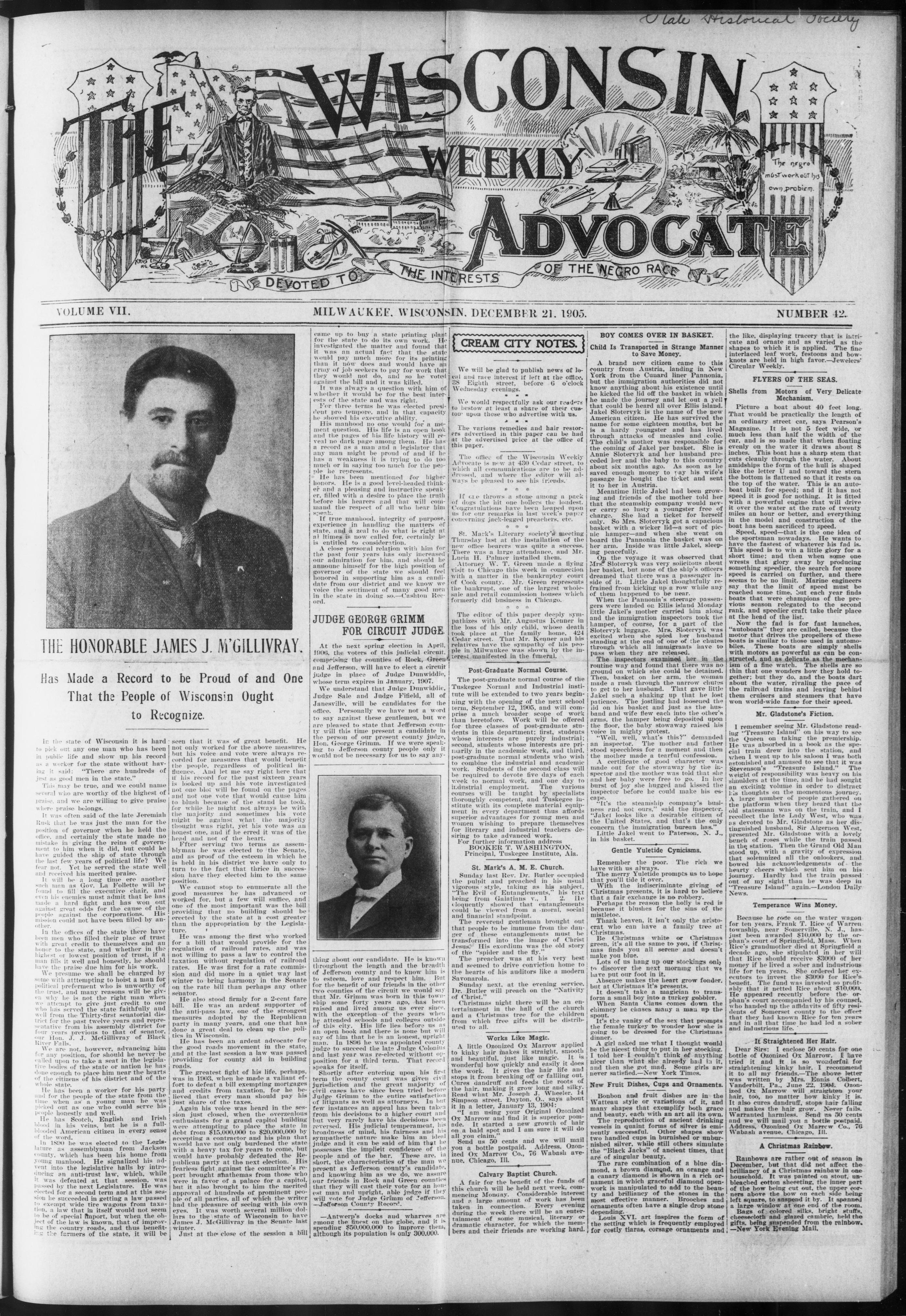
WISCONSIN
WEEKLY
ADVOCATE
DEVOTED TO THE INTERESTS OF THE NEGRO RACE
THE HONORABLE JAMES J. M'GILLIVRAY.
Has Made a Record to be Proud of and One That the People of Wisconsin Ought to Recognize.
VOLUME VII.
THE HONORABLE JAMES
Has Made a Record to
That the People o
to Re
In the state of Wisconsin it is hard to pick out any one man who has been in public life and show up his record as a worker for the state without having it said: "There are hundreds of just as good men in the state." This may be true, and we could name several who are worthy of the highest of praise, and we are willing to give praise where praise belongs.
It was often said of the late Jeremiah Rusk that he was just the man for the position of governor when he held the office, and certainly the state made no mistake in giving the reins of government to him when it did, but could he have guided the ship of state through the last few years of political life? We fear not. Yet he served the state well and received his merited praise.
It will be a long time ere another such man as Gov. La Follette will be found to fill the executive chair, and even his enemies must admit that he has made a hard fight and has won out against great odds for the cause of the people against the corporations. His mission could not have been filled by another.
In the offices of the state there have been men who filled their plac of trust with great credit to themselves and an honor to the state, and whether in the highest or lowest position of trust, if a man fills it well and honestly, he should have the praise due him for his work. We presume we shall be charged by some with attempting to hoist a man for political preferment who is unworthy of the trust, and many reasons will be given why he is not the right man when we attempt to give just credit to one who has served the state faithfully and well from the Thirty-first senatorial district for the past twelve years and representative from his assembly district for four years previous to that of senator, our Hon. J. J. McGillivray of Black River Falls
We are not, however, advancing him for any position, for should he never be called upon to take a seat in the legislative bodies of the state or nation he has done enough to place him near the hearts of the citizens of his district and of the whole state.
He has been a worker for his party and for the people of the state from the time when as a young man he was picked out as one who could serve his people honestly and well.
He has Scotch, English and Irish blood in his veins, but he is a full-blooded American citizen in every sense of the word.
In 1890 he was elected to the Legislature as assemblyman from Jackson county, which has been his home from young manhood. He signalized his advent into the legislative halls by introducing an anti-trust law, which, while it was defeated at that session, was passed by the next Legislature. He was elected for a second term and at this session he succeeded in getting a law passed to exempt wide tire wagons from taxation, a law that in itself would not seem to be of special import, but when the object of the law is known, that of improving the country roads, and thus benefiting the farmers of the state, it will be
---
seen that it was of great benefit. He not only worked for the above measures, but his voice and vote were always recorded for measures that would benefit the people, regardless of political influence. And let me say right here that if his record for the past sixteen years is looked up and his vote investigated not one blot will be found on the pages and not one vote that would cause him to blush because of the stand he took, for while he might not always be with the majority and sometimes his vote might be against what the majority thought was right, yet his vote was an honest one, and if he erred it was of the head and not of the heart.
Fter serving two terms as assemblyman he was elected to the Senate, and as proof of the esteem in which he is held in his district we have only to turn to the fact that thrice in succession have they elected him to the same position.
We cannot stop to enumerate all the good measures he has advanced or worked for, but a few will suffice, and one of the most important was the bill providing that no building should be erected by the state at a cost greater than the appropriation by the Legislature.
He was among the first who worked for a bill that would provide for the regulation of railroad rates, and was not willing to pass a law to control the taxation without regulation of railroad rates. He was first for a rate commission and did more in a quiet way last winter to bring harmony in the Senate on the rate bill than perhaps any other senator. He also stood firmly for a 2-cent fare bill. He was an ardent supporter of the anti-pass law, one of the strongest measures adopted by the Republican party in many years, and one that has done a great deal to clean up the politics in Wisconsin.
He has been an ardent advocate for the good roads movement in the state, and at the last session a law was passed providing for county aid in building roads. The greatest fight of his life, perhaps, was in 1903, when he made a valiant effort to defeat a bill exempting mortgages and credits from taxation, for he believed that every man should pay his inst share of the taxes.
Again his voice was heard in the session just closed, when the overzealous enthusiasts for a grand capitol building were attempting to place the state in debt from $15,000,000 to $20,000,000 by accepting a contractor and his plan that would have not only burdened the state with a heavy tax for years to come, but would have probably defeated the Republican party at the next election. His fearless fight against the committee's report brought anathemas from those who were in favor of a palace for a capitol, but it also brought to him the merited approval of hundreds of prominent people of all parties, all of which the writer had the pleasure of seeing with his own eyes. It was worth several million dollars to the state of Wisconsin to have James J. McGillivray in the Senate last winter.
Just at the close of the session a bill
came up to buy a state printing plant for the state to do its own work. He investigated the matter and found that it was an actual fact that the state would pay much more for its printing than it now does and would have an army of job seekers to pay for work that they would not do, and so he voted against the bill and it was killed. It was always a question with him of whether it would be for the best interests of the state and was right.
For three terms he was elected president pro tempore, and in that capacity he showed his executive ability.
His manhood no one would for a moment question. His life is an open book and the pages of his life history will reveal no dark page among them. He has a record as a man and a legislator that any man might be proud of and if he has a weakness it is trying to do too much or in saying too much for the people he represents.
He has been mentioned for higher honors. He is a good level-headed thinker and a pleasing and instructive speaker, filled with a desire to place the truth before his hearers and that will command the respect of all who hear him speak.
If true manhood, integrity of purpose, experience in handling the matters of state, and a zeal to do what is right at al ltimes is now called for, certainly he is entitled to consideration.
A close personal relation with him for the past four years has only increased our admiration for him, and should he announce himself for the high position of governor of the state we should feel honored in supporting him as a candidate from our district and we know we voice the sentiment of many good men in the state in doing so.—Cashton Record.
JUDGE GEORGE GRIMM FOR CIRCUIT JUDGE
At the next spring election in April, 1906, the voters of this judicial circuit, comprising the counties of Rock, Green and Jefferson, will have to elect a circuit judge in place of Judge Dunwiddie, whose term expires in January, 1907. We understand that Judge Dunwiddie, Judge Sale and Judge Fifield, all of Janesville, will be candidates for the office. Personally we have not a word to say against these gentlemen, but we are pleased to state that Jefferson county will this time present a candidate in the person of our present county judge, Hon. George Grimm. If we were speaking to Jefferson county people only it would not be necessary for us to say any-
[Picture of a man in a suit and bow tie].
thing about our candidate. He is known throughout the length and the breadth of Jefferson county and to know him is to esteem, love and respect him. But for the benefit of our friends in the other two counties of the circuit we would say that Mr. Grimm was born in this township some forty years ago, has been raised and lived among us ever since, with the exception of the years when he attended schools and colleges outside of this city. His life lies before us as an open book and there is none but will say of him that he is an honest, upright man. In 1896 he was appointed county judge to succeed the late Judge Colonius and last year was re-elected without opposition for a third term. That record speaks for itself.
Shortly after entering upon his first term the county court was given civil jurisdiction and the great majority of civil cases have since been tried before Judge Grimm to the entire satisfaction of litigants as well as attorneys. In but few instances an appeal has been taken from his decisions to a higher court and but very rarely have his decisions been reversed. His judicial temperament, his broadness of mind, his fairness and his sympathetic nature make him an ideal judge and it can be said of him that he possesses the implicit confidence of the people and of the bar. These are, in short, the characteristics of the man we present as Jefferson county's candidate, and knowing him as we do, we assure our friends in Rock and Green counties that they will cast their vote for an honest man and upright, able judge if they will vote for Judge Grimm of Jefferson. Jefferson County Record.
Antwerp's docks and wharves are among the finest on the globe, and it is spending $50,000,000 to improve them, although its population is only 300,000.
CREAM CITY NOTES.
We will be glad to publish news of local and race interest if left at the office, 38 Eighth street, before 6 o'clock Wednesday evenings.
We would respectfully ask our readers to bestow at least a share of their custom upon those who advertise with us.
The various remedies and hair restorers advertised in this paper can be had at the advertised price at the office of this paper.
The office of the Wisconsin Weekly Advocate is now at 430 Cedar street, to which all communications are to be addressed, and where the editor will always be pleased to see his friends.
空空
If one throws a stone among a pack of dogs the hit one hollers the loudest. Congratulations have been heaped upon us for our remarks in last week's paper concerning jack-legged preachers, etc.
* * *
St. Mark's Literary society's meeting Thursday last at the installation of the new office bearers was quite a success. There was a large attendance, and Mr. Lucia H. Palmer installed them.
Attorney W. T. Green made a flying visit to Chicago this week in connection with a matter in the bankruptcy court of Cook county. Mr. Green represents the bankrupt, one of the largest wholesale and retail commission houses which formerly did business in Chicago.
```markdown
```
The editor of this paper deeply sympathizes with Mr. Augustus Kenner in the loss of his only child, whose death took place at the family home, 424 Cedar street. That Mr. Kenner and his relatives have the sympathy of his people in Milwaukee was shown by the interest manifested in the funeral.
Post-Graduate Normal Course.
The post-graduate normal course of the Tuskegee Normal and Industrial institute will be extended to two years beginning with the opening of the next school term, September 12, 1905, and will comprise a much broader scope of work than heretofore. Work will be offered for three classes of post-graduate students in this department; first, students whose interests are purely industrial; second, students whose interests are primarily in the academic work, and third, post-graduate normal students who wish to combine the industrial and academic work. Students of the second class will be required to devote five days of each week to normal work, and one day to industrial employment. The various courses will be taught by specialists thoroughly competent, and Tuskegee institute with its complete material equipment in every department thus affords superior advantages for young men and women wishing to prepare themselves for literary and industrial teachers desiring to take advanced work.
or further information address BOOKER T. WASHINGTON. Principal, Tuskegee Institute, Ala.
St. Mark's A. M. E. Church.
Sunday last Rev. Dr. Butler occupied the pulpit and preached in his usual vigorous style, taking as his subject, "The Evil of Entanglements," his text being from Galatians v., 1 2. He cloquently showed that entanglements could be viewed from a moral, social and financial standpoint.
The reverend gentleman brought out that people to be immune from the danger of these entanglements must be transformed into the image of Christ Jesus. His exordium was the old story of the "spider and the fly."
The preacher was at his very best and seemed to drive conviction home to the hearts of his auditors like a modern Savonarola.
Sunday next, at the evening service, Dr. Butler will preach on the "Nativity of Christ."
Christmas night there will be an entertainment in the hall of the church and a Christmas tree for the children from which free gifts will be distributed to all.
Works Like Magic.
A little Ozonized Ox Marrow applied to kinky hair makes it straight, smooth and beautiful, just like magic. It is wonderful how quickly and easily it does the work. It gives the hair life and stops it from breaking off or fallling out. Cures dandruff and feeds the roots of the hair, making it grow long and silky. Read what Mr. Joseph J. Wheeler, 14 Simpson street, Dayton, O., says about it in a letter, January 13, 1904: "I am using your Original Ozonized Ox Marrow and find it is superior pomade. It started a new growth of hair on a bald spot and I am sure it will do all you claim." Send us 50 cents and we will mail you a bottle postpaid. Address, Ozonized Ox Marrow Co., 76 Wabash avenue, Chicago, Ill.
Calvary Baptist Church.
A fair for the benefit of the funds of this church will be held next week, commencing Monday. Considerable interest and a large amount of work has been taken in connection. Every evening during the week there will be an entertainment of some musical, literary or dramatic character, for which the members and their friends are working hard.
BOY COMES OVER IN BASKET.
Child Is Transported in Strange Manner to Save Monev.
A brand new citizen came to this country from Austria, landing in New York from the Cunard liner Pannonia, but the immigration authorities did not know anything about his existence until he kicked the lid off the basket in which he made the journey and let out a yell that could be heard all over Ellis island. Jakel Slotervyk is the name of the new American citizen. He has survived the name for some eighteen months, but he is a hardy youngster and has lived through attacks of measles and colic. The child's mother was responsible for the coming of Jakel per basket. She is Annie Slotervyk and her husband preceded her and the baby to this country about six months ago. As soon as he saved enough money to pay his wife's passage he bought the ticket and sent it to her in Austria.
Meantime little Jakel had been growing and friends of the mother told her that the steamship company would never carry so lusty a youngster free of charge. She had a ticket for herself only. So Mrs. Slotervyk got a capacious basket with a wicker lid—a sort of picnic hamper—and when she went on board the Pannonia the basket was on her arm. Inside was little Jakel, sleeping peacefully.
On the voyage it was observed that Mrs. Slotervyk was very solicitous about her basket, but none of the ship's officers dreamed that there was a passenger inside of it. Little Jakel thoughtfully refrained from kicking up a row while any of them happened to be near.
When the Pannonia's steerage passengers were landed on Ellis island Monday little Jakel's mother carried him along and the immigration inspectors took the hamper, of course, for a part of the Slotervyk luggage. Mrs. Slotervyk was excited when she spied her husband standing at the end of one of the chutes through which all immigrants have to pass when they are released.
The inspectors examined her in the routine way and found that there was no ground on which she could be detained. Then, basket on her arm, the woman made a rush through the narrow chutes to get to her husband. That gave little Jakel such a shaking up that he lost patience. The jostling had loosened the lid on his basket and just as the husband and wife flew each into the other's arms, the hamper being deposited upon the floor, the baby stowaway raised his voice in mighty protest. "Well, well, what's this?" demanded an inspector. The mother and father stood speechless for a moment and then the mother made a tearful confession.
A certificate of good character was made out for the stowaway by the inspector and the mother was told that she and her baby were free to go. In her burst of joy she hugged and kissed the inspector before he could make his escape. "It's the steamship company's business and not ours," said the inspector. "Jakel looks like a desirable citizen of the United States, and that's the only concern the immigration bureau has." Little Jakel went to Paterson, N. J.,
Little Jakel went to Paterson, N. J., in his basket.
Gentle Yuletide Cynicisms
Remember the poor. The rich we have with us always.
The merry Yuletide prompts us to hope that you'll tide it over.
With the indiscriminate giving of Christmas presents, it is hard to believe that a fair exchange is no robbery. Perhaps the reason the holly is red is because it blushes for the sins of the mistletoe. Thank heaven, it isn't only the aristocrat who can have a family tree at Christmas. Be Christmas white or Christmas green, it's all the same to you, if Christmas finds you all serene and doesn't make you blue. Lots of us hang up our stockings only to discover the next morning that we have put our foot in it.
Absence makes the heart grow fonder, but at Christmas it's presents.
It doesn't take a magician to transform a small boy into a turkey gobbler. When Santa Claus comes down the
form a small boy into a turkey gobbler.
When Santa Claus comes down the chimney he chases many a man up the spout.
It's the vanity of the sex that prompts the female turkey to wonder how she is going to be dressed for the Christmas dinner.
A girl asked me what I thought would be the nicest thing to put in her stocking.
I told her I couldn't think of anything nicer than what she already had in it, and then she got mad. Some girls are never satisfied.—New York Times.
New Fruit Dishes, Cups and Ornaments.
Bonbon and fruit dishes are in the Watteau style or variations of it, and many shapes that exemplify both grace and beauty, each with an art all its own. The reproduction of ancient drinking vessels in quaint forms of silver is eminently successful. Other shapes show two handled cups in burnished or unburnished silver, while still others simulate the "Black Jacks" of ancient times, that are of singular beauty. The rare combination of a blue diamond, a brown diamond, an orange and a canary diamond is shown in a rich ornament in which graceful diamond openwork is manipulated to add to the beauty and brilliancy of the stones in the most effective manner. Brooches and ornaments often have a single drop stone depending.
Louis XVI. art inspires the form of the setting which is frequently employed for costly tiaras, corsage ornaments and
the like, displaying tracery that is intricate and ornate and as varied as the shapes to which it is applied. The fine interlaced leaf work, festoons and bow knots are held in high favor.—Jewelers' Circular Weekly.
FLYERS OF THE SEAS.
Shells from Motors of Very Delicate Mechanism.
Picture a boat about 40 feet long. That would be practically the length of an ordinary street car, says Pearson's Magazine. It is not 5 feet wide, or much less than half the width of the car, and is so made that when floating evenly on the water it draws about 8 inches. This boat has a sharp stem that cuts cleanly through the water. About amidships the form of the hull is shaped like the letter U and toward the stern the bottom is flattened so that it rests on the top of the water. This is an auto boat built for speed; and if it has not speed it is good for nothing. It is fitted with a powerful engine that will drive it over the water at the rate of twenty miles an hour or better, and everything in the model and construction of the boat has been sacrificed to speed.
Speed, speed—that is the one idea of the sportsman nowadays. He wants to have the fastest of whatever his fad is. This speed is to win a little glory for a short time; and then when some one wrests that glory away by producing something speedier, the search for more speed is carried on further, and there seems to be no limit. Marine engineers say that the limit of speed must be reached some time. But each year finds boats that were champions of the previous season relegated to the second rank, and speedier craft take their place at the head of the list.
Now the fad is for fast launches, "autoboats" they are called, because the motor that drives the propellers of these boats is similar to those used in automobiles. These boats are simply shells with motors as powerful as can be constructed, and as delicate as the mechanism of a fine watch. The shells are so thin that one wonders how they hold together; but they do, and the boats dart about the water, rivaling the pace of the railroad trains and leaving behind them cruisers and steamers that have won world-wide fame for their speed.
Mr. Gladstone's Fiction
I remember seeing Mr. Gladstone reading "Treasure Island" on his way to see the Queen on taking the premiership. He was absorbed in a book as the special train drew into the station, and when I went up to his saloon I was both astonished and amused to see that it was Stevenson's "Treasure Island." The weight of responsibility was heavy on his shoulders at the time, and he had sought an exciting volume in order to distract his thoughts on the momentous journey. A large number of people gathered on the platform when they heard that the old statesman was on the train, and I recollect the late Lady West, who was as devoted to Mr. Gladstone as her distinguished husband, Sir Algernon West, presented Mr. Gladstone with a lovely bunch of roses while the train passed in the station. Then the Grand Old Man stood up, with a gravity of expression that solemnized all the onlookers, and bowed his acknowledgements of the hearty cheers which sent him on his journey. Hardly had the train passed out of my sight than he was deep in "Treasure Island" again.—London Daily News.
Temperance Wins Money.
Because he rode on the water wagon for ten years. Frank T. Rice of Warren township, near Somerville, N. J., has just been awarded $10,000 by the orphan's court of Springfield, Mass. When Rice's grandmother died at Springfield a decade ago, she stipulated in her will that Rice should receive $3000 of her money if he lived a sober and industrious life for ten years. She ordered her executors to invest the $3000 for Rice's benefit. The fund was invested so profitably that it netted Rice about $10,000. He appeared recently before the orphan's court accompanied by his counsel, who handed up the affidavits of fifty residents of Somerset county to the effect that they had known Rice for ten years and in all that time he had led a sober and industrious life.
It Straightened Her Hair.
Dear Sirs: I enclose 50 cents for one bottle of Ozonized Ox Marrow. I have tried it and it is so wonderful for straightening kinky hair. I recommend it to all my friends.—The above letter was written by Mrs. Ennis Colbert, Vanderbilt, Pa., June 22, 1904. Ozonized Ox Marrow will straighten your hair, too, no matter how kinky it is. It also cures dandruff, stops hair falling and makes the hair grow. Never fails. Warranted harmless. Send us 50 cents and we will mail you a bottle postpaid. Address, Ozonized Ox Marrow Co., 76 Wabash avenue, Chicago, Ill.
A Christmas Rainbow.
Rainbows are rather out of season in December, but that did not affect the brilliancy of a Christmas rainbaw in one household. It was painted on stout, unbleached cotton sheeeting, the inner part of the bow being cut out, the upper corners above the bow on each side being left square, to suspend it by. It spanned a large window at one end of the room. Bags of colored silks, bright stuffs, cheesecloth and glazed cambric, held the gifts, being suspended from the rainbow.—New York Evening Mail.
GOSSIP FCR THE LADIES.
```markdown
```
My Room.
I sit in my room in the twilight,
As oft I have done before,
And gaze upon objects so precious,
And think must I see them no more.
On the walls hang portraits of dear ones,
Whom no more on earth I shall see,
Though my heart has never forgotten
Those dear ones who fondly loved me.
There's the old-fashioned rocker of mother's,
I can see her dear form in it now,
As she used to sit with her sewing,
With a smile, and calm, peaceful brow.
There are the plants mother loved in the window,
With their blossoms so sweet and so fair;
Ah! in days gone by how she watched them
And gave them her tenderest care.
Of mysterious packages hidden
For Christmas and birthdays as well.
Ah! who can chide me for loving
This dear room with its memories sweet,
And yet with them sad ones are mingled,
For here mother slept her last sleep.
Associations are many, which bind me,
To the room, which I ever hold dear.
And fond recollections come crowding
As time goes on with each year.
—Marie Meriam in Brooklyn Eagle.
Christmas—The Children's Day.
Yes! and we "grown-ups" would not get half the enjoyment out of it were it not for them.
Ah! What would the world be to us
If the children were no more?
We should dread the desert behind us
Worse than the dark before.
In the home where there are children, how beautiful, how sweet, how inspiring is everything connected with Christmas day. There is the tree with its festive trappings, its glittering tinsel, its twinkling tapers, its mysterious little boxes and tempting packages; curiously shaped cakes and candies; and apples and nuts and oranges and dates and figs a plenty—all this would mean nothing if there were not some children to share it. How happy and contented is the little girl with her doll and its wardrobe and go-cart, her dishes and piano and tm kitchen, her blocks and picture books. And there is the little boy with his drum and horn and "choochoo," his ladder wagon and fire engine—plenty of noise, of course, all day long; but what music is sweeter than the joyous shout of gladdened children. And the older members of the family join in the merriment and laughter; everybody has a smile for everybody and a word of good cheer.
But do you ever give a thought to the poor children to whom Christmas will bring no joy, no gladness; little urchins whose home is no more than a hovel where hunger and cold are intimate acquaintances. In such "homes" you will find groups of children on Christmas morn, illy fed and scantily clothed, huddled together before a cheerless fire. The Christmas breakfast is no more sumptuous than was the scant meal yesterday; and yesternight they went to bed hungry.
These are the children that you could make happy at this time when happiness should be universal; these are the children whose hearts you could fill with joy and whose eyes make big with pleasure. Will you? Will you spread good cheer? Will you be an angel of goodness to at least a few poor children this Christmas day? There is so much you could do for them. Clothes and edibles will of course be welcome to them; a load of coal would give them warmth for a month; but do not, oh, do not forget the little things that mean so much to the childish heart—the toys of priceless value to them, the candies and fruits. In brief, let them share, as it were, the good things that you will shower on your own children that day. And though they may dumbly greet your entrance, rest assured that in each little heart there will well up a prayer unuttered, a blessing unspoken.
And then the orphans—the little boys and girls whose parents are dead. Pray think of them when you look at the happy faces of your own children. They are dependent for their little measure of happiness on strangers, and in their simple way they appreciate what is done for them.
But, oh, for the touch of a vanished hand, And the sound of a voice that is still.
*****
To the One Far Away.
Here are a few suggestions as to the filling of the Christmas box which will be opened with smiles and tears by the lonely recipient, far away from the Christmas home circle.
Besides eatables, if the box is sent to a boy or girl at college, a few personal gifts will be eagerly welcomed.
For the Collegian.
Where a box is sent from home to a daughter or son at college, a few personal gifts are also included. Negliges of French flannel, challis or wool crepe, daintily made, are welcome additions to the college girl's wardrobe. One can never have too many lounging robes for study hours. Neckpieces and a new blouse of China silk or some washable material are things which she has not time to make for herself, and yet is in constant demand.
A laundry bag of cretonne or linen with her monogram worked in the corner, or a shoe bag, partitioned off into little sections and which holds her supply of footgear, including rubbers, storm boots and skates, are gifts which figure among the necessaries for her comfort. A hand-made kerchief or corset cover, to wear with her thin frocks for teas and dances, appeals especially to her love for dainty things. An embroidered scarf for her bureau or dressing table, or a velvet scarf for her study table, are appreciable gifts.
For the man at college let the mother or sisters select a bath or lounging robe or a house jacket. Suitable pictures for his walls, pillows for his "corner," a bit of tapestry for the background of this little niche, a silken blanket to drape his window seats, a pair of appropriate curtains, desk accessories, a book stand or holder, year books with calendar attached, which may be used as engagement diaries, are gifts which country sweethearts may send their college heroes without fear of criticism.
A girl recently sent her brother at college a hand-made little tabourette of silvery maple which he is exhibiting to his friends, who are casting some alarmingly jealous glances in its direction.
Cakes, Candy and Fruit.
But, of course, the main interest is the variety and daintiness of the good things enclosed.
Old-fashioned molasses candy, butter scotch and fudge, made with fresh cream, are among the prized home-made bon-bons. Then there is a special kind of sweet which appeals to children on account of its varied colors. It is simply molasses candy, filled with raisins (seedless), nuts, figs, cloves, thin slices of candied or preserved pineapple and little red mountain berries, teabberries, they are called, that are sweet but pulpy, and which gives the whole a festive air.
A small barrel of rosy-cheeked apples, such as Baldwins, rainbows, lady-blush, and the dainty little snow apples, besides nuts of all kinds. Some home-made mince pies and a big fruit cake will be hailed with shouts of joy.
The things prepared at home will taste doubly dear to the one far away, and
this, rather than expense, should be the main point to be remembered when packing a Christmas box.—Exchange.
Betty's Twilight Chat.
The best cure for morbid nerves is a visit with nature, in a carriage or on foot, where the cobwebs can be blown out of the brain by the wind and fresh air, and the eyes gladdened by the sight of the beautiful world. In my last mail I found five letters of woe from as many nerve-wrecked women, all seeking a remedy, and evidently unaware that it lies at their very threshold.
I have talked considerably, of late, about the common sense methods of cure used at sanatoriums; it is because I have only just been made acquainted with them and have not ceased to wonder at their popularity. It has become the fashion for men and women of means to enroll themselves among the guests at these resorts, when they find that irregular living has impaired their ability to sleep and otherwise repair the ravages of time. The novelty of being compelled to live by rule appeals to them and they take medicine in a holiday spirit.
There are two great classes of women—those who do not get outdoors as often as they should, and those whose gadding propensities interfere with duty. The small intermediate class lives rationally, performing necessary tasks at proper times and relaxing their nerves by rational exercise. They are seldom ill in body and never low in spirits and are altogether nice to live with. They will tell you that household duties or the work by which they earn a living keeps the muscles elastic and the blood in active circulation and disease has a hard struggle to get a footing in their systems. They will also say that such healthy conditions prepare them for enjoyment of outside things.
We lose our power of enjoyment early in life, sometimes through overwork. We are like the children with so many toys that none please, or the poor little creatures of the slums whose burdens are so heavy that the power to enjoy is paralyzed. On rare occasions we find men and women well along in years but delightfully young at heart and always they are found to be persons who have so combined work and play as to tire of neither. They have avoided ruts by following fancy and can never be made to understand the plight of those who have passed from living to mere existence. There is a very wide difference between the two.
Without doubt we would be better in every way without many of the luxuries we have come to regard as necessities. Steam heat has spoiled us by making us believe we cannot be comfortable in rooms below summer temperature. We use warm water instead of cold, and commit the greatest piece of folly when we sleep in warm bedrooms. The victim of insomnia would do well to look right there for the cause of wakeful nights and restless days.
Every living creature needs fresh air and plenty of it. Human beings are the only ones that endeavor to get along without it. The woman who settles down in her home becomes self-centered and courts a train of petty evils. There is nothing like seeing new faces and new scenes to make one oblivious of little, troublesome cares. Did you ever try the experiment of putting away a puzzling piece of work for a day when you feel fresher? If so, you know how easy is the solution after your mind has been cleared by a rest. More can be accomplished in this way.—Boston Traveler.
That Top Bureau
Drawer and Its Mysteries
Perhaps women, young and old, are about tired of listening to sermonettes concerning the condition of their bureau drawers; but it seems there are still a few subjects to criticism. However, regardless of the appearance of an untidy drawer, it is decidedly inconvenient.
Suppose, for instance, a woman is dressing in a hurry. There ensues an excited hunt for a certain collar or pin, which is a strain on the temper and causes the contents of the drawer to be tossed up in worse confusion than ever. Suppose that the woman is not in a hurry, the inconvenience still remains, and it takes her a good deal longer time to dress than is necessary. Also her pretty things are mussed and soon unfit for use. When a woman once becomes used to a neat, systematic arrangement of her ties and belts and handkerchiefs and "little things," she cannot manage at all without it.
The first suggestion along this line is, have as few accessories as possible. Sometimes half the contents of drawers and boxes are utterly useless—just collections of various things from time to time that are never worn. The ancient maxim, "A place for everything, and everything in its place," applies here. It is not practical, however, to attempt to lay things in neat piles in a drawer. They wil stay in the said pile, with the strictest care, about five minutes. The best idea, without a doubt, is to have boxes of various sizes set in a drawer, each with a lid that lifts on hinges. The boxes with lids that come off and on are more or less inconvenient.
On the bureau top there may be a glove box, a handkerchief box, a jewel box, a veil box, and so on. But with all these there are the collection of little things that have no special places. Let there be a box for shoe strings and corset laces, a box for plain linen handkerchiefs (the fancy ones repose with dignity in the box on top), a box for plain ties, a box for fancy stocks, a box for strings of beads, a box for belts and girdles, a box for common pins, and still another for safety pins, a box for ribbons, and so on. This does seem like a multitude of boxes, but most of them are small, and they do keep things in bounds. For little or no expense they can be made very neat and pretty. Christmas is a regular harvest time for such things. Then there are boxes galore.—New Orleans Picayune.
*****
Six New Reduction Methods.
Does your waist line suit you? Is it all right as to size and position? Or would you like to have it a little lower, or a little higher, or a little smaller? The present fashions require a pretty waist to be exhibited at their best. Knowing this, the beauty and physical culture specialists have been at work seeing what they could do. Six new ways of reducing the waist line have been discovered. All are working well when properly selected, for each case needs its particular reduction method, and what will reduce one will have no effect upon another.
If the waist is too large on account of fat, pure and simple, exercise is the thing. Let the woman wrap a piece of flannel around her and exercise. The room must be very warm; a Turkish bath would be the best place in which to exercise. She must exercise, until she has brought out perspiration from every pore. Another method is to use medicated flannel, which is flannel that has been steeped in sweet herbs and spices. This is bound around the one exercising. There is a new German reduction method which calls for a rubber blanket
in which the woman is wrapped. Sometimes she is put into a rubber suit. And with this so tight that it both compresses and causes her to perspire, she does her exercise.
The result is a rapid loss of weight. And particularly does this weight disap near around the belt line
Of gymnastics intended to lessen the waist line the most important is the bending exercise. The woman should lie flat upon the floor and elevate her feet. She can stand and bend over. She can lie upon the floor and lift one foot, then the other. The rope gymnastics are very good indeed. A rope is slipped over the foot and handles are held in the hand. The rope is seesawed by the handles and the patient is strengthened as to her back and broadened as to her shoulders. The second of the rope exercises is taken lying flat upon the back. The patient lies down, lifts one foot, throws a rope over it and seesaws it, pulling the handles back and forth. This is for the reduction of the belt line proper. Incidentally it develops the chest.
There are people who cannot reduce by simple exercise, and these must take the diet cures. There are dozens of these. The latest embraces cheese and all sorts of milk concoctions, but cuts out meat almost entirely. The one who is dieting may take meat once a day, in limited quantity, but no more. The reduction diet, according to this idea, is to eat cheeses of all kinds, provided they are pure, and to make a meal of them. Nothing at all to drink is permitted. Bananas, fruits of all kinds, ice cream, custards and such may be eaten. But the patient must not drink anything for two hours after meals. Then she may take a pint of water if she likes. But she must not drink just before or after meals.
She may eat one orthodox meal every day, consisting of meat, vegetables and a salad. But she must drink nothing while eating, unless a very little sour wine.
The fruit cures are all right, if they work, but there are very few who can get along with them. They don't agree with everybody.
The chocolate cures are better, for they agree with more people. And if the patient likes chocolate and cocoa she can live upon them, eating fruit in between meals. This is warranted to bring her down if she will walk ten miles a day besides dieting.
The late to bed and early to rise reduction method is recommended for the reduction of the belt line. The patient is encouraged to go to the theater and to stay out as late as possible. She must not seek her couch mitch before midnight.
Then she should have a good soft bed and be permitted to sink into a heavy sleep. This may last until 6 o'clock in the morning, but no longer. Six hours is long enough for anybody to sleep according to this treatment.
At 6 o'clock she is up and by 8 o'clock she has dressed, breakfasted and is out taking her constitutional. She walks until almost noon, sitting down occasionally to rest, and when she comes back she is ready for fruit luncheon, with one little cup of tea and a nap of fifteen minutes.
The afternoon is spent very much in the same manner. And when evening comes the patient is taken to the opera. It is a strenuously healthy life, and she gets thin and strong.
It is the aim of the new reduction methods to reduce the weight without reducing the strength, and thus far they have succeeded very well, as a rule.
Another reduction method is dancing. The patient dances four hours a day. She practices two hours in the morning and two in the afternoon.
There are teachers who have taken up dancing as a reduction specialty, and these are the ones who teach you how to get the most of the best good from dancing.
Engage a good dancing teacher, a chorus girl teacher, one who understands all about the ballet and who knows how to train the toes of those who are going to dance. Then pay her well and ask her to give you private lessons until you have progressed sufficiently to join her ballet class. While you are learning you are reducing.
Dancing is one of the very best exercises a woman ever had. It makes the waist line slim and the feet nimble.
There is the climbing exercise, but this is taken in a gymnasium. The patient runs up and down a straight up and down ladder. The woman who is reducing will find it a great exercise, but it strains every muscle and she must go at it, carefully.—New York Sun.
Eut Woman's Work Is Never Done.
An English critic, G. K. Chesterton, in a recent essay has said some very nice things about what is generally considered the less intelligent sex.
"Women are the inheritors of the oldest, most universal human wisdom," he says. "They have more sense than men, for the simple reason that a man has to be a specialist, and a specialist has to be a fanatic. The normal man all over the world is a hunter, or a fisher, or a banker, or a man of letters, or some silly thing. If so he has to be a wise hunter or a wise banker. But nobody with the smallest knowledge of professional life would ever expect him to be a wise man. But his wife has to be a wise woman. She has to have an eye on everything."
Which is one of the most appreciative things woman has had said about her for a long time, and, besides, it's true.
Here are a few things that the mother of a certain household had to know and to do one day a short time ago: She had to help her two sons with their school tasks, the one with his Latin, the other with mathematics; she had to go into the kitchen and give the cook a practical lesson in breadmaking, for the bread had been of inferior quality, and she guessed it was because the dough had been left to rise too long, and was then placed in an oven that was too warm.
She had to darn some stockings for her brood, and the darning was so well done it looked like embroidery.
She had to make out a market list, with a regard both for food values and for the fact that the expenses should not exceed a certain sum; she had to discuss ethics at a meeting of her club. Hearing her small daughter practicing at the piano she went into the room and gave her a lesson on time that was much clearer than the music teacher's had been. When her husband came home in the evening she discussed the political situation with him intelligently enough to make him enjoy himself, and before the family retired she read a chapter from the Bible to the young folk of the house and expounded it.
She was not an extraordinary woman in any way—at least, she didn't consider herself so—and her neighbors don't consider her above the average; but every day she and the other women of the country have to solve problems in a dozen different directions.
They must know how to manage servants; enough about cooking to impress Mary Ann; the best thing to clean mahogany furniture; how carpets may be kept bright; the latest thing in setting the table; how to give all sorts of functions, from a children's dinner party to a very formal dinner; enough theology to raise the children properly and talk to the minister when he comes to call; something about everything that is going on in the world, so that she may converse intelligently; and last, but by no means least, exactly how to make her husband comfortable.
It's a busy life, that of the housekeep-
er; and, as the English critic says, compared to it the life of her husband is a simple thing, even if he is making $10,000 a year as the head of a great business.
HOW A PHYSICIAN TAMED FISH.
Began by Feeding the Young and Soon Gained Confidence of Whole Family.
That fish may be tamed like animals or birds has recently been shown by a Swiss physician who contributes to a recent number of the Appenzeller Zeitung an interesting and curious narrative. He says: "I have never yet heard nor read that any one has tried to tame fish in water, and I was therefore desiring not a little to test the eventual possibility of doing so when a very favorable opportunity was offered me. I was taking baths for my health in a private bathing house on the Lake of Lungano. At the north and south sides of the building there live in a heap of stones a family of loaches (Cave-dini), consisting of about six different spawnings—altogether perhaps 100 or 150 fishes.
"The loaches (the largest of which might be about as long as a fullgrown brook trout) used often to swim over into the batthouse, but would flee when I entered the water. I then sat down (at the time when the warmth of the water permitted doing so) a whole hour, up to my neck in the water, supporting my hands on my knees and holding in each a piece of bread as big as my fist, so that it was thoroughly soaked in the water. A like procedure I repeated in the evening, and so on the following days, each forenoon and each evening.
"At first the loaches would have absolutely nothing to do with the toothsome morsel placed at their disposal, but anxiously avoided the living statue in the water, which probably was not quite as immovable as the marble ones in the museums. Soon, however, several members of the youngest spawning ventured, with the most extreme caution, to take a nibble at the bread, quickly starting back if my hands moved even a millimeter.
"Gradually came representatives also of the second youngest generation, and so by degrees from day to day ever older and larger specimens, till finally all alike became tame and whirred round me as soon as I stepped into the water. With true curiosity the whole company would make a dash at the bread that I brought with me. I could move my body and hands as I pleased, could lift both hands with bread and fishes like a shot out of water and plunge them in again. All this did not disturb them. They would come into my hands, glide through my fingers and let me stroke them on the head, the back and the sides, the big ones as well as those of medium size and the little ones.
"When one day I had myself photographed with my proteges, it was found that the color of the fishes differed too little from that of the water for a sharp picture to be given. We therefore brought two large white sheets to spread on the bottom of the lake. Our fear that the fishes might be frightened away by the operation proved groundless. They romped so around the white sheets that we had much trouble to lay them down and weight them with stones without pressing to death some of the fishes. I am glad to have proved by my experiments that even fish in water are tamable.—Illustirte Zeitung.
An Organ 700 Years Old.
William C. Carl brought back with him from Japan a pipe organ of ancient make which he believes will prove a revelation to modern instrument builders.
The organ is 700 years old, but, notwithstanding this fact, embodies practically all the improvements which present day builders regard as new. The pipes are of bamboo, and the instrument is in a good state of preservation. Mr. Carl also brought home a large collection of Japanese music arranged in modern notation. Previous to thirty years ago, he says, all the native music was handed down from one generation to another in characters, but since the establishment of an academy at Tokio a great impetus has been given to all classes of music, and more than 600 students were in attendance at that institution when Mr. Carl visited it.—Seattle Post-Intelligencer.
Father of the House.
Representative Henry H. Bingham of Pennsylvania is the "father of the House" in point of service, although not the oldest member in point of years, for there are twenty-nine representatives older than he is. This is Mr. Bingham's sixty-fourth birthday. He is the fifth representative from his state to hold the title of "father of the House." All of them, including Mr. Bingham, came from Congress districts in the city of Philadelphia. The first in this remarkable line was "Pig Iron" Kelley, who served fifteen terms of two years each. Then came Samuel J. Randall with fourteen terms, Alfred D. Harmer with the same number of terms and Charles O'Neil with fifteen terms. Mr. Bingham, the fifth in this unbroken line of continuous "fathers," began his thirteenth term this week.
Juror Weds Defendant
George H. Edwards of Peoria, Ill., sat on the coroner's jury which last June justified Winona Gillham, 16 years old, in killing her father. He fell in love with the girl while she was telling her story on the witness stand, and recently she married him. Her mother went to court and consented to the marriage. Edwards is 23 years old. Winona Gillham shot her father through the head and then beat out his brains. Public sentiment was greatly aroused until the girl produced proof before the coroner's jury that her father had attempted to assault her and that she killed him in defense.
A Covote's Bodvguard.
Gray wolves are appearing in close proximity to this city, and within the recent past no less than a dozen have been seen in this vicinity. Hunters in the past day or two have seen quite a number lurking about the cottonwood trees on the banks of the Arkansas river and in the tall cactus north of the city. When seen the wolves are generally preceded by a coyote, and hunters say the wolves are acting as a bodyguard to th coyote.—Florence Cor. Denver Post.
Devastation by a Swarm of Locusts
Clouds of greenish gray locusts alighted at Saigon on the morning of the 22d inst. at about 8 o'clock. In a few hours time they stripped the trees of almost all their leaves. The branches and twigs bent and snapped under their weight. At 2 o'clock the whole swarm took flight and moved off to the eastward. The natives had never seen anything of the kind within memory.—Straits Budget.
Finds Wife Is Bigamist
William Vinson of San Bernardino. Cal., has sued Jennie Vinson to have their marriage annulled on the ground that his wife is a bigamist. The couple were married five years ago. The other night Mrs. Vinson, while asleep, disclosed the fact that she had been married at Flagstaff, Ariz., to a man named McAuliffe. Vinson awakened her and she confessed.
For the Children.
Kris Kringle Fooled.
'Twas the night before Christmas, when all through the flat
Not a creature was stirring, not even a rat;
When down the tall chimney came Santy a-bound,
Disgust on his face as he turned him around.
Straight into the parlor in anger he went. And found a big placard, "This Flat is for Rent." —Puck.
The Delay.
Twas Christmas Eve and Santa Claus Was not on schedule time. So up the chimneys boys and girls In haste began to climb. They meant to seek him high and low. But ere they traveled far.
They Had a Good Time.
There were two of us and we had between us a surplus of three or four dollars. We cast about for something to do with our money. Suddenly an idea occurred to the Three-Spot. It isn't very often that this happens, but the surplus probably did it on this occasion.
"I have it," he said. He didn't mean the money, for the Two-Spot was careful to keep that in his pocket. "I have it," he repeated. "Let's go along the street until we find some poor, ragged children looking eagerly in the shop windows. Then we'll find out what they want most and go in and buy it."
"Good," replied the Two-Spot, "but what shall we do with the rest of the money?"
"We'll go till we're tired and I guess there'll be no 'rest' for the weary."
And so we started out. And let it be recorded here that we had visions of swarms of ragged children gazing into every window along the business streets. But in this we were doomed to disappointment. Early in the afternoon there was not one poor looking child who was not trudging along beside its mother. The latter generally had an armful of parcels and was evidently intent on purchasing more. Up and down the entire length of Woodward avenue we went without spying one child who was a likely looking candidate for our magnanimity. Then we tried Gratiot avenue. Surely there would be lots of them, we thought, on Gratiot avenue, little Poles and German children. But we walked nearly out to the railroad tracks, up one side and down the other, and set eyes on never a one.
The Three Spot was beginning to cast eyes on some new pipes in the store windows and made several remarks about the desirability of having a stein on one's mantel.
"Do you know," said he to the Two Spot, "I don't believe there are any poor, ragged children looking into store windows."
The Two Spot replied that it wasn't time yet; that their hours for looking into windows did not begin until 3:30 or 4. Then we came to the front of a very big store, with a Santa Claus scene up over the great entrance and sleigh bells jingling away pleasantly. Here we stood for some minutes.
"There they are!" ejaculated the Two Spot.
"Where, where?" asked the Three Spot.
"Right there in the corner of the window."
And sure enough, there were four poorly clad, cold-looking little urchins, three little boys and a girl somewhat larger, gazing as earnestly at the gay things within as if they were priceless jewels. We crossed the street and came up near to them from behind.
"On, look at that fire engine," the biggest boy was saying and the others were pointing out so many things that they were all talking at once.
"What are you going to get for Christmas?" aswed the Three Spot of the littlest one. The lad glanced up, smiled, and looked into the window again without speaking. The question was repeated.
"I—don't—know," came the answer slowly and softly.
"Well, what would you like to get for Christmas?"
The little one smiled and looked hard into the window again without answer ing. Finally he whimpered softly. "A horse."
"And what would you like, my little man?" asked the Two Spot of the next largest boy. This boy had beautiful big brown eyes and a clean face, though evidently pinched by hunger.
"A hook and ladder," was the answer. And the third wanted a fire engine and the little girl would like to get a doll. So the Spots took the covey in tow and led them into the entrance of the big building, where the crowds were surging to and fro, and the elevator took the whole party to the floor where toys were dispensed to purchasers. Then the march up the long aisles between tables covered with bright and tempting things was begun, until the "horse" department was reached. The littlest one was hanging on to the Two Spot's thumb with a grip that made sure he wasn't going to lose the chance, unless the thumb gave way.
"Oh, gimme that!" exclaimed the biggest boy, pointing to a fire engine with real hose. But it cost as many dollars as the Spots had with them, and it was out of the question.
"Wouldn't this do?" asked the Three Spot, with a considerate tenderness in his tones that was unusual, as he took up a toy horse and sulky.
"Yes, sir," said the boy, and one purchase was made.
The next boy was satisfied with a harvesting machine and the biggest wanted a drum, not being able to get the fire engine. Then he set eyes on a policeman's uniform which he thought would be fine. But his brother scorned a policeman's uniform when "you don't get no club," and the other dropped the idea and took the drum. There was very little difficulty in picking out the little girl's doll. She was shown several samples, some with golden hair, some with dark hair.
"Does it go to sleep?" she asked, as one was handed to her. She was assured it did go to sleep when it lay on its back, for then the eyes were closed. Then she took it in her arms and fairly hugged it and her eyes were dancing with joy. By this time all four were standing in open-mouthed astonishment to see themselves the possessors of so many things. Each was holding his selection tightly in his arms.
"Don't we get them right now?" they asked. And they laughed outright when they were told that this was to be the case. The Two Spot handed the money to the clerk, who took the things and had them wrapped up. Two of the little ones were looking up at the Two Spot, two at the Three Spot. Almost simultaneously from four little mouths came the question. "Who are you?" And the answer was the same in both cases—"Oh. I am a friend of Santa Claus."
"Is this the store where Santa Claus lives?"
"Yes."
Then the tables were turned and the spots found out from the children that they lived on Woodbridge street and had ten brothers and sisters. The littlest fellow clung to the Two Spot's thumb
on the way out, as he had coming in. Finally the party came to the big entrance again. "Now you'll go home and be good children, won't you?" "Yes," they all said in chorus. And they all turned and smiled good-bye. As the little girl passed the Two Spot she came close to him and whispered the smiling words, "Thank you." Then they crossed the street hand in hand, a happy little caravan, each hugging his precious bundle.—Exchange.
SLAUGHTER OF RICE BIRDS
Thousands Shot and Trapped Along South Carolina Coast Lands.
The rice bird or bobolink or reed bird, as the game is known further north, is now in great abundance on the rice fields about Charleston and the coast section of South Carolina, and thousands of the birds are being killed every day, with no evidence of any diminution in the supply.
The business of killing the birds is a profitable one for those who engage in it, whether they indulge in the exercise as sportsmen in bringing down the game for the pleasure of shooting and supplying their own tables or kill the little birds for market and to exterminate the destroyers of the small grain. There are hundreds of parties all over this lower section of South Carolina hunting the birds, and although great quantities are killed, yet the birds seem as numerous as ever during the morning and evening, when they feed.
Killing the birds for sale is mostly done in "pot hunting" fashion in this section, a system of killing the birds which is not in vogue in any other place where the kind of game is found. A large fire is built on the marsh and a big tent is arranged in such a way that escape is impossible when the bird once enters it. The marsh is beaten and the flying birds, attracted by the light, enter the nets and are caught in large quantities. The birds are killed and shipped to market. Many negroes are employed in this work of trapping and killing the game, working for themselves in some cases and in others for firms which make a regular business of dealing in the daln-ty and succulent morsels.
Where a gun is used the 12-gauge double barreled shotgun is generally preferred, although some sportsmen use a gun as small as a 20-gauge. As the birds are not hard to kill, and a lot of shooting has to be done in the average day's sport, this smaller shooting iron is desirable. The shell usually taken along is loaded with one ounce of No. 10 shot, backed by two and a half to three drams of powder of the semi-smokeless or smokeless variety. Dogs can be taken, but are not necessary, and in some sections, where skiffs are used in whole or part, the dogs have to be left at home.
The birds are found in the eastern section of the country at this season of the year, subsisting on rice, oats, millet and other grain growing in swamps and marshy places. It is a mystery where the rice birds come from. Many of the knowing ones are of the opinion that they bury themselves in the mud from season to season, after the manner of snakes and frogs, but the more plausible theory is that they come and go in the night. The birds do not fly any great distance in the daytime, rarely more than thirty or forty yards. That they do most of their flying at night is proved by the fact that hundreds of birds may be picked up in the morning dead, having come in contact with live electric wires in places where the agencies of modern civilization are found. The birds disappear almost as suddenly as they show up.
When the birds first show up they are very thin and ragged looking. When they strike the rice and oat fields they soon fatten up, and after three or four days of gluttony they are as fat as the proverbial butter ball. The birds are slow fliers, which makes it possible for a man of only ordinary skill to bring down large numbers with his gun in the course of his day's sport. The size of the bag depends, of course, upon his skill, and remarkable stories are told through this section of the number of the little birds which have been killed at a single shooting, but, as stated above, the slaughter of the birds seems to show no diminution in the supply, which gives an idea of the great quantity of the birds which infest the country.—Charleston Evening Post.
Geography as It Is Taught.
Little Rob was the prize geographer of his class; that is, he could locate cities and bound countries with great gibbness. He could draw the most realistic maps, printing in the rivers, mountain ranges and cities from memory. Rob considered geography purely in the light of a game, in which he always beat, but he never associated it with the great world about him. Rivers to him were no more than black, wiggly lines; cities were dots, and states were blots. New York was green, Pennsylvania was red and California was yellow.
Of course Rob had never traveled. He was born in a canyon near the country school he attended. One day the teacher made the discovery of Rob's idea of geography through the following incident. After vainly inquiring of several of the children where British Columbia is located, she called on Rob, who, as usual was waving his hand excitedly, wild with the enthusiasm of pent up knowledge. "It is on page sixty-eight," he declared. After the roar had subsided the teacher explained that that was only a picture of British Columbia. Then she asked Rob to hound British Columbia.
"Can't, teacher; it is all over the page."—Success Magazine.
A Much Needed Condition.
As the lamented Gen. Harry Heth of the late Confederacy was passing through the country after his advance scouts he came up with a couple of them feasting on green persimmons up in a persimmon tree. The fruit had just begun to blush from the sun and to show the fullness of being almost ready for the finishing touches of the first frost.
Gen. Heth was one of Virginia's old school gentlemen, and never forgot the courteous training he had received, even when among the soldiers, who, though only privates, were yet, many of them, of as good families as was the general himself. Seeing his men feasting on the green persimmons, the general thought of the condition their stomachs would be left in, and called
"Boys, what are you doing up there?"
"Eating persimmons, general," came back the answer.
"They will draw your stomachs all up, boys," returned the general.
"That's just what we want, general, something to draw us up to suit the rations we receive," came back the ready answer.—Atlanta Constitution.
Nutritive Value of an Egg.
According to Voit, one egg corresponds to 150 grammes of milk, to 50 grammes of meat and gives 80 calories. It is easily digested, especially if the egg is cooked in the shell and it does not remain in the stomach more than one or two hours. Prepared on a plate, the nutritive value is increased by the addition of fat, but its digestibility is diminished. Le Progres Medical.
Though on a pedestal is set
Ted, Junior, as a hero,
The Ell freshmen won't forget
The score: 16 to 0.
THE WISCONSIN WEEKLY ADVOCATE
R. B. MONTGOMERY, Editor and Proprietor.
The Wisconsin Weekly Advocate after three years' residence at 79 Fifth street, has moved its headquarters to 729 St. Paul Ave., where we will receive our guests and transact our business in future.
3 Representative Journal Devoted to the Interest of All the People.
One inch, one year.....$15.00
Two inches, one year.....25.00
Three inches, one year.....35.00
Four inches, one year.....42.00
For larger space, special rates.
Locals, 10 cents per line.
One year ..... $2.00
Six months ..... 1.00
Three months ..... .50
Direct all communications to
R. B. MONTGOMERY
430 Cedar Street.
HOW TO SEND MONEY.—Post Office
Order, Express Order, Draft or Registered
Letter. R. B. Montgomery will not be re-
sponsible for loss when sent in any other
way.
TO CONTRIBUTORS:
All communications must be sent with the
name and address of the sender as an evi-
dence of good faith, but not necessarily for
publication. No manuscript returned if not
accepted, unless accompanied by stamps.
EDITORIAL PARAGRAPHS.
"I know of the bravery and character of the Negro soldier. He saved my life at Santiago, and I have had occasion to say so in many articles and speeches. The Rough Riders were in a bad position when the Ninth and Tenth cavalry came rushing up the hill carrying everything before them. The Negro soldier has the faculty of coming to the front when he is needed most. In the Civil war he came 400,000 strong, and I believe he saved the Union."—President Roosevelt.
While the Wisconsin Weekly Advocate was going through the press last week, one of Milwaukee's most prominent citizens was being declared not guilty of one of the meanest of crimes. The trumped-up case against Mr. Charles F. Pfister was dying a natural death. That that gentleman has the sincere sympathy of his fellow citizens has been proven from the expressions of a large number of the cream of such and quoted in the daily press. To us all along the case seemed to be one of malicious persecution. That the district attorney and his aides should have been so far left to themselves as to pursue the case to the (for them) bitter end is to us incomprehensible. A man who has the moral courage to admit defeat and gracefully acknowledge that he has committed an error of judgment will always gain a certain amount of approbation and respect, but a man who in the plenitude of his own conceit cannot or will not do so is beyond redemption.
But all this does not detract from the grievous wrong which has been wrought upon the reputation and probity of Mr. Pfister. It is a well known fact that such an accusation as that brought against that gentleman by the grand jury would obtain an almost world-wide circulation, while on the other hand, his innocence of the crime charged against him and as proved by his accusers, will fail of the same wide publicity. It is all very well to say that "the accused leaves the dock without a stain upon his character." The very fact that a man of Mr. Pfister's standing should be accused of such a crime will forever rankle in his heart, and in those of his friends. Like Caesar's wife, a man of his financial and political standing should be above suspicion, and that is the very thing that District Attorney McGovern his accuser, has proved him to be. We desire to express our sympathy with Mr. Pfister in the severe ordeal of the last three months, and we also deeply sympathize with Messrs. McGovern, Goff and Cochems. "Pity 'tis, but pity 'tis, 'tis true."
In looking over our exchanges this week we were both gratified and mortified to read therein the accounts of splendid celebrations of the centenary of William Lloyd Garrison. Gratified—because the great majority of our thinking people throughout the country had risen to the occasion, and showed to the world that gratitude for favors received will ever be one of the characteristics of the Negro race; but mortified in that a large, a very large, percentage of our people took no interest whatever in the celebration.
In the preceding editorial we have said that a writer, one who makes a mistake or commits an error of judgment, on finding out that wrong has been done, should freely and frankly acknowledge it and do all in his power to rectify it. This we do to our good friend, Shelton M. Minor, whom we wrongfully accused of appropriating our thunder at the Garrison centenary meeting Sunday last, and trust that he will accept this "amende honorable" in the same spirit in which it is offered. At the same time we think that the colored people of this city ought to have been more alert and have shown themselves in a better light.
Editorial Crispness.
A lady having written a story of which she thought a great deal took it to an editor and asked him to read it in order to see if he could make any use of it. As the editor was somewhat dilatory in according to the lady's request she called a day or two later and again asked him to look at it and to let her know as soon as possible because, as she said, "I have other irons in the fire." Shortly after the editor's reply came, which was: "Dear Madam—I have read your story, and I should advise you to put it with your other irons.—Yours faithfully, The Editor."—The Sketch.
PRESCIENCE.
Still the sky was gray and grim,
By the winter's breath congealed;
Bare and gaunt were bush and limb,
White and bleak were moor and field.
But beneath the frozen sod
Stirred a host of blossoms, shy,
Saying, with triumphant nod:
"Spring is nigh!"
Through the grove a rustle crept;
Neighbor unto neighbor spoke;
Dryads who for long had slept
In their cells of bark awoke,
Felt a subtle, eager thrill,
Stretched their arms, by rigor numb.
Passed the word o'er vale and hill:
"Spring is come!"
"Blind, insensate things!" I thought,
"All the world is ice and snow;
Yours a hope too dearly bought,
As a few short days will show.
Spring, you prate? When deep amid
Frost and drift lie leaf and spear!"
But, behold, e'en while I chid
Spring was here!
—New England Magazine.
THE CASE OF FLORA.
```markdown
```
WILLIBERT FRAREY was already spoken of as "an old bachelor" when he first went to board with Mrs. Albrecht. He was 28 then, a man of somewhat particular habits, none of them very sociable. What he wanted was a quiet, comfortable place to board, as homelike as possible and free from any annoyance from other boarders. He offered Mrs. Albrecht unimpeachable references and demanded the like of her, caution being his strong point. Even then he would only take the room for a week, having his doubts of Flora Albrecht, a miss of 14. He feared she might be noisy and he wanted to try the place before he definitely settled down.
At the end of the week, however, he sent for his trunks, congratulating himself upon the circumstance of having at last found something that suited him. Mrs. Albrecht was a quiet, neat, self-contained little woman who did not bother him with attempts at conversation, kept his room in perfect order and gave him a good breakfast and dinner. What more could he want? As for Flora, the lanky daughter with the usually tousled mane of light hair, Frarey saw scarcely anything of her heard less.
On his part, Frarey was a model boarder, quiet, regular and prompt in his settlements. He paid monthly now. The experimental stage had passed and as far as he knew he was willing to spend the rest of his days with the Al-
WITH AN AIR OF EMBARRASSMENT.
brechts. He went down to the wholesale grocery house, where he had an excellent position, every morning at 8 o'clock and returned at 6:30—in time for dinner. Sometimes he spent the evening in his room, reading an improving book, sometimes he went out to hear an improving lecture.
Frarey was totally indifferent to the budding charms of Flora, who was really as hearty and wholesome a girl as need be. It was a year or two before she began to bud at all—two years at least before Frarey took any notice of the fact. She wore her first pompadour for three evenings before he observed even that. A year later or thereabouts Frarey, meeting her in the hall, saw that she was wearing an uncommonly attractive white dress and mentally remarked that she had beautiful white teeth that showed to advantage when she smiled.
Then Flora went away somewhere to take a course of the higher education. Perhaps Frarey missed her, but he hardly knew. It is certain that in a general way and without any reference to anybody in particular he had occasional thoughts of settling down in a home of his own. It would be nice to have some one to read the improving books to and to take to the improving lectures. That was all it amounted to just hazy general thoughts.
But when Flora returned a year later with charms that now began to blossom from the bud his reflections became more definite.
"I'd best go slow about this," he said to himself. "A man needs something more than pearly teeth and a rosy complexion to make him comfortable."
So he did not encourage her, though, when she went away the following June for her second year, he bought her "The Stones of Venice" and the North American Review to read on the train for which she was very grateful.
Time passed and Flora came back. On the evening of her arrival what he called her improvement almost took Frarey's breath away. Her former prettiness had become actual beauty and her conversation, which Mrs. Albrecht no longer attempted to restrain, was bright.
The next morning Frarey met Flora on the stairs and as he stood aside to let her pass she, too, stopped.
"Mr. Frarey," she said, with a charming air of embarrassment,
C
News dispatches from various parts of Russia report how the Cossacks have made brutal use of their sabers and whips against the excited people. The Cossack's whip is an instrument of torture, and it is used by these semibarbarian followers of the Czar with wonderful expertness. Generally the whip has but one thong or lash; occasionally it has two or three. The end of each thong is loaded with a bit of iron or lead to render the pain and wound inflicted more intense. A Cossack has been known to pick an eye from a man's face with a blow of his miniature knout. He can split an apple on a man's head with a cut of the lash, and he can snip off the burning end of a match held in a comrade's fingers. But no thoughts as to accuracy of stroke govern him when confronted with a vengeful, howling mob. Then he simply lays about him with the full strength of his lusty arm, and the recipient of the blows will remember for a lifetime that he has had an encounter with these deraded hirelings of absolutism.
The Cossacks are said to be of Tartar origin. They generally inhabit the steppes of Russia about the lower Don and Dnieper, but are found in lesser number in eastern Russia, Caucasia and Siberia. Ethnologists are uncertain as to their origin, but their nucleus is supposed to have consisted of refugees from the ancient limits of Russia forced by hostile invasion to adoption of military organization, and later into a more or less free tribal existence. They have indulged in many unsuccessful revolts against the Czars, ending in their subjection, but they retain various privileges. With regard to their military prowess they were surrounded with a certain amount of romance, like the French zouave and the Prussian uhlan; but the war with Japan has tended to dispel much of the glamour that attended their alleged exploits.
The Cossack was supposed to be unparalleled as a scout—in fact, he was supposed to be the eye and soul of the Czar's legions. But the unpretentious cavalryman of the Mikado has shown that as a scout and fighter he ranks as high, if not higher, than the vaunted Cossack. The Cossack generally is armed with a rifle without bayonet, and with a sword, which has no scabbard. The front ranks of most Cossack regiments also carry lances. At the beginning of the war with Japan it was estimated that there were 130 regiments of Cossacks of six squadrons each and eighteen of four squadrons, besides fifty-three independent squadrons. Army service with them begins at the age of 18 and lasts for twenty years, seven of which is in actual service, and generally they provide most of their own equipment.
"mother tells me that some of your things need mending. There are—er—some socks that need darning and other things. You know, mother never had much time for such things, but I have, and—I wonder if you would let me try my hand at them."
What would you have thought in such a case?
At first the mending and darning were done rather roughly and unskillfully, but Frarey didn't care for that—not a cent. He would have had to throw the socks away in any event. But the improvement was rapid and in a short time an incredible neatness was shown in the darns. Within a week Frarey, commenting on the excellence of the bread at table, was informed that Flora had made it.
Still Frarey hesitated, not from any misgiving now, but from sheer diffidence. He brought books often now and candy once or twice. Gradually he tried to accustom himself to the idea of an engagement and matrimony. He had long reveries in the solitude of his room.
One evening he was indulging his fancy in this way when he thought he heard voices on the steps below his window. His room was on the second floor. Yes, one of the voices was Flora's. It was her laugh. The other voice was manly.
A chill of apprehension came over Frarey. He approached his window and stealthily, noiselessly raised it and listened. He was just in time. "No, dear," Flora was saying; "I won't consider anything but housekeeping, and, Dick, you have no idea how domestic I am getting. I can do lots of things—cook, make bread, mend, darn socks—I've been practicing on Mr. Frarey's, poor man. But he was very sweet over my early failures. I used to think him such an awful crank, but lately he's got to be just the dearest old thing—"
Frarey shut down the window hastily.—Chicago Daily News.
HON. JOHN C. SPOONER.
President Will Depend Much Upon Him This Session. There are two important matters of legislation before the present Con-
A.
gress in which President Roosevelt will depend upon Senator John C. Spooner, of Wisconsin, for considerable assistance. One is the Panama Canal legislation and the other railroad rate regulation. On two previous
occasions he saved the Panama Canal legislation and the President sees in him his chief reliance in the coming debate on that subject. What part he will take in the Senate fight on the railroad matter has not been outlined, but he is a recognized authority on constitutional questions and is the legal adviser of the Senate leaders. He is also chairman of the Committee on Rules.
Senator Spooner is 62 years old, a graduate of Wisconsin University and a Civil War veteran. He is in the Wisconsin Legislature as a young man and sat in the United States Senate from 1885 to 1891, when William F. Vilas succeeded him. In 1892 he was defeated for Governor, and in 1897 was elected Senator at Washington, being re-elected in 1903. President McKinley on several occasions offered him places in his cabinet, which he declined. He is one of the really great men of the Senate.
A LITTLE LESSON IN ADVERSITY
So accustomed we to think of Gen. Philip Sheridan entirely as a military hero that adversity naturally suggests to mind the thought of battlefield and war. But Sheridan's first fights were not won on battlefields, and his first combats were in a little town of western Ohio against a force that has killed more men than war—poverty.
C. H.
Sheridan was 12 years old when he went to work in a country store. His wages amounted to 50 cents a week. He was industrious and he was capable. How the boy ever managed to live on such a stipend is cause for wonder. He lived at home, but the family was correspondingly poor. Nearly two years afterward Sheridan was receiving a dollar and a half a week, and at the age of 17 he was acting as bookkeeper and manager at the munificent salary of $3 weekly.
He had cherished ambitions of becoming a soldier. He now applied to a member of Congress for appointment to West Point. The Representative was pleased with Sheridan's ambition, determination and the power he had already exhibited of conquering obstacles and, though most of the places in the military academy were given to sons of veterans of the Mexican war, he secured the appointment for the young man.
Sheridan realized keenly his need of wider knowledge, and would often hang blankets in the windows of his room in order to be able to study after the signal had sounded for lights out. His later career is a matter of history. But that it was won by the same determination that overcame the narrow environments and petty opportunities of a little village and carved success for himself is evident to all who read his story.
Men and women get along surprisingly well, considering how much the men know about the women, and how much the women suspect about the men.
10¢
a day
Buys a
Buck's
Stove
10¢
a day
BUCKS
STOVES&RANGES
THE PEACE MAKING
Just a Point
It may not seem like much of a point, but it is a fact that all Great Buck's Ranges and Cook Stoves (when s ordered) have a great, big, honest, white enamele reservoir.
Remember, We Have a Large Line of Furniture, Carpets, Stoves, Etc.
F.W.SCHNECK P.GHINNERS
F.W.SCHNECK & CO.
HOUSE FURNISHERS
255-259-THIRD-ST.
COAL! COAL! COAL!
210 FIFTH STREET (Near Wells) Is prepared to supply the public with coal by basket or ton, and wood by basket or cord. Prompt delivery guaranteed. Large Moving Vans Rapid Express
Return $10 in cash purchase checks and I will give 25c worth of goods FREE. Our rebate system is better than Trading Stamps. If we please you, tell your friends. If not, tell us. We handle ONLY McLaughlin Coffees.
WANTED 500 FAMILIES TO COME WEST
To Illinois, Wisconsin, Minnesota, North and South Dakota, Montana, Idaho, Washington and Wyoming. By reading the Wisconsin Weekly Advocate you will find all the information needed.
Our paper has the largest circulation of any Negro Journal in the West. Address
WISCONSIN WEEKLY ADVOCATE
729 St. Paul Ave. Mi waukee, Wis.
ALL RUSSIANS TO VOTE
PLAGUE THREATENING.
Strike Is Not Successful Everywhere but Movement Covers the Whole Empire.
ST. PETERSBURG, Dec. 22.—(4 p. m.)—The final decision in regard to the electoral law is expected to be taken at Tsarskoe-Selo today. The minority in the cabinet is understood to favor universal suffrage, but Premier Witte will present both the majority and minority reports to the Emperor.
LONDON, Dec. 22., (5 p. m.)—A dispatch to a news agency from St. Petersburg says it has been finally decided to grant the Russian people universal suffrage.
PARIS, Dec. 22.—(4 p. m.)—Russian news is pessimistic as far as the interior is concerned. In St. Petersburg itself the day's developments show that the strike is not fulfilling the expectations of the labor leaders. Russian Poland is under martial law.
Plague Epidemic Feared.
Slowly the danger of a plague epidemic is advancing on Russia. A territory 180 by 300 miles has already been infected. A dispatch to The Temps says the strike area now covers all of Russia. It is expected that the ministry will soon be helpless. From Libau, however, it is reported that order has been restored among mutinous army reserves. A dispatch to The Evening Standard from Constantinople says that the Turkish consul at Batoum reports that the Armenians are massacreing Tartars at the rate of 500 daily.
Martial Law in Poland.
WARSAW, Russian Poland, Dec. 22. (Noon.)A proclamation of the governor general was gazetted here today establishing martial law in all of the ten governments of Russian Poland and appointing ten temporary military governors general. Officials, owners of estates, priests, doctors and other of the better class are arriving at Rigo under the escort of the garrisons of their respective localities, leaving all the government and private properties in the hands of the revolutionists. A committee of Goldingen people has compelled the district governor, Baron Ropp, to send the troops away from here. The town is now under the control of the revolutionists.
Thorns for Strike Leaders.
ST. PETERSBURG, Dec. 22. -3:40 a. m.-The failure of many of the railroad men of St. Petersburg to obey the strike order and the ability of M. Nemechaieff, minister of communications, to move trains on all roads except the Baltic roads are thorns in the sides of the strike leaders.
The fiat went forth at last night's meeting of the workmen's council that traffic must be interrupted at all costs, though this admittedly will be difficult on the Nicholas road to Moscow. Trains are running with their ordinary crews on their line, but all the trains are heavily guarded.
To Try Moral Suasion.
The delegates will try moral suasion with the faithful employees, but it is feared they will also resort to destroying the bridges along the roads.
The government has succeeded in arresting practically all the members of the strike and railroad committees.
Outside of the industrial regions there is little evidence of a strike. The city pharmacies generally remain open. The drug clerks who have just emerged from a protracted struggle disregarded the summons of their union to strike. The mentes of the revolutionists is a mysterious hand bill with which Tsarskoe-Selo was flooded today. Professing to allude to a terrorist plot against the Emperor the handbill says:
The police have been baffled in their efforts to find the printers and disseminators of these bills.
Some of Lights Turned On.
During the night the authorities succeeded in getting a sufficient number of sailors from Cronstadt to enable the operation of all except one of the electric lighting plants which was also galling to the strikers as the darkening of the city and the stopping of the railroads were the most effective means of making the strike generally felt.
The workmen of two of the three electric light plants struck yesterday evening and consequently the streets in the major portion of the city were in darkness throughout the night, the inhabitants being compelled to fall back on candles and kerosene.
Searchlight Recalls October.
The searchlight mounted on the spire of the admiralty building again vividly illuminated the Nevsky prospect as it did during the October strike; cavalry and infantry patrols guarded every block, and machine guns were stationed at several points.
During a tour of the city a correspondent saw dozens of workmen between soldiers with fixed bayonets being marched off to prison.
A cache of arms and hand bombs was seized on the Schlusselburg avenue yesterday and a crowd of 1000 strikers of the Nevsky works was charged and dispersed by Cossacks, who used the flats of their swords and whips, but no one was seriously injured.
News from the Interior
MINSK—The general strike has commenced here. All the stores are closed. WARSAW—The failure of the important banking house of Maurice Nelken was announced today. The difficulties of the concern are attributed to the political situation. KOSTROMA—The railroad employees here struck today. All traffic has ceased. YAROSLAV—Traffic on the railroad here is interrupted by the strike.
VORONEZOH-The employees of the Southwestern railway struck at 10 o'clock this morning. The crews of passenger trains hauled the trains to large towns before abandoning them in order that the passengers should not suffer.
DAY OF BLOODSHED IN RUSSIA
More Mutiny and Pillaging Adds to Fear for General Strike.
ST. PETERSBURG, Dec. 22.—S a.m.)—Developments yesterday and to this hour today in the Russian situation are as follows:
The city of Takum, Courland, was captured by revolutionaries, retaken by troops, then captured again by insurrectionists, each time after a desperate battle. The building to which the governor and officials were driven was fired and all were killed as they tried to escape.
Troops in Vladivostok set fire to the prison containing 900 mutineers, roasting all alive. Drunken Cossacks also fired a block
of residences and killed 120 men, women and children as they fled from the flames. The estates of fifty nobles in Livonia were burned, and those owners who did not escape were killed. Roads are clogged with caravans of land owners going to the frontier. Wandering bands of peasants are terrorizing the country.
Inhabitants of the government of Vitebsk have organized an independent government, with capital at Ryezhitsa. The second workmen's council was arrested and hurried to SS. Peter and Paul fortress, where the first council is imprisoned. A third council immediately took charge.
But one train left St. Petersburg. It was manned by troops, and nearly all its passengers were soldiers. Serious disorders and collisions between troops and populace occurred in Moscow, which was connected with the capital by a single telephone wire.
Workmen demanded that priests cease prayers for the emperor.
In Kharkoff 10,000 revolutionaries are under arms.
PRISONERS KILL OFFICERS
Released Russians in Mutiny on Transports for Home.
VICTORIA, B. C., Dec. 22.—Mail advices from Japan by the steamer Tremont state that the released Russian prisoners sent from Nagasaki to Vladivostok on the transport Voronej killed four of their officers and the released prisoners are planning a general revolt. Quiet was restored temporarily. The warships Russia, Gromoboi and Bogatyr have proceeded to Russia. The property losses during the recent rioting was immense, a German firm of merchants, Kuntz & Alber, alone losing $1,000,000 in gold.
GERMANIZE PRUSSIAN POLAND.
Ninety-seven Cities' Names Are Changed to Carry Out Plan.
BERLIN, Dec. 22. A royal decree was published today changing the names of ninety-seven places in Prussian Poland to German names as a further step towards the Germanization of the province.
THOUSANDS STARVING IN NORTHERN JAPAN.
Tokio Reports That Advent of Winter Makes Conditions Deplorable Speedy Relief Necessary.
TOKIO, Dec. 22, 11:30 a. m.—An eye witness of the extent of the famine in the northeast provinces, who has just returned, reports the condition of the people to be really deplorable. The advent of winter has found thousands on the verge of starvation and speedy relief alone will save them. Measures of relief will be vigorously taken up here and assistance from sympathizers abroad will be welcome.
WAITED SIXTY YEARS.
Oliver Smith's Notable Fund for Massachusetts Agricultural School Now Available.
NORTHAMPTON, Mass.. Dec. 22. After a wait of sixty years the agricultural school provided for in the will of Oliver Smith is to become an accomplished fact. Mr. Smith died December 22, 1845. His will provided that the fund for the establishment of the school was to accumulate for sixty years. Hence it became available today. In anticipation of this date the trustees of the school last month purchased a site in Northampton in order to be ready for establishing the school. The purchase consists of ninety-three acres and the track includes about all the varieties of soil desirable for agricultural purposes.
To Help Young People.
Oliver Smith belonged to the same class of philanthropists as Peter Cooper, Anthony Drexel and Charles Pratt. His aim was to give practical assistance to young men and women striving to get a foothold in life. He is perhaps entitled to be called the pioneer philanthropist of America, for it was early in the '30s that plans for establishing a permanent source of benefit for young men and women took form in his mind. His benefactions as they now stand are well toward $1,500,000.
Oliver Smith was born in Hatfield, this state, in January, 1766. He never married. Oliver received little education except that given by his mother. He took his share of the paternal estate when he arrived at the age of 21, receiving land valued at $500. In middle life he was the proprietor of the village store in Hatfield and in later years he accomplished the rapid increase in his wealth by stock transactions in New York. But throughout his active life a part of his attention was devoted to farming. Belonging to his family were other celebrated philanthropists, among them Sophia Smith, founder of Smith college, and Mary Lyon, founder of Mount Holvoke college.
Half Million for Charity.
Oliver Smith left almost $500,000 for charitable purposes. In sixty years this amount has, of course, vastly increased. The reports of the trustees show that more than the total of the original amount has been paid out to indigent boys alone, and about half as much to indigent young women. In addition about $50,000 has been expended in annuities to special beneficiaries, more than $300,-000 to indigent widows, besides expenses and taxes amounting to more than $600,-000.
The provisions of the will were not permitted to become established without a contest in the courts that was commensurate in strenuous endeavor and in the eminence of the counsel employed with the issues involved. The will became the subject of an encounter between the two men who were the giants of their time in legal controversy and who remain commanding figures in history—Daniel Webster and Rufus Choate. The trial in the supreme court here opened July 6, 1847. Mr. Choate appeared as leading counsel for the heirs-at law, and Mr. Webster for the defense. Mr. Choate, in his argument, spoke three hours and Mr. Webster two hours. The jury returned a verdict for the will, after being out one hour.
Fund Is Now Available.
The will set aside $30,000 for an agricultural school, the money to be placed at interest and to be allowed to accumulate for sixty years. It is this fund, amounting now to about $315,000, which became available today.
STUDENTS WISHES FIRST.
Columbia University Not to Abolish Football Unless They Have Been Consulted on the Subject.
NEW YORK, Dec. 22. President Butler announced to Columbia students today that intercollegiate athletics would not be abolished at Columbia university without first consulting the wishes of the student body. He made this statement at a mass meeting of students which had been called to protest against the faculty's proposal to abolish athletics.
START WALK IN STORM.
START WALK IN STORM.
Appleton University Duet Plods to Chicago on Foot.
APPLETON, Wis., Dec. 21.—[Special.]—In a driving snow storm Coach "Deacon" Koehler and Prof. T. E. Ashton of Lawrence university started on a 200-mile walk from Appleton to Chicago. Snow at the Capital. MADISON, Wis., Dec. 21.—[Special.]—Three inches of snow has fallen here, and precipitation is still in progress.
Real Winter in La Crosse.
LA CROSSE, Wis., Dec. 21.—[Special.]—For the first time this winter the whole northwest is covered with a blanket of snow. Three inches of snow fell at La Crosse and vicinity and the fall still continues.
Storm on Atlantic Coast.
NORFOLK, Va., Dec. 21.—The Virginia and North Carolina coasts are being swept by one of the most severe storms of the present year. The storm is supposed to have wrought great havoc at sea. Grave fears are entertained for smaller vessels that were caught in its course.
REV. J. C. KAUFMAN FREE.
Monroe Pastor Not Guilty of Sensational Charges—Tried by Committee of Clergymen.
MONROE, Wis., Dec. 21.—A committee of five ministers, representing the Evangelical Synod of Northern Illinois and Southern Wisconsin, after inquiry into charges of gross immorality, lying, profanity, dishonesty and conduct unbecoming a minister brought against Rev. J. C. Kaufman, pastor of Grace Lutheran church of Monroe, exonerated the minister on all charges. The committee said that possibly too much occasion has been given to rumor and admonished Mr. Kaufman to be more careful and cautious. Mr. Beidler, the principal complaining witness in the case, was also admonished to refrain from further action. Mr. Beidler is a former pastor of the Monroe church and engaged in the practice of medicine here.
ELECTRIC IS IN TROUBLE.
Chicago & Milwaukee Line Meets Resistance in Efforts to Secure Station Site at Kenosha.
KENOSHA, Wis., Dec. 21.—[Special.]
The Chicago & Milwaukee Railway company is meeting with a stubborn resistance in its efforts to secure land for a splendid station in Kenosha as it is discovered that the selected site had been sold on a land contract to the Montgomery Lumber company.
Clyde Rayford, foreman of the construction crew of the company, was arrested Tuesday on a charge of trespassing. He entered the land and attempted to build fences. Injunctions have been prepared and it is understood that they will be served if the company makes any further efforts to take forcible possession of the land.
FINDS LONG LOST PURSE
Appleton Man Gets Passages and Valuables Stolen on Start to Holland Last July.
APPLETON, Wis., Dec. 21.—[Special.]—Last July Henry Van Vorst started for Holland. His pocket was picked as he got on the train here and he lost his railroad tickets, steamship tickets, other valuable papers and $80 in currency. He had to get new tickets and make another start. Nothing was seen or heard of the stolen pocket book since until this week, when it was found Monday under a pile of wood in the J. W. Cotter wood yard. The thief took the money and threw the book and papers out of the car window.
ENGINEER IS MAD IN CAR.
Charles M. Warren of the Milwaukee Road Taken Into Custody After Terrible Experience.
JANESVILLE, Wis., Dec. 21.—After having run his engine past eight stations at the rate of sixty miles an hour without a single stop, the Chicago, Milwaukee & St. Paul railroad officials had Engineer Charles M. Warren removed from his cab at this point. It was found that the man had gone insane, and after being examined he was sent to Mendota asylum. Warren sent his train down grades and around curves, throwing passengers from their seats, stopping only at places where there were no stations.
ICE HARVEST IS LATER.
Hundreds of Kenosha Workmen Are Idle as Ice Is but Four Inches Thick Now.
KENOSHA, Wis., Dec. 21.—[Special.]—Grave fears are being expressed among the ice harvesters in this county on account of the lateness of the season. Not a single pound of ice has so far been taken from the lakes of Kenosha county. Last year more than 10,000 tons had been cut. For the past ten days men employed for the ice harvest have been at the big boarding houses idle. The ice is but four inches thick.
FOUNDRY SUIT IS REVIVED.
G. N. Prentiss Brings Another $50,000
Action Against J. F. Davidson.
RACINE, Wis., Dec. 21.—The stock in the American Skein and Foundry company owned by Joseph F. Davidson, former president of the company, valued at $110,000, was attached last evening by the sheriff. Gilbert N. Prentiss, secretary and general manager of the company, has brought suit against the former president for $50,000 for alleged defamation of character. The court recently dismissed a similar suit because the complaint did not show sufficient cause.
FIGHT WITH BOAR FATAL.
Yorkville Farmer Dies from Injuries Received a Week Ago.
RACINE, Wis., Dec. 21.—[Special.]—From the effects of wounds sustained in a fierce fight with a boar, Frank E. Holmes, aged 48, of Yorkville and son of a wealthy pioneer, died last night at his home.
IN THE BUSINESS TO STAY!
JOHN L. SLAUGHTER
Desires to inform his friends and the public generally that he sold out his interest in the coal and wood business on the east side to his brother and has opened a yard for the sale of COAL AND WOOD
John L. Slaughter wishes to impress upon his friends that he can do all of their trade and their friends' trade also. So call up PHONE 1811 MAIN and order your coal and wood from J. L. SLAUGHTER, 217 WELLS STREET.
While in Chicago Stop at MRS. THOMAS TURPIN'S 92 THIRTY-THIRD STREET Prices Reasonable. Tel. 8281 Douglas
YOUR CREDIT IS GOOD
$1.00
A Week
Men's Suits & Overcoats
FINE TAILORING
No Security Required.
No Questions Asked of Your Employer.
The Truefit Credit Clothing Co.
Metropolitan Block. 294 THIRD STREET
$1.00
A WEEK
WE CONTINUE TO WARN THE BENEVOLENT PUBLIC AGAINST THE NUMEROUS BEGGARS FOR ALLEGED CHARITABLE INSTITUTIONS IN BEHALF OF THE NEGRO RACE. LOOK WELL TO THE CREDENTIALS OF SUCH MENDICANTS AND INQUIRE OF SOME REPUTABLE NEGRO CITIZEN REGARDING THE TRUTHFULNESS OF THEIR STATEMENTS.
M
FRANK PARK
MILWAUKEE, WIS.
6 7
WE CONTINUE TO WARN THE
THE NUMEROUS BEGGARS FOR
TIONS IN BEHALF OF THE NEGR
DENTIALS OF SUCH MENDICAN
BLE NEGRO CITIZEN REGARDIN
STATEMENTS.
BUNDE&UPMEYER CO
JEWELERS.
Clocks, Cut Glass and
Plated Ware are on
the balcony
floor.
BUNDE&UPMEYER CO
JEWELERS.
Ladies say that ours is
the best Stationery
department in
the city.
BUNDE&UPMEYER CO
JEWELERS.
Our knowledge in the
buying of Diamonds
protects our
patrons.
-Augustin Poole, a veteran trainer who fought in the Crimea in 1854-56 was thrown into a burial trench while wounded after the battle of Tehernaya but made a slight movement that was noticed and was pulled out again, died in England the other day. He lived just fifty years after his first funeral.
Milwaukee
Rubber Heels 50c
a pair a Specialty. Orders Promptly Attended
ARN THE BENEVOLENT PUBLIC AGAINST
RS FOR ALLEGED CHARITABLE INSTITUTE
NEGRO RACE. LOOK WELL TO THE CRE
NDICANTS AND INQUIRE OF SOME REPUTA-
GARDING THE TRUTHFULNESS OF THEIR
BUNDE&UPMEYER CO
JEWELERS.
Your patronage is always
appreciated—be it
great or be
it little.
Beware of Impostors
of different professions soliciting money in Wisconsin for purposes unknown to any person in that state and for use elsewhere. Driven out of other states they are overrunning this. We think it an imperative duty on us as being the only negro paper in the state, to protect its generous philanthropists. From now on, we shall warn the mayor and chief of police of every city in Wisconsin against such adventurers.
A Seattle judge granted thirteen divorces in 75 minutes. The other day, in one case a man was granted a divorce because his wife had joined the "Shakers," and in another because his wife had circulated a report that he was an Anarchist.
FORD'S HAIR POMADE
Formerly known as “OZONIZED OX MARROW”
SO
STRAIGHTENS
KINKY or CURLY HAIR that it can be put up in any style desired consistent with its length.
Ford's Hair Pomade was formerly known as "OZONIZED OX MARROW" and is the only safe preparation known to us that makes kinky or curly hair straight, as shown above. Its use makes the most stubborn, harsh, kinky or curly hair soft, pliable and easy to comb. These results may be obtained from one treatment; 2 to 4 bottles are usually sufficient for a year. The use of Ford's Hair Pomade ("OZONIZED OX MARROW") removes and prevents dan-druff, relieves itching, invigorates the scalp, stops the hair from falling out or breaking off, makes it grow and, by nourishing the roots, gives it new life and vigor. Being elegantly perfumed and harmless, it is a toilet necessity for ladies, gentlemen and children. Ford's Hair Pomade ("OZONIZED OX MARROW") has been made and sold continuously since about 1888, and label, "OZONIZED OX MARROW", was registered in the United States Patent Office, in 1874. In all that long period of time there has never been a bottle returned from the hundreds of thousands we have sold. FORD'S HAIR POMADE remains sweet and effective, no matter how long you keep it. Be sure to get Ford's, as its use makes the hair STRAIGHT, SOFT, and PLIABLE. Beware of imitations. Remember that Ford's, Hair Pomade ("OZONIZED OX MARROW") is put up only in 50 ct. size, and is made only in Chicago and by us. The genuine has the signature, Charles Ford Prest. on each package. Refuse all others. Full directions with every bottle. Price only 50 cts. Sold by druggists and dealers. If your drug-gist or dealer can not supply you, he can procure it from his jobber or wholesale dealer or send us 50 cts. for one bottle postpaid. or $1.40 for three bottles or $2.50 for six bottles, express paid. We pay postage and express charges to all points in U.S.A. When ordering send postal or express money order, and mention this paper. Write your name and address plainly to
The Ozonized Ox Marrow Co.
(None genuine without my signature)
Charles Ford Prest
76 Wabash Ave., Chicago, Ill.
Agents wanted everywhere.
SPECIAL NOTICE
THE "TURF" CAFE
Regular Dinner 25c
Dinner 11:30 to 2 p. m. and 5 to 8 p. m.
Sliced Tomatoes, 10c. Radishes, 10c.
Cucumbers, 10c. Green Onions, 10c.
Lettuce, 10c.
BEAN SOUP.
Boiled Trout and Mint Sauce, 25c.
Boiled Leg of Mutton, Egg Sauce, 25c.
Roast Pork and Apple Sauce, 25c.
Short Ribs of Beef with Brown Potatoes, 25c.
Fricasseed Chicken, 25c.
ENTREES.
String Beans. Green Peas.
Boiled and Mashed Potatoes.
Apple and Lemon and Custard Pie.
Rice Pudding.
Coffee and Tea and Milk.
Anything ordered not mentioned on this bill will be charged for extra.
MONROE BROS., Prop's. 194 THIRD ST.
MONON ROUTE
NORTH OR SOUTH
Always ask for tickets
via the
MONON ROUTE
THE SHORT LINE BETWEEN
Chicago,
Indianapolis,
Cincinnati,
Louisville
Six trains daily between Chicago and the Ohio river.
For folders, rates, etc., call at any Monon ticket office or address
FRANK J. REED,
Gen'l Pass. Agent, Chicago.
S. B. JONES,
C. P. Agent, 232 Clark St., Chicago.
ELK EXPRESS CO.
G. J. CHARLESTON, Mgr.
63 E. Sixth Street,
ST. PAUL. MINN.
The Difference.
The two girls were having fun with others on their way home on a Tenth and Jackson street car last evening after finishing their work in the department store. "My steady," said the one who answered to the name of Mary, "talks shop too much to suit me. I think I'll turn him off and get another." "I like my fellow to talk shop," said the young woman addressed as Lizzie. "What for?" said Miss Mary. "Well, he's a street car conductor, you know, and he's always, saying: 'Sit closer, please.'" Philadelphia Record.
High are hearts in hut and hall—
Cry "Noel!" sing "Noel!"
And in stall
Lowly kneel the cat le all.
To the merry Yuletide bell
Shout "Noel!"
Bees in slumber buried deep—
Cry "Noel!" sing "Noel!"
Out of sleep
Into mellow murmur leap.
To the joyous Yuletide bell
Shout "Noel!"
At the dawning if ye mark
Cry "Noel!" sing "Noel!"
We may bark
Voices in each airy are!—
To the blessed Yuletide bell
Shout "Noel!"
THE PIT AND THE PENDULUM.
[An extract from one of Edgar Allan Poe's most noted stories, of additional interest because of the fact that his name was rejected in the recent voting for new candidates for the Hall of Fame.]
I saw that some ten or twelve vibrations would bring the steel in actual contact with my robe—and with this observation there suddenly come over my spirit all the keen, collected calmness of despair. For the first time during many hours—or perhaps days—I thought. It now occurred to me that the bandage, or surcingle, which enveloped me, was unique. I was tied by no separate cord. The first stroke of the razor-like crescent athwart any portion of the band would so detach it that it might be unwound from my person by means of my left hand. But how fearful, in that case, the proximity of the steel! The result of the slightest struggle, how deadly! Was it likely, moreover, that the minions of the torturer had not foreseen and provided for this possibility? Was it probable that the bandage crossed my bosom in the track of the pendulum? Dreading to find my faint, and, as it seemed, my last hope frustrated, I so far elevated my head as to obtain a distinct view of my breast. The surcingle enveloped my limbs and body close in all directions—save in the path of the destroying crescent.
For many hours the immediate vicinity of the low framework upon which I lay had been literally swarming with rats. They were wild, bold, ravenous—their red eyes glaring upon me as if they waited but for motionlessness on my part to make me their prey. "To what food," I thought, "have they been accustomed in the well?"
They had devoured, in spite of all my efforts to prevent them, all but a small remnant of the contents of the dish. I had fallen into an habitual sea-saw, or wave of the hand, about the platter; and at length the unconscious uniformity of the movement deprived it of effect. In their voracity the vermin frequently fastened their sharp fangs in my fingers. With the particles of the oily and spicy viand which now remained, I thoroughly rubbed the bandage wherever I could reach it: then, raising my hand from the floor, I lay breathlessly still.
At first, the ravenous animals were startled and terrified at the change—at the cessation of movement. They shrank alarmingly back; many sought the well. But this was only for a moment. I had not counted in vain upon their voracity. Observing that I remained without motion, one or two of the boldest leaped upon the framework and smelt at the surcingle. This seemed the signal for a general rush. Forth from the well they hurried in fresh troops. They clung to the wood—they overran it, and leaped in hundreds upon my person. The measured movement of the pendulum disturbed them not at all. Avoiding its stroke, they busied themselves with the anointed bandage. They pressed—they swarmed upon me in ever accumulating heaps. They writhed upon my throat; their cold lips sought my own; I was half stifled by their thronging pressure; disgust, for which the world has no name, swelled my bosom, and chilled, with a heavy clamminess, my heart. Yet one minute, and I felt that the struggle would be over. Plainly I perceived the loosening of the bandages. I knew that in more than one place it must be already severed. With a more than human resolution I lay still.
Nor had I erred in my calculations—nor had I endured in vain. I at length felt that I was free. The surcingle hung in ribands from my body. But the stroke of the pendulum already pressed upon my bosom. It had divided the serge of the robe. It had cut through the linen beneath. Twice again it swung, and a sharp sense of pain shot through every nerve. But the moment of escape had arrived. At a wave of my hand my deliverers hurried tumultuously away. With a steady movement—cautious, sidelong, shrinking, and slow—I slid from the embrace of the bandage and beyond the reach of the scimitar. For the moment, at least, I was free. * * *
Something unusual—some change which, at first, I could not appreciate distinctly—it was obvious, had taken place in the apartment. For many minutes of a dreamy and trembling abstraction I busied myself in vain, unconnected conjecture. During this period I became aware, for the first time, of the origin of the sulphurous light which illumined the cell. It proceeded from a fissure, about half an inch in width, extending entirely around the prison at the base of the walls, which thus appeared, and were completely separated from the floor. I endeavored, but of course in vain, to look through the aperture.
As I arose from the attempt, the mystery of the alteration in the chamber broke at once upon my understanding. I have observed that, although the outlines of the figures upon the walls were sufficiently distinct, yet the colors seemed blurred and indefinite. These colors had now assumed, and were momentarily assuming, a startling and most intense brilliancy, that gave to the spectral and fiendish portraitures an expect that might have thrilled even firmer nerves than my own. Demon eyes, of a wild and ghastly vivacity, glared upon me in a thousand directions, where none had been visible before, and gleamed with the lurid luster of a fire that I could not force my imagination to regard as unreal. * * *
The glare from the enkindled roof illumined its inmost recesses. Yet, for a wild moment, did my spirit refuse to comprehend the meaning of what I saw. At length it forced—it wrestled its way into my soul—it burned itself in upon
my shuddering reason. Oh! for a voice to speak!—oh! horror!—oh! any horror but this! With a shriek, I rushed from the margin, and buried my face in my hands—weeping bitterly.
The heat rapidly increased, and once again I looked up, shuddering as with a fit of the ague. There had been a second change in the cell—and now the change was obviously in the form. As before, it was in vain that I at first endeavored to appreciate or understand what was taking place. But not long was I left in doubt. The inquisitorial vengeance had been hurried by my twofold escape, and there was to be no more dallying with the King of Terrors. The room had been square. I saw that two of its iron angles were now acute—two, consequently, obtuse. The fearful difference quickly increased with a low rumbling or moaning sound. In an instant the apartment had shifted its form into that of a lozenge. But the alteration stopped not here—I neither hoped nor desired it to stop. I could have clasped the red walls to my bosom as a garment of eternal peace. "Death," I said, "any death but that of the pit!" Fool! might I not have known that into the pit it was the object of the burning iron to urge me?
Could I resist its glow? or if even that, could I withstand its pressure? And now, flatter and flatter grew the lozenge, with a rapidity that left me no time for contemplation. Its center, and, of course, its greatest width, came just over the yawning gulf. I shrank back—but the closing walls pressed me resistlessly onward. At length for my seared and writhing body there was no longer an inch of foothold on the firm floor of the prison. I struggled no more, but the agony of my soul found vent in one loud, long and final scream of despair. I felt that I tottered upon the brink—I averted my eyes—
There was a discordant hum of human voices! There was a loud blast as of many trumpets! There was a harsh grating as of a thousand thunders! The fiery walls rushed back! An outstretched arm caught my own as I fell, fainting, into the abyss. It was that of Gen. Lasalle. The French army had entered Toledo. The Inquisition was in the hands of its enemies.
NOVEL BUTTON-FASTENER.
Secures the Buttons So That They Can Be Quickly Detached.
One of the latest novelties patented is a novel button fastener shown in the illustration below, and which is designed to be used to secure the buttons to the garment so that they can be quickly detached whenever desired. The buttons used on wash vests and similar garments are generally sewed on in the usual manner, but when the garment is washed the buttons are usually damaged in some way. To effectually wash and iron a
I
BUTTONS READILY DETACHED
wash vest the buttons should be removed before the cleaning process. This entails considerable work, which is overcome in the novel button fastener shown here. The button must be of a spherical design, having an eye which is inserted through a buttonhole or eyelet hole on one side of the garment, and the fastener secured to the button eye on the other side. The fastener is very small, being a little longer in length than the diameter of the button, and is made of spring wire, to insure elasticity. The base is perfectly straight, terminating in a coil spring at one end, the free ends of the wire meeting equidistant from the coil. In the center of the upper portion the wire is bent into a half loop, which engages with the eye of the button, the end of the wire being deflected to prevent the sharp edges from catching in and injuring the garment. As well understood, the fastener is used by passing the eye of the button through a buttonhole or eyelet hole in the garment and clasped to the fastener on the other side, the coils serving to keep the fastener stiff and preserve its resilience for indefinite use without impairment.
Spanking Causes Fire
Principal John Uzzell of the Humbolt school in Alton, Ill., was greatly surprised while administering punishment with a wooden paddle to one of the pupils in the school, to see the trousers of the boy catch fire during the operation. The principal had the boy over his knee and was wielding the paddle upon the seat of his trousers. The punishment was not unduly severe, and great was the astonishment of the principal when he noted the smoke and flames. The phenomenon was accompanied by a series of startling reports similar to the setting off of a bunch of firecrackers. The boy had stuffed a lot of parlor matches in his hip pocket, and when the principal applied the paddle the matches were exploded. The fire in the lad's trousers was extinguished without trouble, but for a while it seemed likely that he would have to walk home in a barrel.
Buffalo Bill Loses Horses.
All the horses belonging to the Wild West show of Col. William F. Cody ("Buffalo Bill") were shot at Marseilles, France. Although the government veterinaries had certified that glanders had been entirely eradicated from the stud, Col. Cody decided on this radical measure to allay the fears of the farmers regarding the spread of the disease. The saddles, bridles, and other articles of the equipment, as well as the clothing of the stablemen, were burned. Col. Cody is now in the United States purchasing a fresh stud.
Saloon Closing Successful.
Minneapolis tried closing her saloons one Sunday. Before that the police had picked up on an average of thirty drunks on Sunday. That Sunday they scoured the city thoroughly and failed to get one. That knocked off saloon profits: let us hope that it also wiped away tears and turned dollars into food for hungry children.
THE WILD DOVE.
Hark! hear him calling on the hill
When all sweet things beside are still;
Cease he never will,
The pale wild dove.
So lone, the wild dove smooth and gray.
Over and over all the day,
What does he say?—
"I love! I love!"
- John, Vance Chengy...in Lippincott's.
New York Every Day.
Mr. Carnegie finds himself in such excellent health this year that he has determined to accept a lot of invitations for dinners and the like.
Louis Popkin, who said he is a jewelry salesman of Kansas City, Mo., reported to the New York police that he had been robbed of about $1100, taken from under his pillow in a lodging house.
Protesting that the police were keeping him from Miss Alice Roosevelt whom he called his sweetheart, a man about 35 years old who said he was Joseph Thomas, was committed to Bellevue hospital to have his sanity inquired into.
The steamer Indianapolis weighed anchor at Hoboken, bound "round the horn" for Seattle. When the voyage shall be ended the vessel will have traveled from Chicago to Seattle and made one of the most noteworthy voyages in the history of steam navigation.
Carl Frederick von Saltza, instructor of fine arts at Columbia university, died at St. Lukes hospital, after an illness extending over a month. He died in ignorance of the fact that his wife had died three days before him at the same hospital. Mrs. Von Saltza suffered from an affection of the heart.
John D. Rockefeller has left New York and gone south to evade subpoena servers. A friend of the family is authority for this statement. The subpoena servers have been after the oil king to try to have him testify before a special commission in the case of the state of Missouri against the Standard Oil company and its allied companies.
The Cunard company will soon put into commission two ships which will make even such wonders as the Amerika, the Baltic and the Cedric look like the mimic boats which the boys sail on the ponds in Central park. They are to be longer, deeper, faster, more commodious, etc. There seems to be no limit to the development of ocean-going ships.
When Sarah Bernhardt arrived in New York from Canada to begin what is announced as her farewell appearance in the Gotham city, she was welcomed by hundreds of her compatriots. Madame herself said it was truly delightful. Madame perhaps was even more pleased when she learned that the advance sale of tickets showed more than $60,000 in the treasury.
An innovation in the use of telephones is now employed to a limited extent on the New York Central road. It provides communication between conductor and engine driver on moving trains, and the connection of the train with business houses in places where a temporary stop is made, so that passengers may talk to friends or customers without the necessity of leaving the train at all.
Mechanical inefficiency was declared to exist in nearly every detail of New York's fire protective system by Fire Chief Croker, in a letter commenting on the recent report of the National Fire Underwriters to the effect that New York was in danger of a great conflagration. The chief states that the city needs more fire apparatus, a new telegraph alarm system, a better water supply, more modern hydrants, and more stringent rules in constructing buildings and in handling explosives.
By paying $9800 duty Sigmund Schwabacher, a wealthy resident of San Francisco, has obtained the release from the custody of the federal government of eleven trunks and a box of gems, which were sent to the public stores from the White Star line pier more than a week ago, when the steamer Cedric brought over Mr. Schwabacher and his family. United States appraisers valued the contents of the various boxes, which besides jewelry included expensive frocks, exquisite lingerie and other articles of apparel, at $25,000.
Richard Croker's New York house at 5 East Seventy-fourth street is for sale. The once powerful "boss" of New York and his family, save a single member, have left America and hereafter will live in Europe. Only Richard S. Croker, the sole surviving son, remains here, and even he is without a home. His temporary abiding place is the Democratic club. With the advertisement of the house for sale Mr. Croker cuts the last link that connected him with the metropolis which he ruled so long. The assessed valuation is $100,000.
The Fifth Avenue hotel sees very little of Senator Platt these days, but he may be found almost any night in the magnificent new home hotel across the way from the St. Regis, the Gotham. Senator Platt has aged greatly during the last year, and during the insurance investigation he had two body attendants with his constantly. Senator Depew has suffered much in physical health since the insurance investigation began, in which he and many other persons of prominence in the political and financial worlds have been severely criticised.
The theft of a $25,000 painting by Greco, entitled "Christ and the Cross," from an art gallery in Madrid has become known in New York. Custom inspectors have been asked to keep a watch for it, as it is thought that an effort will be made to bring it to this country. The information came out when John Costa, an American artist, who has been traveling in Europe, returned today on the Carmania. Costa was not suspected of having the painting, but he had to undergo the same inspection that every artist will be subjected to in the hope of finding the missing picture.
In the diocese of New York and Long Island last year the Living Church Annual, just out, reports that the Protestant Episcopal church lost 1 per cent. in membership. In Brooklyn its membership fell from a growth of 4 per cent. last year to 1 per cent. this year. In the diocese of New York, which includes the boroughs of Richmond, Manhattan and the Bronx and the counties on both sides of the Hudson river as far as Dutchess, the loss is almost wholly due to the wiping out of All Souls parish. In the diocese of New York there are 79,690 communicants of the church, against 80,777 last year.
The will of Mrs. Francis Burton Harrison, who was killed in an automobile accident on Long Island, was filed for probate in New York. Mrs. Walter S. Martin, a friend, living in San Francisco, is left $50,000. Jewels and trinkets are distributed among relatives and friends. Two-thirds of the residue of the personal estate is to be divided equally
between the two children of Mr. and Mrs. Harrison, Virginia and Barbara. The remainder goes to Mr. Harrison absolutely. The value of the estate is believed to amount to more than $1,000,000, consisting chiefly of the fortune left to Mrs. Harrison by her father, the late Charles F. Crocker of San Francisco.
The wonderful Trinity building in New York is to have a twin. The new structure is now under way, which means that it is almost finished, according to the schedule of skyscraper building in New York. So far the hole in the ground is completed and about 100 tons of steel have been delivered. The structural iron workers are on strike, but they are always striking. It does not seem to matter much. The work goes on just the same. The Trinity twin is to stand across the court from the completed structure and is to be almost an exact counterpart of it. True, it will be born two years after, but it will be a twin in the point of general resemblance.
As the winter approaches the janitors in the thousands of big apartment buildings which house about half the population of New York are becoming visibly austere. Where during the warm summer months it was permitted to address them as "Mike" or "Jim," this familiarity is no longer tolerated. They are the arbiters of the comfort of half the people, and a request to "send up steam" must be framed with the care of a protocol. One brow-beaten apartment house dweller recently put forth the idea that the janitor should live on the top floor of the big apartment houses instead of in the basement, for then there would always be steam heat and the elevator would always be running.
The Ansonia (New York) hotel management has no objections to dogs, but it insists upon the owners observing certain rules. There is a special elevator upon which dogs must be lifted down and up. The management finds the presence of dogs a pleasant as well as a profitable phase of Ansonia life. "They are no trouble whatever," said one of the clerks: "the guests keep them in the rooms. We have a special elevator for them, and the guests who have no dogs are not annoyed by either the sight or the sound of them. You might stay in the lobby here all day and not see three dogs. When they eat they are taken down to the kitehen on the special elevator, and those in charge of them order their meals."
"Al" Adams, the man who enjoys the reputation of being the meanest man in New York on the score of his policy enterprises, has proven that the Lord is not always on the side of the just man. He cleared up a half million in real estate within a week. His latest stroke was completed, when he sold his old "House of all Nations" to the McAdoo tunnel interests for $750,000. The property cost him less than $250,000, and it has returned him a fair income on his investment. His net profit is thus $500,000. Adams bought the parcel in small lots at odd times. The property disposed of equals about 15,000 square feet, which brought $50 a square foot, which is a record in the new Pennsylvania tunnel boom center.
When Thomas F. Ryan, the great railroad and insurance, magnate, appeared before the insurance investigation committee the onlookers were amazed at the physical proportions of the man. He is a giant. The man who bought up the Equitable over night and who makes a daily practice of making million-dollar deals had not appeared in public up to this time. The city hall was crowded with curious New Yorkers who were anxious to see the man who was big enough to hire Anthony Brady and Chauncey Depew as clerks. Ryan is only about 54 years old. He is in perfect physical condition and he looks like a man who would easily own the whole earth if left alone for ten years. The present business may put a crimp in him, but it is not likely to be a very deep one.
President Roosevelt pressed a button in Washington and simultaneously a countless number of electrical devices and machines were set in operation in Madison Square garden. The occasion was the formal opening of the electrical exposition, the first of its kind to be held in New York since 1899. Besides modern electrical machinery for securing maximum power from minimum expenditure in industrial work, there are on exhibition practically all the latest electrical devices of a popular nature, from electric heating, lighting, and cooking apparatus to motion pictures and talking machines. One of the interesting features is the "theaterphone," by means of which persons are enabled to listen to the words and music at the theaters over a wire connected direct to the various stages. Another novel exhibit is an automobile equipped with wireless sending and receiving apparatus.
Half the population of New York is affected with a wheeze which the doctors call the grip. The disease comes from the west and from abroad and must therefore be world-wide. According to London physicians the grip there has brand new symptoms for the winter season of 1905-6. Neuralgic headaches and facial pains are now de rigeur with the grip, they report. To which the local health authorities say: "Bosh. Grip has specific symptoms, only one of which may be prevalent any year or any week. There is no such thing as styles in grip symptoms." Against this is the fact that many New Yorkers are complaining of neuralgic headaches and painful faces this winter, all of which seems to bear out the London doctors' assertion that the symptoms described accompany this season's influenza. People who are not in the habit of doing exterior decorating to the town at night have been complaining of "Oh, such a head!"
A solitary mourner followed the body of the late Elizabeth De Peyster to St. Bartholomew's in New York. It was Miss Augusta De Peyster, the last of the three maiden sisters of the famous old New York family. Society, if permitted, would have made a magnificent demonstration of mourning, but the sister chose to be alone in her grief, and her friends, and even her relatives respected her wishes. She sat alone in the great dimly lighted church, her head bowed, as the vested choir sang the solemn service of the last offices of the dead. It was a magnificent service, but the presence of the lone mourner made it one of grief and not of show. Two years ago Miss Cornelia, the youngest of the three maiden sisters, died. Two mourners, her sisters, accompanied the dead. There was the same magnificent service of music at St. Bartholomew's, and for a long time afterward the two sisters were not seen in public.
Jan Kubelik, the violinist, and incidetally the father of twins (girls), was given an enthusiastic reception by the Slavic alliance at their clubhouse in New York. Two hundred or more Russians, Bohemians, Croatians, Servians and representatives of a half dozen other races of whom at least half were women, greeted him. They all wanted to know about the twins and the little violinist found it in his heart to tell them over and over again what fine children they are.
Finally a woman rushed up to him. "I so wanted to speak to you." she said. "I have a little boy about the age of yours."
"But, madame," said Kubelik. "I have no little boy—not yet."
He was besieged with questions. Did he ever get "mash notes?"
"Mash?" said Kubelik. "What is that mash?"
The term was explained discreetly. "O, yes," said he, "I have got them, but I don't believe it right—what you call on the square to speak of them, is it?" There was a ripple of applause from the women and laughter from the men, which seemed to puzzle Kubelik a bit.
FORTUNE-BRINGING DREAMS.
Numbers Seen in Sleep Considered the Luckiest of Omens.
Has there ever been a lottery, we wonder, in which dreams of lucky numbers have not played a romantic part, as in the case of M. Cousin, who won the second prize of £8000 in the recent French lottery?
That, for instance, is a strange story that is told of Signor Fozzi, a merchant of Milan. Not long ago the signor dreamed of his daughter, who died several years since, and next morning, with his dreams still mournfully haunting his memory, something brought to his mind that it was one of the days on which the municipal lottery was open. To the lottery he went, being a man of sporting instincts, and his dream suggested the venture. His daughter having died at the age of 24 years 13 days and 4 hours he selected these three numbers to bet upon, and two of the three proved highly lucky. One, on which he had laid 8s 4d brought him 250 times his stakes, or over £100, and the other 4250 times his stake of £1 12s 6d, or nearly £7000.
It was a dream that brought fortune too late for an Italian peasant called Luen. The peasant dreamed one night that he had been present at the drawing of the great state lottery, and that the first prize of £8000 had fallen to ticket No. 24016. When he awoke he was so strongly impressed by his dream that he scraped together all the money he possessed and, after long searching, was able to buy a ticket, not of the number of his dream, but containing the same figures in a different order. Then he fell on evil days, his wife died of an illness brought on by hardship and starvation, and a few days later he, too, succumbed. Within a week of this double tragedy the ticket he had purchased was awarded the great prize at the lottery drawing.
A similar pathetic story is told of a poor blind woman, once a familiar figure in Sackville street, Dublin, where for many years she earned a scanty livelihood by selling laces and other small articles. One night she dreamed of a number which was to win a great prize in a forthcoming lottery, and when she awoke she hurried to the lottery office to insure it. The number was not drawn; but her faith in it was unabated, and time after time she insured it, selling her clothes, and even the basket that contained her goods, to raise the necessary money. At last her small resources were quite exhausted. One day she was unable to insure the number, and that very day it was drawn. The blow of fortune was too much for the poor old creature, and, groping her blind way to the Royal canal, she ended her troubles in its waters.
In the early days of lotteries in England to dream a number was always looked on as the luckiest of omens. In an old copy of the Post Bay we may still read this advertisement: "This is to give notice that 10s over and above the market price will be given for the ticket in the £1,500,000 lottery, No. 132, by Nath Cliff, at the Bible and Three Crowns in Cheapside." Light was thrown on this mysterious notice by a letter which the advertiser wrote to the Spectator, in which he says: "You must know I have but one ticket, for which reason, and a certain dream I have lately had more than once, I resolved it should be the number I most approved. My visions are so frequent and strong upon this occasion that I have not only possessed the lot, but disposed of the money which in all probability it will sell for."
About the same time a footman, on the strength of a similar dream, spent the whole of twenty years' savings in purchasing two lottery tickets bearing his lucky dream numbers, and when the tickets proved blanks we learn, "after a few melancholy days he put an end to his life." In a box was found the following plan of the manner in which he should spend the £5000 prize, which his mistress preserved as a curiosity:
"As soon as I have received the money I will marry Grace Towers; but as she has been cross and coy I will use her as a servant. Every morning she shall get me a mug of strong beer, with toast, nutmeg and sugar in it; then I will sleep until 10, after which I will have a large sack posset. My dinner shall be on table by 1, and never without a good pudding. I will have a stock of wine and brandy laid in. About 5 in the afternoon I will have tarts and jellies and a gallon bowl of punch; at 10 a hot supper of two dishes. If I am in a good humor and Grace behaves herself, she shall sit down with me."—Tit-Bits.
Gvpsv Funeral Peculiar
A coffin containing the body of Rosa Cruse, aged 12 years, a gypsy girl, was solemnly borne by twelve Mexican gypsy men from their camp along the Clayton road near St. Louis to the Clayton Catholic church, where a brief funeral ceremony was held. The girl had died of pneumonia. In accordance with the custom of Mexican gypsies no women were present at the funeral. Just as the coffin was carried from the church to a wagon to be conveyed to the cemetery a bottle of champagne was placed on the lid. At the grave the bottle was opened, some champagne sprinkled in the new mound of earth and the twelve mourners, one of whom was the girl's father, drank the rest. Returning to camp, more champagne was purchased for the grieving mother and her friends and a funeral feast was held for the rest of the day.
Roosevelt Welcomes Triplets.
Edward Morris, an amateur actor of Trenton, N. J., had christened the triplets born to his wife a few days ago. After the ceremony by Father Bernadine a dinner was given to about twenty friends of the family, at which a letter from President Roosevelt's secretary, William Loeb, was read.
"Having had his attention attracted to the recent happy event in your family," writes the secretary, "President Roosevelt wishes me to convey to you and Mrs. Morris, especially Mrs. Morris, his heartiest congratulations and good wishes for the future welfare and happiness of your children."
He Knew.
She (sentimentally)—How like life are the waves of the sea! He—You bet! Come to the shore in great style and go away broke.—Chicago News.
"What are some of the industries of Cuba?" asked the teacher.
"I dunno," answered the boy at the foot of the class.
"Where do the Havana cigars come from?" "Lancaster county." promptly replied the boy. whose father keeps a cigar store.—Philadeiphia Record.
Mrs. Theodosia B. Shepherd Seemed Chosen or Called for Her Special Work.
"I sometimes think that we do not always choose our work, but are chosen, or called to it. It has always seemed to me that I was called into the field of flowers with a special mission for them; to grow and disseminate them, where they are loved; to write about them; to talk about them, and, most of all, to create new varieties."
Thus spoke the "Woman Wizard" of California of her flowers and her work among them. All that Luther Burbank has been and is, to the vegetable kingdom, Mrs. Theodosia B. Shepherd has been and is to the world of flowers. So nearly as I can find out, there is no grander example in the world, of the wholesome and idealistic work of floriculture being appropriate for womankind, than at the home of Mrs. Shepherd, which is situated near the old mission gardens of San Buenaventura, or, Ventura-by-the-Sea, as it is now called. Flooded with sunshine the year round, and fanned by the softest sea breezes, her place is an Eden of which she herself has been largely the creator. Such a variety of choice flowers nowhere else exists; and certainly not the love and almost reverence she manifests for them. And such a little woman to have done so much! Hampered always by delicate health, and yet it was this same delicate health that took her to California, and led her into this beautiful work. The story of her career his its element of romance, as well as a measure of the sordid, for it was not for pleasurable pastime alone, but bread and butter as well, that caused Mrs. Shepherd to make hybridizing and cross-fertilizing of flowers a life work.
To tell it in as few words as possible, she was the daughter of Augustus Hall, one of Iowa's most brilliant lawyers in his day and generation, and afterwards chief justice of Nebraska. She completed her education at Ruth Bryan's seminary, Batavia, N. Y., after which she married W. E. Shepherd of Oskaloosa, Ia., also an able and honored lawyer. In 1873, on account of her poor health, they migrated to California, and settled in Ventura, at that time only a little out-of-the-way hamlet, scarcely on the map, and eighty miles by stage from Los Angeles, over mountains, and the only market.
It possessed then, as now, an equable temperature, while the soil was wonderfully rich, fertile and well watered, and the season was long enough to perfect almost any flower and to ripen the seed, and at that time Mrs. Shepherd grew flowers and crossed them for her own pleasure and love of them.
Accident made it a business. A dry season added to the general privations of a new country, so that there was no money to be procured. This general financial depression made itself felt in the Shepherd household the same as all the others, and Mrs. Shepherd became fired with the desire to do something to help her husband along. Handling rare plants and bulbs became a business with her, and in 1881 she sent some choice flower seeds to Peter Henderson, the then veteran florist and seedsman of New York, at the same time informing him of the many varieties that grew and flourished at Ventura in open air the year round; the result of which was that he wrote her an appreciative letter advising her to go to work seriously in raising seeds, and predicting that in less than fifty years California would be growing seeds for the world, and so it proved, for Mrs. Shepherd, no longer alone in the business—she has taken her three daughters in to form a company now ships seeds and bulbs to almost every known country.
"It is only match-making, you know," she will say. "Just flower match-making, and the realization of one's dreams through hybridizing and cross-fertilizing. If one loves the work and carefully observes nature's suggestions for improvement, he will find his floral children responding to his most beautiful ideals. Every year will find defects eradicated and an increase in beauty, fragrance and grace. If a flower has a plain edge and a fringed one is wanted, I simply mate it with one that has lancinated edges, and then if the fringe is not as deep as I desire, I keep on bringing about these unions until the desired result has been obtained."
It is so wonderful what this little, frail woman has done with her flowers that one must see to fully realize. She has lengthened, or shortened stems at will; changed color, made new colors, caused single flowers to take on ruffles and frills until they look like ballet dancers, and made those that stood up stiffly to droop modestly. In fact any change that suggests itself to her she seems able to bring about. Do you wonder she is called, "The Flower Wizard?" She makes no secret of her work, but will go through her vast gardens showing you how, simply with a camel's hair brush, or maybe with the tip of her delicate finger, she pollenizes. The pollen touched to the selected and prepared flower does the work.
Mr. Burbank is Mrs. Shepherd's greatest admirer. He takes off his hat to her when it comes to flowers, and often consults her about his fruit and vegetables. Together they have developed what they call a vegetable fruit, or the ever-bearing crimson rhubarb, which Californians have on their table from one October to another. It grows and is edible every month in every year, and while rhubarb has always been classed with vegetables the flavor of this crimson variety is so fruity that Mr. Burbank and Mrs. Shepherd decided to call it vegetable fruit.
Mrs. Shepherd's seed and vegetable business is now large enough to warrant all kinds of compliments, and it has its commercial side, but to her I feel sure the beauty of her work is its best reward.—Pittsburg Dispatch.
Wanted to Be Jailed.
While a case was being tried by County Judge Hillskoetter in St. Louis a brick crashed through the courthouse window and struck the judge on the head, injuring him so badly that it was necessary to postpone the trial.
The sheriff and his deputies ran to the street and arrested a man who stood under the window calmly surveying the broken window pane.
"I thought you'd come," he said. When arrested he gave his name as Michael Scanlan. "I just wanted to get in jail for the winter," was his only excuse.
Scanlon will be cared for by the city during the winter.
Has Thirty-five Children.
J. B. Dismuke, a progressive Lee county (Texas) farmer, 65 years of age and weighing more than 200 pounds, is the father of thirty-five children. Dismuke is a Confederate veteran. He married in Tennessee at the age of 20 years. His first wife was Miss Susan Singleton. To them were born seven children, three girls and four boys. When his first wife died Dismuke was again married, in 1867, to Miss Ella Skinner of Alabama. The result of this union was two girls and ten boys. In this family were four sets of twins. His second wife died in 1882, and in 1883 he married a widow. Mrs. Ecker, from which union three girls and nine boys were born. His last wife is still living.
TRADE
MARK.
St.Jacobs Oil
has traveled round the world,
and everywhere human
Aches and Pains
have welcomed it and blest
it for a cure.
Price, 25c. and 50c.
YOU HAVE NO RIGHT TO SUFFER
Q. What is the beginning of sickness?
A. Constipation.
A. Constipation.
Q. What is Constipation?
A. Failure of the bowels to carry off the waste matter which lies in the alimentary canal where it decays and poisons the entire system. Eventually the results are death under the name of some other disease. Note the deaths from typhoid fever and appendicitis, stomach and bowel trouble at the present time.
Q. What causes Constipation?
A. Neglect to respond to the call of nature promptly. Lack of exercise. Excessive brain work. Mental emotion and improper diet.
Q. What are the results of neglected Constipation?
A. Constipation causes more suffering than any other disease. It causes rheumatism, colds, fever, stomach, bowel, kidney, lung and heart troubles, etc. It is the one disease that starts all others. Indigestion, dyspepsia, diarrhoea, loss of sleep and strength are its symptoms—piles, appendicitis and fistula, are caused by Constipation. Its consequences are known to all physicians, but few sufferers realize their condition until it is too late. Women become confirmed invalids as a result of Constipation.
Q. Do physicians recognize this?
Q. Do physicians recognize this?
A. Yes. The first question your doctor asks you is "Are you constipated?" That is the secret.
Q. Can it be cured?
A. Yes, with proper treatment. The common error is to resort to physics, such as pills, salts, mineral water, castor oil, injections, etc., every one of which is injurious. They weaken and increase the malady. You know this by your own experience.
Q. What, then, should be done to cure it?
A. Get a bottle of Mull's Grape Tonic at once. Mull's Grape Tonic will positively cure Constipation and Stomach Trouble in the shortest space of time. No other remedy has before been known to cure Constipation positively and permanently.
Q. What is Mull's Grape Topic?
A. It is a Compound with 40 per cent of the juice of Concord Grapes. It exerts a peculiar strengthening, healing influence upon the intestines, so that they can do their work unaided. The process is gradual, but sure. It is not a physic, but it cures Constipation, Dysentery, Stomach and Bowel Trouble. Having a rich, fruity grape flavor, it is pleasant to take. As a tonic it is unequalled, insuring the system against disease. It strengthens and builds up waste tissue.
Q. Where can Mull's Grape Tonic be had?
A. Your druggist sells it. The dollar bottle contains nearly three times the 50-cent size.
Good for ailing children and nursing mothers.
A free bottle to all who have never used it because we know it will cure you.
138 FREE BOTTLE 1223-5
FREE. Send this coupon with your name and address, your druggist's name and 10c to pay postage and we will supply you a sample free, if you have never used Mull's Grape Tonic and will also send you a certificate good for $1.00 toward the purchase of more Tonic from your druggist
MULL'S GRAPE TONIC Co., 21 Third Ave. Rock Island, Ill.
Give Full Address and Write Plainly
50 cent and $1.00 bottles at all druggists. The $1.00 bottle contains about six times as much as the 35 cent bottle and about three times as much as the 50 cent bottle. There is a great saving in buying the $1.00 bottle
The genuine has a date and number stamped on the label—take no other from your druggist.
THE BEST COUGH CURE
No cough is too trifling or too serious to be treated by the right method, and the right method is the use of the best cough cure, which is
Kemp's Balsam
This famous preparation cures coughs, colds, bronchitis, grip and consumption in its first stages. Irritation of the throat and bronchial tubes is immediately removed by the use of Kemp's Balsam.
ELY'S
CREAM BALM
CURES COLD
CATARRH
ROSE COLD
HEAD
HAY-FEVER
DEATHS
LEMDRACHE
50 CTS.
TRADE MARK
ELY BROS.
NEW YORK
Ely's Gream Balm
cleanses, soothes and heals
the diseased membrane.
It cures catarrh and drives
away a cold in the head
quickly.
Cream Balm is placed into the nostrils, spreads
over the membrane and is absorbed. Relief is im-
mediate and a cure follows. It is not drying—does
not produce sneezing. Large Size, 50 cents at Drug-
gists or by mail; Trial Size, 10 cents.
ELY BROTHERS, 56 Warren Street, New York
It pays to advertise
to advertise.
THE BALLADE OF THE MISTLETOE
I am standing under the mistletoe,
And I smile, but no answering smile replies
For her haughty glance bids me plainly know
That not for me is the thing I prize;
Instead, from her coldly scornful eyes...
Indifference looks on my barefaced guile;
She knows, of course, what my act implies--
But look at those lips! Do they hint a smile?
I stand here, eager, and beam and glow,
And she only looks a refined surprise,
As clear and crisp and as cold as snow,
And as—Stop! I will never criticise!
I know what her cold glance signifies;
But I'll stand just here as I am awhile
Till a smile to my pleading look replies—
But look at those lips! Do they hint a smile?
Just look at those lips, now! I claim they show
A spirit unmeet under Christmas skies;
I claim that such lips on such maidens owe
A—something—the custom justifies;
I claim that the mistletoe rule applies
To her as well as the rank and file;
We should meet these things in a cheerful
guise—
But look at those lips! Do they hint a
smile?
These customs of Christmas may shook the
THE GOOSEBONE.
The goosebone prophet ate a goose
A day or two ago;
Call out the band and turn 'em loose
And let the tuba blow.
He dried the breast bone near the fire
And meanwhile no one smiled;
Strike up the band there, Hezekiah,
This winter will be mild.
The goosebone prophet told us so,
He got it from the goose;
He says that we'll have lots of snow,
But winter will be loose.
In February there will be
Some real old zero starch;
And maybe we will also see
Some frosty days in March.
But on the whole King Winter's grip
Won't be so very strong;
From time to time he'll take a trip,
Nor will his stays be long.
So get the band and turn 'em loose,
Let horn and fife be blown;
Hurrah for that old prophet's goose,
Three showers for his sweet love.
M. MAJESTE'S VISION OF CHRISTMAS PAST.
M. Majeste, a manufacturer of seltzer water in the Marais, was returning from a Christmas eve celebration with some friends and he whistled softly as he made his way down the deserted streets. "Gracious! 2 o'clock," he murmured as he paused before a large doorway where the ancient escutcheon, regilded, shone brightly in the moonlight. It was M. Majeste's trademark, the escutcheon of the once powerful Nesmond and the coat of arms shone brightly on bottle and siphon. The old Nesmond hotel, now M. Majeste's home and place of business, was built round a large well lighted courtyard, with stairways of ancient sulendor.
As M. Majeste crossed the deserted court it struck him that his home looked singularly imposing, as if a touch of its former glory had returned, and a queer smile crossed his lips as he thought to himself: "What if the Nesmonds should come back!"
At that moment a bell rang out long and clearly. The wide doorway was thrown open quickly and a confused sound of whisperings and the rumble of carriages sounded in the courtyard. Valets and attendants flew hastily about and the way was blocked with the arriving guests.
There was a dainty swish of silk and the clatter of swords and a medley of thin, high voices as the people alighting from their coaches made their way smiling up the broad staircase. All these people seemed old, very old. There were eyes that had lost their fire and brocades that shimmered witha subdued iridescence in the light of the torches. Above all a thin mist of powder rose at every courtesy from the white puffed scaffolding of these stately heads. In a moment the place seemed to be haunted. Torches glittered from window to window and up and down the curving stairways. The whole mansion was ablaze with light.
"Merciful saints! they will set the house on fire!" thought poor M. Majeste, and recovering from his stupor he made an effort to shake the heaviness from his legs and ran down into the courtyard, where the footmen had just lighted a great bonfire.
M. Majeste went up and spoke to them, but the men did not answer. They stood chatting among themselves, but not the faintest breath issued from their lips into the freezing shadows of the night.
M. Majeste was somewhat put out. He was reassured, however, when he realized that this great fire with its long, straight flames was a most peculiar one which emitted no heat. It simply glowed, it did not burn. With his mind at rest the honest man mounted the stairs again and entered the store.
In the old days the store rooms must have been grand reception halls. There was a glint of tarnished gold still clinging to the cornices, mythological frescoes circled about the ceilings, wound about the mirrors and hovered above the doorways, vague and dust hidden like bygone memories. The silken curtains and graceful furniture, once so beautiful an addition to the rooms, had gone. Nothing but baskets were in the salon now, great cases filled with leaden headed siphons, and outside the long window gloomed the black outline of a withered lilac bush.
M. Majeste entered. To his astonishment his quiet warehouse was crowded and brilliantly illuminated. He bowed politely; but his appearance was apparently unnoticed. The ladies in their beautiful, quaint dresses leaned gently on the arms of their cavaliers, flirting with stately, ceremonious grace. They promenaded, chatted and separated into little groups.
These dainty olden marquises seemed very much at home in the ancient salons. One little lady paused smiling before a painted pier glass, nodding in a friendly way at a Diana that rose, lithe and rossette, from the woodwork, a crescent on her brow.
"Think of it! think of it!" she said. "Here I am," laughed the Diana. "Nesmond, come and see your crest!" and the stately company laughed at the sight of the Nesmond coat of arms displayed on the siphons and letter paper above the name of Majeste.
"Ha, ha, Majeste! Then the majesties are not all dead in France, after all!"
There was no end to the merriment. the old time coquetries. Suddenly one cried: "Champagne!" "Nonsense!" "Yes, indeed! Champagne. Come, Countess, will you join us in a little Christmas celebration?" They had mistaken M. Majeste's soda water for champagne. Naturally the poor little ghosts were somewhat light
headed. The foam of the seltzer excited them and made them feel like dancing. The minuets were immediately organized. Four rare violinists, provided by their host, struck up an old melody, full of triplets, quaint and melancholy in its vivacity, and the pretty little grandmothers turned slowly, bowing gracefully in time to the music. Their very finery seemed freshened and made younger by the sound, the waistcoats of cloth and gold, the brocaded coats and diamond buckled shoes. The panels themselves seemed to awaken. The old mirrors, scratched and dim, which had stood incased in the wall for over 200 years, recognized them all, glowing softly upon them and portraying their images with a pale vagueness like a tender regret.
In the midst of all this elegance M. Majeste felt himself somewhat ill at ease. His own rooms, bought with his hard won gold, seemed to beiong to him no longer, and, huddled in a corner, he watched the scene from behind a case of bottles. Gradually the pale light of the dawn stole in through the long windows. Before it the figures melted and disappeared. Only the four little violinists were belated in one corner and M. Majeste watched them evaporate as the daylight crept upon them.
In the court below, a powdered head, sprinkled with emeralds, vanished within the recesses of a sedan chair, and the last spark of a torch dropped by a lackey on the pavement blended strangely with the sparks left by the wheels of one of M. Majeste's drays that came rumbling noisily in through the open portals. Across the roofs of the city floated the clear peal of the Christmas chimes, and M. Majeste sighed as he turned from the dainty picture of Christmas past to the gray reality of Christmas present.—From the French.
FLOATING DECOY.
Can Be Conveniently Folded for Packing and Transportation.
A decoy is an absolute necessity when on an expedition for shooting ducks, as much better results can be obtained than without one. These decoys are generally very good imitations of the real article, and they have to be, as the fowl are liable to become suspicious of any strange conduct on the part of the decoy and refuse to be fooled. The fault with most decoys is their liability to topple over, especially if the wind is strong or the water rough. In the illustration is shown the scheme of an Illinois man.
```markdown
```
WILL NOT TOPPLE OVER.
which seems very good on paper. Instead of employing an individual decoy duck, he uses three, all being mounted on sections and connected together by a frame which is almost invisible in the water. Each section acts as a buoy for a duck, and by joining these sections together, one section forms a support for the other, preventing any or all from falling over on their sides. The ends of each section are joined together in the center by a hinge, so that they can readily be folded and packed for transportation. Novel means are used to keep the rear ducks separated and in the rear of the front duck. A cord, on the free end, through eyelets along the bottom of the framework from the front duck to one of the rear ducks and continues on to the other duck. The pull on the cord emanating from the weight, which pull is augmented by the wind or wave, causes the cord to remain taut and hold the rear supports with their decoys at a proper angle from the front decoy, and in such a position that the decoys cannot be drawn together, the hinges limiting the turn of each support.
GOOSEBONE WEATHER PROPHET.
Predicts Mild Winter with Slight Interception of Cold Snap.
Elias Hartz, aged 92 of Reading, Pa., the goosebone weather prophet, helped to eat his first goose of the season the other day. Looking at the breast bone after it was dried, Mr. Hartz saw very little of the usual purple coloring and at once declared emphatically that the coming winter would be very mild. Along about the holidays, or during the early part of January, a sharp drop in the temperature is indicated, but it will not last more than a few days. The remainder of that month will be mild. About the first of February severe cold weather with plenty of snow, and probably a blizzard, may be expected. Real winter weather is predicted for that month and it may extend into March.
The bone is perfectly clear until the middle of winter, when a dark spot is shown. Then it again clears and remains so until the closing month of the winter. The discolorations of the bone are in sharp contrast compared with those of the two previous years. The one for 1904-1905 showed from the dark color all the way through that the winter would be severe from start to finish.
Cow in Second Story.
Hearing an unusual clatter on the landing at the top of the back stairs, Mrs. E. M. Peterson of Munising, Mich., who occupies the apartments in the second story of the Peterson bakery building, opened the rear door and was astonished to gaze into the face of the family cow. Bossy didn't like the situation any better than did Mrs. Peterson. The landing was so narrow that the animal could not be turned around, and the men who had been summoned were compelled to take the bovine through the living rooms and down the front stairway. It required a great deal of time and patience to get bossy down on terra firma again.
Wins Large Legacy.
When the grandmother of Frank T. Rice, a well known business man of Warren township, near Somerville, N.J., died a decade ago she stipulated that Rice should receive $3000 if he led a sober and industrious life for ten years. He was a hotelkeeper at the time his grandmother died. After her death he gave up his hotel and started in to win the $3000. He settled on a farm and for ten long years has kept in the straight and narrow path. Affidavits to this effect have been filed in Rice's behalf, and he will soon get the $3000.
BODY MASS OF SORES.
Could Not Sleep, Spent Hundreds of Dollars on Doctors, but Grew Worse—Cured by Cuticura for $8.
"Cuticura saved the life of my mother, Mrs. Wm. F. Davis, of Stony Creek Conn. Hers was the worst eczema I ever saw. She was hardly able to eat or sleep. Her head and body was a mass of sores, and she despaired of recovery. Finally, after spending hundreds of dollars on doctors, growing worse all the time, living in misery for years, with hair whitened from suffering and body terribly disfigured, she was completely cured by two cakes of Cuticura Soap, five boxes of Cuticura, and three bottles of Cuticura Resolvent.—Geo. C. Davis, 161 W. 36th Street, New York."
PECAN SHELLING.
Many Hundreds of People Occupied in Extracting the Kernels of Nuts.
Some idea of the magnitude of the pecan nut meat industry may be had when it is stated that in San Antonio, Tex., alone there are 1700 members of the Pecan Shellers' union. a labor organization composed of men engaged as a regular business in the shelling of pecan nuts and extracting the delicious kernels. Not all of the pecan shellers in San Antonio belong to the union. There are several hundred other men, women and children in that city who gain a livelihood from the work. There are branches of the Pecan Shellers' union in Austin and several other towns of the state.
The pecan nut shelling season lasts from October 1 to July 1. The new crop of nuts begin to come into market about October 1, and from then until January 1 the business of extracting the kernels is very active. The kernels are shipped in large bulk to New York, St. Louis and other cities, where they are used by confectioners in the manufacture of candies. Pecan shelling is a comparatively new industry. It had its origin, so far as its becoming a recognized business is concerned, a few years ago when a candy manufacturer of New York visited Texas.
He ate some of the candy made and sold by Mexican street vendors in San Antonio. Pecan kernels form an important ingredient of this candy. As an experiment he arranged for a small shipment of the pecan meats to be made to him. The kernels were received in due time, and the highest art of the candymaker was employed in their use. The pecan candy became popular almost instantly and other orders for the pecan kernels were placed. That was the beginning of an industry which now gives employment to several thousand people. There is a big demand for the pecan kernels in every large city in the country.
A GUARANTEED CURE FOR PILES. Itching, Blind, Bleeding Protruding Piles. Druggists are authorized to refund money if PAZO OINTMENT falls to cure in 6 to 14 days. 50c.
Knew the Difference.
In a court room in North Carolina, according to a story related by Representative Small of that state, a man was on trial for larceny. His sanity was doubted, and the district attorney thought it best to prove it. He put the following question to one of the leading witnesses:
"Do you think the prisoner can distinguish between right and wrong and good and bad?"
"I think he can, sir," said the witness, "for I saw him take a drink of whisky over at Bill Skinner's bar and he said it was powerful good stuff. Yes, sir, I think he knows the difference between good and bad."
The Bar enjoyed a good laugh and the proof was accepted.—Charleston News and Courier.
SEVEN YEARS AGO
A Rochester Chemist Found a Singularly Effective Medicine.
William A. Franklin, of the Franklin & Palmer Chemical Co., Rochester, N. Y., writes:
"Seven years ago I was suffering very much through the failure of the kidneys to eliminate the uric acid from my system. My back was very lame and
"Seven years ago I was suffering very much through the failure of the kidneys to eliminate the uric acid from my system. My back was very lame and ached if I overex-
erted myself in the least degree. At times I was weighed down with a feeling of languor and depression and suffered continually from annoying irregularities of the kidney secretions. I procured a box of Doan's Kidney Pills and began using them. I found prompt relief from the aching and lameness in my back, and by the time I had taken three boxes I was cured of all irregularities."
Sold by all dealers. 50 cents a box. Foster-Milburn Co., Buffalo, N. Y.
Was Too Real for Him.
Two newsboys were seeing "Hamlet" for the first time. The duel had been fought; they saw the Queen poisoned before their eyes, they saw Laertes killed, the King killed, Hamlet killed. There was a crash and a clatter in the gallery, as up started one of the newsboys. "Come on, Jimmy," he said excitedly to his companion, "there'll be special editions out for this."
Woman Drives Hearse
The unusual sight of a woman driving a hearse caused considerable interest at Independence, Mo. She was Mrs. C. D. Carson, wife of an undertaker. Her husband was compelled to leave the city, and Mrs. Carson promptly took his place at a funeral.
Discovering a bag in the streets of Sydney, Australia, a man took it to the police station, where it was found to contain gold and bank notes to the value of £850, and subsequently a hatless old man, a lunatic, who was wandering aimlessly through the streets, was found to be the owner.
Bears the
Signature of
Charles H. Plitcher.
PAINFUL PERIODS
Suffer
Miss Nellie Holmes
Miss Nellie Holmes Mrs. Tillie Hart
While no woman is entirely free from periodical suffering, it does not seem to be the plan of nature that women should suffer so severely. Menstruation is a severe strain on a woman's vitality. If it is painful or irregular something is wrong which should be set right or it will lead to a serious derangement of the whole female organism. More than fifty thousand women have testified in grateful letters to Mrs. Pinkham that Lydia E. Pinkham's Vegetable Compound overcomes painful and irregular menstruation. It provides a safe and sure way of escape from distressing and dangerous weaknesses and diseases.
The two following letters tell so convincingly what Lydia E. Pinkham's Vegetable Compound will do for women, they cannot fail to bring hope to thousands of sufferers.
"Your medicine is indeed an ideal medicine for women. I suffered misery for years with painful periods, headaches, and bearing-down pains. I consulted two different physicians but failed to get any relief. A friend from the East advised me to try Lydia E. Pinkham's Vegetable Compound. I did so, and no longer suffer as I did before. My periods are natural; every ache and pain is gone, and my general health is much improved. I advise all women who suffer to take Lydia E. Pinkham's Vegetable Compound."
Mrs. Tillie Hart, of Larimore, N. D., writes:
Dear Mrs. Pinkham:—
"I might have have been spared many months of suffering and pain had I only known of the efficacy of Lydia E. Pinkham's
Ask Mrs. Pinkham's Advice—A Woman
Sale Ten Million
THE FAMILY'S FA
CANDY CAT
10c.
25c, 50c.
THEY WORK WH
BEST FOR T
Million Boxes a Year.
FAMILY'S FAVORITE MEDICINE
carets
BY CATHARTIC
WORK WHILE YOU SLEEP
All
Druggists
FOR THE BOWELS
Sale Ten Million Boxes a Year.
THE FAMILY'S FAVORITE MEDICINE
Cascarets
CANDY CATHARTIC
10c.
25c, 50c.
THEY WORK WHILE YOU SLEEP
590
All
Druggists
BEST FOR THE BOWELS
ANTI-GRIPINE
IS GUARANTEED TO CURE GRIP, BAD GOLD, HEADACHE AND NEURALGIA. I won't sell Anti-Gripine to a dealer who won't Guarantee It. Call for your MONEY BACK IF IT DOESN'T CURE. F. W. Diemer, M.D., Manufacturer, Springfield, Mo. $16.00 AN AGRE
"Sailors don't wear earrings as they used to, "said a ship chandler. "In the past I had a jewelry case and sold earrings of all kinds. Lately I did away with it, for there is now no money in sailors' earrings at all.
"But there used to be. Every salt had his ears pierced, and was as proud of his earrings as a lady. For some varieties I got as high as $50 a pair.
"A sailor would never wear precious stones, like diamonds or pearls, in his ears. The only stone he would wear was agate."—St. Louis Globe-Democrat.
by local applications, as they cannot reach the diseased portion of the ear. There is only one way to cure deafness, and that is by constitutional remedies. Deafness is caused by an inflamed condition of the mucous lining of the Eustachian Tube. When this tube is inflamed you have a rumbling sound or imperfect hearing, and when it is entirely closed, Deafness is the result, and unless the inflammation can be taken out and this tube restored to its normal condition, hearing will be destroyed forever; nine cases out of ten are caused by Catarrh, which is nothing but an inflamed condition of the mucous surfaces.
We will give One Hundred Dollars for any case of Deafness (caused by catarrh) that cannot be cured by Hall's Catarrh Cure. Send for circulars free.
F. J. CHENEY & CO., Toledo, O.
Sold by Druggists, 75c.
Take Hall's Family Pills for constipation.
Some low-water alarms for boilers are made dependent for operation upon the melting of a fusible alloy exposed to the heat of the steam. When the water falls and the temperature rises the melting of the alloy releases a weight-actuated circuit closer and rings a bell.
TO CURE A COLD IN ONE DAY
Take LAXATIVE BROMO Quinine Tablets.
Druggists refund money if it falls to cure.
E. W. Grove's signature is on each box. 25c.
The capture of no fewer than 1270 whales last year in Newfoundland waters points to the rapid extermination of the cetaceans.
Have used Piso's Cure for Consumption nearly two years, and find nothing to compare with it.—Mrs. Morgan, Berkeley, Cal., Sept. 2, 1901.
A motor driver was fined $115 in the town of East Wolseley, England, the other day for passing a cart on the wrong side.
MRS. WINSLOW'S SOOTHING SYRUP for Children teething; softens the gums, reduces inflammation, allays pain, cures wind colic. 25 cents a bottle.
The Pennsylvania railroad is planting trees so as to provide crossties for use fifteen to twenty years from now.
---
---
Suggestions
Miss Nellie Holmes of 540 N. Davi sion Street, Buffalo. N. Y., writes: Dean Mee, Pinkham.
Dear Mrs. Pinkham:—
PRICE, 25 Cts
TO CURE THE GRIP
IN ONE DAY
ANTI-GRIPINE
HAS NO EQUAL FOR HEAD AGE
Agate in Sailors' Earrings.
Deafness Cannot be Cured
Vegetable Compound sooner; for I have tried so many remedies without help. "I dreaded the approach of my menstrual period every month, as it meant so much pain and suffering for me, but after I had used the Compound two months I became regular and natural and am now perfectly well and free from pain at my monthly periods. I am very grateful for what Lydia E. Pinkham's Vegetable Compound has done for me." Such testimony should be accepted by all women as convincing evidence that Lydia E. Pinkham's Vegetable Compound stands without a peer as a remedy for all the distressing ills of women. The success of Lydia E. Pinkham's Vegetable Compound rests upon the well-earned gratitude of American women.
When women are troubled with irregular, suppressed or painful menstruation, leucorrhoea, displacement or ulceration of the womb, that bearing-down feeling, inflammation of the ovaries, backache, bloating, (or flatulency), general debility, indigestion and nervous prostration, or are beset with such symptoms as dizziness, faintness, lassitude, excitability, irritability, nervousness, sleeplessness, melancholy, they should remember there is one tried and true remedy. Lydia E. Pinkham's Vegetable Compound at once removes such troubles. Refuse to buy any other medicine, for you need the best.
Don't hesitate to write to Mrs. Pinkham if there is anything about your sickness you do not understand. She will treat you with kindness and her advice is free. No woman ever regretted writing her and she has helped thousands. Address Lynn, Mass.
WESTERN CANADA
is the amount that many farmers will realize from their wheat crop this year
25 BUSHELS TO THE ACRE
will be the average yield of wheat
The land that this was grown on cost many of the farmers absolutely nothing, while those who wished to add to the 160 acres the Government grants, can buy land adjoining at FROM $0 TO $10 AN ACRE. Climate splendid, schools convenient, railways close at hand, taxes low. For "20th Century Canada" pamphlet and full particulars regarding rates, etc. Apply for information to Superintendent of Immigration, Ottawa, Canada, or to T. O. Currie, Koom E2, B. Callahan Block, Milwaukee, WI., Authorized Government Agents.
Please say where you saw this advertisement.
PAXTINE TOILET ANTISEPTIC FOR WOMEN troubled with fills peculiar to their sex, used as a douche is marvelously successful. Thoroughly cleanses, kills disease germs, stops discharges, heals inflammation and local eruptions.
Paxine is in powder form to be dissolved in pure water, and is far more cleansing, healing, germicidal and economical than liquid antiseptics for all TOILET AND WOMEN'S SPECIAL USES For sale at druggists, 50 cents a box. Trial Box and Book of Instructions Free. THE R. PAXTON COMPANY BOSTON, MASS.
PENSION JOHN W. MORRIS Washington, D.C. Successfully Prosecutes Claims. Late Principal Examiner, U.S. Pension Bureau. 3 yrs in civil war. Is adult boating claims, atty since
M. N. U. No. 51, 1905.
WHEN WRITING TO ADVERTISERS please say you saw the Advertisement in this paper.
PISO'S CURE FOR
CURES WHERE ALL ELSE FAILS.
Best Cough Byrup. Tastes Good. Use
in time. Sold by druggists.
CONSUMPTION
Our wagons speed all over town,
All hours of every day,
Depositing and picking up
Big bundles on the way.
We've got the best machinery,
And expert help galore;
We make your linen glisten and gleam
Like sea-foam on the shore!
We do not slight an article,
However coarse or fine;
Oh, everything's immaculate
On The American Laundry Line.
And so we bid for patronage,
At least a wholesome share
Of collars, cuffs and shirts and gowns,
And rumpled underwear.
We set the pace and from our point Our banner shall not fall. We fling it to the breeze and reach Going higher than them all.
Laundry left before 8 a. m. can be called for at 6:30 p. m. same day, Saturdays excepted.
WANTED--AGENTS
We want 100 agents in every city, town and hamlet in the U. S. for the Wisconsin Weekly Advocate. It will be devoted to the interest of the Negro race and will contain the news of their sayings and doings throughout the world.
60 Per Cent. Commission
ADDRESS
WISCONSIN WEEKLY ADVOCATE
MILWAUKEE, WIS.
Before Starting on Your Travels
CALL ON
Ceo. Burroughs & Sons
MANUFACTURERS OF
PREMIUM TRUNKS
VALISES, SAMPLE CASES, Etc.
424 1 426 East Water St., Milwaukee
S. F. PEACOCK & SON
Funeral Directors
AND
EMBALMERS
431 Broadway. MILWAUKEE, WIS
COAL! COAL! COAL!
Get Your Coal from
B. M. GLASPY,
2609-13 State St.,
CHICAGO.
Best in the City.
CHR. RITTER FRED. RITTER
Christian Ritter & Son
UNDERTAKERS
AND
EMBALMERS
276 Fifth St. Milwaukee, Wis.
Telephone 1631 Main.
Come —be the guest of San Antonio this winter. Leavy the chilly north behind you, and find health and pleasure under the stainless splendor of her turquoise sky.
To all newcomers, San Antonio offers a thousand delightful surprises. For the sightseer, the old Mission Churches are still here, the Cathedral of San Fernando, and gray and ghostly in the dazzling sunlight, the historic Alamo. For the invalid a perfect combination of sunny winter weather, pure, dry air, beautiful scenery and modern accommodations. San Antonio is, of all America, the oddest blending of modern utility and beauty, with romance and heroism of the mediaeval.
Come to San Antonio! The exceptionally low rates during the Fall and Winter months—the excellent train service and accommodations via the M., K. & T. Ry. make it a journey of but small cost and not of a tiresome length. I want you to read "The Story of San Antonio." I'll send it on request. Once read, I'm sure you'll be more than half convinced that you should be the guest of San Antonio this winter. Address
W. S. ST. GEORGE,
General Passenger and Ticket Agent,
ST. LOUIS, MO.
THE
MKT
THE MKT
THE MKT BREWING COMPANY
States by prosperous conditions leads a larger proportion of the enlisted men to desert than in countries where conditions are not so favorable to earning a living. But in wartime we have never had the slightest difficulty in enlisting more men than we needed.
CONSUMPTION IMPROVES THE HUMAN RACE
Tuberculosis injures the individual but confers resisting power on the race. Every race is resistant to every disease strictly in proportion to its past experience of it. Thus Englishmen, who have suffered much from tuberculosis, are more resistant to it than West African negroes, who have suffered less, and much more resistant than Polynesians, who have had no previous experience of it. Englishmen, under given conditions, contract the disease less readily, or, if infected, recover more frequently, or, if they perish, do so after a more prolonger resistance than negroes and Polynesians.
ently preached the doctrine of action that we are almost convinced that any action is better than none.
We suffer from the spirit of unrest, which frequently prompts us to ill consider and take thoughtless action often merely for the sake of doing something. We are inclined to applaud the man who does, not so much because he accomplishes anything useful as because he accomplishes something, be it good, bad or indifferent. This spirit of unrest permeates our whole national life, political, social, educational. Contentment bids fair to be banished from our existence. He who is content is sneered at as being without ambition. Contentment and happiness are synonymous, but we refer to both in a struggle for the obtainable. Were our ambitions laudable our state of mind would be most comfortable, but unfortunately we scarcely know what we are striving for.
In America, when negroes were first taken ease prevailed to a comparatively slight or amongst the agricultural population; but they became worse, and the descendants of underwent concurrent evolution. To-day persist in the Northern cities, though their is abnormally high. But though a constant slaves and soldiers was poured for century Europe and Africa, they have left no traction. All perished in a few generations being so stringent as to cause extinction. It is tolerably certain that a fresh immigrant negroes to America would end disastrously
In America, when negroes were first taken to it, the disease prevailed to a comparatively slight extent, especially amongst the agricultural population; but the conditions slowly became worse, and the descendants of the early slaves underwent concurrent evolution. To-day they are able to persist in the Northern cities, though their death rate there is abnormally high. But though a constant stream of negro slaves and soldiers was poured for centuries into parts of Europe and Africa, they have left no trace on the population. All perished in a few generations, the elimination being so stringent as to cause extinction, not evolution. It is tolerably certain that a fresh immigration of African negroes to America would end disastrously.
It is not necessary, of course, to believe that variations are never caused by the direct action of environment. Presumably the insusceptibility of the germ-plasm is due to evolution, and evolution is never perfect. It is only necessary to believe that in circumstances normal to the species the insusceptibility is so high that the amount of variation produced by the direct action of the environment is so minute as to be negligible—that is, not a cause of racial change.
HOW TO MAKE HAPPY MARRIAGES
age is an institution of the State; there should put it out of the bounds of possible people can marry each other in two a week. How many marriages would be off if the State required a three years' rent before people are married? After woman wants to become a nun in two no convent in the world will accept her. Not be a novice for two or three years; she has to make an examination of her day and to find out if she has a vocation.
All men marry without the slightest prepuce slightest thought of the future, while as at her most odd pairings. She wants that is her part; the men and women to each other are not her affair.
That school should be taught to look upon most beautiful, the happiest, the most almost possible thing in the world. Boys to keep their minds and their bodies pure they will probably enter, and to have son and loyalty to girls; and girls should self-sacrifice and responsibility for the
Marriage is an institution of the State; therefore she should put it out of the bounds of possibility that people can marry each other in two days or a week. How many marriages would be broken off if the State required a three years' engagement before people are married? After all, if a woman wants to become a nun in two months, no convent in the world will accept her. She must be a novice for two or three years; during that time she has to make an examination of her conscience every day and to find out if she has a vocation for a nun.
The army is rather a skeleton army than an organization for the field. It is much larger in cavalry and artillery in proportion to the infantry than it would be for campaign purposes. It would take comparatively short time to increase our infantry arm, and a much longer time to increase the cavalry and artillery branches of the line. The army has not had the educational benefit of extensive maneuvers that large European armies have, and perhaps there would be less experience on the part of our officers in commanding forces in the field than there would be among European commanders.
In the Philippine uprising it became necessary to divide the army into 600 posts, and thus to have a great many independent commands by captains and lieutenants, and in some cases by noncommissioned officers. This was a great strain upon the discipline of the army, but it showed a capacity of the American soldier, the noncommissioned officer and the company commander to exercise successfully the responsibilities of separate commands in a way, I venture to say, that could have been equaled in no other army.
The constant offer of better wages and greater opportunities to improve themselves furnished in the United days or a week. How many man-broken off if the State required engagement before people are to all, if a woman wants to become months, no convent in the world. She must be a novice for two during that time she has to make an ex-conscience every day and to find out if she for a nun.
But women and men marry without the aration, without the slightest thought of the dame Nature laughs at her most odd pair; her world peopled, that is her part; the who are ill-suited to each other are not her.
Girls and boys at school should be taught marriage as the most beautiful, the happiest desirable and the most possible thing in life should be taught to keep their minds and to for the state which they will probably end a sense of protection and loyalty to girls; be taught industry, self-sacrifice and respect married state.
But women and men marry without the slightest preparation, without the slightest thought of the future, while dame Nature laughs at her most odd pairings. She wants her world peopled, that is her part; the men and women who are ill-suited to each other are not her affair.
Girls and boys at school should be taught to look upon marriage as the most beautiful, the happiest, the most desirable and the most possible thing in the world. Boys should be taught to keep their minds and their bodies pure for the state which they will probably enter, and to have a sense of protection and loyalty to girls; and girls should be taught industry, self-sacrifice and responsibility for the married state.
WHEN MEN DO HOUSEWORK.
WHEN MEN DO HOUSEWORK.
Who ever heard of a woman having a horse hitched to her wash wringer? Yet that is the way man would make work easy if he had housework to do. He would hitch a horse to it, press a button or lift a lever. He wouldn't lift and tug and scrub himself into an early grave as long as there was at his command horse power, water power and electricity.
To use more strength than is absolutely necessary to accomplish a task is reckless extravagance. If men had the heavy furniture to drag about every sweeping day, would they strain their muscles and break their backs over it as women do. No, indeed, have in the house a set of adjustable
When men move furniture they will have in the house a set of adjustable trucks
side of an ironing board until his hoof his spine and bore holes in the base of anger, heated by artificial means and run in his strong right arm. The necessi-uries that will make play out of labor man usurps the throne.
More than half the time ignorant of the that his wife is doing. Because he is wife asks her husband to buy a horse turn her wash wringer he will begin to with labor and strength-saving devices. drags, roll-top desks, etc., and to hire expert stenographer to his correspond-ing an air plant to sweep her rooms, heavy housework.—Cynthia Grey, in
No man will ever stand by the side of an ironing board until his heel bones push through up his legs to his spine and bore holes in the base of his brain. He'll fix up a steel wringer, heated by artificial means and run by some power other than that lodged in his strong right arm. The necessities, the conveniences, even the luxuries that will make play out of labor will find a place in the home when man usurps the throne.
But there isn't a man who is more than half the time ignorant of the lifting and tugging and hard labor that his wife is doing. Because he is ignorant he has to be told. When a wife asks her husband to buy a horse to run her washing machine or to turn her wash wringer he will begin to wake up.
It costs money to fit up a house with labor and strength-saving devices. But it costs money to buy drills, drags, roll-top desks, etc., and to hire office boys and janitors.
If father can afford to hitch an expert stenographer to his correspondence, a woman is justified in demanding an air plant to sweep her rooms, and improved machinery to do the heavy housework.—Cynthia Grey, in Chicago Journal.
RAILROAD CONDUCTOR WHO GOT $10.000 JOB.
Gov. Higgins of New York made a sudden transformation in the position of Henry N. Rockwell, a railroad conductor, by appointing him a member of the State Board of Railroad Commissioners a post dispatcher, assistant conductor, and conductor in the service of the New York Central. In an interview he said he does not believe in government ownership of railroads and that in his belief a railroad operative gives the best service after he has reached 40.
He Knew Mankind.
A group of microbes were conversing on the lip of a pretty girl.
Suddenly a young microbe burst in upon them, greatly excited.
"Doomed!" he cried. "We are doomed! Mankind has discovered that kissing is the chief cause of our multiplication."
But the others laughed easily, and an old, wise microbe said:
"Don't worry, lad. Despite that discovery, we'll still continue to multiply at the same old rate."
There is a difference: A woman can laugh if a man shocks her, but when a woman shocks a man, he couldn't laugh if some one tickled him.
The patch is apt to come off in a patched-up quarrel.
---
THE AMERICAN SPIRIT OF UNREST.
The country needs men of thought and men of learning, and needs them badly. The man who thinks may be a greater patriot than the man who does. It has been said that no amount of means and light will avail unless accompanied by action, which is the same as saying that the brain would be useless without the power of expression. We have defined action as the two prizes of thought. The good old motto, "Act in haste; repent at leisure," no longer stands at the top of our copy books. We have so persist-
G. B. M'CLELLAN.
The country needs men of thought and men of learning, and needs them badly. The man who thinks may be a greater patriot than the man who does. It has been said that no amount of means and light will avail unless accompanied by action, which is the same as saying that the brain would be useless without the power of expression. We have defined action as the two prizes of thought. The good old motto, "Act in haste; repent at leisure," no longer stands at the top of our copy books. We have so persist- ently preached the doctrine of action that we are almost convinced that any action is better than none.
We suffer from the spirit of unrest, which frequently prompts us to ill consider and take thoughtless action often merely for the sake of doing something. We are inclined to applaud the man who does, not so much because he accomplishes anything useful as because he accomplishes something, be it good, bad or indifferent. This spirit of unrest permeates our whole national life, political, social, educational. Contentment bids fair to be banished from our existence. He who is content is sneered at as being without ambition. Contentment and happiness are synonymous, but we refer to both in a struggle for the obtainable. Were our ambitions laudable our state of mind would be most comfortable, but unfortunately we scarcely know what we are striving for.
THE ARMY AND ITS DETRACTORS.
The statement that the American army is "rotten" is the result of an extreme prejudice and hostility angainst an organization concerning which the detractor has no knowledge. Our army is in an excellent state of efficiency. It is lacking in men for service at the coast defenses and in that respect must be increased somewhat in the next two or three years. In all respects, man for man, our army will challenge comparison with any army in the world.
SECRETARY TAFT.
The army is rather a skeleton army than an organization for the field. It is much larger in cavalry and artillery in proportion to the infantry than it would be for campaign purposes. It would take comparatively short time to increase our infantry arm, and a much longer time to increase the cavalry and artillery branches of the line. The army has not had the educational benefit of extensive maneuvers that large European armies have, and perhaps there would be less experience on the part of our officers in commanding forces in the field than there would be among European commanders.
In the Philippine uprising it became necessary to divide the army into 600 posts, and thus to have a great many independent commands by captains and lieutenants, and in some cases by noncommissioned officers. This was a great strain upon the discipline of the army, but it showed a capacity of the American soldier, the noncommissioned officer and the company commander to exercise successfully the responsibilities of separate commands in a way, I venture to say, that could have been equaled in no other army. The constant offer of better wages and greater oppor-
The constant offer of better wages and greater opportunities to improve themselves furnished in the United
FARMER REFUSES $16,500
PENSION MONEY.
A man reading a newspaper in a chair, with a donkey sitting on a wooden platform above him, and a steam engine in the background.
William S. Elliott, a farmer near Kokomo, Ind., has refused to accept a government pension that has accumulated until it amounts to $16,500. He has been notified time and again that the money is ready for him. His conscience will not permit him to take the money, he says. When pressed for particulars
cumulated until it amounts to $16,500. He has been notified time and again that the money is ready for him. His conscience will not permit him to take the money, he says. When pressed for particulars he replies:
"What claim have I on the government? I did only my plain duty, and am not entitled to any reward for that."
Elliott was a private in Company H, One Hundred and Forty-seventh Indiana Infantry, and was six months in service during the Civil War. For several weeks he was in the hospital at Harper's Ferry, suffering from illness that resulted in a disability that became permanent. This, he says, could have happened to him at home as well as in the army.
"Yes, my pension is lying in the department unclaimed," said Elliott. "It amounted to $15,000 three years ago, and I suppose it amounts to $16,500 now. I do not need the money, neither does my family. If I felt that I had earned the money I would take it, but I am unable to figure out how I am entitled to it. I have a large and productive farm, well stocked, and everything to make me comfortable. I have earned these conveniences by daily labor.
RAILROAD CONDUCTOR
WHO GOT $10.000 JOB.
Gov. Higgins of New York made a sudden transformation in the position of Henry N. Rockwell, a railroad con-
"Suppose I had taken the $30 a month pension and I and my children had lapsed into idleness, as so many would under the circumstances? The gift would be a curse instead of a blessing."
M.
President Elliot, of Harvard, lives a life of the greatest possible simplicity. After seventy years of life, more than half passed as head of the university, he declares that one of the most desirable satisfactions of his life comes from having had nothing to do with the attainment of wealth. Erect, light of foot and alert as a youth, he eats well, sleeps well, walks rapidly with his shoulders thrown back, and is as eager to get new facts as when he entered Harvard as a student fifty-six years ago. "I am satisfied with the rewards of my life," he said, simply.
as he swung off to get his orders, a delegation headed by the Governor's secretary, approached and handed him an elaborately decorated document which made him railroad commissioner. He is 56 years old. As a boy he was an office boy in a railroad office, where he learned telegraphy. He became successively operator, assistant
Better a temperance pledge than a pawnbroker's.
ductor, by appointing him a member of the State Board of Railroad Commissioners, a post paying $10,000 a year. Rockwell, who has been in railroad service 40 years, was at his usual work on the Empire State Express when it pulled into Albany, and
Imported
THE LITTLE SAVOY BUFFET
GUS. C. SCHMIDT
When M
North Si
SCHMIDT JOE
When Marketing Call at
North Side Meat Mark
SCHMIDT & WAAL, Prop's.
Successors to C. A. Waal.
Telephone 196
139-141 Washington
Washington St. Manist
Open Day and Night.
Oysters, Game, Fish
Delicacy t
Banquet Rooms for Dinner
NOTE—We have neither private
DINNER FI
MONROE
194 Third Street, Mil
P. CANAR.
CANA
LAUN
522 State St.
W. J.
New and
Second-Hand HOU
Storage F
JANESVILLE,
The Turf Cafe
Game, Fish, Steaks, Chops
Delicacy the Seasons Afford.
Ms for Dinner Parties, Etc. Cuisine
Table D'Hote.
ne neither private rooms, nor "private" people,
general public.
DINNER FROM 5:30 TO 8:00; 35c.
MONROE BROS., Prop
Street, Milwaukee, Wis.
R. G.
CANAR BROS
LAUNDRY
State St. Telephone Main 357 Milwa
=W. J. CANNON=
DEALER IN
and HOUSEHOLD GO
Storage For Household Goods
ILLE, WIS
Banquet Rooms for Dinner Parties, Etc. Cuisine Par Excellent. Table D'Hote. NOTE-We have neither private rooms, nor "private" people, but cater to the general public. DINNER FROM 5:30 TO 8:00; 35c.
MONROE BROS., Prop's.
194 Third Street, Milwaukee, Wis.
P. CANAR. G. CANAR.
CANAR BROS.
LAUNDRY
522 State St. Telephone Main 357 Milwaukee.
W. J. CANNON
DEALER IN
New and
Second-Hand HOUSEHOLD GOODS
Storage For Household Goods
JANESVILLE, WISCONSIN
NOTICE
TO ALL actual settlers who during the next six mo. Lake, Chippewa county, Wis. Two head of blooded stock either in Chippewa or Gates or States. Terms of payment for long time at 6 per cent. inte.
J. L. GATES LAND
Dated March 1, 1905.
The largest land owners in blooded Polled Angus, Herefo
One-Thir
actual settlers who buy a quarter section of land the next six months: Come to our cattle ran ewa county, Wisconsin, and get a young cow and of blooded stock given away with 160 acres of apppewa or Gates counties, the best clover belt omm of payment for the land, one-quarter down 6 per cent. interest. Address,
STATES LAND CO., Milwaukee
March 1, 1905.
best land owners in the state. We have about
ed Angus, Herefords and Durhams.
TO ALL actual settlers who buy a quarter section of land from us during the next six months: Come to our cattle ranch at Long Lake, Chippewa county, Wisconsin, and get a young cow and calf free. Two head of blooded stock given away with 160 acres of choice land, either in Chippewa or Gates counties, the best clover belt of the United States. Terms of payment for the land, one-quarter down, balance on long time at 6 per cent. interest. Address,
J. L. GATES LAND CO., Milwaukee, Wis.
Dated March 1, 1905.
The largest land owners in the state. We have about 600 head of blooded Polled Angus, Herefords and Durhams.
One-Third Saving Sale
One-Third Saving Sale
Warranted Watches, Jewelry, Silverware, Clocks, Opera Glasses, Cutlery, etc.
C. J. DEWE
The Wiscons
is in a position to s
for trustworthy a
of both sexes,
The Wisconsin Weekly Advocate
is in a position to secure Desirable Situations for trustworthy and competent Colored Help of both sexes, in Wisconsin, Michigan, and neighboring states—more especially in the smaller cities. Many such are constantly on its list. Applications are solicited from the rural districts and smaller cities of the southern states. Address Management, 729 St. Paul Avenue, Milwaukee, Wis.
R. E. AIKENS.
```markdown
```
SAVOY BUFFETines and Liquors2634 STATE STREET
JOSEPH WAAL
marketing Call at
Meat Market
Manistee, Mich. For Ladies and Gentlemen.
urf Cafe
Steaks, Chops and Every
Seasons Afford.
Parties, Etc. Cuisine Par Excellent.
Le D'Hote.
oms, nor "private" people, but cater to the
general public.
5:30 TO 8:00; 35c.
BROS., Prop's.
Milwaukee, Wis.
G. CANAR.
R BROS.
DRY
Phone Main 357 Milwaukee.
CANNON
SALER IN
EHOLD GOODS
Household Goods
WISCONSIN
buy a quarter section of land from us: Come to our cattle ranch at Long in, and get a young cow and calf free. En away with 160 acres of choice land.eties, the best clover belt of the United the land, one-quarter down, balance on Address,
CO., Milwaukee, Wis.
e state. We have about 600 head of and Durhams.
ON
W. B. FLOWERS.
CHICAGO