Wisconsin Weekly Advocate
Monday, April 2, 1906
Milwaukee, Wisconsin
Page text (machine-generated)
State Historical Society
WISCONSIN
WEEKLY
ADVOCATE
DEVOTED TO THE INTERESTS OF THE NEGRO RACE
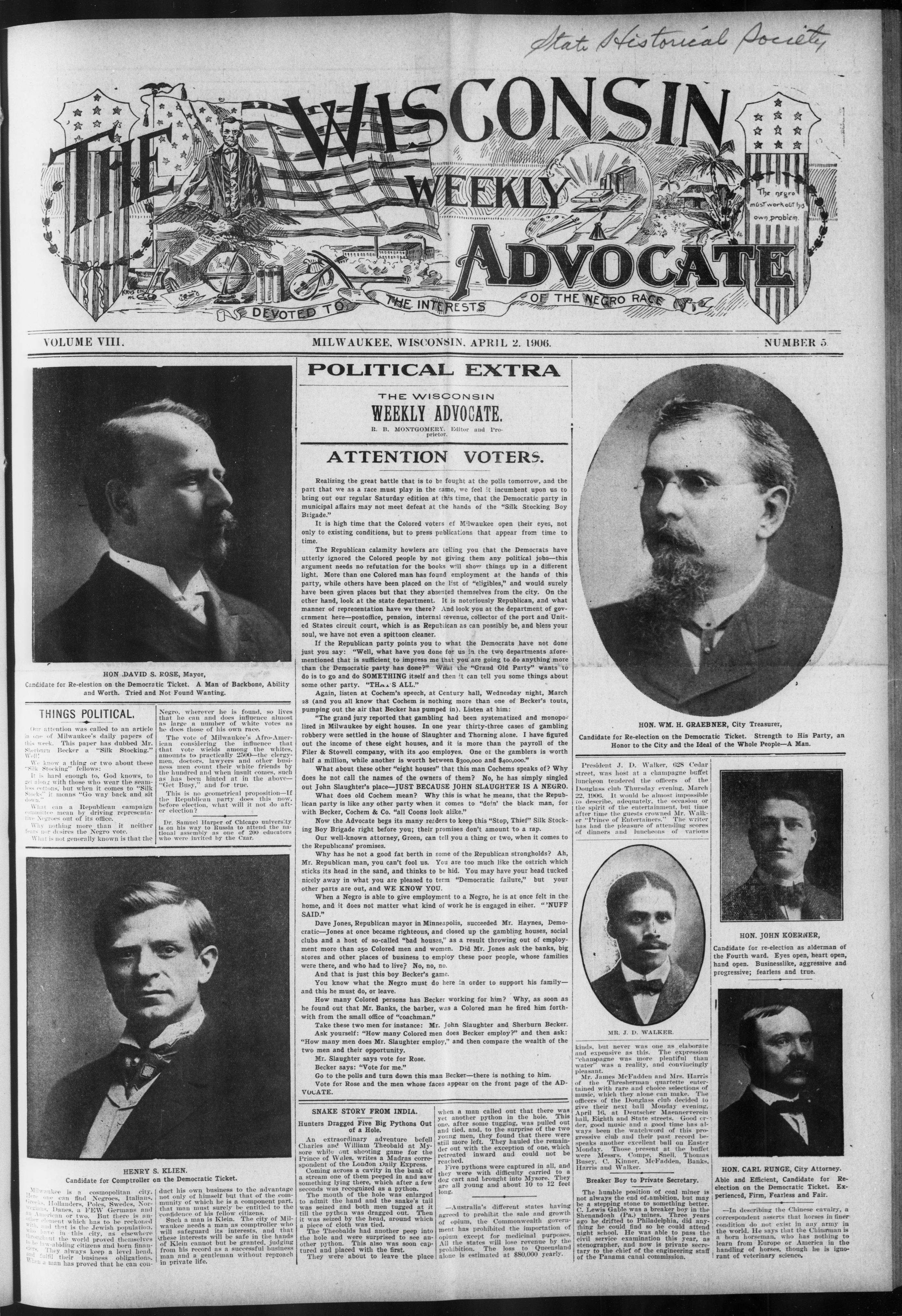
Candidate for Re-elestion on the Democratic Ticket. A Man of Backbone, Ability and Worth. Tried and Not Found Wanting.
VOLUME VIII.
HON .DAVID S.
Candidate for Re-election on the Democracy and Worth. Tried and
THINGS POLITICAL.
Our attention was called to an article in one of Milwaukee's daily papers of this week. This paper has dubbed Mr. Sheburn Becker a "Silk Stocking." Well!
We know a thing or two about these "Silk Stocking" fellows:
It is hard enough to, God knows, to get along with those who wear the seamless cotton, but when it comes to "Silk Stocks" it means "Go way back and sit down."
What can a Republican campaign committee mean by driving representative Negroes out of its office.
Why nothing more than it neither fears nor desires the Negro vote.
What is not generally known is that the
HENRY
Candidate for Comptroller
Milwaukee is a cosmopolitan city. Here one can find Negroes, Italians, Greeks, Hollanders, Poles, Swedes, Norwegians, Danes, a FEW Germans and an American or two. But there is another element which has to be reckoned with, and that is the Jewish population, who have in this city, as elsewhere throughout the world proved themselves to be law-abiding citizens and born financiers. They always keep a level head, and fulfil their business obligations. When a man has proved that he can con-
Negro, wherever he is found, so lives that he can and does influence almost as large a number of white votes as he does those of his own race. The vote of Milwaukee's Afro-American considering the influence that that vote wields among the whites, amounts to practically 2500—the clergymen, doctors, lawyers and other business men count their white friends by the hundred and when insult comes, such as has been hinted at in the above—"Get Busy," and for true. This is no geometrical proposition—If the Republican party does this now, before election, what will it not do after election?
Dr. Samuel Harper of Chicago university is on his way to Russia to attend the national assembly as one of 200 educators who were invited by the Czar.
S. KLIEN.
in the Democratic Ticket.
duct his own business to the advantage not only of himself but that of the community of which he is a component part, that man must surely be entitled to the confidence of his fellow citizens.
Such a man is Klein. The city of Milwaukee needs a man as comptroller who will safeguard its interests, and that these interests will be safe in the hands of Klein cannot but be granted, judging from his record as a successful business man and a gentleman without reproach in private life.
POLITICAL EXTRA
THE WISCONSIN WEEKLY ADVOCATE.
R. B. MONTGOMERY. Editor and Proprietor.
ATTENTION
Realizing the great battle that is to be part that we as a race must play in the same bring out our regular Saturday edition at the municipal affairs may not meet defeat at the Brigade."
It is high time that the Colored voters only to existing conditions, but to press public time.
The Republican calamity howlers are utterly ignored the Colored people by not giving argument needs no refutation for the books of light. More than one Colored man has found a party, while others have been placed on the have been given places but that they absent other hand, look at the state department. It manner of representation have we there? An environment here—postoffice, pension, internal reed States circuit court, which is as Republic soul, we have not even a spittoon cleaner.
If the Republican party points you to we just you say: "Well, what have you done for mentioned that is sufficient to impress me than the Democratic party has done?" What do is to go and do SOMETHING itself and the some other party. "THAT'S ALL."
Again, listen at Cochem's speech, at Cent 28 (and you all know that Cochem is nothing pumping out the air that Becker has pumped out. "The grand jury reported that gambling has lized in Milwaukee by eight houses. In one robbery were settled in the house of Slaughter out the income of these eight houses, and in Filer & Stowell company, with its 400 employees half a million, while another is worth between. What about these other "eight houses" that does he not call the names of the owners out John Slaughter's place—JUST BECAUSE?
What does old Cochem mean? Why the lican party is like any other party when it comes with Becker, Cochem & Co. "all Coons look at Now the Advocate begs its many readers Boy Brigade right before you; their promise Our well-known attorney, Green, can tell the Republicans' promises.
Why has he not a good fat berth in some Mr. Republican man, you can't fool us. You sticks its head in the sand, and thinks to be nicely away in what you are pleased to term other parts are out, and WE KNOW YOU.
When a Negro is able to give employment home, and it does not matter what kind of SAID."
Dave Jones, Republican mayor in Minneapolis—Jones at once became righteous, and on clubs and a host of so-called "bad houses," ment more than 250 Colored men and women stores and other places of business to employ were there, and who had to live? No, no, no.
Great battle that is to be fought at the polls, peace must play in the same, we feel it incumbent Saturday edition at this time, that the law may not meet defeat at the hands of the "Colored voters of Milwaukee open conditions, but to press publications that appeal."
Scalamity howlers are telling you that the Colored people by not giving them any refutation for the books will show things the Colored man has found employment at have been placed on the list of "eligibles," does but that they absented themselves from the state department. It is notoriously Reaction have we there? And look you at the office, pension, internal revenue, collector or court, which is as Republican as can possibly be a spittoon cleaner.
In party points you to what the Democrat, what have you done for us in the two-efficient to impress me that you are going to party has done?" What the "Grand Old Men" SOMETHING itself and then it can tell you THAT'S ALL."
Cochem's speech, at Century hall, Wednesay that Cochem is nothing more than one that Becker has pumped in). Listen at him reported that gambling had been systematically eight houses. In one year thirty-three in the house of Slaughter and Thorning and these eight houses, and it is more than one company, with its 400 employes. One or the other is worth between $300,000 and $400 other "eight houses" that this man Cochem names of the owners of them? No, here is place—JUST BECAUSE JOHN SLAUGHTER Cochem mean? Why this is what he means by other party when it comes to "doin' to the & Co. "all Coons look alike."
State begs its many readers to keep this "Stop, but before you; their promises don't amount to attorney, Green, can tell you a thing or two nises.
A good fat berth in some of the Republicans, you can't fool us. You are too much like a sand, and thinks to be hid. You may have you are pleased to term "Democratic for and WE KNOW YOU."
able to give employment to a Negro, he is not matter what kind of work he is engaged.
Publican mayor in Minneapolis, succeeded Mr. became righteous, and closed up the game so-called "bad houses," as a result throw Colored men and women. Did Mr. Jones pieces of business to employ these poor peeled to live? No, no, no.
ATTENTION VOTERS.
Realizing the great battle that is to be fought at the polls tomorrow, and the part that we as a race must play in the same, we feel it incumbent upon us to bring out our regular Saturday edition at this time, that the Democratic party in municipal affairs may not meet defeat at the hands of the "Silk Stocking Boy Brigade."
It is high time that the Colored voters of Milwaukee open their eyes, not only to existing conditions, but to press publications that appear from time to time.
The Republican calamity howlers are telling you that the Democrats have utterly ignored the Colored people by not giving them any political jobs—this argument needs no refutation for the books will show things up in a different light. More than one Colored man has found employment at the hands of this party, while others have been placed on the list of "eligibles," and would surely have been given places but that they absented themselves from the city. On the other hand, look at the state department. It is notoriously Republican, and what manner of representation have we there? And look you at the department of government here—postoffice, pension, internal revenue, collector of the port and United States circuit court, which is as Republican as can possibly be, and bless your soul, we have not even a spittoon cleaner.
If the Republican party points you to what the Democrats have not done just you say: "Well, what have you done for us in the two departments aforementioned that is sufficient to impress me that you are going to do anything more than the Democratic party has done?" What the "Grand Old Party" wants to do is to go and do SOMETHING itself and then it can tell you some things about some other party. "THAT'S ALL."
Again, listen at Cochem's speech, at Century hall, Wednesday night, March 28 (and you all know that Cochem is nothing more than one of Becker's touts, pumping out the air that Becker has pumped in). Listen at him:
"The grand jury reported that gambling had been systematized and monopolized in Milwaukee by eight houses. In one year thirty-three cases of gambling robbery were settled in the house of Slaughter and Thorning alone. I have figured out the income of these eight houses, and it is more than the payroll of the Filer & Stowell company, with its 400 employees. One or the gamblers is worth half a million, while another is worth between $300,000 and $400,000."
What about these other "eight houses" that this man Cochems speaks of? Why does he not call the names of the owners of them? No, he has simply singled out John Slaughter's place—JUST BECAUSE JOHN SLAUGHTER IS A NEGRO.
What does old Cochem mean? Why this is what he means, that the Republican party is like any other party when it comes to "doin' the black man, for with Becker, Cochem & Co. "all Coons look alike."
Now the Advocate begs its many readers to keep this "Stop, Thief" Silk Stocking Boy Brigade right before you; their promises don't amount to a rap.
Our well-known attorney, Green, can tell you a thing or two, when it comes to the Republicans' promises.
Why has he not a good fat berth in some of the Republican strongholds? Ah, Mr. Republican man, you can't fool us. You are too much like the ostrich which sticks its head in the sand, and thinks to be hid. You may have your head tucked nicely away in what you are pleased to term "Democratic failure," but your other parts are out, and WE KNOW YOU.
When a Negro is able to give employment to a Negro, he is at once felt in the home, and it does not matter what kind of work he is engaged in either. "'NUFF SAID."
Dave Jones, Republican mayor in Minneapolis, succeeded Mr. Haynes, Democratic—Jones at once became righteous, and closed up the gambling houses, social clubs and a host of so-called "bad houses," as a result throwing out of employment more than 250 Colored men and women. Did Mr. Jones ask the banks, big stores and other places of business to employ these poor people, whose families were there, and who had to live? No, no, no.
And that is just this boy Becker's game.
You know what the Negro must do he and this he must do, or leave. How many Colored persons has Becker he found out that Mr. Banks, the barber, was with from the small office of "coachman." Take these two men for instance: Mr. Jo Ask yourself: "How many Colored men d "How many men does Mr. Slaughter employ,' two men and their opportunity.
the Negro must do here in order to suf or leave. red persons has Becker working for him' Mr. Banks, the barber, was a Colored man's office of "coachman." men for instance: Mr. John Slaughter and How many Colored men does Becker emple Ms. Slaughter employ," and then compare opportunity.
You know what the Negro must do here in order to support his family—and this he must do, or leave.
How many Colored persons has Becker working for him? Why, as soon as he found out that Mr. Banks, the barber, was a Colored man he fired him forthwith from the small office of "coachman."
Take these two men for instance: Mr. John Slaughter and Sherburn Becker.
Ask yourself: "How many Colored men does Becker employ?" and then ask: "How many men does Mr. Slaughter employ," and then compare the wealth of the two men and their opportunity.
Mr. Slaughter says vote for Rose.
Becker says: "Vote for me."
Go to the polls and turn down this man Becker—there is nothing to him.
Vote for Rose and the men whose faces appear on the front page of the ADVOCATE.
Becker says: "Vote for me."
Go to the polls and turn down this man
Vote for Rose and the men whose faces a
VOCATE.
Go to the polls and turn down this man Becker—there is nothing to him.
Vote for Rose and the men whose faces appear on the front page of the ADVOCATE.
SNAKE STORY FROM INDIA.
Hunters Dragged Five Big Pythons Out of a Hole.
An extraordinary adventure befell Charles and William Theobald at Mysore while out shooting game for the Prince of Wales, writes a Madras correspondent of the London Daily Express.
Coming across a cavity in the bank of a stream one of them peeped in and saw something lying there, which after a few seconds was recognized as a python.
The mouth of the hole was enlarged to admit the hand and the snake's tail was seized and both men tugged at it till the python was dragged out. Then it was seized by the head, around which a piece of cloth was tied.
The Theobalds had another peep into the hole and were surprised to see another python. This also was soon captured and placed with the first.
They were about to leave the place alo
---
be fought at the polls tomorrow, and the same, we feel it incumbent upon us to act this time, that the Democratic party in the hands of the "Silk Stocking Boy" of Milwaukee open their eyes, not publications that appear from time to time.
Telling you that the Democrats have not giving them any political jobs—this book will show things up in a different ground employment at the hands of this list of "eligibles," and would surely present themselves from the city. On the other hand, it is notoriously Republican, and what And look you at the department of government, collector of the port and Unit-ublican as can possibly be, and bless your fate to what the Democrats have not done for us in the two departments aforeseen that you are going to do anything more. What the "Grand Old Party" wants to do then it can tell you some things about the Century hall, Wednesday night, March nothing more than one of Becker's touts, tapped in). Listen at him: Being had been systematized and monopolized one year thirty-three cases of gambling lighthouse and Thorning alone. I have figured and it is more than the payroll of the employes. One or the gamblers is worth between $300,000 and $400,000."
"That this man Cochems speaks of? Why others of them? No, he has simply singled USE JOHN SLAUGHTER IS A NEGRO. Why this is what he means, that the Republit comes to "doin' the black man, for look alike."orders to keep this "Stop, Thief" Silk Stock-promises don't amount to a rap. Tell you a thing or two, when it comes to some of the Republican strongholds? Ah, You are too much like the ostrich which to be hid. You may have your head tucked in term "Democratic failure," but your UU.iment to a Negro, he is at once felt in the field of work he is engaged in either. "'NUFF neapolis, succeeded Mr. Haynes, Demon and closed up the gambling houses, social lives," as a result throwing out of employwomen. Did Mr. Jones ask the banks, big employ these poor people, whose families, no, name. So here in order to support his family—maker working for him? Why, as soon as was a Colored man he fired him forth-rr. John Slaughter and Sherburn Becker. When does Becker employ?" and then ask: "loy," and then compare the wealth of the man Becker—there is nothing to him.aces appear on the front page of the AD-
when a man called out that there was yet another python in the hole. This one, after some tugging, was pulled out and tied, and, to the surprise of the two young men, they found that there were still more left. They hauled the remainder out with the exception of one, which retreated inward and could not be reached.
Five pythons were captured in all, and they were with difficulty carried to a dog cart and brought into Mysore. They are all young and about 10 to 12 feet long.
Australia's different states having agreed to prohibit the sale and growth of opium, the Commonwealth government has prohibited the importation of opium except for medicinal purposes. All the states will lose revenue by the prohibition. The loss to Queensland alone is estimated at $80,000 yearly.
[Name]
Candidate for Re-election on the Democratic Ticket. Strength to His Party, an Honor to the City and the Ideal of the Whole People—A Man.
President J. D. Walker, 628 Cedar street, was host at a champagne buffet luncheon tendered the officers of the Douglass club Thursday evening, March 22, 1906. It would be almost impossible to describe, adequately, the occasion or the spirit of the entertainment, but time after time the guests crowned Mr. Walker "Prince of Entertainers." The writer has had the pleasure of attending scores of dinners and luncheons of various
[Name]
MR. J. D. WALKER. kinds, but never was one as elaborate and expensive as this. The expression "champagne was more plentiful than water" was a reality, and convincingly pleasant.
Mr. James McFadden and Mrs. Harris of the Thresherman quartette entertained with rare and choice selections of music, which they alone can make. The officers of the Douglass club decided to give their next ball Monday evening, April 16, at Deutscher Maennerverein hall, Eighth and State streets. Good order, good music and a good time has always been the watchword of this progressive club and their past record bespeaks another excellent ball on Easter Monday. Those present at the buffet were Messrs. Compe, Snell, Thomas Busey, C. Kinner, McFadden, Banks, Harris and Walker.
Breaker Boy to Private Secretary.
The humble position of coal miner is not always the end of ambition, but may be a stepping stone to something better. C. Lewis Gable was a breaker boy in the Shenandoah (Pa.) mines. Three years ago he drifted to Philadelphia, did anything he could find so he could attend night school. He was able to pass the civil service examination this year, as stenographer, and now is private secretary to the chief of the engineering staff of the Panama canal commission.
NUMBER 5
NER, City Treasurer,
atic Ticket. Strength to His Party, an
of the Whole People—A Man.
PETER H.
HON. JOHN KOERNER,
Candidate for re-election as alderman of the Fourth ward. Eyes open, heart open, hand open. Businesslike, aggressive and progressive; fearless and true.
[Picture of a man in a suit with a bow tie].
Able and Efficient, Candidate for Re-election on the Democratic Ticket. Experienced, Firm, Fearless and Fair.
—In describing the Chinese cavalry, a correspondent asserts that horses in finer condition do not exist in any army in the world. He says that the Chinaman is a born horseman, who has nothing to learn from Europe or America in the handling of horses, though he is ignorant of veterinary science.
---
CHARLES N. HATFIELD OF LOS ANGELES TAKES CONTRACT.
Will Get Ten Thousand Dollars from Mining Operators' Syndicate if He Delivers the Goods.
LOS ANGELES, Cal., March 31. Charles M. Hatfield, the famous rainmaker of this city, has been engaged by contract with the Yukon territorial government to make rain in the Klondike during all the coming mining season. According to the contract Hatfield must be on the ground by May 1 with an assistant and the rainmaking apparatus. Last summer the Klondike hydraulic plants suffered the loss of thousands of dollars that they would have harvested had there been big rains. The rainmaking plan was suggested and fostered by J. T. Lithgow, territorial comptroller, who had come in touch with Hatfield's work while here on a visit.
By the terms of the contract Hatfield is to receive $10,000 provided he makes rain to the satisfaction of a board of seven men, three of whom shall be chosen by the governor of the Yukon, three by Hatfield and one by the first six. Should Hatfield fail to produce rain to the satisfaction of the board, or the majority of the board, he will receive only his cost of transportation to and from the Klondike and maintenance for himself and assistant. Of the $10,000 half is to be paid by ten of the largest mining operators of the Yukon. The other half is to be paid by the Yukon government.
Hatfield agrees to produce rain to the satisfaction of the board. No stipulated quantity of rain by inches is required, but it is specifically stated in the contract that he "shall increase the rainfall and renew it from time to time for four months, as may be named by the board, and sufficient to insure, so far as ample rain will, a successful and prosperous summer for placer mining industry of the Dawson district." Five days will be allowed after each seance for the rain to come.
PENS EDICTS FOR CZAR.
Chicago Man Is Real Author of Manifestos for Russians—Studied in Many Countries.
CHICAGO, Ill., March 31.—Chicago is the cradle of Russian liberty; the recent manifestoes of the Czar granting what is assumed to be a measure of freedom to the oppressed Slavs is the direct result of the work of a Russian subject who fled from his mother country to America, and who is now residing in Chicago, and the basic principles of the new Russian constitution were outlined by a Chicagoan, according to friends of Vasili Andreevitch Bouroff, a member of the Russian nobility. Bouroff has just received an A. B. degree from the University of Chicago. He declares he has the confidence of Prime Minister Witte and Count Pobyedonostseff, formerly procurator general of the holy synod, and through them has influence with the Czar.
Bouroff has twice fled from Russia, and the Czar has invited him twice to return. Twelve years ago he left Russia again and set out to study the governments of Europe and America. He now has crystallized his views and has presented them to his government.
"The Czar has been misrepresented in America," says Bouroff. "He is a sincere, intelligent man, who did not waste his youth but spent his time studying and reading. He is not a genius, perhaps, but he is open minded and has believed all along that what he was doing was the right course."
ITALIAN TRADE IS LARGE.
Philippines Buy Big Amount of Duplicated American Goods—Germans Sell Counterfeit Shoes.
MILAN, March 31.—Italian manufacturers are building up a big trade in the Philippine islands. Lombardy shipped $380 in goods to Manila in 1903, $4000 in 1904, and for the six months ending December, 1905, the shipments from Milan to the Philippines amounted to over $38,000. Every article sent by the Italians is being made in the United States. and includes hats, paper, cottonts, umbrellas, boots, milk, macaroni, paint, hemp, lamps, medicines, preserves, linen, soap, pottery, and wearing material. Many of the "Manila hats" coveted by travelers and collectors, the consul adds, are made in Milan and shipped by the gross.
"American shoes" are also made in Italy. In Mannheim, Germany, a number of shoe stores advertise American shoes. Some of the merchants admit that their stocks were from Milan. One of the shoe store managers was an Italian who said he saw no reason why American shoes should not be made in Italy just as well as in Massachusetts.
FASTEST ON THE LAKES.
Steamer Theodore Roosevelt Successfully Launched at Toledo O.
TOLEDO, O., March 31.—The Theodore Roosevelt, believed to be the fastest passenger steamer on the Great Lakes, was launched today at the yards of the Toledo Shipbuilding company. The launching was a success in every particular and was witnessed by a large crowd, including 350 guests from Chicago and Laporte, Ind. Miss Geneviva Mott of Chicago, daughter of one of the directors of the Indiana Transportation company, broke the bottle of wine over the bows. The Theodore Roosevelt will be ready for business and will ply between Chicago and Michigan City. The launching was followed by a banquet and a telegram of greeting was sent to President Roosevelt.
GRIEF FOR FRIEND IS FATAL.
Mrs. May Kay of New Orleans Kills Self in New York Hotel.
NEW YORK, March 31.—Mrs. May Kay, a young widow from New Orleans, who shot herself Thursday evening, died Friday in St. Vincent's hospital. It came out that the immediate motive which drove her to kill herself was the death of Mrs. Blanche Turner Dennis, who died Thursday.
The two women had lived together in the Alabama for several months and were close friends. As Coroner Shrady turned in for a little rest Thursday after finishing his work on the Dennis case, he was called up on the telephone and a woman's voice asked him if Mrs. Dennis was really dead. He answered that she was. The woman broke down and cried for a moment. Then she caught her voice and asked for particulars. Coroner Shrady told her the plain story.
"What is your name, madam?" he asked when he had told all he knew. She was crying violently when he said this, and he had to ask again before he got the name "Kay."
UNCLE SAM PUTS OFF RECIPROCITY.
Secretary Root Busying Himself to Further Relations Directly with Canadians.
WASHINGTON, D. C., March 31. Convinced that reciprocity treaties with Great Britain for friendship between the United States and Canada are now out of the question, Secretary Root is busying himself in the hope of settling differences which bade fair to be settled by the joint high commission, when the Klondike gold strike caused the negotiations to be broken off suddenly. A canvass of the Senate persuaded Secretary Root that reciprocity would not be considered at this session of Congress. The announcement of Chairman Payne of ways and means that no tariff legislation would be passed by this Congress, confirmed the reports that Republican leaders had agreed to accept the counsel of the "stand patters."
Germany Holds Big Front.
As the state department is under obligations to secure concessions for Germany in return for the favor shown the United States by permitting this country to remain among the favored nations, in spite of the discriminatory tariffs recently put into force by the German government, Secretary Root feels that it would not be wise to undertake other propositions at a time when legislators seem so little inclined to tariff changes. Moreover the demand for reciprocity with Canada does not exist to the degree that it did when the joint high commission sat in 1898. Canadians have cooled in their ardor.
Secretary Root now feels that it is time to take up the broken strands where the joint high commission left them, and it is believed that he and Gov. Grey of Canada will make public some interesting plans for the settlement of international differences in their addresses at the Pilgrims' dinner in New York tonight. The preservation of Niagara Falls is perhaps the most interesting of the new international problems which have developed since 1898. Canada has shown a disposition to co-operate with this country.
Although the joint high commission has never formally dissolved it has been moribund for years, and it is not likely that any effort will be made to revive this commission. Negotiations will be conducted by Secretary Root and Sir Henry Mortimer Durand, the British ambassador, with the co-operation of some representative of the Canadian government. No difficulties are expected.
Other Questions Are Up.
In spite of the friendly relations between the United States and Great Britain, international disputes like the recent troubles as to the control of the St. Johns river between New Brunswick and Maine, and unjust discriminations against American fishermen along the east coast of Canada, remind statesmen that treaties are necessary. Seal fishing in Bering sea and the North Pacific is another subject of dispute. In the regulations of seal fishing described by the Paris tribunal was a provision that the regulations should be submitted to an examination every five years to determine whether there was reason for modification. Out of the movement to have these regulations revised grew the joint high commission.
Vice President Fairbanks who was then senator, headed the American contingent on the joint high commission and Lord Herschel, chief justice of England was chairman of the English contingent, but the latter died from an injury while the commission was meeting in Washington and Sir Wilfred Laurier succeeded.
Marine Rights Involved.
Other subjects, which will doubtless be taken up again by Secretary Root are:
Provisions for the transit of merchandise in transportation to or from either country, across intermediate territory of the other whether by land or water; mining rights of the subjects or citizens of each country within the territory of the other; a revision of the agreement in 1817 respecting naval vessels on the Great Lakes and extradition.
BIG DAY FOR ST. PAUL.
Fiftieth Anniversary as Municipality and Corner Stone for Big Auditorium Is Laid.
ST. PAUL, Minn., March 31.—St. Paul put on its holiday attire today in honor of its fiftieth anniversary as a municipality and celebrated with parades of bands, military and civic organizations. The main feature of the celebration was the laying of the corner-stone of the giant St. Paul municipal auditorium and theater which is being built at a cost of $350,000. This sum was raised by popular subscription. The building occupies nearly half a city square and has two fronts. The walls now stand about three stories high. The building will be completed in June in time for the Northwestern Saengerfest which meets in St. Paul.
The auditorium will be so constructed that the largest conventions and horse shows can be accommodated and it can be changed into an ordinary sized theater or concert hall. The management of the auditorium will be under a board of business men appointed by authority of the city council.
COREYS MAY BE RECONCILED.
Relatives Said to Be Making Effort to Patch Up Trouble Between Couple.
SAN FRANCISCO, Cai., March 31. Eastern friends and relatives of Mrs. W. E. Corey of Pittsburg, wife of the president of the United States steel trust, W. Ellis Corey, are gathering at the Palace hotel, and there is a definite report that a final effort is to be made within a day or two, either here or in Reno, Nev., to effect a reconciliation between the couple. At present Mrs. Corey is perfecting her legal residence in Nevada in order to get a divorce.
Died Shortly After Loke
R. E. Doran, a Des Moines upholsterer, joked on the uncertainty of life in an undertaking establishment of L. F. Shank and laughingly selected a casket which he declared was "just about his size." He remarked, however, that it would be a long time before the, closed wagon would back up at his door. He stepped out upon the street and had gone but a short distance when he dropped dead of heart failure. He was 56 years old and in apparently good health.
Kid Sullivan of Washington and Unk Russell fought fifteen hard, fast rounds to a draw before the Ureka Athletic club at Baltimore. The bout was of the hurricane order from start to finish. Russell proved to be the cleverer of the two, but Sullivan was the stronger. The pace was a fast one and at the finish both men were tired, just fighting like demons.
—Recent rains have insured an immense yield from orchard, field and vineyard in California this year.
CAGERES IS IN DANGER
THOUSANDS OF MAUSERS SHIPPED HOME BY ENEMIES.
Dominican Minister at Washington Complains to Uncle Sam About Shipments from This Country.
NEW YORK, March 31.—Arturo Fiaillo, acting consul general here for Santo Domingo, has learned that the bark Lagonia, which sailed two weeks ago from Philadelphia for San Domingo, has on board 300,000 Mauser cartridges, shipped by enemies of President Ramon Caceres.
The Dominican minister at Washington has informed the state department which, it is said, has issued orders to Minister Dawson to Santo Domingo to have gunboats keep watch for the Lagonia.
The shipment of arms or ammunition from the United States to Santo Domingo was prohibited by a proclamation issued a few months ago by President Roosevelt and is a violation of the neutrality laws.
SHIPPER FRAUD CHARGES GROWING.
Interstate Commerce Commission to Seek Evidence Further West in April.
WASHINGTON, D. C., March 31. As a result of the investigation in New York city by the interstate commerce commission of alleged under-billing and misdescription of goods by various shippers, it is the intention to certify the cases to the department of justice for criminal proceedings with the view to bringing about indictments.
This action, however, will be deferred until after the commission has conducted further hearings in April in other cities such as Buffalo and Philadelphia, where it is said frauds of equal, if not greater magnitude than those alleged to have been committed in New York and vicinity, have been perpetrated. A member of the commission said today that it was the determination of the commission so far as possible to break up the practice and that it was their belief that this could be done only through drastic action in the courts.
Inquiry today as to whether or not the hearing would extend further west, even to Chicago, Milwaukee or the Twin Cities, elicited no reply of a tangible nature from the commission. It is not believed that there is any immediate chance for such an extension of activity in this line.
WASHOUT CAUSES WRECK.
Two Killed and Others Injured on Chesapeake & Ohio Near Quincy, Ky. Nickel Plate in Ditch.
PORTSMOUTH, O., March 31.—Two trainmen were killed, one fatally injured, and five other persons seriously hurt in a wreck on the Chesapeake & Ohio railroad near Quincy, Ky., last night. The train was an accommodation and ran into a washout, the engine, baggage car and smoker leaving the rails and plunging into a small creek which was swollen by recent rains.
FORT WAYNE, Ind., March 31.—A broken rail on the Nickel Plate track thirty miles west of Fort Wayne, near South Whitley, derailed passenger train No. 2 yesterday afternoon, sending seven cars into the ditch and injuring twenty-three persons. Two children were nearly drowned when rescued from the ditch, through which the recently formed torrent rushed rapidly. Charles Jacobsen, a travelnig salesman who was in the wrecked day coach, says a good many of the injured were hurt in a scramble for the door of the car, when women and child:en were trampled under foot.
JEALOUS FURY IS FATAL.
New York Cabman Kills Man Who Hired His Sweetheart as Housekeeper, After Many Attempts.
NEW YORK, March 31.—In an insane fury caused by jealousy, James Ahearn, aged 34, a cabman, shot and instantly killed James Black, aged 54, an upholsterer, in his flat at 229 East Sixty-third street, today, probably fatally wounded Mary Woods, aged 30, who is Black's housekeeper, nad then put a bullet into his own brain. Ahearn died two hours later.
Mary Woods was formerly Ahearn's sweetheart. She left him only a short time ago to become housekeeper for Black. Twice last night Ahearn broke into Black's apartment to find Mary Woods. On the first occasion he shot Black in the nose, injuring him slightly, and then ran away.
After the police for three hours had searched the neighborhood for the cabman and had relaxed their efforts, he returned to the flat and did the fatal shooting.
CLAIM BIG MINE FRAUD.
Sixty Men at Wilkes Barre (Pa.) Accuse Philadelphia and Los Angeles Men in $60,000 Case.
WILKES BARRE, Pa., March 31.—Warrants were issued today for the arrest of J. L. Shaffer of Philadelphia and L. H. Mitchell of Los Angeles, Cal., charging them with false pretense and with defrauding some sixty men of this city and vicinity out of $60,000 which they invested in the Joacquina Gold Mining company.
TRAIN ROLLS INTO DITCH.
Chicago and Florida Limited Reported Wrecked Near Macon (Ga.) and There May Be Fatalities.
MACON, Ga., March 31.—The Chicago and Florida limited on the Southern railway is reported to have rolled down an embankment near Holton. Several people are reported killed or injured.
SILVER KING MINE SUED.
Former Senator Kearns and David Keith Are Co-efendants.
SALT LAKE CITY, Utah, March 31. -Suit for $900,000 damages was begun in the United States court by the Magnolia St. Louis Mining company against the Silver King Mining company, former Senator Thomas Kearns and David Keith. The plaintiff alleges that the defendant company trespassed upon its ground and extracted ore to the value of $300,000. In such cases the state law allows triple damages. Mr. Kearns is president and Mr. Keith vice president of the Silver King mine.
SLEPT AT WORK BENCH
RUSSIAN NEWSPAPER FORCES COMPELLED TO STAY INSIDE.
MOSCOW, March 31.—When the governor general of Moscow ordered that the inhabitants of that city must not go out of doors after 10 o'clock at night while the state of siege lasted, the command proved highly inconvenient to all-night workers, journalists and all persons employed on newspapers being particularly hard hit.
To go home, at a lawful hour meant leaving their work half finished; to go home when their work was done involved running the gauntlet of the police, who were not disposed to be merciful to anyone connected with the press.
Under the circumstances the sword was admitted to be mightier than the pen and the newspaper workers of Moscow, after finishing their nightly task, refrained from venturing out into the streets until the hour arrived when they could do so in safety, without fear of either bayonet or bullet.
During the recent disturbances, therefore, the men, once the paper was printed, lay down and slept on the scene of their labors. The editor-in-chief slumbered on an easy chair, within reach of his telephone, while the subeditors followed their chief's example, making a shift with the tops of office desks, or with mattresses scattered pell-mell about the office floor.
The compositors made their beds on the frames supporting their cases of type, an arrangement suggesting the bunks on board ship or the old-fashioned beds let into the wall. In the pressrooms the workers made themselves as comfortable as they could on the platforms of the rotary machines or on the heaps of paper. In the publishing department the workers had to content themselves with the large benches on which the papers are folded and packed for distribution.
COMPLETE PEACE MADE IN MOROCCO.
France and Germany Agree Upon Settlement and Europe Is Breathing Easier.
ALGECIRAS, Spain, March 31.—The committee of the conference on Moroccan reforms reached an agreement on all points. This agreement will be sanctioned at the plenary session of the conference this afternoon.
The complete accord resulted from a long conference held this morning between M. Revoil, head of the French mission, and Count von Tattenbach of the German mission. The division and the policing of the ports of Morocco were arranged as follows:
Spain polices Tetuan and La Raich; a Franco-Spanish mixed police will be established at Casablanca and Tangier, and a French police force alone will have charge of Mogodor, Suffi, Magazan and Rabat.
This gives France four Atlantic ports. The duration of this police agreement was fixed at five years. The settlement of the question of the sfate bank of Morocco gives France three shares, including those of the French syndicate. The other nations have one share. Four bank supervisors will be appointed by the Bank of England, the Bank of France, the Imperial bank of Germany, and the Bank of Spain.
Europe's Politics Shaken Up.
BERLIN, March 31.—The gains and losses due to Germany's Moroccan policy are being reckoned up at the foreign office. The strain of these months revealed that Italy is in secret agreement with France and the triple alliance although existing as before on parchment is considered to be virtually ended. Russia on whom Germany also counted has been against the Kaiser. Germany, however, regards it as a great gain to learn that she cannot rely in international politics on any one except Austria. France and Great Britain have been pressed closely together in their mutual dislike of Germany. A naval strengthening of Germany will surely follow.
ARCHBISHOP IS ANNOYED.
Ireland Declares Reports of Public Mission at Rome Are Not True— Visit Is Personal.
ROME, March 31.—Archbishop Ireland is most annoyed about the reports circulating in the United States concerning his visit to Rome. He said today: "I came here simply for my regular visit ad libitim. It is especially untrue that I am acting as the representative of the American government in the settlement of the Philippine affairs, with the Vatican. My work here is purely personal and has had no public significance whatsoever. Everywhere and from everybody I receive such marked demonstrations of cordiality that it delights me. I consider them to be addressed to my country and the clergy to which I belong."
The archbishop expects to remain in Rome until after Easter.
PEACE SOCIETIES FUTILE.
WASHINGTON, D. C., March 31. Secretary Bonaparte today at the graduating exercises of the United States naval medical school, presented diplomas to the twenty-one young doctors. He said that peace societies, however good their intentions might be, never prevent a war or improve war conditions. Christianity has influenced conditions and today military men care for the injured of their enemy as well as of their own army.
HINTS AT HUGE CONSPIRACY.
Negro Witness in Hartje Divorce Case at Pittsburg Not Released.
PITTSBURG, Pa., March 31.—An unsuccessful attempt was made to release Clifford Hoee, a negro, charged with perjury in swearing against Mrs. Mary Scott Hartje, who is suing her millionaire husband, August Hartje, for divorce. Attorney John S. Robb, Jr., for Mrs. Hartje, sprung a sensation by saying to the court:
"I desire to say to you that this case has not reached its climax. Before it does, if things go on as I expect, the greatest scandal ever known in the history of the county will be laid bare to the public. Persons at present of great prominence are likely to find themselves in the position of the prisoner at the bar. This is beyond all question the greatest conspiracy that ever has been entered into."
WORK OF CONGRESS.
IN THE HOUSE.
Following the President's suggestion, the House, on the 26th, passed several resolutions to correct the useless printing of public documents, and empowering the House and Senate printing committees to fix the number of documents to be printed. It is asserted that the new arrangement will save the government more than $1,000,000 annually. Nearly the entire day was devoted to District of Columbia business. A large number of bills of a local character were passed.
The House on the 27th witnessed a most unusual scene when Speaker Cannon arose on the floor in the midst of a spirited discussion on reciprocity and tariff revision to reply to an attack by Mr. Shackleford. The urgent deficiency bill was passed and a few paragraphs of the legislative appropriation bill were considered, Messrs. Prince and Hardwick continuing to defeat many provisions by point of order. A bill permitting the building of a dam across the St. Joseph river in Berrien county, Michigan, was passed. At 5:10 p. m. the House adjourned until the next day.
In order that the legislative, executive and judicial appropriation bill might be considered without being subject to limitless points of order, the House, on the 28th, passed a rule prohibiting that method of fighting the measure, by a vote of 169 to 109, twenty Republicans voting with the minority. This appears to have been the first special rule ever reported from the committee on rules directly affecting an appropriation bill. The remainder of the day was devoted to the consideration of the measure, and more progress was made than in all the days heretofore given to it. At 5 p.m. the House adjourned until next day.
Considerable progress was made with the legislative, executive and judicial appropriation bill in the House on the 29th. The committee on appropriations suffered a defeat in committee of the whole, when, by a vote of 58 to 22, a paragraph relating to the division of the railway mail service was expunged from the measure, on the ground that it was properly a part of the postoffice bill. For confidential agents of the interior department to aid in ferreting out land frauds $20,000 was allowed. The conference report on the consular bill was adopted. It was agreed that debate on the pure food bill will commence April 10 and continue at least two days. At 5 p. m. the House adjourned until next day.
After two weeks' consideration, the House on the 30th passed the legislative, executive and judicial appropriation bill, carrying $30,000,000, less by nearly $700,000 than the last bill for similar purposes. The feature of the day's proceedings was the elimination of the provision in the bill to drop from the government service clerks past a certain age limit. Efforts to discontinue the so-called "postage stamp agency" and the services of special agents to investigate trade conditions abroad failed. At 6 p. m. adjournment was taken until the next day. This being war claim day, only those directly interested in legislation on the private calendar were in attendance. The House, on the 31st, in four hours, passed 170 bills, and many were sent to the court of claims for adjudication. One of the bills passed awarded $77,712 to the French Trans-Atlantic Cable company for the cutting of the cable and destruction of cable houses during the war with Spain. At 4 o'clock adjournment was taken until Monday.
IN THE SENATE.
There was a hint in the Senate, on the 26th, at an effort to fix a time for a final vote on the railroad rate bill, but it was surrounded by so much doubt that no prediction would be justified. Senator Tillman said that, in the absence of objection, he may ask tomorrow to have a day specified. The discussion arose from an effort by several senators to secure immediate consideration of amendments. Senator Tillman objected on the ground that there were too many absentees. He thought there should be no vote without full notice. Among the amendments offered were: By Senator Foraker, prohibiting the issuance of passes; by Senator Scott, compelling railroads to connect with other railroads; by Senator Culberson, denying to interstate railroads the privilege of making campaign contributions.
The Senate on the 27th listened to Messrs. Tillman and McCumber. Mr. Tillman made special inquiry concerning the status of his resolution relative to the use of national bank funds in politics and touched on the insurance and beef cases. Mr. McCumber devoted himself to the rate bill, finding many flaws in the measure, but announcing that he would vote for it if it was properly amended. The joint resolution regulating the allotment of documents in the government printing office and aiming to prevent unnecessary printing and binding, passed yesterday by the House, was adopted. A bill amending the law fixing fees and expenses of witnesses in the federal courts in the western states was passed. At 5:20 p. m. the Senate went into executive session, adjourning five minutes later until the next day.
Mr. Knox made his first set speech in the Senate on the 28th, his subject being the railroad rate bill, and he dealt almost exclusively with the legal features of the problem. The conference report on the bill regulating the final disposition of the affairs of the Five Civilized Tribes of Indians was taken up, and much objection was expressed to many of the changes. Messrs. La Follette, Clark (Wyoming) and Tillman voiced disapproval of the provision authorizing the secretary of the interior to lease the coal lands. The matter was still under discussion when the Senate, at 5:12 p. m., went into executive session, to adjourn a few minutes later until next day.
The Senate on the 29th listened to speeches on the railroad rate bill by Messrs. Clay, Carmack and Newlands. All indicated a purpose to support the measure, but Mr. Clay favored a limited court review amendment. The bill providing for the reorganization of the medical department of the army by authorizing the appointment of officers to take the place of contract surgeons was passed by a vote of 42 to 5. Among the other bills passed was one authorizing a dam across St. Joseph river at Berrien Springs. Mich. Mr. Lodge presented the conference report on the consular reorganization bill, which was agreed to. At 4:35 p. m. the Senate went into executive session and five minutes later adjourned until Monday.
Understood the Signals.
I was engrossed in my magazine as the train sped on, and did not notice that a bride and bridegroom had entered the carriage at a small station; but my attention was attracted to the couple in rather an odd way—by telegraphic signals.
Two young men (evidently operating clerks at the telegraph) who sat opposite to each other were making remarks about them by ticking with their pocket-knives.
"Sweet as a peach, isn't she?" ticked off one of the young men.
"Yes," replied the other. "Bridal couple, evidently."
"See how close he sits to his tootsy-
wootsy."
"I see. They are holding each other's hands, aren't they?" "No; but they are exchanging loveglances."
"How on earth do you suppose a chump like that managed to catch such an angel?"
"Give it up. She surely couldn't see anything in him to admire."
"Her lips were just made for kisses."
"That's what they were."
"I say!"
"Well?"
"When the train gets to the next tunnel I'm going to reach over and kiss her."
"You wouldn't dare."
"Yes, I would. She'd think it was her husband, you know."
Their telegraphic conversation ceased here, for the bridegroom had taken out his pocketknife and commenced to tick off this message:—
"When the train gets to the next tunnel the chump proposes to reach over and hammer your two heads together till your teeth drop out. See?" They saw it, and at the next station the young fellows found it to their comfort to change carriages.—Tit-Bits.
A CURE FOR DEBILITY
Dr. Williams' Pink Pills A Reliable Remedy for the Weak, Ailing and Bloodless.
When the body is weak and the blood thin it is sometimes difficult to find the cause unless a wasting illness has preceded, or the sufferer happens to be a girl on the verge of womanhood.
Obscure influences, something unhealthful in one's surroundings or work, may lead to a slow impoverishment of the blood and an enfeeblement of the whole body. When a serious stage has been reached there seems to be nothing that will account for it.
Mr. C. E. Legg, of Tipton, W. Va., has found a successful method of treating weakness and bloodlessness. He says:
"I used Dr. Williams' Pink Pills for weakness caused by a lingering malarial fever that began in the spring of 1896. The worst effects of this were indigestion and a bad state of my blood. I was anaemic, as the doctors say. People generally would say that I didn't have blood enough, or that I didn't have the right kind of blood; mine was too thin. My kidneys and liver were out of order. I was badly annoyed by sour risings from my stomach. There was a good deal of pain, too, in my back and under my right shoulder blade."
"How long did these troubles last?" "For over two years. For four months of that time I was under the care of a physician, but his medicine did me no good. Meanwhile I learned of the cures that had been wrought by Dr. Williams' Pink Pills." "You owe your cure to these pills?" "I certainly do, and I also know that they are helping others to whom I have recommended them. They have real merit and I know of nothing that would take their place." For further information and valuable booklet address the Dr. Williams Medicine Co., Schenectady, N. Y.
BIRDS KILLED BY INSECTS.
Mosquitoes Suck Their Blood and Consequently Cause Death.
Scores of canaries and other birds in Baltimore are the victims of the merciless attacks of mosquitoes. Great numbers of birds become weak and die as a result of having the life blood sucked from their bodies by the insects at night. "Scores of birds die each year," said James A. Graham, a canary fancier, "of the attacks of mosquitoes. Several years ago I noticed that the legs of my pets were swollen and the skin cracked and sore. The birds perceptibly shrunk in size and were almost dead when it was suggested to me that mosquitoes had something to do with the trouble.
"It at once set to work, accepting the mosquito theory as the correct one. The cages were covered with net to keep out the pests, and as an extra precaution the leg of the birds were dipped in oil of pennyroyal, red cedar and other remedies with perfectly satisfactory results. The insects can bite through the feathers of the canary with perfect ease. All birds, when they sleep during the summer, spread out their feathers, making it easy for the long-billed mosquito to reach their bodies."
A COLD BROUGHT IT ON.
Severe Congestion of the Kidneys Soon Cured by Doan's Kidney Pills.
Richard M. Pearce, a prominent business man, of 231 South Orange street, Newark, N. J., says: "Working nights during bad weather brought on a heavy cold, aching of the limbs and pain in the back and kidneys. Severe congestion of the kidneys followed. Besides the terrific aching there were whirling headaches, and I became exceedingly
J. B. H.
weak. My doctor could not help me, and I turned to Doan's Kidney Pills, with the result that the kidney congestion disappeared, and, with it all the other symptoms. What is more, the cure has lasted for eight years." Sold by all dealers. 50 cents a box. Foster Milburn Co. Buffalo N.Y.
A New Use for Glass.
L'Illustration (Paris) publishes the following: Like reinforced concrete, reinforced glass is now more and more employed in buildings. Reinforced glass, the principle of which has been patented by an American, is made by rolling two sheets of glass between which is placed a metallic grating. The product shows remarkable cohesion and tenacity; and, in case of breaking, the pieces of glass, instead of separating, remain adherent, held by the metallic grating. That is the principle advantage of reinforced glass. By interesting experiments, recently made, MM. Schlernitzauer and Crocket have proved that a plate of reinforced glass, slightly les sthan a quarter of an inch thick, and a trifle over four feet long by about a foot and a half wide, could support a weight of about 1,047 pounds. Under 1,322 pounds it did not break, but was only bent and cracked. Reinforced glass has another important property: a small building, the walls of which are made of reinforced glass, resists a very lively fire lit on the inside; whereas an ordinary window breaks at the first touches of the flame.
Such properties clearly fit reinforced glass for roofing, shop windows and glass partitions; but its application to the construction of staircases is particularly successful, for glass staircases allow the easy lighting of the descents into basements. Their steps are not slippery, and, in case of fire, their superiority over wooden staircases is incontestable.—Scientific American.
His Fate Sealed.
A new member was beseeching and pleading with the speaker to put him on a certain committee. Mr. Cannon shook his head. He would be glad to do it, but it was not practicable.
"Then, Mr. Speaker," said the new member, "you seal my fate. My failure to get on this committee simply ruins me with my people, and I had as well prepare to go home."
With solemn face the speaker extended a hand, and all he said was "Goodbye."—Washington Post.
Set a Herd of Cattle Afire.
A few days ago two cowboys on the Matador ranch near Channing were dipping cattle in oil. They found one unbranded steer and after dipping it branded it.
The heat of the branding iron set fire to the hair of the animal, which was soaked with oil, and it immediately dashed into a bunch of steers which had been dipped in the same fluid a few minutes before, setting them afire, from which forty died.—Texico Trumpet.
—The King of Spain has ordered a supply of Irish tweeds from Ballinrobe.
THE PO
By Rev. John J. Donlan.
I would thou wert cold or hot.—Rev. iii. 15.
These words of the beloved disciple lead us to suspect that something more is demanded of Christians than mere acceptance of doctrine and the doing of good works. Unless the motive power behind the good works be vitalized by inspiring goodness their performance cannot be viewed as a distinctly Christian act.
The text has no reference to sinners except in the sense that "the just man falls seven times a day." Its lesson is for those whose lives are relatively perfect, yet cannot show any positive act to further the honor and glory of God or to secure their own progress in the spiritual life.
Such Christians are apt to deceive themselves as to their true condition. The facts that they do not transgress and that they contribute to or engage in philanthropic works are glaring lights that injure their spiritual sight, and they are unable to perceive their own destitution. To these the apostle says: "Anoint thine eyes with eyesalve that thou mayst see."
Our blessed Lord said: "He that doeth truth cometh to the light that his works may be made manifest, because they are done in God." Here, then, is the crucial test: Are your good works done in God or through a desire to shine before your fellow men? To most genuine character moved by the sincerest human motives can produce only pagan economy if the spirit of God be not his guide, for "that which is born of the flesh is flesh, and that which is born of the spirit is spirit."
Of such St. John says: "Knowest not that thou art wretched and miserable and poor and blind and naked. I counsel thee to buy of me gold, fire tried, that thou mayst be made rich and mayst be clothed in white garments, and that the shame of thy nakedness may not appear."
The fire-tried gold is charity or love of God. Hence, whatsoever is done, if it be not done through love of God, it avails as nothing.
St. Paul expresses this, saying: "Though I bestow all my goods to feed the poor, and though I give my body to be burned, and have not charity, it profiteth me nothing." Again, speaking of the basic principle of all good deeds, he says: "Other foundations can no man lay than that is laid, which is Christ Jesus." Christians without spiritual motive exercise only their natural gifts in doing good and forget that it is only through the merits of Christ that we are lifted above pagan Christian acts not according to grace, but according to nature.
Prayer, attendance at church service, large contributions to religion are as dross if the motive be not primarily God, and secondarily himself, his fellow man and the world. Such Christ had in mind when He uttered the rebuke: "I know thy works, that thou are neither cold nor hot."
It is only when the humiliation of calamity comes, and we despair not of God, but of ourselves, that we realize the mere humanitarianism of all done. Then the truth dawns that the building of good deeds was erected on a "foundation of gold, silver, precious stones, wood, hay, stubble."
In the hour of trial the structure collapsed because Jesus Christ was not the chief corner stone. Let us always, therefore, "follow after charity and desire spiritual gifts," that all we do shall be for God through the saving grace of our Lord Jesus Christ.
DEFEAT AND VICTORY.
By Rev. John B. Whitford.
Text—"Except a corn of wheat fall into the ground and die, it abideth alone; but if it die, it bringeth forth much fruit." John xii:24.
Success and failure, victory and defeat are relative terms. There is the defeat of victory and the victory of defeat.
Were the lives of Socrates and Bruno failures? They went down as roots go down. They were overpowered by the populace and by the leaders of their times. They were defeated. But in their defeat they triumphed. Their obedience to a vision, their consecration to truth, their loyalty to principle, and their faithfulness to their higher selves have won the respect and admiration of the ages. The names of such men shine with inextinguishable glory.
Here is a young man with splendid endowments. He feels within him the divine spark of genius. He looks forward to a place in literature, or science or philosophy. But he is stricken down by some malignant disease and is unable to do the things of which he had dreamed. He is fettered by ill-health. But he develops patience, sweetness, and serenity. Hope sings in his soul like a skylark in the morning. In time he is like a wondrously tinted flower full of fragrance and perfect beauty. Has he failed? Has he gone down in defeat?
Here is a woman capable of love in its purest and most passionate form.
longing to become a wife, longing to reach the crown of her development, which is motherhood, but because of certain uncontrollable conditions, she is unable to realize her ideals. But in the home where she is, she is not only daughter but mother. She holds the family together and is the magnet in that home. Has she failed? In one sense she has. But in another she has not. Here is a father. He feels he has not accomplished any great thing. He has moved in a limited circle all his days. He remained at home and went daily to his work. But he sent his children off to school and now they are filling positions of power. Has he failed? Not by any means. Success in its last analysis is not money, not position, not fame, not power, but character threaded through and through with the gold of truth, honor, integrity, righteousness and holiness. It is not what man has but what he is that constitutes permanet and eternal capital. And he who has a well stocked intellect, a pure heart, a right spirit, an honest life-purpose is no failure. A man can be happy without money, but not without virtue. He who builds his wondrous life-house story one story high, every stone chiseled and set in radiant colors, has true riches and knows no defeat.
SHOULD FURNISH PLEASURE
By Rev. R. A. White. The church has until lately set its face against pleasure. Even now it scarcely seems to appreciate the deep
social importance of pleasure in life. The fact is love of pleasure is a primal want, a deep-seated necessity of a normal life. Not only so, but legitimate pleasure has its individual and social value. Proper pleasure gives health to body, recreation to the mind and makes Home, church or
REV. R. A. WHITE.
for good morals. Home, church or state which does not provide proper pleasure for both old and young are failures at a vital point.
Now, the church failing to appreciate the social and individual value of pleasure has left the providing of pleasure to those who often make it a danger. In a great city in particular has the love of pleasure been capitalized and the furnishing of pleasure made a commercial commodity. Much of the evil falling upon the lives of certain classes of our young men and women comes through love of pleasure and the fact that they have no way of providing themselves with pleasure under legitimate and safe conditions. Great cities are crowded with young men and women without homes or with those whose homes and surroundings make pleasure-getting under proper conditions almost an impossibility. Yet pleasure of some kind they will have, and they have a right to pleasure under safe conditions.
Pleasure furnishing must sooner or later be seen to be a social question of vast moral and civic importance. Instead of leaving this matter to dance hall keepers city and church must make it their serious business to provide proper pleasure. It is not enough to denounce the saloon and the dance hall. Put something better in their place. Furthermore, the churches must sooner or later see that it is a part of their business to furnish pleasure for at least such of their young men and women as do not have other safe opportunities. The church should not do this sort of thing just to be sensational or "up to date," but because it recognizes the deep psychology of the situation and importance for good or evil of the basic impulse in human nature for pleasure. Parish socials with their stereotyped social functions or the young people's social with nothing more exciting than a game of bean bag, blind man's buff or something equally uninteresting will not meet the need.
WORLD IS GETTING BETTER. By Bishon Samuel Fall
The Apostle Paul urges upon the Galatian Christians not to be weary in welldoing and adds the comforting assurance that in due season we shall reap if we faint not. The temptation to grow weary in welldoing is a common one. Quite often it arises from the belief that little progress results from the most arduous efforts for righteousness. Many Christians take the
BISHOP FALLOWS.
pessimistic view that the world is growing worse and will grow worse until the second personal coming of Christ. I can not for a moment entertain such a view. All the facts and findings of history prove the contrary. The world of to-day infinitely transcends in all good things the world of the apostles.
Short Meter Sermons.
By looking for the best love lifts to the best. A tree is known by its fruits, not by its shoots. The man who goes out to buy religion never gets anything but the gold brick variety.
HOUSEHOLD
DEPARTMENT
Enamel Finish for Shelves. An excellent idea for pantry shelves is to give them two coats of ordinary white paint, and then a third finishing coat of white enamel. As soon as the enamel dries, wash it over with cold water, and then it will harden quickly. Do not cover these shelves with oilcloth or paper, but leave them bare and notice the improvement. As there are no covers under which crumbs, etc., can collect, there is nothing to encourage mice, and the enamel is easy wiped clean with a damp cloth. With enameled shelves it is never necessary to clean out the whole pantry at once, for it keeps clean all the time.
Revolving Cellar Shelf.
A handy cellar shelf that will save the housekeeper many steps may be arranged at the side of the cellar stairs, within easy reach upon descending a few steps. The shelf is contrived from an old axle and wheel. The axle is
HANDY SHELF
fastened to hang from the nearest beam to the stairway. The wheel is covered with thin, smoothly planed boards and the axle is kept well oiled, so the wheel will revolve readily, bringing all parts of the shelf within reach at need.
A simple method for testing eggs, which comes from Germany, is based upon the fact that the air chamber in the flat end of an egg increases with age. If the egg is placed in a solution of common salt it will show an increasing inclination to float with the long axis vertical. By watching this tendency the age of the egg can be determined almost to a day. A fresh egg lies in a horizontal position at the bottom of the vessel; an egg from three to five days old shows an elevation at the flat end, so that its long axis forms an angle of 20 degrees, and an egg a month old floats vertically upon the pointed end.
An Family Made Filter:
Take a new wooden pail and bore holes all over the bottom. Procure some fine, clean sand, and having thoroughly washed it in many waters place it in a bag of some strong cotton material. Just the shape of the bottom of the pail, but slightly larger, and about two inches thick. Place the bag in the bottom of the pail, place the pail over another, and pour water in. If the sand is fine and pure it is remarkable what excellent filtration can be obtained from this simple contrivance, which costs but a trifling sum.
Giblet Soup.
Method: Well wash four sets of duck giblets; cut the gizzards into small pieces, and put them in the stewpan with enough water to cover them. Skim well, add a bunch of herbs, lemon, thyme, marjoram, cloves, parsley, sixteen berries of allspice and pepper; stew gently for two hours. Take out the pieces of meat and keep them warm, thicken the soup with flour, and season with a tablespoonful of ketchup and a little salt. Boil up, and pour over the giblets.
Sardines and Creese.
Ingredients: Sardines, pepper, salt, lemon juice, a little flour, the yolk of an egg, and grated cheese. Method: Warm some sardines in the oil from the tin, add pepper, salt and squeeze of lemon. When hot, lay the sardines on a hot dish, sprinkle grated cheese over them; thicken the sauce with a little flour and the yolk of an egg, and mask the sardines with it; garnish the dish with fried croutons.
How to Treat Linoleum.
To preserve the charms of new linoleum and renew the youth of old proceed thus: Take an ounce of fine glue size and pour over it a pint of hot water. Stir with a stick till the glue is melted. Wash over the linoleum with a damp flannel, then apply the mixture with a good clean piece of flannel. Do not step upon the floor until it is quite dry.
Short Suggestions.
Equal parts of turpentine, linseed oil and vinegar make a splendid polish for furniture, etc.
To turn out a cake from a tin without breaking wrap it round with a damp cloth for a few minutes.
Porridge meal if soaked over night in water requires but half the time to cook for breakfast, a point worthy of notice.
To render stained water bottles beautifully clean and bright, put in salt and pour on vinegar; stand a few hours, then shake.
Bananas fried in the fat remaining in the pan in which sausages have been fried make a very appetizing dish to serve with the sausages.
To remove iodine stains soak the stain in cold water for half an hour then cover thickly with common soda and the stain will disappear.
MITCHELL CALLS STRIKE.
CONFERENCES WITH BITUMINOUS OPERATORS FAIL AND ANTHRACITES ARE AFFECTED ALSO.
APPEAL TO ROOSEVELT.
He Was Asked to Appoint Commission to Investigate Conditions Among the Workers.
MINERS TABLE A REPORT ON IT.
INDIANAPOLIS, Ind., March 30. President Roosevelt was last night appealed to again in an effort to avoid a huge coal strike. The miners and operators of the soft coal fields yesterday failed to agree on a wage scale—this was the second attempt. Then President Mitchell ordered the suspension of work in all the mines, including the anthracites, pending negotiations, on April 1.
Appeal Placed Among Memoirs.
President Mitchell in calling the national convention of the United Mine Workers of America to order today said: "Gentlemen, the purpose of asking for a separate convention of the miners is to determine the policy that we shall now pursue. The secretary has a copy of a communication addressed to the President of the United States by a part of the operators of three districts and I think it well that it now be submitted for your information." W. D. Ryan of Illinois moved that "the communication be received and placed on file among other memoirs for our future reference." This was adopted unanimously.
Fight May Involve 500,000 Miners.
If a general strike is determined upon in the anthracite fields, too, the 50,000 union miners are expected to take out the 90,000 non-union men in addition. Altogether the minimum of strikers will be 115,000, but the maximum may exceed 500,000. Rapidly spreading from state to state, the strike might assume proportions compared with which all former industrial wars dwindle into insignificance. There were leaders among the mine workers who predicted it would sweep the fields of the entire country, reaching, before the close of next week, the dimensions of a general coal strike.
Hope in Big Fuel Stores.
With complete or at least partial paralysis of the coal industry in prospect, stored up in the country are millions of tons of fuel. Even the vast preparations against a coal famine, however, are insufficient to last more than four months at the most liberal estimate. Conservative coal operators say that stocks of coal on hand throughout the country amount to approximately 50,000,000 tons. Of this 30,000,000 tons are bituminous and 20,000,000 tons anthracite product. John H. Winder, leader of the bituminous operators, estimated that the visible coal supply will last from sixty days to four months. Other coal men who are in close touch with the strike preparations believe it will be exhausted in a much shorter time. All advise the most careful economy by consumers.
Southwestern States to Join.
Southwestern states, including Missouri, Kansas, Arkansas, Texas and Indian territory, are to be gathered into the strike maelstrom immediately, it was said. This district represents 30,000 miners. Iowa with 14,000 miners, West Virginia with 7000, Michigan and Kentucky, each with 3000, probably will suffer next. Following the failure of the conference President Mitchell, acting for the anthracite miners' scale committee, ordered a suspension of work in the three anthracite mining districts, beginning Monday. This order affects about 160,000 miners and holds pending the negotiations with owners of that field.
Mitchell Hero of Conference.
John Mitchell will go forth to lead his third great strike as a hero. In the last dramatic moments of the fruitless peace meeting today he underwent a severe trial. Charges reflecting on his personal honesty and integrity were hurled at him from the operators' side of the hall. Before 1000 of his own people Mitchell in a passionate appeal cleared his name of suspicion and forced an apology from his accusers.
The last incident of the spectacular wind-up of the peace convention was a ringing cheer which greeted Mitchell as he walked down the aisle of the convention hall past his own people as the curtain was rung down on the scene.
In the heat of the debate toward the closing of negotiations Clarence Parker, president of the Madison Coal company of Illinois made the attack upon Mitchell. The miners' leader had asked Mr. Parker if he did not hold the dual position of president of the coal company and purchasing fuel agent for the Illinois Central railroad.
Leader's Courage Thrills Miners.
Leaping to his feet, Mr. Parker pointed his finger at Mitchell and cried: "Yes, and I have seen the time when you, Mr. Mitchell, were glad that I was a railroad official."
"What do you mean?" shouted Mitchell in the midst of an uproar.
"I mean that you accepted transportation from me," replied Mr. Parker.
Hurls Back a Denial.
His face flushed with excitement, the leader of the miners drew himself up to his full height, raised his hand above his head, and in a voice trembling with emotion said: "I deny positively that statement. I defy you to produce the evidence. That is an infamous and untruthful statement, and I demand that you produce evidence either to prove your assertion or withdraw it. In the name of these miners here who have trusted me for years as their leader, I insist on proof." Ten minutes of bitter wrangling followed.
Charge Explained Amid Cheers.
Eventually the transportation matter was explained by W. D. Ryan, secretary of the Illinois miners, and Mitchell's close friend, and by Mr. Parker, Ryan saying he had solicited it himself without Mitchell's knowledge and taking the blame for the action.
Finally Mr. Winder of the operators rose and moved the previous question. It recurred upon President Mitchell's resolution that the miners be granted a restoration of the 1903 mining scale. Chairman Traer instructed Secretary Wilson to call the roll.
A. J. Moorshead, for the Illinois operators, voted "No." He was followed by Ohio and Indiana, operators of each of these states casting a similar vote. For Pennsylvania Francis L. Robbins voted "Aye." George A. Magoon, for the "independent" Pennsylvania operators, entered a protest in behalf of those interests.
Hope Dashed in Four Words.
Then came the miners. Each state in turn voted "Aye" with Mr. Robbins. "The motion is lost," announced Secretary Wilson, simply.
FOIL NEW BANK RAID
COLLEGE BOYS ARE ROUTED IN KHARKOFF (RUSSIA).
KHARKOFF, Russia, March 30. Even more daring than the robbery of the Credit Mutual bank at Moscow recently was the attempt made in broad daylight to rob the Volga Komma bank by several college boys and technological students. The youthful students quietly walked into the bank with customers of the institution, drew revolvers and ordered everybody to hold up his hands. Most of the employees fled in panic, but one cool-headed clerk attracted the attention of guards outside, who immediately barred the entrances to the bank.
The students, finding themselves trapped, smashed the windows, jumped out to the street, and attempted to escape under cover of revolver fire. One policeman was mortally wounded. Four of the would-be robbers were overpowered and captured.
ST. PETERSBURG, March 30.—The first actual elections to the Russian national parliament took place Thursday, when twelve members of the council of the empire were chosen by a congress composed of representative associations of trade and industry throughout European Russia. Former Minister of Commerce Timiriazeff, who presided over the congress, was unanimously elected as one of the delegation to the council of the empire, and he undoubtedly is destined to be the leader of the Liberals in the upper chamber.
The Constitutional Democrats have won a sweeping victory in the municipal elections in the cities and towns of the St. Petersburg district outside of the capital itself.
OMITS SEVEN VETERANS.
Brigadiers at Head of Departments Not Made Major Generals-To Get Honors Later.
WASHINGTON, D. C., March 30. Seven brigadier generals, all veterans of the Civil war, were not included in the list sent to the Senate recently by the President for promotion to the grade of major-general, but their names were not omitted from lack of consideration. In five cases the officers were at the head of great staff departments and it was not deemed wise to retire them at this time from active service. However, it is made possible for them to attain the grade of major-general. The officers on staff duty are Brig. Gens. George B. Davis, judge advocate general; Charles F. Humphrey, quartermaster general; Alexander MacKenzie, chief of engineers; Robert M. O'Reilly, surgeon general, and Francis S. Dodge, paymaster general.
Complete reorganization of the coast artillery and the separation of the field and coast artillery is contemplated in a bill by Representative Hull of Iowa.
BANK TELLER IS ACCUSED
National of North America Says $34,000 Have Been Taken in Twenty-five Years.
NEW YORK, March 30.—Joseph P. Tinney, note teller at the National Bank of North America, was arrested and arraigned in police court today on a charge of stealing $34,000. The alleged peculations it is charged in the affidavit presented to the court have been going on for twenty-five years. Officials of the bank appeared in court to press the complaint. Cashier Wire said that $25,000 of the amount alleged to have been stolen was taken before 1900. The money is said to have been used in speculating.
Turney was remanded without bail until Monday. According to the bank officers he had secured much of the money by keeping checks which came into his possession. He is 50 years of age, and has been in the employ of the bank for about thirty years.
HAUL FOR WOMAN BANDIT
Holds Up Four Men in Streets of Cass Lake, Minn., Securing Total of $500.
CASS LAKE, Minn., March 30.—The first successful woman bandit who ever operated in the northwest had her fling here and was captured. She held up four men and the plunder she secured aggregated $500.
One of her victims parted with a roll of $200 while covered by a big revolver in the hands of the masked woman. Two others were robbed to the extent of $100 each. It is not known how much the fourth victim contributed.
All the hold-ups took place in the street at midnight. When the woman, who refused to give her name, was arrested, over $500 and a revolver were found in her possession. The bandit is a handsome, well dressed woman, 25 years of age, and is a stranger at Cass Lake. She admitted it was not her first exploit.
FREE ALCOHOL VICTOR.
WASHINGTON, D. C., March 30. The House committee on ways and means today authorized a favorable report on the free alcohol bill. The vote on the bill was 16 to 2, Dalzell (Pa.) and Grosvenor (O.) voting against it.
GETS WRIT TO SEE DAUGHTER.
Beloit Man Says Wife Hid Child from Him.
WAUKEGAN, Ill., March 30.—[Special.]—John Kline of Beloit, Wis., has secured an order allowing him to see his daughter, held by the mother, who separated from Kline, it is said, and went to Chicago to live. He charges that his wife has hidden the girl from him and placed her in a school at Lake Forest. Kline was refused permission to see her in the school, secured a writ of habeas corpus and later the order.
WISCONSIN INDIAN MARRIED.
Elaborate Ceremony Unites Oneida and California Maiden
CARLISLE, Pa., March 30.—The marriage last evening of Wilson Chartes of Oneida, Wis., the famous Indian athlete, and Miss Elizabeth Knudsen of Klamath, Cal., was marked by an elaborate military ceremony. Among the wedding party were: Miss Josephine Charles, Genns Baird and Wallace Denny, Oneida, Wis. Chauncey Archiquette and Elias Chartes of Oneida, Wis., were best men.
FORTUNE IN FISH BAIT.
Bangor Florist Able to Retire on Money Made by Raising Earthworms.
By far the most popular bait for all kinds of fishing in Maine is living earthworms, which have the odor of the ground about them and which seem to be choice tidbits, not only for trout and landlocked salmon, but also for pickerel, perch, black bass and, indeed, every species of food fish that swims in fresh water. As the Maine soil is deficient in humus and lacking in decaying vegetable matter, angleworms are not plentiful.
More than ten years ago Carl Beers, a florist of Bangor, went into the business of rearing earthworms for the purpose of selling them to the local fishermen, as well as for shipment to Boston. He imported a breed of dark purple worms from Belgium, which were prolific breeders, though coarse and strong flavored, and later he secured a box of giant angleworms from India. In the course of a few years he was able to supply live worms by the million to his customers.
Those shipped to Boston were sold in job lots for 75 cents a pound. To the home customers he sold worms of average size for 10 cents a dozen. Though his greenhouse was a small one, and though his trade in flowers was never extensive, he made money rapidly from the sale of worms, until last year, when he retired and went to his old home in Sweden, a wealthy man. Sidney Cook of Presque Isle, the inventor of several diving appliances used by men who work in deep waters, was the next man to attract attention as a public benefactor in the bait line. Mr. Cook says his invention was made possible through having watched the Indians of Canada when they sought worms for bait.
"All earthworms come to the surface at night," said he, "and feed on the grasses and rotting leaves near the entrance to their burrows. While the worms were busy eating the Indians of Canada had a habit of dragging a blanket with its under side smeared with bird lime along the surface of the land, thus picking up the fat worms, together with sticks and lumps of earth and small pebbles.
"After dragging the land for a time the Indians carried the blanket to the camp, picked off the worms and added another coating of bird lime. Though I have been praised very much for my invention, it is not mine by rights, as I gained the idea from Indians.
"The only change I have made is to go out with a light giving forth a violet color and allowing it to shine for a few minutes upon the land to be visited with the smeared blanket. Most lights frighten earthworms and drive them underground, which is the reason why they feed in the dark, but a light that carries a blue or a violet blue shade seems to soothe the creatures and makes them careless of danger.
"Or perhaps the worms are hypnotized by the strange glare and cannot get away. That is the way a dash lamp acts upon deer at night, and I think a deer should know as much as an angleworm."—New York Sun.
A STICK'S WIDE TRAVELS
Much Stamped Souvenir That Has Gone 100,000 Miles.
A mailing stick that has probably traveled through American mails for a hundred thousand miles or more, going to and fro between Washington and various internal revenue offices, is in the possession of Collector Chamberlain, waiting to start on another trip to the national capital. It is decorated nearly all over with the stamps of revenue collectors from Honolulu to Brooklyn. The stick is used to wrap monthly reports around before they are mailed, and the collectors have a habit of putting their rubber stamps on it before remailing it.
The stick appears to have begun its career in October, 1902, by a trip to the collector at Cleveland, O. Since then it has been here twice and has been one or more times to Arkansas, Illinois, New York, Texas, South Carolina, Indiana, Louisiana, Missouri, California, Tennessee, Iowa, Kentucky, Michigan and Massachusetts. After each trip there is a return to Washington with a report. The department at Washington returns it with a report. The various collectors report monthly, so that the sticks are going all the time.
"There are many of them going to and fro all the time," said Collector Chamberlain, "and when they get all covered over some one is likely to hold on to them as souvenirs. I suppose this one has gone a hundred thousand miles or more in the last few years. It will start to Washington again soon."—Hawaiian Star.
The Doctor Named Them Correctly.
Some one said "Coffee never hurts any one." Enquire of your friends and note their experiences.
A Philadelphia woman says:
"During the last 2 or 3 years I became subject to what the doctor called 'coffee jags' and felt like I have heard men say they feel who have drank too much rum. It nauseated me, and I felt as though there was nothing but coffee flowing through my veins.
"Coffee agreed well enough for a time, but for a number of years I have known that it was doing me great harm, but, like the rum toper, I thought I could not get along without it. It made me nervous, disordered my digestion, destroyed my sleep and brought on frequent and very distressing headaches.
"When I got what the doctor called a 'coffee jag' on, I would give up drinking it for a few days till my stomach regained a little strength, but I was always fretful and worried and nervous till I was able to resume the use of the drug.
"About a year ago I was persuaded to try Postum, but as I got it in restaurants it was nothing but a sloppy mess, sometimes cold, and always weak, and of course I didn't like it. Finally I prepared some myself, at home, following the directions carefully, and found it delicious. I persevered in its use, quitting the old coffee entirely, and feeling better and better each day, till I found at last, to my great joy, that my ailments had all disappeared and my longing for coffee had come to an end.
"I have heretofore suffered intensely from utter exhaustion, besides the other ailments and troubles, but this summer, using Postum, I have felt fine." Name given by Postum Co., Battle Creek, Mich.
There's a reason.
Restaurant cooks rarely prepare Postum Coffee properly. They do not let it boil long enough.
The Wisconsin Weekly Advocate after three years' residence at 79 Fifth street, has moved its headquarters to 729 St. Paul Ave., where we will receive our guests and transact our business in future.
A Representative Journal Devoted to the Interest of All the People.
ADVERTISING RATES.
One inch, one year.....$15.00
Two inches, one year.....25.00
Three inches, one year.....35.00
Four inches, one year.....42.00
For larger space, special rates.
Locals, 10 cents per line.
TERMS OF SUBSCRIPTION
One year ..... $2.00
Six months ..... 1.00
Three months ..... .50
Direct all communications to
R. B. MONTGOMERY
420 Cedar Street.
HOW TO SEND MONEY.—Post Office
Order. Express Order. Draft or Registered
*Letter. R. B. Montgomery will not be
responsible for loss when sent in any other
way.
TO CONTRIBUTORS:
All communications must be sent with the
name and address of the sender as an evidence of good faith, but not necessarily for
publication. No manuscript returned if not
accepted, unless accompanied by stamps.
"I know of the bravery and character of the Negro soldier. He saved my life at Santiago, and I have had occasion to say so in many articles and speeches. The Rough Riders were in a bad position when the Ninth and Tenth cavalry came cushing up the hill carrying everything before them. The Negro soldier has the faculty of coming to the front when he is needed most. In the Civil war he came 400,000 strong, and I believe he saved the Union."—President Roosevelt.
[Name]
(The Celebrated Baritone Soloist and Prominent Member of the Douglass Club.)
[Name]
MR. WILLIAM KEMP. (One of Our Leading Society Young Men and Valuable Member of the Douglass Club. Who Will Participate in Its Great Easter Monday Ball.)
Accidents and Fatigue
It was shown by an exhaustive inquiry of the subject in France that the number of accidents increases progressively hour by hour during the first half day; that after the rest at midday the number of accidents is notably less than in the last hour of the forenoon; that in the course of the second half day accidents again become from hour to hour progressively more numerous, and that the maximum number of accidents toward the end of the second half is notably higher than the corresponding maximum in the morning.
The influence of the workingmen's fatigue on the production of accident stands out clearly from these observations, and it is easy to understand how this comes about when it is remembered that with fatigue the attention readily diminishes and disappears. The conclusion, therefore, is that in order to produce a diminution in the number of accidents it would be sufficient to intercalate in the middle of each half day of work a period of repose, naturally not so long as that at midday, but the length of which remains to be determined. In fact, one would only have to apply to the manual labor of adults the measures which for a long time have been put into practice for children as regards their intellectual labor.—Philadelphia Telegraph.
Lesson in Promptitude
A Philadelphia lawyer was one day discoursing upon the importance of impressing upon the young mind the necessity of cultivating the virtues of regularity and precision.
"Early in life," said he. "I had this lesson imparted to me by my tutor. He was a Frenchman by birth. I can never forget the earnestness with which he used to descant upon the subject. 'For punctuality, young sir.' he would say, 'permit me to commend to you ze example of ze sun, which rises exactly at break of day, nevoire before, nevaire after.'"—New York Times.
—The smallest quadruped in the world is the pigmy mouse of Siberia.
THE HONORABLE JAMES J. M'GILLIVRAY.
Has Made a Record to be Proud of and One That the People of Wisconsin Ought to Recognize.
In the state of Wisconsin it is hard to pick out any one man who has been in public life and show up his record as a worker for the state without having it said: "There are hundreds of just as good men in the state." This may be true, and we could name several who are worthy of the highest of praise, and we are willing to give praise where praise belongs.
It was often said of the late Jeremiah Rusk that he was just the man for the position of governor when he held the office, and certainly the state made no mistake in giving the reins of government to him when it did, but could he have guided the ship of state through the last few years of political life? We fear not. Yet he served the state well and received his merited praise. It will be a long time ere another such man as Gov. La Follette will be found to fill the executive chair, and even his enemies must admit that he has made a hard fight and has won out against great odds for the cause of the people against the corporations. His mission could not have been filled by another.
In the offices of the state there have been men who filled their plac of trust with great credit to themselves and an honor to the state, and whether in the highest or lowest position of trust, if a man fills it well and honestly, he should have the praise due him for his work. We presume we shall be charged by some with atttempting to hoist a man for political preferment who is unworthy of the trust, and many reasons will be given why he is not the right man when we attempt to give just credit to one who has served the state faithfully and well from the Thirty-first senatorial district for the past twelve years and representative from his assembly district for four years previous to that of senator, our Hon. J. J McGillivray of Black River Falls.
We are not, however, advancing him for any position, for should he never be called upon to take a seat in the legislative bodies of the state or nation he has done enough to place him near the hearts of the citizens of his district and of the whole state. He has been a worker for his party and for the people of the state from the time when as a young man he was picked out as one who could serve his people honestly and well. He has Scotch, English and Irish blood in his veins, but he is a full-blooded American citizen in every sense of the word.
In 1890 he was elected to the Legislature as assemblyman from Jackson county, which has been his home from young manhood. He signalized his advent into the legislative halls by introducing an anti-trust law, which, while it was defeated at that session, was passed by the next Legislature. He was elected for a second term and at this session he succeeded in getting a law passed to exempt wide tire wagons from taxation, a law that in itself would not seem to be of special import, but when the object of the law is known, that of improving the country roads, and thus benefiting the farmers of the state, it will be seen that it was of great benefit. He not only worked for the above measures, but his voice and vote were always recorded for measures that would benefit the people, regardless of political influence. And let me say right here that if his record for the past sixteen years is looked up and his vote investigated not one blot will be found on the pages and not one vote that would cause him to blush because of the stand he took, for while he might not always be with the majority and sometimes his vote might be against what the majority thought was right, yet his vote was an honest one, and if he erred it was of the head and not of the heart.
Ffter serving two terms as assemblyman he was elected to the Senate, and as proof of the esteem in which he is held in his district we have only to turn to the fact that thrice in succession have they elected him to the same position.
We cannot stop to enumerate all the good measures he has advanced or worked for, but a few will suffice, and one of the most important was the bill providing that no building should be erected by the state at a cost greater than the appropriation by the Legislature.
He was among the first who worked for a bill that would provide for the regulation of railroad rates, and was not willing to pass a law to control the taxation without regulation of railroad rates. He was first for a rate commission and did more in a quiet way last winter to bring harmony in the Senate on the rate bill than perhaps any other senator. He also stood firmly for a 2-cent fare bill. He was an ardent supporter of
the anti-pass law, one of the strongest measures adopted by the Republican party in many years, and one that has done a great deal to clean up the politics in Wisconsin.
He has been an ardent advocate for the good roads movement in the state, and at the last session a law was passed providing for county aid in building roads.
The greatest fight of his life, perhaps, was in 1903, when he made a valiant effort to defeat a bill exempting mortgages and credits from taxation, for he believed that every man should pay his just share of the taxes.
Again his voice was heard in the session just closed, when the overzealous enthusiasts for a grand capitol building were attempting to place the state in debt from $15,000,000 to $20,000,000 by accepting a contractor and his plan that would have not only burdened the state with a heavy tax for years to come, but would have probably defeated the Republican party at the next election. His fearless fight against the committee's report brought anathemas from those who were in favor of a palace for a capitol, but it also brought to him the merited approval of hundreds of prominent people of all parties, all of which the writer had the pleasure of seeing with his own eyes. It was worth several million dollars to the state of Wisconsin to have James J. McGillivray in the Senate last winter.
Just at the close of the session a bill came up to buy a state printing plant for the state to do its own work. He investigated the matter and found that it was an actual fact that the state would pay much more for its printing than it now does and would have an army of job seekers to pay for work that they would not do, and so he voted against the bill and it was killed.
It was always a question with him of whether it would be for the best interests of the state and was right.
For three terms he was elected president pro tempore, and in that capacity he showed his executive ability.
His manhood no one would for a moment question. His life is an open book and the pages of his life history will reveal no dark page among them. He has a record as a man and a legislator that any man might be proud of and if he has a weakness it is trying to do too much or in saying too much for the people he represents.
He has been mentioned for higher honors. He is a good level-headed thinker and a pleasing and instructive speaker, filled with a desire to place the truth before his hearers and that will command the respect of all who hear him speak.
If true manhood, integrity of purpose, experience in handling the matters of state, and a zeal to do what is right at al times is now called for, certainly he is entitled to consideration.
A close personal relation with him for the past four years has only increased our admiration for him, and should he announce himself for the high position of governor of the state we should feel honored in supporting him as a candidate from our district and we know we voice the sentiment of many good men in the state in doing so.—Cashton Record.
Wear Plaids for Spring
The word of the fashion-makers of Paris has gone forth. Plaids are to be "the thing" for spring wear. All the brilliant tartans of Scotland will be seen in every imaginable material, from the lightest silk gauze to woolen stuffs. Shepherds' plaids will also be very popular, particularly those which show large and distinctly black and white markings.
Coats will be short and jaunty, severely "tailor-cut" externally, but ornamented in the lining with elaborate embroideries and lingerie frills. A swagger walking suit which a big Rue de la Paix dressmaker was just turned out for a noted society leader, whose hair is so golden red that nobody will believe it is natural, is of black and white camel's hair, of light weight, in large squares of dead black and white. The skirt is made in full pleats and the jacket short and perky.
The jacket is cut slightly round at the throat, and a narrow turn-over collar of handsome lace finishes it off. Small lace cuffs also turn back over the ends of the sleeves, which are of elbow length. Jet buttons rimmed with platinum beading are set in a double row down the front of the jacket.
The severe simplicity of the exterior of this jacket is misguiding, for inside it is a marvel of elaborate beauty. A vivid green silk with a design worked in gold threads upon it is used as a lining, and rows of lingerie frills edged with Valenciennes are set around the edge for a depth of about five inches. It Pays to Advertise.
COUNT ME THY SOLDIER, LOVE, TO DAY.
Count me thy soldier, Love, today,
Give me thy spotless shield,
And send me on thine errantry
Forth to the fateful field.
Give me thy banner, pure and bright,
A sword that shall not fail.
And lead me in thy glorious fight
Till all thy foes shall quail.
The battle ground lies far and wide,
The hosts no man can tell:
But here at hand I make a stand,
One life to dearly sell.
The laurel wreath may not be mine,
Nor plaudits greet my ear.
But in this place, a little space,
For Love I couch a spear.
The triumph over dark and wrong,
The victory for the light.
Waits but each single soldier's stroke
To put the foe to flight.
Oh, do not doubt that far away
Your comrades' cheers arise!
Faith, and the blow that proves the faith
Shall win the peerless prize.
Count me thy soldier, Love, today,
And when the fight is won,
Then come and walk the battle field
At setting of the sun.
And let me join the glad hurrah,
Or, on my grass-green bed.
Let me but dream I see thee smile
Above thy soldier dead.
WHEN ALMA TOOK SECOND PLACE.
When the average for the week was announced Alma Wentworth was highest and the coveted prize was hers for another week. This news was received with a burst of applause and the pupils of the senior class of Bangs' academy crowded round with congratulations. Another week's triumph and the $50 scholarship and gold medal were hers for a certainty.
Not all the pupils gathered about her, however. Dick Hartman had his followers and Dick was a pretty close second every time, so close that the class had divided, taking sides for its own favorite. Every mark for merit was closely questioned and the candidates for highest honors were almost enemies. They were polite in class and coldly polite on the street.
Tuesday following the announcement of the week's average, Dick Hartman and his father might have been seen crossing through the little grove back of the schoolhouse in earnest conversation. The veranda of a deserted cottage offered a quiet, secluded place to talk, and the two sat down on the lower step.
"I tell you, Dick," said his father, "you must win that prize. I've worked hard for my money and what education I've got I've picked up myself, and in spite of it I've made money, and I've given you every chance."
"I know it, father," replied Dick, "and I have tried hard, but Miss Wentworth is an unusually intelligent girl. I do my best but she out-distances me."
"Do you mean to tell me that you can be beaten by a girl? (Mr. Hartman was getting excited.) Her baldheaded old man stopped me today in the road and remarked that it was good to have brains in the family.
"I don't want a son of mine to be beaten by John Wentworth's daughter." That was where the shoe pinched, and suddenly he leaned toward his son, saying: "Dick, my lad, give me a chance to throw it back to John Wentworth and I'll give you a full course at technology and an allowance besides, although I don't believe in that foolishness."
Dick leaped to his feet in his excitement. "Do you mean it, father, you will never regret it if you give me the chance." Then suddenly the light died out of his eyes. "It's a hard bargain, father. I'll do the best I can, and let the best man win."
They rose to their feet and continued on through the grove, while suddenly from a quiet corner of the veranda a girl arose. Her cheeks were burning red and her lips tightly closed as half guiltily she passed down and crossed the grove in an opposite direction.
The remainder of the week was an exciting one. Dick Hartman had never recited better or been quicker or brighter, but as he advanced, so did Alma, and the class looked on in wonder. They both seemed to be laboring under strong excitement and the climax was reached on Friday.
The last half hour was given to geometry, and as Alma was slightly ahead, she was the first to be called upon to recite. If she recited correctly the first place was hers. The professor put his hand into the box on his desk and drew for a slip. "Miss Wentworth, demonstrate Theorem X." When she reached the board she turned about to face the class, confident, alert and smiling.
She saw Dick Hartman and the quiet despair on his face; the silent renunciation of a cherished desire could be read in the eyes that followed her movements. In a second all that it meant to him swept over her in a wave of pity, and she turned. suddenly, placed the pointer in its groove and with a shake of her head started for her seat.
The professor jumped to his feet excitedly. "Miss Wentworth, try it, take a minute to think it over." But she did not answer and with her head on her desk and amid a death like silence she heard Dick Hartman almost stammer through the demonstration.
There was no cheering that afternoon when the average was announced and Alma took second place. Dick was first, and strangely quiet as he moved his books. He watched Alma as with burning cheeks she joined her sympathetic girl friends.
Sunday afternoon Alma came down the path through the woods enjoying the beautiful June weather. At the little foot-stile, Dick Hartman barred her way, hat in hand. "Miss Wentworth, pardon me, but I wish to ask you why you failed last Friday afternoon."
Alma summoned all her dignity and coldly replied, "Rather a personal question, I take it."
Dick flushed, but persisted. "I knew you understood that theorum perfectly."
Alma grew haughty. "You seem to know a great deal about my affairs."
Dick came closer and looked her squarely in the eyes. "I was in Alice White's house last Thursday night. Tom and I were in the sitting room and I heard you explain it to Alice thoroughly."
It was Alma's turned to flush. She knew she was cornered. She tried to face it out definantly, but could not meet his eyes.
"Now, Miss Wentworth. I wanted to win, but I wanted to win fairly. Tell me the reason," his voice was kindly, almost beseeching, "were you coerced or threatened in any way?"
She raised her eyes and looked at him squarely. "I was in the summer house last Tuesday. I knew how much the prize meant to you."
A look of bewilderment which quickly changed to pleasure, came over him. "Miss Wentworth, do you mean it, you gave it up for me?" He seized her hand. "You have placed in my power the chance of a lifetime, and I shall never forget it." He would have said more, but, pushing him aside and gathering up her skirts she ran through the woods to hide her embarrassment. In her heart she knew that in exchange for a moment's triumph she had gained a life-long friend. -Boston Post.
THE NEGRO IN POLITICS.
It is commonly asserted that "politic is the science of government."
If this be true, what logical reason can be given why the Negro should not play his part, as a man, in this science—in the administration of government, municipal, state and national?
Selfishness, in no economy of life, has ever made its subjects fat—it will not in political.
The great growth and development of the American Negro, along moral and religious lines, has come as the logical sequence to his manifest unselfishness in his denominational worship and devotion.
The lesson drawn from this fact should be taken into serious consideration, as regards politics, by every man in the race.
The Republican party is tabbed the "Party of Freedom"—well what!!—this, the spirit that pervaded the Republican party forty years ago has been driven into the night, and for what logical reason?—we wait for a reply.
If the Negro, just emerging from selfdom, was fit or qualified for recognition in all departments of government, from police official to the United States Senate, why is he now UNFIT—developed as he is along the lines of literacy, morality and those material parts that make for civilization?
On the other hand, the Negro has been taught that the Democratic party is his enemy—living in roaring opposition to his best interests and poisonous to his every virtue. The Negro believed this and was glad, becoming a monomaniac on this score—to vote the Republican ticket for him became a trade.
It was then that the "Grand Old Party" said, "Go spirit," feeling that to reckon with the Negro further was a duty forever past.
The Negro had been caught in the open, between the Democratic party, styled the "Party of the Devil," and the Republicans, "The Deep Sea."
Whether or not these two appellations were pleasing, time has at least proved that applied to the Democratic party to be unwarranted and untrue, both in the north and the south, for in the south-land, had the Democratic party been ungenerous and let its wheels of power roll, the millions of poor, ignorant and defenceless blacks, whom had been picked by bayonet from their shambles and hurled into their faces, to fall at their feet, would long since been ground into powder.
The Republican party has played politics, the Democratic has played men, and for this comes in for the greater commendation.
Democracy of Milwaukee, unlike a good many northern cities, is noted for its fair play, regarding not color of cuticle, but throwing open its merit books, and the man who measures up gets the job. A MAN could ask no more, DEMOCRACY offers nothing less.
We all know that when the iron hand of law a few seasons ago reached out to grab, it did not grab like the hand of Chief Collins in Chicago—the BLACKS and spare the WHITES, but spared and took alike.
THE HON. DAVID S. ROSE was city ruler then, he is city ruler now—let the Negroes do their whole duty and keep him where he is.
Persons high up in the Republican ranks have gone to Mayor Rose, on many occasions, with various complaints against supposed evils among Milwaukee's Colored folk, but which were in reality progress and prosperity above their rivals and tormentors, and the only answer they received from this fair minded executive was: "You just go ahead and preach your gospel, and look after your business and I will look after mine."
Such is the position of a man of backbone.
Such is the man Rose.
For such a man we will vote.
THE HON. WM. H. GRAEBNER, the able and efficient city treasurer, needs no eulogy at our hands. Open, frank, conscientious—generous to a fault—a philanthropist without stint.
THE HON. WM. H. GRAEBNER, the able no eulogy at our hands. Open, frank, conscientious anthropist without stint.
All Milwaukee believes in this great man, Mr. Graebner has made his position doubly stand made by his refusal to run for mayor, that David S. Rose is the one man who can amwaukee, Good Government, Individual Liberty (rent) and Prosperity.
A weak Democratic prosecutor would be offkee than a Republican in that same office among the public is only fair in its demand that Mr. responsible office.
Mr. Runge is an experienced barrister of g who prosecutes not the individual, but the case spasmodic, jumping at conclusions, but calm at case under consideration, looking at it from even he may not appear before the people as a jester.
The Negro here in common with men of o at the hand of this man, and will stand by him.
THE HON. JOHN KOERNER, alderman of five (5) years guarded, and so well, the interest had to petition or request. No business ward induce cleaner or better paved streets than are this ward is complex in the extreme, and yet the admirable indeed. This is called "Milwaukee's and church move on, each prospering in their w
Let us vote for these men.
Why should we not?
All Milwaukee believes in this great man, regardless of race or politics.
Mr. Graebner has made his position doubly strong in the wise and manly stand made by his refusal to run for mayor, telling the whole people thereby that David S. Rose is the one man who can and will bring to them a Greater Milwaukee, Good Government, Individual Libiberty, Low Tazes (which means lower rent) and Prosperity.
A weak Democratic prosecutor would be of no more use to the city of Milwaukee than a Republican in that same office among Democrats, and for that reason the public is only fair in its demand that Mr. Carl Runge be re-elected to that responsible office.
Mr. Runge is an experienced barrister of great brilliancy—and a prosecutor, who prosecutes not the individual, but the cases that are brought before him; not spasmodic, jumping at conclusions, but calm and deliberative—taking case after case under consideration, looking at it from every point of the legal compass that he may not appear before the people as a jester with no case in hand.
The Negro here in common with men of other races has suffered no reverses at the hand of this man, and will stand by him for what he has been and is now.
at the hand of this man, and will stand by him for what he has been and is now. THE HON. JOHN KOERNER, alderman of the Fourth ward, has for the past five (5) years guarded, and so well, the interests of his ward that not one has had to petition or request. No business ward in any large city in America can produce cleaner or better paved streets than are to be found in this ward. Life in this ward is complex in the extreme, and yet the prevalence of law and order is admirable indeed. This is called "Milwaukee's Black Belt," and so it is. Business and church move on, each prospering in their way, and do not scratch and fight.
Let us vote for these men.
Why should we not?
CHURCH-WORKER'S
FREE BOOK OF MONEY RAISING PLANS
HOW TO RAISE MONEY
is the title of a valuable, instructive book just published, explaining many new and successful plans for raising sums of money from $8.00 to $200.00, quickly and easily without investment, for churches, schools, aid societies, charity or any other purpose.
This book is sent absolutely free, postage prepaid, to interested persons at W. Wisconsin Mfg. Co., Dep't 280. Manitowoc, Wis.
When writing to advertisers please mention the Wisconsin Weekly Advocate
SQUIRRELS' WINTER STORES.
Hoard Very Little—Chipmunk's Preparation for Cold Weather.
Here in Maine—in fact, all over New England—red squirrels do not put by great hoards of any kind for winter use. When a Maine red squirrel has filled itself with acorns and beech nuts it will hide a few here and there—under leaves, in hollow logs, in cracks of rifted trees and among stone heaps.
An average red squirrel, having the run of an oak grove in the fall of the year, may in the course of two weeks hide away from two to four quarts of acorns, though they will be in perhaps twenty different places, and in no instance which we have noted has any nut been shelled.
The squirrel which plans a hoard of nuts and makes deliberate preparations for winter is the little chipmunk, or striped squirrel, which seeks winter quarters soon after heavy frosts and which remains in hiding all winter. The chipmunks often hide as many as two quarts of shelled beech nuts in one place. Their storehouses are, as a rule, under the ground in sloping and sandy soil, the burrows having been dug with true engineering skill, so that no freshet can drown them out.
There is a colony of chipmunks among the mounds of graves in the cemetery on Indian island. Old Town, which numbers nearly 100 individuals, and it speaks well for the kindness of the Indian children to know that the little workers are permitted to live so near to human habitations, for the Indian cottages are on all sides.
It is believed that most observing woodsmen will say that the red squirrels of this vicinity seldom make large caches of provisions for winter consumption and never shell the stored nuts. In fact, the red species have no need to pay much heed to such matters, as they are abroad and active in the coldest days of winter, as much as they are in midsummer, so precautions for food are not demanded. As the red squirrels subsist for a good part of the year upon the cones of pines and spruces, which hang to the limbs, they do not care how deep or hard the snow may be, feeling secure
```markdown
```
Such is the man Rose.
in finding all the food they want among the treetops.—Bangor News.
Legal Proverbs of Chinese.
Native proverbs relating to legal affairs divide themselves roughly into three classes—first those more or less common to all people, and dealing with that "once bitten twice shy" sort of wisdom which leads a man to put up with evils rather than go to law. Such, for example, are the following:
If one family has a lawsuit ten families are involved in calamity.
If but one word of information against a man gets into the court nine bullocks cannot drag it out again.
Let householders avoid litigation, for once go to law and there is nothing but trouble.
Win your lawsuit and lose your money.
Instances of this kind might be multiplied. But we must pass on to the second class—those referring specially to the mandarins; and here it may be said that though the majority of the proverbial sayings are not complimentary there are a few to bear witness to the good that a good man may do even in an official capacity, while others give pointed advice—e. g. "Never beat if you must fine; if you do, all fines decline." Most, however, as is natural, deal with the seamy side. The following are a few specimens:
No punishment on the bench, no law below it.
Deceive, but don't insult a mandarin. Men's hearts are like iron, and the rule of the mandarins like a furnace
or the manhills like a furnace.
Even an honest Chih-fulmay, during the three years' term of office, saves 10 myriad snow-white tales of silver.
Before he comes into office he reproves a thousand faults; after he comes into office he commits the same himself.
Quickly pay your taxes, even if he should empty your purse; then you will be most happy.
Wishing to criminate, no difficulty will be met in finding a pretext. With only right to back you, sure the yamens lack you. Yamens are deep as the sea; and their corruptions lofty as heaven. ware of hell.—North China Herald.
If it were not for the optimists, how would the get-rich-quick fraternity live?
The American Steam Laundry
173 SECOND STREET
HELLO, MAIN 1524.
Our wagons speed all over town,
All hours of every day.
Depositing and picking up
Big bundles on the way.
We've got the best machinery.
And expert help galore;
We make your linen glisten and gleam
Like sea-foam on the shore!
We do not slight an article,
However coarse or fine;
Oh, everything's immaculate
On The American Laundry Line.
And so we bid for patronage,
At least a wholesome share
Of collars, cuffs and shirts and gowns,
And rumpled underwear.
We set the pace and from our point
Our banner shall not fall,
We fling it to the breeze and reach
Going higher than them all.
Laundry left before 8 a. m. can be
called for at 6:30 p. m. same
day, Saturdays excepted.
WANTED--AGENTS
We want 100 agents in every city, town and hamlet in the U. S. for the Wisconsin Weekly Advocate. It will be devoted to the interest of the Negro race and will contain the news of their sayings and doings throughout the world.
50 Per Cent. Commission
ADDRESS
WISCONSIN WEEKLY ADVOCATE
MILWAUKEE, WIS.
Before Starting on Your Travels
CALL ON
Ceo. Burroughs & Sons
PREMIUM TRUNKS
VALISES, SAMPLE CASES, Etc.
424 7 426 East Water St., Milwaukee
If You Want a
FURNISHED ROOM
GO TO
MRS. C. C. THOMPSON
223 Sixth Street
She has a 12-room flat, finely
furnished for roomers.
Telephone White 8575
COAL! COAL! COAL!
Get Your Coal from
B. M. GLASPY,
?609-13 State St.,
CHICAGO.
Best in the City.
ELK EXPRESS CO.
G. J. CHARLESTON, Mgr.
03 E. Sixth Street,
ST. PAUL. MINN.
FORD'S
HAIR POMADE
Formerly known as
"OZONIZED OX MARROW"
SO
up in any style desired consistent with its length.
Ford's Hair Pomade was formerly known as "OZONIZED OX MARROW" and is the only safe preparation known to us that makes kinky or curly hair straight, as shown above. Its use makes the most stubbornly scalable and easy to comb. These results may be obtained from one treatment; 2 to bottles are usually sufficient for a year. The use of Ford's Hair Pomade ("OZONIZED OX MARROW") removes and prevents dandruff, relieves itching, invigorates the scalp, stops the hair from falling out or breaking off, makes it grow and, by nourishing the roots, gives it new life and vigor. Being elegantly perfumed and harmless, it is a toilet necessity for ladies, gentlemen and children. Ford's Hair Pomade ("OZONIZED OX MARROW") has been made and labelled nowously since 1883."OZONIZED OX MARROW" is registered in the United States Patent Office, in 1874. In all that long period of time there has never been a bottle returned from the hundreds of thousands we have sold.-FORD'S HAIR POMADE remains sweet and sweet, no matter how long you keep it. Be sure to get Ford's, as its use makes the hair STRAIGHT, SOFT, and PLIABLE. Beware of imitations. Remember that Ford's, Hair Pomade ("OZONIZED OX MARROW") is put up only in 50 ct. size, and is made only in Chicago and by us. The genuine has the signature, Charles Ford-Past, each package. Refuse all others. Full rectified every bottle. Price only 50 cts. Sold by drugstores and dealers. If your drugstor or dealer does not supply you, he can procure it from his jobber or wholesale dealer or send us 50 cts. for one bottle postpaid, or $1.49 for three bottles or $2.50 for six bottles, express paid. We pay postage and express charges to all points in U. S. A. When ordering send postal or express money order, and mention this paper. Write your name and address plainly to
The Ozonized Ox Marrow Co.
(None genuine without my signature)
Charles Ford Press
76 Wabash Ave., Chicago, Ill.
Agents wanted everywhere.
SHORT TEMPERANCE
SERMONS.
Do you want to know where a boy usually begins to be fast? With a cigarette. It is the lad's first step in bravado, resistance of sober morality, and a bold step in disobedience. Just now take the matter on the scientific side. Tobacco blights a boy's finest powers, wit, muscle, conscience. Nations are legislating against it. Germany, with all her smoke, says, "No tobacco in the schools." It spoils boys' brains and makes them too small for soldiers. Knock at the door of the great military institutions of France: "No tobacco" is the response. Try West Point and Annapolis—"Drop that cigarette" is the word. Indeed, smoking boys are not likely to get so far as that.
Major Hunton, of the marine corps, who is in charge of the Washington navy barracks, says that one-fifth of all the boys examined are rejected for heart disease, of which ninety-nine cases in one hundred come from cigarettes. His first question is: "Do you smoke?" "No, sir," is the invariable reply. But the record is stamped on the very body of the lad, and out he goes. Apply for a position in a bank. If you use tobacco, beer, cards, the bank has no use for you.
Business life demands fine brain, steady nerve, firm conscience. Watch the boys. See one sixteen years in age, twelve in size, twenty in sin, and he smokes, probably chews and drinks. Babes of seven and eight are at it. The vice increases. I could pile up statistics by the hour, testimony from the highest medical authority, of the misery preparing and already come. The use of cigarettes increases enormously, but only increases the use of stronger tobacco. In August, 1889, 16,000,000 more cigars were made in this country than in the year before, and the firm that made this statement credits the increase to the cigarette and the fault to careless parents.—Natural Advocate.
Incbriety Among American Women.
Rev. Dr. Madison C. Peters, a New York minister, in a public address delivered in New York recently, charged the fashionable world of the United States with being responsible for inebriety among women in that republic. He said: "The fashion that encourages women inebriates among the society women of New York presents a deplorable outlook for the future of the republic. The fashionables of this city are establishing a custom which is being followed by millions of American women, to the detriment of the race. Closely observe the goings-off in the fashionable drinking places of our city, and nine out of ten women drink, drink habitually, their tipples identical with those of the men, and the calls as frequent: drinking with men and women, and alone, at luncheon, at dinner, at supper and between times, young women and old, to say nothing of the drinking in their own homes, where nobody except their maids see them. Fashionable physicians know that I tell the truth. Alcoholism among women is alarmingly on the increase. My appeal is to every woman who loves her kind to discourage the custom of social drinking and help save the womanhood of the nation from the curse of drunkenness. It depends upon the women to elevate the tone of public sentiment, and to advance the cause of morality; it is for you women to say whether drinking shall continue to increase among us or daily become less. The moral character of the men makes the moral character of the nation, and the one can be elevated only by elevating the other. The lines of men are influenced by the teaching they receive from and the example that is set them by the women. The moral interests of society are in the hands of women, and the only way by which they can lead men straight is to be straight themselves.
A Doctor's Comment.
Dr. George F. Shrady, the famous New York medical man, who was General Grant's physician throughout his last illness, speaking of the lower rate policies now being issued to abstainers by life insurance companies, as compared with those issued to drinkers, said to an interviewer recently:
"I think it is a good and just plan, and the liberality of insurance companies to non-drinkers will be a profitable arrangement. That reduced rates should be given on the lives of total abstainers can be amply shown. No figures are necessary to tell of the higher percentage of deaths among people addicted to the use of liquors. It is simply a matter of daily observation.
"The extent to which drink shortens life will be a matter of delicate adjustment. It must, of course, depend upon the amount of liquor taken into the system. The moderate drinker of today may become the immoderate drinker of to-morrow. There are all sorts of things which must enter into the calculations of the insurance companies, and to arrive at a proper reduction will require some very deft figuring."
Temperance Notes.
Montreal Endeavorers are pressing a pledge-signing campaign with keen zest. The monthly meetings conducted by Knox society have an attendance of from 200 to 400, and others will push it with equal vigor. A city missionary addressing the Presbyterian Social Union in Philadelphia on the slum problem in large cities, when asked what connection the saloons had with the slums, replied: "Remove the saloons, and there will be no slums."
HOUSEHOLD TALKS
Three cups of granulated sugar two cups of cold water, one teaspoonful of cream of tartar. Boll these ingredients together until stiff enough to make a ball of the consistency of putty when dropped into cold water. Turn out upon a dish and stir to a cream with a spoon or wooden spatula. Have ready the beaten white of an egg and two teaspoonfuls of powdered gum arabic dissolved in a very little water, and very thick. When the beating of the sugar makes it begin to turn white, add the eggs and gum arabic, and stir until cool. This can be used at once, or will keep for a month. When wanted, set the vessel containing it in an outer pan of hot water, and beat until soft enough to spread on the cake.
To Save Meat.
Chop fine any bits of meat, chicken, pork, veal, beef or what not, add and chop into any cold fried or boiled eggs which have been left over. When the whole is chopped fine and thoroughly mixed add one or two beaten eggs. The beaten eggs can be dispensed with if necessary. Add a little sweet milk for moisture and enough cracker crumbs to make the mixture easily handled. Season with salt and pepper. Roll into croquettes and fry in hot lard. If desirable the croquettes can be made into balls and fried to a crisp in half butter and half lard.
Boston Baked Beans
Soak a quart of beans in cold water over night. In the morning soak for two hours in warm water. Drain, put into a pot with water enough to cover them and bring slowly to a boil. When tender pour off the surplus water and put the beans into a deep bake dish, place a piece of deeply-scored salt pork in the center, pour in a pint of water in which the beans were boiled, stirring into this a half-cup of molasses and a quarter teaspoonful of French mustard. Cover and bake for at least six hours.
Broiled Squabs.
Pick and draw the squabs and remove their heads and feet. Split them down the backs, wipe out the bodies with a damp cloth and lay them open on a gridiron. Broll over a clear fire, turning when necessary, and watching carefully that they do not burn. Lay on slices of buttered toast, put a lump of butter on each bird, sprinkle with salt and pepper and serve.
Chill Con Carni.
Seed six red chillies and cover with boiling water. When tender scrape the pulp into water. Cut two pounds of steak into small pieces and try brown in butter or dripping, add flour and brown it. Then pour over it the chili water, season with garlic and thyme and simmer until the meat is tender and the gravy thick.
Whole Wheat Muffins.
Into a quart of whole wheat flour stir a teaspoonful of salt and two teaspoonfuls of baking powder. Into a pint and a half of rich milk stir three beaten eggs. Add this mixture to the flour, stir in a tablespoonful of melted shortening and beat very hard for some minutes. Turn into greased muffin tins and bake in a hot oven.
Ways to Keep Brend.
Bread can always be kept well in a closed tin box. Another good way to keep it is to sprinkle each loaf with flour, and then tie them up in paper bags, which are hung on hooks in the pantry. When ready to use, brush off the flour and rub with a soft cloth wet in cold water, then place in the over for five minutes.
Avoid Breakage
Thin glass is less likely to be broken by boiling water than glass which is thicker, since it allows the heat to pass through it more quickly. A teaspoon put into a tumbler before pouring in boiling water will often prevent the glass from cracking, especially if you pour the water in very slowly.
Clean Lemons Before Using. Before grating lemons, it is well to wash them in a basin of lukewarm water, for on examination it will be found that the outside of a lemon is anything but clean, and if put under a microscope, it will be discovered to have tiny black specks on it, which are the minute eggs of an insect.
Short Suggestions.
To keep milk from scorching rinse the pans in cold water before pouring in the milk.
When mixing mustard always use milk instead of water, and the mustard will not dry up nearly so quickly.
Clean copper kettles with lemon dipped in salt, rinse thoroughly in clear water and polish with a soft cloth.
Serviceable pudding bags are made of heavy jeans. Grease the bag well and dredge with flour before putting pudding in.
If too much salt has been added to the soup slice a raw potato and boil it in the soup a few minutes. The potato will absorb much of the salt.
Cover a grease spot on the matting with French chalk and sprinkle benzine over it. Allow the benzine to evaporate and brush off the chalk, when the grease spot will have disappeared.
IN THE BUSINESS TO STAY! JOHN L. SLAUGHTER
Desires to inform his friends and the public generally that he sold out his interest in the coal and wood business on the east side to his brother and has opened a yard for the sale of COAL AND WOOD in the rear of his premises, 217 WELLS STREET, where he has large and small teams to deliver orders in any quantity promptly. John L. Slaughter wishes to impress upon his friends that he can do all of their trade and their friends' trade also. So call up PHONE 1811 MAIN and order your coal and wood from J. L. SLAUGHTER, 217 WELLS STREET.
Always Make Attack Upon the Flank of an Animal.
I have taken considerable trouble to find out how tigers kill large game, writes an assistant controller of forests at Perah to the London Field. Some time ago I was asked to come and see a full grown bullock that had been killed by a tiger. On examining it I found the animal had its neck broken and there were claw marks on the nose and shoulder, but nowhere else. There was no doubt that the tiger had jumped at the bull and landed on the shoulder and when the bull turned his head to gore the tiger he must have put his claw out and with a sudden jerk broken the neck.
On another occasion I went to see a young buffalo which had been killed by a tiger and found the same thing had happened. There were similar marks on the nose and also on the near shoulder, which clearly indicated that this animal had been killed in the same way. Malays who have actually seen a tiger killing a buffalo told me they saw the same thing happen, also that in dragging off a heavy carcass such as buffalo or bull he gets most of the weight across his shoulder.
This must be fairly correct, as I have often followed a kill, and the marks left indicated that only a portion of the animal was trailing along the ground. I have known a full grown bull which ten men could not move dragged for two miles by a tiger in heavy jungle, where roots of trees and swamp had to be gone through. In no case have I seen the pug marks facing the wrong way except when stopping to feed, which proves he must carry a portion of the animal over his shoulder.
The old idea of a tiger killing large game by a blow from his paw is nonsense; besides, in this country a tiger never faces his prey but attacks him on the flank, unless charged. Another curious fact that may seem very like a fairy tale is that a tiger does not seem to mind a small lamp being tied over a kill about ten feet high but will come and feed. I have known three occasions when this has been tried, and each time a tiger has come to feed upon the carcass.
Growls of a Grafter.
When in trouble bad politicians go to good lawyers.
Don't go to Germany for mud baths. Go into politics. The demagogue and the demijohn usually go together. What is the use of a politician being good when no one will believe it? Bad year for bosses. Self-made men are replacing the "machine"-made. First the trust magnate robs the people, then the gilded grafter trims him. A woman can always be "caught with the goods on"—usually expensive dry goods. Sometimes a young man is lucky in entering politics. He gets badly defeated and goes back to work. A Welsh rarebit will keep the average man awake at night quicker than the wee small voice of conscience.
Every man has his price, but the politician shows his wisdom by guessing whether he wants payment in honor, flattery or cold cash.—Peter Pry Shevlin in Judge.
SPECIAL NOTICE
THE "TURF" CAFE
DINNER BILL
Regular Dinner 25c
Dinner 11:30 to 2 p. m. and 5 to 8 p. m.
Sliced Tomatoes, 10c. Radishes, 10c.
Cucumbers, 10c. Green Onions, 10c.
Lettuce, 10c.
BEAN SOUP.
Boiled Trout and Mint Sauce, 25c.
Boiled Leg of Mutton, Egg Sauce, 25c.
Roast Pork and Apple Sauce, 25c.
Short Ribs of Beef with Brown Potatoes, 25c.
Fricasseed Chicken, 25c.
ENTREES.
String Beans. Green Peas.
Boiled and Mashed Potatoes.
Apple and Lemon and Custard Pie.
Rice Pudding.
Coffee and Tea and Milk.
Anything ordered not mentioned on this bill will be charged for extra.
MONROE BROS.. Prop's.
MONROE BROS., Prop's. 194 THIRD ST.
S. F. PEACOCK & SON
Funeral Directors
AND
EMBALMERS
131 Proadway MIDWEST F
CHR. RITTER FRED. RITTER
Christian Ritter & Son
UNDERTAKERS
AND
EMBALMERS
276 Fifth St. Milwaukee, WI.
Telephone 1631 Main.
---
STATE STREET MARKET
Telephone 8961 White OTTO HARBICHT, Prop. 504 STATE ST.
CHOICE MEATS
POULTRY AND GAME IN SEASON
Cholest Spring Chicken
in Stock at All Times.
ROOMS FOR RENT
While in Chicago Stop at MRS. THOMAS TURPIN'S 92 THIRTY-THIRD STREET Prices Reasonable. Tel. 8281 Douglas
Suits to Order $15.00 Leaders for This Week UNCALLED FOR SUITS AT HALF PRICE.
P. CANAR. G. CANAR.
CANAR BROS.
LAUNDRY
522 State St. Telephone Main 357 Milwaukee.
All modern improvements, including steam heat, baths, electric lights in every room.
WE CONTINUE TO WARN THE BENEVOLENT PUBLIC AGAINST THE NUMEROUS BEGGARS FOR ALLEGED CHARITABLE INSTITUTIONS IN BEHALF OF THE NEGRO RACE. LOOK WELL TO THE CREDENTIALS OF SUCH MENDICANTS AND INQUIRE OF SOME REPUTABLE NEGRO CITIZEN REGARDING THE TRUTHFULNESS OF THEIR STATEMENTS.
Beware of Impostors
of different professions soliciting money in Wisconsin for purposes unknown to any person in that state and for use elsewhere. Driven out of other states they are overrunning this. We think it an imperative duty on us as being the only negro paper in the state, to protect its generous philanthropists. From now on, we shall warn the mayor and chief of police of every city in Wisconsin against such adventurers.
PARDEEVILLE FIRESWEPT.
EARLY DOUBLE BLAZE EATS FROM BOTH ENDS TO THE CENTER OF VILLAGE.
Department Delayed by Defect in Water Works and Outside Help Is Summoned—Incendiarism Suspected.
PARDEEVILLE, Wis., March 31. [Special.]—Pardeeville was nearly wiped out by fire at an early hour this morning, when two business blocks, in opposite sections of the city caught fire and spread over the business portion, causing a loss of at least $50,000.
Ten business houses were destroyed. The Pardeeville fire department was unable to play upon the blaze for half an hour because of a defect in waterworks.
Aid was called from several of the surrounding cities, but the fire was under control when they arrived.
A fire was discovered in the William Hughes department store and in W. A. Hall's saloon at 1:30 o'clock this morning. A high gale spread the fire rapidly and when it was finally under control, ten business houses had been destroyed.
Loss Reaches $40,000.
W. A. Hall, saloon..... $2,000
A. E. Koehler, groceries..... 3,000
M. H. Dean, dry goods stock and bldg..... 7,000
D. P. Smith, groceries..... 1,500
J. Sanborn, building..... 2,500
J. E. Horton, barber shop, stock..... 300
August Fredericks, building and saloon..... 4,500
Barlish & Sons, harness shop..... 2,200
Lynch & Morain, groceries..... 1,500
William Hughes, department store..... 15,000
Total loss..... $40,000
When it was seen that the whole city was in danger of destruction, the people became wild with excitement and fear. Household goods were taken from homes and the firemen were left alone to fight the big blaze.
Incendiarism Is Suspected.
The cause of the fire has not yet been determined. It is thought, from the location and time of the two original fires that it was the work of incendiaries. An investigation is being made by the police. Pardeeville has a population of over 1300, and is an incorporated village on the Milwaukee road. It is nine miles from Portage, the county seat of Columbia county.
Escapes Fire with Young Babe.
MENOMINEE, Mich., March 31.—[Special.]—Carrying her child, nine days old, in her arms. Mrs. Dan Perra, wife of a well-to-do farmer, walked half a mile to neighbors today when the Perra home was destroyed by fire. Mrs. Perra is in a critical condition from excitement and exposure.
FOX LAKE IN FIRE DANGER.
Gale Spreads Blaze of Burning Residence
—Kenosha Has Incendiary.
FOX LAKE, Wis., March 31.—Fox Lake was threatened for a while at midnight with a disastrous fire which started in the residence of J. C. Davis and was soon beyond control. The high wind carried embers to the residences of W. H. Murphy and H. H. Weisel. Bucket brigades after strenuous work got the fire under control before the Murphy and Weisel residences were greatly damaged. The Davis place is a total loss. The Fox Lake hotel was in great danger also. KENOSHA. Wis., March 31.—During the high gale late last night incendiaries set fire to the old Methodist church in the center of the resident district of the city. The damage is small. There is no clue to the identity of the people.
FRENCH BACK IN ASYLUM.
Ashland Slayer Loses in Fight for Release from Oshkosh Hospital Means Life Term.
OSHKOSH, Wis., March 31.—William G. French, the Ashland slayer, must remain in an insane asylum the remainder of his life. It took a jury ten minutes to decide. French some seventeen years ago shot and killed Gavon M. Steele, a mutual friend, because of money troubles. After three trials French was sentenced to sixteen years in state prison. That term has expired. Six years ago French was transferred to the northern hospital. He petitioned the county court for a trial to determine his mental condition. French acted as his own lawyer. Among the witnesses was Richard Guenther, United States consul at Frankfort-on-the-Main, Germany, who is spending his vacation here. Guenther was a member of the state board of control when French was transferred. French was proven a paranoiac and an unsafe person to be at large.
WATCHESASYLUM MEALS.
State Board of Control Will Have Bills of Fare Reported to Them by Superintendents.
JUNEAU, Wis., March 31.—[Special.]—Supt. Eugene Derse of the county insane asylum recently received some very specific instructions from the state board of control. Hereafter every meal must be reported fully. The daily bill of fare for breakfast, dinner and supper must be made out to the minutest detail, and signed by the superintendent, and the cook. In the absence of the superintendent, it is to be signed by the matron. This daily programme is reported to the board.
Loan Associations Prosper.
MADISON, Wis., March 31.—State Banking Commissioner Bergh has filed his annual report on the building and loan associations of Wisconsin for the year ending 1905. The commissioner says in part: "During the year two associations have been organized and chartered. Certificates of dissolution have been filed by three. the Antigo Building and Loan association, the Rock County Building and Loan and Savings association of Janesville and the Home Savings and Loan association of Marinette.
"The abstract of reports of the fifty-four associations shows total assets of $4,191,603.99, being a gain of $170,118.61 in total assets over December 31, 1904. The total number of shares of installment stock outstanding is 114,530, a gain of 782 shares. Real estate stands now at $81,794.58, which is $30,587.75 less than a year ago—a gratifying reduction. Real estate sold on land contracts has increased from $23,826.50 on December 31, 1904 to $42,035.76 on December 31, 1905. The fund for contingent losses has been augmented from $45,525.34 in 1904, to $46,801.56 in 1905—a gain of $1276.22.
"The total operating expenses of the fifty-four associations during the year 1905 amounted to $45,493.13, being 1.15 per cent. of the total loans, or 1.08 per cent. of the total assets."
TRAIN KILLS OHIO MAN.
Chillicothe Photographer Wandered to Railway While Intoxicated, Say Police—Exact Time Unknown.
FOND DU LAC, Wis., March 31. [Special.]—L. J. Mason of Chillicothe, O., was killed by a Wisconsin Central engine in this city at an early hour this morning. The exact time of the accident is unknown. The body was found about 6 o'clock this morning near the bridge a short distance north of Lewis street. The head and right arm were cut off and the body was badly mangled. Mr. Luderman, a conductor on a Wisconsin Central freight train discovered the body just as the train was passing over it. It was still warm. The head was about ten feet away.
According to information gathered by the police, the man evidently became intoxicated and wandered to the track and went to sleep. It is thought that a passenger or wild engine killed him. The body was wedged so tightly in a frog that it had to be pried out. He was 29 years old and had conducted a picture gallery in this city for two weeks. The body will be held at the McLain undertaking rooms until relatives are found.
ANTI-SALOON CRUSADE ON
Five Hundred Men, Women, Children and Ministers Parade Neenah Streets Late at Night.
NEENAH, Wis., March 31.—[Special.]—Five hundred men, women and children, headed by the ministers of Neenah and Menasha, paraded the streets of the Twin cities at 11 o'clock last night, singing songs and offering prayer in front of the saloons.
The proprietors refused to promise Sunday closing, it is said, when the crusaders appeared. Mayor Schultz was then appealed to by the leaders, and he, too, it is said, declined to make any promises.
The parade last night is but a part of a vigorous anti-saloon crusade now going on here. No violence was offered the people, although several alleged egg-throwing parties were broken up by the police.
SALVATIONISTS ACCUSED.
Oshkosh Worker Held on Forgery Charge Admits Cashing Check Found in Friend's Letter.
OSHKOSH, Wis., March 31.—Capt. A. M. Scoville of the Salvation Army has been arrested by United States Marshal Thomas D. Reid on a charge of forgery. He was held for trial at the June term of federal court in this city before Judge Quarles. The name of the complaining witness was not given, but he is a fellow member of the army in Milwaukee.
It is charged that Scoville took a letter from the postoffice at Milwaukee, addressed to the complainant, opened it and found in it a money order for $10. He admits that he signed his friend's name to the order and cashed it, according to the police.
SNUB STRIKE OF CO-EDS.
Ungallant Men Students at Northwestern Vote to Have Women Barred from Their Chapel.
CHICAGO, Ill., March 31.—Two hundred Northwestern university co-eds who refused to attend the chapel services yesterday because they had been segregated from the men were shocked to find later that even while they had been standing in the cold to express their loyalty to their brothers, the men had passed a unanimous resolution to exclude the girls from chapel services.
For several weeks the men and women have been attending the daily services in separate buildings, because, as the faculty says, there was too much flirting when they met.
Finally all but eighty girls pledged themselves to boycott the chapel services until the segregation rule was removed.
LOOK EAST FOR SLAYERS.
Minneapolis Mystery Not Yet Cleared May Have Been Due to a Love Affair.
MINNEAPOLIS, Minn., March 31. Inquiry into the murder of six Macedonians has been transferred to the east. It seems certain that the murderers have escaped eastward. A Minneapolis employment agent Tuesday sent five Macedonians to Chicago, who, it is believed, are the Ohio suspects. The latest theory is that the crime resulted from a Bulgarian romance. Petro Stuyanoff told the police that Krestin Yovko, one of the murdered men, was about to return to Bulgaria to marry the daughter of Nukola Kaleff, the oldest of the murdered brothers. Museum men are trying to get the house in which the crime was committed for exhibition purposes.
FRENCH STRIKE IS SEVERE
Fatal Affrays Repeated and 30,000 Men Are Making Additional Demonstrations.
LENS, France, March 31.—The strike is being renewed throughout the mining region. A sanguinary affray has occurred at Henin-Liettard. A striker was killed, three gendarmes were wounded, houses were sacked and windows were broken. Over 30,000 strikers are parading and have engaged in riotous manifestations. A thousand additional troops have arrived here. The parliamentary committee today began its investigation into the catastrophe of March 10, and the strikers made demonstrations before the committee's headquarters.
VICTIM DIED IN THE TRUNK
Coroner's Inquest Develops Sensation in McVicar Case.
STOCKTON, Cal., March 31.—The coroner's inquest here into the death of A. N. McVicar, whose body was found in a trunk here last Saturday night, developed the fact that the deceased had been put into the trunk alive, and that death was partly due to poisons administered and asphyxiation.
CLAIM DR. HAUGH LNSANE
Attorneys for Convicted Triple Murderer Ask Examination
DAYTON, O., March 31.—Attorneys for Dr. Oliver C. Haugh, recently convicted of murder in the first degree for killing and burning his mother, father and brother, today filed a motion in the common pleas court for a trial to determine his sanity.
FAIRCHILD TELLS NAUGHT
Gov. Scofield's Libel Suit Hearing at Green Bay Is Not Productive of Information.
GREEN BAY, Wis.. March 30. [Special.]—Effort to secure information for the defense in the libel suit of former Gov. Scofield against the Milwaukee Free Press, by taking deposition of Attorney H. O. Fairchild, fell flat before Court Commissioner Watermolen this afternoon. The examination lasted less than half an hour and resulted in absolute failure to elicit information from Mr. Fairchild.
Questions related mostly to campaign affairs and conversations in which Scofield was supposed to have been involved, dating back as far as 1890. Dependent was asked as to conversation had with Thomas Smith of Sturgeon Bay, some years ago when it was alleged to have been said he had $200 to spend in behalf of Scofield's campaign. Mr. Fairchild said he was unable to recollect any such conversation.
Gov. Scofield was present. Attorneys Lyons and Cook represented the plaintiff and the defendant, respectively.
CARPENTER FIGHTS HARD.
Asphalt Agent Charged with Bribing Green Bay Alderman Brings Formidable Array of Lawyers.
GREEN BAY, Wis., March 30.—[Special.]—Although the preliminary examination of Charles M. Carpenter of Chicago, general agent in Wisconsin for the Barber Asphalt company, will not open until Wednesday, Carpenter arrived in the city last night with the formidable legal staff to conduct his defense, consisting of Attorneys Frank M. Hoyt and A. C. Umbreit of Milwaukee and Thomas M. Kearney of Racine. The only information given out by Carpenter's attorneys is that they have come to prepare for the hearing and desire to have considerable time here to arrange the defense. It is understood that in addition to these attorneys, one of the most prominent attorneys in Chicago and a leading Green Bay lawyer will aid the defense.
MUNSON FORCOMMANDER
La Crosse Captain Will Be Candidate for Head of State Spanish War Veterans at Racine.
LA CROSSE, Wis., March 30.—[Special.]—A. C. Munson of La Crosse will be a candidate for department commander of the United Spanish War Veterans at the state encampment in Racine July 2, 3 and 4. Mr. Munson is a leading member of Camp Casberg of this city. Last year Lieut. E. C. Raymond was defeated because of dissensions. This year the La Crosse members are united and Capt. Munson's candidacy has been assured support from other cities.
TRIED TO CREMATE SELF.
Oshkosh Woman, Said to Be a Religious Fanatic, Is Adjudged Insane— Neighbors Saved Her. OSHKOSH, Wis., March 30.—[Special.]—Mrs. Kate Miller of this city has been adjudged insane. She is said to be a religious fanatic and Wednesday evening she saturated her clothing with kerosene and attempted to cremate herself. Other occupants of the residence saved her.
BANK'S CAPITAL IS IMPAIRED
North Freedom Institution Closed by Directors on Bergh's Advice.
BARABOO, Wis., March 30.—Later developments show that the bank of North Freedom was closed by its directors, acting on the advice of Bank Examiner Bergh, who decided that the capital stock was impaired. If the requirements of the examiner are not met, a receiver will be appointed. Mr. Bergh says the depositors would not lose. The bank has been running for three years. PHONE INTERESTS MAY MERGE
Wisconsin Company Said to Be After Racine Citizens'.
RACINE, Wis., March 30.—It is believed that the Wisconsin Telephone company is attempting to absorb the Citizens' Telephone company or perfect a merger similar to that in Kenosha. Under the franchise the Citizens' company cannot enter into any arrangement with any existing telephone company in this city.
STRIKE AFFECTS PAPER MILLS
Coal Supply Is Low and Water Power Inadequate.
APPLETON, Wis., March 30.—[Special.]—As a result of the coal strike every paper mill in Wisconsin, it is stated, may be forced to shut down during the summer because of the lack of fuel. The mills have but a small amount of coal in sight and the water power is inadequate. Forty mills will be affected.
KENOSHA TELEGRAPH MAN DIES.
Old Time Operator and Manager Was 56 Years of Age.
KENOSHA, Wis., March 30.—[Special.]—W. S. McDermott, for many years manager of the Western Union Telegraph company in Kenosha, died at his home this morning, aged 56. He was a son of the late Col. McDermott, and was well known among operators in this section.
KILLED ON HIS WAY TO WORK
Aged Racine Man Tossed 100 Feet by Locomotive.
RACINE, Wis., March 30.—[Special.]
—Charles Groenke, aged 70, was struck by a southbound passenger train on the North-Western road and instantly killed. The body was thrown 100 feet and every bone broken. Mr. Groenke was on his way to work. He had lived in Racine forty years.
DROPS DEAD IN OFFICE.
PLATTEVILLE, Wis., March 30. [Special.]—E. Burrell of Jackson, Mich. dropped dead in the office of the Badger Mining exchange in this city late last night of heart failure.
SWITCHMAN FALLS UNDER CARS.
Green Bay Man Killed and Body Is Maneled.
GREEN BAY, Wis., March 30. [Special.]—William H. Buntin, night switchman in the North-Western yards, aged 47 and married, was killed instantly early this morning. The body was mangled.
LA CROSSE, Wis., March 30.—[Special.]—The state convention of the United Commercial Travelers, to have been held here June 15 and 16, has been changed to June 8 and 9.
ACCEPT A Y. M. C. A. SITE
NEW BUILDING TO BE ERECTED ON TROUT PROPERTY.
Final Selection Is Made from Many Desirable Locations—Is to Cost $6055
Net—Size 60x144
FOND DU LAC, Wis., March 29. [Special.]—The property occupied by the Wilkins livery stable on East First street and owned by J. W. Trout has been accepted as a site for the new Y. M. C. A. building. The lot is 60x144 feet and the net cost is $6055. The selection was made last night at the end of a three-hour session of the Y. M. C. A. committee. The site is one of the most desirable in the city and is centrally located. It is now occupied by a large frame and a small brick building.
Three other sites were offered on East First street and in the vicinity of the one selected. Other sites offered were the Pettibone property on Main and East Second streets, a lot at East Second and Marr streets, a lot at Western avenue and Main streets, and one at Main and East Merrill. The last one was offered gratis. Each of the sites was accompanied by a number of liberal subscriptions for the proposed building. The board of directors will meet Monday evening to arrange for the building.
FRENCH IS SPECTACULAR.
Steele's Slayer, Who Wants Freedom from Northern Hospital, Is Own Lawyer in Proceedings.
OSHKOSH, Wis., March 29.—[Special.]—William G. French, who seeks to be declared sane to regain his freedom from the Northern Hospital for the insane, after serving a sentence to Waupun for the murder of G. H. Steele at Ashland, has methods of conducting his case that are erratic and spectacular. He is his own lawyer.
In county court today the jury was sworn and the hearing started. Mr. French brought into the courtroom a large American flag and a banner upon which was printed the famous quotation:
If any man tears it down, shoot him on the spot. Believe in Lord Jesus and thou shalt be saved. WILLIAM FRENCH.
He also has a trunk filled with books and odds and ends to be used in the hearing, and he placed a basket full of apples near the rail. A placard over the apples was labeled. "Take one."
BANK CLOSES ITS DOORS.
Examiner Bergh's Action on North Freedom Institution Is Great Surprise Creditors Are Secure.
BARABOO, Wis., March 29.—[Special.]—Bank Examiner Bergh of Madison this morning closed the Bank of North Freedom. The action came as a great surprise to the stockholders and depositors, it is said.
No cause was given for closing the institution. The deposits are $60,000 and the capital is $10,000, and it is said here that there is plenty of money to pay creditors.
ASKS $10,000 FOR HEART.
Racine County Girl Sues Another Prominent Young Resident on Breach of Promise Charge.
RACINE, Wis., March 29.—[Special.]
—Summons and complaint were filed in the circuit court this morning in the suit of Mary Howarth against James Birchelt for alleged breach of promise, damages being asked in the sum of $10,000. Both are wealthy residents of the town of Yorkville. The complaint is exceedingly sensational.
SELL DEFUNCT ASHLAND BANK.
Grand Jury Investigating Affairs While Property Is Sold.
ASHLAND, Wis., March 29.—[Special.]—The Security Bank building and Ellis block of Ashland changed hands today, becoming the property of the G. F. Sanborn company. The property was sold by the receivers on the approval of the circuit court. This property, valued at about $20,000 is a part of the assets of the defunct Security bank, whose affairs the grand jury has been investigating for the last twenty days.
HOTCHICK AND WILDER LEAVE.
New Consuls to Trieste and Hong Kong Take Charge in April.
MADISON, Wis., March 29.—[Special.]—George Hotchick, recent clerk in the land office, who has been appointed consul to Trieste, Austria, leaves Madison with his family tomorrow on his way to his new post. Amos P. Wilder, consul general to Hong Kong, leaves Monday with his family, sailing April 7 from San Francisco.
LA CROSSE WOMAN ATTACKED.
Man Chokes Plow Factory Foreman's Wife in Alley at Night.
LA CROSSE, Wis., March 29.—Mrs. Charles O. Tanberg, wife of the foreman of the La Crosse Plow company's plant, was assaulted last night while on her way home from a lodge meeting. When opposite an alley she was choked, beaten and kicked. Her cries brought relief, but her assailant escaped.
FLOOD DANGER IS PAST.
Rivers at Darlington Fall Rapidly and Trains Are Running.
DARLINGTON, Wis., March 29. All danger from high water here is past. The river fell rapidly during the night. The Milwaukee road has a large force of men at work repairing the damage to tracks and temporary repairs have been made so that trains are running.
Prof. Clarke Speaks at Ann Arbor.
RIPON. Wis., March 29.—[Special.]
—Prof. E. W. Clark of the Latin department, Ripon college, will deliver an address at the Michigan schoolmasters' conference at Ann Arbor today on "Roman Terra Cotta Lamps," illustrated with slides from his Roman photographs. Prof. Clark will spend the summer in research in Italy.
Beloit Fights Over License Question.
BELOIT, Wis., March 29.—Rev. Joseph Carden, the new rector of St. Paul's Episcopal church, announced that no license is a failure. The Christian Endeavor union has published a challenge to Dr. Carden to publicly debate the question. He will probably accept. A series of no license meetings is now being held here.
SON'S REQUEST IS FATAL
WHITEWATER WOMAN ACCIDENTALLY KILLED.
WHITEWATER, Wis., March 29.—[Special.]—Mrs. John Dutton, aged 43, the wife of a farmer living in the town of Whitewater, five miles from this city, was accidentally killed by a bullet from an old rifle late yesterday.
Her 14-year-old son brought an old gun from the barn to the kitchen, asking his mother to place it into the stove and burn out the wooden butt. She held it in the stove by the barrel, when the gun suddenly went off and a bullet pierced her heart. Neither knew that the rifle was loaded.
On July 4, 1904, young Dutton, who brought the rifle to his mother, lost an eye while playing with a revolver. Mrs. Dutton leaves a husband and three sons.
CAPITOL WORK IS BEGUN.
Elevator to Hoist Material for New Roof Is in Course of Construction at Madison.
MADISON, Wis., March 29.—[Special.]—What may be said to be practically the beginning of work on the new capitol building was started today in the digging for a new elevator to be installed beside the stairway of the north wing of the present capitol building. The Kieckhefer company of Milwaukee has the contract. The first purpose of the elevator will be to hoist material for the building of a new roof over the north wing which will begin at once. The idea is to add another story to the north wing to give the supreme court and state law library more room.
After a fireproof roof has been built to protect the library, the present roof will be taken off and the work of reconstruction begun under direction of Architect L. F. Porter. It is expected the whole north wing will eventually give way to the new building, but not before six years hence. Work will be begun on the new west wing very soon. It is expected two years will be required for the building of each of the four wings, the north to go up last. The building is to be in the form of a St. Andrews' cross with the entrances as at present. The total cost is expected to be in the neighborhood of $3,000,000.
CHARGE LOW ASSESSMENT
Kenosha Mayor and Official Said to Have Favored Estates for Their Own Interests.
KENOSHA, Wis., March 29.—[Special.]—William Henry Harrison, supervisor of assessments for the county, has issued an open letter to the voters in which he charged Mayor James Gorman and Assessor Henry Biennemann with assessing property at less than the real value. The property cited in the Biennemann case is that of Biennemann and his brother-in-law and that in the Gorman case is the property of the estate of Michael Gorman, to which the mayor is one of the heirs. Harrison's letter states that he has begun a suit to collect a forfeiture from Gorman and a similar suit will be started against Assessor Biennemann. This letter at the height of the campaign has caused a great political uproar. The men accused claim that the letter is sent out wholly for political purposes. District Attorney R. V. Baker has drawn the papers in the two suits. Biennemann has been an assessor in Kenosha for five years and is a candidate for re-election.
GYM IS PING PONG HALL.
U. of W. Students Continue to Show Disapproval of Athletic Position by Labeling Armory.
MADISON, Wis., March 29.—[Special.]—As further expressing disapproval of the faculty position relative to athletics, students last night painted across the front of the gymnasium in large letters "Ping Pong Hall."
CHETEK GETS ELECTRIC LIGHT
Hot Fight Endeu by Grant of Twenty- Year Franchise.
CHETEK, Wis., March 29.—[Special.]
The granting of a franchise for lighting the city with electricity by W. J. Gairn, a real estate dealer, has settled a long political dispute and a hot fight in the city council. After much wrangling, a special council meeting was quietly called and a 20-year franchise was granted. The plant is to be ready by January 1, 1907. The city may purchase the plant in ten years. The price of lighting is not to exceed $60 per year for $3/2 ampere are lamps, or $15 per year for 32-candle power incandescent lights.
EXCITEMENT CAUSES INSANITY.
Bruce Woman Committed to Mendota After Revival Meetings.
LADYSMITH, Wis., March 29. [Special.]—Made insane, it is said, by religious excitement at revival meetings at Bruce, in this county, Miss Flora Bretag, aged 23, was today committed to the state hospital for the insane at Mendota. She was very violent at times and on one occasion, it is said, threw a glass at her father which cut a gash in his head. She did not know her own brothers. Miss Bretag was a telephone operator.
MINISTER WANTS TO BE MAYOR
Dodgeville Candidates on Citizens' Tickets
—License Question Up.
DODGEVILLE. Wis., March 29. [Special.]—Rev. F. W. Schoenfeld, pastor of the Plymouth Congregational church, is a candidate for the office of mayor, his opponent being W. V. Powell, a flour and feed dealer. There are no political factions and the candidates are on Citizens' tickets. The license question will also be voted upon.
STATE NEWS BULLETINS.
RACINE-A. R. Fuller, agent of the North-
Western railway, with his wife and daughter,
were nearly suffocated by escaping coal gas.
LA CROSSE-The Jacobs-Sterling case was decided in favor of the plaintiff, Sterling, proprietor of the Hotel Law, being ordered to pay back to Jacobs money he had won at a poker game.
MADISON-The junior engineering students of the university will start their annual trip April 6. The trip will be in two sections, one traveling through the east and the other in the west.
SHEBOYGAN-The Bijou Amusement company, which controls houses at Oshkosh, Appleton, Green Bay, Marinette and Manitowoc, has joined the Western Vaudeville Managers' association, allied with the Jones circuit.
TAX CAUSES A CRIME.
St. Louis Machinist Mortally Wounds Wife and Kills Self—Could Not Pay Assessment.
ST. LOUIS, Mo., March 31.—Martin Giesbell, aged 60, machinist, shot his wife, aged 50, at their home today, mortally wounding her, and then killed himself. Neighbors found the woman dying. Giesbell lay near her, dead, still clasping the revolver in his hand. The cause assigned for the tragedy is poverty and inability to meet a street improvement assessment.
TILLMAN A CANDIDATE.
South Carolina Senator Will Seek Reelection on the Dispensary Plank of Democrats.
WASHINGTON, D. C., March 31. Senator Tillman has sent an address for publication in South Carolina this afternoon relating to his candidacy for reelection. The dispensary or liquor question will be the main issue in the Democratic primary next August. The senator says he believes as strongly as ever in the dispensary system.
MUST TELL ABOUT GRAFT.
Arkansas Supreme Court Says State Senator Butt, Indicted, Should Answer Questions.
LITTLE ROCK, Ark., March 31. The supreme court affirms the lower court in requiring State Senator Butt to answer questions by the grand jury concerning alleged "boodle" transactions at the last Legislature. Butt is charged with accepting bribes. He claimed under the constitution he need not answer questions that would incriminate himself.
LATEST MARKET REPORTS.
MILWAUKEE—Eggs—Market steady. The produce board's official quotation is 13c for current receipts, at mark, cases returned; strictly fresh, candled, cases returned 14@15c; seconds and checks, 8@10c. Butter—Market steady. Elgin price on extra creamery is 27c. Local price, extra creamery, 27c; prints, 28c; firsts, 23@24c; seconds, 19@20c; renovated, 19@20c; dairy, fancy, 19@21c; lines, 16@17c; roll, 16@17c; packing stock, 13@14c. Cheese—Steady; American full cream twins, 12@12¼c; limburger, per lb, 11½@12c; off grades, 9@10c; fancy brick, 10½@11c; low grades, 9@10c; imported Swiss, 26c; fancy Block, 13½@14c; round Swiss, 13½@14c; loaf, 13½@14c; Sapsago, 18c; Daisies, 12½@13c; Long Horns, 12½@13c; Young Americas, 12½@13c. BRILLION, Wis., March 31.—[Special.] The Brillion cheese market is as follows: Dalsies, 13c; Twins, 11½c.
CHICAGO, Ill., March 31.—Butter-
Steady; creameries, 16@26½c; dairies, 15@
23c. Eggs—Firm, at mark, cases included,
14½c. Cheese—Firm; daisies, 13@13½c;
twins, 12c; Young Americas, 11½@12c.
Poultry—Live, steady; turkeys, 12½c; chick-
ens and springs, 13½c. Potatoes—Easier;
Burbanks, 62@64c; rurals, 62@65c; red
stock, 60@65c. Veal—Firmer, 50 to 60-lb
weights, 5@5½c; 65 to 75-pound weights, 5½@6½c; 85 to 110-pound weights, 7½@8½c.
NEW YORK, March 31.—Butter—Fairly
steady, unchanged; receipts, 2593. Cheese—
Firm, unchanged; receipts, 1718; weekly
exports, 4716 boxes. Eggs—Strong; receipts,
12,070; state, Pennsylvania and nearby
fancy, selected, white, 21c; do choice, 19@
20c; do mixed, extra, 19c; western firsts,
18c; do seconds, 16c; southerns, 16½@17½c.
MILWAUKEE STOCKYARDS REPORT
HOGS—Receipts, 500; market steady; light, mixed, 6.35@6.47½; fair to choice mediums, 6.35@6.47½; selected mediums and heavy, 6.45@6.50.
CATTLE—Receipts, none; steady; calves steady; butchers' steers, medium to good, 1050 to 1300 lbs, 4.75@5.50; fair to medium, 950 to 1050 lbs, 4.00@4.50; heifers common, 3.00@3.50; good, 4.00@4.75; cows, fair to good, 3.75@4.50; canners, 1.75@2.50; cutters, 2.75@3.00; bulls, common, 2.75@3.15; choice, 3.25@3.75; feeders, 800 to 950 lbs, 3.50@4.25; stockers, 500 to 750 lbs, 2.75@3.25; veal calves, common, light, 3.00@4.00; choice, 5.00@5.75. Milkers and springers—Market demoralized; don't ship them.
SHEEP—Receipts, 50; steady, 3.50@5.50; shorn, 3.00@4.50; lambs, steady, 5.50@6.50; shorn, 4.00@5.25.
MILWAUKEE HAY MARKET.
Choice timothy hay, 10.00@10.25; No. 1
timothy hay, 9.25@9.50; No. 2 timothy hay,
7.00@8.00; clover and mixed, 6.00@7.50;
choice Kansas and Nebraska prairie, 9.00@
9.50; No. 1 prairie, 8.25@8.50; No. 2 prairie,
6.00@7.00; Wisconsin prairie, 5.50@6.50;
packing hay, 4.50@5.00; rye straw, 6.50@
7.00; oats straw, 5.00@5.25; wheat straw,
4.50@5.00.
MARKETS BY TELEGRAPH.
MILWAUKEE, March 31.—Close—Wheat—Steady. No. 1 northern, on track, 80c; No. 2 northern, on track, 79c. Corn—Easier. No. 3 on track, 43c. Oats—Steady; standard, 32c; No. 3 white, on track, $30_{1/2}$ $31_{1/2}$ Barley—Steady; standard, 54c; sample on track, $37_{54}$ c. Rye—Steady; No. 1 on track, $65_{1/2}$ c. Provisions—Steady; pork, 16.10; lard, 8.42.
Flour quotations are: Hard spring wheat patent, in wood, 4.00@4.25; straight, in wood, 3.80@4.00; export patents, in sacks, 3.45@3.55; first clear, in sacks, 3.25; rye, in wood, 3.45@3.55; country, 2.90@3.00 in sacks. Buckwheat flour, 5.30@5.50. Kansas patents, in wood, 3.85.
Millstuffs are quoted at 16.50 for bran, 16.50 for standard middlings and 18.50@18.75 for Milwaukee flour middlings in 100lb sacks; rye middlings, 16.25; red dog, 19.50; barley feed, 17.25; delivered at country points, 50c extra.
CHICAGO, Ill., March 31.—Close—Wheat
—May, 77%@77%c; July, 76%@76%c. Corn—
May, 44%c; July, 44%@44%c. Oats—May,
30%c; July, 29%@29%c. Pork—May, 16.23,
July, 16.15@16.17%c. Lard—May, 8.35@
8.37%c; July, 8.50. Ribs—May, 8.65; July,
8.67%c. Rye—Cash, 60@63c; May, 60@60%c.
Flax—Cash northwestern, 1.12; southwestern,
1.06; May, 1.14. Timothy—March, 3.17.
Clover—Cash, 13.50. Barley—Cash, 37%@
53c.
NEW YORK, March 31.—Close—Wheat—
May, 85c; July, 83%c; September, 82%c.
Corn—May, 51%c; July, 51c; September,
51%c; December, 50c.
MINNEAPOLIS, Minn., March 31.—Close—
Wheat—May, 75%c; July, 78%c; September,
76%@77c; No. 1 hard, 77%c; No. 1
northern, 76%c; No. 2 northern, 75%c.
KANSAS CITY, Mo., March 31.—Close-
Wheat—Lower, May, 72%c; July, 69%c; Sept-
ember, 69%c; cash No. 2 hard, 75%@77%c;
No. 3, 73%@77%c; No. 2 red, 93%@55c; No. 3,
87%@93c. Corn—Lower, May, 39%c; July,
39%c; cash No. 2 mixed, 40%@40%c; No. 2
white, 42c; No. 3, 41%@41%c. Oats—Steady, No. 2 white, 31%@32c.
DULUTH, Minn., March 31.—Close-
Wheat—To arrive, No. 1 northern, 77%c;
No. 2 northern, 77%c; on track, No. 1 nor-
thern, 77%c; No. 2 northern, 75%c; May,
77%c; July, 78%c; Flax—To arrive and on
track, 1.15%; May, 1.16%; July, 1.17%; Sept-
ember, 1.16; October, 1.15. Oats—To arrive, on track and May, 29%c. Rye—56c.
Barley—37%@45c. Receipts—Wheat, 33,638;
shipments, none.
ST. LOUIS, Mo., March 31.—Cattle—Receipts, 300; no Texans; market steady; beef steers, 3.25@6.00; stockers and feeders, 2.40 @4.40; cows and heifers, 2.10@5.25; Texas steers, 3.90@4.70; cows and heifers, 2.25 @4.25. Hogs—Receipts, 2000; market steady; pigs and lights, 5.70@6.40; packers, 6.15@ 6.45; butchers and best heavy, 6.35@6.50. Sheep—Receipts, 1200; market steady; natives, 4.00@5.50; lambs, 5.50@6.85. OMAHA, Neb., March 31.—Cattle—Receipts, 200; market unchanged; native steers, 3.75@5.65; cows and heifers, 2.85@ 4.40; western steers, 3.40@3.65; canners, 1.50@2.75; stockers and feeders, 2.75@4.60; calves, 3.00@6.50; bulls and stags, 2.50@ 4.25. Hogs—Receipts, 8000; market shade to 5c lower; bulk of sales, 6.20@6.25. Sheep— Receipts, 5500; market steady; lambs, 6.00@ 5.50; sheep, 4.40@6.00.
Betting on Cricket Fights.
Sixty Chinese have been arraigned before the Hong Kong court charged with gambling by betting on the results of cricket fights Many thousands of people journey from Canton to see this local sport. The crickets themselves are valued by their owners at enormous prices, a victorious insect fetching sometimes hundreds of dollars.—South China Post.
How's This?
We offer One Hundred Dollars' Reward for any case of Catarrh that cannot be cured by Hall's Catarrh Cure.
F. J. CHENEY & CO., Toledo, O.
We, the undersigned, have known F. J. Cheney for the last 15 years, and believe him perfectly honorable in all business transactions and financially able to carry out any obligations made by his firm.
WALDING, KINNAN & MARVIN.
Wikicolem, Dungrists, Toledo, O.
Wholesale Druggists, Toledo, O. Hall's Catarrh Cure is taken internally, acting directly upon the blood and mucous surfaces of the system. Testimouilals sent free. Price 75 cents per bottle. Sold by all Druggists.
Take Hall's Family Pills for constipation.
A Custom in Toulouse
Toulouse has preserved a quaint custom. It has its corps of "serenos" (as they are called in Spain)—able-bodied persons who are ready to accompany the tardy reveller to his own door.—Pall Mall Gazette.
Ask Your Dealer for Allen's Foot-Ease
A powder to shake into your shoes. It rests the feet, Cures Corns, Bunions, Swollen, Sore, Hot, Callous, Aching, Sweating feet and Ingrowing Nails. Allen's Foot-Ease makes new or tight shoes easy. Sold by all Drugglsts and Shoe Stores, 25c. Sample malled FREE. Address Allen S. Olmsted, Le Roy, N. Y.
Wire fencing is now made in continuous rolls instead of in sections as heretofore. Galvanized wires at the intersections, fed automatically from reels, are welded by means of small transformers.
Worth Knowing
that Allcock's are the original and only genuine porous plasters; all other so-called porous plasters are imitations.
Edinburgh has adopted a scheme for collecting for charity through a central office on the lines of the Liverpool system.
TO CURE A COLD IN ONE DAY
Take LAXATIVE BROMO Quinine Tablets.
Druggists refund money if it fails to cure.
E. W. Grove's signature is on each box. 25c.
A ray of light, it is said, could move eight times around the globe between the ticks of a watch.
No bird of prey has the gift of song.
PAINS
AMERICAN WOMEN FIND RELIEF
The Case of Miss Irene Crosby Is One of Thousands of Cures made by Lydia E. Pinkham's Vegetable Compound.
How many women realize that it is not the plan of nature that women should suffer so severely.
Miss Irene Crosby
Thousands of American women, however, have found relief from all monthly suffering by taking Lydia E. Pinkham's Vegetable Compound, as it is the most thorough female regulator known to medical science. It cures the condition which causes so much discomfort and robs these periods of their terrors. Miss Irene Crosby, of 313 Charlton Street, East Savannah, Ga., writes: "Lydia E. Pinkham's Vegetable Compound is a true friend to woman. It has been of great benefit to me, curing me of irregular and painful periods when everything else had failed, and I gladly recommend it to other suffering women."
Women who are troubled with painful or irregular periods, backache, bloating (or flatulence), displacement of organs, inflammation or ulceration, that "bearing-down" feeling, dizziness, faintness, indigestion, nervous prostration or the blues, should take immediate action to ward off the serious consequences, and be restored to perfect health and strength by taking Lydia E. Pinkham's Vegetable Compound, and then write to Mrs. Pinkham, Lynn, Mass., for further free advice. She is daughter-in-law of Lydia E. Pinkham and for twenty-five years has been advising women free of charge. Thousands have been cured by so doing.
CURES INDIGESTION
When what you eat makes you uncomfortable it is doing you very little good beyond barely keeping you alive. Digestive tablets are worse than useless, for they will in time deprive the stomach of all power to digest food. The stomach must be toned up—strengthened. The herb tonic-laxative,
Lane's Family Medicine
will do the work quickly and pleasantly.
Sold by all dealers at 25c. and 50c.
ARE YOU GOING WEST? The door of opportunity is open at Port Townsend, Wash., on Puget Sound. Best climate; best and cheapest lands. Address Hustlers' Club, Box 544, Port Townsend, Wash., for full printed information FREE. Do it at once.
DROPSY NEW DISCOVERY; gives quick relief and cures worst cases. Book of testimonials and 10 Days' treatment Free. Dr. H. H. GREEN'S SONS, Box U, Atlanta, Ga
If afflicted with Thompson's Eye Water sore Eyes, use
THE SPICE OF LIFE.
The Crossroads' Groc'ry Store.
I see it as it stood there that summer long ago.
A building old and rickety, stained brown by rain, and snow.
Rough boxes piled behind it, staid teams lined up before
Whose owners sat and gossiped in the crossroads groc'ry store.
Within the dingy windows, opaque with heavy dust.
Strange goods were piled in odd array 'neath cobwebs thick and must.
Rat-traps were mixed with picture books, and gingham cloth with nails.
And carving knives with herbs and roots, and sugar-plums with flails.
And at the rear beneath the hams and strings of apples brown.
strings of apples brown.
There stood the postal wicket, where gathered half the town
To wait in slow procession when came the daily mail.
Or read "The Dodgeville Argus" 'neath the dim lamp's smoky pale.
And there, around the Round Oak stove, on cracker tops and stools.
That they deemed necessary to the welfare of the land.
And there, in solemn conclave, its destiny was planned.
Oh, Mars, what mighty battles were fought beside that blaze!
Minerva, sing us of those plans, most sapient, to amaze
Proud foes, schemed of an evening beside the woodfire's glow.
Oh, home of rude philosophers, where petty Miltons sung,
Where guiltless Cromwells conquered,
where oft the rafters rung
With words of unknown Lincolnns--you hold your sway no more.
For passing years have blotted out the crossroads groc'ry store.
Bookbindings in Europe
An official of the Congressional Library was recently remarking upon the difference of the bindings put upon the documents issued by the United States government and those of European countries. "Here, for instance, is a volume issued by the French government upon fish culture." he said. "You will observe that the paper, presswork, and illustrations are the finest, while the binding or cover, rather, is a very cheap paper. A volume somewhat similar is the annual report of the Smithsonian institution in this country, but upon this report is put a good binding of green cloth.
"The reason for this is simple. Practically every book collector or institution in Europe has its private binding, it being possible to have this work done at a very moderate rate, and the paper covers are intended merely as wrappers until the volume shall have reached its destination. In this country there are a few individuals and some libraries which have their books bound in a private binding, but the cost of such work is so great that it is far from being usual.
"This is one reason for the fact that the paper and presswork of a French book, for instance, are so much finer than those of an American book of the same price."—Harper's Weekly.
One Good Turn Deserves Another
Office Boy (to employer)—Please, sir, will you give me a raise in my wages? Employer—Yes, my boy. Is there anything else I can do for you? "You might make my hours shorter so I'll have time to spend my raise."—Translated for Tales from "Familie-Journal."
Nil Nisi Bonum.
Last summer there died at Washington a lawyer who, for many years, had shocked a large number of friends by his rather liberal views touching religion. A friend of the deceased who cut short a Canadian trip to hurry back to Washington for the purpose of attending the last rites for his colleague, entered the late lawyer's home some minutes after the beginning of the service.
"What part of the service is this?" he inquired in a whisper of another legal friend standing in the crowded hallway. "I've just come myself," said the other. "but I believe they've opened for the defense."—Harper's Weekly.
At the Salon.
The Connoisseur—Now that is an admirable portrait. But do you remember, baroness, the portrait of La Fornarina, Rafael's mistress?
The Baroness—Oh, my dear sir! Surely you cannot imagine I am familiar with any portraits save those of married women.—Translated for Tales from Le Rire.
An Awkward Error.
An American at Gibraltar entertained Charles Dana Gibson at dinner in the late fall at the Bristol.
When Mr. Gibson rose to reply to a toast, he was a little embarrassed.
"I have not the gift of oratory," he began, "and that is awkward. Indeed, to be deficient in anything is awkward, isn't it? It is especially awkward to be deaf.
"At a dinner at Dark Harbor last summer a deaf old man sat beside a young and beautiful girl.
"He, however, misunderstood her in his deafness. He thought she said 'pa james.' And he replied:
jamas. And he replied. "'No. I like the old-fashioned night-shirts best.'"—New York Tribune.
A Hopeful Outcome.
William Allen White says that the most amusing "personal" note that ever he came across in a country newspaper was that which last year caught his eye while reading a Wisconsin paper. The item was something like this:
"Niels Andersen met with a painful accident last week, a fishhook becoming entangled in his eye. Niels is being attended by Dr. Phil Morton, who says his eye will come out all right."—Harper's Weekly.
Differently Expressed.
Two groups of people were seated in the waiting room of a railroad station. One consisted of a young man, and two young ladies dressed in the height of fashion, the other, a man and his wife not so fashionably attired. They had been there onlyy a few minutes when a girl came in whose complexion was as nearly perfect as anything in this world ever is. While she was buying her ticket the young man remarked to the ladies with him:
"Isn't Miss Cransford a beauty? Her complexion is as perfect as a rose." At the same time the other man clutched his wife's arm and whispered: "Lord, Nan, hasn't that gal got a purty hide?"—Lippincott's Magazine.
"Who Is My Bride Today?"
While King Alfonso's favorite morning joke is to ask his chamberlain, "Who is my bride today according to the newspapers?" considerable interest attaches
to the statemen made by Senor Gullon, the Spanish foreign minister, who is at present in Paris with his sovereign. Asked whether it was true that King Alfonso was to wed Princess Victoria of Battenberg, the minister did not deny the report, but contented himself with saying: "His majesty has plenty of time in which to think the matter over."—London Mail.
A Natural Conclusion
Mistress (severely)—How did it happen that I saw a policeman with you in the kitchen last night?
Maid—I suppose, madame, you must have looked through the keyhole.—Translated for Tales from "Strekoza."
The Latest atents.
Househunter-Seems to me this house isn't very well built. The floor shakes when we walk.
Househunter—And these stairs creak terribly. House Agent—Y—es. We furnish this new patent burglar alarm staircase without any extra charge.-Life.
How He Saw It
Husband—Indeed it is! The poor husband—even death brings him no release. —Translated for Tales from "Strekoza."
Got Even with the Interrupter.
The little man was expounding to his audience the benefits of physical culture. "There years ago," he said, "I was a miserable wreck. Now what do you suppose brought about this great change in me?" "What change?" said a voice from the audience. There was a succession of loud smiles, and some persons thought to see him collapse. But the little man was not to be put out. "Will the gentleman who asked 'What change' kindly step up here?" he asked suavely. "I shall then be better able to explain. That's right."
Then, grabbing the witty gentleman by the neck: "When I first took up physical culture. I could not even lift a little man, now (suiting action to word) I can throw one about like a bundle of rags." And he flung the interrupter half a dozen yards along the floor.
"I trust, gentlemen, that you will see the force of my argument, and that I have not hurt this gentleman's feelings by my explanation." There were no more interruptions.—Kansas City Independent.
Business Man (to applicant)—Well, your testimonials are excellent, and you seem to be a pushing traveler. I suppose you have never been in trouble of any kind?
Applicant—Yes; I was twenty days in jail once.
Business Man (taken aback)—Indeed! Well, I am afraid that— But what were you sent to prison for? Applicant—For nearly killing a man who refused to give me an order. Business Man—You are engaged.—Tit-Bits.
Not Thorough.
Mrs. Oldwon—John, I've waited and waited for you to come home, until I was frightened half to death.
Oldwon—Yes, that's just like you—always doing things by halves!—Translated for Tales from Familie Journal.
Forgot the Umbrella.
A gentleman went into a shop in Birmingham, and said he wanted to buy a Dalmatian dog to take abroad with him. "Certainly, sir," said the assistant. "I've got the very thing." In a quarter of an hour he brought out the animal; the customer paid the money and departed. Before his train time, however, a heavy shower fell. The gentleman returned with the dog in a state of great indignation.
"Look at him!" he cried; "you told me he was a Dalmatian. Give me my money back. All his spots are washed off in the rain."
The proprietor apologized. "It's all that stupid fool's mistake."
He called to his assistant. "James, did you sell that dog to this gentleman?" "Yes, sir." "Well, you ought to be ashamed of yourself. Don't you know an umbrella goes with that dog?"—New Orleans Picayune.
The Gamin's Advice
It was in Piceadilly that the fair motor driver could not make her magnificent car go. It spluttered, it panted, it throbbbed, it blocked the traffic and drew a huge hilarious crowd. The lady—pretty and young to boot—drew various levers, patted numerous pedals, blushed furiously. Still the car would not budge. Suddenly a small voice piped out, "Put annuver penny in lid," and the crowd laughed.—Sheffield Telegraph.
A Successful Experiment
Mrs. Bossingham—When you led me to the altar, Alfred, you were a very solitary man. In fact, you married for sympathy. Alfred—Well, my dear, our acquaintances don't refuse it me. Judy.
Worse Yet
Tom—How's our old friend Dick?
Harry—Don't speak of him—poor fellow!
Tom—Heavens! What has happened to him?
Harry—He's run off with my wife!— Translated for Tales from La Vida Galante.
Ouerv.
Could a beach-comber form a Marcel wave?
Or the Spanish mane of a sea-lion primp?
Or powder the periwig of a pier?
Or the crest of a curling breaker crimp?
—Edwyn Stanley in Lippincott's.
A Whimsy.
There's a girl
With a curl.
That I'm likin' down yonder to Punkinville;
And she
Says to me:
"Well, I won't if I won't and I will if I will."
And I tell you, sirs,
The way that she says it makes my hair like hers.
Durn girls
That wears curls. —New York Sun.
A Whimsv.
"Stringing" Him
A smart young fellow called out to a farmer who was sowing seed in his field. "Well done, old fellow, you sow, I reap the fruits."
"Maybe you will," said the farmer, "for I'm sowing hemp."—Harper's Weekly.
"Did you give your wife that lecture on economy you said you were going to?"
"Yes, you bet I did!"
"Have any effect?"
"Ye-s: I'm going to make my last year's suit do for this year."—Tit-Bits.
---
PERSIAN SHAH'S PALACE.
Cheap European Decorations Instead of Oriental Art.
During the Shah of Persia's visits to France and other parts of Europe his suite never tired of expatiating on the wonderful magnificence of the monarch's Persian palace. According to them, it was a dream of eastern splendor, and anything we poor western people could show paled into insignificance before the glittering beauties of the Shah's dazzling dwelling. But apparently this sort of talk was only Oriental bluff. M. Claude Anet, an observant Frenchman, has recently been in Persia, and, writing home from Teheran, he gives some eye opening details of the much vaunted palace of the Shah. In a country which, like Persia, has produced treasures of artistic decoration, it is rather curious to learn that the Shah admits no ancient Persian art within the walls of his palace. It is all European, and European of the cheapest and most vulgar kind. In the "museum" there are glass cases containing little paper fans, still bearing their price—6½d, or hand glasses marked 2s 6d. True, the famous peacock throne is there, but it did not come from Delhi, as is claimed, nor was it ever pressed by the form of the Grand Mogul. It was made at Ispahan in the beginning of the Nineteenth century, and many of the precious stones with which it was formerly decorated are said to have been replaced with glass. The gardens are lovely, but the apartments of the palace are filled with the most unlovely objects, said to have been received by his majesty as presents. The Shah's special apartment is encumbered with musical boxes of all kinds and automatic musical machines. His majesty sleeps on two cushions on the floor. Near the cushion on which he lays his head is a small table, on which are four photographs, surrounding his own likeness—those of King Edward, Queen Alexandra, the Czar and the Czarina.—London Globe.
MAMMOTH WHITE OAK LOG.
Delivered at Warren; Sixty-two Feet Long. Seven Through.
A white oak tree, the largest ever cut in Trumbull county, at least for over fifty years, was brought to the Helman ship timber mill at Warren, O. The tree as it was delivered to the mill measured sixty-two feet in length and seven feet through, and contained 7365 feet of lumber, board measure. This tree was located by Mr. Helman's buyers on the farm of C. K. Shipman in Gustavus and $100 was the price paid for it. In lumberman's lore each ring found on a tree, counting out from the center, means a year's growth, and the workmen who cut the tree counted 1050, and then tired, not finishing the job. The Helman company will dress the stick down to 30x30 inches, sixty-two feet long, and will ship it to New York to be used as a dredge anchor.
TERRIBLE SCALP HUMOR
Badly Affected with Sores and Crusts Extended Down Behind the Ears
"About ten years ago my scalp became badly affected with sore and itching humors, crusts, etc., and extended down behind the ears. My hair came out in places, also. I was greatly troubled; understood it was eczema. Tried various remedies, so called, without effect. Saw your Cuticura advertisement, and got the Cuticura Remedies at once. Applied them as to directions, etc., and after two weeks, I think, of use, was clear as a whistle. I have to state also that late last fall, October and November, 1904. I was suddenly afflicted with a bad eruption, painful and itching pustules over the lower part of the body. I suffered dreadfully. In two months, under the skillful treatment of my doctor, conjoined with Cuticura Soap and Cuticura Ointment, I found myself cured. H. M. F. Weiss, Rosemond, Christian Co., Ill., Aug. 31, 1905."
Arrange Event on Mississippi.
A notable pleasure trip on the Mississippi river is being arranged by Capt. Alexander Winslow of La Crosse, Wis. Many early rivermen now in distant parts of the country have accepted the invitation to meet former comrades and view the full sweep of the Mississippi throughout its entire navigable course.
A GUARANTEED CURE FOR PILES, Itching, Blind, Bleeding Protruding Piles. Druggists are authorized to refund money if PAZO OINTMENT falls to cure in 6 to 14 days. 50c.
—The "Egyptian" cigarette is made of Turkish tobacco and paper manufactured in France or Austria and is rolled by Greeks.
Treating Wrong Disease.
Many times women call on their family physicians, suffering, as they imagine, one from dyspepsia, another from heart disease, another from liver or kidney disease, another from nervous exhaustion or prostration, another with pain here and there, and in this way they all present alike to themselves and their easy-going and indifferent, or over-busy doctor, separate and distinct diseases, for which he, assuming them to be such, prescribes his pills and potions. In reality, they are all only symptoms caused by some uterine disease. The physician, ignorant of the cause of suffering, encourages this practice until large bills are made. The suffering patient gets no better, but probably worse, by reason of the delay, wrong treatment and consequent complications. A proper medicine like Dr. Pierce's Favorite Prescription, directed to the cause would have entirely removed the disease, thereby dispelling all those distressing symptoms, and instituting comfort instead of prolonged misery. It has been well said, that "a disease known is half cured."
Dr. Pierce's Favorite Prescription is a scientific medicine, carefully devised by an experienced and skillful physician, and adapted to woman's delicate system. It is made of native medicinal roots and is perfectly harmless in its effects in any condition of the system.
As a powerful invigorating tonic "Favorite Prescription" imparts strength to the whole system and to the organs distinctly feminine in particular. For overworked, "worn-out," "run-down," debilitated teachers, milliners, dressmakers, seamstresses, "shop girls," house-keepers, nursing mothers, and feeble women generally, Dr. Pierce's Favorite Prescription is the greatest earthly boon, being unequaled as an appetizing cordial and restorative tonic.
As a soothing and strengthening nervine "Favorite Prescription" is unequaled and is invaluable in allaying and subduing nervous excitability, irritability, nervous exhaustion, nervous prostration, neuralgia, hysteria, spasms, chorea, St. Vitus's dance, and other distressing, nervous symptoms commonly attendant upon functional and organic disease of the uterus. It induces refreshing sleep and relieves mental anxiety and despondency. Dr. Pierce's Pleasant Pellets invigorate the stomach, liver and bowels. One to three a dose. Easy to take as candy.
Mayer
Working Shoes
For Farmers, Miners, Lumbermen, Mechanics and Working Men
are expressly adapted to the needs of working people of all classes.
The leather for these shoes is carefully selected and the soles made of tough, pliable sole leather that wears like iron. Honest stock and high grade workmanship have placed Mayer working shoes above all others in strength and wearing quality. Insist on getting Mayer Shoes, and look for the trade-mark on the sole. Your dealer will supply you.
For a Sunday or dress shoe wear the "Honorbilt" for men.
MILWAUKEE
EMAYER
B&SCO
CUSTOM MADE
F. Mayer Boot & Shoe Co.,
Milwaukee, Wis.
Sale Ten Million Boxes a Year.
THE FAMILY'S FAVORITE MEDICINE
CANDY CATHARTIC
THEY WORK WHILE YOU SLEEP
10c.
25c, 50c.
ALL
Druggists
BEST FOR THE BOWELS
Blooms of the Violet Tree.
It was a violet tree—a tree two feet high, thick with foliage and covered with some thirty or forty purple flowers.
"The violet tree is new," the florist said. "The idea comes from France. The tree blooms all the year.
"The ordinary violet is an annual. But with careful nursing it is possible, in two years, to turn it into a small and everblooming tree, such as you see.
"I have a dozen violet trees. They cost $5 apiece. In the spring and early summer they are covered with 250 or 300 flowers. They are never without twenty-five or more blooms."—New Orleans Times-Democrat.
—Selling islands by auction is a new departure in affairs international. Imagine the sign. "Pacific Islands For Sale." reared aloft in the greatest ocean of the world.
DODD'S
KIDNEY
PILLS
FOR ALL KIDNEY DISEASES
CURES RHEUMATISM
BRIGHT'S DISEASE
DIABETES BACKACHE
The use or purchase
of this package. The public may rely on
the advice of imitations. Sold only in boxes seized.
MAKE EVERY DAY
COUNT-
no matter how
bad the weather.
You cannot
afford to be
without a
TOWER'S
WATERPROOF
OILED SUIT
OR SLICKER
When you buy
look for the
SIGN OF THE FISH
TOWER'S
FISHBRAND
A J TOWER CO. BOSTON U.S.A.
TOWER CANADIAN CO. LTD. TORONTO CAN
$16.00 AN ACRE
WESTERN CANADA
is the amount that many farmers will realize from their wheat crop this year
25 BUSHELS TO THE ACRE
will be the average yield of wheat
The land that this was grown on cost many of the farmers absolutely nothing, while those who wished to add to the 160 acres the Government grants, can buy land adjoining at FROM S6 TO S10 AN ACRE. Climate splendid, schools convenient, railways close at hand, taxes low. For "20th Century Canada" pamphlet and full particulars regarding rates, etc. Apply for information to Superintendent of Immigration, Ottawa, Canada, or to T. O. Currie, Room I2, B. Callahan Block, Milwaukee, Wis., Authorized Government Agents.
Please say where you saw this advertisement.
SICK HEADACHE
Positively cured by these Little Pills.
CARTER'S
LITTLE
LIVER
PILLS.
CARTERS
LITTLE LIVER PILLS.
They also relieve Distress from Dyspepsia, Indigestion and Too Hearty Eating. A perfect remedy for Dizziness, Nausea, Drowsiness, Bad Taste in the Mouth, Coated Tongue, Pain in the Side, TORPID LIVER. They Purely Vegetable.
regulate the Bowels.
SMALL PILL. SMALL DOSE. SMALL PRICE.
CARTERS
LITTLE LIVER PILLS.
Genuine Must Bear
Fac-Simile Signature
REFUSE SUBSTITUTES.
CATARRI
ELY'S
CREAM BALM
CATARRI
ROSE COLD
HAY FEVER
CURES COLD
HELP
BREATHING
HELLOCARE
ELY BROS.
NEW YORK
HAY FEVER
Ely's Cream Balm is quickly absorbed. Gives Relief at Once. It cleanses, soothes heals and protects the diseased membrane. It cures Catarrh and drives away a Cold in the Head quickly. Restores the Senses of
Taste and Smell. Full size 50 cts., at Druggists or by mail; Trial Size 10 cts. by mail. Ely Brothers, 56 Warren Street, New York.
W.L. DOUGLAS
SHOES
ALL
PRICES
BEST
IN
THE
WORLD
THE WORLD'S GREATEST SHOEMAKER
SOLE AGENTS FOR
W.L. DOUGLAS SHOES
ESTABLISHED
JULY 6, 1876.
CAPITAL $2,500,000
$10,000 REWARD to anyone who can
discover this statement.
If I could take you into my three large factories at Brockton, Mass., and show you the infinite care with which every pair of shoes is made, you would realize why W. L. Douglas $3.50 shoes cost more to make, why they hold their shape, fit better, wear longer, and are of greater intrinsic value than any other $3.50 shoe.
W. L. Douglas Strong Made Shoes for Men, $2.50, $2.00. Boys' School & Dress Shoes, $2.50, $2, $1.75, $1.50 CAUTION.—Insist upon having W.L.Douglas shoes. Take no substitute. None genuine without his name and price stamped on bottom. Fast Color Eyellets used; they will not wear brassy. Write for Illustrated Catalog. W. L. DOUGLAS, Brockton, Mass. That Delightful Aid to Health
Paxtine Toilet Antiseptic
Whitens the teeth—purifies mouth and breath—cures nasal catarrh, sore throat, sore eyes, and by direct application cures all inflamed, ulcerated and catarrhal conditions caused by feminine ills.
Paxtine possesses extraordinary cleansing, healing and germicidal qualities unlike anything else. At all druggists. 50 cents
LARGE TRIAL PACKAGE FREE
The R. Paxton Co., Boston, Mass.
MOTHER GRAY'S SWEET POWDERS FOR CHILDREN.
MARY
A Certain Care for Feverishness,
Constipation, Headaches,
Stomach Troubles, Teething
Disorders, and Destroy
Worms. They Break up Cells
in 24 hours. At all Druggists, Seta
Sample mailed FREE Address.
A. S. OLMSTED, Le Roy, N Y
Mother Gray, Worma. They Break up Celds Nurse in Children in 24 hours. At all Druggists, Sctaren's Home. Sample mailed FREE. Address, New York City. A. S. OLMSTED, Le Roy, N. V.
DO YOU WANT CASH FOR YOUR FARM OR LANDS?
I have the cash and am looking for a bargain in this county. Send me complete description of your property and lowest cash price. No agents or scalpers need reply.
MORTON T. CULVER, 78 La Sall: Street, CHICAGO.
Experience unnecessary. Write for terms to Bankera' Accident Co., Des Moines, Ia.
M. N. U.....No. 14, 1906.
WHEN WRITING TO ADVERTISERS please say you saw the Advertisement in this paper.
10¢
a day
Buys a
Buck's
Stove
10¢
a day
BUCK'S
STOVERS
Just a Point
It may not seem like much of a point, but it is a fact, that all Great Buck's Ranges and Cook Stoves (when so ordered) have a great, big, honest, white enameled reservoir.
Remember, We Have a Large Line of Furniture, Carpets, Stoves, Etc.
F.W.SCHNECK P.GHINNERS.
F.W.SCHNECK & CO.
HOUSE FURNISHERS.
255-259-THIRD-ST.
210 FIFTH STREET (Near Wells) Is prepared to supply the public with coal by basket or ton, and wood by basket or cord. Prompt delivery guaranteed. Large Moving Vans Rapid Express
Return $10 in cash purchase checks and I will give 25c worth of goods FREE. Our rebate system is better than Trading Stamps. If we please you, tell your friends. If not, tell us. We handle ONLY McLaughlin Coffees.
WANTED 500 FAMILIES TO COME WEST
WANTED 500 FAMILIES TO COME WEST
To Illinois, Wisconsin, Minnesota, North and South Dakota, Montana, Idaho, Washington and Wyoming. By reading the Wisconsin Weekly Advocate you will find all the information needed.
Our paper has the largest circulation of any Negro Journal in the West. Address
WISCONSIN WEEKLY ADVOCATE
729 St. Paul Ave. Mi waukee, Wis.
W. T. GREEN
LAWYER
NOTARY PUBLIC
Rooms 216-217-218 Empire Building
TELEPHONE BLACK 8633
14 Grand Ave., Milwaukee, Wis.
THE BATTLE-FIELDS.
OLD SOLDIERS TALK OVER ARMY EXPERIENCES.
The Blue and the Gray Review Incidents of the Late War, and in a Graphic and Interesting Manner Tell of Camp, March and Battle.
"I took a great deal of interest during the Russo-Japanese war," said the Sergeant, "in those fellows in the dugouts and shebangs along the Shakhe. They acted very much as our boys did in 1863 and 1864. They seemed to feel just as sure that they would stay where they were all winter as we did when we built comfortable winter huts at Shellmound in October and November, 1863. To secure the material for these huts we tore down houses, just as the Russians and Japs did, and we felt it in our bones that we would remain a long time to enjoy the shebangs so carefully constructed.
"We were at Chattanooga for several weeks. We liked Shellmound better, and we banked on the belief that the rebs could not be driven from Lookout mountain and Missionary ridge. Therefore, we built our winter quarters with great care, with our shelter tents for tops. We tore down the Shellmound station for brick. We went miles into the country for boards and other material, and we did a good job in the construction of quarters. Everything was in ship shape on the morning of November 3d, when we were ordered to move to Bridgeport, ten or fifteen miles down the river.
The boys lifted up their voices and swore but they were equal to the occasion. They tore down the huts, made a raft of the lumber, using bricks as ballast, and a special guard from each regiment floated down the river to Bridgeport while the main column marched down the railway. Knowing where they were going and just where they were to camp, the men of the brigade made short work of that march. They were in camp in good time and had the lumber from the raft on the ground, ready to build new winter quarters that night.
"The next day a new city of huts, with canvas tops and board sides, went up quickly. The material had been matched at Shellmound, and every mess had its own. Members of the One Hundred and Twenty-Third New York, on guard at the pontoons, looked with wonder on the building operations of that day. Our boys seemed so cock sure of everything and built in such faith that they would spend the winter there that the New Yorkers joked us a good deal about running the whole darned machine.
"For once our instinct as to staying was right. We remained at Bridgeport several weeks, and thought we were going to remain several weeks longer, because the colonel began to build a more commodious shebang for himself. He and the carpenters planned with great care, and they had a beautiful frame up when we were ordered to move eastward. The colonel was vexed, but he took things quietly. He ordered all the huts left as they were, except as to the canvas tops, and the regiments were formed ready to march when fires broke out in twenty or more places.
"The colonel was greatly irritated, but when the brigade commander rode up and asked how he accounted for the conflagration, the colonel said curtly, 'I think, general, the fire is of incendiary origin, and, in the absence of a fire department, I think it is going to sweep the camp.' It did. Before the regiments marched, the winter quarters were in ashes and the boys were glad of it."
"By the way," said the major, "that reference to rafting lumber down the Tennessee in a way to give every man his own material reminds me of the wonderful luck we had in recovering knapsacks and extra clothing left behind when we were ordered on forced marches or into battle. I don't believe the boys appreciated the system that brought each man his own property in every case where knapsacks were left in the rear or clothing stored for a long campaign.
"For example, in that march to Shellmound and Bridgeport, our brigade sneaked out of Chattanooga at midnight, leaving tents standing and knapsacks in charge of special guards. We were in the mountains north of the river for three days, and then on a swing as the right of the army of the Cumberland down the river. When our tents and knapsacks came to us at Shellmound everything was as it should be, and every man in our regiment had his knapsack and his belongings. At Stone River we dropped our knapsacks on the road from Nashville and left them piled up by company measure in charge of men who could not march well.
"We did not see them for many a day, and most of us expected never to see them again. The men left on guard saw the knapsacks packed on wagons and then, eager to be in the fight, cut out for the front. They swore everything was all right, but we didn't believe it, until January 8, when the wagons came into camp with tents and knapsacks. The latter had been carefully packed and were soon in the hands of the owners. In the Chickamauga campaign we didn't see our knapsacks for several weeks, but they came to us September 30, in camp near Fort Palmer, in front of Chattanooga.
"When we started on our rearward march to Louisville in the fall of 1862, our knapsacks and extra cloth
ing were stored in Nashville. When we had returned to that city after the Perryville campaign our knapsacks came to us as clean and in as good order as when they were stored. Letters and newspapers came to us from the North in nearly every camp. I remember that I recovered a heavy mail on the 18th of September, the night before the battle of Chickamauga, and newspapers and letters came to us at Chattanooga a few days after the battle. It required conscience and a fine organization to accomplish all that.
"The mail service was the more remarkable because letters were addressed to men by company and regiment, and regiments were constantly changing positions. I remember on one occasion our brigade, separated from the others of our division, was sent off on an expedition. We met on the wooded slope of the mountain a wagon train going up. An officer in charge, noticing our regimental flag, reported to the colonel, and in twenty minutes our mail was distributed and we had letters which, under ordinary circumstances, would have gone to division headquarters, away from which we were marching. It was a great system."—Chicago Inter Ocean.
A Soldier's Experience.
My first gun was a Harper's Ferry musket, altered over, and it would kick worse than a mule. It kicked me on the head, in the face, in the eye and on the shoulder, and all at one discharge. The last time I fired it it kicked itself out of my hands onto the ground, and there it lay kicking when the captain put his foot upon it and made it stop. The right way to fight with that gun was to send it to the Johnnies, and there would have been a succession of discouraged soldiers on that side—if not dead ones. There was one thing certain, with that gun to carry any soldier would be ready to sing:
"Come, welcome death, thou end of kicking.
I am ready and willing to go."
My next gun—the next day—was a Springfield rifle—a dandy.
In chasing General Price we made a march of one hundred and nine miles in three days, with only nine large-sized hardtack for rations. In this march the boys beat the oldish men. Of our company of ninety-six men, but fourteen were there to stack arms at the end of three days—of these twelve were under twenty-one, three under eighteen, and three under seventeen years of age, and I was one of the last three.
After all our hard marching Price was not there when we arrived—he had been gone six hours. We were six days in marching back over the same ground.
We arrived at Shiloh in time for me to be detailed to help bury the dead. That is a duty in connection with army work seldom described. The mind dislikes to dwell upon it. The killing of the man is an exciting work. There is some excitement even in being in line with shot and bullets—in seeing who gets hit—in feeling that you are yet whole—but there is no redeeming feature in going out to the field of the dead and gathering the men like sheaves in a harvest field and arranging them in a trench and covering them with earth. There is no other form of death so sickening as that of a well and hearty man killed by the accidents of battle.
Hour after hour we worked on at burying the Shiloh dead. I wish I could shut out the memory of that labor from my mental vision forever. At Farmington I was again detailed to bury the dead, and there helped to bury 700 as fine-looking soldiers as man ever saw. Here ended my service in this direction, as I soon after joined the cavalry and was put upon a new line of duty.—C, E. Smith in American Tribune.
James H. Cunningham, one of the leading lawyers at the Beaver (Pa.) bar, is about to receive from the United States government pay for six months that he served as a soldier, and during which time he was confined in Andersonville prison.
Cunningham enlisted in Company F, One Hundred and Fortieth regiment, Pennsylvania Volunteers, in 1864. He was only 15 years old then, but the recruiting officers were not particular, for he was not even large for his age. He joined his regiment at Cold Harbor on June 6 and was wounded in one of the fights. He was captured and sent to Andersonville, where he languished for six months.
When exchanged he joined his company at Petersburg, fighting in every battle from Petersburg to Appomattox. His term not having expired when his company was mustered out, he was transferred to Company D, Fortythird Pennsylvania Volunteers, and served for thirty days, when he was mustered out.
When it came to signing the pay roll it was found that he was short $80 for the time he had spent in Andersonville. He signed under protest, and then forgot all about it.
Recently he applied for a pension, and notified the pension lawyers of the fact. He has received word that the government would pay him $276.80, which is the amount of his claim with interest, upon demand.
Here is another gem from that prolific mine, the police court: "Prisoner used such strong language," said a constable, "that I was obliged to get the assistance of another officer to take him into custody."—London Telegraph.
Get Ready for the Best Music, Best Dances, Best Order, at the
GRAND EASTER BALL
APRIL 16th, '06
GIVEN BY DOUGLASS CLUB
At Deutscher Maenner-Verein Hall
MUSIC BY GOSSMANN'S ORCHESTRA
ADMISSION 25¢
J. D. WALKER, Pres.
W. A. CAMPE, Vice-Pres.
W. S. SNELL, Sec'y
S. R. BANKA, Treas.
R. E. AIKENS.
W. B. FLOWERS.
THE LITTLE SAVOY BUFFET
Imported Wines and Liquors
2634 STATE STREET
Telephone South 855
JOSEPH WAAL
arketing Call at
Meat Market
GUS. C. SCHMIDT When M North Si
SHMIDT JOY
When Marketing Call at
North Side Meat Mark
SCHMIDT & WAAL, Prop's.
Successors to C. A. Waal.
Telephone 196
139-141 Washington
Washington St. Manist
Manistee, Mich.
Open Day and Night.
Surf Cafe
Steaks, Chops and Every
Seasons Afford.
Parties, Etc. Cuisine Par Excellent.
Le D'Hote.
oms, nor "private" people, but cater to the
general public.
15:30 TO 8:00; 35c.
BROS., Prop's.
Mukee, Wis.
CANNON
ALTER IN
EHOLD GOODS
Household Goods
WISCONSIN
The T
Oysters, Game, Fish
Delicacy t
Banquet Rooms for Dinner
NOTE—We have neither private
DINNER F
MONROE
194 Third Street, Mil
W. J.
New and
Second-Hand HOUS
Storage F
JANESVILLE,
The Turf Cafe
Game, Fish, Steaks, Chops
Delicacy the Seasons Afford.
Rums for Dinner Parties, Etc. Cuisine
Table D'Hote.
We neither private rooms, nor "private" people,
general public.
DINNER FROM 5:30 TO 8:00; 35c.
MONROE BROS., Prop
Street, Milwaukee, Wis.
=W. J. CANNON=
DEALER IN
and HOUSEHOLD GO
Storage For Household Goods
VILLE, - - - WIS
Banquet Rooms for Dinner Parties, Etc. Cuisine Par Excellent. Table D'Hote. NOTE-We have neither private rooms, nor "private" people, but cater to the general public.
194 Third Street, Milwaukee, Wis.
W. J. CANNON
DEALER IN
New and
Second-Hand HOUSEHOLD GOODS
Storage For Household Goods
JANESVILLE, WISCONSIN
NOTICE
TO ALL actual settlers who during the next six mo. Lake, Chippewa county, Wis. Two head of blooded stock either in Chippewa or Gates o. States. Terms of payment for long time at 6 per cent. inte.
J. L. GATES LAND
Dated March 1, 1905.
The largest land owners in blooded Polled Angus, Herefo-
One-Thir
actual settlers who buy a quarter section of land the next six months: Come to our cattle ran bewea county, Wisconsin, and get a young cow and of blooded stock given away with 160 acres of ipppewa or Gates counties, the best clover belt ourns of payment for the land, one-quarter down at 6 per cent. interest. Address, ATES LAND CO., Milwaukee March 1, 1905.arest land owners in the state. We have about
buy a quarter section of land from us
ss: Come to our cattle ranch at Long
sin, and get a young cow and calf free.
een away with 160 acres of choice land.
ties, the best clover belt of the United
the land, one-quarter down, balance on
Address,
CO., Milwaukee, Wis.
TO ALL actual settlers who buy a quarter section of land from us during the next six months: Come to our cattle ranch at Long Lake, Chippewa county, Wisconsin, and get a young cow and calf free. Two head of blooded stock given away with 160 acres of choice land. either in Chippewa or Gates counties, the best clover belt of the United States. Terms of payment for the land, one-quarter down, balance on long time at 6 per cent. interest. Address,
J. L. GATES LAND CO., Milwaukee, Wis.
Dated March 1, 1905.
The largest land owners in the state. We have about 600 head of blooded Polled Angus, Herefords and Durhams.
One-Third Saving Sale
Warranted Watches, Jewelry, Silverware, Clocks, Opera Glasses, Cutlery, etc.
C. J. DEWE The Wiscons
C. J. DEWEY, 234 WEST WATER ST.
The Wisconsin Weekly Advocate
is in a position to secure Desirable Situations for trustworthy and competent Colored Help of both sexes, in Wisconsin, Michigan, and neighboring states—more especially in the smaller cities. Many such are constantly on its list. Applications are solicited from the rural districts and smaller cities of the southern states. Address Management, 729 St. Paul Avenue, Milwaukee, Wis.
```markdown
```
For Ladies and Gentlemen
CHICAGO