Wisconsin Weekly Advocate
Thursday, April 19, 1906
Milwaukee, Wisconsin
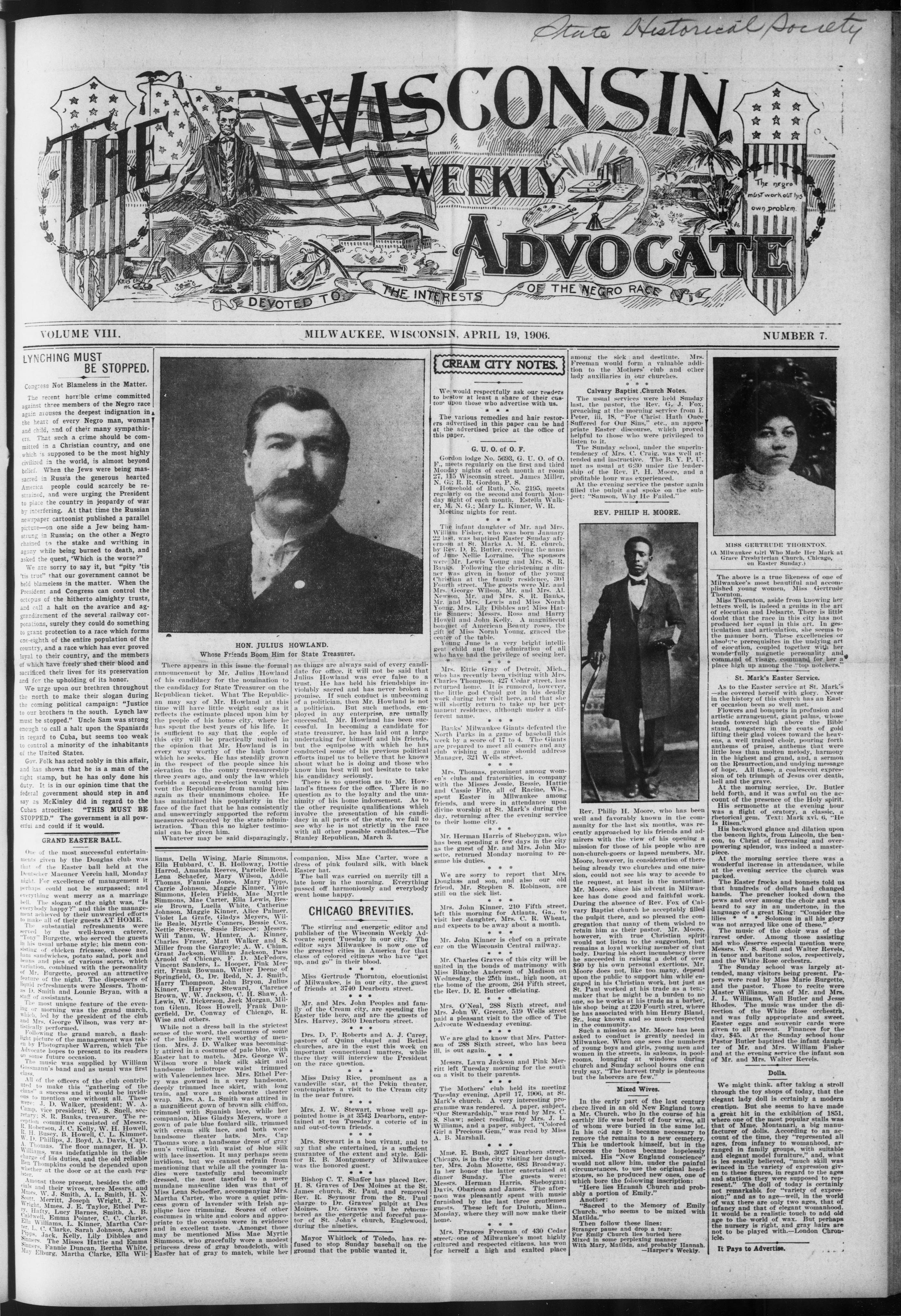
Page text (machine-generated)
State Historical Society
WISCONSIN
WEEKLY
ADVOCATE
DEVOTED TO THE INTERESTS OF THE NEGRO RACE
LYNCHING MUST BE STOPPED.
LYNCHING MUST BE STOPPED.
Congress Not Blameless in the Matter.
The recent horrible crime committed against three members of the Negro race again arouses the deepest indignation in the heart of every Negro man, woman and child, and of their many sympathizers. That such a crime should be committed in a Christian country, and one which is supposed to be the most highly civilized in the world, is almost beyond belief. When the Jews were being massacred in Russia the generous hearted America people could scarcely be restrained, and were urging the President to place the country in jeopardy of war by interfering. At that time the Russian newspaper cartoonist published a parallel picture—on one side a Jew being hamstrung in Russia; on the other a Negro chained to the stake and writhing in agony while being burned to death, and asked the quest, 'Which is the worse?'
We are sorry to say it, but "pity 'tis 'tis true" that our government cannot be held blameless in the matter. When the President and Congress can control the octopus of the hitherto almighty trusts, and call a halt on the avarice and aggrandizement of the several railway corporations, surely they could do something to grant protection to a race which forms one-eighth of the entire population of the country, and a race which has ever proved loyal to their country, and the members of which have freely shed their blood and sacrificed their lives for its preservation and for the upholding of its honor.
We urge upon our brethren throughout the north to make their slogan during the coming political campaign: "Justice to our brothers in the south. Lynch law must be stopped." Uncle Sam was strong enough to call a halt upon the Spaniards in regard to Cuba, but seems too weak to control a minority of the inhabitants of the United States.
Gov. Folk has acted nobly in this affair, and has shown that he is a man of the right stamp, but he has only done his duty. It is in our opinion time that the federal government should step in and say as McKinley did in regard to the Cuban atrocities: "THIS MUST BE STOPPED." The government is all powerful and could if it would.
GRAND EASTER BALL
One of the most successful entertainments given by the Douglas club was that of the Easter ball held at the Deutscher Maenner Verein hall, Monday night. For excellence of management it perhaps could not be surpassed; and everything went merry as a marriage bell. The slogan of the night was, "Is everybody happy?" and this the management achieved by their unwearied efforts to make all of their guests AT HOME.
The substantial refreshments were served by the well-known caterer, "Tony" Burgette, who served the guests in his usual urbane style; his menu consisting of chicken fricasse, cheese and ham sandwiches, potato salad, pork and beans and pies of various sorts, which variation, combined with the personality of Mr. Burgette, proved an attractive feature of the night. The dispensers of liquid refreshments were Messrs. Thomas D. Smith and Lonnie Bryan, with a staff of assistants.
The most unique feature of the evening or morning was the grand march, which led by the president of the club and Mrs. George Wilson, was very artistically performed.
Following the grand march, a flashlight picture of the management was taken by Photographer Warren, which The Advocate hopes to present to its readers on some future occasion. The music was supplied by William Gossmann's band and as usual was first class.
All of the officers of the club contributed to make this "gathering of the clans" a success and it would be invidious to mention one without all. These were: J. D. Walker, president; W. A. Camp, vice president; W. S. Snell, secretary; S. R. Banks, treasurer. The reception committee consisted of Messrs, R. Roberson, J. C. Kelly, W. H. Howell, R. H. Busey, B. Howell, C. L. Kimmer, W. D. Phillips, J. Boyd, A. Davis, Capt, A. Thomas. The floor manager, H. D. Williams, was indefatigable in the discharge of his duties, and the old reliable Ben Thompkins could be depended upon whether at the door or at the cash register.
Amonst those present, besides the officials and their wives, were Messrs. and Mmes. W. J. Smith, A. L. Smith, H. N. Scott. Merritt, Joseph Wright, J. E. Wright, Mmes. J. E. Taylor, Ethel Perry, Hafty, Lucy Barnes, Smith, A. B. Caldwell, Emma Pointer, C. C. Clarke, Ella Williams, L. Kinner, Martha Carter, L. C. Clarke, Sarah Johnson, Agnes Pipps, Jack, Kelly, Lily Dibbles and Sinners. The Misses Hattie and Emma Sinners, Fannie Duncan, Bertha White, May Elburg, Martha Clarke, Ella Wil-
There appears in this issue the formal announcement by Mr. Julius Howland of his candidacy for the nomination to the candidacy for State Treasurer on the Republican ticket. What The Republican may say of Mr. Howland at this time will have little weight only as it reflects the estimate placed upon him by the people of his home city, where he has spent the best years of his life. It is sufficient to say that the people of this city will be practically united in the opinion that Mr. Howland is in every way worthy of the high honor which he seeks. He has steadily grown in the respect of the people since his elevation to the county treasurership three years ago, and only the law which forbids a second re-election would prevent the Republicans from naming him again as their unanimous choice. He has maintained his popularity in the face of the fact that he has consistently and unswervingly supported the reform measures advocated by the state administration. Than this no higher testimonial can be given him.
Whatever may be said disparagingly,
liams, Della Wising, Marie Simmons, Ella Hubbard, C. B. Holloway, Dottie Harrod, Amanda Reeves, Partelle Reed, Lena Schaefer, Mary Wilson, Addie Thomas, Fannie Jones, Mary Pipps, Carrie Johnson, Maggie Kinner, Vinie Simmons, Helen Fields, Mae Myrtle Simmons, Mae Carter, Ella Lewis, Bessie Brown, Luella White, Catherine Johnson, Maggie Kinner, Alice Palmer, Violet La Grafe, Gladys Meyers, Willie Beale, Myrtle Conners, Bessie Cox, Nettie Stevens, Susie Briscoe; Messrs. Will Tanm, W. Hunter, A. Kinner, Charles Fraser, Matt Walker and S. Miller from the Gargoyle; A. W. Chinn, Grant Jackson, William Jackson, Pass Arnold of Chicago, F. D. McFedors, Vincent Sanders, L. Hooper, Pink Merritt, Frank Bowman, Walter Deene of Springfield, O., Dr. Redd, N. J. Smith, Harry Thompson, John Bryon, Julius Kinner, Harvey Steward, Clarence Brown, W. W. Jackson, C. H. Shaw, A. Lewis, W. Dickerson, Jack Morgan, Milton Glenn, Ross Howell, Frank Dangerfield, Dr. Conway of Chicago, R. Wise and others.
While a dress ball in the strictest sense of the word, the costumes of some of the ladies are well worthy of mention. Mrs. J. D. Walker was becomingly attired in a costume of pale blue, with Easter hat to match. Mrs. George W. Wilson wore a black silk skirt and handsome heliotrope waist trimmed with Valenciennes lace. Mrs. Ethel Perry was gowned in a very handsome, deeply trimmed lace skirt, with long train, and wore an elaborate theater wrap. Mrs. A. L. Smith was attired in a magnificent gown of brown silk chiffon, trimmed with Spanish lace, while her companion, Miss Gladys Meyers, wore a gown of pale blue foulard silk, trimmed with cream silk lace, and both wore handsome theater hats. Mrs. Cap Thomas wore a handsome dress of gray nun's veiling, with waist of blue silk with lace insertion. It may perhaps seem invidious, but we cannot refrain from mentioning that while all the younger ladies were tastefully and becomingly dressed, the most tasteful to a mere mundane masculine idea was that of Miss Lena Schoeffer, accompanying Mrs. Martha Carter, who wore a quiet princess gown of lavender with Irish applique lace trimming. Scores of other costumes in white and colors and appropriate to the occasion were in evidence and in excellent taste. Amongst those may be mentioned Miss Mae Myrtle Simmons, who gracefully wore a modest princess dress of gray broadcloth, with Easter hat of gray to match, while her
as things are always said of every candidate for office, it will not be said that Julius Howland was ever false to a trust. He has held his friendships inviolably sacred and has never broken a promise. If such conduct is unbecoming of a politician, then Mr. Howland is not a politician. But such methods, employed in any enterprise, are usually successful. Mr. Howland has been successful. In becoming a candidate for state treasurer, he has laid out a large undertaking for himself and his friends, but the equipoise with which he has conducted some of his previous political efforts impel us to believe that he knows about what he is doing and those who know him best will not hesitate to take his candidacy seriously.
There is no question as to Mr. Howland's fitness for the office. There is no question as to the loyalty and the unanimity of his home indorsement. As to the other requisite qualifications which involve the presentation of his candidacy in all parts of the state, we fail to see why he is not strictly in the race with all other possible candidates.—The Stanley Republican, March 3.
companion, Miss Mae Carter, wore a dress of pink foulard silk, with black Easter hat. The ball was carried on merrily till a late hour in the morning. Everything passed off harmoniously and everybody went home happy.
CHICAGO BREVITIES
The stirring and energetic editor and publisher of the Wisconsin Weekly Advocate spent Tuesday in our city. The editor says Milwaukee is now one of the greatest cities in America for that class of colored citizens who have "get up, and go" in their blood.
* * *
Miss Gertrude Thornton, elocutionist of Milwaukee, is in our city, the guest of friends at 3740 Dearborn street.
***
Mr. and Mrs. John Peoples and family of the Cream city, are spending the Easter tide here, and are the guests of Mrs. Harvey, 3610 Dearborn street.
* * *
Drs. D. P. Roberts and A. J. Carey, pastors of Quinn chapel and Bethel churches, are in the east this week on important connectional matters, while there they will interview the President on the race question.
***
Miss Daisy Rice, prominent as a vaudeville star, at the Pekin theater, contemplates a visit to the Cream city in the near future.
* * *
Mrs. J. W. Stewart, whose well appointed home is at 3543 Dearborn, entertained at tea Tuesday a coterie of in and out-of-town friends.
* * *
Mrs. Stewart is a bon vivant, and to say that she entertained, is a sufficient guarantee of the extent and style. Editor R. B. Montgomery of Milwaukee was the honored guest.
***
Bishop C. T. Shaffer has placed Rev. H. S. Graves of Des Moines at the St. James church, St. Paul, and removed Rev. R. Seymour from the St. Paul charge to Dr. Graves' pulpit at Des Moines. Dr. Graves will be remembered as the energetic and forceful pastor of St. John's church, Englewood, during the nineties.
Mayor Whitlock of Toledo, has refused to stop Sunday baseball on the ground that the public wanted it.
We would respectfully ask our readers to bestow at least a share of their custom upon those who advertise with us.
The various remedies and hair restorers advertised in this paper can be had at the advertised price at the office of this paper.
G. U. Q. of Q. F.
Gordon lodge No. 5693, G. U. O. of O. F., meets regularly on the first and third Monday nights of each month at room 27, 115 Wisconsin street. James Miller, N. G.; R. R. Gordon, P. S. Household of Ruth, No. 2195, meets regularly on the second and fourth Monday night of each month. Estella Walker, M. N. G.; Mary L. Kinner, W. R.
***
The infant daughter of Mr. and Mrs. William Fisher, who was born January 22 last, was baptized Easter Sunday afternoon at St. Marks A. M. E. church, by Rev. D. E. Butler, receiving the name of June Nellie Lorraine. The sponsors were Mr. Lewis Young and Mrs. S. R. Banks. Following the christening a dinner was given in honor of the young Christian at the family residence, 301 Fourth street. The guests were Mr. and Mrs. George Wilson, Mr. and Mrs. Al. Newson, Mr. and Mrs. S. R. Banks, Mr. and Mrs. Lewis and Miss Norah Young, Mrs. Lily Dibbles and Miss Hattie Sinners; Messrs. Ross and Harry Howell and John Kelly. A magnificent bouquet of American Beauty roses, the gift of Miss Norah Young, graced the center of the table.
Young June is a very bright intelligent child and the admiration of all who have had the privilege of seeing her.
Mrs. Ettie Gray of Detroit, Mich., who has recently been visiting with Mrs. Charles Thompson, 427 Cedar street, has returned home. It is rumored, however, the little god Cupid got in his deadly work during her visit here, and that she will shortly return to take up her permanent residence, although under a different name.
☆ ☆ ☆
Banks' Milwaukee Giants defeated the North Parks in a game of baseball this week by a score of 17 to 4. The Giants are prepared to meet all comers and any club wishing a game should address Manager, 321 Wells street.
***
Mrs. Thomas, prominent among women's clubs and fraternities, in company with the Misses Jessie, Bessie, Hattie and Cassie Fite, all of Racine, Wis., spent Easter in Milwaukee among friends, and were in attendance upon divine worship at St. Mark's during the day, returning after the evening service to their home city.
* * *
Mr. Herman Harris of Sheboygan, who has been spending a few days in the city as the guest of Mr. and Mrs. John Mosette, returned Monday morning to resume his duties.
* * *
We are sorry to report that Mrs. Douglass and son, and also our old friend, Mr. Stephen S. Robinson, are still on the sick list.
* * *
Mrs. John Kinner, 210 Fifth street, left this morning for Atlanta, Ga., to visit her daughter, Mrs. C. R. Wheat, and expects to be away about a month.
\* \* \*
Mr. John Kinner is chef on a private car on the Wisconsin Central railway.
Mr. Charles Graves of this city will be united in the bonds of matrimony with Miss Blanche Anderson of Madison on Wednesday, the 25th inst., high noon, at the home of the groom, 264 Fifth street, the Rev. D. E. Butler officiating.
* * *
Mrs. O'Neal, 288 Sixth street, and Mrs. John W. Greene, 519 Wells street paid a pleasant visit to the office of The Advocate Wednesday evening.
***
We are glad to know that Mrs. Patterson of 288 Sixth street, who has been ill, is out again.
* * *
Messrs. Lawn Jackson and Pink Merritt left Tuesday morning for the south on a visit to their parents.
***
The Mothers' club held its meeting Tuesday evening, April 17, 1906, at St. Mark's church. A very interesting programme was rendered. A paper, subject, "Our Stewardship," was read by Mrs. C. S. Shaw; select reading, by Mrs. J. L. Williams, and a paper, subject, "Colored Girl a Precious Gem," was read by Miss A. B. Marshall.
---
Mme. E. Bush, 3027 Dearborn street, Chicago, is in the city visiting her daughter, Mrs. John Mosette, 683 Broadway. In her honor the latter entertained at dinner Sunday. The guests were Messrs. Herman Harris, Sheboygan, Davis, Obaricon and James. The afternoon was pleasantly spent with music furnished by the last three gentlemen guests. These left for Duluth, Minn., Monday, where they will now make their home.
* * *
Mrs. Frances Freeman of 430 Cedar street, one of Milwaukee's most highly cultured and respected citizens, has won for herself a high and exalted place
among the sick and destitute. Mrs. Freeman would form a valuable addition to the Mothers' club and other lady auxiliaries in our churches.
Calvary Baptist Church Notes.
The usual services were held Sunday last, the pastor, the Rev. G. J. Fox, preaching at the morning service from I. Peter, iii, 18, "For Christ Hath Once Suffered for Our Sins," etc., an appropriate Easter discourse, which proved helpful to those who were privileged to listen to it.
The Sunday school, under the superintendency of Mrs. C. Craig, was well attended and instructive. The B. Y. P. U. met as usual at 6:30 under the leadership of the Rev. P. H. Moore, and a profitable hour was experienced.
At the evening service the pastor again filled the pulpit and spoke on the subject: "Samson, Why He Failed."
REV. PHILIP H. MOORE.
THE LEGEND OF THE WORLD'S FIRST BLACK MAN
Rev. Philip H. Moore, who has been well and favorably known in the community for the last six months, was recently approached by his friends and admirers with the view of his opening a mission for those of his people who are non-church-goers or lapsed members. Mr. Moore, however, in consideration of there being already two churches and one mission, could not see his way to accede to the request, at least in the meantime. Mr. Moore, since his advent in Milwaukee has done good and faithful work. During the absence of Rev. Fox of Calvary Baptist church he acceptably filled the pulpit there, and so pleased the congregation that many of them wished to retain him as their pastor. Mr. Moore, however, with true Christian spirit would not listen to the suggestion, but remains a loyal working member of that body. During his short incumbency there he succeeded in raising a debt of over $60 by his own personal exertions. Mr. Moore does not, like too many, depend upon the public to support him while engaged in his Christian work, but just as St. Paul worked at his trade as a ten-maker that he might be a burden to no one, so he works at his trade as a barber, his shop being at 220 Fourth stret, where he has associated with him Henry Bland, Sr., long known and so much respected in the community.
Such a mission as Mr. Moore has been asked to conduct is greatly needed in Milwaukee. When one sees the numbers of young boys and girls, young men and women in the streets, in saloons, in poolrooms, lounging at windows during church and Sunday school hours one can truly say, "The harvest truly is plenteous but the laborers are few."
Mixed Wives.
In the early part of the last century there lived in an old New England town a Mr. Church, who in the course of his earthly life was bereft of four wives, all of whom were buried in the same lot. In his old age it became necessary to remove the remains to a new cemetery. This he undertook himself, but in the process the bones became hopelessly mixed. His "New England conscience" would not allow him, under the painful circumstances, to use the original headstones, so he produced new ones, one of which bore the following inscription:
"Here lies Hannah Church and probably a portion of Emily."
Another:
"Sacred to the Memory of Emily Church, who seems to be mixed with Matilda."
Then follow these lines: Stranger pause and drop a tear: For Emily Church lies buried here Mixed in some perplexing manner With Mary, Matilda, and probably Hannah.
NUMBER 7.
THE WOMEN'S HERITAGE
The above is a true likeness of one of Milwaukee's most beautiful and accomplished young women, Miss Gertrude Thornton. Miss Thornton, aside from knowing her letters well, is indeed a genius in the art of elocution and Delsarte. There is little doubt that the race in this city has not produced her equal in this art. In gesticulation and articulation, she seems to the manner born. These excellencies or absolute prerequisites in the undying art of elocution, coupled together with her wonderfully magnetic personality and command of visage, command for her a place high up among the "top notchers."
St. Mark's Easter Service
As to the Easter service at St. Mark's—she covered herself with glory. Never in the history of this church has an Easter occasion been so well met.
Flowers and bouquets in profusion and artistic arrangement, giant palms, whose heads towered high above the Bible stand, songsters in the coats of gold lifting their glad voices toward the heavens, a well trained choir, pouring forth anthems of praise, anthems that were little less than molten melody, harmony in the highest and grand, and, a sermon on the Resurrection, and undying message of hope. All these, a coalescent expression of teh triumph of Jesus over death, hell and the grave.
At the morning service, Dr. Butler held forth, and it was awful on the account of the presence of the Holy spirit.
His sermonette at the evening hour was a flight of oratory, a classic, a rhetorical gem. Text: Mark xvi. 6, "He Is Risen."
His backword glance and dilation upon the beacon lights, from Lincoln, the beacon, to Christ of increasing and overpowering splendor, was indeed a masterpiece.
At the morning service there was a wonderful increase in attendance, while at the evening service the church was packed.
The Easter frocks and bonnets told us that hundreds of dollars had changed hands. The preacher looked down the pews and over among the choir and was heard to say in an undertone, in the language of a great King: "Consider the lilies * * * Solomon in all his glory was not arraved like one of these."
The music of the choir was of the rarest order. Among those assisting and who deserve especial mention were Messrs. W. S. Snell and Walter Revels, in tenor and baritone solos, respectively, and the White Rose orchestra.
The Sunday school was largely attended, many visitors being present. Papers were read by Miss Marie Burgette, and the pastor. Those to recite were Master Williams, son of Mr. and Mrs. J. L. Williams, Wall Butler and Jesse Rhodes. The music was under the direction of the White Rose orchestra, and was fully appropriate and sweet. Easter eggs and souvenir cards were given to all present. Finances for the day, $45. At the Sunday school hour Pastor Butler baptized the infant daughter of Mr. and Mrs. William Fisher and at the evening service the infant son of Mr. and Mrs. Walter Revels.
Dolls.
We might think, after taking a stroll through the toy shops of today, that the elegant lady doll is certainly a modern creation. But she seems to have made a great hit in the exhibition of 1851, where one of the most popular stalls was that of Mme. Montanari, a big manufacturer of dolls. According to an account of the time, they "represented all ages, from infancy to womanhood, arranged in family groups, with suitable and elegant model furniture," and, what is les seasily believed, "much skill was evinced in the variety of expression given to these figures, in regard to the ages and stations they were supposed to represent." The doll of today is certainly not remarkable for "variety of expression;" and as to age—well, in the world of wax there are only two ages, that of infancy and that of elegant womanhood. It would be a realistic touch to add old age to the world of wax. But perhaps the nursery is right, and gray hairs are not to be played with.—London Chronicle.
It Pays to Advertise.
while tearing down an old barn on the place of William Melton at Mount Vernon, Ind., a jar entaining $1,700 in gold coins was found by workmen.
It was decided at a meeting of Logansport Presbyterians at Valparaiso, Ind., that unless something was done to get men to go to church there wouldn't be enough of them in heaven to sing bass.
Mrs. Joe Schwab of Findlay, O., took Paris green because she dreaded, as she said, to care for her husband, who was injured in a runaway. A physician, however, arrived in time to save the woman's life.
Coveting it for use as a hair ribbon, a 15-year-old girl took the crape off the door of a house of mourning in Chicago and made off with it. She was arrested by a policeman who saw the act and gave the name of Clara Beckstrom.
After being whipped for some prank a fox terrier dog belonging to Charles Moore of Salem, O., killed itself. A loose end of rope was hanging near the window of a shed, and placing its head within the noose of the rope the dog leaped out of the window and hanged.
Benjamin Hitchcock, 20 years old, wedded Mrs. Alice Wilbur, aged 60 years and twice a widow at Meriden, Conn. Neighbors did not take kindly to the arrangement, and gave the couple a charivari, showering the house with missiles, until the police were forced to scatter the crowd. Cooks, second girls, nurse girls and laundry girls of Wilkes-Barre, Pa., have started the formation of a union, by which they expect to regulate the hours of work, adopt and observe a regular scale of wages and determine privileges. The women say their hours are too long and their pay too low.
The Pennsylvania's officers reported on their arrival in New York that during target practice off Cape Cruz on April 7 one of the ship's 6-inch gun batteries under the command of Lieut. J. R. Brady scored seventeen hits in 90 seconds. This is said to be a new world's record for the 6-inch gun.
Safe-blowers operated in the postoffice at Birmingham, a village near Norwalk. O. The safe contained $800 in money and $100 in stamps, but the discharge of the explosive so twisted the inner door of the safe that the men failed to secure booty. The outer door was blown off. They got away in a stolen rig.
When the fast mail on the Lake Shore reached Laporte, Ind., it carried a passenger who was not down on the conductor's list. Anna Ryguanen of Ashtabula, O., who was en route from Minneapolis, Minn., to her home, gave birth to a male child just as the train reached the station.
The Meteor express on the St. Louis & San Francisco road leaped safely over a gap of three feet in a bridge between Turck and Scanmon, Kan., the fact that it was going nearly sixty miles an hour enabling it to cross the break in the structure. The break was caused by an explosion of dynamite placed on the rails by train wreckers.
John Myers, aged 73, who mysteriously disappeared from his home at Zanesville, Q., forty years ago, leaving a blind wife and five small children, turned up last week at the home of his son, Wil, liam Myers, east of Leabanon, Ind. Myers was supposed to be dead. His wife died of a broken heart shortly after he left home and two of his children are dead. He claims that the past is a blank.
Rebecca Blough of Johnstown, Pa., almost laughed herself to death. She took a small piece of camphor for a cold from which she had been suffering, and was poisoned. The drug acted upon certain nerves and caused the young woman to laugh. She could not refrain, and when a doctor was called in she was in a serious condition. Drugs which act as an antidote for camphor poisoning were administered, and Miss Blough, who is 18 years of age, is now somewhat better.
Believing that she had been robbed of valuable jewels while ill, Mrs. Joseph H. Pineau of Williamsport, Pa., had a man servant arrested, and he was detained at the police station for a hearing recently. Mrs. Pineau afterward dreamed that she saw her jewels at the bottom of a basket containing chinaware. In the morning she looked in such a basket in a closet, and there were the jewels, evidently having been dropped therein. The domestic was discharged from custody at once.
---
Augustus and Elizabeth Swartz, residents of Plain Township, O., were found at their isolated home, starving. They are brother and sister, and, although they are well-to-do, they positively refused to take food until the officers made all sorts of dire threats. Two weeks ago Augustus told neighbors that "he and Elizabeth had sworn off eating." The remark was treated as a joke. When found they were in bed sick from their long fasting. If they insist upon starving they will be sent to the county infirmary.
---
Miss Cora Arnold, aged 52 years, may not marry Albino Cravarria, the blanket Indian of whom she has been enamored the last eight years. Although Rev. Thomas Uzzell of Denver, Colo., is said to have announced his willingness to unite the pair, Miss Arnold hesitates, because so many friends have pleaded with her not to wed the redskin. It is believed she is making arrangements to reimburse him for his trouble and to send him back to the reservation. Miss Arnold occupies a fine suite of rooms at the Colonade, a Capital Hill apartment house in Denver, while the savage is quartered in a cheap lodging house.
No Sense of Humor.
An old Georgia darkey owned a small and ancient mule, but which, as a casual question as to the price at which it was held, became suddenly endowed with all the virtues of the best blood in Kentucky.
"But he is at least 20 years old, uncle," the would-be purchaser protested.
"Dat mule?" Uncle Mose said, indignantly. "No, sah! Et dat mule's no' an 6 years ole, Ah hopes he dies fo' mawning!"
Upon visiting his stable the next day, Uncle Mose was struck with consternation to find his animal stretched lifeless on the ground.
"Look at dat, now!" he exclaimed, with intense disgust. "What yo' think o' dat? Never did see sich er fool mule—couldn't eben take er lil' joke lack dat!"—Harper's Weekly.
Has Perfected Green Carnation.
Rober Calvert, a veteran horticulturist, for twenty-five years secretary of the La Crosse, Wis., board of trade, has perfected a green carnation perfect in coloring, fragrance and beauty. He declines to reveal the secret of the culture of his new flower.
AN OLD FIREPLACE.
When Summer days come, ye forsake
My settles for the green-wood's sake,
But soon, ashamed, for auld lang syne
Ye bring me oak boles, knots of pine,
And heap my arms with gifts, and I
Crackle forgiveness merrily.
And on my settles young and old
Gather to hear old tales retold.
Old tongues rehearse them staid and slow
The younger lisp and prattle so
The tale's half lost in laugh and shout,
And ere I know it I'm half out.
And soon they bring the night log in.
And in the dim light I begin
To tell my story, old and wise:
So you may dress it, Sleepy Eyes,
When Mother tucks you into bed
And smooths the pillow for your head.
—Richard Kirk in American Magazine.
THE ROMANCE OF A FAN.
Outside, the leaves rustled beneath the starlit, frosty sky, and the wind moaned fitfully around the solitary old gray house. I knew that the sky was cold and star-gemmed, because I could peep up at it through the unshuttered window from my resting place on the little table. Inside, the firelight danced on the oak-paneled wall of the low-ceiled room, and Joyce, from the cozy depths of her chair, watched the play of the flickering shadows among the gleaming old silver on the tea table before her.
Her lovely face, framed in its halo of dead-gold hair, was very sad and wistful. I could read her thoughts, for I possessed certain occult powers, owing to my eastern origin. She was living over again the sad events of the last two weeks. She seemed still half dazed from the suddenness of it all. Perhaps she could scarcely realize even yet that her dear mother, her loving lifelong companion, had been taken from her forever.
"I cannot go on like this any longer," her thoughts ran; "the loneliness would drive me mad! Was any girl ever in such a sorry plight, I wonder? Of course, I always knew that mother's income was only for her lifetime; but then I never thought of her dying, nor did she, except in the dim future.
"And now here I am, after the funeral expenses and the doctor's bill have been settled and the servants paid off, with exactly a ten-pound note between myself and starvation—literally starvation! The house is my own, truly, and I have clothes to last me a twelvemonth or more," glancing down ruefully at her plain but dainty mourning.
"There's all of granny's lovely old silver, too. That is mine now, of course; but even if I sold it I should only be staving off the evil day. And it would be almost a crime. I must bestir myself and think of something tangible. If only Jack! If only—" And she broke off with a sigh.
At this point in her musings my eyes caught hers in a flash of sympathy, and, stretching out her little white hand, she took me up caressingly.
I was the first love offering he had made her, and in my way was considered a rare curio of intrinsic worth and great beauty.
Well! I have said that Joyce took me up caressingly. She did, and pressed me a moment against her pretty lips. She was thinking more of Jack than of me, I knew. But where was the use of looking back? It was all nearly two years ago now, and the mystery was still unsolved. She had never been to another dance since that fateful night; consequently neither had I.
That fatal night of the Hunt ball was our last glimpse of gaiety. And he was there, and he had never come near us; he had carefully avoided meeting her eyes whenever the mazes of the dance had brought him into her vicinity. Her pride had forbidden her to make the slightest sign, and she had borne up bravely until we were back in her pretty bedroom, quite alone. And well I knew then how much she had really cared!
A few weeks later she heard he had gone abroad—gone without a word or a sign.
A few days later Joyce journeyed off to the smart little country town some three miles distant, and the next morning the following advertisement appeared in the county paper, for I heard her read it out to our one faithful maid-of-all-work: "Lady desiring residence in beautifully situated country home can be received on moderate terms.—Apply The Cottage, Mereton." And a week later, after the usual formalities had been exchanged, the lady arrived, and was duly installed—an exceedingly prim old lady of quaint and dignified demeanor, with gray curls down each side of her face and her eyes partially obscured behind smoke-colored glasses. I detested her on the spot.
One evening, a few days after her arrival. Joyce and her paying guest were chatting amicably over their teacups when the latter suddenly exclaimed, in the gruff voice I disliked so much:
"What a very pretty fan that is, and how those two emeralds gleam in the lamplight!"
Joyce rose from her chair and handed me over for inspection.
"Remarkably well-cut stones! I do not think I ever saw such perfect imitations!"
"Oh, but they are not imitations! They are genuine, I assure you!" corrected Joyce.
"My dear child, are you not rather unwise to have anything so valuable lying about? Real stones of this size must be worth quite a sum of money?"
"I have never thought about its monetary value. It was a present from some one for whom I had a very deep regard, and is associated with many very dear memories. I think it is quite safe. You see this is my own private sanctum, and very few people beside myself ever come here."
In that same night, just as the clock in the corner had ceased chiming 3, I heard a stealthy step outside in the hall, and the door of the room I was in was cautiously opened.
I could just discern the figure of a man groping his way toward the tea table, where the beautiful silver service rested on its tray. He commenced quickly to transfer the silver pieces into a large canvas bag. Then clutching me roughly, he thrust me into the darkness of an outside pocket, where everything became a blank.
My next recollection was of being jerked violently out of the man's pocket and landing in the mud of a silent gaslit street. He hurried on—he was running—leaving me behind, a prey to many
fears, splashed and begrimed, and wondering what my fate would be.
Later on the sleeping street began to arouse. At last a postman saw me, stooped and picked me up, muttering something about a "queer piece of mumbo jumbo." And, wiping the mud carefully from me with his red handkerchief, he put me into his pocket, and once more everything became a blank.
One evening a few days later there was a knock at the door of the little parlor, and a pleasant manly voice explained:
"I have called in reference to your advertisement respecting a fan."
Where had I heard that voice before? "Well, sir, if you can describe it satisfactorily, as I stated, you can have it!"
"You said a curious fan, entwined initials, J. J. It was the coincidence of the initials which struck me, as I had them carved on the fan myself when I presented it to the lady to whom I fancy it belongs."
That voice! Of course, it was Jack's! My green eyes glowed with suppressed excitement.
"If it is the fan I suppose, it is carved out of ivory, with two large emeralds set obliquely in the first stem."
"That is your fan, sir! Half a minute, sir!"
And in less than that time I was in Jack's firm clasp.
There was a little chinking sound, a surprised and grateful "Thank you, sir," on the part of the postman, a brisk "Good night" from Jack, then off once more.
Where was I bound for now? And what would be the sequel to it all, I wondered! But I could almost guess.
I was back in my dainty little sanctum; was clasped between Joyce's dear soft hands; and they were crushed against her throbbing heart. I could feel how fast it was beating!
I was very interested, and kept an eye on each of them. She had only just come into the room. He stood on the hearth-rug facing her, and she was staring with lovely wide startled eyes up into his own. She had taken me mechanically from him; scarcely, as I could see, grasping his explanation.
"I—er—saw the little beggar advertised, you know, with our joint initials, and—and—all the rest of it!"
No answer.
"I heard of your loss, Joyce," glancing tenderly at the little black-robed figure; "and that you had not married Marsden after all!" he went on, hurriedly. He was very white and agitated, I could see.
"Married Marsden!" she echoed, faintly, trying to calm herself. "Marsden never proposed to me!"
"Never proposed to you! Do you mean to say that she lied? That it has all been some hideous mistake?"
"Who lied? What has been a mistake?"
"Hilda Marsden! She told me you had accepted her brother that night of the Hunt ball. You remember? Joyce, darling, can you ever forgive me?"
And so the mystery was explained at last! Hilda Marsden had been Joyce's most intimate friend those days! The old, old story of love and jealousy, I suppose.
Of the thief who stole me nothing more was ever heard, or of the beautiful old silver tea service, or of the paying guest for she disappeared the same night, leaving her black silk gown, with her cap and ringlets and spectacles behind her, Modern Society.
MAKE HOME MADE RAG DOLLS
Large, Thrifty Enterprise Developed Out of Merely an Experiment.
Young children love a rag doll—one that they can knock around and sit upon and hug to their heart's content—more than all the French finery in the doll way that ever was planned. Acting on this knowledge, two women have started an industry in home-made rag doll-making which has proved to be most profitable, surpassing all expectations.
Miss Marietta Adams and her sister, Miss Emma, started the idea originally to give pleasure to their baby friends, but it has now become an established business of distinct commercial importance. One of the sisters was formerly a crayon artist and the other a stenographer, but they possessed business acumen which has been utilized most profitably. Many women are employed, and so great is the demand for these rag babies that it is almost impossible to fill the orders. The industry is a living example of the fact that capital and a college education are not always necessary to win success in the commercial world.
The incident which led up to an independent business career for the two girls occurred while visiting friends in Chicago. Just to give pleasure to some little folk several dolls were made. So attractive were they that friends desired to purchase them. One admirer took upon herself to show them to a department store, with the result that the firm offered a market at once for all the dolls that they could make that season.
In 1903 a collection was entered for sale in the children's building at the Columbian exposition. So great was the demand for them that with all the assistance at command it was impossible to fill orders. At the close of the exposition, to the surprise and delight of the young women, their work was awarded honorable mention by the World's Columbian Exposition commissioners. Success continued to follow in the wake of the dolls, and for the next five years the number manufactured was doubled, until 1904 it reached the 5000 mark. Up to the fall of 1898, the mother and two daughters constituted the working force. Shortly afterward, Miss Emma Adams, the pioneer of the enterprise, died suddenly. Since then a large force has been employed and artists engaged to paint the heads.
These playthings are widely scattered among European countries and many are to be found in the collections of children of royalty.—Pictorial Review.
Took Chances.
During the recent visit of the first division of the North Atlantic squadron plans for entertaining Rear Admiral Evans and his officers were spoiled by the sudden indisposition of "Fighting Bob." A party of ladies were exploring the flagship under the guidance of a grizzled quartermaster when one of them, referring to the awkward circumstance, remarked inquiringly:
"I suppose you sailors are sorry that the admiral is sick?"
"Indeed we are, mum," said the quartermaster. "But," lowering his voice confidentially, "we all knew the old man was in for it when we saw him sampling the grub that's served out to us fellows for'ard."
The Wastefulness of Wood Workers
In a great number of works and mills, wood is being wastefully burned in ordinary furnaces designed for good coal. In some cases wood alone is burned, in other cases it is mixed with coal, either
large or small; indeed, it may be fairly observed that in many works good coal is being burned to consume the wood—a practice not at all uncommon, and entirely due to the ignorance of the steam uscr, who too often is quite satisfied if he can generate such steam as he requires under any circumstances.
In many saw mills, etc., sufficient wood waste is available to provide the whole of the steam power required if such fuel is burned under the best conditions, and in this industry needless to add it would be very beneficial if coal accounts could be entirely closed. Such a desideratum, however, will be reached only by burning wood waste under those scientific conditions which will insure the maximum value being secured, and fully utilized. The nature of the material is such that it can be best burned outside of the boiler in an external cell or furnace.—Engineering Magazine.
WITH MAY ACROSS THE SEA.
Once more to see familiar stars
Look down through friendly trees
Once more to feel the heart of youth
With May across the seas!
Once more to see the hyacinth
Press upward through the grass,
To hear the plowboy's tuneless song
Above the furrow pass.
In dreams the willows silver along the rising streams,
In dreams the shining valley puts on her Springtide gleams!
-Martha G. D. Bianchi in Everybody's Magazine.
LIVINGSTONE'S GUARD.
An Interview with One of Them in South Africa—Wonderful Knowledge of Country.
A letter to the editor of The Missionary Review recently received from Mrs. J. M. Bailey of the C. M. S. agency, Mombasa, British East Africa, gives some interesting details in regard to the last sickness of David Livingstone and the men who bore his body to the coast. Mrs. Taylor was led to write through reading in the "New Acts of the Apostles" the account of Livingstone's body-guard. It occurred to her that she might see "Matthew," and ask him a few details of that wonderful journey which had never been given to the public. She writes:
Matthew Wellington was one of the six boys from Nasik who came over from India to help find David Livingstone in Africa. He is still alive, a hale and hearty man, probably 50 and 60 years of age. He is an overseer in government employment, in the public works department. I have known him since 1885, and his daughter Florence is a good girl—a teacher in our C. M. S. school on the mainland, Freretown. One son, Henry, the oldest, is no good, but Join, the younger, is a steady lad. Ruth, the mother, is a capable woman, a good wife and mother.
"Matthew, one Sunday morning after service, came and told me about the starting and the journey; the meeting and serving his master. Livingstone; his wonderful knowledge of country and people and languages. He spoke of his weariness of body sometimes, and his trouble to get food for the porters of his camp. He dwelt on the missionary's upright, pure, clean life, his keeping the Sabbath with prayer and reading with his men, and his feast at Christmas for them. He told of Livingstone's weakness and death, after journeying up to the very last, as long as he could ride a donkey or walk.
"Matthew then graphically described the embalming, and added the information that for fourteen days the body lay in the sun, then it was turned over and exposed for another fourteen days. He also told what I have never heard before—that the legs were doubled up from the knee to the body to make the burden less like a corpse in carrying it across country. This shows the ingenuity of the native mind in an emergency. The heart and viscera were all buried.
The chief thought in the boys' mind was to do everything according to their orders at Nasik, from the Royal Geographical society's letter: 'Bring him or find him, alive or dead, to the coast.' This was their duty, and they stuck to the letter of the directions.
"Matthew described the first coffin made at Bagamoyo, on the coast of the French mission, and then, so natural to a native mind, spoke of the glory of a coffin of lead or tin, and the outer wooden one with brass handles, at the consulate of Zanzibar. He said that Jacob was a clever, intelligent boy, more so than any of the others, and no one grudged him the honor of the journey to England. He was afterward a teacher in the 'C. M. S.' for a time, but is now dead.
"Matthew has lived in Mombasa or Freretown ever since. He told me all these details in Terarhill, as I felt I should get the facts more fully in a native language than in English."
Importance of European Canals
Since the war with Germany in 1870- 71 the canal system of France has been improved and enlarged at the cost of about $500,000,000. That country has over 3000 miles of canals and nearly 4700 miles of rivers so improved for purposes of navigation that they are in large measure artificial waterways. The great network of French canals is all government property, and tolls are not charged.
In Germany the cost of improvements in internal waterways, mainly rivers, in the decade from 1890 to 1899, both years inclusive, was nearly $75,000,000. In recent years the development of German rivers and canals has gone forward at a great pace, and many important projects remain to be carried out. The Rhine and the Weser are to be connected by a canal. Berlin is to be made much more truly a seaport than it is now, the upper Danube is to be joined with the Rhine, and other vast improvements are to be undertaken.
Less advanced countries have made notable progress in this development of internal waterways. Austria-Hungary has approved a project for the connection of the Danube with the Oder, and ultimately through the Oder to the Elbe, and eastward to the Vistula, at the expense of $50,000,000. Russia is seriously considering the opening of a ship canal between the Black sea and the Baltic. The Don and other rivers would be utilized for a large part of the distance, and the undertaking would involve comparatively few engineering problems. It is a large enterprise, demanding much money, and it may be delayed because of Russia's financial burdens, but there is no doubt of its feasibility and it will yet become a fact.
All through Europe the canal and the canalized river are more valued than such waterways were a few years ago. The railroad is no longer looked upon as the destroyer of inland waterways. It is perceived that both the railways and the canals and rivers will be needed to meet the needs of trade and industry.—Cleveland Leader.
Left It to Her.
"Ethel," said a clergyman, to one of his parishioners whom he saw with her hair in curling pins, "if nature had wanted your hair to curl, She would have curled it for you."
"She did, sir, when I was a child," was the reply, "but I suppose she thinks, now, that I am old enough to do it myself."—Punch.
A TALE OF A TEA TABLE.
Betsy Bobbity baked a bun—
A beautiful, big bewitching one,
So light that it fairly shone with pride,
With currants a-plenty safe inside.
Patsy Popity peeled a peach.
A pear, and plum, and put them each
In a tiny pie with a frosted top,
As fine as those in the baker's shop.
Three little maids to the pantry flew
To look for the dishes pink and blue.
And a terrible tragedy happened next—
And my! but the three little maids were
vexed!
Young Puppety Pup came racing by.
And the little red table caught his eye;
Then never a bit he cared—not he—
That he hadn't been, asked to the dainty
tea:
But he ate up Betsy Bobbity's bun,
With all of the currants—every one,
The three little pies at a single bite,
And everything else there was in sight!
Dora Doppity cried, "Dear me!
What a capital time to give a tea!"
And she put the little red table out,
With three little chairs set round about.
And Betsy Bobbity's Baby Blue.
And Patsy Poppity's Precious Prue,
And Dora Doppity's Daisy Dee.
Were asked to come to a charming tea.
But never a word the three guests said.
As they gazed with a smile right straight
ahead;
And never they showed the least surprise,
Although, right under their very eyes,
The rude and ravenous Puppety P.
Ate all that they were to have had for tea!
Which shows us plainly that Baby Blue, And Daisy Dee, and the Precious Prue, Were well brought up, and clearly knew That the proper, ladylike thing to do Was never to make remarks at tea. Whatever they chanced to hear or see! -Ellen Manly in St. Nicholas.
DECIDE OWNERSHIP OF EGG
Who Is Lawful Possessor, Owner of Hen or Bar?
Who is the lawful possessor of an egg and its posterity—the man who owns the hen or the man who owns the barn which the proud fowl selected as a site for the great event? This is a problem which is causing the jurists of Danville, Ill., to mount their hair in perplexity.
Sensational features marked the hearing of the case. The "corpus delicti" of the chick that was hatched from the egg that was laid by the hen that chose the wrong barn, stark and unsightly after being interred for days, was presented for identification. A pair of bantam game chickens, rooster and hen, was introduced as exhibits "A" and "B." Nothing was then lacking to complete the chain of testimony except the original egg. But lo! a judicial miracle came to pass, and in open court the cackling hen laid another egg exactly like the one which had caused the litigation. It was seized upon and marked exhibit "C."
"Sid" Tate of Batestown was the defendant, and Charles McDaniels of the same community the complainant. The stories told by various witnesses developed the facts that Tate had imported a setting of bantam eggs from South Carolina three years ago, and had been peacefully engaged in the business of raising bantams ever since, until one of his hens wandered afield and made a nest in an alien barn. Tate did not know of this contretemps-for the mother hen came safely back to roost—until the next season, when he observed a lusty bantam scratching for worms in McDaniels' yard. Being the only owner of bantams in the vicinity, he became convinced that McDaniels had poached upon his preserves.
Accordingly Tate gave chase to the innocent bird, ran it to earth and wrung its neck, resolved that McDaniels should not establish an opposition bantam farm. He offered the corpse to a neighbor, but it was declined with thanks, so he buried it deep and did not mark its grave. When McDaniels discovered that Tate had murdered the foundling he brought suit against him. Justice Hall was unable to solve the riddle, but held Tate to the grand jury under a bond of $50. Whereupon Tate swore out a warrant for McDaniels' father-in-law, charging him with keeping a red bird in a cage, which is an infringement of the state laws. The entire county is hoping that the feud will not graduate from ornithological reprisals to shotguns.
Professor's Indorsement.
Before President Angell of the University of Michigan has attained to his present high position a young hopeful entering college was recommended to his consideration.
"Try the boy out, professor; criticise him and tell us both what you think," the parents said.
To facilitate acquaintance the professor took the boy for a walk. After ten minutes' silence the youth ventured, "Fine day, professor."
"Yes," with a faraway look.
Ten minutes more and the young man, squirming all the time, ventured, "This is a pleasant walk, professor."
"Yes."
For another ten minutes the matriculate boiled to his bones and then blurted out that he thought they might have rain.
"Yes." And this time the professor went on: "Young man, we have been walking together for half an hour, and you have said nothing which was not commonplace and stupid."
"True," answered the boy, his wrath passing his modesty, "and you indorsed every word I said."
Then they laughingly shook hands, and word went home from the professor that the boy was all right and that they were great friends.—Detroit Free Press.
Taken at His Word.
When Rossetti was a student of art he one day happened to go with some fellow students to the East End of London. There, at a wharfside inn, he saw an immense canvas on the barroom wall. After laughing at it for some time, and thus provoking the innkeeper's wrath, the following conversation took place: "Where did you get that picture?" "Oh, never mind, young man, where I got it." "What price do you set on it?" "More than you can afford!" "Indeed!" said Rossetti. "Now, how much?" "Three thousand pounds," replied the innkeeper. At this there was a loud burst of laughter from the young artists. "Do you know how much I would give you for your three-thousand-pound picture?" "How much?" asked the innkeeper. "Three pounds." said Rossetti.
"Done," said the innkeeper, promptly; and to his amazement and amusement Mr. Rossetti found himself the owner of the colossal daub,-Tit-Bits.
Growth of Beagling
Beagling, which a generation ago was followed only in some few and often out-of-the-way places, where each pack had an almost private existence, is now one of the most popular of country winter sports, with whole hosts of euthusiastic adherents in almost every part of the kingdom.-The Field.
Monkey Wears Spectacles
In the Breslau zoological garden there is a spider monkey, which was operated upon for cataract, and now wears glasses. It seems to do well and understands the reason for its strange facial adornment.
Graft Is Bascillus.
"You must deal with a bacillus as injurious as any encountered by medical officers. I refer to the bacillus of graft and financial irregularity. Nobody ever became bankrupt who kept books properly, and it is the duty of the pay corps to know what it has to spend and to keep strictly within its appropriations."
This was part of the advice Secretary Bonaparte gave to the members of the naval pay officers' school at the Washington navy yard. The secretary mentioned the saying attributed to Napoleon I., that "an army, like a serpent, crawls on its belly," and said it is even more accurate to say that a fleet swims on its belly. Sailors must be fed by their officers, and ineffective officers mean underfed men, for the sailor has no opportunity to obtain food for himself, the secretary said. Consequently, he said, the duties of naval officers are especially great, and the care of the men behind the guns involves as great a responsibility as caring for the guns themselves and supplying ammunition for their use.
DODD'S
KIDNEY
PILLS
FOR ALL KIDNEY DISEASES
CURES RHEUMATISM
BRIGHT'S DISEASE
DIABETES BACKACHE
have discontinued the use of our purchase
package. The public may rely on our
store of imitations. Sold only in boxes.
BACHELORS ARE TO BLAME.
Influenced Husbands to Tell Untruths to Wives When Necessary. Bachelors and married men of South Chicago debated the question whether benedicts should tell their wives the truth, after having spent a night "out," or tell them that "business had detained them." The debate took place before 200 members of the Friendship council of the Royal league and the bachelors, who were speaking against telling the truth, triumphed over the married men. The bachelors contended that most of the matrimonial squalls came from telling the truth, and the judges thought the same.
"But, on the other hand," said the married men, "it's ten to one she finds out any way, and then it's worse than if you told her. Get to her first—that's our motto—and there are other reasons. Maybe you wake up not feeling very well. Business don't make you feel that way, and you can't say you are sick. The best you can do is sneak out to the hydrant in the back yard.
"But if when you get home and say, 'Ma, I been out again,' and use a little diplomacy, then in the morning she will take pity on you and bring you a glass of water and just the littlest bit of breakfast."
As personal experiences were barred from the debate the married men claimed that they were at a disadvantage.
It was rumored, however, that the married men were a little insincere, in that they did not "practice what they preached."
South Chicago wives and sweethearts see before them a long vista of trouble, as now, when their lords and future lords are found prevaricating, they will say: "Well, it has been decided that I ought not to tell you where I was."
The women say that they fear a dangerous precedent has been established, and lay it all to the bachelors.
Reclaiming the Sahara Desert.
As a result of recent scientific investigations it may be possible to revise our ideas of the barrenness of the Sahara desert, since it has been found by boring that there are numerous springs which rise to the surface and make possible a system of irrigation. In the territory to the south of Algeria a government irrigation survey has been at work making a series of deep test borings, some of which are as deep as 2000 feet. In this way considerable water has been encountered, and in certain cases already twice the usual amount of water has been made available for the palm groves. Harper's Weekly.
Blind from Nervousness.
Addison N. Thomas of Jasper, Ind., foreman of the Dubois (Ind.) county grand jury, suddenly became blind, and it is stated his blindness is the result of listening to harrowing evidence of crime. These stories are believed to have injured his nervous system so as to affect the nerves regulating the flow of blood to the eyes. Thomas is totally blind in one eye and the other is badly affected. Physicians say there is no hope for him. The grand jury has been investigating several crimes and it was noticed that Thomas was extremely nervous during the examination.
A WOMAN DOCTOR
Was Quick to See that Coffee Poison Was Doing the Mischief. A lady tells of a bad case of coffee poisoning and tells it in a way so simple and straightforward that literary skill could not improve it.
"I had neuralgic headaches for 12 years," she says, "and have suffered untold agony. When I first began to have them I weighed 140 pounds, but they brought me down to 110. I went to many doctors and they gave me only temporary relief. So I suffered on, till one day in 1904, a woman doctor told me to drink Postum Food Coffee. She said I looked like I was coffee poisoned.
"So I began to drink Postum and I gained 15 pounds in the first few weeks and am still gaining, but not so fast as at first. My headaches began to leave me after I had used Postum about two weeks—long enough I expect to get the coffee poison out of my system.
"Now that a few months have passed since I began to use Postum Food Coffee, I can gladly say that I never know what a neuralgic headache is like any more, and it was nothing but Postum that cured me. Before I used Postum I never went out alone; I would get bewildered and would not know which way to turn. Now I go alone and my head is clear as a bell. My brain and nerves are stronger than they have been for years." Name given by Postum Co., Battle Creek, Mich.
There's a reason. Read the little book, "The Road to Wellville," in pkgs.
GOSSIP FOR THE LADIES.
Solace.
Laughter was only an echo. For Joy had passed me by. And the songs of the birds which I sighed for
Struck on mine ear like a cry.
But who nad told her of my hunger?
Whence filled she her cup for my cheer?
Over the sands of the desert
I heard her feet draw near.
"Love in a cottage is all very well, but wait till the chimney smokes," is the one true axiom that appears in an otherwise worthless book, written by the son of the Archbishop of Canterbury. Its author should have inherited much cleverness from his distinguished father, but, unfortunately, the mantle of intellectuality does not always fall to the son. Apart from the question of happiness involved in so many homes, where the flue of affection is choked by the continually smoky condition of the chimney, other questions arise as to the causes that bring about this complaint. Some say an improvident husband, others an extravagant wife, but the latter accusation is such a ready one that little credence should be given the mere statement.
Money is so important a factor in life, and its maintenance, that no woman should be thought mercenary who considers carefully the financial standing of the man she is to marry. A wife depends wholly on her husband for support, unless she be an heiress in her own right—and pity is there are not more! Consequently, when she leaves her comfortable home, where everything his been done for her, where she was provided for without having to ask, it is extremely galling to a woman of spirit to be placed in the position of the average wife; that of having to solicit—and usually account for—the money necessary for household expenditure. Many a wife speculates, theoretically, how the surplus amount might be expended in pleasurable ways, if a surplus ever remained after the paying of necessary bills.
Some women are not stinted—the majority are. Either from selfishness on the part of the man, or because of the diminutive size of his exchequer. When a man fails in business, it is frequently conceded the misfortune was brought about by "his extravagant wife." Whether the statement be true or not, with many it is a foregone conclusion. Very few men—if any—have ever met failure for this reason alone. And if a man—usually so keen in business judgment—permits his wife to bring upon him, through her extravagance, loss of fortune, he has only himself to blame. Such a one would add grace to a trying crisis by swallowing the self-appointed dose without a murmur like a man—if a true one.
Marriage is a co-partnership, or should be, not only in the wealth of affection invested, but the more substantial wealth of capital. A man trusts his business interests to his partner and seldom questions his judgment, once having placed his confidence. The partnership may last a lifetime, or be dissolved early—not so with matrimony. This particular kind of contract is "Till death do us part" (or some Dakota judge). It is not that the man lacks confidence in his wife's integrity, but rather in her ability to handle money wisely.
Often one hears the husband, in speaking to his wife, say, regarding business matters: "You wouldn't understand if I told you." Does it ever occur to that man, should the final parting come sooner than expected, that he was instrumental in her not having understood? That when alone in the world she will have to learn, in the school of bitter experience and with many a heartache, what he might have considerately taught her from his practical knowledge of business detail? Every woman should be the confidante of her husband in business matters, and few of them would be found wanting in executive ability.
If a man has a bank account large enough to draw upon for the necessities and luxuries of life, the wife should be entitled to draw upon it whenever she sees fit—and no questions asked. If the family pursue be slim, the right kind of woman will never squeeze it to nothingness. Every woman, rich or poor, should have an allowance apart from the general expense fund, and it should be regulated according to the man's income. Money gives us all a sense of power and importance, and a woman appears the same dispirited mortal who has to ask for every cent needed as the man who marries the girl of independent means.
When it comes down to real practica- bility a woman can make a given sum of money go farther than a man. He may have the better judgment in business matters, but in the spending of money for household expenses he frequently follows the "penny wise and pound foolish" adage—but never acknowledges it! A woman's province is the home, and all matter pertaining to it. Man's, its maintenance
The question is often propounded, "Why do so many women of today postpone marriage, or never enter the bonds of wedlock?" It is one that has given scholars of sociology much thought and led them into various discussions. There may be numerous reasons, but one of the best offered is that there are so many avenues of industry open to the girl of the period that make her independent she is in no hurry to assume the obligations and restraints of matrimony.
The old-fashioned idea, good in itself, was that no woman of respectability would leave her home. She was queen of that circle, and her life and wants were simple. Everything in it was looked after by this same woman, and she was well versed in the arts of domestic science. Marriage, when the time came, was looked upon as the consumption of all good things. When the young girl did leave her home it was to go into one equally simple, but as well taken care of. There were not the demands made on the young bride then there are today. The management of her home was her chief care and pleasure, and the wives of that period were not worn out at night by the round of gaieties indulged in. The husbands seemed more willing to intrust their small finances to their wives' judgment, and a discontented, unhappy wife, because of money matters, was seldom found.
If men would bring the subject home and think how like a worm of the earth their now purse-proud and mighty spirit would feel if the cash on hand was to be dealt out farthing by farthing to them—an accounting asked as well—they might then imagine some of the misery the average housewife undergoes in the ordeal.—Exchange.
A Course of Study for Motherhood.
The advocates for increasing the military spirit of the nation say very justly. "Begin with the boys." Should not the advocates of making motherhood the ideal of women begin with the girls?
Herbert Spencer, speaking of the education of boys, declared that future students of our public school education would come to the conclusion that it was a system intended for the celibates of the community, and that some other method must surely have been in vogue for those destined to fulfill the ordinary duties of the citizen. May not this reproach be even more justly leveled at our educational system as applied to girls? In the otherwise excellent education provided in girls' high schools is the smallest hint ever given that the care of children is the noblest work which can await a girl in her future life? Could a girl not be taught even in the schoolroom that the care of children is work which will call for all her intellect and all her cultivation, and that the only narrowness which is to be found within the four walls of a nursery is the narrow outlook, which the unskillful mother too often brings to her work?
The really successful mother, who does not wish her influences to cease with the babyhood of her children, must not only have a considerable knowledge of physiology and hygiene to manage the little children's health, but she must take good care to have an intellectual equipment which will enable her to keep up with her children mentally when they begin to think for themselves. The good mother must be ready with intelligent sympathy for all, and every intellectual development which her children may display. There is, therefore, no subject which girls can be taught that may not be useful to them afterwards in the care and education of children. It is hardly possible to overestimate how great a difference there would be in the standpoint of the next generation if by waving a magic wand the ideal of motherhood could be made universally recognizable as the ultimate aim of women's education in every girls' school and women's college throughout the length and breadth of the land.
And motherhood should be recognized as including not only the care of a woman's own children, but that of children entrusted to her professionally, or of children for whom she cares for the sake of "sweet charity." From the girls educated with this ideal would grow up a race of women who would use every modern intellectual development for the highest purpose to which women can apply them, and who would raise the duties of motherhood to their proper place in the just ordering of the world. But if a girl for the first eighteen years of her life is taught either to ignore or to despise the work which awaits her, it is difficult to blame her if when she grows up she carries this teaching into effect. The future of the race lies in the hands of the women teachers. Let us hope that they will soon awaken to the seriousness of their responsibilities.—Boston Traveler.
The Real Working Woman.
Man's work is from sun to sun.
But woman's work is never done.
There is one class of women whose work in the world is not half appreciated.
It is the class to which the every-day wife and housekeeper belongs.
She wouldn't change her proud position as wife, mother and housekeeper for anything in the world; her position is the highest and noblest that woman can fill, but it is not the easiest. There is no position that requires more love, patience and tact than ners. From the time she rises in the morning until she goes to bed at night her heart, head and hands are in constant demand. And even her hard-earned rest is broken half the time by a crying baby or ailing child. She is the core of the housesold round her the entire household machinery revolves. After a day of care and worry and work she is supposed to greet her husband with a cheery smile and be ready for any sort of an evening frolie.
Poor woman: she is often so tired that she would much rather go to bed than to the theater, but part of her duty is to be companionable to her husband, and so she goes in spite of aching back and tired brain.
A man's day's work is simple and easy compared to that of his wife's.
Here are just a few of her duties:
If she has no servant she must get the children up in the morning, cook the breakfast, get the children off to school in time, wash the dishes, sweep, dust and make the beds, do the marketing, have luncheon or dinner ready in time, wash more dishes, prepare the evening meal and between times make the children's clothes.
In the evenings there is always a basketful of mending to be attended to.
Dozens of times through the day the children make demands on her attention and sympathy.
Certain social duties must be kept up and shopping must be done.
Do you wonder she is tired at night?
For all this she gets no great amount of praise. People look on her as merely doing her duty.
And she is doing her duty, God bless her; doing it nobly and well.
The every-day woman who is doing her duty quietly and unselfisly is the best woman in the world. The woman who has borne sons and daughters and is bringing them up to be good men and women is doing more for her country than all the millionaires and reformers put together. Do not fail to give her all the praise and appreciation you can, for her price is above rubies.—Philadelphia Evening Bulletin.
An Enigma Only to Him.
Whenever a man fails to understand a woman and her ways ne attributes the failure to the intricacies of her character, rather than to the density of his own understanding.
It is only to man that woman is an enigma.
To her own sex she is as open and transparent as the day.
She can pull the wool over a man's eyes a thousand times, but she can't fool a woman once.
However, she is perfectly safe—the other woman will never give her away for the simple reason that she is also busy pulling the wool over some man's eyes and has no time to bother about her neighbor's concerns.
But should they both be interested in the same man, look out for squalls.
The man will receive an insight into woman's ways that will give him the surprise of his life.
It is man's vanity that makes him like to be won by finesse. He does not care to think of himself as falling a too willing victim to woman's wiles.
He would prefer to be won by strategy. And so he is won by strategy of a sort, but it is strategy that everyone but himself sees through. In "Man and Superman," Bernard Shaw's book, Ann says there is only one way to get what you want, and that is to "go straight for it and grab it." And that is really what woman does—she never for one moment loses sight of
the end in view. She may make wide detours, but she always has some excellent reason for doing so. Woman's intuitions are keener than man's because it is through her intuitions that she has had to win her way in the world. She had not man's physical strength, and so she had to fight with the strongest weapon at her command. Hundreds of years have developed the weapon to rapierlike keenness.
To hide its strength she has sheathed it in gentleness and diplomacy.
She strikes home, but does it so deftly and gently that the victim does not realize he is struck.
Sometimes the cause of the victory lies not so much in the deftness of the stroke as in the density of the victim.
It is said that a woman will jump at a conclusion that a man can only arrive at after laborious thought. It is simply that man's brain goes round the block while woman's cuts across lots. And though that "rebel woman's willful heart" may not acknowledge man in general as her master, there is always one man in particular who holds the key to the fortress. If he is not keen enough to claim his own, woman's wit must come to the rescue and pierce the density of his perceptions.—New Orleans Picayune.
Recipes by Marjorie Webster.
County Salad—Roast a piece of nice tender pork; if well marbled with fat it will be delicate, and to many tastes as good as chicken. Lt it become very cold, then remove the outside fat and crusty part and cut the lean part in small dice. Prepare an equal quantity of sliced celery, and if you like you may use apples also, in the same proportion, selecting those with crisp texture and tart flavor. Make a mayonnaise dressing and flavor it slightly with tarragou vinegar and some sweet herb, marjoram, thyme or sage. Be very careful to use the herbs in moderation, but you may be generous with onion juice. Make some cranberry jelly and mould it in a border mould; when firm turn it on to a platter and fill the center with the salad; cover with the dressing and garnish with prasley or any convenient green.
Boiled Custard—Scald one pint of milk. Beat yolks of three eggs with one-eighth teaspoon salt and three rounded tablespoons granulated sugar; add part of the hot milk; mix, turn back into double boiler and stir constantly till the foam disappears and the custard is smooth and feels like cream. Strain at once and stir often while it cools. Favor with one teaspoon vanilla.
Fish Timbale—Cut one pound of raw halibut into pieces and pound these in a mortar to a smooth pulp; cook one cup of sifted bread crumbs and a cup of cream or rich milk to a paste; then pound this to a paste with the fish; add also the unbeaten whites of two eggs, a generous teaspoon of salt, one-third teaspoon white pepper and one-half teaspoon onion juice. When all are nicely blended with the paste, press the mixture through a puree sieve, then fold into it the stiff-beaten whites of two more eggs. Turn the mixture into a buttered melon mold, holding a quart, or into a fish mold or a dozen individual timbale molds; the latter should have fitted into the bottom of each a piece of buttered white paper. Set the mold or molds into a pan of warm water and cook in a moderate oven until the centers are firm. A large mold will require cooking about fifty minutes; small molds about twenty. Serve turned from the mold and surrounded with Bechamel, tomato Hollandaise or other fish sauce.
Bechamel Sauce—Let the trimmings of the fish, skin, bone, etc., cook in a pint of water with a slice of onion, three or four slices of carrot and a sprig of parsley until reduced about one-half. Cook one-fourth a cup of flour, one-half a teaspoonful of salt and a dash of paprika in one-fourth of a cup of butter until frothy; then add gradually the cup of strained fish stock and a cup of thin cream. Let cook six or eight minutes after all the liquid has been added. Add more salt and pepper, if needed, a tablespoon of lemon juice, and, if at hand, the volks of one or more eggs.
Whole Wheat Muffins—Into a quart of whole wheat flour stir a teaspoonful of salt and two teaspoonfuls of baking powder. Beat three eggs light and stir them into three cups of rich milk. Add these to the flour, stir in a tablespoon of melted shortening, and beat very hard for at least five minutes. Turn into greased muffin tins and bake in a quick oven.
Apple Fritters—Take large, juicy apples, core, peel and cut each apple in four slices around. Prepare batter as below, dip each slice in separately, drop in hot fat and fry a light brown. Serve immediately with sauce or powdered sugar over them. Make the batter of four eggs, one quart of milk, one quart of flour, two teaspoonfuls of powder and a little salt.
Chocolate Cake—One and a half cups of sugar, half a cup of milk, half a cup of butter, one and three-fourths cups of flour, a quarter of a pound of chocolate, three eggs, two teaspoons of baking powder; scrape the chocolate fine and add two tablespoons of sugar to it. Beat the butter to a cream, gradually add the sugar, beating all the while. And three tablespoonsfuls of boiling water to the chocolate and sugar. Stir over the fire until smooth and glossy, then stir into the beaten sugar and butter. Add to this the beaten eggs, milk and the flour, into which the powder has been thoroughly mixed.
Dried Pears (Stewed)—Wash and soak the evaporated fruit for six hours in cold water. Turn the fruit with the water in which it was soaked into a saucepan and bring to a gentle boil. The slices should be just covered by the water. Stew until very tender; then remove the fruit and set aside while you measure the juice. To a half pint of the liquor add a half pint of the molasses and simmer for twenty-five minutes. Skim the syrup. return the pears to it, add a pinch of powdered ginger, boil up once, and remove from the fire.
The Most-Out-of-the-Way—
Place in all Texas was one woman's home for some ten years. When she came back, more charming than ever, she revealed her secret. "I never let either my dress or my mind get careless. Once loosen everything and you dissolve in sloth and lose ground before you know it."
She kept up her correspondence with many friends, subscribed for a New York newspaper and read it regularly, even if a trifle late, and studied with so much interest the life of the faraway spot where she lived, its people, its animals, its plants, its customs and incidents, that when she came back to her eastern home and talked to her friends about it every woman of them sighed and said: "Oh, what an opportunity you had in being there!" instead of commiserating her for being a thousand miles from a woman's club.
What such a woman does is a suggestive hint to the woman who falls behind in her husband's march to worldly success. It is not too much to say that a woman who dresses quietly but daintily, who talks in a quiet voice, who is quietly courteous to all can fill a position by her husband's side in a fairly competent manner, even if she is keenly sensitive that she is ignorant of much that other women possess in the way of learning and ability. She can be a good listener, and that is a rarer accomplishment today than to be a good talker. The wom-
an who says little has indeed become refreshing. With native intelligence any woman can be mistress of the ordinary rules of etiquette and courtesy, and even if the rest is silence she will not have to blush for herself. Intellectually progressive she may not be, but a well-bred woman is never out of date, even in our advancing civilization.—Washington Star.
TEACH CHILDREN TRUTHFULNESS
Warm Praise When Children Do Right Should Be Unstinted.
"When we are little, people wish us to be dolls or graven images; when we grow up they approve of us on condition that we are like all the rest of the world; when you have seen one of them you have seen them all.
"Truth can free us from this bondage; let our children be taught to be themselves, to ring clear, without crack or muffle. Make loyalty a need in them, and in their gravest failures, if only they acknowledge them, count it for merit that they have not covered their sin.
There is one thing that should be unstinted in dealing with children, and that is praise for all the good they do and warm appreciation of their efforts to do right. And no one should ever say to any child, "You are bad." That is the way to cultivate just what you do not want to see in them.
Let them know that you expect the best and are surprised when they fail to fulfill your expectations. Then they will be much more likely to try to live up to the ideal that they know you hold for them.
Above all, let there be nothing artificial in the children's lives. Charles Wagner has put it so well that before closing this article I give his own words: "Falsehood is the vice of a slave, the refuge of the cowardly and the weak. He who is free is strong and unflinching in speech.
"We should encourage in our children the hardihood to speak frankly. What do we ordinarily do? We trample on natural disposition, level it down to the uniformity which, for the crowd, is synonymous with good form.
"To frankness let us aid ingenuousness in our solicitude as educators. We must not frighten it away; when it has once fled it so rarely comes back. Ingenuousness is not simply the sister of truth, the guardian of the individual qualities of each one of us; it is, beside, a great informing and educating force.
"I see among us too many practical people, so-called, who go about armed with terrifying spectacles and huge shears to ferret out naive things and clip their wings. They uproot ingenuousness from life, from thought, from education, and pursue it even to the region of dreams."
"Under pretext of making men of their children, they prevent their being children at all; as if, before the ripe fruit of autumn, flowers did not have to be, and perfumes and songs of birds, and all the fairy springtime.
"I ask indulgence for everything naive and simple, not alone for the innocent conceits that flutter round the curly heads of children, but also for the legend, the folksong, the tales of the world of marvel and mystery."
It is, indeed, too true that some of the elders endeavor to muzzle a child's thoughts and muffle all its ingenuousness. Instead of teaching the child to think and govern its own thoughts they try to suppress thought in the child and tell it what to think and what not to think. Without accomplishing what they try to do, they nevertheless do incalculable mischief that takes a lifetime for the child to outgrow.
Some children are too independent to allow any one to assume dominion over their thought. They are like the little girl who was told by her mother, her aunt, and her grandmother, successively, that she must not express an uncomplimentary opinion that she had formed about one of her mother's callers, "Well," at last, said the child, "I think so." But you must not think so," commanded her elders. "You can boss my talk, but you cannot boss my think," replied the little girl. And she was right. —Exchange.
MARRIES MANY COUPLES.
Declares That Weddings Are Less Frequent Last Few Years.
Rev. John Rudolph, pastor of the German Evangelical church, known as the "marrying parson" of Hoboken, completed last week some interesting statistics of his fifteen years' pastorate. During this time he has united in marriage 1859 couples and officiated at 1806 funerals. In the fourteen years that he was pastor of the German Reformed church, previous to going to Hoboken, he united in marriage 872 couples and officiated at 1011 funerals. This makes a grand total of 2731 marriages and 2900 funerals during his twenty-nine years of ministry.
Dr. Rudolph declares that weddings are less frequent than five years ago for the reason that young men do not earn enough money nowadays to support a wife, and, on the other hand, young women prefer to "gad about" like men in preference to doing housework and bringing up families. Dr. Rudolph says the inability of young men to obtain remunerative positions now is because the young women force themselves into men's positions, and as a result a good many grow up and do not care to marry, preferring to be independent.
The clergyman advises the board of education to supplant the 300 teachers in Hoboken with male instructors. He says this will give school teachers an opportunity to marry before they get old. Men will not marry old women, he says, and school teachers invariably lose their marriage opportunities by remaining in school too long. He thinks a man can provide for a wife and family very comfortably on a salary ranging from $800 to $1000.
Gulls the Fishers' Pointers.
The failure of the sardine fishery is not the only disaster which has this year befallen the Breton fishermen. The gulls and other sea birds are also vanishing from the coast. This intensifies the calamity, because they are valuable auxiliaries to the fisherman. They are to him what the pointer is to the sportsman. Where the shoals of sardines are there do the sea gulls gather in flocks, and the fishing boats in the season follow their movements with a confidence that is never betrayed. But people with cheap shooting licenses have of late years wrought such havoc among these birds that they are deserting the coast, and Brittany feels her misery becoming more than complete. Petitions are being signed in the province prayig for legislative prohibition of such useless slaughter.—London Globe.
Couldn't Catch Him.
Farmer Foddershucks — Yes, M'ria, them Washin'ton politicians tried ter bunker me, but I was too smart fer 'em. Mrs. Foddershucks—Land sakes! What happened?
Farmer Foddershucks—Well, when I got ter Washin'ton I went to a hut-tel. An' a slick lookin' feller—Senator, probably—shoved a big book in front o' me an' said, "Register please." "Not much," says I; "I registered t' home last fall. Want ter git me run in fer repeatin', don't ye?"—Cleveland Leader.
Mother Goose Ballooning.
Mary had a big balloon
Chock full of gas, you know;
And everywhere that Mary went
Hot air was sure to go.
Little Jack Horner
Sat in a corner
Of his balloon. He said "Hi!
You can now let her go."
And the people below
Saw Jack Horner rise into the sky.
For the Children.
LITTLE MAID DOROTHY.
By Fred Myron Colby A long time ago there lived a little girl by the name of Dorothy. Her other name does not matter, although it was one that she had no need to be ashamed of. She lived in a little town in Massachusetts not far from Boston, which was then only a large village of four or five thousand inhabitants.
Dorothy was a little girl when the Revolutionary war broke out, so now you know how long ago she lived. She heard her folks telling about the British soldiers and how there would be war if things kept on going wrong. And early one spring morning her father and her brother hurried away with their guns, very much excited. They were minute men; that is, men who were ready to start at a moment's notice to fight the British. So Dorothy knew that the war so much talked of had begun.
She was only a young girl, as I have said, but she was quite sure the British were terrible creatures and ought to be killed for oppressing the colonists so cruelly, and she thought that if she should see one of King George's soldiers she would want to shoot him. You can see by this what cruel feeling war will give even the young folks.
All that warm April day when the battles of Concord and Lexington were being fought, her father and brother were away, and Dorothy and her mother were very anxious about them. They did not know, of course, but that they might be wounded or even killed in their encounter with the redcoats, as the British soldiers were called. It was a dismal, dreary day for Dorothy, you may be sure, for all it was such a bright, beautiful day out of doors.
In the afternoon Dorothy's mother went to visit a sick neighbor some distance away, and the girl was left alone in the old farm house. But she was not allowed to be idle, for she was set to spinning wool. Spinning wheels are now a great curiosity and are very seldom seen except in museums, but in those times there was a spinning wheel in every house, on which was spun the wool, to knit the thick woolen mittens and stockings that people wore. Girls learned to spin when they were very small and I have no doubt that it kept them out of mischief many a time.
Wouldn't you just liked to have taken a peep at Dorothy as she stood in the cool, shadowy kitchen, as trim and pretty a little figure as was ever seen, her childish face very sedate and thoughtful under the dainty white cap that she wore, turning the great rim of the wheel, while the soft roll of wool grew into a stout thread on the swiftly revolving spindle? Well, it was just so she must have looked on that long ago day when the minute men at Lexington "fired the shot heard round the world."
It was an unusually hot afternoon and the tall, old fashioned clock that stood in the corner of the kitchen kept ticking away and Dorothy kept spinning, only stopping now and then to reel off the yarn when there was a spindle full. She was reeling off her second "knot" when suddenly a shadow darkened the doorway. Dorothy looked up, expecting to see her father or her brother, but it was neither of them. She was frightened as she saw that the intruder was one of those terrible British soldiers. She knew that well enough on account of his gay regimentals, his shining accouterments and the big tall hat he wore. The next moment she saw, too, that he was wounded and faint, for there were splashes of blood on his long Hessian boots, and his face was as white as one of the sheets on her bed upstairs under the eaves.
"My little maid," he said, "will you give me a drink of water, and may I sit and rest awhile in the shade? I am nearly dead from heat and exhaustion." Dorothy left her spinning and brought him the water, cool and sweet, from the well, and he sat in one of the straight-backed kitchen chairs and drank it and seemed much refreshed. He was a young fellow, not much more than a boy, and there was something in his face and in his manner of speaking that reminded her of her brother Tom. But for all that, she knew that he was one of the dreaded and hated British, and Dorothy, not knowing what else to do, resumed her spinning, not daring to look up. And he, as if he could never quench his thirst, kept drinking small swallows of the cool water from the pitcher Dorothy had given him.
After awhile he walked to the door, but staggering back in a broken voice he said: "Child, I am a redcoat, and I suppose you hate me; but I have a sister in England just your age, and she loves me better than anything else in the world. For her sake, save me, I am so weak and faint I cannot go a rod, and my enemies are close at hand to kill me." Dorothy glanced out of the window and saw half a dozen armed Americans running up the road. She had only a moment in which to act. Then, for that other girl's sake across the ocean, and because, as she afterwards said, he made her think of Tom, she opened the chamber door. "Go up and hide in my room; they will not look for you there."
Then she went to spinning again, and a moment later was accosted by the pursuing minute men.
"Have you seen a redcoat pass within the hour?" they asked. Dorothy trembled all over; she could not tell a lie, nor would she imperil the life of the man who had trusted her. At last she said:
"I have been spinning here by the door all the afternoon, and I am quite sure no redcoat has passed by." And she gave a long whirl of the wheel.
"It is strange where he could have disappeared," they muttered. "You would have been sure to see him if he had passed?"
"No one could have gone down the road without my seeing him," answered Dorothy with a flushed face.
"Well, we have no time to lose; he cannot be far away," and they rushed off down the road.
Dorothy was not sure whether she had done right or wrong, but she felt relieved when she saw the coast was clear, and she crept to the door of her chamber and whispered in a low voice to the man that his enemies were gone.
"God bless you, child" he cried.
"You have saved my life. Now, if I can only get into the city."
And he so won upon her sympathy that she brought him a suit of her brother's cast-off clothing and in the dusk of the April night the Briton passed in his disguise through the American lines, and reached his comrades in safety. After the war was over there came a letter from England with a ring in it for the girl that had saved the soldier's life, written by his sister, who sent thanks and blessings to Dorothy for the kind deed she had done. And that ring and the old spinning wheel are both in existence, for this is a "true story," told me by Dorothy's grand-daughter, who had the tale from Dorothy's own lips.—Exchange.
Tea-Table Salad.
In Wall Street.
The spring lamb with a merry frisk
Now gambols into view.
And, being willing to oblige,
Supplies the mint sauce, too.
-New York Times
More Effective
Bookworm—Reading maketh a full man.
Highball—Perhaps it does, but I know a way that's a darned sight quicker.
H. R. H.
In Mitigation.
He—What, you want another hat already?
She—Oh, but the other was such a little one, dear.—Translated for Tales from Meggendorfer Blaetter.
Unlucky.
Manager—What's the matter with the snake charmer?
Bearded Lady—Yes. He sees snakes.
H. R. H.
Perfectly Safe.
Patient—Doctor, I'm horribly afraid of being buried alive.
Doctor—Don't worry for an instant, my friend. I'll see to that all right.—Translated for Tales from Simplicissimus.
Alas!
Frayed Fowler-I tole yer not t' hit de house. I piped de dog, an' if dey se, it on yer it's yer own fault. Weary Waggles-It ain't my fault. It's misfortune.
In the Torture Chamber.
Dentist (prodding a patient's gum in search of a fragment of root)—r'uny. I don't seem to feel it.
Patient (ironical in spite of the pain)—You're in luck!—Translated for Tales from "Les Annales."
A Business Woman.
What did your wife do when she found that you had paid your creditor with her dowry?"
"Do? Why, she divorced me, and married the creditor."—Translated for Tales from Fligende Blaetter.
The Engagement Ring
The Fiancee—Yes, Percy placed it on my finger last night—Isn't it a beauty?
Her Dearest Friend—Yes; but in about a fortnight you'll find it will make a funny black mark on your finger. It did on mine.—Bystander.
Had Some Rights.
Mrs. De Fashion—My dear, I have
picked out a husband for you.
picked out a husband for you.' Miss De Fashion—Very well; but I want to say, mother, that when it comes to buying the wedding dress I am going to select the materials myself, so there." —Illustrated Bits.
In Same Class.
The teacher has been telling the class about the rhinoceros family. "Now, name some things," said she, "that it is very dangerous to get near to, and that have horns."
"Motor cars!" replied little Willie promptly.—Answers.
Extremes Meet.
First Prisoner—What are you in for.
Second Prisoner—Fast riding. What are you in for?
"Slow riding."
"How's that?"
"I ran off with a bicycle."—Translated for Tales from Fliegende Blaetter.
A lady entered a railway station not a hundred miles from Edingurgh the other day, and said she wanted a ticket for London. The pale-looking clerk asked; "Single?"
"It ain't any of your business," she replied. "I might have been married a dozen times if I'd felt like providin' for some poor, shiftless wreck of a man like you."—Tit-Bits.
Flattery should always be diluted with tact.
Don't be the under dog just to get sympathy.
A broken promise isn't all that it is cracked up to be.
It's the easiest thing in the world to make a bad matter worse. Even an idea will seldom strike a man when he is down.—New York Times.
She Couldn't Draw It.
A school teacher one day, during the hour for drawing, suggested to her pupils that each draw what he or she would like to be when grown up. At the end of the lesson one little girl showed an empty slate.
"Why," said the teacher, "isn't there anything you would like to be when you grow up?" "Yes," said the little girl. "I would like to be married, but I don't know how to draw it."-Life.
He Knew the Law.
A civil war veteran, several times representative from his own district to the New Hampshire Legislature, and at one time speaker of the House, had just returned home from a closing session of the Legislature, at which, says a writer in the Manchester Union, the law pertaining to the right of way to pedestrians had been passed.
He was crossing the street from his office one day soon after his return when an electric car came bounding along. The motorman, alive to the danger of the veteran, made frantic efforts to attract his attention, and when they failed, shouted:
"Look out, major! If you don't get off the track I shall run over you."
The major stopped stock still in the middle of the track. "If you do, young man, you'll hang for it," he said, firmly.
The Sincerest Flattery.
A New England hostess quite recently entertained the wife of a Japanese statesman who had been spending a few days on the Atlantic coast.
She gave, out of consideration for the guest of honor, "a Japanese tea"—a case of "carrying coals to Newcastle" which included its own fitting reward.
When it came time to say au revoir, the little lady of the Flowery Kingdom was very polite—and quite unconsciously crushing.
"I am delighted," she declared, "at the similarity of Japanese and American ways of entertaining."
---
THE WISCONSIN WEEKLY ADVOCATE.
R. B. MONTGOMERY, Editor and Proprietor.
The Wisconsin Weekly Advocate after three years' residence at 79 Fifth street, has moved its headquarters to 729 St. Paul Ave., where we will receive our guests and trans-act our business in future.
A Representative Journal Devoted to the Interest of All the People.
ADVERTISING RATES.
One inch, one year..... $15.00
Two inches, one year..... 25.00
Three inches, one year..... 35.00
Four inches, one year..... 42.00
For larger space, special rates.
Locals, 10 cents per line.
TERMS OF SUBSCRIPTION
One year ..... $2.00
Six months ..... 1.00
Three months ..... .50
Direct all communications to
R. B. MONTGOMERY.
430 Cedar Street.
HOW TO SEND MONEY.—Post Office
Duer, Express Order, Draft or Registered
Letter. R. B. Montgomery will not be
responsible for loss when sent in any other
way.
All communications must be sent with the name and address of the sender as an evidence of good faith, but not necessarily for publication. No manuscript returned if not accepted, unless accompanied by stamps.
EDITORIAL PARAGRAPHS.
"I know of the bravery and character of the Negro soldier. He saved my life at Santiago, and I have had occasion to say so in many articles and speeches. The Rough Riders were in a bad position when the Ninth and Tenth cavalry came rushing up the hill carrying everything before them. The Negro soldier has the faculty of coming to the front when he is needed most. In the Civil war he came 400,000 strong, and I believe he saved the Union."—President Roosevelt.
The schooner yacht Amorita, purchased by Chicago yachtsman on the Atlantic coast, will be a valuable addition to the lake fleet. She is a seaworthy craft with a good record in her class.
To say that in the opinion of Audubonites, Iowa, has "put a feather in her hat" by enacting a law prohibiting the use of plumage of any kind in millinery would be paradoxical but figuratively true.
Mexico has determined to stimulate the sale of holes in her mountain country by removing the tax on mines. This is of interest to promoters as well as to men who are really digging out "pay dirt."
---
Promoter O'Rourke's offer of $100,000 for a heavy-weight fistic tournament will probably cause James J. Jeffries to shy his mitts into the ring for another "go" after the purse and a percentage of the gate receipts.
Horatio Carter of Wellesley, Mass.. has started a plan to obtain money enough to purchase the home of the late Dr. S. F. Smith, the author of "America," and make of it an historical landmark, in honor of the author.
---
Prof. George Foot Moore of Harvard university has been awarded the Walter Channing Cabot fellowship for three years. Prof. Moore was born in West Chester, Pa., in 1851, but most of his early life was passed in Ohio.
---
Congressman P. P. Campbell of Kansas is regarded as one of the best dressed men in Washington. His correct sartorial taste led one of his friends to describe him as "the only member of the Kansas delegation who does not look like a Kansan."
One of the oldest men in northern New Hampshire is Luther B. Towne of Littleton, who is in his 93d year and halo and vigorous. He is a disciple of the fresh air fad and on the coldest day of the winter can be seen going about with his chest exposed, preferring to leave it bare and unprotected.
---
Andrew J. Harlan of Savannah, Missouri, is the last survivor of the Thirty-first Congress, having represented the Eleventh Indiana district. Although 91 years old, he is still hale and hearty. Among the members in this Congress were such men as Daniel Webster, John C. Calhoun, William H. Seward, Stephen A. Douglas, Jefferson Davis and John J. Crittenden.
After more than fifty years of activity in the ministry as pastor of one church, Rev. Edwin Wheelock of Cambridge, Vt., one of the oldest, if not the oldest Congregational preacher in the state, has retired from active religious work. In the whole Green Mountain state there is not a minister who has a wider acquaintance and who is more highly esteemed.
Prof. Angelo Heilprin, author of "Tower of Peelee," "Mont Peelee," and editor of "Lippincott's New Gazetteer," is just completing a series of paintings in oil to illustrate the features and phenomena in Mont Peelee. When finished these paintings are to be exhibited publicly, and it has been Prof. Heilprin's desire to show pictorially what has been written scientifically.
The claim of Jamestown, Va., to being the oldest named place in the United States has been challenged from the Pacific coast. Frank H. Powers of San Francisco has asserted in Washington that Carmel-by-the-Sea in California comes before Jamestown. He says Carmel was named in 1602 by the Spanish navigator Viscayno, and that a Frenchman. Perouse, made a map of Carmel in 1658, which referred to one made in the first-named year by the Spaniard.
THE HONORABLE JAMES J. M'GILLIVRAY.
Has Made a Record to be Proud of and One That the People of Wisconsin Ought to Recognize.
In the state of Wisconsin it is hard to pick out any one man who has been in public life and show up his record as a worker for the state without having it said: "There are hundreds of just as good men in the state." This may be true, and we could name several who are worthy of the highest of praise, and we are willing to give praise where praise belongs.
It was often said of the late Jeremiah Rusk that he was just the man for the position of governor when he held the office, and certainly the state made no mistake in giving the reins of government to him when it did, but could he have guided the ship of state through the last few years of political life? We fear not. Yet he served the state well and received his merited praise.
It will be a long time ere another such man as Gov. La Follette will be found to fill the executive chair, and even his enemies must admit that he has made a hard fight and has won out against great odds for the cause of the people against the corporations. His mission could not have been filled by another
In the offices of the state there have been men who filled their plac of trust with great credit to themselves and an honor to the state, and whether in the highest or lowest position of trust, if a man fills it well and honestly, he should have the praise due him for his work. We presume we shall be charged by some with attempting to hoist a man for political preferment who is unworthy of the trust, and many reasons will be given why he is not the right man when we attempt to give just credit to one who has served the state faithfully and well from the Thirty-first senatorial district for the past twelve years and representative from his assembly district for four years previous to that of senator, our Hon. J. J. McGillivray of Black River Falls.
We are not, however, advancing him for any position, for should he never be called upon to take a seat in the legislative bodies of the state or nation he has done enough to place him near the hearts of the citizens of his district and of the whole state. He has been a worker for his party and for the people of the state from the time when as a young man he was picked out as one who could serve his people honestly and well. He has Scotch, English and Irish blood in his veins, but he is a full-blooded American citizen in every sense of the word.
In 1890 he was elected to the Legislature as assemblyman from Jackson county, which has been his home from young manhood. He signalized his advent into the legislative halls by introducing an anti-trust law, which, while it, was defeated at that session, was passed by the next Legislature. He was elected for a second term and at this session he succeeded in getting a law passed to exempt wide tire wagons from taxation, a law that in itself would not seem to be of special import, but when the object of the law is known, that of improving the country roads, and thus benefiting the farmers of the state, it will be seen that it was of great benefit. He not only worked for the above measures, but his voice and vote were always recorded for measures that would benefit the people, regardless of political influence. And let me say right here that if his record for the past sixteen years is looked up and his vote investigated not one blot will be found on the pages and not one vote that would cause him to blush because of the stand he took; for while he might not always be with the majority and sometimes his vote might be against what the majority thought was right, yet his vote was an honest one, and if he erred it was of the head and not of the heart.
Fter serving two terms as assemblyman he was elected to the Senate, and as proof of the esteem in which he is held in his district we have only to turn to the fact that thrice in succession have they elected him to the same position.
We cannot stop to enumerate all the good measures he has advanced or worked for, but a few will suffice, and one of the most important was the bill providing that no building should be erected by the state at a cost greater than the appropriation by the Legislature.
He was among the first who worked for a bill that would provide for the regulation of railroad rates, and was not willing to pass a law to control the taxation without regulation of railroad rates. He was first for a rate commission and did more in a quiet way last winter to bring harmony in the Senate on the rate bill than perhaps any other senator. He also stood firmly for a 2-cent fare bill. He was an ardent supporter of
the anti-pass law, one of the strongest measures adopted by the Republican party in many years, and one that has done a great deal to clean up the politics in Wisconsin.
He has been an ardent advocate for the good roads movement in the state, and at the last session a law was passed providing for county aid in building roads.
The greatest fight of his life, perhaps, was in 1903, when he made a valiant effort to defeat a bill exempting mortgages and credits from taxation, for he believed that every man should pay his just share of the taxes.
Again his voice was heard in the session just closed, when the overzealous enthusiasts for a grand capitol building were attempting to place the state in debt from $15,000,000 to $20,000,000 by accepting a contractor and his plan that would have not only burdened the state with a heavy tax for years to come, but would have probably defeated the Republican party at the next election. His fearless fight against the committee's report brought anathemas from those who were in favor of a palace for a capitol, but it also brought to him the merited approval of hundreds of prominent people of all parties, all of which the writer had the pleasure of seeing with his own eyes. It was worth several million dollars to the state of Wisconsin to have James J. McGillivray in the Senate last winter.
Just at the close of the session a bill came up to buy a state printing plant for the state to do its own work. He investigated the matter and found that it was an actual fact that the state would pay much more for its printing than it now does and would have an army of job seekers to pay for work that they would not do, and so he voted against the bill and it was killed.
It was always a question with him of whether it would be for the best interests of the state and was right.
For three terms he was elected president pro tempore, and in that capacity he showed his executive ability.
His manhood no one would for a moment question. His life is an open book and the pages of his life history will reveal no dark page among them. He has a record as a man and a legislator that any man might be proud of and if he has a weakness it is trying to do too much or in saying too much for the people he represents.
He has been mentioned for higher honors. He is a good level-headed thinker and a pleasing and instructive speaker, filled with a desire to place the truth before his hearers and that will command the respect of all who hear him speak.
If true manhood, integrity of purpose, experience in handling the matters of state, and a zeal to do what is right at al times is now called for, certainly he is entitled to consideration.
A close personal relation with him for the past four years has only increased our admiration for him, and should he announce himself for the high position of governor of the state we should feel honored in supporting him as a candidate from our district and we know we voice the sentiment of many good men in the state in doing so.—Cashton Record.
Russian Terrorism.
I was chatting the other evening with a Parisian who had just returned from Russia, and who told me that in western Europe we had as yet no real idea of the state of affairs.
"Trepoff, for instance, who has the position once occupied by Plehve, knows that any moment he may be blown to pieces, as Plehbe himself was, although he spent £20,000 a year to assure him personal safety. Do you know," my friend added, "how Trepoff goes out? A landau leaves the palace surrounded by a squad of Cossacks. A man is in it, but the man is not Trepoff. He drives in an ambulance wagon with the Red Cross of Geneva floating from the driver's seat, and as he passes people cross themselves and murmur, 'Another one of Trepoff's victims.'
"I went to interview Trepoff a few days before I left St. Petersburg," he added. "I had received a letter promising me an audience. At the palace I was passed on to a secretary, who took me through three empty salons to a small private office, where he left me. A few minutes later he returned and pointed to a telephone upon the table. 'His excellency is waiting for you,' he said, quietly. 'Waiting?' 'Yes, at the other end of the wire. He sees nobody.' 'But I am a personal friend of his excellency's,' I explained. 'And that is why you are allowed into the palace,' was the answer.
"And so I said good-bye by tephone to Trepoff. I could not bring the words 'Au revoir' across my lips somehow, for who knows where Trepoff will be when I am next in Russia?"—Paris Letter to London Express.
JOHN L. SLAUGHTER
Desires to inform his friends and the public generally that he sold out his interest in the coal and wood business on the east side to his brother and has opened a yard for the sale of
in the rear of his premises, 217 WELLS STREET, where he has large and small teams to deliver orders in any quantity promptly. John L. Slaughter wishes to impress upon his friends that he can do all of their trade and their friends' trade also. So call up PHONE 1811 MAIN and order your coal and wood from J. L. SLAUGHTER, 217 WELLS STREET.
TAKING OXYGEN FROM AIR.
Interesting Experiments Witnessed by French Savants. Consul Brimot of St. Etienne writes that a group of savants of the Academie des Sciences, Paris, very recently paid a visit to a factory at Boulogne-sur-Seine to witness the manufacture for industrial purposes of enormous quantities of oxygen and nitrogen, extracted in a liquid state from the atmospheric air. The consul says:
"Georges Claude, the inventor of the interesting process, furnished the explanations. As the liquid oxygen flowed out from the generator it was of a bluish hue, while the nitrogen was colorless. Several experiments were made for the visitors to prove the importance of having an abundant supply of oxygen at one's disposal; a forge set up in the grounds showed the wonderful effects of the gas. The fire, which had almost died out, was immediately rendered incandescent by a current of hydroxide from the blow-pipe. A bar of iron was brought to a red heat and then melted like lead. Two pieces of iron were welded in a few minutes by the aid of a powerful flame from the blowpipe. Much costly and tedious riveting will be no longer necessary; iron will be welded against iron, copper against copper, etc. The doctors already foresee the possible treatment with liquid air of certain affections of microbian origin, such as osteomyelitis, anthrax and the malignant disease of the skin termed lupus."—Washington Post.
Goldsmith's Showy Clothes.
Goldsmith was ludicrously fond of showy clothes. When he sought to take orders in Ireland he tried to dazzle his bishop by a pair of scarlet breeches.
While studying medicine in Edinburgh he wore "rich sky blue satin," "fine sky blue shalloon" and silver hat lace. Before Johnson, Reynolds and Garrick he strutted about bragging of his bloom colored coat, and when his reputation had been made by his two principal poems he blazed forth in purple silk small clothes, a scarlet great coat and a physician's wig.
He carried a gold headed cane, and a sword hung by his side—a weapon so disproportioned to his diminutive stature that a coxcomb who passed him in the Strand called out to his companion to "look at that fly with a long pin stuck through it."—Sartorial Art Journal.
J. W. GREENE
THE PROPRIETOR OF THE
Elite Tonsorial Parlors
534 EAST WATER ST.
Phone 7411 Black.
In Connection Manicuring. Massage
and Chiropody Done by MISS PEARL
DUNCAN. Will call to any part of
the city — all work guaranteed.
Give her a call.
SPECIAL NOTICE
THE "TURF" CAFE
DINNER BILL
Regular Dinner 25c
Dinner 11:30 to 2 p. m. and 5 to 8 p. m.
Sliced Tomatoes, 10c. Radishes, 10c.
Cucumbers, 10c. Green Onions, 10c.
Lettuce, 10c.
BEAN SOUP.
Boiled Trout and Mint Sauce, 25c.
Boiled Leg of Mutton, Egg Sauce, 25c.
Roast Pork and Apple Sauce, 25c.
Short Ribs of Beef with Brown Potatoes, 25c.
Fricasseed Chicken, 25c.
ENTREES.
String Beans. Green Peas.
Boiled and Mashed Potatoes.
Apple and Lemon and Custard Pie.
Rice Pudding.
Coffee and Tea and Milk.
Anything ordered not mentioned on this bill will be charged for extra.
MONROE BROS., Prop's.
104 THIRD ST.
CHR. RITTER FRED. RITTER
Christian Ritter & Son
UNDERTAKERS
AND
EMBALMERS
276 Fifth St. Milwaukee, Wis.
Telephone 1631 Main.
S. F. PEACOCK & SON
Funeral Directors
AND
EMBALMERS
131 Broadway. MILWAUKEE, WIS
---
STATE STREET MARKET
Telephone
8961 White
OTTO HARBICHT, Prep.
504
STATE ST.
CHOICE MEATS
POULTRY AND GAME IN SEASON
Choicest Spring Chicken
In Stock at All Times.
While in Chicago Stop at MRS. THOMAS TURPIN'S 92 THIRTY-THIRD STREET Prices Reasonable. Tel. 8281 Douglas
Suits to Order $15.00 Leaders for This Week UNCALLED FOR SUITS AT HALF PRICE.
CANAR BROS. LAUNDRY 522 State St. Telephone Main 357 Milwaukee.
All modern improvements, including steam heat, baths, electric lights in every room.
WE CONTINUE TO WARN THE BENEVOLENT PUBLIC AGAINST THE NUMEROUS BEGGARS FOR ALLEGED CHARITABLE INSTITUTIONS IN BEHALF OF THE NEGRO RACE. LOOK WELL TO THE CREDENTIALS OF SUCH MENDICANTS AND INQUIRE OF SOME REPUTABLE NEGRO CITIZEN REGARDING THE TRUTHFULNESS OF THEIR STATEMENTS.
P. CANAR.
CANAR
LAUND
522 State St. Teleph
WHEN IN EAU
THE FOX
MRS. POLI
All modern improvem
heat, baths, electric li
WE CONTINUE TO WARN TH
THE NUMEROUS BEGGARS FOR
TIONS IN BEHALF OF THE NEGRO
DENTIALS OF SUCH MENDICANT
BLE NEGRO CITIZEN REGARDING
STATEMENTS.
MONON ROUTE
NORTH OR SOUTH
Always ask for tickets
via the
MONON ROUTE
THE SHORT LINE BETWEEN
Chicago,
Indianapolis,
Cincinnati,
Louisville
Six trains daily between Chicago and the Ohio river.
For folders, rates, etc., call at any Monon ticket office or address
FRANK J. REED,
Gen'l Pass. Agent, Chicago
S. B. JONES,
C. P. Agent, 232 Clark St., Chicago
---
Beware of Impostors
Beware of Impostors
of different professions soliciting money in Wisconsin for purposes unknown to any person in that state and for use elsewhere. Driven out of other states they are overrunning this. We think it an imperative duty on us as being the only negro paper in the state, to protect its generous philanthropists. From now on, we shall warn the mayor and chief of police of every city in Wisconsin against such adventurers.
PAPERS BY THE PEOPLE
"BUSY" BUSINESS MAN BAR TO PROGRESS. By John A. Howe
Among the young men of to-day who are looking for opportunities for launching into successful careers it may be said that the great majority have before their eyes as an example for emulation the typical busy business man. Not infrequently this busy business man is not busy. He is emotional, excitable, and is borrowing troubles and tangles. He thinks he
is most strenuous, when as a matter of merely his self-control. Personally he by train and cab to his office, dash the vator, bounce into his office and be a from his emotionalism. But this man tion is one of the busiest of men, and grows upon him until it becomes a mental aberration in a passive state, lently breaks out.
Viewed from any side this overbus wears the standing and indelible conferency. The man feeling the pressure of after day is unfitted for the exactions is a quart cup in the gauger's plant wlon measure is of economical use. He many trips from the cask to the barre service. He is in use in many places the process he is inimical to good bus measure and wholly so to all else in l
Yet this is the type of business many observers of the business world the attentions. We have become too mu tles of strenuosity. It no longer interest with calm exterior and an inward com moves with even certainty to a legitimate light and the grand stand are the proper attract in his accomplishments. With background for attainment, the world look, to say nothing of learning.
is most strenuous, when as a matter of fact he has lost merely his self-control. Personally he may rush madly by train and cab to his office, dash to the express elevator, bounce into his office and be an hour recovering from his emotionalism. But this man in his own estimation is one of the busiest of men, and the busy feeling grows upon him until it becomes a condition of fixed mental aberration in a passive state, or until it as violently breaks out.
Viewed from any side this overbusied business man wears the standing and indelible confession of his inefficiency. The man feeling the pressure of his business day after day is unfitted for the exactions of his work. He is a quart cup in the gauger's plant where only the gallon measure is of economical use. He needs make too many trips from the cask to the barrel in rendering his service. He is in use in many places, however, and in the process he is inimical to good business in a great measure and wholly so to all else in life.
Yet this is the type of business man which with so many observers of the business world naturally attracts the attentions. We have become too much the blind apostles of strenuosity. It no longer interests us that a man with calm exterior and an inward confidence in himself moves with even certainty to a legitimate end. The limelight and the grand stand are the properties necessary to attract in his accomplishments. Without this portable background for attainment, the world does not care to look, to say nothing of learning.
HOME TEACHING COUNTS MOST.
By Juliet V. Strauss.
Speaking of the management of boys I will just remark that I am opposed to the suspension from school of a boy for any sort of offense. I think it does no good. It is little punishment to keep a boy out of school. He at once becomes the envy of the other boys, who wish to goodness they could do something that merited suspension.
The question of punishment is as serious a question as we have to deal with, not only in the home and school,
JULIET V. STRAUSS but in the world at that any of our fellow creatures merit melancholy one and binds us to old he and beliefs.
Our laws as they stand to-day, and tha as it is carried on, are a constant invitation
JULIET V. STRAUSS but in the world at large. The fact that any of our fellow creatures merit punishment is a melancholy one and binds us to old heathenish customs and beliefs. Our laws as they stand to-day, and the business of law as it is carried on, are a constant invitation to crime. Men
A DAY IN THE WOODS.
A feller feels like drowsin'—for the air is full o' dreams;
Far off the cow bells tinkle by the cool an' shaded streams;
An' the wooin' winds invite you where the bees are on the wing,
An' the birds are makin' merry where the honeysuckles swing.
Sing a song o' summer—
"Ting-a-ling-a-ling!"
Cattle boys a-sleepin'
Where the honeysuckles swing.
A feller feels like loafin'; for the weather's fair and fine,
An' the fishin' rod's a-bobbin' to the throbbin' o' the line;
An' the river-banks invite you where a breezy chorus swells,
An' scenes o' joy delight you where the cattle shake their bells.
Sing a song o' summer—
"Ting-a-ling-a-ling!"
Cattle boys a-sleepin'
Where the honeysuckles swing.
It's good to be a-livin' in this weather—night an' morn;
When you hear a song o' plenty in the rustle o' the corn!
When a picture o' the harvest shines in every drop o' dew,
An' the old world's rollin' happy 'neath a livin' bend o' blue!
Sing a song o' summer—
"Ting-a-ling-a-ling!"
Cattle boys a-sleepin'
Where the honeysuckles swing.
—Atlanta Constitution.
A CHARM STRING.
LL give you your dinner if you will cut me an armful of kindling," said the cook to the tramp, who had appeared at the back door in quest of a "handout."
"That's a bargain," agreed the hobo, smilingly, as he went to the woodpile, picked up the ax, and happily began to use it.
"Well, I do know if that ain't the most willin' tramp to work that I ever saw in all of my born days," commented the cook, as she turned again to the meal she was preparing.
Whistling away as cheerily as a bird, the itinerant shirker of a steady job wielded the ax industriously, and had about his armful of kindling ready when a little girl of ten, who was playing in the yard, came up to watch him at his labor. She carried several hundred buttons of many shapes, sizes and colors on a string, and, as she reached him, she wound them prettily around her neck, and asked innocently:
"Do you like to cut wood?"
"Can't say that I am particularly fond of the pastime," he answered, politely, glancing up; "but you know those who eat must work.' Then as his eyes rested on the string of buttons, he ask-
I
P.
ed, interestedly, "Isn't that a charm-string you have around your neck?"
"Yes, sir," was the reply; "I believe that is what mamma calls it."
"Let me see it, please," requested the tramp, wiping the perspiration from his face, and seating himself on a stick of wood. "Well, well," he went on, as he took the string in his hands, and examined the buttons interestedly. "You have quite a number. This certainly brings back to my memory the happiest days of my life—days of thirty years ago. When I was a young man of twenty, my little lady, every boy and girl had a charm-string; and if I had been a few years younger, I would have had one myself, for it was a childish fad that I have always admired. I enever expected that these things would be a fad again with the little folks—at least not while I was living. How long have you been collecting these buttons?"
"It ain't mine," answered the girl, confidently; "it's mamma's. I never saw one before this morning. I was looking through mamma's trunk for a piece of ribbon for my doll and found it. She said that I could play with it, if I would be careful, and not lose any of the buttons, and bring it back after a little. Mamma said that she made this string when she was sixteen years old; that all of the boys and girls had them, and I guess that is the time that you remember.
"Yes, I guess it is," agreed the man, reflectively.
"And you see this button?" asked the child, seating herself on the grass in front of him.
"That pretty, round pearl one?" questioned the tramp.
"Yes, sir; this one," holding it between her fingers. "Well, mamma, told me that it was on the vest of her old sweetheart, and that one Sunday she said that she wished that she had a button like it for her charm-string, and her sweetheart unscrewed it and gave it to her. It was the top button. Mamma said she wouldn't take a fortune for that button."
"That was real nice in her sweetheart," murmured the tramp, reaching for the string, then examining the button closely. "What was your mother's name, little lady?" he went on, still turning the string of buttons over in his hands.
"Her name was Mary Ferner," answered the child, "but you know my papa's name was Wellesley. Papa died about two years ago, but I remember him well. Mamma says that she and the man that gave her this button would have married, if they hadn't quarreled, and that it was all her fault, and——"
"Fannie, Fannie!" cried a voice from the house. "Come here immediately. Come right on."
"All right, mamma. I must go," she said, turning to the tramp. "Good-by."
"What in the world were you telling that tramp?" asked Mrs. Wellesley, as her daughter reached her. "You beat all children I ever saw in my life to talk to everybody you meet. You might
take the chances on being "cleared," on slipping out of punishment through some convenient loophole of the law, made and constructed for this very purpose. Couples deliberately marry with the idea that it is easy to be divorced, and divorce and remarriage is not the least criminal of the many things that flourish under the law like the green bay tree.
The home is the only sure safeguard for society. The mother is the important officer in the world's corps of disciplinarians. Let her realize this more fully and get back to her post from the foolish straying away the "woman movement" is responsible for.
Teaching is the secret of discipline, and home teaching is the thing that is going to count. Let your boy get out and rub up against the world; don't make a "sissy" of him, but let him have engraved indelibly on the plastic infant mind by line upon line and precept upon precept, an understanding of the difference between fun and ribaldry, manliness and brutality, energy and ambition, happiness and dissipation, independence and impudence, and all the other things that are so easily confused, especially in a country like our own, where so many wrong things are for the time being held as admirable.
There will be a reaction from this spirit of "Get there, no matter how," and from this insufficient attitude of unscrupulousness and refined immorality being the smart thing.
RAILROAD REBATES MUST STOP.
My own idea about rebates is this: The rebate must stop, and the railroad is not the only sinner in the case. Such action must be taken by legislation and the enforcement of such legislation as will apply the remedy to both the beneficiary and the railroads. It is the great and vital evil of our commercial system, and I am sure that every person engaged legitimately in the business of shipping or hauling will agree with those who are seeking relief.
ORCES AND REMARRIAGES.
By Judge A. T. Clearwater.
proportion of divorces to marriages and images in defiance of law is astounding indicative not only of contempt for law, a decadence and degradation, a lower-standards and ideals, which is depressive most disheartening feature of these divorces and illegal remarriages is far the larger number of them are people who, by virtue of their standing to the ancient and lofty maxim of should be exemplars to the less fortunate, is character for one moment influences
COLLUSIVE DIVORCES AND REMARRIAGES. By Judge A. T. Clearsw
and in deference to the ancient and lofty maxim of noblesse oblige, should be exemplars to the less fortunate, but no idea of this character for one moment influences their conduct.
have told him something that would have brought him back here to-night, and got us all robbed and killed."
"He seems like a nice man, mamma; and I was just telling him about your charm-string. He said all the boys and girls had them when he was a young man."
"I guess they did," said Mrs. Wellesley. "But, give it to me, now; you have had it long enough. The first thing I know, you will lay it down, forget it, and that will be the last of it."
"No, I won't mamma. Let me play with it awhile longer."
"No, not now; hand it here, and go and prepare yourself for dinner. Some day when it is rainy, and you can't get out to play, you may have it all day," and, taking the string from her daughter's hand, she turned into the house, while the tramp, who, though busily splitting wood, had been watching her, stuck the ax into a log, and walked toward the gate, while the cook called after him:
"Say, you! Come on here, and get your dinner."
"Don't care for any," answered the hobo; "I am not hungry."
"Must be crazy," commented the cook. "I thought that something was wrong with him at first, by the way he wanted to cut that wood. Well, I hope that he is so luny that he can't find his way back here, for I always was afraid of crazy folks," and with this consolation, she picked up a dish of beef, and hurried to the dining room.
Two hours later, a handsomely dressed stranger rang the bell, which was answered by Mrs. Wellesley. The caller raised his hat politely, looked searchingly, though not ungentlemanly, into the face of the woman, then smilingly said:
"Mrs. Wellesley; Mary, you don't know me, do you?"
"Mr. Deering—Julius Deering, as sure as I live!"
"The same old Julius," laughed the man, holding out his hand, which the lady grasped, at the same time cordially inviting him to enter. "How in the world did you learn that I was here?" she asked, wonderingly.
"Why, your old charm-string was the cause of my discovery."
"My old charm-string!" echoed the widow, wonderingly.
"Yes, ma'am; your little daughter was showing it to me, and I recognized a button upon it."
"Why, she showed it to no one but a tramp who cut some wood for us," blushed the owner of the old-time toy, who well remembered the incident of the pearl button.
"Well, I happened to be that tramp. My next book deals with tramp life, and, wishing to accurately picture that interesting individual, I have been on the road with the hoboes for two months, and——"
"Why, here's the tramp that cut the wood!" cried Fannie, bursting into the room like a ray of sunshine.—Waverley Magazine.
A man may be humble without advertising the fact.
LESLIE M. SHAW.
I
By Lesile M. Shaw.
And Salute Your Queen Ho, All Ye Faithful Followers of Ananias GIVE EAR!
A Young Girl said to a Cooking School Teacher in New York: "If You make One Statement as False as That, All You have said about Foods is Absolutely Unreliable."
"There's a Reason" for
HOW SORREL IS PRESERVED
Curious Industry of a French Agricultural Community.
A curious agricultural industry is beprofitably carried on at Varedales, near Meaux, France. It consists in the manufacture of preserved sorrel, which is put up in tins or small casks and exported to all parts of the world for use as a culinary and table accessory. This industry was started at Varedales in the year 1860, but it still remains practically unknown to the world at large. It requires a motive power of
Rise Liars, An Ho, All Ye Fa A Young Girl said to a make One Stater about
This burst of true American girl indignation was caused by the teacher saying that Grape-Nuts, the popular pre-digested food, was made of stale bread shipped in and sweetened.
The teacher colored up and changed the subject.
There is quite an assortment of traveling and stay-at-home members of the tribe of Ananias who tell their falsehoods for a variety of reasons.
In the spring it is the custom on a cattle ranch to have a "round up," and brand the cattle, so we are going to have a "round up," and brand these cattle and place them in their proper pastures.
FIRST PASTURE.
Cooking school teachers—this includes "teachers" who have applied to us for a weekly pay if they would say "something nice" about Grape-Nuts and Postum, and when we have declined to hire them to do this they get waspy and show their true colors.
This also includes "demonstrators" and "lecturers" sent out by a certain Sanitarium to sell foods made there, and these people instructed by the small-be-whiskered-doctor—the head of the institution—to tell these prevarications (you can speak the stronger word if you like). This same little doctor conducts a small magazine in which there is a department of "answers to correspondents," many of the questions as well as answers being written by the aforesaid doctor:
In this column sometime ago appeared the statement: "No, we cannot recommend the use of Grape-Nuts, for it is nothing but bread with glucose poured over it." Right then he showed his badge as a member of the tribe of Ananias. He may have been a member for some time before, and so he has caused these "lecturers" to descend into the ways of the tribe wherever they go.
When the young lady in New York put the "iron on" to this "teacher" and branded her right we sent $10.00 to the girl for her pluck and bravery.
SECOND PASTURE.
Editors of "Trade" papers known as grocers' papers.
Remember, we don't put the brand on all, by any means. Only those that require it. These members of the tribe have demanded that we carry advertising in their papers and when we do not consider it advisable they institute a campaign of vituperation and slander, printing from time to time manufactured slurs on Postum or Grape-Nuts. When they go far enough we set our legal force atwork and hale them to the judge to answer. If the pace has been hot enough to throw some of these "cattle" over on their backs, feet tied and "bellowing," do you think we should be blamed? They gambol around with tails held high and jump stiff legged with a very "cocky" air while they have full range, but when the rope is thrown over them "it's different."
Should we untie them because they bleat soft and low? Or should we put the iron on, so that people will know the brand? Let's keep them in this pasture, anyhow.
Grape=
about 8-horsepower while a quantity of steam (representing 17-horsepower) is also used for boiling and cooking purposes. As the water used must be extremely pure, an artesian well has been sunk in the grounds of the factory and yields a supply of the necessary medium which, like the immortal Bayard is sans reproche. Sorrel can only be grown four years in succession upon the same land, which must then be put under other crops for about twelve years. Hence the land bought up for the purpose covers a superficial area of 120 hectares (296 acres). When picked (for which sixty women are employed) the leaves are con-
and Salute Y
f faithful Follower
Cooking School Teacher
ment as False as That, A
Foods is Absolutely Unre
THIRD PASTURE.
Now we come to a frisky lot, the "Labor Union" editors. You know down in Texas a weed called "Loco" is sometimes eaten by a steer and produces a derangement of the brain that makes the steer "batty" or crazy. Many of these editors are "Locoed" from hate of anyone who will not instantly obey the "demands" of a labor union and it is the universal habit of such writers to go straight into a system of personal vilification, manufacturing any sort of falsehood through which to vent their spleen. We assert that the common citizen has a right to live and breathe air without asking permission of the labor trust and this has brought down on us the hate of these editors. When they go far enough with their libels, is it harsh for us to get judgments against them and have our lawyers watch for a chance to attach money due them from others? (For they are usually irresponsible.)
Keep your eye out for the "Lo coed" editor.
Now let all these choice specimens take notice:
We will deposit one thousand or fifty thousand dollars to be covered by a like amount from them, or any one of them, and if there was ever one ounce of old bread or any other ingredient different than our selected wheat and barley with a little salt and yeast used in the making of Grape-Nuts, we will lose the money.
Our pure food factories are open at all times to visitors, and thousands pass through each month, inspecting every department and every process. Our factories are so clean that one could, with good relish, eat a meal from the floors.
The work people, both men and women, are of the highest grade in the state of Michigan, and according to the state labor reports, are the highest paid in the state for similar work.
Let us tell you exactly what you will see when you inspect the manufacture of Grape-Nuts. You will find tremendous elevators containing the choicest wheat and barley possible to buy. These grains are carried through long conveyers to grinding mills, and there converted into flour. Then the machines make selection of the proper quantities of this flour in the proper proportion and these parts are blended into a general flour which passes over to the big dough mixing machines, there water, salt and a little yeast are added and the dough kneaded the proper length of time.
Remember that previous to the barley having been ground it was passed through about one hundred hours of soaking in water, then placed on warm floors and slightly sprouted, developing the diastase in the barley, which changes the starch in the grain into a form of sugar.
Now after we have passed it into dough and it has been kneaded long enough, it is moulded by machinery into loaves about 18 inches long and 5 or 6 inches in diameter. It is put into this shape for convenience in second cooking.
These great loaves are sliced by machinery and the slices placed on wire trays, these trays, in turn, placed on great steel trucks, and rolled into the secondary ovens, each perhaps 75 or 80 feet long. There the food is subjected to a long low heat and the starch which has not been heretofore transformed, is turned into a form of sugar generally known as Post Sugar. It can be seen glistening on the granules of Grape-Nuts if held toward the light, and this sugar is not poured over or put on the food as these prevaricators ignorantly assert. On the contrary the sugar exudes from the interior of each little granule during the process of manufacture, and reminds one of the little white particles of sugar that come out on the end of a hickory log after it has been sawed off and allowed to stand for a length of time.
This Post Sugar is the most digestible food known for human use. It is so perfect in its adaptability that mothers with very young infants will pour a little warm milk over two or three spoonfuls of Grape-Nuts, thus washing the sugar off from the granules and carrying it with the milk to the bottom of the dish. Then this milk charged with
ere's a Reason" Nuts and P
veyed as quickly as possible to the factory; here they are carefully washed by mechanical means, and are then well cooked in specially designed digesters or boilers.
This interesting industry, which is by no means unprofitable, would well repay consideration, as there is plenty of room for a much large trade to be done in preserved sorrel—by no means an unpalatable table adjunct.—Scientific American.
The oldest lighthouse in existence is at Corunna, Spain. It was erected in the reign of Trajan and was rebuilt in 1634.
Your Queen
rs of Ananias
GIVE EAR!
r in New York: "If You
All You have said
reliable."
Post Sugar is fed to the infants producing the most satisfactory results, for the baby has food that it can digest quickly and will go off to sleep well fed and contented.
When baby gets two or three months old it is the custom of some mothers to allow the Grape-Nuts to soak in the milk a little longer and become mushy, whereupon a little of the food can be fed in addition to the milk containing the washed off sugar.
It is by no means manufactured for a baby food, but these facts are stated as an illustration of a perfectly digestible food.
It furnishes the energy and strength for the great athletes. It is in common use by physicians in their own families and among their patients, and can be seen on the table of every first-class college in the land. We quote from the London Lancet analysis as follows:
"The basis of nomenclature of this preparation is evidently an American pleasantry, since 'Grape-Nuts' is derived solely from cereals. The preparatory process undoubtedly converts the food constituents into a much more digestible condition than in the raw cereal. This is evident from the remarkable solubility of the preparation, no less than one-half of it being soluble in cold water. The soluble part contains chiefly dextrin and no starch. In appearance 'Grape-Nuts' resembles fried breadcrumbs. The grains are brown and crisp, with a pleasant taste not unlike slightly burnt malt. According to our analysis the following is the composition of 'Grape-Nuts'; Moisture, 6.02 per cent; mineral matter, 2.01 per cent; fat, 1.60 per cent; proteids, 15.00 per cent; soluble carbohydrates, &c., 49.40 per cent; and unaltered carbohydrates (insoluble), 25.97 per cent. The features worthy of note in this analysis are the excellent proportion of proteid, mineral maters, and soluble carbohydrates per cent. The mineral matter was rich in phosphoric acid. 'Grape-Nuts' is described as a brain and nerve food, whatever that may be. Our analysis, at any rate, shows that it is a nutritive of a high order, since it contains the constituents of a complete food in very satisfactory and rich proportion and in an easily assimilable state."
An analysis made by the Canadian Government some time ago shows that Grape-Nuts contains nearly ten times the digestible elements contained in ordinary cereals, and foods, and nearly twice the amount contained in any other food analyzed.
The analysis is familiar to practically every successful physician in America and London.
We print this statement in order that the public may know the exact facts upon which we stake our honor and will back it with any amount of money that any person or corporation will put up.
We propose to follow some of these choice specimens of the tribe of Ananias. When you hear a cooking school teacher or any other person assert that either Postum or Grape-Nuts are made of any other ingredients than those printed on the packages and as we say they are made, send us the name and address, also name of two or three witnesses, and if the evidence is clear enough to get a judgment we will right that wrong quickly.
Our business has always been conducted on as high a grade of human intelligence as we are capable of, and we propose to clear the deck of these prevaricators and liars whenever and wherever they can be found.
Attention is again called to the general and broad invitation to visitors to go through our works, where they will be shown the most minute process and device in order that they may understand how pure and clean and wholesome Grape-Nuts and Postum are.
There is an old saying among business men that there is some chance to train a fool, but there is no room for a liar, for you never can tell where you are, and we hereby serve notice on all the members of this ancient tribe of Ananias that they may follow their calling in other lines, but when they put forth their lies about Grape-Nuts and Postum, we propose to give them an opportunity to answer to the proper authorities.
The New York girl wisely said that if a person would lie about one item, it brands the whole discourse as absolutely unreliable.
Keep your iron ready and brand these "mavericks" whenever you find them running loose.
for
Postum
SKIN ERUPTIONS 35 YEARS.
Suffered Severely with Eczema All Over Body—A Thousand Thanks to Cuticura Remedies.
"For over thirty-five years I was a severe sufferer from eczema. The eruption was not confined to any one place. It was all over my body, limbs, and even on my head. I am sixty years old and an old soldier, and have been examined by the Government Board over fifteen times, and they said there was no cure for me. I have taken all kinds of medicine and have spent large sums of money for doctors, without avail. A short time ago I decided to try the Cuticura Remedies, and after using two cakes of Cuticura Soap, two boxes of Cuticura Ointment, and two bottles of Cuticura Resolvent, two treatments in all, I am now well and completely cured. A thousand thanks to Cuticura. I cannot speak too highly of the Cuticura Remedies. John T. Roach, Richmondale, Ross Co., Ohio, July 17, 1905."
Denths Lead to Heights.
A Washington guide directed the attention of a party of sightseers to a small gray-haired man, -and said, affectionately: "There goes one of the greatest men in the country. That's Chief Justice Fuller."
"Why, he has no stature whatever," whispered one of the ladies. "Nor weight," hastily rejoined another. "And I can't understand," observed a man in the group, "how he has managed to attain to so great a height."
The guide answered him significantly and tersely, "Because of his great depth."—Harper's Weekly.
TO CURE A COLD IN ONE DAY
Take LAXATIVE BROMO Quinine Tablets.
Druggists refund money if it fails to cure.
E. W. Grove's signature is on each box. 25c.
Dhodesia's Largest Nugget
Weighing 21.62 ounces, a gold nugget, which measures $5\frac{1}{2}$ inches in length and 3 inches in width, was recently found near Bulawayo. It is believed to be the largest yet found in Rhodesia, and is now in the British South Africa Company's museum at 2 London Wall Buildings, E.C.—London Mail.
FACTS IN NATURE.
Not Only Do We Get Inspiration From Nature. Put Health as Well.
For people who are run-down and nervous, who suffer from indigestion or dyspepsia, headache, biliousness, or torpid liver, coated tongue with bitter taste in the morning and poor appetite, it becomes necessary to turn to some tonic or strengthener which will assist Nature and help them to get on their feet and put the body into its proper condition. It is becoming more and more apparent that Nature's most valuable health-giving agents are to be found in forest plants and roots.
Nearly forty years ago, Dr. R.V. Pierce, now consulting physician to the Invalids' Hotel and Surgical Institute, at Buffalo, N.Y., discovered that by scientifically extracting and combining certain medicinal principles from native roots, taken from our American forests, he could produce a medicine which was marvelously efficient in curing cases of blood disorder and liver and stomach trouble as well as many other chronic, or lingering ailments. This concentrated extract of Nature's vitality he named "Golden Medical Discovery." It purifies the blood by putting the stomach and liver into healthy condition, thereby helping the digestion and assimilation of food which feeds the blood. Thereby it cures weak stomach, indigestion, torpid liver, or billiousness, and kindred derangements.
If you have coated tongue, with bitter or bad taste in the morning, frequent headaches, feel weak, easily tired, stitches or pain in side, back gives out easily and aches, belching of gas, constipation, or irregular bowels, feel flashes of heat alternating with chilly sensations or kindred symptoms, they point to derangement of your stomach, liver and kidneys, which the "Golden Medical Discovery" will correct more speedily and permanently than any other known agent. Contains no alcohol or habit-forming drugs. All its ingredients printed in plain English on wrapper. The sole motive for substitution is to permit the dealer to make a little more profit. He gains; you lose. Accept no substitute for "Golden Medical Discovery."
Constipation causes and aggravates many serious diseases. It is thoroughly cured by Dr. Pierce's Pleasant Pellets. One a laxative; two or three are cathartic.
CARTER'S
LITTLE
IVER
PILLS.
these Little Pills. They also relieve Distress from Dyspepsia, Indigestion and Too Hearty Eating. A perfect remedy for Dizziness, Nausea, Drowsiness, Bad Taste in the Mouth, Coated Tongue, Pain in the Side, TORPID LIVER. They
Purple Vegetable.
CARTERS
LITTLE
LIVER
PILLS.
Genuine Must Bear
Fac-Simile Signature
Brent Good
REFUSE SUBSTITUTES.
Daxtine
Whitens the teeth—purifies mouth and breath—cures nasal catarrh, sore throat, sore eyes, and by direct application cures all inflamed, ulcerated and catarrhal conditions caused by feminine ills. Paxtine possesses extraordinary cleansing, healing and germicidal qualities unlike anything else. At all druggists. 50 cents LARGE TRIAL PACKAGE FREE The R. Paxton Co., Boston, Mass.
Mother Gray,
Nurse in Children's Home,
New York City
MOTHER GRAY'S SWEET POWDERS FOR CHILDREN.
A Certain Cure for Feverishness,
Constipation, Headache,
Stomach Troubles, Teething
Disorders, and Destroy
Worms. They Break up Colds
in 24 hours. At all Druggists, 25 cts.
Sample mailed FREE Address.
A. S. OLMSTED. Le Roy, N. Y.
GWENDOLEEN'S REPOSE
My Gwendoleen, my heart's delight!
Sleep on through shivering spear and brand,
An apple rosy red within thy baby hand;
Thy pillowed cheeks a pair of roses bright,
Thy heart how happy day and night!
Mid all our woe, O vision rare!
Sweet little princess cradled there,
The apple in thy hand—thy all of earthly care.
Thy brethren battle with the foe.
Thy brethren battle with the foe,
Thy sire's red strokes around him sweep,
Whilst thou, his bonny babe, art smiling
through thy sleep.
through thy sleep.
All Gwalia shudders at the Norman blow!
What are the angels whispering low
Of thy father now?
Would cast away her crown to slumber thus like thee
BIFF'S WEDDING.
The bride-to-be was quite certain she wanted him.
"You know," she told his mother, "he'll fit into the color scheme so beautifully with that golden hair. All he will have to do is unroll one of the ribbons for the aisle. Do say yes, Mrs. Hunter."
"All!" echoed the mother of Biff. "All!" she repeated. "My dear Miss Farmington, that child is quite capable of playing a sudden game of jump-the-rope with your white satin ribbon or using it to lasso the rector."
"But he will look so angelic all in white," persisted the bride-to-be. "Those Russian blouse suits become him so and he walks so well. I shall count on him then."
Thus it became necessary for Biff's mother to break the news to him of his impending debut at a church wedding.
"Why should I walk down the aisle?" he demanded, calmly. "Do I have to be married, too? What for? Why?"
By dint of hard mental labor and the exercise of maternal patience Biff's mother made him faintly comprehend his part in the scheme or things. Still, he was doubtful. At the mention of white silk stockings he began to regard the prospect with favor, until in her haste to clinch his consent his mother mentioned as an especially alluring point that a nice, sweet little girl was to be his companion in that promenade down the aisle—a little girl he knew, Retta Kingston.
Biff showed the white feather instantly. "I will not go down the aisle with a girl!" he protested with the stormy insistence of a 6-year-old. "Why should I? Ain't I enough just by myself? I don't like Retta, anyhow!"
More diplomacy on the part of his mother caused Biff to relent. "Well, anyhow," he said, with an air of finality, "if I let her walk with me and she doesn't keep step I'll punch her face."
"He's just as apt as not to do it, too," wailed Mrs. Hunter to the bride-elect. "I'm so worried!"
As the time for the wedding drew near Biff had sundry attacks of backsliding. Whenever it was necessary for him to be fitted with a coat or experimented on in regard to a proper tie or a new shoe his stage fright grew severe and required chocolate creams or similar soothing applications before it was vanquished. Being a shrewd youngster, Biff detected possibilities in this situation. Toward the end he held out strenuously. He didn't want to be a page at the wedding and he wasn't going to be, and that was all there was about it. Chocolate creams he scorned and stood firm in his defiance. Even the blandishments of the bride-to-be had no effect on his adamantine young heart.
"You must, Biff!" his mother said finally in the low, tense tone of voice stage heroines always use at the critical moment when they add to a great scene by acting it with repression. "You simply must, now that everything is arranged. Is there anything you particularly want? I'll give it to you if only you'll be a good boy and do as you first said you would." Biff considered the prospect with inward joy. "I think I would like to go to that play Jimmy went to," he finally announced. "You certainly may go," promised his overjoyed mother.
Biff remembered that he must keep up the attitude of a martyr. "All right," he said with a gentle sigh. "I'll do it. But, please, let's not talk about it any more." Regard for Biff's mighty sacrifice of self led the family to respect his wish. Also they were afraid he might change his mind again were the topic brought to his attention.
The night of the wedding Biff's mother suffered from nervousness, for her pride and joy had been in a particularly impish mood all day, and his chier charm, except on a public occasion like this, was his unexpectedness. No human being could know what the crinkles in Biff's brain would lead him to do next. And, whatever it was, it was certain to be thoroughly done. He might drop the ribbon half way down the aisle and clamber into the pew with his family; he might drag marbles out of his pocket and have a game on the chancel steps; he might interrupt the rector and converse with him. Biff's mother had thirteen varieties of cold chills as she sat and waited and smiled in her best society manner as though she were enjoying herself.
There was a portentous strain of music and then a hush. The bridal procession started.
Could that be Biff—that angelic-faced child gazing heavenward, holding the ribbon so gracefully, stepping so easily? His mother held her breath in an agony of apprehension. Little Retta reached the end of the aisle unscathed as to face and Biff's lips were still closed. High up on the steps he was posed in his proper place. Then he turned and surveyed the people interestedly, unembarrassedly.
Suddenly his mouth opened wide, wider—it was a yawn. It is not given many people to see such a comprehensive, all-embracing yawn. As has been said, Biff did things thoroughly. It really was a scandalous yawn.
"I am only thankful," shivered Biff's mother as the procession came back down the aisle, "that it was no worse. But—heavens!"
"Yes, I had a good time," said Biff sleepily that night, his hands full of wedding cake. "Say, can I go over to Johnnie Martin's tomorrow to play with his new goat?"—Chicago News.
Fine Perfumes Kept in a Safe.
"The perfumery business multiplies itself by five in December," said a perfumer. "He who does a $500 weekly business does a $2500 one. Then. The
ettar of roses is not the most expensive ingredient we use. There are certain crystals that cost $45 an ounce, and they weigh heavy at that. Musk bags are also costly. A musk bag is a tobacco-brown affair, about the size of a walnut. It costs $18 usually—a little more than its weight in gold. Perfumers keep much of their stock in the safe, along with the books and money. They have to, when they are continually buying packets no bigger than a pound of sugar that are yet worth $400 and $500."—New Orleans Times-Democrat.
FASTENING FOR WINDOW SHADES.
Readily Applied or Removed Without Injuring the Shade.
A neat cord and tassel on the window shade adds much to its attractiveness, but it is claimed that most of such cords are attached in a haphazard and insecure manner, often causing injury to the shade. A new and useful improvement in this line is the cord attachment shown in the illustration, which is neat in appearance and can be easily applied or removed without in any way injuring the shade fabric. It consists of a metallic blank of resilient material formed into a shape to engage the stick in the end of
```markdown
```
ATTACHED TO THE SHADE.
the shade on both sides. The upper part of the blank has one or more lugs projecting from the inside which come in contact with the shade stick. These lugs are formed from and are integral with the body of the metal. To hold the lugs to the shade, a screw is passed through a threaded opening in the lower part of the holder, connecting the two sides. It thus becomes a locking means for the holder and is effectual for drawing the holder in close impingment with the shade stick. It will be apparent that the fastening becomes locked against any motion by virtue of the shape of the shade stick. The cord for operating the shade is passed through an opening in the end of the fastener and is prevented from pulling through by tying a knot in the end. Obviously, by loosening the screw the upper portion of holder will expand, thus allowing it to be applied to or removed from the shade with no danger of causing any damage.
The Lord loveth a cheerful liver.
Never send a man on a fool's errand. Go yourself.
Truth and popularity are not always good friends.
A woman never feels a day older than she thinks she looks.
As a rule the head that wins a hat is too big to wear it.
Where a secret is concerned a woman makes every word tell.
A wasted opportunity never comes back for a second trial.
The breath of scandal is the ill wind that blows nobody good.
Lots of us bow to the inevitable without a formal introduction.
The proof of the pudding is sometimes in the vermiform appendix.
A girl will forgive a fellow if he kisses her, but never if he doesn't.
Automobiles have horns, but that isn't what makes them dangerous.
Before you give a man advice, be sure you know the kind he wants.
Egotism is one of the things that never object to working overtime.
Talent is frequently mistaken for genius—by the fellow who has it.
The man who trusts to his faults is apt to be false to his trusts.—New York Times.
Old Time Fire Glories Passing.
Pittsburg will look still less like "hell with the lid off" after the first of the year, when the hot slag trains from the blast furnaces of the Carnegie plants will be discontinued. Hereafter the slag will be moved and dumped cold.
These slag trains are about the last of the old time fiery glories that made Pittsburg's environs picturesque at night. Years ago the "Canada tops" put a stop to the great bursts of flame that used to come from the blast furnaces when charges were dumped into them in the old fashioned way and, incidentally, saved the heat. Then open hearth steel furnaces began to displace Bessemer converters with their magnificent towers of golden flame, the open hearth furnaces showing no fire at all. The slag trains continued a picturesque feature of the Monongahela river banks at night, but now they, too, are doomed.
By the new process slag is passed under a spray of water as it is poured from the furnaces into the cars to be removed. This causes it to break into fragments and cools it so that the trains loaded with it are no more picturesque than trains loaded with pig iron. The granulated slag is used for railroad ballast and other purposes.—Pittsburg Dispatch.
How He Knew.
Not long age a man was about to purchase a barrel of apples at the establishment of a produce dealer. They appeared to be especially fine ones, but an old farmer standing near whispered to him to look in the middle of the barrel. This the would-be purchaser did, to find that with the exception of a layer at each end, the apples were small and inferior.
"I'm much obliged," he said, turning to the old farmer.
"I've got some nice ones on my wagon I just brought in," the old fellow ventured, diffidently.
"I take a barrel from you, then," the man said, paying him the price and giving his address for their delivery.
"Say, a bystander asked, as the purchaser walked away, "how did you know those apples in the center of the barrel were no good?"
A twinkle came into the old codger's eye.
"Oh, that was one of my bar'ls," he said.—Harper's Weekly.
FOR NERVOUS PEOPLE
A Michigan Mother Preserved to Her
When the blood is impoverished the nerves starve and neuralgia or something more serious swiftly follows. Nervous people are generally pale people. By supplying through the blood those vital elements that the nerves need, Dr.Williams' Pink Pills for Pale People have performed those remarkable cures that make it impossible for any nervous sufferer to neglect them.
A recent case is that of Mrs. Peter Morrissette, of No. 315 Eleventh street, Alpena, Mich., who writes as follows: "My trouble started with childbirth. After one of my children was born I had a kind of paralysis. I was very weak and my mouth was a little crooked. I was always tired and was so nervous that I could not bear to hear a dog bark or a bell ring—even the little bird in its cage would annoy me. My heart fluttered a great deal and I had dizzy spells. I was not able to be left alone.
"My doctor gave me different kinds of medicine, changing it several times. When it was evident that he could not help me he said he did not understand my case. This was three years ago and I was very much discouraged, when my brother, who had taken Dr. Williams' Pink Pills, recommended them to me. I tried them and noticed a change for the better when I was taking the second box. Dr. Williams' Pink Pills cured me and I have been well ever since. I now do all my own housework, sewing and washing for seven of us." Dr. Williams' Pink Pills have also cured diseases caused by impure or impoverished blood such as rheumatism, anemia and after-effects of the grip.
All druggists sell Dr. Williams' Pink Pills or the remedy will be mailed, postpaid, on receipt of price, 50 cents per box, six boxes for $2.50, by the Dr. Williams Medicine Co., Schenectady, N. Y.
All Gone.
The editor of a paper in Richmond tells of the assignment given to a young woman in the employ of that journal to cover the wedding of the daughter of a well-known citizen. The "society editor" was prevented by sickness from attending the ceremony, and so was obliged to make the best she could of a second-hand account of the festivities. Early in the morning after the wedling the young woman repaired to the home of the bride's parents. To the darky who opened the door she said:
"I have called to get some of the details of the wedding."
An expression of intense regret came to the dusky countenance of the servant.
"Ise awful sorry, miss!" she exclaimed,
"but dey is all gone. You oughter come last night. De company eat up every scrap!"—Harper's Weekly.
A PRECARIOUS CONDITION
Women who are languid, suffer backache and dizzy spells, should read carefully, the experience of Mrs. Laura Sullivan, Bluff and Third Sts., Marquette Mich., who says: "I had backache and bearing-down pain, and at times my limbs would swell to twice natural size. I could hardly get up or down stairs.
Third Sts., Marquette Mich., who says: "I had backache and bearing-down pain, and at times my limbs would swell to twice natural size. I could hardly get up or down stairs, and often could not get my shoes on. Beginning to use Doan's Kidney Pills I got relief before I had used half a box, but continued taking them until cured. The bloating subsided and I was well again." Sold by all dealers. 50 cents a box. Foster-Milburn Co., Buffalo, N. Y.
National Songs Criticised.
"The Star Spangled Banner" cannot be sung satisfactorily, and "America" is set to an English air, consequently the United States should offer a prize to composers and make an effort to obtain a satisfactory national hymn.
Such was the argument advanced by Julius I. Lyons of New York, who called on Secretary Bonaparte and endeavored to enlist him in a movement to acquire a new national hymn.
Mr. Bonaparte professed an ignorance of music, which made it impossible for him to condemn songs now in use, and told Mr. Lyons that he did not believe a national song ever could be popular unless it was in some way connected with an event in history of great importance.
State of Ohio, City of Toledo, Lucas Coun
Frank J. Cheney makes oath that he is senior partner of the firm of F. J. Cheney & Co., doing business in the City of Toledo, County and State aforesaid, and that said firm will pay the sum of ONE HUNDRED DOLLARS for each and every case of Catarrh that cannot be cured by the use of Hall's Catarrh Cure.
FRANK J. CHENEY.
Sworn to before me and subscribed in my presence, this 6th day of December, A. D. 1886.
A. W. GLEASON.
(Seal.)
Notary Public.
Hall's Catarrh Cure is taken internally, and acts directly on the blood and mucous surfaces of the system. Send for testimonials, free.
F. J. CHENEY & CO.,
Toledo, O.
Sold by all Druggists, 75c.
Take Hall's Family Pills for constipation.
According to the German East African Journal, the government has given permission to import, provisionally, 2000 Chinese for employment in railway construction.
The world has only 10,000,000,000 tons of iron ore available, and the supply is likely to run short inside of a century.
WET?
No doubt you'll need a 406
TOWER'S
FISH BRAND
SUIT or SLICKER
this season.
Make no mistake — it's the kind
that's guaranteed to keep you dry
and comfortable in the hardest
storm. Made in Black or Yel-
low. Sold by all reliable dealers.
A. J. TOWER CO.,
BOSTON, U.S.A.
TOWER CANADIAN CO., Ltd.
Toronto, Can.
Sale Ten Million Boxes a Year.
THE FAMILY'S FAVORITE MEDICINE
ascarets
CANDY CATHARTIC
10c.
25c, 50c.
THEY WORK WHILE YOU SLEEP
590
All
Druggists
BEST FOR THE BOWELS
POSTER PRECEDED NEW COUPLE.
Knew They Were Married—Advance Notice Sent as Joke.
"Of course, you wish the bridal chamber," said the clerk at the Auditorium hotel in Chicago, when a handsome and well dressed young man carefully wrote on the register, "Mr. and Mrs. E. J. Goulston, Boston."
"Yes, we do, but how did you know?" was the answer. Then the clerk showed him a large poster decorated with hearts, half-tones of a beautiful young woman and an attractive appearing man, and the following words, printed in large letters:
: It gives all kindly disposed persons ;
: a grand opportunity to show their
: kindness by neighborly attentions to
: the young couple.
Seek Them Out on the Train.
In the Hotel, at the Theater.
Welcome Them! Congratulate Them!
Be Happy with Them!
: "Two minds with but a single :
: thought;
: Two hearts that beat as one."
: "All the world loves a lover"—and :
: Here is your chance to demonstrate :
: it!
A letter requesting that in the spirit
of good fellowship the poster be put up
at the counter had been received at the
hotel in advance of the coming of the
bridal couple from Clarence K. Arnold
of Boston.
His Three Wives All in a Row.
An Arkansas city man who had twice been divorced took his third wife to the theater recently. His two earlier wives have become good friends, and when the couple took their seats the man looked around, and to his consternation saw he had his three wives in a row beside him. Cleveland Leader.
To Clean a Carpet on the Floor.
Sweep the carpet thoroughly, then sprinkle with corn meal or coarse salt and sweep again. Dissolve a bar of Ivory Soap in three gallons of water, and with a sponge or soft broom, go over the carpet. Rinse in the same way with clear, warm water and let the air pass through the room until the floor is dry.
Careful tests made in a German well which has been drilled more than a mile into the earth show that the average rise in temperature is about one degree Fahrenheit for every fifty-five feet in depth.
You Can Get Allen's Foot-Ease FREE.
Write to-day to Allen S. Olmsted, Le Roy, N. Y., for a FREE sample of Allen's Foot-Ease, a powder to shake into your shoes. It cures tired, sweating, hot, swollen, aching feet. It makes new or tight shoes easy. A certain cure for Corns and Bunlons. All Drugglsts and Shoe Stores sell it. 25c.
There has recently been discovered growing in the spray of the great Victoria Falls, in South Africa, a new gladiolas, and it has been named the "Maid of the Mist."
Worth Knowing
that Allcock's are the original and only genuine porous plasters; all other so-called porous plasters are imitations.
George Cabot Lodge, Egyptologist, poet and student, is his father's private secretary in the United States Senate.
A GUARANTEED CURE FOR PILES. Itching, Blind, Bleeding Protruding Piles. Druggists are authorized to refund money if PAZO OINTMENT falls to cure in 6 to 14 days. 50c.
M. Fallieres' election as President of the French republic cost $6000. His salary is $20,000 a month.
CURES SICK-HEADACHE
Tablets and powders advertised as cures for sick-headache are generally harmful and they do not cure but only deaden the pain by putting the nerves to sleep for a short time through the use of morphine or cocaine.
Lane's Family Medicine
the tonic-laxative, cures sick-headache, not merely stops it for an hour or two. It removes the cause of headache and keeps it away. Sold by all dealers at 25c. and 50c.
25Bushels of Wheat
FARMS IN
WESTERN
CANADA
means a productive capacity in dollars of WESTER CANADA FREE Over $16 Per Acre This on land, which has cost the farmer nothing but the price of tilling it, tells its own story. The Canadian Government gives
Lands adjoining can be purchased at from $6 to $10 per acre from railroad and other corporations. Already 175,000 FARMERS from the United States have made their homes in Canada. For pamphlet "Twentieth Century Canada" and all information Apply for information to Superintendent of Immigration, Ottawa, Canada, or to T. O. Currie, Kroom 12, B. Callahan Block, Milwaukee, Wis., Authorized Government Agents.
Please say where you saw this advertisement.
DO YOU WANT CASH FOR YOUR FARM OR LANDS?
I have the cash and am looking for a bargain in this county. Send me complete description of your property and lowest cash price. No agents or scalpers need reply.
MORTON T. CULVER, 78 La Salle Street, CHICAGO.
STOP, WOMAN!
experi-
n's dis-
great
is the
of
am,
ers
n,
That in addressing Mrs. Pinkham you are confiding your private ills to a woman a woman whose experience with women's diseases covers a great many years.
Mrs. Pinkham is the daughter-in-law of Lydia E. Pinkham, and for many years underherdirection, and since her decease,she has been advising sick women free of charge.
suffer in silence and drift along from bad to worse, knowing full well that they ought to have immediate assistance, but a natural modesty impels them to shrink from exposing themselves to the questions and probable examinations of even their family physician. It is unnecessary. Without money or price you can consult a woman whose knowledge from actual experience is great.
Mrs. Pinkham's Standing Invitation.
Women suffering from any form of female weakness are invited to promptly communicate with Mrs. Pinkham, at Lynn, Mass. All letters are received, opened, read and answered by women only. A woman can freely talk of her private illness to a woman; thus has been established the eternal confidence between Mrs. Pinkham and the women of America which has never been broken. Out of the vast volume of experience which she has to draw from, it is more than possible that she has gained the very knowledge that will help your case. She asks nothing in return except your good-will, and her advice has relieved thousands. Surely any woman, rich or poor, is very foolish if she does not take advantage of this generous offer of assistance.
If you are ill, don't hesitate to get a bottle of Lydia E. Pinkham's Vegetable Compound at once, and write Mrs. Pinkham, Lynn. Mass., for special advice. When a medicine has been successful in restoring to health so many women, you cannot well say, without trying it, "I do not believe it will help me."
CATARRH
ELY'S
CREAM BALM
CATARRH
CURES COLD
ROSE COLD
HEAD
HAY FEVER
DEATNESS
HEADACHE
ELY BROS.
NEW YORK
HAY FEVER
A Positive CURE
Ely's Cream Balm is quickly absorbed. Gives Relief at Once. It cleanses, soothes heals and protects the diseased membrane. It cures Catarrh and drives away a Cold in the Head quickly. Restores the Senses of
Taste and Smell. Full size 50 cts., at Drug- gists or by mail; Trial Size 10 cts. by mail. Ely Brothers, 56 Warren Street, New York.
W. L. DOUGLAS
$3.50 & $3.00 SHOES FOR MEN
W. L. Douglas $4.00 Cilt Edge Line cannot be equalled at any price.
W.L. DOUGLAS
SHOES
ALL PRICES
BEST
IN
THE
WORLD
THE WORLD'S GREATEST SHOEMAKER
SOLE AGENTS FOR
W.L. DOUGLAS SHOES
ESTABLISHED
JULY 6, 1876.
CAPITAL $2,500,000
W. L. DOUGLAS MAKES & SELLS MORE MEN'S $3.50 SHOES THAN ANY OTHER MANUFACTURER IN THE WORLD. $10.000 REWARD to anyone who can disprove this statement
If I could take you into my three large factories at Brockton, Mass., and show you the infinite care with which pair of shoes is made, you would realize why W. L. Douglas $3.50 shoes cost more to make, why they hold their shape, fit better, wear longer, and are of greater intrinsic value than any other $3.50 shoe. W. L. Douglas Strong Made Shoes for
W. L. Douglas Strong Made Shoes for Men, $2.50, $2.00. Boys' School & Dress Shoes, $2.50, $2, $1.75, $1.50 CAUTION. -Insist upon having W.L. Douglas shoes. Take no substitute. None genuine without his name and price stamped on bottom. Fast Color Eyelets used; they will not wear brassy. Write for Illustrated Catalog. W. L. DOUGLAS, Brockton, Mass.
Experience unnecessary. Write for terms to Bankers' Accident Co., Des Moines, Ia.
A BIG CHANCE men or women in very profitable mfg. business; capital furnished. Pint toilet water free to writer. Enormous profits. Territory going fast; write now and get big thing. Give age, business. W. H. OTT, 430 Eleventh Ave., New York.
DROPSY NEW DISCOVERY; gives quick relief and cures worst cases. Book of testimonials and 10 Days' treatment Free. Dr. H. H. GREEN'S SONS, Box U, Atlanta Ga.
M. N .U. No. 16, 1906.
WHEN WRITING TO ADVERTISERS please say you saw the Advertisement in this paper.
THE LITTLE S
Imported Win
THE LITTLE SAVOY BUFFET
GUS. C. SCHMIDT When Mark North Side
SHMIDT JOY
When Marketing Call at
North Side Meat Mark
SCHMIDT & WAAL, Prop's.
Successors to C. A. Waal.
Telephone 196
139-141 Washington St.
Washington St. Manist
139-141 Washington St. Manistee, Mich.
Open Day and Night.
The Tu
Oysters, Game, Fish, S
Delicacy the S
Banquet Rooms for Dinner Parti
Table
NOTE—We have neither private rooma
The Turf Cafe
Game, Fish, Steaks, Chops
Delicacy the Seasons Afford.
rooms for Dinner Parties, Etc. Cuisine 1
Table D'Hote.
we neither private rooms, nor "private" people,
general public.
Banquet Rooms for Dinner Parties, Etc. Cuisine Par Excellent. Table D'Hote. NOTE- We have neither private rooms, nor "private" people, but cater to the general public.
DINNER FROM 5:30 TO 8:00; 35c.
MONROE B
194 Third Street, Milwaukee
W. J. C
DEAL
New and
Second-Hand HOUSE
Storage For H
JANESVILLE,
ONROE BROS., Prop
Street, Milwaukee, Wis.
=W. J. CANNON=
DEALER IN
and HOUSEHOLD GO
Storage For Household Goods
VILLE, WISCO
194 Third Street, Milwaukee, Wis.
W. J. CANNON
DEALER IN
New and
Second-Hand HOUSEHOLD GOODS
Storage For Household Goods
JANESVILLE, WISCONSIN
NOTICE
TO ALL actual settlers who buy during the next six months: Lake, Chippewa county, Wisconsin. Two head of blooded stock given either in Chippewa or Gates counties States. Terms of payment for the long time at 6 per cent. interest. J. L. GATES LAND Dated March 1, 1905. The largest land owners in the blooded Polled Angus, Herefords and One-Third
actual settlers who buy a quarter section of land during the next six months: Come to our cattle ranches in Bewa county, Wisconsin, and get a young cow and a load of blooded stock given away with 160 acres of sippewa or Gates counties, the best clover belt on terms of payment for the land, one-quarter down at 6 per cent. interest. Address,
BATES LAND CO., Milwaukee, March 1, 1905.
West land owners in the state. We have about 200 Angus, Herefords and Durhams.
- Third Saving ON
Warranted Watches, Silverware, Clocks, Opera Cutlery, etc.
DEWEY, 234 WEST W
Wisconsin Weekly Advance
A position to secure Desirable Situations worthy and competent Colored with sexes, in Wisconsin, Michigan, poring states—more especially in the South. Many such are constantly on the market are solicited from the rural or smaller cities of the southern states.
Ement, 729 St. Paul Avenue, Milwaukee
TO ALL actual settlers who buy a quarter section of land from us during the next six months: Come to our cattle ranch at Long Lake, Chippewa county, Wisconsin, and get a young cow and calf free.
The largest land owners in the state. We have about 600 head of blooded Polled Angus, Herefords and Durhams.
One-Third Saving Sale
Warranted Watches, Jewelry, Silverware, Clocks, Opera Glasses, Cutlery, etc.
The Wisconsin is in a position to secure for trustworthy and of both sexes, in W neighboring states—m cities. Many such are Applications are solicited and smaller cities of the Management, 729 St. Paul
The Wisconsin Weekly Advocate
is in a position to secure Desirable Situations for trustworthy and competent Colored Help of both sexes, in Wisconsin, Michigan, and neighboring states—more especially in the smaller cities. Many such are constantly on its list. Applications are solicited from the rural districts and smaller cities of the southern states. Address Management, 729 St. Paul Avenue, Milwaukee, Wis.
HOWLING DOGS
Efforts of Legal Minds to Devise a Remedy for Disturbers of the Peace. The devising of adequate remedies against disturbances of the public peace by howling dogs and meowing cats has never been regarded as an easy proposition. The framing of a legal provision to do away with the cause of such disturbances taxed for a time the minds of those who drew up the present Sanitary Code. The last clause of this code, section 180, is as follows: No person owning, occupying or having charge of any building or premises shall keep or allow thereon or therein any animal or bird, which shall by noise disturb the quiet or repose of any person therein or in the vicinity, to the detriment of the life or health of any human being.
The disturbance of the peace caused by an "animal or bird," a dog, a cat, a parrot or a crow, may justify legal intervention if detrimental to "the life or health of any human being"—which it seldom is. Sleep may be prevented by the disturbance caused by a dog without its being directly detrimental either to
---
R. E. AIKENS.
SAVOY BUFFET
ines and Liquors
2634 STATE STREET
CHICAGO
Marketing Call at Meat Market
Manistee, Mich. For Ladies and Gentlemen
Surf Cafe
Steaks, Chops and Every
Seasons Afford.
Parties, Etc. Cuisine Per Excellent.
Le D'Hote.
Oms, nor "private" people, but cater to the
general public.
BROS., Prop's.
Milwaukee, Wis.
CANNON
ALER IN
EHOLD GOODS
Household Goods
WISCONSIN
buy a quarter section of land from us
s: Come to our cattle ranch at Long
rin, and get a young cow and calf free.
been away with 160 acres of choice land.
ties, the best clover belt of the United
the land, one-quarter down, balance on
Address,
CO., Milwaukee, Wis
state. We have about 600 head of
and Durhams.
Saving Sale
ON
Red Watches, Jewelry,
Store, Clocks, Opera Glasses,
etc.
Y, 234 WEST WATER ST.
Weekly Advocate
Desirable Situations
and competent Colored Help
Wisconsin, Michigan, and
more especially in the smaller
are constantly on its list.
Red from the rural districts
the southern states. Address
Paul Avenue, Milwaukee, Wis.
life or health, and it is this clause of the Sanitary Code which gave the most trouble to those who devised it.
It was at one time proposed that this provision of the Sanitary Code should include the protection of citizens on "life, liberty and the pursuit of happiness," but while that had a patriotic ring, it fell short of fulfilling the requirements of courts that a provision of law involving a penalty should be at least reasonable. The Sanitary Code fails, therefore, to cover what is perhaps the most frequent cause of complaint over the disturbance of the peace by animal or bird—a noise which interrupts repose, without being at the same time detrimental either to life or to health.—New York Sun.
Slow Starvation.
Prospective Tenant—Is this a healthy neighborhood, landlord?
Landlord—Healthy! I should say so! In the last ten years there have been only two deaths—the doctor and the druggist.—Translated for Tales from Fliegende Blaetter.
ON
W. B. FLOWERS.
CHICAGO
JOSEPH WAAL
SOLVING LIFE'S PROBLEMS.
By Rev. Andrew Hagerman.
Jesus saith unto him, I am the way and the truth and the life; no man cometh unto the Father but by me.—John 14:6.
These words of Christ to his perplexed disciple, Thomas, are an answer to doubters in every age. Jeremiah exclaims, "Where is the good way?" Pilate cries out, "What is truth?" James asks, "What is your life?"
Three burning questions, therefore, in human experience are here presented to us, viz: Whom to follow? What to believe? How to live?
Whom to follow? We are blinded by sin, weakened by inherited corruption, befogged with an evil environment and yet seeking and struggling for the right path. Something within us is ever crying out for the way of life, and the promises of God all point to the fulfillment of these desires.
But how can Christ be said to be the way back to right living and to God? Because he is the revelation of the great loving heart of God to us. The fatherhood of God is made plain and real to us by Christ. As he lived in the Father and with the Father, so may we. Be a follower of him, for a knowledge of Christ opens eyes, it never darkens them.
A second question facing us in daily experience is what to believe. This may not be an age of doubt greater than some previous ones, but it is a time when many things are being restated and differently stated. Under these circumstances many and many a one to-day is asking, and I believe with an honest heart, "After all, what is truth?" Back to the Christ must this generation go as all others have had to do, if they would know what to believe in the face of all the new discoveries and improved opportunities of this century.
Christ's golden rule of putting yourself in the other man's place, and acting accordingly, has never been set aside. Christ exemplified that rule perfectly. Do you ask, like Pilate in his bewilderment, "What is truth?" I point you with joy to the Christ, and bid you accept and imitate him, and thus find a solution for all your doubts and errors.
A final question in daily experience is, how to live and act. The inspiration and power to live aright must come from the same source—the Christ. It is his who prompts to noblest duty and to the most philanthropic service. The nations of the earth can never express all they owe to Christ and his followers for what they are. The world of trade and commerce does not comprehend its debt to him and his flight of life thus brought to the regions beyond.
Christ is the life of all morality, too. Sometimes morality descends by inheritance unacknowledged. Sometimes it enters into the life of a man like contagion from his environment. Sometimes a man's own selfish heart convinces him that to be moral is to do the best thing for himself, yet, in its final analysis, the great cause of uprightness, of purity, of self-sacrifice, of disinterested love, is the Christ.
Christ is the life, the rock of truth, upon which his church was founded. his divinity as well as his humanity, his infinite power as well as his most human love, must be acknowledged by the church bearing his name. Christ is the life of the home. How often he sanctified the joys thereof while upon earth! And he has never since ceased in such ministrations of love.
But more intimate than all this is his nearness and power within the individual—to you and to me in our sweetest joys and in our most difficult tasks of life. In our moments of greatest hopefulness and in our seasons of deepest depression in our days of largest ingathering and in our times of keenest loss, Christ is in our life.
DOUBTS.
Prove all things; hold fast that which is good.—I. Thes. 5:21.
He who does not doubt is damned. Intellectually and morally nothing is possessed until it is put to the proof. If you do not test things for yourself they will be tested for you by adversity and necessity. There is no virtue in taking things for granted. There is a greater reason for putting the things of religion to the test since it is to take the supreme place in the life.
Doubt is not disbelief; it is not rejection without examination. Neither should it be the habitual dwelling in a fog of uncertainty. It is inquiry and examination; it is the mental process through which all things must pass; it is a road that leads to faith. It is the attitude of mind that says: "I have been endowed with reasoning powers; it were an irreligious act to refuse to use them on all things." The man who is too indolent to investigate, too impoverished of intellect to examine doctrines and philosophies, to appreciate truth and eradicate error
—that man finds it easy and convenient to exercise his credulity and call it faith. To him it is a reprehensible thing to unsettle established beliefs, for it means that they must be carefully reconstructed and this involves unnecessary labor.
If he wants peace a man would better steal a kingdom than breathe one word against the petrified formulas of the fathers. No offense can be greater than that of disturbing them and causing them to do their thinking all over again. To them their creed is a key to unlock the gate of heaven; to change its shape in the minutest degree would be to destroy its usefulness, and even to inquire whether there might not be another key is to manifest the depravity of one who would enter in as a burglar.
All discoverers have been doubters. They have refused to accept the last word of the stay-at-homes as to what might be abroad. Their doubt led to faith, a faith so strong and sublime that it compelled them to leave ease and face hardship, to forsake friends and face loneliness and hatred. Often the bravest of all men is he who confronts ancient opinion with the sword of an interrogation.
The only doubts we need to dread are those of the professional doubter, the man who seeks darkness rather than light, or the man who delights in erecting intellectual stumbling blocks that he may show how easily he vaults them. Sometimes it would seem as though the religious world were divided into two parties—those who hope for salvation by blindly believing everything and those who seek fame by blatantly denying all things.
But between the two there is the course of the sane man who uses the reasoning powers he has, who doubts all things only that he may prove them, that good may be thrashed from bad and worthless. To him doubt is a path and not a terminus, a method and not a product; he comes at last, through the testing of doubt, to certainty, to faith founded on facts.
The wise man leaves many perplexing problems to themselves. There are difficulties not worth the solving, mere matters of idle speculation, becoming diminutive beside real duties. There are difficulties which, when laid away, like a thangled skein, seem to unravel themselves. Problems of history and of speculation come to have little weight as compared with the proving of the daily questions of present duty.
The great thing is to find that which is good, that which is worth holding fast; and that is found not by speculative inquiry, but by plain doing of the best we know. Don't worry over doctrines. Do the deeds of the best life. If there are things you cannot believe, forget them; go right on with the business of building the life on the things that are good, on the lines laid down by the life that ever has been the light of men. The practice of his precepts leads to the possession of his principles. With these at base life comes out of the shifting uncertainty and takes on form, order, and meaning, and finds enduring firmness.
Short Meter Sermons.
Yesterday's cloud is to-day's refreshing.
The demons are all afraid of a happy man.
The master's back shows the servant's true face.
Sin may be often covered, but it is never concealed.
No man ought to complain of the pain that cures pride.
To-morrow's shadow is always heavier than to-day's duty.
He who has no patience with children has no power with men.
This is always a good world to those who are doing good work.
True courage faces any foe, but it does not forget its firearms.
If your religion interferes with your business the chances are it needs to.
We can well afford to forego the fortune that makes you forget the good.
The length of life we cannot determine, but its strength and value we may.
It is the sacrifice we make for ideals that determines the value of the real.
The best arguments for religion will always be in lives rather than in libraries.
To be under obligations to a bad man is next door to being obliged to be bad.
More people are ridiculous on account of assumed virtues than through real faults.
Better pass up the offering than waste your genius trying to make a nickel look like a dollar.
When sorrow knocks at the heart the wise man lets her in; she is often only joy's messenger.
It is better to overestimate your own worth than to waste all you have while envying that of others.
The man who is afraid of being first can be sure of one thing, that he will not be last in the list of failures.
As soon as the church gets to worrying over the figure it cuts it ceases to cut any figure at all in the world.
10¢
a day
Buys a
Buck's
Stove
10¢
a day
BUCK'S
STORES & RANGES
It may not seem like much of a point, but it is a fact, that all Great Buck's Ranges and Cook Stoves (when so ordered) have a great, big, honest, white enameled reservoir.
Remember, We Have a Large Line of Furniture, Carpets, Stoves, Etc.
F.W.SCHNECK. P.G.HINNERS.
F.W.SCHNECK & CO.
HOUSE FURNISHERS.
255-259-THIRD-ST.
210 FIFTH STREET (Near Wells)
Is prepared to supply the public with coal by basket or ton, and wood by basket or cord. Prompt delivery guaranteed.
Large Moving Vans Rapid Express
Telephone White 9341.
315 Fifth St. Cash Grocer Return $10 in cash purchase checks and I will give 25c worth of goods FREE. Our rebate system is better than Trading Stamps. If we please you, tell your friends. If not, tell us. We handle ONLY McLaughlin Coffees.
WANTED 500 FAMILIES TO COME WEST
To Illinois, Wisconsin, Minnesota, North and South Dakota, Montana, Idaho, Washington and Wyoming. By reading the Wisconsin Weekly Advocate you will find all the information needed. We Find Homes and Employment to All Our Subscribers Our paper has the largest circulation of any Negro Journal in the West. Address
WISCONSIN WEEKLY ADVOCATE 729 St. Paul Ave. Mi waukee, Wis.
W. T. GREEN
LAWYER
NOTARY PUBLIC
Rooms 216-217-218 Empire Building
TELEPHONE BLACK 8633
14 Grand Ave., Milwaukee, Wis.