Wisconsin Weekly Advocate
Thursday, July 5, 1906
Milwaukee, Wisconsin
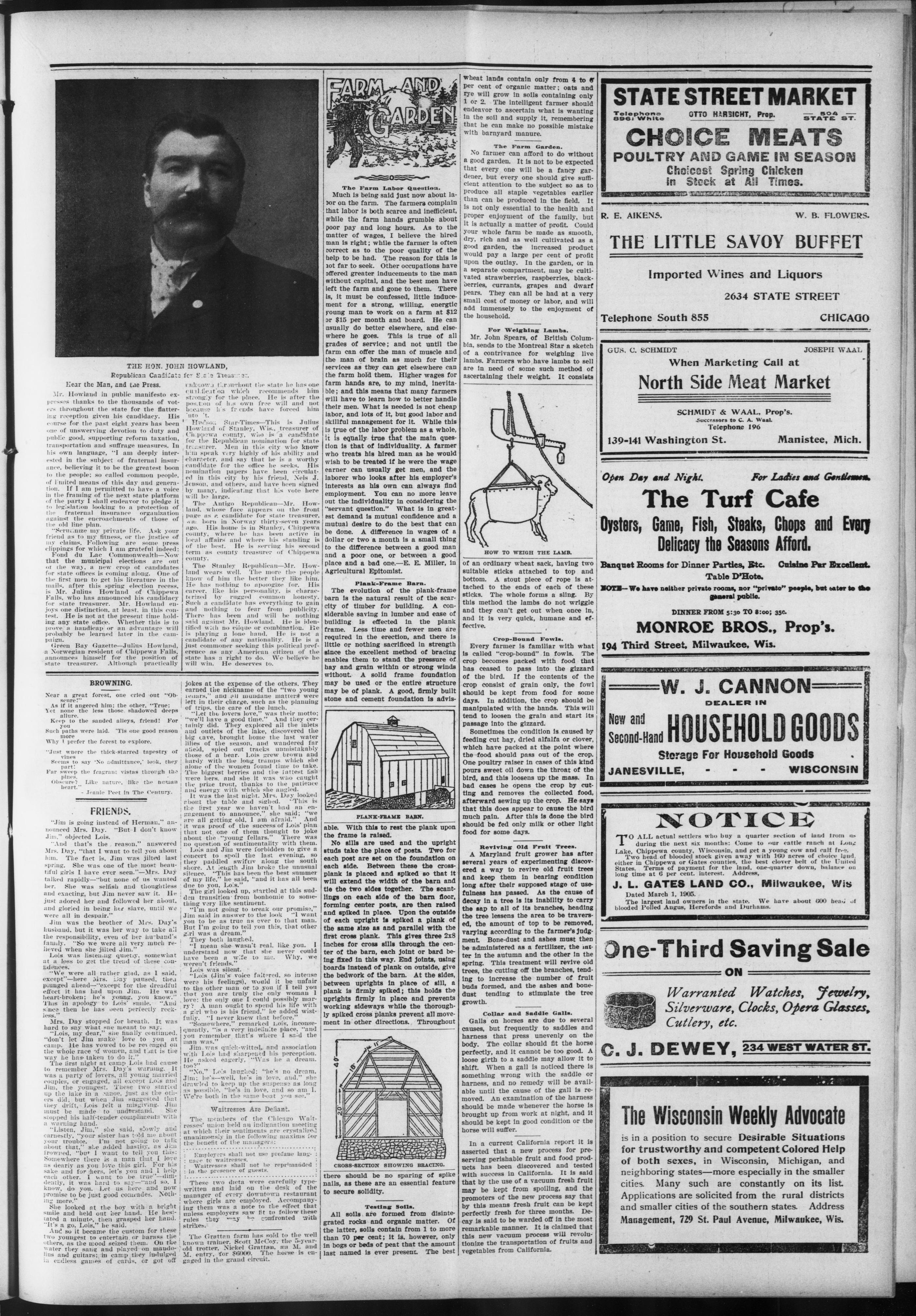
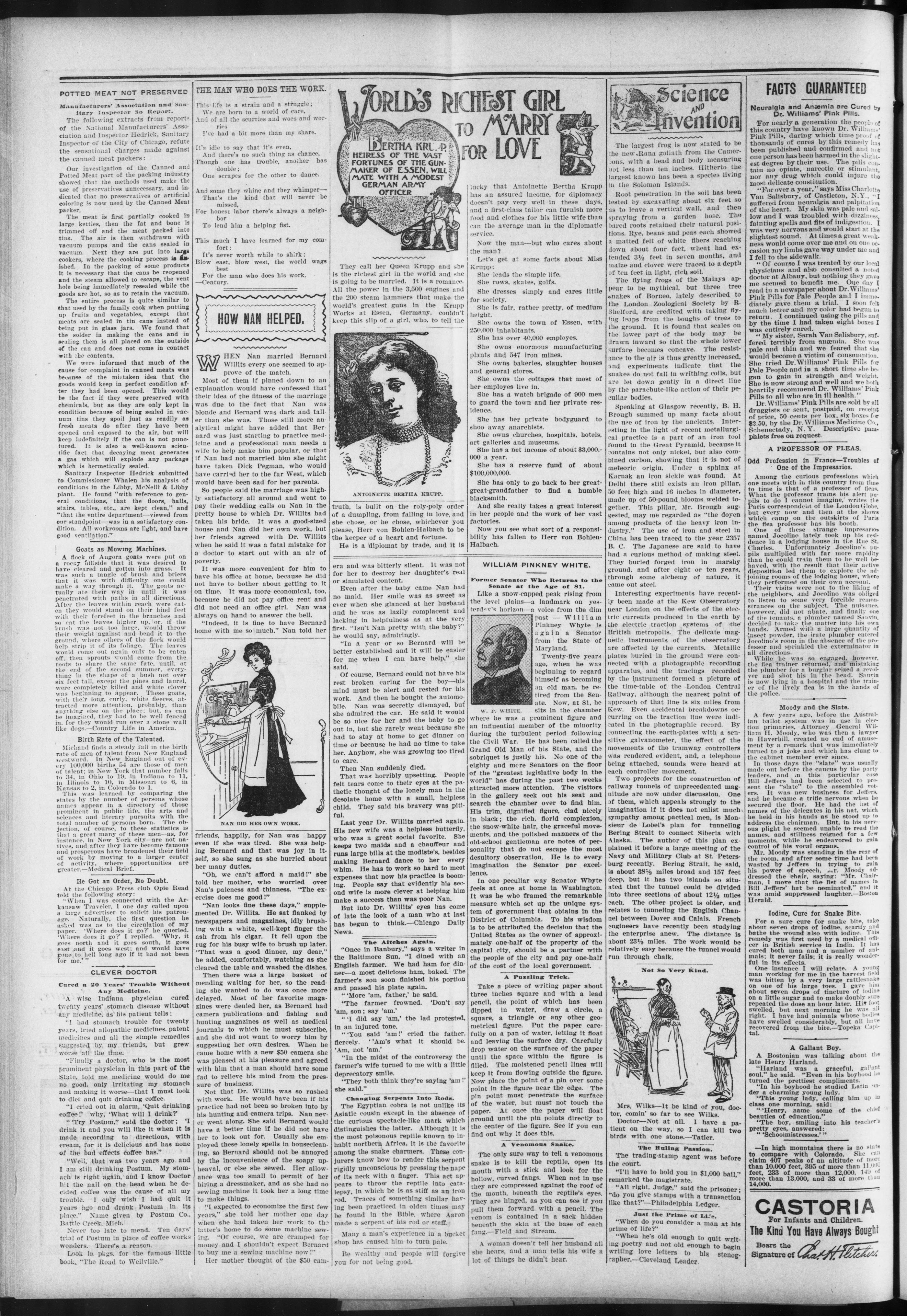
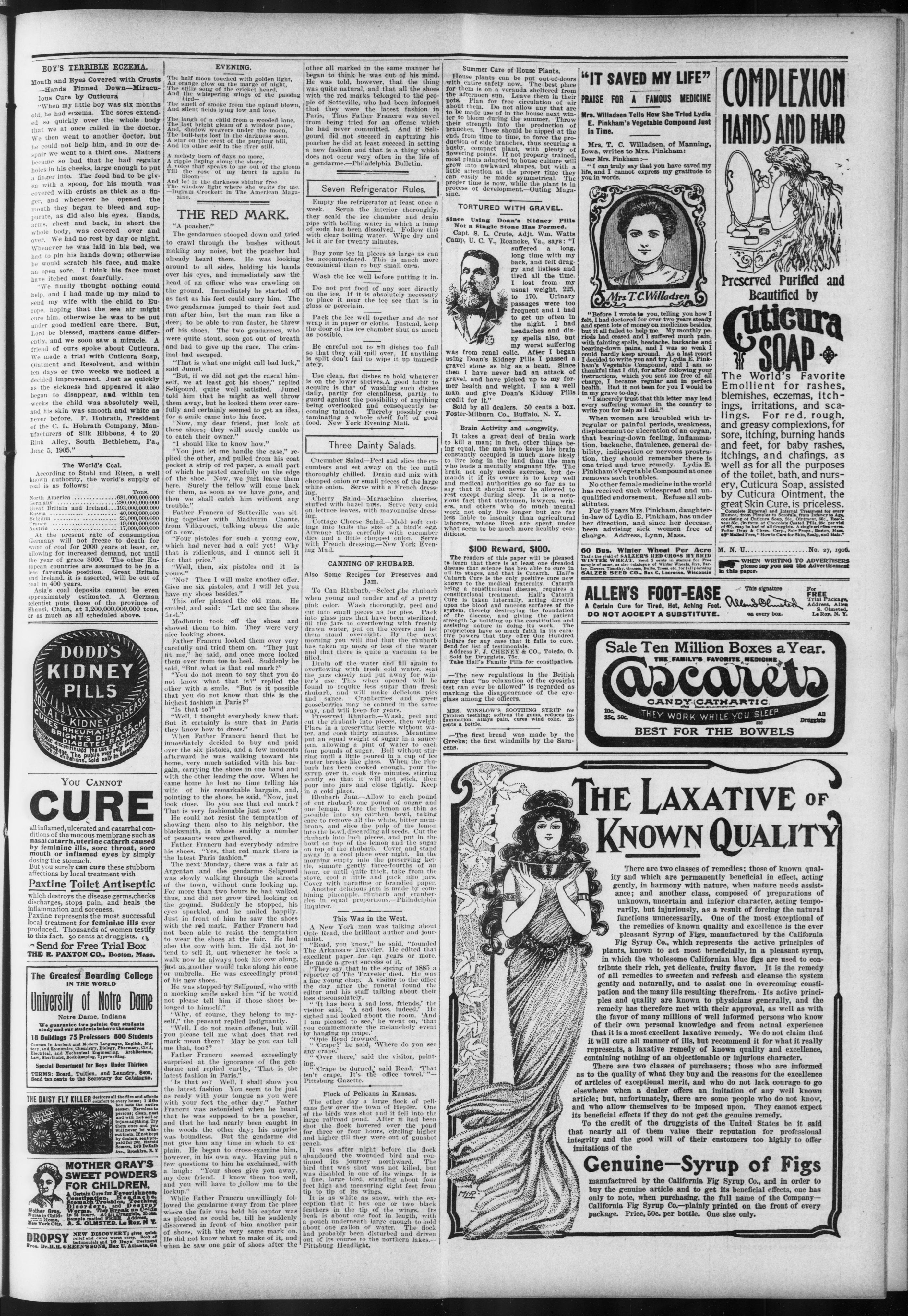
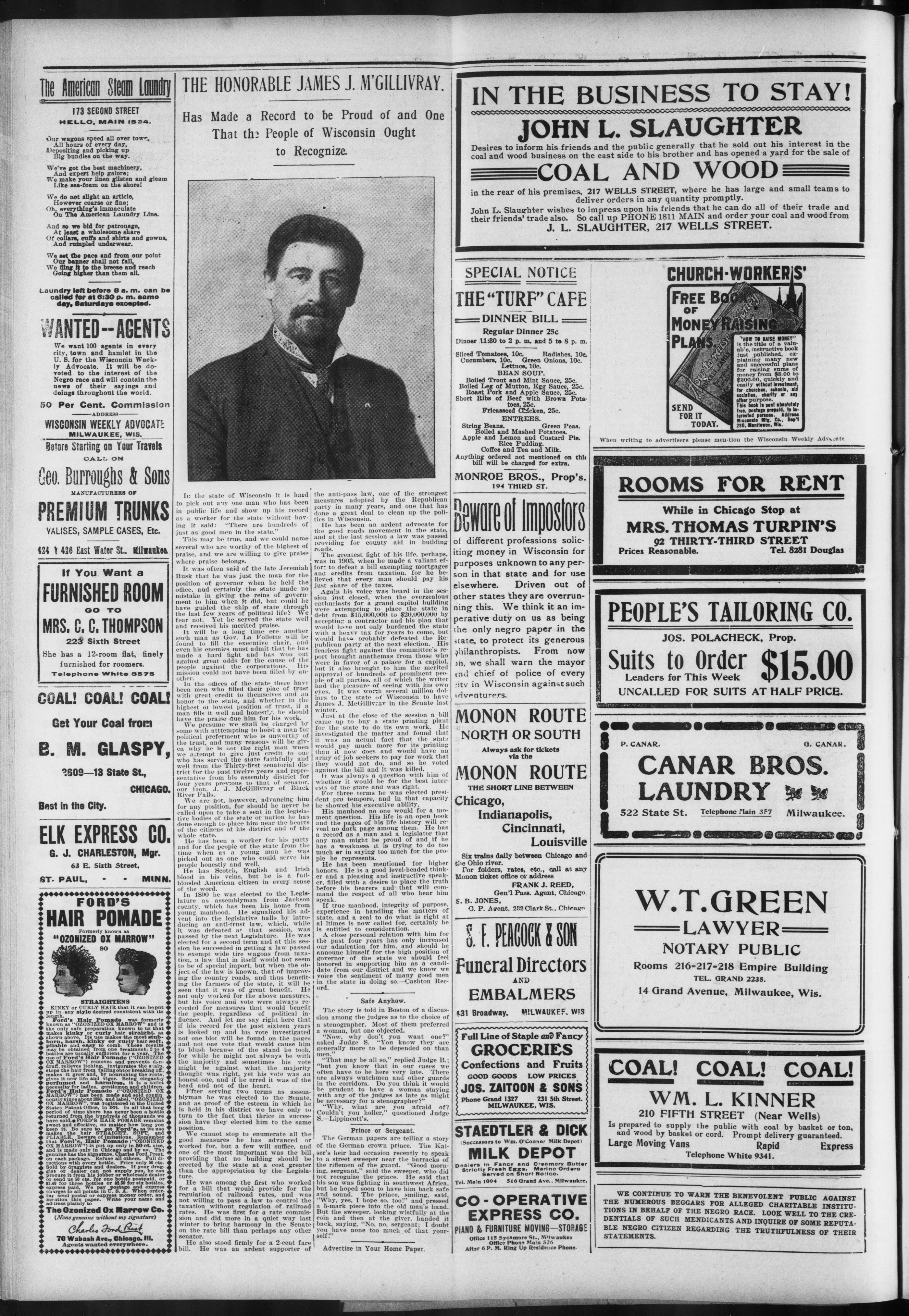
Page text (machine-generated)
State Historical Society
WISCONSIN
WEEKLY
The negro must work out his own problem.
ADVOCATE
DEVOTED TO THE INTERESTS OF THE NEGRO RACE
P.
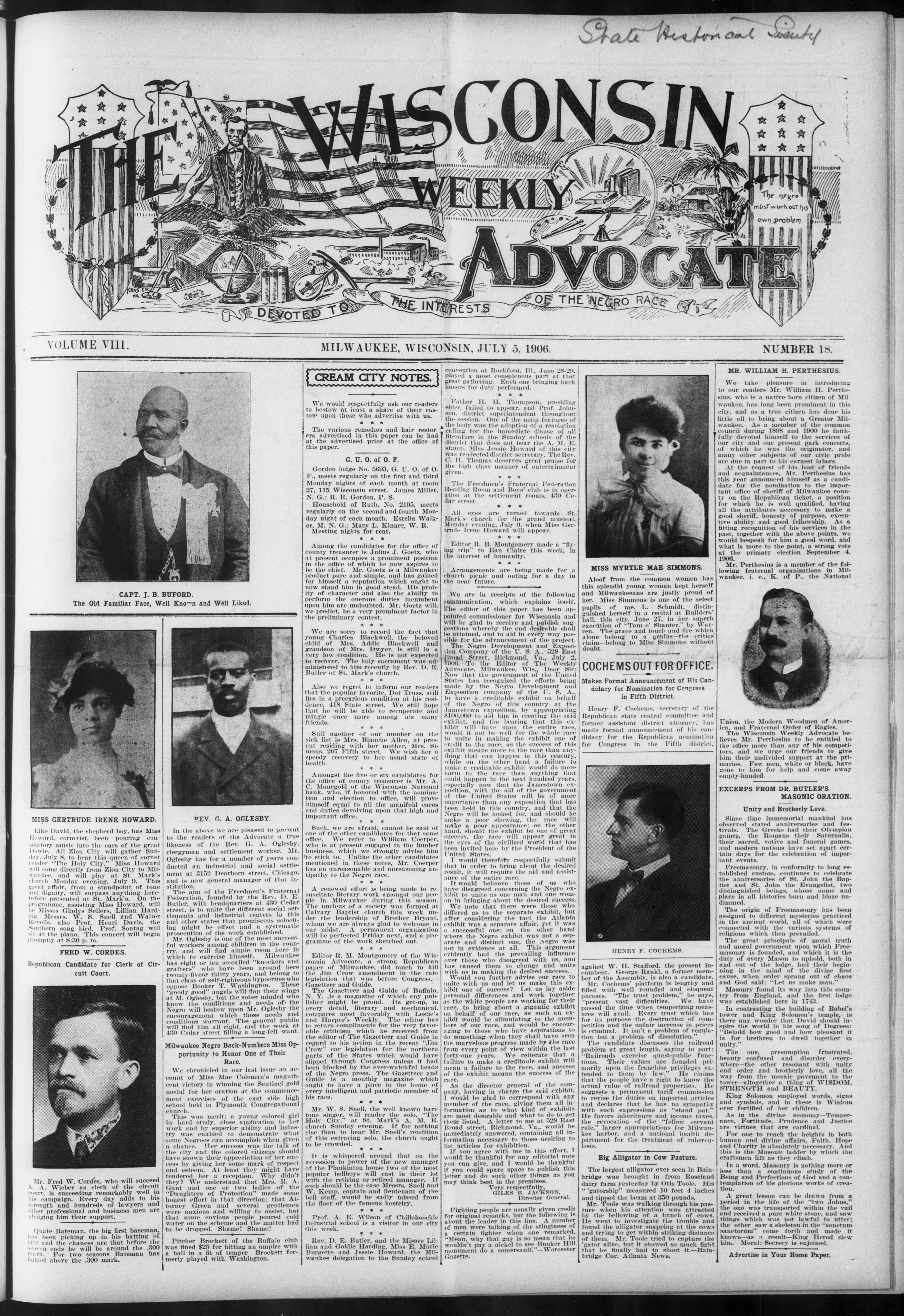
CAPT. J. B. BUFORD. The Old Familiar Face. Well Known and Well Liked.
THE WOMEN'S HISTORY MUSEUM
MISS GERTRUDE IRENE HOWARD.
Like David, the shepherd boy, has Miss Howard, cornetist, been pouring consolatory music into the ears of the great Dowie. All Zion City will gather Sunday, July 8, to hear this queen of corner render "The Holy City." Miss Howard will come directly from Zion City to Milwaukee, and will play at St. Mark's church Monday evening, July 9. This great affair, from a standpoint of tone and dignity, will surpass anything heretofore presented at St. Mark's. On the programme, assisting Miss Howard, will be Misses Gladys Sellers, Lillian Harding. Messrs. W. S. Snell and Walter Revells, also Prof. Henri Davis, the Southern song bird. Prof. Sontag will sit at the piano. This concert will begin promptly at 8:30 p. m.
FRED W. CORDES
Republican Candidate for Clerk of Circuit Court.
Mr. Fred W. Cordes, who will succeed A. A. Wieber as clerk of the circuit court, is succeeding remarkably well in his campaign. Every day adds to his strength and hundreds of lawyers and other professional and business men are pledging him their support.
Quate Bateman, the big first baseman, has been picking up in his batting of late and the chances are that before the season ends he will be around the .300 mark. For two seasons Bateman has batted above the .300 mark.
[Name]
REV. G. A. OGLESBY.
In the above we are pleased to present to the readers of the Advocate a true likeness of the Rev. G. A. Oglesby, clergyman and settlement worker. Mr. Oglesby has for a number of years conducted an industrial and social settlement at 3152 Dearborn street, Chicago, and is now general manager of that institution.
The aim of the Freedmen's Fraternal Federation, founded by the Rev. D. E. Butler, with headquarters at 430 Cedar street, is to unite the different social settlements and industrial centers in this and other states that promiscuous solociting might be offset and a systematic prosecution of the work established.
Mr. Oglesby is one of the most successful workers among children in the country, and will find ample room here in which to exercise himself. Milwaukee has eight or ten so-called "knockers and grafters" who have been around here twenty-five-years, and belong to that class of self-righteous hypocrites who oppose Booker T. Washington. These "goody good" angels will flap their wings at M. Oglesby, but the sober minded who know the conditions and needs of the Negro will bestow upon Mr. Oglesby the encouragement which those needs and conditions warrant. The general public will find him all right, and the work at 430 Cedar street filling a long-felt want.
Milwaukee Negro Back-Numbers Miss Opportunity to Honor One of Their Race.
We chronicled in our last issue an account of Miss Mae Coleman's magnificent victory in winning the Sentinel gold medal for her oration at the commencement exercises of the east side high school held in Plymouth Congregational church.
This was merit; a young colored girl by hard study, close application to her work and by superior ability and industry was enabled to demonstrate what some Negroes can accomplish when given a chance. Her success was the talk of the city and the colored citizens should have shown their appreciation of her success by giving her some mark of respect and esteem. At least they might have tendered her a reception. Why didn't they? We understand that Mrs. R. A. Gant and one or two ladies of the "Daughters of Protection" made some honest effort in that direction; that Attorney Green and several gentlemen were anxious and willing to assist, but that some envious people poured cold water on the scheme and the matter had to be dropped. Shame! Shame!
Pitcher Brockett of the Buffalo club was fined $25 for hitting an umpire with a ball in a fit of temper Brockett formerly played with Washington.
CREAM CITY NOTES.
---
We would respectfully ask our readers to bestow at least a share of their custom upon those who advertise with us.
The various remedies and hair restorers advertised in this paper can be had at the advertised price at the office of this paper.
G. U. O. of O. F.
Gordon lodge No. 5693, G. U. O. of O. F., meets regularly on the first and third Monday nights of each month at room 27, 115 Wisconsin street. James Miller, N. G.; R. R. Gordon, P. S.
Household of Ruth, No. 2195, meets regularly on the second and fourth Monday night of each month. Estella Walker, M. N. G.; Mary L. Kinner, W. R.
* * *
Among the candidates for the office of county treasurer is Julius J. Goetz, who at present occupies a prominent position in the office of which he now aspires to be the chief. Mr. Goetz is a Milwaukee product pure and simple, and has gained for himself a reputation which ought to now stand him in good stead. His probity of character and also the ability to perform the onerous duties incumbent upon him are undoubted. Mr. Goetz will, we predict, be a very prominent factor in the preliminary contest.
* * *
We are sorry to record the fact that young Charles Blackwell, the beloved child of Mrs. Addie Blackwell and grandson of Mrs. Dwyer, is still in a very low condition. He is not expected to recover. The holy sacrament was administered to him recently by Rev. D. E. Butler of St. Mark's church.
\* \* \*
Also we regret to inform our readers that the popular favorite, Dot Truss, still lies in a precarious condition at his residence, 418 State street. We still hope that he will be able to recuperate and mingle once more among his many friends.
* * *
Still another of our number on the sick list is Mrs. Blanche Allen, at present residing with her mother, Mrs. Simons, 207 Fifth street. We wish her a speedy recovery to her usual state of health.
* * *
Amongst the five or six candidates for the office of county treasurer is Mr. A. C. Manegold of the Wisconsin National bank, who, if honored with the nomination and election to office, will prove himself equal to all the manifold cares and duties devolving upon that high and important office.
***
Such, we are afraid, cannot be said of one of the other candidates for that same office. We refer to William Coerper, who is at present engaged in the lumber business, which we strongly advise him to stick to. Unlike the other candidates mentioned in these notes, Mr. Coerper has an unreasonable and unreasoning antipathy to the Negro race.
\* \* \*
A renewed effort is being made to resuscitate literary work amongst our people in Milwaukee during this season. The nucleus of a society was formed at Calvary Baptist church this week under the leadership of Brother Bryant, whom we are always glad to welcome in our midst. A permanent organization will be perfected Friday next, and a programme of the work sketched out.
* * *
Editor R. M. Montgomery of the Wisconsin Advocate, a strong Republican paper of Milwaukee, did much to kill the Jim Crow amendment in the ratio legislation that was before Congress. Gazetteer and Guide.
The Gazetteer and Guide of Buffalo, N. Y., is a magazine of which any publisher might be proud. Its get-up, in every detail, literary and mechanical, compares most favorably with Leslie's and Harper's Weekly. The editor has to return compliments for the very favorable criticism which he received from the editor of The Gazetteer and Guide in regard to his action in the recent "Jim Crow" car legislation for the northern parts of the States which would have slipped through Congress unless it had been blocked by the ever-watchful heads of the Negro press. The Gazetteer and Guide is a monthly magazine which ought to have a place in the home of every intelligent and patriotic member of his race.
* * *
Mr. W. S. Snell, the well known baritone singer, will render the solo, "The Holy City," at St. Mark's A. M. E. church Sunday evening. If for nothing else than to hear Mr. Snell's rendition of this entracing solo, the church ought to be crowded.
* * *
It is whispered around that on the accession to power of the new manager of the Plankinton house two of the most popular bellboys will cast in their lot with the retiring or retired manager. If such should be the case Messrs. Snell and W. Kemp, captain and lieutenant of the bell staff, would be sadly missed from the floor of the famous hostelry.
**
Prof. A. E. Wilson of Chillohoochie Industrial school is a visitor in our city this week.
***
Rev. D. E. Butler, and the Misses Lillian and Goldie Harding, Miss E. Marie Burgette and Jessie Howard, the Milwaukee delegation to the Sunday school
convention at Rockford, Ill., June 28-29. played a most conspicuous part at that great gathering. Each one bringing back honors for duty performed.
***
Father H. H. Thompson, presiding elder, failed to appear, and Prof. Johnson, district superintendent throughout the session. One of the main features of the body was the adoption of a resolution calling for the immediate disuse of all literature in the Sunday schools of the district that does not bear the A. M. E. stamp. Miss Jessie Howard of this city was re-elected district secretary. The Rev. C. H. Thomas deserves great praise for the high class manner of entertainment given.
* * *
The Freedmen's Fraternal Federation Reading Room and Boys' club is in operation at the settlement rooms, 430 Cedar street.
All eyes are turned towards St. Mark's church for the grand musical, Monday evening, July 9, when Miss Gertrude Irene Howard will appear.
* * *
Editor R. B. Montgomery made a "flying trip" to Eau Claire this week, in the interest of humanity.
* * *
Arrangements are being made for a church picnic and outing for a day in the near future.
We are in receipts of the following communication, which explains itself. The editor of this paper has been appointed commissioner for Wisconsin and will be glad to receive and publish suggestions whereby the end desirable shall be attained, and to aid in every way possible for the advancement of the project.
The Negro Development and Exposition Company of the U. S. A., 528 East Broad Street, Richmond, Va., July 2, 1906.—To the Editor of The Weekly Advocate, Milwaukee, Wis., Dear Sir: Now that the government of the United States has recognized the efforts being made by the Negro Development and Exposition company of the U. S. A., to have a creditable exhibit on behalf of the Negro of this country at the Jamestown exposition, by appropriating $100,000 to aid him in creating the said exhibit, and the bearing that this exhibit will have upon the entire race, would it not be well for the whole race to unite in making the exhibit one of credit to the race, as the success of this exhibit means more to the race than anything that can happen in this century, while on the other hand a failure to make a creditable exhibit would do more harm to the race than anything that could happen in the next hundred years, especially now that the Jamestown exposition, with the aid of the government of the United States will be of more importance than any exposition that has been held in this country, and that the Negro will be looked for, and should he make a poor showing, the race will make a poor appearance; on the other hand, should the exhibit be one of great success, the race will appear great in the eyes of the civilized world that has been invited here by the President of the United States.
I would therefore respectfully submit that in order to bring about the desired result, it will require the aid and assistance of the entire race.
It would behoove those of us who have disagreed concerning the Negro exhibit to unite as one man and one woman in bringing about the desired success.
We note that there were those who differed as to the separate exhibit, but after considering the fact the Atlanta exhibit was a separate affair, yet it was a successful one; on the other hand where the Negro exhibit was not a separate and distinct one, the Negro was not in evidence at all. This argument evidently had the prevailing influence over those who disagreed with us, and has caused them to change and unite with us in making the desired success.
Would you further advise our race to unite with us and let us make this exhibit one of success? Let us lay aside personal differences and work together as the white people are working for their race, to bring about a gigantic exhibit on behalf of our race, as such an exhibit would be stimulating to the members of our race, and would be encouraging to those who have aspirations to do something when they shall have seen the marvelous progress made by the race from every point of view within the last forty-one years. We reiterate that a failure to make a creditaole exhibit will mean a failure to the race, and success of the exhibit means the success of the race.
As the director general of the company, having in charge the said exhibit, I would be glad to correspond with any member of the race, giving them all information as to what kind of exhibits are most desirable and what to do to get them listed. A letter to me at 528 East Broad street, Richmond, Va., would be immediately answered, containing all information necessary to those desiring to list articles for exhibition.
If you agree with me in this effort, I would be thankful for any editorial note you can give, and I would be thankful if you could spare space to publish this letter and do such other things as you may think best in the premises.
Fighting people are usually given credit for original remarks, but the following is about the leader in this line. A number of men were talking of the stinginess of a certain fighter when one remarked, "Mean, why that guy is so mean that he wouldn't pay a nickel to see Bunker Hill monument do a somersault."—Worcester Gazette.
Mary Louise
MISS MYRTLE MAE SIMMONS.
Aloof from the common women has this splendid young woman kept herself and Milwaukeeans are justly proud of her. Miss Simmons is one of the select pupils of me. L. Schmidt, distinguished herself in a recital at Builders' hall, this city, June 27, in her superb execution of "Tam o' Shanter," by Warren. The grace and touch and fire which alone belong to a genius—the critics claim—belong to Miss Simmons without doubt.
COCHEMSOUT FOR OFFICE.
Makes Formal Announcement of His Candidacy for Nomination for Congress in Fifth District. Henry F. Cochems, secretary of the Republican state central committee and former assistant district attorney, has made formal announcement of his candidacy for the Republican nomination for Congress in the Fifth district,
```markdown
```
against W. H. Stafford, the present incumbent. George Rankl, a former member of the Assembly, is also a candidate. Mr. Cochems' platform is lengthy and filled with well rounded and eloquent phrases. "The trust problem," he says, "present vast difficulties. We have passed the time when temporizing measures will avail. Every trust which has for its purpose the destruction of competition and the unfair increase in prices is criminal. It isn't a problem of regulation but a problem of dissolution."
The candidate discusses the railroad problem at great length, saying in part: "Railroads exercise quasi-public functions. Their values are founded primarily upon the franchise privileges extended to them by law." He claims that the people have a right to know the actual value of railroad properties. He suggests a permanent tariff commission to revise the duties on imported articles and declares that he has no sympathy with such expressions as "stand pat." He favors inheritance and income taxes, the revocation of the "fellow servant rule," larger appropriations for Milwaukee harbor, and a national health department for the treatment of tuberculosis.
Big Alligator in Cow Pasture.
The largest alligator ever seen in Bainbridge was brought in from Roseland dairy farm yesterday by Otis Toole. His "gatorship" measured 10 feet 4 inches and tipped the beam at 350 pounds. Mr. Toole was walking through his pasture when his attention was attracted by the bellowing of a bunch of cows. He went to investigate the trouble and found the alligator snapping at the cows and trying to get within striking distance of them. Mr. Toole tried to capture the 'gator alive, but it showed so much fight that he finally had to shoot it.—Bainbridge Cor. Atlanta News.
NUMBER 18.
MR. WILLIAM H. PERTHESIUS.
We take pleasure in introducing to our readers Mr. William H. Perthesius, who is a native born citizen of Milwaukee, has long been prominent in this city, and as a true citizen has done his little all to bring about a Greater Milwaukee. As a member of the common council during 1898 and 1900 he faithfully devoted himself to the services of our city and our present park concerts, of which he was the originator, and many other subjects of our civic pride are due in part to his earnest labors.
At the request of his host of friends and acquaintances, Mr. Perthesius has this year announced himself as a candidate for the nomination to the important office of sheriff of Milwaukee county on the Republican ticket, a position for which he is well qualified, having all the attributes necessary to make a good sheriff, honesty of purpose, executive ability and good fellowship. As a fitting recognition of his services in the past, together with the above points, we would bespeak for him a good word, and what is more to the point, a strong vote at the primary election September 4, 1906. Mr. Perthesius is a member of the following fraternal organizations in Milwaukee, i. e., K. of P., the National
P.
Union, the Modern Woodmen of America, and Fraternal Order of Eagles. The Wisconsin Weekly Advocate believes Mr. Perthesius to be entitled to the office more than any of his competitors, and we urge our friends to give him their undivided support at the primaries. Few men, white or black, have gone to him for help and come away empty-handed.
EXCERPS FROM DR. BUTLER'S MASONIC ORATION.
Unity and Brotherly Love.
Since time immemorial mankind has observed stated anniversaries and festivals. The Greeks had their Olympian games, the Romans their Saturnalia, their sacred, votive and funeral games, and modern nations have set apart certain days for the celebration of important events.
Freemasonry, in conformity to long established custom, continues to celebrate the anniversaries of St. John the Baptist and St. John the Evangelist, two distinguished beings, whose name and place in all histories burn and blaze undimmed.
The origin of Freemasonry has been assigned to different mysteries practiced in the ancient world, all of which were connected with the various systems of religions which then prevailed.
The great principals of moral truth and moral government upon which Freemasonry is founded, and which it is the duty of every Mason to uphold, both in and out of the lodge, had their beginning in the mind of the divine first cause, when order sprang out of chaos and God said: "Let us make man."
Masonry found its way into this country from England, and the first lodge was established here in 1743.
In contrasting the building of Babel's tower and King Solomon's temple, is there any wonder that David should inspire the world in his song of Degrees: "Behold how good and how pleasant it is for brethren to dwell together in unity."
The one, presumption frustrated, beauty confused and disorder everywhere—the other resonant with unity and order and brotherly love, all the way from the mosaic pavement to the tower—altogether a thing of WISDOM, STRENGTH and BEAUTY.
King Solomon employed words, signs and symbols, and in these is Wisdom ever fortified of her children.
As in the divine economy—Temperance, Fortitude, Prudence and Justice are virtues that are cardinal.
For one to reach the heights in both human and divine affairs, Faith, Hope and Charity is absolutely necessary. And this is the Masonic ladder by which the craftsmen lift as they climb.
In a word, Masonry is nothing more or less than a continuous study of the Being and Perfections of God and a contemplation of his glorious works of creation.
A great lesson can be drawn from a period in the life of the "two Johns," the one was transported within the vail and received a pure white stone, and saw things which was not lawful to utter; the other saw a skeleton in the "sanctum sanctorum" come forth and made it known—as a result—King Herod slew him. Moral: Secrecy is enjoined.
Advertise in Your Home Paper.
—In Rome's cemetery over 6,000,000 people are buried.
—Mrs. Louisa N. Bullard has given the Harvard medical school $52,000 to establish a chair of neuropathology.
—The Welsh National Eisteddfod is the biggest open-air concert in the world. At least 20,000 people attend it every year.
—It is estimated that the value of the presents which Prince Arthur of Connaught brought home from Japan is no less than $200,000.
—In Mexico the law against smoking in theaters is so strictly enforced that recently the entire personnel of a theatrical company were arrested and fined for smoking in one act of a performance of "Zaza."
—John D. Long, ex-secretary of the navy, is much opposed to the proposed new system of spelling. He says: "To spell well is the distinguishing mark of a scholar, as much as good manners are of a gentleman."
—Recent efforts to measure the duration of flashes of lightning seem to show that it is often as brief as one-forty-thousandth part of a second. A flash lasting the fiftieth part of a second is considered about the extreme duration.
—Japan's mortuary list in the late war numbers 80,738, made up of 47,152 killed in action, 11,424 died from wounds and 21,802 from sickness. The total included 213 officers, 76,908 non-commissioned officers and men, and 1357 non-combatants.
—Exactly 100 lives were lost in fires which occurred in London last year. Forty-six of the victims were under 8 years old and 14 were over 60. In almost every instance the fire was due to carelessness and the lack of ordinary precautions.
—The Hon. William Pinckney Whyte of Maryland, who recently became United States senator for the third time, is the only man living who was a member of that body and voted against negro suffrage when the fifteenth amendment to the constitution was passed by it.
The Children's hospital, Bristol, England, has three dogs which collect for it. They have been trained to catch in their teeth coins thrown to them and drop them into a box they carry. They are very successful collectors and the hospital has given their trainer a medal.
The Queen of Greece probably dispenses more of what may be described as "official kisses" than any one else on earth. Every lady presented to her with whom she is on intimate terms she kisses on the cheek; others who have not the honor of knowing her well she kisses on the forehead.
There is being built on the Minnesota state fair grounds in Minneapolis the largest amphitheater in the world, at a cost of $100,000. Although the building is designed wholly for fair purposes, it will be available at other times in the year for conventions or gatherings requiring a large seating capacity.
It has been proved beyond a doubt that incubators were in successful operation among the ancient Egyptians. These original hatching machines were about 9 feet high, and were arranged with galleries for holding the eggs, which were heated from a central oven. About 400 incubators have been discovered in Europe.
—Says a writer in the Cape Times of Cape Town: "Stuurman, an old bushman who lives on the top of a hill at Stuurman's huts, in the Prieska district of the Cape Colony, claims to be the oldest man in the world. He is said to be 146 years old and his wife—his second—over 100. It is known for certain that sixty-five years ago he was a very old man and that his son is more than 90 years old."
An Automobile School.
The remarkable development in the automobile industry, and the swift advances in automobile construction within recent years, have produced unexpected and unforeseen conditions, and one of the most striking phases in the situation is the lack of men trained to manage and care for the high-powered cars which are being turned out of the factories by the thousand here and imported from abroad. The high salaries that have been offered for drivers and experts, and the pleasant character of the work itself, have attracted the attention of young men of all classes, and hundreds of these have applied to factories and garages with offers to work without compensation merely in order to acquire mechanical training in this line. The superficial automobile engineering education thus obtained has been accepted on the principle that a half-trained chauffeur is better than none at all. Manufacturers of popular cars have estimated that three-quarters of the troubles reported to them by automobile owners are the results of inefficient handling rather than of inherent defects in the mechanism; and today the selection of a driver has become almost as important as the choosing of the car. It was to relieve this condition that the New York School of Automobile Engineers in New York city was incorporated, and Prof. Charles E. Lucke of the department of engineering of Columbia university was invited to plan courses and to supervise a general scheme of instruction that would give thorough training in the principles involved in the construction and handling of automobiles of all types, as well as in the solution of the many practical problems confronting the chauffeur. That the plan of the school has been successful in attaining the object for which it was designed is attested by the fact that of over 100 students who have completed the course none has failed to give satisfaction to his employer.—Scientific American.
Oriental Brewery Trust.
There is a brewery trust in Japan. Once Japan imported all the beer she consumed. After a time she learned how to make her own beer, and at several places breweries were established with Japanese capital. These for a time competed—with the usual result. In 1904 the government itself conceived, planned, initiated and organized the brewery trust of Japan, and now directs the trust's operations. Under government direction the trust has thrived amazingly, and while stupid competition has been eliminated no one has been injured, no one has been garroted or robbed. Meanwhile under government control the amount of beer exported from Japan in 1905 was double the amount exported in 1904, and the amount exported in 1906 will probably double the amount exported in 1905, for under government direction Japan is beginning to seize the beer trade in China and Korea.—Everybody's Magazine.
Rabbit as Regiment Pet
Regiments have adopted strange pets from time to time, but the strangest probably is that of the Montgomeryshire Yeomanry, now in camp in Garth, Breconshire. It is a rabbit found recently by the regimental postman in a letter box he was clearing.
Attached to its neck was a label on which were a halfpenny stamp and the address of a gentleman in Wrexham, Denbigshire. The rabbit is being made much of by the regiment.—London Evening Standard.
THE LAGGARD.
Seven ships of the line!
Brave as ships could be!
They circled there in a crescent fair
To conquer the world for me!
But Sunday, Monday, and Tuesday fled,
With their sails all gleaming bright,
To race a race with the flying sun
For the star-set goal of night.
And Wednesday and Thursday were so fleet
That the wind could never tell
Whether two ships there were he sped,
Or whether two shadows fell.
Friday and Saturday, wing-and-wing,
Like white ghosts floated last,
And I curved my hand to hail to them,
But swift as a thought they passed.
Dim in the west; hull down, and gone—
And only dreams were mine!
I had lost them all, beyond recall,
Seven ships of the line!
—Elsie Casseigne King in Lippincott's.
HIS VELLOW GOD.
Tom Jenkins ran his hand through the gold that lay heaped on the floor of the shack. "Seems to me, Billy," he said, slowly, "that hopin' to find it is better'n findin' it." Dull gleams of light from a smoky lantern fell athwart the face of the gold miner, rugged, homely, offering a marked contrast indeed to the patrician features of Billy Bailey, his junior partner.
"Finding Billy, means quittin'. It's an end to the wants and privations I've knowed for nigh twenty years. But, somehow. I've come to like these still ole mountains, an' the singin' of the pines an' the river. They've grown like friends, an' I'm never lonesome among 'em. Maybe it's the las' time they'll ever sing for me.
"We're goin' back to civilization," continued Tom, unheeding the other's lack of sympathy with his reminiscent mood, "an' that means separation. I know you like me, Billy. A feller couldn't want a better partner that you've been fer the past two years I've knowed you. But with yer eddication, an' yer young blood, an' yer ambitions, you ain't my kind in civilization. We can't be the same down there. I couldn't expect it. But I think a powerful deal of you, Billy. I——"
"O, come, Tom," broke in his companion, impatiently, "you're in the dumps tonight. Take a drink and brace up. We've worked and starved in these cursed wilds for gold, until at last we've got it. Think of the city's 10,000 pleasures that this stake can buy for us. There's no life in these solitudes. It's there in the crowded streets, and it can all be ours when we've got such a god—the god of gold—to see us through."
"But it ain't fer me," persisted Tom. "I'm past them things. If it wan't fer the hope of finin' the old woman down there in Frisco an' makin' her comfortable, I'd stay. I don't care fer the gold after all. I've found it, an' my hungrin' fer it it's satisfied."
Billy finished his task, but his mind was still busy with thoughts of the future. But Billy saw none of the beauty of the night. The mountains awakened memories of hardships and hopelessness; the river was only a highway to civilization. He lit his pipe and began to pace up and down the shelving shore.
There was none of the stuff of which heroes are made in Billy Bailey's composition. His college career cut short by the melting away of his father's fortune he awoke one morning to find himself face to face with the world, his wits his only capital.
He remembered tonight his struggle to maintain his social position; the slights heaped upon him by erstwhile boon companions; the gradual sinking away of hope, until, with starvation staring him in the face, he had shipped in a vessel bound "round the horn." He recaned his hardships on the western frontier, his final falling in with old Tom Jenkins, and the hopeless search for gold until a week ago, when the gravel of a driel-up mountain stream unexpectedly yielded them their fortune. His future course was plain. Mercilessly he would engage in the war for wealth. His heart must know but one love, the love of gold.
And the stake! it was not so much, after all. If he only had Tom's share, too! The thought startled him, and he looked furtively about, as though already under surveillance. Well, why not? What was Tom to him now? The old man cared nothing for gold; he had said as much. Why not begin the task of wealth gathering tonight, and double his fortune by a single coup?
The skiff was all ready for the morrow's journey down the river. He could easily reach North Fork by daylight, and miles of distance would lie between him and Tom before the latter could make the trip across the almost impassable mountain trail.
He walked back to the house. Tom was fast asleep. The flickering light of the lantern fell aslant the corner where he lay, his powerful form half swathed in the tattered blankets, his brawny arms thrown above its head.
It was but the work of a few minutes to gather together the things necessary for the short journey down the river and to secure the treasure for safe transportation. There was a look of cunning triumph on his face as he completed his preparations.
He made a cautious step toward the door of the shack, when a slight noise, real or fancied, caused him to glance back over his shoulder. The next instant the bag of gold crashed to the floor, while Billy sank on his knees, as though felled by a blow. Tom was sitting bolt upright in bed, his revolver leveled at Billy's heart.
"Well," he said bluntly, "what do you intend to do?"
"So," said Tom, with a long breath, "I wuz mistook in you, after all. To think that I give you my friendship an' you wan't worth it. What be I going to do? What do men usu'lly do when a gardner turns thief?"
"You wouldn't shoot me, Tom?"
"Why not? Men's been killed fer less 'an this, an' the world wuz well red of 'em."
"Oh, spare me, spare me, Tom. You said you cared nothing for gold, while I—I was made with love of it. It is my god—my heaven—my everything. But take it, take it all—only give me my life—Tom—I—I—can't—die."
"Git up," commanded the other, coldly; "don't make me despise you worsn't I do. What would you do if you wuz in my place? Shoot, wouldn't you? You'd kill me now if you had the chance."
"But think, Tom, what life means to me; I'm young and—"
"Thank what friendship meant to me, Bill."
In the momentary silence that followed
the pines and river could be heard singing their old, old song, unheeding of the scrite of mortals for a scrap of the treasure they guarded. Tom heard the song and his bitterness seemed to go out with the weird melody.
"I'll spar' yer life," he said, hoarsely; "you kin go."
The boy glanced from the old man to the bag of gold, and then turned slowly toward the doorway.
"You'd better take yer pile now," said Tom quietly, "as I reckon you won't be comin' back."
"Do you mean it?" gasped Billy.
"Certainly; half's yourn, ain't it? There's only one thief in this camp, an' it ain't me."
Billy vaguely appreciated the nature of the man with whom he was dealing, yet he felt that such nobleness required some acknowledgment. He sprang forward and tried to grasp the old man's hand.
"No, no—not that!" cried Tom, fiercely. "Don't touch me. That gold is yourn. Take it and go. But go quickly, Billy—fer God knows I'm only human."—San Francisco Argonaut.
SMOKE WATCHING MAN DROWN.
Central Americans Display Deliberation Before Rescue.
If you fall overboard from a steamship at night and care at all about being picked up again, said the San Francisco Call the day before the earthquake, do not elect for your tumbling off place a vessel manned to any large extent by the easy going sons of Central America. The Acapulco, of the Pacific Mail company's San Francisco-Panama fleet, which arrived here yesterday from the isthmus, is a good boat from which not to fall overboard. This happened on the outward voyage:
The Acapulco left Acajutla about dusk and darkness found her speeding south as fast as her engines would drive here. F. Guardow is the Acapulco's boatswain. As the mate's chief deputy should, he was busying himself straightening up the decks, littered with the disorder of departure from Acajutla. In climbing over a pile of freight he lost his balance and tumbled overboard. Several Mexican sailors witnessed the boatswain's disappearance, but instead of giving the alarm rolled cigarettes and speculated calmly as to the identity of the man overboard. Somebody suggested that it might have been the boatswain. They decided to investigate. The boatswain's room was vacant. He was not to be seen on deck. The boatswain must be overboard.
Rolling another cigarette and stopping to light it as he went, one of the sailors sauntered to Capt. Trask's room and reported that the boatswain had fallen overboard about ten minutes before. What Capt. Trask said was in Spanish—West coast sailor Spanish. There is no equivalent for what he said in the polite United States used by the newspapers. While he was saying it, however, he was giving orders. The steamer stopped and was steaming back along her wake trail by the time the lifeboat was ready for launching.
After a long search the life savers found Guardow. The tropical water was warm and the boatswain a good swimmer. He had been swimming for half an hour, however, and the sight of the receding hull of the Acapuleo had not cheered him up very much. The people in the boat were surprised to find him, as these waters are infested with sharks of the man-eating variety and the search had been more a matter of form than anything else.
As they helped the dripping man over the side one of the sailors who had speculated on his identity peered into the boatswain's face. As he turned away he remarked to a shipmate, "It's heem all right."
Couldn't Sit Down.
"I beg your pardon, but I'm in trouble," said a man who was well dressed and plainly excited, to Sergt. Temperly at No. 3 police station, Armourdale, yesterday. "Can you help me out?" "I'll do my best," answered the oblig-
"I'll do my best," answered the obliging sergeant. "Sit down and tell me about it."
"No, I simply can't sit down," said the man, nervously.
"Must be serious to affect you like that," said the sergeant. "What is it?"
"You see, it is this way," said the man. "I came in on an early train from the west; and as I got up late, when the train was but a few minutes from the Union depot, I dressed in all haste. I had some business to attend to in Armourdale right away, and I paid my street car fare from some change I had in my overcoat pocket. But when I was standing at the corner of Fifth and Kansas a moment ago, for the first time I unbuttoned my overcoat and looked inside, and found—"
"That you had been robbed while on the train?" broke in the sergeant interestedly. "No." said the man, "I found that I had put my trousers on backward, and I can't sit down. What I want is a private place to change 'em."
He got it.—Kansas City Journal.
Indian and the Telephone
There is consternation in the central office of the telephone company at Holdenville because of the fact that a fullblood Creek Indian who cannot speak English has become a patron. John Goat, a fullblood member of the Creek council, who lives in the woods six miles south of Holdenville, has begun to adopt the advanced ideas of the white man by having a private telephone line run out from that town to his home.
Goat is probably the only fullblood in the Creek nation who has a telephone, and he has discovered that it is of little use to him. When he calls up he cannot by any contraction of the face or signs of the body make central understand what number he wants. Once in a while, when he does succeed in getting a number, he can find no one at the other end of the wire who can talk to him, he says. As one of his Indian friends expresses it, "the telephone can talk Creek only at one end, and the other end persists in speaking English." If other fullbloods follow the example of John Goat it will be necessary for the telephone company to maintain an interpreter in every exchange.—Muskogee Cor. Kansas City Journal.
Sentenced Dog to Death.
There has recently concluded at Delemont, in Switzerland, a trial which vividly recalls the customs of the Middle Ages. Two men, a father and son, named Scherrer have, after a trial full of exciting incidents, been condemned to imprisonment for life for murder and robbery.
A dog which the two guilty men had employed was dealt with even more sternly. The judges took evidence as to the dog's share in the crime as carefully as to that of the men, and then ordered that the corrupted beast should be put to death.—London Globe.
How He Remembered It.
When they met on Chestnut street, after some months in which they hadn't seen each other, the one chap told the other he had taken a little house in Germantown, and was there with his lares, penates and coal bill. "Come up and see me some evening—any evening: we're
rarely out, you know, and, then, we have a telephone, so you can let us know when you're coming."
you. I suppose your name is in the tele-
phone directory?" queried the other.
phone directory. queried the other.
"Well, no; not yet, as we've just got the telephone; but our number is—is—really; it's funny, but just this minute I can't—it's something like—Ding it all; it's strange I forget that number, for just on purpose I multiplied it by two and divided the result by four, so as to enable me to remember it, and I can't recall the first thing about it. Ever know the like? I'll write you the number."—Philadelphia Record.
INDIANS' STEEL TOMAHAWKS.
Made in Europe and Were Often Hand Carved.
Dr. James Cox has come into possession of a genuine man killer in the shape of an Indian tomahawk. The weapon was ploughed up by William Dunafee on his farm two and a half miles north of Mastontown, Preston county. Except for a few rust pits the tomahawk is in a fine state of preservation. It is made of steel, and is the work of white men, as Indians never made steel tomahawks, but bought them from traders. It has been hand carved in graceful patterns, and it is doubtful if the hand work on it could be done for less than $10. It is a pipe tomahawk, that is, it combines the two. A neat steel bowl was brazed on, opening onto the handle, and the handle was the stem.
It was never ground to a keen edge. Indians preferred tomahawks rather blunt when the weapon was meant for war purposes, because a sharp, thin edge would be more likely to stick fast if it struck a bone.
It did not belong to an Indian native of West Virginia, because this state ceased to be the home of Indians about 1650 to 1670. They were exterminated or driven out about that time by a Mohawk invasion from New York. The Indians who had their homes along the Monongahela, Kanawha, Cheat and other streams before that time, and whose flint arrows we still find in abundance, had only stone hatchets. These implements are still occasionally found in graves and elsewhere. They belonged to the Indians who had no contact with white men, and whenever a stone hatchet is found in West Virginia it may be taken for granted that it belonged to a nation who lived there more than 250 years ago. How much older than that it may be no one can tell. It may be thousands of years older.
The steel tomahawks, however, tell a different story. They are the handiwork of white men. The Indians bought them and carried them on war expeditions. The fine specimen found near Mastontown was, in all probability, lost by some warrior on a raid among the settlements further east. The warrior probably came from Ohio and the date may be fixed approximately between 1755 and 1790. During that period of thirty-five years Indians were accustomed to make war raids across Preston county. From 1755, the year of Braddock's defeat, until about 1765, the close of Pontiac's war, parties of Indians occasionally used the trail which crossed Cheat river at Dunkard bottom in their excursions against the settlers of Hampshire county. That old trail passed near the place where the tomahawk was found, though perhaps not over the exact spot.
During the Revolutionary war Indians made several raids into Preston county. We can, if we choose, suppose that some member of a raiding party lost the tomahawk during one of these excursions. We may also risk the guess that the weapon was made in England, although there is nearly as much ground for supposing that it was made in France. Both countries made tomahawks and sold them to Indians. — Morgantown Chronicle
Moose in Bangor Streets.
On Friday morning at about 2 o'clock, as Charles H. Potter was coming down Columbia street and had reached a point in front of Kelley's plumbing shop, he saw a strange animal trotting along toward him from the direction of Hammond street. In the dim light it looked at a little distance like a mule, but as it came nearer Mr. Potter recognized it as a half grown cow moose. He stamped upon the sidewalk and the animal, taking alarm, ran into the yard on the west side of the Baptist church.
Finding, however, that there was no escape in that direction, the moose came out again and ran through Columbia street at great speed and disappeared up Hammond street. Mr. Potter told Patrolman Sproul about it, and so the news circulated. As Mr. Potter travels daily through a country where moose abound, there is no likelihood of his being mistaken in his identification of one of the species at close quarters.
On Friday a farmer living in the suburbs of Bangor reported that a young cow moose, presumably the same that visited the down town streets, had browsed in his pasture Thursday evening, where several persons had seen the animal.—Bangor News.
Where Lincoln Put the Whetstone
It is related that at one time President Lincoln was conversing with an aristocratic American lady about the United States, when she remarked: "I love my country, of course, but am much grieved that there are so many common people in it." He replied: "But, madam, think how God must have loved them; he made so many of them."
A soldier at whose house when a boy Lincoln paused in his tramps in Illinois, and who loaned him a whetstone to sharpen his jackknife, met him during the war, in Washington. Lincoln remembered the incident and spoke of the use of the whetstone.
"Y-a-a-s," drawled out the old soldier. "Whatever did you do with the whetstone? I never could find it. We lowed mebbe you took it along with you." "No—no. I put it on top of the gatepost—that high one." "Mebbe you did; nobody else could have reached it, and none of us ever thought to look there for it." There it was found where it was placed fifteen years before. The soldier reported the fact to the President.—Boston Post.
Killed Big Sturgeon in a Ditch
The state game warden may be called upon for a ruling as to whether the present is an open season for the hunting of big game, when the game takes the shape of a 40-pound sturgeon. Angus Woods and a companion were strolling about the country in the vicinity of the James Sullivan farm when they noticed a great commotion in the water of a ditch.
Investigation showed the cause to be a big fish, which appeared to be having trouble over some obstructions. Securing a gun, they attached the monster and after a hard fight succeeded in landing it. It proved to be a sturgeon nearly 5 feet in length and weighing 40 pounds.
It is surmised that during the high water it left the river and journeyed out into the marshes, and on the subsidence of the flood found itself stranded in the ditch.—Grand Forks Cor. Minneapolis Journal.
—Writing from Abyssinia, a correspondent says: "Quaint customs prevail in these parts. When a father is getting on in years the son bids him climb into a tree and jump down from the branches. If the old man staggers on landing, the son spears him on the spot; his usefulness is over."
A Common Impulse.
Man, he likes to make a speech,
An' make it good an' long;
Bird, he hops upon a limb
An' wants to sing a song.
Bullfrog bellows in de marsh,
De cricket chirps his best,
An' even de mosquito,
He gits noisy like de rest.
De bumblebee keeps buzzin',
But the locus' drowns him out—
Dey's all a-speechify'n.
Everybody wants to shout
Dar ain' no us objectin',
'Cause it isn't nothin' queer—
We kind o' wants the earth to stop
An' notice dat we's here.
Asking damages of $100,000, the Town Topics Publishing company has begun a suit against the Printers' Ink Publishing company for libel. The alleged libel was published in Printers' Ink on May 30, 1906, and was in the nature of editorial comment on the business said to have been lost by the plaintiff company during the last year.
Wendel Phillips Garrison has retired from the editorship of The Nation, after forty-one years of service. Hammond Lamont, for six years managing editor of The Evening Post, succeeded him. With Mr. Lamont will be associated Paul Elmer More, literary editor of The Evening Post. Harold J. Learoyd, the present city editor, succeeds Mr. Lamont as managing editor of The Evening Post.
A remarkable lawsuit, because of the number of defendants and the amount of money involved, has just been begun by the New York Phonograph company against 940 deaiers in phonographs and supplies in the state. Each suit is for $10,000, making the total amount involved $9,400,000. The action grows out of long-standing litigation between the New York Phonograph company and the National Phonograph company, representing the Edison interests, and is based on alleged violation of an agreement under which the New York Phonograph company was to have the exclusive sales rights in New York state of the Edison phonographs and supplies. The New York company obtained a decision in the federal courts and is now suing dealers for purchasing supplies from the National company.
"This tip question is a serious proposition to a man with limited funds," said a stranger in New York city, who is spending a few days' vacation here. "This morning I dropped into a barber shop and the man who shaved me got 10 cents for himself. The boy who brushed my clothes got 5 cents. At breakfast I handed the waiter 10 cents, and he seemed to be hurt. Along about noon I went out for luncheon in a cafe and the waiter got 10 cents. In the restaurant it also cost me 10 cents for the waiter who brought my lunch. Just before dinner I dropped into a cafe for a few minutes. There the waiter who brought me 15 cents' worth of whisky received 10 cents for himself. Now, at one of the Broadway restaurants up town where I went for dinner I left 25 cents on the table for the waiter. Just before going to bed I had a drink and a club sandwich and for handing them to me the waiter got 10 cents. That night I had a welsh rarebit dream on the cheese in the sandwich and found out that I had been blackmailed out of 90 cents during the day. I figured out that this meant $27 every month, or $328.50 per year, or $3285 in the last ten years. Say, if I had saved that much in the last ten years I would spend my vacation in Paris instead of New York."
With the hotels of early New York names were something more than mere designations. Bull's Head Tavern meant that a pictured bull's head was hung out for a sign and that drovers congregated beneath the hospitable roof. Madison Cottage, Fraunce's Tavern, Buckhorn Tavern, the Broadway House and later the United States House and Merchants were names of concrete application. We still have the Astor House of long memory, together with the new Hotel Astor. Also perpetuating the names of families there are the Waldorf-Astoria, the Hoffman House, the Sinclair, the Belmont, the Gilsey, the Bancroft, the Breslin, the Everett and the Vanderbilt. In the names of some hotels are suggestions of imitations and a lack of good American imagination. What in New York or any other American city does Savoy mean, or Imperial, Majestic, Balmoral, Buckingham, Cambridge Court, St. Regis, Empire, Marie Antoinette, Metropolitan, Martinique, Navarre, Normandie, Vendome, Oriental, Seville, Prince George, San Remo or Victoria? Why should not the name of a hotel, quite as much as the title of a book, mean something for the subject?
If you don't believe that a python weighing 268 pounds, and 29 feet 8 inches long is an enemy worthy of consideration, just ask any one of the eight employees of Bartel's animal store, in Greenwich street, New York, who, while removing it from one cage to another, engaged in a desperate battle with the reptile, which resulted in the serious injury of one man.
The snake was brought to this country several days ago on the British steamship Verona, from Singapore. It was sold to William Bartel for $300, and was conveyed from the ship to the animal store in a small cage which had been its home during the voyage. The wooden sides of the cage were broken open, and the snake at once came out.
Immediately it was grabbed from all sides by eight stalwart men. It twisted itself from their grasp and coiled itself in a remote corner of the room.
The men advanced cautiously, with Frank Healey in the lead. Quick as a flash the head of the monster python darted out, striking Healey on the forehead. Healey was knocked over backward. He struck the man behind him, who, in turn, fell back upon the next, until the entire crowd had been bowled over like ninepins.
The men, with the exception of Healey, who was stunned by the blow, sprang quickly to their feet and made another rush for the snake. This time they were able to gain a firm hold on it, in spite of its struggles.
"Ive been handling snakes all my life," said William Schmidt, an old animal man, who helped to remove the snake, "but this is the largest and most ferocious I have ever seen. It required all the strength of us eight men to subdue it."
Loss and Gain
Two Americans were being shown through the citadel of Quebec by a British soldier. Halting at a certain spot on the parade ground their guide pointed to a small cannon. "This," said he, "is a gun we captured from the Americans at the battle of Bunker Hill."
Quick as a flash came this reply:
"Well, as we kept the country, we can afford to let you have the gun."—Lippincott's Magazine.
—Under a new law in Norway every would-be bride must exhibit a certificate that she knows how to cook. In Norway a dyspeptic is regarded as a natural curiosity.
Walter Wilde of Philadelphia, who had his leg rebroken and made longer so he could enter West Point, has recovered. The operation was successful.
Surgeons at the West Kent hospital in London, took sixteen stitches in the heart of a Cambridge undergraduate who had been impaled on a fence. The patient is doing well.
A workman was killed last month in the Baldwin Locomotive works at Philadelphia by a piece of falling iron. The feet were missing. His family now sues the company for the recovery of the feet.
William, the little son of W. C. Addleman of Tyrone, Pa., was playing with a pet cat some time ago when he was bitten. The bite will prove fatal. He has bitten himself twice since the cat bit him.
A. J. Seaman, an eccentric bond buyer of Omaha, who lives on 9 cents a day, is receiving hundreds of letters from women who wish to marry him. To those inclosing a stamp Seaman is answering on a postal card, making 1 cent on each applicant.
During a recent thunderstorm a boy named Joseph Delorem was walking on Merryman island, near Marinette, Wis., with an umbrella over his head. Lightning struck the umbrella, tore it all to pieces and left him with nothing but the handle in his hand. He was not injured.
Gov. E. W. Hoch is in favor of the establishment of a state denatured alcohol distillery in Kansas. He argues it would employ a large number of convicts, escape the legal objections to the state oil refinery, and effect the same object by reducing the price of light and fuel to consumers.
Skipper Jane Morgan, one of a half dozen women in the world who hold master navigators' licenses, took her yacht Waturus out past Delaware breakwater at Philadelphia, Monday, on a cruise to the North Cape and the Mediterranean. Miss Morgan is a daughter of Randall Morgan, a gas magnate.
Because he did not desire to have the woman members of his party awakened at sunrise to take a train for Columbus, George Foster P-eabody, the noted New York educator and philanthropist, chartered a special train at Atlanta, Ga., to make the trip, paying $668 for the few cars and engine that were used.
Because Charles W. Pigg of Keokuk, Ia., didn't like his name he has taken steps to have it changed to Randall, adopting the maiden name of his mother. He has filed a legal document in the court and states as his reason for the change that the name Pigg is not "euphonious and not pleasing to his family."
During a heavy rainstorm at Alton, Ill., a deluge of little green frogs was precipitated recently. The frogs fell so plentifully that thousands were hopping around the streets. Pedestrians and vehicles crushed them by hundreds. It is believed the frogs were scooped up from the marshy lowlands by the heavy wind, carried over the city and dropped.
Hail fell in torrents at Kirwin, Kan., the other night for an hour. The stones, from two to four inches in diameter, beat in the roofs of houses and barns and cut holes in galvanized iron tanks. One horse was killed. The hail, washed into the hollows by the rain, was to be found two feet deep, and in some places the drifts of hail were six to ten feet deep.
Two brothers, who have not met for fifty-six years and who believed each other dead, who fought against each other in the Civil war and were in the same engagement where the one was captured and taken prisoner, have just been reunited at North Chicago. They are Miles Barler, aged 73 years, of Llano county, Texas, and John Barler of Stark county, Illinois.
Mayor Dempsey of Cincinnati has issued an order forbidding Salvation army workers from soliciting funds for their work on the streets, and directed the chief of police strictly to enforce it. The mayor said the army's methods of distributing charity are open to criticism. He says he cannot understand why, after they have acquired property worth $75,000, they still demand a small price for food and lodging, and will not give them unless paid.
The postmaster at Lindsborg, Kan., will ask the department for extra clerks because of the prevalence of families named Johnson, Anderson, Peterson and Swenson which receive mail. There are 249 Johnson, 134 Andersons, 87 Swensons, 99 Petersons and numerous Olsons. Their children tie up the office by asking: "Any mail for Anderson?" or "Any mail for Johnson?" The question "which Anderson" or "which Johnson" must be put to every child inquirer, and this, in the opinion of the postmaster, makes necessary the service of extra clerks.
The dreaded rosebugs, in greater numbers than ever before, are swarming the frut and flower gardens out on Long Island, eating up the buds and young fruit "sets." A Sayville woman has devised a scheme to rid her garden of the rosebug pest. Obtaining a number of mossbunkers from the local fishermen at the bay, she hung the fish up by their tails among the branches of her fruit trees, causing the big black flies to accumulate, which she had previously observed, were deadly enemies of the rosebugs. The rosebugs are disappearing. The sight of fish dangling among the branches of the fruit trees and grapevines attracts the attention of city folks, who wonder at the new sort of fruit Long Island is producing.
Big Flock of Sheep.
Sheep by the thousands are wending their way from the country about Trinidad, Quincy and Ephrata toward the Cascade mountains, where they are to be ranged during the summer. Last year more than 150,000 sheep were grazed in the mountains of Chelan county.
O. E. Loving, a local sheepman, states that 60,000 head will cross at Orondo within the next few days. A large number are wending their way over the mountains from Ellensburg on the way to the Icicle mountains. Owing to the fact that more of the Washington forest reserve has been thrown open for grazing purposes than ever before a greater number of sheep are expected in this section this summer.—Wenatchee Cor. Spokane Spokesman-Review.
Ibsen on Friendship
Friends are a costly luxury, and when one invests one's capital in a mission in life one cannot afford to have friends. The expensiven of friendship does not lie in what one does for one's friends, but in what one, out of regard for them, leaves undone. This means the crushing of many an intellectual germ.—From a Letter to George Brandes.
GOSSIP FOR THE LADIES.
A Mood.
Sometimes within the city's crowded street,
I hear the forest's voices call to me.
MeMre whispers, they reverberate through
my soul,
Like echoes from some solemn, mystic sea.
To me alone they lend their gentle plea:
Gentle, and still how potent is their call!
It stirs my blood and yet is faint and sweet
As drowsy murmurings from Memory's
hall.
I hear the lisping rustle of the leaves
Upon the oak, stirred by the breath of
June;
Could I in rapturous ease beneath those
boughs
Recline, dear God, I'd ask no other boon.
I hear the swish and splash of leaping trout
Within the forest's dim, sequestered pools,
Round whose cool, limpid depths the briars
bend;
And over all a cloistered stillness rules.
The woodland vista melts within the dusk,
And Night will drop her cool, dark curtain
soon;
Yet farther from the city's throng I drift,
And in the forest sleep beneath the moon.
—Percy M. Cushing in Sports Afield.
A Lady and Her Husband.
Six o'clock in the evening at a Grand avenue restaurant. All the tables are fairly well filled—excepting a large one in the rear. There the chairs are turned. While a waiting guest at the next table is wondering what it all means, there sails through the front door a streak of green, or blue, or possibly red—otherwise a tall and very thin young woman with dark hair and a commercial complexion. She holds her head very high and she walks very rapidly to the rear table. She knows everybody is looking. She sits at a corner of the big table and lowers one chair just around on the other side.
A stranger who finds the tables in front full attempts to sit across from the new arrival. He is promptly routed. Then comes a young boy-man with light hair and spectacles. When he reaches the rear table every one in the neighborhood knows that "Jack" has arrived. "Jack" apears to live in reflected glory. It's easy to see who makes the laws for that pair. So every evening this one couple monopolizes all the space at the table with five or six chairs out of commission. When the meal is finished the girl leaves with a flourish equal to that which attended her coming. "Jack" follows humbly and is permitted to pay the cashier
The irreverent men at the next table remember once when "Jack failed to arrive. It was sprinkling outside and a slight breeze was stirring. The attenuated beauty called a waiter to her and wailed:
"I just know my husband is out in all this storm. Poor boy. He'll get soaking wet. And he's driving a pair of crazy horses, too. Won't you telephone for me and see if he has arrived safely at the stable?"
And the men at the next table groaned aloud—Kansas City Times.
Horizon Line
"The average girl's horizon is bounded on the north by her clothes, on the south by her social relations, on the east by her private hopes and on the west by her income—four solid walls that shut out very thoroughly the world's light and movement." This serious charge, brought by a recent critic of the sex, is based on the statement of the employer of a large number of women that not one in twenty of them ever knows anything of contemporary events, or will ever be fit for promotion beyond mechanical work.
Many newspapers have a department "Of Interest to Women." The index of its contents for a month in one newspaper would be instructive reading for women. Club quarrels which begin with abuse and end in tears; discussions of long finger nails; the edicts of "beauty doctors," and the perennial servant question—these testify to the limit of the horizon of women as it appears to the experienced editor.
By and by, when education shall have had a little better chance at girls, and when women shall have "found themselves," they will accept the home with its problems as a matter of course. The woman will regard it as the man regards shop or factory—as a place for work, but also as a place which commands, even in work hours, an outlook upon a larger world.
When that happy day arrives, the things "Of Interest to Women" will include the English education bill as well as the local school committee, the Russian Douma as well as the "Rainy Daisies," the regulation of railway rates rather than the latest divorce, and the abrogation of the concordat by France rather than the petty jealousies of the village denominations.
It will not then be as easy to bound the average girl's horizon, and life for both men and women will be both more interesting and more useful. — Youth's Companion.
The Healthy Woman
Is careful to spend at least half an hour every day in the open air. Never rides where she can walk the distance comfortably.
Doen't waste her vitality in superfluous and energetic talking.
Eats three meals a day at regular hours.
Takes fifteen quiet minutes in a darkroom after luncheon. Begins each day with a cold bath, followed by a glass of cold or hot water.— New York Evening Mail.
A Neighborhood Club.
"My dear, I believe I'll have a party and just invite the ladies living on both sides of this street in the same block," said Mrs. A.
"Why, mamma." said her daughters. "What a funny idea."
"Well, as my friends were leaving yesterday after my reception it just struck me that here are about sixteen perfectly charming women living right in the same block and we have never all been together at one time. Some of them have never seen each other. Why should we not all become acquainted?"
Mrs. A. sent out her invitations for a "Neighborhood party" and every neighbor came. That was the beginning of a Neighborhood club that has lasted for a year with no summer vacations. The party is given once a month. In the summer it takes the form of a morning porch party. Each hostess selects the month which is most convenient for her.
Sometimes the neighbors do needlework, while one of them reads a story or tells the story of the latest book. Sometimes there is a musical programme, games, cards, contest, sometimes there are household days when recipes are discussed. Once when the hostess had received an invitation to a wedding in another town and her seamstress had disappointed her, there was a sewing bee. The pretty organdie dress was cut out, fitted and then the ruffles and lace were passed around and differ-
ent ones did different parts of the dress until it was completed and a happy woman went off to the wedding. This Neighborhood club has extended down into the next block and through its example two or three other neighborhood clubs have been formed, one being for evenings and the husband's being included. This club has rented, for the season, a cottage at a resort near the city and the neighbors each have two weeks' lease on the cottage, giving them all a cheap outing, each family contributing to the furnishing.—Good Housekeeping.
Keep the Confidence of Your Children.
I have been thinking a good deal about that subject of keeping our children's confidence; there is no question about our having it in the beginning. We must be natural and honest with children, say just what we mean; most of us talk too much. I wonder if we do not forfeit this confidence in a very common and thoughtless way! Have you never seen a mother turn to the family, or company, perhaps, and repeat aloud what her child had just told her in a whisper, while the child hid his face or was much confused? She thought the remark was so cute that she couldn't think of refusing to share it; but, by so doing, the child unconsciously loses faith in his mother. We know one little fellow who does not disguise his disappointment if his mother "tells." When he comes to her with some discovery or surprise he is preparing, he says: "Now, you won't tell, will you, mamma?" Then he returns to his play, but in a minute we hear him again, "Don't you tell, mother." The things a child tells may be very simple or common to us, but they are new and wonderful to him. We should heed his small requests, being thankful that he is thinking and learning. Hearing his sayings repeated may grow to be an unnatural pleasure to the child; then his mother becomes a medium through which he may say things he would not dare to say except in this second-hand way.
I believe we should make little secrets and surprises for our children in order to cultivate their confidence, as well as to give them pleasure. The best time to get near a child is at bedtime; this is an opportunity every mother has and we should not overlook it. Morning, doubtless, is the time for grown folks' quiet hour, but the children's serious time is at night. Then you can tell them almost anything. When they are sleepy, leave them each with a kiss. How they miss their kiss if mother forgets! Even the big boy does, we are sure, although he might deny that if much were said about it.
To the Girl Who
Standing with reluctant feet, where the brook and river meet, Womanhood and childhood fleet.
The world is full of impatient little girls who think they know more than their parents.
Hardly a day passes that the mail does not bring a number of letters from girls who complain that their parents exercise too great care over them, and invariably the letters end with "Don't you think that I am old enough to judge for myself in such matters?"
Now, I am fully aware that the age of 18 and thereabouts is a very wise age and that one feels very worldly wise and experienced.
Having gone through it, I am at liberty to give an opinion, and let me say, dear girls, that the things one does not know at 18 would fill the very largest book ever written. It is all very well to chafe and fret at the restrictions placed upon your conduct by your parents, but you need every one of those restrictions. Your parents always know best. No one in the world has your welfare so much at heart as they. If your father objects to anyone of your men friends you may be pretty sure that he has some very good reason for his objections. It stands to reason that he should be a better judge of men than you with your limited experience could expect to be.
He knows the ways of the world and the pitfalls that lie in the path of unwary little feet. Your mother is the best and most unselfish friend you have in the world, and if you form the habit of making a confident of her you can never go very far astray. Tell her your secrets. She will guard them as faithfully as you would yourself. Do not think her unreasonable when she insists that you should be in off the street at an early hour in the evening, for she realizes that girls cannot afford to risk the least breath of criticism. Some day when you are married and have daughters of your own you will understand the loving anxiety that prompts your mother to guard you so carefully.
She wants you to marry a good, true man, and that is the reason she is so particular about the friendships you form and the manner in which you conduct yourself.
She knows that the right kind of men seek the girl that has a good home training.
When you lose your heart to a man and your parents refuse to allow him to come to the house, you feel that they are cruel and that you are a much-abused person.
Of course no one is infallible, and sometimes parents make mistakes through their over-anxiety, but time always shows a man up in his proper colors, and if the man you love is worthy, he will eventually prove himself to be so and win your parents' approval.
Girls of 18 often imagine themselves deeply in love with men whom they do not in reality love at all. It is merely a case of fascination.
The parents, more wise than the girl, realize this, and naturally do their best to keep her from spoiling her life by marrying him.
The girl thinks her heart is broken and that her parents are monsters of cruelty. In reality she owes them an everlasting debt of gratitude.
So don't be impatient of the home fetters, little maidens; they are the best, the wisest, the most loving of all fetters and the more careful your parents guard you the happier, better woman you will be.—Philadelphia Evening Bulletin.
Perfuming the Hair Fad of the Season.
The girl with the scented hair is the popular craze. Her hats seem to be scented and her veils; yes, and her complexion, too—all perfumed. Does it all come from the scent of the scented hair? That is another question.
The girl with the perfumed hair knows how to select her perfumes. She does not pick them out at haphazard, by any means. Nor is she reckless with them. She picks out the right scents and uses them in the right way.
The secret in perfuming is to choose the wild flower scents. The hothouse scents are apt to be heavy. Or you can choose the "made" scents, which are very good, indeed. No matter what odor is selected, let it be one that is refresh-
ing. Don't choose heavy, funereal odors. There is all the difference in the world between odors. There are scents that make one faint and depress one, and there are others that enliven. Choose the latter. The girl who goes in for beauty can just as well scent her hair as not and she can do it in an unobtrusive way. In the summer time the hair is heavy and it smells heavy. It is not light and agreeable, and now is the time to scent it. There are ever so many ways of doing it. Upon the piazza of a Newport house a girl sat the other day rocking.
As she rocked she held in her hands the tips of a pair of bonnet strings. And she smiled as she rocked and sawed the strings. Upon her head there was a bonnet, not the ordinary bonnet, nor yet a sunbonnet. It was a curious little Venetian affair which might be called a head-dress, yet it reality it was a scented hat.
The material was a pale pink silk and the lining was pink like the outside. It was made with a little round crown into which the head could be slipped and there were little ear-like tabs coming down upon the neck. These taps were filled with perfume and the top of the hat—the tiny little crown—was also full of perfume. It was redolent as the breeze.
Upon the beach one sees women with the padded silk caps, sunning themselves all alone, far from the eye of man, with the little caps upon the hair, and the odor gradually settling into the locks.
There are summer girls who like to perfume the hair with the natural flowers. And where this can be afforded the flowers should be red roses of the American Beauty variety, as their scent is the heaviest. The garden rose is almost as good, but it fades sooner and the odor of the fading rose is very disagreeable. The girl who goes in for the natural scents will be careful to see that her flowers are fresh and that they are renewed as often as they fade.
The girl who is perfuming her hair, will want to dip it in perfumed water. But she must dilute the water until there is not too much alcohol in it as alcohol, if very strong, will fade the hair and make it gray. The best perfume for the hair is a very weak spirits of cologne made sweet with just a very little oil of jasmine which can be added to the spirits of cologne and set away for a couple of weeks to ripen.—Exchange.
A Little Advice Anent Cake Baking
The fire should be so made up that it will last throughout the baking of a cake; a hotter oven is needed for a thin cake than for a thick one. The oven door should not be opened for twenty minutes after the cake is put in, except in the case of small buns, when it may be opened at ten minutes; a cake should never be jarred or the oven door slammed.
It is hardly possible to give the exact time for baking cakes, but whenever possible, the best way is to test the article before removing it from the oven by running a long, thin skewer or common straw into the center of it; if it comes out dry and clean the cake is done, if it sticks and is wet, further baking is required.
The heat of the oven must now be considered. If a thermometer is not in use, the best way of testing is to tear up a sheet of kitchen paper and try the oven by placing it in it every few minutes until the required temperature is arrived at. If after the stay of a few minutes the paper turns a dark brown the oven is "quick" and ready for tarts and things of that description. If a yellowish-brown the oven is "moderately quick" or "soaking." ready for bread, cakes, etc. If after being left in a few minutes, the paper is only slightly tinged, sponge cakes, meringues, etc., may be baked.
Oven thermometers are the greatest help to an inexperienced cook. Four hundred and fifty degrees correspond to a "hot" oven, 400 degrees to a quick or sharp oven, 350 degrees moderately quick, 300 degrees steady or soaking, 275 degrees to 250 degrees slack or cool oven. It should be borne in mind, however, that the thermometer, being on the oven door, registers the temperature a trifle cooler than it really is. Both bread and cakes should be a few minutes in the oven before beginning to color, for after they turn brown they stop rising. When once any fancy layer cake has been accomplished successfully, there is no limit to the variety of decorations and flavorings upon which changes may be rung.
Our Emotions—
Some one has classified into two grand divisions those belonging to hate and those belonging to love. Tenderness, generosity, compassion, protection, patience, truthfulness, obedience, confidence, dutifulness, gratitude; expressing benevolence to inferiors, reverence to superiors, and mutual help to equals, are on the love side. These become the permanent love emotions and in their permanent moods form the virtues, the right, which is in harmony with the law, and therefore leads to bliss. They represent attraction, pleasure, love, spirit, life, unity.
On the hate side are harshness, cruelty, oppression, vindictiveness, fear, treachery, anger, combativeness, aggressiveness, disrespect, jealousy, expressing scorn to those inferior, fear to those that are superior, and mutual injury to equals. In their permanent moods these hate emotions become vices, the wrong, that which is in conflict with the law, and hence leads to misery. They represent repulsion, pain, hate, matter, form and separateness. Therefore all our emotions ranged on the love side are forms of that most beautiful of emotions, love, and as we express them we are expressing love and generating bliss for others as well as for ourselves.
The opposite emotions belong to hate and to vice and to misery. They need never arise in our breasts. When they seem to be there the germs of the ill emotion may be dissolved by its opposite on the love side. Tenderness may be brought in opposition to harshness, and thus dissolve it; compassion in opposition to cruelty, and dissolve it; protection in opposition to oppression, and so on; thus all our emotional life will express love and purity and breathe an atmosphere of bliss.—Washington Star.
The Silence Cure.
The pretty girl has been a firm believer in the advantage to her hair of exposing it to the air and light, and the "no hat" craze not long ago drove the old-fashioned person frantic. But of all the cures sprung upon society of recent years the "silence" fad is perhaps the most remarkable. As a rest for the brain, and in order to quiet the nerves and compose the mind, it is seriously suggested that women should band themselves into a "silence" league and promise that for one hour every day they will not speak a single word! It is probable that this cure will be popular with the husbands of its devotees, but that the (supposedly) more talkative sex will pin their faith for any length of time to such an uncongenial cure is more than doubtful. It is also an open question whether such a brief spell of taetiturnity could have the slightest of the mental and physical effects claimed for it.
For the Children.
---
BELINDA'S CHOICE.
The box has came! The box has came!" and Bessie danced excitedly into the cheery kitchen, her short black curls bobbing about wildly.
"Oh, Bess, honestly?" asked Ethel. The arrival of the box had been announced by the little sister at such frequent intervals during the last few days, in fact whenever the sound of wheels had been heard, that Ethel's doubtful query was not to be wondered at.
"Sure and true—black and blue, if it's not so—cut me in two," chanted Bessie, dancing away again, like a piece of thistledown.
Ethel threw down the tea-towel with which she was drying the dishes, and darted to the door, but was restrained by grandma's gentle tones: "Not so fast, dear. Finish the task first."
"Oh, grandma, I can't wait. I'm so impatient."
"Let patience have her perfect work," replied grandma in her firm yet gentle way.
With a pout Ethel snatched up the discarded towel and gave a hasty rub to one of the plates; then the thought of all grandma's goodness to herself and her sister, motherless and fatherless, flashed over her. With a bright little "All right, grandma," she set to work with a will, and finished the dishes carefully, then flew to the front hall, where stood the box with its label "U. S. Express" and the card tacked upon it—From Mrs. Gerald South, Seventy-second street, N. Y."
No wonder Ethel found it hard to restrain her impatience. Did not the box contain a dress—the dress—promised for the club party by her gay young auntie, who never did things by halves?
Too eager to await Uncle Horace's return, Ethel wrenched and hammered, her own fingers coming in for not a few of the vigorous blows, until she finally succeeded in loosening the nails, so suddenly that both she and the cover retired into temporary oblivion, quite unpremeditated, in one corner of the hall floor.
Picking herself up with a gay little laugh, she began to examine the contents of the long-watched-for box, with a sigh of fullest content, her mind busy with pleasant anticipation of the coming party.
"How nice it will be to have a brand-new dress, not made over and not washed and ironed uncountable times. From New York, too! Umm!"
First came a dainty fan, a pair of white gloves, a delicate lace scarf and several handkerchiefs, some of them lace edged. Then followed a little coat for Bess, also a book and a toy for the same small damsel. Ethel thanked her lucky stars that the inquisitive little fingers were not in evidence just then to interfere with the joys of this delightful orgy of unpacking. All these things were interesting, but they paled into insignificance beside "it." Would she never reach it?
At last a pasteboard box appeared. Eagerly! she essayed to untie the strings, but her trembling fingers refused to work quickly enough to suit her, so with a muttered "Hateful old knots!" she cut the cord and lifted the paper beneath, then started so violently that the box and its contents went spinning across the floor.
What was that thing beneath that horrible bright green monstrosity, with those dreadful brass buttons? "Regular policeman's buttons." Ethel characterized them as she despairingly picked up the dress and shook off its remaining wrappings, holding it at arm's length in great disdain.
"Guess Auntie's afraid it might fade!" and she held the hideous creation where the bright light fell upon its vernal beauty. "Green—and such a green! Did she think I wanted it for a St. Patrick's day parade?" and poor disappointed Ethel broke down, and cried bitterly.
A new dress meant more to her than to most girls. There was very little money to spare in the small household. Besides, she had burned her bridges behind her, or her bridge, rather, for only the day before, in a burst of sisterly affection, she had cut up her one white dress, much shrunken from frequent tubbings, as a surprise for little Bess on her birthday. She had trusted so implicitly in Auntie, gay, careless young Auntie, who kept a warm spot in her heart for her dead brother's motherless girls.
"I can't go, I can't go!" she wailed, despairingly. "Now they'll organize the club without me, and I did so want to belong. It will be almost as good as truly traveling to study with Miss Archer. She's been everywhere, and seen everything, almost. Mary's giving this whole party just to have us meet her and plan the club. How could Auntie disappoint me so"
Dear grandma, who had entered in the midst of these lamentations, patted the bright head soothingly, saying, "Never mind, dearie. Auntie loves you and wouldn't purposely disappoint you. I confess," with a puzzled glance at the dress glaring at her from the couch, "I don't quite understand it myself. They may be wearing that bright green in New York, I've heard they dress very gaily there, but—," and grandma's gentle nature couldn't saddle the poor unsuspecting New Yorkers with those awful brass medals!
"I don't go on to the party, so there! "Oh, dear," sighed grandma, "if there were only time to make something—"
were only time to make something but even the most loving hands couldn't accomplish a new dress for a girl of 14 in part of a morning. The party was to begin with a luncheon for the fortunate twelve, and later they were to meet Miss Archer and arrange the details of the long talked of travel club, to be carried on under her direction.
"Wear the old blue, dear. Don't miss such an opportunity as this."
"That blue!"—the concentrated scorn of the words! "Why, grandma, it's faded all colors of the rainbow, and some others beside. The rest of the girls will be in white, you know they will."
"Well, dear, they want you, not your dress," said grandma, knowing well that her little granddaughter was a general favorite, in spite of few clothes and no pocket money to speak of. "Be brave and make the best of it, that's grandma's dearie!" to which Ethel smiled a tearful assent as she covered the offending article under heaps of wrapping paper, at the vort bottom of the box.
The next day, at 11, arrayed in the old blue gown, which fully deserved all the opprobrium bestowed upon it. Ethel entered her grandmother's room. That dear old lady's deft fingers had fashioned dainty collar and cuffs from a handsome embroidered kerchief she possessed—a hoarded treasure, ruthlessly sacrificed for the sake of the sweet-natured girl so dear to her. This dainty addition, together with the pretty face framed in its halo of sunny hair, made one forget the uncompromising ugliness of the dingy blue gown.
Mary had urged Ethel to come early that they might talk over one or two debated questions concerning the club before the others arrived, so with a little regretful sigh Ethel resolutely banished all thought of "might have beens." and giving grandma a loving hug and kiss, prepared to set forth. Just then Bessie banged against the closed door with such force that the lock sprung open, and precipitated the little maiden into the middle of the room. Determined not to
lose the chance of giving her news first, the tiny tot did not even wait to pick herself up, but cried out eagerly, "It's came again! It's came again!"
"What does the child mean?" asked grandma, wonderingly.
"Man brought it. He's on the p'azza now. Sure, pop Ethie!"
Ethel hurried out to the piazza in time to receive a large pasteboard box from the messenger with the words, "Rush order. Hope it's in time. There's to be a return parcel, miss. Wonderingly she carried it in and quickly untied the cover. Lifting the folds of tissue paper, she disclosed a beautiful creamy mull with dainty lace yoke and cuffs, and silk girdle—a gown to make any girl "oh" with pleasure. From its folds fell a letter, and, when Ethel had sufficiently recovered from her trance of delight, she opened it eagerly.
"My Dear Little Niece—Did you think aunties had gone crazy? I did not discover the mistake until Belinda appeared, bemoaning the loss of her promised attire. Belinda, you know, is the daughter of my laundress, and I gave her a dress for a party where she is to be one of the shining lights—a shaded light, I should say, for she is as black as ebony.
"She picked out the dress herself. I tried to change her decision and she yielded with great sweetness, yet with such evident regret that I allowed her to follow the dictates of her own sweet will. You have seen the result! When the dress was displayed to her mother, she said, solemnly, 'Dat shorely am a han'sum gawmunt: it shorely am.'"
"I only discovered the fate of the 'hansum gawmunt' when Belinda brought me your dress, which had been sent to her by mistake. I do hope this will reach you in time for the wonderful club-forming party. If you wore the green dress, I fear it would break up the club. I have enclosed five dollars so that you may entertain the girls, too. Belinda is in agonies of apprehension about her dress, so do send it on just as soon as you can bear to part with it. Your loving aunt, IRENE SOUTH." —Brooklyn Eagle.
BALLAD OF VEGETABLES
A potato went out on a mash
And sought an onion bed;
"That's pie for me!" observed the squash,
And all the beets turned red.
"Go 'way!" the onion, weeping, cried;
"Your love I cannot be;
The pumpkin be your lawful bride--
You cantaloupe with me."
But onward still the tuber came,
And lay down at her feet;
"You cauliflower by any name
And it will smell as wheat;
And I, too, am an early rose,
And you I've come to see;
So don't turnip your lovely nose,
But spinnach with me."
"I do not carrot all to wed,
So go, sir, if you please!"
The modest onion meckly said.
"And lettuce, pray, have peas!
Go, think that you have never seen
Myself, or smelled my sigh;
Too long a maiden I have been
For favors in your rye!"
"Ah, spare a cuss!" the tuber prayed;
"My cherryshed bride you'll be;
You are the only weeping maid
That's currant now with me!"
And as the wily tuber spoke
He caught her by surprise,
And, giving her an artichoke,
Devoured her with his eyes.
Tea-Table Salad.
Revised to Date.
You may break up the auto, or do as you will.
You may break
will;
But the scent of its power will cling to it
still.
A Modern Horatius.
"How is he at bridge; strong: 'His bridge is strong enough to sup port the whole family."—Harper's Weekly.
Logical.
"I vote as I pray," said a bum, one day,
"Be the weather dark or sunny;
I vote as I pray—tis the only way.
How He Headed Her Off.
I'm going to take riding lessons. Closewon-If you do I'll notify the S. P. C. A.-Translated for Tales from Meggendorfer Blaetter.
Where There Are Two Wills.
"Young Gailey says he's going to quit his foolishness now and work with a will hereafter."
"Yes, that's because he was left out of his rich uncle's."—Judge.
Old Jokes Meet.
He—Gracious! Did you notice the terrible smell that automobile made that went by, a little while ago?
She—No, dear; I was peeling onions for dinner then.—Yonkers Statesman.
A Cowherdly Query.
When chorus girls take off their tights, Diminishing their limbs by halves, Can it be duly said, by rights,
Stunted.
"What's the matter with that little Cuban baby? He looks below par." "Yes; modern science did it." "How's that?" "Oh, he was brought up on sterilized cigars."
A Necessity.
"Yes indeed, Mrs. Flaherty, fish is terribly dear now. We have to go without eating for two or three days before we can afford to observe a fast day."—Translated for Tales from Meggendorfer Blaetter.
More Than One Way.
Mrs. Vail—That horrid Mrs. Gale could never make a man happy. Mrs. Frail—She did, though. She got a divorce from her husband last week.—Translated for Tales from "Meggendorfer Blaetter.
Looking Forward
Scientist—I know I haven't long to live, doctor, and when I die I want you to perform an autopsy. I'm very anxious to know just what's the matter with me.—Translated for Tales from Fliegende Blaetter.
Complex.
Strawber-I should think you would be devoted to Miss Casper-she is such a pretty girl.
Singerly-That's the trouble-she's altogether too pretty to be loved by one man-Exchange.
Caution
"I notice our parson always specifies water when he prays for rain."
"Yes. Once when he was a missionary in the South Sea islands he prayed for rain and got hot ashes and molten lava."
—Los Angeles Times.
Overheard in a Pullman.
"Oh, George, wouldn't it be lovely to
make people think we are already married!"
"All right; when we get out you carry the bag and umbrellas."—Translated for Tales from Le Rire.
Self-Protection.
"Indeed I did, every time he did it."—
Translated for Tales from Le Rire.
Peek-a-Boo
"My life," said the beautiful girl. "is an open book; I conceal nothing from the world."
"That's so," replied her father, sizing up her new shirt waist, "but don't you think you ought to?"—Houston Post.
A Dire Threat.
Reggy Deswelle (to his tailor)—Weally, I think I have been very patient with you. I promised again and again to pay you, but if you keep on bothering me I simply won't promise any more.—Translated for Tales from Fliegende Blaetter.
It Might Have Been Worse.
Lydia—I'm just as mad as I can be with Charlie. He kissed me right before all the girls.
Georgette—Well, isn't that better than if he kissed all the girls before you?
—Translated for Tales from Fliegende Blaeet.
A Scrap
"Every once in a while," said Bridgeman. "I notice my wife cutting wedding notices out of the papers. I wonder what she does with them?" "Probably," remarked Henpeck, "she pastes them in a 'scrap' book."—Philadelphia Press.
Easy to Shut Up.
Miss Bleecher Are you going to the baseball game tomorrow?
Field—Well—er—yes; I thought of going.
Miss Bleecher—Alone?
Fiend—Oh, no; I shall take an umbrella.—Judge.
Where It Belonged.
New Bookkeeper (to employer)—How shall I enter up the five thousand dollars that your old bookkeeper ran away with profit and loss?
Employer—No, charge it to running expenses.—Translated for Tales from Eligende Blaetter.
His Lurid Style.
The Lady Interviewer—and you brought that lovely parrot from the ill-fated ship? What a beauty! Does it talk at all?
The Sailor Man (embarrassed)—H'm! E-r--yes, quite a bit, mum, but not fur pubercation!—Brooklyn Life.
Reassuring
Hotel Clerk—A man has written for rates and he wants to know if it is cool here in summer.
Manager—Write him that two of our boarders got pneumonia last August because they didn't have all their winter furs with them.—Town Topics.
Logical
Nulywed—But, my dear, you're mistaken. I adore you.
"No, you don't! No man could love a woman so badly dressed as I am."—Translated for Tales from Le Rire.
Economy.
Summer Boarder (just arrived)—Why, when I was here last year there were three windmills, and now I see only one.
Landlord—Well, you see there wasn't wind enough to keep all three going, so we took down two.—Translated for Tales from Fliegende Blaetter.
Economy
Wood and Wood.
"Don't you like to hear the wind whistling through the wood?" asked the poetical one.
"Well," replied the practical one, "if I'm out in the forest I do; but if the wood is made up into a $2 flute, I can't say that I do."—Yonkers Statesman.
A Suspicious Opening.
"Tell me honestly what you think of my musical talent."
"Well, if you'll promise not to be offended—"
"Why, of course not—but never mind; let's talk of something else."—Translated for Tales from Meggendorfer Blaetter.
Still Praying for a Man.
She's got a brand-new auto cap,
She's got some auto clothes;
She's got a pair of goggles, and
A smell-guard for her nose.
She's got a vell quite big enough
For a mosquito bar;
And now she's praying for a man
Who's got an auto car.
His Sinecure.
The Farmer—My son Reuben, who's in Noo York, tells me there's a bank down there that keeps open day an' night.
The Storekeeper (turning to his clerk)—Hear that, Jason? An' sometimes yew growl becuz yew have tew work only from 6 a. m. tew 10 p. m.—Exchange.
Mormons' Dull Season.
"Yes," said the Mormon evangelist, "this is our dull season."
"Why," remarked the plain person, "I didn't think you ever stopped proselytizing.
"Oh, yes; you see it's almost impossible to get a man interested in polygamy with the Eastern bonnet season so near at hand."—Philadelphia Press.
Explicit.
"Tell me," requests the young person, entering the study of the gray-bearded philosopher, "what is the difference between friendship and love?"
The gray-bearded philosopher studies the table thoughtfully for a moment, then replies:
"Friendship, my son, is a mutual understanding; love is a mutual misunderstanding."—Life.
An Echo Alarm Clock
President Murphy of the Chicago National League club told at a basebail dinner a remarkable echo story, according to an exchange.
"There was a man," he began, "who had a country house in the Catskills. He was showing a visitor over his grounds one day, and, coming to a hilly place, he said:
"There's a remarkable echo here. If you stand under that rock and shout the echo answers four distinct times, with an interval of several minutes between each answer.' But the visitor was not at all impressed. He said, with a loud laugh: 'You ought to hear the echo at my place in Sunapee. Before getting into bed at night I stick my head out of the window and shout, "Time to get up, William!" and the echo wakes me at 7 o'clock sharp the next morning.'" — Cincinnati Commercial-Tribune
Though willow grows in wet places it is naturally one of the driest of woods. It contains only 26 per cent. of water. Oak contains 34 per cent.
THE WISCONSIN WEEKLY ADVOCATE.
R. B. MONTGOMERY, Editor and Proprietor.
The Wisconsin Weekly Advocate after three years' residence at 79 Fifth street, has moved its headquarters to 430 Cedar St., where we will receive our guests and trans- act our business in future.
A Representative Journal Devoted to the Interest of All the People.
ADVERTISING RATES.
One inch, one year..... $15.00
Two inches, one year..... 25.00
Three inches, one year..... 35.00
Four inches, one year..... 42.00
For larger space, special rates.
Locals 10 cents per line.
TERMS OF SUBSCRIPTION
One year ..... $2.00
Six months ..... 1.00
Three months ..... .50
Direct all communications to
R. B. MONTGOMERY,
430 Cedar Street.
HOW TO SEND MONEY.—Post Office
Daler, Express Order, Draft or Registered
Letter. R. B. Montgomery will not be
responsible for loss when sent in any other
way.
All communications must be sent with the name and address of the sender as an evidence of good faith, but not necessarily for publication. No manuscript returned if not accepted, unless accompanied by stamps.
"I know of the bravery and character of the Negro soldier. He saved my life at Santiago, and I have had occasion to say so in many articles and speeches. The Rough Riders were in a bad position when the Ninth and Tenth cavalry came rushing up the hill carrying everything before them. The Negro soldier has the faculty of coming to the front when he is needed most. In the Civil war he came 400,000 strong, and I believe he saved the Union."—President Roosevelt.
FREEDMEN'S FRATERNAL FEDERATION.
FREEDMEN'S FRATERNAL FEDERATION.
Headquarters, 430 Cedar Street.
Phone, Grand 3785.
Summer Activities.
Home and Field Missionary.
Reading Room.
Circulating Library.
Boys' Club.
Business League.
Plain Sewing.
Truant Committee.
Employment Bureau.
Persons wishing to speak with
Rev. G. A. Oglesby
Rev. D. E. Butler will call up Grand 3785.
There appears in this issue the formal announcement by Mr. Julius Howland of his candidacy for the nomination to the candidacy for State Treasurer on the Republican ticket. What The Republican may say of Mr. Howland at this time will have little weight only as it reflects the estimate placed upon him by the people of his home city, where he has spent the best years of his life. It is sufficient to say that the people of this city will be practically united in the opinion that Mr. Howland is in every way worthy of the high honor which he seeks. He has steadily grown in the respect of the people since his elevation to the county treasurership three years ago, and only the law which forbids a second re-election would prevent the Republicans from naming him again as their unanimous choice. He has maintained his popularity in the face of the fact that he has consistently and unswervingly supported the reform measures advocated by the state administration. Then this no higher testimonial can be given him.
Whatever may be said disparagingly, as things are always said of every candidate for office, it will not be said that Julius Howland was ever false to a trust. He has held his friendships inviolably sacred and has never broken a promise. If such conduct is unbecoming of a politician, then Mr. Howland is not a politician. But such methods, employed in any enterprise, are usually successful. Mr. Howland has been successful. In becoming a candidate for state treasurer, he has laid out a large undertaking for himself and his friends, but the equipoise with which he has conducted some of his previous political efforts impel us to believe that he knows about what he is doing and those who know him best will not hesitate to take his candidacy seriously.
There is no question as to Mr. Howland's fitness for the office. There is no question as to the loyalty and the unanimity of his home indorsement. As to the other requisite qualifications which involve the presentation of his candidacy in all parts of the state, we fail to see why he is not strictly in the race with all other possible candidates.-The Stanley Republican, March 3.
Modern Love Making
"The maneuvering mamma" is practically extinct. The modern daughter has an almost free hand in managing her love transactions. The mere love marriage, which was so disturbing a thought to the mother of even twenty years ago, is seldom heard of in Mayfair in these altered circumstances.
The new love making is a subject which cannot be dealt with except with the utmost discretion, for it might grieve some to have it hinted that the modern daughter is a better woman of business in such a situation than was even the "maneuvering mamma."—London Graphic.
I. W. Johnson of Chicago, manager of Fred Cooley, has challenged Jack Beunett, the Kenosha heavyweight, on behalf of Cooley. Johnson offers to present Bennett with $100 and to give double this amount to any Kenosha charity if Cooley does not knock Bennett out in three rounds.
THE LIQUOR TRAFFIC
THE LIQUOR TRAFFIC
SHORT, IMPRESSIVE TEMPERANCE SERMONS.
Many Dangers Lurk in the Flowing Bowl—Bright and Influential Men Have Been Dragged Down by the Demon Drink.
"Let liquor alone and 'twill never hurt you."
So some people argue and think it is true.
"Let liquor alone," that is all very well,
But whom it will hurt is a thing you
can't tell.
It may not hurt you, but it may harm
another,
A husband, a son or a sister or brother;
Your sweetheart, your lover, your dear
little child,
By whose fun and frolic your hours are
beguiled.
On whose love and counsels you long did depend.
And bring you such sorrow as ne'er you have known;
"I never touched liquor, but liquor touched me." For rum's no respecter of persons, indeed.
Requests and petitions it never will heed.
It says, "I've a right in this land of the free,
The voters have licensed me, now let me be."
And thus the rum traffic goes on in our land
And works desolation on every hand;
At morn or at noon, or by day or by night,
You never know when you are safe from its blight.
It fills the police courts, expense doth involve,
Makes criminal cases for jurists to solve;
It causes more fires, more murders and crime.
Than you would be willing to read at one time.
It causes sad accidents on land and sea,
Wrecks trains and sinks vessels in hopeless debris,
Makes many homes hovels; and, oh, 'tis a shame,
How innocent suffer when they're not to blame.
The drunkard's wife, shivering, no fire, no wood,
Her poor little ones who are crying for food,
And many a mother in sorrow doth swoon At seeing her boy brought home drunk from a saloon. One-half of the misery ne'er can we know That's caused by vile liquor, our terrible foe.
"Let liquor alone," oh, if men only would. Then pledge all the youth, teach them how to be good. And teach them to so hate this beverage of sin
That touching and tasting it ne'er they'll begin.
Yes, let the pledge signing speed on in its might
And thus help to hasten the dawning of right :
For in this great contest we each may have part.
But we will not grant it our land for a throne.
So let us fight on and be never cast down
Till glad Prohibition our labors shall crown.
The Workingman's Friends
The people who call the saloon the "poor man's club" pose as friends of the workingman. They intimate that it is little short of cruel to take this comfort out of his life. They contrast the warmth and light and hilarity of the saloon with the bare dreariness of his home. But it is no wonder that that poor man's cottage is bare, when his earnings are going into the saloon-keeper's till. It is not strange that the home is cold, if he spends his wage to buy fuel for the fire within. No wonder that his wife cannot always be smiling and cheerful if she does not know what night her husband will reel in a furious maniac. The real friends of the workingman is the one who helps him to be true to himself, to make his home happy, his children light of heart. Better than a "club" for every man, rich or poor, is the home where love and peace dwell.—Young People's Weekly.
Prohibition in Arkansas.
Fifty-six of the seventy-five counties of Arkansas are now under prohibition law.
Of the total State population of 1,311,564, there are 893,370, or 68 percent of the total, living under prohibitory laws.
Eleven-twelfths of the territory of the State and two-thirds of the population enjoy the benefits of prohibition.
A vote on the license question is taken at each general election, which occurs once in two years.
A majority of the adults of any community can get rid of the saloon at any time by petition signed by a majority under the "three mile law."
Officers having knowledge of illicit selling and failing to perform their duty forfeit their commissions.
Temperance Notes.
Forty-seven of the great trunk railroads now discriminate against drinking employes.
The representatives of the Anti-Saloon League of Washington have spoken on Sundays in over 325 churches of the State since Aug. 1, 1905.
A poor Irishman applied for a license to sell liquor; being questioned as to his moral fitness he replied: "Ah, sure, it is not much of a character a man needs to sell rum."
THE HOUSEHOLD
Handling boiling clothes with an ordinary pole was not considered an up-to-date method by an Iowa inventor.
He therefore evolved the apparatus shown here—a pair of forceps so shaped as to firmly and positively grip the clothes so that they can be handled without tearing. It resembles very much a pair of scissors, having two
ed the apparatus shown here—a pair of forceps so shaped as to firmly and positively grip the clothes so that they can be handled without tearing. It resembles very much a pair of scissors, having two
FOR HOT CLOTHES. levers intermediately pivoted. One end of the levers is shaped to form a handle and the other into spoons. These spoons are hollowed out to form a recess, the back being slotted, which reduces the weight and also affords a firm grip. Between the handles is a spring. It is the intention of the inventor to manufacture these forceps of aluminum.
Spiced Crabapples.
Prepare the apples as for preserves. Make a syrup of one pint of vinegar to three and a half pints of sugar. Pour over the fruit and let stand over night. Boil the fruit, a little at a time, in the syrup till tender. Pack the fruit in jars. Add mixed spices to the vinegar to suit the taste, boil down to enough to just cover the fruit, pour over it and seal. Crabapples can be carefully gathered and stored away till the throng of other fruits is over. In fact, the above recipes are those used with wild crabapples, which were formerly buried in the ground to ripen; but these formulas can be used successfully with the cultivated varieties.
Swiss Tartlets.
Take one egg, its weight in stale cake crumbs and fresh butter, a tablespoonful of sugar, and a little flavoring. Beat up the butter to a cream with the sugar, add the cake crumbs and eggs, then flavoring, mixing all together. Line some patty pans with puff paste, and then a layer of apricot jam and a thick layer of the mixture. Bake about a quarter of an hour in a sharp oven.
Strawberry Ice Cream.
Put a pint of cream in a saucepan with half a pound of sugar, and set over the fire to heat. When the sugar is dissolved stand aside to cool; add a pint of cream. Mash a quart and a half of ripe strawberries with three-quarters of a pound of sugar and let stand one hour, then strain the juice off, pour into the cream, mix well, turn into a freezer and freeze.
Almond Cakes.
Rub two ounces of butter into five ounces flour, five ounces powdered lump sugar, beat an egg with half the sugar, then put it to the other ingredients. Add one ounce blanched almonds and a little almond flavor, roll them in your hand to the size of a nutmeg, and sprinkle with fine lump sugar. They should be lightly baked.
To Choose Apples.
In choosing apples be guided by the weight; the heaviest are the best, and those should always be selected which, on being pressed by the thumb, yield to it with a slight cracking noise. With large apples waste is saved in peeling and coring them.
Why Not Try It!
Try rubbing tough meat with a cut lemon to make it tender.
Sprinkle clothes with a whisk broom and hot water.
Mix stove blacking with a little ammonia to prevent its burning off.
Add a few drops of ammonia to the blue water to whiten the clothes.
The color in a carpet or rug may be brightened by sweeping with a broom dipped in salt water, shaking well before using, as it only needs to be dampened.
If the white woolen shawl has become soiled dip it in a bath of cornmeal and rub it very thoroughly.
All traces of mud may be removed from black clothes by rubbing the spots with a piece of raw potato. Kerosene will clean dirty windows or mirrors, giving them a high luster. It will make dull brass shine.
Short Suggestions.
Always wash the dischloth thoroughly and hang in the sunshine to dry after each using.
If the juice of a fruit pie runs out try putting a small funnel of white paper in the center of the upper crust.
To clean bottles or glass jars, cut a small potato into dice and shake in the bottle or jar half-filled with cold water.
If eggs that are to be boiled hard are put into rapidly boiling water the yolks will not become dark on the outside.
When roasting meat to make the gravy nice and brown take a tablespoonful of sugar and melt in a pan till it smokes, then add boiling water, stir well and mix with the gravy.
To grease a griddle cut a small white turnip in half and rub the griddle with it. It causes no smoke, smell, taste of adhesion and will be found better than butter or grease.
THE characteristics that have made Blatz Beers world-famed are an invariable feature of each brand. Whether your dealer offers you Blatz "Wiener," "Private Stock," "Export" or "Muenchener," you will be sure of a beer that's brewed for quality along either Bohemian or Bavarian lines by the Blatz Process.
Wiener BLATZ-MILWAUKEE And it's this very process that's the answer to the much talked of Blatz Character—that "peculiarly good taste." All of the fundamental and essential elements of honest brewing are only the "setting" on which is built Blatz Individuality. If you're a lover of draught beer—keg beer—you should cultivate the "Blatz Sign habit."
Bottled Blatz is available, or should be, in most first class places. Ask for Blatz Private Stock. Telephone Bottling Department, Main 2400, or send postal card for a case delivered home. The celebrated brands—Private Stock, Wiener, Muenchener and Export—are
The Former Hate to Move—How Flat Hunting Reveals Character.
"Here's where you have a chance to study human nature," says the superintendent of an apartment house. "Why. I can tell as soon as I have gone over an apartment with a couple whether they live happily together.
"If they talk over the attractive corners and she tells where his reading lamp will go, and he says that is a nice corner for her tea table, they are pretty sure to be home folks.
"If he digs holes in the floor with his cane while she makes a quick survey of the rooms and orders repairs in a lifeless fashion, they are merely getting a shell of a home in which to hang the skeleton of their one-time domestic happiness.
"You learn to read women, too, in this business," he continues. "The woman who talks about the lovely flat she has and how she hates to leave it, but Henry is bound to come uptown; who criticises everything in the apartment and fairly sniffs the air for trouble, will make a nagging, fault-finding tenant, and if I had my way I'd raise her rent."
"The woman who wears a stylish dress in the newest coloring and fabric, but whose shoes are run down at the heel, whose finger tips need manicuring and whose underskirts hang in tatters of embroidery below her dress skirt, is sure to be a sloppy housekeeper and ruin the fittings in the flat.
"References count for something, but not everything. A doubtful party always comes well armed with references, but when a woman and a man look at each other doubtfully and wonder whether they had best give the name of their uncle, or his employer, or their last landlord. I take heart and know they are not up to Chicago tricks.
"The bane of the apartment house superintendent is the Sunday rush. All through April we work early and late showing apartments on Sunday. On a pleasant Sunday we show perhaps two hundred callers over apartments and rent possibly two. On a rainy Monday we have three callers and rent two apartments. Rainy-day flat hunters mean business. "I do not believe any man would move if he had his own way. He would rather pay more rent, put in a gas stove if the steam heat is not all that it ought to be, sleep on a mattress stretched on boards laid over the bathtub if the flat is too small—anything rather than move. Moving has driven more than one well intentioned man to drink."
If this is true there ought to be a tremendous decrease in Chicago's liquor traffic this spring, for it is said that only 3000 out of 400,000 families in the city have indulged in a May moving.—Chicago Inter-Ocean.
Return of Witchcraft.
Witchfraft has come back after a lapse of 250 years, or else there are 400 badly mistaken residents of Bristol, Conn. They constitute the Italian colony. In the last two years not a single baby has come to bless their homes, and the blame for it is all credited to witchcraft. They insist some spell has been cast over them and they loudly demand redress. Carmencita Minetto, a pretty Sicilian woman, who came here just two years ago, has been branded as the witch. The Italians harked back recently to the date of her arrival here and recalled that since that day not a baby has come to the colony. A week ago a committee went to the police and demanded the woman's arrest as a witch.
But the police declined to make an arrest. The feeling against the woman grew of such intensity that the Italians attacked her on her way to mass. The police protected her then, but when she ventured out again the other night she was set upon by a mob and badly stabbed. She knows her assailant, but refuses to give his name or make a complaint. The woman has used herbs in treating some of the Italians for petty ailments, and now they think her concoctions come straight from the devil himself.
Is Last Mongoose.
The mongoose at the Bronx Zoological park at Washington must be lonesome. The only other of his species in the United States died the other day at the Rock Creek zoo. The two were the subjects of special governmental exception to the law against bringing mongoose into the country, and it is doubtful if the ban will ever be lifted to provide a successor for either of them.
The solitary specimen that for five years had been a distinguished guest at the Rock Creek zoo was brought here by a government official stationed in Cuba. Congress had heard of the mongoose several years before the Spanish war, and the fear that the little animal would become domiciled in this country led to the passage of a law making it a crime to bring them into the United States. In Cuba the mongoose is a pest. It is fond of eating birds and birds' eggs, so that it depopulates the woods and thickets wherever it finds a home.
Cook as Good.
Mike—Kin yure woife cook as good as
yure mother used to. Pat?
Pat—She cannot; but Oi niver mintion ut. She kin throw considerable betther. —Judge.
WANTED 500 FAMILIES TO COME WEST
To Illinois, Wisconsin, Minnesota, North and South Dakota, Montana, Idaho. Washington and Wyom. g. By reading the Wisconsin Weekly Advocate you will find all the information needed.
Our paper has the largest circulation of any Negro Journal in the West. Address
WISCONSIN WEEKLY ADVOCATE
729 St. Paul Ave. Mi waukee, Wis.
THE TURF HOTEL BARBER SHOP
317 WELLS STREET
Is Again Open for Business Under the Management of
ELIA LOGAN
Hot and Cold Water Baths Best of Work Guaranteed
NOTHING in a business letter stands out like a word printed in red. You get such emphasis in your letters if written on
The New Tri-Chrome Smith Premier Typewriter
Simply moving a small lever in front of the machine instantly changes the writing from black or purple to red.
This machine permits not only the use of a three-color ribbon, but also of a two-color or single-color ribbon. No extra cost for this new model.
THE SMITH PREMIER TYPEWRITER CO.,
PROF. GEO. W. MURPHY
Corns, Bunions and Ingrowing Nails
Extracted Without Pain
Telephone or Address Plankinton House, Time Office
A Bret Harte Joke.
Sam Davis of Nevada once made a wager that he could successfully imitate the style of any living or dead poet, and do it so thoroughly that the difference was not discernable; and that the public, the press and the critics would not detect the fraud. As a result he wrote "Binley and 46," to which he signed F. Bret Harte's name. The fake was put out in a publication known as "The Open Letter." It described an engineer who took his train through a snowstorm in the Sierras, dying at his post.
BIEL
WIENER
Blatt
MILWAUKEE
DOO FAMILIES
THE WEST
Minnesota, North and South
Washington and Wyoming.
Weekly Advocate you will
needed.
and Employment to
subscribers
circulation of any Negro
ress
EKLY ADVOCATE
Mi waukee, Wis.
CARBER SHOP
AS STREET
Under the Management of
LOGAN
Best of Work Guaranteed
Smith Premier No. 2.
A letter stands out like a word
get such emphasis in your let-
Tri-Chrome
Typewriter
over in front of the machine
g from black or purple to red.
of a three-color ribbon, but also of a two-
No extra cost for this new model.
EWRITER CO.,
W. MURPHY
And Ingrowing Nails
Without Pain
Bakinton House, Time Offices
poem was copied. "Binley and 46" was given a full page in Leslie's Weekly, with a portrait of Bret Harte, and described as "the best short poem of the decade."
It was many years before Mr. Harte denied its authorship. The poem has since been incorporated in several books of popular recitations, notwithstanding Binley freezes to death beside a roaring locomotive furnace, with 150 pounds of steam up and two cords of wood within reach.—Success Magazine.
It Pays to Advertise.
---
[Name not visible]
THE HON. JOHN HOWLAND,
Republican Candidate for State Treasurer.
Hear the Man, and the Press.
Mr. Howland in public manifesto expresses thanks to the thousands of voters throughout the state for the flattering reception given his candidacy. His course for the past eight years has been one of unswerving devotion to duty and public good, supporting reform taxation, transportation and suffrage measures. In his own language, "I am deeply interested in the subject of fraternal insurance, believing it to be the greatest boon to the people; so called common people, of limited means of this day and generation. If I am permitted to have a voice in the framing of the next state platform of the party I shall endeavor to pledge it to legislation looking to a protection of the fraternal insurance organization against the encroachments of those of the old line plan.
"Scrutinize my private life. Ask your friend as to my fitness, or the justice of my claims. Following are some press clippings for which I am grateful indeed: Fond du Lac Commonwealth—Now that the municipal elections are out or the way, a new crop of candidates for state offices is coming along. One of the first men to get his literature in the mails, after this spring election recess, is Mr. Julius Howland of Chippewa Falls, who has announced his candidacy for state treasurer. Mr. Howland enjoys one distinction, at least, in this contest. He is not at the present time holding any state office. Whether this is to prove a handicap or an advantage will probably be learned later in the campaign.
Green Bay Gazette-Julius Howland, a Norwegian resident of Chippewa Falls, announces himself for the position of state treasurer. Although practically
Near a great forest, one cried out "Obscure!"
As if it angered him; the other, "True:
Yet none the less those shadowed deeps allure
Keep to the sanded alleys, friend! For you.
Why ! prefer the forest to explore.
"Jim is going instead of Herman," announced Mrs. Day. "But I don't know Jim," objected Lois.
"And that's the reason," answered Mrs. Day, "that I want to tell you about him. The fact is, Jim was jilted last spring. She was one of the most beautiful girls I have ever seen."—Mrs. Day talked rapidly—"but none of us wanted her. She was selfish and thoughtless and exacting, but Jim never saw it. He just adored her and followed her about, and gloried in being her slave, until we were all in despair."
Jim was the brother of Mrs. Day's husband, but it was her way to take all the responsibility, even of her husband's family. "So we were all very much relieved when she jilted Jim."
Lois was listening quietly, somewhat at a loss to get the trend of these confidences.
"We were all rather glad, as I said, except"—here Mrs. Day paused, then plunged ahead—"except for the dreadful effect it has had upon Jim. He was heart-broken; he's young, you know." This in apology to Lois' smile. "And since then he has been perfectly reckless."
Mrs. Day stopped for breath. It was hard to say what she meant to say.
"Lois, my dear," she finally continued, "don't let Jim make love to you at camp. He has vowed to be revenged on the whole race of women, and that is the way he has taken to do it."
The first night at camp Lois had cause to remember Mrs. Day's warning. It was a party of lovers, all young married couples, or engaged, all except Lois and Jim, the youngest. These two started up the lake in a canoe, just as the others did; but when Jim suggested that they drift, Lois felt a misgiving. Jim must be made to understand. She stopped his half-tender compliments with a warning hand.
"Listen, Jim," she said, slowly and carnestly, "your sister has told me about your trouble. I'm not going to talk about that," she added hastily, as Jim frowned, "but I want to tell you this: Somewhere there is a man that I love as dearly as you love this girl. For his sake and for hers, let's you and I help each other. I want to be true"—differently, it was hard to say—and so. I know, do you. Let us here and now promise to be just good comrades. Nothing more."
She looked at the boy with a bright smile and held out her hand. He hesitated a minute, then grasped her hand. "It's a go, Lois," he said.
And so it became the custom for these two youngest to entertain or harass the others, as the mood seized them. On the water they sang and played on mandolins and guitars; in camp they indulged in endless games of cards, or got off
BROWNING
FRIENDS.
unknown throughout the state he has one qualification which recommends him strongly for the place. He is after the position of his own free will and not because his friends have forced him into it. Hudson Star-Times—This is Julius Howland of Stanley, Wis., treasurer of Chippewa county, who is a candidate for the Republican nomination for state treasurer. Men in this city who know him speak very highly of his ability and character, and say that he is a worthy candidate for the office he seeks. His nomination papers have been circulated in this city by his friend, Nels J. Jenson, and others, and have been signed by many, indicating that his vote here will be large.
The Antigo Republican—Mr. Howland, whose face appears on the front page as a candidate for state treasurer, wa: born in Norway thirty-seven years ago. His home is in Stanley, Chippewa county, where he has been active in local affairs and where his standing is of the best. He is serving his second term as county treasurer of Chippewa county.
The Stanley Republican—Mr. Howland wears well. The more the people know of him the better they like him. He has nothing to apologize for. His career, like his personality, is characterized by rugged common honesty. Such a candidate has everything to gain and nothing to fear from publicity. There has been and will be nothing said against Mr. Howland. He is identified with no cique or combination. He is playing a lone hand. He is not a candidate of any nationality. He is a just commoner seeking this political preference as any American citizen of the state has a right to do. We believe he will win. He deserves to.
jokes at the expense of the others. They earned the nickname of the "two young remars," and all mundane matters were left in their charge, such as the planning of trips, the care of the lunch. "Let the lovers love," was their motto; "we'll have a good time." And they certainly did. They explored all the inlets and outlets of the lake, discovered the big cave, brought home the last water lilies of the season, and wandered far atfield, spied out tracks unmistakably those of a bear. Lois grew brown and hardy with the long tramps which she alone of the women found time to take. The biggest berries and the fattest fish were hers, and she it was who caught the prize trout, thanks to the patience and energy with which she angled.
It was the last night. Mrs. Day looked about the table and sighed. "This is the first year we haven't had an engagement to announce," she said; "we are all getting old, I am afraid." And it was proof of the success of Lois' plan that not one of them thought to joke about the "young fellars." There was no question of sentimentality with them. Lois and Jim were forbidden to give a concert to spoil the last evening, so they paddled swiftly along the south shore. At length Jim broke the unusual silence. "This has been the best summer of my life," he said, "and it has all been due to you, Lois."
The girl looked up, startled at this sudden transition from bonhomie to something very like sentiment.
"I'm not going to break our promise," Jim said in answer to the look. "I want you to be as true as ever to that man. But I'm going to tell you this, that other girl was a dream."
They both laughed.
"I mean she wasn't real, like you. I understand now that she never could have been a wife to me. Why, we weren't friends."
Lois was silent.
"Lois (Jim's voice faltered, so intense were his feelings), would it be unfair to the other man or to you if I tell you that you are truly the only woman I love: the only one I could possibly marry? A man ought to spend his life with a girl who is his friend," he added wistfully. "I never knew that before."
"Somewhere," remarked Lois, inconsequently, "is a very indefinite place, "and you remember that's where I said the man was." Jim was quick-witted, and association with Lois had sharpened his perception. He asked eagerly, "Was he a dream, too?" "No," Lois laughed: "he's no dream, Jim; he's—well, he's in love, and." she drawled to keep up the suspense as long as possible, "he's in love, and so am I. We're both in the same boat you see."
Waitresses Are Defiant.
The members of the Chicago Waitresses' union held an indignation meeting at which their sentiments are crystalized unanimously in the following maxims for the benefit of the managers:
: Employers shall not use profane lang-:
: rase to waitresses.
Waitresses shall not be reprimanded in the presence of guests.
These two dicta were carefully typewritten and laid on the desk of the manager of every downtown restaurant where girls are employed. Accompanying them was a note to the effect that unless employers saw fit to follow these rules they may be confronted with strikes.
The Grattan farm has sold to the well known trainer, Scott McCoy, the 5-year-old trotter, Nickel Grattan, an M. and M. entry, for $6000. The horse is engaged in the grand circuit.
FARM AND GARDEN
Much is being said just now about labor on the farm. The farmers complain that labor is both scarce and inefficient, while the farm hands grumble about poor pay and long hours. As to the matter of wages, I believe the hired man is right; while the farmer is often correct as to the poor quality of the help to be had. The reason for this is not far to seek. Other occupations have offered greater inducements to the man without capital, and the best men have left the farm and gone to them. There is, it must be confessed, little inducement for a strong, willing, energetic young man to work on a farm at $12 or $15 per month and board. He can usually do better elsewhere, and elsewhere he goes. This is true of all grades of service; and not until the farm can offer the man of muscle and the man of brain as much for their services as they can get elsewhere can the farm hold them. Higher wages for farm hands are, to my mind, inevitable; and this means that many farmers will have to learn how to better handle their men. What is needed is not cheap labor, and lots of it, but good labor and skillful management for it. While this is true of the labor problem as a whole, it is equally true that the main question is that of individuality. A farmer who treats his hired man as he would wish to be treated if he were the wage earner can usually get men, and the laborer who looks after his employer's interests as his own can always find employment. You can no more leave out the individuality in considering the "servant question." What is in greatest demand is mutual confidence and a mutual desire to do the best that can be done. A difference in wages of a dollar or two a month is a small thing to the difference between a good man and a poor one, or between a good place and a bad one.—E. E. Miller, in Agricultural Epitomist.
Plank-Frame Barn.
The evolution of the plank-frame barn is the natural result of the scarcity of timber for building. A considerable saving in lumber and ease of building is effected in the plank frame. Less time and fewer men are required in the erection, and there is little or nothing sacrificed in strength since the excellent method of bracing enables them to stand the pressure of hay and grain within or strong winds without. A solid frame foundation may be used or the entire structure may be of plank. A good, firmly built stone and cement foundation is advis-
PLANK-FRAME BARN.
able. With this to rest the plank upon the frame is raised.
No sills are used and the upright studs take the place of posts. Two for each post are set on the foundation on each side. Between these the cross-plank is placed and spiked so that it will extend the width of the barn and tie the two sides together. The scantlings on each side of the barn floor, forming center posts, are then raised and spiked in place. Upon the outside of each upright is spiked a plank of the same size as and parallel with the first cross plank. This gives three 2x8 inches for cross sills through the center of the barn, each joint or bard being fixed in this way. End joints, using boards instead of plank on outside, give the bedwork of the barn. At the sides, between uprights in place of sill, a plank is firmly spiked; this holds the uprights firmly in place and prevents working sideways while the thoroughly spiked cross planks prevent all movement in other directions. Throughout
40'
18'
11'
20'
CROSS-SECTION SHOWING BRACING. there should be no sparing of spike nails, as these are an essential feature to secure solidity.
Testing Solids.
All soils are formed from disintegrated rocks and organic matter. Of the latter, soils contain from 1 to more than 70 per cent; it is, however, only in bogs or beds of peat that the amount last named is ever present. The best
wheat lands contain only from 4 to 6 per cent of organic matter; oats and rye will grow in soils containing only 1 or 2. The intelligent farmer should endeavor to ascertain what is wanting in the soil and supply it, remembering that he can make no possible mistake with barnyard manure.
The Farm Garden.
No farmer can afford to do without a good garden. It is not to be expected that every one will be a fancy gardener, but every one should give sufficient attention to the subject so as to produce all staple vegetables earlier than can be produced in the field. It is not only essential to the health and proper enjoyment of the family, but it is actually a matter of profit. Could your whole farm be made as smooth, dry, rich and as well cultivated as a good garden, the increased product would pay a large per cent of profit upon the outlay. In the garden, or in a separate compartment, may be cultivated strawberries, raspberries, blackberries, currants, grapes and dwarf pears. They can all be had at a very small cost of money or labor, and will add immensely to the enjoyment of the household.
For Weighing Lambs.
Mr. John Spears, of British Columbia, sends to the Montreal Star a sketch of a contrivance for weighing live lambs. Farmers who have lambs to sell are in need of some such method of ascertaining their weight. It consists
```markdown
```
of an ordinary wheat sack, having two suitable sticks attached to top and bottom. A stout piece of rope is attached to the ends of each of these sticks. The whole forms a sling. By this method the lambs do not wriggle and they can't get out when once in, and it is very quick, humane and effective.
Crop-Bound Fowls.
Every farmer is familiar with what is called "crop-bound" in fowls. The crop becomes packed with food that has ceased to pass into the gizzard of the bird. If the contents of the crop consist of grain only, the fowl should be kept from food for some days. In addition, the crop should be manipulated with the hands. This will tend to loosen the grain and start its passage into the gizzard.
Sometimes the condition is caused by feeding cut hay, dried alfalfa or clover, which have packed at the point where the food should pass out of the crop. One poultry raiser in cases of this kind pours sweet oil down the throat of the bird, and this loosens up the mass. In bad cases he opens the crop by cutting and removes the collected food, afterward sewing up the crop. He says that this does appear to cause the bird much pain. After this is done the bird should be fed only milk or other light food for some days.
Reviving Old Fruit Trees
A Maryland fruit grower has after several years of experimenting discovered a way to revive old fruit trees and keep them in bearing condition long after their supposed stage of usefulness has passed. As the cause of decay in a tree is its inability to carry the sap to all of its branches, heading the tree lessens the area to be traversed, the amount of top to be removed, varying according to the farmer's judgment. Bone-dust and ashes must then be administered as a fertilizer, the latter in the autumn and the other in the spring. This treatment will revive old trees, the cutting off the branches, tending to increase the number of fruit buds formed, and the ashes and bone-dust tending to stimulate the tree growth.
Collar and Saddle Galls.
Collar and Saddle Galls. Galls on horses are due to several causes, but frequently to saddles and harness that press unevenly on the body. The collar should fit the horse perfectly, and it cannot be too good. A loose girth to a saddle may allow it to shift. When a gall is noticed there is something wrong with the saddle or harness, and no remedy will be available until the cause of the gall is removed. An examination of the harness should be made whenever the horse is brought up from work at night, and it should be kept in good condition or the horse will suffer.
In a current California report it is asserted that a new process for preserving perishable fruit and food products has been discovered and tested with success in California. It is said that by the use of a vacuum fresh fruit may be kept from spoiling, and the promoters of the new process say that by this means fresh fruit can be kept perfectly fresh for three months. Decay is said to be warded off in the most remarkable manner. It is claimed that this new vacuum process will revolutionize the transportation of fruits and vegetables from California.
STATE STREET MARKET
Telephone 8961 White OTTO HARBICHT, Prop. 504 STATE ST.
CHOICE MEATS
POULTRY AND GAME IN SEASON
Choiceest Spring Chicken
in Stock at All Times.
Imported
THE LITTLE SAVOY BUFFET
Imported Wines and Liquors
Telephone South 855
GUS, C. SCHMIDT
When M
North Side
SCHMIDT
Succ
139-141 Washington
Open Day and Night.
The T
Oysters, Game, Fish
Delicacy t
Banquet Rooms for Dinner
NOTE—We have neither private
DINNER F
MONROE
194 Third Street, Mil
W. J.
New and
Second-Hand HOU
Storage F
JANESVILLE,
SCHMIDT & WAAL, Prop's.
Successors to C. A. Waal.
Telephone 196
Washington St. Manistee
and Night. For Ladies and
The Turf Cafe
Game, Fish, Steaks, Chops
Delicacy the Seasons Afford.
ns for Dinner Parties, Etc. Cuisine
Table D'Hote.
ne neither private rooms, nor "private" people,
general public.
DINNER FROM 5:30 TO 8:00; 35c.
MONROE BROS., Prop
Street, Milwaukee, Wis.
W. J. CANNON
DEALER IN
and HOUSEHOLD GO
Storage For Household Goods
ILLE, WISCO
GUS. C. SCHMIDT JOSEPH WAAL
When Marketing Call at
North Side Meat Market
SCHMIDT & WAAL, Prop's.
Successors to C. A. Waal.
Telephone 196
139-141 Washington St. Manistee, Mich.
Banquet Rooms for Dinner Parties, Etc. Cuisine Par Excellent. Table D'Hote. NOTE- We have neither private rooms, nor "private" people, but cater to the general public.
194 Third Street, Milwaukee, Wis.
W. J. CANNON
DEALER IN
New and
Second-Hand HOUSEHOLD GOODS
Storage For Household Goods
JANESVILLE, WISCONSIN
NOTICE
TO ALL actual settlers w
during the next six m
Lake, Chippewa county, Wis.
Two head of blooded stock
either in Chippewa or Gates
States. Terms of payment
long time at 6 per cent. into
J. L. GATES LA
Dated March 1, 1905.
The largest land owners
blooded Polled Angus, Herefo
One-Thir
actual settlers who buy a quarter section of land for the next six months: Come to our cattle ran ewa county, Wisconsin, and get a young cow and of blooded stock given away with 160 acres of appwea or Gates counties, the best clover belt omm of payment for the land, one-quarter down 6 per cent. interest. Address,
ATES LAND CO., Milwaukee
March 1, 1905.
best land owners in the state. We have about
ed Angus, Herefords and Durhams.
TO ALL actual settlers who buy a quarter section of land from us during the next six months: Come to our cattle ranch at Long Lake, Chippewa county, Wisconsin, and get a young cow and calf free. Two head of blooded stock given away with 160 acres of choice land, either in Chippewa or Gates counties, the best clover belt of the United States. Terms of payment for the land, one-quarter down, balance on long time at 6 per cent. interest. Address,
The largest land owners in the state. We have about 600 head of blooded Polled Angus, Herefords and Durhams.
One-Third Saving Sale
One-Third Saving Sale
Warranted Watches, Jewelry, Silverware, Clocks, Opera Glasses, Cutlery, etc.
The Wisconsins is in a position to se for trustworthy a
C. J. DEWEY, 234 WEST WATER ST.
The Wisconsin Weekly Advocate
is in a position to secure Desirable Situations for trustworthy and competent Colored Help of both sexes, in Wisconsin, Michigan, and neighboring states—more especially in the smaller cities. Many such are constantly on its list. Applications are solicited from the rural districts and smaller cities of the southern states. Address Management, 729 St. Paul Avenue, Milwaukee, Wis.
R. E. AIKENS.
```markdown
```
SAVOY BUFF
ines and Liquors
2634 STATE STREET
JOSEPH W.
Marketing Call at
Meat Market
& WAAL, Prop's.
To C. A. Waal.
Phone 196
Manistee, M.
For Ladies and Gentlemen
Surf Cafe
Steaks, Chops and
Seasons Afford.
Articles, Etc. Cuisine Par Ex-
tle D'Hote.
Roms, nor "private" people, but cat-
eral public.
15:30 TO 8:00; 35c.
BROS., Prop's.
Milwaukee, Wis.
CANNON
DEALER IN
EHOLD GOOD
Household Goods
WISCONS
buy a quarter section of land from us: Come to our cattle ranch at Cotton, and get a young cow and calf from even away with 160 acres of choice catties, the best clover belt of the U. the land, one-quarter down, balance. Address,
CO., Milwaukee, W.
the state. We have about 600 hectares and Durhams.
W. B. FLOWERS.
BUFFET
quors
CHICAGO
POTTED MEAT NOT PRESERVED
Manufacturers' Association and Sanitary Inspector So Report.
The following extracts from reports of the National Manufacturers' Association and Inspector Hedrick, Sanitary Inspector of the City of Chicago, refute the sensational charges made against the canned meat packers:
Our investigation of the Canned and Potted Meat part of the packing industry showed that the methods used make the use of preservatives unnecessary, and indicated that no preservatives or artificial coloring is now used by the Canned Meat packer.
The meat is first partially cooked in large kettles, then the fat and bone is trimmed off and the meat packed into tins. The air is then withdrawn with vacuum pumps and the cans sealed in vacuum. Next they are put into large cookers, where the cooking process is finished. In the packing of some products it is necessary that the cans be reopened and the steam allowed to escape, the vent hole being immediately resealed while the goods are hot, so as to retain the vacuum.
The entire process is quite similar to that used by the family cook when putting up fruits and vegetables, except that meats are sealed in tin cans instead of being put in glass jars. We found that the solder in making the cans and in sealing them is all placed on the outside of the can and does not come in contact with the contents.
We were informed that much of the cause for complaint in canned meats was because of the mistaken idea that the goods would keep in perfect condition after they had been opened. This would be the fact if they were preserved with chemicals, but as they are only kept in condition because of being sealed in vacuum tins they spoil just as readily as fresh meats do after they have been opened and exposed to the air, but will keep indefinitely if the can is not punctured. It is also a well-known scientific fact that decaying meat generates a gas which will explode any package which is hermetically sealed.
Sanitary Inspector Hedrick submitted to Commissioner Whalen his analysis of conditions in the Libby, McNeill & Libby plant. He found "with reference to general conditions, that the floors, halls, stairs, tables, etc., are kept clean," and "that the entire department—viewed from our standpoint—was in a satisfactory condition. All workrooms are light, and have good ventilation."
Goats as Mowing Machines.
A flock of Angora goats were put on a rocky hillside that it was desired to have cleared and gotten into grass. It was such a tangle of brush and briers that it was with difficulty one could make a way through it. The goats actually ate their way in until it was penetrated with paths in all directions. After the leaves within reach were eaten they would stand on their hind feet with their forefeet in the branches and so eat the leaves higher up, or, if the brush was not too large, would throw their weight against and bend it to the ground, where others of the flock would help strip it of its foliage. The leaves would come out again only to be eaten off, then sprouts would come from the roots to share the same fate, until, at the end of the second summer, everything in the shape of a bush not over six feet tall, except the pines and laurel, were completely killed and white clover was beginning to appear. These goats, with their long, curly, white fleeces, attracted more attention, probably, than anything else on the place; but, as can be imagined, they had to be well fenced in, for they would run over a stone wall like dogs.—Country Life in America.
Birth Rate of the Talented.
Michand finds a steady fall in the birth rate of men of talent from New England westward. In New England out of every 100,000 births 54 are those of men of talent; in New York that number falls to 34, in Ohio to 19, in Indiana to 11, in Illinois to 10, in Missouri to 6, in Kansas to 2, in Colorado to 1. This was learned by comparing the states by the number of persons whose names appear in a directory of those prominent in public life, the arts and sciences and literary pursuits with the total number of persons born. The objection, of course, to these statistics is that a great many of these men—as, for instance, in New York city—are not natives, and after they have become famous and prosperous have broadened their field of work by moving to a larger center of activity, where opportunities are greater. Medical Brief.
He Got an Order. No Doubt.
At the Chicago Press club Opie Read told the following story:
"When I was connected with the Arkansaw Traveler, I one day called upon a large advertiser to solicit his patronage. Naturally, the first question he asked was as to the circulation of my paper. 'Where does it go?' he queried. 'Where does it go?' I replied. 'Why, it goes north and it goes south, it goes east and it goes west; and would have gone to hell long ago if it had not been for me.'"
CLEVER DOCTOR
Cured a 20 Years' Trouble Without Any Medicine.
A wise Indiana physician cured twenty years' stomach disease without any medicine, as his patient tells:
"I had stomach trouble for twenty years, tried allopathic medicines, patent medicines and all the simple remedies suggested by my friends, but grew worse all the time.
"Finally a doctor, who is the most prominent physician in this part of the State, told me medicine would do me no good, only irritating my stomach and making it worse—that I must look to diet and quit drinking coffee.
"I cried out in alarm, 'Quit drinking coffee!' why, 'What will I drink?"
"Try Postum," said the doctor; "I drink it and you will like it when it is made according to directions, with cream, for it is delicious and has none of the bad effects coffee has."
"Well, that was two years ago and I am still drinking Postum. My stomach is right again, and I know Doctor hit the nail on the head when he decided coffee was the cause of all my trouble. I only wish I had quit it years ago and drank Postum in its place." Name given by Postum Co., Battle Creek, Mich.
Never too late to mend. Ten days' trial of Postum in place of coffee works wonders. There's a reason. Look in pkgs. for the famous little book. "The Road to Wellville."
THE MAN WHO DOES THE WORK
This life is a strain and a struggle;
We are born to a world of care.
And of all the scurries and woes and worries
I've had a bit more than my share.
It's idle to say that it's even,
And there's no such thing as chance,
Though one has trouble, another has double;
One scrapes for the other to dance.
And some they whine and they whimper
That's the kind that will never be missed,
For honest labor there's always a neighbor
To lend him a helping fist.
This much I have learned for my comfort:
It's never worth while to shirk:
Blow east, blow west, the world wags best
For the man who does his work.
—Century.
HOW NAN HELPED.
HEN Nan married Bernard Willits every one seemed to approve of the match.
W
Most of them if pinned down to an explanation would have confessed that their idea of the fitness of the marriage was due to the fact that Nan was blonde and Bernard was dark and taller than she was. Those still more analytical might have added that Bernard was just starting to practice medicine and a professional man needs a wife to help make him popular, or that if Nan had not married him she might have taken Dick Pegman, who would have carried her to the far West, which would have been sad for her parents.
So people said the marriage was highly satisfactory all around and went to pay their wedding calls on Nan in the pretty house to which Dr. Willits had taken his bride. It was a good-sized house and Nan did her own work, but her friends agreed with Dr. Willits when he said it was a fatal mistake for a doctor to start out with an air of poverty.
It was more convenient for him to have his office at home, because he did not have to bother about getting to it on time. It was more economical, too, because he did not pay office rent and did not need an office girl. Nan was always on hand to answer the bell. "Indeed, it is fine to have Bernard home with me so much," Nan told her
WASHING
NAN DID HER OWN WORK.
friends, happily, for Nan was happy even if she was tired. She was helping Bernard and that was joy in itself, so she sung as she hurried about her many duties.
"Oh, we can't afford a maid!" she told her mother, who worried over Nan's paleness and thinness. "The exercise does me good!"
"Nan looks fine these days," supplemented Dr. Willits. He sat flanked by newspapers and magazines, idly brushing with a white, well-kept finger the ash from his cigar. It fell upon the rug for his busy wife to brush up later. "That was a good dinner, my dear," he added, comfortably, watching as she cleared the table and washed the dishes.
Then there was a large basket of mending waiting for her, so the reading she wanted to do was once more delayed. Most of her favorite magazines were denied her, as Bernard had camera publications and fishing and hunting magazines as well as medical journals to which he must subscribe, and she did not want to worry him by suggesting her own desires. When he came home with a new $50 camera she was pleased at his pleasure and agreed with him that a man should have some fad to relieve his mind from the pressure of business.
Not that Dr. Willits was so rushed with work. He would have been if his practice had not been so broken into by his hunting and camera trips. Nan never went along. She said Bernard would have a better time if he did not have her to look out for. Usually she employed these lonely spells in housecleaning. so Bernard should not be annoyed by the inconvenience of the soapy upheaval, or else she sewed. Her allowance was too small to permit of her hiring a dressmaker, and as she had no sewing machine it took her a long time to make things.
"I expected to economize the first few years," she told her mother one day when she had taken her work to the latter's home to do some machine sewing. "Of course, we are cramped for money and I shouldn't expect Bernard to buy me a sewing machine now!" Her mother thought of the $50 cam
Her mother thought of the $50 cam-
BERTHA KRUP,
HEIRESS OF THE VAST
FORTUNES OF THE GUN-
MAKER OF ESSEN, WILL
MATE WITH A MODEST
GERMAN ARMY
OFFICER
They call her Queen Krupp and she is the richest girl in the world and she is going to be married. It is a romance. All the power in the 3,500 engines and the 200 steam hammers that make the world's greatest guns in the Krupp Works at Essen, Germany, couldn't keep this slip of a girl, who, to tell the
A.
ANTOINETTE BERTHA KRUPP.
truth, is built on the roly-poly order of a dumpling, from falling in love, and she chose, or he chose, whichever you please, Herr von Bohlen-Halbach to be the keeper of a heart and fortune.
He is a diplomat by trade, and it is
era and was bitterly silent. It was not for her to destroy her daughter's real or simulated content. Even after the baby came Nan had no maid. Her smile was as sweet as ever when she glanced at her husband and he was as lazily complacent and lacking in helpfulness as at the very first. "Isn't Nan pretty with the baby?" he would say, admiringly. "In a year or so Bernard will be better established and it will be easier for me when I can have help," she said.
Of course, Bernard could not have his rest broken caring for the boy—his mind must be alert and rested for his work. And then he bought the automobile. Nan was secretly dismayed, but she admired the car. He said it would be so nice for her and the baby to go out in, but she rarely went because she had to stay at home to get dinner on time or because he had no time to take her. Anyhow, she was growing too tired to care. Then Nan suddenly died.
That was horribly upsetting. People felt tears come to their eyes at the pathetic thought of the lonely man in the desolate home with a small, helpless child. They said his bravery was pitiful.
Last year Dr. Willits married again. His new wife was a helpless butterfly, who was a great social favorite. She keeps two maids and a chauffeur and runs large bills at the modiste's, besides making Bernard dance to her every whim. He has to work so hard to meet expenses that now his practice is booming. People say that evidently his second wife is more clever at helping him make a success than was poor Nan. But into Dr. Willits' eyes has come of late the look of a man who at last has begun to think.—Chicago Daily News.
The Aitches Again.
"Once in Banbury," says a writer in the Baltimore Sun, "I dined with an English farmer. We had ham for dinner—a most delicious ham, baked. The farmer's son soon finished his portion and passed his plate again.
"More 'am, father,' he said.
"The farmer frowned. 'Don't say 'am, son; say 'am.'
"I did say 'am,' the lad protested, in an injured tone.
"You said 'am!' cried the father, fiercely. 'Am's what it should be. 'Am, not 'am.'
"In the midst of the controversy the farmer's wife turned to me with a little deprecatory smile.
"They both think they're saying 'am!' she said."
Changing Serpents Into Rods. The Egyptian cobra is not unlike its Asiatic cousin except in the absence of the curious spectacle-like mark which distinguishes the latter. Although it is the most poisonous reptile known to inhabit northern Africa, it is the favorite among the snake charmers. These conjurers know how to render this serpent rigidly unconscious by pressing the nape of its neck with a finger. This act appears to throw the reptile into catalepsy, in which he is as stiff as an iron rod. Traces of something similar having been practiced in olden times may be found in the Bible, where Aaron made a serpent of his rod or staff.
Many a man's experience in a bucket shop has caused him to turn pale.
Be wealthy and people will forgive you for not being good.
lucky that Antoinette Bertha Krupp has an assured income, for diplomacy doesn't pay very well in these days, and a first-class tailor can furnish more food and clothes for his little wife than can the average man in the diplomatic service.
Now the man—but who cares about the man?
Let's get at some facts about Miss Krupp:
She leads the simple life.
She rows, skates, golfs.
She dresses simply and cares little for society.
She is fair, rather pretty, of medium height.
She owns the town of Essen, with 250,000 inhabitants.
She has over 40,000 employes.
She owns enormous manufacturing plants and 547 iron mines.
She owns bakeries, slaughter houses and general stores.
She owns the cottages that most of her employes live in.
She has a watch brigade of 900 men to guard the town and her private residence.
She has her private bodyguard to shoo away anarchists.
She owns churches, hospitals, hotels, art galleries and museums.
She has a net income of about $3,000,-000 a year.
She has a reserve fund of about $100,000,000.
She has only to go back to her great-great-grandfather to find a humble blacksmith.
And she really takes a great interest in her people and the work of her vast factories.
Now you see what sort of a responsibility has fallen to Herr von Bohlen-Halbach.
WILLIAM PINKNEY WHITE.
Former Senator Who Returns to the Senate at the Age of 81.
Like a snow-capped peak rising from the level plains—a landmark on yesterdey's horizon—a voice from the dim past — William Pinkney Whyte is a gain a Senator from the State of Maryland.
A.
Twenty-five years ago, when he was beginning to regard himself as becoming an old man, he retired from the Senate. Now, at 81, he sits in the chamber
W. P. WHITE
where he was a prominent figure and an influential member of the minority during the turbulent period following the Civil War. He has been called the Grand Old Man of his State, and the sobriquet is justly his. No one of the eighty and more Senators on the floor of the "greatest legislative body in the world" has during the past two weeks attracted more attention. The visitors in the gallery seek out his seat and search the chamber over to find him. His trim, dignified figure, clad nicely in black; the rich, florid complexion, the snow-white hair, the graceful movements, and the polished manners of the old-school gentleman are notes of personality that do not escape the most desultory observation. He is to every imagination the Senator par excellence.
In one peculiar way Senator Whyte feels at once at home in Washington. It was he who framed the remarkable measure which set up the unique system of government that obtains in the District of Columbia. To his wisdom is to be attributed the decision that the United States as the owner of approximately one-half of the property of the capital city, should be a partner with the people of the city and pay one-half of the cost of the local government.
A Puzzling Trick.
Take a piece of writing paper about three inches square and with a lead pencil, the point of which has been dipped in water, draw a circle, a square, a triangle or any other geometrical figure. Put the paper carefully on a pan of water, letting it float and leaving the surface dry. Carefully drop water on the surface of the paper until the space within the figure is filled. The moistened pencil lines will keep it from flowing outside the figure. Now place the point of a pin over some point in the figure near the edge. The pin point must penetrate the surface of the water, but must not touch the paper. At once the paper will float around until the pin points directly to the center of the figure. See if you can find out why it does this.
A Venomous Snake.
The only sure way to tell a venomous snake is to kill the reptile, open its mouth with a stick and look for the hollow, curved fangs. When not in use they are compressed against the roof of the mouth, beneath the reptile's eyes. They are hinged, as you can see if you pull them forward, with a pencil. The venom is contained in a sack hidden beneath the skin at the base of each fang.—Field and Stream.
A woman doesn't tell her husband all she hears, and a man tells his wife a lot of things, he didn't hear.
Science AND Invention
The largest frog is now stated to be the new Rana goliath from the Camerons, with a head and body measuring not less than ten inches. Hitherto the largest known has been a species living in the Solomon Islands.
Root penetration in the soil has been tested by excavating about six feet so as to leave a vertical wall, and then spraying from a garden hose. The bared roots retained their natural positions. Rye, beans and peas each showed a matted felt of white fibers reaching down about four feet, wheat had extended $3\frac{1}{2}$ feet in seven months, and maize and clover were traced to a depth of ten feet in light, rich soil.
The flying frogs of the Malays appear to be mythical, but three tree snakes of Borneo, lately described to the London Zoological Society by R. Shelford, are credited with taking flying leaps from the boughs of trees to the ground. It is found that scales on the lower part of the body may be drawn inward so that the whole lower surface becomes concave. The resistance to the air is thus greatly increased, and experiments indicate that the snakes do not fall in writhing coils, but are let down gently in a direct line by the parachute-like action of their peculiar bodies.
Speaking at Glasgow recently, B. H. Brough summed up many facts about the use of iron by the ancients. Interesting in the light of recent metallurgical practice is a part of an iron tool found in the Great Pyramid, because it contains not only nickel, but also combined carbon, showing that it is not of meteoric origin. Under a sphinx at Karnak an iron sickle was found. At Delhi there still exists an iron pillar, 50 feet high and 16 inches in diameter, made up of 50-pound blooms welded together. This pillar, Mr. Brough suggested, may me regarded as "the doyen among products of the heavy iron industry." The use of iron and steel in China has been traced to the year 2357 B. C. The Japanese are said to have had a curious method of making steel. They buried forged iron in marshy ground, and after eight or ten years, through some alchemy of nature, it came out steel.
Interesting experiments have recently been made at the Kew Observatory near London on the effects of the electric currents produced in the earth by the electric traction systems of the British metropolis. The delicate magnetic instruments of the observatory are affected by the currents. Metallic plates buried in the ground were connected with a photographic recording apparatus, and the tracings recorded by the instrument formed a picture of the time-table of the London Central Railway, although the nearest point of approach of that line is six miles from Kew. Even accidental breakdowns occurring on the traction line were indicated in the photographic record. By connecting the earth-plates with a sensitive galvanometer, the effect of the movements of the tramway controllers was rendered evident, and, a telephone being attached, sounds were heard at each controller movement.
Two projects for the construction of railway tunnels of unprecedented magnitude are now under discussion. One of them, which appeals strongly to the imagination if it does not enlist much sympathy among pactical men, is Monsieur de Lobel's plan for tunneling Bering Strait to connect Siberia with Alaska. The author of this plan explained it before a large meeting of the Navy and Military Club at St. Petersburg recently. Bering Strait, he said, is about $38\frac{1}{2}$ miles broad and 157 feet deep, but it has two islands so situated that the tunnel could be divided into three sections of about $12\frac{1}{2}$ miles each. The other project is older, and relates to tunneling the English Channel between Dover and Calais. French engineers have recently been studying the enterprise anew. The distance is about $23\frac{1}{2}$ miles. The work would be relatively easy because the tunnel would run through chalk.
Not So Very Kind.
Mrs. Wilks—It be kind of you, doctor, comin' so far to see Wilks.
Doctor—Not at all. I have a patient on the way, so I can kill two birds with one stone.—Tatler.
The Ruling Passion.
The trading-stamp agent was before the court.
"I'll have to hold you in $1,000 bail," remarked the magistrate.
"All right, Judge," said the prisoner; "do you give stamps with a transaction like that?"—Philadelphia Ledger.
Just the Prime of Life.
"When do you consider a man at his prime of life?"
"When he's old enough to quit writing poetry and not old enough to begin writing love letters to his stenographer.—Cleveland Leader.
FACTS GUARANTEED
Neuralgia and Anaemia are Cured by Dr. Williams' Pink Pills.
For nearly a generation the people of this country have known Dr. Williams' Pink Pills, during which time proof of thousands of cures by this remedy has been published and confirmed and not one person has been harmed in the slightest degree by their use. The pills contain no opiate, narcotic or stimulant, nor any drug which could injure the most delicate constitution.
"For over a year," says Miss Charlotte Van Salisbury, of Castleton, N.Y., "I suffered from neuralgia and palpitation of the heart. My skin was pale and salow and I was troubled with dizziness, fainting spells and fits of indigestion. I was very nervous and would start at the slightest sound. At times a great weakness would come over me and on one occasion my limbs gave way under me and I fell to the sidewalk.
"Of course I was treated by our local physicians and also consulted a noted doctor at Albany, but nothing they gave me seemed to benefit me. One day I read in a newspaper about Dr.Williams' Pink Pills for Pale People and I immediately gave them a trial. I soon felt much better and my color had begun to return. I continued using the pills and by the time I had taken eight boxes I was entirely cured.
"My sister, Sarah Van Salisbury, suffered terribly from anemia. She was pale and thin and we feared that she would become a victim of consumption. She tried Dr. Williams' Pink Pills for Pale People and in a short time she began to gain in strength and weight. She is now strong and well and we both heartily recommend Dr. Williams' Pink Pills to all who are in ill health." Dr. Williams' Pink Pills are sold by all druggists or sent, postpaid, on receipt of price, 50 cents per box, six boxes for $2.50, by the Dr. Williams Medicine Co., Schenectady, N.Y. Descriptivo pamphlets free on request.
A PROFESSOR OF FLEAS.
Odd Profession in France—Troubles of One of the Impresarios.
Among the curious professions which one meets with in this country from time to time is that of a professor of fleas. What the professor trains his alert pupils to do I cannot imagine, writes the Paris correspondent of the London Globe, but every now and then at the shows which camp on the outskirts of Paris the flea professor has his booth. One of these strange impresarios named Jocolino lately took up his residence in a lodging house in the Rue St. Charles. Unfortunately Jocolino's pupils multiplied with far more rapidity than he could train them to be well behaved, with the result that their active disposition led them to explore the adjoining rooms of the lodging house, where they performed on their own account.
Their visits were not to the liking of the neighbors, and Jocolino was obliged to listen to some very forcible remonstrances on the subject. The nuisance, however, did not abate, and finally one of the tenants, a plumber named Sauvin, decided to take the matter into his own hands. Armed with a large quantity of insect powder, the irate plumber entered Jocolino's room in the absence of the professor and sprinkled the exterminator in all directions.
While he was so engaged, however, the flea trainer returned, and mistaking the plumber for a burglar seized a revolver and shot his in the head. Sauvin is now lying in a hospital and the trainer of the lively flea is in the hands of the police.
Moody and the Slate
A few years ago, before the Australian ballot system was in use in election primaries. Attorney General William H. Moody, who was then a lawyer in Haverhill, created no end of amusement by a remark that was immediately turned to a joke and which has clung to the cabinet member ever since.
In those days the "slate" was usually made out before the caucus by the party leaders, and in this particular case Bill Jeffers had been selected to present the "slate" to the assembled voters. It was new business for Jeffers, and he became a trifle nervous when he secured the floor. He had the list of names of the delegates in his hat, which he held in his hands as he stood up to address the chairman. But, in his nervous plight he seemed unable to read the names, and stillness reigned for a few moments, while he endeavored to gain control of his vocal organs.
Mr. Moody was standing in the rear of the room, and after some time had been wasted by Jeffers in trying to gain his power of speech, Mr. Moody addressed the chair, saying: "Mr. Chairman, I move that the list of names in Bill Jeffers' hat be nominated," and it was amid suppressed laughter.—Boston Herald.
Iodine, Cure for Snake Bite.
For a sure cure for snake bite, take about seven drops of iodine, scarify and bathe the wound also with iodine. This remedy was first used by a medical officer in British service in India. It has cured both man and a number of animals; it never fails; it is really wonderful in its effects.
One instance I will relate. A young man working for me in the harvest field was bitten by a very large rattlesnake on one of his large toes. I gave him about seven drops of tincture of iodine on a little sugar and to make doubly sure repeated the dose an hour later. His foot swelled, but next morning he was all right. I have had animals whose bodies have swelled considerably, but all have recovered from the bite.—Topeka Capital
A Gallant Boy.
A Bostonian was talking about the late Henry Harland.
"Harland was a graceful, gallant soul," he said. "Even in his boyhood he turned the prettiest compliments.
class one morning, said:
"'Henry, name some of the chief beauties of education."
"The boy, smiling into his teacher's pretty eyes, answered:
"'Schoolmistresses.'"
—In high mountains there is no state to compare with Colorado. She can claim 407 peaks of an altitude of more than 10,000 feet, 395 of more than 11,000 feet, 233 of more than 12,000, 149 of more than 13,000, and 33 of more than 14,000.
CASTORIA
For Infants and Children.
The Kind You Have Always Bought
Bears the
Signature of
Chas H. Fletcher.
“pov’S TERRIBLE ECZEMA.
Mouth and Eyes Covered with Crusts
—Hands Pinned Down—Miracu-
lous Cure by Cuticura
“When my little boy was six months
old, he had eczema. The sores extend-
ed so quickly over the whole body
that we at once called in the doctor.
We then went to another doctor, but
he could not help him, and in our de-
spair We went to a third one. Matters
pecame so bad that he had regular
holes in his cheeks, large enough to put
~ finger into. The food had to be giv-
en with a spoon, for his mouth was
eovered with crusts as thick as a fin-
ger, and whenever he opened the
mouth they began to bleed and sup-
purate, as did also his eyes. Hands,
arms, chest and back, in short the
whole body, was covered over and
over. We had no rest by day or night.
\henever he was laid in his bed, we
had to pin his hands down; otherwise
be would seratch his face, and make
an open sofe, I think his face must
have itched most fearfully.
“We finally thought nothing could
help, and I had made up my mind to
send my wife with the child to Eu-
rope, hoping that the sea air might
cure him, otherwise he was to be put
under good medical care there. But,
Lord be blessed, matters came differ-
ently, and we soon saw a miracle, A
friend of ours spoke about Cuticura.
We made a trial with Cuticura Soap,
Qintment and Resolvent, and within
ten days er two weeks we noticed a
decided improvement. Just as quickly
as the sickness had appeared it also
began to disappear, amd within ten
weeks the child was absolutely well,
and his skin was smooth and white as
never before. F. Hohrath, President
of the C. L. Hohrath Company, Man-
ufacturers of Silk Ribbons, 4 to 20
Rink Alley, South Bethlehem, Pa.,
June 5, 1905.”
The World’s Coal.
According to Stahl und Eisen, a well
known authority, the world’s supply of
coal is as follows:
Tons.
North America ...........++-681,000,000,000
JOTMIARY see eee eee e eee eee ee + -280,000,000,000
Great Britain and Ireland... .193,000,000,000
RUSSIA. see seeee eee eeeeesee ee 40,000,000,000
BelgiUM ...eseeee eo eeeeeee see 23,000,000.000
ETUNCe ..eeeseeeeeeeaseeessee 19,000,000,000
AUSUFIA < se ceecgee sees eceeee ce 14,000,000,000
At the present rate of consumption
Germany will not freeze to death for
want of coal for 2000 years at least, or,
allowing for increased demand, not until
he year of grace 3000. The other Eu-
ropean countries are assumed to be in a
ess favorable position. Great Britain
and Ireland, it is asserted, will be out of
coal in 400 years.
Asia's coal deposits cannot be even
approximately estimated. A German
scientist puts those of the province of
Shansi, Chian, at 1,200,000,000,000 tons,
or as much as all scheduled above.
SANS E LY n P
fam See }
Mm DODDS »
A 5
2KIDNEY i
7G PILLS =
TUDO S51
ew
x ara ret|
I rets
Rie meee ls
Sita a
You Cannot
all inflamed, ulcerated and catarrhal con-
ditions of the mucous membrane such as
nasalcatarrh, uterine catarrh caused
by feminine ills, sore throat, sore
mouth or inflamed eyes by simply
dosing the stomach.
But you surely can cure these stubborn
affections by lecat treatment with
Paxtine Toilet Antiseptic
which destroys the disease germs,checks
discharges, stops pain, and heals the
inflammation and soreness.
Paxtine represents the most successful
local treatment for feminine ills ever
produced. Thousands of women testify
to this fact. 50 cents at druggists. (4
~ Send for Free Trial Box
THE R. PAXTON CO., Boston, Mass.
The Greatest Boarding College
IN THE WORLD
Notre Dame, Indiana
We guarantee two points: Our students
study and our students behave themselves
18 Buildings 75 Professors 800 Students
Courses In Ancient and Modern Languages, English, His-
tory, and Reonomles, Chemistry, Biology, Pharmacy. Civ,
Electrical, and Mechanical oe ing. Architecture,
Law, Shorthand, Book-keeping, Type-writing.
Special Depariment for Boys Under Thirteen
TERMS: Board, Tuition, and Laundry, $400.
Send ten cents to the Secretary for Catalogue.
aS
THE DAISY FLY KILLER setrozeio'svery nome, 1 B00
Sox fants the entire
were 3 season. Harmless to
oho RIED SPCR OME persons: clean, neat
es Seats and will not soll or
='t RbCl =F injereanything. Try
ee: Et ae Se AT ioMe'] them once an =
RAS | cutive: te votkens
Cat a Sr
ha Eitsers: 148 Dekalb
‘Ave., Brooklyn, X. ¥
MOTHER GRAY’S
SWEET POWDERS
FOR GHILDREN,
oust ym wm e af a
feten Se Vee hoeiea
Korda Oltn ee
D MEY, DISCOVERY, om.
DROPSY fcsiia ie beg ones
EVENING.
The half moon touched with golden light,
An orange glow on the marge of night,
‘The stilly song of the cricket heard,
And a whispering wings of the passing
bird—
The smell of smoke from the — blown,
And silent tieids lying low and lone.
The laugh of a child from a wooded lane,
The Jast bright gleam of a window pane,
And, shadow weavers under the moon,
The bull-bats lost In the darkness soon.
A star on the crest of the purpling hill,
And its other self in the river still.
A melody born of days no more,
A ripple lisping along the shore,
A voice that speaks to me out of the gloom
Till the rese of my heart is again in
bloom—
And lo! in the darkness shining free
The window light where she waits for me.
ae Crockett in The American Maga-
zine.
—_—_—_———
ee a a a
“A poacher.”
The gendarmes stooped down and tried
to craw] through the bushes without
making any noise, but the poacher had
already heard them. He was looking
around to all sides, holding his hands
over his eyes, and immediately saw the
head of an officer who was crawling on
the ground. Immediately he started off
as fast as his feet could carry him. The
two gendarmes jumped to their feet and
ran after him, but the man ran like a
deer; to be able to run faster, he threw
off his shoes. The two gendarmes, who
were quite stout, soon got out of breath
and had to give up the race. The crim-
inal had escaped.
“That is what one might call bad luck,”
said Jumel.
“But, if we did not get the rascal him-
self, we at least got his shoes,” replied
Seligourd, quite well satisfied. Jumel
told him that he might as well throw
them away, but he looked them over care-
fully and certainly seemed to get an idea,
for a smile came into his face.
“Now, my dear friend, just look at
these shoes; they will surely enable us
to eatch their owner.”
“I should like to know how.”
“You just let me handle the case,” re-
plied the other, and pulled from his coat
pocket a strip of red paper, a small part
of which he pasted carefully on the edge
of the shoe. Now, we just leave them
here. Surely the fellow will come back
for them, as soon as we have gone, and
then we shall catch him without any
trouble.”
Father Francru of Sotteville was sit-
ting together with Madhurin Chante,
from Villerouet, talking about the sale
of a cow.
“Four pistoles for such a young cow,
whieh had never had a calf yet! Why
that is ridiculous, and I cannot sell it
for that price.”
“Well, then, six pistoles and it is
yours.”
“No? Then I will make another offer.
Give me six pistoles, and I will let you
have my shoes besides.”
This offer pleased the old man. He
smiled, and said: “Let me see the shoes
first.”
Madhurin took off the shoes and
showed them to him. They were very
nice looking shoes.
Father Franeru looked them over very
carefully and tried them on. “They just
tit me,” he said, and once more looked
them over from toe to heel. Suddenly he
said, “But what is that red mark?”
“You do not mean to say that you do
not know what that is?” replied the
other with a smile. “But is it possible
that you do not know that this is the
highest fashion in Paris?”
“Is that so?”
“Well, I thought everybody knew that.
But it certainly is sure that in Paris
they know how to dress.”
When Father Francru heard that he
immediately decided to buy and paid
over the six pistoles, and a few moments
afterward he was walking toward his
home, very much satisfied with his bar-
gain, carrying the shoes in one hand and
with the other leading the cow. When he
came home he lost no time telling his
wife of his remarkable bargain, and,
pointing to the shoes, he said, “Now, just
look close. Do you see that red mark?
‘That is very fashionable just now.”
He could not resist the temptation of
showing them also to his neighbor, the
blacksmith, in whose smithy a number
of peasants were gathered.
Father Francru had everybody admire
his shoes, “Yes, that red mark there is
the latest Paris fashion.”
_ The next’ Monday, there was a fair at
Argentan and the gendarme Seligourd
was slowly walking through the streets
of the town, without once looking up.
For more than two hours he had walked
thus, and did not grow tired looking on
the ground. Suddenly he stopped, his
eyes sparkled, and he smiled happily.
Just in front of him he saw the shoes
with the red mark. Father Francru had
not been able to resist the temptation
to wear the shoes at the fair. He had
also the cow with him. He did not in-
tend to sell it, nut whenever he took a
walk now he always took his’ cow along,
just as another would take along his cane
or umbrella. He was exceedingly proud
of his new shoes.
_ He was stopped by Seligourd, who with
a mocking smile asked him “if he would
not please tell him if those shoes be-
longed to himself.”
“Why, of course, they belong to my-
self,” the peasant replied indignantly.
“Well, I do not mean offense, but will
you please tell me what does that red
mark mean there? May be you can tell
me that, too?”
Father Francru seemed exceedingly
surprised at the ignorance of the gen-
darme and replied curtly, “That is the
latest fashion in Paris.”
“Is that so? Well, I shall show you
the latest fashion You seem to be just
as ready with your tongue as you were
with your feet the other day.” Father
Franeru was astonished when he heard
that he was supposed to be a poacher,
and that he had nearly been caught in
the woods the other day; his surprise
was boundless. But the gendarme did
not give him any time in which to ex-
plain. He began to cross-examine him,
however, in his own way. Having put a
fase anmnetinna +n him ha axciaissad. with
other all marked in the same manner he
began to think he was out of his mind.
He was told, however, that the thing
was quite natural, and that all the shoes
with the red marks belonged to the peo-
ple of Sotteville, who had been informed
that they were the latest fashion in
Paris, Thus Father Francru was saved
from being tried for an offense which
he had never committed. And if Seli-
gourd did not succeed in capturing his
poacher he did at least succeed in setting
a new fashion and that is a thing which
does not occur very often in the life of
a gendarme.—Philadelphia Bulletin.
| Seven Refrigerator Rules.
Empty the refrigerator at least once a
week. Serub the interior thoroughly,
they seald the ice chamber and drain
pipe with boiling water in which a lump
of soda has been dissolved. Follow this
with clear boiling water. Wipe dry and
let it air for twenty minutes.
Buy your ice in pieces as large as can
be accommodated. This is much more
economical than to buy small ones.
Wash thie ice well before putting it in.
Do not put food of any sort directly
on the ice. If it is absolutely necessary
to place it near the ice see that is in
glass or porcelain.
Pack the ice well together and do not
wrap it in paper or cloths. Instead, keep
the door of the ice chamber shut as much
as possible,
Be careful not to fil dishes too full
so that they will spill over. If anything
is split don’t fail to wipe it up immedi-
ately,
Use clean, flat dishes to hold whatever
is on the lower shelves.A good habit to
acquire is that of washing such dishes
daily, partly for cleanliness, partly to
guard against the possibility of Soe
being overlooked and consequently be-
coming tainted. Thereby possibly con-
taminating a whole shelf full of good
food. New York Evening Mail.
| Three Dainty Salads.
Cucumber Salad—Peel and slice the eu-
cumbers and set away on the ice until
thoroughly chilled. Drain and mix with
chopped onion or smali pieces of the large
white onion. Serve with a French dress-
ing. i
Cherry Salad—Maraschino cherries,
stuffed with hazel nuts. Serve very cold
on lettuce leaves, with mayounaise dress-
ing.
Cottage Cheese Salad.—Mold soft cot-
tage into balls the size of a bird’s egz.
Arrange them carefully with cucumber
dice and a little chopped onion. Serve
with French dressing.—New York Even-
ing Mail.
+
CANNING OF RHUBARB.
Also Some Recipes for Preserves and
Jam.
To Can Rhubarb.—Select gthe rhubarb
when young and tender and of a pretty
pink color. Wash thoroughly, peel and
eut into small pieces as for pies. Pack
into giass jars that have been sterilized,
fill the jars te overtlowing with freshly
drawn water, put on the covers and let
them stand overnight. By the next
morning you will find that the rhubarb
has takeu up more or less of the water
and that there is quite a vacuum to be
filled.
Drain off the water and fill again to
overtiowing with fresh cold water, seal
the jars closely and put away for win-
ter’s use. This when opened will be
found to require Jess sugar than fresh
rhubarb, and will make delicious pies
and — sauce. Cranberries and = greer
gooseberries may be canned in the same
way, «nd wili keep for years.
Preserved Rhubarb.—Wash, peel and
cut the rhubarb into pieces, then weigh.
Place in a preserving kettle without wa-
ter, and cook thirty minutes. Meantime
put an equal weight of sugar in a sauce-
pan, allowing a pint of water to eaci
four pounds of sugar. Boil without stir-
‘ring until a little poured in a cup of ice
water breaks like glass. When the rhu-
barb has been cooked enough, pour the
syrup ever it, cook fiye minutes, stirring
gently so that it will not stick, then
pour into jars and close tightly. Keep
in a cold place.
Rhubarb Jam.—Allow to each pound
of cut rhubarb one pound of sugar and
one leman. Pare the lemon as thin as
pussible into an earthen bowl, taking
care to remove all the white, bitter mem-
brane, and slice the pulp of the lemon
into the bewl, discarding all seeds. Cut the
rhubarb into inch pieces, and put in the
bowl on top of the lemon and the sugar
on top of the rhubarb. Cover and stand
away in a cool place over night. In the
morning empty into the preserving ket-
tle, simmer gently three-fourths of an
hour, or until quite thick, take from the
stove, cool a little and pack into jars.
Coyer with paraftine or brandied paper.
Another delicious jam is made by com-
bining pineapple. rhubarb and_eranber-
ries in equal proportions.—Philadelphia
TInanirer.
This Was in the West.
A New York man was talking about
Opie Read, the brilliant author and jour
nalist.
“Read, you know,” he said, “founded
The Arkansaw Traveler. He edited that
excellent paper for tqn years or more.
He made a great success of it,
“They say that in the spring of 1885 4
reporter of The Traveler died. He wa:
a fine young chap. A visitor to the oflice
the day after the funeral found the
editor and his staff talking about their
loss disconsolately.
“‘It has been a sad loss, friends,’ the
visitor said. ‘A sad loss, indeed.’ Lc
sighed and looked about the room. ‘And
I am pleased to see,’ he went on, ‘that
you commemorate the melancholy event
by hanging up crape.’
“Opie Read frowned,
“‘Crape?’ he said, ‘Where do you se
any crape.’ E
aie ‘Over there,’ said the visitor, point:
ing.
““Crape be durnedy said Read. ‘That
isn’t crape. It's the office towel.’ ”—
Pittsburg Gazette.
eaten Gialeb daee date
Flock of Pelicans in Kansas.
The other day a large flock of peli.
cans flew over the town of Hepler. One
of the birds was shot and it fell into the
large rai'road pond. After it had beer
shot the flock hovered over the pond
for three or four hours, circling higher
and higher till they were out of gunshot
reach.
It was after night before the flock
abandoned the wounded bird and con-
tinued its journey northward. The
bird that was shot was not killed, but
was disabled in one of its wings. It is
a fine, large bird, standing about four
feet high and measuring eight feet from
tip to tip of its wings.
| It is as white as snow, with the ex-
ception that it has one or two black
feathers in the tip of the wings. Its
beak is about one foot in length, with
‘a pouch underneath large enough to hold
about one gallon of water. The flock
had probably been disturbed and driven
out of its course to the northern lakes.—
Pittsburg Headlight.
SN NS
Qe Pin,
hahaa fy =a
} “ge THE LAXATIVE oF
ee ae 7 ce. »
sL Pe)
As gaa |
pel q a UA J Zi
SNe aaa ahs )
wre | io —e
Boing Z ee oa Fi [a
ee wi f % ¥ 7 There are two classes of remedies; those of known qual-
Aas - ia S p/ yp ity and which are permanently beneficial in effect, acting
cae CE <i, BR) cently, in harmony with nature, when nature needs assist-
p=, Se a4 bl ae ssi enn 4 ance; and another class, composed of preparations of
eg ogee Pe son he unknown, uncertain and inferior character, acting tempo-
yo a eA ye ghee Sy = rarily, but injuriously, as a result of forcing the natural
oa Cie Y functions unnecessarily. One of the most exceptional of
ev a i Lee, m) the remedies of known quality and excellence is the ever
ae. re oes i“ if & pleasant Syrup of Figs, manufactured by the California
BANGS Sy Gees. Wie i Fig Syrup Co., which represents the active principles of
ery ae? Foe ho} ee: yy Bp) plants, known to act most beneficially, in a pleasant syrup,
we en G < (ype ¢2=<% in which the wholesome Californian blue figs are used to con-
pa} fe , CL ih ae ogee tribute their rich, yet delicate, fruity flavor. It is the remedy
eh rye Wisi LBS of all remedies to sweeten and refresh and cleanse the system
Eee es ? SOIT Bi =, gently and naturally, and to assist one in overeoming consti-
CBee of [fic Poe Ss pation and the many ills resulting therefrom. Its active princi-
é Sages eg Sep his Meese ples and quality are known to physicians generally, and the
Repke fi & 2 272%: yvemedy has therefore met with their approval, as well as with
So ile ¢ [gOS BGs Be the favor of many millions of well informed persons who know
S48 BE Be PES Ods ad of their own personal knowledge and from actual experience
A oth hee - ESO Fe that it is a most excellent laxative remedy. We do not claim that
flict i: £2 7/F EE it will cure all manner of ills, but recommend it for what it really
on BFS PS *# represents, a laxative remedy of known quality and excellence,
\ Fae i, fs< 7 #9; containing nothing of an objectionable or injurious character.
A «Gis IREIS EE &: There are two classes of purchasers; those who are informed
RSs P#5$H°9 3° as to the quality of what they buy and the reasons for the excellence
ee jPccntm See ff of articles of exceptional merit, and who do not lack courago to go
feat pete gg fei elsewhere when a dealer offers an imitation of any well known
ee ciawaallia oo, fi Et 4, article; but, unfortunately, there are some people who do not know,
Carentan taee oS A Fy} and who allow themselves to be imposed upon. They cannot expect
ne ff: Wy its beneficial effects if they do not get the genuine remedy.
ee To the credit of the druggists of the United States be it said
am fg ae fd that nearly all of them value their reputation for professional
arr SS C23; & integrity and the good will of their customers too highly to offer
; P oo foe ES imitations of the
. figs tts BS t£2 2 eo
wt ge ee ORS _
Pn" aot & YS, Genuine—Syrup of Figs
Pet aatis pe ae E Be 3
Paa ates ee. 4 4 manufactured by the California Fig Syrup Co., and in order to
“i gS nti ee 5 “¥:§ buy the genuine article and to get its beneficial effects, one has
Tl Pat ee ES 2] only to note, when purchasing, the full name of the Company—
EP go gee g 8 SSE California Fig Syrup Co.—plainly printed on the front of every
SF, watt els ? ¥ package. Price, 50c. per bottle. One size only.
- es io est
Summer Care of House Plants.
House plants can be put out-of-doors
with entire safety now. The best place
for them is on a veranda sheltered from
the afternoon sun. Leave them in their
pots. Plan for free circulation of air
about them. Do not allow any that are
to be made use of in the house next win-
ter to bloom during the summer. Throw
their strength into the production of
branches. These should be nipped at the
end, from time to time, to force the pro-
duction of side branches, thus securing a
bushy, compact past with plenty of
flowering points. If not properly trained,
most plants adapted to house culture will
grow into awkward shapes, but with a
little attention at the proper time they
can easily be made symmetrical. ‘The
proper time is now, while the plant is in
process of development.—Outing Maga-
zine.
—____.
TORTURED WITH GRAVEL.
Since Using Doan’s Kidney Pills
Not a Single Stone Has Formed.
Capt. 8. L. Crute, Adjt. Wm. Watts
Camp, U. C. V., Roanoke, Va., says: “I
suffered a _ long,
long time with my
back, and felt drag:
gy and listless and
tired all the time.
I lost from. my
usual weight, 225,
to 170. Urinary
passages were toc
frequent and I had
to get up often in
the night. I had
headaches and diz.
zy spells also, dul
my worst suffering
a eunerreu A 4Uhe,
= long time with my
back, and felt drag-
5 go gy and listless and
ri tired all the time.
4 is By I lost from: my
Ty aes? sf, usual weight, 225,
SM ta fae to 170. Urinary
SAREE oo | passages were too
ym. yi \ frequent and I had
pl to get up often in
Et the night. I had
4 fA headaches and diz-
N ba zy spells also, but
my worst suffering
was from renal colic. After I began
using Doan’s Kidney Pills I passed a
gravel stone as big as a bean. Since
then I have never had an attack of
gravel, and have picked up to my for-
mer health and weight. I am a well
man, and give Doan’s Kidney Pills
credit for it.”
Sold by all dealers. 50 cents a box.
Foster-Milburn Co., Buffalo, N. Y.
—_-_____
Brain Activity and congevity.
| It takes a great deal of brain work
to kill a man; in fact, other things be.
ing equal, the man who keeps his brair
constantly occupied is much more likely
to live long in the land than the man
who leads a mentally stagnant life. The
brain not only needs exercise, but de
mands it if its owner is to keep well
and medical authorities go so far as te
say that it should never be allowed te
rest except during sleep. It is a noto-
rious fact that statesmen, lawyers. writ.
ers, and others who do much mental
work not only live longer but are far
less liable to insanity than agricultural
laborers, whose lives are spent under
what seem to be much more healthy con-
ditions.
. ae
S100 Reward. $100.
The readers of this paper will pe
to learn that there is at least one dreaded
disease that science has ben able to cure in
all Its stages, and that is Catarrh. Hail's
Catarrh Cure is the only positive cure now
known to the medical fraternity. Catarrh
being a constitutional disease, requires a
constitutional treatment. Hall's Catarrh
Cure {is taken internally, acting directly
upon the blood and mucons surfaces of the
system, thereby destroying the foundation
of the disease, and giving the patient
strength Sy building up the constitution and
assisting nature in doing its work. The
proprietors have so much faith in its cura-
tive powers that they offer One Hundred
Dollars for any. case that it falls to cure.
Send for list of testimonials.
Address F. J. CHENEY & CO., Toledo, O.
Sold by ion Te.
Take Hall's Family Pills for constipation.
a
—The new regulations in the British
army that “no relaxation of the eyesight
test can ever be allowed” is regarded as
‘marking the disappearance of the eye-
glass among the officers.
eokercenltaiee eet
MRS. WINSLOW'S SOOTHING SYRUP for
Children teething; softens the gums, reduces in-
fammation, allays pain, cures wind colic. 25
cents a bottle.
—The first bread was made by_ the
Greeks; the first windmills by the Sara-
cens.
9 ~ This signature Fi
ALLEN’S FOOT-EASE Pie
Trial Package
A Certain Cure for Tired, Hot, Aching Feet. Qae.3Oe—rad_ Address. Alien
DO NOT ACCEPT A SUBSTITUTE. — en every box. LeRoy, =e
Sale Ten Million Boxes a Year.
THE: FAMILY'S FAVORITE MEDIOINE ty
CAN DY \CATHARTIC
etme THEY WORK WHILE YCU SIEE eal
BEST FOR THE BOWELS
i
ob
IT SAVED MY LIFE”
PRAISE FOR A FAMOUS MEDICINE
Mrs. Willadsen Tells How She Tried Lydia
E. Pinkham’s Vegetable Compound Just
in Time.
Mrs. T. C. Willadsen, of Manning,
Iowa, writes to Mrs. Pinkham:
Dear Mrs. Pinkham :—
_“T can truly say that you have saved my
life, and I cannot express my gratitude to
you in words.
3 r Ra am = aS
ee Fe EH
4d
rT (s
) Mrs T.C.Willadsen
“see ee oe
“Before I wrote te you, telling you how I
felt, [had doctored for over two years steady
and spent lots of money on medicines besides,
but it all failed to ee ey
riods had ceased and I suff much care
with fainting spells, headache, backache and
bp eek Jwins, and I was so weak I
could ly keep around. As a last resort
i seciaae oe ercel aie Pink-
ham’s — Com; |, and Iam so
thankful I did, for after eet i
ee which you oe oon
health. Had it not been for you I would be
in my grave to-day.
“T sincerely trust that this letter may lead
every suffering woman in the country to
write you for help as I did.”
When women are troubled with ir-
regular or painful periods, weakness,
displacement or ulceration of an organ,
that bearing-down feeling, inflamma-
tion, backache, flatulence, general de-
bility, indigestion or nervous prostra-
tion, they should remember there is
one tried and true remedy. Lydia E.
Pinkham’s Vegetable Compound at once
removes such tronbles.
No other female medicine inthe world
has received such widespread and un-
qualified endorsement. Refuse all sub-
stitutes.
For 25 years Mrs. Pinkham, daughter-
in-law of Lydia E. Pinkham, has under
her direction, and since her decease.
deen advising sick women free of
charge. Address, Lynn, Mass.
60 Bus. Winter Wheat Per Acre
‘That's the yield of SALZER’S RED CROSS HY BUID
WINTER WHEAT. Send 2 cents in stamps for Free
sample of sume, a8 lao catalogue, of Winter Wheats, Kye, Bar-
ley, Clovers, Timothy, Grasses, Bulbs, Trees, etc. for fail planting
SALZER SEED CO.. Bex C. Lacrosse. Wisconsin
(\ aN uy
b \ Say”
i wn
\ | Va
, aif
MUA
eS Wi 4
s, tis ,
fe fae
OTA IA el WN
RA Py )
Preserved Purified and
Beautified by
The Sti Favorite
Emollient for rashes,
blemishes, eczemas, itch-
ings, irritations, and sca-
lings. For red, rough,
and greasy complexions, for
sore, itching, burning hands
and feet, for baby rashes,
itchings, and chafings, as
well as for all the purposes
of the toilet, bath, and nurs-
ery, Cuticura Soap, assisted
by Cuticura Ointment, the
great Skin Cure, is priceless.
6a Mailed Free, “ How to Care for Skin, Sealp, and Hair.”
MWe isk. cc. os ee 97, 2908
gen nes WRITING TO ADVERTISERS
please say you saw the Advertisement
ip this paper.
173 SECOND STREET
HELLO, MAIN 1824.
Our wagons speed all over town,
All hours of every day,
Depositing and picking up
Big bundles on the way.
We've got the best machinery,
And expert help galore;
We make your linen glisten and gleam
Like sea-foam on the shore!
We do not slight an article,
However coarse or fine;
Oh, everything's immaculate
On The American Laundry Line.
And so we bid for patronage,
At least a wholesome share
Of collars, cuffs and shirts and gowns,
And rumpled underwear.
We set the pace and from our point Our banner shall not fall. We filing it to the breeze and reach Going higher than them all.
Laundry left before 8 a. m. can be called for at 6:30 p. m. same day, Saturdays excepted.
WANTED--AGENTS
We want 100 agents in every city, town and hamlet in the U. S. for the Wisconsin Weekly Advocate. It will be devoted to the interest of the Negro race and will contain the news of their sayings and doings throughout the world.
50 Per Cent. Commission
ADDRESS
WISCONSIN WEEKLY ADVOCATE
MILWAUKEE, WIS.
Before Starting on Your Travels
CALL ON
Geo. Burroughs & Sons
MANUFACTURERS OF
PREMIUM TRUNKS
VALISES, SAMPLE CASES, Etc.
424 Y 426 East Water St.. Milwaukee
If You Want a
FURNISHED ROOM
GO TO
MRS. C. C. THOMPSON
223 Sixth Street
She has a 12-room flat, finely
furnished for roomers.
Telephone White 8575
COAL! COAL! COAL!
Get Your Coal from
B. M. GLASPY,
?609----13 State St.,
CHICAGO.
Best in the City.
ELK EXPRESS CO.
G. J. CHARLESTON, Mgr.
63 E. Sixth Street,
ST. PAUL, MINN.
FORD'S
HAIR POMADE
Formerly known as
"OZONIZED OX MARROW"
SO
STRAIGHTENS
KINKY or CURLY HAIR that it can be put
up in any style desired consistent with its
length
The Ozonized Ox Marrow Co.
(None genuine without my signature)
Charles Ford Press
76 Wabash Ave., Chicago, Ill.
Agents wanted everywhere.
THE HONORABLE JAMES J. M'GILLIVRAY.
Has Made a Record to be Proud of and One That the People of Wisconsin Ought to Recognize.
In the state of Wisconsin it is hard to pick out any one man who has been in public life and show up his record as a worker for the state without having it said: "There are hundreds of just as good men in the state." This may be true, and we could name several who are worthy of the highest of praise, and we are willing to give praise where praise belongs.
It was often said of the late Jeremiah Rusk that he was just the man for the position of governor when he held the office, and certainly the state made no mistake in giving the reins of government to him when it did, but could he have guided the ship of state through the last few years of political life? We fear not. Yet he served the state well and received his merited praise.
It will be a long time ere another such man as Gov. La Follette will be found to fill the executive chair, and even his enemies must admit that he has made a hard fight and has won out against great odds for the cause of the people against the corporations. His mission could not have been filled by another.
In the offices of the state there have been men who filled their plac of trust with great credit to themselves and an honor to the state, and whether in the highest or lowest position of trust, if a man fills it well and honestly, he should have the praise due him for his work. We presume we shall be charged by some with attempting to hoist a man for political preferment who is unworthy of the trust, and many reasons will be given why he is not the right man when we attempt to give just credit to one who has served the state faithfully and well from the Thirty-first senatorial district for the past twelve years and representative from his assembly district for four years previous to that of senator. our Hon. J. J. McGillivray of Black River Falls.
We are not, however, advancing him for any position, for should he never be called upon to take a seat in the legislative bodies of the state or nation he has done enough to place him near the hearts of the citizens of his district and of the whole state. He has been a worker for his party and for the people of the state from the time when as a young man he was picked out as one who could serve his people honestly and well. He has Scotch, English and Irish blood in his veins, but he is a full-blooded American citizen in every sense of the word.
In 1890 he was elected to the Legislature as assemblyman from Jackson county, which has been his home from young manhood. He signalized his advent into the legislative halls by introducing an anti-trust law, which, while it was defeated at that session, was passed by the next Legislature. He was elected for a second term and at this session he succeeded in getting a law passed to exempt wide tire wagons from taxation, a law that in itself would not seem to be of special import, but when the object of the law is known, that of improving the country roads, and thus benefiting the farmers of the state, it will be seen that it was of great benefit. He not only worked for the above measures, but his voice and vote were always recorded for measures that would benefit the people, regardless of political influence. And let me say right here that if his record for the past sixteen years is looked up and his vote investigated not one blot will be found on the pages and not one vote that would cause him to blush because of the stand he took, for while he might not always be with the majority and sometimes his vote might be against what the majority thought was right, yet his vote was an honest one, and if he erred it was of the head and not of the heart.
Fter serving two terms as assemblyman he was elected to the Senate, and as proof of the esteem in which he is held in his district we have only to turn to the fact that thrice in succession have they elected him to the same position.
We cannot stop to enumerate all the good measures he has advanced or worked for, but a few will suffice, and one of the most important was the bill providing that no building should be erected by the state at a cost greater than the appropriation by the Legislature.
He was among the first who worked for a bill that would provide for the regulation of railroad rates, and was not willing to pass a law to control the taxation without regulation of railroad rates. He was first for a rate commission and did more in a quiet way last winter to bring harmony in the Senate on the rate bill than perhaps any other senator. He also stood firmly for a 2-cent fare bill. He was an ardent supporter of
the anti-pass law, one of the strongest measures adopted by the Republican party in many years, and one that has done a great deal to clean up the politics in Wisconsin.
He has been an ardent advocate for the good roads movement in the state, and at the last session a law was passed providing for county aid in building roads.
The greatest fight of his life, perhaps, was in 1903, when he made a valiant effort to defeat a bill exempting mortgages and credits from taxation, for he believed that every man should pay his just share of the taxes.
Again his voice was heard in the session just closed, when the overzealous enthusiasts for a grand capitol building were attempting to place the state in debt from $15,000,000 to $20,000,000 by accepting a contractor and his plan that would have not only burdened the state with a heavy tax for years to come, but would have probably defeated the Republican party at the next election. His fearless fight against the committee's report brought anathemas from those who were in favor of a palace for a capitol, but it also brought to him the merited approval of hundreds of prominent people of all parties, all of which the writer had the pleasure of seeing with his own eyes. It was worth several million dollars to the state of Wisconsin to have James J. McGillivray in the Senate last winter.
Just at the close of the session a bill came up to buy a state printing plant for the state to do its own work. He investigated the matter and found that it was an actual fact that the state would pay much more for its printing than it now does and would have an army of job seekers to pay for work that they would not do, and so he voted against the bill and it was killed. It was always a question with him of whether it would be for the best interests of the state and was right. For three terms he was elected president pro tempore, and in that capacity he showed his executive ability.
His manhood no one would for a moment question. His life is an open book and the pages of his life history will reveal no dark page among them. He has a record as a man and a legislator that any man might be proud of and if he has a weakness it is trying to do too much or in saying too much for the people he represents.
He has been mentioned for higher honors. He is a good level-headed thinker and a pleasing and instructive speaker, filled with a desire to place the truth before his hearers and that will command the respect of all who hear him speak.
If true manhood, integrity of purpose, experience in handling the matters of state, and a zeal to do what is right at all times is now called for, certainly he is entitled to consideration.
A close personal relation with him for the past four years has only increased our admiration for him, and should he announce himself for the high position of governor of the state we should feel honored in supporting him as a candidate from our district and we know we voice the sentiment of many good men in the state in doing so.—Cashton Record.
Safe Anyhow.
The story is told in Boston of a discussion among the judges as to the choice of a stenographer. Most of them preferred a woman, but one objected.
"Now, why don't you want one?" asked Judge S. "You know they are generally more to be depended on than men."
"That may be all so," replied Judge B.; "but you know that in our cases we often have to be here very late. There are always watchmen and other guards in the corridors. Do you think it would be prudent to have a woman staying with any of the judges as late as might be necessary for a stenographer?
"Why, what are you afraid of? Couldn't you holler," questioned Judge S.-Lippincott's.
Prince or Sergeant.
The German papers are telling a story of the German crown prince. The Kaiser's heir had occasion recently to speak to a street sweeper near the barracks of the riflemen of the guard. "Good morning, sergeant," said the sweeper, who did not recognize the prince. He said that his son was fighting in southwest Africa, but he hoped soon to have him back safe and sound. The prince, smiling, said, "Why, yes, I hope so, too!" and pressed a 5-mark piece into the old man's hand. But the sweeper, looking wistfully at the coin and then at the giver, handed it back, saying, "No, no, sergeant: I doubt you have none too much of that yourself!"
Advertise in Your Home Paper.
IN THE BUSINESS TO STAY! JOHN L. SLAUGHTER
Desires to inform his friends and the public generally that he sold out his interest in the coal and wood business on the east side to his brother and has opened a yard for the sale of COAL AND WOOD in the rear of his premises, 217 WELLS STREET, where he has large and small teams to deliver orders in any quantity promptly. John L. Slaughter wishes to impress upon his friends that he can do all of their trade and their friends' trade also. So call up PHONE 1811 MAIN and order your coal and wood from J. L. SLAUGHTER, 217 WELLS STREET.
THE "TURF" CAFE
DINNER BILL
Regular Dinner 25c
Dinner 11:30 to 2 p. m. and 5 to 8 p. m.
Sliced Tomatoes, 10c. Radishes, 10c.
Cucumbers, 10c. Green Onions, 10c.
Lettuce, 10c.
BEAN SOUP.
Boiled Trout and Mint Sauce, 25c.
Boiled Leg of Mutton, Egg Sauce, 25c.
Roast Pork and Apple Sauce, 25c.
Short Ribs of Beef with Brown Potatoes, 25c.
Fricasseed Chicken, 25c.
ENTREES.
String Beans. Green Peas.
Boiled and Mashed Potatoes.
Apple and Lemon and Custard Pie.
Rice Pudding.
Coffee and Tea and Milk.
Anything ordered not mentioned on this bill will be charged for extra.
MONROE BROS., Prop's.
194 THIRD ST.
Beware of Impostors
of different professions soliciting money in Wisconsin for purposes unknown to any person in that state and for use elsewhere. Driven out of other states they are overrunning this. We think it an imperative duty on us as being the only negro paper in the state, to protect its generous philanthropists. From now on, we shall warn the mayor and chief of police of every city in Wisconsin against such adventurers.
MONON ROUTE
NORTH OR SOUTH Always ask for tickets via the
MONON ROUTE
THE SHORT LINE BETWEEN
Chicago,
Indianapolis,
Cincinnati,
Louisville
Six trains daily between Chicago and
the Ohio river.
For folders, rates, etc., call at any
Monon ticket office or address
FRANK J. REED,
Gen'l Pass. Agent, Chicago.
S. B. JONES,
O. P. Agent, 232 Clark St., Chicago
S. F. PEACOCK & SON
Funeral Directors
AND
EMBALMERS
431 Broadway, MILWAUKEE, WIS
Full Line of Staple and Fancy
GROCERIES
Confections and Fruits
GOOD GOODS LOW PRICES
JOS. ZAITOON & SONS
Phone Grand 1327 231 5th Street.
MILWAUKEE, WIS.
STAEDTLER & DICK
(Successors to Wm. O'Connor Milk Depot)
MILK DEPOT
Dealers in Fancy and Creamery Butter
Strictly Fresh Eggs. Marine Orders
Served on Short Notice.
Tel. Main 1094 516 Grand Ave., Milwaukee.
CO-OPERATIVE EXPRESS CO.
PIANO & FURNITURE MOVING—STORAGE
Office 115 Sycamore St., Milwaukee
Office Phone Main 526
After 6 P. M. Ring Up Residence Phone.
FREE BOOK OF MONEY RAISEING PLANS
HOW TO RAISE MONEY
is the title of a valuable, instructive book just published, explaining many new and successful plans for raising sums of money from $8.00 to $200.00, quickly and easily without investment, for churches, schools, aid societies, charity or any other purpose.
This book is sent absolutely free, postage prepaid, to interested persona. Address Wisconsin Mfg. Co., Dep't 280, Manitowoc, Wis.
SEND FOR IT TODAY.
ADMISSIONS please mention the Wisconsin Week
THOMS FOR RE
While in Chicago Stop at
S. THOMAS TURPI
22 THIRTY-THIRD STREET
reasonable. Tel. 8281
LE'S TAILORING
When writing to advertisers please mention the Wisconsin Weekly Advocate
ROOMS FOR RENT
While in Chicago Stop at MRS. THOMAS TURPIN'S 92 THIRTY-THIRD STREET Prices Reasonable. Tel. 8281 Douglas
PEOPLE'S TAILORING CO.
JOS. POLACHECK, Prop. to Order $15 s for This Week LED FOR SUITS AT HALF
Suits to Order $15.00 Leaders for This Week UNCALLED FOR SUITS AT HALF PRICE.
NOTARY PUBLIC Rooms 216-217-218 Empire Building TEL. GRAND 2235. 14 Grand Avenue, Milwaukee, Wis.
COAL! COAL! COAL!
210 FIFTH STREET (Near Wells) Is prepared to supply the public with coal by basket or ton, and wood by basket or cord. Prompt delivery guaranteed. Large Moving Vans Rapid Express Telephone White 9341
WE CONTIMUE TO WARN THE BENEVOLENT PUBLIC AGAINST THE NUMEROUS BEGGARS FOR ALLEGED CHARITABLE INSTITUTIONS IN BEHALF OF THE NEGRO RACE. LOOK WELL TO THE CREDENTIALS OF SUCH MENDICANTS AND INQUIRE OF SOME REPUTABLE NEGRO CITIZEN REGARDING THE TRUTHFULNESS OF THEIR STATEMENTS.