Wisconsin Weekly Advocate
Thursday, July 19, 1906
Milwaukee, Wisconsin
Page text (machine-generated)
State Historical Society
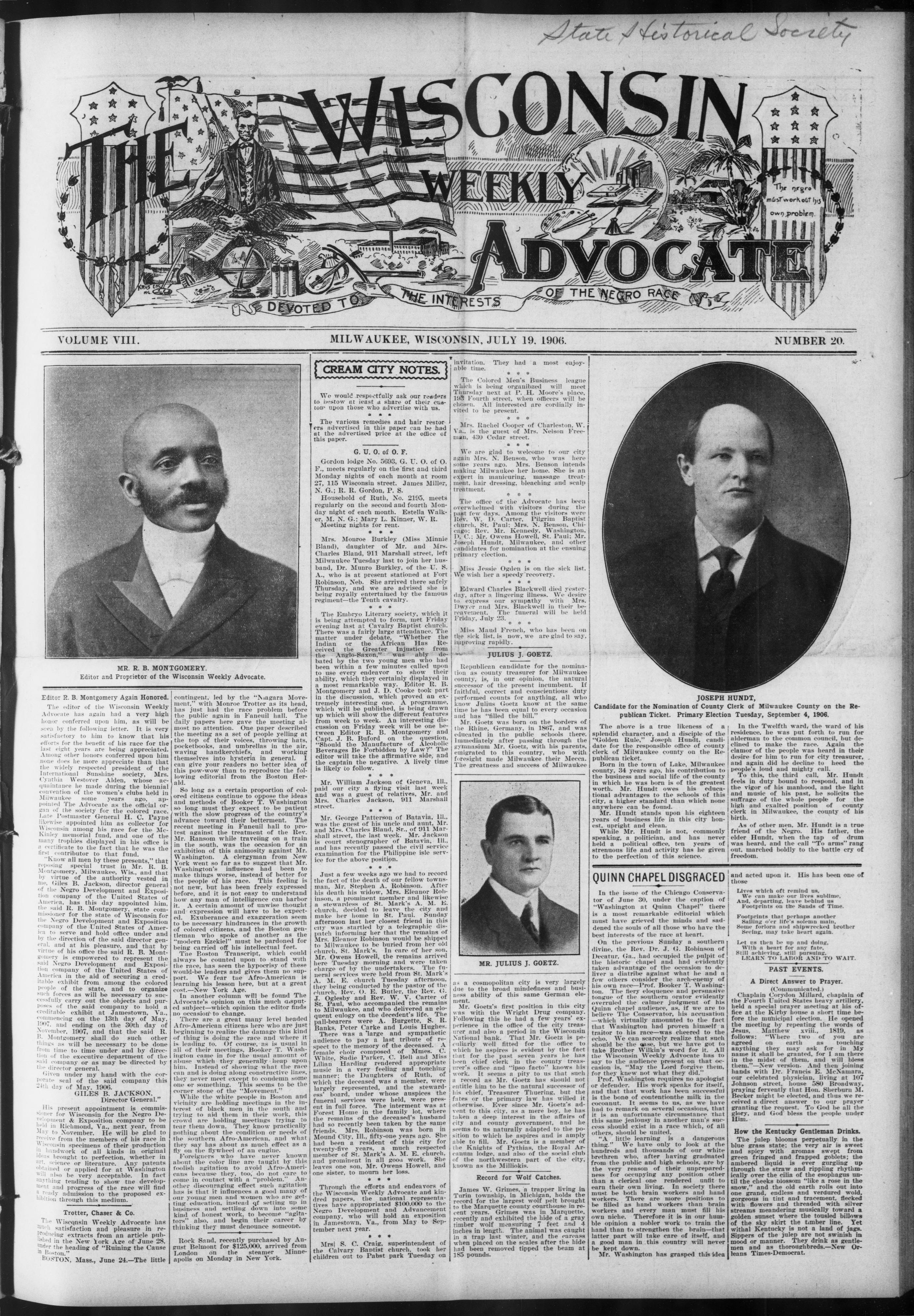
WISCONSIN
WEEKLY
Advocate
DEVOTED TO THE INTERESTS OF THE NEGRO RACE
[Name not visible in the image]
MR. R. B. MONTGOMERY. Editor and Proprietor of the Wisconsin Weekly Advocate.
VOLUME VIII.
MR. R. B. MON
Editor and Proprietor of the
Editor R. B. Montgomery Again Honored.
The editor of the Wisconsin Weekly Advocate has again had a very high honor conferred upon him, as will be seen by the following letter. It is very satisfactory to him to know that his efforts for the benefit of his race for the last eight years are being appreciated. Among other honors conferred upon him none does he more appreciate than that the widely respected president of the International Sunshine society, Mrs. Cynthia Westover Alden, whose acquaintance he made during the biennial convention of the women's clubs held in Milwaukee some years ago, appointed The Advocate as the official organ of the society for the colored race. Late Postmaster General H. C. Payne likewise appointed him as collector for Wisconsin among his race for the McKinley memorial fund, and one of the many trophies displayed in his office is a certificate to the fact that he was the first contributor to that fund.
"Know all men by these presents," that reposing special trust in Mr. R. B. Montgomery, Milwaukee, Wis., and that by virtue of the authority vested in me, Giles B. Jackson, director general of the Negro Development and Exposition company of the United States of America, has this day appointed him, the said R. B. Montgomery, state commissioner for the state of Wisconsin for the Negro Development and Exposition company of the United States of America to serve and hold office under and by the direction of the said director general, and at his pleasure, and that by virtue of his office the said R. B. Montgomery is empowered to represent the said Negro Development and Exposition company of the United States of America in the aid of securing a creditable exhibit from among the colored people of the state, and to organize such forces as will be necessary to successfully carry out the objects and purposes of the said company to hold a creditable exhibit at Jamestown, Va., commencing on the 13th day of May, 1907, and ending on the 30th day of November, 1907, and that the said R. B. Montgomery shall do such other things as will be necessary to be done from time to time under and by direction of the executive department of the said company or as may be directed by the director general.
Given under my hand with the corporate seal of the said company this 24th day of May, 1906.
His present appointment is commissioner for Wisconsin for the Negro Development & Exposition company to be held in Richmond, Va., next year, from May to November. He will be glad to receive from the members of his race in Wisconsin specimens of their production in handwork of all kinds in original ideas brought to perfection, whether in art, science or literature. Any patents obtained or applied for at Washington will also be very acceptable. In fact anything tending to show the development and progress of the race will find a ready admission to the proposed exhibition through this medium.
Trotter, Chaser & Co.
The Wisconsin Weekly Advocate has much satisfaction and pleasure in reproducing extracts from an article published in the New York Age of June 28. under the heading of "Ruining the Cause in Boston."
BOSTON, Mass., June 24.—The little
contingent, led by the "Nagara Movement," with Monroe Trotter as its head, has just had the race problem before the public again in Faneuil hall. The daily papers here gave the meeting almost no attention. One paper described the meeting as a set of people yelling at the top of their voices, throwing hats, pocketbooks, and umbrellas in the air, waving handkerchiefs, and working themselves into hysteria in general. I can give your readers no better idea of this pow-wow than to reproduce the following editorial from the Boston Herald.
So long as a certain proportion of colored citizens continue to oppose the ideas and methods of Booker T. Washington so long must they expect to be patient with the slow progress of the country's advance toward their betterment. The recent meeting in Faneuil hall to protest against the treatment of the Rev. Mr. Ransom while traveling on a train in the south, was the occasion for an exhibition of this animosity against Mr. Washington. A clergyman from New York went so far as to suggest that Mr. Washington's influence had been to make things worse, instead of better for the people of his race. This feeling is not new, but has been freely expressed before, and it is not easy to understand how any man of intelligence can harbor it. A certain amount of unwise thought and expression will have to be expected. Exuberance and exaggeration seem to be necessary hindrances in the growth of colored citizens, and the Boston gentleman who spoke of another as the "modern Ezekiel" must be pardoned for being carried off his intellectual feet.
The Boston Transcript, which could always be counted upon to stand with the race, has seen the hypocrisy of these would-be leaders and gives them no support. We fear the Afro-American is learning his lesson here, but at a great cost.—New York Age. In another column will be found The Advocate's opinion on this much disputed subject—which opinion the editor finds no occasion to change.
There are a great many level headed Afro-American citizens here who are just beginning to realize the damage this kind of thing is doing the race and where it is leading to. Of course, as is usual in all of their meetings, Booker T. Washington came in for the usual amount of abuse which they generally heap upon him. Instead of showing what the race can and is doing along constructive lines, they never meet except to condemn some one or something. This seems to be the corner stone of the "Movement."
While the white people in Boston and vicinity are holding meetings in the interest of black men in the south and trying to aid them in their work, this crowd are holding meetings trying to tear them down. They know practically nothing about the condition or needs of the southern Afro-American, and what they say has about as much effect as a fly on the flywheel of an engine.
Foreigners who have never known about the color line are taught by this foolish agitation to avoid Afro-Americans because they, too, do not care to come in contact with a "problem." Another discouraging effect such agitation has is that it influences a good many of our young men and women who are getting education, instead of setting up in business and settling down into some kind of honest work, to become "agitators" also, and begin their career by thinking they must denounce someone.
Rock Sand, recently purchased by August Belmont for $125,000, arrived from London on the steamer Minneapolis on Monday in New York.
CREAM CITY NOTES.
We would respectfully ask our readers to bestow at least a share of their custom upon those who advertise with us.
The various remedies and hair restorers advertised in this paper can be had at the advertised price at the office of this paper.
G. U. O. of O. F
Gordon lodge No. 5693, G. U. O. of O. F., meets regularly on the first and third Monday nights of each month at room 27, 115 Wisconsin street. James Miller, N. G.; R. R. Gordon, P. S.
Household of Ruth, No. 2195, meets regularly on the second and fourth Monday night of each month. Estella Walker, M. N. G.; Mary L. Kinner, W. R.
Meeting nights for rent.
***
Mrs. Monroe Burkley (Miss Minnie Bland), daughter of Mr. and Mrs. Charles Bland, 911 Marshall street, left Milwaukee Tuesday last to join her husband, Dr. Munro Burkley, of the U. S. A., who is at present stationed at Fort Robinson, Neb. She arrived there safely Thursday, and we are advised she is being royally entertained by the famous regiment—the Tenth cavalry.
***
The Embryo Literary society, which it is being attempted to form, met Friday evening last at Cavalry Baptist church. There was a fairly large attendance. The matter under debate, "Whether the Indian or the African Has Received the Greater Injustice from the Anglo-Saxon," was ably debated by the two young men who had been within a few minutes called upon to use every endeavor to show their ability, which they certainly displayed in a most remarkable way. Editor R. B. Montgomery and J. D. Cooke took part in the discussion, which proved an extremely interesting one. A programme, which will be published, is being drawn up which will show the different features from week to week. An interesting discussion on Friday week will be one between Editor R. B. Montgomery and Capt. J. B. Buford on the question, "Should the Manufacture of Alcoholic Beverages Be Forbidden by Law?" The editor will take the affirmative side, and the captain the negative. A lively time is likely to follow.
\* \* \*
Mr. William Jackson of Geneva, Ill., paid our city a flying visit last week and was a guest of relatives, Mr. and Mrs. Charles Jackson, 911 Marshall street.
* * *
Mr. George Patterson of Batavia, Ill., was the guest of his uncle and aunt, Mr. and Mrs. Charles Bland, Sr., of 911 Marshall street, the last week. Mr. Jackson is court stenographer of Batavia, Ill., and has recently passed the civil service examination for the Philippine isle service for the above position.
***
Just a few weeks ago we had to record the fact of the death of our fellow townman, Mr. Stephen A. Robinson. After his death his widow, Mrs. Eleanor Robinson, a prominent member and likewise a stewardess of St. Mark's A. M. E church, decided to leave the city and make her home in St. Paul. Sunday afternoon last her closest friend in this city was startled by a telegraphic dispatch informing her that the remains of Mrs. Eleanor Robinson would be shipped to Milwaukee to be buried from her old church, St. Mark's. In care of her son, Mr. Owens Howell, the remains arrived here Tuesday morning and were taken charge of by the undertakers. The funeral services were held from St. Mark's A. M. E church Tuesday afternoon, they being conducted by the pastor of the church, Rev. O. E. Butler, the Rev. G. J. Oglesby and Rev. W. V. Carter of St. Paul, who accompanied the remains to Milwaukee, and who delivered an eloquent eulogy on the decedent's life. The pall-bearers were A. Burgette, S. R. Banks, Peter Carke and Louis Hughes.
There was a large and sympathetic audience to pay a last tribute of respect to the memory of the deceased. A female choir composed of Mmes. C. White, Sadie Parker, C. Bell and Miss Lilian Harding rendered appropriate music in a very feeling and touching manner; the Daughters of Ruth, of which the deceased was a member, were largely represented, and the stewardess' board, under whose auspices the funeral services were held, were present in full force. The interment was at Forest Home in the family lot, where the remains of the deceased's husband had so recently been taken by the same friends. Mrs. Robinson was born in Mound City, Ill., fifty-one years ago. She had been a resident of this city for twenty-five years, a much respected member of St. Mark's A. M. E. church, and prominent in all goo work. She leaves one son, Mr. Owens Howell, and one sister, to mourn her loss.
***
Through the efforts and endeavors of the Wisconsin Weekly Advocate and kindred papers, the national representatives have appropriated $100,000 to the Negro Development and Advancement company, who will hold an exposition in Jamestown, Va., from May to September next year.
* * *
Mrs| S. C. Craig, superintendent of the Calvary Baptist church, took her children out to Pabst park Tuesday on
invitation. They had a most enjoyable time.
* * *
The Colored Men's Business league which is being organized will meet Thursday next at P. H. Moore's place, 193 Fourth street, when officers will be chosen. All interested are cordially invited to be present.
* * *
Mrs. Rachel Cooper of Charleston, W. Va., is the guest of Mrs. Nelson Freeman, 430 Cedar street.
We are glad to welcome to our city again Mrs. N. Benson, who was here some years ago. Mrs. Benson intends making Milwaukee her home. She is an expert in manicuring, massage treatment, hair dressing, bleaching and scalp treatment.
* * *
The office of the Advocate has been overwhelmed with visitors during the past few days. Among the visitors were Rev. W. D. Carter, Pilgrim Baptist church, St. Paul; Mrs. N. Benson, Chicago; Rev. Mr. Kennedy, Washington, D. C.; Mr. Owens Howell, St. Paul; Mr. Joseph Hundt, Milwaukee, and other candidates for nomination at the ensuing primary election.
Miss Jessie Ogden is on the sick list. We wish her a speedy recovery.
* * *
Edward Charles Blackwell died yesterday, after a lingering illness. We desire to express our sympathy with Mrs. Dwyer and Mrs. Blackwell in their bereavement. The funeral will be held Friday, July 23.
* * *
Miss Maud French, who has been on the sick list, is now, we are glad to say, improving rapidly.
JULIUS L. GOETZ
Republican candidate for the nomination as county treasurer for Milwaukee county, is, in our opinion, the natural successor of the present incumbent. If faithful, correct and conscientious duty performed counts for anything, all who know Julius Goetz know at the same time he has been equal to every occasion and has "filled the bill."
Mr. Goetz was born on the borders of the Rhine, Germany, in 1867, and was educated in the public schools there. Immediately after passing through the gymnasium Mr. Goetz, with his parents, emigrated to this country, who with foresight made Milwaukee their Mecca. The greatness and success of Milwaukee
[Picture of a man in a suit and tie].
MR. JULIUS J. GOETZ.
as a cosmopolitan city is very largely due to the broad mindedness and business ability of this same German element
Mr. Goetz's first position in this city was with the Wright Drug company. Following this he had a few years' experience in the office of the city treasurer and also a period in the Wisconsin National bank. That Mr. Goetz is peculiarly well fitted for the office to which he aspires is evident by the fact that for the past seven years he has been chief clerk in the county treasurer's office and "ipso facto" knows his work. It seems a pity to us that such a record as Mr. Goetz has should not entitle him to be the natural successor of his chief, Treasurer Thuering, but the fates or the primary law has willed it otherwise. Ever since Mr. Goetz's advent to this city, as a mere boy, he has taken a deep interest in the affairs of city and county government, and he seems to us naturally adapted to the position to which he aspires and is amply able to fill. Mr. Goetz is a member of the Knights of Pythias, the Royal Arcanum lodge, and also of the social club of the northwestern part of the city, known as the Milliokis.
Record for Wolf Catches.
James W. Grimes, a trapper living in Turin township, in Michigan, holds the record for the largest wolf pelt brought to the Marquette county courthouse in recent years. Grimes was in Marquette, recently and exhibited the hide of a gray timber wolf measuring 7 feet and 4 inches in length. The animal was caught in a trap last winter, and the carcass when placed on the scales after the hide had been removed tipped the beam at 185 pounds.
[Name not provided]
The above is a true likeness of a splendid character, and a disciple of the "Golden Rule," Joseph Hundt, candidate for the responsible office of county clerk of Milwaukee county on the Republican ticket. Born in the town of Lake, Milwaukee county, 34 years ago, his contribution to the business and social life of the county in which he was born is of the greatest worth. Mr. Hundt owes his educational advantages to the schools of this city, a higher standard than which none anywhere can be found. Mr. Hundt stands upon his eighteen years of business life in this city honest, upright and clean.
While Mr. Hundt is not, commonly speaking, a politician, and has never held a political office, ten years of strenuous life and activity has he given to the perfection of this science.
QUINN CHAPEL DISGRACED
QUINN CHAPEL DISGRACED
In the issue of the Chicago Conservator of June 30, under the caption of "Washington at Quinn Chapel" there is a most remarkable editorial which must have grieved the minds and saddened the souls of all those who have the best interests of the race at heart.
On the previous Sunday a southern divine, the Rev. Dr. J. G. Robinson of Decatur, Ga., had occupied the pulpit of the historic chapel and had evidently taken advantage of the occasion to deliver a diatribe against what he and a few others consider the arch-enemy of his own race—Prof. Booker T. Washington. The fiery eloquence and persuasive tongue of the southern orator evidently overruled the calmer judgment of his Quinn chapel audience, as, if we are to believe The Conservator, his accusation—which virtually amounted to the fact that Washington had proven himself a traitor to his race—was cheered to the echo. We can scarcely realize that such should be the case, but we have got to take Brother Wilkin's word for it. All the Wisconsin Weekly Advocate has to say to the audience present on that occasion is, "May the Lord forgive them, for they knew not what they did."
Prof. Washington requires no apologist or defender. His work speaks for itself, and that that work has been successful is the bone of contentionthe milk in the cocoanut. It seems to us, as we have had to remark on several occasions, that it is an unfortunate circumstance that this same jealousy in another man's success should exist in a race which, of all others, should be united.
"A little learning is a dangerous thing." We have only to look at the hundreds and thousands of our white brethren who, after having graduated from the public and high schools, are by the very reason of their unpreparedness for occupying any position other than a clerical one rendered unfit to earn their own living. In society there must be both brain workers and hand workers. There are more positions to be filled as hand workers than brain workers and every man must fill his own niche. Therefore it is in our humble opinion a nobler work to train the hand than to strengthen the brain—that latter part will take care of itself, and a good man in this country will never be kept down.
Mr. Washington has grasped this idea
NUMBER 20.
HUNDT,
Clerk of Milwaukee County on the Re-
n Tuesday, September 4, 1906.
In the Twelfth ward, the ward of his residence, he was put forth to run for alderman to the common council, but declined to make the race. Again the clamor of the people was heard in their desire for him to run for city treasurer, and again did he decline to heed the people's loud and mighty call. To this, the third call, Mr. Hundt feels in duty bound to respond, and in the vigor of his manhood, and the light and music of his past, he solicits the suffrage of the whole people for the high and exalted position of county clerk in Milwaukee, the county of his birth.
As of other men, Mr. Hundt is a true friend of the Negro. His father, the elder Hundt, when the tap of drum was heard, and the call "To arms" rang out, marched boldly to the battle cry of freedom.
and acted upon it. His has been one of those
Lives which oft remind us,
We can make our lives sublime,
And, departing, leave behind us
Footprints on the Sands of Time.
Footprints that perhaps another
Sailing o'er life's solemn main,
Some forlorn and shipwrecked brother
Seeing, may take heart again.
Let us then be up and doing,
With a heart for any fate,
Still achieving, still pursuing,
LEARN TO LABOR AND TO WAIT.
A Direct Answer to Prayer.
Chaplain Corydon Millard, chaplain of the Fourth United States heavy artillery, held a special prayer meeting at his office at the Kirby house a short time before the municipal election. He opened the meeting by repeating the words of Jesus, Matthew xviii., 1819, as follows: "Where two of you are agreed on earth as touching anything they may ask for in My name it shall be granted, for I am there in the midst of them, and will bless them."—New version. And then joining hands with Dr. Francis E. McNamara, our celebrated physician, living at 107 Johnson street, house 580 Broadway, praying fervently that Hon. Sherburn M. Becker might be elected, and thus we received a direct answer to our prayer granting the request. To God be all the glory, and God bless the people under Him.
How the Kentucky Gentleman Drinks
How the Kentucky Gentleman Drinks.
The julep blooms perpetually in the blue grass state; the very air is sweet and spicy with aromas swept from green fringed and frapped goblets; the ambered liquid is ever gurgling up through the straw and rippling rhythmically over the cilia of the esophagus until the cheeks blossom "like a rose in the snow," and the old earth rolls out into one grand, endless and verdured wold, gorgeous in tint and tracement, flecked with flowers and threaded with silver streams meandering musically toward a golden sunset where the tousled billows of the sky skirt the timber line. Yet withal Kentucky is not a land of jags. Sippers of the julep are not swinish in mood or manner. They drink as gentlemen and as thoroughbreds.—New Orleans Times-Democrat.
---
—Washington is practically the only National capital that has no slums at all, but Berlin runs it close in this respect.
—To the amazement of Berliners a corner of the royal palace has been given over to a cigar dealer.
—The first pocket handkerchiefs utilized in the manner they are today, were manufactured at Paisley in 1743.
—Paris soon will have hansom cabs, the fronts of which will be opened or shut by the "fare" pressing the button.
—About seventy specimens of the extinct great auk are now preserved in museums. A specimen recently sold in London brought $2000.
—Pliny's Natural History may be regarded as the first encyclopaedia, since it contained 30,000 facts compiled from 2000 books by 100 authors.
—Ants are extraordinarily fond of liver, and may be exterminated by laying raw liver near their haunts. The liver, when covered with insects, should be thrown into boiling water.
—The largest incubator in the world has just been completed at Pembroke, N. Y. It holds 15,000 eggs. It does the work of 1000 hens, or of one hen sitting constantly for ten years.
—A number of the local dramatic critics, to gain practical experience, are occupying the stage at the principal theater in Tokio. Large audiences watch their jistrionic efforts.
—Princess Fehim was Margaret Morgan, an American circus rider. Prince Fehim saw her ride, fell in love with her and married her. He was banished by the Sultan and the princess was expelled from Turkey.
—The British Undertakers' association has been in annual conference in Liverpool, and, according to the London Express, "after enjoying a genial luncheon heard a lecture by Dr. Nightingale on the treatment of corpses."
—The Northampton (England) Guardians of the Poor have received a letter from a farm laborer, who writes: "I hear that you have one or two widows on the books If so, I am in want of one for a wife. One that is on outdoor relief would just suit me"
The recent defeat of Lord Kerry, the Conservative candidate for the Appleby division of Westmoreland, England, by three votes recalls that in 1880 the contest in South Suffolk was decided by a single vote, and that six years later there was a dead heat at New Castle-Under-Lyne.
A prize of $20,000 is offered by the beet sugar manufacturers of France to anyone who shall first discover and apply in France a new method of utilizing sugar in the arts. It is required that the method shall increase the consumption of French sugar 100,000 pounds per annum.
By a secret method a London firm is able to make hollow lead soldiers. This greatly reduces the cost of production, and the trade in these toys, which once belonged almost exclusively to Germany, is now rapidly increasing in England. The weight of the hollow soldier is one-third of the solid.
Rev. John Francis Lee, pastor of the Metropolitan African Methodist Zion church of Norfolk, Va., is attracting much attention in the south as a poet, many believing that he is the coming negro poet of America, taking up the minstrel harp dropped by the late Paul Laurence Dunbar.
Richard F. Pettigrew of South Dakota wishes to be the first Socialist to sit in the United States Senate as such. He has served two terms already. Being an eclectic in politics he was first elected as a Republican, afterwards re-elected as a Demo-Populist, and in three years will hoist the Socialist banner.
Sea serpents again. Says a news item: "The officers of the Caviani, which has arrived from Auckland, New Zealand, from Raratonga, report having, when off the Kedmadeca islands, twice passed close to a sea serpent. They estimated its length at sixty feet. Its color was a reddish brown and its head the shape of a gurnet's."
A Record Hen.
Somewhere in the region round about Altoona, Pa., is a hen which instead of laying eggs of gold, produces an output that contains half dollars, standard coin of the realm. Charles Schmit, a butcher of this city, can prove that this is correct, and he has placed his shop temporarily in the charge of his clerk in order that he may locate the hen. Schmitt bought a few dozen eggs from some hucksters a short time ago. He secured most of them from a Bedford county man, but got the others from farmers whose homes are near Altoona. Schmitt wanted the eggs for home consumption. Breaking one the other morning, preparatory to frying it, he was amazed when a half dollar came from the shell. It looked as though it was newly minted, although the yolk and white of the egg had formed around it. The coin, upon examination, proved to be of standard weight. It had the true "ring" and bore the date of 1906. After exhibiting it to many persons Schmitt started in search of the huckster from whom he bought the eggs. Several secret service men who viewed the curiosity have declared that it is as perfect as any coin turned out by the government. What action they will take in event of Schmitt locating the hen is a matter of conjecture.
Absent-Minded Financier
A new story about absent-mindedness is being told on a West Philadelphia man, and he is not a college professor, either, but an alert financier of large affairs, who is so absorbed in his business that similar stories have been told of him before.
His infirmity, indeed, is so well recognized that at his office, in a big Broad street building, every sort of safeguard is taken, and he is a diffuclt person to see, except by appointment. On this occasion, however, he was not in his office, but at home, alone in the library, awaiting with some trepidation the course of events upstairs, where great things were happening. Despite his anxiety, however, his mind wandered and he fell to speculating as to how he should enlarge his business so as to make it fit the approaching amplification of his domestic establishment.
Just then there was a knock at the door. "Come in," said the financier. A white capped nurse stuck her head around the edge of the door. "It's a boy, sir," she said. The financier raised himself. "Kindly ask him to state the nature of his business," he replied.—Philadelphia Record.
Sweet as Printer's Pi
A Danish paper compares "I love you" in many languages. Here are some of them—the Danish paper is our only authority for their correctness: The Chinanaman says, "Uo ngai ni:" the Armenian, "Ge sirem ez nez:" the Arabian, very shortly, "Nehabeeck:" the Egyptian, similar, "N'achkeb;" the Turk, "Sisi sevejorum," and the Hindoo, "Main tym ko pijar karyn." But overwhelming is the declaration of love of an Esquimau, who tries to win the chosen one by the pleasing sound of the dainty little word: "Univifigssaerntdluinalerfirmajungnarsigujak."—Exchange.
FOR MOLLY
Oh, Molly, with the dark gray eyes,
The light that 'neath their lashes lies
Shall cost a very world of sighs
To hapless lovers!
And laughter, too, has set its trace
In dimples on your winsome face,
While some unguessed at, luring grace
About you hovers!
The little tendrils of your hair
Have woven 'round your brow a snare-
I would that I might say "Beware!"
To those who linger;
I would there were much less of harm
And less of statuaried charm
To curve along your perfect arm
And rosy finger!
Your lips are redder far, I know.
Than roses when the south-winds blow,
A red-bird's wing against the snow
I think is duller:
And in your cheek is something rare
That even painters might despair,
So much of youth comes shyly there,
To seize its color!
Your voice doth match you as the sea
Doth match the sky, and comes to me
Like water in a minor key
'O'er pebbles slipping,
Or as the sound of measured note
By moonlight when some passing boat
Sends liquid murmurings afloat
From oars dipping.
Through the lace mantle 'round you throwin'
Your bosom's rise and fall is shown,
Sweet purity of ivory zone
Half-seen, half-hidden—
Half-hidden lest the thoughtless vain
Too curious, with eye profane,
A vermell blush your throat to stain
Might send mubidden.
O Molly with the dark gray eyes
Deep-brimming, tender, glad and wise,
However change the fickle skies
That are above you,
Though days be long and worlds are wide
Though fate turns harsh and seas divide,
There's one will follow at your side
And live to love you!
—Ernest McGaffey in National Magazine.
HAROLD CASEMATE'S WINDFALL
Harold Casemate sat in his dingy lodgings in a back street off the Euston road smoking what he intended to be the last pipe he should ever smoke. Bankrupt in purse, broken in health, abandoned by his friends, in short, at the end of his tether, he had made up his mind to get quit of it all that very night. A small bottle of laudanum, on which he had invested his last shilling, reposed in his pocket, ready, at any moment, to give him easy and effectual release.
The young man had begun, indeed, fairly well, having got on to a good weekly paper. But the private life into which his moral instability betrayed him was not of a character conducive to regularity, punctuality or sustained industry. He fell into the hands of the wrong men, and—worse than that—of the wrong women. Worries, financial and othersupervened. He became more and more distracted from his work. Contribution after contribution was returned to him as useless. His health was getting rocky, his nerves out of order. He lost heart. No money, no energy, no heart for anything. He owed his landlady some £15; she had told him, in terms perhaps needlessly impolite, that unless his account was settled by Saturday next out he must go. This was Friday evening. Tomorrow would see him homeless and destitute. It must either be the workhouse or the laudanum. He preferred the laudanum.
He laid down his pipe, which was just smoked out, and, taking the little darkblue bottle from his pocket, slowly extracted the cork. While he was in the act of doing so, there came a knock at the door, and Polly, the lodging house slavey, entered, with a registered letter and its accompanying slip of green paper in her hand. Casemate hastily thrust the bottle back into his pocket, and taking the green slip of paper, signed it as requested.
The registered letter he threw carelessly aside, scarcely glancing at it.
Happening to look up at the girl, he read her astonishment, and was rather amused by it. "You were wondering why I didn't open the letter at once—eh?" he remarked, with a spiritless sort of smile. "Well, yuss, sir! I was a-wondering that," confessed Polly, puzzled to know how he had guessed her thoughts.
"Now, I dare say," he went on, "you are under the impression, Polly, that the registered post is only made use of by obliging persons when they want to send you cash, or checks, or bank notes, or diamonds—eh? But if you had lived as long as I have and had an equal experience of the ways of creditors, you would know that they have a playful little habit of registering their dunning letters and other such agreeable missives. In order to satisfy you that I am right in my surmise about this confounded thing," went on Casemate, taking up the registered letter, "I will open it in your presence, Polly, and show you."
He suited the action to the word, tore the end off the envelope, and shook the contents out on to the table, as though they had been something poisonous. * * * There fell out a letter, and from the letter fell out what looked uncommonly like a bank note. Casemate unfolded and examined it. It was a bank note for £50. At the moment he was too much astonished to speak.
"Lor', sir!" ejaculated Polly, her eyes fixed on the note. "It's money, ain't it?" Casemate nodded. Then he took up the letter. It was from a firm of solicitors—the most agreeable solicitors' letter he had ever received—and read as follows:
8008 Lincoln's Inn Fields, Feb. 8, 19.—Dear Sir: We have been instructed by a client of ours, a constant reader of your articles, who has for some time followed your career with interest, and heard of your misfortunes with regret, to forward you inclosed Bank of England note for £50. We may add that our client—for reasons into which we need not enter—prefers to remain anonymous; a wish which you will no doubt respect, and forbear from making any inquiries on the subject. Kindly acknowledge safe receipt of the
Kindly acknowledge safe receipt of the £50 to us and believe us to be, yours very faithfully, JENKINS & TALMATH.
Casemate's feelings, as he read this letter, were a curious blend of delighted relief and puzzled perplexity. Who the deuce could the generous unknown be? His reflections were disturbed by the sound of the garrulous little slavey's voice.
"Fifty pounds?" she ejaculated. "Fifty golding thick 'uns. Oh my wig! Well, now, p'raps life in these 'ere digs' will be worth living once more," she added grinning, with apparent inconsequence.
"Eh? What the deuce do you mean?" demanded Casemate.
"Well, yer see, it's this way, sir. The missis, she've been in such a stew these weeks past about that bill as yer owes her—that things in the basement has been pretty near onbearable. But now yer'll be able to pay her, and that'll put
her in a good temper, and she'll stop naggin' at me."
Harold Casemate took up his pipe again and slowly filled it. There was on hurry now about bidding a long adieu to that faithful friend. This £50 note, which had come so mysteriously and so opportunely, nad changed in a moment the whole face of the situation.
While he was still thinking the matter over, and wondering who his anonymous benefactor could be, there came a loud knock at his door—an aggressive, imperious sort of knock; and without waiting for the formality of his "Come in," Mrs. Bapkins, his landlady, flounced into the room.
About that little matter of fifteen-twelve-six, as yer owes me, Mr. Casemate, "she began, setting her arms akimbo and sniffing defiantly.
"Ah, yes," he replied quietly, handing her the £50 note. Here you are. You can pay yourself out of this and let me have the change and the receipt in the morning."
In about three-quarters of an hour Polly brought up a steak flanked by mashed potatoes and a bottle of stout.
"My! ain't missis in a heavingly humor, though," she remarked, as she bustled about, laying the table. "Cherubims and seraphims ain't in it with her. Ho yuss. It's like the Garding of Eden in the basement just now."
Like all other most highly impressionable men, the same acute sensitiveness that made Casemate a quick and easy prey to despair at an adverse turn of fortune rendered him susceptible of equally sudden elation at the smallest stroke of good luck. In a few months his feet were well on the high road that leads to distinction and affluence. And now that he was able to pay his way regularly, he found Mrs. Bapkins vastly more civil and considerate for his creature comforts. But, in the course of a month or two, the good woman was again very much upset; and this time it was not Casemate, the lodger, but Polly, the slavey, who was the delinquent.
Poily had the impudence to contract pneumonia; and worse than that, by the time the doctor was sent for, the girl had the unparalleled cheek to be too ill to be moved.
Mrs. Bapkins was very much incensed, and inveighed against Polly, and pitied herself, in no measured terms.
"Tut, aut," said Casemate, much concerned (being a kind-hearted fellow), not, of course, for the selfish and unfeeling landlady, but for the unfortunate Polly. 'I'm sorry to hear the poor girl's so ill—very sorry. Look here. Don't you worry about expense, Mrs. Bapkins. Just you engage a nurse and procure whatever the doctor orders, and I'll pay for it all.'
But, in spite of everything being done for her, Polly got rapidly worse. On the third day the doctor pronounced her condition hopeless. Mrs. Bapkins was in a terrible state of mind, and pities herself more than ever. Polly was actually going to have the audacity to die in her house. Late that evening, while he was busy on an article he was writing, there came a tap at his door. The nurse entered.
"The poor girl's gone, sir," she said. "She passed away about an hour ago. * * * Before she became unconscious, she asked me to give you this after she was dead. It's about her funeral, I believe, and the settlement of her small effects. She told me that, as she had no friends or near relations, and as you'd always been kinder to her than any one else, she would like you to do this for her—if you would." As the nurse spoke, she handed him a small packet, which, as soon as he was alone, he proceeded to open. It contained an ill-spelled letter, in Polly's sprawling, childish handwriting, and a postoffice savings bank book. The letter was dated some days previously, and ran as follows:
Deer Sir: You woan't get this til I'm ded. It's to say will you please see as I'm berried decent. There's £9 left in the bank. That will pay for it. I engclose my bank book. And, Deer Sir, there's sumthink else as yer'll see if yer looks at the book. But yer mushnn't be angry, sir. Cos I done it for yer good and cos I cooden help—I cooden really, sir—cairling for yer as I never caired for no one else afore. Good-by, deer, deer, sir, and God bless yer for all yer kindness, from POLLY.
The tears started to his eyes as he read this letter. Then he looked into the bank book, and the truth stood revealed. Three months before (he remembered the date well) there was an entry in the book showing that the sum of £50—ten years of the little slavey's hardly-earned savings—had been drawn out in a lump.—Truth.
Crowd Mobbed Clown.
Dressed in his outlandish costume, with the paint still on his face, John R. Woundy, a circus clown, at Bridgman, near St. Joseph, Mo., held at bay a mob of farmers threatening to hang him, whom thirty minutes before he had been convulsing with laughter. At his feet lay Fred Sieman, a farmer, with a bullet hole in his lung.
Woundy remonstrated with toughs for cutting guy ropes and was immediately attacked. He then brought down the foremost of his antagonists.
Woundy backed up against the canvas wall of the tent, while the mob charged backward and forward. Then Woundy threatened to shoot if another stone was thrown. The shower of missiles ceased. The deputy sheriffs with Woundy in charge were pursued by the mob nearly to St. Joseph, where the prisoner was lodged in the county jail.
The farmers then turned on the circus, but they were driven off by a posse and finally dispersed.
The First Safety Pins.
"There is a strange story connected with the safety pin," the clerk said. "An Englishman invented this pin some thirty or forty years ago. For this admirable invention he was highly honored. Fetes and applause were showered upon him. If I am not mistaken the man was even knighted.
"About three years ago, in excavating in Pompeii, they came upon—what do you think. A perfect safety pin. Hundreds of perfect bronze safety pins. The Englishman's invention wasn't new at all. It was 2000 years old.
"The man had been feted and honored all his life—he had even been knighted, for an invention that he didn't invent."—Minneapolis Journal.
Sharks and Balloonists
Ballooning on the Adriatic coasts has dangers of its own quite apart from the risk of drowning. The sea is stated to be infested by sharks, and an aeronaut reaching the water has small chances of living till rescue reaches him.
No trace has yet been found of the bodies of Capt. Nazari and Signor Minoletti, whose balloon collapsed over the Adriatic over a week ago, and it is feared that they have been devoured. From Ancona another balloon was on Friday seen floating toward the Adriatic
and showing colored lights as signals of distress. A torpedo boat went in the direction where the balloon was last seen, but up to yesterday evening there was no trace either of the balloon or its occupants.—London Globe.
BRIEF NOTES OF GENERAL INTEREST
Roy Slocum, aged 11, was drowned in the river at Muskegon, Mich. George Herlien and Ralph Scuitma, his playmates, were saved by their dog, which towed them to shore.
Miss Julia Munson Beaver, 18, daughter of William C. Beaver, of Pittsburg, Pa., died of nervous prostration, due to worry over the action of the high school authorities in withholding her diploma, after overworking herself in a determined effort to win it this year.
Carrying a load of select wines and liquors, a team of frightened horses ran away from in front of a liquor company's establishment at La Crosse. Jugs were overturned and wines and liquors were mixed with the dust of the street. Leaving the team unhitched was the cause of the trouble.
Miss Lucille Weeks of Syracuse, N. Y., has brought an action against the Auburn & Syracuse Electric Railroad company to recover $1000 because she could not get a seat on one of the company's cars. Miss Weeks boarded a crowded car and when she demanded of the conductor that he procure her a seat, she declares, he laughed at her.
D. J. Hotchkiss, editor of the Fox Lake (Wis.) Representative, has been wearing a pedometer and found that during the month of June he walked 182 miles, and without doing any unnecessary walking. Six miles a day he considers an easy average. Hotchkiss says that he can now prove to any one who doubts, that being a postmaster, editor and general rustler is not as great a snap as one would suppose.
While dazed and half awake after a dream that burglarls were looting his safe, J. C. Davidson, proprietor of a general store at Bryant, ten miles south of Canton, Ill., grasped a revolver lying on a chair by the bed. The hammer slipped and the bullet plowed through his left hand and buried itself in the body of his wife, who was sleeping at his side. The woman died. No blame is attached to the husband.
After forty years Confederate soldiers of Gen. John H. Morgan's command are receiving pay from the federal government for horses which were taken from them when they surrendered. Dr. L. J. Frazee and several other ex-Confederates of Lexington, Ky., who surrendered to Gen. E. H. Hobson at Mount Sterling, Ky., in May, 1865, have just received checks for their horses taken from them at that time. The amount each received is $125.
Prosperity is declared largely responsible for the marked increase in insanity, according to the report of Dr. Charles G. Hill, in charge of the Mount Hope retreat near Baltimore.
"I believe," says Dr. Hill, "that by a thorough research it could be traced in a great part to the prosperity of the period; the luxurious indulgence, the dissipations, the departure from the old standard of rectitude and the moral deterioration."
Mrs. John Underwood of New York, encamped with her husband in a remote gulch near Harney's peak, in the Black hills of Nebraska, was attacked by a mountain lion while a mile from camp. She screamed. The lion paused, with one foot on her breast. She changed her screams to a song. As the animal still hesitated, she continued to sing till morning, when her husband found her and killed the lion, which, apparently, was charmed by the song. The woman was slightly injured.
There is danger that the borough of Stillwater, Columbia county, Pa., will be left without enough voters to fill the public offices. The borough had forty-four qualified voters. Many of these are employed in a plowing mill which last week was removed to Berwick, and a number have followed the mill. The borough has twenty-two public offices to fill and less than thirty voters are left, while some of these may still remove. As it is, only a few voters will be able to avoid the responsibilities of public office.
Mrs. Mary Fay,105 years old, who was sent to the New York almshouse last month after being arrested as a destitute person, died suddenly on July 4 of heart disease. Dr. Philip S. O'Hanlon, coroner's physician, states that Mrs. Fay was more than an ordinary person in physique.
"I have performed 4,550 autopsies," said Dr. O'Hanlon, "but she was the best preserved person I ever saw. Were it not for the lines of age in her face she would not have been taken for more than 25 years old. She weighed approximately 140 pounds and was a little more than five feet in height. The body was exceptionally well nourished, and the teeth in both upper and lower jaws were in perfect condition."
Cheated of his evening game of pinochle and a glass of beer, and doomed to see Sundays pass without even a chance to meld or bury his lips in the foam of a cool draught, old George Schrader, of Jersey City, killed himself with gas. Dying, he blamed the framers of New Jersey's latest Excise law for having made life not worth living. Schrader was nearly 80 years old. He was a character in the neighborhood, and for years not a night passed nor a Sunday that did not find him in a saloon near his home playing his favorite game of pinochle and sipping lager. Some folk told the time by the comings and goings of the old fellow. He was a drifter, without relatives, who lived for the joys of pinochle and a few glasses of beer.
A Sailor's Address.
"And you say you have been dealing with sea captains while you have been on shore. Name just one?" asked Lawyer John T. Harrington of a sailor witness in the police court.
"I will name Horton Osgood."
"Give me his address?"
"Well, if the wind has been good and sou'son'west, he is now half way between here and Demerara," replied the sailor.—Boston Herald.
Women as Poisoners.
In cases of criminal poisoning a woman is nine times out of ten found to be the guilty party. Poisoning is a feminine crime par excellence. The Hindu practice of condemning young widows to be burned alive on the biers of their husbands was a sort of preventive measure against coijugal poisoning.—Le Matin of Paris.
A Horse Census.
A cavalry authority in Belgium estimates that there are more than 80,000,000 horses in the world. There are 22,000,000 in Russia, while Germany and Austria-Hungary each has more than the British, Isles, where it is reckoned there are about 3,000,000.
DAREDEVIL DAN.
Milady has married her coachman,
The king has eloped with his cook,
The heart of the Duchess Disdainful
You shepherd there holds in his crook;
The papers affirm that Sir Preacher
Has given Miss Soubrette a kiss!
Dan Cupid, you queer little devil,
You shouldn't mix matters like this!
Why is it that yonder logician
Is enamored of Mistress Coquette?
And the heart of young Stripling, aged
twenty,
On the eldest Miss Spinster is set?
That Tom is in love with the wife of
Poor Dick, who adores Harry's spouse?
Dan Cupid, you queer little devil,
You haven't the sense of a louse!
Just look at the eyes of Miss Beauty
As they follow old Croesus about—
Can it be she prefers him, in spite of
His wheeze and his punch and his gout,
To the handsome and ardent musician
With the holes in his shoes and his hat?
Dan Cupid, you queer little devil.
Why don't you mend matters like that?
What makes you set deacons to dancing,
Or change merry maldens to sad?
What makes you turn good fellows sober
And drive all the sober ones mad?
Young Giltedge has fought with his people
And married on nothing a year,
Dan Cupid, you odd little devil,
What makes you, what makes you so
queer?
Trapping sages in pitfalls of folly,
Giving innocence lessons in guille,
You wrecker of proper conventions,
You think a state less than a smile!
Yes, you, with that leer and that swagger.
Yes, you, with that look in your eye—
Yet, Cupid, you dear little devil,
How we'd mourn you bade us goodby!
New York Every Day.
A man who described himself as James Stellman, an engineer, 24 years old, of Brooklyn, was arrested in New York on a charge of complicity in a $50,000 diamond robbery in London on March 14, 1905. According to the police Samuel Locket, Stellman's partner, is serving a five years' prison term in England in connection with the crime.
Cheridah Simpson, prima donna of "Seeing New York," on the New York theater roof, is to star next season in a revival of Reginald De Koven's comic opera, "Red Feather," in which Grace Van Studdiford and Thomas Q. Seabrooke were heard late in 1903. Miss Simpson is a Milwaukee girl. She has long been in Col. Savage's companies.
Prof. Thomas H. Teegan of the Central Training college, Dublin, Ireland, arrived in New York on the steamer Oceanic. He has come to America to obtain objects of historic interest for the international exhibition to be held in Dublin in 1907. Melville E. Ingalls, president of the public ownership commission of the National Civic Federation, was also a passenger on the Oceanic.
Hetty Green entertained four women guests at a 25-cent dinner at the Hotel Gramatan, Bronxville, recently. After settling the bill of $1.25 she left the table without tipping the waiter. Mrs. Green arrived in an automobile. She took a table d'hote dinner and ate heartily. She and her friends seemed in high spirits, laughing and chatting away for two hours before they arose, re-entered the automobile, and hurried away.
The net value of the estate left by the late John A. McCall, former president of the New York Life Insurance company, was $40,835, according to the report of the appraisers of the estate, which was filed in the surrogate's office. This document shows that Mr. McCall died possessed of property valued at $74,000, but this has been reduced by the payment of debts, administrative expenses, and other disbursements to the extent of $33,165.
New creations in millinery are attracting many women to New York stores this summer. Carnation red straw hats, with a light trimming of self-colored tulle and bunches of deep, dark carnations in such exact imitation of nature as to be deceptive, are popular with the swellest young women here. This type of hat is usually worn with a full ostrich feather boa dyed carnation to match. A white gown as an accessory makes a pretty and becoming outfit.
The International Mercantile Marine company is preparing to build six transAtlantic liners to add to its present fleet, according to an announcement of President J. Bruce, who arrived in New York from England. He said that the new vessels will be completed in three years. The steamers probably will be constructed at Belfast, Ireland, and some of them are expected to have a speed of twenty-five knots an hour. Mr. Ismay said their engines will not be of the turbine type.
R. E. Johnston, manager, has set out to cancel some contracts he had made for the appearance of Eugene Ysaye in concert here next winter. The Belgian violinist cabled a positive refusal to return here next season. As he and the manager had a stormy time in his last tour here the news that Ysaye had declined to come back created no surprise in musical cricles. His decision puts an end to the announced tour of him and Mme. Nordica during December and January.
New York society women promise to revive a barbarous fad this fall which at least will be jumped upon with both feet by the fair sex of Pittsburg. Large and long earrings are now chic, so if you see a woman, the lobes of whose ears are stretched by heavy pendants of the Cleopatra design, decide at once that she has just returned from Gay Paree. During the past month returning tourists have brought back the new-fashioned earrings. Maiden lane is now making samples. So beware!
The government statistics for the manufacturing industries of New York city shows 20,839 establishments with a product of $500 or more. The total amount of capital represented is $1,042.946,487. There are 63,561 salaried officials and 465,366 wage earners, an increase of 45 per cent in the first and almost 20 per cent in the latter over 1900. The salaries paid amounted to $73,017,655, an increase of almost 38 per cent, and the wages $248,138,259, an increase of 26 per cent.
The cost of materials used was $818.029,267, an increase of 29 per cent, and the miscellaneous expenses were $206,825,065, an increase of 60 per cent. The value of the products was $1,526.523,006, as against $1,172,870,261 for 1900, an increase of over 30 per cent.
Two out of town salesmen left a Broadway hotel recently and started to explore the Bowery. While the drummers were seated at a table quietly watching a moving picture of unsymmetrical figures whose yells of "Sof' boiled on two" would sound familiar to the short-order cooks in an east side restaurant, the hardware man was nudged on the shoulder by a pretty little peroxideine who laughinly said: "Say, feller, ye're come down here to pump us chorus girls about the Thaw case, ain't ye? Now tell the truth, fur you see I know yer 'tectives." Everyone who goes within a mile of a chorus girl or a Bowery dancer since the roof garden affair is
taken for a detective. The chorus girls are making capital of the tragedy and some of them are in the employ of the attorneys on both sides of the case.
Dogs are now tabooed in most of the big hotels in New York, so while milady dines Buster or Fudge must remain whining and crying his "poor dear little eyes out" in the check or baggage room, under the care of some heartless waiter who often grabs the beribboned autocrat of the kennel and makes him demonstrate his pluck. It's a pretty hard blow, too, for the dog-carrying fashion plates of swelldom, because when a belle makes an elaborate toilette and selects one of her poodles whose color matches her dress it causes a deprecating effect when Mine Host says that society shall not "go to the dogs." It's a fact that certain species of dogs are being carried this season to harmonize with the color scheme of faddish women. Heretofore dogs have been admitted to the parlors and lobbies of some of the fashionable hotels, but this summer they are ostracised the same as would be a baby from an uptown apartment house.
New York has practically been rebuilt and rejuvenated during the last two decades; skyscrapers are looming up almost mushroom-like in the business section of the city, but this great transformation does not bear the sincere stamp of the staid, old, loyal New Yorker's approval because he loves old things and loves to recall old times. Like Voltaire, who took extreme delight in reminding his friends that he was old, Father Knickerbocker is always anxious to tell his correct age, recount incidents of his boyhood and point with pride to priceless old paintings and prints showing the evolution of the present giant which adorn the walls of the Astor house and other historical buildings in the city. The new skyscraper age is a matter of indifference to old residents of Manhattan. Speak to one of the greatness of the city and he will nod approvingly, but discuss primitive New York with him and his enthusiasm will be unbounded. Ask him for facts concerning the newest pile of granite and marble that is climbing just a few inches above the highest building in town and possibly in many cases the provincial Gothamite will be unable to tell you. On the other hand, ask him about some little rookery on the east side, west side or, in fact, any place on the island and he has the information at the tip of his tongue. Loyal New Yorkers love their old Battery, old landmarks and all the picturesque old spots in the city. They will criticise the Bowery sometimes rather harshly, but if you are a stranger in the city refrain from doing so because the world-famous district, with its beer gardens, dance halls, fakirs and thugs, has a place in the innermost recesses of any old Gothamite's heart. He treasures the place as he would his first toy because the Bowery stands as a noisy and loyal monument to old New York. At the Astor house are innumerable old prints illustrating scenes and incidents of the times when New York was a mere village. Strangers in the city are brought here daily and shown these pictures by veteran residents. They leave the realm of pictures depicting village life and step into mammoth New York. If the visitor has agreed with his enthusiastic guide that New York is a Methuselah, but by no means in the dotage stage, he has won the day.
A marriage has been arranged and will take place between Ritter Carl Schaefer, and Miss Jessie Eagle, ward and niece of Miss Eagle, of New York city. Schaefer is a widower and has eight children, of whom two, Dora. 21, and Tillie. 19, have views. Consistently with their views they created a scene in Yorkville court when their father, through Attorney Harold Spielberg, implored the court to enjoin them from blocking his way to marriage with Miss Jessie Eagle, rare, pale and 28, with whom he is deeply in love. Miss Eagle, also in court, stood at a discreet distance from the Schaefer girls.
It seems that Schaefer's love for her is of some years' standing, and that she is good, prudent, and a superlative housewife. Schaefer himself is also of some years' standing, having just completed his 66th year.
As the spiel of Lawyer Spielberg came to an end, Schaefer told Magistrate Whitman that he had already half a dozen times attempted to get away with a marriage ceremony, but that his daughters had each time prevented.
"On the night of June 30 there was to be a wedding," Schaefer continued, "but as I was putting the wedding ring on the lady's finger, she had to run for her life into the street, the two girls made so much trouble. Again, on the night of the Fourth, the same day the Kronprinz had his son, it was the same, and I got this." The relator here introduced in evidence a very black eye.
Whereupon spoke up Dora, the eldest daughter:
"Judge, Your Honor, the person my father desires to marry is not our equal and is in every way unfitted to enter our household. It shall not be. I swear it."
"See," interpolated Lawyer Spielberg, "more duress, again they forbid the banns."
"And my unfortunate sister, Tillie," went on Dora, "has been the Cinderella of the family and this is to be our reward. When that person enters our home we will be forced to go. We hold sacred the memory of our mother."
"Your Honor," broke in Schaefer, "I am worth $90,000 cash money. Here I will write my 2-year-old son a check for $500 and my daughter Tillie a check for $500 if they will let the wedding go on. Dora is of age and will get nothing, of course. And I want you to marry us right now."
With a long shuddering scream that made the back seats take notice Dora fainted gracefully into the arms of Attorney Spielberg. Simultaneously Tillie took a double wrap in the back hair of the bride-to-be and made work for the court officers. It took twenty minutes to restore order. Then Magistrate Whitman said he could see no reason why he should not perform a ceremony, both parties being willing and of full age. But the bride-to-be demurred, saying she wished the wedding to be a church affair, so in the end the pair left court with Probation Officer Thomas, who went along to keep the girls away.
Schaefer was seen at his Seventh street home. After much pleading and many promises he removed the barricade from behind his door and poked out a cautious head. Finding merely men he came out and announced that his nuptials are to be celebrated soon.
"And my daughters are not invited, they have never done anything for me. I do my own cooking, washing and ironing, and you can eat off the floor."
All of which was supported by a slight stiffness in the gait of Mr. Schaefer, due in all human probability to a touch of housemaid's knee.
Dollar of 1804 Sold for $1000
Thomas L. Elder bought from a Mr. Chapman of Philadelphia a United States silver dollar of the year 1804. The coin is one of six known specimens, and cost Mr. Elder $1000. He considers this cheap, as the last purchase recorded of a similar coin was that made by W. F. Dunham, vice president of the Chicago Numismatical society, who paid $1100 for his specimen.—New York Tribune.
GOSSIP FOR THE LADIES.
An old lane, an old gate, an old house by a tree.
A wild wood, a wild brook—they will not let me be;
In boyhood I knew them, and still they call for me.
Down deep in my heart's core I hear them, and my eyes.
Through tear-mists behold them beneath the old-time skies,
'Mid bee-boom and rose-bloom and orchard lands arise.
I hear them, and heartsick with longing is my soul,
To walk there, to dream there, beneath the sky's blue bowl;
Around me, within me, the weary world made whole.
To talk with the wild brook of all the long ago.
To whisper the wood-wind of things we used to know
used to know When we were old companions, before my heart knew woe. To walk with the morning and watch its rose unfold;
To drowse with the noontide, lulled on its heart of gold:
To lie with the night-time and dream the dreams of old.
To tell to the old trees and to each listening leaf.
The longing, the yearning, as in my boyhood brief.
The old hope, the old love, would ease my heart of grief.
The old lane, the old gate, the old house by the tree.
The wild wood, the wild brook—they will not let me be;
In boyhood I knew them and still they call to me. —Criterion.
The Utility Box Deserves Its Name.
It started out in a very modest way as a shirt waist box. Now it is known as the utility box and incidentally it is becoming more useful and more ornamental in proportion to the way that its popularity increases. Just let a woman once realize the comfort of such a box and she will not be content to be long without one. Several years ago somebody conceived the idea of shirt waist boxes, and the little boxes covered with cretonne or burlap or denim were found so exceedingly useful that the idea developed and grew until now the original ones really look quite commonplace and insignificant beside the elaborate chests—for that is really what they are—that are seen everywhere.
are seen everywhere.
Both upstairs and down these utility boxes are attractive and useful. Covered with material to match the general color scheme of the room they may be turned into most delightful window seats for the bedroom, and made of decorative wood they may be made to serve the double purpose of a hall bench and a place to store hammocks, tennis racquets, balls and other outdoor playtime articles.
Among the new boxes seen this season are those of unvarnished red cedar. By means of some clever process the knots are made absolutely smooth, while the beautiful coloring of the wood makes it adaptable to any surroundings. Something new in the way of shape, too, is the box with slightly raised ends that form handles and that is particularly suitable for the hall seat.
Some of the prettiest boxes seen are covered with Japanese matting and mounted in bamboo. The matting is dainty in both coloring and design and the box makes a charming piece of furniture for a summer bedroom. The edges of some are finished with the bamboo, while others are decorated with queerly-shaped designs made of narrow strips or bamboo.
These matting-covered boxes may be had with a lining of red cedar and some of them are so long that dress skirts may be placed in them without the necessity of folding. Some boxes, too, are lined with light colored wood highly polished, so that they are quite as pretty inside as our.
The real utility box, the one that lives up to the fullest meaning of its name, is made like a trunk and has two trays, one for shirt waists and the other, the top one, divided into ever so many little compartments to hold all sorts of olds and ends of feminine belongings. These are so light in weight that they are easily lifted out and the fact that the contents may be kept separate makes the utility box doubly useful. Burlap is still much used as a covering for these boxes, and a new idea that makes them much handsomer is to have trimmings of weathered oak, while fancy hinges of wrought iron add much to their appearance.
For the woman with more ingenuity than money the making of a utility box ought not to present serious difficulties. If a plain, strong wooden box with a well made top is secured it may be covered and the trays added without much work. If it can be put on rollers so much the better.
The top should be padded slightly and fastened on with substantial hinges, and with not much extra trouble the entire box may be nicely lined. If it is to be used as a window seat several small size pillows covered with the same material as that with which the box is upholstered will add to both its looks and comfort.
To fit the box with trays nail thin strips of wood at either end for the supports and for the trays themselves tack stiff pieces of canvas to a framework made of pieces of board one inch wide and three inches high. A very satisfactory hall settee was recently made by a woman, one of those ingenious women who are able to take hopeless old things and convert them into useful new ones.
This particular woman had an old-fashioned, low, flat ice chest that had been out of commission for many a long day. She had rollers put on it in place of the legs, painted it dark green, put wrought iron handles and hasp on it, made an upholstered cushion for the top to help conceal traces of its humble origin, and when she had finished it was not only extremely useful but quite an attractive looking article of furniture.—New York Evening Mail.
Have there been times when for pleasure or profit you have wished that you were of the opposite sex? If so, will you kindly jot down a few particulars on a half-note sheet, and mail the same to me at your earliest convenience? Your reply will be considered a personal favor, and be held strictly confidential as to name and address.
Last February I mailed forty copies of the above request to as many friends and acquaintances, divided equally as to sex. I now have at hand twenty-seven returns, sufficient, I imagine, to proceed upon a short diverting excursion along a by-way of human nature.
A letter penned by a young woman of Albany, N. Y., quite young; a beauty of the Gibson type, says:
If you ever print this with my name I shall never forgive you. Yes, I long to be a man. Listen! So that I could drive a milk wagon! I hear you laugh. Never mind. I would give all my jewellery, except my pearls, to be a man and drive a milk wagon just once. Only think! To set up in front of a hundred shining cans, and drive into the city at
4 o'clock in the morning—and whistle!— whistle till every dog in the square barked. But I never can be a man and drive a milk wagon. Never! I think it dreadful unkind of Fate! And now don't you dare laugh!
Dear debutante, believe me, I would as soon laugh at this natural, wholesome wish of yours as laugh—
Now, here is a letter from a Japanese man, whose English, I take it, is misinformed rather than lost:
Your much esteemed interrogation arrived, and moves me deeply. To be a woman! Who would not esteem himself happiest of men to be such indeed? I myself often have thought of it, and I sigh. Truly, not my women, but your women! Ah, the American girl! Is she not wonderful, soulful, melodious? She is a lotus flower that floats on my heart's stream. Her beauty is so swift! Her features have the place of abiding for each loveliness. Hark! she sighs! she laughs! she loves! It is ravishment. Is not this a sweet bouquet of the hedge roses and wild flowers of English? But it seems to me this letter expresses the writer's love of the women rather than any wish upon his part to change his sex; so I lay it by and choose another:
Have I ever wished to be a man? you ask. I have many unsatisfied longings; but this certainly is not one of them. Why should it be? By our superior diplomacy we women have already made you men-folks our unconscious but not less useful vassals, and though our growth be slower it but attests our superior nature. Maturity comes quickly to the lichen, but slowly to the mammal. I grant that you lead us in many things; but only as the donkey does the cart—though he leads, he pulls. No, I had as lief be a dodo as a man.
The sentiments of ten women I shall summarize briefly:
Two would not be men, neither now nor in a state of reincarnation.
One would be a man if she could dress in color and ruffles, as men dressed in former times.
One would like to be a man, to come and go as she pleased.
One loves horses so well, she would like to be a man "at times," so that she could be a jockey. One would lige to be a man, so that she could get twice the salary for the same work.
One would like to be a man for how it would feel
One would like to be a man for awhile, because she would have so much to be thankful for when she got back to her own sex. One wishes to be a man, so she could fix her auto when it breaks down on the road. One would like to be a man, to treat the employed of her sex as a gentleman should.—D. D. Lemon in Sunday Magazine.
A Common-Sense View.
Just make up your mind that your manners are bad, indeed, very bad; just come to a realizing sense that you don't seem to attract and hold people as you should; arrive fairly and squarely at the point where you can see, with quite painful distinctness, that for want of charm you are failing to make the successful career you planned out for yourself, and then sit right down and take a common sense view of the situation. Waste no time losing your confidence or courage, but look the situation directly in the eye and say: "I will study this art of agreeability just as I would study electricity, or a language, or dressmaking.
"I can't get on any longer without it, and I find that there are first and foremost excellent text books upon the subject to be studied, the rules and information in which will be to me of inestimable value."
Having got this far along the right and royal road to the attainment of your desire, don't be either ashamed or afraid to go straight and purchase some excellent volume on correct social usage. You can no more succeed without it than you can learn to discourse sweet music without notes, or prepare delectable dishes without the assistance of an authorized volume of approved recipes.
Select carefully compiled and perfectly up-to-date works on the best and most modern etiquette by well-known authors, and do not be in the least deterred from your study of rules because you may be passing over first youth or because you do not live in a fashionable community where there appear to be larger opportunities for practicing what you learn.
There is literally no time of life when it is too late to study and adopt the principles of exquisite politeness. I am proud to count in my list of friends a man who made his money in Colorado gold, and a large part of that gold he dug and blasted from the rock with his own big strong hands. At 45 he had a fortune and he gave up the mines, came east, bought a house in New York, and began to fit himself for the enjoyment of a social life. "I earned my money by some hard licks," he bravely said, "and now I am going to earn my social position by some more hard licks."
He was as good as his word. The hard licks he put in while earning and winning the society of cultured men and women were devoted to the study of etiquette and a gradual application of all its best rules. Today he sists at the head of his own table, whereat he entertains the best in the land, and his kindly, graceful, genial and correct manners are as great a credit to his pluck and sound common sense as are his millions.
Now, if you wish to achieve as excellent results as my millionaire acquaintance, take your work on etiquette seriously and study it with cheerful diligence. "I guess it isn't any harder to win a sound reputation for good manners than it is to win a solid bank account." I once heard my enterprising friend from the west say, and if you just keep that same philosophy in practice, you are bound ultimately to be numbered among the well-bred ones of this earth.
I advise you to remember, if you can, that you do not take up this study, of a book that helps you to the attainment of agreeability, just because it is a fine sort of accomplishment to possess. Keep well in mind that you study your etiquette authority just as you study algebra, or geography, or history, because it contains information that is going to be soundly and practically helpful to you all your days, in business and out, by day and by night, wherever or whenever you mix with your kind. Again, I am going to quote my friend from Colorado, because on one occasion, when we both stood in his library, he took down a well-thumped book and regarded it half sadly, half admiringly.
"It is my authority on social usage," he said, "and I wish very much I had begun to study it and apply its rules when I was fourteen instead of forty-five. I would have made my fortune more rapidly and with less difficulty than I did had I only known what a help could be found in a little knowledge of etiquette."
Choice Cookies.
A conscientious housekeeper must be equal to the many unexpected demands
made upon her hospitality, and to know that she has a supply of little cakes or dainty cookies on hand to offer the chance caller with the cup of tea or chocolate adds greatly to her content. A number of choice recipes are gleaned from What-to-Eat as follows: It is wise to make several kinds at a time and when done and cold pack closely in a tin box between layers of fresh parafine paper. The fruits and nuts can be prepared ready for use the day before and if two persons work together, one to mix, roll out and cut, the other to prepare the tops and watch the baking, it is surprising what an amount can be made in a few hours.
Spice Nuts.—Four eggs, one pound granulated sugar, one-fourth pound shelled almonds, one-fourth pound citron, one heaping teaspoonful cinnamon, one even teaspoonful cloves, one even teaspoonful allspice, one pound flour, two teaspoonfuls baking powder.
Wipe the almonds on a clean cloth and chop or cut into small pieces. Cut the citron fine. Sift the flour, weigh it and divide into two portions. Mix the spices, nuts and citron with one portion and to the other portion add the baking powder. Break open the eggs into a large bowl, add the sugar and beat with a wire egg beater until ligat and thick as custard. Then gradually add the flour, the spiced portion first, and mix well. Flour the hands and mold into little balls about the size of a hickory nut. Drop on buttered tins an inch apart and bake in a moderate oven until a light brown.
Sugar Cookies.—Three-fourth cup butter, one and one-half cups light brown sugar, yolks of two hard-boiled eggs, one whole egg, one tablespoonful brandy, flour to roll.
Have a small kettle of boiling water on the stove. Open two eggs, one at a time. Place the whites in a small bowl, retain the yolks in the shell and drop into the boiling water. Boil until done, then cool, and when thoroughly cold grate or rub fine. In this way the white of the egg can be utilized for some other purpose, which could not be done if the whole egg were boiled hard.
Beat the butter and sugar to a cream, add the powdered yolks, next the whole egg, brandy and flour, each in succession. Make no stiffer than absolutely necessary to handle. Flour the baking board well and roll out an eighth of an inch in thickness. Cut any desired shape. Brush before baking with a well-beaten egg and sprinkle with a mixture of sugar, cinnamon and almonds cut fine, or decorate with almonds cut in quarters. Bake on well-greased pans in a moderate oven.
Molasses Cookies—Four eggs, one and one-half cups brown sugar, one pint New Orleans molasses, one teaspoonful each of cinnamon, cloves, allspice and ginger, one-half pound shelled almonds wiped and cut fine, one-fourth pound citron cut fine, one pint flour, two even teaspoonfuls soda, two tablespoonfuls brandy.
Beat the eggs and sugar together until very light. In the meantime heat the molasses and pour it over the soda, and add at once to the beaten yolks and sugar. Mix spices, almonds and citron with the flour, and add next, then brandy. Now stir in only enough flour to handle. Roll out about three-eighths of an inch in thickness, and cut with a square or round cutter. Bake in a moderate oven.
Boil one cup of granulated sugar in one-half cup of water until it spins a thread. Dip a pastry brush into this hot syrup and brush with it the top of each cake while yet hot. These cakes are much better when at least several days or a week old.
Maple Sugar Cookies—One cupful of sugar, one cupful of crushed maple sugar, one cupful of butter, two well beaten eggs, two tablespoonfuls of water, two teaspoonfuls of baking powder, and flour enough to roll out. Do not have the dough too stiff. Cut with a small cookie cutter and bake in a hot oven.
When a Girl Is Engaged.
The wise girl needs no advice as to how she shall bear herself during the period of her engagement. There is no danger that she will not take it seriously. The risk in her case is that she will be so much burdened down with her new duties that she will lose sight of the lighter and more pleasurable side of it. That is not the happiest engagement which is conducted to the refrain of the "Dead March" in "Saul." A man may think it is very charming, for a while, to see his fiancee take almost a religious view of the new relationship, but it will not be long before he will crave the every-dayness that takes fun as well as solemnity into account.
Fewer girls of this type, however, are found than of the other. There are girls who consider all love affairs more or less as jokes, even those that lead to marriage. Their point of view is determined sometimes by their associates and sometimes by the part of the country in which they have been reared. In certain sections it used to be the custom not to announce an engagement until a very brief period before the wedding cards were out. Under those circumstances a girl seemed to take a keen pleasure in concealing her new relationship from those about her. I have known of girls who would not hesitate to deny point-blank the fact of their betrothal, even within a few weeks of their marriage. I once heard a girl say: "All my fun would be at an end if my engagement were announced. I shall have to live with one man for the rest of my natural life, and I mean to fly about a little before I settle down with him."
One would be tempted to condemn this sort of thing unreservedly were it not that those same flirtatious girls often become the most devoted wives and mothers, and never bestow a look or a thought upon other men after marriage. But, although there are instances of this kind, it is a decidedly unsafe rule to follow. More than this, it is unkind and unfair to all the parties concerned.
Beware of Tin Receptacles.
Some friend to humanity should have a large sign printed: "Do not put mayonnaise in tin receptacles," and hang it in every kitchen where salads are prepared. It is only recently that several ladies in Richmond, Va., were made seriously ill by eating salad at a reception. Investigation showed that the mayonnaise, in which was considerable lemon juice, had been allowed to stand all day in a tin pail. According to the physicians, enough poison was generated to kill forty men, and had the ladies eaten the mayonnaise from the bottom of the pail it would have ended seriously. Ptomaine poisoning develops through the action of acid on tin. That is why every can of meat or vegetables or fruits should be turned out into an earthen bowl or crock immediately upon opening the tin can. The air we breathe is a vital force filled with gases which enter into chemical combination with foods and change their composition, more than the average housekeeper who has not studied chemistry, dreams.
Things Put Away.
We've ail got them—sacred bits of jewelry, or jace, or other possessions, too good to use." Even although we ourselves may never have use for the hidden treasure—we steel our hearts to the thought of giving it away. "It would not be appreciated," we say when our conscience pricks.
Nor do we attempt to use the precious things ourselves. They may get lost, or torn, or broken, or a hundred other things may happen to them. It
only occurs to the onlooker at the little comedy that the article might as well be used a dozen times before being lost, or broken, or torn, as be kept in a box and only used six times before death or changing circumstances bring it to a new owner.
So we go on saving these treasures—for what? Everybody knows the old lady who keeps her furniture swathed in Holland, whose silver reposes in the basket, whose best black silk dress is little more than a memory, carefully folded in tissue paper at the bottom of a bureau drawer. And everybody knows the sequel! How the blinds, drawn up to the top after the funeral, let the sunlight glare down on the carefully preserved carpet; how the inventory man with notebook and pencil thumps the coverless chairs and mounts the sofa in his rough boots to see if a picture is genuine. We know how the silver goes to grand-niece Marion, who has already got more than she can use, and to second cousin Ruth, who hardly knows silver from pewter, and who will give the baby the smaller pieces to "bang-bang" on the kitchen table, while cousin Deborah, who, with the help of a large black bordered pocket handkerchief, is rummaging the drawers upstairs between lugubrious sniffs, will at length pounce upon the black silk dress and carry it off to cut up into a petticoat.
It doesn't seem worth saving up for—yet we're doing the same thing every day. We don't take the good of our possessions—we expect to use them—but don't. There is always an occasion a little ahead that we have in view as we peep at our treasures in their hiding places. And when that occasion comes it is too much trouble to unearth our precious possessions—we decide that we won't risk using them for fear of some mischance. And so it goes on until time intervenes and we are required to part with our property—sometimes suddenly and without even the pleasure of dictating who is to receive it.
It doesn't seem worth it, does it? Surely it is better to use our treasures, enjoy them, lose them, or break them and spoil them if we wish—they are our own—or give them away with whole-hearted pleasure to someone who can enjoy them more than we.
So let us each peep into our property box and see if we cannot replace some long hidden treasure with a little human enjoyment or warmhearted love.—Detroit News Tribune.
Hints on Photographs.
It is unwise to wear a new dress. It always falls in awkward folds.
Whenever possible it is money well spent to drive to the photographer's.
A feather boa or a lace fichu has a wonderfully softening effect on the features.
Above all, if you want your picture to have a natural expression, you must forget where you are.
Generally speaking, the head and shoulders make a far prettier picture than a full length portrait.—Exchange.
DUPLICATING APPARATUS.
Copies of Havbills, Eec., Made in a Handy Wav.
The modern, up-to-date business man always has his bills made out in duplicate, and sometimes in triplicate, but generally the former is deemed sufficient. In this way a perfect record is made of the original bill, and in case of mistake, when it is necessary to refer to the bills, the record is readily procured. A handy duplicating apparatus has been patented by an Oregon inventor, by which duplicate copies of bills, waybills, etc., can be made without the hand coming in contact with the carbon paper. The frame is made with a side and back of the same size as the bills to be used. In the
```markdown
```
READILY MANIPULATED.
back of the frame are vertical slots which hold a pair of sliding hinges. Connected with the hinges is a wire frame to which the carbon sheet is attached, the frame arranged parallel to the sides and back, one sidepiece being longer than the other to serve as a handle for lifting the carbon paper. The affixing of the carbon sheets to the holder can be done by folding the ends of the carbon paper back in the form of a loop which slips over the rod. In using the apparatus the pad of duplicate sheets on which the carbon duplicate of the waybill or other writing is to be made is placed on the bottom of the case, the carbon holder then arranged so that the sheet of carbon will rest on top of the pad. The bill or writing of which a duplicate is to be made is placed on top of the carbon sheet and the face of the bill is then filled out in the usual way; simultaneously with filling out a carbon duplicate of the writing is made on the uppermost sheet of the pad. By then lifting the carbonholder on its hinge the uppermost sheet of the pad can be removed and the device rearranged for further work. As the pad diminishes in use the hinges gradually work down in their socket, so as to maintain the carbon and sheet in the proper position until the last sheet in the pad has been used, after which a fresh pad of duplicate sheets is placed in position. There is no handling of the carbon by the fingers after it has been affixed on the holder. Furthermore, the sheets of paper on which the original and duplicates of waybills are written are frequently printed in form of blanks. When of this form the apparatus insures that the original sheet when placed in the case is properly positioned with respect to the pad underlying the carbon sheet.
Searchlight Scared Footpads.
To a searchlight used by a local advertising electrical firm Charles Douglas, an oil worker, ascribes his escape from two highwaymen.
The searchlight, on the top of a high building, sweeps every part of the city. While Douglas, alone, was in the southern part of town late at night, he was confronted by two men, who ordered him to "shell out." Douglas started to comply, when suddenly the beams of the searchlight fell full upon the faces of the two men, who, terrified, took to their heels. Douglas also ran and made good his escape.—Muncie Cor. Indianapolis News.
YOUNG FOLKS' COLUMN.
Merry Water Sports.
To the trout brook in the meadow,
With eager haste they sped.
To watch the jolly water sports,
Of which they all had read.
The butterflies and dragonflies,
The beetles, gnats and bees.
The hoppers and the katydids
Found places in the trees.
The squirrels and the meadow mice,
The rabbit and the hare.
Lay down beneath the daisies,
In white and gold so fair.
Now Madame Spider hastened forth,
A silken rope to spin.
Across the dancing waters,
When the races would begin.
"Sir Gray Top and the caddis worm
Will try a race together,
Each carrying his house along,
Which surely is no feather.
"The nimble snail, Sir Gray Top, wins!"
The turtle cried with glee.
"Now, look upon the driving match
Between the newt and me."
Here comes the skippers, one by one,
In suits so trig and neat.
Now for a summer skating match,
Against the current fleet.
"I think," cried Master Spotted Back,
When all the sports were done,
"The prize should go to Whirligig,
For surely he has won.
"With his somersaults and flying,
With his floating and his whirl,
His wonderful gymnastics,
And his truly magic twirl."
"Hurrah! Hurrah! Sir Whirligig! Hurrah for you!" they cried.
As Spotted Back around his neck
A shining medal tied.
—Margaret Wentworth Leighton.
How the Prince Was Kidnaped
In the garden of the ancient castle of Altenburg two boys rested beneath a great yew tree. "Dost thou know, Albert, why our father fought against our uncle, Prince William?"
"Of course, I know," replied his brother. "It was because our uncle wanted to take more than his share of the land left by his cousin, Count William, 'the Fool,'—God rest his soul—who died last Michaelmas. Thou knowest how the people call our father 'Frederick the Gentle,' because he is the best sovereign who has ever reigned in Saxony. He does not wish to do any man an injustice; so he asked a council of the nobles to decide the question between him and Ritter Kunz von Kaufungen, who thinks that because our father hired him to fight we should pay all his losses in the war. The decision was that our father was in no wise responsible. Then that wicked old knight flew in a rage and vowed to be revenged on our father."
"I saw him as he passed through the castle court," said Ernest. "He scowled so that I feared him. Then he looked hard at me and muttered something about 'the other one, too.' Then he laughed and his laughter afrighted me more than his frown."
"He cannot hurt thee, brother," said Albert. "Are we not safe in this strong castle with so many men-at-arms to protect us?"
Weeks passed, and the boys forgot the rough old knight and his threats. Never for a moment, nowever, did Kunz forget his grievance nor his purpose of revenge.
Early in June, 1455, affairs called the elector, Frederick the Gentile, to Leipsic. Nearly the whole garrison of Altenburg accompanied him as escort, only a few men-at-arms remaining at the castle as guard for the electress and her sons. What more was needed? Was not the whole realm at peace? Yet, but just across the Bohemian border the old hawk was watching his prey, and there was an unsuspected traitor within the very walls of the castle. On the night of the 7th of July all the royal household were sleeping. The castle was dark, save for one glimmering light in a turret window: silent, save for the slow tramp of two warders on the wall.
As the sentries, moving in opposite directions, met toward the side that overlooked the town, three mounted men emerged from the shadow of the forest and moved silently toward the castle. At the same time the light that gleamed from the narrow casement was extinguished. As the troopers halted before a small postern in the castle wall a rope was dropped from the window immediately above it; to this the men quickly attached a rope ladder, which was drawn up and secured.
Noiselessly the three crept up the swaying ladder, and Schwalbe, who was waiting above, showed the rooms of the electress.
"We'll catch the mother-bird first," said Kunz, as he fastened the outer bolts of the doors.
Then they halted before another door to which Schwalbe pointed.
The troopers pushed by him and entered the room in which Prince Ernest was sleeping. The sword of one of the men struck against the door as he passed through, and the sound awoke the boy, who cried in terror. The face that bent over him bore the well-remembered scowl of Kunz von Kaufungen.
The two lads in the adjoining room were awakened by Ernest's cry. Conrad, a foster brother, who was sleeping with Albert, saw through the open door three armed men dragging Prince Ernest from his bed.
"Hide! hide! Let us get under the bed!" But it was too late for Conrad to follow. The troopers were already entering the chamber, and caught him just slipping over the edge of the bed.
Seizing the boy they hastened after their leader, who was bearing Prince Ernest toward the postern.
Conrad uttered no word to undeceive his captors. Their mistake had saved his foster brother, his future sovereign, whom he loved with all the devotion of his loyal Saxon heart. The troopers bore him across the moat to Ritter Kunz, who was already mounted.
"Blockheads! Whom have you here? This brown brat is no son of Wettin!"
This brown brat is no son of Wettin!" Kunz bore his captives out of the sight of the distracted mother, who watched from a window, and turned into the highway. They had ridden but a few minutes when the great alarm bell rang out from the castle turret, awakening the sleeping town below. Immediately the bells of the town and villages answered that of the castle.
Consigning Prince Ernest to the care of two troopers, he bade them ride southward, then strike eastward across the boundary and meet him in Bohemia. Selecting two squires to accompany himself, he instructed the rest of the band to scatter in various directions. Then, with Prince Albert seated before him, and the two squires following, he plunged into a wood road that led into the heart of the forest. Hour after hour they rode, eyes and ears intent on any sign or sound that might mean pursuit. By noon it was very hot. The horses panted and Prince Albert begged for water. Nothing could be gained by cruelty to
his young prisoner, so Kunz dismounted to gather some wild raspberries for the boy.
Filling his glove with berries, he handed it to Prince Albert, then returned to the bushes to satisfy his own thirst. The two squires also dismounted; the fruit was ripe and abundant; they had fasted long and were in no haste to remount.
Albert, from the height of the saddle, saw at a little distance something moving among the tree trunks. Presently there emerged from the thick undergrowth of bushes the figure of a grimy charcoal burner, carrying on his shoulder the long pole used in poking the kiln.
If only the man would approach near enough for the boy to attract his attention. The peasant drew nearer. He stepped out into the glade and halted suddenly, amazed at the strange sight of horses and armed knights in this wilderness.
Addressing one of the men, he asked if they had lost their way in the forest, and if they would graciously permit him to guide them out.
This sooty vision was most unwelcome to Kunz. Drawing his sword, he rushed upon the unarmed peasant, but caught his foot in a trailing bramble and fell upon his face. This was Albert's opportunity. Leaning from the saddle, he whispered:
"I am Prince Albert of Saxony. I have been stolen!"
At these words the eyes of the collier blazed. With a wild whoop he rushed upon the two squires, brandishing his long pole, and with one wide, sweeping blow brought both of them to the ground, shouting:
"Traitors! Thieves! Villains!"
The cries made such a din that the inhabitants of an unseen cluster of cottages nearby came running to learn the cause. The squires scrambled to their feet, only to be seized and bound. Kunz was disarmed and mounted on a horse with his hands tied behind him. The happy charcoal burner marched beside the rescued prince. And so the journey back toward Altenburg began. In the first village through which they passed the wild alarm of the bells was changed to a merry joy peal; the wind bore the good news on. The bells of other towers and churches took it up, and told the electress of the rescue, long before she saw the face of her returning son.
When the young prince had been welcomed and wept over and questioned and had told the story of his rescue through the valor of Gottlieb, the charcoal-burner, the grateful mother sent for the poor man.
"How, O thou brave man," she asked, "did'st thou dare, unarmed, to attack an armed knight like Kunz von Kaufungen?"
"Ah, madame," he replied, grinning with embarrassment, "I drilled him well with my good pole!"
"And what shall I do for thee, my good driller?" said the electress, joining in the laugh that followed his words.
"If I might be permitted to cut—to cut all the wood I—I need for my kiln, in the royal forest."
The electress smiled, but her eyes were moist.
"I will do what I can for thee, my good man," she answered. "Thou shalt have proof of our gratitude. Farewell."
Meanwhile the two troopers also had been unsuccessful in their attempt to reach Bohemia. Finding that Kunz, their master, had been captured, they offered to give up Prince Ernest if promised pardon and freedom for themselves. Their terms were accepted, and so both sons were returned to safety.
And did the brave charcoal burner receive his reward? Yes. The elector granted his request and gave him as well a farm of the best land in the royal domain, an annual grant of seed grain from the royal granary, right of pasturage on the public land and other gifts, some of which are still enjoyed by his descendants.
When the princes, Albert and Ernest, were men, ruling together, they built a magnificent castle at Meissen, which the people of a later time called Albrechtsburg—Albert's castle. Modern paintings on the walls of this castle depict many scenes in the life of Albert "The Bold," Saxony's favorite hero. There we see Albert on the battlefield; Albert at foreign courts, managing diplomatic affairs. But perhaps the most striking of the series is the picture that shows the woodland glade, the captive prince, the defeated kidnapers and the valiant charcoal burner.—Washington Star.
For the Honeymoon.
The house had quieted after the wedding. Mother and Aunt Mary were in the parlor talking it over.
"So it's over," said Aunt Mary, smiling into mother's eyes.
"Yes," said mother, bravely, although a little tearfully, "it's over—and begun." "They'll be happy, I'm sure."
"Yes. They are very well suited to each other."
"Very. I could see that. They both have studious habits."
"Yes. But, Mary——" Mother paused and the gleam of mischief evoked by Aunt Mary sooner than anybody else darted into her eyes. "Mary, they can't have much sense of humor. Though it's my own girl I say it."
"Why not?"
"Do you know what they took to read on their wedding journey? Stevenson's 'Travels with a Donkey.'—Wasp.
Big Peanuts This Year.
Peanut lovers have noticed that the nuts are generally very much larger this year than usual, a fact which may be verified by the most casual glance at any stand where they are sold. They are also said to be much better in flavor, though there are some connoisseurs who declare that the small nut is the sweeter. "The increased size of the peanuts now in the market," says a wholesale dealer. "is due more to improved methods of cultivation, I think, than to the accident of favorable weather conditions, though the current crop is unusually large in quantity. As to the relative merits of the large and small nut I cannot speak, being a seller and not an eater of them. I do know, however, that with these big, fat looking fellows on sale there is practically no market for the little ones."—Philadelphia Record.
Green Peas on Toast.
Cook three cups of green peas in water to cover until tender. Allow the water to cook nearly all away, then add one-quarter cup of butter rubbed smooth with a rounding tablespoon of flour and a saltspoon of salt. Add enough boiling water to the liquid in the pan to make one cup in all and cook three minutes. Put the peas in spoonfuls on six round slices of toast, pour the sauce over and serve. This makes a good luncheon course.
The venerable Prof. Alexander Stephens, M. D., of the New York College of Physicians and Surgeons, said recently in a lecture to his class: "The older physicians grow the more skeptical they become of the virtues of medicine and the more they are disposed to trust to the powers of nature."
THE WISCONSIN WEEKLY ADVOCATE
R. B. MONTGOMERY, Editor and Proprietor.
The Wisconsin Weekly Advocate after three years' residence at 79 Fifth street, has moved its headquarters to 420 Cedar St., where we will receive our guests and trans- act our business in future.
A Representative Journal Devoted to the Interest of All the People.
One inch, one year.....$15.00
Two inches, one year.....25.00
Three inches, one year.....35.00
Four inches, one year.....42.05
For larger space, special rates.
Locals, 10 cents per line.
TERMS OF SUBSCRIPTION.
One year .....$2.00
Six months .....1.00
Three months .....50
Direct all communications to
R. B. MONTGOMERY
430 Cedar Street.
HOW TO SEND MONEY.—Post Office Order, Express Order, Draft or Registered Letter, R. B. Montgomery will not be responsible for loss when sent in any other way.
All communications must be sent with the name and address of the sender as an evidence of good faith, but not necessarily for publication. No manuscript returned if not accepted, unless accompanied by stamps.
EDITORIAL PARAGRAPHS.
---
"I know of the bravery and character of the Negro soldier. He saved my life at Santiago, and I have had occasion to say so in many articles and speeches. The Rough Riders were in a bad position when the Ninth and Tenth cavalry came rushing up the hill carrying everything before them. The Negro soldier has the faculty of coming to the front when he is needed most. In the Civil war he came 400,000 strong, and I believe he saved the Union."—President Roosevelt.
FREEDMEN'S FRATERNAL FEDERATION.
Headquarters, 430 Cedar Street.
Phone, Grand 3785.
Summer Activities.
Home and Field Missionary.
Reading Room.
Circulating Library.
Boys' Club.
Business League.
Plain Sewing.
Truant Committee.
Employment Bureau.
Persons wishing to speak with
Rev. G. A. Oglesby
Rev. D. E. Butler will call up Grand 3785.
ALLIED PRINTING
TRADES UNION LABEL COUNCIL
MILWAUKEE, WIS.
This Label is a guarantee that the printing bearing it is the product of Union Labor.
Casting Off the Pilot.
An ephemeral newspaper, presumably in the interests of the Negro race in Wisconsin, has undergone a transformation. From an eight-page paper it has felt impelled to reduce itself to a four-page sheet. The excuse given is a very flimsy one—reducing the patent matter. In looking over the new sheet we find that there is just as much patent matter in it as there was in the young old newspaper.
We cannot congratulate the enterprising proprietors and publishers of the sheet on the change which they have made. In the issue of last week our proof reader has carefully gone over every line of original matter, and finds the same literally riddled, brindling with mistakes—some amusing, some absurd and some painful, but all showing very crude journalism on the part of the writers, printers and publishers. It would take too much space to specify all of these, but if any of the editors, the circulation manager or the printer of this sheet cares to call at our office we will show them a corrected copy.
There appears in this issue the formal announcement by Mr. Julius Howland of his candidacy for the nomination to the candidacy for State Treasurer on the Republican ticket. What The Republican may say of Mr. Howland at this time will have little weight only as it reflects the estimate placed upon him by the people of his home city, where he has spent the best years of his life. It is sufficient to say that the people of this city will be practically united in the opinion that Mr. Howland is in every way worthy of the high honor which he seeks. He has steadily grown in the respect of the people since his elevation to the county treasurership three years ago, and only the law which forbids a second re-election would prevent the Republicans from naming him again as their unanimous choice. He has maintained his popularity in the face of the fact that he has consistently and unswervingly supported the reform measures advocated by the state administration. Than this no higher testimonial can be given him.
Whatever may be said disparagingly, as things are always said of every candidate for office, it will not be said that Julius Howland was ever false to a trust. He has held his friendships violably sacred and has never broken a promise. If such conduct is unbecoming of a politician, then Mr. Howland is not a politician. But such methods, employed in any enterprise, are usually successful. Mr. Howland has been successful. In becoming a candidate for state treasurer, he has laid out a large
---
undertaking for himself and his friends, but the equipoise with which he has conducted some of his previous political efforts impel us to believe that he knows about what he is doing and those who know him best will not hesitate to take his candidacy seriously.
There is no question as to Mr. Howland's fitness for the office. There is no question as to the loyalty and the unanimity of his home indorsement. As to the other requisite qualifications which involve the presentation of his candidacy in all parts of the state, we fail to see why he is not strictly in the race with all other possible candidates.—The Stanley Republican, March 3.
FRIEND IN NEED.
New York Woman Makes Profession of Attending to Little Details Which Worry Teachers.
It is not at all an unusual thing for people, particularly out-of-town people, to find themselves in a position where some slight service rendered by another person means no end of convenience. It is often, however, the sort of service that requires too much nerve to ask one's friends to do, and yet one is at a loss as to where to turn because it is work that doesn't belong strictly in the province of employment bureaus or shopping agencies or detective headquarters. In consequence the errand either remains undone or else the person attends to it himself at cost of time and trouble. There is a woman in New York who makes her living by doing these very nondescript errands for all sorts of people from almost all over the country. Several years ago she found herself absolutely dependent on her own exertions, without training or capacity for any particular kind of work, when it was suggested to her that she assume the role of a friend in need to the public at large. Since then her experiences with people and her opportunities for insight into human nature have been interesting, to say the least, and her income, while of course varying, has been comfortable.
She has done practically everything for people who needed help, from writing an advertisement for a cook who wanted a situation to attending to the necessary business in connection with the pathetic case of a young woman who died in a hospital and whose remains were sent to her home in a far western state. She took entire charge of affairs just as a friend would have done and says that the grateful thanks that she received from the girl's family repaid her quite as much in their way as did the very substantial check.
Not long ago she spent two days at work in the reference department of a big library. An out-of-town naturalist, who had spent some time in New York, found on going home that he had lost a number of scientific references necessary in the preparation of his lectures. He wrote, explaining just what he wanted, and she copied pages from musty books, did it satisfactorily, and saved him a trip to New York.
Through an advertisement in a western paper she executed a number of commissions for some people in a little town in New Mexico. Her connection there began with a queerly constructed letter inclosing a check and a request to buy the writer a revolver—"the best to be had in New York." The revolver was such a success that a week or so later she had a letter from the leading physician of the burg asking her to find him a wife. She wrote him that she wasn't running a matrimonial bureau. Then a ranch owner wrote that his wife was going to Los Angeles for a few months and would like to know of a nice boarding place. So the woman in New York made arrangements for the woman in New Mexico to board with a woman in California. Satisfactory arrangements, too.
Last winter she had a letter from a woman in a suburban town giving her a Brooklyn address, and asking her to find out if there was really such an address and to ascertain the name of the people who lived there. A check was enclosed that covered the value of her time and carfare a good many times. She journeyed to Brooklyn, found that there was such a place, gave the correct information to her correspondent, and, of course, doesn't yet know why she was asked to do it.
For some months she wrote letters for a man who had lost the use of his hands to his aged mother up in New England. As a usual thing he said his wife and daughter attended to his correspondence, but occasionally he liked to slip in a $10 bill, and to save complications he thought it best not to let them know. Once every four or five weeks, therefore, he would appear and have her write a letter at his dictation, for which he paid her well.
She had rather a curious case, the first one of its kind, only a few weeks ago. The laughter of a woman who was a nurse in a large charitable institution came and begged her to take charge of her mother, who was on the verge of nervous prostration, for just a few days. She could not afford a sanitarium, and had no other absolutely quiet place to go. "I have never yet turned down any one whom I could possibly help," said the woman in telling about it, "and so I took her in. She had not been able to sleep and seemed utterly exhausted. For nearly a week after she came to me she slept almost continuously. That was all she needed, a quiet place and a comfortable bed, and in two or three weeks she was all right again."
She is always coming across odd and interesting and many pathetic cases—this professional friend in need—and her services are invariably at the command of people who need assistance in any kind of an emergency.—New York Evening Mail.
A Marriage Mix-up.
A double divorce, an annulment of marriage, a remarriage, and a juggling of records in an effort at secrecy, have been revealed in the Chicago courts. The parties to the proceedings were Dr. Walter S. Barnes, 3000 Michigan avenue, Mrs. Ida Norcross, the physician's present wife, and Mrs. Harriet W. Barnes, whose decree of divorce obtained in Idaho was set aside by Judge Walker. After the decree had been set aside the marriage of Dr. Barnes and Ida Norcross was annulled. Dr. Barnes got a valid divorce from Mrs. Harriet Barnes and finally remarried Mrs. Ida Norcross Barnes. The annulment and divorce proceedings in Chicago were had within twenty-one days.
Rain Saved Prisoners.
Yuan Shih Kai, viceroy of Chili, has delivered an original judgment in the case of five prisoners who were liable to the death penalty. He gave them a chance to redeem their lives by praying. It is a period of extreme drought, and the viceroy ordered the men to pray for rain. If their prayers were not answered within three days they were to be executed. God mercifully sent a small rainfall and the prisoners were liberated. The success of the experiment induced its repetition and five other prisoners are now fervently praying for more rain on behalf of the community, but more particularly on behalf of themselves.
By Rev. C. Q. Wright.
"Whosoever shall say to his brother 'Racca' shall be in danger of the council; and whosoever shall say 'Thou fool' shall be in danger of hell fire."—Matt. 5: 22.
Ridicule is an edged tool, satire a deadly weapon, and scorn may become an accursed instrument.
These powers of speech may be used rightly to correct, heal and to save, but never to hurt, poison or destroy. The vast press, the multiplied facilities of speech and the ever-increasing forms and methods of art for the conveyance and display of ideas, together with the thousands of educational institutions and the wide ramifications of our magical modern delivery and transportation systems, have all joined to increase enormously the power of satire to help or to harm. Therefore it should be used conscientiously, discreetly and mercifully. Otherwise it is a cowardly, pernicious and fatal weapon.
Virtue and worth may be malmed or slain as easily as vice and meanness and misfortune. Adversity and misery are all too often the pitiable victims of the unspeakably cruel attacks of the satirist and the scorner.
What worse calamity could be brought upon sensitive women or high-spirited men than to make them feel that they are absurd or contemptible or outcast or that they are mentally disordered, materially ruined or spiritually lost? Dav after day we see the results of this idle, mischievous fun or vicious satire in the forms of terror, humiliation, disgrace, loss, grief, insanity, suicide.
A sensational but unfounded story in the newspapers worked the professional ruin of a young hero of one of our wars—a man of loftiest attainments and faultless life. The idle, mischievous whisperings of a ship's company made to be overheard by a sergeant as he goes the rounds of the decks at night serve to drive him insane. Persistent ridicule on the part of his pernicious comrades in camp worked the mental wreck of a fine little bugler whom I knew and loved. But examples like these are without number, familiar to us all.
Society, trade and politics turn out victims of this order continually, and their misfortunes proclaim again that "man's inhumanity to man makes countless thousands mourn." Even one such victim should sufficiently admonish us against this too prevalent vice—the wicked use of satire. We should avoid it because it is cowardly and cruel and because it is so dangerous—so very dangerous. It is so often aimed at the helpless and unfortunate, whose condition or peculiarities they cannot help, and which should make them rather objects of compassion.
These are creatures for whom Christ died, and whose presence in the world entitles them to place, consideration, fellowship and the helpful word and hand. Let us follow the maxim, "Live and let live."
Let us learn to "enjoy the imperfect in a life that can never be perfect," and more earnestly to pursue the "golden rule" and strive after the grace to love our neighbor as ourselves. To think to put ourselves in his place will serve to guide us in the way of kindness toward our fellow being in all situations.
Behold, I show you a terrible picture: Jesus mocked as a crazy king by brutal Roman soldiers; a filthy cast-off robe is put on Him, to cover the bloody stripes on His scourged back; a crown of thorns is set on His head, a weed is gathered from the yard and placed in His hand and then with guffaws and insults these ruffians bow at His feet in mock obeisances and hail Him in derisive terms as king. Last they smite and cuff the blessed sufferer and command Him to prophesy—to name the offender. Not one brave voice raised in protest, nor one hand raised to defend Him who was the most peerless man of his day, the most superb hero they had ever seen, and who was soon to defend them and all the race with His life.
Let that sickening scene of cruel mocking stand before the shamed eyes of all men as God's rebuke to human ridicule.
THE HEALING OF THE NATION.
The leaves of the tree were for the healing of the nations.—Rev. xxil., 2. There are lives so small that they never think beyond themselves; with others the interest widens out to the limits of the home, the business, the city, the state, and with the full-grown man, to the whole universe. This is the measure of a life. It dies itself and carries death to others when it lives only to itself. The interests and activities beyond the individual, in citizenship, in the sense of national and human life, make the whole and healthful life.
The day forever has passed when we can think of the religious man as the one who puts his fingers to his ears and flees from this world to some other and quieter one, as a dreamy enthusiast who knows nothing of the gutters
of earth so occupied is he with the glories of heaven. What we need is more religion in our politics and less politics in our religion. We need more men who are determined that the grace of God shall be applied to our social, industrial and national problems, and that for our pious lamentations about the corruption and greed of wicked men we will substitute labor and personal sacrifice for political honesty and civil righteousness.
Piety and patriotism are inseparable; he cannot be a good man who is not a good citizen. He who talks of politics as a dirty business and who hopes to enter the delights of the city above by neglecting the duties of citizenship here, never will know what those delights are. For will not the good Judge of all ask him, "What have you done with your life, how much better is your world for you?" and in his silence the voice shall say, "Inasmuch as ye did it not for one of these, ye did it not for me."
Men are not patriotic because they enjoy processions and picnics, or because they applaud fire-eating speeches that revive buried animosities. They glory in the battles they never fought and the victories for which they did not pay. The most gallant veterans are the men who were drafted and switched around a few times in a box car before peace was declared. And now instead of paying the price of peace by wrestling with the problems and sacrificing for the security of to-day, they are boasting of a past in whose glory they had no part.
The man of religion needs to know that the best way he can serve heaven is by the service of earth, and the man of patriotic spirit that he can best serve his land by that sacrifice and devotion which we call religion. Too long have we gone lamenting the open sores of our national life, while yet carrying all the time the only balm that will heal them, perhaps cherishing that healing medicine as too sacred for such common, secular service.
The health of a nation depends on that of the individuals. The best thing a man can do for his country is to be a clean, honest, true and helpful private citizen. What he is in his heart is of more importance than what he may say or do in a public way. The glory of a nation is not in possessions, but in people; not in crops, but in character, and that which can set aright the human heart will heal and vitalize the whole nation. The ideals of religion in the individual lie at the basis of the reality of righteousness in the nation.
If men only will do for the affairs of their city and State now the things they expect to do for the city celestial, if they will be now only what they hope to be then, the kingdom of heaven speedily will come to the place and time to which it belongs, here and now. The healing for our woes, rest for our weariness, soothing for our sorrows, and relief for our oppressed cannot come by legislation. All this means new life and new life springs from within. Laws may make right paths, but the touch of the infinite, the dawn of divine love in the heart, and the power of heaven born ideals alone will give them impulse to walk in them.
RELATIONS TO THE SAVIOR.
By Rev. W. Hanson Pulsford. There are two Christs. There is the Jesus of theological imagination, an impossible figure with gilded halo in the stained glass window through which a certain form of piety loves to receive the sacred light. Careful inquiry into the facts is giving us another Jesus. It destroys the gilt of the miraculous and strips off the robe of the supernatural with which the early centuries clothed God incarnate. But it restores to us one of the simplest and noblest personalities the world has ever known.
The theological Christ is removed from us alike in his birth, in his life and in his death. He meets life with a knowledge not possible to men and has at his command powers which wholly separate him from us. He is no longer one in whom we truly see the range and quality of human life. He is an exception—the one exception of history.
The Jesus to whom criticism brings us is flesh of our flesh. He enters the world as does every human child. The battle of life we fight is the battle which he faced. He is a comrade on the very road we all travel. Hence his presence is a power. As we see in him our own true nature there comes to us that blessed contagion of human goodness which is the hope of the world. The widening knowledge which robs us of an outgrown dogma restores to us the living personality of the Jesus who wakened a new manhood in those who caught the beauty and inspiration of his spirit.
Heaven helps those who help others. Heaven despairs of the man who desplses men.
The hardest work some folks do is telling how busy they are.
STATE STREET MARKET
Telephone 8961 White OTTO HARBICHT, Prop. 504 STATE ST.
CHOICE MEATS
POULTRY AND GAME IN SEASON
Choicest Spring Chicken
in Stock at All Times.
THE LITTLE
Imported
THE LITTLE SAVOY BUFFET
Imported Wines and Liquors
GUS. C. SCHMIDT
When M
North Si
HIMIDT JOE When Marketing Call at North Side Meat Mark
GUS. C. SCHMIDT JOSEPH WAAL When Marketing Call at North Side Meat Market
SCHMIDT & WAAL, Prop's.
Successors to C. A. Waal.
Telephone 196
Open Day and Night.
The T
Oysters, Game, Fish
Delicacy t
Banquet Rooms for Dinner
NOTE—We have neither private
DINNER F
MONROE
194 Third Street, Mil
W. J.
New and
Second-Hand HOU
Storage F
JANESVILLE,
Washington St. Manist
The Turf Cafe
Game, Fish, Steaks, Chops
Delicacy the Seasons Afford.
ms for Dinner Parties, Etc. Cuisine
Table D'Hote.
ne neither private rooms, nor "private" people,
general public.
DINNER FROM 5:30 TO 8:00; 35c.
MONROE BROS., Prop
Street, Milwaukee, Wis.
=W. J. CANNON=
DEALER IN
and HOUSEHOLD GO
Storage For Household Goods
VILLE, - - - WIS
Banquet Rooms for Dinner Parties, Etc. Cuisine Par Excellent. Table D'Hote. NOTE-We have neither private rooms, nor "private" people, but cater to the general public.
194 Third Street, Milwaukee, Wis.
W. J. CANNON
DEALER IN
New and
Second-Hand HOUSEHOLD GOODS
Storage For Household Goods
JANESVILLE, WISCONSIN
NOTICE
TO ALL actual settlers ww during the next six m Lake, Chippewa county, Wis Two head of blooded stock either in Chippewa or Gates States. Terms of payment in long time at 6 per cent. inte J. L. GATES LAN Dated March 1, 1905. The largest land owners in blooded Polled Angus. Herefo
actual settlers who buy a quarter section of land, the next six months: Come to our cattle ran. Sewa county, Wisconsin, and get a young cow and of blooded stock given away with 160 acres of Sippewa or Gates counties, the best clover belt o. rms of payment for the land, one-quarter down. 6 per cent. interest. Address,
ATES LAND CO., Milwaukee
March 1, 1905.
best land owners in the state. We have about
ed Angus, Herefords and Durhams.
TO ALL actual settlers who buy a quarter section of land from us during the next six months: Come to our cattle ranch at Long Lake, Chippewa county, Wisconsin, and get a young cow and calf free. Two head of blooded stock given away with 160 acres of choice land, either in Chippewa or Gates counties, the best clover belt of the United States. Terms of payment for the land, one-quarter down, balance on long time at 6 per cent. interest. Address,
The largest land owners in the state. We have about 600 hea. of blooded Polled Angus, Herefords and Durhams.
One-Third Saving Sale
Warranted Watches, Jewelry, Silverware, Clocks, Opera Glasses, Cutlery, etc.
C. J. DEWE
The Wiscons
is in a position to se
for trustworthy a
C. J. DEWEY. 234 WEST WATER ST.
The Wisconsin Weekly Advocate
is in a position to secure Desirable Situations for trustworthy and competent Colored Help of both sexes, in Wisconsin, Michigan, and neighboring states—more especially in the smaller cities. Many such are constantly on its list. Applications are solicited from the rural districts and smaller cities of the southern states. Address Management, 729 St. Paul Avenue, Milwaukee, Wis.
R. E. AIKENS.
SAVOY BUFFETines and Liquors2634 STATE STREET
JOSEPH WAAL
marketing Call at
Meat Market
Manistee, Mich. For Ladies and Gentlemen.
Surf Cafe
Steaks, Chops and Every
Seasons Afford.
Parties, Etc. Cuisine Par Excellent.
Le D'Hote.
Roms, nor "private" people, but cater to the
general public.
15:30 TO 8:00; 35c.
BROS., Prop's.
Milwaukee, Wis.
CANNON
ALER IN
EHOLD GOODS
Household Goods
- - WISCONSIN
buy a quarter section of land from us
as: Come to our cattle ranch at Long
sin, and get a young cow and calf free.
Even away with 160 acres of choice land.
ties, the best clover belt of the United
the land, one-quarter down, balance on
. Address,
CO., Milwaukee, Wis
the state. We have about 600 hea. of
and Durhams.
W. B. FLOWERS.
CHICAGO
[Name not visible]
Hear the Man. and the Press.
Mr. Howland in public manifesto expresses thanks to the thousands of voters throughout the state for the flattering reception given his candidacy. His course for the past eight years has been one of unswerving devotion to duty and public good, supporting reform taxation, transportation and suffrage measures. In his own language, "I am deeply interested in the subject of fraternal insurance, believing it to be the greatest boom to the people; so called common people, of limited means of this day and generation. If I am permitted to have a voice in the framing of the next state platform of the party I shall endeavor to pledge it to legislation looking to a protection of the fraternal insurance organization against the encroachments of those of the old line plan.
"Scrutinize my private life. Ask your friend as to my fitness, or the justice of my claims. Following are some press clippings for which I am grateful indeed: Fond du Lac Commonwealth—Now that the municipal elections are out of the way, a new crop of candidates for state offices is coming along. One of the first men to get his literature in the mails, after this spring election recess, is Mr. Julius Howland of-Chippewa Falls, who has announced his candidacy for state treasurer. Mr. Howland enjoys one distinction, at least, in this contest. He is not at the present time holding any state office. Whether this is to prove a handicap or an advantage will probably be learned later in the campaign.
Green Bay Gazette-Julius Howland, a Norwegian resident of Chippewa Falls, announces himself for the position of state treasurer. Although practically
Young Trees Need Most Tillage.
The younger the trees the more often should they be tilled; they have especial need of a vigorous growth when young and are more affected by lack of water than older trees. Obviously, trees loaded with fruit should be tilled more often and later in the season than barren trees; the fruit is mostly water. The dryer the season, the greater the necessity for tillage. I have seen a thrifty and profitable unirrigated home orchard in a region which had but eight inches of rainfall—it was tilled until the surface soil was like road dust. No good gardener tills his fruit trees the same number of times each season. The infallible guides are the dryness of the soil and the growth of the trees. The only general statement worth making is that most home orchards in the humid sections of the country should be tilled from five to ten times during the season. Wherever a crust is formed on the surface, especially after a beating rain, it is a sign that water is escaping and tillage is necessary to break it up and restore the mulch.—Garden Magazine.
A Modern Moses.
"He is another Moses; be kind to him," reads a note that was pinned to a baby which was found securely fastened in a small boat in bushes along the Mississippi river near Hickman, Ky. The note paper indicates the child came from Cairo, Ill.
COAL! COAL! COAL!
Get Your Coal from
B. M. GLASPY,
?609—13 State St.,
CHICAGO.
Best in the City.
If You Want a
FURNISHED ROOM
GO TO
MRS. C. C. THOMPSON
223 Sixth Street
She has a 12-room flat, finely
furnished for roomers.
Telephone White 8575
ELK EXPRESS CO.
G. J. CHARLESTON, Mgr.
63 E. Sixth Street,
ST. PAUL, MINN.
unknown throughout the state he has one qualification which recommends him strongly for the place. He is after the position of his own free will and not because his friends have forced him into it. Hudson Star-Times—This is Julius Howland of Stanley, Wis., treasurer of Chippewa county, who is a candidate for the Republican nomination for state treasurer. Men in this city who know him speak very highly of his ability and character, and say that he is a worthy candidate for the office he seeks. His nomination papers have been circulated in this city by his friend, Nels J. Jenson, and others, and have been signed by many, ind.cating that his vote here will be large.
The Antigo Republican—Mr. Howland, whose face appears on the front page as a candidate for state treasurer, was born in Norway thirty-seven years ago. His home is in Stanley, Chippewa county, where he has been active in local affairs and where his standing is of the best. He is serving his second term as county treasurer of Chippewa county.
The Stanley Republican—Mr. Howland wears well. The more the people know of him the better they like him. He has nothing to apologize for. His career, like his personality, is characterized by rugged common honesty. Such a candidate has everything to gain and nothing to fear from publicity. There has been and will be nothing said against Mr. Howland. He is identified with no cique or combination. He is playing a lone hand. He is not a candidate of any nationality. He is a just commoner seeking this political preference as any American citizen of the state has a right to do. We believe he will win. He deserves to.
FRED W. CORDES.
Republican Candidate for Clerk of Circuit Court.
[Image of a man with a mustache and a suit]
Mr. Fred W. Cordes, who will succeed A. A. Wieber as clerk of the circuit court, is succeeding remarkably well in his campaign. Every day adds to his strength and hundreds of lawyers and other professional and business men are pledging him their support.
Hysterical Short Leg.
A curious case of "hysterical short leg"—to use a doctor's descriptive phrase—has recently been admitted into a special hospital in central London. The patient, a lad of 15, appeared to have one leg a couple of inches shorter than the other. After some months' treatment on the south coast he was brought to a London orthopedic hospital. Leg splints were used with the idea of extending the limb, but when the patient was placed under chloroform his leg suddenly assumed a normal position.
The only explanation was that the lad, who was mentally deficient, had, by contracting the muscles of the leg, caused the appearance of a shortened limb. He was removed to a hospital which treats mental cases. In the ward he was told to leave his bed and run to the fireplace and back. The lad burst into tears and declared he could not do it. The point was insisted upon and the patient staggered pathetically to the fireplace and started to come back, when he fell. Unfortunately for the short leg theory, he fell on the wrong side, and the bogus nature of his alleged defect was made even more apparent than before.
He stolidly refused to use his leg naturally, however, in spite of the exposure.
A fellow of the Royal College of Surgeons said yesterday: "This assumption of bodily defects is not altogether unusual and is a form of hysteria. A contraction of the muscles and a tilting of the pelvis, and the thing is done. It is due to a morbid desire to excite sympathy and attract attention. I have known of cases where serious wounds have been inflicted by patients suffering from hysteria with the same object."—London Daily Mail.
It Pays to Advertise.
HOUSEHOLD DEPARTMENT
Cream one rounding tablespoon of butter with one cup of sugar, add one well-beaten egg, one cup of milk. two cups of flour sifted with four level teaspoons of baking powder and one teaspoon of vanilla flavoring. Bake in a shallow pan and cover with chocolate icing. This cake must be beaten while fresh, as there is so little butter in it. For the icing, melt one square of chocolate with a teaspoon of milk; beat the white of one egg until stiff, add one-half cup of powdered sugar and beat again, and then add the melted chocolate and beat. Cover the cake, and, if liked, sprinkle over a little cocoanut.
To Preserve Pineapple.
To Preserve Pineapple. Choose nice, ripe fruit, peel, pick out the eyes with a sharp knife, slice down to the core, then put it in a chopping bowl and chop in small, even pieces. Measure, and for every bowlful of the fruit add a good, full bowl of sugar; stir and let the fruit stand for two hours. Put on a range where it will cook slowly until the fruit is clear and of a beautiful amber color. Put in glass tumblers and when cold cover with melted pariffin. This will keep any length of time, and is a splendid thing to have on hand, as it can be used so many different ways for dessert.
Swiss Eggs.
Six eggs, one-quarter pound cheese, one-third cupful cream, two tablespoonfuls butter, one teaspoonful mustard, one-half teaspoonful salt and cayenne pepper to taste. Cut the cheese into thin shavings, butter a baking dish and spread the cheese upon it. Upon the cheese distribute in small portions the rest of the butter. Mix the salt, cayenne, mustard and cream and pour half of the mixture over the cheese. Break the eggs into the dish, and, after pouring over them the remainder of the mixture, place in an oven and cook for eight minutes.
Raspberry Vinegar.
This German recipe for raspberry vinegar is very good: "Take one quart of ripe raspberries; pour one pint of the best wine vinegar over them and let them stand for three days in a cool place, stirring well twice each day. Then press the mixture through a muslin cloth, and to each pint of strained juice add half a pound of sugar; cook in a granite, porcelain or brass saucepan until it is like sirup. Take off the scum from the sirup, let it cool and then bottle it."
Gooseberry Olives.
Select large, fully-grown green gooseberries. Snip off the ends, being careful not to break the skin. Fill the sealers as full as they will hold of the fruit, then pour in cold water until two-thirds full and fill in the rest with the best cider vinegar. To every two-quart jar add two tablespoonfuls of salt, and half that amount for a quart jar. Seal up tight. Put in a cool place and they will be ready for use in two weeks, although they improve with age.
Pea Fritters.
Cook a pint or three cups more peas than you need for dinner. Mash while hot with a wooden spoon, seasoning with pepper, salt and butter. Put up until morning. Make a batter of two whipped eggs, a cupful of milk, quarter teaspoonful soda, a half teaspoonful cream of tartar, beating very hard, and cook as you would ordinary griddle cakes.
Lady Dainty Cakes.
Stir to a cream a cupful of fresh or well-washed butter; add slowly a cupful of granulated sugar, three eggs and two cupfuls of finely sifted flour; mix and roll thin, then cut into small, round cakes; beat a tablespoonful of powdered sugar into the yolk of an egg and spread the tops of the cakes with it, grate almonds over them and bake a delicate brown.
Canned Rhubarb. Raw.
Cut up rhubarb into inch lengths, wash, fill quart jars with it and run cold water from the faucet into each jar until very cold and until each jar has been overflowing for several minutes. While overflowing screw the tops on the jars. Put away in sand until ready to use.
Broiled Salmon Steaks.
Wipe the steaks with a damp cloth, put on a buttered gridiron and cook over the hot coals, turning often until a light-brown and done all through. Transfer to a hot platter, rub with butter, sprinkle with salt and serve with garnishing of sliced lemon and parsley.
String-Bean Salad.
Boll fresh and tender string beans (after removing all the strings) in salted water until done. Drain and set aside until cold, then put in the ice until well chilled. Arrange on crisp lettuce leaves, sprinkle lightly with salt and white pepper and serve with a French dressing.
Brown Egg Sandwiches.
Mash the yolks of hard-boiled eggs and moisten with a little butter and vinegar, work to a paste, adding salt, pepper and French mustard to taste; also, if desired, a drop of tabasco. Spread the mixture between slices of Boston brown bread cut wafer thin.
THE characteristics that have made Blatz Beers worldfamed are an invariable feature of each brand. Whether your dealer offers you Blatz "Wiener," "Private Stock," "Export" or "Muenchener," you will be sure of a beer that's brewed for quality along either Bohemian or Bavarian lines by the Blatz Process.
Wiener BLATZ-MILWAUKEE And it's this very process that's the answer to the much talked of Blatz Character—that "peculiarly good taste." All of the fundamental and essential elements of honest brewing are only the "setting" on which is built Blatz Individuality. If you're a lover of draught beer—keg beer—you should cultivate the "Blatz Sign habit."
Bottled Blatz is available, or should be, in most first class places. Ask for Blatz Private Stock. Telephone Bottling Department, Main 2400, or send postal card for a case delivered home. The celebrated brands—Private Stock, Wiener, Muenchener and Export—are
The American Steam Laundry
173 SECOND STREET
HELLO, MAIN 1524.
Our wagons speed all over town,
All hours of every day,
Depositing and picking up
Big bundles on the way.
We've got the best machinery,
And expert help galore;
We make your linen glisten and gleam
Like sea-foam on the shore!
We do not slight an article,
However coarse or fine;
Oh, everything's immaculate
On The American Laundry Line.
And so we bid for patronage,
At least a wholesome share
Of collars, cuffs and shirts and gowns,
And rumpled underwear.
We set the pace and from our point
Our banner shall not fall.
We fling it to the breeze and reach
Going higher than them all.
Laundry left before 8 a. m. can be
called for at 6:30 p. m. same
day, Saturdays excepted.
WANTED--AGENTS
We want 100 agents in every city, town and hamlet in the U. S. for the Wisconsin Weekly Advocate. It will be devoted to the interest of the Negro race and will contain the news of their sayings and doings throughout the world.
50 Per Cent. Commission
ADDRESS
WISCONSIN WEEKLY ADVOCATE
MILWAUKEE, WIS.
Before Starting on Your Travels
CALL ON
Geo. Burroughs & Sons
MANUFACTURERS OF
PREMIUM TRUNKS
VALISES, SAMPLE CASES, Etc.
424 Y 426 East Water St., Milwaukee
FORD'S
HAIR POMADE
Formerly known as
"OZONIZED OX MARROW"
SO
STRAIGHTENS
KINKY or CURLY HAIR that it can be put
up in any style desired consistent with its
length
up in any style desired consistent with its length.
Ford's Hair Pomade was formerly known as "OZONIZED OX MARROW" and is the only safe preparation known to us that makes kinky or curly hair straight, as shown above. Its use makes the most stubborn, harsh, kinky or curly hair soft, pliable and easy to comb. These results may be obtained from one treatment 2 to 4 bottles of Ford's Hair Pomade ("OZONIZED OX MARROW") removes and prevents dandruff, relieves itching, invigorates the scalp, stops the hair from falling out or breaking off, makes it grow and, by nourishing the roots, gives it new life and vigor. Being elegantly perfumed and harmless, it is a toilet necessity for ladies, gentlemen and children. Ford's Hair Pomade ("OZONIZED OX MARROW") has been made and sold continually since about 1858, and label, "OZONIZED OX MARROW", was registered in the United States Patent Office, in 1874. In all that long period of time there has never been a bottle returned from the hundreds and we have sold it. Ford's Hair Pomade remains effective, in matter how long you keep it. Be sure to get Ford's, as its use makes the hair STRAIGHT, SOFT, and PLIABLE. Beware of imitations. Remember that Ford's, Hair Pomade ("OZONIZED OX MARROW") is put up only in 50 ct. size, and is made only in Chicago and by us. The genuine has the signature, Charles Ford. Prest. on each package. Refuse all others. Full directions with every bottle. Price only 50 cts. Sold by druggists and dealers. If your drugist or dealer cannot supply you, procure it from his jobless wholesale dealer at the price for one bottle postpaid, or $1.40 for three bottles or $2.50 for six bottles, express paid. We pay postage and express charges to all points in U. S. A. When ordering send postal or express money order, mention this paper. Write your name and address plainly to
The Ozonized Ox Marrow Co.
(None genuine without my signature)
Charles Ford Press
76 Wabash Ave., Chicago, Ill.
Agents wanted everywhere.
WANTED 500 FAMILIES TO COME WEST
To Illinois, Wisconsin, Minnesota, North and South Dakota, Montana, Idaho. Washington and Wyom. g. By reading the Wisconsin Weekly Advocate you will find all the information needed.
We Find Homes and Employment to All Our Subscribers
Our paper has the largest circulation of any Negro Journal in the West. Address
WISCONSIN WEEKLY ADVOCATE 729 St. Paul Ave. Mi waukee, Wis.
THE TURF HOTEL BARBER SHOP
317 WELLS STREET
Is Again Open for Business Under the Management of
ELIA LOGAN
Hot and Cold Water Baths Best of Work Guaranteed
NOTHING in a business letter stands out like a word printed in red. You get such emphasis in your letters if written on
The New Tri-Chrome Smith Premier Typewriter
Simply moving a small lever in front of the machine instantly changes the writing from black or purple to red.
This machine permits not only the use of a three-color ribbon, but also of a two-color or single-color ribbon. No extra cost for this new model.
THE SMITH PREMIER TYPEWRITER CO.,
Battled with Lynx.
Ed Rudquist of Superior, Wis., returned from a fishing trip near Dedham, with a harrowing tale of a battle with a lynx. According to Mr. Rudquist's account of the adventure he saw a lynx kitten while fishing along the bank of the stream and immediately gave chase. The animal concealed itself in a hole in the river bank and while Rudquist was trying to dig it out the mother of the kitten attacked him. She had stealthily come up behind him and suddenly
leaped upon his back, sinking her claws into his clothing and flesh.
Rudquist yelled for help, and then feeling the sharp nails of the cat in his shoulder muscles he realized that he must act quickly or perhaps be killed. He was standing high on the bank of the river, so he jumped headlong into the water.
The lynx dislikes water as decidedly as does the hobo. Accordingly it parted company with Mr. Rudquist.
In the meantime Rudquist's companion came up and shot the mother. Rudquist has many severe scratches as a result of the encounter.
DEAR LITTLE FACE.
Dear little face that asks to know
The mystery of living,
Dear little face that years will show
That life was made for giving,
Dear little face where lines will grow
And deepen with life's sadness,
Would I could keep you from the low,
Replacing grief with gladness!
Dear little face, how can you meet
A world, strong men defying?
Dear little one, why must you hear
The sorrowing and crying?
Dear little face—I dare not dream
But, praying here above you,
I draw you closer in my arms—
God knows how well I love you!
—Midland Monthly.
HEY were racing along the country road at very nearly the top speed of the machine. The November full moon shone down frostily upon them and the county constables who were supposed to be on the watch for violators of the speed regulations were dreaming under their comfortable coverlets of possible earnings from the apportionments of fines. The circumstances could not have been more conducive to the settlement of the question that had been standing between them ever since he had determined that she was the one girl in all the world for him, and she had exhibited a coy reluctance to give him the definite answer.
They had covered a dozen miles since he had made his last remark, which related to nothing more important than the perfection of the weather, and his keen enjoyment of the drive—particularly, as he ventured to say, in such congenial companionship. At that she had stiffened herself up in her seat by his side—it was a small
VAN GOGH
runabout in which they were making their excursion and he was the chaufeur—and when he had laid his free hand with a light caressing touch on the waist of her sealskin coat she squeezed herself against the opposite side of the cushions.
With a sensation as if the temperature was dropping away below the freezing point, he nerved himself to the venturing of the opinion that he was glad that he had an opportunity to be alone with her. The reply sent the thermometer down 10 degrees. "Don't you think," she said, "that Miss Eglington is extraordinarily beautiful?"
He was stumped for only a moment. "She's a charming girl," he responded, "but there is rather too much of the brick red in her hair to suit me, and one of her shoulders is out of the Michael Angelo slope. Now, I know a girl who is not defective." "But Miss Varbison's features are surely what you would call classic according to the Greek and Roman models?" "Perhaps they are, but I have never been sufficiently interested in her to make a critical study of her contours. But there is one girl whose features seem to me to be——"
"And Helen Varbison is so graceful and witty. I really think that she could fill the comic column of a newspaper with her original witticisms. Then she is such a lovely pianist. She doesn't doubt that if financial misfortune should come to the family, she could earn a good income on the concert stage."
"I have never made an investigation of her qualifications, but I am not objecting to your rating of her. She is almost a stranger to me, and I don't know that I desire any more intimate acquaintance with her. My thoughts have all been of——"
"You wretch," she said. "Why, on the very night that you and I and she first met at the Vandesooks, she confided to me when we were putting on our wraps to go home that you were one of the most pleasing men she had ever met."
"I remember that night," he said. "I am not aware that I said over a couple of dozen words to her. My mind was full of——"
"She isn't a girl who generally goes wild over a man. She is reserved, and when she does express commendation of a male individual you can be sure that he is worthy of it."
"Then I wish that another girl would fall into her frame of mind. I
G. Malmieri
AN AVALANCHE OF VOLCANIC MUD. The recent continuous heavy rains have done great damage to the Vesuvian region. Torrents of mud have been pouring down the volcano on all sides, creating panic and destroying property and houses. At Cercola the people had to take refuge on the roofs from the floods. The inhabitants of San Sebastiano deserted the place on the approach of an avalanche of water, mud and debris six feet deep.
hope some good man may get her some day. But what I wished to say was——"
"Then you are not one of those who think that the girl is always setting a trap for the man?"
"Goodness gracious," he blurted out, "I am only anxious that the girl nearest to me would fall into the trap that I have been trying to set for her. I brought you out to-night with the sturdiest kind of intention of making a proposal and you have been fencing me off for the last hour with a lot of rubbishy talk about girls that I never looked at twice. Let's get down to business and will you please answer me a direct question? It's been trembling on my lips and I must know how I stand." "Joe," she warbled, "you can put your arm around me now."
"After all," she remarked to herself in the seclusion of her bedroom an hour after midnight, "the only thing I am sorry about is that it occurred on a lonely road. I will ring Helen up on the phone the first thing in the morning and give her the story. Neither she nor any one of the other girls had any notion that it would happen for a week yet."—Pittsburg Times.
ANARCHY'S DEADLY BOMBS.
They Are Regarded as the Terror of Modern Civilization. The attempt upon the lives of the King and Queen of Spain and the discovery of a plot in Italy against the King of that country emphasize the pernicious activity of anarchists. It is estimated that at the present time there must be thousands of bombs in Russia alone—all intended for the reaping of a bloody harvest. These bombs are about the size of an orange, and they were at first—until the authorities
AN ANARCHIST AT WORK.
awoke to the fact—imported into Russia inside oranges, the contents of the fruit having been, of course, carefully removed.
Nowadays the making of bombs is a simple matter. Anyone who has the slightest mechanical skill can make an ordinary hand-grenade bomb, provided he has the shell. In this shell are placed, beside the explosive, old nails, links of chains, jagged pieces of metal, ordinary bullets and a detonator cap. When thrown against a hard substance the shell explodes with sufficient violence to blow down a house. Many of the bombs turned out by anarchists are of crude make. Others are quite elaborate, for there are many skilled chemists in the ranks of the red brethren. The picture of the anarchist in his workshop, reproduced from the Illustrated London News, is more than a fanciful one. It represents an actual condition and one that is a menace to modern society.
ADMIRAL ROJESTVENSKY.
Vice Admiral Rojestvensky, who was cleared by court-martial of the charge of surrendering after the battle of the Sea of Japan, had a reputation for daring before his clash with the Japanese. He was placed in command of the combined second and third squadrons when it was decided by Russia to send another fleet to the far East in the recent war. He is about 53 years of age, and has been in the Russian navy most of his life. His first service of note was in the Turkish war, when, commanding a gunboat, he dashed into the enemy's fleet, engaged a battleship, inflicting severe damage, and cleverly escaped. He was awarded the Cross of St. George, and has been decorated many times since. He was wounded and captured in the battle of the Sea of Japan.
The White House Children.
If you think that because the President must concern himself with affairs of tremendous moment for the country and the world, he cannot romp with his little folk as other fathers do, you are much mistaken. And if you think that Mrs. Roosevelt has no time to see that the children learn their lessons, or to tuck them comfortably in bed, even on the nights of great receptions or state dinners, you are likewise mistaken. Or if you think that the young persons at the White House are excused from any educational tasks, or have any special privileges as to lessons or school work, and envy them on that account, get rid of the impression at once. Pocket money for ice cream soda and chocolates is not unknown, but there is no unlimited indulgence in them. The President likes all wholesome things, and he is not above the fairy tales that all children love.—St. Nicholas.
Some Ideas of His Own.
It was Dick's turn to read his composition in school. He arose, walked up in front of his teacher's desk and after making his bow unrolled a sheet of foolscap and began:
"Cows:
"Cows is a very useful animal. Cows give milk, but as for me, 'Give me liberty or give me death.'"—Ladies' Home Journal.
Youth and Age.
Newitt—Of course every young man thinks he'd be perfectly happy if he could only have his way.
Wise—Yes, and the older he grows the happier he is to think he didn't have it.—Philadelphia Press.
There are some mothers who think the baby's father doesn't love it because he refuses to let it smear molasses candy on his clothes.
If you were operated on by the doctors, would you want a notice of it in the papers?
A man always has use for at least one more pair of suspenders.
Summer.
Winter is cold-hearted,
Spring is yea and nay;
Autumn is a weather cock,
Blown every way—
Summer days for me,
When every leaf is on the tree.
When Robin's not a beggar
And Jenny Wren's a bride,
And larks hang, singing, singing, singing
Over the wheat fields wide,
And anchored lilies ride,
And the pendulum spider
Swings from side to side,
And blue-black beetles transact business
And gnats fly in a host,
And furry caterpillars hasten,
That no time be lost,
And moths grow fat and thrive
And lady birds arrive.
Before green apples blush,
Before green nuts embrown.
Why, one day in the country
Is worth a month in town;
Is worth a day and a year
Of the rusty, musty laglast fashion
That days drone elsewhere.
In the Poultry Yard
The ideal site for a poultry yard is a dry, rather high piece of ground, having a slope to the south or east. Natural drainage should be good. A yard located on a flat, undrained surface will never give satisfaction. A light soil is vastly superior to a heavy one—if sandy, so much the better. Clay land is objectionable because hens cannot scratch to advantage in it, and unless hens can scratch and pulverize the soil into dust they will not do well. Poultry grounds should be protected on the north and west by buildings, a high, tight board fence or a thick hedge of evergreens—something that will break the force of the prevailing winds.—Outing Magazine.
The Great Forage Plant.
Alfalfa is the most popular forage crop we have, and its importance throughout the west is so great that the whole farming system is built up with reference to the harvesting and utilization of this crop. Although ordinarily associated with the west, the early attempts at introducing alfalfa were in New York state. As far back as 1791 efforts were made to grow it in Jefferson county, New York. It was first introduced into the western part of this country in 1854, having been taken from Chili to San Francisco. Within the last twenty years it has established itself in the great plains region where irrigation is not possible, and where a reduced rainfall is not sufficient to grow the ordinary tame grasses. In the east it has made far less progress as a competitor of red clover and timothy.—Farming.
Keep the Garden Busy.
Your chief aim should be to keep your garden busy the whole year. You will always find in the planting tables some useful crop that will fill in where one has been harvested. If toward the end of the season—say the middle of August—you have more empty space than you need for successsional sowing, it will pay to fork over the ground and sow white mustard, or any green crop that grows quickly, to be turned under for manure. Remember this: An empty garden is always a weedy one. It is less trouble to sow such a crop than it is to hoe the weeds, and there are no bad after effects. Aim to plant in each plot as nearly as possible such things as can be harvested about the same time. It facilitates the work greatly, and looks better. Imagine manuring and forking over three feet, then skipping ten or fifteen feet, and forking three feet more. More time is wasted than would be necessary to cultivate a whole plot.—Garden Magazine.
The Way to Make Hens Moult.
One of the achievements of modern poultry keeping is that of forcing a hen to doff her old coat, and grow a new one before the time when she would do so naturally. Many hens shed their feathers so late in the season, naturally that cold weather overtakes them before they get new suits, consequently they seldom begin laying before spring. If the moult can be hastened so that a new coat of feathers is grown and the laying can be started before cold weather, the prospect is good for a supply of eggs during fall and winter.
The result is usually accomplished by cutting off all meat and mash foods, putting the hens on short rations of grain for a week or so to stop the laying, then allow more liberty and feed a full ration high in protein. This loosens the old feathers, which drop off quickly, and starts a rapid growth of the new. A liberal allowance of beef scrap is essential, and linseed meal is an advantage. Sunflower seeds are also good during the moult.—Farming..
The Solids in Milk
Where the dairyman sells milk from a herd it is impossible for him to be always informed regarding the quality of the milk produced by his cows, as they differe greatly, each cow being an individual to be considered. Even the solids are not exempt, as they are not uniform in the relative proportion of fat, casein, etc., while their value depends upon the preferences of the buyer. The fat in the milk is the portion that is believed by the consumer to give the greatest value, yet the purchaser, while being guarded in securing the proper proportion of solids, may receive all that he expected and yet not receive milk as rich in cream as his neighbor, who procured milk containing the same proportions of solid matter, and, while it may be the case that milk is fully up to all the requirements of the law, yet the purchaser will be no wiser than before. The dairyman cannot guarantee a certain grade of milk daily, as its quality is not fully within his control. To estimate milk by the relative proportion of solids and liquids does not insure to the consumer that he receives all to which he is entitled, as it is an actual fact that the more fat in the milk the less it costs the dairyman and the poorer the milk in quality when its real value is considered.—St. Louis Globe-Democrat.
Growing Pigs.
The rule is to grow the pigs during the period when grass is abundant, and fatten them when cold weather arrives, never keeping a pig over from fall until spring if it can be avoided, though it may be mentioned that the large hog also has its admirers. An experienced breeder, who is partial to extra heavy hogs, claims that hogs can not be too large or fat, as individuals have been known to reach 800 pounds, or more. To make his hogs grow fat when they had become too sluggish to go to the trough and eat, because their limbs were too weak to support their bodies, he takes the food to them when lying down, and they will eat and thrive for many weeks after they are unable to walk to the trough. Such a method, however, is too laborious to be generally practiced. Let them eat, rest and sleep. A good hog will then add considerable weight to its body, and it is sometimes well not to slaughter them too early. It must not be overlooked that the manure is also a valuable item of profit. The opinion is general that corn-fed pork is harder, contains more nutrient and shrinks less in the pot and in
the frying pan than pork fed on milk. slops or partly on flesh. as happens where swine are kept and fed in slaughter yards, and no doubt the corn-fed pork is superior; at least, experience teaches the farmer that it is one of the most profitable modes of disposing of corn, and that it also pays to give the pigs a variety, rather than to confine them to only one kind of food.—St. Louis Globe-Democrat.
Importance of Cooling Milk.
Probably the most important precaution that can be taken with milk is to cool it as quickly as possible after it is drawn. At a temperature of 60 degrees F. and lower the germs grow but slowly. Ordinary well or spring water has a temperature of between 50 and 60 degrees F. If the farmer has an open water supply he also has a refrigerator that is cooler than the ordinary ice box. If the cans are lowered into the spring or well as soon as possible after milking the milk will be cooled before the germs can have time to begin their growth. The proof of the effectiveness of the plan is seen on country milk routes where on the morning rounds evening's milk that has been cooled in this manner and warm morning's milk are carried in separate cans. Customers demand the warm morning's milk as a guarantee of purity, and yet the cold evening's milk invariably keeps the better.
If the gerns in milk that is produced under ordinary conditions are killed within two or three hours after milking, the milk will keep well and may be used for nearly all purposes. In order to kill the microbes it is not necessary to boil the milk. A temperature of 180 degrees F. sterilizes it from all but a few rare germs and at the same time leaves it as palatable as fresh milk. In some creameries ordinary farmer's milk is run through a thin pipe, one end of which is hot and the other end cold. Within half a minute the milk is heated and then cooled. Such milk is safe and wholesome. Doubtless this method of treatment will be increasingly used. The principle is the same that is applied in canning fruit. If the milk were sealed against new germs it would keep as well as cordensed milk.
Hens and Cows.
By comparison of the intrinsic value of an individual hen, and her cost of maintenance for a year, we find that in proportion to her value and cost she far exceeds the returns given by a cow. Fifty good laying pullets are worth no more than a good grade dairy cow—considering their utility only, and eliminating from the comparison their value for exhibition or fancy breeding purposes. Fifty good strong utility pullets, if given good common-sense management, will yield a profit for a year, over and above their feed, of $75—$1.60 a hen a year. If the same flock of hens is given scientific treatment the income may be greatly increased. I think it is safe to say that there are few cows which, when their feed is paid for, return a net profit of $75 a year to the owner. I make this comparison, not for the purpose of disparaging the dairy interests of the state, but to emphasize the possibility of the hen as a staple where the soil is too poor for even ordinary grazing. A large percentage of farms has one or more acres unfit for even pasture. Such land is ideal land for poultry provided it is dry. A field of rocks growing up to sprouts and briars is an ideal situation for poultry and can be made to return a handsome profit to the owner.
It is not to be supposed, however, that poultry will thrive without care. The trouble with poultry in the past has been that at has been neglected. The average farmer belittles the hen and considers her beneath his dignity—of no value, and fit only for the attention of the women folks. If the average farmer would keep a flock of from 100 to 300 laying hens, and give them half the care he gives his cows and hogs, he would find the balance sheet at the end of the year in favor of the hens. There is a saying that "a hen will eat anything a hog will and make a good deal better use of it." If farmers would raise less pork and more fowl, feed more clean, wholesome grain to their hens, and less brewery refuse to their cows, we would find fewer farm mortgages begging for takers.—Massachusetts Ploughman.
SHOES AND GRACEFUL WALKING
"All of the cities on the continent," said a prominent wholesale shoe merchant who has just returned from his first trip abroad, "are full of graceful walkers of the feminine sex. This is more noticeable to the American, probably for the reason that here, in our larger cities especially, we see so little of that kind.
"The reason American women don't walk well, as a rule, is that their shoes are uncomfortable and the heels are too high. A French woman can walk all day without a protest. And regardless of the fact that she wears those much abused French heels. But that is just where the mistake is made. The American manufacturer has, in, his endeavor to provide something quite dashing, tacked onto the heel seat of some of the shoes a heel monstrosity which throws the average French custom shoemaker into a rage at the sight of it.
"What the French woman really wears for street wear is the old-fashioned $1\frac{1}{2}$ or $1\frac{1}{4}$ 'Louis' heel with the broad top lift, which gives as much surface on which to walk as the ordinary military heel of the present day. Then she wears her shoes to fit her feet according to the shape the good Lord made them. If her foot is of the long, narrow and pointe, kind, that is the kind of shoes she buys or has made; if short, wide and square it is the short vamp and broad toe that is selected. And above all other things—they are never tight.
"Said a well-known gymnasium teacher to me: 'It is impossible for a woman to be awkward in her walk if she will wear a shoe with a heel not exceeding $1\frac{1}{2}$ inches in height, and when she puts her foot down have the toes turned outward. The former restriction permits her to follow the rule of putting the ball of the foot down first, and the latter is the natural position of the foot if it is put down naturally with the ball first."
"I was also told by many shoemakers abroad that it is the usual, rather than the unusual thing for the woman of average means to possess eight or nine pairs of shoes, and change often. These were street shoes, to which he referred. Another good and sensible thing those foreigners do is to frequently have new kid linings put in their shoes. This, they claim, makes the shoe feel fresher and prevents blisters.
"There is much to be learned from the foreigners in the selection and care of shoes, but the thing that strikes me as being the fundamental principle, or difference, between the American woman and her sister abroad lies in the fact that the former selects her shoes with but the one thought of style, while the latter looks for comfort and utility first and then style."—The Shoe Retailer.
A man summoned at Guilford, England, for non-payment of taxes gave his occupation as "making of antique furniture."
Science AND Invention
Explosive rock has been reported from the north of the Tauern tunnel in Austria. The rock is in such compression that, without warning, slabs several yards in dimensions will be suddenly hurled from one wall to the other. Fatal accidents have resulted.
San Francisco's earthquake was felt and duly registered by the seismograph of the Zikawel observatory, near Shanghai, China. The perturbation was rather strong, and the commotions propagated through the earth's crust lasted a little over one hour and thirty-four minutes.
Pontypool, England, is anxious about the electric cable that runs through the town. The corporation surveyor asserts that several horses have taken fright owing to the electric current catching their shoes and throwing them on their haunches. A town councilor said the streets were "full of current," and that "the town might be blown up at any moment."
Acetylene is being used as an explosive in Germany, where it has proven disappointing as an illuminant. Each cartridge contains an ounce and three-fourths of calcium carbide, yielding about sixteen quarts of acetylene, and after wetting the carbide the confined mixture of generated gas and air is exploded by an electric spark. In blasting the rock is not thrown out, but is broken up into pieces small enough to be readily removed.
In liquefying helium, the last of the gases that have been thought to be permanent, Olszewski has reached a temperature of 271.3 degrees below zero Centigrade. This is a cold about 30 degrees greater than Dewar obtained three years ago in liquefying hydrogen and is within about 2 degrees of the supposed absolute zero. The question has now been raised whether 273.7 degrees below the freezing point of water is really the absolute zero.
The continuous expansion of the steel industry, and the consequent call for improvement in the qualities of the metal, have led to many experiments that have produced, in some cases, surprising results. Every one knows the extraordinary effects of mingling a little nickel with steel. But the possibilities of steel alloys have apparently only just begun to be explored. One of the latest of the valuable results attained by the experimenters is due to an intermixture of a little vanadium. Steels containing from 2 to 12 per cent. of nickel have both their tensile strength and their elastic limit increased by the addition of not more than 1 per cent of vanadium. This is especially true when the steel is tempered by heating to about 850 degrees Centigrade, and cooling in water at atmospheric pressure.
It is generally known that the colors of vegetation vary in intensity in a direct ratio to the amount of sunlight combined with coolness of temperature, within certain limits. Examples are the intense redness of apples grown in northern climates, and the deep colors of Alpine vegetation. But the soil, and other influences, also have an effect upon plant colors. Henry Kraemer has recently experimented upon the artificial control of the colors of plants through the introduction of chemicals into the soil they grow in. In very small quantities such chemicals are absorbed without apparent injury, but the effect upon the colors is slight. Yellow roses, for instance, appeared to become deeper in color under the influence of aluminum sulphate and potassium sulphate. With the use of these same chemicals the petals of the white carnation showed a tendency to develop red streaks, whereas when fed with ammonium sulphate, aluminum sulphate, iron citrate and citric acid, scarlet carnations tended to form white streaks.
THE YOUNGEST FARMER.
McLean County, Illinois, is noted for its agricultural predominance the world over, and it now claims to possess the most juvenile farmer on record. John Harpole Wiley is his name, and he is seven years of age. The lad handles a team of large horses with perfect ease and can also plow and use the mowing machine. In spite of his tender years and rugged life he is a sturdy lad and insists on putting in a full day's work.
Permission Granted.
The following incident is related of Nat Goodwin, the actor. Not long ago Goodwin was standing on the corner of Broadway and 34th street, where three car lines converge, when a seedy-looking individual, apparently from the country, approached him questioningly.
"I want to go to the Brooklyn Bridge," he said, looking in perplexity at the cars rushing in six different directions.
"Very well," said Goodwin, severely; "you can go this time, but never ask me again."—Harper's Weekly.
A bank isn't necessarily solid because it has a stone front.
RAD COMPLEXIONS
Depraved Blood Causes Pimples and Boils-Dr. Williams' Pink Pills Make New Blood and
Cure Follows.
"I abused my stomach, my blood got out of order and then my face broke out with pimples and boils," says T. E. Robertson, of 197 Addison street, Washington, Pa. "This was over two years ago. My stomach was in bad shape. After eating I would have to rest awhile or I would suffer the most severe pains in my stomach. On arising I would often be so dizzy that I could hardly stand up. The slightest exertion would start my back aching so that I often had to sit down and rest awhile. At times I experienced a pain around the heart which alarmed me but which I suppose came from my stomach trouble.
"I began to break out on the face with pimples and later with boils which confined me to the house a week or more at a time. One day I saw Dr. Williams' Pink Pills for Pale People advertised in a pamphlet which was left at the door and I thought I would give them a trial. I took several boxes of the pills before all the pimples and boils left me, but I am now glad to say that my blood is good. I do not have any eruptions and I no longer have the head and stomach troubles I have described. I am very grateful for what Dr. Williams' Pink Pills have done for me and I have recommended them and always will advise those who are suffering from bad blood or stomach trouble to try them."
If you want good health you must have good blood. Bad blood is the root of most common diseases like anaemia, rheumatism, sciatica, neuralgia, St. Vitus' dance, nervousness, indigestion, debility, partial paralysis and locomotor ataxia. Dr. Williams' Pink Pills are sold by all druggists or sent, postpaid, on receipt of price, 50c. per box, six boxes for $2.50, by the Dr. Williams Medicine Company, Schenectady, N.Y.
How to Shoe Your Horse.
The shoe should be nailed on firmly, with not over six nails, and these driven so that, while they take a wide hold of the horn, they come out for clinching low down on the foot, thus minimizing the chances of pricking the sensitive portions, and also enabling the nail-holes to quickly grow down and disappear. The nails should be driven with sundry rather gentle taps, rather than with a few blows, as thus any splitting or indirection of the nail points may be readily detected, as the animal wilk finch before the quick is really touched. The driven nails should not be "drawn" too vigorously in clinching, lest discomfort or pain ensue; should be filed gently, that they may clinch easily, and the clinches themselves hammered smooth, and rasped with as little disturbance of the horn as possible, that the beautiful enamel with which nature has covered all hoofs may be uninjured.—Outing Magazine.
Sir Ralph Payne-Galway, a baronet of York, England, is believed to be the best archer in Europe. It is said that he has frequently shot an arrow a quarter of a mile and struck the center of the tarket.
J. C. Henrics of Charleston, S. C., has a curiosity in a three-legged duck.
DODD'S
KIDNEY
PILLS
FOR ALL KIDNEY DISEASES
CURES RHEUMATISM
BRIGHT'S DISEASE
DIABETES BACKACHE
We have discontinued the use of our product
package. The public may rely on our
care of imitations. Sold only in boxed sets.
CURE all inflamed, ulcerated and catarrhal conditions of the mucous membrane such as nasal catarrh, uterine catarrh caused by feminine ills, sore throat, sore mouth or inflamed eyes by simply dosing the stomach.
But you surely can cure these stubborn affections by local treatment with
which destroys the disease germs,checks discharges, stops pain, and heals the inflammation and soreness. Paxtine represents the most successful local treatment for feminine ills ever produced. Thousands of women testify to this fact. 50 cents at druggists. $ Send for Free Trial Box THE R. PAXTON CO., Boston, Mass.
18 Buildings 75 Professors 800 Students
Courses in Ancient and Modern Languages, English, History, and Economics Chemistry, Biology, Pharmacy, Civil, Electrical, and Mechanical Engineering. Architecture, Law, Shorthand, Book-keeping, Type-writing.
Special Department for Boys Under Thirteen
TERMS: Board, Tuition, and Laundry, $400.
Send ten cents to the Secretary for Catalogue.
DAISY
RY KILL
box lasts the entire season. Harmless to persons; clean, neat and will not make our living anything. Try them once and you will never be without them. If not kept by dealers, sent prepaid for 20c. Harold Somers, 149 DeKalb Ave., Brooklyn, N. Y.
DENSION JOHN W. MORRIS, Washington, D.C.
Successfully Prosecutes Claims.
Late Principal Examiner U.S. Pension Bureau.
13 vrs in civil war. 15 adjudicating claims, attys since.
500 VIRGINIA FARMS, buildings, timber, best kets. future. Grains, trucking, dairying, poultry.
Great opportunities for farmers. Write for Real Estate Herald, Pyle & Co., Petersburg, Va.
DROPSY NEW DISCOVERY! gives quick relief and cures worst cases. Book of testimonials and 10 Days' treatment Free. Dr. H. H. GREEN'S. Bex U. Atlanta, Ga
MYSTERIES OF "RED DEATH."
Strange Sect That Is Said to Have Many Adherents in Russia.
In the Russian journal Ural are given some amazing details of a mysterious sect known as the Red Death.
The sect has its headquarters at Ekaterinoslav, and has many adherents throughout the region. They have their temples and meet at night for their mysteries, in which red wine forms a considerable part.
The feature of this strange sect which most strikes the outside world is that associated with its title. When one of the sect is at the point of death he is carried to the temple, in which is a room with no window, but covered—ceiling, walls and floor—with red.
There is no furniture, but on the floor are two cushions. The victim who, in the jargon of the sect, is "ripe for glory," is laid on the floor with his head on one cushion and left alone for some time.
A young maiden clothed in red then enters, slowly approaches the body, and if death has not already taken place puts the second cushion over the victim's mouth and holds it down until all sign of life has gone.
FOUR YEARS OF AGONY.
Whole Foot Nothing but Proud Flesh
—Had to Use Crutches—"Cuticura
Remedies the Best on Earth."
"In the year 1899 the side of my right foot was cut off from the little toe down to the heel, and the physician who had charge of me was trying to sew up the side of my foot, but with no success. At last my whole foot and way up above my calf was nothing but proud flesh. I suffered untold agonies for four years, and tried different physicians and all kinds of ointments. I could walk only with crutches. In two weeks afterwards I saw a change in my limb. Then I began using Cuticura Soap and Ointment often during the day and kept it up for seven months, when my limb was healed up just the same as if I never had trouble. It is eight months now since I stopped using Cuticura Remedies, the best on God's earth. I am working at the present day, after five years of suffering. The cost of Cuticura Ointment and Soap was only $6; but the doctors' bills were more like $600. John M. Lloyd, 718 S. Arch Ave., Alliance, Ohio, June 27, 1905."
FOR PROPER YOUNG WIDOWS.
They Cannot Mourn Correctly in Elbow Sleeves or Two-Inch Hems.
A young widow, who if not herself sitting up and taking notice yet fears that she may be the cynosure of critical eyes, sends the following appeal to Vogue:
Please give advice for mourning for a young widow. What is the correct hat and veil? Are elbow sleeves good taste? What collar and cuffs are worn? What materials and trimmings? Give model for a traveling coat.
It is pleasant to know that in the darkness of her affliction Young Widow is not to be left without a gleam of informing light. She pines to be correct. Vogue gives her information of so careful a character that if she is not a model of proper mourning the onus must be upon her own soul.
Here are the latest rules for the guidance of young widows desiring to mourn properly:
If you observe the strictest standards you should wear a crape bonnet and veil in town and a crape hat with crape or chiffon face veil in the country. There is only one correct way of draping a widow's veil. We do not care for any of the fancy drapings which are sometimes seen. These are not good taste.
Elbow sleeves are not good taste in deep mourning, as they make too much of an attempt at dressiness. Collars and cuffs of sheer white organdie are worn by widows. These have a deep hem and measure three inches or so in width. For materials use nun's veiling, Henrietta cloth, crepe de chine, chiffon, dull veilings, taffetas.
Lace and embroidery are not correct trimmings, but you can use dull finished ribbon, net, footings and hemstitched ruffles. All what can be worn for summer, as it is as deep mourning as all black for country wear. All your gowns should be simply made. For your coat use dull finished pongee, with trimming of stitched taffeta.
Cupid's Responsibility
Were it not that people fall in love no publisher could keep his office open for a week, and no bookseller, either.—Books of Today.
OUTDOOR LIFE
Will Not Offset the Ill Effects of Coffee When One Cannot Digest It. A farmer says: "It was not from liquor or tobacco that for ten years or more I suffered from dyspepsia and stomach trouble; they were caused by the use of coffee until I got so bad I had to give up coffee entirely and almost give up eating. There were times when I could eat only boiled milk and bread, and when I went to the field to work I had to take some bread and butter along to give me strength.
"I doctored with doctors and took almost everything I could get for my stomach in the way of medicine, but if I got any better it only lasted a little while until I was almost a walking skeleton.
"One day I read an ad. for Postum and told my wife I would try it, and as to the following facts I will make affidavit before any judge:
"I quit coffee entirely and used Postum in its place. I have regained my health entirely and can eat anything that is cooked to eat. I have increased in weight until now I weigh more than I ever did; I have not taken any medicine for my stomach since I began using Postum. Why, I believe Postum will almost digest an iron wedge.
"My family would stick to coffee at first, but they saw the effects it had on me, and when they were feeling bad they began to use Postum, one at a time, until now we all use Postum." Name given by Postum Co., Battle Creek, Mich.
Ten days' trial of Postum in place of coffee proves the truth, an easy and pleasant way. "There's a reason."
Look in pkgs. for a copy of the famous little book, "The Road to Wellville."
B'S THAT OUGHT TO BE.
B hopeful, b cheerful, b happy, b kind,
B busy of body, b modest of mind;
B earnest, b truthful, b firm, and b fair,
Of all Miss B. Havior, b sure and bware.
Bthink ere you stumble of what may bfall;
B true to yourself, and b faithful to all.
B brave to bware of the sins that bset,
B sure that one sin will another bget.
B watchful, b ready, b open, b frank,
B manly to all men, whatever their rank.
B just and b generous, b honest, b wise,
B mindful of time, and b certain it files.
B prudent, b liberal, of order b fond.
Buy less than you need bfore buying byond,
B careful, but yet b the first to bstow.
B temperate, b steady—to anger b slow.
B thoughtful, b thankful, whale'er may btide
B trustful, b joyful, b cleanly bside.
B pleasant, b patient, b fervent in all.
B best if your can, but b humble withal.
B prompt and b dutiful, still b polite.
B reverent, b quiet, b sure to b right.
B calm, b retiring, b ne'er led astray.
B grateful, b cautious of those who btray.
B tender, b loving, b good and bnign—
Bloyd shalt thon b and all else shall b
Bloved snail thou b, and all else snail b thine. —Pittsburg Leader.
Tea-Table Salad.
A Want.
Ef yo' wants fren's, make 'em.— American Spectator.
A Want.
Howell-I have seen that girl on the stage.
Powell-What did you see her in?
Howell-Tights.-Town Topics.
Prime Feature
Another good thing about the correspondence schools is that they don't have any football team. Somerville Journal.
A Dav.
Yesterday was a day that cooled the June juleps and saved us the trouble of flagging the ice wagon.—Atlanta Constitution.
To Arms, Ye Brave!
I question whether any man
Along the street you strike
Has failed to say that unto him
All elbows look alike.
Exclusiveness.
"Why did Rockerbilt have that private elevator installed?"
"Why, he wanted to keep himself from the stairs of the crowd."—Princeton Tiger.
A Fact
Nobody wants to be nobody
Which sounds rather queer. But why?
Because it's a rational statement
Which nobody will deny.
The Sphinx.
Mr. Rockefeller has expressed himself about Napoleon, but inexorable circumstances prevent the Emperor from giving his opinion of Mr. Rockefeller.—Kansas City Times.
All in the Dialect
That the farmer means well There's no question at all. Yet as comic sheets tell. He pronounces it "waal." Philadelphia Press
The Gentle Boy.
Kind Old Lady—Here, my boy, is 5 cents for helping me with my satchel. Small Boy—Huh! I don't smoke them nasty cheap brands of cigarettes.—American Spectator.
Another.
The marts of Packingtown among
Went Mary with her lamb;
Now half of it is potted tongue
And half is potted ham.
—Louisville Courier-Journal.
Inclusive.
Miss Coldart—No, I can never marry
you. All our family is opposed to you.
Mr. Nervey—But, if you are not—
Miss Coldart—I said all our family.—
The Catholic Standard and Times.
Inclusive
The Question
And now the question is no more Of politics or baseball score; But each one asks, "Which shall it be The mountains, country, or the sea?"
Time, the Merciful.
Mr. Ray—Why, Evelyn, how could you bow to the creature. Don't you know there was a terrible scandal about her?
Mrs. Ray—Oh! yes, my dear, but that was weeks ago.—Brooklyn Life.
The Narragansett Bather.
She laughs at the wave, in her bathing dress,
Till everyone's learned to like her;
Though that laugh would turn to a cry of distress
If the moral wave should strike her.
—Town Topics.
Looked That Way
"Now I cannot exactly tell whether you are a married man or a roller skater," said the professor, examining the bumps on the man's head; "but from the extraordinary large size of this bump, I think you may be both."—Yonkers Statesman.
All Is Not Lost.
Old Nick—Hello, what have we here?
Assistant—A trust magnate.
Old Nick (brokenly)—Poor beggar! He's suffered enough on earth. Give him a bath, scrape that mud off him, and let him shovel coal under the muck-rakers' grill.—Town Topics.
Poetry vs. Prose.
"If you love me, darling, tell me with your eyes."
That's the way the old song goes.
But, we find, the darlings, when they make replies,
Very often answer with their "Noes."
—The Catholic Standard and Times.
Slow Progress.
Tom—Slowly. I'm playing a waiting game just now.
Jack—A waiting game?
Tom—Yes; I'm waiting for her to change her mind.—Columbia Despatch
A Summer Tragedy.
On the painted pink plaza,
Where the lambent Luna laid
All her gleaming glamor as a
Gift to golden glory made,
Two hearts were beating singly
In a harmony so thick,
He didn't know what hit him
When the old man threw the brick.
-William J. Lampton in New York Herald.
Typical English Joke.
Scene: An East-end School.—Visitor (to one of the scholars)—Well, my little man, what's your name?
Boy—Wheeler, sir.
Visitor (jocularly)—Ah, a two-wheeler or a four-wheeler?
Boy—Arf-er Wheeler, sir. (The boy's name was Arthur).—London Paper.
Hearing from China.
Bacon—Russia heard from Japan, all right.
Egbert-And America is going to hear from China.
"Do you really believe it?"
"I certainly do. I hear that 200,000,-
000 Chinese firecrackers arrived here last Wednesday."—Yonkers Statesman.
The One Essential.
"The venture doesn't seem to be panning out quite as well as it might," remarked the first schemer.
"No." the other admitted; "there is only one way that we can meet success in this thing."
"And what's that?"
"Avoid meeting our creditors."—The Catholic Standard and Times.
Johnny on His Travels
His mother tucked 4-year-old Johnny away in the top berth of the sleeping car, says a writer in Youth. Hearing him stirring in the middle of the night, she called softly:
"Johnny, do you know where you are?"
"Tourse I do," he returned sturdily.
"I'm in the top drawer."—Youth's Companion.
Quite True.
Miss Boston—They say she's extremely haughty.
Miss Tours—I should say so! The last time I saw her she went sailing down the street in—
Miss Boston—Pardon me; why do you use that senseless expression? How could she go "sailing" down the street?
Miss Tours—Easy enough. I saw her last in Venice.—The Catholic Standard and Times.
MOVES THE BAIT.
Clock Mechanism Propels the Apparatus in the Water.
Numbers of contrivances to assist the fisherman and tool the fish have been invented at different times, but to a New York man belongs the credit for the latest. He has invented a device for fishing purposes which moves the bait about in the water automatically in any direction desired, an illustration of which is shown here. The body is shaped to resemble a fish and is of about the same dimensions as most fresh-water fish, being made of cork and divided in the center. Inside the body, or float, is a recess to receive a motor casing, and in the latter is secured a spring motor. The stop mechanism and release comprise a stoplever, which is pivoted in a bearing on the top of the casing. The lever car-
```markdown
```
TRAILS THE BAIT.
ries a pin, which registers with a circle of perforations in a gear wheel of the motor gearing, so as to prevent the motor from unwinding when not in use. Secured underneath the float is a fine keel, to keep the float in an upright position. Journaled in the sides of the float are two adjustable arms, carrying disks or balls of cork, which raise the arms when the float is lowered into the water, this operation moving the lever to which they are secured, causing the pin or stop to disengage from the perforations of the wheel, allowing the motor to drive the shaft. This shaft rotates a propeller at the rear end of the float, the bait being suspended from a rod at the stem of the float. A key winds the motor when it is run down. The adjustable arms have connections which enable the float to be driven in a circular path, depending on the adjustment of the arms; if the arms are displaced symmetrically the motor will propel the float in a straight path, the fishing line being attached to a stud at the top. The operation is as follows: The motor having been wound up, the float is lowered into the water. When the float comes in contact with the water, the adjustable arms that carry the balls of cork are raised, thus causing the pin to disengage from the wheel, allowing the motor to drive the propeller shaft and thus moving the float to which the bait is attached. If the float is withdrawn from the water the weight of the arms and balls will bring the pin into engagement with the gear wheel, arresting its further rotation.
EVERYDAY PHILOSOPHY.
It does not make the average man mad to call him a tirt.
Many a man who says he will fight until hell freezes over is willing to settle.
There is this to say about the best of kin: If none of them live with her, a wife has faith in her husband longer.
There are some people who ask for no greater distinction in life than to be asked, in time of trouble, "to break the news."
A man in politics has the same haggard look that a woman has when she is engineering a rather unsuccessful love affair.
If a man can't afford to give a girl a diamond ring for a betrothal, he can do more than square matters by giving her a very thin plain gold one, and saying it was the engagement ring of his grandmother.—Atchison (Kan.) Globe.
A Viscount's Wager.
A marvelous story is being told in Paris of a peer painter's pilgrimage. Ten years ago, according to the story, Viscount Jacques de Gruart laid a wager of £12,000 with some companions that he would make the tour of the world on foot, accompanied by his fiancee, whom he was to marry on the day of his departure, husband and wife subsisting exclusively the whole time on the viscount's earnings as an amateur painter. There was no stipulation as to time. The pair have just reached Paris on their return, after successfully accomplishing their undertaking and winning their bet. They have traversed Europe, America, Africa and Australia, living on nothing but the meager profits of the viscount's brush—London Globe.
Well Preserved.
A dozen glass jars filled with berries were found by workmen who were excavating for a building in Johnstown, and it is believed they were buried by the great flood of 1889. The berries seem to be as good as when they were caught in the mighty swirl of the waters seventeen years ago.—Philadelphia Record. Advertise in Your Home Paper.
AFTER ITS FIRST BATH WITH CUTICURA SOAP
"10 lbs."
Physicians, Pharmacists, and Nurses endorse Cuticura Soap because of its delicate, medicinal, emollient, sanative, and antiseptic properties derived from Cuticura, the great Skin Cure, united with the purest of cleansing ingredients and most refreshing of flower odors. For preserving, purifying, and beautifying the skin, as well as for all the purposes of the toilet and bath, Cuticura Soap is priceless. Absolutely pure and may be used from the hour of birth. Sold throughout the world. Cuticura Soap, 25c. Ointment, 50c., Resolvent, 50c. (In form of Chocolate Coated Pills, 55c. per vial of 60), may be had of all druggists Potter Drug & Chem. Corp., Sole Props, Boston, Mass. Mailed Free, "All About the Skin, Scalp, and Hair
MOTHER GRAY'S SWEET POWDERS FOR CHILDREN,
A Certain Cure for Feverishness,
Constipation, Headache,
Stomach Troubles, Teething
Disorders, and Destroy
Worms. They Break up Cells
in 24 hours. At all druggists, Some
sample mailed FREE. Address:
A. S. OLMSTED. Le Rox. N. Y.
60 Bus. Winter Wheat Per Acro
That's the yield of SALZER'S RED CROSS, HYBRID
WINTER WHEAT. Send 2 cents in stamps for Free
sample of name, as also catalogue of Winter Wheats, Eye, Barley, Clowers, Timothy, Grasses, Bulle, Trees, etc. for fall planting.
SALZER SEED CO., Box C, Lacrosse, Wisconsin.
M. N. U. No. 29, 1906
WHEN WRITING TO ADVERTISERS
please say you saw the Advertisement
in this paper.
900 DROPS
CASTORIA
A Vegetable Preparation for Assimilating the Food and Regulating the Stomachs and Bowels of
INFANTS & CHILDREN
Promotes Digestion, Cheerfulness and Rest. Contains neither Opium, Morphine nor Mineral.
NOT NARCOTIC.
Recipe of Old Dr. SAMUEL PITCHER
Pumpkin Seed
Alx Senna
Rochelle Salts
Anise Seed
Peppermint
Bicarbonate Salts
Worm Seed
Clarified Sugar
Wintergreen Flavor
A perfect Remedy for Constipation, Sour Stomach, Diarrhoea, Worms, Convulsions, Feverishness and Loss of Sleep.
Fac Simile Signature of
Charles H. Flitcher.
NEW YORK.
At 16 months old
35 doses - 35 cents
EXACT COPY OF WRAPPER.
CASTORIA
For Infants and Children.
The Kind You Have Always Bought
Bears the Signature of
Charles H. Flitcher
In Use
For Over Thirty Years
CASTORIA
THE CENTAUR COMPANY, NEW YORK CITY.
Sale Ten Million Boxes a Year.
THE FAMILY'S FAVORITE MEDICINE
Ascarets
CANDY-CATHARTIC
HEY WORK WHILE YOU SLEEP
All Druggists
BEST FOR THE BOWELS
ALLEN'S FOOT-EASE
A Certain Cure for Tired, Hot, Aching Feet.
DO NOT ACCEPT A SUBSTITUTE.
This signature
Allen's Foot-Ease
on every box.
For FREE
Trial Package
Address, Allen
S. Olmsted
Le Roy, N. Y.
American Goods in Mexico.
"American merchants could do 50 per cent. more business in Mexico were they to study the character and condition of trade in our country," said Walter E. Grevel of Mexico City.
"The main trouble with the slow sale of American merchandise in Mexico is the fact that the merchants and manufacturers demand that payment for their goods be sent upon the receipt of the bill for the same, and this bill arrives a month in advance of the goods. Of course, our merchants do not favor the idea of paying for goods before receiving them. On the other hand, European merchants are liberal in giving time limits of as high as six months, and as a consequence enjoy a good portion of our trade."—Washington Post.
UTTERLY WORN OUT.
Vitality Sapped by Years of Suffering with Kidney Trouble. Capt. J. W. Hogun, former Postmaster of Indianola, now living at Austin, Texas, writes: "I was afflicted for
years with pains across the loins and in the hips and shoulders. I had headache also and neuralgia. My right eye, from pain, was of little use to me for years. The constant flow of urine kept my system depleted,
F.
causing nervous chills and night sweats. After trying seven different climates and using all kinds of medicine, I had the good fortune to hear of Doan's Kidney Pills. This remedy has cured me. I am as well to-day as I was twenty years ago, and my eyesight is perfect." Sold by all dealers. 50 cents a box. Foster-Milburn Co., Buffalo, N. Y.
Advantages of Electric Light.
Two neighbors wer discussing the rival merits and cost of gas and electric light. "Well, I haven't worked it out carefully," said the man who used electric light, "but I save a lot of matches!"—London Western Mail.
Rogers Wins the Grand American Handicap.
Two hundred and sixty-eight of the best shots in the country took part in the Grand American Handicap Tournament held in Indianapolis, Ind., June 19-22. This event was attended by shooters from all over the country. The great event of the week was the Grand American Handleap, which was won by Mr. F. E. Rogers, of St. Louis, who broke 94 out of 100 targets from the 17-yard mark in a gale of wind, shooting Winchester Factory Loaded Shells. In each of the other three events on the program, Winchester Factory Loaded Shells or Winchester Repeating Shotguns landed in first place, making a clean sweep for these justly popular and reliable goods.
An electric engine attached to nine heavy Pullman coaches made a record of thirty-three miles an hour. The trial was recently made on the New York Central railroad.
MRS. WINSLOW'S SOOTHING SYRUP for Children teething; softens the gums, reduces inflammation, allays pain, cures wind colic. 25 cents a bottle.
Stamps have just been designed and printed in Greece to commemorate the Olympic games of 1906.
WEIGHING THE BABY
MOTHER GRAY'S SWEET POWDERS FOR CHILDREN,
A Certain Cure for Feverishness,
Constipation, Headaches,
Comaache, Trouble in Sleep,
Dizziness and Destroy
Worms. They Break up Cells
in 34 hours. They Destroy
Sample mailed FREE Addroam
A. S. OLMSTED. Le Roy, N. Y.
THE HONORABLE JAMES J. M'GILLIVRAY.
Has Made a Record to be Proud of and One That the People of Wisconsin Ought to Recognize.
In the state of Wisconsin it is hard to pick out any one man who has been in public life and show up his record as a worker for the state without having it said: "There are hundreds of just as good men in the state." This may be true, and we could name several who are worthy of the highest of praise, and we are willing to give praise where praise belongs.
It was often said of the late, Jeremiah Rusk that he was just the man for the position of governor when he held the office, and certainly the state made no mistake in giving the reins of government to him when it did, but could he have guided the ship of state through the last few years of political life? We fear not. Yet he served the state well and received his merited praise. It will be a long time ere another such man as Gov. La Follette will be found to fill the executive chair, and even his enemies must admit that he has made a hard fight and has won out against great odds for the cause of the people against the corporations. His mission could not have been filled by another.
In the offices of the state there have been men who filled their plac of trust with great credit to themselves and an honor to the state, and whether in the highest or lowest position of trust, if a man fills it well and honest!; he should have the praise due him for his work.
We presume we shall be charged by some with attempting to hoist a man for political preferment who is unworthy of the trust, and many reasons will be given why he is not the right man when we attempt to give just credit to one who has served the state faithfully and well from the Thirty-first senatorial district for the past twelve years and representative from his assembly district for four years previous to that of senator, our Hon. J. J. McGillivray of Black River Falls.
We are not, however, advancing him for any position, for should he never be called upon to take a seat in the legislative bodies of the state or nation he has done enough to place him near the hearts of the citizens of his district and of the whole state.
He has been a worker for his party and for the people of the state from the time when as a young man he was picked out as one who could serve his people honestly and well.
He has Scotch, English and Irish blood in his veins, but he is a full-blooded American citizen in every sense of the word.
In 1890 he was elected to the Legislature as assemblyman from Jackson county, which has been his home from young manhood. He signalized his advent into the legislative halls by introducing an anti-trust law, which, while it was defeated at that session, was passed by the next Legislature. He was elected for a second term and at this session he succeeded in getting a law passed to exempt wide tire wagons from taxation, a law that in itself would not seem to be of special import, but when the object of the law is known, that of improving the country roads, and thus benefiting the farmers of the state, it will be seen that it was of great benefit. He not only worked for the above measures, but his voice and vote were always recorded for measures that would benefit the people, regardless of political influence. And let me say right here that if his record for the past sixteen years is looked up and his vote investigated not one blot will be found on the pages and not one vote that would cause him to blush because of the stand he took, for while he might not always be with the majority and sometimes his vote might be against what the majority thought was right, yet his vote was an honest one, and if he erred it was of the head and not of the heart.
Ffter serving two terms as assemblyman he was elected to the Senate, and as proof of the esteem in which he is held in his district we have only to turn to the fact that thrice in succession have they elected him to the same position.
We cannot stop to enumerate all the good measures he has advanced or worked for, but a few will suffice, and one of the most important was the bill providing that no building should be erected by the state at a cost greater than the appropriation by the Legislature.
He was among the first who worked for a bill that would provide for the regulation of railroad rates, and was not willing to pass a law to control the taxation without regulation of railroad rates. He was first for a rate commission and did more in a quiet way last winter to bring harmony in the Senate on the rate bill than perhaps any other senator.
He also stood firmly for a 2-cent fare bill. He was an ardent supporter of
the anti-pass law, one of the strongest measures adopted by the Republican party in many years, and one that has done a great deal to clean up the politics in Wisconsin.
He has been an ardent advocate for the good roads movement in the state, and at the last session a law was passed providing for county aid in building roads.
The greatest fight of his life, perhaps, was in 1903, when he made a valiant effort to defeat a bill exempting mortgages and credits from taxation, for he believed that every man should pay his just share of the taxes.
Again his voice was heard in the session just closed, when the overzealous enthusiasts for a grand capitol building were attempting to place the state in debt from $15,000,000 to $20,000,000 by accepting a contractor and his plan that would have not only burdened the state with a heavy tax for years to come, but would have probably defeated the Republican party at the next election. His fearless fight against the committee's report brought anathemas from those who were in favor of a palace for a capitol, but it also brought to him the merited approval of hundreds of prominent people of all parties, all of which the writer had the pleasure of seeing with his own eyes. It was worth several million dollars to the state of Wisconsin to have James J. McGillivrav in the Senate last winter.
Just at the close of the session a bill came up to buy a state printing plant for the state to do its own work. He investigated the matter and found that it was an actual fact that the state would pay much more for its printing than it now does and would have an army of job seekers to pay for work that they would not do, and so he voted against the bill and it was killed. It was always a question with him of whether it would be for the best interests of the state and was right.
For three terms he was elected president pro tempore, and in that capacity he showed his executive ability.
His manhood no one would for a moment question. His life is an open book and the pages of his life history will reveal no dark page among them. He has a record as a man and a legislator that any man might be proud of and if he has a weakness it is trying to do too much or in saying too much for the people he represents.
He has been mentioned for higher honors. He is a good level-headed thinker and a pleasing and instructive speaker, filled with a desire to place the truth before his hearers and that will command the respect of all who hear him speak.
If true manhood, integrity of purpose, experience in handling the matters of state, and a zeal to do what is right at al times is now called for, certainly he is entitled to consideration.
A close personal relation with him for the past four years has only increased our admiration for him, and should he announce himself for the high position of governor of the state we should feel honored in supporting him as a candidate from our district and we know we voice the sentiment of many good men in the state in doing so.—Cashton Record.
The Amiable Spider.
The spider is not usually credited with amiability of temper, and so the proofs brought forward by M. A. Lecallion in La Nature of its material affections are the more interesting. The species concerned is one which makes its nest and web in the ears of oats. The nest of one was broken open, the mother taken out, and another female spider put in. The latter on entering looked around and at once began to close the entrance. When the mother spider is brought back the usurper tries to defend herself, and they exchange blows through the opening. Then the mother goes round the nest to find another entrance, and the usurper tries to escape. She is forced, however, by the other to retire again in the nest. Making a third attempt while the mother is absent again, the usurper escapes, though hotly pursued. Assuring herself that her enemy has really gone, the mother enters her nest, and after a while begins to close the opening. The usurper is then placed on the nest three times, but always retreats in haste. A spider, itthus appears, will readily adopt another nest, but will not defend it as she would her own. If, however, the usurper has had possession of the nest for twenty-four hours, she will not leave it voluntarily, and will defend it virgorously against its true owner. A spider kept from her own nest for eight days does not try to recover it nor show any interest in it.—London Globe.
Advertise in Your Home Paper
SHORT TEMPERANCE
SERMONS.
"Station!" shouted the driver of one of Cobb & Co.'s weather-worn coaches, as he began to unstrap the mail bags, and to drop them into the arms of a man below.
"Anything fresh, Jack?"
"Well, yes, something that's taken the freshness out of us all."
"Trenchment again?"
"No, it's not retrenchment. But Fred Duncan is well-nigh gone. He was on duty as the 1:30 a. m. 'mixed' was passing through from Sydney, and he must have slipped off the platform as he was handing out the staff. Nothing more is known, excepting that a bottle half full of brandy was found in the office.
"Fact is, I'm stunned, and not hungry. I knew him from a boy; but he was always a boy—an only one. No, it wasn't his fault; the old people pampered him, and in doing that, all his good points were stunted, and he never grew up. If you'll call round for me about 3 o'clock we'll make inquiries, and maybe there is something we can do for his wife."
"All right, Hoskins, as you wish, though I doubt if it's much good. They say she sits by his bed without shedding a tear, and refused to take any food until the doctor threatened to send her home."
The two men had been walking briskly till they had come to the hospital gate. Passing through with a nod to the keeper, they slackened pace lest they should disturb the sufferers within.
For a few minutes they stood in the dimly lighted vestibule; all seemed overshadowed and hushed, save a moan that made these strong men shudder.
Presently a nurse came forward. "You wish to inquire about Duncan." she said kindly. "The doctor hasn't any hope whatever, and his wife is with him."
"We would like to look at him, if you please," said Hoskin.
"It's against orders, but you may have three minutes. Do not speak," she cautioned, as she led the way into a long ward.
"That is his bed where you see the screens, between which you may catch a glimpse of his face."
What they saw and heard made them feel that they were standing on sacred ground. The young wife bent over her husband with a hungry look as she strained to catch words that sound thick and full of effort.
"Is that you, Ethel?"
"Yes, dear, I am listening."
"I want to tell you—it was drink—and O, I forgot—don't you know, Ethel?"
She pressed closer, and her face seemed almost as death-like as his own.
"Tell—tell them—not—to drink. God forgive. Good-by."—Australian Christian World.
Drinkers. Take Heed.
Over two millions of the best positions in the United States are closed to men who drink. In the centers of business men who are placed in positions of trust must be bonded by bonding companies, and not by their friends. One of the main questions that a bonding company asks of one to be bonded is, "Do you drink intoxicating liquors?" and they will not bond one who is given to drink.
The Pennsylvania Railroad Company not only insists on its men being sober but insists on their keeping out of the way of temptation. On one division the trainmen were given orders not to stop over night at the end of their division at a hotel that had a bar. The hotel near the depot closed the bar because they preferred the patronage of the railroad without drink rather than to lose this patronage and retain the sale of drink.
In Cincinnati a railroad employee lived next door to a saloon. He was much surprised one morning to get a notice from headquarters to change his place of residence or give up his position with the railroad. The only explanation given was that the railroad company did not care for any of its employees to be so closely associated with any saloon. Yet there are those who are demanding that a saloon shall be placed in every soldier's camp.
A Wise Man.
Peter H. Burnett, the first governor of California, cultivated a thirst for strong drink when he was a young man. He was good at mathematics, and began to figure what his chances were of dying a drunkard. He found that out of a hundred moderate drinkers ten became sots within a very short time. He could find no way of telling which ten it would be, and so concluded it would not be safe for him to join the hundred moderate drinkers. He said that no sensible man would go into a business where the chances were ten per cent against success.
Temperance Notes:
Britain spends on an average £3,000,000 more on intoxicating liquors than on bread, butter, cheese, milk, eggs and fruit.
The most virile temperance sentiment now prevails throughout Mississippi. Not only is there a vigorous war being made upon the C. O. D. business—a war to the very hilt—but many of the circuit judges are much more severe than usual on the ordinary crimes of the day. Judge Cochran, of the Meridian District, deserves special mention for his courageous arraignment of lawlessness generally.
IN THE BUSINESS TO STAY! JOHN L. SLAUGHTER
Desires to inform his friends and the public generally that he sold out his interest in the coal and wood business on the east side to his brother and has opened a yard for the sale of COAL AND WOOD in the rear of his premises, 217 WELLS STREET, where he has large and small teams to deliver orders in any quantity promptly. John L. Slaughter wishes to impress upon his friends that he can do all of their trade and their friends' trade also. So call up PHONE 1811 MAIN and order your coal and wood from J. L. SLAUGHTER, 217 WELLS STREET.
DINNER BILL
Regular Dinner 25c
Dinner 11:80 to 2 p. m. and 5 to 8 p. m.
Sliced Tomatoes, 10c. Radishes, 10c.
Cucumbers, 10c. Green Onions, 10c.
Lettuce, 10c.
BEAN SOUP.
Boiled Trout and Mint Sauce, 25c.
Boiled Leg of Mutton, Egg Sauce, 25c.
Roast Pork and Apple Sauce, 25c.
Short Ribs of Beef with Brown Potatoes, 25c.
Fricasseed Chicken, 25c.
ENTREES.
String Beans. Green Peas.
Boiled and Mashed Potatoes.
Apple and Lemon and Custard Pie.
Rice Pudding.
Coffee and Tea and Milk.
Anything ordered not mentioned on this bill will be charged for extra.
MONROE BROS., Prop's.
194 THIRD ST.
Beware of Impostors
of different professions soliciting money in Wisconsin for purposes unknown to any person in that state and for use elsewhere. Driven out of other states they are overrunning this. We think it an imperative duty on us as being the only negro paper in the state, to protect its generous philanthropists. From now on, we shall warn the mayor and chief of police of every city in Wisconsin against such adventurers.
MONON ROUTE
NORTH OR SOUTH
Always ask for tickets
via the
MONON ROUTE
THE SHORT LINE BETWEEN
Chicago,
Indianapolis,
Cincinnati,
Louisville
Six trains daily between Chicago and
the Ohio river.
For folders, rates, etc., call at any
Monon ticket office or address
FRANK J. REED,
Gen'l Pass. Agent, Chicago.
S. B. JONES,
O. P. Agent, 282 Clark St., Chicago
S. F. PEACOCK & SON
Funeral Directors
AND
EMBALMERS
¢31 Broadway. M!LW4UKEF. WIS
Full Line of Staple and Fancy
GROCERIES
Confections and Fruits
GOOD GOODS LOW PRICES
JOS. ZAITOON & SONS
Phone Grand 1327 231 5th Street.
MILWAUKEE, WIS.
STAEDTLER & DICK (Successors to Wm. O'Conner Milk Depot) MILK DEPOT Dealers IN FANCY AND CREAMERY BUTTER
Dealers In FANCY AND CREAMERY BUTTER
STRICTLY FRESH EGGS
Marline Orders Served on Short Notice
Tel. Main 1094
516 Grand Avenue, Milwaukee, Wis.
CO-OPERATIVE EXPRESS CO.
Piano and Furniture Moving
STORAGE
Office 115 Sycamore St.
Office Phone Main 526
MILWAUKEE
After 6 P. M. Ring Up Residence Phone.
FREE BOOK OF MONEY RAISED PLANS. How to raise money
"HOW TO RAISE MONEY" is the title of a valuable, instructive book just published, explaining many new and successful plans for raising sums of money from $8.00 to $200.00, quickly and easily without investment, for churches, schools, aid societies, charity or any other purpose.
This book is sent absolutely free, postage prepaid, to interested persons. Address Wisconsin Mfg. Co., Dep't 290, Manitowoc, Wis.
ROOMS FOR RENT
While in Chicago Stop at MRS. THOMAS TURPIN'S 92 THIRTY-THIRD STREET Prices Reasonable. Tel. 8281 Douglas
PEOPLE'S TAILORING CO.
Suits to Order $15.00 Leaders for This Week UNCALLED FOR SUITS AT HALF PRICE.
NOTARY PUBLIC Rooms 216-217-218 Empire Building TEL. GRAND 2235. 14 Grand Avenue, Milwaukee, Wis.
210 FIFTH STREET (Near Wells) Is prepared to supply the public with coal by basket or ton, and wood by basket or cord. Prompt delivery guaranteed. Large Moving Vans Rapid Express
WE CONTINUE TO WARN THE BENEVOLENT PUBLIC AGAINST THE NUMEROUS BEGGARS FOR ALLEGED CHARITABLE INSTITUTIONS IN BEHALF OF THE NEGRO RACE. LOOK WELL TO THE CREDENTIALS OF SUCH MENDICANTS AND INQUIRE OF SOME REPUTABLE NEGRO CITIZEN REGARDING THE TRUTHFULNESS OF THEIR STATEMENTS.