Wisconsin Weekly Advocate
Thursday, July 26, 1906
Milwaukee, Wisconsin
Page text (machine-generated)
State Historical Society
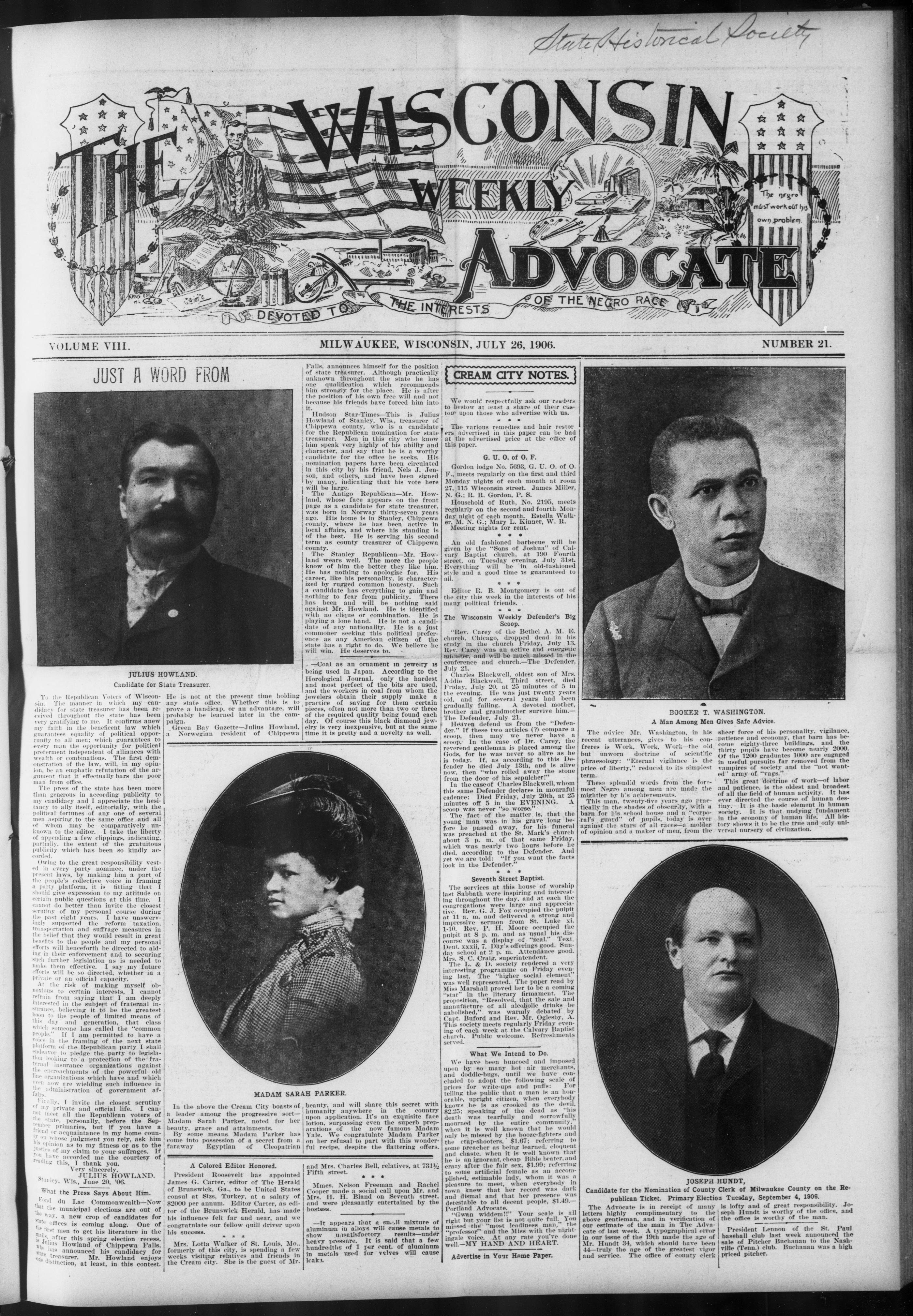
WISCONSIN
WEEKLY
Advocate
DEVOTED TO THE INTERESTS OF THE NEGRO RACE
VOLUME VIII.
JUST A WORD FROM
```markdown
```
[Name]
JULIUS HOWLAND.
Candidate for State Treasurer.
To the Republican Voters of Wisconsin: The manner in which my candidacy for state treasurer has been received throughout the state has been very gratifying to me. It confirms anew my faith in the beneficent law which guarantees equality of political opportunity to all men; which guarantees to every man the opportunity for political preferment independent of alliances with wealth or combinations. The first demonstration of the law, will, in my opinion, be an emphatic refutation of the argument that it effectually bars the poor man from office.
The press of the state has been more than generous in according publicity to my candidacy and I appreciate the hesitancy to ally itself, editorially, with the political fortunes of any one of several men aspiring to the same office and all of whom may be comparatively unknown to the editor. I take the liberty of appending a few clippings, indicating, partially, the extent of the gratuitous publicity which has been so kindly accorded.
Owing to the great responsibility vested in every party nominee, under the present laws, by making him a part of the people's collective voice in framing a party platform, it is fitting that I should give expression to my attitude on certain public questions at this time. I cannot do better than invite the closest scrutiny of my personal course during the past eight years. I have unswervingly supported the reform taxation, transportation and suffrage measures in the belief that they would result in great benefits to the people and my personal efforts will henceforth be directed to aiding in their enforcement and to securing such further legislation as is needed to make them effective. I say my future efforts will be so directed, whether in a private or an official capacity.
At the risk of making myself obnoxious to certain interests, I cannot refrain from saying that I am deeply interested in the subject of fraternal insurance, believing it to be the greatest boon to the people of limited means of this day and generation, that class which someone has called the "common people." If I am permitted to have a voice in the framing of the next state platform of the Republican party I shall endeavor to pledge the party to legislation looking to a protection of the fraternal insurance organizations against the encroachments of the powerful old line organizations which have and which even now are wielding such influence in the administration of government affairs.
Finally, I invite the closest scrutiny of my private and official life. I cannot meet all the Republican voters of the state, personally, before the September primaries, but if you have a friend or acquaintance in my home county on whose judgment you rely, ask him his opinion as to my fitness or as to the justice of my claim to your suffrages. If you have accorded me the courtesy of reading this, I thank you.
Very sincerely.
JULIUS HOWLAND.
Stanley. Wis. June 20. '06.
What the Press Says About Him.
Fond du Lac Commonwealth—Now that the municipal elections are out of the way, a new crop of candidates for state offices is coming along. One of the first men to get his literature in the mails, after this spring election recess, is Julius Howland of Chippewa Falls, who has announced his candidacy for state treasurer. Mr. Howland enjoys one distinction, at least, in this contest.
1910
He is not at the present time holding any state office. Whether this is to prove a handicap, or an advantage, will probably be learned later in the campaign. Green Bay Gazette-Julius Howland, a Norwegian resident of Chippewa
[Image of a woman with a hat and a veil, looking slightly to the side.]
1
In the above the Cream City boasts of a leader among the progressive sort—Madam Sarah Parker, noted for her beauty, grace and attainments. By some means Madam Parker has come into possession of a secret from a faraway Egyptian of Cleopatrian
A Colored Editor Honored.
President Roosevelt has appointed James G. Carter, editor of The Herald of Brunswick, Ga., to be United States consul at Sizs, Turkey, at a salary of $2000 per annum. Editor Carter, as editor of the Brunswick Herald, has made his influence felt far and near, and we congratulate our fellow quill driver upon his success.
Mrs. Lotta Walker of St. Louis, Mo., formerly of this city, is spending a few weeks visiting relatives and friends in the Cream city. She is the guest of Mr.
---
17
MADAM SARAH PARKER
---
Falls, announces himself for the position of state treasurer. Although practically unknown throughout the state he has one qualification which recommends him strongly for the place. He is after the position of his own free will and not because his friends have forced him into it. Hudson Star-Times-This is Julius Howland of Stanley, Wis., treasurer of Chippewa county, who is a candidate for the Republican nomination for state treasurer. Men in this city who know him speak very highly of his ability and character, and say that he is a worthy candidate for the office he seeks. His nomination papers have been circulated in this city by his friend, Nels J. Jenson, and others, and have been signed by many, indicating that his vote here will be large.
The Antigo Republican—Mr. Howland, whose face appears on the front page as a candidate for state treasurer, was born in Norway thirty-seven years ago. His home is in Stanley, Chippewa county, where he has been active in local affairs, and where his standing is of the best. He is serving his second term as county treasurer of Chippewa county.
The Stanley Republican—Mr. Howland wears well. The more the people know of him the better they like him. He has nothing to apologize for. His career, like his personality, is characterized by rugged common honesty. Such a candidate has everything to gain and nothing to fear from publicity. There has been and will be nothing said against Mr. Howland. He is identified with no clique or combination. He is playing a lone hand. He is not a candidate of any nationality. He is a just commoner seeking this political preference as any American citizen of the state has a right to do. We believe he will win. He deserves to.
Coal as an ornament in jewelry is being used in Japan. According to the Horological Journal, only the hardest and most perfect of the bits are used, and the workers in coal from whom the jewelers obtain their supply make a practice of saving for them certain pieces, often not more than two or three of the required quality being found each day. Of course this black diamond jewelry is very inexpensive, but at the same time it is pretty and a novelty as well.
[Image of a woman with dark hair styled in waves, wearing a light-colored dress with a high collar and a decorative bow on her neck.]
beauty, and will share this secret with humanity anywhere in the country upon application. It's an exquisite face lotion, surpassing even the superb preparations of the now famous Madam Yale. We congratulate Madam Parker on her refusal to part with this wonderful recipe, despite the flattering offers.
and Mrs. Charles Bell, relatives, at 731 $ \frac{1}{2} $ Fifth street.
Mmes. Nelson Freeman and Rachel Cooper made a social call upon Mr. and Mrs. H. H. Bland on Seventh street, and were pleasantly entertained by the hostess.
—It appears that a small mixture of aluminum in alloys will cause metals to show unsatisfactory results—under heavy pressure. It is said that a few hundredths of 1 per cent. of aluminum in metals used for valves will cause leak.
---
CREAM CITY NOTES.
We would respectfully ask our readers to bestow at least a share of their custom upon those who advertise with us.
The various remedies and hair restorers advertised in this paper can be had at the advertised price at the office of this paper.
G. U. O. of O. F.
Gordon lodge No. 5693, G. U. O. of O. F., meets regularly on the first and third Monday nights of each month at room 27, 115 Wisconsin street. James Miller, N. G.; R. R. Gordon, P. S. Household of Ruth, No. 2195, meets regularly on the second and fourth Monday night of each month. Estella Walker, M. N. G.; Mary L. Kinner, W. R.
An old fashioned barbecue will be given by the "Sons of Joshua" of Calvary Baptist church, at 190 Fourth street, on Tuesday evening, July 31st. Everything will be in old-fashioned style and a good time is guaranteed to all.
Editor R. B. Montgomery is out of the city this week in the interests of his many political friends.
The Wisconsin Weekly Defender's Big Scoop.
"Rev. Carey of the Bethel A. M. E. church, Chicago, dropped dead in his study in the church Friday, July 13. Rev. Carey was an active and energetic minister, and will be much missed in the conference and church.—The Defender, July 21.
Charles Blackwell, oldest son of Mrs. Addie Blackwell, Third street, died Friday, July 20, at 25 minutes of 5 in the evening. He was just twenty years old, and for several years had been gradually failing. A devoted mother, brother and grandmother survive him.—The Defender, July 21.
Heaven defend us from the "Defender." If these two articles (?) compare a scoop, then may we never have a scoop. In the case of Dr. Carey, the reverend gentleman is placed among the Gods, for he was never so alive as he is today. If, as according to this Defender he died July 13th, and is alive now, then "who rolled away the stone from the door of his sepulcher!"
In the case of Charles Blackwell, whom this same Defender declares in mournful cadence: Died Friday, July 20th, at 25 minutes off 5 in the EVENING. A scoop was never "so worse."
The fact of the matter is, that the young man was in his grave long before he passed away, for his funeral was preached at the St. Mark's church about 3 p. m. of that same Friday, which was nearly two hours before he died, according to the Defender. And yet we are told: "If you want the facts look in the Defender."
Seventh Street Baptist.
The services at this house of worship last Sabbath were inspiring and interesting throughout the day, and at each the congregations were large and appreciative. Rev. G. J. Fox occupied the pulpit at 11 a. m. and delivered a strong and impressive sermon from St. Luke xi. 1-10. Rev. P. H. Moore occupied the pulpit at 8 p. m. and as usual his discourse was a display of "zeal." Text, Deut. xxxii, 7. Day's offerings good. Sunday school at 2 p. m. Attendance good. Mrs. S. C. Craig, superintendent.
The L. & D. society rendered a very interesting programme on Friday evening last. The "higher social element" was well represented. The paper read by Miss Marshall proved her to be a coming "star" in the literary firmament. The proposition, "Resolved, that the sale and manufacture of all alcoholic drinks be aabolished," was warmly debated by Capt. Buford and Rev. Mr. Oglesby, A. This society meets regularly Friday evening of each week at the Calvary Baptist church. Public welcome. Refreshments served.
What We Intend to Do.
We have been buncoed and imposed upon by so many hot air merchants, and doddle-bugs, until we have concluded to adopt the following scale of prices for write-ups and puffs: For telling the public that a man is an honorable, upright citizen, when everybody knows he is as crooked as the devil, $2.25; speaking of the dead as "his death was tearfully and sorrowfully mourned by the entire community," when it is well known that he would only be missed by the booze-fighters and the crap-shooters, $1.67; referring to some preacher as being learned, eloquent and chaste, when it is well known that he is an ignorant, cheap Bible beater, and crazy after the fair sex, $1.99; referring to some artificial female as an accomplished, estimable lady, whom it was a pleasure to meet, when everybody in town knew that her record was dark and dismal and that her presence was detestable to all decent people, $1.49.—Portland Advocate.
"Gwan widdem!!" Your scale is all right but your list is not quite full. You missed the "most leadiness man," the "professor" and the Miss with the nightingale voice. At any rate you've done well.—MY HAND AND HEART. Advertise in Your Home Paper.
[Portrait of a man in formal attire, facing forward, with a serious expression. The background is a plain, light color, and the portrait is framed in an oval shape.]]
Candidate for the Nomination of County Clerk of Milwaukee County on the Republican Ticket Primary Election Tuesday, September 4, 1906.
The advice Mr. Washington, in his recent utterances, gives to his confreres is Work, Work, Work—the old but unworn doctrine of scientific phraesology: "Eternal vigilance is the price of liberty," reduced to its simplest term.
These splendid words from the foremost Negro among men are made the mightier by his achievements.
This man, twenty-five years ago practically in the shades of obscurity, with a barn for his school house and a "corporal's guard" of pupils, today is over against the stars of all races—a molder of opinion and a maker of men, from the
JOSEPH
Candidate for the Nomination of County
publican Ticket. Primary Electi
The Advocate is in receipt of many letters highly complimentary to the above gentleman, and in verification of our estimate of the man in The Advocate of last week. A typographical error in our issue of the 19th made the age of Mr. Hundt 34, which should have been 44—truly the age of the greatest vigor and service. The office of county clerk
NUMBER 21.
WASHINGTON.
Gives Safe Advice.
sheer force of his personality, vigilance, patience and economy, that barn has become eighty-three buildings, and the thirty pupils have become nearly 2000. Of the 1200 graduates 1000 are engaged in useful pursuits far removed from the vampires of society and the "not wanted" army of "vags."
This great doctrine of work—of labor and patience, is the oldest and broadest of all the field of human activity. It has ever directed the course of human destiny. It is the basic element in human society. It is that undying fundament in the economy of human life. All history shows it to be the true and only universal nursery of civilization.
HUNDT,
Clerk of Milwaukee County on the Re-
on Tuesday, September 4, 1906.
is lofty and of great responsibility. Joseph Hundt is worthy of the office, and the office is worthy of the man.
President Lennon of the St. Paul baseball club last week announced the sale of Pitcher Buchanan to the Nashville (Tenn.) club. Buchanan was a high priced pitcher.
THE WISGONSIN WEEKLY ADVOCATE
MILWAUKEE, WIS.
B. B. MONTGOMERY, Editor and Proprietor.
SONS OF SKIDOO.
Unique Society of Men Born on 23d of Month.
The Sons of Skidoo, composed of such afflicted citizens as were born on the 23d day of any month, has been formally organized at Waterbury, Conn. Defiance to those who point the finger of scorn at twenty-three will be hurled during a birthday dinner of twenty-three courses to be served at twenty-three small tables on the 23d of the month. Legally qualified Sons of Skidoo from all over the state will be invited. The move had its inception with City Clerk William H. Sandland, who was born July 23, 1868. At the last city election he was the only Republican candidate to win at the polls. He exhibits his record as proof that the original skidoo renders loyal aid to those of his appointed who acknowledge him.
"In fact," says Mr. Sandland, "I consider that my fortunate birthday had much to do with the skidoo of my Democratic opponent."
Co-operating with Mr. Sandland is Sheriff M. J. Smith, a Democrat, who was born on the same day of the same year. Sheriff Smith won his election by the scantiest of majorities. He attributes his victory solely to the fact that his patron hoodoo descended upon the other fellow.
The constitution of the organization states that its purposes are the abolition of foolish superstitions and the exaltation of the name of Skidoo.
Any person who is 23 years of age may become a member upon proof of his birth date. It is proposed to make the organization national.
QUEER DIVORCE LAWS
French Marriage Reform League Drafts Bill.
The French Marriage Reform league, after numerous committee meetings and many months of deliberation, has decided to lay before the Chamber of Deputies the draft of a bill reforming the existing marriage laws.
Women are to be placed on an equal footing with men, and divorce, which is to be made easy for both sexes, will be granted under two separate headings.
In the first place, a clause in the draft provides for a divorce for some specific reason. Drunkenness, insanity, and sentence to penal servitude for some criminal offense are to be added to the legal reasons for which a divorce can be granted.
On the other hand, the existing law, which provides that a wife may obtain a divorce for ill treatment, would be abolished under the proposed reforms, so that a husband, presumably, could beat his wife persistently without the wife being able to get a divorce. The most striking suggestion, however, is that a divorce should be granted without any apparent reason, provided that both parties make a formal legal request for divorce and persist in this request for a period of two years. In all such cases, however, two years must elapse before the decree is made absolute.
Rocking Chair Fatal.
Almost as fatal to its occupants as the electric chair in a penitentiary is a pale blue rocking chair which stands on the porch of the house occupied by Mrs. Mary Confer, of Yellow Springs, O., the widow of a wealthy farmer. It is left severely alone by those who know its history.
The first owner of the rocker was John Allen, a rich farmer. One day he was suddenly stricken and died. His wife committed suicide in Buffalo and his son Edward succeedbed to a lingering illness. All three loved to sit in the old chair.
At a public auction of the Allen estate the article of furniture was bought by Francis Haffner, a baker of this place. He died soon afterward, and the death of his widow and son followed.
When the Haffner chattels were put under the hammer the chair was bought by William Confer. He also passed away after using it, as did his mother-in-law. Mrs. Philip Klopfer of Dayton, O., a boarder, despite the warnings of friends, used the chair one day recently and she soon afterward met with a serious accident.
New Shade for Eyes
A becoming and conspicuously useful shade for the eyes was one of the novelties Ascot racing has produced in England. It is the invention of a woman, who has called it the Maisette, and already royalty and many smart women have welcomed it.
In new photographs that have appeared of the Queen of Spain, her majesty may be observed holding the new shade up to her forehead. Princess Ena took the shade from London with her when she went to Spain. In form and in the air of alert smartness it conveys the shade approaches the lorgnette carried by many women. It has the folding stick of that useful object, made of tortoise shell or gold, but not the lenses. Instead of them there is an elegantly shaped bar of tortoiseshell or gold, lined with green ribbed silk, and it is this bar that is raised to the forehead and there allowed to rest, in order that the eyes may be protected from glare.
Russ Revolt Hymn.
The Twentieth Century of St. Petersburg, formerly The Russ, has published a second poem by M. Amfiteatroff, one of Russia's most brilliant journalist poets, entitled "The New Marseillaise." The paper has been confiscated, and probably will be suppressed.
The verses are dedicated to Maxim Gorky, and are virtually an appeal to armed revolt. The refrain goes, "Rise to your rights, people; array yourselves under the red banner." The following is a translation of a typical verse:
Seize the headman's axe and pass sentence to slay;
Quit the plow and grasp the sword and bludgeon;
The Volva weeps blood for the wrongs of
the necure:
Seek your salvation in mortal combat with the oppressors.
Death Rate on Canal
A foreign view of the sanitary condition of the Isthmus of Panama is given in the following extract from the Mexican Investor, published in the consular reports:
"In 1882, the second year of the French work on the canal, the death rate was 112 per 1000, and the French had a force of only 1900 men. In August, 1905, the second year of American occupancy, with a force of 12,000 men, there were only eight deaths—two-thirds of a man to every 1000. The death rate has been cut down from 112 to 8 by vigilant sanitary precautions. When the improvements now under way are completed there will be a still further improvement in the health of the isthmus."
THE BATHING GIRL.
Sweet Elinore
Went to the shore
With a bathing suit
Both gay and cute—
Dear Elinore!
She wore with ease
This suit to the knees,
In the neck cut low
And trimmed with a bow—
Sweet Elinore!
With a smile to cheer
Did she appear
On the shore each day
With this suit so gay—
Sly Elinore!
Her foot she got wet—
Not her suit, you bet;
It might possibly shrink,
We'd blush to think
Of Elinore!
—New York Herald.
New York Every Day.
Charles B. Macdonald is one of the men of the hour in New York financial circles. The successful trader on the New York stock exchange returned home from Europe some days ago after a six months' vacation to become a special partner in the firm of R. H. Thomas & Co. Mr. Macdonald, according to his business associates, made an even $1., 000,000 last year. And still t...ere is money in Wall street.
The statue of liberty on Bedloe's island is to receive a coat of varnish within as well as without. In the eighteen years since the statue was erected the salt winds of the Atlantic have begun to effect its bronze plates and it is feared that unless something is done quickly they will be seriously weakened. The light in the torch will be increased and strengthened. The United States government has appropriated $62,800 to make the statue safe and in a few days the goddess will be given a coat of varnish.
The agent for five of the largest uptown apartment houses in New York is the pioneer of a novel clause which may be inserted in many leases next year. The contract which the agent shoves under the noses of prospective tenants specifies that there shall be no dogs, parrots or phonographs in the houses. The owner of the building has an especial aversion for the three sort of pets and he believes that they annoy everyone but the owners. A funny thing, though, about the lease is that it places no restrictions on babies.
Wicked flaring three-sheet posters showing Goldie in the hands of the "villun" and depicting the baser side of life which is vicious and demoralizing have been put under the ban by the aldermen of New York. An ordinance solemnly prohibiting the public display of posters tending to represent the doings of any criminal act, or deprave the morals of individuals, or shocking to the sense of decency, tending to shock the mind in acts of immorality or crime, or to familiarize and accustom the mind of young persons, has been passed and will be rigidly enforced.
News ladies have almost reached the stage where they will require maids, because in this progressive age an exquisite toilet and spectacular effect is the drawing card for some of the hundreds of feminine venders of newspapers in Gotham. Sometimes when a man is purchasing an "exter" from a newslady the thought strikes him, "Oh, if me mudder would only see me now!" then he pigeontoes himself away. What would a Pittsburg newsie think of a young woman in peek-a-boo shirtwaist, Yvette Guilbert gloves Mamselle Champagne slippers, with possibly a touch of rouge on her cheeks, selling papers which she carries in a portfolio?
They were seated at luncheon in Martin's in New York, and the gist of the conversation was the Atlantic City horse show. Several in the party, it seemed, during the day had completed their arrangements for leaving for the shore to day. "It's a mystery to me why Pittsburg women will stick to the old, heavy bathing suit," said a matron. "When you take your dip you'll look like a Doweyite beside the taffetas and pongee plaids." 'Oh," laughed the woman who does not live far from Point Breeze, "I was not particular about any fabric when I selected my suit. I simply wanted to get something that would be at least a foot or two above sea level." Ouch!
Rev. William C. Hall, 37 years old, of Chatham, N. Y., is in a serious condition at the Kings county hospital as the result of an unusual accident which befell him on Thursday. While alighting from a moving Flatbush avenue trolley car he bumped violently into Richard Hoffman, who was in the act of jumping on the car. Their heads came together with much force and both were sent sprawling in the roadway. Hoffman escaped injury, but the young minister was picked up unconscious. At the hospital it was found that he was suffering from a dangerous hemorrhage in the brain. Hall has not regained consciousness and there is grave fear for his recovery.
Prison bars and prisoners sometimes are not proof against a desperate man when he wants to make a touch. According to a story that is going the rounds of the hotels, Harry Kendall Thaw, since he has been imprisoned in the Tombs, has made numerous loans to some of his western friends who were in hard luck. A Pittsburger and his friend, who live in the suburbs of that city, according to the officers of the prison, went broke on the ponies at Gravesend last week, returning to New York with scarcely enough money to send a call of distress to Pittsburg. The first man they thought of in New York was Thaw. They sent him a request by special delivery and the answer was accompanied by a check.
There is a chorus girl famine in New York. This is the statement made by a prominent musical comedy manager, who added that he has had all kinds of trouble getting women for the "Merry, Merry." To repeated advertisements there come but few answers. The cause of this condition, so far as professionals are concerned, is the Thaw case. Show girls are generally not averse to publicity, but the conditions by which it would be attained are not those upon which the young women are inclined to smile. One manager said: "The season has been a prosperous one and most of the grills have money. They are away spending it and eluding the sleuths who have been seeking evidence in the case against Thaw. You bet they won't come back until the matter is cleared up."
Upper Broadway in New York is deserted these warm days except for actors and actorines. Get off a car at Long-acre square about noon one of these July days and walk down the east side of Broadway. You will see hundreds of "heavies," "leads," "second heavies," "second leads," low comedians, shaggy-headed mouthes of Elizabethan verse and fifty varieites of road show leading ladies, to say nothing of sour looking
coon shouters, pathetically gowned ingenues and knockabout artists with reputations in Georgia and Oklahoma. New York's main thoroughfare has become a street of hamfatters and to a person interested in the stage, its craziness, its pathos and its humor, a better acquaintance with some of these erstwhile purveyors of amusement is infinitely more delightful than a talk with a car conductor about Mrs. Carter's marriage.
"Kleptomaniacs have all the New York hotel proprietors and the house detectives on the jump," said mine host of an up-town hotel in New York. "Our greatest loss is in the transient out-of-town trade. Half the women must have a souvenir of the St. Regis, the Waldorf or the Holland house. They seem to think a trip to New York is a failure unless they have a few prizes to show. Many women change about at the hotels so as to have a collection of odd pieces. They don't mind showing their country friends the loot they have won in New York. It is not regarded as theft, but as a smart fad, and I have yet to hear one woman denounce the practice. On the ocean steamships this souvenir business has grown out of bounds. On one trip of a New York liner to this side one-half the butter plates and one-third of the spoons were out of service before Sandy Hook was reached."
As a result of 689 inspections the bureau of weights and measures in the New York city hall has seventy-eight sets of scales which were confiscated from ice wagons. The captured scales are packed in barrels, ready for use as evidence when the corporation counsel's office gets ready to prosecute the ice venders. Patrick Derry, the head of the bureau, sent all his twenty inspectors out at the beginning of the week to investigate complaints that the itinerant dealers were robbing the poor who bought from them
More than 50 per cent. of the confiscated scales show from twenty to forty pounds against the purchaser in every hundred pounds. Several of the wagons from which the scales were taken bore the name of the American Ice company, but the greater number were taken from small dealers, who were selling from open carts.
Lovesick swains and their sweethearts, under the protecting shadows of Grant's tomb and an avenue of maples that throws a beautiful canopy over lovers' lane in Riverside park, New York, sit and promenade in thousands these sultry nights. Every park bench on the drive overlooking the Hudson is the scene of a spooning match, and, surrounded by an enchanted circle of lovers, the statue of the martyred President who said, "Let us have peace," seemingly smiles on approvingly. Osculation is not permitted in Riverside, but in sequestered spots where the water of the Hudson flows and under the screen of the park's shrubbery many a game of smacks is pulled off. Said a park policeman whose service stripes extend to his elbow: "There's nothin' wrong about spoonin' long's it done with ivory one seein' it. Everybody knows that's what the young uns come here for. Ivery girl wants to be the limin and she wants a good squeezer. See? See that binch there? Well, I got me wife off that binch tin years ago. That was one good case of spoonin', me laddy buck."
Patrons of a Park Row restaurant, in New York, were given a hydrophobia scare by a man with one lung whose actions caused waiters and diners to make a hurried exit. The "lunger" was a Civil war veteran whose appearance indicated that he had been hitting the essence of headache hard the night before. Suddenly he jumped from his seat in the middle of the dining room and began to bark like a Russian greyhound. His eyes protruded, and for a few minutes his paroxysms broke the perspiration of everybody in the place—of course, with the exception of the proprietor. The grizzled vet's actions convinced everybody that he was a candidate for Pasteur treatment, and a youth declared that it was a bad case of hydrophobia. Gradually the old warrior ceased barking, then calmly resumed his seat at the table. Turning his bloodshot optics on the man with the stick he yelled: "Hydro hell! You blamed idiot. I was eating blue fish and swallowed a bone. Thought I had swallowed my fork." He later explained that the absence of a lung produced the barking sounds when he coughed.
George B. Winter, the London tailor who came to the United States to improve the patterns of uniforms for Uncle Sam's soldiers, sailed for England on the Oceanic. His work here is finished. It remains for American tailors and clothing manufacturers to carry out the designs which Winter submitted and which the quartermaster general has accepted with some modifications.
"How will the soldier look in the new uniform?" said Mr. Winter. "He will look as smart as can be, for in the first place the men of your army are a smart lot. All they need is a uniform that will show them off to better advantage. There will be no radical change in the uniform as it is at present. The chief difference will be in cut.
"The breeches of the cavalrymen will be a little fuller about the hips and closer at the knee and buttom, so their leggings and booths may be better adjusted. The blouse will have a different turn here and there and there will be some change in the collar. There are other details which I do not feel at liberty to discuss."
Gems of a size and value which make their description read like the loot of a royal treasure house have been stolen, and the New York police detectives are raking Gotham high and low seeking to find trace of them. The list includes scores of diamonds, most of them as large as a pigeon's egg and so numerous that an estimate of their value at $50,000 was treated with scorn as wholly inadequate. While the police refuse to give any information, it is understood that the jewels were stolen from a woman very well known in New York society and that the theft occurred either at her town house here or at her villa in Newport.
Most magnificent of the stolen pieces of jewelry is a stomacher, a girdle of fire, in which only the finest diamonds are set. They range in size up to six carats. Of this the detectives have a photograph, which indicates that the missing jewel piece is one of the world-famous collections of perfect gems. In addition there are twenty-five articles of diamond jewelry. These also are set with very large and very fine stones. Four carats is about the smallest of those set as solitaires and other stones run to six carats and larger. Dho has been the victim of the robbery is a secret which the detectives are guarding most closely.
A. D. T. No. 609—in private life John Matto, aged 16—reported to his manager at New York in a rebellious mood.
"Another job like that and I'm quittin,'" was his ultimatum. Matto probably will resign anyway in consequence of the joshing of his associates.
"Can you catch flies?" demanded an elderly woman of Matto, when he answered a call. "Catch some for me."
At the end of an hour Matto had succeeded in annexing one squashed and attenuated fly.
"O. my." half sobbed the woman.
"That never will do. Bill likes only fat ones. Here." So saying she wrote Matto to a note, directing him to take it to McGlatchie's saloon and give it to Jerry Sullivan, barkeeper.
"Please let bearer catch some flies," the note read.
Aided by Sullivan, Matto scooped up a handful of boozy flies that had sipped deeply and free of the beer on the bar and had lost the use of their wings.
"Mercy!" shrieked the woman when Matto showed his spoil with a commendable degree of pride. "Bill never could eat those drunken flies. They were fattened on beer, and Bill is so delicate. Besides, he is sick."
"So am I," retorted Matto. "I quit. Catch your oyn flies. What is Bill—a bird?"
"No; he's my pet lizard," explained the lady.
New York all depends on the point of view. The occasional visitor to the big city, dined and wined and theatered by the men anxious to obtain business, finds it a city where money is far more common than water, where the evenings are a rush of glittering hotel interiors and gay crowds laughing at garish shows; the mornings a trifle dull and headachy. The art student or the very young fortune seeker finds it the Bohemia he has dreamed of, where unlimited cigarettes, plenty of wine and nights of cheap pleasure obscure the actual grime and shabbiness of existence. On the other hand, many men and women find here the broadest culture and the richest opportunities the country offers. In brief, there is no place in America where may be found more exhilarating heights, or fouler depths, or a wider range of betwixt and between—it all depends on the individual. Only in this wonderful mingling of all sorts and conditions, only in New York would be possible the Trinity corporation system of schools—a work little known outside the circles of the parish, yet a work actively carried on for more than two generations. Trinity corporation, of ancient and honorable history, reputed to be of fabulous wealth, is a name widely known. Trinity church, known as "Old Trinity," is a sight to be sought out by every stranger within New York's gates. Of Trinity corporation's manifold interests and goods perhaps only the rector and the vestry have any realization. Of unique interest among Trinity's efforts to make the school a living force in the world today is its system of parish schools. To afford the youth of the church the benefit of the most approved and efficient methods of secular education, combined with that larger culture and discipline which can only be obtained where emphasis is placed on good breeding, morality and church teaching, is the object of these schools; in short, to train up Christian gentlemen—and gentlewomen. There are seven of these day schools, besides two night schools, a cooking school, a laundry school and the Washington square school, where manual training, cooking, pyrography and stenography are taught. The pupils have the best instruction of the day. Music and drawing are included in the curriculum and a regular and systematic course of religion is given the pupils.
Big Fight with Rat.
A doctor, a high school professor, a divinity student, and the doctor's son had a fight with a huge gray rat at Elizabeth, N. J., and it required the combined efforts of the four, two of whom were armed with revolver and rifle, to overcome the rodent. Cedric Turner, the son of Dr. William F. Turner, keeps a number of rabbits and pigeons in a house in a yard behind his father's home. Thinking thieves were in the yard, Turner and his father got a revolver and rifle and went for Prof. William M. Duncan and Harry S. Keat, a divinity student, who turned out to assist in capturing the supposed burglars. The men found only a rat "bigger than a squirrel."
The doctor opened fire, but only succeeded in wounding the rat in the left off leg. The wound enraged the beast. It flew at the doctor, gripped his shirt with its teeth and tore it down the front, and then tried to fasten its teeth in the doctor's throat. Prof. Duncan beat off the ferocious animal. Then the professor had a combat with the rat, which tore his trouser legs with his teeth. The rodent attacked Keat and bit him on the finger. Then he was driven into a corner and speedily dispatched with bullets.
Flowers and Bill Boards.
A new "uplift" has come to Chicago. This renaissance has lodged in the message of the harassed billboard system, the president of which disclosed plans for a "city beautiful."
"We have grown sick and tired of being denounced in press and pulpit for the unaesthetic accompaniments of this business," he amplified. "That agitation, I suppose, accounts for 99 per cent. of the legislative hostility which we encounter. People with ragged fences, ragged lawns and ragged porches have declaimed against the 'unsightly' signs. These signs are now going to be 'boulevarded' as rapidly as we can accomplish the job.
"Where they are in unsightly vacant lots, the greater part of which, of course, they hide, we shall fill in the ground in front of them, sod most of it, and plant the rest in flowers, with a shrub or two at the ends to give it a finish."
"We shall start this, naturally, near the boulevards, where police protection may be had for these flower beds. Then gradually, as the community grows accustomed to them, we shall spread them through the Ghetto and wherever our signs go."
Cows Swim Stream
People crossing the middle bridge at Marinette, Wis., are afforded considerable amusement by the large herd of cows which swim across a portion of the river to get at the rich grass on the island formed by the main river and the Kirby Carpenter dredge pond. The current in the dredge pond is swift and the cows do not venture to swim across unless the grass on the island is particularly inviting. In some places the pond is eighteen or twenty feet deep and the current is so swift that the cows drift down the stream fully 100 feet below the point where they started.
When the cattle go into the water they disappear entirely from view under the surface and then just their heads and horns can be seen as they make their way across to the grassy plat on the island. At night they all gather in a herd at the west end of the island and one after another make their way back to the main land.
Tilted Suitor Sues Chicago
After thinking over the matter carefully for something like seven years Erick Nordstrom yesterday decided that the city owed him the trifling sum of $25,000, because in 1899 he failed to marry Mathilde Svenson. It appears from the statement of the complainant that Sergt. Cullinan used his official position to spread stories reflecting on the eligibility of Nordstrom as a suitor to the hand of Miss Svenson. This action on the part of the paid guardian of law and order had the effect of interfering with the suit of the complainant, and so great was the handicap that when he got into his stride the race was all over and Miss Svenson was Mrs. Christanson.
In the present suit against the city Mr. Nordstrom is acting as his own attorney.-Chicago Inter Ocean.
KIDNAPED BY FATHER.
Romantic Affair of Chicago Girl Is Disclosed.
Miss Grace Monroe, 18 years old, was "kidnaped" by her father, Rev. Alexander Monroe, pastor of the Chicago Lawn Congregational church, under romantic circumstances. An hour after midnight she was carried out of her father's residence, and despite her cries for help, was put into a cab and driven rapidly across the prairies toward the city. While this family melodrama was being enacted the girl's fiance, William Lieferman, to whom she was to be married on June 28, the day of her graduation from the Lake high school, remained hidden in the bushes in the rear of the house.
Later a telegram from Centralia, Ill., announced that Pastor Monroe had arrived there with his wife and daughter and James Shanklin, a Centralia dentist, who assisted in the kidnapping. They are the guests of Shanklin's mother and sisters. Mr. Monroe's opposition to his daughter's marriage to Lieferman, who is a young printer, was the cause of the trouble which has split the Congregational church. The affair began three years ago, when Mr. Monroe established a church in Chicago Lawn. Lieferman, a respectable young man, joined the church and met the minister's pretty daughter. The father took a dislike to the young man, but did not interfere actively at first. Church members began to whisper. Then the minister took a hand. Feigning acquiescence at last, she lulled the fears of her family and met her wooper in secret places. Discovering this, Mr. Monroe watcher her closely. She bore this for a while, but two weeks ago she left home and went to live with a friend, Mrs. John Wilmier, 6100 Spaulding avenue. Lieferman called to see her every evening and the marriage was decided upon. The pastor, however, watched his daughter closely enough to thwart the scheme.
DUEL NEAR PARIS.
Farmer Saw Men Fight Battle with Rapiers.
Great secrecy has been maintained with regard to a duel which took place a couple of nights ago in the neighborhood of Paris, and the chances are that nothing would have been revealed about it if a farmer who was returning home at a later hour than usual had not noticed the little gathering and, unobserved, watched the proceedings from beginning to end. A motor car containing four persons, the principals and two seconds, had been speeding along a dusty road, when it suddenly came to a halt by the gate of a certain field. Its occupants alighted, and the preparations for an engagement were immediately made. The two men divested themselves of coats and waistcoats, and soon they were facing each other, rapier in hand. They fought very fiercely, keeping it up with several sharp encounters for about twenty minutes, when one of them sustained a fairly severe thrust in the body, which brought the fight to a close. The wounded man was tended by one of the seconds, and was then conveyed with the utmost possible rapidity to his dwelling outside Paris.
The farmer, who had followed the whole affair in the brilliant moonlight, informed the local police officials of what had happened on the following morning, but as everything was considered to have been in order the authorities are not likely to interfere. The combatants are said to have been a wealthy manufacturer in a neighboring township and an engineer, his employe, whom, as is alleged, he had caught a few hours before the duel took place paying attentions of a compromising nature to his wife. The lady's brother was the second of the outraged husband, the doctor acting in a like capacity for the engineer.
Saved by a Ram.
Timothy Freelove, a farmer living near Middletown, N. Y., thanks his stars today because one of the humblest "butted in" at a crisis in his life.
When his Holstein bull, which he was leading to water, knocked him down, he found it hard to regain his balance. The Holstein retired a few paces, scalped the turf, lowered his head, and was ready to charge the farmer. It was in the middle of a ten-acre lot and no human help was near.
Just then there was a swift flash of dull gray and curled horns. Something struck that bull right in the middle of the forehead, backed away, made a swift detour, and came at him again from the rear. The Holstein ran like a creature possessed of many devils.
Freelove got to his feet as quickly as he could and gained the refuge of the road. There he saw the frightened bull bellowing and dodging around a yard in advance of Dan'l, a Dorset ram, which had gained entrance through a break in the fence and had gone to the rescue of his master.
"I always set a heap o' store by Dan'l," said Freelove, "and I hereby give it out that I pension the critter for life."
Love at First Sight
Eugene F. Ware, lawyer, poet, farmer and expension commissioner, believes not only in love at first sight, but that the divorce laws are all right. In analyzing his views Mr. Ware says: "You can't knock out the 'love at first sight' business unless you make over the race. It cannot be dispensed with from an ethical or a sentimental point of view. It is a phenomenon that newspapers and magazine writers can talk about till the millenium, but it is here to stay and I am awful glad of it.
Divorce laws are not too easy. Women have got to have some way to get rid of worthless, no account husbands. As it is now, women stand a good deal more than they ought to and there are not enough divorces granted, because women are too patient and too forgiving. If good men would stay good there would not be so much need of divorces."
Gave Mother Party
Mr. and Mrs. Philo M. Blackman of Appleton, Wis., have a daughter, a little tot of 4 years. One day she took it into her head that her mother deserved to have a party, so she started out and invited ten of Mrs. Blackman's lady friends to an afternoon party for her mother and gave each the same hour for arrival. They all went, and found Mrs. Blackman totally unprepared for company and a much surprised woman. She learned the facts in the case, and then she remembered that her little daughter had given her several hints during the day, such as "Mamma, you better dress up a little, some one may drop in." but she had kept her secret throughout. The gathering was rendered an enjoyable one, nevertheless.
A San Francisco Parrot
We were almost in the van of the retreating host. As we reached the summit of the hills we passed through thousands of watchers, who calmly observed their mighty enemy writhing toward them. Before morning all of these thousands had joined our westward march. But in the mid-afternoon we did not lack for company. Delicate women bore rolls of bedding along the way. Family groups laden with blankets, provisions, canned goods in soap boxes, clocks, mirrors, paintings, all manner of possessions, went by. One tot of six trudged along
with a big package of breakfast food in his chubby arms. I saw one young woman carrying a glass globe half full of water in which her precious goldfish were darting about. A stepladder lashed to a pair of baby carriage wheels made a long truck on which a brawny young man had loaded a dozen suit cases or more. Canary cages, coal sacks and every conceivable burden were borne along on the backs of men, women and children. High on a great load of trunks piled in an automobile, screaming out his disgust and voicing the merry sentiments of the crowd around him, a parrot squawked above the din. "This is a h—1 of a fix! This is a h—1 of a fix!" —From the World Today.
New Army Uniforms.
G. V. Winter, a London military tailor, is going to the United States under engagement with the American war department to advise regarding the new active service uniforms. He will be paid $1000 a week. His son accompanies him as a model. Mr. Winter said:
"The Washington officials have given me a free hand. I hope to design something smart for both branches of the United States service. American army men are smart, but although the materials of their uniform are superior to those of the British army their design and cut are most unsatisfactory.
"I understand the officials are anxious to avoid a semblance of German uniforms and wish to copy ours as far as practicable. Their offer was most flattering to the London tailors."
Poor Honey Crop in Texas.
The honey crop in Uvalde county is almost a complete failure this spring, and some apiarists who have hitherto shipped 400 or 500 cases will hardly get more than twenty or twenty-five cases at best. The long siege of rainy weather just when the catclaw and guajilla were in bloom caused the failure. However, there will be considerable honey made from the mesquite blossoms, but this is of inferior quality. There can be no complaint on other crops. The corn crop will be immense, and people are now enjoying an abundance of roasting ears, squash, beans, potatoes, beets and other truck. A big hay crop has been harvested. Cotton looks exceedingly well. Many hundred fat cattle have been shipped, as well as fat goats, to market. Austin (Tex.) Tribune.
Lived in Cemetery.
In a rocky nook, with the scant protection afforded by the overhanging crags and the branches of trees, Anna M. Wood, 16 years old, lived for nearly a week in Woodland cemetery, Stamford, Conn., having just been discovered. Her home is in Middletown. She ran away because, she says, her stepfather was not kind to her. There are few men in Stamford who would care to spend one night amid such ghostly surroundings. Anna had no fear apparently. The overhanging rocks did not shelter her from the rain last Monday night. The girl came here first and stayed with friends in South Stamford. Then she packed a small grip and went to the cemetery to live. How she found food is a mystery.
Americans Smart Soldiers.
The military appearance of the American soldier was a surprise to George V. Winter, who came from London on invitation of the War department to design certain improvements in the uniforms of the service.
"The American soldier has the best build and bearing in the world," declared Mr. Winter. "I thought Tommy Atkins was the best in line, so I am surprised at what I have seen here. While the American soldier is not so beefy as the Britisher, he is 'smarter' and better set up. He is the best looking soldier in the world, superior to the fighting men of Germany, France or England. The only improvement in the uniform is to give him a better fit, giving full effect to his fine qualities."
Sunken Steamer Rises.
For some unknown reason the steamer North Alabama, which struck a snag and sank six miles below here in 1870, has suddenly reappeared on the surface of the Missouri river. The boat was bound from Sioux City to the Yellowstone district with flour and whisky when it sank. It is supposed a change in the current washed away the earth deposited above and around the boat, allowing it to rise again. There were fifty barrels of whisky aboard. Already a hunt has begun to locate the liquor, which has had thirty-six years of ripening. Owing to the fact that mud and sand had filled up much of the interior it has been impossible to get at the whisky yet.
"Love Buttons" Latest.
A pretty way of sealing an engagement has been invented by the inhabitants of the east end of London. Every man, immediately he is engaged, is expected by his fiancee to wear a button brooch with her photograph in his buttonhole for as long as the engagement lasts, and she in turn wears his photograph on her breast, near her heart. These are called "love buttons," and if discarded any day by either of the parties it is a sign that the engagement is at an end. This novel idea has been in existence for about a week, and during that time 500 of these buttons have been sold.
New Parts Wanted.
"My brother bought a motor here last week," said an angry man to the salesman who stepped up to greet him, "and he said if anything broke you would supply him with new parts."
"Certainly," said the salesman.
"What does he want?"
"He wants two deltoid muscles, a couple of kneecaps, one elbow and about half a yard of cuticle," said the man; "and he wants them at once."—Tit-Bits.
Hypnotized: Not Sane.
Mrs. May Macafree, aged 39 years, wife of D. L. Macafree, wealthy and a leader in women's club circles, was adjudged insane in Colorado Springs, Colo., and committed. Mrs. Macafree became violent in the Lenox hotel. Three years ago she was hypnotized by a traveling hypnotist and has acted strangely since. She became also an ardent spiritualist. Her Brockton estate yields her $15,000 interest annually.
The Automobile Crop
In New York state there are 28,250 automobiles registered, and it is estimated that for the United States the number exceeds 80,000. The annual cost and operation of the New York automobiles are said to aggregate $30,000,000, from which it is assumed that the entire country spends about $70,000,000 annually for the delights of motoring. From Daily Consular and Trade Reports.
Church's Unlucky Career.
During an electrical storm the Methodist church at Attica, a village north of Albany, Wis., was struck by lightning and burned to the ground. The loss is $2500 and insurance $1200. This is the fourth time this church has been struck by lightning in the past twenty-five years.
The German First Twelve
A new monthly paper offered a prize for the best list of the ten most important living Germans. Frau Schultz of Dresden won. Her list was: Emperor William, his wife, his seven children, his two daughters-in-law, and the baby the crown princess was expecting.—Simpli-cissimus
GOSSIP FOR THE LADIES.
A Voice in the Night.
The day had been so fraught with troublous care,
My soul had been so cankered by the sting
Of mallee's sharp tooth, that suffering
And wounded sore, even the sunset fair
And
Seemed to my troubled eyes but as the
glare
Of skies of burnished brass, and questioning
The love of God, or man, or any thing,
I flung me down, too spent and bruised for prayer.
When lo, upon the night-wind, soft and clear,
The brooding notes of some low lullaby
Were warted to me, from a casement near,—
A mother's song to hush her infant's cry.—
Bearing to me that truth of priceless worth,
That love is still the sweetest thing on earth.
—Louella C. Poole in New England Magazine.
Woman and the Church.
"Take woman's treatment by the Christian church," says The Woman's Home Companion. "Today it is easy to understand why many women have half deserted church work for club work, inasmuch as for centuries men did all the preaching and women most of the practicing, largely through missionary societies devoted to heathen on the other side of the earth.
"This 'religious' record was most secular, to say the least. The council of Macon, composed of fifty-nine bishops, seriously considered whether woman had a soul, but by a majority of one decreed that she had. Later one Christian sect declared that woman would have to be transformed into a man before she could be resurrected. Then the saints called her all sorts of vituperative names. St. Bernard said that woman was 'the organ of the devil.' St. Cyprian characterized her as 'the instrument of the devil.' St. John Damascene denounced her as 'the daughter of falsehood,' and St. Gregory the Great said, 'Woman has the poison of the asp, the malice of the dragon.' St. Paul's milder edict, 'It is a shame for a woman to speak in the church,' has until lately prevented the fair sex from securing any representative within the sacred precincts. She was not permitted to sing in the choirs or to speak in the pulpit. Today the only church which recognizes the absolute equality of men and women is the Orthodox Friends, though the recent establishment of the 'house of churchwomen' by the Episcopal church is a step toward universal religious equality."
The Equipment for a Short Trip.
A short trip in the country does not call for much luggage or many changes in dress. To stop for three or four days in the country in summer requires two or three changes of dress, but not more. A most convenient gown is a pretty silk costume, a skirt with one high-cut and one low-cut waist. When the journey is short the dress one travels in, especially if it be in the convenient coat and skirt design, is all that is necessary during the day and seems fresh every morning with change of waist. In summer it is best to take also a pretty cotton gown. The jacket of the traveling dress will probably answer for a wrap in driving. An extra hat is required for church wear, as otherwise it is considered smarter to wear a plain hat in the country.
The most particular attention should be given to all the little toilet details, such as underclothing, brushes and combs, and the thousand and one little et ceteras which belong to toilet accessories. At least one entire set of fresh underclothes for each day belongs in the small trunk which should be used, a bath wrapper, and a dainty dressing sack or dressing gown. An extra pair of boots or shoes, evening slippers and a goodly choice of stockings also are to be added. These do not take up much room and add greatly to comfort.
There was an old rule in well regulated households that a handbag always should contain a night gown as well as toilet articles. This is not at all a bad idea, for luggage is often detained even in these times of rapid transportation, and with the gown and brushes the traveler always is well provided. Fresh stocks for the shirt waist often are convenient.
Several other essentials to take along are the resolution, first, to contribute in any way possible toward the entertainment of all; secondary, not to call upon the servants save in case of dire necessity, since the presence of guests is tax enough on the household machinery; thirdly, to be punctual at meals. Guests may not be openly found fault with, but any want of promptness on their part is certain to be noted with discomfort.
Women's Attitude Toward Women
"Do women enjoy one another?" naively asks one of them in the Contributors' club of the Atlantic Monthly, says the Columbia State. The answer that surges swiftly from our southern heart is that it is a great pity if they do not, as they are missing a good thing. But we hasten sternly to suppress that murmur—to see how the lady in the magazine undertakes to lay the tempest she has raised. She first appeals to Mlle. Scudery—a perfectly safe resource, as Mademoiselle wrote the words that are so unflattering to the sex whose hands have rocked the cradle, and, therefore, ruled the world. The Scudery wrote:
"The most charming women in society, when they are together without men, seldom say anything that is worth hearing, and feel more bored than when they are alone. But with men it is not so. Their conversation is, no doubt, less lively when no women are present, but as a usual thing, though it may be more serious, it is also more reasonable; they can do without us better than we can do without them."
That last sentiment would not have suited dear old Cowper, who could not at all do without the comradeship and the inspiration of women, any more than the rest of us. We take it also that Mile. Seudery did not make this confession at a time when it would have had its highest social value. However, to return to our moutons, as another French person said, the Atlantic's contributor sets along with the Frenchwoman's opinion the views of some women from Philadelphia, Memphis, Boston and New York. The Philadelphia woman quoted a man, who said he "vastly preferred dinners where women were present," for, he added, "in dining with men only one misses that exquisite sensation of relief which descends upon the soul when the ladies rise from the table." This classifies him to the extent that it places him north of the Potomac, and, besides, it isn't true. It is true only to the extent that men, like other human beings, do not prefer sweets all the time. The opinions of the women on this subject are of great interest—and they may be of considerable utility.
One Philadelphia lady said that in the absence of men, she was so upset that she had to take to bridge, or "go mad." The name of this lady is cautiously withheld. Another Philadelphia said:
"I honestly prefer to talk with women. I like a little more concession and rounding off than a man is willing to give. I confess I like men to take the initiative, and I am always ready to accept a man's
opinion, as the result of more careful, all-round thinking than a woman's. A man does not allow himself to be run away with by every impulse as we do; but I do love a clever woman's idea of things."
"Next came," says the writer, "the charming Southerner." Now, we prick up our ears. What did our countrywoman report?
"Of course, one likes to talk with men, and in doing so exerts one's powers and makes one's best efforts to be interesting. It is useful to draw out a man's views on important subjects. But with men one thinks of the impression one is making, and in talking to men one is conscious of being a little bit of a humbug. Now, with women no affectations are of the least use, and there is a comfort in dropping any sort of hypocrisy, and in talking about the things one honestly cares about—that is, domestic matters, children and dress. Nobody need condemn these as trivial subjects, for they are of the utmost consequence. Leave knowledge of them out of a woman's mind, and what is she? Then women understand one another readily, and are generally helpful and sympathetic and clever. Yes, women are immensely clever; that is, when they are on their own line."
Isn't that fluent? She was from Memphis, too. We heartily agree with her that "women are immensely clever," but we think of the "Memphian chivalry" of saying there is a comfort in dropping us out of the conversation, as there is in "dropping any sort of hypocrisy." The Boston woman—we can see her in the mind's eye, Horatio, with her eye glasses, and with a pocket edition of Browning, as she says that "men are so little in earnest; they will not be serious. * * * No one misses men if one has a few good women friends."
To the major portion of this we softly demur, but can heartily agree with the lofty sentiment and gladsome truth of the last sentence.
The New York woman said that "women are practically more interested in women than in men." "Practically," in consideration of the fact that they marry us and send their Easter bonnet bills to us, is very good, indeed. It is the exact word, and worthy of the champion from Boston. "We dress for one another"—this, we must protest, is plagiarism, as the Boston lady could have told her before she committed herself too far. Jane Austin said it, and it is not worth anybody's while to try to say again what Jane says once and for all. But see how she dissects man: "You can enter into his thoughts, help him to work them out, make him talk his best and feel contented with himself, and he admires you." The "you" has a distinctly feminine underscore.
After these views, the Philadelphia Portia summed up as follows:
"No more men!"
Woman will have "no more men"—that is, if in the words of this Daniel come to judgment, she can get "a little world of her own, with something revolving around her." What is that "something" to be, we wonder? Some dizzy and whirling idiot, we suppose, who fancies that the particular woman is the sun. We are told that all the women were "experienced, mature, rational, not to say clever;" so we infer that each of them has "something revolving around her," and can light-heartedly chirrup:
The Usual Complaint of the Bachelor.
The modern young man is inveighed against by the hostesses of today for many reasons. Crystalize them, and you will find that they consist of only two: He has sporting instincts and he is poor.
Just as a man will not go out shooting if he may never under any circumstances hit anything; just as he will eschew fishing if he is not permitted to catch a fish, so in precisely the same way he avoids the dance, the dinner, and the afternoon tea, because he knows that they can all lead to nothing.
The language of the eyes, the whispered soft nothings, the palm-covered, sequestered nooks, only pave the way that leads to marriage. And our young man, just because he is a sportsman, just because he knows that for the present marriage is beyond his reach, hesitates to raise hopes in a young feminine heart, hesitates, too, for fear of finding himself on the brink of the matrimonial abyss, which at so early a date can only bring ruin to his own career, and that of the woman we may learn to love.
For one man who can afford to marry under 30 years of age there are ninety-nine who cannot; and it is the ninety-nine, not the one, who would make the partners of the ballroom.
Because the flat of society has gone forth that a wife must be a luxury; and luxuries are not the lot of the average young man.
And here, forsooth, are hostesses grumbling because we struggling clerks, striving doctors, hitherto briefless barristers, underpaid schoolmasters, are not eager to marry! It is not as if these embryo brides were of the kind to help us in our onward struggle.
Such ladies must be kept in that station of life in which it has pleased God to call them; and, indeed, they are fit for no other. They cannot sew; to cook they are ashamed. They are completely ignorant of the proper organization of a household; their experience in dealing with servants they propose to buy at the bridegroom's expense.
In fine, the sum total of their attainments consists in a limited knowledge of the rules of bridge and a distant hope of succeeding in golf. Meanwhile, their parents sit with folded hands, smugly satisfied with their brilliant offspring, hoping for the modern young man to come along and offer—if we may compare so delicate a subject to business—their daughters a position which commands an enormous salary, and for which they have had no training and no experience.
I wonder how many maidens of today realize amid their round of social gaiety, the wonderful, inestimable value of a wife's sympathy and co-operation; how its presence may take a man soaring up to the heights over every difficulty, every danger, every obstacle; how its absence may draw him down, down to the lowest depths, whither he would never have gone alone?
The majority of us are poor, with our living to make, and our names to write—if only in tiny letters—somewhere on the scroll of fame. It is not that we are ungallant; it is not that we do not admire these butterfly maidens. But "hope deferred maketh the heart sick;" and to begin a flirtation at 25, with the prospective bride of one's fortieth year, does not appeal to many of us.
does not appear to harm.
If, then, matters are to be mended, if ballrooms are to be filled with dinner parties patronized, the maiden of today must descend from her lofty pedestal, or, at least, make clear to us that the steps which lead to her feet need not be paved with gold. Let her take her young life, at any rate, as seriously as we do ours. Let her realize that she,
too, has a career before her which, though domestic and unworldly, is none the less important. We want her and she wants us—Nature has so ordained it. But, alas! we cannot submit to her motto: "You pay, and I will look pretty."—Philadelphia Evening Bulletin.
On the Art of Taking Rest.
Do you know how to rest a while? In the resting room of a railroad station full of bustle a woman sat down to wait for half an hour. "I'll rest a while," said she.
And for half an hour she made a brave attempt at getting rested. When her companions came for her at the end of the half hour she look more fagged than before.
She had rested by sinking her head back upon the rounding curve of an upholstered chair. She did not remove her hat nor did she get a cushion for her feet. She simply sat there with her arms hanging at her sides.
There was a strain upon her back; there must have been a strain upon her nerves, for she faced the crowded room, and there was a strain upon her neck, her knees and her elbows. She was not comfortable in any respect.
When you rest be sure that you put your muscles to sleep. That does not mean to stop the circulation, but only to arrange your muscles so that they will not bother you.
Your muscles, your nerves and your upper and lower limbs must all rest at the same time. Incidentally, your neck will get rested, your knees will limber by and your back will be quiet.
The people who always have a neckache are those who do not know how to rest. They always manage to rest in such a way that the neck gets no benefit from their relaxation.
When you rest take the advice of Herbert Spencer, and rest your head first, said a woman physical culturist.
"I always put my head to sleep for an hour a day," said he, when asked how he did so much work and was so rested all the time.
And Ruskin said practically the same thing: "I drop off a while, just to let my nerves know that I am thinking of them," he said to an interviewer, who congratulated him on the brilliancy of his latter days.
Cavalieri and Dortzal, the two most beautiful women in France, are adepts at muscle resting. Dortzal, who is a French prize beauty, knows how to rest her nerves. When asked after the beauty contest how she stood the strain, she said:
"I know how to rest even when I am talking. This is what I do when I am very tired:
"I don't try to get away, but I rest just where I am. I have learned the secret. This is the way I rest: I stop talking for one thing, and so I rest my face, my throat and my lungs. Then I rest my neck.
"I take the strain off my spine. You can do this only by elevating your feet. Do not attempt to put them above your head, nor on the table nor even on top of a chair. Just lift them and let them rest on a high footstool. That is the best way in the world to take the strain off your spine.
"There are many who say that placing both feet flat on the floor will rest the spine. But it doesn't. Lift your feet. Take the pull off your spinal column. That is the only way to get rested.
"Now take the strain off the back of your neck. Rest your head against something."
"Don't tip your head too far back.
"Don't turn or twist your neck.
"Don't strain the neck muscles by getting into an unusual position.
"Don't attempt to rest the head against anything that is unsteady.
"Have the pillow soft and yielding and have it placed at a slight angle.
"Rest your shoulder blades against something firm and about the shape of your back.
"Have the elbows supported and don't let the hands be cramped.
let the hands be clamped.
"These are my rules for resting. I get into a comfortable position, and then I am ready for anybody, be he friend, foe or interviewer."—New York Sun.
Heartbreak.
Heartbreak would largely be spared if when adverse fortunes come people would accept the smaller income and live on what it will give them, rather than to try to keep up appearances. If only they would come down themselves and drop the world instead of letting it drop them the fall would not be so hard to bear to say honestly: "We had to leave our home because we could not afford to live in it," rather than to make explanations like: "It was too far from our friends," or "The neighborhood was not quite healthful" and so on. The part of society worth catering to does not care a rush for appearances that only are a mask, and does value the calm and dignified acceptance of a smaller income or no income at all. It is in these cases that blood tells.
The real gentlewoman goes to work and makes no fuss about it, and sometimes finds in the enchanged conditions a new and broader life and a keener interest in and wider knowledge of the world and its shams and realities. It is the real people themselves for whom the desirable portion of society cares, and what does it matter if a tiny parlor in a tiny flat takes the place of a big drawing room if the same charming woman is in it, the same sweet, thoughtful hostess, even if her gown be not in the latest fashion and her refreshments are of the simplest sort.
It is the way to look at things and take them that makes our ways pleasant or unpleasant. If things seem burdensome the best way is to take them up and carry them, whatever they are, with all our hearts and all our strength, or they always will be underfoot and tripping us up and making us fall and stumble, but, picked up and shouldered, even though we stagger for a time, they often turn out much easier to carry and not half to heavy as they had appeared while we stood by and looked. Our yokes may be made easy and our burdens light.—Washington Star.
For a Business Woman.
One good tailored suit, spring and fall.
A trim, rather small and becoming hat.
A rainy-day skirt and coat for bad weather.
Plain, smart waists to wear with this to the office.
A fancy waist to freshen it up for the theater and Sundays.
A comfortable house gown to slip on when she goes home at night.
The above may seem like a modest wardrobe, but for the woman who is in business to win, and who hasn't much time to fool over clothes, it may be taken as a safe guide.—Chicago News.
Going to Luncheon.
How a Man Goes—Glances at the clock, drops his pen, jumps from his chair, grabs his hat, bolts for the door. Says briefly, "Going to lunch," and is gone. Time, one-half minute.
How a Woman Goes—Glances at the clock, wipes her pen carefully and places it in the pen tray, arranges papers neatly on her desk. Goes to the mirror. Removes four or five combs, as many pins, and possibly unties a bow from her hair. Combs up her pompadour, puffs out the sides, combs up the scolding locks, replaces bow, pins, and combs, then surveys result with hand mirror. Washes her hands and cleans her nails. Dabs the powder rag over her face to remove "that shiny look." Applies
whisk broom to dress. Puts on hat, and thrusts into it five long hatpins. Consults hand mirror again, puts on veil. Uses hand mirror once more. Investigates sundry fancy pins at back of neck and belt. Pulls on gloves. Gets her parasol. Gives one more look in the mirror, and goes. Time—depends on the woman and the length of her gloves, but anywhere from twenty minutes to half an hour.—New York Press.
"Landing" Him.
Landing Him.
Monday—be pretty—smile once.
Tuesday—Be prettier Down at him.
Wednesday—Be pensive—sigh once.
Thursday—Laugh at him.
Friday—Confess your love for him.
Saturday—Be "out."
Sunday—Accept him.—Exchange.
WEST WIND AND THE BEAR.
Aunt Jinsey had been mammy to the Randolph children, on Broadlands plantation, as she was mammy to their mother before them. But with the coming of the new baby, a little colored nurse, 12-year-old "America," was brought up to the big house to play with the three elder children, and do what she could, till Aunt Jinsey's time was more her own.
America assisted in getting Pate, Patty and Isabel out of bed, and, under Aunt Jinsey's direction, managed their morning toilets.
"You dest like a little bear, Marse Pate," the young girl giggled. "I bound you like to sleep all de winter th'oo"
"Does bears sleep all winter, Aunt Jinsey?" asked Pate, applying to the higher authority, as he grumblingly fastened his shoes.
"Dey does sence de West Wind done piped old Mr. Bear to sleep one time," returned Aunt Jinsey, good humoredly. The baby lay across her knees, with skirts trailing down to her foot, and she trotted him gently as she spoke. "Black gal," she broke out with sudden fierceness, "what you let little Marse put his shoes on widout poligizin' 'em for? You—wid po' talk 'bout bears; and' lettin' dese chillen go same as white trash!"
"Nevon mind the shoes!" cried Pate.
"Never mind the shoes!" cried Pate. "Let Meriky tell us about the bear."
"Meriky tell you 'bout de bear!" snorted Aunt Jinsey. "Ef she can't tell a tale better dan what she kin dress a child, hit'll be a mighty raggety tale."
"You tell us, then, Aunt Jinsey," pleaded gentle little Patricia. "It was you that said you knew about the West Wind piping the bear to sleep. Tell us that tale."
Somewhat mollified, the old woman settled herself for the story, keeping a sharp eye on America, who was still busily polishing Pate's shoes. "Long time ago de fust bear he was young an' foolish. He never slep' all de winter long in a holler log, like bears does dese days; an' he was a mighty bad hand to backbite an' carry tales. He tell everybody dat will listen to him dat de West Wind ain't no singer.
"Now, de West Wind kin make de puttiest music er anybody in de Big Woods. More dan dat, he make up all de songs what he sings, dest as he go 'long.
"When he hear what dat impuduous young bear say, he fly right straight to Mr. Bear, he did. 'Oh, I ain't no singer, ain't I?' he ax. 'Well, Mr. Bear, we kin call up de critters in de big woods to jedge, an' I kin sing you so fast asleep dat you won't wake up 'fo' spring."
"Try it,' say Mr. Bear. 'Uh-uh-uh!"
"Try it,' say Mr. Bear. 'Uh-uh-uh?' he grunt; 'try hit—dest try hit!"
"So den de West Wind call all the critters togedder; an' when dey ranged round to look on, he sing 'bout what bears love best. He had him a song 'bout ripe huckleberries, an' honey dripping out de comb in de bee tree. Oh, mind you, his song was sweet!"
"I've heard the wind when it made me think of things like that," said Pate. "But it never made me sleepy."
"De West Wind's tune make little Brown Bear mighty sleepy," said the old negress. "He stand hit as long as he kin, an' den he quile down in the holler tree very comfo'able an' commence to snore.
"All de critters laugh, but dat ain't win de day for de West Wind. yit. He got to put Mr. Bear so plum' fast asleep dat he won't wake up tell spring.
"So de West Wind pile leaves all 'bout de bear, an' make him warm, so he snore softer an' softer. De dry leaves done dey part; dey rushle a nice little tune to go wid de West Wind's song; but still Mr. Bear was a-snorin', an' de West Wind know 'at when a bear snore he gwine wake up soon.
"Den de West Wind call pon de rain; an' de rain come an' pat for de music. Pitter-Patter—pit-pat! Pitter—Patter—pit-pat! Dat how de rain sound on de leaves. 'Pitter-patter—pit-pat.' But still Mr. Bear snore on.
"Last of all, an' best of all, to make a bear sleep, come Jack Frost wid his banjo. When de West Winds pipe a song, an' de leaves rushle and play a chune to go wid hit, an' de snow come, an' Jack Frost's banjo begin to snap an' crackle de strings, de ain't no bear ever made kin stay awake. Naw, suh-nary bear ever made! Dey dest plumb 'bleege to go to sleep.
"Mr. West Wind bend down close over Mr. Bear. He sleep like a dead bear. He ain't snore no more. Den de West Wind an' de rain an' de frost take a-holt o' hands an' fly awa laughin'. An' de leaves say 'We'll stay hyer an' watch him tell spring.
"So it was wid dat first bear; so it been wid every bear to dis good day. Dey might like to stay awake an' dance in de field, an' play snowball wid de critters; but when de West Wind begin to pipe, an' de rain begin to pit-a-pat, an' de snow come—most of all, when Jack Frost play de banjo—de bear 'bleege to go sleep in a holler tree an' sleep tell spring."
Never Saw Street Car.
Mr. and Mrs. George N. Arnold, who own and live on a 238 acre farm two miles south of Delavan, Wis., have a banner record in living happily to themselves without having visited a single large city for more than fifty years. They have lived on the same farm and in the same house for forty-eight years. Mr. Arnold was in Milwaukee in 1848, but he hasn't seen it since. The couple passed through Chicago on their wedding journey fifty-two years ago. That was in 1854 when the town had less than 60,000 people. Mrs. Arnold, it is said, has not been in Delavan for the last ten or twelve years, or on a railroad train since she left the one that brought her to Badgerdom more than a half century ago.
Mr. Arnold has since taken a few short rides on trains in that time, but he has never seen a street car.
Largest Maple Log.
Lewis Hart of Harrison township, Indiana, delivered to a sawmill at Peru, the largest maple log cut in this county in many years. The tree stood ninety feet in height, and from the log, which was twelve feet long and four feet in diameter, over 1000 feet of fine lumber was cut.
AN' I BUT TENT THY FAITHER'S FLOCKS.
In summer time the wee lambs broose,
The loch lies blue in shadow.
An' little breezes tell thy name
To a' the ferny meadow.
Whan mither left me, puir lone lad,
An' a' the warl' was dreary,
Sae kind thou can'st to comfort me,
Wi' blue eyes, soft an' cheery.
It is na wise to love sae weel,
An' thou sae grave an' tender,
But whan thy blue eyes pitied me
'Twas a' ane holy splendor!
An' I but tent thy faither's flocks,
Auld Angus Donald's laddle,
Sae meanly clad the bitter wind
Sweeps thro' my scanty plaid.
I maun's weel try to gain a star
As thy sweet lips, my dearie.
I maun's weel try to clasp the cross
Of gold on Kirk o' Mary.
—Garnet Noel Wiley in The Bohemian.
BOTH MASTER
"Of course, knock down the house!" The man on the outside grumbled. The only word his wife understood was an oath. She jerked her hands out of the dough she was kneading, and started for the kitchen door. Ere she had reached it, a vigorous kick shook the little house from roof-tree to architrave. An old clock fell from its shelf on the wall into the sink
That's right! Break up everything in the house!" cried the woman. Hardened to the man's impatience because of the mishap, her first care was for the timepiece. She lifted the wreck from the sink. A shard of glass, shattered from the dial, pierced her thumb! Broken cogs rattled loose within the clock; its hands were stunned forever, and crossed on its oosom as the arms of a dying Christion; but the yellow face, sprinkled with a dab of her own blood, told her with a last mute look, the hour of its tragedy, and the homecoming of Martin Wiggins. She shot the bolt, and flung the door wide open.
"Just like a man! Stay out till 8 o'clock! Leave your wife at home all day in suspense; spoil the supper that's been waiting for the last three hours on you, and then come home and knock down the house while your wife's getting her hands out of the dough pan!"
Once inside, the man's impatience simmered down to explanations. "But I couldn't help it, Kate," he said. "Had I get these taxes collected up. I ought a 'told you I'd be away all day, but once I got started trottin' round the back hills, wny, then I tried to get over as much in one day as I could, so—but what's the matter with your hands?"
"What's the matter with the clock?" she retorted; "that's more importance!"
She pointed to the ruined old clock that had regulated their toil and rest since the day of their marriage twenty years before.
"You don't mean that I kicked it off the——!"
Her look of contempt silenced him.
"I guess I heard it drop," he ventured.
"I thought you were throwing things!"
"Here, tie this bandage on."
Meekly he obeyed. "I believe it's too tight," she said, with less acerbity.
"I wouldn't a'banged the door so hard, Kate," he said, apologetically, "but," and here he lowered his voice, "collections were big today, and I've brought home about $3600. I didn't care to direct attention to myself coming home tonight."
"But I'm in a hurry to get a bite and away again. The oil company is meeting at the schoolhouse tonight, and I can't get out of being there."
"What! And leave me with that money in the house alone?"
"It's not a bad neighborhood for burglars, Kate. Haven't heard of a robbery hereabouts in the past five years. * * * Kate, you must have spent a good part of the day over at the butcher's, to be so late in making bread, so Lucy won't object to staying with you tonight, will she?"
"There you are again! I wasn't out of this house this whole blessed day, Martin Wiggins. But Lucy might come, anyway."
After a hurried meal, Wiggins went out to ask the town butcher, August Heffleman, to allow his daughter to sleep that night in the Wiggins' house. A few minutes later he returned, accompanied not by Lucy, but the butcher himself, and his huge watch-dog, known miles around for his bravery, strength and sagacity. With Wiggins, the butcher strode in, his little gray eyes beaming with good nature from the slits in his bulging pink cheeks. The dog hesitated on the threshold, awaiting a word of invitation.
"Kom in, Bismarck! Kom in!" Heffleman said, to the dog, whereat the magnificent animal leaped into the middle of the room.
"Yes," continued the butcher, "Martin was yust now tellin' me, youse was all alone by yourself tonight; und Lucy, poor girl, is too seek to kom. So I fetch my dog Bismarck. Und all I haf to do is tell him to schtay here und vatch dis hause; und Bismarck will schtay und vatch dis hause till I kom und tell him: 'Dat is all right, Bismarck, now youse can kom und go mit me to your own hause.'"
Then he talked in German to the dog, and Wiggins and his wife could make out by frequent recurrences of the words "hause" and "diese frau," that he was endeavoring to make the dog understand his responsibility for the night. Bismarck licked his master's hand, lazily lifted his hulk from the middle of the room, and crossing to the woman, sat down beside her, the hem or her skirt drawn tight under his great paws. With a last reminder to the dog, and a warning to Wiggins that if he should come home during the night not to attempt to make entrance to the house without having his wife first give directions for peace to her protector, Heffleman departed. With Heffleman went Wiggins.
For years it had been the custom of the Wiggins' to carry the old clock from the kitchen to their bed chamber upstairs, every night on retiring. When the woman took the timepiece in her arms this night, by force of habit, she smiled grimly, and set it down again. Immediately it struck her that though the ancient timepiece could no longer tell her the hours, it would be a safe treasure-box for the township taxes that had been entrusted to her keeping. She crammed the wallet of bills, and the bag of silver and copper in among the old springs and cogs and levers, and, with a last word of kindness and warning to the dog, she climbed the stairway, set the clock upon a chair beside her bed, and was soon asleep.
She awoke suddenly with a feeling that
her hand had been drawn into her clotheswringer! As she came to her full senses out of slumber, she realized that the bandage on her injured finger, now swollen and inflamed, was binding too tightly. She looked into the face of the old clock, dimly lighted by a half-moon, to learn the hour—then laughed at hersea for remembering the tragedy of the evening before. "Oh, yes, the money! Was it safe? She put her hand into the pendulum door, and felt of the bills and the coin. That instant a low growl sounded up the stairway. Bismarck was awake, and on the alert! Then a heavy low bark, a threatening note from the sinewy neck and throat!
A man's voice she heard, as if striving to pacify the faithful brute!
In fear and trembling, the woman arose from her bed, and hastily dressed. Meanwhile, she could hear the burglar working, as if to remove the kitchen window. A snarl and a meaning growl now and again from the dog plainly told her that he was still on guard, waiting for the next move.
For a moment then, silence followed. Then a bump against the side of the house, as if a man had struck the weather boarding with his foot while climbing in the window; then a confusion of noises, the growl of the dog, the words of the man—a clear call of the dog's name, a coaxing word, a cry of command, smothered with a guttural howl, and the blind courage of the brute attack!
Grasping the money from the old clock, the woman stole down a narrow stairway, unlocked a door seldom opened, and escaped into the darkness.
Crossing the weedy field to the edge of the village, she came face to face with a figure hurrying towards her!
"Martin!" she gasped, and stumbled into his arms with the treasure still clutched in her trembling hands.
"Yes, I thought you'd get some creepy hallucination, and when the meetin' was over, instead of staying all night at the hotel, I started home."
She made hurried explanation.
"There may be more than one," he said.
"I'll get Silas and Sam Digby to go with me. You come along and stay at their house."
The three men, with such weapons as they could collect, and unlighted lanterns, stole up to the Wiggins' house.
Approaching they could see the open window where the burglar had entered. Within all seemed quiet and still.
Watching the exits, they lighted the lanterns they had brought with them, and went closer. The dog uttered a threatening growl.
"We can't go in with him there," said Wiggins, "as long as he's alive, and I wouldn't shoot the brute now for twice the value of everything that's in that house."
"Maybe he'll let your wife go in," suggested Sam Digby.
Mrs. Wiggins came. She entered the door whence she had fled, and going to her room, started to speak to the dog, coming down the main stairway as she did so, carrying a lamp in her hand.
As her face showed at the door leading into the kitchen, Bismarck wagged his tail, at the same time keeping one eye on the men on the outside.
The glare of the lamp fell on the floor. In the middle of the room stood the dog, the pride of victory and of duty well done strong in every muscle, every glance of his great brown eyes.
Half under him, limp but still forever, lay the body of the burglar.
The neck, marked with the fangs of the dog, was so fat that after one look they all gasped:
"The butcher!"—Young's Magazine.
TOY MONEY BOX.
Movable Figures Play a Game of Football.
All parents try to inculcate in their children the habit of saving pennies, and for this purpose a toy bank of some kind is usually provided. It seems that the more fancy the bank the more eager the child will be to place his pennies in it, especially if the bank has figures which move every time a coin is placed in it. A recent invention of a Philadelphia is a novel toy bank having movable figures which assume different positions every time a coin in placed in a slot. The
T
PLAY FOOTBALL.
mechanism is so arranged that if enough pennies are placed in the bank the figures will simulate a game of football, one figure, apparently, trying to make a touch-down and other figures attempting to prevent the same. If the child has a big sister, and the big sister has a beau, he can promise him a game of football for the small contribution of 10 cents. The bank is made of cast iron, the mechanism being placed beneath and the figures on top of the baseplate. The center figure, the man carrying the ball, moves forward in a straight line, while the two other figures revolve, the mechanism being so arranged that the two tacklers just miss their tackle, the man with the ball getting through. Every time a coin is put into the bank the figures revolve a portion of a circle, about five coins completing a game. A series of cogs and springs act as operating parts to move the figures.
Left Money to Paper.
A rare example of discerning gratitude is given by the late Marchioness Isabella Lucini of Pavia, who has left a legacy of $3000 to a local comic paper to which she had been a lifelong subscriber. Her will also directed that $300 in addition should be spent on a sumptuous banquet to which the staff of the paper should be entertained "in recognition," so the will textually reads, "of the many pleasant hours spent in perusing its humorous columns."
THE FIELD OF BATTLE
ANCIDENTS AND ANECDOTES OF THE WAR.
The Veterans of the Rebellion Tell of Whistling Bullets, Bright Bayonets, Bursting Bombs, Bloody Battles, Camp Fire, Festive Bugs, Etc., Etc.
Captain Beverly Tucker of Tennessee tells this story concerning General Grant, says the New York Herald. About three weeks before the battles began around Chattanooga, Grant came there on crutches, having been severely injured by a runaway horse while in New Orleans.
Paying no heed to his disability, Grant was on horseback every day, studying the topography of the field of the operations of the immediate future. One morning, accompanied by a staff retinue, the commanding officer traversed the country about Missionary Ridge, and shortly after the noon hour everybody, including the horses, became hungry. The whole place seemed deserted, but smoke was at last discovered coming from the chimney of an obscure hut. An orderly was sent there, who came back and reported that a white woman was there who would prepare a dinner if they would wait, but that it would be a very ordi nary meal. The offer was at once accepted with thanks.
While preparing and serving the plain dinner the little woman kept up a vigorous running fire of talk, showing that she was a Confederate, and that she fairly hissed with hatred of the "Yankees." The general and his subordinates maintained silence, except for a few very courteous rejoinders, and when the dinner was over the general addressed the woman of the house thus:
"Madam, we are under obligations to you for the dinner, and for your courtesy in preparing it for us. But, as it is very palpable that you are a Confederate, we must insist upon paying for what we have received. Here is a $50 bill in Confederate money and here is a $50 bill in the United States money; you shall have either one that you choose."
Now, the Confederate money was scarcely worth the paper on which it was printed, and the woman was very poor. General Grant and all the officers riveted their eyes upon the little woman, but she never flinched, nor paled, nor qualed. Shaking her gray hair haughtily, and holding up her head as proudly as any queen could have done, she said:
"I hate the Yankees, and I hate their cause; and I hate their money, too. I can accept nothing but Confederate money, sir."
"Please understand, madam," was the reply, "that I am General Grant, the commander of all of these Yankee forces. I was educated at West Point with your Confederate generals, Lee, Jackson, Johnston and all the rest, and I am, of course, a gentleman. Therefore, you will understand that it is with great courtesy and kindness that I place my hand upon your shoulder and commend you, as an American woman, for the courage of your convictions. You are as firm in your belief as our Revolutionary grandmothers were. You are right, as a matter of principle, in choosing the Confederate money; and now, as a lady to whom we are under obligations for kindness shown, I seg of you to accept the United States bill also, as a token of our respect and esteem."
With the Confederate money in one hand, she accepted the United States money with the other hand, and then said:
"In the same spirit, general, I must believe hereafter that the Yankees are also sincere and brave, and I shall never abuse them again under any circumstances."
Two of a Mind.
In the spring of 1865, after Fort Fisher had been captured, I was detailed with four men to do scouting duty. We had stopped for dinner, when I thought to ride alone to the top of a mountain near and see if I could learn anything while the boys made the coffee. I was soon on the mountain, and before I knew it, in turning a point, was in the immediate neighborhood of twenty North Carolina cavalry. It was too late to retreat, and so, doffing my hat, I put spurs to my horse and rushed in among them, exclaiming: "The Yanks are just upon us strong, and we must get out of this." They questioned me sharply about how I, claiming to be one of them, was wearing the Yankee blue. I told them that I was one of the Eleventh Texas Cavalry, and was employed as a spy, and was then on my way to Newbern. I could see that this story was believed by all save a tall, shrewd, silent fellow who said nothing. I rode in the direction of Newbern with them that afternoon, at night camping in a secluded spot, at no great distance from Coxe's picket line. After supper, for which I had a keen appetite, I lay thinking how to escape. When they had all got to sleep I began to crawl out of camp. I soon got upon my feet, and was making my way the best I could when I heard a musket click.
There stood the Johnny who did not believe me. I told him I had been out picking up what information I could, and wanted to get back into camp, but, having got bewildered, had lost my way, and wished he would show me.
"Well, you are a slick one," he responded; "come on, I will show you into camp."
I saw at once that he was taking the wrong way to go to his camp, but
followed on. Pretty soon we came to his outer picket, when he got down and I did the same. As soon as we were past the picket and out of hearing I said to him: "I am sure you are going the wrong way."
He then turned to me and said: "See here, I have helped you through this line, now you help me through yours. I know you are playing off—that you belong to the Union army, and I want to go there, too. I am sick of serving on the wrong side."
In a little time we came to the Union pickets, when I got them to send us under guard to General Coxe. I gave him valuable information, and then sought my regiment, who were glad to see me after my sudden leavetaking. My Confederate ally was paroled and allowed to go where he chose.—Corporal M. B. in American Tribune.
Lest We Forget.
Full 40 years have come and gone since the boys of '61
Came marching back, in their faded blue, from the fields that they had won.
Full 40 years have passed away, their ranks are sadly thin.
But whitened locks nor feeble limbs can quench the fires within.
And now they tell how once they fought their country's battles o'er;
Of charges made and victories won on battlefields of yore;
Of Gettysburg and Donelson you often hear them tell;
Of comrades dear who perished there in the rain of shot and shell.
At Mission Ridge, at Seven Oaks, on Chickamauga's plain,
Death walked abroad, with awful mien, Grim Reaper, through the grain.
Right on the brave old heroes went, nor flinched when facing death,
Their lines of blue closed up when thinned by the baleful cannon's breath.
With Farragut at New Orleans and bloody Mobile Bay
They worked their guns, and courted death, fighting their bloody way
And broke the yoke the slaves had worn for many weary years.
Shall we, their sons, forget the deeds of warriors gone before,
When the same old Flag they fought to save is colored with their gore?
Shall we forget, and calmly sit, while the grizzled vet'rans march
Beneath the trees of this broad land, their own triumphal arch?
Shall we forget the sainted dead who at their country's call
Gave up their lives in prison pens, and sleep beneath the pall
Of Southern cypress, or beneath the snowy cotton fields,
In graves unmarked, still slumber on, at rest upon their shields?
No! no! I say! we'll not forget the deeds of these our sires,
But on our altars will renew our Nation's hallowed fires.
Our dear old Flag, the Stars and Stripes, we'll proudly raise on high,
Our hearts will throb with a patriot's zeal, our cheers will reach the sky.
Our fathers' deeds will be the pride of thouands yet unborn
The noble brows of those we love, Columbia's bravest sons,
Who offered life, a sacrifice, 'mid the thunder of her guns
Let us, then, stand, their loyal sons, and lend a helping hand
To those who in the hour of need gave succor to our land.
Their mem'ries keep, their graves keep green, the Flag that once they bore
In Southern lands shall be our pride and care forever more.
And when at last our race is run, and we cross the shining strand,
We pray our sons may do the same, and keep our native land
Free from the hand that would destroy what they fought hard to gain.
And try as hard as they have tried our Nation to maintain.
A. F. Tomlinson, Junior Vice Commander, Camp 50, S. V.
Will Power vs. Science.
"Capt. John Ricker was one of those dare-devil fellows in the war, and he cared for nothing. One night after there had been a fierce fight we found him stretched on the ground in an unconscious condition, and the doctor said there was no chance to save him. So we covered his body over, and went on to look after the others.
"After a while we got back to the captain again, and the doctor found that he was still living, but unconscious. The doctor assured us that there was no chance for his life, but, after a consultation, we decided that we ought to arouse him and let him know that he was about to die and ask him if he wished any message sent to his family. He was accordingly rolled about on the ground and punched to a mild extent to bring him to his senses.
"Pretty soon Ricker opened his eyes, and the doctor told him that there was no chance of his living until morning, and asked if there was anything he wished done. Ricker motioned to a wallet that was fastened in his clothing, and the doctor opened it. First, a small photograph was held up, to see if it was that which was wanted, but Ricker shook his head and signaled to he doctor to keep on. Then three or four letters were pulled out, one by one, and then another photograph, all of which were received with looks of disgust from Ricker.
"At last the doctor pulled out a dirty $10 bill, rolled up into a small ball, and this was held up to Ricker. A glance of approval shot across the face of Ricker, and he raised himself slightly on his elbow and beckoned to the doctor to get nearer, and then he whispered hoarsely: 'I will bet you that, d——n you, that I live longer than you do.' "The truth is that Ricker got better, was made a major, attended the funeral of the doctor, and did not die until a few years ago."-Lewiston Journal.
TEMPERANCE TALKS.
THE RUM TRAFFIC SHOULD BE SUPPRESSED.
Dangers that Always Lurk in the Flowing Bowl—Many Bright and Influential Men Have Been Dragged Down by the Demon Drink.
The story of a human wreck came up recently in a bill of complaint filed in Indianapolis against the keeper of a barrel house by the mother of a young man, twenty-five years of age, who had been a railroad brakeman. He was a kind and affectionate son, and had always provided well for his widowed mother.
Several months ago he took to drinking. His manner changed, and became harsh toward his mother. Frequently, when he came home in a drunken frenzy, he abused his mother and broke the furniture. Finally, he lost his position on the railroad. The mother then took in roomers, and with the money she earned kept her son clothed. His actions about the house forced the roomers to leave. She then secured a position with a telephone company.
One night the mother came home from her work to find the young man beastly drunk. He knocked her down cellar. Though suffering terribly she went to her work as usual the next day, but she was soon forced to discontinue. She had suffered the fracture of three ribs.
She went to the barrel house where she believed her son got his liquor, and with tears in her eyes implored them not to sell intoxicants to her son when it was evident that he was already under their influence. Her entreaties were never heeded.
He sank lower and lower. When he was not supplied with money he took articles of furniture from the house and pawned them. Clothes purchased for him by the patient mother's toil were also pawned and the slave to the drink habit wore rags in order to satisfy his passion.
We do not know the end of this modern prodigal son. It is reported that when he had spent the last available cent he finally awoke to his pitiful plight and left for parts unknown, heedless of his mother's sacrifices. But wherever this modern prodigal may be, he can be assured that the gates of mercy are not yet closed, and that it is for such as he that Christ died. A widowed mother's prayers will yet be heard.
"For a' That, and a' That."
Gae senseless fools their beer and wine, Their sin cocktails and a' that:
Their whisky punch and rum sae fine,
Their brandy nobs and a' that.
For a' that, and a' that,
Their sleevers lang and a' that,
Pure water frae the mountain r.ll,
Is king o' drinks for a' that.
Their shouting custom's but a farce,
Their treating freens and a' that;
Puir wife and weans at hame, alas!
They bear the brunt o' a' that.
For a' that, and a' that,
Their spurious joys and a' that,
A happy wife and bairns ye ken,
Compare wi' nane o' a' that.
Guid Templar folks are nae sae blate,
They ken whilks best o' a' that:
Their cunning wiles and a' that,
For health and strength and happy hearts
Can come frae nane o' a' that.
Then let us pray that come it may,
As come it will for a' that;
That glorious time whin men shall live,
In righteousness and a' that.
For a' that, and a' that,
It's coming yet for a' that,
When drink the curse o' men and states,
Shall banished be for a' that.
Shall banished be for a that.
-Revised version by Saunders McDuff.
A Town Without a Saloon.
Evansville, Wis., is a town that never has had a saloon, either legal or otherwise. It has a population of nearly 2,000. Not a merchant would consent to the town licensing a saloon. They do a large credit business, losing only about one per cent in bad debts. There are no loafers or rowdies. A manufacturer says: "Every one is for no license. By comparing Evansville and neighboring license towns of equal size, etc., I see that we are far ahead of them." The pastors say: "The city is exalted by righteousness." From Bradstreet's estimate of this town and two of its neighbors of equal size and natural advantages, it appears that the no license policy has worked an increase of about fifty per cent in volume and value of business, and of per capita wealth among merchants. Real estate values also run proportionately higher. The tax rate is lower.
Tennessee a Prohibition State. There are 1,848 cities, towns and villages in the State of Tennessee. Of these 1,835, all but 13, are living under laws prohibiting the traffic in intoxicating liquors. Of the 2,020,616 people in the State, 1,732,737 are now living under prohibitory laws. Eighty-five per cent of the total population of the State, therefore, lives under prohibition.
Belgian Public Houses.
Belgium, where public libraries are almost unknown, has 190,000 public houses. That means one public house for thirty-six inhabitants, or one public house for twelve men above seventeen years of age, the publican included. During the last fifty years the population has increased 50 per cent., and the number of public houses 253 per cent.
THE characteristics that have made Blatz Beers world-famed are an invariable feature of each brand. Whether your dealer offers you Blatz "Wiener," "Private Stock," "Export" or "Muenchener," you will be sure of a beer that's brewed for quality along either Bohemian or Bavarian lines by the Blatz Process.
Wiener BLATZ-MILWAUKEE And it's this very process that's the answer to the much talked of Blatz Character—that "peculiarly good taste." All of the fundamental and essential elements of honest brewing are only the "setting" on which is built Blatz Individuality. If you're a lover of draught beer—keg beer—you should cultivate the "Blatz Sign habit."
Bottled Blatz is available, or should be, in most first class places. Ask for Blatz Private Stock. Telephone Bottling Department, Main 2400, or send postal card for a case delivered home. The celebrated brands—Private Stock, Wiener, Muenchener and Export—are
The American Steam Laundry
173 SECOND STREET
Our wagons speed all over town,
All hours of every day,
Depositing and picking up
Big bundles on the way.
We've got the best machinery,
And expert help galore;
We make your linen glisten and gleam
Like sea-foam on the shore!
We do not slight an article,
However coarse or fine;
Oh, everything's immaculate
On The American Laundry Line.
And so we bid for patronage,
At least a wholesome share
Of collars, cuffs and shirts and gowns,
And rumpled underwear.
We set the pace and from our point Our banner shall not fall. We fling it to the breeze and reach Going higher than them all.
Laundry left before 8 a. m. can be called for at 6:30 p. m. same day, Saturdays excepted.
WANTED--AGENTS
We want 100 agents in every city, town and hamlet in the U. S. for the Wisconsin Weekly Advocate. It will be devoted to the interest of the Negro race and will contain the news of their sayings and doings throughout the world.
50 Per Cent. Commission
ADDRESS
WISCONSIN WEEKLY ADVOCATE
MILWAUKEE, WIS.
Before Starting on Your Travels
CALL ON
Geo. Burroughs & Sons
PREMIUM TRUNKS
YALISES, SAMPLE CASES, Etc.
424 7 426 East Water St., Milwaukee.
FORD'S
HAIR POMADE
Formerly known as
"OZONIZED OX MARROW"
so
KINKY or CURLY HAIR that it can be spun in any style desired consistent with its length.
Ford's Hair Pomade was formerly known as "OZONIZED OX MARROW" and is the only safe preparation known to us that makes kinky or curly hair straight, as shown above. Its use makes the most stubborn, harsh, kinky or curly hair soft, pliable and easy to comb. These results may be obtained with one treatment. The use of Ford's Hair Pomade ("OZONIZED OX MARROW") removes and prevents dandruff, relieves itching, invigorates the scalp, stops the hair from falling out or breaking off, makes it grow and, by nourishing the roots, gives it new life and vigor. Being elegantly perfumed and harmless, it is a toilet necessity for ladies, gentlemen and children.
Ford's Hair Pomade ("OZONIZED OX MARROW") has been made and sold once, since about 1883, and labelled "OZONIZED OX MARROW" as requested in the United States Patent Office, 1874. In all that long period of time there has never been a bottle returned from the hundreds of thousands we have sold. FORD'S HAIR POMADE remains sweet and effective, no matter how long you keep it. Be sure to get Ford's, as its use makes the hair STRAIGHT, SOFT, and PLIABLE. Beware of imitations. Remember that Ford's, Hair Pomade ("OZONIZED OX MARROW") is put up only in 50 cts. size, and is made only in Chicago and other genuine has the signature. Comes Ford Prest. Directions with every bottle. Price only 50 cts. Sold by druggists and dealers. If your druggist or dealer can not supply you, he can procure it from his jobber or wholesale dealer or send us 50 cts. for one bottle postpaid, or $1.40 for three bottles or $2.50 for six bottles, express paid. We pay postage and express charges to all points in U. S. A. When ordering send postal or express money order, and mention this paper. Write your name and address plainly to
The Ozonized Ox Marrow Co.
(None genuine without my signature)
Charles Ford Prest
76 Wabash Ave., Chicago, Ill.
Agents wanted everywhere.
WANTED 500 FAMILIES TO COME WEST
To Illinois, Wisconsin, Minnesota, North and South Dakota, Montana, Idaho. Washington and Wyoming. By reading the Wisconsin Weekly Advocate you will find all the information needed.
Our paper has the largest circulation of any Negro Journal in the West. Address
WISCONSIN WEEKLY ADVOCATE
729 St. Paul Ave. Mi waukee, Wis.
THE TURF HOTEL BARBER SHOP
NOTHING in a business letter stands out like a word printed in red. You get such emphasis in your letters if written on
The New Tri-Chrome Smith Premier Typewriter
Simply moving a small lever in front of the machine instantly changes the writing from black or purple to red.
This machine permits not only the use of a three-color ribbon, but also of a two-color or single-color ribbon. No extra cost for this new model.
THE SMITH PREMIER TYPEWRITER CO.,
Telephone or Address Plankinton House, Time Office.
When Making Jam.
Use good, dry, not over-ripe fruit. Purchase only good sugar, cheap kinds will spoil the flavor of the fruit. A copper preserving pan is best, but failing that, a cast iron enameled stewpan does excellently. Tin pans should be avoided, as they spoil the color of the jam. The preserving pan should not be more than three parts full at the most. The jam should be allowed to boil quickly the whole time, otherwise it will be a bad color.
If the preserving pan is at all thin.
RIOT
WIENEI
Blat
MILWAUKEE
DO FAMILIES
THE WEST
Minnesota, North and South
Washington and Wyoming.
Weekly Advocate you will
need.
and Employment to
subscribers
circulation of any Negro
ess
WEEKLY ADVOCATE
Mi waukee, Wis.
CARBER SHOP
13 STREET
Under the Management of
LOGAN
Best of Work Guaranteed
Smith Premier No. 2.
etter stands out like a word
but such emphasis in your let-
Tri-Chrome
Typewriter
in front of the machine
from black or purple to red.
of a three-color ribbon, but also of a two-
to extra cost for this new model.
WRITER CO.,
W. MURPHY
And Ingrowing Nails
WITHOUT PAIN
Plankinton House,
Office.
place it on a trivet over the fire, and not directly on the fire. Skim the jam wei and often. When the jam begins to get decidedly less, and to change color, pour a little onto a plate and let it get cold; if it then forms a jelly it is done.
Pour the jam into clean, perfectly dry jars and when they are cold cover them with parchment paper.
If you wish to keep the fruit whole boil the sugar and water first to a syrup, and then put it in the fruit, otherwise begin to cook the fruit first, and then add the sugar, or put both into the pan together.—New York Evening Mail.
MICHIGAN
Grand Rapids
Detroit
Lake Erie
Buffalo
NEW YORK
Albany
Tobedo
Cleveland
Rt. Wayne
Logansport
OHIO
Columbus
1860
1850
1890
1890
1880
1820
Indianapolis
Vincennes
Louisville
KENTUCKY
PENNSYLVANIA
Pittsburgh
Philadelphia
Baltimore
WASHINGTON
VIRGINIA
Charleston
VIRGINIA
ATLANTIC
OCEAN
The center of population in the United States has been moving steadily westward for more than a century with remarkable regularity, both as regards distance and direction, says the Chicago Record-Herald. Since the year 1790 the exact location of this mythical point has been calucalu hd? igivs e t atehrlisod etaol shrdlucmfwyppp calculated officially at Washington for every ten years of the nation's history. When these points are plotted upon the map and connected a remarkable line of progress is obtained, in which may be read at a glance much of this country's history. "Westward the course of empire takes its way," as all the world knows, but it is probable that nowhere in history has any similar line of progress, as it may be called, proceeded westward so directly according to compass and at so even a rate of progress.
In the year 1790, when the center of population was first calculated, it was found to be at a point twenty-three miles east of Baltimore. In making this estimate the entire population of the United States of that period was, of course, considered. It was the population center of a strip extending from Maine to Florida. And since the frontier population of that early day was inconsiderable the center of population was practically the same as the geographical center. To-day the geographical center of the country is, of course, considerably west of the Mississippi. In more than a century these two theoretical points have become widely separated. The center of population in the United States is at present six miles southeast of Columbus, Ind.
The regularity of this line is the more remarkable when it is considered that the United States has grown, geographically, by leaps and bounds. The development of the country has not been a steady growth westward as regards its acquisition of territory. The Louisiana Purchase, for example, by adding millions of acres to the United States at one time would presumably have had the effect of drawing this line of progress sharply to the southwest. The acquisition of Alaska again would have had a similar influence in another direction. And yet the line shows little deflection at the important dates when these territories were added.
For a century again the distance covered by this point during each decade has varied very slightly. It has moved westward at the rate of about forty miles every ten years, a little more or less, whether at the beginning or the end of the century. The shortest distance traveled
IM is going instead of Herman," announced Mrs. Day. "But I don't know Jim," objected Lols. "And that's the reason," answered Mrs. Day, "that I want to tell you about him. The fact is, Jim was jilted last spring. She was one of the most beautiful girls I have ever seen"—Mrs. Day talked rapidly—"but none of us wanted her. She was selfish and thoughtless and exacting, but Jim never saw it. He just adored her and followed her about, and gloried in being her slave, until we were all in despair."
Jim was the brother of Mrs. Day's husband, but it was her way to take all the responsibility, even of her husband's family. "So we were all very much relieved when she jilted Jim."
Lois was listening quietly, somewhat at a loss to get the trend of these confidences.
"We were all rather glad, as I said, except"—here Mrs. Day paused, then plunged ahead—"except for the dreadful effect it has had upon Jim. He was heart-broken; he's young, you know." This is apology to Lois' smile. "And since then he has been perfectly reckless."
Mrs. Day stopped for breath. It was hard to say what she meant to say.
"Lois, my dear," she finally continued, "don't let Jim make love to you at camp. He has vowed to be revenged on the whole race of women, and that is the way he has taken to do it."
The first night at camp Lois had cause to remember Mrs. Day's warning. It was a party of lovers, all young married couples, or engaged, all except Lois and Jim, the youngest. These two started up the lake in a canoe, just as the others did; but when Jim suggested that they drift. Lois felt a misgiving. Jim must be made to undertand. She
was between years 1800 and 1810, when only thirty-six miles were traversed. The longest jump was between 1850 and 1860, when eighty-one miles were covered. The regularity of the movement of the center of population while the population of the country has increased at such an enormous rate is obviously very remarkable.
By reference to the accompanying map it will be seen that the digressions of this line either to the north or south have been somewhat less than fifty miles in a full century. These figures apply, however, only until the end of the last century. Since 1900 the line has shown a tendency to move southward, while at the same time its rate of progress has been abruptly checked. In other words, while the movement of the line was at the rate of about forty miles every ten years, its movement during the decade from 1890 to 1900 was but fourteen miles, a startling contrast with previous decades for a century. This abrupt check to its movement and its southward tendency indicate, of course, a rapid increase of the population in the South.
The first movement recorded, that between 1790 and 1800, was from a point twenty-three miles east of Baltimore to a point eighteen miles west of that city, a total movement of forty-one miles. Ten years later it was located forty miles northwest by west of Washington, having moved thirty-six miles in the decade. By the year 1820 it had reached a point sixteen miles north of Woodstock, Va., having traveled at an even fifty miles. In the following decade it left the State of West Virginia, nineteen miles west-southwest of Moorfield, a distance of thirty-nine miles. It next traveled to a point sixteen miles south of Clarksburg, in the same State, fifty-five miles. The next decade carried it to a point twenty-three miles southeast of Parkersburg, repeating the same distance of the previous decade, fifty-five miles. In 1860 it moved into Ohio, to a point twenty miles south of Chillicothe, having traveled eighty-one miles, the longest movement in its history.
Ten years later it had reached a point eight miles northeast of Cincinnati, fifty-eight miles. The southern tendency then became obvious, for in the following ten years, between 1870 and 1880, it traveled to a point eight miles west by south of Cincinnati. It next moved to a point twenty miles east of Columbus, Ind., and in the last ten years, in 1900, it had reached its present resting place. The total distance traveled in 110 years has been exactly 519 miles.
stopped his half-tender compliments with a warning hand.
"Listen, Jim," she said. slowly and earnestly, "your sister has told me about your trouble. I'm not going to talk about that," she added hastily, as Jim frowned, "but I want to tell you this: Somewhere there is a man that I love as dearly as you love this girl. For his sake and for hers, let's you and I help each other. I want to be true"—diffidently, it was hard to say—"and so, I know, do you. Let us here and now promise to be just good comrades. Nothing more."
She looked at the boy with a bright smile and held out her hand. He hesitated a minute, then grasped her hand. "It's a go, Lois," he said.
And so it became the custom for these two youngest to entertain or harass the others, as the mood seized them. On the water they sang and played on mandolins and guitars; in camp they indulged in endless games of cards, or got off jokes at the expense of the others. They earned the nickname of the "two young fellars," and all mundane matters were left in their charge, such as the planning of trips, the care of the lunch.
"Let the lovers love," was their motto; "we'll have a good time." And they
JUST GOOD COMRADES.
certainly did. They explored all the inlets and outlets of the lake, discovered the big cave, brought home the last water lilies of the season, and wandered far afield, spied out tracks unmistakably those of a bear. Lois grew brown and hardy with the long tramps which she alone of the women found time to take. The biggest berries and the fattest fish were hers, and she it was who caught the prize trout, thanks to the patience and energy with which she angled.
It was the last night. Mrs. Day looked about the table and sighed. "This is the first year we haven't had an engagement to announce," she said; "we are all getting old, I am afraid." And it was proof of the success of Lois' plan that not one of them thought to joke about the "young fellars." There was no question of sentimentality with them.
Lois and Jim were forbidden to give a concert to spoil the last evening, so they paddled swiftly along the south
shore. At length Jim broke the unusual silence. "This has been the best summer of my life," he said, "and it has all been due to you, Lois."
The girl looked up, startled at this sudden transition from bonhomie to something very like sentiment.
"I'm not going to break our promise," Jim said in answer to the look. "I want you to be as true as ever to that man. But I'm going to tell you this, that other girl was a dream."
They both laughed.
"I mean she wasn't real, like you. I understand now that she never could have been a wife to me. Why, we weren't friends."
Lois was silent.
"Lois (Jim's voice faltered, so intense were his feelings), would it be unfair to the other man or to you if I tell you that you are truly the only woman I love; the only one I could possibly marry? A man ought to spend his life with a girl who is his friend," he added wistfully. "I never knew that before."
"Somewhere," remarked Lois, inconsequently, "is a very indefinite place, and you remember that's where I said the man was."
Jim was quick-witted, and association with Lois had sharpened his perception. He asked eagerly, "Was he a dream, too?"
"No," Lois laughed; "he's no dream, Jim; he's—well, he's in love, and," she drawled to keep up the suspense as long as possible. "he's in love, and so am I. We're both in the same boat, you see."—Milwaukee Wisconsin.
Taking No Chances.
An old Pennsylvania farmer, while on a visit to Philadelphia, says a writer in the Public Ledger, was taken with a violent toothache, and calling on a dentist, was informed that the tooth must be extracted, and that he had better take gas for the operation.
The patient agreed to this, and then started to count his money.
The dentist remarked, "Oh, you need not pay me until I have finished."
"I reckon not," replied the farmer, "but if you are going to make me unconscious, I thought I'd jest like to see how I stand."
Consolation.
A minister, who has since attained prominence in New York, says a writer in the Sun, was in his earlier years called from a village church. One of the sisters expressed grief at his going.
"They will get a better preacher to take my place," he consoled her.
"No, that's just the trouble," she said.
"Every preacher, lately, is worse than the last."
When a man says, "I didn't eat any breakfast," ever remark his mournful way of saying it?
It takes as much to keep a boy now as it formerly took to keep a man.
Little Lessons in Patriotism
Thirty-four years' service in the Senate and House of Representatives of the United States, years of prompt, intelligent, efficient public service, marked by executive ability of a high character, is the record of Hannibal Hamlin in the annals of his country.
A. B.
Hamlin's first election to the Senate of the United States took place in 1848. He remained a member of that body until
mained a member of that body until 1860, at which time he was nominated for vice-president upon the Republican ticket with Abraham Lincoln. During the four years of the vice presidency he was by virtue of his office president of the Senate, so in the time of the Civil War it naturally happened that he had more of duties than usually falls to the lot of the second on the ticket.
When the second election of Lincoln took place it was decided that a Southern man was necessary for the vice presidency and Andrew Johnson was selected. Mr. Hamlin was appointed in 1865 collector of the port of Boston. In 1886, however, when Johnson had become President, after the death of Lincoln, Hamlin resigned his position because of his opposition to Johnson on the policy of reconstruction in the South. In 1869 his State, Maine, again elected him to the Senate, where he served until 1875, when, honored by men of every party, he left the public service.
FLEETS OF THE WORLD.
War Vessels Built and Building by Leading Maritime Powers.
A return showing the fleets of Great Britain, France, Russia, Germany, Italy, the United States of America and Japan, on March 1, 1906, distinguishing battle ships built and building, was issued as a parliamentary white paper, says the London Chronicle.
The number of battle ships of these countries is as follows: Great Britain, 61; France, 29; Russia, 12; Germany, 31; Italy, 16; United States, 15; Japan, 11.
Coast defense vessels armored: France, 9; Russia, 6; Germany, 11; United States, 11; Japan, 3.
Cruisers of all classes: Great Britain, 114; France, 57; Russia, 13; Germany, 47; Italy, 25; United States, 35; Japan, 36.
Torpedo vessels, torpedo boat destroyers and torpedo boats: Great Britain, 251; France, 301; Russia, 247; Germany, 128; Italy, 152; United States, 54; Japan, 111.
Submarines: Great Britain, 25; France, 39; Russia, 13; Germany, 1; Italy, 2; United States, 8; Japan, 5.
Great Britain is the only country returning scouts, the number entered being eight.
Under the building return, it is shown that Great Britain is building 6 first-class battle ships, 10 armored cruisers, 18 torpedo boat destroyers and 15 submarines. France: Six first-class battle ships, 23 torpedo boat destroyers, 52 torpedo boats and 32 submarines.
The Queen's Gift.
There are many stories told of the Queen of Italy's acts of kindness to her poor subjects. Tit-Bits tells the following, which shows, however, that not even the good intentions of queens are always fulfilled.
Her Majesty one day noticed a pleasant-faced little girl and spoke to her. There was a short conversation, and the Queen asked the child what she could do in the way of needlework.
"I can knit stockings, signora."
"I can knit stockings, signora," replied the girl.
"Do you know who I am?" continued the Queen.
"Yes, signora, you are the Queen."
"Well, then, make me a pair of stockings and send them to the palace."
A few days afterward the articles arrived, and the Queen, in return for the gift, sent the child a beautiful pair of silk stockings, one filled with sweets, the other containing money. The next day the Queen received a letter from her little friend as follows:
"Signora, your gift has caused me many tears. My father took the money, my big brother took the sweets, and as for the stockings, mother took them or herself."
Sure of Her Power.
Dumley—I'm sure if you accepted me I'd make you a good husband.
Miss Brightly—That's out of the question, but I'm sure I'd make you a good husband if I accepted you.—Philadelphia Press.
Vacations are like marriage: Anciipation often beats the realization.
THE
HOUSEHOLD
Handy Ironing Outfit.
A very handy little thing for the housekeeper is this ironing outfit. On one end of a smooth white board is neatly tacked a piece of soft, coarse muslin, laid in several folds. On the other end is fastened a sheet of the finest emery paper. Screwed fast between these is a small iron stand, and opposite to this reposes a cake of wax, neatly swathed in linen. Thus every requisite for the ironing table is at hand. Taking her iron from the stand, the housewife removes starch from it by means of the emery, supplies polish by a few passes over the wax, and gives a finishing touch by rubbing it over the folds of cloth.
Pickled Oysters:
Strain the liquor from one hundred large oysters, and add to it a quarter of a pint of best vinegar, a quarter of a pint of white wine, four saltspoonfuls of salt, six spoonfuls of whole black pepper and a little whole mace; put this on the fire and let it boil a few minutes, then pour while boiling hot over the oysters and let them stand ten minutes; pour the liquor off and let both liquor and oysters get cold, then put the oysters in glass jars and cover with the liquor; put on the covers and close tightly. These will keep for some time.
Tomato Catsup:
Boll together a peck of unpeeled tomatoes and a half-dozen white onions until soft enough to rub through a colander. After they have passed through the colander, rub them through a sieve and put into the preserving kettle with three bay leaves, a tablespoonful each of powdered pepper, cloves, mace, sugar, salt and celery seed (this last tied in a little cheesecloth bag) and a half-teaspoonful of paprika. Boll for six hours, stirring frequently. Take out the bag of seed, add a pint of vinegar, boil up once hard and remove from the fire.
Tripe and Potato Stew.
Cut one pound of cold cooked tripe into inch pieces with half the amount of cold boiled potatoes; make a rich cream sauce of two tablespoonfuls of butter, a tablespoonful and a half of flour and a cupful and a half of rich milk; season with a teaspoonful of onion juice, salt and cayenne, and add the tripe and potato; toss gently in the sauce until thoroughly heated through and serve in a hot, covered dish. Oysters are sometimes used in place of the potatoes.
Stuffed Beefsteak.
Prepare a dressing of one cupful of bread crumbs, one tablespoonful of chopped parsley, salt and pepper to taste. Trim off the fat from a sirloin steak, spread on the dressing, roll up, skewer or tie to keep it in shape, and bake an hour. Baste often with dripping. When done, remove the skewer carefully that it may not unroll, and serve with brown sauce. Mushrooms may be added to the stuffing if desired.
Orange Puff Pie.
Cream together three-fourths of a cupful of sugar and three tablespoonfuls of butter and beat in the juice of an orange and half of the rind, grated; add the beaten eggs, reserving the whites of two of them for iceing; line a deep pie plate with a rich, flaky crust and fill with the mixture; bake, and, when done, cover with an icing made by beating the whites of the two eggs with three tablespoonfuls of powdered sugar.
Boston Baked Bean Cake.
These are made of left-over baked beans. Heat with a little water to molsten, rub through colander, season with salt, pepper and mustard. Put a tablespoonful of pork drippings or butter in a frying pan, and cook in it when hot a tablespoonful of minced onion, taking care not to have it blacken. When colored slightly, lay in the cakes and brown on either side. Serve on toast or with tomato sauce.
Hot Chocolate Sauce.
Boll together a cup of water and a half cup of sugar for two minutes, adding a pinch of cinnamon. Rub four tablespoonfuls of grated chocolate to a paste with a gill of milk and a scant teaspoonful of cornstarch dissolved in a little water. Boil, stirring steadily, for three minutes, then add a teaspoonful of vanilla and serve.
Sonr-Milk Biscuits
One quart of flour; a teaspoonful of baking soda, sifted with the flour; a spoonful of salt; one-half cup lard, chopped into the flour. Mix all together, adding enough very sour milk to make a biscuit dough.
Celery Sauce.
Again a white sauce or melted butter, this time flavored by the addition of chopped celery, the latter having been well boiled till quite tender in salted water.
Parsley Sanco.
This is simply an ordinary melted butter sauce, with a teaspoonful of chopped parsley (well dried before chopping) and a squeeze of lemon juice stirred in.
Short Suggestions
Sprinkle clothes with hot water and a whisk broom. A few drops of lemon juice make cake frosting white.
---
BUYING HEAT UNITS
Large Consumers of Coal Are Adopting This Method.
Buying coal on the heat unit basis is becoming increasingly and deservedly common.
One of the latest proofs of this is given in Cassier's Magazine, which states that Chicago is said to have let contracts for 200,000 tons of coal on this basis.
In the case of the Chicago deliveries, if the coal test shows 13,000 British thermal units, moisture 10 per cent., and ash 8 per cent., the price is to be $2.30 per ton; but if the coal varies in heat units the price is to vary accordingly.
On a 5000 ton contract an analysis of the coal is made once a week. The sample is taken by the regular method and analyzed and reported to the consumer and the contractor.
TERRIBLE TO RECALL.
Five Weeks in Bed with Intensely Painful Kidney Trouble. Mrs. Mary Wagner, of 1367 Kossuth Ave., Bridgeport, Conn., says: "I was so weakened and generally run down
with kidney disease that for a long time I could not do my work and was five weeks in bed. There was continual bearing down pain, terrible backaches, headaches and at times dizzy spells, when everything was a blur before me. The passages of the kidney secre
A.
tlons were irregular and painful, and there was considerable sediment and odor. I don't know what I would have done but for Doan's Kldney Pills. I could see an improvement from the first box, and five boxes brought a final cure."
Sold by all dealers. 50 cents a box. Foster-Milburn Co., Buffalo, N. Y.
HIDDEN TRAINING SCHOOL.
Making a Revenue-Cutter Officer—His Pav When a Cadet.
The recent address of Secretary Shaw to the graduates of the school of instruction of the revenue cutter service called attention anew to a very useful institution of whose existence many people have been unaware. Hidden away in a picturesque spot on Curtis Creek, in Anne Arundel county, Md., known as Arundel Cove, Uncle Sam has a third training school, inferior only in size to the ones at West Point and Annapolis. At this school young men who are to command the treasury's navy, known as the revenue cutter service, are put through a course of training, both mental and physical, equal to that of either the army or navy. Comparatively little is known by the general public of the revenue cutter cadet school, yet the service itself antedates the navy, having been organized in 1790, when it constituted the nation's first naval defense.
The future revenue officer receives $500 a year during his cadetship, which covers three years, $10 per month being deducted in order that he may, upon his graduation, have to his credit a sufficient sum to equip himself with the regulation dress of a third lieutenant. He then receives a salary of $1,400 per year. Absolutely no "pull" is required when a young man wishes to enter the service, as his appointment does not come through either the President or congressmen, but is the direct result of a competitive examination conducted by the civil service commission throughout the country. When a vacancy occurs, any young man with a high school education, not less than 18 nor more than 24 years of age, not under 5 feet 3 inches in height, and unmarried, may win a cadetship.—Leslie's Weekly.
John Chinaman
I have just received the following quaint story from a reader who is apparently unperturbed by the recent earthquake. A lady in San Francisco engaged a Chinese cook. When the Celestial came, among other things she asked him his name.
"My name," said the Chinaman, smiling, "is Wang Hang Ho."
"O. I can't remember all that," said the lady. "I will call you John."
John smiled all over and asked:
"What is your namee?"
"My name is Mrs. Melville Longdon."
"Me no memble all that," said John.
"Chinaman he no savey Mrs. Membul London. I call you Tommy."—Tatler.
BACK TO PULPIT.
What Food Did for a Clergyman.
What Food Did for a Clergyman.
A minister of Elizabethtown tells how Grape-Nuts food brought him back to his pulpit: "Some five years ago I had an attack of what seemed to be La Grippe, which left me in a complete state of collapse, and I suffered for some time with nervous prostration. My appetite failed, I lost flesh until I was a mere skeleton, life was a burden to me, I lost interest in everything and almost in everybody save my precious wife.
"Then on the recommendation of some friends I began to use Grape-Nuts food. At that time I was a miserable skeleton, without appetite and hardly able to walk across the room; had ugly dreams at night, no disposition to entertain or be entertained and began to shun society.
"I finally gave up the regular ministry; indeed I could not collect my thoughts on any subject, and became almost a hermit. After I had been using the Grape-Nuts food for a short time I discovered that I was taking on new life and my appetite began to improve; I began to sleep better and my weight increased steadily; I had lost some fifty pounds, but under the new food regime I have regained almost my former weight and have greatly improved in every way.
"I feel that I owe much to Grape-Nuts and can truly recommend the food to all who require a powerful rebuilding agent delicious to taste and always welcome." Name given by Postum Co., Battle Creek, Mich. A true natural road to regain health, or hold it, is by use of a dish of Grape-Nuts and cream morning and night. Or have the food made into some of the many delicious dishes given in the little recipe book found in pkgs. Ten days' trial of Grape-Nuts helps many. "There's a reason." Look in pkgs. for a copy of the famous little book, "The Road to Wellville."
Thinks Pe-ru-na Is a Wonderful Medicine.
MISS ANNIE HENDREN.
MISS ANNIE HENDREN, Rocklyn, Wash., writes:
"I feel better than I have for over four years. I have taken several bottles of Peruna and one bottle of Manalin.
"I can now do all of my work in the house, milk the cows, take care of the milk, and so forth. I think Peruna is a most wonderful medicine.
"I believe I would be in bed to-day if I had not written to you for advice. I had taken all kinds of medicine, but none did me any good.
"Peruna has made me a well and happy girl. I can never say too much for Peruna."
Not only women of rank and leisure praise Peruna, but the wholesome, useful women engaged in honest toil would not be without Dr. Hartman's world renowned remedy.
The Doctor has prescribed it for many thousand women every year and he never fails to receive a multitude of letters like the above, thanking him for his advice, and especially for the wonderful benefits received from Peruna.
Electrifying. Too.
Among other records to break is that of the output of the locomotive works. During the past six months the number of engines completed is more than 1300. If it were just that number it would amount to fifty a week; or more than eight every twenty-four hours, omitting Sundays.—Philadelphia Record.
SICK HEADACHE
CARTER'S
LITTLE
LIVER
PILLS.
these Little Pills.
They also relieve Distress from Dyspepsia, Indigestion and Too Hearty Eating. A perfect remedy for Dizziness, Nausea, Drowsiness, Bad Taste in the Mouth, Coated Tongue, Pain in the Side, TORPID LIVER. They
Tumple Vegetable
CARTERS
LITTLE
LIVER
PILLS.
Genuine Must Bear
Fac-Simile Signature
Brew Good
REFUSE SUBSTITUTES.
CURE all inflamed, ulcerated and catarrhal conditions of the mucous membrane such as nasal catarrh, uterine catarrh caused by feminine ills, sore throat, sore mouth or inflamed eyes by simply dosing the stomach.
But you surely can cure these stubborn affections by local treatment with
which destroys the disease germs, checks discharges, stops pain, and heals the inflammation and soreness. Paxtine represents the most successful local treatment for feminine ills ever produced. Thousands of women testify to this fact. 50 cents at druggists. Send for Free Trial Box THE R. PAXTON CO., Boston, Mass.
A Skin of Beauty is a Joy Forever.
Cream or Magical Beautifier.
PURIFIES as well as beautifies the skin. No other cosmetic will do it.
Removes Tan, Pimples, Freckles, Moth Patches, Rash, and Skin Diseases, and every blemish on beauty, and defies detection. If has scoured the test of 87 years, and is so harmless, we taste it to besurge it is properly made. Accept no counterfeit of similar name. Dr. L. A. Sayre said to a lady of the heuton (a patient): "As you ladies will use them, I recommend 'Gouraud's Cream' as the least harmful of all the
```markdown
```
A Certain Core for Feverishness
Constipation, Mood dache,
Stomach Froubies, Teething
Disorders, and Destroy
Worms. They Break up Cells
in 3 hours. At all Digestors, Both
Sample mailed FREE Address.
A. S. OLMSTED, Le Roy, N. Y.
DROPSY NEW DISCOVERY gives quick relief and cures worst cases. Book of testimonials and 10 Days' treatment Free. Dr.H.H. GREEN'S SONS, Box U, Atlanta, Ga
DIVIDENDS assured to investors in our stock
Meadow Creek Mining Co., Buffalo,
N. Y.
A SONG.
The sky is more blue than the eyes of a boy,
A rlot of roses entangles the year,
Ah, come to me, run to me, fill me with joy
Dear, dear, dear.
The air is a passion of perfume and song,
The little moon swings up above, look above:
I cannot wait longer, I've waited so long Love, love, love.
-Helen Hay Whitney in Metropolitan Magazine.
LOVE TORTURED TO DEATH.
The male guests had retired to the smoking room. Pereira, the well-known theatrical manager, with marble-white high collar and loud cravat, stood in front of the hearth, holding a glass of curacoa in hand.
"Everything depends on the plot," he said. "A drama that cannot be summarized in five minutes is of no account. When an author comes to me at breakfast time to talk over a new piece with me I tell him, before he begins, that if he cannot give me the plot within the time it takes me to eat an egg, his work is not worth consideration."
"I am not a dramatic author," said Maurice St. Clair, the tall attache of the Russian embassy, "but if you will permit me, Pereira, I will give you the synopsis of a narrative that I am sure you will be able to utilize. But the time consumed in eating an egg seems to me too short to cover the details of any tangible plot."
"Well, I'll make it two eggs," rejoined the theatrical manager good naturedly; "but I tell you beforehand, like the man about to be guillotined, that I have my suspicion of tales told by men of your metier. Well, out with it!"
"The story was the sensation of Vienna when I was stationed at the Russian embassy there. At that time there lived in the city a specialist in heart diseases, Dr. Theodore Arnold, a man about 40 years old. who was an Apollo, always dressed in the height of fashion, with finely cut features and a carefully trimmed blonde beard. He was in all respects a type of Austrian manhood, but he had the eyes on an Englishman, cold and blue like steel, which petrayed a phlegmatic nature.
"One day Dr. Arnold was called to attend the daughter of a Russian family named Skebelow. The expert physician at once detected a dangerous heart disease. Dr. Arnold was captivated by Miss Masha Skebelow, who was a tall and exceedingly beautiful brunette. Accustomed as he was to the examination of patients, he felt embarrassed when he had to place his ear to the fair breast of Masha and to knock on her heart.
"Dr. Arnold fell passionately in love with Masha Skebelow. He sued for her hand, was accepted, and the marriage took place within a month. Immediately after the wedding the Skebelows left Vienna to seek amusement in other cities.
"Young Mrs. Arnold charmed society with her ravishing beauty and amiable manners. Her health was so fully restored within a month after the marriage that she could attend all social entertainments, and even balls, her husband permitting her to dance at times."
"Despite the heart disease?" asked Manager Pereira.
"Yes; the young woman was so greatly improved that even as a physician Dr. Arnold allowed his wife to waltz. This was a fatal mistake in a physiological sense, for the dashing young Capt. von Blasewitz was always most conspicuous on the ball programme of the charming Russian."
"Well enough," said Pereira, impatiently; "the dramatis personae are in place, now forward to denouements, as we say in theatrical parlance."
"One day the doctor found a package of letters—"
"Which brought the husband the conviction that he had been betrayed." "Certainly." "The husband, of course, wreaks vengeance?" "By one of those crimes which are never discovered."
"How, then, was it found out?" "From the lips of Dr. Arnold himself a confession provoked by the insuppressible longing to free the conscience" "Out with the plot, Maurice; leave out all psychological reflections."
"Masha," continued St. Clair. "was not entirely restored to health, though her husband had treated her for more than two years. As gradual as was her convalescence, so gradual was to be her decline. This was the physician's revenge. He controlled his anger, and contented himself to play the role of a husband who is suspicious and watchful. In this way he filled Masha's soul with fear and anxiety. So he watched her like a cat. A mysterious power laid obstacles in the way of every attempt at a rendezvous. Correspondence was interrupted, and love was poisoned.
"This life, full of excitement and worry, gnawed away at the heart of Masha. The doctor was killing his wife step by step in the same way that he had almost effected a complete cure. Hours of anxiety and despair were followed by long days of lonesome sadness, which forced the blood into the heart. And while he watched the progress of his satanic treatment with diabolical delight, he tortured his victim with his hypocritical despair.
"Before half a year elapsed the attacks of his wife-patient were of daily occurrence, the beating of the heart became almost audible, the disease had full sway. The end came soon enough. One night Dr. Arnold rushed into the house, and, acting like a maniac, he screeched, 'Madame, I know all. Capt. von Blasewitz is your lover!'
"Poor Masha turned pale as death. 'Kill me!' she begged. He had her in the condition he had longed for so many months. 'I will never lift my hand against my wife, madame. Your devoted lover has paid the penalty for both of you. I have just fought a duel with him. I have killed him.'
"Masha sank to the floor unconscious; but the doctor had lied. He had not hurt a hair of the redoubtable captain's head, who was known all over Vienna as a crack shot.
"The injured husband was obdurate. You must dress and go with me. As a pretext for my duel with Capt. von
Blasewitz I chose a quarrel over a game of cards. But you are compromised; your name is mentioned in the affair. The world must see you tonight on my arm. If not, it will be said that I fought on your account, and we shall be dishonored. So dress yourself for the ball.' "The poor young wife, sick unto death, had to obey. How could she resist the man whom she had so cruelly injured? She made her toilet as best she could, and her husband dragged her to the ballroom. More dead than alive, she sank in a fauteuil in the anteroom, where the names of the arriving guests were announced.
"Suddenly Dr. Arnold bent over his wife as if he would whisper a word of love to her. 'Has grief over the loss of your lover not killed you yet?' he asked, anxiously. 'Alas! not yet,' she replied. 'Then look over there,' he said, pointing to the door. At that moment came the loud announcement, 'Capt. Baron von Blasewitz!'
"Masha had risen from her chair, and stood for a moment as straight as an arrow; then she tottered, and sank to the floor dead."
Maurice was silent, and an indescribable stillness pervaded the smoky room. Even Pereira did not utter a word.
Then the hostess appeared and suavely asked, "Have the gentlemen finished smoking? The ladies feel very lonesome."
"What became of the doctor?" he asked.
"He is in a sanitarium repeating the plot of the drama in incoherent fashion."
—From the French of Francois Coppee.
Tea-Table Salad.
The Double Life.
Pastor Wagner's book on the "Simple Life" is due for another boom.—Pittsburg Gazette.
Where It's Kansas Style
So far the present summer has been very cool and agreeable, and people generally are looking as well as the wheat. Atchison Globe.
Also Profitable
Scott—I wonder how the doctors pronounce appendicitis? Mott—I believe they pronounce it dangerous.—Boston Transcript.
Easily Adjusted
"Well, you keep the cream until I get you a larger plate."—Town Topics.
His Punishment
New Arrival—I'm the proprietor of a New York hotel.
St. Peter (coldly)—Sorry, but you didn't wire ahead for a room.—Life.
The Word.
Assistant—What shall I put under the bride's picture? She's homely as a mud fence. Editor—In that case we always say "accomplished."—American Spectator.
Rural England.
where the Roman camp is about here?
Rustic—Naw, sir; I've heerd tell as
there used to be a Roman camp about
'ere, but 'twas afore my time.—Tit-Bits.
Past the Limit.
Willie—Was you the one I heard making love to my sister last night?
Fiddleback—I was here. Why?
Willie—I didn't suppose there was any one living could make me feel so sick as that.—Life.
Bertha's Idea.
Belle—Bertha is getting to be quite famous. Blanche—Oh, well! Bertha's idea of fame is to ride around in a hansom and have people say "That's her!"—American Spectator.
The Strenuous Life
Teacher—How long had Washington been dead when Roosevelt was inaugurated?
Scholar—I dunno, but it hasn't been very dead, since Teddy has been there!—Brooklyn Life.
Smiled
"Mr. Scadds, I wish to interview you on a rather unusual subject; it is said, you know, that millionaires never smile, do they?"
"Sure, my boy, sure; I'll take a high ball."—Houston Post.
A Failure
"And was the operation a success?"
"No," replied the great surgeon, sadly.
"Did he die?"
"Oh, no; he regained his health, but I was never able to collect a cent for my services."—Houston Post.
Good Hearted.
Boarder—I'll pay you very soon—I am going to be married.
going to be married.
Landlady—Oh, don't do that, Mr. Hardup, just on account of the few dollars you owe me!—Translated for Tales from Meggendorfer Blaetter.
Wall Street arithmetic:
10 mills make one trust.
10 trusts make one combine.
10 combines make one merger.
10 mergers make one magnate.
1 magnate makes all the money. The Montreal Star
Reason for It.
"I did it on purpose, Mrs. Hasher, replied the n. b. "I believe in compelling the strong to assist the weak."—Columbus Dispatch.
Long and Short of It.
"Did the judge give him a long sentence?"
"No."
"I thought he said, 'Ten years.'"
"Well, you don't call a sentence long that has only two words, do you?"—Cleveland Plain Dealer.
No Siren
Mr. City Boarder was being entertained by his rural sweetheart.
"Do you play and sing 'When the Cows are in the Corn,' Miss Milkyweigh?"
"Lord bless you, no!" she ejaculated:
"I get the dogs and chase 'em out."—Harper's Weekly.
The Wise Physician.
"Do you always eat what your doctor advises you to eat?"
"Always. But I have a growing suspicion."
"What's that?"
"I believe he advises me not to eat
the things he really wants me to eat."— Cleveland Plain Dealer.
Not His
"Tommy," said the teacher, reproachfully, "why didn't you take your hat off to me when you passed me yesterday?" "I didn't have me hat on, ma'am," replied the boy. "Don't tell me that. I saw you." "I know you seen me, but you didn't see me hat. Dat wuz me brudder's hat I had on."—The Catholic Standard and Times.
Making an Impression
"What yo' all quar'lin' 'bout?" the old man demanded of his youngest sons.
"Aw, Bub he wants ter borry everything I hey," the oldest asserted.
"Tom, he's jist pison mean." Bub retorted angrily. "Mean an' stingy! Ah just wanted ter borry his chaw er ter bacca ter hev while Ah was a-talkin' ter Lize-Jane, an' he wouldn't lend hit ter me fer even five minutes."—American Spectator.
An Enlivening Remark
I heard a funny thing last evening. It was overheard in a railway carriage. Smith and Jones talking about a recently established foreign Emperor (German). Jones—They tell me that unfortunately he is very bellicose. Smith—Dear me! You surprise me! I always understood he was rather tall and slim. Is not this enlivening?—Letter of Canon Ainger.
Wrong Diagnosis.
"Now," said the doctor, "you'll have to accustom yourself to one cigar after meals."
"Oh, doctor!" said the patient, "that's pretty hard——"
"Tut, tut! After a time you'll find it easy to give up even the cigars after meals." "But I'm sure I'll be giving up the meals after the cigars. I've never smoked, you know."—Philadelphia Press.
A Sure Sign.
Czar—My trusty liege, have you discovered any further attempt on our life today?
Prime Minister—Alas, yes, your imperial majesty.
Czar—Ha! In what shape was the danger this time?
Prime Minister—My secret spies discovered, sire, that the Anarchists had shipped a large supply of Chicago canned meat for your majesty's table. — Baltimore American.
Modern Methods
"We have some fine sausage," ventured the waiter.
"Keep it."
"How about a taste of ham?"
"Cut it out."
"Corned beef, potted chicken, canned tongue?"
"Thunder and Mars! You must take me for an investigating committee. I came here to get something to eat. Bring me a glass of distilled water and a fumigated banana."—Philadelphia Ledger.
HOW TO KEEP YOUNG.
Some Ideas That Should Interest Busy Housewife.
The busy housewife and devoted mother rarely finds time to peruse elaborate treatises on hygiene, and yet the busiest and brightest woman naturally wants to keep well and to keep young just as long as she can, not only for her own sake, but for the sake of others, says Mother's Magazine. And what mother would not be proud to have it said of her, as was said of a certain mother by her son, who recently dedicated a book to her in the following strain: "To my mother, who endowed me with health, a cheerful spirit, courage to face trials and philosophy to bear them?"
Happy the son who has such a mother, happy the mother who bequeaths such a vital equipment to her son or daughter! Good health, cheerfulness, courage—what a splendid trinity! and the last two are more easily cultivated when the first is vigorous, for what Lord Chesterfield said of the man may be transposed and asserted of the woman; that a light supper, a good night's sleep, and a fine morning have often made a heroine of the same woman who by indigestion, a restless night and a rainy morning would have proved a coward.
To keep well and to keep young, don't miss your "beauty sleep," and think over the following ten rules given by one busy woman to another:
1. Take a cold bath and rub down, with some systematic exercise of the muscles every morning.
2. Say a vital prayer for help and guidance.
4. Be ready for the day's duties before they are ready for you.
5. Look squarely in the face of your day's work, and know as nearly as possible what you will undertake that day.
6. Take up your day's work in systematic order, trying to bear with unruffled spirit all unforeseen interruptions.
7. Keep one hand always ready to extend to the person who needs it.
8. Stop work before you get so tired you feel as if you'll drop, and rest, if only for a few minutes.
9. Have some absorbing thought or work that is yours alone, to which you can turn for diversion.
10. Realize, as you go to bed, that this day and its worries have gone past recall, that there is a blessed time of oblivion between you and the next one, and close your eyes with a prayer of thankfulness for the happiness of the day.—Boston Traveler.
War on Potato Bugs.
John Schmit of Jefferson, Wis., has been experimenting somewhat along the lines of Wizard Burbank and has originated a potato plant that should recommend itself to all raisers of tubers in this country, who would dispense with the use of Paris green to kill bugs. The plant that has resulted from his experiments grows very high and each plant produces a half bushel of tubers more or less. The advantage of his discovery is that it grows high and it is not necessary to spray it with a solution of Paris green in water. All that is required is for a man to pass between the rows with a stick in his hand and as he passes along give each plant a sharp rap and the bugs fall to the ground and break their necks. He has not tried it as yet, but is confident that it will work satisfactorily and this fall will have several hundred bushels of the potatoes for sale.
Were "Electrical" Plates."
The ingredients of the powder used in "Dr." White's "Magic Egyptian Breastplates" were shown to be plumbago, sulphur, lead oxide and acher, the stuff having no electrical value. This was brought out in the United States district court in Baltimore, where "Dr." White is on trial on a charge of using the mails in furtherance of a scheme to defraud. Although "Dr." White's advertisement declared that the breastplates were "highly magnetized," a chemist testified that the powder is incapable of being magnetized.
Sale Ten Million Boxes a Year.
THE FAMILY'S FAVORITE MEDICINE
Cascarets
CANDY CATHARTIC
10c.
25c. 50c.
THEY WORK WHILE YOU SLEEP.
All
Druggists
BEST FOR THE BOWELS
CHANCE TO MAKE A FORTUNE.
Find a Way of Making Fogs Skiddoo at Your Behest.
The inventor who will devise an efficient method of dispelling fog or of counteracting its effect will reap a great fortune.
It is said that a week of the fog so common in London, especially in the latter part of December, costs the railway companies there $1,000,000 and the cabmen $5000 a day, while the loss to merchants is beyond calculation. According to the Technical World, the excess of gas used on a foggy day would supply a town of 40,000 people an entire year.
It is estimated that in consequence of foul atmosphere the people of the British capital are put to an unnecessary expense of from $15,000,000 to $25,000,000 annually, and in winter enjoy sunshine only one-fourth of the time to which they are entitled. The effect of the fog is aggravated by the outpourings of smoke laden chimneys, which infect the air, bringing periodically an alarming increase in the death rate through accident and from diseases of the respiratory organs.
SORES ON HANDS.
Suffered for a Long Time Without Relief—Doctor Afraid to Touch Them—Cured by Cuticura.
"For a long time I suffered with sores on the hands which were itching, painful, and disagreeable. I had three doctors and derived no benefit from any of them. One doctor said he was afraid to touch my hands, so you must know how bad they were; another said I never could be cured; and the third said the sores were caused by the dipping of my hands in water in the dyehouse where I work. I saw in the papers about the wonderful cures of the Cuticura Remedies and procured some of the Cuticura Soap and Cuticura Ointment. In three days after the application of the Cuticura Ointment my hands began to peel and were better. The soreness disappeared, and they are now smooth and clean, and I am still working in the dye-house. Mrs. A. E. Maurer, 2340 State St., Chicago, Ill., July 1, 1905."
Fall Excursions to Milwaukee
The Jobbers and Manufacturers' association has arranged for three Merchants' Excursions to Milwaukee during August and September.
Any merchant in the northwest is entitled to a rate of one and one-fifth fare for the round trip, not alone for himself and wife but for anyone actively interested in his business.
You can buy tickets to Milwaukee as follows:
First Excursion, August 4 to 12 and return home August 6 to 22.
Second Excursion, August 18 to 26 and return home August 20 to September 5.
Third Excursion, September 1 to 9 and return home September 3 to 19.
Ask for ticket to Milwaukee at full fare and for a certificate (not a receipt) for fare paid. This certificate will entitle you to one-fifth fare to return home if validated at the Secretary's Office, 45 University Bldg., at any time within the dates fixed.
Get the low rate and visit Milwaukee, the most beautiful city in America.
Silver in the Arts
The heavy demand for silver in India and in the orient generally is having, with other influences, a marked effect on its price. There has been an advance in the price of silver of 20 cents in three years. This advance is expected to continue, and it will have a good effect on the trade in eastern markets by increasing the purchasing power of the money now used in the orient. In the first four months of the current year Great Britain exported to India $30,000,000 worth of silver. The use of silver in the arts is rapidly increasing, it being estimated that fully 50,000,000 ounces are consumed in that may annually. The United States and Mexico combined yield more than 82 per cent. of the world's output of silver. Jewelers' Circular Weekly.
MRS. WINSLOW'S SOOTHING SYRUP for Children teething; softens the gums, reduces inflammation, allays pain, cures wind colic. 25 cents a bottle.
Strange Mexican Cacti.
Mexico has a cactus which grows toothpicks; another, ribbed and thickly set with teeth-like spines, furnishes the natives with combs; there is another cactus the long curved spines of which resemble fishhooks; there is another which is an almost perfect imitation of the sea urchin; still another, says the American Magazine, resembles the porcupine; there is another covered with long red hair, which is nicknamed the "red-headed cactus." There are several varieties which serve as timepieces. One of these, the cereus nycticalus, opens its blossoms at 7 o'clock in the evening and closes them at 7 o'clock in the morning; another opens at 8 o'clock and closes at 8 o'clock the next morning; another opens at 9 o'clock in the morning and closes at noon.
DODD'S
KIDNEY
PILLS
FOR ALL KIDNEY DISEASES
CURES RHEUMATISM
BRIGHT'S DISEASE
DIABETES BACKACHE
have discontinued the use of our medicine.
The public may rely on our
care of institutions, sold only in boxed
What is a Backache?
IT IS NATURE'S WARNING TO WOMEN
Diseases of Woman's Organism Cured and Consequent Pain Stopped by Lydia E. Pinkham's Vegetable Compound. "It seems as though my back would break." Women utter these words over and over again, but continue to drag along and suffer with aches in the small of the back, pain low down in the side, "bearing-down" pains, nervousness and no ambition for any task.
Miss Maude Morris
They do not realize that the back is the mainspring of woman's organism, and quickly indicates by aching a diseased condition of the female organs or kidneys, and that the aches and pains will continue until the cause is removed. Lydia E. Pinkham's Vegetable Compound has been for many years the one and only effective remedy in such cases. It speedily cures female and kidney disorders and restores the female organs to a healthy condition.
"I have suffered with female troubles for over two years, suffering intense pain each month, my back ached until it seemed as though it would break, and I felt so weak all over that I did not find strength to attend to my work but had to stay in bed a large part of the first two or three days every month. I would have sleepless nights, bad dreams and severe headaches. All this undermined my health.
"We consulted an old family physician, who advised that I try Lydia E. Pinkham's Vegetable Compound. I began taking it regularly and soon found that I could sleep and eat better than I had done for months. Within two months I became regular and I no longer suffer from backache or pain."—Miss Maude Morris, Sec. Ladies' Aid and Mission Society, 85 E. Hunter St., Atlanta, Ga.
The Greatest Boarding College
IN THE WORLD
University of Notre Dame
Notre Dame, Indiana
We guarantee two points: Our students
study and our students behave themselves
18 Buildings 75 Professors 800 Students
Courses in Ancient and Modern Languages, English, History,
and Economics Chemistry, Biology, Pharmacy, Civil,
Electrical, and Mechanical Engineering. Architecture,
Law, Sherthand, Book-keeping, Type-writing.
Special Department for Boys Under Thirteen
TERMS: Board, Tuition, and Laundry, $400.
Send ten cents to the Secretary for Catalogue.
E. G. HADDEN CO.
COMMISSION MERCHANTS
Grain, Provisions, Stocks and Bonds
PHONE MAIN 379
COMMISSION ON GRAIN ONE-EIGHTH
Market letter sent upon application.
14 Chamber of Commerce, MILWAUKEE, WIS.
Libby's
Luncheon
Loaf
Libby's
Food
Products
make picnics more enjoyable by making the preparations easier.
Easier to carry; easier to serve; and just right for eating as they come from the can.
Libby's cooks have first pick of the best meats obtainable—and they know how to cook them, as well as pack them.
If you're not going to a picnic soon you can make one tomorrow at your own table by serving some sliced Luncheon Loaf.
It is a revelation in the blending of good meat and good spices.
Booklet free, "How to Make
Good Things to Eat." Write
Libby, McNeill & Libby, Chicago
500 VIRGINIA FARMS, buildings, timber, best
kets, future, Grains, trucking, dairying, poultry,
Great opportunities for farmers. Write for Real
Estate Herald, Pyle & Co., Petersburg, Va.
M. N. U....No. 30, 1906.
WHEN WRITING TO ADVERTISERS
please say you saw the Advertisement
in this paper.
This signature
Allen and Olmsted
on every box.
For
FREE
Trial Package
Address, Allen
S. Olmsted,
Le Roy, N. Y.
In Boxes a Year.
Favorite MEDICINE
HARTIC
LE YOU SLEEP
All
Druggists
THE HONORABLE JAMES J. M'GILLIVRAY.
In the state of Wisconsin it is hard to pick out any one man who has been in public life and show up his record as a worker for the state without having it said: "There are hundreds of just as good men in the state." This may be true, and we could name several who are worthy of the highest of praise, and we are willing to give praise where praise belongs.
It was often said of the late Jeremiah Rusk that he was just the man for the position of governor when he held the office, and certainly the state made no mistake in giving the reins of government to him when it did, but could he have guided the ship of state through the last few years of political life? We fear not. Yet he served the state well and received his merited praise. It will be a long time ere another such man as Gov. La Follette will be found to fill the executive chair, and even his enemies must admit that he has made a hard fight and has won out against great odds for the cause of the people against the corporations. His mission could not have been filled by another.
In the offices of the state there have been men who filled their plac of trust with great credit to themselves and an honor to the state, and whether in the highest or lowest position of trust, if a man fills it well and honest! he should have the praise due him for his work. We presume we shall be charged by some with attempting to hoist a man for political preferment who is unworthy of the trust, and many reasons will be given why he is not the right man when we attempt to give just credit to one who has served the state faithfully and well from the Thirty-first senatorial district for the past twelve years and representative from his assembly district for four years previous to that of senator, our Hon. J. J. McGillivray of Black River Falls.
We are not, however, advancing him for any position, for should he never be called upon to take a seat in the legislative bodies of the state or nation he has done enough to place him near the hearts of the citizens of his district and of the whole state.
He has been a worker for his party and for the people of the state from the time when as a young man he was picked out as one who could serve his people honestly and well. He has Scotch, English and Irish blood in his veins, but he is a full-blooded American citizen in every sense of the word.
In 1890 he was elected to the Legislature as assemblyman from Jackson county, which has been his home from young manhood. He signalized his advent into the legislative halls by introducing an anti-trust law, which, while it was defeated at that session, was passed by the next Legislature. He was elected for a second term and at this session he succeeded in getting a law passed to exempt wide tire wagons from taxation, a law that in itself would not seem to be of special import, but when the object of the law is known, that of improving the country roads, and thus benefiting the farmers of the state, it will be seen that it was of great benefit. He not only worked for the above measures, but his voice and vote were always recorded for measures that would benefit the people, regardless of political influence. And let me say right here that if his record for the past sixteen years is looked up and his vote investigated not one blot will be found on the pages and not one vote that would cause him to blush because of the stand he took, for while he might not always be with the majority and sometimes his vote might be against what the majority thought was right, yet his vote was an honest one, and if he erred it was of the head and not of the heart.
Ffter serving two terms as assemblyman he was elected to the Senate, and as proof of the esteem in which he is held in his district we have only to turn to the fact that thrice in succession have they elected him to the same position.
We cannot stop to enumerate all the good measures he has advanced or worked for, but a few will suffice, and one of the most important was the bill providing that no building should be erected by the state at a cost greater than the appropriation by the Legislature.
He was among the first who worked for a bill that would provide for the regulation of railroad rates, and was not willing to pass a law to control the taxation without regulation of railroad rates. He was first for a rate commission and did more in a quiet way last winter to bring harmony in the Senate on the rate bill than perhaps any other senator. He also stood firmly for a 2-cent fare bill. He was an ardent supporter of
the anti-pass law, one of the strongest measures adopted by the Republican party in many years, and one that has done a great deal to clean up the politics in Wisconsin.
He has been an ardent advocate for the good roads movement in the state, and at the last session a law was passed providing for county aid in building roads.
The greatest fight of his life, perhaps, was in 1903, when he made a valiant effort to defeat a bill exempting mortgages and credits from taxation, for he believed that every man should pay his just share of the taxes.
Again his voice was heard in the session just closed, when the overzealous enthusiasts for a grand capitol building were attempting to place the state in debt from $15,000,000 to $20,000,000 by accepting a contractor and his plan that would have not only burdened the state with a heavy tax for years to come, but would have probably defeated the Republican party at the next election. His fearless fight against the committee's report brought anathemas from those who were in favor of a palace for a capitol, but it also brought to him the merited approval of hundreds of prominent people of all parties, all of which the writer had the pleasure of seeing with his own eyes. It was worth several million dollars to the state of Wisconsin to have James J. McGillivrav in the Senate last winter.
Just at the close of the session a bill came up to buy a state printing plant for the state to do its own work. He investigated the matter and found that it was an actual fact that the state would pay much more for its printing than it now does and would have an army of job seekers to pay for work that they would not do, and so he voted against the bill and it was killed.
It was always a question with him of whether it would be for the best interests of the state and was right.
For three terms he was elected president pro tempore, and in that capacity he showed his executive ability.
His manhood no one would for a moment question. His life is an open book and the pages of his life history will reveal no dark page among them. He has a record as a man and a legislator that any man might be proud of and if he has a weakness it is trying to do too much or in saying too much for the people he represents.
He has been mentioned for higher honors. He is a good level-headed thinker and a pleasing and instructive speaker, filled with a desire to place the truth before his hearers and that will command the respect of all who hear him speak.
If true manhood, integrity of purpose, experience in handling the matters of state, and a zeal to do what is right at al times is now called for, certainly he is entitled to consideration.
A close personal relation with him for the past four years has only increased our admiration for him, and should he announce himself for the high position of governor of the state we should feel honored in supporting him as a candidate from our district and we know we voice the sentiment of many good men in the state in doing so.—Cashton Record.
Takes Wife's Name.
When Prof. H. P. Williamson of the University of Chicago returns to his chair of French instruction next fall after an extended leave of absence in Europe, he will come back with the name M. d'Visme, or Prof. M. d'Visme. The change in his name will come about as a result of his marriage within a few weeks to Mlle. Alice Azeline Lucie Olympe d'Visme of Paris. The conventional custom will be reversed, and instead of the bride assuming the husband's name he will assume hers. The Midway educator and his bride to be are adhering to an ancient custom among the nobility of France in the Sixteenth and Seventeenth centuries, when for the sake of historical precedence the groom sacrificed his name for that of his bride, as a token of his love and respect for her family. The name Mr. Williamson is soon to assume has belonged to the d'Visme family for generations as one of the proudest in all France and their descendants consider it well nigh a tragedy to give so significant a name up to oblivion.
Chloroformed a Wildcat.
Last night some daring individual chloroformed a large wildcat owned by the Owen Sound Rubber Collar company and carried it off.
It was the property of the company, and was used in window display advertising of their goods and was secured after the escape of another wildcat from a car while being taken to London a few months ago.—Owen Sound Cor. Toronto Globe.
DEFINITION OF LAW.
Combined Experience of Many Men, Says Prof. Wurts.
"It is often said that law is applied common sense," said Prof. John Wurtis of the Yale Law school the other day when in town. "While it is true that law principles originated in common sense, the law itself is the combined experience of many men: for no two men uninstructed in law will agree as to what is applied common sense.
"Then there are many rules of law which undoubtedly have a common sense origin, but conditions having changed, history fails to disclose this origin. Yet these very rules must be retained in order not to shake personal and property rights. Therefore no man can depend on his own uninstructed common sense to know the law.
"To drive this statement home, I have frequently put to an incoming law class the question, 'When does an infant become of age?' The answer is always unanimous: 'When he is 21 years old.'
"The next question appears ridiculous to some, and makes them laugh, while others set their alleged common sense at work, and never with correct result: 'When is a man 21 years old?'
'One student says: 'On his twenty-first birthday,' but of course he does not mean it, for he is about a year out of the way. Another ventures: 'On the twenty-first anniversary of his birthday.' This sounds better, but even if correct is not specific enough. 'When he has completed his twenty-first anniversary,' 'At the beginning of that day,' 'On his twenty first anniversary, at the precise hour of his birth,' are other answers.
"And then I surprise the guessers by saying that they are all wrong.
"In computing time it is a general rule that the law disregards part of a day. In applying this rule, suppose a man was born just one minute before midnight on January 2, 1880.
"At midnight he had lived but one minute, yet the day on which he was born was ended, and the law considered him one day old. So in computing the twenty-one years which a man must live in order to reach his majority we do not begin with the moment of birth, but with the commencement of the day of his birth.
"Now, since we must start with the first moment of January 2, 1880, it is perhaps natural to say that this man did not become 21 years old until the close of January 1, 1901. Mathematically speaking this is true.
"Twenty-one years in that sense requires that the last moment of January 1, 1901, should have arrived in order to make the man of age, and, obviously, he was of age at that point of time. But here again the rule is applied."
"As the man was of age on the last moment of January 1, the law disregards the entire part of the day intervening between the first moment and the last, and consequently he became in law 21 years old on the first moment of January 1, 1901, the day preceding the twenty-first anniversary of his birthday.
"This rule is a part of what is known as the common law and is applied in this country in all states where the common law of England has been adopted. and remains unchanged by statute. A man may vote or make a valid will on the day preceding the twenty-first anniversary of his birthday, although the right in the one case and the capacity in the other is given only to persons 'who have reached the age of 21 years.'"
--New York Sun.
Find Heart of Rameses II
After being preserved in soda for 3161 years, the heart of Rameses II. has been unwrapped and inspected.
The Comptes Rendus of the Paris academy tells the story in one of its recent issues. Several months ago four vases, containing the heart and viscera of Rameses II., were bought by the National Museum of the Louvre.
Three of the vases contained bundles of linen wrappings which, with their contents, had been hardened by the carbonate of soda and resinous substance which had been employed.
The three packages presumably contained the stomach, intestines and liver of the King, but these had so mingled with the preservatives that they could not be identified.
The fourth vase, whose cover bore a representation of a jackal's head, was found actually to contain the King's heart, but transformed into a sort of hard, oval plate of a hornlike texture. The only way in which sections of it could be obtained for microscopical examination was by sawing off a piece and reducing it with a razor. These specimens were found to have a muscular construction peculiar only to the heart and the tongue. As the mummy of Rameses II., now at Cairo, has not lost its tongue, there is no doubt that the horny plate at Paris is all that is left of the ruler's heart.
Don't Miss This
A grand opportunity is now open to one who wishes to go into the hotel business. First class hotel and bar fixtures, a model and up-to-date rooming house, steam heat, electric lights and bath in connection. Any one desiring any information will please communicate with
MRS. PAULUS
Fox House EAU CLAIRE, WIS.
When in
CHIPPEWA FALLS
Call and See the
Bargains at the
STAR
CLOTHING STORE
13 SPRING ST.
They have the best line of Clothing and Gents' Furnishings in the state, and are strictly up to date as they handle nothing but the best.
Advertise in Your Home Paper.
IN THE BUSINESS TO STAY! JOHN L. SLAUGHTER
Desires to inform his friends and the public generally that he sold out his interest in the coal and wood business on the east side to his brother and has opened a yard for the sale of
in the rear of his premises, 217 WELLS STREET, where he has large and small teams to deliver orders in any quantity promptly. John L. Slaughter wishes to impress upon his friends that he can do all of their trade and their friends' trade also. So call up PHONE 1811 MAIN and order your coal and wood from J. L. SLAUGHTER, 217 WELLS STREET.
MONROE BROS., Prop's. 194 THIRD ST.
Beware of Impostors
of different professions soliciting money in Wisconsin for purposes unknown to any person in that state and for use elsewhere. Driven out of other states they are overrunning this. We think it an imperative duty on us as being the only negro paper in the state, to protect its generous philanthropists. From now on, we shall warn the mayor and chief of police of every city in Wisconsin against such adventurers.
MONON ROUTE NORTH OR SOUTH Always ask for tickets via the
MONON ROUTE
THE SHORT LINE BETWEEN
Chicago,
Indianapolis,
Cincinnati,
Louisville
Six trains daily between Chicago and
the Ohio river.
For folders, rates, etc., call at any
Monon ticket office or address
FRANK J. REED,
Gen'l Pass. Agent, Chicago.
S. B. JONES,
C. P. Agent, 232 Clark St., Chicago.
S. F. PEACOCK & SON
Funeral Directors
AND
EMBALMERS
431 Broadway, MILWAUKEE, WIS
Full Line of Staple and Fancy
GROCERIES
Confections and Fruits
GOOD GOODS LOW PRICES
JOS. ZAITOON & SONS
Phone Grand 1327 231 5th Street.
MILWAUKEE, WIS.
STAEDTLER & DICK
(Successors to Wm. O'Conner Milk Depot)
MILK DEPOT
Dealers in FANCY AND CREAMERY BUTTER
STRICTLY FRESH EGGS
Marine Orders Served on Short Notice
Tel. Main 1094
516 Grand Avenue, Milwaukee, Wis.
CO-OPERATIVE EXPRESS CO.
Piano and Furniture Moving
STORAGE
Office 115 Sycamore St.
Office Phone Main 526
MILWAUKEE
After 6 P. M. Ring Up Residence Phone.
FREE BOOK
OF
MONEY RAISE
PLANS.
"HOW TO RAISE MONEY"
is the title of a valuable, instructive book just published, explaining many new and successful plans for raising/sums of money from $8.00 to $200.00, quickly and easily without investment, for churches, schools, aid societies, charity or any other purpose.
This book is sent absolutely free, postage prepaid, to interested persons. Address Wisconsin Mfg. Co., Dep't 230, Menitewoc, Wis.
SEND
FOR IT
TODAY.
ROOMS FOR RENT
While in Chicago Stop at MRS. THOMAS TURPIN'S 92 THIRTY-THIRD STREET Prices Reasonable. Tel. 8281 Douglas
PEOPLE'S TAILORING CO.
P. CANAR. G. CANAR.
CANAR BROS.
LAUNDRY
522 State St. Telephone Main 357 Milwaukee.
NOTARY PUBLIC Rooms 216-217-218 Empire Building TEL. GRAND 2235. 14 Grand Avenue, Milwaukee, Wis.
WE CONTINUE TO WARN THE BENEVOLENT PUBLIC AGAINST THE NUMEROUS BEGGARS FOR ALLEGED CHARITABLE INSTITUTIONS IN BEHALF OF THE NEGRO RACE. LOOK WELL TO THE CREDENTIALS OF SUCH MENDICANTS AND INQUIRE OF SOME REPUTABLE NEGRO CITIZEN REGARDING THE TRUTHFULNESS OF THEIR STATEMENTS.