Wisconsin Weekly Advocate
Monday, September 17, 1906
Milwaukee, Wisconsin
Page text (machine-generated)
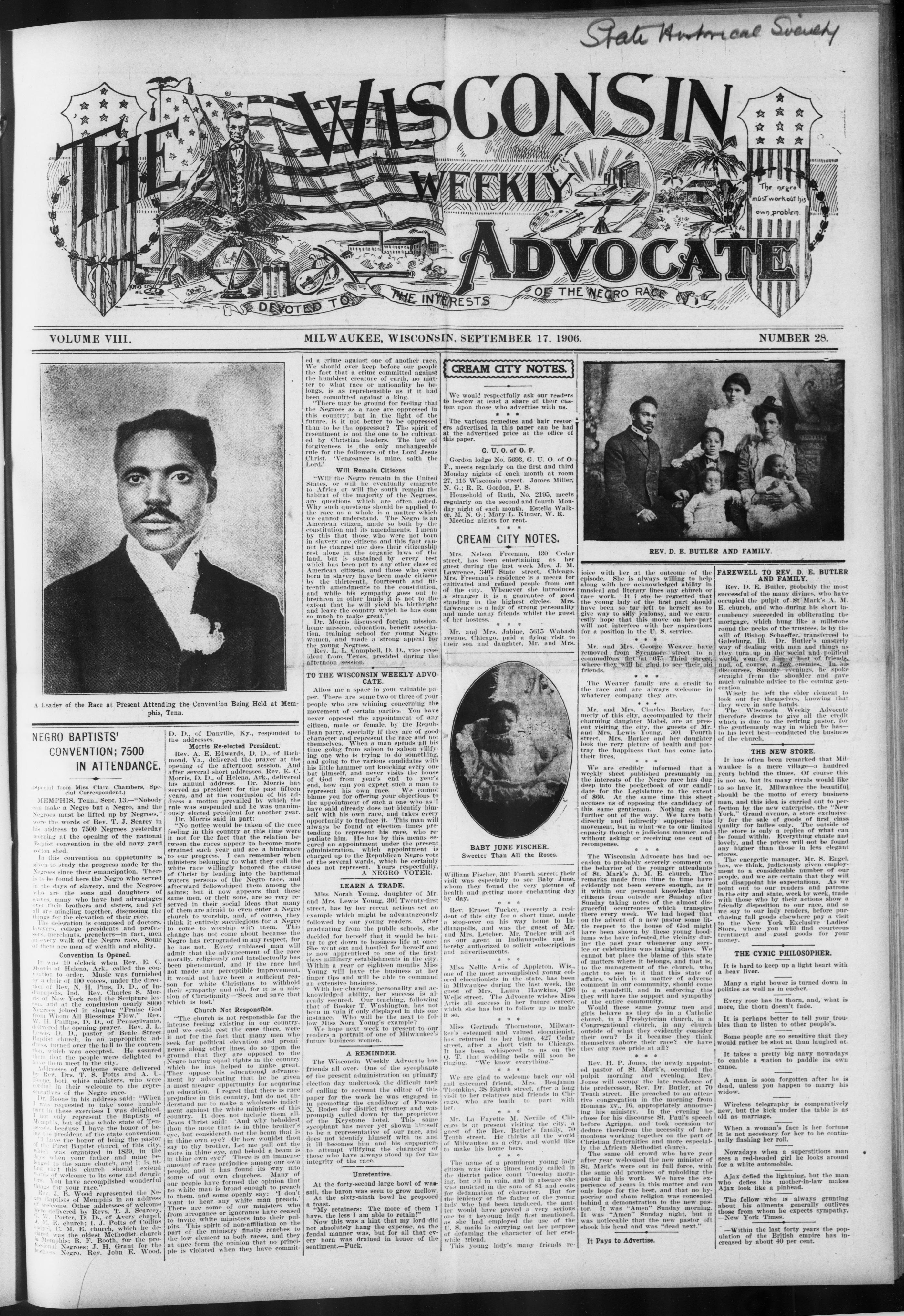
State Historic Society
WISCONSIN
WEEKLY
The negro must work out his own problem.
ADVOCATE
DEVOTED TO THE INTERESTS OF THE NEGRO RACE
A Leader of the Race at Present Attending the Convention Being Held at Memphis, Tenn.
NEGRO BAPTISTS'
CONVENTION; 7500
IN ATTENDANCE.
(Mpecial from Miss Clara Chambers, Special Correspondent.) MEMPHIS, Tenn., Sept. 13.—"Nobody can make a Negro but a Negro, and the Negroes must be lifted up by Negroes," were the words of Rev. T. J. Searcy in his address to 7500 Negroes yesterday morning at the opening of the national Baptist convention in the old navy yard cotton shed.
In this convention an opportunity is given to study the progress made by the Negroes since their emancipation. There is to be found here the Negro who served in the days of slavery, and the Negroes who are the sons and daughters of slaves, many who have had advantages over their brothers and sisters, and yet all are mingling together, discussing the things for the elevation of their race. The delegation is composed of doctors, lawyers, college presidents and professors, merchants, preachers—in fact, men in every walk of the Negro race. Some of them are men of wealth and ability.
Convention Is Opened.
It was 10 o'clock when Rev. E. C. Morris of Helena, Ark., called the convention to order. Music was furnished by a choir of 100 voices, under the direction of Rev. N. H. Pius, D. D., of Indianapolis, Ind. Rev. Charles S. Morris of New York read the Scripture lesson, and at the conclusion nearly 8000 Negroes joined in singing "Praise God from Whom All Blessings Flow." Rev. W. H. Phillips, D. D., of Pennsylvania, delivered the opening prayer. Rev. J. L. Lewis, D. D., pastor of Beale Street Baptist church, in an appropriate address, turned over the hall to the convention, which was accepted. He assured them that the people were delighted to have them meet in the city.
Addresses of welcome were delivered by Rew. Drs. T. S. Potts and A. U. Boone, both white ministers, who were cordial in their welcome to the representatives of the Negro race. Dr. Boone in his address said: "When I was requested to take some humble part in these exercises I was delighted. I not only represent the Baptists of Memphis, but of the whole state of Tennessee, because I have the honor of being the president of the state convention. "I have the honor of being the pastor of the First Baptist church of this city, which was organized in 1839, in the days when your father and mine belonged to the same church, and it is fitting that this church should extend words of welcome to its sons and daughters. You have accomplished wonderful things for your race."
Rev. J. B. Wood represented the Negro Baptists of Memphis in an address of welcome. Other addresses of welcome were delivered by Revs. T. J. Searcey, G. W. Porter, D. D., of Avery chapel, A. M. E. church; I. J. Potts of Collins chapel, C. M. E. church, which he declared was the oldest Methodist church in Memphis; B. F. Booth, for the professional Negroes; J. H. Grant for the business Negro. Rev. John E. Wood,
D. D., of Danville, Ky., responded to the addresses.
Morris Re-elected President.
Rev. A. E. Edwards, D. D., of Richmond, Va., delivered the prayer at the opening of the afternoon session. And after several short addresses, Rev. E. C. Morris, D. D., of Helena, Ark., delivered his annual address. Dr. Morris has served as president for the past fifteen years, and at the conclusion of his address a motion prevailed by which the rule was suspended and he was unanimously elected president for another year. Dr. Morris said in part:
"No notice would be taken of the race feeling in this country at this time were it not for the fact that the relation between the races appear to become more strained each year and are a hindrance to our progress. I can remember when ministers belonging to what they call the white race willingly honored the cause of Christ by leading into the baptismal waters persons of the Negro race, and afterward fellowshiped them among the saints; but it now appears that these same men, or their sons, are so very reserved in their social ideas that many of them are afraid to even enter a Negro church to worship, and, of course, they think it entirely sacrilegious for a Negro to come to worship with them. This change has not come about because the Negro has retrograded in any respect, for he has not. Every unbiased man will admit that the advancement of the race morally, religiously and intellectually has been phenomenal, and if the race had not made any perceptible improvement, it would not have been a sufficient reason for white Christians to withhold their sympathy and aid, for it is a mission of Christianity—'Seek and save that which is lost.'
Church Not Responsible.
"The church is not responsible for the intense feeling existing in our country, and we could rest the case there, were it not for the fact that many men who seek for political elevation and prominence along other lines, do so upon the ground that they are opposed to the Negro having equal rights in the country which he has helped to make great. They oppose his educational advancement by advocating that he be given a most meager opportunity for acquiring an education. I regret that there is race prejudice in this country, but do not understand me to make a wholesale indictment against the white ministers of this country. It does not include them all. Jesus Christ said: 'And why beholdest thou the mote that is in thine brother's eye, but considereth not the beam that is in thine own eye? Or how wouldst thou say to thy brother, Let me pull out the mote in thine eye, and behold a beam is in thine own eye?' There is an immense amount of race prejudice among our own people, and it has found its way into some of our own churches. Many of our people have formed the opinion that no white man is broad enough to preach to them, and some openly say: 'I don't want to hear any white man preach.' There are some of our ministers who from arrogance or ignorance have ceased to invite white ministers into their pulpits. This spirit of non-affiliation on the part of the ministry finally reaches to the low element in both races, and they at once form the opinion that no principle is violated when they have commit-
ed a crime against one of another race. We should ever keep before our people the fact that a crime committed against the humblest creature of earth, no matter to what race or nationality he belongs, is as reprehensible as if it had been committed against a king.
"There may be ground for feeling that the Negroes as a race are oppressed in this country; but in the light of the future, is it not better to be oppressed than to be the oppressor? The spirit of resentment is not the one to be cultivated by Christian leaders. The law of forgiveness is the only unchangeable rule for the followers of the Lord Jesus Christ. 'Vengeance is mine, saith the Lord.'
Will Remain Citizens
"Will the Negro remain in the United States, or will he eventually emigrate to Africa or will the south remain the habitat of the majority of the Negroes, are questions which are often asked. Why such questions should be applied to the race as a whole is a matter which we cannot understand. The Negro is an American citizen, made so both by the constitution and its amendments. I mean by this that those who were not born in slavery are citizens and this fact cannot be charged nor does their citizenship rest alone in the organic laws of the land, but is sustained by every test which has been put to any other class of American citizens, and those who were born in slavery have been made citizens by the thirteenth, fourteenth and fifteenth amendments to the constitution, and while his sympathy goes out to brethren in other lands it is not to the extent that he will yield his birthright and leave the country which he has done so much to make great."
Dr. Morris discussed foreign mission, home mission, education, benefit association, training school for young Negro women, and made a strong appeal for the young Negroes. Rev. L. L. Campbell, D. D., vice president from Texas, presided during the afternoon session.
TO THE WISCONSIN WEEKLY ADVOCATE.
Allow me a space in your valuable paper. There are some two or three of your people who are whining concerning the movement of certain parties. You have never opposed the appointment of any citizen, male or female, by the Republican party, specially if they are of good character and represent the race and not themselves. When a man spends all his time going from saloon to saloon vilifying one who is trying to do something, and going to the various candidates with his little hammer out knocking every one but himself, and never visits the house of God from year's end to year's end, how can you expect such a man to represent his own race. We cannot blame you for offering your objections to the appointment of such a one who as I have said already does not identify himself with his own race, and takes every opportunity to traduce it. This man will always be found at election times pretending to represent his race, who repudiate him. He has by this means secured an appointment under the present administration, which appointment is charged up to the Republican Negro vote of the several wards, which he certainly does not represent. Yours respectfully, A. NEGRO VOTER.
LEARN A TRADE.
Miss Norah Young, daughter of Mr. and Mrs. Lewis Young, 301 Twenty-first street, has by her recent actions set an example which might be advantageously followed by our young readers. After graduating from the public schools, she decided for herself that it would be better to get down to business life at once. She went out and hustled for herself and is now apprenticed to one of the first-class millinery establishments in the city. Within a year or eighteen months Miss Young will have the business at her finger tips and will be able to command an extensive business.
With her charming personality and acknowledged ability, her success is already secured. Our teaching, following that of Booker T. Washington, has not been in vain if only displayed in this one instance. Who will be the next to follow Miss Nora Young's example? We hope next week to present to our readers a portrait of one of Milwaukee's future business women.
A REMINDER.
The Wisconsin Weekly Advocate has friends all over. One of the sycophants of the present administration on primary election day undertook the difficult task of calling to account the editor of this paper for the work he was engaged in in promoting the candidacy of Francis X. Boden for district attorney and was promptly called down by the proprietor of the Keystone hotel. This same sycophant has never yet shown himself to be a representative of our race, and does not identify himself with us and it ill becomes him and his supporters to attempt vilifying the character of those who have always stood up for the integrity of the race.
Unretentive
At the forty-second large bowl of wassail, the baron was seen to grow mellow. At the sixty-ninth bowl he proposed a toast. "My retainers: The more of them I have, the less I am able to retain!"
Now this was a hint that my lord did not absolutely hang the expense, as the feudal manner was, but for all that every horn was drained in honor of the sentiment.—Puck.
CREAM CITY NOTES.
---
We would respectfully ask our readers to bestow at least a share of their custom upon those who advertise with us.
The various remedies and hair restorers advertised in this paper can be had at the advertised price at the office of this paper.
G. U. Q. of Q. F.
Gordon lodge No. 5693, G. U. O. of O. F., meets regularly on the first and third Monday nights of each month at room 27, 115 Wisconsin street. James Miller, N. G.; R. R. Gordon, P. S.
Household of Ruth, No. 2195, meets regularly on the second and fourth Monday night of each month. Estella Walker, M. N. G.; Mary L. Kinner, W. R. Meeting nights for rent.
CREAM CITY NOTES.
Mrs. Nelson Freeman, 430 Cedar street, has been entertaining as her guest during the last week Mrs. J. M. Lawrence, 3407 State street, Chicago. Mrs. Freeman's residence is a mecca for cultivated and refined people from out of the city. Whenever she introduces a stranger it is a guarantee of good standing in the highest circles. Mrs. Lawrence is a lady of strong personality and made many friends whilst the guest of her hostess.
Mr. and Mrs. Jabine, 5615 Wabash avenue, Chicago, paid a flying visit to their son and daughter, Mr. and Mrs.
5615 Wabash flying visit to Mr. and Mrs.
2
BABY JUNE FISCHER. Sweeter Than All the Roses.
William Fischer, 301 Fourth street; their visit was especially to see Baby June, whom they found the very picture of health and getting more enchanting day by day.
☆ ☆ ☆
Rev. Ernest Tucker, recently a resident of this city for a short time, made a stop-over on his way home to Indianapolis, and was the guest of Mr. and Mrs. Letcher. Mr. Tucker will act as our agent in Indianapolis and is hereby authorized to solicit subscriptions and advertisements.
* * *
Miss Nellie Artis of Appleton, Wis., one of the most accomplished young colored elocutionists in the state, has been in Milwaukee during the last week, the guest of Mrs. Laura Hawkins, 426 Wells street. The Advocate wishes Miss Artis all success in her future career, which she has but to follow up to make it so.
* * *
Miss Gertrude Thornstone, Milwaukee's esteemed and valued elocutionist, has returned to her home, 427 Cedar street, after a short visit to Chicago. It has been whispered to us on the Q. T. that wedding bells will soon be ringing. "We know everything."
***
We are glad to welcome back our old and esteemed friend, Mrs. Benjamin Thomkins, 38 Eighth street, after a long visit to her relatives and friends in Chicago, who are loath to part with her.
```markdown
```
Mr. La Fayette M. Neville of Chicago is at present visiting the city, a guest of the Rev. Butler's family, 70 Tenth street. He thinks all the world of Milwaukee as a city, and would like to make his home here.
☆ ☆ ☆
The name of a prominent young lady citizen was three times loudly called in the district police court Tuesday morning, but all in vain, and in absence she was muleted in the sum of $1 and costs for defamation of character. But for the leniency of the father of the young lady who had been traduced, the matter would have proved a very serious one to t heyoung lady first mentioned, as she had employed the use of the U. S. mails in carrying out her purpose of defaming the character of her erstwhile friend. This young lady's many friends re-
M. E. H.
REV. D. E. BUTLER AND FAMILY
joice with her at the outcome of the episode. She is always willing to help along with her acknowledged ability in musical and literary lines any church or race work. It i sto be regretted that the young lady of the first part should have been so far left to herself as to give way to silly jealousy, and we earnestly hope that this move on her part will not interfere with her aspirations for a position in the U. S. service.
Mr. and Mrs. George Weaver have removed from Sycamore street to a commodious flat at 675 Third street, where they will be glad to see their, old friends.
The Weaver family are a credit to the race and are always welcome in whatever company they are.
Mr. and Mrs. Charles Barker, formerly of this city, accompanied by their charming daughter Mabel, are at present visiting the city, the guests of Mr. and Mrs. Lewis Young, 301 Fourth street. Mrs. Barker and her daughter look the very picture of health and portray the happiness that has come into their lives.
We are credibly informed that a weekly sheet published presumably in the interests of the Negro race has dug deep into the pocketbook of our candidate for the Legislature to the extent of $60. At the same time this sheet accuses us of opposing the candidacy of this same gentleman. Nothing can be further out of the way. We have both directly and indirectly supported this movement, but in what we to our limited capacity thought a judicious manner, and without asking or receiving one cent of recompense.
The Wisconsin Advocate has had occasion to probably severely comment on the behavior of the younger attendants of St. Mark's A. M. E. church. The remarks made from time to time have evidently not been severe enough, as it it within our personal knowledge that citizens from outside are Sunday after Sunday taking notes of the almost disgraceful occurrences which transpire there every week. We had hoped that on the advent of a new pastor some little respect to the house of God might have been shown by these young hoodlums who have infested the vicinity during the past year whenever any service or celebration was taking place. We cannot but place the blame of this state of matters where it belongs, and that is, to the management of the church, who ought to see to it that this state of affairs, which is a matter of adverse comment in our community, should come to a standstill, and in enforcing this they will have the support and sympathy of the entire community.
Would these same young men and girls behave as they do in a Catholic church, in a Presbyterian church, in a Congregational church, in any church outside of what they evidently consider their own? Is it because they think themselves above their race? Or have they any race pride at all?
Rev. H. P. Jones, the newly appointed pastor of St. Mark's, occupied the pulpit morning and evening. Rev. Jones will occupy the late residence of his predecessor, Rev. Dr. Butler, at 70 Tenth street. He preached to an attentive congregation in the morning from Romans xv., 16, appropriately announcing his ministry. In the evening he chose for his discourse St. Paul's speech before Agrippa, and took occasion to deduce therefrom the necessity of harmonious working together on the part of Christian fraternities and more especially the African Methodist church.
The same old crowd who have year after year welcomed the new minister of St. Mark's were out in full force, with the same old promises or upholding the pastor in his work. We have the experience of years in this matter and can only hope for the best, and that no hypocrisy and sham religion was concealed behind a demonstration to the new pastor. It was "Amen" Sunday morning. It was "Amen" Sunday night, but it was noticeable that the new pastor oft shook his head and was "dead next."
**
***
* * *
```markdown
```
* * *
It Pays to Advertise
THE FAMILY OF MARY C. HARRIS
FAREWELL TO REV. D. E. BUTLER AND FAMILY
Rev. D. E. Butler, probably the most successful of the many divines, who have occupied the pulpit of St Mark's A. M. E. church, and who during his short incumbency succeeded in obliterating the mortgage, which hung like a millstone round the necks of the trustees, is by the will of Bishop Schaeffer, transferred to Galesburg, Ill. Dr. Butler's masterly way of dealing with man and things as they turn up in the social and political world, won for him a host of friends, and, of course, a few enemies. In his discourses, Sunday evenings, he spoke straight from the shoulder and gave much valuable advice to the coming generation. Wisely he left the elder element to look out for themselves, knowing that they were in safe hands.
The Wisconsin Weekly Advocate therefore desires to give all the credit which is due to the retiring pastor, for the gentlemanly way in which he has to his level best-conducted the business of the church.
It has often been remarked that Milwaukee is a mere village—a hundred years behind the times. Of course this is not so, but its many rivals would like to so have it. Milwaukee the beautiful should be the motto of every business man, and this idea is carried out to perfection by the new enterprise, the "New York," Grand avenue, a store exclusively for the sale of goods of first class quality for ladies only. The outside of the store is only a replica of what can be found within. Everything chaste and lovely, and the prices will not be found any higher than those in less elegant stores.
The energetic manager, Mr. S. Engel, has, we think, judiciously given employment to a considerable number of our people, and we are certain that they will not disappoint his expectations. As we point out to our readers and patrons in the city and state, week by week, trade with those who by their actions show a friendly disposition to our race, and so we say to our lady readers, before purchasing fall goods elsewhere pay a visit to the New York Exclusive Ladies' Store, where you will find courteous treatment and good goods for your money.
THE CYNIC PHILOSOPHER.
It is hard to keep up a light heart with a heavy liver.
Many a right bower is turned down in politics as well as in eucher.
Every rose has its thorn, and, what is more, the thorn doesn't fade.
It is perhaps better to tell your troubles than to listen to other people's.
Some people are so sensitive that they would rather be shot at than laughed at.
It takes a pretty big navy nowadays to enable a nation to paddle its own canoe.
A man is soon forgotten after he is dead, unless you happen to marry his widow.
Wireless telegraphy is comparatively new, but the kick under the table is as old as marriage.
When a woman's face is her fortune it is not necessary for her to be continually flashing her roll.
Nowadays when a superstitious man sees a red-headed girl he looks around for a white automobile.
Ajax defied the lightning, but the man who defies his mother-in-law makes Ajax look like a pinhead.
The fellow who is always grunting about his ailments generally outlives those from whom he expects sympathy.—New York Times.
Within the last forty years the population of the British empire has increased by about 40 per cent.
NUMBER 28.
THE NEW STORE
THE WISCONSIN WEEKLY ADVOCATE.
MILWAUKEE, WIS.
R. B. MONTGOMERY, Editor and Proprietor.
Curious Condensations.
—It is a dull market day in New York city when 5,000,000 eggs and 500,000 pounds of butter are not received.
—Thirty-two thousand homes are now closed in New York city, while their occupants are at the summer resorts.
—In the land of Melukkah, or Median, are old mines in which mining tools of the date 500 B. C. have been found.
—Mme. Patti possesses an old doll called "Henrietta," which was given to her when she was 7 for singing nicely.
—During the last ten years the single product of sisal fiber has yielded in Yucatan the enormous sum of 297,000,000 Mexican dollars.
The use of colored papers for house decoration, which was scarcely known in China until quite recently, is now becoming general.
Charles Francis Brush, the noted Cleveland electrician, has on his office door: "Office hours, 11:30 to 12." He is there promptly and never works overtime.
The net used by Japanese fishermen for yellowtail, bonito and tunny is sometimes several thousand feet in length. The seine nets are sometimes three mile long.
The oldest building in Wall street, New York, is the government assay office, immediately east of the sub-treasury, yet it is only eighty-three years old, having been erected in 1823.
Queen Wilhelmina of Holland is an excellent linguist, for she speaks French, German and English as fluently as her native Dutch, and she knows something besides of Italian and Russian.
Wurthemberg, Germany, has 487,000 acres of forest from which its net profit last year was $2,240,000. The Germans cut the older trees and plant enough young ones to take their places.
There is a remarkable increase of railway traffic in New York city. Each month this year there have been 100,000 more fares collected than during the corresponding month last year, and 6,000,000 more transfers have been issued.
—Darwin relates that the gauchos of the American pampas live for months on the fat meat of the oxen they watch over. The Eskimos can get along very well by eating from five pounds to six pounds a day of reindeer or seal's flesh, so long as it is not too lean, but contains a due proportion of fat.
—Northwestern Ohio, south of the counties bordering on Lake Erie, had a late and slow start in industrial development and in population. The Indians were in possession long after they departed from the rest of the state. The forest was dense and the land was hard to clear. Transportation facilities were poor.
At the birth of a Japanese baby a tree is sometimes planted, and this must remain untouched until the marriage day of the child. When the nuptial hour arrives the tree is cut down and a skilled cabinet maker transforms the wood into furniture, which is regarded by the young people as the most beautiful of all ornaments of the house.
Three fishermen at Southwold the other day secured a fox shark, or thrasher fish, a pugnacious species which is the greatest enemy of the whale. This fish is rarely caught in our waters, and the one that was captured was about 7 feet in length. One blow from the enormously strong tail of this fish is sufficient to stave in the sides of a large boat.
In a well that has been boring since 1902 water was reached the other day. It is at Boultham, near Lincoln, Eng., and is to supply that city with water. The well's depth is 1560 feet. When water was tapped there was a noise like thunder, and in fifteen minutes the water rose 185 feet. In a few hours it was within 70 feet of the top of the shaft.
The German Kaiser's castle in Poen, Polish Prussia, is being rapidly completed. It is in Romanesque style, with buildings grouped around two interior courtyards, overlooking the greater of which will be the dwelling rooms, while in the smaller will be the state apartments. One feature of the facade is a chapel with a tower 250 feet high. The state hall is 80 feet square and lined with bronze decorated marble.
The age of a horse cannot always be told by looking at its teeth. After the eighth year the horse gets no more new teeth, so that this method is useless for a horse more than 8 years old. As soon as the set of teeth is complete, however, a wrinkle begins to appear on the edge of the lower eyelid, and another wrinkle is added each year, so that to get the age of a horse more than 8 years old you must count the teeth plus the wrinkles.
The street railway operating plant of Portland, Ore., which employs sawmill refuse as fuel, has adopted a cinder-separating plant with great success. A powerful draught from a steel fan forces the furnace smoke through a steel-plate flue into a vertical steel cylinder 32 feet in diameter. The bottom is a cone-shaped hopper for receiving the cinders, while the smoke, after losing its velocity, slowly emerges through an aperture at the top. As the gases lose velocity the cinders, being heavier, drop into the hopper, whence they are conveyed back to the furnaces to be completely burned. Besides abating the nuisance the boiler economy is increased.
A remarkable epitaph is on a tombstone in Brighton churchyard in England. It reads: "In memory of Phoebe Hoessel, who was born at Stepney in the year 1713. She served for many years as a private soldier in the Fifth Regiment of Foot in different parts of Europe, and in the year 1745 fought under the command of the Duke of Cumberland at the battle of Fontenoy, where she received a bayonet wound in her arm. Her long life, which commenced in the time of Queen Anne, extended to the reign of George IV., by whose munificence she received comfort and support in her later years. She died at Brighton, where she had long resided, December 12, 1821, aged 108 years."
To Break the Monotony
Irving G. Wadsworth of the Congregational Home Missionary society of New York, was describing professional beggars and their ways.
"There was a beggar with a wooden leg," he said, "who for many years plied his trade near the Battery. The old fellow is dead now. He left a good bank balance behind him.
"They say of this very successful beggar that one afternoon a delivery man, seeing him unbuckling his wooden leg in the cheap lodging house where they both lived, said in a reproachful tone:
"Wot, Bill, knockin' off work already? It's only 2 o'clock."
"The beggar" continued the unbuckling of his lignous limb.
"No, ye dolt; I ain't knockin' off; I'm only changin', he said. 'Ye can't expect me to beg all day on the same leg, can ye?"—New York Tribune.
A PEDDLER.
Fine knacks for ladies! cheap, choice, brave and new;
Good penny worths-but money cannot
again;
My trifles come as treasures from my
mind.
It is a precious jewel to be plain;
Sometimes in shell the Orient's pearls
we find.
Of others take a sheaf, of me a grain!
Of me a grain!
THE BURNISHED BRASS PLATE.
"Parker," said Jude Carson one morning, "I want this bit of metal polished. I want it made bright. I want it made to shine like burnished gold!"
The emphatic manner in which these instructions were given, combined with their somewhat unusual character, excited Parker's curiosity.
"Yessir," he said; and took up a small metal plate about the size of a lady's visiting card, or perhaps a shade larger.
For upward of an hour Parker was very busy with emery cloth and brick dust and chamois leather, and as he worked and scrubbed and polished, his brain was just as busy as his hands, trying to conceive what possible use Mr. Carson could have for a bit of brass plate.
"Excellent," said Mr. Carson. "I couldn't have done it better myself."
"Yessir—no, sir!" said Parker, in confusion.
It was a morning of surprises. On a table beside the easy chair in which Mr. Carson reclined was set out an array of genuine working tools. There was a riveting tool and a boring tool and a graving tool, and a pot of enamel paint, and a file, and a hammer, and a packet of short spikes with points as fine as needles. At the sight of them Parker's curiosity rose to fever pitch. On one pretext or another for the rest of that morning Parker made it his business to be in and out of his master's room, and in the course of it he saw a great deal that interested him and augmented his curiosity, but nothing whatever that satisfied it.
For instance, he saw Mr. Carson using the boring tool, then he caught him busy with the riveting tool, and then it was the turn of the graving tool, and it was an undoubted fact that Mr. Carson was engraving certain letters or characters on the burnished surface of the plate.
But the reason for all this activity remained a mystery, and by lunch time the tools and the brass plate and the paint brush had been put away without a single word of explanation.
After lunch Mr. Carson was engrossed in studying the floor plan of a great block of buildings designed to be let out as offices.
It was next morning after breakfast that Mr. Carson took Parker partially into his confidence.
"Parker, I have discovered what looks like a reasonable opportunity for replenishing our somewhat depleted exchequer; but the success of the effort will depend in some degree upon yourself."
"Yessir!" said Parker.
"You know Graham house, Upper Broad street—a huge pile of buildings, containing some hundreds of sets of offices?"
Parker knew it well, and said so; he also recognized it as the block of buildings whose floor plan Mr. Carson had been so diligently studying the night before.
"Very well, Parker, I want you to call upon Sidney Mander, an insurance broker in a small way of business, who occupies a single office on the third floor, last door but one at the end of the passage. It's one of the cheapest offices in the place, because it looks out upon the central well of the block and gets very little air, and little or no light.
"I want you to call upon Mr. Mander shortly before 12 o'clock, Parker," proceeded Mr. Carson, airily, "and engage him in conversation on any suitable topic that occurs to you. You might suggest to him that you desire to insure your life, or that you have a friend who desires to insure his, or that you propose to take out a fire insurance policy. I confidently leave the exact choice of a topic to your own good judgment, Parker. But the point of your instructions consists in this—that you will have to get him out of his office by 12:15 and keep him out of it till 12:30. Between 12:15 and 12:30 I shall want his office for my own use." "Yessiv!" said Parker. But his curi-
"Yessir!" said Parker. But his curiosity—it almost suffocated him.
"Are you the headquarters of the city police? Oh, I'm Hiram Jones—Hiram Jones & Son of 231 Graham house, Upper Broad street, wholesale jewelers. Yes, yes; that's right. I want you to send round a couple of plain clothes men to be here not later than 11:30. Get that? Eh? You can manage it? Good! Well—eh? Well, of course, I can't say, but it looks fishy—quite outside the ordinary run of business. Says he wants to buy an assortment of really high-class fancy jewelry. No, I haven't seen him; he wrote. What? References? Yes, I asked for references, but he replied that he was prepared to pay cash, subject to the usual discount. Naturally I let it go at that. I didn't catch that. Oh, his name? The name he gives is Smith—Lumley Smith. Wrote originally from a hotel in Manchester, but wired this morning that he was in London and would call at 12 sharp. Then you'll send them? Very much obliged; but not later than 11:30."
And Hiram Jones returned the instrument to its stand with the satisfied feeling that he had taken the very best means of protecting himself against being swindled that were open to a cautious and keen-sighted man to adopt.
And, indeed, he had. Whatever risk he was running in exhibiting to Mr. Lumley Smith an assortment of high-class fancy jewelry was narrowed down by these precautions to its incredible minimum.
At 11:30 punctually the two plain clothes men presented themselves at 231 Graham house and were ushered into Hiram Jones' private office.
He smiled broadly when he saw them, for they were just the type of men he would have selected himself if he had had the choosing of them. Saunders, the detective sergeant, stood
six feet two in his socks, a broad-shouldered, deep chested giant, a blow of whose brawny fist would have felled an ox, while Jenkinson, his assistant and subordinate, who was only a little less tall, was a man of that fine, wiry, hardbitten frame that means speed, endurance and agility. "Have you got a screen, sir?" inquired Saunders, when he had been thoroughly posted in the part he was designed to play. Yes, Hiram Jones possessed a screen, which was duly brought and placed in the corner nearest Mr. Jones' writing table.
"That will do for me. Now, what about Jenkinson?" Mr. Jones suggested the cupboard to the left of the door. A few minutes before 12 o'clock the two detectives secreted themselves in their respective hiding places, and on the stroke of the hour Lumley Smith, alias Jude Carson, was announced.
IV.
Jude Carson made his selection from among the costly objects shown him with the rapidity and unerring skill of the expert.
He explained at the outset that he only dealt in the very best, and that it would be waste of time to offer him second-rate or inferior goods; and as rapidly as he selected them he stowed them away in his bag.
Hiram Jones, adopting a frank air of unsuspicion, made no objection to this proceeding. Why should he? Was he not absolutely secure in his knowledge of the stalwart help at hand?
Jude Carson looked at his watch and noted that it was twenty minutes past 12. He closed his bag with a snap and then in a trice he had flung the door open and vanished. The bewildering suddenness and audacity of the act simply paralyzed Hiram Jones, but not so the detectives. They were ready for it-ready and prompt. Saunders threw down the screen and hurled himself at the door without the delay of an instant; but even he was not so quick as Jenkinson, who was out of his cupboard and after the fugitive before Jude Carson had fairly left the room.
Carson held straight on down the passage, past the lift and the staircase, past an interminable array of office doors on either side, running at top speed, with Jenkinson hard on his heels and Saunders only a few yards further behind him, neither gaining nor losing on his pursuers. Round the corner he swung.
Saunders, who knew the topography of the building, shouted "Got him!" for beyond the corner was only a short length of passage, ending in a blank wall. Jenkinson eased up a trifle at this triumphant shout, but he turned the corner in time to hear a door slam. There were only two doors, one of which was shut. "He's here," said Jenkinson, pointing to the closed door, which bore the legend "Pull" on a brass plate, with red letters. Jenkinson pulled, without making any impression on the door. "George, he's got a wrist! You have a try!"
Then Saunders gripped the handle and pulled, with no better success. "He must have roped it up," said Saunders.
"He couldn't have done it; he hadn't the time. He's holding it." They pulled till the veins on their foreheads stood out like knotted cords. They pulled for two minutes, and still the door refused to budge. "He's a second Sampson!" gasped Saunders, mopping his face. Whilst untying his handkerchief, Jenkinson accidentally pushed the door, and the door instantly swung open. "Well, of all the fools!" ejaculated Saunders. But his feelings were really too deep for speech. He broke off abruptly, and entered the room. Jenkinson followed him in silence. There was nobody there.
The windows were wide open. They peered down into the central well of the building and saw that an iron ladder ran right up to the roof from the ground an iron ladder which was evidently intended to be used as an emergency exit in case of fire. "Hello! Anything I can do for you?" inquired a voice behind them.
It was Sidney Mander, the insurance broker.
"Yes; you might tell us what you mean by that word 'Pull.'"
"What word 'Pull'?"
The door being wide open when he entered it Mr. Mander hadn't noticed it.
They showed him.
"I am sure I don't know. It wasn't there a quarter of an hour ago when I went out."
Mander, as he spoke, picked it off quite easily with his finger and thumb.
Then the detectives understood.
It was the identical piece of brass plate which had so keenly aroused Parker's curiosity.—Answers.
How Palestine Is Flourishing.
If Palestine is not precisely a land flowing with milk and honey in modern times, it is still not doing badly, according to the consular report of Mr. Dickson, just issued. It is particularly fertile in oranges, which it exported to the value of £114,650 last year, chiefly to Scotland, the trade, we are told, being steadily increasing. Wines and spirits, too, are becoming important, the Jewish colonies displaying considerable activity in the cultivation of the grape, which was very abundant last year. Watermelons are also plentiful. The total value of the imports and exports of Palestine last year was £821,820. Consular reports are sometimes curious in the way they lump trades together. We find Consul Dickson saying: "As regards other articles of export, there was an increase in religious ornaments and hides." It may be noted that it is the Americans who are after the religious ornaments of Palestine. People who desire to send their friends to Jericho will be interested to hear that a new carriage road will be completed down to the Dead sea and Jericho in the course of a year. Then, if anybody wants to send a telegram to Beersheba the thing can be done on the customary terms. Beersheba in these days only consists of fifty dwellings, but it is "rising in importance." — Dundee Advertiser.
Syndicating Beecher
The current number of M. A. P. in America contains the history of Editor Bok's first publishing venture. When the present editor of The Ladies' Home Journal was a schoolboy in Brooklyn he enjoyed the friendship of Henry Ward Beecher, then in the height of his popularity. He attended the Sunday school of
Plymouth church, and Mr. Beecher took a great fancy to the lad. Bok had an amateur printing press and some type, and he published a tiny four-page paper, playing the role of proprietor, editor, reporter, compositor, pressman and newsdealer. One day the embryo journalist—still in knickerbockers—went to Mr. Beecher with a proposal to "syndicate" his sermons to out-of-town papers. Mr. Beecher consented and regularly furnished the boy with his "copy." Bok made a big success of the thing and a whole bunch of money besides.—Literary Digest.
Reliable Recipes.
Deep Peach Cake. Fill a pudding dish half full of drained canned peaches, or of fresh ones cut in halves after they have been stoned and peeled. Cover with paste made as for pies and bake. Serve with or without whipped cream.
Old-Fashioned Cream Cake—Beat two eggs in a cup, fill up the cup with sweet cream, add one cup of sugar, one and one-half cups of flour sifted with three level teaspoons of baking powder, then add one-half teaspoon of lemon flavoring.
Clam Chowder—Steam one-half peck of clams until the shells open; remove the shells, thin membranes and black ends. Chop fine all but soft parts. Cook one slice onion in salt pork fat, add two cups of water, two cups of clam juice and four cups of sliced potatoes. When the potatoes are done add a salt spoon of pepper, two cups of thick white sauce, the chopped clams and six buttered crackers split open. If too thick add more hot milk or clam water.
Butter Balls—The best way to make individual butter pats is to work the butter into little balls with grooved butter paddles made of wood. Keep the paddles in cold water until well chilled, then take a piece of butter about the size of an English walnut and roll between the paddles into either a round ball or a tiny roll. Place the rolls in ice water till they are to be served. This is a great improvement over serving cut or broken pieces of butter on the table, as must often be done in the emergency. It takes but a little time to make up the butter needed for the day.
Cream Custards.—For six custards, beat three eggs, add six slightly rounding tablespoons of powdered sugar and beat until the sugar is nearly dissolved. Take three cups of milk, two cups of cream, using the custard cups for a measure and pour on to the sugar and eggs. Stir all together and flavor with one-half teaspoon of vanilla. Pour the custards into cups and set in a pan in a moderate oven. It is necessary that the custard cook slowly and gradually thicken rather than boil up. When the custards are nearly cool set in the ice chest and serve very cold.
Veal Pie—Simmer a knuckle of veal until the meat is tender. Add to the broth a small chopped onion, two slices of carrot, a bit of bay leaf, a sprig of parsley and an even teaspoon of salt. Simmer until the liquid is reduced to four cups. Cut the meat into small pieces and put in a baking dish. Melt four level tablespoons of butter, add an equal amount of flour and when smooth pour on the hot broth. Add more seasoning if needed and pour over the meat. When cool cover with a top crust made from good paste and roll rather thick. Cut a round piece out of the center and bake in a slow oven; serve hot.
Veal with Tomato Sauce—Cut cold roast veal into even slices. Fry some bacon, take up on a platter and lay the sliced veal into the fat. Fry slightly and place on the platter with the bacon and pour over all a tomato sauce. Cook two cups of tomato with a thick slice of onion and four whole cloves for ten minutes, heat two level teaspoons of butter in a small pan, stir in two level tablespoons of flour and when smooth and brown stir it into the tomato. Cook two minutes and season with one-half level teaspoon of salt and a little pepper; rub through a wire strainer to take out the seeds.
Peach Gelatine.—Soak one-half a box of gelatine in one cup of cold water for fifteen minutes; add one cup of boiling water and dissolve the gelatine. Add the juice of two lemons, one and one-half cups of sugar, then strain. Measure the liquid and add enough cold water to make three cups in all. Rinse a round tin with cold water and place a cup or small jar in the center to make a hollow when the mould of the jelly is taken out. Pour one-quarter of the jelly into the mold and cover with sliced peaches that have been sprinkled with sugar. Keep the remainder of the gelatine liquid by having it in a warm place. When the first layer has hardened a little, add another and so on until the whole has been used. Then set away to become firm. When served turn the mold over on the plate and lift off the tin; to take the cup out without breaking the jelly put in a little hot water when it will slip out easy. Fill the hollow left by the cup with whipped cream.
Raisin Cake—Cream one cup of butter, add one cup of sugar, one-half cup of milk with the whites of four eggs beaten stiff, one and one-half cups of flour sifted with three level teaspoons of baking powder and one-half cup of cornstarch. Bake in layers. Chop one-half cup of raisins and spread over an icing used as filling between the layers.
Water Bread-For six small loaves, or three double ones, take three pints of warm water and in one-half cup of this water dissolve one yeast cake. To the rest of the water add one tablespoon of salt and one of butter. Add flour enough to make a stiff batter; also the yeast and beat fifteen minutes. Let rise over night, then stir in flour to make a dough to knead. Knead long and thoroughly; pounding with the rolling pin will improve the grain of the dough. Let rise and then shape into loaves, using almost no flour in the process. Let the dough rise again and bake well.-Marjorie Webster.
Why Zulus Won't Work
The more married the greater the wealth of the Zulu, for the women till the lands, sow and reap the maize, gather the fuel, and, assisted by the younger members of the household, do all the hard work of the family, where everybody works but father, the men considering such menial work beneath their dignity as a nation of warriors and contenting themselves with tending the cattle, conducting the affairs of the tribe, for the Zulu is a born politician and spends his time in gossip and drinking tivala (a native beer), content with his lot nor caring for the morrow.
This polygamous custom causes the dearth of labor and all its attendant troubles in South Africa. In a genial climate the Zulu's wants are few; he needs no clothes; his land and cattle, tilled and tended by his wives, supply all his requirements. The chase, in a land where game abounds, affords recreation and food.
Why, therefore, should he work at all, unless compelled to find money to pay the iniquitous hut tax imposed by the hated white?—Harper's Weekly.
A SPOILED STORY
Young Tommy was a reckless chap
As ever you did spy;
He crept into the pantry once
And ate a pot of lye—
No, no! I mean a lot of ple.
This story gets so mixed at times
Under my very eyes,
I'll stop. So far what I have said
Seems like a lack of pies—
Dear me! I mean a pack of lies.
—J. D. Benedict in St. Nicholas.
New York city requires 2744 bakers to make its supply of daily bread.
Of all the names given to male dogs in New York city "Teddy" now leads the list in point of numbers.
The increase in receipts of the Manhattan postoffice is 10 per cent. over those of last year, when the total amount was $15,486,405.08.
The chewing gum habit is increasing. According to the last report of the gum trust, about 572,000 pieces are masticated in New York city each day.
Ellis Island, in New York bay, is the great gateway for aliens coming to America, and an average of 2414 of them pass through it every day in the year.
Police of New York city arrest on an average ninety-five persons each month for the crime of burglary. There is no record of the burglaries for which there are no arrests.
On a summer night the brighest spot on earth is Coney island, in the city of New York. Physical brightness, caused by the thousands of electric lights, is referred to, and the fact is best appreciated by an approach from the water.
New York city boasts the oldest structure on the hemisphere. It is the Egyptian obelisk, in Central park, first erected as an offering to the sun god by Thotmes II. Moses saw it when it was old, for it was constructed more than 1600 years before our era.
No street in the country of such prominence has so few drug stores as Broadway, from Fourteenth street to Bowling Green—in New York. People are compelled sometimes to walk half a mile looking for a place to buy a headache powder or some other simple remedy.
New York, with the longest water line of any city on earth, has the unenviable reputation of having the poorest, most out of repair, ragged, tumble down and disreputable water front of them all. This condition is little varied excepting for a short distance at the Battery.
There is a general impression that Manhattan island is comparatively level, while it is far from it. From the Battery water level you must climb, seventy-seven feet to reach the grand circle at Central park; twenty-three feet more to get to the highest point in Mount Morris park, twelve feet more to reach water level in Central park reservoir, twenty feet more to get to the top of Morningside park, another sixty-eight feet to stand at Broadway and 175th street, and yet another fifty feet to get to Washington bridge road and 184th street, when you are 250 feet above the water of the bay.
Automobilists will soon have to cease telling speed lies. There soon will be an end to the country sleuth rising up with a gun behind a hedge and taking the morotist off to be fined. Soon every automobile will carry a register that will show the rate of speed of the vehicle from the time it starts to the time it stops. The speed regulator is a French invention, and quite a few of them are being used in New York. It looks on the outside like one of those self-registering thermometers and barometers the weather bureaus use. It has a needle, and this needle writes the machine's speed. It makes a record of the speed. This record speaks for itself. All lies of chauffeurs, all lies of venal motor cops are powerless against that record.
Cross-country riding in Central park is becoming popular with fair equetriennes, notwithstanding the abundance of "Keep off the grass" signs. There is a good chance for men to enjoy a morning ride through the pleasure ground at this time of year, before the summer girl gets back from the seashore to crowd the bridle path. Many of the side-saddlers indulge in some pretty fast riding and exhibit a dare-devil spirit that one must admire—if safely out of the way. When the mounted policeman is talking to the lady with a white cap who pushes the perambulator and is out of sight a fair rider will make an excursion to the grassy spaces which have been rolled with care and seeded and planted, with absolute indifference to the park rules. "What can we do with them?" asked an officer today. "They're too nice and pretty to arrest, and then they always say that the horse took fright and ran off the path."
We now have everything "the newest," but the latest novelty the New York shops have put forth in that line is the newest pocketbook. It is of green leather and looks exactly like a big fourleaf clover. Plenty of pretty girls who have been sighing in vain for something "different" will find solace in carrying it. Of course, there is a handle, which somewhat detracts from the pocketbook's vernal beauty, but there isn't anything they can do about it, for the girl must have something to carry the clover by. The clover holds such a lot—why, a girl who wanted to show her friend on a Broadway car the other afternoon that the clover was more than it seemed took out a mirror, powder puff, a little pair of gold-mounted opera glasses that folded up flat, a tiny pencil, a cut-glass vinaigrette, a little box for holding hairpins, a coin purse and calling cards. What more could woman ask for?
"Talk about the freedom of the bachelor," said the man who is living alone in a bachelor flat in New York. "I am beginning to think seriously of marrying in order to regain mine, for I have reached the stage at home where I am the slave instead of the master of the place. It's all due to the stern-faced Irish widow who looks after it for me. There are few tyrants as unbending as the old family servant—I have had her for more than two years, and that is long enough in New York to make her an institution—and she has come to care for the flat to the entire exclusion of the wants and needs of my humble self. The fact is she now regards it as an organic entity which exists for the purpose of providing her with a regular weekly stipend in return for such effort as she sees fit to expend on it, while I am merely a piece of furniture, objectionable be
cause I am articulate and, on principle, make periodical protests against the method, or lack of method, of her rule. Get rid of her? I could not if I would and don't believe I would if I could, but if I could meet a nice girl who had been graduated from a lion-taming school I'd ask her to marry me just for the sake of being my own man again."
There is one place in New York where girls haven't the advantage over men in the way of wearing shirt waists, and that is on the bridle path in Central park. Here the shirt-waist man, with tanned skin and the jolly air which marks one who finds New York too good for him at any time of the year, is just as much in evidence as the shirt-waist girl. In fact, the man with the conventional riding coat has been the exception rather than the rule this summer. Several years ago the question of whether a man might ride in a public park without a coat in tropical weather resulted in the popular verdict that he could if he was an exercise boy taking out the horses and didn't care for appearances. That settled it then. Now, however, the man who rides in a negligee shirt is an accepted fact—perhaps he will try a peek-a-boo next summer.
Gay began to fold napkins into flowers and figures at the Fifth Avenue hotel on May 1, 1862. He met Mr. Moffat forty-four years ago, serving him so well the railroad magnate offered him a position of trust with one of his enterprises.
"You are too good a man always to be a waiter," said Moffat.
"I am too good a waiter, thanking you for the offer," said Gay, "to make anything but a poor railroad man."
This refusal on the part of Gay to take advantage of his offer only strengthened Moffat's admiration for the head waiter. In 1898 Moffat took Gay to Europe and again in 1905. The second European trip included an outing for Mrs. Gay and her daughter as well. Mr. and Mrs. Moffat and his sister, Mrs. C. H. Strong, treated the Gays like social equals and in every way showed the head waiter his position did not count one whit so far as the esteem of Moffat was concerned.
Visitors to the Central Park Zoological gardens in New York the other morning were amazed to see a Javanese monkey almost fully dressed emerge from the keeper's quarters. Nobody was more surprised than the custodian of the animal, who recognized his own collar and necktie and a waistcoat, all flung together and twisted in fantastic fashion. Knocko, as the animal is called, was brought up in a fire engine house, and for several years he had been in the habit of seeing the "smoke eaters" hastily attire themselves and hurry out on a run. It has been nearly a year since he was given to the Central park "zoo," and recently was the first chance he had of demonstrating his skill as a lightning change artist. The simian has shown such interest in his former associates that a suit of blue with a red shirt and a fireman's helmet will be made for him so that he can give one of his favorite performances of sliding down a pole in the most realistic fashion.
When E. H. Gary, chairman of the board of directors of the United States Steel corporation, made his declaration to the United States customs officials in New York, after he arrived from Europe, the deputy collector in charge of the ship nearly fell over from astonishment. "Wait a minute," said Mr. Gary, after he had declared several thousand dollars' worth of wearing apparel and other articles for Mrs. Gary and himself. He put his hand in his trousers pocket and drew out two large pearls. "I wish to declare these."
"Any value?" asked the customs official.
"I paid $53,000 for them in Paris." said Mr. Gary, modestly.
Later when the ship docked Mr. Gary paid to the collector's representative on the pier $5300 duty in cash. Besides this sum Mr. Gary paid $2200 duty on other articles declared.
News of Mr. Gary's act spread among the arriving passengers and caused a sensation. The duty paid, while large, is by no means a record sum handed to the deputy collector on the dock, which was $32,000 paid by Mrs. Collis P. Huntington in 1901.
"I never had money stolen from me but once," said an elderly man to a group that was discussing pickpockets in New York, "and then it was at a time when I thought it most impossible. I had just drawn $500 from a bank to take to a neighboring office, and in order to take no chances, I put it in my pocket with my hand on top of it, and made up my mind to walk all the way to my destination that way. Passing a shop window I stopped a moment to look in, and all of a sudden was aware that the roll in my pocket and under my hand was gone. I turned around, and on the spur of the moment accused a man just stepping away of taking it, and threatened to call the police. He hesitated a moment, and then to my surprise, handed over the $500
"I ought to have you arrested.' I said, 'but I won't if you'll tell me how in the world you got my wad when I had my hand on it all the time.' "Oh, no, you didn't,' he answered, 'Do you see that straw? Well, when you were looking in that window I tickled your ear with that straw. You raised your hand to scratch your ear for just a second, and in that second I got your money."
Senator P. C. Knox sat in a big leather chair in the corridor of the Waldorf-Astoria smoking a cigar while two pages, each bearing the cards of several Park row newsgetters, searched for him. The little Pennsylvania statesman did not register at the big helstery—possibly because he did not want to be disturbed after his tiresome voyage across the deep. "Sen-aa-toor Knox" cried the uniformed kiddies; "Sen-aa-toor Knox!" But Mr. Knox sat complacently puffing at his cigar. Three of the newspapermen stood almost in front of the Senator and another sat touching elbows with him. "I have waited almost three hours for this man Knox," said one reporter. "I wouldn't be surprised if he is in his room." At this juncture a Pittsburger walked up to Mr. Knox and cordially extending his hand, said: "Why, Senator, I am glad to see you back. You are indeed looking well." The newspapermen were almost dumfounded. He talked with them for a few moments and then walked to an automobile with Mrs. Knox. "He tried to hand us the lemon," said the rotund fellow with the white crush hat. "We deserved it." replied the expert on ship news.
Beware the Toad
As an example of the fatal effect of the venom of a toad on a dog M. Brigard in the Archives medicales d'Angers Bulletin general de therapeutique, May 8, 1906, tells of a hunter's dog that took a toad in its mouth. Although it rejected it immediately, there was an increased flow of saliva, the tongue, gums and conjunctiae became deeply congested, and shortly afterward the dead of syncope with cardiac paralysis. Cadaveric rigidity set in very rapidly. This shows that children are exposed to danger when they play with these batracbians.—New York Medical Journal.
GOSSIP FOR THE LADIES.
```markdown
```
Do We Forget?
Do we forget when winter snows lie deep Above the beds where our beloved sleep, And we no longer wildly weep Do we forget?
Because, when comes the holy Christmas ride. And love and joy are scattered far and wide. We look our sighs and strive our tears
We check our sighs, and strive our tears to hide—
Do we forget?
Do we forget, because with mute lips pressed
To fading pictures, all our love unguessed,
Lies locked secure within our patient breast—
Do we forget?
Because, across the widening gulf of years,
There comes no loving word to quell our fears,
No watchful hand to brush away our tears—
Do we forget?
Do we forget? Nay, in each heart there lies
A secret place, where, hid from mortal eyes,
Dwells, strong and true, a love that never dies,
Nor can forget!
—S. O'H. Dickson.
Etiquette of Court Functions.
The hour at which the invited guests are asked to attend a court at Buckingham palace, at night, is 10 o'clock: but it is usually not until 10:30 that the King and Queen take up their position in the ballroom.
The famous royal hock cup, the recipe of which is kept secret, is always served at supper after the court has been held, and if mayonnaise figures on the menu, this is also made from a unique recipe.
Every court function in Spain is regulated with the rigid lines laid down by old etiquette. At present there is no such ceremony known as a drawing room at the Spanish court. The debutante in Spain makes her appearance in society at a ball or party given by friends. It has been very rarely the case that young women have been admitted to the palace; hitherto, if by any special command, an audience of the King has been granted, the ceremony has been performed in the morning or afternoon, and for it the debutante has worn ordinary outdoor costume. Young ladies who wish to be presented at court in Vienna must belong to the nobility, and the desire must be expressed to the Countess Maria Theresa v. Harrach, the "Grande Maitresse de la Cour."
This lady draws up a list of the applicants and sees that they are sent invitations for the next court ball; because presentations are only made on such an occasion.
When the lady who is to be introduced arrives she is taken to the "Grande Maitresse de la Cour," who presents her according to the position she occupies on the list. Since 1898, the year of the lamented Empress' death, ladies are presented to the Archduchess Maria Josepha, the wife of the younger brother of the heir apparent, because the heir apparent himself is only morganatically married, and thus his wife cannot "receive."
The presentation is accompanied by the words: "Will your imperial highness deign to graciously accept the presentation of So-and-So," the name and title being specifically pronounced. The lady then makes a deep curtsey, the Archduchess says a few friendly words to her and the ceremony is over. The Archduchess never gives her hand, either to be kissed or otherwise, nor does she kiss the debutante. If a lady is introduced to the Emperor, he sometimes (not always) gives her his hand; but no kissing takes place.
All guests who are invited to courts at the royal castle in Berlin are requested to arrive fifteen minutes before their majesties enter the apartment generally used for the purpose—namely, the great drawing-room called the "white room."
The ladies are placed on one side of the room, and the gentlemen on the opposite one, and junior chamberlains are always in attendance in large numbers to preserve order and help any unfortunate who does not understand the proceedings.
The imperial couple then enter the apartment, attended by the princes, and preceded by the court chamberlain. They take their places in front of two thrones, and then any foreign princesses who are present made their reverence. Diplomatic presentations come next, and are generally made by the ambassadors and ministers, while their wives present the ladies to the Empress. When they are presented the ladies bow to her majesty, and the debutantes kiss her hand. The ladies are not presented to the Emperor.
After all the presentations have been made, the Emperor and Empress make a short tour of the room and spend a few minutes chatting with any personal friends and others who may particularly interest them. It is at this time that the debutantes are introduced to the Emperor, if he commands it.
At court balls the course of procedure is as follows: The imperial pair take their places upon the dais and a command is given to the court chamberlain to let the ball open, an office generally performed by an officer who has been specially chosen for his grace in dancing and his ability to lead the cotillons. At all court functions it is forbidden for any of the guests to sit down, and her majesty the Empress is particularly imperative on this point, with the result that, as can be easily imagined, the strain on the guest, if she or he is not particularly robust, is very great. Cases have, indeed, been known at such functions of gouty ambassadors slipping behind convenient curtains, where they may rest for a few moments unseen, and of foot-sore women shedding their shoes and standing in stockinged feet, instead of high-heeled slippers.
Since Queen Elena became first lady in the kingdom of Italy court functions have been much modified and changed. It was the custom of Queen Margherita to hold "cercles," at which the guests stood at the sides of the great reception room.
Queen Elena has instituted the plan of giving afternoon tea receptions at the Quirinal, at which refreshments are handed round among the guests. The Queen receives some of her courtiers in the Salle Bianca, the white drawing room. In the tea room she moves gracefully among her guests, and chats freely. Her majesty does not dance at the state balls given at the Quirinal, but occupies a chair, by which her husband stands.
An audience with the Pope is equal to an appearance at the court of a temporal monarch. All royal personages who are members of the Church of Rome are expected to make their visit to the Pope before they interchange visits with the King and Queen of Italy. Protestant princes and princesses are not laid under this obligation. It is as a rule not a difficult matter for any Danish subject to be received in audience by the Danish King. Every Monday his majesty spends a couple of hours at the Amalienborg palace, and here everybody is admitted, if only beforehand he has sent in his name to the lord chamberlain, to whom he has to state the object of his visit. The ceremony at the Danish court
most like the English royal drawing room generally takes place twice a year. The rank system in Denmark is a rather complicated affair, but it may be sufficient to state that there are nine different classes of rank. Of these the first three are as a rule received on the occasions above mentioned.
It was almost a new feature when, the other day, ladies belonging to the first two classes of rank were invited to be received at the Amalienborg palace.
On this occasion only very few young women were seen, as the English custom of introducing debutantes at court is in Denmark an altogether unknown institution. The ceremony is simplicity itself. The ladies pass by the King and Queen, shaking hands with both.
The kissing of hands has long ago been given up at the Danish court because of sanitary reasons.—Brooklyn Eagle.
We All Have Them
—Treasures Hoarded
"We've all got them—sacred bits of jewelry, or lace, or other possessions, too good to use." Even though we ourselves may never have use for the hidden treasure—we steel our hearts to the thought of giving it way. "It would not be appreciated," we say," when our conscience pricks.
Nor do we attempt to use the precious things ourselves. They may get lost, or torn, or broken, or a hundred other things may happen to them. It only occurs to the onlooker at the little comedy that the article might as well be used a dozen times before death or changing circumstances bring it to a new owner.
So we go on saving these treasures—for what? Everybody knows the old lady who keeps her furniture swathed in holland, whose silver reposes in the basket, whose best black silk dress is little more than a memory, carefully folded in tissue paper at the bottom of a bureau drawer. And everybody knows the sequel! How the blinds, drawn up to the top after the funeral, let the sunlight glare down on the carefully preserved carpet; how the inventory man with note book and pencil thumps the coverless chairs and mounts the sofa in his rough boots to see if a picture is genuine. We know how the silver goes to grand-piece Marion, who has already got more than she can use, and to second cousin Ruth, who hardly knows silver from pewter, and who will give the baby the small pieces to "bang-bang" on the kitchen table, while cousin Deborah, who, with the help of a large black-bordered pocket handkerchief is rummaging the drawers upstairs between lugubrious sniffs, will at length pounce upon the black silk dress and carry it off to cut into a petticoat.
It doesn't seem worth it, does it? Surely it is better to use our treasures, enjoy them, lose them, or break them and spoil them if we wish—they are our own—or give them away with whole-hearted pleasure to some one who can enjoy them more than we.
So let us each peep into our property box and see if we cannot replace some long hidden treasure with a little human enjoyment of warm-hearted love.—Exchange.
taining and of Invitation.
Forced entertainments in the home, those indefinite things called "repaying social debts," are the bane of every woman who attempts in the slightest degree to be humanly sociable; who likes to be received as well as receive. The authoress, George Sand, provided a remedy for this which in present days is being revived by the most intelligent women who desire to surround themselves with the best at the least expense of nerves and common sense. "I never," wrote George Sand, "accepted an invitation that I did not care to, consequently I never incurred disagreeable obligations and did not have to practice hypocrisy. Further, when I entertained I had only to invite people I respected and loved."
Her salon was always filled with lovable and brilliant people. Madame Recamier pursued much the same policy. She would not accept an invitation to another's home for "form's sake." If she accepted it was a certain sign she cared for her hostess and expected to meet the people of the world "who help." The highest form of the art of entertaining is to bring to your table minds that are congenial. A circle of kindly minds about a hospitable ooard, even though but a few be present, is now, and always has been, the recognized art of truly successful entertainment.
The young wife or mother, though, who wishes to entertain within the limit of her means, has many rocks and hidden abysses to avoid. She naturally wishes to make friends in the community in which she lives. She wishes companionship in her own sex and respect from her husband's masculine friends. She knows, if she is any sort of a wife, that what she does socially must help or harm her husband in his own outside affairs.
The social failure of Abraham Lincoln's wife, pure woman though she was, probably more embittered his private life than any other circumstance, and the graciousness and womanly character and tact of Frances Folsom Cleveland had more to do with the ultimate fame of Grover Cleveland than the unthink- world will ever know.
In the art of entertaining as exemplified in the best homes today there are certain "Dont's" which may be considered:
Don't invite those who for one reason or another are unwelcome. You may deceive yourself in doing it, but you do not deceive them.
Don't invite guests for the sake "of policy." They are no more deceived by your forced welcome than you are.
Don't lose the idea that your heartstone is sacred to you and yours and only those should come into its light who appreciate it from that point of view.
Don't accept invitations to affairs that to you are a bore and in which you will feel yourself out of class.
Don't regard exclusiveness in your invitations to your own home as an evidence of snobbery. Idle persons may say so, but those who can come will doubly appreciate the courtesy shown them and will reciprocate in natural manner. Don't measure any invitation you give on the guest's financial standing; rather on mental ability and personal worth.
These are not severe rules; they are being practiced in many a humble as well as costly home today, and their observance leads to the highest social enjoyment. After they have been mastered and you have learned to decline an invitation that is purely formal and to know how to accept one that comes from the heart, you are fitted to entertain in your own home.
The problem which confronts you then is how to invite those who will be congenial when the breaking of bread begins. A mixed company is rarely pleasant and rarely necessary. Extending a large number of "formal" invitations almost invariably results in the presence of a "mob." The mob is never polite nor complimentary.
The wife of average income usually can give four home receptions or parties a year without straining the house-
hold pocketbook. Two may be informal and two formal. Suppose, for the first of the informal ones, she gives a tea to the other wives she is congenial with, and introduces a feature or two of novelty easily thought out by any bright-witted woman. For the second informal one she may let her husband's personal masculine friends come to an evening of coffee and games; the friends of her husband who are unmarried or widowers.
For the first formal function she can choose the people of the community who like books, and seat them at the table so that they mentally fit to each other; and for the second formal affair she can bring the musicians or the art lovers or the travelers together. It is surprising what results a little effort in this direction will produce. A woman's efforts to entertain in this manner quickly become known as "original," "distinctive," and, better than either, as "sincere."
It is not a crowd nor extravagance that gives a social time its genuine spirit, but it is the bringing together, with good judgment, people who can understand each other and will entertain each other, and doing it within your means and because you really wish to entertain them.—H. F. Cable in Mother's Magazine.
The Care of Fine Rugs.
"The care of a fine rug is everything," says George Leland Hunter in an article entitled "The Truth About 'Doctored' Rugs" in Country Life in America. "Just as thoroughbred racers have luxury and affection lavished upon them, so thoroughbred rugs should be treated gently and tenderly. The broom should be used daily on them and they should be swept with the nap. Every third day, after the sweeping, sawdust that has been slightly moistened should be sprinkled over the rug, which should then be gone over with a carpet sweeper. Be careful to have the sweeping precede the application of sawdust, as otherwise the moistures will turn some of the dust into mud that, caking itself in the threads, will ravel the fibers. Once a week rugs should be taken out on the lawn, spread out face down and then gently tapped—gently, mind—with a jiaj rattan beater.
"Fine rugs like razors—and people, too—require rest. By no mean leave rugs in use during the summer. When the warm weather approaches have them taken up, carefully cleaned, and sent to cold storage. The process of cleaning as practiced by the experts is as follows: First of all the dust is removed by the vacuum system. Then the rug is spread on its face, liquid olive oil soap is poured, over the back and it is gently rubbed with a brush until a fine lather forms. Then the same thing is done to the face of the rug. After that warm water is played over the rug until it revives. After the hot shower, of course a cold shower follows, and for about an hour on a concrete floor that slants slightly cold water runs over the surface of the rug from sprinklers. Then, in order to take the water out, the rug is rolled with the nap, a light wooden roller being the tool employed. After which the rug is spread out on the roof, face up, for three clear days and nights. When the sunlight has removed the last vestige of moisture the rug is rolled up with the nap and is ready for storage."
About Women.
Life for a woman must always be more or less a question of appearance. No woman is so good or so beautiful or so intellectual that she can afford to be dowdy. No woman has the least right to render herself unattractive, particularly to those with whom she is most closely associated. Do not nag at your husband or children; it only aggravates the evil, and in time you will lose your power to charm, and, possibly, their love and respect. Let your children know you for the best and truest friend they have ever had, or ever shall have. No woman can afford to fret and worry and nag if she wants to retain her beauty and power to please.
The spirit of compromise in married life saves many an unhappy moment. Nothing is unimportant in a woman's life from her nails and hands down to her mind and character. A woman should not try to conquer her blushes. They are Nature's signs of charity and honor. A happy woman about is a blessing in life. She is cheerful in everything she does, be it work or play.—Philadelphia Bulletin.
Floral Hints for September.
The woman who loves plants with beautiful foliage, like that of the Boston and Pierson ferns, asparagus sprengereus, and asparagus plumosus nanus, should be getting plants for winter use started as soon as possible, if she would have them give the best of satisfaction. These plants do not develop in a month or two, it should be borne in mind. A late-started plant will not be large enough to make much show before next spring. Therefore, the matter of providing greenery for the adornment of the window-garden, the coming winter, should be taken in hand at once—the sooner the better, in fact—that the young plants may attain sufficient size to do the duty expected of them early in the season.
Old plants of both the ferns named can be cut apart in such a manner as to secure a crown with a considerable quantity of roots attached. Each one of these divisions will make excellent material for stock plants for winter. Put them in a soil composed of leafmold and sand, with good drainage. Keep them out of the sun, and water well.
Asparagus sprengereu is one of the most satisfactory trailing plants we have. It grows luxuriantly in almost any location, and under conditions that would be very trying to ordinary plants. Insects seldom attack it. It throws up dozens of stalks, which grow to a length of five and six feet, thickly set with short side-branches. These form a compact mass of charming foliage, of a rich, dark green. This plant is most effective when grown on brackets and allowed to droop, entirely without training. In fact, train it and you spoil it. Give it a rather heavier soil than advised for ferns. Water moderately. Old plants can be cut apart with a sharp knife, but they cannot be divided in any other way, as they will be found a solid mass of thick, tuberous roots, too tough and entertwined to be separated by the hand.
Asparagus plumosus manus is generally known as asparagus fern, or lose fern. It is not in any sense a fern. It gets the name because of its fine, dainty foliage. It is grown extensively for table decorations, small plants being very graceful in form, and of just the right habit and color to blend well with fine china, cut glass and silverware. I doubt if a finer plant could be found for this purpose. Give it a soil of sandy loam. Water it moderately, and keep it in shade. Old plants can be divided by cutting them apart. They have a sort of fleshy, half-tuberous root from which branches are setn up. These frequently make a growth of three or four feet, and become small vines. In order to keep plants within the limit demanded for table decoration, it is well to pinch off the end of the new branches when they have made a growth of a foot and a half. This causes the side branches to develop, and form a sort of fern-like frond which is much prettier than the slender, twisty ones which are the result of non-training. One of these plants, well furnished with
branches, forms a basis of green among which roses, carnations and other flowers can be thrust in such a manner as to make the combination very delightful. Lily of the valley or Roman hyacinths are especially lovely when used in this way. The woman who likes to make her table attractive should grow several of these plants. With one of them and a very few flowers she can work wonders in the decorative line, and be independent of the florist, to a great extent. Chrysanthemums which have been growing in the garden during the summer must be lifted and potted before frost comes. Do this in a damp, cloudy day, if possible. Water well before lifting. Then set away in a cool, airy, shady place, and leave them there until they cease to wilt. Shower daily.
The house plants will have to go indoors before long. It is well to wage warfare against insects now. My standby as an insecticide is ivory soap, melted, in the proportion of half an ordinary sized cake to ten quarters water. Dip the plant in this to make sure no insect escapes the application. If your plants are free from insects when they are taken into the house, you can keep them so, with little trouble during the remainder of the season by using this soap infusion as a preventive once a week.
By all means pot some Roman hyacinths, Narcissus and Bermuda lilies for winter flowering. Put them in a rich compost of sandy loam and old, wellrotted cow manure. Pot them the latter part of this month, water them well, and set away in the cellar or some other dark, cool place to form roots. Plants potted the last of September ought to be in condition to bloom by the holidays. Leave them in the cellar until the soil in the pot is full of roots.
Some Prominent People.
ARCHBISHOP KEANE—Intense in his Americanism, loyal in his friendships and boundless in his toil, John Joseph Keane, archbishop of Dubuque, Ia., stands foremost among the prelates of the Roman Catholic church in America. Archbishop Keane was born in Ballyshannon, county Donegal, Ireland, September 12, 1839. He came with his family to the United States in 1846, was educated at St. Charles college and at St. Mary's seminary, Baltimore, and in 1866 entered the Roman Catholic priesthood. He was an assistant pastor of St. Patrick's church, Washington, until 1874, when he was made bishop of Richmond, Va., being consecrated August 25, 1878. He left Richmond to become director of the Catholic university at Washington, which position he resigned in 1897 and went to Rome to become closely attached to his holiness, Leo XIII. His appointment as archbishop of Dubuque dates from 1900. His archdiocese includes the states of Iowa, Nebraska and Wyoming. Archbishop Keane's work as an educator stands out most brilliantly and he also has been active in the organization of church temperance societies.
DR. CYRUS ADLER, probably the greatest American authority on Jewish history and archaeology, was born in the town of Van Buren, Ark., September 13, 1863. His early education was received from private tutors. Later he attended the University of Pennsylvania, from which he was graduated in 1883. Since his graduation his entire time has been devoted to study and to his work as a writer and instructor on his favorite subjects. For a number of years he has been an instructor in Semitic languages at Johns Hopkins university, serving at the same time as librarian of the Smithsonian institution. In 1892 he went abroad as special commissioner of the World's Columbian exposition to Turkey, Egypt, Morocco, Algiers, Tunis and other countries. In 1898 he represented the government of the United States at the conference to discuss an international catalogue of scientific literature. Dr. Adler has written many articles on Semitic philology, Assyriology, oriental archaeology, comparative religion, bibliography, etc. He was the editor of the Jefferson Bible and also one of the editors of the Jewish Encyclopaedia.
CHARLES DANA GIBSON—Born in Boston, September 14, 1867, reared on Long Island, an artist at 10 and a man of fame at 20, Charles Dana Gibson is a fine type of American manhood, and a draughtsman whose genius ranks him among illustrators as Kipling ranks among writers. His methods are just as forceful, just as personal. Of course, Gibson did not "arrive" in a day. Yet he did not experience great hardships as a beginner. While he was still in his early twenties he won wide fame by his drawings of the "Gibson girl." The original of the "Gibson girl" is Mr. Gibson's sister-in-law, one of the beautiful Langhorne girls of Virginia, and who is now the wife of young Waldorf Astor. It was about a year ago that Mr. Gibson startled his friends by announcing his determination to abandon black and white for oil. Forthwith he packed his belongings and went to Spain to study the old masters. Now word has been received that he has had quite enough of his new ambition and means to return to his first love, which made him world famous.
PORFIRIO DIAZ, the creator of modern Mexico, and for thirty years the president of the republic, was born in the city of Oaxaca, September 15, 1830. His parents wished to educate him for the church, but the young man chose the profession of law instead. He served in the revolution against Santa Ana, which was the beginning of his brilliant military career. From first to last he was prominent in the defense of his country against the combined forces of England, France and Spain, in their effort to convert Mexico into an empire, with the ill-fated Maximilian on the throne. On April 2, 1867, Diaz scored his greatest victory by capturing the city of Puebla after a desperate assault. After the final overthrow of Maximilian Diaz proved himself a master in statecraft. He overthrew one after another of the ambitious leaders who were striving for the upper hand in the republic. In 1876 Diaz finally became constitutional president of the country. A better day began for Mexico from the time he first assumed power. That the republic appreciates his work is evidenced by the fact that he is now serving his seventh term as president and is practically assured of a continuance of his power so long as he lives.
DUKE ERNST OF SAXE-ALTEN-BURG is 80 years old September 16. The Duke has occupied the throne for more than fifty years. His consort died nine years ago leaving no male issue, and the next heir to the throne is the Duke's only brother, Moritz. Prince Moritz, who is a man 77 years old, enjoys the reputation of being the most utterly blase man in Europe, and, although in perfect physical condition, had been in the habit of staying in bed for weeks, not because he was ailing, but simply because, to use his own words, there was "nothing worth getting up for." Under the circumstances, it is probable that when the present ruler passes away Prince Moritz will abandon his rights of succession to his only son, Prince Ernst, on the ground that it would be "too much of a bore" to reign.
YOUNG FOLKS' COLUMN.
"
LUCY'S DEFECT.
She is not blind—she is not deaf—
She's straight, and strong, and pretty,
We think her so—we know her mind
Is clear, and quick, and witty.
And Lucy is a pleasant child;
Her grandmama says of her,
"In warp or woof you'll not a trace
Of selfishness discover."
Of gifts and graces Lucy has
A goodly share conceded,
Yet something is amiss; her friends
All see how much 'tis needed.
Grandpa allows she's true and good,
And owns he loves her dearly;
And were it not for this defect
He'd think her perfect—nearly.
With face or form, with head or heart,
There isn't much the matter:
But Lucy's ever busy tongue
-Mary A. Gillette in St. Nicholas.
THE FIRST SOAP BUBBLE.
It was the most beautiful land imaginable, for the sky was blue with cloudlets sprinkled here and there in snowy heaps; and the flowers never faded, but were always fresh, bright and fragrant. It seemed only natural, therefore, that when a wee princess was born to the good King, she sould resemble a sweet tiny flower, with her sunny brown hair and great blue eyes softly fringed with long, dark lashes. They called her Pansy, and from her birth the dear little princess gave no one any trouble, nor caused any disturbance in the royal house.
Now her father's kingdom was a large one, and difficult to manage, for in those days the age had come when people began to make inventions, bringing them to the King to earn money and make themselves famous; but their ruler was not always willing to hear them and grant requests made to him by foolish people who knew not how to invent something which would be of use in the world. For one particular invention, however, the King paid a large sum, and that one was a pipe. Now the King began to like smoking, and the rest of his subjects quickly following his example, the country soon embraced this new diversion.
The little princess was, of course, very much interested in the invention, as the King kept her with him most of the time. and Pansy liked nothing better than to be allowed to enter his private study, there to examine with curiosity the pipes which fairly lined its walls—pipes of wood and clay, and others with amber mouthpieces, or silver and gold handles; however, her own little play pipe pleased our princess best of all. It was a very plain little one of clay, with only the moulded figure of a fairy on the bowl, but it was so clean and white and pretty that she begged her father to let her keep it.
One day the princess was being washed, for even princesses can get dirty after a morning's romp, and after her little hands had been dried, she dabbled the pipe around in the soapy water. "I can smoke like daddy," cried the child, laughing gayly as she raised the pipe to her lips and blew through the hollow handle. To her surprise there came from the mouth of the bowl a beautiful filmy ball, through which gleamed colored lights, and showed a distinct reflection of the room, the window, the garden beyond, and the wondering face of little Pansy, as she blew and blew; while the bubble grew larger and larger, so soft and quivering with the air's slightest motion, so beautifully round and transparent, that the princess, in her delight and surprise, took the pipe from her mouth, laughing aloud with glee. But her smiles changed to tears, as a moment after the soap bubble, rising and floating gently in the air before her, suddenly vanished away.
Never before had Pansy or her attendants seen a ball of water filled with air. The little Princess, in her disappointment at its loss, began to weep loudly. Her sobs, which no one could stop, brought the King from his council chamber across the open court yard, and, raising his little daughter to his knee, he tried to quiet the child. Could he not, and would he not, give her anything she might desire? Finally the royal nurse prepared some soapy water, dipped in the fairy pipe, and blew once more. Again that soft, enchanting nothing appeared, and, waving to and fro, again vanished as a puff of wind came through the open casement from the balmy air outside. Before the little Princess had time to cry out once more, the King followed the maid's example to please his little daughter, and Pansy, finding it as easy to blow her bubbles as to
Prince Ernst is 35 years old and is married to Princess Adelaide of Schaumburg-Lippe.
JAMES J. HILL, one of the foremost leaders in the transportation industry of the world, was born on a farm near Guelph, Ontario, September 16, 1836. At an early age he left his father's farm for business life in Minnesota, which state he has continued ever since to call his home. His first work in the Minnesota capital was in shoveling cargoes into the steamers of the Dubuque & St. Paul Packet company. Then came eight years as levee agent of the river transport firms. Gathering together a little capital he established a general fuel and transportation business on his own account. He was one of the first to recognize in the great Red river valley the bread basket of the continent, and this was really the beginning of his distinguished career. He established the Red River Transportation company, the first to open communication between St. Paul and Winnipeg. He bought the St. Paul and Pacific Railway company and reorganized it into a profitable system. But his crowning effort was the building of the Great Northern railway, extending from Lake Superior to Puget Sound, with branches gridironing the entire northwest, and with direct steamship connections with China and Japan.
RICHARD OLNEY, who was attorney general and later secretary of state in the cabinet of President Cleveland, and who was discussed for the Presidential nomination two years ago, celebrated his 71st birthday, quietly, as is his habit, at his summer home at Falmouth on September 16. Mr. Olney devotes his entire attention to his law practice and declares he is permanently out of politics.
The Age of Animals.
"How old do animals get to be?" is a question that many little folks, as well as their elders, ask. And you may marvel at a part of the answer, when I say that size (contrary to most ideas) does not denote the length of animal life. For example, says a writer in The Washington Post, the beaver, a comparatively small animal, lives twice the number of years that marks the age of the huge rhinoceros.
Many naturalists who have made the age of animals, reptiles and birds a study tell us that the whale is the long-
weep over their strange disappearance, dried her eyes and pushing back her curls ran out into the garden with her dear plaything. For hours she blew and tossed the bubbles up into the sunlit air, delighting in their graceful, swaying motions, and their bright colors, as they reflected grass and flowers in beautiful harmony.—From Grace Litchfield Jacobs' "The Invention of Soap Bubbles" in St. Nicholas.
WHAT ONE BOY TRIED TO DO.
It was a hot day in July. The sun had gotten up so early that, although it was only 8 o'clock, it seemed to little Ronald he couldn't stand the heat another minute, and he was wondering what he could do to keep cool.
He had just come from his city home with mother and sister Sybil to this nice place in the country to spend a part of his vacation.
Mamma was now in the hammock. Sybil had gone somewhere, and Dandy—the fox terrier—was trying to take a nap under the lilac bushes, but the flies bothered him and his rest was much disturbed.
"Why don't you and Dandy go down to the brook?" said mamma. "It's nice and shady under the trees; take your fishing rod along. Maybe you will get enough fish for dinner."
"Come on, Dandy," he shouted; "let's see who will get there first," and away they ran toward the woods.
Down through the path they came. Dandy, rushing ahead, punging into the water, stopping to drink only a few mouthfuls; then flying up the opposite bank, barking furiously at imaginary enemies.
"Gee whiz, but it's hot," and Ronald commenced taking off his shoes and stockings. How good the water did feel to his tired little feet, and he soon was so busy hunting for the pretty pebbles he forgot all about fishing till he heard some boys calling to each other.
"Hi, there; got a bite?"
"Naw; got nothing; come on farther down."
"Hold on. I've got a nibble."
"Huh, what a little fellow. He's no good. Say, Jim, throw it back; you don't want it."
Just then two boys came through the bushes, one of them swinging the little fish, which was still hanging to the hook.
"Say, boy," he cried. "Look out, I'm going to fire this rock," and, suiting the action to the word, the stone struck the water, throwing it in all directions.
"What did you do that for? See, you hit a frog," cried Ronald, fairly dancing.
"What if he did?" said the other boy rudely. "They are no good, and I want it for bait, and he reached over, dragging the poor little frog out by one leg.
"Oh, you mustn't kill them; they never did you any harm, and beside it's wicked," cried Ronald; but the boys only laughed and walked farther away down the stream.
The little fellow threw himself down upon the ground, putting his arms under his head; he knew it was right to catch a frog to eat, but why did they stone the poor frog and carry it away by its legs? As he lay there thinking, all at once he heard a queer little voice. He sat up very straight and looked toward the brook. There, by the edge of the water, was a great big frog, looking at him with her eyes full of tears. "Why did that boy kill my baby frog? We never did him any harm, and he was the only one I had left. Something has happened to them all." and the poor mother frog commenced to weep in her distress. "I am very sorry for you, Mrs. Frog." said Ronald. "and I wouldn't have let him if I could have helped it."
"Yes, I known you wouldn't. I have heard of you and of the other kind children who belong to the Humane society," said the great green frog, shaking the tears from her eyes so that she could see him better. "We all love you, for we know you are kind to God's creatures and will do us no harm maliciously. Please tell all the other boys not to hurt us, whenever you have a chance. That is all you can do. Now, I must say good-bye, for I am more at home under that moss-covered rock, but I won't forget you."
She gave two or three hops toward him, when he suddenly felt something cold against his cheeks, and, opening his eyes, he saw the dog trying to wake him up.
He sprang to his feet, looking everywhere for the big frog, but he could find no trace of her.
"Come on, Dandy," he cried. "Come on; let's go home and tell mamma all about it."
est-lived mammal, reaching the extreme age of some 200 or 300 years. Indeed, one noted French naturalist asserts that a whale many live to be 1000 years old. The elephant is doubtless the longest-lived animal, his age averaging about 150 years. Early development does not govern longevity. For example, we have the cat, full grown at 9 months of age and living to the good old age of 20 years.
in the table below:
Years. Years.
Elephant 150 Stag 50
Camel 75 Lion 45
Beaver 50 Ass 35
Moose 50 Leopard 25
Rhinoceros 20 Hippopotamus 20
Horse 25 Cow 15
Chamois 25 Cat 20
Hare 8 Squirrel 8
Deer 20 Dog 15
Sheep 16 Monkey 17
Bear 20 Wolf 20
Tiger 25 Mouse 6
PEARL NECKLACE FROM THAMES.
Lost for Year, Recovered by Workman Who Didn't Know Its Value.
A valuable pearl necklace lost in the Thames over a year ago by a lady of title has just been recovered by its owner.
Some months ago a Henley-on-Thames workman walking by the side of the river near Shiplake ferry saw something glisten in the water, and getting the object out he found that it was a pearl necklace. Thinking the gems, however, were only imitation, he casually carried the necklace home in his pocket and gave it to his wife.
She occasionally wore it, but never dreamed of its real value until some little time ago, when she broke the clasp and took it to a local jeweler to be repaired. The jeweler at once saw that the pearls were valuable, and not satisfied with the woman's story he sent for the police. The pearls were handed over to the custody of the police, and in due course were advertised by them as found. A day or two ago the necklace was identified and claimed by a lady well known in fashionable circles, who had dropped it into the river while staying at a Thamesside mansion near Henley.
The pearls are valued at £40 or £50, and the man who found them has received a check for £5.—London Tribune.
Avertise in Your Home Paper.
THE WISCONSIN WEEKLY ADVOCATE
R. B. MONTGOMERY. Editor and Proprietor.
The Wisconsin Weekly Advocate after three years' residence at 79 Fifth street, has moved its headquarters to 430 Cedar St., where we will receive our guests and transact our business in future.
A Representative Journal Devoted to the Interest of All the People.
ADVERTISING RATES.
One inch, one year.....$15.00
Two inches, one year.....25.00
Three inches, one year.....35.00
Four inches, one year.....42.00
For larger space, special rates.
Legals, 10 cents per line.
One year $2.00
Six months 1.00
Three months .50
Direct all communications to
R. B. MONTGOMERY.
430 Cedar Street.
HOW TO SEND MONEY.—Post Office
under, Express Order, Draft or Registered
Letter. R. B. Montgomery will not be re-
sponsible for loss when sent in any other
way.
TO CONTRIBUTORS:
All communications must be sent with the name and address of the sender as an evidence of good faith, but not necessarily for publication. No manuscript returned if not accepted, unless accompanied by stamps.
FREEDMEN'S FRATERNAL FEDERATION.
Headquarters, 430 Cedar Street.
Phone, Grand 3785.
Summer Activities.
Home and Field Missionary.
Reading Room.
Circulating Library.
Boys' Club.
Business League.
Plain Sewing.
Truant Committee.
Employment Bureau.
Persons wishing to speak with
Rev. G. A. Oglesby
and
Rev. D. E. Butler
will call up Grand 3785.
ALLIED PRINTING
TRADES UNION LABEL COUNCIL
MILWAUKEE, WIS.
This Label is a guarantee that the printing bearing it is the product of Union Labor.
EDITORIAL PARAGRAPHS.
"I know of the bravery and character of the Negro soldier. He saved my life at Santiago, and I have had occasion to say so in many articles and speeches. The Rough Riders were in a bad position when the Ninth and Tenth cavalry came rushing up the hill carrying everything before them. The Negro soldier has the faculty of coming to the front when he is needed most. In the Civil war he came 400,000 strong, and I believe he saved the Union."—President Roosevelt.
The End of the Season.
No more
Doth summer revelry resound
While fierce mosquitoes 'round
The shore
Where gore
Is for the asking to be had.
The season, be it sad or glad,
It's o'er.
No more
Do noisy kids their lungs expand
Or play piano with one hand
Next door,
Or pour
Sand down your back in merry chaff
And seem surprised when you don't laugh
And roar.
No more
Will the gay rustic raconteur
Tell y'rns and still have some to spare—
The bore!
Before
Our eager gaze September shows
Some hope that on such woes we'll close
The door. —Washington Star.
Among the Four Hundred.
A
Swellington-I can't imagine what made the bridegroom so nervous. Wellington-I can. Swellington-What? Wellington-He didn't have time to get his prospective father-in-law's check certified before the ceremony.
Business Is Business.
Gotrox—What are your lowest terms as a son-in-law?
Count—One mililon.
"All right; I'll sign a check tomorrow."
"Oh, you won't marry her; I'm going to hold you for a rise and sell you to somebody else."—Life.
Notes of Interest.
An English court has just allowed the heirs of a young man who went down with a ship in a storm in the Indian ocean in 1857, to "presume" that he is dead.
Heretofore the only real banner in use in the Chinese army was the "Tatu" of the commanders of large divisions. Hereafter every regiment is to have its flag, as in the armies of other countries.
The steward of a political club in New York. John Paul by name, has the rare distinction of being a grandson and a grand father at the same time. His grandmother is living at the age of 97, and a baby granddaughter has recently been born. A thorough knowledge of the "geography" of London is required of cabmen. Among 735 applicants for license in 1904 there were only 350 who passed the examination; and of these more were dropped because they did not know how to drive.
- It is estimated that at least 2,000,000 bales of cotton are lost throughout the south every year because of the frost and scattered cotton left in the field by the pickers. According to a correspondent of the Manufacturers' Record of Baltimore, a machine has been invented which will save nearly all this loss.
- The largest and costliest building thus far undertaken in New York, the city of immense structures, is the magnificent $10,000,000 Episcopal cathedral of St. John the Divine, now being erected on Morningside heights. This will be the greatest sacred edifice in America, and the fourth in importance in the world.
In proof of the continued effectiveness sof the work of Pope Leo XIII, for a renewal of popular interest in Bible study the Boston Pilot notes from the figures of the Italian Bibliographical society that during the last four years about half a million copies of the New Testament alone have been bought in Italy.
Three hundred and ninety-two egg-distributing stations are maintained by the government in Ireland for the purpose of bettering the poultry of that country. Many meetings are held by the government in Ireland for the purpose of bettering the poultry of that country. Many meetings are held each year to promote Irish poultry interests.
The Creole Steamship line is planning to make Baltimore a direct port of entry for products of Mediterranean countries. This company has headquarters at Turin, Italy, and plies between Mediterranean ports and New York, with Baltimore and New Orleans as outwardbound cargo points. One of the four vessels recently took on a cargo of coal at Baltimore for Messina.
The Chinese do everything backward, from a European point of view. Their compass points to the south instead of the north. The men wear their hair long, while the women coil theirs in a knot. The dressmakers are men, the women carry burdens. The spoken language is not written, and the written language is not spoken. Books are read backward, and any notes are inserted at the top. White is used for mourning, and the bridesmaids wear black.
Under the new constitution the Transvaal is to have a bilingual legis lature. English or Dutch may be spoken. In Canada a member of parliament can address the House in English or French, and it was only the other day that Mr. Bourassa attacked Sir Wilfrid Laurier for replying in English to a speech of his made in French. In New Zealand the Maori or native members have the right of speaking in their own language, their speeches being translated sentence after sentence by an official interpreter.
—"Turks are extremely particular," writes a traveler, "in regard to the quality of the water they drink, and are willing to be at much trouble and expense to obtain water of the kind they prefer. To be a perfect beverage water must issue from a rock, fall from a height, be of medium temperature, flow rapidly and copiously, taste sweet, spring in high and lonely ground and run from south to north or from east to west. The excellence of any water is accordingly determined by the number of these conditions it fulfills."
There are in Germany 2508 co-operative stores societies, having a membership of over 1,200,000. The value of goods sold by them increased from 147.000,000 marks (mark 23.8 cents) in 1903 to 230,000,0000 in 1905. The profits realized (which accrue to the benefit of the members) were 12,000,000 and 18,000,000, respectively, for the years mentioned. Many of these various retail co-operative stores have their wholesale purchasing companies which supply them at original cost; they are thereby enabled to secure lowest wholesale prices.
The steamship Goldmouth, belonging to the Shell line, has just arrived at Rotterdam, after steaming from Singapore by the route round the Cape of Good Hope, a distance of 11,791 miles, in 52 days, without once stopping the engines or checking the generation of steam in the main boilers. This performance is believed to be the largest nonstop run ever made by marine machinery. The vessel was burning liquid fuel, and with so great an economy that enough surplus is left to take the vessel 20 days steaming on her return passage east.-London Daily Chronicle.
—The outward robe of the Pope is red and made from the wool of the lambs of the convent of St. Agnes, near the Porta Pia. The cloak and cape are lined with purple and trimmed with gold lace; the sombrero, or hat, is red, and has a gold cord and tassel. Beneath the cloak is worn an alb, made also of wool of the lambs of St. Agnes, and girt about the waist with a sash of white moire antique, garnished with gold fringe. The Pope's hands are burdened with kid mittens and his feet are burdened with a pair of slippers worn over his ordinary shoes. The total value of his wardrobe is said to be $150,000.
During the last year the Audubon society of Louisiana has rented some seventeen bird breeding islands, located in the waters of the gulf. Last year the islands were watched by two wardens whose wages were paid by the national committee of Audubon societies, and although they were not wholly able to prevent trespassing and egg stealing, nevertheless the results attained were well-nigh marvelous. On their own and the neighboring islands of Breton reservation, owned by the federal government, by these simple preventive measures there were hatched and raised all of 40,000 birds, composed of the following species: Common terns, forsters, terns, royal terns, laughing gulls, black skimmers.
Not for Publication
The engagement between a wealthy Baltimore belle and an impecunious clubman of that city was at one time last winter perilously near the "breaking off" point, and all by reason of the unfortunate mistake of a florist's assistant of whom the young man had ordered flowers for his beloved. It appears that the young fellow had hastily dispatched to the florist's establishment two cards, one bearing an order for roses to be sent to the young lady's
address, and the other intended to be attached to the flowers. What was the astonishment and indignation of the beloved one when, on taking the roses from their boxes, she found affixed the card bearing the legend:
"Roses. Do the best you can for $3."
—Harner's Weekly.
A Sight Misapprehension.
Grace-I was shipwrecked last summer, and spent two whole hours clinging to a buoy.
On the Sea.
Capt. Dugge of the Hamburg-American liner Prinz Oskar, stood by the rail as his handsome boat neared Gibraltar.
The day was fine, the sea blue and sparkling, and a pure cool wind was blowing.
"How beautiful the sea is," said Capt. Dugge. "Did you ever witness the wonder of those who see the sea for the first time?
"Once I saw two peasants in such circumstances. They gazed at the boundless spread of rolling blue water with awed eyes. Then one said:
'Amazing! Who would have thought there could be so much water as that?'
'Yes.' said the other. 'And remember. Fritz, you only see what is on top.'"—New York Tribune.
Sure Sign.
Newitt-I guess I must have been pretty full when you were talking at the banquet last night.
Gagley—Why? Can't you recall what I was talking about?
Newitt—O! yes, that's just it. I remember distinctly that I laughed at the stories you were telling.—Philadelphia Press.
Don't Miss This
A grand opportunity is now open to one who wishes to go into the hotel business. First class hotel and bar fixtures, a model and up-to-date rooming house, steam heat, electric lights and bath in connection. Any one desiring any information will please communicate with
MRS. PAULUS
Fox House EAU CLAIRE, WIS.
When in
CHIPPEWA FALLS
Call and See the
Bargains at the
STAR
CLOTHING STORE
13 SPRING ST.
They have the best line of
Clothing and Gents' Furnishings in the state, and are strictly up to date as they handle nothing but the best.
COAL! COAL! COAL!
Get Your Coal from
B. M. GLASPY,
?609—13 State St.,
CHICAGO.
Best In the City.
If You Want a
FURNISHED ROOM
GO TO
MRS. C. C. THOMPSON
223 Sixth Street
She has a 12-room flat, finely furnished for roomers.
Telephone White 8575
ELK EXPRESS CO.
G. J. CHARLESTON, Mgr.
63 E. Sixth Street,
ST. PAUL. MINN.
---
IN THE BUSINESS TO STAY!
JOHN L. SLAUGHTER
in the rear of his premises, 217 WELLS STREET, where he has large and small teams to deliver orders in any quantity promptly. John L. Slaughter wishes to impress upon his friends that he can do all of their trade and their friends' trade also. So call up PHONE 1811 MAIN and order your coal and wood from J. L. SLAUGHTER, 217 WELLS STREET.
CHURCH-WORKER'S'
FREE BOOK
OF
MONEY RAISEIN
PLANS
"HOW TO RAISE MONEY" is the title of a valuable, instructive book just published, explaining many new and successful plans for raising sums of money from $8.00 to $200.00, quickly and easily without investment, for churches, schools, aid societies, charity or any other purpose.
This book is sent absolutely free, postage prepaid, to interested persons. Address Wisconsin Mfg. Co., Dep't 290, Manitowoc, Wis.
SEND
FOR IT
TODAY.
When writing to advertisers please mention the Wisconsin Weekly Advocate
ROOMS FOR RENT
While in Chicago Stop at MRS. THOMAS TURPIN'S 92 THIRTY-THIRD STREET Prices Reasonable. Tel. 8281 Douglas
PEOPLE'S TAILORING CO.
P. CANAR. G. CANAR.
CANAR BROS.
LAUNDRY
522 State St. Telephone Main 357 Milwaukee.
COAL! COAL! COAL!
210 FIFTH STREET (Near Wells) Is prepared to supply the public with coal by basket or ton, and wood by basket or cord. Prompt delivery guaranteed. Large Moving Vans Rapid Express Telephone White 9341
WE CONTINUE TO WARN THE BENEVOLENT PUBLIC AGAINST THE NUMEROUS BEGGARS FOR ALLEGED CHARITABLE INSTITUTIONS IN BEHALF OF THE NEGRO RACE. LOOK WELL TO THE CREDENTIALS OF SUCH MENDICANTS AND INQUIRE OF SOME REPUTABLE NEGRO CITIZEN REGARDING THE TRUTHFULNESS OF THEIR STATEMENTS.
DINNER BILL
Regular Dinner 25c
Dinner 11:30 to 2 p. m. and 5 to 8 p. m.
Sliced Tomatoes, 10c. Radishes, 10c.
Cucumbers, 10c. Green Onions, 10c.
Lettuce, 10c.
BEAN SOUP.
Boiled Trout and Mint Sauce, 25c.
Boiled Leg of Mutton, Egg Sauce, 25c.
Boast Pork and Apple Sauce, 25c.
Short Ribs of Beef with Brown Potatoes, 25c.
Fricasseeed Chicken, 25c.
ENTREES.
String Beans. Green Peas.
Boiled and Mashed Potatoes.
Apple and Lemon and Custard Pie.
Rice Pudding.
Coffee and Tea and Milk.
Anything ordered not mentioned on this bill will be charged for extra.
MONROE BROS., Prop's.
194 THIRD ST.
Beware of Impostors
of different professions soliciting money in Wisconsin for purposes unknown to any person in that state and for use elsewhere. Driven out of other states they are overrunning this. We think it an imperative duty on us as being the only negro paper in the state, to protect its generous philanthropists. From now on, we shall warn the mayor and chief of police of every city in Wisconsin against such adventurers.
MONON ROUTE
NORTH OR SOUTH
Always ask for tickets
via the
MONON ROUTE
THE SHORT LINE BETWEEN
Chicago,
Indianapolis,
Cincinnati,
Louisville
Six trains daily between Chicago and
the Ohio river.
For folders, rates, etc., call at any
donon ticket office or address
FRANK J. REED,
Gen'l Pass. Agent. Chicago.
S. B. JONES,
P. Agent. 232 Clark St. Chicago.
S. F. PEACOCK & SON
Funeral Directors
AND
EMBALMERS
431 Broadway. MILWAUKEE, WIS
Full Line of Staple and Fancy
GROCERIES
Confections and Fruits
GOOD GOODS LOW PRICES
JOS. ZAITOON & SONS
Phone Grand 1327 231 5th Street.
MILWAUKEE, WIS.
STAEDTLER & DICK
(Successors to Wm. O'Conner Milk Depot)
MILK DEPOT
Dealers in FANCY AND CREAMERY BUTTER
STRICTLY FRESH EGGS
Marine Orders Served on Short Notice
Tel. Main 1094
516 Grand Avenue, Milwaukee, Wis.
CO-OPERATIVE EXPRESS CO.
Piano and Furniture Moving
STORAGE
Office 115 Sycamore St.
Office Phone Main 526
MILWAUKEE
After 6 P. M. Ring Up Residence Phone.
THE PO
ORTHODOXY.
By Henry F. Cope.
"Except ye be converted and become as little children, ye shall not enter into the kingdom of heaven."—Matt. xviii., 3.
Nowhere do the regulators abound more than in religion. Ecclesiasticism seems to breed the worm of criticism. When religion becomes only a profession its followers feel their first duty to be the discovery of abnormalities in others of their craft. Those to whom religion means certain formal statements generally are convinced that, if the church should be reduced to those who absolutely were orthodox, there would be but one member, and they know who that would be.
The narrow heart always feels called upon to gauge the things that are infinite. It is the shrift of laziness to set up mechanical standards for things that are moral and spiritual. The caste spirit that cannot base itself on blood or breeding proceeds to create its little clique on lines of belief or ceremonials.
He is his disciple who learns of him, who takes the child's attitude toward this new life. He is not a philosopher who carefully would set out a logical statement of what this way of life means; he is not a mechanic who would set up enginery by which its purposes should be accomplished; he is a child, learning, living approximately to its ideals unconsciously.
The essential thing about the child is that he is growing, developing. Things with him are not set, determined, formal. There only is one thing that always is the same about the child; that is the trend of his life, its upward, outward, enlarging movement. A child lives not by rules but by unconscious forces, not by efforts at certain results but by the outliving of the life within. Vitality is the chief virtue; the others take care of themselves because he is too busy growing even to think of the vices that are but forms of death.
So is the life of the true child of the most High. It is marked only by one steady, unvarying characteristic, its general trend toward larger life and into the Father's likeness. No certain set of features prevails here, no set cut of garments, no undeviating routine of conduct and formal acts, no forms of words. But through their play and their tears, their schooling and their toil, the children grow into larger life.
Christianity is a trend rather than a type. It is the life that goes toward the things infinite, wholly good and true; its ideals move higher as the ages go by. Life enlarges before its children. It comes back to God. It is a life, not a philosophy; a life eternal and therefore unending in its development. This, then, is the only possible test of my religion, a vital test, a deep test: am I growing? am I moving toward larger life? are my sympathies broader, finer? compassions deeper? knowledge and humility, power and pity growing side by side?
Gone are the days when a man could reach his ideal in a single moment; when he was saved in a second to stay at that point. To stand still is to die, even though one be standing on amount of transfiguration. Alas for the still born Christians in the world! Gone the old ideal of a type to which one might by niceties and oddities of speech, garb and custom speedily conform. A life is not made thus mechanically.
Religion is larger and deeper than that, it is the learning of life's great, unsearchable lesson as a child by living is learning the laws of life. The larger the life in all the things that are noble, sweet, and beneficent the more truly is it religious, and only as it ever, unceasingly moves toward higher things is it religious at all. Begin to learn to live, take a child's place before the great Master, and you shall find the way of life. Not by their buttons or their badges shall men enter the kingdom, but by their being and becoming like the best.
THE DEATH OF SUMMER
By Rev. H. Pereira Mendes.
How great is Thy goodness which Thou hast stored for those that reverence Thee.—Psalms xxxi., 19.
Autumn's more sober colors are replacing the radiance of spring and the strength of summer. The leaves are changing hue. The evenings draw in; the breezes murmur the first whispers which tell us that nature's life is waning. But too soon the end will come. That end we call death—nature's death.
Year after year the same story is retold. Springtide's tender leaves of hope, summer blossoms, autumn harvests, these spell beauty, joy; prosperity. Winter blasts and shrouds and fetters spell—what? The reverse of beauty and joy and prosperity! No—emphatically no.
All is beautiful in God's creation. The echo of the winter blast is the rustling of the golden grain in the coming season. From under this shroud of snow will spring the growths which mean man's joy. And the fetters of
ice are but prophetic of harvests which build prosperity. What holds good in nature around us holds good in our own human lives. The springtide of life, with its tender leaves of hope, its buds of promise, its dreams and happiness and beauty, its visions of success and prosperity, passes away.
Then in the summertide of our existence we begin to realize that things are not what they seem, but the disappointments, the defeats, the tangles, the strains and the stresses shall be found to mean the strengthening of our own character, the development of our own possibilities for better things, leading to the harvesting in life's autumn of all that is worth harvesting—the wisdom, the experiences, the growths and fragrances of tried love and the blossoms and fruits of tested friendship.
Let the autumn come, even though the beauty is so different from the vigorous and glowing and promising beauty of earlier days. When at last we will behold the great goodness which God has stored for us we will have learned to have faith in God's workings. We will have discovered gratitude for God's blessings. We will have made amends for our shortcomings and we will be calmed by our hope for God's salvation.
These are the notes of the perfect chord—to most of us on earth a lost chord. We hear its far-off sounds more plainly; its melody is restored to our memories when our ripened years remind us that death, God's ingathering, is at hand. That divine ingathering will mean that He will, with His hand and with His power, with His wisdom and with His alchemy, gather in, weave, merge and transmute all the sorrows and tangles, all the lost hopes, faded visions, foiled efforts, all the bereavements and pains and trials of life, into something new and beautiful and wonderful, even as He transmutes the desolation of winter, its blasts, its snow shrouds and its icy fetters, into the beauty of spring, the radiance of summer, the harvests of the autumn.
SAYS JESUS VISITS EARTH.
When we study the life of Jesus for its historical significance, the broad relationship of his life to time and events, we see that he steadily prepares a group of men for that work. He teaches them more definitely than he teaches the world.
As he approaches the end of his earthly career he tells them plainly of his tragic end, the three days in the tomb and the resurrection from the dead, with all the attendant circumstances. At the present time the school men teach us that we are under the supreme care and conduct of the Holy Spirit, that Christ's work is finished and that he now has no more to do with the earth work than if he were a stratum in a series of strata of the earth's physical phenomena. But to me there was and there is great comfort in the restored text, in the restored thought, that Jesus visits the earth, that his personal spirit visited the apostles, determining and changing their course of work and travel.
We go beyond the privilege of asking in his name, we may feel that he walks with us and aids us here in this world. I like to think that he loves us all and visits our homes just as he did in Bethany because he loves us. There is a social content in the thought and it is redemption from carelessness, from despair and from tragedy. If we can only feel, as we have a right to feel, that he is a personal champion and friend he is restored to us on earth.
Short Meter Sermons.
Godliness is manliness made perfect.
Only an insignificant temper is lost easily.
The common task makes the uncommon hero.
Grumbling does not help your growth in grace.
We find in the world what lies in our hearts.
Many a cross disposition is mistaken for a divine cross.
The way to find life's gloom is to seek only your own glory.
Some of the best sermons ever given have come in soup plates.
You cannot chase away this world's gloom with a cast iron smile.
Many a soul has chosen real sin because chastised for imaginary ones.
If men treated their stomachs better their souls would worry them less.
No one knows any more about heaven than he finds out by making others happy.
It will be hard to cash your repentance in heaven unless it is indorsed by reformation.
When a man looks on his religion as a ticket, he is apt to find himself on the wrong train.
When you meet a truth that is afraid of any other truth you may know you have found a falsehood.
The saddest failure is when a man stops at a small success when he was called to a great one.
If you cannot find your neighbor, you certainly cannot find your own way on the heavenly road.
The call to watch and pray does not mean to watch your neighbor while you pray for your own needs.
TEMPERANCE TALKS.
THE RUM TRAFFIC SHOULD BE SUPPRESSED.
Dangers that Always Lurk in the Flowing Bowl—Many Bright and Influential Men Have Been Dragged Down by the Demon Drink. A recent issue of American Medicine contains a remarkable article from the pen of Dr. T. D. Crothers, on "Alcohol as a remedy."
The old theory regarding the effects of alcohol on the human system and the one now taught in the text books in the schools, is that in modern quantities the drug is a stimulant, and in larger amounts a narcotic. Dr. Crothers says that modern research has failed to confirm this theory, but has indicated that the unvarying action of the drug is that of an anaesthetic and narcotic.
The studies of Prof. Kraepelin, of the University of Heidelberg, show why it is that men seem to feel better on taking a drink. The narcotic action of spirits, above referred to, covers up pain and discomfort. Any medical action alcohol has is entirely due to this power. Like the use of opium, it covers up the symptoms of pain and discomfort at the peril of injury to the body.
An especially timely paragraph is this: "Formerly alcohol was thought to be useful as a tonic for worn out elderly persons. This theory is also rapidly passing away. Nearly all the old peoples homes and hospitals for the aged have abandoned spirits as a tonic."
When persons are overcome in the street or in a crowd, the first thing many think of is the administering of alcoholic stimulants. Dr. Crothers declares this to be a very dangerous practice, when the patient is suffering from either apoplexy or pressure on the brain due to congestion. The attempt to tide a patient over extreme exhaustion from fever or other cause, is "simply making large drafts on resources with increased collapse and more certain death. This is the more startling from the fact that there are so many substances that can be used to produce the same effect without danger."
The keeping of liquors in bond according to Dr. Crothers, only increases their ability to kill off people. The doctor says: "The older the wine, whisky or brandy, the more complex and dangerous the spirits and alcohol present." For those who are taking a little for the stomach's sake, the doctor has this message: "The apparent good effects are misleading and the invalid who has taken spirits in moderation for a long time, with the belief that he is regaining health and vigor, is suddenly seized with acute inflammation of the kidneys or liver, which he attributes to some trivial cause." The low vitality and resisting power of the one who uses spirits as either a drug or a medicine makes him an easy victim when disease or accident overtakes him.
Dr. Crothers concludes as follows: "I know of but one use of alcohol in the sick room that is thoroughly scientific—that is its use as a refrigerant, to cool off the skin in fevers."
This talking about some people "proposing to make people good by law," makes us tired. Whoever proposed to do such a thing? Whoever heard anybody proposing to do it?
We are aware that the apologists for the legalized rum traffic falsely accuse the opponents of that monster crime of "proposing to make people good by law," because they oppose the licensing of the saloon. But, to all persons not blinded by partisan prejudice, the difference between proposing to prohibit the traffic in intoxicating liquors is as great as the difference between proposing to make by edict an honest man by law and proposing by legal enactment to make it unlawful for him to steal, and possible to imprison him if he does steal.
Prohibition does not propose to make saloonkeepers and rum sellers good by law. They know very well that that would be a hopeless task. But they do propose, by prohibiting the licensing of saloons, to prevent them and the devil's agents who run them from seducing innocent boys and young men of the country, converting them into drunkards and ruining them. It is this devilish drunkard-making business that they propose to prohibit and destroy, by having wholesome prohibitory laws enacted and enforced—by legally punishing the saloonkeeper and rum seller for violating every principle of brotherhood and justice. They do not propose to make them morally good by law, but they do propose to punish them for ruining innocent boys and impoverishing and debauching society through the legalized saloon as their agent.—Religious Telescope.
Temperance Notes.
The Arctic traveler, Nansen, was asked by a neighbor, "Did you take any alcohol with you when you left the Fram to make your heroic expedition by sledges?" "No," said Nansen, "for if I had done so I should never have returned."
"The whisky traffic is the greatest curse that ever came to mankind. When a man begins to sell whisky there is ground to hold suspicion that he is dishonest. The whisky seller stands ready to make a drunkard of a neighbor's son, a prostitute of his neighbor's daughter, and to destroy our system of government."—Judge Dayton, of Federal Court, St. Clarksburg, W. Va.
THE characteristics that have made Blatz Beers worldfamed are an invariable feature of each brand. Whether your dealer offers you Blatz "Wiener," "Private Stock," "Export" or "Muenchener," you will be sure of a beer that's brewed for quality along either Bohemian or Bavarian lines by the Blatz Process.
And it's this very process that's the answer to the much talked of Blatz Character—that "peculiarly good taste." All of the fundamental and essential elements of honest brewing are only the "setting" on which is built Blatz Individuality. If you're a lover of draught beer—keg beer—you should cultivate the "Blatz Sign habit."
Bottled Blatz is available, or should be, in most first-class places. Ask for Blatz Private Stock.
Telephone Bottling Department, Main 2400, or send postal card for a case delivered home.
The celebrated brands—Private Stock, Wiener, Muenchener and Export—are
WANTED 500 FAMILIES TO COME WEST
To Illinois, Wisconsin, Minnesota, North and South Dakota, Montana, Idaho. Washington and Wyomg. By reading the Wisconsin Weekly Advocate you will find all the information needed.
Our paper has the largest circulation of any Negro Journal in the West. Address
WISCONSIN WEEKLY ADVOCATE
729 St. Paul Ave. Mi waukee, Wis.
THE TURF HOTEL BARBER SHOP
317 WELLS STREET
Is Again Open for Business Under the Management of
ELIA LOGAN
Hot and Cold Water Baths Best of Work Guaranteed
NOTHING in a business letter stands out like a word printed in red. You get such emphasis in your letters if written on
The New Tri-Chrome Smith Premier Typewriter
Simply moving a small lever in front of the machine instantly changes the writing from black or purple to red.
This machine permits not only the use of a three-color ribbon, but also of a two-color or single-color ribbon. No extra cost for this new model.
THE SMITH PREMIER TYPEWRITER CO.,
The city of Centralia, Wash., was founded by a colored man named George Washington. He died at the age of 89 years, a few months ago and all the stores in town were closed in his honor.
After studying the sensitiveness of the tendrils and hairs on plants, a distinguished naturalist has come to the conclusion that some plants are capable of experiencing regular sensations.
BILO
WIENER
Blatt
MILWAUKEE
The American Steam Laundry
173 SECOND STREET
HELLO, MAIN 1524.
Our wagons speed all over town,
All hours of every day,
Depositing and picking up
Big bundles on the way.
We've got the best machinery,
And expert help galore;
We make your linen glisten and gleam
Like sea-foam on the shore!
We do not slight an article,
However coarse or fine;
Oh, everything's immaculate
On The American Laundry Line.
And so we bid for patronage,
At least a wholesome share
Of collars, cuffs and shirts and gowns,
And rumpled underwear.
We set the pace and from our point
Our banner shall not fall,
We fling it to the breeze and reach
Going higher than them all.
Laundry left before 8 a. m. can be
called for at 6:30 p. m. same
day, Saturdays excepted.
WANTED--AGENTS
We want 100 agents in every city, town and hamlet in the U. S. for the Wisconsin Weekly Advocate. It will be devoted to the interest of the Negro race and will contain the news of their sayings and doings throughout the world.
WISCONSIN WEEKLY ADVOCATE
MILWAUKEE, WIS.
Before Starting on Your Travels
CALL ON
Geo. Burroughs & Sons
MANUFACTURERS OF
PREMIUM TRUNKS
VALISES, SAMPLE CASES, Etc.
424 1 426 East Water St., Milwaukee.
FORD'S
HAIR POMADE
Formerly known as
"OZONIZED OX MARROW"
80
PIXIES TOLD OF TREASURE.
Superstitious Cornishman Digging for the Buried Gold.
Superstitions beliefs still linger in the remote villages of Cornwall, and the tenacity with which many of the Cornish folk cling to them is strikingly illustrated by a remarkable story of a search for hidden treasure which comes from Wendron.
Nearly half a century ago an old lady named Varker lived in a cottage, at Lower Bodilly, in the parish of Wendron, which had the reputation of being haunted by ghosts. One night she declared that two pixies had paid her a visit and told her that vast treasure was hidden beneath the cottage.
With the reputation which the humble dwelling had for being haunted, the story was received with considerable credence in the district. It made such an impression on her two sons that they immediately commenced to excavate for the treasure. Taking up the floor of one of the rooms, they sank a shaft to the depth of several fathoms. Water invaded the shaft and pumps and other appliances were erected for draining and hauling. The premature death of one of the brothers led to the abandonment of the operations without any treasure being discovered.
Now, after the lapse of forty years, the search for the supposed hidden treasure has been resumed by W. H. Varker, a resident of Goldsithney and grandson of the old lady who held communication with the pixies. In the interval the cottage has been demolished, but Mr. Varker has located the site, and with the help of another man from the neighborhood is engaged in sinking a shaft.
The excavations already extend to a depth of twenty-four feet, of which seventeen feet is vertical and the remainder on an incline. Pumps and machinery are in course of erection and the explorer is sanguine of success.
Some of the older folk in the district entertain the belief that the cottage marked the site of a smugglers' den and that the sinking of the shaft will lead to the discovery of underground passages.—London Chronicle.
FADED TO A SHADOW.
Wora Down by Five Years of Suffering from Kidney Complaint.
Mrs. Romethe Myers, of 160 South Tenth St.; Ironton, Ohio, says: "I have worked hard in my time and have been exposed again and again to changes of weather. It is no wonder my kidneys gave out and I went all to pieces at last. For five years I was fading away and finally so weak that for six months I could not
JOHN B. HARRIS
get out of the house. I was nervous, restless and sleepless at night, and lame and sore in the morning. Sometimes everything would whirl and blur before me. I bloated so badly I could not wear tight clothing, and had to put on shoes two sizes larger than usual. The urine was disordered and passages were dreadfully frequent. I got help from the first box of Doan's Kidney Pills, however, and by the time I had taken four boxes the pain and bloating was gone. I have been in good health ever since."
Sold by all dealers. 50 cents a box. Foster-Milburn Co., Buffalo, N. Y.
QUEEN VICTORIA'S FAN.
Use of the Fan by the Church—Some of the Earliest Makers.
The Fanmakers' company, by whom the lord mayor and sheriffs are entertained this evening, may or may not know it, but they owe the prosperity indeed, the very existence—of their calling to our little allies the Japanese. The folding fan originated in the land of the rising sun thirteen centuries ago, and was modeled, if tradition speaks truly, upon the wing of the bat. We did not get the idea directly from Japan. It passed through China, and, very long afterward, through Italy, Spain, and France to us. The non-folding fan is, of course, as old as the history of church and court, and had an important place in the paraphernalia of both in Assyria and Egypt.
Anciently in the church the fan was employed to brush away flies from the sacred vessels, and in the processions of Rome the flabella of peacock feathers still has place. Fan making is still an important industry in Paris, but the articles now produced do not compare for beauty with the products of the Eighteenth century, when goldsmiths, jewelers, metal workers, carvers and artists combined to make fans which today are worth fabulous prices.
Probably the strangest fan ever used was that employed one evening by Queen Victoria. At a signal from the Queen the company arose to return from supper to the ballroom. Leaning on the arm of the prince, consort, her majesty entered the ballroom smiling and bowing, and fanning herself with—a huge table fork! In a moment of forgetfulness she had picked up from beside her plate, not the fan at which she had aimed, but a particularly substantial piece of cutlery.—London Standard.
WELL PEOPLE, TOO.
Wise Doctor Gives Postum to Convelecents.
A wise doctor tries to give nature its best chance by saving the little strength of the already exhausted patient, and building up wasted energy with simple but powerful nourishment. "Five years ago," writes a doctor, "I commenced to use Postum in my own family instead of coffee. I was so well pleased with the results that I had two grocers place it in stock, guaranteeing its sale.
"I then commenced to recommend it to my patients in place of coffee, as a nutritious beverage. The consequence is, every store in town is now selling it, as it has become a household necessity in many homes.
"I'm sure I prescribe Postum as often as any one remedy in the Materia Medica—in almost every case of indigestion and nervousness I treat, and with the best results.
"When I once introduce it into a family, it is quite sure to remain. I shall continue to use it and prescribe it in families where I practice.
"In convalescence from pneumonia, typhoid fever and other cases, I give it as a liquid, easily absorbed diet. You may use my letter as a reference any way you see fit." Name given by Postum Co., Battle Creek, Mich. Read "The Road to Wellville" in pkgs. "There's a reason."
IT WILL BE A TERROR TO COUNTRY "SPELLIN' MATCHES."
AH-T-H-R-O-NO! U!
SPELL THRU!
THE NEW ROWSEVELT SPELLING BOOK
A GENERAL VIEW OF VALPARAISO BEFORE THE DISASTER.
A SECOND SAN FRANCISCO.
Stricken Valparaiso and the Earth-
banks Wibrā-Denstated It.
quake Which Devastated It. Valparaiso, the South American city that has suffered a fate similar to that of San Francisco, is built upon 19 hills or mountains belonging to the coast range and varying from 300 to 1,100 feet in height. These hills are sometimes separated by deep ravines through which flow small streams of water. The level ground along the bay covers only a narrow strip, in some places wide enough for four parallel streets, in others barely wide enough for two. It is nowhere more than one-half mile in width. Much of this narrow strip was made by filling up the low ground along the bay and protecting it from the sea by stone walls and iron rails.
Streets in the level part of the city are generally straight, but the hills are reached by winding roads, stairways and steam lifts. Belgian blocks form the principal material for street paving,
A GENERAL
while sidewalks are flagged. Calle Victoria, the principal street, is a wide thoroughfare, stretching along the bay from one end of the city to the other; it is lined with handsome government
NORTH ATLANTIC
OCEAN
Quita
C. Blanco
Lobos
PLAIN OF THE AMAZON
Lima
SOUTH
PACIFIC OCEAN
S. Felix F.
Valparaiso
Juan Fernandez
Santiago
SOUTH
ATLANTIC
OCEAN
buildings, hotels, banks, stores and offices. The majority of these edifices are built of brick, three or four stories in height; carved facades are a prominent feature; stores are large and have plate glass windows. The city is divided for administrative purposes into four sections, which in a general way coincide with the physical divisions. The city is the chief port of the republic of Chile. It is situated on the edge of a beautiful curving bay, the houses climbing up the hillsides which form the background of the city. Its population was estimated at over 150,
---
ACONCACUA
THE
ANDES
Sierra de Contrae
VALPARAISO
Pampas
Uruguay
Sea Level
SECTIONAL VIEW ACROSS SOUTH AMERICA.
000. It had already suffered severely on three former occasions—in 1822, 1829 and 1851. During recent years it had been immune and had been growing in prosperity, its imposing buildings, tram cars, and electric light suggesting a busy European city. It has received, however, what will probably prove to be a disastrous setback. The extent of the shock is reported to have covered an area of 2 degrees, or about 140 miles in length. The city is backed by the enormous range of the Andes which is famous for its terrible gorges and towering peaks, recently successfully surmounted by the Transandean railway, which connects the west coast with Buenos Ayres on the east. Railways, telegraphs, water and electric mains were all broken down as in San Francisco, but in many cases the solidarity of the houses preserved them from ruin. The tremors caused by the earthquake spread over the world and were recorded on numerous seismographs.
VIEW OF VALPARAISO BEFORE T
The earthquake at Valparaiso occurred on the slopes of the great chain of the Andes, a district which has been shaken by such movements ever since the country has been known to history. The strata of the continent has been pushed up to heights of nearly 20,000 feet, all along the western side of South America. A large number of volcanoes exist in the chain of the Andes, but they are not continuously distributed. There is one numerous group in Colombia and Ecuador, and then a gap occurs, Peru being almost free from volcanoes, the second group occurring near the southern boundary of the country in the Lake Titicaca district. Then another break occurs, and the third series of volcanoes begins just south of Santiago.
The sectional view shows how the great range of the Andes rises on the western edge of the continent and slopes away to a wide plain towards the east. The ocean depths off Valparaiso are also severe, the 6,000-foot line coming close in shore as indicated in the one-column map. The strata adjacent to these great inequalities of height and depth are in a state of great strain.
Men, do your shirts open all the way down in front? If not, you are not in style.
If all the people were candidates we could get along easier with them.
ACORCACUA
SURFACE
THE
ANDES
Sierra de Campe
VALPARAÍS
SECTIONAL VIEW ACE
Boys Desert the Farm. How to secure farm help, is one of the most vital questions before the farmers of this country to-day, says Farming. Wherever one goes, he finds that every farmer is deficient in the proper kind of help on the farm, and that many farmers are hampered and prevented from doing the best work possible for lack of efficient help.
Twenty-five years ago this difficulty did not confront the farmers to anything like the extent existing to-day. Then, the boys of the families remained on the farm and were not above aiding their fathers in their farm work. The daughters were satisfied to help their mothers in the dairy and kitchen and to join with the men and boys on the farm in milking the cows and doing the chores.
Who Would Be Our King?
If Washington had accepted the American crown when it was offered to him during the revolution who
HE DISASTER.
would have been king to-day? If that dynasty had continued according to lineal descent the reigning monarch would be one of Louisville respected and honored citizens—Mr. George Washington Lewis. Only two reigns would have intervened between that of George I. and the present day. Mr. Lewis is now 87 years old, and divides the evening of life between here and California, says the New York Examiner.
The heir-apparent to this great throne would have been Mr. John C. Lewis, who is one of Louisville's leading merchants. Instead of being known throughout the South as a great merchant prince, presiding over a great department store, he would be living leisurely in the royal palace, looking forward to his coming reign.
Thanksgiving Proclamations
The first proclamation of Thanksgiving Day that remains in printed form is that issued by Francis Bernard, governor in chief of the Province of Massachusetts Bay.
This document was read at the council chamber in Boston on November 4, 1767.
When a man tells you an important secret, and you are thinking what a good time you will have telling it, he says: "Now promise me you won't say anything."
Pampas Uruguay Sea Cord
OSS SOUTH AMERICA.
CANADA WHEAT CROP.
CANADA WHEAT CROP.
ALL REPORTS INDICATE A BIG YIELD.
Great Harvests in the Canadian Northwest Bring Unparalleled Prosperity to the Farmers of That Region.
For the past four or five weeks the result of the harvest in the Canadian West has been an absorbing topic, not only with the Canadian people, but with a large and interested number of Americans—millers, grain dealers and farmers particularly. To such an extent has this interest in the Canadian grain crop been manifested that, when the Northwest Grain Dealers' Association left for their trip of inspection, they were accompanied by a number of American grain dealers who felt it necessary to have a personal knowledge of the subject.
Two or three weeks ago a public statement was made by Mr. Roblin, Premier of Manitoba, in effect that the wheat crop would reach 115,000,000, and that there would be fully 100,000,000 for export, and at that time there were many who believed that Mr. Roblin's estimate was weil within the mark; but since then conditions have changed, and other estimates have been made. Every possible effort to get accurate knowledge of the crop has been put forth in many quarters. The Winnipeg Free Press put a corps
HARVESTING WHEAT NEA
```markdown
```
of correspondents in the wheat field for twenty consecutive days. In this way thousands of miles were traveled by train through the wheat district, over 1,400 miles were driven through growing wheat, and 93 pivotal points were visited and observations made. As a result of the work a straight announcement is made that the wheat acreage is 4,700,000; that the average yield is 19 bushels to the acre; and that the aggregate crop will reach 90,250,000. been the difficulty of obtaining help at harvest time. As each additional area has been put to this scarcity of help has been added and during the present harvest along the line has been " Wanted." The work of prepar seeding is spread over several m the ingathering of the harvest done in a few weeks; hence the for additional assistance at this lar time. The crop of 1905 rea
Bank statements regarding crops are usually of a dependable character, and the figures furnished by the Canadian Bank of Commerce more than endorse those given by the Free Press. The bank estimate places the figures at: Wheat, 91,813,900; oats, 80,854,680; barley, 17,735,790. Wherever a good wheat section exists in Western Canada there is an elevator (or elevators) and a good shipping point; and where there is a good shipping point, a thriving bank (or banks) will be sure to be in the midst of it; and the local manager of the bank, who has the most accurate knowledge of the farming conditions and crop results, is the man who usually does the business. Hence the necessity for careful crop compilation.
Then, there are others who watch the growing crop with a careful eye—the grain dealers and shippers, for instance, Winnipeg has a Northwest Grain Dealers' Association which is so much interested in the crop return that this year, accompanied by the city bankers and a number of American grain dealers, they made a tour of inspection through the principal grain areas by special train. The
THE FIELD
THRESHING NEAR THORNHILL, MANITOBA.
bulletin of the association sizes up the situation as follows: Wheat, 87,203,000 bushels; oats, 75,725,600 bushels; barley, 16,731,335.
This is a lower estimate than either of the others, but we must consider that it is a railway-tour estimate, whilst the others were made by men in the wheat field, so to speak; and the circumstances somewhat favor the correspondent and the local bank manager, respectively, in his estimate. But there is one point upon which all agree, and that is that the wheat crop of 1906 is of excellent quality throughout, that it is characteristic of Western Canada's grain and will grade high all along the line. On this point American grain men such as J. F. Whallon of Minneapolis, Finlay Barral of Chicago, Sheriff Brainerd of Springfield, Ill., and others, are particularly explicit in their statements.
A careful examination of all the figures at present available would lead us to believe that the yield will probably be about 90,000,000 bushels. These figures may seem disappointing to many who believed that the increased acreage under
First Hint of the Truth.
"When did you first become acquainted with your husband?"
"The first time I asked him for money after we were married."—Los Angeles, Cal., News.
"Does that man really believe all he says?"
"Believe it!" echoed Senator Sorghum, "why he doesn't even understand it."—Washington Star.
Winnipeg correspondence :
crop this year would have yielded a larger percentage of increase on the returns of 1905, but there are several causes that have contributed to keep down the average yield. The greater the number of new settlers the greater the chance of inexperienced and less profitable farming. It is the newer settler, as a rule, who, a his anxiety to break new land, has sown on this year's stubble, and a good average yield cannot be expected on this land. But, be that as it may, a crop of 90,000. 000 bushels in the Canadian West is not to be looked at lightly. Allowing 20,000. 000 bushels for home consumption and seeding purposes, 78,000,000 bushels will represent the export trade, and this quantity at a little better than 70 cents per bushel, will represent a distribution of nearly $56,000,000 for wheat alone, between Winnipeg and the foothills; and this large amount of money is altogether independent of the cost of freighting this vast quantity of grain from the western elevators to tidewater.
The income of the Western Canadian farmers this year will be further augmented by the returns which they will receive from the excellent crop of oats and the good crop of barley which is their portion. Of oats alone over 75,000,000 bushels are claimed, and barley brings to market over 17,000,000 bushels. An additional $25,000,000 from these crops added to the $50,000,000 from wheat, and the proceeds from dairying and mixed farming, will contribute very materially to making agriculture in Western Canada a very dependable business. A drawback to the more successful carrying on of farming operations in the Canadian West for some years back has
R KILLARNEY, MANITOBA.
been the difficulty of obtaining needed help at harvest time. As each year an additional area has been put under crop this scarcity of help has been accentuated, and during the present harvest the cry all along the line has been "Harvesters Wanted." The work of preparation and seeding is spread over several months, but the ingathering of the harvest has to be done in a few weeks; hence the necessity for additional assistance at that particular time. The crop of 1905 required 18,000 harvesters from outside, and this year it has been estimated that from 22,000 to 25,000 will be required to supplement the work of the farmers in Manitoba, Saskatchewan and Alberta.
The demand for harvest nands is not permanent, the work for which they come lasting only from early in August until the end of the threshing season. Many of those who come to work in the grain fields, however, remain and become grain growers themselves, creating additional demand for the same class of help, and thus the problem becomes more acute every succeeding year. The time was when a sufficient number of harvest hands could easily be obtained from Ontario, but in recent years the area taken in by the harvest excursions has been extended and in 1904 and 1905 it reached clear down to Nova Scotia in the call for men to work in the fertile fields of the West. This year the limit has been further extended, and a new movement of British farm laborers has been inaugurated, which will be of incalculable benefit to the prairie country, giving a stimulus to immigration, and disseminating among
THE TRAINING CENTRE
the agricultural classes in Britain a knowledge of the life, conditions and opportunities in the three prairie provinces that should greatly quicken the stream of settlement from the rural districts of Britain to Canada.
From the Western States, too, valuable assistance has been received in the work of harvesting the crop this year, and some of the finest fields in Saskatchewan and Alberta have been worked almost exclusively by Americans. So successful has been the settler from the Western States, usually, that he is invariably the forerunner of a colony from that portion of the State whence he came, and, through the new provinces particularly, there is a very strong representation from North and South Dakota, Oregon, Minnesota, Wisconsin, Kansas, Iowa, Michigan, Illinois, Missouri and other States of the Union. These are amongst the most progressive settlers, as they come well provided with money, completely equipped with stock and machinery, and possessed of knowledge of western farming which cannot possibly be possessed at first hand by the settler from beyond the ocean.
She—I can never marry you, but we can at least always be friends.
He—I suppose that is one of the advantages of not getting married.—Philadelphia Record.
Tess—Mr. Mugley has actually asked Miss Passay if he might call upon her. Jess—You don't say? I'll bet she's got her bridesmaid picked out already. Philadelphia Press.
Hopes.
NO REST NIGHT OR DAY.
With Irritating Skin Humor—Hair Began to Fall Out—Wonderful Re- from Cuticura Remedies.
"About the latter part of July my whole body began to itch. I did not take much notice of it at first, but it began to get worse all the time, and then I began to get uneasy and tried all kinds of baths and other remedies that were recommended for skin humors; but I became worse all the time. My hair began to fall out and my scalp itched all the time. Especially at night, just as soon as I would get in bed and get warm, my whole body would begin to itch, and my finger nails would keep it irritated, and it was not long before I could not rest night or day. A friend asked me to try the Cuticura Remedies, and I did, and the first application helped me wonderfully. For about four weeks I would take a hot bath every night and then apply the Cuticura Ointment to my whole body; and I kept getting better, and by the time I used four boxes of Cuticura I was entirely cured, and my hair stopped falling out. D. E. Blankenship, 319 N. Del. St., Indianapolis, Ind. Oct. 27, 1905."
Sunflower Forests
"I roted your trees are all planted in rows in this country," said a timid tourist on the train as he pointed out across the Kansas landscape. "Gosh all fish hooks," exclaimed the disgusted farmer who was going to the next town to get some automobile fixtures; "those are not trees. That's a Kansas cornfield."—Kansas City Journal.
WOMEN'S NEGLECT
WOMEN'S NEGLECT
SUFFERING THE SUREPENALTY
Health Thus Lost Is Restored by Lydia E. Pinkham's Vegetable Compound.
How many women do you know who are perfectly well and strong? We hear every day the same story over and over again. "I do not feel well; I am so tired all the time!"
Miss Kate McDonald
More than likely you speak the same words yourself, and no doubt you feel far from well. The cause may be easily traced to some derangement of the female organs which manifests itself in depression of spirits, reluctance to go anywhere or do anything, backache, bearing-down pains, flatulency, nervousness, sleeplessness, or other female weakness.
These symptoms are but warnings that there is danger ahead, and unless heeded a life of suffering or a serious operation is the inevitable result.
The never-failing remedy for all these symptoms is Lydia E. Pinkham's Vegetable Compound.
Miss Kate McDonald of Woodbridge, N. J., writes:
Dear Mrs. Pinkham:
"Restored health has meant so much to me that I cannot help from telling about it for the sake of other suffering women.
"For a long time I suffered untold agony with a female trouble and irregularities, which made me a physical wreck, and no one thought I would recover, but Lydia E. Pinkham's Vegetable Compound has entirely cured me, and made me well and streng, and I feel it my duty to tell other suffering women what a splendid medicine it is.
For twenty-five years Mrs. Pinkham, daughter-in-law of Lydia E. Pinkham, has under her direction, and since her decease, been advising sick women free of charge. Her advice is free and always helpful. Address, Lynn, Mass.
CURES INDIGESTION
When what you eat makes you uncomfortable it is doing you very little good beyond barely keeping you alive. Digestive tablets are worse than useless, for they will in time deprive the stomach of all power to digest food. The stomach must be toned up—strengthened. The herb tonic-laxative,
Lane's Family Medicine will do the work quickly and pleas- anty. Sold by all dealers at 25c. and 50c. 90,000,000 BUSHELS
160 APRIL IN FARMS IN WESTERN CANADA FREE That's the WHEAT CRO IN Western Canada This Year This with nearly 80,000,000 Bushels of Oats and 17,000,000 Bushels of Barley means a continuation of good times for the farmers of Western Canada.
Low Taxes, Healthy Climate, good Churches and Schools, Splendid Railway Service
The Canadian Government offers 160 acres of land FREE to every settler willing and able to comply with the Homestead Regulations. Advice and information may be obtained free from W. D. Scott, Superintendent of Immigration, Ottawa, Canada, or T. O. Currie, Room 12, B. Callahan Block, Milwaukee, Wis., Authorized Government Agents.
Please say where you saw this advertisement.
If afflicted with Thompson's Eye Water sore Eyes, use
---
The Crop That Jack Built.
This is the man who sowed the crop,
Working ever without a stop,
Up in the morn and noonday glare,
Shirking nothing till twilight fair.
Providence
This is the Power that helped him reap Safe from ruin and pest to keep, Sending blessings of suns and rains, Loading heavy the creaking wains.
Prosperity.
This is the wealth that came to be
Flooding the land from sea to sea;
"Good Times" ever the sweet refrain
All from the harvest's golden grain.
The Politician.—
This is the man who credit takes.
All of the rest were no great shakes;
Says to prosper again you must
Vote your ticket for him or bust.
McLandburgh Wilson in New York Sun.
Because her husband, by his own admission, had not spoken to her for more than six months, although living in the same house, Mrs. Josie Rausenbach, without breaking her own silence, filed a suit for divorce in St. Louis.
Disgusted because his automobile would not run H. E. Hille of St. Louis deliberately burned the machine at Billtown, ten miles east of Terre Haute. Ind. He boarded a train here later for St. Louis. He said he was on his way from Indianapolis, and that as the machine would not work he would render it valueless to any one who tried to take possession of it.
Thrown or fallen from the Pennsylvania New York-Chicago nineteen-hour flyer, a 2-months-old boy baby was picked up in the weeds and bushes east of Lima, O., in perfect health and uninjured, having alighted in soft clay and marsh lands. The babe was gowned in costly linens, marked in French monogram, and is being cared for temporarily by a good family until an investigation can be made.
Although he never took a bath, Aaron ("Blind") Williams of Goshen, Ind., lived to be 80 years old. He died last week. He was known throughout northern Indiana and southern Michigan as the man who had probably walked a greater distance than any other man living. Williams was a man of wonderful physique, standing 6 feet 3 inches. Sewed in an undershirt was found $14 in bills and another small sum of money was found in his room.
William Higginson of Meriden. Conn., aged 60, married Mrs. Lucinda Beardsley, a widow. Higginson's two daughters were married recently to Mrs. Beardsley's grandsons. Friends who are trying to figure out the various relationships have given it up in despair. Grace Higginson married William Stone and shortly afterward Sadie Higginson was married to Harry Stone, William's brother. Mrs. Stone, mother of the two bridegrooms, is the daughter of Mrs. Beardsley.
Rev. S. V. Williams of La Porte, Ind., who was deposed from the pastorate of the Christian church in that city because of his sensational confession of indiscretions, has written from New York to friends that he has become a resident of that city, buried his identity, and is seeking menial labor that he may do penance for his sins until again commanded by God to preach. Mrs. Williams has left him. He says he will not again be heard of until he feels he has been forgiven.
Between the steps of a train and the entrance to the union depot Dr. C. O'Brien of Greeley proposed to and was accepted by Miss Wilma Merrill of Benton Harbor, Mich., at Denver. By the time a cabby had driven the couple to a hotel Dr. O'Brien had secured the consent of Miss Merrill to an immediate marriage. The ceremony was performed at once in St. Leo's Roman Catholic church by Rev. Father Carey. The bride has been teaching school at Missoula, Mont. She met the doctor casually a year ago, but there had been no courtship.
To ascertain whether Julius Wolfe of Wilkes-Barre, Pa., has been driven insane by his fascination for the "skiddoo" figure "23" and the unlucky number "13" the court has postponed his trial for theft in order that his mental condition may be investigated. His attorney, Charles B. Lehanan, found him figuring with "23" and "13" and refusing to answer any questions and requested a continuance of the case. Wolfe was arrested on August 23. His case was twenty-third on the list, and in a group picture of a female orchestra which he claims as his there are twenty-three women.
Bloomers have been suggested as the proper apparel for Marion (Ohio) school teachers. The suggestion was made by H. H. Dickerson, president of the school board. Whether President Dickerson expressed the idea as a joke or whether he was really serious is left a matter of conjecture. But, whatever his meaning may have been, the teachers are exceedingly indignant. The suggestion of the board president came as the result of a protest which the teachers, headed by H. L. Frank, superintendent of schools, made against the use of oil on the floors of the school buildings. The teachers complain that the oil soiled their dresses.
"They can't teach such doctrine here so long as I am superintendent of schools," said Supt. Jordan of Minneapolis, in discussing the action of the Indiana state board of health in placarding public schools with orders against kissing on the mouth because of danger of microbes. Dr. Jordan is a thorough believer in and advocate of the old-fashioned way of osculation. Dr. Jordan had just finished reading an article in a weekly publication on Indiana's crusade when he threw the paper from him with disgust and made the remark quoted above. "I guess a good smack on the mouth is worth all the risk of bacilli," he remarked as he walked away.
The singing of Mary Weathers was too bad, even for the county jail at Oswego, Kan., and Mary's term of imprisonment has been cut short, on the condition that she and her alleged voice leave the county. Mary is a lady of color who spent the greater part of the last two years in the local bastile. This did not keep down her spirits, however, for Mary would sing anywhere, and all the time. At least that was what she called it, but the people living in the vicinity of the jail have other and not such pleasant names. Sunday Mary shook the dust of Oswego from her feet, ignorant of the reason for her release. No one would tell her. They feared Mary might want to be paid for going should she learn her power.
In a hot September sun, with the mercury often above the 90 mark, Cora Dowling, a Smith college graduate and daughter of a millionaire contractor,
now dead, has been working as a day laborer the last week picking corn on her own farm, near Nunda, N. Y. Miss Dowling returned a few days ago from the Thousand islands, where she had been cruising on a friend's yacht. She found her acreage of corn ripe and ready for picking, but labor scarcity.
"Let's go and help ourselves," she said to her sisters, Mabel and Minnie. The three donned big straw hats and gloves and the work began.
"At first it was great fun," said Miss Dowling, "but after a while it got mighty hard. We didn't want to give up, however, and so kept on, and now I am glad we did, for I don't mind it nearly so much."
Brig. Gen. Francis S. Dodge, who has served as paymaster-general of the army during the past two years, has been placed on the retired list, having reached the age of 64 years, the limit for active service in the army. Gen. Dodge is a native of Massachusetts and served during the Civil war as a private in the Twenty-third Massachusetts Volunteer infantry. At the close of the war he was appointed a lieutenant in the Ninth United States cavalry. From 1867 to 1875 he served in Texas, and during the three years following he was stationed at various points in New Mexico and Colorado. He was brevetted major and awarded the congressional medal of honor for gallant services in action against the Indians near Mill Creek, Col. Gen. Dodge is succeeded as paymaster-general by Col. Sniffen, who was private secretary to President Grant.
A dream will make the Laurel county (Ky.) fair a failure this year and cause a loss of many thousands of dollars to the fair association. The Laurel county fair is the largest in southeastern Kentucky, and every year at least 10,000 persons are present on each of the four days on which it is conducted. A few days ago Rev. J. A. Jones, a Baptist minister, had a dream in which he saw the buildings of the fair association struck by lightning and entirely destroyed while the grounds and buildings were filled with people. Mr. Jones told of his dream, and the report of it spread like wildfire. It is said that Rev. Mr. Jones denounced the fair and said that if it were held this year it would be visited by a great loss of life. The people of that section, to a great extent, are superstitious mountain folk, and they say that they will not attend the fair this year.
Gardner Brothers, merchants of Ree Heights, S. D., may delay a wedding because they are unable to supply the prospective bride with shoes large enough to fit her feet. The size required is No. 11, double E, and there is none in the town. They sent in a rush order to a shoe manufacturer of St. Paul and he could not fill it, but he wrote the Ree Heights firm this letter:
"Yours of the 30th, ordering one pair of lady's shoes, stock 8549, size 11, double E, at hand. We are not positive whether the size given was correct or not, as the same is very unusual. If this size is correct the shoes will have to be made over a man's last. It will take at least thirty days to make, as we shall be obliged to cut new patterns."
Ree Heights is a small town, but it now claims the record of having the biggest order for wedding shoes unfilled of any town in South Dakota.
Five thousand copies of the Lord's prayer were received at Mayor Dunne's office in Chicago, from Ben Armstrong. Little Rock, Ark. The package came by express, prepaid. It is Armstrong's idea that if his circulars are distributed through the city Chicago will be in a fair way toward reformation. Besides the Lord's prayer, the circulars contain the following:
This is the Lord's prayer. Children and blind people who cannot see, must have this prayer read to them. Children that cannot talk must look at the letters of the prayer. The Lord's prayer will heal everybody who reads it of all manner of diseases. Let everybody write some more prayers. Ben is nothing but the dust of the earth. Praise God forever. These are sent to you by the Lord, by Ben.
BEN ARMSTRONG.
The package will be delivered to the mayor when he returns to the city, and he will face the task of distributing them to sinning Chicagoans.
Twentieth Century Proverbs
Remember, young man, it is far easier to find a wife than to lose one.
The man at the top of the ladder takes but little interest of the rounds.
A woman is seldom satisfied when an old dress is forced to do her a good turn.
The reason why people always like babies and kittens is that they always act naturally.
A man gets ready for a wedding in the frame of mind a woman gets ready for a funeral.
The great trouble of practicing what you preach is that it is so easy to get out of practice.
When he lends a helping hand the average man makes so much noise that it spoils the effect.
When an office boy's relatives begin to die it is a sign that the baseball season is coming around.
You have probably observed that there is only a few dollars' difference between "ennur" and "laziness."
Charity may begin at home, but did you ever note in a time of great stress how far and rapidly it travels?
The woman who never wonders what her husband does with so much pocket change is a pearl of great price.
The man who turns out in the rain to go to church feels that he is entitled to a double measure of blessedness.
It is always difficult for a young man to understand what there is about his sister that attracts other young men.
When there is plenty of champagne at the wedding reception all the guests never saw such a pretty bride before.
It sometimes comes to pass that after a man has eaten everything that has been set before him he wonders what ails him.—The Bohemian.
Dragged Ten Wolves from a Den.
By going into a hole head first and pulling out ten ferocious wolves with bare hands and handing them one at a time to his companions, Uncle Sol Strong, past 60 years of age, has Abernathy skinned a mile. This all happened Sunday. Uncle Sol, Fred Strong and Walt Davis went out for a little wolf chase. We have already told the result. The wolves were tied and brought to Geary. Just before locating this bunch of wolves Uncle Sol was riding over the ground at a pretty fast gait. All at once his horse came to a stop, but the rider kept on going and landed at the bottom of a deep canyon 40 feet from his horse. A bruised shoulder was the only bad effect—Geary Bulletin.
PUTNAM FADELESS DYES Color more goods brighter and faster colors than any other dye. One 10c package colors all fibers. They dye in cold water better than any other dye. You can dye a garment without rinsing apart. Write for free booklet--How to Dye, Bleach and Mix Colors. MONROE DRUG CO., Unionville, Missouri
A NERVOUS WRECK
Mrs. Green Gained 26 Pounds and Recovered Her Health by Taking Dr. Williams' Pink Pills. General debility is a term that covers a multitude of cases where there is no acute disease, yet the patient continues to lose strength and the doctor's medicines have no apparent effect. This is the decline that leads to death if means are not found to check it. In a great majority of cases Dr. Williams' Pink Pills will check it and restore health and strength because they actually make new blood and so send renewed vitality to every organ and tissue of the body.
Mrs. S. A. Green, whose address is Box 29, R. F. D. No. 4, Franklin, Ga., says: "For three and a half years I suffered with weakness and nervousness, complicated with stomach trouble. At times I was confined to my bed for periods ranging from three weeks to two months and was under the physician's care most of the time for three years. I do not know the cause of my trouble but I was prostrated with weakness and, although I took a great deal of medicine, nothing seemed to give me strength. At times my stomach hurt me something fearful and my head often troubled me. I was sleepless and what sleep I did get did not refresh me.
"When I began taking Dr. Williams' Pink Pills, I weighed but 104 pounds. I knew I was so bad that a few doses would not cure me and I had patience. Soon the pills began to give me strength my blood got in better condition, I could sleep well at night and help some with the housework. Now I weigh 130 pounds and think nothing of walking half a mile. Dr. Williams' Pink Pills have done wonders for me and the neighbors all know this statement is true."
Dr. Williams' Pink Pills are sold by all druggists, or will be sent by mail, postpaid, on receipt of price, 50 cents per box, six boxes $2.50, by the Dr. Williams Medicine Co., Schenectady, N.Y.
A. Complex Lock
Havig one of these locks, 96,000,000 years is the time given to unlock a safe which is fastened with the wonderful new lock invented in Jamaica. The combination consists of four sets of twenty-four letters of the alphabet, which can be set to a sentence in most modern languages. When one letter is used in one alphabet and another in a second set, and so on, it becomes a most complicated matter. Then there is the initial problem of which language it has been keyed in, to be solved by the man that attempts to open the safe. Furthermore, instead of letters the inventor, one Neuman Tobias, has employed four sets of numerals. Assuming that the lock has been set to a figure in the number of 3,030,303,030,303,030, it would take any one who undertook to unlock the safe 96,090,278 years 269 days 30 minutes 30 seconds, working at the rate of sixty numbers a minute, to arrive at the proper combination. During this time he would have no time for food and sleep.—St. Louis Post-Dispatch.
Concerning Ladies' Hats.
The New York Millinery Trade Review, the leading American Journal of its kind, contains the following in its September issue: "Milwaukee is becoming known as one of the largest manufacturing centers of the world, and millinery is a large part of its product. It will pay the up-to-date retailer to visit this splendid market and take advantage of the benefits offered. An especially aggressive house is that of Blumenfeld, Locher
only cater to the local territory, but try to interest dealers in all parts of the United States. They are "The Progressive Millinery House of Milwaukee." Ladies should see to it that dealers show them hats from this firm. Every hat has the B. L. & B. Co. Monogram Label. The styles are always up-to-date. The hats are milliner made and are sold at prices within reach.
Unlucky.
A chemist made a mistake in weighing some poison, and thus killed the purchaser. When the news was announced to him, he exclaimed: "Oh, how unfortunate I am; he was my best customer." —Il Diavolo Rosa.
Chinese Girls in a Japanese School.
Thirty Chinese young ladies have recently graduated from a Japanese girls' school, which was specially organized for the education of Chinese women in Japan.—Shanghai Mercury.
What Ails You?
Do you feel weak, tired, despondent, have frequent headaches, coated tongue, bitter or bad taste in morning, "heartburn," belching of gas, acid risings in throat after eating, stomach gnaw or burn, foul breath, dizzy spells, poor or variable appetite, nausea at times and kindred symptoms?
If you have any considerable number of the above symptoms you are suffering from billiousness, torpid liver with indigestion, oridyspepsia. Dr. Pierce's Golden Medical Discovery is made up of the most valuable medicinal principles known to medical science for the permanent cure of such abnormal conditions. It is a most efficient liver invigorator, stomach tonic, bowel regulator and nerve strengthener.
The "Golden Medical Discovery" is not a patent medicine or secret nostrum, a full list of its ingredients being printed on its bottle-wrapper and attested under oath. A glance at its formula will show that it contains no alcohol, or harmful habit-forming drugs. It is a fluid extract made with pure, triple-refined glycerine, of proper strength, from the roots of the following native American forest plants, viz., Golden Seal root, Stone root, Black Cherrybark, Queen's root, Bloodroot, and Mandrake root.
The following leading medical authorities, among a host of others, extol the foregoing roots for the cure of just such aiments as the above symptoms indicate; Prof. R. Bartholow, M. D., of Jefferson Med. College, Phila.; Prof. H. C. Wood, M. D., of Univ. of Pa.; Prof. Edwin M. Hale, M. D., of Hahnemann Med. College, Chicago; Prof. John King, M. D., Author of American Dispensatory; Prof. Jno. M. Scudder, M. D., Author of Specific Medicines; Prof. Laurence Johnson, M. D., Med. Dept. Univ. of N. Y.; Prof. Finley Ellingwood, M. D., Author of Materia Medica and Prof. in Bennett Medical College, Chicago. Send name and address on Postal Card to Dr. R. V. Pierce, Buffalo, N. Y., and receive free booklet giving extracts from writings of all the above medical authors and many others endorsing, in the strongest possible terms, each and every ingredient of which "Golden Medical Discovery" is imposed.
ery is composed.
Dr. Pierce's Pleasant Pellets regulate and invigorate stomach, liver and bowels. They may be used in conjunction with "Golden Medical Discovery" if bowels are much constipated. They're tiny and sugar-coated.
Sale Ten Million Boxes a Year.
THE FAMILY'S FAVORITE MEDICINE
Cascarets
CANDY CATHARTIC
THEY WORK WHILE YOU SLEEP
10g
25g 50g
All
Druggists
BEST FOR THE BOWELS
AMERICAN WASTEFULNESS.
We Act as if We Thought Our Resources Were Inexhaustible.
Instances of American wastefulness abound on every hand, but there is no better example than is afforded by the devastation of the forests, says the Colorado Springs Gazette. Untold millions of board feet of timber are left every year by lumbermen to rot on the ground or in stumps, and quantities almost as vast are destroyed by forest fires. It was scarcely a decade ago that the forests of the United States were believed to be inexhaustible, but now everybody who knows anything of the subject is aware that they are going so rapidly that their complete extinction is a matter of only a few years.
This fact is realized by the railroads, the great lumbering concerns and other extensive users of timber, and some of them are taking steps to replace the forests already destroyed. But from the planting of the seed to the cutting of the matured tree is a long time to wait—from twenty to thirty years—and in the meantime where is the country to look for its lumber supply?
The deposits of minerals and metals are going the same way. In an address to the Columbia university graduates in science the other day Dr. James Douglas said that the "monstrous wastefulness" of the mining methods in vogue in this country would soon bring about the exhaustion of "those resources which we have fondly regarded as inexhaustible."
On Hot August Afternoons.
"This hot weather," said a Cleveland Baptist, "reminds me of an address I once heard John D. Rockefeller make.
"Mr. Rockefeller was speaking about the value of little things—spare minutes, spare pennies, and so on.
"He told us how one of the littlest things, in the human line, that he has ever seen—a little new office boy—had caused him, at the beginning of his career, to distrust a bookkeeper who afterward turned out to be an untrustworthy man.
"This boy had come to work in Mr. Rockefeller's office. He was a bright little fellow, and the chief liked his looks.
"One hot August afternoon, as Mr. Rockefeller was starting out to collect a bill, he said kindly to the little boy: 'I suppose the bookkeeper has told you what to do this afternoon?' 'Yes, sir,' the boy answered. 'I am to wake him up when I see you coming back.'"—New York Tribune.
—The consumption of wine averages only three pints a year a head of the population of Great Britain. It has decreased nearly 50 per cent. in the last six years.
A powder to shake into your shoes. It rests the feet, Cures Corns, Bunlons, Swollen, Sore, Hot, Callous, Aching. Sweating feet and Ingrowing Nails. Allen's Foot-Ease makes new or tight shoes easy. Sold by all Druggists and Shoe Stores, 25c. Sample mailed FREE. Address Allen S. Olmsted, Le Roy, N. Y.
Vilegodawickramage Arnolis Appu and Samalawickramalenage Janis Appu are, according to The Times of India, "wanted" by the Calcutta police.
MRS. WINSLOW'S SOOTHING SYRUP for Children teething; softens the gums, reduces inflammation, allays pain, cures wind colic. 25 cents a bottle.
Coquelin, before he took to the stage, was a baker.
ABSOLUTE
SECURITY.
Genuine
Carter's
Little Liver Pills.
Must Bear Signature of
Great Good
Very small and as easy
to take as sugar.
CARTER'S
LITTLE
LIVER
PILLS.
FOR HEADACHE.
FOR DIZZINESS.
FOR BILIOUSNESS.
FOR TORPID LIVER.
FOR CONSTIPATION.
FOR SALLOW SKIN.
FOR THE COMPLEXION
Price
25 Cents
GENUINE MUST HAVE SIGNATURE.
Purely Vegetable.
CURE SICK HEADACHE.
A Skin of Beauty is a Joy Forever.
D. R. T. Felix Gouraud's Oriental
Cream or Magical Beautifier.
PURIFIES as well as beautifies the skin. No other cosmetic will do it.
Removes Tan, Pimple, Freckles, Moth Patches, Rash, and Skin Diseases, and everyblemish on beauty, and degrades retention. It has stood the test of 87 years, and is so harmless we taste it to be sure it is properly made. Accept no counterfeit of similar name. Dr. L. A. Sayre said to a lady of the hautton (a patient): "As you ladies will use them I recommend 'Gouraud's Cream' as the least harmful of all the skin preparations." For sale by all druggists and Fancy-Goods Dealers in the United States, Canada and Europe.
FERD. T. HOPKINS, Prop., 37 Great Jones Street, New York.
Sale Ten Million
THE FAMILY'S FA
CANDY CA
10c.
25c. 50c
THEY WORK WH
BEST FOR T
FADELE
Admiration.
Soon after the first baby was born, the young wife went upstairs one evening and found her husband standing by the side of the crib, gazing earnestly at the child.
As she stood still for a moment, touched by the sight, she thought, "Oh, how dearly Charlie loves that boy!"
Her arms stole softly around his neck, as she rubbed her cheek caressingly, against his shoulder. The husband started slightly at the touch.
"Darling," he murmured, "it is incomprehensible to me how they can make such a crib as that for fourteen and sixpence."—London Tit-Bits.
—The railway bridge which connects Venice with the mainland is 12,050 feet long and has 222 arches.
DODD'S
KIDNEY
PILLS
FOR ALL KIDNEY DISEASES
CURES RHEUMATISM
BRIGHT'S DISEASE
DIABETES BACKACHE
discontinued the use of our
package. The public may rely
on imitations. Sold only in box
HOLD UP!
and consider
THE POMMEL
FISH BRAND SLICKER
LIKE ALL
TOWER'S
WATERPROOF
CLOTHING.
15 made of the best
materials, in black or yellow
fully guaranteed, and sold by
reliable dealers everywhere.
417 STICK TO THE
SIGN OF THE FISH
TOWER'S
FISH BRAND
TOWER, CANADIAN CO., JUNTEE. AJ TOWER CO.
TORONTO, CAN. BOSTON, MASS, U.S.A.
W. L. DOUGLAS $3.50&$3.00 Shoes BEST IN THE WORLD
W.L.Douglas $4 Gilt Edge line
cannot be equalled at any price
To Shoe Dealers:
W. L. Douglas' Job-
bing House is the most
complete in this country
Send for Catalog
SHOES
ESTABLISHED
1876
CAPITAL
$2,500,000
SHOES FOR EVERYBODY AT ALL PRICES.
Men's Shoes, $5 to $1.50. Boy's Shoes, $3
to $1.25. Women's Shoes, $4.00 to $1.50.
Missan & Children's Shoes, $2.25 to $1.00.
Try W. L. Douglas Women's, Misses and
Children's shoes; for style, fit and wear
they excel other makes.
If I could take you into my large factories at Brockton, Mass., and show you how carefully W.L. Douglas shoes are made, you would then understand why they hold their shape, fit better, wear longer, and are of greater value than any other make.
Wherever you live, you can obtain W. L. Douglas shoes. His name and price is stamped on the bottom, which protects you against high prices and inferior shoes. Take no subtitle. Ask your dealer for W.L. Douglas shoes and insist upon having them.
Fast Color Eyelets used; they will not wear brass. Write for Illustrated Catalog of Fall Styles. W. L. DOUGLAS, Dept. 14, Brockton, Mass.
CURE all inflamed, ulcerated and catarrhal conditions of the mucous membrane such as nasal catarrh, uterine catarrh caused by feminine ills, sore throat, sore mouth or inflamed eyes by simply dosing the stomach.
But you surely can cure these stubborn affections by local treatment with
Paxton represents the most successful local treatment for feminineills ever produced. Thousands of women testify to this fact. 50 cents at druggists.
Send for Free Trial Box
THE R. PAXTON CO., Boston, Mass.
50 CARDS AND CASE
With Name and Address. Gold Letters on Case. Postage Prepaid. Samples.
LOUIS STEIN 140 E., 14 St., New York, N. Y.
DROPSY
NEW DISCOVERY gives quick relief and cures worst cases. Book of testimonials and 10 Day's treatment Free. Dr.H.H. GREEN'S SONS, Box U. Atlanta, Ga
M. N. U.....No. 38, 1906.
WHEN WRITING TO ADVERTISERS please say you saw the Advertisement in this paper.
Stunning Fall Suits, Cloaks, Millinery
Our opening week's inducements give a rare opportunity to choose from our magnificent assortment of autumn apparel for women. Considering the fact that the stocks are in an exceptional state of completeness, such a combination of excellent quality and low prices is seldom encountered. And this fact is being recognized rapidly by Milwaukee women who are making "The Store Beautiful" the busiest place in the city.
Tomorrow there will be special inducements listed below:
An exceptional assortment of all the prevailing Autumn shades in black and blue mixtures and the new grays in pony coats, Norfolk jackets and plain tailored coats, three-quarter and full length. Every suit accentuates its individuality by its special tailoring and clever trimmings. For the opening week we are offering special inducements at.....$15.00
Our line of Coats vary in price from $10 to $100.
Shirred Camille Sailor, made of brown panne velvet, trimmed white plumes and aigrets. Full ribbon shirring at back with Lansdowne steel buckle. Opening inducement.....$5.00
Thirty-seven other styles at the same price.
The oval crown turban vet. Trimmed with wings a Very stunning effect. Open
A jaunty shape in Alice feathers. Trimmed with wi Blue panne velvet facing.
All Hats, Cloaks and Su
The
GRAND AVENUE
BETWEEN FOUR
AND FIFTH STR
The oval crown turban, one of the very newest creations. in beautiful steel panne velvet. Trimmed with wings and an elaborate pearl buckle.
Very stunning effect. Opening inducement.....$7.50
A jaunty shape in Alice Blue; extra fine quality felt. Shirred Chiffon top. Peacock feathers. Trimmed with wings, ribbon and steel buckle.
Blue panne velvet facing. Opening inducement.....$7.50
All Hats, Cloaks and Suits listed above are worth double the figures asked.
The Store Beautiful
The New York
GRAND AVENUE
BETWEEN FOURTH
AND FIFTH STREETS
GRAND AVENUE
BETWEEN FOURTH
AND FIFTH STREETS
Largest in the State
MYSTERIOUS JEW COLONY IN CHINA
For More Than Two Thousand Years He brews Have Lived in Celestial
For more than 2000 years a colony of Jews has been established at Kaifengfu, China. The exact date of their entrance into the country is not known, but it is supposed from a tablet found in their synagogues at that place that they must have appeared there about 500 B. C., although it may have been as late as 58 A. D. It is not until the Third or Fourth century that they are mentioned in Chinese annuals, when their synagogue is referred to by a Chinese writer as a "heaven spirit monastery." Western Persia is given as their starting point, by which Persia is probably meant, because of the number of Persian words which are used by the Chinese Hebrews.
Mrs. Ezra, who is an authority on the subject, thinks that there is no good reason for the theory that the Chinese Hebrews are descended from the ten tribes. There are many references to these Hebrews from the year S78. An Arabian writer mentions them as one of the sects that perished in a general massacre at Khanfu, but in 956 and 958 there are records of the Chinese district officials conferring honors on Hebrews, and in 1163 the erection of a synagogue was begun in Kaifengfu.
Hebrews were invited to Pekin to join the imperial army. In the Fifteenth century there were many Hebrew communities in China. The best information we have about these communities comes through the Jesuits, who entered Pekin at the end of the Sixteenth cen-
Discovered by Jesuits.
The discovery of the Chinese Hebrews was made by Father Ricci, one of the first Jesuits to enter China. Early in the Seventeenth century, one summer's day in Pekin a visitor, prompted by rumors of the arrival of certain foreigners who worshiped a single God, and yet were not Mohammedans, called on Father Ricci. The missionary, noticing the difference of features from the ordinary Chinese, led him to the oratory and knelt on his knees before a picture of the virgin with the infant Jesus and St. John the Baptist. Near by was another picture representing four of the apostles.
The visitor knelt also, remarking, "We in China do reverence our ancestors. This is Rebecca with her sons Jacob and Esau, but as to the other picture, who make obeisance to only four sons of Jacob; were there not twelve?"
Returning to the former apartment, mutual explanations followed-and an un-
SUITS AND CLOAKS
ment of all the prevailing red blue mixtures and the Norfolk jackets and plain and full length. Every quality by its special tailoring $15.00
Another assortment presents the advanced suit in a manner to indicate the different attractions. These are shown in all mixed and plain colors an- ing for the opening week.
Early in price from $10 to $100.
MILLINERY SECTION
or, made of brown panne velvet, trimmed white back with Lansdowne steel buckle.
urban, one of the very newest creations. in b
ings and an elaborate pearl buckle.
Opening inducement.....
Alice Blue; extra fine quality felt. Shirre
wings, ribbon and steel buckle.
Opening inducement.....
Suits listed above are worth double the fig
The Store Beautiful
Zew Y
ENVE
OURTH
STREETS
Largest in the State
foreseen solution ensued. The stranger was a Hebrew, Ngai by name, who had come to Pekin from Kaifengfu to procure literary honors. He stated that in his city there were some twelve families of Israelites, with a fair synagogue, in which they preserved a roll of the law over 400 years old, and in Hangchow, the capital of Chekiang, there were many more families, also with a synagogue.
Can Read Hebrew.
Scattered over the length and breadth of China there were others of his sect, but these were gradually being lost from having no meeting place. When shown a Bible in Hebrew he confessed his inability to read it, though he recognized the characters. He said that his preference for Gentile literature subjected him to many reproaches from the chief of the synagogue. Father Ricci was able to test the truth of these statements, and dispatched some Chinese Christian messengers to Kaifengfu for purposes of investigation, and soon received visits from other native Hebrews.
The condition of the Chinese Hebrews has been declining very fast since that time. A missionary in 1866 found them in an impoverished condition. They had been obliged to tear down a part of their synagogue to sell it. Finally, some thirty years later, a society for the rescue of these people was established, and in response to an urgent invitation eight Chinese Hebrews left Kaifengfu for Shanghai. They arrived in that city in March, 1902, where they were cordially received by the Hebrew colony. Questioned as to their observance of their ancient religion, these Hebrews admitted that their faith was rapidly declining. At present they do not observe any of the ordinances of the Hebrew religion, nor do they observe the idolatrous practices of the heathen. Many of them have been scattered, but there still remain to the seven clans about 140 adults. Their condition is so deplorable that they have no leader, no synagogue and no school for their children.
A member of the Nebraska Legislature was making a speech on some momentous question and, in concluding, said:
"In the words of Daniel Webster, who wrote the dictionary, 'Give me liberty or give me death!"
One of his colleagues pulled at his coat and whispered:
"Daniel Webster did not write the dictionary; it was Noah."
"Noah nothing," replied the speaker; "Noah built the ark."—Buffalo News.
—The women of Obadjona wear ornaments on the upper lip, which is enlarged by inserting small pieces of wood or stone until the lip protrudes sufficiently.
Another assortment of coats and suits that represents the advanced styles of the season are made up in a manner to indicate in the most effective way the different attractions of the very newest models. These are shown in all the latest mixed and plain colors and are selling for the opening week at..... $25.00
Noah.
BIG CAPER PHEASANTS.
Game Bird to Be Sent from Great Britain to British Columbia. Secretary Musgrave of the British Columbia Fish and Game club announces that arrangements have practically been completed for the importation of a number of birds, giants of the grouse family, from Great Britain, to be distributed equally upon the island and the mainland.
Of the birds it has been decided to import the great capercailzie is the more interesting to sportsmen. A good specimen weighs from ten to thirteen pounds; a blue grouse of the weight of four pounds is considered a big bird; so that by comparison it is possible to form a fairly approximate idea of the size of the caper. Obviously, therefore, he would form a valuable addition to our stock of game birds
The problem will be the protection of the stock after it gets here. A flying game bird of the size of a capercaillie would prove a very tempting mark to any man in whom the hunting "instinct" is strongly developed. What would the man or boy who acknowledges allegiance to neither law nor conscience—whose conscience has perhaps never been developed at all—of whom it is surmised there may be some in British Columbia, do under similar circumstances?
We suspect also from the history of the "cock o' the woods" that, after the manner of all fowls of gigantic growth, he is not prolific. Neither is he masterful like his cousin far removed, the Mongolian pheasant. That is not a characteristic of the members of the grouse family. This view is borne out by the history of the caper in Great Britain. He is a northern bird, but although he withdrew himself to the farthermost wilds of the United Kingdom, he was at one time all but extinct. By fostering care and assiduous protection he is becoming common again. Nevertheless, his tribe cannot be slaughtered in thousands by the sportsmen of Great Britain, as is the case with the ordinary grouse of the moors. Therefore we say that the chief difficulty will arise after the consignment arrives. The environment here ought to be specially well suited to the nature of the immigrants. They should do very well indeed and increase and multiply if given a chance. If every sportsman made them a special object of his solicitude and care they would have a chance.—Victoria Times.
Weeds a Source of Disease.
A physician who has been investigating the matter says that from the weeds growing in a pool of stagnant water in a pasture he has been able to develop and cultivate the genuine tuberculosis germ, and cited the fact as a strong argument in favor of furnishing the cow with a supply of pure water.
HOUSEHOLD DEPARTMENT
Take an equal number of pieces of liver and of fat bacon, free the latter from rind, etc., and place the bacon in a clean pan. Fry till cooked. Then dish up on a hot plate and reserve. And the slices of liver to the fat remaining in the pan. Fry till cooked and of a nice golden-brown hue. Take out and add to the bacon. Thicken the fat with a little flour and water and a tiny bit of butter mixed together, and stir till quite creamy and of a good brown color. Place the liver and bacon in a deep pie dish in layers. Add salt and pepper, if thought necessary. Fill up the chinks with forcemeat balls, pour the gravy over the whole. Cover with a plain crust. Brush the top with beaten egg, and bake in a moderately hot oven until the crust is done; then serve at once.
Steamed Chicken.
Rub the chicken on the inside with pepper and half a teaspoonful of salt; place in a steamer in a kettle that will keep it as near the water as possible, cover and steam an hour and a half; when done, keep hot while dressing is prepared; then cut up, arrange on the platter and serve with the dressing over them. The dressing is made as follows: Boil one pint of gravy from the kettle without the fat, add cayenne pepper and half a teaspoonful of salt; stir a tablespoonful of flour into a quarter of a pint of cream until smooth, and add to the gravy. Corn starch may be used instead of the flour, and some cooks add nutmeg or celery salt.
The Art of Baking.
The housekeeper who knows how to regulate the heat of her oven and also its peculiarities will save much discomfort to her family. If when baking a cake it browns too quickly on the top, wet a piece of strong brown paper with water and lay it over the cake. A quick oven will burn a gingerbread in a very short time and is sometimes the cause of heavy pastry, and will often cause a hollow in a very light cake. When baking any kind of food the best attention should be given to looking after the fire until the work is done. It does not pay to be careless in this matter.
Rice Pudding.
Wash a teacupful of rice and boil it in two teacupfuls of water; then add, while the rice is hot, three tablespoonfuls of butter, five tablespoonfuls sugar, 5 well-beaten eggs, one tablespoon of powdered nutmeg, a little salt, one-fourth pound of raisins (stoned and cut in halves), one-fourth pound of Zante currants, one-fourth pound of citron, cut in slips, and one quart of cream; mix well, pour into a buttered dish and bake an hour in a moderate oven.
Custards.
Steamed custards are delicious, but must be steamed slowly and carefully. Adding cold water will undoubtedly cause a steamed pudding to fall. A very hot oven will scorce any pudding in which whipped white of egg is spread on the top, while the inner part will be quite uncooked. When boiling a pudding such as rolypoly, or a suet dumpling, it often sticks at the bottom of the saucepan when dropped in. A plate in the pan will prevent this.
Mince Toast.
Mince any cold meat at hand (if there is a variety so much the better). season highly with pepper, salt and chutney or herbs, and moisten the meat with gravy or cream. Make all thoroughly hot in a stewpan, but do not let it reach boiling point. Have ready some squares of buttered toast, place the mince on these, and garnish with parsley. Serve very hot.
Apple Cream.
Boil twelve apples in water till soft, take off the peel and press the pulp through a hair sieve upon one-halt pound sugar; whip the whites of two eggs, add them to the apples, and beat all together it becomes very stiff and quite white. Serve it heaped upon a glass dish.
Washington Pudding.
Beat one-third cup of butter and one cup of sugar together until light, and one and a half cups of flour, sifted with two and a half teaspoons of baking powder. Bake in two large layer tins and spread while warm with jelly or jam and serve with a hot liquid pudding sauce.
All stocks, soup and gravy should be boiled up each day or they will turn sour.
If lemons are kept in cold water their freshness will remain unimpaired for several weeks.
One of the best ways to save your steps in the kitchen is to sit down to iron. You will find it a great improvement on the stand-up way of doing it.
A tablespoonful of vinegar put into a paraffin lamp or stove that smells or smokes will cause it to burn with a clear light and prevent it from smoking.
Napkins, tablecloths and children's aprons are frequently quite ruined by the juice of peaches, and it is well to know that if the fabric is soaked in spirits of camphor before wetting the stain will be removed.
Imported
THE LITTLE SAVOY BUFFET
Imported Wines and Liquors
GUS. C. SCHMIDT
When M
North Si
IMIDT JOE When Marketing Call at North Side Meat Mark
GUS. C. SCHMIDT JOSEPH WAAL When Marketing Call at North Side Meat Market
SCHMIDT & WAAL, Prop's.
Successors to C. A. Waal.
Telephone 196
Open Day and Night.
The T
Oysters, Game, Fish
Delicacy t
Banquet Rooms for Dinner
NOTE—We have neither private
DINNER FI
MONROE
194 Third Street, Milw
W. J.
New and
Second-Hand HOUS
Storage F
JANESVILLE,
Washington St. Manist
The Turf Cafe
Game, Fish, Steaks, Chops
Delicacy the Seasons Afford.
ns for Dinner Parties, Etc. Cuisine I
Table D'Hote.
no neither private rooms, nor "private" people,
general public.
DINNER FROM 5:30 TO 8:00; 35c.
ONROE BROS., Prop
Street, Milwaukee, Wis.
=W. J. CANNON=
DEALER IN
HOUSEHOLD GO
Storage For Household Goods
ILLE, - - - WIS
Banquet Rooms for Dinner Parties, Etc. Cuisine Par Excellent. Table D'Hote. NOTE- We have neither private rooms, nor "private" people, but cater to the general public.
194 Third Street, Milwaukee, Wis.
W. J. CANNON
DEALER IN
New and
Second-Hand HOUSEHOLD GOODS
Storage For Household Goods
JANESVILLE, WISCONSIN
NOTICE
TO ALL actual settlers w
during the next six m
Lake, Chippewa county, Wis
Two head of blooded stock
either in Chippewa or Gates
States. Terms of payment
long time at 6 per cent. inte
J. L. GATES LAN
Dated March 1, 1905.
The largest land owners i
blooded Polled Angus, Herefo
One-Thir
actual settlers who buy a quarter section of land by the next six months: Come to our cattle ran- newa county, Wisconsin, and get a young cow and all of blooded stock given away with 160 acres of apppewa or Gates counties, the best clover belt o- rms of payment for the land, one-quarter down- 6 per cent. interest. Address,
GATES LAND CO., Milwaukee
March 1, 1905.
best land owners in the state. We have about
ed Angus, Herefords and Durhams.
TO ALL actual settlers who buy a quarter section of land from us during the next six months: Come to our cattle ranch at Long Lake, Chippewa county, Wisconsin, and get a young cow and calf free. Two head of blooded stock given away with 160 acres of choice land. either in Chippewa or Gates counties, the best clover belt of the United States. Terms of payment for the land, one-quarter down, balance on long time at 6 per cent. interest. Address,
J. L. GATES LAND CO., Milwaukee, Wis
Dated March 1, 1905.
The largest land owners in the state. We have about 600 head of blooded Polled Angus, Herefords and Durhams.
One-Third Saving Sale
Warranted Watches, Jewelry, Silverware, Clocks, Opera Glasses, Cutlery, etc.
C. J. DEWE
PROF. GE
Corns, Bunion
EXTRACT
PROF. GEO. W. MURPHY Corns, Bunions and Ingrowing Nails EXTRACTED WITHOUT PAIN Telephone or Address Plankinton House, Time Office.
The Wisconsin Weekly Advocate
is in a position to secure Desirable Situations for trustworthy and competent Colored Help of both sexes, in Wisconsin, Michigan, and neighboring states—more especially in the smaller cities. Many such are constantly on its list. Applications are solicited from the rural districts and smaller cities of the southern states. Address Management, 729 St. Paul Avenue, Milwaukee, Wis.
R. E. AIKENS.
```markdown
```
SAVOY BUFFET
ines and Liquors
2634 STATE STREET
Meat Market
Manistee, Mich.
For Ladies and Gentlemen
urf Cafe
Steaks, Chops and Every
Seasons Afford.
Parties, Etc. Cuisine Par Excellent.
Le D'Hote.
oms, nor "private" people, but cater to the
general public.
5:30 TO 8:00; 35c.
BROS., Prop's.
Mukee, Wis.
CANNON
ALER IN
EHOLD GOODS
Household Goods
WISCONSIN
buy a quarter section of land from us
iss: Come to our cattle ranch at Long
rain, and get a young cow and calf free.
been away with 160 acres of choice land.
tries, the best clover belt of the United
the land, one-quarter down, balance on
Address,
CO., Milwaukee, Wis
the state. We have about 600 head of
and Durhams.
W. B. FLOWERS
CHICAGO
JOSEPH WAAL