Wisconsin Weekly Advocate
Thursday, October 4, 1906
Milwaukee, Wisconsin
Page text (machine-generated)
STATE HISTORICAL SERVICE
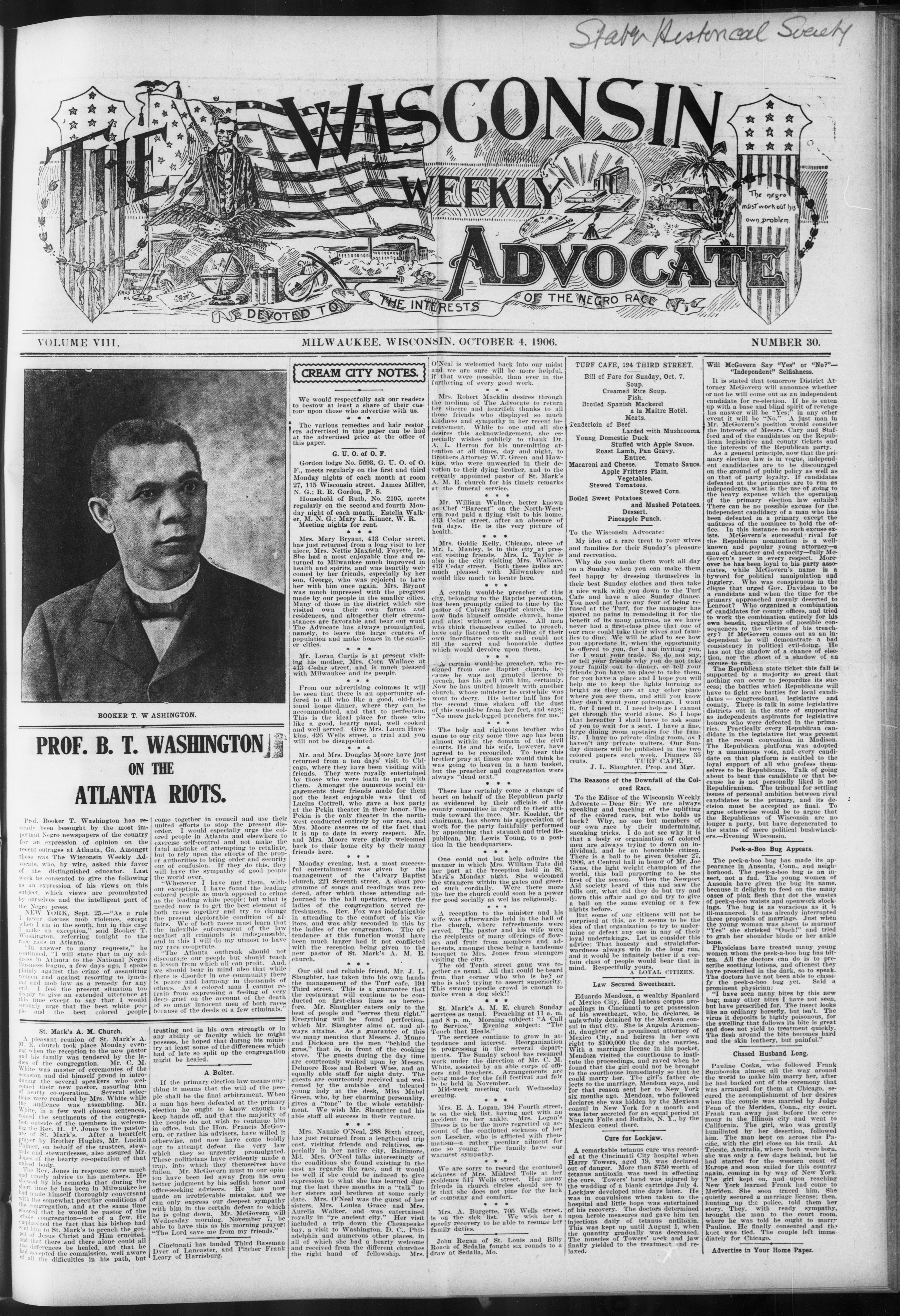
WISCONSIN
WEEKLY
The negro must work out his own problem.
ADVOCATE
DEVOTED TO THE INTERESTS OF THE NEGRO RACE
VOLUME VIII
[Name]
PROF. B. T. WASH ON THE ATLANTA RIO
PROF. B. T. WASHINGTON ON THE ATLANTA RIOTS.
Prof. Booker T. Washington has recently been besought by the most important Negro newspapers of the country for an expression of opinion on the recent outrages at Atlanta, Ga. Amongst these was The Wisconsin Weekly Advocate, who, by wire, asked this favor of the distinguished educator. Last week he consented to give the following as an expression of his views on this subject, which views are promulgated by ourselves and the intelligent part of the Negro press. NEW YORK, Sept. 25.—"As a rule I never discuss mob violence, except when I am in the south, but in this case I make an exception," said Booker T. Washington, referring tonight to the race riots in Atlanta.
"In answer to many requests," he continued, "I will state that in my address in Atlanta to the National Negro Business league, a few days ago, I spoke plainly against the crime of assaulting women and against resorting to lynching and mob law as a remedy for any evil. I feel the present situation too deeply to give an extended utterance at this time except to say that I would strongly urge that the best white people and the best colored people
St. Mark's A. M. Church
A pleasant reunion of St. Mark's A. M. E. church took place Monday evening when the reception to the new pastor and his family was tendered by the ladies of the congregation. Mr. C. M. White was master of ceremonies of the occasion and did himself proud in introducing the several speakers who welcomed their new pastor, assuring him of hearty co-operation. Several selections were rendered by Mrs. White while the audience was assembling. Mr. White, in a few well chosen sentences, voiced the sentiments of the congregation outside of the members in welcoming the Rev. H. P. Jones to the pastorate of St. Mark's. After a heartfelt prayer by Brother Hughes, Mr. Lucian Palmer, on behalf of the trustees, stewards and stewardesses, also assured Mr. Jones of the hearty co-operation of that united body.
The Rev. Jones in response gave much and timely advice to his members. He showed by his remarks that during the short time he has been in Milwaukee he had made himself thoroughly conversant with the somewhat peculiar conditions of the congregation, and at the same time showed that he would be pastor of the whole congregation—not of a few. He emphasized the fact that his bishop had sent him to St. Mark's to preach the gospel of Jesus Christ and Him crucified, and that there and there alone could all the differences be healed, and that he had accepted the commission, well aware of all the difficulties in his path, but
the differences in the party
WASHINGTON THE RIOTS.
come together in council and use their united efforts to stop the present disorder. I would especially urge the colored people in Atlanta and elsewhere to exercise self-control and not make the fatal mistake of attempting to retaliate, but to rely upon the efforts of the proper authorities to bring order and security out of confusion. If they do this, they will have the sympathy of good people the world over.
"Wherever I have met them, without exception, I have found the leading colored people as much opposed to crime as the leading white people; but what is needed now is to get the best element of both races together and try to change the present deplorable condition of affairs. We of both races must learn that the inflexible enforcement of the law against all criminals is indispensable, and in this I will do my utmost to have my race co-operate.
"The Atlanta outbreak should not discourage our people but should teach a lesson from which all can profit. And, we should bear in mind also that while there is disorder in one community there is peace and harmony in thousands of others. As a colored man I cannot refrain from expressing a feeling of very deep grief on the account of the death of so many innocent men of both races because of the deeds of a few criminals."
trusting not in his own strength or in any ability or faculty which he might possess, he hoped that during his ministry at least some of the differences which had of late so split up the congregation might be healed.
If the primary election law means anything it means that the will of the people shall be the final arbitrament. When a man has been defeated at the primary election he ought to know enough to keep hands off, and that the majority of the people do not wish to continue him in office, but the Hon. Francis McGovern, or rather his advisers, have willed it otherwise, and now have come boldly out to attempt defeat the very law which they so urgently promulgated. These politicians have evidently made a trap, into which they themselves have fallen. Mr. McGovern must in our opinion have been led away from his own better judgment by his selfish honor and office-seeking advisers. He has now made an irretrievable mistake, and we can only express our deepest sympathy with him in the certain defeat to which he is going down. Mr. McGovern will Wednesday morning, November 7, be able to have this as his morning prayer: "The Lord save me from my friends."
Cincinnati has landed Third Baseman Dver of Lancaster, and Pitcher Frank Leary of Harrisburg.
A Bolter
CREAM CITY NOTES.
We would respectfully ask our readers to bestow at least a share of their custom upon those who advertise with us.
```markdown
```
The various remedies and hair restorers advertised in this paper can be had at the advertised price at the office of this paper.
G. U. Q. of Q. F.
Gordon lodge No. 5693, G. U. O. of O. F., meets regularly on the first and third Monday nights of each month at room 27, 115 Wisconsin street. James Miller, N. G.; R. R. Gordon, P. S. Household of Ruth, No. 2195, meets regularly on the second and fourth Monday night of each month. Estella Walker, M. N. G.; Mary L. Kinner, W. R.
***
Mrs. Mary Bryant, 413 Cedar street, has just returned from a long visit to her niece, Mrs. Nettie Maxfield, Fayette, Ia. She had a most enjoyable time and returned to Milwaukee much improved in health and spirits, and was heartily welcomed by her friends, especially by her son, George, who was rejoiced to have her with him once again. Mrs. Bryant was much impressed with the progress made by our people in the smaller cities. Many of those in the district which she visited own their own farms and residences, and altogether their circumstances are favorable and bear out what The Advocate has always promulgated, namely, to leave the large centers of population and make homes in the smaller cities.
Mr. Loran Curtis is at present visiting his mother, Mrs. Cora Wallace at 413 Cedar street, and is much pleased with Milwaukee and its people.
\* \* \*
From our advertising columns it will be seen that there is an opportunity offered to all who like a good, old-fashioned home dinner, where they can be accommodated, and that to perfection. This is the ideal place for those who like a good, hearty meal, well cooked and well served. Give Mrs. Laura Hawkins, 426 Wells street, a trial and you will not be disappointed.
* * *
Mr. and Mrs. Douglas Moore have just returned from a ten days' visit to Chicago, where they have been visiting with friends. They were royally entertained by those who were loath to part with them. Amongst the numerous social engagements their friends made for them not the least enjoyable was that of Lucius Cottrell, who gave a box party at the Pekin theater in their honor. The Pekin is the only theater in the northwest conducted entirely by our race, and Mrs. Moore assures us of the fact that it is up to date in every respect. Mr. and Mrs. Moore were gladly welcomed back to their home city by their many friends here.
* * *
Monday evening, last, a most successful entertainment was given by the management of the Calvary Baptist church, 221 Seventh street. A short programme of songs and readings was rendered, after which those attending adjourned to the hall upstairs, where the ladies of the congregation served refreshments. Rev. Fox was indefatigable in attending to the comfort of his visitors, and was ably seconded in this by the ladies of the congregation. The attendance at this function would have been much larger had it not conflicted with the reception being given to the new pastor of St. Mark's A. M. E. church.
* * *
Our old and reliable friend, Mr. J. L. Slaughter, has taken into his own hands the management of the Turf cafe, 194 Third street. This is a guarantee that the restaurant will continue to be conducted on first-class lines as heretofore. Mr. Slaughter caters only to the best of people and "serves them right." Everything will be found perfection, which Mr. Slaughter aims at, and always attains. As a guarantee of this we many mention that Messrs. J. Munro and Dickson are the men "behind the guns," that is, in front of the cooking stove. The guests during the day time are courteously waited upon by Messrs. Delmore Ross and Robert Wise, and an equally able staff for night duty. The guests are courteously received and welcomed by the amiable and talented young lady at the desk, Miss Mabel Green, who, by her charming personality, gives a "tone" to the whole establishment. We wish Mr. Slaughter and his able staff all success in their venture.
---
Mrs. Nannie O'Neal, 288 Sixth street, has just returned from a lengthened trip east, visiting friends and relatives, especially in her native city, Baltimore, Md. Mrs. O'Neal talks interestingly of the conditions she found existing in the east as regards the race, and it would be well if she could be induced to give expression to what she has learned during the last three months in a "talk" to her sisters and brethren at some early date. Mrs. O'Neal was the guest of her sisters. Mrs. Louisa Grace and Mrs. Aurelia Walker, and was entertained royally in "ye ancient city." Her visit included a trip down the Chesapeake bay, a visit to Washington, D. C., Philadelphia and numerous other places, in all of which she had a hearty welcome and received from the different churches the right hand of fellowship. Mrs.
O'Neal is welcomed back into our midst and we are sure will be more helpful, if that were possible, than ever in the furthering of every good work.
曲 大 业
Mrs. Robert Macklin desires through the medium of The Advocate to return her sincere and heartfelt thanks to all those friends who displayed so much kindness and sympathy in her recent bereavement. While to one and all she desires this acknowledgement, she especially wishes publicly to thank Dr. A. L. Herron for his unremitting attention at all times, day and night, to Brothers Attorney W.T. Green and Hawkins, who were unwearied in their devotion to their dying brother, and to the recently appointed pastor of St. Mark's A. M. E. church for his timely remarks at the funeral service.
***
Mr. William Wallace, better known as Chef "Barecat" on the North-Western road paid a flying visit to his home, 413 Cedar street, after an absence of ten days. He is the very picture of health.
* * *
Mrs. Goldie Kelly, Chicago, niece of Mr. L. Manley, is in this city at present visiting friends. Mrs. L. Taylor is also in the city visiting Mrs. Wallace, 413 Cedar street. Both these ladies are much pleased with Milwaukee and would like much to locate here.
* * *
A certain would-be preacher of this city, belonging to the Baptist persuasion, has been promptly called to time by the pastor of Calvary Baptist church. He now finds himself outside church, home and alas! without a spouse. All men who think themselves called to preach, have only listened to the calling of their own inordinate conceit and could not fill the sacred and honorable duties which would devolve upon them.
***
certain would-be preacher, who resigned from one Baptist church, because he was not granted license to preach, has his gall with him, certainly. Now he has united himself with another church, whose minister he erstwhile was wont to decry. His better half has for the second time shaken off the dust of this would-be from her feet, and says: "No more jack-legged preachers for me."
***
The holy and righteous brother who came to our city some time ago has been almost within the domain of the civil courts. He and his wife, however, have agreed to be reconciled. To hear this brother pray at times one would think he was going to heaven in a ham basket, but the preacher and congregation were always "dead next."
* * *
There has certainly come a change of heart on behalf of the Republican party as evidenced by their officials of the county committee in regard to their attitude toward the race. Mr. Koehler, the chairman, has shown his appreciation of work for the party faithfully performed by appointing that staunch and tried Republican, Mr. Lewis Young, to a position in the headquarters.
***
One could not but help admire the manner in which Mrs. William Tate did her part at the reception held in St. Mark's Monday night. She welcomed the strangers within the gates and greeted such cordially. Were there more like her the church could soon be a power for good socially as wel las religiously.
***
A reception to the minister and his wife was afterwards held in the hall of the church, where refreshments were served. The pastor and his wife were the recipients of many offerings of flowers and fruit from members and adherents, amongst these being a handsome bouquet to Mrs. Jones from strangers visiting the city. The old Tenth street gang was together as usual. All that could be heard from that corner who who is he? or who is she? trying to assert superiority. This swamp poodle crowd is enough to make even a dog sick!!
---
St. Mark's A. M. E. church Sunday services as usual. Preaching at 11 a. m. and 8 p. m. Morning subject: "A Call to Service." Evening subject: "The Touch that Heals."
The services continue to grow in attendance and interest. Reorganization is progressing in the several departments. The Sunday school has resumed work under the direction of Mr. C. M. White, assisted by an able corps of officers and teachers. Arrangements are being made for the fall festival and fair to be held in November.
Mid-week meeting each Wednesday evening.
***
Mrs. E. A. Logan, 194 Fourth street, is on the sick list, having met with an accident to her ankle. Mrs. Logan's illness is to be the more regretted on account of the continued sickness of her son Lescher, who is afflicted with rheumatism—a rather peculiar ailment for one so young. The family have our warmest sympathy.
***
We are sorry to record the continued sickness of Mrs. Mildred Tolls at her residence 517 Wells street. Her many friends in church circles should see to is that she does not pine for the lack of company and comfort.
* * *
Mrs. A. Burgette, 705 Wells street, is on the sick list. We wish her a speedy recovery to be able to resume her family duties.
John Regan of St. Louis and Billy Roach of Sedalia fought six rounds to a draw at Sedalia, Mo.
Soup.
Creamed Rice Soup.
Fish.
Broiled Spanish Mackerel
a la Maitre Hotel.
Meats.
Tenderloin of Beef
Larded with Mushrooms.
Young Domestic Duck
Stuffed with Apple Sauce.
Roast Lamb, Pan Gravy.
Entree.
Macaroni and Cheese. Tomato Sauce
Apple Fritters Plain.
Vegetables.
Stewed Tomatoes.
Stewed Corn.
Boiled Sweet Potatoes
To the Wisconsin Advocate:
My idea of a rare treat to your wives and families for their Sunday's pleasure and recreation.
Why do you make them work all day on a Sunday when you can make them feel happy by dressing themselves in their best Sunday clothes and then take a nice walk with you down to the Turf Cafe and have a nice Sunday dinner. You need not have any fear of being refused at the Turf, for the manager has spared no pains in remodeling it for the benefit of its many patrons, as we have never had a first-class place that one of our race could take their wives and families to dine. We will be glad to see how you appreciate it, when the opportunity is offered to you, for I am inviting you, for I want your trade. So do not say, or tell your friends why you do not take your family out to dinner, or tell your friends you have no place to take them, for you have a place and I hope you will help me to keep the lights burning as bright as they are at any other place where you see them, and still you know they don't want your patronage. I want it, for I need it. I need help as I cannot get through the world alone. So I hope that hereafter I shall have to ask some of you to wait for a seat. I have a fine, large dining room upstairs for the family. I have no private dining room, as I haven't any private waiters. Our Sunday dinners will be published in the two colored papers each week. Dinners 35 cents. TURF CAFE.
J. L. Slaughter, Prop. and Mgr.
The Reasons of the Downfall of the Colored Race.
To the Editor of the Wisconsin Weekly Advocate—Dear Sir: We are always speaking and teaching of the uplifting of the colored race, but who holds us back? Why, no one but members of our own race by their undermining, sneaking tricks. I do not see why it is that a body or organization of colored men are always trying to down an individual, and he an honorable citizen. There is a ball to be given October 27, 1906, at Central hall in honor of Mr. Joe Gans, the light weight champion of the world, this ball purporting to be the first of the season. When the Newport Aid society heard of this and saw the bills out, what did they do but try and down this affair and go and try to give a ball on the same evening or a few nights before.
But some of our citizens will not be surprised at this, as it seems to be the idea of that organization to try to undermine or defeat any one in any of their loyal undertakings. Let us consider this advice: That honesty and straightforwardness always win in the long run, and it would be infinitely better if a certain class of people would bear that in mind. Respectfully yours.
Law Secured Sweetheart.
Eduardo Mendoza, a wealthy Spaniard of Mexico City, filed habeas corpus proceedings in Cincinnati to get possession of his sweetheart, who, he declares, is unlawfully detained by the Mexican consul in that city. She is Angela Arizmendi, daughter of a prominent attorney of Mexico City, and heiress in her own right to $100,000 the day she marries. With a marriage license in his pocket, Mendoza visited the courthouse to institute the proceedings, and raved when he found that the girl could not be brought to the courthouse immediately so that he could marry her. The girl's father objects to the marriage, Mendoza says, and for that reason sent her to New York six months ago. Mendoza, who followed declares she was hidden by the Mexican consul in New York for a month and was later secreted for an equal period at Niagara Falls and Buffalo, N. Y., by the Mexican consul there.
Cure for Lockjaw.
A remarkable tetanus cure was recorded at the Cincinnati City hospital when Harry Towers, aged 19, was declared out of danger. More than $750 worth of tetanus antitoxin was used in effecting the cure. Towers' hand was injured by the wadding of a blank cartridge July 4. Lockjaw developed nine days later. He was in convulsions when taken to the hospital and little hope was entertained of his recovery. The doctors determined upon heroic measures and gave him ten injections daily of tetanus antitoxin. This was kept up until August 1, when the quantity gradually was decreased. The muscles of Towers' neck and jaw finally yielded to the treatment and relaxed.
---
NUMBER 30.
Will McGovern Say "Yes" or "No?"— "Independent" Selfishness.
It is stated that tomorrow District Attorney McGovern will announce whether or not he will come out as an independent candidate for re-election. If he is eaten up with a base and blind spirit of revenge his answer will be "Yes;" in any other event it will be "No." A just man in Mr. McGovern's position would consider the interests of Messrs. Cary and Stafford and of the candidates on the Republican legislative and county tickets and the interests of the Republican party.
As a general principle, now that the primary election law is in vogue, independent candidacies are to be discouraged on the ground of public policy as well as on that of party loyalty. If candidates defeated at the primaries are to run as independents, what is the use of going to the heavy expense which the operation of the primary election law entails? There can be no possible excuse for the independent candidacy of a man who has been defeated in a primary except the unfitness of the nominee to hold the office. In this instance no such excuse exists. McGovern's successful rival for the Republican nomination is a well-known and popular young attorney—a man of character and capacity—fully McGovern's peer in every respect. Moreover he has been loyal to his party associates, while McGovern's name is a byword for political manipulation and jugglery. Who was conspicuous in the clique that urged Gov. Davidson to be a candidate and when the time for the primary approached meanly deserted to Lenroot? Who organized a combination of candidates for county offices, and tried to work the combination entirely for his own benefit, regardless of possible consequences to the victims of his treachery? If McGovern comes out as an independent he will demonstrate a bad consistency in political evil-doing. He has not the shadow of a chance of election, nor the ghost of a shadow of an excuse to run.
The Republican state ticket this fall is supported by a majority so great that nothing can occur to jeopardize its success; the battles which Republicans will have to fight are battles for local candidates — congressional, legislative and county. There is talk in some legislative districts out in the state of supporting as independents aspirants for legislative honors who were defeated in the primaries. Practically every Republican candidate in the legislative list was present at the recent convention in Madison. The Republican platform was adopted by a unanimous vote, and every candidate on that platform is entitled to the loyal support of all who profess themselves to be Republicans. Talk of going about to beat this candidate or that because he is not personally liked is not Republicanism. The tribunal for settling issues of personal ambition between rival candidates is the primary, and its decision must be accepted as final. To argue otherwise would be to argue that the Republicans of Wisconsin are no longer a party, but have degenerated to the status of mere political bushwhackers.—Evening Wisconsin.
Peek-a-Boo Bug Appears
The peek-a-boo bug has made its appearance in Ansonia, Conn., and neighborhood. The peek-a-boo bug is an insect, not a fad. The young women of Ansonia have given the bug its name, because it delights to feed on the many oases of pink flesh that dot the wastes of peek-a-boo waists and openwork stockings. The bug is as voracious as it is ill-mannered. It has already interrupted three proposals of marriage. Just when the young woman was about to murmur "Yes" she shrieked "Ouch!" and tried to grab her shoulder blade or her ankle bone.
Physicians have treated many young women whom the peek-a-boo bug has bitten. All the doctors can do is to prescribe soothing lotions, and oftenest they have prescribed in the dark, so to speak. The doctors have not been able to classify the peek-a-boo bug yet. Said a prominent physician:
"I have seen many bites by this new bug; many other bites I have not seen, but have prescribed for. The insect looks like an ordinary horsefly, but isn't. The virus it deposits is highly poisonous, for the swelling that follows its bite is great and does not yield to treatment quickly. The flesh around the bite becomes hard and the skin leathery, but painful."
Chased Husband Long.
Pauline Coska, who followed Frank Sumboroka almost all the way around the world to make him marry her, after he had backed out of the ceremony that was arranged for them at Chicago, secured the accomplishment of her desires when the couple was married by Judge Fenn of the Meriden, Conn., city court. Frank ran away just before the ceremony in the Illinois city and went to California. The girl, who was greatly humiliated by her desertion, followed him. The man kept on across the Pacific, with the girl close on his trail. At Trieste, Australia, where both were born, she was only a few days behind, but he had started for the western coast of Europe and soon sailed for this country again, coming in by way of New York. The girl kept on, and upon reaching New York learned Frank had come to Meriden. She soon traced him. She quietly secured a marriage license; then, hunting up the police, told them her story. They, with ready sympathy, brought the man to the court room, where he was told he ought to marry Pauline. He finally consented and the knot was tied. The couple left immediately for Chicago.
Advertise in Your Home Paper.
THE WISCONSIN WEEKLY ADVOCATE
MILWAUKEE, WIS.
B. B. MONTGOMERY, Editor and Proprietor.
Tea-Table Salad.
True.
Mother—My son, there is always more pleasure in giving than in receiving. Son—I know, mother, especially a spanking.—Translated for Tales from Meggendorfer Blaetter.
A Crime.
"There was a murder in Jinx's house last night." "Horrors! Tell me about it!" "His daughter murdered a few popular songs."—Houston Post.
Not Particular.
"Grace says she just loves a man with shoulder straps."
"Who is he?"
"Oh, no one in particular. Just any man."—Detroit Free Press.
The Thrifty Youth.
"Yes, he proposed to me over the long-distance 'phone."
"But that costs money, doesn't it?" "Yes, but he had the bill sent to father."—Cleveland Plain Dealer.
At the End of the Summer
At the End of the Summer. Higbee—I hear your wife is to deliver a series of lectures. I hope she makes a success of it. Henpec—She ought to. She has had practice enough.—Town and Country.
The Usual Thing.
a divorce from his wealthy wife.
"Yes, he was only temporarily embarrassed when he married her."—Translated for Tales from Fliegende Blaetter.
Sent Back.
Mr. Harduppe-I hope the flowers I sent you to wear at the ball came on time?
Miss Cutting-No, they didn't. They came C. O. D.-Woman's Home Companion.
A True Helpmeet
Wife—I am getting so stout that all my dresses are too tight.
"Will it be cheaper to order new ones or go to Marienbad and take the cure?" —Translated for Tales from Meggendorfer Blaetter.
Revenge.
Johnny—I'll get even with ma for spankin' me.
Tommy—Aw, what'll you do?
Johnny—One o' these days I'll everlastingly whale her grandchildren.—Cleveland Leader.
H..d Skiddooed.
Gunbusta (bald-pated)—My boy. remember that the hairs of our heads are numbered." Wilfred—Yours must have been numbered twenty-three, Pa. — Woman's Home Companion.
He Knows
The ghost of Louis XVI., appearing to the Czar of Russia, and lifting off his head.
"Take notice, Nicholas, my friend, for I've been there before."—Translated for Tales from Simplissimus.
A Terrible Disappointment.
"Has that pretty young Mrs. Millyuns any hopes about her old husband's illness?" "No, she has given up all hope. The doctors told her yesterday he would recover."—Baltimore American.
Illusion
Woman (expecting a call from her lover)—Oh, this waiting is something terrible! I can't stand it. (To maid). Sophie, go outside and ring the bell three or four times, hard!—Translated for Tales from "Meggendorfer Blaetter."
That Was Something
Wife—Bah! Tell me any great or heroic action you ever performed in your life!
Husband—I prevented you from dying an old maid, didn't I? Isn't that enough?—Translated for Tales from "Le Bire."
The Auto Crank.
"Did you see the mirage yesterday?"
"Garage?"
"Mirage."
"I don't know. There are so many of these new automobiles that I can't begin to keep track of them."—Cleveland Plain Dealer.
Her Birthday
"How old were you today, Miss Lizzie?"
"You are certainly lacking in taste to ask such a question."
ask such a question.
"How should I know that?"—Translated for Tales from Meggendorfer Blaetter.
Accountable.
Fred—I don't know why it is, but I always feel sheepish when I go sailing with you.
Grace—Perhaps it is because the boat has a mutton-leg sail.
Force of Habit.
Richly (seeing his son returning from school crying)—What's the matter, my boy?
Son—The teacher struck me, papa.
Richly (putting his hand in his pocket)
—For how much?—Translated for Tales from Le Sourire.
Not Locomotive
Mrs. Goodkind—So you are an engineer, and can't get a job in this town!
Well, why don't you go to some other place?
Tattereden Torne—I can't, madam; you see I'm a stationary engineer!—Woman's Home Companion.
To Exterminate Mosquitoes
"He's got a new plan to exterminate mosquitoes." "Coal oil, I suppose?" "No; his idea is to cross them with lightning bugs so that you may see them coming and thus swat them more easily in the dark."—Philadelphia Press.
Translated.
"Habiliments for Infants" is a sign in a clothing store in Boston. A western visitor, seeing it, stopped in amazement. "What does that mean?" he asked his better-acquainted fellow westerner. "That?" said the other. "Oh, that is Boston dialect for kids' duds."—Youth's Companion.
Special Delivery.
Mrs. Uptowne—I purchased some socks and a drum for my boy. How does it happen that you brought only the drum?
Driver—You see, ma'am, I'm the driver of the band-wagon: the socks will come in the hose cart.—Woman's Home Companion.
Rather:
"Here's a Chicago man returns after an absence of thirty-one years, hands his wife fifty $100 bills and requests that she ask him no questions. Strange case, eh?" "Very. It will be even stranger if his wife complies with his request."—Louisville, Courier-Journal.
At the Dinner Table
"Who is that handsome man over there?"
"That is Louis XIV."
"How absurd! What do you mean?"
"Well, his name is Louis, and he is always invited when there happens to be thirteen at table." — Translated for Tales from Fliegende Blatter.
A. Money Question
Jack—What's the difference between the color of a rose and a counterfeit copper?
Dick—I hate to give up anything with money in it, but I do. What's the answer?
Jack—One is a good scent and the other isn't—The Bohemian.
Idiotic
"I can tell whether a man is going to his work or coming from it by the way he walks."
"Indeed? How do you tell?"
"Well, you see, when a man is going to his work he walks toward his office, and when he's returning he—Why, where are you going?"—Cleveland Leader.
Superfluous Hair.
"Just one kiss." dutifully demanded Mainchanz after he had been accepted by Miss Hare, the swarthy and exceedingly homely heiress. "Oh?" she giggled, coyly, "I don't like to kiss a man with a moustache." "Oh, come your moustache isn't so heavy as all that."—Philadelphia Press. A Grocer Thrown Down.
A
"Don't you believe that these eggs are fresh?"
"I wouldn't believe it on the affidavit of the hen that laid them."
Funny.
She—What are you thinking about?
He—Nothing.
She—Nonsense! One can't think of nothing. Tell me what you were thinking about!
about the same thing you were.
She (blushing furiously)—Oh, how awful!—Translated for Tales from Le Rire.
Never Too Late To——
Father—Let me see, John, how old are you now?
Son—Just thirty.
Father—Don't you think it about time you took your medical degree and started to work?
Son—Oh, no, father; people have so little confidence in young doctors!—Translated for Tales from Meggendorfer Blaetter.
MUSINGS OF A GENTLE CYNIC.
Many a girl has lost a good friend by marrying him.
Many a good husband hasn't the nerve to be anything else.
Some men never accomplish anything without a pacemaker.
It is quite possible that the Lord also loveth a cheerful loser.
Tomorrow never comes—that is, unless you have a note to meet.
A man's idea of an ideal wife is one who thinks she has an ideal husband.
The minute a man accomplishes anything he is called a crank by those who have failed.
Of course every man understands that salvation is free till he stacks up against a church fair.
Liquor improves with age. The longer you keep it the better it is for you. Figure it out.
The first scratch on her new furniture is apt to convince the bride that marriage is a failure.
A woman always feels that Fate is unkind to her if the poor man she refuses to marry turns around and makes a fortune.
When a fellow tells a girl he would kiss her if he thought no one was looking, ten chances to one she will shut her eyes.—New York Times.
If you go about it right, a quarter will make as much noise dropping into the collection plate as a five-dollar gold piece.—New York Times.
—Iceland will have a system of land telegraph lines by October. It has just been connected by cable with England.
THE GNU WOOING.
There was a lovely lady gnu
Who browsed beneath a spreading yew.
Its stately height was her delight;
A truly cooling shade it threw!
Upon it little tendrils grew
few to show
Which gave her gentle joy to chew.
Yet oft she sighed, a-gazing wide,
And wished she knew another gun.
(Some newer gun beneath the yew
To tell her tiny troubles to.)
She lived the idle moment through,
And days in dull succession flew,
Till one fine eve she ceased to grieve—
A manly stranger met her view.
He gave a courtyard bow or two—
Perhaps it is the yew you knew.
(Its brances blew and seemed to coo,
"Your cue, new gnu—it's up to you!")
Said he, "If guests you would eschew,
I'll car alden without ado—
"Tis my regret we've never met—
I knew a gnu who knew of you."
(This wasn't true—what's that to you?—
The new gnu knew; she knew he knew.)
"Though there are other trees, 'tis true,"
Said she, "If you're attracted to
The yews I use, and choose to chew
Their yewey dewey tendrils, do!"
And now if all I hear is true. Beneath that yew the glad day through There romps a little gnuey new.
HER HOUSE IN ORDER.
Miss Dennett-Brown was much elated. The post had brought her two gratifying communications—one from her banker announcing the advantageous sale of some shares in a company she believed to be unsound; the other from her married sister in London telling her that Lady Macintyre had made up her mind to settle in Chipperton. She was only the widow of a city knight, it is true, but she had a handle to her name and was supposed to be wealthy. "It is just what we want in Chipperton," Miss Dennett-Brown remarked to her unmarried sister Olivia, "some one to give tone to the place and lead society."
And already she saw visions of garden parties, at which she would be an honored guest, and bazaars at which she would be asked to hold a stall. With her mind's eye she even began to range rapidly over her somewhat antiquated wardrobe and to reckon up its possibilities.
"She will be a great acquisition, but"—turning to her letter—"she is not to be here till the end of the London season, Carrie says."
Having decided that this was to be regretted but could not be helped, she armed herself with a sheath of tracts and went forth in great good humor to visit those of her neighbors who, being poor, had apparently forfeited the Englishman's right to consider his house his castle. She went first to some pretty chalet like cottages just on the outskirts of the town, into two of which new tenants had lately come, whose acquaintance she was anxious to make.
The door of the first was invitingly open. Through it she saw, in the little sitting room opposite, a woman who was engaged in ironing some lacy looking articles. She was of a pleasant but homely countenance, and wore her gown pinned up under a voluminous holland pinafore.
Miss Dennett-Brown rapped sharply on the door with the handle of her umbrella, and, without waiting for permission, entered.
"I hope I do not interrupt you," she said.
The woman's face expressed surprise—and could it be possible? a shade of annoyance. But she said politely:
"Oh, not at all; if you will go into the front room I will be with you in a minute."
"Don't move," exclaimed the other. "Go on with your work—I will sit here," and she plumped herself down into a chair by the table. "I love to watch people work."
"I expect it is fascinating sometimes to those who themselves have nothing to do."
Miss Dennett-Brown was a little taken aback, and tried to look severe.
"Oh, I am a very busy woman, I assure you. Do you always do your ironing in here?"
"No, not always. I sometimes iron in the kitchen—but today the kitchen is rather in a pickle."
"Ah, that is a pity. Do you not think it is a good rule to clean your kitchen early? An ill-kept kitchen is—well, you know, so very untidy. I think I have a little paper on that very subject. I am sure you will find it useful," and diving into her string bag, she produced a tract. "Her House in Order,' it is called," she said; "it is most interesting."
She was not observant of the countenances of the humble, or she would have noticed a curious twinkle in the eyes of the woman before her, as she replied:
"Thank you. Kindly put it down, and I will show it by-and-by to Susan."
"Read it yourself, my good woman—read it yourself—it will teach you a great deal."
And without stopping for a reply she jerked her thumb in the direction of the yard, whence came sounds of the clattering of pails, and asked laconically:
"Your daughter?"
"No, that is not my daughter—my daughter is in London."
"In service?"
"She is married."
"I hope so—she has made no complaint so far."
"Any sons?"
"Yes, I have two sons."
"And what are they doing?"
"One is a collector and the other a soldier."
"Oh, really—a 'collector?' Now what do you call a collector? What does he collect—taxes, I suppose?"
"Well, I believe he does, sometimes. But he does a great deal more than that—he is very hard worked, poor boy."
"That's better than having no work at all, like those poor, wretched men who go about the streets. Hard work won't do him any harm—it will do him good. I don't believe in young men being too hard worked."
"No? I am afraid they are sometimes."
"Don't you believe it. And the one who is a soldier? Is he steady? I hope so, for your sake—but they are exposed to so many temptations, are they not? Now I have a touching little story here, which I should like you to send him when
you write—it may help to keep him in the right way." And again she had recourse to her bag, and drew forth another paper.
The ironing being now finished, the mistress of the house suggested an adjournment to another room, as her visitor seemed inclined to stay. The latter unceremoniously pushed open a door in the passage, looked with disfavor at a pile of unpacked luggage, and sniffed ostentatiously.
"A very unpleasant smell here," she said. "What is it? Stuffy—very stuffy! I should keep that window open if I were you. Let me see, when did you come in?"
"About ten days ago."
"Oh, you are not very quick in settling down, are you? I shall be round again next week with the Parish Magazine, and shall hope to find you quite straight; in the meantime, mind you read the little paper—it will be a great help. No, I will not go into the other room—and, oh, don't forget to send the story to your soldier son."
"I will certainly send it. Who shall I say sent it to him?"
"I'm Miss Dennett-Brown—but you can tell him it was one of the parish visitors. Oh, and I have not asked your name."
"I am Lady Macintyre," the other replied sweetly. "I have come in here to be near the Poplars, which is being got ready for me—pretty, quaint little doll's house, isn't it?"
But Miss Dennett-Brown could not reply; she felt a cold, creepy sensation down her spine, and finding herself suddenly bereft of speech—fled.
"How was I to know?" she asked plaintively when her sister reproached her with want of penetration. "She looked just like any one else—not so aristocratic as Mrs. Wegg, the postman's wife, and she had on an old holland overall—and—and—" she went on breathlessly, "it was mean of her not to say who she was at first, and to lead me on—and it was just like Carrie to say she wasn't coming yet—she always does get hold of the wrong end of a story—of course, we shall not be invited to the Poplars now!" And the much injured lady wept.—Ellis Wyhurd in Lady's Realm.
George Washington's Table
Two men were walking by Fraunces' Tavern in New York the other evening. The place is now undergoing alterations to restore it to its original colonial state, and the men stopped a moment to look over a pile of the material which has been torn down. Rummaging round one of them suddenly stopped in surprise. "Look here!" he said, in excitement. "here is the top to one of those old, round colonial tables. I'll bet it was a table that George Washington ate and drank off of, and I'm going to have it, and send it up to my house in Rhode Island."
There was the watchman to reckon with, but a small donation quieted his conscience. Then the seeker after antiques, for lack of a better way, carried the heavy top by hand to an expressman, and paid $3 for packing and shipping it.
Then the other man who had hitherto said nothing remarked to his friend: "See here, Joe, that wasn't the top to a table at all. Did you see that iron hoop sticking out? It's the bottom of a water tank which was put in fifty years after George Washington's time."
There was a moment's chill silence. Then: "Oh, pshaw," said the other. "It may not be a George Washington table, but it will be when it gets to Rhode Island. Do you think I'm going to all this trouble for nothing?"
Cultivation of Cucumbers.
Few garden plants have been known to and cultivated by man longer than the cucumber, says the Farmers' Bulletin, issued by the agricultural department. De Candolle has proved that this plant has been in cultivation between 3000 and 4000 years. There is no specific remedy for the striped cucumber beetle. Direct applications of poisons, such as Paris green or other arsenical, will destroy the beetles when they occur in moderate numbers. A normal crop may be placed at about 200 half-barrel baskets per acre, the price varying from 50 cents to as much as $2 per basket. After the fruits have been harvested and the marketing season has closed, the vines should be destroyed by gathering and burning or plowing them under, so as not to harbor or breed diseases.
A point which is of prime importance in the management of the cucumber patch is that none of the fruits be allowed to come to maturity. The ripening process, which means the development and maturing of the seeds, produces a heavy strain upon the growing plant, the life and yield of the plant being in proportion to the number of fruits which are allowed to ripen.
To Have Clean Brushes
Tooth and nail brushes should always be stood in such a position that all water can drain from them.
Household brushes last much longer if taken care of and washed regularly. Remember that they should never be allowed to rest on the bristles.
Long-handled ones should be hung up by the heads, and short ones either propped upright on a shelf or suspended by a piece of twine. Hearth brushes will last nearly as long again if they are kept hung up.
For cleaning household brushes, make a solution of soda by dissolving one pound in one quart of water. Stir over the fire till dissolved, then bottle for use.
Add one tablespoonful to a quart of water; wash the brushes in this, using also a little soap for the soft hair ones; rinse in clean cold water and dry in the open air. Brushes that have been used for paint can be cleaned with turpentine, and spirits of wine will remove varnish.
Gives Awav Dollars.
A merchant in Watertown, N. Y., who has been in business in that city for fifty years, will celebrate the half century anniversary by trying to influence the boys and girls to form the habit of saving money systematically. On that day $1 will be given to every boy or girl living in the city of Watertown, between the ages of 4 and 16, not exceeding $2000, under the following conditions:
Each child, personally, or through his or her guardian, must apply to the secretary of the Watertown Savings Loan and Building association before September 1 for a book to be legally issued to such child and deposit in the association 10 cents a week for one year.
At the end of the year $1 extra will be added to the account, which at that time or thereafter can be withdrawn by the owner with accumulations. It is expected that the habit formed will be continued as the child realizes the value of saving.
Barney Cinnamon and Jack La Beau boxed a six-round draw at Beaver Dam. Bing Casey and Billy Younger boxed a four-round draw.
THE POINT OF VIEW.
(To a Mummy, Date 4000 B. C.)
Respected Sir: I'd like to know
What think you of the present?
Was life six thousand years ago,
Down Egypt way, more pleasant?
You furnish us but scanty clews
That trace your life, old fellow—
What shade was Neolithic news?
Nile-green, or yappy yellow?
I wonder if within your case
Where rest your bones, nigh cloakless,
You marvel, with impassive face,
At words like "auto," "smokeless."
But pshaw! Perhaps this very hour
Your latest incarnation
Forth speeds, with twenty-horsedess) pow!
And deals out devastation!
At risk of setting you a task
Beyond your limits, will I
The liberty assume to ask:
What brands were your bacilli?
Was every breath you used to draw
A parlous undertaking?
Was your career one rigid law
Of boiling, spraying, baking?
And did you die because you caught
A kiss not disinfected?
Ah, peor old fellow, all untaught!
You now must feel dejected.
In your time how one lived, perhaps,
Was paramount beside of
The query of us modern chaps,
Demanding what one died of!
BRIEF NOTES OF GENERAL INTEREST
A dispute over the possession of a chicken wishbone caused James Hanford, who lived on a farm near Mt. Gilead, O., to shoot and kill his wife, and then with the same revolver take his own life. The shooting took place just after dinner. The wishbone later was found broken on the table.
Clarence Well, aged 15, is proud of his long curls that fall in cascades over his shoulders, so proud of them that he ran away from his home in Minneapolis when the school authorities there ordered him to see a barber. He'll stay with relatives at Mason City., Ia., where there is no compulsory school law affecting hair, and cherish his locks.
Mayor Kenpel of Akron, O., in his crusade against "mashers" who flirt with girls on the street has issued a statement asking the mothers to help him by spanking their daughters who persist in going downtown at night, seeking adventure. The mayor says the girls are largely to blame for the "mashing" evil. Many mothers have promised to comply with his request.
William Betz of Cleveland has the "telephone habit," declares his wife, Vina, who filed suit for divorce. She says that at all hours of the day and night she is called to the telephone by Betz and asked foolish questions. Often, she says, he awakens her at midnight by calling up to ask her "if the mockingbird sings." She asks the court to force Betz to quit bothering her.
Commissioned as a special officer, Mrs. Heins, at Kewanee, Ill., arrested sixteen men for climbing the fence and entering the La Fayette fair grounds without paying admission. The woman wore a policeman's star and none of the men offered resistance when she escorted them to the office of the association. She was selected out of many applicants and her work is regarded as the best yet done by a patrol officer for the fair.
The freshman class at Tufts college in Medford, Mass., is distinguished by the presence as a member of the youngest collegian in the United States. Norbert Weiner, aged 11, the son of Leo Weiner, assistant professor of Slavonic languages at Harvard, is the lad. He lives with his parents at Medford Hillside. When Norbert was 18 months old he knew his alphabet. When 8 years old, he was reading Darwin, Huxley, Ribot and Haeckel.
---
Mrs. Elizabeth Crowe of Aberdeen, S. D., in the police court at Ottawa, Ont., was fined $3 for kissing her own child. She was some years ago the wife of Dr. V. H. Lyon of Ottawa. Judge McCoy of South Dakota granted Lyon a divorce and gave him the custody of the little girl. Mrs. Crowe, while visiting here, saw the child on the street and kissed her, and the husband made a charge of assault, which was upheld by the magistrate.
"The horse nearly killed my grandpa and nearly killed my grandma, and now it has killed me; please kill the horse," were the dying words of little Charlie Mullens, aged 6, of Ware Mass. Charlie went into the pasture recently with a whip to chase the horse and it kicked him in the abdomen.
Ten years ago the boy's grandfather sustained a dozen fractured bones by the horse running away, and last year it overturned his grandmother and broke three of her ribs.
What undoubtedly was the highest official military salute ever fired was the brigadier general's salute of eleven guns fired on the summit of Pike's peak, nearly three miles above sea level recently. It was fired by guns from the Twelfth artillery; U. S. A., and was in honor of Brig.-Gen. Zebulon Montgomery Pike, who, in 1806, at the head of the Southwest expedition sent out by the war department, made the first record of the existence and location of the mountain that now bears his name.
A tramp called at the residence of Father Gavisk of St. John's church at Indianapolis and asked for money with which to buy something to eat. Father Gavisk gave the fellow a dime.
"You must think I am going to a cheap restaurant," snarled the beggar.
Father Gavisk demanded the return of the dime, but the tramp refused. Then the priest's fighting blood was up and he gave the fellow a blow. There was a struggle and the man went away from the door without the dime.
"Bob" Toosley, Chicago's "richest" policeman, has sent in his resignation to Chief Collins, following a demand by the chief for an investigation into a recent fight between Lavin and Collins adherents in a saloon at Chicago. Toosley is said to be worth $500,000. For fifteen years he has failed to don a policeman's uniform and his defiance of orders from "downtown" has been the scandal of the district "back of the yards." He went on undisturbed until he drank too much one night and betrayed his friendship for Lavin.
After a lavish expenditure of money for several weeks, Opal Collier, 11 years old, confessed to Chief of Police Smith at Anderson, Ind., that she had robbed her mother, Mrs. Maggie Collier, of $482 from a purse containing $487, which Mrs. Collier kept in a lounge at the family home. The child betrayed herself when she handed her mother $80, saying the money was given to her by a man who said he had robbed her mother. Mrs. Collier then discovered that her money was gone. Her little daughter had been buying dresses, household articles and entertaining her friends for several weeks, but her mother had believed the child's story of an unknown friend giving her the money. The child was taken before the juvenile court.
A BIRDS' BALLROOM.
Where the Cock o' the Rock Performs Like a Whirling Dervish.
Dancing is by no means confined to quadrupeds. A writer in The Strand says that it is the principal play of many birds.
Perhaps the finest of bird dancers is the South American cock o' the rock. These birds have regular dancing places, level spots which they keep clear of sticks and stones.
A dozen or more of the birds assemble around this spot, and then a cock bird, his scarlet crest erect, steps into the center. Spreading his wings and tail, he begins to dance, at first with slow and stately steps, then gradually more and more rapidly until he is spinning like a mad thing. At last, tired out, he sinks down, hops out of the ring and another takes his place.
Some of the quail tribe are great dancers, and so are the American sand hill cranes. It is a most ludicrous sight to watch a crane dancing, he is so desperately solemn over the whole performance. He looks like a shy young man who has just learned to waltz and is rather ashamed of the accomplishment.
CURED OF GRAVEL.
Not a Single Stone Has Formed Since Using Doan's Kidney Pills. J. D. Daughtrey, music publisher, of Suffolk, Va., says: "During two or three years that I had kidney trouble
I passed about 21/2 pounds of gravel and sandy sediment in the urine. I haven't passed a stone since using Doan's Kidney Pills, however, and that was three years ago. I used to suffer the most acute agony during a gravel attack, and had the other usual symptoms of kidney trouble—lassi-
A. H.
tude, headache, pain in the back, urinary disorders, rheumatic pain, etc. I have a box containing 14 gravel stones that I passed, but that is not one-quarter of the whole number. I consider Doan's Kidney Pills a fine kidney tonic." Sold by all dealers. 50 cents a box. Foster-Milburn Co., Buffalo, N. Y.
No Wonder She Was Tired.
The young man who wore his hair long and talked music had been to call on the young woman, and when he took his leave she went into the library where her father was and threw herself on a sofa wearily.
"Tired?" inquired the father.
"He's been talking music in the abstract," was all she said.
"What did he say about it?"
"Well," she replied, "he said that the musical faculty is located in the second frontal convolution of the brain, and as it has a center in each cerebral hemisphere, a strong development of it expands the temporal region of the cranium about where the hair begins."
"Was that all? smiled the father.
"Oh, no; he said further that the temperament, or mixture of the bodily elements, must also be carefully considered, and, as the tone art is so largely a matter of feeling and suggestion, the degree of sensitiveness and responsiveness in the fiber of the individual will be only second in importance to the development of the brain."
"Why didn't you ask him to sing after that?"
"I did, papa; I did," sighed the girl.
"And did he?"
"Yes, he did; and he sang 'The Man
That Broke the Bank at Monte Carlo'."
—Tit-Bits.
TERRIBLE SCALP HUMOR.
Badly Affected with Sores and Crusts
—Extended Down Behind the Ears
—Another Cure by Cuticura
"About ten years ago my scalp became badly affected with sore and itching humors, crusts, etc., and extended down behind the ears. My hair came out in places, also. I was greatly troubled; understood it was eczema. Tried various remedies, so called, without effect. Saw your Cuticura advertisement, and got the Cuticura Remedies at once. Applied them as to directions, etc., and after two weeks, I think, of use, was clear as a whistle. I have to state also that late last fall, October and November, 1904. I was suddenly afflicted with a bad eruption, painful and itching pustules over the lower part of the body. I suffered dreadfully. In two months, under the skillful treatment of my doctor, conjoined with Cuticura Soap and Cuticura Ointment, I found myself cured. H. M. F. Weiss, Rosemond, Christian Co., Ill., Aug. 31, 1905."
Some Mixed Advice.
Senator Frye, in an address at Castine, Me., told a story of a Castine editor.
"In your beautiful and quaint town of Castine," he said, "there was once an editor who received, at about this season, two inquiries from subscribers.
"The first subscriber was the mother of twins, and she wanted to know how to bring her little ones safely through the trying ordeal of teething. The second subscriber, a farmer, wanted to know how to rid his orchard of grasshoppers.
"The editor in the next week's issue answered these questions to the best of his ability, but unfortunately he mixed them up.
"Cover them carefully with straw, and set fire to it, and the little pests, after jumping about in the flames for a few minutes, will speedily be settled."
"To the farmer pestered with grasshoppers the editor's advice was:
"Give a little castor oil, and rub their gums gently every three hours with a bone ring."—New York Tribune.
$100 Reward. $100.
The readers of this paper will be pleased to learn that there is at least one dreaded disease that science has ben able to cure in all its stages, and that is Catarrh. Hall's Catarrh Cure is the only positive cure now known to the medical fraternity. Catarrh being a constitutional disease, requires a constitutional treatment. Hall's Catarrh Cure is taken internally, acting directly upon the blood and mucous surfaces of the system, thereby destroying the foundation of the disease, and giving the patient strength by building up the constitution and assisting nature in doing its work. The proprietors have so much faith in its curative powers that they offer One Hundred Dollars for any case that it falls to cure. Send for list of testimonials.
Gibraltar is the smallest British possession. It measures less than two square miles. Canada is the biggest, with 3.746.000 square miles.
GOSSIP FOR THE LADIES.
```markdown
```
sweet have I known the blossoms of the
mining
Tenderly tinted to their hearts of dew;
But now my flowers have found a fuller
fragrance
Because of you.
Long have I worshiped in my soul's en-
shrining
Wise have I seen the uses of life's labor,
To all its puzzles found some answering
clew;
But now my life has learned a nobler mean-
ing
Because of you.
In the past days I chafed at pain and wait-
ing,
Grasping at gladness as the children do;
Now it is sweet to wait and joy to suffer
Because of you.
In the long years of silences that part us,
Dimmed by my tears and darkened to my
view.
Close shall I hold my memories and my madness Because of you.
Whether our lips shall touch or hands shall hunger Whether our love be fed or joys be few. Life will be sweeter and more worth the living
Kashmir Rugs
A friends came in recently to ask for my congratulations on the purchase of an antique Kashmir rug. She felt that she had gained a treasure and that because it was an Oriental rug it would wear for the rest of her life. She did not seem to realize that while the knotted Oriental rugs are improved by age because the pile, in wearing down, brings out the gloss and color in the wool, the Kashmir rugs are woven in quite a different way and are little more improved by years of wear than a piece of ingrain carpet would be. They fade, to be sure, but not always to their advantage, and they possess no gloss to be developed. The two weaves of rugs ought never to be counfounded as their qualities and capabilities are quite different. This is a very common mistake, and one that often leads on the novice in rug buying to a severe disappointment. M. H.
Apropos this hint, an expert on rugs says: "It is true that a Kashmir rug never attains the sheen or the gloss that rugs woven with a pile acquire by age, but equally valuable is the indescribably soft harmony of colors which age gives to Kashmir rugs. A good antique Kashmir rug will wear as long as any rug with a pile. I would congratulate anyone who is fortunate enough to possess a fine antique Kashmir rug. They are very rare now and many times more valuable than five or six years ago."—Good Housekeeping.
Woman's Exercise.
Doing something that is of use enhances the value of exercise. A walk with a purpose invigorates one far more than aimless sauntering through fields and lanes, although the distance traversed be the same in both instances.
The manual labor necessitated in the keeping of a house in order, the sweeping, bed-making, and other varied household tasks, affords most beneficial muscle drill if done with proper care as to poise and individual strength. Said Mrs. Harriet Beecher Stowe. "A woman can not work at dressmaking, tailoring, or any other sedentary employment without enfeebling her constitution, impairing her eyesight, and bringing on a complication of complaints; but she can sweep, cook, wash, and do the duties of a well-ordered house with modern arrangements, and grow healthier every year. The times when all women were healthy were the times when all women did housework a part of every day."
The one drawback with housework as an exercise is that it is work which must largely be done in a house, within confines of walls instead of out in the open, in the free fresh air. Some purposeful exercise out of doors is a great desideratum. Gardening has had its attractions for womankind ever since the world began. It is an occupation both health-giving and educational and one is indeed fortunate who is so situated that she may spend hours each day engaged in some form of this most fascinating employment.
Give Him Room.
There are not a few women in the world who have a rooted idea that their husbands should be as much a home fixture as the domestic cat, says Woman's Life, and this little mistake on their part is an active agent in the propagation of matrimonial woes. Man is essentially a creature of change, and monotony is the death blow of many a one time fierce, burning passion. Consequently the wise woman, knowing this, will encourage her husband to spend an occasional evening out, recognizing that her company and that of his home will be better appreciated if sandwiched in between a night with his old chums or one spent at the much maligned but innocent club meeting.
Early in married life a woman should recognize this fact and act accordingly. Instead of adopting an aggressive attitude when her husband suggests going out, she should smile sweetly, help him to get out and say, "I'm glad you are going out, dear. Don't hurry home," and when he does come it should be to find a smiling wife and a good supper. This is the sort of a marriage which is seldom a failure. The husband of such a wife is always in love with her, and has a habit of mentally contrasting her with the other wives of his acquaintances much to her advantage.
There are many worse fellows than the one who seeks an occasional night out with his particular chums. Encourage him, little bride, and don't weep your bonnie eyes out when he takes you at your word. Never mind the example of your neighbor who has a husband of the first class henpecked order. You do not want montony to put the first touch of blight on your still warm, glowing affection, and this assuredly will happen if you do not restrain your passion for an unlimited dose of your husband's company.
The Family Lar and Its Lessons.
"Necessity," says a witty juggler with ancient proverbs, "is the mother of contention." Most housewives will acknowledge the truth of the altered saying When the bills come in, there is always a family jar in some homes. A bill that cannot easily be paid is oftentimes one that ought not to have been incurred; and when economy marries extravagance, there must be countless conflicts before any level of agreement is reached. When one spoiled only child of injudicious parents—and America flourishes many such nowadays—marries another, there are certain to be pasages at arms before long. Or when Young America tries its strength and its ideas of the day against the conservatism and authority of elders of foreign birth, as happens every week in thousands of homes in this land of the immigrant,
there must be contention. The modern daughter does not always "get along" with her mother, nor do brothers and sisters invariably dwell together in unity, no matter how blessed it might be for them to do so. For all these reasons, the family jar is a thing of universal experience. We all know it; and while we may all dislike it, theoretically, we are quite as apt to oe mixed up in the thick of a conflict as anybody else.
Theoretically, we deprecate it; but, practically, is there not "a soul of goodness in things evil," and so in the family jar? Character has to be hammered out in this world. Conflicts at home are a pity—and yet, unless men and women are perfect, which every one knows does not happen in this imperfect world, their faults and failings and prejudices are going to be evident in their closest relations. The discipline of home is one of its best points. The man of hot temper who learns to quarrel less with his wife, and to bear with his children better every year, is learning what nothing else in the world could teach him. The brothers and sisters who fight things out are not a pleasing spectacle, but they are being educated to get along with others, and losing various crudenesses, egoisms, and glaring faults. It has been said by wise sociologists that even a faulty home is better to bring up a child in than the best institution. "I usually let my children thresh things out among them," said a southern mother of eleven boys and girls, "for I find substantial justice is done that way rather than by my interference." An only and indulged child, a man whose wife habitually defers to his every whim, may know nothing of family jars—but how insupportable such persons usually are! Too much peace may be as bad as too many family quarrels.—Harper's Bazar.
Shall We Call?
This is a question so frequently asked and so constantly discussed that the following extract from a letter recently written from a small town near New York may be of interest. It tells its own story and teaches its own lesson:
"It was a short romance, a passing summer episode, but my eyes fill with tears whenever I remember it. They looked like children, he and she, when they moved into the forlorn little house on the roadside in our village. 'Just married, of course,' said the gossips, 'Shall we call? Better wait, perhaps, till we know who they are and what his business is,' etc. So no one disturbed them. The young husband went to town early every morning, and the little wife sat alone on the porch and awaited his return. They planted morning glories and nasturtiums, and hung a bird cage among the vines, so the place blossomed into new life and looked as it had never done before. The young people seldom left home; only on Sundays they walked to the Presbyterian church and sat in a far back pew, hand in hand through the service. One day I saw the doctor's carriage in front of the little porch. 'Dear me,' I thought, 'I wonder what is the matter there. I must surely look in tomorrow.' And I did. But alas! a grim visitor, who will not be denied, had been before me. As no one responded to my knock I opened the front door and found my way to the sitting room. In an instant I knew what had happened. There sat the poor boy alone, his face buried in his hands, while his whole frame shook with dry, tearless sobs. I put my hand upon his shoulder—he was younger than my own son—and I whispered, 'Oh, let me help you if I can.' 'Oh,' he groaned, 'if only you had come before! She was so lonely. She longed so for a woman's hand and a woman's voice. Yes,' he added, 'you can help me. Tear down the flowers when I am gone; they were hers. And give away her bird. I shall never see this place again after today.' The sorrowful departure took place that very afternoon, and I did as he requested. I never pass the bare porch of that house without remembering that I had practically denied the kindness and the sympathy so sorely needed and craved by one of my sisters."
—Exchange.
Sehr Schoen.
A group of women sat on the shady porch of a country clubhouse idly talking. The subject under discussion was the ever interesting one of household servants, especially cooks, good, bad and indifferent, and an argument was going on as to what really constitutes their various degrees of excellence.
"My husband condemns everything that isn't of the simplest," said one, who was a recent bride, and therefore somewhat given to quoting the head of the house. "He says we women are too prone to order entrees and kickshaws called 'made dishes.'"
"Oh, nonsense, Alice," retorted her elder sister, "you are new at the game. For pity's sake don't take up a fad and inflict plain roasts and boiled things upon your friends and family."
"Well, I don't know," said another, "now and then (very occasionally), men do hit off a truth. My inferior half declares that maraschino cherries and gelatine are the bane of his existence and the curse of the age."
"Children!" solemnly began Mrs. W., "give me five minutes and I will tell you a melancholy tale of suffering that I was called upon to endure last winter. I think when you hear it that you will hesitate about admitting the kitchen artist. I had a German woman as cook, so truly conscientious and so ponderously worthy that sometimes I felt slapping her, just to rouse her a little. But no one could fail to recognize her good qualities, for she certainly was most diligent, economical and industrious. Moreover, I did not want to make a change in midwinter, so I endeavored to bear with her queer ways and trying eccentricities. I think I might have survived if she had only been satisfied with the simpler rules of her profession. But, oh, dear, such extraordinary dishes as she sent up to us were very exasperating. We had castles built of lobster shells, forts constructed by the aid of gelatine, little maccaroni guns sticking out of the sides, and many other ingenious horrors. The children enjoyed it enormously, but I always trembled when we had a guest present. One day I said casually (lest she should be fired to fresh zeal by anything out of the common), 'Katrina, I have a few old friends coming to luncheon with me next Thursday.' 'Ach, so?' she replied. 'Well, we must make the old glad.' 'Oh, no!' I exclaimed, 'I don't mean that kind of "old." just intimate friends, so we can have everything quite simple.' 'Yes, yes!' said she. 'Simple, surely, but very fine.' My heart sank. I lapsed into my poor German that I might make myself better understood. 'Don't take too much trouble, Katrina; our everyday dishes will be all right.' 'But it is my duty to take trouble,' said this terribly worthy one, looking at me reproachfully, as if I were tempting her to deadly sin.
"Now, if these invitations had not already gone I should have torn them up on the spot, so certain was I that there were awful breakers ahead. But the die was cast, and like a very coward I composed the most elementary menu that it was possible to devise. A cup of consommé, some cold crabs with mayonnaise sauce, chops and mashed po-
tatoes, a salad and an ice, and I flattered myself that even the ingenious Katrina could not be very wild over these absolutely conventional dishes. Alas! even then I did not know her capabilities! The day arrived. With misgivings in spite of myself, I selected my prettiest guipure trimmed linen. and made an artistic arrangement of flowers upon the table, dressed and awaited my fate. The first evil that befell me, when we were all assembled, was the sight of maraschino cherries floating in my cup of soup, otherwise admirably made. After all, this wasn't very terrible, but I quailed inwardly, and nervously fingered my roll, only to find a huge plumped-up prune within. Hastily whispering to the butler to get some toast, I again endeavored to converse calmly with my neighbors. The crabs appeared duly, with my initials.—New York Tribune.
One Mother's Method.
Sunday school teachers and the mothers of the children who attend the Sunday school can work together effectively for the good of the children far better if only they knew one another. And the superintendent of one primary department had the happy inspiration to give a "mothers' tea" occasionally, to which the teachers and mothers are invited. A musical programme is rendered, a helpful talk given, and simple refreshments served. The acquaintance thus formed is appreciated by both, and as a result they work in harmony with each other. One mother's special aid is to see that her three children thoroughly know the Golden Text for each Sunday. Their teachers offer various inducements for perfect recitation, regular attendance, and donation of money, as follows:
On a piece of light-gray cardboard eight inches square, three circles are drawn, one inside the other. The largest is called the "Attendance Circle," the next the "Golden Text Circle," and the smallest the "Penny Circle." A sufficient number of diameters were drawn through these circles to mark off the Sundays in each quarter. Each section was dated, and if the child was present a gilt star was placed in the first circle. For perfect recitation of the text, under the same date a heart was affixed in place, and the penny-offering earned a smaller star for the inner circle. At the end of the quarter the child has a pretty keepsake that he will value, as the teacher gives each child its own square, with a pink or blue ribbon attached for a hanger.
Now for the mother's part: She cuts slips of pink tinted water color paper and prints on them in plain black lettering the text for the coming Sunday, and attaches it by a hanger to the foot of the bedstead. It hangs there in plain sight of the children to see as soon as they open their eyes in the morning, and they will repeat it to themselves at least seven times during the week.
This mother does not think that this is all of her duty, by any means, for to young children the words of the text will not have much meaning unless explained very clearly. This need she meets by reading over the lesson and the text with the children on Sunday evening, then explaining it as thoroughly as she can. This fixes the text in the child's mind. But during the week she makes it an object to bear the text in mind herself, and any new information she gathers is given to them at the twilight hour, usually, or perhaps at the bedside along with the good night kiss.
Her little talks are short, never wearisome or preachy, and the truths she takes good care to impart in this little story way she has, are seed sown upon good soil.
She realizes that to be thoroughly in accord with the teacher's method she must in a measure at least have the same source of information, so she is a regular subscriber to the Primary Teacher's Lesson Quarterly. Nothing but sickness ever keeps these little ones from their beloved Sunday school, and when the teacher asks them questions relative to the lesson they can give intelligent answers.—T. Celestine Cummings in Mothers' Magazine.
How He Was Gathered In.
The golf girl seated herself jauntily on the hotel veranda railing in front of a group of women who were making fancy work, a pretext for doing nothing in particular.
"Humph!" she ejaculated, with a wry grimace, "how you people can waste a whole morning over that nonsense when you might be golfing, is beyond me."
"Yes, and have every bone in our bodies aching afterward, and our gowns bedraggled and our hair in strings," supplemented a trim young woman in immaculate white linen.
"Well." returned the other, serenely, "if you care more for your appearance than for fun, you might take your golf as that little Mrs. Paxton does hers. I met her on the links yesterday, dressed as if she was at a garden party. 'I thought you didn't play golf,' quoth I, and she, giving me one of those saccharine smirks of hers, replied, 'Oh, I'm only keeping Mr. Buckley's score for him.'"
"I should think her husband had better be looking after her," put in a voice from the outer edge of the group. "The way she is going on with that man is something to make angels weep."
"As far as I've been able to find out, nobody knows whether she has a husband or not." commented a woman who was trying to make violet pink silk roses grow around a circular piece of cloth. And the pretty girl in white linen added emphatically, "She's designing enough in all conscience for the—the proverbial widow."
"That's exactly where you show your penetration," struck in the golf girl, judiciously, "as you'll see when I tell you the rest of my story. And, by the way, it's a good tip for you girls, too.
'In the first place, madame begins by confiding to all of monsieur's friends how much she admires him—such a handsome man, so entertaining and all that. Next she gets hold of him and wins his sympathy by posing as a lone, heart-broken woman. I overheard her one day telling him as the mail came in that she had no one to write love letters to her. And you should have seen her mock melancholy and languishing eyes! Her next move is to go to monsieur with tears in her eyes. She was heard that people are talking about them—that his attentions to her have been remarked. Some one told some one else, who told her dearest friend, who told her that she Mrs. P., was 'trying to gather in Mr. B.' In the end madame pretends to be in a great rage over the matter and says, 'Let's just give them something to talk about. You play the devoted to me and I'll appear to return it. It will be such a joke to fool them and get even.' The following day madame receives a two-pound box of chocolates, ostentatiously presented before the public. 'It's part of the game,' madame whispers to her dearest friend, who afterward let me into the secret.
"Since that day it has been a succession of drives, walks and all sorts of attentions. Madame is having the time of her life, while we have to sit and look on. That man, the only eligible one here, was 'gathered in' all right. Now you know how the thing was done you may profit by the tale. I'm going to solace myself with another game—ta-ta," and the golf girl waved her score card by way of farewell and tripped down the walk.
He's a Dream Child.
If anybody knows more about the bringing up of young children than do
the unmarried relatives of a young couple with their first baby, it would be interesting to know who.
It is the opinion of some persons that when you are not married yourself you have so much better opportunity to impartially observe the mistakes of other people and learn just how things should be done in order to avoid similar results.
This kind of logic is the only thing that warrants maiden aunts and bachelor uncles going about the world proffering advice on the proper training of their young nieces and nephews.
It is not always welcome advice. Dear, no! Parents seldom show a disposition to take it in the kindly spirit in which it is offered.
"Now, I do hope," cautioned one unmarried aunt, when the littlest baby came, "that you two will be sensible about this child. Get him in the way of amusing himself. Don't fool with him. Leave him lie alone, on his back, all day. Accustom him to go to sleep every evening at 5 o'clock. Do not take him up when he cries. Don't talk baby rubbish to him. Do not permit him to upset the comfort of your home, nor to disturb your and Bob's domestic peace."
Much more advice of the same wise sort the unmarried relative administered. The young mother listened meekly, but with a peculiar gleam in her eye as she darted to pick up the small crying morsel of four weeks old.
The morsel is now a year old. He is a nice baby, but not exactly the sort that unmarried aunts with theories approve of for the reason that he cries if he isn't played with, stays up till 9 and 10 o'clock, eats ice cream at bedtime and arouses his parents by lusty roars in the stilly night.
"If you had brought up that child as I told you," mildly suggests the unmarried relative, "he wouldn't be such a nuisance now."
"Nuisance!" cries his mother. "Did his naughty aunty say him was a nuisance? He's mother's sweet, precious little lambie, so him was!"
"If he were my child," began the aunt, with severity.
"Well, he isn't," said the maternal worm, turning at last. "And if he was possibly he would be a paragon, and possibly he wouldn't. In my experience—and don't forget, Maudie," said the young mother proudly, "that I have more experience in these matters than you—in my experience babies are babies, and they'll be the kind of babies Providence made them to be, theories notwithstanding.
"I used to have some theories about children myself, before I was married. But you can't have babies and theories both, and I'd sooner have baby. And if you want to keep your theories, Maudie, I'd advise you never to marry; for that perfect infant of yours that you're always quoting would be a shocking and everlasting refutation of all your theories. He's no live child. He's only a dream child. And if you want him to continue to be an example for his little cousins you'd best stay single and keep him in dreamland."
With which parting shot the young mother turned to pick up the baby's tanned-colored bear for the sixteenth time; while the unmarried feminine held her peace and looked thoughtful.—Philadelphia Evening Bulletin.
WITH THE VAUDEVILLE WITS
She (reading)—"Ireland has produced more odd characters than any other land."
He (trying to repeat)—"Ireland has produced more hod carriers than any other land.
"A bank is a place where people put their money where it will be handy for other people to get it."
"Excuse me for sneezing. I went to a barn dance last night and caught the hay fever"
"Do you know how to tell a bad egg?"
"No, but if I had anything of importance to communicate to a bad egg I'd break it gently."
"If you marry for money you deserve all you get; if you marry for sympathy you get it from the neighbors."
"I was a Mrs., but I found it didn't pay, so I went back to Miss."
"Then you are a grass widow?"
"Then you are a grass wow?
"Yes. Why, are you a lawn mower?"
"Have you a mother?"
"Certainly. Did you think I was born in an incubator?"
"You look, as if you belonged in a chicken coop."
"Well, I'm no 'broiler' anyway."
"There is nothing like married life, after all. Man and woman should pull together through this life just like a team of horses."
"Yes, and they would, too, if they only had one tongue between them."
"You have a splendid voice."
"I inherit it; my father was an auctioneer."
"A girl got on a street car and asked for a transfer. The conductor gave one to her, of course. It was punched at 4:30 and was good for only one hour. Well, the girl kept it about five hours and then tried to pass it off on the conductor. He looked at it and saw that it was no good and told the girl so. She looked at him and what do you suppose she had the nerve to say? Why, she said: 'Good gracious, I can't help it if your old car is five hours late.'"
"An old German was sitting on an elevated car reading a German newspaper. Every time the guard opened the door the wind struck the old man on the neck. Finally he got so mad he said to the guard: 'Eder leave der door open or don't shut it at all.'"
"A boy whose voice was changing went into a hardware store and in a high voice said: 'I want a 10-cent hammer,' and, in a low voice, 'and 3 cents' worth of nails.' The dealer thought two boys were there and said: 'If you boys will ask for things one at a time I'll try to wait on you.'"
"There were two Dutchmen out on the river fishing. They were calling for help and there they were, facing each other and trying to row ashore."
"Moses Cohn got on a street car and was so intent on what he was reading that he didn't notice which way the car was taking him. Finally he realized that he was at Thirty-ninth street, when he should have been at Third street. 'What iss de matter?' he asked the conductor. 'You should be going the other way,' the conductor said. Then Moses sat down on the seat opposite and faced the other way."
"There was a man on a railroad train who complained of headache. Somebody advised him to put his head out of the window to cool off a little. He did and left it out all night—forgot to take it in. The next morning he found nine mailbags hanging on it."
"In New York there was a Jew named Isaac Levi and he wanted to go to Pittsburg. He went up to the ticket window and asked the ticket seller what time the train left. The ticket seller said '6 o'clock.' Isaac thought about it a little and then said. 'I'll tell you what I'll do. If you make it 5:30 I'll buy a ticket.'"
It Pays to Advertise.
YOUNG FOLKS' COLUMN.
He was a boy. If he had been a weed he could hardly have been more natural. From the top of his tousled head to his well-stubbed toes he was just a plain, healthy boy.
Folks called him lazy. Perhaps he was not exactly fond of weeding the onion bed, but you should see him at work upon a snow fort. He would labor like a Trojan all day building a dam across the brook, tugging at great stones that he could only roll into place, and carrying bushels of sod and mud to stop up the holes. Let folks call him lazy. He just knew he wasn't.
They said he was idle. He may not have been precisely industrious in the way his papa and mamma could have wished, but he was always doing something. From one end of the quiet little Dutch town where he lived to the other there was not a livelier boy than Tommy. Many a time he and Willie O'Neil had walked miles down the railroad track gathering scrap iron and selling it to the junk man—all for a little money to hire a boat and go rowing. It was plain to Tommy that folks who called him idle did not know what they were talking about. But after all, one thing was sure. When Tommy was sent on an errand, he never hurried back. Then they called him slow-coach, and snail; they said a tortoise would easily beat him in a race. Tommy thought a minute, knew better and then skipped whistling away.
No. Tommy wasn't even slow. If there really was anything wrong he was too sociable. If he met a little boy, or a little girl, either, his first business was to find out where, why and what? He knew all the children in the village. He knew the dogs and they knew him. Even the cats and geese were not strangers. If the river that flowed past the town could have known and could have smoked it would also have claimed friendship. Tommy did love the river. Then there were the junk piles and the vacant lots. These had to be watched to see if there were anything new. With such a friendly nature, and with so many interesting things out-of-doors, you and I can see without half looking that it was not always easy to get back from an errand right on the dot.
But somehow the more things and people Tommy knew about town the worse his reputation for promptness became. He was late to school, late home, late everywhere. The teacher told Tommy's mamma that the boy always knew his lessons, and that he was bright and obedient, but just dilatory.
That was the word they had been looking for, dilatory. That described him, Dilatory Tommy. It fitted him, too; and so it stuck. Tommy winced under it for a time, but it didn't hurt hard enough to reform him. By the time he was 11 the whole village knew him as Dilatory Tommy Dunn. The habit and the name had fast hold of him. No one knew better than he that he simply couldn't get a thing done on time, and he began to be quite ashamed of his reputation.
WHAT A CHANGE
He used to be a happy man
With smooth and lofty brow;
They put him up fur office, an'
You ought to see him now!
He has a skeery sort o' look
An' his remarks so pat
Sounds like he read 'em in a book--
A no 'count book at that!
His is a life that irritates,
His trouble never ends.
A-shakin' hands with folks he hates
An' turnin' down his friends.
He meant to make reform his plan,
But couldn't find jes' how.
He used to be a happy man.
You ought to see him now!
—Washington Star.
Some Prominent People.
ABDUL HAMID II., the present Sultan of Turkey, was born September 22, 1842, the second son of Sultan Abdul Medjid. He succeeded to the throne on the deposition of his elder brother, Sultan Murad V., August 31, 1876. The present Sultan is the thirty-fourth, in male descent, of the house of Othman, the founder of the Turkish empire, and the twenty-eighth Sultan since the conquest of Constantinople. Abdul Hamid has ten children and six living brothers and sisters. By the law of succession obeyed in the reigning family, the crown is inherited according to seniority by the male descendants of Othman, sprung from the imperial haram. Consequently it is not Abdul Hamid's eldest son who is his legitimate successor, but the Sultan's brother, Mehemmed-Reshad Effendi, who was born in 1844. The heir apparent is of decidedly reactionary tendencies, and it is said that when the present Sultan dies a movement will be made to place his son, Mehemmed-Selim Effendi on the throne. The latter is more modern and progressive in his views and will have the support of the "Young Turkey" party and all those who desire to see the country advance along the lines of modern civilization.
JOSEPH D. SAYERS, one of the most prominent public men of the south, was born in Granada, Miss., September 23, 1845. He removed to Texas with his parents when 10 years old and has made the Lone Star state his home ever since. He served in the Confederate army though the Civil war, and was admitted to the bar in 1866. He entered public life as a state senator in 1872, was lieutenant governor in 1879-80, and from 1885 to his election as governor in 1898 he was a prominent member of Congress. He served two terms as governor, and the wise policy pursued by him during the four years he acted as chief executive added greatly to the development of the natural industrial resources of his state. Two great public calamities visited Texas during Gov. Sayers' administration. The first occurred in 1899, when great overflows occurred in the valleys of the Brazos and Colorado rivers, destroying the crops and rendering many people homeless. In September, 1900, the great storm that cost the city of Galveston and the coast country many thousands of lives and an appalling destruction of property took place. Gov. Sayers took personal charge of the distribution of the several million dollars contributed to the relief of the sufferers, and in this work he looked after every detail so carefully that no word of complaint ever was heard of the manner in which the vast fund was handled by him.
RT. REV. WILLIAM PARET, the venerable bishop of the Protestant Episcopal diocese of Maryland, celebrated his eightieth birthday September 23, being born in 1826. Bishop Paret has resided in Baltimore twenty-one years. Previous to his elevation to the bishopric and his transfer to this city he occupied plpits in Elmira, N. Y., East Saginaw, Mich., Williamsport, Pa., and Washington, D. C.
SAMUEL RUTHERFORD CROCKETT was born at Duchrae, in Galloway. September 24, 1860. The future novelist attended the University of
himself that when he was 12 years old he would reform. Nobody should know of his intentions. He would surprise the village and show any one who cared that he could be prompt if he chose.
It was a mere chance that caused Mr. Dunn to need the plumber on the morning of the day his boy was 12 years old. Tommy was sent on the errand and was told, as he had been for years, to hurry back. He smiled to himself a superior smile as he thought of the wonder he would create by coming home for once on time. He was barely around the corner when he struck up a brisk run, which he continued until he reached the plumber. Folks who saw him passing cried: "What is the matter with Dilatory Tommy?"
Well, Tommy did his errand and started home. He had run so while coming that he could easily walk around by the back street—his favorite way—and along by the river. It might have been risky enough if he had not turned over a new leaf, for Tommy knew that the river and the wharves and the fishermen with their boats were perfectly fascinating to him. The fishermen were there, too, early in the morning, preparing to go down the river for their day's fishing. Among them was Jimmy Malone, the veteran fisherman of the village. He always had a good word to give the boys, and Tommy would rather be with old Jimmy than anyone else he knew. Jimmy had his boat all clean and trim as Tommy came by.
"Good morning, Tommy," said he. "Don't ye want to go a piece down the river with me? Sure and' it's Saturday. Ye'll have no lessons today. Hop in, lad. I'll set ye ashore whenever ye want to go."
Poor Tommy! It was a double temptation to go rowing, and especially with old Jimmy. He did not even say no, though he meant to go but a little ways, then hurry home across the fields. The first hour passed like no time. That made it too late to hurry. He might just as well stay till noon. The fascination was complete. The fishing' was good, he could have been put ashore any time and could have walked home in an hour. ed to make a whole day of it, though he could have been put ashort any time and could have walked omhe in an hour. When Jimmy spoke of staying out at night for catfish Tommy's little cup of joy was full. Anyway, he thought, he would just as soon come home after dark as before.
There was great anxiety at Tommy's home all the afternoon. Had they not known his weakness they would have thought him in the river instead of on it. When at last he did come, late at night, there was no greeting of any kind. The house was dark and he went to his bed alone. He overheard his father saying: "I have lost all patience with him. He may run wild now if he wants to; I'm done." Next day Tommy told his mother all about his birthday resolution and its failure. "Never mind, my boy, let's try again," she said. Tommy did try again and won.—Washington Star.
Edinburgh, then went to Heidelberg and finally graduated from New College, Oxford. At the age of 26 he entered the Free Church of Scotland, and became minister at Penicuik, a position which he occupied for several years. In 1886 he made his first appearance in the world of authorship with the publication of a volume of poems, entitled "Dulce Cor." It was some years later that he essayed fiction, and in 1893 won immediate popularity by the publication of "The Stickit Minister." Since that time his place has been assured among novelists with a "public," and his successive volumes have been welcomed by a wide circle of readers. In addition to his popular works of fiction Mr. Crockett has written some fresh and engaging stories for youthful readers.
HENRY ROBERT EMERSON, minister of railways and canals for Canada, was born in Sunbury, county, New Brunswick, September 25, 1853. After graduating from Harvard university he entered upon the practice of law in his native province. His political career began in the provincial legislature. In 1877 he succeeded to the premiership of New Brunswick. In 1900 he was elected to the House of Commons and four years later he became minister of railways and canals. In this position he has made a name for himself throughout the dominion by his administration of the Intercolonial railway. His administration has marked the commencement of a new era for the Intercolonial. When he assumed charge measures of reform were put into effect with the result that a deficit of $1,800,000 for the year 1905 was turned into a surplus of $100,000 during the fiscal year ending in July, 1906.
STEPHEN BENTON ELKINS, United States senator from West Virginia, was born in Perry county, Ohio, September 26, 1841, and received his education in Missouri. He was admitted to the bar in 1864, moved to New Mexico and practiced law there for several years. He was a member of the territorial legislative assembly and held many other offices in the territory, afterward being elected to the Forty-third and Forty-fourth Congresses. He also served on the Republican national committee for three presidential campaigns. After leaving Congress he moved to West Virginia and engaged in business affairs. He was appointed secretary of war in 1891, and served until the close of President Harrison's administration. In February, 1894, he was elected to the United States Senate and was re-elected in 1901 by the unanimous vote of the Republican members of the Legislature.
Dog Has Five Feet.
A dog with five feet is the property of Policeman Harry Cherry of El Paso. It is a white poole, coming from the very best stock and having a pedigree several yards long. Its two little brothers who came into this world at the same time have begun to take notice that there is something wrong with their playmate, and instead of welcoming him with true puppy love they have turned the cold shoulder and kicked the unfortunate with the extra pinning from the nest. The fifth foot is joined on to the left forefoot, and is perfectly formed except that there is no thumb. It moves with the left foot and the pup seems to have as much use of it as he has of his other feet.
Makes Paper of Marsh Reeds.
A dispatch to a Berlin paper from Bucharest says an Austrian inventor has discovered a new process of making paper from common marsh reeds. It is asserted that the paper is far superior to that made from wood pulp or esparto grass and almost the equal of that made of rags.
A bill has been brought forward in the Roumanian Parliament authorizing foreign firms to participate in the working of an immense marshy tract on the Danube delta and the Dobrudska, which is crown property, where the reeds grow in rank profusion. The peasantry herefore have used a few of these reeds in thatching, the rest being burned or wasted.
THE WISCONSIN WEEKLY ADVOCATE.
R. B. MONTGOMERY, Editor and Proprietor.
The Wisconsin Weekly Advocate after three years' residence at 79 Fifth street, has moved its headquarters to 430 Cedar St., where we will receive our guests and trans-act our business in future.
Representative Journal Devoted to the Interest of All the People.
ADVERTISING RATES.
One inch, one year.....$15.00
Two inches, one year.....25.00
Three inches, one year.....35.00
Four inches, one year.....42.00
For larger space, special rates.
Locals, 10 cents per line.
TERMS OF SUBSCRIPTION.
One year $2.00
Six months 1.00
Three months .50
Direct all communications to
R. B. MONTGOMERY.
430 Cedar Street.
HOW TO SEND MONEY.—Post Office
Order, Express Order, Draft or Registered
Letter. R. B. Montgomery will not be
responsible for loss when sent in any other
way.
TO CONTRIBUTORS:
All communications must be sent with the name and address of the sender as an evidence of good faith, but not necessarily for publication. No manuscript returned if not accepted, unless accompanied by stamps.
ALLIED PRINTING
TRADES UNION LABEL COUNCIL
MILWAUKEE, WIS.
This Label is a guarantee that the printing bearing it is the product of Union Labor.
EDITORIAL PARAGRAPHS.
"I know of the bravery and character of the Negro soldier. He saved my life at Santiago, and I have had occasion to say so in many articles and speeches. The Rough Riders were in a bad position when the Ninth and Tenth cavalry came cushing up the hill carrying everything before them. The Negro soldier has the faculty of coming to the front when he is needed most. In the Civil war he came 400,000 strong, and I believe he saved the Union."—President Roosevelt.
HE VISITED MARS
Where the Spirit of a Syracuse Man Wandered.
Sackville G. Leyson of Syracuse, N. Y., recently paid a visit to Mars, and although the distance is 111,000,000 miles he went there and back in forty minutes—at least his spirit did, while his body was in his residence. Mr. Leyson is president of the Society for Psychical Research. In describing his visit he said:
"When I approached Mars it looked like a big globe of fire, and it seemed as if I was about to plunge into a molten mass. It was surrounded with blood red clouds, mixed with others of a greenish hue. There are two tribes of people on Mars—one so large that I only came up to their knees, and the other so small that they only came up to my knees. None wore clothing and all were covered with hair. The larger species had huge ears, a nose like a lion, and only one eye, in the middle of the forehead. Their lungs did not move up and down in breathing, but the expansion was crosswise. The little men lived in holes in the ground or in rocks, and the larger ones had houses made of rocks. The little ones had web feet and slipped over a moss like substance as though skating. They could walk up perpendicular walls like flies. The small ones have two eyes one in each temple. They had no nose, but there was a hole in each cheek. There was a substance which looked like snow, but which was not cold, and was easy and soft to walk upon. Down in a deep chasm I saw men working at some sort of machine which was guiding lights across transparent rocks and the rays seemed to be reflected clear to the atmosphere of the earth."
Mr. Leyson says he will go to Mars again, when he has an audience of scientists and psychologists to testify to the truth of his statement.
Feared Burial Alive.
George L. Wild of Baltimore, who died July 10, expressed in his will, just offered for probate, a dread of being buried alive. "Having a great dread of being buried alive," he said in his will, "I implore my relatives to apply every necessary test of death before my body is cremated. It is my desire that my funeral shall be simple and inexpensive and to be performed according to the rites and methods of the Society of Friends, of which I am a member; that besides the committee of Friends, who shall be directed to perform the funeral rites, only my immediate relatives shall attend the funeral, and particularly that no orthodox minister, priest or preacher of any denomination shall be allowed to speak or pray at same."
Must Tip Privately.
Teachers of the Spokane (Wash.) public schools hereafter will be forced to do all their tipping in private. They also will be compelled to seek the seclusion of their apartments when they desire to smoke. Young women employed by the school board declare the promulgation of a new rule to that effect is an insult. The committee on regulations of the city board of education has uttered the following order: "Teachers are not allowed to indulge in public in habits prohibited to pupils, in school, such as using liquor, tobacco, etc." Mayor F. L. Daggett is chairman of the committee. It is believed that the rule will be adopted unanimously.
Danger at Weddings.
It would seem part of the function of The Lancet, the London medical weekly, to point out the perils we meet in daily life. A little while ago we learned that poison lurked in the 3-penny postage stamp. Last week we were warned of danger in the joyous bridal cake. Attention is drawn to the "disgusting, filthy practice of blowing icing and other sweet stuffs on brides' cakes and other ornamental pastry by means of tubes applied to the lips of pastry cooks." The writer cites dealing recently with a case where a pastry cook was suffering from a well marked disease of the mouth and throat.
TRUTHS NOT SHAKEN.
By Rev. John B. Whitford. Text: "That those things which cannot be shaken may remain."—Hebrews xii:27.
While intellectual movements have invalidated certain traditional formulas, they have not invalidated the faith once delivered to the saints. The religion of Jesus, like His own idyllic life, was crystal in its purity. No mountain stream, reflecting all night long the quivering stars, can be any freer from fleck or stain. But when the Roman Empire emptied itself into it, it became a turbid stream. Without the Roman Empire there never could have been a Papal Christianity. Without Greek philosophy the Nicene and Athanasian creeds would have been impossible. And without the personal experiences of St. Augustine and the natural vindictiveness of Calvin the theology of Western Christendom would have had less of shadow and more of light. So, much of historic Christianity is no more the religion of Jesus than a bit of green glass is an emerald. Religion as Jesus lived and taught it is life communicated from the heavens, filling the mind with visions and the heart with love, and is therefore independent of creeds and systems.
The questionings of our time have left us a clearer vision of God as the immanent, indwelling and Eternal Life of all the universe; a clearer vision of Christ's humanity and divinity; a clearer vision of the Bible as a moral firmament of truth, inlaid with constellations; a clearer vision of the continuity of life and the reign of law in all worlds, and a clearer vision of the divine and eternal essence of religion. Forever beautiful and suggestive is the story of finding one of the lost portraits of Jesus. In the city of Paris, during the early part of the last century, a certain man with artistic tastes purchased for a trifle what was supposed to be a painting of the Virgin Mary. While inspecting it, he accidentally displaced some of the outer covering, and all at once there came a gleam of such entrancing beauty that caused him to hold his breath. He recognized it as the brilliant product of a gifted hand. He resolved to remove the accretions of the years, particle by particle, speck by speck. And while engaged in doing so the wondrous face of Christ shone upon him in soft and heavenly light. In losing a cheap and inartistic picture of the Virgin Mary, he found Poussin's famous painting of the Christ. Such is the work of loving, reverent scholars during this transitional time, the most momentous in the history of the Christian Church. They have removed the glasses of literalists and theologians that had come between the face of truth and men's eyes and marred for them its perfect symmetry and obscured its glorious beauty. Blessed are the eyes which see the things that are occurring in the interest of pure and undefiled religion. For many prophets and kings desired to see what we are seeing, to hear what we are hearing and to know what we are knowing touching the fulfillment of the ancient prophecy, "Behold I make all things new!"
SOUL'S BARREN SOIL.
By Rev. John J. Donlan. Sow for yourself in justice and reap in the mouth of mercy; break up your fallow ground, for it is time to seek the Lord—Hosea x., 12. The teaching of holy scripture takes it for granted that an intimate relationship exists between the laws of the natural and of the spiritual world. The various sacred writers read the eternal will of the Father in the simplest laws of nature. The prophet Hosea is no exception to the rule. He also, on this analogy, frames his advice as given in the text, which harmonizes so beautifully with the harvest time.
The soil upon which God's husbandry is always working is the heart and conscience of men. The divine messages, the efforts, the means of grace, are so many showers of heavenly dew to soften and penetrate hardened hearts. The prophets tell us that if we desire to reap a harvest of joy and peace the great laws of God's kingdom must be subserved. He emphasizes the fallow ground as that upon which the fertilizing dews of divine grace have many times rested, and, where the good seed of his word is scattered daily.
We must not mistake the prophet's meaning when he speaks of "fallow ground." He does not intend to say that a harvest of evil is reaped or that the ground was already preoccupied. He means that the soil has produced nothing. God's messages, warnings and providences have been sent in vain. The seed scattered broadcast by prophets, wise men and scribes has fallen where it could take no root. It had not been given a chance even to germinate, for the soil was hard, untilled, barren. The work of God is always developing, and His continual action must be cooperated in, helped forward and welcomed by us. While the dews of grace are His, and the seeds also, and His also the power that can make it take
root downward and bear fruit upward, yet it is our duty to labor with Him and to surrender our hearts to His gentle influence.
Hence the prophet's story appears to us to break up the fallow ground. The labor may be difficult, it may cause toil and anguish, especially to those who have long neglected the work; but it must be plowed up and harrowed if we are to sow to ourselves in righteousness that we may reap in mercy.
No matter how long we may have permitted the soil of the soul to lie fallow and barren, the task of breaking it up is not impossible if we remember that "it is God who worketh in us both to will and to do." It is certainly common sense to work at it now with divine assistance than later on "to fall into the hands of the living God."
When the work is left to God experience shows that to heal lovingly He strikes heavily. The departing sinner knows too well how frightful and wearisome is God's process of breaking up the fallow ground of a hardened heart. In the last moments of life the dreadful effects of God's work is often noted, and the dying soul realizes "it is indeed time to seek the Lord."
It is the part of wisdom to take the time now. The past may have been careless, lukewarm, or indifferent, but the time is now at hand to reap in mercy. "Seek Him while He may be found; work with Him; help to harvest the seed he has sown, and then in the great granaries of eternal life the fruit of our labors will rest with the harvesting of all who work with God."
ETERNAL LIFE
By Rev. Stanley L. Krebs. Text—"I am come that they might have life, and that they might have it more abundantly."—John x:10.
Untouched by a higher life, unvivified by true life, terrestrial life would continue unchanged, even after death. Mere existence will go on beyond the grave, both for the wicked and for the so-called moral man, moral by rule and not by the inner Christ. The soul of the wicked and of the merely moral man has endless existence, but they will not live. They will merely exist, either in endless torment, as Christ indicates, all brought on themselves and adjusted by their own character, or in an endless lethargy, which would be practical annihilation. According to this latter hypothesis there is some truth in the Buddhistic doctrine of Nirvana and Des Cartes' "sleeping monads."
As our natural life differs from motion, so our eternal life differs from our Christian character. Motion is the result of natural life. No life, no motion. A corpse is inert. No Christian life in the soul, no Christian character will develop from it. Character is thus the fruit of the hidden life-root. The Christian virtues and graces are the flowers and fruit of Christ's life growing and expanding in the soul. But the life from which they grow is far deeper, more mysterious and divine than they. Even in Christ Jesus Himself this law held good. For inspiration says of Jesus, "In Him was life, and the life was the light of men." That means that in Jesus divine life existed first, and then that divine life shining forth in character and good deeds became the light of men.
Christianity is vastly more than a mere system of doctrine to be studied, more than mere ethics to be conned, more than rules of conduct to be practiced; it is divine life, eternal life, everlasting life started on earth, within reach of all. Christianity brings, through definite laws which cannot with impunity be broken or neglected or trifled with, brings to our souls a new force, a new life, a celestial potency, which they by mere creation did not possess before, a force which we cannot think into ourselves, think we never so wisely.
The ready-made religion always looks the part.
There is nothing holler than everyday helpfulness.
Faith never would know itself but for foul weather.
A passion for speaking seldom is a passion for souls.
You cannot elevate society at the price of the individual.
The strain of the market should be the gain of good morality.
The man who can keep his religion to himself hasn't any to keep.
There never will be a closed town until there is a wide-open church.
He who does not get his education from everything gets it from nothing.
Religion never will be attractive so long as it only offers easy things to men.
The honest man knows himself too well to think he wholly is self-made.
No man worships the divine better than he who works for this poor old human.
There are some men who, if they were drowning, would wait for a quarter-sawed board.
When a man meets a doctrine that doesn't square with his living he calls it "dogmatism."
This world is enriched not by the laurels you lay on the strong, but by the loads you lift from the weak.
Many who are stealing the bread of the poor are planning to pay them back with a statue of the loaves and fishes.
David B. Dana Writes History of Great Conflagrations.
In 1858 David D. Dana published in Boston his work called "The Fireman." in which he gives a list of what he denominates large fires (today they would be called conflagrations) which had occurred in this country in the previous fifty years, says the Journal of Fire. The record, as a matter of fact, begins with the fire in Boston, March 20, 1760; but this is the only city where any data are given previous to the year 1800, hence the list given by Dana may be said to represent the fire loss for the first half century from what were called large fires. Dana does not enumerate any fire where the loss was less than $20,000. There are, however, a very few—possibly not over 5 per cent.—as low as this figure, and from that point the upper limit is $17,000,000.
There were two fires in the first half of the Nineteenth century which reached this $17,000,000 figure, one being the fire in New York city in 1835, while the other was the fire in San Francisco in 1851. Dana's statistics appear to be quite complete—probably as complete as could be gathered. The aggregate produced by his researches makes a total of $191,000,000 caused by so-called large or conflagration fires.
Fifty years later—or, to be exact, forty-eight years—the National Board of Fire Underwriters, in their report for 1906, publish a list of what they call conflagrations, which occurred between 1866 and 1906. In other words, they practically cover the fifty years succeeding Dana's record. No fire enumerated by the national board involved a loss of less than $500,000, and the largest were, of course, the well known Chicago fire of 1871, of $165,000,000, and the Boston fire of the succeeding year, of $70,000,-000, while the third is the Baltimore fire of 1904, with a loss of $50,000,000. The total amounts to $557,000,000.
It should be noted that the minimum fire enumerated by the national board is twenty-five times greater than the minimum fire enumerated by Dana; and yet, in the second half century, with a minimum twenty-five times higher than in the first century, the loss from large fires or conflagrations is nearly three times as large as it was in the earlier period. The maximum fire enumerated in the first period is $17,000,000, while in the second period it is (Chicago) $165,000,-000, or practically ten times as large.
The statistics for the last period are from the National Board of Fire Underwriters up to the close of 1905. Since then the San Francisco conflagration has occurred, and with a fire loss of $250,000,000 a new maximum is established. This maximum is fifteen times greater for the latter period, as compared with the earlier. The first period has twenty-six fires with losses equal to or in excess of $1,000,000, while the second period has, to the close of 1905, seventy-eight such fires. These million dollar fires thus show an increase of three times for the latter, as compared with the earlier period.
The totals given above are the total fire or property loss, as distinguished from the insurance loss. The first represents the total loss caused by fire, while the latter is that portion of the loss which is returned to the insured by the insurer. In the long run the insurance loss is about 60 per cent. of the total property loss. Thus, for a period of thirty years—1875 to 1904, inclusive—The Chronicle fire tables report a property loss of $3,600,000,000, while the insurance loss was $2,207,000,000, which is 61 per cent. During this same period—1875 to 1904, inclusive—the property loss from large or conflagration fires, as listed by the national board, amounted to $272,000,000, and the insurance loss, being 60 per cent. of this, was $163,000.-000—practically $7½ per cent. of either the property or insurance loss caused by all fires.
A Marrying Proposition.
The proposition that a man does not necessarily like the woman he marries got a black eye in court at South Scranton, Pa.
It appears that five years ago Andrew Villasky told Stephen Simmecenerick of a pretty Austrian girl who wanted to come to this country and would make a fine wife for him. The two agreed that Andrew should pay $69, the passage money, to bring the girl here, and then if Stephen liked her he was to refund the money. She came and Stephen married her. Since then Andrew has been trying in vain to get his money, and finally brought suit.
Stephen's defense was that marrying did not mean liking, and his thrifty wife agreed with him. Ald, Cuarles, however, awarded Andrew the amount of his claim.
They have the best line of Clothing and Gents' Furnishings in the state, and are strictly up to date as they handle nothing but the best.
WANTED 500 FAMILIES TO COME WEST
To Illinois, Wisconsin, Minnesota, North and South Dakota, Montana, Idaho, Washington and Wyoming. By reading the Wisconsin Weekly Advocate you will find all the information needed.
Our paper has the largest circulation of any Negro Journal in the West. Address
WISCONSIN WEEKLY ADVOCATE
729 St. Paul Ave. Mi waukee, Wis.
THE TURF HOTEL BARBER SHOP
317 WELLS STREET
Is Again Open for Business Under the Management of
ELIA LOGAN
Hot and Cold Water Baths Best of Work Guaranteed
NOTHING in a business letter stands out like a word printed in red. You get such emphasis in your letters if written on
The New Tri-Chrome Smith Premier Typewriter
Simply moving a small lever in front of the machine instantly changes the writing from black or purple to red.
This machine permits not only the use of a three-color ribbon, but also of a two-color or single-color ribbon. No extra cost for this new model.
THE SMITH PREMIER TYPEWRITER CO.,
THE KEYSTONE HOTEL
208 Fourth St., Milwaukee.
The Strangers' Home
Come and See Me
DOUGLASS MOORE, Prop.
TEL. GRAND 1434.
Choice
Wines,
Liquors
and
Cigars
One-Third Saving Sale
Warranted Watches, Jewelry, Silverware, Clocks, Opera Glasses, Cutlery, etc.
```markdown
```
C. J. DEWEY. 234 WEST WATER ST.
The Wisconsin Weekly Advocate
is in a position to secure Desirable Situations for trustworthy and competent Colored Help of both sexes, in Wisconsin, Michigan, and neighboring states—more especially in the smaller cities. Many such are constantly on its list. Applications are solicited from the rural districts and smaller cities of the southern states. Address Management, 729 St. Paul Avenue, Milwaukee, Wis.
THE PO
CHURCH THAT DOES NOT PAY.
By Rev. W. A. Bartlett, D. D. A Chicago preacher recently used his church to make the statement that the church does not pay. It seems a poor return for a man to make whose bread and butter comes from the pay he receives from the church. There is a church which certainly does not pay. It is the church so "liberal" that it has lost its hold on honest men's lives by discarding all authority in its teaching and openly stating to its members that the time has passed when there needs to be any special restraint in the manner of life and calls for no denial of self in seeking personal righteousness. It is this easygoing, broad churchism which has much to answer for. Nor is this spirit confined to the so-called liberal churches.
It is the spirit of the age. We preachers too often try to twist the teachings of the word to suit the demands of a worldly age. It is the story of the man and the dog. When the dog would not come to him his owner said: "Lie there, then." When church members have said "We will not be held down to narrow and old-fashioned ideas," there has been a tendency to hunt up passages in the Bible to ease the situation and this has been called the "new theology."
Some of us have never believed in that newer theology or preached it. It is a suicidal policy for the church to turn her back to the commandments of Almighty God and listen to the demands of an age which wants to worship the golden calf. If I temper my preaching to suit the man who neglects his home, who wastes his substance in riotous living, who rents his buildings for saloons and immoral purposes, I can not expect the prosperity of heaven or the respect of earth. If the preachers permit the church to drift as unguided humanity wish them to, along the lines of selfish and fashionable pleasures where the woman is devoted to the world, they are like ostriches hiding their heads in the sand and thinking the world is deceived. But no one is.
The living church has got to gain possession over the lives and hearts of the people. And the people are waiting for that kindly yet tremendous voice that shall call them back to a sober and orderly way of life. The moral life of our city is like the man sick with nervous exhaustion—full of pains and troubles, from the mayor who discards the laws down through dishonest police to the lawless citizen.
And I have the hardihood to say that, while I believe in the church and that it is the best institution we have and I rejoice to be in it, much of the waste of life and the low moral tone is due not alone to the condition of political and grafting ambition, but to the fact that many professed Christians have forgotten God and have demanded to be free from high responsibility.
TRUTHS NEEDED BY ALL MEN.
And Jacob awaked out of his sleep, and he said, surely the Lord is in this place; and I knew it not—this is none other but the house of God, and this is the gate of heaven.—Genesis xxviii., 16-17.
In that primitive age when God's outdoors was the only cathedral of the people and the rude wayside altar was the only chapel—when there was no scripture nor pulpit nor press for enlightenment—this lad fled, fled from his crime and home and started out on his first journey in the world. It is a strange, hard, alarming experience and he falls upon some astonishing truths at the very outset of his pilgrimage.
Jacob discovers the misery of wandering. How utterly homesick and miserable he must have been. To this is added the consciousness that he is the guilty author of all this wretchedness—that he himself has made this bed he now lies upon.
Oh, how many wanderers there are to-day, fleeing out into the world from homes they themselves have made impossible. But Jacob's heart was not hardened by his misfortunes. I have a suspicion that the poor lad wept himself to sleep that night and that he murmured his mother's name many times before the vision came. It takes a tender, chastened heart to dream holy dreams and see heavenly visions. His hard situation was about to be turned into a noble blessing. His hard pillow proved a rugged bit of good fortune, in that from its troubled dreams he discovered the angels. His eyes were opened to the dear fact of angelic presence and ministrations to the open way to the beyond—he beholds the very scala santa up to heaven.
How tremendously these things enrich and dignify human life and being, and Jacob must have matured marvelously by this experience in the holy night of their realization.
But all truths are linked together and revelations are built, one upon the other, toward the ultimate light of the throne eternal, and so more and yet more astounding things come crowding through his shining dream, till beyond
the ladder and beyond the angels the enthralled sleeper finds God. "Behold the Lord stood above it," and he speaks forth from the deep experience of all of us when he exclaims, "Surely the Lord is in this place; and I knew it not."
He begins to perceive, as all should, that all places are holy where we meet God and fusill duty; that every abiding spot may become a house of God and a gate of heaven if we make it so. Like Jacob of old, we all have need of both to know of and to know God. Nor can we too soon discover that "He is not far from each one of us; for in Him we live and move and have our being." Next Jacob comes to realize that he has a great place and mission in the world.
Happy the man who makes these discoveries; who comes to know that he lives with the angels daily; that the Father has a plan in Him, and a blessed destiny to work out and a glorious inheritance to reward him with.
Would that we all had a ladder—not prone upon earth, but uplifted toward heaven—reaching to its very gates, with God's own face and voice at the top of it, even the ladder of the cross. A perfect acceptance of Him who ascended and descended upon that cross will turn every affliction into a blessing, and stony pillows and hard beds will become means of heavenly knowledge and sacred experience. They make our common law divine, And every land a Palestine.
We need these things so much. Let us go in quest of them. Without them life is a barren, beclouded and miserable journey, but with them it is transformed and glorified. Oh, that we may all discover God, and cling close to Him.
NATURE ABHORS A VACUUM. By Rev. John Rusk
The Savior presents so much that is original in form of speech and thought that we are ever walking in interesting fields when we accompany him. The dramatic form of his speech to-day is thought inspiring. He calls the soul a house—in this instance a house occupied by an unclean spirit. This spirit leaves or is expelled as the case may be.
The spirit wanders over marsh and plain, over sea and shore, and then comes back to the empty tenement. He finds it swept and garnished. Exploring the situation and finding it favorable, he goes off, bringing seven others with him, and they occupy the soul and its vacant areas. Thus the last estate of that man is worse than the first. That is to say, the empty spaces of the soul are a prey to hostile forces.
There is a natural law at the basis of this and no one may hope to escape it. Wherever and whenever this takes place, for good or for evil, it is but the fulfillment of a natural law. Let us illustrate it as follows: In the valley of the Little Miami was a mill for the manufacture of powder. Somehow an accident occurred; not only was the mill destroyed, but the effect was widespread. Houses were wrecked; yet these houses side by side one was taken and the other left. The ones destroyed utterly seemed to be blown outward. An interesting discussion took place on the phenomenon. It was decided that a vacuum was caused by the explosion, and that during that moment of the absence of the air outside the air in the building blew out the walls. In houses where there were open windows or doors no serious damage took place. The damage was a primary law—that nature abhors a vacuum and it seeks to restore the equilibrium by restoring conditions; that is, filling up waste places.
Short Meter Sermons.
His loss is greatest who refuses all loss.
The hardest fortune of all is to find fortune easily.
You cannot attain eminence by climbing on the fence.
Temptation seldom wastes any time on a full heart.
Present achievement often is the foe of full possibility.
It's easy to think you are serious when you are soured.
Charity becomes bribery as soon as you use it as a bait.
A little practice of religion cures a lot of philosophy about it.
Faith is not faith until it gets into your fingers and your feet.
The largest moral muscles are not those that move the tongue.
It takes more than a heroic resolution to resolve one into a hero.
The appeal to conscience will not save the intellect from its activity.
A man's contributions are apt to be in the inverse ratio to his kicks.
The strength of the vertebra does not depend on the starch in the collar.
A man does not establish the tenderness of his heart by the softness of his head.
The crime of heresy is that it would make some men do their thinking all over again.
Environment may determine character, but it depends on you to determine environment.
HOUSEHOLD TALKS
A young wife who finds catering for two without a waste of provisions perplexing makes a part of her own cooking butter.
A bottle of cream, unless it happens to be needed for a dessert, is never used up, so she turns what is left into a bowl, day by day, until she accumulates enough to pay for churning. Then she beats it into butter, drains off the buttermilk, salts it and works out the moisture. Left-over peas go into puree of pea soup the next day. Cold corn is used up in fritters or succotash. Cold mashed potatoes reappear in potato cakes or potato pancakes, says the New York Evening Sun. The ways of meat fragments are many, the housewife's repertoire of "cutlets," souffles, croquettes, ragouts and the like being a long one. "The ragout," she whispered in a friend's ear, "is nothing but mother's 'stew,' with less gravy, only, some way, not half so good."
Artificial Milk
Artificial milk is one of the latest attempts of science to duplicate by synthetic processes the products of nature. In Germany, where chemistry has reached its highest state of development, they are offering a so-called artificial milk, which is recommended for use in bakeries as a substitute for the natural product. According to one of the reputable German chemical journals, this latest product of the laboratory consists of a mixture of syrup and sesame oil, emulsified with some proteid substance. This is of sufficient strength to be diluted by the consumer with nine parts of water. It is stated that in some of the southern states, remote from milk supplies, an artificial substitute is made from cotton-seed oil in much the same manner.
Testing Flour:
There are several methods of testing flour, one of which at least should be known to every purchaser of household provisions. If flour is white with a yellowish straw-color tint it is good, while if it has a bluish cast, or black specks in it, it is the opposite. Flour can also be tested by its adhesiveness —wet and knead a little of it between the fingers; if it works soft and sticky it is poor. If a little flour is thrown against a dry, smooth surface and it falls like powder, you may know that it is not of the best quality. If flour squeezed in the hand retains the shape given it, when the hand is relaxed, it is a good sign.
Spiced Grapes.
Pulp the grapes, cut the pulp in a saucepan, and stew gently until soft enough to be rubbed through a strainer to remove the seeds. Weight the pulp, and to five pounds of it add a pint of vinegar, four pounds of brown sugar, three tablespoonfuls of ground cloves and two of ground cinnamon. Stew all together until very thick, then pour into jelly glasses and seal.
Strawberry Float.
Squeeze every bit of juice from a quart of strawberries. Beat three egg-whites stiff with sugar to taste, and whip into this meringue the squeezed berries. Sweeten a pint of rich cream, and pour into it the juice of the berries. Line a glass bowl with macaroons, pour the strawberry cream upon these, then heap the meringue on top of all. Serve soon.
Gooseberry Fool.
Put into a jar one quart of green gooseberries, with two tablespoonfuls of water and two cupfuls of sugar; set the jar in a saucepan of boiling water and boil until the fruit will mash; beat to a pulp and put through a coarse sieve. To one pint of pulp add one-half pint of cream and one cupful of milk; add the milk, first gradually, beating well. Serve cold.
Rich Vanilla Ice Cream.
Make a custard of a quart of milk, seven eggs and two cups of sugar, or more if you wish the ice cream to be quite sweet. Boil in the custard several vanilla beans. When the custard just coats the spoon remove from the fire and set aside to cool. When cold strain out the vanilla beans, add a quart of rich cream and freeze.
An Easy Dessert.
Select large, freestone peaches. Peel and set on the ice until thoroughly chilled. When ready to serve fill the cavity left in the peach with ice cream or with whipped and sweetened cream, into which chopped nuts have been stirred. Set a candied cherry in the center of each and serve immediately.
Short Suggestions.
Tubs will not warp or crack open if the precaution is taken to put a pail of water into each directly after use.
Boil dingy lamp burners in plenty of water to cover; with a quart or two of potato parings in the water it will brighten them wonderfully.
Tea and coffee and some fruit stains can be removed from linen by rubbing them with butter. Rub thoroughly into the linen, and then soak in hot water.
A delicious crust may be formed upon the top of a sponge cake by dusting it with powdered sugar before putting it into the oven.
IN THE BUSINESS TO STAY! JOHN L. SLAUGHTER
Desires to inform his friends and the public generally that he sold out his interest in the coal and wood business on the east side to his brother and has opened a yard for the sale of
in the rear of his premises, 217 WELLS STREET, where he has large and small teams to deliver orders in any quantity promptly. John L. Slaughter wishes to impress upon his friends that he can do all of their trade and their friends' trade also. So call up PHONE 1811 MAIN and order your coal and wood from J. L. SLAUGHTER, 217 WELLS STREET.
THE "TURF" CAFE
DINNER BILL
Regular Dinner 25c
Dinner 11:80 to 2 p. m. and 5 to 8 p. m.
Sliced Tomatoes, 10c. Radishes, 10c.
Cucumbers, 10c. Green Onions, 10c.
Lettuce, 10c.
BEAN SOUP.
Boiled Trout and Mint Sauce, 25c.
Boiled Leg of Mutton, Egg Sauce, 25c.
Roast Pork and Apple Sauce, 25c.
Short Ribs of Beef with Brown Potatoes, 25c.
Fricasseed Chicken, 25c.
ENTREES.
String Beans. Green Peas.
Boiled and Mashed Potatoes.
Apple and Lemon and Custard Pie.
Rice Pudding.
Coffee and Tea and Milk.
Anything ordered not mentioned on this bill will be charged for extra.
MONROE BROS., Prop's.
194 THIRD ST.
Beware of Impostors
ot different professions soliciting money in Wisconsin for purposes unknown to any person in that state and for use elsewhere. Driven out of other states they are overrunning this. We think it an imperative duty on us as being the only negro paper in the state, to protect its generous philanthropists. From now on, we shall warn the mayor and chief of police of every city in Wisconsin against such adventurers.
MONON ROUTE
NORTH OR SOUTH
Always ask for tickets
via the
MONON ROUTE
THE SHORT LINE BETWEEN Chicago, Indianapolis, Cincinnati,
Louisville
Six trains daily between Chicago and
the Ohio river.
For folders, rates, etc., call at any
union ticket office or address
FRANK J. REED,
Gen'l Pass. Agent, Chicago.
R. JONES,
P. Agent. 232 Clark St., Chicago.
S. F. PEACOCK & SON
Funeral Directors
AND
EMBALMERS
431 Broadway. MILWAUKEE, WIS
Full Line of Staple and Fancy
GROCERIES
Confections and Fruits
GOOD GOODS LOW PRICES
JOS. ZAITOON & SONS
Phone Grand 1327 231 5th Street.
MILWAUKEE, WIS.
STAEDTLER & DICK
(Successors to Wm. O'Conner Milk Depot)
MILK DEPOT
Dealers in FANCY AND CREAMERY BUTTER
STRICTLY FRESH EGGS
Marine Orders Served on Short Notice
Tel. Main 1094
516 Grand Avenue, Milwaukee, Wis.
CO-OPERATIVE EXPRESS CO.
Office 115 Sycamore St. MILWAUKEE
Office Phone Main 526
After 6 P. M. Ring Up Residence Phone.
FREE BOOK OF MONEY RAISING PLANS
How to raise money
DINNEN, EASTLY
100-200-2000
SEND FOR IT TODAY.
"HOW TO RAISE MONEY!" is the title of a valuable, instructive book just published, explaining many new and successful plans for raising sums of money from $8.00 to $200.00, quickly and easily without investment, for churches, schools, old societies, charity or any other purpose.
This book is sent absolutely free, postage prepaid, to interested persons. Address Wisconsin Mfg. Co., Dep't 280, Manifowc, Win.
ROOMS FOR RENT
MRS. THOMAS TURPIN'S
92 THIRTY-THIRD STREET
Prices Reasonable. Tel. 8281 Douglas
PEOPLE'S TAILORING CO.
Suits to Order $15.00 Leaders for This Week UNCALLED FOR SUITS AT HALF PRICE.
NOTARY PUBLIC Rooms 216-217-218 Empire Building TEL. GRAND 2235. 14 Grand Avenue, Milwaukee, Wis.
COAL! COAL! COAL!
210 FIFTH STREET (Near Wells) Is prepared to supply the public with coal by basket or ton, and wood by basket or cord. Prompt delivery guaranteed. Large Moving Vans Rapid Express
WE CONTINUE TO WARN THE BENEVOLENT PUBLIC AGAINST THE NUMEROUS BEGGARS FOR ALLEGED CHARITABLE INSTITUTIONS IN BEHALF OF THE NEGRO RACE. LOOK WELL TO THE CREDENTIALS OF SUCH MENDICANTS AND INQUIRE OF SOME REPUTABLE NEGRO CITIZEN REGARDING THE TRUTHFULNESS OF THEIR STATEMENTS.
A KENTUCKY WOMAN
A KENTUCKY WOMAN
How She Gained Fifteen Pounds in Weight and Became Well by Taking Dr. Williams' Pink Pills. Women at forty, or thereabouts, have their future in their own hands. There will be a change for the better or worse, for the better if the system is purified by such a tonic as Dr. Williams' Pink Pills. Mrs. D. C. Wedding, of Hartford, Ky., writes as follows concerning the difficulties which afflicted her:
"I was seriously ill and was confined to my bed for six or eight months in all during two years. I had chills, fever, rheumatism. My stomach seemed always too full, my kidneys did not act freely, my liver was inactive, my heart beat was very weak and I had dizziness or swimming in my head and nervous troubles.
"I was under the treatment of several different physicians but they all failed to do me any good. After suffering for two years I learned from an Arkansas friend about the merits of Dr. Williams' Pink Pills and I decided that I would try them. The very first box I took made me feel better and when I had taken four boxes more I was entirely well, weighed fifteen pounds more than when I began, resumed my household duties, and have since continued in the best of health. I have recommended Dr. Williams' Pink Pills to many people on account of what they did for me, and I feel that I cannot praise them too strongly."
Dr. Williams' Pink Pills restored Mrs. Wedding to health because they actually make new blood and when the blood is in full vigor every function of the body is restored, because the blood carries to every organ, every muscle, every nerve, the necessary nourishment. Any woman who is interested in the cure of Mrs. Wedding will want our book, "Plain Talks to Women," which is free on request. All druggists sell Dr. Williams' Pink Pills, or they will be sent by mail postpaid, on receipt of price, 50 cents per box, six boxes for $2.50, by the Dr. Williams Medicine Co., Schenectady, N.Y.
COAL OIL JOHNNY IS DYING
Man Who Squandered $3,000,000 in Riotous Living in a Few Months.
John W. Steel, known as Coal Oil Johnny, who in seven months in 1862 squandered a fortune of $3,000,000 and earned the reputation of being the most remarkable spender in history, is dying on the Fee farm, near Franklin, Pa. At his bedside his faithful wife is his sole companion. He has the necessities of life and nothing more. His last forty years have been spent in grief because of his earlier folly.
"Coal Oil Johnny" was 20 years old in 1861 when his foster mother was blown to pieces while trying to ignite a fire with coal oil. That accident gave Johnny his nickname, also a farm under which were oceans of oil and a bank account of $600,000.
He had to wait a year to get possession of this wealth, and for twelve months he plotted and planned how he could cut a figure with his fortune. His record as a spendthrift is told in a book written by a brighter mind than Johnny's because he never learned to read or write. It is a story of awful folly.
This young man marched about the streets of Oil City, Petroleum Center and other oil towns bedecked in currency of the United States. Bills of various denominations were pinned to his coat and trousers. He used paper money as a lining for his hats.
He scattered this wealth broadcast each day, paying $5 for a shoe shine; $10 for a shave. His tips to waiters amounted from $5 to $10. He gave friends money to gamble with and once bought a hotel and gave it to the clerk.
In New York he hired a cab, then bought it and made a present of it to the driver. After he had bought all the champagne in a New York hotel once, he ordered several cases and had attendants to spill it in a bath tub. Then he bathed in the costly liquid. Coal Oil Johnny would pass along the street, see a pretty girl and present her with a hundred dollar bill. He paid for everything that pleased his fancy. He raised the price of everything. After six months of this riotous living in 1862 he got to the end of his string. He sold his oil properties and royalties for a song.
One morning he awoke dead broke. Friends deserted him, and he had hard work getting a job that paid $1.50 a day. He went west and lived in Kansas, South Dakota and Washington Territory. He never made more than $2 a day. He was so disgusted with oil fields that the sight of a derrick made him sick. He came home to die a year ago, and is now at the point of death.—New York Sun.
Consul B. F. Chase of Catania, Italy, reports that one of the growing uses for sulphur is in the manufacture of bisulphide of carbon, which is utilized in the manufacture of artificial silk, horsehair and such products from wood pulp. For each 1000 pounds of the fabric made it requires 750 pounds of bisulphide of carbon.
-Of all the names given to male dogs in New York city, "Teddy" now leads the list in point of numbers.
RIGHT HOME.
Doctor Recommends Postum from Personal Test.
No one is better able to realize the injurious action of caffeine—the drug in coffee—on the heart, than the doctor.
When the doctor himself has been relieved by simply leaving off coffee and using Postum, he can refer with full conviction to his own case.
A Missouri physician prescribes Postum for many of his patients because he was benefited by it. He says:
"I wish to add my testimony in regard to that excellent preparation—Postum. I have had functional or nervous heart trouble for over 15 years, and part of the time was unable to attend, to my business.
"I was a moderate user of coffee and did not think drinking it hurt me. But on stopping it and using Postum instead, my heart has got all right, and I ascribe it to the change from coffee to Postum.
"I am prescribing it now in cases of sickness, especially when coffee does not agree, or affects the heart, nerves or stomach.
"When made right it has a much better flavor than coffee, and is a vital sustainer of the system. I shall continue to recommend it to our people, and I have my own case to refer to." Name given by Postum Co., Battle Creek, Mich. Read the little book, "The Road to Wellville," in pkgs. "There's a reason."
JUAN FERNANDEZ LOST
The building was severely damaged, with its roof collapsed and walls broken. The interior was also severely damaged, with debris scattered throughout the space. The building was in a state of ruin, with its structural integrity compromised.
INSIDE OF THE VILLA AFTER THE EXPLOSION.
A
---
All boys, old as well as young, were deeply interested in a report concerning the fate of that romantic spot in the south Pacific Ocean known as the Island of Juan Fernandez, where dear, delightful old Robinson Crusoe made imperishable fame for himself, largely because there were no theaters or fraternal organizations to distract his attention. At least, that is what many believe, though a few who profess to know stoutly aver that Crusoe never existed except in the vivid imagination of Daniel Defoe, author of the story, who based his yarn on events in the life of Alexander Selkirk, a Scotchman, who spent several years in the solitude of this rocky protuberance in the vast Pacific, 400 miles off the coast of Chili.
During the recent quake that shook up Valparaiso it is said the Island of Juan Fernandez disappeared, leaving neither track, trace nor semblance of the romantic spot. What a pity! It must have made the water bubble when it went under, for it was about six miles broad by eighteen in length and covered with rocky peaks, the highest having an elevation of about 4,000 feet.
The Island of Juan Fernandez was discovered in the sixteenth century by the companion of Plzarro, for whom it is named. It was once a nest of pirates, then a fortified Spanish station, later became a Chilian convict station, and of late has had over a score of peaceful inhabitants clustered in a valley hamlet. Sharb, the English buccaneer, made it the station from which he and his men sallied forth to ravage the Chilian coast. Pursued by a Spanish car-
TERRORISM IN RUSSIA.
The Frenzy of the Attack Made on Premier Stolypin's Life. The desperate frenzy which fills the minds of the Russian revolutionary party, leading it to any extreme in order to visit punishment upon those whom it accuses of obstructing the attainment of political rights and a fuller measure of freedom. Is well illustrated in the recent attempt upon the life of
INSIDE OF THE VILLA
Premier Stolypin. For daring recklessness this attempt has few parallels, even in Russia.
M. Stolypin was holding a reception at St. Petersburg in his summer residence in Apothecary Island, a wooden building. The guests had assembled, when there arrived four men, to all appearances ordinary visitors. But, as the list of intending visitors had been closed, the servants would, not allow them to enter. They thereupon attempted to force an entry into a room adjoining that in which the guests were assembled. In the struggle one of the men let fall a bomb, which ex-
---
Scene of Alexander Selkirk's Hermitage perpetually confused with Isle of which Deroe put his ROBINSON CRUSOE
aval, they fled, leaving behind the black man who reappears in story as Crusoe's man Friday. The English vessel, the Cinque Ports, arrived in 1704, having for mate Alexander Selkirk, the original of Robinson Crusoe. No need to go into the familiar story of his adventures, nor to question how closely the novelist adheres to fact in what is undoubtedly the most fascinating story of adventure ever written.
The narrow ridge where Selkirk watched is now called The Saddle, because at either end of it a big rocky hummock rises like a pommel. Boys and girls of two or four generations ago will recall very readily those lines of Cowper on the life of Alexander Selkirk, beginning as follows: I am monarch of all I survey, My right there is none to dispute:
That sages have seen in thy face?
Better dwell in the midst of alarms,
Than reign in this horrible place.
On one of these rocky hummocks there had been placed a large tablet with inscriptions commemorating Alexander Selkirk's long and lonely stay. It was placed there in 1868 by the officers of the British ship Topaze and reads as follows:
In Memory of Alexander Selkirk, Mariner.
A Native of Largo, in the County of Fife, Scotland.
Who Lived on This Island in Complete Solitude for Four Years and Four Months.
He Was Landed from the Cinque Ports, Galley, 96 tons, 16 guns, A. D. 1704, and was taken off in The Duke Privateer, 12th Feb., 1709.
He Died Lieutenant of H. M. S. Weymouth, A. D. 1723, aged 47 years.
This Tablet is erected near Selkirk's lookout by Commodore Powell and the officers of the H. M. S. Topaze, A D. 1868.
ploded with terrible force. Thirty people were killed and thirty were injured. M. Stolypin escaped unhurt, but his daughter and little son were badly injured, the girl having had both of her legs shattered. Among the killed were a prince, a general, a colonel, a captain and two court officials. Of the four terrorists three were killed and the fourth was promptly arrested. This attempt upon the life of Premier
AFTER THE EXPLOSION.
Stolypin is only one of many others, some of them successful, made upon high officials in the Russian public service. Almost every day the revolutionists strike at some official somewhere in the empire. One day it is in St. Petersburg, another day in Moscow, again it is in Finland, again in Poland. Official assassination is openly preached and practiced, so that the upholders of Russian autocracy are trembling for their lives. Neither life nor property is safe, and even the Czar on his throne has been singled out for slaughter. Never in any land, nor in any age, with the possible exception
---
of France during its revolutionary outburst in the eighteenth century, has such a reign of terror prevailed as now reigns in Russia.
BEAVER FARM NO IDLERS' HOME.
Furry Colonists Drive Off Those Who Will Not Work.
On the farm of the Rev. W. E. Christmas, a few miles from this town, exists one of the few beaver farms of Canada, says a New York Post writer at Oxbow. Sask. Within the limits of the farm are five large dams, peopled by some 200 beavers. The banks of the Souris river, which runs through the farm, are fringed with poplar trees, supplying the beaver with the best of building material and also with his daily bread. According to a law passed in 1896, it is illegal to kill beavers until the fall of 1908, consequently this colony is waxing strong and multiplying very rapidly. Having been protected from the trappers for the past ten years, they are becoming very tame and do not seem to mind a casual onlooker, although they do most of their work by moonlight. One night these beavers cut down fifty-two trees, according to the Rev. Mr. Chrismas, who takes a great deal of interest in his little tenants and watches carefully to see no harm comes to them.
These beavers are very industrious, and have no use for one of their number who refuses to do his share of the work. When such a member of the flock is noticed the others drive him away to live in solitude, and when such a beaver is found by a trapper they are known as bachelors. It takes the beavers but a short time to fell a large-sized tree, and they are able to throw it in any direction desired. When once felled the tree is quickly cut up into lengths for houses, dams, or food, as may be required. The house of the beaver is built on the bank of the river, with its entrance under water. Once having built the entrance the rest of the house is started, the whole colony working at the house until it is finished, and when completed it is warm, dry and cozy. Although it is impossible for beavers to live for long under water, the entrance is built for some distance under the water, and then there is a long tunnel connecting the house with the water.
A beaver family usually consists of four or five, and comes into the world with its eyes wide open. The young ones live with their parents for two years and then they are made to shift for themselves. The full-grown beaver measures about two feet in length, with a tail some ten inches long, which he can use as a spade or a trowel as well as a paddle. The average age is 15 years, although some have been known to be as old as 20, but such cases are said to be rare. When the animal is 9 years of age its pelt is at its prime, and will fetch from $10 to $12 in Minneapolis.
The Parson's Run.
One of the traditional stories of the town of Fairfield, Conn., recounts a wild dash from the pulpit made by a worthy and beloved pastor of the Episcopal flock, Dr. Labaree. It was on a Sunday more than a hundred years ago. The service had been read, the prayers sald, the hymns sung, and the parson began his sermon. As he proceeded his gestures became very energetic. He brought his right hand down with great force. Then he turned pale, cleared the pulpit stairs at a bound, dashed out the church door and ran toward the pond a short distance away.
The congregation followed in bewildered pursuit, and saw their venerable pastor with flying robe rush into the water until it came to his neck. Then turning round, he faced his astonished audience and said:
"Dearly beloved brethren, I am not crazy, as no doubt many of you think, but yesterday at the drug store I bought a bottle of nitric acid, and carelessly left it in my pocket to-day.
"My last gesture broke the bottle. I knew the suffering the acid would cause when it penetrated my clothing, and rushed for the water to save myself pain."
He drew several pieces of glass from his pocket in witness of the tale. Then he dismissed the company and hurried home.
"By a Neck."
In the lower Amazon country the temperature ranges about eighty-seven degrees in the shade all the year round, says the author of "Ten Thousand Miles in a Yacht." At Manaos, one thousand miles up the river, the temperature is six or eight degrees higher. Thermometers are little used in that country, and little understood. So when a yachtsman returned down-river and was asked by an official at Para, "How is the temperature at Manaos?" his reply, "Eight degrees hotter than here," elicited a stare of non-omprehension.
"At Manaos," said the yachtman in explanation, "I used to wilt six collars a day. Here in Para I only need three a day." This was perfectly clear to the Brazilian, whose face lighted with understanding.
Her Position.
"Do you think your latest matrimonial venture will be for the better or the worse?"
"I can't say," answered the sensational actress with a look of resignation. "Everything is now in the hands of my press agent."—Washington Star.
The first three lines of a wedding notice, stating who married whom, is all the information there is in the item.
Ever notice that "funny" looking people have "funny" looking company?
Loaded Black Powder Shells
"NEW RIVAL"
Hard, Strong, Even Shooters,
Always Sure Fire,
The Hunter's Favorite, Because
They Always Get The Game.
For Sale Everywhere.
THE ROUND-UP.
A.1 Interesting Sight to an Outsider—The Method, Adopted
The conduct of a big round-up by the range riders is most interesting to the outsider. When a round-up is decided on, the horsemen usually organize into a legal body and elect a foreman for the great drive. This foreman is always an old rider and horse owner who enjoys the full confidence or the range riders. The first part of May is the time usually chosen for the round-up. From 150 to 200 riders are generally required to make a successful drive.
A round-up entails days of rough mountain riding and nights spent in the open before the wild horses are driven into the big corrals, from which there is no means of escape. Many horses break through the lines of drivers and escape. More men on fresh horses are sent back to attempt to round up these horses, while the main body of riders keep on with the drive. At the entrances to the corrals, which are often a mile wide, riders on fleet horses are stationed, to see that the wild creatures are turned in the right direction.
It is at the entrance to one of the big corrals that the spectator usually takes his stand toward the wind-up of a drive. First he sees in the distance a cloud of dust. Then there comes to his ears the neighing of mares and foals. Soon, sweeping down a nearby ravine, surrounded by clouds of dust, comes the wild band, followed and herded by the skilful range riders. Straight for the water just inside the corral make the tired and thirsty creatures, forgetful of all else in the desire to plunge their noses deep in the cool water. Long and gratefully the wild horses drink, while the colts and fillies neigh and caper around. After drinking it is easy to place the tired hand in the inner corral.
With 200 men driving, 400 horses are a fair result of one day's work. This means that upward of 1500 horses were started at daybreak, but as the day advances the riders and horses grow weary it becomes harder and harder to hold the wild creatures and impossible to overtake and turn them back when once they have broken through the lines. Many orphan colts and fillies, not yet weaned, are always taken in a big round-up, the mothers breaking through and escaping. These are usually shot, except such as are taken by nearby farmers, who raise them on milk until they are able to forage for themselves. — Philadelphia Ledger.
Largest Wool Clip.
The largest individual wool clip ever grown on the American continent was shipped from Billings, Mont., over the Burlington to a Boston wool firm. The clip weighed 1,500,000 pounds, and forty-four cars were required to carry it. The owner refused an offer of 24 cents a pound for the wool.
Mercier Invades England.
Gen. Mercier, who has fled from Paris to England, where he hasn't been enthusiastically received, once delivered in the French senate an elaborate speech on the feasibility of invading England.
The Farmer's Wife
Is very careful about her churn. She scalds it thoroughly after using, and gives it a sun bath to sweeten it. She knows that if her churn is sour it will taint the butter that is made in it. The stomach is a churn. In the stomach and digestive and nutritive tracts are performed processes which are almost exactly like the churning of butter. Is it not apparent then that if this stomach-churn is foul it makes foul all which is put into it?
The evil of a foul stomach is not alone the bad taste in the mouth and the foul breath caused by it, but the corruption of the pure current of blood and the dissemination of disease throughout the body. Dr. Pierce's Golden Medical Discovery makes the sour and foul stomach sweet. It does for the stomach what the washing and sun bath do for the churn—absolutely removes every tainting or corrupting element. In this way it cures blotches, pimples, eruptions, scrofulous swellings, sores, or open eating ulcers and all humors or diseases arising from bad blood.
If you have bitter, nasty, foul taste in your mouth, coated tongue, foul breath, are weak and easily tired, feel depressed and despondent, have frequent headaches, dizzy attacks, gnawing or distress in stomach, constipated or irregular bowels, sour or bitter risings after eating and poor appetite, these symptoms, or any considerable number of them, indicate that you are suffering from biliousness, torpid or lazy liver with the usual accompanying indigestion, or dyspepsia and their attendant derangements.
The best agents known to medical science for the cure of the above symptoms and conditions, as attested by the writings of leading teachers and practitioners of all the several schools of medical practice, have been skillfully and harmoniously combined in Dr. Pierce's Golden Medical Discovery. That this is absolutely true will be readily proven to your satisfaction if you will but mail a postal card request to Dr. R. V. Pierce, Buffalo, N. Y., for a free copy of his booklet of extracts from the standard medical authorities, giving the names of all the ingredients entering into his world-famed medicines and showing what the most eminent medical men of the age say of them.
ELY'S CREAM BALM
CATARRH
ROSE COLD
HAY-FEVER
CURES COLD
IN HEAD
DAIRMISS
HEADACHE
SO CTS.
TRADE BROAD.
ELY BROS.
NEW YORK
is quickly absorbed. Gives Relief at Once. It cleanses, soothes, heals and protects the diseased membrane. It cures Catarrh and drives away a Cold in the Head quickly. Restores the Senses of Taste and Smell. Full size 50 cts. at Druggists or by mail; Trial size 10 cts. by mail.
Elv Brothers, 56 Warren Street, New York.
Moon and Insanity.
Lunar insanity is said to be the failing that brought about Thomas Jones' removal to the county jail at Cleveland, O. As regularly as a new moon is sighted in the northwest, it is claimed, so regularly does Jones lose control of an ungovernable temper. Jones is a retired carpenter contractor. His daughters, Mrs. Fred F. Klingman, wife of a prominent attorney, and Mrs. George Molter, lodged a complaint in the probate court and asked to have their father locked up to await examination as to whether he is mentally responsible. Mr. Jones is 70 years of age. His family say that his health has been gradually failing during the last two or three years. They claim that his mania lies in the belief that every one who does not agree with his views is an archenemy. Jones is every ready to attack anybody who opposes his opinions.
Not Offish.
"Pardon me, madame, I think I have seen you somewhere."
"Very likely; I go there very often."
—Translated for Tales from Le Sourire.
—In 1899 the number of automobiles in France was 1672; in 1905 it was 21, 524.
DODD'S
KIDNEY
PILLS
FOR ALL KIDNEY DISEASES
CURES RHEUMATISM
BRIGHT'S DISEASE
DIABETES BACKACHE
Having discontinued the use of our product
package. The public may rely on one
memory of imitations, sold only in boxed sets.
STAND FIRM
When you buy an
OILED SUIT
OR SLICKER
demand
TOWER'S
FISH BRAND
It's the easiest and
only way to get
the best
Sold everywhere
A & TOWER CO. BOSTON, MASS.
TOWER CANADIA CO. TORONTO CAN.
W. L. DOUGLAS
*3.50 & *3.00 Shoes
BEST IN THE WORLD
W.L.Douglas $4 Gilt Edge line
cannot be equalled at any price
To Shoe Dealers:
W. L. Douglas' Job-
bing House is the most
complete in this country
Send for Catalog
SHOES
ESTABLISHED
1876
CAPITAL
$2,300,000
SHOES FOR EVERYBODY AT ALL PRICES
Men's Shoes, $5 to $1.50. Boys' Shoes, $3
$1.50. Wheels, $4.00 to $1.50.
to $1.25. Women's Shoes, $2.25 to
Misses' & Children's Shoes, $2.25 $1.00.
Try W. L. Douglas 'Gomee', Misses and
Children's shoes; for style, fit and wear
and other makes.
If I could take you into my large factories at Brockton, Mass., and show you how carefully W.L. Douglas shoes are made, you would then understand why they hold their shape, fit better, wear longer, and are of greater value than any other make.
Wherever you live, you can obtain W. L. Douglas shoes. His name and price is stamped on the bottom, which protects you against high prices and inferior shoes. Take no substitute. Ask your dealer for W. L. Douglas shoes and insist upon having them.
Fast Color Eyelenses used; they will not wear brassy.
Write for Illustrated Catalog of Fall Styles.
W. L. DOUGIL AS. Dent. 14. Brockton, Mass.
YOU CANNOT CURE all inflamed, ulcerated and catarrhal conditions of the mucous membrane such as nasal catarrh, uterine catarrh caused by feminine ills, sore throat, sore mouth or inflamed eyes by simply dosing the stomach.
But you surely can cure these stubborn affections by local treatment with Paxtine Toilet Antiseptic which destroys the disease germs, checks discharges, stops pain, and heals the inflammation and soreness. Paxtine represents the most successful local treatment for feminine ills ever produced. Thousands of women testify to this fact. 50 cents at druggists. Send for Free Trial Box THE R. PAXTON CO., Boston, Mass.
HESTER Black Powder Shells NEW RIVAL" strong, Even Shooters, always Sure Fire, enter's Favorite, Because
H. H. GREEN's SONS, of Atlanta, Ga., are the only successful Dropsy Specialists in the world. See their liberal offer in advertisement in another column of this paper.
No land animal is known to have naturally poisonous flesh. There are, however, several fish whose flesh is deadly.
MRS. WINSLOW'S SOOTHING SYRUP for Children teething; softens the gums, reduces inflammation, allays pain, cures wind colic. 25 cents a bottle.
The member of marriages in London last year was 39,586.
Cure For The Blues ONE MEDICINE THAT HAS NEVER FAILED Health Fully Restored and the Joy of Life Regained.
When a cheerful, brave, light-hearted woman is suddenly plunged into that perfection of misery, the BLUES, it is a sad picture. It is usually this way: She has been feeling "out of sorts"
Mrs. Rosa Adams
for some time; head has ached and back also; has slept poorly, been quite nervous, and nearly fainted once or twice; head dizzy, and heart beats very fast; then that bearing-down feeling, and during her periods she is exceedingly despondent. Nothing pleases her. Her doctor says: "Cheer up: you have dyspepsia; you will be all right soon." But she doesn't get "all right," and hope vanishes; then come the brooding, morbid, melancholy, everlasting BLUES.
Don't wait until your sufferings have driven you to despair, with your nerves all shattered and your courage gone, but take Lydia E. Pinkham's Vegetable Compound. See what it did for Mrs. Rosa Adams, of 819 12th Street, Louisville, Ky., niece of the late General Roger Hanson, C.S.A. She writes: Dear Mrs. Pinkham:
"I cannot tell you with pen and ink what Lydia E. Pinkham's Vegetable Compound has done for me. I suffered with female troubles, extreme lassitude, 'the blues,' nervousness and that all-gone feeling. I was advised to try Lydia E. Pinkham's Vegetable Compound, and it not only cured my female derangement, but it has restored me to perfect health and strength. The buoyancy of my younger days has returned, and I do not suffer any longer with despondency, as I did before. I consider Lydia E. Pinkham's Vegetable Compound a boon to sick and suffering women."
If you have some derangement of the female organism write Mrs. Pinkham, Lynn, Mass., for advice.
CURES SICK-HEADACHE Tablets and powders advertised as cures for sick-headache are generally harmful and they do not cure but only deaden the pain by putting the nerves to sleep for a short time through the use of morphine or cocaine.
Lane's Family Medicine
the tonic-laxative, cures sick-headache, not merely stops it for an hour or two. It removes the cause of headache and keeps it away. Sold by all dealers at 25c. and 50c.
ABSOLUTE SECURITY.
Genuine Carter's
Little Liver Pills.
Must Bear Signature of
Austin Good
Very small and as easy
to take as sugar.
CARTER'S
LITTLE
LIVER
PILLS.
FOR HEADACHE.
FOR DIZZINESS.
FOR BILIOUSNESS.
FOR TORPID LIVER.
FOR CONSTIPATION.
FOR SALLOW SKIN.
FOR THE COMPLEXION
Price
25 Cents
GENUINE
MUST HAVE SIGNATURE.
Purely Vegetable.
CURE SICK HEADACHE.
A Skin of Beauty is a Joy Forever.
DR. T. Felix Gouraud'e Oriental Cream or Magloal Beautifier.
PURIFIES as well as beautifies the skin. No other cosmetic will do it.
Removes Tan, Pimple, Freckles, Moth Patches, Rash, and Skin Diseases, and overly blemish on beauty, and defies detection. It has stood the test of 57 years, and is so harmless we taste it to besure it is properly made. Accept no counterfeit of similar name. Dr. L. A. Sayre said to a lady of the haunton (a patient) "As you ladies will use them, I recommend 'Gouraud's Cream' as the least harmful of all the skin preparations." For sale by all druggists and Fancy-Goods Dealers in the United States, Canada and Europe.
FERD. T. HOPKINS. Prop. 37 Great Jones Street, New York.
---
TO MY LADY.
Roses to you I bring
And music ravishing,
And pearls on silken string.
You take it all and smile,
With lips that do beguile,
With Eve's most ardent wile,
That Adam did undo,
Where first the roses blew,
And Eve would know—and knew.
I know the story well,
Yet fall as Adam fell
Beneath the ancient spell.
—London Outlook.
A DELICATE SITUATION.
Dermott O'Blencow, a handsome young Irishman of good family, but no fortune, having tried various other careers without success, had at length turned his attention to things theatrical and gone upon the stage. Here he had met with some slight success; his good looks, graceful figure and a certain romantic air had recommended him to the notice of a distinguished London manager, who was in want of a handsome young lover for a subordinate part in one of his melodramas, and he had engaged Dermott at £4 a week.
The piece ran for 150 nights and when it was taken off he paid a visit to his friend, John Micklethwaite, a country doctor with a practice in the Midlands which had already reached such dimensions that he was making arrangements for taking a partner.
"By the way, Dermott," said the doctor, on the third day after his arrival, "I wonder if you'd mind doing me a little favor."
"Only too pleased. What is it?" inquired Dermott.
"It's to cycle over to X." replied the doctor, naming a village five miles distant, "and to take some medicine to one of my patients there and inquire how she is. I am so confoundedly busy this morning that I can't drive over myself, and my man has to go with medicine right in the other direction. If you can do this for me and tell them that I'll be over tomorrow morning without fail, I'd be awfully obliged. The patient is a Miss Jellicoe. She lives with her sister at a large house called the Cedars. And, by the way, will you ask to see Miss Mary Jellicoe—the sister—and learn from her, first hand, how my patient is."
In half an hour Dermott started with the medicine in his pocket. The Cedars was a prosperous-looking house. Dermott was shown into a reception room, where he was joined by Miss Mary Jellicoe. She was a fresh, wholesome looking girl, but with the self-possessed air of one accustomed to manage her own affairs.
"Dr. Micklethwaite is very sorry that he is unavoidably prevented from coming himself today," began Dermott, by way of explanation, "but——"
"Ah, just so," cut in Miss Mary, briskly, with a comprehending nod. "So he has sent you instead. Very happy, I am sure, to make your acquaintance. Now, as regards my sister Ruby. I am sorry to say she is not quite so well this morning. She has had a recurrence of——"
Then, before Dermott quite knew what was happening, he found himself being subjected to an intimate and particular description of Miss Ruby Jellicoe's symptoms, involving details the very mention of which made him blush all over from head to foot. Moreover, the unconcerned air with which the young lady went into these delicate particulars took Dermott so completely aback that he was, temporarily speechless. There was some mistake, of course. And a remark that Miss Mary let fall soon supplied the clue. She was evidently under the delusion that he was Dr. Micklethwaite's new partner.
Dermott experienced "the cold creeps" down his backbone. If he had had presence of mind to stop before she had got fairly under way it might have been all right. But to point out her mistake to the young lady now would overwhelm her.
"So, perhaps," she went on, "you will now come up and see my sister."
Dermott gasped. 'the cold sweat broke out profusely on his forehead. He now began to realize what he had let himself in for by his tacit acquiescence in the lady's mistake.
"I—er—oh, yes! To be sure. But—but—perhaps she mightn't like to see—a—a—stranger," he suggested, clutching desperately at the idea.
Miss Mary looked at him in evident surprise. "Dear me, no!" she said. "Ruby has more sense than that, I hope. Besides, even if it were otherwise, I should insist on her seeing you, now you are here. Will you come up, please?" Dermott dared not say more. His guide led the way to a luxuriously furnished room, where the patient, a pretty girl of about 25, lay in bed. "Worse and worse!" groaned Dermott, inwardly. "If she'd been up and dressed it wouldn't have been so bad. But in bed! And perhaps she'll expect me to examine her. Oh, Lord!"
"Dr. Micklethwaite is unable to come himself today, dear," said Miss Mary, addressing her sister. "So he has sent his partner to see you instead."
Then, to Dermott's dismay, she went out and left him alone with the sick girl. He approached the bedside and mumbled out an inquiry how she felt.
"Not so well," answered the patient, regarding the handsome young Irishman approvingly with her brown eyes (and very fine eyes they were, as Dermott noted). "I've had a recurrence of the old trouble. Dr. Micklethwaite has told you all about my case, I presume."
"Yes, yes. He has described it to me exactly. Dermott answered hastily.
"My heart has been jumping about, too, in the most alarming manner," continued Miss Ruby. "Dr. Micklethwaite has assured me that there is nothing the matter with it. But I should feel more satisfied if you would sound me." Dermott's mouth grew suddenly dry, and his hair felt a distinct inclination to stand on end. Then he suddenly remembered that doctors always sound their patients with a stethoscope, and, of course, he had no such instrument with him.
He went through the form of feeling in his pockets.
"Tut-tut," he ejaculated, with feigned annoyance. "How stupid of me! I came away in such a hurry that I forgot to bring my stethoscope."
"How tiresome," exclaimed Miss Ruby, rather peevishly. "You can't examine me without your stethoscope, I suppose?"
"Quite impossible," answered Dermott, with decision.
"Well, you must examine me, then, next time you come," said the patient. "Shall you come tomorrow?"
("Not if I know it," thought Dermott to himself.)
Aloud, he said:
"I am afraid I shall not have the pleasure. Dr. Micklethwaite told me to say he should come himself tomorrow."
Miss Ruby pouted; and her mouth, when she pouted, looked exceedingly pretty. However, she said no more on the subject, but proceeded to talk of her various aches and pains, Dermott saying "Ah," "Umph," "Indeed," or "Quite so," as he thought the occasion required.
His demeanor evidently made an impression on Miss Ruby, who declared that he seemed to understand her much better than Dr. Micklethwaite did, and expressed the hope that he would come and see her again.
When he got back he burst in upon Dr. Micklethwaite and gave him a graphic and agitated description of his embarrassing experience. The doctor couldn't help laughing despite the gravity of the complications.
"You can see, Dermott, what an awkward position it places me in," he said.
"When my real partner comes Miss Jellicoe is bound to find out the truth——"
"Shure. I've been thinking of that," interposed Dermott. "Ye can say, now, can't ye, that I'm just a medical friend who've come to assist ye temporarily?"
"Well, yes, I can say that. And I suppose I shall have to say it," answered Dr. Micklethwaite. "Still, it's rather dangerous."
Next day Dr. Micklethwaite went over to the Cedars and returned in anything but an equable frame of mind.
"Hang it all, Dermott," he said, "a fresh complication has arisen. You've gone and impressed Miss Ruby so much that she now insists upon your attending her instead of me. Miss Mary told me that her sister was quite set on it, and, in view of the patient's peculiar temperament, she felt she ought to be humored. The worst of it was, too, that I myself have been impressing on them all the necessity of humoring the young woman, from the very beginning.
"I had to say that you should go tomorrow instead of me. It's a nice mess you have landed me in Dermott."
Dermott scratched his head in comical perplexity. Then he began to smile to himself, as though he were thinking of something that pleased him; he was thinking of Miss Ruby's pretty face and soft, eloquent eyes. He should uncommonly like to see them again.
"Perhaps it might be better for your sake, Jack, old man, that I should go again," he said, considerably. "I can't say, personally, of course, that I much relish the idea. Still, if it will help to smooth things out for you a bit——"
"But, I say, you'll be careful, won't you, Dermott?" Dr. Micklethwaite cautioned him, anxiously. "Don't do anything to expose your ignorance and give away the show, for heaven's sake."
"Never fear, my dhear fellow," replied Dermott, confidently. "But look here, Jack, you must lend me your stethoscope and show me how to use the beastly thing. For she's bang certain to insist on my sounding her heart, and I can't get out of it by making excuses a second time, you know."
Next morning, Dermott having been duly drilled in the use of the stethoscope and having received sundry other useful hints, set out on his bicycle for the Cedars. He was looking forward to the impending ordeal with mingled feelings of nervousness and anticipation. He rather dreaded the interview, and yet he entirely longed for it.
When he was ushered into Ruby Jellicoe's room and found himself in the presence of his divinity, he was in a nervous tremor. He approached the bedside and asked the patient how she felt.
"Not much better," she replied, looking up into his face with her eloquent eyes, which set every pulse in Dermott's body throbbing. "My heart has been jumping about in the most dreadful way. I can't think what is the matter with it. You have brought your stethoscope with you today, I hope!"
"Yes," replied Dermott, fumbling in his pocket for the instrument.
But now, suddenly—to his great astonishment—Miss Ruby buyst out laughing
ishment—Miss Ruby burst out laughing.
“Oh, you shocking humbug,’ she cried.
“Really, you might confine your habits of impersonation to the theater and not drag them, like this, into private life.
As if I hadn't seen you a dozen times on the stage of the St. Jermyn's, Dermott O'Blencow, and didn't know perfectly well that you are no more a doctor than I am!”
“Phwat! you knew that?” cried out Dermott, fairly gasping with amazement.
“To be sure I did,” she answered, still laughing merrily. “I knew you were a horrid imposter from the first.”
She looked him full in the face as she spoke, and Dermott saw something in her eyes that made him tingle and thrill from head to foot with a sudden, wild elation.
"Then why was it, me darlint," he exclaimed, "that you pretended to be deceived by me, and insisted on me coming to attend ye again, instead of me friend, the real docthor?"
"Because," she answered him, demurely, "you had promised to sound my heart the next time you came, and—andI thought I should like to see how far you would carry your performance."
* * * * * * * *
"And to think," remarked Dermott presently (having in the meanwhile sounded Miss Ruby's cardiac organ and found its condition entirely to his satisfaction), "to think if it hadn't been for the accident of your sister, Miss Mary, making that mistake about me——"
Ruby Jellicoe smiled. "It was no accident," she interposed. "Look here, Dermott. You may as well know the truth. The first time I saw you at the St. Jermyn's I determined to make your acquaintance. It was I who got Dr. Micklethwaite to invite you to stay with him. And then, the very day before you came, I was suddenly taken ill; so all my plans were upset. However, the doctor, my sister and I put our heads together to find a way out of the difficulty, and—well, you can see for yourself how we found it."—London Truth.
I found an ugly oyster shell,
But with much pains I pried
It open, and I joy to tell
I found a pearl inside.
CASTORIA
The Kind You Have Always Bought, and which has been in use for over 30 years, has borne the signatnre of and has been made under his personal supervision since its infancy. Allow no one to deceive you in this. All Counterfeits, Imitations and "Just-as-good" are but Experiments that trifle with and endanger the health of Infants and Children—Experience against Experiment.
Makes the Load Lighter
An ounce of grease is sometimes the only difference between profit and loss on a day's teaming. You know you can't afford a dry axle—do you know as well that Mica Axle Grease is the only lubricant you can afford? Mica Axle Grease is the most economical lubricant, because it alone possesses high lubricating property, great adhesive power, and long-wearing quality. Hence, the longest profitable use of your outfit is to be had, only when the lubricant is Mica Axle Grease.
Mica Axle Grease contains powdered mica. This forms a smooth hard surface on the axle, reduces friction, while a specially prepared mineral grease forms an effective cushioning body between axle and box. Mica Axle Grease wears best and long-
Sale Ten Million Boxes a Year.
THE FAMILY'S FAVORITE MEDICINE
Cascarets
CANDY CATHARTIC
10c.
25c, 50c.
THEY WORK WHILE YOU SLEEP
690
All
Druggists
BEST FOR THE BOWELS
AVegetable Preparation for Assimilating the Food and Regulating the Stomachs and Bowels of INFANTS CHILDREN Promotes Digestion.Cheerfulness and Rest.Contains neither Opium,Morphine nor Mineral. NOT NARCOTIC.
Ripe of Old Dr. SAMUEL PITCHER
Pumpkin Seed -
Alx. Senna +
Rohelle Salts -
Anise Seed +
Pepermint -
Dr. Carbonate Soda +
Worm Seed -
Clorothid Sugar
Wintergreen Flavor
Pumpkin Seed -
Alx Sunna +
Rochelle Salts -
Anise Seed +
Peppermint -
Di Carbonate Soda +
Warm Seed -
Clorflid Sugar
Wintergreen Flavor.
Aperfect Remedy for Constipation, Sour Stomach, Diarrhoea Worms, Convulsions, Feverishness and LOSS OF SLEEP.
Fac Simile Signature of
Charles H. Pitchier
NEW YORK.
At 6 months old 35 DOSES - 35 CENTS
EXACT COPY OF WRAPPER.
An ounce of grease is some profit and loss on a day's test a dry axle—do you know only lubricant you can afford economical lubricant, because property, great adhesive Hence, the longest profitably when the lubricant is Mica Mica Axle Grease contains smooth hard surface on the ly prepared mineral grease between axle and box. Mi
MICA AXLE GREASE
STANDARD OIL CO.
MICA
AXLE GREASE
STANDARD OIL COMPANY
PUTNAM FA
more goods brighter and faster colors than any other dye. One 10c
ment without ripping apart. Write for free booklet--How to Dye, B
Sale Ten Million Boxe
THE FAMILY'S FAVORITE MEDIC
What is CASTORIA
Castoria is a harmless substitute for Castor Oil, Paragoric, Drops and Soothing Syrups. It is Pleasant. It contains neither Opium, Morphine nor other Narcotic substance. Its age is its guarantee. It destroys Worms and allays Feverishness. It cures Diarrhoea and Wind Colic. It relieves Teething Troubles, cures Constipation and Flatulency. It assimilates the Food, regulates the Stomach and Bowels, giving healthy and natural sleep. The Children's Panacea—The Mother's Friend.
est-one greasing does for a week's teaming. Mica Axle Grease saves horse power consequentlly saves feed. Mica Axle Grease is the best lubricant in the world-use it and draw a double load. If your dealer does not keep Mica Axle Grease we will tell you who does. STANDARD OIL COMPANY
DELESS DY package colors all fibers. They dive in cold water better than any other coat and Mix Colors. MONROE DRUG CO., Union
SS DYES
cold water better than any other dye. You can dye
OE DRUG CO., Unionville, Missouri
50 CARDS AND CASE
With Name and Address; Gold Letters
on Case, Postage Prepaid, Samples.
LOUIS STEIN 140 E., 14 St., New York, M. Y.
DROPSY
NEW DISCOVERY; gross quick
relief and cure worst name. Book of
testimonials and 10 Days treatment
Free. Dr. H. H. GREEN'S BONS, Box U, Atlantic Co.
WHEN WRITING TO ADVERTISERS please say you aim the Advertisement in this paper.
If afflicted with sore Eyes, use Thompson's Eye Water
It pays to advertise.
---
The American Steam Laundry
173 SECOND STREET
HELLO, MAIN 1524.
Our wagons speed all over town,
All hours of every day,
Depositing and picking up
Big bundles on the way.
We've got the best machinery,
And expert help galore;
We make your linen gilsten and gleam
Like sea-foam on the shore!
We do not slight an article,
However coarse or fine;
Oh, everything's immaculate
On The American Laundry Line.
And so we bid for patronage,
At least a wholesome share
Of collars, cuffs and shirts and gowns,
And rumpled underwear.
We set the pace and from our point
Our banner shall not fall.
We fling it to the breeze and reach
Going higher than them all.
Laundry left before 8 a. m. can be
called for at 6:30 p. m. same
day, Saturdays excepted.
WANTED--AGENTS
We want 100 agents in every city, town and hamlet in the U. S. for the Wisconsin Weekly Advocate. It will be devoted to the interest of the Negro race and will contain the news of their sayings and doings throughout the world.
50 Per Cent. Commission
ADDRESS
WISCONSIN WEEKLY ADVOCATE
MILWAUKEE, WIS.
before Starting on Your Travels
CALL ON
Ceo. Burroughs & Sons
MANUFACTURERS OF
PREMIUM TRUNKS
VALISES, SAMPLE CASES, Etc.
424 Y 426 East Water St., Milwaukee
Don't Miss This
A grand opportunity is now open to one who wishes to go into the hotel business. First class hotel and bar fixtures, a model and up-to-date rooming house, steam heat, electric lights and bath in connection. Any one desiring any information will please communicate with
MRS. PAULUS Fox House EAU CLAIRE, WIS.
COAL! COAL! COAL!
Get Your Coal from
B. M. GLASPY.
?609—13 State St.,
Best in the City.
FORD'S
HAIR POMADE
Formerly known as
"OZONIZED OX MARROW"
so
KINKY or CURLY HAIR that it can be put up in any style desired consistent with its length.
Ford's Hair Pomade was formerly known as "OZONIZED OX MARROW" and is the only safe preparation known to us that makes kinky or curly hair straight, as shown in the use makes the most stubborn harsh, kinky or curly hair soft, pliable and easy to comb. These results may be obtained from one treatment; 2 to 4 bottles are usually sufficient for a year. The use of Ford's Hair Pomade ("OZONIZED OX MARROW") removes and prevents dandruff, relieves itching, invigorates the scalp, stops the hair from falling out or breaking off, makes it grow and, by nourishing the roots, give it new life and vigor. Being elegantly perfumed and harmless, it is a toilet necessity for ladies, gentlemen and children. Ford's Hair Pomade ("OZONIZED OX MARROW") has been made and sold continuously since about 1888, and label, "OZONIZED OX MARROW", was registered in the United States Patent Office, in 1874. In all that long period of time there has never been a bottle returned from the hundreds of thousands we have sold. FORD'S HAIR POMADE remains sweet and effective, no matter how long you keep it. Be sure to use the Ford's as its markings, the hair STRAIGHT, SOFT, and PLIABLE, Beware of imitations. Remember that Ford's, Hair Pomade ("OZONIZED OX MARROW") is put up only in 50 ct. size, and is made only in Chicago and by us. The genuine has the signature, Charles Ford. Prest. on each package. Refuse all others. Full directions with every bottle. Price only 50 ct. Sold by drugists and dealers. If your drugist's or dealer has a supply purchase it from your jobber wholesale dealer or send us 50 ct.s for one bottle postpaid, or $1.40 for three bottles or $2.50 for six bottles, express paid. We pay postage and express charges to all points in U.S.A. When ordering send postal or express money order, and mention this paper. Write your name and address plainly to
The Ozonized Ox Marrow Co.
(None genuine without my signature)
Charles Ford Press
76 Wabash Ave., Chicago, Ill.
Agents wanted everywhere.
SOLDIERS' STORIES.
ENTERTAINING REMINISCENCES OF THE WAR.
Graphic Account of Stirring Scenes Witnessed on the Battlefield and in Camp-Veterans of the Rebellion Recite Experiences of Thrilling Nature.
I am going to tell you the story exactly as it happened. I have no desire to make you think Ned Barton a brilliant hero; I will simply recount the part he bore in some stirring scenes and let you make up your own mind about him.
The War of the Rebellion broke out, you know, in April, 1861. Ned was then 17 years old, a strong, athletic boy, the best runner, jumper and ball player in Hoodville.
Hoodvile echoed with the drum and life as well as other places and the boys were as full of the martial spirit, in their way, as the men. Ned Barton was particularly enthusiastic and early in the summer of that eventful year he organized a company among the boys of the town, pored over "Hardee's Tactics" and "Ellsworth's Zouave Drill," and gave himself up, heart and soul, to training his young recruits in the manual of arms.
He called his company the "Zouave Cadets," and suitably to the name, they were uniformed in dark blue jackets, loose red trousers and linen leggings. Jaunty red caps, trimmed with yellow braid, completed the dress, and since these ambitious young "home-guards" could not obtain arms from the State, each one of them carried a double-barreled shotgun. The women of Hoodville, proud of the boy-soldiers, presented the company with a pretty flag and "Capt." Barton with a handsome sword, having a pearl handle and a silver-plated scabbard.
Now, all this was great fun to the members of the Zouave Cadets, and no less to the citizens of Hoodville; for when the company paraded, night or day, there was a general turn-out of the people to look at them.
About this time I began to recruit a company of cavalry for the Federal army under the authority of the Governor of the State. Ned Barton was among the first who proffered their services. I knew the boy well, his strong, positive character, his courage, his ambition and his physical strength. He was too young, so far as years might be counted, to assume the duties of a soldier in the field, but this weighed as nothing with me against the other considerations I have named.
He was one of the best drill-masters I ever saw. Before I was able to put a squad through the simplest maneuvers, he had mastered the whole company drill, and I did not consider it derogatory to my dignity as the captain to sit on my horse in the field where we practiced our evolutions, and permit him to take command.
In less than a month we had the company formed, and on the day we were sworn into the service, Ned Barton was formally elected second lieutenant. Wishing to have what it call a "crack" company when I led it to the scene of action, I asked the Governor's permission to encamp near Hoodville for three or four weeks to perfect the drill of the men.
Saturdays the camp was crowded with visitors, boys and girls particularly, and on the last one before we left to join the Army of the Potomac, we scarcely had room for the drill that I had arranged to give for our visitors' benefit. Perhaps it was the crowd that excited him, or he may have been taken with an "ur' y spell," as one of the men said, but Ned's horse—Rocket, he called him—was so full of spirit that day that his young rider had difficulty in controlling him.
In going through the maneuvers of our drill, it became necessary several times for me to warn the young people back out of our way; they wanted to see everything, and would crowd up as close as they could, regardless of galloping horses and flying heels. In executing one of my commands, called out as they were cantering over the field, the men made a bad break, and Ned Barton, who was near me, noticing their mistake, suddenly gave Rocket the spurs and swept after them at a gallop. His course led him directly toward a part of the field where fifty or more boys and girls were standing all intently watching the drill.
I did not appreciate the danger myself, until I caught a look from Ned's face, then I started toward the crowd, shouting to them to open a passage for the running horse. Some of them understod me and broke to one side, screaming with sudden fright. This created a panic, in the midst of which half a dozen girls, 14 or 15 years of age, clutching at each other and struggling to get out of the way, fell to the ground in a heap, directly in the horse's path. On either side of them, so quickly had it all happened, and so rapid had been the horse's approach, were other young people not yet out of the way, so that the prostrate but struggling forms of these half a dozen girls made the only gap in the line.
Ned instantly made up his mind what to do, and he had to make it up instantly, for Rocket was not twenty feet from them when they fell. Raising the horse by the bit with all his strength, and driving the spurs into his flanks, he cleared the frightened girls by a flying leap and went galloping down the field.
You ought to have heard the ringing cheer that hundreds of voices sent after the gallant young rider!
We had been fighting all day. The
Confederate line of battle had been with drawn from the level ground, where our division had pressed the enemy slowly but steadily back, and now occupied the crest of a low hill that lay south of us. Here they made a stubborn resistance, and twice had they repulsed our charge upon their new position. The second charge had just been made, and our brave men, after terrible slaughter, had been ordered to fall back beyond musket-shot, where they now rested on their arms until another attack should be ordered, or night should give them rest.
Between us and the enemy lay a stretch of meadow-land that, in the morning, had been very fair to look upon. Now it was dotted all over with dead and wounded men and horses, dismantled artillery wagons, and guns and knapsacks. We had not had time, as yet, to count up our losses, even in my own company, but all of us knew that Sergeant Watkins had fallen, the gallant fellow who bore our company flag. This is how we knew it:
General King, who commanded our division, had given me personal orders to charge a battery on the enemy's left. I led my men at a gallop up the hill, and we captured the battery; but a superior force of the enemy swept down upon us at that moment, and we were compelled to fall back.
It was then that Watkins fell, but the flag did not go down with him. Wanting both hands free in battle, he had devised a means of fastening the staff to his saddle-bow so that the flag
NED REGAINING THE STANDARD.
was always to be seen waving above his head. And so it happened that, when the brave sergeant fell, pierced by a ball, the flag still waved, but it was above a riderless and terrified horse. When we had gained the position to which the general had ordered us to retreat, our first thought was for the safely of our company flag. A soldier prizes his battle-flag more than his life, you know, and would give his blood freely to protect it from capture or dishonor. Ours had been presented to us by our friends at home, and we loved it with enthusiasm.
Suddenly Ned Barton, who had dismounted and now stood holding Rocket by the bridle-reln, turned to me and cried with great vehemence:
"Captain, there is the sergeant's horse—and see! he still carries our flag!"
I looked toward where he pointed, and saw the horse galloping wildly over the meadow where we had just been fighting, with the flag flying from the upright staff at his saddle. Both armies had caught sight of him and such a shout as you never heard went up at the singular spectacle.
"Captain!" cried Ned again, "I must have that flag if I die in saving it! Don't refuse me—I'm off!" and before I could speak a word the boy was dashing the spurs into Rocket's flanks and rushing over the meadow toward the riderless horse. He had scarcely started when three horsemen galloped down the hill from the enemy's line, evidently intending to capture the flag before Ned could reach it.
War, battle, discipline, orders, were all forgotten, and then men from both sides, federal and confederates, crowded tumultuously forward, yelling and cheering over the race between the blue-coated boy and his three gray-coated competitors.
They were all four now within easy range of the muskets from either side, but no one thought of raising a gun against them—it would have been foul murder. Frightened at the clamor on both sides of him the seregant's horse now changed his course and ran from his pursuers, so that their direction was at a sharp angle with his.
It was a question of speed—and Rocket proved himself worthy of his name. While the confederates were yet a hundred yards away from the coveted prize, Ned Barton grasped the bridle of the riderless horse and turned in the direction of our lines. Dropping his own reins upon Rocket's neck, he raised his cap with his left hand and saluted his discomfited antagonists. And then the men on both sides cheered.—Chicago Daily News.
An Unsung Hero.
Many a man has laid down his life simply and unhesitatingly, without thought of the laurel wreaths of fame. The truest heroism strikes no attitudes. Dramatic sentiment expresses itself on the stage, but in real life self-sacrifice is direct and without pose. The negrq whose bravery is recorded in the book of the Forty-fourth Massachusetts Volunteer Militia probably never dreamed that he was a hero.
A flatboat full of soldiers and negroes had attempted to land at Rodman's Point, but were repulsed by a terrific fire of Confederate bullets. Those who had got out of the boat tumbled back into it in great haste and endeavored to push off. But the flatboat stuck fast in the mud.
The shot rained hot and heavy. Suddenly one of the negroes exclaimed:
"Somebody's got to die to git us out ob dis, an' it may's well be me."
Jumping out, he pushed the boat into free water, and then fell, plerced by five bullets.
---
TEMPERANCE TOPICS.
HOMES ARE RUINED BY STRONG DRINK.
Thousands of Lives, Characters and Fortunes Are Annually Wrecked Along the Gilded Pathway, Having Its Beginning in Wine Room.
We must have a saloon, to make men of our boys.
We must get them away from their homes and their mothers, National Advocate
Cure for Drunkenness.
There is a famous prescription in use in England for the cure of drunkenness, by which thousands are said to have been assisted in recovering themselves. The recipe came into notoriety through the efforts of John Vine Hall, commander of the steamer Great Eastern. He had fallen into such habitual drunkenness that his most earnest efforts to reclaim himself proved unavailing.
At length he sought the advice of an eminent physician, who gave him a prescription which he followed faithfully for seven months, and at the end of that time had lost all desire for liquor, although he had been for years led captive by a most debasing appetite. The recipe, which he afterwards published, is as follows:
"Five grains of sulphite of iron, ten grains of magnesia, eleven drachms of peppermint water and one drachm of spirits of nutmeg. Dose, teaspoonful twice a day, to be taken in water."
This preparation acts as a tonic and stimulant, and so partially supplies the place of accustomed liquor, and prevents the absolute physical and moral prostration that follows a sudden breaking off of the use of stimulating drinks.
The Heart's Work.
The heart is practically a pump a little over 5 inches high and 3 inches wide. This pump acts 70 times per minute; 4,200 times per hour, 100,800 times per day; 56,792,000 per year; 2,575,440,000 in 70 years. At each beat it pumps an average of 3 ounces 8.4 drams into circulation; 6.1 quarts per minute; 369.6 per hour. All the blood in the body, viz., about 54.6 quarts, passes through the heart every two or three minutes. The heart exerts a power daily capable of lifting over 44 tons to a height of 39 inches. During 70 years of life this marvelous little pump, working incessantly day and night, delivers the enormous amount of more than 55,000,000 gallons of blood. When alcoholics are taken this work is greatly increased.
"When I come to look through the court calendar, and when I see the number of crimes which have been committed under the influence of drink, I cannot help saying a word or two on that subject. Every day I live, the more I think of the matter, the more firmly do I come to the conclusion that the root of almost all crime is drink," declares Judge Hawkins.
"Tis only noble to be good.—Te. yson.
---
E. J. THOMAS
Gem
LAUNDRY
254-256 FIFTH STREET
Telephone Grand 903
THE TURF CAFE
J. L. SLAUGHTER
194 THIRD ST. MILWAUKEE, WIS.
'PHONE GRAND 3024
Imported
THE LITTLE SAVOY BUFFET
Imported Wines and Liquors
2634 STATE STREET
Telephone South 855 CHIC
GUS. C. SCHMIDT When M North Side
SCHMIDT JOS
When Marketing Call at
North Side Meat Mark
SCHMIDT & WAAL, Prop's.
Successors to C. A. Waal.
Telephone 196
W. J.
New and
Second-Hand HOUS
Storage F
JANESVILLE,
PROF. GE
Corns, Bunion
EXTRACT
Telephone or
W. J. CANNON
DEALER IN
and HOUSEHOLD GOODS
Storage For Household Goods
ILLE, - - - WISCO
PROF. GEO. W. MURPH
orns, Bunions and Ingrowing Nails
EXTRACTED WITHOUT PAINT
Telephone or Address Plankinton House
Time Office.
W. J. CANNON
DEALER IN
New and
Second-Hand HOUSEHOLD GOODS
Storage For Household Goods
JANESVILLE, WISCONSIN
PROF. GEO. W. MURPHY Corns, Bunions and Ingrowing Nails EXTRACTED WITHOUT PAIN Telephone or Address Plankinton House, Time Office.
NOTICE
TO ALL actual settlers who
during the next six months
Lake, Chippewa county, Wis.
Two head of blooded stock
either in Chippewa or Gates
States. Terms of payment for
long time at 6 per cent. inte
J. L. GATES LAND
Dated March 1, 1905.
The largest land owners in
blooded Polled Angus, Herefo
actual settlers who buy a quarter section of land ing the next six months: Come to our cattle ran siwea county, Wisconsin, and get a young cow and and of blooded stock given away with 160 acres of sipewa or Gates counties, the best clover belt of items of payment for the land, one-quarter down. 6 per cent. interest. Address, ATES LAND CO., Milwaukee March 1, 1905.
TO ALL actual settlers who buy a quarter section of land from us during the next six months: Come to our cattle ranch at Long Lake, Chippewa county, Wisconsin, and get a young cow and calf free. Two head of blooded stock given away with 160 acres of choice land. either in Chippewa or Gates counties, the best clover belt of the United States. Terms of payment for the land, one-quarter down, balance on long time at 6 per cent. interest. Address,
J. L. GATES LAND CO., Milwaukee, Wis
Dated March 1, 1905.
The largest land owners in the state. We have about 600 head of blooded Polled Angus, Herefords and Larhouses.
R. E. AIKENS.
W. B. FLOWERS.
BUFFET
quors
STREET
CHICAGO