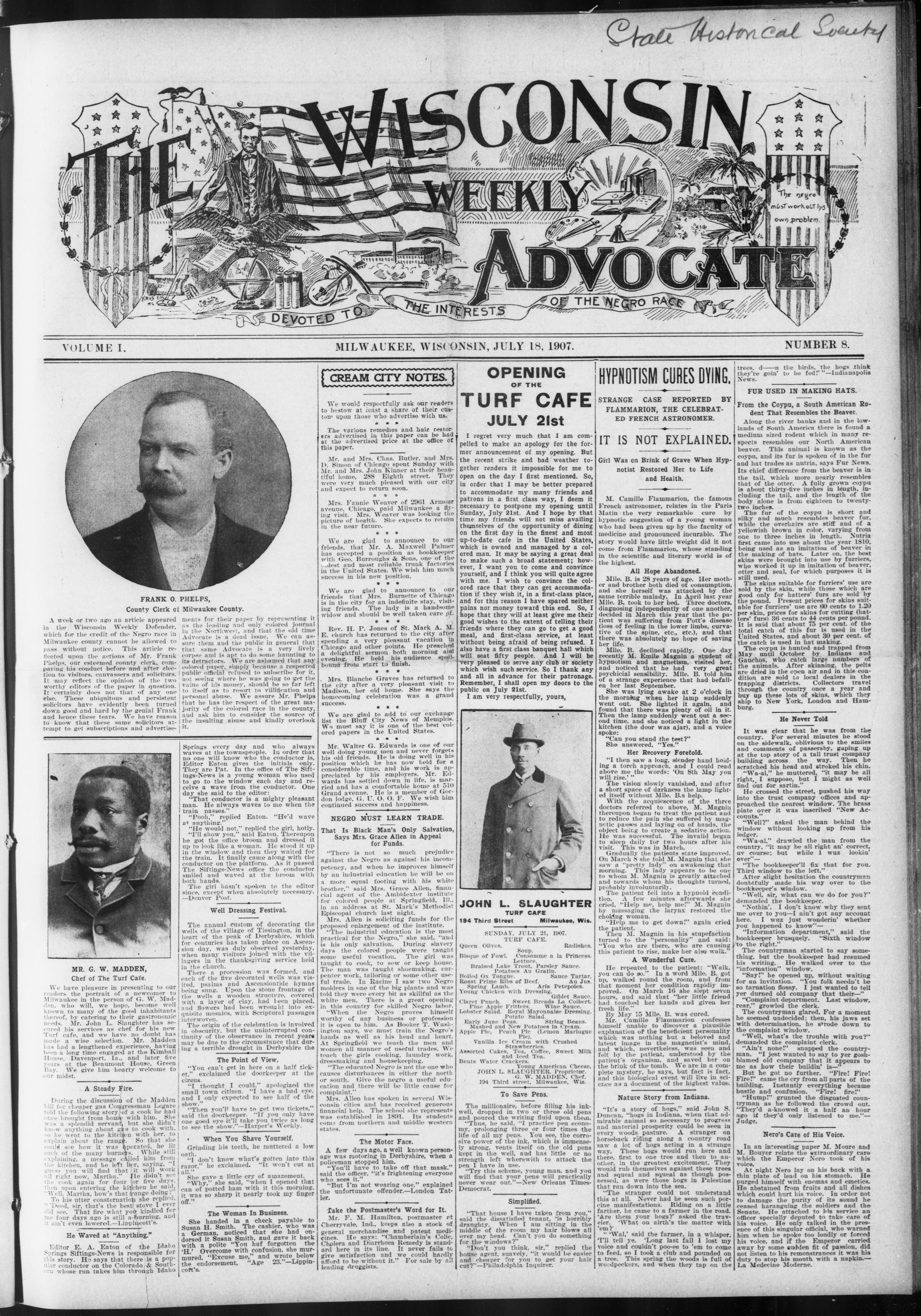
Wisconsin Weekly Advocate
Thursday, July 18, 1907
Milwaukee, Wisconsin
Page text (machine-generated)
THE WISCONSIN WEEKLY ADVOCATE
MILWAUKEE, WIS.
R. B. MONTGOMERY, Editor and Proprietor.
Humorous Items.
Earned.
Most men who marry money earn it. St. Joseph News-Press.
What's the Answer?
Hoax—How do I look in this dress suit?
Joax—Fine! Why don't you buy it?
Judy.
Floored.
One Sexton—Do you have matins at your church?
The Other—No, we have oilcloth.—Harper's Weekly.
Officer's Baggage
sentry?
Sentry—She's waitin' round the corner for ye, sir!—Regiment.
Two Ages of Men.
There are two periods in a man's life when he is unable to understand woman. One is before marriage and the other after.-Harper's Weekly.
By Installments.
Portly Dame—Save me! Oh! save me. Fireman—I'll do my best, mum, but I'm afraid I shall have to take you down in installments.—Bon Vivant.
At the Registry Office
the young man there has!
The Groom—Yes, he has every reason for it. He is only a witness.—Figaro.
An Eve to Business.
out publicity for about £100. Society Woman—How much more will it cost with publicity?—Illustrated Bits.
Not Her Verdict
Smithkins—A man is considered innocent until he is proven guilty.
Sticking to the Subject.
"But she's a very, very clever girl." "She must be. A horse with feet like that would interfere."—Washington Herald.
Too Heavy
"But, my good fellow," said the divine, "did, you ever, take, a, bath?"
did you ever take a bath:
"No, sir," the tramp answered, humbly.
"I never took nothin' bigger'n a teaspoon."
On the Outskirts.
Traveler—The 9:15 train i every late again this morning, porter. Porter—It is a bit behind, sir, but we're expectin' it every hour now. Harper's Weekly.
The Benefit of the Doubt.
The Magistrate—Are you guilty or not?
The Prisoner—Well, your honor, I think I am; but I'd like to be tried, to make sure.—Harper's Weekly.
Expensive.
"Our time is money," grumbled the collector. "Then," replied the debtor, "how can you afford to waste so much of it in chasing me?"—Philadelphia Ledger.
Then Silence
The Passenger—How dare you use such terrible language to the poor horse? The Cabman—Can't help it, ma'am; but if you was a real lady you wouldn't understand it.—Harper's Weekly.
Waiting for "Reform."
Dix-Civilization is a long time reaching that island..St. Joseph (Mo.) News Press.
Scholarship.
Genial Clergyman (visiting the village school)—Well, my little man, what do you do in school all day?"
The Most Promising Pupil—I wait till it's time to get out, sir.—Harper's Weekly.
Whatsh the Dif?
First Diner-out-"I shay, ole man, d you know Wilshon?"
you know Wishon.
Second Diner-out—"No. Whatsh ish name?"
First Diner-out—"I dunno." — Harper's Weekly.
She Was On.
The Doctor—You understand, don't you, that this out only to be used externally?
The Patient's Wife—Sure, sir. I allus makes him get out o' bed to drink it.—Harper's Weekly.
The Book of the Hour
guide for motorists.
"Has it got all the inns in the state in it?"
"You bet! And a complete list of hospitals with rates."—Town Topics.
Hope for the Worst
"Your wife," said the physician, "will not be able to speak above a whisper for a week or more."
"I wonder, doctor, queried the eager husband, "if there is any hope of her disease becoming chronic?"—Judy.
Not Much
"You women think too much of your clothes," said Mr. Tyte, severely.
clothes, said Mr. Tyte, severely. Mrs. Tyte looked down, patted her skirt, and smiled a demure and yet ironical smile. "I don't think much of these," she murmured.
A Real Sport
Young men have made signs.
"Jerome," she said, "claims to be very fond of the turf, and yet—"
She pointed to the overgrown and entangled garden.
"I find it quite impossible to make him touch the lawnmower."
The Fool's Advantage.
A fool tricked out in Motley, smiled on his lord and said to him, "Sir, what is the difference between my foolishness and thine?"
"Say on," quoth the lord.
"Well, of mine," quoth the fool, "I make a profession."—P. T. O.
The Question of the Hour
"What you want to do," said the drug-
gist, as he handed the old negro the medicine, "is to take a dose of this after each meal."
"Yes, suh," was the reply. "an' will you please tell me what I wine ter git de meals?"—London Tribune.
An Advantage.
"A life of temperance and self-denial tends to promote cheerful conversation," said the philosopher.
"I suppose it does," answered Mr. Dustin Stax: "it may disappoint your stomach, but it will keep your physician from talking to you about your liver."—Washington Star.
Voices of the Night.
A cry went out upon the air—
'Twas twelve o'clock at night
And the people in the neighborhood
Awoke in sudden fright.
The cause of all the trouble was
Discovered in a trice.
Some tabby cats were making love
Instead of catching mice.
—Birmingham Age-Herald.
Careful Calculation.
"Aren't you afraid your persistent refusal of a nomination will hurt your prospects?"
"Certainly not," answered the eminent politician. "If I hadn't friends enough to overcome a little obstacle like that I would not stand a show of being elected, anyhow."—Washington Star.
What's the Use?
Second Summer Girl—"Oh, he's an actor." First Summer Girl—"No; I mean the other one." Second Summer Girl—"Oh, he hasn't any money either."—Harper's Weekly.
As the Anchor Dropped.
Into the harbor the good ship steamed,
Serene against wind and the tide.
"They've dropped their anchor," the young man said.
To his fair and lovely bride.
And the wife so sweet with the golden hair,
In tones of reproach replied:
"It serves them right for their carelessness
In hanging it over the side."
—Brooklyn Life.
Education.
Education.
The Mrs.—Bridget, you did not dust the parlor this morning.
Bridget—Sure, and Oi did, mum.
The Mrs. (angrily)—But you couldn't have! I can write my name in this dust on the piano!
Bridget (admiringly)—Well, look at that now! Don't it show what an indication 'ill do fer ye?'—Harvard Lampoon.
Climbing.
Up a-chugging,
Up a-plugging—
Speed that starts a thrill;
Sparks a-humming,
Engines drumming,
Up the Stucky hill.
Up a-whizzing
And a-zizzing—
Just a streak, you see;
Ten to twenty
Is a plenty
Miles an hour for me.
—Cleveland Plain Dealer.
Businesslike
"I seem to remember that lady; who is she?"
"She was my typist last year."
"She's charming. Why did she leave you!"
"She was too conscientious for me. One day I proposed marriage to her, and what do you think she did! She took all that I said down in shorthand and brought it nicely typewritten, for me to sign."
IN THE LABOR WORLD.
Union barbers of Cleveland, O., are watching all the shops to see that they close on Sunday, according to law.
The National Association of Letter Carriers will hold its sixteenth annual convention in Canton, O., the week of September 2.
Chicago elevator men have submitted to a board of arbitration a proposition made to building managers for a wage increase of $10 a month.
Conditions in the Canadian cigar making industry have been unsettled for some time, owing to differences between the employers and the unions.
Industrial insurance agents organized a union recently in Brooklyn, said to be the first of its kind in the United States.
At future meetings of the Rhode Island branch of the American Federation of Labor no delegate will be seated unless his clothing bears the union label.
Grand Master P. H. Morrissey, recently re-elected by the Brotherhood of Railway Trainmen to be the head of the organization for the next two years, has already served in that position twelve years.
That the Irish labor element is not in favor of socialism as one of the objects of the labor movement was manifested by the vote taken at the labor conference recently held in Belfast. It was 835,000 against 90,000 for.
Nearly seven thousand men employed on all the street car lines and on the four elevated railroad systems of Chicago have received an advance in wages of from 7 to 10 per cent.
Following the strike of 500 Italian trackmen on the New York Central railway, a movement has been started to organize the 200,000 or more Italian railway employees all over the United States, and bring about a higher scale of wages.
Following the example set by the Chicago trade unionists, the labor unions of Covington, Ky., have started a movement for a trades union bank. The bank will have a paid-up capital of $50,000. All the stock has been subscribed by the labor unions.
A government bill for granting state advances to farmers for agricultural improvements, similar to the system of agricultural banks in existence elsewhere, will be introduced next session in the Cape (South Africa) Legislature.
Miss Anastasia O'Meara of Cambridge, Mass., has the honor of being the first woman to hold an office in the Retail Clerks' association of that city. She was also the first woman member of the association.
一、
The latest and most up-to-date form of government sick insurance is being considered in Holland. The proposed insurance is obligatory and extends to all laborers employed regularly.
From two-thirds to three-fourths of the exports of Japan are produced by female labor. In tea, silk weaving and numerous other industries the labor of women is invariably required, while in marine and mining industries it is of no importance.
A considerable proportion of the trade unions in European countries provide benefits for unemployed members, and many other organizations, such as friendly societies and co-operative associations, make similar provision for their members.
---
THE FLAG.
I did not know it was so dear,
Till under alien skies
A sudden vision of it near
Brought tears into my eyes.
To wander down the crooked street
Of some far foreign town;
No friend amid the crowd you meet,
Strange faces peer and frown;
To turn a corner suddenly,
And ah! So brave and fair,
To spy that banner floating free
Upon the foreign air!
Most beautiful its starry blue,
Most proud its white and red;
The meaning thrills on through and through
For which the heroes bled.
O, that will catch the careless breath,
And make the heart beat fast;
Our country's flag for life and death!
To find our own at last!
In those far regions, wonder-strewn,
No sign so good to see—
My country's blessed flag, my own,
So dear, so dear to me!
-Abbie Farwell Brown, in The Churchman
MISSION OF CAPTAIN JINKS
Captain Jinks reclined among the sofa cushions and gazed with bored eyes on the passersby. "What a day for rabbits," he thought, as he noticed the light fall of snow that was quickly being defiled by the muddy boots of pedestrians. Out there where the leafless trees swayed softly in the wind its purity was unmarred save by the wild inhabitants of the wood. A yearning came over him for that great quiet, and for the first time he felt that she had shown him injustice. If she had only been content to remain in the country; but—no, she had to return, and drag him with her. For three long years he had sacrificed everything for her. His devotion had been that of a dog.
In his way he was immensely proud of her, and in his heart there was a true affection which no one else could replace. Still, was that any reason why he should be led around all of his life like an irresponsible animal? This last summer had taught him the meaning of freedom, had given him a realization of his own strength, and in the awakening the blood of his fighting ancestors, so long in abeyance to her caresses, cried aloud for activity. Yet here in the city all that he could do was to spend the time between growls and yawns in the warm luxury of the apartment.
Gradually the mind of Captain Jinks recalled many little incidents, and in his morbid mood the more he thought of them the more injured he felt, until in a wave of self-pity he formed a resolution to leave. He would go back to the country, and if she really cared she would follow and be content with his life. If not—as Captain Jinks thought of this alternative the future was more hazy. He could not imagine life without Maid Marion somewhere near. Maid Marion was the name by which she called herself when they held those long confidences in the twilight, in which she had told him about the other one. As there is always "the other one" in every woman's life (or if not she pretends there is), Captain Jinks was not troubled by jealousy. It was hard for the captain to relinquish the mental companionship he had enjoyed with her, but he had made up his mind with the bulldog determination of which she had accused him to go undisuaded by the thought of her caresses.
As he walked down the hall he paused a moment to listen to the sad little song she was singing. Pushing open the door of her room he entered. She was sitting before the mirror doing up her red gold hair. Captain Jinks sat down on the floor beside her, a favorite place of his. She paused in her occupation, and taking his face in her hands she raised it so that her grave eyes looked into his, and said: "Do you love me, boy?"
His only answer was to kiss her finger tips. She released her hold and smoothed his head with tender touch. The captain knew that it was no use to try to make her understand his purpose. He knew that there was only one thing to do—go and let his loss bring them into closer sympathy.
"Now you have bothered me enough," she said, and pushing him gently from her, began to twist the heavy coils of hair in place. He waited a moment in the doorway, but she was too intent on her own reflection to notice him. Then, with one last long look at his dear mistress, Captain Jinks with drooping head turned and walked away.
As he stepped out into the snow he looked up at the window to see if she were there, but the curtains remained discreetly closed, and with a sense of disappointment he went quickly down the street and was soon lost to view in the hurrying crowd.
Jack Hodgeman swung into a brisk gait as he started on his morning's constitutional around the reservoir. At one time jack had acquired a good deal of weight; not nice, healthy, firm looking flesh, but the flabby, pallid kind, which makes a fellow's friends offer advice about total abstinence. Every one knew that it was a hard blow for him when Miss Hargraves broke the engagement. And some mutual friends of the parties concerned said rather unkind things about her when they noticed a nice, healthy, wealthy young man making a beast of himself. Suddenly, to the surprise of relatives and comrades, Jack took a brace and entered on a frantic dissipation of work. For three years he kept at it with the help of constitutional cocktails and horizontal bar highballs.
As he stepped quickly along, the wind blowing keen on his face, the old sense of loneliness returned to him. Sometimes it would hide away for months, and just as Jack was beginning to congratulate himself on its permanent departure it would pounce back, and as if invigorated by its long rest, torture him almost—to drink. A table set for one usually played a prominent part in this mood; maybe because he had always imagined her pouring coffee for him in the morning. This morning the solitary service stood out a little more boldly than usual. He frowned savagely in his effort to think of other things, and vaguely became aware of some one following him. Despite his rapid stride the steps behind him kept in his wake with gentle insistence.
Finally he turned and saw a poor, slinking, half-starved creature keeping at an apologetic distance. There was no asking for alms, no suggestion of liquor, just a pitiful appeal for companionship. His coat was mud stained and down his face was a line of dull, dry brown which inferred a meeting at close quarters with some enemy. Yet there was that in his demeanor that told of better days. em-
phasized by his fresh and neatly fitted collar. Some sense of comradeship prompted Jack to speak.
"Not looking very fit, old fellow," he said.
The follower paused and studied intently for a minute Jack's good-natured face, and then advanced and fitting his step to Jack's walked solemnly along beside him.
"It's a shame," said Jack, looking closely at his companion, "for a fellow of your evident stamp and breeding to be down in the world this way. You look as if some one had cared for you, and I dare say they are worrying about you now. I think it is a good thing to be able to defend yourself, but it is a disgrace for you to be marked up in such a disgusting way."
The delinquent squirmed under the lecture, and Jack went on: "It's none of my business, after all, if you go about like a friendless yellow cur. But I'll make you this offer; if you want to go around to my diggings I'll set you up to a bath and breakfast, and after that we'll look up your friends. By the way, when you go in with me put on a front, as the managers of my place are rather particular about your kind."
When Jack reached his bachelor apartment house he noticed with pride the noble, if somewhat fierce, aspect assumed by his comrade, and was pleased to see that even the haughty elevator boy trembled before his belligerent eyes.
"This is a friend of mine who will breakfast with me, Benton." Jack said to his man as he ushered his guest into his suite.
"Very well, sir," replied his man, "but he's getting on the couch, sir."
"Luxurious cuss! Kick him off. He might have——"
"Yes, sir; yes, sir," interrupted Benton, making a frantic dash toward his master's disreputable appearing guest.
"I promised him a bath, Benton. Do you think that you are equal to it?"
"I might try, sir; but there's nothing like this tramp kind for being afraid of the water. I've had them to deal with before, sir." After coaxing from Benton and a denite command from Jack the stranger disappeared.
Jack looked about his room with an air of satiety in his glance. "Think of that brute," he said to himself. "He's happier in his dog's life than I am in all this." Then, taking from his pocket a little gold locket and opening it, he gazed for a time at the contents. "If I could only crush the memory of you as easily as I could crush this semblance I could know happiness of some sort. It's no use. I can't do it. You'll be with me until I die. That's all. It's four years now, and I keep getting worse all the time. I said that I'd never come back until you sent for me; and I won't. But if ever you do—" Hodgeman replaced the locket in its former abode and walked into the dining room.
The outcast had returned from Benton's ministrations looking like a well groomed animal, and, sitting down by his host, accepted gratefully the well broiled lamb chops placed before him.
"Why don't you look in the 'ads,' sir?" suggested Benton as he placed the morning paper before his master.
"Good idea! Guess I will," said Jack, and, opening the paper, turned quickly to a certain section and glanced down the column until the following caught his eye: "Lost, Strayed or Stolen—A while bull terrier with brown markings. Answers to the name of Captain Jinks. Spiked collar with license. Handsome reward for his return to Miss Hargrave, 85 Blank street, city."
Jack stared excitedly from the paper to his guest, then ran his fingers wildly through his hair.
"Is your name Captain Jinks?" he shouted at the outcast. With a joyful yelp at the familiar sound the bull terrier beat a lively tattoo with his tail on the floor.
"So Maid Marion is your mistress," said Jack.
Captain Jinks forgot dignity at the name of his dearly beloved, and rolled over on his back, pawing frantically at the empty air. An inspiration came to Jack.
"Benton! my coat, hat, a cab, quick, and something with which to tie this dog!" he shouted.
Benton, in obeying these commands, cast suspicious glances at the decanter, but on his master's departure he looked at the exciting paragraph, emitted a low whistle and gravely winked one eye. "Miss Marion, Miss Marion," called the breathless little maid. "It's a man with Captain Jinks, and he won't let him go until he sees you." Hodgeman had gravitated from the hall into the library from force of habit. He stood in a shadow which gave his respite to study the softened expression of Miss Hargraves' face as she entered the room. Her eyes were all for the dog, and she knelt down beside him.
"Oh! Captain," she cried, reproachfully. "You've been fighting." Looking up she rose with a cry of recognition at the sight of Hodgeman. The four years' silence had not seemed so painful or oppressive to either as that which ensued. "I—I—I don't quite understand," stammered Miss Hargraves.
"Ill help you to," began Hodgemans, with a tremor in his voice. "I found him in the park, a miserable outcast, looking as starved and battered in body as I have been in heart for the past four years." He paused, then added quizzically. "I said I'd never come back until you sent for me. You have, and offered a handsome reward besides. If there was a mirror in the room you would see the only reward that I want. Won't you give it to me, Maid Marion?"
Miss Hargraves stooped and patted the dog, who was jumping frantically on her. "Don't you think," she said, with her head bent down, "that your demands are rather exorbitant?"
"Would its payment be a hardship?" he asked.
"Oh!" said Miss Hargraves. "Not exactly. It depends on the grace days you allow me."
Captain Jinks reclined on the sofa cushions and gazed with wistful eyes out into the night. Occasionally he rubbed his nose with his paw, as if to reduce a painful dislocation, for somewhere in the rooms below his chance acquaintance of the morning sat exchanging confidences with Maid Marion in the twilight.—Commercial Advertiser.
Hogs Fatten on Locusts
A news telegram of June 3, from Willow Springs, Mo., says:
"Thousands of hogs of southeast Missouri are fattened on a crop that was planted seventeen years ago—a crop of seventeen-year locusts. Since early spring the hogs of the farmers in this section have been getting fat on something they
found in the woods and each farmer secretly wondered whose corn crib his pigs had found, for they came home each night not squealing for their feed, but only to sleep; and every day they brought home a layer of bacon and lard added to their once lean and hungry bodies. The "rail splitters" of south Missouri and Arkansas were fast being turned into prize Berkshires and Polands by what o. whom the farmer did not know until a few days ago, when the woods were filled with the song of the seventeen-year locusts."
EVERYDAY COOKERY
Lemon Honey.—Beat one-half cup of powdered sugar with one-half cup of butter until creamy, add one unbeaten egg and beat again. Stir over the fire until it thickens, then add the grated yellow rind and the juice of one lemon, heat again and turn out to cool.
Cocoa Nibs.—Put two ounces of cocoa nibs or shells into a little cold water and when wet through add one quart of boiling water and cook one and one-half hours. Strain and add to one quart of hot milk. Sweeten slightly and a pleasant and inexpensive drink will result.
Cheese Rolls.—Cheese rolls are excellent to serve with salad. Roll light raised bread dough almost as thin as pie crust. Spread with grated cheese and roll up like jelly cake. Cut in slices one inch thick, lay on a buttered pan and when risen light bake twenty minutes to a half hour.
Coffee Cake.—Beat one-half cup of butter to a cream with one cup of light brown sugar, add two beaten eggs, one-half cup of molasses, one-half cup of cold coffee, one cup of chopped raisins and two and one-half cups of flour sifted with one level teaspoon each of soda, cinnamon and cloves.
Tea Cake.—For a cheap cake to be eaten fresh heat two tablespoons of melted butter into one cup of sugar. Add one beaten egg, two-thirds cup of milk and two cups of sifted flour sifted again with three level teaspoons of baking powder. Add half a teaspoon of mixed spice and bake in a shallow pan. Serve partly cool.
Date Muffins.—Beat the yolks of two eggs well, add one cup of milk, one and one-half cups of whole wheat flour sifted with two level teaspoons of baking powder, one tablespoon of melted butter; the stiffly beaten whites of the eggs, and last one-half cup of chopped dates. Bake in hot buttered gem pans about twenty minutes.
Escalloped Corn.—Cook six good sized ears of tender corn, cut it from the cob and put into a baking dish. Stir a rounding tablespoon of butter into two cups of hot milk, stir until melted, then pour over the corn; to two beaten eggs add one-quarter cup of flour and salt and pepper. Mix with the corn, sprinkle buttered bread crumbs over the top and set in a quick oven to cook the sauce and brown the top.
Baked Creamed Potatoes.—Cut cold boiled potatoes into small even dice, season two cups with a level teaspoon of salt and a few dashes of pepper. Turn into a buttered baking dish that may be set on the table and pour a cup of thin cream over the potatoes. Dot the surface with a tablespoon of butter cut in bits. Set in the oven to heat and brown the top. Some of the Japanese dishes will serve well to bake escalloped dishes in and look well on the table.
Lemon Syrup.—Grate the yellow rind of twelve lemons and add to six pounds of granulated sugar. Add two quarts of water and heat and stir until the sugar is dissolved. Cook until the syrup thickens and skim until no more scum will rise. Add the juice of the twelve lemons, simmer fifteen minutes, bottle, seal and keep in a cool place. Added to water this syrup will make an excellent lemonade. It can be made when lemons are cheap and kept on hand.
Mocked Plum Pudding.—Soak two cups of fine bread crumbs in four cups of cold milk for two hours. Beat four eggs, add one-quarter cup of sugar, the soaked crumbs and milk. Season with a pinch of salt, a saltspoon of cinnamon and a few gratings of nutmeg. Add also two tablespoons of melted butter and one cup of seeded raisins that have been standing in hot water for half an hour before seeding. Mix, turn into a buttered baking dish and bake in a moderate oven until firm. Serve with a liquid sauce.
Stuffed Onions.—Use rather small Spanish onions, which are best for this manner of cooking. Take off the outer thin skin and cook in boiling salted water for quarter of an hour. Drain and cool slightly. Make a stuffing of one cup of fine bread crumbs and one cup of finely chopped cooked meat seasoned highly with salt and paprika, and moisten with three tablespoons of melter butter. Scoop out the center of the onions, chop and add to the meat, fill the onions, set them in a baking pan, pour in water an inch deep and bake in a moderate oven.
Two-Cup Cake.—Break one egg into cup, fill in sugar to make it a half cup, then fill up the cup with sweet cream. Turn into a bowl and beat well for several minutes, then add one cup of flour sifted with two level teaspoons of baking powder and a pinch of salt. Add half a teaspoon of lemon flavoring and bake in a small pan in a moderate oven. Tea Rusks.—Dissolve one yeast cake in cup of milk, add a second cup of milk, three well beaten eggs, one cup of sugar and one-quarter cup of butter. Add enough flour to make a dough that can be handled, then cover and let rise very light; mold into small cakes. Let rise again, bake in a quick oven and when done brush the tops with sugar dissolved in milk.
MARJORIE WEBSTER
Strawberries as a Dentifrice
"Perhaps it is your sunburn that deceives me, but I really believe," said the first girl, as she floated on the sunwarmed billows, "that your teeth have turned three shades lighter."
The second girl, taking a huge breaker very skillfully, laughed and replied: "No, it is the truth. They really are white. It is a new wash that I use."
"Tell me what it is."
"It is nothing but crushed strawberries. You take two or three fresh strawberries, crush them, and rub your teeth with them for five or six minutes a day. The improvement begins at once, and in a short time the yellowest teeth are as white and lustrous as pearls."
YOU'D BETTER BEWARE.
If you see a sky-blue el-e-phant
A-climbing of a tree;
If you see a flaming lizard
A-setting on your knee.
If you catch a crimson monkey
With your dinner making free—
Don't say a word about it.
For a certain one would doubt it,
And brand you "Nature faker," don't you
see?
If you should go a-hunting
In the fullness of the moon.
And your faithful dogs should tree for you
A whopping, fat old coon
(Of course you wouldn't do it
This season, it's too soon)—
But don't plug the hole, you lout,
And try to "smoke him out,"
For you'd close the "door of hope" upon
said coon.
If you have a strong opinion
On any sort of sub-
Ject, don't you dare express it,
Or you'll find out you're a "dub,"
And if you're an official
You'll be fighting with your grub—
For you will, beyond a doubt,
Be fired and cast out,
And elected as a member of the "Ananias
Club." —St. Louis Globe-Democrat.
The Flower Garden.
Campanulas.
One of the showiest and tallest of the campanulas is campanula pyramidals, which sometimes grows to the height of five feet. Its numerous spikes in blooming season are covered with blue and white flowers. It will endure shade and can be planted in front of borders. It is not a long-lived plant and should be given good winter protection. The clustered "hair bell," companula glomerata, is chiefly interesting on account of its intensely purple flowers and their peculiar arrangement in densely clustered heads. It is good for a border or rockery. The Chinese and Japanese bell flower, platycodom grandiflorum and P. mariesi resemble the campanula and are most satisfactory border plants. They may be planted in clumps in a mixed border or will make a fine showing in beds by themselves. There are blue and white varieties and both single and double kinds.
Good Seed.
The woes of the amateur gardener are very amusing to others, but definitely real to the man who has spoiled a suit of clothes, blistered his hands and lost his temper in his effort to make things grow.
A young man, recently married, early in the spring secured a suburban place, mainly with the idea of "fresh, home-grown vegetables." Every evening he would hurry through his supper and rush out to his garden, where he displayed more energy than skill. But, alas! When many little green things began to break the ground in his neighbors' garden his own remained as bare as the Sahara.
"It certainly has got me beat," he confided to a friend at his office one day. "I can't understand why not a blessed thing has come up. I planted peas and corn and tomatoes."
"Perhaps the seed was defective," the friend suggested. "I hardly thing it was that," the gardener replied, "for I got the very best—paid 15 cents a can for them."—Philadelphia Public Ledger.
Deutzia Lemoinei.
This is a shrub that blooms freely early in the spring at a time when there is not an abundance of bloom in the garden. The plant is almost covered with clusters of panicles of pure white flowers above the leaves, the contrast giving a striking appearance. This shrub grows to a height of about 4 feet and in is equally satisfactory as a hedge plant in the mixed border or as a speciment plant in the lawn. It is easily kept in neat form by a small amount of pruning which should be done after the plants bloom. It is perfectly hardy, of easy culture and rapid growth.
One of the hardiest deutzias is the species parviflora, a native of northern China. A native of China and Japan is Deutzia scabra, usually sold in nurseries as Deutzia crenata. It varies in height from six to ten feet according to conditions, with stout, yellowish branches. The upright spiked white clusters come into bloom in June and last until July. There are a good many forms of this deutzia in cultivation differing in semidouble, double and purple or rose tinted blossoms.
Deutzia Watereri has a large, double rose tinted flower which is very showy. Deutzia discolor a native of China is a graceful shrub growing three to four feet tall with white flowers tinged with pink on the outer side of the petals. It needs protection from the cold in New England winters. Deutzia Kalmaeflora is a beautiful shrub with large white distinct blossoms slightly tinted-with rose but should be well protected in winter. A large number of forms and hybrids have lately been sent out by French originators in which the parentage of Deutzia gracilis on one side has been largely used, and which are conspicuous for rose tints, large bell shaped blossoms and more conspicuous clusters.
Interrupted Love Thoughts
Little Tommy Keating, of the office force at the Hotel St. Francis, used to be a ball player himself, and is still so much interested that he thinks and talks in the slang of the diamond.
Keating was intently composing a love letter yesterday. A chauffeur had come to the desk and asked if a certain guest was "good pay," and the cashier was looking it up in the ledger. The telephone girl from behind the key rack had just asked if Fred Swanton of Santa Cruz was in, and Clerk McCullough was looking to see if the key was in the box. A man near the counter was at the moment explaining why he couldn't get any laundry done.
"There's a strike," shouted the man to his deaf friend.
"He's out," said McCullough to the telephone operator. "He's safe," called the cashier from his desk. "What! What!" ejaculated little Tommy, suddenly coming out of the land of candy hearts and forget-me-nots. "How's that? Whose error? Rotten umpiring!"—San Francisco Chronicle
How He Liked Them
Congressman George W. Smith, who has been representing the southernmost district of Illinois in Congress ever since John R. Thomas got tired of the job, twenty years ago, was campaigning around Murphyboro, one time in a buggy. With him was a driver. They came to a bridge over the Big Muddy river. The sight of water naturally suggested fish. For lack of anything better to say, Congressman Smith said to the driver:
"Do you like fish?"
"Yes," was the reply.
Nothing more was necessary and nothing more was said. However, when the next campaign came around Congressman Smith went over the same territory at the same time of the year, with the same driver. Again they crossed the Big Muddy and again the sight of water suggested fish.
"How?" asked Congressman Smith. "Fried," said the driver.—Judge. Advertise in Your Home Paper.
GOSSIP FOR THE LADIES.
My Mother's Garden.
Her heart was like her garden,
Old-fashioned, quaint and sweet,
A wealth of buds and blossoms
Hld in a still retreat.
Sweet violets of sympathy
Were always opening there.
And Hiles white and pure unclosed,
Each one a whispered prayer.
On trellises of trust.
And in that quiet garden—
The garden of her heart—
Song-birds built nests, and caroled
Their songs of cheer apart;
And from it still floats back to us,
O'ercoming sin and strife.
Sweet as the breath of roses blown,
The fragrance of her life.
--Alice M. Allen.
Ladylike Geometry.
1. A straight line is the shortest distance between two parallel envelopes.
tance between two mininery openings. 2. A straight line determined by two bargain tables is considered as prolonged both ways until the store closes. 3. A broken line is a series of successive straight lines described by a woman alighting from a street car. 4. A mixed line is a line composing the reception committee of a club's presidential candidate. 5. A plain figure is one all points of which have been neglected by the dressmaker.
6. Figures of the same shape don't always have the same style.
7. Figures of the same size never consider themselves equivalent.
8. Women equal to the same thing are not always equal to each other.—Exchange.
The Clubwoman's Collect.
Let us be large in thought, word and deed.
Let us be done with fault-finding and leave off self-seeking. May we put away pretence and meet each other face to face, without self-pity, without prejudice.
May we never be hasty in judgment. Let us take time for all things. Make us to grow calm, serene, gentle. Teach us to put into action our better impulses, straightforward and unafraid. Grant that we may realize that it is the little things that create difference, that in the big things of life we are one. May we strive to touch and to know the great common woman heart of us all. And, oh, let us not forget to be kind.— Sollected
Learn to Shake Hands.
One does not need to grasp the hand in a dealth-like grip, but there is something about a good handshake which is the silent interpreter of a welcome. A person possessing a great deal of personal magnetism may just take your hand in his and the cordial welcome is recognized without even so much as the slightest pressure of the fingers. Others may have a good grip, which is more like a clutch. There is no set rule for handshaking unless a person bears in mind that handshaking must be a feeling expressed with the hands and not the eye or voice. If only done through a matter of form, there is no earthly use of shaking hands at all. Strong intuition serves a great many persons, and to grasp a cold, clammy hand, which lies like a piece of marble in one's hand, is to make a big-hearted person feel like he had come in contact with the wrong party.
When Sleep Is Most Needed.
Perfect health demands not only a fixed amount of sleep, but the observance of regular habits, says Dr. John D. Quackenbos in Good Housekeeping. And perfect sleep for man can be obtained only at night, as suggested by the rythmical succession of light and darkness. There is point to the old proverb, "An hour's sleep before midnight is worth two after." Those who are in the habit of turning night into day realize this to their cost. The hour before midnight that his worth two after is from 11 to 12. And inasmuch as the human system is more below par at 3 a.m. than at any other period in the twenty-four hours' sleep should cover at least two hours on each side of this time. When life is at stake in the crisis of acute disease, nurses are instructed to begin special stimulation at midnight and to continue it until 6 in the morning, in the hope that flagging energies may be sustained through this period of supreme depression.
What Makes the Charming Hostess.
You know her as soon as you step over the sill.
She has diffused an atmosphere of welcome over the entire house. You feel at home in every room, even though left alone.
And you are left alone sometimes.
For the perfect hostess doesn't dog your footsteps every minute.
She knows that you will want to write letters, and nap, and read.
She gives you the house to entertain yourself in and you can have her too, whenever you want her.
She does not wear you out with too many entertainments or too many persons.
She doesn't make you feel that you've got to "pay for your keep" by doing chores.
Neither does she refuse to let you help her, if she sees it would make you happiest.
She gives you the impression it's a joy just to have you in the house.
And you always want to see her again.
--Cooking club Magazine.
The Frank Person.
We all know—and respect—and avoid—such persons; the world is full of them—too full for the general comfort of its other inhabitants. And frequently what they call the truth is not abstract at all, but is merely the expression of their own particular (and frequently erroneous) opinions. Yet as they utter it they glow with spiritual pride and feel themselves in the same boat as the Christians of the Catacombs and the rest of the noble army of martyrs; never realizing that their cause is no tenet of an inspired creed, but merely an embodiment of their own pet prejudices; and their sacrifice on its behalf is neither their own life nor wealth, but merely the feelings and the sentiments of other people, says Woman's Life.
Such persons are very fond of remarking that they owe it to themselves to say exactly what they think; it never seems to occur to them that they likewise owe it to others to conceal what they think, if such thoughts be inimical to the general pleasantness and well-being of society at large; yet surely they have never been taught that their duty to themselves comes before their duty to their neighbors.
Mosquito Remedies.
Mosquitoes, as every one knows, find
their lodging places in any corner where dampness lurks. An uncovered rain water barrel will bring them in hordes. Water barrels should be covered in dry weather, all damp heaps of dead leaves cleared away from every corner on the premises, the sunshine allowed to enter all crevices, and the scientist's favorite remedy of kerosene used freely over the surface of stagnant pools. If these precautions are strictly followed the country family should have no trouble from these pests, providing the nearest neighbors do likewise. It is easier to follow these precautions than to keep the insects off by herbs and lotions.
If, in spite of all reasonable precautions, mosquitoes persistently haunt the premises, a small souldering fire of pine boughs or any fragrant wood built near the house will have a deterring effect upon them. The fire should smoulder enough to give forth a thick smoke, which is not at all disagreeable to persons out of doors.
It is said that a bouquet of pennyroyal will, as a rule, keep mosquitoes away from a room. The best antidote for a mosquito bite is ammonia weakened with a little salt and water. Some persons use camphor. Salt and water is a good disinfectant. Alcohol and a mild solution of carbolic acid, rubbed well into a mosquito bite, will kill any germs.
Mosquito netting is certainly ugly and undesirable. It always keeps out more or less fresh air, and plenty of fresh air in summer is a necessity. There seems to be nothing to take its place, however, in certain localities where masquitoes abound.
The Poor Spinster!
Sometimes a wife, happy or unhappy, adored or abandoned, as the case may be, makes it clear to the objects of her gentle scorn that it is their inexperience with man that puts them in the kindergarten class of humanity. Maida herself, married from her father's house at twenty-two, after an exhaustive acquaintance with all the possible vagaries of masculinity in the persons of our grandfather, the village clergyman, our uncle, his clerical successors; our father, the village doctor; our brother, his assistant; and Frederick—Maida will prate fluently by the hour about what man likes and what he doesn't like; what are his tastes in food, and what he really thinks about the heroine of "The Garden of Allah;" what sort of women he really admires, and at what temperature he likes a room. To Grace she will prattle thus: Grace, who in the course of her fifteen years' wandering since she was Maida's bridesmaid, has made a sprig of continental royalty wish to renounce his kin and his coronet and emigrate to America as her spouse; has caused a duel at a German army post—"though that," she says, "is nothing; a stein of beer more or less, a misstep on the sidewalk, would have quite as well sufficed;" has figured as the heroine of a popular novelist's most popular novel; has had her picture painted by three competing artists, each determined to make her loveliness quite unlike what the others made it, and all succeeding in making it quite unlike her own; and who now, at well past thirty-five, is about to marry a millionaire woolen manufacturer of Rhode Island. To Grace will Maida calmly and glibly explain Man.—Anne O'Hagan in Harper's Bazar.
Puddings and Popovers.
Wafer Puddings—Are made by placing one pint of milk in a double boiler. When hot add a quarter of a pound of butter, stir until melted; add lastly half a pint of sifted pastry flour; stir until you have a smooth dough; take from the fire and when lukewarm add five eggs well beaten. Beat the mixture continuously for ten minutes, then cover and stand in a warm place for an hour. Put a tablespoon into greased, hot gunpans, and bake in a moderately quick oven for forty minutes. This proves most delicious served hot with a liquid pudding sauce.
Popovers—Beat two eggs without separating and add to them half a pint of milk. Pour this carefully, stirring all the while, into half a pint of sifted flour. Strain at once into greased, hot gunpans and make in a moderately quick oven for at least thirty-five minutes. If not sufficiently baked they will fall when taken from the oven.
Mock Charcotte.—Moisten four level tablespoons of cornstarch in half a cup of cold water. Add hastily one pint of boiling water and cook one minute; add half a cup of sugar, take from the fire and pour slowly into it the well-beaten whites of four eggs, beating all the while. Turn into a mold that has been rinsed with cold water and stand aside to cool. Serve with a French custard sauce made by beating the yolks of the eggs with four tablespoonfuls of sugar, adding to them one pint of scalding milk. Cook until it is the sturdiest of cream, then take from the fire and add a teaspoonful of vanilla, or any desired flavor.
Cream Cornstarch Pudding-May be made by using the same measurements and manipulation, substituting milk for water. This may be changed into a chocolate cream pudding by adding to the milk, before adding the cornstarch, two ounces of grated chocolate, or into coffee cream by using instead of milk one pin of moderately strong coffee.
Wit and Woman.
No one is more tiresome than the "would-be" witty woman. If nature has endowed you with the quality of wit, well and good, but it is an impossible quality to cultivate. Wit is not always kindly, and it often detracts from a woman's gentleness. The wit is never able to resist the opportunity of raising a laugh. The fact that other people's feelings may be hurt does not count. The most lovable thing about a woman is her womanliness and gentleness. If you try to be smart and funny you are in great danger of losing both those qualities. There is no harm in being funny as long as it is not at other people's expense. The trouble is that it is hard to know where to draw the line.
If you notice you will find that the gentle girl is never at a loss for friends and attention. You know to be gentle does not mean to be weak and uninteresting. A girl can be full of life and spirit and fun and still be exquisitely gentle. To be gentle means to have consideration for others, to be refined in thought and action. The gentle girl is as popular with her own sex as with men, and where you find the girl that both men and women like you have found the best of all girls. She may never have made a witty remark in her life, but she has hosts of friends.
There is one thing that people absolutely cannot stand, and that is ridicule. Many a promising love affair has been nipped in the bud by an untimely laugh. A mental hurt is much harder to recover from than a physical one. A keen sense of humor is an excellent thing, and yet it has its drawbacks. To always see the funny side of a thing, unless one has self-control, is dangerous.
Be as merry and jolly as you like, but don't try to be too funny.
The Summer Society.
It is beyond the imagination of the ordinary person who has never mingled with the gaiety and luxury of a houseparty at a wealthy country estate to grasp its bewildering splendors. Life and color are upon every hand, vibrating in diversified animation, says a writer on Country Mansions, in the New Broadway Magazine.
The great country house is scarcely more than a stage, sumptuously set for a magnificent performance that is given, at the oftenest, only two or three times a year. The assembling of the great house-party is the significant hour toward which all this miracle of preparation tends. From the gathering of the guests at the station into the smart traps and motor buses sent to meet them, to the departure of the last laden footman, borne in the wake of the last graceful girl, the great show moves forward like some superb, spectacular performance with all the actors perfect in their parts.
with all the actors perfect in their part. Through the patterned walks of the Italian gardens set with stiff trees cut into gingerbread shapes that would be ridiculous if they were not so impressive women with trailing lingerie gowns (worth enough in themselves to realize a poor man's dream of a cottage in the country) pick their dainty way. In the Japanese garden—for these splendid houses have not one garden, but a suite of gardens--the crowd about the tea-tables look as if they were gowned and grouped by some master of stage management.
The terraced lawns mount upward, much as in Jacob's famous dream, with a greater glory at each successive step; the will garden is hung with every sort of creeping plant; the rose garden blooms and blows in fragrant perfectness; but these are, after all, only the background of the brilliant scene. "The play's the thing," and these men and women are merely players in the greatest drama of the age—the drama of society. The tennis court, hidden behind a mass of lofty shrubbery, the bowling alley, the artificially created swimming pool—are all set for their brief appearance.
Mrs. John J. Astor an Acknowledged Beauty
Mrs. John Jacob Astor is unquestionably the beauty of the London season. Wherever she is seen this regal American woman causes a sensation. Crowds follow her about a room. Her height, her snowy hair over such a fresh young face, her amazing gowns and historic jewels have fairly dazzled London. Twice lately I have seen her in a "creation" which for originality and beauty I have never seen surpassed. On the first occasion she wore a costume of silvery scales which fitted her figure close, giving the idea of some wondrous mermaid from the deep. The top of the bodice was filled in with filmy lace suggestive of foam, and at her throat was the Empress Eugenie's famous pendant of blazing diamonds.
On the other occasion she was attired in some black, cloudy fabric, which seemed to swathe her figure, revealing no opening and not a single jewel. Above this, thrown into strong relief by the contrast, rose her flower-like face with its crown of white hair dressed in big curls. In which gown she looked the more striking it would be hard to say. A man who was present the other night at an embassy party, remarked: "Mrs. Astor makes every other woman appear insignificant and commonplace."
Many women are bleaching their hair to resemble hers and others who do not care to go this length are wearing white wigs. Mrs. Astor has been here frequently, but she has never before made such a sensation. She looks utterly unconscious of the admiration she arouses—or it is utterly indifferent? Nor somehow does she convey the impression of being particularly happy. Her thoughts often seem far away from the gaiety in which she is the bright particular star. Occasionally there flits over her face, like a cloud, a care-worn expression that makes her appear, for the few moments that it lasts years older. I have seen her stand in the center of a crowd apparently not hearing a word that was being said by those around her. But all this only adds to the interest she arouses. It suggests a hidden sorrow, a buried romance, and things of that sort that inquisitive folk like to speculate about.
Woman's Right vs. Marie Corelli
A search for the subject upon which Marie Corelli has not expressed her opinion would be like a quest for the roc's egg, consequently the claim of a divided attention to the subject can be urged in excuse of the shallow reasoning with which this gardulous author, in her paper, "Man's War Against Woman," in "Harper's Bazar," opposes the causes of woman suffrage.
Miss Corelli, after some statements to the effect that women's susceptibility to a "personally expressed admiration for their eyes," would largely affect the direction of their vote, goes on to say that the "woman's rights" question is conveyed in Cleopatra's opening speech to Antony in Shakespeare's play:
"If it be love indeed, tell me how much."
"It is all there" says the writer.
It is all there, says the writer.
"That is really all woman wants to know. 'If it be love indeed'—then she had her 'suffrage.' She can rule her slave for good or bad. She governs man, and through him she governs the world.
"Clever women want no audible voice in politics, inasmuch as they can, if they choose, silently work the whole business behind the scenes. Stupid women clamor about their 'rights,' evidently unaware that in the very force of the clamor they are throwing all 'rights' away. The clever woman sits at home—and like a meadow spider spreads a pretty web of rose and gold, spangled with diamond dew. Flies—or men—tumble in by scores—and she holds them all prisoners at her pleasure with a silken strand as fine as a hair."
Echoing Miss Corelli, we might say, "There it is"—it, the sop, "woman's influence over man," which soggy and indigestible, is handed out by every stranger who approaches the Cerberus of woman's suffrage. The novelist is disappointing in that she does not even make the old gag-stop look like muffins, a rasped roll or some of the more palatable breakfast foods. In fact, as they stand, her remarks are quite as unappeptizing and quite as illogical as though uttered by some less authoritative person than the author of a dozen or more favored romances.
In the first place, the writer deprecates the suffrange because woman "has no time to think," and because of the prejudicial effect of a candidate's compliment to her eyes. In the second place, with no apparent twinges of inconsistency, she urges woman to rule the world through her influence over man! She hasn't the intellect nor the detachment of view necessary to vote herself, mind you, but, nevertheless, Miss Corelli trustfully confides her husband's vote to her!
Yes, it is painfully apparent. Miss Corelli's viewpoint is quite as cramped as that of the undereducated man, who, from the summit of serene impersonality of judgment sniffs, "My, it's a good thing the madam can't vote. She'd say, 'I'm not going to vote for Joe Smith. His wife puts on entirely too many airs to suit me.'" Yet a few breaths afterward this same man, with
all Miss Corelli's tranquil freedom from sequence, will dismiss the subject with a pompous "Woman should influence the world in the home, not the polls." He does not reflect that should she do so, he will probably not cast his vote for the man whose wife "puts on airs." But aside from its want of thoughtfulness, this attitude of ruling a man through his love for you seems an ignoble one. What woman respects the man who surrenders his individuality of opinion to his love for her?
As for the poor man's side of it, the feminine influence upon him is so often a sinister one, that the question of "woman's rights" seems to be intimately connected with that of "man's wrongs." Mme. Du Pompadour wove a pretty "web of rose and gold" for Louis XV., and together they trod right merrily over the hearts of the starving peasantry of France. Cleopatra, enslaving her Roman with "gorgeous colors, rare wines and exquisite perfumes," exerted the feminine influence until Antony had deserted country, wife and honor.
So long, indeed, as a woman is able to express her power in no other way than through her influence on man, it is unavoidable that that influence should be a menace. For, to exert her power, she must bend every effort to ensnare, and ensnarement means craft and guile. Women who must weave "webs of gold and rose" have little time for wholesome thoughts upon which to feed the victim whom they lure into its threads. Their whole energies must be turned to beguilement. Certainly, as long as woman's influence is harped on so continually we have got to realize the truth of Bernard Shaw's conception and agree that woman is as dissimulating as any of the other lower creatures.
Marie Corelli may say, "Better to be Cleopatra than a suffragette," but the noblest and best-thinking men and women will deny it and will say better to have no political voice than to obtain it through mere physical magnetism.
84.848 JAPANESE KILLED.
Japan's Losses in War Made Known by Ceremony in Honor of the Dead.
One of the charges brought against the Japanese by the correspondents serving in the field with the Japanese armies during the late war with Russia was that the commanders of the Mikado's forces never allowed a correct list of the men lost by land and sea to go forth. Until recently outside nations have not known what was the loss to the island empire in terms of men slain in the land and naval engagements of the war, and now the true figures come out through a peculiar circumstance.
On May 1 there was celebrated at the Yasukuni shrine in Tokio the third and last great ceremony in honor of the souls of the dead patriots of the war. Because the Emperor had decided that no man's soul shall be slighted because of politic paring down of the list of casualties the ceremony which took place on May 1 was all inclusive. It took in those to whom former honors were done, those that died of their wounds after the termination of the war and, by imperative order of the Emperor, those non-combatants who lost their lives in the discharge of their duties in both branches of the service.
A total of the souls worshipped at the three ceremonies gives the complete toll of the war as far as the Japanese war and naval officers have been able to verify the records. It is as follows:
Souls
Worshipped.
First ceremonial..... 29,550
Second ceremonial..... 30,877
Third ceremonial..... 24,421
Total. 84,848
The worship in honor of the souls of the dead soldiers and sailors in Japan partakes somewhat of the nature of our Memorial day save that the religious element in the ceremonies is stronger. Shinto and Buddhist priests both conduct services of an impressive character, and usually high officers of the army and navy stand forth in turn before the multitude of worshippers and read eulogistic addresses to the spirits of the dead heroes, addresses them as if they were present and, participants in the rites. At the last services Admiral Togo and the Emperor himself conducted one of the services, and the Empress and Prince Imperial lent the dignity of the imperial presence to the second.
No complete list of the casualties suffered by the Russians has ever been published. One authority has it that the Russian dead and wounded during the war amounted to 388,500, but of this number he does not specify how many were killed—New York Sun.
Dr. Osler Tabooes Soup.
Dr. William Osler, to whom is accredited the oft-repeated and oft-denied assertion that people should be chloroformed after becoming 60 years old, is bitterly opposed to the drinking of soup, according to the statements of a New York merchant.
"My wife was a wreck from nervous dyspepsia," said the merchant. "Several prominent physicians in New York had treated her without success, and finally I was advised to take her to Baltimore to see Dr. Osler. He inquired carefully about her habits, and particularly her diet. We described it without going into details, but this did not satisfy the great physician.
"Tell me what you have for dinner, describing the nature of the courses, their number, and so on,' he insisted.
"Well, usually we start with some good nourishing soup,' I began.
"Stop right there,' interrupted Dr. Osler. 'Soup must go. There is a popular fallacy that soup is nourishing. That is a mistake. Here is one of the most harmful things one can eat. It is worse than lobster. Of course, there are times when a simple beef or mutton broth is not to be condemned. But as a rule soup is positively dangerous. It dilutes the gastric juices and it ferments too rapidly to permit it to be easily digested. It is the greatest cause of dyspepsia and nervous disorders. Vegetable soup should be thrown into the garbage pail, where it belongs, instead of being poured into a delicate stomach. Half the nervous wrecks among society folk who live well are caused by eating soup.
"Dr. Osler gave some other advice, which was followed by my wife, in addition to giving up soup. Soup is never served at our table, and has not been for four years. My wife is well and strong today, and she can eat anything on the menu except soup."—What to Eat.
Allowances Necessary.
"Why does marriage seem to dispel so much of the glamour of affection?" asked the sentimental young woman.
Burning Cotton and Coffee
It is reported that the Brazilians are going to burn their coffee because the price is low. Coffee drinkers are not frightened since they remember how the Georgians burned their cotton a few years ago when the price was low. One bale of scraps, which could not be sold or given away, was burned.—Galveston News.
PROMINENT PEOPLE.
JOHN D. ROCKEFELLER, whose whereabouts recently had been a cause for speculation among process servers and others who would like to meet him, had a birthday anniversary July 8. It seems to be about as difficult to fix the oil magnate's exact age as it usually is to light upon his exact whereabouts. Some authorities have it that Mr. Rockefeller was born July 8, 1838, while others declare that it was in 1839 that he first saw the light of day and began to dream of oil combines and millions.
However this may be it is certain that Mr. Rockefeller finds himself on his present birthday, whether it be his sixty-eighth or sixty-ninth, the possessor of more money than any other known individual in this or any other country. And it is a pretty safe guess that the more birthdays he has the more money he will possess, despite the fact that he scatters quite a few millions yearly among American colleges and charities. Three or four years ago, when Mr. Rockefeller did not have very much more than half a billion dollars to his name, his income was $2 and a few cents over every second of the day. The average man earning $2 a day can appreciate the difference there is between $2 a day for six days a week and $2 a second for seven days a week. It is impossible for the human mind to comprehend the vastness of Mr. Rockefeller's wealth should the oil magnate live to reach his 100th birthday and should his fortune continue to increase at the present rate.
JOSEPH CHAMBERLAIN, the eminent English statesman whose health for some time past has been a matter of grave concern to his friends, was born July 8, 1836, in London. When 20 years old he removed to Birmingham and engaged in business. In 1863 he began his political career. For five years he was an agitator, chiefly in support of a national education entirely free from denominational control. In 1873 he was unanimously elected president of the Birmingham school board. Thrice elected mayor of Birmingham, he reformed and set in order the municipal government, deservedly earning the highest reputation as a municipal administrator. He entered Parliament in 1876. In 1886 Mr. Chamberlain was president of the local government board in Mr. Gladstone's cabinet, but resigned owing to disagreement with his leader on home rule for Ireland. Upon the elevation of Lord Hartington to the peerage Mr. Chamberlain became the leader of the Liberal Unionist party in the House of Commons. His greatest reputation was acquired as secretary of state for the colonies, which position he filled from 1895 to 1903. In 1888 Mr. Chamberlain was married to the daughter of W. C. Endicott, who was secretary of war in President Cleveland's first cabinet.
QUEEN SOPHIA, the beloved consort of King Oscar II. of Sweden, was born July 9, 1836, the daughter of Duke William of Nassau. It was at her grandmother's palace at Wiesbaden that the little princess was brought up till she was 17, when she went to live at Wied. Here Prince Oscar of Sweden met her when she was 20 years of age, and the two were wed June 6, 1857. Last month their golden wedding anniversary was joyously celebrated throughout Sweden. From her childhood Queen Sophia has been modest and unassuming, and although she comes of one of the oldest reigning families in Europe, who had a powerful name as far back as the Twelfth century, she has refused to allow her royal rank to set up a barrier between herself and her poorer countrywomen. For years she has been the victim of poor health and has devoted her time more to charitable work than to the court functions. She is the mother of four stalwart sons—the Crown Prince Gustav, Prince Oscar Bernadotte, Prince Carl and Prince Eugene.
NEHEMIAH D. SPERRY, representative in Congress of the Second Connecticut district and the oldest member of the House in point of years, was born July 10, 1827, at Woodbridge, Conn. He was educated in the common schools and in his youth worked on a farm and as a mill hand. His political career was begun in 1853, when he was elected to the common council of New Haven. From then on his rise was rapid. In 1855 he was made secretary of the state of Connecticut, and when only 28 years old he became secretary of the national Republican committee during Lincoln's campaign, and was among President Lincoln's warm personal friends. For years he was chairman of the Connecticut Republican state committee, never losing a battle once during his tenure of office. In 1861 President Lincoln made him postmaster of New Haven, where he remained until the first election of President Cleveland. He returned to the office under President Harrison, making his occupancy of it twenty-eight years. In 1895 he was elected to Congress and last year he was returned for the seventh time. It was due in great part to Mr. Sperry's work in Congress that that body made its first appropriation to establish the rural mail delivery service.
JOHN WANAMAKER, the great Philadelphia merchant, was born in the Quaker City, July 11, 1838. After a few years of country school life, he obtained employment in a bookstore, where he remained until 1856, when he removed to Indiana with his father. He remained in the west but a year, however, returning to Philadelphia in 1857, and starting a small newspaper. The paper gave promise of success, but journalism was not the path that the young man had mapped out for himself. After working as a clerk for some time he went into the clothing business on his own account and soon won for himself great popularity and financial success. Mr. Wanamaker was one of the first to establish what is now commonly known as a department store. Despite his vast business interests he has found time to connect himself intimately with prominent movements in the social and religious worlds. He has been active also in Republican politics and from 1889 to 1893 he served as postmaster general of the United States.
JOHN W. RIDDLE, the United States ambassador to Russia, was born in Philadelphia, July 12, 1864. He was prepared for college at a private school and graduated from Harvard in the class of 1887. Later he studied international law, history and diplomacy at Columbia university and at the school of political science in Paris. He was appointed to the diplomatic service from Minnesota in 1893. His first post was secretary of legation at Constantinople and after six years service he retired in 1899. In 1901 he was appointed secretary of embassy at St. Petersburg and remained there until he was promoted several years ago to Cairo as consul general and minister resident. In 1905 Mr. Riddle was appointed minister to Romania and Servia, and last December he was named to succeed George von L. Meyer at St. Petersburg. Mr. Riddle is one of the most accomplished linguists in the diplomatic service of the United States. He speaks five or six languages and his Russian is said to be perfect. His promotion to the St. Petersburg embassy came as a reward for long service and conspicuous diplomatic ability. It was
while charge d'affaires of embassy at St. Petersburg that Mr. Riddle achieved his most notable triumph. This consisted in presenting to the Russian minister of foreign affairs the famous Kishineff petition of the American Government after the Russian minister at Washington. Count Cassini, had refused to receive it.
PRINCE JOHN CHARLES FRANCIS, the youngest child of the Prince and Princess of Wales, had a birthday July 12. Though Prince John is but two years old and stands sixth in the line of succession to the throne, his birthday anniversary is accorded the same official honors as in the case of the older members of the English royal family.
It is interesting to note, by the way, that Prince John's birthday coincides with that of Julius Caesar. After the latter's death and deification the augurs announced that whoever saw the light on Caesar's birthday was "destined to happiness and great glory." It goes without saying that all England hopes their prognostications may prove correct in Prince John's case.
COL. JOHN JACOB ASTOR, one of the most striking examples of the millionaire class who cannot be termed among the idle rich, was born at Rhinebeck, N. Y.. July 13, 1864. He is the great-grandson of the founder of the Aster family in America. He was graduated from the scientific department of Harvard university in 1888, and his services to the country in equipping the Aster battery during the war with Spain are well remembered. In addition to looking after his colossal real estate interests in New York city, Col. Astor finds time to devote to scientific study and other useful occupations. He is well versed in the science of electricity and has invented several apparatus, among them a street cleaner. Col. Astor was married in Philadelphia in 1891 to Miss Ava Willing, a member of a famous old family of the Quaker City. Mrs. Astor is known for her many accomplishments. She is an expert horsewoman, and a very fine golf player.
DR. PRESLEY MARION RIXEY, surgeon general of the United States navy, was born in Culpepper county, Va., July 14, 1852, and was graduated from the medical department of the University of Virginia in 1873. He entered the navy as assistant surgeon in 1874, and was in service at home and on European stations until 1893, having been promoted to surgeon in 1888. Since 1895 he has resided in Washington, where he attended the late President McKinley through two illnesses and also attended Mrs. McKinley. In 1902 Dr. Rixey was nominated by President Roosevelt to be surgeon general of the navy, with the rank of a rear admiral, the appointment being in accordance with the announced intention of President McKinley. Dr. Rixey is highly esteemed by the members of his profession, and is known as a brilliant operator in surgery.
Over the Desert by Motor.
Udde, which is in the Gobi desert.
We are now in the heart of the Gobi desert, and this message is being dispatched from a solitary office beside the well of Udde.
Now and again we put to flight herds of gazelles and antelopes, which, terrified at our approach, scattered in the distance.
We could easily have pursued and captured them, but that would have unnecessarily delayed us.
Many times Mongolian horsemen tried to follow us at a gallop, but they did not appear to be at all hostile. They made signs of astonishment at not being able to overtake us, and to our signals of salutation.
Toward 8 o'clock we entered upon the first of the arid plains of the Gobi, the road being somewhat difficult and the heat very oppressive. We had made sixty miles an hour.
By 10 o'clock we had entered the vast solitudes of the desert, and the torrid atmosphere seemed to burn our faces.
We passed numerous caravans at rest, as they only travel during the night. Their tracks are marked out by the bones of camels, whose flesh has been wasted away by the all-devouring sun.
At the entrance to the desert are many strange heaps of stones, crowned with the skulls of oxen. These are Mongolian "obo," primitive altars, to which the caravans resort for prayer before committing themselves to the risks of the desert journey.
From afar these "obo," perched upon hillocks, look like men. We thought, indeed, that we should find crowds of human beings, but as soon as we got near to these collections of images the feeling of loneliness was rendered all the more intense by reason of our deception.
It was at 4 o'clock that we reached Udde, and we were joyfully received by the Chinese telegrapher, who offered us hospitality.
Who can say that the automobile is not destined to be a vehicle of certain deserts, the successor to the patient camel?
A Bright. Frothy Tragedy.
"What I want," Francis Wilson told an amateur dramatist, "is a bright, frothy tragedy—something crisp and snappy." "How do you mean?" asked the would-be author, slightly puzzled. "Can you give me an idea?"
"Oh, yes," said Wilson. "Here's one. Just a little thing in one act, you know. When the curtain goes up two persons are discovered on a sofa, one a pretty young woman, the other a nice-looking young man. They embrace. Neither says a word. Then a door opens at the back and a commercial traveler enters. He wears an overcoat and carries an umbrella. You can tell at once by his manner that he is the husband of the young woman. At least that would be the natural inference of every discriminating ploygoer.
"The husband takes off his coat, draws a revolver, and in the midst of the silent embrace of hero and heroine, fires.
"The young woman falls dead.
"He fires again. The young man falls dead.
"Then the murderer comes forward, puts on a pair of eyeglasses, and proceeds to contemplate his sanguinary work.
"Great heavens!" he exclaims, 'I am on the wrong floor.'"—Everybody's.
Das Ewig Weibliche
It is because it is always impossible to know how a woman will act, to grasp the workings of her mind, to pierce the veil that hides the innermost recesses of her soul, that she has held such complete sway over man. He can never definitely rely upon her.—London World.
French Rags Preferred.
French rags, says a French contemporary, are eagerly sought for by paper makers all over the world. Their general quality is better than that of foreign rags because the French like good linen and do not wear underclothing so far as other nations.—Paper Making.
Norway to Use Convicts on Farms
Several years ago Denmark began to utilize convicts for cultivating the soil. The example is to be followed in Norway, where, in consequence of immigration, there is a dearth of laborers.
Not because your hair is curly,
Not because your eyes are
blue.
But I have slowly learned to
Love You.
"JUST U."
Because You Get Your Hair Cut and Shave at
H.L.HOKE
and You Do Use Apho Hair Tonic
209 N. Third St. LaCrosse, Wis.
We Ask Our Patrons in La Crosse
to Place Their Orders With
Arctic Ice & Fuel Company
LOUIS C. JENKS, Proprietor
OFFICE 401 HAGAR ST.
Ice Houses & Yards Foot St.Cloud St.
Old Phone 231 LA CROSSE, WIS. New Phone 231
FIRST B
MIDHALIFA
Drink Pabst Beer With Your Meals
It is rich in the food elements of Pabst exclusive eight-day malt and the tonic properties of choicest hops. It nourishes the whole body. Pabst eight-day malt gets all the good out of the barley into the beer.
Pabst BlueRibbon
has highest food value because made from Pabst eight-day malt. This, together with many exclusive features of the Pabst brewing process, gives it that rich, mellow flavor found in no other beer. Pabst Blue Ribbon Beer is always pure and clean, the most healthful beer and the best to drink. It is the beer for your family to drink—the beer to keep on hand in your home.
PARST
B
PARST
B
Beware of Impostors
Beware of Impostors
of different professions soliciting money in Wisconsin for purposes unknown to any person in that state and for use elsewhere. Driven out of other states they are overrunning this. We think it an imperative duty on us as being the only negro paper in the state, to protect its generous philanthropists. From now on, we shall warn the mayor and chief of police of every city in Wisconsin against such adventurers.
S. F. PEACOCK & SON Funeral Directors AND EMBALMERS
431 Broadway. MILWAUKEE, WIS
A Suggested Explanation.
"The feelings of women are far deeper and finer than those of man," cried the lady orator, in a fierce tone. "We are told by those who style themselves the stronger sex that we are much inferior. Is that so?"
Aloud chorus of "No" from the ladies greeted this question, and the orator went on:
"I say that woman feels where man thinks—"
"Is that the reason your husband is bald?" inquired one of the few male members of the audience.
It was lucky for him that he got two seconds start in the race for the door.—Pearson's Weekly.
Fact. Not Fancy.
"If you please, ma'am," said the servant from Finland, "the cat's had chickens."
"Nonsense, Gertrude!" returned the mistress of the house. "You mean kittens. Cats don't have chickens."
"Was them chickens or kittens that master brought home last night?"
"Chickens, of course."
"Well, ma'am, that's what the cat has had."—Youth's Companion.
The Baggage Man.
"Here!" shouted the railway official, "what do you mean by throwing those trunks about like that?" The porter gasped in astonishment, and several travelers pinched themselves to make sure that it was real. Then the official spoke again to the porter: "Don't you see that you're making big dents in this concrete platform?"—Sketch.
Called Down.
"Tell me, pretty maiden," said a masher to a girl.
"Are there any more at home like you?"
And the maiden, with a snicker, shook a saucy little curl
As she answered, "Chase yourself, you pie-faced mutt, and cut out the con; I'm a lady!"
—Birmingham Age-Herald.
THE WISCONSIN WEEKLY ADVOCATE.
Published once a week by
Editor and Proprietor.
Entered as second-class mail matter at the Postoffice at Milwaukee, Wis.
The Wisconsin Weekly Advocate after three years' residence at 79 Fifth street, has moved its headquarters to 430 Cedar St., where we will receive our guests and trans-act our business in future.
Representative Journal Devoted to the Interest of All the People.
ADVERTISING RATES.
One inch, one year.....$15.00
Two inches, one year.....25.00
Three inches, one year.....35.00
Four inches, one year.....42.00
For larger space, special rates.
One year ..... $2.00
Six months ..... 1.00
Three months ..... .50
Direct all communications to
R. B. MONTGOMERY.
430 Cedar Street.
HOW TO SEND MONEY.—Post Office
Order, Express Order, Draft or Registered
Letter. R. B. Montgomery will not be
responsible for loss when sent in any other
way.
All communications must be sent with the name and address of the sender as an evidence of good faith, but not necessarily for publication. No manuscript returned if not accepted, unless accompanied by stamps.
EDITORIAL PARAGRAPHS.
"I know of the bravery and character of the Negro soldier. He saved my life at Santiago, and I have had occasion to say so in many articles and speeches. The Rough Riders were in a bad position when the Ninth and Tenth cavalry came rushing up the hill carrying everything before them. The Negro soldier has the faculty of coming to the front when he is needed most. In the Civil war he came 400,000 strong, and I believe he saved the Union."—President Roosevelt.
DEARER HAVANA CIGARS
PRICES LIKELY TO ADVANCE BEFORE LONG.
Supply of Tobacco Now Short, Says a Cuban Manufacturer-Cigars Will Be Extra Good.
That the smoking public will have to pay more for imported cigars within the next three months is the opinion of one of the best known cigar manufacturers in Cuba, who is paying a visit to New York, but he adds that the cigars will be of exceptionally good quality. "In the last year or so," said the manufacturer, "we have been working at a clear loss of $5 on the 1000 cigars—that is, a loss of fully 10 per cent. The cause of this is the high price of leaf tobacco.
"Taking everything into consideration our tobacco costs us just three times as much is it did before the Spanish war. The 1906 crop was a failure, and there is not older tobacco in the island. Consequently the warehouses are cleaned up absolutely and in the factories stocks are exceedingly low.
"It is true that the 1907 crop is large, but it will not be ready to work for some time to come. This crop is of a peculiar character.
"At the beginning of the year it looked as if it would be destroyed by drought. Rain, however, came in the nick of time and saved it, but the leaf as a result of lack of moisture in the earlier stages of its growth is thick and heavy and will take a long time to cure.
"Much of it, indeed, will not be ready for the manufacturer until well on in next year. In the meantime tobacco will be exceedingly scarce and prices will probably rise higher than ever.
"Again, the cigars made from this tobacco will naturally be heavier than those sold now, and as a greater part of the duty on cigars is assessed by weight there will be an increase in the cost of the cigars landed in this country, and part at least of this will have to be borne by the manufacturer. I estimate that the increase in weight will be at least 15 per cent., and you can figure what that would mean at $3.60 a pound.
"That the manufacturer losing money at the rate of 10 per cent., as he is, should endure this additional burden without an attempt to recoup himself is hardly to be expected. The matter has been informally discussed by the manufacturers several times and the unanimous opinion has been that cigar prices must go up.
"I think the advance will be about 10 per cent., with which we should do little more than break even. As regards the effect on retail prices, they will have to be raised too. I do not think that there will be any change in the 15 cents, 25 cents, 50 cents or $1 straight cigars, but the dealer will have to charge more for those sizes now selling at two for 25 cents, three for 50 cents, and three for $1 and the like.
"However, I can give much consolation, the consumer will get value for his money. For the thick, heavy tobacco will make cigars of exceptional richness and aroma, and it is my opinion that the cigars put on the market in 1908 will be the best since 1881, the banner year. "Concerning the domestic made Havana cigar, I am hardly in a position to speak, but I should think that the domestic manufacturers will also be compelled to raise their prices sooner or later, for they declare that with present prices of tobacco they are losing money, and there is every indication that they will soon have to pay even more for their raw material."
Scandalous.
"Mrs. Sandys," said the grumbling boarder, "I am going to write to the town clerk."
"Indeed, sir," said Mrs. Sandys. "What about?"
"About the quality of the water. It's disgraceful. Why, I detected a distinct flavor of coffee in it this morning."—Tit-Bits.
Nº 2 Oats
$28
Wheat Bran
$24.50
Wheat Middlings
$23.50
Mueller's Molasses Grains
$21.50
We've been trying to tell you in the past, Mr. Dealer, why Mueller's Molasses Grains is the best feeding proposition on the market. We've been likewise telling you why it's "dollars for you" to handle it, but now we propose to show you, by cold facts in figures, just why all this is so.
Economy in first cost; reliable results. That covers it in a nut shell. Take No. 2 oats selling at $28, wheat bran at $24.50 and wheat middlings at $23.50 (Philadelphia points), is it not reasonable argument to assume that, at a cost of only $21.50 the feeder is going to demand
Mueller's Molasses Grains
and especially so when he knows he is getting more feeding value? Certainly. He's not going to throw from two to seven dollars of American money through his cattle or stock and into the waste pile if he can help it. He's going to make every dollar count, and it will count when he puts it into Mueller's Molasses Grains. And this is why Mr. Dealer, it is "dollars for you." Samples for the asking, and prices too.
E. P. MUELLER
Milwaukee, Wis.
Norfolk, Va.
Dollars
for
YOU
We spend money with those who spend money with us.
He Has the Finest Meat, Game and Chickens in the Market. He Will Use You Courteously.
THE LITTLE SAVO
Imported Wines and
2634 STA
SAVOY BUFFET
THE LITTLE SAVOY BUFFET
Imported Wines and Liquors
2634 STATE STREET
When in Lake
A Good Place To Eat
MR. FISH
Restaurant and
He is up-to-date in his business
give him a call and you will
Lake Geneva
ace To Eat is at
SHER'S
and Bakery
this business. When in city
you will be treated well.
Restaurant and Bakery He is up-to-date in his business. When in city give him a call and you will be treated well.
YOU COULD NOT DO BETTER THAN TRADE WITH WM.RUEHI
WM.RUEHL
STAPLE AND FANCY
GROCERIES
TEL. GRAND 3093 196 FIFTH STREET
MILWAUKEE, WIS.
TEL. GRAND 3093 196 FIFTH STREET MILWAUKEE, WIS.
IS.
ELK EXPRESS CO.
G. J. CHARLESTON, Mgr.
63 E. Sixth Street,
ST. PAUL, MINN.
---
R. E. AIKENS.
Telephone South 855
CO-OPERATIVE EXPRESS CO.
Office 115 Sycamore St.
Office Phone Main 526
MILWAUKEE
After 6 P. M. Ring Up Residence Phone.
FACTS IN FIGURES
(Wet or Dry)
W. B. FLOWERS.
CHICAGO
FRESH EGGS AND DAIRY BUTTER A SPECIALTY
We receive a fresh lot of Dairy Butter and Fresh Eggs Twice a Week
---
When Marketing Call at
North Side
North Side Meat Man
SCHMIDT & WAAL, Prop's.
Successors to C. A. Waal.
Telephone 196
139-141 Washington St. Man
One-Third
Third Saving
ON
Warranted Watches
Silverware, Clocks, Op-
cutlery, etc.
DEWEY, 234 WEST
One-Third Saving Sale
Warranted Watches, Jewelry, Silverware, Clocks, Opera Glasses, Cutlery, etc.
C. J. DEWEY
C. J. DEWEY. 234 WEST WATER ST.
CHURCH-WORKER'S
FREE BOOK OF MONEY RAISEING PLANS.
HOW TO RAISE MONEY" is the title of a valuable, instructive book just published, explaining many new and successful plans for raising sums of money from $8.00 to $200.00, quickly and easily without investment, for churches, schools, aid societies, charity or any other purpose.
This book is sent absolutely free, postage prepaid, to interested persons. Address Wisconsin Mtg. Co., Dep't 230, Manitowoc, Wis.
SEND FOR IT TODAY.
When writing to advertisers please m
advertisers please mention the Wisconsin V
GUS. C. SCHMIDT
```markdown
```
JOSEPH WAAL
all at
Market
op's.
Manistee, Mich.
CATHOLIC EDUCATORS NOW ASSEMBLED IN MILWAUKEE.
1910
Delegates to National Catholic Educational Association Grouped in Front of New Building of Marquette University, Eleventh Street and Grand Avenue, Where Sessions Are Being Held.
(From The Evening Wisconsin.)
Cardinal Gibbons was elected honorary president-general and Mgr. D. J. O'Connell, S. J., rector of the Catholic university at Washington, D. C., was re-elected president-general at a business meeting of the Catholic Educational association at Gesu auditorium this morning. The association unanimously adopted the report of the nominating committee, by which action the following officers were elected:
Vice president, representing the seminary department, Rev. John M. Mackie of Cincinnati.
Vice president, representing the college department, Rev. James A. Burns, Brookland, D. C.
Vice president, representing the schools Rev. Walter J. Shanley, Danbury, Conn. Treasurer general, Rev. Francis T. Moran
Mgr. O'Connell Thanks Delegates.
Mgr. O'Connell, in acknowledging his election, said: "It is with considerable feeling and sincere thanks that I return to this chair for the fourth time, in answer to your gracious call. I feel that in my person you prefer to honor the crowning Catholic educational institution in the United States, the Catholic university, and I thank the association for the honor conferred upon the college and upon myself. In electing his eminence, Cardinal Gibbons, as honorary president-general, we have done ourselves an honor, we have strengthened the association and have given it that completeness of ecclesiastical finish that up to this time has been lacking."
College Men Elect Conway.
ing officers were elected: President, Rev. John A. Conway, S. J.
President, Rev. John A. Conway, S. J., Georgetown.
Vice president, Rev. Father Heir, president Holy Cross college, Pittsburg.
Secretary, Rev. L. A. Delurey, O. S. A., Villanova, Pa.
Executive board, Rev. J. A. Burns, Very Rev. D. J. Flynn, Emmetsburg, Md.
McDevitt Heads Lower Schools.
The officers elected in the graded school department were:
President, Rev. P. R. McDevitt, Philadelphia.
Vice president, Rev. Thomas Thornton, New York.
Secretary, Rev. F. W. Howard, Columbus, O.
Executive board, Very Rev. B. J. Mulligan, Trenton, N. J.; Rev. E. A. La Fontaine, Fort Wayne, Ind.; Rev. Thomas Devlin, Pittsburg; Brother Victor, New York; Brother John Waldron, Cleveland.
General executive board, Rev. P. C. Yorke, San Francisco; Very Rev. John A. Connelly, St. Louis.
Dver to Head Seminaries
Seminary officers elected are:
Vice president, Rev. Dr. E. M. McSweeney, Mt. St. Mary's college, Emmetsburg, Md. Secretary and treasurer, Rev. J. Fenton, St. Anthony's college, Washington, D. C.
Received Papal Blessing.
The blessing of his holiness, Pope Pius X., sent through Cardinal Merry del Val to Archbishop Messmer at the latter's request, and read by Rev. F. W. Howard, secretary general of the association, to the assembled clergy and nuns, who stood with heals reverently bowed during its reading this morning, crowned the deliberations of the Catholic Educational association with the approval and benediction of the head of the Catholic church. In extending his blessing the Holy Father said: "Mgr. Sebastian G. Messmer, archbishop of Milwaukee: The Holy Father extends his thanks to you and to the Catholic Educational association for the expression of homage, and grants his apostolic benediction with all his heart."
Pays Tribute to Messmer.
Mgr. O'Connell, the newly elected president of the association in his closing remarks paid a war mtribute to Archbishop Messmer, who had been heart and soul in according with the asosciation since its inception, and to the large assemblage of sisters, to whom was due the success and high standing of the parochial schools.
Archbishop Messmer, who was on the platform during the closing session, brought the convention to a close by pronouncing his benediction upon the kneeling priests and sisters.
Resolution Shows Feeling.
Significant of the strong feeling that Catholic youth should be educated in none other than Catholic institutions was the adoption of the resolution, offered by the college department, and incorporated in the resolutions of the general associations, urging upon Catholics the sacred duty of giving their support to Catholic colleges. The resolution was as follows:
"Whereas, it has been shown that many of our Catholic young men and women are attending non-Catholic academies and colleges, where the danger to their faith and morals is even greater than in the elementary schools, therefore, be it
"Resolved, that it is the sacred duty of Catholic to encourage and support Catholic education in colleges, as they have so nobly done in building up and supporting the parochial schools.
Resolutions Are Adopted.
The other resolutions adopted by the general session are as follows:
general session are as follows. The Catholic Educational association is the expression of the unity of principle that underlies all Catholic educational work.
and of the unity and spirit of co-operation that exists among those whose lives are devoted to this noble calling. We rejoice at the splendid spirit of zeal and harmony displayed in this fourth annual meeting of our association and the work that has been accomplished shows what may be done in the future by the growth of this spirit of cooperation and sympathy in thought and action.
We congratulate the members on the devotion to Catholic ideals which has been so manifest in the papers and discussions of all the departments of this association.
The fathers of this republic believed that religion, morality and knowledge are essential to good government and the happiness of mankind. We hold as a principle that good citizenship has its secure foundation in an education at once moral and religious.
One of the happy results of this meeting is the growing consciousness of the community of interest in the cause of education that unites our pastors in charge of our schools and those engaged in the work of higher education.
Resolved, that the cordial thanks of the Catholic Educational association be tendered His Grace, the Most Rev. Archbishop S. G. Messmer for the gracious welcome which he has accorded us, for the genuine inspiration which he has given us through his magnetic words and for the profound and unflagging interest which he has taken in the deliberations of our convention.
That we likewise extend our sincere thanks to the Rev. Clergy and to the citizens of Milwaukee, and especially the Rev. Fathers of Marquette college for the accommodations which they have supplied us by opening to our conventions the splendid halls of the new Marquette University.
That we profoundly thank the Most Rev. Archbishops of New York, Chicago and New Orleans, and the Rt. Rev. Bishop of Marquette for the encouragement which they have lent us through their distinguished presence and their stirring words and wise counsel.
Must Work for Legislation.
That there must be greater labor on the part of Catholics to secure the legislation needed for the advancement of the interests of the church was the consensus of opinion at the meeting of the Catholic Educational association at the Gesu auditorium Wednesday night, when the session was devoted to the subject of legislation, paper relating to legislation in five different states, with impromptu addresses by Archbishop Messmer and Archbishop Blenk. At the teachers' meeting in the afternoon a paper of interest by Sister Mary Alfonsa of St. Catherine's academy at Racine was read by Rev. F. T. Moran. Sister Alfonsa urged the need of larger and separate playgrounds and of more teachers.
Final Meeting Tonight.
Prof. J. C. Monaghan, upon an urgent and special request from the officers of the association, addressed a large gathering of priests and sisters at the Gesu auditorium this afternoon on the best methods of educating youthful minds. He will also be the chief speaker at the closing exercises of the convention in the Alhambra this evening. Rt-Rev. D. J. O'Connell, president of the association, will make an address at the last meeting, and the Catholic Choral club will sing a number of songs assisted by Brunkhorst's orchestra. The meeting is open to the public and the admission is free.
Fight Degenerate Plays
Rev. Francis B. Cassily, who spoke at the evening meeting, urged the duty of the church to take action on the production of degenerate plays in the United States. Degenerate plays should be prohibited in every theater in the country, he said, and the Catholic church should bring about the legislation necessary for such prohibition.
Urge Missionary for Deaf.
The appointment of a missionary priest to visit all state and city institutions for the deaf and instruct Catholic inmates in their faith, was advocated by the speakers who participated in the meeting of the deaf mute teachers held Wednesday. This missionary, it was argued, should be paid a stated salary, all parishes in the diocese to be assessed pro rata to defray this expense. Rev. P. M. Whelan of Philadelphia, in his paper on "How Can Existing Conditions Among Our Catholic Deaf Mutes Be Improved," declared that Catholic children in state institutions were losing their faith because they were not instructed regularly and by experienced teachers
"The deaf." he said "are a special class and special provision must be made for them. Protestants have churches for deaf mute congregations exclusively and in New York there are even ministers for the deaf. Every large center of population should have at least one minister for deaf mutes."
Would Form Society.
He suggested that a society of hearing men and women be formed, that they be taught the manual alphabet and send them out to do missionary work among the unfortunate. A committee, consisting of Revs. Whelan, Quin of Hartford, Conn., and Berkley of Columbus, O., was appointed to draft resolutions expressing the sentiment of the meeting.
Prelates Leave for Homes.
Archbishop Farley of New York returned to his home Wednesday evening. He was driven about the city in the afternoon by Milwaukee priests. Archbishop Messmer will accompany Archbishop Blenk of New Orleans to Indianapolis Friday evening where the two prelates will attend the convention of the National Federation of Catholic clubs. Archbishop Quigley left for Chicago this morning. It was his intention to remain
until this evening but important business at home necessitated his earlier departure.
TELEPHONES ON CARS
Useful in Train Dispatching—Connections Quickly Made.
There are three methods followed in the application of the telephone to electric railway dispatching: (1) Fixed telephone sub-stations in booths placed at suitable points along the line. (2) Jack boxes at poles to which portable telephones carried in the cars may be hung and connected for temporary use. (3) Portable telephone sets hung upon the front of the car, the vestibule platform of which serves as a booth, and attachment made by flexible wires to jacks at numerous poles along the line.
On some railway lines, says Technical Literature, the method of connecting a telephone on the car with the line is not by means of a jack at the side of one of the poles, but by a long slender rod carrying the wires, which may be hooked upon the main lines at any place.
The telephones used on electric railroad systems must give transmission which is clear and loud, and must be of types not liable to be placed out of service by the jar of continuous transportation on a car. Application of the telephone to train dispatching on electric railways has resulted in a marked economy of both plant and operation, in that the ability of the superintendent to be informed as to the position of the various cars and to communicate with their operators gives a greater service efficiency to the road.
The telephone is of great service in severe snowstorms by reason of the facility which it affords for information to be given the train dispatcher as to the condition of the road. In cases of mishap the telephone affords means for the quick clearance of the track by the facilities of obtaining wrecking cars or repair hands. In cases of accident not only can medical help be summoned for the injured, but means can be taken to procure information relative to details of the occurrence which may be of great importance in ascertaining the liability of the company.
RIFLE IN TREE TRUNK
Oak Has Grown Around the Gun Almost Completely Imbedding It.
About eleven miles from Centralia, on the road to Little Rock, is a curiosity, to see which would amply repay any one for the drive. About fifty yards from the road, near a deserted homestead, is and old-fashioned rifle imbedded in the trunk of a tree.
The trunk of the scrub oak is not more than 6 inches through at the point where the rifle is imbedded, so that the stock and barrel are in complete view. The rifle is in perfect state of preservation.
It is evident that the rifle was placed in the crotch of the tree many years ago, probably at the height at which a man would rest a gun when taking careful aim.
In the course of years the tree has grown completely around the rifle, the lock being imbedded. The crotch is now about 6 inches above the barrel and the gun is about 10 feet from the ground. Romances innumerable might be woven about the old rifle, but it stands as a memento to the development and progress that have taken place. What was a wild and unexplored country at the time when the rifle was first placed in the crotch of the tree, with the red man monarch of all he surveyed, with scattered settlements of hardy pioneers already preparing to contest his supremacy is now dotted with farms and homes of prosperous families.—Seattle Times.
Woodpecker Would Get Her.
During a camp meeting in a South American town by the colored Methodist church. Aunt Mariah Saunders, an aged negress, became very much excited, and in the exuberance of her spirit jumped and began to shout. Suddenly she exclaimed. "Good Lord, I wish I wuz a June bug." "Why do you wish you was a June bug. sister?" asked the preacher. "So I could fly straight to Jesus," she shouted.
"God bless you, sister," said the minister. "A woodpecker would get you before you got halfway."
Their Substitute.
"My dear bishop," he protested. "I am shocked to find you out shooting on Sunday. The Apostles did not go shooting on Sunday." "No," replied the bishop, "they did not. The shooting was very bad in Palestine, and they went fishing instead."—Cleveland Leader.
Hubby's Tales From Home
The fond husband was seeing his wife off with the children for their Easter in the country. As she got into the train, he said: "But, my dear, won't you take some fiction to read?"
"Oh, no." she responded sweetly. "I shall depend on your letters from home."
—London Tatler.
Special Discount of 10 per cent. to those mentioning this ad. seen in Wisconsin Weekly Advocate.
Before Starting on Your Travels Call on
GEO. BURROUGHS
& SONS
MANUFACTURERS OF
PREMIUM TRUNKS
Valises, Sample Cases, Etc. 424 & 426 East Water Street, Milwaukee.
MONON ROUTE
NORTH OR SOUTH
Always ask for tickets
via the
MONON ROUTE
THE SHORT LINE BETWEEN
Chicago,
Indianapolis,
Cincinnati,
Louisville
Nearly 1000 Wash Waists, the surplus stock of one of New York's foremost makers of fine lawn waists, go on sale tomorrow morning. Waists worth from $1.25 to $2.00. Put down 75c and take your choice.
Six trains daily between Chicago and the Ohio river.
For folders, rates, etc., call at any Monon ticket office or address
FRANK J. REED,
Gen'l Pass. Agent, Chicago.
S. B. JONES,
C. P. Agent, 232 Clark St., Chicago.
Also sharp reductions all along the line in Ladies' Washable Ready-to-Wear Apparel
Full Line of Staple and Fancy GROCERIES
If You Wish Good Value in
Dress Goods, Silks & Linings
Confections and Fruits
GOOD GOODS LOW PRICES
JOS. ZAITOON & SONS
Phone Grand 1327 231 5th Street.
MILWAUKEE, WIS.
Big Varieties, Complete Stock, Lowest Priced in the City New Showing of Summer Wash Goods Embracing the handsomest designs in Swisses, Batistes, Lawns and Mulls.
COAL! COAL! COAL!
Get Your Coal from
B. M. GLASPY,
?609-13 State St.,
CHICAGO.
Grand Leader Corner Third and Prairie Streets.
KERN'S
SUCCESS
Finest FLOUR Produced
AT ALL FIRST-CLASS GROCERS
Best in the City.
GO TO
SANDY W. TRICE
& CO.'S DEPART-
MENT STORE
When in Chicago
LOCATED AT 2918 STATE ST.
There you will find everything you are looking for at lowest prices. When visiting Chicago don't fail to call at Sandy W. Trice & Co.'s Department Store, 2918 State Street. The only store of its kind in Chicago controlled by negroes.
No Intoxicating Drinks D. MOORE, Sold to Minors. Prop.
---
FARM AND GARDEN
Handy Barn Device.
The illustration shows a device for a hay box, which should be in every stable. This box may be made of any dimensions desired and reaches from the loft to just above the manger in the stall below, placing it at a height so that the horse can get at the hay readily. As shown in the cut the box should be wider at the bottom than at the top to prevent the hay from lodging. The open space below should be fitted with two or more light iron bars to prevent the animal from pulling out too much of the hay at a time and wasting it.
In the lower part of the drawing is shown the slatted bottom, which is used in this box so that the chaff and dust may sift through. The top of the box, in the loft, should be covered with a heavy slatted arrangement for the purpose of ventilation. It should be made of slats sufficiently heavy to bear the weight of a man if he should step on it accidentally, and he hinged
```markdown
```
at one end for easy handling. These hay boxes may be made of inch material, and will cost but a trifle, compared with the saving of hay and their convenience.
Plague of Field Mice.
The apple belt of Maine is suffering from a visitation of field mice, which have devastated the orchards, so that it will require several years of careful nursing before the apple crop will be up to standard. These animals are so tiny that it seems impossible that they could cause so much damage, but the seriousness of them is due not to their size but their numbers. They have been allowed to multiply very rapidly in the past few years by the destruction of their natural enemies, the crows, jays, shrikes, owls and hawks. These birds have been killed off in great numbers by the farmers because of the damage they are supposed to do the crops and in thus disturbing nature's balance the farmers have brought down upon themselves an equally if not more serious trouble.
The mice attack the fruit trees, gnawing the bark from the base, so that the tree is seriously injured and often killed. The State agricultural experts are working on the problem, but they are unable to offer any solution, except that of protecting the natural enemies of the mice. Poisoning is not successful, for the reason that other animals are destroyed at the same time.
Taking Power from a Windmill.
If you have a windmill it can easily be arranged to run the grindstone, bone cutter, feed grinder, etc. The cut shows
a good device to convert the perpendicular motion of the windmill into a horizontal one. The bar, b, is connected to the windmill pitman, a, so that it may be attached at will. The wheel, c, and shaft, e, should be of iron or steel. The short pitman, b, may be of iron or hard wood. The axle bar, d.
a good device to convert the perpendicular motion of the windmill into a horizontal one. The bar, b, is connected to the windmill pitman, a, so that it may be attached at will. The wheel, c, and shaft, e, should be of iron or steel. The short pitman, b, may be of iron or hard wood. The axle bar, d, which holds shaft, e, rigid, permitting the pitman, b, to revolve wheel, c, should be of heavy iron, firmly secured, and braced to pump at platform.—Farm and Home.
Gardening Suggestions
The main cabbage crop may be transplanted during June or July, and a crop of millet or Hungarian grass may be put in if desired. In some sections the sweet potato crop does not get fully transplanted before June. Carrots, beets and parsnips should always be put in the ground early, yet it is not too late to make good crops of them in June, provided rain falls during the time the seed is in. The turnip crop is one of the most important, and the putting in of the seed may be deferred until any time after a good rain, but farmers must prepare their lands well for late crops, especially if the seeds are fine or of a kind that does not germinate quickly. Good preparation is one of the essentials to good growth and capacity to withstand drought.
The Meat We Eat.
The per capita consumption of meat in the United States is estimated at 179 pounds. The Australians alone surpass us as meat eaters, and the average in their country is abnor-
mally high because of the large number of animals as compared with the sparse population, meat in consequence being abundant and cheap. Following the United States are Argentina, Great Britain, Germany and France, ranging from 140 to 81 pounds, and Italy brings up the rear of the procession with 27 pounds. In Germany there are slaughtered for food each year under official inspection numbers of horses and dogs in addition to the usual food animals. In Paris there were slaughtered for food during ten years an annual average of more than 20,000 horses, mules and asses.
Lime-Sulphur-Salt Wash.
From experiments carried on with chemically pure lime and sulphur, it appears to the author of a government bulletin that solid sulphur is not dissolved by boiling fifteen minutes, but that the best results are obtained by boiling from forty-five to sixty minutes. A boiling period of one hour is sufficient to dissolve nearly all of the sulphur, but the thiosulphates are somewhat increased by a longer period.
Salt apparently has no influence upon the composition of the wash in so far as the sulphur compounds are concerned. The slight differences in the composition of the wash, as used by different investigators, have little or no influence upon the time required for boiling. When lime and sulphur are used in equal quantities there is more than enough lime to dissolve the sulphur. These substances may be used in the proportion of one pound of lime to one and one-quarter pounds of sulphur. About twenty-five pounds of sulphur to fifty gallons is a maximum quantity.
It appears that the use of air-slaked lime has no influence on the composition of the wash, and that there is likewise practically no difference in composition whether flowers of sulphur or flour of sulphur is used. Detailed notes are also given on the composition of lime-sulphur wash with particular reference to the different kinds of sulphur compounds. It is found that not all of the sulphur is dissolved by the heat generated by caustic soda, but the suggestion is made that a wash containing ten pounds of caustic soda and nineteen pounds of sulphur per fifty gallons of water without lime may give satisfactory results.
Fall Beauty Apple.
One naturally expects a Kentucky product to be handsome. So it is no surprise that the name Fall Beauty has been selected as appropriate for a new apple which has originated in the Blue Grass country. The apple, according to the description by NEW APPLE.
has been selected as appropriate for a new apple which has originated in the Blue Grass country. The apple, according to the description by the State experiment station, is not only a beauty, but has other good qualities. The apples are sometimes deeper on one side than the other, but generally quite symmetrical. The weight seems to average a fraction above half a pound. Other points are:
Color, deep purplish red, sometimes completely so, again only or largely on the exposed side; striped, with deeper purple and pale waxen yellow; when fully ripe, with ocher yellow, the stripes contracting and extending into the cavity at the calyx end; marked with evident ocher yellow dots, these becoming especially conspicuous where the purplish red is deepest; region about the calyx end sometimes extensively waxen yellow.
Flesh white at first, becoming creamy when thoroughly ripe; flavor not striking, but pleasant; subacid; skin rather tough, thus calculated to protect it from insect and fungous injury and to render it a good shipper. Ripe Sept. 22. While it is adapted only for fall use, it ripens at a time when few apples as good are in a condition for the table, the early ones being long gone and the late ones not yet sufficiently ripe. It keeps very well, becoming finally in October mellow and agreeable as an eating apple. It cooks well before this final change, making good sauce, but proving especially acceptable when baked. Unfortunately the cut cannot show the richness of the coloring of the Fall Beauty. In bearing it is as regular as Rome Beauty or Ben Davis.
Selecting Milch Cows.
That one cow can be made to do the work of two has been found to be easily accomplished by the selection of the best individuals. A Vermont dairyman, whose cows produced 100 pounds of butter each per year, has succeeded in getting 200 pounds per year from each cow in the herd. Dairymen in other sections have done fully as well. It is claimed that if one cow gives as much as formerly did two, there is a saving in stable room, labor and care. This cannot be accomplished, however, unless the cows are reared on the farm, or purchased from improved breeds. Feed, of course, is an important matter, also, but a good cow will give more product from the food eaten than will an inferior cow that is fed in the same manner.
Land owners interested in establishing commercial forest plantations, shelter belts, windbreaks and snowbreaks and in planting trees to reclaim shifting sands and other waste lands, will be given practical assistance by the forestry service of the Department of Agriculture on application to the offices at Washington.
By cleaning up the farm you will increase its value and when it is cleaned and cleared it will cultivate more easily and cheaply and give large returns.
THE Popular Pulpit
```markdown
```
AN ACCEPTABLE SACRIFICE.
By Rev. Henry F. Cope. If I were hungry I would not tell thee; for the world is mine and the fullness thereof. . . . Offer unto God thanksgiving, and pay thy vows to the Most High.—Psalms 1:12-14. Men are not drawn together by a collection box. To make this the standard emblem of the church is but to emphasize the difference between the institution and the one who said, "Come unto me all ye that labor and are heavy laden and I will give you rest." It little helps the need of a hungry world to stand ever before it begging it to give, to bring in its offerings.
To the plain man there will always seem some absurdity in the request that he, human and finite, should sacrifice his own lamb or his few hard earned pennies to a being who is almighty, to whom the whole creation belongs. He cannot understand a Father who does nothing but sit by his altar and watch the tithes brought in.
Is this the only concrete expression we can make of the spirit of worship, to give up material things to a spiritual being? Whence this change of conception, from the servants of the Man of Nazareth, who were sent out to heal and help and do good, to an institution going out to collect everything that is good for itself?
Surely nothing could be farther from the old seer's and singer's thought of the wondrous one, from whom all things came, the source of all being, all beauty, all worth and wealth. He, as they clothed his glory in terms of mankind, was the great giver instead of a getter. To him the hungry looked and were fed, the naked were clothed, the sad cheered; to all he gave their meat in due season.
The emphasis was not on God's need of man and his possessions, but on man's need of the Most High. The life and spirit, the eternal power that moves through all our lives, needs not our bare pittance wrung with anguish from field or loom, but the opening of our hearts, the lifting up of ourselves into touch with things sublime and spiritual. Heaven needs our hearts.
Who is to be pitied more than he to whom religion is the dropping of pennies through the slot of a collection box and seeing the world through its narrow crack. Rather is it the learning to see the eternal goodness, the unremitting giver in all this world, in every event, until the whole being goes out in grateful praise, offering the sacrifice of thanksgiving.
True, there is no religion without sacrifice. But there is none in the sacrifice of gifts to the Almighty as though he were hard up, nor in gifts regarded as payments on paradise mortgages or as means of mollifying an offended judge. The sacrifice whose aroma rises sweet to heaven is the service of love, the self-denial born of gratitude or affection, the gifts to men because they are the children of the good Father.
The broken heart, the contrite sigh, the sympathy that serves—these are the sacrifices on which the welfare of the whole universe waits. We honor the divine less by lofty steeple or pealing organ than by entering into the beauty and enjoying the riches of the great temple of nature and making its wealth known, available and appreciable by all men everywhere.
The winning of the world waits for the revelation of the wealth of the Lord of all being. Men need not tarry till they have taxes for him; with empty hand, with hungry hearts, with needy spirits, they are invited to come to the Father of spirits and the feast of his love as men came, the sick, the weary, the sad, long ago to one in whom they found the wealth of infinite love.
RIGHT THOUGHTS
By Rev. Dr. Frank Oliver Hall. Think on these things.—Philippians 4:8.
What things? Things that are true, honest, just, pure, lovely, attractive, virtuous, honorable. Upon these things says Paul, "Let your thoughts dwell."
Thoughts are things as much as brick walls and paved streets are. There is such a thing as insanitary thinking as surely as there is such a thing as insanitary plumbing. There is a mental atmosphere conducive to health as much as sunshine and fresh air, and there is a miasma of the soul which is as deadly as the malaria of Dismal Swamp.
To select a spiritual dwelling place where the atmosphere is heavy with hate and poisonous with passion; to pull up the shutters of despair and exclude the sunshine of hope; to close the windows of the heart and exclude the light of faith and the warmth of love, is as deadly as it would be to build one's house in a stagnant marsh or to live in a dark, unventilated cellar.
Notice that Paul writes as if men had the power to select their own intellectual dwelling places. So they have. Physically most men must dwell where circumstances ordain. But the poorest man may have a dwelling place for his mind more desirable than the region in which many a millionaire is content to reside, in an atmosphere of the soul filled with unclean odors.
Every man has within himself the power to change his mental dwelling place. The normal man has power to direct his thoughts as he has power to direct his hand. By the exercise of such power he may win success, character and righteousness. The mind is master of the body. Experiment demonstrates that thought pumps the blood into the head or hands or feet according as one directs his mind, and that emotions, controllable by the will, may refresh or poison the physical system as they are good or bad.
Paul has given us not only the secret of health, but the secret of happiness. Not the dwelling place of the body, but the dwelling place of the thoughts, determines whether one's life shall be filled with joy or with misery. Some of the most miserable people live in mansions, dine sumptuously and dress luxuriously. Some of the happiest people live in very lowly circumstances. The difference is entirely mental.
One man is miserable in spite of his fine physical circumstances; another is happy in poverty because of his mental dwelling place. Moreover, Paul indicates here the road to success. More people fail to achieve their worthy ambitions because they cultivate wrong mental habits than for any other cause whatever.
Life is full of splendid opportunities for the man who will seize them, and all the forces of the universe help on the man whose mind dwells in faith and courage and confidence and indomitable hope; and all the forces of the universe set against the man who dwells in a mental atmosphere of doubt and despondency, suspicion of himself and his fellow man.
Finally, thought means comfort. What you do depends upon what you think. Conduct is first in the mind, afterward in the body. Beware of wrong thinking. Beware of holding evil pictures before the imagination. Do not play with evil even in your thoughts, for what you think will register itself ultimately and inevitably in what you do.
On the other hand, one can overcome all the evils with which his inner life is beset by exercising the will in the direction of right thinking. If you would do the things you ought to do and leave undone the things you ought not to do, then look to your thoughts and in whatsoever things are true, honest, just, pure, lovely, attractive, virtuous, honorable, there let your thoughts dwell.
PARABLE OF THE VINEYARD
By Rev. H. R. Farmington. Text—Luke 20:9-19. There is no being whose claims are so little understood by men as the claims of God. When the conduct of men towards God is represented in a parable, we can see better its ingratitude and treachery. Everyone will admit that the Lord of the vineyard had a right to demand its fruits. And God has a right to our obedience and our love. To him we owe all we enjoy, and the very power of enjoyment comes from him.
Christians who look back on their days of rebellion perceive that they were fast growing from bad to worse. There was some fear of evil in early youth, which was lost as they grew older in sin. When the Savior had concluded his parable, he declared the punishment the lord would inflict on the husbandmen. "He will come and destroy these husbandmen, and shall give the vineyard to others." Now this prophecy was intended as a warning to the Jews, who had persecuted God's servants the prophets, and who were now plotting the death of the Son of God. The people understood that this warning was for them. If they had been as anxious to avoid sin as they were to avoid suffering, they would have escaped this punishment. Jesus now changed the figure from a vineyard to a building, and he quoted, "The stone which the builders rejected, the same is become the head of the corner." These words are full of severity and awful foreboding for all the rejecters of Christ. He was the Stone given by God as a sure foundation upon which we might build. But we can spurn and reject this Stone, but it is to our own hurt. He is either the Rock on which we build, or else he is "a Stone of stumbling." "It shall grind him to powder." The blessed Savior, who might, like a stone, be a support and defense, will become, if we refuse to believe in him, the instrument of our destruction.
These Jews were rejecting builders upon whom, after a few years of grace, "The Stone" fell and ground to powder. Away in a lonely Highland valley there lies a huge rock that has fallen from the face of a tall black cliff. A shepherd was passing beneath it, and suddenly, when the figure of God's will touched it, it came down, leaping and bounding, and it fell; and the man that was beneath it is there now, "ground to powder." That is Christ's illustration of his rejecters. Make him the foundation on which you build, and you will be safe.
Short Meter Sermons
Difficulty often is a divine challenge.
Singing cures more sorrow than sighing.
The finger of scorn never is on the helping hand.
No man ever did his duty standing on his dignity.
Soul culture is a matter of spiritual companionship.
When the gift of a little for charity seems to put a man into mortal pain you may be sure the root of evil is striking down into a vital spot.
THE
HOUSEHOLD
Pineapples and Strawberries. To each medium-sized pineapple take one teacupful of granulated sugar. Pare and core the pineapple, cut in slices or in squares. Mix some sugar with the pineapple, adding enough water to melt the sugar. Boil briskly for fifteen minutes. Then fill the can almost full of fruit. Then pour on melted paraffin. Use new tops and rubbers, if possible. When the can has cooled sufficiently, dip the top of each can in melted paraffin.
Wash and stem the strawberries. To each quart of berries allow one quart of granulated sugar. Boil briskly for fifteen minutes. Then almost fill the can with the berries, pouring on top melted paraffin. Scald. When cool dip each top in melted paraffin. Strawberries canned in this way are delicious and will keep their color.
Sardine Salad.
Sardine salad is a delicious luncheon or tea dish. Remove the skin and bones from six big sardines and cut into tiny pieces. Place these in a salad bowl with six cold boiled eggs cut in quarters and one big, firm apple cut into strips and three cold boiled potatoes cut into dice. If you like the flavor add half a teaspoonful of finely chopped chives and then faur tablespoons of French dressing. Serve very cold.
Concerning Eggs.
A fresh egg will sink when placed in water and rest on its side; if three weeks old it will incline slightly with the small end down; if three months old it will stand on the small end, and if older it will float with large end out of water more or less, according to age. Popular Mechanics having apparently made experiments with aged eggs, is responsible for these statements.
Lemon Cookies.
Four cups of sifted flour, or enough for a stiff dough; one teacupful of butter, two cups of sugar, the juice of one lemon and the grated peel from the outside, three eggs, whipped very light. Beat thoroughly each ingredient, adding, after all is in, half a teaspoonful of soda dissolved in a tablespoonful of milk. Boil out as any cookies and bake a light brown.
Chocolate Wafers.
One-half of a cupful of light brown sugar, one-half of a cupful of granulated sugar, one-half of a cup of grated bitter chocolate, one and one-half cupfuls of flour, one-quarter of a teaspoonful of salt, one teaspoon vanilla. Mix to a soft dough, roll out—a little at a time—thin and cut into circles. Bake in a moderate oven.
Spiced Rhubarb.
To $2 \frac{1}{2}$ pounds of rhubarb, washed and cut in inch pieces, add one cupful of vinegar, 2 pounds of sugar and one tablespoonful each of cinnamon and cloves. Put all in a preserving kettle and boil steadily for half an hour. Put in jelly glasses, covering the tops with paraffin.
Preserved Strawberries.
Add to 1 pound well-cleaned and washed strawberries half cupful sugar, boil five minutes, put them in jars, close and turn the jars upside down every two minutes till cold. They will soak up a great deal of the juice and look fine.
Short Suggestions.
Pewterware should be washed in hot water with a fine silver sand and afterward polished with a leather.
A crust of bread put into the water in which greens are boiled will absorb all objectionable rankness of flavor.
When ivory handles have turned yellow rub them with turpentine and it will very shortly restore their color.
When ironing colored clothes see to it that the irons are not too hot. Excessive heat will fade the clothes. Iron on the wrong side.
The rollers of a clothes wringer may be easily and effectively cleaned by rubbing them with a cloth which has been dipped in coal oil.
A piece of pumice stone is the very best thing to scrape and scour iron kettles, or any utensil that will not be injured by scratching.
Sweeping with the carpet sweeper will be more effectual if the sweeper is pushed in the same direction as the warp of a rug—not against it.
When too much salt accidentally has been used, the effect may be counteracted by adding a tablespoonful of vinegar and a tablespoonful of sugar.
If the clothes line becomes kinked or twisted when it is being taken down wind the line toward you, instead of away from you, and it will wind smoothly. If flour sacks are to be washed, turn them wrong side out and put in cold water. Wash and rinse in cold water. The use of hot water for this purpose will make the flour sticky and hard to wash out.
Badly discolored brass should first of all be washed in hot soapsuds to which a little washing soda has been added, and then scoured with paraffin and whiting. If afterwards polished with brass paste in the usual way a beautiful luster will be the result.
LONDON'S WATER SUPPLY
Enough in One Year to Float the Navies of the World.
It has been calculated that if a cistern covering 850 acres and 345 feet high could be constructed and the water supply of London for one year turned into it, the warships of all the world's navies could ride at anchor there. The figures are given by Tit-Bits, which adds:
"If we now dig a canal 100 feet wide across Europe, from the extreme north to the south, and empty our cistern into it, we shall find that the water in our canal, which is 2400 miles long, will rise to a uniform height of ten feet. Every drop of it is consumed by the inhabitants of Greater London within a year; while each man, woman and child living today throughout the world could draw fifty gallons from it without exhausting its contents.
"The mains through which these hundreds of millions of tons of water flow for the use of London are almost long enough to stretch a quarter of the way around the earth at the equator, while it would take a locomotive, traveling at the rate of sixty miles an hour, more than four days and nights to race from one end of them to the other."
COULD HARDLY TOTTER ABOUT.
A Vivid Description of the Most Insidious of Diseases.
Miss Emma Shirley, Killbuck, N. Y. writes: "Kidney disease mysteriously fastened itself upon me two years ago and brought awful headaches and dizzy spells. I was all unstrung, weak and nervous, could scarcely totter about. Pains in the side and back completely unnerved me. My food distressed me, I look-
A. B.
ed badly and the kidneys were noticeably deranged. I sank lower and lower until given up and at this critical time began with Doan's Kidney Pills. Details are unnecessary. Twelve boxes cured me and I weigh six pounds more than ever before. They saved my life." Sold by all dealers. 50 cents a box. Foster-Milburn Co., Buffalo, N. Y.
LOVE OF THE JEWSHARP
Some Distinguished Performers Upon the Instrument—Its Antiquity.
The jewsharp has been a familiar instrument under that rame in this island for some 400 years, and is itself of much greater antiquity. In a Scottish witch trial in 1591 it was affirmed, says the London Globe, that a girl named Duncan played "upon a small trumpe called a jewstrump" before the unholy fraternity of witches on the occasion of their invading a church; whereupon his Scottish majesty, before whom and his council the trial took place called upon the girl to play before him a dance upon her "trumpe," which she accordingly did.
Several writers of voyages and travels of the Elizabethan era mention jewsharps, with hatchets, knives, beads, and the like, as suitable wares to be taken for purposes of barter with the American Indians and other uncivilized peoples. Sir Walter Raleigh mentions that a jewsharp would purchase hens, which seems a fairly profitable rate of exchange.
The jewsharp has had its Paderewski. The late Charles Godfrey Leland, best known to fame as Hans Breitmann, in his "Memoirs," recalling his student days in Germany, mentions a certain Dr. Kerner, who performed on the single and double jewsharp. Dr. Kerner, says Leland, "from the most unpromising instrument drew airs of such exquisite beauty that one could not have been more astonished had he heard the sweet tones of Grisi drawn from a cat by twisting its tail."
More extraordinary even than the performances of Leland's Dr. Kerner were those given some eighty years ago in London by a compatriot of his named Eulenstein. The late Prof. Charles Tomlison, writing in 1895, gave his own recollections of some of Eulenstein's feats. This performer, he wrote, "excited wonder and delight by combining as many as sixteen jewsharps, including two octaves, in one frame, and he managed to shift them in his mouth so rapidly as to produce what was called fairy music. A performance at the Royal Institution led to his being invited to evening parties." One can hardly imagine a performance on the jewsharp as one of the attractions at the present day Royal Institution.
But the jewsharp has gone down in the world. It is no longer played upon at the Royal Institution; no modern Dr. Bourney composes music for it; nor will it, as an article of barter, purchase a single hen.
A SMALL SECRET
Couldn't Understand the Taste of His Customers. Two men were discussing the various food products now being supplied in such variety and abundance. One, a grocer, said, "I frequently try a package or so of any certain article before offering it to my trade, and in that way sometimes form a different idea than my customers have.
"For instance, I thought I would try some Postum Food Coffee, to see what reason there was for such a call for it. At breakfast I didn't like it and supper proved the same, so I naturally concluded that my taste was different from that of the customers who bought it right along.
"A day or two after, I waited on a lady who was buying a 25e package and told her I couldn't understand how one could fancy the taste of Postum.
"I know just what is the matter,' she said, 'you put the coffee boiler on the stove for just fifteen minutes, and ten minutes of that time it simmered, and perhaps five minutes it boiled, now if you will have it left to boil full fifteen minutes after it commences to boil, you will find a delicious Java-like beverage, rich in food value of gluten and phosphates, so choice that you will never abandon it, particularly when you see the great gain in health.' Well, I took another trial and sure enough I joined the Postum army for good, and life seems worth living since I have gotten rid of my old time stomach and kidney troubles."
Postum is no sort of medicine, but pure liquid food, and this, together with a relief from coffee, worked the change. "There's a Reason." Read "The Road to Wellville," in pkgs.
ONE MAN'S EXPERIENCE IN WESTERN CANADA.
There Are Thousands of Opportunities in This Land of Opportunity. To the Editor—Dear Sir: The following experience of an Illinois man who went to Western Canada six years ago is but one of the thousands of letters that could be reproduced showing how prosperity follows the settler on the fertile lands of Western Canada. This letter was written to the Chicago agent of the Government of the Dominion of Canada and is dated at Evarts, Alberta, April 8, 1907:
It is six years the 5th of this month since I and family landed in Red Deer, family sick and only $75.00 in my pocket. Bought a $12 lot, built a 12x14 shack and went to work as a carpenter. Next May sold for $400 (had added 16x18 building to shack). Purchased two lots at $70 each and built a 28x28 two-story building and sold for $950. Filed on a quarter section 33 miles northwest of Red Deer and have spent three years on it, and am well pleased. Quarter all fenced and cross fenced, wire and rail, $21/2 miles of fence. House 29x31 feet on stone foundation. Last year was my first attempt to raise grain, $11/2 acres of fall wheat, yield grand, but was frosted Aug. 2, was cut Aug. 16 and made good pig feed. Had $11/2 acres fall rye that I think could not be beat. A farmer from Dakota cut it for me; he said he never saw such heavy grain anywhere. Straw was 7 feet high. I had 4 acres of 2-rowed barley on fall breaking that did not do so well, yet it ripened and gave me all the feed I need for stock and seed for this spring. I did not have grain threshed, so can't give yield, but the wheat would have gone at least 25 bu. to the acre. Have a log stable 31x35 feet, broad roof and two smaller buildings for pigs and chickens.
I have lived in Harvey, Ill., and know something about it. I have been hungry there, and though able and willing to work could get none to do. One Saturday evening found me without any supper or a cent to get it with. A friend, surmising my situation, gave me a dollar, which was thankfully accepted and later paid back. Wife and I are thankful we came here. We were living near Mt. Vernon, Ill., as perhaps you remember visiting me there and getting me headed for the Canadian Northwest and a happy day it has proved for me. I have not grown rich, but I am prospering. I would not take $3,000 for my quarter now. The past winter has been a hard one, but I worked outside the coldest day (52 below) all day and did not suffer. We are getting a school started now that is badly needed.
Our P. O., Everts, is about 15 miles; there is another office 6 miles, but it is not convenient to us. Wife and I would not exchange our home here for anything Illinois has to offer. Yours truly, (Signed) E. EMBERLEY.
Going Through the Custom House Is a Simple Matter There.
There is no country where the matter of landing from American passenger ships is so easy and so expeditiously done as England, says the Travel magazine. Of course, it is a free trade country, the freest in the whole world.
There are duties levied on tobacco and spirits, but travelers are allowed a half pound of tobacco, in any shape, and a half pint of spirits, which also means the same as perfume. Sugar is dutiable, whether in grain, sweets or in jam, but a small quantity is freely passed.
In all cases, however, these goods must be the actual property of the passenger, and be for his use and control. Cocoa, coffee and tea are also dutiable, as are reprints of English books. Outside of these things, as named, passengers can bring in anything, motors, cycles, horses, but not dogs, for which animal a not to exceed six months quarantine awaits. Keep dogs on the American side.
The customs officials are life appointees—under the civil service—and will be found most obliging and helpful. In fact, they are a model to the customs world. Tell the truth at all times to these officials and you will be all right. They are marvelously keen on spotting the supposedly smart liar.
SCALY ERUPTION ON BODY.
Doctors and Remedies Fruitless—Suffered Ten Years—Completely Cured by Cuticura.
"Small sores appeared on each of my lower limbs and shortly afterwards they became so sore that I could scarcely walk. The sores began to heal, but small scaly eruptions appeared. The itching was so severe that I would scratch the sores until the blood began to flow. After I suffered thus about ten years I made a renewed effort to effect a cure. The eruptions by this time had appeared on every part of my body except my face and hands. The best doctor in my native county and many remedies gave no relief. All this was fruitless. Finally my hair began to fall out and I was rapidly becoming bald. A few months after, having used almost everything else, I thought I would try Cuticura Ointment and Cuticura Soap. After using three boxes I was completely cured, and my hair was restored, after fourteen years of suffering and an expenditure of at least $50 or $60 in vainly endeavoring to find a cure. B. Hiram Mattingly, Vermillion, S. Dak., Aug. 18, 1906."
Legislative Session Once in Four Years.
Alabama is the only state in the Union which holds a legislative session only once in four years. Her lawmakers and unmakers get $4 a day and the quadrennial session is limited to fifty days.
MRS. WINSLOW'S SOOTHING SYRUP for Children teething; softens the gums, reduces inflammation, allays pain, cures wind colic. 23 cents a bottle.
A Mountain of Gold.
Mount Morgan of Queensland, Australia, is practically a hill of gold-bearing mineral.
MOTHER GOOSE FOR GROWN-UPS.
I.
Hi-diddle-diddle,
A Pole and a fiddle!
The damsels are all at his feet.
His locks wildly flowing
Have gotten them going.
It's only six dollars a seat!
II.
Hickory, dickory, dock!
How is the common stock
Of steel today?
Unsteady, eh?
Then I'll unload a block.
III.
Young Mrs. Hubbard
Despairingly blubbered,
Her hubby had promised a string
Of beautiful dresses,
And now he confesses,
He can't even get her a spring!
—Washington Herald.
BRIEF NOTES OF
GENERAL INTEREST
Mayor Young has put the lid on Mason City, Ia., so tight that church bells cannot be rung on Sunday. The good people of the town began a crusade to shut up all places of amusement, and the result was a counter fight which resulted in the noisy church bells being declared a nuisance and silenced. The fight was so hot that the mayor was hung in effigy.
When Mrs. Andrew Lucaskow was led from the church into the home of her husband after her marriage at Treverton, Pa., one of the wedding guests proposed that each man kiss the bride and give $1 apiece. The bride and husband agreed to the proposition and soon the young woman was overwhelmed with kisses. She eventually had $385 on the plate provided for the kiss fees.
Charles Bossen, who has been night clerk at the Dutton hotel in Jewell, a small town south of Webster City. Ia., for seven years, has just fallen heir to $125,000 through the death of a brother in Trenton, N. J. Bossen is an unpretentious bachelor and will remain as night clerk in the Jewell hotel. He does not even expect to return east unless a trip is necessary to prove his identity.
A dispatch from Robervale, Quebec, reveals the death from starvation of twenty-one Indians in the depths of the forest about Lake Mistassini. The Indians left Mistassini, 300 miles north of Lake St. John, about the end of March, intending to make the journey to Robervale on foot. Their provisions failed them and they succumbed one after another, only one of the party surviving.
To be made a grandfather three times in but a little more than that number of hours was the experience of Capt. J. E. Ryan of Jeffersonville, Ky. The fathers are his three sons, John E. Ryan, who is in business in Jeffersonville; Thomas F. Ryan, who is connected with the army depot in Jeffersonville, and William D. Ryan, a barber in Louisville. The children of John and William Ryan are boys, and that of Thomas is a girl.
The conductor of a freight train that passes through Middleton, Conn., daily told of a pet lizard four inches long that has lived in the caboose for the last year. Just as soon as one of the crew lies down to sleep the lizard crawls upon his bosom, and when a fly, mosquito, or other insect comes around it is caught by a swift movement of the lizard's tongue. The conductor says that no netting or blinds are ever necessary to keep out such insects when the lizard is about.
Chester Coppeck of Elwood, Ind., has field suit against the Pittsburg, Cincinnati, Chicago & St. Louis Railroad company for $2000. He alleges that while he was en route to Hamilton, O., he was pulled out of his seat by an employee of the company and roughly treated. He was accompanied by his fiancee, who was so indignant because he did not resent the indignity that she jilted him. He says that it was owing to the act of the company's employee that he lost the affections of the young woman.
Mrs. Charles Robinson of Lawrenceburg, Ind., in the role of a feminine William Tell, saved her husband's life by shooting a large dog, which had thrown him to the ground and was tugging at his throat. Robinson was at the dog's mercy, when Mrs. Robinson appeared on the scene with a rifle. The dog was standing on her husband's body, and had not her aim been true, the bullet might have killed the man she saved. Resting her rifle on a fence some distance away she took aim coolly and sent the bullet straight through the animal's body, killing it.
Because M. J. Cronin of Chicago, apparently in wholesome dread of Dr. Osler and his story of chloroform for men of 45 years and over, developed an overweening desire to play baseball and marbles with the boys of his neighborhood, he was committed to the Dunning hospital for the insane. Cronin is just turned 45 and lives at 593 North Hoyne avenue. Besides baseball and marbles, Cronin has a mania for playing pool and throwing dice with youths of tender years. In the county court for the insane it was deemed advisable to commit him to the asylum for fourteen days as a posisible means of curing him of his dread of Dr. Osler.
Robert Walton, a Vernon county, Missouri, farmer, delayed the Missouri Pacific passenger train on the line crossing his farm for half an hour by refusing to get off the track. Walton took this novel method of attempting to collect a claim against the company.
Some time ago the same train with the same crew killed three mules and a horse belonging to Walton. He filed no claim, but waited as long as he believed was a reasonable time for the company to settle with him.
The company, having failed to make any move in the matter, he mounted a horse and stood on the track as the train appeared. The engineer whistled, but Walton kept his place, waving his hand to stop the train. It was necessary to remove him by force before the train could proceed.
William J. Bryan has written to William McKinley at Bartlesville, I. T., asking that his thanks be conveyed to Jeff Davis for the return of a nightshirt. The letter ends the shirt episode which aroused comment throughout the country two weeks ago. Mr. Bryan was a passenger coming to Bartlesville on a Missouri. Kansas & Texas train. He left his nightshirt in his berth, where it later was found by Jeff Davis, the Pullman conductor. The latter brought the commoner's wearing apparel to Bartlesville that afternoon and turned it over to William McKinley, the station agent. In the evening Mr. McKinley sent the nightshirt to Mr. Bryan's hotel. The next day he received the following note from Mr. Bryan:
"Dear Mr. McKinley: I thank you for sending me the underclothes, and have noted with interest the names of the parties concerned. Please present my compliments and thanks to Jeff Davis.
"W. J. Bryan."
For the alleged theft of a shroud from a dead man and burying him in the scanty white undershirt furnished by the county hospital, despite the fact that the
relatives, had paid for the shroud, W. B. Jackson, an undertaken on West Ninth street, St. Louis, has been fined $150 and sentenced to six months in jail. John Parnell died and his two sons arranged for the funerai. They asked Jackson how much he would charge to furnish their father with a coffin, a shroud and a grave. The price agreed upon was $25. When the day for the funeral came both brothers say they went to the Jackson undertaking rooms and there saw their dead parent, properly laid out in his coffin and dressed in a long black shroud. They made arrangements to return after dinner for the trip to the cemetery, and on leaving the parlor were warned by a woman, who said:
"I hope Jackson won't treat your father like he did my son."
The two men became suspicious and when the grave was reached they ordered the coffin opened. To this the driver objected, saying it was against Mr. Jackson's orders, but this only strengthened their suspicions. The brothers insisted, and finally the lid was removed. The black shroud had disappeared. The arrest of the undertaker followed.
Ten Gibson girls used by the Dean Heat Distributer company of Allentown, Pa., as an advertisement, have placed that concern in the hands of a receiver.
Dr. R. Kline, president of the company, as well as the Kline Hardware company of Allentown, specifically urges this point in his petition for a receiver.
"They employed Gibson girls to exploit their business and these were paid excessive wages," he avers. J. L. McCaskey, manager of the branch office at Philadelphia, says he went through a terrible siege to get ten Gibson girls who would come up to the mark. He declares they only cost $900 in six weeks. "They were to show by their beautiful appearance that a range manufactured by the concern wouldn't spoil the fairest complexion, and when I turned my force of demonstrators out," he said, "they had been so carefully picked over that there were no distilled sweetness and beauty of Chestnut street belles.
"There was one trouble, however. They were not 'professionals,' having gone into it merely because my rigid examination unmistakably branded them as beauties and precluded any further doubt as to their style, and they got worn out at the end of the first week or so and quit. I had to keep impaneling new sets all the time. This cost money and then the officers put in their petition."
SOME HELPFUL HINTS
Face Lotion.—To freshen the skin and prevent wrinkles use a lotion made from three ounces of rose water and one tablespoon of tincture of benzoin.
Oil Cloth Preservatives.—Warm some linseed oil until it will flow readily; moisten a piece of flannel slightly with the oil and rub over the floor covering. Rub so that the cloth shines, but on no account leave a trace of oil to attract dust.
Tooth Washes.—Two drops of camphor may be put on the tooth brush and used to advantage occasionally. Pure castile soap and warm water are excellent, and precipitated chalk flavored with a little wintergreen is also good because it contains no grit to wear away the enamel of the teeth.
Pantry Shelves.—Do not put folded papers on the shelves or paste paper Hamburg along the edges, but stain and varnish them or cover with enamel paint, according to the finish of the room. Papers will gather dust and become soiled, but bare shelves may be slightly damp, and kept at all times spotlessly clean.
Hot Plates for Pain.—Nothing is better than dry heat to quiet pain, and the quickest and easiest way to apply it is by means of common earthen or tin pie plates heated and wrapped in woolen cloth. They can be changed often, and in many cases of illness relief is sure. An old woolen shawl or an old blanket cut into several pieces makes the best wrapping for the plates.
Mushroom Sauce.—Mushroom sauce is usually served with beef. If fresh mushrooms are used they must be fried in a little melted butter and stewed in just enough water to cover and keep from burning, and always with the heat moderate. Then add to a rich brown sauce, using one-third as much broken mushrooms as there is of sauce. If canned mushrooms are used the button variety is preferred. Cut them in halves and merely heat in the sauce.
Orange Flower Cream.—Melt four ounces oil of sweet almonds, six drams of white wax and six drams of spermaceti together. Add one and one-half ounces of glycerine to two ounces of orange flower water and dissolve two drams of borax in it. Pour slowly into the melted fats and stir continuously. Add fifteen drops of oil of neroli, fifteen drops of oil of bigarade, and fifteen drops of oil of petit grain. This is used as a skin food. First wash the face well in hot water and good soap, rinse well in water as hot as can be borne, and repeat the rinsing. Rub the orange flower cream well into the skin.
He Is the Whole Thing.
Thrall is a little town on the Shasta route 390 miles northward of San Francisco, where the Klamath Lake railroad starts out from California and runs over toward Oregon. Some say the road is forty or fifty miles long and that it is not nearly so long as the list of nineteen different offices and official positions occupied by E. T. Abbott, the most prominent citizen of Thrall. The San Francisco Chronicle says when Abbott called recently upon the passenger officers of the Southern Pacific they were amazed at his printed card, which read:
Thrall, California.
Station Agent Southern Pacific Co.
Agent Wells-Fargo Express Co.
Agent W. U. Telegraph Co.
Agent Sunset Telephone Co.
Postmaster.
Landlord Thrall Hotel.
Manager General Store.
Local Agent Pelton R. Sugar Pine
Lumber Co.
Local Agent Pokegama Sugar Pine
Lumber Co.
Local Agent Klamath River Improve-
ment Co.
Weyerhaeuser Land Co.
Klamath Lake R. R. General Mgr.
Klamath Lake R. R. G. F. & P. A.
Klamath Lake R. R. Pur. A. & R. M.
Klamath Lake R. R. Chief E. & M. M.
Superintendent Schools.
Subject to R. R. Commission, Cal.
Subject to R. R. Commission, Oregon.
Subject to Interstate Com. Com.
Incidental, "keeping out of jail." Open
to proposals for other positions.
"Anything" I ain't "Isn't."
.....
Just Between Women.
Ella-I have seen twenty-two summers. Stella-I wish I was as near-sighted as you are.-Illustrated Bits.
The Modesty of Women
Naturally makes them shrink from the indelicate questions, the obnoxious examinations, and unpleasant local treatments, which some physicians consider essential in the treatment of diseases of women. Yet, if help can be had, it is better to submit to this ordeal than let the disease grow and spread. The trouble is that so often the woman undergoes all the annoyance and shame for nothing. Thousands of women who have been cured by Dr. Pierce's Favorite Prescription write in appreciation of the cure which dispenses with the examinations and local treatments. There is no other medicine so sure and safe for delicate women as "Favorite Prescription." It cures debilitating drains, irregularity and female weakness. It always helps. It almost always cures. It is strictly non-alcoholic, non-secret, all its ingredients being printed on its bottle-wrapper; contains no deleterious or habit-forming drugs, and every native medicinal root entering into its composition has the full endorsement of those most eminent in the several schools of medical practice. Some of these numerous and strongest of professional endorsements of its ingredients, will be found in a pamphlet wrapped around the bottle, also in a booklet mailed free on request, by Dr. R. V. Pierce, of Buffalo, N. Y. These professional endorsements should have far more weight than any amount of the ordinary lay, or non-professional testimonials.
The most intelligent women now-a-days instist on knowing what they take as medicine instead of opening their mouths like a lot of young birds and gulping down whatever is offered them. "Favorite Prescription" is of KNOWN COMPOSITION. It makes weak women strong and sick women well. Dr. Pierce's Medical Adviser is sent free on receipt of stamps to pay expense of mailing only. Send to Dr. R. V. Pierce, Buffalo, N. Y., 21 one-cent stamps for paper-covered, or 31 stamps for cloth-bound. If sick consult the Doctor, free of charge by letter. All such communications are held sacredly confidential. Dr. Pierce's Pleasant Pellets invigorate and regulate stomach, liver and bowels.
ORIGIN OF CAMEL'S HUMP
Science Says It Might Have Been Developed by Work
Did the camel develop his hump because of countless generations of burden carrying in the deserts? Some scientists say so. The thoroughbred mehari, or saddle camel of Central Algeria, which carries no burden heavier than a slim Arab dispatch bearer, is losing its hump. Prof. Lombroso, the Italian anthropologist, has identified similar callosities—miniature humps—upon the neck and shoulders of Hottentot and Malagasy porters employed in work more appropriate to the camel.
ALASKA'S BUSIEST FARMER.
Much Work Is Accomplished by J. D. Johnston. Pioneer of North.
One of Alaska's pioneer farmers is J. D. Johnston of Bear Lake, near Seward, who has taken up a homestead and is putting it under cultivation. After two years' work he can show a comfortable, well-built home, a dozen acres plowed, thirty acres seeded down for pasture and a considerable part of his claim cleared. He is successfully growing clover and has planted many varieties of fruit trees, berry bushes and flowers, most of which are thriving.
OLD-TIME TOOTHPICKS BEST
Were Made of "Soft Pine" and Did Not Endanger Gums as Present Ones Do.
Twenty-five years ago wood toothpicks were made of "soft pine" two and one-half inches long, flattened like a wedge at both ends, and really so soft that they did not endanger the enamel of the teeth or injure the gums. The toothpicks of today are made of the hardest kinds of wood, round-pointed, plunted, brittle. They hurt the teeth and gums. When a point breaks off it is often necessary to go to a dentist to have it removed.
Wild Pigeons.
There was never any great "sport" in hunting wild pigeons. Half a century ago along the shore of Lake Ontario, in the town of Sodus, it was no trouble to get a wagonload simply by knocking them from their roosts in the trees at night. But their flesh was delicious, and in certain seasons contributed in considerable degree to food supply. In those days they were slaughtered by wholesale, but that hardly accounted for their sudden flight to parts unknown, considering that just before that event there was no apparent diminution in their numbers. They simply stopped coming, and their new haunts were never discovered.—Rochester Democrat and Chronicle.
You Can Get Allen's Foot-Ease FREE
Write to-day to Allen S. Olmsted, Le Roy,
N. Y., for a FREE sample of Allen's Foot-
Ease, a powder to shake into your shoes.
It cures tired, sweating, hot, swollen, aching
feet. It makes new or tight shoes easy.
A certain cure for Corns and Bunions. All
Druggists and Shoe Stores sell it. 25c.
One Patron a Year.
Charleroi, Washington county, has a Carnegie library in which there are several thousand volumes, and the property holders are roundly taxed to support it. It cannot be said, however, that the citizens are great readers, as the report of the librarian for the last year shows there was one solitary patron of the library. The librarian expresses the opinion that people of the town are too much engrossed in poker, bridge whist, baseball and roller skating to have time for books. Philadelphia Record.
"Darling Nelly Gray."
A week or two ago a tablet was unveiled at Oberlin university, Westerville, O., in honor of the memory of Benjamin Russell Hanby, who wrote "Darling Nelly Gray," a song that was immensely popular in Civil war times among the abolitionists. Hanby graduated from the university in 1858. The tablet bears a few bars of the music of the song, and was unveiled in the presence of the author's widow, who came from Los Angeles for the ceremony.
Telling a Horse's Points.
An officer of the British Royal College of Veterinary Surgeons says it is easy to tell a horse's character by the shape of his nose. If the profile has a gentle curve, and at the same time the ears are pointed and sensitive, the animal may be depended on as being gentle and at the same time high spirited.—Kennebec Journal.
CASTORIA
For Infants and Children.
The Kind You Have Always Bought
Bears the
Signature of
Char. H. Flitchure
Sale Ten Million Boxes a Year.
THE FAMILY'S FAVORITE MEDICINE
Cascarets
CANDY CATHARTIC
10c.
25c, 50c.
THEY WORK WITH OU SLEEP.
590
All
Druggists
BEST FOR THE BOWELS
BIG WINNINGS ON THE DERBY.
Cashing In to the Tune of Hundreds of Thousands of Dollars.
The $50,000 which John W. Gates is said to have won on Nealon the other day look modest after all compared with some winnings which have been gathered in by bettors on the English Derby.
Sir Joseph Hawley on three occasions won from £50,000 to £60,000, viz.: On Teddington in 1851, Musjid in 1859 and Beadsman in 1858. He would have won as much on Blue Gown in 1869 had he not hedged.
The largest sum ever taken by one man on the Derby is said by Baily's Magazine to have gone to Mr. Naylor on Macaroni in 1863, but the amount is not stated. Mr. Chaplin won a larger amount on Hermit in 1867, but did not get half of it.
Mr. Merry is said to have won £100,000 on Thormanby, but the real amount was £70,000.
The half length by which the Irish colt Barbarian was beaten by Daniel O'Rourke in 1852 made a difference of £90,000 to Bookmaker Davies. He lost £70,000 on the Epsom week when West Australian won the Derby.
The largest amount that was ever stood on one horse was by Mr. Jacques and his confederate. This was on Mildew, who was backed to win £270,000 in the Derby won by Voltigeur. No bookmaker has won the Derby since Caractacus carried it off in 1862. He was ridden by a stable lad, and was the property of Charles Snewing.
SCULPTOR AT WORK IN JAIL.
Accused of Wife Murder, He Models Royal Group for the Government.
The Italian sculptor G. Cisariello, who has been in prison at Naples for the last eighteen months, has recently been allowed to practice his art in the prison. The idea was suggested to him by a postal card sent to him by a friend, with a portrait of the Crown Prince of Italy on it.
He sketched a group showing the King and Queen and the boy and made application for modelling clay and tools and for permission to have a child of 3 years to visit him daily to serve as a model for Prince Humbert. The tools and clay were furnished, but the child model was refused.
Cisariello went on with the work and he has just finished it. Fellow prisoners occasionally posed for the adult figures, but he had no material for the child except the postal card. Notwithstanding this, the work is said to have merit. The government has ordered the model to be cast in bronze and the finished work is to be set up in front of the prison.
Cisariello's trial is expected to begin next month.
FLOUR SENT TO MANCHURIA
United States Supplies Practically All Used in Country.
The United States is supplying practically all the flour used in Manchuria. Large cargoes are discharged daily by the fifteen or more steamers plying regularly between Japanese ports and Dalny, and loaded at once into freight cars to be transported into the interior. Whole trains, consisting of dozens of freight cars, laden only with flour from the Pacific slope of the United States can be observed here at any time. Recently in one day 133,000 bags of flour, destined to Yingkow were landed in Dalny.
A Winchester Triumph.
The great American shooting classic—the biggest trap-shooting event of the year—known as the Grand American Handicap, held at Chicago, June 18-21, resulted in an overwhelming victory for Winchester Shells and Winchester Shotguns. The Professional Championship was won by W. R. Crosby, of O'Fallon, Ill., and the Amateur Championship by Hugh M. Clark, of Urbana, Ill., both shooting Winchester "Leader" Shells. In the Grand American Handicap, M. J. Maryott, of Fort Collins, Colo., shooting a Winchester Shotgun and an Illinois amateur, shooting Winchester "Leader" Shells, tied with one other shooter. The Preliminary Handicap was won by Geo L. Lyon, with a Winchester Shotgun High average for the tournament was won by an Illinois Amateur with Winchester Shells. This remarkable list of winnings for Winchester Shells and Guns in an entry of 452 of the very best shots in the country is incontrovertible proof of the high merit of these goods, which are growing more popular every year amongst all classes of shooters.
Cotton Dress of 150 Years Ago
Miss Susie Watson of Bunker has a cotton dress which is 150 years old and in a clean and neat condition. The cloth was spun by hand by Miss Margaret Wilson, who married Ben Benson, father of Early Benson, deceased. The cotton was hand picked. The dress was used by Miss Wilson as a wedding dress.—Giles County Record.
When the Wedding Ring Breaks
When a wedding ring has worn so thin as to break the superstitious believe that either the husband or the wife will soon die. This may be regarded as an obvious superstition and perhaps accounts for the fact that wedding rings are now made so much thicker and heavier than formerly.—Grand Magazine.
Wholesale, but Honest, Grafting
One apple stump of an Oregon farmer has been successfully grafted with twenty-three varieties of fruit, including peaches, plums, prunes and even some nuts.—Baltimore American.
DODD'S
KIDNEY
PILLS
FOR ALL KIDNEY DISEASES
FOR RHEUMATISM
BRIGHT'S DISEASE
DIABETES: BACKACHE
375 "Guaranteed"
Mrs. Emma Stolt, of Appleton, Wisconsin.
"A neighbor advised me to use Peruna. I began to improve at once."
1
Mrs. Emma Stolt, 1069 Oneida St., Appleton, Wis., writes:
"Peruna has done me a great deal of good since I began taking it and I am always glad to speak a good word for it.
"Three years ago I was in a wretched condition with backaches, bearing down pains, and at times was so sore and lame that I could not move about. I had inflammation and irritation, and although I used different remedies they did me no good.
"A neighbor who had been using Peruna advised me to try it, and I am glad that I did. I began to improve as soon as I took it and I felt much better.
"I thank you for your fine remedy. It is certainly a godsend to sick women."
Catarrh of the Internal Organs.
Miss Theresa Bertles, White Church, Mo., writes:
"I suffered with catarrh of the stomach, bowels and internal organs. Everything I ate seemed to hurt me. I never had a passage of the bowels without taking medicine. I was so tired mornings, and ached all over. I had a pain in my left side, and the least exertion or excitement made me short of breath.
"Now, after taking Peruna for six months, I am as well as I ever was. Peruna has worked wonders for me. I believe Peruna is the best medicine in the world, and I recommend it to my friends."
London's Annual Shipping.
Twenty-seven thousand vessels enter the port of London in the course of a year.
Libby's
Food Products
Libby's
Corned Beef
is a mild cured and perfectly cooked corned Beef, and carefully packed in Libby's Great White Kitchens. It is prepared as carefully as you would make it in your own kitchen.
It has the characteristics and delicious flavor of the right kind of corned beef.
For Quick Serving.—Libby's Corned Beef, cut into thin slices, arranged on a platter and garnished with Libby's Chow
FORKED BEEF
Forked Beef
Forked Beef
Ask your grocer for Libby's and insist upon getting Libby's Libby, McNeill & Libby, Chicago
TO MEN OF QUALITY
Do you want to sell your people something that will make them your friends? Then keep away from uncertainties and sell only dividend paying securities. We handle only such and properties nearing the dividend stage.
We want a responsible, live man in each county and will pay him well.
Write at once giving references.
THE WISCONSIN ASSOCIATION,
Madison, Wis.
FREE To convince any woman that Paxtine Antiseptic will improve her health and do all we claim for it. We will send her absolutely free a large trial box of Paxtine with book of instructions and genuine testimonials. Send your name and address on a postal card.
rections, such as nasal catarrh, pelvic catarrh and inflammation caused by feminine ills; sore eyes, sore throat and mouth, by direct local treatment. Its curative power over these troubles is extraordinary and gives immediate relief. Thousands of women are using and recommending it every day. 50 cents at druggists or by mail. Remember, however, IT COSTS YOU NOTHING TO TOY IT. THE R. PAXTON CO., Boston, Mass.
All About the New State Oklahoma.
How to make money there. Send name; Magazine FREE six months. Address P. C. LAVEY, Box 997, Muskogee, Indian Territory.
INDIAN RELICS WANTED, of copper and stone. Write and tell me what you have. H. P. HAMILTON, Two Rivers, Win
WHEN WRITING TO ADVERTISERS please say you saw the Advertisement in this paper.
It pays to advertise.
In Boxes a Year.
FORITE MEDICINE
HARTIC
C.J. SLEEP
500
All
Druggists
HE BOWELS
E. J. THOMAS
Gem
LAUNDRY
254-256 FIFTH STREET
Telephone Grand 903
NOTARY PUBLIC Rooms 216-217-218 Empire Building TEL. GRAND 2235. 14 Grand Avenue, Milwaukee, Wis.
COAL! COAL! COAL!
210 FIFTH STREET (Near Wells)
Is prepared to supply the public with coal by basket or ton,
and wood by basket or cord. Prompt delivery guaranteed.
Large Moving Vans Rapid Express
NOTICE
TO ALL actual settlers who buy a quarter section of land during the next six months: Come to our cattle ran Lake, Chippewa county, Wisconsin, and get a young cow and Two head of blooded stock given away with 160 acres of either in Chippewa or Gates counties, the best clover belt on States. Terms of payment for the land, one-quarter down long time at 6 per cent. interest. Address,
J. L. GATES LAND CO., Milwaukee
Dated March 1, 1905.
The largest land owners in the state. We have about blooded Polled Angus, Herefords and Durhams.
W. J. CANNON
DEALER IN
New and Second-Hand HOUSEHOLD GO
Storage For Household Goods
JANESVILLE, WIS
P. CANAR.
CANAR BROS
LAUNDRY
522 State St. Telephone Main 357 Milw
FORD'S HAIR POMA
FORMERLY KNOWN AS
"OZONIZED CX MARROW"
Makes the Hair Pliable, Soft and Easy
READ WHAT THE PEOPLE SAY
a quarter section of land from us
Come to our cattle ranch at Long
and get a young cow and calf free.
away with 160 acres of choice land,
the best clover belt of the United
land, one-quarter down, balance on
Address,
CO., Milwaukee, Wis.
state. We have about 600 head of
Durhams.
ANNON
LER IN
HOLD GOODS
household Goods
WISCONSIN
G. CANAR.
R BROS.
DRY
ne Main 357 Milwaukee.
IR POMADE
KNOWN AS
OX MARROW"
Soft and Easy to Comb
THE PEOPLE SAY
TO ALL actual settlers who buy a quarter section of land from us during the next six months: Come to our cattle ranch at Long Lake, Chippewa county, Wisconsin, and get a young cow and calf free. Two head of blooded stock given away with 160 acres of choice land, either in Chippewa or Gates counties, the best clover belt of the United States. Terms of payment for the land, one-quarter down, balance on long time at 6 per cent. interest. Address,
J. L. GATES LAND CO., Milwaukee, Wis.
Dated March 1, 1905.
The largest land owners in the state. We have about 600 head of blooded Polled Angus, Herefords and Durhams.
W. J. CANNON
DEALER IN
New and
Second-Hand HOUSEHOLD GOODS
Storage For Household Goods
JANESVILLE, WISCONSIN
P. CANAR. G. CANAR.
CANAR BROS.
LAUNDRY
522 State St. Telephone Main 357 Milwaukee.
FORD'S HAIR POMADE
West Chester, Pa., Meh. 30. 1905. I had typhoid fever and my hair all came out. I used three bottles of your pomade and now my hair is nine inches long and very thick and nice and straight. Most every one seeing how good your pomade did my hair, they too are anxious for it. My hair is an example to every one. Yours respectfully. ELLY BYE.
Colvert, Tex., Meh. 31. 1905. I have used one bottle of your pomade and my hair is now perfectly straight, soft and black as silk. I will not be without it. RHODA EDWARDS.
Paris, Mo., July 15. 1899.
Gentlemen: When I began using your pomade my head was so bald I was ashamed of myself, but now my hair has grown three inches all over my head and I have been using it only two months. IDA PRETER.
Gentlemen: I have used your pomade and have found it to do more than it can do. It stops the hair from falling out and breaking off, and cleans the scalp soft, pliable and glossy.
I have seen the original letters and testify to the genuineness of the staircase.
R. B. MONTGOMERY, Edtr., Wisconsin Weekly Ad.
FORD'S HAIR POMADE, formerly known as "OZONIZED OX straightens Kinky or Curly Hair that it can be put up in any style of with its length, and is the only safe preparation known to us that makes Kinky Hair Straight, as shown above. Its use makes the most stubborn, hair curly hair soft, pliable and easy to comb. These results may be our treatment: 2 to 4 bottles are usually sufficient for a year. The use of POMADE removes and prevents dandruff, relieves itching, invigorates the hair from falling out or breaking off, makes it grow, and by nourishing the life and vigor. Being elegantly perfumed and harmless, it is a toilet name gentlemen and children. FORD'S HAIR POMADE, formerly known as Ox Marrow" has been made and sold continuously since about 1888, and the late OX MARROW," was registered in the United States Patent Office in 1874. Ford's, as its use makes the hair STRAIGHT, SOFT and PLIABLE. Beware. Remember that FORD'S HAIR POMADE is put up only in 50c. only in Chicago and by us. The genuine has the signature, Charles Ford package. Refuse all others. Full directions with every bottle. Price of druggists and dealers. If your druggist or dealer cannot supply you, he from his jobber or wholesale dealer, or send us 50c. for one bottle, postpurchase, or $2.50 for six bottles, express paid. We pay postage and to all points in U. S. A. When ordering send postal or express money on the name of this paper. Write your name and address plainly to
Atlanta, Ga., June 6, 1900.
We found it to do more than it is recommended to
bring off, and cleans the scalp and makes the hair
MAGGIE REND.
into the genuineness of the statements.
Wisconsin Weekly Advocate.
It is known as "OZONIZED OX MARROW," so
can be put up in any style desired consistent
known to us that makes Kinky or Curly
makes the most stubborn, harsh, kinky or
rab. These results may be obtained from one
cent for a year. The use of FORD'S HAIR
believes itching, invigorates the scalp, stops the
grow, and by nourishing the roots, gives it new
and harmless, it is a toilet necessity for ladies.
FORMADE, formerly known as "Ozonized
States Patent Office in 1874. Be sure to get
SOFT and PLIABLE. Beware of imitations.
DE is put up only in 50c. size, and is made
as the signature. Charles Ford, Prest. on each
with every bottle. Price only 50c. Sold by
easier cannot supply you, he can get it for you
us 50c. for one bottle, postpaid, or $1.40 for
less paid. We pay postage and express charges
and postal or express money order, and mention
address plainly to
Gentlemen: I have used your pomade and have found it to do more than it is recommended to do. It stops the hair from falling out and breaking off, and cleans the scalp and makes the hair soft, pliable and glossy.
MAGGIE REND.
I have seen the original letters and testify to the genuineness of the statements.
R. B. MONTGOMERY, Edtr., Wisconsin Weekly Advocate.
FORD'S HAIR POMADE, formerly known as "OZONIZED OX MARROW," so straightens Kinky or Curly Hair that it can be put up in any style desired consistent with its length, and is the only safe preparation known to us that makes Kinky or Curly Hair Straight, as shown above. Its use makes the most stubborn, harsh, kinky or curly hair soft, pliable and easy to comb. These results may be obtained from one treatment; 2 to 4 bottles are usually sufficient for a year. The use of FORD'S HAIR POMADE removes and prevents dandruff, relieves itching, invigorates the scalp, stops the hair from falling out or breaking off, makes it grow, and by nourishing the roots, gives it new life and vigor. Being elegantly perfumed and harmless, it is a toilet necessity for ladies, gentlemen and children. FORD'S HAIR POMADE, formerly known as "Ozonized Ox Marrow" has been made and sold continuously since about 1858, and the label, "OZONIZED OX MARROW," was registered in the United States Patent Office in 1874. Be sure to get Ford's, as its use makes the hair STRAIGHT, SOFT and PLIABLE. Beware of imitations. Remember that FORD'S HAIR POMADE is put up only in 50c. size, and is made only in Chicago and by us. The genuine has the signature, Charles Ford, Prest, on each package. Refuse all others. Full directions with every bottle. Price only 50c. Sold by druggists and dealers. If your druggist or dealer cannot supply you, he can get it for you from his jobber or wholesale dealer, or send us 50c. for one bottle, postpaid, or $1.40 for three bottles, or $2.50 for six bottles, express paid. We pay postage and express charges to all points in U. S. A. When ordering send postal or express money order, and mention name of this paper. Write your name and address plainly to
THE OZONIZED OX MARROW CO.
153 E. Kinzio St., Chicago, Ill.
(None genuine without my signature. Agents Wanted everywhere.)
---
---
Key West, Fla., Aug. 28, 1804.
I used only one bottle of your pomade and my hair has stopped breaking off and has greatly improved. When I started using this wonderful preparation my hair was seven inches long and now it is ten inches or more. Yours truly, 314 Southard St.
MINNIE FOASTER.
Brookhaven, Miss., Aug. 13, 1898.
Gentlemen: I must confess I never tried any preparation so excellent for the hair. My hair was turning gray and was rather deadly but since I have been using your hair pomade my hair has turned black like it was when I was a girl and it has a lively, glossy color.
C. L. ROBERTS.
```markdown
```
Charles Ford Print
Nicely Furnished Rooms Single and Double. Also Light Housekeeping. 427 Cedar Street, Milwaukee.
Cail up Grand 783. You Can Be Accommodated At Any Time.
SAY! Are You Looking for Choice Groceries? If So, Go to
Mfg.of Soda,Ginger Ale,etc. COR. FIFTH AND VLIET STREETS
WE CONTINUE TO WARN THE BENEVOLENT PUBLIC AGAINST THE NUMEROUS BEGGARS FOR ALLEGED CHARITABLE INSTITUTIONS IN BEHALF OF THE NEGRO RACE. LOOK WELL TO THE CREDENTIALS OF SUCH MENDICANTS AND INQUIRE OF SOME REPUTABLE NEGRO CITIZEN REGARDING THE TRUTHFULNESS OF THEIR STATEMENTS.
H
E.L.HUSTING
TRADE MARK
PHONE G. 177. COR.
WE CONTINUE TO WARN THE
THE NUMEROUS BEGGARS FOR
TIONS IN BEHALF OF THE NEGRO
DENTIALS OF SUCH MENDICANT
BLE NEGRO CITIZEN REGARDING
STATEMENTS.
He Went to Sleep.
Erastus Wilson Peters Brown,
He was the sleeplest man in town;
He wouldn't work, his neighbors tell,
Because he liked to sleep so well.
He'd sleep at night, and through the day
He'd yawn and stretch and sleep away;
(Yawns) "Can't—work—fur—yew—today," said he,
"I've got—to—take—a-nap—yew—see," And so he went to sleep.
He fell in love with Sallie Hall,
Or thought he did, and went to call.
He found her on the sofa, where
He sat himself with utmost care.
(Yawns) "Now—Sallie," he began to say In his old, lazy, sleepy way:
"I—love—yew—and—er—I—er—"—And ere he'd really popped to her He went to sleep.
Jim Fuller met him on the street,
And in a tone polite and sweet Reminded him about a ten
He'd owed him since "the land snows when."
when."
Erastus yawned and said, "Say—Jim,"
And that was all he said to him—
He went to sleep.
* * * * * * *
Erastus Wilson Peters Brown,
He died one day upon the town.
His spirit reached Saint Peter's door
As tired and sleepy as of yore.
Saint Peter threw the portals wide,
To which the sleepy ghost replied:
(Yawns) "Just—wait—until—I've—had—a—
nap—
And—then—I'll—enter—ln—mayhap—"
And so he went to sleep.
—Joe Cone in New York Sun.
FAMOUS MINE PETERING OUT
Mount Morgan in Australia Changing from Gold to Copper.
For years the Mount Morgan Mining company of Australia has been paying a monthly dividend of $145,000 on its stock. The shareholders have thus far received nearly $25,000,000 in dividends. A great change has come to pass, however, and it will interest all who have known Mount Morgan as the most wonderful gold mine in the world.
Prof. J. W. Gregory, who occupies the chair of geology in the University of Glasgow, has just issued his book on Australia, which is partly the result of his extended studies in that continent for several years. He says that the gold of Mount Morgan has been decreasing in quantity and that the mountain is rapidly changing into a low grade copper proposition. The company is preparing now to extract the copper values, for it is believed that the history of Mount Morgan as a great gold producer is practically closed.
Mount Morgan is in the southeastern part of Queensland. It is a curious fact that long ago the poor herder named Gordon who owned it and sold it for a pittance told the purchasers that he had observed curious green and blue stains all over the mountain and he would not be surprised if it contained copper.
His surmise has proved true at last, but the experienced prospectors who found gold there did not tell Gordon of the indications that fairly startled them and he gladly accepted their offer of $5 an acre for the land. Gordon died in poverty, but he lived long enough to know the value of the prize that had slipped through his hands.
The Morgan brothers, who purchased the mountain, let four other men into the enterprise and five years later each of the six men was a millionaire. The stock has remained in comparatively few hands and the mine has made a fortune for every one concerned in it. The army of miners working the mine has usually numbered about 1200.
The richest gold deposits were found at the top of the mountain and until the top had been quarried away the dividends amounted to more than $500,000 a month. The ore decreased considerably in the value of its gold, but later it remained for years almost uniform in richness and it was thought likely that the entire mountain would be worth digging away.
Recently, however, as the level of operations has been lowered, less gold has been extracted and now the gold has
E. L. HUSTING CO. SOLE BOTTLER OF CocaCola
The Popular Drink of the Negro Race.
Mfg. of Soda, Ginger Ale, etc.
FIFTH AND VLIET STREETS
IN THE BENEVOLENT PUBLIC AGAINST
FOR ALLEGED CHARITABLE INSTITUTE
REGRO RACE. LOOK WELL TO THE CRECANTS AND INQUIRE OF SOME REPUTA-
RDING THE TRUTHFULNESS OF THEIR
largely disappeared and copper has come into view. With copper supplanting the precious metal Mount Morgan will no longer be known as one of the richest spots on the globe.
He Wanted Company
Shortly after 2 o'clock one bitter winter morning a physician drove four miles in answer to a telephone call. On his arrival the man who had summoned him said:
"Doctor, I ain't in any particular pain, but somehow or other I've got a feeling that death is nigh."
The doctor felt the man's pulse and listened to his heart.
"Have you made your will?" he asked finally.
The man turned pale.
"Why, no, doctor. At my age—oh, doc, it ain't true, is it? It can't be true
"Who's your lawyer?"
"Higginbotham, but—"
"Then you'd better send for him at once."
"Who's your pastor?" continued the doctor.
"Rev. Kellogg M. Brown," mumbled the patient. "But, doctor, do you think
"Send for him immediately. Your father, too, should be summoned; also your
"Say, doctor, do you really think I'm going to die?" The man began to blubber softly.
The doctor looked at him hard.
"No. I don't," he replied grimly. "There's nothing at all the matter with you. But I'd hate to be the only man you've made a fool of on a night like this."—Everybody's.
In the Name of Charity
Nearly all the giddy youth of the neighborhood attended the charity bazaar and one by one they drifted to a stall where a tiny, shapely, scented, gray kid glove reposed on a satin cushion, says the Popular Magazine. Attached to the cushion was a notice written in a delicate feminine hand, which ran:
"The owner of this glove will, at 7:30 this evening, be pleased to kiss any person who purchases a twenty-five cent ticket beforehand."
Tickets were purchased by the score, and at 7:30 a long row of sheepish, not to say doggish, young bloods, assembled outside the stall.
Then, punctual to the moment, old Tom Porson, the local pork butcher, who weighs 220 pounds, and is almost as beautiful as a side of bacon, stepped to the front of the stall.
"Now, young gents," he said, in his best "Buy, buy, buy" tones. "this 'ere glove belongs to me. I bought it this morning. Now, I'm ready for you. Come on! Don't be bashful! One at a time!" But nobody came on.
Visitors on the Job
The truly gifted engineer always makes one part of his work fit into another, and no energy is every wasted.
A wealthy engineer who had set up a very fine place in the country, where he had carried out many pet constructive projects, was visited there by an old friend. The visitor had so much difficulty in pushing open the front gate that he spoke about it to the proprietor.
"You ought to look to that gate," he said. "A man who has everything exactly right should not have a gate that is hard to open."
"Ha!" exclaimed the engineer, "you don't understand my economy, I'm quite certain. That gate communicates with the waterworks of the house, and every person who comes through it pumps up four gallons of water!"—London Tit-Bits.
It is just as impossible to have a successful, growing, money-making business without advertising, as it is for a bootblack to make a million dollars blacking boots.
Buy Your Fuel by
TON OR
HANSET & S
521 Wells St.
THEY'LL SERV
When You Buy
BIO
WABASHA RO
Wabas
N OR BASI
From the
ET & SON COA
ls St. 590 E. W
EY'LL SERVE YOU RIG
You Buy Your Flour A
IG J
SHA ROLLER M
Wabasha, Minn.
Grand
VE S. R. BANK
RELIABLE BA
A CALL
When You Buy Your Flour Ask for BIG JO
WABASHAROLLER MILL CO. Wabasha, Minn.
THE RELIAE
196 $ _{1/2} $ Fourth Street
Treatment
ME SEEKING
able localities of the country before
should consult
Bell Telephone No. 261
MRCO & SATTER
Investments, Western and
Farm Lands a Specialty
B McMillan Building, LA CRO
leave LaCrosse every Tuesday. Cheap rate
yourself. A trip will do you good. For
phone.
LE'S TAILORING
JOS. POLACHECK, Prop.
to Order $15
for This Week
LED FOR SUITS AT HALF
ELSON'S
HAIR
DRESSING
Perfumed Hair Pomade
SIMALLY FOR COLORED PEOPLE.
able preparation has been in
over ten years, and is considered a necessary
s. It is guaranteed free from all injurious d.
HAIR DRESSING makes harsh, stubborn
t and glossy, enables you to comb it with
consistent with its length. It is perfectly sa
the needed oils directly to the roots of the h
NG tones up, invigorates and nourishes the
ing out, increases its growth, and preven
ing off at the ends, and gives the hair new
HAIR DRESSING removes Dandruff, cures
Scalp, etc.
ing experimental about Nelson's Hair Dress
and is endorsed by thousands of satisfied users
it does all and more than what we claim for it
THOSE WHO KNOW HAVE TO
Courteous Treatment
HOME S
in the desirable local titles should
O. D. MARCO Bell Tele
MARCO &
Real Estate, Investment
Farm Land
Office 303 McMillan Bu
Our excursions leave LaCrosse ever
Join us and see for yourself. A trip w
call, write or telephone.
PEOPLE'S TA
JOS. POLAC
Suits to Order
Leaders for This W
UNCALLED FOR SU
NELSON'S HAIR DRESSING
A Delightfully Perfumed Hair Pre
PREPARED ESPECIALLY FOR COLORED P
This old, reliable preparation has a constant use for over ten years, and is thousands of homes. It is guaranteed by supplying the needed oils direct.
HAIR DRESSING tones up, invigorate hair from falling out, increases splitting and breaking off at the ends.
NELSON'S HAIR DRESSING and Scaling of the Scalp, etc.
There is nothing experimental about thoroughly tested and is endorsed by the be convinced that it does all and more
HOME SEEKERS
in the desirable localities of the country before deciding should consult
Office 303 McMillan Building, LA CROSSE, WIS. Our excursions leave LaCrosse every Tuesday. Cheap rates to home-seekers. Join us and see for yourself. A trip will do you good. For further information call, write or telephone.
PEOPLE'S TAILORING CO.
JOS. POLACHECK, Prop. Suits to Order $15.00 Leaders for This Week UNCALLED FOR SUITS AT HALF PRICE.
NELSON'S
HAIR
DRESSING
A Delightfully Perfumed Hair Pomade
PREPARED ESPECIALLY FOR COLORED PEOPLE.
NELSON'S HAIR DRESSING makes harsh, stubborn, kinky, curly hair soft, pliant and glossy, enables you to comb it with ease and to do it up in any style consistent with its length. It is perfectly safe and harmless. By supplying the needed oils directly to the roots of the hair, NELSON'S HAIR DRESSING tones up, invigorates and nourishes the scalp, stops the hair from falling out, increases its growth, and prevents the hair from splitting and breaking off at the ends, and gives the hair new life and vigor. NELSON'S HAIR DRESSING removes Dandruff, cures Tetter, Itching and Scalling of the Scalp, etc. There is nothing experimental about Nelson's Hair Dressing; it has been thoroughly tested and is endorsed by thousands of satisfied users. Try a box and be convinced that it does all and more than what we claim for it.
WHAT THOSE WHO KNOW HAVE TO SAY:
Miss Isabelle Byrd, Battle Creek, Michigan, writes: "I recommend it wherever I go. It has done wonders for me."
Miss Willie L. Griffey, McMinnville, Tenn., writes: "I have used your Nelson's Hair Dressing for nearly four years and would not be without it. It is the most wonderful beautifier on the market for colored people. There are others, but none like Nelson's."
NELSON'S HAIR DRESSING is p
cannot get it at your drug store, send us
We want good agents (male or f
Address NELSON MANUFACT
FOR DRESSING is put up in 4-ounce square at all drug stores for 250. Our drug store, send us 30c. in stamps and we will agents (male or female). Write for price. CON MANUFACTURING CO., Richmond
NELSON'S HAIR DRESSING is put up in 4-ounce square tin boxes and sold at all drug stores for 25c. a box. If you cannot get it at your drug store, send us 30c. in stamps and we will mail you a box. We want good agents (male or female). Write for prices, terms, etc. Address NELSON MANUFACTURING CO., Richmond, Virginia.
Phone 3521 Grand
BASKET
in the
ON COAL CO.
590 E. Water St.
WE YOU RIGHT
Your Flour Ask for
JO
LLER MILL CO.
a, Minn.
R. BANKS
LE BARBER
ALL
SEEKERS
of the country before deciding
to consult
Phone No. 261
P. A. SATTLE
SATTLER
Lans, Western and Southern
is a Specialty
Building, LA CROSSE, WIS.
Tuesday. Cheap rates to home-seeke
do you good. For further informa
TAILORING CO.
CHECK, Prop.
per week $15.00
MITS AT HALF PRICE.
made
AMPLE.
seen in
considered a necessary toilet article in
see from all injurious drugs or chemicals.
kines harsh, stubborn, kinky, curly
ses you to comb it with ease and to do it
th. It is perfectly safe and harmless.
try to the roots of the hair, NELSON'S
rates and nourishes the scalp, stops the
growth, and prevents the hair from
and gives the hair new life and vigor.
moves Dandruff, cures Tetter, Itchling
At Nelson's Hair Dressing; it has been
husands of satisfied users. Try a box and
can what we claim for it.
NOW HAVE TO SAY:
Mrs. C. Covenia, Fernandina, Florida, writes: "I have been an agent for your Nelson's Hair Dressing for nearly four months. It is the best selling article I ever sold." Cora Resnoves, Indianapolis, Ind., writes: "It is the only Hair Dressing that the colored people ought to use. It is the only one that does my hair any good."
up in 4-ounce square tin boxes and sold drug stores for 25c. a box. If you 0c. in stamps and we will mail you a box. male). Write for prices, terms, etc. RING CO., Richmond, Virginia.