Wisconsin Weekly Advocate
Thursday, August 1, 1907
Milwaukee, Wisconsin
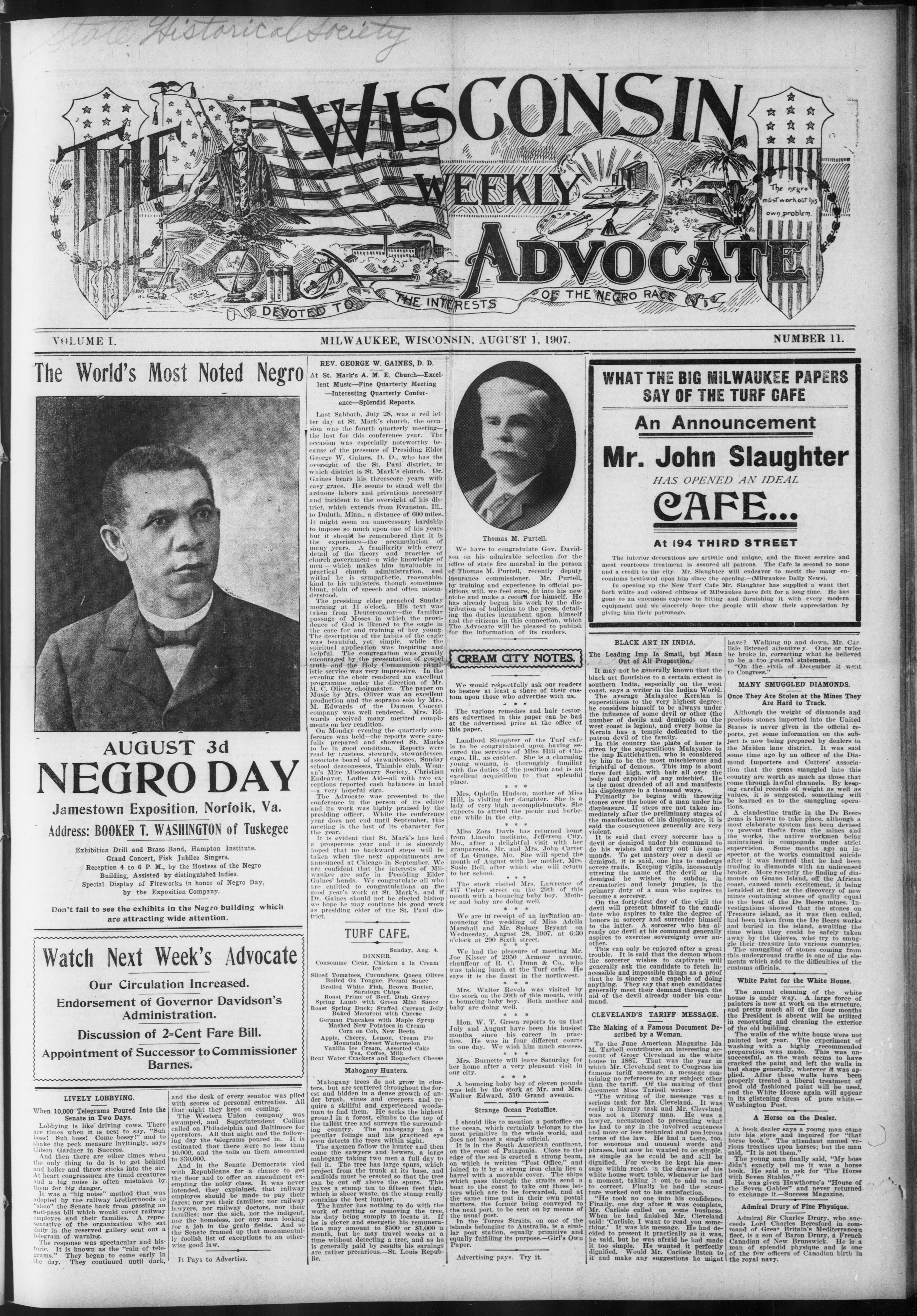
Page text (machine-generated)
WISCONSIN
WEEKLY
The negro
must work out his
own problem.
ADVOCATE
DEVOTED TO THE INTERESTS OF THE NEGRO RACE
The World's Most Noted Negro
AUGUST 3d NEGRO DAY
Exhibition Drill and Brass Band, Hampton Institute. Grand Concert, Fisk Jubilee Singers. Reception 4 to 6 P. M., by the Hostess of the Negro Building, Assisted by distinguished ladies. Special Display of Fireworks in honor of Negro Day, by the Exposition Company.
Don't fail to see the exhibits in the Negro building which are attracting wide attention.
Watch Next Week's Advocate
Endorsement of Governor Davidson's Administration.
Appointment of Successor to Commissioner Barnes.
VOLUME I.
The World's Mo
AUGU
NEGR
Jamestown Expos
Address: BOOKER T. W.
Exhibition Drill and Brass
Grand Concert, Fis
Reception 4 to 6 P. M.,
Building, Assisted by
Special Display of Firew
by the Expo
Don't fail to see the exhibits
are attracting
Watch Next W
Our Circulat
Endorsement of Ge
Adminis
Discussion of 2
Appointment of Succe
LIVELY LOBBYING.
When 10,000 Telegrams Poured Into the Senate in Two Days.
Lobbying is like driving cows. There are times when it is best to say, "Suh boss! Suh boss! Come bossy!" and to shake the peck measure invitingly, says Gilson Gardner in Success. And then there are other times when the only thing to do is to get behind and holler and throw sticks into the air. At heart congressmen are timid creatures and a big noise is often mistaken by them for big danger. It was a "big noise" method that was adopted by the railway brotherhoods to "shoo" the Senate back from passing an anti-pass bill which would cover railway employees and their families. A representative of the organization who sat daily in the reserved gallery sent out a telegram of warning
The response was spectacular and historic. It is known as the "rain of telegrams." They began to come early in the day. They continued until dark,
and the desk of every senator was piled with scores of personal entreaties. All that night they kept on coming. The Western Union company was swamped, and Superintendent Collins called on Philadelphia and Baltimore for operators. All that night and the following day the telegrams poured in. It is estimated that there were no less than 10.000, and the tols on them amounted to $30,000.
And in the Senate Democrats vied with Republicans for a chance to get the floor and to offer an amendment exempting the noisy class. It was never intended, they explained, that railway employees should be made to pay their fares; nor yet their families; nor railway lawyers, nor railway doctors, nor their families; nor the sick, nor the indigent, nor the homeless, nor any man looking for a job in the grain fields. And so the Senate framed up that monumentally foolish list of exceptions to an otherwise good law.
It Pays to Advertise.
MILWAUKEE, WISCONSIN, AUGUST 1, 1907.
REV. GEORGE W. GAINES, D. D.
At St. Mark's A. M. E. Church-Excel lent Music-Fine Quarterly Meeting Interesting Quarterly Conference-Splendid Reports.
Last Sabbath, July 28, was a red letter day at St. Mark's church, the occasion was the fourth quarterly meeting—the last for this conference year. The occasion was especially noteworthy because of the presence of Presiding Elder George W. Gaines, D. D., who has the oversight of the St. Paul district, in which district is St. Mark's church. Dr. Gaines bears his threescore years with easy grace. He seems to stand well the arduous labors and privations necessary and incident to the oversight of his district, which extends from Evanston, Ill., to Duluth, Minn., a distance of 600 miles. It might seem an unnecessary hardship to impose so much upon one of his years but it should be remembered that it is the experience—the accumulation of many years. A familiarity with every detail of the theory and practice of church government—a wide knowledge of men—which makes him invaluable in practical church administration, and withal he is sympathetic, reasonable, kind to his ministers, though sometimes blunt, plain of speech and often misunderstood.
The presiding elder preached Sunday morning at 11 o'clock. His text was taken from Deuteronomy—the familiar passage of Moses in which the providence of God is likened to the eagle in the care for and training of her young. The description of the habits of the eagle was beautiful, yet simple, while the spiritual application was inspiring and helpful. The congregation was greatly encouraged by the presentation of gospel truth and the Holy Communion ritualistic service was very impressive. In the evening the choir rendered an excellent programme under the direction of Mr. M. C. Oliver, choirmaster. The paper on Music by Mrs. Oliver was an excellent production and the soprano solo by Mrs. M. Edwards of the Damon Concern company was well rendered. Mrs. Edwards received many merited compliments on her rendition.
On Monday evening the quarterly conference was held—the reports were carefully prepared and showed St. Marks to be in good condition. Reports were read by trustees, stewards, stewardesses, associate board of stewardesses, Sunday school deaconesses, Thimble club, Woman's Mite Missionary Society, Christian Endeavor, Ladies Aid—all with two exceptions reported cash balances in hand—a very hopeful sign. The Advocate was presented to the conference in the person of its editor and its work was highly praised by the presiding officer. While the conference year does not end until September, this meeting is the last of its character for the year.
It is evident that St. Mark's has had a prosperous year and it is sincerely hoped that no backward steps will be taken when the next appointments are announced at Chicago in September. We are confident that the interests of Milwaukee are safe in Presiding Elder Gaines' hands. We congratulate all who are entitled to congratulations on the good year's work at St. Mark's, and if Dr. Gaines should not be elected bishop we hope he may continue his good work as presiding elder of the St. Paul district.
DINNER.
Consomme Clear, Chicken a la Cream Ice
Sliced Tomatoes, Cucumbers, Queen Olives
Boiled Ox Tongue, Pecanl Sauce
Broiled White Fish, Brown Butter,
Saratoga Chips
Roast Prime of Beef, Dish Gravy
Spring Lamb with Green Mint Sauce
Roast Spring Duck; Stuffed Currant Jelly
Raked Macaroni with Cheese
Mahogany Hunters.
Mahogany trees do not grow in clusters, but are scattered throughout the forest and hidden in a dense growth of under brush, vines and creepers and require a skillful and experienced woodsman to find them. He seeks the highest ground in a forest, climbs to the top of the tallest tree and surveys the surrounding country. The mahogany has a peculiar foliage and his practiced eye soon detects the trees within sight. The axemen follow the hunter and then come the sawyers and hewers, a large mahogany taking two men a full day to fell it. The tree has large spurs, which project from the trunk at its base, and scaffolds must be erected so that the tree can be cut off above the spurs. This leaves a stump ten to fifteen feet high, which is sheer waste, as the stump really contains the best lumber.
The hunter has nothing to do with the work of cutting or removing the tree, his duty being sumply to locate it. If he is clever and energetic his remuneration may amount to $500 or $1,000 a month, but he may travel weeks at a time without detecting a tree, and as he is generally paid by results his earnings are rather precarious.—St. Louis Republic.
[Name]
We have to congratulate Gov. Davidson on his admirable selection for the office of state fire marshal in the person of Thomas M. Purtell, recently deputy insurance commissioner. Mr. Purtell, by training and experience in official positions will, we feel sure, fit into his new niche and make a record for himself. He has already begun his work by the distribution of bulletins to the press, detailing the duties incumbent upon himself and the citizens in this connection, which The Advocate will be pleased to publish for the information of its readers.
We would respectfully ask our readers to bestow at least a share of their custom upon those who advertise with us.
The various remedies and hair restorers advertised in this paper can be had at the advertised price at the office of this paper.
Landlord Slaughter of the Turf cafe is to be congratulated upon having secured the services of Miss Hill of Chicago, Ill., as cashier. She is a charming young woman, is thoroughly familiar with the duties of the position and is an excellent acquisition to that splendid place.
Mrs. Ophelia Hudson, mother of Miss Hill, is visiting her daughter. She is a lady of very high accomplishments. She expects to attend the picnic and barbecue while in the city.
* * *
Miss Zora Davis has returned home from Lincoln institute, Jefferson City, Mo., after a delightful visit with her grandparents, Mr. and Mrs. John Carter of La Grange, Mo. She will spend the month of August with her mother, Mrs. Susie Bell, after which she will return to her school.
* * *
The stork visited Mrs. Lawrence of 417 Cedar street on the 29th of this month with a bouncing baby boy. Mother and baby are doing well.
米 米 米
We are in receipt of an invitation announcing the wedding of Miss Adella Marshall and Mr. Sydney Bryant on Wednesday, August 28, 1907, at 6:30 o'clock at 290 Sixth street.
We had the pleasure of meeting Mr. Joe Kisser of 2950 Armour avenue, chauffeur of R. C. Dunn & Co., who was taking lunch at the Turf cafe. He says it is the finest in the northwest.
Mrs. Walter Revels was visited by the stork on the 30th of this month, with a bouncing baby boy. Both mother and baby are doing well.
* * *
Hon. W. T. Green reports to us that July and August have been his busiest months since his career in practice. He was in four different courts in one day. We wish him much success.
* * *
Mrs. Burnette will leave Saturday for her home after a very pleasant visit in our city.
* * *
A bouncing baby boy of eleven pounds was left by the stork at Mr. and Mrs. Walter Edward. 510 Grand avenue.
Strange Ocean Postoffice
I should like to mention a postoffice on the ocean, which certainly belongs to the most primitive in the whole world, and does not boast a single official.
It is in the South American continent, on the coast of Patagonia. Close to the edge of the sea is erected a strong beam, on which is written "Post Office," and joined to it by a strong iron chain lies a barrel with a movable cover. The ships which pass through the straits send a boat to the coast to take out those letters which are to be forwarded, and at the same time put in their own postal matters, the former being conveyed to the next port, to be sent on by means of the usual post.
In the Torres Straits, on one of the islands belonging to Australia, is a similar post station, equally primitive and equally fulfilling its purpose.—Girl's Own Paper.
Advertising pays. Try it.
WHAT THE BIG MILWAUKEE PAPERS
SAY OF THE TURF CAFE
An Announcement
Mr. John Slaughter
HAS OPENED AN IDEAL
CAFE...
At 194 THIRD STREET
The interior decorations are artistic and unique, and the finest service and most courteous treatment is assured all patrons. The Cafe is second to none and a credit to the city. Mr. Slaughter will endeavor to merit the many encomiums bestowed upon him since the opening.—(Milwaukee Daily News).
In opening up the New Turf Cafe Mr. Slaughter has supplied a want that both white and colored citizens of Milwaukee have felt for a long time. He has gone to an enormous expense in fitting and furnishing it with every modern equipment and we sincerely hope the people will show their appreciation by giving him their patronage.
BLACK ART IN INDIA
It may not be generally known that the black art flourishes to a certain extent in southern India, especially on the west coast, says a writer in the Indian World. The average Malayalee Keralan is superstitious to the very highest degree; he considers himself to be always under the influence of some devil or other (the number of devils and demigods on the west coast is legion), and every house in Kerala has a temple dedicated to the patron devil of the family. In this country the place of honor is given by the superstitious Malayalee to the imp Kuttichathen, who is considered by him to be the most mischievous and frightful of demons. This imp is about three feet high, with hair all over the body and capable of any mischief. He is the most dreaded of all and manifests his displeasure in a thousand ways.
Primarily he begins with throwing stones over the house of a man under his displeasure. If steps are not taken immediately after the preliminary stages of the manifestation of his displeasure, it is said the consequences generally are very violent.
It is said that every sorcerer has a devil or demigod under his command to do his wishes and carry out his commands. To get mastery over a devil or demigod, it is said, one has to undergo severe trails. Keeping vigils, incessantly uttering the name of the devil or the demigod he wishes to subdue, in crematories and lonely jungles, is the primary duty of a man who aspires to become a sorcerer.
On the forty-first day of the vigil the devil will present himself to the candidate who aspires to take the degree of honors in sorcery and surrender himself to the latter. A sorcerer who has already one devil at his command generally aspires to exercise sovereignty over another. This can only be enjoyed after a great trouble. It is said that the demon whom the sorcerer wishes to captivate will generally ask the candidate to fetch inaccessible and impossible things as a proof that he is sincere and capable of doing anything. They say that such candidates generally meet their demand through the aid of the devil already under his command.
CLEVELAND'S TARIFF MESSAGE.
The Making of a Famous Document Described by a Woman.
To the June American Magazine Ida M. Tarbell contributes an interesting account of Groer Cleveland in the white house in 1887. That was the year in which Mr. Cleveland sent to Congress his famous tariff message, a message containing no reference to any subject other than the tariff. Of the making of that document Miss Tarbeil writes:
"The writing of the message was a serious task for Mr. Cleveland. It was really a literary task and Mr. Cleveland was not a literary man. He was a lawyer, accustomed to presenting what he had to say in the involved sentences and more or less technical and ponderous terms of the law. He had a taste, too, for sonorous and unusual words and phrases, but now he wanted to be simple, as simple as he could be and still be dignified. For weeks he kept his message within reach in the drawer of his white house work table, whenever he had a moment, taking it out to add to and to correct. Finally he had the structure worked out to his satisfaction.
"He took no one into his confidence. Finally, one day after it was complete, Mr. Carlisle called on some business. When he had finished Mr. Cleveland said: 'Carlisle, I want to read you something.' It was his message. He had decided to present it practically as it was, he said, but he was afraid he had made it too simple. He wanted it perfectly dignified. Would Mr. Carlisle listen to it and make any suggestions he might
NUMBER 11.
MILWAUKEE PAPERS
TURF CAFE
announcement
Slaughter
AND AN IDEAL
FE...
ORD STREET
and unique, and the finest service and
all patrons. The Cafe is second to none
will endeavor to merit the many en-
pening.—(Milwaukee Daily News).
Mr. Slaughter has supplied a want that
aukee have felt for a long time. He has
and furnishing it with every modern
people will show their appreciation by
have? Walking up and down, Mr. Carlisle listened attentive y. Once or twice he broke in, correcting what he believed to be a too general statement. "On the sixth of December it went
"On the sixth of December it went to Congress."
Once They Are Stolen at the Mines They Are Hard to Track.
Although the weight of diamonds and precious stones imported into the United States is never given in the official reports, yet some information on the subject is now being prepared by dealers in the Maiden lane district. It was said some time ago by an officer of the Diamond Importers and Cutters' association that the gems smuggled into this country are worth as much as those that come through lawful channels. By keeping careful records of weight as well as values, it is suggested, something will be learned as to the smuggling operations.
A clandestine traffic in the De Beers gems is known to take place, although a most elaborate system has been devised to prevent thefts from the mines and the works, the native workmen being maintained in compounds under strict supervision. Some months ago an inspector at the works committed suicide after it was learned that he had been trading in diamonds with an unlicensed broker. More recently the finding of diamonds on Guano Island, off the African coast, caused much excitement, it being heralded at first as the discovery of new mines containing stones of quality equal to the best of the De Beers mines. Investigations showed that the stones on Treasure island, as it was then called, had been taken from the De Beers works and buried in the island, awaiting the time when they could be safely taken away by the thieves, who try to smuggle their treasure into various countries. The smuggling of stones coming from this underground traffic is one of the elements which add to the difficulties of the customs officials.
White Paint for the White House.
The annual cleaning of the white house is under way. A large force of painters is now at work on the structure, and pretty much all of the four months the President is absent will be utilized in renovating and cleaning the exterior of the old building.
The walls of the white house were not painted last year. The experiment of washing with a highly recommended preparation was made. This was unsuccessful, as the wash seems to have cracked the paint and left the walls in bad shape generally, wherever it was applied. After these walls have been properly treated a liberal treatment of good old fashioned paint will be used, and the White House again will appear in its glistening dress of pure white.—Washington Post.
A Horse on the Dealer
A book dealer says a young man came into his store and inquired for "that horse book." The attendant named various treatises upon horses; but the man said, "It is not them."
The young man finally said, "My boss didn't exactly tell me it was a horse book. He said to ask for 'The Horse with Seven Stables.'"
He was given Hawthorne's "House of the Seven Gables" and never returned to exchange it.—Success Magazine.
Admiral Drury of Fine Physique.
Admiral Sir Charles Drury, who succeeds Lord Charles Beresford in command of Great Britain's Mediterranean fleet, is a son of Baron Drury, a French Canadian of New Brunswick. He is a man of splendid physique and is one of the few officers of Canadian birth in the royal navy.
THE WISCONSIN WEEKLY ADVOCATE
MILWAUKEE, WIS.
B. B. MONTGOMERY, Editor and Proprietor.
Humorous Items. To give without offending is an art; to refuse without offending, a greater art.—Fliegende Blaetter.
An Insulting Old Woman.
Overheard at Oxford during Eights Week: Aunt Jane (to gorgeous undergraduate)—And tell me, Roland, did you play in the boat race?—London Globe.
Locked and Bolted.
How's this, Doctor Wiley,
Is your advice good?
Here's a man who has lockjaw
From bolting his food.
—Cleveland Plain Dealer.
Married Man Knew.
"Wonderful," said the professor, "is the strength of the human jaw."
"And," added the married man, "think of its tirelessness!"—Washington Herald
Oh, That This Too, Too, Etc.
Aunt Jane drank quarts of anti-fat
And feels no longer earthly pain.
Not only was it anti-fat
"Twas also anti-Jane.
—New York Evening Sun.
An Evasive Reply.
Philanthropist—What would you say if I were to offer you work? Beggar—I would not be vexed with you. Oh, I can take a joke!—Fliegende Blaetter.
A Sure Thing
"Cremation is good," wrote the little girl in the examination, "because the person might only be in a swoon, and if he is burned he cannot recover."—Brooklyn Life.
Tabooed
Freddie—"Have you told me all the fairy-stories you know, ma?" Mrs. Cobwigger—"Yes, dear; all except the ones your papa tells me."—Harper's Weekly.
Woman's Logic
"Then you won't let me kiss you?" "Certainly not! You mustn't desire such things. Besides, if you did, you wouldn't want to half so much."—St. Louis Republic.
"The payments ain't so hard."
"What terms?"
"A dollar down and a dollar whenever the collector ketches me."—Louisville Courier-Journal.
The Exception to the Rule
Teacher—"The trunk is the middle part of the body." Freddie—"Say, ma'am, you ought to go to the circus and see the elephant." Harper's Weekly.
Under Suspicion.
"His money isn't tainted. He made it out of stocks."
"No, he made it out of the water in the stocks, and it wasn't pure water."—Philadelphia Leader.
Shameful Deception
"I understand that old Gobsa Golde deceived Dolly dreadfully about his age."
"Yes. He told her before they were married that he was 82, and here it turns out that he is only 65."
Malicious Husband
She—Did my voice fill the salon, at the musical?
He—Apparently—and the dining-room and smoking-room, too, as evedyone fled there!—I Motto per Ridere.
A Fallacv.
She—Those white shoes of yours squeak. I bet they are not yet paid for. He—Oh, there's nothing in that superstition, or why don't these white flannels and this Panama hat squeak, too?
Woman's Way.
"What an actress that woman is! She pretends to be glad to see me." "But you were a match for her?" "Indeed, yes! I pretended to be just as glad to see her."—Washington Herald.
Quit Even.
Ouit Even.
Tommy—Ma, Willie Jones sez he saw—Mother—Hush! Tommy, you interrupted me while I was speaking. Tommy—We'l, ma, you jest int'rupted me, so we're even.—Philadelphia Press.
In the Current.
Dolly has a bathing suit
Very short and very cute—
Shows a lot of stocking!
Queer sort of material—
"Electric silk," she says they call
It—because it's shocking.
A Mistaken Ouotation.
Husband (sighing)—She gave me her hand yesterday, and promised that she would try to control her temper, and today she threw me downstairs! "Frailty, thy name is woman!"—Fliegende Blaetter
Fixed Styles.
Snake-I notice Mr. Leopard is wearing those ugly old polka dots, although stripes are the fashion this summer.
Citing a Case.
Olive—Do you believe that the quicklunch-counter habit has a bad effect on the heart?
Violet—It had on Tom's heart. He fell in love with a pretty waitress.—Smart Set.
Great Expectations
The Senior Partner—Today is your birthday, isn't it. Herr Meij?
Chief Clerk—(expectantly)—Yes sir. "Well don't come half an hour late tomorrow, as you did last year!"—Meggendorfer Blaetter.
Defiant.
"My girl, you must cultivate a meeker spirit. Don't you wish to go to heaven?" "Yes; but I don't want no angel starin' at me through no lorgnette."—Louisville Courier-Journal.
Ominous
If Taft Knox Root and Fairbank scales
The height his doom is sealed,
For with a Cannon we will sweep
His whole Foraker field;
'Twill be no Hughes for him to hide,
His ley calm will melt,
And when beneath a Bryany tide
He'll know how Rosa felt.
—New York Times.
HOME AFTER WORK.
Dynamo music all day
Throbbing its volts through the brain
Throbbing its dirges of Pain,
Its music of world-work and strain,
Dying and dying away
When twilight is gray!
Song or incessant turmoil,
Hunt of the golden spoil,
Music that sways and reels,
Music one hears not, but feels!
Glittering vision of glories,
Streets and crowds and the calls,
Streets and crowds and the halls,
The sun-flashing windowed walls,
Man-builted, stories on stories.
Sublime promontories!
And now at home in my chair,
The golden day pours like a sea
And peace floats into the heart—
All day in the crowd I was hurled.
By the crowd was my soul unfurled.
I helped in the work of the world.
I played my part, my part—
Of power of peace in the heart.
Eternal peace in the heart!
—St. Louis Times
LIFTED SHADOWS.
No finer man than young Donald Carmichael could have been found between Land's End and John o' Groats. He was what the Irish would have called "a broth av a bhoy," the Scotch, "a "braw laddie;" the English, "a strapping young fellow."
Six feet three in his socks, broad in proportion, lithe and clean-limbed, straight as a lance, he went far to merit the description. And he was as handsome as he was big. His face was large and open, no single feature marring the harmony of the whole. Many a bonnie lassie's heart beat faster when Donald Carmichael went by.
But there was a shadow on young Donald's life, against which his gifts of face and physique went for naught. He was a stammerer. His affliction was not of that mild form, commonly met with, which is capable of being controlled, and is accounted no great disadvantage. The malady had visited him in its most virulent form. He was able to form a sentence only with the greatest difficulty, after repeated attempts. Even this was beyond him upon frequent occasions. The smallest experience outside the routine of his restricted life reduced him to absolute incoherence.
And Donald was shy, sensitive and proud. His disability spoiled his life. It made him a conrmed recluse, hating society, hugging solitude. And that is why we find him in this lonely lighthouse on the northeast coast of Scotland. That is why he had adopted a calling which appealed only to men such as old Tammas, who was predestined for the work, his father, grandfather and great-grandfather having been keepers before him.
Tonight Donald was strangely restless. A peculiar mood was upon him; he was fanciful, imaginative, apprehensive. He had an uneasy sense of impending calamity. Anything might happen on a night like this!
What was that? A cry of distress, or only the shriek of the wind? Donald looked with straining eyes out into the brooding night. Surely that was a schooner? He seemed to desry it struggling through the storm, reeling and tottering, like a wounded elk with merciless dogs at its haunches. Then a sudden impact of water driven by the fierce wind against the windows of the lighthouse made vision impossible. When the ensuing lull occurred nothing was visible on the face of the deep, so Donald concluded that the laboring schooner had been a figment of his imagination.
Toward dawn the storm abated in fury, and a more comfortable state of mind came to the watcher. He looked toward the distant horizon with the pall of cloud changed from black to a sullen gray, developing by imperceptible gradations into a fixed luminous purple. Then he extinguished the lights. His eyes, roving once more over the limitless expanse of ocean, suddenly altered their direction and looked sheer down at the rugged rocks which constituted the base of the lighthouse.
What he saw there brought swift expression to his eyes—of alarm, astonishment, incredulity, startled awe. Prone on the rocks, a few bare inches' purchase from the lapping water, was a human form. Donald concentrated his vision, but was unable to tell whether it was man or woman, boy or girl; nor dared he hazard a guess whether the poor soul was alive or dead.
He quickly roused old Tammas, and together they descended to the rocks below. Both stood for a brief moment inactive, silently regarding the body which had escaped from the clutches of the sea.
"Twas a maiden in the first access of young womanhood—of some eighteen or nineteen summers may be. She was very beautiful to look upon.
Was that the pallid hue of death on her cheek? No; she still breathed. A half-sob escaped from Donald's throat—his heart was very tender.
"Puir bit lassie!" said Tammas.
"Some puir mither will greet sair the nicht. Help me wi' her, Donal'. Puir bit lassie!"
Her waist was encircled by a life-belt —though insensible, she was still clasping it. They gently disengaged her fingers and bore her to the one bedroom of the tower. Donald tumbled the belongings of himself and Tammas to the storeroom below. For three long days they fought for the girl's life. No woman could have been more tender than were these two rough men. Strange emotions welled up in Donald's breast, and ere long the labor for him had become one of love.
With joy they watched the color stealing covertly into the face of their patient, and on the fourth day their work was completed. The crisis was past, the danger gone; the girl was saved
It was 3 o'clock one boisterous afternoon when she opened her eyes and for the first time was able intelligently to apprise her surroundings. She looked around her, marveling greatly. Then she remembered the storm, the wreck, her struggle with the waves. So she had been rescued; by whose hands she did not know. Then Donald came. He stopped short on the threshold. If the girl had been desirable before, what was she now, her face lighted up by
beautiful eyes, smiles trembling on her lips, her whole self sweet and appealing.
lips, her whole self sweet and appealing. Donald walked to the bedside. A torrent of words rushed to his lips. Then—he remembered his terrible affliction; he had forgotten it for the moment. The words were unuttered; his lips closed like a vise. Oh, she must not know—she must not know! He could not bear it. Heaven help him to keep his secret from her! Intuition told the girl that Donald was her rescuer. She did not speak, but suddenly a rich red color flooded her cheeks, and with an impulsive-gesture she seized his hand and pressed it to her lips. He snatched his hand away and rushed from the room.
Presently old Tammas shambled in. Donald had sent him in to hear the girl's story and learn her behests. Tammas was with her half an hour or more. When he came out of the bedroom there was a look of perplexity on his face.
"Puir bit lassie!" he soliloquized. "I'll keep her secret, gin I can, bit I sair misdoot my abeelity. Theimmer's got thochts o' Donal,' an' disna want him tae knaw. She na minds me knawin'—I dinna coont. But fine I'm o' the opeenion Donal' will no' be owre lang findin' oot the truth."
Later in the afternoon, however, Tammas had food for further reflection.
"Weel, that cowes a'. Fust, I maun keep bit lassie's secret, an' noo I maun keep Donal's."
He scratched his pate in perplexity. Then a sudden thought struck him, causing him to chuckle long and loudly.
"Michty, they'll keep yin anither's secrets."
During ensuing days the lighthouse was a different place to Donald. The presence of the girl seemed to have shed a tranquil sweetness over everything. Even the storerooms and kitchen were different. There was an intangible atmosphere about them which awed him, and caused him to tread softly.
A new land was opening out before his gaze, beautiful and enchanting. A beckoning finger bade him enter it. But he held back; to him it was a forbidden land. Was he always to abide under the shadow of his hateful affliction?
Meanwhile, there was one thing about the girl which puzzled him sorely. This was her absolute avoidance of him. Albeit he had registered a vow always to keep at a distance from her, he had scarce thought that circumstances would so aptly fall in with his desires. He marveled often. The girl, too, was puzzled, and many were the wistful glances which she cast in Donald's direction. She would not have him by her side, and yet—yet—why did he stay away!
"Donal', Donal', the pains i' the sma' o' my back ha' a' gane awa', an' I ken we'll sune ha' a gey muckle o' bonnie weather. Mon, tak' this glass an' lookit owre alang thae shore. The laddies are aye pittin' a boat oot to sea, or I'm a senner."
Donald clapped the glass to his eyes, and an involuntary groan escaped his lips. His worst fears were realized. He watched the advancing boat like one fascinated. Tammas stumbled down the stairs to put a few things together.
Suddenly Donald heard a footstep on the stair, lighter than that of Tammas, and, turning, he saw the girl, who now had made a place forever in his life and memory.
He looked at her hungrily, curiously conscious of every detail about her—her slim, supple figure, sweet face, gleaming eyes, and wealth of beautiful brown hair. Never had she appeared fairer, more desirable to him, than at this moment.
And the boat was coming which would bear her away. Henceforth their ways might lie widely apart. Perchance his eyes would never more behold her.
He could not bear the thought. In a moment he had forgotten everything save his great love. He was by the girl's side, holding both her hands, looking into her eyes (which held an expression he could not fathom), pouring forth his burning passion.
At length he paused, a choking sensation in his throat. The girl made no answer. Whence came that look in her eyes? He had seen it before in a seagull lying behind a boulder with a broken wing.
He looked at her, amazed. Then the pain in her eyes was blotted out by blinding tears. She drew from her bosom a scrap of paper and a pencil, and, hastily writing a few words, thrust the paper into Donald's hand.
He read in a haze:
"Poor Greta is deaf and dumb, and, alas! cannot understand your words."
A lump rose in Donald's throat. But soon a great joy surged over him. Underneath the simple message he inscribed these words: "Donald loves you!" and gave back the paper to the girl.
A burning blush leapt into her cheeks. She shyly raised her sweet eyes, and in their limpid depths. Donald saw the light of heaven shining.
The shadow had lifted. A love had come to them both, requiring neither speech nor language to express it.
At this moment a shock of red hair appeared above the plane of the lightroom floor. Old Tammas took in the situation, and shook his head sorrowfully.
"I'm no' wanted here," he said, and forthwith descended to the storeroom to fortify himself with a wee drappie against the next appearance of the pains in the sma' o' the back.—H. G. MacLaurin in Pearson's Weekly.
Electricity in the Sick-Room
In this day of scientific study of the laws of health and of deep research to overcome the fatalities and sufferings of disease, electricity takes no insignificant part.
In the hospital of the modern type the rooms are heated with an electrical luminous radiator, which does not vitiate the air; the cooking is prepared in electrically heated utensils, and the work about the buildings is accomplished with the aid of electric power. Then, too, there are the electric lights, ventilators, the cooling fans and the impatient telephone. The electrotherm, or heatingpad, displaces the old hot packs. The surgeon prepares his instruments in the new electrical sterilizer. A powerful magnet is used to assist in extracting pieces of steel from the eyes of patients. The electric batteries are of great assistance to paralytics, and the electrical vibrator is beneficial to skin, muscles and body. A device has even been invented in which, it is said, an electric current takes the place of ether and lulls the sufferer into insensibility while an operation is being performed. The baby milk warmer and electric water heaters are also useful adjuncts to the sick-room.
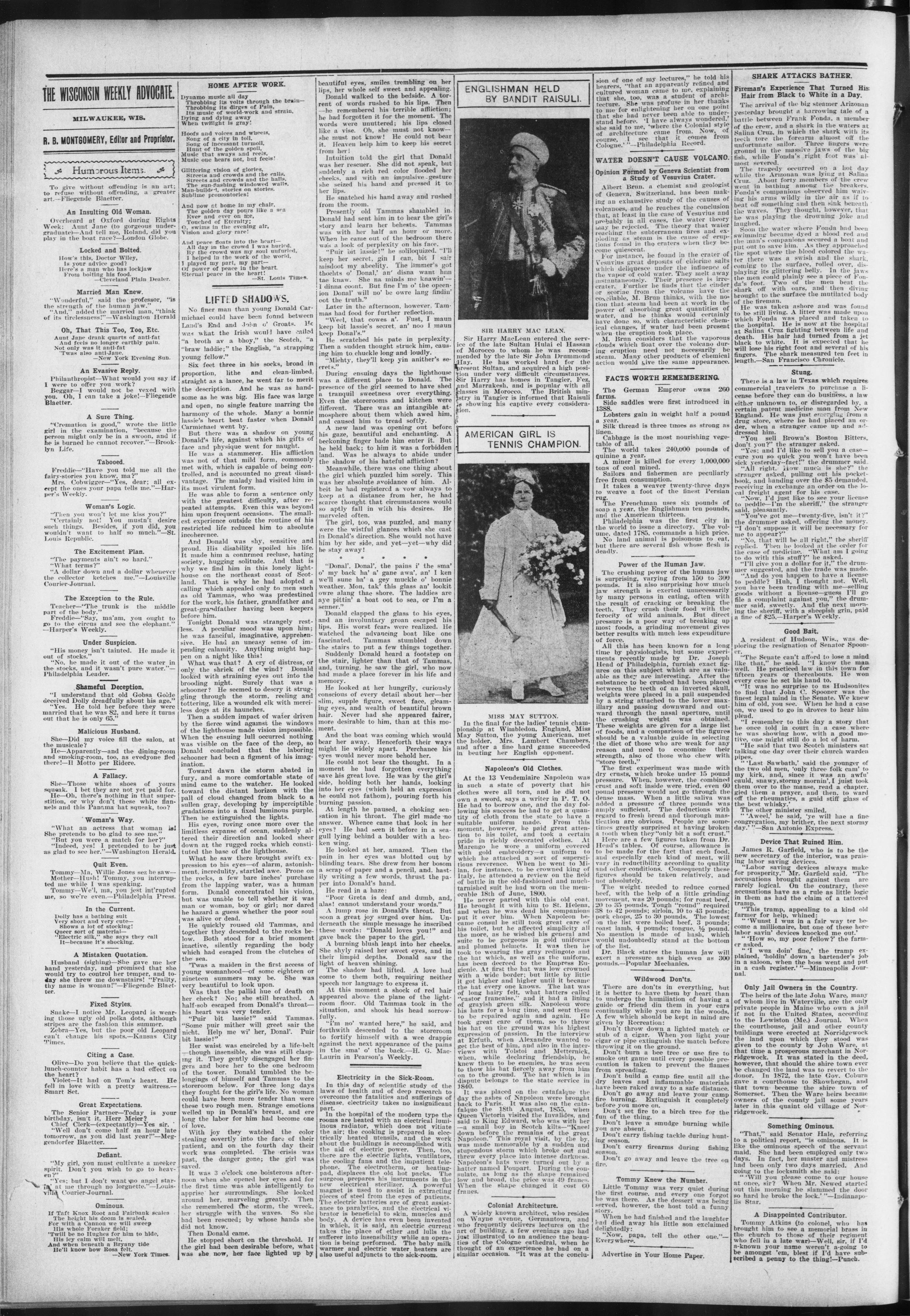
ENGLISHMAN HELD BY BANDIT RAISULI.
SIR HARRY MAC LEAN.
Sir Harry MacLean entered the service of the late Sultan Hulai el Hassan of Morocco to whom he was recommended by the late Sir John Drummond Hay. He has worked hard for the present Sultan, and acquired a high position under very difficult circumstances. Sir Harry has homes in Tangier, Fez, and Marrakesh, and is popular with all classes in Morocco. The British ministry in Tangier is informed that Raisuli is showing his captive every consideration.
1
MISS MAY SUTTON. In the final for the ladies' tennis championship at Wimbledon, England, Miss May Sutton, the young American, met the holder, Mrs. Lambert Chambers, and after a fine hard game succeeded in beating her English opponent.
Napoleon's Old Clothes.
At the 13 Vendemiaire Napoleon was in such a state of poverty that his clothes were all torn, and he did not own a sword, says a writer in P. T. O. He had to borrow one, and the day following his success he had to get a quantity of cloth from the state to have a suitable uniform made. From this moment, however, he paid great attention to his toilet, and took a certain pride in richly decorated clothes. At Marengo he wore a uniform covered with gold embroidery—a uniform to which he attached a sort of superstitious reverence. When he went to Milan, for instance, to be crowned king of Italy, he attended a review on the field of battle in the old-fashioned and much-tarnished suit he had worn on the memorable 18th of June, 1800.
He never parted with this old coat. He brought it with him to St. Helena, and when he was dead his companions put it over him. When Napoleon became consul he still took great care of his toilet, but he affected simplicity all the more, as he wished his general and suite to be gorgeous in gold uniforms and plumed helmets. It was then he took to wearing the gray redingote and the hat which, as well as the uniform, has been decreed to the Empress Eugenie. At first the hat was low crowned with a wide border; but little by little it got higher and higher until it became the hat every one knows. The hat was of long hairy felt, what hatters called "castor française," and it had a lining of grayish green silk. Napoleon wore his hats for a long time, and sent them to be repaired again and again. He took great care of them, so to throw his hat on the ground was his highest expression of passion. In the interview at Erfuth, when Alexandre wanted to get the best of him, and also in the interviews with Tolstoi and Metternick, when, while declaring friendship, he knew them to be enemies, he was seen to throw his hat fiercely away from him on to the ground. The hat which is in dispute belongs to the state service in 1840.
It was placed on the catafalque the day the ashes of Napoleon were brought back to Paris. It was also on the catafalque the 18th August, 1855, when Queen Victoria visited the Invalides, and said to King Edward, who was with her—a small boy in Scotch kilts—"Kneel down before the remains of the great Napoleon." This royal visit, by the by, was made memorable by a sudden and stupendous storm which broke out and threw every place into intense darkness. Napoleon's hats were turned out by a hatter named Poupart. During the consult, as long as the shape remained low and broad, the price was 49 francs. When the shape changed it cost 60 francs.
Colonial Architecture
A widely known architect, who resides on Wayne avenue, Germantown, and who frequently delivers lectures on the art of building, a few evenings ago had just illustrated to an audience the beauties of the Cologne cathedral, when he thought of an experience he had on a similar occasion. "It was at the conclu-
sion of one of my lectures," he told his hearers, "that an apparently refined and cultured woman came to me, explaining that she, too, was a student of architecture. She was profuse in her thanks to me for enlightening her on one point that she had never been able to understand before. 'I have always wondered,' she said to me, 'where the Colonial style of architecture came from. Now, of course, I see that it comes from Cologne.'"—Philadelphia Record.
WATER DOESN'T CAUSE VOLCANO
Opinion Formed by Geneva Scientist from a Study of Vesuvius Crater. Albert Brun, a chemist and geologist of Geneva, Switzerland, has been making an exhaustive study of the causes of volcanoes, and he reaches the conclusion that, at least in the case of Vesuvius and probably in all cases, the water theory may be rejected. The theory that water reaching the subterranean fires and exploding as steam is the cause of eruptions found in the craters when they become quiescent.
For instance, he found in the crater of Vesuvius great deposits of chlorine salts which deliquesce under the influence of the vapor of cold water. They melt away instantaneously. Their presence is irrecrater. Further he finds that the cinder or scoriae from the volcano have the coexilable, M. Brun thinks, with the notion that steam had been at work in the power of absorbing great quantities of water, and he thinks would certainly have done so, with characteristic chemical changes, if water had been present when the eruption took place. M. Brun considers that the vaporous clouds which float over the volcano during eruption need not necessarily be steam. Many other products of chemical action would give the same appearance.
FACTS WORTH REMEMBERING
The German Emperor owns 260 farms.
Side saddles were first introduced in 1388. Lobsters gain in weight half a pound a year.
Silk thread is three times as strong as linen. Cabbage is the most nourishing vegetable of all. The world takes 240,000 pounds of quinine a year.
A miner is killed for every 1,000,000 tons of coal mined.
Sailors and fishermen are peculiarly free from consumption. It takes a weaver twenty-three days to weave a foot of the finest Persian rug. The Frenchman uses six pounds of soap a year, the Englishman ten pounds, and the American thirteen. Philadelphia was the first city in the world to issue a directory. The volume, dated 1785, commands a high price. No land animal is poisonous to eat, but there are several fish whose flesh is deadly.
Power of the Human Jaw
The crushing power of the human jaw is surprising, varying from 150 to 300 pounds. It is also surprising how much jaw strength is exerted unnecessarily by many persons in eating, often with the result of cracking or breaking the teeth. They crush their food with the ferocity of wild animals. But direct pressure is a poor way of breaking up most foods, a grinding movement gives better results with much less expenditure of force.
All this has been known for a long time by physiologists, but some experiments recently made by Dr. Joseph Head of Philadelphia, furnish exact figures on this subject which are as valuable as they are interesting. After the substance to be crushed had been placed between the teeth of an inverted skull, weights were placed in a pail suspended by a string attached to the lower maxillary and passing downward and outward through the nasal aperture, until the crushing weight was obtained. These weights are given for a large list of foods, and a comparison of the figures should be a valuable guide in selecting the diet of those who are weak for any reason and need to economize their strength, also of those who chew with "store teeth."
The first experiment was made with dry crusts, which broke under 15 pound pressure. When, however, the combined crust and soft inside were tried, even 60 pound pressure would not go through the dense mass. When a little saliva was added a pressure of three pounds was amply sufficient. The deductions with regard to fresh bread and thorough mastication are obvious. People are sometimes greatly surprised at having broken a tooth when they "only bit a soft crust." Here are a few figures taken from Dr. Head's tables. Of course, allowance is to be made for the fact that each food, and especially each kind of meat, will vary in reductibility according to quality and other conditions. Consequently these figures should be taken relatively, and not absolutely.
The weight needed to reduce corned beef, with the help of a little grinding movement, was 20 pounds; for roast beef, 20 to 35 pounds. Tough "round" required 38 to 42 pounds; sirloin, 10 to 43 pounds; pork chops, 25 to 30 pounds. The lowest on the list were boiled beef, 3 pounds; roast lamb, 4 pounds; tongue, $ \frac{1}{2} $ pound. No mention is made of hash, which would undoubtedly stand at the bottom of the list.
Dr. Black states the human jaw will exert a pressure as high even as 300 pounds.—Popular Mechanics.
Wildwood Don'ts.
There are don'ts in everything, but it is better to have them by heart than to undergo the humiliation of having a guide or friend din them in your cars continually while you are in the woods. A few which should be kept in mind are given by Recreation:
Don't throw down a lighted match or stub of a cigar. When you light your cigar or pipe extinguish the match before throwing it on the ground.
Don't burn a bee tree or use fire to smoke out game until every possible precaution is taken to prevent the flames from spreading.
Don't build a camp fire until all the dry leaves and inflammable materials have been raked away to a safe distance.
Don't go away and leave your camp fire burning. Extinguish it completely before you move on.
Don't set fire to a birch tree for the fun of the thing.
Don't leave a smudge burning while you are absent.
Don't carry fishing tackle during hunting season.
Don't carry firearms during fishing season. Don't go away and leave the tree on fire.
Tommy Knew the Number
Little Tommy was very quiet during the first course, and every one forgot he was there. As the dessert was being served, however, the host told a funny story.
When he had finished and the laughter had died away his little son exclaimed delightedly:
"Now, papa, tell the other one."—Everywhere.
Advertise in Your Home Paper.
SHARK ATTACKS BATHER.
Fireman's Experience That Turned His Hair from Black to White in a Day.
The arrival of the big steamer Arizonan yesterday brought a harrowing tale of a battle between Frank Fonda, a member of the crew, and a shark in the waters at Salina Cruz, in which the shark with its teeth tore the forearm almost off the unfortunate sailor. Three fingers were ground in the massive jaws of the big fish, while Fonda's right foot was almost severed.
The tragedy occurred on a hot day while the Arizonan was lying at Salina Cruz. About forty members of the crew went in bathing among the breakers. Fonda's companions observed him waiving his arms wildly in the air as if to beat off something and then sink beneath the waves. They thought, however, that he was playing the drowning joke and laughed.
Soon the water where Fonda had been swimming became dyed a blood red and the man's companions secured a boat and put out to save him. As they approached the spot where the blood colored the water there was a swish and the shark, coming to the surface, rolled over, displaying its glittering belly. In the jaws the men could plainly see a piece of Fonda's foot. Two of the men beat the shark off with oars, and then diving brought to the surface the mutilated body of the fireman.
He was taken ashore and was found to be still living. A litter was made upon which Fonda was placed and taken to the hospital. He is now at the hospital at Salina Cruz fighting between life and death. His hair had turned from a jet black to white. It is expected that he will lose his right foot and several of his fingers. The shark measured ten feet in length.—San Francisco Chronicle.
Stung.
There is a law in Texas which requires commercial travelers to purchase a license before they can do business, a law either unknown to, or disregarded by, a certain patent medicine man from New England. He was just emerging from a drug store, where he had placed an order, when a stranger came up and addressed him.
"You sell Brown's Boston Bitters, don't you?" the stranger asked.
"Yes; and I'd like to sell you a case—cure you so quick you won't have been sick yesterday--fact!" the drummer said.
sick yesterday—fact, the drummer said.
"All right. How much is she?" the stranger asked, pulling out his pocket-book, and handing over the $5 demanded, receiving in exchange an order on the local freight agent for his case.
"Now, I'd just like to see your license to peddle—I'm the sheriff," the stranger said, pleasantly.
"You've got me—twenty-five, isn't it?" the drummer asked, offering the money.
"I don't suppose it will be necessary for me to appear?"
"No, that will be all right," the sheriff replied. Then he looked at the order for the case of medicine. "What am I going to do with this stuff?" he asked.
"I'll give you a dollar for it," the drummer suggested, and the trade was made. "And do you happen to have a license to peddle? Huh. I thought not. Well, you have been trading with me—selling goods without a license—guess I'll go file a complaint against you," the drummer said, sweetly. And the next morning the sheriff, with a sheepish grin, paid a fine of $25—Harper's Weekly.
Good Bait.
A resident of Hudson, Wis., was deploring the resignation of Senator Spooner.
"The Senate can't afford to lose a mind like that," he said. "I know the man well. He practiced law in this town for fifteen years or thereabouts. He won every case he set his hand to.
"It was no surprise to us Hudsonites to find that John C. Spooner was the finest legal mind in the Senate. We knew him of old, you see. When he had a case on, we used to go in droves to hear him plead.
"I remember to this day a story that he once told in court in a case where he was showing how, with a good motive, one might still do a lot of harm.
"He said that two Scotch ministers sat talking one day over their church warden pipes.
'Last Sawbath,' said the younger of the two old men, 'only three folk cam' to my kirk, and, since it was an awfu' cauld, snawy, stormy mornin', I juist took them over to the manse, read a chapter, gied them a prayer, and then, to ward off the rheumatics, a guild stiff glass of the best whisky.'
The other minister smiled.
“‘Aweel,’ he said, 'ye will hae a fine congregation, my brither, the next stormy day.'”—San Antonio Express.
Device That Ruined Him
James R. Garfield, who is to be the new secretary of the interior, was praising labor saving devices. "Labor saving devices always make for prosperity," Mr. Garfield said. "The accusations brought against them are rarely logical. On the contrary, these accusations have as a rule as little logic in them as had the claim of a tattered tramp.
"This tramp, appealing to a kind old farmer for help, whined: 'Wunst I wuz in a fair way ter become a millionaire, but one of these here herer goril' dances, knocked me out."
"‘I wuz doin' fine,' the tramp explained, 'holdin' down a bartender's job in a saloon, when the boss went and put in a cash register.'"—Minneapolis Journal.
Only Jail Owners in the Country
The heirs of the late John Ware, many of whom live in Waterville, are the only private people in Maine who own a jail if not in the United States, according to the Lewiston (Me.) Journal. When the courthouse, jail and other county buildings were erected at Norridgewock the land upon which they stood was given to the county by John Ware, at that time a prosperous merchant in Norridgewock. It was stated in the deed, however, that should the shire town ever be changed the land was to revert to the donor. In 1872, the late Gov. Coburn gave a courthouse to Skowhegan, and that town became the shire town of Somerset. Then the Ware heirs became owners of the county jail some years later in this quaint old village of Norridgewock.
Something Ominous.
"That," said Senator Hale, referring to a political report, "is ominous. It is like the ominous speech of the servant maid. She had been employed only two days. In fact, her master and mistress had been only two days married. And going to the locksmith she said:
"Will you please come to our house at once, sir? When Mr. Newed started out this morning he slammed the door so hard he broke the lock.'"—Indianapolis Star.
A Disappointed Contributor
Tommy Atkins (to colonel, who has brought him to see a memorial brass in the church to those of their regiment who fell in a late war)—Well, sir, if I'd a-known your name weren't a-going to be amongst 'em, blest if I'd have subscribed a penny to the thing!—Punch.
GOSSIP FOR THE LADIES.
Love's Perfect Speech
How often have I thought that when you came
Some unexpected moment to my door—
As you have come a thousand times before,
Your tender eyes alight, your cheeks aflame,
To welcome and be welcomed in love's name—
The words would come at last and I should pour
But oh, 'tis not in outward sign we reach Our highest flight, or find ourselves expressed, But rather in the cloistered hour when each To each draws near in confidence and rest. As Love in silence seeks her perfect speech, So I am silent when I love you best. HELEN A. SAXON
A Well Spent Life.
Every person born is possessed of a God-given gift. To find that gift or talent, to develop it full and to use it unselfishly in the general cause—that is a well-spent life. It may be the power of alleviating the sufferings of others; it may be the ability to uplift others from the darkness of ignorance to open their eyes to a sense of appreciation of the beauties of this wonderful world we inhabit, or it may be that greatest of all-gifts—the knack of bringing happiness and cheer into hearts burdened to despondency.—J. Francis Carroll.
When Traveling
In repeated experiences with the New York custom house. I have discovered one thing which may be of use to less experienced travelers. It is this: if one is going abroad for a short trip and wishes to buy clothing and souvenirs, it is wise to lay aside the bills for everything bought, at the time of purchase. Before reaching port, make a list of what you have with the price attached and present the list and the bills to the inspector. It is most embarrassing to have the contents of one's trunk turned out on the dock—as is sometimes done—because unable to state exactly what has been purchased and how much it has cost. With a list, an inspector generally looks at one or two articles and if they correspond to the bills, the trunk will be passed at once.—Good Housekeeping.
Questions for Boys and Girls.
If you are good at guessing or answering, here are a few questions you can wrestle with: You can see any day a white horse, but did you ever see a white colt? How many different kinds of trees grow in your neighborhood, and what are they good for? Why does a horse eat grass backward and a cow forward? Why does a hop vine wind one way and a bean vine the other? Where should a chimney be the larger, at the top or bottom, and why? Can you tell why a horse when tethered with a rope always unravels it, while a cow always twists it into a kinky knot? How old must a grape vine be before it begins to bear? Can you tell why leaves turn inside down just before a rain? What wood will bear the greatest weight before breaking? Why are all cowpaths crooked?—Wesleyan Advocate.
Why Co-operative Housekeeping Fails.
In the July number of Harper's Bazar, Mrs. Charlotte Perkins Gilman asks, "Why does co-operative housekeeping fail?" and then brilliantly answers her own question. She says, among other things: "Here is the position.
"The human race is gradually evolving a system of monogamous marriage; our own recent stock, liberally called the Anglo-Saxon,' has maintained it for some time. "Monogamous marriage and the family life going with it have been proved to be the best means of rearing children yet practiced, and also the most conducive to personal happiness in the parties concerned. This form of family requires for its maintenance a home, a place to live in by itself. All this we commonly believe and we are right.
"But what we do not understand—the great body of us—is that the work done in and for the home is no real part of that home. and may be quite as well done, even far better done, by other persons, in other places. And what the cooperator does not understand is that while the work may very properly be organized, the families may not.
"This is the whole secret of the failure of co-operative housekeeping. It does not go far enough. It still assumes that this work must be done by the family, and as it is proven difficult and expensive for a family to do it alone, therefore it will be easier and cheaper for families to do it together.
"Here is where the principle is wrong and therefore sure to fail in practice."
Self-supporting Women.
One woman out of every five in this country is a bread-winner, according to an official report by the census bureau at Washington. In continental United States—by which is meant United States exclusive of Alaska, Hawaii, and other outlaying territorial possessions—there are 23,485,559 women over 16 years of age. Of this number, 4,833,630 are bread-winners. This vast army of women workers is divided into 294 occupations, of which there are 125 occupations employing more than 1000 women. There are some women following odd occupations, for women, in which they make a bold invasion into the domain of male bread-winners. For instance the census shows that there are 2 women who are street railway motormen, 5 ocean and river pilots, 10 baggagemen, 31 brakemen, 45 locomotive engineers and firemen, 26 switchmen and flagmen, 43 hack drivers, 6 ship carpenters, 2 roofers and slaters, 185 blacksmiths, 508 machinists, 8 boiler makers, 11 well borers. Of the 303 occupations followed by male bread winners, all but nine have been adopted by women. Of course the largest number of women bread-winners is the domestic servant numbering 1,124,383, with farm laborers next in number, 456,405. Dressmakers, laudresses and teachers follow closely in the order named, in number. Everything indicates that women will continue to invade the avocations once considered as man's exclusive domain. Once their entrance into business life was considered a menace, but if they were to be eliminated at this time, it would result in paralyzing business. Probably the principal attraction to induce women to enter business life, is the idea of independence and freedom—escape the restraint and confinement of home—and which seems to be a vital, living spark in everything in nature, inanimate as well as animate, and which no thongs are ultimately able to restrain. What the result will be on the home and society, no one can even guess, yet it is a matter of grave concern.—Cooking Club Magazine.
Summer Comfort.
For people who live out of the city during the summer months a piazza is easily fixed to be as another and general living room, and with no effort one can have out-of-door life even on the warmest day. This is done simply by putting out comfortable chairs, several tables
of different sizes, a hammock, of course, and one or more rugs, according to the dimensions of the porch. These floor coverings should be of material that does not fade or is not harmed by rain. In my opinion no piazza is to be considered approaching the ideal unless it has awnings. These not only keep off the sun, but they serve also the important purpose of foiling prying eyes and make retired what would otherwise be too public on some houses near the street.
Next in importance to awnings are the chairs, and, above looks even, must they be comfortable. I like at least one steamer chair; it allows one to rest so completely and looks so easy. Next to these are rockers, straw preferably, but if these are not possible wooden ones may be made to look very well by painting them white.
Near several of the chairs should be tables. These are needed for books, work and jars of flowers, for the latter should always be in evidence, and field blossoms are as decorative as cultivated ones.
A low stand makes variety among the furnishings, and is a convenient place for a glass of lemonade.
The best effects in furnishing a piazza are had on those which are almost square in proportion. A long one presents difficulties of angularities, but even these may be overcome if the chairs are so arranged as to be in groups, each with its table or stand.
A house in which there are small children is greatly improved by a small porch that may be turned into a playroom. Here the little ones should be allowed to have their toys and reign supreme, and at the same time the noise and confusion is kept from the main piazza reserved for the grown-ups.
Cooling Drinks Without Liquor
Not the temperance folk alone but many of those who do not object to wines and liquors in the cold weather find summer drinks made from fruit and water more cooling and therefore more desirable. Novelty is always in demand and the few recipes given will be found to meet both requirements.
Tea Punch. While fresh fruits are always preferable, canned berries and pineapple may be substituted. Steep two generous teaspoonfuls of tea in two quarts of water for five minutes. Then strain and add one pound of lump sugar, stirring until thoroughly dissolved. Grate the peel of eight good-sized lemons and extract ail the juice. Cut three oranges into slices, shred one pineapple, slice five bananas very thin, and hull one pint of strawberries. When the tea is cold, add all the fruit and let stand in the refrigerator for several hours. Place a cube of ice in the punch bowl, pour the mixtures around it, when chilled serve in punch glasses. To get the best results from the pineapple, peel and remove the eyes, tear apart with a silver fork, reject the cores, sprinkle with sugar, and let it stand on the ice for twelve hours.
A French Punch.—The French are noted for their delicate and delicious drinks. A favorite kariesian recipe calls for five pounds of raisins, five pounds of dried apples, and five gallons of water. Put all together in a small earthern jar and let stand uncovered for three days, stirring occasionally from the bottom. At the end of that time bottle with half a teaspoonful of sugar and a stick of cinnamon in each bottle. Cork tightly and store in a cool place. The fruits having fermented, the drink will keep for a considerable length of time and is really delicious when served cold. It is claimed that over 50,000,000 gallons of this punch were drunk in France in a single year.
Iced Chocolate.—This beverage is so generally served hot that the cool summer drink is far less familiar than it should be. When carefully made and served it is delicious as well as wholesome, and can be safely recommended for delicate children and elderly people. Put one ounce of unsweetened chocolate into a saucepan and pour on it gradually one pint of boiling water, stirring all the time. Put the saucepan on the fire and stir until the chocolate is all dissolved then add granulated sugar to taste and stir until it begins to boil. Cook for three minutes longer without stirring, then strain and cool. Add one teaspoonful of vanilla extract, bottle and store in a cool place. When needed put two tablespoonfuls of crushed ice in a tumbler, add two tablespoonfuls of whipped cream, one gill of milk and half a gill of carbonic or Apollinaris water. Stir thoroughly before drinking.
Raspberry Shrub—Few city people are familiar with the refreshment found in this simple drink, although the raspberry makes one of the best flavors known. Put two quartes of the ripe fruit into a stone jar and pour over them one quart of good cider vinegar. Cover and stand in a cool place for two days, then drain off the liquid, taking care not to mash the berries, and pour it over a second quantity of the fruit. Again let it stand for two days, when repeat the process and stand aside for the third time. At the end of the final period strain through a muslin bag and add one quart of sugar to every pint of liquid. Boil slowly for five minutes, skim thoroughly, and let stand until partly cool, then bottle and seal. At serving time stir into iced water in quantity to suit the taste. Sweeten and serve in glasses half filled with crushed ice.—Vogue.
Woman and Her "Rights."
Many things have developed recently, which, taken at their surface value, might be considered as indicating that "Woman's Rights," as generally understood, are losing ground as a cause. This apparent backward tendency seems to date from the demise of Miss Susan B. Anthony, or a short time previous to that event. Death and defection appear to have contributed to the decline, and we hear much less today about female suffrage than we formerly did. Of course, Miss Anthony's death was a severe blow to the cause, and no one seems to have arisen as yet to take her commanding position. The recent death of Helen Gouger was also a serious loss. Now comes Miss Phoebe W. Couzins with a declaration against the ballot for women. This is of importance from the fact that Phoebe Conzins was one of the first, and for many years one of the strongest, fighters in the equal suffrage ranks. She now declares that experience has shown woman is not ready for the ballot, and that where woman suffrage has been tried it has been a failure. Miss Couzins is an attorney, and was at one time United States Marshal in Missouri. She has always been recognized as a woman of strong mental equipment, and a clear thinker.
These deaths and others, and the defection of Miss Couzins and the lukewarmness of others, can not but have the effect of weakening what was once looked upon as a strong cause, and seem to indicate that "Woman's Rights" as once understood, have lost favor. But let us see if these surface indications really mean what they seem to mean. It seems to be one of the essential weaknesses of causes such as that of woman suffrage that the original leaders fail to provide for the progress and growth of the work beyond the time of their own usefulness and vigor. True, there is a pretty story of how Miss Anthony selected her own successor in the person
of a little child, but children are not what are wanted as leaders and commanders of such an army as Susan B. Anthony led. Miss Phoebe Couzins is an old lady, and grand and strong as she once was, the flight of time brings inevitable results. But the true cause of woman will not perish with these women, nor pass with the fleeting breath of any woman or set of women. The true cause of the enfranchisement of women has not declined. It has grown. It is greater and stronger today than it ever was, and it is growing every day. That growth, it is true, is along somewhat different lines than those laid down by the pioneers in the cause. It is not now the political platform nor the arena of the contest for public place that serves for the battle ground. While the old school woman's rights advocates have been passing away, there has arisen a new school of woman's rights, and that has marched irresistibly with the march of events and with the progress of the world's history. Women have quietly and unostentatiously gone into the arena of life's real activities and conquered a triumph such as was never dreamed of by the grand old leaders, ambitious and sanguine though they were. Women have entered the professions, have gone into the workshops and the offices; women have gone into the pulpit and ascended the bench; women have been admitted to the bar, and have walked the wards of the hospitals. In fact, women have invaded all fields of usefulness to humanity, and what man's hand has done, women's hand has been turned to; what man's mind has conceived, women's brain has showed itself capable of.
The cause of the woman's rights has not languished, nor is it likely to languish. It has flourished, and woman now is nearer having her actual rights all over the world than was considered a possibility less than a generation ago. Man is nearer recognizing woman as his equal in all things and his superior in many, than the first fighters for the emancipation of women thought he ever would be. The recognition is not merely "from the teeth out," but comes from the heart and from the intellect of all honest and thinking men. Woman has her right, nad woman's rights are all right.—Woman's National Daily.
Advice for Girls in Their Twenties. Will Fortune never come with both hands full?
The most interesting period of a girl's life is when she is passing from the teens to the twenties. She stands in the center of a highway; dozens of roads lead from it. Which does she want to take? Will the road she is destined to tread be the one she likes best?
A girl of twenty is on the real threshold of life. All the golden doors of the future are ready to open. Perhaps she is already engaged, though this is rather a pity for one so young. If not, she has long since built the most wonderful castles in Spain about the lover who is to come into her life some day. She has dreamed of wifehood, motherhood, and a home of her own; has pictured unattainable happiness, and sailed among the rose-colored clouds of the "morning of life."
All happy girls have done these things; but some unimaginative young women say they never passed through this roseate period in the early twenties. It seems rather tragic, doesn't it? At twenty life is very much like a serial story; the most exciting chapters, those which include love affairs, courtship and marriage, have just begun. There are the dull intervals which resemble the prosy pages in a novel, then come the thrilling incidents, new scenes and experiences.
And through all the life story what of the heroine? How does she play her part? Does she rise to the best that is in her in the drama of every day—does she make the most of the opportunities which come to all young people—does she fill up each minute of her day with interests, enthusiasm and experiences? Or does she let life and all its glorious possibilities crawl by like a stagnant stream which never sounds its depths?
Thousands of girls spend all their best years—from the teens to the thirties—placidly expecting something to "turn up" which will change their whole lives—the coming of a Prince Charming who will crown them queen. While they dream the more practical girl goes out into the world, lives every minute of her life, and captures the prince. The other girl sits, meanwhile, on the hillside, eating her heart out in a weary waiting for him to seek and claim her lovely hand as he does in the fairy stories.
"Why didn't somebody tell me? How was I to know?" says the girl who has waited too long and finds out her mistake perhaps too late. A girl sometimes has an unworldly mother, who does not know that the conditions of life have entirely changed since her young days; or perhaps she advises her daughter, but she is a willful girl bent on having her own way. We should not be young if we didn't sometimes make mistakes. Girls in their twenties should take advantage of every opportunity to learn and see things. Do not be content always to slip down with the stream. Go up-stream sometimes; face difficulties, and overcome them. A girl who is afraid of a few thorns never plucks the roses.
"All sorts of interesting things happen to her. Nothing ever comes my way!" says one young woman of another. As a rule, the girl to whom things happen has gone out half-way to meet them.
Many young women are too timid, too half-hearted and uninterested to attract interesting happenings. Perhaps they make friends of the wrong people; a splendid possibility comes along, stares them in the face, begs them to take it. They pas sit by, give it a dead cut, and it goes on to some more wideawake girl who is keen, enthusiastic, and knows a good thing when she sees it.
So many girls complain that they have no chances; they see few people, have few friends, and no opportunities to marry. Another girl, situated in exactly the same position, makes chances by the force of her keen interest and sympathy; she manages to attract friends, and often marries well and happily when everything seems against her.
This is the sort of girl to whom things happen; but it is not luck. The theory of luck was invented by a lazy person to explain to the world why he failed. Other lazy people adopted the idea, and millions of persons waste their entire lives waiting for fortune—which never comes.
A Floral Scrap
"Did you hear of all the trouble in the flower circus?"
"No; what was it?"
"Well, to begin with the tiger lilies boasted of the superiority of their tricks over the dandy-lions, and these cat-tails were brought to the elephant's ears, and it was very natural that the dogwood tell them where the cow's-lips would repeat them. The fox-glove was on hand, although the cock's-comb gossip was ahead. Then everybody was inclined to linger to admire the parrot's-feather, till they heard the cro-cross like a trooper, and all hands got a fatherly lecture from the poppy flower."—Washington Herald.
Korean Patriotism.
The other day a Korean gendarm went to the office where subscriptions toward the public debt are being received, and having paid in his money, cut his finger and with the blood wrote an oath to support the movement to the best of his ability.—Korea Daily News.
THE MANHOOD TRUST.
If I were a billionaire
I'd go to the sickening slums
And pick up the children there
In search of their daily crumbs.
I'd gather them to my breast;
I'd cherish and hold them fair;
And teach them the sweets of rest
If I were a billionaire.
If I were a billionaire
I'd take every little one
And send them forth in the air
To play in the gladsome sun.
I'd give them the birds and trees,
Removed from the city's glare;
I'd give them the cleasing breeze
If I were a billionaire.
If I were a billionaire
I'd get up a Manhood Trust.
No funds for the college chair
Of the gray-headed dryasdust;
But all that I had I'd plan
To redeem each human tare
To flower forth as a man—
If I were a billionaire.
ENVOY.
If I were a billionaire
These are the things I'd do.
And joy would succeed despair
In citizens strong and true—
If I were a billionaire.
—John Kendrick Bangs in Life.
PROMINENT PEOPLE
DAVID H. MOFFAT, the well-known Western financier and railroad builder, was born in Orange county, N. Y., July 22, 1839. After working for a time as a bank messenger in New York city he went to Iowa and became connected with a bank in Des Moines. A few years later he made the overland trip to Denver, which at that time was a mere frontier settlement. In 1867 Mr. Moffat was chosen cashier of the First National Bank of Denver, an institution of which later he was to become president. His first railroad venture was in co-operation with the late John Evans, Governor of Colorado, in building the Denver and l'acific railroad between Denver and Cheyenne, thus connecting, in 1869, Denver with the Union Pacific railroad. In later years Mr. Moffat became president of the Denver and Rio Grande railroad, and it was during his presidency, in 1887, that the railroad was extended to the mining camp of Aspen. Largely at his own expense Mr. Moffat built the Florence and Cripple Creek railroad, connecting the famous Cripple Creek mines with the Denver and Rio Grande system.
SPENCER COMPTON CAVENDISH, the eighth Duke of Devonshire, who is reported seriously ill, was born July 23, 1833. He succeeded to the ducal title in 1891, having previously become well known by his courtesy title of Marquis of Hartington. First returned to the House of Commons in 1857, he was appointed a lord of the admiralty in 1863 and secretary of state for war in 1866. He was postmaster general under Gladstone from 1868 to 1871, and chief secretary for Ireland during the next three years. He was secretary for India from 1880 to 1882 and then came three more years as secretary of state for war. Since 1886 he has been recognized as an active and influential leader of the Liberal Unionists, and on the formation of a Unionist ministry in 1895 accepted the post as lord president of the council. He opposed Chamberlain in his fiscal policy and led the Free Trade Unionists. His wife, who was formerly the Duchess of Manchester, is a recognized leader in English society, and he himself is one of the largest and wealthiest land owners in Great Britain.
WILLIAM GILLETTE, the noted actor and playwright, was born July 24, 1855, at Hartford, Conn. He began his theatrical work in 1877 and during the several years that followed he appeared with stock companies in New Orleans, New York, Boston, Cincinnati and Louisville. After a season with the late John T. Raymond Mr. Gillette began starring in plays from his own pen, which policy he has followed ever since. The first play he wrote was a comedy entitled "The Professor," which ran for almost a year in New York. He then collaborated with Mrs. Frances Hodgson Burnett in the writing of "Esmeralda." In 1884 Mr. Gillette played in "Young Mrs. Winthrop," and the same year essayed the principal part in his own adaptation of Von Moser's "Bibliothekar." The title of this piece was later changed to "The Private Secretary," and it proved one of the most successful plays ever given in America. Mr. Gillette's next play was "Held by the Enemy," which achieved another great success. What the public has acclaimed as his greatest play, "Secret Service," was produced in 1895. In 1901 he dramatized Sir Conan Doyle's detective stories of "Sherlock Holmes," and played the title part with much success in America and Europe. Among his other plays that have met with success are "Too Much Johnson," "Settled Out of Court," "Because She Loved Him So" and "Clarice."
CARROLL DAVIDSON WRIGHT, for many years United States commissioner of labor, which position he resigned to accept the presidency of Clark college, was born in Dunbarton, N. H., July 25, 1840. He was educated in New Hampshire and Vermont, and began the study of law. At the beginning of the Civil war he enlisted in the Fourteenth New Hampshire regiment, of which he became colonel in 1864. He was acting assistant adjutant general under Gen. Sheridan, and resigned in March, 1865. In the following October he was admitted to the bar in New Hampshire. Later he removed to Massachusetts, where he was in the state Senate. He was chief of the bureau of statistics and labor in 1873-8. In January, 1885, he was made the first commissioner of the bureau of labor in the interior department at Washington. He is a member of many scientific societies, and is the author of numerous works on lal questions.
ROBERT SANDERSON McCORMICK, the American ambassador to France, was born in Rockbridge county, Virginia, July 26, 1849. His father was the head of the great McCormick company of Chicago, manufacturers of farming machinery. Robert was educated in the Chicago schools and finished his studies at the University of Virginia. He entered the diplomatic service as secretary of the American legation at London, which position he filled from 1889 to 1892. During the following year he served as the o.cial representative in London of the World's Columbian Exposition. His first ambassadorship was to Austria-Hungary, and he was next sent to Russia, where he remained from 1902 to 1905. In May, 1905, he was transferred to the American embassy at Paris to succeed General Horace Porter.
PRINCE OSCAR, the fifth son of Emperor William of Germany, was born July 27, 1888. Like all of the sons of the Kaiser the education of Prince Oscar has been most thorough. He is thoroughly acquainted with the modern languages, especially French and English. Nor has his physical training been neglected for his intellectual education. He is an excellent horseman and has been thoroughly drilled in army tactics. He has been required also to cultivate the arts and like all of his brothers he is
skilled in music. Prince Oscar, with his younger brother, Prince August William, received his early education at Ploen. Here, in addition to his other studies, he was taught the science of agriculture on practical lines. After finishing their preliminary schooling at Ploen the two young princes entered the university at Bonn. Then will come several years of practical training in the army.
GOV. JOHN A. JOHNSON of Minnesota, upon whom public attention has been entered recently by the announcement that he was Col. Henry Watterson's "dark horse" candidate for the Democratic presidential nomination next year, was born in St. Peter, Minn., July 28, 1861, of Swedish parents. At the early age of 12 he was left to care for his family by the death of his father and he started out with practically no schooling to make his way in the world. He went to work in a printing office in his home town and in the course of time rose until he became the editor and later the owner of the newspaper by which he had been first employed as a boy. Prior to election as governor his only experience as an office holder had been gained by seven years of service as a state senator. In 1904, although Roosevelt carried Minnesota by a plurality of 161.-464 votes, Johnson, leading the Democratic ticket, was elected governor by a plurality of 7862. And in 1906, when there was no national election, Gov. Johnson was re-elected by a plurality of 73,318.
BRIEF NOTES OF GENERAL INTEREST
Alvin Vanderbark, 12 years of age, was overcome by heat twice while watching a circus parade at Lincoln, Neb. His condition is serious.
Fearing his dog was drowning, John Fischer leaped into the Huron river, at Ann Arbor, Mich., to rescue the animal and was drowned. The dog got to shore all right.
Millions of dead bugs, which were piled in the streets under the arc lights throughout Janesville, Wis., created such a stench that the fire department was called out to wash them away.
At a charitable fete given for the aged poor in Buckinghamshire, England, prizes for flat races were won by two men aged 83 and 86 years respectively. In one woman's race a dame of 92 sprinted finely but was beaten by a younger competitor.
Marsden Ryan, mate of the British schooner Delta, bound from Philadelphia for Port Williams, Nova Scotia, killed himself in his cabin because he stuttered. Ryan had long been melancholy over the fact and treatment did him no good. He had taken a special course while in Philadelphia.
The heat was so intense at Atlanta, Ga., recently, that in a crate of eggs which was being driven along the streets at noon twelve chickens were hatched. The driver almost dropped the eggs when he heard a "peep peep" as he was carrying them into the store. The twelve chickens are healthy and promise to develop. The eggs came from Tennessee to Atlanta.
Jacob Laderach, known as the strangest man in Switzerland, has just died at Musingen, leaving a fortune of nearly $50,000 to the state. Laderach was a peasant, a miser, a money lender, a woman hater, a teetotaler, a non-smoker and a vegetarian. He was about 70 years old, and for nearly half a century he had allowed no person to enter his house.
Word was received at Hamlet, Ind., of the marriage on a railroad train in Kansas of Rev. G. M. Veach, pastor of the Methodist Episcopal church there, to Mrs. Mary Jarrett, a wealthy Winamac woman. Mrs. Jarrett boarded the train on which the clergyman was, at Wymore, Colo., where Mr. Veach telegraphed to the next station for a clergyman to get aboard. After the Kansas line had been crossed the ceremony was performed in the presence of several score of passengers. Mr. and Mrs. Veach are touring the west on their honeymoon.
The will of Eli Thornburg, the wealthiest farmer in Delaware county, Ind., was probated and shows that he carried his aversion to pianos and organs even to the grave. He beqaauthed his entire property, consisting of farms, Muncie business blocks and cash and bonds to his daughter and son-in-law on condition that they never allow a piano or organ to come into their home. should this provision of the will be violated and either his daughter or son-in-law "succumb to piano or organ craze" the property is to revert at once to the others named in the will.
Triplet calves were born on the farm of Henry Grunwald, near Lenzberg, Ill. Each of the animals is healthy and perfectly formed. Grunwald is an enthusiastic supporter of the Cannon boom, and rather than run the risk of being branded a nature faker has named the trio Tom, Dick and Harry.
"I might have called one of them 'Teddy,' out of respect to the President's views on race suicide," he said, "but three calves at one birth are so unusual that I don't believe I care to attract any attention from the white house, which might put me in Dr. Long's class."
It was learned at Providence, R. I., that the survivor of the battleship Georgia turret accident who is at the Chelsea naval hospital under the name of John A. Burch is the son of Manuel George Silva of this city. The boy's real name is Lawrence Arthur Silva. Young Silva is not yet of age. He enlisted in the navy in New York under an assumed name against his father's wishes and has two brothers who are also in the navy. He was a gun pointer in the ill fated turret crew. His relatives in this city are aware of his condition and daily visits are paid him at the hospital. He has a chance to recover.
The funeral of the late Col. Edward M. Neill took place at Trinity church, Newport, R. I., Rev. E. De S. Juny of St. John's church officiating. It had been expected that Rev. Stanley S. Hughes, rector of the church, would conduct the services, but he did not appear, and the funeral party was held at the church door for more than half an hour while another clergyman was secured. A large number of summer residents were in attendance, and the absence of Dr. Hughes created much feeling. He had gone on a drive with Bishop Ethelbert Talbott, his guest, having made a mistake in the day of the funeral.
Two drivers of automobiles fought a duel at Columbus, Ind., with their machines as weapons. They are Joe Medium of Columbus and Eugene E. Reyer of Kokomo, each an agent for his particular type of car. An accidental collision started the row. Both men became angry and, putting on full speed, charged each other.
Time and again they crashed together, each trying to put the other machine out of action. They would back away, then charge, until the fenders of Medlam's machine were so bent it wouldn't run. Medlam then leaped into the other car to pummel Reyer, but the police put an end to the fight.
Cupid scored a decisive victory in a Covington (Ky.) police court when Judge Read ordered Mont McCann to release his son, Russell, aged 15 years, in order that he might fly to the waiting arms of his wife, Lottie, aged 20. Mrs. McCann, Jr., had her father-in-law arrested for locking up his son when he learned that he had been married. Young McCann looks to be much older than he is, and when both, it is said, represented themselves as being of legal age in Hamilton, O., they had no difficulty in securing a license. When they returned to Covington they went to their own homes, but news of their marriage leaked out, and, according to the young people, McCann, Sr., locked up his son and refused to let him see his bride. He promised Judge Read to relinquish the role of the stern parent.
Frank H. Moorehead of Fairchild, N. J., believed that every cloud has a silver lining. Frank always was an optimist, but since a recent experience nothing can shake his faith. Moorehead was on a fishing trip. Before noontime he had stepped into a hole and sprained an ankle, upset a canoe and nearly drowned. With no fish, he was making a short cut for home. It led him through grounds where a cottage was burned four years ago. Briars hid the path and the cellar excavation. He tumbled into the cellar and got up to vow that he would never go fishing again. Then he saw a silver sugar bowl near by. Investigation disclosed more silver, including big and little pieces, and in a crevice was a black box. It contained watches and many rings, some of them set with diamonds. The goods found by Moorehead are valued at from $200 to $3000, and are supposed to have been hidden by thieves.
The most important paleontologist discovery ever made in the great fossil beds of Wyoming has just come to light in the fossilized skeleton of an animal of the lizard type which shows a length of 314 feet, and which weighed, during life, more than 100,000 pounds. It is far and away the largest skeleton of any prehistoric animal yet discovered.
The remains were found by an expedition from the Wyoming state university, and are in a perfect state of preservation, every bone seeming to have been in place when petrifaction set in.
The great skeleton in the side of a hill has not been entirely detached from the stone in which it is embedded. However, the entire length can be seen. One vertebrae, which has been removed, weighed more than 1000 pounds when brought here.
The skeleton will be taken from the earth and placed in the Wyoming state university, which has the greatest collection of prehistoric animal fossilizations in the world.
Unable to secure harvest hands by offering them large wages, Stacy Van Valkenberg, a rich farmer and hotel keeper at Danville, Ill., has hit upon a novel plan to secure them. He has an automobile, and whenever the wants a man to work in the fields he goes into the street and soon picks one up. The man is then hurried off to the farm in the machine and placed at work.
The scheme is a great success. Men who work for farmers who have no more commodious vehicles than sidebar buggies or a spring wagon which does duty as a buggy and vehicle upon which to carry lumber, are flocking to the Van Valkenberg farm. They want the rides, and if other people will not give them rides he will. Employment agencies are having a hard time since Van Valkenberg opened up his automobile attraction. All the farm hands, who are getting the largest wages ever paid in the history of the county, refuse to ride to work in anything but a machine, and the result is that but few of them are accepting jobs.
---
Accompanying the wedding announcement of Miss Gertrude Glumenauer and Carl Roberts of Maywood was a dainty little engraved masteboard telling of the arrival of the stork. The wedding of Miss Glumenauer and Roberts was the sequel to a childhood romance. The date of the wedding given on the cards was October 5, 1906. At the time they were married Mr. and Mrs. Roberts were each just 16 years old.
For years the two had gone to school together. They had started in the same high school class, and when they turned sophomores they joined the second year secret society and became leaders in fraternity affairs. Following an initiation one night the two agreed to elope. On the following day they played "hookey" from school and went secretly to Kenosha, Wis., where they secured a marriage license. They were married and on the same day returned to Chicago. Fearing parental displeasure for their youthful impetuosity, both bride and groom agreed to say nothing, and to continue in school, as though they were still only good school chums.
Recently the girl confided in her mother, and the wedding announcements were issued. The parents of both the children have given the wedding their approval, and extended forgiveness for the secrecy of it. Miss Glumenauer is the daughter of Mr. and Mrs. Charles H. Glumenauer. Roberts is the son of the late Edward Roberts. Mrs. Glumenauer was formerly president of the Maywood Woman's club.
Umbrella Language.
There are languages of flowers, so why need the umbrellas go without a language? Here it is, anyway:
Place your umbrella in the rack and it will often indicate that it will exchange owners.
To open it quickly on the street means that somebody's eyes are going to be in danger.
To shut it quickly signifies that a hat or two will probably be knocked off.
When the man has the umbrella and the woman the drippings it signifies marriage.
To swing an umbrella over your shoulder signifies that "I am making a nuisance of myself.
To put an alpaca umbrella beside a silk one means "exchange is no robbery."
To lend an umbrella signifies, "I am a fool."
To return an umbrella means—well, never mind what it means. Nobody ever does that.—Boston Globe.
The Chief Trouble.
"It is a sad fact," said the statistician, "that the ordinary waste of food in an English middle class family would be sufficient to maintain wholly a French family of similar station."
"True," said the epicure. "And it is also a gratifying fact that the average French family couldn't be hired to eat it after it had been cooked by the average English middle class family, so that, after all, it is not wasted as far as France is concerned."—Harper's Weekly.
THE LIQUOR TRAFFIC
SHORT, IMPRESSIVE TEMPERANCE SERMONS.
Many Dangers Lurk in the Flowing Bowl—Bright and Influential Men Have Been Dragged Down by the Demon Drink.
The dreadful spread of sickness in the world is sufficient to alarm any one who will unload his selfishness long enough to think seriously about it. How far are we, you, dear reader, and this editor, responsible for the prevalence of the abominations in this world? The futility of this inquiry is largely due to the immensity of what it comprehends, let us be more several years associated in the work of the rescue mission of this city, relates with an immeasureable indignation, how she went into a home last winter where she found the most beautiful child she ever saw, only three or four years old, the weather wild and blustering with the thermometer registering away down below zero, and this child clothed with absolutely nothing but a thin unlined calico dress. What was the cause of this condition? Only this: The father and mother drink. That accounts for it all. The greatest statesman of the English-speaking nations, Mr. Gladstone, affirmed that it is the duty of the government to make it as easy as possible for its citizens to do right and as difficult as possible for them to do wrong. In that part of the city where such brutes as that father and mother live they could not go from their rooms in any direction a half black without passing a saloon. By whose authority do these saloons exist? That father and mother deserve the worst kind of punishment for their worse than brutal neglect of their child, but what made them so brutal? What makes it almost impossible for them to break away from the drink? We are freely and fully trusting God to bring the wrath of his indignation down upon every responsible person in this matter, and we are certain that it will be properly proportioned, but in the meantime, when the blizzard howls and the mercury creeps down into the bulb we could wish that every unfaithful father and mother who have children of their own snugly tucked in their warm beds, well fed, well clothed, and loved with deepest tenderness, might not have another hour of sleep which should not be troubled with dreams of that poor suffering babe with her thin calico garment and naked feet, until they shall repent and set about doing what they are bound to do by every law of God and humanity to prevent another child from similar suffering. The judgment day will reveal what we do not know now of the pro rata of responsibility for the husbands of unclothed and unfed and un-Christianized children of drunken parents. We can wait for we know God is just. Please do not write asking us to be more modern in denouncing the drink curse, for we cannot endure such counsel of the ungodly.—Wesleyan Methodist.
Crimes Traceable to Drink
Police Commissioner Bingham has issued his annual report of the work of the New York police for 1906. On the last day of December the force consisted of 8,817 persons. During the year they made 189,202 arrest for seventy three different crimes, which comprises almost every offense on the calendar. A careful analysis of these crimes in relation to strong drink makes an interesting study. The following crimes are only committed as a rule when one is under the influence of strong drink. They are called "drink crimes."
Assault (number of arrests)......
Disorderly conduct (arrests)......
Disorderly persons (arrests)......
Homicide and manslaughter (arrests)......
Attempted suicide (arrests)......
Vagrancy (arrests)......
Intoxication (arrests)......
Intoxication and disorderly conduct (arrests).....
On an average one-half of all the other crimes 39,312
Total 150,890
That is to say seventy-nine per cent and a fraction of the 189,202 arrests made by the police last year can be truthfully laid to strong drink.
A great many of our fellow men who yearly give their quasi-consent to the liquor traffic think only of the six million dollars received as a liquor tax. They do not consider the blasted homes, ruined lives, drunkards' graves and lost souls. This is only one of the items of the terrible loss sustained by humanity. Look at those who are sent to the death house, the thousands that are committed to prison for long and short terms, the army of ruined motherhood and childhood, the pauperized communities and the trail of poverty, disease and death that are left to coming generations!
The liquor traffic must be outlawed. It is the most damning crime of the age. Only a madman would defend it as a benefit to any community.—Rev. John Josiah Munro, Prison Chaplain in New York City.
The only venomous bird known is the "death bird" of New Guinea. The bite of the bird causes intense pain in every part of the body, loss of sight, convulsions and finally death.
In Persia there are no distilleries, breweries or public houses and native wine is the only intoxicating beverage used.
About one in twenty of London's inhabitants lives on charity.
FLASHES OF FUN
Mr. De Style—What makes you think I am old-fashioned? Miss Uptodate—Why, you asked me to be yours forever.—Judge.
"Oh! Jack, what do you think? Baby said 'Goo-goo! to-day.' "Did he? By Jove! I wonder if he really meant it?"—Brooklyn Life.
Sabbath School Teacher—What does the parable of the Prodigal Son teach us? Bobby Thickneck—Not to be fatted calves, ma'am.—Puck.
She (singing)—Oh, for the wings of the lark! He—These women are never content. Now her motor doesn't satisfy her.—Fliegende Blaetter.
"Williams has sent his wife to Europe for his health." "His health?"
"Yes; he said it was the only way he could get rid of his (s)cold!"
His Wife (writing)—Which is proper, "disillusioned" or "disillusionized? Her Husband—Oh, just say "married" and let it go at that.—Chicago News.
She—No; I can never be yours. He— In that case, farewell forever. She (hastily)—Now, don't go off mad, George. You can be mine.—Somerville Journal.
Daughter—But he is so full of absurd ideals. Mother—Never mind that, dear. Your father was just the same before I married him.—Town and Country.
Pater—Well, my boy, so you have interviewed your girl's father, eh? Did you make the old codger toe the mark Son—Yes, dad. I was the mark.—Boston Transcript.
"Dat feller, 'Rastus Skinnah, done bin talkin' a powahful 'bout he's araisin chickens." "Sho! he doan' mean 'raisin',' he means 'liftin'.'"—Philadelphia Press.
"In what condition was the patriarch Job at the end of his life?" asked a Sunday school teacher of a quiet boy. "Dead!" calmly replied the youth.—Sydney Journal.
Mother—Jimmy, there were three jars of jelly in the cupboard, and now there is only one. How is that? Jimmy—I don't know, ma, unless I overlooked it.—Illustrated Bits.
Pete Coopah—How'd you and your wife celebrate your wooden weddin' yestidy? Jim Johnson—Oh, she hit me on de head wif a rollin' pin 'cause Ah wouldn't split some kindlin's!—Puck. "Freddy, you shouldn't laugh out loud in the schoolroom," exclaimed the teacher. "I didn't mean to do it," apologized Freddy. "I was smiling, when all of a sudden the smile busted."
Foreman Waterville Hose Co., No. 1. Hurry up an' come on, Si! Woolsey's barn's a-burnin'. The Newest Volunteer—Sorry, Heck, but I can't. Both m' red shirts are in the wash."—Puck. Her Husband—If a man steals—no matter what it is—he will live to regret it. His Wife—During our courtship you used to steal kisses from me. Her Husband—Well, you heard what I said—Tit-Bits.
Hicks-I dropped around to see the Fitz Kloses in their flat last night, but I couldn't get in. Wicks-Not at home, en? Hicks-Yes, they were all at home; that was the trouble.-Catholic Standard and Times.
The Guest (after dinner)—Your wife is such a beautiful woman it's a wonder you're not jealous of her. The Host—Oh, I am! I never invite any man here that any sane women would take a fancy to.
Miss Smith—Is there a letter for me Postmistress — Well, er—yes, there was one from your mother in Mudtown, but I've mislaid it. But it's all right, anyhow. She says they are all quite well.—Comic Cuts.
"This magazine article says that bachelors should be taxed," remarked Mrs. Grouch. "That's the way!" exclaimed Mr. Grouch, vigorously. "A man can't enjoy anything these days without paying for it."—Judge.
"How is it that a strong man like you cannot get employment?" a lady asked a tramp. The mendicant replied: "Ah, mum, yer see, people wants reference from my last employer. an' he's been dead about 20 years!" "There's one thing I will say," remarked Mr. Millions, "and that is that my daughter Arabella has a fine disposition." "Indeed!" "Yes, sir. The way she can listen for hours to her own playing on the violin shows remarkable self-control."—Tit-Bits.
Doctor (to patient)--Your heart is rather irregular; have you anything that is worrying you? Patient--Oh, not particularly, only that just now when you put your hand in your pocket I thought you were going to give me your bill.—Fliegende Blaetter.
"Yes," said the bride of a week, "Jack tells me everything he knows, and I tell him everything I know." "Indeed!" rejoined her ex-rival, who had been left at the post. "The silence when you are together must be oppressive."
"John," she whispered, "there's a burglar in the parlor. He has just knocked against the piano and hit several keys at once. "I'll go down," said he. "Oh. John, don't do anything rash!" "Rash! Why I'm going to help him. You don't suppose he can remove that piano from the house without assistance." -- Philadelphia Press.
Dollars for You Mr. Dealer.
Why Not
Mueller's Molasses Grains
Thousands of dollars expended annually in perfecting this most economical food.
A Balanced Ration
For your horses and cattle composed of Natural Cereals, cooked and dried, put up in 100 lb. sacks. Guaranteed free from chemicals. Are you ready to take advantage of the opportunity of pushing a good cause? Dollars saved by the feeder. Have you seen our Specimen Contracts? Exclusive Agency. Sold in carload lots. They are yours for the asking. Samples and prices upon application. Molasses Grains, Brewer's Grains and Malt Sprouts.
E. P. MUELLER
Milwaukee, Wis.
ROBT. M. SMITH & CO., General Agents U. S., Richmond, Va.
The Famous WHERE FASHION REIGNS 312 GRAND AVENUE
A Noteworthy Wind-Up Sale
All our Fine Ladies' Jackets Suits, Skirts and Washable Garments Must Go Regardless of Cost.
Prices that don't begin to pay for the cost of materials used. And further, whatever you buy here is noted for its beauty and exclusiveness of style. Look at the price tickets, cut the amount in half and the garment is yours.
Big Varieties, Complete Stock, Lowest Priced in the City
New Showing of Summer Wash Goods
Embracing handsomest designs in Swisses, Batistes, Lawns and Mulls.
TRADE WITH THE
Grand Leader
Corner Third and Prairie Streets.
It is announced that Norman Elberfeld, shortstop of the New York American league team, has been suspended indefinitely owing to indifferent work in the field and at the bat.
President Herrmann of the Cincinnati club is out with an interview in which he states that "Hanlon will again manage the Reds next season if he wants to."
Send 4 cents for sample. Agents wanted. Hair Culture taught for $25. More money in hair than any other business for women. Address to
Telephone Grand 4591 L. Office Hours: 9 a. m. till 12 M.
1 p. m. till 4 p. m.
7 p. m. till 9 p. m.
PROF. G. W. MURPHY
CHIROPODIST
Room 219 Empire Building 14 Grand Avenue
(2nd Floor Take Elevator)
Be relieved of pain and enjoy comfort! Consultation free
The Professor removes corns and bunions and ingrowing toe nails without injury to the skin or any inconvenience to the patient. All ailments of the feet carefully treated. Special attention paid to club and deformed toe nails.
Will Call at Any Part of City
Terms reasonable. Highest medical and Society references.
WE CONTINUE TO WARN THE BENEVOLENT PUBLIC AGAINST THE NUMEROUS BEGGARS FOR ALLEGED CHARITABLE INSTITUTIONS IN BEHALF OF THE NEGRO RACE. LOOK WELL TO THE CREDENTIALS OF SUCH MENDICANTS AND INQUIRE OF SOME REPUTABLE NEGRO CITIZEN REGARDING THE TRUTHFULNESS OF THEIR STATEMENTS.
M.
Send 4 cents for sa
Hair Culture taught
other business for worl
MRS
3617 Dearborn Street,
Telephone Grand 4591 L.
PROF.
Room 219 Empire B
Be relieved of p
The Professor remove
out injury to the skin or
of the feet carefully treat
toe nails.
Terms reasonable.
JBA KERN & SONS
49
CHOICE FLOUR
SUCCESS
WARRANTED - PLEASE
MILWAUKEE WISE
WE CONTINUE TO W
THE NUMEROUS BEGG
TIONS IN BEHALF OF T
DENTIALS OF SUCH M
BLE NEGRO CITIZEN R
Mrs. Alice H. Thomas, M.D. HAIR AND SCALP SPECIALIST
Poor, thin, short hair cultivated into a luxuriant healthy growth or money refunded. Thomas' Magic Hair Grower, the finest preparation on the market for dandruff and falling hair. Price $1.00.
KERN'S SUCCESS Finest FLOUR Produced
AT ALL FIRST-CLASS GROCERS
is Pe-ru-na Useful
for Catarrh?
Shoulda list of the ingredients of Pe-
runa be submitted to any medical ex-
pert, of whatever school or nationality,
he would be obliged to admit without
reserve that each ene ef them was ofun-
doubted value in chronic catarrhaldis-
eases, and had steod the test of many
years’ experience in the treatment of
such diseases. THERE CAN BE NO
DISPUTE ABOUT THIS WHAT-
EVER. Peruna is composed ofthe most
efficacious and universally used herbal
remedies for catarrh. Every ingredient
of Peruna has a reputation ef its own
in the cure of some phase of catarrh.
Peruna brings to the home the COM-
BINED KNOWLEDGE OF SEVERAL
SCHOOLS OF MEDICINE in the treat-
ment of catarrhal diseases; brings to
the home the scientific skill and know!-
edge ofthe modern pharmacist; andlast
but notleast, brings to the home thevast
and varied experience of Dr. Hartman,
intheuseofcatarrh remedies, and in the
treatment of catarvhal diseases.
The fact is, chronic cafarrh is a dis-
ease which is very prevalent. Many
thousand people know they have
chronic catarrh, They have visited
doctors over and over again, cnd been
told that their case is one of chronic
catarrh. It may be ofthe nose, throat,
lungs, stomach or some other internal
organ. There is no doubt as to the na-
ture of the disease. The only trouble
isthe remedy. This doctor has tried to
cure them. That doctor has tried to
prescribe for them.
BUT THEY ALL FAILED TO
BRING ANY RELIEF.
Dr. Hartman’s idea is that a catarrh
remedy can be made on a large scale,
as he is makingit; that it can be made
honestly, of the purest drugs and of
the strictest uniformity. His idea is
that this remedy can be supplied direct-
ly to the people, and no more be charged
for it than is necessary for the
handling of it.
No other household remedy so uni-
versally advertised carnies upon the
label the principal active constituents,
showing that Peruna invites the full
inspection ef the critics,
OLDHAM HAS 200 MILLS.
World’s Greatest Cotton Spinning Place
—37,500 Employed.
Oldham, seven miles from the town
hall of Manchester, England, is noted as
the greatest cotton spinning place in the
werld. It has nearly 200 mills, contain-
mz 15,000,000 spindles. These factories
give employment to 37,500 persons,
whose annual wages amount to $12,-
166.250. Oldham is also a great town
for the production of textile machiuery,
one such shop employing about 3000 ma-
chinists and another nearly 2000.
ee
Mormon Colonies in Mexico Prosperous.
‘The Mormon colonies in the northern
part of Chihauhua are in a remarkably
prosperous condition and extensive de-
velopments are in progress.
In the village of Casas Grandes a
dozen two-story brick buildings with
stene foundations are under way and
others will soon be started.
A telephone system, which is under
censtruction, will place all the colonies
in communication with El Paso on the
north and Dolores on the south.
The farmers are turning their atten-
tion to the breeding of fine stock and are
improving pedigreed Percheron and
French coach stallions and _ registered
Hereford bulls,—Mexiean Herald.
Spee:
Birds “as Fat as Butter.”
One of the anim: curiosities of South
America is the oil bird er guacharo. It
breeds in rock caves, and its young are
ppecieionsty, fat. The natives kill these
irds and boil down the fat into a sort
of butter.
MRS. WINSLOW'S SOOTHING SYRUP for
Children teething; softens the gums, reduces in-
fsmmation, allays palo, cures wind colle. 23
‘eents & hotties
A suecessicn of ‘noises means a suc-
cession of shocks. The ear, unlike the
eye, has no lid under which it may go
to sleep; and, indeed, it has been proved
that the sense of hearing is at work just
after sleep comes on.—Country Life.
_—_——————
Of Interest To Women.
‘o such women as are not seriously out
ofjhealth) but who have exacting duties
to/perforn\, either in the way of house-
hdid eares\or in social duties and func-
tidns, yhigh\serlously tax their strength,
as welfd ursing mothers, Dr. Pierce’s
Favorite ription has proved a most
valuable supporting tonic and invigorat-
ing nervine. By its timely _use, much
serious_sick 1
qvoided. The operating table and the
surgeons’ knife, wi: .
seldom have to be employed if this most
valua’ le womans remedy were resorted
to in good time, The“ Favorite Prescrip-
tion” i proven w great boon toexpectant
mothers by preparing the system for the
coming of baby, thereby rendering child-
birth safe, easy, and almost painless.
Bear in mind, please that Dr. Pierce’s
Favorite Prescription is not a secret or
patent medicine, against which the most
intelligent people are quite naturally
averse, because of the uncertainty as to
their composition and harmless character,
but is a MEDICINE OF KNOWN COMPOSI-
TIoN, a full list of all its ingredients being
printed, in plain English, on every bottle-
wrapper. An examination of this list of
ingredients will disclose the fact that it is
non-alcoholic in its composition, chemic-
ally pure, triple-refined glycerine ae
the place of the commonly used alcoho!
in its make-up. In this connection it
may not be out of place to state that the
“Favorite Preseription” of Dr. Pierce is
the only medicine put up for the cure of
woman’s esa weaknesses a ail-
ui nts, and sold through drugg! ts, all
the ingredients of which have thé un-
inimous endorsement of all the leading
medical writers and teachers of all the
several schoois of practice, and that too
as remedies for the ailments for which
"Favorite Prescription” is recommended,
A little book of these endorsements will
be sent to any address, post-paid, and
absolutely free if you request same by
Rs stal card, or letter, of Dr. R. V. Pierce,
Or bh a xp : it Pe cure con:
«pation, Constipation ee cause of
many diseases. the cause and you
cure the disease. Tee ee Sake as candy.
SUMMER SONG.
eapened im the dales
itens hour by hour;
Tris in the swales
Feathers into flower;
And the oriole,
ce the golden noon,
Pours his lyric soul
Out in tune!
Life's wondrous enp
Flooded to the brim:
Seize it, friend, and sup
Ere the day crows dim!
Spelled with ecstasy,
Free from every gyve,
It's enouzh to be
Just alive:
Clinton Scollard in the Independent.
| TO THE LADIES. |
1
FASHION HINTS.
Then there are the pins and brooches
much worn with different styles of bows.
The jeweled fastener for linen collars
is now in vogue with all the summer
neck wear.
This is mostly worn with a decollete
gown, although it is often used to give
character to a lingerie collar.
A velvet neckband studded with jewels
and fastened at the back with a bow
leaving very long ends, is the latest fad
in a collar.
Sleeve links to hold the collar together
top and bottom are a French conceit.
and a tight little butterfly bow of white
tulle is fastened between them.
Amethysts, star sapphires, rubies,
emeralds, jade, lapis lazuli, opal and tur-
gone matrix are all beautiful and
fashionable stones for collar pins.
The diamond horse shoe is a great
favorite, also the jeweled circlet show-
ing a combination of stones is partieu-
larly attractive. Enamelled lace pins in
blue, pink, white and violet are used
with linen gowns of the same color, and
sometimes they are worn with white
where there are the only touch of color.
a
F Wedding Etiquette.
Every one is supposed to arrive before
the bride, and her bridesmaids await
for her inside the door, ranged in the or-
der in which they are to follow her up
the aisle.
The order of coming and going to and
from the church is the following: The
bride’s mother drives to church a few
minutes before her daughter, unless she
is giving the bride away, in which case
the mother drives with her. But it is
more usual, should the father be dead, or
‘unable from illness or absence to give
his daughter away, for the next nearest
male relative to do so in his place. The
eldest brother, if available, gives _ the
‘bride away, or an uncle, or an old friend
of the family may do so.
___,When the bride is married in her trav-
eling dress, her attendants are also at-
tired in suitable gowns of the same type,
‘eare being taken here to keep a pictur-
‘esque effect in style and coloring. Chil-
dren, as far as_ possible, should be
quaintly attired in frocks that enhance
their childish charm.
The bride, as she is the last to arrive,
is the first to leave the church, driving
off with the bridegroom. Next the bride’s
father drives off with the bridegroom’s
mother, then follow the bride’s mother
‘with the bridegroom’s father, so that the
respective parents are at home to wel-
come the guests. This is quite English.
When they are gone, the bridesmaids
are handed into the carriages by the ush-
ers—the best man, of course, playing
cavalier to the maid of honor.
It is not necessary for the bride’s fam-
ily to provide carriages for any save the
bridesmaids, but many do so.
‘ Judged by Paper She Uses.
Stationary has its fads as well as
clothes, and a woman is often judged by
the writing paper she uses.
Note paper of any positive color, such
as green, purple, blue, yellow or the like
are always bad form.
Certain neutral tints are permissible,
and gray is the favorite one just at pres-
ent.
Blue is also popular, but white is sel-
dom seen now, owing to another fad, al-
though it is always good form.
The rough finish, rather than the
smooth is the present fad, but the edges
should never be rough.
Highly scented note paper is consid-
ered very poor taste. Slight scent is per-
missible. but it is better to have none at
all than too much.
Corresponding cards have again come
into vogue, where only a few lines are
needed in.a note.
‘The monogram should be on the left
comer ard the address written in the
right.
White, gold and silver are the best
colors for stamping, and blue is the only
shode considered really good.
For Dainty Little Feet.
The shoes and stockings of this sum-
mer are skown in many styles, qualities
and _ colors.
The piazza shoe, that is, one wor m
the afternoon and every day, has a prum-
inent role in footgear.
The tan shoe takes the lead over the
black one, and in a walking shoe the
style is, pointed toes, rather short vamp,
ue instep and straight Spanish heel.
fhe two favorite styles in pumps, is
the low-cut vamp and medium Spanish
heel and a little bow of leather on the
toe, and the new pump cut very high in
the back, low in front, finished with an
elaborate buckle, above which is a close-
fitting pointed tongue of the leather. _
White shoes may be only appropriate-
ly worn with a white dress, or one which
has a flower or line or color through it.
Colored pumps are worn with a gown
and hose to match.
Power of Dimples.
Dimples have been called the imprints
of Cupid’s fingers, and it is unquestioned
that the girl who has them possesses 2
deadly weapon in the lists of love.
Why?
The mischievous dimple appears and
vanishes as the lights and shadows of
the various emotions flit across the face;
there is no telling whither it goes or
whence it comes, and its very uncer-
tainty has a tantalizing, but neyerthe-
less a pleasing affect on the eye of every
male observer. He is at once predis-
posed to be attracted, and is on the out-
look for everything else that is lovable
in the happy owner of the cle lag
Then, again, it is impossible to im-
agine that a girl with a dimple is eyery
really angry or sad; she may scowl or
look depressed, but out comes the little
dimple to give the lie to every serious
emotion. You take it as indisputable,
though you may be very far wrong, that
the girl with the dimple is light-hearted
and humorous; and to one endowed with
these qualities you are only too willing
to lose your heart.
Fane Are Necessary.
The feature which lends a charm t
feminine grace more than any other i
the fan, and this is an accessory im thik
Summer’s toilette.
The appropriateness of the fam carrieé
should be the most important thing to
remember while choosing one.
If it is of goed material, nicely deco-
rated and of a harmonious color, a paper
fan may be just as appropriate as one
of silk or gauze. Fans of crepe de chine
embroidered in a Japanese design of bam-
boo leaves, the same ornamentation being
carried out harmoniously in the carving
of ivory sticks, are very dainty.
These are mostly in white but equally
as pretty are those embroidered in roses
in natural colors.
There are fans of sandal-wood, and of
chiffon and mousseline. The very small
fans jeweled or set with vanity mirrors
on the outside sticks are only suitable
to be worn with Empire gowns, and in-
deed, no other fan would be appropriate.
Variety of Sleeves.
All Paris gowns show a great variety
in_sleeves.
The short sleeves is still very popular
and the American women care little
about giving it up for their hot weather
gowns.
Many of the smartest frocks are ap-
pearing with the long mitten cuffs at-
tached to the sleeves at the elbow.
These are made of the sheerest laces
and embroideries.
‘The graceful kimono sleeve is the
most evidenced in all sleeve designs, but
the small armhole with the tight-fitting
sleeves is seen on some imported gowns.
Summer Wraps.
Summer wraps have an important part
in the fashion of the season.
Made in long loose lines is the most
pleasing style, when worn over evening
gowns.
They are seldom trimmed with any-
thing Sagas straps of the material and
a satin collar and cuffs.
A long Rajah coat is just the thing
for a woman who travels daily on the
train.
This should cover every inch of her
gown and would be a most serviceable
garment to possess.
About Parasols.
Women are carrying coaching parasois
with very long handles, when they wear
tailor-made costumes.
‘The handles are of ebony, silver-band-
ed, crystal or jade and are ornamented
with rosettes of satin ribbon.
| Some of the 7 high priced ones are
‘provided with a large jeweled or gold
inerusted box which springs open, re-
vealing a tiny gilt powder box and puff.
The linen parasol in pure white or
| matehing, the gown in color is also the
proper thing.
| Dainty Linen Gowns.
| At a garden party last week was seen
‘a dainty linen gown in shell pink em-
anole in thistles.
The skirt was fashioned in fan-plaited
panels, flaring at the hem, where the
embroidery reached the edge and then
wandered up the plaits.
The coatee was barely long enough to
hide the belt, and was finished at the
bottom with embroidered slashes.
A very pretty waistcoat was of solid
embroidery.
Prettv Dresses of Mull.
Such pretty dresses can be made of
mull, dimity, batiste, organdy or_ swiss.
Dimity_ is particularly cool and fresh
looking for a simple frock, and very
dainty flower patterns are shown in this
material.
Dotted Swiss in white or some delicate
color is very popular for lingerie gowns.
. Mohair Skirt.
The white or cream mohair skirt is
worn this summer to a great extent with
a batiste, silk or even lace waist. It is
made ankle length. circular and prettily
flared below the ae If trimming is de-
sired, folds of self-tones taffeta are put
on near the bottom. or a mohair or silk
Pee makes a pretty effect.
: An Attractive Hat.
| A very attractive hat of panama which
-has the new droop, is trimmed in violet
louisine ribbon nine inches wide. This
is drawn through an oblong gilt buckle
‘in the front and finished at the right
side with three square Joops and an end
held by two bunches of hydrangeas.
| __RELIABLE RECIPES. |
Orange Frappe.—Make a syrup of one
and one-half cups of water, the same of
sugar and the grated yellow peel of two
oranges; cook ten minutes. Strain and
add the strained juice of six oranges and
asmall lemon. Freeze at once and serve.
soe
Fried Crullers.—Mix one-quarter cup of
‘sugar with two tablespoons of melted
butter, two beaten eggs, a few gratings
of nutmeg, one-half level teaspoon of
‘soda dissolved in a cup of milk. Mix
with enough flour to roll out thin; cut in
cruller shape and fry in deep fat.
_ Fruit Fritters—Sift two cups of flour
with two level teaspoons of baking pow-
der and a pinch of salt. Beat one egg,
add three-quarters cup of milk and stir
gradually into the flour. Beat and stir
in one and one-half cups of sliced peaches
and drop by spoonfuls into deep hot fat.
Fry until light brown, drain and roll in
powdered sugar.
Bread Griddle Cakes.—Measure two
cups of stale bread crumbs. Pour on one
cup of milk and let it cook one hour.
Mash the bread in the milk, add a level
tablespoon of sugar, a level teaspoon of
salt, two tablespoons of melted butter,
two well beaten eggs, one cup of white
flour sifted with a level teaspoon of soda.
Stir well together, add one cup of sour
milk, beat hard and cook on a griddle.
Breakfast Cake.—Use one pint of risen
bread dough, one-quarter cup each of
butter and sugar. Work half of the but-
ter into the dough, roll out half an inch
thick and lay in a pan. Put the remain-
der of the butter over the top in small
pieces and sprinkle the sugar over even-
ly. A sweet rich crust will be formed
when the cake is baked. The dough
should rise until light or twice its orig-
inal size before baking.
LILIAN MASON.
A Calendar for Lovers.
The twelve months are arranged in a
plan of incompatibilities that may be
taken im at a glance, but which we ad-
vise out married readers not to look at,
Jest they find that they have made a
mistake. It is as follows: a .
sa cannot agree with one born in
uly.
February cannot agree with one born in
August,
March cannot agree with one born in
ee
| Abrl cannot agree with one born in Octo-
ver.
May cannet agree with one born in No-
vember.
June eannot agree with one born in De-
-eember.
The man of the world will carry a cut-
ting ef this paragraph about with him,
and bring up the subject of birthdays
early in the comversation with any mar-
riageabl: persem to whom he may feel
at al dawn.
NEW SPECIES.
Intimation concerning two new species
of animals, indigenous to Africa; has
been conveyed to Europe by J. BD.
Speares, who has been spending several
months in trapping and hunting big
game in Portuguese East Africa in the
regions surrounding Lake Nangadi and
the Rovuma river. One of these refers
to a new type of zebra, a whole herd
of which the Irunter observed near by,
but a specimen of which he failed to se-
cure. Many members of this herd were
marked differently to the prevailing type
of this animal, fhe heads and necks
being brown, while the hindquarters
were striped in the conventional manner
peculiar to this quadruped. When the
natives were questioned upon the point,
they asserted that they were becoming
very scarce. Although the hunter pur-
sued the herd for several miles, owing
to their agility and timidity he was_un-
able to approach them closely. Upon
another occasion, however, he was more
fortunate and secured a closer view of
the animal. "t resembles the zebra in
shape, but the head, neck, fore-legs, and
fore half of the body were quite dark
brown in color, the hind part of the
body, including the legs, being striped.
‘He also discovered a peculiar type. of
antelope similar in size and shape to
the Boer roebuck or impala, the dis-
tinetive difference being a black line
down the center of the back and on
either hind leg down to the foot. When
the animal is startled it immediately
takes to flight, the initial leap being ful-
ly ten feet through the air. This species
of antelope is essentially gregarious, be-
ing found in herds ranging from ten to
fifty in number, and is exceedingly wild
and active. Mr. Speares also secured
what is believed to be a new species of
buek, wiich is perfectly hernless, about
as large as a steenbuck and possessing
a brilliant red coat.—Scientifie American.
A WOMAN'S SUFFERINGS.
A Dreadfal Operation Seemed to Be
the Only Outcome.
Mrs. Clyde Pixley, Bridge street,
Belding, Mich., writes: “I had inflam-
mation of the bladder, and the trouble
D> had gone so far in
hcg cep Se five years that my
eee te 2 fe physicians said
PEt phec/ nothing but an op-
‘e Reb 6) eration would cure
ae eS ff me. Awful bear-
3 ae ing down pains,
Va P backaches and
, rs headaches tortur-
aN ed a shes were
Smee” OZ S] is of ines
thee, Zan Pe 8 of dizi ae
hw ee ee ee
Cs HO five years that my
hie Wess, Pe physicians said
She ep Dey nothing but an op-
el Reb <¢) eration would cure
Ge eS e, me. Awful bear-
3 z ing down pains,
ao B backaches and
q gin headaches _tortur-
ae ed a See we
wee” 2 spells of iness
GEL. & SH? and faintness, the
kidney secretions were like blood and
passed with intense pain. I had lost
30 pounds when I began using Doan’s
Kidney Pills, and was dreadfully ner-
vous. In one week I felt better and to-
day I am a well woman and have been
for a long time.”
Sold by all dealers. 50 cents a box
Foster-Milburn Co., Buffalo, N. Y.
Serato es
GRAVES MADE LEVEL NOW.
Modern cemetery ideas that run con-
trary to deep seated sentiment usually
create dissatisfaction when they are first
introduced. Just now, says Park and
Cemetery, the lot holders in Cedar Grove
cemetery, Brooklyn, N. Y., are agitated
over the rule providing for the levelling
of all grave mounds.
Many of the lot holders are now pay-
ing for annual care of their lots object
to a notice recently issued by the ceme-
tery company to the effect that mounds
on lots for which annual care is not paid
would be levelled. Some resent it as “a
mean outrage.”
Other cemeteries have had similar ex-
periences. In Lakewood cemetery, Min-
neapolis, when a new law went into ef-
fect regarding the lowering of the grave
mounds there were many protests, but in
less than a year when the changed ap-
pearance of the sections made apparent
the marked improvement in the land-
seape by lowering the mounds to ar al-
imcst imperceptible rise over the graves
lot holders began requesting this treat-
ment of their lots, and within a short
period of time several thousand grave
mounds had been lowered, the cost of
annual care materially reduced and the
general appearance of the grounds great-
ly improved.
TWO SISTERS HAD ECZEMA.
Cuticura Cured Sealp Troubles of
Two Illinois Girls—Another Sis-
ter Took Cuticura Pills.
“I must much praise to all the Cuti-
cura Remedies. I used but one cake of
Cuticura Soap and one box of Cuticura
Ointment, as that was all that was re-
quired to cure my disease. I was very
much troubled with eczema of the head,
and a friend of mine told me to use
the Cuticura Remedies, which I did,
and am glad to say that they cured my
eczema entirely. My sister was also
cured of eczema of the head by using
the Cuticura Remedies. Another sis-
ter has used Cuticura Resolvent and
Pills and thinks they are a splendid
tonic. Miss Edith Hammer, R. F, D.
No. 6, Morrison, IIl., Oct, 3, 1906.”
—$—
A Sea of Milk Daily for New York.
In New York city the whole subject of
the milk supply is at present receiving a
great deal of attention. While condi-
tions are bad, awfully bad, there has
been much improvement during the past
few years. And this result is attalned
in spite of great obstacles. The great
city needs for each oe supply 1,600,-
000 ae of milk. This immense sea
of milk comes from over 30,000 dairies,
some of them 400 miles away. From
remote corners of Pennsylvania and
from Ohio milk is sent into. New York.
Much of the milk is from Nee
to forty-eight hours old on arrival in the
city, offering numerous inducements for
the use of prea are It is sold
from about 12,000 places, offering many
inducements for the use of water or
baser adulterants, and unlimited facili-
ties for contamination—The Crafts-
man.
LEEPPH AIS >
DODDS %
iz Va
aati a eee
Ga ee
SSH,
ead] Seer
Graney
ig eta
Rau 75 “G ee
ee
a Tm |
com WASTORIA:
ee | come |
| 900 Drors) For Infants and Children.
c.f GASTOR( The Kind You Have |
a prew tth
s men ee
aS | egetal ion forAs-
a | See —_—— |
Een re ae
fey || PemoesDienintientl] of
faz°)| | | Opium.Morphine nor Mineral
ss a Nor NaRcoric.
Bay || acvacnaocmmn |
e| Se) —
| | | [nl]
bgey|| elie.)
S)|sccraacenn|( eet
ete For Over
ie —_—_—-
ee | FacSimile Signature of 2
ei “Ze | Thirty Years
ees At@ months ole i
<== CASTORIA.
Biggoe). Guaranteed under € 5s {
Copy of Wrapper. THE CENTAUR COMPANY. NEW YORK CITY.
eT ET ES
.
How to Exercise the
Bowels
Your Intestines are lined inside with They do not waste any precious fluid of
millions of little suckers, that draw the the Bowels, as Cathartics do.
Nutrition out of food asit passesthem. They do not relax the Intestines by
But, if the food passes too slowly, it greasing them inside like Castor Oil or
decays before it gets through. Then the Glycerine.
little suckers draw Poison fromitinstead Th¢y simply stimulate the Bowed
of Nutrition. Mascles to do their work naturally, com-
This Poison makes a Gas that injures fértably, and nutritiously.
your system more than the food should And, the Exercise these Bowel Muscles
have nourished it. are thus forced to take, makes them
You see, the food is Nourishment or stronger for the future, just as Exercise
Poison, just according to how longitstays makes your arm stronger.
in transit. A
wwf VF me
eee :
CASCARED X Waien
POCKET (Os “a POCKET
The usual remedy for ‘* Y/frig? Cascarets are as safe
this delayed passage j to use constantly as they
(called Constipation) is to are pleasant to take.
take a big dose of Castor Oil. They are purposely put up like candy,
This merely makes slippery the passage so you must eat them slowly and let them
for unloading the current cargo. go down gradually with the saliva, which
It does not help the Cause of delay a is in itself, a fine, natural Digestive.
ia. ‘They are put up purposely in thin, flat,
It does slacken the Bowel-Musclesmore round-cornered Enamel boxes, so they
than ever, and thus weakens them for can be carried inaman’s vest pocket, or
their next task. in a woman's purse, all the time, without
Ft eee
Ic, ce he jomel, a]
Phospate of Sodium, Aperient Water, e Ee es bos * all drugetots.
0 ” Be very careful to get the genuine,
any of these mixed. made only by the Sterling Remedy Com-
What does the Cathartic do? pany and neversoldin bulk. Every tablet
It mere flushes-out the Bowels with a stamped “‘CCC."* li
waste of Digestive Juice, set flowing into
the Intestines through the tiny suckers. rae
* * *
But, the Digestive Juice we waste in 7 FREE TO OUR FRIENDS}
doing this today is needed for tomorrow's Fregeh deg GOLD-ATATED BORB0N BO
natural Digestion. We cannot afford to dressing table. Sc onasieeaeted for the
lose it. measure of sod to coven cot ef Gomme
That's why Cascarets are the only safe ets with wi trinket is loaded.
medicine for the bowels. egg
Denatured Alcohol on Increase.
Consul A. Gaulin of Havre reports
that according to official statistics the
total quantity of denatured alcohol con-
sumed in France during the year 1906
was 14,409,547 gallons against 12,475,-
186 gallons in 1905, showing an increase
of 1,934,361 gallons.
=
ALLEN’S A Powder for the Feet.
os
S, is
Sliake into your Shoes
} Allen's Foot™Ease,
BAL thsitecc. ivcurs postal seciten
ce smarting, nervous feet and instantly,
g takes the sting outof corps and bun-.
(Mey ions. It’s the greatestcomfort
x discovery of the ame,’ Allen's
Foot—Ease makes tight-fittiog or
I new shoes feel eary. It is a certain
PEP cure for ingrowing ‘nails, sweating,
Eggg as Sesilons and hot, tired, aching feet.
SGP We “have over 39, 60" testimonials.
al TRY IT TO-DAY. Sold by ali
Si Droggists and Show Stores, 6c. Do
nbs .
“Ina pinch, Bont by mail forse. in stampa.
use "Ss, TRI AS
Foot-Ease” FREE cor Cyn Biden,
ALLEN S. OLMSTED, Le Koy, N. ¥.
a A te ee ee
To convince any
woman that Pax-
tine Antiseptic will
ae her health
do all we claim
send her absolutely’ treo‘ large ‘rial
box. of Paxtine with book’ of instruc:
tions and genuine testimonials. Send
your name and address on @ postal card.
cleanses
and heals
mucous
me m-
brane af-
fections, such 2s nasal cstarrh, pelvic
catarrh and inflammation caused by femi-
nine ills; sore eyes, sore throat and
mouth, by direct local freatment. | Its cur-
ative power over these troubles is exjra-
ordinary and gives immediate Sehet
Thousands of women are using and rec-
ommending it every day. 60 cents at
a orby mail. Remember, however,
IT COSTS YOU NOTHING TOTRYI™.
THE RB. PAXTON ©O., Loston, Mans.
It pays to advertise.
—— ae
Mh ll
Le .
* 4
Food
= Products
4 9
Libby’s Veal Loaf
*
With Beef and Pork
Do you like Veal Loaf? You
will surely be delighted with
Libby’s kind, made from choice
fresh meats,in Libby’s spotless
kitchens. It is pure, wholesome
and delicious in flavor.
Ready for Serving At Once.— Simply
garnished with sauce it is an appetizing
entree for luncheon or dinner
oop
Libby, McNeill & Libby
Chicago
| TO MEN OF QUALITY
Do you want to sell your people something
that Will make them your friends? Them keep
away from uncertainties and seli only dividend
paeylog securities. We bandle only such and
Droperties nearing the dividend stage.
We want a responsible, live man in each coum
ty_and will pay him well.
“Write at once giving references.
THE WISCONSIN ASSOCIATION,
; Madison, Wis.
INDIAN RELICS WANTED, of oppe
ad sone Write snd tell me what you have.
| i P. HAMILTON. Two Livers, Wis
MN. Us. ........------.+. NO. 31,1908.
WHEN WRITING TO ADVERTISERS
| TIRIB™ piease say you saw the Advertiseseat
Aa this paper. is
E. J. THOMAS
Gem
LAUNDRY
254-236 FIFTH STREET
Telephone Grand 903
210 FIFTH STREET (Near Wells)
Is prepared to supply the public with coal by basket or ton,
and wood by basket or cord. Prompt delivery guaranteed.
Large Moving Vans Rapid Express
NOTICE
TO ALL actual settlers who buy a quarter section of land during the next six months: Come to our cattle ran Lake, Chippewa county, Wisconsin, and get a young cow and Two head of blooded stock given away with 160 acres of either in Chippewa or Gates counties, the best clover belt of States. Terms of payment for the land, one-quarter down, long time at 6 per cent. interest. Address,
J. L. GATES LAND CO., Milwaukee
Dated March 1, 1905.
The largest land owners in the state. We have about blooded Polled Angus, Herefords and Durhams.
W. J. CANNON
DEALER IN
New and Second-Hand HOUSEHOLD GO
Storage For Household Goods
JANESVILLE, WISCO
P. CANAR.
CANAR BROS
LAUNDRY
522 State St. Telephone Main 357 Milw
FORD'S HAIR POMA
FORMERLY KNOWN AS
a quarter section of land from us. Come to our cattle ranch at Long and get a young cow and calf free. Away with 160 acres of choice land, the best clover belt of the United land, one-quarter down, balance on Address,
CO., Milwaukee, Wis.
state. We have about 600 head of Durhams.
CANNON
ER IN
HOLD GOODS
newsehold Goods
WISCONSIN
G. CANAR.
R BROS.
DRY
ne Main 357 Milwaukee.
IR POMADE
KNOWN AS
TO ALL actual settlers who buy a quarter section of land from us during the next six months: Come to our cattle ranch at Long Lake, Chippewa county, Wisconsin, and get a young cow and calf free. Two head of blooded stock given away with 160 acres of choice land, either in Chippewa or Gates counties, the best clover belt of the United States. Terms of payment for the land, one-quarter down, balance on long time at 6 per cent, interest. Address,
J. L. GATES LAND CO., Milwaukee, Wis.
Dated March 1, 1905.
The largest land owners in the state. We have about 600 head of blooded Polled Angus, Herefords and Durhams.
W. J. CANNON
DEALER IN
New and
Second-Hand HOUSEHOLD GOODS
Storage For Household Goods
JANESVILLE, WISCONSIN
P. CANAR. G. CANAR.
CANAR BROS.
LAUNDRY
522 State St. Telephone Main 357 Milwaukee.
"OZONIZED OX MARROW" Makes the Hair Pliable, Soft and Easy READ WHAT THE PEOPLE SAY
Soft and Easy to Comb
THE PEOPLE SAY
West Chester, Pa., Meh. 36. 1905.
I had typhoid fever and my hair all came out.
I used three bottles of your pomade and now my hair is nine inches long and very thick and nice and straight. Most every one seeing how good your pomade did my hair, they too are anxious for it. My hair is an example to every one.
Yours respectfully, ELLY BYE.
Colvert, Tex., Meh. 31. 1905.
I have used one bottle of your pomade and my hair is now perfectly straight, soft and black as silk. I will not be without it.
RHODA EDWARDS.
Paris, Mo., July 15. 1899.
Gentlemen: When I began using your pomade my head was so bald I was ashamed of myself, but now my hair has grown three inches all over my head and I have been using it only two months.
IDA PRETER.
Gentlemen: I have used your pomade and have found it to do more than it is soft, pliable and glossy.
I have seen the original letters and testify to the genuineness of the state.
R. B. MONTGOMERY, Edtr., Wisconsin Weekly Ad.
FORD'S HAIR POMADE, formerly known as "OZONIZED OX straightens Kinky or Curly Hair that it can be put up in any style due with its length, and is the only safe preparation known to us that makes Kinky Hair Straight, as shown above. Its use makes the most stubborn, hardy hair soft, pliable and easy to comb. These results may be of no treatment; 2 to 4 bottles are usually sufficient for a year. The use of POMADE removes and prevents dandruff, relieves itching, invigorates the hair from falling out or breaking off, makes it grow, and by nourishing the skin and vigor. Being elegantly perfumed and harmless, it is a toilet net gentlemen and children. FORD'S HAIR POMADE, formerly known as Ox Marrow" has been made and sold continuously since about 1888, and the lace OX MARROW," was registered in the United States Patent Office in 1874. Ford's, as its use makes the hair STRAIGHT, SOFT and PLIABLE. Beware Remember that FORD'S HAIR POMADE is put up only in 50c. only in Chicago and by us. The genuine has the signature, Charles Ford package. Refuse all others. Full directions with every bottle. Price of druggists and dealers. If your druggist or dealer cannot supply you, he can from his jobber or wholesale dealer, or send us 50c. for one bottle, post three bottles, or $2.50 for six bottles, express paid. We pay postage and to all points in U. S. A. When ordering send postal or express money on the name of this paper. Write your name and address plainly to
Alanta, Ga., June 6, 1900.
We found it to do more than it is recommended to bring off, and cleans the scalp and makes the hair MAGGIE REND.
into the genuineness of the statements.
Wisconsin Weekly Advocate.
It is known as "OZONIZED OX MARROW," so can be put up in any style desired consistent known to us that makes Kinky or Curly makes the most stubborn, harsh, kinky or lab. These results may be obtained from one point for a year. The use of FORD'S HAIR believes itching, invigorates the scalp, stops the arrow, and by nourishing the roots, gives it new and harmless, it is a toilet necessity for ladies. POMADE, formerly known as "Ozonized States Patent Office in 1874. Be sure to get SOFT and PLIABLE. Beware of imitations. ODE is put up only in 50c. size, and is made as the signature, Charles Ford, Prest, on each with every bottle. Price only 50c. Sold by dealer cannot supply you, he can get it for you us 50c. for one bottle, postpaid. or $1.40 for less paid. We pay postage and express charges and postal or express money order, and mention address plainly to
Gentlemen: I have used your pomade and have found it to do more than it is recommended to do. It stops the hair from falling out and breaking off, and cleans the scalp and makes the hair soft, pliable and glossy.
MAGGIE REND.
I have seen the original letters and testify to the genuineness of the statements.
R. B. MONTGOMERY, Edtr., Wisconsin Weekly Advocate.
FORD'S HAIR POMADE, formerly known as "OZONIZED OX MARROW," so straightens Kinky or Curly Hair that it can be put, up in any style desired consistent with its length, and is the only safe preparation known to us that makes Kinky or Curly Hair Straight, as shown above. Its use makes the most stubborn, harsh, kinky or curly hair soft, pliable and easy to comb. These results may be obtained from one treatment; 2 to 4 bottles are usually sufficient for a year. The use of FORD'S HAIR POMADE removes and prevents dandruff, relieves itching, invigorates the scalp, stops the hair from falling out or breaking off, makes it grow, and by nourishing the roots, gives it new life and vigor. Being elegantly perfumed and harmless, it is a toilet necessity for ladies, gentlemen and children. FORD'S HAIR POMADE, formerly known as "Ozonized Ox Marrow" has been made and sold continuously since about 1858, and the label, "OZONIZED OX MARROW," was registered in the United States Patent Office in 1874. Be sure to get Ford's, as its use makes the hair STRAIGHT, SOFT and PLIABLE. Beware of imitations. Remember that FORD'S HAIR POMADE is put up only in 50c. size, and is made only in Chicago and by us. The genuine has the signature, Charles Ford, Prest, on each package. Refuse all others. Full directions with every bottle. Price only 50c. Sold by drummers and dealers. If your druggist or dealer cannot supply you, he can get it for you from his jobber or wholesale dealer, or send us 50c. for one bottle, postpaid, or $1.40 for three bottles, or $2.50 for six bottles, express paid. We pay postage and express charges to all points in U. S. A. When ordering send postal or express money order, mention name of this paper. Write your name and address plainly to
THE OZONIZED OX MARROW CO.
153 E. Kinzio St., Chicago, Ill.
(Noce genuine without my signature. Agents Wanted everywhere.)
---
---
Key West, Fla., Aug. 28, 1804. I used only one bottle of your pomade and my hair has stopped breaking off and has greatly improved. When I started using this wonderful preparation my hair was seven inches long and now it is ten inches or more. Yours truly. 314 Southard St. MINNIE FOASTER.
Brookhaven, Miss., Aug. 13, 1898.
Gentlemen: I must confess I never tried any preparation so excellent for the hair. My hair was turning gray and was rather deadly but since I have been using your hair pomade my hair has turned black like it was when I was a girl and it has a lively, glossy color.
C. L. ROBERTS.
```markdown
```
Charles Ford Print
MEMORIES
OF THE
WAR
During the Civil War somebody said: "God bless old Kentucky! She kept her quota full on both sides all the time!" But there were persons in all the border States who tried to keep on both sides, and of course that often led to ludicrous incidents.
I remember one old man particularly in our neighborhood who undertook the plan mentioned, and he made a miserable failure of it. He was a very economical man. Often when out for a horseback trip he would walk and lead his horse in order to save the wear of his saddle. Once while thus traveling he met a squad of soldiers dressed in gray, and supposing them to be Confederates he began to hurrah for Jeff Davis. They were Federal soldiers, gotten up for that special occasion, and they took that old man and gave him an awful whipping and sent him on his way—not rejoicing, however.
Shortly afterward he met another squad of soldiers. They were dressed in blue, and being possessed of the idea that they were Federal soldiers he began to yell: "Hurrah for Lincoln!" They happened to be Confederates, gotten up for that express occasion, and they took that old man and bent him over a fallen tree and gave him another terrible whipping.
Not very long after that the old fellow met another squad of soldiers—it doesn't make any difference how they were dressed. He didn't do any "hollerin'." One of the soldiers asked him: "What are you, old man?" "Well," said he, "to tell the truth, I'm nothing, and mightly little of that."
One day in the autumn of 1861 there stood in line in the streets of my native village two companies of young men, one going to the Federal army and one to the Confederate; one in blue and one in gray. Sadly they shook hands and many wept, but they parted as friends, for they were brothers and cousins, and schoolmates and neighbors, and frequent were such expressions as: "Jimmle, if I ever see you in a battle I'll shoot in another direction," or, "George, if I ever meet you in a charge I'll run my bayonet in the ground."
It was less than twelve months after that those two companies did meet, and it was on Shiloh's dreadful field. But their protestations of friendship, if not forgotten, were at least unheeded. It was no time for sentiment—not even common politeness.
Amid the two mighty armies that crashed together there no time was given to two squads of country boys—even from the same neighborhood—to indulge in the courtesies of any occasion other than such as they could hand out abruptly through the death-dealing tubes of their rifles. Amid sheets of flame and the clash of resounding arms, amid the roar and smoke and carnage of battle, it was one long and deadly and desperate struggle for the mastery, and when the powder clouds blew away there on that ensanguined field lay, side by side, brothers and schoolmates, friends and neighbors, some in blue and some in gray, silent in the soldier's last sleep.
Four years afterward, diminished in numbers to less than a tenth, those two squads returned to their native village, bearded men and veterans, to talk about those who came not back and of the scenes through which all had passed. The day that those two companies left their native village their sweethearts came to bid them good-by.
I remember the case of one boy and his sweetheart, notwithstanding he was a very homely boy. She was a bright-eyed little beauty, with dimpled cheeks and chin, and flossy curls, and pretty hands and feet. Her good-by was a smile that was tinted with tears, and it was given with a gentle touch of trembling fingers and the faintest quivering of rose-hued lips.
But right there and then, at that tender parting, that boy gave that poor girl some poetry—poetry that he had written himself. And what was meaner, he tried to impress her with the idea that he had just dashed it off while standing there in that crooked line of recruits, when the fact was that he struggled over those twelve lines for as many days and nights like a worn-out team at a stalled wagon. These are the lines:
Good-by, my little blue-eyed belle;
Don't cry and let those tear-drops tell
How much you wish I'd star
How much you wish I'd stay. I'm coming back with honors won By noble deeds, most nobly done, Amid the fiercest of the fray.
Amid the fiercest of the fray.
Good-by, my gentle little giri.
And try, my heart's most precious.
Goodby, my gentle little girl,
And try, my heart's most precious pearl,
To be as happy as a fay.
To be as happy as a fay. Through dangers ali I'l live for you, And come home honored, tried and true, And love you, live for you alway.
Now the cold-drawn, petrified truth of the business is that that young poetsoldier didn't believe the war would last more than three weeks by a fast watch, and fondly hoped that the entire jamboree would be over and done with before his regiment could organize and get to the front.
But it was not that way. He had
some of the fun and fight, as well as lots of gum-elastic marches through dust and heat, and mud and cold, and profanity. The girl was married about six months afterward, and married to a fellow who could no more write poetry than a mule can play the flute.
All wars produce a great deal of poetry. Some of it is very beautiful, some of it very pathetic and some of it very funny, while much of it comes limping home as lame as if it had lost its feet in battle.
Among the typical poems that our last war produced were, on the Federal side, Whittier's "Barbara Frietchie," and on the Confederate side "Stonewall Jackson's Way." The songs most popular in the armies were, on the Federal side, "John Brown's Body," "Tramp, Tramp, Tramp, the Boys Are Marching," "Rally Round the Flag, Boys," and "Say, Darkies, Have You Seen Old Marster?" "Marching Through Georgia" was written after the war. On the Confederate side the popular songs were "Dixie," "The Bonnie Blue Flag" and "Maryland, My Maryland."
Of the post-bellum poetry one of the most beautiful things was "The Conquered Banner," by Father Ryan, the poet-priest if Mobile. One stanza of that is: Take that banner down, 'tis tattered; Broken is its staff, and shattered. And the valiant ones are scattered
Over whom it floated high.
Oh, 'tis hard for us to fold it;
Hard to think there's none to hold it;
Hard for us who once unrolled it
Now to fold it with a sigh.
Please allow me to offer to the present flow of verse the following:
Take the rag, ye sons of sires—
They who kept the altar fires
Of the nation blazing bright,
Through the wild, tempestuous night
Of the war's black desolation,
And who gave the land salvation.
Sons of soldiers, take the banners,
And with long and loud hosannas
Praise the God who reigns above,
Who hath given Home and Love;
Let your watchword ever be,
"North and South, Fraternity."
O'er the land and every sea,
Hold this ensign of the free,
Guiding by its lambent light,
It will lead you in the right,
Ever onward, stern arrayed,
Wielding Freedom's battle blade.
—William Lightfoot Visscher in Chicago Herald.
Yankee Cavalry Against Virginia Chivalry.
The coolness and courage with which some of the Virginia women are endowed is a fact which has been too often and too brilliantly illustrated to admit of any doubt. During the rebellion, a Union cavalry straggler, after vainly ransacking the outbuildings of a plantation in search of corn, approached the door in which a young lady was standing, and demanded that "some of the grain, which he knew was concealed in the house should be given him." "We have none," was the reply. "Stand aside until I go in and see for myself," he rudely retorted, at the same time whipping out of its sheath a heavy Colt's revolver. No sooner done than the fair Virginian planted herself firmly in the doorway, drew a small repeater from her full and throbbing bosom, and deliberately aiming it at the intruder's head, exclaimed:
"Approach one step further towards this house and you are a dead man!"
Baffled in his endeavors by such an exhibition of bravery, the trooper turned on his heel and left, without taking that "one step further." He was not aware, at the time, that the malden who thus placed a check upon his movements was the betrothed of George B. Davis, a nephew of Jeff's, who discharged her pocket pistol with an accuracy which had made her famous in that locality.
Worth Reading.
A bird in the cage is worth two in the hand.
Germany's army on a peace footing is 610,000 men, and that of France is 607,000.
No one seems to have as hard a time earning money as the woman who marries for it.
New York City pays in salaries to its more than 50,000 servants $132 each minute in the day.
London has over 1,000 post offices and the mail delivery amounts to 727,000,000 pieces per year.
Quacks flourish immensely in Russia. Dr. Kiriloff can see only one effective remedy against them—a better education for the masses.
Victoria, Australia, is overrun with wild dogs, the descendants of stray domestic animals. They are as bad as wolves and are ravaging the flocks.
An Austrian army officer cut himself under the chin in shaving, the green collar of his tunic rubbed against the cut and he died of blood poisoning.
The Bristol (Eng.) Home for Lost and Starving Dogs has provided an ambulance on cycle wheels for the conveyance of injured dogs to the institution.
In London many motor 'buses are used. She men who run them receive a bonus if they go a week without an accident. If accidents happen they are fined.
The canaries of Germany excel all other canaries as singers. One has been recorded to continue a single trill for 11/4 minutes, with twenty changes of note.
The various official proceedings in connection with the separation of Norway from Sweden cost the latter country just $277,775, according to the Swedish budget.
PROMPT. DELIVERY TEL. GRAND. 3841
Buy Your Fuel by
TON OR BASKET
From the
HANSET & SON COAL CO.
521 Wells St. 590 E. Water St.
THEY'LL SERVE YOU RIGHT
When You Buy Your Flour Ask for
WABASHA ROLLER MILL CO. Wabasha, Minn.
GIVE S. R THE RELIABLE
196 $ _{1/2} $ Fourth Street
THE SEEK
The localities of the country be
should consult
Bell Telephone No. 261
MCO & SATTER
Investments, Western and
Farm Lands a Specialty
McMillan Building, LA CR
LaCrosse every Tuesday. Cheap
yourself. A trip will do you good.
E'S TAILORING
S. POLACHECK, Prop.
No Order $1
For This Week
D FOR SUITS AT HAIR
SON'S
HAIR
PRESSING
Purified Hair Pomade
FOR COLORED PEOPLE.
Preparation has been in
ten years, and is considered a neces-
t it is guaranteed free from all injurious
DER DRESSING makes harsh, stubb
and glossy, enables you to comb it w
ient with its length. It is perfectly
seeded oils directly to the roots of the
ones up, invigorates and nourishes
it, increases its growth, and pre-
soff at the ends, and gives the hair
DER DRESSING removes Dandruff, cu
help, etc.
Experimental about Nelson's Hair D
is endorsed by thousands of satisfied u
es all and more than what we claim for
DOSE WHO KNOW HAVE
Courteous Treatment
HOME S
in the desirable localities o
should
O. D. MARCO
Bell Telec
MARCO &
Real Estate, Investment
Farm Land
Office 303 McMillan Bu
Our excursions leave LaCrosse even
Join us and see for yourself. A trip wi
call, write or telephone.
PEOPLE'S TA
JOS. POLAC
Suits to Order
Leaders for This Week
UNCALLED FOR SU
NELSON'S HAIR DRESSING
A Delightfully Perfumed Hair P
PREPARED ESPECIALLY FOR COLORED P
This old, reliable preparation has a constant use for over ten years, and is thousands of homes. It is guaranteed for
NELSON'S HAIR DRESSING hair soft, pliant and glossy, enabling in any style consistent with its length.
By supplying the needed oils direct HAIR DRESSING tones up, invigorating hair from falling out, increases its splitting and breaking off at the ends.
NELSON'S HAIR DRESSING and Scaling of the Scalp, etc.
There is nothing experimental about thoroughly tested and is endorsed by the be convinced that it does all and more
WHAT THOSE WHO
HOME SEEKERS
in the desirable localities of the country before deciding should consult
Office 303 McMillan Building, LA CROSSE, WIS. Our excursions leave LaCrosse every Tuesday. Cheap rates to home-seekers. Join us and see for yourself. A trip will do you good. For further information call, write or telephone.
PEOPLE'S TAILORING CO.
JOS. POLACHECK, Prop.
Suits to Order $15.00
Leaders for This Week
UNCALLED FOR SUITS AT HALF PRICE.
NELSON'S
HAIR
DRESSING
A Delightfully Perfumed Hair Pomade
NELSON'S HAIR DRESSING makes harsh, stubborn, kinky, curly hair soft, pliant and glossy, enables you to comb it with ease and to do it up in any style consistent with its length. It is perfectly safe and harmless. By supplying the needed oils directly to the roots of the hair, NELSON'S HAIR DRESSING tones up, invigorates and nourishes the scalp, stops the hair from falling out, increases its growth, and prevents the hair from splitting and breaking off at the ends, and gives the hair new life and vigor. NELSON'S HAIR DRESSING removes Dandruff, cures Tetter, Itching and Scaling of the Scalp, etc. There is nothing experimental about Nelson's Hair Dressing; it has been thoroughly tested and is endorsed by thousands of satisfied users. Try a box and be convinced that it does all and more than what we claim for it.
WHAT THOSE WHO KNOW HAVE TO SAY:
Miss Isabelle Byrd, Battle Creek, Michigan, writes: "I recommend it wherever I go. It has done wonders for me."
Miss Willie L. Griffey, McMinnville, Tenn., writes: "I have used your Nelson's Hair Dressing for nearly four years and would not be without it. It is the most wonderful beautifier on the market for colored people. There are others, but none like Nelson's."
NELSON'S HAIR DRESSING is p
cannot get it at your drug store, send us
We want good agents (male or f
Address NELSON MANUFACT
PRESSING is put up in 4-ounce square at all drug stores for drug store, send us 30c. in stamps and wents (male or female). Write for p MANUFACTURING CO., RICH
NELSON'S HAIR DRESSING is put up in 4-ounce square tin boxes and sold at all drug stores for 25c. a box. If you cannot get it at your drug store, send us 30c. in stamps and we will mail you a box. We want good agents (male or female). Write for prices, terms, etc. Address NELSON MANUFACTURING CO., Richmond, Virginia.
Phone 3521 Grand
SEEKERS
and the country before deciding
to consult
Phone No. 261
P. A. SATTLER
SATTLER
Loss, Western and Southern
is a Specialty
Building, LA CROSSE, WIS.
Tuesday. Cheap rates to home-seeker
do you good. For further information
TAILORING CO.
CHECK, Prop.
per week $15.00
UNITS AT HALF PRICE.
made
AMPLE.
seen in
considered a necessary toilet article in
fee from all injurious drugs or chemicals.
makes harsh, stubborn, kinky, curly
you to comb it with ease and to do it
with. It is perfectly safe and harmless.
try to the roots of the hair, NELSON'S
rates and nourishes the scalp, stops the
growth, and prevents the hair from
and gives the hair new life and vigor.
in moves Dandruff, cures Tetter, Itching
At Nelson's Hair Dressing; it has been
thousands of satisfied users. Try a box and
what we claim for it.
NOW HAVE TO SAY:
Mrs. C. Covenia, Fernandina, Florida, writes: "I have been an agent for your Nelson's Hair Dressing for nearly four months. It is the best selling article I ever sold." Cora Resnoves, Indianapolis, Ind., writes: "It is the only Hair Dressing that the colored people ought to use. It is the only one that does my hair any good."
it up in 4-ounce square tin boxes and sold drug stores for 25c. a box. If you 100c. in stamps and we will mail you a box. male). Write for prices, terms, etc. RING CO., Richmond, Virginia.