Wisconsin Weekly Advocate
Thursday, August 29, 1907
Milwaukee, Wisconsin
Page text (machine-generated)
WISCONSIN
WEEKLY
Advocate
DEVOTED TO THE INTERESTS OF THE NEGRO RACE
CREAM CITY NOTES.
We would respectfully ask our readers to bestow at least a share of their custom upon those who advertise with us.
The various remedies and hair restorers advertised in this paper can be had at the advertised price at the office of this paper.
Amongst the callers at the office of The Advocate this week to visit Mrs. R. B. Montgomery were Messrs. P. A. Daniells and William H. Barnett of Memphis, Tenn., and Mr. F. L. Barnett of Chicago, who are visitors at Waukesha this season.
Mrs. John T. Mossette and Miss Irene Banks are visiting Chicago this week, the guests of the mother of the former.
Delinquent subscribers are requested to pay up their subscriptions, else their paper will be discontinued.
* * *
Prof. S. J. Hunter is at present in the city in the interests of Noxubee Industrial school, Mississippi, of which he is the founder and principal. The Advocate confidently recommends him and his work to the consideration of the people of the northwest.
* * *
Miss Della Marshall of Marietta, Ga., a resident of this city for some time, was united in marriage Wednesday evening to Mr. Sidney Bryant, Louisville, Ky. The ceremony was performed by the Rev. S. S. Seissons of Chicago at the home of Mrs. C. S. Shaw, 290 Sixth street. The Advocate wishes the young people all happiness., prosperity and posterity.
* * *
We regret to record the death of Mrs. French, a stewardess of St. Mark's A. M. E. church, which took place suddenly Wednesday afternoon; also of Mrs. Cora Jones, which took place on the same day.
* * *
A barbecue and picnic in connection with Zion Baptist church will take place at White City on Labor day, September 2.
* * *
Mrs. Clifton A. Johnson is visiting friends at Fond du Lac this week.
Only Negro Conductor.
Not only does Henry Vanness of Rockville, Conn., enjoy the distinction of being the only Negro railroad conductor in the world, but he also has the honor of being one of the men who have been longest in continuous railroad service in the country, having been employed as a conductor for twenty-three years without a break. He has been employed on the New York, New Haven & Hartford railroad since it was opened to traffic in 1863.—Exchange.
When the governor of a state liberates thirty-eight state prisoners in a bunch, as the governor of Tennessee did a few days ago, men are apt to look upon the act as one inspired by the highest motive and regard the governor as a librator. But there is another side to that question. The state has taken away the liberty of those prisoners, most of whom were mere boys. By its treatment of them it has also taken away their health, for most of them were suffering from that dread disease, consumption, which never relinquishes its victim till he lands in the grave. When these people are no longer useful to the state the governor sends them home to die and to be buried at the expense of their kindred and friends. Then where is the kindness of such liberation?
The Christian women of our race in Tennessee would do well to begin a movement for the reformation of the wreckless and neglected youth as the women of Alabama have done. Then instead of these boys going to prison to die, as many of them do, they could go to the schools of reform. The time has come when our people must turn their attention to the saving of their people.Nashville Globe.
New York is soon to have an Afro-American stock broker. He will not carry his office under his hat, nor has he rented a room in an obscure part of the city, but his office will be in the heart of the Wall street district, right down among the "bulls" and "bears." His name is Robert W. Taylor, who for fourteen years has held the responsible position of financial secretary of the Tuskegee institute.
James Jones, colored, who was a bodyguard of Jefferson Davis and who has the Confederate seal that was entrusted to him by President Davis just before the evacuation of Richmond, was offered $15,000 to produce the seal, by men representing leading Confederates. He replied that no amount of money could tempt him to betray the trust imposed by Jefferson Davis and that the secret would be buried with him.—Exchange.
The colored people of Seattle, Washington, certainly were determined in their stand against the National Christion Endeavor society for its acquisscence in the refusal of the hotel to accommodate colored delegates. They called upon
the colored people not to attend the convention and had considerable feeling against Dr. Walter Brooks of Washington, D. C., and Dr. W. T. Johnson of Richmond, Va., for attending the convention. The only way these two colored men could appease the indignation of the local colored people at their attendance was to beg off in the excuse they had not been informed of the true situation.
John Beeman, the Negro preacher who offered to take his brother's place on the gallows, is now rejoicing that his brother's sentence has been commuted to life imprisonment.—Ohio Standard World.
The University of Pennsylvania refused to take part in the college meeting held in Jamestown at the exhibition on the 29th ult., because those who had it in charge would not allow Taylor, the noted runner, to enter the race.
Mock Turtle Radishes. Consomme Printencire Queen Olives.
Lamb Chop. Breaded a la Nelson
Carolina Rice Cake. Tutti Frutti.
Roast.
Prime Ribs of Beef au Jus.
Roast Spring Chicken. Giblet Soup
Leg of Mutton. Caper Sauce.
Special Long Island Duck. Apple Sauce
Dessert.
Vegetables.
Corn on Cob. Green Peas.
Boiled and Mashed Potatoes.
Extras.
Apple Pie and Peach Pie.
Plum Pudding.
Hard and Brandy Sauce.
J. L. SLAUGHTER. Prop.
194 Third street.
MEN'S CORSET BILLS.
They Are Always Paid—Coaxing a Man's Figure Into Shape.
Since corsets are generally regarded as exclusively destined for feminine wear, it may come as a surprise to many readers to learn that the annual corset bill of many a smart man is much larger than that of the average smart woman. This is, nevertheless, a fact.
A leading corsetiere who supplies most of them put down a good customer's bill at £150 a year. Let no one imagine that it is only fops who wear them.
The majority of wearers are military men, who, I learn, require a greater amount of padding than civilians. Others are ordinary well dressed men, given to manly sports, and by no means effeminate.
A man's figure has to be gradually coaxed into shape and is first of all put into a soft silk corset with scarcely any bones, until he attains by degrees to the full glory of the perfect figure. This process usually takes three months, and five special makes of corsets are employed in the development, or perhaps it would be more accurate to say the "repression" of the figure.
The corsetiere to whom I am indebted for this information is loud in praise of her male clientele. They are not fidgety, they have good taste, and no matter what other bills they leave unpaid she is always sure of her money, possibly because few men would dare face a summons from such a quarter.—Pall Mall Gazette.
WELCOME MILESTONES
They Always Gladden the Heart of the Pedestrian.
In a walking trip a milestone along the way is the most companionable fellow in the world; your spirits rise as you near him as though you were about to greet a human friend, and they keep almost consistently on this high level till his brother a mile distant advances to meet you.
And when you overlook one of this friendly company because of an encroaching bank or screening boughs, says the Travel Magazine, his neighbor further on comes to you doubly welcome. At the latter end of this passage in the journey your spirits flag a trifle as though oppressed by a sense of desertion. You may even scowl at the overhanging bank which is more than a party to this concealment.
Those worthy persons who attend to the roads should see to it that every milestone within their province stands out frankly from its leafy background. Observance of this, however, would rob the wayfarer of that leap of the heart which is his when the stone tells the story of two miles done rather than one. For however much the landscape and the minute world at his feet may claim the footfarer's admiration he is still keenly alive to the virtue of decent distances covered in his day's journey.
He Didn't Care.
The usual large crowd was gathered at the New York end of the Brooklyn bridge, waiting for the trolley cars. An elderly lady, red in the face, flustered and fussy, dug her elbows into convenient ribs, irrespective of owners. A fat man on her left was the recipient of a particularly vicious jab. She yelled at him, "Say!" He winced slightly and moved to one side. She, too, sidestepped and thumped him vigorously on the back. "Say!" she persisted, "does it make any difference which of these cars I take to Greenwood cemetery?" "Not to me, madam," he answered, slipping through an opening in the crowd.—Bellman.
A SUMMER MOOD
The majesty of the Miltonic line
The majesty of the Martine fine
Allures me not today, nor paradise,
Unless it be in Julia's winsome eyes
As hymned by Herrick, with his lute-note
fine;
Not the Shakespearean altar-fire divine Beguileth me, save where, in tender wise, It plays through Rosalind's questions and replies. Or Beatrice's sallies sets ashine.
The day is one of laughing Lovelace mood, Tricksy with frolic fancies such as gave To Suckling's wit its nimbleness and zest; For me Terpsichore, the Muse they wooed—Those cavaliers so debonair and brave—
Curious Condensations.
-Fish live in the ocean at a depth of 18,000 feet.
-The electric chair for executions is used only in the United States.
—The world's gold production in 1905 has been figured at $376,289,200.
—The Chinese have twice sacked Moscow—once in 1237 and again in 1293.
The town of Orson, Sweden, is without taxes. The necessary revenues are derived from a forest reservation.
The tobacco plant has grown larger and more profuse in the United States than in any other country.
A Japanese porter carries his teapot with him when he goes to his day's work, as an American workman carries a dinner pail.
The third-class passenger service of the English railroads is constantly increasing in popularity at the expense of the other classes.
It is predicted that cement will soon be shipped largely in bulk on account of the increasing cost of bags and barrels. There were 40,000,000 barrels of cement made in this country last year.
—Many tales are told by travelers of the wonderful skill of the Algerians in handling rifles. The native Algerians would rank with our expert rifle shooters.
—One of the most remarkable railway bridges in the world is that which connects Venice with the mainland. Built on 223 arches it is 12,050 feet long.
—A native savings bank is to be opened near the native customs in Tientsin by order of the Chinese Viceroy Yuan. Deposits will be accepted of $1 and upwards.
—The Swiss government is considering two great new transalpine tunnel schemes. One is to pierce the Spluegen, and the other the Greina, in the canton of the Grisons.
—M. Safanoff, the Russian conductor, never uses a baton. Instead he waves his arms, clenches his fists and fights the air in a manner disquieting to the average concert-goer.
—In all France there are only 1100 persons who are millionaires in our sense of the word (in dollars). Of millionaires in francs there are about 15,000, apart from the 1100 already counted.
—A nugget weighing five ounces, which must have been passed over by wheeled traffic for years, has been found in the main street at Linton, near Ballarat, Australia, by one John Godden as he was returning from work.
- Princess Ludwig Ferdinand of Bavaria has formed a league to promote the wearing of shorter skirts. The Kaiserin and other prominent women are said to be in entire sympathy with the movement.
- In all France there are only 1100 persons who are millionaires in our sense of the word (in dollars.) Of millionaires in francs there are about 15,000, apart from the 1100 already counted.
- It is estimated that 21,000,000 acres are available for rice growing in Louisiana and Texas and the value of such a crop would be $400,000,000. This would make the rice crop fifth in point of value among the cereals of this country.
—Sir Langdon Bonython is one of Australia's journalistic knights. From the position of reporter he worked his way up to the editorship. He has sat in the Commonwealth Parliament and taken a prominent part in the progress of education in his state.
—Queen Alexandra is but one of the many royal ladies who bear the name of "Alex." Her two nieces, Princess Alexandra of Hesse, who is now the widow of the Grand Duke Sergius of Russia, and the present Czarina of Russia, are both known as "Alex."
—Consul W. H. Hunt reports that the declared exports to the United States from St. Etienne, France, for the first quarter of the present year, compared with those of 1906, show an increase of $319,070. The increase was in cheese, gloves, lace and velvet ribbons.
—Possibly as a guaranty of speedy funerals Berlin has acquired its first electric motor hearse. The hearse has been approved by the police and is to be put in regular service immediately. Its owner says that it will enable funerals to be dispatched in one-third of the time that is now necessary.
—Suppose that one could find an alloy that would bear the same relation to aluminum that steel does to carbon or bronze to tin, says The Engineering Record. The result would be a new structural material of immense importance in mechanical work. The builders of light machinery are looking for just this thing.
—The South African conquest cost Great Britain a cool $1,200,000,000, and
the Boers must have spent a sixth as much more in defending their little republics. To get a foothold in Manchuria and drive back the Russian armies took a tidy $1,100,000,000 from the Japanese treasury, while ambitions for a greater empire cost the Czar $1,500,000,-000. In these two wars, not counting the many millions which Germany is still paying out in Southwest Africa, the stupendous total of $4,000,000,000 was expended.
In twenty-seven years Dr. J. Hirschberg, a German oculist, has used the magnet in 347 operations for removing particles from the eye. In the eight years ending 1903 he performed the operation 64 times, securing good and permanent vision in 36 cases. In 9 of the 36 cases the bit of iron was removed from the vitreous, in 27 from the retina; 22 were fresh cases and 14 were old. In 22 of the 64 cases the injured eye had to be taken out, the iron pieces being large or blood poisoning following the injury. In four cases the magnet failed to remove the particles.
The common sunflower is an American plant. Its original home is stated by eminent botanists to be Peru and Mexico. The Russian peasantry seem to be convinced that the plant possesses properties against fever, and fever patients sleep upon a bed made of sunflower leaves and also cover themselves with them. This use has recently induced a Russian physician to experiment with a coloring matter prepared from sunflower leaves, and it is stated that he had good results with the coloring matter and with alcoholic extracts from the flower and leaves. With 100 children from 1 months to 21 years old he has, in the majority of cases, effected as speedy a cure as otherwise with quinine.
Increased Consumption of Olives.
"Detroiters eat 300 per cent. more olives today than they did five years ago," said Frederick Weed. "Grocery men who formerly seldom heard of olives now make big sales of them. That is true all over the country.
"All the olives sold in the United States come from a district within 100 miles of Seville, Spain. The Spaniards have a secret process of preparation that makes these olives the best available. Italian olives are so irregular in size and quality, that they are used for oil. California olives also are used for oil, as they will decay when pickled. Many Italian olives are sent to this country packed in hogsheads like prunes and these olives are sold exclusively to Italians. Americans will not eat black olives. All Spanish olives are stuffed and otherwise prepared in Spain, whence they are shipped here in 200-gallon barrels. In this country the olives are sorted and bottled. But aside from putting them up in brine in bottles the entire work of preparing them for the table is done in Spain."—Detroit Free Press.
Mediaeval Woman's Leisure.
The women of the Sixteenth century and earlier times had easier lives than those of our generation. To be sure, there are a hundred labor saving devices today which were unknown to them. But in at least two important respects they had the advantage over their descendants. They waged no conflict against dirt such as we carry on from morning till night. The Elizabethan had no prejudice against garbage in his front yard, vermin in his bedroom, decaying rushes on the floor of his banquet hall, or soiled lace in his sleeves. The strength of arm and spirit which now goes to keeping clean was left to the mediaeval lady for other tasks. Moreover, although her clothing was gorgeous—rich with embroidery and lace, and heavy with jewels—it was not subject to rapid changes of fashion. The cut of a sleeve or the hang of a skirt was settled for five years rather than for five months. Life was then free from the modern terror of "looking like a last year's rag bag."—Youth's Companion.
Tea Biscuit.
The discouraged housewife could not keep her mind and her conversation long away from the servant problem. "It is really the burning question of the day, you know," she said. "They expect so much money and they know so little—that is, many of them. I had a girl last winter who thought the finger bowls were a kind of wine glass and another who laid out the butter knife for me to carve steak with, but my latest recruit, I am sure, reached the limit. She came to me well recommended—by the way the very worst ones seem able to get good references—and I agreed to pay her $20 a month. The second day she was with me I asked her if she could make tea biscuits.
"Well, ma'am,' she said, hestating, as if not quite sure of her ground, 'I never did put tea leaves in the dough, but I s'pose I could.'"—Philadelphia Ledger.
Hen's Quail Family.
Several days ago while running a mowing machine on his place in Holman street William Green cut in two a quail sitting on her nest. He found in the nest fourteen eggs.
These eggs he took to the house at once and placed them under a hen that had been wanting for several days to set. Monday the eggs hatched out, and the old hen was surprised as well as apparently delighted at the quickness with which she did the job as well as with the beauty of her little ones. She guards the little quals with jealous care and appears to be very proud of them. They, too, appear satisfied with their big mother and are growing very tame.—Alton Telegraph.
It Pays to Advertise.
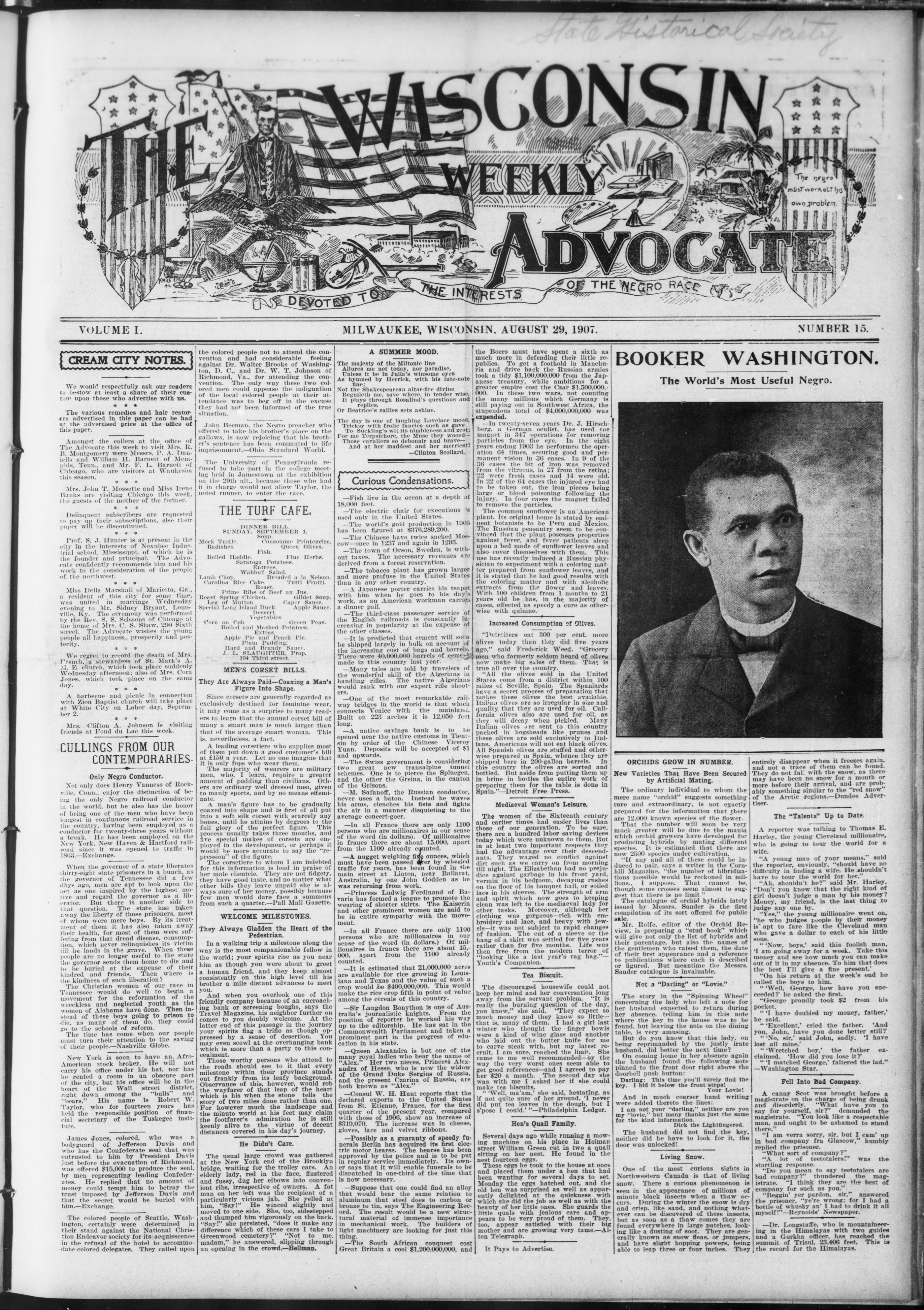
BOOKER WASHINGTON.
ORCHIDS GROW IN NUMBER.
New Varieties That Have Been Secured by Artificial Mating.
The ordinary individual to whom the mere name "orchid" suggests something rare and extraordinary, is not exactly prepared for the information that there are 12,000 known species of the flower. That the number will soon be very much greater will be due to the mania which orchid growers have developed for producing hybrids by mating different species. It is estimated that there are now 2500 species under cultivation. "If any and all of these could be induced to pair, says a writer in the Cornhill Magazine, "the number of hlbridizations possible would be reckoned in millions.. I suppose. That cannot be, though some crosses seem almost to suggest that there is no limit."
The catalogue of orchid hybrids lately issued by Messrs. Sander is the first compilation of its sort offered for public sale. Mr. Rolfe, editor of the Orchid Review, is preparing a "stud book" which will give not only the list of hybrids and their parentage, but also the names of the gentlemen who raised them, the date of their first appearance and a reference to publications where each is described or figured. But meantime the Messrs. Sander catalogue is invaluable.
Not a "Darling" or "Lovie."
The story in the "Spinning Wheel" concerning the lady who left a note for her husband expected to return during her absence, telling him in this note where the key to the house was to be found, but leaving the note on the dining table, is very amusing.
But do you know that this lady, on being reprimanded by the justly irate husband, did better the next time?
On coming home in her absence again the husband found the following note pinned to the front door right above the doorbell push button:
Darling: This time you'll surely find the key. I hid it below the front steps!
Your Lovie!
And in much coarser hand writing were added thereto the lines:
I am not your "darling," neither are you my "lovie," but many thanks just the same for the kind information.
The husband did not find the key, neither did he have to look for it, the door was unlocked!
Living Snow.
One of the most curious sights in Northwestern Canada is that of living snow. There a curious phenomenon is seen in the appearance of millions of minute black insects when a thaw occurs. During the winter the snow is dry and crisp, like sand, and nothing whatever can be discovered of these insects, but as soon as a thaw comes they are found everywhere in large patches, looking like a dusting of soot. They are generally known as snow fleas, or jumpers, and have slight hopping powers, being able to leap three or four inches. They
NUMBER 15.
ASHINGTON.
t Useful Negro.
entirely disappear when it freezes again, and not a trace of them can be found. They do not fall with the snow, as there may have been no snow for a month or more before their arrival, and are probably something similar to the "red snow" of the Arctic regions.—Dundee Advertiser.
The "Talents" Up to Date.
A reporter was talking to Thomas E. Harley, the young Cleveland millionaire, who is going to tour the world for a wife.
"A young man of your means," said the reporter, enviously, "should have no difficulty in finding a wife. He shouldn't have to tour the world for her."
"Ah, shouldn't he?" said Mr. Harley.
"Don't you know that the right kind of girl doesn't judge a man by his money? Money, my friend, is the last thing to judge any one by.
"Yes," the young millionaire went on, "he who judges people by their money is apt to fare like the Cleveland man who gave a dollar to each of his little sons.
" 'Now, boys,' said this foolish man, 'I am going away for a week. Take this money and see how much you can make out of it in my absence. To him that does the best I'll give a fine present.' "On his return at the week's end he called the boys to him.
can take boys to him.
"Well, George, how have you succeeded? he asked the first.
"George proudly took $2 from his pocket.
"I have doubled my money, father,' he said.
"Excellent,' cried the father. 'And you, John, have you done better still?'
"No, sir,' said John, sadly. 'I have lost all mine."
"Wretched boy,' the father exclaimed. 'How did you lose it?'
"I matched George,' faltered the lad."
—Washington Star.
Fell Into Bad Company.
A canny Scot was brought before a magistrate on the charge of being drunk and disorderly. "What have you to say for yourself, sir?" demanded the magistrate. "You look like a respectable man, and ought to be ashamed to stand there." "I am verra sorry, sir, but I cam' up in bad company fra Glascow," humbly replied the prisoner. "What sort of company?"
"A lot of teetotalers!" was the startling response. "Do you mean to say teetotalers are bad company?" thundered the magistrate. "I think they are the best of company for such as you." "Beggin' yer pardon, sir," answered the prisoner, "ye're wrong; for I had a bottle of whusky an' I had to drink it all myself!"—Reynolds' Newspaper.
—Dr. Longstaffe, who is mountaineering in the Himalayas with two guides and a Gurkha officer, has reached the summit of Trisul, 23.406 feet. This is the record for the Himalayas.
Jane Record for the Library
THE WISCONSIN WEEKLY ADVOCATE
MILWAUKEE, WIS.
R. B. MONTGOMERY, Editor and Proprietor.
Humorous Items. "I tell you, young man, we want brains in this business."
"I know you do: your management shows it."—Baltimore American.
The Servant—Professor! There's a thief in the dining room!
The Astronomer (deep in a calculation)
—Fell him I'm too busy to see him!—
Il Motto per Ridere.
"The master has at last come home from the tavern. But madame need not bother to make me a scene. I told him just exactly what I thought of him already, on the stairs."—Fliegende Blactter.
---
"These kisses you sold me yesterday are hard and stale," growled a customer at the candy counter. "I thought you claimed to keep only fresh candies." "We do generally," replied the fair saleslady. "Those must have come from an old batch."—Lippincott's.
Literally.
"Does she take in boarders?
"I should say she does. Gets $7 a week out of 'em."—Cleveland Plain Dealer.
A Water Garden
First Suburbanite—Raising anything on your place this year?
Second Suburbanite—Pond lilies in my cellar.—Life.
Beware.
Beware.
The man who drinks "to beat the Dutch"
Aud guzzles wine and stuff.
First thinks enough is not too much—
Then calls too much enough.
Indulgence.
"Such an indulgent husband my Jim is!"
"Yes; so I've heard. Indulges a little too much sometimes, doesn't he?"
For Fashion's Sake.
Shoemaker—Very large inside and very small outside?—Meggendorfer Blaster.
Apropos of Nothing.
"Your wife used to like to sing and she played the piano a lot. Now we don't hear her at all. How's that?" "She hasn't the time. We have two
The Windows of Her Soul
My Dolly's eyes may be;
Then rapture and roses whenever she close.
One of her shutters at me.
New York, Evening Sun
True Freedom.
"I am married, but I keep my independence, let me tell you!"—Meggendorfer Blaetter.
Not Equipped.
"I'm just crazy to be a reporter," said the rich man's daughter. "Insanity is no qualification," returned the editor, closing the interview.—Philadelphia Ledger.
Just Like Him.
a wife and three children.
Jones—That's nothing. He was too
mean to take them anywhere when he
was living.—Life.
Bread and Cheese and—
Bread and cheese and kisses
And every meal a song!
The diet spurn.
Such kissess turn
To onions entry strong.
—New York Evening Sun.
An Intelligent Servant.
The Mistress—Who hung the thermometer to the ceiling?
The Servant—I, ma'am. You were complaining because it was so low!—Il Motto per Ridere.
Complicated Love-Making.
"What! The Spaniard made violent love to you? Why, he does not know a word of English!"
"Oh, but he knelt before me, dictionary in hand."—Fliegende Blaetter.
That Kind.
Hotel Manager—Have the Barkers found fault again today?
That Kind
Hotel Clerk—Yes, sir. They complain as much as if they were getting their board free.-Harner's Weekly.
Well. I Guess!
Who possessed—me, on my Thirteen millions! Now won't she plucky? — Town Tolics.
The Explanation
"That fellow," said Tete de Veau, "is always getting off the old joke about the difficulty of finding a woman's pocket." But, you know," L'Oignon explained, smiling, "he married a rich wife."
In Modern Days.
"Nope. Papa and mamma are both lawyers, and they can't agree on the punishment."—Fliegende Blaetter.
Why They Strike.
Rhine tourist (to German innkeeper who is filling bottles from a barrel)—What kind of wine is that, landlord? Landlord—"Vell, dot depends on vot labels I put on de bottles, ain'd it?
In 1920.
In 1920
Stern Mother—So you wish to marry my son, do you?
"Young Woman—Yes, ma'am.
Stern Mother—Are you able to support him in that condition of idleness to which he has always been accustomed?—Pick-Me-Up.
Force of Habit.
Mr. Easy—Cheer up, Mr. Peck. If we must go down, let's go cheerfully like men.
Mr. Peck—But, hang it all, Mr. Easy, if I don't get home my wife will never let me go fishing again, never!—Harper's Weekly.
Fifteen Dollars in Her Inside Pocket.
Madge-What did Molly mean by saying that joining the Audubon society was a good business proposition?
Marjorie-The dues are only five dollars, while a hat with feathers on it
costs at least twenty dollars.—Harper's Weekly.
An Obstinate Parent.
"Reginald." said the head of the family, "I have told you again and again that you are not to pull the cat's tail. Again and again." Reginald eyed him sadly. "You are getting very obstinate, father,' he said reprovingly.—London Globe
Misunderstood
Suitor (to the only daughter of a very wealthy widow)—Dear Gerte, will you be mine?
Gerte—Oh, I—I—do not know. Pray speak to mother first.
"But unfortunately she has refused me."—Fliegende Blaetter.
Simple Encugh.
"The leddy hasn't the money now," said Delia, "but ye kin lave the ice an' she'll pay ye on Saturday."
"But," protested the new iceman, "s'posin' she ain't got the money then?"
"Well, if she ain't ye kin take yer ice back" Philadelphia Press
Just the Man.
"We want a man for our inquiry office." said the manager. "but he must be able to answer all sorts of questions and not get irritated."
"That's all right, sir," replied the applicant. "I'm the father of eight children."—Philadelphia Inquirer.
Feminine Reasoning
Husband (as they arrive at the station a minute too late)—If you hadn't taken so much time with your toilet, we wouldn't have been too late.
Wife—And if you hadn't made me run, we wouldn't have to wait so long for the next train!—Meggendorfer Blaetter.
Intelligent
"Let us see, Private Girellini, if you have quite understood what are the four points of the compass. Now the east is in front of you, at your left the north, at your right the south; what is behind you?" "My knapsack, captain."—Il Motto per Ridere.
"Miss Gidday," remarked Mr. Walz. "is a splendid dancer; so light on her feet."
"Huh! unfortunately she's just as light in the other extreme."—Philadelphia Press.
In Silent Contempt.
"I'm sorry," said the justice, "but there's no evidence against you, and I'll have to turn you loose, with just a fine for contempt of court."
"But—I haven't said a word!"
"I know it, my friend; but I'll be blest if you didn't look it!"—Atlanta Constitution.
Study in Philology
"Charley, dear," said young Mrs. Torkins, "why do they call racing calculations 'dope'? I thought that was a slang name for a drug."
"You're quite right," was the answer. "They call it that because all it generally gets you is a pleasant dream and a rude awakening."—Washington Star.
Three Fingers.
the railroad for damages?"
"Yes, suh; he lost three fingers in the collision."
"From his right or lef. hand?"
"From his hip pocket, suh; the collision thowed him against a seat and broke his bottle."—Houston Post.
Knowledge Acquired
Farmer Korntop-Ain't ye goin' to send yer boy to college?
Farmer Rich-No; tain't necessary now. Farmer Korntop-But ye sed ye wuz goin' ter put him through college. Farmer Rich-Yes but he's learned to smoke cigarettes without it.-Catholic Standard and Times.
His Reason.
"So you are in favor of government ownership?" "Emphatically," answered the discontented citizen.
"I suppose you have studied the subject thoroughly?" No, I can't say I have. But I fancy it is something the railways wouldn't like.—Washington Star.
Noah's Leisure Hours
"Now, how do you suppose Noah spent the time in the ark during the flood?" the Sunday school teacher asked.
"Prayin'," suggested Willie.
"Fishin'," ventured Dick.
"Humph!" grunted Willie contemptuously.
"'Twould be fine fishin' wid only two worms, wouldn't it?"—London Tattler.
Rather Clever.
"Hang it!" said Scrooge. "Here comes Blank with that tiresome wife of his. I'd give worlds to escape meeting them." "Quick, then—in here," said Mrs. Scrooge. And the intelligent woman dragged her husband into a shop where a large assortment of the costliest summer gowns had just been put on sale.
A. Last Resort.
The parson's small boy had been desperately trying to run away from his new nurse. At last he spied a parkguard.
"Mister, are you a policeman?"
The giant in brass buttons bent lower.
"Why, yes, sonny, I be."
"Then please arrest this woman. She won't stop follerin' me around!"—Lippinecott's.
Boiled Eggs as a Quinine Tonic
Senator Butt of the Arkansas Senate had just finished one of his droll stories about feeding morphine to a pointer pup and watching him as he indulged in the ensuing antics occasioned by the opium. Representative De Rossit, known as one of the most veracious men in the state, said:
"Senator, your dog reminds me of my hen. Needing quinine one day, as we often do, I mixed up an ounce of the drug with molasses and rolled it out into pills. Leaving the stuff to dry on the front porch, I went into the house.
"Returning, I saw the last of my pills swallowed by my hen.
"Of course, I thought her silly head would burst wide open. She simply commenced cackling, and has been laying two eggs a day ever since. And do you know, Senator, those eggs are the best chill tonic on the market? One of them taken internally will knock the spots from any case of malaria in the state, and shaking ague can't stand before 'em an hour after they are eaten. I keep that hen dosed, I do."—Tit-Bits.
Iceland Wonders.
People who live in vast and barren lands have the best eyesight. Eskimos will detect a white fox on the snow at a great distance, while Arabs can pick out objects on the desert that are invisible to others.—Springfield Republican.
AGE
Snow and stars, the same as ever
In the days when I was young;
But their silver song, ah, never.
Never now is sung!
William Winter, in the Fiction Number (August) Scribner.
THE SCAPEGOAT.
"It is false," he said, with slow anger. She stiffened, and looked coldly into his eyes.
"It is a—lie," he insisted, more quietly, but more emphatically, folding his arms across his chest. "Stella, are you going to accept a comparative stranger's word against mine? It's monstrous—perfectly abominable."
"I saw you—drop the knave of trumps into your lap when Mr. Manton led the seven," she said in a whisper, deliberately. "And the knave of trumps was in Bob's hand."
"And the knave of trumps was in your brother's hand?" he said, after a moment's pause.
"Oh," she cried, springing up, "you mean your tone to imply that Bob might have been cheating, as he was your partner? How mean—how contemptibly mean! You would like to make him carry the load of your shame for you! A boy of 19—a Carlton! There never was a Carlton who would cheat at cards!"
"Nor a Riversley," he answered, coldly, "I am sorry that I should have been afflianced to the Riversley who broke the line of honest gentlemen of that name," she retorted, hotly.
"That is unworthy of you," he said, gravely. "I think I had better go."
"Yes," she said, between her teeth, tearing at her finger rings, "you had better go." She held one out to him and a look of faintness stole over her proud face. He took a step toward her, and she reached toward him and dropped the ring into his hand. "Thank you," he murmured. "I—" He checked himself, turned, and left her.
II.
"I knew you were cheating and that Wallace and Manton realized something was wrong; and I was sure you'd play the knave on the trick, and my knave would expose your dealing. You must tell her, Carlton! It's impossible I should go about branded as a card cheat!" "I can't tell her!" cried the boy, stamping his foot, impatiently. "You don't know what it would mean. Stella is as proud as Lucifer, and—I don't know what she'd do. She'd tell dad for one thing, that's certain; and—oh, Riversley, old chap, you don't know what it would mean, or you'd never ask me to do it."
"Well, I've told you how I stand," said Riversley, rising and walking over to the mantelpiece. "She believes I was cheating, and—she's chucked me; just as any girl would, believing it. I don't blame her for that; what I blame her for is believing me capable of such a thing."
"I can't do it! Good heavens! you must be mad to think I could go to her, and—it's impossible! I'm sorrier than I can possibly say, Riversley. I would have done anything in the world rather than it should have fallen on you."
"No more words about it; you've got to put it right. Within twenty-four hours I shall expect to hear from Stella that she knows I am still a gentleman."
III
On the balcony of a little hotel overlooking the Bay of Naples sat Riversley in an armchair. The chair was comfortable to a luxurious degree; yet he moved constantly as if he were uncomfortable. He was thinking over a paragraph he had read half an hour before in The Morning Post, which he regularly received each day:
"A marriage has been arranged between Miss Mary Vincent Stella Carlton, only daughter of Gregory Carlton, Esq., of Hadley Park, Berks, and 341 Hill street, W., to Sir William Brundon Rouston of douston, Herts."
The announcement had come to him as a surprise, for there had been no hint of such a thing in any of the letters he had had from Robert Carlton during the past ten months. Otherwise, of course, it was not surprising. Rouston was an excellent fellow, a handsome man, and an honest gentleman. Not otherwise it was not surprising.
Riversley moved uneasily in his chair and the paper slipped from his knees. He let it lie. Then he automatically picked up the Paris paper which had arrived with his Morning Post and tore it open. Suddenly he started. Bobby Carlton was dead. Stella and her father were in Paris. The boy had been hurled out of the motor car he was driving, dying a few hours later in the Paris hospital.
Had he spoken?
Riversley rose weakly from his chair and hurried from the balcony. Forty hours later he was in Paris. Immediately on his arrival he called at the hotel at which the newspaper said the Carltons were staying.
Mr. Carlton was not within. After hesitating, Riversley wrote a few words on a card and sent it up to Stella. She came to him in the waiting room and he knew, with a sinking heart, that the boy had not spoken.
"I have read of the accident to your brother, Miss Carlton. I was in Naples," he said. "I—may I ask if your brother left any message—er—for me?"
"No; not that I am aware of," she answered, folding her hands before her. "He is not dead, you know; the reports were wrong in that particular."
"Not? Oh, I'm heartily glad!"
"But there is no hope—none whatever. Father is with him at the hospital now."
"I—I'm awfully sorry!" faltered Riversley, glancing at his hat. "I—I don't know whether it will seem a fitting request to make, but would it be possible, if he is conscious, for me to see him for a few minutes on a matter of the very utmost importance to myself?" She hesitated and he added: "I may say it is a matter of more than life and death to me."
"If you wait while I put on a hat I will come with you to the hospital and see," she said.
"Thank you," he replied quickly, glancing at her with brightening eyes.
"We will walk—it is near," she said, when she reappeared.
"Do you wish to see him alone?" she said when they reached the hospital.
"No; oh, no."
In a private ward Mr. Carlton rose
from a chair beside the bed in which his son lay and he bowed coldly to Riversley, while the nurse glided silently out of the room.
"Bob, old boy, here's Mr. Riversley come to see you," said Mr. Carlton gently, turning to his son.
As Robby opened his eys, an unmistakable look of fear entered them. Riversley saw the look and bit his lip.
"I'm sorry, Bob—more sorry than I can say," he said, with a sad smile, leaning over the bed and lightly touching the boy's hand; and as he bent lower he whispered, "For Heaven's sake speak."
The boy rolled his head on the pillow to avert his face and closed his eyes. "Bobby, haven't you got a word to say to me?" said Riversley, with infinite gentleness. "We were such good pals once! Won't you say something I can remember—something for friendship's sake, that'll make the world seem—what?" Riversley saw Stella draw nearer to the bed. She was watching his face narrowly; he could feel her gaze. "Go away," whispered the boy, faintly. Riversley swung round and something rising from his heart shook him. "Bob," murmured Riversley, turning quickly back to the bed, "I'm going now, old chap. Good-bye—good-bye."
"Good-bye," murmured the boy weakly. Riversley squared his shoulders as he followed Mr. Carlton out of the room. The elder man inclined his head slowly and drew back, and Riversley went down the steps like a tired man. Late in the evening he sauntered that way again and stood outside the hospital. Then he walked past a few hundred yards, to where the road became a boulevard, with seats and trees. He sat down and watched the few passersby with the air of a stranger conscious of his loneliness. He vaguely noticed that one man passed and repassed two or three times on the opposite pavement and finally crossed the road and sat down on a seat in the shadow cast by a tree.
Presently he became conscious of a light, quick step coming from the direction of the hospital, and looking up he saw the figure of a woman approaching him. He did not recognize her till she had almost passed, and then impulsively he rose.
She drew nearer to him, and he could see that one of her hands was pressed to her heart. He did not speak.
"Mr. Riversley," she said, stepping into a shadow, "do you know why I sent you away this morning?"
"No."
"I wanted to find out from Robert why you had come so far to see him; I saw a strange expression in your face, and I heard your whispers to him."
"I muttered to myself—I've got into that way of late."
"You need not tell me, for I know," she said, in a faint, far-off voice. "I—I—made him tell me, and I think he was happier when he had told me; but I—I wouldn't kiss him as he died." She put up her arms and hid her face in them, crying gently. Riversley glanced this way and that, and looked at her again. "Don't," he said, huskily. "Put I—I—have kissed him since—so many, many times since, for he needn't have told me. need he?" "No," he answered, "he shouldn't have told you."
"Oh, yes," she exclaimed, dropping her arms, "of course, he ought to have told me—he ought to have told me months ago. It was wicked of him—wicked of you both to so deceive me. Oh—oh, Jim—"
"Hush—you forget!" said he, drawing a quick breath.
"Yes—I forgot." She hung her head, and they stood silently face to face. "Jim," she cried, suddenly drawing near, "let me forget again!" She put her arms round his neck. "Only for a minute—forget for a minute; remember only ourselves, and forgive me. Oh, Jim—Jim—forgive me!" She laid her face on his breast and went.
"Stella," he said, in a little while, "we're in a public road. People may pass! Child! Some one is coming! Remember Rouston."
"Forgive!" she pleaded.
"I have nothing to forgive, dearest. But remember Rouston."
"I remember," she answered, drawing back and dashing the tears from her eyes. "He should be here. He was to have waited on the next seat for me, to see me to the hotel. He came over from London directly he heard the news."
"It was Rouston, then, I saw cross the road and sit down there!" Riversley exclaimed.
He strode rapidly to the next seat, and a man rose up as he approached and held out a hand.
"Halloa, Riversley! What the deuce are you doing in Paris?"
The recognition was so instantaneous that it was clearly meant to have significance. Riversley hated dissimulation and gave no chance for it.
"Oh, not long. Introduce me to the lady, will you—unless—I know her?"
"Rouston! She is——"
"Stella? Of course! I know. Oh, I know, old chap! I'm not a fool. Good night."
"But, Rouston——"
Rouston turned back.
"Hang it, man, won't you be satisfied till I say I heard every word, and I have always thought Bobby would clear the air one day and turn me off? I couldn't hold her to it, and I wouldn't if I could. Good night!"
He was gone.
Then Riversley returned slowly to where Stella was standing in the shadows.—C. Randolph-Lichfield in Tit-Bits.
Avoiding the Danger.
"The duel," said Senator Tillman at a dinner in Washington, "is a thing I abhor. I believe, though, in manliness and pluck, and I hope the time will never come when a conversation such as was recently overheard in a New York club will be typical of American chivalry.
"Bludd threatens to kick me the next time he sees me in company. If he should come in here now what would you advise me to do? "
"Sit down," was the reply.—Minneapolis Journal.
5.000.000 Die of Plague.
In the last decade, or since October, 1896, the plague in India has snuffed out 5.000.000 lives. This is probably as many people as have been sacrificed in battle since the Napoleonic wars.
A Privilege of Greatness.
He was the manager of a large firm, and had the reputation among his clerks of being a "terror"—by which they meant a hot-tempered individual with a
tendency to grumble, for he was little that was terrible about him. On this particular morning the youngest of the junior clerks was in a great state of fear. He had made a trifling mistake, and had been summoned to the manager's presence. He lamely attempted to explain, but the great man cut him short brusquely.
"Then—then, if you're not the manager," spluttered the other, "why are you talking like an idiot?"—Answers.
"The Heaper of Coals."
Mrs. Fanny Crosby, the author of hymns, is still, though 87 years old, in first rate health. "Not long ago," said a New York clergyman, "I visited Mrs. Crosby in Bridgeport, and found her exceedingly entertaining. I shan't soon forget some of the youthful memories that she recounted.
"Our talk turned to the subject of children's quaint misunderstanding of Biblical metaphors and parables, and she told an amusing story on this head.
"She said that a little boy came home one day from school in a bad humor. Another boy, Jack Jones, had given him a thrashing, and he wanted revenge.
"'Oh,' said his mother. 'don't think of revenge, Willie. Be kind to Jack. Heap coals of fire on his head. Then he will become your friend.'
"Willie thought he would try this method. He did not see Jack Jones till the next day at recess. Just as he was buying a lemon pie for luncheon Jack appeared and said:
"'Look here, I licked you yesterday, but I didn't give you enough. Now I'm going to lick you again.'
"And he planted a hard blow on Willie's stomach.
Willie gasped and grunted, but instead of striking back he extended his pie to Jones.
"'Here,' he said, in a kindly voice, 'I'll give you this. I make you a present of it.'
"'Gosh, it was good,' he said. 'What did you give it to me for?'
"Instantly Jones hauled off and struck him again.
'Now go and get another pie,' he said."
No Real Change
Controller Metz said the other day of a bill that he disliked:
"I object to this bill because it would accomplish nothing. It would make no real change. It would be like the case of the actor and the canal boat captain.
"There was once upon a time an actor, who, after an enforced idleness of two months, was lucky enough to secure an engagement in a town twenty-five miles away.
"The case was a hurry-up one. The actor had to reach the distant town that night. If he failed to arrive, then his part would be assigned to someone else.
"Well, the man patched his torn boots with patent thread, pinned up his few belongings in a newspaper and set out in the early morning on foot along the towpath. He had only a few coppers, hence the train was an impossibility.
"But after the poor fellow had covered some six or seven miles his boots gave out, blisters rose on his feet, fatigue overcame him, and in despair he threw himself on the grass beneath a tree.
"As he lay there in a bitter mood a canal boat hove in sight. It drew near slowly, and an idea seized the actor.
"Waal, wot d'ye want?" said the captain, as he stopped the boat.
"Captain,' said the actor, 'I have to get to Quag tonight to play second heavy in "The Evil That Men Do." I am footsore and weary, and can walk no further. If you will assist me I will work my passage."
"The captain gave the actor a kindly nod.
"All right,' he said. 'Lead the hoss.'"—New York Tribune.
A Reward of Faith.
A congregation in a hilly district in Ohio, says the Youth's Companion, bought a small tract of land and erected a church building upon it. Then the question of insurance came up. Mr. Sipes, the wealthiest member, who had contributed more than half the money needed for the new structure, declared that he did not believe in insurance. "This is the Lord's building. He'll take care of it," he said.
His view prevailed and there was no insurance. In a few weeks the building was struck by lightning and almost totally consumed by fire. Another one was erected, Mr. Sipes contributing the greater portion of the fund as before. This time the demand was almost unanimous that it be insured, but Mr. Sipes again objected on the same ground.
Again he carried his point. In less than a month the new church was struck by lightning again, and although strenuous efforts were made to save it, the loss was almost total.
"There must be some reason for this brethren," said Brother Sipes. "I am going to find out what it is."
Thereupon he employed a force of men to sink a shaft on the site of the twice destroyed church. Within a few days a rich vein of iron ore was found and the church property was sold for many times the amount needed to buy land in another locality and build again.
"I tell you, brethren," said Brother Sipes, "it pays to trust the Lord. He's a great deal better business manager than anybody in this congregation."
Electric Corn Popping.
The day has passed when in order to get an evening's enjoyment out of a pan of crisp popcorn some one has got to burn his fingers or face over a hot stove or grate. The electric corn popper is one of the latest inventions applying electricity and is meeting with considerable favor and pleasant reception. The popper is a dainty little affair, shaped very much like an old fashioned quart dipper. It has a pair of little rubber tired wheels under it to aid in circulating the corn and all that is necessary is to make the proper connection to a lamp socket, put in the corn and begin shaking. It costs about five cents an hour to operate this popper, which means that any one with appetite to make it could easily pop a bushel basket full of crisp kernels with half the cost and none of the trouble incident to the old fashioned way.—Boston Transcript.
The Revised Psalm
The father's peroration was superb.
"'And departing, leave behind you,' he concluded, 'footprints on the sands of—'"
But here the sun rudely interrupted.
"Footprints?" he sneered. "Who wants to leave footprints?"
"Then what would you leave, my boy?" the old man inquired.
"Tracks," said the youth haughtily.
"Tracks of my 90-horsepower racer, to be sure.. Am I a dog or a workingman that I should leave mere footprints?"
Miscellaneous Items.
The natives of Ushashi wear hats made from the skins of lions:
An old woman on the witness stand at Bellizona, Switzerland, gave her age as 102. But it was ascertained on cross-examination that she was 106. She explained that she was "ashamed of being so old."
The richest unmarried woman in France is probably Princess Marie Bonaparte, daughter of the late Prince Roland. She is pretty, accomplished, young and inherited a vast fortune from her maternal grandmother.
According to the census of the board of health, Manila has 11,022 houses of strong material, 15,142 of light material and 3311 of mixed material, a total of 29,745 houses. The population is 223,542, says the Manila Daily Bulletin.
A man writes from Waxahachie, Tex., to a newspaper in St. Louis that he was once taken for Mark Twain in a book store in Constantinople, and now is very proud of it. The experience has made him Waxahachie's most eminent citizen.
In London a child is born every three minutes, and a death is recorded every five minutes. The city contains 700 railway stations, 5000 omnibuses, 7000 hansoms, 14,000 cabs and 7000 tram cars. Daily 1,000,000 persons travel on underground railways.
According to French and Swiss physicians, it is dangerous for elderly and weak persons to visit the higher altitudes of the Alps. They assert that for such persons to do so is to invite cerebral apoplexy, cardiac lesions and pulmonary embolism.
The proposed cable to Iceland is to be laid from the Shetland islands to Thorshavn, in the Faroe islands, and thence to Seydisfjord, in Iceland. From the latter point there is to be a land line to Reykjavik. The cable is not expected to be completed until the autumn.
The liquidator appointed by the French government to manage the property of the Carthusian monks, sold by auction on June 30, the trade mark of the Grande Chartreuse, together with right to reproduce the form of the bottle. The trade mark realized £25,164.
The Wochemer railway, from Assting to Trieste, which was opened by Archduke Franz Ferdinand of Austria, July 19, passes through a portion of the Alps and has 47 tunnels and 728 bridges. One of the bridges has the largest stone arch in the world. Its span is over 270 feet. About forty employees of the New York, New Haven & Hartford railroad have been retired on pensions. The men so retired have been in the employ of the company from thirty-five to forty years and will now receive from $6 to $7 a week for the remainder of their lives.
One of the few bells cast by Paul Revere now in existence is to be taken from the belfry of the old Baptist church in Warren, R. I., to be recast at Troy, N. Y. A member of the church will oversee the job and will write an account of the undertaking for historical purposes.
Berlin university is the most numerously attended seat of learning in the world. It contains 7774 matriculated and 1330 non-matriculated students. All the states of Germany and every country in Europe, from Norway to Sicily, from Ireland to Russia, are represented in its classrooms.
—Miss Cecelia Milow, who came to this country from Sweden three years ago to gather information about work with street boys, has been so successful in organizing such clubs in Stockholm that a philanthropist has guaranteed her a life income so that she may continue the work throughout the kingdom.
—To Prof. Charles Frederick Holder, sportsman, naturalist, angler and author, is due the credit for the organization of the famous Tuna club of Santa Catalina, whose influence has been such that nowhere in the world does a higher, standard of sport prevail than on the fishing grounds of southern California.
-St. Louis is favored by a place in the Paris salon through the efforts of Gustav Wolff, known in St. Louis at a sign painter and bill poster, but in Paris recognized as an able painter of landscapes, whose genius has been rewarded by the admission of two of his landscapes in the present Paris salon.
-The British consul general at Lourenco Marques, in a report to the British foreign office on the value of the Kaffir trade, mentions that the Kaffirs of that colony employed in the Transvaal spend of the wages they bring back with them every year $2,500,000 in drink, and there are only about 50,000 of them.
One point in the Queen of Spain's future life seems to have escaped general notice. She will have to live under the same roof as her mother-in-law, her sister-in-law, her aunt-in-law, her husband's brother-in-law and the three children of the King's dead sister, the oldest of them being heir to the throne.
Women who have recently joined the Wandsworth (Eng.) Rifle club have proved so expert in the use of the rifle that scores of 35 out of a "highest possible" of 40 have frequently been recorded. The club committee is desirous of securing other women sharpshooters in order to arrange a match between the women and men.
Sixty per cent. of the London police are on the night service, which they prefer to day service because there is less to do. One of their main duties at night is to see that doors and windows are barred and to notify the occupants of houses when they are not. Nearly 26,000 doors and windows have been found open by them in one year.
The representative of a British syndicate is in Peking offering to lend to the Yuchuan-Pei a large sum of money to build railways. Beyond demanding the sole right to contract for the construction materials and to provide the engineers to build them, the syndicate will not interfere in any way with the control and policy of the railways.
A new electric furnace for determining the fusion points of refractory substances has been constructed at Hanau by W. C. Heraens. Its essential part is a tube of iridium four-fifths of an inch thick and an inch and three-fifths in diameter, and in this temperatures between 1500 degrees and 2000 degrees can be maintained for any desired length of time.
-In China wages of women operatives are nearly at the vanishing point. It is said that in the silk mills at Shanghai there are 20,000 workers, among whom are children that work at 3 cents a day and women at 5 cents. The highest paid get 26 cents for the 13-hour day. In the Shanghai cotton mills the best women workers get 14 cents a day, the poorest 5 cents, the hours being from 6 to 6, with 30 minutes at noon for dinner.
Leprosy is increasing in both North and South America. Columbia, where there was only 400 lepers forty years ago, is said to have 40,000 now, and many find their way into the United States. Such a medical authority as Dr. Ashmead, who was formerly chief medical adviser to the government of Japan, says the increase is alarming. When leprosy is brought into a new country it takes fifty years for the seeds to take root and it becomes epidemic after 200 years. It has been shown that mosquitoes are active in transferring leprosy bacilli.
GOSSIP FOR THE LADIES.
Solitude. during the day, but that does not affect
Would I might speak with tongues of more than men
To tell the beauty of a quiet glen
Where timid birches cluster, each a maid
White-robed and slender, waiting half afraid
For what portentous hours may produce.
Would I might paint the hemlock and the spruce.
spruce.
Glooming disdainful of the birches' fear
By that pure, ardent lake, where the red
deer
Feed on the margin, sweet with fragrance
brief
And dainty succulence of lily-leaf.
And dainty succulence or my-lear.
Here roams the fawn, unfrightened and alone,
Free as the breeze, pine-scented, and far
flown
From mountain sides; and here the buck
and doe.
Grazing, or drinking from the quiet flow, Share with the lake its wild bright purity. Oh, fairer than man's fairest work to see In this true realm of silence and delight. Of spicy scents, all flooded o'er with bright Glory of summer skies. So lucent seems This little lake of loveliness and dreams, That clouds lie feathery light within its breast, And all its polished stones are jewels dressed By lapidaries to a sumptuous sheen That adds an Orient richness to the scene: While in and out glimmers the luring dye Of racing trout in full-gemmed panoply. Here, too, the heron blue, in lonely state, Crosses the reeds with flight deliberate, And lighting slowly on his log-made throne Stands motionless, and kingly, and alone. Nor lovliver land might any king desire. For where could freer burn the holy fire. Of wisdom pure and aspiration high Than in so calm a spot and under such a
sky!
—Louise Morgan Sill, in Harper's Weekly.
The Ideal as to the Useful Life.
I doubt if ever in the history of the human race so many people were reaching out toward ideals of usefulness as now.
Perhaps this is because there are so many individual creeds, and so much liberty of belief is granted to evolving humanity.
When plants are crowded into small space, and compelled to push up through the same aperture, they grow sickly and many of them die for lack of enough soil.
When each is allowed his own freedom and can look at the sun from its own standpoint, they grow vigorous and strong. Different plants require different soil and varying degrees of the sun's rays.
Each soul today con, if it will, see God in its own way, and worship Him according to its own light, and its own power to see light. It is not an age of church-going, but it is an age of increasing spiritual hunger.
Long ago I used to think it would be a great thing for the world were there only one great church, one creed for all humanity.
But I have come to realize what a mere form such a religion would become, with a few figureheads in authority, and no individual thinking done by the masses of humanity.
The more creeds the better for the evolving race.
The one thing to desire is that each soul lives up to the highest requirements of his faith.
What is called metaphysical thought, has possession of three-fourths of the intelligent people of the English-speaking world today.
It is a line of thought as old as the universe, and is nutritious for the mind, as whole wheat bread for the body.
A young woman who has no money has fallen into this line of thought, and she is anxious to make her life a blessing to the world. Just how to live an unselfish and worthy life, and benefit the race, puzzles her as it does many older people.
Thousands of men and women are wishing they could be of use to humanity, and are continually neglecting habits and manners which help to make life unpleasant for others about them. We cannot do good to others until we are good to ourselves. We cannot make others better until we make the best of ourselves. The very first duty we owe to the Creator is to finish ourselves. That is the work which is given us to do.
Body, mind and spirit, must all unite to form the perfected human being. So long as we live in the body, we must give it attention, and make it attractive as the home of the spirit, and the spirit's messenger, the mind.
Orderly habits, becoming and well-worn clothing, agreeable voices, correct language, proper pronunciation, an attractive manner, are all steps toward living an unselfish and useful life. They help to beautify the earth.
An attractive manner necessitates an easy, graceful poise of the body, a good carriage, a knowledge of how to sit, stand and walk, and the ability to listen well. Careful table manners are important factors in an unselfish life. Nothing is more selfish than spoiling the meal hours for others by spread elbows, audible eating, and the toothpick habit.
The habit of self-reliance and the ability to make one's own enjoyment, is another unselfish habit. The woman who is forever relying upon others to entertain her or to open ways for her to entertain herself, can never be a great helper in the world.
To sum up—the cultivation of all the agreeable and pleasing qualities, the self-reliance which develops mental resources for enjoyment, thoughtful lines for others in small things, an avoidance of gossip and tale-bearing, a nature which rejoices in the pleasures of others and sympathizes with their troubles, and knows how to divert the minds of the sad to hope and cheerfulness, this is the practical method to "help humanity" and make "the world better."
She who does this will be given larger tasks afterward. And this preparation requires no capital.
Observation, perseverance, memory and attention, self-control, self-denial and continued belief in our ability to attain the ideal—these are all that are needed to obtain the result. She who makes herself an unselfish and agreeable woman does more for the world than she who neglects her womanhood while trying to do charitable work. It is a truism that charity begins at home. And it begins with one's self. Build first yourself—and other structures will be given you to build.-Ella Wheeler Wilcox in Philadelphia Evening Bulletin.
Ventilation Once More.
"If they would but keep their windows open at night, there would be little need of my doctoring them at all," said a plain-speaking physician, referring to a certain class of his patients. Many people are really afraid of "night air." They seem to have a feeling that God has put something very deadly into the atmosphere that surrounds the earth after the sun has disappeared. Now, look at that thought, just a moment. It isn't in the least after the manner of God's provision for his children. Besides, it is really the same air that has been over the earth, lighted and heated and cleansed by the sun all day: nothing whatever has happened to contaminate it. Again, there is no air to breathe, after sunset, but "night air," outside or inside. True, air at night is apt to be a little damper and cooler than it is
during the day, but that does not affect it for breathing purposes, else how could humanity endure days that are damper and cooler than other days? how could people live and thrive at the seashore as they do?
Another thing to think of is whether night air could possibly be any more fatal to health than is air filled with the carbonic acid gas thrown off by action of the lungs, a real poison. For a test, breathe into a clean bottle, then stop it quickly and tightly; after several hours smell of the contents of the bottle. Your nose will tell you a very unpleasant story. Fill a clean bottle with clean water, take it out of doors after dark, pour out the water and let it fill with air, stop it tightly; then smell of it in the morning. Your nose will have nothing different to say than it would had you experimented with daylight air. Some morning, after you have been out of doors and had a good sniff of fresh air, enter a small room, tightly closed, in which one or two people have been sleeping. Your sense of smell will be greatly offended. If your room is small and not well ventilated, and you become restless so that you cannot sleep, wrap yourself warmly, throw the window wide open and draw in deep breaths for a few minutes. The fresh, pure air from outside replaces the poison-laden air in your lungs, and makes you comfortable. You'll sleep, at least till the air of the room gets "stuffy" again.
One needs to be very careful about drafts across the bed, about having too strong a wind blowing upon one; nor need one rush to the extreme of sleeping in air as cold as it is outdoors on some winter nights—though we hear from all sides that consumptives are cured by sleeping in the coldest air. The doctor's plea always is for pure air, not merely for cold air. Cold air may be impure, warmed air may be pure.
God has surrounded us with millions and millions of cubic feet of pure, sunbathed air, wonderfully compounded, wonderfully adapted to our needs. It does not seem fair to build air-tight houses and shut out this vital element; to insist on breathing over and over air that we poison with every movement of the lungs; to do this and then speak of pneumonia, bronchitis, tuberculosis, nervous prostration as "mysterious dispensations of providence!" Do not let us make a bugaboo of "night air," and deliberately poison ourselves. Let us have the best God gives us and be thankful for it.—Martha J. Nichols in Mother's Magazine.
Women in New Fields.
It is a difficult matter in these days of woman's activity in many fields of industry and usefulness to say what is a new field for woman. The sex are so rapidly, though quietly, invading so many occupations that only a little while ago seemed reserved for or to belong exclusively to men, that comment can hardly be made on one step forward before so many follow that the new field becomes an old and well occupied one. In the professions and in the trades it has long since been accepted that practically nothing is closed to women, and while they do not always excel in every calling, they are seldom actual failures. But interests now attaches not so much to the wide range of women's work as compared with the work for which she was supposed to be fitted only a few years ago, as it does to the industries and callings in which women are pioneers.
The older walks of activity and means of gaining a livelihood have already become crowded with women, and they are mapping out new paths and investigating and experimenting in new directions. The success the sex meets with in this direction confirms the modern belief that women are resourceful, and the old idea that a woman could not originate, but had to follow some beaten path is as erroneous as it is obsolete. As proof of this take the case of the young woman in an eastern city who, on being thrown on her own resources, and sizing up her stock in trade as to talents and training, found herself as she thought, almost bankrupt. Accustomed to wealth and the security that wealth brings in material things, she was at first in a sad plight from being entirely without any sort of a qualification for earning her own living. She had a knack at story telling, and she studied out a plan that resulted in the organization of a number of story clubs. She read the latest and best novels, digested them, and at stipulated times met with her clubs and told the stories. It proved popular, and she soon had all the clubs she could possibly serve, and at good compensation.
Somewhat along the same lines is the work of a young Philadelphia woman. She was at her wits' ends until she hit on the reading club idea. She turned her attention chiefly to lonely old ladies, and for a couple of hours each day, at a stipulated time, she reads to them by telephone. It isn't even necessary for these old ladies to go to the trouble of going to club meetings, or even to dress, as women must dress when going out. They can sit in their own bed rooms and hear the reader. She can have as many as a dozen or a score listening on so many different wires at the same time, and they all pay her generously.
Looking towards somewhat different fields, it is said that a woman is one of the best sugar beet raisers in California. She has broad fields, and superintends her beet growing herself. From a very modest beginning she has built up a great business. There is a woman in Nevada who supports herself and several children raising and selling pampas plumes. At Pasadena, Cal., several ladies make a specialty of preparing ostrich feathers for the market.
With these examples before us—and they are, only a few of many—it would be folly for any one to say that any field of industry or any occupation of usefulness is closed to women. It seems there is always something new, and the sex no longer has cause to complain of the narrow limits within which they are permitted to compete with men.—Woman's National Daily.
To the Girl With Nothing a Year.
The girl with the least to spend is frequently the one upon whom obligations rest most heavily, and in the season of weddings she feels that some return, however small, must be made to the brides-elec., who have probably done much at one time or another to contribute to her own good times. Silver and glass are both expensive from her point of view, for in either from $8 to $10 has to be spent in order to get anything that does not look small and almost cheap, so her choice therefore must swing towards things in brass or some quaint antique, which if she is clever she, will be able to find at one of two or three little shops not far from the hum of the busiest streets of New York and quite easy of access. At one an old-fashioned cut glass bowl, the design ground on the cutting that was nine inches in diameter, was shown for $1.50, which is now merely quoted as an example, for at these shops, such opportunities last but a day perhaps, the list of attractions ever changing and ever new, though genuinely old. Odd and pretty bits of silver can also be picked up, for but the price of the metal per ounce, regardless of the work:manship or article
outside of the weight value. Quaint old Chinese plates, no two alike 'tis true, but each with a definite charm are in evidence from 75 cnts up and curious tea strainers, old writing boxes, that need but a polish, are all there but for a little more, as are oval and other old-fashioned gilt frames, that with a mirror put in are a most attractive wall fitting by a desk or writing table.
In the brasses there are several shops that are satisfying when one has but little to spare for a present, and a very handsome etched Russian brass vase may be bought for $7.50: the plainer bernished brass vases in most attractive shapes, costing from $3 upwards. Sconces with two brackets are $3.75 and candlesticks of the altar description with a row of several holders in a straight line on one bar, are at various prices, according to size. Those with a glass shade to protect the flame from draughts, the shade fitting in a pierced brass holder two and one-half inches high and about the same in diameter, which has at side a bracket in which the snuffer fits, and at back a solid brass handle, most comfortable to caary it by. It is of course a reproduction of the Sheffield candlesticks, is made by hand and costs $2. For 75 cents and $1 pretty, plain tea-caddies abound and oval boxes, or squares, also for tea are $3.50 and upwards. A loving cup with handles copper riveted is $2.50 and so on go the prices at a really reasonable pace for many other useful articles, which when marked simply in black type are very good to look at and different from the usual run of wedding gifts.—Vogue.
Wives Who Dislike Work
I do not believe the average man wants his wife to work downtown unless there are some unusual circumstances which make it necessary or unless she prefers to do it and insists upon it.
Perhaps what inspired the remark by the young man in question that he would not object to having his wife work downtown was the apparent worthlessness of some married woman of his acquaintance. A couple of women sat across from me in the street car the other night and one of them remarked to the other: "I do hope John is not home when I get there." The other replied: "It is only ten minutes after 6: I thought he never got home until 6:30." The reply was: "He does not usually because he works after 5:30 nearly every night, but it always happens on my card club day that he leaves the office promptly and so gets home before I do and then he fusses because dinner is not ready. I believe he plans to get home earlier on Wednesday for meanness."
I confess to a feeling of sympathy for the husband of this woman, coming home to an empty house after a hard day at the office and having to wait for his dinner. She seemed to me a worthless woman—one to whom home making is a secondary consideration.
I know of an office clerk who gets $75 to $80 a month and works harder than a day laborer, whose wife spends nearly every afternoon "shopping." at a card club, or visiting her friends. She gets home about the time he does and throws together a dinner, when by remaining home in the afternoon or at least getting home by 5 o'clock she might have a roast, some hot biscuits, and a nice pudding at no greater cost than the dinner of fried meat and hurriedly prepared vegetables. These people are always from one to two months behind with their bills and the husband gets more discouraged every day. I believe he would be justified in saying that he would not object if his wife worked downtown.
Don't Give Milk to Cats
To most people it will be startling to hear that cats should not have milk.
It is not a natural, save in the beginning, food for them, nor a desirable one. Meat for food and water for drink is the latest approved cat diet. Be sure and keep water about; many a cat goes thirsty. Nor even is it best to give kittens milk. As soon as they are through nursing give them meat at once; don't wean them with milk. At eight weeks the desirable food is raw meat chopped fine. Beef is perhaps the best sort, if one is going into the thing scientifically so to speak, though there is no harm in general table scraps where there is not too much grease with them.
The best vegetable (for the diet should not consist wholly of meat) is rice. This, cooked not too soft, and mixed with finely chopped raw meat, and given them twice a day, has been found by a successful culturist to be the most satisfactory and healthful diet. Unlike dogs, they really do not need regular washing, though it is quite possible to train a cat to a weekly bath if she is taken early enough.
DOG MEAT EATEN IN GERMANY.
Kingdom of Saxony the Center of Cynophagy—Use Authorized by Law. Not only is the flesh of horses and mules eaten in Germany almost as much as in France, but also there is a growing consumption of dog meat, and in some localities dogs are fattened for market, and there are even special abattoirs for slaughtering them. The use of dog meat is said to have had its origin in Saxony; and there are statistics going as far back as 1869. But on June 3, 1900, a law was passed which authorizes the sale and consumption of dog all over the German empire.
Dr. Villapadierna, a Spanish physician, who investigated the subject and prepared a report on it, is quoted by a Paris paper as saying that the growth in Saxony is steady. In 1869 the number of dogs recorded as killed for food was 468; in 1900 it was 1260; in 1902 it was 2869. Later figures are wanting, but the consumption in 1906 is said to have been at least 5000.
All the dogs slaughtered for the market are rigidly inspected and only passed if in strictly healthy condition. The meat is again inspected after killing. This is required by the law which authorizes its sale, but no other step is taken to discourage the growth of the habit of "cynophagy." Relatively to population the city of Dessau is the largest consumer of dog. It is the capital of the Duchy of Anhalt, which is wedged into the Saxon province of Prussia. It has a population of about 50,000 and eats 250 dogs a year. In Chemnitz 312 dogs were eaten last year, and in Leipsic 103, but these are vastly larger places.
The taste for dog is reported as extending throughout Silesia and into Bavaria. In Munich dogs are regularly slaughtered and the flesh is sold by low grade butchers. The Germans, however, declare that they do not buy it in that region and that the demand is confined to the lowest class of Italian laborers. No dog flesh is sold in Berlin as yet.
Too Many Quail in Colorado.
Their fields so overrun with quail that their grain crops are being ruined, the farmers of Montrose county have appealed to State Game Commissioner Farr to declare an open season on the birds. A few years ago a shooting club imported a large number of California quail into Montrose county and these birds have increased so rapidly that they are now said to be a menace to the ranchmen. Thousands of quail settle on a promising field of grain at one time and in a few hours it is completely stripped and valueless.
PROMINENT PEOPLE.
George E. Roberts, who recently resigned his position as director of the United States mint to accept the presidency of a Chicago bank, was born in Delaware county, Ia., August 19, 1857. Several years of his youth were spent at the printer's "case," after which he embarked in the newspaper business for himself. When he was but 21 years old he became part owner of a newspaper at Fort Dodge Ia., which he soon made a power in Republican politics in the state. His first political appointment, that of state printer, came to him when he was 24 years old. He early developed an interest in the financial question, studying it closely, and when the free silver agitation swept over the country his newspaper articles, based on a thorough knowledge of the theory of finance, attracted much attention. Lyman J. Gage, then president of a Chicago bank, was greatly interested in the writings of Mr. Roberts, and when Mr. Gage later became secretary of the treasury one of his first acts was to secure the appointment of the young Iowa newspaper man as a director of the mint.
RAYMOND POINCAIRE, an eminent French stateman and a former premier of the republic, was born at Barle-Duc. August 20, 1860. He studied law and literature in Paris, and in 1887 was returned to the Chamber of Deputies. In 1893 he declined the ministry of finance, but accepted that of public instruction. When M. Dupuy formed his second cabinet in May, 1894, M. Poincaire was made minister of finance. In 1899 he became the acknowledged leader of the Progressionist party, and in that capacity assisted the Radicals in drafting the Ruau motion on which the third Dupuy ministry was overthrown. President Loubet then asked M. Poincaire to form a ministry, but he did not succeed. M. Poincaire, in addition to being an expert on finance, has always affected literary tastes. Years ago he published a bitter diatribe against England, to which achievement the English ascribed his selection as finance minister in 1894.
LOUIS PHILIPPE BRODEUR, one of the most aggressive and popular of Canadians in public life today, was born August 21, 1862, in the province of Quebec. His father was Toussaint Brodeur, one of the patriots of 1837. The younger Brodeur received his education at the College of St. Hyacinth and Laval university. After his graduation from the latter institution he was called to the bar in 1884. He entered public life as a member of the House of Commons in 1891. In 1896 he became deputy speaker of the house, serving in that capacity until 1900, when he became speaker. In 1904 he was made minister of inland revenue in the Dominion government, and later became minister of marine and fisheries. At his first session as a minister Mr. Brodeur introduced a bill in the house against the American tobacco trust, and its enactment into law successfully prevented the American combine from gaining control of the Canadian field.
MELVILLE E. STONE, the general manager of the Associated Press, was born August 22, 1848, in Hudson, Ill. In 1860 he removed with his parents to Chicago, and his education was received in the public schools of that city. His first business venture was as the proprietor of a machine shop. In the great Chicago fire of 1871 he lost all he had accumulated. Then he became a newspaper reporter. He filled various positions on the different daily papers of Chicago until 1875. In that year, in partnership with two others, he established the Chicago Daily News. The paper had a rough road at first, the partners not being any too well supplied with ready capital. But later it met with abundant prosperity. Mr. Stone's health failing in 1888, he sold out his newspaper interests and spent several years traveling in Europe. Returning to Chicago in 1891 he organized a national bank and remained its active head until 1898. Some five years previously he had become general manager of the Associated Press, succeeding William Henry Smith, the first head of that news-gathering organization.
GEORGE CLEMENT PERKINS, United States senator from California, was born August 23, 1829, at Kennebunkport, Me. Tiring of life on the farm he left home when a lad of 12 years, and until 1855 followed the sea as cabin boy and sailor. In 1855 he shipped aboard a sailing vessel bound for San Francisco. He left his ship at that port and settled at Oroville, Cal. Here he went into business, prospered, and in time became a bank president, and the principal owner of several steamships. He entered public life in 1868, when he was elected a member of the state Senate. The post of governor of California was won by him in 1879, and he held that position till 1883. In 1893 he was the successful choice of the Republicans for a seat in the United States Senate.
CHARLES W. FULTON, United States senator from Oregon, was born August 24, 1853, at Lima, O. At an early age he removed with his parents to the middle west and his education was received in schools in Iowa and Nebraska, in both of which states he resided for a time. He studied law at Pawnee City, Neb., and was admitted to the bar in 1875. Soon after he went to Oregon. For a time he taught school before beginning the practice of his profession at Astoria. He entered public life as a state senator, serving in that capacity from 1878 to 1902. In the meantime he had won fame as a lawyer and appeared as chief counsel in many important cases in the northwest. Four years ago he was elected to the United States Senate after a long and hard-fought contest.
SILAS A. HOLCOMB, Nebraska's greatest and most successful Populist leader, was born in Gibson county, Ind., August 25, 1858. His boyhood was spent on a farm, where he worked through the summers and attended the district school for a few months in the winter. At the age of 20 the death of his father left him with the support of his family on his hands. In 1879 he went to Nebraska, taking with him his widowed mother and his brothers and sisters. He worked a year on a farm and then entered upon the study of law. In 1881 he was admitted to the bar. From 1891 to 1894 he served as judge of the Twelfth judicial district of Nebraska, and in 1894 he was elected governor of the state on a fusion ticket of the Populist and Democratic parties. He served as governor till 1898 and two years after leaving the executive chair he became a justice of the state supreme court. He continued on the bench till a year ago when he retired definitely from public life.
A Boomerang Contract.
The author of "A Temperance Town" and "A Texas Steer" spent much of his time in his country home; but one day he appeared unexpectedly in New York at the Lambs club. Going straight to the cafe, he made one large, inclusive gesture, which brought every man present about him. "It's on me," said Mr. Hoyt. Then he told his story. It was before the days of electric and gasoline motors, and he had bought a little steam yacht. He engaged as his
engineer one of his Yankee neighbors and offered him liberal wages, with the provision that the engineer should find his own coal. It was a long way to the nearest coal yard, and Mr. Hoyt had all the trouble he was looking for to keep his own furnace fed.
"But where shall I get the coal?" the new engineer asked. "I don't care," said the foremost of American stage humorists. "Steal it." So the bargain was struck. All went well until in the early autumn Mr. Hoyt went into his cellar to see how much-coal he would have to have brought him for the winter. Of several tons on hand in the spring only two or three scuttlefuls remained. The theft was speedily traced to the engineer.—Saturday Evening Post.
IN THE LABOR WORLD.
Denmark has 1156 local labor unions, with a total membership of 90,911.
Until the beginning of the Nineteenth century strikes were of rare occurrence and did not have much effect upon labor conditions.
The earliest recorded labor strike in America occurred in 1740 or 1741, when the journeymen bakers of New York city struck for higher wages.
Every local contractor in Philadelphia now employs exclusively members of the Structural Iron Workers' union.
The Brotherhood of Railroad Freight and Baggage Men has, established its national headquarters in Boston.
Wages offered to immigrants at Toronto for employment on farms throughout the province are about 10 per cent. higher than last year.
The Dallas (Tex.) Trades' assembly has appointed a committee to consider the project of erecting a labor temple for the unions of that city.
An expert who has been compiling data on strikes declares that the greatest number of strikes occur in the building trades, and that the second greatest number is in the textile trades.
The eastern Oklahoma Independent Cotton Ginners' association met recently and issued a protest against the proposed introduction of Japanese labor for chopping and picking cotton.
The newly organized unions of industrial insurance agents of Massachusetts Rhode Island, Connecticut, New York and New Jersey have formed an international union. It will ask for a charter from the American Federation of Labor.
School janitors of Minneapolis have taken steps to form a union and as soon as the organization is completed they propose to apply for a charter from the American Federation of Labor.
A regulation has gone into effect in Canada which prohibits the employment of children under 14 years of age in factories under any conditions. The age previously fixed was 13 years.
In 1900 the International Association of Machinists spent over $3,000,000 in establishing a 9-hour day. Last year the International Typographical union spent a like sum in establishing an 8-hour day.
The broom makers' union of San Francisco is making a fight against broom making by convict labor. It has issued a request to organized labor and the public in general not to buy any broom that does not bear the union stamp.
PHILOSOPHY OF A DYSPEPTIC
Few men live up to their obituaries.
Lots of men are forgotten long before they are dead.
Fools and rascals are merely people who are found out.
Tell two girls they look alike and they will both hate you.
Most of us are born rulers. At any rate were are born babies.
Life is naturally a burden to the woman who doesn't carry her age well.
It's all right to take the world as you find it, but leave a little for the rest of us.
When a man has an evil mind, airing his views doesn't make them any sweeter.
It is doubtful if even the people who don't live in glass houses should throw stones.
Whether a girl is vivacious or merely silly depends upon whether you like her or not.
The skeleton in the closet wouldn't be so bad if it would only stay where it belongs.
The bob-tail dog may not be much on the wag, but he can afford to laugh at tin cans.
A boy stands a fairly good chance of not being spoiled if his grandmothers are both dead.
Many a married man loses his identity with less fuss than he loses his collar button.
A warm heart takes no account of the thermometer.—New York Sun.
The Patch Told the Tale.
A New Englander recently had occasion to engage a gardener. One morning two applicants appeared—one a decidedly decent looking man, and the other of much less prepossessing appearance and manner.
"Has that man worked for you before?"
"No." replied the other, "in fact, I never saw either of them until today."
"Then why did you choose the shorter man? The other had a much better face."
"Face!" exclaimed the proprietor of the place, in disgust. "Let me tell you that when you pick out a gardener, you want to go by his overalls. If they're patched in the knees you want him. If the patch is on the seat of his trousers, you don't."—Success.
Saving Further Trouble
Ambassador Bryce at a dinner in Urbana, Ill., gave a young lady some tips on European travel.
"And above all," he said, "don't fail to tip your cabman liberally. Hansoms and fourwheelers would be cheap in London if one only paid the legal fare for them, but he who tries to pay the legal fare—well, he doesn't try it more than once.
"One day I saw an old lady stop a hansom, look up at the driver and say timidly:
"'Driver, I want to go to Ludgate Circus. I see by the book that the legal fare is two shillings. If I give you three will you promise not to swear at me afterward?"—Indianapolis Star.
Psychology and Philosophy of the Manner of Wearing the Individual Headgear.
The ravages of psychology are daily increasing. Not content with turning the individual and the crowd inside out, for our edification, psychologists are bent on giving us the rationale of every object in the heavens above and the earth beneath. What we eat and what we wear, what we do and what we are forbidden to do, our habits, our emotions, our relations, both external and internal—everything must now have its "psychology." The latest is "The Psychology of the Hat."
In such a case one's first instinct rightly is cherchez the German professor. He is the guilty man this time and his name is Prof. Hans Gross of Gratz. In a recent work on criminal psychology he has a long disquisition on the hat as an index of character. It is all set down, of course, after the severest fashion of science. Gladstone used sometimes to entertain his friends by amusing discourses about hats—the styles different public men affected, comic accidents he had seen in connection with headgear, and so on. But this was mere personal anecdote and persiflage. The German professor knows nothing of such trifling. He has made a long series of observations on the manner of wearing the hat and solemnly publishes the results of his studies for the behoof or warning of mankind.
It is not the nature of the hat itself which counts so much as the angle at which it is worn. Thus we learn that if a man wears his hat exactly "perpendicular to the vertical axis of the head" we may know him for a citizen wholly upright, to be sure, but almost certainly a pedant or a bore. A hat carried very much on one side of the head is an infallible mark of insolence and presumption. Wearing the hat on the back of the head is a sign of recklessness. Prof. Gross is convinced that it is also a sign of being in debt. If you meet a man with his hat very far back you may set him down as pretty near bankruptcy. This is a hint to Bradstreet and bonding companies. But there are many distinctions and subtleties here into which our professor does not go. A "shocking bad hat," for example, may be an index of either dire poverty or great wealth. The very rich may be as independent as the hopelessly poor in this respect; a duke may wear a hat indistinguishable from a dustman's. On the other hand, we are informed by an observant friend that a man whose credit is suspected must be very careful about his hats. They must be of the best make and latest fashion if he would not see his accommodation at the bank mysteriously cut off. But it is the moral nature, not the size of the bank account, at which Prof. Gross is most anxious to arrive by way of the hat; accordingly, he notes the fact that a hat pulled far down over the forehead should put you on your guard against a sulky temper.
If anyone thinks this is learning wreaked upon trifles let him wait until he hears of a treatise on the evolution of the hatpin! No mere man could be equal to this, of course. There are mysteries in the hatpin which even the most intrepid male, versed though he might be in the method of Entwicklungsgeschichte, would shrink from attacking. It is Miss Evelyn Sharp who informs us that we have reached "a critical point" in the evolution of the hatpin. It began, we learn, as a harmless but necessary device for fixing the lady's hat to her hair. It was then "a black, unobtrusive thing, with a small and shiny head." But that stone age of the hatpin is now left far behind. "We may go on pretending that the function of the hatpin is to fasten the hat to the hair, but this fiction is difficult to maintain in the face of seven of them, all bristling round one small toque; and some milliners are frank enough to reject it altogether and to include hatpins as part of the trimming."
Use has evolved into ornament. We have reached the stage of the decorative hatpin. And just here is the danger, this is the "crisis." "Women must look to it, lest in their hurry to seize upon a new means of ornamentation they forget the primary use of the hatpin." Miss Sharp protests stoutly against some of the monstrosities that pass current—an insect, or bird, or a constellation of Saturns, serving as the head of a hatpin. She suggests making use of "the derelicts of our trinket boxes" when seeking after hatpins that will be both original and pretty. We cannot go into this. The masculine mind naturally pauses in awe before such arcana. Our only concern is to note how rapidly it is getting to be true that nothing is undreamed of in our philosophy. If the psychology of the hat must be studied what object, all unconscious of its psychology, is safe? We may any day get a tome on the criminology of the necktie, or the normal significance of the safety pin.—New York Post.
Conscientious
Norman Duncan, the novelist, was a few years ago a slender lad performing the duties of assistant town clerk in a little town in Ontario. His remuneration was the princely sum of $5 a week, but, after all, he was very young and the work and hours were very light.
Duncan worried about that salary a g good deal. It didn't strike him as being just right—and to Duncan, in those early years, not to be right was to be very wrong indeed, for he had been reared under the strictest sort of surroundings. He knew it was his duty to perform his work properly, and he also knew it was due to himself that a proper salary be paid.
So one day he approached the chief clerk, and, with some hesitation (for the clerk was an elderly gentleman who took a personal interest in him), suggested that the amount of salary might with propriety be altered.
The clerk looked at him for a few n..ments in dumb astonishment.
"Do you mean to tell me, Norm, that you want your salary changed?" he almost roared, at length.
"Yes, sir," said Norman, bravely, "because—"
"See, here, Norman, isn't your work light enough?"
"Yes, sir, but—"
"And you don't have to stay around here, Duncan, more than two or three hours a day, do you?"
"That's just it," cried Duncan eagerly; "it doesn't seem that I'm doing right for taking so much money every week for doing almost nothing!"
The old gentleman gasped—and did not decrease his salary.—Cleveland Leader.
Good Use For It.
Two Irishmen were passing a big jewelry store, in the window of which were displayed a lot of loose diamonds, rubies, emeralds, and other precious stones. "Ah, Pat," said Barney, "they be foeine stones. How would you like your pick?" "Och, be jabers!" replied Pat, "I'd rayter hov me shove!"—Lippincott's.
Drink Pabst Beer With Your Meals
It is rich in the food elements of Pabst exclusive eight-day malt and the tonic properties of choicest hops. It nourishes the whole body. Pabst eight-day malt gets all the good out of the barley into the beer.
Pabst
BlueRibbon
has highest food value because made from Pabst eight-day malt. This, together with many exclusive features of the Pabst brewing process, gives it that rich, mellow flavor found in no other beer. Pabst Blue Ribbon Beer is always pure and clean, the most healthful beer and the best to drink. It is the beer for your family to drink—the beer to keep on hand in your home.
PARENT
MAGICAL MUSEUM
PARENT
MAGICAL MUSEUM
GO TO
SANDY W. TRICE & CO.'S DEPARTMENT STORE
When in Chicago LOCATED AT 2918 STATE ST.
There you will find everything you are looking for at lowest prices. When visiting Chicago don't fail to call at Sandy W. Trice & Co.'s Department Store, 2918 State Street. The only store of its kind in Chicago controlled by negroes.
MONON ROUTE
NORTH OR SOUTH
Always ask for tickets
via the
MONON ROUTE
THE SHORT LINE BETWEEN
Chicago,
Indianapolis,
Cincinnati,
Louisville
Six trains daily between Chicago and the Ohio river.
For folders, rates, etc., call at any Monon ticket office or address
FRANK J. REED,
Gen'l Pass. Agent, Chicago.
S. B. JONES,
C. P. Agent. 232 Clark St., Chicago.
COAL! COAL! COAL!
Get Your Coal from
B. M. GLASPY,
?609-13 State St.,
CHICAGO.
Best in the City.
Not because your hair is curly, Not because your eyes are blue. But I have slowly learned to Love You. "JUST U."
Because You Get Your Hair Cut and Shave at H.L. HOKE and You Do Use Apho Hair Tonic 209 N. Third St. LaCrosse, Wis. We Ask Our Patrons in La Crosse to Place Their Orders With Arctic Ice & Fuel Company
LOUIS C. JENKS, Proprietor
OFFICE 401 HAGAR ST.
Ice Houses & Yards Foot St.Cloud St.
Old Phone 231 LA CROSSE, WIS. New Phone 231
Full Line of Staple and Fancy
GROCERIES
Confections and Fruits
GOOD GOODS LOW PRICES
JOS. ZAITOON & SONS
Phone Grand 1327 231 5th Street.
MILWAUKEE, WIS.
---
THE WISCONSIN WEEKLY ADVOCATE
Published once a week by
R. B. MONTGOMERY,
Editor and Proprietor.
Entered as second-class mail matter at the Postoffice at Milwaukee, Wis.
The Wisconsin Weekly Advocate after three years' residence at 79 Fifth street, has moved its headquarters to 430 Cedar St., where we will receive our guests and trans-act our business in future.
Representative Journal Devoted to the Interest or All the People.
ADVERTISING RATES.
One inch, one year.....$15.00
Two inches, one year.....25.00
Three inches, one year.....35.00
Four inches, one year.....42.00
For larger space, special rates.
Locals, 10 cents per line.
TERMS OF SUBSCRIPTION.
one year ..... $2.00
six months ..... 1.00
three months ..... .50
Direct all communications to
R. B. MONTGOMERY.
430 Cedar Street.
HOW TO SEND MONEY.—Post Office
Order, Express Order, Draft or Registered
Letter. R. B. Montgomery will not be
responsible for loss when sent in any other
way.
TO CONTRIBUTORS:
All communications must be sent with the name and address of the sender as an evidence of good faith, but not necessarily for publication. No manuscript returned if not accepted, unless accompanied by stamps.
EDITORIAL PARAGRAPHS.
"I know of the bravery and character of the Negro soldier. He saved my life at Santiago, and I have had occasion to say so in many articles and speeches. The Rough Riders were in a bad position when the Ninth and Tenth cavalry came rushing up the hill carrying everything before them. The Negro soldier has the faculty of coming to the front when he is needed most. In the Civil war he came 100,000 strong, and I believe he saved the Union."—President Roosevelt.
ALLIED PRINTING
TRADES UNION LABEL COUNCIL
MILWAUKEE, WIS.
The Belgian government has appropriated $28,200,000 to carry out plans which when completed will make Antwerp the largest harbor in Europe. Twenty-eight millions is a large amount, but in this instance it will be well expended.
The death is announced at Lamoine, Me., of Isaiah Young, the oldest resident of that town. He was ninety-seven years of age. Young's grandfather, Elkanah Young, was one of the Boston Tea party. He is survived by a widow, aged ninety-three.
Those who welcomed the internal combustion engine for small power boats, because it obviates the use of steam boilers, which sometimes burst, are probably finding reason to alter their views somewhat, in the increasing number of disastrous explosions on gasoline launches.
The tremendous meteor which swept into the sea from the heavens at Amaganzett, Long Island, and emitted what is described as a "hissing rear," as it cause huge breakers to go tumbling shoreward, may have been a new seaside resort attraction aiming for the traditional sea serpent.
17
Mrs. Perry Starkweather of Minneapolis has been made special woman labor inspector for Minnesota. The position was provided for in a bill passed by the last Legislature. There are 80,000 women employed in shops and factories in Minnesota, and Mrs. Starkweather's task will be to look out for them.
The football committee is at work in New York city on next fall's schedule, and the task is said to be almost completed. The gridiron game has been much improved by the changes in the rules, and its advocates are looking forward to a season in which the wisdom of the changes will be still further demonstrated.
Among the Legion of Honor appointments and promotions in connection with July 14, the anniversary of the fall of the Bastile, is the appointment of Mr. Bing, an American merchant, as a chevalier, and the promotion of Frederick Arthur Bridgman, the artist, and John Wanamaker of New York and Philadelphia to the rank of officers.
In conducting a 100-mile cruising race, the Lake Winnebago yachtsmen have given proper recognition to the craft that are designed for service as well as for racing. The fact that a 100-mile race can be arranged on Lake Winnebago is evidence of the superior advantages for yachting which are afforded by that lake and its adjacent waters.
A gift to the town of Gorham, Me., of a library to cost $50,000 has been made by former Mayor James P. Baxter of Portland. It is situated on the site of the Baxter homestead, where the donor was born. The Baxter home will be moved to the rear of the lot and fitted by Mr. Baxter as a museum for relics of the Revolutionary and Civil wars, etc.
Miss Ethel Roosevelt, who will make her debut at the grand ball to be given at the White House January 1, will wear on this occasion a gown of sheer handkerchief linen, which all agree is eminently in accord with her seventeen
summers. This dainty gauze fabric is being embroidered and made by hand by sisters of a Catholic nunnery, personal friends of hers. She will leave school for her presentation ball, but this will in no way interfere with her graduation in June.
British naval architects seem to be adopting the turbine engine with enthusiasm. A torpedo boat has been constructed for the royal navy which it is said will be able to maintain a speed of thirty-five knots an hour. In view of this expected achievement, and the performances of the battleship Dreadnaught and the Cunard steamer Lusitania, the confidence of the British engineers is justified. American engineers are doubtful because the turbine engine is a delicate affair, despite its great efficiency for certain kinds of work.
A general order has been ordered from the War Department assigning to the several branches of the service this year's graduates of the United States Military academy. These assignments, which carry the rank of second lieutenant, include nine to the corps of engineers, headed by Cadet James Gordon Steese of Pennsylvania; six to the field artillery, headed by Cadet Edwin Eastman Pritchett of Massachusetts; eighteen to the coast artillery corps, headed by Cadet Richard Herbert Somers of New Jersey; twenty-six to the cavalry arm, headed by Cadet Henry Lee Watson of New Jersey, and fifty-two to the infantry arm, headed by Cadet Leslie Eastman.
The uncertainty as to whether the German Empress will accompany the Kaiser on his visit to Windsor in November next is entirely due to the state of her health, which for some years back has been most variable, and has prevented her from being at the side of her consort on many ceremonial occasions. But it is known that the Kaiserin cherishes the liveliest desire to return to Windsor which is connected with some of her happiest memories when she was the guest of her uncle, Prince Christian, at Cumberland Lodge. It was, indeed, here where she first met and fascinated Prince William of Prussia (now the Emperor), when, in the autumn of 1878, as a Bonn student, he was on his way to Balmoral on a visit to the Queen.
Rev. Dr. Gunion Rutherford, who died recently at Bishoptone, Eng., at the age of 53, was a famous bandmaster and was reputed one of the finest classical scholars in England. In 1877 he went to St. Paul's school as assistant master and remained there six years. During this period or shortly after he published a number of scholarly editions of the classics, from Caesar to Babrius. In 1883 he was elected to a post at Oxford, but in the same year he succeeded Dr. Charles Broderick Scott as headmaster of Westminster school, where he remained till 1901, when he resigned because of ill health. Few English scholars of his day were better known in continental countries.
The resignation of David Hutcheson, for many years superintendent of the public reading room in the library of Congress, has been announced. Mr. Hutcheson is 64 years old and he gives advancing age and a desire for travel and recreation as the reasons for resigning his post. He has been in continuous service at the library since 1874, in which year he came to the United States from London and was employed for a brief period by a bookseller in Brooklyn. During his term of service in the library of Congress, Mr. Hutcheson has been remarkable for his wide knowledge of books and authors and for his tenacious memory. In accepting his resignation Librarian Putnam declared that it would be impossible to fill Mr. Hutcheson's place adequately.
---
Antonio Baroni, an Alpine guide, has retired after more than thirty-two years of piloting the tourists of the world over all the difficult Alpine reaches on the Italian side. He was born in 1833, when virtually the whole of northern Italy belonged to Austria, and his early manhood was spent in the Austrian army. But with the liberation of Lombardy in 1859 he took service with Sardinia under Charles Albert, and after several years of fighting, which ended in the subjugation of the two Sicilies, he took his discharge. In 1874, whether by choice or necessity, he began life afresh as a guide. Disdaining to confine himself to his own Lombard hills, he made himself familiar with the whole of the Italian mountain chain, and piloted his clients over all the most difficult ascents, from Monte Rosa to Antelao, and from the Piedmontese ice peaks to the Dolomites of Cadore. He was one of the first to master the risky Croda da Lago. In 1902 the Bergamo section of the Italian Alpine club voted him a gold medal, and last year, feeling the chills of age growing upon him, he followed the example of that of Bergamo, presenting to Baroni a handsome testimonial in gold. This was handed to him at a public dinner given in his honor.
Okapi Specimens.
Another specimen of the okapi has been added to the exhibited series of animals in the Natural History museum at South Kensington, making three in all of this remarkable creature now to be seen in that institution. This latest acquisition is the specimen obtained by the Alexander-Gosling expedition on the river Welle, in the northern-most corner of the Congo Free State, some hundreds of miles from the nearest place where examples of the okapi have hitherto been found. The Welle species, as seen in the cleverly mounted specimen at South Kensington, is a good deal darker than the specimens from the Ituri and Semliki forests, and may turn out to be a distinct local race of the animal. The Alexander-Gosling specimen has a further interest attached to it in being the only one of the okapi captured by a white man first hand, all the other skins in Europe having been obtained through natives. Some leaves of the plant on which the okapi feeds, collected by R. B. Woosnam during his recent journey from Ruwenzori to the Congo, have also been placed on view in the museum—London Globe.
-Although South America twice the area of the United has only half the population.
WHAT THE BIG MILWAUKEE PAPERS SAY OF THE TURF CAFE
Mr. John Slaughter
The interior decorations are artistic and unique, and the finest service and most courteous treatment is assured all patrons. The Cafe is second to none and a credit to the city. Mr. Slaughter will endeavor to merit the many encomiums bestowed upon him since the opening.—(Milwaukee Daily News.)
In opening up the New Turf Cafe Mr. Slaughter has supplied a want that both white and colored citizens of Milwaukee have felt for a long time. He has gone to an enormous expense in fitting and furnishing it with every modern equipment and we sincerely hope the people will show their appreciation by giving him their patronage.
TRAPPING IN A CAVE.
Coon, Rabbit, Oppossum, Fox, Skunk and Weasel Caught There.
"The cave on the Warrior's Ridge in Port Township is a wonderful work of nature," writes a Pennsylvania trapper in Hunter-Trapper-Trader. "The entrance is so small that one would take it for a fox den, and a man has to lie down flat in order to get into it. It goes down sixty feet to mud and water, and then you have to climb up over muddy rocks and banks to get to the far end.
"There is a stream of clear water running across the far end of this cave. The roof is sixty feet high and is a solid rock of limestone and full of white stalactites.
"The cave is full of animals. The groundhog, the coon, the rabbit, the opossum and fox, the skunk and the weasel are all there, and I have caught some of each in this cave. I set traps inside."
"The animals stay in different cracks and seams in the rock; some climb almost to the surface of the ground, and others go downward. They all have their dens inside this large cave. It is very warm in the winter. A man will sweat the coldest day of winter and there is a steam coming out of the entrance on cold days.
"I had to hunt for weeks before I found the entrance. I was told where it was supposed to be and yet I had a great time finding it. I went in with a railroad torch, and I was surprised to find it so large. It runs back half a mile and the roof and walls are of solid rock.
"In it I got seventeen bats in their winter sleep, and sold them for $1 each to the Wistar Institute of Philadelphia. I also got some opossum and groundhogs, which I sold to them at $1 a head. They wanted to examine their nervous system in their long sleep."
The Tablet
An Ohio author, now in Chicago, recently had a visit from a friend who still lives in the town where the two were boys together. He gives this account of one memory of that call: "Nesbit," said he, with the pleasantest kind of a look on his face, "you remember that little old house on Main street where you were born? When he said that I brought up a vision of that house as clear as the reality. I saw the queer little windows, the nice, friendly door, the yard, the liacs—everything. 'Yes, Bill.' I said with emotion, 'I remember very well.' 'Well,' he said, 'the folks have gone and put a tablet on that old house.' At first I couldn't speak. I had all I could do to keep the terrs from coming. The folks hadn't lost sight of me, then. They knew what I had been doing. A tablet was, I admitted to myself, somewhat beyond my deserts, but—but there is was. When I could speak I said: 'And what does the tablet say, Bill, old man?' Bill looked away out of the window, 'Main street,' said he softly."—Argonaut.
The Big Man's Belt.
Billy James, Probate Court Clerk, was looking at belts in a Euclid avenue haberdashery the other day. He had some difficulty in getting one that suited him and that was at the same time long enough to meet the requirements of his girth.
"How much is this?" he asked at last, when he saw one that seemed to be about it.
The clerk told him it would cost him $2.
"Good heavens!" exclaimed the genial Billy. "Ain't that a pretty stiff price for one belt?" he inquired. "Yes," admitted the clerk. "but after they get up into regular surcingle size we charge for them by the pound."—Cleveland Plain Dealer.
"Get Wise."
"A Laramie woman went to the theater the other night with some friends, but when they were seated she was separated from her friends by a man and woman who seemed to pay no attention to each other. The woman figured out that if the two people would sit over a seat she could sit with her friends. Bracing up her nerve, she said sweetly to the man, "Beg pardon, are you here alone?" The man stared at the curtain as if he were drawing a salary for it. "I beg pardon," the woman said, a little louder, "are you alone?" "Get wise," whispered the man hoarsely through the extreme corner of his mouth, "this is my wife."—Laramie Boomerang.
S. F. PEACOCK & SON
Funeral Directors
AND
EMBALMERS
131 Broadway. MILWAUKEE, WIS
---
American Lunch Room
325 Wells Street, Milwaukee
Dry Cleaning, Dyeing, Tailoring. Dress Plaiting and Making of Cloth Covered Buttons.
Dry Cleaning, Dress Plaiting
GENERAL OFFICE AND WORKS: 254-256 West Water Street.
EAST SIDE OFFICE: 116 Wisconsin St., Wells Bldg.
SOUTH SIDE OFFICE: 378 GROVE STREET.
MILWAUKEE, WIS.
OPEN DAY AND NIGHT THE BEST SANDWICHES IN THE CITY
Commutation Ticket, $1.00 for $1.10 TELEPHONE 787-Y GRAND
If You Wish Good Value in
Dress Goods, Silks & Linings
Big Varieties, Complete Stock, Lowest Priced in the City New Showing of Summer Wash Goods Embracing handsomest designs in Swisses, Batistes, Lawns and Mulls.
Corner Third and Prairie Streets.
Special Discount of 10 per cent. to those mentioning this ad. seen in Wisconsin Weekly Advocate.
Before Starting on Your Travels Call on
GEO. BURROUGHS
& SONS
MANUFACTURERS OF
PREMIUM TRUNKS
Valses, Sample Cases, Etc. 424 & 426 East Water Street, Milwaukee.
Dr. Julian P. Thomas, the aeronaut, who was recently the victim of an automobile accident, is an absolute fatalist. He is entirely devoid of fear. He often has said himself that his continuous risking of his life in balloon and automobile trips was not due to unusual courage, but simply mental inability to feel fear.
Advertising pays. Try it.
of different professions soliciting money in Wisconsin for purposes unknown to any person in that state and for use elsewhere. Driven out of other states they are overrunning this. We think it an imperative duty on us as being the only negro paper in the state, to protect its generous philanthropists. From now on, we shall warn the mayor and chief of police of every city in Wisconsin against such adventurers.
Advertise in Your Home Paper.
Buy Your Fuel by
TON OR
From
HANSET & S
521 Wells St.
THEY'LL SERV
When You Buy Y
BIG
WABASHA RO
Wabash
Phone 3521 Grand
GIVE S. R
THE RELIAB
AC
OR BASK
From the
ET & SON COA
ls St. 590 E. W
EY'LL SERVE YOU RIG
In You Buy Your Flour A
IG J
ASHA ROLLER M
Wabasha, Minn.
Grand
IVE S. R. BAN
RELIABLE BA
A CALL
HANSET & SON COAL CO. 521 Wells St. 590 E. Water St. THEY'LL SERVE YOU RIGHT
When You Buy Your Flour Ask for
WABASHAROLLER MILL CO. Wabasha, Minn.
196 $ _{1/2} $ Fourth Street
Courteous Treatment
HOME S
in the desirable localities or
should
D. D. MARCO
Bell Telep
MARCO &
Real Estate, Investment
Farm Land
Office 303 McMillan Bu
Our excursions leave LaCrosse every
Join us and see for yourself. A trip wi
call, write or telephone.
PEOPLE'S TA
JOS. POLAC
Suits to Order
Leaders for This Week
UNCALLED FOR SU
NELSON'S HAIR DRESSING
A Delightfully Perfumed Hair P
PREPARED ESPECIALLY FOR COLORED P
This old, reliable preparation has
constant use for over ten years, and is
thousands of homes. It is guaranteed for
NELSON'S HAIR DRESSING
hair soft, pliant and glossy, enab
up in any style consistent with its len
By supplying the needed oils direct
HAIR DRESSING tones up, invigor
hair from falling out, increases i
splitting and breaking off at the ends
NELSON'S HAIR DRESSING re
and Scaling of the Scalp, etc.
There is nothing experimental abo
thoroughly tested and is endorsed by th
be convinced that it does all and more
WHAT THOSE WHO
ME SEEKING
Durable localities of the country be-
should consult
BELL Telephone No. 261
ARCO & SATTER
Lane, Investments, Western a
Farm Lands a Specialty
03 McMillan Building, LA CRO
les leave LaCrosse every Tuesday. Cheap re-
for yourself. A trip will do you good. For
telephone.
ALE'S TAILORING
JOS. POLACHECK, Prop.
to Order $15
drs for This Week
SOLD FOR SUITS AT HALF
LSON'S
HAIR
DRESSING
Perfumed Hair Pomade
SPECIALLY FOR COLORED PEOPLE.
Available preparation has been in
over ten years, and is considered a neces-
sion. It is guaranteed free from all injurious
HAIR DRESSING makes harsh, stubbe-
tant and glossy, enables you to comb it wi-
consistent with its length. It is perfectly
the needed oils directly to the roots of the
DRESSING tones up, invigorates and nourishes the
ing out, increases its growth, and pre-
making off at the ends, and gives the hair
HAIR DRESSING removes Dandruff, cur-
the Scalp, etc.
Nothing experimental about Nelson's Hair Dr
d and is endorsed by thousands of satisfied us-
but it does all and more than what we claim for
THOSE WHO KNOW HAVE
HOME SEEKERS
Office 303 McMillan Building, LA CROSSE, WIS. Our excursions leave LaCrosse every Tuesday. Cheap rates to home-seekers. Join us and see for yourself. A trip will do you good. For further information call, write or telephone.
PEOPLE'S TAILORING CO.
JOS. POLACHECK, Prop.
Suits to Order $15.00
Leaders for This Week
UNCALLED FOR SUITS AT HALF PRICE.
NELSON'S
HAIR
DRESSING
A Delightfully Perfumed Hair Pomade
PREPARED ESPECIALLY FOR COLORED PEOPLE.
This old, reliable preparation has been in constant use for over ten years, and is considered a necessary toilet article in thousands of homes. It is guaranteed free from all injurious drugs or chemicals. NELSON'S HAIR DRESSING makes harsh, stubborn, kinky, curly hair soft, pliant and glossy, enables you to comb it with ease and to do it up in any style consistent with its length. It is perfectly safe and harmless. By supplying the needed oils directly to the roots of the hair, NELSON'S HAIR DRESSING tones up, invigorates and nourishes the scalp, stops the hair from falling out, increases its growth, and prevents the hair from splitting and breaking off at the ends, and gives the hair new life and vigor. NELSON'S HAIR DRESSING removes Dandruff, cures Tetter, Itching and Scaling of the Scalp, etc.
There is nothing experimental about Nelson's Hair Dressing; it has been thoroughly tested and is endorsed by thousands of satisfied users. Try a box and be convinced that it does all and more than what we claim for it.
WHAT THOSE WHO KNOW HAVE TO SAY:
Miss Isabelle Byrd, Battle Creek, Michigan, writes: "I recommend it wherever I go. It has done wonders for me."
Miss Willie L. Griffey, McMinnville, Tenn., writes: "I have used your Nelson's Hair Dressing for nearly four years and would not be without it. It is the most wonderful beautifier on the market for colored people. There are others, but none like Nelson's."
NELSON'S HAIR DRESSING is p
cannot get it at your drug store, send us
We want good agents (male or f
Address NELSON MANUFACT
AIR DRESSING is put up in 4-ounce square at all drug stores for 2500 your drug store, send us 30c. in stamps and we food agents (male or female). Write for pr ELSON MANUFACTURING CO., Rich
NELSON'S HAIR DRESSING is put up in 4-ounce square tin boxes and sold at all drug stores for 25c. a box. If you cannot get it at your drug store, send us 30c. in stamps and we will mail you a box. We want good agents (male or female). Write for prices, terms, etc. Address NELSON MANUFACTURING CO., Richmond, Virginia.
BASKET
the
ON COAL CO.
590 E. Water St.
E YOU RIGHT
our Flour Ask for
JO
LLER MILL CO.
A, Minn.
. BANKS
LE BARBER
ALL
SEEKERS
in the country before deciding
to consult
Phone No. 261 P. A. SATTLER
SATTLER
Lakes, Western and Southern
area a Specialty
Building, LA CROSSE, WIS.
Tuesday. Cheap rates to home-seeker
do you good. For further information
SILORING CO.
CHECK, Prop.
Over $15.00
PARTS AT HALF PRICE.
made
PLE.
seen in
considered a necessary toilet article in
free from all injurious drugs or chemicals.
kisses harsh, stubborn, kinky, curly
les you to comb it with ease and to do it
with. It is perfectly safe and harmless.
try to the roots of the hair, NELSON'S
cuts and nourishes the scalp, stops the
growth, and prevents the hair from
and gives the hair new life and vigor.
moves Dandruff, cures Tetter, Itching
At Nelson's Hair Dressing; it has been
thousands of satisfied users. Try a box and
can what we claim for it.
NOW HAVE TO SAY:
Mrs. C. Covenia, Fernandina, Florida, writes: "I have been an agent for your Nelson's Hair Dressing for nearly four months. It is the best selling article I ever sold." Cora Resnoves, Indianapolis, Ind., writes: "It is the only Hair Dressing that the colored people ought to use. It is the only one that does my hair any good."
it up in 4-ounce square tin boxes and sold drug stores for 25c. a box. If you 10c. in stamps and we will mail you a box. male). Write for prices, terms, etc. RING CO., Richmond, Virginia.
AI Work
THE LIQUOR TRAFFIC
Many Dangers Lurk in the Flowing Bowl—Bright and Influential Men Have Been Dragged Down by the Demon Drink.
"He's beginning to go down hill, for he's drinking. Unless he turns over a new leaf and keeps it turned I'll have to look for another man, and I shall regret doing that, for he's a valuable man in his place."
This remark was made not long since by a leading business man regarding a man who had been in his employ a number of years, and had more than made good. Then, rather suddenly, he began to drink to the extent that the indulgence interfered with his business. The ultimate result is as sure as anything in this world could possibly be. He will sink lower and lower, until at last his position will be gone and the chance of his ever occupying another as good will be decidedly slim. Probably, in the end, he will be found without any position, while his wife and daughters will be obliged to earn a living for the family. Probably, too, that end will last a long time, more's the pity, for, through some strange dispensation of fate, worthless people often live long, a drag on all connected with them, when worthy people are taken off in their prime.
I asked this man's employer how it happened he had taken to drinking heavily. "Oh," said he, "the old story. First, I suppose he took it for a bracer when he was tired, then because he liked it, lastly, because he was weaker than his desire."
"But his family!" I exclaimed. "What about them? Does he stop to think something about what this will mean to his wife and children?"
"I suppose he does, in a weak sort of way, but he thinks more of himself than he does of them. That's the way it is with all heavy drinkers, although they can talk love to beat the band when they are sober."
Yes, that employer spoke truly. The man who drinks and thus steals from his family the support that should go to them is a selfish creature. This particular case I have just referred to is full of pathos. Twelve years ago that man led to the altar a charming girl full of enthusiasm and love. Four children have been born to them, and now, when the wife needs the strong support of her husband every day of her life, he goes home to her night after night with his brain muddled, his hand unsteady, and leaving behind him a record at the office which means dismissal as sure as that the gas bill must be paid.
But suppose he went home sober and found her in that condition? What then? Surely she has as much right to prove the traitor and the coward as has he, and just as much excuse, for her days are as full of wearing care as his. Is it his especial privilege to drag his family into the gutter? No, and many times no. He has no more right to "take to drinking" and deprive his family of his comfort and support than has she to leave her husband and little ones alone to fare for themselves, while she sits "draining the flowing bowl."
If a man is so weak that he cannot resist ruining his career because he likes the effects of drink, then let him discover this before he marries. If he waits until after marriage to indulge his appetite, then he is a coward and a robber. For when a man marries he takes upon himself an obligation to the whole of society. He founds a home and rears a family. If after doing this he makes himself valueless in the business world and a drag on his family because he hasn't strength of character to control his appetite for drink—well, who is there who would call him a man?—Pittsburg Sun.
Prohibition Promotes Prosperity. Pasadena is a thriving California city, which will not permit any barrooms within its limits. Its reputation is world-wide. It has a desirable residential location, and there is no lack of hotel accommodation. In a recent address, the Mayor of the city, Mr. Waterhouse, said:
"The city's prosperity and importance is founded upon the fact of its being a prohibition city, which is its principal attraction. It has caused more people to come here and make their homes than any other one thing, and it is a remarkable fact that the people whom prohibition has drawn here are the best kind of citizens. It was prohibition, and nothing else, that brought your humble servant here, and has induced him to remain, and he will stay here as long as prohibition does."
Restrictions regarding intoxicants are now being adopted by many of the leading fraternal lodges and social orders in America. Grand Master McKendric of the Free Masons, has lately issued a mandate prohibiting intoxicants in the Masonic Temple in Philadelphia, and similar measures are pending in several other large centers. In Georgia there is not only restriction on liquor, but the liquor dealer himself is debarred from this Order. The Knights of Pythias have also passed an enactment that hereafter no one engaged in the liquor business shall be eligible to membership in that organization. The new statute reads: "He must not be a professional gambler, saloonkeeper, bartender or dealer in spirituous, vinous or malt liquors."
HALF-TON HORSE MACKEREL
Italians Chief Consumers of Such Dainties in New York City.
The biggest horse mackerel of the season arrived in town today and was gobbled up in a hurry by a syndicate of Little Italy purveyors who wanted it for their clientele of epicures. The prize was consigned to Chesebro Brothers, of Fulton market, who only had it an hour or so before disposing of it. The big fish was captured by one of the thirty-five steamers of the Fisheries company, a concern with headquarters in Philadelphia and a fleet of steam mackerel seiners swarming up and down the coast. It was taken off Montauk Point by the steamer Ranger and weighed 1000 pounds and was nine feet long. Its body was almost as big as that of a horse.
Fulton market is accustomed to horse mackerel weighing from 500 to 800 pounds, but the Ranger's prize, however, was a couple of hundred pounds heavier than the usual run of these fish. One caught off Point Pleasant last week weighed about 600 pounds. Fifteen hundred pounds and ten feet of length is the record. Italian gourmets seem to have a monopoly of appetite for horse mackerel. Fulton market men don't recommend it to novices.
The syndicate of Little Italy retailers who snapped up the 1000-pound morsel proceeded to divide the fish and get it on the push carts and in the fish stalls as soon as possible, and by none it is probable that most of the piscatorial halfton was stewing in olive oil in half a thousand homes and restaurants and served up with spaghetti, leeks, garlic and chilii.
It takes two steamers to land a half-ton mackerel. When a school of fish is sighted a couple of miles of seine are paid out over the sterns of two steamers, which then steam away from each other on parallel courses and finally encircle the school. When the steam derrick hoists in the net sometimes fifty tons of fish come aboard, to be iced until shipped to the nearest big market, Boston, New York or Philadelphia, offering the highest prices.—New York Evening Mail, July 2, 1907.
The Oregon Roses.
More beautiful than it would be possible for me to describe is this city now, clad from mountain height to the lowlands "where rolls the Oregon" in robes of living green, with roses, roses everywhere.
As far as the eye can see, down long vistas of streets and avenues, a living mass of bloom and beauty. They climb over trellises and piazzas and run along the roofs. They grow in clusters and singly. They fill the parking between the sidewalks and streets. No home so humble but has great clusters of Caroline Testouts, La France, Jacs and other varieties. The Paul Nerou bushes grow as high as the houses in some cases, and the immense blooms, as large as a cabbage, thrown out their odor on the summer air. There is nothing this side of heaven to equal the Oregon rose. Every bush and every variety is the most prolific, and every blossom that opens its sweet face to the morning sun is the most beautiful and perfect vyt.
Every condition for raising perfect roses exists here. There is no cold weather to winter kill. The ground can be mulched and top dressed at any time. By February 1 the young shoots begin to appear, and from that time on until December everything is favorable. It is very unusual for any late frosts to injure the buds, and so they thrive and grow; the soft spring rains do their part toward the grand fruition, and when the warm suns of May have kissed and coaxed each bud to do its best the grand work is accomplished, and lo! they burst on the delighted vision a mass of bloom, odor and beauty.—Portland Cor. Springfield Republican.
Bicycle Coffee Grinder.
The old adage that "the head should save the heels" has been transformed by the Mahern brothers, Frank and Fred, employed at a Dedham grocery, so that the legs are made to save the arms, and that in a most unique manner.
It is a method of running a coffee mill by leg power on a bicycle instead of by arm power. One of the disagreeable features of the grocery business has been the arm method of grinding coffee.
Now this is just where the quick wit of Frank Mahern came in. A devotee of the wheel and knowing that it is much easier to pedal than to strain with the arms, he conceived the idea that a transfer of the strain from arms to legs would be much easier and quicker.
The question was one of applying the power to the coffee mill, which was done by removing the forward wheel of a tandem and fastening the bicycle in such a way that the rear wheel was directly opposite one of the wheels of the coffee mill, which was fitted with a belt wheel. The tire was removed from the bicycle wheel and a belt put on, running from the wheel to the belt wheel on the coffee mill. The arrangement was then complete, and when there is coffee to be ground it is thrown into the grinder, the bicycle is mounted and the rider takes a practice spin and at the same time grinds the coffee.—Dedham Cor. Boston Globe.
Leo XIII.'s Handkerchiefs.
Many people have read of the beautiful layette presented by Pope Pius X. to his godson, the Prince of the Asturias, but the historical interest attaching to part of it is not generally known. When giving the order for the layette it occurred to his holiness that something might be done in connection with it with some exquisitely fine new cambric pocket handkerchiefs that had belonged to the late Pope Leo XIII., and which had in the course of events come into the possession of his successor. Accordingly, after consultation in the proper quarters, these handkerchiefs were fashioned into some of the dainty little garments that help to swell the little one's wardrobe, and so during the next few months the heir to the Spanish throne will be at least partly clothed in what had once been the property of the great and good Pope who twenty-one years ago assumed the duties of godfather to the royal infant's own father, Don Alfonso XIII.—Lady's Pictorial.
Great Lincoln Rally.
July 20, 1860, forty-seven years ago, a great tri-county Lincoln rally was held at the Stowe farm in the northeast corner of Jersey, where Macoupin and Greene touch their borders. Owen P. Lovejoy was the orator of the day. The speech he delivered on that occasion obtained national fame. Lincoln often quoted from this speech, and in 1888 Robert G. Ingersoll declared that Lovejoy's speech was the greatest political address ever delivered on the continent. Gen. John M. Palmer presided at the meeting. Though there were no railroads in this section of the state at that time, the crowd that assembled was so large there was difficulty in feeding them. They came in wagons from fifty miles distant. The old pit where seven beeves and fourteen sheep were barbecued is still in evidence. Arrangements are being made for observing the forty-seventh anniversary on July 23, 1907.—Jerseyville Republican.
—There is received daily at the port of New York an average of $274,000 in gold and silver imports.
E. J. THOMAS
Gem
LAUNDRY
234-256 FIFTH STREET
Telephone Grand 903
210 FIFTH STREET (Near Wells)
Is prepared to supply the public with coal by basket or ton,
and wood by basket or cord. Prompt delivery guaranteed.
Large Moving Vans Rapid Express
Telephone White 9341.
NOTICE
TO ALL actual settlers who buy a quarter section of land during the next six months: Come to our cattle ran Lake, Chippewa county, Wisconsin, and get a young cow and Two head of blooded stock given away with 160 acres of either in Chippewa or Gates counties, the best clover belt of States. Terms of payment for the land, one-quarter down, long time at 6 per cent. interest. Address,
J. L. GATES LAND CO., Milwaukee
Dated March 1, 1905.
The largest land owners in the state. We have about blooded Polled Angus, Herefords and Durhams.
W. J. CANNON
DEALER IN
New and Second-Hand HOUSEHOLD GO
Storage For Household Goods
JANESVILLE, WIS
P. CANAR.
CANAR BROS
LAUNDRY
522 State St. Telephone Main 357 Milw
FORD'S HAIR POMA
FORMERLY KNOWN AS
"OZONIZED OX MARROW"
Makes the Hair Pliable, Soft and Easy
READ WHAT THE PEOPLE SAY
a quarter section of land from us. Come to our cattle ranch at Long and get a young cow and calf free. Away with 160 acres of choice land, the best clover belt of the United land, one-quarter down, balance on address,
CO., Milwaukee, Wis.
state. We have about 600 head of Durhams.
ANNON
ER IN
HOLD GOODS
household Goods
WISCONSIN
G. CANAR.
R BROS.
ORY
ne Main 357 Milwaukee.
IR POMADE
KNOWN AS
OX MARROW"
Soft and Easy to Comb
THE PEOPLE SAY
TO ALL actual settlers who buy a quarter section of land from us during the next six months: Come to our cattle ranch at Long Lake, Chippewa county, Wisconsin, and get a young cow and calf free. Two head of blooded stock given away with 160 acres of choice land, either in Chippewa or Gates counties, the best clover belt of the United States. Terms of payment for the land, one-quarter down, balance on long time at 6 per cent. interest. Address,
The largest land owners in the state. We have about 600 head of blooded Polled Angus, Herefords and Durhams.
W. J. CANNON
DEALER IN
New and
Second-Hand HOUSEHOLD GOODS
Storage For Household Goods
JANESVILLE, WISCONSIN
P. CANAR. G. CANAR.
CANAR BROS.
LAUNDRY
522 State St. Telephone Main 357 Milwaukee.
West Chester, Pa., Meh. 30, 1905. I had typhoid fever and my hair all came out. I used three bottles of your pomade and now my hair is nine inches long and very thick and nice and straight. Most every one seeing how good your pomade did my hair, they too are anxious for it. My hair is an example to every one. Yours respectfully. ELLY BYE.
Colvert, Tex., Meh. 31, 1905. I have used one bottle of your pomade and my hair is now perfectly straight, soft and black as silk. I will not be without it. RHODA EDWARDS.
Paris, Mo., July 15, 1899.
Gentlemen: When I began using your pomade my head was so bald I was ashamed of myself, but now my hair has grown three inches all over my head and I have been using it only two months. IDA PRETER.
Gentlemen: I have used your pomade and have found it to do more than it do. It stops the hair from falling out and breaking off, and cleans the scape of soft, pliable and glossy.
I have seen the original letters and testify to the genuineness of the stair.
R. B. MONTGOMERY, Edtr., Wisconsin Weekly Advert.
FORD'S HAIR POMADE, formerly known as "OZONIZED OX straightens Kinky or Curly Hair that it can be put up in any style with its length, and is the only safe preparation known to us that makes Kinky Hair Straight, as shown above. Its use makes the most stubborn, her curly hair soft, pliable and easy to comb. These results may be our treatment; 2 to 4 bottles are usually sufficient for a year. The use of POMADE removes and prevents dandruff, relieves itching, invigorates the hair from falling out or breaking off, makes it grow, and by nourishing the life and vigor. Being elegantly perfumed and harmless, it is a toilet mat gentlemen and children. FORD'S HAIR POMADE, formerly known as Ox Marrow" has been made and sold continuously since about 1858, and the LOX MARROW," was registered in the United States Patent Office in 1874. Ford's, as its use makes the hair STRAIGHT, SOFT and PLIABLE. Bev Remember that FORD'S HAIR POMADE is put up only in 50c. only in Chicago and by us. The genuine has the signature, Charles Ford package. Refuse and by us. The genuine has the signature, Charles Ford package. Refuse and by us. Full directions with every bottle. Price of druggists and dealers. If your druggist or dealer cannot supply you, he can from his jobber or wholesale dealer, or send us 50c. for one bottle, post three bottles, or $2.50 for six bottles, express paid. We pay postage and to all points in U. S. A. When ordering send postal or express money on name of this paper. Write your name and address plainly to
Atlanta, Ga., June 6, 1900.
We found it to do more than it is recommended to
give off, and cleans the scaip and makes the hair
MAGGIE REND.
to the genuineness of the statements.
Wisconsin Weekly Advocate.
You are known as "OZONIZED OX MARROW," so
you can be put up in any style desired consistent
known to us that makes Kinky or Curly
makes the most stubborn, harsh, kinky or
lab. These results may be obtained from one
unit for a year. The use of FORD'S HAIR
pleases itching, invigorates the scalp, stops the
arrow, and by nourishing the roots, gives it new
and harmless, it is a toilet necessity for ladies.
FORMADE, formerly known as "Ozonized
only since about 1858, and the label, "OZONIZED
States Patient Office in 1874. Be sure to get
SOFT and PLIABLE. Beware of imitations.
DE is put up only in 50c. size, and is made
with the signature, Charles Ford, Prest, on each
with every bottle. Price only 50c. Sold by
seller cannot supply you, he can get it for you
with 50c. for one bottle, postpaid, or $1.40
for less paid. We pay postage and express charges
and postal or express money order, and mention
address plainly to
Gentlemen: I have used your pomade and have found it to do more than it is recommended to do. It stops the hair from falling out and breaking off, and cleans the scaip and makes the hair soft, pliable and glossy.
MAGGIE REND.
I have seen the original letters and testify to the genuineness of the statements.
R. B. MONTGOMERY, Edtr., Wisconsin Weekly Advocate.
FORD'S HAIR POMADE, formerly known as "OZONIZED OX MARROW," so straighten Kinky or Curly Hair that it can be put up in any style desired consistent with its length, and is the only safe preparation known to us that makes Kinky or Curly Hair Straight, as shown above. Its use makes the most stubborn, harsh, kinky or curly hair soft, plinable and easy to comb. These results may be obtained from one treatment: 2 to 4 bottles are usually sufficient for a year. The use of FORD'S HAIR POMADE removes and prevents dandruff, relieves itching, invigorates the scalp, stops the hair from falling out or breaking off, makes it grow, and by nourishing the roots, gives it new life and vigor. Being elegantly perfumed and harmless, it is a toilet necessity for ladies, gentlemen and children. FORD'S HAIR POMADE, formerly known as "Ozonized Ox Marrow" has been made and sold continuously since about 1858, and the label, "OZONIZED OX MARROW," was registered in the United States Patent Office in 1874. Be sure to get Ford's, as its use makes the hair STRAIGHT SOFT and PLIABLE. Beware of imitations. Remember that FORD'S HAIR POMADE is put up only in 50c. size, and is made only in Chicago and by us. The genuine has the signature, Charles Ford, Prest, on each package. Refuse all others. Full directions with every bottle. Price only 50c. Sold by druggists and dealers. If your druggist or dealer cannot supply you, he can get it for you from his jobber or wholesale dealer, or send us 50c. for one bottle, postpaid, or $1.40 for three bottles, or $2.50 for six bottles, express paid. We pay postage and express charges to all points in U. S. A. When ordering send postal or express money order, and mention name of this paper. Write your name and address plainly to
THE OZONIZED OX MARROW CO.
153 E. Kinzio St., Chicago, Ill.
(None genuine without my signature. Agents Wanted everywhere.)
---
---
Key West, Fla., Aug. 28, 1804.
I used only one bottle of your pomade and my hair has stopped breaking off and has greatly improved. When I started using this wonderful preparation my hair was seven inches long and now it is ten inches or more. Yours truly, 314 Southard St. MINNIE FOASTER.
Brookhaven, Miss., Aug. 13, 1808.
Gentlemen: I must confess I never tried any preparation so excellent for the hair. My hair was turning gray and was rather deadly but since I have been using your hair pomade my hair has turned black like it was when I was a girl and it has a lively, glossy color.
C. L. ROBERTS.
```markdown
```
FARMERS
CORNER
---
In colder climates, where shelter must be provided, a house may be built with the slanting roof; and an open ventilator should be placed in front, close to the roof, and never be closed except in cold weather. The roost should be placed on a level in the front of the house, with a sliding or rolling door in the rear. Only light enough is needed for the turkeys to see the way to and from the roosts. The door should be left open all day, that they may come and go at pleasure. Within this house they may be fed in cold, snowy weather, writes T. F. McGrew, United States Department of Agriculture. In the cold northern climate of Canada one of the most successful turkey growers has a double-inclosed apartment house for his breeding stock in winter, connected with which is an inclosed run that will protect them from the elements, at the same time furnishing opportunity for open-air exercise during the day. This kind of house is
GOOD TURKEY HOUSE.
GOOD TURKEY HOUSE. most useful in cold climates, but it might be used in all localities and prevent midnight marauders of all kinds from carrying away the turkeys.
Eggs Without Shells.
Russian exporters, to avoid an excessive freight on eggs, as well as to avoid loss from breakage and from spoiling by heat, ship them without the shell—l. e., broken and the contents put up in air-tight block tin boxes; with or without salt, according to the taste of the customer.
Each box contains several eggs and is sold by weight, the size running from half a kilogram up to a pud (some 16 kilograms). The price of the latter is 5 rubles. For use in cooking and for a limited time these tinned or preserved eggs seem to answer very well; that is, on the continent, for England doesn't take kindly to them. London, for instance, says the National Druggist, which buys large quantities of Russian eggs, pays 8 rubles a pud for them (against 5 for the preserved eggs), besides the weight of the shells and the extra freight tariff on eggs.
Each block tin box of "conserved" eggs, whether of half kilo (a kilo is a little more than two pounds) or 2-pud size, must bear the date and hour of its closing, thus guarding against getting stale eggs. The amount of eggs put up in boxes and annually exported is enormous and constantly growing.
Trees Grow at Night.
One of the foreign agents of the Bureau of Forestry, now in Tasmania, reports as the result of a series of measurements of growing apple and pear trees and rose and geranium bushes and other plants that 85 per cent of the growth of trees takes place between midnight and 6 o'clock in the morning.
The growth continues at a much diminished rate until 9 o'clock. After that it is very slight until noon, when the tree falls into a condition of complete rest, lasting until 6 o'clock. Then there is a gradual renewal of the growth, which, however, does not become rapid until the middle of the night.
Horse Facts.
Have his harness fit. He'll last much longer. Above all, don't overtax his strength. Give him a little water very often. Don't give him a big drink directly after a meal. Don't allow him to eat too fast. Even scatter his grain on a clean floor. Don't beat a stupid horse—that only proves the driver's stupidity. Stay with him while he is shod—the shoer may hit him over the head, ruining him. A few days' rest, with earth to stand on, unshod, will do him more good than veterinary treatment in many cases.
A Good Spray Mixture.
Paris green does not dissolve, but is held in suspension in water, hence the water must be constantly agitated to apply it. The Ohio Experiment Station recommends a much cheaper mixture, which is soluble in water. It is made by dissolving two pounds of commercial white arsenic and four pounds of carbonate of (washing) soda in two gallons of water. Use one and one-half pints of this mixture to each barrel of Bordeaux mixture when spraying for blight and scab.
How to Blanch Celery.
To blanch celery easily and rapidly, go on your knees astride the row; take a plant in one hand, shake it and squeeze it close, to get out the earth from the center, holding it with one hand, and with the other draw the earth up to the plant on that side; then take the plant with the other hand and draw up the earth on the other side; next let
go of the plant and draw earth from both sides, pressing it against the plant. Finish with a hoe when the row is gone over, and give a sprinkling along the row.
Weeds of Value.
New Zealand flax is one of a number of wild weeds that yield their gatherers great wealth, says the Scientific American. This flax, the strongest known, grows wild in marshes. When it is cultivated it dwindles and its fibers become brittle and valueless.
Indian hemp grows wild, and out of it hasheesh, or keef, is made. Keef looks like flakes of chopped straw. It is smoked in a pipe; it is eaten on liver; it is drunk in water. It produces an intense, a delirious happiness; and among Orientals it is almost as highly prized as beer and whisky with us.
The best nutmegs are the wild ones. They grow throughout the Malay archipelago. But the most valuable weed of all these wild growths is the seaweed. The nitrate beds of South America, which yield something like $65,000,000 a year, are nothing but beds of seaweed decomposed.
Proportion of Sexes In Swine.
The Bureau of Animal Industry of the Department of Agriculture has recently issued an interesting bulletin on the relative proportion of the two sexes of pigs at birth. This is information not heretofore obtainable, for the reason that while the herd books have given the total number of pigs farrowed, the number of each sex was given only for those raised. The report included 1,477 litters. The number of boar pigs was 6,660, the number of cows 6,626. The average per sow was, boars 4.51, sows 4.48. For all practical purposes the sexes may be regarded as equal in number at birth, although the boars are seen to be slightly more numerous than sows. Expressed in the lowest terms of whole figures, the proportion stands 201 boars to 200 sows. The results were gathered from twenty-five States and Territories and represented eight breeds, with several litters of grades or mixed breeds.
The Army Worm.
He ruins the crops.
In 1743 he appeared by millions.
In 1743 he appeared by millions. That was in struggling New England. Dr. Bouton, of Vermont, saw ten bushels in a heap. The last very serious onslaught was made in 1896.
He feeds on the succulent stalks of wheat, corn, oats and the like. Fortunately he has a host of natural enemies. His mamma is a light-brown moth, who lays her eggs in meadow grasses. In his six weeks from egg to mothfly he does his great damage to the precious crops. He's a julcy morser for the meadow lark, the bobolink, the blackbird, robin redbreast and many others. The black beetle also devours him wholesale.
Hay Carrier.
Make of muslin or coarse unbleached muslin six feet wide and a handy
CONVENIENT HAY CARRIER.
length tacked to a 2x2 piece on each side, all but a middle space, which should be left loose for hand-holds. Straw, vines, or almost any litter which is liable to scatter, can be carried readily.
Grape Vine Fertilizing
Grapevines usually need very little manure other than mineral, and that chiefly potash. In European countries it is the habit of vineyardists to burn the prunings each year and apply the ashes. No other fertilizer is used. In fact, stable manures are objected to, as they make the vines grow rank, and the fruit will lack the flavor that belongs to fruits whose vines are only manured with the ashes. Much of the excellence of French wines is possibly due to this sparing use of manure.
Trees and Grass.
Sometimes we see trees which dry up the grass under them, while in the same neighborhood will be trees under which the grass will grow better than where it is not thus shaded. An orchard that has long been plowed deep has most of its feeding roots below those of the grass. On the other hand, under the trees where grass has long grown the true feeding roots come near the surface, and when a dry time arrives the grass under it lacks moisture, and is very soon killed out.
Rhubarb.
One of the garden crops that thoroughly understands how to take care of itself is rhubarb. If planted in earth that is not very dry, it will continue for many years without receiving any particular attention. It is, however, very fond of high living, and those who desire to have large and succulent stalks should give a good top dressing of manure every season.—Meehan's Monthly.
Gooseberry Story.
Flifty years ago George W. Wetzel, of Bardolph, Ill., had gooseberry pie for his wedding dinner. The other day he celebrated his golden wedding anniversary and had another gooseberry pie for dinner. And the gooseberries grew on the same bush from which the first pie was gathered. - Louisiana Press-Journal.
THE Bobbylar
Pulpit
That ye may study to be quiet.—I. Thessalonians 4:11.
Anxiety involves extreme pain. It comes from the same root as anguish. The pain, however, is not physical, but mental, and for that reason all the harder to bear.
How prevalent in society is this form of mental pain. How infrequent is a tranquil face. Anxiety seems to be a kind of hysteria to which Americans are susceptible. In suicide, at least, we seem to be in a fair way of outstripping the rest of the world. Some Hindus that Prof. James was showing about Cambridge remarked upon the strained faces of Americans and their distorted limbs, in contrast to Oriental placidity and grace. He said that it was the custom of Hindus to retire at certain times every day to relax their muscles and meditate on eternal things.
Has Christianity a cure for anxiety? The Christian is tranquil as regards provision for the future. He provides for the future, but without anxiety. Over and over Christ bids His disciples: Be not anxious. This does not mean that we are not to work hard and lay up against a rainy day.
The Scriptures teach that righteousness is the parent of comfort. "Seek first the kingdom of God, and His righteousness; and all these things shall be added unto you." The universe is on the side of the man who does right. Exceptions to this are only apparent. The life of the individual is too short for the principle to work itself out completely, so that it stands out more clearly in the history of a family or of a nation.
It is not only provision for the future that is apt to make us anxious. We worry over our past. Now, the Christian revelation provides a drug for these painful memories. We learn, like St. Paul, to forget the things which are behind. We cannot change the past, but we believe that all our sins are forgiven. Our very sins then become stepping-stones. They prevent resumption. They fill us with sympathy for the erring. We love God, because He first loved us.
Our work, too, often makes us anxious. We thirst for recognition or else we grieve over the meager and inconspicuous results of all our efforts. But the value of our work is determined not by the bulk of the result achieved, but by the spirit in which the work is done. It is only as we go deep into the work itself, without thought of the consequences, that we vitally affect the lives of others. Besides the chief value of our work is that it promotes ample and symmetrical self-development. God thinks more of a man than of his work. The work may be wood, hay or stubble, in the end burned up, but the man is saved.
We are employed by our Great Master to work by the day, not by the piece. Every day should have its ritual and it is more important to live by rule than to accomplish some great result. This is the secret of "Toll unsevered rom Tranquillity."
The supreme crises of life are an even more fruitful source of foreboding than our past or provision for the future. This mind is infested with the thoughts of bereavement and with poverty, sickness and death and old age. Here, again, the Christian's eye is calmed by faith in the love of God. Providence is only another name for the love of God which anticipates these crises, so that when we arrive at them we see the traces of the Father's hand that has arranged them for us beforehand, either lightening the burden or strengthening our shoulders to bear it. Some of these things we may never have to experience at all, and why should we allow ourselves to suffer them in imagination? We have no right to occupy the mind with unpleasant things. The imagination has power to mass untoward events so as to produce the effect of their occurring simultaneously. Real evils come to us one by one and grace is promised for each day's need.
BRIDGE OF GOD'S LOVE.
By Rev. Frederick Lynch. And there was no more sea.—Rev. xxl., 1.
We can hardly appreciate what the sea was to the ancients. It stood for separation, almost impossible barriers, long, interminable stretches of fearful waters. Ulysses' return from the Trojan wars to Ithaca is a life journey of cruel buffetings of winds and seas. It is a two days' trip now, and the ocean to us is a symbol of nearness rather than distance. It brings the nations together instead of separating them. But John, when he wrote these words on his lonely island, Patimos, where he was exiled, thinks of it as an unpassable barrier between himself and all whom he loves. It separates him from home.
So when in his vision he sees the beautiful city of God which is some time to be built in the hearts of men, when God shall make his home among men and dwell with them, and there shall be no more pain and sorrow, only gladness and joy—all things made new—he needs must add these words to the vision:
"And there was no more sea."
That is, there was no separation.
One thing Christianity has done. It has broken down distances, it has removed barriers, it has brought things together that belong to each other, it has swept away the vast, impassable stretches in the world of the spirit. Thus, first of all, when John said "There is no more sea," he meant there would be no separation between God and man. The gods of the old days were far off—man had to go long journeys to find God. He dwelt on mountain heights. Christianity has made Him a near God. He is the ever present spirit, inhabiting His world. He is nearer to man than nearest friend. There is no great space for man to traverse to find Him. Nothing separates Him from man but man's own sea. He is the dear Father of us all, and we take His hand as the little child takes his mother's hand.
This is the teaching of Jesus. It is the meaning of His life. To those who walked with Him in Galilee God was by their side. Never again could they worship a far-off God.
This was also the meaning of Calvary. In the death of Christ men saw God and man meeting in the one great sacrifice of love. In Christ the divine and human meet and evermore are one.
This vital sense of the nearness of God is the only thing that can keep religion alive to-day. This is what we mean by faith. This is the fulfillment of the vision John saw—God with us—no separation—no more sea.
Again John saw in his vision the estrangement of the people, and he says: "In that day, when the kingdom comes, there will be no more sea." That is, there will be no separation of races and of nations. All these foolish and unChristian race prejudices and international hatreds and caste distinctions will be swept away.
As a matter of fact, speaking literally, how true it is that there is no more sea between Europe and America. Our great ships have made the sea as nothing and the nations mingle. Already much of the old separation is breaking down and we are realizing that man to man the world over is brother. But some day there shall be no separation whatever, but we shall see that all men suffer the same defeats and losses and are striving after the same common happiness and good. Then the brotherhood of man will have come and "there will be no more sea."
Finally, John was thinking of how the sea separated him from those he loved, so when he throws the picture over into that other world, which we call heaven, he says, "There will be no more sea there." Here life is full of losses. Love's golden cord are broken. Dear ones are taken from us and seemingly a great ocean of space is between us and them. But there the golden cords shall be again united. Love can never lose its own. And there shall be no more partings. There shall be no separation there. This is the immortal hope of our Christian faith and nothing can take it from us. No partings yonder, no separations, "no more sea."
THE REAL AND THE IDEAL. By Rev. J. M. Harris
"Set your affection on things above, not on things on earth."—Col. 3:2. It is probable that from the age of 16 up to 30 Jesus of Nazareth spent his life in mechanical toil; he made wooden plows, ax handles and yokes; he served as a carpenter. Then for three years he gave himself to the ministry of ideal things, exclusively to the service of the spirit.
There is a wonderful satisfaction in making things, in looking over some concrete piece of work accomplished when the day ends. It is a satisfaction that belongs to the artisan. Is it not probable that many said that it was a great pity when Jesus gave up so useful a trade as his? To them he seemed to be but chasing the rainbow.
But to-day who possesses a single one of the things that young carpenter made? And did we possess them all, what better off would the world be? Yet, on the other hand, how ill could this world afford to lose what he gave it by those three years of the service of the ideal.
In our age of things we so easily forget how large is the place of the ideal and the spiritual. Ever estimatinf our assets in the concrete, we fail to recognize that our real wealth lies in thoughts and things abstract. The permanent possessions of humanity are spiritual. Not acres nor armies, not banks nor business make a nation, but mighty, compelling ideals and traditions.
Jeses, Shakespeare, Browning, Lowell, Emerson, left no goods and chattels, no bonds and mortgages; they left inspirations; they bequeathed ideals; living first for the soul, their souls survive and remain to us all. The truly great who still stand after the test of the years are those who have lived for the spirit.
Too many of us are fretting because we are not getting on in the world. Seeing the apparent ease with which some acquire fortune, we become discontented with our small gains. We talk as though fortunes and follies, money and lands were the only things worth while. Yet we know better, for we all find our real joys in other things.
Life is the business of learning to use things as tools, the real as the servant of the ideal, to make conditions ever better that character may grow the more, to serve in the making of things and the enduring of things under the inspiration of the full and glorious purpose of life, the realizing of the best for ourselves, the rendering of our best to others.
THE HOUSEHOLD
Makes Meat Tender.
It would be safe to say that if there were no meat trust meat tenderers would be almost unknown. On the
contrary, there is a constant demand for some device by which meat can be rendered more tender before cooking. Poor cooking is seldom the cause of tough meat. In the majority of meat tenderers the method is to pound the steak etc. with an
MEAT TENDEBER.
instrument having numerous sharp points. The pounding must be done with care, all parts of the meat being equally gone over. Where the pounding is applied too much to one spot, the meat is unintentionally severed. Not so with the meat tenderer shown here, which consists of a pair of hinger jaws having teeth arranged in rows on the inner surfaces. On the front of the jaws are a lever and corresponding catch, by which the jaws are forcibly compressed. By moving the steak after each compression the teeth are forced to cover the entire surface evenly. Boarding and chop houses please take notice.
Cherry Cake.
Pour hot water over a pound of candied cherries, let stand a moment, drain, dry in a cloth, and set in the oven opening to become dry. Take half a pound of crustless bread slices in as much milk as they will absorb. Add four beaten eggs, four tablespoonfuls of sugar, four of warm butter, a quarter of a pound of boiled and grated chestnuts, a dusting of cinnamon. When these ingredients are mixed well, add the cherries. Pour into a buttered shallow pan, brush the top generously with butter, strew much sugar and cinnamon, and bake slowly in moderate oven. This is delicious served with chocolate.
Fig Marmalade.
Three pounds of rhubarb, three pounds of sugar, one pound of figs, juice of one lemon and grated rind of half. Wash the figs and cut fine and put in the bottom of the kettle; cut rhubarb into inch cubes and spread evenly over the figs; over the rhubarb distribute one pound of the sugar and let stand over night. In the morning cook slowly until it looks clear, then add balance of sugar and cook until thick. About fifteen minutes before taking from the stove add juice and rind of lemon. This quantity will make two quarts of marmalade. It can be sealed while hot, or put in jelly glasses and covered with paraffin.
Kitchen Measure.
Wheat flour-One quart is equal to one pound two ounces.
Soft butter-One quart is equal to one pound.
Powdered sugar-One quart is equal to one pound.
Best brown sugar—One quart is equal to one pound two ounces.
Ten eggs—Equal to one pound.
Forty drops equal one teaspoonful.
One tablespoonful is equal to one-half ounce.
Four tablespoonfuls are equal to one-half gill, or two ounces.
One wine glass is equal to one-half gill, or two ounces.
Preventing Rust on Tin.
An authority on household matters says that if new tinware be rubbed over with fresh lard and thoroughly heated in the oven before it is used it will never rust afterward, no matter how much it is put in water. For stained tinware borax produces the best results. If a teapot or coffeepot is discolored on the inside, boll it in a strong solution of borax for a short time, and all its brightness will return.
Cream of Corn Soup.
Put the contents of a can of corn to cook in a double boiler, with a quart of milk. Let it simmer slowly for an hour, then press through a sieve. Season with paprika and salt, and add to it a pint of cream. While the soup is heating, but not boiling, stir into it three egg yolks, beaten in a little cream. This last addition should make it creamy and just thick enough.
Fruit Syrup.
Put several quarts of fruit in a porcelain lined kettle set in a larger pan of water and cook until the juice flows freely. Strain through cheesecloth or cotton batting. Measure the juice and allow a pound of sugar to each pint of juice. Boil together five minutes and bottle.
Canning Tomatoes.
When canning tomatoes, put up a few jars for sauces and soups by the simpler process of preserving them with the peeling on. This saves much time and strength, and as the tomatoes are strained for soups and sauces, the skins will remain behind with the seeds.
Walnut Cake:
One cupful sugar, one-half cupful butter, one-half cupful of milk, two eggs, one teaspoonful cream tartar, one-half teaspoonful soda, one cupful walnuts, chopped fine; one-half cupful raisins, one-half cupful currants, two cupfuls flour.
THE TOURISTS' TRIBUTE.
Enormous Sum Spent Annually by Americans in Europe—Victims of Extortion.
Germany has been doing some figuring on the annual profit of Europe from the American tourist invasion. It is assumed that 300,000 persons make a flying trip across the Atlantic each year, and their expenditures, exclusive of steamship tickets, are averaged at $760 a head or a total of $228,000,000.
This sum is mostly divided among the railroads, hotels and boarding houses, tailors and dressmakers and art dealers. It is estimated that 30,000 American women buy more or less clothing in Paris every year, and that they leave $8,000,000 as a minimum with the dressmakers and $1,500,000 with the milliners.
For curios and articles to be kept or made presents as mementoes of the trip, Americans spend about $2,000,000 in Paris every year. The amount of "tribute" thus paid to the Old World by the New has increased at a fixed rate every year until the present. There is some alarm now lest American liberality be checked by the greed of those who profit by it. The outrageous prices asked, often three and four times the current local value of articles, have been detected by many visitors and many promising deals, it is said, have been summarily cut short.—New York Sun.
NO DOCTORS FOR HIM
Geneva Man Dead at 102 Makes Startling Statement.
Jean Brun, dead at 102 years, at Geneva said recently: "I have never consulted a doctor and have never taken medicine. I have drunk and smoked all my life, and, with the exception of my mother, have never kissed a woman."
Mysterles of the Gypsies.
Commenting on the edict of the Hungarian government ordering the gypsies to give up their nomadic life, the Chicago News says:
Gypsies first appeared in Europe about 600 years ago. They were supposed to have come from Egypt, and were called Egyptians, from which fact comes their name. Now it has been proven conclusively from their peculiar language that they actually came from northern India. They first appeared in Turkey and Greece, later finding their way into the Balkan states and Hungary. From these latter countries they spread throughout Europe. Small and dark, nomadic in their habits, and many of them "petilly theftuous," to quote Robert Louis Stevenson, they have never amalgamated with the people among whom they dwelt. However, they are credited with many good qualities by persons who have studied them sympathetically.
Though there are many gypsies in England, the United States and other nations, it is in Roumania, Hungary and Russia that they are chiefly found, their numbers in that part of Europe being placed at 500,000. Many of them are capable musicians. The gypsy players of Hungary are famous. In that country gypsies are called "ciganes." The French call them "Bohemians," from which fact comes the use of that word to describe the care-free life of idlers.
An Ancient Cottonwood
Probably the oldest and biggest cottonwood tree in Kansas stands on the farm of J. J. Russell, two miles southwest of Oneida. The old patriarch towers high above all the other trees thereabouts and measures twenty feet and ten inches in circumference and about seven feet in diameter. J. J. Russell wanted to cut it down and saw it up into boards because of the enormous amount of lumber in it some time ago, but could not get a saw long enough to saw it in two. The tree stands in a creek bottom. Some time ago a man versed in tree lore who visited Oneida estimated that the cottonwood tree was a thousand years old. We supposed cottonwoods were short lived trees, but it seems not. This enormous tree must have stood hundreds of years to attain its great growth. The cottonwood stands where any one can examine it. It is apparently sound and good for hundreds of years more.—Sabetha Herald.
Emperor Who Led Cavalry Charge
Francis Joseph, the aged Emperor of Austria-Hungary, is the only living sovereign who can boast of having led an army in actual combat with an enemy. It was a few months before the ascension of Francis Joseph, in 1848, that he turned the fortunes of the day at the bloody battle of Santa Lucia by a magnificent cavalry charge led in person by the then 19-year-old archduke. His dragons crashed through the squares of the Sardinians and captured the guns which all day long had poured a murderous fire into the Austrian ranks. He escaped without a scratch, though men fell like flies around him.—Providence Journal.
Rudyard Kipling's novel, "Kim," has been translated into Chinese.
Words of Praise
For the several ingredients of which Dr. Pierce's medicines are composed, as given by leaders in all the several schools of medicine, should have far more weight than any amount of non-professional testimonials. Dr. Pierce's Favorite Prescription has THE BADGE OF HONESTY on every bottle-wrapper, in a full list of all its ingredients printed in plain English.
If you are an invalid woman and suffer from frequent headache, backache, gnawing distress in stomach, periodical pains, disagreeable, catarrhal, pelvic drain, dragging down distress in lower abdomen or pelvis, perhaps dark spots or specks dancing before the eyes, faint spells and kindred symptoms caused by female weakness, or other derangement of the feminine organs, you can not do better than take Dr. Pierdens Favorite Prescription.
The hospital, surgeon's knife and operating table may be avoided by the timely use of "Favorite Prescription" in such cases. Thereby the obnoxious examinations and local treatments of the family physician can be avoided and a thorough course of successful treatment carried out in the privacy of the home. "Favorite Prescription" is composed of the very best native medicinal roots known to medical science for the cure of woman's peculiar ailments, contains no alcohol and no harmful or habit-forming drugs.
Do not expect too much from "Favorite Prescription; " it will not perform miracles; it will not dissolve or cure tumors. No medicine will. It will do as much to establish vigorous health in most weaknesses and ailments peculiarly incident to women as any medicine can. It must be given a fair chance by perseverance in its use for a reasonable length of time.
You can't afford to accept a secret nostrum as a substitute for this remedy of known composition.
Sick women are invited to consult Dr. Pierce, by letter, free. All correspondence is guarded as sacredly secret and womanly confidences are protected by professional privacy. Address Dr. R. V. Pierce, Buffalo, N. Y.
Dr. Pierce's Pleasant Pellets the best laxative and regulator of the bowels. They invigorate stomach, liver and bowels. One a laxative; two or three a cathartic. Easy to take as candy.
MAN-A-LIN
THE IDEAL
LAXATIVE
MADE FROM
CORREOTIVES
AND
ADJUVANTS.
Copyright 1906, by The Mansalin Co.
MAN-A-LIN Is An Excellent Remedy for Constipation.
MAN-A-LIN Is An Excellent Remedy for Constipation.
There are many ailments directly dependent upon constipation, such as biliousness, discolored and pimpled skin, inactive liver, dyspepsia, overworked kidneys and headache. Remove constipation and all of these ailments disappear.
MAN-A-LIN can be relied upon to produce a gentle action of the bowels, making pills and drastic cathartics entirely unnecessary.
A dose or two of Man-a-lin is advisable in slight febrile attacks, la grippe, colds and influenza.
THE MAN-A-LIN CO.,
COLUMBUS, OHIO, U.S.A.
BONAPARTE AT JAFFA.
His Orders Regarding the Plague Stricken Soldiers.
Prof. Forgue of Montpellier in a recent lecture on the respect that practitioners should have for human life told the story of Desgenettes, which, though well known, is worth telling again as it is told by Desgenettes himself.
When the French were about to evacuate Jaffa the question arose what was to be done with the plague stricken soldiers in the hospital. Desgenettes says: "Shortly before the raising of the siege—that is to say, on the 27th—Gen. Bonaparte sent for me very early in the morning to his tent, where he was alone with his chief of the staff. After a short preamble as to our sanitary condition, he said to me, 'If I were you I should end at once the sufferings of those stricken with plague and should end the dangers which they threaten us by giving them opium.' "I answered simply, 'My duty is to preserve life.' Then the general developed his idea with the greatness coolness, saying that he was dwising for others what in like circumstances he would ask for himself.
He pointed out to me that he was, before any one else, charged with the conservation of the army, and consequently it was his duty to prevent our abandoned sick from falling alive under the scimiters of the Turks. 'I do not seek,' he went on, 'to overcome your repugnance, but I believe I shall find some who will better appreciate my intentions.'" Desgenettes goes on to say that opium was, as a matter of fact, given to some thirty patients.
It happened, however, that a certain number rejected it by vomiting, were relieved, got well and told what had happened. The story has been told in various ways, and the fact of the poisoning of the sick soldiers has been accepted by the enemies of Napoleon and denied by the defenders of his memory. Desgenettes' narrative bears the stamp of truth.—British Medical Journal.
It's a Good Time now
to see what a good "staying" breakfast can be made without high-priced
Meat
A Little Fruit,
A Dish of Grape-Nuts and Cream,
A Soft-Boiled Egg,
Some Nice, Crisp Toast
Cup of Postum Food Coffee
That's all, and all very easy of digestion and full to the brim with nourishment and strength.
REPEAT FOR LUNCHEON OR SUPPER,
and have a meat and vegetable dinner either at noon or evening, as you prefer.
We predict for you an increase in physical and mental power.
"There's a Reason."
Read the "little health classic." "The Road to Wellville." in pkgs.
All the Old Favorites.
There are no birds in last year's nests adown the flood of years.
Maude Muller on a summer's day lay dying in Algiers.
Man wants but little here below thy cold gray crags, O sea!
Tis sweet to hear the watch dog's bark across the sands of Dee.
At midnight in his guarded tent, when all but him had fled,
Lifeless but beautiful he lay, the bivouac of the dead!
Past Fontenoy, past Fontenoy, to hastening ills a prey,
Under a spreading chestnut tree my fondest hopes decay.
She was a phantom of delight that man was made to mourn.
The mill will never grind again; only three grains of corn!
Oh, come into the garden, Maude, and list unto me tell
Of how Horatius kept the bridge when Kosciusko fell!
—Louisville Courier-Journal.
BRIEF NOTES OF GENERAL INTEREST
The physicians of Logan county, O., have formed a union, established a scale of charges, provided for a blacklist for dead beats and decided that preachers must pay regular rates for medical services.
Miss Mabel Brown of Providence, Mass., solved the way to stop street cars. She placed her dress suit case between the rails in front of a car and sat on it, folding her arms, and looking defiantly at the motorman, who promptly stopped the car. Several had previously passed her without stopping.
It took two Philadelphia girls to justify the jokesmith's familiar quip about kitchen utensils as women's weapons, Bessie Park, 19 years old, and her sister Jeannette, aged 15, the other evening captured a negro burglar after Jeannette had broken a potato masher over his head, knocking him senseless until the police arrived.
The ministers of Coffeyville, Kan., have formed a "union" and adopted a uniform price of $5 to be exacted from persons not members of their congregations for a funeral sermon. This action was taken following the experience of one of the local ministers who was called to a neighboring town to preach a funeral sermon and had to pay $3 out of his own pocket for the privilege.
A calf with two tails was born recently on the farm of Henry Wait, in Canaan, N. Y. One tail is twice as long as the other, but both are perfect formed. Wallace N. Cheney has bought the calf, and will keep it with his herd as a curiosity. The calf has found out the benefits of having two caudal appendages. It uses one of them to fleck flies from one side of its body and the other does similar duty on the other side.
No more skirt dances at the Iowa state fair. The state agricultural board has ruled that all costumes must be substantial—that decollete will be strictly forbidden and no skirt must be more than four inches from the ground. Further order is made that "the aforesaid female attendants must be clothed, swathed, or otherwise entirely covered with some opaque substance." But one concession is made—the girls may go barefooted.
Dr. H. P. Hansen of Story county, Ia., has been made the defendant in a $3000 damage suit, filed by Miss Alice McKee, chief operator of the night telephone service of Cambridge. Miss McKee alleges that Dr. Hansen called her some uncomplimentary names and even threatened to throw her from the telephone exchange because she did not get a message through as quickly as he wished.
A case of wine which had been buried twenty-three years was uncovered a few days ago by workmen excavating for the Massachusetts Mutuai Life Insurance building foundations at Springfield, Mass. Emil Lerche, a hotel proprietor, who formerly owned the land, says that he buried the champagne in 1884, when Springfield voted no license. He was never after able to find the wine and attributed its disappearance to thirsty employees.
An unintentional passenger on the Deutschland, which arrived at New York recently, was J. S. Burton, an American now residing in London. He rode out to the steamship in the tender from Cherbourg to visit his friend, A. M. Chisholm of Duluth. Mr. Chisholm introduced him to two beautiful women, Mrs. Evelyn Donal and Mrs. D. L. Moffitt, in whom he became so interested that he forgot to return on the tender and was carried on the voyage.
He had no trouble with the customs officers, as his luggage consisted of $5 he had borrowed from his friend.
Hundreds of women at Greenwich, Conn., are wearing men's socks instead of long stockings: not from any "advanced woman" idea, but to keep cool. This information was given at the hosiery counters in the dry goods stores. The salesmen say women have bought every pair of the smaller sizes of socks of every colors. The women prefer open-worked tan or black socks, but they will take any color they can get. Necessarily, the women are wearing men's garters to hold up the socks. They buy garters of several colors to match the socks. This information was gained at the garter counters.
A fried chicken, peanuts, a water melon, soda water, a new straw hat and patent leather shoes were the first purchases made by Eddie Aikens, colored, and ten years old, who stole $780 from the pockets of a coat William Ehble, a blacksmith, had left carelessly in his shop. Eddie had the time of his life until he ate ten big, luscious peaches he had bought at 15 cents apiece from a street fruit stand. They and the other delicacies made him sick and he was taken to the hospital. The police were still looking for the thief when they were notified that the stricken lad, thinking he was about to die, had confessed. He handed back about $700 of the stolen money.
There hasn't been a wedding in Plainfield, Ind., for fourteen months, and the list of old maids is growing alarmingly large.
The other evening, previous to an entertainment for the public library, 100 Plainfield girls, clad in old maids' costumes of days gone by, paraded the streets carrying banners, some of which bore these legends:
"O, Lord, for a man."
"I'll sew your buttons on."
"I once was young."
"I've got my eye on you."
"Let me darn your socks."
"Ask papa."
"This is so sudden."
One "sweet young thing" stalked haughtily apart from her companions, carrying a banner with this legend: "I don't belong to that gang." No one but old maids took part in the library entertainment.
William Genung, a Pennsylvania rail-
road flagman of Elizabeth, N. J., had a day off and went fishing at Sewaren on Staten island sound. He caught fifty-two weak fish. Then he tried to catch a turtle with the same hook. The turtle must have been an enormous one for it jerked Genung into the water, overturning his boat and spilling all the fifty-two fish back into the sea.
When he fell into the water Genung's feet somehow got caught in the line and pretty soon he was being towned out to sea by the monster turtle. He was so entangled that all his efforts to extricate himself proved futile and only his skill as a swimmer kept him afloat. For several hundred yards he was towed and he was getting tired out when his cries attracted two other fishermen. George Clemons and William Senby of this city. They cut the line and carried him ashore in a rowboat. This sounds like a nature fake, but Genung says that all his fish being gone proves the truth of the tale.
A kiss has proved the undoing of the common schools of Steubenville, O. Just before the present vacation a high school teacher, E. H. Denig, was charged with kissing one of his female pupils in school. He was investigated and exonerated. Supt. E. M. Van Cleve believing that the incident had ended Denig's usefulness in the schools, did not recommend his retention. Denig's friends in the board elected him without recommendation. Supt. Van Cleve appealed to the state school commission and the commissioners held that to make Denig's election valid without the superintendent's recommendation he must have a three-fourths vote in the board of education. That he could not get.
Denig's friends then refused to confirm any of the teachers recommended by the superintendent. Both sides are firm and there the deadlock stands. With the opening of the school year only two weeks off not a teacher has been elected and many of them are seeking employment elsewhere.
A novel suit has been started by Louis F. Liotard, of Browertown, N. J., against the New York and New Jersey Telephone company. Mr. Liotard seeks damages to the extent of $10,000, being the price of a piece of property that he alleges he might have sold, but didn't. Mr. Liotard relates in his plea that for fifteen years he has been a subscriber to the use of the telephone. In the last issue of the phone directory his name was omitted. It appears that Mr. Liotard has a piece of property which is valued at $10,000, for which he found a customer in the person of George F. Holden of New York. Mr. Holden went to Paterson to look at the property. Mr. Holden according to the story told by Mr. Liotard, tried to call up Mr. Liotard on the telephone. Failing to find Mr. Liotard's name in the book, he called up "central" and asked whether Mr. Liotard had a phone. According to Mr. Liotard, his customer was told he was not a subscriber. Mr. Holden returned to New York and the sale of the property was all off. Hence, the suit.
While Miss Molly O'Hagan, employed on a farm in Montville, N. J., was up in a haymow gathering eggs, James Moran, a young farmer, who had long, but unsuccessfully, sought her hand in marriage, stealthily removed the ladder, and kept her a prisoner in her lofty station until she promised to be his wife.
Moran owns the adjoining farm. It was an opportune time, as the family had all driven to the old Dutch Reformed Church to attend the services, leaving Miss Molly to cook the dinner. She did not know who had removed the ladder, and called Moran, whom she heard going by whistling.
The latter entered the barn, and Molly pleaded with him to place the ladder, but the young farmer only kept on decaring his love.
"If you have any love in you," said Molly, "let me down; my dinner will be spoiled."
"Will you be my wife?" asked the persistent young man.
As her case seemed hopeless and she could almost smell the dinner burning Molly finally surrendered her heart to "Jim's" keeping.
There are numerous localities in every country in which the lay of the land, as determined by the surveyor, is such that a person, by merely crossing a bridge or walking a few yards, may go from one state to another or from one city to another in a very short space of time; but a dwelling so located that the family occupying it may truthfully say that they are living in two different towns at the same time, is a novelty.
Down in Providence county, Rhode Island, there is a young clergyman named Barney, whose residence is located on the dividing line between Pawtucket and Central Falls, the line running diagonally through the house. The front door of the residence is in Pawtucket, while the parlor and most of the other rooms are in Central Falls. When a couple call on the pastor to be married they are shown into the parlor in Central Falls, whereupon he takes them through the hall into his study in Pawtucket, where he performs the ceremony. The newly married couple may then take a short trip to Central Falls without leaving the house in which they were made one.
The merry giggle of the joyful waitress is under the ban
If the mandate of Municipal Judge Beitler of Chicago is obeyed the gurgle of merriment will have to class with the crowing of the rooster, the shrick of the calliope and the braying of the donkey.
The court room over which Judge Beitler presides is in the rear of the Chicago avenue police station, with side windows opening directly upon the kitchen of a North Clark street restaurant.
The court room is stuffy, and in warm weather the windows are opened. Thereby hangs the tale. The continuity of sound that enters the windows during court hours, and which is said to emanate from the restaurant across the way, has aroused the ire of Judge Beitler.
"One ham on rye, and fry two," was the order of a waitress with a giggle as she entered the kitchen.
A witty sally, by way of greeting, from another waitress changed the giggling to laughter that grew heartier as it progressed. Across the way Judge Beitler shifted at uneasily and imposed a $5 fine on a penitent "drunk and disorderly."
"Stack o' wheats," came a cry with another burst of laughter.
"One small well done," shouted another, joining in the laughmaking, and his honor's patience was exhausted.
"Mr. Bailliff." he cried to the court officer, "put an end to that laughing next door. If they don't stop lock a few of them up."
'Poundin' de Scripters.
Years ago there was a negro preacher in Mound City, the Rev. Pompey Johnson, who called himself "the Lord's warhorse." One Sunday he preached from a text from the Gospel of John, and he began by saying: "Let me explain, breddern and sisters, dey am three Johns named in the Bible—John de Baptis," John de Evangelist, and John de Bunyan. Dis one am John de Evangelist."—Kansas City Star.
The boomerang is rather a puzzle. One might think that the highest laws of mathematics had been laid under contribution in the perfecting of it. The convexity on one side, the flatness on the other, and the sharp knifelike edge on the inside of the convexity have the air of having been carefully thought out. Yet the people who invented this singular weapon cannot count higher than five and are destitute of all the arts and amenities of life. Their is perhaps the lowest plane of human life. Some people have assumed that the boomerang was the creation of an older and higher civilization, but for this there is no evidence. It must be the product of one age long empirical use of throwing weapons.—London Spectator.
Clyde Fitch, in a kindly letter to a young and unknown playwright, said:
"Iliked your play; I thought it promising, but in the first act you imitated Ibsen, in the second you imitated Pinero, and in the third and fourth you imitated Barrie. This will never do.
"Imitation in art is always bad. It suggests the shabby man who, as he sipped a glass of beer, looked in the mirror behind the bar and muttered to himself:
"Here I am wearing a railroad president's shoes, the trousers of a Senator, the hat of a millionaire banker, the waistcoat of a Newport society leader, and an ambassador's coat; and yet in spite of all, I look like a tramp."—Washington Star.
The transparent glass ruler, an innovation, is of great assistance to draftsmen in their work.
900 DROPS
CASTORIA
ALCOHOL 3 PER CENT.
A Vegetable Preparation for Assimilating the Food and Regulating the Stomachs and Bowels of
INFANTS OF CHILDREN
Promotes Digestion. Cheerfulness and Rest. Contains neither Opium. Morphine nor Mineral. NOT NARCOTIC.
Recipe of Old Dr. SAMUEL PITCHER
Pumpkin Seed -
Alb. Senna +
Rochelle Solts -
Anise Seed +
Peppermint -
Bi Carbonate Soda +
Worm Seed -
Citrified Sugar -
Wintergreen Flavor.
Aperfect Remedy for Constipation, Sour Stomach, Diarrhoea, Worms, Convulsions, Feverishness and Loss of SLEEP.
Fac Simile Signature of
Charl H. Pitchier
NEW YORK.
At 6 months old
35 DOSES - 35 CENTS
Guaranteed under the Food and Wrapper.
Exact Copy of Wrapper.
W. L. DOUGLAS
$3.00 & $3.50 SHOES
BEST IN THE WORLD
SHOES FOR EVERY MEMBER OF THE FAMILY. AT ALL PRICES.
900 DROPS
CASTORIA
ALCOHOL 3 PER CENT.
A Vegetable Preparation for Assimilating the Food and Regulating the Stomachs and Bowels of
INFANTS CHILDREN
Promotes Digestion. Cheerfulness and Rest. Contains neither Opium. Morphine nor Mineral. NOT NARCOTIC.
Recipe of Old Dr. SAMUEL PITCHER
Pumpkin Seed -
Alx. Senna +
Rochelle Salts -
Anise Seed +
Peppermint -
B1 Carbonate Soda +
Worm Seed -
Clarified Sugar -
Wintergreen Flavor.
Aperfect Remedy for Constipation, Sour Stomach, Diarrhoea, Worms, Convulsions, Feverishness and Loss of SLEEP.
Fac Simile Signature of
Char. H. Flitchur.
NEW YORK.
At 6 months old
35 Doses - 35 CENTS
Guaranteed under the Food and
CASTORIA
For Infants and Children.
The Kind You Have Always Bought
Bears the Signature of
Char. H. Flitchur.
In Use For Over Thirty Years
CASTORIA
THE CENTAUR COMPANY. NEW YORK CITY.
$25,000 To any one who can prove W. L. Douglas does not make & sell more Men's $3 & $3.50 shoes than any other manufacturer.
THE REASON W. L. Douglas shoes are worn by more people in all walks of life than any other make, is because of their excellent style, easy-fitting, and superior wearing qualities. The selection of the leather and other materials for each part of the shoe, and every detail of the making is looked after by the most complete organization of superintendents, foremen and skilled shoemakers, who receive the highest wages paid in the shoe industry, and whose workmanship cannot be excelled. If I could take you into my large factories at Brockton, Mass., and show you how carefully W. L. Douglas shoes are made, you would then understand why they hold their shape, fit better, wear longer and are of greater value than any other make.
My $4 Gilt Edge and $5 Gold Bond Shoes cannot be CAUTION! The genuine have W. L. Douglas name and price No Substitute. Ask your dealer for W. L. Douglas shoes. I direct to factory. Shoes sent everywhere by mail. Catalog free.
My $4 Gilt Edge and $5 Gold Bond Shoes cannot be equalled at any price.
CAUTION! The genuine have W. L. Douglas name and price stamped on bottom. Take
No substitute. Ask your dealer for W. L. Douglas shoes. If he cannot supply you, send
direct factory. Shoes sent everywhere by mail. Catalog free. W.L.Douglas Brockton Mass.
The average rent paid for New York city tenements and apartment houses built within five years amounts to $146 annually for each person living in them.
MUELLER'S
Molasses Grains
FOR YOUR
HORSES and CATTLE
Saves One-Third
of Your Feed Bill
E.P. Mueller
Milwaukee, Wis.
FOR YOUR HORSES and CATTLE Saves One-Third of Your Feed Bill E.P. Mueller Milwaukee, Wis. DYSPEPSIA
"Having taken your wonderful "Cascarets" for three months and being entirely cured of stomach catarrh and dyspepsia, I think a word of praise is due to "Cascarets" for their wonderful composition. I have taken numerous other so-called remedies but without avail and I find that Cascarets relieve more in a day than all the others I have taken would in a year.
James McGune, 108 Mercer St., Jersey City, N. J.
Best For
The Bowels
Cascarets
CANDY CATHARTIC
THEY WORK WHILE YOU SLEEP
Pleasant, Palatable, Potent, Taste Good, Do Good,
Never Sicken, Weaken or Gripe, 10c, 28c, 50c. Never sold in bulk. The genuine tablet stamped OCC. Guaranteed to cure or your money back.
ANNUAL SALE, TEN MILLION BOXES
SERVE LONG WITHOUT WAGES.
French Mechanics Must Take Apprenticeship and Serve in Army.
All mechanics in France are obliged to serve an apprenticeship of from two to three years, during half of which period, at least, they receive no wages and must board themselves. In addition to this each one must give up two years of his life for military service, for which he receives 1 cent a day and board and clothes. It will be seen that every mechanic in France must expend four or five years of his life without wages before he is prepared to earn from 97 cents to $1.17 a day.
VERY BAD FORM OF ECZEMA.
Suffered Three Years—Physicians Did No Good—Perfectly Well After Using Cuticura Remedies.
"I take great pleasure in informing you that I was a sufferer of eczema in a very bad form for the past three years. I consulted and treated with a number of physicians in Chicago, but to no avail. I commenced using the Cuticura Remedies, consisting of Cuticura Soap, Ointment and Pills, three months ago, and to-day I am perfectly well, the disease having left me entirely. I cannot recommend the Cuticura Remedies too highly to anyone suffering with the disease that I have had. Mrs. Florence E. Atwood, 18 Crilly Place, Chicago, Ill., October 2, 1905. Witness: L. S. Berger."
GYROSCOPE AS COMPASS.
Its Use in Steering Steel Vessels and Warships.
The mariner's compass occasionally fails of its purpose in these days of iron ships and cargoes of a magnetic nature. This especially is the case in warships, where the huge masses of iron and steel in guns and gun turrets, etc., are liable to affect the reading of the compass.
It is the usual practice to make all possible corrections, but gun turrets have to be moved around, and the corrections cannot always be trusted.
Again, the shock due to the firing of big guns is bad for the compass. Dr. H. Anschutz-Kampfe has invented a new form of steering standard, dependent for its operation upon the principle of the gyroscope.
This apparatus has been subjected to exhaustive tests on a battleship, where amid the firing of great guns, the movement of the turrets and such other disturbing influences as would effectually have disposed of the ordinary compass it behaved with remarkable precision and came out of the trials quite uninjured. The apparatus consists essentially of an electrically operated gyroscope carrying an indicating needle and pivoted within an arc similar to that of the ordinary compass.
The instrument does not necessarily point north and south, but it tends continually to point in any direction in which it is set, and thus to indicate any change of direction of the ship. It is not proposed to displace the mariner's compass by means of this instrument, for its readings would tend to become inaccurate after long periods of use without resetting by some standard. It will serve as a useful supplement to the compass.
Ether a Festive Drink in Russia.
The habit of ether drinking is extremely prevalent in some parts of Russia, as of East Prussia, and all the efforts of the authorities to combat the evil have hitherto been almost fruitless. An idea of the extent to which the habit prevails may be gathered from reports given in the Russian newspapers of a recent accident which occurred at a place called Trossno. Ether is drunk by farmers on festive occasions, when it appears to be consumed in pailfuls. A farmer celebrating his son's wedding in the fulness of his hospitality got in two pails of ether. During the process of decanting the ether into bottles a violent explosion took place, by which six children were killed and one adult was dangerously and fourteen others more or less severely injured.—Family Doctor.
Merchants Visit Milwaukee.
Come to the city of beautiful parks, clean streets, fine buildings, huge factories, immense jobbing houses and hospitable people. Spend your time during the Annual Fall Buying Season where you can bring your families and combine business with pleasure.
The recent laws in Wisconsin, Iowa Illinois, Minnesota, Nebraska, Missouri, and neighboring states, by which passenger fares are reduced to two cents a mile, are of great advantage to merchants in this territory who wish to come to Milwaukee. After August 15, 1907, merchants may buy a regular ticket to Milwaukee at a rate of two cents a mile (the lowest rate now given for any occasion) and will not be required to secure certificates or be restricted to certain dates. This offers decided advantages to Milwaukee patrons. While in Milwaukee call for information at the Milwaukee Association of Jobbers and Manufacturers, 45-49 University Bldg.
Out of the Mouths of Babes.
Through an aristocrat from head to foot, five-year-old Bernice came to kindergarten with her small nands chapped terribly, an evidence of lack of grooming that astonished Miss Violet.
"Bernice," she suggested, "ask your mamma to put some cold cream on your hands, so they won't hurt and be rough."
But the hands grew no better. After several days Miss Violet asked:
"Did you tell your mamma about the cold cream. Bernice?"
The child looked up, solemn-eyed.
"My hands can't be chapped. Mamma says it's only mortal mind, and I must get over it." Then Miss Violet remembered that "mamma" was a Christian Scientist.—Lippincott's.
Cigars $5 Apiece.
At a recent tobacco exhibition in London one West End firm exhibited the very choicest brain of Havana cigars that is made, sold at the almost fabulous price if £25 a box, or 25s. apiece. There is actually a sale for these precious luxuries in a certain exclusive circle, while there is quite a brisk trade in cigars at 4c. apiece.—London Tit-Bits.
You Can Get Allen's Foot-Ease FREE
Write to-day to Allen S. Olmsted, Le Roy, N. Y., for a FREE sample of Allen's Foot-Ease, a powder to shake into your shoes. It cures tired, sweating, hot, swollen, aching feet. It makes new or tight shoes easy. A certain cure for Corns and Bunions. All Druggists and Shoe Stores sell it. 25c.
The late Thomas Bailey Aldrich was not only a member of the Players' club, but he was a member to whom the organization owes its name.
MRS. WINSLOW'S SOOTHING SYRUP for Children teething; softens the gums, reduces inflammation, allays pain, cures wind colic. 25 cents a bottle.
The proposed extension of the Yokohama gas works, at a cost of $313,000 gold, is stated in a Japanese newspaper extract.
Statistics compiled by the statistician of the Chicago health department show that cities on the great lakes are more healthful than those on the sea coast or on river banks. The five chief cities located on the great lakes, four on the sea coast and six on rivers are used in the illustration. The figures in the health department's table show that the five lake cities had a death rate from all causes of 13.62 per 1000, the coast cities a rate of 17.90 and the river cities a rate of 18.39. The lake cities used for the illustration were Chicago, Cleveland, Buffalo, Detroit and Milwaukee. Those on the coast were New York, Boston, Baltimore and San Francisco. The river cities were Philadelphia, St. Louis, Pittsburg, Cincinnati, New Orleans and Washington.
DODD'S
KIDNEY
PILLS
FOR ALL KIDNEY DISEASES
FOR RHEUMATISM
BRIGHT'S DISEASE
DIABETES.BACKAKE
375 "Guaranteed"
CASTORIA
For Infants and Children.
The Kind You Have
Always Bought
Bears the
Signature
of
Char. H. Flitcher.
In
Use
For Over
Thirty Years
CASTORIA
THE CENTAUR COMPANY. NEW YORK CITY.
oes cannot be equalled at any price. Las name and price stamped on bottom. Take Douglas shoes. If he cannot supply you, send all. Catalog free. W.L.Douglas, Brockton, Mass
FREE
To convince any woman that Paxtine Antiseptic will improve her health and do all we claim for it. We will send her absolutely free a large trial box of Paxtine with book of instructions and genuine testimonials. Send your name and address on a postal card.
PAXTINE
cleanses and heals mucous membrane affections, such as nasal catarrh, pelvic catarrh and inflammation caused by feminine lilies; sore eyes, sore throat and mouth, by direct local treatment. Its curative power over these troubles is extraordinary and gives immediate relief. Thousands of women are using and recommending it every day. 50 cents at druggists or by mail. Remember, however, IT COSTS YOU NOTHING TO TRY IT. THE R. PAXTON CO., Boston, Mass.
Born's Park Sanitarium. Sheboygan Minerai Water Baths Cure Chronic Cases Rheumatism, Nervousness, Skin Diseases FATHER KNEIPP COLD WATER CURE.
HOMES FOR NICE BABIES
Twenty-six nice babies, boys and girls, for whom we want good homes.
Apply at the
STATE PUBLIC SCHOOL, Sparta, Wisconsin
INDIAN RELICS WANTED, of copper and stone. Write and tell me what you have.
H. P. HAMILTON, Two Rivers, Wis.
M. N. U. NO. 35, 1907.
WHEN WRITING TO ADVERTISERS please say you saw the Advertisement in this paper.
It pays to advertise.
Inventor of the Boomerang.
Potpourri.
Transparent Glass Ruler
Average Tenement Rent
Lake Cities Healthful.
FAST COLOR EYELIDS USED EXCLUSIVELY
gp tdeeeeSseSeeSeSSeSSesyg
4 .¥ pouGLas MOORE. FRED KINNER b.4
a Proprietor. Manager. f W
‘* THEORIENTALCLUB ¥
ar OPEN DAY AND NIGHT y
a 196 FOURTH STREET MILWAUKEE, WIS. ,
A. TELEPHONE 1434 GRAND. WV
‘ec cececececcccceceeceee
GUS, O. SCHMIDT JOSEPH WAAL
When Marketing Call at
North Side Meat Market |
ne eee ee )
SCHMIDT & WAAL, Prop’s.
Successors to C. A. Waal.
Telephone 196
139-141 Washington St. Manistee, Mich.
One-Third Saving Sale
EO)
ES, Warranted Watches, Fewelry,
i oe Silverware, Clocks, Opera Glasses,
eee Cutlery, etc.
2. J. DEWEY, 224 WEST WATER 5ST.
We spend money with those who spend money with us.
——GO TO——
518
Mr. FRED F. BERG, weis st
He Has ihe Finest Meat, Game
and Chickes in the Market.
He Will Use You Courteously.
R. BE. AIKENS. W. B. FLOWERS.
THE LITTLE SAVOY BUFFET
Imported Wines and Liquors
2634 STATE STREET
Telephone South 855 CHICAGO
YOU COULD NOT DO BETTER
THAN TRADE WITH ree
DAIRY BUTTER
A SPECIALTY
a oo Ae
STAPLE AND FANCY a?
fresh lot of
GROCERIES Dairy Butter
and Fresh Eggs
TEL. GRAND 3093 196 FIFTH STREET Twice a Week
MILWAUKEE, WIS.
When in Lake Geneva
A Good Place To Eat is at
2
MR. FISHER’S
Restaurant and Bakery
He is up-to-date in his business. When in city
give him a call and you will be treated well.
CHURCH-WORKER|S’ 2-27
a ee
FREE BoA
OF 4 a Es ,
¢ AOE now TO RAISE MOREY’
P (Pe. Se is the Suis ot svar:
able, inetructive book
RCS
oe ming many’ ni
aes and ‘successful plans
for raising sums of
fi . money from $50 to
Wa tie $200.00, quickly and
< ° easily without Investment,
‘for charches, schools, ald
¥ —_— charity or om
SEND i This book fe sont absolctely
Esa {ree, postage prepaid, to ln-
PORT ee) Benes me Dork
TODAY. 280, Menitewes, Wis.
wtigere please mention the Wisconsin Weekly Advocate.
Fae See TRS YS *
foe od
ae saan ced
ira, Pe gn <A
say foe im
Cd. wa
co earn @
Ree ero
ete toe Se ac
Reger eens es ae
£ Reise iN a ae
SoGis ve nee
arc - ses Scenes em
ze es Teas
ee
ees oes ‘
ESAS lees
Sas ier sd
Par
Tee as
ee
CO-OPERATIVE EXPRESS CO.
Piano and Furniture Moving
=== STORAGE ———
Sitice phone Main 526 MILWAUKEE
THE BOOMING CANNON
RECITALS OF CAMP AND BAT-
TLE INCIDENTS.
Survivors of the Rebellion Relate
Many Amusing and Startling Inci-
dents of Marches, Camp Life, Forag-
ing Experiences snd Battle Scenes.
“Lhe most OFiiant ecnarge 4 CVer
witnessed was made by Custer at the
battle of Yellow Tavern,” said an old
Confederate cavalryman at the recent
reunion in Richmond, who is quoted in
| the Washington Post. “It was near the
| beginning of what historians now call
| the Wilderness campaign.
| “I was with Jeb Stuart, Gen. Fitz
| Lee’s division. Wicham’s brigade and
‘Phil’ Sheridan’s troops were hanging
on us like a pack of hungry wolves,
| nipping us at every turn. We had been
marching and fighting pretty steadily
for more than two weeks, with mighty
little time for rest.
“We left Hanover Junction about 1
| o'clock one night and reached Yellow
‘Tavern before 10 o’clock the next morn-
ing. You know Sheridan was not one
to let grass grow under his feet when
there was any fighting to be done, and
when he was matched against Jeb
Stuart It was nip and tuck.
“We hadn't more than halted at the
Tavern when up comes Sheridan and
tries to drive us out. It was a pretty
tough struggle, a hand to hand fight,
and we fell back from the Tavern, but
held our position on the telegraph road
leading to Richmond. I was with the
battery on the extreme left wing, and
it was about 2 o’clock in the afternoon
when orders came for the whole divi-
sion, excepting the First Virginians, to
dismount, but hold their position.
It did seem good, I can tell you,
after so many hours in the saddle, to
stretch on the ground and take a
smoke; that is, all who had anything to
smoke. There was just one pipeful
among that whole battery, and the boy
who owned it passed it down the line,
and each man took his turn puffing at
it.
“When it was gone we all began to
speculate on what deviltry Sheridan
would be up to next, and how Jeb
Stuart would head him off. It wasn’t
long before some fellow wished for a
drink of water.
“You know how it is, when one man
wishes for water the whole company
begins to swear they are dying of
thirst. Jack Saunders and I took a
bunch of canteens and started over the
hill to a spring that he had seen that
morning during our scrimmage with
the Yanks.
“I was on my hands and knees over
the spring when I heard Saunders’
grunt of surprise. He was staring
through the trees.
“There only a few hundred yards
away was a considerable body of cay-
alry. Making sure that it was our
right wing, I wondered to see them
mounted and in ranks. Just then the
voice of an officer rang out:
“‘Cavalry! Attention! Draw saber!’
“The entire line moved forward at
a quick walk, and as the officer wheeled
his horse I saw his face. My God! it
was Custer!
“The situation came to Saunders and
me like a flash. We threw down the
canteens and started back to the bat-
tery on a dead run.
“‘Trot!’ Custer’s voice rang out
again: The next instant he shouted:
‘Charge!’
“With wild cheers his cavalry dashed
forward In a sweeping gallop, attack-
ing our entire left wing at the same
time. We saw our battery taken, our
line broken and our men running like
sheep.
“Saunders and I had but one thought
—to join our fleeing ¢ompany. As we
reached the telegraph road above the
din of battle I heard Jeb Stuart's voice.
“There he was, making a stand with
a handful of men around him. Thank
God, I had sense enough to join them.
“It seamed but a moment before Cus-
ter’s troops were coming back as fast
as they had gone forward. They had
met the First Virginians. We greeted
them with the rebel yell and the last
charge In our weapons.
“Jeb Stuart cheered us on, ah, how
he cheered us! I gave them my. last
shot and was following with my
weapon clubbed when I sew a man,
who had been dismounted and was run-
ning out, turn as he passed our rally
and fire his pistol.
“Jeb Stuart swayed in his saddle. It
was only for a moment, then his voice
rang out, cheering his struggling troops.
“The enemy rallied just across the
road and fired a volley into the little
band gathered around Jeb Stuart. His
horse sprang forward with a scream
of agony and went down on Its knees.
As we lifted the general off, the young
officer who was helping me exclaimed:
“My God, general, you are wound-
ed! Your clothes are soaked with
blood! You must leave the field, sir!”
“‘No, Gen. Stuart answered ; ‘I will
not leave until victory is assured. Get
me another horse.’
“When I returned with the horse he
was seated with his back against a
Grninsa death aiid ek: eee: Bie” eee a
replied, and the thouzht seemed to put
fres vigor in his body. ‘You must put
me on my horse and keep me there. My
men must not know that I am
wounded.
“We lifted him on his horse and,
mounting our own, we held him in his
saddle. When the tide of the battle
turned, supported between us, he made
a last effort to rally his fleeing troops.
“Go back, men!’ he eried. ‘Go back,
men! Go back and do your duty!’
“We felt him sway in his” saddle.
The young officer turned our horses’
heads to the rear and we carried our
fainting general from the field, still
holding him upright in the saddle.
That was Jeb Stuart’s last battle and
Custer’s most brilliant charge.”
Nicknames Won in Battle.
Of the numerous and amusing nick-
names that have been used in refer-
ence to noted Generals, there are per-
haps none more fitting than those that
were given to the commanders during
the Civil War.
Of these General Grant and General
Thomas were more favored than their
contemporaries. Uncle Sam, Uncordi-
tional Surrender, United States, znd
United We Stand Grant have been the
many interpretations of the initials of
that General, and he was also called
Old Three-Stars, indicating his rank as
Lieutenant General.
Gen. George H. Thomas was called
Old Slow-Trot and Pap Thomas by the
army of the Tennessee; Old Reliabie,
on account of his sterling nature and
his steadfast purpose, but the name
most familiar to us is the one that was
given him when steadfast he stood in
Frick’s Gap, on the field of Chicka-
mauga, after the column of both his
flanks had given way before the tor-
rent of Rragg’s onset, the hail of fire
that swept the Union ranks moved him
not a jot from his firm base, and tie
billow that swamped the rest of the
field recoiled from him.. “The rain
descended and the floods came and heat
upon that house, and it fell not, for
it was founded upon a rock.” There
fore the soldiers of the Cumberland
Army were wont to call him the Rock
of Chickamauga.
“Old” seems to have been rather 2%
term of endearment than otherwise
with the soldiers; General Rosecrans
was called Old Rosy; Stonewall Jack-
son, Old Jack; General Halleck, Old
Brains, and Old Tommy and Old War-
horse were both given to Gen. Thomas
©. Devin, who commanded Devin's brt-
gade during the War of the Rebellion.
Gen. P. T. Beauregard was called
Old Bory; he superseded Bonham in
command of the forces at Manassas,
about the first of June, 1861, and tle
South Carolinians said one day, “Old
Bory’s come.” Soon the Virginia troops
had an opportunity of seeing this Old
Bory who seemed so popular with the
Palmettese. Little Napoleon was a
name applied to him and Gen. George
B. McClellan. Uncle Robert was a
soubriquet bestowed upon General Lee.
and in turn he gave the name The Gal-
lant to Maj. John Pelham, of the Con-
federate Army.
Gen. Jchn A. Logan was named Black
Jack and Jack of Spades because of
his long black hair and drab complex-
jon. General Early was called the Bad
Old Man by the Confederate troops.
the German General, Franz Sigel, was
cailed Dutchy ; Sykesy was the name of
General Sykes; Rhody was applied to
General Burnside, he having been for-
merly Colonel of the First Rhode is-
land Regiment ; Skin-and-Bone was con-
ferred on Mahone by the Confederate
troops.
Superb was a nickname to General
Hancock from a remark given by Gen-
ern] Meade at Gettysburg, when the
Second Corps reptlsed Longstreet's
men. One-Armed-Devil and One-Armed-
Phil was Phil Kearney called by the
Confederates.
Cockeye was a name given to Gen?ral
Butler because one of his eyes was
affiicted with strabismus, and his cog-
nomen of Picayune Butler was given
by the New Orleanaise, that being rhe
well-known appellative of the colored
barber in the basement of the St
Charles.
Stonewall Jackson was conferred on
Gen. Thomas Jonathan Jackson, and
the expression had its origin in +he
appellation used by the rebel Gen2ral
Bee on trying to rally his men at ihe
battle of Bull Run: “There Is Jackson,
stanéing like a stonewall,” and from
that day he was known as Stonewall
Jackson.
Iouisa was a soubriquet given to
Gen. Lew Wallace by his troops. He
was a great favorite for his fighting
qualities, and the soldiers adopted thet
name for want of a better one.—New
York Observer.
The Veteran’s Request.
Oh, sing to me the old war songs,
‘The songs I love to hear;
The songs my father sang to me,
The songs to mother dear.
As he rocked me in my cradle bed,
Or held me on his knee,
I could not sleep, he sang so sweet
Those dear old songs to me.
Sing any of those old war songs,
‘The cheerful and the sad,
‘They make me sigh when I am gay
Or weep when I am glad.
And my mind goes back to war times,
The salt tears come you see;
And my heart leaps up at every chime
As those songs are sung to me.
Sing on, sing more of those war songs,
So full of love and cheer,
For they start the very heart
To memories that are dear.
Perhaps in days to come
I may sing songs with thee,
But give me just another song
| One old war song for me. rt
me Nits. Alice. Thamas, u.,
es +2
SP ——Cs«CAUR-AND SCALP SPECIALIST
hee : 3 eae
< Pea,| Poor, thin, short hair cultivated into
Bae Pa | a luxuriant healthy growth or money
he ae reiunded. Thomas’ Magic Hair Grower,
iE egeti ss || the finest preparation on the market for
| dandruff and falling hair. Price $1.00.
Send 4 cents for sample. Agents wanted.
Hair Culture taught for $23. More money in hair than any
other business for women. Address to .
MRS. ALICE A. THOMAS
3617 Dearborn Street, Flat 2 Chicago, tl.
Mention This Paper.
C 9a. m. till 12M. 2
Telephone Grand 4591 L. Office Moure:} 1p. m. till 4 p. m.
7p. m. till 9 p. m.
f PROF. G. W. MURPHY 3
CHIROPODIST
Room 219 Empire Building 14 Grand Avenue
(2nd Floor Take Elevator)
Be relieved of pain and enjoy comfort! Consultation free
The Professor removes corns and bunions and ingrowing toe nails with-
out injury to the skin or any inconvience to the patient. All ailments
of the feet carefully treated. Special attention paid to club and deformed
toe nails.
Will Call at Any Part of City
Terms reasonable. Highest medical and ay
Fate KERN’S
eS SUCCESS
@ Finest FLOU R Produced |
ad Si i ‘ AT ALL FIRST-CLASS GROCERS
E. L. HUSTING CO.
SOLE BOTTLER OF
m \
; JC) CocaCola
=s 0 o The Popular Drink of the
< SETS Negre Race.
Miss Mig. of Soda, Ginger Ale,etc.
PHONE G. 177. COR. FIFTH AND VLIET STREETS
SAY! Are You Looking for Choice Groceries? If So, Go to
T. RIGAS & N. THANOS
—DEALERS IN—
CHOICE GROCERIES
Candies, Fruits, Cigars and Tobacco
Phone Grand 3898
428 WELLS STREET. MILWAUKEE, WIS.
| MRS. C. THOMPSON’S
Rooming House
Nicely Furnished Rooms
Single and Double. Also Light Housekeeping.
427 Cedar Street, Milwaukee.
Call up Grand 783. You Can Be Accommodated «
Any Time.
it ala i RN i ae ieee a
The Oriental Club
196 Fourth Street
Hot and Cold Water Baths Day and Night
No Intoxicating Drinks D. —
WE CONTINUE TO WARN THE BENEVOLENT PUBLIC AGAINST
THE NUMEROUS BEGGARS FOR ALLEGED CHARITABLE INSTITU-
TIONS IN BEHALF OF THE NEGRO RACE. LOOK WELL TO THE CRE-
DENTIALS OF SUCH MENDICANTS AND INQUIRE OF SOME REPUTA-
BLE NEGRO CITIZEN REGARDING THE TRUTHFULNESS OF THEIR
STATEMENTS.