Wisconsin Weekly Advocate
Thursday, September 19, 1907
Milwaukee, Wisconsin
Page text (machine-generated)
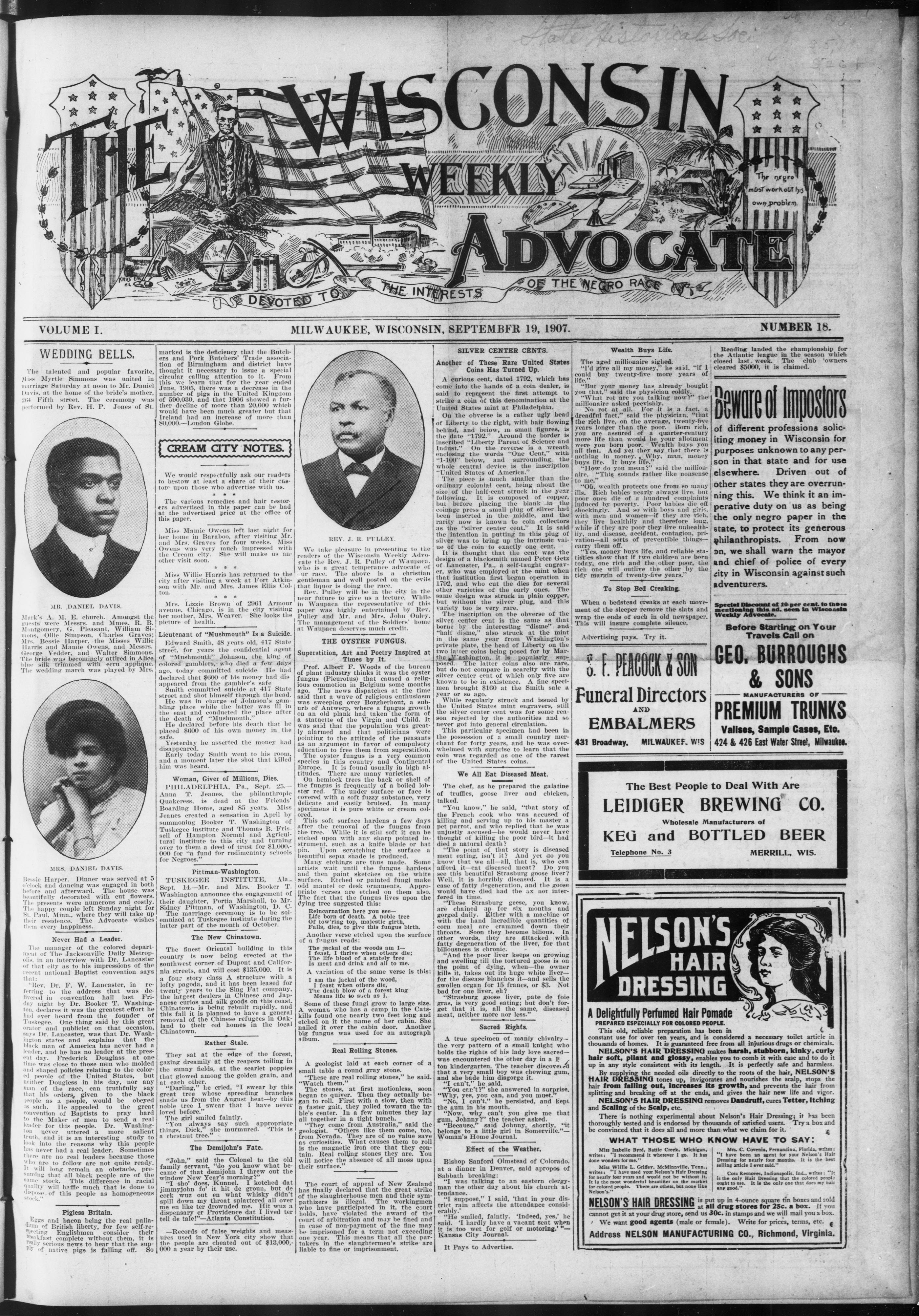
WISCONSIN
WEEKLY
ADVOCATE
DEVOTED TO THE INTERESTS OF THE NEGRO RACE
VOLUME I.
WEDDING BELLS.
The talented and popular favorite, Miss Myrtle Simmons was united in marriage Saturday at noon to Mr. Daniel Davis, at the home of the bride's mother, 264 Fifth street. The ceremony was performed by Rev. H. P. Jones of St.
[Name]
MR. DANIEL DAVIS.
Mark's A. M. E. church. Amongst the guests were Messrs. and Mmes. R. B. Montgomery, G. Pleasant, William Simons, Ollie Simpson, Charles Graves; Mrs. Bessie Harper, the Misses Willie Harris and Mamie Owens, and Messrs. George Vedder, and Walter Simmons. The bride was becomingly attired in Alice blue silk trimmed with ecru applique. The wedding march was played by Mrs.
[Image of a woman with a large hairstyle, wearing a high-collared dress with a decorative neckline. She is holding her chin with her left hand and her right hand is resting on her forehead.]
MRS. DANIEL DAVIS.
Bessie Harper. Dinner was served at 5 o'clock and dancing was engaged in both before and afterward. The house was beautifully decorated with cut flowers. The presents were numerous and costly. The happy couple left Sunday night for St. Paul. Minn., where they will take up their residence. The Advocate wishes them every happiness.
Never Had a Leader
The manager of the colored department of The Jacksonville Daily Metropolis, in an interview with Dr. Lancaster of that city as to his impressions of the recent national Baptist convention says that:
"Rev. Dr. F. W. Lancaster, in referring to the address that was delivered in convention hall last Friday night by Dr. Booker T. Washington, declares it was the greatest effort he had ever heard from the founder of Tuskegee. One thing said by this great orator and publicist on that occasion, says Dr. Lancaster, was that Dr. Washington states and explains that the black man of America has never had a leader, and he has no leader at the present day. Frederick Douglass at one time was close to those men who molded and shaped policies relating to the colored people of the United States, but neither Dougless in his day, nor any man of the race, can truthfully say that his orders, given to the black people as a people, would be obeyed as such. He appealed to the great convention of Baptists to pray hard to the Maker of men to send a real leader for this people. Dr. Washington never uttered a more salient truth, and it is an interesting study to look into the reasons why this people has never had a real leader. Sometimes there are no real leaders because those who are to follow are not quite ready. It will long remain an obstacle, presuming that all black people are of the same stock. This difference in racial quality will baffle much that is done to dispose of this people as homogeneous stock."
Pigless Britain.
Eggs and bacon being the real palladium of British liberty, for few self-respecting Englishmen consider their breakfast complete without them, it is really serious news to hear that the supply of native pigs is falling off. So
marked is the deficiency that the Butchers and Pork Butchers' Trade association of Birmingham and district have thought it necessary to issue a special circular calling attention to it. From this we learn that for the year ended June, 1905, there was a decrease in the number of pigs in the United Kingdom of 590,030, and that 1906 showed a further decline of more than 20,000 which would have been much greater but that Ireland had an increase of more than 80,000.—London Globe.
CREAM CITY NOTES.
We would respectfully ask our readers to bestow at least a share of their custom upon those who advertise with us.
The various remedies and hair restorers advertised in this paper can be had at the advertised price at the office of this paper.
Miss Mamie Owens left last night for her home in Baraboo, after visiting Mr. and Mrs. Graves for four weeks. Miss Owens was very much impressed with the Cream city. She will make us another visit soon.
\* \* \*
Miss Willie Harris has returned to the city after visiting a week at Fort Atkinson with Mr. and Mrs. James Ellis Colton.
* * *
Mrs. Lizzie Brown of 2961 Armour avenue, Chicago, is in the city visiting her mother, Mrs. Weaver. She looks the picture of health.
Lieutenant of "Mushmouth" Is a Suicide.
Edward Smith, 48 years old, 417 State street, for years the confidential agent of "Mushmouth" Johnson, the king of colored gamblers, who died a few days ago, today committed suicide. He had declared that $600 of his money had disappeared from the gambler's safe
Smith committed suicide at 417 State street and shot himself through the head. He was in charge of Johnson's gambling place while the latter was ill in the east and conducted the place after the death of "Mushmouth." He declared before his death that he placed $600 of his own money in the safe.
Yesterday he asserted the money had disappeared. Early today Smith went to his room, and a moment later the shot that killed him was heard.
Woman Giver of Millions Dies
PHILADELPHIA, Pa., Sept. 25. Anna T. Jeanes, the philanthropic Quakeress, is dead at the Friends' Boarding Home, aged 85 years. Miss Jeanes created a sensation in April by summoning Booker T. Washington of Tuskegee institute and Thomas B. Frissell of Hampton Normal and Agricultural institute to this city and turning over to them a deed of trust for $1,000.000 for "a fund for rudimentary schools for Negroes."
Pittman-Washington.
TUSKEGEE INSTITUTE, Ala.. Sept. 14.—Mr. and Mrs. Booker T. Washington announce the engagement of their daughter, Portia Marshall, to Mr. Sidney Pittman, of Washington, D. C. The marriage ceremony is to be solemnized at Tuskegee institute during the latter part of the month of October.
The New Chinatown.
The finest Oriental building in this country is now being erected at the southwest corner of Dupont and California streets, and will cost $135,000. It is a four story class A structure with a lofty pagoda, and it has been leased for twenty years to the Sing Fat company, the largest dealers in Chinese and Japanese curios and silk goods on this coast. Chinatown is being rebuilt rapidly, and this fall it is planned to have a general removal of the Chinese refugees in Oakland to their old homes in the local Chinatown.
Rather Stale.
They sat at the edge of the forest, gazing dreamily at the reapers toiling in the sunny fields, at the scarlet poppies that glowed among the golden grain, and at each other. "Darling," he cried, "I swear by this great tree whose spreading branches snade us from the August heat—by this noble tree I swear that I have never loved before."
The girl smiled faintly.
"The girl smiled affectionately.
"You always say such appropriate things, Dick," she murmured. 'This is a chestnut tree.'
The Demijohn's Fate.
"John," said the Colonel to the old family servant, "do you know what became of that demijohn I threw out the window New Year's morning?"
"I sho' does, Kunnel. I kotched dat jimmyjohn fo' it hit de groun, but de cork wuz out en what whisky didn't spill down my throat splattered all over me en like ter drownded me. Hit wuz a dispensary er Providence dat I lived ter tell de tale!"—Atlanta Constitution.
—Records of false weights and measures used in New York city show that the people are cheated out of $13,000,-000 a year by their use.
[Name]
REV. J. R. PULLEY.
We take pleasure in presenting to the readers of the Wisconsin Weekly Advocate the Rev. J. R. Pulley of Waupaca, who is a great temperance advocate of our race. The above is a christian gentleman and well posted on the evils that liquor is doing the race.
Rev. Pulley will be in the city in the near future to give us a lecture. While in Waupaca the representative of this paper was highly entertained by Rev. Pulley and Mr. and Mrs. John Onley. The management of the Soldiers' home at Waupaca deserves much credit.
THE OYSTER FUNGUS
Superstition, Art and Poetry Inspired at Times by It.
Prof. Albert F. Woods of the bureau of plant industry thinks it was the oyster fungus (Pleurotus) that caused a religious commotion in Belgium some months ago. The news dispatches at the time said that a wave of religious enthusiasm was sweeping over Borgherhout, a suburb of Antwerp, where a fungus growth on an old plank had taken the form of a statuette of the Virgin and Child. It was said that the population was greatly alarmed and that politicians were pointing to the attitude of the peasants as an argument in favor of compulsory education to free them from superstition. The oyster fungus is a very common species in this country and Continental Europe. It is found usually in high altitudes. There are many varieties.
On hemlock trees the back or shell of the fungus is frequently of a boiled lobster red. The under surface or face is covered with a soft fuzzy substance, very delicate and easily bruised. In many specimens it is pure white or cream colored.
This soft surface hardens a few days after the removal of the fungus from the tree. While it is still soft it can be etched upon with any sharp pointed instrument, such as a knife blade or hat pin. Upon scratching the surface a beautiful sepia shade is produced.
Many etchings are thus made. Some artists wait until the fungus hardens and then paint sketches on the white surface. Etched or painted fungi make odd mantel or desk ornaments. Appropriate verses are etched on them also. The fact that the fungus lives upon the dying tree suggested this:
Life born of death. A noble tree
Of tow'ring top, majestic girth
Of tow'ring top, majestic girth.
Falls, dies, to give this fungus birth.
Another verse etched upon the surface of a fungus reads:
The jackal of the woods am I—
I feast, I thrive when others die;
The life blood of a stately tree
Is meat and drink and all to me.
A variation of the same verse is this:
I am the jackal of the wood,
I feast when others die,
The death blow of a forest king
Means life to such as I.
Some of these fungi grow to large size. A woman who has a camp in the Catskills found one nearly two feet long and etched on it the name of her cabin. She nailed it over the cabin door. Another big fungus was used for an autograph album.
Real Rolling Stones.
The stones, at first motionless, soon began to quiver. Then they actually began to roll. First with a slow, then with a faster gait, they rolled toward the table's center. In a few minutes they lay all together in a tight bunch.
"They come from Australia," said the geologist. "Others like them come, too, from Nevada. They are of no value save as curiosities. What causes them to roll is the magnetic iron ore that they contain. Real rolling stones they are. You will notice the absence of all moss upon their surface."
The court of appeal of New Zealand has finally declared that the great strike of the slaughterhouse men and their sympathizers is illegal. The workingmen who have participated in it, the court holds, have violated the award of the court of arbitration and may be fined and in case of non-payment of the fine may be imprisoned for a term not exceeding one year. This means that all the partakers in the slaughtermen's strike are liable to fine or imprisonment.
SILVER CENTER CENTS.
Another of These Rare United States Coins Has Turned Up.
A curious cent, dated 1792, which has come into the hands of a coin dealer, is said to represent the first attempt to strike a coin of this denomination at the United States mint at Philadelphia.
On the obverse is a rather ugly head of Liberty to the right, with hair flowing behind, and below, in small figures, is the date "1792." Around the border is inscribed "Liberty Parent of Science and Indust." On the reverse is a wreath enclosing the words "One Cent," with "1-100" below, and surrounding the whole central device is the inscription "United States of America."
The piece is much smaller than the ordinary colonial cent, being about the size of the half-cent struck in the year following. It is composed of copper, but before placing the blank in the coinage press a small plug of silver had been inserted in the middle, and the rarity now is known to coin collectors as the "silver center cent." It is said the intention in putting in this plug of silver was to bring up the intrinsic value of the coin to exactly one cent.
It is thought that the cent was the design of a blacksmith named Peter Getz of Lancaster, Pa., a self-taught engraver, who was employed at the mint when that institution first began operation in 1792, and who cut the dies for several other varieties of the early ones. The same design was struck in plain copper, but without the silver plug, and this variety too is very rare.
The inscription on the obverse of the silver center cent is the same as that borne by the interesting "disme" and "half disme," also struck at the mint in the same year from Washington's private plate, the head of Liberty on the two latter coins being posed for by Martha Washington, it is popularly supposed. The latter coins also are rare, but do not compare in scarcity with the silver center cent of which only five are known to be in existence. A fine specimen brought $160 at the Smith sale a year or so ago. While regularly struck and issued by the United States mint engravers, still the silver center cent was for some reason rejected by the authorities and so never got into general circulation.
This particular specimen had been in the possession of a small country merchant for forty years, and he was overwhelmed with surprise to learn that the coin was regarded as one of the rarest of the United States coins.
We All Eat Diseased Meat.
The chef, as he prepared the galatine of truffles, goose liver and chicken, talked.
"You know," he said, "that story of the French cook who was accused of killing and serving up to his master a pet parrot, and who replied that he was unjustly accused—he would never have thought of killing the poor bird—it had died a natural death?
"The point of that story is diseased meat eating, isn't it? And yet do you know that we all—all, that is, who can afford it—eat diseased meat? Do you see this beautiful Strasburg goose liver? Well, it is horribly diseased. It is a case of fatty degeneration, and the goose would have died had the ax not interfered in time.
"These Strasburg geese, you know, are chained up for six months and gorged daily. Either with a machine or with the hand incredible quantities of corn meal are crammed down their throats. Soon they become bilious. In other words, they are attacked with fatty degeneration of the liver, for that biliousness is chronic.
"And the poor liver keeps on growing and swelling till the tortured goose is on the point of dying, when—the owner kills it, takes out its huge white liver—for the disease blanches it—and sells the swollen organ for 15 francs, or $3. Not bad for one liver, eh?
"Strasburg goose liver, pate de foie gras, is very good eating; but don't forget that it is, all the same, diseased meat, neither more nor less."
Sacred Rights.
A true specimen of manly chivalry—the very pattern of a small knight who holds the rights of his lady love sacred—was encountered the other day in a Fleton kindergarten. The teacher discovered that a very small boy was chewing gum, and she bade him disgorge it.
"I can't," he said.
"You can't?" she answered in surprise.
"Why, yes, you can, and you must."
"No, I can't," he persisted, and kept the gum in his mouth.
"Now, why can't you give me that gum, Johnny?" the teacher asked.
gum, Johnny; the teacher asked. "Because," said Johnny, shortly, "it belongs to a little girl in Somerville."—Woman's Home Journal.
Effect of the Weather.
Bishop Sanford Olmstead of Colorado, at a dinner in Denver, said apropos of Sabbath breaking:
"I was talking to an eastern clergyman the other day about his church attendance.
"I suppose," I said, 'that in your district rain affects the attendance considerably.'
"He smiled, faintly. 'Indeed, yes,' he said. 'I hardly have a vacant seat when it is too wet for golf or motoring.'"—Kansas City Journal.
It Pays to Advertise.
The Best People to Deal With Are LEIDIGER BREWING CO. Wholesale Manufacturers of KEG and BOTTLED BEER Telephone No. 3 MERRILL, WIS.
NELSON'S HAIR DRESSING makes harsh, stubborn, kinky, curly hair soft, pliant and glossy, enables you to comb it with ease and to do it up in any style consistent with its length. It is perfectly safe and harmless. By supplying the needed oils directly to the roots of the hair, NELSON'S HAIR DRESSING tones up, invigorates and nourishes the scalp, stops the hair from falling out, increases its growth, and prevents the hair from splitting and breaking off at the ends, and gives the hair new life and vigor.
NELSON'S HAIR DRESSING removes Dandruff, cures Tetter, Itching and Scaling of the Scalp, etc. There is nothing experimental about Nelson's Hair Dressing; it has been thoroughly tested and is endorsed by thousands of satisfied users. Try a box and be convinced that it does all and more than what we claim for it.
WHAT THOSE WHO KNOW HAVE TO SAY:
NELSON'S HAIR DRESSING is put up in 4-ounce square tin boxes and sold at all drug stores for 25c. a box. If you cannot get it at your drug store, send us 30c. in stamps and we will mail you a box. We want good agents (male or female). Write for prices, terms, etc.
Wealth Buys Life.
The aged millionaire sighed. "I'd give all my money," he said, "if I could buy twenty-five more years of life." "But your money has already bought you that," said the physician coldly. "What rot are you talking now?" the millionaire asked peevishly.
No rot at all. For it is a fact, a dreadful fact," said the physician, "that the rich live, on the average, twenty-five years longer than the poor. Born rich, you are assured of a quarter-century more life than would be your allotment were you born poor. Wealth buys you all that. And yet they say that there is nothing in money. Why, man, money buys life. It buys life."
"How do you mean?" said the millionaire. "This sounds rather like nonsense to me."
"Oh, wealth protects one from so many ills. Rich babies nearly always live, but poor ones die of a hundred complaints induced by poverty. Poor babies die off shockingly. And so with boys and girls, with men and women—if they are rich, they live healthily and therefore long, while if they are poor they live unhealthily, and disease, accident, contagion, privation—all sorts of preventible things—carry them off.
"Yes, money buys life, and reliable statistics show that if two children are born today, one rich and the other poor, the rich one will outlive the other by the tidy margin of twenty-five years."
To Stop Bed Creaking
When a bedstead creaks at each movement of the sleeper remove the slats and wrap the ends of each in old newspaper. This will insure complete silence.
Advertising pays. Try it.
S. F. PEACOCK & SON
Funeral Directors
AND
EMBALMERS
431 Broadway, MILWAUKEE, WIS
The Best People
LEIDIGER B
Wholesale M
KEG and BO
Telephone No. 3
NELSON'S HAIR DRESSING
A Delightfully Perfumed Hair Po
PREPARED ESPECIALLY FOR COLORED PE
This old, reliable preparation has
constant use for over ten years, and is
thousands of homes. It is guaranteed f
NELSON'S HAIR DRESSING
hair soft, plant and glossy, enab
up in any style consistent with its len
By supplying the needed oils direct
HAIR DRESSING tones up, invigor
hair from falling out, increases it
splitting and breaking off at the ends.
NELSON'S HAIR DRESSING re
and Scaling of the Scalp, etc.
There is nothing experimental abo
thoroughly tested and is endorsed by th
be convinced that it does all and more t
WHAT THOSE WHO
Miss Isabelle Byrd, Battle Creek, Michigan, writes: "I recommend it wherever I go. It has done wonders for me."
Miss Willie L. Griffey, McMinnville, Tenn., writes: "I have used your Nelson's Hair Dressing for nearly four years and would not be without it. It is the most wonderful beautifier on the market for colored people. There are others, but none like Nelson's."
NELSON'S HAIR DRESSING cannot get it at your drug store, send us We want good agents (male or female) Address NELSON MANUFACTURE
NUMBER 18.
Reading landed the championship for the Atlantic league in the season which closed last week. The club owners cleared $5000, it is claimed.
Beware of Impostors
Beware of Impostors
of different professions soliciting money in Wisconsin for purposes unknown to any person in that state and for use elsewhere. Driven out of other states they are overrunning this. We think it an imperative duty on us as being the only negro paper in the state, to protect its generous philanthropists. From now on, we shall warn the mayor and chief of police of every city in Wisconsin against such adventurers.
Special Discount of 10 per cent. to those mentioning this ad. seen in Wisconsin Weekly Advocate.
Before Starting on Your Travels Call on
GEO. BURROUGHS
& SONS
MANUFACTURERS OF
PREMIUM TRUNKS
Vallses, Sample Cases, Eto.
424 & 426 East Water Street, Milwaukee.
to Deal With Are
BREWING CO.
manufacturers of
TITLED BEER
MERRILL, WIS.
been in
considered a necessary toilet article in
free from all injurious drugs or chemicals.
makes harsh, stubborn, kinky, curly
les you to comb it with ease and to do it
length. It is perfectly safe and harmless.
try to the roots of the hair, NELSON'S
ates and nourishes the scalp, stops the
s growth, and prevents the hair from
and gives the hair new life and vigor.
moves Dandruff, cures Tetter, Itching
but Nelson's Hair Dressing; it has been
thousands of satisfied users. Try a box and
than what we claim for it.
KNOW HAVE TO SAY:
Mrs. C. Covenia, Fernandina, Florida, writes: "I have been an agent for your Nelson's Hair Dressing for nearly four months. It is the best selling article I ever sold."
Cora Resnoves, Indianapolis, Ind., writes: "It is the only Hair Dressing that the colored people ought to use. It is the only one that does my hair any good."
but up in 4-ounce square tin boxes and sold all drug stores for 25c. a box. If you 30c. in stamps and we will mail you a box. (male). Write for prices, terms, etc.
URING CO., Richmond, Virginia.
E. J. THOMAS
Gem
LAUNDRY
254-256 FIFTH STREET
Telephone Grand 903
210 FIFTH STREET (Near Wells)
Is prepared to supply the public with coal by basket or ton,
and wood by basket or cord. Prompt delivery guaranteed.
Large Moving Vans Rapid Express
NOTICE
TO ALL actual settlers who buy a quarter section of land during the next six months: Come to our cattle ran Lake, Chippewa county, Wisconsin, and get a young cow and Two head of blooded stock given away with 160 acres of either in Chippewa or Gates counties, the best clover belt on States. Terms of payment for the land, one-quarter down, long time at 6 per cent. interest. Address,
J. L. GATES LAND CO., Milwaukee
Dated March 1, 1905.
The largest land owners in the state. We have about blooded Polled Angus, Herefords and Durhams.
W. J. CANNON
DEALER IN
New and Second-Hand HOUSEHOLD GO
Storage For Household Goods
JANESVILLE, WIS
P. CANAR.
G.
CANAR BROS
LAUNDRY
522 State St. Telephone Main 357 Milwa
FORD'S HAIR POM
FORMERLY KNOWN AS
"OZONIZED OX MARROW"
Makes the Hair Pliable, Soft and Easy
READ WHAT THE PEOPLE SAY
a quarter section of land from us
Come to our cattle ranch at Long
and get a young cow and calf free.
away with 160 acres of choice land.
the best clover belt of the United
land, one-quarter down, balance on
address,
O., Milwaukee, Wis.
ate. We have about 600 head of
Durhams.
ANNON
ER IN
HOLD GOODS
household Goods
WISCONSIN
G. CANAR.
BROS.
RY
Main 357 Milwaukee.
IR' POMADE
KNOWN AS
OX MARROW"
Soft and Easy to Comb
THE PEOPLE SAY
TO ALL actual settlers who buy a quarter section of land from us during the next six months: Come to our cattle ranch at Long Lake, Chippewa county, Wisconsin, and get a young cow and calf free. Two head of blooded stock given away with 160 acres of choice land, either in Chippewa or Gates counties, the best clover belt of the United States. Terms of payment for the land, one-quarter down, balance on long time at 6 per cent interest. Address,
The largest land owners in the state. We have about 600 head of blooded Polled Angus, Herefords and Durhams.
W. J. CANNON
DEALER IN
New and
Second-Hand HOUSEHOLD GOODS
Storage For Household Goods
JANESVILLE, WISCONSIN
P. CANAR. G. CANAR.
CANAR BROS.
LAUNDRY
522 State St. Telephone Main 357 Milwaukee.
West Chester, Pa., Mch. 30. 1905.
I had typhoid fever and my hair all came out.
I used three bottles of your pomade and now my hair is nine inches long and very thick and nice and straight. Most every one seeing how good your pomade did my hair, they too are anxious for it. My hair is an example to every one.
Yours respectfully, ELLY BYE.
Colvert, Tex., Mch. 31. 1905.
I have used one bottle of your pomade and my hair is now perfectly straight, soft and black as silk. I will not be without it.
RHODA EDWARDS.
Paris, Mo., July 15, 1899.
Gentlemen: When I began using your pomade my head was so bald I was ashamed of myself, but now my hair has grown three inches all over my head and I have been using it only two months.
IDA PRETER.
Gentlemen: I have used your pomade and have found it to do more than it do. It stops the hair from falling out and breaking off, and cleans the scapular soft, pliable and glossy.
I have seen the original letters and testify to the genuineness of the stains.
R. B. MONTGOMERY, Edtr., Wisconsin Weekly A
FORD'S HAIR POMADE, formerly known as "OZONIZED OIL straightens Kinky or Curly Hair that it can be put up in any style with its length, and is the only safe preparation known to us that makes Hair Straight, as shown above. Its use makes the most stubborn, curly hair soft, pliable and easy to comb. These results may be the treatment; 2 to 4 bottles are usually sufficient for a year. The use of HOMPOMADE removes and prevents dandruff, relieves itching, invigorates the hair from falling out or breaking off, makes it grow, and by nourishing the life and vigor. Being elegantly perfumed and harmless, it is a toilet mug gentlemen and children. FORD'S HAIR POMADE, formerly known Ox Marrow" has been made and sold continuously since about 1888, and the Ox MARROW," was registered in the United States Patent Office in 1875. Ford's, as its use makes the hair STRAIGHT, SOFT and PLIABLE. Be Remembrer that FORD'S HAIR POMADE is put up only in 50c, only in Chicago and by us. The genuine has the signature, Charles F. package. Refuse all others. Full directions with every bottle. Price for drummists and dealers. If your druggist or dealer cannot supply you, be from his jobber or wholesale dealer, or send us 50c, for one bottle, post three bottles, or $2.50 for six bottles, express paid. We pay postage and to all points in J. S. A. When ordering send postal or express money on name of this paper. Write your name and address plainly to
Atlanta, Ga., June 6, 1900.
We found it to do more than it is recommended to
ing off, and cleans the scalp and makes the hair
MAGGIE REND.
into the genuineness of the statements.
Wisconsin Weekly Advocate.
It is known as "OZONIZED OX MARROW," so
can be put up in any style desired consistent
known to us that makes Kinky or Curly
makes the most stubborn, harsh, kinky or
hose. These results may be obtained from one
part for a year. The use of FORD'S HAIR
believes itching, invigorates the scalp, stops the
arrow, and by nourishing the roots, gives it new
and harmless, it is a toilet necessity for ladies.
POMADE, formerly known as "Ozonized
States Patent Office in 1874. Be sure to get
SOFT and PLIABLE. Beware of imitations.
DE is put up only in 50c. size, and is made
with the signature, Charles Ford, Prest, on each
with every bottle. Price only 50c. Sold by
baker cannot supply you, he can get it for you
as 50c. for one bottle, postpaid, or $1.40 for
paid. We pay postage and express charries
postal or express money order, and mention
press plainly to
Gentlemen: I have used your pomade and have found it to do more than it is recommended to do. It stops the hair from falling out and breaking off, and cleans the scalp and makes the hair soft, pliable and glossy.
MAGGIE REND.
I have seen the original letters and testify to the genuineness of the statements.
R. B. MONTGOMERY, Edtr., Wisconsin Weekly Advocate.
FORD'S HAIR POMADE, formerly known as "OZONIZED OX MARROW," so straightens Kinky or Curly Hair that it can be put up in any style desired consistent with its length, and is the only safe preparation known to us that makes Kinky or Curly Hair Straight, as shown above. Its use makes the most stubborn, harsh, kinky or curly hair soft, plinble and easy to comb. These results may be obtained from one treatment; 2 to 4 bottles are usually sufficient for a year. The use of FORD'S HAIR POMADE removes and prevents dandruff, relieves itching, invigorates the scalp, stops the hair from falling out or breaking off, makes it grow, and by nourishing the roots, gives it new life and vigor. Being elegantly perfumed and harmless, it is a toilet necessity for ladies, gentlemen and children. FORD'S HAIR POMADE, formerly known as "Ozonized Ox Marrow" has been made and sold continuously since about 1858, and the label, "OZONIZED OX MARROW," was registered in the United States Patent Office in 1874. Be sure to get Ford's, as its use makes the hair STRAIGHT, SOFT and PLIABLE. Beware of imitations. Remember that FORD'S HAIR POMADE is put up only in 50c. size, and is made only in Chicago and by us. The genuine has the signature, Charles Ford, Prest, on each package. Refuse all others. Full directions with every bottle. Price only 50c. Sold by druggists and deniers. If your druggist or dealer cannot supply you, he can get it for you from his jobber or wholesale dealer, or send us 50c. for one bottle, postpaid, or $1.40 for three bottles, or $2.50 for six bottles, express paid. We pay postage and express charges to all points in J. S. A. When ordering send postal or express money order, and mention name of this paper. Write your name and address plainly to
THE OZONIZED OX MARROW CO.
153 E. Kinzio St., Chicago, Ill.
(None genuine without my signature. Agents Wanted everywhere.)
---
---
Key West, Fla., Aug. 28, 1904.
I used only one bottle of your pomade and my hair has stopped breaking off and has greatly improved. When I started using this wonderful preparation my hair was seven inches long and now it is ten inches or more. Yours truly.
314 Southard St. MINNIE FOASTER.
```markdown
```
Brookhaven, Miss., Aug. 13, 1898.
Gentlemen: I must confess I never tried any preparation so excellent for the hair. My hair was turning gray and was rather deadly but since I have been using your hair pomade my hair has turned black like it was when I was a girl and it has a lively, glossy color.
C. L. ROBERTS.
Charles Ford Prest
THE WISCONSIN WEEKLY ADVOCATE
MILWAUKEE, WIS.
R. B. MONTGOMERY, Editor and Proprietor.
Miscellaneous Items.
The output of porcelain at Seto from April, 1906, to March, 1907, was valued at $661120 of which 53 per cent. went to the United States.
The total amount of notes in circulation of the Bank of Japan on July 13 ast was $152,000,000, with a specie reserve amounting to $74,000 000.
Of the entire human race it is estimated that 500,000,000 live in houses, 700,000,000 in huts and caves, and 250,000,000 have virtually no shelter.
Scottish bakers in 1888 only earned from 20 shillings to 28 shillings a week; the average wages now stand at from 28 shillings to 35 shillings a week.
James Delaney, born in 1826, and said to be the oldest letter carrier in the country, has resigned after fifty years' continuous service in New York.
Gstrich feathers can be taken every eight months. The plumes are not, as some suppose, pulled, but are cut with a sharp knife. The stumps wither and fall out.
Since July, 1905, new companies have been formed in Japan, with a total capital of $598,294,400, and the increased capital of old companies amounted to $240,862,365.
The total output of salt in Japan during the year ended March 31 last amounted to 1,257,361,528 pounds. The import of foreign salt during the same year amounted to 35,061,392 pounds.
-Iron cloth is largely used today by tailors for making the collars of coats set properly. It is manufactured by a new process from the steel wool and has the appearance of having been woven from horsehair.
-At the beginning of the year the number of people living under statutory prohibition in Maine, North Dakota and Kansas was only 2,500,000. By the end of the year Tennessee and Georgia will nearly have trebled the number.
-Some time ago a woolen manufacturer in the north of England succeeded in making a fabric from old ropes. He obtained a quantity of old rope and cordage, unraveled them and wove them by a secret process into a kind of rough cloth.
Cardinal Merry del Val, the papal secretary of state, is said to be one of the most modern of men. He usually drives about in his old world coach, and is said to play an excellent game of golf and can send a rifle bullet through a 10-cent piece at twenty yards.
In regard to the marketing of American motor cars in Turkey Vice Consul General William Smith-Lyte advises that owing to the impossible roads and streets there are no prospects whatever for business in the Constantinople district.
Disappearing paper is a novelty for use by those whose correspondents forget to burn the letters after their utility has ceased. It is steeped in sulphuric acid, dried and glazed, the acid being partly neutralized by ammonia vapor. It falls to pieces after a given time.
The aigrette in a lady's bonnet is the crowning beauty of an egret mother. The collector seizes the bird while she is on her nest, with the young just hatched, and tears off her plumes and wings, leaving her to die beside her little ones who, deprived of her fostering care, also die, victims to woman's vanity.
Vice Consul Ernest Santi of Milan, Italy, reports that the city government has voted to obtain a loan of $13,510,000 at 4 per cent. interest, to be liquidated within fifty years. The money is to be used in making municipal improvements, such as building sewers, public baths, tramways, electrical plant, new streets, etc.
Abdul Hamid, the Sultan of Turkey, has a hobby for carpentry and cabinet work. Before he came to the throne and when there seemed little prospect of his succeeding to the heritage of Osman he spent a good deal of time in the joiner's shop, and, indeed, became a fairly skillful workman, capable of earning his living anywhere.
The record for multiple weddings seems to be held by a small English village called Trail. The bridegrooms were the four sons of John Sumers of that village, and the brides, whose ages ranged from 18 to 28, were the daughters of James Hochsteeler, a prosperous farmer. The eight young persons have lived all their lives within a stone's throw of each other.
Queen Louise of Denmark is extremely wealthy, for she not only inherited a large fortune from her father but also another from her mother, Princess Louise of the Netherlands, who was one of the greatest royal heiresses of the Nineteenth century. Both the King and the Queen of Denmark are still very young looking, though they celebrated their silver wedding in 1894.
The crescent-shaped sand dunes which move in thousands across the desert of Aslay, near La Joya, Peru, have been investigated by Astronomer S. L. Bailey, who found the points of a crescent to be 160 feet apart, while the convex side measured 477 feet and the greatest width was more than 100 feet. The estimated weight was 8,000 tons, yet it was carried 125 feet a year by the prevailing south winds.
—London now has six "tubes" for electric underground service. Five more tubes are under construction and projected. The existing railways of London, underground and surface, it is estimated, carry over 600,000,000 persons yearly, of which the underground lines accommodate 258,000,000. There are nearly 600 railway stations in Greater London, and into the trunk-line stations alone there pour annually over 300,000,000 passengers.
Another new "itis" pertaining to occupation has appeared. It is "telephonitis." The new epidemic has broken out recently among girl switchboard operators in the Bronx. The symptoms are a rash on the arm used to handle the plugs, followed by partial or complete heblessness of the member. It is suggested by physicians that the disorder may be due to mild blood disorder caused by careless handling of the plugs by their metal ends, instead of by the insulated handle.
According to the Dominion Bureau of Statistics, the manufacture of glass in Canada is a waning industry. In five years since 1900 there has been a very large falling off in number of employees and a corresponding falling off in amount of wages. At the same time the imports of glass are increasing most remarkably. In 1902 the imports were valued at $1,932,539, and in 1906 they were valued at $2,673,031, and increase of $740,492. The Canadian Manufacturer says the trouble is the lack of protective duties.
The Third Thames Bridge
Blackfriars bridge, now being incased with the preliminary staging for its widening, is not the original bridge erected there in 1769. That was christened Pitt bridge, and a halfpenny toll was charged for pedestrians on week days and a penny on Sundays. It was
the third bridge across the Thames, and it would probably be standing now but for the undermining of its foundation by the rebuilding of London bridge in 1831. Old London bridge, with its twenty narrow arches, acted almost a dam across the Thames, and Rennie's new bridge, with only five arches, so increased the scour of the tides that Blackfriars bridge was rendered unsafe pulled down, rebuilt and opened in 1869. In the same way Westminster bridge had to be demolished in 1846, after a vain endeavor to strengthen it agains the altered river flow caused by the new London bridge. Though Westminster Bridge was the "point d'appui" of Wordsworth's matchless sonnet. Blackfriars is the more practically interesting, for it was the riots against its halfpenny and penny tolls in 1780 that led the government to purchase the river bridges and throw them open to the public, toll free.—London Chronicle.
DEVIL'S TOWER A RESERVE
A Queer Rock Formation in Northeastern Wvoming.
President Roosevelt has issued an order setting aside the Devil's tower, a peculiar geographical formation in northeastern Wyoming, as a national monument and a federal reserve. Nearly 2000 acres of land also are set aside with the tower. This reserve will be under the care of the general land office of that district no entries will be allowed on it and every effort will be made to protect the tower from injury. This Devil's Tower is a chimney like mountain of rock that rises 800 feet above the surrounding country and for almost 500 feet is nearly perpendicular and devoid of any growth or vegetation. The top of the tower is large enough in area for a baseball team to play a good game and is covered with a scant soil formed from the disintegrated rock and bearing moss, cactus and ferns.
Two men are known to have climbed this tower at the risk of their lives. One of them was Jack Rogers, an old cowboy, and the other was Arthur Jobe, a young engineer for the Homestake Mining company. The tower stands on the bank of the upper Belle Fourche river and has been for years one of the landmarks of the country. It was at one time included in an entry made by Miss Kent, an English woman, who filed on a homestead including this mountain. This entry afterwards was canceled.—Deadwood Cor. St. Paul Pioneer Press.
A. Bishop's Seashore Mission.
Three years ago the Bishop of Manchester announced his intention of holding a mission on the sands of Blackpool; and though there were numerous offers of help at once forthcoming the suggested experiment was not generally regarded with much favor. The bishop's third mission on the seashore at Blackpool has just ended, and his lordship states that not only has there been a great increase of interest apparent each year, but this year it has appeared that the scheme has been taken up by the entire crowd of holiday seekers, there being no opposition whatever to be observed. The bishop is jubilant over the evident success of the mission, and how active he has himself been in connection with the work may be gauged from the fact that he addressed about seventy meetings, with an aggregate audience of 160,000 people. The bishop's ready speech, his sense of humor, and his cheerful, kindly manner have made him most popular, and the trippers look out with joyous expectation for the "kindly old gentleman in gaiters and skull cap," as he threads his way along the densely throughed sands at low tide. If the bishop required any "apologeae" for holding his mission, it is found in the fact to which he draws attention, that there are thousands of people in Blackpool who do not go to any place of worship, simply because they cannot. The churches and chapels in the town cannot possibly accommodate anything like half the great crowds who visit Blackpool in August.—Pall Mall Gazette.
Profit in His Risk.
Jim Johnstone, the famous baseball umpire, said recently in New York that baseball crowds were far kinder to umpires than they used to be.
"This is true of theater crowds, too," said Mr. Johnstone. "Why, with provincial touring companies in the past maltreatment was regularly expected. In fact, the companies profited by it in more ways than one.
"I know of a company that was playing 'The Broken Vow,' in Paint Rock, a one-night stand. The audience didn't like 'The Broken Vow,' and eggs, cabbages and potatoes rained upon the stage.
"But finally a gallery auditor, in a paroxysm of rage and scorn, hurled a heavy boot, and the actor, thoroughly alarmed, started to retreat.
"Keep on playing, you fool,' hissed the manager from the wings as he hooked in the boot with an umbrella. 'Keep on till we get the other one.'"—Washington Star
In the Shadow of the Sacred Cod
A young lady, evidently an amateur fisherman, presented an odd sight as she walked up Atlantic avenue Sunday with a large cod in her hand. To all appearances she had been fishing and the fish that she carried was the prize of the catch. She insisted on carrying it with her on the electric car, and although many held their noses as the car sped on she paid no attention to them, but instead simply smiled.—Boston Evening Record.
The Reason.
"Well! Well!" suprisedly commented the patent churn man, as the village brass band tore rapidly past, smashing out tintinnabulatory strains as they went, "those fellows are pretty nearly on a dead run! What makes them march so fast?" "Trying to git away from the music, I guess," replied the landlord of the Pruntytown tavern, who was a pessimistic old grouch, anyhow.—Smart Set.
Disappearing Land.
In two years the Missouri river has destroyed 60,000 acres of farm land, as Walter Williams figures it. The average Missouri farms contains 120 acres. That means that each year fifty Missouri farms are tumbled over into the muddy water for want of adequate protection. Nor is this cheap land. It sells at an average price of $100 an acre, even with the menace of the river hanging over it.—Kansas City Journal.
—Concrete is now being employed for paving purposes. This material promises smoothness, cleanliness of surface and durability. A foundation of cinders to the depth of ten inches is first made and permitted to pack well for a week. Then the concrete curbing is made in the usual manner. Finally the concrete is mixed and thrown into place, considerably higher in the center and sloping to either gutter. Immediately before the concrete hardens it is marked off with an instrument to resemble a pavement laid with brick. This method will insure a firm footing for draft horses in the winter.
Mrs. Alice H. Thomas, M.D. HAIR AND SCALP SPECIALIST
Mrs. Alice H. Thomas, M.D. HAIR AND SCALP SPECIALIST
Poor, thin, short hair cultivated into a luxuriant healthy growth or money-refunded. Thomas' Magic Hair Grower, the finest preparation on the market for dandruff and falling hair. Price $1.00. For sample. Agents wanted.aught for $25. More money in hair than any women. Address to
ERS. ALICE A. THOMAS
Street, Flat 2
Chicago, Ill.
Mention This Paper.
1 L. Office Hours: 9 a.m. till 12 M.
1 p. m. till 4 p. m.
7 p. m. till 9 p. m.
F. G. W. MURPHY
CHIROPODIST
Building 14 Grand Avenue
(2nd Floor Take Elevator)
All of pain and enjoy comfort! Consultation free
moves corns and bunions and ingrowing toe nails within or any inconvenience to the patient. All ailmentstreated. Special attention paid to club and deformed
Will Call at Any Part of City
Highest medical and Society references.
KERN'S
SUCCESS
Finest FLOUR Produced
AT ALL FIRST-CLASS GROCERS
E. L. HUSTING CO
SOLE BOTTLER OF
Coca Cola
Poor, thin, short hair cultivated into a luxuriant healthy growth or money refunded. Thomas' Magic Hair Grower, the finest preparation on the market for dandruff and falling hair. Price $1.00.
Send 4 cents for sample. Agents wanted.
Hair Culture taught for $25. More money in hair than any other business for women. Address to
Telephone Grand 4591 L.
Office Hours: 9 a. m. till 12 M.
1 p. m. till 4 p. m.
7 p. m. till 9 p. m.
PROF. G. W. MURPHY
CHIROPODIST
Room 219 Empire Building 14 Grand Avenue
(2nd Floor Take Elevator)
Be relieved of pain and enjoy comfort! Consultation free
The Professor removes corns and bunions and ingrowing toe nails without injury to the skin or any inconvenience to the patient. All ailments of the feet carefully treated. Special attention paid to club and deformed toe nails.
Will Call at Any Part of City
Terms reasonable. Highest medical and Society references.
Mfg. of Soda, Ginger Ale, et
FOR. FIFTH AND VLIET STREET
Looking for Choice Groceries? If So, Go to
GAS & N THANOS
SAY! Are You Looking for Choice Groceries? If So, Go to
T. RIGAS & N. THANOS
—DEALERS IN—
CHOICE GROCERIES
Candies, Fruits, Cigars and Tobacco
Phone Grand 3898
428 WELLS STREET. MILWAUKEE, WIS.
Single and Double. Also Light Housekeeping. 427 Cedar Street, Milwaukee.
Call up Grand 783. You Can Be Accommodated At Any Time.
The Oriental Club
196 Fourth Street
Hot and Cold Water Baths Day and Night
No Intoxicating Drinks
Sold to Minors.
D. MOORE,
Prop.
WE CONTINUE TO WARN THE BENEVOLENT PUBLIC AGAINST THE NUMEROUS BEGGARS FOR ALLEGED CHARITABLE INSTITUTIONS IN BEHALF OF THE NEGRO RACE. LOOK WELL TO THE CREDENTIALS OF SUCH MENDICANTS AND INQUIRE OF SOME REPUTABLE NEGRO CITIZEN REGARDING THE TRUTHFULNESS OF THEIR STATEMENTS.
```markdown
```
Send 4 cents for sample
Hair Culture taught for
other business for women
MRS. A
3617 Dearborn Street, F
Telephone Grand 4591 L.
PROF. C
Room 219 Empire Building
(2nd
Be relieved of pain
The Professor removes co
out injury to the skin or any
of the feet carefully treated.
toe nails.
WILL C
Terms reasonable.
J.B.A KERN & SONS
49
CHOICE FLOUR
SUCCESS
WARRANTED - PLEASE
MILWAUKEE WISE
H
TRADE MARK
E.L.HUSTING
PHONE G. 177. COR.
SAY! Are You Looking
T. RIGAS
The Popular Drink of the Negro Race.
GOSSIP FOR THE LADIES.
```markdown
```
What was the song of the night?
Baffled by unseen powers,
Heard I its desolate wall
Through all the sorrowful hours.
Over the compassing hills,
Gloom-haunted valleys across,
Quivered its burden of grief,
Of loss, loss, loss!
Now, through the glory of morn
Pulses a magical strain.
Courage and blessing and faith
Blend in the tender refrain.
Purer than dreams of the past,
Dearer than lover or friend,
The spirit that dares and achieves
Cries, "Do, and endure to the end!"
—Sarah D. Hobart.
Our Married Friends.
When a girl friend marries we lose her. We may frequently call on her, and there may be a renewal of old time chatter, but the little heart to heart talk and the chatter so freely exchanged by all girl friends is missing. She does not take you into her confidence. Probably she will tell you a lot of her little perplexities, etc., but she never wholly confides in you in the same old way. She soon drifts out of your life, new friends come into it, and the girl friend slips into a notice sphere or her own. She is still beloved by the girl friend, but even the single girl no longer delights in telling her her little secrets, reading her the letters, or making her a confidant in any manner. The young bride will claim to be just the same yesterday, today and forever, but as soon as she vows to "love, honor and obey" one of the masculine tribe, then farewell to the girl friend.
Personality in Dress
More Important Than Money.
"Does personality depend upon being well dressed and having money to spend?" queries a writer in the current number of Harper's Bazar. In the matter of great personalities—what may be called overwhelming ones—feminine opinion, at any rate, would disagree with him. Mary Lyon, whose name has been voted into the Hall of Fame, was never well dressed. She gave away too much of the tiny salary she earned to have anything left for good clothes. Dorothea Dix was not a fashion plate. June Addams and Mrs. Ballington Booth wore the plainest raiment. Joan of Arc probably wore rags, pure and simple. If great women are so independent of fine raiment, great men are, of course, even more so. If the American people had noticed clothes, what chance would Abraham Lincoln have had? The thesis, however, may have weight as to ordinary personality. Most people feel more important in new clothes. To wear a new dress has been known to produce a distinct uplift in a tired feminine spirit. And it is a fact that when a young girl went to apply at a teachers' agency laterly the foremost piece of advice given her by three women who had been teachers was: "Wear your best clothes. It makes a difference."
It is a queer commentary on the other side of the question, though, that the people with the most money and the best clothes are often lacking in personality—of a compelling and attractive kind. Their money and their clothes appear to do the work. Where is the point where money begins to help personality and where again the point where it ceases to do so? Where is the place where dress "keeps the steam up" and maintain spontaneity and enthusiasm and where is the place where it produces a fashion plate?
The Nobler Sacrifice.
What influences does business exert on the inexperienced, expectant girl? They are purely psychological. The question of comparative health and comparative morals in domestic and business life is narrow, as compared with the broader one of psychological conditions. I believe that there are just as many women who break down under the strain of bearing children and domestic burdens as there are those who have nervous prostration from trying to do a man's work in business and live a woman's life at home.
But there is this difference: The woman who sacrifices herself on the domestic altar may leave behind her a living, breathing memorial in the sons and daughters who revere her memory, and who hand down to posterity the influence of her strong character, as ever-widening circle for good; while the woman who sacrifices herself to business success can leave only a few tangled skeins in office or store for some other woman to straighten out. The woman who is normal and healthy, and performs her work in the normal, common-sense way, will not break down either in the home or in a wage-earning field.
Wage-earning women as a class I believe to be even more moral than their sisters who lead the protected life. Contact with the world shows them the wages of sin as well as the wages of work. They are less credulous, less trusting, than the girl who idealizes every man who comes upon her horizon. The girl whose virtue is inherent and strongly entrenched does not yield to the blandishments of the man she meets in business; rather she becomes absolutely impregnable. On the other hand, the girl who is naturally wild and unrestrained does not require the influence of office, store or factory environment to show her the downward way.—Anna Steese Richardson in Woman's Home Companion.
Do Americans Dress Too Showily?
One of the first exclamations of foreigners visiting America concerns the showiness of costume which is noticed in women of good position. In New York especially there is thought to be too little distinction between the gowns of a lady, in the old-fashioned acceptance of the word, and those of her sisters of less enviable reputation.
The difficulty is not, perhaps, because the society women of America gown themselves too gayly, but because they are often indiscreet in their selections of the modes which come here directly from Paris.
"After the Americans we purify," is a current remark in Paris concerning the season's fashions. The most pronounced and often outre styles are sent to America, since here the market is sufficiently broad and varied to take in all sorts and conditions. There is, besides, money and to spare, in the purses of many classes of women. It is, then, after the American importers have been satisfied that the season's models are refined and "purified" for the well-bred women of France. During the last year two American girls who have married Frenchmen have had the unique experience of having their husbands request them to lay aside their extensive trousseaus and to provide themselves instead with lingerie and gowns more refined and ladylike.
These trousseaus, however, had been bought in America at enormous expense, since they were "imported" and of the latest cut and design. In France they would have been bought and worn by women of uncertain reputation, while in this country they were chosen by well bred and society women.
It is often in hats that this note of fastness is the most apparent. Indeed, too careful a choice of headwear cannot
be made in the saops where French hats hold sway. Either they are very dainty and recherche or else there is hardly anything in the way of dress that can equal their ugliness.
A Treasure Party.
At a treasure party each guest was asked to bring the thing she prized most, on the invitations being written this quotation from "Rebecca:" "It's the dear thing in the world to me, but it's an awful care."
When the guests arrived each was asked to give her "treasure" to the hostess before the others saw it. Each "treasure" was then numbered and displayed on a table. The guests were given numbered lists and asked to guess to whom each "treasure" belonged.
After the contest each guest took her own "treasure" and told why she prized it. The collection was a most varied and amusing one. One guest brought her only piece of real lace and told how many times and in how many different capacities she had worn it—as collar, jabot, on hats, on capes, to weddings, parties, church. She described it as her "hallmark of gentility." Another brought a pair of head bracelets over 100 years old, made by a dear grandmother. One brought a china dog—a relic of childhood's days. One brought a much-indented silver spoon on which all her children had cut their teeth.
One caused much laughter by bringing the waist of the dress she wore when her husband proposed to her. Another brought a button cut off the coat worn by her husband to the picnic where first they met. A diamond ring, which one showed as her treasure, brought out the story of how foolish everyone had declared the grandmother's gift to a young bride starting out with very little means. But the diamond ring had proved a great blessing and had kept the wolf from the door many times when the young couple was struggling to get along. She told how it had gone for rent, for fuel, for the doctor's bill and once had paid her railroad expenses for a visit to her girlhood's home. Somehow the money had always come to redeem the ring and now in more prosperous days it was regarded as the family "mascot."
Upon unanimous vote, the greatest treasure of all and the one which received the prize, was the baby which a young mother brought as her greatest treasure. Laura A. Smith.
Long Sleep Is Good Health Tonic.
The old-fashioned idea of the beauty sleep was the sleep that comes before 12 o'clock. Every hour spent in sleep before midnight made a woman younger, according to the old-fashioned idea of the beauty sleep. After 12 the sleep is heavy and not so good for the nerves, being less invigorating and less strengthening. "Sleep after 12 is the sleep of exhaustion," said a specialist.
When you go to bed—if you are looking for beauty sleep—you should fall asleep right away. The beauty sleeper, the one who wakes up looking refreshed, will fall asleep the minute her head touches the pillow. She will fall into a slumber, heavy and dreamless, and she will waken in the morning of her own accord.
Don't allow yourself to be awakened in the morning if you are looking for beauty sleep. Or if you must be wakened let it be ever so gently. Don't waken up with a start or with an alarm clock or a bell ringing. It startles you, jars your nerves and upsets you for the day. It destroys the effect of your beauty sleep. The true beauty sleeper never goes to bed without something to eat. The girl who wants a fine complexion will eat a dish of prunes before going to bed. They will be of the ordinary blue variety, plain boarding house prunes. The society woman who feels that her nerves need stimulating will take a few oranges, the juice and pulp and a cracker. And the tired-out woman will take some form of malted milk, or a tiny cup of cream and a biscuit. There are all sorts of beauty foods for eating late at night.
The beauty sleeper will sleep better if she takes something before going to bed, even though it be no more than a cup of hot water and a cracker. Her stomach will be quieter and her nerves will be easier. She will not have the restless feeling of the one who goes to bed hungry and who wakes up with lines in her face.
"The beauty sleep is the sleep a woman gets after she has slept seven hours and before she has slept nine hours," said an old Viennese specialist. "A woman needs seven hours' sleep for the building up of her system," said he. "Then she needs two hours more for the recuperation of her body. The extra two hours will restore her complexion, make her eyes bright, take the wrinkles out of her face and make her form elastic.
"This is supposing." said he, "that she is a woman who lives an active life, who gets plenty of outdoor exercise, who does not eat too much and who keeps her disposition cheerful. Such a woman can stand nearly nine hours' sleep out of the 24, particularly if she be a modern society woman."
If possible, get into the habit of waking at a certain time and wake up of your own accord. If you have slept the right kind of sleep, you will feel rested and will want to get up. It would be impossible to lie in bed longer. Every nerve and every muscle will long for exercise. You will feel that it is time to be on your feet.
If you feet heavy and tired in the morning, it means that you have had no beauty sleep at all. It means that your sleep has not rested you; and it means that you are little better off than you were the night before.
Peach Desserts
Peach Parfait—Soften a level teaspoonful of gelatine in cold water, then place over a teakettle of boiling water until it is dissolved. Prepare one and a half cups of peach pulp by paring and stoning the fruit and passing it through a fruit strainer; add the juice of one lemon sprinkling it over the peaches, and also one small cup of sugar, sifting this lightly over every part of the pulp and folding it in with a fork: now add the dissolved gelatine, place the bowl containing the mixture in a basin of iced water, and stir until it shows signs of thickening or becoming firm. Have ready prepared some whipped cream; for this use two-thirds of a cup of rich thick cream, added to one cup of thinner or single cream, and beat till firm enough to retain its shape; when the fruit mixture begins to thicken with the gelatine, fold the cream lightly into it; turn the mixture into a mold which has been lined with paraffin paper, selecting one of such size that the mixture fills it; lay a paper over the top and fold down at the sides, then press on the cover and bury the mold in equal quantities of ice and salt, letting it stand for three hours; at serving time turn out of the mold and garnish with very fine peaches cut into halves across the middle, the peaches being first pared and the stones removed; beat one-fourth of a cup of the very thick cream till it is stiff and use for decorating the mold of parfait, sprinkling the cream with chopped almonds or pistache nuts pre-
viously blanched. Or, the parfait may be turned into individual molds, or it may be served in tall glasses, the whipped cream being heaped on top, the half of a fine peach being cut into pieces and placed in the bottom of the glass; or the fruit may be shredded fine and mixed with the whipped cream used as a garnish. Parfait is always nice for serving as the sweet course at dinner, being more delicate than ice cream.
No collection of peach recipes is complete without peach shortcake—a dainty which rivals the strawberry shortcake although the latter enjoys a wider fame. Make a delicate shortcake dough by sifting three cups of flour, adding six level teaspoonfuls of baking powder, and sifting the flour a second time while adding the baking powder; now work into this as for pastry, half a cup of butter, and add just a very little sugar—say a scant teaspoonful, which adds to the richness or shortness of short cake in some mysterious manner—a secret known to the old-time makers of shortcake. Mix this into a soft dough by adding just enough milk to permit handling the dough, although it should not be too dry, turn into buttered layer tins and place in the oven; they should bake in from fifteen to twenty minutes, but should not be allowed to bake too hard, although if not baked thoroughly, the shortcake will be heavy and "doughy." Prepare some choice mellow peaches by paring and removing the stones, first scalding the fruit to loosen the skins, then letting the fruit cool. Cut the peaches into slices crosswise of the fruit, mix with sugar enough to sweeten well, and let the peaches remain where they will keep slightly warm, although not hot, until the cake is baked; place a layer of the shortcake on a plate that has been slightly warmed by being dipped into hot water and dried; butter the shortcake generously, spread a thick layer of the fruit; then place the second layer, butter this and spread even more thickly with the sliced fruit. On top sprinkle plenty of confectioner's sugar, sifting it evenly over the fruit, and serve at once, passing a pitcher of plain unwhipped cream with the shortcake. As a luncheon sweet course, it is difficult to improve upon peach shortcake—Vogue.
PROMINENT PEOPLE.
HAMLIN GARLAND, prominent as a dramatist and novelist, was born September 16, 1860, at West Salem, Mass. When he was 10 or 12 years old the family moved to Osage, Iowa and some years after to Dakota. Young Garland received his education in the district schools of these two state. When not at school he worked on the farm. After his education was finished he taught school in Illinois for a year or two. Then he returned to Dakota to take up a land claim, but soon after went to Boston and began to write stories. It was not many years, however, before he again returned to live in the Mississippi valley, and it is in this region that he received the inspiration for the most of his literary work. The publication of "Main Traveled Roads" in 1890 assured his literary success. Since then numerous novels and several dramatic works have been the products of his pen.
JOHN ROLL M'LEAN, publisher of newspapers in Cincinnati and Washington, was born in the first named city, September 17, 1848. His father was Washington McLean, proprietor of the Cincinnati Enquirer and for many years prominent in Democratic politics. John R. McLean was educated in the public schools of Cincinnati and afterward went to Harvard. After graduating from college he spent several years in Germany as a student and then went back to Cincinnati to go to work on his father's newspaper. He started at the bottom of the ladder, and only after a thorough practical training was he allowed to become a proprietor. Under his management his newspaper properties made for him a vast fortune. Mr. McLean was talked of both for first and second places on the Democratic national ticket at various times, and his name was before the convention of 1896 that finally nominated Bryan. He ran for governor of Ohio on the Democratic ticket in 1899, but was defeated by George K. Nash. For a number of years he was a member of the Democratic national committee.
BEEKMAN WINTHROP who some time ago relinquished the post of governor of Porto Rico to become assistant secretary of the treasury was born in Orange N. J., September 18, 1874, and is a graduate of Harvard. Several years ago Mr. Winthrop went to the Philippines to be secretary to William H. Taft, who was governor of the islands at that time. He made a fine record there for efficiency. Later he served as a time as judge of the court of first instance in the Philippines. In this capacity he was exceedingly popular with the Americans and natives alike, whose confidence and respect he completely won. In 1904 he returned to the United States to accept the post of governor of Porto Rico, which place he held nearly three years. Mr. Winthrop is a direct descendant of Gov. John Winthrop of Massachusetts.
WILLJAM PATERSON, minister of customs and for year prominent in the public affairs of Canada, was born September 19, 1839, in Hamilton, Ontario. For thirty-five years he has been a member of the House of Commons, having in his first election defeated Sir Francis Hincks. He early gained a reputation as an effective public speaker, and his speeches contributed not a little to the handslide which brought the Liberal party into power in the Dominion. In the absence of Sir Wilfrid Laurier Mr. Paterson has frequently led the House in debate and, gifted with a powerful voice, a flashing eye and keen sarcasm, his speeches were always listened to with closest attention by the members of both parties. In his ten years of service as a minister his honesty has never been questioned, and his devotion to the routine of his office has become proverbial.
UPTON SINCLAIR, author of "The Jungle" and other books, was born in Baltimore, September 20, 1878. He studied at the college of the city of New York and Columbia university, paying his way through college by writing jokes and stories. He wrote a book of 80,000 words when he was 17. In 1900 he gave up college and went to Canada to write "King Midas," his first successful book. For four years he lived in shanties and tents, often subsisting on fish and game. During the next summer he wrote "Prince Hagen." The publishers rejected it and during that time he nearly starved in New York. Mr. Sinclair then became a Socialist and wrote "Mannassas," the first of a civil war triology, in a shanty that he built near Princeton, N. J. His most striking work, "The Jungle," was written in 1905, and described conditions of a horrible nature alleged to exist in the great packing houses of Chicago. The charges which the author made against the so-called Beef Trust attracted the attention of the President of the United States. A federal investigation was ordered and the result was a great change in methods in the packing houses, a thorough cleaning up and a betterment of the living and working conditions in the packing-house district. Another result was the enactment by Congress of a rigid meat inspection law.
Isaac N. Perry, an Indiana pioneer whose chief boast in life was that he was a woman hater and the possessor of the secret of perpetual motion, is dead on his farm at Slate Cut, having reached the age of 97 years. The body will rest in a coffin Perry made himself and a massive stone sarcophagus he erected in his own yard. He was never married.
The suburb of Leeds, la., is excited over the shooting of Roy Holt, a 14-year-old boy, by Thomas R. Chubb, who was protecting his melon patch with a gun. The town is divided into two bitter factions, one of which seeks to send the boy to the reform school and the other demands that Chubb be sent to the penitentiary. While mass meetings are being held by both factions the victim of the shooting lies in a hospital in a critical condition.
Edward Richards of Dayton took "Professor" Smith's place in a balloon ascension at the Miami (N. Y.) county fair and a few minutes later 10,000 people saw his parachute crumple in a windstorm while he plunged 1200 feet to death. It was raining when Richards cut the parachute loose and a heavy gale began to blow. Suddenly a part of the cloth gave way and then the parachute turned inside out. Richards fell into a tree and was killed instantly.
Dragged from the room of his "affinity," Miss Ruth Schumacher, by a mob of twenty enraged men, disguised as whitecaps, Rev. H. Harsha, a retired Methodist minister of Krennaling, Colo., was horsewhipped until he begged for mercy and was then taken to his own ranch, a mile away, where he was told to remain with his own wife and children under pain of a worse punishment. Miss Schumacher is under arrest on a charge of obtaining money on false pretenses.
When moving to the edge of the roof of a three-story building at Ninety-first street, South Chicago, to get a better look at a girl who was watching him at work, Peter Shuda, 27 years old, missed his footing. He fell to the ground suffering probably fatal injuries. While shingling the roof his attention was attracted by the face of a young girl on the sidewalk forty feet below. When falling Shuda threw out both hands to protect his head from striking the walk. Both arms were broken at the wrists.
Rev. Thomas Livingston, pastor of the North Congregational church, Middletown, N. Y., received a sound drubbing after prayer meeting from about fifty young members of his congregation. The young people entered the parsonage and secreted themselves. All were armed with shingles, and when their pastor entered he was set upon and a shingling was given him that he will not soon forget. The minister fought off his assailants until it dawned upon him that it was his birthday and he took the drubbing good naturedly.
---
Convicted of having been caught with thirteen illegally caught trout in the icebox of his Adirondack home, J. Pierpont Morgan was fined $155 by Justice of the Peace Harrington of Racquet Lake, N. Y. Guests of Mr. Morgan have been occupying his beautiful camp, Uncas, twelve miles from Racquet Lake, since early in the summer. The lake trout season in the Adirondacks closed on August 31, but two weeks later Inspector "Joe" Grenon of Racquet Lake learned that the Morgan guests were still fishing in Morgan's private lake, Mohegan, and on September 14 the inspector raided the camp.
Dared to show his nerve, Albert E. Peverette of South Bend, serving a term for the Richland, Mich., bank robbery in the Marquette prison, picked up a piece of glass and cut off his left hand. This fact came out in an investigation now being conducted at Marquette for the purpose of learning the truth of the alleged cruelties practiced in the prison. According to Peverette he could no longer stand the abuse, and when he was told to prepare himself for another beating he replied that he would cut off one of his hands before he would submit to further ill treatment. Jeered at by the keeper, he promptly carried his threat into execution.
Mrs. Dora Hickson, 18 years old, of Redville, Kan., who, for several days has been nearly frantic, and has been urging the St. Louis police to find the woman who kidnapped her baby, was made happy by learning that the child was in a foundling asylum at Salt Lake City. Mrs. Hickson, while checking her baggage, had given the baby to Mrs. J. L. Corey of Bland, Ill., to hold. Mrs. Bland waited in vain for the mother, who had been delayed, to return. When train time arrived she boarded it, with the child, thinking that she had been tricked by the woman who wished to abandon the baby.
Alexander Stanton, a wealthy Texas rancher, who claims to be a nephew of Lincoln's war secretary, was found wandering about Nashua, N. H., his memory and his money gone. When brought here he could not remember his name, but said he knew Rev. N. L. Colby. The minister identified him and when he spoke Stanton's name the man's memory returned. Stanton said he had sold a shipment of cattle in Chicago September 2, and the last thing he remembered was getting the money, several thousand dollars, and starting out into the street. An old cut on the back of his head showed that he had been slugged.
Henry H. Rogers spent an hour the other day at New Bedford, Mass., on his electric automobile with Mark Twain as his companion.
Mr. Rogers operated the machine, and they stopped to call on a few of Mr. Rogers' friends in the business district.
Mark Twain wore his white suit and for a few minutes an anxious look. This was when Mr. Rogers left the automobile without throwing the switch completely and went into a newspaper store. The machine began to get under way and Mr. Clemens deserted it quickly. He chased Mr. Rogers into the store and remarked "She started and I hopped out."
Mr. Rogers went out and set the brake so that Mark dared to trust himself in the carriage.
The home of Harvey Wray, a business man of Bloomfield, Ia., was entered while the family was away and here is what was missed when Mr. Wray returned home and searched the house:
Died or not water.
A generous coating from the bar of toilet soap.
Unwonted liberties with a bathtub.
But in exchange here is what the burglar left in the house;
A tub full of black water.
A coating of mud in the bottom of the tub.
A form silhouetted on the towel, too blurred, however, to afford identification of the intruder.
The burglar had taken nothing but a bath.
Declaring that he wished to enlist the
aid of President Roosevelt in an attempt to collect $10,000,000 from John D. Rockefeller, a muscular looking man of about 30 years, apparently a farm hand, who afterward gave his name as Orlando Toland, visited Sagamore Hill and fell into the hands of the secret service men.
Toland, who seemed to be insane, said Mr. Rockefeller had promised to give him $65,000,000 if he could find a woman who had committed a murder in St. Paul, and $10,000,000 for the work done. He says he came from Oxford. Ala., two weeks ago and looked for Mr. Rockefeller in Washington and New York. Then he decided to see the President, who, he said, had gone on a trip with him when he visited Sagamore Hill two years ago. The secret service men put Toland on an evening train for New York.
Pedro Alvarado, a Mexican peon, who took millions from the Alvarado silver mines of Parral, Mexico, once offered to pay the Mexican national debt and astonished three continents by his lavish display of wealth, is now in debt and has been compelled to realize upon his famous mine. He owes about $500,000, and because he refused to mortgage or sell any of his assets creditors prevailed upon him to lease the mine from which he has taken nearly $18,000,000. It was about a year ago that Alvarado offered to pay off the national debt of Mexico. The offer was refused, and the Mexican kept on buying silver mines and $20,000 rugs, constructing handsome hotels near his mines and giving away large sums of money.
During this time the silver mine was being filled with water, and his royalties became smaller as work was curtailed. Now the young man finds that he is in need of funds and creditors are pressing him for their money.
An innocent powder puff in the mouth of a French poodle caused a mad dog scare on the streets of Manayunk, one of the most populous factory suburbs of Philadelphia, which drove hundreds of mill workers in headlong flight and led to the shooting of the animal by a policeman.
Miss Naomi Barrington of Gates street bought the powder puff at a drug store. Standing at the counter, she dropped the article, and her dog, Curly, playfully seized it. The long handle slipped down the dog's throat, and in a state of mad fear he dasued out of the store and down the street.
It was the noon hour and the factories were pouring out a crowd of employees on their way home to the midday meal. Taking the fluffy white mass in the dog's mouth for froth, consequent on rabies, men and women scattered, uttering cries of terror.
Policeman Green came to the rescue. He also thought the dog was mad. Pulling his pistol, he killed the pet with one bullet through the head. The heart-broken young woman then came up and tearfully carried away the carcass for burial.
As the result of a skilled piece of surgery, John Buxton, of Turn-of-River, near Stamford, Conn., has a brand-new doctor-made ear.
Buxton, 80 years old, a retired farmer, had a cancerous growth of the right ear. He called on Dr. T. G. Biggs, who told him the growth, which deafened that ear, must be extirpated with the knife. The operation was performed, the growth, including the right outside ear.
Then, Dr. Biggs performed a pretty plastic operation. He cut out of Buxton's forehead and the upper back of his head, a V-shaped piece of skin and muscle, but did not cut to the point where the lines of the V join. He left that so that blood vessels would supply the new ear. Turning down the flap, Dr. Biggs constructed the new outer.
And it has restored Farmer Buxton's hearing in that ear. Meeting him for the first time since the operation, a friend, older than Buxton, and who can speak scarcely above a whisper, said to him:
"I congratulate you. John. Have something?"
"Yes, a little rum and gum," instantly replied Buxton.
Conductor G. E. Briggs, who was in charge of the train that removed Orlando Toland, the crank who visited the President's home at Oyster Bay, told some of the things that Toland had talked about during the trip to Long Island City. Briggs says that the crank talked about dynamite and how easy it is to set it off. He also, says Briggs, was familiar with the details of the President's western trip, knew just when he was to leave Oyster Bay, and just when he would be in various towns during the trip.
That the secret service men made a mistake in letting Toland go as they did, is the opinion of Conductor Briggs.
Conductor Briggs says that Toland chattered like a magpie on the trip to Long Island City, and among other things said:
"I belong to the Golden Eagle society, with headquarters in Philadelphia. We have a den, the whereabouts of which is unknown to the police. I was appointed a committee of one to see the President. I am determined to see both the President and John D. Rockefeller." Briggs claims Toland ran to the rear platform and jumped off the train as it was running slowly through the Long Island City yards. Despite his rough dress, Conductor Briggs says that Toland talked like a man with some education.
"I never saw an explosive cow; I never hope to see one, but this I will tell you, anyhow, I'd rather see than be one."
Lewisboro (Conn.) saw an explosive cow storehouse for dynamite, a magazine for combustibles. All that is mortal of the cow now lies in the middle of a swamp, next to the remains a sign bearing the paradoxical warning:
DO NOT JAR THIS
IT WILL GO OFF.
Albert Scofield is blasting rocks and stumps on his Lewisboro farm. He reached a field the other day just in time to see one of his cows swallow two sticks of dynamite which had been left in the cleft of a big stump over night. The greasy paper wrapping the dynamite had provoked the animal's appetite, but scarcely had she taken the dainly morsels into her midst than acute indigestion attacked her and, jumping the low fence, she ran through the village bellowing in pain. Scofield at a most respectful distance chased her yelling:
"Don't stop her! She's full of dynamite; she'll explode if she stops suddenly."
A consultation of war was held, John Simpson, the best shot in Lewisboro, armed with his trusty carbine, took position 200 yards from the cow.
"Bang!" Simpson's carbine sounded. The cow still mooed; the sun still shone. "Bang!" the cow fell dead at Simpson's second shot. Then, slowly, very slowly, her body was dragged to the swamp.
To Die a Natural Death.
An English tourist traveling in the north of Scotland, far away from anywhere, exclaimed to one of the natives: "Why, what do you do when any of you are ill? You can never get a doctor." "Nae, sir," replied Sandy. "We've just to dee a natural death!"—Exchange
Oh, what are the wild waves saying? They say it's a sin and a crime
In brief, the wild waves do their talking quite after the manner of folks.
—Washington Herald.
SOME FOREIGN TOPICS
There was a young man of Tsin-Tsin,
Who thought he would like to drink gin,
But he felt of his head,
In the morning and said:
"I'm sure that intemprance is sin."
A sport who had lived in Shang-Hai,
Said: "I really can't understand what
With the high price of booze,
And the blooming club dooze
Those chumps in Manila don't dai."
An old Chink that lived in Nankin
Said: "I'm sure it would not be a sin
To take a new wife
For each day of my life,
But I don't know just when to begin."
An old man that lived in Sha-Sze
Made his living by peddling tea,
And so brisk were his sales
That he made many taels.
But "a very poor man" was he.
—Detroit Free Press.
Chinese Girls in American Colleges
Chinese women who have been excated in America will receive a distinguished recruit when Miss May Lialy Cheng, the only daughter of Sir Cheetung Liang Cheng, the Chinese minister to the United States, returns to her native land.
Miss Cheng is a particularly bright young woman and has attracted much attention in Washington. It is announced that the piquant little Celestial maiden will be educated in Barnard college, although it is said Wells college, Aurora, N. Y., is a possible candidate for the honor of instilling the ideas of western civilization in the pretty Miss Liang's head. Wells college is the alma mater of Li Hung Chang's grandaughter, Miss Li now Mrs. Bien
Miss Cheng is under sweet 16 and dresses in Oriental style, as becomes the daughter of the Chinese representative to this country. She speaks English and has shown marked ability in music. Broadway Magazine.
Her Age
The late senator Platt of Connecticut enjoyed funny stories and could tell a good many himself. Notwithstanding his long public life he always remembered a yarn that he carried from his school days.
One year when the district schools opened in his town one of the teachers, in making a record of the ages of her pupils, as required by law, found that one little girl, who came from a family not noted for being especially bright, was unable to say when her birthday came.
So, in order to complete her records, the teacher walked two miles to see the girl's mother one afternoon after school. Asked if she could remember just when her daughter was born the woman thought for some little time, and then with a sort of puzzled look, said:
"Well, the gal was born in 'tater time, that's sure, but I can't 'member whether they was a-plantin' on 'em or a-diggin' on 'em."—Boston Herald.
- Ship Sinking in Quicksand
Broadside on the sands of the west coast the big Kosmos liner Sesestris is bleaching in the sun, a helpless wreck, frustrating every attempt to move her from the quicksands in which she daily sinks lower and lower until in the course of time she will probably be completely swallowed. The last and final attempt to save the valuable ship was made by the Anubis, one of the Kosmos ships, now lying in this port. The Sesestris went aground at Ocos, Peru, about six months ago, due to her having lost her anchor. Although she struck head on, she has been washed by the waves until she has swung around broadside and is now high and dry on the beach.
It is possible at all times to board her without wetting one's feet, and at low tide she is completely out of the water. There were at one time rumors of her being converted into a hotel.—Seattle Times.
Nothing Else—But.
An artist of some repute had an old soldier named Bill for his model and general servant. One day a lady called. The artist was absent, and she was received in the studio by Bill. "Dear me!" she exclaimed, as she glanced first at an unfinished picture and then at Bill. "I declare! This picture is extremely like you!" "It is me, madam," answered Bill decisively. "I sits for all his men. That's what he is specially good at." "You must be a very useful person to your master," she observed. "And do you think he is especially good at old men?"
"Yes," replied Bill. "But why not? 'Cos he's got nothink to do! I orders his frames, washes his brushes, sets his palettes, mixes his colors, and then sits here for him to look at. He's go nothink else to do but to plaster on the paint!" Woman's Home Journal.
With the Gloucester Fishermen
The routine life on a mackerel schooner is not strenuous. The crew consists of fourteen men, a skipper and cook. Two men constitute a watch; one aloft as a lookout, the other at the wheel, so that each man has two hours on duty, and then twelve hours off, before his turn comes around again. During this period he may be called on to shorten sail, wash the deck or to perform other work. Half of the crew have their bunks forward with the cook, who is king of the forecastle, and the rest sleep aft with the captain. We were assigned to a double bunk aft, where we were not troubled by galley smells, but had to be on our good behavior. All the rolics and revels were forward. The crew ate in two shifts, the older men with the skipper.—The Travel Magazine.
Found Treasure in a Tree.
A singular case of treasurer trove is reported from the Belgian village of Saint Omer-Capelle, where some boys climbing an old willow tree to rob a bird's nest found in a hole high up in the trunk an old leather bag. On opening this they found it to contain what seemed to be bright yellow counters and pieces of paper, bearing writing which they did not understand. So they made playthings of the lot, and gave some away, without, however, anything being damaged. As soon as the find reached the ears of the parents they naturally guessed the truth. Some among them, being honestly disposed, gave information to the Mairic, which after some trouble resulted in the whole contents of the bag being got together again. They were old notes and gold representing 20, 000 francs.—London Globe.
Advertise in Your Home Paper.
THE WISCONSIN
WEEKLY ADVOCATE
bi ‘
Published once a week by
R. B. MONTGOMERY,
Editor and Proprietor.
Entered as second-class mail matter at
the Postoffice at Milwaukee, Wis.
The Wisconsin Weekly Advocate after three
years’ residence at 79 Fifth street, has
moved its headquarters to 430
Cedar St., where we will re-
ceive our guests and trans-
act our business in
future.
& Representative Jonrnal Devoted to the
Interest of All the Peeple.
ADVERTISING RATES.
ue inch, one year...........-.-++--$15.00
Two inches, one year......2.....+++- 25.00
Three inches, one year.............-. 35.00
our inches, one year.............+.. 42.00
for larger space, special rates.
Locals, 10 cents per line.
TERMS OF SUBSCRIPTION.
UME FOAL... . ee cere cece esse cere eres cone GRO
Bix months .....,.....esee eee ceeeeeee ee 1.00
Three. months ..........:...cccsecsesees OO
ee eer
irect all communications to
R. B. MONTGOMERY.
430 Cedar Street.
HOW TO SEND M2INEY.—Post Office
vrder, Express Order, Draft or Registered
Letter. R. B. Montgomery will not be re-
spensible for loss when sent In any other
way.
TO CONTRIBUTORS:
all communications must be sent with the
name and address of the sender as an evi-
dence of good faith, hut not necessarily for
pnbtication. No manuscript returned if not
secepted. unless accompanied by stamps.
—S————————————
Tieo PRIN
ASSERT
€ TRADES (Be) COUNCIL 9
Na
EDITORIAL PARAGRAPHS,
“I know of the bravery and character
of the Negro soldier. He saved my life
at Santiago, and I have had occasion to.
say so in many articles and speeches.
‘The Rough Riders were in a bad position
when the Ninth and Terth cavalry came
tushing up the hill carrying everything
tefore them. The Negro soldier has the
faculty of coming to the front when .¢
+s needed most. In che Civil war he came
400,00¢ strong, and I believe he saved
the Unicn.”—President Roosevelt.
—_—_——_——_———_
Kighty persons were killed by acci-
dents in the Alps during the past sea-
son; and yet mountain climbing is still
away behind automobile racing.
A new British torpedo boat is credited
with the achievement of 33% kuots, or
practically 39 statute miles, an hour.
This is railroad time for water service.
Walter Wellman’s aerial journey to
the pole from Spitzbergen will be made
next year—perhaps. The pole will be
there whenever he starts, as the refrig-
eration is perfect in that latitude.
The commanders of the Anglo-Ameri-
ean polar expedition failed to find a con-
tinent north of Alaska. Well, it isn't
needed just at present. The Americans
have not completed developing Alaska
yet.
Wellman’s abandonment of his pro-
posed uerial voyage over the Arctic sea
for another year will cause a sigh of re-
lief among the thousands who feel that
the ship will never return if she ever
makes a start.
If San Francisco has had any doubts
as to existence of rats in great number
within ber borders, she will soon have
them removed, now that she has offered
a bounty of ten cents per head in her
efforts to combat the bubonic plague.
Walter Wellman will now have a
whole winter in which to explain that
while he did not reach the pole, his air-
ship proved itself in many different ways
a tremendous success, fully warranting
all the time and money which were ex-
vended upon the expedition.
‘The magnitude of Russia’s ideas as to
the character of her new navy may be
realized from the fact that the Admiralty
is examining plans for four new battle-
ships of 21,000 tons displacement. The
famous British battleship Dreadnaught
has a displacement of 17,900 tons.
An seroplane constructed by Israel
Ludlow, the inventor, failed to meet ex-
pectations during a trial over Hampton
lieads, and “ducked” five courageous
men who were trying to start it. If
every would-be navigator of a flying ma-
chine could drop to nothing worse than
a ‘dueking,” there would be less temer-
ity in making aerial experiments.
The steam yacht Wakiva, of the New
Xork Yacht club, has returned from: the
Arctic sea with her owner and family,
after au Arctic voyage which embraced
a visit to Dane island, Spitzbergen, the
seene of Walter Wellman’s airship ex-
periments. If American yachtsmen get
the habit of steering northward into the
ice the pole will be danger of discovery.
Ss
It transpires that when the Swedish
etuiser Fylgia steamed out of Boston
harbor with Prince Wilhelm she was
minus about thirty of her “Jackies,” whe
found America so satisfactcry Unat they
could not resist the temptation to pro-
Jong their “shore leave” indetixitely. It
will be recalled that the Brivish war-
ships which visited Jamestown for the
opening of the Exposition experienced
heavy losses by desertion. This could be
prevented -by the abolition of “shore
leave,” but as such restriction would
cause discontent and militate against dis-
cipline, the captains of foreign warships
are compelled to take their chances when
in American ports.
Z\ RECORD JOURNEY
‘THROUGH ASIAN \VILDS
Lnilisch Journalist Crosses the.
Rog oe and Penetrater
the Most Bsrcure and
Liborpitable Reprar ap the Glabe
Aackeks i EeE :
We US \Y se
AWS AN Ni 4 aa Re
WSN! Ye, pa
a SAN, S ir PO = eek am wy yy Yr
a Ppt aos by COLE L AY,
ee a cae aT ne
SS " nts SY SS Siz wd ts4 Se
A Wan. oe a
Time was when Africa was called the
Dark Continent, partly because so Iit-
tle was known of its vast interlor, and
the maps furnished by the cartograph-
ers took so much. for granted, when
they did not absoluteiy misrepresent
the country. But the Dark Continent
now is fairly well explored, and parts
of its interior are as well charted as
many places nearer home. But Asia,
even now, centuries after Marco Polo
traversed it, seems to contain much
that is new, because it is so little
known. That part of the continent
which lies along the Himalaya and on
its crest, has been so little traveled by
moderns that until the British entered
Tibet by force recently the country
Practically was an unsealed book to
the outside world.
An adventurous Englishman, David
Fraser, who represented the London
Times in Manchuria during the Russo-
Japanese war, has just finished one of
the most remarkable journeys ever un-
dertaken in Asia, and has brougat back
some most alluring photographs and
an entertaining tale of his experiences.
Fraught with Excitement.
Even in the remote East, where civ-
ilization still is of the most primitive
Pattern, it is not impossible to take a
journey without having any thrilling
tales of danger to tell. The people in
the interior of Asia are as a rule pa-
cific, and the traveler who does not
make himself offensive to the natives
generally arrives at his journey’s end
without serious difficulty. To imagine
there are no natural dangers 1s, of
course, erroneous. There are; for to
limb some of the highest mountains
in the Himalaya: range Is itself an
an experience fraught with excitement,
and, at times, of positive danger. Mr.
Fraser, indeed, nearly lost his Ife in
attempting to return by way of In-
dia, through a pass blocked with snow.
The regions in which he traveled are
generally held to be the wildest and
most inhospitable in the Eurasian Con-
tinent, but the traveler, who had as
companion a British officer, succeeded
in making his remarkable trip without
any serious mishap.
After the close of the war Mr. Fra-
ser decided to make a survey of the
interior of Asia, in the little known
regions of Chinese Turkestan, Tibet,
China, India, Russian Turkestan and
| Persia. Of these, perhaps, Chinese Tur-
[Reetan is the least known to the outer
world, although Persia, beyond the
lchiee cities, is almost an unknown
quantity to the average person, even if
the latter affects to be experienced.
‘VYibet has been entered by several travy-
elers during the last decade, notably
by Sven Hedin. The Tibetan war, if
the conflict may be so dignified,
brought that hidden country to the
front, ané many of its peculiarities
have become familiar, although Mr.
Fraser found there was still something
to leare there. Russian Turkestan has
been visited, along the line of the Rus-
sian railway advance, and, consequent-
ly, is not altogether an unknown coun-
try.
In the course of his wanderings
through this high region, where for
months at a time the traveler was at
an altitude of a mile or more, Mr.
Fraser crossed the Himalaya three
times, and also made journeys across
the Karakorum, Kuen Len, and the
Alai, the names of some of which are
unfamiliar to most readers. He used
some of the most remarkable modes of
conveyance, Through Chinese Turke-
stan he had to rely on camels; in Tibet
the homely but entirely efficient yak
was fsed, and in parts of his tour he
made use of a donkey caravan. In
addition to these means of’ transpor-
tation h2 also covered 800 miles on
foot.
Some of the ground covered by Mr.
Fraser has been traversed by one or
two other travelers during the last few
years, but the part of Tibet in which
he wandered may be sald to have been
never trod by Europeans. He was
much impressed by the hill country of
Sikkim, a small State north of India,
which nestles at the foot of the Him-
alayas like a pass through the great
mountains. At one side lies Nepal and
on the other fs Bhotan. Beyond lies
the weird and mysterious country of
Tibet.
One of the World’s Marvels.
The Sihk country, he relates, “is
probably one of the most marvelous
regions in the world, presenting, as it
does, in close proximity the rich lux-
uriance of tropical vegetation and the
wintry solitudes of everlasting snow.
Marching along the siopes of one of
its exquisite valleys at a height of
3,500 feet above sea level we came to
one point where we were able to look
over a precipice that sank straight
down for 2,000 feet to the bed of the
Teesta River itself, here uo more than
1,500 feet above the sea.
“On the opposite side of the valley
was a deep rift in the tree-clad hills,
and looking up this gorge the eye sur-
mounted ridge after ridge in quick
succession, until it finally rested on the
top of Kinchinjunga, 28,150 feet, the
third highest mountain In the world.
No more than thirty miles separated
the Teesta from the top of its lordly
neighbor, and in the clear air it was
almost impossible to belleve the dis-
tance was So great.”
The panorama spread before the
traveler at this point did not fail to
make a conquest of Mr. Fraser. “It
looked,” he said, “as !f the very foot
of Kinchinjunga was set in a tiny
thread of silver that gleamed far be-
low us, and that his mighty flanks rose
sheer until they ended in the twin
white peaks, 26,650 feet above. The
dark hillside and rushing waterfall, of
serrated ridges and gloomy gorges, of
blue glacier and lofty snow fields at-
forded by this scene is surely one of
the wonders of the world.”
Peak Five Miles High.
Heights of mountains In the Hima-
laya region, where they are the great-
est in the world, are difficult to com-
prehend by those who have never been
so fortunate as to climb, or attempt to
climb, these immense elevations. But
a fair idea of the height of Kinchin-
junga may be had by the simple state-
ment that, could the mountain be lald
on its side, and its base placed at Del-
aware avenue, Its summit would be
found to be at 60th street, or within a
few hundred feet of five miles.
The traveler found another marvel-
ous country In the regions stretching
north from Simla, where official India
spends the summers, 1,000 miles west
of Sikkim. “From the summer capital
of India,” he says, “the foothills of the
great backbone of mountain lie tum-
bled in inextricable confusion and
scored at intervals by the sources of
the famous rivers that give its name
to the Punjab. ‘The first encountered
is the Sutlej, rising in the distant
mountains of Tibet and racing through
dark gorges until it debouches in the
plains 300 miles below the point where
we crossed. Over the Jaolewrl Pass,
10,200 feet, we cross into the lovely
valley of Kulu, which Hes about 4,000
feet above the sea. Then over the Ro-
tang Pass, 13,500 feet, Into Lahoul, a
country bare and desolate beyond be-
lief, and at no point lower than 10,-
000 feet. Crossing the Shingo Pass,
16,600 feet, we are In the most rugged
of all Himalayan countries, Zanskar,
where we cross four passes of over
16,000 feet above sea level before de-
scending into the valley of the Indus
and reaching the ancient and curious
town of Leh, 11,500 feet.”
Travel Through Cloudland,
Here it seems that the voyagers have
hardly made a beginning, for immedi-
ately north of Leh Hes the Khardung
Pass, 17,800 feet, quickly followed by
a drop to 10,000 feet, and then another
rise to the Saser Pass, 18,000 feet.
“Between these two,” says Mr, Fra-
ser, “we engage a large caravan of
ponies to carry the baggage, for in
fourteen days’ travel there will be no
habitations, no food for man or beast,
nor even fuel by the way. Everything
must be carried except water, of which,
alas, there is too much in this sum-
mer season, when the bet sun daily at-
tacks the eternal snows that flank the
route. From the top of the Saser we
drop into the valley of the Shyok Riv-
er, 15,100 feet, where great glaciers
poke their snouts across the valleys
and choke up the passes. Through a
long, deep gorge we slowly and labor-
jously climb to the Depsang plain, a
great stretch of smooth gravel beds, 17,-
000 feet above the sea, and over which
we take a day to travel. ri
“Beyond Depsang we rise to the
lofty Karakorum Pass, 18,550 feet, and
in three days later cross the Suget
Pass, 17,600 feet, after which we drop
down to 11,000 feet, and once more en-
counter human beings and some vege-|
tation.”
From Camels to Yaks.
Arrived at Kurgah, the travelers
were on Chinese territory, and the
ponies were exchanged for camels, for
horse transport Is useless in the bed
of the rushing Karakash River, which
had to be forded many times during the
four days they followed its course. The
Sanju Pass, 16,600 feet, had to be sur-
mounted, and this necessitated a change
of the baggage from camels to yaks,
for only the latter patient beast can
climb its steep and dangerous ascents.
Chinese Turkestan, says the travel-
er, is a desert indeed, but his route lay
through a succession of the most de-
lightful and refreshing oases, where
“milk, cream and honey, vegetables and
the finest fruit in thé world, are ob-
talnable almost for the asking.”
At a height of only 4,000 feet, accord-
ing to Mr. Fraser, travel is easy and
pleasant compared with the toil and
hardship of the mountainous regions
passed. The travelers rested at Kash-
gar, and then plunged into the moun-
tains once more, crossing the Alai range
by the Terek Pass, 12,600 feet, and
then finding themselves in Russian ter-
ritory. There were still 200 miles of
caravan traveling before the travelers
reached the Transcaspian railroad at
Ahdijan, whence they were sped to As-
kabad, a town on the Persian border.
Meshed, the famous city of pilgrim-
ages, was reached after crossing moun-
tain passes of the comparatively low
level of 7,000 feet.
Caught in « Blizzard.
While crossing a Persian pass at an
elevation of 10,000 feet the explorers
were caught in a blizzard, but they es-
caped without even a frostbite, and
continued to the tomb of Omar ut Nal-
shapur. Finally the route took them
to Baku, where the adventurous part
of the journey ended. Im the course
of the tour across unknown Asia they
traveled about 2,500 miles on various
primitive modes of transport and about
800 on foot, to say nothing of the count-
less miles covered by railroad and by
carriages.
How Dollis Are Made.
Many big things are needed to make
a smal] doll, She has her beginning in
a great trough, where workmen knead
up into a dingy paste old cardboard,
even old gloves, old rags and gum
tragacanth, They are great brawny
fellows, these men, naked to the waist,
wearing leathern aprons. In an ad-
joining room the paste Is poured into
molds for the busts, the arms, the legs
of dolls innumerable. There 1s a spe-
cial machine for stamping out the
hands. I should not Mke to confess
how long I stood in front of It, fas-
cinated by the steady stream of queer
little hands that fell ceaselessly from
the Iron monster. It was awful, un-
canny, hypnotizing. Indeed, the whole
sight was grim and monstrous, ‘The
low factory rooms were misty with
steam and lit by strange, red glowing
fires. Always the great steel machines
pulsed and changed, and through the
mist sweaty giants of men went to and
fro with heaps of little greenish arms
and legs until you began to think that
some new Herod had killed all the lit-
tle people in the world.—Everybody’s.
Napoleon Trasted His Omens.
Napoleon always had an unlimited
trust in his presentiments. When the
news came to him that one of the Nile
river boats, the name of which was
L'Italie, had been wrecked and the
erew put to death he gave up all hope
of ever completing his conquest of
Italy by annexation. Napoleon believ-
ed that the stars exercised an occult
influence over human destinies. When
General Rapp, at one time his aid-de-
camp, returned from the siege of Dant-
sic he found the emperor gazing with
concentrated attention at the heavens.
“Look there!” shouted the emperor.
“It is my star! The fiery red one, al-
most as large as the moon! It is be-
fore you now, and, ah, how brilliant!
It has never abandoned me for a sin-
gle instant 1 see it on all great oc-
easions. It commands me to go for-
ward; !t is my sign of good fortune,
and where it leads I will follow.”
How to Enjoy Whist.
“How can one learn to enjoy the
game of whist?”’—Aspirant.
Get yourself roped into a game as
partner to some one who helped Hoyle
write his book. The other two players
must also be experts. Start In pleas-
antly to enliven the game with a few
well-chosen anecdotes, now and then
making the wrong play. After your
partner has slapped your ears and
sworn at you and put the black curse
on you and all your ancestry and called
you a fogl a few times you will awake
to the real Joy of the gentle and Intei-
lectual game. We have tpted this sev-
eral times, but not at frequent tnter-
vals, and we can guarantee Its efficacy.
—Chicago News. .
On Guard.
“Yes, I sleep in the garage now and
the chauffeur sleeps in the house.”
“What's that for?”
“The chauffeur Is troubled with in-
somnia and the midnight rides he took
in my car in order to pass away the
time were altogether too extensive.”
Cleveland Plain Dealer.
Extras.
“That summer resort proprietor is a
sharp one, isn’t he?”
“I should say so. I fell off the dock
and he charged me for an extra bath.”
—Cleveland Leader.
How ® woman with a mean husband
regtets that she didn’t, as a girl, show
greater appreciation of her father,
/\ ere one Tee A NMeR \y
M THE ORIENTAL CLUB) yy
Ay OPEN DAY AND NIGHT W
n 196 FOURTH STREET MILWAUKEE, Wis. y
~ TELEPHONE 1434 GRAND. W
We cccccceccecececeaccce’”
Gus, 0. SCHMIDT JOSEPH WAAL
When Marketing Call at
North Side Meat Market
SCHMIDT & WAAL, Prop’s.
Successors to C. A. Waal.
Telephone 196
139-141 Washington St. Manistee, Mich,
One-Third Saving Sale
=—————————_——————— On ————_——_——_—————.
dtm Warranted Watches, Fewelry,
ee Silverware, Clocks, Opera Glasses,
Cutlery, etc.
Cc. J. DEWEY, 234 WEST WATER sT..
We spend money wrth those who spend money with us.
—-—GO TO——
518
Mr. FRED F. BERG, weiss:
He Has ‘the Finest Meat, Game
and Chickens in the Market.
He Will Use You Courteously.
R. BE. AIKENS. W. B. FLOWERS.
THE LITTLE SAVOY BUFFET
Imported Wines and Liquors
2634 STATE STREET
Telephone Sonth 855 CHICAGO:
YOU COULD NOT DO BETTER
THAN TRADE WITH eee
DAIRY BUTTER
A SPECIALTY
a
STAPLE AND FANCY Waceonives
fresh lot of
GROCERIES |. correc.
and Fresh Eggs
TEL. GRAND 3093 196 FIFTH STREET Twice a Week
MILWAUKEE, WIS.
When in Lake Geneva
~ A Good Place To Eat is at
MR. FISHER’S
Restaurant and Bakery
He is up-to-date in his business. When in city
give him a call and you will be treated well.
°
CHURCH-WORKER|S’
FREE Boga | A)
OF f, S 2
pa i ee
MONEMAga)
Cu 74 ¥, ‘ = ”
PLAS cg as
[WARE ab’e, instrnotive book
“i Ce just published, ex-
nee Plaining many’ new
fi inn? and successful plans
Ve
Wicks $200.60. sats and
SNS easily withest investment
VS for cherches, schools,
M Peng charity or any
SEND Eaters
et Rr
TODAY. 280, Manitewes, Wis
When writing to advertisers please men tion the Wisconsin Weekly Advocate.
Si cet eer ee eee
CO-OPERATIVE EXPRESS C0.
Piano and Furniture Moving
Sitics uasrcaneress MILWAUKEE
ELK EXPRESS CO.
MEMORIES
OF THE
WAR
THE
Emporium
invite your presence on the occasion
of their
Fall Opening
of Fine Millinery, Cloaks, Suits,
Furs and Ladies' Furnishings
Thursday, Friday and Saturday,
September 26th, 27th and 28th
We have aimed to make this opening display the
crowning triumph of our career—an exhibit of
refined and exclusive styles that will prove of the
most fascinating interest to all lovers of fashion
and will usher the biggest and busiest season
in the history of this old established house.
308 Grand Avenue
In an article published in your paper entitled "Siesta in Savannah," says a contributor to the New York Sun, one of your correspondents writes of this beautiful old-fashioned Southern city with its innumerable public parks and public squares, its open spaces carpeted with rich green and shaded by venerable trees, etc. And again: "This is a simple, gracious, dignified old city, inhabited by self-respecting and wholesome minded folk."
In reading this tribute to Savannah's attractions recollections of that city in the spring and summer of 1864 well tp in my mind.
The dust and heat and turmoil of contest and battle had waged for three years. One day I found myself in Savannah, and many companions were in like plight with myself. We were prisoners of war on a journey from Plymouth, N. C., to Andersonville and Macon, Ga. There were some 1,800 of us, and we were called "Plymouth Pilgrims" by the press of the South as we journeyed toward what was to be our first destination inside the Southern Confederacy.
Was it kindness on the part of our captor to us, or was it a display they thought they would like to make of us, as a cat does of its mouth, to the people of Savannah, whose equanimity and peacefulness had not yet been disturbed by any serious war echoes, that we were permitted to get out of our train and return the gaze of those who flocked by thousands to look upon us? The sun shone brightly, and people came by carriages, on horseback and on foot to look at us. It was a most entertaining sight to see those people, ladies and children predominating, most of the men probably being away at the front.
There was a space allotted to us of about fifteen feet on one side of the train. A few sentinels kept us within its bounds. We were probably as good looking a lot of soldiers as could be found, for we had recently come out of garrison duty of more than a year. Consequently our clothes were good and we were fresh and clean in appearance, in marked contrast with soldiers made prisoners in the midst of an active campaign.
Phone 3521 Grand
GIVE S. R. BANKS
THE RELIABLE BARBER
A CALL
196½ Fourth Street
Courteous Treatment AI Work
The people looked at us with mingled curiosity and kindness. We were the first Union prisoners that had been exposed to public view in Savannah. As I stood on a slight elevation where I could get a good view of the crowd a woman sent a small child to me to ask if I was from New York. I replied that I was from the State of New York, but not from the city. My answer seemed to disappoint her.
HOME SEEKERS
Suddenly two men pushed their way through the line of sentinels. One of them wore the Confederate uniform of a captain; the other was in citizen's clothes. The officer said, "We will see now if there is any one here from Allegany." I turned and saw in the speaker one a little older than myself, who had been a village boy with me in the county of New York which he named. I shouted out, "How are you, Fred?" and he stopped, amazed at the sudden realization of his thought. A ringing laugh was his response. The duty he had to perform, to provision the train load of prisoners, permitted only few words to be interchanged between us. He introduced me to his companions, who had come South some thirty years before from the same Northern county as ourselves.
American Lunch Room
Capt. H. gave us pieces of bacon in the raw and some sea biscuit, which we apportioned among ourselves. Very toothsome food I can assure you under the circumstances in which we found ourselves.
In three months time, about Aug. 1, I was again in Savannah. Sherman's army was getting into uncomfortable proximity for our guards to the prisons at Andersonville and Macon, forty miles apart. I had been confined at Macon with 1,600 officers of the Union army and it was deemed prudent to remove us from that locality. With 600 others I was brought to Savannah. The scourge of war had not yet reached that city and there was the same holiday crowd out to see us that there had been before. In this case, however, we were taken from the cars to be marched to the Naval Asylum grounds. The active man in control was my friend of three months before.
As prisoners in Savannah we fared quite famously. Umbrageous trees helped to screen us from the summer sun. We had tents to live in during the six weeks of our stay. We had fresh beef ration every day and we had rice to go with it. With mud ovens which we made ourselves we could roast our beef and bake our corn bread, which we sweetened with sorghum. We also could made our rice into puddings. One not overcome by depression from restraint of liberty could fare well at Savannah. It was said that the people took pride in giving us excellent treatment.
PEOPLE'S TAILORING CO.
JOS. POLACHECK, Prop.
Suits to Order $15.00
Leaders for This Week
UNCALLED FOR SUITS AT HALF PRICE.
Such is my recollection of the old town at a time when the country was racked by civil war.
Humors of War.
During the Civil War the commander
Best for Men
Nothing Better Than
the Best You Know:
The MEYER
Always $2.50
Always ahead
in quality, fit
and style!
Hundreds of
different kinds
to pick from.
All at the uni-
form price of
$2.50
WHY NOT TRY?
"The Shoe of to-day"
MEYER
$2.50
Shoes
For Men
"UNION
MADE"
All Leathers
All Choice Styles
"A Shoe of
True Merit"
Equal to many $5 Shoes. better
than some $3.50 Shoes.
Our price always $2.50
You are sure to find full Assortments at our
MAIN STORE
207 W. Water St. 207
MILWAUKEE, WIS.
Any of the
Meyer Stores
Will Supply You 3
307 W. Water St. 208 Grand Ave. 163 Third St.
of a marching detachment looked along his line, scowled at its irregularity. then shouted aloud: "Close up! Close up, you fellows! Why, if the enemy were to fire on us now they couldn't hit one of you." Another commander, while a battle was in progress, came upon a straggler who was running away, with tears streaming down his cheeks. "My man, don't be a baby!" the general remonstrated, thinking to shame the renegade. "Boo-hoo! Wisht I was a baby, and a gal baby at that," was the answer that showed him the case was hopeless.
That is less humanly amusing than the answer of a guileless lieutenant who with half a company had been captured and paroled by the ubiquitous John Morgan. Upon reaching Federal territory the lieutenant made haste to report to the nearest post commander, who, after duly welcoming the newcomer, said: "Tell me how all this happened. Were you surprised?"
"Surprised! A heap worse'n that. I tell you, I was plum astonished to see them gray fellers. I was, fer a fact, colonel," the lieutenant answered, with the air of one who fully covers the case.—Success Magazine.
The Cost of War.
There has been a general impression, erroneous, to be sure, that Uncle Sam's battle month is April and that he has always begun his scraps with his neighbor during the month of showers. This is not a fact, although the Revolution started April 19, 1775, the Black Hawk War April 21, 1831, and the rebellion April 13, 1861, although really the first blood shed was in the streets of Baltimore, when the 6th Massachusetts encountered the mob April 19, while en route from the Hub to the capital. Some comparison of the number of men and the cost of these various struggles serve to show the growth of the country.
The revolution cost in round numbers, according to the best estimate obtainable, $135,193,703, and in this struggle, which lasted within eight days of eight years, there were employed, during the whole time, 294,791 men, divided as follows: Regulars, 130,711; militia and volunteers, 164,080. No accurate figures, as to the number of men lost, can be obtained. The first battle was at Lexington and Concord, and the cessation of hostilities came April 11, 1783.
C. W. HERRO CO.
The next time that your Uncle Samuel had occasion to call upon his boys to show the stuff they were made of, came in 1812, war being declared by the president June 18 of that year. While there had been no battle fought previous to the declaration of hostilities, yet Great Britain had angered the young nation by insisting on its claimed right to impress into the British navy the former subjects of Great Britain, wherever found. This war closed on February 1, 1815. There were engaged in the strife a total force of 471,622 men, of whom only about 85,000 were regular soldiers and seamen, the rest being volunteers. This war of nearly three years cost in round numbers $107,159,000.
Has opened a FIRST=CLASS RES= TAURANT for Ladies and Gentlemen, at 426 WELLS ST. Their service is up=to=date. Cleanliness is their motto. Give them a call.
The next could hardly be called a war, although it is designated in history as the Black Hawk War. There is no data preserved by which an accurate estimate could be given either as to the cost or the number of men engaged. The war lasted a little over a year, beginning in April, 1831, and ending September 30, 1832. The Seminole war is hardly worth the name of more than a series of scrimmages.
It was fifteen years after the outbreak with the Black Hawk Indians that the American eagle again became war-like and plumed itself for battle. President Polk notified Congress, in May, 1846, that less than a month before a small detachment of United States troops had been captured by the Mexicans. Congress at once declared war, and authorized the president to raise an army of 50,000 men and to spend $10,000,000. From the best records obtainable in the War Department, it is shown that the United States put into the field an army of 30,954 regulars and 73,776 volunteers. This war, which ended in 1848, cost about $100,000,000.
A GOOD PLACE TO EAT
The great struggle, which came in 1861-65, was the most expensive the country ever saw, both from its cost in priceless human life and in the money spent. Reckoned as a whole, the country spent for this war no less than $7,400,000,000, of which the North expended $5,100,000,000, and the devoted people of the South the balance in upholding a hopeless cause. It is estimated that during the whole of the war, Uncle Sam's boys numbered altogether 2,018,200 men, but the number of men which the South put into the field could only be estimated, at best. The losses sustained by the armies in the war of the rebellion have been stated as high as 600,000 men, but ex-Deputy Commissioner of Patents Bell states that this is greatly exaggerated, as the best figures obtainable show the total losses did not exceed 101,500. In citing instances of exaggeration he said it was claimed that at Gettysburg something like 40,-000 men were lost, while, as a matter of fact, in that three days' fight the union forces had killed 2,834 men and the Confederates 3,500 men. The battle of the Wilderness, according to this authority, had much greater fatalities, as the union loss then was 5,597 and the Confederate loss about 2,000. Thus it can be seen that Uncle Sam altogether has spent for wars $7,742,352,-706, and has put into the field in various ways a total of 2,986,168 men, armed and equipped for fighting, not counting the Indian affairs.
If You Wish Good Value in
Dress Goods, Silks & Linings
HORSES EAT BEANS.
Fattening and Strengthening Food Spain Provides for Its Equines.
Consul General Benjamin H. Ridgely of Barcelona reports that on the occasion of a recent important agricultural and botanical convention in that Spanish city Senor Bartolome Bonet, a cultivator and agricultural student, referred to the algarroba tree as the "tree of the future". Mr. Ridgely continues;
"He based his statement upon the value of its fruit—locust beans—as a fattening and strengthening food for horses. Upon investigating the matter I found that the algarroba or carob tree grows all along the Spanish coast of the Mediterranean and in the Island of Marjorca and Ibiza. The beans are used as fodder for horses. The best quality is obtained in the neighborhood of Vinarroz, and large quantities are grown in the Tortosa district. The tree grows best in dry, rocky soil. About the eighth or ninth year it begins to bear fruit and will produce about 50 kilos (110 pounds) the first year. A good tree in full beauty will, on an average, produce 550 to 660 pounds annually, and the beans are sold at 20 to 22 reales (90 to 95 cents) per aintal (89% pounds).
"The life of the carob tree is about 30 years. The only thing it has to fear is the frost, which almost invariably kills it. The wood is valueless as lumber and is sold for fuel. The beans, when used for food for horses, are strengthening, fattening and healthful. In feeding the beans are broken into halves or quarters and mixed with bran."
A MISSOURI WOMAN
Tells a Story of Awful Suffering and Wonderful Relief.
Mrs. J. D. Johnson, of 603 West Hickman street, Columbia, Mo., says:
"Following an operation two years ago, dropsy set in, and my left side was so swollen the doctor said he would have to tap out the water. There was constant pain and a gurgling sensation around my heart, and I could not raise my arm above my head. The kidney ac-
A. B.
tion was disordered and passages of the secretions too frequent. On the advice of my husband I began using Doan's Kidney Pills. Since using two boxes my trouble has not reappeared. This is wonderful, after suffering two years." Sold by all dealers. 50 cents a box. Foster Milburn Co., Buffalo, N. Y.
INSIDE OF A DAM
Unique Power House Near Baltimore Constructed Under Water.
An absolutely unique power plant has recently been completed about fifteen miles below Baltimore on the Patapsco river. It is built within a dam and is entirely under water. It is the first of its kind ever built and cost much less than it would have if built in any other known way. The dam is 220 feet long, 40 feet thick at the base and $26\frac{1}{2}$ feet high. The spillway is 168 feet long, but at present only 108 feet of this distance is used for housing the power plant. The dam is of reinforced concrete, the shell being 18 inches thick at the bottom and tapering at the top.
The apron extends only half way down from the crown, says the Electrical World, the remaining down stream portion being entirely open and provided with windows by means of which the interior is lighted. The shape of the apron is such that the water is thrown some little distance away from the windows. The part used by the power house is fitted with a false ceiling hung five feet from the inside of the dam so as to protect the apparatus from any water that might seep through the outer shell of the dam. The dam is built of a fine and rich mixture, which was laid very wet. Aside from this no precautions were taken to eliminate water.
The water is fed to the turbines through steel pipes passing through the up stream spillway shell and discharged by draft tubes into the base of the dam, dropping into a well sunk some three feet below the river bed. The water passes thence by way of a channel constructed in the river bed, out of the dam. The intake is $5\frac{1}{2}$ feet below the crest of the spillway so that the trash racks are kept clear of drift wood, etc.
Raw Egg Removes Fishbone
Swallow a raw egg immediately if a fish bone has stuck in your throat and it will remove it.
PUTS THE "GINGER" IN
The Kind of Food Used by Athletes. A former college athlete, one of the long distance runners, began to lose his power of endurance. His experience with a change in food is interesting. "While I was in training on the track athletic team, my daily 'jogs' became a task, until after I was put on Grape-Nuts food for two meals a day. After using the Food for two weeks I felt like a new man. My digestion was perfect, nerves steady and I was full of energy.
"I trained for the mile and the half mile runs (those events which require so much endurance) and then the long daily 'jogs.' which before had been such a task, were clipped off with ease. I won both events.
"The Grape-Nuts food put me in perfect condition and gave me my 'ginger.' Not only was my physical condition made perfect, and my weight increased, but my mind was made clear and vigorous so that I could get out my studies in about half the time formerly required. Now most all of the University men use Grape-Nuts, for they have learned its value, but I think my testimony will not be amiss and may perhaps help some one to learn how the best results can be obtained."
There's a reason for the effect of Grape-Nuts food on the human body and brain. The certain elements in wheat and barley are selected with special reference to their power for rebuilding the brain and nerve centers. The product is then carefully and scientifically prepared so as to make it easy of digestion. The physical and mental results are so apparent after two or three weeks' use as to produce a profound impression. Read "The Road to Wellville," in pkgs. "There's a reason."
THE Popular Pulpit
---
By Rev. Dr. S. T. Willis.
Thou wilt keep him in perfect peace whose mind is stayed on thee because he trusteth in thee.—xxvl. 3.
It is to be noted that man does not keep himself in peace, for in the sense of this, grace would, in fact, be impossible. But it is a gift. Jesus said: "My peace I give unto you, not as the world giveth, give I unto you," and again, "These things have I spoken unto you that my peace might remain in you." We do not come to it by the road of toll and struggle; we cannot create it nor walk ourselves into it, and yet, however unworthy we may feel ourselves to be, we live daily within reach of this heavenly boon. Its source is in God, in fact, it is "the peace of God."
The deep solitudes of nature and the solemn majesty of the heavenly spheres indicate it to the sense of man, but it is experienced only in the deepest recesses of the soul. And this peace of God will rule in the heart if we will permit it.
It is also to be noted that it is a perfect peace, for, indeed, God's peace could be nothing less; and it passes all human understanding. Like the gracious God by whom it is imparted, it is incomprehensible even to him that experiences it. It is perfect in its nature and perfect in its work, imparting a divine calmness and serenity of soul and a sweet heavenly rest that the world can neither give nor take away.
This peace does not occupy the world of material things; its realm is in the hearts and minds of men. He is kept in perfect peace, whose mind is stayed on God. The world promises only tribulations, persecutions and afflictions, disappointments, heartaches and death. Its sweetest smiles are delusive, its trusted friendships bring danger and its brightest hopes are fraught with evil. But God does not leave alone and unaided the soul that is stayed on Him. He is an ever present help in time of trouble. He gives and sustains such peace of mind and composure of soul in the thickest of the fight that one can say: "The Lord is my light and my salvation; whom shall I fear? The Lord is the strength of my life; of whom shall I be afraid?"
For greater is He who abides in the trusting heart than all the combined forces of the world; the flesh and the devil. The soul kept in perfect peace can say when it comes to the Valley of Shadows: "I fear no evil, for Thou art with me."
And what is the secret of this sweet peace, the gift of God's love? It is all summed up in one word—trust—"because he trusteth in thee." That is to say, it is faith in God. Faith that takes him at his word. It is that condition of mind that lays hold on God and yields all unto Him in perfect confidence.
This giving up all to God and the staying of the mind on God means three things—prayer, obedience and happiness. There is no hour so free from care or so exempt from temptations and ills that will not be brightened and sweetened if we direct our thought in faith to God: looking through what may seem to be a "frowning Providence" to the "smiling face" of divine love and mercy beyond.
Listen to this infallible and all comprehensive prescription for human happiness:
"In nothing be anxious; but in everything by prayer and supplication with thanksgiving let your requests be made known to God and the peace of God which passeth all understanding shall keep your hearts and your minds in Christ Jesus."
Here is prayer, including supplication and thanksgiving. The hand of faith stretched out in earnest prayer relieves the heart from worry and anxious care and brings sweet peace and contentment, that calm, trustful, reposeful prayer that believes in God's love and that lays the soul down upon His bosom, that in Him it may find rest.
It goes a step farther in faith, rendering unquestioning evidence. God is yearning to bestow this grace in lavish abundance. Hear Him:
"Oh, that thou hadst hearkened unto my commandments. Then had thy peace been as a river and thy righteousness as the waves of the sea."
Peace as a river—that is abundant, free, full-living and never falling. It includes all other divine gifts and the mind that is so stayed on God, through trust in Him, is kept in security and happiness, for deep down in the soul, far beyond any disturbance from any earthly enmity or ill, there flows from the throne of God an eternal and gladdening river of peace.
FACING THE FACTS.
By Rev. Henry F. Cope.
"Ye shall know the truth and the truth shall make you free."—John, vili., 32.
This is the age of the dominance of science. When a man asks, What shall I believe? only one answer can be returned: Believe the things that are. An age now past found it easy to believe that it believed what it was told, even the things that it knew were not so. But to-day at least has the merit
of finding no merit in that form of self-deception.
The passion for absolute truth and rightness is one of the noblest that can spring up in any breast; it is a ripe fruit of religion. The scientist, by his devotion to exact facts, to pure truth, is the religious man of our day, and the schools become religious educators in their power to instill a primary love for truth and to lift up ideals of exactness and equity.
When we translate religion into terms of life, into actuality as contrasted with imagination, we begin to discover the necessity for foundations deeper than legend or romance. So long as a man's religion consisted of imagination on the canvas of fancy about his past or future he did not need to take his designs from facts.
But when religion becomes the science of right living, the process of securing right social relationships and character as the expression of ideal personal and individual character, it is evident that in such a work religion must proceed on ascertained, indisputable verities.
We may be satisfied with myths as to the ordering of the first family, and we may leave to the play of fancy the specifications of an ideal heaven; but when we begin to order our own families and adjust our social and civic affairs we are compelled to wait for principles based on facts, for truth. Religion thus becomes a science.
Much eloquence was spilled over the conflict between religion and science. It was only a conflict between the old religion and its new form, between the gray dawn and the growing day. Our fathers were not wilfully false, holding on to darkness when the light came; but they so long had held sacred the pictures seen in twilight they were loath to give them up for those of the full day's printing.
The most damaging infidelity is the lack of faith in truth, the fear that it might not be safe to allow all the facts to be known. He who in the name of religion seeks to prevent our seeing and accepting the full facts is religion's greatest foe. Only the full truth can set us fully free, intellectually, spiritually, morally.
Why should we fear the light of investigation on the things of religion? There is more sacredness in simple truth than in secrecy. It were better to be lost forever seeking truth than saved by sophistry. How foolish to attempt to adjust our lives by laws built out of speculation, to attempt to steer by a compass when there is no pole of truth?
In to-day's changing tides of thought, when the old faiths seem slipping away, when we wonder why we have lost the simple faith of our own youth or our father's, looking for some firm ground for our feet, we do well to set them down on nothing but facts, to discriminate among the sands of time and the alluvial deposits of tradition till we find the rock of truth.
But facing the facts we find everywhere one writ large, over all one great principle of unchanging law, one great purpose moving through all nature and all history, and what we once only dared to hope and dream, that back of all there throbs infinite love and there rules infinite wisdom, now is attested by the impressive array of the witnesses of science.
Truth always is safe. The holiest error must be born of hell. We can make no mistake in refusing to go beyond truth, and we will find that she leads to the ordering of life according to eternal laws, to the doing of duties and finding of sweet joys as old as the hills and as unchanging; she will lead in the paths of rightness.
Some day our race will know all the alphabet of nature and be able to recall the story of the unchanging goodness; some day we shall comprehend the wavering handwriting of history; some day we shall catch the harmony of love and law; we shall know the full truth that is religion; shall know things as they are and be what we should be.
Short Meter Sermons.
Self-conceit is the child of self-decelt.
Marking times leaves no mark on time.
The proof of love is loving the unlovely.
Truth never is found by twisting the facts.
We possess no knowledge until we impart it.
Wings come not to those who refuse to walk.
An ideal usually is what we want the other man to be.
There is no righteousness without some self-respect.
You cannot lead men to the divine by crawling in the dust.
The real saints have no time to write their autobiographies.
When a man bolls over quickly you soon find out what is in him.
True plety simply is the prosperity of the eternal things in a man.
The best way to say "don't" to a child is to give him something to do.
You have no business with religion until you have some religion in your business.
Many a man who would make a first-class lighthouse is wasting his life trying to be a foghorn.
When a man thinks of nothing but his sins and failure he will have nothing else to think of.
Lots of people who talk of their lives as blue are only color blind; they either are green or yellow.
FARMERS CORNER
The illustration shows the exterior view and ground plan of a poultry house intended for one colony of fowls. The house is 12x16 feet on the ground, nine feet high in front and six feet in the rear. It has three windows, two on the south side and one on the east end which admit plenty of sunlight. There are no windows on the north and west, thus making a warm corner for roosts and avoiding drafts. It is covered with shiplap, paper and siding on the outside, is ceiled on the inside and has a good shingle roof. A raised platform is built two and a half feet from the main floor in one end of the house. six inches above which are the roosts. The roosts rest upon a frame fastened to the wall with hinges so that it can be easily raised and the platform cleaned in a very short time each morning. The space under the roost platform and the entire remaining part
ALLEY
water feed
NESTS
DOOSTS
Dust Box
of the house, except the alley, may be used for a scratching room. The alley is separated from the pen by wire netting except under the nests where vertical slats should be used placed two inches apart. Between these slats the chickens feed out of a trough that sits in the alley where they cannot get into it with their feet.
Why Milk Costs More.
Interesting statistics as to the cost of milk production are given by the local milk dealers of a Massachusetts town in an announcement made of an increase in the retail price of milk to seven cents a quart during the winter months. On this announcement we find the following suggestive comparisons:
"Twenty years ago mill feed cost $14 per ton; today $22 per ton. Then cotton seed cost $18 per ton; today $34 per ton. Then, farm labor cost $20 per month; today, $26 per month. Then milch cows cost $45 each; today, $65 each. Formerly a milk dealer's outfit consisted of about 25 tin cans, costing about $15. Today, for the same business, it requires bottles, boxes, fillers, coolers, etc., costing $150. Our plumbing, carpenters' repairs, blacksmithing and other like expenses have increased 33 per cent. Added to the above are the constantly increasing restrictions of state and local boards of health, which undoubtedly improve the quality of the milk, but at a considerable increase in cost, which increase has fallen on the producer and dealer, when it should be paid by the consumer."
Farmers and Poultry Fanciers.
Farmers and Poultry Fanciers. The farmer has a real grievance against the poultry fancier, in that he has done all of his crossing and inbreeding of fathers, daughters, uncles and aunts without any regard to practical utility, says Farming, whether the hens from which he has been breeding were producing 60 eggs a year or 200 made no difference. His whole aim has been to breed out a fowl flight feather or two, or to create a better comb, or eyes of a better tint at a sacrifice of everything else. The result is that when a farmer goes into the market to buy thoroughbreds with his money in his pocket ready and willing to pay for the best stock, he not only often pays for qualities he does not need, but actually pays a premium for something that has been obtained at a sacrifice of the very qualities which he does need. There are a few men, however, raising thoroughbred stock that is "bred to lay," or to meet certain market demands, and those are the men that should be patronized.
Thumps in Pigs.
Don't kill those little chubby fat pigs because they have the "thumps," says a writer in Farm and Fireside. Quilt giving so much corn; give them milk, kitchen refuse, bran and anything but so much corn. Give them coal to eat whenever they want it. One man killed three of his pigs because he did not know what was wrong with them. He said they had fits when they went to drink their slop. He thought they were going mad, so he knocked them in the head. With a little care they could have been saved.
Horses and Grass.
A famous veterinary surgeon declares that grass beats all the drugs in creation as a sure cure for sick horses and mules. Horses should have a few pounds of grass daily from spring until fall, he says. The prevalent notion that it is harmful is idiotic and cruel.
Grass to horses is the same as fresh vegetables and fruit to us. Their craving for it proves their need of it. Yet ignorant, unfeeling drivers yank them away from it as if it were poison instead of the life-giving medicine it is, designed by their Maker for them. When they gnaw the bark of trees or eat leaves it is because they crave grass and can't get it.—Buffalo Horse World.
Stacking Wheat.
Years ago it was a common custom to stack the wheat as soon as it was well cured in the shock, but gradually this custom was abandoned until in many parts of the country it was a rare sight to see a stack.
Of recent years a reaction seems to be slowly taking place and stacking is again coming into fashion, according to a writer in American Agriculturist. The reason for this is not in doubt. It is the bitter and costly experiences that have come home to farmers through leaving their grain in the shock until the machine came around. Of course, when everybody stacked and the thrashing season occupied six weeks or more, a majority of the crops were necessarily left standing in the shock for weeks, exposed to storms and winds.
Now, of course, while it is a fact that rainy seasons in July are uncommon, they are of sufficiently regular occurrence to make the damage they inflict far outweigh the cost of annually stacking or storing the grain.
Stacking can be carried on every moment of the day that the wheat is dry enough to handle. If the stack is uncompleted at night or when a shower comes up it can be covered with a tarpaulin. With his grain once safely in the stack the farmer is independent of the weather and the machine boss and can go about his other work serenely conscious that he has done his duty in safeguarding his principal cash crop.
Some Fancy Strawberries.
Five years ago Henry Jerolaman, the New Jersey strawberry man, produced a seedling, specimen fruit,
duced a seedling which is here shown. When the increase of the first plant had made a row eight feet long Mr. Jerolaman on going away one day told the boy left in
```markdown
```
the boy left in MILLIONAIRE. charge that no berries were to be sold from those plants for less than $1 per quart, thinking that would be prohibitive. On his return the boy handed him $4, a customer having taken four quarts, all that were ready at the time. Next day the same man returned and got three quarts more. This was running into money so fast that Millionaire seemed an appropriate name for the berry. The fruit illus-
trated was two two inches in diameter and about as large as any seen. Many run from one and a quarter to one and a half inches. The shape is uniform
KEVITT SEEDLING.
KENYET SEEDLING. shape is uniform, no coxcombing being noted; color bright red, with a fine gloss; quality good, above the average to my taste. Its seasons is long and nearly every berry is strong and abundant, the plants standing from ten to fifteen inches high by actual measurement. To produce strawberries of mammoth size, so that a dozen berries will fill a quart basket, plants should be set out in the early part of August in good, rich soil and kept well cultivated during the growing season. All runners should be kept off the plant.--Rural New Yorker.
Enstening Fence Wire.
A better way to fasten wire to a fence post where staples do not hold is to use short pieces of wire. Twist one end around the wire on one side of the post, bring it around on the other side and twist around the wire again. By treating several posts this way the wire will be drawn quite tight without the aid of a stretcher.
Success with Hogs.
In order to make a success of hog raising every animal must be attentively watched and every small detail of the business carefully attended to.
Dairy Notes.
Large yields per animal means less cost in making them.
Unless a big cow is an extra milker, she is less profitable than a smaller one that is a fair milker.
The butter product of all cows is more or less influenced by the care and feeding of the animal.
An advantage of dairying in connection with grain raising is that it makes a home market for home grown crops.
If the temperature is too low the time and friction consumed in churning are so great that the butter becomes soft, deficient in color and does not keep well.
The speed of the churn depends upon the size of the churn and the amount of cream, but it should be turned so as to give the greatest concussion to the cream.
The value of cream is based on the dry solids it contains and cream from different cows and from the same cows at different periods of the year has a surprising difference in butter value.
Dairying has this advantage, that its produce is in the line of food and is always in demand at some price and is therefore a money crop to the farmer; to this may be added the fact that the money comes quite frequently.
KIDNEY TROUBLE
Suffered Two Years—Relieved In Three Months.
C.B. FIZER
M R. C. B. FIZER, Mt. Sterling, Ky. writes:
MR. C. B. FIZER, Mt. Sterling, Ky. writes:
"I have suffered with kidney and other trouble for ten years past.
"Last March I commenced using Peruna and continued for three months. I have not used it since, nor have I felt a pain.
"I believe that I am well and I therefore give my highest commendation to the curative qualities of Peruna."
Pe-ru-na For Kidney Trouble.
Mrs. Geo. H. Simser, Grant, Ontario, Can. writes:
"I had not been well for about four years. I had kidney trouble, and, in fact, felt badly nearly all the time. "This summer I got so very bad I thought I would try Peruna, so I wrote to you and began at once to take Peruna and Manalin. "I took only two bottles of Peruna and one of Manalin, and now I feel better than I have for some time. "I feel that Peruna and Manalin cured me and made a different woman of me altogether. I bless the day I picked up the little book and read of your Peruna."
It is the business of the kidneys to remove from the blood all poisonous materials. They must be active all the time, else the system suffers. There are times when they need a little assistance. Peruna is exactly this sort of a remedy. It has saved many people from disaster by rendering the kidneys service at a time when they were not able to bear their own burdens.
Two Who Knew Scott
Why is it that one so rarely hears of the death of old men who knew Sir Walter Scott? Is it because all are dead, and that those who saw and talked with him are now represented only by a few vigorous old ladies? The number of these has been sadly reduced, if not extinguished, this week by the death of two—Mrs. Campbell Fraser and Miss Robb. Both were characters whom Sir Walter would have gladly enshrined in his novels, but at the time they met the novelist their personalities were undeveloped. Mrs. Fraser saw her hero in the streets of Edinburgh, but did not enjoy the luxury of speech. Miss Robb (who, being the posthumous child of a naval captain, enjoyed a pension for the ninety-three years of her life) met Sir Walter at a crowded Edinburgh concert to which, as a boarding school miss, she had been taken with the other girls. She offered the limping stranger her seat. He refused, saying, "Never mind, my dear; keep your place." Miss Robb, however, insisted, and lived for eighty years afterward to feel glad that she did.—London Chronicle.
THE BRITISH GOVERNMENT AND AMERICAN FOOD STUFFS.
Contract for Canned Meats Placed in Chicago-British War Office Has Every Confidence in the Stockyard Products.
Another large contract for tinned meats for the British Army has been placed with Libby, McNeill & Libby of Chicago, through the Director of Supplies Department of the British War Office. This contract was a competitive affair, England, Canada, Australia and Brazil entering with tenders. It was quality and method of packing that got the Chicago firm the business. General Clayton of the War Department in an interview, according to the London Standard, stated that the British Government is highly satisfied with the Foodstuffs supplied by Chicago, and they have every confidence in the manufactures entering Britain from the Stock Yards.
"The foods for the Army will be packed under the supervision of British representatives at the invitation of the packers," he said. "Although the Government is ready to rely upon the new Pure Food Regulations recently inaugurated in the United States. All the talk about the inefficiency of the new law is sheer nonsense. British officers in America have gone fully into the matter and the authorities are perfectly satisfied to place orders in Chicago when conditions call for outside supplies of canned meats."
A Street Scene.
Despite the 4-inch sole of his left boot, the man limped.
"Shine, boss?"
He looked at his feet. Yes, he needed a shine. And, leaning against a lamp post, he put first one foot and then the other on the little Arab's box all glittering with bright brass tobacco tags.
"How much?" he said at the end.
"A nickel, boss."
But the cripple tapped with his umbrella the thick sole of his left boot, and, smiling awkwardly, he said in a constrained voice:
"But you ought to charge extra for a thing like this?"
The boy, without looking up, answered in a low tone:
"No, a nickel's enough. I don't want to make no money out of your hard luck."
During a high-browed discussion at the Players' club in New York the other day, a friend asked Raymond Hitchcock to define the difference between a tragedian and a comedian, to which the "Yankee Tourist" star replied: "Well, I hate to talk about myself, but I have come to believe that a comedian is simply an actor with blond hair, while a tragedian is a brunette who thinks he is an actor."
"How about the brunette comedians and the blond tragedians?"
"They're nature-fakirs." — Harper's Weekly.
Overwhelming Proof that Lydia E. Pinkham’s
Vegetable Compound Succeeds.
One of the greatest triumphs of
Lydia EB. Pinkhain’s Vegetable Com-
pound is the conquering of woman's
dread enemy Tumor,
The growth of a tumor is so in-
gidious that frequently its presence
is wholly unsuspected until it is well
advanced.
So called ‘‘wandering pains” may
come from its early stages or “the
presence of danger may be made
manifest by excessive monthly periods
aecompanied Be unusual pain, from
the abdomen through the groin and
thigh.
if you have mysterious pains, it
there are indications of inflammation
er displacements, secure & bottle of
Lydia BE, Pinkham’s Vegetable Com-
pound, made from native roots and
herbs, right away and begin its use.
The following letters should con-
vinee every suffering woman of its
virtue, and that it actually does
conquer tumors.
Mrs. May Fry, of 836 W. Colfax
Ave , South Bend, Ind., writes :
Dear Mrs. Pinkham :—
“J take great pleasure in writ-
ing to thank you for what Tyats
Pinkham’s Vegetable Compound has
done for me. I also took the Blood
Purifier in alternate doses with the
Compound. Your medicine removed a
eyst tumor of four years’ growth,
which three of the best physicians
declared I had. They had said that
only an operation could help me. I am
very thankful that I followeda friend's
advice and took your medicine. It has
made me a strong and well woman and
T shall recommend it as long as I live.”
Mrs. E. F. Hayes, of 26 RugglesSt.,
Boston, Mass., writes :
Dear Mrs. Pinkham :—
“T have been under different doctors’
treatment for a long time without
relief. They told me I had a fibroid
tumor, my abdomen was swollen and
Isnffered with great pain. I wrote
to you for advice, you replied and I
fotiowed your directions carefully and
today Iam a well women. Lydia E.
Pinkham’s Vegetable Compound ex-
pelled the tumor and strengthened my
whole system.”
Mrs. Perry Byers, of Mt. Pleasant,
lowa. writes :
FIFTEEN YEARS OF ECZEMA.
Terrible Itching Prevented Sleep—
Hands, Arms and Legs Affected—
Caticara Cured in Six Days.
“Il had eczema nearly fifteen years.
The affected parts were my hands,
arms and legs. They were the worst
in the winter time, and were always
itchy, and I could not keep from
scratching them. I had to keep both
hands bandaged all the time, and at
night I would have to scratch through
the bandages, as the itching was so
severe, and at times I would have to
tear everything off my hands to
serateh the skin. I could not rest or
sleep. I had severa] physicians treat
me, but they could not give me a
permanent cure, nor even could they
stop the itching. After using the Cutt-
cura Soap, one box of Cuticura Ojnt-
ment and two bottles of Cuticura Re-
solvent for about six days the itching
had ceased, and now the sores have
disappeared, and I never felt better in
my life than I do now. Edward Wor-
reli, Band 30th U. S. Infantry, Fort
Crook. Nebraska.”
Feasibility Has Been Shown.
“Phat the plain is practicable has al-
ready been demonstrated experimentally
by the Paint Manufacturers’ association
ef the United States. At the beginning
ef the current year it was learned that
a shade to be known as copper brown
would be popular in women's goods.
With this color a dark green shade natu-
rally suggested itself as a harmonizing
color, so copper verde was selected as a
second speci! color for the experiment.
An approved formula for these two
shades was then worked out and given
te every member of the association and
at the proper time attention was called
to them in all quarters. As a result
the total sales of all manufacturers of
these colors for the year will approxi-
mate, if they do not exceed, 100,000 zal-
Ions, net counting the imitations of the
two colors supplied by painters and
others, This is an experiment which
shows that ‘fashion in paints’ is not
only feasible, but something which will
be greatly ‘appreciated by the home-
owners of the country.”
oe
Guns, Traps, Decoys, ete. Lowest prices.
Write for free catalog No. 1. N. W.
Hide & Fur Co., Minneapolis, Minn.
—Admiral Farragut says he used to be
guided by a still, small voice which told
him what to do in battles.
ee
MRS. WINSLOW'S SOOTHING SYRUP for
Children teething: seftens the gums, reduces in-
fammation, allays pain, cures wind colic. 25
seats a boitle.
eee
—There are now in the New York
savings banks $963,631,500.
————
A flow of 50 gallons of water a min-
ute will irrigate 50 aeres.
“Having taken ers ‘wonderfal ‘“‘Cascarets” for
three mouths and eing eptirely cured of stomach
eatarrh and dyspepsia, pike word of praise is
due to “Cascarets’ for their wo! erful composition.
}? ave taken peneney other so-called remedies
ut without avail and I find that Cascarets relieve
ToutatR 8 Gey tan all the others 1 have taken
sa 2
Jamen McUune, 108 Mercer St., Jersey City, N: 2.
Best for
s The Bowels f
‘CANDY CATHARTIC os
ine err
ORK WHILE
Pleasant, Palatable, P: Good, Do Good,
Rover sieken, Waaken or Gripe oe, Soe, Soe: Neret
old fable or-Grip
Guaranteed to eure or your meacy Bankes
Sterling Remedy Co., Chicago or N.Y. 592
ANNUAL SALE, TEM MILLION BOXES
Dear Mrs. Pinkham :—
“L was told by my physician that I
had a fibroid tumor and that I would
have to be operated upon, I wrote to
you for advice, which 1 followed care-
folly and took Lydia E. Pinkham's
Vegetable Compound. I am not only
cured of the tumor but other female
troubles and can do allmy own work
after eigh years of suffering.”
| Mrs. S. J. Barber, of Scott, N. Y.
writes :
Dear Mrs. Pinkham:—
“Sometime ago I wrote you for
advice abouta tumor which the doctors
thought would have to be removed.
Instead I took Lydia E. Pinkham’s
Vegetable Compound and to-day am a
well woman.”
Mrs. M. M. Funk, Vandergrift, Pa.,
writes:
Dear Mrs, Pinkham :—
“JI had a tumor and Lydia E. Pink-
ham’'s Vegetable Compound removed
it for me after two doctors had given
me up. I was sick four years before I
began to take the Compound. I now
recommend Lydia E Pinkham’'s Veget-
able Compound far and near.”
- Such testimony as above is con-
vineing evidence that Lydia E. Pink-
ham’s Vegetable Compound stands
without a peer as a remedy for Tumor
Growths as well as other distressing
ills of women, and such symptoms as
Bearing-down Sensations, Displace-
ments, Irregularities and Backache,
ete. Women should remember that it
is Lydia E. Pinkham’s Vegetable Com-
pound that is curing so many women
Don’t forget to insist upon it when
some draggist asks you to accept
something else which he calls ‘just
as geod.”
Mrs. Pinkham’s Invitation to Women.
Women suffering from any form
of female weakness are invited to
write Mrs. Pinkham, Lynn, Mass.,
for advice. She is the Mrs. Pinkham
who has been advising sick women
free of charge for more than twenty
years, and before that she assisted
her mother-in-law, Lydia E. Pink-
ham in advising. Thus sheis especially
well qualified to guide sick women
back to health,
a
Consolation.
A fond mother received an unexpected
jolt from her 5-year-old son one day last
week, ‘Phe little fellow, an unusually
spunky boy for his age, came home cry-
ing at the top of his lungs. His mother
rushed to him, and, after soothing him
for a while, drew from him the story
of his trouble. He had been bullied and
beaten by another boy several years his
senior, who had severs! times before sent
the Iad home erying. ‘“The brute!” his
mother exclaimed, “J’l attend to him.
I'll go right down to sce his mother this
instant. The big bully! The idea of his
hitting a little fellow like you. I'll teach
him a lesson.” She was fairly beside her-
self now, but the boy had recovered
himself and had stopped crying. His
face brightened suddenly and he said:
“Never mind, mudder; I know a little
fellow down the street that I ean lick.”
—Philadelphia Record.
Parliamentarv Language.
Representative Champ Clark of Mis-
souri tells a story about former Repre-
sentative Henry U. Johnson of Indiana.
“Mr. Johnson,” he said, “was engaged
in a debate with an Illinois congressman
and called him an ass. This was unpar-
liamentary, of course, and had to be
withdrawn. Pursuant to the order of
the speaker, Mr. Johnson said:
“] withdraw the language I used,
Mr. Speaker, but I insist that the gen-
tleman from Illinois is out of order.’
“ ‘How am I out of order,’ demanded
the Ilinois man, with considerable heat.
“*Prohably a veterinary surgeon can
tell you,’ retorted Johnson. This was
parliamentary and went to the record.”
—Indianapolis News.
There ts mure Catarrh Im this section of
the country than all other diseases put to
gether, and untill the last few years was
supposed to be incurable. For a great mauy
years doctors pronounced {t a local disease
and prescribed local remedies, and by cen
stantly failing to cure with local treaiment.
pronounced it incurable. Science has prov
en eatarrh te be a constitntional diseaxe
and therefore requires constituttonal treat-
ment. Hall's Catarrh Cure, manufactured
hy F. J. Cheney & Co., Toledo, Ohio. fs the
only constitutional cure on the market. It
1s taken internally in doses from 10 drops
to a teaspoonful. It acts directly on tho
blood and mucous surfaces of the system.
They offer one hundred dollars for any case
it fails to cure. Send for circulars and tes-
timonia!s.
Address F. J. CHENEY & CO., Toledo, 0.
Sold by Drugyists, 75c.
Take Hall's Family Pills for constipation.
eg
Mansfield and the Drum.
It is not generally known that. in
addition to his other activities Richard
Mansfield was at one time a reporter.
He did all-around work on a_ small
paper in Boston, and from the city room
graduated to the desk of musical and
dramatic criticism. Only one of his
criticisms seems to have attracted no-
tice, and that was because he devoted
the major part of it to the work of
the bass drum. He read the bass
drummer a long lecture on his igne-
rance of the dynamic value and capa-
bilities of that instrument. The idea
of criticising the brass drum made the
professionals smile, but Mansfield main-
tained that it was but natural that he,
the son of a musician himself, should
be acute to defects that other critics
ignore-—Washington Herald.
ee eee
Last of a Famous Yacht.
The once famous schooner yacht At-
lanta has been sold to a junk firm of
Bath, Me., for $1000 and now lies in
Boothbay Harbor, where she will be
stripped for the scrap material she con-
tains. The Atlanta was built at City
Island in 1873 for Waldorf Astor. I
1875 she won a notable race to Sandy
Hook lightship and return for a cup of-
fered by Commodore Kane, beating fif-
teen other starters. In 1877 she won a
$1000 cup offered to the winner of a
schooner yacht race from Owl’s Head te
Sandy Hook and Cape May lightships.
pati initianee
A Sixteen-Day Speech.
Lord Alverstone, who is now on a vis-
it to this country in company with many
other distinguished jurists of Great Brit-
ain, has the reputation of having made
the lomgest speech ever delivered by a
lawyer. This was when he appeared as
counsel for Great Britain in the Vene
zuelan arbitration matter. His address,
whieh eovered the British case thocong
y. eecupied sixteen days.—Philadelphia
ress.
THE WEDDING GOWN.
For me, it would be all too rare,
This web of Ponmeriog white ;—
Too royal fair for me to wear
Round simple heart's delight.
But ths is for one only Bride
The very moon should pale beside,
Ye yell her for thy sight.
Oh, not for me I work. apart
And singing here, above
This whiteness in my bands and heart.
This Hen of the dove.
But what thing woven of the sun
Were too much glory for that One
Beloved of my Love?
—Josephine Preston Peabody in Scribner.
Py
: & Tea-Table Salad. & $
el
pL etd machine a good hill-climber?”"
“J should say so! It is taking me over
the hills to the poor house.”—Smart Set.
Mrs. Money Bags—I hear you have
spent a azeat deal of your time in Italy?
Mrs. Parvenue—Oh, yes, my dear;
we're quite Italicized.
Rich.
- Mrs. Moth.—“How do L look in this
sable coat?’
A Drop from Kentucky.
Some of us are made on the order of
billboards—a_ flashy front with a vacant
Jot behind.—Hogwallow Kentuckian.
nes
| What He Knows.
- A young man just out of college
knows a good deal except about how to
earn a living.—Somerville Journal.
Reliable Tip.
“Brown says there is a fortune in grain
speculation.”
“He should know; he put one there.”
—Smart Set.
| Good or Bad, Which?
| “I understand he is the worst liar is
town.”
“On the contrary, he is perhaps the
best.”—Smart Set.
Seeking an Easy Education.
“Most men learn only in the scheo) of
| experience.”
| “Yes, and some of them want to take
that course by mail.”—Smart Set.
The Irony of Fate.
He—So Smythe has been run over by
an automobile, eh? How did it happen?
She—The poor fellow was — stooping
over to pick up a horseshoe for Inck.—
Smart Set.
| Changed Conditions.
Madge—Miss Prim is always Jookins
| under the bed.
| Marjorie—She would he more likely
to find a man if she looked under an
auto.—Smart Set.
On the Trail.
Investigators of the capitol steal
seemed to be in the air.
“It’s all right,” they explained; “we're
merely looking for the man higher up.”
—Philadelphia Ledger.
The Useful Wife.
“Does Jones think he’s any better off
since he got married?”
“Yes. He says he has someone to
thread his needle now when he wants to
sew on a_ button.”—Judge.
Very Likely.
“John.”
“Well, what is it now?’ he growled.
“When Rudyard Kipling wrote that
poem abont a bear that walks like a
man, don’t you think he must have had
you in mind?”
A Reminder.
Collector exhibiting his | curios—I'd
give yon this figure, only it's so ugly J
hardly like to.
Young Lady—I'd love to have it. It
would always remind me of you.—Phil-
adelphia Ledger.
Trying to Forget.
“Beg pardon, sir,” said the waiter,
with outstretched palm, “but ‘aven’t you
forgotten something?”
“No,” replied the departing guest:
“but I'm trying to forget it. Good day!”
Catholic Standard.
The Species.
“I tell you that man is a human
snake.”
“Get out! He's one of the big copper
kings.”
“Exactly what I said—he’s a copper-
head.”—Baltimore American.
Equality Undesirable.
First Citizen—Youn don’t inke any
stock in spelling reform?
Second Citizen—No; if them spelling re-
formers got in power it wouldn't be any
time before they'd be spellin’ as bad as
any of us.—Town and Country.
She Wace a “Widder.”
> ies Jiggins—How’d you like me for
your second, Mrs. Miggins?
Mrs. Miggins—Go along with you!
You might wait till I’m a widder.
Mr. Jiggins—Well, so you are. Your
Bill’s just been run over.—Sketeh.
An Auto Thought.
“Automobiles,” said Wragged Whis-
Kore, “is gittin’ so common nowadays
that—”
He smiled thonghtfally.
“_It'll soon be safe fer us fellers to
say we're hostlers lookin’ fer work.”
Might Be Worse.
Tom Pitech—Merciful felines! I am
sure I have been hit by a hundred oid
shoes.
Miss Maltese—Cheer up, Tom. Suppose
you were in Holland, where they have
wooden shoes!—Philadelphia Inquirer.
Cause for Hurry.
“J understand they were married in
haste.”
“Yes, they told the minister to hurry
because there was only a little gasoline
left in their automobile and they were
twenty miles from home.”’—Town Topies.
Jumpers Hear the Honk.
“How’s things in Lonelyville?” asked
the first farmer.
“Everybody's on the jump,” replied the
second farmer, proudly.
“Then the automobiles have struck
ar town, too, have they ?’—Yonkers
itatesman.
The Envoy.
Mrs. Smith—Yes, my little 5-year-old
girl is a great help in my housekeeping.
Mrs. Randall—Why, what can such a
child do to help?
Mrs. Smith—She goes down and tells
the cook for me whenever we're going to
have company.—Harper’s Bazar.
A Kind Word.
“So yeu don’t share the coest indig-
nation teward the railways
“"@.’ apewered Farmer Cerntossel:
“T have always felt that a locometive
was entitled to a great deal of eredit
for sticking to the track instead of snort-
ing up and down the country roads like
an automobile.”—Washington Star.
| But Not to Work For.
| “Do you like peaches?” asked the
kind-hearted farmer.
“Sometimes.” replied the tramp, cau-
tiously.
“Only some times, eh?”
“Yep. I like ’em fine when they're al-
ready picked.”"—Philadelphia Press.
Naturally.
| Thinkly—Just look at the smoke pour
ing out of the windows of Mr. Bron-
son’s house! Quick, call the fire en-
gines!
Winkly—Don’t get excited. Bronson
swore off smoking on New Year's day.
and he’s making up for lost time.—Life.
| ‘ Case for the Alienis‘.
Manieses turned over thriee in his sar-
cophagus and sneezed, awaking the
echoes of the silent pyramid. Throwing
aside his wrappings of purple and fine
linen, he raised the wooden cover and
reached for a bath robe.
“Nerissa! What, ho! Nerissa!” he
cried, and scareely had the sound died
away when an eruption from a second
mummy case revealed a beautiful, dark-
‘some damsel, a shade less substantial
than Rameses himeelf.
“Oh, beauteous Lily of the Nile, dost
thou realize that tonight we may leave
‘behind this magnificent tomb and enter
into the bodies ot mortals, seeing what
we will? 1 have heard that a band of
impious and light-hearted youths are
about to hold up the imperial dynasty of
‘the Ptolemies to ridicule before the com:
‘mon herd. I would witness it.”
- “As you will, so shall it be, my gra-
‘cious lord,” answered the fair spectef, fe:
in the days when she had lived it was no
small thing to cross the will of one’s lord
‘and master.
} i.
A very weary young man and a very
weary maiden, not to mention a very
‘weary chaperon, took their seats a few
‘moments ere the curtain rose. For two
days they had danced, canoed and talked.
until He. who was one of the shy and
silent order, seriousiy contemplated sui-
‘cide or a remark on the weather. And
‘so he was devoutly thankful when the
Object. of His Dreams evinced a desire
for silence. Not a word flitted between
them for as much as thirty seconds, and
then there stole upon them a faint but
overpowering stupor, as if they were
floating through space, borne along on
the filmy wave of a billowy cloud. For
Rameses and Nerissa had entered into
their mortal frames.
An unwarranted agitation on the part
of the drummer stirred Him to con-
sciousness. and as He turned and gazed
upon the maiden at His side He be-
thought him of a witty remark and tried
to spring it in approved fashion. But to
His Dismay He found Himself saying,
“The slavish knaves! How dare they
talsify history? It was not so that my
life was wrought in hieroglyphics on
the obelisk. I will have them all thrown
to the sacred crocodile of Iris as an en-
tree!”
The very modern young lady by His
side nodded her pretty head and an ut-
terly astonished young man heard Her
say. “Yea, my lord, ‘twere indeed a foul
thing to traduce thee so!” The look
that came with Her words made His
heart. an already much overworked or-
gan, race madly, and a wish to tell Her
what was on His mind took possession
of Him. Yet—what in the name of all
that was Holy was He saying?
“My Lotus Bud, my Egyptian Queen,
my adored One, I have loved thee for
ages without number. I love thee now.
What matter if they make sport of a
long line of illustrious kings? still have
thee, Sweet One!”
“Thou hast always had my love, oh,
Prince!” softly answered the Girl, ere
apoplexy nearly seized the “Prince,” and
He gasped for air.
Once more the insistent drummer rent
the air with his crashing cymbals.
The man rubbed his eyes and turned
to His companion, who met his look with
a puzzled glance.
“We must have been dreaming.” said
He, and She only nodded.
He leaned a little closer and whis-
pered, “I wish we had kept on dream-
ing.”
“So do I,” she answered.
™m
Far oft in Egypt two mummy cases
closed softly in the mighy pyramid, and
irom the depths of one there came in
mufiled tones: “Well, there is something
left in the world nowadays, even though
they do falsify history.”—The Princeton
‘Tiger.
—_—
Ever Had Ocean Heart?
The throbbing and vibration of the
engines of a modern steamer have a
most extraordinary effect upon the hu-
man_ heart.
Let it be said at once that ocean
traveling does not in any way injure the
heart; on the contrary, it benefits it, with
the general health.
But the vibration of the machinery is
transmitted to this vital organ with
the most extraordinary results so far
as medical examination is concerned.
A ship’s doctor will tell you that
when he listens through his stethoscope
to the beating of 2 man’s heart at sea, it
seems as if every moment the heart
would stop.
With sturdy and invalid passengers it
is just the same. The heart appears
to the doctor as if every beat would be
its last. This being the case, it is ex-
cecdingly diftienlt for the physician to
ascertain the true condition of the. trav-
eler’s health, and he generally resorts to
the expedient of slinging his patient in a
hammock, where the vibration is consid-
erably lessened, though no device ean
overcome it altogether.—Answers.
ee
Bandless Regiments.
Military music in the French army is
getting into a very low condition. The
two years’ service system hit the regi-
mental bands very hard in taking away
from them one-half of their strength ev-
ery year. Efficient bandmasters, however.
and hard work might have counteracted
this, But now the supply of bandmasters
is threatened. These were provided by
means of annual competitions amonz
army bandsmen for positions of master
and assistant master, but for two years
now these examinations have not been
beld, and already there are more than
fifty regiments which, whatever they may
still have in the way of a band, have eer-
tainly no recognized bandmaster. The
annual competitions used, it appears, to
be condneted by the Conservatoire, which
since 1905 has made one plea or other fer
negleeting them.—London Globe.
EEE
(ike ‘ i no
2 :
Ss Casta Pal The Kind You Have
acs | (8 ened nO REE
7p) LROT A Always Bought
ee | ga TR aa
ied |} AVegetable Preparationfor: the
|| igateieenees| Bears
ee ‘i INFANTS * CHILDREN Signature
hy) Promotes Digestion(h rfid of
Bae || Opin are narra
c a) Nor NaRCOTIC.
eae See
co Pie of 0d ELT 3
e.| Se :
Bae|| fee
| ee) ; —sdUse
| Se For Over
ce eso and LOSS OF SLEEP
f80p : ae 5 y
=| “Zz | Thirty Years
ega||_NEW YORK.
ee - (Perens Scents
Seiden CS hag 2
= Copy of Wrapper. THE CERTAUR COMPANY. NEW YORK CITY.
re OT OL a, LL EE See
W. L. DOUGLAS
$3.00 & $3.50 SHOES re won
VERY MEMBER pen ee ates ae
SHOES FOR E! =a
nes She FAMILY, AT ALL PRICES. oe S
‘'o any one who can prove W. L.
$25,000 \reitias docs not make & sell ye 2
Reward (gyere Men’s $3 & $3.50 shoes . P r]
than any other manufacturer. 7
THE REASON W. L. Douglas shoes are worn by more poopie z ie)
in all walks of life than any other make, is becanse of their ox y
excellent style, easy-fitting, and superior wearing qualities, a
‘The selection of the lexthers and other materials for each part ma, 7
of the shoe, and every detail of the making is looked sitar by es () a
the most completeorganization of superintendents, foremen: x 4 y
skilled shoemakers, who receive the highest wages paid in the a/
shoe industry, and whose workmanship cannot be excelled. ey
If I could take you into my large factories at Brockton. Mass., iy 4
and show you how carefully W.L. Douglas shoesace made, you "7, yet
wonld then understand why they hold their shape, fit better, Fe, o
wear longer and a8 ot greater value than any other make. ae eee
Y SE ae The —— have ete pau name and price stamped én bottom. Take
Ne Supstitute. Ask your dealer for W-L. Douglas shoes. If be cannot supply you, send
direct to factory. Shoes seut every where by mail. Oatalog free. W.L-Dousias. Mass.
THE RISE OF EMPORI4, KAN.
How It Got to Be County Seat in the
Early Davs.
‘The carly settlers of kansas remember
manv exciting times occasioned by coun-
ty seat fights. Many of these fights re-
sulted in the killing of some of the par-
ticipants. But when Emporia wanted
to get the county seat away from Amer-
iens it set its brains to work and took it
without raising a disturbance. Americus
was unaware of the trick that was be-
ing played. a
When Emporia conceivec the idea of
becoming the capital of the county the
south line of Breckenridge county, now
Lyon county, was a short distance south
of the town. Its citizens circulated a pe-
tition asking the Legislature to cut a
strip off from the north end of the ey
and to add a like strip to the south end,
thus making Emporia close to the center
of the county. Americus ueard of the
proposed change and got out a remon-
strance, which received as many or more
signatures than t petition.
‘At that time the state capital was Le-
compton and the only way to get there
was on horseback. Eaeh town prepared
to pfesent its side of the case to the Leg-
islature and che Emporia man started
with his petitien.for Lecompton. On his
way, however, he was stricken with fe-
ver and agne and was detained on ac-
count of the illness. The Americus man
with the remonstrance overtook him.
Just what kind of a deal was made is not
known to the public, but the remon-
strance never got to the Legislature, and
when the petition was presented the num-
ber of signers had greatly increased since
it had left Em>oria. The Americus man
suddenly came into possession of $400
- the title to several town lots, it is
‘suid.
Owing te the poor facilities of com-
munication in those days the people of
Americus did not find out how they had
been duped until it was too late. ..obody
opposed the change in tne Legislature,
the petition was granted and Emporia
got the county seat without much trou-
ble.—Kansas City Times.
A Borough of Spinsters
‘There are 38,804 unmarried women in
the city of Westminster. Why not face
the situation and call the place “West-
spinster?”’—London Bystander.
Daw Be N New and Liberal
f R y eR Homestead
$5); ny Regulations
weaning Sey
Cai: Western Canada
NEW DISTRICTS
Some of the choicest lands in the grain growing
belts of Saskatchewan and Alberta have recently been
opened for settlement under the Revised Homestead
Regulations of Canada. Thousands of homesteads of
160acres each are now available. The new regula
tions make it possible for entry to be made by proxy,
the opportunity that many in ‘the. United States have
been waiting for. Any member of afamily may make
entry for any other member of the family who may
be entitled to make entry for himself or herself.
Entry may now be made before the Agent or Sub-
Agent of the District by proxy {on gertain conditions),
by the father, mother, son, daughter, brother or sis-
ter of an intending homesteader.
“Any even numbered section of Dominion
Lands in Manitoba or the North-West Provinces,
excepting 8 and 26, not reserved, may be home-
steaded by any petson the sole head of a family,
or male over 18 years of age, to the extent of
one-quarter section, of 160 acres, moreorless.’?
‘The fee in each case will be $10.00. Churches,
schools and markets convenient. Healthy climate,
splendid crops and good laws. Grain growing and
cattle raising principal industries.
For further particulars as to Rates, Routes, Best
Time to Go and Where to Locate, apply to
W. D. Seott, Superintendent ¢f Immigr ti n,
Ottawa, Cavad , or f. O. Currie, Room 12, B
Galiahan Block, Milwaukee, Wis., Authorized
vernment Agents,
Please say where 5 ou saw this advertisement.
Hen’s Daily Street Car Ride.
Afraid of being called a “nature fak-
er,” Motorman Bratebey of the Berk-
shire street railway, running between
North Adams and Cheshire, kept to him-
self for some time the trick of a caickem
of, nee penetss which he <n
esterday, however, a rural passenger
who chanced to be standing in the front
vestibule with Bratchey exclaimed in sur-
prise when a chicken suddenly swooped
down on to the fender, and after rid-
ing there a few minutes came flying up
into the vestibule with a squawk of sat-
isfaction.
“By heck!” said the astonished fare-
payer, “J never seen that done afore,
an’ I've got more’n 300 chickens.”
“I'll bet you didn’t,” rejoined the mo-
torman, and then he told how the chik-
en, whose name is Marietta, has been
taking these trips on his car, from his
home, four miles south of the city,
through the principal streets of North
Adams and back for some time now.
Bratehey never slows down for Marietta,
but sbe is an expert at making fiying
connections with tle fender, and never
forgets to be graceful about it either.
S235) See See
Avystria invented the postage stamp.
SERN A rN
Sa yai) tks 2
e KIDNEY 2
eK ae
en eS
NS Ly SS
Se rch!
% BS TEE Sa? i”
hs ae eos uw
To convince any
fine Antiveptio will
septic
east
we els
send absolute! fet, ter mi
per a
Dox 16 with book of testcase
tions and genuine testimonials. Send
your name and address on @ postal card.
cleanses
and heals
mucous
me m-
brane af-
fections, such as nasal cstarrh, pelvie |
catarrh ‘and inflammation caused by tems
nine ills; sore cre sore throat and |
mouth, by direct local tment. Its cur-
ative power over these troubles Is extra-
ordinary and gives immediate relict.
Thousands of women are using and rec-
ommending it overt, day. So cents at
ee eka em ber, however, |
IT €08TS YOU NOTHING TO TRY IT.
THE BR. PAXTON ©O., Loston, Mass.
5 ie
Born’s Park Sanitarium,
Sheboyom wineral Woler Bolns Gure Chromic
Gases, Aleumalism, Nervousness, Skin Diseases
FATHER KNEIPP COLD WATER CURE.
TERMS MODERATE, WRITE FOR THEM.
BORIS PARK OO..shenorenn Se
Bp FLEE ee
MU NO. 29, 1907.
YE ESAS
Sy aa to pdcectina: :
———— aaa
Drink Pabst, Beer With Your Meals
It is rich in the food elements of Pabst exclusive eight-day malt and the tonic properties of choicet hops. It nourishes the whole body. Pabst eight-day malt gets all the good out of the barley into the beer.
Pabst BlueRibbon
has highest food value because made from Pabst eight-day malt. This, together with many exclusive features of the Pabst brewing process, gives it that rich, mellow flavor found in no other beer.
Pabst Blue Ribbon Beer is always pure and clean, the most healthful beer and the best to drink. It is the beer for your family to drink—the beer to keep on hand in your home.
SANDY W. TRICE & CO.'S DEPARTMENT STORE
When in Chicago LOCATED AT 2918 STATE ST. There you will find every thing you are looking for at lowest prices.
When visiting Chicago don't fail to call at Sandy W. Trice & Co.'s Department Store, 2918 State Street. The only store of its kind in Chicago controlled by negroes
MONON ROUTE
NORTH OR SOUTH
Always ask for tickets
via the
MONON ROUTE
THE SHORT LINE BETWEEN Chicago, Indianapolis, Cincinnati, Louisville Six trains daily between Chicago and the Ohio river.
For holders, rates, etc., call at any Monon ticket office or address
FRANK J. REED,
Gen'l Pass. Agent, Chicago.
E. B. JONES,
O. P. Agent. 232 Clark St., Chicago.
COAL! COAL! COAL!
Get Your Coal from
B. M. GLASPY,
?609-13 State St.,
CHICAGO.
Best in the City.
Not because your hair is curly. Not because your eyes are blue. But I have slowly learned to Love You. "JUST U."
Because You Get Your Hair Cut and Shave at
H.L. HOKE
and You Do Use Apho Hair Tonic
209 N. Third St. LaCrosse, Wis.
We Ask Our Patrons in La Crosse
to Place Their Orders With
Arctic Ice & Fuel Company
LOUIS C. JENKS, Proprietor
OFFICE 401 HAGAR ST.
Ice Houses & Yards Foot St.Cloud St.
Old Phone 231 LA CROSSE, WIS. New Phone 231
GROCERIES
Confections and Fruits
GOOD GOODS LOW PRICES
JOS. ZAITOON & SONS
Phone Grand 1327 231 5th Street.
MILWAUKEE, WIS.
---
THE LIQUOR TRAFFIC
SHORT, IMPRESSIVE TEMPERANCE SERMONS.
Many Dangers Lurk in the Flowing Bowl—Bright and Influential Men Have Been Dragged Down by the Demon Drink.
In a recent issue of the Catholic Register, there is a communication from M. A. Landing, the International Secretary-Treasurer of the Priests' Total Abstinence League of America, in which he sets forth the object of the work of the League. The organization was formed at Indianapolis in 1892, and has the cordial approval of almost the entire hierarchy of the United States and Canada. The conditions for membership are: 1. Total abstinence from all intoxicating liquors, except used medicinally by order of a physician.
2. The preaching of two sermons a year on total abstinence, and, in case of pastors, the formation of a total abstinence society, however small, in the parish.
3. Contributing at least one dollar a year to the work of the League, which is to be sent to the secretary before the first of Augsut.
Father Landing makes an appeal to priests everywhere to connect themselves with the League. He says:
"Unorganized individual effort, no matter how earnest and persevering, has not the force of united widespread endeavor. The success of temperance work among Catholics depends on the priesthood, and though the work is a gigantic one, the priesthood is equal to it if only they unite."
A Pathetic Scene.
These words came from the lips of a Lewis woman as she met her husband face to face in a hotel barroom the other evening, says the Lewis Pilot. They were directed to the bartender and the lounger, as the former handed the woman's husband a glass of whisky. She continued: "That man has not done a day's work this winter, and I am worn out trying to support him and the rest of the family. I want to know if something cannot be done to keep him from destroying his own life and starving his family?"
The woman was thin and pale. Her lips quivered as she spoke. Her frail body could hardly stand the strain of the unfamiliar environment. As she finished, the little girl by her side burst into tears, the bartender took back the whisky, the abashed husband stood with bowed head, one by one the loungers left the room. Presently the bartender, gazing at the poor woman, solemnly vowed that the man should not drink at his bar again.
It was a pathetic scene; it was the last resort of a desperate woman. As she left the hotel with her husband and her little girl there was a lesson too painful for any pen to picture.
Teetotalism Among Royalty.
It is stated that Queen Victoria of Spain does not know the taste of alcohol. Her special "tipple" is made from oranges, the fresh fruit squeezed into a glass, which is filled up with aerated waters. Oranges are her favorite fruit, and at Cowes she was accustomed to eat them freely.
The Princess of Wales, who is an exceedingly considerate mistress, once dismissed an under-nurse on the spot because, contrary to instructions, she had given Prince Edward, when he was five, a sip of wine allowed her for lunch. All the children of the Prince and Princess are being brought up strict teetotalers, and save for the one taste of wine Prince Edward had from his nurse, they know nothing of alcohol.
Princess Patricia of Connaught and her married sister also abjure wine. Another royal teetotaler is the Duchess of Argyll, and the young daughters of the Princess Royal, their Highnesses Alexandra and Maud, have never in their lives touched wine.
Progress and Reform.
It is stated on good authority that New Zealand is laying plans to secure a law providing for the compulsory teaching of hygiene and physiology in the public schools, with special reference to the effect of alcohol and narcotics on the human system. There is now almost a universal conviction prevailing throughout Europe and America that if, during the last year or two, the rank and file of the Russian army had drunk more tea and less vodka they would be much better fighters than they are.
Some one estimates that getting born costs the people of the United States $225,000,000 annually; getting married, $300,000,000 annually getting buried, $75,000,000 annually. Getting drunk costs the people of the United States more than $1,427,000,000 annually, or more than one and a half times as much as getting born, married and buried put together.
If money talks, says Zion's Watchman, then we are six times as proud of our saloons as of our public schools and eight times as proud of our efforts to damn men who drink as we are of our attempts to save them with the gospel.
The average life of an American ship is only eighteen years, while that of a British vessel is twenty-six years. The Scandinavian average is the best. It is thirty years.
The Famous
WHERE FASHION REIGNS
312 Grand Avenue
Milwaukee's Pioneer Cloak and
Suit House
Takes pleasure in announcing its opening for the
Fall Season of Millinery, Cloaks, Suits
and Furs on Thursday, Friday and
Saturday of this week.
The highest standard of merchandise will be shown
at moderate prices.
Visitors to Milwaukee are invited to attend.
There rode in the golden obden days
A horseman through the town;
And many a gentle maid would gaze
From a rose-hung casement down.
He greeted her; them, quick and glad,
She seized her handkerchief
And waved until the gallant had
Was gone; then wept for grief.
The autodots, in these iron days,
Around the corner steer;
And many a gentle maid will gaze
From a window, half in fear.
The scent borne to them on the breeze
Is not, as then, of roses;
They sniff; their handkerchiefs they seize—
And hold them to their noses.
—Fleigende Blatter.
IN THE LABOR WORLD
Woodsmen and sawmill workers held a well attended convention on Labor day at Eureka, Cal.
The Panama canal authorities have disconsinued hiring labor abroad, the 42,000 men now at work being sufficient for the present.
Gratifying gains in membership were reported by the officers of the Vermont State Federation of Labor at the annual convention of the organization held recently in Burlington.
The Pittsburg & Lake Erie railroad has started to put its operators on the 8-hour basis, although such is not required until March under the interstate commerce regulations.
One hundred and forty laborers employed by the government on the construction of fortifications at Cusing, Cow and Diamond islands, Maine, struck recently for increased wages.
Nearly 200 iron molders struck at Evansville the other day because of an order issued at the five stove foundries prohibiting the drinking of beer on the premises during the noon hour.
In the course of a recent address Rev. Jenkin Lloyd Jones of Chicago declared that the United States stands next to Russia in the matter of "transforming children into wage earners and slaves."
The first labor journal published in Alaska appeared at Nome last month, and is entitled the "Nome Industrial Worker." It is a four-page weekly, representing the Western Federation of Miners.
Organized labor is in the lead as regards improved conditions in Richmond, Va. The unorganized workers work twelve and fifteen hours a day, while the union men are as a rule on an eight-hour basis.
The success of the Missouri State Federation of Labor in the matter of obtaining the enactment of a number of laws in the interests of organized labor has attracted a great deal of attention in the east.
The membership of the Brotherhood of Painters, Decorators and Paperhangers of America now exceeds the 70,000 mark. During the first six months of the present year ninety-seven new unions were organized.
The recent national convention at Cincinnati of the Metal Polishers, Buffers, Platers, Brass Molders and Brass and Silver Workers' union formulated a demand for an 8-hour day and a 20 per cent. increase in wages.
The Scottish conciliation board decided to concede $6\frac{1}{4}$ per cent. advance in wages at its meeting in Glasgow, to come into effect at once. This is the third advance in the present year. The concession affects 80,000 miners.
Machinists and other workers in the railroad shops of the Great Northern, the Northern Pacific and the Milwaukee railroads are to be granted the nine-hour day, for which the men have been fighting for years, as a trial. About 2200 machinists will be affected.
The Te Fang (China) cigarette factory employs about eighty workmen, the majority of whom are boys. The wages range from $1 to $1.65 a month for the boys, and from $3.60 to $5.50 a month for the older and more experienced workmen. These wages include their food, which consists of two meals a day.
The executive board of the American Federation of Labor at its recent session in Norfolk, decided to instruct all affiliated organizations to co-operate with
WHAT THE BIG MILWAUKEE PAPERS SAY OF THE TURF CAFE
Mr. John Slaughter HAS OPENED AN IDEAL ..CAFE.. At 194 Third Street
The interior decorations are artistic and unique, and the finest service and most courteous treatment is assured all patrons. The Cafe is second to none and a credit to the city. Mr. Slaughter will endeavor to merit the many encomiums bestowed upon him since the opening.—(Milwaukee Daily News.)
In opening up the New Turf Cafe Mr. Slaughter has supplied a want that both white and colored citizens of Milwaukee have felt for a long time. He has gone to an enormous expense in fitting and furnishing it with every modern equipment and we sincerely hope the people will show their appreciation by giving him their patronage.
Miller
HIGH LIFE Beer
is made from the very best material—filtered through fine pulp wool—and properly aged in modern underground vaults, which gives it a character and taste all its own
You can't help but like it.
Order a case today. —Phone West 19.
MILWAUKEE
A GOOD PLACE TO STOP
MUSKEGON HOUSE
W. A. WEST, Prop.
Board by Day or Week
TOMAHAWK, WIS.
the federation in an effort to have the next Congress enact more stringent immigration laws providing for the exclusion of Asiatic laborers of every description.
The eight-hour law for railroad telegraphers, which recently became effective in Missouri, has been ignored by the railroads on the ground that it was unconstitutional. Complaints for violation of the law have been filed in various sections of the state, the first of which trials was held recently at Chillicothe, and resulted in the conviction of the company, and the imposition of a fine of $200.
The organization of employees on the railway lines of the United States dates from the organizing of the Brotherhood of the Footboard, at Detroit, Mich., May S. 1863, by the locomotive engineers, which association is known as the Brotherhood of Locomotive Engineers. Other branches of the transportation service followed, from time to time, so that now each branch of the service is organized.
A conference at Swansea, England, between the unions engaged in the steel trade and the employers resulted in an S-hour working day being conceded. Other concessions also were granted, by means of which the lower paid men will not suffer in pocket through the reduction of hours. The decision affects the 3000 men already employed, and will provide work for 1500 men additional.
Abolition of tips is the latest flat issued by the American Federation of Labor. It is proposed to establish a wage scale for hotel and restaurant employees that will prohibit the acceptance of tips from patrons. The Federation of Labo asks the public to assist in this by withholding all tips from waiters, porters, bellboys and other help in public places. Every union man in the United States will be expected to obey this order.
The twenty-fourth annual report of the Michigan bureau of labor shows a healthy growth of the organized labor movement throughout the state. Strikes have been less frequent, very few being reported for the period covered by the canvass. Some of these were successful and others were settled by a compromise. In Detroit, the metropolis of the state, the number of local labor unions has increased 100 per cent. during the past four years.
WE CONTINUE TO WARN THE BENEVOLENT PUBLIC AGAINST THE NUMEROUS BEGGARS FOR ALLEGED CHARITABLE INSTITUTIONS IN BEHALF OF THE NEGRO RACE. LOOK WELL TO THE CREDENTIALS OF SUCH MENDICANTS AND INQUIRE OF SOME REPUTABLE NEGRO CITIZEN REGARDING THE TRUTHFULNESS OF THEIR STATEMENTS.