The Broad Ax
Saturday, July 20, 1901
Chicago, Illinois
Page text (machine-generated)
THE BROAD AX
REV. L. A. MURRAY'S TRIAL IS POSTPONED.
Last Wednesday Rev. L. A. Murray who is the Pastor of Bethel Church 30th & Dearborn Sts., was to have his trial but it was put off until Wednesday July 17, and from early morning until late in the afternoon many people surrounded the church for the purpose of attending and they seemed greatly disappointed when they were informed that Rev. Murray's trial had been again put off or postponed until the September conference which meets in St Stephens Church on the west side.
Many of Rev. Murray's friends and many of those who are not his friends feared that if they went ahead with the trial at this time that blood would be shed. If all the reports are true it seems that many who wanted to get into the church at the time the first trial was to have taken place carried razors, revolvers, and other deadly weapons, which they intended to use in cutting, carving and shooting each other to pieces. It is something terrible to think that men calling themselves christians will so far forget themselves to think that it is impossible for them to settle their church troubles without the use of fire-arms and razors The actrions of those so-called christians in this instance reminds us of Ben. Tillman when he said "that all anyone has to do is to scratch a Negro under his skin, and you will find a savage, regardless of his education and his great pretentions."
While we do not altogether agree with Senator Tillman in his statement in relation to the Negro, but It must be admitted that we certainly told many things about the Negro which are absolutely true, disguise it as we may. For if those Negro were fully civilized they would have no inclination to go armed to the teeth while simply attending a trial which was to be held in church.
Therefore it was owing to the excitable condition of the men and women who belong to Bethel Church that Bishop Grant, and his advisers deemed it unwise to proceed with Rev. Murray's trial, for it is maintained that the Bishop was apprehensive that some of the hot heads might use their guns and revolvers, and that some innocent person might loose their life during the progress of the trial. Others belonging to Bethel Church, and residing near it say that Bishop Grant was disinclined from the first to sit in judgement on the actions of Rev. Murray, for the reason that he was fearful that it would split the church in two, and devide its members up into two waring factions that the Bishop fully realizes that Rev. Murray is a great money getter, and a mighty worker for the Lord.
Not being in a position to know, we do not pretend to say whether all or any of the evil reports which have been floating around respecting the actions of Rev. Murray are false or true, but there is an old saying which contains much truth namely: "where ever there is so much smoke there is always bound to be some fire." So this applies to Rev. Murray, if he is not guilty of departing from the straight and narrow path which all preachers should walk in that is providing they are eager and anxious to command the respect of honest men and women, but unfortunately for Rev. Murray he permitted himself so it appears, to mingle too freely with some of the females who are connected with Bethel Church, and as it always turns out with those who go too far with women; those women entangled Rev. Murray in their nets—hence the scandal which has raged around Bethel Church for the past four months.
Rev. Murray to the present has paid a very high price to his whistle, and he, himself and his brother ministers should profit by his bitter experience. Many claim who ought to know what they are talking about that so far Rev. Murray's can as not been conducted according to the rules which govern the methodist church, they contend that unless it was agreeable to all parties who are directly inter-
ested in the case that the local boards of Quinn Chapel and Bethel had no right to pass final judgement upon Rev. Murray, that it was not within their power to say that he is without sin, but that duty belongs to the presiding Elder, who is always assisted by six other Elders, and in case the presiding Elder and his assistants cannot adjust the trouble such as surrounds Rev. Murray, then it must some up before the next general conference; so it seems that Rev. Murray and his supporters have cut across lots in order to accomplish their object and for that reason many church members have become disgusted with the outcome of the trial.
All of this church scandal will have a bad effect on the morals of the colored people for many miles around Chicago and it is further proof to our mind that for years the Afro-American preachers have been the great load-stone around the Negroes neck that they have retarded his advancement more than all the other agencies combined.
From the close of the last political battle to the present the lily-white leaders of the Republican party of this city and Cook County have left no stone unturned in their mad effort to shake their colored brothers loose from around their white necks, and seemingly they are hell-bent on building up a white man's Republican party right here in Chicago, Cook County, and Illinois, and it remains to be seen just how long the colored Republicans will submit to such treatment as is being accorded them by their Negrohating white leaders.
Last year the colored republicans whooped it up to beat the band for Little Dick Yates, because his father beat an old colored man out of some money long before his death which his son went pay back, but since young Dick Yates succeeded 'a being elected Governor by the aid of the Negro vote he does not know them and he is too proud to look an honest and respectable Negro square in the face. He is not in favor of appointing them to hold any office which is good enough for a lily-white republican.
The record of the lily-white leaders of the Republican party here in Cook County is no better than Governor Yates, when is comes to dealing with the colored republicans for there are not over six or seven colored men employed in the various county offices, and they only receive small pay for the work which they have to perform In the 2nd Ward the colored Republicans are the balance of power, but nothwithstanding that fact there are 32 lily-white republicans on the county pay-roll from that ward and only two colored republicans. This shows how much love (?) the lily-white republicans have for their colored brothers and if the colored republicans of Illinois and Cook County continue to stand such shabby and shameful treatment then they are weaker and bigger fools than we take them to be.
To-day The Tammany Society of Chicago holds forth at Oswald's Grove, 52nd & Halsted Sts., and as we have stated that Grand Sachem Alderman Thomas Carey and his aids will spare no pains to make it pleasant for all of its friends. Hons. Samuel Alschuler, James F. O'Donnell, Bloomington; Charles K. Ladd, Kewanee; J. W. Orr, Chamraim; Gen. Alfred Orendorf, Springfield; Congressman George P. Foster; James J. Gray, Edward Maher, Alderman Wm. F. Brennan, Miles J. Devine; John J. Coburn, John S. Butler, E. Emitt Clare and several other speakers will poor out their oratory for the benefit of those who attend Tammany's big picnic.
Lawyer Dan. Morgan Smith, Jr. is the candidates of the Tilden Democracy for alderman from the 31st Ward next spring.
HEW TO THE LINE.
BENEFIT FOR MRS. HUDGENS. Last Monday evening the North Side Sunday Club gave a musical and literary entertainment at Herman Baptist Church, for the benefit of Mrs. Lillian Hudgens. The following program was carred out:
4. Address by Julius F. Taylor on "The Civilization of the Early Egyptians."
5. Violin solo by Miss Jennie Powell.
6. Vocal solo by Miss Alnaice Brown.
The committee having the affair in charge consisted of Mrs. L. Williams, Miss H. Overstreet, Miss Alice Crump, S. D. Hayes, President; C. Hughes and J. B. Butler, who acted as master of ceremonies.
Refreshments were served and a nice sum was realized for Mrs. Hudgens.
CHIPS.
Some say that in case that Mayor Carter H. Harrison is elected President of the United States in 1964, that the Hon. Robert E. Burke will be the next senator from the sucker state. Dr. J. Webb Curtis returned to the city from the Phillippine Islands last week and he is glad to get back so he can become ac,quainted with his family friends.
They are feeble and we must help to make their lives pleasant. That's why we are going to the Old Folk's Home picnic at Gardner's Park, on Aug. 14.
Hon. Fredrick W. Job, chairman of the state board of arbitration, is in line for the nomination for County Judge in 1902. Mr. Job is an able lawyer and he is a credit to his profession.
Edward J. Maher, who has many friends throughout the Fifth Ward and the South Town has in connection with Mr. Hanley engaged in the general contracting business, with offices at 88 La Salle street.
According to the latest United States census report there are 85,098 Afro-Americans within the State of Illinois of this number 45,121 are males, 39,959 females.
Mrs. Bartles, 5142 Princeton avenue, who is a fortune teller, endeavored to commit suicide Monday night. She became provoked at her husband because he could not or would not comply to her request, hence she wanted to end her existence.
Mrs. Doctor W. A. Buckner arrived home from Austin, Texas, Monday morning. Mrs Buckner spent the last four months in visiting with friends in the South, and her extended trip to the land of flowers was very beneficial to her health.
The Ohio Democracy has traded off Bryanism for Tom Johnsonism. Under such a banner the Democracy will stand about as much show of carrying Ohio as the editor of the Eagle has of being crowned king of Great Britain and Ireland and emperor of India.-The Eagle, St. Louis, Mo.
When an editor attempts to please everybody in the columns of his paper then he pleases nobody, and as a result of his foolish attempt a paper is forced upon the public that is not worth the ink it takes to make the letters on the paper. It is like unto salt that has lost its savour.—Ex.
Walter T. Stanton, of the old Town of Lake, continue to come to the front and the leaders of the party could not do any better than select Lawyer Stanton, as one of the judges to preside over one of the new municipal courts which will be established in this city next year.
Col. Herry F. Donavon who is the greatest newspaper harlot in the west, and who it is claimed is connected with the city pay roll, is of the opinion that "State Chairman John P. Rockins and his followers are so few
'n number that the most of them will be in or get in jail between now and next spring."
Attorney Alfred R. Urion who is one of our oldest friends and who is one of the mainstays in the law department of Armour & Co., has lately bought a fine home for his family at 106 East 40th street. Not many years ago Mr. Urion came to Chicago from Fargo, N. D., and during his residence here he has outstripped many of the big lawyers of Chicago.
Rev. G. W. Dickey, founder of the Burning Bush Mission, 2442 State street, has succeeded in having his mission transformed into the Burning Bush Christian Church. He starts off with a membership of more than one hundred. The Broad Ax, generally speaking, is not willing to bet much on colored preachers, but it does believe that Rev. Dickey is doing a good work among those who live near his church.
City Sealer James A. Quinn says "that he will stand by Mr. Robert E. Burke until the infernal regions are sickled over with a thin coat of ice; that he does not desire to dictate to Mr. Burke, nor to become the head boss of the Democratic praty; that he does not take any more stock in State Chairman John P. Hopkins, Rogers C. Sullivan, William C. Legner, Thomas Gahan and company, than the devil does in holy water," or words to that effect.
The National Association of Colored Women's Clubs convened at Buffalo last week, and Mrs. J. S. Yates, of Kansas City, Mo., was elected President; Mrs. Booker T. Washington, of Alabama, First Vice President; Mrs. Agnes Moody, of Illinois. Second Vice President; Miss Smallwood, of Allegheny. Pa., Corresponding Secretary; Miss Elizabeth Carter, of Connecticut, Recording Secretary; Second Recording Secretary, Mrs. S. H. Evans, of Buffalo, N. Y., Third Recording Secretary, Miss Josie Holmes, of Atlanta. Ga.; Treasurer, Miss Lillie Anthony, Jefferson City. Mo.; Mrs. Josephine C. Bruce, of Mississippi, Chairman of the Executive Committee; Mrs. L. A. Davis, of Chicago, Ill., National Organizer.
Major George W. Littlefield, of Austin, Texas, is probably the largest individual land owner in the United States. His ranch and farm holdings in Texas and New Mexico aggregate about 1,250,000 acres. This includes a tract of 284,000 acres of ranch land which he, recently bought.
A miscellaneous item to the effect that Joseph Fritz of Byron, Mich., was president of the Epworth League there and also a bartender in his father's saloon is denied. The young man is a consistent member of the Methodist church and does not tend bar; although he boards at home, which is above his father's saloon. He holds no office in the Epworth League.
A new division of seagoing torpedo boats has been added to the German navy. The vessels are five in number and are from the same type as those lately sent for service in Chinese waters. Each has a displacement of 350 tons, with a crew of fifty men, an armament of three torpedo tubes and five quick-firing 2-inch guns. The boats are capable of steaming twenty-six to twenty-seven knots an hour, and each can carry 100 tons of coal.
It is a fact worth bearing in mind that whenever news is scarce in Washington the correspondents are sure to set afloat one or two rumors; that an extraordinary session of Congress is to be called, or that some member of the cabinet is about to retire. Matter for a second dispatch is furnished by a denial of the rumor. A knowledge of this device will enable readers to estimate the p.able truth of these rumors when they first make their appearance.
A Maryland judge has judicially affirmed one of woman's rights, says the Pittsburg Dispatch. If a woman finds her husband loitering around the streets, she has a right to order him home, where his presence is wanted, and to push, shove or otherwise use so much force as is necessary to make him obey. This is an especially indisputable right, according to the learned court of Hagerstown, Md., where the loitering husband is found in company with another woman.
In all big cities there are multitudes of folk who work in the night time. In London fully 100,000 inhabitants earn their bread by the sweat of their brows between sunset and sunrise.
The author of "The Kidnapped Millionaires," the latest novel to attract general attention, is Frederick Upham Adams, an inventor of some note. He recently built a railroad train which shattered all records from a mile to one hundred miles. It was built to avoid atmospheric resistance, and was popularly known as the "cigar-shaped train" or the "wind-splitter." Between Washington and Baltimore this train of seven cars attained the remakable speed of 103 miles an hour.
One may sympathize with the writer of a letter lately published in the London Times, and yet not be able to repress a smile. "I recently attempted to alight from one of the new American tram-cars," writes this indignant Englishman, "I am sure that I used the utmost care, yet I was thrown nearly thirty feet!" Evidently the poor man had never before ridden on a street car which moved fast enough to make it unsafe to alight while the car was in motion. One is led to think that the plan to give London real rapid transit is succeeding.
Dorothy Talbert, colored, 104, who now lives in Atchison, for many years was a slave in Clay county, Mo. Mrs. Talbert was originally owned by a Virginia family, but she was sold before the civil war to Fountain Waller of Liberty, Clay county, together with her five children. The Virginia man who sold them afterward bought back Hester, one of the children and she is still on his plantation, and is herself a great-grandmother. Mrs. Talbert lives alone, and tends her garden beside doing her own work. Mrs. Conway, her daughter, who died a few years ago, although 61, was the old lady's "baby," and she feels the loss keenly.
Western apples sent to the New York market last season afford new proof of the importance of packing goods in the best way. In the ordinary New York flat there is seldom room for a barrel of apples, nor would fruit bought in such quantity keep until used. On the other hand apples purchased by the dozen or the peck are expensive. Western growers who acted upon this knowledge were well paid. Last year they shipped their apples to New York in boxes. They were sold at barrel rates, and the boxes were conveniently kept on the fire escapes until freezing weather. Two hundred and fifty thousand boxes were sold last winter, and this year the number will be still larger.
The rights of a striking workman were clearly and concisely stated the other day by a New York magistrate who was hearing a case of assault. "You may work for whom you please," he said, "as long as you please, and leave whenever you please. If you can do better or get more money, you have a perfect right to do so. But every other man has the same right to sell his labor for what he sees fit, to work as many hours as he pleases, and to accept whatever compensation has been agreed upon between him and his employer. The law does not permit you to interfere with him." If every striker would keep this simple statement in mind, labor troubles would at least be free from vio'ence.
Paul Wayland Bartlett, the sculptor, who has established his studio in one of the eastern suburbs of Washington, has received a letter from the French government accepting his statue of Lafayette, which is the gift to France of 5,000,000 American school children. Mr. Bartlett's design was the successful one before the American jury, and he was required by the French government to erect his statue in plaster on the site allotted for it in the court of the Louvre, where the French jury finally passed on it.
Tradition asserts that the Queen of Sheba gave Solomon an intricately pierced stone to thread. He solved the problem by forcing a worm, dragging a thread, to crawl through the winding passage. The modern version is on a manified scale. To test the right of Chicago to call itself a seaport, the steamer Northman, loaded with western grain, timber and machinery, has made the voyage from Chicago to Hamburg by way of the Great Lakes and the Welland canal. The white thread of her wake can hardly fail to weave new nd important pattern into the maritime commerce of nations.
NO. 39.
Five brothers named Backes live in Trenton, N. J. All are lawyers enjoying lucrative practice, and not one of them had more than a grammar school education. Their father died in 1874, leaving a widow and six boys, the eldest of whom was but 14 years old.
The search for frozen birds in a New York city cold storage house, made by the state game inspector, is ended, and it appears that in its course nearly 49,000 birds, were discovered, a'l of which, it is alleged, were killed out of season. Criminal and civil actions are to be brought at once against several persons.
Eugene Field's first poem was discovered recently in the possession of Edgar White, a court historographer at Macon, Mo. It is entitled "Bucephalus, a Ttail," and is believed to have been written by the author in 1871, when he was a student in the state university. H. W. Burke, a St. Joseph justice of the peace, who worked with Field on the old St. Joseph Gazette, has pronounced the poem genuine.
The Pullman company is arranging to establish a pension system for its entire force of employees, numbering between 12,000 and 15,000 persons. Sixty years will be made the limit of service. For each year an allowance of 1 per cent of the average monthly pay for the last ten months is to be given. Thus, employees who have been with the company forty years, receiving $50 a month, would get 40 per cent of $50, or $20 a month.
A patriotic New Yorker, a member of the Sons of the Revolution, is preparing to give to each of the public school buildings of New York city, a copy of colossal size, of the famous Houdon bust of Washington. The model, made by Wilson MacDonald, one of the oldest sculptors in America, has already been accepted. The public spirited donor believes that love of country should be taught in the schools and that there is no better way of teaching it than by keeping the memory of the greatest patriots fresh in the minds of the pupils. Naturally the Father of his country comes first.
An Indianapoils correspondent calls attention to the part played by the telephone in a recent divorce case at Noblesville, Ind. A Mrs. Nagle brought suit for divorce. On the day appointed for the trial her attorney, Mr. Fippen, could not attend, and called up the Noblesville judge and explained the circumstances, suggesting that the case be tried by telephone. The judge consented the witnesses were sworn, and in answer to questions asked them by Mr. Fippen, thirty miles away, submitted their testimony to the judge, after which Mr. Fippen delivered his argument, talking into the judge's ear by telephone. The divorce was granted.
Dr. N. S. Davis, of Chicago, is called the father of the American medical association, for it was in 1845, while a member of the New York state medical society, that he offered a resolution recommending that a national convention, representing all the medical societies and colleges in the country, be held in New York city in May, 1846. The purpose was to be the adoption of a concerted plan of action for the elevation of the standard of medical education in the United States. The convention resulted in the formation of the American medical society. Dr. Davis is 85 years old, and has been a resident of Chicago since 1849.
The remarks against kissing attributed to Professor Crook of Chicago, prompted B. B. Wilson, a merchant of Mount Hope, Kan., to form an anti-kissing league. A dozen married men were persuaded to become members. The wife of Secretary T. J. Cox, of the league, has revolted and is suing for divorce, after three weeks without kissing, but Cox coasts he has not kissed his wife in many years, maintaining that it is unmanly. The pledge one has to take to join the league is that he will kiss no woman, no matter if she is his wife. "Kissing is for women only—the weaker sex," Wilson says. "Kissing is a weak manner of showing affection. We love our wives more than those men who are all the time kissing them every time they leave the house. Some wives may object, but that will not induce us to desert the cause. My wife is in favor of the plan and looks at it in the same manner as I do."
The Aztec language in use in Mexico at the discovery of America lacked the sounds indicated by our letters h, d, f, v, v, i, j and v.
Will promulgate and at all times uphold the two principles of Democracy, but Farmers, Catholics, Protestants, Knights of lance, Indians, Mormons, Republicans, Priests, or may be so can have their say, so long as their language is proper and responsibility is fixed. The Broad Ax is a newspaper whose platform is broad enough for all, ever claiming the editorial right to speak its own mind.
How many trees can you distinguish in the dark by the sound which the wind makes in blowing through their leafy branches? Few practical exercises in botany are more interesting than the attempt thus to identify trees. Every man should be his own detective to the extent of letting passing sounds tell him as much as possible of what he cannot see.
A New York newspaper remarks that "ferries come and ferries go, bridges rise and bridges fall, but tunnels last forever." There is a scientific truth in the observation. Of all works of man earthworks—plain earth mounds sodded over—are about the most enduring. A properly constructed tunnel is essentially a work in earth, and so almost as permanent as the great globe itself.
Melrose hall at Bedford avenue and Winthrop street, Brooklyn, was once headquarters of Whig and Tory, and George III. was toasted and honored by loyal subjects. Its glory has departed, however, and the other day it resounded with the crash of the auctioneer's hammer. The price paid was $2,700. The term "hall" has clung to the old building, although it is a dwelling house. The hall was built in 1748 by John Lane, an Englishman.
Isaac T. Pratt, the veteran trapper of Bennington, Vt., caught a bear last week in a ravine traversed by the Hell Hollow brook in Woodford. It weighed about 325 pounds. The fur was in prime condition, being thick, long and glossy black. This is the third bear that Mr. Pratt has captured within a few days in that section and the seventy-ninth that he has trapped during his lifetime. The bear was the largest captured in Bennington county for many years.
The figures now secured show that the chance which the British soldiers had of being killed in South Africa amounted to more than 2½ times the risk they would have incurred in barracks in England. Thus stated, the mortality seems small, but what must be borne in mind is that during short periods, say a few hours at a time during the war, almost every man has to run risks many hundreds times as great as those of ordinary life, and that a half hour's brush with the enemy carries a concentrated danger which would mean certain death to every man concerned if it lasted twenty-four hours.
It has been discovered that it would be possible to use the same calendars every twenty years—when the dates of the months fall on the same days of the week—thereby avoiding the expense of five almanacs for the present century. But here is something even better than that. Those persons who might be able to get hold of calendars for the twelfth century would find the days and dates coincident with the present century. Again, those with a frugal mind who have preserved the almanacs of the nineteenth century will avoid an outlay for calendars of the century commencing Jan. 1, 2201, as the dates for the hundred years following will be like those of the last century.
"Mrs. Louise Osborne Ferson of Chicago," says the Boston Transcript, "has invented an army ration, made of pork and beans baked into a thin, dark-colored biscuit, four inches long and two wide. It is seasoned to taste, and is said to be as palatable as it is nourishing. Mrs. Ferson studies languages at Vassar and took honors in philosophy at Wellesley. She became interested in food problems through the work of her sister, Dr. Grace Osborne, who is professor of hygiene in the Woman's Medical College of Chicago. The two women worked out together the relative values of different kinds of nutritive substances, and the biscuits are the result. Mrs. Ferson went to Washington recently to consult with the army department on a proposition to supply the food to the troops."
The Kate Shelley Bridge, which is nearing completion in Iowa four miles west of Boone, is one of the largest in the world, and the origin of its name is interesting. Twenty years ago, between Boone and Moingona, an engine went through the bridge at the time of a raging flood. From her widowed mother's cottage. near by a maiden of sixteen years saw the engine's headlight disappear in the raging torrent. Lighting a lantern she went away through the storm to Moingona, told of the disaster, and saved a passenger train from following the ill-fated engine to a watery grave. The state of Iowa gave her a medal for her bravery, her name has been celebrated in poetry and prose, and now it has been decided to name this new viaduct the Kate Shelley Bridge.
Walter Budds, 9 years old, had a current from an electric cable carrying 10,000 volts of electricity pass through his body recently. That he was not killed is considered miraculous, but the physicians at the Hartford hospital, where the boy is now suffering from the effects of the shock say that he will recover, says the Hartford Courant. Young Budds started out with Johnnie Farrell and Willie Cosgrove, young chums of his, to see the circus parade. They went to Main street near the tunnel and after waiting for some time without the parade's coming in sight, they got uneasy. On Albany avenue, just above the Main street junction, the Hartford Electric Light company has a terminal tub through which the cables that bring the electric current in from the Farmington river pass into the underground system of the company. One of the boys suggested that they climb upon the roof of the terminal tub to see if the parade was coming down Albany avenue. They made a run for the tub. A ladder stood in the rear of the tub, and the tub is built several feet above the surface of the ground. Young Budds was in advance of the others. He was the first to mount the ladder and as he climbed up the rounds he turned to the other boys and said that he could get to the top first. The parade was not in sight and that he might have a better view of the surroundings he reached from the top of the tub to one of the cables with the heavy voltage for the purpose of pulling himself onto the pole which carried the cables down through the tub. In taking hold of the cable he instantly connected himself with the electric current. His feet were jerked from beneath him, his body became rigid and blue flames shot out from the cables underneath the boy's hands. What appeared to the big crowd to have been a dead boy was brought back to life, and then the little fellow was taken to the Hartford hospital in an unconscious condition. He was very weak on being received at the institution, but during the afternoon he gained more strength and had a long sleep. Both his hands were badly burned and the index finger of his left hand was burned off.
TO FOIL CHECK RAISER:
New Scheme for Preventing Any Alterations in Checks.
More than 20,000,000,000 of checks are used annually in the United States, and of this amount something like 18,000 are "raised," the loss falling on the drawer, for the drawer of a check is chargeable with the amount paid on it, provided his signature is genuine, no matter for what amount he has previously filled it in. Many devices have been planned for foiling the check-raiser, but the security check is the most perfect protection the ingenuity of man has yet unfolded. The check has been briefly described as follows: "On the left of the check is printed the safe-guarding schedule. The words directing the payment of money are qualified by the following printed into the body of the paper: 'Provided amount does not exceed that expressed in words and figures at end of schedule.' After the drawer has writt n in the amount of money to be paid he adjusta a small paper cutter to that line of the upper half of the schedule which bounds the maximum amount to be paid in dollars, tens, hundreds, or thousands, and tears off the check down as far as the small ring in the center of the schedule. Then he revolves his ruler, adjusting it to that line of the lower half of the schedule which bounds the number of dollars, tens of dollars, hundreds or thousands, to be paid, and then completes tearing the check from the stub along that line. This leaves in the hands of the drawer the check absolutely safeguarded from alteration, for the left hand margin expresses in words and figures the amount not exceeding which it has been drawn."
The device is used by scores of banks and by hundreds of prominent firms, although it has been before the public but a short time. It is used not only on checks but also notes, receipts, drafts, bills of lading, and other papers, and is suited for use of money orders and tickets.
Portago's Plothera of Money.
Portugal is suffering from a plethora of money just now. Not gold, of course; nor silver; but copper. So vast is the supply of this inferior metal that ordinary people are exceedingly chary of changing such few gold coins as they may come into possession of. The copper coinage is big and cumbersome, and it is also depreciated, so that, in order to avoid being burdened with it, it has become the custom, in the larger cities at all events, to use street car tickets as currency. In the provinces postage stamps are made to serve a similar purpose. Meanwhile the government at Lisbon goes on serenely minting the obnoxious coins which nobody will use-at the rate of some 80 tons a month.
Amerien's Clyde the Deinwar.
The Delaware is the river of great ocean shipbuilding in the United States. From Philadelphia to Wilmington there are seven great concerns and several smaller ones. Within the past few months these yards have had under construction more than seventy vessels, representing a tonnage of over two hundred thousand and a combined cost of something like $20,000,000. The Cramps had considerably more than one-half of this, but there were enough millions left to keep the other concerns busy and prosperous.—Saturday Evening Post.
PRISON LIFE EASY FOR EX- ARMY OFFICER.
Plays Golf with His Guards and Receives Luxuries from an Unknown Source—Case In Again Before Secretary Root.
If common report is to be trusted, a scandal of considerable moment is brewing at Fort Leavenworth, that may result in the degradation of the authorities of that institution. Revelations have been made by a prisoner confined in the stockade which are certainly deserving of investigation, for they alleged that neither the letter nor the spirit of the law is lived to in the case of the star prisoner, Capt Oberlin M. Carter, and that favoritism is practised within the government penitentiary.
Carter will be remembered as the former United States army officer who, after defrauding the government out of millions of dollars on contracts at Savannah and being tried for his crimes by court martial, was stripped of his rank and uniform and confined in Fort Leavenworth on a long sentence, which was supposed to carry with it labor of the most menial kind. For a time the ruling of the court martial was carried out to the letter, and Carter was reported to be propelling a wheelbarrow in garden work as a penance for his misdeeds, but according to the prisoner who now makes complaint this state of affairs no longer obtains. Instead of receiving the same treatment as the others under sentence, Carter is the object of special consideration from the prison authorities and his fellow culprits are on the verge of mutiny over his case.
A part of Carter's sentence, like that of all degraded officers, was that he should have no association with army officers and that any of the latter who should engage in any social intercourse with him would be open to the severest discipline, yet it is said that some of the officers at Fort Leavenworth have violated the spirit and the letter of this
A.
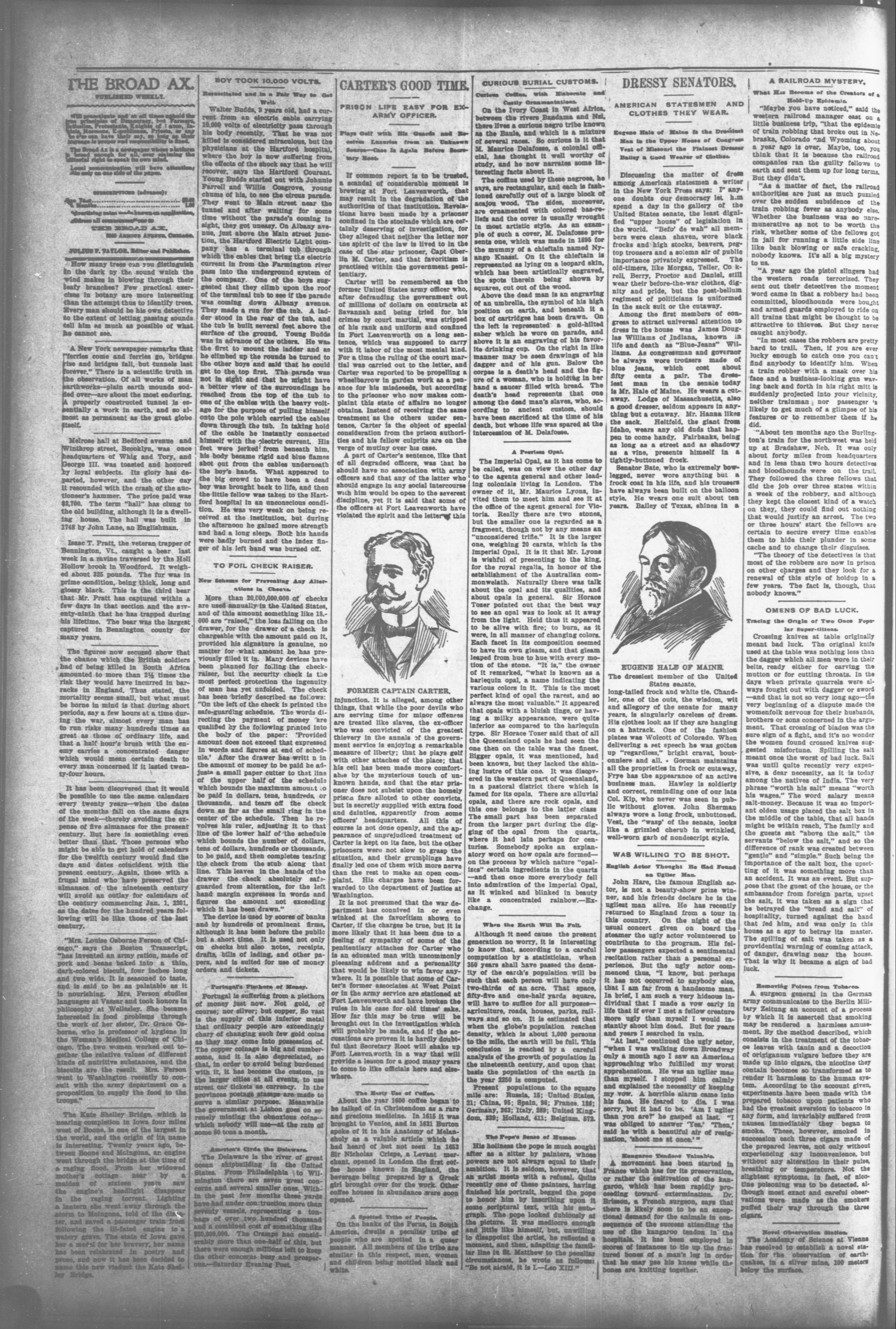
FORMER CAPTAIN CARTER
injunction. It is alleged, among other things, that while the poor devils who are serving time for minor offenses are treated like slaves, the ex-officer who was convicted of the greatest thievery in the annals of the government service is enjoying a remarkable measure of liberty; that he plays golf with other attaches of the place; that his cell has been made more comfortable by the mysterious touch of unknown hands, and that the star prisoner does not subsist upon the homely prison fare allotted to other convicts, but is secretly supplied with extra food and dainties, apparently from some officers' headquarters. All this of course is not done openly, and the appearance of unprejudiced treatment of Carter is kept on its face, but the other prisoners were not slow to grasp the situation, and their grumblings have finally led one of them with more nerve than the rest to make an open complaint. His charges have been forwarded to the department of justice at Washington.
It is not presumed that the war department has connived in or even winked at the favoritism shown to Carter, if the charges be true, but it is more likely that it has been due to a feeling of sympathy of some of the penitentiary attaches for Carter who is an educated man with uncommonly pleasing address and a personality that would be likely to win favor anywhere. It is possible that some of Carter's former associates at West Point or in the army service are stationed at Fort Leavenworth and have broken the rules in his case for old times' sake. How far this may be true will be brought out in the investigation which will probably be made, and if the accusations are proven it is hardly doubtful that Secretary Root will shake up Fort Leavenworth in a way that will provide a lesson for a good many years to come to like officials here and elsewhere.
About the year 1600 coffee began to be talked of in Christendom as a rare and precious medicine. In 1615 it was brought to Venice, and in 1621 Burton spoke of it in his Anatomy of Melancholy as a valuable article which he had heard of but not seen. In 1652 Sir Nicholas Crispe, a Levant merchant, opened in London the first coffee house known in England, the beverage being prepared by a Greek girl brought over for the work. Other coffee houses in abundance were soon opened.
A Spotted Tribe of People
On the banks of the Perus, in South America, dwells a peculiar tribe of people who are spotted in a queer manner. All members of the tribe are similar in this respect, men, women and children being mottled black and white.
On the Ivory Coast in West Africa, between the rivers Bandama and Nzi, there lives a curious negro tribe known as the Baule, and which is a mixture of several races. So curious is it that M. Maurice Delafosse, a colonial official, has thought it well worthy of study, and he now narrates some interesting facts about it.
The coffins used by these negroes, he says, are rectangular, and each is fashioned carefully out of a large block of acajon wood. The sides, moreover, are ornamented with colored bas-reliefs and the cover is usually wrought in most artistic style. As an example of such a cover, M. Delafosse presents one, which was made in 1895 for the mummy of a chieftain named Nyango Kuassi. On it the chieftain is represented as lying on a leopard skin, which has been artistically engraved, the spots therein being shown by squares, cut out of the wood.
Above the dead man is an engraving of an umbrella, the symbol of his high position on earth, and beneath it a box of cartridges has been drawn. On the left is represented a gold-hilted saber which he wore on parade, and above it is an engraving of his favorite drinking cup. On the right in like manner may be seen drawings of his dagger and of his gun. Below the corpse is a death's head and the figure of a woman, who is holding in her hand a saucer filled with bread. The death's head represents that one among the dead man's slaves, who, according to ancient custom, should have been sacrificed at the time of his death, but whose life was spared at the intercession of M. Delafosse.
A Peerless Opal.
The Imperial Opal, as it has come to be called, was on view the other day to the agents general and other leading colonials living in London. The owner of it, Mr. Maurice Lyons, invited them to meet him and see it at the office of the agent general for Victoria. Really there are two stones, but the smaller one is regarded as a fragment, though not by any means an "unconsidered trifle." It is the larger one, weighing 20 carats, which is the Imperial Opal. It is it that Mr. Lyons is wishful of presenting to the king, for the royal regalia, in honor of the establishment of the Australian commonwelath. Naturally there was talk about the opal and its qualities, and about opals in general. Sir Horace Tozer pointed out that the best way to see an opal was to look at it away from the light. Held thus it appeared to be alive with fire; to burn, as it were, in all manner of changing colors. Each facet in its composition seemed to have its own gleam, and that gleam leaped from hue to hue with every motion of the stone. "It is," the owner of it remarked, "what is known as a harlequin opal, a name indicating the various colors in it. This is the most perfect kind of opal the rarest, and so always the most valuable." It appeared that opals with a bluish tinge, or having a milky appearance, were quite inferior as compared to the harlequin type. Sir Horace Tozer said that of all the Queensland opals he had seen the one then on the table was the finest. Bigger opals, it was mentioned, had been known, but they lacked the shining lustre of this one. It was discovered in the western part of Queensland, in a pastoral district there which is famed for its opals. There are alluvial opals, and there are rock opals, and this one belongs to the latter class The small part has been separated from the larger part during the digging of the opal from the quartz, where it had lain perhaps for centuries. Somebody spoke an explanatory word on how opals are formed—on the process by which nature "opalizes" certain ingredients in the quartz—and then once more everybody fell into admiration of the Imperial Opal, as it winked and blinked in beauty like a concentrated rainbow.—Exchange.
When the Earth Will Be Full.
Although it need cause the present generation no worry, it is interesting to know that, according to a careful computation by a statistician, when 350 years shall have passed the density of the earth's population will be such that each person will have only two-thirds of an acre. That space, fifty-five and one-half yards square, will have to suffice for all purposes agriculture, roads, houses, parks, railways and so on. It is estimated that when the globe's population reaches density, which is about 1,000 persons to the mile, the earth will be full. This conclusion is reached by a careful analysis of the growth of population in the nineteenth century, and upon that basis the population of the earth in the year 2250 is computed.
Present populations to the square mile are: Russia, 15; United States, 21; China, 95; Spain, 96; France, 186; Germany, 263; Italy, 289; United Kingdom, 239; Holland, 411; Belgium, 572.
The Pope's Sense of Human
His holiness the pope is much sought after as a sitter by painters, whose powers are not always equal to their ambition. It is seldom, however, that an artist meets with a refusal. Quite recently one of these painters, having finished his portrait, begged the pope to honor him by inscribing upon it some scriptural text, with his autograph. The pope looked dubiously at the picture. It was mediocre enough and little like himself, but, unwilling to disappoint the artist, he reflected a moment, and then, adapting the familiar line in St. Matthew to the peculiar circumstances, he wrote as follows: "Be not afraid, it is I.—Leo XIII."
DRESSY SENATORS.
AMERICAN STATESMEN AND CLOTHES THEY WEAR.
Eugene Hale of Maine is the Dressiest Man in the Upper House of Congress. Vent of Missouri the Plainest Dresser Bailey a Good Wearer of Clothes.
Discussing the matter of dress among American statesmen a writer in the New York Press says: I' anyone doubts our democracy let him spend a day in the gallery of the United States senate, the least dignified "upper house" of legislation in the world. "Befo' de wah" all members were clean shaven, wore black frocks and high stocks, beavers, pegtop trousers and a solemn air of public importance privately expressed. The old-timers, like Morgan, Teller, Cookrell, Berry, Proctor and Daniel, still wear their before-the-war clothes, dignity and pride, but the post-bellum regiment of politicians is uniformed in the sack suit or the cutaway.
Among the first members of congress to attract universal attention to dress in the house was James Douglas Williams of Indiana, known in life and death as "Blue-Jeans" Williams. As congressman and governor he always wore trousers made of blue jeans, which cost about fifty cents a pair. The dressiest man in the senate today is Mr. Hale of Maine. He wears a cutaway. Lodge of Massachusetts, also a good dresser, seldom appears in anything but a cutaway. Mr. Hanna likes the sack. Heltfeld, the giant from Idaho, wears any old duds that happen to come handy. Fairbanks, being as long as a street and as shadowy as a vine, presents himself in a tightly-buttoned frock.
Senator Bate, who is extremely bow-legged, never wore anything but a frock coat in his life, and his trousers have always been built on the balloon style. He wears one suit about ten years. Bailey of Texas, shines in a
A.
EUGENE HALE OF MAINE
long-tailed frock and white tie. Chandler, one of the outs, the wisdom, wit and allegory of the senate for many years, is singularly careless of dress. His clothes look as if they are hanging on a hatrack. One of the fashion plates was Wolcott of Colorado. When delivering a set speech he was gotten up "regardless," bright cravat, boutonniere and all. Gorman maintains all the proprieties in frock or cutaway. Frye has the appearance of an active business man. Hawley is soldierly and correct, reminding one of our late Col. Klip, who never was seen in public without gloves. John Sherman always wore a long frock, unbuttoned. Vest, the "wasp' of the senate, looks like a grizzled cherub in wrinkled, well-worn garb of nondescript style.
WAS WILLING TO BE SHOT.
English Actor Thought He Had Found an Uglier Man.
John Hare, the famous English actor, is not a beauty-show prize winner, and his friends declare he is the ugliest man alive. He has recently returned to England from a tour in this country. On the night of the usual concert given on board the steamer the ugly actor volunteered to contribute to the program. His fellow passengers expected a sentimental recitation rather than a personal experience. But the ugly actor commenced thus, "I know, but perhaps it has not occurred to anybody else, that I am far from a handsome man. In brief, I am such a very hideous individual that I made a vow early in life that if ever I met a fellow creature more ugly than myself I would instantly shoot him dead. But for years and years I searched in vain.
"At last," continued the ugly actor, "when I was walking down Broadway only a month ago I saw an American approaching who fulfilled my worst apprehensions. He was an uglier man than myself. I stopped him calmly and explained the necessity of keeping my vow. A horrible alarm came into his face. He feared to die. I was sorry, but it had to be. 'Am I uglier than you are?' he gasped at last. "I was obliged to answer 'Yes.' "Then,' said he with a beautiful air of resignation, 'shoot me at once.'"
Kangaroo Tenders Valuable.
A movement has been started in France which has for its preservation, or rather the cultivation of the kangaroo, which has been rapidly proceeding toward extermination. Dr. Brisson, a French surgeon, says that there is likely soon to be an exceptional demand for the animals in consequence of the success attending the use of the kangaroo tendon in the hospitals. It has been employed in scores of instances to tie up the fractured bones of a man's leg in order that he may puse his knees while the bones are knitting together.
A RAILROAD MYSTERY.
What Has Become of the Creators of a Hold-Up Epidemic.
"Maybe you have noticed," said the western railroad manager east on a little business trip, "that the epidemic of train robbing that broke out in Nebraska, Colorado and Wyoming about a year ago is over. Maybe, too, you think that it is because the railroad companies ran the guilty fellows to earth and sent them up for long terms. But they didn't.
"As a matter of fact, the railroad authorities are just as much puzzled over the sudden subsidence of the train robbing fever as anybody else. Whether the business was so unremunerative as not to be worth the risk, whether some of the fellows got in jail for running a little side line like bank blowing or safe cracking, nobody knows. It's all a big mystery to us.
"A year ago the pistol slingers had the western roads terrorized. They sent out their detectives the moment word came in that a robbery had been committed, bloodhounds were bought and armed guards employed to ride on all trains that might be thought to be attractive to thieves. But they never caught anybody.
"In most cases the robbers are pretty hard to trail. Then, if you are ever lucky enough to catch one you can't find anybody to identify him. When a train robber with a mask over his face and a business-looking gun waving back and forth in his right mitt is suddenly projected into your vicinity, neither trainman nor passenger is likely to get much of a glimpse of his features or to remember them if he did.
"About ten months ago the Burlington's train for the northwest was held up at Bradshaw, Neb. It was only about forty miles from headquarters and in less than two hours detectives and bloodhounds were on the trail. They followed the three fellows that did the job over three states within a week of the robbery, and although they kept the closest kind of a watch on they, they could find out nothing that would justify an arrest. The two or three hours' start the fellows are certain to secure every time enables them to hide their plunder in some cache and to change their disguises.
"The theory of the detectives is that most of the robbers are now in prison on other charges and they look for a renewal of this style of holdup in a few years. The fact is, though, that nobody knows."
OMENS OF BAD LUCK.
Tracing the Origin of Two Once Popular Super-tittons.
Crossing knives at table originally meant bad luck. The original knife used at the table was nothing less than the dagger which all men wore in their belts, ready either for carving the mutton or for cutting throats. In the days when private quarrels were always fought out with dagger or sword—and that is not so very long ago—the very beginning of a dispute made the womenfolk nervous for their husbands, brothers or sons concerned in the argument. That crossing of biades was the sure sign of a fight, and it's no wonder the women found crossed knives suggested misfortune. Spilling the salt meant once the worst of bad luck. Salt was until quite recently very expensive, a dear necessity, as it is today among the natives of India. The very phrase "worth his salt" means "worth his wages." The word salary means salt-money. Because it was so important olden usage placed the salt box in the middle of the table, that all hands might be within reach. The family and the guests sat "above the salt," the servants "below the salt," and so the difference of rank was created between "gentle" and "simple." Such being the importance of the salt box, the upsetting of it was something more than an accident. It was an event. But suppose that the guest of the house, or the ambassador from foreign parts, upset the salt, it was taken as a sign that he betrayed the "bread and salt" of hospitality, turned against the hand that fed him, and was only in this house as a spy to betray its master. The spilling of salt was taken as a providential warning of coming attack, of danger, drawing near the house. That is why it became a sign of bad luck.
Removing Pollen from Tobacco
A surgeon general in the German army communicates to the Berlin Military Zeitung an account of a process by which it is asserted that smoking may be rendered a harmless amusement. By the method described, which consists in the treatment of the tobacco leaves with tanin and a decoction of origiganum vulgare before they are made up into cigars, the nicotine they contain becomes so transformed as to render it harmless to the human system. According to the account given, experiments have been made with the prepared tobacco upon patients who had the greatest aversion to tobacco in any form, and invariably suffered from nausea immediately they began to smoke. These, however, smoked in succession each three cigars made of the prepared leaves, not only without experiencing any inconvenience, but without any alteration in their pulse, breathing or temperature. Not the slightest symptoms, in fact, of nicotine poisoning was to be detected, although most exact and careful observations were made as the smokers puffed their way through the three cigars.
Xenol Corporation
The Academy of Science at Vienna has resolved to establish a novel station for the observation of earthquakes, in a silver mine, 100 meters below the surface.
MACHINE INVENTED TO DO THIS SORT OF WORK.
It Works Out the Enormously Complicated Calculations of Tidal Variations —Only One Other Instrument Like It in the World—Saves Mental Effort.
A machine that will do the work of thirty expert mathematicians is being constructed by the government in its scientific instrument shop on Capitol Hill, Washington. It is to be an improvement on an instrument in use in the bureau of the Coast Survey which has charge of calculating the tides. This machine will be in a class all by itself as a mathematician. England has one which does a similar class of work, but does not carry its calculations so far. The British instrument was invented by Lord Kelvin. The American instrument was contrived by E. Terrel, an employee of the United States Coast Survey. The American machine now in use cost $3,500. It stands about two feet high and is eighteen inches across. Its half a foot of depth is a maze of wheels, pulley and levers. It does wonderful things. There is a little crank on the lower left hand side, and at a simple turn of that crank the machine will give the answer to a problem involving ninety-one separate calculations. The problems it works out are the enormously complicated calculations of tidal variations. In the year 1903 some ship will be in the harbor of Karachi, India, at the head of the Arabian sea. Suppose the ship arrives at 6:30 in the morning on the 1st day of October. The captain will have a printed table in his pilot house, and in that table he will read that at that particular hour of that particular day of that particular year there is seven feet of tide in the bay. By referring to a chart showing the depth of the bay normally he will know just how much water there is for his vessel.
The calculation by which it is possible to predict seven feet of tide at that place and time was made by the United States government's machine on May 17 last in Washington. The machine owned by the British government is the only other one by which the calculating could have been done; but on account of the enormous volume of such work to be done the two governments try to divide the territory. Foreign governments have frequently applied to the United States to do some tide forecasting for harbors important to their commerce with the machine invented by Mr. Terrel, which the new one is expected to supersede. They have been quite willing to pay for such work, but as a rule the coast survey has been unable to comply with such requests, owing to the pressure of its own work. Dr. R. A. Harris of the Coast Survey devised the plans for the new machine now being constructed. He has taken suggestions from the two instruments now in existence and hopes to produce one which will combine the good features of both. The employment of mechanical apparatus for doing work usually performed by the human mind is more extensively seen in the government scientific department than in any other place in the country. The multiplying and dividing machine, for example, is a great saver of time and mental labor not to mention its absolute accuracy. The machine declines to make mistakes, and if the operator tries to make seven go into six, will ring a bell in protest. Practically all the adding in the government's coast survey work is done by machines. Where the column contains three-quarters of a million figures, as frequently happens in the computations, the saving in mental effort is very considerable.—New York Sun.
A Watch Like a Flower.
In Zurich a very novel watch has just been made. It forms the cup or heart of a jewelled flower, which is intended to be worn as an ornament. The flower itself can be opened or closed by touching a tiny spring, and when it is closed the little watch is not visible. When a lady wearing such an ornament desires to know the time all she has to do is to touch the spring, whereupon the flower opens and the watch is revealed. The little watch is fastened to the dress by an ordinary safety pin. The artist who designed this timepiece sold it for $800 a few days after he finished it, and now the beautiful jewel is attracting so much attention that there is little doubt many similar watches will be fashioned in the near future.
Egyptian Recipe for Restoring Hair.
The care of the hair, so far as we know, begins with Egypt. We are told that during the reign of Teti (or Teta), which was sometime between 4000 B. C. and 2000 B. C., a hair restorer was invented for the mother of the King. Manetho credits Teti with a work on anatomy, so he may have been the author of the tonic. From a copy of the original which is supposed to be the oldest medical recipe, the following translation is made. A remedy for restoring the hair. It was made for Shisha, the mother of our majesty, the King of Upper and Lower Egypt, Teti, who has a true voice. The paw of a dog, the seed of the date and the hoof of an ass. Cook very thoroughly in a pot with oil and annoint it.
Ingratitude, more strong than traitors' arms—Shakespeare.
The Hayes group of copper mines, near Albernison, the west coast of Vancouver island, has been sold for $600,000.
If you see a fruit basket containing oranges, lemons and bananas on your friends dressing table do not eat them. He may need them in his business and keep them there as an adjunct to his boots and shoes. People who have tried it say that orange juice is the best dressing in the world for black leather. Take a slice of orange and rub it thoroughly all over the boot or shoe. Allow it (the boot or shoe) to dry and then brush quickly with a soft brush until the article you are polishing shines like a looking glass. A convenient dressing for tan shoes is the inside of a banana skin. Rub it well and evenly all over the shoe, and it will remove all spots and dirt as well as give a fine polish, which is brought out by using a flannel cloth for wiping dry and another for polishing after drying. Some persons use a slice of lemon as a dressing for russet leather and recommend it to their friends. Patent leathers are the most "uncertain, coy and hard to please" of any kind of shoe made. You can pay any price you please for a pair of patent leathers and they will crack the first time you wear them. On the other hand, you may buy a cheap pair that will not crack until they are nearly worn out. Everybody has his own favorite prescription for keeping patent leathers in good health, and is ready to defend it against all comers. Hearts that stood the storm when seas were rough and which sorrow but more closely tied have been driven far asunder through a dispute over the best way to take care of patent leathers. The shoeman will tell you to heat them before you put them on and they will not crack, but the shoe man will not guarantee them, and tells you this only to be agreeable and make conversation. A good way to treat patent leathers is never to polish them with anything except fine sweet oil or vaseline. It is necessary to take a clean sponge and clean the shoe thoroughly before applying the oil or vaseline. After this treatment the shoe must be rubbed dry at once with channel or some other soft cloth which will not scratch the patent finish.—New York Press.
HOW TO ENTER POLITICS.
Sage Advice from a Kansas Editor to
Asplind Stateman.
If you want to be a politician, the first thing to do is to get into the push, or at least create the impression that you are in writes "Doc" Taler to Gene Smyth in the Kopeka Mail. When there is a convention, if you can't work in as a delegate, you can at least get into the crowd in the hotel lobby, and if you carry yourself in shape you can make the stranger who is within the gates of the city believe you are not only a delegate, but one of the steering committee. Keep busy. Take at least eight or ten men off to one side in the course of the evening for private conversation. There is quite a good deal in making people believe you are cutting a good many lemons, whether you are or not. It is a good idea to be seen off in a corner talking with some prominent candidate. You can arrange this if you have the proper amount of gall. You may not have anything to tell him, but then you will be seen in consultation, and you will make some parties who don't know you very well think that there must be a hen on. But, above all else, cultivate your gall. If you can get some reporter to interview you on the political situation, that will be a good scheme. The newspapers can make a reputation for almost any sort of a man for they invariably employ cheap ten-dollar a week reporters.
Banre of Modern Guns.
It is evident that few besides ordnance experts know the effective range of one of the modern breech-loading rifles. Proof of this lies in the frequency that newspapers are asked to state in their columns the distance that a shot or shell may be fired, the thickness of metal it will pierce, etc. The new 16-inch breech-loading rifle recently finished at the Watervliet arsenal, and which is to remain with the army exhibit at the Pan-American exposition, will no doubt excite the question among lay people as to whether such guns could do much damage in Manhattan if mounted on an enemy's ship off the harbor. A table of ranges and muzzle velocities of this gun, prepared by Lieut.-Col. T. M. Ingalls, shows what it is capable of doing. With 45 degrees elevation, and a projectile weighing 2,370 pounds, given a muzzle velocity of 2,000 feet per second, its effective range would be 14.9 miles, while with a muzzle velocity of 2,600 foot seconds, its range would be 24 miles. The table also shows distance of travel with other velocities, and governed by weight of charge of powder, but sufficient has been stated to prove that with the maximum muzzle velocity a projectile could be sent nearly twice the distance from Sandy Hook to the battery.
mountain on Mountain Side.
Walter Page, the editor of the World's Work, has organized a party to walk through the most romantic parts of the mountains of North Carolina this summer. The expedition is to be in charge of his brothers, Henry and Junius Page of Aberdeen, N. C. The party consists of Walter Page's two sons, Ralph, now at Harvard university, and five other Harvard students, and Arthur, a younger son, who is going to a technical school in Lawrenceville, N. Y., and three classmates An old negro, "Uncle Isaac," an auxile in the Page family, will drive a pair of strong mules to a wagon, which is to contain tentz, provisions, etc.
WHEN COACHMAN SMOKES.
This Coachman Did in the Absence of the Family.
A wifeless wanderer among the clubs sought to express his astonishment at a condition of affairs of which one of his companions told, and with this purpose he exclaimed: "I should have as soon expected to see a coachman laughing."
This implied dignity of the coachman is commonly observed, but there was a sad breach of it in lower Broadway the other evening. A private brougham was being driven up the street from one of the downtown ferries just before the dinner hour. The horses were stylish and well kept, the carriage was spick and span, the coachman's livery was faultless; but, alas for the traditions of his post! The coachman was smoking assiduously, getting the greatest evident enjoyment out of a briar cutty-pipe. It was quite clear that he had carried the family to a ferry or steamboat, and that quite sure that they were out of the way he had determined to lose no time in getting down to the pleasures or comforts nearest his heart.—New York Sun.
Wonderful Case in Indiana.
Buck Creek, Ind., July 15th—Mrs. Elizabeth Rorick of this place had Rheumatism. She says: "All the doctors told me they could do nothing for me." She was very, very bad, and the pain was so great she could not sleep at night.
She used Dodd's Kidney Pills, and she is well and entirely free from pain or any symptom of the Rheumatism.
"Are you still using Dodd's Kidney Pills?" was asked.
"No, I stopped the use of the Pills some time ago, and have not had the slightest return of my old trouble. I am sure I am completely and permanently cured."
Many in Tippecanoe County who have heard of Mrs. Rorick's case and her cure by Dodd's Kidney Pills, are using the Pills, and all report wonderful results.
Who Owned the Dog?
In order to test the ideas of children as to rights, the following story was told them: "Jamie's father gave him a dog, but Jamie forgot to feed it, and the dog cried often at the door. Then Jamie's father gave the dog to a kind little girl who lived down the street. The children were asked: Who had the best right to the dog, the father, Jamie, or the little girl, and why? In answering this question seventy per cent of the boys and fifty-seven per cent of the girls thought the little girl had the best right to the dog; forty-four per cent of the children thought, because Jamie had been so cruel in neglecting to feed the dog, he did not deserve it. This seems to weaken the theory commonly held that children are cruel by nature. About twenty-five per cent thought the father had the best right to the dog, saying that he had paid for the dog, and he was older and would take better care of it. About eight per cent said Jamie had the best right, because when a thing is given away you can't take it back again. It was principally the older children who took this last point of view.—Archie McDonald in Everybody's Magazine.
COLORADO.
New daily limited service via Great Rock Island Route, one night out Chicago to Colorado. We can convince you we have the best service, the best connections and arrive in Denver and Colorado Springs (Manitou) at the most convenient hour. Only direct line to Manitou. Cheap summer excursions daily to Colorado and Utah with especially low rates on certain days. For details write John Sebastian, G. P. A., Chicago.
Wisconsin Man for Philippines
Rev. Walter Clayton Clapp, who has accepted an appointment for the church board of missions to represent the Episcopal church in the Philippines, was formerly professor of Hebrew at the Nashotah seminary, Wisconsin.
Connecticut and Clocky
The first clocks manufactured in this country were by Eli Terry at Plymouth, Conn., in 1793. The manufacture soon became extensive and Connecticut wooden clocks were famous all over the country.
It is the only cure for Swollen, Smarting, Burning, Sweating Feet, Corns and Bunions. Ask for Allen's Foot-Ease, a powder to be shaken into the shoes. At all Druggists and Shoe Stores, 25c. Sample sent FREK. Address Allen S. Olmsted, LeRoy, N. Y.
Secretary of Confederate Navy.
Col. James G. Milner, who died recently at Milford, O., was once secretary of the navy for the confederacy. He died very poor, yet was before the war one of the richest men in the south.
General Lew Wallace is at work upon his autobiography. He made a trip to Kentucky recently to confer with some veterans on certain features of the battle of Shiloh which will be included in the work.
Laundering This Dresses.
To launder the exquisite creations of muslin and lace in which this season abound has become quite a problem, yet the most delicate materials will not be injured if washed with Ivory Soap and then dried in the shade. But little starch need be used.
ELIZA R. PARKER.
A manuscript Bible, richly illuminated, of about the year 1410, has just been sold at auction in London for 1800 guineas.
InGammalion of Skin Traced to Wear- ing Colored Stockings.
The London Lancet printed an interesting article recently, in which it is shown that arsenic sometimes occurs in dyed stockings of bright colors. Indeed dermatitis, or inflammation of the skin, has been traced to the wearing of stockings containing arsenic. The arsenic appeared to be present partly in a soluble and partly in an insoluble form. In another article in the Lancet was a curious list of mineral substances that were found in dress materials. No arsenic was found in any one specimen of the material submitted to examination, although there were present salts of zinc, aluminum, chromium, tin, magnesium and iron. In one case, that of pink flannel, the material was loaded with Epsom salts. The materials examined were all more or less brilliantly colored with aniline dyes. In recording the results of this inquiry it was stated that from time to time dermatitis had been referred to the use of highly colored fabrics and although dyes may not be injurious per se, yet certain poisonous agents, such as mordants, may be used in their preparation.—Milwaukee Wisconsin.
EXCURSION TO NEW YORK
Vla Oesan.
Going via Old Point Comfort and steamer, returning via Pan-American Exposition. Address W. E. Conklyn, 234 Clark St., Chicago.
The Picturesque Pan-American Route to Baffalo
is a very appropriate designation of the Grand Trunk Railway System, which has made the most ample preparations to accommodate visitors to the East this summer. A new train was inaugurated June 2, known as the "Detroit and New York Express," which leaves Dearborn Station, Chicago at 11:32 a.m. The equipment is new and strictly up-to-date, every comfort of the traveler being provided for. Meals are served a la carte between Chicago and New York at any hour to suit the convenience of patrons.
From Detroit the trains speeds eastward, stopping en route at Mt. Clemens, whose waters are famous the world over, leaving the State at Port Huron and entering Canada via the great "St. Clair Tunnel," that marvel of engineering, passing during the night through the important cities of London and Hamilton, crossing the magnificent single arch double track steel bridge over the Niagara Gorge arriving at Niagara Falls, N. Y., at 4:25 a. m., where stop-over may, under certain conditions, be made without additional cost by deposit of railway ticket with agent.
Buffalo, the Pan-American City, is reached at 6:15 a. m., where stop-over is granted on tickets to points beyond Buffalo, on payment of $1. The trip east of Buffalo via the Lehigh Valley Railroad through the lake region of New York state is like passing through a fairy land of beauty. The view of the historic Wyoming Valley from the mountains which arise on either side is strikingly beautiful—one which the traveler will long remember, even when gazing upon scenes of wider fame. At South Bethlehem connection is made for Philadelphia, which is reached at 3:47 p. m.
New York is reached at 4:33 p. m., a most convenient hour, as it allows ample time to reach hotel or residence, dine leisurely, and enjoy the whole evening in the city. For sleeping car reservations on all trains and for any additional information, apply to J. H. Burgis, City Pass. and Ticket Agent 249 Clark St., corner Jackson boulevard, Chicago, Ill.
Degrees for Divinity Doctors.
The Lambeth, D. D. degree is to be conferred by the archbishop of Canterbury on the venerable B. T. Dudley, archdeacon of Aukland, who has been for forty years a missionary in New Zealand, and upon Rev. J. G. Bayliss, rector of Longeneuil, Quebec, and assistant secretary for the diocese of Montreal.
The Bank of France compels customers checking out money to accept at least one-fifth in gold coin.
Money to loan at low rates on farm property. List your surplus money with me. I pay 4½ to 5 per cent. interest on sums of $100 and up. Northwestern farms and city property bought and sold. References. Elwyn F. Larson, Durand, Wisconsin.
Irate Parent—Tell that young Softleigh that he must cease his visits here. I forbid him the house. Daughter—But, papa, he doesn't want the house. It's me that he's after.
The Burlington, Cedar Rapids & Northern Railway has got out a neat booklet descriptive of the beautiful summer resorts at Spirit and Okoboji Lakes in Northwestern Iowa. Free copies will be mailed upon application to Jno. G. Farmer, Assistant General Passenger Agent, Cedar Rapids, Ia.
No family, shop, ship, camp or person should be without Wizard Oil for every painful accident or emergency.
I am sure Ploo's Care for Consumption saved my life three years ago—Mrs. Tina. Romaine.
Maple Street, Norwich, N. Y., Feb. 17, 1900.
BABY'S
Cuticum Soap
MEDICINAL
& TOILET
MILLIONS OF MOTHERS USE CUTICURA SOAP ASSISTED BY CUTICURA OINTMENT THE GREAT SKIN CURE
For preserving, purifying, and beautifying the skin of infants and children, for rashes, itchings, and chafings, for cleansing the scalp of crusts, scales, and dandruff, and the stopping of falling hair, for softening, whitening, and soothing red, rough, and sore hands, and for all the purposes of the toilet, bath, and nursery. Millions of Women use Cuticura Soap in the form of baths for annoying irritations, inflammations, and excoriations, for too free or offensive perspiration, in the form of washes for ulcerative weaknesses, and for many sanative, antiseptic purposes which readily suggest themselves to women, especially mothers. No amount of persuasion can induce those who have once used these great skin purifiers and beautifiers to use any others. Cuticura Soap combines delicate emollient properties derived from Cuticura, the great skin cure, with the purest of cleansing ingredients and the most refreshing of flower odors. It unites in ONE SOAP at ONE PRICE, the BEST skin and complexion soap and the BEST toilet, bath, and baby soap in the world.
COMPLETE EXTERNAL AND INTERNAL TREATMENT FOR EVERY HUMOR,
Citicura
THE SET
Consisting of Citicura SOAP, to cleanse the skin of crusts and scales and soften the thickened cuticle, Citicura OINTMENT, to instantly ally itching, inflammation, and irritation, and soothe and heal, and Citicura KRESOLVENT, to cool and cleanse the blood. A SINGLE SET is often sufficient to cure the most torturing, disgirling, itching, burning, and early skin, scalp, and blood humors, with loss of hair, when all else fails. Sold throughout the world. British Depot: P. NEWBURY & SONS, 11-28, Charleston House Sq., London. POTTER DROUG AND CREEK CORP., Sole Proprietor, Boston, U.S.A.
Passing of Ugly Women.
If there are few or none of the allconquering "belles" and "toasts" of olden days, it is equally certain that the plain woman has become an extinct species of society. Dress, diamonds, face treatment, "make-up," manicure, massage—one and all help toward a universal quasi-prefection of face, form and figure. The health craze, too, makes for beauty, as it enjoins exercise, early hours, fresh air and temperance in eating and drinking. The plain woman dowdily dressed, has been left behind with the dead and gone nineteenth century.
Ladies Can Wear Shoes
One size smaller after using Allen's Foot-Ease, a powder. It makes tight or new shoes easy. Cures swollen, hot, sweating aching feet, ingrowing nails, corns and bunions. All druggists and shoe stores, 25c. Trial package FREE by mail. Address Allen S. Oimsted, LeRoy, N Y.
New York City had at the beginning of the civil war a population of about one-quarter of what it is at present—805,000. Taxation for city purposes, now $100,000,000, was then $5,000,000.
Youth and beauty cut a wide swath when backed by wealth and influence.
Mrs. Winalow's Soothing Syrup.
For children teething, softens the gums, reduces inflammation, allays pain, cures wind colic. See a bottle.
Speak to others as you would like to be spoken to.
Coe's Cough Balsam
Is the oldest and best. It will break up a cold quicker than anything else. It is always reliable. Try it.
Berlin has 80,540 more women than men.
I CURE FITS
FREE
A Full-Size $1 Treatment of Dr. O.
Phelsing Brown's Great Remedy for
Fits. Epilepsy and all Nervous Diseases. Address
O. FIELPS BROWN, 98 Broadway, Newburgh, L.E.
SCALE AUCTION
BIDS BY MAIL. YOUR OWN PRICE.
Jones, We Pave the Freight, Blughamton, N.Y.
BABY
MILLIONS OF
USE CUTICURA SOAP
CURA OINTMENT T
For preserving, purifying, and
and children, for rashes, itching
the scalp of crusts, scales, and
falling hair, for softening, whit
and sore hands, and for all t
and nursery. Millions of W
form of baths for annoying
excoriations, for too free or ol
of washes for ulcerative weak
antiseptic purposes which
women, especially mothers.
induce those who have once
and beautifiers to use any o
delicate emollient properties d
skin cure, with the purest o
most refreshing of flower od
at ONE PRICE, the BEST s
the BEST toilet, bath, and l
COMPLETE EXTERNAL AND INTER
Cuticura
THE SET
Consisting of C
and scales and s
MENT, to insta
tion, and soothe
cool and clean
client to cure the
ing, and scaly skin, scalp, and blood hu
Bold throughout the world. British D
house Sq., London, POTTER DEED AM
PISO'S CURE FOR
CORES WHEN ALL ELSE FAILS.
Best Cough Syrup. Testes Good. Use
in time. Sold by druggists.
CONSUMPTION
FRAGRANT
SOZODONT
a perfect liquid dentifrice for the
Teeth and Mouth
New Size SOZODONT LIQUID, 25c
SOZODONT TOOTH POWDER, 25c
Large LIQUID and POWDER, 75c
25c
At all Stores, or by Mail for the price.
HALL & RUCKEL, New York
BANFF
In the Canadian Rockies, the great resort of travelers from all parts of the globe; Lakes in the Clouds, water sketches in the Land of the Sky; the Yoho Vailey, the newly discovered Wonderland near Field, British Columbia—a region of lofty waterfalls, vast glaciers, startling canons and high mountain peaks; the Great Glacier of the Selkirks—a huge frozen Niagara—on the line of the
CANADIAN PACIFIC RAILWAY
Swiss guides, Houseboats on the Kootenay and Shuswap Lakes for fishing and shooting parties.
For descriptive booklets, rates, etc. apply to
A. C. SHAW,
General Agent, Passenger Department,
CANADIAN PACIFIC RAILWAY.
228 South Clark Street,
CHICAGO, ILL.
OIL REVIEW FREE!
SPECIAL ILLUSTRATED
TEXAS edition describing the
BEAUMONT fields and prospectus
of best OIL invest-
ment sent FREE upon request. JNO. W
THOMPSON, No. American Bidg., Philadelphia, Pa.
Parma for sale on easy terms, or excnan-e, in Ia.
Seh., Minn. or S.D. J. Mulhall, Sioux City, Iowa.
BEAUTIFYING the skin of infants, eggs, and chasings, for cleansing and dandruff, and the stopping of itching, and soothing red, rough, and purposes of the toilet, bath, women use Cuticura Soap in the irritations, inflammations, and intensive perspiration, in the form of masses, and for many sanative, readily suggest themselves to No amount of persuasion can used these great skin purifiers. Cuticura Soap combines derived from Cuticura, the great cleansing ingredients and the oils. It unites in ONE SOAP skin and complexion soap and baby soap in the world.
NORMAL TREATMENT FOR EVERY HUMOR, Cuticura Soap, to cleanse the skin of crusts often the thickened cuticle, Cuticura Ointment allay itching, inflammation, and irritation and heal, and Cuticura Resolvent, to the blood. A SINGLE SET is often still most torburing, disgurging, itching, burners, with loss of hair, when all else fails. F. NEWBERRY & SONS, 11-28, Charter-Dunn, Comp., Sole Prop., Boston, U.S.A.
afflicted with
love eyes. may
W. N. U. CHICAGO, NO. 29, 1901.
When Answering Advertisements Kindly
Mention This Paper.
FORECAST OF FASHIONS.
Straw buckles for hat trimmings are natty.
All skirts for elaborate occasions are extremely long.
The open-work stocking is the correct thing for small children.
White swiss and madeira work is much used this season as trimming.
A pretty hat is of tuscan straw trimmed with tea roses, white roses and green leaves.
Bobbinet makes some of the prettiest and most serviceable of the gowns in this material.
Sleeves are showing a good deal of fullness from the elbows downward, but remain tight at the top.
White and ecru lace blouses under elaborate tailor suits for afternoon wear are the correct mode.
Those who can not afford feathered boas are wearing them of accordion plaited chiffon, net or tulle.
Point Arabe and point de Venise laces are extensively used for trimming millinery, summer gowns, capes and fichus.
There are boleros without backs; simply front pieces, made of the most brilliant fabrics to wear over the fronts of blouses.
Alpine hats which are always stylish for traveling are narrower of brim than last year, and the dented crowns are considerably lower.
The waist that closes at the back is a marked feature of the season and is particularly effective when made of fine material stitched in tucks.
Flemish laces applied on delicate net grounds are much used to decorate India mulls, ecru lawns, grenadines and other transparent fabric.
Very fashionable are the blouses of thin white material worn over colored slips to serve as a shirtwaist for either a dressy white skirt or a plain foulard. For bridal costumes this season, net, chiffon, elk crepe-de-chine, mousseline de sole, silk mull and China silks are taking the place of the severely made white satin gown. Old-fashioned flowered organdles are in again. Pale yellow on a white ground or pale blues and pinks are preferred. These are elaborately trimmed with hand-made lace.
The woman who has to shop in the mornings will find that a black or dark blue skirt with the same color blouse in one of the new soft silks or crepe de chines, is a charming and serviceable costume.
COLERIDGE'S TABLE-TALK.
Painting is the intermediate somewhat between a thought and a thing. I for one do not call the sod under my feet my country. But language, religion, law, government, blood—identity in these makes men of one country. I wish our clever young poets would remember my homely definitions of prose and poetry; that is, prose—words in their best order; poetry—the best words in the best order.
think of the sublimity, I should rather say profundity, of that passage in Ezekiel. "Son of man, can these Lones live? And I answered, O Lord God, Thou knowest." I know nothing like it.
If men could learn from history what lessons it might teach us! But passion and party blind our eyes, and the light which experience gives is a lantern on the stern, which shines only on the waves behind us!
I think nothing can be added to Milton's definition or rule of poetry—that it ought to be simple, sensuous, and impassioned; that is to say, simple in conception, abounding in sensible images, and informing them all with the spirit of the mind. Milton's Latin style is, I think, better and easier than his English. His style in prose is quite as characteristic of him as a philosophic Republican, as Cowley's is of him as a first-rate gentleman.
STAGE WHISPERS
Mr. Frohman's intentions regarding London explain why he has chosen an English actor, Sidney Brough, for Miss Adams' leading man. It is said the company will contain several other English players. William Faversham's manager, Charles Frohman, evidently is resolved that his star shall be the first before the public with a Don Caesar de Bazan play. He has announced that "A Royal Rival," the piece he secured for Mr. Faversham from the English actor, Lewis Waller, will be produced at the Criterion theater, New York, on August 26.
Maurice Grau, the well-known American impresario and manager, recently announced his intention of abandoning the American stage. In connection with Mr. Grau's sensational exit from American opera:l affairs, it is said that he has become convinced that Americans will only support the opera as a social fad, and that they lack that fine appreciation of art which makes opera-goers in cities on the continent, though they have to starve, in order to save the entrance fee to the piece.
HERE AND THERE.
There have been 2,100 explosions in coal mines in the last fifty years, involving a loss of 8,800 lives.
Palms never live more than 250 years. Ivy has been known to live 450, chestnut 860, oak 1,600, and yew 2,880 years. Admiral Schley, who is an enthusiastic Knight Templar, has promised to attend the annual conclave in Louisiana in August.
Habits, soft and pliant first, are like some coral stones, which are easily cut when first quarried, but soon become hard as adamant.
There are indubitable evidences that the good in the world is stronger than the evil; great, slow, steady progress of the good, forever gaining on the evil.
No man can tell whether he is rich or poor by turning to his ledger. It is the heart that makes a man rich. He is rich or poor according to what he is, not according to what he has.
When you get into a tight place and everything goes against you, and it seems as if you could not hold out a minute longer, never give up then, for that's just the place and time the tide'll turn.
Oh, opportunity! opportunity! Phantom goddess of success, that not one in a million has decision to seize and make his own! If hell be paved with good intentions, it might be roofed with lost opportunities.
If every year we would root out one fault, soon we should be perfect men. But often it is just the opposite. We find that we are better, purer men when we set out toward God than when for many a year we had professed our love.
It is not enough that a human being should abstain from gross, palpable evil, he must follow actual good. It is better to go down into the market and run your chance of the dirt that shall soil it, and the hands it shall pass through in making your one talent 10 talents, than to hide it up in a napkin, and stand aloof from your fellow creatures, even though it should give you cause, like the Pharisee, to "thank God you are not as other men."
FUNNYGRAPHS.
"That Mr. Flagg from Boston seems to be very attentive." "Yes. I think he must take me for the constitution the way he sticks to me."—Cleveland Plain Dealer. "I understand that Noitall says your new picture is a monstrosity." "I don't mind him," quietly remarked the artist, "he never had an opinlon of his own. He merely repeats what others say."—Philadelphia Times.
Better Days: Beggar (preliminarily): "I've seen better days." Busy man: "So have I; looks as if it had set in for an all-day drizzle. Confoundedly unpleasant. Got to take 'em as they come, though. Tra, la, la." Magistrate—Now, my boy, you are on your oath. Do you know what that means? Witness—Er—no, sir; not exactly. Magistrate—Do you know what you're expected to tell? Witness (promptly)—Oh, yes, sir; the lawyer that brought me here wrote it all down so's I could learn it off by heart.
"Arrah, now, but railways are a moighty foine invintion, annyway." Friend: "I shouldn't have thought you could see much to admire in them, Pat, seeing that you lost your leg in a railway accident." Pat: "Faith, ah' didn't Oi get $200 damages? Begorra, if it had only been my head Oi'd have owned the loine."
An American vistor to England, annoyed at being pressed for settlement o. a bill by the landlord of the hotel at which he was staying, threatened to leave. "You don't stir from this hotel until you have paid us," protested the manager. "Just put that in writing, and I'll stay here for the remainder of my days," was the retort.
ABILITY OF CHILDREN.
Every girl and boy that is educated should be able to write a good hand. Spell all the words in ordinary use. Know how to use these words. Speak and write good English. Write a good social letter. Add a column of figures rapidly. Make out an ordinary account. Receipt it when paid. Write an advertisement for a local paper. Write a notice or report of a public meeting.
Write an ordinary promissory note.
Reckon the interest or discount on it for days, months and years.
Draw an ordinary bank check.
Take it to the proper place in the bank to get the cash.
Make neat and correct entries in day book and ledger.
Tell the number of yards of carpet required for the parlor.
Measure the pile of lumber in the shed.
Tell the largest number of bushels of wheat in the largest bin, and the value of current rates.
Tell something about the laws of health and what to do in case of emergency.
Know how to behave in public.
Be able to give the great general principles of religion.
Have sufficient common sense to get along in the world.
BABES' BRIGHT SAYINGS.
Mabel's mother was showing her a brood of chickens hatched in an incubator. "They are poor litt'e orphans," said the mother. "An' is that the orphan asylum?" asked Mabel, pointing in wonder at the incubator.
One of the first things to attract the attention of Baby Clarence was grandma's hatrack, made of a pair of deer horns. One afternoon, when he was 3 years old, his papa took him to Capt. G——'s park. When relating the incidents of the trip to his mamma on their return, he exclaimed: "And, oh, mamma! I saw a deer, and he had a hatrack' on his head!"
```markdown
```
RENFROE BROS.
Desserts in
WOOD, COAL, FEED AND ICE.
137 West Forty-Seventh St.
CHICAGO.
DR. H. C. FAULKNER,
Physician and Surgeon,
OFFICE: 6258 HALSTED STREET,
CHICAGO.
Office Hours: Phone 818 Went
10 to 12 a. m., 2 to 4 p. m
6 to 7:30 p. m.
TELEPHONE EXPRESS 472.
PROF. W. E. DORSEY,
2058 La Salle St.
Leader and Manager
K. P. Military Band and Orchestra
Music Furnished for Balls and Receptions. Prices Reasonable. Call and see me.
DR. L. M. FENWICK.
(A. M., M. D., E. M.)
PHYSICIAN AND SURGEON.
6212 S. Halsted St. 2nd Floor.
HOURS: 8 to 10 a. m., 12 to 2 p. m., 7 to 8 p. m.
Sunday, by appointment.
Tel. Wentworth 627. CHICAGO, ILL.
Estimates and Specifi-
tions Furnished . . . Prompt Attention
Given to Jobbing
C.J.BOYD,
Practical Plumber and Gas fitter
Steam and Hot Water Heating,
Iron and Tile Drainage . . .
Telephone Yards 814.
709 WEST 47TH STREET.
DR. JOSEPH JEFFREY,
Physician and Surgeon,
488 Dearborn Street, CHICAGO
Houses: 8-10 a. m., 2-4, 6-8 p. m.
JAMES T. CRAIG,
Coal, Wood & Ice
General Expressing and Moving.
5001 ARMOUR AVE. CHICAGO, ILL
GOT EVEN WITH JOKER. Paris Man Gets Thorough Thrashing for Joke of Years Before.
The world always laughs when the practical joker is "come up with," even if many years have elapsed since the joker had his inning. It was in 1890 or thereabouts that a Paris drummer boarded a train in Bordeaux for home. He had made a good sale in Bordeaux and was feeling ripe for anything. It occurred to him what a good joke it would be to lean out of the window of the car and slap some one's face as the train rolled out. He did the act, pulled his head in and chuckled all the way to Paris as he pictured what the victim of his joke was saying to himself and to others. Years passed and the drummer prospered. He went into business for himself, and consequently grew staid and sober. A little while ago as he was walking along one of the boulevards in Paris a man stepped up to him and asked him if he had ever lived in Bordeaux. The staid and sober business man said he never had, but when he used to be a commercial traveler he frequently had been in the town. Whereupon the stranger recalled the face-slapping episode and said he was it, and begged permission to return the compliment, which he proceeded to do vigorously. The staid and sober business man regained his lost youth marvelously quick, and it was a lively scrimmage when the police stepped in and ran both men off to the station house. There upon reflection the business man refused to enter a complaint against the man with a memory, and decided to call the affair even.
If your nearest druggest does not have the Original Ozonized Ox-Marrow he can get it for you from any wholesale druggist in the city. It straightens kinky hair. Warranted harmless. Only 50 cents a bottle. The Ozonized Ox-Marrow Co., 76 Wabash Ave., Chicago, Ill.
Read and subscribe for The Broad Ax, the only newspaper in Chicago which "hews to the Lina."
```markdown
```
Aug. 14th, Gardner's Park SAY PEOPLE ATTENTION! It Will Be Old Folks Home Day BASKET PIC-NIC
GARDNER'S PARK, WEST PULLMAN,
WEDNESDAY, AUG. 14th, 1901.
Benefit Home for Aged and Infirm
Colored People.
Armant's Orchestra. - - - Admission 25 Cents.
Twenty Trains to Park, via Illinois Central Railroad. Street and Elevated Cars to
Calumet Electric Lines at 63rd and So. Park and thence to Park.
PRIZES TO THE WINERS:
Bicycle Race, Sack Race and Shoe String Race.
Base Ball Game at 3:30.
COMMITTEE:
Mrs. Jerry P. Stewart, Mrs. Richard Jefferson,
Hon. John G. Jones, Mrs. Kate Allen,
James W. Camp, Samuel R. Johnson,
Mrs. Gabriella Smith, Mrs. Eva Phelps,
Frinchie R. Bell, J. H. Porter.
B. F. ROGERS & COMPANY INSURANCE
84 and 86 La Palle St., Suite 615 to 619.
Telephone, Main 2077. Chicago.
JOHN E. OWENS
Attorney at Law,
SUITE 621 ASHLAND BLOCK,
50 S. Clark Street, CHICAGO
TEL. MARRISON 51.
Thomas F. Scully,
Attorney at Law,
70 Clark Street, CHICAGO
ROOM 14.
JOSEPH A. McNERNEY
LAWYER
SUITE 706-708
CHICAGO OPERA HOUSE
CHICA
Beauregard F. Moseley,
LAWYER.
Practice in all Courts.
Main Office 6256 Halsted St,
Down Town Office 260 S. Clark St., Room 421
Hours from 12 to 2 P. M.
Phone: 2533 Harrison.
Telephone Yards 797 Residence, 113 Garfield Bd.
JOHN FITZGERALD
JUSTICE OF THE PEACE
4787 S. HALSTED STREET.
.....CHICAGO
ALBERT B. GEORGE LAWYER. 423 Ashland Block. Chicago. — Tel. M. 2625. —
EDWARD H. WRIGHT
LAWYER
Suite 421. 200 S. Clark St.
Telephone, Harrison 2533. CHICAGO
GEO. W. W. LYTLE,
Attorney and Counselor at Law
Telephone Central 3558.
Suite 60, Grand Opera House,
Notary Public 87 & 89 S. Clark St.
Chicago.
RESIDENCE, 954 Turner Ave.
Lawrence M. Ennis,
Advocate and Counselor at Law.
Suite 726 Opera House Bock.
S. W. Corner Clark and Washington St.
TELEPHNNE MAIN 1782.
G. E. EVANS
Dealer in All Kinds of
HARD AND SOFT COAL,
Wood, Charcoal, Coke and Ice,
Expressing and Moving a Specialty.
332 29th St. Chicago, Ill.
Aug. 14th, Ga.
SAY PEOPLE
It Will Be Old
BASKET
GARDNER'S PARK,
WEDNESDAY, A
Benefit Home for the
Colored
Armant's Orchestra.
Twenty Trains to Park, via Illinois Central
Calumet Electric Lines at 63rd and
PRIZES TO THE
Bicycle Race, Sack Race
Base Ball Game
COMMITTEE
Mrs. Jerry P. Stewart, Mrs. P.
Hon. John G. Jones, Mrs. Kate
James W. Camp, Samuel R. John
Mrs. Gabriella Smith, Mrs. Evie
Frinchie R. Bell, J. H. Porter.
Bernard F. Rogers
B. F. ROGERS
INSUR
TELEPHONE MAIN 3292
HEAVY MACHINERY. Smoke Stacks, Cupolas and Monuments Erected. Hoisting and Placing of all kinds of Beams and Girders for architectural work. Office. 31 South Canal St.. Chicago TELEPHONE MAIL
...The Mutual Reserve Fund Life or New York...
E. P. BARRY, M'g'r. JULIUS F. TAYLOR, Special Agt. 410 Roanoke Bldg., 145 La Salle St. 6040 Armor Ave.
Citizens Brewing COMPANY ARCHER AVE. AND MAIN STREET. CHICAGO Telephone Canal 373
POOL AND BILLIARDS
BRAXTON'S ....PLACE
SAMPLE ROOM
Fine Wines and Liquors
Imported and Domestic Cigars
260 West Lake St.
JIM
GEORGE
Jas. J. McCormick, SAMPLE ROOM
SALE AND EXCHANGE STABLE.
Driving, Draft and General Business Horses
Always on Hand
1197 Milwaukee Ave. Near Robey St.
Telephone West. 1028. CHI
Gardner's Park
ATTENTION!
Folks Home Day
PIC-NIC
WEST PULLMAN,
JG. 14th, 1901.
Aged and Infirm
People.
- Admission 25 Cents.
Railroad. Street and Elevated Cars to
So. Park and thence to Park.
THE WINERS:
Grand Shoe String Race.
Time at 3:30.
TTEE:
Richard Jefferson,
Allen,
Jenson,
Phelps,
John D. Cory
& COMPANY
ANCE
154 LaSalle Street
JOSEPH STRAUSS
ORTHERN
HANGE STABLE.
General Business Horses
on Hand
CHICAGO, III.
CURLY HAIR
MADE STRAIGHT
BY THE
TAKEN FROM LIFE.
BEFORE AND AFTER TREATMENT.
WONDERFUL DISCOVERY
ORIGINAL
OZONIZED OX MARROW
[COPYRIGHTED.]
Will straighten your hair, quickly and easily so that you can do it yourself at home no matter how kinky or curly it is. This wonderful hair pomade has been made and sold many years giving perfect satisfaction to everybody. It is the only safe preparation in the world that straightens kinky hair as shown above. Nourishes the scalp, cures dandruff, prevents falling, and makes the hair grow. Sold over forty years. Warranted. Testimonials free on request. It was the first invention ever sold for straightening kinky hair. Beware of imitations. Get the Original Organized Ox Marrow as the genuine never fails to keep the hair pliable and beautiful. A toilet necessity for ladies and gentlemen. Elegantly perfumed. Owing to its superior and lasting quality it is the most economical. It is not possible for anybody to produce a preparation equal to it. Full directions with every bottle. Only 50 cents. Sold by dealers or we will ship your hair paid one bottle for 65 cents or three for 5.49. Send postal or express money order, we do not accept G. O. D. Write your name and address pliably to OZONIZED OX MARROW CO., 76 Wabash Ave., Chicago, IL.
NEWSPAPER LAW.
Any person who takes the paper regularly from the postoffice, whether he is a subscriber or not, is responsible for the pay. The courts have decided that refusing to take newspapers and periodicals from the postoffice, or removing and leaving them uncalled for is prima facie evidence of intentional fraud.
The Broad Ax desires to engage the services of one or two popular young women as collectors, subscription and advertising solicitors. Good salary paid to active workers. Call or address JULIUS F. TAYLOR, 5040 Armour avenue.
```markdown
```