The Broad Ax
Saturday, October 25, 1902
Chicago, Illinois
Page text (machine-generated)
THE BROAD AX
THEODORE W. JONES PUTS ON THE BOXING GLOVES WITH THE EDITOR OF HE JUNIOR CHURCH ORGAN AND HE KNOCKS THAT INDIVIDUAL OUT IN THE FIRST OR SECOND ROUND.
My attention has just been directed to a recent article in The Chicago Monitor which reflects adversely upon the motives and actions of a citizen's committee lately organized in the interest of Olivet Baptist Church of this city. The said article in referring to an alleged majority of the membership of that church says, they "will not be mulcted by the contractors, or driven by a citizen's committee, as that is something foreign to Baptist usages."
Now I refuse to accept any of these claims as sound, and maintain that the attempted bringing together of the various factions of that church to end an ignoble strife and redeem their property, was a friendly and unofficial intermediation on the part of the public, undertaken no doubt with the sanction of God's benediction, even if without the authority of Hitchcock's laws. The time has passed when any man can say that the public has no interest in the affairs of a church whether it be Baptist or not. The public has a material interest in the church; it supports her picnics, fairs and many entertainments, subscribes to her various funds, exempts her personal property from assessment and her real estate from taxation. There is no place in this country where the church is not recognized by the courts of law, and no state in this Union that has not enacted laws for the punishment of those who would deface her property or desecrate her Sabbath.
I further maintain that all of the contractors' bills have been passed upon and allowed by a Master in Chancery. The church had its day in court, and judgment, execution and sale followed. It is too late now to cry out, "mulcted." Why was not this made a part of the defense and set up in court? The real truth of the matter is, that Rev. Thomas refused to settle because of personal objections to one individual contractor, and from this narrow view of the situation, evil and ruin have followed.
ments, permit me to say in additon, that sentimentality is that habit of mind which unfortunately leads many of our people to minimize beneficent efforts, even when results are obvious, important and far-reaching. They evidently draw no mental contrast between a citizen's meeting and the local conditions in that church which made such a meeting a necessity. The Monitor not only lacks public spirit, but it also denies the right of the people to properly direct and control human endeavor. The article bursts into unbounded enthusiasm over Rev. Thomas and his coterie of short-haired women, forgetful that their course of "rule or ruin" has not only divided the body of Christ and made His wounds to bleed afresh, but it has brought disgrace to a great denomination, disrupted a popular Sabbath school, disorganized humane effort, divided households and separated families.
households and separated families. ao forget the unity of the church; to forget the work and worth of Olivet Sabbath School; to misinterpret the great importance of peaceful homes and the dwellers therein; to set at naught the established standards of domestic tranquility; and to imply that Thomas and his ill-advised followers are in the right, is to invert the true order of relative values in the church, the home and the community.
A united and progressive church is a better demonstration of true Christianity than any faction great or small. The minister who prevents strife and contention in the church, instead of causing them, is greater in my estimation than he who cures these ills. The physician, by whose advice the body is kept in a healthy condition is greater than he who is able merely to soften its pain. There is more real glory in the abolition of war and carnage than in the victories of battle. I would not in any sense belittle the value and services of those who generously espoused the cause of Olivet Church, but rather insist that its officers should give more attention to the promotion of he primary conditions of health, growth and development; more attention to those fixed habits and principles by which their fore-fathers founded that church; by which honesty and integrity are exalted—those principles of equity and righteousness by which the kingdoms of the earth have been founded, mankind emancipated, backsliders reclaimed and churches established and maintained.
The editor of The Chicago Monitor is a sociable, interesting and "allaround" good fellow,but it does not happen to fall within his province to know much about religion or the affairs of a church. By means let Olivet conform to "Baptist usages,"let her subscribe to denominational customs, let her have Hitchcok's rules,but let her also have a religion which is warm with the thoughts, the deeds and the will of God. Usages, rules and customs may change from age to age with each new advance of knowledge, but His will is unchangeable and shall remain forever.
REV. LONGREEN MURRAY HOT IN THE COLLAR.
Tuesday noon while walking along on Dearborn street, near Jackson boulevard, meditating on the origin and final destiny of the human race, Rev. Longreen Murray approached us and said something about the article in The Broad Ax last week respecting his "panting to get in among the women," but we paid no more attention to Longreen than we do to any little black poodle dog which may happen to bark at our heels. For we have our boundless contempt for any preacher who will perjure himself while on the witness stand, like this creature did.
After the election is over we have a good dose of medicine in store for Longreen.
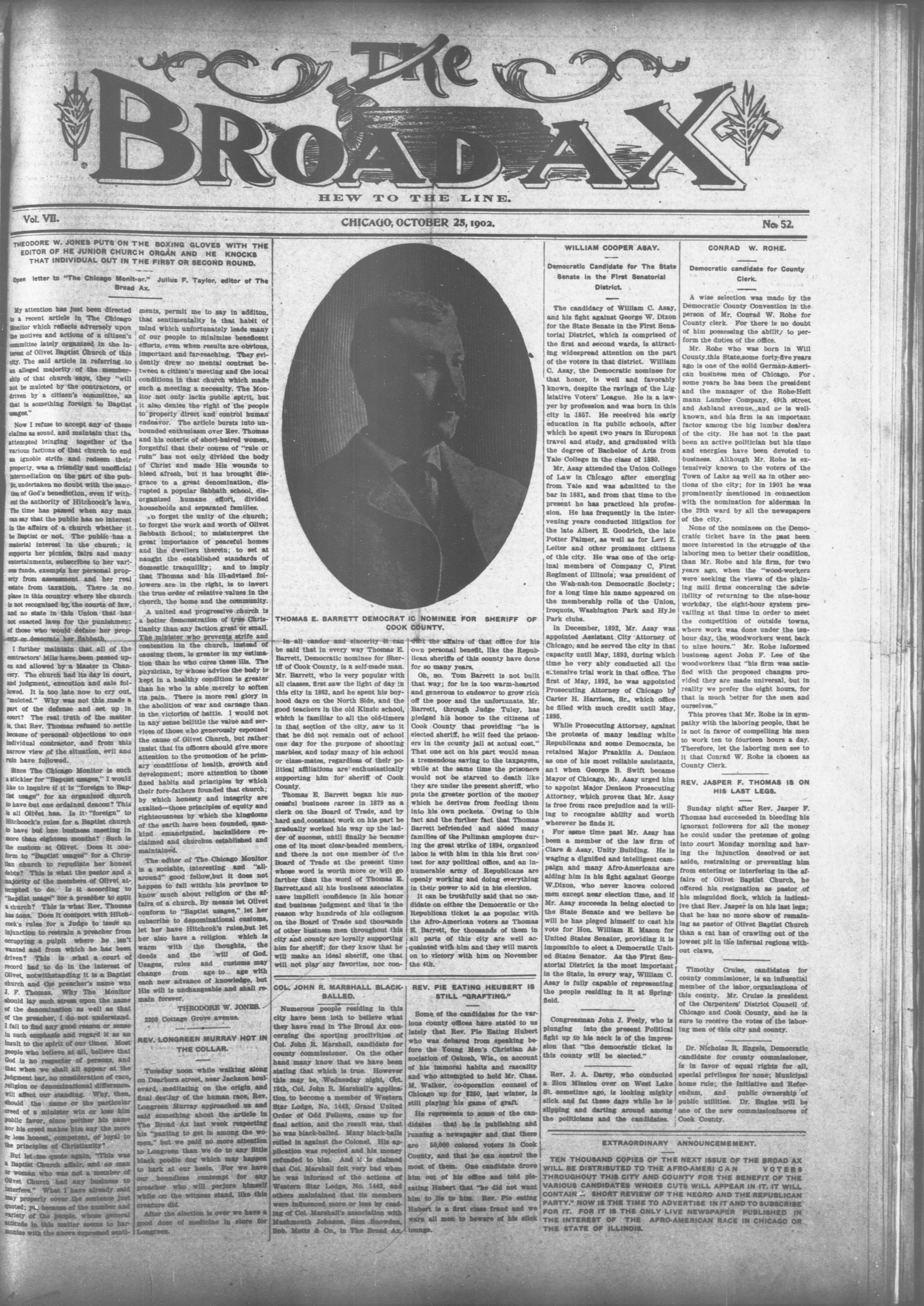
[Portrait of a man in formal attire, with a mustache and a tie, set against a plain background. The image is oval-shaped with a black-and-white color scheme.]]
THOMAS E. BARRETT DEMOCRAT IC NOMINEE FOR SHERIFF OF COOK COUNTY.
In all candor and sincerity it can be said that in every way Thomas E. Barrett, Democratic nominee for Sheriff of Cook County, is a self-made man. Mr. Barrett, who is very popular with all classes, first saw the light of day in this city in 1863, and he spent his boyhood days on the North Side, and the good teachers in the old Kinzie school, which is familiar to all the old-timers in that section of the city, saw to it that he did not remain out of school one day for the purpose of shooting marbles, and today many of his school or class-mates, regardless of their political affiliations are enthusiastically supporting him for sheriff of Cook County.
Thomas E. Barrett began his successful business career in 1879 as a clerk on the Board of Trade, and by hard and constant work on his part he gradually worked his way up the ladder of success, until finally he became one of its most clear-headed members, and there is not one member of the Board of Trade at the present time whose word is worth more or will go farther than the word of Thomas E. Barrett, and all his business associates nave implicit confidence in his honor and business judgment and that is the reason why hundreds of his collegues on the Board of Trade and thousands of other business men throughout this city and county are loyally supporting him for sheriff; for they know that he will make an ideal sheriff, one that will not play any favorites, nor con-
Numerous people residing in this city have been loth to believe what they have read in The Broad Ax concerning the sporting proclivities of Col. John R. Marshall, candidate for county commissioner. On the other hand many know that we have been stating that which is true. However this may be, Wednesday night, Oct. 15th, Col. John R. Marshall's application to become a member of Western Star Lodge, No. 1443, Grand United Order of Odd Fellows, came up for final action, and the result was, that he was black-balled. Many black-balls rolled in against the Colonel. His application was rejected and his money refunded to him. And it is claimed that Col. Marshall felt very bad when he was informed of the actions of Western Star Lodge, No. 1443, and others maintained that its members were influenced more or less by reading of Col. Marshall's association with Mushmouth Johnson, Sam Snowden, Bob Motts & Co., in The Broad Ax.
duct the affairs of that office for his own personal benefit, like the Republican sheriffs of this county have done for so many years.
Oh, no. Tom Barrett is not built that way; for he is too warm-hearted and generous to endeavor to grow rich off the poor and the unfortunate. Mr. Barrett, through Judge Tuley, has pledged his honor to the citizens of Cook County that providing "he is elected sheriff, he will feed the prisoners in the county jail at actual cost." That one act on his part would mean a tremendous saving to the taxpayers, while at the same time the prisoners would not be starved to death like they are under the present sheriff, who puts the greater portion of the money which he derives from feeding them into his own pockets. Owing to this fact and the further fact that Thomas Barrett befriended and aided many families of the Pullman employes during the great strike of 1894, organized labor is with him in this his first contest for any political office, and an innumerable army of Republicans are openly working and doing everything in their power to aid in his election.
It can be truthfully said that no candidate on either the Democratic or the Republican ticket is as popular with the Afro-American voters as Thomas E. Barrett, for thousands of them in all parts of this city are well acquainted with him and they will march on to victory with him on November the 4th.
Some of the candidates for the various county offices have stated to us lately that Rev. Pie Eating Hubert who was debared from speaking before the Young Men's Christian Association of Oskosh, Wis., on account of his immoral habits and rascality and who attempted to hold Mr. Chas. M. Walker, co-oporation counsel of Chicago up for $250, last winter, is still playing his game of graft.
He represents to some of the candidates that he is publishing and running a newspaper and that there are 50,000 colored voters in Cook County, and that he can control the most of them. One candidate drove him out of his office and told pie eating Hubert that "he did not want him to lie to him. Rev. Pie eating Hubert is a first class fraud and we warn all men to beware of his slick tounge.
The candidacy of William C. Asay, and his fight against George W. Dixon for the State Senate in the First Senatorial District, which is comprised of the first and second wards, is attracting widespread attention on the part of the voters in that district. William C. Asay, the Democratic nominee for that honor, is well and favorably known, despite the ravings of the Ligislative Voters' League. He is a lawyer by profession and was born in this city in 1857. He received his early education in its public schools, after which he spent two years in European travel and study, and graduated with the degree of Bachelor of Arts from Yale College in the class of 1880.
Mr. Asay attended the Union College of Law in Chicago after emerging from Yale and was admitted to the bar in 1881, and from that time to the present he has practiced his profession. He has frequently in the intervening years conducted litigation for the late Albert E. Goodrich, the late Potter Palmer, as well as for Levi Z. Leiter and other prominent citizens of this city. He was one of the original members of Company C, First Regiment of Illinois; was president of the Wah-nah-ton Democratic Society; for a long time his name appeared on the membership rolls of the Union, Iroquois, Washington Park and Hyle Park clubs.
In December, 1892, Mr. Asay was appointed Assistant City Attorney of Chicago, and he served the city in that capacity until May, 1893, during which time he very ably conducted all the extensive trial work in that office. The first of May, 1893, he was appointed Prosecuting Attorney of Chicago by Carter H. Harrison, Sr., which office he filled with much credit until May, 1895.
While Prosecuting Attorney, against the protests of many leading white Republicans and some Democrats, he retained Major Franklin A. Denison as one of his most reliable assistants, and1 when George B. Swift became Mayor of Chicago, Mr. Asay urged him to appoint Major Denison Prosecuting Attorney, which proves that Mr. Asay is free from race prejudice and is willing to recognize ability and worth wherever he finds it.
For some time past Mr. Asay has been a member of the law firm of Clare & Asay, Unity Building. He is waging a dignified and intelligent campaign and many Afro-Americans are aiding him in his fight against George W.Dixon, who never knows colored men except near election time, and if Mr. Asay succeeds in being elected to the State Senate and we believe he will he has pledged himself to cast his vote for Hon. William E. Mason for United States Senator, providing it is impossible to elect a Democratic United States Senator. As the First Senatorial District is the most important in the State, in every way, William C. Asay is fully capable of representing the people residing in it at Springfield.
Congressman John J. Feely, who is plunging into the present Political fight up to his neck is of the impression that "the democratic ticket in this county will be elected."
Rev. J. A. Darey, who conducted a Zion Mission over on West Lake St. sometime ago, is looking mighty slick and fat these days while he is slipping and darting around among the politicians and the candidates.
EXTRAORDINARY ANNOUNCEMENT.
TEN THOUSAND COPIES OF THE NEXT ISSUE OF THE BROAD AX WILL BE DISTRIBUTED TO THE AFRO-AMERICAN VOTERS THROUGHOUT THIS CITY AND COUNTY FOR THE BENEFIT OF THE VARIOUS CANDIDATES WHOES CUTS WILL APPEAR IN IT. IT WILL CONTAIN SHORT REVIEW OF THE NEGRO AND THE REPUBLICAN PARTY." NOW IS THE TIME TO ADVERTISE IN IT AND TO SUBSCRIBE FOR IT. FOR IT IS THE ONLY LIVE NEWSPAPER PUBLISHED IN THE INTEREST OF THE AFRO-AMERICAN RACE IN CHICAGO OR THE STATE OF ILLINOIS.
A wise selection was made by the Democratic County Convention in the person of Mr. Conrad W. Rohe for County clerk. For there is no doubt of him possessing the ability to perform the duties of the office.
Mr. Rohe who was born in Will County,this State,some forty-five years ago is one of the solid German-American business men of Chicago. For some years he has been the president and the manager of the Rohe-Heilt mann Lumber Company,49th street and Ashland avenue, and ne is well-known, and his firm is an important factor among the big lumber dealers of the city. He has not in the past been an active politician but his time and energies have been devoted to business. Although Mr. Rohe is extensively known to the voters of the Town of Lake as well as in other sections of the city; for in 1901 he was prominently mentioned in connection with the nomination for alderman in the 29th ward by all the newspapers of the city.
None of the nominees on the Democratic ticket have in the past been more interested in the struggle of the laboring men to better their condition, than Mr. Robe and his firm, for two years ago, when the "wood-workers were seeking the views of the plaining mill firms concerning the advisibility of returning to the nine-hour workday, the eight-hour system prevailing at that time in order to meet the competition of outside towns, where work was done under the ten-hour day, the woodworkers went back to nine hours." Mr. Rohe informed business agent John F. Lee of the woodworkers that "his firm was satisfied with the proposed changes provided they are made universal, but in reality we prefer the eight hours, for that is much better for the men and ourselves."
This proves that Mr. Rohe is in sympathy with the laboring people, that he is not in favor of compelling his men to work ten to fourteen hours a day. Therefore, let the laboring men see to it that Conrad W. Rohe is chosen as County Clerk.
REV. JASPER F. THOMAS IS ON HIS LAST LEGS.
Sunday night after Rev. Jasper F. Thomas had succeeded in bleeding his ignorant followers for all the money he could under the pretense of going into court Monday morning and having the injunction desolved or set aside, restraining or preventing him from entering or interfering in the affairs of Olivet Baptist Church, he offered his resignation as pastor of his misguided flock, which is indicative that Rev. Jasper is on his last legs; that he has no more show of remaining as pastor of Olivet Baptist Church than a cat has of crawling out of the lowest pit in the infernal regions without claws.
Timothy Cruise, candidates for county commissioner, is an influential member of the labor, organizations of this county. Mr. Cruise is president of the Carpenters' District Council of Chicago and Cook County, and he is sure to receive the votes of the laboring men of this city and county.
Dr. Nicholas R. Engels, Democratic candidate for county commissioner, is in favor of equal rights for all, special privileges for none; Municipal home rule; the Initiative and Referendum, and public ownership of public utilities. Dr. Engles will be one of the new commissioninores of Cook County.
Will promulgate and at all times uphold the true principles of Democracy, but Catholics, Protestants, Priests, Indelis, Farmers, Single Taxers, Republicans, Enthikers of Labor, or any one else can have their say, so long as their language is proper and responsibility is fixed.
The Broad Ax is a newspaper whose platform is broad enough for all, ever claiming the editorial right to speak its own mind.
Local communications will receive attention. Write only on one side of the paper.
Subscriptions must be paid in advance.
THE BROAD AX
8040 Armour Avenue, Chicago.
JULIUS F. TAYLOR, Editor and Publisher.
Entered at the Post Office at Chicago IL, at Second-class Matter.
VOLTAGE OF LIGHTNING.
It Exceeds the Carrying Power of an Electric Plant of 40,000 Volts Ten Times Over.
Few people have any understanding of the disruptive power of a severe bolt of lightning. The figures quoted convey little, even when one is told that at the present time the limit of carrying power of an electric plant is electricity at 40,000 volts, one-tenth of that of a heavy lightning bolt, says an electrical authority.
Perhaps a truer conception is to be gained from the story of an old Long Island resident, who admits being very fond of squirrel hunting, and says: "In a piece of clear woods near where I lived several years ago was an enormous white oak tree several feet through at the stump, and spreading over half an acre of ground. Under certain conditions I could always count on finding a fox squirrel in that tree, and I knew every limb of it.
"One morning, after a tremendous thunder storm, in which we all had noticed a mighty thunder bolt, I visited this tree. Only a pile of broken brushwood and thousands of little splinters scattered all over the ground for the distance of several hundred feet all around marked where this giant of the forest had stood. Some explosive force had torn the roots out until there was a hole in the ground eight feet deep and ten feet across.
"That one bolt of electricity had torn that tree to pieces in a way that ten woodsmen working an entire week could not have accomplished.
APPETITE AND AGE.
Well-Known Physician Who Depre entes Present-Day Practice of Over-Feeding the Aged.
Sir Henry Thompson deprecates increased eating as a means of keeping up the strength of those who are advancing in years, and particularly objects to the repeated and general use of concentrated forms of animal nourishment for the aged. Overnourishment in old age is apt to lead to pains and aches due to the impairment of excretion and a long protracted course of overfeeding will end in an attack of gout. Even artificial teeth are not to be considered an unmixed blessing, for by a provision of nature the teeth begin to decay and become useless just when the system begins to thrive without much animal food of coarse fiber. Indigestion, says Sir Henry Thompson, is mostly not a disease, but an admonition. "It is the language of the stomach, and is mostly an unknown tongue to those who are addressed." It means that the individual has not yet found his appropriate diet. "There is no food whatever which is wholesome in itself; that food only is wholesome which is so to the individual."
STORIES OF SNAKEBITES.
Sisteties Regarding Fatalities in India Are Unreliable and the Benson.
An English traveler just returned from India says that the stories about the great number of deaths from snake-bites in India are to a great extent unreliable, as statistics, when carefully analyzed, show. He accounts, moreover, for the extreme exaggerations in figures on very plausible grounds. In India, he says, the law requires that when there is a sudden death a detailed report of it must be made to the civic surgeons, and as there are many such deaths far from the civic offices where the report should be made, the under officers perform their duty with the least possible trouble. To save the annoyance of transporting dead bodies, or vital organs, and the loss of time in getting evidence on the facts of the cases—which may be plain murders, by poison or otherwise—a report of death by "snakebite" is made. This sort of report is very convenient and makes interesting statistics.
Keeping a Rooster Quiet. An English artist recently was summoned to appear in court for allowing a rooster to crow in the morning to the annoyance of his neighbors. The case was amicably settled. A London newspaper thereupon printed the following: "It is quite possible to keep fowls and prevent them from crowing. All that is needed is a slight string over the neck and fastened to the foot. It is the habit of chanticleer to throw back his head when crowing, and he will not crow if prevented, as he may be, by the string from doing so. The contrivance has the great merit of inflicting no pain whatever. The bird scarcely knows of the pressure of the string until he tries to crow, and a harmless jerk brings him to order."
THE FADING GLACIERS.
Who Has Been Making Observations Among the Alps.
A well-known Swiss naturalist, H. M. Correvon, writes from Arolla, Canton Valais, reports the Paris Messenger.
"The glaciers seem to be fading into the shadows of their former selves, real skeletons encircled by their white or black moraines. They are diminishing everywhere.
"I remember in July, 1884, Prof. F. A. Forel, the famous expert in geology, took us to a glorious ice grotto which he had discovered 20 minutes' walk away from the hotel at Arolla. We were able to walk there without difficulty as in an ice corridor. Now not only has the grotto disappeared, but it takes an hour and a quarter to reach the glacier from the hotel.
"During the first days of October 25 years ago I traversed with two guides the glacier of Bersol from Zermatt to Arolla; it then reached deep down into the valley, nearly touching the glacier of Arolla. To-day we mounted up to 500 meters within the Pass of Bertol without any difficulty.
"M. Anzeoug, who has stayed at Arolla every summer since 1860, believes firmly that the glaciers which separate this territory from Italy will disappear as the years go by, and that the cattle of the Valasian peasants will be sent to market to Aosta (Italy) across the passes which are now covered with ice.
"The one curious advantage in this diminution of the glaciers is that the moraines of Arolla are now producing veritable forests, the seeds of which must have been blown up by the wind from the valley.
ARGENTINE CATTLE
May Be Largely Purchased by Great Britain to Restock the Pastures of South Africa,
It may be said that Great Britain will naturally favor her own colonies in making such purchases of cattle to restock the South African pasture lands, and, other things being equal, this would be natural, says the Buenos Ayres Herald. But Canadian and New Zealand beef brings a better price in the British market than Argentine, and this because in those colonies more attention has been given to the breeding of cattle for prime beef, and in consequence both Canada and New Zealand, and the United States as a probable bidder, are not likely to offer their stock as cheaply as will the Argentine estanciero, and this difference in price is likely to secure for this country a generous slice, at least, of the business. Where else in the world can the requisite number of cattle be found at such prices as can be made here? We believe it safe to state that Argentina stands alone and in a commanding position in this respect; at least, we have good reason for the hope that is in us that in this direction lies a prompt, large and profitable business for us. Great Britain will become a buyer of hundreds of thousands of cattle for the South African plains in making purchases of such magnitude. That Argentine cattle at Argentine prices and Argentine proximity to the ports of discharge will be favorably looked upon seems to be reasonable, hence our belief and that of the market in general that the signing of peace means an especial good of great magnitude to this country.
JUROR HAD RED HAIR
And Resented Remark of Fresh Lawyer by Refusing to Come to an Agreement.
It behooves a lawyer to be careful of what he says while arguing before a jury. John C. Kinnear, a practitioner in New York, realizes this fact thoroughly, says the Albany Argus, and all because of a remark he made not long ago in the Yorkville municipal court. He appeared on behalf of another lawyer who was suing a corporation for $500 for services alleged to have been performed. The evidence adduced made out quite a strong case for the plaintiff, whose counsel made a telling speech. He reviewed the facts in clever fashion, and toward the close of his remarks said that the corporation would have paid but for the fact that a "red-headed lobster of a junior partner had objected, and thus precipitated legal proceedings. The court rebuked Mr. Kinnear for using such language and the lawyer apologized. But he had done the mischief. All the jurymen but one tittered, and he had red hair. The judge delivered his charge strongly in favor of the plaintiff and the jury retired. Everybody expected a verdict in a few minutes, but in a couple of hours words reached the court that there was no prospect of an agreement. With one exception the jury was agreed on a verdict for plaintiff. The exception was the red-headed man, who said: "Perhaps the lawyer thinks it's smart to call people red-headed lobsters. I don't." The court finally discharged the jury and Lawyer Kinnear is still digesting the lesson.
The state department is to indulge itself with a new great seal of the United States, as the old one is so worn that it will not make a clean-cut impression on the documents it is used on. Congress appropriated $1,200 to have a new seal cut; but the old design, of course, will be followed faithfully. Only three seals have been formed since the formation of the government, they having been made in 1782, 1841 and 1895, respectively.
Hair Show in Paris. An original exhibition is being conducted in Paris, at which hair that formerly thatched the pates of distinguished people is being sold.
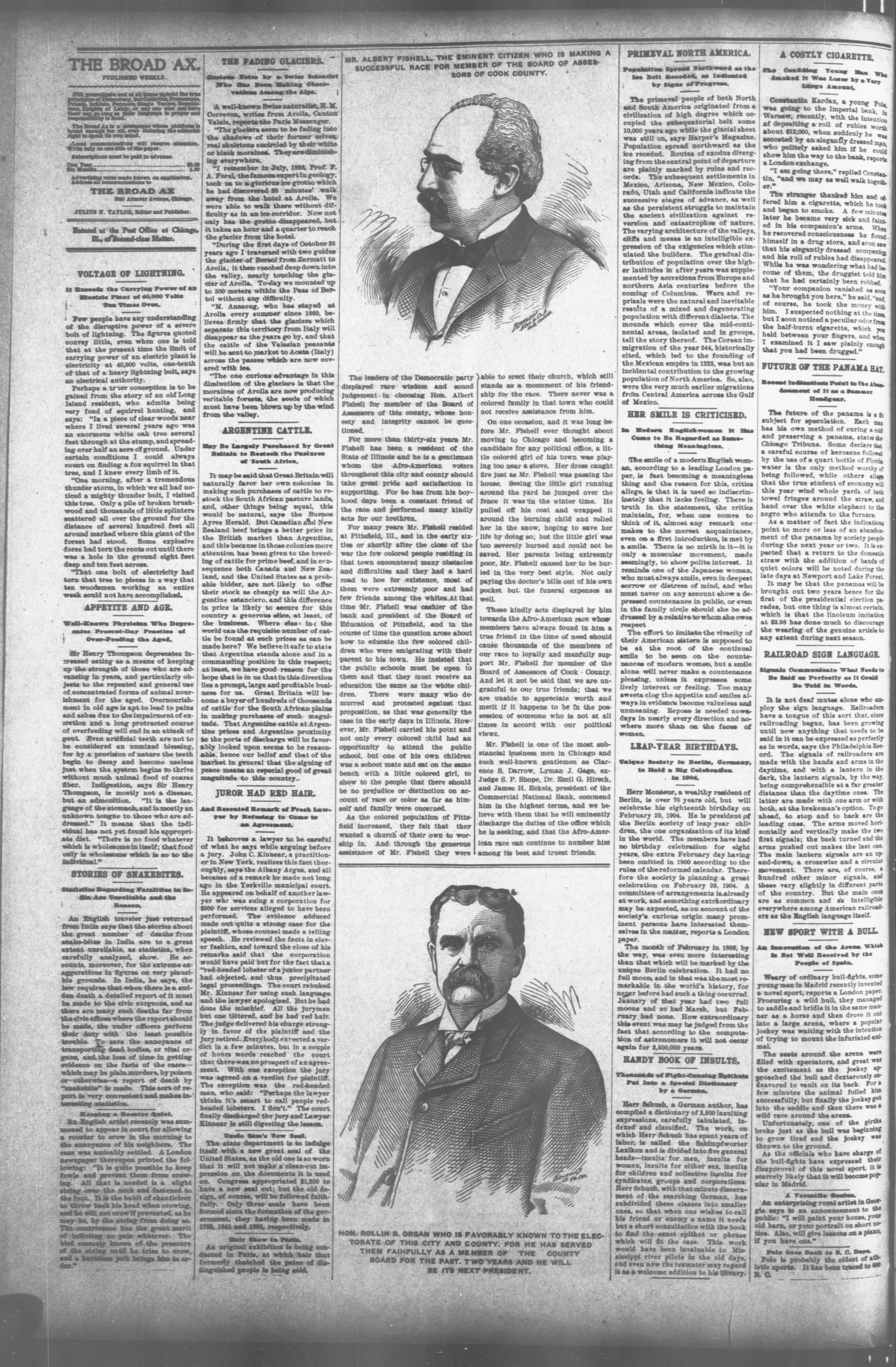
MR. ALBERT FISHELL, THE EMINENT CITIZEN WHO IS MAKING A SUCCESSFUL RACE FOR MEMBER OF THE BOARD OF ASSES SORS OF COOK COUNTY.
SORS OF COOK COUNTY.
Kenneth A. M.
HON. ROLLIN B. ORGAN WHO IS FAVORABLY KNOWN TO THE ELEC TORATE OF THIS CITY AND COUNTY. FOR HE HAS SERVED THEM FAIHFULLY AS A MEMBER OF THE COUNTY BOARD FOR THE PAST. TWO YEARS AND HE WILL BE ITS NEXT PRESIDENT.
The leaders of the Democratic party displayed rare wisdom and sound judgement in choosing Hon. Albert Fishell for member of the Board of Assessors of this county, whose honesty and integrity cannot be questioned
For more than thirty-six years Mr. Fishell has been a resident of the State of Illinois and he is a gentleman whom the Afro-American voters throughout this city and county should take great pride and satisfaction in supporting. For he has from his boyhood days been a constant friend of the race and performed many kindly acts for our brethren.
For many years Mr. Fishell resided at Pittsfield, Ill., and in the early sixties or shortly after the close of the war the few colored people residing in that town encountered many obstacles and difficulties and they had a hard road to hoe for existence, most of them were extreemly poor and had few friends among the whites.At that time Mr. Fishell was cashier of the bank and president of the Board of Education of Pittsfield, and in the course of time the question arose about how to educate the few colored children who were emigrating with their parent to his town. He insisted that the public schools must be open to them and that they must receive an education the same as the white children. There were many who demurred and protested against that proposition, as that was generally the case in the early days in Illinois. However, Mr. Fishell carried his point and not only every colored child had an opportunity to attend the public school, but one of his own children was a school mate and sat on the same bench with a little colored girl, to show to the people that there should be no prejudice or distinction on account of race or color as far as himself and family were concerned.
As the colored population of Pittsfield increased, they felt that they wanted a church of their own to worship in. And through the generous assistance of Mr. Fishell they were
able to erect their church, which still stands as a monument of his friendship for the race. There never was a colored family in that town who could not receive assistance from him.
On one occasion, and it was long before Mr. Fishell ever thought about moving to Chicago and becoming a candidate for any political office, a little colored girl of his town was playing too near a stove. Her dress caught fire just as Mr. Fishell was passing the house. Seeing the little girl running around the yard he jumped over the fence it was in the winter time. He pulled off his coat and wrapped it around the burning child and rolled her in the snow, hoping to save her life by doing so; but the little girl was too severely burned and could not be saved. Her parents being extreemly poor, Mr. Fishell caused her to be buried in the very best style. Not only paying the doctor's bills out of his own pocket but the funeral expenses as well.
These kindly acts displayed by him towards the Afro-American race whose members have always found in him a true friend in the time of need should cause thousands of the members of our race to loyally and manfully support Mr. Fishell for member of the Board of Assessors of Cook County. And let it not be said that we are ungrateful to our true friends; that we are unable to appreciate worth and merit if it happens to be in the possession of someone who is not at all times in accord with our political views.
Mr. Fishell is one of the most substancial business men in Chicago and such well-known gentlemen as Clarence S. Darrow, Lyman J. Gage, exJudge S. P. Shope, Dr. Emil G. Hirsch, and James H. Eckels, president of the Commercial National Bank, commend him in the highest terms, and we believe with them that he will eminently discharge the duties of the office which he is seeking, and that the Afro-American race can continue to number him among its best and truest friends.
PRIMEVAL NORTH AMERICA.
Population Spread Northward as the Joe Belt Receded, as Indicated by Signs of Progress.
The primeval people of both North and South America originated from a civilization of high degree which occupied the subequatorial belt some 10,000 years ago while the glacial sheet was still on, says Harper's Magazine. Population spread northward as the ice receded. Routes of exodus diverging from the central point of departure are plainly marked by ruins and records. The subsequent settlements in Mexico, Arizona, New Mexico, Colorado, Utah and California indicate the successive stages of advance, as well as the persistent struggle to maintain the ancient civilization against reversion and catastrophes of nature. The varying architecture of the valleys, cliffs and mesas is an intelligible expression of the exigencies which stimulated the builders. The gradual distribution of population over the higher latitudes in after years was supplemented by accretions from Europe and northern Asia centuries before the coming of Columbus. Wars and reprisals were the natural and inevitable results of a mixed and degenerating population with different dialects. The mounds which cover the mid-continental areas, isolated and in groups, tell the story thereof. The Corean immigration of the year 544, historically cited, which led to the founding of the Mexican empire in 1325, was but an incidental contribution to the growing population of North America. So, also, were the very much earlier migrations from Central America across the Gulf of Mexico.
HER SMILE IS CRITICISED.
In Modern Englishwomen It Has Come to Be Regarded as Something Meaningless,
The smile of a modern English woman, according to a leading London paper, is fast becoming a meaningless thing and the reason for this, critics allege, is that it is used so indiscriminately that it lacks feeling. There is truth in the statement, the critics maintain, for, when one comes to think of it, almost any remark one makes to the merest acquaintance, even on a first introduction, is met by a smile. There is no mirth in it—it is only a muscular movement, made seemingly, to show polite interest. It reminds one of the Japanese woman, who must always smile, even in deepest sorrow or distress of mind, and who must never on any account show a depressed countenance in public, or even in the family circle should she be addressed by a relative to whom she owes respect
The effort to imitate the vivacity of their American sisters is supposed to be at the root of the continual smile to be seen on the countenances of modern women, but a smile alone will never make a countenance pleasing, unless it expresses some lively interest or feeling. Too many sweets clog the appetite and smiles always in evidence become valueless and unmeaning. Repose is needed nowadays in nearly every direction and nowhere more than on the faces of women.
LEAP-YEAR BIRTHDAYS.
Unique Society in Berlin, Germany, to Hold a Big Celebration in 1904.
Herr Monteur, a wealthy resident of Berlin, is over 70 years old, but will celebrate his eighteenth birthday on February 29, 1904. He is president of the Berlin society of leap year children, the one organization of its kind in the world. The members have had no birthday celebration for eight years, the extra February day having been omitted in 1900 according to the rules of the reformed calendar. Therefore the society is planning a great celebration on February 29, 1904. A committee of arrangements is already at work, and something extraordinary may be expected, as on account of the society's curious origin many prominent persons have interested themselves in the matter, reports a London paper.
The month of February in 1886, by the way, was even more interesting than that which will be marked by the unique Berlin celebration. It had no full moon, and in that was the most remarkable in the world's history, for never before had such a thing occurred. January of that year had two full moons and so had March, but February had none. How extraordinary this event was may be judged from the fact that according to the computation of astronomers it will not occur again for 2,500,000 years.
HANDY BOOK OF INSULTS.
Thousands of Fight-Causing Epithets Put Into a Special Dictionary by a German.
Herr Schuch, a German author, has compiled a dictionary of 2,500 insulting expressions, carefully tabulated, indexed and classified. The work, on which Herr Schuch has spent years of labor, is called the Schimpfworter Lexikon and is divided into five general heads—insults for men, insults for women, insults for either sex, insults for children and collective insults for syndicates, groups and corporations. Herr Schuch, with that minute discernment of the searching German, has subdivided these classes into smaller ones, so that when one wishes to call his friend or enemy a name it needs but a short consultation with the book to find the exact epithet or phrase which will fit the case. This work would have been invaluable to Mississippi river pilots in the old days, and even now the teamster may regard it as a welcome addition to his library.
COSTLY CIGARETTE
The Confiding Young Man Who Smoked It Was Loser by a Very Large Amount.
Constantin Kardax, a young Pola, was going to the Imperial bank, in Warsaw, recently, with the intention of depositing a roll of rubles worth about $12,000, when suddenly he was accosted by an elegantly dressed man, who politely asked him if he could show him the way to the bank, reports a London exchange.
"I am going there," replied Constantin, "and we may as well walk together."
The stranger thanked him and offered him a cigarette, which he took and began to smoke. A few minutes later he became very sick and fainted in his companion's arms. When he recovered consciousness he found himself in a drug store, and soon saw that his elegantly dressed companion and his roll of rubles had disappeared. While he was wondering what had become of them, the druggist told him that he had certainly been robbed.
"Your companion vanished as soon as he brought you here," he said, "and, of course, he took the money with him. I suspected nothing at the time, but I soon noticed a peculiar odor from the half-burnt cigarette, which you held between your fingers, and when I examined it I saw plainly enough that you had been drugged."
FUTURE OF THE PANAMA HAT
Recent Indications Point to the Abuse
document of It as a Summer
Headgear.
The future of the panama is a fit subject for speculation. Each man has his own method of curing a cold and preserving a panama, states the Chicago Tribune. Some declare that a careful course of kerosene followed by the use of a quart bottle of Florida water is the only method worthy of being followed, while others allege that the true student of economy will this year wind whole yards of bath towel fringes around the straw, and hand over the white elephant to the negro who attends to the furnace.
As a matter of fact the indications point to more or less of an abandonment of the panama by society people during the next year or two. It is expected that a return to the domestic straw with the addition of bands of quiet colors will be noted during the late days at Newport and Lake Forest. It may be that the panamas will be brought out two years hence for the first of the presidential election parades, but one thing is almost certain, which is that the linoleum imitation at $2.98 has done much to discourage the wearing of the genuine article to any extent during next season.
RAILROAD SIGN LANGUAGE.
Signals Communicate What Needs to Be Said as Perfectly as It Could Be Told in Words,
It is not deaf mutes alone who employ the sign language. Railroaders have a tongue of this sort that, since railroading began, has been growing until now anything that needs to be said in it can be expressed as perfectly as in words, says the Philadelphia Record. The signals of railroaders are made with the hands and arms in the daytime, and with a lantern in the dark, the lantern signals, by the way, being comprehensible at a far greater distance than the daytime ones. The latter are made with one arm or with both, at the brakeman's option. To go ahead, to stop and to back are the leading ones. The arms moved horizontally and vertically make the two first signals; the back turned and the arms pushed out makes the last one. The main lantern signals are an up-and-down, a crosswise and a circular movement. There are, of course, a hundred other minor signals, and these vary slightly in different parts of the country. But the main ones are as common and as intelligible everywhere among American railroaders as the English language itself.
NEW SPORT WITH A BULL.
An Innovation of the Aroma Which Is Not Well Received by the People of Spain.
Weary of ordinary bull-fights, some young men in Madrid recently invented a novel sport; reports a London paper. Procuring a wild bull, they managed to saddle and bridle it in the same manner as a horse and then drove it out into a large arena, where a popular jockey was waiting with the intention of trying to mount the infuriated animal.
The seats around the arena were filled with spectators, and great was the excitement as the jockey approached the bull and dexterously endeavored to vault on its back. For a few minutes the animal foiled him successfully, but finally the jockey got into the saddle and then there was a wild race around the arena. Unfortunately, one of the girths broke just as the bull was beginning to grow tired and the jockey was thrown to the ground.
As the officials who have charge of the bull-fights have expressed their disapproval of this novel sport, it is scarcely likely that it will become popular in Madrid.
An enterprising rural artist in Georgia says in an announcement to the public: "I will paint your house, your old barn, or your portrait on short notice. Also, will give lessons on a piano, if you have one."
Polo Goes Back to B. C. Dayn.
Polo is probably the oldest of athletic sports. It has been traced to 600 B. C.
The majority of people can scarcely remember the time when there was no revolver, yet the fact is that it is a modern weapon and in its form of real efficiency is less than half a century old, says an eastern exchange. It was the invention of Joseph Shirk, citizen of Lancaster county, Pennsylvania, a county which also boasts of Robert Fulton, who, if not the inventor of the steamboat, was certainly the man who introduced the art of steam navigation successfully and is largely to be credited with the wonderful results which have followed and its revolutionary effects on commerce and civilization.
Before the civil war there were the old-fashioned pepper-boxes, which were dangerous to the user; then came the "navy," which had to be loaded like a musket, each barrel requiring separate attention, and usually being ineffective except at point-blank range. Then followed the present weapon of destruction, which is much more effective than the muskets of our fathers. Out of the revolver was evolved the repeating rifle of to-day, which has so far changed the whole tactics and strategy of war that Jean De Bloch felt that a great war could never again take place. Had he lived to see the end of the late war in South Africa he would have been confirmed in his views.
TURKEYS ARE NOT STUPID.
One Brood in Virginia That Knew Very Well When the Roof Was in Danger.
"People generally think turkeys have the least sense of all the domestic fowls," said Frank Wilkinson, a Virginia farmer, the other day, relates the Washington Star, "but I've got some that seem to have more gray matter than a great many human beings I know.
"One night a short time ago my wife and I and some visitors were out driving in the evening. As I was putting up the horses after returning home I noticed my turkeys were not roosting as usual in the big buttonwood tree by the barn. Instead they were perched on the fence posts and in the limbs of other trees.
"It struck me as mighty funny, as turkeys on the place had roosted in that tree ever since I could remember. I mentioned it to my wife when I went in the house, and she said she had noticed it when we drove in and thought it peculiar.
"That night about midnight a hard wind and rainstorm came up and the old buttonwood blew down. Now, how did those turkeys know that tree was doomed? At sundown there was no sign of a storm, and the buttonwood was fully 50 years old and apparently as stanch as ever. I tell you, I've had great respect for the judgment of turkeys since then."
SOCIAL WASP AND HER PREY.
How the Wary Insect Ontohes Unsurpelling Object and Stores It Away.
The wasp does not sting her prey. Her habit is to seize the squirming esterpillar in her fore legs, pass it back several times between her mandibles until it is quite limp and dead, and then to roll it deftly into a ball and hold it between the fore legs while she flies to the nest. There the operation is continued three or four minutes longer until the malaxation is complete, says Popular Science Monthly. In distributing the food the mass it hold firmly against the ventral side of the thorax by means of the femora of the first pair of legs and a bit partly pinched off with the mandibles. Next, the wasp inserts her head into a cell, lightly touches the larvae with her antennae, causing it to stir and open its mouth, and then pushes the bit of food into the mouth with the tarsal joints of the fore legs. With the remainder the wasp now passes to another cell, and the process is repeated until the ball of food is used up.
A singular Iron Meteorite. The University of Wisconsin has come into possession of a unique piece of meteorite iron. The date of its fall is not known, but it was plowed up near Algona, Wis., in 1887, and until last March remained in the hands of the farmer who discovered it. It is shaped like a shield, ten inches long by six broad, and an inch thick in the center. The convex surface is smooth, while the concave side is rough and encrusted with oxide. It is believed that it moved broadside through the air, the convex surface in front. On this surface are strongly marked lines, radiating from a nearly flat elliptical boss in the center. The lines deepen as they approach the periphery.
Political Superiors of Woman. The immigration statistics say that during the past year, of the adults who landed in New York 62 per cent. of the Syrians, 55 per cent. of the Italians, 31 per cent. of the Poles, and 21 per cent. of the Greeks could neither read nor write. It is inspiring, writes Ida Husted Harper, for American women to contemplate that in five years, or less, the vast majority of these, being males, will be casting their ballots for every official and every public question that go before the electorate, while educated, taxpaying, native-born women are absolutely barred from votes or vote. But, then, of course, it insures us a much wiser and better government to have the steerage vote.
London Street Troughes. London is introducing water troughs for thirsty horses, at which the water can be run off by touching a push-button and fresh water run in.
The Process of Revolution Dies Back in the Beginning of the Seventeenth Century.
Ice cream has been brought to its present state of perfection by a gradual process of evolution from the original idea which dates back to the beginning of the seventeenth century, says What to Eat. At that time iced fruits and caps made of ice first appeared at banquets. Like many other good things for the table, ice cream claims Paris for its birthplace, and yet it was not a Frenchman but an Italian named Precope Couteaux who first thought out the idea of icing lemonades and liquers. From this was gradually evolved over 100 years later ice cream, or iced butter, as it was then called, from its resemblance to that article of food.
While all civilized nations serve ice in great variety, we are apt to think of ice cream as an essentially American dish, probably because frozen desserts of all kinds are more generally used in this country than in any other. Ice cream first made its appearance in America in Philadelphia at the end of the eighteenth century. It was then considered a great luxury, and, consequently, was rarely seen except on state occasions. It was not within the reach of ordinary mortals until 1800, when an Italian condectioner established an ice cream house, as it was then called, at Germantown, a suburb of Philadelphia.
A NORTH CRIEK TALB.
Being the Truthful Narrative of a Wonderful Hunting Experience by a Truthful Man.
The following narrative was written by the veracious North Creek correspondent of the Troy Press:
George Little has lived all his life in the Adirondacks and the fish and game stories he tells are worth traveling many miles to hear. Some years ago when he had charge of a camp for the late Speaker Husted and Dr. Hayes he was out hunting and fishing on Raquette lake. He discovered a flock of wild geese flying in the shape of a V. He was in the act of loading his gun which was of the muzzle-loading pattern, and not having time to withdraw the ramrod, fired, and then waded across Alder brook to bag them. On going through the water a brass button on his parraloons flew off and as he reached shore he found 70 pounds of trout in his pants, which was the cause of the button disappearing, and about four rods away lay a fine deer dead. He then went to secure his geese, and on his ramrod sticking in a tree hung 17 of the birds pierced through the neck. He then brought his game safely to camp, and when he dressed the deer he found the brass button imbedded in his heart. If anyone doubts this story he has the brass button to show.
HE TURNED ON THE POWER.
A prominent Washington physician furnished considerable amusement to pedestrians on Pennsylvania avenue one afternoon recently. The eminent, but upon this occasion absent-minded, physician endeavored to leave the Raleigh hotel in his automobile. He had ridden from some distance with a party of friends whom he entertained at luncheon at the hotel. When the party was ready to resume the trip the machine refused to go, and the physician labored for a long time in the fruitless effort to induce it to move, relates the Washington Post.
By this time a large crowd had collected, and the party seemed to wonder how it was possible for such a mob to form in such a little while. Then some rude man in that collection called out at the top of his voice: "Why don't you turn on the gasoline?" The doctor's facial expression might have meant anything, although he said not a word. But he quietly laid down his tools, his quick eye sought out the man who had made the suggestion, and, in a manner that was Chesterfieldian to the lirnit, he said: "I thank you."
Then he turned on the power, and the machine went sailing off as smoothly as a cup defender.
RUSSIA'S FOREIGN TRAD.
American Importations Show That the Garr's People Appreciate Good Machinery.
The official report of the Russian foreign trade for the first four months of 1902 shows the American importations to be virtually the same as in 1900, apparently indicating that Russian buyers have become fully convinced it is better to buy American machinery in spite of the discriminating duty against it. The comparative figures for 1900, 1901 and 1902 are respectively $8,980,000, $7,158,000, and $8,-913,500. In the meantime German and British imports have fallen, their figures being $34,061,500, $32,216,500, and $30,292,000, and $15,064,000, $14,217,000 and $10,394,000. The whole import has continued falling, so that the share of America is relatively larger than in 1900. The exportations continue to increase.
One morning not long ago there was an odd sight in the eastern section of the city of Reading, Pa. The lid of a large kettle, containing several thousand stockings, at a local dye works, was lifted off under a too heavy pressure of steam, and the hosery scattered in every direction. Stockings hung from trees and telegraph wires, and neighboring roofs were littered with them. Several employees jumped from upper windows during the excitement.
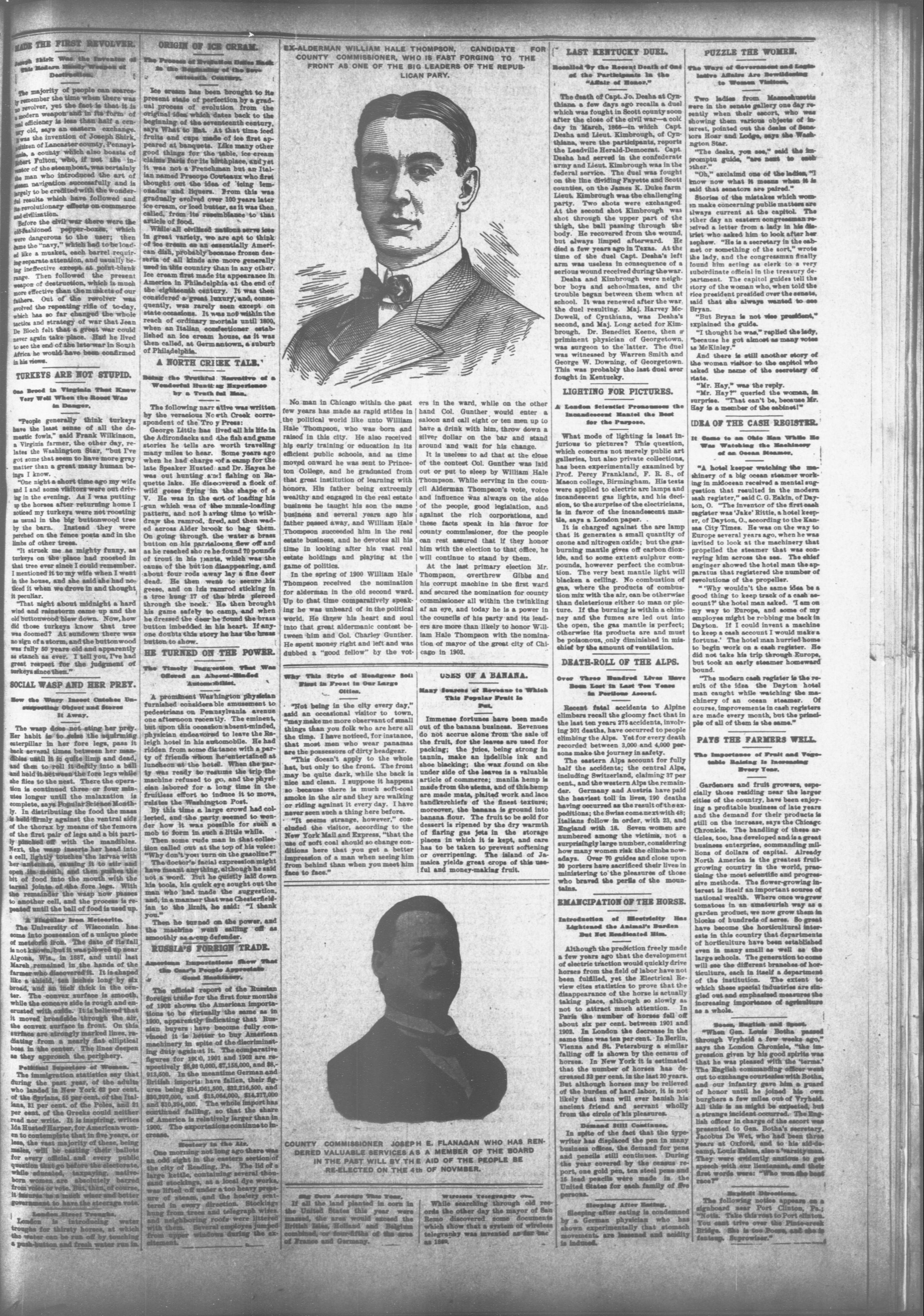
EX-ALDERMAN WILLIAM HALE THOMPSON, CANDIDATE FOR COUNTY COMMISSIONER, WHO IS FAST FORGING TO THE FRONT AS ONE OF THE BIG LEADERS OF THE REPUBLICAN PARY.
LICAN PARY.
COUNTY COMMISSIONER JOSEP H E. FLANAGAN WHO HAS RENDERED VALUABLE SERVICES AS A MEMBER OF THE BOARD IN THE PAST WILL BY THE AID OF THE PEOPLE BE RE-ELECTED ON THE 4th OF NOVMBER.
No man in Chicago within the past few years has made as rapid stides in the political world like unto William Hale Thompson, who was born and raised in this city. He also received his early training or education in its efficient public schools, and as time moved onward he was sent to Princeton College, and he graduated from that great institution of learning with honors. His father being extreemly wealthy and engaged in the real estate business he taught his son the same business and several years ago his father passed away, and William Hale Thompson succeeded him in the real estate business, and he devotes all his time in looking after his vast real estate holdings and playing at the game of politics.
In the spring of 1900 William Hale Thompson received the nomination for alderman in the old second ward. Up to that time comparatively speaking he was unheard of in the political world. He threw his heart and soul into that great aldermanic contest between him and Col. Charley Gunther. He spent money right and left and was dubbed a "good fellow" by the vot-
Why This Style of Headgear Soil First in Front in Our Large Cities.
"Not being in the city every day," said an occasional visitor to town, "may make me more observant of small things than you folk who are here all the time. I have noticed, for instance, that most men who wear panamas are the possessors of dirty headgear. "This doesn't apply to the whole hat, but only to the front. The front may be quite dark, while the back is nice and clean. I suppose it happens so because there is much soft-coal smoke in the air and they are walking or riding against it every day. I have never seen such a thing here before.
"It seems strange, however," concluded the visitor, according to the New York Mail and Express, "that the use of soft coal should so change conditions here that you get a better impression of a man when seeing him from behind than when you meet him face to face."
COUNTY COMMISSIONER JOSEPH
DERED VALUABLE SERVICES A
IN THE PAST WILL BY THE
RE-ELECTED ON THE 4
Big Corn Acreage This Year.
If all the land planted in corn in the United States this year were massed, the area would exceed the British Isles, Holland and Belgium combined, or four-fifths of the area of France and Germany.
ers in the ward, while on the other hand Col. Gunther would enter a saloon and call eight or ten men up to have a drink with him, throw down a silver dollar on the bar and stand around and wait for his change.
It is useless to ad that at the close of the contest Col. Gunther was laid out or put to sleep by William Hale Thompson. While serving in the council Alderman Thompson's vote, voice and influence was always on the side of the people, good legislation, and against the rich corporations, and these facts speak in his favor for county commissioner, for the people can rest assured that if they honor him with the election to that office, he will continue to stand by them.
At the last primary election Mr. Thompson, overthrew Gibbs and his corrupt machine in the first ward and secured the nomination for county commissioner all within the twinkling af an eye, and today he is a power in the councils of his party and its leaders are more than likely to honor William Hale Thompson with the nomination of mayor of the great city of Chicago in 1903.
USES OF A BANANA.
Many Sources of Revenue to Which
This Popular Fruit Is
Put.
Immense fortunes have been made out of the banana business. Revenues do not accrue alone from the sale of the fruit, for the leaves are used for packing; the juice, being strong in tannin, make an indelible ink and shoe blacking; the wax found on the under side of the leaves is a valuable article of commerce; manila hemp is made from the stems, and of this hemp are made mats, plaited work and lace handkerchiefs of the finest texture; moreover, the banana is ground into banana flour. The fruit to be sold for dessert is ripened by the dry warmth of flaring gas jets in the storage places in which it is kept, and care has to be taken to prevent softening or overripening. The island of Jamaica yields great crops of this useful and money-making fruit.
H E. FLANAGAN WHO HAS REN-
S A MEMBER OF THE BOARD
THE AID OF THE PEOPLE BE
th OF NOVMBER.
While searching through old records the other day the mayor of San Remo discovered some documents which show that a system of wireless telegraphy was invented as far back as 1869.
LAST KENTUCKY DUEL.
Recalled By the Recent Death of One of the Participants in the "Affair of Honor."
The death of Capt. Jo. Desha at Cynthiana a few days ago recalls a duel which was fought in Scott county soon after the close of the civil war—a cold day in March, 1866—in which Capt. Desha and Lieut. Kimbrough, of Cynthiana, were the participants, reports the Leadville Herald-Democrat. Capt. Desha had served in the confederate army and Lieut. Kimbrough was in the federal service. The duel was fought on the line dividing Fayette and Scott counties, on the James K. Duke farm. Lieut. Kimbrough was the challenging party. Two shots were exchanged. At the second shot Kimbrough was shot through the upper part of the thigh, the ball passing through the body. He recovered from the wound, but always limped afterward. He died a few years ago in Texas. At the time of the duel Capt. Desha's left arm was useless in consequence of a serious wound received during the war.
Desha and Kimbrough were neighbor boys and schoolmates, and the trouble began between them when at school. It was renewed after the war, the duel resulting. Maj. Harvey McDowell, of Cynthiana, was Desha's second, and Maj. Long acted for Kimbrough. Dr. Benedict Keene, then a primiment physician of Georgetown, was surgeon to the latter. The duel was witnessed by Warren Smith and George W. Downing, of Georgetown. This was probably the last duel ever fought in Kentucky.
LIGHTING FOR PICTURES.
A London Scientist Promotes the Incandescent Mantel the Best for the Purpose.
What mode of lighting is least injurious to pictures? This question, which concerns not merely public art galleries, but also private collections, has been experimentally examined by Prof. Percy Frankland, F. R. S., of Mason college, Birmingham. His tests were applied to electric arc lamps and incandescent gas lights, and his decision, to the surprise of the electricians, is in favor of the incandescent mantle, says a London paper.
It is charged against the are lamp that it generates a small quantity of ozone and nitrogen oxide; but the gasburning mantle gives off carbon dioxide, and to some extent sulphur compounds, however perfect the combustion. The very best mantle light will blacken a ceiling. No combustion of gas, where the products of combustion mix with the air, can be otherwise than deleterious either to man or picture. If the burning is within a chimney and the fumes are led out into the open, the gas mantle is perfect; otherwise its products are and must be poisonous, only diminished in mischief by the amount of ventilation.
DEATH-ROLL OF THE ALPS.
Over Three Hundred Lives Have Been Lost in Last Ten Years in Perilous Assent.
Recent fatal accidents to Alpine climbers recall the gloomy fact that in the last ten years 275 accidents, involving 301 deaths, have occurred to people climbing the Alps. Yet for every death recorded between 3,000 and 4,000 persons make the journey in safety.
The eastern Alps account for fully half the accidents; the central Alps, including Switzerland, claiming 37 per cent., and the western Alps the remainder. Germany and Austria have paid the heaviest toll in lives, 190 deaths having occurred as the result of the expeditions; the Swiss come next with 48; Italians follow in order, with 23, and England with 18. Seven women are numbered among the victims, not a surprisingly large number, considering how many women risk the climbs nowadays. Over 70 guides and close upon 30 porters have sacrificed their lives in ministering to the pleasures of those who braved the perils of the mountains.
EMANCIPATION OF THE HORSE.
Introduction of Electrodeity Has Lightened the Animal's Burden But Not Excledated Him.
Although the prediction freely made a few years ago that the development of electric traction would quickly drive horses from the field of labor have not been fulfilled, yet the Electrical Review cites statistics to prove that the disappearance of the horse is actually taking place, although so slowly as not to attract much attention. In Paris the number of horses fell off about six per cent. between 1901 and 1902. In London the decrease in the same time was ten per cent. In Berlin, Vienna and St. Petersburg a similar falling off is shown by the census of horses. In New York it is estimated that the number of horses has decreased 33 per cent. in the last 20 years. But although horses may be relieved of the burden of hard labor, it is not likely that man will ever banish his ancient friend and servant wholly from the circle of his pleasures.
Demand Still Continues.
In spite of the fact that the typewriter has displaced the pen in many business offices, the demand for pens and pencils still continues. During the year covered by the census report, one gold pen, ten steel pens and 15 lead pencils were made in the United States for each family of five persons.
Sleeping After Eating.
sleeping after eating is condemned by a German physician who has shown experimentally that stomach movements are lessened and acidity is induced.
PUZZLE THE WOMEN.
The Ways of Government and Legislative Affairs Are Bewildering to Women Visitors.
Two ladies from Massachusetts were in the senate gallery one day recently when their escort, who was showing them various objects of interest, pointed out the desks of Senators Hoar and Lodge, says the Washington Star.
"The desks, you see," said the impromptu guide, "are next to each other."
"Oh," exclaimd one of the ladies, "I know now what it means when it is said that senators are paired."
Stories of the mistakes which women make concerning public matters are always current at the capitol. The other day an eastern congressman received a letter from a lady in his district who asked him to look after her nephew. "He is a secretary in the cabinet or something of the sort," wrote the lady, and the congressman finally found him acting as clerk to a very subordinate official in the treasury department. The capitol guides tell the story of the woman who, when told the vice president presided over the senate, said that she always wanted to see Bryan.
"But Bryan is not vice president," explained the guide.
"I thought he was," replied the lady, "because he got almost as many votes as McKinley."
And there is still another story of the woman visitor to the capitol who asked the name of the secretary of state.
"Mr. Hay," was the reply.
"Mr. Hay?" queried the woman, in surprise. "That can't be, because Mr. Hay is a member of the cabinet!"
DEA OF THE CASH REGISTER.
It Came to an Ohio Man White He Was Watching the Machinery of an Ocean Steamer.
"A hotel keeper watching the machinery of a big ocean steamer working in midocean received a mental suggestion that resulted in the modern cash register," said C. G. Eakin, of Dayton, O. "The inventor of the first cash register was 'Jake' Rittie, a hotel keeper, of Dayton, O., according to the Kansas City Times. He was on the way to Europe several years ago, when he was invited to look at the machinery that propelled the steamer that was conveying him across the sea. The chief engineer showed the hotel man the apparatus that registered the number of revolutions of the propeller.
"Why wouldn't the same idea be a good thing to keep track of a cash account?' the hotel man asked. 'I am on my way to Europe, and some of my employees might be robbing me back in Dayton. If I could invent a machine to keep a cash account I would make a fortune.' The hotel man hurried home to begin work on a cash register. He did not take his trip through Europe, but took an early steamer homeward bound.
"The modern cash register is the result of the idea the Dayton hotel man caught while watching the machinery of an ocean steamer. Of course, improvements in cash registers are made every month, but the principle of all of them is the same."
PAYS THE FARMERS WELL.
The Importance of Fruit and Vegetable Raising Is Increasing Every Year.
Gardeners and fruit growers, especially those residing near the larger cities of the country, have been enjoying a profitable business of late years and the demand for their products is still on the increase, says the Chicago Chronicle. The handling of these articles, too, has developed and is a great business enterprise, commanding millions of dollars of capital. Already North America is the greatest fruit-growing country in the world, practicing the most scientific and progressive methods. The flower-growing interest is itself an important source of national wealth. Where once we grow tomatoes in an amateurish way as a garden product, we now grow them in blocks of hundreds of acres. So great have become the horticultural interests in this country that departments of horticulture have been established even in many small as well as the large schools. The generation to come will see the different branches of horticulture, each in itself a department of the institution. The extent to which these special industries are singled out and emphasized measures the increasing importance of agriculture as a whole.
"When Gen. Louis Botha passed through Vryheid a few weeks ago," says the London Chronicle, "the impression given by his good spirits was that he was pleased with the 'terma.' The English commanding officer went out to exchange courtesies with Botha, and our infantry gave him a guard of honor until he joined his own burghers a few miles out of Vryheid. All this is as might be expected, but a strange incident occurred. The English officer in charge of the escort was presented to Gen. Botha's secretary, Jacobus De Wet, who had been three years at Oxford, and to his aid-decamp, Louis Ealem, also a varsity man. They were evidently anxious to get speech with our lieutenant, and their first words were: "Who won the best race?"
The following notice appears on a signboard near Port Clinton, Pa.; "Notice. Take this route to Port Clinton. You can't drive over the Pinte creek Bridge. She is too Poor, and she is fentsup. Suprowiser."
All the members of the Board of Trade who amount to anything at all have formed a Thomas E. Barrett Club, and these dealers in pork and wheat intend to stand by him until they land him in the Cook County jail; not as a prisoner, but as sheriff of this county.
Miss M. M. Wagner, proprietor of the Ill. Fire-Proofcovering Co. 78 La Salle St., is one of Chicago's sharp and able business women.Miss Wagner employs from fifteen to twenty-five men in the manufacturer of all kinds of firecovering.
Mrs. Perry Bates, 5001 Dearborn st., several years ago was injured by falling through a defective sidewalk, on Wabash ave., near 52nd st., and recently the city settled with Mrs. Bates by paying her fifteen hundred dollars.
The Plaindealer, Topeka Kansas, in its last issue reproduced our entire article on "Rev. Jasper F. Thomas," unhorsed and Driven out of Olivet Baptist Church", brother Plaindealer. The Broad Ax desires to thank you for the compliment!
John P. Hopkins, chairman of the Democratic State Committee of Ill., is one the most astute and practical politicians in this country, and The Broad Ax will gladly support John P. Hopkins for chairman of the Democratic National Committee.
Mrs. A. F. Tervalon, 2826 State St., who is one of our good Lady friends, has been seriously ill for the past ten days, but to the delight of her many friends, Mrs. Tervalon, is rapidly improving, and she will soon be able to get up to the trough and eat her regular meals.
James H. Bowman, candidate for Clerk of the Criminal Court, is an oldtime printer; he is president of the Pressmen's Union of Chicago, and it is useless to state that all the office devils and printers in this city will work and vote for James Bowman, for Clerk of the Criminal Court.
John M. Harlan wanted to know the other night in one of his speeches "What has Thomas E. Barrett done for this community to entitle him to be elected sheriff of Cook oCunty." We might ask what has John M. Harlan done for Chicago outside of shooting off his big bazzoo, rustling with Kentucky corn juice and eating lots of Black Crow?!
David Dudenhaver, who robbed Georgetown Lewis out of all his money and clothing, and then let him go down to Joliet. Frank Cantwell, and two other tricky fellows have been indicted by the Grand Jury for conspiracy and for endevoring to extort money from prisoners in the Cook County jail.
Mr. Willard M. McEwen, ex-assistant state's attorney, Republican nominee for judge of the Superior Court, claims that "more than twenty-five hundred Democrats will vote for him, and that he will win out on November the 4th." Mr. McEwen always stands well with the newspaper boys, and they can pat him on the back and he will regale them with good live stories.
Ex-Judge Wm. T. Plummer, dealer in typwriters Journal Building this city, who was at one time an honored citizen of Fargo, North Dak., spent the past three weeks in visiting with friends in the east, and before returning home he attended the encampment of the Grand Army of the Republic at Washington, D. C.
County Commissioner James Daley is prominently identified with the labor organizations of Chicago and this will greatly ad to his strength in his race for re-election Commissioner Daley has served the people of this County on the Board for two years past without a blemish on his record, and we feel sure that the people will never think of passing him up on November 4th but will re-elect him.
Telephone Main 751
CHARLES L. WEBB
Court Reporter,
311 Ogden Bldg. 34 Clark St.,
General Steenographer Chicago.
OUR TICKET.
For Clerk of the Supreme Court—
John L. Pickering, Springfield.
State Treasurer—George Duddle-
ston, Chicago.
Superintendent of Public Instruction
—Anson L. Bliss, Hillsboro.
Trustees of the State University—
Dr. Julia Holmes Smith, Chicago; J.
A. White, Urbana; S. S. Paxton, Mon-
mouth.
Clerk of Apellate Court, Third Dist
trict—J. H. Baker, Sullivan.
FOOT BALL! FOOT BALL!
Evanston vs. Chicago. Sunday, Nov.
2, 1902, at 79th street and Wentworth
avenue, Chicago.
This is the team from Evanston that
won the championship cup in 1801.
Game called at 2:30. Admission 25c.
Don't fail to see the final game of
the series on Thanksgiving Day.
Chas. L. Webb, Pres. Evanston Athletic Association.
James Hale Porter, Pres. of Chicago
Athletic Association.
The intelligence of the colored voters of Illinois is being throughly tested and the result of the test will be announced by the returns of the election on the 4th of November. The contest is between Hon. W. E. Mason and one A. J. Hopkins for the United States Senate. Senator Mason has always been a champion of the colored man's rights as a citizen, even before he went to the senate and since he has spoken in no unmistakeable terms in behalf of the colored citizens.—The leader, Jackson, Miss.
Yes- it is true that the eyes of the world are fastened on the Afro-American voters of Ill. and if they will blindly vote and work for members of the Legislature who will support Hopkins, as against senator Mason, then they are lost to all sense of honor and manhood.
The Legislative voters, League, in its late report put its stamp of approval on some of the greatest political highwaymen and scoundles in Chicago; it does not urge the voters to elect clean men like Richard E.Burke, M. J. Stanton, James T. Prendergast, and many other worthy men who are seeking seats in the legislature the boys running the legislative voters league are pretty foxy fellows; it seems that they are out for the coin. The league cracks down on Ed. Morris Attorney for the "Gamblers Trust" and says, "that his political associates have been bad and his influence has been lent to aid the worst element of his party and his own private interests." It praises Samuel C. Selby independent Republican candidate for the Legislature for the first district and says, "that he is a man of character and intelligence." This is one redeeming feature in the report of the League.
In the experimenting with the magnetic extraction of metal from low-grade ore Thomas Edison has spent $2,000,000 within a few years, only to find at last that his plant is worthless for the work and he will have to build another.
From on and after this date all AfroAmericans, who are confined in the Cook County jail, and the other penal institutions of this county, who have been tricked or defrauded out of their money by scheming and unscrupulous white and black lawyers or alleged lawyers under the pretense of signing their bonds or securing their release or freedom are requested to communicate with Julius F. Taylor, editor of The Broad Ax, 5040 Armour av, City.
AGENTS FOR THE BROAD AX.
From on and after this date The Broad Ax can be found on sale at the following places:
William Goetz, dealer in cigars and tobacco, 411 E. 36th street.
A. G. Marshall, newstand and book store, 3604 State street.
E. H. Faulkner, dealer in cigars and tobacco, 3104 State street.
A. P. Tervalon's Cigar Store and News Stand, 2826 State street.
Edward Felix's Cigar Store, 358 30th street, N. E. Corner Armour Ave.
FREDERICK W. JOB
ATTORNEY AT LAW
SSE MARQUETTE BUILDING
Telephone 2310 Central
CHICAGO
LAWRENCE A. NEWBY
ATTORNEY-AT-LAW
Room 6, 128 LaSalle St.,
CHICAGO
RESIDENCE 2623 WABASH AVE
William Howard Fitzgerald
LAWYER
Room 402 Reaper Block, CHICAGO
JOSEPH A. McINERNEY
LAWYER
Suite 708—708
CHICAGO OPERA HOUSE
CHICAGO.
Beauregard F. Moseley,
LAWYER.
Practice in all Courts.
Main Office 6256 Halsted St,
Down Town Office 260 S. Clark St., Room 4n
Hours from 12 to 2 P. M.
Phone: 2588 Harrison.
ISRAEL COWEN
ATTORNEY AT LAW
415 TACONA BUILDING
ALEX I. WYATT,
JEWELER AND OPTICIAN
Manufacturer of
OPTICAL AND REFRAOTING GOODS
Watches and Jewelry Repaired, Prices
Reasonable. Eyes Tested Free. ----
98 E. Madison St. a ear Dearborn Chicago
BERNARD J. MAGUIRE,
BUFFET.
430 STATE ST., Cor Polk.
IMPORTED WINES, LIQUORS
AND CIGARS A SPECIALTY,
TEL. 973 Harrison. CHICAGO
FOR BARGAINS IN
Dry Goods, Gents' Furnishings and Shoes
GO TO
THOMAS & HARRIS
TWO BIG STORES
5101-3 Wentworth Ave.
5650-4 S. Halsted Street
WONDERFUL DISCOVERY
Curly Hair Made Straight By
TAKEN FROM LIFE:
BEFORE AND AFTER TREATMENT.
ORIGINAL
OZONIZED OX MARROW
(Copyrighted.)
This wonderful hair pomade is the only safe preparation in the world that makes kinky or curly hair straight as shown above. It nourishes the scalp and prevents the hair from falling out or breaking off, cures dandruff and makes the hair grow long and silky. Sold over forty years and used by thousands. Warranted harmless. Testimonials free on request. It was the first preparation ever sold for straightening kinky hair. Secure of limitations. Get the Original OZONIZED OX MARROW as the genuine never fails to keep the hair straight, soft and beautiful. A toilet necessity for ladies, gentlemen and children. Elegantly perfumed. The great advantage of this wonderful pomade is that by its use you can straighten your own hair at home. Owing to its superior and lasting qualities it is the best and most economical. It is not possible for anybody to produce a preparation equal to it. Full directions with every bottle. Only $0 cents. Sold by druggists and dealers or send us $0 cents for one bottle or $1.40 for three bottles. We pay all express charges. Send postal or express money order. Write your name and address plainly to
OZONIZED OX MARROW CO.,
76 Wabash Avenue, Chicago, Illinois.
Don't imagine that all hair preparations are alike. Quite the contrary. Some never do what is claimed for them. The Original Ozonized Ox Marrow has been on the market for so long that there is no doubt it will do everything we claim for it. It is the most genteel preparation that any one can use on their hair. It is most delicately perfumed and when thoroughly rubbed into the scalp and well brushed through the hair it cannot fail to cure dandruff and make the hair straight, soft and beautiful. It invigorates the scalp producing new growth and stops the hair from falling out. Try a bottle and you will be sure to be pleased. Only 50 cents, express paid, to any address in the United States. Druggists also sell it. Address: Ozonized Ox Marrow Co., 76 Wabash Ave., Chicago, Illinois.
FOR SALE.
Three story brick building, lot 25x
125, vacant lot adjoining same length,
brick cottage rear of corner lot. Rent
$80 per month. This property is loca-
ted on Halsted street near 35th and
it is a great bargain at $13,000. For
further particulars call on or address
Julius F. Taylor, 5040 Armour avenue,
Chicago.
ROOMS FOR RENT.
Two comodious nicely furnished
ILLINOIS BRICK CO.
WILLIAM C. KUESTER. SUPERINTENDENT.
N. Western Ave., Ch Telephone Lake View 270. IENADEL B
n Ave., Chicago Lake View 270. DEL BROS
1994 N. Western Ave., Chicago.
211-213 Madison Street
CHICAGO
Telephone Main 3300
UNIFORM CALLAHAN
FOR
Firemen, Barriers, Tormen, Manitors, Wagonmen, Street Car Employees, Telegraph Messens, Railroad Emp, Bellboys, Wa
GEO. C. CALLAHAN & CO.
PRODUCE COMMISSION
Butter, Poultry, Eggs, Game, Veal, Eto.
WATER STREET,
COB FEINBEN
Market and Grocer
Telephone 565 South
State Sts. CHI
Higginbothan
25th Street - - - CHI
S. BOYD DEALER
DAL, WOOD AND
EXPRESSING
omptly Attended to Cash on Delivery
4656 Armour Avenue, CHI
Ms. J. McCormick
AMPLE ROO
IMPORTED AND DOMESTIC
WINES, LIQUORS AND CIGARS
HALSTED STREET,
GREAT NORTHERN
AND EXCHANGE STA
ing, Draft and General Business Horses
Always on Hand
Ave. Near Robey St.
West, 1028.
BARNEY BENSO
and Fire Wrecker
MOVER of All Kinds of
HEAVY MACHINERY
stacks, Cupolas and More
Hoisting and Placing
of Beams and Girders
architectural work.
31 South Canal St., C
TELEPHONE MAIN 4928
FORM CAPS
FOR
Street Car Employes,
Telegraph Messengers,
Railroad Employes,
Bellboys, Watchmen, B
LLAHAN & CO.
COMMISSION
eggs, Game, Veal, Eto.
CHICAGO.
EINBERG
and Grocery
565 South
CHICAGO
Policemen, Firemen,
Letter Carriers,
Elevatormen,
Janitors, Wagonmen,
Street Car Employes,
Telegraph Messengers,
Railroad Employes,
Bellboys, Watchmen, Bn
GEO. C. CALLAHAN & CO.
PRODUCE COMMISSION
Butter, Poultry, Eggs, Game, Veal, Eto.
217 SOUTH WATER STREET, CHICAGO.
DEALER IN
FOOD AND ICE
Cash on Delivery
our Avenue, CHICAGO.
McCormick,
THE ROOM
AND DOMESTIC
CARS AND CIGARS
T, CHICAGO
JOSHIPE SURVIV
NORTHERN
CHANGE STABLE.
General Business Horse
on Hand
CHICAGO, III
BENSON,
Fire Wrecking.
All Kinds of
MACHINERY.
Olases and Monuments
and Placing of all
and Girders for
rural work.
Canal St., Chicago
MAIN 4928
F. W. BOYD DEALER IN COAL, WOOD AND ICE MOVING AND EXPRESSING All Orders Promptly Attended to Cash on Delivery Telephone Blue 28g 4656 Armour Avenue, CHICAGO.
SAMPLE ROOM
IMPORTED AND DOMESTIG WINES, LIQUORS AND CIGARS 8402 SOUTH HALSTED STREET, OHIGASS
A. JOSEPH JOSIEPH SHEAUN
GREAT NORTHERN
SALE AND EXCHANGE STABLE.
Driving, Draft and General Business Horses
Always on Hand
1197 Milwaukee Ave. Near Robey St.
Telephone West, 1028.
HOUSE AND LOT WANTED.
Anyone having a good house and lot for sale on easy payments located between 59th and 69 Halsted and Ashland avenue, will find it to their advantage to address Julius F. Taylor, 5040 Armour avenue, Chicago.
nue, Chicago, Ill.
---
Mason and General Contractor