The Gazette
Saturday, December 21, 1912
Cleveland, Ohio
Page text (machine-generated)
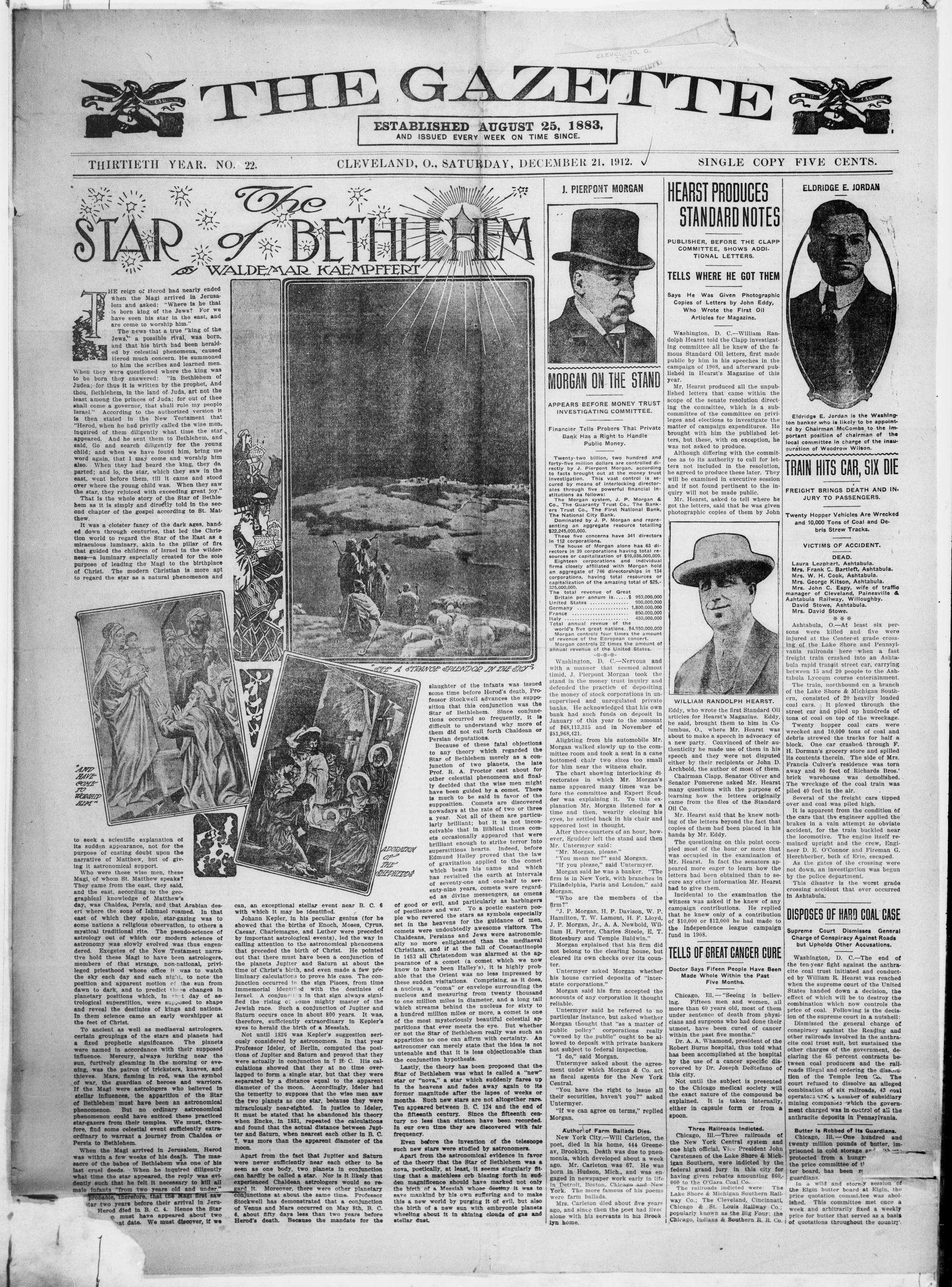
STAR OF BETHLEHEM WALDEMAR KAEMPFFERT
THIRTIETH YEAR. STAR
THIRTIETH YEAR. NO. 22.
HE reign of Herod had nearly ended when the Magi arrived in Jerusalem and asked: "Where is he that is born king of the Jews? For we have seen his star in the east, and are come to worship him."
T
The news that a true "king of the Jews," a possible rival, was born, and that his birth had been heralded by celestial phenomena, caused Herod much concern. He summoned to him the scribes and learned men. When they were questioned where the king was to be born they answered: "In Bethlehem of Judea; for thus it is written by the prophet, And thou, Bethlehem, in the land of Juda, art not the least among the princes of Juda; for out of the shall come a governor, that shall rule my people Israel." According to the authorized version it is then stated in the New Testament that "Herod, when he had privily called the wise man, inquired of them diligently what time the star appeared. And he sent them to Bethlehem, and said, Go and search diligently for the young child; and when we have found him, bring me word again, that I may come and worship him also. When they had heard the king, they da parted; and lo, the star, which they saw in the east, went before them, till it came and stood over where the young child was. When they saw the star, they rejoiced with exceeding great joy."
When they were questioned where the king was to be born they answered: "In Bethlehem of Judae; for thus it is written by the prophet, And thou, Bethlehem, in the land of Juda, art not the least among the princes of Juda; for out of those shall come a governor, that shall rule my people Israel." According to the authorized version it is then stated in the New Testament that "Herod, when he had privily called the wise men, inquired of them diligently what time the star appeared. And he sent them to Bethlehem, and said, Go and search diligently for the young child; and when we have found him, bring me word again, that I may come and worship him also. When they had heard the king, they departed; and lo, the star, which they saw in the east, went before them, till it came and stood over where the young child was. When they saw the star, they rejoiced with exceeding great joy."
That is the whole story of the Star of Bethlehem as it is simply and directly told in the second chapter of the gospel according to St. Matthew.
It was a cloister fancy of the dark ages, handed down through centuries, that led the Christion world to regard the Star of the East as a miraculous luminary, akin to the pillar of fire that guided the children of Israel in the wilderness—a luminary especially created for the sole purpose of leading the Magi to the birthplace of Christ. The modern Christian is more apt to regard the star as a natural phenomenon and
"AND HAVE COME TO WORSHIP HOP"
That is the whole story of the Star of Bethlehem as it is simply and directly told in the second chapter of the gospel according to St. Matthew.
It was a cloister fancy of the dark ages, handed down through centuries, that led the Christion world to regard the Star of the East as a miraculous luminary, akin to the pillar of fire that guided the children of Israel in the wilderness—a luminary especially created for the sole purpose of leading the Magi to the birthplace of Christ. The modern Christian is more apt to regard the star as a natural phenomenon and
to seek a scientific explanation of its sudden appearance, not for the purpose of casting doubt upon the narrative of Matthew, but of giving it astronomical support. Who were these wise men, these Magi, of whom St. Matthew speaks? They came from the east, they said, and the east, according to the geographical knowledge of Matthew's
day, was Chaldea, Persia, and that Arabian desert where the sons of Ishmael roamed. In that east of which they spoke, star-gazing was to some nations a religious observation, to others a mystical tradition rite. The pseudo-science of astrology out of which our modern science of astronomy was slowly evolved was thus engendered. Exegetes of the New Testament narrative hold these Magi to have been astrologers, members of that strange, non-national, privileged priesthood whose office it was to watch the sky each day and each night, to note the position and apparent motion of the sun from dawn to dark, and to predict these changes in planetary positions which, in that day of astrological superstition, were supposed to shape and reveal the destinies of kings and nations. In them science came an early worshipper at the feet of Christ.
To ancient as well as mediaeval astrologers, certain groupings of the stars and planets had a fixed prophetic significance. The planets were named in accordance with their supposed influence. Mercury, always lurking near the sun, furtively gleaming in the morning or evening, was the patron of tricksters, knaves, and thieves. Mars, flaming in red, was the symbol of war, the guardian of heroes and warriors. If the Magi were astrologers who believed in stellar influences, the apparition of the Star of Bethlehem must have been an astronomical phenomenon. But no ordinary astronomical phenomenon could have enticed these practiced star-gazers from their temples. We must, therefore, find some celestial event sufficiently extraordinary to warrant a journey from Chaldea or Persia to Bethlehem.
When the Magi arrived in Jerusalem, Herod was within a few weeks of his death. The massacre of the babes of Bethlehem was one of his last cruel deeds. When he inquired diligently what time the star appeared, the reply was evilly such that he felt it necessary to kill all male infants "from two years old and under."
day, was Chaidela, Persia, and that Arabian desert where the sons of Ismael roamed. In that east of which they spoke, star-gazing was to some nations a religious observation, to others a mystical traditional rite. The pseudo-science of astrology out of which our modern science of astronomy was slowly evolved was thus engendered. Exegetes of the New Testament narrative hold these Magi to have been astrologers, members of that strange, non-national, privileged priesthood whose office it was to watch the sky each day and each night, to note the position and apparent motion of the sun from dawn to dark, and to predict these changes in planetary positions which, in that day of astrological superstition, were supposed to shape and reveal the destinies of kings and nations. In them science came an early worshipper at the feet of Christ.
can, an exceptional stellar event near B. C. 6 with which it may be identified.
Johann Kepler, in his peculiar genius (for he showed that the births of Enoch, Moses, Cyrus, Caesar, Charlemagne, and Luther were preceded by important astrological events), led the way in calling attention to the astronomical phenomena that preceded the birth of Christ. He pointed out that there must have been a conjunction of the planets Jupiter and Saturn at about the time of Christ's birth, and even made a few preliminary calculations to prove his case. The conjunction occurred in the sign Pisces, from time immemorial identified with the destinies of Israel. A conjunction in that sign always signified the rising of some mighty master of the Jewish race. Such a conjunction of Jupiter and Saturn occurs once in about 800 years. It was, therefore, sufficiently extraordinary in Kepler's eyes to herald the birth of a Messiah.
To ancient as well as mediaeval astrologers, certain groupings of the stars and planets had a fixed prophetic significance. The planets were named in accordance with their supposed influence. Mercury, always lurking near the sun, furtively gleaming in the morning or evening, was the patron of tricksters, knaves, and thieves. Mars, flaming in red, was the symbol of war, the guardian of heroes and warriors. If the Magi were astrologers who believed in stellar influences, the apparition of the Star of Bethlehem must have been an astronomical phenomenon. But no ordinary astronomical phenomenon could have enticed these practiced star-gazers from their temples. We must, therefore, find some celestial event sufficiently extraordinary to warrant a journey from Chaldea or Persia to Bethlehem.
Not until 1826 was Kepler's suggestion seriously considered by astronomers. In that year Professor Ideler, of Berlin, computed the positions of Jupiter and Saturn and proved that they were actually in conjunction in 7 B. C. His calculations showed that they at no time overlapped to form a single star, but that they were separated by a distance equal to the apparent diameter of the moon. Accordingly, Ideler had the temerity to suppose that the wise men saw the two planets as one star, because they were miraculously near-sighted. In justice to Ideler, it must be stated that he abandoned his theory when Encke, in 1831, repeated the calculations and found that the actual distance between Jupiter and Saturn, when nearest each other in B. C. 7, was more than the apparent diameter of the moon.
When the Magi arrived in Jerusalem, Herod was within a few weeks of his death. The massacre of the babes of Bethlehem was one of his last cruel deeds. When he inquired diligently what time the star appeared, the reply was evidently such that he felt it necessary to kill all male infants "from two years old and under."
Apart from the fact that Jupiter and Saturn were never sufficiently near each other to be seen as one body, two planets in conjunction can hardly be called a star. Nor is it likely that experienced Chaldean astrologers would so regard it. Moreover, there were other planetary conjunctions at about the same time. Professor Stockwell has demonstrated that a conjunction of Venus and Mars occurred on May 8th, B. C. 6, about fifty days less than two years before Herod's death. Because the mandate for the
probable, therefore, that the migrator two years before their arrival in Jeru Herod died in B. C. 4. Hence the Star must have appeared about two at date. We must discover, if we
THE GAZETTE
ESTABLISHED AUGUST 25, 1883 AND ISSUED EVERY WEEK ON TIME SINCE.
CLEVELAND, O., SATURDAY, DECEMBER 21, 1912.
slaughter of the infants was issued some time before Herod's death. Professor Stockwell advances the supposition that this conjunction was the Star of Bethlehem. Since conflations occurred so frequently, it is difficult to understand why more of them did not call forth Chaldean or Persian deputations.
Because of these fatal objections to any theory which regarded the Star of Bethlehem merely as a conjunction of two planets, the late Prof. R. A. Proctor cast about for other celestial phenomena and finally decided that the wise men might have been guided by a comet. There is much to be said in fear of the supposition. Comets are discovered nowadays at the rate of two or three a year. Not all of them are particularly brilliant; but it is not inconceivable that in Bible times comets occasionally appeared that were brilliant enough to strike terror into superstitious hearts. Indeed, before Edmund Halley proved that the law of gravitation applied to the comet which bears his name and which has revisited the earth at intervals of seventy-one and one-half to seventy-nine years, comets were regarded as divine messengers, as omens
of good or evil, and particularly as harbingers of pestilence and war. To a poetic eastern people who revered the stars as symbols especially set in the heavens for the guidance of men, comets were undoubtedly awesome visitors. The Chaldeans, Persians and Jews were astronomically no more enlightened than the mediaeval Christians, and if at the fall of Constantinople in 1453 the Christendom was alarmed at the appearance of a comet (a comet which we now know to have been Halley's), it is highly probable that the Orient was no less impressed by these sudden visitations. Comprising, as it does, a nucleus, a "coma" or envelope surrounding the nucleus and measuring from twenty thousand to one million miles in diameter, and a long tall which streams behind the nucleus for sixty to a hundred million miles or more, a comet is one of the most mysteriously beautiful celestial apparitions that ever meets the eye. But whether or not the Star of Bethlehem really was such an apparition no one can affirm with certainty. An astronomer can merely state that the idea is not untenable and that it is less objectionable than the conjunction hypothesis.
Lastly, the theory has been proposed that the Star of Bethlehem was what is called a "new" star or "nova," a star which suddenly flares up in the heavens and fades away again to its former magnitude after the lapse of weeks or months. Such new stars are not altogether rare. Ten appeared between B. C. 134 and the end of the fifteenth century. Since the fifteenth century no less than sixteen have been recorded. In our own time they are discovered with fair frequency.
Even before the invention of the telescope such new stars were studied by astronomers.
Apart from the astronomical evidence in favor of the theory that the Star of Bethlehem was a nova, poetically, at least, it seems singularly fitting that a matchless orb blazing in sudden magnificence should have marked not only the birth of a Messiah whose deedey it was to save mankind by his own suffering and to make this a new world by purging it of evil, but also the birth of a new sun with amberonite planets wheeling about it in shining clouds of gas and stellar dust.
J. PIERPONT MORGAN
M.
APPEARS BEFORE MONEY TRUST
INVESTIGATING COMMITTEE.
Financier Tells Probs That Private
Bank Has a Right to Handle
Public Money.
Twenty-two billion, two hundred and
forty-five million dollars are controlled
directly by J. Pierpont Morgan, according
to facts brought out at the money trust
investigation. This vast control is
secured by various interlocking director-
ers through five powerful financial in-
stitutions as follows:
The Morgan system, J. P. Morgan &
Co., The Guaranty Trust Co., The Bank-
Trust Co. The First National Bank,
The National City Bank.
Dominated by J. P. Morgan and represent-
ing an aggregate resource totalling
$22,245,000,000.
The five concerns have 341 directors
in 112 corporations.
The chart showing interlocking directories in which Mr. Morgan's name appeared many times was before the committee and Expert Scudder was explaining it. To this explanation Mr. Morgan listened for a time and then, wearily closing his eyes, he settled back in his chair and appeared lost in thought.
After three quarters of an hour, however, Scudder left the stand and then Mr. Untermyer said:
"Mr. Morgan, please."
"You mean me?" said Morgan.
"If you please," said Untermyer.
Morgan said he was a banker. "The firm is in New York, with branches in Philadelphia, Paris and London," said Morgan.
"Who are the members of the firm?"
"J. P. Morgan, H. P. Davison, W. P. Hamilton, T. W. Lamont, H. F. Lloyd, J. P. Morgan, Jr., A. A. Newbold, William H. Porter, Charles Steele, E. T. Stotesbury and Temple Baldwin."
Morgan explained that his firm did not belong to the clearing house, but cleared its own checks over its counter.
Untermyer asked Morgan whether his house carried deposits of "interstate corporations."
Morgan said his firm accepted the accounts of any corporation it thought reliable.
Untermyer said he referred to no particular instance, but asked whether Morgan thought that "as a matter of public policy" corporations really "owned by the public" ought to be allowed to deposit with private bankers not subject to federal inspection.
"I do," said Morgan.
Untermyer asked about the agreement under which Morgan & Co. act as fiscal agents for the New York Central.
"You have the right to issue all their securities, haven't you?" asked Untermyer.
"If we can agree on terms," replied Morgan.
Author of Farm Ballads Dies.
New York City—Will Carleton, the poet, died in his home, 444 Greeneav, Brooklyn. Death was due to pneumonia, which developed about a week ago. Mr. Carleton was 67. He was born in Hudson, Mich., and was engaged in newspaper work early in life in Detroit, Boston, Chicago and New York. The more famous of his poems were farm ballads.
Mrs. Carleton died about five years ago, and since then the poet had lived alone with his servants in his Brooklyn home.
SINGLE COPY FIVE CENTS.
HEARST PRODUCES STANDARD NOTES
PUBLISHER, BEFORE THE CLAPP COMMITTEE, SHOWS ADDITIONAL LETTERS.
TELLS WHERE HE GOT THEM
Says He Was Given Photographic Copies of Letters by John Eddy, Who Wrote the First Oil Articles for Magazine.
Washington, D. C.—William Randolph Hearst told the Clapp investigating committee all he knew of the famous Standard Oil letters, first made public by him in his speeches in the campaign of 1908, and afterward published in Hearst's Magazine of this year.
Mr. Hearst produced all the unpublished letters that came within the scope of the senate resolution directing the committee, which is a subcommittee of the committee on privileges and elections to investigate the matter of campaign expenditures. He brought with him the published letters, but these, with on exception, he was not asked to produce.
Although differing with the committee as to its authority to call for letters not included in the resolution, he agreed to produce these later. They will be examined in executive session and if not found pertinent to the inquiry will not be made public.
Mr. Hearst, asked to tell where he got the letters, said that he was given photographic copies of them by John
WILLIAM RANDOLPH HEARST.
Eddy, who wrote the first Standard Oil articles for Hearst's Magazine. Eddy he said, brought them to him in Columbus, O., where Mr. Hearst was about to make a speech in advocacy of a new party. Convinced of their auuthenticity he made use of them in his speech and they were not disputed either by their recipients or John D Archbold, the author of most of them
Chairman Clapp, Senator Oliver and Senator Pomerene asked Mr. Hearst many questions with the purpose of learning how the letters originally came from the files of the Standard Oil Co.
Mr. Hearst said that he knew nothing of the letters beyond the fact that copies of them had been placed in his hands by Mr. Eddy.
The questioning on this point occupied most of the hour or more that was occupied in the examination of Mr. Hearst. In fact the senators appeared more eager to learn how the letters had been obtained than to secure any other information Mr. Hearst had to give them.
Incidental to the examination the witness was asked if he knew of any campaign contributions. He replied that he knew only of a contribution of $10,000 or $12,000 he had made to the Independence league campaign fund in 1908.
TELLS OF GREAT CANCER CURE
Doctor Says Fifteen People Have Been Made Whole Within the Past Five Months.
Chicago, Ill. — "Seeing is believing. Fifteen men and women, all more than 60 years old, most of them under sentence of death from physicians and surgeons who had done their utmost, have been cured of cancer within the past five months."
Dr. A. A. Whamond, president of the Robert Burns hospital, thus told what has been accomplished at the hospital by the use of a cancer specific discovered by Dr. Joseph DeStefano of this city.
Not until the subject is presented to the Chicago medical society will the exact nature of the compound be explained. It is taken internally, either in capsule form or from a spoon.
Three Railroads Indicted.
Chicago, Ill.—Three railroads of the New York Central system and one high official, Vice President John Carstensen of the Lake Shore & Michigan Southern, were indicted by the federal grand jury in this city for having rebates amounting $80,000. The railroads indicted were: The Lake Shore & Michigan Southern Railway Co.; The Cleveland, Cincinnati, Chicago & St. Louis Railway Co.; popularly known as the Big Four; the Chicago, Indiana & Southern R. R. Co.
1851
ELDRIDGE E. JORDAN
Eldridge E. Jordan is the Washington banker who is likely to be appointed by Chairman McCombs to the important position of chairman of the local committee in charge of the inauguration of Woodrow Wilson.
TRAIN HITS CAR, SIX DIE
FREIGHT BRINGS DEATH AND IN-
JURY TO PASSENGERS.
Twenty Hopper Vehicles Are Wrecked
and 10,000 Tons of Coal and De-
bris Strew Tracks.
VICTIMS OF ACCIDENT.
DEAD.
Laura Leaphart, Ashtabula.
Mrs. Frank C. Bartlett, Ashtabula.
Mrs. W. H. Cook, Ashtabula.
Mrs. George Kitson, Ashtabula.
Mrs. John C. Espy, wife of traffic
manager of Cleveland, Painesville &
Ashtabula Railway, Willoughby.
Ashtabula, O.-At least six persons were killed and five were injured at the Center-st grade crossing of the Lake Shore and Pennsylvania railroads here when a fast freight train crashed into an Ashtabula rapid transit street car, carrying between 15 and 20 people to the Ashtabula Lyceum course entertainment. The train, northbound on a branch of the Lake Shore & Michigan Southern, consisted of 20 heavily loaded coal cars. It plowed through the street car and pulled up hundreds of tons of coal on top of the wreckage. Twenty hopper coal cars were wrecked and 10,000 tons of coal and debris strewed the tracks for half a block. One car crashed through F. H. Dorman's grocery store and spilled its contents therein. The side of Mrs. Francis Culver's residence was torn away and 80 feet of Richards Bros.' brick warehouse was demolished. The wreckage of the coal train was piled 40 feet in the air. Several of the freight cars tipped over and coal was piled high. It is apparent from the condition of the cars that the engineer applied the brakes in a vain attempt to obviate accident, for the train buckled near the locomotive. The engine itself remained upright and the crew, Engineer D. E. O'Connor and Fireman G. Herchberber, both of Erie, escaped. As the gates of the crossing were not down, an investigation was begun by the police department.
This disaster is the worst grade crossing accident that ever occurred
DISPOSES OF HARD COAL CASE
Supreme Court Dismisses General Charge of Conspiracy Against Roads but Upholds Other Accusations.
Washington, D. C.—The end of the ten-year fight against the anthracite coal trust initiated and conducted by William R. Hearst was reached when the supreme court of the United States handed down a decision, the effect of which will be to destroy the combination which now controls the price of coal. Following is the decision of the supreme court in a nutshell: Dismissed the general charge of conspiracy against the Reading and other railroads involved in the anthracite coal trust, but sustained the other charges of the government, declaring the 65 percent contracts between coal producers and the railroads illegal and ordering the dissolution of the Temple Iron Co. The court refused to dissolve an alleged combination of six railroads, 42 coal operators and a number of subsidiary mining companies which the government charged was in control of all the anthracite deposits in Pennsylvania.
Butter is Robbed of Its Guardians.
Chicago, Ill.—One hundred and twenty million pounds of butter, imprisoned in cold storage and protected from a hungry the price committee of the ter board, has been r
In a wild and stormy session of the Elgin butter board at Elgin, the price quotation committee was abolished. This committee met once a year to discuss the price for butter that served as a basis of quotations throughout the country.
ge .
Ea f ak
Fils La~ 4G Jay fog oe) Se G? ce
» he, SWE rep er be
2 me eee, :
nome se || Netienecemranuncumeiest ee uae) ie
Po ery RE " nea, say eg Hoy cag rg se) ua :
& ae hah o LD oa e OR AR RARER EP i,
aS S&S 8 yee bs See ae wets ee
Se SG ae BR Pre a a »
ERTS EE GIL, ay ~
PuBLiseo EVERY SATURDAY |
SUBSCRIPTION RATES
(in Advance)
QMO Yearseccereseereeesss B1B0
Bix Months... eccceseeeeee 100
‘Three Monthe...... i. 0
Gubscribers are requested to re
mit by postoffice money on
der oF registered letter,
Entered at the postoffice In Cleveland,
‘Ohib, as second-class matter
Address all communications to
HARRY C. SMITH
| Editor and proprietor,
THE GAZETTE,
Blackstone Bullding, Cleveland, 0.
| Member Ohio Legistature: 1804
‘Ne: 1806; 1896 to 1898; 1900 to 1908
ie eee ee
THE GAZETTE Ie the oldest, and
has the largest bona fide circulation,
double that of any newspaper In the
Interest of Afro-Americans, published
tn the state of Ohio, and comparteon
with any will Immediately establish
Ita rank as one of the NEWSIEST
AND BEST In the country.
‘Merry Christmas!
Please remember that a year's sub-
scription to The Gazette, for a triend
or relative, is a Christmas gift that
will be appreciated and that will be
a weekly reminder of you for twelve
months or one year. Try it!
One feels Ike holding one’s nose
and stuffing one’s ears when the names
Blease and Roddenberry are men-
tioned. These two southern blather-
skites are trying to “out-Tillman” Till-
man and “out-Vardaman” Vardaman.
Good Nord! deliver us!
Do not squander money during the
coming holiday season because you
will surely and sorely need it before
the expiration of next year. Use
judgment in giving, haying pleasure,
ete, and SAVE all you can for fu-
ture use. Be wise, this time.
Every community in this country,
where there is a dozen intelligent
members of the race, or more, should
have a Citizens’ Rights’ club or
“league,” in order to be able to make
an organized (fight in the courts and
elsewhere, when necessary, in defense
of our civil and other rights. Our peo:
ple of Washington, D. C., New York,
and other large cities in the north,
have such organizations. There can
be a number of them, even in one city,
as a large membership is not abso:
lutely necessaty. “Quality rather than
quantity”—intelligence, loyalty and
ability to contribute to the support of
such a movement—should be the first
consideration when the qualifications
for membership in such an organiza:
tion are being passed upon.
) TWO APPEALS TO CRIME!
‘The Jack Johnson case seems to
have upset a large. number of people
in Chicago, including its “intellectual
lights” — ministers, lawyers, editors
and, of course, the politicians—to such
an extent that when one wishes to
ascertain the motives for some of the
demands of change, one is at a loss
to know whether they are mere as-
sininity or downright badness, mere
folly or depravity. Johnson's conduct
ig no doubt open to serious censure
in several respects, but he is no worse
than hundreds of other infractors of
“law, custom, morals,” etc., and, if
she were not the Negro, who downed
the white pugilist, much of the out
ery against him would have been very
‘weak voiced: The prize for depravity
downright must at present be award:
ed to Mrs, Patrick Weathers of Guth-
rie, Okla,, who has sent)the following
“gem” to the “Bull Moose" organ, the
Chicago Tribune, which did not ‘con-
sider it improper to insert it in the
columns’ of @ paper “that is read the
world over.” There are people in the
World who consider the publication of
such an appeal to crime (murder) a
legal offense as well as a moral one,
and the Tribune may as well know
that its neceptance of such rank: ma-|
terial is not even “to the taste” of
its own saner readers. We copy it!
Verbatim et literatim:
Different in Oklahoma,
Guthrie, Okla, Dec, 4.—Baitor
Chicago Tribune.—Why does not your
splendid paper, that is read the world
over, have the Iilinois legislature e1\-
act laws to prevent such disgraceful
happenings as the late marriage of
Jack Johnson? Down in this part of |
the country he would never have lived
to marry the second white girl.
Mra, Patrick Weathers. |
It needs no further comment than |
that Mrs. Patrick Weathers is Irish
(a race that has bee in the same fix
as regards marriage; since there was
a time when no Englishman could
legally marry an Irish girl or widow).
She is also most probably Catholic
(Christian), and that church has only |
lately in South Africa declared that
‘while it did not encourage intermar-
lage of whites and blacks, it would
insist that where sexual intercourse |
was had or contemplated, the parties
should be obliged to marry," etc. The!
‘ame course Was pursued by the Cen-|
rum party (Catholic) in the German |
Diet, and the socialists, who combin- |!
ng on that issue, defeated the colo-|
lal minority op that point. That a
yoroan can appeal, inalduously, but
ndeed appeal to murder is HORRIBLE
m itself, but that a paper edited by
nen who claim to be good citizens of
he American Republic, which must;
¢ of necessity ® government based on |
yw and order, on Justice and equality |
> all its inhabitants, does so, is even ||
tore horrible. The tendency of such |
ublication ties openly before all who
re not blind, {
THE “FORCE BILL” OF RACE
>SBERIORITY.
Lovejoy, Lincoln and
e forced by prejudice,
Mr under ae maak of “science,
ethics, morality rel pemernieee to
‘oth races, into | the progress:
jve (7) states that already possess
jaws probibitins Intermarriage of
whites and blacks. A Mr. H. H. Hess
has published a list of such states
‘which, with the exception of indiana,
Colorado, Nebraska, California and
ee
tions prohibit it. In the other so-
called “progressive” states it “is pro-
hibited by statute;” Arizona, Idaho,
Oklahoma, Oregon, Virginia, Texas,
Was editor of a German paper in St.
‘Louis, has wavered and seems, too,
longer “laughs at lecksmiths\" Still
tice than laws,” which indeed, after
all, do not prevent “illegitimate” mis-
More to say anent the matter; but just
from the Chicago Jourial) “there are
[one foolish White people who will
marry Negroes and some foolish Ne-
groes who will marry whites, but they
raised by Representative Roddenberry
attack on the race, In congress. We
erick Douglass, who later married a
| ball in 1865 at the White House
GOV. HARMON MISQUOTED.
‘The New York Age quotes Gov. Jud-
son Harmon, of this state, as saying
recently in a newspaper interview:
“Ohio has often agitated the pass-
age of a law against the intermar.
riage of whites and blacks but, I am
sorry to say, it has. not yet been
Passed. Such marriages are a blot on
our civilization.”
If the Governor is quoted correctly,
he states what is NOT true because
Ohio has NOT “often agitated the
passage of such a law" since the one
of the kind, a remenant of the infa
mous “Black Laws” of this state, was
wiped by the “Bly-Arnett’ bill, many
years ago. We believe that the Gov-
ernor is too intelligent a man to have
made such a mistake, wilfully or oth-
erwise, and also that he is too big
and broad-minded to ever say that he
is “sorry that such a law. has not yet
been passed” and that “such marriages
area blot on our civilizaztion.” Mar-
riages of blacks and whites ate no
more a “blot on our civilization” than
are the murriages of persons of the
same color but of different races or
classes, and the Governor and every:
one else, ordinarily intelligent, kiow
this. Such statements, as The Age
attributes to Goy. Harmon, would be
expected from @ narrow-mind thor-
oughly surcharged with racial and
color prejudice, and not from a man
who is generally rezurded as one of
the Jeading statesmen and jurists of
nis country. No, we do not believe
that Ohio's Governor ever delivered
himself of such “playing-to-the gal
jery” rot.
CORRESPONDENTS WANTED.
‘The old reliable Gazette desires an
active agent and correspondent in
jevery city and town in. Ohfo and
neighboring states having a number
|et ‘Afro-American residents. Only 3
|Ilttle time on Fridays or Saturdays is
| required.
‘We are especially desirous of hear
ing from persons in the following
named cities: Zanesville, Newark
Lancaster, Lebanon, Chillicothe, To
ledo, Troy, Canton, Springfield, Piqua,
| Cotumbus, Cambridge, Steubenville,
Bellaire, St. Clairsville, Wilmington,
|Portsmouth, Washington, C. “HL, Ox:
ford, Sabina, Gallipolis, Rendville, Ur-
bana, Delaware, Mt. Vernon, East Liv-
erpool, Wellsville, Akron, Dayton, Mid-
dieport, Bellefontaine, Lima, O., and
other places where we have none.
; ‘Write to the editor of The Gazette,
Blackstone building, Cleveland, 0..
‘and torms will be sent promptly. Our
‘readers will oblige us greatly by send-
ing at once the addresses of persons
{in the cities named above, or others,
to whom we can write relative to the
matter.
FOR SALE.
Houses and lots in Oberlin. Ohio,
and in @ most desirable locality; sur-
roundings excellent; cheap and on
easy terms, Address or see D. C.
Fisher, 554 Broadway, Lorain, Ohio.
Phone, residence 635; office. 585.
WOULD LOVE COLORED GIRL.
Ashburn, Ga.—In a battle, Dec. 7
at King’s Mills, a lumber camp near
here, following the horsewhipping of
C. R. Christmas because of his infat-
uation for a Negro girl, John Christ.
mas was killed and his brother,
James Christmas, and J. D. Ward
were probably fatally wounded. Sev-
eral others are reported to bave been
wounded.
Greatest of Meat Raters.
‘Fhe Americans are the greatest
ment eaters of gny of the nations.
WRITTEN BY “THE OLD RELIA
BLE" GAZETTE'S CORRE.
SPONDENTS.
|
‘What Our People Are. Doing Exch
bY Weck--Ghuree, Perkonal, Sesisi
egdaUlcarary andi
leal — Marriages,
| Deaths, Etc.
AW doveentondente must mall tnel
ligeet news letters lor our nest. two
| issues, on Saturday or Sunday (at the
|vory latest) and at thelr central post
| efice aha wor in a letterbox it they
|wish them to apear in our issues of
[Beer 2 and: Dee 28, 1812, “This 1s
[ade necesary as a result of Christ
fone aloe Fears: saan ones
‘in the middle of the week—on
Welneetey All Correstondints. il
|pleage remember thle as there Will be
[ho exeoptions to the rule ovtiiied ta
Deon ena
Springfield.—Russell H. Swayne of
this city, a recent graduate of Howard
University Medical School, Washing
ton, D.C, was one of the 8 recently
examined by the Ohio State Board of
Medical Examiners. Dr. Swayne
headed the list, leading the class by a
general average of 93 per cent—Read
The Gazette.
Meintyre.—Rev. FE. P. Smith of Car-
negie, Pa., was called here recently by
his brother's fllness. ‘The latter ts
still seriously {1l.—Miss Mamie Smith
is better.—Several were in Steuben:
ville, shopping, Saturday —Rev. D. D.
Lewis, our’pastor, is sick.—Miss Jes-
sie Smith was able to be out, Sunday.
—Xmas. tree in the evening—Mrs
Mary E, Adkins is sick.
Painesville. — Joseph Hill's home
was partially destroyed by fire,
Wednesday.—Silas Kelly is ill at the
hospital. —The Victor sewing club met
at Miss Ruth Freeman's, Friday —Mr.
Chas, Eledge is visiting his son, John,
in Cleveland.—Mrs. B. A. Kelly and
Mrs. J. L. Wooten were in Cleveland,
Wednesday evening. — Miss Perle
Smith was in Cleveland, shopping,
Monday.—Jefferson Kelly ‘was taken
to the State Hospital for the Insane,
at Newburg, Wednesday.—Mr. and
Mrs. Jonas Gordon visited relatives,
here, recently.—T. F. Gordon is worse.
| Ashtabula. Miss Rhea Johnson,
‘who has been sick for the past week,
fs able to sit up—Arthur Beller of
Lawton, lost the tip end of a finger
It is healing nicely—Miss Amber My-
ers left for home, Saturday. She will
be married on the 18th at Sandy Lake,
Pa—The Autumn Leaf Club held a
business meeting.—Mr. Wilbur Mon-
roe, was in town, Monday.—There was
a railroad wreck and only two of thir-
teen escaped. All traffic was stopped
until the-road was cleared.
- Sandusky.—Rev. jand Mrs. G. D.|
Smith attended the wedding of Mr. |
Jacob Thompson and Mrs. Susie Weth-
ers, 3110 Benoa Or: Cleveland, |
Dec. 12. Rev. Q. D. Smith officiated — |
Wedding belis are ringing. Fulton |
and Washington streets are becoming |
very active long sis line==The stork |
brousht Rev. and Mrs, J.C. Turner a
fine boy, the 13th—Mrs. George Scott
is looking for her daughter, Mrs, Nel- |
son Bolling of Elyria, to spend Xmas |
with her—Mrs. N. Williams is better. |
—Mrs. Susan Taylor continues quits |
poorly—Mrs. J. 8. Davis and. sister, |
Miss R. Garrett, were in Cleveland, |
shopping last week—Things are be:
ocming “exceptionally interesting on
Fulton St. There is a possibility of |
“Indianapolis' coming here and not re- |
turning.—The churches and S. 8. are |
preparing for Christmas.—Rev. and |:
Mrs, G. D. Smith have received an
Xmas box from Paris, Ky. | Among the |
good things Was a fat goose— |.
Rey. J..C. Turner so ean
Siureh and much iaferest was mani |
fested by his people.
oe :
Zanesville—“Mother” Johnson and |:
ie Grimes of Cleveland, were here, |
ecently. Miss Alma Blake, daughter |
{ETTE, CLEVELAND. © SATURDAY. DECFEMRER 21. 191
of Mrs. Ben Caliman, has returned
from that city.—John C, Brooks and
Miss Anna MeNorton were married at
Yorktown, Va., last month. Her
mother was formerly Miss Sada Gant
of this city.—Misses Nina Clinton and
Estella Green are expected home
from Charleston, W. Va., to spend the
holidays. Miss Sadie Mays. will ac
company the latter.—Roy Thomas is
convalescing and Jesse Sweed was
released from the hospital, last. Wed
nesday.—Mr. and Mrs. Oliver of Mem-
phis, are making their home with Mr
and Mrs..Chas. West.
Smithfield.—Rev. D. D. Lewis., Miss
kunma Carter, Mr. Abe and” Mise
Mamie Smith of Melntyre, are very
ine Mesdames ‘8, He and M.'G, Hg
tis, L. Davis, M. E, Veney, Mr. and
Mra. H, Thomas, Wap. Munts, G. Davis,
Haye Harris, 1 and O. Zenenot. and
Mr. Fitegerald, are improving.—Mr
Jolin Harris has a sprained foot—Mr.
‘and Mrs, ‘Chatineey' West of Wabash
lation, located here, a few Weeks ago
The laiter sustained an operation last
week, and is very sick—ar. F. Ram
sey of Hopedale, was here, Sunday,
and Rev, Cooper, last Wedneeday.—
Mrs. B. Turner aiid Iittle Lavina Lew
is of Mt, Vernon, Mis. E, Ptice and
Harry Lewis were called here by Rev.
D-D, Lewis’ iliness, and Mrs, D, West
by her sister, Emma's tllness.—Mr.
and Mrs, J, Powell spent Sunday’ with
‘Mr. and Mrs. 1B. J. Smith.—STessrs.
‘Thome Sanford and A. West attend.
jed the A. M. B. services here, Sunday.
“airs, G, Palmer was. the ‘guest of
Mrs. A. Palmer, a few days.—Mr. and
Mrs. D. Christian and children spent
Sunday with Mrs. R. Veney. Mr. G-
Harris and two daughters, of Chestnut
Ridge, sent the day with relatives
Mrs: Harris has neuralgia Mr. Spm:
tel Naylor, an old restdent, died, shim
ae morping.
SHE REPLIES TO RODDENBERRY.
Mes. Lucille Cameron Johnson Fires
a “Broadside” into Southern
| Blatherskites.
Chicago, Ill—Mrs. Jaek Johnson
says: “Iam a free woman and have
@ perfect right to marry whom 1
please.. Why don't the United States
government stop southern and north-
ern white men as well from living
and raising children by Colored wom-
en out of wedlock; look in the south
and see the advantage taken of the
Colored people. Look at that case
where the white men in Georgia
fought and killed each other for the
love of a Colored woman, There are no
gleaming headlines in the nice(?) big
Papers. Well, let them howl who
wil; all T have to say fs T am happy
and I did not go south either. 1 want
my fellow citizens to know that I am
still living in the land of the free and
the home of the brave.”
DOINGS OF THE RACE.
Caleb Nelson of Allentown, Pa., ex
funces lett a. $10,000 eatate whe
ded recentiy.
" Coterldge Taylor's wite and chil
dren, need. fsancial aasistance. They
are in London, Eng.
‘the oighth‘annal session of on
sunday School cougress will be. hel
at Muskogee, Oktay June 43
Senator Moses. Clapp. as intro
died an amentment {0 a. House of
Represeatatives ‘Bill to, pay” the’ bal
tinge due. depositors in. the long. de
funct Freedthan’s Savings & Trust
Co
‘The Associated Press Dispatch to
the daily newapspern: tot neck, a
nouncing that Jack Johnson's Afro-
American attorneys (W. B, Anderson
and EB, H, Wright) had “quit him in
Glsrast because he ad tnarried La
eile Cameron, a "white gir" was "4
lie cut out of whole cloth.”
"rhe Philadelphia Tribune, x. race
paper, celebrated fts 28th anniversary
recently by purchasing an $8,000
Dallding into. whteh itis stort’ to
lev. G. A, Oldham, rector of the
tashionapie St. buke's Pe ts, Chureh,
Ns City, has written Rector Huteh:
tis C. Biehop, of St. Philips PE
Church, asking him to announce from
his pulpit that Colored members were
not wanted at St kake's "and. they
should join St. Philip's.
ole lenge saye So hell with the
Constitution!” Every Southern state
chat beran to distrauchise the Cok
ored man by the shotgun and has
lately taken to nullifying the Consti-
ion by bald Negro disfranchisement
plans in their revised constitutions |
jave_all long ‘practiced this. ame!
orang’ and Gerona" anarchy.
WHAT IS MORE, THE NATION
KNOWS IT, AND HAS KNOWN IT
ALL ALONG!—N. Y. Amsterdam
THE TUSKEGEE CONFERENCE.
Dee. 14, 1912
My dear Mr. Smith: I very much
hope it will be possible for yourself or
some representative of The Gazette to
be present at the forthcoming meeting
of the Tuskegee Negro Conference
Which is to be held January 22nd and
25rd, 1913. T enclose herewith, a elr-
cular which gives full information. 1
am of the opinion that you will find
the meetings both helpful and profit
able. The school as usual, will be
pleased to have you accept its hospt
{ality during your stay here.
Yours. very truly.
BOOKER T. WASHINGTON,
Principal.
A RESULT OF EMANCIPATION.
(From the Springfield Republican.)
‘A general celebration of the final
emancipation proclamation of Lin-
coln, in its coming fiftieth annivers-
ary, will be held throughout the
North; why not at the South, too?
it is now perfectly clear that eman-
cipation was not only unavoidable but
the only feasible course: if Lincoln
had not adopted ix, tho-slaveholters
themselves would have been forced to
it. And the conduct of the long-en-
slaved race, since that day, has re-
flected far more \credit on them than
the course of the white race, South or
North, on thelr superior natures.
fy
IRON NECK-BANDS!
stitution” Causes Comrade McSpad-
den to Write Interestingly—Of Spe-
cial Interest to Our Young Folk.
The Cleveland Leader, under the
date of Dee. 6, 1913, said
‘Gov. C. L. Blease of South Caro:
lina, during the conference of gover
nors remarked: “To Hell with the con:
stitution,’ Blease voiced the seutt
ments of many, north and south, re
publlcans, “Bull “Moose,” and demo:
crats, who express their views not
only "by words but by actions and
deeds, too numerous to mention. In
fall that stamps the law-maker and the
law-upholder with meanness, hyp:
ocrisy and prejudice, America has
ho equal. Search the world over, and
Te has no rival. ‘The colordine is of
modern times; only once do we read
of it in the Bible —"Numbers,” 12th
chapter—and the results were not
pleasing to Aran and his wife. Some
‘people say that there is no prejudice
‘exisiting in the republican oF demo:
Jeratie party ‘against. the Afro-Amer
ean; or, in other words, they say
‘there is’ no prejudice in‘ the white
[man's heart against te Afro-Amer!
‘can, Now 1 am prepared to prove that
‘this monster does exist to a fearful
‘extent within party lines. have con
versed with bath white and Colored
[mien who advance the iden that they
could not see any prejudice in the
‘politieal organizations. 1 wonder
“where their eyes were that they
should be so blind as not to see it. T
ask these persons, how many of the
Tace do they see fling public offices
among the white people? Very few.
and if they are appointed to any of
ifice, It is @ very Inferior one. What
lis the reason of this? Is It because
‘they are not capable of filling any of
‘flee? No, It is the result of preju
‘dice, And they do not confine their
fiendish motives to. any particular
|class; college president or a pugillst,
init happens to be one of the race, It
ig really amusing to see and hear
some of our long-faced republicans.
Oh, how they love their Colored
friend, when they want to use him.
Within the next four years the Col
Jored voter of the United States will
with the many tickets in the. fleld
have the balance of political power
| They have it in several municipalities
jnow. May they have wisdom to use
| that power aright. My comrades, 1ook
|around you; mark well the dema-
|gogue, He has noted you as his prey:
[his plans are laid, ‘This is quite clear
| from some things which have come to
jsight Inthe Jast-few months. We
[really Deteve that the transition ie
period of the race is about to besin,
[although apparently, we are at a mod
jern “Red Sea.” Do we despair? No
Jnever. God is not dead. We allow It
jhias been truly trying to us to meet
now and then a cold shoulder from
‘certain republicans, but still the
|theory and principles of the party are
Jsueh as to give us hope; and asa
people we could not lose sight of the
fact that the principles of republican.
ism are loyal and true; but some of
the administrative officials are rotten
to the core with deceit and prejudice.
During the late campaign many of the
candidates quoted that great and good
man, Abraham Lincoln’ Truly he was
a grand man and one who saw and
‘prophesied fifty years hence, especial
ly pertaining to our race. . President
Linco wrote Senator Conkling of
New York, under the date August 26,
186%, from the executive mansion,
Washinston, D. C., referring to. the
Neato troops:
“Negroes, like other people, act up-
‘on motives’ Why should they do any-
‘thing for us, if we do nothing for
‘them? If they stake thelr lives for us,
they must be prompted by the strong:
est motive, even the promise of free-
dom, and the promise being made,
musi be kept."
“lust how far those in authority have
regarded that_ promise we refer the
reader to the disfranchisement of our
brother in many southern states; their
being kicked ont of nearly all public
offices and national conventions,
“fred” out of the regular army “with
out honor,” and many other deeds
turtful to the reece. Phe “Great Lib-
erator” furthermore said that he
hoped when peace came, it~ would
come to stay and so come as to be
worth the keeping in all future time
It will then have been proved that
among freemen there can be no sue-
cessful appent from the ballot to the
bullet, and that they who take such
appeal are sure to lose their case and
pay the cost. And then there will be
some black men (Sergt, Mingo Sand:
ers for oe) who can remember that
with silent tongue and clenched teeth,
steady eve, and well-polsed bayonet,
they have helped mankind on to thiz
great consummation, while they feared
there would be white persons. like
Vardaman, Dixon, Tillman, “Bull
Moose” and Go¥. Blease, unable to
forget, who with malignant heart and
deceitful speech, have striven to hind-
ar. Forty-nine years—it will soon be
nfiy years—eince Lincoln wrote those
words and every word has come true.
i it were not true, there would not be
ny "Knights of the Golden Circle,”
‘Lilly Whites” or “Night-riders.”
T cannot refrain from giving account
yf some “brave and humane” acts by
Messrs, Tillman, Dixon, Vardaman
‘lenges illustrious” ancestor:
FIFTY DOLLARS REWARD: Ran|
way from the subscriber, a Negro
ellow, named Dick. About 21 or 22
years of age. Dark mulatto. Har
many scars on his back from being
xhipped.
JAMES NOR.
Advertisement in the Sentinel and
\dvertiser, Vieksburs, Mise, Oct. 10
TEN) DOLLARS REWARD: Ran
away on the Sth of Oct., 1837, Caro-
line, age about 38 years. “Had a collar
of fron on her neck with one prong
turned down
THOMAS CUGGY.
Address Gallatin Street, between
Hospital and. Barracks
From the New Orleans Bee, Oct. 28,
1837.
TWENTY-FIVE DOLLARS RE
WARD: For a black woman. Betsy.
who ran away from my house in Fan-
bourg, McDonough, about the 12th
inst., when she had on her neck an
PROF. FRED D. JACKSON,
Formerly of Boston, Mass., solicits your at:ention and
patronage to his 1
SELECT DANCING SCHOOL
an ex reme y digni‘ied insti’ ution of gr ceful dancin . f
In regulzr sess on «very
Wednesday Night, 8 to 2 o’clock
Thursday Afternoon, 2:30 to 6:30
Special teachers for beginners from 8 to 10 p. m.
None too young or too old to learn correct dancing.
FAIRFAX'S ORCHESTRA, KOMISSION 256, CH-PERONS FAEE
Ideal Hall, 2404 Central Ave., Cleveland, Ohio. ,
LN
LOOK AND LIVE
Dr, J. K. Nickens Family
j + vq have cured thousands,
| thesis Fa Remedies and will cure you.
! a, K DR. NIGKENS BLOOD SARSAPARILLA
\a ep, | cures Kidney, Liver, and stomach
VGA A day Diseases, and all the disorders of
| Nee «=the blood. Price 50 Cents.
DR. NIGKENS FEMALE TONIG; the great nerve aud Heart
remedy for mental Depression, and general female weak-
ness. Price 50 Cents.
DR. NICKENS KING OF PAIN for all manner of pains.
Price 50 Cents.
DR. NIGKENS GATARRH GURE for Old Sores, Chronic Ul-
cers, Cuts. Price 50 Cents.
DR. NIGKENS COUGH AND LUNG SYRUP, for Coughs and
Colds and all Throat and Lung Diseases. Price 50 Cents.
DR. NICKENS GREAT ALKALI LINIMENT, cures Headache,
Neuralgia, Sore Muscles, Sprains and Swellings of all
kinds. Price 50 Cents a Bottle.
Manufactured by
DR. NICKENS MEDICINE CO.
2334 E. 87th St. Cleveland, O,
iron collar. Age about 20 years.
CHARLES KERMISS.
New Orleans paper, March 1837.
Committed to jail of Pike Co., a man
about 20 or 22 years of age, who calls
his name, John, The said Negro has
a clog of iron on his right foot, which
will weigh about 4 or 5 pounds.
B, W. HODGES, jailor.
Montgomery (Ala.) Advertiser, Sept.
29, 1837.
$100 REWARD: Ran away from
the subscriber, six weeks ago, Negro,
‘scar over one eye. Also one on his
Jeg from the bite of a bicod-hound,
‘and a burn on his body from a piece
of hot iron, in the shape of the letter
oy
JOHN DELBHANTY.
New Orleans Bee, Feb. 8th, 1837.
$50 REWARD: Ran away from
Murat’s plantation, near Baton Rouge
about two months ago, the Negro,
Manuel, 30 years old; scar on the fore-
head, and much marked fror whip:
pings and irons.
‘New Orleans Bee, May 27, 1887.
These show the bad conditions; but
think of it, dear reader, seventy-nine
years Inter, a nation boasts, of being
“the grandest. government” in the
world, permitting men, women and
children to be mobbed, lynched,
burned-at-the-stake, and _’ otherwise
mistreated. For the sighing of the
poor and the oppression of the needy,
God hath risen! ‘The world will see
it_as God has always seen it, and
When He shall at length make in-
quisition for blood, and his vengeanse
Kindles over the habitations of eruel-
ty, with a destruction more terrible
tion that of Sodom and Gomorrah,
‘His righteous dealing will be justified
of man and his name glorified amoag
the nations, and there will be a voice
of rejoicing in earth and in heaven.
A. MeSPADDEN,
1949 EB, 97th St.
Cleveland, Ohio.
Pasadena, Cal. Notes.
Some of our best people in Ohio
have settled in this city. Among the
number ate: Mr. Andrew Roberts,
formerly from Xenia, O., and Mr. Wat.
lace Clark of Ohio and’ Pennsylvania.
The former is president of the local
“Buckeye” Society, recently organ-
ized with 100 members, which was
promoted by Mr. Clark —Mr. and ars
W. C. Fields of Cleveland, are here
and doing nicely. ‘The latter is very
active in our local Civie club and in
Sunday school work, as she was when
a resident of the “Forest City.”
RKHRKRHRKHKEHHEEEE
ne eee ef eee
AGENTS! READ!
When your Gazettes are not
Gulivered en Friday mornings,
gail’ at" your Ceatral Pestefice
General Delivery Window for
them In the afterscen of the
ame day. Editor.
eseaannsanensesd
BEN BAIRD
THE SIGNIST
SIGNS AND SHOW CARDS
OF ALL KINDS,
2352 E, 34th St, Cleveland, Onio.
Mme.L. C. Parrish
HAIR CULTURING, MANICURING
AND SCALP TREATMENT
r ar
am
Ie = gg
eas G
es Ce,
| ~~
MY
1 RT Oe |
a SRS
A. Bae |
la bette. ne ee
| Langest Importer of Pure Human Hair.
|, Traine in tho best cools. Many years?
| experience,
Honest dealing with the public.
| For Growing iairon Balt Honda Bae
| Temples, use Parrish’s Never Fail Hair Foot,
|verjer. «ss» «2 Soba Oe,
For Stimnlating the Growth of the Hair,
use Parrish's Wonderfal Hair Tonic, per
Potties ss ts « bocand Bbe,
For Cleaning the Hair and Scalp, use Par.
tish’s Head Wash, por jar. sy) be.
For Cleaning and Satening tho Skin,
use Parrish's Velvet Liquid, Power,
bole es es ss ate BBGr amd hee
For Doveloping and Beautifying the Skin,
use Parrish’s Orage Flower bkin Food,
WEIN ns a alas Sak WERE
We manufacture all other kinds of Toilet
Artictes—Hanwi Made, Natural ooking Wigs
Switches, Braids, Pulls, ete. Free Catalogue,
Parrish’s Never Fail Hair Food is abso-
lately ane of the best hair preparations on
the Market 1 pe the hale ft Bit
at the end and falling out, It wilt make,
Your Hair Grow. It is praiged by people ti
All sections of tho countey.
Send 10 cents for a sample jar.
Agents wanted. Write for terms.
Mme.L.C. PARRISH,
95 Camden St.,Boston,Mass,
Phone 888 ® Tremont.
Mection this paper when writing.
ee
Ke Was Shown.
‘Mra Jimlee—“One thing I éo fs
teach my children etiquet-te.” ~
‘Knox—“Yes; your Jimmy’ \
‘Walde very politely wit?
Theodore B. Green,
ATTORNEY AT LAW.
508-510 Superior Building.
Office, Main 3076.
Residence, Eddy 2086-R.
CLEVELAND, O.
G. G. REED'S
Dry Goods and
Gents' Furnishings,
A Complete Line.
DOUBLE STAMPS
TUESDAYS AND FRIDAYS.
Cuy, Central 6661 L.
3222 Central Ave., Cleveland, O.
THE MANHATTAN
The Best Place on Central Ave..
to get a Good Lunch and Quick Service
J. W. CRAWFORD, PRO'R..
2133 CENTRAL AVE.
Open Evenings for the Accommodation of the Theater Trade.
B. & M. HAIR DRESSING AND TONIC
HAS PROVEN SUCH A BIG
SUCCESS THAT THE
Has purchased the full control, and will start PLACING AGENTS all over the OUT-OF-TOWN AGENTS WANTED.
Write for full particulars to the
2742 Central Ave. CLEVELAND, OHIO
Travis & Strawder
'Central Transfer Co.'
CAREFUL MOVERS OF FURNI
TURE and PIANOS
Moving Vans
Piano Hoisting a Specialty
Light and Heavy Expressing.
Ordera Promptly Attended to.
Prices Reasonable.
Office and Residence:
2903 Central Ave., Cleveland, Ohio.
Cuy. Cen. 8182R.
TELEPHONES:
Bell, Eddy 1100L.
Cuy. Central 1745R.
Dry Goods and Notions
Ladies' Dresses, Ladies'
Underwear, Aprons and
Children's Clothes made
to order. Fancy Waists.
Give us your Christmas
Orders now.
Mrs. Edith Woods.
4217 Central Ave.
'Phone (House No.), Dean 1082J.
M.
THE "PORO" SYSTEM of Scalp and Hair treatment is based on the latest scientific and sanitary methods, effecting a healthy scalp thus promoting a growth of beautiful hair.
The "Poro" preparations used in connection with the treatment are made and sold exclusively by myself, having the exclusive right to that name; and I, alone, know the secret of the composition that been used in the hair begins to grow as the result of the use of "PORO," it will continue to do so if only the scalp and hair be kept clean. This sanitary method of treatment is also having the desired effect in helping to prevent the spread of diseases, for example, by conditioning the germs of disease which often prove fatal to innocent persons coming in contact with them.
on or address:
0) L. COLLIER,
Ave.
PURELY PERSONAL
PURCHASE
THE
"GAZETTE" AT
J. S. HALL'S, 3121 Central Ave.
L. SCHWARTZ'S, 2921 Central Ave. Open Sunday.
O. C. SCHROEDER'S, Cuyahoga Bldg. Open Sunday.
ELMER F. BOYD'S, 2604 Central Ave.
F. VALENTINE'S, 2130 Central Ave.
SAM, FERTMAN'S, 3608 Central Ave.
J. E. BRANHAM'S, 4401 Central Ave.
MILLER'S, 2249 E. 1051st St.
SPURLOCK'S, 2737 Central Ave.
PUSHAW, Superior Arcade.
SAM COHEN, 2928 Central Ave.
NOTICE TO SUBSCRIBERS:--Subscribers not receiving The Gazette regularly should notify us at once. We desire every copy delivered promptly. We advise our patrons to carefully examine The Gazette's advertisements before making purchases. Business men who advertise in this paper should have the patronage of Afro-Americans. The fact that they advertise is assurance that they want it. Local reading notices (advertisements) ten cents a line (six words in a line.)
PURCHASE
THE
"GAZETTE" AT
O. C. SCHROEDER
ELMER F. BOYD'
F. VALENTINE'S
SAM, FERTMAN'S
J. E. BRANHAM'S
MILLER'S, 2249
SPURLOCK'S, 273
PUSHAW, Superio
SAM COHEN, 2928
NOTICE TO SUBSCRIBERS:-Subs
larly should notify us at once. We
we advise our patrons to carefully ex
before making purchases. Business
should have the patronage of Afro
vertise is assurance that they wan
Local reading notices (advertisements)
For Rent.-Rooms, all modern im-
provements. 2323 E. 90th St.
For Rent.-Large furnished room,
furnace heat. Bath, hot and cold water.
Bell 'phone, East 1690 M. 2249
4t
FOR RENT.-Houses-If you have
places to rent or if you want to rent
-notify The Gazette.
NOTARY PUBLIC—For such services call at The Gazette office, No. 1422 W. 3d Blackstone Building, No. 1422 W. 3d street, near Superior avenue.
For Rent—Five rooms, upstairs, bath, gas, etc., $15 per month, at 2500 Central Ave. "Phone East 3600 M or North 1172 R.
For Rent—Large room for light housekeeping; also a single room, inquire at 2223 E. 43d St. 2t
For Rent—Furnished front room, every convenience, for married couple, 2165 E. 22nd St. ::
For Sale—A grand Christmas gift—New Imperial Encyclopedia and Dictionary, 40 vols, 10,000 illustrations, new and a nice size to handle; $25. Worth twice that amount. Room 3. Blackstone Eldg.
Mr. and Mrs. Wm. Ellis of Detroit, were guests of Mr. and Mrs. H. Lucas of E. 39th St. recently.
Master Cldrence Hill of Central Av. fell, and bent a rib at the Forest St., roller rink, recently.
Rev. Chas. Bundy spent part of Sunday and Monday at Wilberforce University. The institution is flourishing, Dr. Bundy says:
Mr. Geo. Queen was taken to St. Vincent's Hospital, the first of the week, for an operation. He is critically ill at this writing.
Dr. Philip Johnson of Toledo, a resident of this city, was here, Sunday, circulating among his many friends. He is "the picture of health and prosperity."
The editor of The Gazette will be the principal speaker at the emancipation celebration of northwestern Ohio, to be held in Toledo, New Year's evening.
Do not fall to read The Gazette's advertisements. All who advertise this paper, want your trade and will treat you better in every way than those who do not advertise in The Gazette.
Mrs. Isaac D. Ross of Columbus, spent Sunday in the city, visiting her son and daughter, Copeland and Lillian, and her brother and wife, Mr. and Mrs. Harry Copeland of E. 30th St. Mr. and Mrs. Ross may spend, Sunday, also, in the city.
Mr. Jacob Thompson and Mrs. Susie Witherns of 3110 Newton Court, were quietly married, Dec. 12, by Rev. D. G. Smith of Sandusky, whose wife, a former Clevelander, accompanied him to the city, to attend the marriage ceremonies.
Rev. J. L. E. Burr, pastor of Mt. Benson Baptist church, will preach at 10:45 a.m. Sunday, in "Sarah's Vision of the God-man," and at 7:45 p. m. on "The Deceit of the Southwinds." S. S. and B. Y. P. U. at the usual hours.
---
Our ministers should warn the poor, hard-working members of their "flocks," to stay out of those loan shops in Central Ave., and not become "sharks' bait," especially during these days before the holidays. The shops are "parasitic." This is important!
If you wish the Gazette delivered to you, every week, by our carrier, send word, or a postcard with your address, to City Bridges, 4710 Central Avenue. Local items for publication can be handed to him also. Only subscribers' are sent through the mail.
The annual meeting of The People's Drug Co., will be held, Thursday, Jan. 2, 1913 at 8 p. m., at 2828 Central Av. All stockholders will please take notice. W. T. Blue, pres; T. W. Fleming, sec.—Adv. 27.
A big iron foundry in the suburbs of Chicago, will need 200 Afro-Americans. Laborers are paid $1.70 a day to start with. Write to the Employment Bureau, 2830 St., Chicago, Ill., if you want work.
The editor of The Gazette acknowledges the receipt, last week, of a very pretty invitation from the Entrenous Club to attend its Christmas vacation party, Monday, from 2 to 4 p. m., at little Miss Bonnie Sands', 2836 Pine Av. The members are: Ruth, Brown, president; Louisa Sheridan, Juanita Pollard, Bonnie Sands and Grace Brown.
On the special invitation of Bandmaster Nelson of the Cleveland Letter Carriers' band, the editor of The Gazette attended one of its recent rehearsals and directed one of its selection. This band is one of the most popular organizations of the kind in the city, because of its splendid playing at city, state, charitable and other public institutions in the city.
THE GAZETTE, CLEVELAND, O. SATURDAY, DECEMBER 21, 1912.
We wish all of our many readers an exceptionally merry Christmas.
Mr. Roger Dillard is contemplating a trip to the east in a few weeks, to take a position.
Mrs. R. Washington and Miss Ella Thomas of E. 28th St., have returned from a visit with the latter's relatives in Lima.
Mr. E. Tolbert of E. 49th St., has returned from Chicago, where he was called by his son's illness. The latter, was with the "Smart Set" Co.
Mrs. C. R. Quary, who has been visiting relatives in Washington, D. C. has returned to the city and is stopping with Mrs. Wm. Owens of E. 49th St.
From the Colored race, including the Hindu race as well as the Negro race, civilization has arisen and was transmitted through Greek and Latin culture to the present Teutonic civilization.
Mr. Joseph Todd of Central Av., has returned from the hospital, convalescent. His brother, Master Carl Todd is ill in a hospital at Sault St. Marie Mr. Todd left Saturday to bring Carl here.
The Cleveland Association of Colored Men will give a musical and literary program at Mt. Zion Congregational church, Sunday, at 3:30 p. m. It's lecture course has not been dis continued as The Gazette was notified some weeks ago.
"She's my wife. We have lived to gether for thirty-eight years. The law cannot estrange us." Thus spoke Joe seph Lawrence, a white farmer, in the second criminal court at New Orleans, La., recently, while he was waiting trial on the charge of marrying a Colored woman.
Revs. Chas. Bundy, C. H. Young, G. V. Clark, S. C. Harris, B. H. Ware, L. E. Burr, W. G. Webster and G. A. Sissle attended the Ministers' Alliance meeting, Tuesday morning, in the study of Cory M. E. church. Considerable important business was transacted the next meeting the week before. The 31st minister was pleased. The new ministers were introduced to the Alliance and made excellent addresses.
* * * *
The editor of the *Gazette* acknowledges the receipt, a week ago, of an invitation from Mrs. M. S. Mansfield of Dallas, Tex., to attend the marriage of her talented daughter, Miss Mattie S., to W. E. King, editor of the Dallas Express, Dec. 18, at 282 Cochran St., and city. Easily wishes, confers, for a long, successful, happy and heartfelt married life.
Those who failed to attend Judge Levine's lecture, Sunday afternoon, at Antioch Baptist church under the auspices of the DuBols Literary Club, missed a treat. It was one of the very best, most practical and thoroughly interesting, delivered for our people in any of the many "lyceums" of the present or past. The church ought to have been packed! when Rev B. W. Paxton opened the exercises with prayer, Mrs. Blanche Gilmere, president of the club, presided and introduced the judge and a young man, whose name we do not recall, but who sang well a solo without accompaniment the piano being temporarily "out of commission." The judge's definition of "gem" that will be long remembered by those who heard him, Sunday afternoon. He was particularly pleasing and satisfying in his illustrations of various telling points of his lecture, taking practical experiences from every day life with which he was personally familiar. "How the law makes the man" was his subject and for a trifle more than an hour, he did not give up. He was the only attorney in the library some merited praise in his introductory remarks. Judge Levine's voice and delivery are good, his words such as all could understand, and in a quiet way he forces truths "home" that will remain. Both the speaker and the club are to be thanked for Sunday afternoon's intellectual treat. The next lecture will be given at Cory B. church, Cor. of Scovill Av., and E. Church, Cor. of Scovill Av., third Sunday in next month. The editor of The Gazette will be the speaker. His subject will be "The Progress of the Race" and some of his time will be devoted to a discussion of the effect on racial progress of such drastic comment as that of Gov. Blease, Congressman Roddenberry and others.
Our leading people in this community should beware—a "jim crow" Y. M. C. A. stranger has drifted into the city from "New York" or elsewhere and is quietly at work. Our people should remember the recent experiences of our people in Chicago, Dayton and other cities where "jim crow" Y. M. C. A. is quickly resulted in "jim crow" Y. M. C. A. and other color lines that were not in existence in those communities before the establishment of the "jim crow" Y. M. C. A. This latter is invariably urged, that it may furnish jobs to "jim crow" Negroes, who would foist any iniquity upon the race in order that they might secure an easy living—the a tian can to the coat-tall of the "jim crow" Negro and send him to John "Noomday" the man who has desuetude, that may mean Columbus, or any other old place in central or southern Ohio.
Christmas evening a cantata will be rendered by Antioch S. S.
Mrs. Ezella Carter of Chicago, who visited her classmate, Miss Lottie Bailey, 2244 E. 43d St., left, Tuesday evening, to spend the winter in the south.
The following were elected to serve six months as officers of Edwin Cowles Lodge, No. 17, K of P; William M. Clark, C. C; Charley McCard, C; C. Johnson C.; James Payne Frank Hurst, M. O. A.; James Payne frieze; Geo. L. Randolph, M. O. E; J. W. Jones, M. of F.; A. L. Bernard, K. of R. and S.
Life's Gambles is really a remarkable dramatization of human emotions—it's snares and pitfalls. Do not fall to see these thrillingly interesting motion-pictures at the Alpha Theater, Sunday afternoon and evening. All of next week the Booker Washington Stock Co. will hold forth at the Alpha Theater, featuring the song hit, "The Blues." He is one of the most amusing comedians on the stage—Adv.
A goodly number of very happy and greatly pleased dancers assembled at Ideal (Woodliff) hall, Wednesday evening and Thursday afternoon, at Prof. Fred B. Jackson's select dancing school. Fairfax's splendid orchestra was at its best. Everybody received a performance and enjoyed themselves immensely. Next Wednesday evening, Christmas eve, and Christmas afternoon and evening, beautiful souvenirs will be given the lady dancers at Ideal hall. Fairfax's orchestra will be enraged for these occasions and everything else done that will contribute to making them more popular and enjoyed season. Be sure to attend and tell all of your friends and acquaintances to do—Ady.
Married a Jewish Girl
Boston, Mass.-Edward Gaither, an Afro-American hotel and moving picture show proprietor of Cincinnati, was married here at the local immigration station Thursday evening to a 21-year-old Jewish girl who arrived here on the steamer Cymrnie from Lviv, Ukraine, to a police office of the peace and a Jewish immigration inspector, performed the ceremony.
AN APPRECIATION
A White Friend Speaks Out Frankly and Encouragingly—"One Hundred Cents."
Madison, N. J., Nov. 25, 1912.
Hon. Harry C. Smith, Editor Gazzette, Dear Sir—Have been intending for a long time to throw several "boquets" your way:
1st. Because your paper ACTUALLY ARRIVES REGULARLY ON TIME!!! In a 27 years' experience with Negro newspapers and periodicals, I find your record UNPARALLED. And as an evidence of the honesty and sincerity of this compiment, I enclose "one hundred cents" ($1) to be added to my subscription from date.
2nd. Because your paper is sound on race issues and is both educative and enlightening on every topic handled. I send copies (during campaign just closed) to friends in Delaware, Pennsylvania, Washington, D. C., and Maryland, and I think it helped them to "stand by" and "stick to" the Republican party.
3rd. Because your paper is aggressive and progressive in race principles—you call a spade "a spade," and do not refer to it as "an agricultural implement whose utility is undeniably constructive and destructive." You are fearless and courageous in denouncing the wrong—be it committed by friend or foe; you are equally outspoken in defence of the right, where strict justice has been omitted. I admire the brevity and clarity of your editorials and have used them to settle political disputes more than once.
I only wish I was in a position to resolve my GOOD WILL into a more substantial and permanent form. However, allow me to wish you health, happiness and great success as a Thanksgiving day present, with the other compliments of the holiday season.
Yours, etc..
(Rev.) Geo. Wilson Brent.
Alpha Theater
Cor. Central and E. 33d Sts.
Life's Gamble
At the Alpha Theater Sunday Dec. 22,
Doors open at 1:30 p.m.
WEEK OF DECEMBER 23rd.
The Booker Washington Stock Co. in a great play, "The Baby," featuring Nash Coleman in his great song-hit, "The Blues."
RESTAURANT & LUNCH ROOM
OPEN UNTIL MIDNIGHT.
Quick Service. Home
Cooking. The Best Meals.
MRS, L. ARMSTRONG,
2432 CENTRAL AVE.
M. GOLDMAN,
Dealer in
Dry Goods. Hosiery. Notions. Etc.. Ladies and Gents Furnishings, Curtains,
3003 Central Ave., Cor. E. 30th St.
Cleveland, Ohio.
'Phone, Cen. 2189 W.
```markdown
```
OME on along. Sandy;
I'll treat to dinner at
the Metropolitan!"
C
Sandy, a tall girl who didn't look her thirty years, was busy glancing over a typewritten sheet and for a moment did not answer. Bob stood watching her, taking in the delicate lines of her face and the beauty of the "sandy" hair, which when he was alone and forgot that Sandy was a newspaper woman and his "pal," he was pleased to call golden. "Cut that out, Sandy. You'll be back. I have a check and it's Christmas Eve. I'm for a treat. I say—did you hear me ask you to go to the Metropolitan? You take it as calmly as if I had asked you to go around to Otto's lunch counter. Deuce take it! Why can't you be a little enthusiastic?"
Slowly the girl raised her head. More than a sheet of copy had been holding her attention. But she caught Bob's frown and immediately the mother instinct in her was aroused. She broke into her usual comrade laugh. "All right, Bob. The invitation overwhelmed me. The Metropolitan?
An irked, he
overwhelmed me
but *I* couldn't.
Bobby dear. My
shirtwaist is soiled
and you yourself
said there
was a hole in
my beautiful
brown coat."
5
"Oh, come along! I was only joking. You'd outshine all the women at the Metropolitan if you went there in a khaki suit. I wish you had a little more vanity. Women are awfully tame when they haven't." "Come, now, you know I'm vain of the fact that I haven't any vanity. Don't call me tame. I won't go to the Metropolitan with you if you do. Somehow I feel——" "Fiddlesticks! Get on your hat. I'm going. The idea of a newspaper woman's feeling! Cut it out!"
The Metropolitan was filled with the "vulgar rich" in hotel attire; but Sandy and Bob were happy in true bohemian style as they sat at their little table chatting and joking like two boys. Sandy never would play the woman—that was the only objection Bob had to her.
"I say, Sandy. I bet you've no plans for tomorrow and I'm coming to take you out. I've a great plan. Put on that brown silk and play you're a woman for once."
"Yes, a sweet, young, clinging feminine creature with my heart on my sleeve." "Twil be charming, of course. Do you really think I could play the part?"
"Stop joking. Sandy. You never will take me seriously. You will go, won't you?"
"I'd like to please you, Bobby, but I really must be home tomorrow. I
A woman sits in a chair, looking at a man sitting in a chair. The man is holding a bottle of wine.
have work that must be done, and besides I have a feeling that I ought not to go." Feeling be darned! If you had fewer 'feelings' and more feeling for a poor fellow—What's the matter, Sandy?" The girl had cast a glance over the room and had grown suddenly pale. She closed her eyes for a moment. Bob had caught the pallor. "Oh, nothing. I had a little twinge of that old neuralgia. Thus the chasm was bridged and the dinner ended happily. If anything, Sandy was gayer than usual.
Four o'clock the next day Sandy's heart was beating loud. Her "study," as she was pleased to call it, wore its very best attire. Even the inevitable typewriter was out of sight.
She was older, older by six years, than when he had last seen her, but happiness made her wondrously beautiful. Bobby would have lost his wits.
If he should not come! But he would come. If he should come and the dream could not be realized! But he would not come unless he could.
A rap at the door!
"Miss, there's a shentleman a-askin' for ye. Should I send him in?"
"Yes, Mary." The tones were perfectly calm. Six years of patient waiting had not been without their power.
"Margaret!"
"John!"
"I knew you would come. I saw you last evening. I knew you would find me. Oh, John. I am so happy!" She rested her head on his shoulders to hide the tears.
"My Margaret, now and forever!"
"And Constance?"
"Constance is gone—and she wish-ed it to be."
A long silence.
"Sit down, John. There is your chair. How often have I pictured you in it. Let me think. Let me get my breath. I knew you would come. I wonder what Bobby will say! He thinks I have no heart. But—it was to be." New York Mall.
EYE SQUARE GLASSES IN THE GROEP THAT HOLDS GRACE THE FACE.
Optical Specialist.
Eyes Examined Free. Satisfaction
Guaranteed.
11 The Taylor Arcade.
The Magic will not burn or injure the hair, because the comb is never heated. The steel headband which we wear the hair is easy put into the frame of the alcohol or gas heater. The Aluminum Comb is easily detached from the heating bar, then, after the bar is heated the comb goes back into place and is held by a turn of the handle. The Magic Heater is also suitable for curing irons, has a cover and can be carried in a handbag.
Fill with alcohol and light here.
HALF THOUSAND ALL WOOL FABRICS
Taylor's New Shampoo Dryer and Hair Straightener!
The Best in the World!
This Comb, properly heated, and the use of La Trobe Hair Pomade, will bring the most comfort hair straight and silky at every stroke and cause a rapid growth of the hair.
Don't put it off but send $10.00 today and get the comb by return mail.
TAYLOR'S SPECIAL ALCOHOL HEATER is the handiest and most convenient method of heating the Comb, and can be closed up so that you can put it in your hand-bag. Price 50c For best results use LaCrete Hair Pomade. It only meets every requirements of the Comb Straightener, but promotes a luxurious growth of the hair. Price 25c.
SEND FOR MY FREE CATALOGUE Illustrating the Largest and Most Complete Line of
Software for the Internet, people such as Bang Wige, Wipe, Switches,
Pomodorina, Hirf Fline, Combs, Brushes, etc.
T. W. TAYLOR, Howell, Mich.
When writing please mention this paper
Pure Beer Bottled at the Brewery
Order a Case of
Gold Bond
Bottled Beer
THE CLEVELAND & SANDUSKY
BREWING COMPANY
Delivered at the Home. Both Phones.
THE MAGIC IS THE WORLD LARGER THAN PENISON IN THE STEEL HEATING BAR
MAGIC SHAMPOO DRIER M16
MAGIC HEATING BAR
LADIES LOOK!
Every lime hair it is made Magic drier braightens the hair. The Magic will not burn or injure the hair, being bar which from the hair, is alone, put into the The Aluminum Comb is easily detached from the comb goes back into place and is held in handbag.
Fill with alcohol and lighthere
Magic Shampoo Drier $1.00. Magic Alcohol for literature today.
Magic Shampoo Drier Co..
HALF THOUSAND A
Representing a Million Dollar Stock of Woolens for
Fall and Winter.
THE SURPRISES IN STORE FOR YOU ARE MANY.
If you are a lover of the Finest Made-to-Measure High Grade Tailored Garments,
Come and see the new fabrics, the new color tone, the new fashions and let me show you 39 special Justice features in making. Be your requirements an Overcoat, Suit or just a pair of Trousers, give us a trial. I also have a repair and cleaning department; altering and putting old clothes in order is my Specialty. Yes, I am a Colored man, a member of the race. Come and see me.
RUFUS S. JUSTICE,
TAILOR.
4316 Central Avenue, near the
Elks' Building...
Taylor's New
and Hair Straight
The Best in
This Comb, properly heated, and the use of
crimpy hair straight and silky at every stall.
Don't put it off but send $1.08 today.
PRICE OF OOMB $1.
Fill with alcohol and light here
Here is the top.
TAYLOR'S SPECIAL ALCOHOL HEAT
of heating the Comb, and can be closed up so
for best results use LaCreole Hair Por-
the Comb Straightener, but promotes luxuri-
ence of Hair Good in this country for colored pro-
padours, Hair Pins, Combs, Brushes, etc.
Agents Wanted.
T. W.
When writing please
Pure Beer Bottle
Order a
Gold
Bottle
THE CLEVELAN
BREWING
Delivered at the H
LADIES! LADIES! LADIES!
Call your lady friends' and
nequalities' attention to our
up-to-date fashion and pattern
departments and thus encourage
them to subscribe or take
The Gazette regularly. Oblige
the Editor.
M.
944
Shampoo Dryer
nightener!
in the World!
Of Lacrete Hair Pomade, will bring the most
rooks and cause a rapid growth of the hair.
It will be worn down in the warmest
Large, Heavy Strong and Durable. Made of
copper and brass associated together and cast
in a metal plait. High quality and tally
nickle plated good bolt which goes through
the large wood handle and screws into metal
head of shaft to prevent the handle from
gripping or coming off. Remember it all
in one piece. Nothing to petrify of order.
Price of Hair Straightener and Alcohol Heater complete $1.50.
ER is the handiest and most convenient method that you can put it in your hand-bag. Price 50c made. It not only meets every requirements of ant growth of the hair. Price 25c. Illustrating the Largest and Most Complete Line scale, such as Bange, Wiga, Puffs, Switches, Pom
TAYLOR, Howell, Mich,
mention this paper
led at the Brewery
Fire at Grafton, Ill., destroyed buildings valued at $75,000. It is feared $200,000 in currency in the Grafton bank safe has been ruined.
* * *
President-elect Wilson's life has again been threatened by a letter writer. The letter was mailed in New York on December 12, received by the governor's secretary at Trenton, N. J., the following day and turned over to the postal authorities. It is now in possession of United States Assistant District Attorney Lindabury, who declines to discuss it.
* * *
An ordinance prohibiting the advertising of "fake" fire, bankruptcy, receivership or other sales has become effective in Seattle.
William Keener, forty-five, who returned from Los Angeles last week, whence he had gone to benefit his health, committed suicide by shooting himself in the head at Salt Lake City. Despondency because of inability to provide Christmas cheer and good living for his family because of his illness prompted the deed. His wife and daughter, eight years old, were in an adjoining room.
What is regarded as the second highest alimony ever granted in New York state was allowed to Mrs Bernice G. Heinze, when Justice Arthur S. Tompkins in the supreme court at Newburgh, N. Y., granted her a decree of divorce from her husband, Fritz Augustus Heinze, the former copper king.
Before the United States government had served notice of suit for dissolution upon its officers, the Flight (ILI) board of trade, in a wild session, abolished its quotation committee. The action was marked by a bolt of the dissenting faction from the annual meeting.
A vicious bulldog, with his jaws locked on the throat of five-year-old Jasper Goff, strangled the child to death at Bessmer Ala.
As a protest against the convict lease system Governor Donaghey of Arkansas broke all pardon records by pardoning 316 state convicts and 44 county convicts.
Alfred J. Payne, father of Fred Payne, former member of the Chicago and Detroit American league and Baltimore International league baseball teams, was shot and killed near Utica, N. Y., while hunting. He received a death wound when a gun in the hands of his son, Bert, was discharged accidentally.
Twenty-seven men and boys lost their lives by firearms in the New England states and the maritime provinces during the fall hunting season, which has closed.
Judgment for $660, entered by agreement against the estate of Floyd K. Whittemore, a bondsman for Henry L. Hertz, Illinois state treasurer in 1907, settled the last of a score of cases brought by the state to recover fees for recording bonds from former state treasurers.
The National Museum in Washington has added to its historical collection four antique chairs that once were the property of Alexander Hamilton.
Brought to Indianapolis by the defense to impeach the testimony of Ortec MeManigal, Frederick W. Zeiss, union iron worker, Chicago, was taken from the witness stand at the dynamite conspiracy trial by order of Judge Albert Anderson and held under $2.000 bond to appear before the next federal grand jury for perjury.
The 20,000 officers and men of the Atlantic fleet will be in New York for the next fortnight and will spend about $800,000 on their Christmas shot ping and holiday festivities.
Four men were hanged in the penitentiary at Salem Ore, despite efforts to save their lives that were unprecedented. The quartet had been under reprieve granted by Gov. Oswald West for varying periods in order that the electorate of the state might have an opportunity to pronounce its verdict whether the men should hang. The verdict was given in November and was in favor of hanging.
Sporting
Packey McFarland, the pride of the Chicago stock yards, won another victory in a ten-round bout with Eddie Murphy at Kenosha, Wls. But when it was all over Packey knew that he had been in a real battle. Not in many months, or perhaps years, has McFarland had to fight so hard as he did here last night.
Foreign
Prince Taro Katsura has accepted the task of forming a cabinet for Japan following a rescript ordering him to do so by the emperor.
Whitelaw Reid, United States ambassador to Great Britain since 1905, died at Dorchester house, his London residence, of pulmonary oedema, Mr Reid was in his seventy-sixth year and the end was quiet and peaceful.
The peace conference, which has before it the arduous task of arranging terms of permanent peace between the Balkan states and Turkey, began in historic St. James palace in London, the picture gallery having been set aside for the use of the pleni potentiaries.
Personal
Passaic (N, J) benevolent and charitable institutions will receive $440,000 under the will of Peter Reid, one of New Jersey's pioneer manufacturers.
HAPPENINGS OF A WEEK
Latest News Told in Briefest and Best Form.
Washington
William J. Flynn of New York was appointed chief of the United States secret service by Secretary MaceVaegh of the treasury department, succeeding John E. Wilkie, now chief supervising agent of the customs service.
---
President Taft sent to the senate the name of Judge C. A. Carpenter to succeed Judge Peter S. Grosscup as judge of the Seventh circuit in Illinois and Charles S. Cutting to succeed Judge Carpenter in the Northern district of Illinois.
* * *
William R. Hearest, who published the "Archbold letters," gave the senate campaign funds committee in Washington photographic copies of all letters in his possession indicating a connection between John D. Archbold of the Standard Oil company and legislative and campaign activities. The list contained several not hereof published. He said John Eddy of London gave him the photographs of the original Archbold letters.
---
Because of the little time which remains before President-election Wilson will appoint new men to all the important positions in the diplomatic service. President Taft has decided not to name a successor to Ambassador Whitelaw Reir at London, but to let the post remain vacant until after March 4 next.
. . .
The Supreme court of the United States canceled as violative of the Sherman anti-trust law the contracts by which railroad-owned coal companies in the Pennsylvania anthracite fields had purchased the output for all time of "independent mines." The charge of a "general combination" was not sustained.
. . .
In their annual reports Secretary of the Interior Fisher urges the need of new public land laws and Secretary of Commerce and Labor Nagel recommends the establishment of a board to adjudicate the differences between railways and their employees.
The annual report of the interstate commerce commission contains a caustic arrangement of the lax methods prevalent among the railroad companies with reference to providing protection for their passengers and employees.
. . .
Imports of luxuries into the United States during October were probably the highest on record. The bureau of foreign and domestic commerce of the department of commerce and labor estimates that luxuries are coming into this country at the rate of $1,000. 000 a day.
---
That commissions amounting to nearly $50,000,000 a year are poured into the pocket of Wall street brokers each year was the testimony given in Washington before the house committee tee investigating the "money trust" Frank K. Sturgis, a broker and former president of the New York stock exchange, was on the stand.
---
Representative Charles C. Bowman of the Eleventh district, was unseated by the house of representatives by the passage, 153 to 118, of a resolution declaring that corrupt practices had been used in his election in 1910.
Dreamworld
Driven insane, the police say, by hunger and poverty, John Mageo, a mute, shot and killed his deaf and dumb wife, Mary, in their home in Kansas City, Mo.
---
Vice-President John Carstensen of the New York Central lines, together with three subsidiary railroads, was indicted in Chicago on the criminal charge of giving rebates amounting to $60,000 to the O'Gara Coal company. The Lake Shore & Michigan Southern, Big Four and Chicago, Indiana & Southern railroads were named in the true bill with Mr. Carstensen.
Lovers of Turkish rugs have cause to mourn over the report of American Consul Emil Sauer at Bigdad, who has just informed the bureau of foreign and domestic commerce that exports have dropped off until they are near the vanishing point.
Seven students of New York high schools were found in a recent test in arithmetic who could not add 1 and 1, declares Prof. Louis Blan of Columbia university in a statistical report on the unfitness of public school pupils for business.
As the result of a head on collision between passenger trains on the Rock island road near Minneapolis, Oklan, one person was killed outright, fifteen seriously injured and about twenty others received cuts and bruises.
Marvin W. Hambl, twenty-year-old messenger, whose car on the Sunset Western train of the Santa Fe railroad was robbed of $20,145 in gold last week, confessed that he had robbed the sate with the aid of his six-
---
. . .
---
---
. . .
☆ ☆ ☆
---
. . .
```markdown
```
. . .
. . .
THE GAZETTE. CLEVELAND, O. SATURDAY. DECEMBER 21, 1912.
AMERICAN GIRL WIFE OF
PRETENDER TO A THRONE
There is another American woman than Anita Stewart, who married
married art, who married Prince Mignon Eraganza, son of the Portuguese pretender, who might sit on a throne in purple andermine if only the Fates had spun a few threads of a different pattern.
PETER H.
This woman is Princes Lazaro
vich Hrebellano
vich, wife of the
present head of
the old royal and imperial family which ruled for many hundred years in Servia. She was in New York a short time ago, where with her husband she helped recruit soldiers for the Servian army and add to the Red Cross funds of the allied forces. But, although she is called Princess and in European society is treated with the courtesies due her rank, it hardly seems likely that she will ever attain royal honors, for the present king, jealous of the influence which he fears the old name would save among his people, will not allow her husband within the Servian borders.
Just how great that influence might be is indicated by the fact that the great Servian epic, or Laritzka, relates the adventures of the last emperor of the Serbs who bore the same name as the present prince. This is still sung and told at the gatherings on feast days. The old emperor has been lying for more than five centuries embalmed in a little church at Ravanitza, a part of the Servian land that is now under Austrian domination. The body is like ivory and so perfectly preserved that it is not enclosed in a sarcophagus. Thither every year loyal Servians make a pilgrimage from the lands which the Turk and Austrian hold and kneel bareheaded before the body of the emperor to renew their oath of allegiance to old Servia and pledge themselves to work for the restoration of its power.
Few women have had as interesting and varied a life as the Princess Lazarovich. Thanks to the breadth of her experience, she is a woman of charm and versatility, at home in many walks of life and circles of society. She is above the average in height, with a well rounded figure and graceful manners. Her hair is black, silky and wavy, her skin that of a pronounced brunette, which, combined with amber-colored eyes, gives her a striking appearance.
The Princess was Eleanor Calhoun, daughter of Judge E. E. Calhoun, one of the pioneers of California in the days of '49, and a great-granddaughter of the famous Southern statesman.
She was brought up with her sisters and brothers in Calhoun's Valley, miles away from any other family, and when she was fifteen she was sent to school at San Jose. There she took part in several amateur theatrical performances, in which she showed so much talent that her father sent her to London and Paris to study.
Mrs. James Russell Lowell, wife of the United States ambassador to England, was her guardian, and through her she was introduced into diplomatic circles. In London she played with Forbes Robertson, Sir John Hare, Beerbohm Tree and other players of distinction
ROMANTIC LOVE STORY OF
ARCHDUCHESS FRANZISKA
There is material for a romance worthy the pen of any novelist in the
love story of
arduchucche Elisa-
beth Franziska,
granddaughter of
the emperor of
Austria, and
Count Georg Von
Waldburg, whom
she has recently
married. The
count was once a
tutor with no
property and few
prospects of
wealth—today he
is the husband of
P
a princess. It was about a year age that the ex-tutor met his wife and, it is said, they fell in love at first sight in spite of the many usually insurmountable obstacles that bar morganatic marriages. The princess had numerous royal suitors for her hand, but she rejected them all, and resolved to marry the tutor. She was lucky in enlisting the sympathy and help of her grandfather, the emperor, and owing to his support, her parents were at length persuaded to consent to the marriage. However, since her husband was not of the blood royal, it was necessary for the princess to renounce all her royal rights.
To Build an English Village
To Build an English Village.
William B. Osgood Field has let the contract for the building of a miniature English village at Highlawn, his Lenox estate. Within the circle of the old trotting track, where the stallions of Highlawn were trained, Mr. Field will have cottages for chauffeur, coachman, head farmer and garage, barn, greenhouses and storehouses, all of brick. A little further south there will be a poultry plant big enough to house six thousand towls. The location of this tiny village is on a high table land, overlooking Laurel Lake and about a third of a mile from Highlawn House, which Mrs. Field's mother, Mrs. William Douglas Sloane, built and gave to her.—New York Herald.
Her Method.
Mrs. Eve--Does your husband ever refuse you when you ask him for a little money?
Mrs. Wye--I never ask him for a little money. I ask him for a lot, and what I set is a little.
CAP
and
BELLS
WHY SOME MEN LEAVE HOME
Wife Could Not Clearly Understand Husband's Explanation of Ossified Man's Hard Life.
"Circus men must leave a hard life!"
"Indeed they do. Especially the ossified man."
"The ossified man?"
"Yes, the ossified man, see? A hard life. Hard—ha! ha! ha!"
"You don't mean that really, do you?"
"Of course, dear. Don't you see, a hard life! H-A-R-D hard, life. I think that's a pretty smooth one. Ha! ha! ha—er, don't you get it?"
"But I don't understand. The ossified man certainly doesn't have any work to do—"
"Of course not, but you see—"
"Then if he doesn't have any duties to attend to, how can he lead a hard life?"
"He doesn't! He doesn't! He doesn't! It is the married man that leads it. Well, I've got to be getting to town."
His Tip
Billy—Then your engagement with Maud is off, old fellow, eh?
Tom—Yes; I’m rather afraid Maud will be contrary in matrimonial harness. She will not care for team work.
Billy—No? How did you reach that conclusion?
Tom—Well, I asked her, supposing we were married, if she would vote as I did.
Billy—And what did she reply?
Tom—She said: "No, I should vote the other way."—Judge.
Do You See?
"Why is Mrs. Wombat wearing such dowdy clothes lately? She spends half her husband's income on dress. But why is she wearing such bum clothes just now?" "Her husband's mother is visiting her just now. See?"
Miss Gusher—Oh! how I wish I could paint a pretty face! De Auber (the artist) — You wouldn't if you possessed one!
The Gift Horse Idea
Wiseman—1 see a dentist says a man intending matrimony should look carefully at the teeth of the young woman selected. Cynicus—No doubt a scientific conclusion. But it will not appeal to the foreigner of title in search of American money.—Judge.
Bathing Suits, Mayhap
Hub (looking up from newspaper) —My dear, have you seen any of those invisible suits yet? Wife-Invisible suits! What are you talking about? Hub-Why, here's a New York ladies' tailor advertising: "Suits made to order with or without material."
Promise Well.
Intimate Friend—Squiggles, how does it seem to have a baby in the house?
Young Father—I didn't think much of him at first, but the little-er-begar improves wonderfully on acquaintance.
The Anxious Husband
"My love, I don't want you to do your work when we are married."
"That's considerate of you."
"And that brings me to a delicate question. Have you enough money to enable us to keep a hired girl?"
Charming
"I've just been introduced to Prof. Smythe; such a charming man to talk to. He doesn't make one feel a fool in spite of his cleverness." 'Ah, my dear, but that's because of his cleverness."—Punch.
A Correction.
"We are drifting toward a paternal form of government," said the economist. "Pardon me, if I correct you," responded the suffragette, gently; "to be accurate, you should say a maternal form of government."—Case and Comment.
IN CLOTH OR VELVET?
Women Are Finding It Hard to Make a Choice.
Really Comes Down to a Personal Matter as to Which of the Two Fashionable Materials is the More Desirable.
NEW YORK.-"Shall it be a suit of cloth or velvet?" This is the question that is perplexing many
a feminine mind. There are so many advantages in either of these fabrics that the problem resolves its self into a purely personal one. If a woman already possesses a cloth suit, which may be made wearable by a few up-to-date alterations, she will make a wise choice in selecting a second suit of velvet, but the woman who must depend upon one suit for faint and stormy weather will find the suit of cloth far more satisfactory. No hard and fast line can be drawn between the suits of velvet and those of cloth. There are clothes quite dressy enough to be used for handsome reception costumes, and velvents which may be fashioned into the simplest and severest of tailored costumes for the street during the morning prom- enade hours.
Appearance of New Shades
Appearance of New Shades.
For the cloth suits such materials as velours de laine, zibeline, peau de souris and the souce goods are the most fashionable, and even at this date they are appearing in new shadings to arouse afresh the interest of women who have delayed ordering their tailored suits on account of the mild weather. Among the new red tones, now so stylish, there is an intense hue, taking its color from the priceless ruby, and another in the cotta taupe that blends with the red the artist Resnard has made famous. The most unusual of the new colors is that called "frosted grape," which is a cleverer illumination of the grape after the frost has touched it with its snowy breath. Green is still another color which bids fair to supersede the brown and gray tones. Despite this fact one of the most adored costumes at a morning concert recently was a diagonal striped velours de laine in a soft gray tone. The skirt was straight and narrow, as are all the fashionable skirts this winter, yet it was not so tight as to cause the wearer to walk with mincing Japanese steps—a sight by no means uncommon on the avenue these days. In deference to the dictum of fashion that skirts shall reach to within an inch of the ground, oftentimes as close as half an inch, this one was quite long. The narrow silhouette was further retained by a band of opossum fur edging the skirt, and extending at least six inches up from the bottom. The coat suggested the popular Russian blouse, fastening at the side with large smoked pearl buttons and extending well below the hips. A strip of the fur, about two inches in width, outlined the fastening, though it did not extend around the bottom of the coat, as is sometimes the case. The collar was a close, high one of the fur, and there were also cuffs of the same fur.
Velvet the Rival of Cloth.
The suit of cloth, even when it is severely tailored, has a strong rival in the velvet costume. Many of the smartest velvet suits are fashioned on the same simple lines which give the cachet to the cloth suit. The skirts of these velvet suits may be plain or slightly draped, and the jackets are cut on the lines of the Russian blouse or the jaunty cutaway. One of the most admired costumes at the horse show was of black velvet in the Russian blouse style. Black lynx was used for the collar and also for the cuffs of the long sleeves, which were set into the regulation size sleeveholes. A strip of this effective fur finished the opening at the side and added a dressy touch to the bottom of the coat. The skirt was cleverly slashed in the front to permit perfect freedom in walking, and yet not so boldly that the woman with conservative ideas would find food for discussion. The slashing was edged with a band of fur which, likewise, extended around the bottom of the skirt. The black velvet hat was such a harmonious complement to the suit that it deserves description. The lines of the hat were similar to that of the Russian turban, which is worn low on the head, the only trimming being two single sprays of coque feathers, worn directly in front.
Black velvet, by the way, seemed to be the material most strongly favored by the well gowned woman. Another suit of this fabric was fashioned with a medium cutaway jacket. The curve of the fronts was not too extreme to be unbecoming to the woman with large hips, as is the case with the cutaway jackets which curve back abruptly to the elongated back. The attention, however, was immediately attracted to the large motor collar and deep cuffs of blue fox. The skirt was cleverly draped to the side, the drapings kept well to the bottom of the skirt so that the slim silhouette might be preserved. On another black velvet suit the collar and cuffs were of white fox. This costume illustrates the popular vogue for a skirt of contrasting material, the skirt worn with this velvet jacket being of black and white striped peau de couton, cut straight and narrow, and without any trimming.
Contrasting Materials.
The effectiveness of two contrasting materials was interestingly displayed in a coat of taupe velvet worn with a draped skirt of broadcloth. With its
Burns' Howff
It is little less than a panic that has come into the town of Dumfries, Scotland. The reason therefor is that the Globe tavern of that town known as Burns' "Howff" (which is Scottish for the German word "Her"), is in the market, and there is fear that some American may buy the tavern and its relies and ship them to the United States. These relies include the poet's chair, in which he sat while enjoying himself "wil reaming swats that drank divinely," a punch bowl, and a pane
short back narrowing to a slight point and straight fronts rounding a little at the bottom, the jacket sounded the new note. It was semi-fitting, suggesting rather than revealing the figure, and was fastened across the chest with one button. There was a collar of taupe fox one of the dyed turs which has created much gossip, and cuffs of the same fur to finish the three-quarter sleeves. Despite the general belief that the long sleeves will appear on the new coats, there are two or three of the leading designers who cling to the three-quarter sleeves for all coats not intended for general utility wear. Before leaving the subject of jackets with the skirts of another material, one other model must be mentioned. The coat was of rose matelasse and did not extend more than 24 inches. It was quite short enough to show off to good advantage the pannier drapery on the broadcloth skirt. This drapery was carried well to the back, where it was decidedly bourant, and would have been becoming only to a figure as lithe and slightly as the wearer. The fulness was belted in below the knee by a safflah fold of the material.
Horse Show Hats Simple.
The hats worn at the horse show were noteworthy on account of their simplicity. The majority of them were small, resting low on the head, and were trimmed with a single mount of a feathery consistency placed directly in front. Sometimes it was a single spray of osprey, or an aigrette, which nodded over the velvet or brocaded crown. Again, it was one of the manufactured fantasies. The draped crowns were a feature of the best-looking hats, and there was a very soft and becoming effect lent by the flexible, shirred or fulled crowns, which may be adjusted to suit the face of the wearer. The latest idea shows the crown pulled down into a point at either side.
That fur is one of the fads of the season was clearly demonstrated by the quantities of it used in decorating the fashionable headgear. Any one who owns a bit of fur, even though it may be only a scrap, should utilize it in some way this season. It requires only a scrap to make one of the ears
THE FASHION OF THE TWENTIETH CENTURY
which adorn some of the high-priced hats. In addition, there are the bands, quills, wings, igrettes, cabochons and scarves, all made from fur—sable, erine, fox, squirrel, mole, seal and civet cat.
Two Fashionable Costumes.
The first costume shown in the illustration is of dark blue moire antique. The left side of the skirt and the back are covered with a long tunic; the right side is slightly draped. The corsage, very simple, crosses in front, where one side is ornamented with buttons and buttonholes, the other side with a wide white satin revers, and both are bordered with a band ofermine. The chemisette is of white lace ornamented with little buttons, and the cravat is of green ribbon. With this costume is carried a large muff of ermine and lynx. The other costume is of changeable green velvet. The skirt is draped over a tablier of green mousseille de sole which is lined with yellow silk and finished at the bottom with a wide band of gold lace.
The corsage with kimono sleeves is of the green mousseuse d sole over yellow silk and has a little sleeveless balerof gold lace. The retellles, cuffs and girdle are of green velvet, the last ornamented in front with a gold motif. The chemisette, with Marie Stuart collar, is of white lace.
Copper Egg Set
Altogether fascinating to the lover of attractive table accessories are the copper egg cooking outfits for the breakfast table. Usually the set is found in cheerful, copper, but sometimes may be duplicated in nickel for the more economical. There's a tray to hold the whole outfit, an alcohol egg cooker, with compartments for six eggs, and six egg cups of metal with a porcelain inner cup. They are really most attractive when made of copper.
Narrow Belts
Belts are being worn narrow in shiny black, with touches of scarlet or some other hue about the buckle, or of suede or soft silk, but on many dresses belts are a necessity. On country coats it is the half-belts at the back that are the distinguishing feature. of glass on which the poet-peasant inscribed two verses of poetry.
Judge Springs a Problem
Judge Springs a Problem.
"I plainly see," said the Billville justice to the prisoner, "that you are guilty of mendacity."
"What's that?" whispered a spectator to a near by bailiff.
"I dumbo," replied the bailiff.
"I reckon It's some kin to 'equilibrium' of 'pendella' but, whatever it is, you kin jez but it's 'cordin' to law."—Atlanta Constitution
LADY'S COSTUME.
5406
This smart Empire dress closes in front and back. There is a dainty chemisette attached to a standing collar. Any soft material will be suitable with lace or embroidery for the yoke.
The pattern (5406) is cut in sizes 32 to 42 inches bust measure. Medium material requires 4% yards of 44 inch material, with a yard of 18 inch all over and 2 yards of fancy braid.
To procure this pattern send 10 cents to "Pattern Department," of this paper, with a note that it will be sure to give size and number of pattern.
NO. 5406. SIZE.....
NAME.....
TOWN.....
STREET AND NO.....
STATE.....
DOLL'S SET.
4773
No matter what the season, a little girl is sure to be glad to make a new dress for her doll, and the set herewith pictured provides for a neat frock and a long cape. Any bit of dress material left from the gowns of members of the family will generally answer for the doll's outfit, and if there is a piece of bright colored serge for the cape it will be sure to please the little girl.
The pattern (4773) is cut in sizes for dolls from 14 to 26 inches in length. For an 18 inch doll it will require for the dress $ \frac{3}{4} $ yard of 44 inch material, and for the cape $ \frac{1}{2} $ yard 36 inches in width.
To procure this pattern send 10 cents to the manufacturer of this paper. Write name and address plaque to give sure to give size and number of pattern.
Feathered Hats.
Many of the latest feather hats are entirely in white or all black. Some have two small mercury wings as their only trimming. The effect is severely tailored, and will be becoming to very young women more than those of mature years. Probably the most peculiar hat of the year is one fashioned of ostrich feathers.
It is a frame covered on the plan of lays of feathers, which go domest fashion from the crown to the edge. Two immense ostrich plumes mount up diagonally from the crown, and one good, hard wind would undoubtedly demolish the whole affair. The color is elephant gray, and the two plumes shade to almost white at their tips. It costs $37.50, which amount might be better invested.
For the Seamstress.
A good plan to follow when using thick material for a garment is to turn up the hem perfectly flat, without turning in the top edge in the usual way; then baste a piece of tape the color of the material, or if the color cannot be matched, use black on dark material and white on light material over the raw edge of the hem and stitch it in place on both the upper and the lower edges. By basting the tape in place the stitching can be done on the right side of the material, using the basting thread as a guide. In case of a wide thread