The Gazette
Saturday, January 2, 1915
Cleveland, Ohio
Page text (machine-generated)
---
THIRTY-SECOND YEAR. NO. 23
IN WATCH
BETWEEN
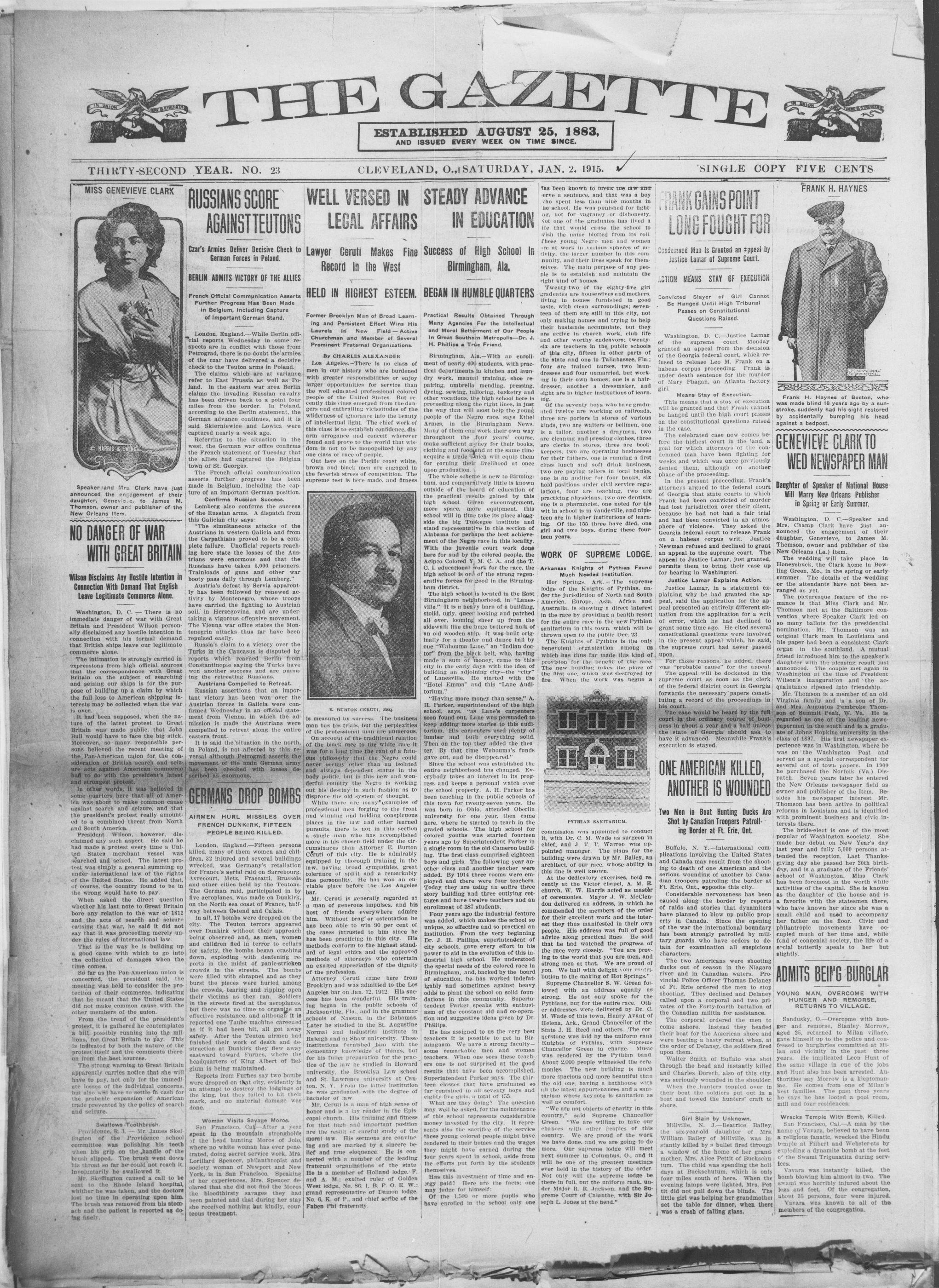
MISS GENEVIEVE CLARK
© HARRIS & EWING
Speaker-and Mrs. Clark have just announced the engagement of their wife, Vivian V. to James M. Thomson, owner of the New Orleans item.
NO DANGER OF WAR WITH GREAT BRITAIN
Wilson Disclaims Any Hostile Intention in Connection With Demand That English Leave Legitimate Commerce Alone.
Washington, D. C. — There is no immediate danger of war with Great Britain and President Wilson personally disclaimed any hostile intention in connection with his formal demand that British ships leave our legitimate commerce alone.
The intimation is strongly carried in expressions from high official sources that the correspondence with Great Britain on the subject of searching and seizing our ships is for the purpose of building up a claim by which the full loss to American shipping interests may be collected when the war fails.
It had been supposed, when the nature of the latest protest to Great Britain war made public, that John Bull would have to face the big stick. Moreover, so many responsible persons believed the recent meeting of the Pan-American union for the conquest of British research and seize in other words, it was believed in some quarters here that all of America was about to make common cause against search and seize, and that the president's protest really amounted to a combined threat from North and South America. But, however, disclaimed any such aspect. He said he had made a protest every time a United States merchant vessel was searched and seized. The latest protest was simply a general summing up under international law of the rights of the United States. He added that; of course, the country found to be in the wrong would have to pay.
When asked the direct question whether his last note to Great Britain bore any relation to the war of 1812 and the acts of search and seizure causing that war, he said it did not say that it was proceeding merely under the rules of international law.
That is the way he is building up a good cause with which to go into the collection of damages when the time comes, for the Pan-American union is concerned, the president said, the meeting was held to consider the protection of their commerce, indicating that he meant that the United States did not make common cause with the other members of the union.
From the trend of the president's protest, it is gathered he contemplates a bill, possibly running into the millions, for Great Britain to pay. This is indicated by both the nature of the protest itself and the comments thereon from the best sources.
The strong warning to Great Britain apparently carries notice that she will have to pay, not only for the immediate losses of the individual concerns, but also will have to settle in cash for the probable expansion of American trade prevented by the policy of search and seizure.
Swallow's Toothbrush.
Providence, R. I. - Mr. James Skeltington of the Providence school committee was polishing his tooth when his grip on the handle of the brush slipped. The brush went down his throat so far he could not reach it. Involuntarily he swallowed it.
Mr. Skoflundon caused a call to be sent to the Rhode Island hospital, whither he was taken, and the doctors lost no time in operating upon him. The patient was taken to the arch and the patient is reported as doing nely.
THE GAZETTE
RUSSIANS SCORE AGAINST TEUTONS
RUSSIANS SCORE AGAINST TEUTONS
Czar's Armies Deliver Decisive Check to German Forces in Poland.
BERLIN ADMITS VICTORY OF THE-ALLIES
French Official Communication Asserts Further Progress Has Been Made in Belgium, Including Capture of Important German Stand.
London, England—While Berlin official reports Wednesday in some respects are in conflict with those from Petrogrand, there is no doubt the armies of the ozar have delivered a decisive check to the Teuton arms in Poland.
The claims which are at variance refer to East Prussia as well as Poland. In the eastern war area Berlin claims the invading Russian cavalry has been driven back to a point four miles from the border. In Poland, according to the Berlin statement, the German advance continues, and it is said Skierniewicow and Lowicz were captured nearly a week ago.
Referring to the situation in the west, the German war office confirms the French statement of Tuesday that the allies had captured the Belgian town of St. Georges.
The French official communication asserts further progress has been made in Belgium, including the capture of an important German position.
Confirms Russian Success.
Lemberg also confirms the success of the Russian army. A dispatch from this Galician city says:
"The simultaneous attacks of the Austrians in western Galicia and from the Carpathians proved to be a complete failure. Unofficial reports reaching here state the losses of the Austrians were enormous and that the Russians have taken 6,000 prisoners. Trainloads of guns and other war booty have been dropped by Austria's defeat by Servia apparently has been followed by renewed activity by Montenegro, whose troops have carried the fighting to Austrian soil. In Herzegovina, and are undertaking a vigorous offensive movement. The Vienna war office states the Montenegro attacks thus far have been repulsed easily. Russia's claim to a victory over the Tatar is disputed by reports which reached Berlin from Constantinople saying the Turks have won another success and are pursuing the retreating Russians.
Austrians Compelled to Retreat. Russian assertions that an important victory has been won over the Austrian forces in Galicia were confirmed Wednesday, in an official statement from Vienna, in which the admission is made the Austrians 'were compelled to retreat' along the entire eastern front.
It is said the situation in the north, in Poland, is not affected by this reversal although Patrousal asserts the Axis of the German army compelled to retreat with losses defending the front.
GERMANS DROP BOMBS
AIRMEN HURL MISSILES OVER FRENCH DUNKIRK, FIFTEEN PEOPLE BEING KILLED.
London, England—Fifteen person killed, many of them women and children, 23 injured, and several buildings wrecked, was Germany's retaliation for France's aerial raid on Sarrebourg, Avrecourt, Metz, Frascarti, Brussels and other cities held by the Teutons. The German raid, participated in by five agrifolios, was made on Dunkirk, on the North sea coast of France, halfway between Oxford and Calais. In all 17 boroughs on the city. The Teuton terrors appeared over Dunkirk without their approach being observed and, as men, women and children fed in terror to cellars for safety, the bombs began crashing down, exploding with deafening reports, in the midst of panic-striken crowds in the streets. The bombs were filled with shrapnel and as they burst the pieces were hurled among the crowds, tearing and ripping open the streets in the streets fired at the aeroplanes, but there was no time to organize an effective resistance, and although it is reported one Taube machine careened if it had been hit, all got away safely. After the Teuton airmen had finished their work of death and destruction at Dunkirk they flew eastward toward Furnes, where the headquarters of King Albert of Belgium is being maintained.
Reports from Furnes say two bombs dropped on the town of Evian in an attack to rob the lodgings of the king, but they failed to hit their mark, and no material damage was done.
Woman Visits Sayage Moro.
San Francisco, Calif.-After a year spent in the mountain stronghold of the head hunting Moros of Jolo, where no white woman has ever penetrated, doing secret service work, Mrs. Lorillard. Spencer, philanthropist and society woman of Newport and New York, has visited San Francisco, spanning the experiences, Mrs. Spencer declared that she did not find the Moros the bloodthirsty savages they had been painted and that during her stay she received nothing but kindly, courteous treatment.
ESTABLISHED AUGUST 25, 1883, AND ISSUED EVERY WEEK ON TIME SINCE.
WELL VERSED IN STEADY ADVANCE LEGAL AFFAIRS IN EDUCATION
HELD IN HIGHEST ESTEEM. BEGAN IN HUMBLE QUARTERS
Former Brooklyn Man of Broad Learning and Persistent Effort Wins His Laurels in New Field - Active Churchman and Member of Several Prominent Fraternal Organizations.
BY CHARLES ALEXANDER
Los Angeles - There is no class of men in our history who are burdened with greater responsibilities or enjoy larger goals. But the well educated professional colored people of the United States. But recently this class enlightened from the dangers and enthralling vicesides of the wilderness of ignorance into the beauty of intellectual light. The chief work of this class is to establish confidence, disarm arrogance and conceit wherever possible. The world which dom is not to be monopolized by any one class or race of people.
Out here on the Pacific coast white, brown and black men are engaged in the feverish stress of competition. The supreme test is here made, and fitness
E. BEHTON GERETL, EPD.
is measured by success. The business man has his trials, but the perplexities of the professional man are numerous. On account of the traditional relation of the black race to the white race it was a great time to cent the cent of a futuristic philosophy that the Negro could never, perhaps other than an isolated and always dependent status in the body politic, but in this new and wonderful country the Negro is working out his destiny in such fashion as to distract the Negro from the opportunities. While there are many* examples of professional men forging to the front and winding and holding conspicuous places in the law and other learned pursuits, there is not in this section a single man who has accomplished more in his chosen field under the circumstances than Attorney E. Burton Cerrit of this city. He is admirably equipped by thorough training in the law, having broad sympathies, great tolerance of spirit and a reminiscent fine personality. He has won an enviable place before the Los Angeles bar. Mr. Cerrit is generally regarded as a of generous impulses, and his host of friends everywhere admire him. Without brag or ostentation he has been able to win 90 per cent of the cases intrusted to him since he has been practicing in this city. His methods conform to the highest standard of legal ethics and the approved methods of attorneys who entertain an exalted appreciation of the dignity of the profession.
Attorney Ceruti came here from Brooklyn and was admitted to the Los Angeles bar on Jan. 12, 1912. His success has been wonderful. His training began in the public schools of Jacksonville, Fla., and in the grammar schools of Nassau, in the Bofmans. Later he studied in the St. Augustine Normal and Industrial institute in Raleigh and at Shaw university. These institutions furnished him with the elementary knowledge of things, but for his further preparation for the practice of the law he studied in Howard university, the Brooklyn law school and St. Lawrence university at Canton, N. Y. From the latter institution he was graduated with the degree of B.S. from the same university. Mr. Ceruti is a man of high sense of honor and is a lay reader in the Episcopal church. His training and fitness for that high and important position are the result of careful study of the moral law. His sermons are conducting and are marked by a sincere belief and true eloquence. He is connected with a number of the leading fraternal organizations of the state. He is a member of Holland lodge. P. and A. M. exerted ruler of Golden West lodge. No. St. J. B. O. E. w. grand representative of Damon lodge. No. 6. K. of P., and chief scribe of the Faben Phi fraternity.
Practical Results Obtained Through Many Agencies For the Intellectual and Moral Battlement of Our People in Great Southern, Metropolis—Dr J. H. Phillips a True Friend.
Birmingham, Ala.-With an enrollment of nearly 400 students, with practical departments in kitchen and laundry work, manual training, shoe repair, umbrella mending, pressing, dyeing, sewing,ufforing, basketry and other vocations, the high school here is proceeding along the right lines. In just the way that will most help the young people of the Negro race, says Ethel Armes, in the Birmingham News. Many of them can work their own way throughout the four years' course, make sufficient money for their books, clothing and footwear at the same time, their school will equip them for earning their freshness at once upon graduation.
The whole scheme is new to Birmingham, and comparatively little is known outside of the board of education of the practical results gained by this high school. Given encouragement, more space, more equipment, this school will in time take its place alongside the big Tuskebee, institute and stand representative in this section of Alabama for-perhaps the best achievement of the Negro race in this locality. With the juvenile court work done here for and by the colored people, the C.I. educational work for the race the high school is on of the strong regenerative forces for good in the Birmingham district.
The high school is located in the East Birmingham neighborhood, in "Launesville." It is a heavy barn of a building, stolid, ugly, queer looking and patched all over, looming sheer up from the sidewalk like the huge buttered milk of an old wooden ship. It was built originally for a theater and hall dance by one "Wahuna Lane." an "Indian doco" named the jungle king who made a sum of money, came to this city in the early days with the idea of building an adjoining city—the "city" of Lanesville. He started with the "Hotel Emma" and this "Lane Auditorium." "Having more money than sense," A. H. Parker, superintendent of the high school, says, "as Lane's carpenters soon found out. Lane was permitted to keep adding more stories to this auditorium." His carpenters used plenty of wood. Then on the top they added the theater. By that time Wahuna's funds gave out, and he dismeasured.
Since the school was established the entire neighborhood hirs changed. Everybody takes an interest in its progress and keeps a personal watch over the school property. A. H. Parker has been teaching in the public schools of this town for twenty-seven years. He was born in Ohio, attended Oberlin university for one year, then came to graded schools. The high school for colored youths was stunted fourteen years age by Superintendent Parker in a single room in the old Cameroon building. The first class comprised eighteen boys and girls. The following year another class and another teacher were added. By 1914 three rooms were employed and there were four teachers. Today they are using an entire three story building and three outlying cottages and have twelve teachers and an assistant teacher. Four years ago the industrial feature was added, which makes the school so unique, so effective and so practical an institution. From the very beginning Dr. J. H. Phillips, superintendent of city schools, gave every effort in his power to aid in the evolution of this industrial high school. He understood the special needs of the colored race in Birmingham, and, backed by the board of education, he has worked indefinitely and sometimes against heavy odds to plant the school on solid foundations. The superintendent Parker speaks with enthusiasm of the constant old and co-operation and suggestive ideas given by Dr. Phillips.
He has assigned to us the very best teachers it is possible to get in Birmingham. We have a strong faculty—some remarkable men and women teachers. When one sees these teachers one is not surprised at the good results that have been accomplished. Superintendent Parker says. The thirteen classes that have graduated so far contained in all seventy boys and eighty-five girls, a total of 153. The question may well be asked, for the maintenance of this school represents considerable money invested by the city. It represents also the sacrifice of the service these young colored people might have tendered in their homes and the wages they might have earned during the four years spent in school, aside from the efforts, put forth by the students themselves.
Has this investment of time and energy paid? Here are the facts: one may judge for himself:
Of the 1,500 or more pupils who have enrolled in the school only one
has been known to cross the new man
serve a sentence, and that was a boy
who spent less than nine months in
the school. He was punished for fight-
ing, not for vagrancy or dishonesty;
not one of the graduates has lived a
life that would cause the school to
sick the name blotted from its roll.
These young Negro men and women
are the greatest of the group of
they, the larger number in this com-
unity, and their lives speak for them-
selves. The main purpose of any people
is to establish and maintain the
right kind of homes.
Twenty two of the eighty-five girl
graduates are housewives and mothers,
living in homes furnished in good
ustice, with clean surroundings; seventeen of them are still in this city, not
anywhere else. They are their husbands accumulate, but they are active in church work, club life
and other worthy endeavors; twenty-
six are teachers in the public schools
of this city, fifteen in other parts of
the state and one in Talahussee. Fl.: four are trained nurses, two la-
dresses and four unmarried, but working
in their own homes; one is a hair-
dresser, another a dressmaker, and
are in higher institutions of learning.
Of the seventy boys who have graduated, twelve are working on railroads, three are porters in stores of various kinds, two are waiters or bellmen, one is a tailor, another a drayman, two are cleaning; and pressing clothes, three are clerks in stores, three are bookkeepers, two are operating businesses for their fathers, one is running a first class lunch and, soft drink business, two are paying teachers in local banks, one is an auditor for banks, six is a teacher in a school, four are teaching, four are practicing physicians, two are dentists, one is a pharmacist, one noted for wit in school is in vaidville, and nipteen are in higher institutions of learning. Of the 455 three have died, one girl and two boys, during these fourteen years.
WORK OF SUPREME LODGE.
Arkansas Knights of Pythias Found Much Needed Institution.
Hot Springs, Ark. - The supreme lodge of the Knights of Pythias, under the jurisdiction of North and South America, Europe, Asia, Africa and Australia, is showing a direct interest in the race by providing a health resort for the entire race in the new Pythian sanitarium in this town, which will be thrown open to the public Dec. 23.
The Knights of Pythias is the only benevolent organization among us which has thus far made this kind of provision for the benefit of the race. The new building takes the place of the first one, which was destroyed by fire. When the work was begun a
PYTHIAN SANITARIUM
commission was appointed to conduct it, with Dr. C. M. Wade as surgeon in chief, and J. T. T. Warren was appointed manager. The plans for the building were drawn by Mr. Batley, an architect, of our race, whose ability in this line is well known.
At the dedicatory exercises, held recently at the Victor chapel, A. M. E. church, W. H. Warner acted as unstater of ceremonies. Mayor J. W. McClendon delivered an address, in which he commended the members of the order for their excellent work and the interest they have in this address was full of good advice along practical lines. He said that he had watched the progress of the race very closely. "You are proving to the world that you are men, and strong men at that. We are proud of you. We bail with delight your contribution to the making of Hot Springs." Supreme Chancellor S. W. Green followed with an address equally as strong. He not only spoke for the Pythians, but for the entire race. Other addresses were delivered by Dr. C. M. Wade of this town, Henry Avant of Helena, Ark., Grand Chancellor of the State J. H. Reed and others. The corpse was laid by the uniform rank Knights of Pythias, with Supreme Chancellor Green in charge. Music was rendered by the Pythian band, which was witnessed by the new building is much more spacious and more beautiful than the old one, having a hathouse with all the latest apprentices and a saturarium whose keynote is sanitation as well as comfort.
"We are not objects of charity in this country," said Supreme Chancellor Green. "We are willing to take our challenges with other peoples of this country. We are proud of the work we have done, and we are going to do more. Our supreme lodge will meet next summer in Columbus, O.C. and it will be here for the first ever held in the history of the order. Not only will the supreme lodge be there in full, but the uniform rank, under Major R. R. Jackson, and the Supreme Court of Calathea, with Sir Joseph L. Jones at the head."
MARK GAINS POINT LONG FOUGHT FOR
Convicted Slayer of Girl Cannot Be Hanged Until High Tribunal Passes on Constitutional Questions Raised.
Washington, D. C.—Justice, Lannar of the supreme court Monday granted an appeal from the decision of the Georgia federal court, which refused to release Loo, M. Frank on a habeas corpus proceeding. Frang is under death sentence for the murder of Mary Phagan, an Atlanta factory girl.
Means Stay of Execution.
This means that a study of execution will be granted and that Frank cannot be hanged until the high court passes on the constitutional questions raised in the case.
The celebrated case now comes before the highest court in the land, a goal for which attorneys of the condemned man have been fighting for weeks and which was once previously their aim, on another phase of the proceeding.
In the present proceeding, Frank's attorneys argued that the federal court of Georgia that state courts in which Frank had been convicted of murder had lost jurisdiction over their client, because he had not had a fair trial and had been convicted in an atmosphere of violence. They asked the Georgia federal court to release Frank or appeal to Justice Newman refused and declined to grant an appeal to the supreme court. The appeal to Justice Lamar, just granted, permits them to bring their case up for hearing in Washington.
Justice Lamar Explains Action.
Justice Lamar, in a statement explaining why he had granted the appeal, said the application for the appeal presented an entirely situation from the application for a writ of error, which he had declined to grant some time ago. He cited several reasons, including that he was in the present appeal which, he said, the supreme court had never passed upon.
For those reasons, he added, there was 'probable cause' for the appeal. The appeal will be docked in the supreme court as soon as the书记 of the court declares the necessary papers constituting a record of the proceedings in his court. The case would be heard by the full court in the ordinary course, but the state of Georgia should ask to have it advanced. Meanwhile Frank's execution is stayed.
ONE AMERICAN KILLED,
ANOTHER IS WOUNDED
Buffalo, N. Y.—International complications involving the United States and Canada may result from the shooting to death of one American and the serious wounding of another by Canadian troopers patrolling the border at Ft. Erie, Ont., opposite this city. Considerable nervousness has been caused along the border by reports of raids and stories that dynamiters have planned to blow up public property in Canada. Since the opening of the war the international boundary has been strongly patrolled by military guards who have orders to deactivate examination all suspicious characters. The two Americans were shooting ducks out of season in the Niagara river and in Canadian waters. Provincial Police Officer Thomas Delaney of Ft. Erie ordered the men to stop shooting. They declined and Delaney called upon a corporal and two privates of the Forty-fourth battalion of the Canadian militia for assistance. The corporal ordered the men to come ashore. Instead they headed their boat for the American shore and were boating a hasty retreat when, at the order of Delaney, the soldiers fired upon them. Smith of Buffalo was shot through the head and instantly killed and Charles Dorsch, aloof of this city, was seriously wounded in the shoulder. When the hunters topped over in their boat the soldiers put out in a boat and towed the hunters' craft to shore.
Girl Slain by Unknown
Milville, N. J.-Bruce Bailey the six-year-old daughter of Mrs William Bailey of Milville, was in stunken killed by a bullet fired through a window of the home of her grandmother. Mrs. Alice Pettit of Buckschutum. The child was spending the holl days at Buckschutum, which is only four miles south of here. When the evening lamps were lighted, Mrs Petit it did not pull down the blinds. The little girl was helping her grandmother set the table for dinner, when there was a crash of falling glass.
IN HIGH
REPUBLIC
FRANK H. HAYNES
Frank H. Haynes of, Boston, who was made blind 18 years' ago by a sunstroke, suddenly had his sight restored by accidentally bumping his head against a bedpost.
GENEVIEVE CLARK TO WED NEWSPAPER MAN
Daughter of Speaker of National House Will Marry New Orleans Publisher in Spring or Early Summer.
Washington, D. C.—Speaker and Mrs. Champ Clark have just announced the engagement of their daughter, Gonevele, to James M. Thomson, owner and publisher of the New Orleans (La.) Item. The wedding take place in Honeyshuck, the Clark home in Bowling Green, Mo., in the spring or early summer. The details of the wedding or the attendants have not been arranged as yet.
The picturequeste feature of the romance is that Miss Clark and Mr. Thomson met at the Baltimore convention, where Speaker Clark led on so many points for the presidential nomination'* in which the original Clark man in Louisiana and his paper had been a consistent Clark organ in the southland. A mutual friend introduced him to the speaker's daughter with the pleasing result just announced. The couple met again in Washington at the time of President Obama, and acquaintance ripened into friendship. Mr. Thomson is a member of an old Virginia family and is a son of Dr. and Mrs. Augustus Pembroke Thompson at Summit Peak, W. Va. He is regarded as one of the leading newspapermen in the south and is a graduate of Johns Hopkins university in the first newspaper experience was in New York, where he was on the Washington Post and served as a special correspondent for several out of town papers. In 1500 he purchased the Norfolk (Va.) Dispatch. Seven years later he entered the New Orleans newspaper field as owner and publisher of the item. Besides his newspaper interest, Mr. Thomson has also reformed in Louisiana and is identified with prominent business and civic interests there.
The bride-elect, is one of the most popular of Washington society. She made her debut on New Year's day last year and fully 5,000 persons attended the reception. Last Thanksgiving day she passed her 20th birthday, and is a graduate of the Friends' school of Washington. Miss Clark has been honored in the north while activities of the capital. She is known as the daughter of the house and is a favorite with the statesmen there, who have known her since she was a small child and used to accompany her father on the floor. Civic and philanthropic movements have occupied much of her time and, while fond of congenial society, the life of a social butterfly appeals to her but slightly.
ADMITS BEING BURGLAR
YOUNG MAN, OVERCOME WITH HUNGER AND REMORSE, RETURNS TO VILLAGE,
Sandusky, O. — Overcome with hunger and remorse, Stanley Morrow, aged 25, returned to Milan-village, gave himself up to the police and confessed to burglaries committed at Milan and vicinity in the past three years. He implicated Leon Hunt of the same village in one of the jobs and Hunt also has been arrested. Autumn bore in the form of a burglary. He comes from one of Milan's best families. The past three years he says he has looted a pool room, pill and four residences.
Wrecks Temple With Bomb, Killed
San Francisco, Cal.—A man by the name of Vavara, believed to have been a religious fanatic, wrecked the Hindu temple at Filbert and Websterists by exploding a dynamite bomb at the feet of the Swami Trigutta in service services. Vavara was instantly killed, the bomb blowing him almost in two. The swami was horribly injured about the legs and feet. Of the congregation, about 35 persons, four were injured. Vavara was known to all of the members of the congregation.
PUBLISHED EVERY SATURDAY
SUBSCRIPTION RATES
(In Advance)
One Year. $1.50.
Six Months. 1.00
Three Months. .50
Subscribers are requested to re-
mit by postoffice money or-
der or registered letter
Entered at the postoffice in Cleveland
Ohio, as second-class matter.
Address all communications to
HARRY C. SMITH
Editor and proprietor,
THE GAZETTE,
Blackstone Building, Cleveland, O.
Member Ohio Legislature: 1894
to 1896; 1896 to 1898; 1900 to 1902
THE GAZETTE is the oldest, and has the largest bona fide circulation, double that of any newspaper in the interest of Afro-Americans, published in the state of Ohio, and comparison with any will immediately establish its rank as one of the NEWSIEST AND BEST in the country.
10,000,000 Afro-Americans.
160,000 in Ohio.
20,000 in Cleveland.
A recent U. S. Supreme Court decision wipes out the convict lease system of Alabama. Georgia got rid of it, several years ago. "A new freedom" for many of our people of those two states.
The convict lease system is a southern "institution" even worse than disfranchisement and "jim crow" cars, and we sometimes think even worse than lynching and other forms of mob violence.
Every thoughtful man North and South will agree with the President. I think his statement represents a growing liberal sentiment on the part of an increasingly large group of Southern white people. The President has always manifested a deep interest in the education and development of White men even before he went to the White House, and he had occasion to know—Booker T. Washington.
President Wilson "manifested a deep interest in the race" when the Trotter delegation called on him, a few weeks ago.
How Booker T. Washington can find it in his heart to continue this sort of thing, is past understanding. Good Lord! have mercy!
BOOKER T. AGAIN
President Wilson, recently in a talk with Mr. Trotter and other gentlemen, sanctioned the segregation of the races in the government employ at Washington. This sentiment as well as others expressed at that time shocked the country and were severely censured by leading white, as well as Colored, papers of the country. None of them agreed with the President in the views expressed by him and all agreed that what he said was unfair to the "Black Man" and would have a bad effect on the race. Since that interview the President talked with the President of the University Commission on Southern Race Questions and indulged in the merest generalities in a patronizing manner. One striking thing he said was: "I know, myself, as a Southern man, how sincerely the heart of the South desires the good of the Negro and the advancement of his race on ALL SOUND AND SENSIBLE LINES." You catch the drift, don't you Talferio? Well, after the Trotter incident few papers, if any, white or Colored, commented on that because they all knew what the President meant by "SOUND AND SENSIBLE LINES." But long comes Dr. Washington, and the Southern papers are running the following:
BOOKER WASHINGTON
PRAISES WILSON
—Louisville (Ky.) News.
We still believe that Leo M. Frank
will pay the penalty of his crime, re
gardless of the recent respite given
him by U. S. Supreme Court Justice
Lamar.
WHAT REPUBLICANS SURELY
WILL DO.
Those worried by doubt as to the changes the legislature will make in the Cox laws can secure reliable information from reading the platform upon which its members stood for election.
In it, Governor Cox is denounced for drilling with the civil service and the destruction of the one per cent. tax limit.
The workmen's compensation law is favored with an increase in the maximum payment for accidental death.
Unnecessary officers, commissioners and expenditures are deprecated.
Protection of women and an eight-hour day, where practicable, are favored.
Power for the supreme court to revise decisions of the secretary of state in primary and I. & R. petition questions, is urged.
The appointment of farmers to all offices whose functions relate to the farm is pledged.
The demand for legislation to promote social justice is recognized.
Local self-government is demanded. Laws regulating the liquor traffic are favored and decentralization of the saloon power for political use, are promised. Home rule in the assessment and taxation of property is assured. Good roads are favored and the great expense of the state highway department is condemned. Republican platform pledges are kept.
THE SOUTH WILL CONTROL.
Responsibility for legislation in the House of Representatives at Washington, D. C., during the concluding two years of the present administration will fall directly upon the South. It is common comment that the South
is "in the saddle," but this will become more clearly true after March 4 next through the reduction of the Democratic membership of the House. At present Democrats from twelve Southern States represent one-third of the Democratic strength in the House; after March 4 next these twelve States, with the Democratic members from Oklahoma and Missouri, will constitute an actual majority of the Democratic strength in the House. Florida, Alabama, Georgia, Arkansas, Kentucky, Louisiana, Mississippi, North Carolina, Tennessee, Texas and Virginia have 103 members in the House, all of whom excepting three Republicans, are Democrats. This group, with the strong Southern representation in the cabinet and the Senate, has been powerful enough largely to dominate the House committees and to control, up to a certain point, legislation in the House. A large degree of responsibility for the record of the last two years is theirs, but after March 4 the responsibility will increase to a marked extent. Thereafter the South will have the power of an actual majority, with aid from Oklahoma and Missouri, as well as the political influence incident to the cohesion of a large group of members and their seniority. In view of some of the legislative projects which the South insisted upon, but obtained only in part during the last two years, the domination of the House majority by this group has aroused a degree of anxiety among Democrats who are looking ahead to the next presidential election. They are frankly afraid that the party will run into a blind alley unless Southern influence can in some way be restrained. The large river and harbor appropriation bill, the proposal for the purchase of $500,000,000 worth of cotton by the government, the proposed segregation of Aldrich Freeland notes for the benefit of the South, and the demand that the 10 per cent tax on currency issues by state banks be repealed are examples of the legislation proposed by Southern representatives who are now causing anxious speculation regarding their course in the near future when they will come into control of the House by actual numbers.
ANNUAL TUSKEGEE CONFERENCE.
Editor Gazette, Dear Mr. Smith: In addition to sending you the within invitation asking that The Gazette be represented at the coming Tuskegee, Ala., Negro conference, I am sending also a galley-proof statement of the subjects to be discussed. I very much hope that you, personally, or some representative of your newspaper, may be present. You shall be very glad, of course, to entertain you or any representative of your newspaper as the guest of the Institute during your stay here. Please advise me as early as practicable if you will be present, or who will represent you. Yours very truly, Booker T. Washington.
WHO SAM McVEY IS.
Sam McVey was born in California in 1885. He is only twenty-nine years old, but has seen about all of the world there is to see, has a neat pile of money stored away to protect him in his old age and is really just beginning to attain, in this country, real prominence in the pugilistic game. Most of Sam's fighting career has been confined to Europe. He has fought a number of times in England, appearing in London and Sheffield. Parisians think him a knight, lived in Paris in a nearby, readily for more than three years. Sam's travels have taken him to Americas France, Spain, Australia, South America and his own native land. He has lived far better than the average person and seen the world at an age when most men are just beginning to think about traveling.
BE A KICKER
An organization of Cleveland women is writing the director of public safety to complain that several matters within the scope of his department are not managed as they should be. The incident has no particular importance—organizations of all kinds are complaining to all the departments upon all sorts of grievances—except as it indicates the way progress is made. We advance by kicking. We elect representatives to operate continually about continuously telling them low inefficiently they are doing the work. If the officials are thin-skinned, or lack a philosophical spirit, the chances are they lose their equanimity and consider themselves persecuted. The wise man in office does nothing of the sort. He knows the value of an intelligent protest. If the people had not kicked loud and long there would have been no Taylor grant. Had they not supported Tom L. Johnson when he kicked he could have accomplish himself, the people behind him he was able to help and win in a pioneer's honor in the fight for economic freedom.
The revolutionary war was a tremendous kick, engineered by patriots and led by a military genius, against conditions which might not have been righted in any other way. The rebellion against Diaz was a kick; every serious political movement in the country during the time society has been kicking itself upstairs to better things.
Let us be kickers. Join the chorus of the dissatisfied. Tell the mayor and his subordinates, the governor and his associates, even the president and his department chiefs, how you think about the office. That's democracy; that's progress. The trouble with most of us is that we do not kick enough—Cleveland Daily Plain Dealer editorial, Dec. 20, '14.
A TEMPORARY VICTORY FOR SEGREGATION.
Louisville, Ky.—Segregation of the 40,000 Negroes in this city is the rightful exercise of a police power of the state, according to an opinion handed down in Criminal Court here, Dec. 24, by Judge James P. Gregory. It violates neither the fourteenth amendment nor the Kentucky bill of rights, said the court. The City Council passed a segregation ordinance last May. Arthur Harriu ignored its provisions. He was arrested, fined, and appealed. Our people, of this city, will undoubtedly carry the case to the highest courts and will win, just as Maryland Afro-Americans did, many months ago, in the U. S. courts. It was not expected—success—in any of the courts of Mt. (or any other southern) state.
THE GAZETTE, CLEVELAND. Q. SATURDAY, JANUARY 2, 1915
WRITTEN BY "THE OLD RELIA-
BLE" GAZETTE'S CORRE-
SPONDENTS
THROUGHOUT THE STATE
What Our People Are Doing Each Week—Church, Personal, Social, Lodge, Literary and Musical — Marriages, Deaths, Etc.
LEBANON.—Bertha Belle Gray of Pittsburg, is spending Xmas with her parents.—Miss Ruth Campbell is also at home for a few weeks.—Artilla Hughes was in Cincinnati last week.—Miss Jessie Morton entertained at dinner, Sunday: Misses Maud Tibbles, Beulah and Leo Peltis, and Messrs. Everett Marchant, Oscar Price of Xenia and Artilla Hughes.—Miss Lela Morgan will leave soon for Marion.—Mrs. Talbert, Place spent Sunday in Dayton.—Mrs. Lee Morgan, son gave a family dinner, Sunday. Nineteen present.—Mrs. M. Chass spent Xmas at home.—Mrs. Anna Belt and daughter of Oxford, are visiting Mr. and Mrs. Bodine.—Roy Emerson of Springfield, visited here, Sunday.
CADIZ—The B. B.'s were entertained, Sunday, by A. J. Wallace.—Among who came home to spend Christmas were: Mrs. James Thompson and daughters, Misses Margaretta and Theresa, Steubenville; Miss Laura White, Wilberforce; L. S. Whistler and Ollie Ramsey; Cannon, Mr. Newark; Mr. Clarke Morse and Mr. Al. Johnson, Warren. Others who visited here were: Messrs. H. A. Tillman, Youngstown; Mr. C. Shackelford, Newark; Ed. Cole, Flushing—Dwight Brooks fell and broke a leg. Mr. and Mrs. C. H. Christian, Mr. and Mrs. James Smith and Mr. and Mrs. James Smith and Mrs. Sunday in Sclio—Mrs. Emma Mason spent Christmas in Steubenville.
CORRESPONDENTS must mail all letters for publication at their all-postoffice sufficiently early on Monday (or Sunday) of each week to have them reach The Gazette office on Tuesday morning, and always write also, their names and that of their city or town on the outside of the cupboard about returned copies. Unless you are a teacher, cannot be given you. Lists of names, wedding presents, etc., obituary notices, speeches, resolutions, poetry, inquiries for relatives and advertisements of all kinds, including items announcing entertainments to be held in the near future, must be paid for in advance at the rate of ten cents a week. For display advertisements will be sent on application. Send postal note and not stamps during warm weather.
YOUNGSTOWN.—A number of out-of-town guests were in the city Xmas.-Mrs. Agnes Lucas entertained a few friends at dinner, Xmas.-The Clef club gave its Xmas dance, in Connell hall. It was well attended. The feature was the prize waltz. First, Miss Olive Brady and Charles Parsons; second, Miss Mae Lacey and Mr. C. Colhran. The evening was an enjoyable one.-Logan lodge will meet the 14th.-A number of Buckeye lodge members attended the memorial services of Farrrell, Pa., lodge, Sunday, and had a fine time.-Consuela Stewart court of Calanthe meeting, Monday evening, was well attended.-Buckeye lodge will have a "smoker" to all officers., 7.-Mr. William Saunders returned from Cleveland, Saturday, and is much improved. Mr. Saunders spent Tuesday and Wednesday, there.-Mr. and Mrs. A. H. Berry of Letonia, were in the city Monday.
AKRON.—The residence of Miss Dotson, proprietor of the "Little Gem Restaurant" was destroyed by fire last week Monday, about 5 p. m. The damage was great, as she lost all of her outside wearing apparel. Mrs. Ethel Green, local representative of Theel, took the rooms with a bit of clothing and other things.—Mrs. Hopkins had a very pleasant whist party Tuesday evening week. Sixteen couples were present. Our young men here have opened a new club, called the Du Bois club. E. and R. W. Douglas and C. Jenkins are its officers. It was too bad that the club had to be postponed. Jenkins R. Johnson put forth every effort to make it a success.—Mrs. Mattie Steele's little girl, Pearl, is seriously ill with pneumonia. She is in the children's hospital.—Mrs. John Riley's sister is here from Georgia, visiting her.—Mrs. Agnes Simpson gave a "pink tea" for her cousin, cousin from Virginia, who is visiting. Those present were: Messrs. John Simpson and Johnson.—Mrs. Green sprained a knee, recently, and was incapacitated for several days.
Miss Geraldine Dyson's party Christmas night, was attended by about twelve couples and the house was beautifully decorated—Mrs. E. D. W. Bell has gone home to Myersdale Pa. to spend the holidays. Mr. W. Scott, one of our local businessmen, invited the for the holidays. Mrs. Clifford Jackson has returned from Chicago, where the visited anunt, several weeks. Mr. Julius John son's party, Xmas night, was then roughly enjoyed by all in attendance. We are sorry to hear of the death of Mr. Beverly.—Mrs. Smead of 70 High, is seriously ill.—Mrs. Ollie Laster, Cleveland, spent Xmas with Mrs. W. Cleveland, church started a revival New Year's, Mrs. Steele's baby. Pearl, seems to be improving. It is at the children's hospital.
SANDUSKY.—Miss Beatrice Shackford and Mrs. Georgia Scott are quite ill.—Mr. Herbert Wallace of Oberlin College, is spending his vacation with his parents. His sister, Mrs. Clark is also visiting them.—The A. M. E. Church entertainments, Xmas morning and afternoon, were successes and many good things were given to friends at the Second Baptist church in the evening. J. R. Davis and club manta was delighted seeing the participation showing so splendid Mr. and Mrs. Davis, Mr. and Mrs. Samuel Scott, and many others of the church and Sunday school, deserve great praise for their excellent Xmas work. The entertainment, and the tree for the little folk.
were exceptionally satisfactory. Rev. and Mrs. G. D. Smith are very thankful to the church for his usual purse of gold, and the latter, for a basket and many useful things. Roy Smith, their son, who attends school at Oberlin, is spending the holidays at home. Mr. and Mrs. Henry Richard entertained a number of guests from Cleveland, among the number being her daughter, Mrs. Nickens, and Mr. and Mrs. Joseph Stowers. -Mr. Mott and Mrs. Joseph Stowers. -Mr. Mott and church by the pastor on his birthday. Sunday the V. society will elect officers, and the church, one trustee, Church and society reports will also be made. -Rev. G. D. Smith, local representative of The Gazette, wants ten more regular weekly patrons for this paper, and would not ask for them if it was not for the betterment of the race. Take the paper and know what is going on among our people the country and among our people the country and thus get what you cannot get from daily newspapers or from any other source in this section of the country. The Gazette ought to enter every one of our homes in Sandyuk.
MANSFIELD.—Mr. and Mrs. J. Da-
MANSFIELD—Mr. and Mrs. J. Davis entertained the following: Mesdames B. Dummore, M. Love and M. W. Ford; Messrs. C. and Theodore Davis and honor C. W. Ford, Dec. 21, in honor of Mrs. Dummore, who left Tuesday to join her daughter in Franklin, M. Dr. Love played beautifully on the piano and Mrs. Ford reached a poem entitled St. Peter at the church of St. Peter, which Mrs. M. Thompson presented a bible-text book to Mrs. Dummore, in behalf of A. M. E. bible class, Tea and crackers were served. The following spent Xmas and New Year's with relatives, and attended church here: Mrs. C. Brock, Miss Ida Beaumont of Cleveland; Mrs. M. Green of Dayton, Mr. and Mrs. W. Smith of Painesville, and Mr. W. Dummore of Chicago Junction—Mrs. D. Barker has returned from Detroit—Mrs. R. Breckenridge is visiting in Greenfield, Mr. F. Cromer and daughter attended church, Sunday evening—Mrs. W. Davis and M. R. Bell sang splain and beth eve sing, accompanied by Miss L. B. Barker in prayer and sang with our excellent choir—Manford Hicks has accepted a position in Ashland—Mrs. M. Love of Chicago Junction is spending two weeks with her parents. The following persons sent Santa Claus to Rev C. W. Ford and family: Mr. and Mrs. B. Dummore, Mrs. M. Beaumont and family, Mrs. M. Thompson and Mrs. L. Spencer, Mr. DeWitte (white), grocerman, gave a Xmas tree that was loaded with gifts. Rev Ford preached an congregation in Sunday, The Cooperation, Sunday, God, with text, Psalms, 51:10. The morning service topic: "Lightening Up a Soul." Text, Deut. 14:23. The pastor has received word from Mrs. N. Preson that she arrived safely in Florida. She sent her regards to all.
OBERLIN.—A Merry Xmas and a Happy New Year. The Christmas spirit certainly has prevailed in this community. Rust Home Missionary society sent out 26 boxes of clothing and shoes were also sent and Xmas trees provided for two families, under auspices of the church. Both churches had fine exercises, Xmas eve. Mt. Zion had a "White Gift Xmas," with no tree, but each class pledged itself to do something during the coming year, or for some needy children. E S. S. had a fine Xtree and tab leaux of "the birth of Jesus." There was popcorn, oranges, a brick of ice cream, and cake for all the children, besides a gift from each teacher to her respective class. The Mutual Im provement society entertained all children at a Xtree tree, Saturday from 2 4 p.m. Fifty dollars is reported as the result of the cantata, "Jeptah and His Daughter," given for the benefit of Rust church's fund. All participant pants will be entertained at a reception, Monday evening—Mrs. Minnie Carter entertained a party of friends Xmas day.—Miss Judy the Queen, left her vacation in Columbus.—Miss M. Brown of Cleveland, is spending the holidays with her sister, Mrs. Henry Bows.—Mid-winter picnic of the two Alders; at Mt. Zion church, Wednesday evening.—A week of prayer at Rust church, next week. Rev W. Delaney requests no dancing or cardplaying in the homes during the week.
BLEASE PARDONS 44.
Columbia, S. C.-Forty-four state prisoners, including ten serving life sentences for murder, were granted clemency, Monday, by Gov. Cole Blense, making a total of 1,488 he has liberated in the last four years.
JOHNSON AND MORAN.
Translated for "The Gazette" by 'Jacob Egberth" of Chicago, a White Friend—Interesting and Remarkable.
Editor Gazette, Dear Sir—In a sketch on "Boxers" which I found in the Chicago Abendpost, a German newspaper, and which was written by a French author at Paris, France. Victor Auburtin, I find the following characterization of the two bestseller weeks who engaged the attention of the "sporting world"—Johnson and Moran. Said Mr. Auburtin:
"At the outstart, it cannot be denied that the black man in this case is the prettier one. The white man. Moran, is a kind of reddish blond Irishman, with a good-natured but somewhat irregular, unsymmetric face. Jack Johnson has one of the most beautiful human heads that I have ever seen; clear, in great, correct proportions, such as at the beginning the Creator wished man's face to be, with his haven and polish and brawny face. He is the Ancient Egyptian. It is surprisingly correct like the head of the wooden figure of the Museum at Gizet, which has the sobriquet, 'The Village mayor,' in the nomenclature of Art history. He moves slow and straight, as compared with the hasty unsteady attempts of the white man. He has great bronzen features."
So far we quote as a bit of contem-
porary sport-history and to chagrin the
"American race-prejudiced newspaper
porters and their tail and trail, the
equally narrow-minded American
sketchers. The balance of the Abhizhi
sketch speaks of the "refined" (ahem) 'ladies' who came from even dis-
tant America and England, as well as
of French ones; and the "white-
maired, learned heads," which were
training their necks to get a good
view of this "cultured" (ahem)展
hibition—a sign of degeneration as in de-
doratism. In the past, bartin, we simply chronicled truthfully the affair, without in the least endorsing the affair.
QUINADE
GROWS HAIR
REMOVES DANDRUFF
SEND FOR SAMPLE
QUINASOAP
THE IDEAL SHAMPOO 50AP
THOROUGHLY CLEANSSES THE SCALP
QUINACOMB
HAIR STRAIGHTENER
SHAMPOO DRYER
QUINADE 25¢ QUINASOAP 50¢ QUINASOAP 25¢
AT ALL DRUGGISTS
SEEBY DRUG COMPANY, NEW YORK CITY, N.Y.
TAYLOR'S SPECIAL ALCOHOL HEATER is the handset and most convenient method of heating the Comb, and can be closed up so that you can put it in your hand-bag. Price $50c. For best results use La Creme Hair Pomade. It not only meets every requirements of the Comb, but also provides a smooth, shiny finish. SEND FOR MY FREE CATALOGUE illustrating the Largest and Most Complete Lines of Hair Goods to this country for colored people, such as Bangs, Wigs, Puffs, Switches, Pompadours, Hair Plus, Combs, Brushes, etc.
If you knew
Nelson's Hair Dressing as we do you would never use anything else on your hair.
PROF. J. E. SPINGARN
AGAIN IN OHIO
To Speak in Columbus, Springfield,
Dayton, Cincinnati, and Toledo,
on "Justice to Black Folk."
Prof J. E. Spingarn, chairman of
the board of directors of the N. A. A. C.
P. is to visit Ohio again this month.
He is to begin a long speaking tour of
the middle west with speeches at
Pittsburgh, Jan. 10 and 11. He will
he will address audiences on questions
connected with the rights of Afro-
Americans, on the following dates:
Columbus, Tuesday, Jan. 12; Spring-
C.
PROFESSOR J. E. SPINGARN.
field, Wednesday, Jan. 12; Dayton, Thursday, Jan. 14; Cincinnati, Friday, Jan. 15; Toledo, Tuesday, Jan. 26. His tour will extend as far west as Opalah. He will visit as far west as St. Paul, and Minneapolis; and his last speech before returning home will be at Buffalo, N. Y., on Jan. 27. He hopes on succeeding tours to cover other sections of the country, so that every part of our great nation will resound to his message of "Justice to Block Folk." It will be remembered that he born a year ago, when he visited a score of cities from Detroit to Topoka, with very great success. This year he intends to return in time to hear Gov. Charles S. Whitman of New York, present the first "Spingarn Medical" on Lincoln's birthday, at the annual meeting of the N. A. A. C. P. in New York.
HER FOSTER MOTHER SWEARS
That Mrs. Alma Boone Little is "White"—How the Former Was "Tricked."
Cincinnati, O.—Mrs. Alma Boone Little of Detroit, the "bride without a race," returned to Detroit, Tuesday, after a visit here that increased her hope that she would prove she is of "white" parentage. She took with her an affidavit which she feels will disprove beyond doubt the charge of her husband, a prominent druggist, who in 1886, "Negro blood" in her veins. The affidavit was signed here by Mrs. Luella Jefferson, 639 Cutt St, the Afro-American foster-mother of Mrs. Little. In the affidavit Mrs. Jefferson says that Mrs. Little is of "white" parentage and that she was tricked into signing a previous statement which made it appear that she was the mother of Mrs. Little. Mrs. Jefferson said that she was in the employ of Mr. and Mrs. George Boone in Denver in 1886, and that she was a "white" parentage. She said that Boone died before Alma Boone, now Mrs. Little, was born; that Mrs. Boone died when the child was six weeks old, and the child was left in her care. Mrs. Jefferson then said that in October, 1914, a man called on her and said that her husband had died in Denver and left an estate of $40,000 to herself and children. Mrs. Jefferson said she wanted to do something for Mrs. Little, and signed an affidavit which mentioned as her daughter. She said she was told the affidavit was all right, and she did not read it. She said she learned afterward the affidavit was not intended for that purpose.
THE
NELSON
GIRL
Is it soft and glossy and
tull of life?
Can you comb it out easily
or is it full of tangles?
Are you proud of your
hair?
Why not become a Hair Dresser? This is your chance. We will set you up in the business. We will send you one of our diplomas from our school and furnish you witt, our Complete Hair Dresser, Outfit. All this for the small sum of $5.50. Hundreds of salaried graduates all over this country are earning money with our Outfits. Why not you? Write today, do not delay.
MILPARK SCHOOL OF HAIR DRESSING,
EDENTON, N. C.
The Beer for home use MUST be pure GOLD BOND BEER
Is absolutely guaranteed and is bottled under Government supervision by The Cleveland & Sandusky Brewing Co. West,785 Central 3933
Taylor's New Shampoo Dryer and Hair Straightener!
The Best in the World!
This Comb, properly heated, and the use of LaCrete Hair Pomade, will bring the most crimpy hair nightlight, all the extra stroke and cause a rapid growth of the hair.
This comb, if but off, but requires 200 g of Pomade, 1 comb, or both.
T. W. TAYLOR, Howell, Mich.
When please mention this paper
.
Price of Hair Straightene
and Alcohol Heater complete
$1.50.
ER is the handiest and most convenient method
that you can put it in your hand-bag. Price 80c
made. It not only meets every requirements of
growth of the hair. Price 25c
illustrating the Largest and Most Complete Line
sale, such as Bags, Wigs, Pumps, Switchea, Pom-
TAYLOR, Howell, Mich.
mention this paper
NELSON'S
HAIR DRESSING
25¢
50¢
Has no superior as
a hair beautifier.
¢ Thousands of men and women have improved the appearance of their hair by using NELSON'S HAIR DRESSING.
¢ For those who know—it is a toilet necessary.
Ask your druggist. If he cannot supply you, send us his name and address and we will send you a free sample.
NELSON MFG. CO.
RICHMOND, VA.
THE NELSON GIRL
---
2742 Central Av., cor. E. 28th St.
Cut this ad. out and present it
at the Brown Drug Co., and receive
a liberal trial size of
B. AND M. HAIR DRESSING
AND TONIC.
This dressing is especially
recommended where the hair
is stubborn or curly, as it not
only makes the hair soft, glossy
and straight, but also easy to
dress.
B. AND M. HAIR DRESSING
is elegantly perfumed, has a
very beneficial effect on the
scalp, and is a splendid hair-
grower.
DON'T FORGET THAT WE
HAVE BUT ONE STORE, AND
THAT IS at E. 28th St. and
Central Ave.
WALKERS' MILLINERY
Latest Style Hats at Reasonable Prices.
Remodeling and Blocking.
Feathers Dyed. Cleaned and Curled.
Mrs. Anna Walker
3065 Central Ave.
Cleveland, O.
A Complete Line
DRY GOODS, LADIES' AND GENTS'
FURNISHINGS
J. LOMSKY
Double Stamps on Tuesdays and Fridays.
STERLING
5 and 10 Cent Store
3003 Central Ave.
Watch Our Windows
For Bargains
Colored Salesladies
Arlington Pharmacy
WE WILL ACCEPT THIS ADVERTISEMENT FOR FIVE CENTS IN TRADE, TO APPLY ON ANY PURCHASE OF TWENTY-FIVE CENTS OR MORE.
E. Rukenstein, Ph. C., Prop.
S. W. Cor. Central Ave. & E.
58th St.
The Fifteenth Annual Session of the
State Summer School
for Colored
TEACHERS OF BOTH SEXES
at the
Agricultural and
Mechanical College
GREENSBORO, N. C.
will begin June 29th, 1914, and continue five weeks.
In addition to the regular work, an attractive lecture course has been arranged, in which will appear some of the most distinguished white and Colored educators in the country.
Board and lodging for the entire session $12.00. Tuition 25c per subject unless other arrangements have been made.
Limited accommodations. Send $1 and have room reserved in advance. For further information write a once at James B. Dudley, President, or D. J. Jordan, Director, A & M. College, Greenaboro, N. C.
THE PEOPLES' DRUG STORE
Cor. Central Ave. and E. 33d St.
Agent for
"HIGH BROWN FACE POWDER"
WE GIVE TRADING STAMPS.
MONEY ORDERS, NEWSPAPER
ADS, TELEGRAMS.
PRESCRIPTIONS A SPECIALTY
Open late at Night.
Cuy. Central 6661-L
G. G. REED
Dry Goods
Ladies' and Gents' Furnishings
Sole agents for the
AMERICAN LADY NEMO
R. @ G. COR.ETS
5222 Central Ave.
Castor Oil Protects Feet. Castor oil will prevent feet from becoming sore on a long walk. It should be poured on the feet, especially between the toes.
Hostess—"People are very dull tonight, Adolph. I really can't get them to talk." Host—"Play something, dearest."—Judy
Where to Purchase The Gazette
NOTICE TO SUBSCRIBERS
Subscribers not receiving The us at once. We desire every copy. We advise our patrons to car tisements before making purchases this paper should have the patron that they advertise is assurance to Local reading notices (adve words in a line).
Subscribers not receiving The Gazette regularly should notify us at once. We desire every copy delivered promptly.
We advise our patrons to carefully examine The Gazette's advertisements before making purchases. Business men who advertise in this paper should have the patronage of Afro-Americans. The fact that they advertise is assurance that they want it. Local reading notices (advertisements) ten cents a line (six words in a line).
Social and Personal
Our
Classified Ad
Department
For Rent—Five rooms, up stairs, at
2417 E. 82d St., water, gas, etc. Apply, Room 2, Blackstone Bldg.
FOR RENT—Houses and Rooms—
If you have them to rent or if you want to rent, advertise in The Gazette. It brings results.
NOTARY PUBLIC—For such services call at The Gazette office, No. 1424 W.
Blackstone building, No. 1424 W.
Third Street, near Superior Ave.
FOR SALE—Houses or lots. If you have either or anything else to sell, or if you wish to purchase, advertise in The Gazette. If anything can bring you results, it can and will.
FOR RENT.-Lower half of house,
five nice rooms, bath, gas, large cellar, yard, etc, at 2417 E. 82d St. Near Quincy Ave. Front and three side entrances. Take Scovill car. Apply.
Room 2, Blackstone Bldg. W. 3d St. near Superior Ave.
For Sale-2174 East 38th St., 7 rooms and bath. Price, $2,650.00.
Bank appraisal, $2,837.50. First mortgage $1,875.00 at 6%, payable $100.00 per year and interest. Will accept $500 down. John M. Anderson, 510 Superior Bldg., Central 5930-L. 3t
Cleveland Sixth City
Miss M. Brown is visiting her sister,
Mrs. Henry Bows, in Oberlin.
Mrs. Olive Laster of Frank Ave.
spent Xmas in Akron, visiting rela-
tives and friends.
Mr. and Mrs. Fred. Sampson who
have been spending the holidays with
his parents and other relatives, leave
today for Florida.
Miss Dazalia Underwood and com-
pany have returned from their eastern
tour to spend the holidays at home.
Mr. James French of Sandusky,
spent Sunday in the city, visiting his
cousin. Mr. Robert Coram, and wife,
1224 Woodland Ave.
Miss Bertha Campbell of Buffalo, is
the guest of Mrs. Yates of Cory Ave.
Sam. T. Boyd who is ill at Lakeside
hospital, was reported much improved,
the first of the week.
Mr. and Mrs. Ed. Elsner received
the sad news Monday, of the death
of the latter's mother, in Washington,
D. C. Mrs. Elsner left for the "Capital City." Tuesday.
Be sure to read carefully the article in The Gazette today, headed "Johnson and Moran," and call your friends' attention to it. It is really remarkable.
The date of the heavyweight championship boxing contest between Jack Johnson and Jess Willard has been set for March 17, in Juarez, Mex.
Against 1642 St. Louis Afro-American school children attending the public schools last year, this year's number is 6254, an increase of 300 per cent.
Did you notice the many fine articles in The Gazette, last week? If you did not, be sure to get a copy and read it carefully. There was much that will not only interest and please you, but also benefit you.
Chas. S. Sutton, Esq. will in all probability be elected clerk of the State Senate when it convenes in the next ten days, as he was named for that phee. Monday, by the causes of the Republica (malevolent) members of that body. Congratulations, "Charley".
Row. Christopher F. Drewes, chairman of the Afro-American mission of the Lutheran church, announces the gift of $500 by a "Mr. Unknown." This is the second gift for this purpose by this person, his two gifts amounting to $1,000.—Westlichie Post, St. Louis, Mo.
The editor of The Gazette is indebted to Mr. and Mrs. W. B. Wright of W. $8th St., this city; Mrs. Patricia Robison of Hermiston, Oregon; Capt. Jas. H. Starkey, this city; Miss Anna Fisher, Lorah, and many others for Christmas and New Year's greetings. Several were beautiful and all very pretty. Thanks for the kind remembrances, friends.
---
---
The Gazette regularly should notify
delivered promptly.
fully examine The Gazette's adver-
sence. Business men who advertise in
mage of Afro-Americans. The fact
that they want it.
artisements) ten cents a line (six
Personal
Mr. Clarence Cheeks, a student of
the dental department of the Uni-
versity of Iowa, is spending the holidays
with relatives in this city.
The installation services of Rev. C. R. Jones, the new pastor of Mt. Haven Baptist church, will be held there, Sunday, at 3 p.m. He is a young man with spiritual power and we wish him success. The public is invited to attend the installation services.
Garrett A. Morgan has just been signally honored by the receipt of a beautiful and valuable gold medal won by his fire-hood protector at the second International Exposition of Safety and Sanitation, held in New York City, recently.
Send or bring locals and all business-matters to The Gazette's offices, suite 2, Blackstone Bldg. If you wish to see the editor call there, please. All matters for publication in current issues of The Gazette, must be in the book by 4 p.m., WEDNESDAY at the latest.
Chas. F. Weaver and Mrs. Ellen Earley of Cincinnati, were quietly married, Saturday, and are "at home" at 2027 E. 39th St. This will come as a distinct surprise to Mr. Weaver's host of friends, especially those among the older residents of the city. The Gazette extends congratulations and sincerest best wishes, and its editor now feels that there must be hope for him, too, as "Charley", as he is familiarly called by his many friends, certainly "courted single blessedness" for "several" years.
Wm. Monroe Trotter, editor of the Boston Guardian, passed through the city, Tuesday noon, en route to Columbus where he spoke that evening. He was met at the depot by Geo W. Johnson and escorted to The Gazette sanctum where he spent a pleasant half hour with its editor, incidentally having the pleasure, also, of meeting there Mrs. Jas. M. Tilley, Mrs. Cornelia F. Nickens and Mrs. Letha Fleming. Editor Trotter will pass through the city, again, next week en route home and may speak here also. Arrangements to that end ought to be effected promptly.
The officers of the Old Folk's home have furnished The Gazette with statements of the matron and ten inmates of the home, which contradict, and strongly too, the rumored "great dissatisfaction among the inmates, claiming mistreatment in several ways, one at least being very aggravating because so unnecessary and unfair." In recent weeks The Gazette received a number of communications, all of which referred to alleged "dissatisfaction and mistreatment." We are pleased to know that they are without foundation in fact and hope the "knockers" will cease bombarding The Gazette with their maliciously unfair communications—criticisms.
Miss Lucy Manson of E. 33rd St. delightfully entertained at dinner, Christmas, in honor of her brother, Mr. David Manson, of Chicago, the following: Mr. and Mrs. Joseph Lucas, Mr. and Mrs. William Mcntire, Mr. and Mrs. Frank Perkins, Mr. and Mrs. John Early, Modesmages Virginia Chaffin and Mary Taylor. Mr. Manson and sister, Miss Lucy, Miss Esther Kiner and a few other friends assembled at Mr. and Mrs. Alex Taylor's Saturday evening last, and parrot of the most enjoyable dinner of Mr. Taylor's birthday. The couple received a large box of real Virginia products, including a 16% pound turkey, from her parents' farm, last week.
The reidition of the cantata, "The Divine Star," by the St. John's choir, Sunday evening, was very good indeed and reflected great credit on its director, Mr. Carroll Scott. Those who took the solo parts were: Mrs. Grace W. Thompson, soprano; Miss Hazel Mountain and Mrs. Lillian Bredell, contralto; Messrs. T. J. Hicks and John Perry, Baritone; E. Thomasbarron, baritone. A large number of the audience has requested its repetition in the near future. The pastor preached a very instructive and practical sermon to a large audience, Sunday morning. He brought in the different phases of the so-called "Negro problem," denouncing the race for its look of the initiative. Among many other efforts against the Afro-American who is trying to be "white," and attributed the absence of race representation in the city council to the selling of the vote for a few crumbs. He said the unionizing of the city teachers would mean the loss of the Colored teacher in our schools. He also denounced segregation. Judge Addams, of the Juvenile court, will speak Sunday evening. Addresses will also be made by Lannon and M.P. J. Perez. Social media will be rendered by Olive Mills, Mr. Harry Thompson and Mr. James Nolan, soloists, and Miss Bessie Cook, organist, Miss Bertha Blue will have charge of the exercises.
---
THE GAZETTE, CLEVELAND, O. SATURDAY, JANUARY 2, 1915
***
. . .
Our advertisers want your trade. Those who do not ask for it in The Gazette certainly care little, if at all, for it. Therefore, we urge our readers and all of our friends to patronize those who ask for your trade in this paper.
---
We commend the article, "Be a Kicker," published elsewhere in this paper. It is worthy of careful reading and thought. Then remember what Prof. Spingar tells us when he spoke at St. John's church, some months ago, and you will not only want The Gazette and its editor to do more kicking, but you will do some yourself. The race needs it.
Rev. Charles Bunday married Edward Hill, age 24, teamster, and Gladys Clay, age 19, both of 2602 Woodland Ave., the first of the week.
TWO ASSEMBLY CLERKS.
(Special to The Gazette.)
Columbus, O., Cal. W. Reynolds,
former resident of Ironton, now of
this city, several times a clerk in
various Legislatures of Ohio, will be
the engrossing clerk of the House of
representatives when it convenes,
week after next, and Chas. S. Sutton
of Cleveland, will be the enrolling
clerk of the State Senate. They are
caucus nonimmies for the places named
the pay of which is $5 a day during
Chas. S. Sutton
the life of the Assembly—about three months. A few other Afro-Americans from other parts of the state will be appointed porters of the House and Senate. This will be the extent of our representation in the working force of the State Assembly this winter. It is no advance.
Charley Sutton says he owes his job to James B. Ruhh, Minor G. Norton and Geo. B. Harris (all "white"), according to the local daily Leader's Columbus correspondent, Wednesday morning, who also says Charley is to be recording clerk instead of enrolling clerk of the State Senate. The local and other Afro-Americans in Columbus, Monday, could do him no good, because they had no standing as positive political factors, even local.
JOHNSON TRAINING FOR WILLARD.
BUENOS AIRES, South America.—Jack Johnson, heavyweight champion of the world, is giving exhibitions here. He has commenced training for his fight with Jess Willard, which will be held next March either in Cuba or Mexico. Johnson will remain in the Argentine Republic for some time and plans to give a series of exhibition bouts. He recently left Paris, where he has been living for two years, and is using a little theatrical side play to help his exhibitions, as he says he is seriously thinking of making Buenos Aires his permanent home.
SHOT BY A WHITE BRUTE.
Jacksonville, Fla. — Wednesday, Dec
9, at 10:30 p. m., Samuel Johnson, a
young man of good conduct, was shot
by a police officer, who was a white
brute for walking down the street
with a young woman of the race.
Johnson knew her well and had been
keeping company with her for some
time. On that night, they were out
for a walk. A shot was fired and
Johnson fell beside the woman. A
policeman heard the shot and saw the
white brute attacker. "I just shot a n—
who was with my wench." The policeman was "tipped" and the white brute got away.
Mushroom Farm.
A mushroom farm in California consists of 600 square feet, the beds being in tiers in a basement. Although mushroom growing in the United States has assumed considerable proportions, the imports continue to be large.
Delicately Put.
Two sisters while visiting in Ireland in Victoria's time got into conversation one day with a tenant of their hostess. One of the girls, who is quite stout, asked the old woman if she would have known them for sisters. "Well," was the answer, "you look alike, but yer sister's slender, while you, miss—well, you favor the quane."
WHAT'S THE ANSWER?
"Gee! Now, why can't dey have
his kind of wedder about de middle
of December when it's so blame cold
an' have a nice freezin' spell now."
CENSUS FIGURES SHOW OUR THRIFT
Big Increase In Colored Population Since 1900.
DEGREASE IN DEATH RATE.
Wealth of Information Contained In Forthcoming Bulletin Prepared by Director Harris of the Department of Commerce—School Attendance and Value of Farms Given In Detail.
Washington—A bulletin on Negroes in the United States will be issued at an early date by William J. Harris, director of the census, department of commerce, which will contain all the principal information obtained through the census regarding the number and distribution of the Negroes, their rate of increase, their sex and age distribution and their marital condition. Figures for illiteracy and school attendance and the occupations of Negroes will also be presented.
The bulletin will show that the number of Negroes in the United States (exclusive of outlying possessions) in 1910 was 9,827,763, and they formed 10.7 per cent of the total population. In 1900 the number of Negroes was 8,833,994, or 11.6 per cent of the total population of that date. The increase among the Negroes during the decade was 993,769, or 11.2 per cent, as compared with an increase of 20.8 per cent among the native whites and of 30.7 per cent among the foreign born whites.
The growth of the Negro population results from their own natural increase, while the growth of the white population is accelerated by the great infux of immigrants and the high birth rate in immigrant families. Of the total number of Negroes in 1910 about one-fifth were reported as mulatto—that is, as having some white blood. The proportion that mulattoes formed of the total Negro population increased from 12 per cent in 1870 to 15.2 per cent in 1890 and to 20.9 per cent in 1910.
Per Cent of the Rural Population.
Nearly three-fourths of the Negroes (7,138,534, or 72.6 per cent) were rural dwellers, while about one-fourth (2,089,229, or 27.4 per cent) lived in towns or cities of at least 2,500 inhabitants. The Negroes formed 14.5 per cent of the rural population of the United States, as compared with 6.3 per cent of the urban. In the southern states the great majority of the Negroes lived in rural districts, while of the Negroes of the north and of the west a large proportion were city dwellers. In 1010 there were 4,853,818 Negro males in the United States, as compared with 4,941,882 Negro females, the number of males to 100 females thus being 98.9, as compared with a ratio of 106 for the whites. The Negroes were the only race in the United States in which there were more females than males.
The age distribution of the Negroes does not differ materially from that of the native whites.
The Negro males in the United States of voting age numbered 2,458,873 in 1910, and the Negro females of voting age numbered 2,427,742.
School Attendance and Literacy.
Of the Negroes six to nine years of age 488,554, or 49.3 per cent, were reported as having attended school during the school year 1909,10; of those ten to fourteen years of age 791,955, or 88.6 per cent, were so reported, and those fifteen to twenty years of age 338,750, or 25.5 per cent. In each age group the percentage of school attendance was much lower for the Negroes than for the whites.
Of the total number of Negroes ten years of age and over, 2,227,731 or 30.4 per cent, were reported as illiterate. Among the whites the percentage of illiteracy was 5, being 3 among native whites and 12.7 among foreign born whites. The percentage of illiteracy among Negroes decreased from 57.1 in 1890 to 44.5 in 1900, and to 30.4 in 1910. The bulletin will contain information by states, and also by counties about Negroes in agriculture. The total number of farms operated by Negroes in 1910 was $33,370. Of this number 218,972 were operated by their owners, 672,964 by tenants and 1,434 by managers. The number of farms owned by Negroes increased by 31,175, or 16.6 per cent, between 1900 and 1910, and the number of Negro tenants increased by 115,730, or 20.8 per cent, during the decade.
Increase in Value of Farm Property.
The total value of farm property operated by Negroes in 1910 was $1,144,151,000 as compared with $449,941,000 in 1900, indicating that the value of agricultural property operated by Negroes increased considerably more than twofold during the decade. The statistics show that, 1,806,727 Negro males and 1,009,849 Negro females were engaged in agriculture.
The data will be shown for the registration area of the United States, which includes the registration states and certain selected cities. The death rate among Negroes in 1910 in this area was 25.5 per 1,000, showing a decrease as compared with the rate in 1900, which was 29.4, and the death rates for 1910 show many decreases, especially in the southern municipalities.
Vindictive Animals
The camel, like the elephant, has a good memory for injuries done to it, and often takes revenge on its assailant in an unexpected fashion.
Rubber Constantly In Demand.
Semi-official estimates made in India of the world's production of rubber for several years to come indicate a constant increase, passing 200,000 tons in 1810, but never equaling the demand.
A Big Cut in the Price of the Mass
NEVER BEFORE SOLD FOR LESS
Alice Moore Dunbar—A LIMITED NUMBER
POSAL OF THIS PAPER AS AN ADVEN
READERS CAN HAVE A COPY FOR $1.5.
The Masterpieces of Negro Eloquence
patter. The most brilliant man and wom
of both races endorse and unqualifiedly
reaction, a treasure trove of valuable info
reference book, a history, a library in its
ford to be without a copy as it is an isp
young. It contains 10 of the greatest
women and women of America, Africa, England an
Each address is a separate gem and from
priceless.
The regular price is $2.50—thousands o
but to introduce it in as many new neigh
reader of this paper, a copy at almost HAI
FOR YOU, ACT NOW.
The D
DRAWER.
Announce
FALL & WIN
Our fine and unusual selec
tions, in Suitings and Overcoating
tion.
We design and make your su
your order and measure, and guar
respect.
Before making your selec
tion call in and look over our line.
We can save you 25%.
Klein & C
Success!
MORRIS B.
Importing
THE Masterpieces of Negro Eloquence
FOR LESS THAN $2.50 A COPY—Edited by MIRIAM
NUMBER HAS BEEN PLACED AT THE DISAN
ADVERTISING PROPOSITION AND THE
Y FOR $1.50. Postpaid.
Eloquence has neither a predecessor a com-
mand women of the race, the leading newspapers
and advertisers. To read it is a liberal of-
nable information accessible in no other form, a
vary in itself. No Intelligent Negro home can af-
fax an inspiration to the old and a help to the
createst speeches ever delivered by the ablest men.
Education from 1884 to the present time
and from the standpoint of inspiration alone
is maudited of copies have been sold at that
neighborhoods as possible we will send any
almost HALF/PRICE—$1.50. A COPY IS HERE
A Big Cut in the Price of the Masterpieces of Negro Eloquence
NEVER BEFORE SOLD FOR LESS than $2.50 A COPY—Edited by Mrs Alice Moore Dunbar—A LIMITED NUMBER HAS BEEN PLACED AT THE DISPOSAL OF THIS PAPER AS AN ADVERTISING PROPOSITION AND THE READERS CAN HAVE A COPY FOR $1.50, Postpaid.
The Masterpieces of Negro Eloquence has neither a predecessor nor a competitor. The most brilliant men and women of the race, the leading newspapers of both races endorse and uniquely recommend it. To read it is a liberal ed. note, a treasure trove of yr. works. No reference book, a history, a library in itself. No intelligent Negro home can afford to be without a copy as it is an inspiration to the old and a help to the young. It contains 51 of the greatest speeches ever delivered by the ablest men and women of America, Africa, England and France from 1818 to the present time. Each address is a separate gem and from the standpoint of inspiration alone is priceless.
The regular price is $2.50—thousands of copies have been sold at that price but to introduce it in as many new neighborhoods as possible we will send any reader of this paper a copy at almost HALF/PRICE—$1.50. A COPY IS HERE FOR YOU, ACT NOW.
The Douglass Publishing Co.
DRAWER I, HARRISBURG, PA., U. S. A.
Announcement!
WINTER STYLES
A dual selection of Foreign and Domestic de-
Overcoatings, are ready for your inspec-
take your suit or overcoat exclusively to
tie, and guarantee to satisfy you in every
or selection elsewhere, make it a point to
your line.
25%.
& Grossman
Successors to
DRRIS B. NEWMAN
Importing Tailor
Second Floor
MEN'S HAIR
The Morgan Hair Refiner
Announcement FALL & WINTER STYLES
Our fine and unusual selection of Foreign and Domestic designs, in Suitings and Overcoatings, are ready for your inspection.
We design and make your suit or overcoat exclusively to your order and measure, and guarantee to satisfy you in every respect.
ROSEDALE FACE Greasy-CREAM-Greasless
J. W. WILLS & CO.
The Leading
Quick Service
2529 Central Avenue
North 474 Central 7562-L
10 Great
Serials
The YOUTH'S Better Than Then the Family Page, a rare Girls' Page, Doctor's Advice, Travel, Science, Education. minds, the best the world can
TH'S COMPANION
Than Ever in 1915
page, a rare Editorial Page, Boys' Page,
s Advice, and "a ton of fun." Articles of
education. From the best minds to the best
world can produce for you and everyone
in the home. There is no age
limit to enthusiasm for The
Youth's Companion.
52 Times a Year
— not 12.
Send to-day to The Youth's Com-
Then the Family Page, a rare Editorial Page, Boys' Page, Girls' Page, Doctor's Advice, and "a ton of fun." Articles of Travel, Science, Education. From the best minds to the best minds, the best the world can produce for you and everyone in the home. There is no age limit to enthusiasm for The Youth's Companion.
52 Times a Year — not 12.
Send to-day to The Youth's Companion, Boston, Mass., for THREE CURRENT ISSUES—FREE
CUT THIS OUT
and send it (or name of this paper) with $2.00 for The COMPANION for 1915, and we will send FREE All the issues of THE COMPANION for the remaining weeks of 1915.
FREE THE COMPANION HOME CALENDAR for 1915.
THEN The 52 Weekly issues of THE COMPANION for 1915.
SUBSCRIPTIONS RECEIVED AT THIS OFFICE
St. Louis, Mo.—John Smith, 19 years old, walked into Central District Police Station last Saturday night and told Sergt. Alexander that he killed Cassie Russell, 20 years old, of 1307 Gay street, last August. He declared that his conscience would not permit him to remain a fugitive longer and that he wanted to be tried on the charge. He said he would be forced for fency and that the woman's death was accidental. He was taken to the Carr Street Station, as the shooting occurred, according to the report of August 8 last, in the Carr Street District. Both members of the race.
Birth of Well-Known Society.
The first society for the Prevention of Cruelty to Animals was founded in England in 1824 by Mr. Martin, M. P.
2056 E. 4th St.
"PORO COLLEGE"
Largest College of the kind in the world.
3000 PINE STREET, ST. LOUIS, MO.
ON GUARANTEE
Every box of "PORO" is fully guaranteed, subject to inspection.
Bought at the store, no returns of this box, PORO
ART DEALER, not used or sold, without other good
buy, not used, nor are we responsible for any damage,
willing what other good
may be found, we are not responsible for any
damage.
WARRANTIES BASED THE PORO AND BRONZE AT
JUNE 20, MAY, WEDNESDAY AT 11:30.
For treatment, call on or address:
MISS KATIE B. COLLIER,
4312 Payne Ave.,
Ciseland, Ohio.
2900 Central Ave. CLEVELAND, CHIO Dinners, 15c Short Orders 15c, 20c and 25c
Harry Menon, Prop.
Mrs. Matilda Walker
Box 44 So, Orange, N. J
Second Floor
is a new discovery that positively straightens the hair within fifteen minutes. No grease. No hot irons. Water. No effect. Absolutely timeless if used second.
Absolutely harmless if used according to directions.
Manufactured by
The G. A. Morgan
Hair Refining Co.
5202 Harlem Avenue, Cleveland, Ohio
25 cents At all Druggists.
Funeral Directors Chapel In Connection. Service First Class.
full of life and action, filled with the fire of fine inspiration and followed by 250 short stories of adventure, will make
AFRO-AMERICAN CULLINGS
Henry Mock, a Negro of Mingo Junction, O., has invented what he calls a "mine destroyer," which will not only prevent a ship from being blown up by a submarine mine, but will set off the mine without harm to the vessel which is equipped with his device. He also claims that his invention will locate icebergs and prevent vessels from running into such "terrors of the sea," and that it is a safe device for rescuing passengers from sinking or burning ships. Mock says he has not secured patents on his invention, but has applied for them in this and other countries. He also says he has correspondence with governments regarding his invention, with gratifying encouragement of their adopting it as an equipment of their navies.
"I have made a number of experiments with my invention," said Mock the other day, "and everyone of them has been an unqualified success. I have experimented on an Ohio River steamer several times with dynamite bombs, and the steamer was as safe from harm when equipped with my invention as though there was no dynamite within a mile of it. The locating of other dangerous substances in the river in the path of the steamer also was tried a number of times with great success.
"I hope soon to secure patents on my invention. When I do I will be glad to have the secret of it made public. It can be used on any sort of steamer or sailing vessel, and I am sure it will be the means of saving thousands of lives at sea every year, as well as locating and destroying submarine mines and finding icebergs in time to prevent the destruction of ocean-going ships."
To ambitious Negro and Indian students, the following courses are offered: Academic-normal, covering four years of work for those who are preparing to become teachers; an agricultural course of four years, and a trade course of four years in any one of 13 trades, including the building industries, as well as such indoor trades as tailoring and printing.
"In 1914 and thereafter," according to the latest announcement, "a diploma from the Hampton school will indicate that the recipient has done at least four years of work beyond the grammar grades. It will be the policy of the school to grant a diploma to no one who has not received sufficient vocational training to make self-support possible at some skilled occupation.
"In all the industrial courses leading to a diploma, a fixed minimum of academic work is required; indeed, it is regarded as an essential part of all industrial courses."
In the agricultural course the Hampton student has the opportunity of learning the best modern practice in field, garden, orchard, greenhouse, horse barn, dairy and poultry houses. Hampton sends out "agricultural missionaries." Mere bigness has never been a goal at Hampton. Every department has grown in natural response to the pressing needs of the races receiving training. Today, between twelve and thirteen hundred students, including some forty Indians, are enrolled. These figures include some four hundred children in the Whittier school, which is a neighborhood elementary school, and is used by Hampton institute as a training school for teachers.
The student life at Hampton institute tends to develop character. In the dormitories, on the parade ground, on the football field, In the cabins of the old and lowly, Indeed, at every turn, fortunate Negro and Indian youths who reach Hampton are receiving valuable training in self-control in evidence, in courtesy, in team work. From the rising bell, which sounds at 5:30 in the morning, until "taps" at 9:30 at night, the Hampton students are being trained in the value of promptness, alertness, discipline, endurance, respect for authority, and applied Christianity. Hampton institute stands for all that aids in training Negroes and Indians to become earnest, industrious, Christian citizens. It teaches the dignity of labor, the happiness of service, and the value of moral and physical cleanliness. Hampton institute is neither a state nor a government school. It must depend largely on voluntary contributions for its support. Indeed, $125,000 are required annually, above the school's regular income, for scholarships and expenses. The school is striving to raise an endowment fund of $4,000,000.
Argentina in January shipped 900,
000 bushels of corn to the United
States.
During 1913, 1,730,872 British work-
ers received a net wage increase of
$807,566 a week.
Tampico, Mex., last year exported to
the United States crude oil valued at
$7,130,632.
The oldest known specimens of writ-
ing are in the British museum. They
are of Chinese origin.
Sasha chewan university, Saskatoon,
will this year spend $300,000 for
new buildings.
The average pay of chorus girls is
#450 for the season.
The music of the Negro, like the music of the Indian, has caused much ink to be spilled. Some enthusiastic souls have looked to the rhythms of the red man for the melody that is to create American music; in fact, some have gone so far to declare that the only possible American music can be Indian music. Which is all very interesting and absolutely inconclusive. The fact remains that Indian composers, in any fair sense of the term, do not exist; while we have among us many talented and well-trained Negro creative musicians. It was with one of these that a New York Tribune representative talked last week, with a man who has written a very large proportion of the so-called modern dances. The man was Jesse Rees Europe, the composer of all the Castle dances, and the director of Europe's orchestra, an organization which has all but secured complete control of the cabaret and dance field in the city. Mr. Europe is a well-trained musician and a man who has thought deeply on the musical possibilities of his race, and of these possibilities he has firm and well defined opinions.
"I am striving at present to form an orchestra of Negroes which will be able to take its place among the serious musical organizations of the country," said Mr. Europe.
"The Tempel club now contains about two hundred members, all musicians, and from this body I supply at present a majority of the orchestra which play in the various cafes of the city and also at the private dances. Our Negro musicians have nearly cleared the field of the so-called gypsy orchestras. The Negro, while not generally equal to the demands of the more sophisticated forms of music, is peculiarly fitted for: the modern dances. I don't think it too much to say that he plays this music better than the white man simply because all this music is indigenous with him. Rhythm is something that is born in the Negro, and the modern dances require rhythm above all else.
"I myself do not consider the modern dances a step backward. The one-step is more beautiful than the old two-step, and the fox-trot than the schottische, of which it is a development. As to the so-called dance craze it does not appear to be a 'craze. I have had probably as good an opportunity to observe the various dances as anyone in the city, and I have found that dancing keeps husbands and wives together and eliminates much drinking, as no one can dance and drink to excess. However, these are questions for a philosopher and not for a musician."
The Negro farmer reads no but letins, few agricultural journals, and seldom sees the daily or semi-weekly market reports published in our papers. He has not taken any interest in the subject of transportation. Freight, express and parcel post rates and their relative value and the importance of this service do not interest him, as he has nothing to ship Demand and supply appeal to him only to the amount of food required or demanded to supply his appetite. He has never been taught anything about farm accounts, and so his receipts and expenditures have no safe check and often, more often than otherwise these expenditures are injudicious.
Kangaroo farming is a very important industry in Australia.
But we sit not down and complain of our lot. We know that we have women in our race today who stand shoulder to shoulder with any women. We need and must make all the Friends we can with white people. They need us and we need them. If centuries were needed to bring the Anglo-Saxon from the morasses of central Europe to the height of today's civilization they cannot expect us to be perfect—yet. We are like the wrecked ship which to the call, "Shall we lower the boats and take you in?" gave answer thus: "No. Lay by us till morning." So say we, to our generous, sympathetic and true white friends. Our record for this half-mile stone from human slavery is unequaled. Let us go on with the team work which embodies the grand old motto of the Swiss republic, "All for each and each for all."—From An Address at the Biennial Federation of Colored Women's Clubs.
In an electric gun invented in England, which seems to be successful, a projectile is hurled through a tube by the action of electric magnets on the outside.
An American visitor in Montreal recently saw a squad of boys whose ages ranged from six to nine, being drilled by two little girls of corresponding age. Upon inquiry one of the drill sergeants explained that her father said the war might last twenty years, and then these boys might fight for the union jack while their fathers came home to rest.
Slamese capital, employing Danish engineers and machinery, is constructing a large cement plant near Bangkok.
Sonneberg, Germany, has had an annual toy output valued at more than $29,000,000.
Robert Ohmmeiss of Trenton, N. J.
demands a divorce because of his
wife's passion for dancing.
Electric fans have made it possible
for churches and theaters in southern
India to remain open all summer.
Japan's government forests last
year yielded $3,600,000 in revenues
and consumed $3,227,000 in expenses.
THE GAZETTE, CLEVELAND, O., SATURDAY, JANUARY 2, 1915
---
SIMULATES THE FROCK
NEW STYLE OF CLOTH JUMPER
IS VALUABLE.
Easily Accomplished, and Practically Adds Another Garment to the Wardrobe—High Choker of Fur in Strong Demand.
If one wants to simulate a trock by adding a self-toned blouse to a skirt when the coat is off, one might do well to consider the claims of that new style of cloth jumper that is slipped over a soft silk lining with long sleeves.
This blouse is easily accomplished by utilizing a piece of the skirt material and binding it with braid or silk or velvet ribbon. Its juncture with the separate skirt is hidden under a broad belt of braided cloth. Another type of blouse that deceives one into thinking in terms of one-piece frocks instead of coats and skirts is a wrinkled garment purposely wrinkled, of soft grograin silk the color of the skirt. It fastens down the front with covered buttons and either turns up at the hem in imitation of a middy blouse, or loses itself in a sash which is finished at the back with a flat bow to carry out the tailored idea.
We may abjure the high, boned collar in our minds and protest that we will be comfortable at any cost, but gradually we will succumb to the fashion for covering the neck. Its insistence wears out opposition. One sees the smart women wearing it, on every side, and one adopts it in piecemeal. Probably it will oust the low collar by February.
Fashion is not opposed to the open V-shaped wedge in the front, but it exacts a covering for the back and sides of the neck. Therefore, the new standing collar of white satin that only extends to the ears is popular for it is an artistic compromise.
The high choker of fur is in strong demand. It is far more fashionable than the loose swinging shoulder piece, or the small scarf with head and tails. These chokers are merely extra high bands to go around the neck, reaching to the ears, and fastening in front with a loop or a rose or a twig of ribbon. Already the separate blouse of colored chiffon to go with a skirt of cloth looks out of tune with the newest fashions. If one wears a suit instead of a one-piece frock the blouse chosen for it must give the superficial appearance of a continuation of the skirt.
SHEER TUNIC FOR EVENING
Garment Worn Over Tight Satin or Silk Skirt May Be Made Most Attractive.
For a long time there has been no more attractive a fashion for evening than the full, sheer tunic over a tight satin or silk skirt.
Fashion allows much latitude in regard to these tunic. At present it is permissible to have them of almost any length from the knee to the length of the skirt; or two or three circular floures of the chiffon or lace may take the place of the single overdress. One or all of them are charmingly graceful over a color or all white for the young girl, who looks better in lacy effects than in the plain satin gowns she has been affecting of late in imitation of the bride.
The sheer overdress, whether of lace, net or chiffon, must flare. A charming method of achieving this is by holding the filmy stuff out by a banding of satin, fur or swansdowns. The latter is charming on a knee-length tunic of white chiffon over a very pale pink or blue messaline. Sometimes the chiffon tunic half covers an under flounce of gold lace, the soft mesh toning down the glitter most becomifully.
USEFUL TO HOLD MATCHES
Decorative Little Article That Will Be Nothing of a Puzzle to Clever Fingers.
A holder for wax matches for the mantelpiece or for placing upon the table after the evening meal for the smokers is a useful little possession, and in the accompanying sketch we
show a decorative little article for this purpose that can be easily made by clever fingers.
For its construction a small circular cardboard box as indicated in the sketch will be required. The sides of the box are smoothly covered with thin silk on which some pretty little floral design of the nature shown has been embroidered. The material is turned over the edge of the box and underneath and fastened on with a strong adhesive. The edge of the box is finished off with a fine silk cord and this completes the upper part of the holder. The base consists of a circular piece of stiff cardboard covered on both sides with some of the same silk that has been used for the upper part. This
As we recall it, the hardest news paper work we ever did was for a splendid old editor, now of sainted memory, who accepted wood on subscription and was pleased to get it. It was our task to carry the wood up two flights of stairs—Toledo Made.
Can You Keep a Secret?
"Can you keep a secret?" is a very common question, usually put by a person who doesn't want to. Now you will reflect that a man going about
FRENCH IDEA WIDELY COPIED
Model Sent Over by Georgette Has Been One of the Great Successes of the Season.
"If you want to predict the style of the most popular suit, look at the designs of the most popular frocks," said a buyer in a big department store not long ago.
As evidence of the truth of this she pointed to some stunning suits made after the silhouette of the gowns of Georgette, one of the youngest of the French dressmakers. These original gowns comprised first of all a skimpy, old-fashioned looking waist—a kind of grandmother's spencer, if you please—that ended below the waist line in a half-hearted peplum and came up close about the neck. In revolt against this came a wide-flowing, voluminous skirt standing out about the ankles about five yards and bristling with a deep band of fur.
So much for the Georgette gown. From it the designers and manufacturers were not slow in deducing a suit, and this was the suit: A wee coat of velvet coming up around the neck into a tight band of fur and a wide skirt of broadcloth of the same time going out about the feet into a wide band of fur. It is all very charming and dashing, and both the Georgette gown and the Georgette suit have achieved one of the most notable successes of the season.
THREE-QUARTER LENGTH
THE FASHION WEEKLY
The model of moleskin has a large sailor collar of sealskin and cuffs to match.
Black Satin Girdles
No matter how much or how little color is used in any one season, black always holds a place, sometimes bigger, sometimes smaller, in the estimation of the dressmaker. This is a season of black hats. There are black satin and tafeta frocks, too, in abundance. This year black satin girdles are used to give character to many of the brightly colored frocks, and they are a usual note in wash frocks, both white and colored.
Peacock Poplin.
A striking gown is made of silk poplin with a blue ground on which there are peacock feathers — the ends or eyes of the feathers, to be exact — woven in natural colors. This gown has a long, wrinkled basque, made of deep blue velvet.
is done by cutting out two pieces of material of the same shape but just a trifle larger than the card and placing one piece on either side of it and sewing the edges together, which are afterwards finished off with silk cord and the box placed in the center of the card and securely fastened to it with glue. A narrow strip of glass paper on which the matches may be struck is glued on to the holder, where indicated in the illustration.
Reefed Boots.
The laced-top cloth boot has marched into the world of fashion, and nowadays we see them of the most formal shoes reed up like a schooner. Many of these boots are extremely high of top, and in comparison with this prolongation the stubby round vamp looks absolutely futile. Buckskin tops are much seen—so too, are chamois—and as a rule the leather on either side of the eyelids. Bronze vamps with bronze-colored cloth tops have resigned little of their flavor, and the fact is that we see every kind of fancy on every kind of boot.
A Pleasing Shade.
Field mouse brown is the exclusive shade, as expensive wearables in the way of gowns, tailleurs and millinery attest. This pleasing shade comes in high-priced yardage goods also, and the soft mouse brown color may be perfectly matched in broadcloth, chiffons, silks and trimmings. Particularly stint is a frock of mouse brown pussy willow silk, with box plaited basket and tunic, the basque opening over a vest of mouse brown velvet embroidered with gold thread.
his own business with several other people's secrets in his brain pockets is pretty certain to pull one of them inadvertently. For, of course, other people's secrets are of no great importance. So when the question comes, "Can you keep a secret?" the answer should be: "No! Can you?"
Stacea of a Carser.
Bocker—He severed a connection,
resolved a position and got fired.
GIVE A COFFEE PARTY
GIVE A COFFEE PARTY
CHANGE FROM THE "TEA" THAT IS SO POPULAR
Hostess Can Provide Delightful Entertainment at Comparatively Small Cost in a Fashion That Is Somewhat Unusual.
Why don't you give a coffee? Have you ever heard of one? It is like a tea, excepting that coffee instead of tea is the chosen beverage, and instead of sandwiches and cakes of the usual sort all the food seems to have come straight from a German coffee shop.
This rather unusual form of entertainment is given in the morning. Cards are sent out with the words "Coffee," and "From 11 to 1" written on them. Or, if the "Coffee" is to be very small, the invitations may be given by telephone. For one of the charms of the "Coffee" is that it is informal
In the dining-room the table is spread with a lace or embroidered luncheon cloth—something rather elaborate can be used—and in the center, instead of flowers, is a big silver tray heaped with fruits made of marzipan. Half a dozen German cakes are placed on the table. There are small German almond cakes on a plate covered with a lace dolly. There is a cake board on which is a big coffee ring, with a wide-bladed silver knife beside it. There is a cheese cake cut into narrow, wedge-shaped pieces. And there are other German sweets of the sort that can be bought at a first-class German delicatessen or bake or made at home according to recipes in a German cookery book. At each end of the table is an urn or a percolating coffee pot over an alcohol flame, for coffee is the only beverage served. It is served in large cups, breakfast size, and with it are passed cream and sugar.
German Doughnuts—Here is a recipe for one German delicacy that may be served with the coffee. Scald a pint of milk, and while it is scalding hot pour over it a pint of flour. Beat until smooth and then add half a teaspoonful of salt, and cool. Add the beaten yolks of four eggs, a tablespoonful of melted butter, a half cupful of sugar, a cupful of flour, two teaspoonsful of baking powder, a teaspoonful of almond or other flavoring and the beaten whites of four eggs. Add more flour if necessary to make a soft dough. Roll out and cut and fry gold brown. Drain on thick paper and roll in sugar.
German Apple Cake.—For German apple cake, sift a pint of flour with one and a half teaspoonfuls of baking powder and half a teaspoonful of salt. Add two tablespoonfuls of butter, rubbing it in thoroughly, and then add a beaten egg and milk enough to make a thick batter. Spread the batter in a buttered tin to the thickness of an inch. Over the top spread quarters or eighths of peeled and cored apples and sprinkle with sugar and chnamon. Bake in a hot oven.
Worth Knowing.
The following is an excellent way to detect chicory in coffee: Put the coffee into cold water. Chicory gives a colored infusion in the water, whereas coffee does not, and by the depth of the color the proportion of chicory may be guessed at.
If a cake sticks in the pan, turn the pan upside down and lay a cloth that has been wet in cold water on the bottom of it. After leaving it this way for five minutes the cake can be easily removed.
Before roasting apples, if you take each one and make a small slit the way around with a knife you will find it prevents them from splitting when cooking.
Her Laundry Method
Shave an ounce of paraffin and a bar of laundry soap into a basin of water and boil for a few minutes until the soap and paraffin have been dissolved. Pour this into a boiler of boiling water and mix it with the water. Wet your soiled clothes in cold water, wring them and put them into the boiling suds. Boil them for ten minutes. They will then require very little rubbing, if any, and the finest piece of fabric will not be injured. This will suffice for a large washing; a smaller amount can be used for a small washing, writes a reader who says she has washed this way for many years and finds it easy and effective.
Ginger Snaps.
Ginger snaps made from self-raising flour are very little trouble to prepare, and the cost is small. Heat a cupul of molasses, and when it reaches the boiling point pour over one-third of a cupul of shortening. Add a table-spoonful of ginger sifted with three heaping cupulds of flour. Put away to get thoroughly cold, then roll out very thin and bake in a quick oven.
When Warming Over Meat
The best way to warm up a roast of meat is to wrap it in thickly greased paper, and keep it covered while in the oven. By having it covered the steam will prevent the meat from becoming hard and dry, and it will become heated through in less time.
Carrat Stew.
Cut the carrots in small pieces and cover with milk enough to stew them. Add salt and pepper to taste, and a small piece of butter.
Removing Smoke Marks
Make a paste of starch and water and spread it on a piece of flannel Allow it to dry and then dust it off with a soft brush.
Way to Improve Cauliflower
Cooking cauliflower in milk and water instead of just plain water makes it look whiter, taste better and contain more nourishment.
Salad With Omelette
Plain lettuce salad is the only sort that should be served with an omellette luncheon—a salad dressed with French dressing.
ON THE
FUNNY
SIDE
HUSBAND NOT AN OPTIMIST
Aunt Matty Could Stand for Considerable Laziness, but Placed Ban on Newfangled Religions.
"How is your husband?" asked Mrs. Wells of her colored washwoman.
"Poorly, mighty poorly, ma'am. He's laid up with a misery in his back, but he says he's mighty glad it ain't no toothache. He never could stand toothache."
"Too bad!" sympathized the lady.
"Did the clothes fit him that my husband sent over?"
"No'm," was the regretful reply.
"No'm, they didn't. They was too big. He had to gib them to his brother Eph. He was mighty glad they fit Eph, though."
"Dear me! I'm sorry the clothes did not fit him. Has he worked any lately?"
"No'm, he ain't." "Pears like he can't get no work. Says he's glad, though, that times is gettin' better." "Well, I declare," said Mrs. Wells, greatly interested. "Your husband must be a regular optimist." "No, indeed, he ain't." denied Aunt Matty, indignantly. "He's a Methodist, an if he was to jine any of them newfangled religions I'd get a divorce."—Judge.
The Unrespected Personality.
"What are your friend's qualifications for the appointment you wish me to obtain for him?" inquired, Senator Sorghum.
"Well," replied the political plugger, "he hasn't any special ability." "Do you call lack of ability: qualification?"
"No. But it's an advantage. A man who hasn't ability can make friends without creating envy, and everybody is rather pleased to see him get helped along at public expense."
Willing to Work.
Taking pity on the tattered wan
deer, the kindly housewife asked
sympathetically:
"But why don't you go to work?"
"I would," the trump replied, "but
the war has made work scarce in my
line."
"What is your line?"
"I'm a hunger strike breaker."—
Youngstown Telegram.
Anticipating the Future.
"This political opponent of ours is making a strong appeal," said the campaign manager.
"How?" asked Senator Sorghum.
"By coming out strong for prison reform."
"Accuse him of graft of the most subtle and farsighted sort. Say he's looking forward to a luxurious life at public expense."
Explaining an Escape.
"Were you ever among cannibals?" asked Miss Sillical.
"Yes," replied the constant traveler.
"And they didn't have you for dinner?"
"Certainly not. Let me see, I met some cannibals just before Easter."
"Oh, I see. How lucky for you that you met them during Leu!"
'Tis a Cold World.
"After a man has held office for a number of years and then becomes a back number in politics he is seldom able to earn a living."
"That's true. He's almost as helpless as the man whose wife has conducted successful boarding house for a long time and dies suddenly of heart disease."
Mrs. Skolder—I would have stayed away longer, but I didn't think you could afford it.
Skolder — Nonsense, my dear. I would have willingly borrowed money to have had you stay away longer.
The Second Stage
"Young Gadson and" Miss Doppel have reached the second stage of their courtship."
"What is that?"
"They have stopped playing the Vicfrola and have started to reading poetry together."
Sight Unseen.
"What do you think of the location they have selected for the new railroad terminal, Mrs. Nurich?" "I haven't given much thought to it, but I heard my husband say it's a perfect sight."—Buffalo Express.
MACHINERY CAUGHT HIS EYE
Scientific Farmer Gets Joy From
Foibles of Kentuckian Who Don't
Believe in "Dingdoodles."
Senator Camden of Kentucky, him-
self a scientific farmer, gets joy from
the foibles of the practical Kentuckian
who does not believe in "dingdoodles,"
but sticks to the rudimental method
of tilling the soil.
Several times each year Senator
Camden invites his neighbors, among
whom are a number of the practical
boys, to visit his farm.
"One elderly gentleman," said Senator
Camden, in telling of one of these
parties, "went over the place carefu-
ly. He examined the different types
of machinery which I had introduced.
The harvesting machinery, the reapers
and the traction engines caught his
eye. He turned to me.
"This newfangled junk may be all
right," he said, "but I'm durned if I can
figure out what you do."—Washington
Star.
Hens His Application
"Here's a Swiss named Egg who lives in New York petitioning to have his name changed." The egg shake, eh? What's the trouble?
"Why doesn't he lay for his tormentors?"
"It appears that he did once and got beaten, whipped to a froth. Poor Egg could barely scramble home."
Harry—What is the most expensive education that you know of?
Leonard—Learning the names and past performances of a lot of race horses.
An Effective Combination.
Rankin—What's become of Smearson, the artist?
Phyle—He is on Easy street now.
Rankin—How did he get his wealth?
Phyle—Married a militant suffragette.
Rankin—Woman with money?
Phyle—No, she didn't have a dollar.
Rankin—Well, then—
Phyle—They made an arrangement by which she publicly slashed every picture be painted, and the adverising made him famous.—Judge.
Curious Coincidence
"There are two things that make me hesitate about buying a farm," said the city man.
"What are they?" inquired the expert performer in real estate.
"All the people I know who want to buy farms don't know a thing about farming, and all those who want to sell them have had a whole lot of experience."
Depressing Contrast
"Do you find that set of books you bought interesting?"
"Not very," confessed the man who tries to improve himself.
"Do you regret your bargain?"
"A little. I'd feel better about it if the man who comes around to collect were as good an entertainer as the one who sold me the books."
Modern Dancing
"When Miss Pippin came to town I was requested to give her a whirl."
"And did you?"
"To the best of my ability, although I couldn't wrap her around my waist as some of those professional dancers do."
Deviation Explained
Inkblotz—Toronto is an Indian name signifying a place of meeting.
Smudgely—How do you suppose it got the name?
Inkblotz—It may have been a get-together place for absconding American bankers in the early days.—Youngstown Telegram.
Had Trained
Mrs. Datus—Do you find your gymnasium work helpful?
Mrs. Artigue—Helpful. Why, this morning I was the first one to reach a bargain counter out of a bunch of one hundred starters—New York World.
Waste of Time
"Felice tells me that she wants to go out into the world and do something for humanity." "Has she any plans?" "One of any practical value. She wants to distribute soap among newsboys."
Socially Impossible
"I thought you liked your new friends so much." "So I do, but I just had to give them—they own such a cheap car."—Puck.
"Yes, by its sweeping arguments."
But No Vegetables Thrown.
"How did you enjoy the roof garden last night?"
"The show was the worst truck ever."
"Sort of a truck garden, eh?"