The Gazette
Saturday, August 26, 1916
Cleveland, Ohio
Page text (machine-generated)
THIRTY-FOURTH YEAR. NO.5.
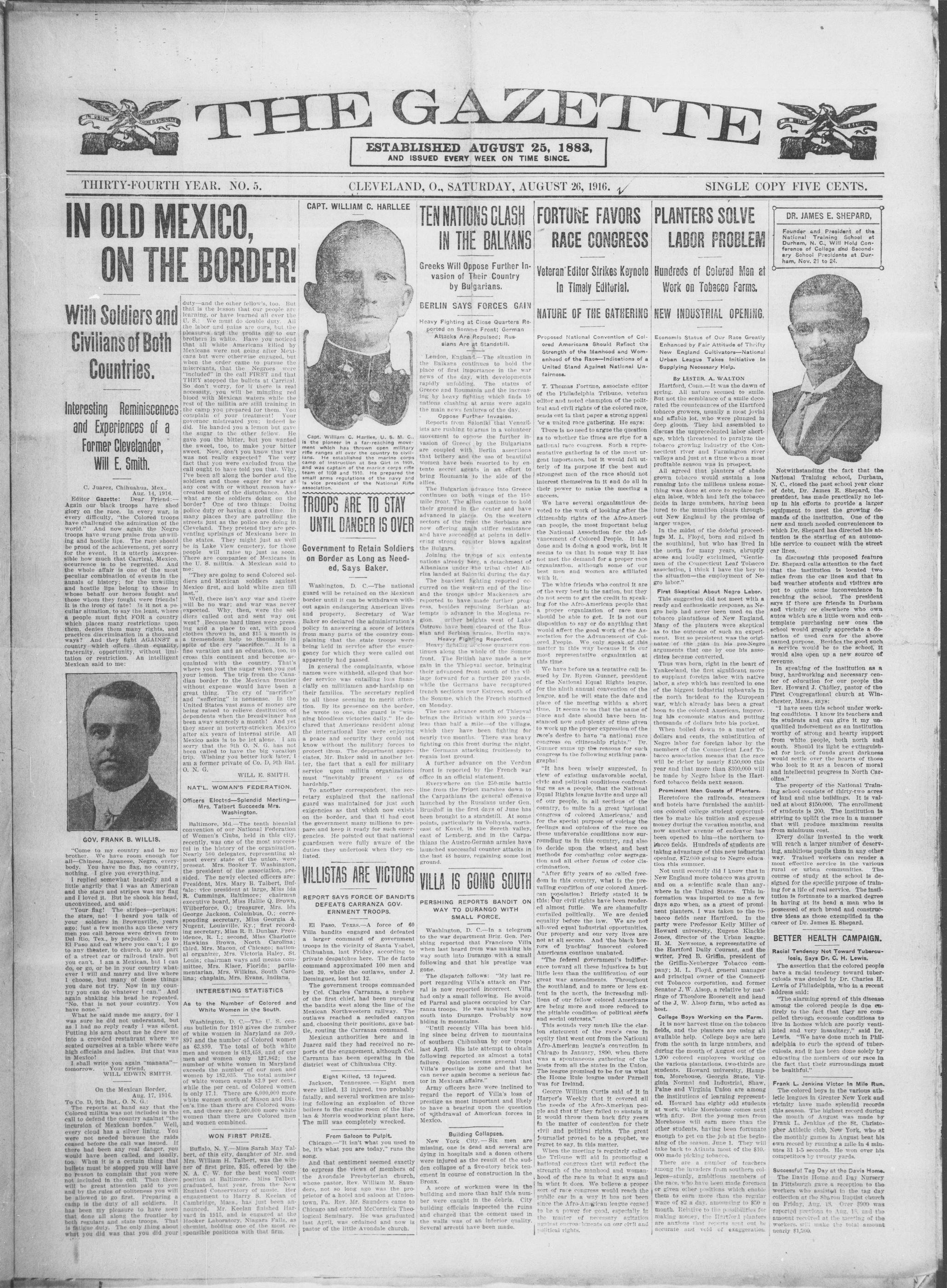
IN OLD MEXICO, ON THE BORDER!
With Soldiers and Civilians of Both Countries.
Interesting Reminiscences and Experiences of a Former Cleveland, Will E. Smith.
C. Juarez, Chihuahua, Mex.
April 14, 1916
Editor Gazette: Deni Friend: Again our black troops have shed glory on the race. In every war, in every difficulty, "the Colored troops have challenged the admiration of the world." And now again the Negro troops have wring praise from unwilling and hostile lips. The race should have been a victory for the event. It is utterly inexpressible how much that Carrizal, Mexico, occurrence is to be regretted. And the whole affair is one of the most peculiar combination of events in the annals of history; for the unwilling and hostile lips belong to those in whose behalf our heroes fought and sacrificed. It is the irony of fate! Is it not a peculiar situation, to say the least, where a people must fight FOR a country which places many restrictions upon them, denies them many rights, and practices discrimination in a thousand ways? And they fight AGAINST a people who oppose fraternity, opportunity, without limitation or restriction. An intelligent Mexican said to me:
GOV. FRANK B. WILLIS.
"Come to my country and be my brother. We have room enough for all—Chinese, Japanese, Negro, every body. You have no flag, no country, nothing. I give you everything."
I replied somewhat heatedly and a little angrily that I was an American and the stars and stripes was my flag and I loved it. But he shook his head, unconvinced, and said:
"Your flag! The stripes—perhaps, the stars, no! I heard you talk of your soldiers in Brownsville, years ago; just a few months ago these very men you call heroes were driven from Del Rio, Tex., by prejudice. I go to El Paso to see a movie, to run the theater, to church, to any part of a street car or railroad train, but you can. I am a Mexican, but I can do, or go, or be in your country whatever I will and marry and live where I choose, but many of these things you dare not try. Now in my country you try to shake his head he repeated. "No, that is not your country. You have none."
What he said made me angry, for I was sure he did not understand, but as I had no reply ready I was silent. Putting his arm about me he drew me into a crowded restaurant where we seated ourselves at a table where were high officials and ladies. But that was in Mexico! I shall write you again "manana"—tomorrow. Your friend. WILL EDWIN SMITH.
On the Mexican Border:
Aug. 17, 1916
To Co. D, 9th Bat., O. N. G.:
The reports at hand say that the Colored militia was not included in the call to defend the country against "the incursion of Mexican hordes." Well, every cloud has a silver lining. You were not needed because the raids ceased before the call was issued. If there had been any real danger you would have been captured and loudly, too. There is a certain thing that bullets must be stopped you will have bullet reason to complain that you were not included in the call. Then there will be great attention paid to you and by the rules of politeness you will be allowed to go-for-that. Preparing a camp is the duty of all soldiers. It has been my pleasure to have seen that all along the frontier by both regulars and state troops. That is fatigue duty. The only thing about what you did was that you did your
duty—and the other fellow's, too. But that is the lesson that our people are learning, or have learned all over the U. S.: We must do double duty. All the labor and pain are ours, but the pleasures and the profits go to our brothers in white. Have you noticed that all white Americans Elled by Mexicans were not going after Mexicans but were otherwise engaged, but when the order came to pursue the pleasures and the profits "included" in the call FIRST and that THEY stopped the bullets at Carrival. So don't worry, for if there is real necessity, you will be mingling red blood with Mexican waters while the rest of the milita are still training in the camp you prepared for them. You complain of your treatment! Your governor misdirected you; indeed he commanded you to abandon the starry sky either follow. He gave you the bitter, but you wanted the sweet, too, to make your bitter sweet. Now, don't you know that war was not really expected? The very fact that you were excluded from the call ought to have told you that. Why, I've been all along the border and the soldiers and those enger for war at any cost with or without reason have been doing what are the soldiers doing on the border? One of two things: Doing police duty or having a good time. In many places they are patrolling the streets just as the police are doing in Cleveland. They pretend they are preventing uprisings of Mexicans here in the states. They might just as in Lake View cemetery, for those who are there. There are companies of Mexicans in the U. S. milita. A Mexican said to me:
"They are going to send Colored soldiers and Mexican soldiers against Mexico first, and hold white men till last."
Well, there isn't any war and there will be no war; and war was never expected. Why, then, were the soldiers called out and sent way out west? Because hard times were pressing and a place to eat, with good clothes thrown in, and $15 a month is the price of "sacrifice." It is a fine vacation and an education, too, to cross this continent and become acquainted with the country. That's where you lost the sugar when you got your lemon. The trip from the Canadian border to the Mexican frontier without expense would have been a great relief. The age of "sacrifice" is suffering; it is nonsense. In the United States vast sums of money are being raised to relieve destitution of dependents when the breadwinner has been away scarcely a month! And yet they sneer at poverty-striken Mexico after six years of internal strife. All Mexico asks is to be let alone. I am sorry that the 9th O.C. N.Y. has been the big education. Wishing you better luck later, I am a former member of Co. D. 9th St. O. N. G. WILL E. SMITH. NATL' WOMAN'S FEDERATION.
Officers Elected - Splendid Meeting
Mrs. Tatiana de Neceda Mrs.
Washington
Baltimore, Md. "The tenth biennial convention of our National Federation of Women's Clubs, held in this city, recently, was one of the most successful in the history of the organization. Nearly 500 delegates, representing almost every state of the United States, presided by T. Washington, the president of the association, presided. "The newly elected officers are: President, Mrs. Mary B. Talbert, Buffalo; vice president at large, Miss Ida R. Cummings, Baltimore; chairman executive board, Miss Halle Q. Brown, Wilberforce, O.; treasurer, Miss Ida George, longtime secretary, Miss Georgia A. Nugent, Louisville, KY; first recording secretary, Miss R. B. Dunbar, Providence, R. I.; second, Miss Charlotte Hawkins Brown, North Carolina; third, Mrs. Macon, of Chicago; national organizer, Mrs. Mrs. Worth Hamm, committee, Mrs. Kiser, Florida; parliamentarian, Mrs. Wilkins, South Carolina; chaplain, Mrs. Evans, Indiana.
INTERESTING STATISTICS
As to the Number of Colored and White Women in the South.
Washington, D. C.—The U. S. census bulletin for 1910 gives the number of white women in Maryland as 369, 897 and the number of Colored women as 63, 899. The total of both white men and women is 458 and the number of white women only 127,862; the number of white women in Maryland exceeds the number of our men and women by 182,025. The total number of white women equals 82.9 per cent., while the per cent. of Colored women is only 17.1. There are 610,000 more white women than there are Colored women, and there are 2,000,000 more white women than there are Colored men and women combined.
WON FIRST PRIZE.
Buffalo, N. Y. - Miss Sarah May Talbert, of this city, daughter of Mr. and Mrs. William H. Talbert, was the winner of first prize, $25; offered by the N. A. C. W. for the best vocal, composition at Baltimore. Miss Talbert graduated, last year, from the New England Conservatory of music. Her engagement to Harry S. Sullivan of Cambridge will be an award. Mr. Keach finished Harvard/1915, and is engaged at the Hooker Laboratory, Niagara Falls, as chemist, holding one of the most responsible positions with that firm.
ESTABLISHED AUGUST 25, 1883. AND ISSUED EVERY WEEK ON TIME SINCE.
CLEVELAND, O., SATURDAY, AUGUST 26, 1916.
Capt. William C. Harlee, U. S. M. C. is the pioneer in a far-reaching movement which has thrown open military rifle ranges all over the country to givlng land. He established the marine comm camp of instruction at Sea Girt in 1909, and was captain of the marine corps rifle team of 1508 and 1910. He prepared the small army regulations of the navy and is vice president of the National Rifle association.
TROOPS ARE TO STAY UNTIL DANGER IS OVER
Government to Retain Soldiers on Border as Long as Needed. Says Baker.
Washington, D. C.-The national guard will be retained on the Mexican border until it can be withdrawn without, again, endangering American lives and property. Secretary of War Baker so declared the administration's policy in answering a score of letters from many parts of the country complaining that the state troops were being held in service after the emergency for which they were called out apparently had passed. In general the complainants, whose names were withheld, alleged that border service was entailing loss financially on militiamen and hardship on their families. The secretary replied to all those seeming to merit attention. By its presence on the border, he wrote to one, the guard is "winning bloodless victories daily." He declared that Americans resident along the international line were enjoying a peace and security they could not know without the military forces to protect them. The department appreciates, Mr. Baker said in another letter, the fact that a call for military service upon militia organizations must "inevitably present costs of hardship."
To another correspondent the secretary explained that the national guard was maltainted for just such exigencies as that which now exists on the border, and that ti had cost the government many millions to prepare and keep it ready for such emergencies. He pointed out that national guardmen were fully aware of the duties they undertook when they enlisted.
VILLISTAS ARE VICTORS
VILLISTAS ARE VICTORS
REPORT SAYS FORCE OF BANDITS DEFEATS CARRANZA GOV- ERMENT TROOPS.
El Paso, Texas—A force of 60 Villa bandits engaged and defeated a larger command of government troops in the vicinity of Santa Yuela, Chihuahua, last Friday, according to private despatches here. The do facto command approximated 100 men and lost 20, while the outlaws, under J. Dominguez, lost but 12.
The government troops commanded by Col. Charles Carranza, a nephew of the first chief, had been pursuing the bandits west along the line of the Mexican Northwestern railway. The outlaws reached a secluded canyon and, choosing their positions, gave battle, routing the Carranza command.
Mexican authorities, here and in Juarez said they had received no reports of the engagement, although Col. Carranza has been operating in the district west of Chihuahua City.
Eight Killed, 13 Injured
Jackson, Tennessee. — Eight men were killed. 13 injured, two probably fatal, and several workmen are missing following an explosion of three boilers in the engine room of the Harlan & Morris woodworking plant here. The mill was completely wrecked.
From Saloon to Pulpit.
Chicago.—"It isn't what you used to be, it's what you are today," runs the song.
And that sentiment seemed exactly to express the views of members of the Avondale Presbyterian church, whose pastor, Rev. William M. Saunders, not so long ago was the proprietor of a hotel and saloon at Uniportown, Pa. Rev. Mt. Saunders came to Chicago and entered McCormick Theological Seminary. He was graduated last April, was ordained and grow is pastor of the Avondale church.
TEN NATIONS CLASH IN THE BALKANS
Greeks Will Oppose Further Invasion of. Their Country by Bulgarians.
BERLIN SAYS FORCES GAIN
Heavy Fighting at Cine Quarters Reported on Some Front; German Attacks Are Repulsed; Russians Are at Standstill.
London, England. The situation in the Balkans continues to hold the place of first importance in the war news of the day, with developments rapidly unrolling. The status of Greece and Romania and the increasing by heavy fighting which finds to natters clashing at arms were again the main news features of the day.
Oppose Further Invasion.
Reports from Saloniki that Venetians are rushing to arms in a volunteer movement to oppose the further invasion of Greece by the Bulgarians are coupled with Berlin assertions that bribery and the use of beautiful women have been resorted to by entferte secret agents in an effort to bring Romania to the side of the allies.
The Bulgarian advance into Greece continues on both wings of the left side. The allies continue to hold their ground in the center and have advanced in places. On the western sectors of the front the Serbians are now offering much stiffer resistance and have succeeded at points in delivering strong counter blows against the Bulgars.
Joining the troops of say orienta nations already here, a detachment of Albanians under the tribal chief Altaia landed at Salzburg during the day. The heaviest fighting reported occurred on the west-end of the line and the troops under Mackosen are reported to have made progress, besides repulsing Serbian attempts a advance in the Moldova region, further heights west of Lake Ostrovie have been cleared of the Russian and Serbian armies, Belia says
Heavy Fighting Reported.
Heavy Fighting... these squares continues along the whole of the Summe front. The British have made a new gain in the Thiepval sector, bringing their advanced front south of the village forward for a further 200 yards, while the Germans have recaptured trench sections near Estres, south of the Somme, which the French stormed on Monday.
The new advance south of Thiepval brings the British within 500 yards less, than half a mile of the village, which they have been fighting on nearly two months. There was heavy fighting on this front during the night, the Germans attacking fruitlessly to regain last ground.
A further advance on the Verdin front is reported by the French war office in an official statement.
Everywhere on the 250-mile battle line from the Priet marshes down to the Carpathians, the general offensive launched by the Russians under Gen. Brusiloff in the first days of June has been brought to a standstill. At some points, particularly in Volhynia, northeast of Kovel, in the Serech valley, east of Lemberg, and in the Carpathians the Austro-German armies have launched successful counter attacks in the last 48 hours, regaining some lost ground.
VILLA IS GOING SOUTH
VILLA IS GOING SOUTH
PERSHING REPORTS BANDIT ON WAY TO DURANGO WITH SMALL FORCE.
Washington, D. C.—In a telegram to the war department Brig. Gen. Pershing reported that Francisco Villa when last heard from was making his way south into Durango with a small following and that his prestige was gone.
The dispatch follows: "My last report regarding Villa's attack on Parral is now reported incorrect. Villa had only a small following. He avoided Parral and places occupied by Carranza troops. He was making his way south into Durango. Probably now hiding in mountains.
"Until recently-Villa has been hiding since being driven to mountains of southern Chihuahua by our troops last April. His late attempt to obtain following reported as almost a total failure. Opinion seems general that Villa's prestige is gone and that he can never again become a serious factor in Mexican affairs."
Army officers here were inclined to regard the report of Villa's loss of prestige as most important and likely to have a bearing upon the question of withdrawal of American forces in Mexico.
Building Collapses.
New York City.—Six men are missing, one is dead and several are dying in hospitals and a dozen others were injured as the result of the sudden collapse of a firestory brick cement in course of construction in the Bronx.
A score of workmen were in the building and more than half this number were caught in the debris. City building officials inspected the ruins and charged that the cement used in the walls was of an inferior quality. Several arrests have been made.
FORTUNE FAVORS RACE CONGRESS
Veteran Editor Strikes Keynote In Timely Editorial.
NATURE OF THE GATHERING
Proposed National Convention of Colored Amoricans Should Reflect the Strength of the Manhood and Womanhood of the Race—Indications of a United Stand Against National Unfairness.
T. Thomas Fortune, associate editor of the Philadelphia Tribune, veteran editor and notable champion of the political and civil rights of the colored race, seeks out in that paper a strong appeal or a united race gathering. He says: There is no need to argue the question as to whether the times are ripe for a national race congress. Such a representative gathering is of the most urgent importance, but it would fall utterly of its purpose if the best and strongest men of the race should not interest themselves in it and do all in their power to make the meeting a success.
We have several organizations devoted to the work of looking after the citizenship rights of the Afro-American people, the most important being the National Association for the Advancement of Colored People. It has done and is doing a good work, it has seen to that in some way it has not met the demand for a proper race organization, although some of our best men and women are affiliated with it.
The white friends who control it are of the very best in the nation, but they do not seem to get the credit in speaking for the Afro-American people that a proper organization of race men should be able to get. It is not our disposition to say or do anything that would affect the good work of the Association for the Advancement of Colored People. We only speak of this master in this way because it is our most representative organization at this time.
We have before us a tentative call issued by Dr. Byron Zimmer, president of the National Equity Rights league, for the annual convention of the league, and he will state the date and place of the meeting within a short time. It seems to us that the name of place and date should have been instanced now and plenty of time given to work up the proper expression of the people's desire to have "a national race congress on citizenship rights." Dr. Garner signs up the reasons for such congress in the following striking paragraphs:
"It has been wisely suggested, in view of existing unfavorable social, civic and political conditions confronting us as a people, that the National Equal Rights league invite and urge all of our people, in all sections of the country, to mute in a great 'national congress of colored Americans', and for the special purpose of voicing the feelings, and opinions of the race on these unfavorable conditions now surrounding us in this country, and also to decide upon the wisest and best methods for combating color segregation and all other forms of color discrimination.
"After fifty years of so called freedom in this country, what is the prevailing condition of our colored American population? Briefly stated it is this: Our civil rights have been rendered almost futile. We are shamefully curtured politically. We are denied custody before the law. We are not allowed equal industrial opportunities. Our property and our very lives are not at all secure. And the black borders of lynchings 'innocent colored Americans continue unmatched.
"The federal government's indifference toward all these injustices is but little less than the multifiltration of our great war amendments. Throughout the southland, and to more or less extent in the north, the increasing millions of our fellow colored Americans are being more and more reduced to the plitable condition of political serfs and social outcasts."
This sounds very much like the eli-
on statement of the race's case in
equity that wont out from the National
Afo-American league's convention in
Chicago in January, 1890, when there
was a spontaneous gathering of the
hosts from all the states in the Union.
The league promised to be for us what
the Home Rule league under Parnell
was for Ireland.
George William Curtis said of it in
Harper's Weekly that it covered all
the needs of the Afo-American people
and that if they failed to sustain it
it would throw them back fifty years
in the matter of contention for their
civil and political rights. The great
journalist proved to be a prophet, we
retest to say, in this matter.
When the meeting is regularly called
the Tribute will aid in promoting a
national congress that will reflect the
strength of the method and woman-
hood of the race in what it says and
in what it does. We believe a proper
sort of race congress would reach the
public car in a way it has not been
since the Afo-Am league ceased to be a power for each, especially in the matter of city agitation in our city and
SINGLE COPY FIVE CENTS.
PLANTERS SOLVE LABOR PROBLEM
Hundreds of Colored Men at Work on Tobacco Farms.
Economic Status of Our Race Greatly Enhanced by Fair Attitude of Thuffy New England Cultivators—National Urban League Takes Initiative, In Supplying Necessary Help.
By LESTER A. WALTON
Hartford, Conn. — It was the dawn of spring. All mature seemed to smile. But not the semblance of a smile decorated the countenances of the Hartford tobacco growers, usually a most joyful and affable lot, who were plunged in deep gloom. They had assembled to discuss the unprecedented labor shortage, which threatened to palyize the tobacco growing industry of the Connecticut river and Farmington river valleys and just at a time when a most profitable season was in prospect.
All agreed that planters of shade grown tobacco would sustain a loss running into the millions unless something was done at once to replace foreign labor, which had left the tobacco fields in large numbers, having been bured to the munition plants throughout New England by the promises of larger wages.
In the midst of the doleful proceedings M. L. Floyd, born and raised in the southland, but who has lived in the north for many years, grumply arose and loudly exclaimed. (Treatmen of the Connecticut Leaf, Tobacco association, I think I have the key to the situation—the employment of Negro labor.)
First Skeptical About Negro Labor
This suggestion did not meet with a ready and enthusiastic response, as Negro help had never been used on the tobacco plantations of New England. Many of the planters were skeptical as to the outcome of such an experiment. But so persistent was the originator of the plan in his pro-Negro arguments that one by one his associates became converted:
Thus was been, right in the heart of Yankeland, the first significant move to supplant foreign labor with native labor, a step which has resulted in one of the biggest industrial upheavals in the north incident to the European war, which already has been a great boon to the colored American, improving his economic status and putting thousands of dollars into his pocket.
When boiled down to a matter of dollars and cents, the substitution of Negro labor for foreign labor by the members of the Connecticut Leaf Tobacco association means that the race will be richer by nearly $150,000 this year and that more than $300,000 will be made by Negro labor in the Harford tobacco fields next season.
Prominent Men Guests of Planters.
Heretofore the railroad, steamers and hotels have furnished the ambitious colored college student opportunities to make his tuition and expense money during the vacation months, and now another avenue of endeavor has been opened to him—the northern tobacco fields. Hundreds of students are taking advantage of this new industrial opening, $72,600 going to Negro education this summer.
Not until recently did I know that in New England more tobacco was grown and on a scientific scale than anywhere in the United States. This information was imparted to me a few days ago when, as a guest of prominent planters, I was taken to the tobacco fields near Hartford. In the party were Professor Kelly Miller of Howard university, Eugene Knuckle Jones, director of the Urban league. H. M. Newsome, a representative of the Hartford Daily Courant, and the writer, Fred B. Griffin, president of the Griffin-Neuberger Tobacco company; M. L. Floyd, general manager and principal owner of the Connecticut Tobacco corporation, and former Senator J. W. Alsop, a relative by marriage of Theodore Roosevelt and head of the J. W. Alsop farm, who acted as host.
College Boys Working on the Farm.
It is now harvest time on the tobacco fields, and the planters are using all available help. College boys are here from the south in large numbers, and during the month of August out of the 1,200 colored employees working on the various plantations, two-thirds are students. Howard university, Hampton, Morehouse, Georgia State, Virginia Normal and Industrial, Shaw, Palne and Virginia Union are among the institutions of learning represented. Howard has eighty old students at work, while Morehouse comes next with fifty. But the young men from Morehouse will earn more than the other students, having been fortunate enough to get on the job at the beginning of the season, June 1. They will take back to Arizona most of the $10,000 made tobacco.
There are a number of teachers among the workers from southern colleges-grammar, ambitions, members of the face, who have been made forename or given other positions which enable them to earn more than the regular wage of $2 a day, amounting to $2 a month. Robbie to the teachers for working notes, the two teachers for plants are auxiliary and the rest of them to account and evaluate the work.
THE EAGLE
WITH THE BANNER
"THE EAGLE WITH THE BANNER"
DR. JAMES E. SHEPARD,
Founder and President of the National Training School at Durham, N. C., Will Hold Conference of College and Secondary School Presidents at Durham, Nov. 21 to 24.
Notwithstanding the fact that the National Tafling school, Durham, N.C. closed the past school year clear of debt, Dr. James E. Shearp, the president, has made practically no let-up in his efforts to provide a larger equipment to meet the growing demands of the institution. One of the new and much needed convenences to which Dr. Shearp has directed his attention is the starting of an automobile service to connect with the street car lines.
In discussing this proposed feature Dr. Shearp calls attention to the fact that the institution is located two miles from the car lines and that in had weather students and visitors are put to quite some inconvenience in reaching the school. The president says if there are friends in Durham and visibility or elsewhere who own auto's which are a little worn and contemplate purchasing new ones the school would greatly appreciate a donation of useful cars for the above named purpose. Resides the good such a service, would be to the school, it would also open up a new source of revenue.
In speaking of the institution as a busy, hardworking and necessary center of education for our people the Rev. Howard J. Childle, pastor of the First Congregational church at Winchester, Mass. says:
"I have seen this school under working conditions. I know, its teachers and its students and can give it my unqualified endorsement as an institution worthy of strong and hearty support from white people, both north and south. Should its light be extinguished for lack of funds great darkness would settle over the hearts of those who look to it as a beacon of moral and intellectual progress in North Carolina."
The property of the National Training school consists of thirty-two acres of land and nine-buildings. It is valued at about $150,000. The enrollment of students is 200. The institution is striving to uplift the race in a manner that will produce maximum results from minimum cost.
Every dollar invested in the work will reach a larger number of deserving, ambitious pupils than in any other way. Trained workers can render a most effective service in the various rural or urban communities. The course of study at the school is designed for the specific purpose of training for a life of real service. The institution is fortunate to a marked degree in having at its head a man who is possessed of such broad and constructive ideas as those exemplified in the career of Dr. James E. Shepard.
BETTER HEALTH CAMPAIGN
Racial Tendency Not Toward Tuberculosis, Says Dr. C. H. Lewis.
"The assertion that the colored people have a radial tendency toward tuberculosis was denied by Dr. Charles H. Lewis of Philadelphia, who in a recent address said:
"The alarming spread of this disease among the colored people is due centrally to the fact that they are compelled through economic conditions to live in houses which are poorly ventilated and very insignificant," said Dr. Lewis. "We have done much in Philadelphia to curb the spread of tuberculosis, and it has been done solely by educating the members of our race in the fact that their surroundings must be healthful."
Frank L. Jenkins Victor In Mile Run. The colored boys in the various athletic leagues in Greater New York and vicinity have made splendid records this season. The highest record during the month of August was made by Frank L. Jenkins of the St. Christopher Athletic club, New York, who at the monthly games in August beat his own record by running a mile in 4 minutes 31.5 seconds. He won over his competitions by twenty yards.
Successful Tag Day at the Davis Home. The Davis Home and Day Nursery in Pittsburgh gave a reception to the workers who assisted in the tag day collection at the St. Francis church on Friday, August 15, 1900 was reported in the Journal. In the amount received in the day of the workers, it was paid an amount nearly $12,000.
One Year.....$1.50
Six Months.....1.00
Three Months......50
Subscribers are requested to rem-
mit by postoffice money or-
der or registered letter
Entered at the postoffice in Cleveland
Ohio, as second-class matter.
Address all communications to
Blackstone Building, Cleveland, O.
Member Ohio Legislature: 1894
to 1896; 1896 to 1898; 1900 to 1902
THE GAZETTE is the oldest, and has the largest bona fide circulation, double that of any newspaper in the interest of Afro-Americans, published in the state of Ohio, and comparison with any will immediately establish its rank as one of the NEWSIEST AND BEST in the country.
10,000,000 Afro-Americans...
160,000 in Ohio.
20,000 in Cleveland.
SATURDAY, AUGUST 26, 1916.
"Let us have faith that right makes might, and in that faith let us to the end dare to do our duty as we understand it."—Abraham Lincoln.
When his Mexican friend finished talking to him no wonder Will Edwin Smith "had no reply ready and was silent." Who would not have been silent?
Self and race respecting Ohio Afro-Americans who do not wish to vote for Willis for governor are going to have an opportunity to vote for a Republican—Rudolph A. Mack, Esq., of Cincinnati. Good!
That the Georgia house of representatives voted down an anti-lynch bill is not surprising. The fact that the Georgia senate passed it, is, however; unless there was an understanding between the house and the senate. This was doubtless the case.
We are quite sure that our thousands of readers do not require any urging to read carefully Will Edwin Smith's two letters on our first page today. Call your friends' attention to them, please. They are two remarkable communications.
Gov. Frank B. Willis "handed the 9th, battalion a lemon" just as he had previously done in refusing to give our people appointments (personal) after voluntarily promising to do so. See Will Edwin Smith's letters on page 1 of The Gazette today.
Chairman Williams of the State Board of Film Censors, in a letter to the editor of The Gazette, months ago, plainly stated that the members of the board, and NOT Gov. Frank B. Willis, are entitled to the credit for barring the infamous photoplay, "The Birth of a Nation," from the state.
President Thomas Woodrow Wilson has not changed his mind for two weeks and the Democrats are wondering what he intends to spring on them next. Whatever it is, they are ready to change as soon as he gives them the tip.
It is one of the gratifying developments of the campaign that the Hughes acceptance speech is better liked as the people of the country become more familiar with it. It was dignified, thoughtful and statesmanlike.
Senator Hardwick, Democrat, of Georgia, says that if his state were not so overwhelmingly Democratic the management of the postal service during this administration would cause the state to go Republican. For the same reason, many states that are not so overwhelmingly Democratic will switch to the Republican column in November.
President Wilson is a minority president. He was elected in 1912 because the Republican party was hopelessly divided. Now the Progressives have returned. The Republican party has unified itself and is again the majority party. To add to Wilson's weakness, the women voters of the country are declaring against him, making sure his defeat in the twelve western states where they have the suffrage. It looks as though he will have only the solid south in the electoral college.
Recently the editor of a prominent Democratic newspaper in the Pacific northwest returned from a trip to New York and told his readers that prosperity was general throughout the east and that "the revival will probably extend to the west soon." Evidently the revival was slow getting out to the country where they have no war order business, for one of the largest and oldest lumber companies of the Pacific coast has just gone into the hands of a receiver, with debts aggregating three quarters of a million.
In February, 1915, Senator Shafroth, Democrat, of Colorado, made the assertion that "there was never so high a protective tariff as now exists by reason of the war, because imports are nearly prohibited by the fact that there is war, and consequently American factories are in a position to have no competitors whatever." That remark followed numerous quotations from newspapers showing the revival of business, especially in war order lines. All of which was pretty good protection argument, coming, from a Democrat.
PREVENT MOB VIOLENCE.
At least one thousand Afro-Americans have been brought to Cleveland in recent months to work in the large plants of this city. Hundreds of their women and children have followed them here. Too many of them are "undesirable" residents whose conduct already has made conditions much worse for our good people of this community. As far as we have been able to learn, this has been the case in other cities of this section of the country that have acquired any considerable number of them. There is need, among our people of this community, of a citizens' organization that will make it its business to look carefully into the situation and deal with it as best it can, promptly, before there are serious results that will redound to the everlasting shame and disgrace of all of our people in Cleveland as well as the city its self. From time to time, for weeks, The Gazette has sounded this note of warning, calling particularly upon our clergymen for leading action in the matter because they are supposedly charged with the moral and religious welfare of our people of this community. We did and do this, however, in a kindly and not "a carping spirit." The matter is of such commanding importance that it deserves immediate attention regardless of all else. Take heed before it is too late Too long, already, have we delayed.
AN EDITOR'S MISTAKES.
The Cleveland Gazette virtually acknowledges that it has failed to hold that city down to the ways of civil righteousness. This would not be such an alarming fact had it not been for the superior claims of Editor Smith who maintained for years that Cleveland was above reproach. The leading spirits wouldn't hear to a colored Y. They would hear to a colored Y. Their ability to hold the schools mixed. And all which is commendable. It was thought, however, that the town was absolutely a "free port." Now comes the harrowing tale that the parks are not free in all particulars to the colored people. Certain days in the year are colored folk days, and at which time all of the concession people proceed to do them up. The Gazette is raging, but to what purpose remains to be determined, are doing fairly well in this city in such matters. We could find considerable trouble if we would look for it.—Indianapolis (Ind.) Freeman.
Our esteemed confrence of The Freeman is wrong in saying that The Gazette has ever claimed that "Cleveland was above reproach", but is right in announcing that "the leading spirits" here will not hear to a "jim crow" Y. M. C. A. movement. Our public schools are "mixed", having about thirty-five Afro-American teachers hardly any one of whom has even one pupil of the race in her classes. The public parks are all "free in all particulars to the Colored people". The one "park" (Luna), a place of business rather than a park, controlled by private individuals, is rented by "punished" Norroes once twice a year for "Negro celebrations" but is open to all persons every day of the season, although there is discrimination in its dance hall, roller skating rink and bathing pool. It is this latter that would estop manly, self and race respecting members of the race from renting the place at all. Our people here could wipe out the discrimination in that "park" if they would only use our Ohio Civil Rights' law, and that is what we are trying to get to do, and expect to succeed, too. Our contemporary could help to make conditions in Indianapolis infinitely better for our people, possibly nearly as good as they still are here in Cleveland, if it would only "look for and find con siderable trouble" there that has been crying aloud, almost to high heaven, these many years for action along the lines of "civil righteousness."
OUR LARGE CITY POPULATION.
YOUNGSTOWN.—The census report of 1910, the last regular census taken, gives some interesting statistics with regard to Afro-Americans. Lowell, Mass., has the smallest population of our people, 133, of any of the cities given and, if we except greater New York, Washington, D. C., with its 94,46, the largest. Of these southern cities in the list, New Orleans leads, its Afro-American population being 89,262. Atlanta, Ga., has 51,909; Birmingham, Ala., 52,308; Louisville, Ky., 52,196; Nashville, Ky., 36,523; Richmond, Va., 46,733; St. Louis, Mo., 43,960 and Baltimore, Md., 84,749. Chicago, Ill., in 1910, had 44,103, a larger number than that of any other western city given in the list. Philadelphia is credited with 84,459; Pittsburgh with 25,623 and Boston with 13,564; Greater New York, 133,418. These figures will be something of a surprise to many people who, without taking the trouble to themselves, imagined that pretty nearly all of our people live in the south.
LOVING—McCARY.
Former Leader of the Constabulary
Band of Manila, P. I., Marries.
Alameda, Cal.-Major Walter H. Loving, organizer and former leader of the Constabulary band. Manila Philippines, who directed the band during the exposition, when here during the Taft administration, and at the St. Louis world's fair, was recently married to Edith M. McCary of this city, daughter of the late Michael McCary, formerly pawmaster's clerk in the U. S. army under Major John K. Lynch. Loving resigned from his government position as head of the scorpion scene where in the west. He and his bride left for Washington, D. C., and Atlantic City, on their honey moon. The couple will spend several weeks in Washington, the birthplace of the bride, and then will go to Minnesota where they will probably locate.
"DREW IS THROUGH," MAYBE!
Los Angeles, Cal.-Howard P. Drew,
holder of the world's record for the
100-yard dash, is suffering from a
stroke of paralysis and will be unable
to participate in future contests, it is
said. This is the second time in a
year that the "Drew is Through" announcement has been made. We don't
believe this one, either.
The N. A. A. C. P. anti-lynching
fund has reached $7,250.93. Nearly
$3,000 more needed to secure promised.
$2,000.
THE GAZETTE, CLEVELAND, O., SATURDAY, AUGUST 26, 1916.
HONORS HIS PREDECESSORS
Leadership of Our Representative at Capital of Little West African Republic Has a Beneficent Effect Upon the Natives—Mrs. Curtis Interested In Social and Educational Affairs.
Mourovia, Liberia.—The Hon. James L. Curtis, American minister here, is succeeding admirably in his work at the American legation. He is a man of broad and constructive ideas and is giving the inhabitants of this little republic the benefit of his experience and knowledge of human affairs. Minister and Mrs. Curtis are both enjoying good health and are active in social service work among the people.
Mrs. Curtis volunteered some time ago to teach corset and dress making in the college of Liberia, and her efforts have been highly successful. Besides teaching regular classes of students, Mrs. Curtis gives instruction to teachers in other departments of the institution. She is a woman of splendid dact, having had considerable experience in club work among the women of America.
Minister Curtis has endeared himself to the people of the west coast by his patriotism and zeal for the cause of his government, whose interest he at all times seeks to enhance. On Memorial day the exterior of the American legation was literally covered with American flags in honor of the nation's dead.
The American colony in Monrovia observed Memorial day with elaborate ceremonies, which began with a march to the new cemetery, which was led by a detachment of the Liberian frontier force under command of Lieutenant Webster.
Arriving at the cemetery, the American minister led the way to a spot through thick underbrush, recently cleared, where he pointed to the remnants of two diapidated headstones, not more than fifteen feet apart, which he told those present marked the graves of Henry Highland Garnett and W. A. Hopkins, American ministers, who died and were buried in Monrovia in the early eighties and whose graves had been so neglected that their location was unknown to the oldest inhabitant.
Minister Curtis exhibited an age colored map which, after a search of several months, he had secured, showing a tree and a path which made certain the identification of the graves. Mr. Curtis then asked that every one join in singing "America," after which he spoke of the life and character of his deceased predecessors.
He spoke with great feeling of Henry Highland Garnett, who, like himself, was a graduate of Lincoln university, Pennsylvania, and concluded his remarks by reciting Bryant's "Thanatopsis."
The graves of the late Mrs. Lyon, wife of former Minister Ernest Lyon; Captain Newton of the Liberian frontier force and James G. B. Lee, the late Brooklyn surveyer, were also profusely decorated with flowers, and at the head of each grave a small American flag was left flying to the breezes. Beautiful copper headpieces, properly inscribed, donated and shipped by Major Charles Young, were placed at the graves of Captain Newton and Mr. Lee. After the ceremony the buglers from the Liberian frontier force blew "taps," and the firing squad fired "taps," which brought to a close the ceremonies of the day.
Minister Curtis, it is said, has secured the necessary consent and in the near future proposes removing the bodies of the two dead ministers to the spot recently conveyed to the American legation by Major Charles Young, which is the most conspicuous as well as the most desirable spot in the cemetery.
NATIONAL RACE CONGRESS.
Widespread Interest In the Proposed Meeting, Says a Virginia Paper.
The Richmond (Va.) Planet indores the call for a national congress of colored Americans. The Planet says: Widespread interest is being shown in the proposal made by Rev. Bryon Gunner, president of the National Equal Rights league, that the colored people hold a national race congress and get together on their civil and political rights and disabilities. In the tentative call the Rev Mr. Gunner, from Hillburn, N. Y., advises that his get together meeting be held within sixty days at some central location in the north.
The secretary of the league, William Monroe Trotter, joins in urging the congress and asks leaders in each community to form equal rights committees and arrange meetings to send representation. An exchange of views on the project is invited, the secretary's address being 27 Cornhill, Boston.
Praeching Gospel of Co-operation.
Some of the ministers of our race at Savannah, Ga., are co-operating with the Local Negro Business league by preaching sermons based upon the importance of supporting race enterprises
SENT NORTH TO WORK
Nearly 1500 More in the Past Twelve Days.
Memphis, Tenn.—Between 1,200 and 1,500 Negroes have been sent to points in the north during the last 12 days for work in ammunition plants. Hundreds preceded them. They represent the shipments made by Lymus Wallace, Negro labor agents, Lymus sax, and that several labor agents were in the field for Negro labor and a couple more arrived that day for the same purpose. He said that he had sent about 1,500 to Chicago, Waterloo, Iowa, Detroit, Cleveland, and to Pennsylvania.
FERGUSON DIES IN AFRICA.
First Episcopal Bishop of Colored Race.
Held Post at Monrovia, Liberia.
The Domestic and Foreign Mission Society of New York on Thursday, Aug. 3, received a cable dispatch from Monrovia, Liberia, which announced the death of the Right Rev, Samuel D. Ferguson, bishop of Liberia and West Africa. Bishop Ferguson had the distinction of being the first man of the colored race elected to membership in the house of bishops of the Protestant Episcopal church in the United States. Bishop Ferguson was nearing his seventy-fifth birthday. For over three decades he had been a noted figure in the Episcopal church. He visited America frequently to attend the conferences of his church.
In 1907 the late Bishop Henry C. Potter of New York entertained him at dinner in Richmond, Va., for which he was severely criticised throughout the south.
Bishop Ferguson was born in Charleston, S. C., and emigrated with his parents to Liberia when six years old. He was educated in the mission schools and was an excellent student, giving early promise of being a leader among his people. In 1862 he was appointed a teacher and began his studies for the ministry. Three years later he was admitted to the church as a deacon, being appointed a priest in 1868. As a priest his work attracted attention, and he was soon suggested for further advancement.
The house of bishops assembled in New York in 1884 and elected him missionary bishop of Cape Palmas and its adjacent territory, the diocese later being changed to that of Liberia and West Africa. On June 24, 1885, his consecration took place in Grace church, New York. During the same year he received the honorary degree of D. D. from Kenyon college, and in 1893 Liberia college conferred on him the degree of D. C. L.
Bishop Ferguson came to America to attend the three hundredth anniversary of the Episcopal church in America in 1607, and it was said then that he would be the first colored man to sit in the chancel of St. Paul's church, the church which Jefferson Davis and Robert E. Lee attended in Richmond, Va. He was then the ranking missionary bishop of his church, having succeeded Bishop C. C. Penick, who resigned as bishop of Cape Palmas in 1883.
After Bishop Penick's resignation the church decided to send no more white men to Central Africa under present conditions, and Bishop Ferguson's appointment was the result.
Bishop Ferguson was commended for his tact in the face of the race prejudice in the south.
When he attended the convention in Boston in 1904 he was made much of, but made no application for quarters through the hospitality committee when called upon to attend the convention in Richmond. He corresponded with the Rev. C. L. Somers, rector of the Church of St. Philip, and was entertained by William C. Scott.
RAISING FUNDS FOR THE SLATER NORMAL SCHOOL
W. A. Blair Shows Interest in Institution at Winston-Salem, N. C.
William A. Blair, Esq., a prominent banker of Winston-Salem, N. C., who is much interested in the Slater Normal and Industrial school in the above named city, is a good friend of the colored people. In speaking of the growth and needs of the institution recently Mr. Blair says:
"Some time ago one of our citizens tendered the trustees $5,000 provided they would raise same amount for a hospital for the sick and where colored girls could be educated for trained nurses, thus introducing an employment for colored women which is peculiarly well adapted to the south.
"His offer was accepted, and we have built the hospital. The graduates, students and friends of the school did much of the manual labor.
"The state officials, seeing the good effects upon the colored people, offered the school $12,000, provided the trustees raised the same amount. We have made a strong effort and have raised a small part of this amount to meet the offer of the state. It is totally impossible for us to raise it here, as our own people have already done all they can; hence we are appealing to the friends of education in all sections of the country for financial aid.
"The state has generously advanced money, and we beg you to please do your utmost to help raise $12,000. Thus, with $24,000 cash in hand, we can increase the plant greatly, as the colored people will do much of the manual labor free.
"The state has just completed a $15,000 dormitory for girls at its own expense. Every dollar now means $1 to the school."
It is suggested that subscriptions of $1 each be sent to Mr. Bair, care of the People's National bank, Winston-Salem, N. C.
Workers Among Young People Meet. The Pennsylvania Baptist state Sunday school convention and the state Baptist young people's convention each held their annual meeting in Pittsburgh the latter part of the first week in August. Mr. William Strothers is president of the Sunday school convention. He is a well known and thoroughly capable religious worker and presided over the two days' meeting of the convention with great ease and clarity. The Young People's union and George H. Newman had a large number of active workers as delegates, who made cheering reports.
KILLS AN ANTI-LYNCHING BILL
Atlanta, Ga.—A bill providing that the sheriff of any Georgia county in which a lynching occurs be removed by the governor was killed by a vote of 113 to 29, by the Georgia house of representatives a few minutes before the close of the legislative session, last week. It had passed the senate.
Foxes Good Rat Catchers.
Foxes have been trained to catch rats by a man residing in Ambergate, Derbyshire, England. He claims that they are better than dogs for the work.
FRESH OHIO NEWS
What Our People Are Doing Each Week—Church, Personal, Social, Lodge, Literary and Musical—Marriages, Deaths, Etc.
SALEM—The Cyrus, Ormes and Manzilla families, old and well known in this section of Ohio, will have their 25th annual reunion at Centennial park, this city, Aug. 31. Many persons, including the editor of The Gazette, not connected with either of the three families, have been invited to attend the reunion. It will undoubtedly prove an exceptional affair.
CORRESPONDENTS must mall all letters for publication at their main postoffice sufficiently early on Monday (or Sunday) of each week to have them reach The Gazette office on Tuesday morning, and always write also, their names and that of their city or town on the outside of the wrapper about returned copies. Unless this latter is done, proper credit cannot be given you. Lists of names, wedding presents, etc., obituary notices, speeches, resolutions, poetry, inquiries, and including items of all kinds, including items announcing entertainments to be held in the near future, must be paid for in advance at the rate of ten cents a line, six words to a line. Our rates for display advertisements will be sent on application.
HILLSBORO—Miss Eather Evans of Greensburg, Ind., is visiting her aunt, Mrs. Clara Evans, and other relatives—Mrs. Mary McGinnis, Selika Thomas and Chin. Wood attended the fair at Washington C. H., last week. Mrs. John Hudson and daughter have returned from Cleveland. Mrs. Ors. have visited relatives. Mrs. Ona Payne of Columbus, is visiting her mother, Mrs. Alline Burton—Charlie Cole has returned from Cleveland—Mrs. Hester West and Clarence Johnson are sick. Rev. and Mrs. G. W. Jackson, Mr. and Mrs. Edward Dixon, Mrs. Fred Williams, Sarah Zimmerman, Neoma Grant attended the W. M. conference Dayton, last week. Mrs. Ruth Tribble visited visiting relatives to Cleveland—Born to Mr. and Mrs. Paul Campbell, a boy. The E. U. B. association convened here, this week. Prof. S. G. Hough returned, last week. Mrs. Theodore Campbell is visiting her husband and other relatives in Cleveland. Mr. and Mrs. Clifford Lamb spent Saturday in San Antonio. L. C. Kher of Locust, preached at the Wesleyan church, Sunday. Rev. P. A. Mills, P. E., held quarterly meeting at the A. M. E. church, Sunday. Mrs. Gildings, of Cincinnati, is visiting her parents, Mr. and Mrs. C. R. Young.
YOUNGSTOWN — Louisa Edwards court's first annual outing, the 15th, was a success. The members appreciate the support the many friends gave them—Mrs. Dolly Bass and Mrs. Geo. Phelps visited relatives in Pittsburgh, recently—Mrs. Emma Sharp, Mrs. Alice Clegghey, the Misses Ody, Julia and Virginia Burton and Mrs. McKeeley. Worrule are visiting in Jackson, Ohio, and Daniel Craney is seriously ill at this writing. Mrs. John P. Davis was buried, last Thursday, from the Third Baptist church. A husband, two daughters, sons, sisters, a brother and a host of friends survive her. An exceptionally enjoyable surprise was given Mr. John Gales, the 15th, in honor of his 33rd birthday. Mrs. Gales served an elaborate four course dinner and a evening. Mr. Gales was presented a fine shaving outfit and a traveling bag. The guests included G. M. Fagan, C. Dongee, F. Hall, C. H. Jenkins, C. E. Sterey, F. Warford, J. R. Holmes, C. R. Smith, W. Saunders and Dennie Howard. Mrs. Jessie Parker is ill. J. A. Jones was called to Hackensack, N. J. by his mother's illness. Harry Jenkins, A. Johnson, J. H. Bohson, Archie Thomas, C. E. Sterey and Wm. Saunders, Buckeye lodge's delegates, are attending the Elks' convention in Philadelphia, this week.
TROOPER CHAS. N. GOOD
A Cleveland Boy With the Ninth Cavalry in the Philippines Writes
Editor Gazette, Dear Sir:—When you receive this letter I hope it will find you and all the friends at home in the best of health. It leaves me in good shape. I think being a soldier is just the life for me. I like it very much. These islands are fine. The hills are full of game. Every Sunday I take my gun and horse and go hunting. Last Sunday I brought down a fine large deer and a wild boar or hog. It is very hot here. I guess you, too, know something about the weather from what we read here. On days we drill, one feels like he is burning up, but I am going to stick it up. I received a letter from my father, a girl, and a soldier. I must write to you. When your answer to this arrives I will write more. Hopping to heer from you soon, I am
SHOTS FLY OVER THE BORDER.
Our Militia and Mexicans in a Fight; Mexican Wounded.
Naco. Ariz.—Over 100 shots were exchanged across the international line about a mile west of here, Saturday night, between patrols belonging to our militia troops from the District of Columbia and a party on the Mexican side. The militiamen say they halted Mexicans who attempted to cross the line. In answer to the challenge the Mexicans fired. in the fusillade that followed the only casualty was the wounding of one of the Mexicans who had tried to cross. He is now a prisoner in the camp of the militia.
MACK WILL OPPOSE WILLIS!
Columbus, O.—R. A. Mack, Esq., of Cincinnati, has announced he will run for governor on an independent Republican ticket. Attorney Mack polled more than 20,000 votes in the Republican primaries against Gov. Willis. This is good news!
THE SMITH STUDIO
ARTHUR J. SMITH, Photographer
Individual and Home Portraiture. Commercial
Photography. Post Cards of Quality.
H. J. OWENS
Signs of all kinds. Show Cards and Electric Signs
a Specialty.
The National Training School
"I cordially commend the school's interest and needs to all who believe in the Negro race and in our obligation to help promote its intellectual, moral and religious uplift." Rev. Dr. Charles H. Parkhurst, New York City.
It is a community of service and uplift.
Its influence is destined to be felt in all sections of the country in improved Negro community life wherever our trained workers locate.
Settlement workers, missionaries for home and foreign mission fields, Y. M. C. A. and Y. W. C. A. secretaries and district nurses receive a comprehensive grasp of their studies under a Wellesley graduate and experienced co-workers and actual everyday practice through the school's social service department.
We aim also to create a better qualified ministry.
. In initial training, advanced bachelor's, business school.
. Thirty-two acres, ten modern buildings, beautiful location.
We can accommodate a few more earnest, ambitious students.
Communities requiring social workers should write us.
FORD'S HAIR POMADE MAKES HARSH MOST SUPPLEMENTAL HEAT TO COMB AND PUT UP IN ANY STYLE THE LENGTH WILL PERMIT PRICE 25¢ AND 50¢ A BOTTLE
FORD'S HAIR STRAIGHTENER NO.022 STRAIGHTENES THE HAIR BY ROLLING IT BETWEEN FOUR BRASS ROLLS. BEST AND QUICKEST THING WE KNOW OF STRAIGHTEN HAIR PRICE $1.50
PATENT SECTIONAL TOOTH COMB PATENTED LOCKING DEVICE FOR ROLLING TEETH TIGHT
FORD'S SPIRAL HANDLE HAIR STRAIGHTENING AND SHIMPOO COMB NO.024 SOLID BRASS COMB PATENTED BURN THE MANDLE SPECIAL LOCKING DEVICE HOLDS THE HANDLE WITHOUT SOLLERING PRICE $1.60
FORD'S MEDIUM SIZED BRASS SHIMPOO AND HAIR STRAIGHTENING COMB NO.026 A GOOD AND SERVICABLE COMB FOR THE MONEY. PRICE $50¢
ALL Our GOODS WARPANED AS DESCRIBED OR MONEY REFURNISHED. FOR SALE BY YOUR BUYER OR DIRECT YOUR MONEY. PRICE IN WESTING BRIELE 310 MONEY BY POST OFFICE OR EXPRESS MONEY ORDER
OZONIZED OX MARROW CO. 46 W.KINZIE ST.CHICAGO,ILL
FORD'S ROYAL WHITE SKIN BUTTON MAKES HAIR LOOK WHITER AS SOON AS IT IS PUT ON. EXCEELL FOR PIMPLES, DROUGH SKIN AND LOCATION WHEN USED PRICE 25¢ A BOTTLE
FORD'S PATENT TWO PIECE SHAMPOO AND HAIR STRAIGHTENING COMB NO.023 YOU HEAT THE ROOT, NOT THE COMB THIS SAVING RUNNING AND SOILING THE COMB RETAINS HEAT LONGER. PRICE $1.50 NO.023 TEETH IN THE TEECH OF SEPARATE PIECES OF BRASS, MOUNTED ON SOLID STEEL AND HOLD A WATER FERROUS TURN THE TEERULE BY TWISTING THE HANDLE AND THIS WILL TEST THE SLEEVE UP TIGHTLY AGAINST THE TEETH AND HOLD THE TRIMMLE. PRICE $1.25
FORD'S LARGE BRASS SHAMPOO AND HAIR STRAIGHTENING COMB NO.025 WOODEN HANDLE LARGE AND VERY STRONG, MAKING A GOOD AND SERVICABLE COMB FOR MONEY AND SNAPPY HAIR NICKEL PLATTE. PRICE $1.00
SHAMPOO AND HAIR STRAIGHTENING COMB NO.026 A SMALL STRONG COMB USED BEST ON REAL SHORT HAIR, NICKEL PLATTE. PRICE $25¢
FORD'S HAIR PRESSER NAILL FRAME, SOLID BRASS KNOBS, VIRT SERVICABLE PRICE $50¢
ALL Our GOODS WARPANED AS DESCRIBED OR MONEY REFURNISHED. FOR SALE BY YOUR BUYER OR DIRECT YOUR MONEY. PRICE IN WESTING BRIELE 310 MONEY BY POST OFFICE OR EXPRESS MONEY ORDER
ABusyLife
By HON. JOSEPH BENSON FORAKER
The Most Important Autobiography In Years
Mr Foraker has given us his experience in the Union Army on the Bench, as Governor of Ohio and in the Senate of the United States.
Political and public events of great importance and incidentally many national characters are dealt with in the most enlightening manner.
The work will prove of special interest to all students of political history whether they are public officials or only public spirited Americans, interested in the preservation of our institutions.
2 VOLS. NET $5.00
All orders sent direct to the
"THE GAZETTE"
Blackstone Bldg., Cleveland, O.
will have the personal direction
of its Editor
TEAR OFF HERE
The
GAZETTE
Blackstone Bldg.
CLEVELAND, O.
Please send me___eop___
"Notes of a Busy Life"
BY J. B. FORAKER
Net $5.00 for which I enclose___
Name___
Address___
The Palace Hotel and Restaurant
MRS. R. R. BROOKS, Prop.
2733 Central Ave.
Cleveland, O.
OPEN DAY AND NIGHT
Best Home Cooking—Quick Service
Regular Meals and Short Orders
LUCH COUNTER
CIGARS AND TOBACCO
HER TONIC is the result of scientific study of the causes of diseases of the scalp.
Instead of treating effects of the disease she treats the causes, treating the same and leaving the scalp in a healthy condition that can be maintained by using her Hair Tonic and Invigorator, according to her directions.
Madame C. H. Jones' Hair Tonic and Invigorator is guaranteed to stop the falling out of the hair and to make the hair grow.
It has been successfully used by many ever since 1300 and with perfect satisfaction by many Toledo people and elsewhere, who will glidly turnure testimonials. More importantly, Toledo people by using widely advertised hair tonics prepared by unscrupulous persons who have been trained to use MADAMIS JONES H. H. Jones to solutely harmless and will do all that is claimed for it. H. H. Jones' Hair Tonic and Invigorator promotes the growth of the hair, prevents and cures baldness, removes dandruff, cures scalp disease, imitates the appearance of the color of the hair by supplying it with the natural elements and necessary nourishment.
MADAME C. H. JONES 833 Woodland Toledo, Ohio Agents Wanted
STERLING
5 and 10 Cent Store
3003 Central Ave.
Watch Our Windows
For Bargains
Colored Salesladies
We close at 6 P.M. every
evening except Saturday
FOR
Pure Drugs, Prescriptions
AND
Cut Rate Patent Medicines
GO TO
The Arlington Pharmacy
GO TO
S. W. Cor. E. 55th Street
and Central Avenue
J. LOMSKY
3816-3820 Central Ave.
DRY GOODS
LADIES' AND GENT'S
FURN13HINGS
Try Our
Lomsky Special $1.00 Corsets,
Also our Ladies' $1.00 Waists
They are good
QUALITY SERVICE
THE
PARLOR DINING
ROOM
QUALITY
MR. AND MRS. H. J. MURRAY
Proprietors
2324 EAST 37TH STREET
CLEVELAND, OHIO
Rosedale 4400-W
The Pride of Carolina
The State Agricultural and Mechanical College of South Carolina
Orangeburg, S. C.
Next session begins September 27th and ends May 25th, 1917.
No Tuition, no Room Rent, no Charges for Water, Lights or Fuel. Entrance Fee $10.00.
Board $6.00 per Month in Advance. Books, Laundry and Personal Expenses Extra.
Every Modern Facility. Standard Equipment. A Faculty of 57 Officers and Instructors.
For Information and Catalogue, Write
R. S. Wilkinson, Pres.
Orangeburg, S. C.
DON'T THROW AWAY
Your copy of The Gazette after reading it, but give it to a friend or an acquaintance who might subscribe after reading a copy of the paper.
Editor
Editor
*O. C. SCHROEDER'S,
Cuyahoga Bldg.
J. E. BRANHAM'S
4219 Central Ave.
PUSHAW
The Arcade.
Superior Entrance.
*OPEN SUNDAYS.
NOTICE TO SUBSCRIBERS
Subscribers not receiving The us at once. We desire every copy. Send or bring locals and all b fiice, suite 2, Blackstone Bldg. If you please. We advise our readers to care tisements before making purchases this paper should have the patron they advertise is assurance that the Local reading notices (adve words in a line); display advertise publication. All matters for publication in be in the office by 4 p. m., WEDN
Subscribers not receiving The Gazette regularly should notify us at once. We desire every copy delivered promptly.
Send or bring locals and all business matters to The Gazette's office, suite 2, Blackstone Bldg. If you wish to see the editor call there, please.
We advise our readers to carefully examine The Gazette's advertisements before making purchases. Business men who advertise in this paper should have the patronage of our people. The fact that they advertise is assurance that they want it.
Local reading notices (advertisements) ten cents a line (six words in a line); display advertising space, fifty cents an inch, single publication.
All matters for publication in current issues of The Gazette, must be in the office by 4 p. m., WEDNESDAY of that week, at the latest.
Our
Classified Ad
Department
FOR SALE.—Four room cottage,
water, gas, toilet, No. 2267 E. 27th
St., near Central Av. Apply, room 2
Blackstone Bldg., W. Third St., near
Superior Av.
WANTED.—50 women for house
cleaning. Any day, $1.60 and lunch
Acme Employment Co., 308 W. Superi
or Ave.
FOR RENT.—Houses and Rooms.
If you have them to rent or if you
want to rent, advertise in The Gazette.
It brings results.
NOTARY PUBLIC.—For such services
call at The Gazette office, No. 2
Blackstone building, No. 1424 W.
Third Street, near Superior Ave.
FOR SALE—Houses or lots. If you have either or anything else to sell, or if you wish to purchase, advertise in The Gazette. If anything can bring you results, it can and will.
Cleveland Sixth City
Mrs. Theo. Campbell of Hillsboro, is here visiting her husband. Mrs. John Hudson, daughter, and Charlie Cole have returned home to Hillsboro.
Mrs. Ruth Tribune of Hillsboro, is expected to arrive in Cleveland today from Columbus.
Mrs. Frances Parker, Miss Imogene Worthy and Miss Alta Robbins were in Cadiz, Sunday.
Mrs. Mary Avers and grand-daughter, Hilian Taper, of Pittsburgh, are visiting their cousin, Mrs. Richard Scott of Aetna Rd.
A small family desiring a good home, cheap, will do well to read our classified ads., on this page. Stop paying rent. Miss Ruth Fisher of Lorain, Miss The Gazette sanctum Monday, enrolment required. We return from that city. Tuesday evening. The second annual revival service of the "City Union" will be held at Shiloh Baptist church, Sept. 10 to 24. Last year this effort was a success. Charles F. Weaver, assessor in Ward 11, left Sunday for Philadelphia to attend the Elks' convention. Mr. Weaver is a delegate from the local community. On Saturday, August 26, the Union Carpenters of this city will hold their 33d annual picnic at Woodland Park, Ashtabula. $500 in cash prizes is to be given to winners. The civil service commission, Worcester ordered a new examination for patrolmen in October. If you want to be a policeman, here is an opportunity to become one.
At Mt. Haven Baptist church, Sunday, seven new members were added to the roll. Rev. and Mrs. Crabble spent a few days in Unlontown, Pa. The S. and M. P. U. are showing progress.
Charles N. Good, a native of this city and son of Mr. Toy Good, a member of troop D. 9th, U. S. cavalry, now stationed in the Philippines, has an interesting letter elsewhere in this issue of The Gazette. A photographic work of all kinds, post-cards, etc., signs painted and electric signs, go to Smith & Owens, 4207 Central Ave. They are the best in the business in this city and the cheapest.-Adv.
Mrs. Floyd Lawson of 1462 Lakeview Rd., is slowly improving after two weeks of serious attacks of heart trouble. Miss Mamie Meade of 1469 Lakeview Rd., has proved a very helpful nurse for her age and is fully applauded.
The federal civil service commission will hold an examination for letter carriers and mall clerks at the federal building Oct. 7, John J. Collins, local secretary, announced, Tuesday. Here is a fine opportunity for our bright young men.
Madam Emma French of Toledo, for her resident Mrs. Ashkabat Bishir was the guest, last week of Mrs. Mollie French of Cedar Ave, and visited several days, the first of the week, with Mrs. Wallace Bolden of E. 39th St., who will leave the first of the month for a visit in Chicago and other western cities.
W. Scott Brown, Jr., of Muskegon, Okla, a former Cleveland "boy," now a successful attorney, and T. J. Ellott, of the same city, possibly our most successful "clothier, haberdasher and foot-fitter" in the entire south, carrying a $40,000 stock of goods in his place of business, the year round, furnishing eminent number of Muskegon, were callers at The Gazette sanctum, Monday afternoon.
Mrs. J. L. Seelig of E. 71st. St. entertained, Monday evening, at a 5 o'clock tea; Mr. and Mrs. W. Scott Brown, jr., and Mr. and Mrs. T. J. Elliott, of Muskogee, Okl.; Mr. and
*A. GORDON,
2928 Central Ave.
*SAM FERTMAN'S,
3608 Central Ave.
*S. A. LUCAS,
3943 Central Ave.
*A. F. CLORE, 9969 Central Ave.
The Gazette regularly should notify delivered promptly, business matters to The Gazette's of-ow wish to see the editor call there, fully examine The Gazette's adver- Business men who advertise in age of our people. The fact that they want it. dissements) ten cents a line (sixing space, fifty cents an inch, single current issues of The Gazette, must SDAY of that week, at the latest.
"Any prejudice whatever will be insurmountable if those who do not share in it themselfs truckle to it and flatter it and accept it as a law of nature."—John Stuart Mill.
Mrs. Geo, Sampson, jr., of Xenia; Miss Dorkin of Rannok, Va., and Mrs. J. H. Beckwith. It is not necessary to say that it proved enjoyable social function because Mrs. Spoel'g' success in the past, as hostess on many occasions, is so well known and generally recognized.
The Young Men's Christian Union, an organization for the uplift and wholesome fellowship of young men, will hold its first large get-together meeting at St. John's A. M. E. church Tuesday at 8 p. m. it is not for men only, but for men and women. An attendance of 1,000 is greatly desired. The object of the meeting is to get the movement before the people. The promoters of the Y. M. C. U. claim this is the movement that has long clashed clearly and much needed. Judge Martin A. Foran of common pleas court, will deliver the address of the evening and there will be a number of choice musical selections including orchestral. Refreshments will be served free.
On invitation, Rev. C. T. Walker of Augusta, Ga., accompanied by Rev. H. C. Bailey, called on John D. Rockefeller at his beautiful Forest Hill estate in the East End, last week Thursday. They were most cordially received and treated. Mr. Rockefeller invariably asked when he was in Augusta. The evangelistic meetings at Antioch Baptist church, including the Sunday afternoon meeting for men, conducted by Rev. Walker have been revelations to the hundreds who have attended them because he is above the average as a speaker and as a minister. Accompanied by Rev. Bailey, he paid The Gazette for the visit, last week Wednesday. Do not tell to hear him if you have not done so.
Do not fail to read carefully Will Edwin Smith's two letters on page 1 of this paper: One to The Gazette and the other to Co. D, the local part of the 9th battalion, O. N. G., of which he was a member, many years ago. Both letters are fine; even better than the one he had in our last issue, and the one he has been holding in The Gazette of April 8, this year. Will is another "Cleveland boy," an excellent writer, a former member of The Gazette staff, and for the past 15 years a resident in Mexico and this country down on the border where he is still located. Our next issue will contain another communication from him that will surpass, in Interest, those given to him by the news, and those we want the news and a real race paper you simply have to get "The Old Reliable." Isn't so? SURE!
Mr. and Mrs. W. H. Van Dusen of 2203 E. 78th St. entertained royally, last Friday evening, in honor of Mr. and Mrs. Frank Barre of Brooklyn, New York, who returned East, this week. The hostess was ably assisted by Mrs. Chas. Leatherman and Mrs. Arthur Wade. The house was beautifully decorated with pink rosebuds, pink and white gladioli. Among those present were Dr. and Mrs. P. Dalo, Mrs. Stett, Rev. and Mrs. B. W. Paxton Messrs. and Mesdames W. Perkins, T. Berryman, John H. Early, W. Smith R. R. Cheeks, Clarence Williams, Theo. Green, Chas. Leatherman, Benj Whitong, J. P. Green, Fred Moore, C. C. Johnson, Chas. Jackson, Chas Smith, Alex. Martin, R. K. Moon, C. Humnicit, John Cousins, Arthur Wade; Mesdames Beatrice Gaines, M. Hubbard, S. Smith of Chatham, Ont. M. Barrett and C. Scott of Columbus, F. Purdy of Erle, W. Scott Brown of Muskogee, Okl. Hattie Walker, Sarah Saxafax, M. Merchant, Misses Harry C. Smith, Geo. Carroll, T. J. Shorter Clinton Flower and Geo. Sutton. The editor of The Gazette greatly regretted his inability to be present Mrs. Barre and Mrs. Van Dusen are sisters.
HON. CHARLES E. HUGHES.
New York City—To a delegation of our people, Mr. Hughes said here on Aug. 8.
I am and always have been friendly in my feelings to the Colored people. I have expressed it in this city at a meeting held with reference to Dr. B. T. Washington. I know the burdens and problems of your people. In what I say as to brotherhood and opportunity denied to none because of race, in that word race I include the Colored American and am mindful of your problems. There are parts of my character in the position that I have taken is to be seen my principles as to equal rights. Americanism is a spirit. It means equality of opportunity, character, intelligence. In intellect, in character, in equality of opportunity there is no, there can be no color line. That is the Americanism for which I stand.
Mr. Hughes spoke as man to man impressing his hearers as earnest and sincere. He made them all feel he was opposed to color discrimination, denial of rights and segregation.
---
THE GAZETTE, CLEVELAND, O.. SATURDAY, AUGUST 26, 1916.
```markdown
```
DOINGS OF THE RACE
The National Negro Business League claims 51 Afro-American banks hold membership in it.
Rt. Rev. Samuel D. Ferguson, age 75, in 1884 elected missionary bishop of Cape Palm and adjacent territory, the diocese later being changed to that of Liberia and West Africa, and consecrated in Grace church, in 1885, where we are our first bishop in the Episcopal church, and a native of Charleston, S. C.
When the white lady in Denver, Colo., a short time ago, gave birth to twin babies, one white and the other black, the physicians and scientists and the people in general wanted to know of the little boy, "whose black baby are you?" At the time the children were born the photoplay, "The Birth of a Nation," was showing in that city and we wonder if it could be possible that the influence of that child was in the photoplay in color, or was it a case of two different fathers?—Portland Advocate.
The elevation of Mrs. Mary B. Talbert of Buffalo, N. Y., to the presidency of the National Association of Colored Women's Clubs, to succeed Mrs. Booker T. Washington, was the elevation of a lady who is peculiarly fitted for leadership. Skilled in club work, gifted in oratory, with a wonderful knowledge of human nature, always found in the front ranks of every movement for racial betterment and human uplift, the association has chosen wisely and the Advocate extends its congratulations to all concerned—Portland (Ore.) Advocate.
NEW ST. JAMES A. M. E. CHURCH.
The Corner-Stone Laying Quite an Elaborate Affair—The Speakers—Visitors in the City—Personal Mention, Etc.
"FITZ" WOULD 'ENTERTAIN'
Any Who Wish to Accept His Invitation
Can Address You to "Care
"the Old Reliable."
Herewith we have U. S. Cannon in ordinary life; professionally, the red-doubtable "Black Fitsizimmons," "Fitz" has met and defeated some of the best men in the fisticist world. Among his most notable achievements are victories over Frank Moran, Jack Kendall, and Peter Jackson; a draw with Joe Jeanneat; a draw and two losing battles to Sam Langford, "The Boston Tar Baby." Here are a few of his bouts and the places where they occurred: Sam Langford, 11 rounds, Webster, Mass.; Sam Langford, 6 rounds, Southbridge, Mass.; Sam Langford, 4 rounds, Boston, Mass.; Jack Twain" Sullivan, 6 rounds, Boston, Mass.; Nathaniel van (N. D.), 6 rounds, Bar Harbor, Joe; Joe Jeanneat, 6 rounds, Union Hill, N. J.; Young Peter Jackson, W. by K. O., 2 rounds, Bridgeport, Conn.; Frank Moran, W., 6 rounds, Youngstown, O.; Frank Moran, L., 6 rounds, Pittsburgh, Pa.; Billy Dunning, K. O., 4 rounds,ound, W. 6 rounds, Bangor, Me.; Dick O'Brien, K. O., 2 rounds, Lewiston, Me.
"Fitz" has lost just nine times out of 113 starts, and has never boxed a man as light as himself but seven times during his career. He wishes the sport writer of The Gazette to state that he is open to box any man in Ohio at any weight from 158 lbs., at 3 o'clock to a ton ringside. "Fitz" is addressed in one of The Gazette office, and he would like to hear from promoters in the near-by cities.
The old reliable Gazette desires an active agent and correspondent in every city and town in Ohio and neighboring states having a number of Afro-American residents. Only a little time on Fridays or Saturdays is required.
We are especially desirous of hearing from persons in the following named cities: Springfield, Dayton, Piqua, Mt. Vernon, East Liverpool, Akron, Lima, O., and other places, particularly in Ohio, where we have none.
Write to the editor of The Gazette, Blackstone building, Cleveland, O, and terms will be sent promptly. Our readers will oblige us greatly by sending at once the addresses of persons in the cities named and others in the state, to whom we can write relative to the matter.
Our advertisers want your trade. Those who do not ask for it in The Gazette certainly care little, if at all, for it. Therefore, we urge our readers and all of our friends to patronize those who ask for your trade in this paper.
Ladies call your friends' attention to our up-to-date illustrated fashion letters and notes on Page 4, each week.
There is only one way to get the real race news and that is to take "the old reliable" Gazette.
Phone, Prospect 441-J.
A RACE ENTERPRISE
Central Shirt Shop
G. J. TATE, Prop.
GENT'S FURNISHINGS
Hosiery, Underwear and
Neckwear
Arrow Collars and Shirts
Hats, Caps, Etc.
2922 CENTRAL AVENUE
CLEVELAND, O.
G. G. REED
Ladies' and Gents' Furnishing Goods
Special $1 Waist
Worth more
Sole Agent for the
American Lady, Nemo & R. R. & G. Corsets
3222 CENTRAL AVENUE
Cuy. Central 6661-L
should take PURO HERBS,
the great Spring remedy.
Cleanses the organs and purifies
the blood.
( 356 PER PACKAGE -- Dry Form
PRICES 75c PER BOTTLE -- Liquid Form
($ 1 PER BOTTLE -- Extra Strong
FOR SALE ONLY AT
BROWN DRUG CO.
CARL R. SEYFERT, Prop.
2742 Central Ave. Cor. E. 28th
The Mile Track Club
1200 Webster Ave.
LOGAN OWENS
President
Nice Dining Room, Dance
Hall and up-to-date features
for the Social Entertainment
of its Members.
Applications for membership
should be filed with
ERNEST W. SHREVE
Secretary
1200 Webster Ave.
Cleveland, O.
FORTY-SEVENTH ANNUAL FAIR, AUG. 29th TO
SEPT. 2nd, AT LEXINGTON, KY.
Always the Year's BEST EXHIBITION, and this time is no exception.
RUNNING AND TROTTING RACES daily. UNEXCELLED FREE
ATTRACTIONS. REDUCED RATES on all railroads. For information of all kinds call on or write.
Wm. Brack, Prop. - - Frank Doctor, Manager
James Mabel. Chef
SLAUGHT
Funeral Di
Emba
Office and F
3923 CEN
Autos for All Occasions.
3923 CENTRAL AV.
Mr. Winslow's
New and Straightened Thin-
MILLE SELENDA,
MILLE drug Co. DR WINSLOW
PRESSING is the best are-
mer for the hair and
every one that has used
the hair and
fighting the hair and
fighting the hair and
Higly Perfumed,
sale by the following
sale by the following
Brown Drug Co.
and the Brown Drug Co.
Pharmacy, 2150 Central A-
t, who will give you
a test for Kink-O-Lin,
a test for Kink-O-Lin,
a test for Kink-O-Lin,
who will give you
free for your trouble.
WANTED-WRITE FOR
and make all money
PRODUCTS
OPENING ANNO-
RIL 1st, and continue
at discount will be
TOP AND TOP COATS
new Tailoring Est-
come early and get you
M. GROSSMAN
Designer of Good Cloths
& Grossman, Successors
FEDNESDAY and NO-
SEVENINGS
209 9
Phone, Main 585 J.
Autos for All Occasions. Calls Answered Day and Night
MILLE SELENDA, the Great Colored Prima Donna, says: DR. WINLOW'S KINK-O-LINE HAIR DRESSING is the best article that has ever been designed. It is the most comfortable and every one that has used it as the best remedy for straightening the hair and making it grow soft and glossy. Highly Perfumed. Price 25c. KINK-O-LINE Danzig Drug Co., S. W. or Central Av. and R. 55th St. The Brown Drug Co. S. W. or Central Av. and R. 55th St.
Danzig Drug
St. The Brown
E. 28th St. The Spencer Pharmacy, 21
Central Av. and E. 38th St., who will
not like it.
When you want the best, ask for
Take this circular to the nearest drug
it for you, or you can send us 25 one
free and give you a hair net free for you.
AGENTS WANTED
Address all letters and make
KINK-O-LINE PRO
SPECIAL OPENING
BEGINNING APRIL 1st, a
a ten per cent discount
and SUMMER SUITS and T
nouncement of my new Tail
miss your chance, come early
I. E. GRO
Designer of
Formerly of Klein & Grossman
OPEN MONDAY, WEDNESDAY
SATURDAY EVENINGS
'Phone, M
MALTONE FOR T
When you want the best, ask for Kink-O-Line and see that you get it. Take this circular to the nearest drudgist or country store and they will order it for you, or you can send us 25 one cent stamps and we will mail a package free and give you a hair net free for your trouble.
KINK-O-LINE PRODUCTS CO. 241 MAIN STREET NORFOLK, VA.
```markdown
```
SPECIAL OPENING ANNOUNCEMENT
BEGINNING APRIL 1st, and continuing for fifteen days, a ten per cent discount will be given on all SPRING and SUMMER SUITS and TOP COATS as an Opening Announcement of my new Tailoring Establishment. Don't miss your chance, come early and get your Easter Suit.
Formerly of Klein & Grossman, Successors to M. B. Newman
OPEN MONDAY, WEDNESDAY and NOW LOCATED AT
SATURDAY EVENINGS 209 SCHOFIELD BLDG.
Phone: Main 5895 J.
MALTONE FOR TIRED OUT PEOPLE
Spring finds a great many men and women in need of a health-building tonic. Winter has sapped their strength and they don't seem to be able to tone up the system to its old-time vitality.
MALTONE is the ideal tonic for just such cases. It is not a drug or medicine, but a time-honored combination of nature's most nourishing foods. The purpose of every remedy is merely to give nature an opportunity to
The East Indi
India Ha
The East India Hair Grower
to
T
tie
sti
Leaves the hair soft
of a thousand flov
Heavy and Beaut
so restores Gray
can be used with Hot
Mail 50 Cents --- 10c E
LYONS, Gen
Hot : : : :
its work. Leaves th
with a balm of a th
remedy for Heavy y
brows, also restor
Color. can be used
Price Sent by Mail 50 Cent
S. D. LYON
314 East Second Street :
its work. Leaves the hair soft and silky. Perfumed with a balm of a thousand flowers. The best known remedy for Heavy and Beautiful and Black Eyebrows, also restores Gray Hair to its Natural Color. . .an be used with Hot Iron for Straightening.
```markdown
```
Rosedale 1800
PETER H.
IGHTER BROS.
Directors and
embalmers
d Funeral Parlors
Winslow's KINK-O-LINE
and Straightened This Hair and We Can Prove it
IN LLEE, SELENDA, the Great Colored Prima
engineer, DR. WINSLOWS KINK-O-LINE HAIR
HINGING is the best article that has ever been dis-
faced for the hair and scalp. It is endorsed by
one that has used it as the best remedy for
entering the hair and making it grow soft and
Highly Perfumed. Price 25c. KINK-O-LINE
made by the following Drungists: The Timen-
the Brown Drug Co. S. W. cop. Central Av. and E.
Bling Drug Co. S. W. cop. Central Av. and
enacyc. 2150 Central Av. The Owl Drug Co., co.
who will give your money back if you do
ask for Kink-O-Line and see that you get it.
It must dug or country store and they will order
22 one enthralling and we will mail a package
for your trouble.
INTENDED-WRITE FOR TERMS
and make all money orders payable to
PRODUCTS CO. 24 MAIN STREET.
NORFOLK, VA.
ENING ANNOUNCEMENT
L1st, and continuing for fifteen days,
discount will be given on all SPRING
and TOP COATS as an Opening An-
new Tailoring Establishment. Don't
be early and get your Easter Suit.
GROSSMAN
Designer of Good Clothes
Grossman, Successors to M. B. Newman
ONESDAY and NOW LOCATED AT
ENINGS 209 SCHOFIELD BLDG.
one, Main 5985 J.
TIRED OUT PEOPLE
en and building their to be its old for just or medi- nation foods. is mere- nity to restore the system to health. With the aid of MALTONE you will find your old time vim and vigor returning rapidly.
MALTONE stimulates your appetite, tones up your nerves, induces sound, invigorating sleep. It is easily assimilated; therefore nourishes the body and stores up strength.
A case of 24 bottles costs only $1.50. Why go without it? 'Phone your order to the MALTONE CO., Central 3933 or Harvard 1400.
Will Promote a Full Growth of Hair,
Will Also Restore the Strength,
Vitality and the Beauty of the Hair.
If Your Hair is Dry and Wiry, Try
East India Hair Grower
If you are bothered with falling
Hair, Dandruff, itching Scalp,
or any Hair Trouble, we want you
to try a jar of East India Hair Grower.
The remedy contains medical properties that go to the roots of the Hair,
stimulate the skin, helping nature do
haves the hair soft and silky. Perfumed of a thousand flowers. The best known Heavy and Beautiful and Black Eyecrestores Gray Hair to its Natural be used with Hot Iron for Straightening.
50 Cents --- 10c Extra for Postage
YONS, General Agent
Oklahoma City, Oklahoma
Quality Service
_ MRS.GEORGE BASS)
eae
Ba eas
i a
SS
Ret
Ete
re Ee ee
es
ot the wast
OAD MILLIONAIRE
5 GlnLS’ FATHER
Chicago, 1—Rdward W. Morr
son, @ multimiliionaire recluse, bas
Deen named as the real father of two
&itls he recently adopted, in proceed:
ings before Judge Landis of the United
States district court.
‘The accuser was Joseph Burnstein,
® junk dealér, and husband of the
ktrls' mother. “His wite, he declared.
ednfessed to lm on her death bed
that Morrison was the father of the
girls.
‘Phe miltionatre, who ts nearly $0,
denied the accusation. His reason for
adopting the girls, he testified, was
Decause their mother iad pleaded
with him, when she was taken ill, to
care for them. He tad known them
all thelr lives, he said, and was fond
of them.
Anna, the oldest, ia 18 and her sis.
ter, Alice, is 18. They have made their
home with Morrison since their adop-
tion @ month aro,
“Morrison attended my wife's fa-
netal with mo in June,” Burnstein tes.
tified. “I told him of my wife's con-
fession. Morrison said: ‘Very well,
TMH fix tt up with you.”
‘The action before Judge Landis was
‘& petition to appoint a receiver for
Morrison's properties, which have been
variously estimated at from $3,000,000
to $8,000,000. One of the contentions
‘wos that Morrison had adopted the
two girls to prevent the city of Chi-
engo from receiving the estate, which,
under the will of his father, wes to
be used for educational purposes if
Morrison died childiess.
Morrison is alleged to have given
away to certain friends more than
$2,000,000 of his estate during the last
Seven years, One of the transactions
concerned was the transfer to James
Ward, his attorney, of property on
which the Hotel Morrison now stands.
It {8 dociared to be worth more than
$2,000,000,
Pregorty valued at $500,000 was
given to the lawyer unconditionally.
"The transfer was made shortly after
Judement had been obtained against
Morrison.
It was’ brought out before Judge
Landis ithat John Sommers, who said
he-had known Morrison for 25 years,
hatt received $200,000 for providing
‘the aged millionaire with amuse.
ment.
Judge Landis restrained Attorney
Ward from collecting rentals amount-
ing to about $5,000 monthly on prop-
erty Morrison had presented to him,
and: also declined to permit Ward to
appear as counsel io the hearing now
‘before the court.
Myster in Poison Case.
Little Valley; N. ¥.—County of.
ficials are investigating what they
believe is a poisoning mystery remark-
able in its coincidence with the Buffum
‘murder case here three years ago.
Willis Buflum died in August, 1913,
from arsenic poisoning. His wife,
after having been once convicted and
sentenced to die, pleaded guilty to
second dogree murder on a second
trial and is serving « 20-year term in
Auburn prison.
Now, according to physicians attend.
ing him, Elmer Blotner, 32, who took
over the Buffum farm, is suffering
from arsenic poisoning, showing the
same symptoms as did Bulfum. He
thas been ii! since May.
| Potters Ordered Back to Work.
Rast Liverpool, O.—-The National
Brotherhood of Operative Potters
‘has Issued an orier to the 200
‘atriking saggermakers in the potter-
tes of Bast Liverpool, Wellsville, Sa.
Unoville. and Hast Palestine, 0. and
Chester and Newell, W. Va., to return
to work on or before Monday.
‘The brotherhood, which gave no of:
ficial ranction to the walkout, declared
‘@ week ago, ruled that (lie men had
violated the agreement between the
‘organization and the United States
Potters’ association.
. Blow Posteffice Safe.
Port Clinton, ©. — Port Clinton
was stirred when reports of three
burglaries were brought in. ‘The first
‘was the blowing of the postoffice safe,
from which the burglars got about $25
worth of parcel post stamps and a few
stamp books. At the interurban sta.
ton of the Northwestern Electric the
ticket office window was pried open,
but nothing was found missing.
‘At the home of George Hamtey,
East Clinton, burglars made @ roid
‘and found some clothing and « $40
‘watch.
AFRO-AMERICAN CULLINGS
Nashville, Tenn., affords un instance
of race co-operntion that is most en-
couraging. A section of the city In-
Labited by poor people of both the
White and colored races was swept by
fire last spring. - Over 2,000 people
were left homeless,
The negro bourd of trade was first
to take vigorous measures for relict.
It gave its support to Dr. George B.
Haynes, who established headquarsers
in the stricken neighborhood, and with
a band of volunteer workers from the
colored population of the city began
at once to organize temporary and per-
manent ald for the sufferers, White
citizens opened similar headquarters
ueross the street. ‘The two agencies
met dally in their ministrations and
the white citizens were so impressed
hy the efficiency of the negro orguniza-
tion that they invited it to join forees
with them and eentrstize the work.
‘Te Invitation was necepted.
‘the Immediate task being more et
feetively accomplished by this co-op:
eration, the workers were encouraged
to plan for larger things. A call was
Issued for the organization of per
manent league to deal with socll prob:
tems. ‘The response was most gratify:
ing and the Public Welfare league
emne into existence on a busis that ob-
dikepatan tha colar Mins.
As a matter of fuct, there Is more
democracy among the colored people
than among the whites. People of
good character and intelligence who
may be serving in some ordinary
capacity are more generally received
by their well-to-do colored brothers
and sisters than among the whites.
‘The highly educated colored person
1s not nearly so unhappy us you ple-
‘ture him, and he does not inek for
‘desirable associntes. In the best
circles may be found people who are
the intellectual equals of any other
race. In these elreles may be found
retired capitalists, ministers, lawyers,
doctors, business men, professors, edi-
tors, teachers, ete—men and women
who have had the best training
America and Europe could give. There
are so many of them that there are
several “sets.”
A number of new commercial enter-
prises have recently been undertaken
in northeast Siberia. Many todine
works have been established in the
neighborhood of Vindivostok, on the
shore of the Jupanese sea, the lodine
eing made from seaweed found there
in abundance. An Interesting distil-
lery for ether has been opened, the
bulk of the ingredient being violets
and Iris blossoms from the Ussnrl coun-
tryside, A good deal of amber Is be-
ing collected from the beach along the
coast of the Premorsk and many new
salt workings have heen opened in the
government of Irkutsk and in the Lena
hinterland in the vicinity of Viluisk.
The chestnut blight bas already
done damage estimated as close to
$50,000,000. ‘The disease attacks both
American and European species, but
does little damage to those from Japan
and China, Plant breeders by cross:
ing Japanese chestnut and native
chinquapin have produced resistant
trees Some of the Chinese chestnuts
are sald to grow 100 feet high :n their
home forests,
It ts a mighty effective dun that eol-
ects the averaze man's thoughts.
‘To the’ gossip the breath of scun-
dal is as the breath of life.
In his presidential address at the tast
meeting of the South Afrienn Assocta-
tion for the Advancement of Science,
R. T. A. Innes called attention to
the Inrge number of astronomleal ob-
servatories, some of them admirably
equipped, Which are dong tittle or no
work, beyond, perhaps, talntaining a
tme service or meteorological service
of local importance. He stuted that
“at least two of the observatories pos-
sossing exceptionally Inrge refracting
telescopes have not contributed one
month's work from them in the last
20 years.” At least 88 per cent of
the observatories listed In the Brit-
Ish nautical alimanne publish nothing.
Take dissolved gum arabic and stir
in enough plaster of paris to make
A Soft paste. ‘This 1s almost colorless
and acts excellently as coment for
china. In repaicing very delieate chins
or porcelain, tle the pleces carefully
{in place with tape. It is then put in-
to a saucepan of milk and the Intter
fs very gradually brought to bolting
point. Remove the saucepan from the
fire, but leave the china in It for about
six minutes. Lift out curefully and
place on @ shelf to dry.
In a world where nations grow and
decay, where forces change and popu-
lations become cramped, it is not pos-
sible or desirable to maintain the
status quo forever. If peace is to be
preserved, nations must learn to ac-
cept unfavorable alterations of the
map without feeling that they must
first be defcated in war, or that in
yielding they incur a bumiliation.—
Bertrand Russell in Atlantic Monthly.
‘The country church ts the only pow-
er that co-ordinates forces Into a
working whole.
W. J. Trench of Mentone, Cal, a
year ago left his overalls hanging on a
peg. In one pocket was a yaluable
key with a string attached tot. When
Mr. Trench returned he found bis over-
falls, but no key. He has just found
the string and the key In @ wren's
ae
‘To make congh sirup take a table-
spoonful of molasses and stir it thick
with ground ginger. Make only a small
amount at a time, and it will alwars be
fresh, Take n tablespoonful, or as
‘much os Is needed.
THE GAZETTE, CLEVELAND, O., | SATURDAY, AUGUST 26, 1916.
The Importation of natives from
South Africa, In order to. relieve the
shortage of agricultural Inbor in Eng-
land, 1s proposed by A. J. Fuller of
the South African senate, who is now
in London.
His scheme is to choose carefully 8e-
lected Individuals, who would be a¢-
companied by trusted leaders of their
own, and he is confident that if men
belonging to widely known families
and holding responsible positions were
chosen, the experiment would be suc-
cessful. He also proposes that colo-
nists who know the nutives and ean su-
perintend hem shall aecompnny: them
from South Africa,
Me. Fuller speaks with knowledge
of the South African natives, having
represented a constituency with one of
the largest black populations in the
country.—Loudon Globe.
It you are a farmer, do you happen
to know how many kinds of grasses
there are? Five thousand! But out of
this great number man uses only 19
varieties, us a rule, and only five of
those are extensively cultivated. It ts
curlous fact that while practically
‘every other farm erop has undergone
‘great’ changes under cultivation,
grasses are aimost the same now as
when man first began to use them ag
‘a wild plant,
Passions and exeitements move the
dusky soldier easily, it Is true. To
devotion to his officers, nevertheless
he ndds pride i the service, ready
excellence in tho drill and a perfect
willingness to follow where he is led.
To ridicule, as a reproof, he is most
‘sensitive. ‘To the power of example
‘he is keenly susceptible. ‘To none of
‘his white comrades is the appeal 0
‘effective as to him to perform for the
honor of his race.
The same childish simplicity whieh
impels to the bursting Into song
lends to an overwhelming respect for
the men in command. Diseipline once
instituted comes to stay In a negro
regiment. Moreover, the rank and
file enrrles 50 far Its trust In Its of-
ficers that the captain of a company
1s quite apt to be the banker for his
men, saving them from losses In camp
gambling games.
According to the Akademische Rund-
Schau, no less than 84 per cent of the
students of the University of Konigs-
berg have gone to the front. The per-
cantages from certain other universi-
tles are: Heldelberg, 60; Munich, 58;
Berlin, 4; Frankfurt, 11. ‘The Teeh-
nische Hochschule of Danzig hus sent
80 per cunt of its students to war. Ger-
man professors and students killed up
to the end of May numbered 1,911, of
whom 266 were trom the University of
Siteaie:
Diplomacy would be more successtul
if It were more truthful and frank. The
way some diplomats treat one an-
other they don't get any nearer to real,
helpful intercourse than the two cele
brities did. Two celebrities, one a stut-
terer and the other deaf, were intro-
need at a ten. After the tea the stut-
tering celebrity was asked how he and
the deaf one had got on. “Oh, we got
on fine," he answered, “I couldn't talk
and he couldn't hear me.”
‘Those who have had experience
with him under arms testify that the
American negro takes most readily
and efficiently to soldiering.
‘The limit of the carrying power of
thunder ts about fifteen miles, while
twice that number of miles 1s not con-
sidered any great distance for the
sounds of battle to travel,
Happiness and the light heart are
among the general characteristics of
the black soldier. He goes about bis
business singing. It 1s related that
during the Spanish war the colored
cavalrymen had hardly dug their
trenches at Santiago before their
smuggled musical instruments were
out and the camp was a medley place
of tunefulness, And there was
white colonel of the Twenty-ffth who
was wont to boast of the chorus
singing whieh he had made almost
part of the regimental drill.
It 1s not true that the highly edu-
cated colored man has a contempt for
the ordinary activities of his race
any more than it is trae of the white
‘race.
‘There is no groster form of ma-
terlulism than when a country com-
munity prospers and then forgets
Christ,
Seventy-six out of elghty-seven cases
of typhoid fever which occurred in a
recent outbreak have been traced by
the United States public health serv-
joe to infected milk. Had the first
cases been reported to a trained
health officer the outbrea‘: could have
been stamped out promptiy. When
will we learn that disease prevention
is sure and cheap?—United States
Public Health Bulletin.
Waen the world would bewilder thy
mind, look up to the eternal heavens
where the stars never stray.—Ruckert.
Mechanical devices for repeating
prayers are familiar in the East, but
they are outdone, in saving of Inbor, by
the “prayer flags" of Thibet. These as
described by J. C. White, in the Na-
tional Geographic Magazine, are sus-
pended on long lines, sometimes reach-
ing across a river. As long as they
are moving In the breeze they are sup
posed to be recording prayers for the
benefit of those who put them up.
‘The original dome of the capitol in
Washiugton was made of wood, cov-
ered with copper.
| eee eee
UGLINESS OF PAST BECOMES) Dut anotler Dit of Victorianism ts
p creeping over the land. |
= ai tee ae Oe pane tae nee cote
} spiration, instead of the present and
Act of Pari te Making Even Woreted| Fiore, tas life another bit of fey
een See work out of early Victorianism and
as Novelty. daring modern fashions. We already |
A young girl, dressed in a frilled
muslin with « blue sash, walking along
Bellevue avenue at Newport one day
last summer, created a sensation by
carrying a small bird of brilliant plu-
mage in a fragile gilt enge swung by
a ring from her little finger,
‘The city by the sea, in which sim-
plicity is exploited with the same kind
of artificlality as it was by Marie An-
toinette at the Petit Trianon, came very
near being actually simple for lack of
incentive to be otherwise.
‘Therefore, when Mrs, Herman Oel-
richs, with the artistic ald of Mrs,
Conde Nast and Frank Crowninshield,
held a fashion show at her house in
the name of a war charity, she was
thrice blest both by the residents of
Newport and the outsiders, And then
a young girl, of undoubted charin and
prestige, Sauntered along the avenue to
the Cusiao and the Willtop Inn,
dangling a bird in a exge from her
finger, she was greeted ax one who
had Saved a season fro y that n-
hocuous desuetude which Newport
owthes.
"The idea was greeted with ripples
of applause for its andacious novelty.
Yet, it was a revival from Victorian
days.
‘The girl with her bird did not have
her novelty to herself very long. All
winter, we have been beseeched to buy
exquisite Chinese bird eages with bril-
liantly plumaged birds seated in them,
to be hung In any room of the house,
whether a cottage or a palace,
Tiny birds that glistened lke
beetles then came into fashion insteud
of the canary, which resembled a new-
born chicken,
‘The milliners seized upon this sym-
bol of Victorianism, the gaudy parrot,
und painted und embroidered it oa
such a quality of huts that the price
quickly sank to 98 cents,
‘The parrot has passed as a novelty
‘and # fnablousble pastime in millinery,
GOOD MOP MADE AT HOME.
Serviceable and Necessary Implement
Genstructed from Odds and Ends
Found Around House.
A mop is almost Iridispensable in
those homes that have polished oors
or Tinoleums, and one made at home
WH be found to answer almost as
Well as those expensive ones that are
to be bought.
To make It, collect together odd-
ments of cloth’ or flannel, anything in
i
| ee
|
.
A Soca Stain Moe:
fuet from which rubbers or floor
cloths are made,
Now cut up the cloths such as flan-
nol or flannelettes, ete, Into strips
about § inches in length and 2% Inches
In width,
SHOULD NOT SHOW WAISTLINE
Woman's Figure Never Looks Well
When Divided by Oppos-
ing Colors.
Here and there, throughout the dec-
fades since the Separate blouse was
Invented, there have been individual
women who have firmly held to the
conviction that a woman's figure
never looks well when sharply dl-
vided at the waistline by two oppos-
ing colors and fubries; and these
women have insistently kept on their
coats in and out of the house. ‘The
coat might have been of a lighter ma-
terlal than the skirt in winter weuth-
er when it was intended for the house,
but it served the purpose of making
fa strong line of the same color from
shoulder to heel.
Ripbon Modes.
Both wide and narrow ribbons are
generally used on gowns and hats, and
narrow ribbons ate used for rouches,
frits and rosettes. Soft silks are used
for quillings, both vgrtical quillings,
or In a series, one Inside the other.
Whole hats are made of moire ribbon
with a fancy edge. Sinart girdles are
made of three of more shades In pas-
tel colorings. A favorite combination
is rose, old blue and violet. Ribbons
with a metal thread forming the
edges and Ines running through the
middle make them stiff enough to
stand out crisply when shirred to form
a ruching or plaiting for a frill, A
ribbon in hunter's green with spots
of cerise and violet in geometric pre
cision inside the border are sultable
for a sports dress. A satin ribbon
BITS OF INFORMATION
‘A megaphone and fan have been
combined in a recent novelty.
New Zealand has an annual death
rate of less than 1 per cent.
One of the newer vacuum bottles
can be taken entirely apart for cleans-
ing.
An enamel to glaze pottery without
the use of heat {s a German invention.
‘Japanese claim to have invented
matches that will light perfectly even
when wet.
but another bit of Victorianism is
creeping over the land.
It Is the worsted rose. France, look-
Ing at the past for her clothes in-
splration, Instead of the present and
future, has lifted another bit of faney
work out of early Victorianism and
flung it into the current of the most
daring modern fashions. We already
have tulle and satin gowns caught up
with bulbous roses, made of soft, fine
wool, in enchanting colors.
Serge sults are eaught at the walst-
line ond neck with small roses in
green, searlet, yellow and black. Tn-
formal linen suits, in the natural tone
of the linen thread, have black and
green wotated roses somewhere on the
ya
Ly
ar bs | &
| gf) Ip
surface where they catch the eye and
do the most good,
For some months, France has been
wearing bats trimmed with large,
sworsted roses and Alpine flowers done
in green and white wool,
On whatever material she wishes to
put these colored worsted threads, she
can do so. Even organdie serves as
a suitable background,
‘The fashions that concern us most
at the present moment, are the crewel
rose and the sumpler eross stitching.
No matter how far a woman is from
Parts, she can use both these meth-
‘ods of trimming with a lavish hand.
Some of the strips can be a shorter
length und should be in the center
of the mop. When sufllcient strips
have been cut (and this can easily be
told by bunching them up until there
is a nice fat bundle), tle them to-
gether about am Inch from the top
with string.
‘This must be done very securely by
Dinding the string round and round.
Now a long stick will be needed, like
a bamboo; if there is not one to hand,
‘one ean be bought cheaply.
‘fo fasten the mop to the handle,
open it out like In the swall diagram ;
run the stick through the center of
it. This Is easily done.
Now take one or two strips of the
mop and put over the end of the stick
and drive a nall through the strips
and into the stiek. In this way the
mop Is well secured nnd is as firm as
a rock,
‘To work, simply rub the mop along
the Moors, don't bend the back at all;
it 18 surprising how the mop will not
only take up the dust, but polish
the floors; it may be used with some
liquid polish if liked, and can be
washed again and again by simply
Aipping it up and down In soapy water
and putting it in the open to dry.
A similar mop is splendid for walls,
pieture-rails, ete.. but should be made
of white of Ightly-colored material,
and, of course, used for no other pur-
pose than the walls,
A trial of one of these home-made
mops will more than convince the
housewife as to its use, and best of
all, it ean be made for nothing, whieh
|in these times is a great consideration.
in dull green and brocaded pattern
in black and white is also in this
class,
The New Sunburst Shirring.
‘A white taffeta model made over
flesh silk and richly broeaded with
natural color corhtlowers, showed a
skirt set onto the bodice with a head-
ing faced with corntlower biue satin.
‘The yoke section had sunburst shir
rings both front and back, whieh form
ed butterfly drapery at the sides,
Umbrella folds at the side fronts
were faced with blue and edged with
narrow gold galoon, This was the
nearest approach to the full hip drap-
ery seen among the new skirts for
evening wear.
New Parasols Are Quaint.
The sexson Is eouspieuvus for the
novelty and charin of tts parasols.
Among the novelties are sunshades of
ail kinds of queer and quilt and un-
usual shapes, many of them having
stripes that radiate from the stick.
Stripes are a grent feature, whether
the parasol be dome shaped or pagoda
shaped. Many of them are copled
from the sunshades of our grand-
mothers, which were covered with
multitudes of miniature frills.
Skirts of White Satin.
White satin skirts severely tailored
are offered for sports wear, both ia
company with coats to match and
‘alone, sind while rather an absurdity
‘so far us practical vervice soe are
undeniably charming in connection
ae simple blouses of crepe Geor-
gette or chiffon und bright tined couts
eat aoveaten:
Electricity has been adapted to 48
different purposes about a household.
Quickly adjusted molds for con-
crete steps have been patented by a
Missouri inventor,
Plumbago 18 the most important
mineral product of Ceylon, which has
about one thousand mines,
An airpropelled hydroplane has
been built in France for use on shal-
low rivers in Africa,
For advertising purposes an auto
mobile has been built that resembles
‘a huge wooden shoe,
MODES ARE SIMPLE
Picturesque simplietty is the keynote
of the season's modes and nowhere
is this condition given more forcible
expression than in the development of
accessories. Old-fashioned styles are
revived, und along with them there
seems to be a return of old-fashioned
industries and types of handiwork. In-
dividuality in costuming ts frequently
obtained by a woman's ability to stiteh
according to her own ideas, ‘This ap-
plies to all sorts of garments, inner
as well as outer. Mudame Mode es
pecially approves of home-made ae
‘cessories.
For the head there's the hand-paint-
ed or hand-embroidered sports bat, or
the gay, queer, unusual chapeau whose
brim is straw braid and whose crown
inight have been snipped from the cor-
ner of grandina’s silk erazy quilt. Silk
patehwork hats are actually shown tn
the shops.
Waistcoats, vests and collars gatore,
fluffy and filmy and lacy or modishly
severe and tallored, according to fancy,
may be of home manufacture. Collars
und capes of chiffon or satin trimmed
in ostrich or marubou or fur, and fol-
lowing {dentically in style line thelr
more costly rivals of all fur, are good
style, Girdles of ribbon or satin or
beadwork may be made as dainty em-
bellishments for simple summer frocks,
Garden or poreh sets consisting of
Dat and bag, combining in thelr make-
up bright flowered eretonne or sill
and straw or raflia brald, are shown;
a busket-shaped or bowl-shaped recep-
tacle of braid having @ shirred-on top
of eretonne or sitk with long ribbon
ends from which it is swung, while a
mushroom or sailor hat of matching
braid is crowned with the gayly flow-
ered fabric. Hand-painted and hand-|
embroidered parasols and ehic little
sinshades adorned with applique
work are Increasingly popular with the
arrival of summer sunshine, and foot-|
gear ts as varied in style line, fabric
und coloring employed as are the va-
rious other accessories of dress.
Not practical perhaps, although de-
cidediy novel, are some sports shoes
ae y
Vy i,j
Re ORS
hy
“ey eS
yw &
®
with uppers made of Scotch plaid
worsted and others made up of bright
flowered cretonne,
‘The sketch shows a pair of fine sik
stockings decorated with eyelet em
broldery, and a pair of boudoir sitppers
or mules of pink and blue checked silk
combined with black satin, together
with a pair of street pumps made of
black and white polka-dotted satin
with patent kid tips and heels, and a
pair of shoe trees, ribbon trimmed and
‘hand painted,
Good taste deplores the wearing of
ultra loud shoes and stockings on the
street, but fancy may be given free
rein in the election of foot apparel
for home wear, and not only do the
‘shops offer a’ generous variety to
choose from, but the woman who feels
‘Inclined to ¢pend the money ean have
‘her own private bootmaker develop her
‘foot-wear to suit her own taste and
style,
‘USES FOR TABLE DAMASK
for Runners and Dollies for
| Lede oe
Partly worn table damask can be
made into runners and doilles for
breakfast use. ‘The border, which
hangs over the table, is In good con-
Gition, when the center of the cloth
is worn, ‘These borders can be used
for runners, while the best parts of
the centers can be made Into square
or round dollies.
‘The dotttes should be neatly hemmed
and on the right side just above the
hem, a fancy stiteh, ‘mutehing the
shade of the breekfast china, should
be embroldered. A single initial in
the same color will make extremely
goed looking dotlies,
‘The sides of the ronner should have
a narrow hem, with a row of the
fancy stitching on the right side. A
rep hem at either end, with a large
Left-Handed Compliment.
George was always trying to say
something to plegse his teacher. The
teacher played the clarinet in a lit-
tle orchestra in the village and George
heard the orchestra play. The next
morning at school he came snlling
up to the teacher with a compriment
on bis playing. “I thought you made
the most noise.”
Daily Thought.
Many delight more in giving of pres-
ents than in paying of debts—Sir
Philip Sydney
initial Just above ft, will give charac
ter to the ranner.
A breakfast set of this sort could
be made in a short time.
RACK FOR BOOTS AND SHOES
18 Simple in Construction and Can
Be Made to Hold Any Number
of Pairs.
Not only Is it better for boots and
shoes to be kept off the floor, but It
makes a room more tidy if there Is
some place In which they can be kept
by themselves. A rack such as we
SP AMAA Nes
Gabe Soe ate MA BBs:
show here may be made to hold any
number of pairs. It is quite simple
in construction,
‘The foundation may either be &
piece of wood or a strong piece of
cardboard, covered with material such
a$ art linen, serge or cloth. Loops
of furniture cord are fixed on as
shown either by sewing to the mater-
jal, or, if the foundation 1s wood,
they may be fixed: by brass-headed
nulls. Cord with a loop in the center
is used for suspending rack from the
wall.
ARRANGING THE PLATE RAIL
Avoid the Monetony of Continuous
Line of Objects of the
‘Sane Size,
An attractive way to arrange the
plates along a plate rail, to avoid
Ue monotony of a continuous line of
objects practically all the same size,
is to group the plates by ones, twos
und threes, with a space of two feet
or so between the groups. For ex-
ample, a large round plate or oval
platter may stand alone; farther along,
two plates of the same pattern may
stand together, one slightly overlap-
ping the other; after another space
there may be @ group consisting of
one large plate with a small one each
side, the small ones very slightly
overlapping the large one. Another
xroup of two, a space, then another
group of three or a single beautiful
plate standing alone, may follow, and
0 on around the room, ‘The effect
Is much more restful and the plates
are better displayed than when ar-
ranged without a definite scheme,
rigs Weekeal aispaiia:
Two pretty aprons were seen the:
other day, both made out of a length
of heavy linen toweling, about 18 or
20 inches wide. In one a hole was
cut, through which to slip the head,
far enough from one end to reach
to the waistline in the back. This
end was gathered into belt that is
brought around to the front, where it
festens with an embroidered button.
‘The other end, which can be made to
reach as far down as desired, is em-
broidered with colored sprays of flow-
ers. ‘The same design appears near
the neck, too; ‘The other apron was
rounded under the arms to form a bib
and was fastened with straps that
reached from the shoulders and
crossed in the back. ‘The raw edges
of the apron were finished in an over-
stiteh of blue, and the straps and bot-
tom of apron were both ornamented
with sprays of flowers embroidered in
the blue.
Raa Runs for Pillows.
A very inexpensive and easily made
pillow for poreh, hammock or camp-
Ing is made from a small rag rug,
‘These may be obtained at a very small
cost in any of the stores and in any
color or combination of colors one
could desire, Just fold the rug in
half, stitch the two sides down with
very coarse cotton, put a small, light
pillow in and stitch the third side
down, or, If desired, fasten with very
large snaps. The pillow could then
more ensily be removed. These pil-
lows lnunder beautifully and should
they lose thelr brightness, could quite
easily be redipped to restore the orig-
inal shade.
‘A New Use for Dental Floss,
Knowing the toughness of dental
floss I had used some of it to string
some penrl beads, I used it in a darn-
Ing experiment. I now use it for but-
tons of all kinds that are apt to feel
an extra strain, especially on all but-
tons of the garments that visit my
muscular laundress—and what a bless
Ing it would be to the mother of tha
small boy who parts with his button
by Instinct! A spool of dental los
costs about 15 cents, and is worth
many times that amount to the busy
housewife—Good Housekeeping.
a as a
Many show the military influence—
which Is but natural.
‘They are made of gold braid, som
times of blue silk, and finished wt
blue silk tassels,
One of the new passementeries 1s
biscult color combined with cerise.
Lovely beaded flouncings are work+
ed out in silver and gray beads with
‘Diack sequing,
een Sr Remon a
Yearly on February 2 and for 45
days after, a mysterious fire breaks
out in Ariyake bay on the west coast
fof Kyushu, Japan, burning both on
Jand and sea, the origin of the eon
fagration being a complete myster
which @ recently outtitted scientite
exploration party will make a point
of solving.
Siticebalier’s “Steen.
If you know how to spend less than
you get you ‘ave the philosopher's
‘ieeia Lia ere