The Gazette
Saturday, January 27, 1917
Cleveland, Ohio
Page text (machine-generated)
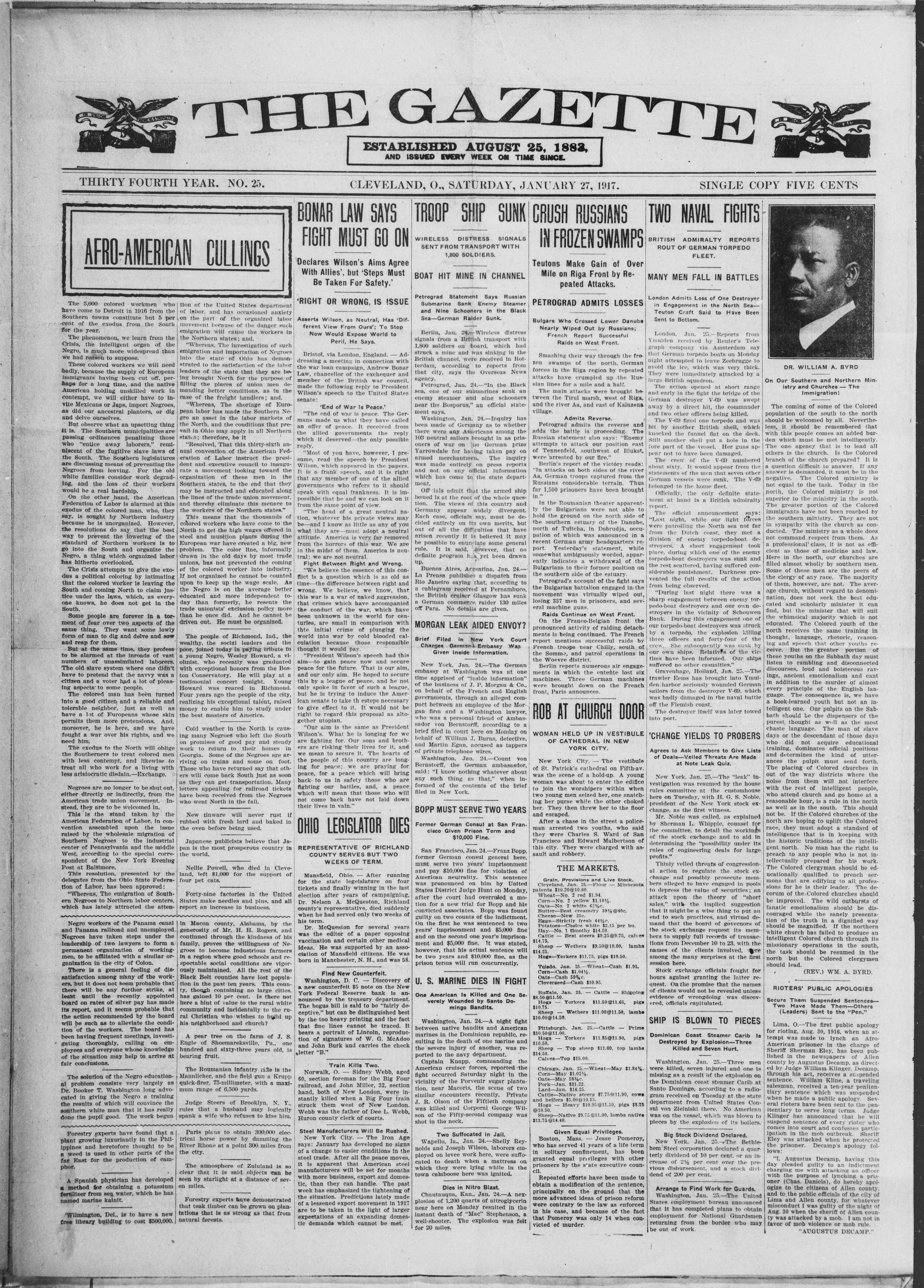
AFRO-AMERICAN CULLINGS
The 5,000 colored workmen who have come to Detroit in 1916 from the Southern towns constitute but 5 per cent of the exodus from the South for the year.
The phenomenon, we learn from the Crisis, the intelligent organ of the Negro, is much more widespread than we had reason to suppose.
These colored workers we will need badly, because the supply of European immigrants having been cut off, perhaps for a long time, and the native American holding unskilled work in contempt, we will either have to invite Mexicans or Japs, import Negroes, as did our ancestral planters, or dig and delve ourselves.
tion of the United States department of labor, and has occasioned anxiety on the part of the organized labor movement because of the danger such emigration will cause the workers in the Northern states; and.
"Whereas, The investigation of such emigration and importation of Negroes into the state of Ohio has demonstrated to the satisfaction of the labor leaders of the state that they are being brought North for the purpose of filling the places of union men demanding better conditions, as in the case of the freight handlers; and.
"Whereas, The shortage of European labor has made the Southern Negro an asset in the labor markets of
But observe what an upsetting thing it is. The Southern municipalities are passing ordinances penalizing, those who "entice away laborers", reminiscent of the fugitive slave laws of the South. The Southern legislatures are discussing means of preventing the Negroes from leaving. For the old white families consider work degrading, and the loss of their workers would be a real hardship.
On the other hand, the American Federation of Labor is alarmed at this exodus of the colored man, who, they say, is sought by Northern industry because he is unorganized. However, the resolutions do say that the best way to prevent the lowering of the standard of Northern workers is to go into the South and organize the Negro, a thing which organized labor has hitherto overlooked.
The Crisis attempts to give the exodus a political coloring by intimating that the colored worker is leaving the South and coming North to claim justice under the laws, which, as everyone knows, he does not get in the South.
Some people are forever in a torment of fear over two, aspects of the same thing. They want some lowly form of man to dig and delve and sow, and reap for them.
But at the same time, they profess to be alarmed at the inroads of vast numbers of unassimilated laborers. The old slave system where one didn't have to pretend that the navy was a citizen and a voter had a lot of pleasing aspects to some people.
The colored man has been turned into a good citizen and a reliable and tolerable neighbor, just as well as have a lot of Europeans whose skin permits them more pretensions. And, moreover, he is here, and we have fought a war over his rights, and we need him.
The exodus to the North will oblige the Southerners to treat colored men with less contempt, and likewise to treat all who work for a living with less aristocratic deadain—Exchange.
Negroes are no longer to be shut out, either directly or indirectly, from the American trade union movement. Instead, they are to be welcomed in.
This is the stand taken by the American Federation of Labor. In convention assembled upon the issue raised by the wholesale migration of Southern Negroes to the industrial center of Pennsylvania and the middle West according to the special correspondent of the New York Evening Post at Baltimore.
This resolution, presented by the delegates from the Ohio State Federation of Labor, has been approved:
"Whereas, the emigration of Southern Negroes to Northern labor centers, which has lately attracted the atten-
Negro workers of the Panama canal and Panama railroad and unemployed. Negroes have taken steps under the leadership of two lawyers, to form a permanent organization of workingmen, to be affiliated with a similar organization in the city of Colon.
There is a general feeling of dissatisfaction among many of the workers, but it does not seem probable that there will be any further strike, at least until the recently appointed board on rates of silver pay has made its report, and it seems probable that the action recommended by the board will be such as to alleviate the condition of the workers. The board has been having frequent meetings, investigating thoroughly, calling on employees and everyone whose knowledge of the situation may help to arrive at fair conclusions.
The solution of the Negro educational problem consists very largely as Dr. Booker T. Washington long advocated in giving the Negro a training the results of which will convince the southern white man that it has really done the pupil good. The work beginn
Forestry experts have found that a plant growing luxuriously in the Philippines and heretofore thought to be a weed is used in other parts of the fog East for the production of camphor.
A Spanish physician has developed a method for obtaining a potassium fertilizer from sea water, which he has named marine kainit.
Willington, Del. is to have a new free library building to cost $500,000.
tion of the United States department of labor, and has occasioned anxiety on the part of the organized labor movement because of the dungeer such emigration will cause the workers in the Northern states; and,
"Whereas, The investigation of such emigration and importation of Negroes into the state of Ohio has demonstrated to the satisfaction of the labor leaders of the state that they are being brought North for the purpose of filling the places of union men demanding better conditions, as in the case of the freight handlers; and,
"Whereas, The shortage of European labor has made the Southern Negro an asset in the labor markets of the North, and the conditions that prevail in Ohio may apply in all Northern states; therefore, be it
"Resolved, That this thirty-sixth annual convention, of the American Federation of Labor instruct the president and executive council to inaugurate a movement looking toward the organization of these men in the Southern states, to the end that they may be instructed and educated along the lines of the trade union movement, and thereby eliminate this menace to the workers of the Northern states."
This means that the thousands of colored workers who have come to the North to get the high wages offered in steel and munition plants during the European war have created a big, new problem. The color line, informally drawn in the old days by most trade unions, has not prevented the coming of the colored worker into industry. If not organized he cannot be counted upon to keep up the wage scale. As the Negro is on the average better educated and more independent today than formerly, he resents the trade unionists' exclusion policy more than he once did. And he cannot be driven out. He must be organized.
The people of Richmond, Ind., the wealthy, the social leaders and the poor, joined today in paying tribute to a young Negro, Wesley Howard, a violinist, who recently was graduated with exceptional honors from the Boston Conservatory. He will play at a testimonial, concert tonight. Young Howard was reared in Richmond. Four years ago the people of the city, realizing his exceptional talent, raised money to enable him to study under the best masters of America.
Cold weather in the North is causing many Negroes who left the South on promises of good pay and steady work to return to their homes in Georgia. Some of the Negroes are arriving on trains and some on foot. Those who have returned say that others will come back South just as soon as they can get transportation. Many letters appealing for railroad tickets have been received from the Negroes who went North in the fall.
New tinware will never rust if rubbed with fresh lard and baked in the oven before being used.
Japanese publicists believe that Japan is the most prosperous country in the world.
Nellie Powell, who died in Cleveland, left $1,000 for the support of four pet cats.
Forty-nine factories in the United States make needles and pins, and all report an increase in business.
In Macon county, Alabama, by the generosity of Mr. H. H. Rogers, and continued through the kildness of his family, proves the willingness of Negroes to become industrious farmers in a region where good schools and respectable social conditions are vigorously maintained. All the rest of the Black Belt counties have lost population in the past ten years. This country, though containing no large cities, has gained 10 per cent. Is there not a hint of value to the rural white community and incidentally to the rural Christian who wishes to build up his neighborhood and church?
A pear tree on the farm of J. S. Engle of Shoemarekville, Pa., one hundred and sixty-three years old, is bearing fruit.
The Roumanian infantry title is the Mannlicher, and the field gun a Krupp quick-fire, 75-millimeter, with a maximum range of 6,500 yards.
Judge Steers of Brooklyn, N. Y., rules that a husband may logically spank a wife who refuses to kiss him.
Paris plans to obtain 300,000 electrical horse power by damming the River Rhone at a point 300 miles from the city.
The atmosphere of Zululand is so clear that it is said, objects can be seen by starlight at a distance of seven miles.
Forestry experts have demonstrated that teak timber can be grown on plantations that is as strong as that from natural forests.
ESTABLISHED AUGUST 25, 1882 AND ISSUED EVERY WEEK ON TIME SINCE
CLEVELAND, O., SATURDAY, JANUARY 27, 1917.
BONAR LAW SAYS FIGHT MUST GO ON
'Declares Wilson's Aims Agree With Allies,' but 'Steps 'Must Be Taken' For Safety.'
RIGHT OR WRONG, IS ISSUE
Asserta Wilson, as Neutral, Has 'Different View From Ours'; To Stop Now Would Expose World to Peril, He Says.
Bristol, via London, England. — Addressing a meeting in connection with the war loan campaign, Andrew Bonar Law, chancellor of the exchequer and member of the British war council, made the following reply to President Wilson's speech to the United States senate:
'End of War Is Peace.'
"The end of war is peace. The Germans made us what they have called an offer of peace. It received from the allied governments the reply which it deserved—the only possible reply.
"Most of you have, however, I presume, read the speech by President Wilson, which appeared in the papers. It is a frank speech, and it is right that any member of one of the allied governments who refers to it should speak with equal frankness. It is impossible that he and we can look on it from the same point of view.
"The head of a great neutral nation, whatever his private views may, be—and I know as little as any of you what they are—must adopt a neutral attitude. America is very far removed from the horrors of this war. We are in the midst of them. America is neutral; we are not neutral.
Fight Between Right and Wrong.
"We believe the essence of this conflict is a question which is as old as time—the difference between right and wrong. We believe, we know, that this war is a war of naked aggression, that crimes which have accompanied the conduct of the war, which have beeth unknown in the world for centuries, are small in comparison with the initial crime of plunging the world into war by cold blooded calculation because those responsible thought it would pay.
"President Wilson's speech had this aim—to gain peace now and secure peace for the future. That is our aim, and our only aim. He hoped to secure this by a league of peace, and he not only spoke in favor of such a league, but he is trying to induce the American senate to take the estates necessary to give effect to it. It would not be right to regard this proposal as altogether utopian.
"Our aim is the same as President Wilson's. What he is longing for we are fighting for. Our sons and brothers are risking their lives for it, and we mean to secure it. The hearts of the people of this country are longing for peace; we are praying for peace, for a peace which will bring back to us in safety those who are fighting our battles, and, a peace which will mean that those who will not come back have not laid down their lives in vain."
OHIO LEGISLATOR DIES
OHIO LEGISLATOR DIES
REPRESENTATIVE OF RICHLAND COUNTY SERVES BUT TWO WEEKS OF TERM.
Mansfield, Ohio. — After running for the state legislature on four tickets and finally winning in the last election after years of campaigning, Dr. Nelson A. McQuestion, Richland county's representative, died suddenly when he had served only two weeks of his term.
Dr. McQuestion for several years was the editor of a paper opposing vaccination and certain other medical ideas. He was supported by an association of Mansfield citizens. He was born in Manchester, N. H., and was 58.
Find New Counterfeit.
Washington, D. C. — Discovery of a new counterfeit $5 note on the New York Federal Reserve bank is announced by the treasury department. The bogus bill is said to be "fairly deceptive," but can be distinguished best by the too-heavy printing and the fact that fine lines cannot be traced. It bears a portrait of Lincoln, reproduction of signatures, of W. G. McAdoo and John Burk and carries the check letter "B."
Train Kills Two.
Norwalk, O. — Sidney Webb, aged 60, section foreman for the Big Four railroad, and John Miller, 32, section hand, both of New London, were instantly killed when a Big Four train struck them west of New London. Webb was the father of Dee L. Webb, Huron county clerk of courts.
Steel Manufacturers Will Be Rushed. New York City. — The Iron Age says: January has developed no signs of a change to easier conditions in the steel trade. After all the peace moves, it is apparent that American steel manufacturers will be set for months with more business, export and domestic, than they can handle. The past week has emphasized the tightening of the situation. Predictions lately made of a lessened export movement in 1917 are to be taken in the light of larger expectations of an expanding domestic demands which cannot be met.
TROOP SHIP SUNK
TROOP SHIP SUNK
WIRELESS DISTRESS. SIGNALS
SENT FROM TRANSPORT WITH
1,800 SOLDIERS.
BOAT HIT MINE IN CHANNEL
Petrograd Statement Says Russian Submarine Bank Enemy, Steamer and Nine Schooners in the Black Sea—German Raider Sunk.
Berlin, Jan. 24.—Wireless distress signals from a British transport with 1,800 soldiers on board, which had struck a mine aid was sinking in the British channel, were received in Hotterdant according to reports from that city, says the Overseas News agency.
Petrograd, Jan. 24.—"In the Black sea, one of our submarines sank an enemy, steamer and nine schooners near the Bosporus," an official statement says.
Washington, Jan. 24.—Inquiry has been made of Germany as to whether there were any Americans among the 103 neutral sailors brought in as prisoners of war on the German prize Yarrowdale for having taken pay on armed merchantmen. The inquiry was made entirely on press reports and not on any official information which has come to the state department.
Officials admit that the armed, ship issued is at the root of the whole question. The views of this country and Germany appear widely divergent. Each case, officials say, must be decided entirely on its own merits, but out of all the difficulties that have arisen recently it is believed it may be possible to enunciate some general rule. It is, said, however, that no definite program has yet been drawn up.
Buenos Aires, Argentina, Jan. 24.—La Presa publishes a dispatch from Rio Janicelo saying that, according to a cablemagnet, received at Pernambuco, the British cruiser Glasgow has sunk a German commerce raider 130 miles off Para. No details are given.
MORGAN LEAK AIDED ENVOY?
Brief Filed in New York Court Charges Germain Embassy Was Given Inside Information.
New York, Jan. 24.—The German embassy at Washington was at one time apprised of "inside information" of the business of J. P. Morgan & Co., on behalf of the French and English governments, through an alleged compact between an employee of the Morgan firm and a Washington lawyer, who was a personal friend of Ambassador von Bernstorf, according to a brief filed in court here on Monday on behalf of William J. Burns, detective, and Martin Egan, accused as tappers of private telephone wires.
Washington, Jan. 24.—Count von Bernstorf, the German ambassador, said: "I know nothing whatever about any such thing as that," when informed of the contents of the brief filed in New York.
BOPP MUST SERVE TWO YEARS
Former German Consul at San Francisco cisco Given Prison Term and $10,000 Fine.
San Francisco, Jan. 24.—Bronz Bopp, former German consul general here, must serve two years' imprisonment and pay $10,000 fine for violation of American neutrality. This sentence was pronounced on him by United States District Judge Hunt on Monday, after the court had overruled a motion for a new trial for Bopp and his convicted associates. Bopp was found guilty on two counts of the indictment. On the first he was sentenced to two years' imprisonment and $5,000 fine and on the second one year's imprisonment and $5,000 fine. It was stated, however, that his actual sentence will be two years and $10,000 fine, as the prison terms will run concurrently.
U. S. MARINE DIES IN FIGHT
One American Is Killed and One Severely Wounded by Santo Domingo Bandits.
Washington, Jan. 24.—A night fight between native bandits and American marines in the Dominican republic, resulting in the death of one marine and the severe injury of another, was reported to the navy department.
Captain Knapp, commanding the American cruiser forces, reported the fight occurred Saturday night in the vicinity of the Porvencir sugar plantation, near Macoris, the scene of two similar encounters recently. Private J. R. Olson of the Fiftieth company was killed and Corporal George Wilson of the Fifty-second company was shot in the neck.
Two Suffocated in Jail.
Wapello, In., Jan. 24—Shelly Reynolds and Joseph Wilson, laborers employed on levee, work here, were suffocated to death when a mattress on which they were lying while in the town calaboose here was ignited.
Dilea In Nitro Blast.
Chautauqun, Kann, Jan. 24. — A nexplosion of 1,200 quarts of nitroglycerin near here on Monday resulted in the instant death of "Mac" Stephenson, a well-shooter. The explosion was felt for 20 miles.
CRUSH RUSSIANS IN FROZEN SWAMPS
CRUSH RUSSIANS IN FROZEN SWAMPS
Teutons Make Gain of Over Mile on Riga Front by Repeated Attacks.
PETROGRAD ADMITS LOSSES
Bulgars Who Crossed Lower Danube
Nearly Wiped Out by Russians;
French Report Successful
Raids on West Front.
Smashing their way through the frozen swamps of the north, German forces in the Riga region by repeated attacks have crumpled up the Russian lines for a mile and a half.
The main attacks were brought between the Tirul marsh, west of Riga, and the river Au, and east of Kalazena village.
Admits Reverse.
Petrograd admits the reverse and adds the battle is proceeding. The Russian statement also says: "Enemy attempts to attack our position east of Tennenfeld, southwest of Hlukst, were arrested by our fire."
Berlin's report of the victory reads: "In attacks on both sides of the river Aa, German troops captured from the Russians considerable terrain. Thus for 1,500 prisoners have been brought in."
In the Roumanian theater apparently the Bulgarians were not able to hold the ground on the north side of the southern estuary of the Danube, north of Tultchia, in Dobrudja, occupation of which was announced in a recent German army headquarters report. Testerday's statement, while somewhat ambiguously worded, apparently indicates a withdrawal of the Bulgarians to their former position on the southern side of the estuary.
Petrograd's account of the fight says the Bulgarian battalion engaged in the movement was virtually wiped out, losing 337 men in prisoners, and several machine guns.
Raids Continue on West Front.
On the Franco-Belgian front the pronounced activity of raiding detachments is being continued. The French report mentions successful raids by French troops near Chilily, south of the Somme, and patrol operations in the Woevre district.
Berlin reports numerous air engagements in which the entente lost six machines. Three German machines were brought down on the French front, Paris announces.
ROB AT CHURCH DOOR
WOMAN HELD UP IN VESTIBULE OF CATHEDRAIL IN NEW YORK CITY.
New York City. — The vestibule of St. Patrick's cathedral on Fifth avail was the scene of a holdup. A young woman was about to enter the edifice to join the worshipers within when two young men seized her, one snatching her purse while the other choked her. They then threw her to the floor and escaped.
After a chase in the street a police-man arrested two youths, who said they were Charles S. Ward of San Francisco and Edward Malbertson of this city. They were charged with assault and robbery.
THE MARKETS.
Grain, Provisions and Live Stock.
Clivia, Inc. — Flow — Minnesota
patents $10.29@10.60.
Buffalo. Jan. 25. — Cattle + Slipking
$8.50@11.50.
Yorkers $11.50@11.65. pigs
$10.75.
Sheep $10.75. Wethers $11.50@11.50. lambs
$10.00@14.50.
Pittsburgh. Jan. 25.—Cattle + Prime
$10.50@11.00.
Hogs $10.50@11.00. Yorkers $11.85@11.90. pigs
$10.50@11.00.
Sheep — Top sheep $11.00, top lambs
$14.60.
Calves-Top $15.00.
Chicago, Jan: 23 — Wheat-May $1.84%.
Corn-May $1.02%.
Oats-May $8.6%.
Pork-Jan. $31.23.
Laundry-May $11.55.
Cattle-Native sters $7.75@11.90, cow
and heifers $5.00@10.15.
Hogs — Heavy $10.95@11.50, pigs $8.75
@10.50.
Shipping-Native $7.75@11.00, lambs native
$1.75@14.40.
Given Equal Privileges
Boston, Mass. — Jesse Pomeroy, who has served 41 years of a life term in solitary confinement, has been granted equal privileges with other prisoners by the state executive council. Repeated efforts have been made to obtain a modification of the sentence, principally on the ground that the more advanced ideas of prison reform were contrary to the law as enforced in his case, and because of the fact that Pomeroy was only 14 when convicted of murder.
TWO NAVAL FIGHTS
TWO NAVAL FIGHTS
BRITISH ADMIRALTY, REPORTS
ROUT OF GERMAN TORPEDO
FLEET.
MANY MEN FALL IN BATTLES
London Admits Loss of One Destroyer in Engagement in the North Sea—Teuton Craft Said to Have Been Sent to Bottom.
London, Jan. 25. Reports from Yonkers received by Reuter's Telegraph company via Amsterdam say that German torpedo boats on Monday night attempted to leave Zeebrugge to avoid the lee, which was very thick. They were immediately attacked by a large British squadron.
The action opened at short range and early in the fight the bridge of the German destroyer V-69 was swept away by a direct hit, the commander and two other officers being killed.
The V-69 fired one torpedo and was hit by another British shell, which knocked the funnel flat on the deck. Still another shell put a hole in the core part of the vessel. Her guns appear not to have been damaged.
The crew of the V-69 numbered about sixty. It would appear from the statements of the men that seven other German vessels were sunk. The V-69 belonged to the home fleet.
Officially, the only definite statement at hand is a British admiralty report.
The official announcement says: "Last night, while our light forces were patrolling the North sea not far from the Dutch coast, they met a division of enemy torpedo-boat destroyers. A short engagement took place, during which one of the enemy torpedo-boat destroyers was sunk and the rest scattered, having suffered considerable punishment. Darkness prevented the full results of the action from being observed.
"During last night there was a sharp engagement between enemy torpedo-boat destroyers and our own destroyers in the vicinity of Schouwen Bank. During this engagement one of our torpedo-boat destroyers was struck by a torpedo, the explosion, killing three officers and forty-four of the crew. She subsequently was sunk by our own ships. Relations of the victims have been informed. Our ships suffered no other casualties."
Gravenhoud, Holland, Jan. 25.—The trawler Eems has brought into Yunilden harbor seriously wounded German sailors from the destroyer V-60, which was badly damaged in the naval battle off the Flemish coast.
The destroyer itself was later towed into port.
'CHANGE YIELDS TO PROBERS
Agrees to Ask Members to Give Lists of Deals—Velled Threats Are Made at Note Leak Quiz.
New York, Jan. 25—The "leak" investigation was resumed by the house rules committee at the customhouse here on Tuesday, with H. G. S. Noble, president of the New York stock exchange, as the first witness.
Mr. Noble was called, as explained by Sherman L. Whipple, counsel for the committee, to detail the workings of the stock exchange and to aid in determining the "possibility under its rules of engineering deals for large profits."
Thinly veiled threats of congressional action to regulate the stock exchange and possibly prosecute members silenced to have engaged in pools to deprive the value of securities; an attack upon the theory of "short sales," with the implied suggestion that it might be a wise thing to put an end to such practices; and virtual demand that the board of governors of the stock exchange request its members to supply full records of transactions from December 10 to 23, with the names of the clients involved, among the many surprises at the first session here.
Stock exchange officials fought for hours against granting the latter request. On the promise that the names of clients would not be revealed unless evidence of wrongdoing was discovered, officials capitulated.
SHIP IS BLOWN TO PIECES
Dominican Coast Steamer Carib is Destroyed by Explosion—Three Killed and Seven Hurt.
Washington, Jan. 25.—Three men were killed, seven injured and one is missing as a result of the explosion on the Dominican const steamer Carib at Santo Domingo, according to a radiogram received on Tuesday at the state department from United States Consul von Ziehlskil there. No American was on the vessel, which was blown to pieces by the explosion of its boilers.
Big Stock Dividend Declared.
New York, Jan. 25.—The Bethlehem steel corporation declared a quarterly dividend of 10 per cent, or an increase of 2½ per cent over the previous disbursement, and a stock dividend of 200 per cent.
Arrange to Find Work for Guards.
Washington, Jan. 25.—The United States employment bureau announced that it has completed plans to obtain employment, for National Guardsmen returning from the border who may be out of work.
UNITED STATES OF AMERICA
DR. WILLIAM A. BYRD
On Our Southern and Northern Ministry and Churches—The Immigration!
The coming of some of the Colored population of the south to the north should be welcomed by all. Nevertheless, it should be remembered that with this people comes an added burden which must be met intelligently. The one agency that is to lead all others is the church. Is the Colored branch of the church prepared? It is a question difficult to answer. If any answer is demanded, it must be in the negative. The Colored ministry is not equal to the task. Today in the north, the Colored ministry is not superior to the ministry in the south. The greater portion of the Colored immigrants have not been reached by the southern ministry. They are not in sympathy with the church as conducted. The ministry as a whole does not command respect from them. As a professional class, it is not as efficient as those of medicine and law. Here in the north, our churches are filled almost wholly by southern men. Some of these men are the peers of the clergy of any race. The majority of them, however, are not. The average church, without regard to denomination, does not seek the best educated and scholarly minister it can find, but the minister that will suit the whimsical majority which is not educated. The Colored youth of the north receives the same training in thought, language, rhetoric, reasoning and speech that other youths receive. But the greater portion of the north receives the same training in thought, language, rhetoric, reasoning and speech that other youths receive. But the greater portion of these youths on the Sabbath day must listen to rambling and disconnected discourses, loud and boisterous ravings, ancient emotionalism and can in addition to the murder of almost every principle of the English language. The consequence is, we have a book-learned youth but not an intelligent one. Our pupils on the Sabbath must the pulpits on the purest thought as well as the most chaste language. The man of slave days' or the descendant of those days' who did not acquire educational training, dominates official positions and determines the kind of utterances the pulpit must send forth. The placing of Colored churches in out of the way districts where the noise from them will not interfere with the rest of intelligent people, who attend church and go home at a reasonable hour, is a rule in the north as well as in the south. This should not be. If the Colored churches of the north are hoping to uplift the Colored race, they must adopt a standard of intelligence that is in keeping with the historic traditions of the intelligent north. No man has the right to preach to any people who is not intellectually prepared for his work. The Colored clergyman should be educationally qualified to preach sermons that are edifying to all professions for he is their leader. The decorum of the Colored churches should be improved. The wild outbursts of fanatic emotionalism should be discouraged while the sheer presentation of the truth in a dignified way should be magnified. If the northern white church has failed to produce an intelligent Colored church through its missionary operations in the south, the task should be resumed in the north but the Colored clergymen should lead.
(REV.) WM. A. BYRD.
RIOTERS'. PUBLIC APOLOGIES
Secure Them Suspended Sentences—Two Have Made Them—Others (Leaders) Sent to the "Pen."
Lima, O.—The first public apology for rioting, Aug. 30, 1916, when an attempt was made to lynch an Afro-American prisoner in the charge of Sheriff Sherman Eley, has been published in the newspapers of Allen county by Augustus Decamp, as directed by Judge William Klinger. Decamp, through his act, receives a suspended sentence. William Kline, a traveling chapman in an year penitentiary sentence which he endured when he made a public apology. Several rioters have been sent to the penitentiary to serve long terms. Judge Klinger has announced that he will suspend sentence of every rioter who comes into court and confesses participation in the mob outbreak. Sheriff Eley was attacked when he protected the prisoner. Decamp's apology follows:
"I, Augustus Decamp, having this day pleaded guilty to an indictment charged with attacking an officer with the purpose of murdering an officer (Chas. Daniels), do hereby apologize to the citizens of Allen county, and to the public officials of the city of Lima and Allen county, for whatever misconduct I was guilty of the night of Aug. 30 when the sheriff of Allen county was attacked by a mob. I am not in favor of mob violence or mob rule.
SUBSCRIPTION RATES
(Yin Advance)
One Year.....$1.50.
Six Months.....1.00
Three Months......50
Subscribers are requested to rem
mit by postoffice money en
der or registered letter
Entered at the postoffice in Cleveland
Ohio, as second-class matter.
Address all communications to
HARRY C. SMITH
Editor and proprietor,
THE GAZETTE,
Blackstone Building, Cleveland, O.
Member Ohio Legislature: 1894
to 1896; 1896 to 1898; 1900 to 1902
THE GAZETTE is the oldest, and has the largest bona fide circulation, double that of any newspaper in the interest of Afro-Americans, published in the state of Ohio, and comparison with any will immediately establish its rank as one of the NEWSIEST AND BEST in the country.
SATURDAY, JANUARY 27, 1917.
"Let us have faith that right makes might, and in that faith let us to the end dare to do our duty as we understand it."—Abraham Lincoln.
The Democrats are about to force a public building bill through Congress. It is so palpably full of pork that Congressman Fess says that one hundred items excluded by the recommendations of the Treasury department are in it. It contains a just appropriation for a needed public building in his district at Urbana, but Congressman Fess cannot vote for the bill because, he says: "By the sheerest rule of common sense it is too high a price to pay."
There is a marked difference in the way the Democratic and Republican press treats the "leak" probe in Washington. The Democratic papers dwell upon the fact that Tom Lawson as a "blathersite," that Messrs. Lansing, McAdoo, Tumulty, et al., declare they are innocent. Therefore, let the probe cease. On the other hand, the Republican papers dwell on the fact that there was a leak and that unscrupulous parties made money out of the leak. Therefore, they declare, let the probe go on until it finds the leak and who profited by it.
THE SMITH FUND
We were disappointed when Mr. Greene, of the Y. M. C. A., reported to us only three dollars as added to the Smith Fund. That we should be so unresponsive to such appeals shows us as lacking in essential race material. That Smith jeopardized his life and lost his liberty by saying things we all would gainssay ourselves and yet when the opportunity comes to aid him a hit we laud idea and tighten the strings of our bookbooks, speaks bad and looks bad. The only encouraging side to us was the letter from the Hon. Harry C. Smith, editor of Cleveland Gazette. We publish it and call on our editors to help a fellow of the craft who certainly needs help. We look in vain in times of appeals like this for the names of our preachers and teachers and other good salaried people. Harry C. Smith is nationally known as a fighter for absolute justice and for a firm racial manhood. We are glad to get his commendation to this proposition and hope other editors will follow his lead — Louisville (Ky.) News.
AN OPEN LETTER.
Cleveland, O., Jan. 11, 1917.
Mr. Wm. Warley,
Care, "The News,"
Louisville, Ky.
"Dear Friend:—The enclosed check for one dollar is self-explanatory—it is for your (News)' fund for Editor A.T. Smith, of the Paul Quinn (Texas)
Weekly, that Prof. G. M. McClelland heads.
Call on our editors for one dollar each and give those ABLE TO DO SO a chance to contribute and thus SHOW some of the real race and brotherly (journalistic) interest we always preach about and too seldom have an opportunity to show in a PRACTICAL way.
You know I always read the Louisville, (Ky.) News with exceptional interest because it is one of our most loyal and best race advocates. Long may it live and prosper. The race needs it.
Wishing it and you a happy and very successful new year (and many of them), I am sincerely
Yours for the Race. HARRY C. SMITH.
THE WALL STREET LEAK.
Three thirgs stand out in the Wall street leak. First, there was a leak. Second, Congressman Henry, chairman (Democratic) of the committee on rules, steadily sought to keep down an investigation. Third, the lid is now off and a national scandal has developed.
Accusation is not guilt. Neither is denial innocence. But if the public is in a somewhat critical frame of mind, the Democratic administration has but itself to blame. Charges affecting the national honor are not best met by evasion and attempts to avoid them. The bars should have been thrown down. If public opinion has crystallized to the point where it believes that there is something rotten in the District of Columbia, the Democratic mis-managers are but themselves to blame.
Thomas B. Lawson, under oath, now avers that Chairman Henry said to him in their private conference,
and there should never have been any private conference by the chairman, that a cabinet officer, a senator and a banker were engaged in a stock-gambling pool. Lawson added that the men alleged to be involved were Secretary of the Treasury McAdoo, the banker was H. Pliney Fiske of New York and a U. S. senator known to him only by the initial "O". Other names were brought in freely. Mr. Henry contradicted Lawson at all points while Lawson countered by saying that immediately after his conference with Henry he laid the information given him by Henry before John O'Hara Cosgrove, Sunday editor of the New York World; Erman J. Ridgeway, president of Everybody's magazine; and Donald McDonald, publisher of a Boston financial paper. Mr. Lawson further avers that Mr. Henry requested that the matter not made public as a matter of patriotism. As a matter of "patriotism", the matter should be investigated to the last man, the last telegram and the last book account. This is due the men under charge, but it is also due the people that have the government at Washington. No chairman has a right to sit in his office, ignoring the rest of his committee, have private conferences with witnesses, and, to decide individually whether or not there is to be a probe. Chairman Henry has but himself to blame if he has made himself the goat in his desire to save the officials of the national administration from investigation. A week ago it was almost a crime in Congress for a Republican member to ask for a probe of the Wall Street leak. It seems different now. Press dispatches of January 11 stated that the Democratic members of Congress "voted over the vigorous protest of the Republicans to report unfavorably the Wood resolution" to investigate the Wall street leak. The developments of the last few days give the all-sufficient reason for their earnest efforts to escape the "pitiless publicity" of a probe.
"OPPOSES NEGRO EXODUS."
The Tuskegee Conference, true to its policy, stultified itself by appealing to our people to remain south and not be lured north by reason of high wages. ROT! What the race needs is better wages. If the south gave the same wages as is given in the north, sensible men would feel that it would be the thing for our people to do—to go and get it where their lives and persons are respected and protected. If this conference had gone on record through the Associated Press, demanding that lynching, "jimcrowism," brutal treatment, indecent riding-coaches, gross insults to our women by white men, segregation and a train of other indigenties, be discontinued, and in their stead the race be given the franchise and equal protection of the law, their pronunciamento of truckling and shameful betrayal of the best interests of the race would in a measure have been mitigated. It goes without saying, our people will ignore the paid servants of southern oppression.
VARDAMAN.
U. S. Senator Vardaman, of Mississippi, has introduced a resolution in the senate ask the U. S. supreme court to pass upon the validity of the fifteenth amendment. In fact all the amendments of the U. S. constitution that enfranchise our people. Some may dismiss this enemy of the race with silence and contempt and thippe that will suffice. Let us not fool ourselves, for it has been the policy of southern demagogues to agitate till something happens. There is danger now in Washington, D. C. Mr. Wilson liberated certain criminals who were guilty of tampering with the franchise in Oklahoma. Who knows but what he would sign any bill that might come to him depriving our people of their right to American citizenship? Who knows but what he is behind this move of Vardaman's. Does any one doubt his ability to carry through congress any matter he wants, especially since he is serving his second and last term in office? Vardaman must be fought, and that systematically. He might as well learn now as later that the amendments, adopted to safe-guard and protect the citizenship of the race, will not be destroyed without a bitter fight. He would have the ability knowledge of our feelings if he would simply understand that our men are as zealous for their rights as he is for; that we will fight as hard and as vigorously for our franchise as he will for his. We further warn him that his helping Mississippi to nullify the U. S. constitution, by depriving our men of their votes because they will not vote for men such as he, will not receive the sanction of the race by acquiescing in having his nefarious practice go further. It is the smarting of a lacerated conscience that makes Vardaman seek to repeal these amendments. He realizes that the conscience of political parties has been seared like his on this issue, and as long as it is left to politics he and his allies will suffer from the castigations of their morbid consciences. We are not only going to fight the disfranchisement of our people but we are going to appeal to the conscience of this country to enforce the constitution. When any state disfranchisement its citizens that state must also lose proportionately in its representation in the lower house of congress, says a mandatory clause of the U. S. constitution. Mr. Vardaman knows that his state has almost a half million only eighty thousand "voted" in the last presidential election — seventy-four thousand for Wilson and six thousand for Hughes. But these eighty thousand voters have TEN congressmen in the lower house of congress, whereas in the thirty-eighth district of New York it took forty thousand votes to elect ONE congressman. Mississippi is stealing its way in Congress. The wall of Mr. Vardaman is that some one should help him get rid of stolen goods. The repeal of these amendments will affect our voters everywhere. Prior to these amendments only white men could vote. If the amendments are unconstitutional, that statute is still in force. Negroes of New York and
THE GAZETTE, CLEVELAND, O., SATURDAY, JANUARY 27, 1917.
Ohio are as much concerned in the perpetuity of these amendments as those of Mississippi. For this right, bought by blood and hallowed by the deaths of the noblest of this land, our men will freely give their blood—to maintain and uphold. The constitution of this country is not safe in Democratic hands. Southern men of the Vardaman type would destroy it as quickly as they would a rabbit. This nation would better beed this warning now that it is unsafe to continue the welfare of the country in the hands of southern Democracy. Whenever the Democratic party wins, the south reigns. The liberties of white men of the country, outside of the south, are no more sacred than those of our people. Because the Democratic south hates the Republican party, and the north, and does not intend for the former to get a foot-hold in the south, is why it has disfranchised our voters who love the Republican party that gave it freedom and liberty. The punishment of our voters in the south is the Democratic method of punishing the Republican party and it is a pity that the Republican party has been so obtuse as not to see this a long time ago. Those amendments must remain, or better ones enacted in their stead.
On the Use of Colored Troops in the
Great War, Fronts
Millions of People,
By J. M. Batchman, Staff Correspondent.
St. Louis, Mo.—The German note of Jan. 12, 1917, contains this statement: "Likewise contrary to the laws of nations and incompatible with the usages of civilization, are the use of COLORED troops in Europe and the extension of the branch into Africa, which was done by a branch of ing treating treaties, and which undermines the prestige of the white race on that continent."
It is remarkable that the Imperial Government should so far neglect its "KULTURE," in its diplomatic correspondence, as to use language which can do nothing more than divorce the respect and neutrality of 10,000,000 Colored Americans who, at best, have been disposed to take the side of fair-minded people and wish that the war might be fought out and the strongest side, morally, come out on top. The German attitude, wishing for the predominating influence in Africa to be which the nation would be the nation of the rest of Europe, but it is in principle repugnant to the opinion of Colored America which is beyond a doubt the most neutral part of the great mass of Americans.
There was a time when little Japan would have taken a more prominent part in the war on the side of the Allies, but for the fact that when she made the proposition to be taken in "on the ground floor" in the peace negotiations and considered the equal of the great powers of Europe, the idea did not meet with favor with the white population of those countries; the sole reason to have been because the Japanese are of a darker race, are "colored."
Those high German officials who permit the idea to go out broadcast that white men are too good to measure arms with the men of darker races, fail to promote neutrality in its broadest sense. Nations in their dealings with other nations can ill afford to lose the power of if they do they lose the power of who are of a different ancestry and who, perhaps, believe themselves the equals of all other mankind. The Afro-American is so constituted that he cannot quietly tolerate such self-exalted opinions in others and give them moral support without loss of self-respect. The Germans might have well omitted giving expression to that part of their note dealing with the issue of whether they have in the present case lost some of the exalted opinion which our people everywhere have held of the German people as a whole.
JAMES HARVEY JACKSON DIES.
James Harvey Jackson, who with Messrs. John Lightfoot, John Holmes and the editor of The Gazette started this paper nearly thirty-four years ago, died of acute indigestion last Friday night at a local hospital. He became ill while at work during the day. Two former wives, one at Wilberforce and the other in this city, from both of whom he was divorced; and two children, both grown, James H., of Detroit, and Miss Cora, of N. Y. City, by his first wife, survive him; also two brothers, Clayborn C., of this city, and Oliver T., of Denver, Colo., former wife of the late Robert Sanger to governors of that state, with the exception of about a year and a half, for the last eight or ten years; and a sister, Mrs. Sarah Murphy of Hamilton, who also resided in Cleveland, many years ago. Mr. Jackson also lived for years in Detroit, Chicago and St. Paul, returning to this city via Detroit about ten or fifteen years ago. The funeral services, Sunday afternoon, at Mt. Zion Congregational church, of which he had been a member for some years, were largely attended. the pastor, Rev. G. V. Clark, officited, assisted by Rev. Pezavia O'Connell of Cory M. church and Rev. J. M. St. John's church. The masons and the C. A. of C. M. of which the deceased was a member, attended, the former carrying out its usual funeral service also, and the latter presenting a set of resolutions which were well read by Dr. E. A. Dale. The body was shipped to Oxford, the native home of the Jackson family. His son, daughter and brother, Clayborn, were in attendance upon the funeral services, Sunday, and have the sympathy of many persons in this community.
ALDERMAN DEPRIEST "IN BAD"!
Chicago, Ill.—Six indictments charging conspiracy were returned in court, Jan. 18, against Oscar DePriest, Afro-American alderman, and Police Captain Stephen Healy. Nineteen others are included in the true bills returned by the county grand jury. They are charged with conspiracy in the exaction of tribute from underworld characters for police protection. Among those named were two detective sergeants, (white), Henry "Teenan" Jones and about a dozen other well-known Afro-American sports of the "black belt."
Our advertisers want your trade. Those who do not ask for it in The Gazette certainly care little, if at all, for it. Therefore, we urge our readers and all of our friends to patronize those who ask for your trade in this paper.
Written by 'The Old Reliable' Gazette's Correspondents
THROUGHOUT THE STATE
What Our People Are Doing Each Week—Church, Personal, Social, Lodge, Literary and Musical—Marrigages, Deaths, Etc.
ELYRIA.—Mr. Michael Davis has gone to New Castle, Pa. Mrs. Frankie Goodson has returned to North Carolina—Miss Marie Ackley, of Cleveland, is visiting her sister, Mrs. Lloyd Brown—The Y. M. W. I. club will meet at Mrs. Hayes, next Thursday. A very enjoyable sleigh ride party was given by Mrs. Jennie Johnson, Tuesday—Visiting her soops in Cleveland—A pleasure club has been organized by young ladies and named the Wa-Wa-Tase club.
CADIZ. — The M. Y. L. club will celebrate the Hon. Frederick Douglass' birthday, Feb. 12. — St. James' S. S. room was well filled, Sunday morning, at the opening service. The pastor B. Robbins, of Omaha sermon, Guy B. Robbins, of Omaha led by his wife's death, Revs. O. W. Childers, Chas. Bundy, P. E., and W. H. Lucas officiated at the funeral. Miss Lucile Johnson of Wilberforce, Mr. and Mrs. Clarence Morris of Warren E. and Wm. Johnson of Cleveland, served relatives in attendance from a distance. — Allen Brown has been seriously ill.
YOUNGSTOWN. — Dr. C. Pettiford is sick. — Jas. Lawson, of Erie, was here Sunday. — Mrs. J. H. Bobson is a little better. — Buckeye Lodge, Elks, will install officers, Thursday evening. — W. A. Snowden is convalescing. — Mr. and Mrs. Chas. Green, of the Sharon line, spent Sunday with Mr. and Mrs. J. H. Harvey. — Mr. and Mrs. J. H. Lomax are rejoicing: It's a girl. Attnnews Roberts, Chester County have opened offices in W. Federal Court. Mr. Dorsey is home from the hospital. Mr. Dorsey she was operated upon. — The oldest and most reliable race paper, and the BEST one in this section of the country, is The Gazette. Tell your friends and acquaintances to order it.
CORRESPONDENTS must mail all letters for publication at their main postoffice sufficiently early on Monday (or Sunday) of each week to have them reach The Gazette office on Tuesday morning, and always write also, their names and that of their city or town on the outside of the wrapper about returned copies. Unless this latter is done, proper credit cannot be given you. Lists of names, wedding presents, etc., obituary notices, speeches, resolutions, poetry, inventions and advertisements of all kinds including images announcing entertainments to be held in the near future, must be paid for in advance at the rate of ten cents a line, six words to a line. Our rates for display advertisements will be sent on application.
SANDUSKY—Mrs. Albert Straughter, age 33, died Jan. 18, and was buried from the Second Baptist church, Rev. G. D. Smith officiating. She leaves a sister, husband and many friends to mourn her demise.—Mrs. Jas. Davis is suffering from acute indigestion. We hope that she will recover. Mrs. Jas. Sotterra is Sunday—Rev. E. Burton is making a strong fight against sin at Homeville and Rev. T. Morris, of Detroit, is helping him. One convert, Sunday evening. The Second Baptist church will begin its annual meeting, Feb. 5.—Miss Maude Alexander is home from Ft. Wayne, Ind., visiting her parents, Mr. and Mrs. Wm. Alexander and child, Mr. and Mrs. Robert, Alexander and trot, was at home, Sunday.—Mrs. Edw. Bryant has lagripe.—Read The Gazette.
SMITHFIELD. — Miss Sadie Mercer and two nieces, of M. Tleasant, were week-end guests of Rev. and Mrs. Williams, Mr. and Mrs. E. Washington, of Steub, also attended St. Paul's church, Sunday. — Saturday, Mrs. E. H. Harris visited her niece, Miss M. Guyder who is seriously ill Washington, Mr. Pred Carter was in Washington, Pa., last week. Binns has rheumatism. — The second quarterly meeting and conference at St. Paul's church, Wednesday and Sunday, Rev. Chas. Bundy, P. E. preached ably in the afternoon, and assisted in the revival services, last week. He held quarterly meeting and conference at McIntyre, Saturday and Sunday, Mrs. Homer Harris and 6 others entertained at supper, Sunday and his Mrs. Pred Mr. and Mrs. H. Harris, Messrs Jas. Harris, sir, and jr. R. Hargrave and others were in Steub, last week. — Rev. S. S. Adams and a number of his members, from McIntyre, attended revival services here, last week, and he preached ably.
LANCASTER.—Lancaster has finally decided to make itself known to others through the old reliable Gazette. We have read of others and wish others to read of us and our weekly happenings. — Mrs. Samuel Harris died, Jan. 18, at the Municipal hospital, after a long illness. Dropsy. Funeral services, Monday afternoon, at the A. M. E. church. Internment in Elmwood cemetery.—Mr. and Mrs. Eosn Streets entertained on Sunday, Ralph Street and Lester Scott of Columbus.—Miss Helen Brown, of Buchtel, is visiting her sister, Mrs. Pearl Anderson.—Mr. and Mrs. Clark Wolfe and baby, Dorothy Melba, recently went to housekeeping on S. Wheat St.—Miss Theodiosia Hawkins entertained the Dunbar club, Friday evening. The meeting was presided over by the president, Miss Hilda Williams. As the roll was called, each member responded with an interesting current event. Business matters were transacted and a friendly social hour followed. She taught her children called to her home on Peach Tree, Ala, by her mother's serious illness.—Miss Lola Anderson was a Columbus visitor, Sunday.
HILLSBORO. — The entertainment at Lincoln building. Friday evening, was a success. A large crowd enjoyed the program. The debate on "Woman Suffrage" was able handled by the boys and girls of the eight grade. Proof Vance, H. C. C. Vance, H. C. C. Vance, and the Lincoln quartette sang. Lunch was served in basement by the Mothers' club.—Mrs. Washington of Tonapah, Nev, and
Miss Gertrude Cox of Dayton, visited relatives here, this week. They were guests of the former's uncle, Mr. James Anderson—Mrs. Clara Ford received word from Columbus, last week, that her daughter, Mrs. Anna Beard Greene, had been burned and was in a hospital—Rev. J. J. Burr was on Sunday, the Baptist church, in the absence of the pastor, Rev. Orr—Mr. Chas. Smith, who is employed as a barber at Steubenville, spent a few days here with his family, last week—Mr. Madison, of St. Louis, is visiting Miss Nannie Jackson—Mr. Peter Kittrell died, Jan. 19, after a few days' illness. Funeral services, held on Monday, the Baptist church, conducted by Rev. Orr. He leaves two sons, a brother and a number of relatives and friends to mourn his demise.
CULTURED BOSTON VOTE
Prefers License to "Prohibition" Be
causes the _Latter Does Not Pro-
hibit
Boston, Mass.—This city has voted 53,495 to 29,997, to continue the licensed saloon. This does not mean that the "Fib" endorses intemperance, but that it prefers regulation to "prohibition." Possibly Boston voters had in mind the neighboring city of Portland which, under the Maine prohibitory law, had been tolerating 50 bullets,ideope saloon, and Mayor Chapman's recent order to close these saloons disclosed 100 "blind tigers" doing a thriving business.
An amendment by U.S. Senator Underwood to leave the question in Washington, D. C., to a popular vote, women and men, was defeated. This debate and Mr. Bryan's advocacy of national "prohibition" prompted Mr. Henry Watterson, editor of the Louisville (Ky.) COURIER-JOURNAL, to say:
"Intelligent self-control is doing much to draw men away from strong bullets,ideope saloon, and drug abuse. But the regeneration of men must proceed from within and is of slow growth. We cannot hope to eliminate death, nor is prohibition likely to end drunkenness."
DOINGS
OF
THE
RACE
The widow of the late Bishop B. W.
Arnett died recently at Wilberforce.
Mickey Bros., progressive undertakers of Charleston, S. C., have 5 Reo limousines and a motor hearse.
The National Equal Rights league urges our people to observe the Lion.
Frederick Douglass' centenary, Feb.
14, and it should be done.
Ladies, our fashion page is the latest and best—up to date! Tell your friends and acquaintances about it, please. Chicago Defender is the largest and most unreliable race paper in the country. It is the race's leading yellow journal and it is always quoted at a risk—Louisville (Ky.) News.
CORRESPONDENTS WANTED
The old reliable Gazette desires an active agent and correspondent in every city and town in Ohio and neighboring states having a number of Afro-American residents. Only a little time on Fridays or Saturdays is required. We especially desirous of hearing from persons in the following named cities: Springfield, Dayton, Piqua, Mt. Vernon, East Liverpool, Akron, Lima, O., and other places, particularly in Ohio, where we have none.
Write to the editor of The Gazette, Blackstone building, Cleveland, O. anderms, or promptly. Our readers will oblige us greatly by sending at once the addresses of persons in the cities named and others in the state, to whom we can write relative to the matter.
A rare opportunity, comfortable living
home sewing, plain cloth seams. Any
sewing machine, stendy, service
ins. No rattles, wanted. Sampsons
return if not satisfactory. Home Sew-
ers Co. Jobbers sewing. Linc., 2 Neh-
both, Del.
GALLSTONES
NOTHING AGREES WITH MY THE GOLKSTONE RIMLEO
WOOD STORAM - CAS, CALC
FOOD AND LEG TREES AND LEAD - WON'T DIGG!
(HE GIVES ME THE MESSAGE OF PRIME ME)
You Can
Have a Good
Stomach Again
Stomach Trouble, Blillomass, Gas, Soor Rings, Sick Hand-
edges, Nervous Weakness, Computation, Colle, Yellow or
Sallow Skin, Gums, Distress and Pain in your Stomach, Side or
Back are majorly in general of Gallstone Troubles or River Dis-
ease. Don't doctor your symptoms. Stomach Trouble makes your
C�lation of You are more likely to be in the source.
C�lation worse. You must care your trouble and the source.
When you are in the source, you should be in the source.
Liver TROUBLE is the most common and typically in-
fects one to over ten times with GALLSTONES. It is
ARE YOU THAT JUNGLUCK ONE?
You probably are if you have any decided Liver or Stomach
trouble. It is better to know the Truth that to try to ever
it up by making your commitment to something else, our
will be the right choice of your method. For example, if you
are to your trouble and you'll get more tired at home. If you
have a Validation, you'll be more than better.
APPENDICTIS
Most so-called Appendiets that
appears to be due to GALL STONES. Many who have
been hard to see the nature prove to be due to GALL
TROUBLES. Many of these are GALLSTONES that are
used to provide it with a good balance. The same
our wonderful remedy GALLSTONES has saved
their lives. Send for our Livestock Box on May
GALLSTONES SEPTEMBER 29, 2019, 210 S. Casberns St., Chicago
DON'T THROW AWAY
Your copy of The Gazette after reading it, but give it to a friend or an acquaintance who might subscribe after reading a copy of the paper. Editor
KINKY
Miss Bessie Blakemore Cook
TEACHER OF PIANO
ABusy
ABusyLife
By HON, JOSEPH BENSON FORAKER
The Most Important Autobiography Mr Foraker has given us his experience on the Bench, as Governor of Ohio and in United States. Political and public events of great imp
The Most Important Autobiography In Years
Mr Foraker has given us his experience in the Union Army on the Bench, as Governor of Ohio and in the Senate of the United States.
Political and public events of great importance and incidentally many national characters are dealt with in the most enlightening manner.
The work will prove of special interest to all students of political history whether they are public officials or only public spirited Americans, interested in the preservation of our institutions.
2 VOLS. NET $5.00
All orders sent direct to the
"The GAZETTE"
Blackstone Bldg., Cleveland, O.
will have the personal direction
of its Editor
The GAZETTE
Blackstone Bldg.
CLEVELAND, O.
Please send me___cop___
"Notes of a Busy Life"
BY J. B. FORAKER
Net $5.00 for which I enclose___
Name___
Address___
12 GREAT SERIALS OR GROUP STORIES IN 1917
Stories upon Stories—and plenty of them. Action, Life, Adventure, Fun, Pathos, Inspiration.
The Youth's Companion
will make 1917 a Great Story Year. Besides the Great Serials and 250 Short Stories, there are rare Special Pages for each one. Family Page, Exceptional Editorial Page, Boys Page, Girls Page, Children's Page, Doctor's Corner, Current Events, Nature and Science, Travel, Information, etc.
Everything from everywhere for every-one in the family.
THE YOUTH'S COMPANION, St. Paul St., BOSTON, MASS.
CUT THIS OUT
and send it (or the name of this paper) with $2.00 for The Companion for 1917, and we will send you
FREE
All the remaining Issues of THE COMPANION for 1916.
FREE
THE COMPANION for 1917.
THEN
The Fifty- Two Weekly Issues of THE COMPANION for 1917.
PHONES:
Studio, Rosedale 3883-J
Home, Prospect 333-J.
Hours 10 A.M. to 6 P.M. Evenings by Appointment 4910 CENTRAL AVE.
J. LOMSKY
3820 Central Avenue
We carry full line of Dry
Goods
Ladies and Gents Furnishings
VIVA
dose, remove Dandruff, the Roots of the hair, and makes it grow long, soft and smooth. It will also make it taller, difference, and after a little while it will be so pretty and long that you can fix it up to suit you. If Excelsior don't do as you want, you can buy it from 285 by mail on receipt of stamps or coin. AGENTS WANTED EVERYWHERE. Write For Particulars.
GENT'S FURNISHINGS
Hoslery, Underwear and
Neckwear
Arrow Collars and Shirts
Hats, Caps, Etc.
2922 CENTRAL AVENUE
CLEVELAND, O.
STERLING
5 and 10 Cent Store
3003 Central Ave.
Under New Management!
Watch Our Windows For Bargains Colored Saleslady We close at 8 P.M. every evening except Saturday
MME.C.H.JONES' Hair Tonic and Invigorator
HER TONIC is the result of scientific study of the causes of diseases of the scalp.
Instead of treating effects of the diseases she treats the causes, eliminating the state and healing the scalp in a healthy condition that can be maintained by using her Hair Tonic and Invigorator, according to her directions.
Madane C. H. Jones' Hair Tonic and Invigorator is guaranteed to stop the falling out of the hair and to make the hair
It has been successfully used by many women in this application. This Tonic is highly recommended by many Toledo people and elsewhere, and is used by many people who have many people get diseased scalp by using widely advertised hair tonics pre-treatment for impatient persons who have a mind nothing about it. On the other hand, MADAME JONES' BENZONIC and INVIGORATOR is absolutely essential to do with that is claimed for it. It promotes the growth of the hair, prevents and cures baldness, restores hair color and part's justure and beauty; it restores the color of the hair by supplying it with the natural elements and necessary nourish-
MADAME C. H. JONES
853 Woodland Hills, Toledo, Ohio
Agents Wanted
SPLENDID ENDORSEMENT. A.M. BROWN, A.M. BROWN, A.M. To Whom it May Concern: This is to certify and stimulate an acquaintance that has passed over many years, and for which it furnished an abundance of doubt, the veracity of any claim made by Madame Jones in intimately acquainted with the formula and have an adequate knowledge of the treatment of such a firm that no combination of drugs have been offered to the public for Alopecia and for which Madame Jones has given such relief, and further has cured nine-tenths of the cases for which Madame Jones has been a pleasure to practice medicine. I were as certain of the medical effects of such combination (Madame Jones' Hair Tonic and Invigorator) will produce. its effect is specific, and, I cheerfully believe that the human mind has produced so far. Truly yours, H. FERGUSON M. D.
FOR
Pure Drugs, Prescriptions
AND
Cut Rate Patent Medicines
GO TO
The Arlington Pharmacy
S. W. Cor. E. 55th Street
and Central Avenue
The State Agricultural and Mechanical College of South Carolina
Orangeburg, S. C.
Next session begins September 27th and ends May 25th, 1917.
No Tultion, no Room Rent, no Charges for Water, Lights or Fuel. Entrance Fee $10.00.
Board $6.00 per Month in Advance. Books, Laundry and Personal Expenses Extra.
Every Equipment Facility, Standard Equipment A Faculty of 57 Officers and Instructors.
For Information and Catalogue, Write
R. S. Wilkinson, Pres.
Orangeburg, S. C.
G. G. REED
Ladies' and Gents' Furnishing Goods
Special $1 Waist
Worth more
Sole Agent for the
American Lady, Nemo & R. & G. Corsets
3222 CENTRAL AVENUE
Bell 'Phone: Prospect 1200 R.
Where to Purchase The Gazette
Where to Purchase The Gazette
*ERNEST P. JACKSON'S
3969 Central Ave.
*OPEN SUNDAYS.
NOTICE TO SUBSCRIBERS
Subscribers not receiving The us at once. We desire every copy. Send or bring locals and all bu fice, suite 2, Blackstone Bldg. If you please. We advise our readers to care tiements before making purchases this paper should have the patron they advertise is assurance that Local reading notices (adver words in a line); display advertis publication. All matters for publication in or be in the office by 4 p. m., WEDNES
Subscribers not receiving The Gazette regularly should notify us at once. We desire every copy delivered promptly.
Send or bring locals and all business matters to The Gazette's office, suite 2, Blackstone Bldg. If you wish to see the editor call there, please.
We advise our readers to carefully examine The Gazette's advertisements before making purchases. Business men who advertise in this paper should have the patronage of our people. The fact that they advertise is assurance that they want it.
Local reading notices (advertisements) ten cents a line (six words in a line); display advertising space, fifty cents an inch, single publication.
All matters for publication in current issues of The Gazette, must be in the office by 4 p. m., WEDNESDAY of that week, at the latest.
Social and Personal
Our
Classified Ad
Department
WANTED AGENTS.—New invention, Royal Slide Comb, actually straightens kinky hair. Taylor Pharmacal Co., Box-100, Atlanta, Ga.
WANTED.—Men roomers—All conveniences. Charge reasonable. Apply at 2347 E. 86th St., between 6 and 7 p. m.
FOR RENT—Houses and Rooms. If you have them to rent or if you want to rent, advertise in The Gazette. It brings results.
NOTARY PUBLIC.—For such services call at The Gazette office, No. 2 Blackstone building, No. 1424 W. Third Street, near Superior Ave.
FOR SALE—Houses or lots. If you have either or anything else to sell, or if you wish to purchase, advertise in The Gazette. If anything can bring you results, it can and will.
FOR SALE—Property at 2176 E. 43d. St., near Cedar Ave: eleven rooms, furnace, etc., $3,000. Four hundred dollars down and the balance, $25 per month. Apply at The Gazette office.
FOR SALE—Eight room house; gas for lighting and heating; lot 35 by 96. $2500 cash. A splendid opportunity to get a good home with nice large, light rooms. Between Cedar and Quincy Ave., west of E. 79th St. Apply at The Gazette office.
ANY WOMAN CAN MAKE BIG MONEY HER OWN HOME. THIS IS MY GRASP IT AT ONCE! FOR PARTICIAL, CLARS, WRITE EVELYN HORTON MFO, CO. 4188 W, BELLE PLACE, ST. LOUIS, MO., AND MENTION "THE GAZETTE" PLEASE.
Cleveland
Sixth City
Miss Marie Ackley is visiting her sister in Elyria.
Miss Mayme Logan, of Pittsburgh, is visiting Dr. and Mrs. F. H. Weaver.
Miss Ruth Dean, of Orinoco St., will entertain "The Squirrels," this evening.
Mrs. Della Le Count, of Scovill Av., has returned from a pleasant trip in Ravenna.
Mrs. Catherine La Blanche, of Central Ave., and Mrs. Twine, of E. 34th St., are ill.
There is only one way to get the real race news and that is to take "the old reliable" Gazette.
Mr. Alfred Allen, E. 35th St., and Mrs. Mary Washington, E. 28th St., are slow converging.
Miss Dorothy Cowdery of E. 69th St., who has been quite ill with throat trouble, is much improved.
George E. and Wm. Johnson attended the funeral of Mrs. Irene Johnson Robbins at Cadiz, last week.
Roller-skating at Forest City Parkink, every Tuesday evening. Kohler and Buchanan, managers, inv. $200 have been subscribed towards a Y. M. C. U. building fund, Felix Worth, the president, reports.
The editor of The Gazette's birthday, is Sunday. He is well, hearty, happy and successful, thank the Lord!
Mrs. F. Lewis, of Elyria, a former resident of this city, is visiting her son, Mr. Fred Blackburn, and brother, Mr. Robert Hodges, a foreman at the Cleveland-Hardware plant, was called to Memphis, Tenn., by his father's death.
Miss Frankie Kinker has resigned her position at Stone's shoe store to accept one as cashier of the Hollenden bar shop.
Mrs. Bailey and Antioch's chieftree were at Warrensville Sunday afternoon, and furnished a greatly appreciated service.
Mr. and Mrs. Jos. R. Seelig, Jr., of Blaine Av., returned, last Thursday, from a very pleasant visit with her relatives in Chicago.
Miss Hattie Henderson, E. 37th St., has returned from Washington, D.C. where she was called to attend the funeral of an uncle.
The Danish West Indies are now the American (West Indies, the property of the U. S. This increases the Afro-American population. The group entertained the Alpha Mu club, last Saturday evening, Mrs. Rachel W. Turner spoke interestingly of her long trip abroad.
Ladies, how do you like our fashion page? It is the latest and best—thoroughly up to date! Tell your friends and acquaintances about it, please.
A. D. Boyd, ("Starlight") alleged age 44, 3221 Central Av., and Isabelle H. Drake, age 20, 3263 E. 93d St., were issued a marriage license, last week.
Mrs. Freeman, of E. 43d St., entertained the Pleasant Co. club, last Thursday, Mrs. J. G. Brown, Miss
---
JACKSON'S,
3641 Central Ave.
*MRS. BESSIE KITZMILLER'S
3943 Central Ave.
The Gazette regularly should notify
delivered promptly.
Business matters to The Gazette's of-
you wish to see the editor call there,
fully examine The Gazette's adver-
sor. Business men who advertise in
image of our people. The fact that
they want it.
stations) ten cents a line (six
ing space, fifty cents an inch, single
current issues of The Gazette, must
SDAY of that week, at the latest.
Personal
"Any prejudice whatever will be insurmountable if those who do not share in it themselves truckle to it and flatter it and accept it as a law of nature."—John Stuart Mill.
Kersey and Mr. Freeman were the guests.
Jas. R. Clark, of Madison, was in the city, Monday. We will have more to say of him, at an early date, that will be of special interest to all of our readers.
Mrs. Jas. Linder, 1915 Scovill Av., returned Monday from Jamestown, N. Y., where she was summoned by the death of her son-in-law, Mr. John Mrs. I. T. Shy, E. 120h. St., was hostess to the Tarentella Social club of Lane Memorial C. M. E. church, last week, Friday evening. C. D. Webster is a sulendid president.
Among the officers of "The Realty, Housing and Investment Co.," something new, are Welcome T. Blue, Tom Fleming, Nahum Brasher and "Germany" Hudson. Comment unnecessary. Miss Amy Williams, daughter of Harry A., Williams, former resident of this city and brother of Clarence Williams of Collinwood, was married during the holidays to a young Baltimorean. Her brother "Bud" is in the navy. Rev. Wm. A. Byrd, of Rochester, N.Y., contributing editor of The Gazette, preached fine sermons, Sunday morning and evening, at Antioch and Mt. Haven Baptist churches, respectively, to large congregations. Mrs. Annabelle Tucker of Cory Avw, more than twice to spend three or more weeks and will return via Washington, D.C. C., to spend a few days there. She will return in time for the spring opening. Elder H. M. Perry, of E. 43d. St., left yesterday (Friday) to visit and assist the Church of God and Saints the pastor, Counsellor, Elder Wm. Tinsley, pastor to Counsellor, wish him a most profitable journey.
All news for The Gazette should be in our office on WEDNESDAY at the latest. Please remember this. Do not mail it on that day and expect it to be delivered in time. Notify us promptly when your copy is not delivered. Judge Martin A. Foran, of the Common Pleas court, has granted the Daw-Moser case a new trial. In the other, the jury brought in a verdict contrary to the law and evidence in the case. Messrs. W. T. Clark and Alex. H. Martin are Mr. Edw. Daw's attorneys. Dr. and Mrs. Pezavia O'Connell, the latter the new supply pastor of Cory M. church, are stopping with Mr. and Mrs. Pezavia O'Connell. The last quarterly meeting of this conference year will be held at Cory tomorrow, Rev. J. H. Courtney, district preset., presiding. Isaac Fuguet, who poisoned himself, dying last week Saturday morning at the city hospital, was buried, Wednesday afternoon, Rev. H. C. Bailey officiated the funeral service for the university son. The University club, for which Fuguet worked as a wafer for a couple of years, paid the funeral expenses. Undertaker, Slaughter Bros.
The editor of The Gazette entertained Revs. Wm. A. Byrd and H. C. Bailey, at dinner, Saturday, and Dr. E. G. Uvenga entertained Rev. Byrd at dinner, Sunday. He was Dr. Bailey's guest from Saturday until Thursday, leaving here to fill an engagement at Ashtabula.
IF YOU WANT YOUR PRESCRIPTIONS FILLED WITH THE BEST DRUGS, AND MOST CAREFUL ATTENTION, TAKE THEM TO ERNESTACKS COUNTY COR. E. 4040. E. AND GENTLE A. 4040. BOTH CARRY A FINE LINE OF TOILET ARTICLES, SUNDRIES, ETC. COME IN AND LOOK US OVER.—Adv.*
*Clarence ("Sonny") Brown and Miss Marie Bolden (daughter of Mrs. Belle Bolden), one of our local public school teachers, both natives of this city, were married this morning. This is the former's second marriage, his first wife dying four years ago and leaving her husband, boy-baby* which her mother Mrs. J. Hoyne Davis of Quebec has been hearing.
the funeral of Mr. Benj. Wilkerson, E. 27th. St., a long sufferer from brain trouble, took place from the Christian Alliance Mission, Monday afternoon. The convention at the Alliance is being well attended, and many souls have been saved. Miss Carroll arrived on vacation to Africa, was an interesting speaker in native costume, last Sunday. A foreigner on a Central avenue car could not understand why colored passengers were not forced to sit in the rear of the car. The colored man, Mr. Foreigner, is an American citizen and would battle for the flag on call, while you might wish to hide in protection of some king or queen. B. S. Driggs is hardly necessary to add that the foreigner had just arrived in Cleveland from the South. Marriage licenses have recently been issued to the following: John
---
THE GAZETTE, CLEVELAND, O., SATURDAY, JANUARY 27, 1917.
duced the speaker of the evening who at once proceeded to one of the most exhaustive and satisfactory discussions of "Disfranchisement" and kindred problems of vital interest to the race, it has ever been our good fortune to listen to. Dr. Byrd is an exceptionally able speaker, a man of education, ability, experience and thoroughly loyal—a leader our people can afford to listen to and follow. The large audience soon saw and appreciated this fact and the reason was that it was all things the heartiest applause was most generously given throughout his address of more than a hour, the latter part of which was devoted to an explanation of the following recommendations: "A NATIONAL PROGRAM for the N. A. C. P. C: Secure for the race every right the constitution gives American citizens, especially the right of franchise. Create a national sentiment for the protection of our people in all things the heartiest organization should have. Restore to our freeholders the right to sit on our freeholders in every state of the union. LOCAL PROGRAM: Appoint committees to look after every vital interest of our people in the state, county, city or hamlet. Have committees on civil rights and political rights, on social uplift, on education, charity, and employment. Local N. A. C. branches to work together to build and state organization which should meet annually. Our peculiar and particular interests, in the state, can then be taken up and solved. The state branches, with representatives from local branches, should form a national organization which should choose its meeting places strategically so as to promote the interests for which the organization was formed by leaving salutary impressions upon various institutions with such a gravely not only will our national interests be looked after but also those that are local."
FREE--REAL HAND MADE HUMAN HAIR BOOK
EXTRA SPECIAL OFFER Electric
Together with Imported Press
Jewel Comb Sce with two Fluorescent
toy enveloping order for So. comb or Eo. comb
and art Hair Foils. Free with LOOK fully illustrated
showing latest styles in Hair Genus and Tolts
articles. Remember. Rulr Not FREE with order for
20s or 60s Comb. disluried book FREE en request.
GEORGE F. F. DURKAY 28 Se. William St. New York
Expert Says Demand For
Gas Is Abnormal
Came to Cleveland a few days ago Mr. George
L. McKibben, gas expert for the State of Ohio
He started at once to investigate a report
general gas shortage.
About three per cent of the East Ohio Co. customers had been inconvenience
at some time during several days, by low
than ordinary gas pressure.
Mr. McKibben came here to do you the justi-
of making a complete, uncolored investiga-
tion of Cleveland Gas Service.
Free from local influences, and unhindered by p-
ersonal likes or dislikes, he and his assistants ma-
a complete investigation, aided by the Cham-
le of Commerce, Chamber of Industry and City
Cleveland.
MAN HAIR BOOK HAIR METS FREE
AL OFFER Electric Straightening COMB 20c.
Together with Impaired Friends Hair Not Free,
Jewel Comb Bee with two Hair Nets Free, Waltz
20c comb or 20c comb
Hair Goods and Tollst
Hair FREE with order for
hair books FREE on request.
Se. William St., New York
Demand For
Abnormal
new days ago Mr. George
at for the State of Ohio.
investigate a reported
of the East Ohio Gas
been inconvenienced
several days, by lower
pressure.
re to do you the justice
ure, uncolored investiga-
Service.
and unhindered by per-
and his assistants made
aided by the Chamber
of Industry and City of
FREE--REAL HAND MADE HUMAN HAIR NETS FREE
EXTRA SPECIAL OFFER Electric Straightening COMB 50C
ELECTRIC STRAIGHTENING
together with Imported French Hair Net Free, Jewel Comb S&S with two Hair Net Free, Write in exclusive order for $50 comb or $50 comb. Hair Net Free is a special offer offering a free comb showing talent in Hair Genes and Toilet showings talent in Hair Genes and Toilet. Comb is 20% of $50 Comb. Electrical book FREE on request.
GEORGE P. P. DURGAY 28 Se. William St., New York
Expert Says Demand For Gas Is Abnormal
Came to Cleveland a few days ago Mr. George L. McKibben, gas expert for the State of Ohio.
He started at once to investigate a reported general gas shortage.
About three per cent of the East Ohio Gas Co. customers had been inconvenienced at some time during several days, by lower than ordinary gas pressure.
Mr. McKibben came here to do you the justice of making a complete, uncolored investigation of Cleveland Gas Service.
Free from local influences, and unhindered by personal likes or dislikes, he and his assistants made a complete investigation, aided by the Chamber of Commerce, Chamber of Industry and City of Cleveland.
His report to the city is printed below:
Cleveland, O., Dec. 27, 1916.
upon investigation of
perted in your city, as
Gas Company is now
150,000,000 feet of gas
during the cold weath-
capacity.
The gas upon account of
abnormal.
For industrial use of
eliminated. Fifty mil-
leen conserved for do-
s conservation of gas will
following will help to
being cold weather.
Users of gas have agreed
their gas during cold
examine their gas ap-
many gas pipes are too
to furnace should at
ourth inches in diame-
consumers should be
in time of gas shortage.
Surveied me and the eco-
go far toward prevent-
recent complaints.
The auxiliary line now
the East Ohio Gas Com-
be materially improv-
on is being made and
to you when the same
Hearty co-operation of
officials, the Cleveland
the Chamber of Indus-
organizations, together
Company, in my work,
a continuation of this
your city of the best.
I will suggest that
uber of Commerce, the
and the East Ohio Gas
of this communication.
Fully,
George L. McKibben,
Public Utilities Com-
Dear Sir: I find upon investigation that the gas shortage reported in your city follows:
That the East Ohio Gas Company is not delivering in excess of 150,000,000 feet of gas each twenty-four hours during the cold weather. This is their full capacity.
That the demand for gas upon account of the shortage of coal is abnormal.
That the special rate for industrial use of gas has been entirely eliminated. Fifty million feet of gas has been conserved for domestic use. Further conservation of gas will be necessary, and the following will help relieve the situation during cold weather.
Many of the large users of gas have agreed to shut off part of their gas during cold weather.
Ask all consumers to examine their gas appliances and fixtures. Many gas pipes are the small. The gas pipe to furnace should be least be one and one-fourth inches in diameter.
Where possible, gas consumers should be prepared to burn coal in time of gas shortage.
The co-operation assured me and the economical use of gas will go far toward preventing a recurrence of the recent complaints.
Upon completion of the auxiliary line put being constructed by the East Ohio Gas Company, the situation will be materially improved. Further investigation is being made as the result will be given to you when the survey is completed.
I have received the hearty co-operation yourself and other city officials, the Cleveland Chamber of Commerce, the Chamber of Industry, and other civic organizations, together with the East Ohio Gas Company, in my work and I am confident that a continuation of the co-operation will assure your city of the bus supply of gas possible. I will suggest that you furnish the Chamber of Commerce, the Chamber of Industry and the East Ohio Gas Company with a copy of this communication.
Yours respectfully,
George L. McKibben,
Gas Expert for the Public Utilities Commission of Ohio.
Dear Sir: I find upon investigation of the gas shortage reported in your city, as follows:
That the East Ohio Gas Company is now delivering in excess of 150,000,000 feet of gas each twenty-four hours during the cold weather. This is their full capacity.
That the demand for gas upon account of the shortage of coal is abnormal.
That the special rate for industrial use of gas has been entirely eliminated. Fifty million feet of gas has been conserved for domestic use. Further conservation of gas will be necessary, and the following will help to relieve the situation during cold weather.
Many of the large users of gas have agreed to shut off part of their gas during cold weather.
Ask all consumers to examine their gas appliances and fixtures. Many gas pipes are too small. The gas pipe to furnace should at least be one and one-fourth inches in diameter.
Where possible, gas consumers should be prepared to burn coal in time of gas shortage.
Upon completion of the auxiliary line now being constructed by the East Ohio Gas Company, the situation will be materially improved. Further investigation is being made and the result will be given to you when the same is completed.
I have received the hearty co-operation of yourself and other city officials, the Cleveland Chamber of Commerce, the Chamber of Industry, and other civic organizations, together with the East Ohio Gas Company, in my work, and I am confident that a continuation of this co-operation will assure your city of the best supply of gas possible. I will suggest that you furnish the Chamber of Commerce, the Chamber of Industry and the East Ohio Gas Company with a copy of this communication.
Yours respectfully,
George L. McKibben,
Gas Expert for the Public Utilities Commission of Ohio.
An Advertisement by The East Ohio Gas Co.
---
Farris, E. 30th. St., and Miss Laura Hamilton, same address; John Tyler, E. 30th. St., and Miss Myra Irwin, Central Av.; George Mitton, E. 38th. St., and Miss Julia Smith, E. 33d. St.; Jordan Patterson, Cedar Av., and Dorothy Ewing, E. 43d. St.; Alexander Moore, Central Av., and Katherine Robinson, E. 30th. St.; Ralph S. Moore, E. 39th. St., and Miss M. Geneva Thompson, E. 34th. St.
Congressman Anthony of Kansas, on behalf of the Republican members of the military affairs committee, is preparing for early introduction a resolution calling upon the secretary of state to say what, if any, reparation has been demanded from Carranza for the murderal butchery. The resolution will ask whether Capt. Theodot will under orders and if he was, as is generally understood, why he was abandoned by this government as soon as the Mexicans killed him and his men.
Mr. Henry Warmick roasted the alleged "editor" of "The Alien" for publishing (two weeks ago) that fake attack on *The Gazette* to which some one had signed his name, and ordered his advertisement out. It was a desperate act and like most such attacks, it was usually the case and has placed our friends (?) in a most embarrassing position.
The limited time, at our disposal, prior to *The Gazette*'s going to press, does not permit us to give an account of the splendid meeting at Antioch Baptist church. Wednesday evening, by the local branch of the N. A. A. C. Church, Mr. Min. W. A. Thatcher, Rochester, N. Y., contributing editor of *The Gazette*, was the speaker, we would like to. Suffice it to say that a fine audience that filled the church greeted the pastor when he arose to introduce the editor of *The Gazette* to the audience, after being warmly received and applauded during a short address, intro-
---
Mayor of Cleveland
[Picture of a man with a mustache and a suit].
Cuyahoga, G.
Edward Do
(T H
3035 Cent
Wm. Brack, Prop. - -
James M
Rosedale 1800
SLAUGHT
Funeral D
Emba
Office and F
3923 CE
Autos for All Occasions.
Cuyahoga, Central 5727
Award Doctor's Care
(THE Z)
3035 Central Avenue
Rack, Prop. - Frank Doctor, Ma
James Mabel, Chef
Edale 1800 Quality Se
SLAUGHTER BROS.
Funeral Directors and
Embalmers
Office and Funeral Parlour
3923 CENTRAL AV.
Calls for All Occasions. Calls Answered Day and
(THE Z)
3035 Central Avenue
Wm. Brack, Prop. - - Frank Doctor, Manager
James Mabel, Chef
GOLD BOND
The Cream of Table Beers
Gold Bond is a brew fit for most modern equipment, the
"made from sun-rise and hops, pure properly aged before
It comes to your table pure.
Bond is a brew fit for Kings --- the product modern equipment, the highest skill in beer-ben made from sun-ripened barley malts and hops, pure distilled water, and properly aged before bottling." es to your table pure, wholesome, bubbling wit No other beer compares with the fine fla Bond.
Gold Bond is a brew fit for Kings --- the product of the most modern equipment, the highest skill in beer-brewing, "made from sun-ripened barley malts and hops, pure distilled water, and properly aged before bottling." It comes to your table pure, wholesome, bubbling with good cheer. No other beer compares with the fine flavor of Gold Bond.
The National Training School
The National Training School
"I cordially commend the school's interest and needs to all who believe in the Negro race and in our obligation to help promote its intellectual, moral and religious uplift." Rev. Dr. Charles H. Parkhurst, New York City.
It is a community of service and uplift.
Its influence is destined to be felt in all sections of the country in improved Negro community life wherever our trained workers locate.
Settlement workers, missionaries for home and foreign mission fields, Y. M. C. A. and Y. W. C. A. secretaries and district nurses receive a comprehensive grasp of their studies under a Wesleyan graduate and experienced coworkers and actual everyday practice through the school's social service department.
We aim also to create a better qualified ministry.
Industrial training, advanced literary branches, business school.
Thirty-two acres, ten modern buildings, healthful location.
We can accommodate a few more earnest, ambitious students.
Communities requiring social workers should write us.
YOU
should take PURO HERBS,
the great Spring remedy.
Cleanses the organs and purifies
the blood.
A blood medicine with a reputation
that cannot be beaten.
Made from Nature's health giving herbs.
( 35c PBR PACKAGE -- Dry Form
PRICES ( 75c PBR BOTTLE -- Liquid Form
( 1 PBR BOTTLE -- Extra Strong
FOR SALE ONLY AT
BROWN DRUG CO.
CARL R. SEYFERT, Prop.
2742 Central Ave. Cor. E. 28th
"Heart of City" Lunch Room
720 W. Frankfort Ave.
Between West 6th and West 9th Sts.
BEST HOME COOKING
QUICK SERVICE
T. E. BLAIR, Prop.
Prospect 1095-J J. H. COX
COX DRY CLEANING CO.
Repairing, Pressing, Cleaning, etc., on short order.
Suits Pressed, 30 Cents
2738 Central Avenue
CLEVELAND, O.
Central 5727
Doctor's Cafe
(NE Z)
Central Avenue
Frank Doctor, Manager
bel, Chef
Quality Service
TER BROS.
Directors and
almers
Cuneral Parlors
CENTRAL AV.
Calls Answered Day and Night
Kings --- the product of the highest skill in beer-brewing, opened barley malts distilled water, and more bottling." wholesome, bubbling with good pares with the fine flavor of
SATIN IS USED IN WINTER HATS
More Seasonableness in Head gear Is Shown This Season Than Last.
EVENING HAT WITH LOW GOWN
New Ones Are Made of Cloth of Silver and Gold Metallic Net and Lace, the Brims Transparent—Russian Headgear Reversed.
The fact that the milliners have taken up satin for several shapes in the new millinery will contribute toward more seasonableness of headgear this winter than last. No one objects to satin, especially if it is in black o. in a dark color, as a relief and offset to the black v. vet hats that have been worn so unremittingly that one began to think that the milliners had lost all power of originality in choosing fabrics.
There have been several seasons in which black velvet dominated, but there has never been anything to equal the last six months. At any forgathering of women, the black velvet hat was as seemingly necessary to the costume as the steel helmet to the soldier. Shapes differed, ornamentation varied, but the hat was black, velvet, and on this fabric were rung the slight changes that the milliners invented. Women do not tire of black velvet hats any more than they tire of blue serge suits and frocks. They are the bread and water of fashions. The only time that the velvet hat grows wearliness in the eyes of the average woman is when the first snows fall and the fashionables turn their atten-
1920
tion to the pines. Then the average woman wants to discard velvet and get anything she can as a substitute; and today, satin is wisely offered as a compromise between winter and summer millinery.
There are also satin hats in all the shades that nature gives to a dahlia, for America, as well as France, has decided that these purplish tones are excessively good-looking and is repeating them throughout costumery with excellent effect.
The brilliant purple that was advocated at the beginning of the season has been coldly greeted, but the deep purples that are almost on blue and black are found to agree with every kind of gown and coat worn.
The shapes of the new hats reveal no long-disguised secrets on the part of the millinery. The Russian turban in its original form is abandoned, but there is an undoubted suggestion from the Muscovite turban in the new hat that is a reversal of the old—meaning that the high point of the brim in front is now turned to the back, and instead of the ornament being placed against this part of the brim, it is kept in front.
Russian Style Passe
The national Russian headdress has been worn a bit threadbare in some of the cheaper hats, but its original glory is retained by the brides who are arranging these crowns with the point in front, as a setting for the tulle veil.
There is another influence at work among some of the milliners, which suggests the field hats worn by the European armies in the early part of the nineteenth century. These turbans are of satin, with the brim
COLLARS ARE WIDER NOW
Styles in Vogue in 1830 May Now Return If Extremes Are Continued.
Collars and cuffs grow bigger and bigger; it looks as though, before many moons have passed, the extreme style of 1830, when cape collars, falling almost to the waistline at front and back were worn, will have been reached. A smart neckwear set for wear over a simple silk frock or blouse, is of sheer batiste, with edge frillings of plinted net. The collar opens in a V and falls well over the shoulder, and instead of crossing in surplice fashion, the long ends are gathered up to form a sort of jabot. The cuffs reach the elbow and are buttoned all the way up with round crochet buttons.
Jackets Are Short.
Jackets for the most part are from 28 to 30 inches long, if not hip length. A French model hints at a bause bodice with woke top having two flaps at either side front, resembling breast cocktails.
turned so high that the crown vanishes, and elongated at the sides and flattened at the back. One of the best of these French shapes is made of black satin, the top of the extra high, upturned brim edged with a fringe of algrettes.
The main points to remember in the new hats are the tightness of the headband in all turbans, the even line which is carried out around the head, the elimination of more than one ornament and the tendency to hold to Slavic ornamentation instead of any other.
The Chinese mandarin turban which has come into first fashion along with the Chinese fabrics and ornaments imported to this country to fill the place of the European importations, is strangely in keeping with some of the Russian shapes, and even the colors of the Chinese ornament which hangs from the button at the top, closely resemble those used by the Slavs. Well, there were days in the formation of the races on this planet when the Mongolian and the Russian were closely mingled. Genghis Khan left many Mongolian traces in that vast bit of territory known as Russia, and it may be that the hat was one.
The Transparent Brim.
Since the advent of the evening hat as an adjunct to the low gown when one is dining in restaurants, there has come into the fashions an entirely new kind of millinery. These new things offer a fresh face of all the millinery wanted a woman to wear in the afternoon, and against which she rebelled for many reasons, she is happy to wear at night. It has given her a good opportunity to exploit the wide brim, which motoring, dancing and skating have put somewhat in the background.
These brims are transparent. Cartoonists used to draw an amusing pictures of women using brims of hats as a substitute for veils, and the idea was considered capricious and attractive; and, suddenly, it is taken seriously. Metallic net and bullion lace are used for these wide brims, and the hat is fitted so far forward over the eyebrows that it is an easy matter to look upward through the fabric. The fashion has also led to women doing up their eyes a bit in the Oriental manner, so as to make them more significant and expressive under the half-concealing metal tissue.
The crowns of these large evening hats are made of crystals, of closely crushed roses and of heavy metal embroidery on tulle or satin, but there are no feathers. The much-vaulted ostrich feather, which was taken up by the best of the French designers in September, did not gain a place in the affections of the public, and the musketeer hat that Talbot revived, with its sweeping plumes and its likeness to those worn by the women of the eighteenth century in England, was taken up only by the individual who wanted something different from her neighbor.
It may be safely said that in choosing an evening hat or one for the afternoon, if you have the social opportunity to exploit so ornamental an article, it is wise to just look into the metallic fabrics and go no further.
Makes Alluring Picture
Makes Alluring Picture.
It is at its very best in the latter setting. The woman who can wear a simply cut, medieval frock of black chiffon velvet, with its slightly open neck, absence of collar and full sleeves caught in with an enbroidered band at the wrist, and a straight Reboux sailor of oxidized cloth of silver, is sure of turning herself into an alluring picture.
It is not within the power of every woman to look well in a metallic hat. If she will be fashionable at the cost of her appearance, let her take her courage in both hands and defy opinion; but if she will compromise with fashion and her appearance and will see to it that pink tulle is laid somewhere in the intricacies of the metallic lace or embroidery that makes up the brim, she can frankly line a wide, transparent brim with a double thickness or plaiting of flesh pink tulle. This will make a hat more striking and effective than if the harshness of its metallic threads is left untouched by a softening veil.
Probably the best of these models is one that has a crown entirely of faint blush roses mounted on gold net which is pulled in and out of the flowers, and a brim that tilts a bit in front, made of fine gold lace mounted on flesh pink tulle.
All of these evening hats are worn with low gowns more often than with half-high ones, but so far they have not been adopted at the theater, for few women are willing to go back to the inconvenient days of holding a large hat on their laps, or, falling in the attempt to it, spend most of their time frantically grabbing it to keep it from slipping, or picking it up from under the heels of the man who goes out between the acts.
1917, by the McClure Newspaper Syndicate.)
**Empire Effects in Engleigh.**
If one is a lover of the empire effect one will appreciate a way of obtaining it in the chemise. The emblem is made as usual, either the straight kind or the envelope variety. Crochet a neat little headdress around the top and then make about 12 or 14 inches of beading insertion to match the edge. Sew this across the front of the chemise at the high waist line and run ribbon through it. Tie it in a bow at the front and sew the ends where the insertion ends, just to the front of the side sams. There will be a high-waited effect and a very dainty one as well.
A Dry Shampoo.
A dry shampoo which will make the hair fluffy and glossy and also give it a delightful perfume, consists of two ounces of cornmeal, two ounces of orris root and two ounces of ground cinnamon. Mix this thoroughly. First brush the hair to remove all tangles, then dust it thickly with the powder. The it up it in a towel for five minutes, then brush it again until both hair and scalp are perfectly clean.
THE GAZETTE, CLEVELAND, O.. SATURDAY, JANUARY 27, 1917.
USELESS TO PREACH
Preachings concerning clothes are of no avail to women. Advice they will sometimes take; argument they will rarely heed; praise they will absorb, no matter how ill-deserved it may be; but preaching against one or many sins in clothes is like throwing grain on the sea, as far as fruitfulness may be expected.
There are times when the reporter of fashions feels that the time is ripe to say a word of caution, to drop a phrase of opinion, to suggest a readjustment of one's ideas concerning the junction of the place and the apparel; but, be this advice stern and sound, it falls on unheeding cars. Two may listen out of a thousand, but even those two cannot be counted on to take their medicine.
What others do becomes such a strong rule in dress that all previously formulated rules and regulations concerning clothes are of no avail. Probably there was a time, or several times, coming at irregular intervals, when women actually kept to the conventions laid down for feminine apparel. They retained satin and velvet, chiffon and embroidery for occasions of gayety or ceremony, and they regarded the sterner stuffs made of worsted and woolen threads as suitable for the rough activities of everyday life.
There were whole generations of women who divided their clothes into two neat piles of sheep and goats, using the latter for the sterner duties of life and keeping the former for their pleasure hours. These times did not last for more than a half generation, if that, but they appeared often enough in the scheme of things to keep women sanely balanced as to the relation between costumery and opportunity.
There has always run a thread of sanity and wisdom through certain classes of women, regarding the division of their clothes, and although we of the hour may laugh at the idea of one's "Sunday best," there may have been far more wisdom in that kind of clothes arrangement than we are showing today. However, there is such a variety of reasons why the women of the moment should not act or dress or think like the women of yesterday that it is foolish to sigh over the good old days when a woman was not compelled, through social emergencies, to keep in her best harness from breakfast to midnight.
HERE IS A USEFUL ARTICLE
Needlework, Pincushion and Cotton Holder is Easily Made and Very Convenient.
Our sketch shows a useful little article for suspending from the post of a looking-glass or from a nail in the wall, in the shape of a combined needlebook, pincushion and cotton-holder. It is made of pale blue quilted satin and lined with soft white silk and edged with a cord of a fancy pattern.
The small sketch on the right of the illustration shows the way in which the interior is arranged and it is fit
书包
ted with four leaves of flannel, cut into points at the edges for the needles. Pins of various kinds can be inserted in the cover and three reels of cotton are threaded upon a piece of silk cord and attached to the back of the book. For hanging the whole thing up, a loop of cord with three little loops at the top is sewn on on either side of the buck of the book.
FORGET IDEA OF BUSINESS
Principal Fault With Young Women Who Have Determined to Enter Into Commercial Life.
"I think that the best advice any young woman can get when she goes into business life is contained in three words, 'Do it now,'" said the woman manager of an interior decorating establishment. "I have more trouble in my business over that one sin of procrastination than all the rest put to
A. Mending Apron.
Among the many new apron patterns there is one which is extremely simple and practical, and just the thing to wear when doing the family mending. The apron is made of two large pieces of white dotted swiss, cut round at the bottom and sewed together at the edge. A silt is made in the center of the front piece from the waistband to within eight inches of the bottom. The edges of the opening are hemmed. This forms an apron which is also an enormous pocket, in which the sewing materials may be placed—out of reach of baby's inquisitive little fingers.
Leather-Soled Motor Stocking
A novelty in hosiery is a sure guarantee against "cold feet" while motorizing. Long woolen stockings in gray, blue and brown have slipper soles of flexible leather and an opening through which the heel can slip. A rosette on the top gives the appearance of a slipper. These can be slipped on over the shoes and easily removed when so desired.
gether. It's incredible the amount of "follow up" I have to do, and it takes time that I ought to give to important work.
"For instance: One young woman here who has taste and a sound training in the principles of decoration, could be invaluable to me. I would give her a position that any girl could be proud of, except for the fact that I cannot depend on her.
"She had some special velvet hangings to make up last week. They were to be trimmed in one place. It was her job to get this, to have the velvet ready for the worker, properly measured, to make a visit to the house where the hangings were to be put up and to get the final word from the owner as to which of three different linings was to be used.
"She should have done all these things in one morning. Well, it took her four days and then she didn't see the owner about the liuings, and the work had to be stopped. While the worker's time had to be paid for, she wasn't up there. She didn't learned the simple little rule that you cannot put tomorrow in the place of today with success. I shall have to ask her to resign."
One procrastinating, behind-the-hour employee can play havoc with an office or a business. Things are so closely fitted together, one bit of work depending for its accomplishment on the fact that another bit has been done promptly, and the bigger and the time waster will not long be tolerated in an up-to-date concern. Not tomorrow, but today, is the rule of the successful.
"FAR EAST" TURBAN
LUDFENWOOD & LIMOLINES
The turban, popular in the far East for centuries, has at last come to the United States. Milady will now parade in one that is almost identical with those of the far East, except that they have quite a little style and are made of better materials. This hat from "Rawak" is of black satin with a silk braid of white for the crown. Its only trimming is a ball of black silk directly in front.
SKIRT AND GAITERS IN ONE
Designer for French Dressmaker Springs Original Sensation in New Model.
Erte, who was the designer for Paul Poiret, has invented a skirt and high gaiters cut in one piece. The manufacturers are trying to introduce this model. Poiret himself could not have designed a more original sensation. The idea was suggested to Erte by the strong return of the mannish costumes of 1830, which the staging of Langdon Mitchell's new play, "Major Pendennis," with John Drew in the title role, has brought so brilliantly before New York audiences. These have been copied for women, with a narrow skirt substituted for the trousers which spread over the instep and have a strap underneath.
It may be that this new skirt by Erte will be adopted by the smart set for riding. It is not at all probable that it will be adopted for walking, but it is highly suggestive of a strong, new influence that is at work in fashions. Women have not advanced far enough to wear the peg-top trousers of 1830, but the insistence upon the skirt that is slightly full from waist to knees and tight from there to ankles, surely found its source in the men's fashions of the early nineteenth century.
Baby Carriage Cover.
Three alternate squares of pink and white poplin are used, three rows deep, to make a baby carriage cover. The white squares were embroidered in wreaths of green with tiny delicately colored flowers.
Many of the new lounging robes are cut in two pieces. That is, there is a distinct skirt and a distinct cont. Some models may be said to be three-piece garments, as they have a dress and a coat or wrap accessory. The rope proper is made of chiffon, georgette crepe, crepe de chine, radium silk, or similar fabric. Much lace is used in trimming, and ribbons are used in place of buttons or hooks and eyes. Accordian plaited effects are like as the foundation for a jacket or shawl-like wrap of lace, which is now an accepted part of a negligee. A good deal of handwork decorates some of these garments, but there are others simply trimmed with plain bands of satin or ribbons.
Russian Headdress in New York.
The high Russian headdress for evening wear, made popular in London at the event wedding of Countess Torby, is beginning to be seen at formal gatherings in New York. Strange as it may seem, this pointed mitre-shaped arrangement is becoming to a great many types.
To avoid valuable time looking for Material required: Three and one the different buttons in your button half vards 34 inches wide.
FROCK FOR SPRING WEAR
CORPORATION
TOWARDS LONDON
INDIANA
A graceful afternoon frock made of pussy willow taffeta is one of the simplest dresses that has yet been seen among the spring fashions. The vest effect gives the bodice smart lines. Although its simplicity is extreme, the gown is natty and will no doubt be popular with the younger set.
RUSH THE SEASONS
Woman Are Turning the Calendar Upside Down.
Straw Hats in the First Month of the Year One of the idiosyncrasies That No Preaching Will Touch.
Much of the preaching that is hurled against women today in the matter of choosing clothes is their perverse habit of tuning the calendar upside down. This was considered rather abusing when it began about a dozen years ago. Straw hats in February were rarely worn at that time, but the individuals asked for them and the milliners heeded the request. After a few experiments, what had been a caprice, a fantastic conception of clothes, turned into a practice aided and furthered by commerce for its own dark reasons.
It one is going south from any point of the compass on this planet, whether it means Italy, Egypt, Panama or Florida, there is every reason to want a straw hat in January, and it is to beguile the people who are running away from the snow into spending their pennies on new hats that the windows blossom out with straw hats on the day after the new calendars are hung on the wall.
All of this is sane behavior; but when the women who remained in the snow took it into their heads to adopt the head covering of June, and the millers, seeing in this caprice a chance to make hundreds of dollars in a dull month, imported from Paris every manner of hot-weather hat, then the whole world suddenly took it into its head that this was the right thing to do.
Actually, there is no sense whatever in rushing the season like this, by the time May arrives, with its sunshine in climates that are given over to cold winters, there is nothing left that is new or enticing in the way of hats, and one has the consciousness of exploiting straw and roses during the days when every change in the skies meant weather that made such a hat ridiculous.
But—preachings are of no avail. If women want straw hats in the first month of the new year, they're going to have them, and if they feel that they would rather wear summer hats for nine months in the year, though they are the most perishable form of headgear, nothing will stop them from doing it. Theirs is the will and theirs is the purse, and they find hundreds of merchants who will encourage them in this caprice to the extent of bankruptcy.
Keeping Buttons
Scarfs of cretonne are very neat and especially attractive for a girl's room. The pincushion and nap pillow should be covered to match.
A scarf made to fit the top of the dresser should be scalloped all around, but one that hangs at the sides need have only the ends scalloped, the sides being hemmed. Rather heavy embroidery floss should be used for working the scallops. The heavy floss not only facilitates the work, but is more in harmony with the material than a fine cotton would be.
Leather Trimmings Again
For a few weeks there has been very little seen of leather trimming, and almost none but motoring coats have been leather trimmed until just now glossy kid piplings are being used on two-toned checked sports suits. A coat of green and gold velour has all its edges bound with green patent leather, but the collar is not leather, nor do flat pieces appear anywhere which just saves the coat from the cast iron appearance leather trimmings are so apt to impart.
**box** take a wire hurlpin and straighten it out; then shape the wire in a circle and bend each end back after stringing all of one kind of buttons on the pin, and hook one end through the other. It takes but a minute and you always have the different kinds right at hand.
WHITE BEST FOR BATHROOM
White paint and white woodworks are most attractive in the bathroom—unless one is blessed with a luxurious white-tiled and white-enameled bathroom, such as the modern apartment houses provide for their occupants. There should always be a breeze blowing the white curtain at the bathroom window in summer time, and the shaded or an awning let down, is much more grateful to the warm and weary seeker of a cool plunge into a room into which the sun pours blindly. A growing plant on the window still will add to the cool suggestion of the bathroom, and in summer the floor covering may be taken up and a blue and white rug rug laid before the tub.
Hand-drawn linen window shades are charming in bathroom windows. Such windows are usually small and set rather high in the wall, so such a shade need not be very large.
It may be hung with loops of tape to an ordinary brass window rod and should hang flat against the window opening, the drawnwork or cutwork border running across the lower edge above a deep hem.
Hand-embroidered and initialled towels give a suggestion of luxury and distinction, and the housekeeper can do the simple embroidery very easily and quickly in odd moments. But whatever the kind of towels be sure there are always a-plenty. There are few things more maddening than to be all ready to step into a bath and to discover that one must dress and take a trip to the linen closet for towels and washcloth.
POPULAR FOR HOUSE WEAR
Charmense, somewhat ousted from favor for evening wear, has taken on a new lease of life for house frocks, and deservedly, for it is decorative in an extremely quiet way, and so very well in accord with prevailing feeling on the subject, while being light and thin enough to prove ideally comfortable under a fur or other heavy coat.
And charmeuse in a deep raven's wing blue was the material used for a charming frock of this persuasion seen the other day, with just that tint of greenish-black on the dull surface of the silk which no material save charmeuse could give without any suggestion of the shot effect, which was quite absent. It was more, indeed, like a bloom on the surface than a tangible color. Here that aluminum embroidery already mentioned, very dull and very heavy, entered prominently into the scheme of things. The panel-like side pieces, carried up to the armpits, were a smart feature of the frock. And very becoming they were, lending an appearance of height to the figure, which is welcome enough in these often "tubby" days. More of the embroidery surrounded the slightly rounded neck left hard and unbroken, and again bordered the wide sleeves, of bell-like proportions.
DRESS FOR GIRL OF TEN
1
Brown shantung always looks nice for little girls' dresses. The model we show here is made in it.
The full skirt is joined to bodice under a straight band which is lightly embroidered in front with green and blue silk. The square yoke, cuffs and top of pocket are embroidered to match; buttons further trim yoke and band; fastening is at back.
Metal handbags or purses for women have reached the maximum degree of beauty and elegance. They are of gold, the mesh of the finest. They are narrow in shape, longer than they are wide, and from the center of the clasp is the handle, taking the place of the old-time chains at the ends. It is finely woven, a flexible half-inch gold band, looped to slip on the wrist or to carry in the hand. These' beautiful little bags are set with diamonds, but delicately, with no aggressive effect.
Beauty Note.
The newest thing in beauty patches are rhinestone mouses that may be worn in the middle of the back and look as though diamonds grew on the wearer's flesh. She may wear emeralds or sapphires if she prefers. Black velvet heart and crescent-shaped spots are quite effective under artificial light.
To Keep Mittens On
Measure off pieces of hat rubber, or the first size rubber elastic, to fit the little wrists (not tight) and sew to inside of wrists of mittens.
GEORGIAN SILVER
By LOUISE OLIVER.
Alex looked down at the little girl beside him with a calm, quiet scrutiny which might have conveyed a diversity of impressions upon any who noticed. But for the enlightenment of the few who knew not Alex, I shall explain that he was quietest when most delighted, and he was indeed thankful to his hostess for putting him beside this sweet little violet of humanity.
He drew a long breath and waited for her to speak. He didn't know the girl and he hoped she didn't know him. Otherwise she might be like the others; overtalkative, unnatural, and apt to overdo. He was too modest to appreciate the fact that, as the best catch in the matrimonial sea, he was apt to be offered bait in generous quantities and of infinite variety. Dorothy looked around the dining room with wide eyes, then up at him with a smile. "I can't believe I'm awake," she said.
"No!". It was an invitation to go on.
"No. They say that sometimes a wish is father to a thought. Maybe I've just wished for something like this so often that now I think it's true. Maybe I'm not here at all—only thinking I am."
"What does it matter? Maybe I'm thinking all this too."
"I was just thinking," she remarked in the interval before the soup, "that it's a shame Bob couldn't be here. He'd love it so. But Aunt Jane said he couldn't come, that's all there was to it. Aunt Jane said it was kind of Mrs. Dexter to ask one of the poor Virginia relations without ringing in the three of us. You see, there's Robert, Stonewall and myself. The boys are dears; you ought to know them. Bob's my twin."
"He must be a dear," ventured Alex. She laughed, but colored nevertheless.
He changed the subject. "Are you fond of old silver?" he asked. "I've been admiring those Georgian candle-sticks. The pattern is very rare."
"I've been collecting bits here and there," he went on. "No doubt you can tell me some wonderful things about old silver. Most Southerners can. But one thing I have discovered for myself, that Southerners may part with their homes, their clothes, and even their souls, but their silver—never. I know where there are some splendid collections in the South, but you can't get them."
Dorothy's appetite for food suddenly disappeared. She laid down her fork and looked so distressed that Alex wondered what dreadful thing he had said.
"I want to—to tell you," said the girl finally, "where I happen to know you may find a beautiful collection of Georgian silver. It is at Bern's, on Fifth avenue. It all came from one family, and it seems to me the things ought to stay together." Then suddenly and brightly, as if to put a distasteful thought behind her, "I wish you could know Wally and Bob. Poor Bob!"
"Why poor?"
"Oh, he loves nice things so. We all do! But I really meant it literally, you know. We are poor. You see that's why I'm -" She stopped, Virginia pride was uppermost. "Nothing," she answered his eager inquiry. "I thought I could tell you, but I can't."
A painful flush had spread over her face, and Alex had an uncomfortable feeling that tears were near. Something was giving this little girl a great deal of unhappiness, he had discovered, and suddenly he had a desire to chase the clouds away from the serious dark eyes, and to see the dimple come and go in her lovely, smooth cheek.
The next day he stopped in Bernits. Not that he would have remembered the thing of itself, but he had gone over every word Dorothy had said to him, and among other things there was the shop of antiques.
And there was Dorothy herself, hatless, coattless and in the plain black garb of a clerk. She colored furiously when she saw him.
Alex was puzzled. Was the story of Virginia, then, merely a happy fiction, manufactured to entertain a dinner partner? If so, it was good. "Good afternoon," he said; "I understand there was a fine collection of old Georgian silver here. May I see it?" "Certainly!" Dorothy led the way to a table on which was an array that made Alex fairly jump with astonishment.
"It's splendid!" he cried. "Whose was it? Where did it come from? I never saw anything like it."
"The silver is mine—all I have. But the boys must go to school, and it must go. I won't let anyone else sell it. That was one stipulation I made to Bernl, that I must approve the purchaser. When anyone else comes along, I double—treble the price."
"But I must have it! Do you approve of me?"
"But the collection isn't complete. There is something else that will have to go with it before I take it."
"What is that?"
"You. I always know what I want instantly, and I could have told you that last night. You're the loveliest girl I've ever known." He reached for her hand.
Dorothy did not draw it away, but instead a deep, steady light dawned in her eyes and the dimple Alex so longed to see appeared in her cheek.
"I wonder if this is really true, or if I'm just thinking it is," she said.
"I hope it's true for us both," he whispered.
(Copyright, 1917, by the McClure Newspaper Syndicate.)
Feminine Sympathy
"I could tell her how sorry all the girls felt for Mamie yesterday."
"Why so?"
"Because she sat there without a word and when the others were telling indignantly how those contemptible street mashers tried to flirt with them."