Colorado Statesman
Saturday, February 12, 1921
Denver, Colorado
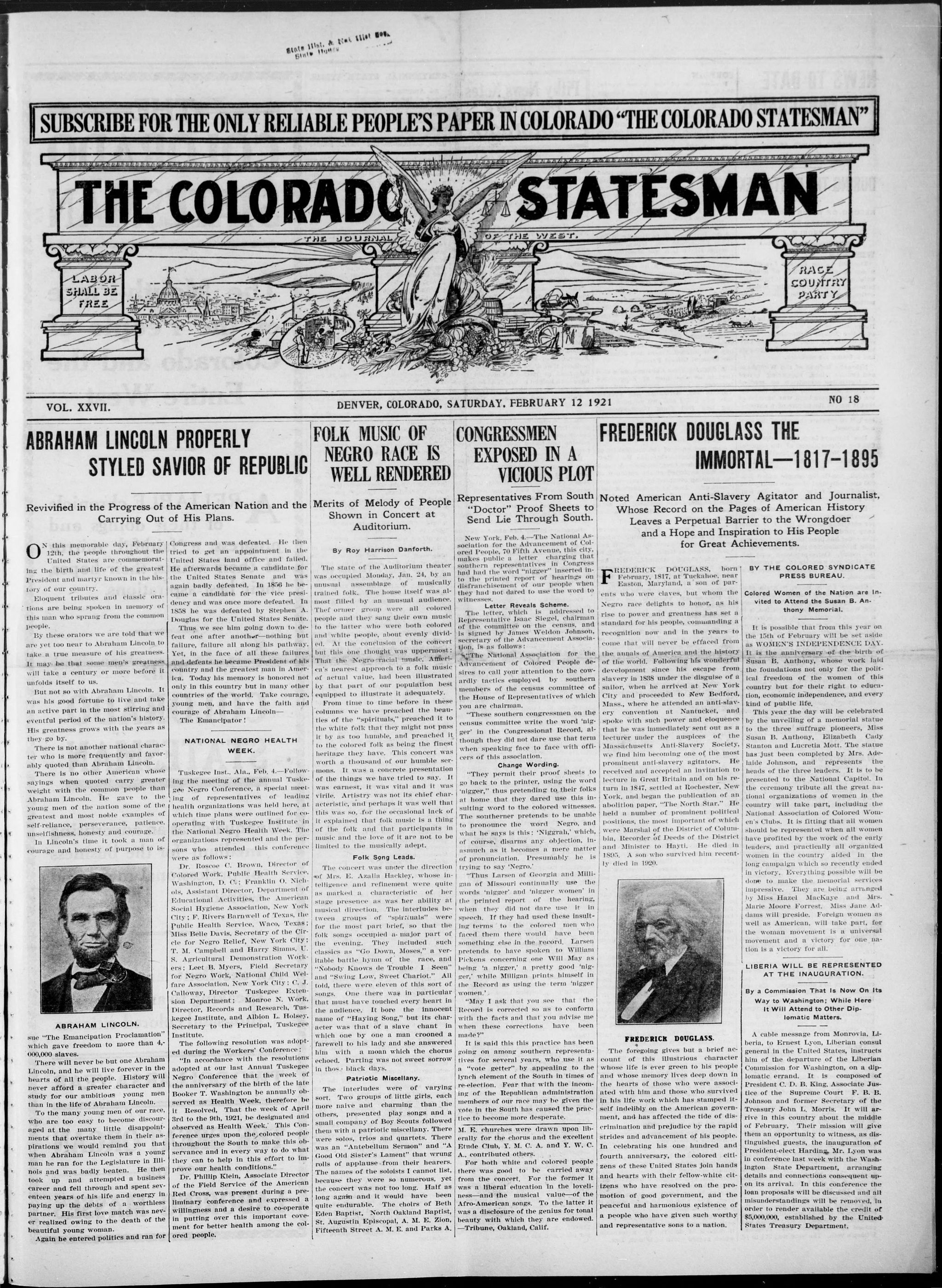
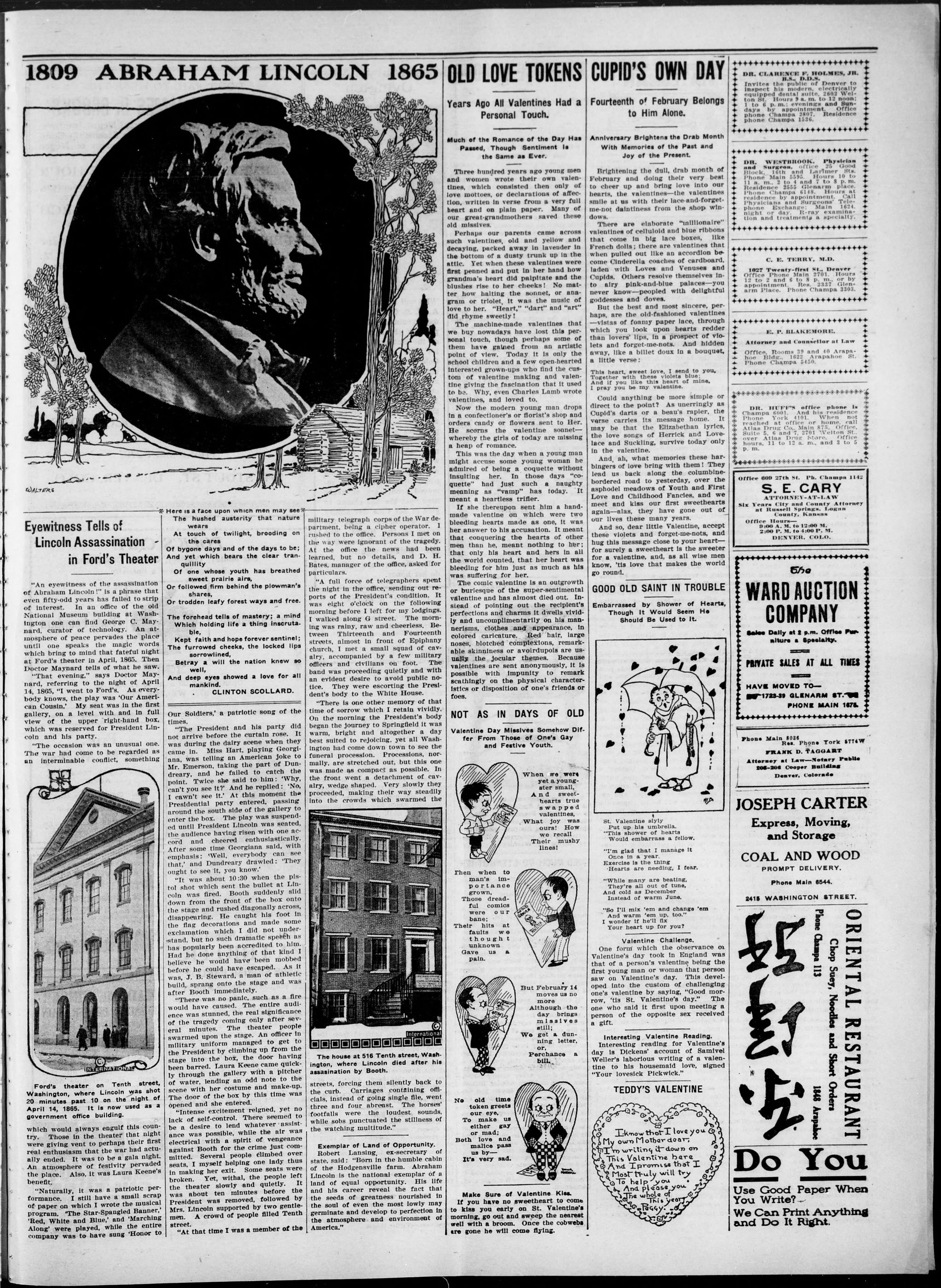
Page text (machine-generated)
SUBSCRIBE FOR THE ONLY RELIABLE PEOPLE'S PAPER IN COLORADO "THE COLORADO STATESMAN"
THE COLORADO STATESMAN
THE JOURNAL OF THE WEST.
LABOR SHALL BE FREE
RACE COUNTRY PARTY
ABRAHAM LINCOLN PROPERLY STYLED SAVIOR OF REPUBLIC
Revivified in the Progress of the American Nation and the Carrying Out of His Plans.
VOL. XXVII.
ABRAHAM LINCOLN
STYLED SA
Revivified in the Progress of
Carrying Out
ON this memorable day, February
12th, the people throughout the
United States are commemorating
the birth and life of the greatest
President and martyr known in the history
of our country.
Eloquent tributes and classic orations are being spoken in memory of
this man who sprang from the common people.
By these orators we are told that we are yet too near to Abraham Lincoln to take a true measure of his greatness. It may be that some men's greatness will take a century or more before it unfolds itself to us.
But not so with Abraham Lincoln. It was his good fortune to live and take an active part in the most stirring and eventful period of the nation's history. His greatness grows with the years as they go by.
There is not another national character who is more frequently and favorably quoted than Abraham Lincoln.
There is no other American whose sayings when quoted carry greater weight with the common people than Abraham Lincoln. He gave to the young men of the nation some of the greatest and most noble examples of self-reliance, perseverance, patience, unselfishness, honesty and courage.
In Lincoln's time it took a man of high honour of purpose to is-
ABRAHAM LINCOLN.
sue "The Emancipation Proclamation" which gave freedom to more than 4,000,000 slaves.
There will never be but one Abraham Lincoln, and he will live forever in the hearts of all the people. History will never afford a greater character and study for our ambitious young men than in the life of Abraham Lincoln.
To the many young men of our race, who are too easy to become discouraged at the many little disappointments that overtake them in their aspirations we would remind you that when Abraham Lincoln was a young man he ran for the Legislature in Illinois and was badly beaten. He then took up and attempted a business career and fell through and spent seventeen years of his life and energy in paying up the debts of a worthless partner. His first love match was never realized owing to the death of the beautiful young woman.
Again he entered politics and ran for
Congress and was defeated. He then tried to get an appointment in the United States land office and failed. He afterwards became a candidate for the United States Senate and was again badly defeated. In 1856 he became a candidate for the vice presidency and was once more defeated. In 1858 he was defeated by Stephen A. Douglas for the United States Senate. Thus we see him going down to defeat one after another—nothing but failure, failure all along his pathway. Yet, in the face of all these failures and defeats he became President of his country and the greatest man in America. Today his memory is honored not only in this country but in many other countries of the world. Take courage, young men, and have the faith and courage of Abraham Lincoln—
NATIONAL NEGRO HEALTH WEEK.
Tuskegee Inst., Ala., Feb. 4.—Following the meeting of the annual Tuskegee Negro Conference, a special meeting of representatives of leading health organizations was held here, at which time plans were outlined for cooperating with Tuskegee Institute in the National Negro Health Week. The organizations represented and the persons who attended this conference were as follows:
Dr. Roscoe C. Brown, Director of Colored Work, Public Health Service, Washington, D. C.; Franklin O. Nichols, Assistant Director, Department of Educational Activities, the American Social Hygiene Association, New York City; F. Rivers Barnwell of Texas, the Public Health Service, Waco, Texas; Miss Belle Davis, Secretary of the Circle for Negro Relief, New York City; T. M. Campbell and Harry Simms, U. S. Agricultural Demonstration Workers; Leet B. Myers, Field Secretary for Negro Work, National Child Welfare Association, New York City; C. J. Calloway, Director Tuskegee Extension Department; Monroe N. Work, Director, Records and Research, Tuskegee Institute, and Albion L. Holsey, Secretary to the Principal, Tuskegee Institute.
The following resolution was adopted during the Workers' Conference: "In accordance with the resolutions adopted at our last Annual Tuskegee Negro Conference that the week of the anniversary of the birth of the late Booker T. Washington be annually observed as Health Week, therefore be it Resolved, That the week of April 3rd to the 9th, 1921, be designated and observed as Health Week.' This Conference urges upon the colored people throughout the South to make this observance and in every way to do what they can to help in this effort to improve our health conditions."
Dr. Phillip Klein, Associate Director of the Field Service of the American Red Cross, was present during a preliminary conference and expressed a willingness and a desire to co-operate in putting over this important covenant for better health among the colored people.
DENVER, COLORADO, SATURDAY, FEBRUARY 12 1921
State Hist. & Net Hist. Book
State Hist.
RELIABLE PEOPLE'S PA
RADO
THE JOURNAL
DENVER, COLORADO, S
FOLK MUSIC OF NEGRO RACE IS WELL RENDERED
Merits of Melody of People Shown in Concert at Auditorium.
By Roy Harrison Danforth.
The state of the Auditorium theater was occupied Monday, Jan. 24, by an unusual assemblage of musically trained folk. The house itself was almost filled by an unusual audience. The orner group were all colored people and they sang their own music to the latter who were both colored and white people, about evenly divided. At the conclusion of the concert but this one thought was uppermost: That the Negro racial music, America's nearest approach to a folk music of actual value, had been illustrated by that part of our population best equipped to illustrate it adequately.
From time to time before in these columns we have preached the beauties of the "spirituals," preached it to the white folk that they might not pass it by as aso humble, and preached it to the colored folk as being the finest heritage they have. This concert was worth a thousand of our humble sermons. It was a concrete presentation of the things we have tried to say. It was earnest, it was vital and it was virile. Artistry was not its chief characteristic, and perhaps it was well that this was so, for the occasional lack of it explained that folk music is a thing of the folk and that participants in music and the love of it are not to be limited to the musically adept.
Folk Song Leads.
The concert was under the direction of Mrs. E. Azalia Hackley, whose intelligence and refinement were quite as marked a characteristic of her stage presence as was her ability at musical direction. The interludes between groups of "spirituals" were for the most part brief, so that the folk songs occupied a major part of the evening. They included such classics as "Go Down, Moses," a veritable battle hymn of the race, and "Nobody Knows de Trouble I Seen" and "Swing Low, Sweet Charlot." All told, there were eleven of this sort of songs. One there was in particular that must have touched every heart in the audience. It bore the innocent name of "Haying Song," but its character was that of a slave chant in which one by one a man crooned a farewell to his lady and she answered him with a moan which the chorus echoed. Parting was not sweet sorrow in those black days.
Patriotic Miscellany.
The interludes were of varying sort. Two groups of little girls, each more naive and charming than the others, presented play songs and a small company of Boy Scouts followed them with a patriotic miscellany. There were solos, trios and quartets. There was an "Antebellum Sermon" and "A Good Old Sister's Lament" that wrung rolls of applause from their hearers. The names of the soloists I cannot list, because they were so numerous, yet the concert was not too long. Half as long again and it would have been quite endurable. The choirs of Beth Eden Baptist, North Oakland Baptist, St. Augustin Episcopal, A. M. E. Zion, Fifteenth Street A. M. E. and Parks A.
CONGRESSMEN EXPOSED IN A VICIOUS PLOT
CONGRESSMEN EXPOSED IN A VICIOUS PLOT
Representatives From South
"Doctor" Proof Sheets to
Send Lie Through South.
New York, Feb. 4.—The National Association for the Advancement of Colored People, 70 Fifth Avenue, this city, makes public a letter charging that southern representatives in Congress had had the word "nigger" inserted into the printed report of hearings on disfranchisement of our people when they had not dared to use the word to witnesses.
Letter Reveals Scheme.
The letter, which is addressed to Representative Isaac Siegel, chairman of the committee on the census, and is signed by James Weldon Johnson, secretary of the Advancement Association, is as follows:
"The National Association for the Advancement of Colored People desires to call your attention to the cowardly tactics employed by southern members of the census committee of the House of Representatives of which you are chairman.
"These southern congressmen on the census committee write the word 'nigger' in the Congressional Record, although they did not dare use that term when speaking face to face with officers of this association."
Change Wording.
"They permit their proof sheets to go back to the printer, using the word 'nigger,' thus pretending to their folks at home that they dared use this insulting word to the colored witnesses. The southerner pretends to be unable to pronounce the word Negro, and what he says is this: 'Niggrah,' which, of course, disarms any objection, inasmuch as it becomes a mere matter of pronunciation. Presumably he is trying to say 'Negro.'
"Thus Larsen of Georgia and Milligan of Missouri continually use the words 'nigger' and 'nigger women' in the printed report of the hearing, when they did not dare use it in speech. If they had used these insulting terms to the colored men who faced them there would have been something else in the record. Larsen pretends to have spoken to William Pickens concerning one Will May as being 'a nigger,' a pretty good 'nigger,' while Milligan prints himself in the Record as using the term 'nigger women.'
"May I ask that you see that the Record is corrected so as to conform with the facts and that you advise me when these corrections have been made?"
It is said this this practice has been going on among southern representatives for several years, who use it as a "vote getter" by appealing to the lynch element of the South in times of re-election. Fear that with the incoming of the Republican administration members of our race may be given the vote in the South has caused the practice to become more desperate.
M. E. churches were drawn upon liberally for the chorus and the excellent Etude Club, Y. M. C. A. and Y. W. C. A., contributed others.
For both white and colored people there was good to be carried away from the concert. For the former it was a liberal education in the loveliness—and the musical value—of the Afro-American songs. To the latter it was a disclosure of the genius for tonal beauty with which they are endowed.—Tribune, Oakland, Calif.
FREDERICK DOUGLASS THE IMMORTAL—1817-1895
Noted American Anti-Slavery Agitator and Journalist. Whose Record on the Pages of American History Leaves a Perpetual Barrier to the Wrongdoer and a Hope and Inspiration to His People for Great Achievements.
FREDERICK DOUGLASS, born February, 1817, at Tuckahoe, near Easton, Maryland, a son of parents who were claves, but whom the Negro race delights to honor, as his rise to power and greatness has set a standard for his people, commanding a recognition now and in the years to come that will never be effaced from the annals of America and the history of the world. Following hfs wonderful development since his escape from slavery in 1838 under the disguise of a sailor, when he arrived at New York City and proceeded to New Bedford, Mass., where he attended an anti-slavery convention at Nantucket, and spoke with such power and eloquence that he immediately sent out as a lecturer under the auspices of the Massachusetts Anti-Slavery Society, we find him becoming one of the most prominent anti-slavery agitators. He received and accepted an invitation to lecture in Great Britain and on his return in 1847, settled at Rochester, New York, and began the publication of an abolition paper, "The North Star." He held a number of prominent political positions, the most important of which were Marshal of the District of Columbia, Recorder of Deeds of the District and Minister to Hayti. He died in 1895. A son who survived him recently died in 1920.
[Pictured is a portrait of Frederick Douglass, a prominent African-American abolitionist and writer. He is known for his role in the Underground Railroad and his efforts to end slavery in the United States.]
FREDERICK DOUGLASS.
The foregoing gives but a brief account of this illustrious character whose life is ever green to his people and whose memory lives deep down in the hearts of those who were associated with him and those who survived in his life work which has stamped itself indelibly on the American government, and has affected the tide of discrimination and prejudice by the rapid strides and advancement of his people. In celebrating his one hundred and fourth anniversary, the colored citizens of these United States join hands and hearts with their fellow-white citizens who have resolved on the promotion of good government, and the peaceful and harmonious existence of a people who have given such worthy and representative sons to a nation.
NO 18
BY THE COLORED SYNDICATE PRESS BUREAU.
Colored Women of the Nation are Invited to Attend the Susan B. Anthony Memorial.
It is possible that from this year on the 15th of February will be set aside as WOMEN'S INDEPENDENCE DAY. It is the anniversary of the birth of Susan B. Anthony, whose work laid the foundations not only for the political freedom of the women of this country but for their right to education, economic independence, and every kind of public life.
This year the day will be celebrated by the unveiling of a memorial statue to the three suffrage pioneers, Miss Susan B. Anthony, Elizabeth Cady Stanton and Lucretia Mott. The statue has just been completed by Mrs. Adelaide Johnson, and represents the heads of the three leaders. It is to be presented to the National Capitol. In the ceremony tribute all the great national organizations of women in the country will take part, including the National Association of Colored Women's Clubs. It is fitting that all women should be represented when all women have profited by the work of the early leaders, and practically all organized women in the country aided in the long campaign which so recently ended in victory. Everything possible will be done to make the memorial services impressive. They are being arranged by Miss Hazel MacKaye and Mrs. Marie Moore Forrest. Miss Jane Addams will preside. Foreign women as well as American, will take part, for the woman movement is a universal movement and a victory for one nation is a victory for all.
LIBERIA WILL BE REPRESENTED AT THE INAUGURATION.
By a Commission That Is Now On Its Way to Washington; While Here It Will Attend to Other Diplomatic Matters.
A cable message from Monrovia, Liberia, to Ernest Lyon, Liberian consul general in the United States, instructs him of the departure of the Liberian Commission for Washington, on a diplomatic errand. It is composed of President C. D. B. King, Associate Justice of the Supreme Court F. B. B. Johnson and former Secretary of the Treasury John L. Morris. It will arrive in this country about the middle of February. Their mission will give them an opportunity to witness, as distinguished guests, the inauguration of President-elect Harding, Mr. Lyon was in conference last week with the Washington State Department, arranging details and connections consequent upon its arrival. In this conference the loan proposals will be discussed and all misunderstandings will be removed, in order to render available the credit of $5,000,000, established by the United States Treasury Department.
FOREIGN
Preservation of the Sevres trenty, which is to be the basis of the London conference, is urged by former Premier Venizelos of Greece. "The treaty is the only guarantee of the stability of peace," he declared. He urged continued support by the allies of Greece. The people, as a whole, he declared, were pro-Ally. Austria may become virtually an allied dependency if the proposals of the interallied mission, which has been investigating Austria's internal conditions, are approved by the Austrian and allied governments. "If these proposals are adopted Austria will be taken over lock, stock and barrel," said the Mittag Post.
The German government has accepted the invitation to participate in the allied conference on reparations in London March 1, it was announced in Berlin. The government in sending its acceptance, sets forth its supposition that the negotiations will include discussion of the German counter-proposals.
Numerous shooting affairs and outrages are reported in Dublin. Three masked men raided the Baggott street branch of the National Bank, eluded police pursuit and escaped with £1,000. Two military lorries were attacked when two bombs were thrown and a boy was injured. Armed men attacked the lome of Gilbert Fenton.
A dispatch from Constantinople said that in an encounter at Zangouldak between a French gunboat and the Turkish tug, Alemadar, one Frenchman was killed and two wounded. The tug had fled from Constantinople, carrying arms and ammunition for the followers of Mustapha Kemal Pasha, the Nationalist leader, and the gunboat pursued it.
The residence of the archbishop of Mexico in Mexico City, the Most Rev. Jose Mora, has been bombed. A bomb also was exploded at the entrance of the building occupied by Juergens and Company, American manufacturers of jewelry. There were no casualties. The bombings are declared to have been attempts at sabotage by radical labor elements.
Former Emperor Karl plans to return to Hungary in the spring, "whatever the consequences may be," it has been learned at Geneva. According to the information obtained, Karl has been working for some time to regain his throne. He was alleged to have recently written to a high personage in Budapest: "I will return to Hungary in the spring, whatever the consequences may be."
Greek armies will launch a whirlwind offensive against Turkish Nationalists in Broussa with the intention of "cleaning them up" if the allies fail to take action at London, General Vlachopoulos declared in an interview. "Mustapha Kenal's forces can be wiped out in ten days," the commander declared. Thousands of men are being rushed to the front from back sectors and preparations for the attack are complete, he said.
GENERAL
Robert P. Brindell, president of the Building Trades Council, convicted of extortion from builders, was sentenced in New York by Supreme Court Justice McAvoy to serve from five to ten years in prison.
A cyclonic storm struck Haleyville, Ala. Houses were moved, small outhouses, garages, automobiles and some livestock were blown away. Telegraph and telephone connections were broken. No one was injured, though it is considered miraculous how some escaped.
Detective John Stavlo, thirty-three years a member of the police department of Minneapolis, made a choice between paternal love and duty and arrested his son, Clarence, as a bandit suspect. After hours of investigation, the father expressed relief that the son is innocent.
Sheriff T. A. Grant of Ouchita parish, Louisiana, has notified Governor Parker that he had forgotten to hang Lonnie Eaton, negro, convicted of murder on Feb. 4, as required by the sentence, and asked what to do with the prisoner. The governor put the problem up to Attorney General Coco.
When ex-Private Samuel Derman, a salesman of Norfolk, Va., several weeks ago paid a $10 fine for publicly thrashing ex-Capt. B. B. Fink, Jr., also a salesman, for alleged mistreatment while both were stationed at Camp Lee during the war, he announced "it was worth $1,000." Captain Fink took him at his word, but for good measure instituted civil suit to recover $10,000.
Thieves rob the Pennsylvania railroad station at Wilcox, near here, so often that it has become a habit. One night recently burglaries took $50, including fifty rebate checks, which were later recovered beside the tracks near the station. Entrance was gained by forcing the bars between the waiting room and the office. This is the fifth time the office has been robbed since B. T. Davis became agent four years ago, and the third time since there has been no safe in the office.
Efforts are being made to round up a number of men, most of them former employes of the Derry Silk Company, who are said to have taken sufficient machinery and raw silk from nine plants operated by the company near Scranton, Pa., to equip a complete mill in an old factory building. The mill was ready for operation when discovered. The value of the stolen goods is placed at $250,000.
Seven persons were injured and property damaged to the extent of several thousands of dollars by a tornado, which passed north of Gilmer, Tex.
NEWS TO DATE IN PARAGRAPHS
CAUGHT FROM THE NETWORK OF WIRES ROUND ABOUT THE WORLD.
RECORD OF IMPORTANT EVENTS
CONDENSED FOR BUSY
PEOPLE.
(Western Newspaper Union News Service.)
WESTERN
The bill in the Kansas Legislature which provided the right of a housewife to claim damages for injuries sustained in performance of her domestic duties, was killed by the judiciary committee.
Detective G. B. Hamby was shot dead at a Salt Lake City hotel by Tom Burns, who in turn was shot by Chief of Police Joseph E. Burbidge. Burns died within an hour. Chief Burbidge narrowly escaped death, a shot grazing and bruising his shoulder.
Nebraska Indians of the Winnebago and Omaha tribes, appearing before the legislative committee on medical societies at Lincoln, denied that the use of the peyote bean was harmful or that it was in the nature of a narcotic. The committee had under discussion the bill to regulate the use of the bean and mescal.
Des Moines, Iowa, has raised $87,640 for entertainment of the Imperial Conclave Nobles of the Mystic Shrine June 14, 15 and 16, the first day of the solicitation. Business men pledged $50,000, Sea-Ga-Zig temple added $25,000 and individual Shriners contributed an additional $12,640, Sea-Ga-Zig temple plans a total fund of $125,000. Because it was charged, newspaper men abused privileges accorded them for obtaining news in the Mare Island navy yard at Vallejo, Calif., an executive order has been issued reviving war time provision for news censorship at the island. Correspondents must submit their news stories to the commander's office for approval before publication.
Charles Leslie Bune, a grain sampler employed by a milling and elevator company in Ogden, Utah, is dead and Ward A. Dunn, an electrician, is in a serious condition from the effects of gas, caused, it is said, by the fermentation of moist grain in an elevator. Bune toppled over shortly after he went for a sample and Dunn collapsed in trying to drag Bune from the danger spot.
Although tempted by lucuous fruits scattered about his cell and by appetizing virtuals served to his cellmate, Dr. Health Engmark, 45, a hunger striking chiropractor, had not weakened as he entered on the third week of his voluntary fast in the Los Angeles jail. Engmark accepted a ninety-day sentence rather than pay $200 fine following his conviction on a charge of practicing medicine without a license.
WASHINGTON
President Wilson's veto of a bill to give title of seventy-six acres of swamp land in Montana to the Milk River Valley Gun Club of Montana was sustained by the Senate, 17 to 9. In his veto message President Wilson said that the land should be made a public game preserve.
Charges that a combination exists in the coal trade to maintain high prices of coal and to shut off the supply of coal to dealers who cut rates were put before the Senate committee considering the Calder coal regulation bill by J. C. L. Ritter, who said the "combination" put him out of business.
World trade conditions have shown little improvement since the first of the year, excepting in the Scandinavian countries and Belgium, but prospects for the future are somewhat brighter, the Department of Commerce was informed in reports from its representatives in Europe, Asia and South America.
American steam locomotives exported last year totaled 1,711 and were valued at $53,629,847, the federal trade commission has announced. This was an increase of 959 locomotives over 1919. "Before the war, Great Britain and Germany controlled the European locomotive market, but recently the United States has been the only country prepared to ship locomotives in quantity."
The first move to exempt the salary of the President from income taxes was made in the House by Representative Pell, Democrat, of New York. His bill would exempt not only the $75,000 salary of the President, but also the salary of the vice president from provisions of the income tax law. Beginning March 4, the President will have to pay an income tax of about $18,000 a year.
Staunch defense of the work accomplished by the American liquidation commission in disposing of millions of dollars of war supplies to France and other European governments after the armistice was made by Edwin B. Parker, New York lawyer, former chairman of the board, in testifying before the House committee, investigating the conduct of the war.
The joint resolutions directing the stopping of enlistments until the regular army is reduced to 175,000 men was passed by the House over President Wilson's veto. The vote was 271 to 16.
Pithy News Notes
From All Parts of
Colorado
Pithy News Notes
From All Parts of
Colorado
(Western Newspaper Union News Service.)
D. T. Ramey is in jail in Pueblo, charged with the murder of Francis Dolan, 28 years old, his brother-in-law, at the Ramey home.
A proof of the excellent blood in the swine herd at the Agricultural College at Fort Collins is the fact that it won fifty-four premiums on thirty-nine head of swine exhibited at the recent National Western Stock Show.
Routt county officials have been unable to decide whether to try Anna Mudra, self-confessed murderer of her mother on the Mudra ranch near Oak Creek, in the Juvenile Court or in the District Court at Steamboat Springs.
The National park service is planning on spending some of its appropriation this year on improving the Fall River road, according to a letter from Secretary of the Interior John Barton Payne to E. E. Sommers of the Colorado State Highway Commission.
Mrs. T. M. Harding, treasurer of the "scholarship fund" of the Colorado Federation of Women's Clubs, has announced that since the inauguration of this fund in 1902 355 Colorado girls have been helped by this fund to secure a normal or technical education.
Patented land acreage in Colorado showed an increase of more than one million acres during the past year, according to figures compiled by the State Immigration Department from the records of the Colorado Tax Commission and based upon assessor's reports.
Examinations for the end of the first semester in the 1920-21 scholastic period at the Colorado School of Mines (international) closed, and the second semester was commenced with an attendance of 455 students in regular standing, compared with 164 at the beginning of the second semester in the school year of 1917-18.
Governor Shoup has announced the appointment of Thomas J. Dixon as judge advocate of the Colorado National Guard. Mr. Dixon, who is a Denver attorney, will take office at once. His rank will be that of a major. For over a year the office of judge advocate has been vacant. This is the second time Dixon has held the position.
Colorado will be compelled to conduct its fight against social diseases single-handed for the next two years, according to a telegram received from Washington, by Dr. R. I. Drinkwater, secretary of the board of health. For two years the government has contributed to the state board on a "dollar-for-dollar" basis. During the biennial period just ended Colorado expended a total of $17,000 in this work. Colorado's four congressmen have called on Secretary of Interior Payne in Washington, D. C., to inquire what steps can be taken to keep would-be settlers off Colorado school lands. The state authorities have notified the congressional delegation that it is a great burden upon the state authorities to have to litigate all the cases in which the state's title to the lands in question is involved. Legislative action by Congress may be necessary to quiet the state's title.
Literature describing the scenic beauties and tourist attractions in Denver and Colorado was sent in large quantities to Holland recently through Fred W. Johnson, district passenger agent of the American Express Company in Denver. The request for the literature came from K. Van der Zeyde, general manager of the express company in Holland. The latter visited Colorado last summer and the request for literature is based on the interest aroused during the sojourn of Mr. Van der Zeyde in Colorado.
That the oil companies which added 1 cent to the regular selling price of gasoline to cover the state oil tax, acted illegally and that they have no right to the money collected as a tax was the burden of a decision handed down by Judge C. J. Morley in Denver in a suit brought by Henry J. Arnold against James Duce, state oil inspector, the Altitude Oil Company and others.
The town of Eagle won the county seat of Eagle county from Red Cliff at the last election by 20% votes, according to a decision handed down in the District Court at Red Cliff by Judge Cooper of Cañon City, sitting for Judge Bouk, who did not wish to act in the case. Red Cliff will appeal the case to the Colorado Supreme Court.
Ernest Miller, alias Frank Forrester, ranch worker around Henderson, attempted to hold up Union Pacific train No. 104 at Sandow station on the night of Nov. 16. He, in company with John Lahm, "mystery man," sawed the switch lock at the station and threw the lever that hurled the Rock Island passenger train into the ditch that night. This is the verdict of a jury in Denver.
A decrease of $1,224,750 in building permits during the month is shown by the monthly report of the city building department of Denver, just completed for January, 1921. During this month 156 building permits were issued by the office, totaling $281,350. During the same month last year 204 permits were issued, totaling $1,506,100.
The negro population of Denver in 1920 was announced by the census bureau as 6,085, an increase of 659, or 12.1 per cent. The white population was 249,652, an increase of 42,581, or 20.6 per cent, and all others 754.
```markdown
```
An American Legion monument, in honor of the soldiers who died and were killed during the late war, will be constructed in City park at Buena Vista, according to an announcement made by city officials. The monument will be an imposing structure of cement, cobblestone and light granite from a local quarry and will be seven and one-half feet high. On one side of the monument will be the roster of the American Legion post and on the opposite side will be the names of the boys who died.
THE COLORADO STATESMAN
Twenty men and three women had a narrow escape from being burned to death when the boarding house, recreation room and bunkhouse connecting the buildings belonging to the Wellington Mine Company at Breckenridge caught fire and were burned to the ground. All the occupants of the houses were compelled to jump out of the second story windows and into two feet of snow, which saved them from injury. The loss is estimated at from $12,000 to $14,000.
The Mouth-Piece of the People of Colorado and the Entire West
Objection to the action of the secretary of the interior and the federal government in seeking to exercise exclusive control over roads running in and out of the Rocky Mountain National park, is made on behalf of the state of Colorado in a brief which has just been filed in the United States Circuit Court of Appeals at St. Louis by Attorney General Victor E. Keyes and Assistant Attorney General Forrest C. Northcutt.
Roland G. Parvin, state game and fish commissioner, has announced that 500 quails of the Bob White variety had been obtained from Brownville, Tex. The birds will be held at City park, Denver, until they can be distributed through the state. According to Mr. Parvin these quail are almost extinct in the state and the 500 are being brought in for propagation purposes.
Postoffice inspectors in Denver are investigating the mysterious robbery of the Wheatridge, Colo., postoffice, which is combined with a general merchandise store. The job was that of youthful burglars, it is believed, as a large amount of candy was missing. This is the second robbery of that postoffice within the past month.
RELIABLE chronicle of their doings and progress; a faithful mirror of their wants, their hopes, their best aspirations.
In an effort to solve the problem of obtaining reliable and efficient farm help in the San Luis valley, former Governor Carlson of Colorado will be sent to New York by the San Luis Valley Realty Board, with the view of inducing a colony of Swedes or other Scandinavian emigrants to locate in this section.
There was but one fire in the national forests in Colorado during 1920. It burned an area of more than ten acres, according to the statement of John McLean, who is in charge of forest protection in Colorado. "Fifteen years ago the mountains were ablaze nightly," said McLean. "Now a fire is a rare sight.
A total of 461 persons were committed to the state reformatory during the past two years according to a report made to the governor by Warden M. P. Capp. It shows that the average population of the Buena Vista institution during 1919 was 141 and 165 during 1920, as compared with 130 during the preceding period.
Pioneering in the placing of its working men in the steel mills on an actual eight-hour basis, the Colorado Fuel and Iron Company found the wisdom of its course justified in a record production at the big plant in Pueblo last month, it was announced at the general offices of the company at Pueblo.
Unequaled as an advertising medium for the business of professional men and women.
New records for the collection of automobile license taxes was established during the month of January, according to a statement made by Carl Menser, automobile supervisor in the secretary of state's office. Fees from this source totaled $130,595.51 the first month of 1921, as against $104,378.39 for the same period last year.
Federal aid to the extent of $154,834.54 has been granted to the Colorado State Highway Commission by District Engineer J. S. Bright of the United States bureau of public roads for the construction and improvement of fifteen and six-tenths miles of highway and earth-graded road and the construction of a bridge in Conejos county over Alamosa creek, at a total estimated cost of $318,203.95.
An excellent family journal speaking to and for many thousand colored citizens.
Charles O'Hara, who is charged with the $3,000 holdup of the Littleton State Bank, was given a preliminary hearing at Littleton and bound over to the February term of the District Court. O'Hara stoutly denies that he had anything to do with the holdup. Willard Teller, cashier of the bank, who was the only witness at the hearing, says he is positive O'Hara "stuck him up." Reading snow scales during the winter months for the purpose of determining the amount of water available for irrigation purposes during the following summer is one of the many tasks confronting the 100 forest rangers stationed in the fifteen national forests of the state, according to District Forester Allen S. Peck of the United States forest service at Denver.
TWODOLLARSAYEAR
THE GREAT ORGAN OF THE
John Lovelace of Lamar, livestock buyer, was instantly killed three miles west of that city, when he lost control of a light car he was driving, which headed into a ditch and turned over. Lovelace was pinned under the machine, crushing his skull. A boy who was in the car jumped to safety.
LABORING MASSES
The farmers' and stockmen's conference started with a "whoop" as hundreds of stockmen and distinguished visitors poured into Montrose for the annual roundup of the Uncompahgre Valley Cattle and Horse Growers' Association
1809 ABRAHAM LINCOLN 1865
WALTERS
Eyewitness Tells of Lincoln Assassination in Ford's Theater
"An eyewitness of the assassination of Abraham Lincoln!" is a phrase that even fifty-odd years has failed to strip of interest. In an office of the old National Museum building at Washington one can find George C. Maynard, curator of technology. An atmosphere of peace pervades the place until one speaks the magic words which bring to mind that fateful night at Ford's theater in April, 1865. Then Doctor Maynard tells of what he saw. "That evening," says Doctor Maynard, referring to the night of April 14, 1865, "I went to Ford's. As everybody knows, the play was 'Our American Cousin.' My seat was in the first gallery, on a level with and in full view of the upper right-hand box, which was reserved for President Lincoln and his party.
"The occasion was an unusual one. The war had come to be regarded as an interminable conflict, something
INTERNATIONAL
Ford's theater on Tenth street, Washington, where Lincoln was shot 20 minutes past 10 on the night of April 14, 1865. It is now used as a government office building.
which would always engulf this country. Those in the theater that night were giving vent to perhaps their first real enthusiasm that the war had actually ended. It was to be a gala night. An atmosphere of festivity pervaded the place. Also, it was Laura Keene's benefit.
"Naturally, it was a patriotic performance. I still have a small scrap of paper on which I wrote the musical program, 'The Star-Spangled Banner,' 'Red, White and Blue,' and 'Marching Along' were played, while the entire company was to have sung 'Honor to
Here is a face upon which men may see
The hushed austerity that nature
wears
At touch of twilight, brooding on
the cares
Of bygone days and of the days to be;
And yet which bears the clear tranquility
Of one whose youth has breathed
sweet prairie airs,
Or followed firm behind the plowman's
shares,
Or trodden leafy forest ways and free.
The forehead tells of mastery; a mind
Which holding life a thing inscrutable,
Kept faith and hope forever sentinel;
The furrowed cheeks, the locked lips
sorrowlined,
Betray a will the nation knew so
well,
And deep eyes showed a love for all
creepy.
Our Soldiers,' a patriotic song of the times.
"The President and his party did not arrive before the curtain rose. It was during the dairy scene when they came in. Miss Hart, playing Georgiana, was telling an American joke to Mr. Emerson, taking the part of Dundreary, and he failed to catch the point. Twice she said to him: 'Why, can't you see it?' And he replied: 'No, I cawnt see it.' At this moment the Presidential party entered, passing around the south side of the gallery to enter the box. The play was suspended until President Lincoln was seated, the audience having risen with one accord and cheered enthusiastically. After some time Georgiana said, with emphasis: 'Well, everybody can see that,' and Dundreary drawled: 'They ought to see it, you know.'
"It was about 10:30 when the pistol shot which sent the bullet at Lincoln was fired. Booth suddenly slid down from the front of the box onto the stage and rushed diagonally across, disappearing. He caught his foot in the fng decorations and made some exclamation which I did not understand, but no such dramatic speech as has popularly been accredited to him. Had he done anything of that kind I believe he would have been mobbed before he could have escaped. As it was, J. B. Steward, a man of athletic build, sprang onto the stage and was after Booth immediately.
"There was no panic, such as a fire would have caused. The entire audience was stunned, the real significance of the tragedy coming only after several minutes. The theater people swarmed upon the stage. An officer in military uniform managed to get to the President by climbing up from the stage into the box, the door having been barred. Laura Keene came quickly through the gallery with a pitcher of water, lending an odd note to the scene with her costume and make-up. The door of the box by this time was opened and she entered.
"Intense excitement reigned, yet no lack of self-control. There seemed to be a desire to lend whatever assistance was possible, while the air was electrical with a spirit of vengeance against Booth for the crime just committed. Several people climbed over seats. I myself helping one lady thus in making her exit. Some seats were broken. Yet, withal, the people left the theater slowly and quietly. It was about ten minutes before the President was removed, followed by Mrs. Lincoln supported by two gentlemen. A crowd of people filled Tenth street.
"At that time I was a member of the
military telegraph corps of the War department, being a cipher operator. I rushed to the office. Persons I met on the way were ignorant of the tragedy. At the office the news had been learned, but no details, and D. H. Bates, manager of the office, asked for particulars.
"A full force of telegraphers spent the night in the office, sending out reports of the President's condition. It was eight o'clock on the following morning before I left for my lodgings. I walked along G street. The morning was rainy, raw and cheerless. Between Thirteenth and Fourteenth streets, almost in front of Epiphany church, I met a small squad of cavalry, accompanied by a few military officers and civilians on foot. The band was proceeding quietly and with an evident desire to avoid public notice. They were escorting the President's body to the White House.
"There is one other memory of that time of sorrow which I retain vividly. On the morning the President's body began the journey to Springfield it was warm, bright and altogether a day best suited to rejoicing, yet all Washington had come down town to see the funeral procession. Processions, normally, are stretched out, but this one was made as compact as possible. In the front went a detachment of cavalry, wedge shaped. Very slowly they proceeded, making their way steadily into the crowds which swarmed the
International
The house at 516 Tenth street, Washington, where Lincoln died after his assassination by Booth.
streets, forcing them silently back to the curb. Carriages containing officials, instead of going single file, went three and four abreast. The horses' footfalls were the loudest sounds, while sobs punctuated the stillness of the watching multitude."
Exemplar of Land of Opportunity.
Robert Lansing, ex-secretary of state, said: "Born in the humble cabin of the Hodgensville farm. Abraham Lincoln is the national exemplar of a land of equal opportunity. His life and his career reveal the fact that the seeds of greatness nourished in the soul of even the most lowly may germinate and develop to perfection in the atmosphere and environment of America."
OLD LOVE TOKENS
Years Ago All Valentines Had a Personal Touch.
Much of the Romance of the Day Has Passed, Though Sentiment Is the Same as Ever.
Three hundred years ago young men and women wrote their own valentines, which consisted then only of love mottoes, or declarations of affection, written in verse from a very full heart and on plain paper. Many of our great-grandmothers saved these old missives.
Perhaps our parents came across such valentines, old and yellow and decaying, packed away in lavender in the bottom of a dusty trunk up in the attic. Yet when these valentines were first penned and put in her hand how grandma's heart did palpitate and the blushes rise to her cheeks! No matter how halting the sonnet, or anagram or triplet, it was the music of love to her. "Heart," "dart" and "art" did rhyme sweetly!
the machine-made valentines that we buy nowadays have lost this personal touch, though perhaps some of them have gained from an artistic point of view. Today it is only the school children and a few open-hearted interested grown-ups who find the custom of valentine making and valentine giving the fascination that it used to be. Why, even Charles Lamb wrote valentines, and loved to.
Now the modern young man drops in a confectioner's or florist's shop and orders candy or flowers sent to Her. He scorns the valentine sonnet—whereby the girls of today are missing a heap of romance.
This was the day when a young man might accuse some young woman he admired of being a coquette without insulting her. In those days "coquette" had just such a naughty meaning as "vamp" has today. It meant a heartless trifler.
If she thereupon sent him a handmade valentine on which were two bleeding hearts made as one, it was her answer to his accusation. It meant that conquering the hearts of other men than he, meant nothing to her; that only his heart and hers in all the world counted, that her heart was bleeding for him just as much as his was suffering for her.
The comic valentine is an outgrowth or burlesque of the super-sentimental valentine and has almost died out. Instead of pointing out the recipient's perfections and charms it dwells vividly and uncomplementarily on his manierisms, clothes and appearance, in colored caricature. Red hair, large noses, blotched complexions, remarkable skinniness or avoirdupois are usually the jocular themes. Because valentines are sent anonymously, it is possible with impunity to remark scathingly on the physical characteristics or disposition of one's friends or foes.
NOT AS IN DAYS OF OLD
Valentine Day Missives Somehow Differ From Those of One's Gay and Festive Youth.
When we were yet a youngster small,
And sweet-hearts true swapped valentines,
What joy was ours! How we recall
Their mushy lines!
When we were
yet a young-
ster small,
And sweet-
hearts true
swapped
valentines,
What joy was
ours! How
we recall
Their mushy
lines!
When we were
yet a young-
ster small,
And sweet-
hearts true
swapped
valentines,
What joy was
ours! How
we recall
Their mushy
lines!
ALFRED
GROVES
Then when to man's importance grown
Their hits at faults we thought unknown Gave us a pain.
But February 14
moves us no
more
Although the
day brings
missives
still;
We get a dun-
ning letter,
or,
Perchance a
bill.
JIMMY BROWN
No old time
token greets
our eye.
To make us
either gay
or mad;
Both love and
mallice pass
us by—
It's very sad.
Make Sure of Valentine Kiss.
If you have no sweetheart to come to kiss you early on St. Valentine's morning, go out and sweep the nearest well with a broom. Once the cobwebs are gone he will come flying.
CUPID'S OWN DAY
Fourteenth of February Belongs to Him Alone.
Anniversary Brightens the Drab Month With Memories of the Past and Joy of the Present.
Brightening the dull, drab month of February and doing their very best to cheer up and bring love into our hearts, the valentines—the valentines smile at us with their lace-and-forget-me-not daintiness from the shop windows.
There are elaborate "millionaire" valentines of celluloid and blue ribbons that come in big lace boxes, like French dolls; there are valentines that when pulled out like an accordion become Cinderella coaches of cardboard, laden with Loves and Venuses and Cupids. Others resolve themselves into alry pink-and-blue palaces—you never know—peopled with delightful goddesses and doves.
But the best and most sincere, perhaps, are the old-fashioned valentines—vistas of foamy paper lace, through which you look upon hearts redder than lovers' lips, in a prospect of violets and forget-me-nots. And hidden away, like a billet doux in a bouquet, a little verse:
This heart, sweet love, I send to you, Together with these violets blue: And if you like this heart of mine, I pray you be my valentine.
Could anything be more simple or direct to the point? As unerringly as Cupid's darts or a beau's rapler, the verse carries its message home. It may be that the Elizabethan lyrics, the love songs of Herrick and Love-lace and Suckling, survive today only in the valentine.
And, ah, what memories these harbinger of love bring with them! They lead us back along the columbine-bordered road to yesterday, over the asphodel meadows of Youth and First Love and Childhood Fancies, and we meet and kiss our first sweethearts again—alas, they have gone out of our lives these many years.
And so, dear little Valentine, accept these violets and forget-me-nots, and hug this message close to your heart—for surely a sweetheart is the sweeter for a valentine, and, as all wise men know, 'tis love that makes the world go round.
GOOD OLD SAINT IN TROUBLE
Embarrassed by Shower of Hearts
Though It Would Seem He
Should Be Used to It.
M.D.
St. Valentine slyly
Put up his umbrella.
"This shower of hearts
Would embarrass a fellow.
"I'm glad that I manage it
Once in a year.
Exercise is the thing
Hearts are needing, I fear.
"While many are beating,
They're all out of tune,
And cold as December
Instead of warm June.
"So I'll mix 'em and change 'em
And warm 'em up, too."
I wonder if he'll fix
Your heart up for you?
One form which the observance on Valentine's day took in England was that of a person's valentine being the first young man or woman that person saw on Valentine's day. This developed into the custom of challenging one's valentine by saying, "Good morrow, 'tis St. Valentine's day." The one who said it first upon meeting a person of the opposite sex received a gift.
Interesting Valentine Reading.
Interesting reading for Valentine's day is Dickens' account of Samvel Weller's laborious writing of a valentine to his housemaid love, signed "Your lovesick Pickwick."
TEDDY'S VALENTINE
I know that I love you
My own Mother dear;
I'm writing it down on
This Valentine here
And I promise that I
Most truly will try
To help you
And please you
The whole of
This year
Raggy.
DR. CLARA DUMES, JR.
R.S. D.D.S.
Invites the public of Denver to
inspect his modern, electrically
equipped dental suite, 2602 Welton St. Hours 9 a.m. to 12 noon;
1 to 6 p.m.; evenings and Sundays by appointment. Office phone Champa 2807. Residence phone Champa 1536.
DR. WESTBROOK, Physician and Surgeon, office 25 Good Block, 16th and Larlmer Sts. Phone Main 5595. Hours 10 to 11 a.m. 3 tty. and 7 to 8 p.m. Residence 2555 Glenarm place. Phone Champa 6148. Hours at residence by appointment. Call Physicians and Surgeons' Telephone Exchange. Main 1634 night or day. R-ray examination and treatments a speciality.
C. E. TERRY, M.D.
1027 Twenty-first St. Denver Office Phone Main 2701. Hours 12 to 2 and 6 to 8 p.m. or by appointment. Res. 2337 Glenarm Place. Phone Champa 3303.
E. P. BLAKEMORE.
Attorney and Counselor at Law
Office, Rooms 39 and 40 Arapahoe Bldg., 1622 Arapahoe St.
Phone Champa 5450.
DR. HUFF'S office phone is Champa 6001. And his residence Phone York 4101. When not reached at Dr. Huff's Office Dr. Huff's Main 8754 Office, Suite 5, 6 and 7, 2701 Welton St., over Atlas Drug Store. Office hours, 11 to 12 a. m., and 3 to 5 p. m.
Office 609 27th St. Ph. Champa 1142
S. E. CARY
ATTORNEY-AT-LAW
Six Years City and County Attorney
at Russell Springs, Logan
County, Kansas
Office Hours:
9:00 A.M. to 12:00 M.
2:00 P.M. to 4:00 P.M.
DENVER, COLO.
WARD AUCTION COMPANY
Sales Daily at 2 p.m. Office Purs-
niture a Specialty.
PRIVATE SALES AT ALL TIMES
HAVE MOVED TO—
1723-39 GLENARM ST.
PHONE MAIN 1678.
Phone Main 8026
Res. Phone York 5774W
FRANK D. TAGGART
Attorney at Law—Notary Public
205-206 Cooper Building
Denver, Colorado
JOSEPH CARTER
Express, Moving,
and Storage
COAL AND WOOD
PROMPT DELIVERY.
Phone Main 6544.
2415 WASHINGTON STREET.
ORIENTAL RESTAURANT
Chop Suey, Noodles and Short Orders
Phone Champa 113
1848 Arapahoe
Do You
Use Good Paper When
You Write?
We Can Print Anything
and Do It Right.
THE COLORADO STATESMAN
LAUGH
MARRY
FREE
BASE
COUNTRY
PARTY
Entered as second-class matter at the postoffice in the City of Denver, Colo.
Communications to receive attention must be news, upon important subjects, plainly written only upon one side of the paper, must reach us Tuesdays, if possible, anyway not later than Wednesdays, and bear the signature of the author. No manuscript returned, unless stamps are sent for postage. All communications of a personating nature that are not complimentary will be withheld from the columns of this paper.
Remittances should be made by express money order, postoffice money order, registered letter or bank draft. Postage stamps will be received the same as cash for the fractional part of a dollar. Only 1c and 2c stamps taken.
No discounts allowed on less than three months' contract. Cash must accompany all orders from parties unknown to us. Further particulars on application.
Reading notices, ten lines or less, 15 cents per line. Each additional line over ten lines, 12 cents per line. Display advertising, 75 cents per inch for first insertion and 50 cents per inch for each additional insertion.
LINCOLN-DOUGLASS CELEBRATION.
show February 12, 1809, the birth of
sometime during the month of February
and 18th, the birth of Frederick Douglass,
a magistrate.
During the one hundred and twelfth anniversary
of the second and fourth of Douglass, we feel da-
tered by the two great men—the one becoming mour-
ning years attesting his wise statesmanship
to preserve the Union and which must
be powerful obedience to the constitution which
for all citizens who have been privileged
by the U. S. A.; the other winning recognition
replacing the abolition of slavery, and his
very colored boy whose cause must be in
if the nation for the bringing about of
the inhabiting this land.
American is familiar with the fifty-seven
American President, and he can rightly be st
memory of those words of his famous dee-
house divided against itself cannot stand
indure half slave and half free. I do not
to expect it will cease to be divided." A
improved himself the possessor of a wonder-
ful national safety, when he said: "Tea
the Constitution and laws of our country
is danger ahead." If our PROFITEERS
economy, when after giving a very sour
following: "Teach economy, that is one
with saving money," they surely would in-
crease us a chance to save a little money in
the great qualities of this American who
used by generations for his executive ability
is a general opinion among our peo-
ton could not be thought of than what
a Civic Association, in their event tonight
actors, Lincoln and Fred Douglass, will sh
ubanquet at Shorter A. M. E. Church, wh
he given the praise and honor due them
in preserving the peace and harmony of
that most unworthy and uncivil-
ncoln-Douglass—two names that any A
dedibly stamped on the hearts of the m
arts they played in the nation's history, and
the capacity of Minister to Hayti, Douglass
conditions between the Haitians and An-
drican relationship. Seeing, therefore, that we
have with pride to two eminent standards,
we deeds stand out conspicuously in the h
orld, let us endeavor by consistent
of the glorious leaders who have gone
been all mankind shall be the recipient to
self, as man shall have met his fellow
knowledged the fraternity, as ordered by
national bond. That this celebration will
be re-dedicate ourselves to the great insti-
tute Colorado Statesman, and at this time
was to those who can be relied upon as the
on, the real subscribers to good govern-
ment ever-ready and willing portion of the
be ready to advocate the cause of RIGHT.
THE records show February 12, 1809, the birth of Lincoln, the immortal, and sometime during the month of February, 1817, between the 14th and 18th, the birth of Frederick Douglass, the noted American anti-slavery agitator.
In celebrating the one hundred and twelfth anniversary of Lincoln, and the one hundred and fourth of Douglass, we feel deeply grateful for the lives of these two great men—the one becoming more famous as time rolls on, the passing years attesting his wise statesmanship which now as then is required to preserve the Union and which must bring men to a realization of cheerful obedience to the constitution which provides liberty and protection for all citizens who have been privileged to live under the starry banner of the U. S. A.; the other winning recognition for his fearlessness in championing the abolition of slavery, and his life, furnishing an inspiration for every colored boy whose cause must be identified with the common cause of the nation for the bringing about of the greatest good to all the people inhabiting this land.
to all the people inimitable with us.
Every real American is familiar with the fifty-seven years of life of the Great American President, and he can rightly be styled "the immortal" when the memory of those words of his famous declaration can never pass away: "A house divided against itself cannot stand. I believe this country cannot endure half slave and half free. I do not expect the house to fall, but I do expect it will cease to be divided." Again this man of the late century proved himself the possessor of a wonderful vision, pointing out the path of national safety, when he said: "Teach reverence and obedience to the Constitution and laws of our country and we are safe; otherwise there's danger ahead." If our PROFITEERS would remember Lincoln and his economy, when after giving a very sound advice he summarized in the following: "Teach economy, that is one of the highest virtues. It begins with saving money," they surely would reduce the present high prices and give us a chance to save a little money instead of spending all. Reviewing the great qualities of this American who has been blessed and will be blessed by generations for his executive ability and his administrative powers, it is a general opinion among our people that a more fitting celebration could not be thought of than what is planned by the Denver Colored Civic Association, in their event tonight, February 12th, where both characters, Lincoln and Fred Douglass, will share honors in the speeches at the banquet at Shorter A. M. E. Church, when the illustrious Americans will be given the praise and honor due them for the noble part they have played in preserving the peace and harmony of the nation, and for the abolition of that most unworthy and uncivilized institution—SLAVERY. Lincoln-Douglass—two names that any American can be proud of, are indelibly stamped on the hearts of the real American for the respective parts they played in the nation's history, and in representing this country in the capacity of Minister to Hayti, Douglass, to a great extent, ameliorated conditions between the Haitians and Americans, resulting in better trade relationship. Seeing, therefore, that we have the good fortune of pointing with pride to two eminent standards of Americanism, whose words and deeds stand out conspicuously in the history of not only our nation but the world, let us endeavor by consistent and upright manhood to emulate the glorious leaders who have gone before, leaving a legacy which when all mankind shall be the recipient thereof, the world will be better off, as man shall have met his fellow man on common ground and acknowledged the fraternity, as ordered by creation and approved by our national bond. That this celebration will be so impressive as to cause us to re-dedicate ourselves to the great institution of liberty, is the hope of The Colorado Statesman, and at this time when the acid test is being applied as to those who can be relied upon as the able supporters of the constitution, the real subscribers to good government, may the people, the race, the ever-ready and willing portion of the population that we are members of, be ready to advocate the cause of RIGHT AND JUSTICE.
THE CRIME WAVE IN DENVER.
coming condition of crime is again raging authorities seem powerless to check it, no increase in the police force of the city last week we read of the new police chief Commercial Association at their regular urged the necessity of a larger police force whether it is the need of a larger police force, that is needed in Denver to co so boldly infesting our city, and open
A MOST alarming condition of crime is again raging in our city, and the police authorities seem powerless to check it, notwithstanding the great added increase in the police force of the city.
It was only last week we read of the new police chief addressing the Denver Civic and Commercial Association at their regular luncheon, and at that time he urged the necessity of a larger police force.
We question whether it is the need of a larger police force, or a more efficient police force, that is needed in Denver to corral the criminal bandits that are so boldly infesting our city, and openly murdering and holding up people in broad daylight and burglarizing our homes with equal immunity.
Certainly something should be done to check the wave of crime that seems to be sweeping the city off its feet and terrorizing the citizens.
If the police force is efficient, but owing to lack of sufficient force, unable to cope with the present dangerous situation, then we urge that the chief of police be given an entire additional regiment of men, if that will curb criminals and put them safely behind the bars. These criminal outlaws have gone beyond the usual custom of attacking men only, and are murdering and holding up old and young women alike. It is hardly safe for a housewife to be alone in her home these days. Surely, if something is not done soon the citizens will have to form a volunteer vigilance committee to help clean up Denver. The police authorities claim that, owing to the big drive against the criminals in the large eastern cities, the gangsters, the gunmen and holdups are flocking to Denver. Such should not be the case. Instead of these criminals heading for Denver, they should be promptly notified that this place is an up-to-date city and not a harboring roost for thugs and criminals, and to pass on as quickly as possible or else they might be sent to jail or the rock pile.
If one should take the time to visit our criminal courts you would see three criminal courts in session. What is the matter with Denver? She is all right, and if you say the word we will put the criminals where they belong
belong.
We are of the opinion that if the police chief would close up all the undesirable places, that these criminals could be more easily rounded up or forced to leave town. This is a serious matter and should be given the gravest consideration by the proper authorities, as the reputation of our fair city is at stake.
This is no time to theorize and search for the cause of so much crime. Let the authorities round up the thieves, thugs, hold-ups and assassins and put them safely away, and then the scientific criminologists can call a convention and debate and resolute upon the cause of the crime wave so general throughout the country.
A TRIBUTE OF LOVE
Pathos in Aged Negro's Offering in Lincoln's Honor.
Humble Flowers Had a Deeper Significance Than the Costly Products of the Florist's Art.
"The most touching tribute ever paid to Lincoln," is the way a newspaper man described an incident which he witnessed a few years ago in Washington. The statues of famous Americans stand in the national capitol, and it is the practice of various patriotic societies to decorate these statues with flowers each Decoration day. Among these marble effigies of the dead is the splendid Gutzon Borglum bust of the martyred President. The pathos of a great heart, breaking under the woes of a nation divided against itself, has been chiseled into the stone by the inspired sculptor.
On this particular Decoration day the choicest products of the hothouse and the garden had been placed lovingly on the brows of Washington, of Lee, of Grant and many others. A wreath of the richest roses the art of the florist could produce lay upon the brows of the Lincoln bust.
The women whose reverent hands had put these tributes in place had gone, when into the great rotunda of the capitol, almost deserted as always it is on a holiday, hobbled an old negro, holding by one hand a little boy, a grandchild, perhaps. In his arms the old negro carried a great mass of the golden-centered daisies which grow in luxuriant profusion in every field around Washington. To keep the flowers fresh a dampened cloth was bound about their stems.
Across the marble floor shuffled the aged negro and his little charge. With a directness that showed he had made the sacred pilgrimage oftentimes before, the one-time slave led the way to where the Lincoln bust rested upon its pedestal. The negro, with eyes dimmed with age and tears, gazed for a few minutes upon the face of the martyred President, his lips moving as if in silent prayer. Then his tribute, the tribute of a race set free, he laid, not on the pedestal with the costly trophies of the hothouse, but humbly in the dust at the pedestal's foot.
LINCOLN'S OLD CHAIR.
international
The office chair used by Lincoln in his law office at Springfield, Ill., when he was elected President in 1860. It was in this identical chair that he sat when he formed his first cabinet and drafted his first inaugural address before leaving for Washington.
OWED MUCH TO STEPMOTHER
Lincoln Was Always Ready to Admit His Great Debt to the Patient, Kindly Woman.
"I often think of the stepmother of Lincoln as an example of the deep and quiet and far-reaching power of a woman, a woman who thinks and loves. A commonplace woman, no doubt, most people thought her, and she probably thought herself so, too; a woman certainly, whose daily work was humble enough to all appearances, a pioneer woman meeting the many needs of the rough and hard pioneer life—that was all she seemed to be.
"If any one of you had seen her in the little rough log cabin at the homely, never-ending household tasks while the boy Lincoln lay stretched before the fire reading one of the few books that life and community afforded, you would hardly have thought of her as a woman of influence. Yet those deft hands of hers that you think of mainly as washing dishes and cooking food and doing other sundry home tasks, were molding, helping to mold all the white—no one knows just how far that help went—a nation's destinies. For the boy Lincoln was growing up under her influence, was growing up to be that man to whom a whole nation will always render loving homage. When he became a great man Lincoln loved to acknowledge that it was the wise, just and far-reaching influence of his stepmother—this plain hard-working woman, remember—that he owed most that was good and influential in himself."—Woman's Home Companion.
There is no grievance that is a fi
object of redress by mob law.—Lin
coln.
Miss Mary White Ovington
M. H.
Who will appear at Shorter A. M. E. Church, next Sunday evening, under the auspices of the Denver branch of the National Association for the Advancement of Colored People, stands without a peer among America's noble white women. She is one of the founders of the N. A. A. C. P., and today is chairman of the board of directors. Miss Ovington possesses a wonderful mentality, is an authores of rare ability and a very wealthy woman. There is not a comfort of life she could not enjoy, far removed from care of every kind; yet she has chosen to give of her time, her ability and wealth to fight the cause of the Negro. She speaks on "The Colored Soldier" Sunday night.
Let Denver turn out and do her honor.
Y. M. C. A. NOTES.
The committee of management had a very interesting and successful meeting on Wednesday, the 2nd, and which much important business was attended to, and plans discussed for the future welfare of the work. The secretaries gave a brief report of the years work, which was approved by the committee.
The father, mother and son banquet of the Boy Scouts and the boys' department of the Y. M. C. A. was a great success. The program was carried out in a manner that called forth great applause.
The meeting last Sunday afternoon was one of great success. In spite of the inclement weather, a large number were present, Mr. Thomas Campbell and Counsellors Blakemore and Cary told the crowd of the insidious measure that had been introduced in the Legislature which had for its purpose the amending of the clause of the civil rights statute of the state. A committee from the Colored Civic Association had waited upon the committee and had been assured that the measure would never be reported out. The meeting tendered a vote of thanks to the committee. Dr. Stripling and Mr. Sturr also made remarks.
The meeting tomorrow (Sunday) afternoon will be held at the Scott M. E. Church, East Twenty-sixth avenue and Clarkson street. Miss Mary White Ovington of Brooklyn, N. Y., one of the officers of the National Association for the Advancement of Colored People, will be the speaker. There is no white woman in the country who has fought harder for the racial rights of the colored people than Miss Ovington. Special music by the Home Circle Quartet. The meeting will begin at 3:30 o'clock, and will open to the entire public.
Specific.
A traveler who alighted from the train in a small Southern town was greeted by a colored porter, who shouted at him: "Palace hotel, boss," and grabbed the traveler's baggage, and the latter said: "Wait a minute, Rastus. Is this hotel American or European?" And Rastus replied: "I dunno, boss, but I think they're Irish." —San Francisco Chronicle.
Apostle Spear
"Apostle spoons," called also "gossip spoons," were gilt spoons given by the sponsors or "gossips," to a child at its christening. They were so-called because each spoon had a figure of an apostle on the handle. Wealthy people gave the whole twelve apostles; those of little means and generosity gave the four evangelists.
Boon of Forgetfulness
To make people laugh is to make them forget. What a benefactor to humanity is he who can bestow forgetfulness.—Victor Hugo.
HONORABLE JAMES D. BROOKS
of New York City on the Universal Negro Improvement Association, Black Star Line Steamship Company and Negro factories; an exponent of Negro unity and its attendant blessings.
FEBRUARY 28 TO MARCH 2, Inclusive All ministers of the Gospel, churches, lodges, Y. M. C. A., Y. W. C. A. and other Negro organizations are invited to this Feast of Information "Come, let us reason together."
MORRISON'S FAMOUS ORCHESTRA George Morrison, Manager
MUSIC furnished for all OCCASIONS
PHONE MAIN 2707
2947 STOUT ST.
POLK'S
Our Motto: Courtesy
Sunday Dinner
2947 STOUT ST. DENVER, COLO.
Our Motto: Courtesy, Celerity, Cleanliness.
Sunday Dinners a Specialty.
Leonette Soda Fo
MUSIC.
Open from 6:30 a. m. to 11:00 p. m.
2721 WELTON ST.
A. E.
HARVEY G. WEBSTER
PATRIOTIC
SHOE SHINING PARLOR
1526 Welton St Phone Main 2196
A. Brief Triumph.
The most embarrassing moment of my life happened during my college days, writes a correspondent. We were all sitting at the dinner table of the college boarding house, each trying to outdo the other in intellectual remarks. I had just finished what I considered a particularly bright comment. I lifted a cup of coffee to my lips with an air of triumph, when suddenly the chair I was s'ing on collapsed and I sank to the floor, allowing the cup of steaming coffee to pour all over my face and clothes.
Ultraviolet Rays
For some years ultraviolet rays have been used for sterilizing water, milk and other fluids. The idea has now been applied to the disinfecting of barrels and casks.
Jud Tunkins.
Jud Tunkins says a campaign of education sometimes makes him think of when he was a boy and the best the teacher could do didn't prevent the fight in the school yard from being the memorable event of the day.
Luncheonette
Jud Tunkins
DENVER, COLO.
CAFE
Celerity, Cleanliness.
s a Specialty.
---
Prof.
W. M. Mackey
FIRST CLASS TONSORIAL
WORK
Hair Cutting a Specialty
Satisfaction Guaranteed
2244 LARIMER ST., DENVER
YOU COULD WELL AFFORD TO BUY
AN OVERCOAT
in midsummer, and you would find it a good investment at this price—
$24 for values up to $60
100 of them sent to us by Adler, Milwaukee, maker of Collegian Clothes for men, who billed us these Overcoats at considerably less than one-half the season's prices.
Michaelson's
15th and Larimer Streets
MADAME HINGER
IS BACK IN DENVER AGAIN
Madame Hinger, English-
Egyptian Palmist and Clairvoyant, is now permanently
located at
1834 CURTIS STREET
Special readings all this
week. If in trouble don't
fail to consult her.
FREE COURSE IN HAIR AND BEAUTY CULTURE
"SEND NO MONEY"
THE OZOMIZED OX MARROW CO.
46 W. KINZIE ST. CHICAGO,ILL.
Soda Fountain
Mr. Ed. Rogers left last Tuesday for Kansas City.
Mrs. Annie Wims of 2227 Humboldt street is still very feeble.
Mr. R. J. and C. J. von Dickersohn are victims of a severe cold.
THE LINCOLN-DOUGLASS B QUET.
By
THE DENVER COLORED CIVIC SOCIATION.
At Shorter A. M. E. Church on urday evening at 8 p. m., February the members and their wives
Mrs. Florence Cooper, who was quite ill last week, is able to be out again.
Mr. W. A. Dean of the Unity Investment and Loan Company reports that the company is climbing upwards.
Mrs. Margaret Alsop is seriously ill at the residence of her mother, 3333 Williams street.
Richard K. DePriest left Wednesday for Los Angeles and other California points for an indefinite stay.
The newly incorporated Mid-West Refinishing Co. will open about March 15th. Robert A. Elmore and C. L. Cohen, proprietors.
Oh, boys! Oh, girls! What a time we will have Monday, Feb. 14, at Old Colony, Grand Carnival Ball. Geo. Morson and his orchestra will be there. You know the rest.
Mr. Richard Butler has taken on the Christian armor. He joined Shorter's A. M. E. Church Sunday morning and promised to stay in the fight.
Messrs. George and Charles J. Parsons arrived home last week from Santa Fe, N. M., where they were called to attend the funeral of their mother.
Mr. William Clark of 2531 Franklin street left last week for a months' vacation. He will visit Chicago, New York City, Philadelphia and Washington, D. C.
Where are you going Monday night? Why, I am going to the Grand Carnival Ball at Old Colony of course. Morrison's orchestra.
Mrs. Andrew M. Dawkins of 3128 Rhodes avenue, Chicago, telegraphed her father, Mr. Nelson von Dickersohn, that a bouncing grandson had arrived and was doing well. Cigars, Nelson, and no back talk.
The Woman's Guild of the Church of the Redeemer gave another demonstration of their ability to do things when they scored another success in their entertainment of last Tuesday. "It was a nice party" is the consensus of opinion and again the women are to be congratulated.
Several colored employés of the Continental Oil Company are serving as jurors in the District Courts presided over by Judges Butler, Moore, Morley and Hersey. Leroy Perkins, a former employé of the company, and one of our very qualified young men, is also serving on a very important case in Judge Butler's division.
Mr. George F. Parsons has again proven to his white brethren that he is their superior in the rabbit game. During the stock show, which was held Jan. 17 to 22, 1921, at the stockyards, Teddy Roosevelt, Sr., white Flemish Giant buck, who won first prize last year in his class, again proved that he was the best white buck in the show by winning the blue ribbon. This is the fourth time Teddy Roosevelt has brought home the first prize. Mr. Parsons also won first prize with the junior white Flemish buck, and second, third and fourth with his grey rabbits. Judge L. S. Griffin, national judge, conceded Teddy Roosevelt the best white Flemish Giant buck in the United States. Visitors are welcome at Mr. Parsson's Rabbitry, 2643 Marion street, Denver, Colo.
ANNOUNCEMENT:
We are obliged to announce that beginning next Monday night, Feb. 14, the Palace Dancing Academy will give its Grand Opening and Carnival Ball at Old Colony Hall. The hall will be beautifully decorated and souvenirs will be given to everyone attending. Dancing every Monday night thereafter. Kindly tell your friends.
GEORGE MORRISON,
JOHN WATKINS, Mgrs.
THE LINCOLN-DOUGLASS BANQUET.
By
THE DENVER COLORED CIVIC ASSOCIATION.
At Shorter A. M. E. Church on Saturday evening at 8 p. m., February 12 the members and their wives and friends of the Denver Civic Association will assemble at the banquet board to do honor to the memory of Abraham Lincoln and Frederick Douglass. Arrangements have been completed, assuring this to be the greatest banquet and celebration ever given by the colored people of Denver.
The following program will be rendered:
Song ..... America
Oration ......
.....Abraham Lincoln as President
Dr. S. A. Huff.
Song .....Association Quartette
.....Abraham Lincoln as a Statesman
Mr. T. K. Price.
Oration ......
Song .....Association Quartette
Oration .....Frederick Douglass
Mr. Leroy J. Perkins.
Song .....Association Quartette
Toast.....Miss Mary White Ovington
Chairman Board of Directors of the
N. A. A. C. P.
Toasts by members.
SCOUT NOTES.
The Father, Mother and Son's Banquet, given under the auspices of the Boy Scouts and the Y. M. C. A. boys department, at Shorter Church, Feb. 7, was one of the greatest treats of the season. The committee was much pleased with the attendance. We are glad, indeed, to see our adults taking to Scouts' interest.
At the large hollow square banquet table that was most beautifully decorated with Scout emblems and songs, with flags in the background, was seated 120 souls to enjoy what was put before them. After the invocation and a few remarks by Mr. Lightner, the program was turned over to Scout Sims, the toastmaster of the evening. Everyone responded to the call. The Scout orchestra of Troop 53 rendered music. The table was served by lady ushers of Shorter Church. Flashlight pictures were taken.
Colonel Hutchenson and Mr. Arnold of the Y. M. C. A. white branch favored us with words of praise.
The prizes were as follows:
Underwood Sprigg, 100 per cent, for doing the most for the advancement of the district. Prize awarded, duty pin. Troop 53. For the Troop doing the best work in the district. Prize awarded, picture of the Boy Scout Band. Scout Frank Brickler of Troop 50, senior patrol leader, for the outstanding service in scouting. Prize awarded, a duty pin. Quentin Harington, Troop 53, for active patrol leadership. Prize, a Scout knife. James Sims, for most excellent Scout service. Prize awarded, Scout axe. Geo. Smith, for excellent Scout service. Prize awarded, scout whistle. The Scout knife and axe were given by Dr. Terry, M. D.
W. E. Parks at the helm.
W. H. C. STELL.
Publicity.
Don't fail to hear the Hon. James D. Brooks of New York City on the Universal Negro Improvement Association, Black Star Line Steamship Company and Negro Factories. An exponent of Negro unity and its attendant blessings. Garvey, the man of the hour, who says: "Organize your brains, pool your resources, invest wisely." An abundant harvest in store. People Presbyterian Church, Monday to Wednesday, February 28th to March 2nd, inclusive. All ministers of the gospel, churches, lodges, Y. M. C. A., Y. W. C. A., and other Negro organizations are invited to this feast of information. Come, let us reason together.
ST. PERPETUA'S GUILD.
The St. Perpetua's Guild of the Church of the Holy Redeemer had a very successful entertainment at the residence of Mrs. George Robinson, 2352 Humboldt street. Quite a large gathering attended and a neat sum was raised for church purposes. This guild consisting of the young married women of the church is to be congratulated on their initial efforts.
Follow the crowd to Old Colony Hall Monday night, Grand Carnival Ball. Palace Dancing Academy. Morrison's famous orchestra.
Nicely furnished room for rent at 2231 Glenarm. All modern. For gentleman only.
CHEYENNE, WYO. NEWS
THE EARLY life and education of Abraham Lincoln should be an inspiration for every youth to profit thereby. Hon. Joseph H. Choate once delivered an address on the career and character of Abraham Lincoln. Speaking of Lincoln's early life, he said: "Books were almost unknown in that community, but the Bible was in every house, and somehow or other, 'The Pilgrim's Progress,' 'Eslop's Fables,' a history of the United States, and a life of Washington fell into his hands. He trudged on foot many miles through the wilderness to borrow an English grammar, and is said to have devoured greedily the contents of the statutes of Indiana that fell in his way. These few volumes he read and re-read, and his power of assimilation was great. To be shut in with a few books, and to master them thoroughly, some times does more for the development of the mind and character than freedom to range at large in a cursory and indiscriminate way through wide domains of literature. This youth's mind, at any rate, was thoroughly saturated with Biblical knowledge and Biblical language, which, in after life, he used with great readiness and effect. But it was the constant use of the little knowledge which he had that developed and exercised his mental powers. After the hard day's work was done, while others slept, he toiled on, always reading or writing. From an early age he did his own thinking, and made up his own mind—invaluable traits in the future President Paper was such a scare commodity that, by evening firelight he would write and cipher on the back of wood shovel, and then shave it off to make room for more. By and by, as he approached manhood, he began speaking in the rude gatherings of the neighborhood, and so laid the foundation of that art of persuading his fellowmen, which was one rich result of his education, and one great secret of his subsequent success."
Mrs. A. M. Jones of Colorado Springs will spend the winter season in our city.
Rev. Brannon did not appear to conduct a meeting at the Second Baptist Church. Rev. G. S. Stacker is occupying the pulpit until the members call a pastor. The church attendance is excellent and Rev. Stacker preaches stirring sermons.
On February 27th the new and spacious banquet hall of the Baker hotel will be the scene of a banquet, given by a number of our citizens.
Mr. E. W. Wright is employed at the state capitol.
The grand opening of the Baker Hotel café was held on Sunday. Many of our citizens visited and partook of a most excellent repast. The banquet hall is very large and artistic and made more home-like with palms and flowers. The office is large and comfortable. It is a compliment to our native son, who endeavors to improve his property to merit the approbation of his friends and acquaintances. The Cheyenne Civic League has paid its second installment of $75 to the Memorial hospital and are ready to receive your $5 pledges on the next installment. Come to the meetings on Thursday night. You are welcome. The discussions are instructive. Prove your personal and civic pride.
KNIGHTS OF PYTHIAS BANQUET
GREAT SUCCESS.
Pythias Lodge No. 11, in their determination to excel all previous celebrations, scored a victory in their nineteenth anniversary banquet held at Dania Hall last Thursday evening. A menu of fine appointments greeted the appetites of the guests, and full justice was given to the sumptuous repast prepared for them. All expressed their appreciation and were loud in their praises of the lodge's ability to entertain. The decorations were choice and in profusion, while the strains of music that floated in the air added to the special enjoyment of those whose good fortune it was to be present. The management was highly commended for the success attending their efforts, while Pythias Lodge deserves to be proud.
THE PARASITE.
They strut with the band like peacocks gay. With heads held high on each gala day.
And are out in front on dress parade.
While shouts ring out from man and
maid;
But they take good pains to be out of
sight
When things go bad and it looks like
a fight—
Take part in the fray?
Never happens, I'll say.
They have a front row seat at func-
tional ground.
tions grand
And smile and nod to beat the band.
With much ado they laugh and prate
To convince the world they're up to
date;
But just pass the hat and call for the
dough.
dough.
They're no where around, they had to
NOTICE
The Universal Negro Improvement Association and African Communities League meets every first and third Tuesdays in the month at 609 Twenty-seventh street, 8:15 p. m. sharp. Visitors welcome. EDWARD C. DAVIS, Secretary.
As to Party Lines—
As to Party Lines—
Numerous tests have proved that five minutes are usually sufficient to complete an ordinary business or social transaction by telephone.
Courtesy in the use of a party line will enable all persons entitled to telephone service over it to receive their share.
Occasionally a conversation on a party line is interrupted by another patron. Please be courteous and receive his apology kindly. Do not retort with a "Get off the line" or a similar remark if your neighbor accidentally interrupts.
Nor is it a kind act to compel your neighbor to wait more than FIVE MINUTES while you hold the line unless your conversation is very important. Please remember he is entitled to an equal amount of service with you.
Telephone courtesy will enable your neighbor to complete his conversation sooner than if he is asked if he is "going to hold the line all day."
As to Long Distance—
It's a real pleasure to sit in your home in the evening and talk with friends at distant points. Ask our Manager for EVENING and NIGHT rates. Under these rates TALK IS CHEAP!
The Mountain States Telephone and Telegraph Co.
The Biggest Vault Door in the West
FIRST
NATIONAL
BANK
The new safe deposit vault door is the latest product of The Mosler Safe Co. of Hamilton, Ohio, and is a thing of beauty as well as strength. It will face the broad staircase which descends directly to the vaults from the main lobby.
MATIONAL
1ST
BANK
FUNERAL NOTICES OF DOUGLASS
UNDERTAKING COMPANY.
Sophronia Robinson Morrison, 39 years, 2526 Glenarm, departed this life February 3rd. Funeral services 2 o.m. Sunday, Feb. 13th, from Bethel Church of God, Rev. John Perkins officiating, after which body will be forwarded to St. Louis, Mo., for interment in family plot.
Chas. Call, 80 years, pioneer of 1260 Kalamath street, departed this life February 5th. Funeral services were held 2 p. m. Wednesday, Feb. 9th, from Douglass Chapel. Rev. W. H. Thomas officiated. Interment in family plot at Riverside.
Benjamin Douglass, 40 years; beloved husband of Mrs. Annie Douglass.
The new SAFE DEPOSIT VAULT of The First National Bank is now ready for the installation of the largest rectangular safe deposit vault door in the entire West. In fact, there is only one other door of similar type as large as this in the United States.
The door, in connection with the massively-built walls of the vault itself, confers upon The First National SAFE DEPOSIT BOX DEPARTMENT a degree of protection hitherto undreamed of in this section of the country. For that matter, there is nothing in New York or Chicago to excel it; possibly none to equal it.
One has to revise ordinary ideas of size in considering the magnitude of this great portal. It weighs approximately 60,000 pounds; thirty tons of chrome steel, easily capable of withstanding the utmost excess of fire or fraud, burglary or banditry, riot or revolution.
It is one of the most costly pieces of mechanism ever brought to Denver, but the record of this bank for over half a century shows that cost is of no consequence here when considering SAFETY and SERVICE for our patrons.
Make your reservations now for boxes in this new department, which will be opened for use MARCH FIFTEENTH. Boxes of all sizes at reasonable rentals. The safety is absolute.
2059 Walnut street; departed this life Feb. 5th. Funeral services were held 2 p. m. Thursday, Feb. 10th from Douglass Chapel. Rev. Waters officiated. Interment Riverside.
John Glenn, 27 years, 2462 Glenarm; departed this life Feb. 5th. Funeral notice later.
Mrs. Salona Lewis of Grand Junction, Colo., departed this life Feb. 7th. Body was received Wednesday, Feb. 9th, for interment in family plot at Riverside.
For Rent—Two nicely furnished rooms in strictly modern house, at 2218 Clarkson street.
For Rent—Three-room frame house, close in; reliable colored people; cheap. 1153 Lincoln St. (Rear).
OPEN THE SHOP
SQUARE DEAL
FOR ALL
AMERICANISM
FOR RENT — Five unfurnished
rooms at 1923 Clarkson street.
<fk
To lay S. Geogr phy
LPIA
i Tan th VES
[Figuring ‘in World
tL Events
\ a PS
Fa XC Society, »D, D
CORK: oat iRigH CITY
IN IRELAND
Cork, third city of Ireland, a con-
siderable part of which was recently
destroyed by fire, bears a very super:
ficlal resemblance to our own New
York In that its nucleus ts situated
on anclsland enfolded by two arms
of a river where its waters meet 1
bay. ‘The comparison soon becomes
a contrast, however, for Cork 1s a elty
of tess than 80,000 souls, has few pub-
lle bulldings or thoroughfares of lm:
portance, and was built on a low,
swampy site Instead of on the rocky
ribs of Mother Earth.
‘The stream that enfolded Cork be-
fore It grew across Its watery bar
riers is the River Lee which rises In
a little Iake to the north, From a
tiuy'island In the Take came the plous
hermit, St. Fin Barre, who established
& monastery on the tsland at the
mouth of the river In the seventh cen-
tury, and frow thix start the present
city has grown, Both the Catholte
and Protestant cathedrals of Cork are
dedicated to this early Irish saint,
At the head of one of the finest
harbors In Treland—n land-locked cove
whose waters are as placid as those
of a.lake—Cork has been subject since
Its establishment to attacks by sea
marauders, Invading Danes burned
the elty In 821 and again in 1012,
nad after the second destruction
founded on the site a Danish trading
post. The Irish, again In control of
the elty, submitted to the English In
1172, who for many years maintained
9 precarious. foothold,
Whe Irish eventually regained Cork
not by force of arms but by “infiltra-
tlon,” for before a great while the
onetime English post was the most
Irish city In Ireland, Its government
entirely In the hands of the people
of, Erin,
“A tragedy overtook Cork the year
Columbus discovered America, and
was visited most heavily on its lord
mayor, During that year the city re-
ceived and assisted Perkin Warbeck,
pretender to the English throne. The
mayor lost his head and the city tts
charter.
Cork’s wonderful harbor has given
it a maritime Importance since early
days. Recognition of this fact Is seen
in the ttle of admiral of the port
hestowed on the lord mayor ot Cork
by Edward IV and held by the lords
mayor to the present day.
Queenstown, at the head of the outer
harbor, and practically a part of Cork,
1s the ‘port of call and departure for
tenos-Atlantic liners, ‘This fact has
made Cork a city of sadness to many,
for perhaps a million or more men
and women, in largest part mere boys
and girls forced by economle pressure
tw emigrate, have there bidden good-
by with set faces and streaming eyes
{o the land they love so well,
While there are practically no points
of great interest In Corl, close by 1s
one of the best known and most fre-
quently visited spots in all Ireland,
I¢ ts the ruined tower of Blarney cas-
tle, stronghold of Cormac McCarthy,
who, legend has {t, instructed by an
old hag he had rescued to kiss one
of the stones of the tower—the fam-
ous “blarney stone"—became trresist-
this elonuent:
SYRIA: UNDER FRENCH
AND ZIONIST RULE
Syria, for the control of the northern
pact of which the ‘Turkish Nattonal-
ints are threatening to fight the French
mandate-holders, and the southern part
of which ts settling quietly under Zlon-
fst and British control, 1s another name
for “the Holy Land;” for under Tur-
key {t comprised the region extending
from the Taurus mountains to Egypt,
and from the desert to “the Great
Bea.”
Its population numbers about three
‘ind @ half millions, of Semitic origin,
speaking the Arable language, and yet
with so many races intermingled
through the centuries of the various
conquests and occupations that the
people cannot claim any one race as
thelr own,
+ Greek, Roman and European crusad-
ér haye all blended with the ancient
Semitic stock to produce the Syrians
of today, whom Lord Cromer, In his
memoirs, termed “the cream of the
Rast.”
In Syria was the one green spot of
‘turkey—the Lebandn mountains. In
ancient times the mountains were ey-
erywhere covered with forests. ‘The
cedars of Lebanon not only furnished
timber for the building of Solomon's
temple in Jerusalem, but the kings of
Hgypt annually floated large rafts of
4ogs from the Syrian coast to supply
the demands of the citles of the Nile.
‘This constant demand from forelgn
Jands, together with the lack of any
system of reforestation, has practl-
cally denuded the mountains of the
whole land.
‘Once more to cover the mountains
and hills with pine and cedar and
oak woull be a simple task Jf carried
on systematically, and under the new
control this work {s now being under-
taken, ‘The chief enemles, in the last
few years, of reforestation by nature
were the herds of goats, which every
spring roamed over the whole country
‘and devoured every green thing. The
lttle seedling trees suffered espectal-
ly.
In 1860, because of massacres, the
European powers insisted that these
mountains be made autonomous, And
following that date this little district
became a living demonstration of what
good government will produce and of
what the people of the land are cap-
able of becoming.
‘The steep mountain sides were ter-
raced to a height of 4,000 feet und
planted to olives, figs and vines
‘Taxes were low, safety to persons and
property secured, good roads bullt and
kept In repair. The people constructed
more comfortable homes and sent thelr
‘sons to schools and college.
~ RESOURCES OF ALBANIA
Now that the Rapallo agreement be-
tween Italy and Jugo-Slavia bas
cleared up the status of the northern
part of the eastern coast of the Adrl-
atic, Albania is the onty country bor-
dering on those historic waters about
whose boundaries there is still some
doubt. As one of the countries whose
confines will probably be fixed In the
near future Albania takes on an addet
Interest, The resources of this portiou
of the Balkan peninsula are dealt with
in the following communication to the
National Geographic society front
Brig. Gen. George P. Scriven, U, 8. A.
who made a tour of the country short-
ly after the Austrians had been driven
out in 1918.
“The Albanians are probably nelther
so good no 80 bad as they have been
painted, but certainly they are worth
the effort necessary to manage their
own affairs and to work thelr little
farms in the fertile valleys, to herd
their sheep and wenve their garments
of wool, if only they are let alone.
‘They do not submit easily to govern:
ment; have no love for chance strang-
ers, and are slow to accept change
in the manner of living or of cultlvat-
Ing the flelds.
“Phe mountains of Albania are prac-
tleally unexplored. Mineral pitch, or
ayphaltum, has been known since the
time of the Romans, and near Valona
I have seen specimens, clean, black
and hard, which promise well. ‘Traces
of petroleum, too, have been found by
the Italians, and I am told boring 1s,
or 1s about to be, undertaken, Copper
and fron are believed to exist in the
hills about the Malik valley, und coai,
silver and lead are sald to be present
elsewhere in the mountains, Gold
mines were worked In ancient times
and Albanian silver was known to
the Venetians, but the whole mountaln
country has lain neglected for ages.
“The climate of Albania ts consid-
ered healthful in the uplands, though
subject to violent changes, which are
trying to the stranger, at certain sea-
sons, even if he ts confined to one lo-
eality. But when a traveler, moving
rapidly about the country In a motor
—the only practicable way of travel-
Ing In these days—rushies several thou-
sand feet from a mountain height,
cold and windy and probably snow-cov-
ered, into a warm, sunshiny valley and
back again in the fraction of an hour,
It fs well to have a care.
“May 1s the pleasantest month of
the year and the valleys then looic
their best. Snow, of course, Iles in the
mountains until well Into the spring,
but seldom lasts throughout the sum-
mer, as the tallest peaks do not attain
an elevation of more than 8,000 feet.
“The fever of the Balkans 1s per-
sistent, but Is not especially fatal.
Still It 1s to be dreaded for Its lnger-
ing effects and the great debility it
causes. The usual specific Is quinine,
a supply of which ts placed on the
mess table or carried about in the
pocket.”
TURKESTAN: RUGS AND
WOMAN PROBLEMS
Turkestan has been figuring in the
world’s néws lately because of the
activities of the Bolsheviki in the
Heitaleaslans Horderidnd of the! old
Russian empire, but it is known best
to Americans by its wohderful rugs
Hrowitialcae (agostry Nia’ arrested the
People of Turkestan is told In the fol
: Al
ve eens i '
: bs :
Tha 7
i. eee ih Ed ||
le Ts GH 5
pea eA A
duc (ie <i 5 ee! ot
eg
CS ee aap
Ror eae e
ea : |
ee ee
is Pe és Ls
In the Bazaar at Merv.
lowing communication to the Nationai
Geographic society:
“If some one asserted that the
American love for Oriental rugs had
changed the marriage customs of &
nomadic people, had brought forth on
this globe a comparatively homely
race of human beings, and had built
up a complex system of morals in the
heart of Asia, It would seem like a
sensational story. Yet that statement
seems well founded, and love for beau-
ty In America has reacted on the fa-
clal features of a princely race in
Turkestan with deplorable result.
‘Truly it 1s a small world when an ar-
tistie recluse In a New York studio
fathers a homely son In a distant des-
ert. Yet the rising generation of Turko-
mans are distinctively-homeller than
their princely sires. And the conquest
of thelr domain by Russia does nor
entirely explain It.
“The Tekkintal rug, more commonly
known by the less distinctive name of
Bokhura, Is the loveliest produet of the
desert loom, Its charm Hes not in in-
tricacy of design, manifold detall, or
symbolle meaning, It fs not @ pleture
in wool, Brillinacy of coloring It does
not have, But in richness of tone the
Tekkintzl wins its rightful place as
queen of rugs,
“Years of cure tn selecting the long:
fibered, spotless woul, In dyeing It io
reds from Bokhara, blues from Af-
ghanistan, or blacks from Mery, with
# touch of orange or yellow now and
then, and in weaving It beneath the
hot sun of the dry desert, give the
‘Tekkintzi a character which more bur-
ried methods cannot give. It reveals
no trace of forelgn accent, for Its
language of lasting beauty Is bred in
the blood.
“Por centuries, possibly extending
back to the Iranian peoples whom Al-
exunder found here on his way to In-
dia, the Tekke maiden had been taught
to dye and weave. When she was
married to her Mohammedan husband,
the young bride took with her to her
master’s hut the rugs her patient toll
had formed, and he in turn pald a cor-
responding price to her parents, Her
dowry was her skill and ts product.
She was a menlul, but with the soul
of an artist. Her toll was long, but
it was not drudgery, She was not »
slave, for her work demanded the In-
spiration of a soul, and she had an
enyinble position compared with that
of many of her Oriental sisters ta
polygamy.
“Gradually these masterpleces {In
mabogany, deep chocolate, terra-cotts,
old rose, burnt orange and black found
their way to Ameriea, where thelr ap-
peal was Irresistible, Buyers raced
one another across Europe into the
‘Transcasplan home of history to se-
cure the priceless treasures of a con-
quered race. ‘The skill of the Tekke
woman begun to win Its reward, Her
genius had caused the art world to
Wear a path to her hut aad her open-
air loom, But there was the unhappy
side.
“Only the rich young Turkomans
could afford to buy a wife at the ex-
orbltant price her skill made possible.
Parents raised the price of thelr
daughters, consoling themselves with
the fact that If they could not pro-
duce offspring they could at least pro-
duce valuable rugs. ‘The age of mar-
riage became higher, Caught in a trap
which skillful women had woven, the
young men revolted from the exagger-
ated demands of the avaricious aod
unromantle parents and sought cheap-
er wives elsewhere, while Tekke wom
en, robbed of love and enmeshed In
their own skelns of fine wool, dragged
out busy lives of hated spinsterhood.”
WHY SALTON SEA IS SALT
Reports that plans are under way
to develop water power from the Col-
orado river—which gives ample progt
of the power It can exert in the cary-
ing of the Grand Canyon—are sald
to have aroused apprehension tn the
minds of the operators of Irrigated
farms In the Imperial valley of Call-
fornia, near the shores of the Saltou
sea. ‘The Imperial valley depends on
the Colorado for its terigation waters.
‘The Salton sea Is really a part of
the Gulf of Cullfornta with a great
ryke of silt separating It from the
greater body of water.
“Many centuries ago the Gulf of
Callfornin extended to a polnt about
150 miles northwestward from {ts
present head,” says a communication
to the Natlonul Geographie society
from Arthur P. Davis.
“It’ also extended up the present
valley of the Colorado river at least
to Yuma and probably somewhat
above, ‘The_Colorado river, rising 1p
the Wind River mountains of Wyo-
ming and the Rocky mountains of Col-
orado, carved the rocks along its
course and brought the resulting sands
and mud down fn Its swift current,
discharging them into the arm of the
gulf near Yuma.
“As this process went on, without
cessation century after century, the
valley was gradually filled, a delta
built up, over which the river flowed
far out Into the gulf. It encroached
progressively up the shores of the gulf
until it built up a delta entirely across,
Joining the foothills of the Cocopah
mountains on the western shore. This
cut off the head of the gulf, and the
arid climate rapidly evaporated the
waters thus separated and left an in-
land depression, wifich at its lowest
point was nearly 800 feet below sea-
level. Tt 1s estimated that the amount
of silt carried by the Lower Colorado
river Is sufficlent to cover 58 square
miles one foot deep with dry alluvial
soil each year.
“The river continued to bring down
its load of sediment and to build its
delta higher and force It farther Into
the gulf, Like all such deltale streams,
the channel on the top of the delta
is constantly shifting, cutting one
bank, building up the other, overflow-
Ing both banks, and during high water
sometimes entirely abandoning an old
channel for a new one. In this way
the river has from time to time flowed
into the Salton sea for some years
or centuries, and anon has shifted to
the eastward und discharged again
Into the gulf. ‘This is the general
course the river has followed ever
since {ts discovery by the Spaniards
In the Sixteenth century.
“At high water the river normally
overflows Its banks in the valley re-
gions all the way from the Grand
Canyon to the Gult of California, In
unusually high water, such as oc
curred in 1891, the overflow running
Into the Salton sink has been sufll-
clent to materially raise the level of
the lake and overflow the tracks of
the Southern Pacific ratlway, which
‘are built along its shores.”
LOVE THE YANKS
©. V. FAIRBANKS = —Prop— WN. F cae wee
Fairbanks
Hotel and
| FIRST CLASS | =
MEALS SERVED (Formerly Barnes Hotel)
HOME COOKING | 9746 WeltonSt., Denver, Colo.
People of the Aisne Realize Debt
to Doughboys.
“Les Americains” Will Long Be Re-
membered With Gratitude in
That Part of France,
Alexander Woolcott writes in the
North American Review that whatever
of bitterness and disappointment there
may be traced In the attitude toward
this country among certain French
people—and that bitterness 1s gro-
tesquely exaggerated by some of the
uncomprehending tourlsts—you find
none of it In the Aisne,
After all, any man’s notions on large
questions Is narrowed and colored and
deflected by his own personal experl-
ence. 1 suppose many a Yank who lost
his arm in France and was later fleeced
‘by some French shrew now cares
precious little what becomes of the
“frogs” the next time Germany splits
her seams. Then 1 know one Brittany
mother whose bouncing three-year-old
boy is a dally reminder of a passing
surgeon in olive drab who saved the
eyes a stupid midwife had blinded, 1
doubt if the most caustic of Paris
pewspapers could dissuade her from
bearty enthusiasm for “les Amert-
cajns."
- Or consider the woman who beams
over the rich old farm on the outskirts
of Beau-le-Guery, near Belleau wood.
To her the war was a distant rum-
bling, a faraway disaster, ull one day
all her neighbors from the north
seemed in flight past her door and
every one told her she too must fly.
Then in came certain fresh young
Americans who climbed into her
-grenlers, strung wires from her tool-
house, displaced ber cows with map
‘tables and slept all over her house.
She heard the enemy come booming to
“the very edge of the landscape visible
‘from her upper windows, saw these
newcomers hurry up to get between
her and that enemy (very obliging of
them), knew of the tussle that fol-
lowed, and then, in time, heard that
the Germans were in Inglorious retreat
to the other end of the world. All
this she saw with her own eyes, heard
with her own ears. So, when some
tired poilu says to her scornfully:
and did you know that those effroy-
able Americans are claiming they won
the war?” she probably makes answer:
“Mon dieu, and didn’t they?”
So, if it be a good thing to hope
that France and America will remain
in sympathy with each other—not that
their chancelleries should always be
In cahoots, but that their peoples
should be fraternal and mutually re-
spectful—we may all be glad that the
linrd-pressed folk of the Aisne at
least do not think of the Americans
as comrades In arms who, when the
fighting was over, packed gayly off
and left them neck deep in want and
Ro gas
Phone Main 4843 ene
J: GIBSON SMITH
1638 Tremont St. Denver
PHONES: DENVER, CHAMPA 2077; PUEBLO, 864.
DAY OR NIGHT.
= The Cammel mf
«s | Undertaking Co Jee
Old n e a Ing mpany Reliable
HOME FUNERAL PARLORS.
2418 Welton St., Denver. 945 Routt Ave., Pueblo, Colo.
Motto: Service, efficiency and modern conditions through-
out. Consult us. We can save you time, worry and money.
Your cares and sorrows are treated as though they were our own.
LICENSED EMBALMERS, FUNERAL DIRECTORS AND
LADY ATTENDANTS.
E. V. CAMMEL, PRESIDENT AND GENERAL MANAGER,
DENVER AND PUEBLO.
vy. XAT
WESTERN BEEF CO
My
Open Daily to 830 p. m. One of the Most Up-to-
Date and Sanitary Mar-
Sundays Until 2:00 p. m. kets in the City.
Fresh Oysters, Chitterlings, Pig Tails, Snouts, Ears, Pigs Feet, Neck
Bones, Spare Ribs Received Fresh Daily.
Fresh and Cured Meats of All Kinds.. Fresh Vegetables, Staple and
Fancy Groceries.
Our Prices Are Always the Lowest
Free Delivery to All Parts of the City.
Phone Champa 1641.
2048 LARIMER STREET DENVER, COLO.
Opposite the Three Rules.
Trustworthiness Attracts.
If you can't be a genius you ean
be a Safe and sane leader in your own
line. You can make reliability your
motto and wrest from reluctant con-
ditions a competence worthy of your
rating. The majority of mortals are
not trustworthy. They do what at.
tracts irrespective of what the results
may be. It’s so easy to see the pot
of gold at the foot of the rainbow
nntil you go after it. But promises
are variable quantities that require
sacrifices of means or self to make
real. Ip the process much of the rost-
ness loses its color and we find life
more commonplace than we dreamed.
So the honegt seeker after place in
progress will try to make good with-
out leaning on fate. And by the
process of developing himself he will
often rise to the merit and reward
of genius. ‘This ts all nature offers
fo men and they grow by using what
they have.—Grit.
THE CHAMPA PHARMACY
TWENTIETH AND CHAMPA,
Is the place to get your
DRUGS, CHEMICALS AND PATENT MEDICINES
WE SERVE DRINKS.
PRESCRIPTIONS OUR SPECIALTY.
Phone us and we will deliver the goods to all parts of the city.
JAMES E. THRALL, Propr.
PHONE MAIN 2425.
‘Telephone Main 207 Residence Phone Champa 828.
PRACTICAL PLUMBER.—LICENSED DRAIN LAYER.
Jobbing Promptly Attended to—Special Attention Given to Ventila-
tion and Sewerage—All Work Guaranteed.
2018 CURTIS STREET. DENVER, COLO.
Heating by Acetylene.
Acetylene as y substitute for coal in
domestic heating in Switzerland is re:
ported to have given great satisfaction.
For several months, the Palace hotel,
a block of five houses at Lausanne,
has been heated by hot water from a
central station, where acetylene Is
generated In a stationary apparatus,
mixed with alr, and burned in a coil
system. In 20 minutes the entire hot
water service for the five houses can
he raised to 160 to 175 degrees
F. Heatmg the building in mid.
winter would require nearly a ton of
coal per day. but in mild winter
weather a comfortable temperature is
maintained with a daily consumption
of 200 to 500 pounds of carbide.
A FULL LINE OF
Black and White Remedies
Ane a Full Line of Mme.C. J. WALKER’S Toilet Articles.
BUT WE KNOW YOU WILL LIKE
Jones West Hair Pomade Best.
Atlas Drug G.
2701 Welton St Phone Main 875
Poisoned by Cream Cakes.
+ Doctors Lesne, Violle and Langle re-
port to the Press Medicale (Paris) a
case of many children being poisoned
by cream cakes that had stood for 24
hours in a window show case. Sg
many of these cases occur in the sum:
mer time that it {s suggested that
such fillings—made of sugar, gelatin,
etc. be forbidden.
_GRANBERRY TAXI, COMPANY
OFFICE OFFIOR
87 gounl, ec
Three-Legged Whale.
A whale with three legs, the firs.
ever discovered. has been caught at a
whaling station near British Columbia
The legs project four feet from the
body near the tail and are about six
inches hroad. The whale is a female
fitry feet long.
Whale Sausage and Steak.
Delicacies made from the flesh a
whales are now being put on the mar-
ket by Newfoundland whalers. Among
them are sausages. meat extract,
canned steaks and tongue.
The Kitchen Cabinet
(@. 1921, Western Newspaper Union.)
As the flower is gnawed by frost, so every human heart is gnawed by faithlessness. And as surely, as irrevocably, as the fruit bouts falls before the east wind, so fails the power of the kindest human heart if you meet it with poison.—Ruskhn.
SEASONABLE GOOD THINGS.
For those who are fond of parsnips the following recipe will be novel and most nourishing:
Savory Parsnips.—Wash parsnips thoroughly and boil in salted water until tender. * Drain, wipe dry and peel. Cut in two lengthwise or leave whole as desired. Surround each with a coating of sausage meat.
Savory Paranips.—Wash parsnips thoroughly and boll in salted water until tender. * Drain, wipe dry and peel. Cut in two lengthwise or leave whole as desired. Surround each with a coating of sausage meat, roll in flour, arrange in a flat dish, sprinkle with salt and bake twenty minutes in a hot oven. Garnish with parsley.
Paranip Fritters.—Cook parsnips until tender, drain, peel and mash, season well with salt, pepper, butter, and drop by spoonfuls into a fritter batter, then fry in deep fat. Serve hot with maple sirup or with a lemon sirup.
Cabbage With Cheese.—Shred cabbage to make four cupfuls, cook in boiling salted water until tender. Drain and leave in a heated colander at the side of the range while preparing a white sauce by blending together two tablespoonfuls each of butter and flour, then pouring over gradually one and one-half cupfuls of milk; cook until smooth and thick; season with salt and pepper and add four tablespoonfuls of grated American cheese, and beat until well dissolved. Lift the cabbage to a hot vegetable dish, pour the sauce over it and serve immediately. A cabbage head cooked after removing the hard heart, then served on a chop plate cut in pie-shaped pieces with the cheese sauce poured over it makes a dish which is both attractive and tasty. Sift paprika over the dish for a garnish.
Prune Tapioca.—Soak fifteen large prunes in twice as much water as will cover them. In the morning stone and chop the prunes. Add enough water to the liquid in which they soaked to make four and one-half cupfuls. Bring this to a boil with the prunes, two-thirds of a cupful of tapioca, one-half teaspoonful of salt, one cupful of sugar in a double boiler for forty minutes. Serve cold with cream. Flavoring and nuts may be added if desired.
Kindly words, sympathizing attentions, watchfulness against wounding men's sensitiveness—the cost very little but they are priceless in their value.—F. W. Robertson.
SANDWICHES FOR THE WINTER PICNIC.
What's a picnic anyway without some good sandwiches? For those
who enjoy peanut butter the following will be welcome:
BREAD
Peanut and Tomato Catsup Sandwich. — Add two tablespoonfuls of cold water to three tablespoonfuls of peanut butter to make it of the desired consistency for spreading. Beat until creamy and add two tablespoonfuls of tomato catsup. Mix thoroughly and spread on thin slices of buttered bread. The butter may be omitted if desired.
Squirrel Sandwiches.—Mix together one-half cupful each of mixed ground nutmeats and ground grated carrots. Add one-half teaspoonful of salt, one and one-half tablespoonfuls of salad oil and one teaspoonful of lemon juice. Mix well and spread on buttered bread.
Pressed Eggs.—Chop fine six hard-cooked eggs, one green onion, one-half a green pepper. Mix together with one-half teapoonful of salt and one tablespoonful of prepared mustard. Place half of the mixture in a small greased loaf pan, press down and add a layer of chopped ham, using one and one-half cupfuls. Finish with the rest of the egg mixture. Pour on two tablespoonfuls of stock to help bind it together and press down well. Keep in the refrigerator until molded well enough to slice. Serve in place of cold meat or use as sandwich filling.
Brookfield Sandwiches.—Mix one cupful of sour cream with three eggs, one tablespoonful of butter, one tablespoonful of sugar, a few grains of cayenne, one teaspoonful of mustard and the same of salt. Put into the double boiler and beat until the eggs are well mixed. Set over boiling water and stir until smooth and thick. Add three tablespoonfuls of vinegar boiling hot and set aside to cool. Put one and one-half pounds of American cheese through the meat chopper with two green and two red peppers. Mix together and add enough cream to thin the dressing for spreading. This may be used for salads as well as sandwich filling.
Another sweet sandwich is prepared as follows: Chop together one cupful of seedless raisins, one cupful of English walnuts, one-half cupful of granted coconut and mix well. Moisten with a little cream and spread on the whole wheat bread.
Nellie Maxwell
The KITCHEN CABINET
(©, 1921, Western Newspaper Union.)
Gather the crumbs of happiness and
they will make you a loaf of content-
ment
"An apple a day keeps the doctor away."
SOME APPLE WAYS.
Apples are such wholesome fruit that all who enjoy them should eat freely of the fruit. The following dish may not be recommended for digestibility, but it can be for enjoyment:
APPLES
Fried Apples and Onions.—Heat a frying pan until smoking hot, add one-third of a cupful of sweet fat, two pints of sliced onions and one and one-third teaspoonfuls of salt. Cook gently over a slow fire for ten minutes, stirring occasionally. Add three pints of quartered tart apples and two table-spoonfuls of sugar; let cook slowly until browned.
Apple Sandwich.—Chop one large apple and one-third of a cupful of raisins together. Spread thin slices of graham bread with butter, spread with the fruit mixture, sprinkle with lemon juice and cover with another slice of buttered bread.
Baked Apple Salad.—Core six small uniform tart apples and place in a baking dish. Fill the centers with brown sugar and a lump of butter in each. Bake as usual, basting them with a little water, then chill. Mix together one-half cupful of chopped peanuts and one cupful of cubed marshmallows with three-fourths of a cupful of mayonnaise; fill the centers with the mayonnaise and cubes of jelly. Serve garnished with lettuce hearts.
Pretty red apples hollowed to form cups, then the apple chopped and mixed with celery, nuts and mayonnaise with a dash of onion, mike a pretty and good tasting salad.
Another good apple pudding is prepared by chopping two cupfuls of apples. Add one-half cupful of raisins, place in the center of a thinly rolled pastry mixture, roll up and pinch the edges together. Place in a deep baking dish, add one cupful each of brown sugar and boiling water and two tablespoonfuls each of butter. Bake one hour in a moderate oven. Add more water if needed and a dash of vinegar, if the apples are not tart. Serve with the sauce in which the pudding was cooked.
My advice is, never do tomorrow what you can do today. Procrastination is the thief of time. Collar him!—David Copperfield.
"The man who has a thousand friends has not a friend to spare."
SEASONABLE IDEAS.
When oranges are the cheapest then is the time to make orange marmalade.
For those who do not care for the bitter English product the following will appeal:
```markdown
```
Amber Marmalade.-Take one orange, one grapefruit, one lemon, cut fine, cover with 12 cupfuls of cold water and let stand over night. Be sure that all seeds are removed, but pulp and skin are all used. Now cook until tender, slowly for an hour or until the peel is transparent. Then set away until the next day, then add ten cupfuls of sugar and slimmer until thick. Pour into glasses and seal with paraffin. This recipe will make about fourteen glasses of marmalade.
Cheese With Celery.—Take small stalks of the inner portion of the bunch of celery and fill with any cream cheese, seasoned to taste. To prepare a cream cheese at home use any good strong cheese grated, adding it to boiling hot cream, stirring until smooth. Then cool and it will be creamy and delicious. One may add canned plimentoes, chopped stuffed olives, cayenne, paprika, chopped green pepper and almost any flavor desired. A half cupful of cheese grated will thicken a cupful of boiling cream.
Savory Sandwich Filling.—Blanch one-half cupful of almonds and brown them in a frying pan with a table-spoonful of oil. Chop fine, season with salt and paprika. Add two tablespoonfuls of chopped pickles, one tablespoonful of chopped chutney. Spread either bread or crackers with cream cheese and sprinkle with the chopped mixture.
Delicious Filling.—Cream two small cream cheeses until smooth. Add gradually two tablespoonfuls of butter and one-fourth of a cupful of orange juice. When well mixed add one-half cupful of chopped plento, one cupful of chopped walnut meats and one-half teaspoonful of salt. Mix well and spread between slices of buttered oatmeal bread. This will make 25 sandwiches.
Puffed Rice Brittle.—Cook in a smooth omelet pan one cupful of sugar until clear and brown; stir into the sirup a cupful or more of crisped puffed rice. Pour on a greased plate and when cool mark in squares and break.
Puffed wheat or popped corn may be used in place of the rice. With the addition of a few nuts one has a richer confection.
Nellie Maxwell
LEGISLATIVE NEWS
UP-TO-DATE REPORT OF WHAT
IS TAKING PLACE AT THE
STATE CAPITOL.
(Western Newspaper Union News Service.)
Supporters of the measure introduced by Representative Minkle C. T. Love of Denver, to allow school boards to employ physicians, nurses and dental examiners and to furnish lunches, eyeglasses and other mechanical devices so that children may regularly attend school, were victorious when the measure was brought before the State House of Representatives. They succeeded in having the bill referred back to the medical affairs committee, after its opponents had attempted to have the enacting clause stricken out and later to refer the bill to the committee on education.
The Colorado Legislature began a race to put through a bill to change the name of the Grand river to that of the Colorado river before the latter name is appropriated by congressional action by Utah and Wyoming, which seek to attach "Colorado" as a new monicker for the Grand river. This was the impression made on the Senate by Senator C. E. Bannister of Grand Junction, author of the bill, who said Congressman E. T. Taylor had notified him that speed is essential in changing the name here to forestall action of these two states.
Following a caucus of Republicans it was decided to let Governor Shoup have the deciding word on the proposal to put before the voters of the state the question of calling a constitutional convention, as provided for in Senate concurrent resolution No. 3, calendared several times for consideration on third reading, but put over each time.
Democrats in the lower house went on record in favor of a protective tariff—probably for the first time in history in Colorado—when only one vote was cast against Representative Sackmann's joint memorial No. 6, urging Congress to place a heavy tariff on imports of livestock and farm products. There are seven Democrats in the body.
Two bills regarding state institutions of higher learning have been printed. One is House Bill No. 364, by Representative William P. Reed of Boulder, which would authorize the governor to appoint a commission of three electors to make a survey of these institutions and report on their findings by July 1, 1922.
Senator O. E. Bannister's bill, No. 109, ruling out of existence what he termed "cut throat notes," was passed on second reading. The bill provides that the usual procedure of process serving and the like must run against judgment notes, contracts or any confession of judgment contained in written obligations.
Final approval of the House was given to the bill by Representative A. E. Walther of Ouray, making it a misdemeanor wilfully to make a false statement regarding the financial standing of any bank.
Senator Alexander R. Young, who has presented many of the measures in the upper house affecting schools, is sponsor for Senate Bill 290, which would permit any school district to create a retirement fund.
The House passed on third and final reading the measure by Representative John J. Vandemoer of Mesa county, allowing the state and county to purchase camping grounds along the public highways.
Senator W. W. Booth's bill to abolish the state barbers' examining board and Senators Church and Callen's bill to authorize the state treasurer to receive gifts on behalf of the state were put over.
Representatives Charles Jaynes of Clear Creek county, Henry J. Price of Montrose and Josie J. Jackson of Denver have hung up a record for the present State Legislature by not introducing a single bill among the 1,100 which the two houses have on record. This fact was shown by the index of bills which came from the printer. Mrs. Jackson has been unable to attend the session because of sickness.
Senator L. E. Renshaw of Idaho Springs has presented Senate Bill 218 by which the width of lode mining claims hereafter located would be made 600 feet, or 300 feet from the middle on each side of the middle of the vein or crevice. Counties, by popular vote at a general election, would be authorized to establish smaller widths if desired.
Senator Golding Fairfield and Representative W. B. Gordon of Prowers county hold the record at the other end of the table. The former has introduced ninety-eight bills, the latter eighty-five. Many of these, however, are measures recommended by the statute revision commission to improve the existing statutes through repeals and amendments.
Senator Samuel W. DeBusk objected to considering on second reading Senator W. W. King's bill revising the regulation of "the practice of the healing art" until members had given it further consideration. It was put over with Senator King's acquiescence after being read with several amendments. With a vote of 28 to 5, the Senate killed a revision commission bill which would have made giving of pre-election promises or pledges by any candidate a basis for disqualification for holding office. This bill had come up for third reading.
RUSSIA DEFIES WORLD LEAGUE
WARNS LITHUANIA THAT ALLIED
OCCUPATION OF VITNA WILL
CAUSE WAR.
POLAND WANTS TROOPS
APPEALS FOR LEAGUE OF NATION FORCES ON BORDER DURING PLEBISCITE.
London, Feb. 11.—The Russian soviet government has notified Lithuania that it will be considered a definite act of hostility by Lithuania if a League of Nations army is allowed to occupy the Vilna district pending the plebiscite, according to a report.
The report is considered as constituting a definite Bolshevist threat against the military authority of the League of Nations.
The Soviet warning is a result of Poland's appeal for league troops at Vilna, on the plea that the forces of General Zellgouski, insurgent leader, have been disbanded on the request of the League of Nations, and that the three Lithuanian armies now on the borders will occupy the district and render an impartial plebiscite impossible.
Ditpatches from Riga express the fear that the soviet authorities are employing the Vilna situation as an excuse for action against Lithuania and the Baltic states. A Berlin dispatch quotes a Stockholm report as saying Russian soviet authorities have agreed to the dispatch of American and Italian troops to the Vilna plebisite district but that they will not tolerate the presence of British and French forces.
Washington.—The American government must extend credit to Russia before trade with the Bolshevists can be established on any considerable scale, Arthur Bullard, chief of the State Department's Russian division, declared before the House foreign affairs committee. Attempts of private agencies to finance trade relations have failed, he added, and will continue to fail until governmental assistance is extended.
Drawing a dark picture of conditions in Russia, Mr. Bullard said executions ordered by military tribunals totaled 1,000 a month and that many persons were shot for such offenses as drunkenness and disorderly conduct.
Won't Hold Club Over
Muskogee, Okla.—Miss Alice Robertson, congresswoman from Oklahoma, announced her opposition to the National League of Women Voters "or any other organization that will be used as a club against the men" at a session of a Republican woman's school of instruction. "We cannot say we will do this or that to the men if they do not comply with our requests," Miss Robertson said. "We want cooperation and should let the women fill such offices as they are capable to fill creditably."
Hunt Animals With Radio.
New York.—Wireless apparatus has been installed by the New York police department to notify police of other cities concerning the movements of suspected criminals. Radio messages covering a radius of about 300 miles are flashed from the top of police headquarters every evening. These messages are picked up by amateurs and their contents reported to the local police.
Railway Employés Claim Victory.
Chicago.—Decision of the Railroad Labor Board that the national agreements shall remain in force until completion of the present hearing was characterized by railroad employés as a victory. The ruling came as a surprise both to railroad and labor camps and upset plans of union officials for a bombardment of the railroads' request for immediate abrogation of the agreements. The board's decision against granting the request left little for the labor men to do except file a statement prepared by B. M. Jewell.
Ford Plans New System.
Detroit, Mich.—A plan of alternating shifts to enable practically all married employés of the Ford Motor Company to work part time until the plant resumes normal operations, has been announced. The shift employed now, comprising about 10,000 men, will be succeeded by another shift of equal size. It was announced that it is planned to alternate the shifts every two weeks until full time employment is available.
Says War Talk Preposterous.
Washington.—"It is preposterous; I can scarcely believe it," said Secretary of State Colby, commenting on a press dispatch which quoted an anonymous official of the British foreign office with saying that "England and America are treading the pathway that leads to war." Officials declared there had been no turn in the relations between Great Britain and the United States which could have justified such a statement and they were inclined to doubt the correctness of the story.
ARCHIE MARKET
Wholesale and R
Hotels and
Fresh and Cuc
Fruits, Veg
wholesale and Retail Staple and Fancy Grocery
Fish and Oysters
Hotels and Restaurants Our Specialty
Fresh and Cured Eastern Corn-Fed Meats
Fruits, Vegetables, Poultry and Game
FREE DELIVERY
Primer Street
Denver
S
al
pany
SIGNS PUT UP WHILE
YOU WAIT
FITS AND CUT FLOWERS CONSTANTLY
ON HAND
USES: Thirty-Fourth and Curtis Streets
MAIN 1811
DENVER, COLO
atherhead Hat
Wholesale and Retail Staple and Fancy Groeries
Fish and Oysters
Hotels and Restaurants Our Specialty
Fresh and Cured Eastern Corn-Fed Meats
Fruits, Vegetables, Poultry and Game
FREE DELIVERY
1950 Larimer Street Denver, Co
The Curtis Park Floral Company
FLORAL DESIGNS PUT UP YOU
CHOICE PLANTS AND CUTS
GREENHOUSES: Thirty-Fe
TELEPHONE, MAIN 1511
Weather
TELEPHONE
MAIN 3203
Established 1876
RENOVATORS, BLE
Of Gents' and I
1624 CHA
Poro Hair
SCIENTIFIC AND SANE
MASSAGING, M
Mme.
2220 OGDEN STREET
The
Curtis
Park
Floral
Company
FLORAL DESIGNS PUT UP WHILE
YOU WAIT
CHOICE PLANTS AND CUT FLOWERS CONSTANTLY
ON HAND
GREENHOUSES: Thirty-Fourth and Curtis Streets
TELEPHONE, MAIN 1811
DENVER, COLO
ENVATORS, BLEACHERS, DYERS AND FINISHERS of Gents' and Ladies' Hats of Every Description
1624 CHAMPA ST., DENVER, COLO.
No Hair Dressing Pad
MIC AND SANITARY SCALP AND HAIR TREATMENT
MASSAGING, MANICURING, TOILET ARTICLES
SCIENTIFIC AND SANITARY SCALP AND HAIR TREATMENT MASSAGING, MANICURING, TOILET ARTICLES
Mme. Lexie A. Brooks
EN STREET PHONE YO
1
C. E. SMITH, M.
The Man
Wholesale and Retail Stores
Hotels and Restaurants
Eastern
Fruits, Vegetables
Telephones
622-636 15TH STREET
C. E. SMITH, Manager, Res. Phone South 1608
The Market Company
and Retail Staple and Fancy Groceries, Fish and
and Restaurants Our Specialty. Fresh and
Eastern Corn Fed Meats
Fruits, Vegetables, Poultry and Game.
Telephones Main 4302, 4303, 4304, 4305
TH STREET DENVER, C
Wholesale and Retail Staple and Fancy Groceries, Fish and Oysters.
Hotels and Restaurants Our Specialty. Fresh and Cured
John K. Rettig
BATS, FANCY AND STAPLE GROCERIE
1864 CURTIS STREET
seventh
John
MEATS, FANCY
186
Corner Nineteenth
PHONE MAIN 3023
Phone Main 6758
Tail Staple and Fancy Groceries
Fish and Oysters
Restaurants Our Specialty
Fed Eastern Corn-Fed Meats
Tables, Poultry and Game
FEE DELIVERY
WHILE WAIT
FLOWERS CONSTANTLY ON HAND
urth and Curtis Streets
DENVER, COLO
head Hat Co.
```markdown
```
PIONEER HATTERS OF THE WEST. WE MAKE OLD HATS NEW.
LEACHERS, DYERS AND FINISHERS
Ladies' Hats of Every Description
AMPA ST., DENVER, COLO.
For Dressing Parlors
UNITARY SCALP AND HAIR TREATMENT
MANICURING, TOILET ARTICLES
Motto—"Efficiency"
Lexie A. Brooks
PHONE YORK 5997W
C. C. DENNIS R. F. LONG
The New Way Shoe
Repairing Co.
AND
American Shoe Repairing
FIRST-CLASS WORK
Best Leather Used—Reasonable Prices
1855 Champa St. Phone Main 3737.
DENVER, COLO.
Manager, Res. Phone South 1608
Basket Company
Meats and Fancy Groceries, Fish and Oysters.
Us Our Specialty. Fresh and Cured
Corn Fed Meats
Potatoes, Poultry and Game.
Main 4302, 4303, 4304, 4305
DENVER, COLORADO
RES. PHONE GALLUP 942
K. Rettig
AND STAPLE GROCERIES
CURTIS STREET
Denver, Colo.
Denver, Colo.
eye .
Aiding Nature in Her Work
TINO repair the damage done by destructive forces is a process
of no short time, But to prevent these bad effeets is but
the routine of a few precious moments.
| In either case, Madam C. J, Walker’s Superfine Toilettes
- stand ready to aid you in the task at hand.
| FOR PREMATURELY OLD COMPLEXIONS—
Madam ©. J, Walker’s Vanishing Cream
Superfine Face Powder
(white, rose-flesh, brown)
Compact Rouge
| TO PREVENT THE ON-RUSH OF OLD AGE—
| Madam C. J. Walker’s Cleansing Cream
Witch Hazel Jelly
Floral Cluster Tale
|
~The Madam C. J. Walker Mfg. Co.
640 North West Street
Indianapolis, Ind.
Makers of 18 superfine preperations for the
hair and skin i :
eee ta: itd
:
\) to place in each of the fifteen thousand homes of our people in
N Denver, a copy of
‘ ae :
i Scott’s Official History of the
} American Negro and the
World War
BF ea ea mr .
N f = er a mmeaeeoes
N ey ee rie
\ eRe OFFICIAL History |f
N Serre. 95{NE Ret | ed
N ‘ a em gee
! AMERICAN NEGRO?
BUEN EN TG LO)
N eet Lec 7: a
q Ft Pe Bai
TBE WORLD WAR4|
q Mec eg mr
H i nie cath pee
Adele pr igi "iy ewes 3) er ae a
" aa Ne Ne ah ss: ol
N Be gee eH
\ SOG
N Teer
N , ae
N Hats iN no Hg) iss
N gee 6 os Ae i cade
N fi SRR RBIS + gre Paige ict be
; pa a a,
N ease COMER RT eis ck. Ae
| Poe Ph NNT
N iy CA i VS et ie
Mogi sey mens meranr nn eth, | Nae Mt ps
| Pe Sh ia |
' BAP Geese
N Hef Ti! 5 SOO7 he |
\ ee rc) au BP Se rg 7‘ os |
: ieee ee aes ios |p |
Lae i ee
N —
J A complete and authentic narration of the participation of
‘ American soldiers of the Negro race in the great fight for de-
N mocracy. Illustrated with official and personal photographs
J of over two hundred in number, this work offers delightful
reading of its 600 pages for the youth, the middle-aged and
J the old, and each home will add dignity and loyalty to our
J race and country by being provided with a copy of this com-
J mendable work. A very desirable gift in and out of season.
This book is being offered at the very reasonable price of
at the office of
{ P.O. Box 116 Room 25, 1824 Curtis St.
) Arrangements can also be made over phone. Call Main 7417
: Phimss| Commuiay No llbiacyis-comptote -without Goatt's
N Hist ESS fine American Negro in the World War, and no better
| HES Shashi AA TSMBCSRARG Multa UAE Estat ware 6? Nero
ee ee ee eee
GARDNER THE TAILOR
Is giving a United Certificate for each 25 cents spent with
him for cleaning, pressing, repairing or tailoring.
‘These Certificates are good for Community Silverware,
or may be exchanged for cash at the Globe National Bank
of Denver.
|. Get your share of them by ealling Champa 1019.
| 1025 218T STREET.
SPRING SULLO IAL
-~ ARE VERY TEMPTINC
# ii as
Sg ti \¥ x
[efi aes 1 3 :
Pea Ok hw
‘ fF
edt
e i / ae
o , = = == 7 é
embroidery 1s In seit-color, Nearly
always there is a gleam of silver or
gold thread in these embroideries, or
the introduction of a little soft con-
trasting color, sparingly used. The
skirt In this model is very practical—
wide enough for comfort—and_platn.
It makes a fine background for a
handsome sash of satin, bordered with
a looped fringe. The coat fustens
only at the neck, revealing a frilly
blouse beneath, It is a youthful,
springtime model, open at the throat
and cool looking.
‘The suit at the right of the picture
will delight those who love trim,
straight lines; it hardly acknowledges
a curve and emphasizes this fact with
buttons that extend to the top of the
standing collar. Flaring sleeves, em-
broidery about the arm’s-eye, and
large patch pockets that extend below
the bottom of the coat, are all note-
worthy, good points in the smart style
of this: model. =
EA air Scan No ety
horizon in the world of fasblon,
lures us to study of new sulty—and
tn early Easter is an incentive for
making an immediate cholee. The
rew models are us “easy to look at”
As a pretty woman—and as hard to
resist. ‘There Is nothing quite 0
tempting—except the new hats to be
worn with them—and both have beau-
{ful innovations in styles to offer.
At this writing, dark blue, beige and
gvay are in the ascendant in colors
far suits, but not monopolizing atten-
tien, and there are muny shades in
thei. Colors are quiet, designs un-
usual and much attention given to
embellivhinent, In which embroideries
lend. Two very smart exponents of
the styles in the embroidered coterie
are shown in the suits pictured. A
dark blue twill at the left has a coat
that {s plainly of Chinese {nsptration,
hanging In straight, cape-like lines,
ind with flaring sleeves. The silk
Everything Glitters
BE
St = fe =
; ‘ sy “ad 4 See yok
TMP So Shek: Benet
fA VG ee
i Oe CN
MEO al ieee
\: yy ’ ge >
& fy a4 CS
y — Be
FY 18 gots) of Sesion Doe
nad a twinkle In her eye this year
When she turned her thoughts toward
spring millinery, and almost every-
thing In hats reflects that twinkle.
Colors are reserved and rich—they ean
afford to border on the sedate, for the
most comprehensive description of the
new modes is found in the phrase
“fiverything Giltters.” It fell from
the lips of an expert millinery au-
‘thority, after a study of a great col-
lection of new models, but is not
meant to convey that everything has a
bard brilliance. Hats are radiant with
a play of light over surfaces that
catch and reflect It.
‘The outstanding feature In spring
hats is cellophane materials, some-
times alone, but oftener in conjune-
‘tion with other fabrics. Fashion has
led up to this brillant stuff by the
vogue for beads and embroideries and,
after several seasons of experiment-
ing, manufacturers have advanced cel-
tophane to the place of first Impor-
tance. ‘The new hats—ot whatever
materini—are soft and light, their
lines beautiful and becoming and thelr
volors rich, Laces, flowers, bows,
yells und handsome ornamental pins
are the trimmings featured.
The group of models shown above
includes four hats that are representa-
tive of the season, At the top a chic
street hat has a crown of cellophane
and a draped brim of corded moire,
all In gray, with two coral pins by
way of finish, It ts a simple but tm-
mensely clever bit of artistry. At the
right another gray hat of cellophane,
with a gray rose of folded ribbon at
the front, divides honors with a very
handsome navy vell. A lovely dress
hat at the left has a body of binck
hair-brald with rows of narrow cello-
phane applied and a flange of malines
about the graceful brim. A wreath
of fine flowers and a generous sash of
French blue ribbon completes a hat
that every woman loves. A similar
style below, of navy halr-brald and
cellophane with a wreath of old dlué
popples, fulfills the mission of a less
picturesque but equally pleasing demt-
dress hat which is equal to many oc-
castons. Black and brown are great
favorites and the refinement of lace
and malines in both colors ts an allure-
ment that designers make the most of.
oo ee
dR, CONTEE, Pres, and Mgr. Phone Main 6123~-Day er Night
Residence Phone York 7992
THE OLD RELIABLE
DOUGLASS UNDERTAKING CO.
INCORPORATED AND BONDED
. NOTARY PUBLIC
. FRAISK 8, REED,
RET Sida id 13 , Licensed Embalmer and Director
pa ee Rr Lady Assistant. Polite Service
DENVER, COLORADO,
Fal Mh Sas eh Ri cae alin gee od ek
4 ; | annie ae
ie oe en Re ee bone
ed. ey ee nee
H f ate aa ed
eee Re du suas a”
‘ i ot |. Lt. ee Gs N = “ey
<i We EA 8 ee { ‘
TAG op ee be ; AON
C Negoe _s kk ae
3 4 7 Lig vee ar 7 Rew f
7 be 3 b eee ep ey
So GES?) ie
fn Na ot Fe = =
I Biz oes Rae FEES a gl 4
om AS \ Ses Hee ie,
vA e “ Sn a
oe y <2 S ce
Bolden Barber Shop
Baths, Electric Massages
- FIRST CLASS SERVICE
R. B. BOLDEN, Proprietor 926 19th St., Denver
| THE
A Wonderful Hair Dressing and Grower.
1,000 AGENTS WANTED.
- Good Money
Made
We want a-
» gents In every
wah ,, | olty and village
if bs i to sell
THE
é SYAR HAIR
: CROWER.
ee This ie a won-
Pee 5 derful prepara-
Fe as 7 tion. Gan be
e is is used with or
Se without
eS Straightening
a gas Irons and by
( ae any person.
a ee One 25 cente
4 box proves ite
value. Any por-
,, sen that will
3 use a 250 box
will be oon=
vinced.
& No matter
we what hae failed
Bb r to grow vour
eo ; hair, juet give
a= aaa THE
os . STAR HAIR
a f GROWER *
& has a@ trial and be
a sete 4 convinced-
Sen he ei ee, Send 250 for
Sa See Tee full size box.
GRR ee If you wish to
br Mee ee tM become an a-
Ree gent for this
Pe wonderful
Preparation,
send $1.00 and wewill send you a full supply that you can begin
work with at once: also agent's terme,
Send all money by money order to
THE STAR HAIR CROWER MPF’R.,
P. O. Box 812, Greensboro, N.C.
Phone York 3786 720 East ‘Twenty-sixth Avenue
SERVICE TAILORING
COMPANY
Is offering the best creations in their fall and winter ane
at Five Points District. . :
‘WM. WILSON, Prop.
LADIES’ AND GENTS’ TAILORING
Cleaning, Pressing and Repairing
Work Called for and Delivered
H. ANDERSON, Tailor and Manager
DENVER, COLO.