Metropolis Weekly Gazette
Friday, October 18, 1918
Metropolis, Illinois
Page text (machine-generated)
METROPOLIS WEEKLY GAZETTE
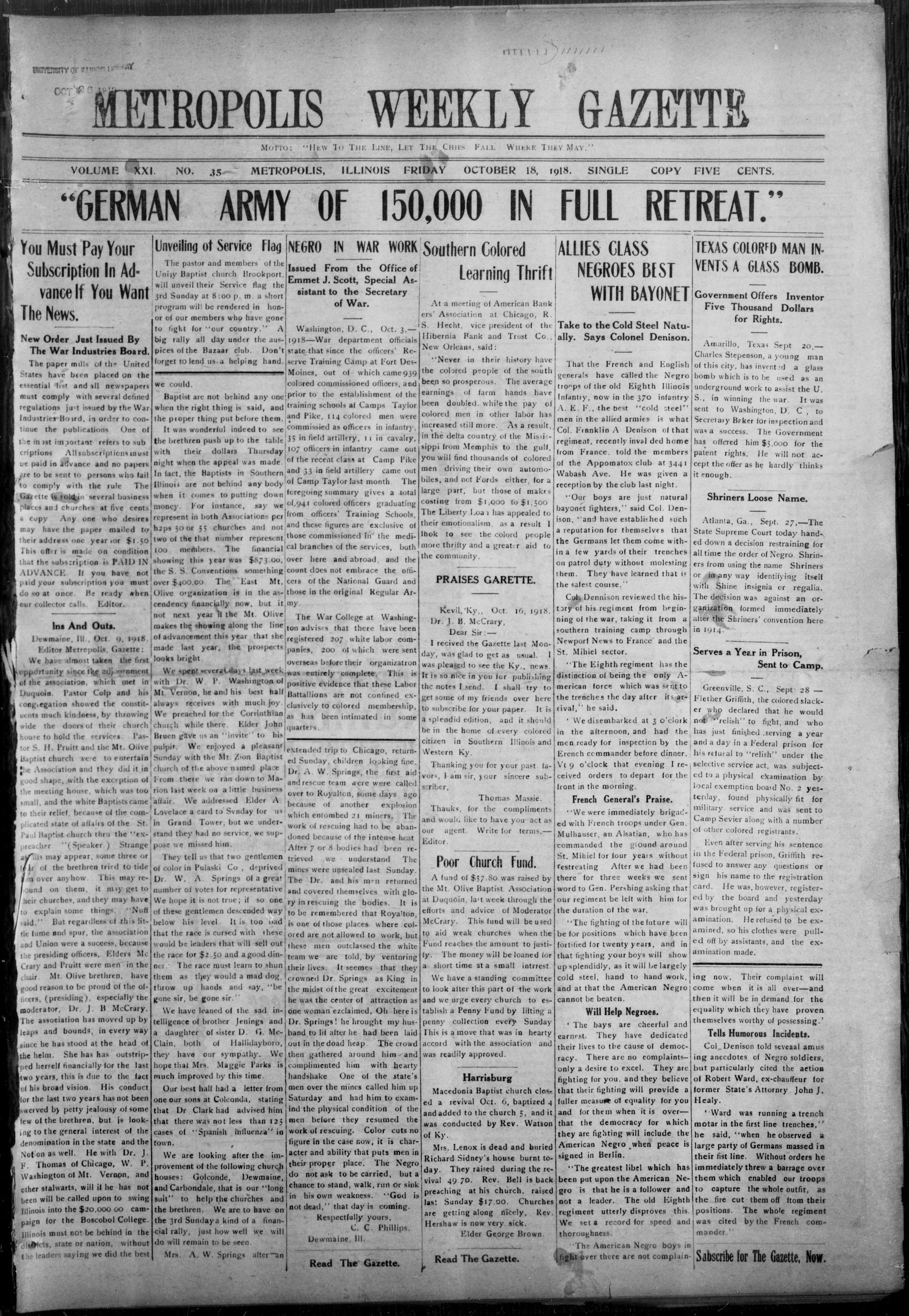
"GERMAN ARMY OF 150,000 IN FULL RETREAT."
METR
VOLUME XXI. NO.
“GERMAN
Unveiling of Service Flag
The pastor and members of the Unity Baptist church Brookport, will unveil their Service flag the 3rd Sunday at 8:00 p.m. a short program will be rendered in honor of our members who have gone to fight for "our country." A big rally all day under the auspices of the Bazaar club. Don't forget to lend us a helping hand.
we could.
Baptist are not behind any one when the right thing is said, and the proper thing put before them. It was wonderful indeed to see the brethren push up to the table with their dollars Thursday night when the appeal was made. In fact, the Baptists in Southern Illinois are not behind any body when it comes to putting down money. For instance, say we represent in both Associations per h2ps 50 or 55 churches and not two of the that number represent 100 members. The financial showing this year was $873.00, the S. S. Conventions something over $400.00 The East Mt. Olive organization is in the ascendency financially now, but it not next year if the Mt. Olive makes the showing along the line of advancement this year that she made last year, the prospects looks bright.
We spent several days last week with Dr. W. P. Washington of Mt. Vernon, he and his best hall always receives with much joy. We preached for the Corrinthian church while there. Elder John Bruen gave us an "invite" to his pulpit. We enjoyed a pleasant Sunday with the Mt. Zion Baptist church of the above named place. From there we ran down to Marion last week on a little business affair. We addressed Elder A. Lovelace a card to Svnday for us in Grand Tower, but we understand they had no service, we suppose we missed him.
They tell us that two gentlemen of color in Pulaski Co., deprived Dr. W. A. Springs of a great number of votes for representative We hope it is not true; if so one of these gentlemen descended way below his level. It is too bad that the race is cursed with these would be leaders that will sell out the race for $2.50 and a good dinner. The race must learn to shun them as they would a mad dog, throw up hands and say, "be gone sir, be gone sir." We have leaned of the sad intelligence of brother Jenings and a daughter of sister D. G. McClain, both of Hallidayboro, they have our sympathy. We hope that Mrs. Maggie Parks is much improved by this time.
Our best half had a letter from one our sons at Colconda, stating that Dr Clark had advised him that there was not less than 125 cases of "Spanish influenza" in town.
We are looking after the improvement of the following church houses: Golconde, Dewmaine, and Carbondale, that is our "long suit" to help the churches and the brethren. We are to have on the 3rd Sunday a kind of a financial rally, just how well we will do will remain to be seen.
Mrs. A. W. Springs after an
---
UNIVERSITY OF RICHMOND LANE
You Must Pay Your Subscription In Advance If You Want The News.
The paper mills of the United States have been placed on the essential list and all newspapers must comply with several defined regulations just issued by the War Industries Board, in order to continue the publications. One of the most important refers to subscriptions. All subscriptions must be paid in advance and no papers are to be sent to persons who fail to comply with the rule. The Gazette is sold in several business places and churches at five cents a copy. Any one who desires may have the paper mailed to their address one year or $1.50. This offer is made on condition that the subscription is PAID IN ADVANCE. If you have not paid your subscription you must do so at once. Be ready when our collector calls. Editor.
Ins And Outs.
Dewmaine, Ill., Oct. 9, 1918.
Editor Metropolis, Gazette:
We have almost taken the first opportunity since the adjustment of the association, which met in Duquoin. Pastor Colp and his congregation showed the constituents much kindness, by throwing wide the doors of their church house to hold the services. Pastor S. H. Pruitt and the Mt. Olive Baptist church were to entertain the Association and they did it in good shape, with the exception of the meeting house, which was too small, and the white Baptists came to their relief, because of the complicated state of affairs of the St. Paul Baptist church thru the "expressacher "("Speaker.") Strange as his may appear, some three or four of the brethren tried to tide him over anyhow. This may rebound on them, it may get to their churches, and they may have to explain some things. "Nuff said." But regardless of this little fume and spur, the association and Union were a success, because the presiding officers, Elders McCrary and Pruitt were men in the chair. Mt. Olive brethren, have good reason to be proud of the officers, (presiding), especially the moderator, Dr. J. B McCrary. The association has moved up by leaps and bounds, in every way since he has stood at the head of the helm. She has has outstripped herself financially for the last two years, this is due to the fact of his broad vision. His conduct for the last two years has not been swerved by petty jealousy of some few of the brethren, but is looking to the general interest of the denomination in the state and the Nation as well. He with Dr. J. F. Thomas of Chicago, W. P. Washington of Mt. Vernon, and other stalwarts, will if he has not been will be called upon to swing Illinois into the $20,000 00 campaign for the Boscobol College. Illinois must not be behind in the districts, state or nation, without the leaders saying we did the best
Issued From the Office of Emmet J. Scott, Special Assistant to the Secretary of War.
Washington, D. C., Oct. 3, 1918—War department officials state that since the officers' Reserve Training Camp at Fort DesMoines, out of which came 939 colored commissioned officers, and prior to the establishment of the training schools at Camps Taylor and Pike, 114 colored men were commissied as officers in infantry, 35 in field artillery, 11 in cavalry, 107 officers in infantry came out of the recent class at Camp Pike and 33 in field artillery came out of Camp Taylor last month. The foregoing summary gives a total of 941 colored officers graduating from officers' Training Schools, and these figures are exclusive of those commissioned in the medical branches of the services, both over here and abroad, and the count does not embrace the officers of the National Guard and those in the original Regular Ar-
The War College at Washington advises that there have been registered 207 white labor companies, 200 of which were sent overseas before their organizatron was entirely complete. This is positive evidence that these Labor Battalions are not confined exclusively to colored membership, as has been intimated in some quarters.
extended trip to Chicago, returned Sunday, children looking fine, Dr. A. W. Springs, the first aid and rescue team were were called over to Royalton, some days ago because of another explosion which entombed 21 miners. The work of rescuing had to be abandoned because of the intense heat After 7 or 8 bodies had been retrieved we understand The mines were unsealed last Sunday. The Dr. and his men returned and covered themselves with glory in rescuing the bodies. It is to be remembered that Royalton, is one of those places where colored are not allowed to work, but these men outclassed the white team we are told, by venturing their lives. It seems that they crowned Dr. Springs as King in the midst of the great excitement he was the center of attraction as one woman ezclaimed, Oh here is Dr. Springs! he hrought my husband to lift after he had been laid out in the dead heap. The crowd then gathered around him and complimented him with hearty handshake One of the state's men over the mines called him up Saturday and had him to examine the physical condition of the men before they resumed the work of rescuing. Color cuts no figure in the case now, it is character and ability that puts men in their proper place. The Negro do not ask to be carried, but a chance to stand, walk, run or sink in his own weakness. "God is not dead," that day is coming. Respectfully yours, C. C. Phillips.
Read The Gazette.
Southern Colored Learning Thrift
At a meeting of American Bankers' Association at Chicago, R.S. Hecht, vice president of the Hibernia Bank and Trust Co., New Orleans, said:
"Never in their history have the colored people of the south been so prosperous. The average earnings of farm hands have been doubled, while the pay of colored men in other labor has increased still more. As a result, in the delta country of the Mississippi from Memphis to the gulf, you will find thousands of colored men driving their own automobiles, and not Fords either, for a large part, but those of makes costing from $1,000 to $1,500. The Liberty Loan has appealed to their emotionalism, as a result I thok to see the colord people more thrifty and a greater aid to the community.
PRAISES GARETTE
Kevil, Ky., Oct. 16, 1918.
Dr. J. B. McCrary,
Dear Sir:—
I recived the Gazette last Monday, was glad to get as usual. I was pleased to see the Ky., news. It is so nice in you for publishing the notes I send. I shall try to get some of my friends over here to subscribe for your paper. It is a splendid edition, and it should be in the home of every colored citizen in Southern Illinois and Western Ky.
Thanking you for your past favors, I am sir, your sincere subscriber,
Thomas Massie.
Thauks, for the compliments and would like to have you act as our agent. Write for terms.—Editor.
Poor Church Fund.
A fund of $57.80 was raised by the Mt. Olive Baptist Association at Duquoin, last week through the efforts and advice of Moderator McCrary. This fund will be used to aid weak churches when the Fund reaches the amount to justify. The money will be loaned for a short time at a small intrrest. We have a standing committee to look after this part of the work and we urge every church to establish a Penny Fund by lifting a penny collection every Sunday This is a move that was in hearty accord with the association and was readily approved.
Harrisburg
Macedonia Baptist church closed a revival Oct. 6, baptized 4 and added to the church 5, and it was conducted by Rev. Watson of Ky.
Mrs. Lenox is dead and buried Richard Sidney's house burnt today. They raised during the revival 49.70. Rev. Bell is back preaching at his church, raised last: Sunday $17.00. Churches are getting along nicely, Rev. Hershaw is now very sick.
Read The Gazette
ALLIES CLASS NEGROES BEST WITH BAYONET
Take to the Cold Steel Naturally. Says Colonel Denison.
That the French and English generals have called the Negro troops of the old Eighth Illinois Infantry, now in the 370 infantry A. E. F., the best "cold steel" men in the allied armies is what Col. Franklin A Denison of that regiment, recently inval ded home from France, told the members of the Appomatox club at 3441 Wabash Ave. He was given a reception by the club last night.
"Our boys are just natural bayonet fighters," said Col. Denison, "and have established such a reputation for themselves that the Germans let them come within a few yards of their trenches on patrol duty without molesting them. They have learned that is the safest course."
Col. Dennison reviewed the history of his regiment from beginning of the war, taking it from a southern training camp through Newport News to France and the St. Mihiel sector.
"The Eighth regiment has the distinction of being the only American force which was sent to the trenches the day after its arrival," he said.
"We disembarked at 3 o'clock in the afternoon, and had the men ready for inspection by the French commander before dinner. Vt 9 o'clock that evening I received orders to depart for the front in the morning.
French General's Praise.
"We were immediately brigaded with French troops under Gen. Mulhauser, an Alsatian, who has commanded the ground around St. Mihiel for four years without restreating. After we had been there for three weeks we sent word to Gen. Pershing asking that our regiment be left with him for the duration of the war.
"The fighting of the future will be for positions which have been fortified for twenty years, and in that fighting your boys will show up splendidly, as it will be largely cold steel, hand to hand work, and at that the American Negro cannot be beaten.
Will Help Negroes.
' The bays are cheerful and earnest. They have dedicated their lives to the cause of democracy. There are no complaints-only a desire to excel. They are fighting for you, and they believe that their fighting will provide a fuller measure of equality for you and for them when it is over—that the democracy for which they are fighting will include the American Negro when peace is signed in Berlin.
' The greatest libel which has been put upon the American Negro is that he is a follower and not a leader. The old Eighth regiment utterly disproves this. We set a record for speed and thoroughness.
' The American Negro boys in fight over there are not complain-
TEXAS COLORFD MAN INVENTS A GLASS BOMB.
Government Offers Inventor Five Thousand Dollars for Rights.
Amarillo, Texas Sept 20.—Charles Stepenson, a young man of this city, has invented a glass bomb which is to be used as an underground work to assist the U. S., in winning the war. It was sent to Washington, D. C., to Secretary Baker for inspection and was a success. The Government has offered him $5,000 for the patent rights. He will not accept the offer as he hardly thinks it enough.
Shriners Loose Name.
Atlanta, Ga., Sept. 27.—The State Supreme Court today handed down a decision restraining for all time the order of Negro Shriners from using the name Shriners or in any way identifying itself with Shine insignia or regalia. The decision was against an organization formed immediately after the Shriners' convention here in 1914.
Serves a Year in Prison, Sent to Camp.
Greenville, S. C., Sept. 28 Flether Griffith, the colored slacker who declared that he would not "relish" to fight, and who has just finished serving a year and a day in a Federal prison for his refusal to "relish" under the selective service act, was subjected to a physical examination by local exemption board No. 2 yesterday, found physically fit for military service and was sent to Camp Sevier along with a number of other colored registrants.
Even after serving his sentence in the Federal prison, Griffith refused to answer any questions or sign his name to the registration card. He was, however, registered by the board and yesterday was brought up for a physical examination. He refused to be examined, so his clothes were pulled off by assistants, and the examination made.
ing now. Their complaint will come when it is all over—and then it will be in demand for the equality which they have proven themselves worthy of possessing.'
Tells Humorous Incidents.
Col. Denison told seveaal amusing anecdotes of Negro soldiers, but particularly cited the action of Robert Ward, ex-chauffeur for former State's Attorney John J. Healy.
"Ward was running a trench motar in the first line trenches," he said, "when he observed a large party of Germans massed in their fist line. Without orders he immediately threw a barrage over them which enabled our troops to capture the whole outfit, as the fire cut them off from their positions. The whole regiment was cited by the French commander."
Subscribe for The Gazette, Now.
Page Two
Metropolis Gazette
PUBLISHED ON FRIDAY BY
THE GAZETTE PRINTING CO.
METROPOLIS, . . . . ILL.
MRS. M. J. McCRARY, MANAGER
J. B. McCRARY, EDITOR
Office 9th and Pearl Streets, Metropolis, Illinois.
Enterered as second-class mail matter, at Metropolis, Illinois, Postoffice.
B Address all communications to J. B. McCRABARY, 903 Pearl St. Metropolis, Ill.
The names and addresses of contributors must be known to us in every instance, in order to secure publication. We want the news of your vicinity week
TERMS OF SUBSCRIPTION:
One Year.....$1.50
Six Months.....80
Three Months.....40
Single Copy.....05
In Advance.
ADVERTISING RATES.
made known on application.
You must mail copy on Mondays to secure publication.
$100 Reward, $100.
The readers of this paper will be pleased to learn that there is at least one dreaded disease that science has been able to cure in all its stages, and that is catarrh. Hall's catarh cure is the oily cure now known to the medical fraternity. catarrh being a constitutional disease, requires a constitutional treatment. Hall's catarrh is taken internally, acting directly upon the blood and mucous surfaces of the system, thereby destroying the foundation of the disease, and giving the patient strength by building up the constitution and assisting nature in doing its work. The proprietors have so much faith in its curative powers that they offer One Hundred Dollars for any case that it fails to cure. send for list of testimonials.
Address F. J. CHENEY & CO., Toledo, O.
Sold by all Druggists, 75c.
Fake Hall's Family Pills for constipation.
We want to put The Gazette into every home in the city within 30 days. Will you help us neighbor? Special inducements will be given. Let every reader help us to get subscribers. Build up your Race Enterprise.
The Gazette has just received another lot of new type faces and other material which adds much to the output of the work of the office. We deserve your patronage. We have a full line of cards, Letter Heads, Envelopes and other material. Let us do some of your work.
Remember, the paper is $1.50 per year. The paper has taken another raise, postage will be higher, 3c for stamps and 2c for post cards, please pay up.
You have seen our Job Office and know that we are prepared to do first classwork. Send us your church work, bills, cards envelopes, and etc. Have a little more Race pride "Parson."
REV. H. A. BOYD:
inst'. Sec. National Bapt. Pub. Board
Unincorporated Mashville- Tenn.
REV. H. A. BOYD:
st'. Sec. National Bapt. Pub. Board
Unincorporated Mashville Tenn.
"WANTED: Laborers, white or colored, for work in our lumber yard, car shops or foundry; largely peice work. Good wages, no trouble. Now is the chance to get steady work for the winter. Apply Mt. Vernon Car Mfg. Company at Mt. Vernon, Illinois."
For Sale.
One sanitary couch, in good condition. Cost when new $12. will sell for $5.00. One iron bedstead and springs about $8.00. One cot and mattress $1.00. Call at 115 W. Third St.
The Executive Board meeting that was to have been in Joppa. this was called off to some future-date on the account of the influnza.
Rev. V. S. Smith, pastor of the Washington Street Baptist chnrch, of Paducah, Ky., preached for the pastor of the First Baptist church Tuesday and Wednesday nights to a large and appreciative audiences, Dr. Smith is indeed a strong gospel preacher, one who stands firm and preaches the gospel as it is.
Rev. and Mrs. J. B. McCrary were in Brookport, Sunday.
The revival at the first Baptist church still continues with five conversions and interest high.
Mrs. Lavada Rodgers is visiting her husband in Paducah.
Mr. and Mrs. J. T. Williamson are preparing their residence on W. 6th St. by raising and putting a concrete foundation under The front porch has also been remodeled and the place looks as if the owners have had some money during these war times.
Rev M S. McCauley preached for St. Paul A. M. E. church Sunday.
A spiritual praise meeting was held at the Free Baptist church Sunday. Revs. Berry Thomas and Edgar McCrary were present and helped to fire the old camp. Rev. McCrary was invited over to preach for them at any time and the invitation was accepted.
Rev. J. H. Smith, presiding Elder over the Cairo district and Rev. J. Reddick pastor of the Methodist church, Brookport, were in the city Wednesday.
Rev. Thomas Turner is at his home for a few days from his charge in Tenn.
We hope that every one who owes us would come in and pay up or send it in. We are striving hard to serve you and we have incurred more debt by adding more machinery and type.
Mrs Katie E. Lowery, of Paducah, Ky. was a visitor for several days recently of her aunt Mrs Ellen White, of Brookport,
Dr. S. R. Gholston, of Richmond, Ky. a son of Thos. Gholston of Paducah, Ky., and a nephew of Mrs. Mattie Fossie of this city is reported to have died Monday of this week. He was a successful practicing physician and a graduate of Meharry Medical College Nashville, Tenn. The Gazette is in sympathy with the father and relatives.
Laater:—We understan hi is improving.
Walker's Indigestian Cure.
Rev. J. B. McCrary is agent for Dr. Walker's Sure cure for Indigestion and Dyspepsia. 50c and $1.00 bottles. $1.10 by mail. We can cheerfully recommend it.
Attend the big rally at Unity Baptist Sunday.
METROPOLIS WEEKLY GAZETTE. METROPOLIS. ILL
Notice is hereby given that the Executive Board of the Ministers' and Deacons' Union of the Mt. Olive Baptist Association will meet in a special session, Thursday before the Third Sunday in October with the Clover Leaf Baptist Church, Joppa, Ill., Rev. D. Parrish, pastor.
Every church in the district is urged to send $1.00 to help defray the expense of the meeting.
Come without fail as there will be business of importance to transact.
S. H. Pruett, President.
Edgar S. McCrary
Cor. Sec'y.
Pain
Will Master You
If You Don't
Master Pain
If you suffer from any
Ache or Pain, take One or
Two of
Dr.Miles
-Anti=
PainPills
They seldom fail to Relieve and do not contain any Habit-forming drugs. SOLD BY ALL DRUGGISTS MILES MEDICAL CO., Elkhart, Ind.
A Prayer.
Mary Lou Blackwell Fossie.
Mary Lou Blackwell Fossie.
We know that in the shadow of the wings of Jehovah there is safety, love and power. Without there is crime, woe, and world wide chaos. Masses of men withdrawing from the shelter of Thy love have plunged the world into an abyss of sin and horror.
Have mercy, O Lord! and restore Thine unchangeable eternal and righteous law. Let National and International righteousness reign supreme, for then there would be peace. Overcome any force or combination of forces that would throttle the power of our Republic for good. Give the rulers clear vision, merciful hearts, and Godlike wisdom. Let them and all the people know Thy law and do Thy will. Let brutality be changed to mercy. Let the battle cry be changed to the song the Angels sang on Judaeon hills, of "Peace on earth, good will to men.
We pray for the helpless motherhood of the entire world. We know they are crushed to the earth without comfort or hope. We know their ideals, and their ambitions for the sons they loved are blighted. We know that the Mother Lullaby is changed to a wail of woe. Have mercy, we plead! Hear their prayers whether they be in America, or the remotest land, comfort them as Thou alone can't comfort, Show them my Father, that the belm that can heal all wounds is service in your name.
Last of all we pray for the soldiers, whether on the seas, or in the trenches, in the air or in the camps. Keep them from sin and crime. Encircle them with Thine Almighty arms, give them
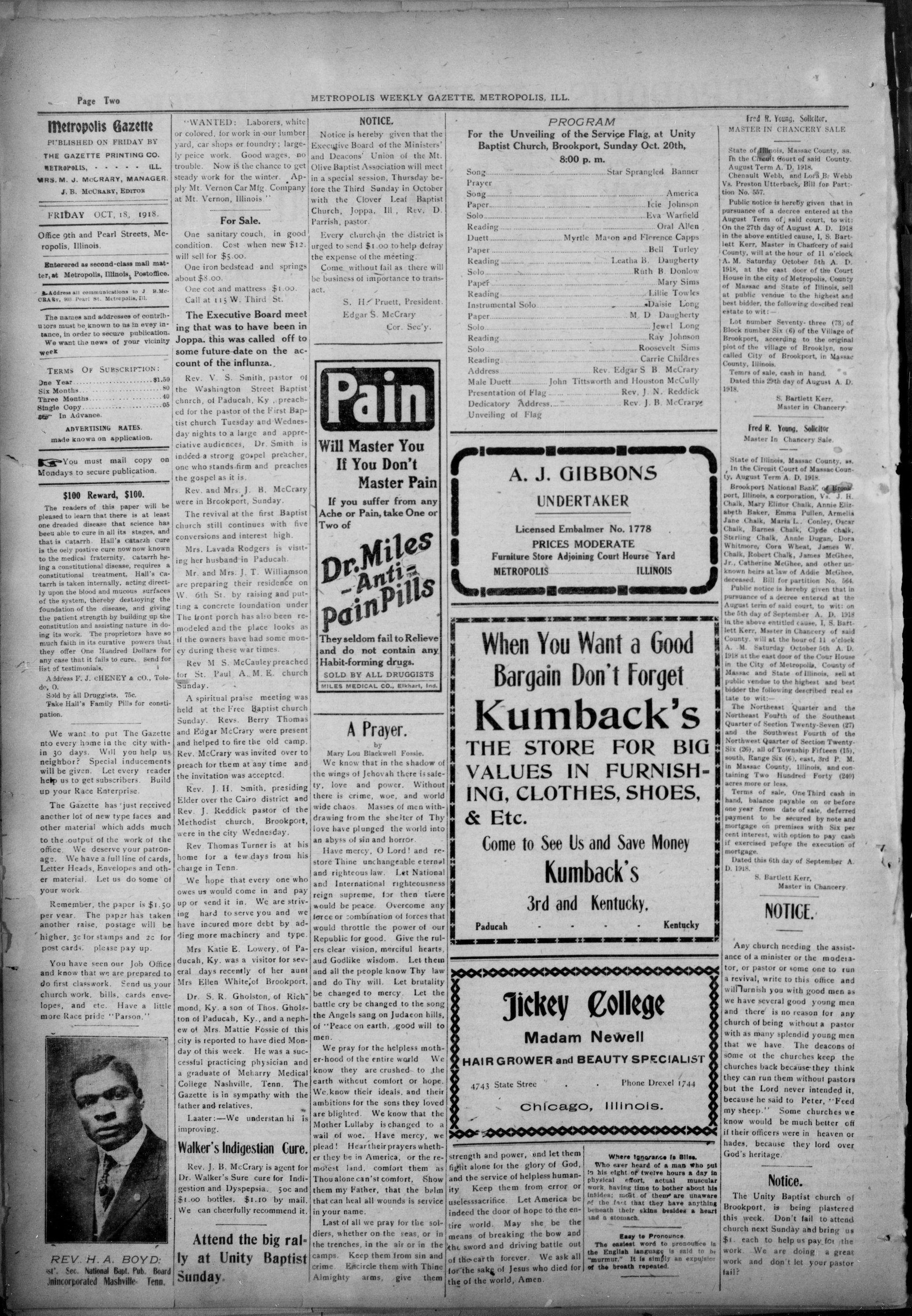
For the Unveiling of the Service Flag, at Unity Baptist Church, Brookport, Sunday Oct. 20th, 8:00 p. m.
Song.....Star Sprangled Banner
Prayer
Song.....America
Paper.....Icie Johnson
Solo.....Eva Warfield
Reading.....Oral Allen
Duett.....Myrtle Mason and Florence Capps
Paper.....Bell Turley
Reading.....Leatha B. Daugherty
Solo.....Ruth B. Donlow
Paper.....Mary Sims
Reading.....Lillie Towles
Instrumental Solo.....Daisie Long
Paper.....M. D Daugherty
Solo.....Jewel Long
Reading.....Ray Johnson
Solo.....Roosevelt Sims
Reading.....Carrie Childres
Address.....Rev. Edgar S. B. McCrary
Male Duett.....John Tittsworth and Houston McCully
Presentation of Flag.....Rev, J. N. Reddick
Dedicatory Address.....Rev. J. B. McCrary
Unveiling of Flag
Licensed Embalmer No. 1778
PRICES MODERATE
Furniture Store Adjoining Court Hourse Yard
METROPOLIS ILLINOIS
When You Want a Good Bargain Don't Forget Kumback's
THE STORE FOR BIG VALUES IN FURNISHING, CLOTHES, SHOES, & Etc.
Jickey College
Madam Newell
HAIR GROWER and BEAUTY SPECIALIST
4743 State Stree Phone Drexel 1744
Chicago, Illinois.
strength and power, and let them fight alone for the glory of God, and the service of helpless humanity Keep them from error or uselessacrifice. Let America be indeed the door of hope to the entire world. May she be the means of breaking the bow and the sword and driving battle out of the earth forever. We ask all for the sake of Jesus who died for the of the world, Amen.
Where ignorance is Bills. Who ever heard of a man who put in his eight of twelve hours a day in physical effort, actual muscular work, having time to bother about his insides; most of them are unaware of the fact that they have anything beneath their skins besides a heart and a stomach.
Easy to Pronounce
Easy to Pronounce.
The easiest word to pronounce is the English language is said to be "murmut." It is simply an expulsion of the breath repeated.
State of Illinois, Massac County, ss.
In the Circuit Court of said County.
August Term A. D. 1918.
Chenault Webb, and Lora B. Webb
Vs. Preston Utterback, Bill for Part-
tion No. 557.
Public notice is hereby given that in
pursuance of a decree entered at the
August Term of said court, to wit:
On the 27th day of August A. D. 1918
in the above entitled cause, I, S. Bartlett Kerr, Master in Charcery of said
County, will at the hour of 11 o'clock
A. M. Saturday October 5th A. D.
1918, at the east door of the Court
House in the city of Metropolis, County
of Massac and State of Illinois, sell
at public venue to the highest and
best bidder, the following described real
estate to wit: —
Lot number Seventy-three (73) of
Block number Six (6) of the Village of
Brookport, according to the original
plot of the village of Brooklyn, now
called City of Brookport, in Massac
County, Illinois.
Temrs of sale, cash in hand.
Dated this 29th day of August A. D.
1918.
S. Bartlett Kerr
Master in Chancery.
Fred R. Young, Solicitor Master In Chancery Sale
State of Illinois, Massac County, ss.
In the Circuit Court of Massac County,
August Term A. D. 1918.
Brookport National Bank, of Brookport,
Illinois, a corporation, Va. J. H.
Chalk, Mary Elinor Chalk, Annie Elizabeth Baker, Emma Pullen, Armelia Jane Chalk, Maria L. Conley, Oscar Chalk, Barnes Chalk, Clyde chalk,
Sterling Chalk, Annie Dugan, Dora Whitmore, Cora Wheat, James W. Chalk, Robert Chalk, James McGhee, Jr., Catherine McGhee, and other unknown heirs at law of Addie McGhee, deceased. Bill for partition No. 564.
Public notice is hereby given that in pursuance of a decree entered at the August term of said court, to wit: on the 5th day of September A. D. 1918 in the above entitled cause, I, S. Bartlett Kerr, Master in Chancery of said County, will at the hour of 11 o'clock A. M. Saturday October 6th A. D. 1918 at the east door of the Cour House in the City of Metropolis, County of Massac and State of Illinois, sell at public vendue to the highest and best bidder the following described real estate to wit:—
The Northeast Quarter and the Northeast Fourth of the Southeast Quarter of Section Twenty-Seven (27) and the Southwest Fourth of the Northwest Quarter of Section Twenty-Six (26), all of Township Fifteen (15), south, Range Six (6), east, 3rd P. M. in Massac County, Illinois, and containing Two Hundred Forty (240) acres more or less.
Terms of sale, One Third cash in hand, balance payable on or before one year from date of sale, deferred payment to be secured by note and mortgage on premises with Six per cent interest, with option to pay cash if exercised before the execution of mortgage.
Dated this 6th day of September A. D. 1918.
NOTICE.
Any church needing the assistance of a minister or the moderator, or pastor or some one to run a revival, write to this office and will turnish you with good men as we have several good young men and there is no reason for any church of being without a pastor with as many splendid young men that we have. The deacons of some of the churches keep the churches back because they think they can run them without pastors but the Lord never intended it, because he said to Peter, "Feed my sheep." Some churches we know would be much better off if their officers were in heaven or hades, because they lord over God's heritage.
Notice.
The Unity Baptist church of Brookport, is being plastered this week. Don't fail to attend church next Sunday and bring us $1 each to help us pay for the work. We are doing a great work and don't let your pastor fail?
Moral and Religious Situation There
Chaplains Francis B. Doherty and Lyman Rollins have just returned from France on a military mission to the United States.
Chaplain Doherty is attached to general headquarters in France, being associated with Bishop Charles H. Brent and Chaplain Paul Dwight Moody (sor of the well-known evangelist of that name) in the general headquarters chaplains' office. The function of this office is, declares the religious publicity committee, the direction and distribution of chaplains' activities in France to the end of the attainment of the best and special interests of all concerned, under General Pershing. This work carries with it considerable travel and gives an intimate knowledge of the situation from a religious and moral point of view.
From this broad knowledge Chapain Doherty says: "Everywhere we find the same situation, here the same story; the condition and the spirit of the men are excellent." When leaving France on his present mission the chapain asked General Pershing: "May we not tell our people in America that the moral and religious situation here is eminently high and very satisfactory?" The reply was: "Yes, and you may say furthermore, that it is going to be kept up to that." Chapains Doherty and Rollins spoke enthusiastically of the altogether admirable spirit of fraternity existing between those who are ministering to our soldiers. The Catholic chapains, they say, are not merely looking to the good of the Catholic boys nor the Protestant to that of the Protestant boys; each is working for the best interest of every man.
TURNING PESTS INTO PROFITS
United States Department of Agriculture Has Plans for Dealing With the Rabbit Problem.
Fully 200,000,000 wild rabbits are killed in the United States every year according to estimates made by the biological survey of the United States department of agriculture. Many of them are jack rabbits, the majority of which have not been utilized in the past. If all the rabbits killed were consumed, they would represent between 200,000 and 300,000 tons of valuable food, and if proper measures were taken to insure the collection of skins, these alone would have a value of $20,000,000. The biological survey has frequently been called upon to help western farmers in coping with the rabbit pest. In view of the probable economic value of rabbit meat and fur in the coming few years, the energies of the farmers and ranchmen will be directed to the conservation of this important resource. Already a number of establishments for collecting, dressing, canning, and shipping rabbit meat are in operation in western centers. As in Australia the transition of the wild rabbit in this country from its status as a pest to source of profit is assured, it is believed.
"Cellulon," New Wood Pulp Fiber. There has, says the Board of Trade Journal, been much discussion in the German press during recent weeks concerning a wood pulp fiber named "Cellulon," for which large claims are made as an efficient substitute for jute, cotton and other fibers. It appears to be certain that the fiber is not made by spinning long strips of paper run off reels through water in the manner which German paper textile substitutes have made familiar. The accounts agree in describing the process, or processes, as a direct manufacture from wood pulp. The consul general at Zurich, who has presented a report to the foreign office, states that the method employed operates on the same general lines as that used for artificial silk manufacture—that is, by squeezing pulp under high pressure through small holes in plates.—Engineer.
Wooden Shoe Classy
If it were not for the pioneers humanity would be helpless. The wife of Lieut. A. J. Huntington of the One Hundred Sixty-Second infantry, resident in Portland, Ore., has long been of the opinion that shoes are too high in price, and, having the courage of her convictions and possessing also a desire to save leather for the army, she occasionally wears a pair of neat wooden low shoes. These are painted black, with a patent leather effect, and are really very convenient and classy in still life, though the rigidity of the sole is some backset. The Lieutenant sent the shoes from France, where that style of shoes is much in use. With rubber tires to dispense with the stricto rattle on cement walks, mother and the girls might save pin money and get along, and with a few old pairs around the house would never be out of knilding wood.
Wheat Products Exports.
Wheat Products Export
Sir William Goode of the British
food ministry, says that from July
1917, to April, 1918, the United States
exported to the allies 80,000,000 bushels
of wheat products. Of this it is
asserted that 50,000,000 bushels represented voluntary sacrifices by the American people in their consumption of wheat.
Real Vacation.
"You say you are on a vacation?"
"Yes," replied the philosophical person.
"For the next few weeks I am going to quit riding on the cars or talking about the weather."
A long, low building of frame construction, attractively planned, with wide verandas and a homelike aspect. Outside are hanging the flags—the Stars and Stripes, which must soon be taken in as it is nearly sunset, and another flag bearing a little triangle of blue and the letters Y. W. C. A. It is a fall afternoon and the air is a bit sharp. Through the front windows of the house the woman approaching up the walk can see the cheerful glow of an open fireplace. There is the sound of a piano and some one is singing.
The woman, who is slight and young and tired-looking, puts her heavy suitcase down on the walk and shifts the baby she is carrying to the other arm. She listens a minute, then picks up the luggage and walks bravely up to the front door. Some one has heard her coming and is there to meet her. Some one always is in places like this. The door is thrown open and a kind woman's voice says; "Oh, do come in and rest. Let me take the baby." The baby is passed over and the stranger, worn from a long journey, tired and sad, is given the welcome which only the Y. W. C. A. hostesses know how to give.
She explains that she has come to see John before he leaves for the front. She has been saving her money for traveling expenses, and has come to surprise him. John has never seen the baby, and now maybe he never will, for she has discovered that John has just left on a two days' furlough to surprise her. Before she could get a train back to her home John's furlough will have expired and he will be on his way back to camp. The little mother does not know how to meet the situation and tears of fatigue and disappointment begin to flow.
"Well, that's too bad," says the sympathetic Y. W. C. A. worker. "But cheer up. You can just stay here for a couple of days. We'll send a wire to John at the first place his train stops and tell him to take the next train back. He can enjoy his furlough here."
This is done and the little family has a glorious day of it.
The Young Women's Christian association has established 92 hostess houses of this character for American soldiers and sailors and their families. In this brief bulletin of news lies one of the most potent factors in the winning of this war. Our boys are fighting for their homes. The Y. W. C. A. with its hostess work in this country and in France is helping to keep the ideal of American home life constantly before the men who are protecting it. These men had to go away from their individual homes, but there is a home which follows them—a place where they can go when they are off duty and meet their families and rest. There is a room in every Y. W. C. A. hostess house with a real fireplace in it and a domestic hearth. There are chats with cushions on them; the china is not of the iron-bound bucket variety necessary in camps; and best of all, the boys say, there are nice women to talk to. No boy in camp would hesitate to ask his mother or sister or the girl he thinks most of to meet him at a Y. W. C. A. house, for he knows that the women she will see there are of the right kind. The very fact that it is known that there is a real, home place near each camp authorized by the war department and presided over by dignified and refined women, has served very largely to discourage the other type of woman and keep her away from the men she formerly preyed upon.
The Y. W. C. A. houses are not established with any view to marking class lines, however, although many of the hostesses who assist led lives of greatest ease and luxury before the war. Democracy rules at the sign of the little Blue Triangle.
A story is told of a great merchant's wife whose individual fortune mounts to the million mark. This lady is a member of one of the Y. W. C. A. committees, and on one occasion she was helping in the cafeteria of a hostess house at the Great Lakes naval training station. A little shopgirl who had a "day off" from her work in the basement of the great store owned by the Y. W. C. A. worker's husband, and who had come to see her sailor brother, was in a State street hurry for service. She sharply ordered the merchant's wife to "look alive with these forks, girlie."
The lady addressed as "girlie" quite humbly saw to it that the pile of forks was replenished. Then she went over and talked to the girl, helped her to locate her brother and sent her away happy. The shopgirl never knew that she had been talking to her employer's wife.
There are two hostess houses at the Great Lakes station, and it is a wonderful sight to see the crowds of women relatives and friends of the sailors who throng to them on the Wednesday drill afternoons. From 1,000 to 3,000 persons a day are cared for in the cafeterias, and the nurseries are full of sailor babies, whose mothers can leave them there safely while they are on the grounds.
In addition to the hostess house work in this country the Y. W. C. A. has established the famous Hotel Petrograd in Parts as a center for transient women war workers overseas. There are also many foyers or recreation centers in France where girl munitions workers, signal corps girls and others are refreshed and brightened by association with the play lenders of the Y. W. C. A. who have introduced American gymnasium classes into French life.
A little sunny village has grown up inside a high wall in France within the last year. Its square flat houses stand in straight even rows and along one side of the city wall is a long dormitory for single women. There are many more of them than of the families in the drab little houses. The village is full of women—old, young, middle-aged—whose faces, hands and hair slowly are turning yellow from the powder which it is said will eventually affect their lungs. But most of them are refugees and the fact that they are giving up their good looks, their health, and perhaps their lives in the munition factory, is of little moment to them. They have come into the walled town from ruined villages and devastated farms with their frightened little children, their despairing old people, carrying all their earthly possessions in tiny bundles. In their individual lives there is no future; in all their world there is no interest but the conquest of the Hun.
No one comes into this little war community that centers around the big new munitions plant but those who work. Because of the danger and the blighting yellow powder, the work is highly paid and all the workers are volunteers.
The women wear overalls or apron dresses, some of black sateen, some nondescript. The dull garb harmonizes with the yellowing faces and despairing eyes.
Into this modern walled city of despair the Blue Triangle has flashed the first message of hope. The Y. W. C. A. foyer is the only recreational center within reach. The cars which find cafes at the end of the line a mile away, stop running at seven o'clock to save fuel. The city is three miles from the factory.
"My problem," writes the Y. W. C. A. secretary in charge, "is to keep the women occupied in the evenings, to give them good healthy amusement so that they will forget their sorrows and go to bed and sleep, physically tired out from playing."
She goes on to tell of some of the women and girls who come to the foyer:
"There is a pretty little round, rosy-checked girl here who is just beginning to show the effects of the powder. The roots of her hair and her forehead are a pale yellow. The palms of her hands are a deep burnt orange and her hands and arms a bright yellow.
"There is an ex-professional dancer, an interesting girl who enjoys the foyer and helps entertain the other girls. There is a professional pianist who does her bit at the noon and evesing hours. There is one rough-and-ready girl who speaks English, whose father was an innkeeper in northern France. There is a pretty little girl who is engaged to a French soldier who still is rejoicing over the five minutes she had with him recently during an air raid. His mother is the caretaker here and he is one of six sons in the war. Two of them are German military prisoners, two are civil prisoners in Germany and two are soldiers in the trenches. Her home in the north of France was destroyed and she escaped with a small bundle of such things as she could carry in her hands.
"There is a sweet-faced girl who was a lacemaker in Valenjeenc, who came direct to us from the German-ridden section after a hard experience in getting away."
These are the women the Blue Triangle is helping to forget—perhaps only for an hour at a time—the horrors that have blackened their heartstones and darkened the world.
"My foyer," the secretary writes, "consists of a hall and two large rooms with cement floors." One has a writing table and paper, pens and ink, sewing machines, a cupboard with teacups in it, a large table with papers and magazines, easy chairs and my desk. The other room has a piano, more tables, chairs, troning boards and $e$ Victrola. There are unframed French pictures and American and French war posters around the room. The walls are painted gray and white."
Saturday evenings they sing and dance. "First they have a chorus," writes the secretary, "such as Le Reve Passe' or the 'Hymne des Aviateurs' or something equally thrilling, and at the final notes of triumph a voice at my ears begs, 'Un polka, mees.' The polka finished, there is a call for the 'Hymne American' and we sing the 'Star-Spangled Banner,' (Le Drapeau Etolie) in two languages."
These foyers have been established in several munition centers in France. Each one has a cafeteria, a recreation hall and rooms fitted up as rest rooms, writing and sewing rooms. At night these rooms are filled with French girls learning English, bookkeeping or stenography, that they may work in the offices of the American Expeditionary Forces. In connection with each is a large recreation field or park.
At the request of the French ministry of war the Young Women's Christian association has opened clubrooms for the sixteen thousand French women employed in the offices of the war department.
So successful has been the foyer work in France that a call has come from England to the American Y. W. C. A. to bring its Blue Triangle huts and foyers across the channel. The English Y. W. C. A. has established centers for munitions workers on a smaller scale, but after inspection of the American work in France the four English representatives to the Allies Women's congress in Paris in August, officially requested that the American Y. W. C. A. undertake similar work in England.
Former Governor Dunne Explains Why Little Ballot Proposition Should Be Supported.
Edward F. Dunne, former governor of Illinois, has joined with Governor Lowden and other state leaders in urging the people to vote in favor of the good roads bond issue at the election in November. Mr. Dunne has made a number of addresses in behalf of the proposition and calls particular attention to the fact that workingmen of the state should vote for it.
"Good roads benefit all the people," says Mr. Dunne. "They affect the people in the country districts most directly, and I take it for granted that almost the unanimous vote of the rural communities will favor the bond issue.
"The workingman in the city, however, may feel that he doesn't get out on the country roads very often, and that he needn't take time to vote on the little ballot. That is a mistaken idea. In the production of the materials that go into good roads, by far the greater proportion of the cost goes to labor in wages. This affects the workers in the production of brick, cement, stone, tar, asphalt, sand, gravel, coal, machinery, tools and numerous other lines. Railroad men who transport these materials also will feel part of the benefit.
Readjustment After War.
"After we win the great war the labor market will have to be readjusted. The far-seeing workingman, as well as the statesman, is looking forward to that day.
"We should prepare for it now. During my administration as governor, I spoke for the good roads bond issue on every possible occasion. We were not in the war then. Now that we are in the war, I believe that there is an added incentive for the support of the proposition. I hope every voter will support it and I particularly appeal to workingmen in the big cities of the state to take an extra second or two in the bailout booth and vote for the good roads bond issue.
"Under the plan of building the roads, all the cost will be paid by automobile owners and not a dollar by the man who does not own an automobile."
"UNCLE JOE" URGES VOTE
"YES" FOR ROAD BONDS
Joseph G. Cannon may be said to keep as close to sentiment among the farmers of Illinois as any man in the state. More than usual interest, therefore, is attached to a statement from him urging the voters of Illinois to follow Governor Lowden's advice and approve the state good roads bond issue on the little ballot at the election on November 5. Congressman Cannon's statement says:
"In indorsing Governor Lowden's suggestion that the bond issue should be approved this year and the construction of the roads delayed until after the war, the state should not, in my judgment, enter upon any great public improvement that will be in competition with the war industries in demand for labor; and after the war such public work may be a public benefit in furnishing work for those who will need it, as well as in providing the state with a well-balanced system of state highways without calling for new taxation.
"In my judgment, the act of the legislature authorizing an issue of $60,000,000 bonds for this public improvement should receive the approval of the voters at the election in November.
A REMINDER TO VOTE.
Even in times of war, the citizen with his mind set upon the problems of the great world struggle cannot afford to neglect the questions of importance that lie close at home. The vote at the recent senatorial primaries was comparatively small, considering the issues involved and the interest aroused in the campaign. Many voters did not go to the polls. Whatever their reason for staying away from the primary election, all voters of the state should look ahead to the questions of public policy placed before them in the November election. There will be many explanations, but no legitimate excuse if the intelligent citizenship of Illinois should let a question like the $40,000,000 road bond issue fall through failure to attend the polls in large enough numbers to make it pass. Every man who votes should take the time to vote "yes" on this question on the little ballot.
GOV. LOWDEN SAYS: "It would be a calamity if the good roads bond issue were beaten." Former Gov. Dunne says: "Every workingman is Illinois should vote for the good roads bond issue. Building the state roads will give employment to labor after the war is over." Gov. Lowden says that workingmen will receive in wages more than $30,000,000 of the $60,000,000 issue.
Both the Republican and Democratic parties have indorsed the $60,000,000 bond issue. Vote "Yes" on Nov. 5.
THE MAN OFF THE STATE ROAD SYSTEM
State Superintendent of Highways.
Occasionally a remark of this kind is heard: "I do not live on the proposed state bond roads and therefore will never get any benefit from them—the system is not properly laid out to accommodate the farmers and I shall vote against it."
The bond issue system is not to be the end of road building in Illinois, but is simply the beginning. It is the framework upon which we will build a state system of roads that will reach to all towns and neighborhoods. But we must build the framework first. It was not laid out with reference to county or township boundaries, but rather with the idea of connecting centers of population and marketing points for farm and factory products. That the great proportion of the traffic originates in these centers of population and travels from one center to another is shown by a traffic census taken in 1918 by the state highway department of Iowa in co-operation with the Iowa State college.
This census covered 47 stations in 17 counties and shows that 65 per cent of all highway traffic originates in the town and returns to the town $-61\%$ per cent is tourist traffic through the state while $28\%$ per cent is farm traffic that is originating on the farm and returning to the farm. Of the 65 per cent originating in the towns, 47 per cent was from town to town; adding to this the through or tourist traffic of $61\%$ per cent, we have $53\%$ per cent of the total traffic following the main roads from town to town. This confirms the correctness of the action of our legislature in connecting centers of population when laying out this system of bond issue roads.
From the foregoing there can be no doubt that the bond issue system covering as it does the majority of the main traveling roads of the state will take care of from 40 to 50 per cent of the entire highway traffic of Illinois.
Granting that we cannot improve all of the roads at the same time, it is apparent that we should begin with those receiving the greatest traffic and let the others follow in the order of their importance; that is, we should not improve the secondary roads before the main roads any more than a railroad company would build the "feeders" before it constructed the "main line."
On the basis of equity, no one can dispute the proposition that the main roads should be improved first and beyond question they will be improved first; hence the sooner they are provided for the sooner we can turn our attention to the less important roads. If, therefore, we shall approve of the bond issue for improving this system of main roads, we will then be at liberty to take up the question of these roads that connect with the bond system. If you live off from the bond system, help put it over in order that you may the sooner have an improved road to your town or farm.
Do not think, however, that the interests of those people living off this bond issue system of roads have been overlooked or neglected. The fact is that the plan provides that all surplus collected from automobile fees above the amount required for the payment of the bonds and interest and taking care of the maintenance of the roads, shall be used in improving these roads leading out from the system. The amount available should average nearly $2,000,000 annually and will be allotted to the counties under the state aid plan.
This means that the counties will provide an equal amount, making a total of approximately $4,000,000 annually for 25 years or an aggregate of $100,000,000. In addition, the care of the bond system roads and the state old system roads, as fast as improved, will be taken off from the hands of the township highway commissioner and the township road and bridge fund, amounting to more than $8,000,000 annually, will all be available for use upon these connecting roads. You will therefore, see that included in the bond issue plan is a very large sum for constructing these roads that are not a part of the bond issue system.
It is apparent, therefore, that you will help yourself and help your neighbor to get a good road by supporting the bond issue even though you do not happen to reside along that system.
70,000 ILLINOIS MINERS INDORSE
GOOD ROADS BOND ISSUE
The Illinois Federation of Miners at its annual convention indorsed the $60,000,000 state good roads issue. Delegates to the convention represented the 70,000 miners of the state. Various other labor bodies also have indorsed the question, which will be up for vote of the people at the election in November.
Gov. Logden says that more than $30,000,000 of the $60,000,000 to be spent on the roads during the five years after the war is won will go for wages of workingmen, not only for those actually engaged on the roads, but for those who produce the materials, for machinery workers, railroad men who transport the material, miners who produce the coal-with which the materials is handled, etc.
Every motorist should show his colors on the good roads bond issue. Carry a banner in your car asking your neighbors to vote "Yes" on the $60,000,000 good roads question on the little ballot Nov. 5.
HIS SWELLED HEAD REDUCED
Why Recruit at Camp Upton No Longer Brags of His Prowess With the "Padded Mitts."
A certain husky, raw-boned recruit from an interior town reached Camp Upton recently and brought forth two sets of boxing gloves. He confided to his comrades that he was a mighty fin boxer, and "back home" he had thrashed everybody who had tried conclusions with him. This declaration naturally was an invitation, and all promptly professed to know nothing of the manly art and asked if he would give them a little instruction.
Flattered, the youth stated his willingness to oblige, and the following day was set for the lesson. The pupils promptly hunted up Benny Leonard, the lightweight champion, who was and is the boxing instructor at Upton, and arranged for him to meet the recruit. The latter was informed that he was to give the first lesson to a very "fresh" youngster, and he agreed to put the unknown in his place. When Leonard was brought before him he wanted to back out, stating that he couldn't think of boxing with a man so much smaller than himself.
Leonard, however, insisted that the lesson go on, and each put on his gloves. During the "lesson" Benny never struck a blow, but contented himself with fencing, ducking, dodging and blocking until the volunteer teacher was so exhausted with his own efforts that he could scarcely stand. He stopped finally, congratulated the champion on his showing, said that he did very well "for an amateur," and then made his way to the barracks to bed. When, later, he was informed of the identity of his antagonist, he said several things more or less complimentary to those who had put up the job on him and sent the gloves to his home.—Leslie's Weekly.
CITY NO LONGER PEST HOLE
British Authorities Have Worked Wonders in Cleaning Up Ancient Capital of the Caliphs.
Paved streets, electric street lights, municipal sprinkling carts, a modern fire department—these are all in old Bagdad now, says Cleveland Plain-dealer. Or, rather, they are in new Bagdad, for the slumberous city on the Tigris has assumed a new aspect since the British drove out the Turks sixteen months ago.
Nothing now remains of the flth and squator of the Turkish regime. The place is still oriental, but the oriental atmosphere is less odoriferous. Dead cats are not left to decompose in the middle of narrow streets. Great Britain has a wonderful way of leaving orientalism unspoiled while making it reasonably clean. The British soldier cannot abide flth. His sanitary squads penetrate the remotest mews and the most deeply hidden cesspools, and the mews and the cesspools cease to attend. The natives soon discover that cleanliness is not a horror.
The Arab is not naturally vile, but he has fallen into the ways of his Turkish masters. Bagdad is as interesting as ever; and ever so much safer. After the war many British tourists will visit the ancient Abbaside capital, where ruled the mighty caliphs, and will note with interest the British benefits bestowed on the city that Wilhelm und Gott once picked as the far gongpost of Mitteleuropa.
Fix the Furnace Now
Fix the Furnace Now.
The prudent man will have his furnace put in thorough order at the present time. Letting it go till fall would be rash at a time when labor is so scarse as now and when there are sure to be so many other people anxious to have their furnaces put in order. There was considerable complaint last winter of the quality of some of the coal, which was explained by the stories received from the mining regions of the working over of heaps at the pit heads, some of which represented the accumulation of many years. This winter the coal may contain fewer impurities, but necessity for getting the greatest possible return in service for every pound burned will be obvious in view of the rule that consumers are allowed to purchase only a percentage of the total amount they used for heating their houses a year ago. A furnace that is out of order will waste a great deal of coal. No one can afford to have that sort of thing going on at the present time.
Proper Breathing Help to Swimmers.
Proper Breathing Help to Swimmers.
Anyone's body will float when the lungs are filled with air, but as a human body is a trifle heavier than water it will sink unless buoyed up by air in the lungs, says Dan Beard in Boys' Life. Consequently if you learn to breathe so that you blow out your breath in time to intake a new breath before you sink, it is evident that you will not sink at all. When breathing while swimming do not take too many breaths, but let your mouth serve as the take. It can do it quicker than your nose because your mouth is bigger than your nautilis or nose holes.
Now if any of you tenderfect drown this sensor it will be your own fault. Breathe right and you will float.
German Resources.
The resources of Germany before the war were estimated to be $800,000,000. The annual expenditures then of the imperial government were about $800,000,000. Her debt now is $30,000,000,000, and her resources and man power have been severely impaired. After the war she is confronted with additional expenditures growing out of the war totaling some $4,000,000,000.
Page Four
L. F. PARRISH HOME FURNISHING and UNDERTAKING
Calls Answered Day Or Night
PHONE
Officers of Ministers' Alliance.
resident;..... Elder
.....C W. Norment, Carbondale
Vice President.....
W. P. Washington, Mt Vernon
Recording Secretary.....
J B. McCrary, Metropolis
Corresponding Secretary.....
J, D. Davis, Colp
Treasurer
dent of the U.
Pruitt. Don't
struggle. If you
membership fe
this purpose.
Spa
Mr. Editor:----
me to have the p
ponding thru you
H. C. Armstead, Pulaski
Vigilant Committee
Elder Wm.....Young, Joppa
D. Parrish, Md. City
S. H. Pruitt, Duquoin
F. Bomar, Cairo
P. B. French, Sparta
Thos. Morris, Mefropolis
A. J. Bowers, Dewmaine
Rev. Berry Thomas, Metropolis.
The only way for any enterprise to succeed is to have both moral and financial support of the friends of the race. Our slogan is to have 1000 subscribers by June. Reader will you help to reach this goal by sending in your neighbor's name with $1.50? We pay the postage. Help to make a greater Metropolis Gazette. We have just received several font of new type and have others of the way. Try our Job Department for your next job. We can serve you satisfactorily. To those who live out of town send us a job to day, and we will mail it out the first mail the next day. Special attention given to this class of work. We know what you need and our 23 years of experience enables us to please you.
KINKY
Hair
Made to Grow
Long, Soft
and Silky
AMY STARNS says
her hair was rapa-
p and short until she
need Exelento, and
now that count it is
her hair 2 inches long,
soft and silky.
Don't be fooled all your life by using
some fake preparation which claims
to straighten kinky hair. You are just
fooping yourself by using it. Kinky
hair cannot be made straight. You
must have hair first. Now this
EXELENTO POMADE
is a Hair Grower which feeds the scalp
and roots of the hair and makes kinky
nappy hair grow long, soft and silky.
It cleans dandruff and stops Falling
Hair. Price 25s by mail on
receipt of stamps or coin.
AGENTS WANTED EVERYWHERE
Write for Particulars
EXELENTO MEDICINE CO. ATLANTA, GA.
Executive Board Meeting.
The Executive Board of the Mt. Olive Baptist association will meet in special session with the Clover Leaf Baptist church. Joppa Thursday before the 3rd Sunday in October business of importance to be transacted. We earnestly request every pastor to bring or send $1 to be applied on printing of the Deacons' Union as they are behind on the printing of minutes as the annual dues too low to meet the requirements, being only 25c annually. They do not meet the running expenses. We ask every deacon to send in 25c to this meeting membership fee and a freewill offering. Please come to the rescue of the presi-
```markdown
```
PHONE
dent of the Union, Elder S. H. Pruitt. Don't forget us in this struggle. If you have paid your membership fee send us 25 for this purpose.
Mr. Editor:—It is an honor for me to have the pleasure of corresponding thru your worthy paper. Our S. S. opened at 9:30 with by J. J. Taylor in the absence of the Supt. The was very beautiful and the attendance was good, and the lesson was reviewed by Rev. Frech. 11:00 a. m our pastor Rev. P. B. French, preached a strong sermon from Acts 13:46. At 7:30 p. m our pastor preached another good sermon from 1st Thes. 1-3.
The Cvrnation club will be entertained in the home of Mrs. Mary Nance, under the supervision of Mrs. Malinda Foster Monday evening. and Sewing circle will meet in the above Thursday evening with the president: Mrs. Dovie Barnhill.
KEVIL, KY.
The revival meeting that wa to begin at Corneal's Chapel last Sunday was postponed on the account of an epidemic of Spanish Influenza in McCracken Co. All churches and schools in McCracken and Ballard Co., have been requested to closed on the above named disease.
The West Ky, Green Valley Association that wes to convene i Fulton, last week was postponed for an indefinite period, as the Influenza is prevalent in that city.
Mr. Herbert Mabry, a well known and respected young man of Lovelaceville, died at Camp Taylor, Louisvile, a few day ago. The body was brought to Kevil last Saturday. Interment in the Pleasant Ridge Cemetery at Lovelaceville, last Sunday. He was the first colored man of Ballard Co., to succumb at Camp Taylor. He leaves a wife, mother, 4 sisters and many other relatives and many other relatives and friends to mourn his loss.
Miss Lola Louis who underwent a recent operation for appendicitis is slowly improving.
Mr. and Mrs. W. S. Dismukes have received a recent message from son Tommie, who is with the U, S. A. somewhere in France. He says he is getting along fine, and enjoying a soldier's life.
Mr. Willie Blanks of Lovelaceville, visited in Kevil, last Sun., Mr. Willie Mathews also was a visitor. Mrs. Herman Gary of Bandana, was the guest of Mrs. Kose Woods last Sunday. Mr. T. R. Massie was a shopper in Paducah, last Wednesday. Mrs. Amanda Frazier is still on the sick list. Miss Nancy Williams who has been teaching at Massac is at home this week, and will remain for an indefinite time. Mr. Vernice Hughes, and Mrs. Eva
311
Sparta
J. J. Taylor,
Reporter
METROPOLIS WEEKLY GAZETTE, METROPOLIS, ILL
Hibbs, of Metropolis, Ill., return home Sunday after a pleasant visit with with friends and relatives in Ky.
The Discoverer Of America.
Christopher Columbus was born in Genoa Italy. He always wanted to play around the sea or ocean to watch the ships as they went in and out. When he was fourteen years old he took up navigation, he grew to be a sailor then he began to make voyages
He made a most famous voyage for the King of Spain, on August 3, 1492 he left Spain with three small ships; the names were The Nina, Pinto and Santa Maria. On October 12 '1492 he discovered America, but America was not named after Columbus, it was named after Americus Vespuccius because he wrote more about it than Columbus
The Geography writers kept putting it off from one Geography to the other until it got the name of America. It seems that Columbus' last days should have been his best days but they were his worst, they carried him back to Spain bound in chain like they would do a common prisoner, when he died he was buried three times, the last time being buried in Havana Cuba, let this be our motto. "Give people what is due them."
BIG DEMAND FOR CASTOR OIL
Government Has Arranged for Extensive Cultivation of the Plant—Needed in War Service.
Among the war booms is one in the production of the castor bean, and the government has become a partner in the industry of producing the plant and extracting the oil. The government has let contracts for the cultivation of 100,000 acres of the plant and nearly all this area contracted for lies in the South, 60,000 acres being in Florida.
The government has entered this line of industry because the demand for this strange oil has outstripped the supply, and the price has risen to a great height. But it was not the high price of the article which induced such action, but the scarcity of the oil, which is considered as being essential to the prosecution of the war. Castor oil is usually thought of in terms of medicine, but its highest value to the allies in this war is as a lubricant for engines of maximum power and minimum weight, engines whose pistons work at the greatest possible speed. For airplane engines it is the best lubricant known, and that is what castor oil is being now largely used for.
The cultivation of the castor plant, which was once quite a flourishing industry in several of the states of the West, notably California and Kansas, and also in some of the southern states, languished because of the competition of castor beans grown in India and because of the devolvement of the petroleum industry and the competition of mineral oil lubricants.
POLES FIGHT FOR FREEDOM
Legion of Soldiers of That Nationality Are Co-operating With the Allies in France.
Napoleon once said of the Polish army, "It is the best." Almost since the beginning of the war it has been the ambition of the Poles again to distinguish themselves in the field, regain their ancient prestige and win from the world the admission that their services entitle their nation to autonomy and independence.
Russia for political reasons discouraged the idea of a distinctive Polish army both under the rule of the czar and under Kerensky. Of course under the bolshevik the agitation ended. So the Poles turned to France, which bade them welcome and in an order dated June 4, 1917, decreed the creation of a distinct Polish legion.
Now the legion, which has grown so fast that it is really an army, is about to take its place on the battle line, having been mobilized in a great camp named Sille-le-Guillaume near Le Mans. The uniform is the same as the French, with the exception of a distinctive headdress, the "czapka." The officers are Frenchmen and Poles who have served in France. It will be news to most Americans that since the early days of January large detachments of well-drilled Poles have been arriving in France from the United States. They are the regiments which Ignace Paderewski was tireless and devoted in recruiting.
We, the Minister's of the Mt Olive and East Mt Olive Baptist District Associations of Southern Illinois, desirous of a more oneness in perpetuating the principles and Doctrines Legislated by Jesus Christ, and practiced by His Apostles, seeking by the word of God to bring ourselves, and the churches as well, more into the unity of the Faith of Jesus Christ, do now adopt the following Constitution.
Sec.1. This organization shall be called the Missionary Baptist Minister's Alliance of Southern Illinois.
Sec 2. Officers. Its Officers shall consist of a President, two Vice Presidents, Recreating Secretary, Corresponding Secretary, Treasurer and such committees as may conserve the best interest of the body, all of which shall be elected annually by a majority vote of the body.
Sec.1. This organization shall be composed of Missionary Baptist Ministers furnishing bonifid membership in any regular Missionary Baptist Church, together with his good standing where he now pastors, or where he last pastored, or the church where he worship's with whether he ever pastored or not.
Sec.1. This organization shall have the power to receive to, or drop from its fellowship any Minister or Ministers whom it deems worthy or unworthy of fellowship.
Sec 2. This Constitution by laws,or regulations, shall by no means conflict with the rules and regulations of the two Associations namely Mt. Olive and East Mt. Olive.
Statement of the Ownership, Management, Circulation, Etc., Required By The Act of Congress of August 24, 1912 of Metropolis Weekly Gazette, published at Metropolis, Ill., for Oct. 1918. State of Illinois, County of Massac ss.
Before me, a Justice of Peace in and for the state and county aforesid id, personally appeared Edgar S. B. McCrary, who, having been duly sworn according to law, deposes and says that he is the Managing editor of the Metropolis Weekly Gazette and the following is to the best of his knowledge and belief a true statement of the ownership, management of the aforesaid publication for the date shown in the above caption, required by the Act of August 24, 1912, embodied in section 443, Postal Laws and Regulations, printed on the reversed of this form toit:
1. That the names and addresses of the publisher, editor, managing editor business Mgs. are: Publisher J. B. McCryar, Metropolis, Ill. Editor J. B. McCryar, Metropolis, Ill. Managing Editor Edgar S. B. McCryar Metropolis, Ill. Business Managers, Mrs M. J. McCryar, and Geo. L. B. McCryar, Metropolis, Ill.
2. That the owner is J. B. McCryar, Metropolis, Ill.
3. That the known bodholders, mortgages, and other security holders owning or holding 1 per cent or more of total amount of bonds, mortgages, or other securities are:
S. B. Kerr, Fred R. Young, D. W. Helm.
Edgar S. B. McCrary, Managing Editor.
Subscribed before me this Second day of October 1918.
Wm. Wright, Justice of the Peace.
My commission expires May 31, 1920.
Pathetic.
"Tis the trony of fate," sighed the county fair aeronaut. "When a boy I wore patches on my trousers and now that I'm a man I sall the skies in a patched balloon."
Household Philosopher.
"Strange what a difference there is," said the household philosopher, "between things we need and things we want. There are many things we need in the house, but never can find the money," while somehow we can always find the money for things we want that we personally fancy."
OUR JOB OFFICE
We have had over 23 years of Active Experience in the printing office and will give you the benefit of same just for the asking on that next job of yours. "Let Us Show You." Try us. We print from a visiting card to a large size poster. BOOK WORK A
SPECIALTY
attention to all inquiries and earnestly solicited. Out of promptly.
What next job please?
Job all kind of work
Bill Heads,
Elements, Envelopes
Diggers, Calling Cards.
SYSTEM'T
CULTURE
History Work Guaranteed
curing a Specialty
m.
Charlie A. Marshall
Home Phone 611-W
Centralla, Ill.
I. Young
and Fancy Groceries
Main in Connection
Order for our many Satisfied Customers place for every one,
Merchandise
Phone 458-R
Centralla Illinois.
We give courteous attention to all inquiries and your patronage is earnestly solicited. Out of town work done promptly.
Letter Heads, Bill Heads. Statements, Envelopes Dodgers, Calling Cards.
D. H. Young
staple and Fancy Groceries
Soda Fountain in Connection
which will be in running Order for our many Satisfied Customers April 1st. A nice clean place for every one,
General Merchandise
525 Comick St. Phone 458-R
centralia Illinois.
Mrs. Anna Wade
HAIR CULTURIST
Colp, Illinois, is an expert in
her line of work. Only a
trial will convince you
She presses out the Kinks
The Hair plays an important part
in every woman's life. Have
beautiful hair
For The Gazet