The Professional World
Friday, August 22, 1902
Columbia, Missouri
Page text (machine-generated)
THE PROFESSIONAL WORLD.
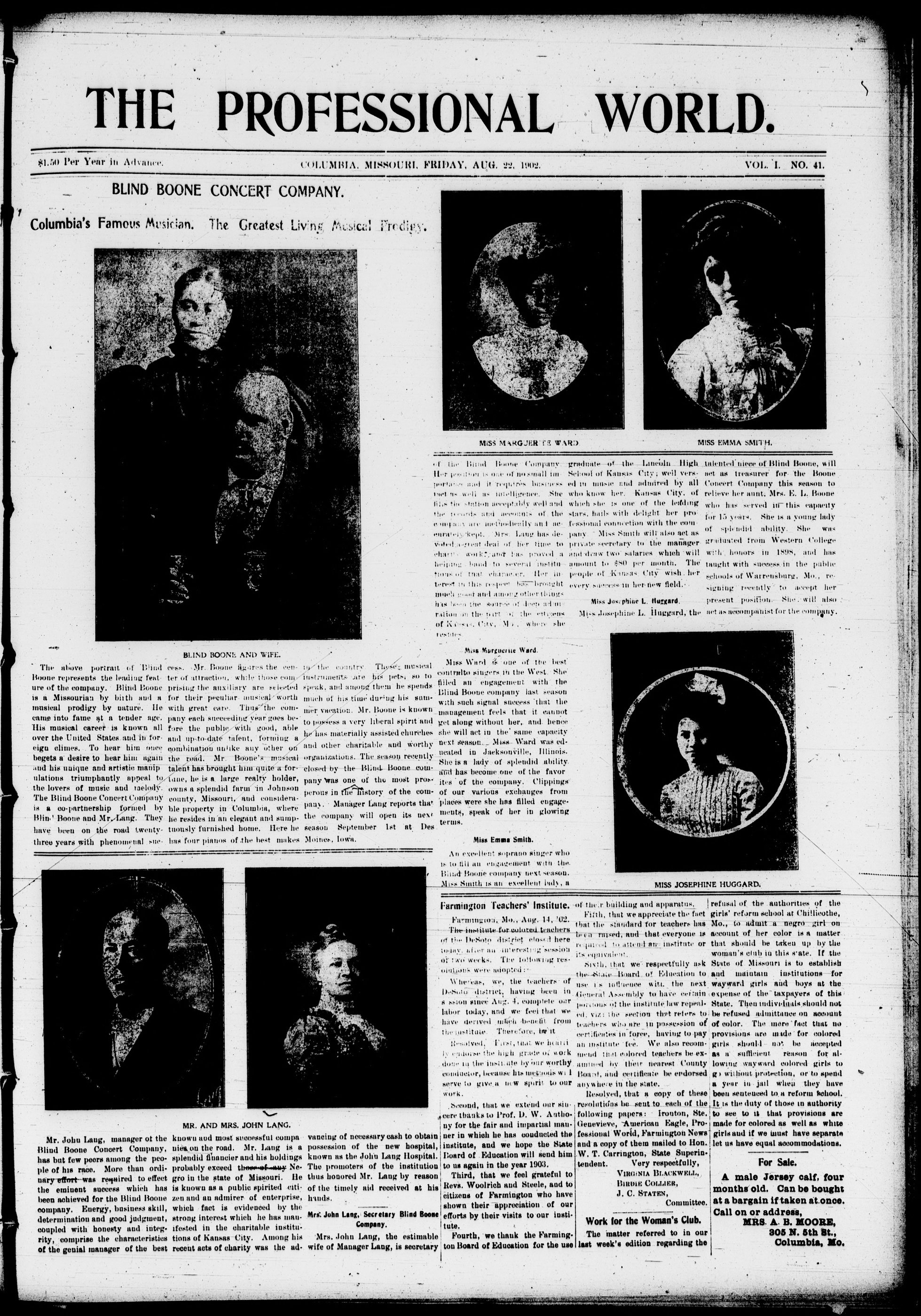
BLIND BOONE CONCERT COMPANY.
Columbia's Famous Musician. The Greatest Living Musical Prodigy.
Mary Ann
M. H. H.
$1.50 Per Year in Advance.
Columbia's Famous Music
The above portrait of Blind Boone represents the leading feature of the company. Blind Boone is a Missourian by birth and a musical prodigy by nature. He came into fame at a tender age. His musical career is known all over the United States and in foreign climes. To hear him once begets a desire to hear him again and his unique and artistic manipulations triumphantly appeal to the lovers of music and melody. The Blind Boone Concert Company is a co-partnership formed by Blind' Boone and Mr. Lang. They have been on the road twenty-three years with phenomenal suc
Mr. John Laug, manager of the Blind Boone Concert Company, has but few peers among the people of his race. More than ordinary effort was required to effect the eminent success which has been achieved for the Blind Boone company. Energy, business skill, determination and good judgment, coupled with honesty and integrity, comprise the characteristics of the genial manager of the best
BLIND BOONE AND WIFE.
cess. Mr. Boone figures the center of attraction, while those comprising the auxiliary are selected for their peculiar musical worth with great care. Thus the company each succeeding year goes before the public with good, able and up-to-date talent, forming a combination unlike any other on the road. Mr. Boone's musical talent has brought him quite a fortune, he is a large realty holder, owns a splendid farm in Johnson county, Missouri, and considerable property in Columbia, where he resides in an elegant and sumptuously furnished home. Here he has four pianos of the best makes
```markdown
```
MR. AND MRS. JOHN LANG.
known and most successful companies on the road. Mr. Lang is a splendid financier and his holdings probably exceed those of any Negro in the state of Missouri. He is known as a public spirited citizen and an admirer of enterprise, which fact is evidenced by the strong interest which he has manifested in the charitable institutions of Kansas City. Among his recent acts of charity was the ad-
COLUMBIA, MISSOURI, FRIDAY, AUG. 22, 1902.
in the country. These musical instruments are his pets, so to speak, and among them he spends much of his time during his summer vacation. Mr. Boone is known to possess a very liberal spirit and he has materially assisted churches and other charitable and worthy organizations. The season recently closed by the Blind Boone company was one of the most prosperous in the history of the company. Manager Lang reports that the company will open its next season September 1st at Des Moines, Iowa.
Mary Ann
vancing of necessary cash to obtain possession of the new hospital, known as the John Lang Hospital. The promoters of the institution thus honored Mr. Lang by reason of the timely aid received at his hands.
Mrs. John Lang, Secretary Blind Boone Company.
Mrs. John Lang, the estimable wife of Manager Lang, is secretary
J.
MISS MARGUERTE WARD
of the Bind Boone Company. Her position is one of nos small importance and it requires business ties as well as intelligence. She films the station acceptably well and the records and accounts of the company are methodically and accurately kept. Mrs. Lang has devoted a great deal of her time to charity work, and has proved a helping hand to several institutions of that character. Her interest in this respect has brought much good and among other things has been the source of deep admiration on the part of the citizens of Kearsaw, City, Mo., where she rests.
Miss Marguerite Ward.
Miss Ward is one of the best contralto singers in the West. She filled an engagement with the Blind Boone company last season with such signal success that the management feels that it cannot get along without her, and hence she will act in the same capacity next season. Miss Ward was educated in Jaeksonville, Illinois. She is a lady of splendid ability and has become one of the favorites of the company. Clippings of our various exchanges from places were she has filled engagements, speak of her in glowing terms.
Miss Emma Smith.
An excellent soprano singer who is to fill an engagement with the Blind Boone company next season. Miss Smith is an excellent lady, a
Farmington Teachers' Institute.
Farmington, Mo., Aug. 14, 1902.
The institute for colored teachers of the DeSoto district closed here today, after an interesting session of two weeks. The following resolutions were adopted:
Whereas, we, the teachers of DeSoto district, having been in a session since Aug. 4, complete our labor today, and we feel that we have derived much benefit from the institute. Therefore, be it resolved, First, that we heartily endorse the high grade of work done in the institute by our worthy conductor, because his methods will serve to give a new spirit to our work.
Second, that we extend our sincere thanks to Prof. D. W. Anthony for the fair and impartial manner in which he has conducted the institute, and we hope the State Board of Education will send him to us again in the year 1903.
Third, that we feel grateful to Revs. Woolrich and Steele, and to citizens of Farmington who have shown their appreciation of our efforts by their visits to our institute.
Fourth, we thank the Farmington Board of Education for the use
MISS EMMA SMITH.
THE LADY OF THE ROOM
[Image of a woman with a large hat, wearing a light-colored dress with vertical stripes.]
[Name]
[Picture of a woman with a large hat and a striped dress. She is looking slightly to the side.]
MISS JOSEPHINE HUGGARD.
of their building and apparatus.
Fifth, that we appreciate the fact that the standard for teachers has been raised, and that everyone is required to attend an institute or its equivalent.
Sixth, that we respectfully ask the State Board of Education to use its influence with the next General Assembly to have certain portions of the institute law repealed viz: the section that refers to teachers who are in possession of certificates in force, having to pay an institute fee. We also recommend that colored teachers be examined by their nearest County Board, and certificate be endorsed anywhere in the state.
Resolved, that a copy of these resolutions be sent to each of the following papers: Irouton, Ste. Genevieve, American Eagle, Professional World, Farmington News and a copy of them mailed to Hon. W. T. Carrington, State Superintendent. Very respectfully,
Work for the Woman's Club. The matter referred to in our last week's edition regarding the
---
---
graduate of the Lincoln High School of Kansas City; well versed in music and admired by all who know her. Kansas City, of which she is one of the leading stars, hails with delight her professional connection with the company. Miss Smith will also act as private secretary to the manager and draw two salaries which will amount to $80 per month. The people of Kansas City wish her every success in her new field.
Miss Josephine L. Huggard.
Miss Josephine L. Huggard, the
of their building and apparatus.
Very respectfully,
VIRGINIA BLACKWELL,
BIRDIE COLLIER,
J. C. STATEN,
```markdown
```
VOL. I. NO. 41.
talented niece of Blind Boone, will act as treasurer for the Boone Concert Company this season to relieve her aunt, Mrs. E. L. Boone who has served in this capacity for 15 years. She is a young lady of splendid ability. She was graduated from Western College with honors in 1898, and has taught with success in the public schools of Warrensburg, Mo., resigning recently to accept her present position. She will also act as accompanist for the company.
refusal of the authorities of the girls' reform school at Chillicothe, Mo., to admit a negro girl on account of her color is a matter that should be taken up by the woman's club in this state. If the State of Missouri is to establish and maintain institutions for wayward girls and boys at the expense of the taxpayers of this State. Then individuals should not be refused admittance on account of color. The mere fact that no provisions are made for colored girls should not be accepted as a sufficient reason for allowing wayward colored girls to go without protection, or to spend a year in jail when they have been sentenced to a reform school. It is the duty of those in authority to see to it that provisions are made for colored as well as white girls and if we must have separate let us have equal accommodations.
For Sale.
A male Jersey calf, four months old. Can be bought at a bargain if taken at once. Call on or address,
MRS. A. B. MOORE,
305 N. 5th St.,
Columbia. Mo.
RUFUS L. LOGAN, B. S D. Editor.
COLUMBIA. : : : MISSOURI
THE NEWS CONDENSED.
THE NEWS CONDENSED.
The woman's franchise bill has passed both houses of the New South Wales legislature.
The Illinois police chiefs and Sheriffs' association is holding a convention in Bloomington.
Dr. Martin Luther Holbrook, the noted writer on medical subjects, is dead at his residence in New York, aged 72 years.
Wong Yen, a Chinatown under arrest at Toledo, O., for entering the United States in violation of the immigration laws, committed suicide.
Walter L. Stebbings, who Saturday stabbed to death Walter A. Scott, president of the Illinois Wire company, has been held to the grand jury.
The sale of the Philadelphia mint property was consummated Wednesday, the buyers being the Philadelphia Mint Realty company. Price $2,000,000.
The Illinois Coal & Coke company, comprising 21 coal mines living around Springfield, will be incorporated this week in New Jersey with a capital stock of $5,000,000.
General Chaffee, in a cablegram to the war department, from Manila, announced the death from cholera of Captain Joseph K. Batchlor, Jr., retired. Batchlor died at Natividad, P. L. Aug. 7.
Several anarchists of Madrid have been arrested on the charge of hatching a plot to assassinate M. Delacorte, the French minister of foreign affairs during his recent stay at Folix, on the French side of the Pyrenees.
The leader of the tag Jacob Kaper blew up Wednesday near St. George's Staten Island. Four of her crew were killed or drowned. Two men were picked up alive and brought to New York City.
A gain on membership of one-third during the last two years was shown in the annual report of Secretary Tuohy of Boomingan at the Illinois state convention of the Ancient Order of Hibernians.
At Marysville, Cal. fire destroyed business property in the city valued at $100,000. Several firemen were injured. The Garrett Grocery company, which does a large business with the mills in that section, lost $10,000.
Secretary of State Rose of Illinois on Wednesday treated the Moraine Mining company of Chicago with a capitol of $100,000. The investigations are John E. Gillman, Emil E. Grubb and Joseph Wright.
At St. Paul, Minn. Mr. Vincent Marked was buried as death by an explosion of a gallon oil filled with alcohol. Her husband died in hospital less than two months ago, and her baby was born since his death.
Ten pounds of dynamite and a gas pipe bomb were found in a room occupied by Charles Kirkerman in the county informant at Decatur Ind. Kirkerman had had trouble with Superintendent Groeller and threatened to injure him.
The fourth distribution to the members of the underwriting syndicate of the United States Steel corporation was made. There was a dividend of 5 per cent on the original subscription of $200,000,000, or a total of $19,000,000, distributed to subscribers.
Henry Watterson of Louisville stated emphatically that he was not a candidate for governor of Kentucky notwithstanding the numerous reports to that effect which had reached him while traveling in the North and West.
The Chatham dockyard authorities hope to have the United States battleship Illinois which was injured by striking an obstruction while entering the harbor of Christiana, repaired in time for the coronation naval review at Spithead on Aug. 17.
Peter Power, under sentence of 30 days for contempt of court in connection with the Northern Pacific merger case, has disappeared from Montreal and gone toward Quebec, according to a Montreal special to the Press and his whereabouts at present are unknown.
A Russian student named Kalafee, recently released from a Silesian prison, has been surrendered to the Russian police. It being suspected that he was an accomplice in the murder of M. Siparczine Russian minister of the interior, who was shot and killed April 15th.
C. W. Cowger, son-in-law of Mrs. Elsa Riley, is being held at Sturphysboro, Bli, for the mysterious murder of her husband, William H. Riley, has disappeared from his boarding house at Springfield, leaving no word as to his whereabouts, or future movements. Riley was killed in his bed Thursday night. Cowger left Friday night.
At Altoona, Pa. the opera house block, one of the largest buildings, which was occupied by the Imperial Dry Goods company, the One Price Clothing company, and the Eleventh Avenue opera house, was gutted by fire early Sunday and caused a loss of $55,000. The origin of the fire is unknown. The dry goods company carried about $65,000 stock and its damage is estimated at over $40,000. Patrick Cudahy, the wealthy Milwaukee packet, has presented 16 lots in the village bearing his name to St. Vincent's orphan asylum, and the institution will be moved there. Mr. Cudahy will also contribute liberally toward the creation of the necessary buildings for the asylum.
Henry Lancaster, the negro in jail at Parsons, W. Va., in connection with the murder of chief of Police F. H. Wilmoth at Womelsdorf, W. Va., says that Clements and Carroll, the two negroes, lynched, were innocent, and that the murderer was James Black. Lancaster was being placed under arrest by Wilmoth when the chief was shot from ambush.
Eustace K. Furlong student assistant in the geological department of the University of California, has discovered imbedded in the floor of one of the caves of Chasta county the remains of an Arctoherium simum, the gigantic primeval bear, that was the first of his kind to roam the two American continents.
Renewal of Tension Between These Two Countries—Condition in No Way Grave.
Washington, Aug. 20—It is admitted at the state department there is a renewal of tension between the United States and Turkey, but the officials do not seem it prudent to disclose the present condition of affairs. They say, however, the condition is in no way grave, but is of that strained character which has occurred from time to time with Turkey in recent years. It is gathered that the present tension grows out of long-pending claims of Americans who suffered loss during the Armenian outbreak. To some extent the Stone abduction gave added cause for irritation. American Minister Leishman has been as wide latitude to deal with the situation as circumstances may demand. There is the fullest confidence here in the course being pursued by the present minister, and as he has been given such a free hand in directing affairs, it is not thought desirable to prejudice any steps he may be taking by official comments as to what has been or will be done.
The Japanese minister, Mr. Takahira, who is in town for a few days, coming back from his summer place, said today when asked as to the attitude of the Japanese government in regard to the Midway islands and Wake island, so much written about lately, that the Japanese government had no intention to claim sovereignty over the islands, and that when the United States government made certain representations in relation to the Midway islands in January 1901, the Japanese government at once officially declared to the same effect, Mr. Takahira-turther said if the United States government would send a war vessel to the islands, as reported in the newspaper, Japan would expect only that the protection should be given to Japanese subjects who may be found there as long as they are engaged in peaceful occupations. Aside from this statement by the Japanese minister, it can be added from authoritative sources that the most satisfactory feeling exists between American and Japanese officials as to the good faith of each and a harmonious adjustment of the questions relating to the Marus islands is assured.
The state department has issued a warrant for the surrender to the Prussian authorities of Arnold Kroeger, a former postoffice employee of Baden charge, with embezzling $2000 and now under arrest at San Francisco.
HUNTING FOR BARTHOLIN.
Chicago Police Get a Tip Over the Telephone and Inaugurate a Search for Murderer.
Chicago, Aug. 20—Instructor Hunt perceived word tonight as to Bartholin's possible whereabouts that every out of the police machinery in motion in an instant. By midnight a score of detectives were ransacking the neighborhood of Kensington Harvey, Pulham, West Pullman, Riverside, Huntwood and Thistlewood street in the secret of a man supposed to have the secret of the turtles' hiding place. Inspector Hunt was summoned to the telephone by a man who claimed to be somewhere in Kensington. The stranger asked the inspector if a citizen had the power to place Bartholin under arrest. Certainly, "was the response, "but you must turn him over at once to an officer."
The man at the phone explained that he had known of Barthelins place of concealment for several days and that he had been dickering about the success to arrange for the deposit of a reward before he would divulge his information. He talked at length with the police official and refused to agree to let a detail of police join him. He said he thought he could effect the capture, but wanted to carry out his plan unloaded by the city authorities. He would only say that his name was McCarthy. Pressed by the trespasser as to whether the suspect he had in mind was within the limits of the city, he only made answer by asking to turn it One Hundred and Thirty-ninth street was outside the city limits. So many little information indicating that Barthelins might be in this city, he came to the police, which is close to Edward Counselman's home, that this later advice is to guarded seriously.
A Double Tragedy
Tipton, Jan. Aug. 20—Mrs. Joseph Romack of Sharpstown killed a month-old baby today by cutting its throat with a table knife and then glazed her own throat, dying soon after. Temporary insanity is given as the cause for the rash act.
THE MACEDONIAN COMMITTEE.
The Ex-President Accused of Being the Chief Agent in the Kidnaping or Miss. Ellen M. Stone
Vienna, Aug. 20 — The correspondent of the Nazi winer Tazbart (2) of Bulgaria, besieges in a dispute the violent conflicts which occurred during the recent congress there of the Macedonian committee. M. Sarafoff the notorious ex-president of the committee was accused of misrepresentation $20,000 and of being the chief agent in the kidnaping last year of Miss. Ellen M. Stone the American missionary. He was also accused, appalling to the correspondent of paying $20,000 to a friend named Deitzscheff, who planned the kidnaping.
PRESIDENT SCHWAB SAYS NO.
New York Aug. 20—Charles M. Schwab, president of the United States Steel corporation, arrived here this evening. He said he did not look like a sick man: that he need of a rest, and was going to take one. He also said: "I am not going to resign and have no intention of retiring from the presidency of the United States Steel corporation."
A dispatch from Oviedo says, king Alfonso is slightly badposed. He is suffering from a slight cold, and his visit to the Leganes works has been postponed.
MAY BE A FUEL FAMINE
50.000 MEN IN PITTSBURG DISSTRICT MAY. BE IDLE.
No Engines to Move the Cars—Situation in the Industrial World Considered Most Grave—the Operators Are Ready to Confer With Their Employees. But Refuse to Discuss Business With Outsiders.
Pittsburg. Aug. 20—The Post tomorrow will publish a story to the effect that a fuel famine is threatened for mills in this district and 50,000 men may be thrown into enforced idleness through the lack of coal and coke. The trouble comes from a scarcity of engines to move loaded cars. It is reported that on sidelines of the Baltimore & Ohio leading into Pittsburgh there are nearly 500 loaded cars. So graves is the situation in the industrial world that there is talk of sending a committee to Baltimore to confer with General Superintendent Potter on the best method of relieving the congestion and bringing immediate relief to the Pittsburgh district.
Mitchell in Chicago.
Chicago, Aug. 26 — President Mitchell arrived in Chicago tonight from Spring Valley, Ill. When asked regarding the report that he came here to meet owners, Mitchell said there was no truth in the story. He and Secretary Wilson spent two hours tonight clearing up business that has accumulated at Indianapolis headquarters. Mitchell also had a conference with Illinois MHS association officers, but it was stated nothing of importance was done.
The Operators' Side
New York, Aug. 29 — The president of the anthracite coal roads had their usual weekly conference here today. Before going to the meeting President Treesdale of the Luckawanna railroad company said: "There is no foundation in fact for the humor that anthracite operators will make concessions in order to end the strike. I think work will be resumed in time to produce plenty of coal for the fall demand. Operators are ready as they always have been ready to adjust with their men, any grievances they may have, and they have never discriminated against any of their men because they have belonged to the nation. What the operators will not do is to discuss their business affairs with outsiders."
Funeral of Dead Striker
Taquna Pa. Aug. 20—776 formal of Patrick Sharpe strike leader and killed at Neapolitan night by a deputy will take place Thursday. All minutes of local unions in the region are making arrangements to march to Lausdorf and attend the funeral and General Dublin will probably station troops along the route of the funeral. This afternoon Thomas Duffy president of District No. 7 and Peter Gallagher, member of the executive board, came to Lausdorf to make investigation of the facts connected with the shooting of Sharpe. Attn: interviewing several men who saw Sharpe killed they want to Manch Chank to encourage counsel and to push the prosecution of the deputy chair with the shooting.
Demand an Increase.
Chicago, Anheuser-Busch InBev
have demanded a 10 percent increase
in wages. The demand offsets the pack-
ing houses in Chicago and the West.
Caught in the Act
Omaha, Neb., Aug. 20. After working two months special agents of the Chicago & Northwestern railroad have located a gang of thieves who have been plying their trade on the first trains running from Chicago west. For at least 14 months passengers have complained that their pockets have been picked while on the train. Most of the complaints came from through passengers who used the slappers.
Special Officers J. C. Plening and E. R. Stevens were detailed on the case. They finally concluded that the work was being done in the barter shops and that the bartenders and porters on the different trains were working together.
The special officers boarded the overland limited at Chicago a few nibbles ago and passed the lifesaving off as sports out for a good time. Mr.蒲裴 carried with him a poll or marked balls. As the train deigned Council Flaming was taken with that "that morning feeling" and went into the barber chair for a hot towel and a rub. He carefully left his coat on a nail where he could not see it.
Wayne Shep, the barber, piled hot towels on the patient's face and the stegm shaded the mirror in front, during this time Lewis Solden, the colored porter industriously brushed the customer's coat, while Sevens got the proceedings from behind a partition in the car.
Shep and Solden went to the buffit room to decide their spells. Just then the officers entered the apartment and cauted the porter in the act of giving Shep a $2 bill. The mana$2 bill was found on the poster. When an arrested wore three diamond rings
In Fear of His Life.
Glennwood, Aug. 20—Charles Harris, a wealthy former living across the river in Nebraska and a few miles south of Plattsmouth, is in constant danger from unsuspecting foxes who have already hurried his home and made an attempt upon his life. His home was burned several months ago and the family—barely occupied with their lives. The fire was thought to have been of an ordinary origin, as a can containing kerosene and some matches were found near. Mr. Harris built a new house and has since been quietly watching for the fire buoys. One evening last week he heard a noise outside. Picking up his revolver he went outside and waited for sometime but not hearing anyone he started for the barn. He had gone hurt, a short distance when someone struck him a terrific blow on the head, rendering him unconscious. His wife—found him in about half an hour with a big gash in his head. The wound looks as though it might have been made with a club.
Mrs. Elmer Chambers, whose home was at Daryllie, Ill., committed suicide at Bedford, Ind.
ACCUSED OF TWO MURDERS.
O'Brien Wanted for the Murder of S. M. Waln and C. Strong While on a Hunting Expedition.
Denver, Aug. 19—The police today received a letter from Frank B. Keyes, a deputy sheriff, at Paiplay, Colo., stating that Thomas O'Brien, the exconvict who was arrested last week on the charge of safe blowing, is wanted at Rawlins Woo, charge with the murder of S. Morris Wain and C. String. Wain and string belong to prominent forensic officers in the East.
fatalities in the East. Strong's father in 1858, the year of the murder, was a Wall street operator Waln came from Haverford, a return of Philadelphia and his brother, Jacob is a commission merchant in that city. Strong and Waln, came west on a hunting trip, and on August 14, 1858, their dead bodies were found. The bodies had been stripped of every stitch of clothing and an examination revealed that Strong's skull had been split open with an axe and Waln's head nearly blown off by a charge of buckshot. No trace of the wagon, firearms or the money of the victims was ever found. O'Brien was not suspected of the murder until he had been lodged in the periphery at Canyon City for house stealing. Wyoming authorities secured requisition papers and were prepared to arrest him on his release from prison, but he was liberated several days earlier than they anticipated and he made good his escape.
Farmer Shoots Two Men.
Gorbache, Okla., Aug. 18—A report tonight from Houston, an isolated town in Canadian county, says Charles Berlow, recently from Illinois, was shot and killed, and Rolney Sipes seriously wounded. The shots are said to have been fired by Elisha R. Barker, a farmer. Trouble arose over threshing machine crews using water from Barker's well.
GERMAN INDUSTRIES EXPAND.
Wonderful Development of the German Consular System—How They are Chosen.
Washington, Aug. 19.—As a weighty testimony of the industrial and commercial expansion of the German empire, United States Consul Monoghan, at Chennitz has transmitted to the state department an interesting report concerning the development of the German consular system. The report was dated July 24 and was made public at the state department today. In 1873 the German system comprised 104 consulates. In 1867, which is the latest year for which the statistic are available, the number had grown to 20. The United States has committed to
consulates abroad. These are all regular government appointments and cannot be compared with the 750 German consulates for the reason that the latter are divided into two classes: the consuls by profession and the elective consuls. The former hold office under the civil service. The elective consuls are chosen by the business men of the foreign country where they are to act and receive no fixed salary their positions being honorary in nature. However, though the United States has enough commercial agents abroad to bring the total number of United States consular officials up to about 500 the test reminds that the German empire has the better of this country in the numerical strength of its consular representatives. Particularly is the German predominance noted in Central and South America where as an official of the state department expressed it, "there appears to be a German consul everywhere." The most rapid increase in the number of German consulates of late has been found for the United States.
OVER 100 PEOPLE ARE KILLED.
Island of Torishima Overwhelmed by Volcanic Eruption and All the Houses Have Disappeared.
Yokohama. Aug. 19.—The little island of Torishima was overwhelmed by a volcanic eruption between Aug. 13 and 15 and all the inhabitants. 100 were undoubtedly killed. The island is covered with volcanic debris and all the houses on it have disappeared. The eruption is still proceeding accompanied by submarine eruptions in the vicinity, which make it dangerous for vessels to approach the island.
Torishima is one of a chain of islands between the Bonin Islands and Hirobo, the biggest island of Japan.
Body Found in Mountains.
Zeichmatt, Switzerland, Aug. 19—The body of Dr. Largin, chief judge of the Berne court, was today found at the bottom of the proceepe on Mount Dom, which deceased climbed Saturday.
THE COMMERCE OF THE WORLD
It Reaches a Grand Total of Over Twenty Billion of Dollars Yearly.
Washington, Aug. 19 — The state department made public today a report from United States Consul Winter at Annaberg dated July 10 showing the commerce of the world for 1901. According to German statistics the total import and export trade of all countries was $100,000,000. Great Britain and her colonies heads the list with a great total of nearly $700,000,000. Germany is placed second with $20,000,000 and the United States third with $12,100,200,000. According to the United States treasury figures the United States share was $2,240,000,000.
Congressional Nominations
Gall's City, Neb., Aug. 19—H. H. Hahabs of Nebraska City was nominated for congress by the Democrats and Populists of the Fourth district this afternoon.
Milwaukee, Aug. 18—John F. Donaven of Milwaukee was nominated for congress by the Democrats of the Fourth district this afternoon.
W. H. Venger was killed at Avalon, Carolina island, Cal. in a saloon fight by A. H. Boyd; a native of Princeton, Ind.
THE CREAMERY FAILURE
DETAILS OF THE COLLAPSE OF
THE ELGIN COMPANY.
---
Thousands of Farmers. Among the Creditors of the Concern-Over $155,000 Due Them For Milk Furnished—Thirty-six Creameries in Iowa Represent Three Thousand Milk Sellers.
Chicago, Aug 19—The failure of the Elgin Creamery company had a far-reaching effect which remains to be told. The Record-Herald furnishes these particulars:
Obadiah Sands' butter corporation,
the Elgin Creamery company, which with 133 creameries in Illinois, Iowa and Wisconsin, is the largest maker in the world has been placed in the hands of a receiver.
A lack of adequate working capital caused the failure.
It is expected that the 10,000 farmers among the creditors will continue to deliver milk to the creameries; that Mr. Sandis will be appointed to act as general manager by the receiver, and that in this way all of the creditors can be satisfied the company properly financed and that the man with an international reputation can thus continue the manufacture of the product which has helped make Elijah famous and which is branded "Elijah batter." On the office door of Mr. Sandis' company, rooms 21 to 25, 154 Lake street, the following notice was to be seen yesterday:
In possession of the American Trust and savings bank, receiver in bankruptcy of the Elijah Creamery company.
Alkohole the assets amounting to approximately $000,000 are nearly twice the liabilities, which are $415,000, the company with Mr. Sand's its president, as one of the creditors, has been forced into bankruptcy. On the recommendation of William Warfield Wilson the attorney, who is a Republican nominee for congress, the American Trust and Savings bank was appointed as receiver at the close of the United States district court session Saturday, Gregory, Poppenhausen & M. Nab also represented creditors in appealing to the court. Referee S. C. Eastman entered the order appointing a receiver. The American Trust and Saving bank is receiver for Illinois only.
But the appointment was so timed as to prevent any hesitant creditors from replevin and attaement proceedings that would hinder the work of quick settlement and an ill-fated receivers will be appointed in the federal court on location and Des Moines today to take charge of the property in Wisconsin and Iowa.
J. L. Ma Nab hurried to Madison, and Ms. Wilson went to Des Moines. It is probable that the appointment of the American Trust and Savings bank as receiver in both these states will be recommended, but there is some doubt as to whether the judges will willingly accept foreign receivers. It has been a long time since so many farmers of the Mississippi valley were directly interested in any one failure. The Elgin Creamery company has 12 cooperies in Illinois, 36 in Iowa and 5 in Wisconsin. And the number of farmers who sell milk to the creators 1000 in all is divided as follows: Illinois 1000, Iowa 3000, and Wisconsin 6000. A total of $155,000 is the them for milk delivered during the last month. But, the average debt of the company per farmer is but $155,000 varying in amounts from $2 to over $100. The situation calling for the appointment of a receiver is shown shortly in the following table, the figures in which, while authorization, are merely approximations:
Assets.
Pills payable (principally
loan) ..... $290,000
For milk (owing farmers) ..... 155,000
For supplies ..... 30,000
Total ..... $415,000
The paid up capital stock of the Elgin Creamery company' was $275,000, and the trouble came from tying up too much money in creamery plants. With semi-monthly payments of nearly $100,000 bind the necessary stocking of butter for marketing in the winter, Mr. Sands was left short on working capital.
"The trouble came at this time owing to the fact that Mr. Sands found difficulty in getting any money from the banks, said David B. Laman, Mr. Sands' attorney. "The business grew on his hands until it was too large to handle with the amount of working capital in his possession. If the court orders the business to be continued it can sell a creamery from time to time and with all of the business' at the company all of the creditors can be paid."
The crash in the affairs of the Elgin Creamery company has been impending for two years, and Mr. Sands has endeavored strenuously to prevent it, even having gone so far at one time as to endavo, to attract Eastern capital by the organization of a gigantic industrial combine in creameries. But his efforts did not preet with success.
The crisis came last Friday, and was uninitiated, according to the statement at Mr. Sands' attorney, by A. Booth & Co. on August 1. Mr. Sands owed farmers for milk delivered at his creameries in June and July something like $5,000. He wanted to pay this.
"I tell you the old gentleman, Mr. Sands has been honest and fair and treated those farmers right and like a friend," said Mr. Wilson economically. He had $20,000 worth of butter stored with A. Booth & Co.
League Will Not Meet
St. Louis Aug. 19—Announcement was made tonight that the National baseball league will not meet here upon the conclusion of Roosevelt's visit in October. The league finds it impracticable to make the necessary arrangements.
STATUE OF LATE EMPRESS
German and Other Royalty Repres-
sented at Unveiling of Statue
of Empress Frederick.
Homburg, Aug. 29.—A statue in honor of the late Emperor Frederick was unveiled here today with considerable ceremony in the presence of the emperor and empress, the Crown Prince Frederick Wilhelm and other German royal personages. The United States ambassador, Andrew White and the other ambassadors, and the civil and military authorities and deputations from the regiments of which the late empress was honorary colonel. After speeches by the burgomaster, in which he colonized the late empress' devotion in promoting the happiness and welfare of humanity, and her self-sacrificing activity in the hospitals during and after the Franco-Prussian war, the troops presented arms and the statue was unveiled. Emperor William then stepped forward, placed a wreath on the pedestal and made a speech, depicting his mother as a steadfast promoter of art, scientific research and the advancement of women. He referred to her oblute spirit, which enabled her to triumph over the hardest trials and poor patiently a long period of keen suffering. A choir then sang an antique and cheers were given for Emperor William. A number of other wreaths were deposited on the pedestal, including one from Dowager Queen Meredith of Italy, who was present at the ceremony.
To American Ambassador
Berlin, Aug 20—Andrew D. White, the United States ambassador, has returned here for a few days work before going to Switzerland, via the Rhine country, with his daughter Mrs. Newberry and her third son Mr. White after his retirement, will presume spend the winter in Switzerland and Italy, as he desires several months of quiet work on the Literary design which he has in hand. The foreign office has not been infraged officially that Mr. White has rescheduled through of course. it is unofficially aware that he has done so. Should Dr. Von Hinden, German a ambassador to the United States, not prolong his stay in Europe it is believed here that the state department will make the usual inquiry concerning the new ambassador through him as to whether the person is succeed Mr. White is acceptable.
WAR DEPARTMENT FIGURES.
Auditor Makes Report of Amounts
Allowed States on Account of
War, With Spain.
Washington, Aug. 20. The annual
report of the auditor of the war
instrument shows the amounts allowed
on account of the war with Spain
aggregate $4,077,755.
A record of deposits made in lieu
of men of the army shown in the
amounting to $777,500 at that
depositor, with an amounting
to $1,555,005 upon
depositors received interest amounting
to $2,475,000.
During the year $320,945 wasowed to the credit of the permanent field of the National Soldiers Home, before the ammobilized from the pay of enlisted men in the army on account of the $212-12 cent fund lines by compulsory and amounts due from deserts at large and dishonorably discharged soldiers. There was Withdrawn from this fund during the year for current expenses $230,000 and the amount paid the treasurer of the home en account of interest on the fund was $700.
Killed by Bee Sting
Kookuk. Aug 29—The three-year-old daughter of Almon H. Marsh, of Glen Day, this country died in nine hours as the result of a bee sting.
MARKET REPORTS:
Chong, Aug. 27–31, 2009–2010.
(1) When the two sides are in a close relationship, they have a very long history of good relations.
(2) When the two sides are in a close relationship, they have a very long history of good relations.
(3) When the two sides are in a close relationship, they have a very long history of good relations.
(4) When the two sides are in a close relationship, they have a very long history of good relations.
Outs—Stronger and higher rate tending seeing at about the best prices with net gains of $1/kg. There was more annual commission house buying of 100 inlet and May and liberal covering by shorts for all months. Wet weather in the West and the Airport that the Iowa region was spotting in shock had a strengthening effect toward the last: No. 2, 28, No. 1, 25, No. 2 white, 35, No. 2 white, 600 in August, 25% September opened, 27% 2% highest, 24% Lowest, 21% close 34% other uncharged.
Receipts—Floor, 2000 bbls; wheat v500 bbls; corn, 257,000 bbls; oats, 200,000 bbls; shipments—Floor, 25,000 bbls; wheat, 57,000 bbls; gourmet bbls; oats, 100,000 bbls;
Chicago Produce.
Angelina Butter Market 600
Chelsea Butter Market 600
Harper Market 600
St. Louis Live Stock
St. Louis, Cattail—Aug. 9—Receipts
to head. Study for natives. Slow to
Texans. beef steers. $1,500.00. steers
and horders. $1,500.00. cows and buffers.
Beef steers. $1,500.00.
Horses. Receipts to head. be higher
than $1,500.00.
Minneapolis Grain.
Minneapolis, Minn. Aug. 20-Whale-
September 30. December 6th on track
No 1 hard Ny. No 1 northern, 50. No
1 northern, 50.
An irrigating plant in Arizona costing $3,000,000 has developed farm and orchard lands worth $30,000,000.
Sick hens and sick sheep are best killed as soon as possible, and we are inclined to put the sick dog with them also.
"More and better work and less land" is the motto which should be hung up in one-half of the farm homes of the country.
Orchard cultivation after the first of July should be avowed, as it tends to induce a growth of wood which cannot fully mature before winter.
What food thirty sheep will eat on the average farm would largely be otherwise wasted. The only trouble about keeping them is the question of fencing.
We know of a young fellow in the country who has rigged up his harness with as many as 40 rings, and he can get all the girls he wants to go riding with him.
The state of New York has placed a ban upon the shooting of live piggies by the sportsmen's tournaments, something which will meet with the approval of all human people.
The strikes among the different branches of federated labor are almost wholly an effort to restore a reasonable balance between the wage of the laborer and the increased cost of living.
Yes, we would salt all the hay which we put in the mow of the barn. It makes the hay more palatable and tends to check excessive fermentation. A half peek of salt to the ten is about right.
It takes a robin and, in fact most other birds which build any sort of a substantial nest about three days to do the work. A sparrow will build a nest in 24 hours and have an egg in it.
A two-pound spring chicken will bring the grower at least 30 cents, and if kept until it wears spurs and a red comb in November it will not bring as much money. The good die young in the case of roosters.
Of the stagnum produced in this country 90 per cent is made from corn. A little is made from potatoes, but unless they can be secured at less than 20 cents per bushel they are not available for this purpose.
In no other country does modern machinery cut such a figure in the production of farm crops as in the United States. With this machinery one man is enabled to accomplish as much work as ten men in many of the old countries.
---
With 72 bogs in sight and a big crop of both pigs and corn almost assured; an outbreak of cholera may be reasonably looked for, for the young pigs will be stuffed with new corn to get them on the market as soon as possible, and somehow that always makes trouble.
The best preventive of the cabbage worm pest is to plant very early or very late. The early cabbage can be matured by the first of July and the late ones planted during the last half of July, which enables the plants to dodge the period when the cabbage butterfly does the most mischief.
Normally wet and undrained lands should not be cropped, but should be kept in grass, either pasture or meadow. Thousands of acres of choice land in the West will be utterly unproductive this year because of the failure to observe this fact, the cultivated crops upon them being simply drowned out.
The question is pertinently asked why a dog should be a free commoner more than a cow, a horse or a hog. Many a dog allowed to run at large will do more damage than ever could a three-year-old steer in the corn. Dogs may be very easily trained to attend to their proper business, and a man who does not know enough to so train his dog has no business to have one.
If we were a young man just starting on a stock farm and had only $500 to invest in stock as a starter, we had rather put the money into five head of well bred and registered heifers than into 20 $25 scrub cows. The first three years the scrub animals might make us the most money, but at the end of that time they would not be in it at all with the thoroughbreds.
One-half of the world's crops are raised by irrigation.
It costs about $200 to take a Pasteur treatment for hydrophobia, and therefore it does not pay to take any chances on dogs.
If you have a horse to sell, fatten him. Fat hides a multitude of faults in a horse.
There is one thing in favor of blue grass—it is always ready for business when there is moisture enough.
A bull corner on corn never arouses the moral ice of the granger who produces the cereal. It is only bear corners which set him howling.
Crop prospects are good in India. The periodical starvation of India's millions as a result of drought is the most horrible thing the world can show.
The man who wants to raise fruit and does not know enough to take care of all trees is a good friend of the nurseryman. Not to per cent of the trees sold in the West, at least, ever live to bearing age.
A good test of modern athletics is to be able to lift a farm mortgage.
A squeaking windmill doesn't seem to worry some men.
There has been relatively a greater advance in the fifty dollar farm lands of the country than in the five dollar unimproved lands of the western and northern borders.
The sparrow when it has pre-empted every available nook and corner of all buildings for nesting places will then take to the trees, preferably evergreens, next boxellers.
Not one woman in ten knows how to make a nice flaky pie crust. They can make angels' food and cholera morbus salads of a dozen kinds and all sorts of fancy cakes, but the ideal pie crust beats them.
---
The meanest garden weed we have is the squirrel-tail grass, or wild barley. It is the most firmly rooted of any of our common weeds and a monopolist of the worst type. It will almost ruin a nice lawn in a single season.
The importance of the poultry business is not realized as it should be. While but few can go into the business upon a large scale, it is still possible for many to take up the work in a small way with profit.
---
The bicycle, automobile and rural mail delivery are a trinity of agencies which are combining a wonderful revolution in the matter of building better roads, the rural mail service bringing about the most effective results.
Some men hate on general principles, and one such undertook to prove that sheep were as nasty and disagreeable animals to care for as hogs, but was shut up when asked if he ever knew a sheep to eat up its dead grandmother. Hogs will.
Bumper crops of oats and corn, a greater than average yield of wheat and liberal yields of rye, barley, hay and fruits are indicated by the July reports of the department of agriculture. This year bids fair to be one of abundant harvests.
We have never known of a case where purely kind measures were taken to break in a broncho. Men who have this work to do say that force is the only means which will tame it. This we know—some very cruel and inhuman work is done in this line.
It is estimated that there are 50,000 regular tramps in this country, which cost the country to maintain not less than $11,000,000 per year. The worst feature is that they are nearly all able-bodied men and instead of being a burden upon the people should be in the ranks of the producers.
The overflow of the Nile river, which rarely fails, not only brings moisture put perennial fertility, to the great harvest fields of Egypt. Its waters carry in solution the stored fertility of the mountain and tablelands of central Africa and for ages has made Egypt the storehouse of the orient.
It is not easy to solve the problem of how to make both ends meet where a man with no capital save his hands and, at his best earning not over $350 per year, has to maintain a home and provide for a family of six. Such a man, desiring to educate his children and live in a decent way, has a hard job on his hands.
One of the principal agricultural papers of the West on the 1st of July had a leading editorial on the importance of the dust mulch. The article must have been left over from last year, for this season it was impossible to raise a dust in any of the territory where the paper circulated. An article on mud blankets would have been more appropriate.
Running a Farm by Proxy.
A friend who owns a nice, improved farm of 160 acres in a western state and who is so situated that he will carry it on himself but that he will desire to keep his money safely invested in the best method of handling it—shall he rent it for a cash rent, shall he let it on shares, shall he hire a man to run it? The first plan will insure him the least trouble and the smallest return. The second plan will he all right provided he can get the right man and make a lease for a term of years. The third will prove the most profitable if he will assume the general over-sight of the farm work, stock it up with good stock to the limit and pay a good man what it is worth to carry it on. He will find it hard to get just the right sort of a tenant on the share plan and still more difficult to get the right man on the salary plan. The honest man may be lazy and the hustler a man who still steal the owner blind.
Should Make $100 a Year.
This is for the goodwife on the eighty or a hundred and sixty acre farm: If you are not making a clean hundred dollars per year out of the poultry which you may just as well as not keep on the farm, something is wrong, for this amount can easily be made, just giving ordinarily good care to a good breed of fowls, letting them have the run of the farm, and it can be done almost wholly from eggs. This $100 you ought to make and to have to do with as you see fit. We know plenty of women who are making from $100 to $175 out of their poultry each year.
Too Many Kinds.
On the average farm there is frequently to be found too great a variety of animal and bird life. We would not try to keep Jersey, Shorthorn and Holstein cattle in one farm herd, or try to raise *rottling horses* and draft stock together, or keep two or three different varieties of chickens, or raise ducks, geese, guinea hens and turkeys all in one happy family. We believe in speciation in our large common type of cattle on our horse pigs, chickens—then a constant effort to produce the very best of the type selected. We would apply the same rule to crops. Even diversifying may be carried to an unprofitable extreme.
Debt on the Farm.
We are asked how much debt a man with a quarter section farm should carry. That depends. Assuming his farm to be worth $1,000 and the man a buster, turning his attention wholly to the production of meat products on his farm and not running a stear thrasher, he might swing a debt of $7,000 at 5 per cent. Still this will makes him sweat and grunt before he gets it paid. We believe it to be a mighty good time to shorten sail in the matter of indebtedness during these days of agricultural prosperity and not load up to the limit, as so many are doing. The money loaners will have their innings again some day.
Immense Increase of Wealth.
The boom in real estate, farm lands particularly, has increased marvelously the wealth of the owners of such lands. During the past four years there have been a great advance in the value of good farm lands in Iowa, Kansas, Nebraska and Dakota of not less than $20 per acre, which means that the farmers of Iowa alone should have $40,000 in wealth they were four years ago, and this increase in wealth has not gone into the hands of speculators, but each man has got his share just in proportion as he is the owner of a few or many acres.
Colored Farm Help.
A Kentucky farmer was telling us recently about the peculiarities of his colored farm help. He said they never could be depended upon if there happened to be a camp meeting or revival in the neighborhood or any of the other doings which are common to their race, would just quit and go no matter how badly their services might be needed on the farm. Then, they seemed to never have got over the notion that what belonged to their boss belonged to them, which brought about a confusion at times as to the ownership of property.
That is a very foolish mother who, taunting the ground that it is more trouble to show her daughter how to do any kind of housework than it is to do it herself, lets the girl off. About a year ago a young lady whom we know was married. Her mother was one of this sort. The girl knew very little about housekeeping could neither make a loaf of bread nor get up a palatable meal. Of course, she had a time of it, and her husband did also, and for that matter, they are having it yet.
WHITE HOUSE WHISKY JUG.
One That All the Presidents Have Had Since Jackson's Time.
Judge Daniel H. McMillan of the territorial court of New Mexico is in Washington on business before the department of Justice. Judge McMillan once resided in Buffalo, N. Y. He was an attorney there and a power in the Republican party of New York.
"I wonder," he said, "if that queer little whisky jig remains in President Roosevelt's bedroom?"
Asked as to his meaning, Judge McMillan replied: "In the administration of President Arthur, I accompanied General George H. Sharpe to Washington on a political mission. We entered the white house and were shown through the cabinet room into the bed chamber of the president. The president called a colored servant and directed him to 'get down that jug.' The servant responded by reaching up to a shelf over the foothold of the bed and bringing orchid queer, squat, little three-fingered filled with a sweet bottle. We all three tilted the receptacle without the aid of gausses. The president explained that the jug had been a fixture of the white house since the days of Jackson.
"Years later," continued Judge McMillan. "I had occasion to call on President Cleveland, and was invited into the same bedroom. Again the jug was called for, and once more the glasses omitted. President Cleveland was surprised to learn that I knew of the jug and had sampled the contents. I am curious to know also whether the story is true that a distiller in Kentucky made a contract to keep it constantly filled."
Fig Coffee.
For some years there has been manufactured in Austria a product called coffee of lags which is much appreciated in Germany and in Austria-Hungary. Its nutritive power is considerable. It is obtained by drying fruits—especially figs—and mixing them with coffee. It acts as a coloring agent and diminishes the excitant quality of the coffee and corrects its bitter taste. Several establishments in Algeria now manufacture fig coffee, which is already much used in Europe—New York Sun.
The Farmer to Be Envied.
The farmer, considered in every light, is an individual much to be envied. As a class he is prosperous as never before; his capital account, as represented in the value of his plant, is appreciating, ad his income yield based on present prices of his product, is above that of other industries or avenues of commercial investment. It is idle to repeat that he forms the real backbone of the country, and none will begrudge him the easy path into which he seems to have entered. As long as he is prosperous the country has nothing to fear in the way of industrial depression.—New York Financial.
"YES, SIR, YOU LEFT 'EM."
Kansas City Bell Boy Satisfies the Doubts of a Departing Guest.
Kansas City Journal: Winslow (that isn't his name, but it will do) travels for a Boston shoe house. He came to Kansas City last week and put up at one of the Kansas City hotels with three trunks of samples. Shortly before his arrival a new belboy had been added to the hotel force. When Willie came every one said the limit had arrived. Not but that Willie meant well. He was undersized, with great blue eyes and a sensitive mouth, and he took "guying" with a pathetic smile that earned him many a dime in recompense. No one seemed able to decide whether Willie was a stray angel or merely deeper than the average boy.
From the time Winslow first saw Willie's innocent face he took a fierce and unreasonable dislike to the boy, Willie, on his part, became terrorized at the first sight of Winslow. The sound of that gentleman's voice caused him to tremble violently. Owing to the fascination that Winslow had for him, it became practically an impossibility for Willie to remember any order he was intrusted with. Half way down stairs he would awake from his trance and realize that he did not know what he was going for. After two attempts at going back for a repetition of the order, Willie's whole moral nature became deranged. Although he invariably forgot 418 wants, nothing but some force could have dragged him to another instruction, but that was the way Willie got drinking water at moon and stamps in the morning, lemonade when he sought a directory, and cigars when he asked for a telephone.
After a day of it Winslow settled down into a cold study of the boy. In New York boys were bad enough. In Kansas City they evidently, through some climatic idiosyncrasy, drew for hotel servitors on the state asylums for the feeble-minded. So with endurance born of experience he gave his order and grimly awaited the always startling results. Then he talked to the boy and sent him back. Willie's eyes grew set and his brow despairing, but he told on.
On the afternoon of Winslow's departure for Denver he was paying his bill, when he called for Willie, hanging fast inimitable near.
"I want you," he said, slowly glaring into the boy's eyes "to go upstairs and see if I left my toothbrush and comb in my room. Toothbrush and comb, in my toothbrush, toothbrush." Don't forget what I want, boy and hurry too. Got to get my train. X-no, sir-, y-yes, sir," chattered Willie.
Winslow hung about impatiently, watching the clock like a hawk. Only two minutes to spare. Just as he caught up his bag to depart, Willie came on the dead run across the floor, his face aglow with the sense of a lotty mission well performed.
"Yes, sir," he cried, eagerly, "you left 'em."
Winslow gazed at his empty-handed emissary. Then, with an inarticulate snarl, he stepped into the waiting carriage.
DEAFNESS CANNOT BE CURED
by local applications as they cannot reach the diseased portion of the ear. There is only one way to cure deafness, and that is by ostetrical remedies. Deafness is not a medical condition but a mucous lining of the Eustachian Tube. When this tube is infiltrated you have a rubbing sound or imperfect hearing, and when it is entirely closed, deafness is the result, and unless the inflammation can be taken out and this tube restored to its normal condition, hearing will be lost. We will give One Hundred Dollars for any case of Deafness caused by catarrh that cannot be cared by Hall's Catarrh Cure. See P. F. J. CHINEY & Co., Teldo, O. Sold by Drugsists. 75. Hall's Family Pills are the best.
Prospect for Wireless Telegraphy.
The Berlin inventor who has succeeded in telemonitoring a distance of seven kilometers, or a little more than four miles, without wires, by using a ray of light to carry the sound, may have hit upon a successful application of a well known scientific principle; but the apparatus he calls for in order to extend the distance is so costly that the device cannot be made of commercial value until it has been greatly simplified. This appears to be one of the improvements reserved for the future. Philadelphia Ledger.
MONEY.
You can make quick money if you buy Consolidated stock now at 10 cents per share. Send orders, drafts, and all materials to THE CONSOLIDATED MINERAL CO.
THE CONSOLIDATED MINERAL CO.
20 Lyceum Bldg.
Kansas City, Mo.
Disappointing Boys
It is said that when President Halley was a youth he was not only peculiar in habits, but a disappointment in many ways to his parents. He was eccentric and apparently without promise. When he was 10 years old his mother took him to New York, where she met a friend also engrossed with family care. To her Mrs. Halley related her troubles, dwelling particularly on the one uppermost in her mind—Arthur. The friend tried to console her by saying: "Well, bear up and never mind, dear. My son is almost as bad." The friend said the man who is responsible for this story, "what she would say if she could have seen Halley conferring the degree of LL. D. on Theodore Roosevelt, the president of the United States." "Perhaps," suggested a listener, "Roosevelt was the other son."
Mothers will find Mrs. Winslow's Sootling Syrup the best remedy to use for their children during the teething period.
We would not be able to experience pleasure if there was no pain.
CASTORIA For Infants and Children. The Kind You Have Always Bought
Bears the
Signature of
Charles H. Fletcher
O. K. Washing Machine
A WHEEL THREADING MACHINE
OUR OLD-TIME SILVER COINS
The Picayun, Fip. Sixpence or Fip penny Bit.
New Orleans Picayune: From time to time a great deal is said and written that is seriously misleading concerning the small Spanish coin after which this newspaper, the Picayune, was named. Congress, by the mint unit of 1792 adopted the money unit of the United States money coinage, the Spanish milled dollar, or "piece of eight reals." It was commonly called the piece of eight. It was of the value of eight reals of plate, that is of silver. A real had the value of 121g, the word "real" in Spanish meaning "royal." The dollar was a piece of eight reals of silver. The real was also divided into two half reals of the value each of 12 cents. They were all coined by the Spanish mints in Spain and Mexico.
For centuries after the discovery and conquest of a large part of the western hemisphere by the Spaniards Spain had more gold and silver than was possessed by any other nation, and, perhaps, any half dozen of the nations of Europe. Spanish money was diffused over the countries of North America and in the British colonies there was little other hard money than Spanish. The Spanish silver was used to pay the dollar to the dollar to the quarter dollar to the eighth of a dollar and the tenth of a dollar were found everywhere in the United States from New England to Georgia, which was the most southern of the original 11 states.
The United States mint, which got to work about 1755, was able to turn out but a small coinage, and for years the Spanish coins made up the chief circulating medium. On Feb. 21, 1557, congress enacted a law requiring that all Spanish coins received by the government should be melted and minted into United States money. From that time the Spanish coins began to disappear, and they have long ago gone out of use.
The Spanish coins here on their face, or diverse side, the portrait of the king, with the inscription in Latin as in the case of Charles II, Carolus II, Rex Hispaniac, et Indiarum, "king of Spain and the Indies, with the date of coinage. The reverse side here the pillars of Hercules and the Spanish arms, with the inscription, "No Plus Ultra." The pillars of Hercules referred to the two promontories of Gibraltar, and the notion held by the ancient people of Southern Europe and Northern Africa, who believed there was on the earth nothing to westward of Gibraltar. The half-dollars, the quarters, the eights and sixteens of the dollar were all stamped in the same way.
The name "Picayune" is from a mongrel Caribian-Spanish word picailon, or picaboon, pronounced as is common in New Orleans. It was supplied all the Spanish states and colonies, such as Florida and Mexico, both adjoining Louisiana, to the half-real, or piece worth $4.14 cents. It was as well known in all the Atlantic states, where, however, it was called by different names, such as "fip." fourpence-ha penny, flippenny bit. That the picayune was a regular Spanish coin, as a matter of abundant and absolute record, is fully established, and there was nothing about it that was local except the name. In 1837, when the Picayune newspaper was founded, ee Spanish half-real was the smallest coin in circulation in New Orleans, and it was adopted as the name and the price of this newspaper. The Picayune coin can be seen pictured with a full description in any of the illustrated coin manuals.
VIEWS OF A SOLDIER.
Noncommissioned Officer Says Men Are With General Smith
Letters from a noncommissioned officer in the United States army in the Philippines have been received by Mrs. H. C. Chadbourne, 505 Grand boulevard Chicago, says the Inter Ocean, which give interesting light on army life there. This officer in a recent letter says:
"Our regiments had plenty to do in the past two and one-half years' service in these islands, but not without the inevitable his fortunes or rather fortunes of war, for we have lost many good, brave men. Some of them were mere boys, but with a heart and grit that makes the American soldier the peer of any of them and second to none. If you could witness some of the sacrifices made by these same boys you would wonder, yet could not explain satisfactorily to yourself, and finally you would accept it as a matter of course.
"I have seen men grievously wounded raise up as high as they could and keep emptying their pieces until they finally fell over from exhaustion and loss of blood; even then, their shouting was kept up to encourage the rest of the men, who, more fortunate than their comrades, were still in the thick of it and carrying the name of the dear old states to victory. I have often wished that I had the vivid imagination of a King, that I might chronicle in fitting CENTRAL N. U. . . . NO. 28-09
is the Best and Easiest Running Washing Machine made? Have you one? If not, why? We would be pleased to have you write us for circulars and description. Send us your dealer's name and we will send you a souvenir. MANUFACTURING CO., DAVENPORT, IOWA
terms of valor, that I have witnessed in action. But we can't all be soldiers and writers, too. That is a God-given talent which falls to but few.
"Of course we are proud of General King. We know that he understands and sympathizes with us as no other man can do who has not come in contact with the regular soldier as he is. He knows the volunteer, too; knows what he can do, and just how far he can control him in action. He is was who said after he had ordered a charge and had himself received an order to return: "There they go. God is the only man that can stop them now, and turning to the soldier who brought him the order, he said: 'Say to my pavilions to order a retreat. My men are already charging and I am confident that they will win out.' And they did."
"This just illustrates how hard it is for the officer to control his men. And I often believe it. just what leads America to victory. They will not be whipped until the breath has left their body. But once the angle sounds that rollicking call 'charge' the officer's usefulness is at an end. He could no more control his men than stop a stumpete of Texas steers. Experience has taught him that his men know just what to do and when to do it, and besides he knows what that horse will be.
"War is a great thing. There is something enticing about it that I cannot explain. Perhaps it is the excitement; perhaps it is the cause we are fighting for. Sometimes it is to revenge the death of a comrade in the army who has bandaged it as they were without rifles, still fought as men never fought before. It is not only the concern of the Ninth Infantry, but every soldier over here feels that it is his fight. We have now a double incentive to bring this insurrection to an end.
"What do you think of the shameful way in which General Smith was let down?" He gave forty years of his life to the army with credit to the nation and to himself. All this to be retired from active service under a cloud. I believe this was done on account of the continual howling of disgruntled 'antis'. General Smith has the satisfaction of knowing, however, that his efforts brought a state of peace to the island of Sarar, and that he avenged the death of the men of the Ninth infantry, who were cut down like savages without a chance to defend themselves."
H. B. Carpenter, a civil engineer, who has just completed the survey of the southern line of Utah, says the boundaries between that state and Arizona do not cross a foot of cultivated land. It traverses a desert, which is cut up by great canvons that are almost impassable. The length of the line is 277 miles. Landmarks along the line will make it possible for the boundary to be located without any difficulty. In the future, Just east of the Colorado river a sandstone butte rises 1,000 feet above the plain, and the very peak of this butte is exactly on the boundary. Our Carpenter named the peak. State Line butte, Not far from this butte is another, which stands 1,300 feet above the plain, and was named Tower peak. These two gigantic stones will always be a guide to persons who have enough curiosity to penetrate the desert in search of the state line.
The whitewasher is generous. He frequently gives the fence an overcount.
Daddy
TRADE MARK
BarbWire
Cuts
HEALS them
It is an antiseptic healing powder, keeps out proud flesh. Keepies flee from wound. Send for free sample. Medicine Co., 66 Hastings St., Chicago, Ill.
Rich Strike in the Wichita Mountain Country.
Kansas City, Mo. Aug. 12—The Consolidated Mineral company of this city have just received advises from their assayers giving results at a depth of 26 feet on the Nellie Mine of $14.80 in gold and one and one-half ounces of silver per ton. They in this mine has widened from inches to inches at the grissof of Silver it first discovered to eight feet at the bottom of the shaft, representing one of the largest bodies of pay ore ever discovered in any district. They have also received from Prof. J. R. Moechel, the eminent chemist of Kansas City, an analysis of the ore in the gold and copper mine, giving a result at depth of 1835 per ton in gold. This company is composed of about 70 of our best business gren, and they are to be congratulated upon their good fortune.
REZO TILE CURE
For Piles Only, Nothing Else
A Pile Cure with a Reputation—Sells
for 50 cents—Ask your DRUGGIST.
Send 20 stamp for sample. Reso Remedy
Co., Iowa City, Ia.