Richmond Planet
Saturday, April 30, 1904
Richmond, Virginia
Page text (machine-generated)
THE RICHMOND PLANET
VOL. XXI NO. 20.
"Jim Crow
ONLY WE
Thanks to the
THEY ARE WA
m Crow" Sv
Law
LY WHITE
s to the Advice o
Folks A
THEY ARE WALKING AND AV
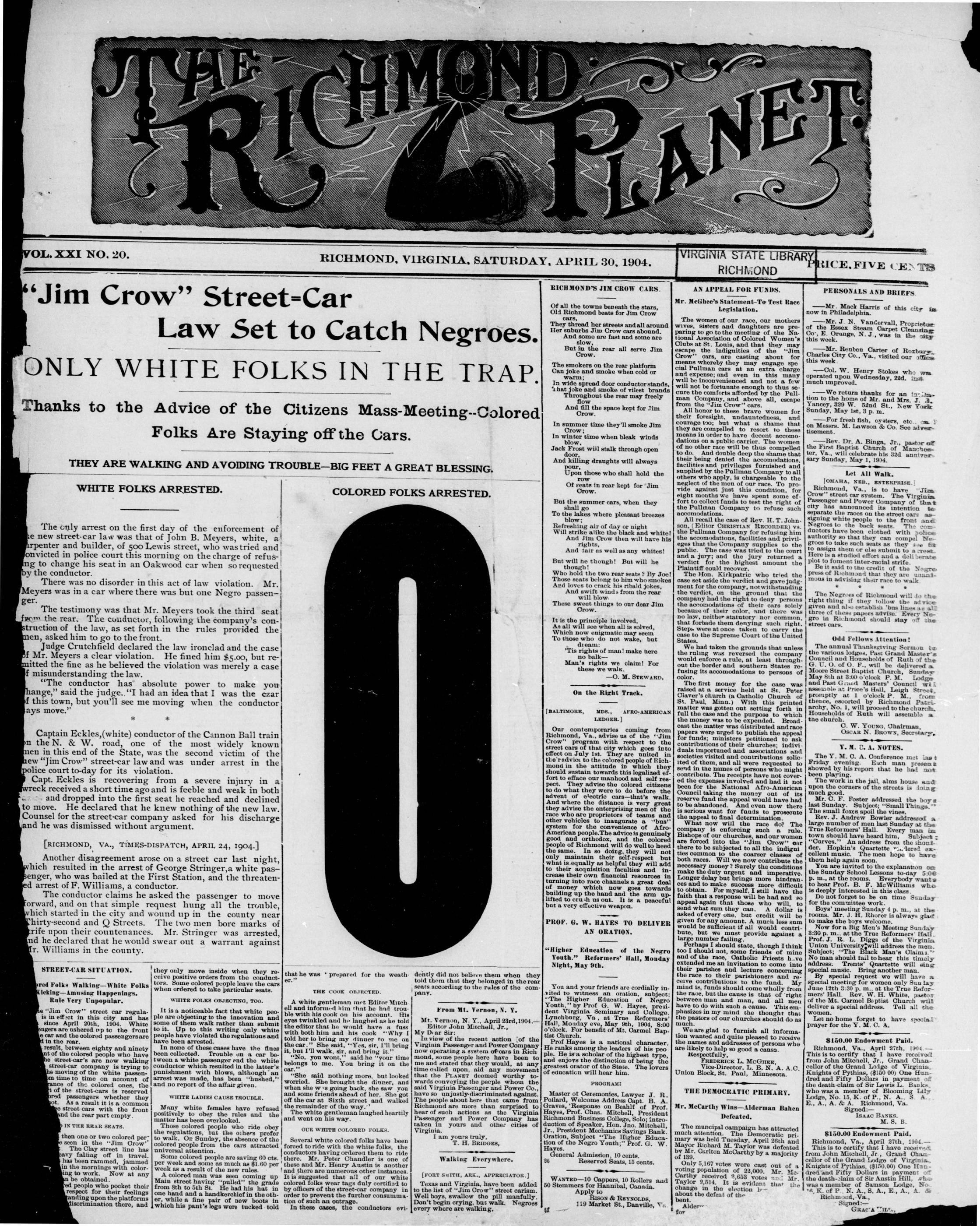
"Jim Crow" Street=Car Law Set to Catch Negroes. ONLY WHITE FOLKS IN THE TRAP
Thanks to the Advice of the Citizens Mass-Meeting--Colored Folks Are Staying off the Cars.
THEY ARE WALKING AND AVOIDING TROUBLE-BIG FEET A GREAT BLESSING.
WHITE FOLKS ARRESTED.
The only arrest on the first new street-car law was that carpenter and builder, of 500 M., convicted in police court this morning to change his seat in an O by the conductor.
There was no disorder in Meyers was in a car where theenger.
The testimony was that Mr. from the rear. The conductor's construction of the law, as set for men, asked him to go to the front. Judge Crutchfield declared of Mr. Meyers a clear violation, mitted the fine as he believed to misunderstanding the law.
"The conductor has all change," said the judge. "I have of this town, but you'll see me says move."
Captain Eckles, (white) conjoined on the N. & W. road, one man in this end of the State, new "Jim Crow" street-car law, police court to-day for its viola. Capt. Eckles is recovering wreck received a short time ago and dropped into the first to move. He declared that he Counsel for the street-car company and he was dismissed without.
[RICHMOND, VA., TIMES-P]
Another disagreement are which resulted in the arrest of senger, who was bailed at the ed arrest of F. Williams, a conjoined conductor claims he forward, and on that simple man which started in the city and Thirty-second and Q Streets. Brife upon their countenances and he declared that he would Mr. Williams in the county.
my arrest on the first day of the en-
get-car law was that of John B. Meyers,
a builder, of 500 Lewis street, who
police court this morning on the chie-
se his seat in an Oakwood car when
actor.
Has no disorder in this act of law vi-
sion in a car where there was but one N.
simony was that Mr. Meyers took the
Mr. The conductor, following the coor-
the law, as set forth in the rules
him to go to the front.
Brutchfield declared the law ironclad
was a clear violation. He fined him
one as he believed the violation was not
standing the law.
Conductor has absolute power to
the judge. "I had an idea that I w
but you'll see me moving when t
Eckles, (white) conductor of the Canne-
t W. road, one of the most w
end of the State, was the second w
ow" street-car law and was under a
no-day for its violation.
Les is recovering from a severe
and a short time ago and is feeble and
hopped into the first seat he reached
he declared that he knew nothing of
the street-car company asked for he
dismissed without argument.
BOND, VA., TIMES-DISPATCH, APRIL 22
I disagreement arose on a street car
in the arrest of George Stringer,
was bailed at the First Station, and
F. Williams, a conductor.
Conductor claims he asked the passen-
son that simple request hung all
in the city and wound up in the
road and Q Streets. The two men be-
t their countenances. Mr. Stringer
sured that he would swear out a wa-
sis in the county.
The only arrest on the first day of the enforcement of the new street-car law was that of John B. Meyers, white, a carpenter and builder, of 500 Lewis street, who was tried and convicted in police court this morning on the charge of refusing to change his seat in an Oakwood car when so requested by the conductor.
There was no disorder in this act of law violation. Mr. Meyers was in a car where there was but one Negro passenger.
The testimony was that Mr. Meyers took the third seat from the rear. The conductor, following the company's construction of the law, as set forth in the rules provided the men, asked him to go to the front.
Judge Crutchfield declared the law ironclad and the case of Mr. Meyers a clear violation. He fined him $5.00, but remitted the fine as he believed the violation was merely a case of misunderstanding the law.
"The conductor has absolute power to make you change," said the judge. "I had an idea that I was the czar if this town, but you'll see me moving when the conductor ays move."
Captain Eckles,(white) conductor of the Cannon Ball train on the N. & W. road, one of the most widely known men in this end of the State, was the second victim of the new "Jim Crow" street-car law and was under arrest in the police court to-day for its violation.
Capt. Eckles is recovering from a severe injury in a wreck received a short time ago and is feeble and weak in both and dropped into the first seat he reached and declined to move. He declared that he knew nothing of the new law. Counsel for the street-car company asked for his discharge and he was dismissed without argument.
[RICHMOND, VA., TIMES-DISPATCH, APRIL 24, IQ04.]
Another disagreement arose on a street car last night, which resulted in the arrest of George Stringer, a white passenger, who was bailed at the First Station, and the threatened arrest of F. Williams, a conductor.
The conductor claims he asked the passenger to move forward, and on that simple request hung all the trouble, which started in the city and wound up in the county near Thirty-second and Q Streets. The two men bore marks of grief upon their countenances. Mr. Stringer was arrested, and he declared that he would swear out a warrant against Mr. Williams in the county.
STREET-CAR SITUATION.
bred Folks Walking—White Folks
Kicking—Amusing Happenings.
Rule Very Unpopular.
The "Jim Crow" street car regula-
is in effect in this city and has
since April 20th, 1904. White
engenders are ushered up to the front
of the car and the colored passengers are
in the rear.
In result, between eighty and ninety
of the colored people who have
the street-car are now walking
street-car company is trying to
the moving of the white passen-
time to time in account of
grance of the colored ones, the
set of the street-car is reserved
passengers whether they
not. As a result it is a common
street cars with the front
and the rear part empty.
IN THE REAR SEATS.
then one or two colored per-
seen in the "Jim Crow"
The Clay street line has
havy falling off in travel,
has been rammed, jammed
in the mornings with color-
ing to work. Now at any
an be obtained.
red people who pocket their
respect for their feelings
standing upon the platforms
discrimination there, and
last day of the enforcement of act of John B. Meyers, white, a Lewis street, who was tried and morning on the charge of refusalwood car when so requested this act of law violation. Mr. Meyers was but one Negro passen-
Mr. Meyers took the third seat following the company's con- in the rules provided the act. and the law ironclad and the case. He fined him $5.00, but re- the violation was merely a case
absolute power to make you an idea that I was the czar moving when the conductor
lector of the Cannon Ball train of the most widely known was the second victim of the band was under arrest in the station.
from a severe injury in a band is feeble and weak in both seat he reached and declined knew nothing of the new law. many asked for his discharge argument.
DISPATCH, APRIL 24, 1904.]
rose on a street car last night, of George Stringer, a white pas-first Station, and the threaten-ductor.
asked the passenger to move request hung all the trouble, wound up in the county near The two men bore marks of Mr. Stringer was arrested, swear out a warrant against
they only move inside when they receive positive orders from the conductors. Some colored people leave the cars when ordered to take particular seats.
WHITE FOLKS OBJECTING. TOO.
It is a noticeable fact that white people are objecting to the innovation and some of them walk rather than submit to it. Up to this writing only white people have violated the regulations and have been arrested. In none of these cases have the fines been collected. Trouble on a car between a white passenger and the white conductor which resulted in the latter's punishment with blows, although an arrest was made, has been "hushed," and no report of the affair given.
WHITE LADIES CAUSE TROUBLE.
Many white females have refused to obey the rules and the matter has been overlooked. Those colored people who ride obey the regulations, but the others prefer to walk. On Sunday, the absence of the colored people from the cars attracted universal attention. Some colored people are saving 60 cts. per week and as much as $1.60 per week as a result of the new rules. A colored man was seen coming up Main street having "pulled" the grade from 8th to 5th St. He had his hat in one hand and a handkerchief in the other, while a fine pair of new boots in which his pant's lers were tucked, told
RICHMOND, VIRGINIA, SATURDAY, APRIL 30, 1904.
COLORED FOLKS ARRESTED.
that he was ' prepared for the weath er."
THE COOK OBJECTED
A white gentleman met Editor Mitchell and informed him that he had trouble with his cook on his account. His eyes twinkled and he laughed as he told the editor that he would have a fuss with both him and his cook "Why I told her to bring my dinner to me to the car." She said, "Yes, sir, I'll bring it, but I'll walk, sir, and bring it." "No, you wont," said he "your time belongs to me. You bring it on the car."
"She said nothing more, but looked worried. She brought the dinner, and when she was going back, she saw you and some friends ahead of her. She got off the car at Sixth street and walked the remainder of the way."
The white gentleman laughed heartily and went on his way.
OUR WHITE COLORED FOLKS.
Several white colored folks have been forced to ride with the white folks, the conductors having ordered them to ride there. Mr. Peter Chandler is one of these and Mr. Henry Austin is another and there are numerous other instances. It is suggested that all of our white colored folks wear tags duly certified to by officers of the street-car company in order to prevent the further consummation of such an outrage. In these cases, the conductors evi-
dently did not believe them when they told them that they belonged in the rear seats according to the rules of the company.
From Mt. Vernon, N. Y.
Mt. Vernon, N. Y., April 23rd, 1904.—Editor John Mitchell, Jr.,
My Dear Sir:
In view of the recent action of the Virginia Passenger and Power Company now operating a system of cars in Richmond, some people here have been to me and stated that they would, at any time called upon, aid any movement that the PLANET deemed worthy towards conveying the people whom the said Virginia Passenger and Power Co., have so unjustly discriminated against. The people about here that came from Richmond are more than surprised to hear of such actions as the Virginia Passenger and Power Company has taken in yours and other cities of Virginia.
I am yours truly,
T. H. BRIDGES.
Walking Everywhere.
[FORT SMITH, ARK., APPRECIATOR.]
Texas and Virginia, have been added to the list of "Jim Crow" street carism. Well boys, swallow the pill manfully. Don't begin crying, but walk. Negroes everywhere are walking.
Of all the towns beneath the stars,
Old Richmond beats for Jim Crow
cars,
They thread her streets and all around
Her suburbs Jim Crow cars abound.
And some are fast and some are
slow,
But in the rear all serve Jim
Crow.
The smokers on the rear platform
Can joke and smoke when cold or
warm;
In wide spread door conductor stands,
That joke and smoke of vilest brands
Throughout the rear may freely
flow
And fill the space kept for Jim
Crow.
In summer time they'll smoke Jim
Crow;
In winter time when bleak winds
blow.
Jack Frost will stalk through open
door,
And killing draughts will always
pour,
Upon those who shall hold the
row
Of reats in rear kept for Jim
Crow.
But the summer cars, when they
shall go
To the lakes where pleasant breezes
blow;
Refreshing air of day or night
Will strike alike the black and white!
And Jim Crow then will have his
rights,
And fair as well as any whites!
But will he though! But will he
though!
Who hold the two rear seats? By Joe!
Those seats belong to him who smokes
And loves to crack his ribald jokes,
And swift winds from the rear
will blow.
These sweet things to our dear Jim
Crow.
It is the principle involved,
As all will see when all is solved,
Which now enigmatic may seem
To those who do not wake, but
dream:
"Tis rights of man! make here
no balk—
Man's rights we claim! For
these we walk.
—O. M. STEWARD.
On the Right Track.
[BALTIMORE, MDS., AFRO-AMERICAN
LEDGER.]
Our contemporaries coming from Richmond, Va., advise us of the "Jim Crow" program with respect to the street cars of that city which goes into effect on July 1st. They are united in their advice to the colored people of Richmond in the attitude in which they should sustain towards this legalized effort to efface their manhood and self-respect. They advise the colored citizens to do what they were to do before the advent of electric cars—that's walk. And where the distance is very great they advise the enterprising men of the race who are proprietors of teams and other vehicles to inaugurate a "bus" system for the convenience of Afro-American people. The advice is genuinely good and orthodox, and the colored people of Richmond will do well to heed the same. In so doing, they will not only maintain their self-respect but what is equally as helpful they will add to their acquisition faculties and increase their own financial resources in turning into race channels a great deal of money which now goes towards building up the hand and the arm uplifted to crush us out. It is a peaceful but a very effective weapon.
PROF. G. W. HAYES TO DELIVER AN ORATION.
"Higher Education of the Negro Youth." Reformers' Hall, Monday Night, May 9th.
You and your friends are cordially invited to witness an oration, subject: "The Higher Education of Negro Youth," by Prof G. W. Hayes, president Virginia Seminary and College, Lynchburg, Va., at True Reformers' Hall, Monday eve, May 9th, 1904, 8:00 o'clock. For benefit of Mt. Carmel Baptist Church.
Prof Hayes is a national character. He ranks among the leaders of his people. He is a scholar of the highest type, and enjoys the distinction of being the greatest orator of the State. The lovers of education will hear him.
PROGRAM:
Master of Ceremonies, Lawyer J. R. Pollard, Welcome Address Capt. B. A. Graves, 'Response on Beahlf of Prof. Hayes, Prof. Chas. Mitchell, President Richmond Business College, Solo; introduction of Speaker, Hon. Jno. Mitchell, Jr., President Mechanics Savings Bank. Oration, Subject "The Higher Education of the Negro Youth," Prof. G. W. Hayes.
WANTED—10 Cappers, 10 Rollers and 50 Stemmers for Hannibal, Canada.
AN APPEAL FOR FUNDS.
Mr. McGhee's Statement-To Test Race Legislation.
The women of our race, our mothers wives, sisters and daughters are preparing to go to the meeting of the National Association of Colored Women's Clubs at St. Louis, and that they may escape the indignities of the "Jim Crow" cars, are casting about for means whereby they may engage special Pullman cars at an extra charge expense; and even in this many will be convinced and not a few will not be forbidden and such cure the comforts afforded by the Pullman Company, and above all, escape from the "Jim Crow" cars.
All honor to these brave women for their foresight, undauntedness, and courage too; but what a shame that they are compelled to resort to these means in order to have decent accommodations on a public carrier. The women of no other race will be thus compelled to do. And double deep the shame that their being denied the accommodations, facilities and privileges furnished and supplied by the Pullman Company to all others who apply, is chargeable to the neglect of the men of our race. To provide against just this condition, for eight months we have spent some effusive collect funds to test the right of the Pullman company to refuse such accommodations.
All recall the case of Rev. H. T. Johnson, (Editor CHRISTIAN RECORDER) vs. the Pullman Company for refusing him the accommodations, facilities and privileges that the Company supplies to the public. The case was tried to the court and a jury; and the jury returned a verdict for the highest amount the Plaintiff could recover.
The Hon. Kirkpatric who tried the case set aside the verdict and gave judgment for the company, not withstanding the verdict, on the ground that the company had the right to deny persons the accommodations of their cars solely because of their color, and there was no law, neither statutory nor common, that forbade them denying such right. Steps were at once taken to carry the case to the Supreme Court of the United States.
We had taken the grounds that unless the ruling was reversed the company would enforce a rule, at least throughout the border and southern States refusing its accommodations to persons of color.
The first money for the case was raised at a service held at St. Peter Claver's church (a Catholic Church of St. Paul, Minn.). With this printed matter was gotten out setting forth in full the case and the purpose to which the money was to be expended. Broadcast the matter was distributed and race papers were urged to publish the appeal for funds; ministers petitioned to ask contributions of their churches; individuals imported and associations and societies visited and contributions solicited them, and all were requested to send in names of persons who might contribute the expenses have not covered the expenses involved and it not been for the National African American Council taking the money out of its reserve fund the appeal would have had to be abandoned. And even now there is serious want for funds to prosecute the appeal to final determination.
What now will the race do? The company is enforcing such a rule. Bishops of our churches, and our women are forced into the "Jim Crow" our there to be subjected to all the indignities common to the coarser classes of both races. Will we now contribute the necessary money? Surely the conditions make the duty urgent and imperative. Longer delay but brings more hindrances and to make success more difficult to obtain. For myself, I still have the faith that a response will be had and so appeal again that those who will, to send what sum they can. A dollar is asked of every one, but credit will be given for any amount. A much less sum would be sufficient if all would contribute, but we must provide against a large number failing.
Perhaps I should state, though I think too I should not, some friends of mine and of the race, Catholic Priests h.ve extended me an invitation to come into their parishes and lecture concerning the race to their parishioners and receive contributions to the fund. My mind is, funds should come wholly from the race, but the cause is that of right between man and man, and all men have to do with such a cause. This emphasizes in my mind the thought that the pastors of our churches should do as much.
We are glad to furnish all information wanted and quite pleased to receive the names and addresses of persons who are likely to help so good a cause.
Respectfully,
FREDERICK L. McGHEE,
Vice-Director, L. B, N. A. A.C.
Union Block. St. Paul, Minneapolis
THE DEMOCRATIC PRIMARY.
Mr. McCarthy Wins—Alderman Bahen
Defeated.
The municipal campaign has attracted much attention. The Democratic primary was held Tuesday, April 26th and Mayor Richard M. Taylor was defeated by Mr. Carlton McCarthy by a majority of 139. Only 5,167 votes were cast out of a voting population of 23,000. Mr. McCarthy received 2,653 votes and Mr. Taylor 2,514. It is evident that the change in the election level about the defeat of the
PERSONALS AND BRIEF'S
—Mr. Mack Harris of this city is now in Philadelphia.
—Mr. J. N. Vandervall, Proprietor of the Essex Steam Carpet Cleansing Co., E. Orange, N. J., was in the city this week.
—Mr. Reuben Carter of Roxbury, Charles City Co., Va., visited our office this week.
—Col. W. Henry Stokes who was operated upon Wednesday, 22d, inst much improved.
—We return thanks for an invitation to the home of Mr. and Mrs. J. J. Yancey, 329 W. 52nd St., New York Sunday, May 1st, 3 p.m.
—For fresh fish, oysters, etc., on Messrs. M. Lawson & Co. See advertisement.
—Rev. Dr. A. Binga, Jr., pastor of the First Baptist Church of Manchester, Va., will celebrate his 32d anniversary Sunday, May 1, 1904.
Let All Walk.
Richmond, Va., is to have "Jim Crow" street car system. The Virginia Passenger and Power Company of that city has announced its intention to separate the races on the street cars assigning white people to the front and Negroes to the back seats. The conductors have been clothed with police authority so that they can compel Negroes to take such seats as they see for to assign them or else submit to a crest. Here is a studied effort and a delibrate plot to foment inter-racial strife.
Be it said to the credit of the Negro press of Richmond that they are unanimous in advising their race to walk.
* * * * *
The Negroes of Richmond will do the right thing if they follow the advice given and also establish 'bus lines as all three of these papers advise. Every Negro in Richmond should stay off the street cars.
Odd Fellows Attention!
The annual Thanksgiving Sermon to the various lodges, Past Grand Master's Council and Households of Ruth of the G. U. O. of O. F., will be delivered Moore Street Baptist Church, Sunday May 5th at 3:00 o'clock P. M. Lodge and Past Grand Masters' Council will assemble at Price's Hall, Leigh Street, promptly at 1 o'clock P. M. , from thence, escorted by Richmond Patriarchy, No. 1, will proceed to the church, Households of Ruth will assemble the church. C. W. Young, Chairman.
Y. M. U. A. NOTES.
The Y. M. C. A. Conference mat has t
Friday evening. Each man present
showed by his report that he had not
been playing.
The work in the jail, alms house and
upon the corners of the streets is loo-
much good.
Mr. C. F. Foster addressed the boys
last Sunday. Subject; "Small Things."
The small狐吞 spoil the vines.
Rev. J. Andrew Bowler addressed a
large number of men last Sunday at the
True Reformers' Hall. Every man
in town should have heard him. Subject
"Curves." An address from the shou-
der. Hopkin's Quartette offered
excellent music. The men hope to have
them help again soon.
You are invited to the explanation on
the Sunday School Lessons to-day 5:00
p. m., at the rooms. Everybody wants
to hear Prof. B. F. McWilliams who
is deeply interested in this class.
Do not forget to be on time Sunday
for the committee work.
Boys' meeting Sunday 4 p. m., at the
rooms. Mr. J. H. Rhoer is always glad
to make the boys welcome.
Now for a Big Men's Meeting Sunday
3:30 p.m. at the True Reformers' Hall.
Prof. J. R. L. Diggs of the Virginia
Union University will address the men.
Subject: "The Black Man's Claims."
No man should tail to hear this timely
address. Trents' Quartette will sing
special music. Bring another man.
By special request we will have a
special meeting for women only Sun Jay
June 3:30 p.m. at the True Reformer
Hall. H. R. H. H. White, pastor of
the Mt. Carmel Baptist Church will
deliver a special address. Tell all the
women.
Let no home forget to have special
prayer for the Y. M. C. A.
$150.00 Endowment Paid
Richmond, Va., April 27th, 1904 —
This is to certify that I have received
from Mitchell, Jr., Grand Chancellor of the Grand Lodge of Virginia,
Knights of Pythias, ($150 00) One Hundred and Fifty Dollars in payment of the death claim of Sir Lewis L. Banks,
who was a member of Blooming Lily
Lodge, No. 15, K of P, N. A., S. A.
E., A. A & A, Richmond, Va.
8150.00 Endowment Paid.
Richmond, Va., April 27th, 1904. This is to certify that I have received from John Mitchell, Jr., Grand Chancellor of the Grand Lodge of Virginia. Knights of Pythians, ($150.00) One Hunt, $10.00, One Slay, $10.00, the death-chaim of Sir Austin Hill, who was a member of Samson Lodge, No. 16, K of P, N. A., S. E., A. A.
SATURDAY.....APRIL 30, 1904
TEMPERANCE
Miss Kara Smart Meets with a Serious Accident at Hands of Drunken Japanese.
(We are permitted to quote the following extracts from a personal letter to Miss Smart's mother.-Editors of the Union Signal.)
Tokyo, Japan.-The other evening, as I was coming home, after a day's absence traveling over the same road I have traveled hundreds of times, my jinrikisha man turned abruptly and darted on the road into the big canal along which the road runs. It was done so quickly I had no time to jump to save myself nor to stop the man.
Almost the first thing I knew I saw him dropping into that awful black hole, then saw one wheel go over (we went sideways fortunately) the stone wall lining side of canal, and then I was hurled into a gulf of pitch darkness and knew nothing more until I struck the water some fifteen feet distant. Down, down I went, for it was high side forunately (or I'd have had a broken head or neck most likely), and as the cold water rushed in mouth, ears, nose, there came to me like a flash father's instructions of many years ago: "Keep your mouth shut, hold your breath, keep your arms down, and you'll come to the top and float until some one can rescue you." and I immediately proceeded to follow instructions to the letter. Result: I went down to the bottom, then, still holding my breath, turned over and came up to the top, right side up with
WAS AT LAST HAULED OUT MORE
DEAD THAN ALIVE
care, and I floated. Looked about for the jinrikisha man and saw none, but while I was wondering what I could do next, how I could get out of that awful place when I didn't know any Japanese word for "help" and I couldn't swim nor climb up a perpendicular stone wall ten feet or more high in case I could get to it—directly I saw his head and shoulders come above water near the edge. I called to him and he turned as if shot (suppose he thought I was done for), paddled out to me, and grasping the bottom of my skirt, towed me in until I got near enough to catch his shoulders, which I grasped, and righted myself, standing by his side, while he held on to me and I to him, the water to our armpits as I remember.
Then we both yelled, "Help! help!" in our own language, and soon we heard voices and then three Japs' heads peeked over the canal wall and peered down onto us. By dint of the man with me boosting, my scrambling and those three men pulling on one wrist which they could just reach with the combined efforts of us all to get together, I was at last hauled out more dead than alive, and lifted to my feet only to tumble down again, for my strength went from me then, as Samson's must have done when he lost his hair.
After finding out about my baggage, two of those men took me, one on each side, and started me for the house, five blocks away. I went a few rods and then discovered my knee (left) was hurt, and a deathly faintness selzed me. I started to fall, but the men held me firmly between them, saying most kindly: "Mo scotia, mo scotia" (meaning a little more—a little more). I begged them in Japanese to put me in another purunia and hurry me home, but they only said: "Scota matte, scota matte!" (a little wait, a little wait) and dragged me along half falling, stumbling, plunging, half fainting. They got me home, looking like a drowned rat, and I had just strength enough left to arouse the household and toppled onto a chair in the hall, but I didn't faint. Oh, no! I knew I mustn't; if I did, then the werest would be to pay, so I held onto my will power and exerted it as best I could, while four women and two strong men undressed and carried me up to my room and put me to bed; then I had a nervous chill that was almost equal to an earthquake, and in the midst of it the doctor came and told me—"not to be so nervous." I ordered white
ter remedies. He said No! I said, Yea! and stuck to it, and he got something else, though I had little need of it when it reached me, for my will had brought me out.
This was five days ago, and I'm still confined to room and couch, though am getting so I can move about a lit tle.
I got off with a sprained knee, a wrenched back, numerous bruises and a shocked nervous system, which was not bad, considering.
How did it happen? Oh, the man was full of sake, of course! I guess I'll never get over the fun it has caused among my friends, some of whom call me "a good sailor," "a temperance comet," etc.
The largest newspaper of Japan reported it, giving all details, and the Japanese temperance leaders (while deeply chagrined that one of their people should have laid me out), are very happy over the outcome. They say: "It's the best thing you've done yet!" That whereas I have heretofore reached thousands, now I have reached millions, for that paper goes all over the Empire, and there's a first class temperance lecture in it as well as plenty of good advertising.
The police swooped down on that poor "kurumaya" (jirikisha man) at once and would have made it interesting for him (for it's pretty serious business to hurt a "foreigner"), but in the midst of my suffering I begged the head of the police, who had come to see me, not to punish or do anything with the man, and while he made no promises to me then and waited two days to see how seriously I was hurt, he eventually let him go and gave him back his license. Such gratitude as the poor fellow and all his associates exhibited! His poor wife came to see me yesterday and brought me a lot of nice oranges. She was completely upset over it. The head man from the jinikisha stand has been to call several times, and I've been almost overwhelmed with calls and attention from friends and from those also whom I never before met, both foreigners and Japanese. My accident has evidently waked up somewhat. Books magazines, flowers and fruit, besides many notes of sympathy, have been bestowed upon me, and still they come.
This is the third narrow escape I have had in three months, though the other two were not such close shaves, and I'm as careful as I can be and do not needlessly run into danger, but you know this is not yet a civilized country, and even if it were—well, they have a few accidents in civilized countries, too, I notice.
Mr. Nemoto, vice-president of the National Temperance League, informed me that the temperance societies never could have afforded to pay for the amount of space devoted by the newspapers to our cause just now, and he's happy over it.
The doctor says I must keep quiet for a few weeks, and I shall be all right. The hardest thing to replace will, I fear, be my clothing, for I went in all over—hat, coat and all, and they are somewhat the worse for such close contact with water and mud. Oh, well, it will all come out some way in course of time.
TEMPERANCE POINTS.
Ex-Gov. John D. Long has been elected to the presidency of the Massachusetts Total Abstinence society. Stand with anybody that stands right. Stand with him while he is right, and part with him when he goes wrong. Lincoln. Enact into every day living the ethics of Christ's Gospel; nothing else can bring the glad day of universal brotherhood.—Frances E. Willard. The average per capita consumption of liquor in the United States last year was 19.48 gallons. Such is the statement of the American Prohibition Year Book for 1904, edited by Mr. Alonzo E. Wilson, the state chairman for Illinois, and just issued from the headquarters in Chicago. Among other startling facts which every temperance man should consider.
A young man who drinks even moderately thereby surrenders his place in the commercial world. Should the fathers and mothers of marriageable daughters be less concerned about the habits of possible sons-in-law than are bankers, railway managers, merchants and manufacturers about the conduct of their hired men?—National Advocate.
Anti-Saloon league workers of Iowa have commenced the issuance of posters bearing the pictures of the Bible and a barrel of whisky, asking the voters which they will choose for government. The liquor dealers have accepted the challenge to battle and say: "We will see which will go the furthest in the fight—a barrel of whisky or a bushel of Bibles."
Temperance Agitation in Russia
We are in receipt of several journals published in different parts of Russia devoted to the presentation of the dangers from the use of alcohol as a beverage. These journals are edited with great spirit and present the subject with strong emphatic language, condemning the government plan of the sale of the spirits and urging individuals to give up all use of spirits as dangerous in the last degree. Compared with the 50 or more journals in this country in which all forms of temperance work are urged it is evident that the Russian and Scandinavian countries are more deeply interested and are taking up the subject from a broader point of view, dealing with facts more than theories.—Journal of Inebriety.
A King's Opinion.
The king of Sweden never loses an opportunity of saying a word for temperance. An English company is at present engaged working a gold mine in Norway, and the king recently had an interview with the heads of the concern, who presented him with some gold jewelry, the produce of the mine. The king, on being informed that a large number of the miners were Good Templars, said: "I am very glad to hear it, because they are just the sort of men to give satisfaction."—National Advocate.
THE RICHMOND PLANET, RICHMOND, VIRGINIA.
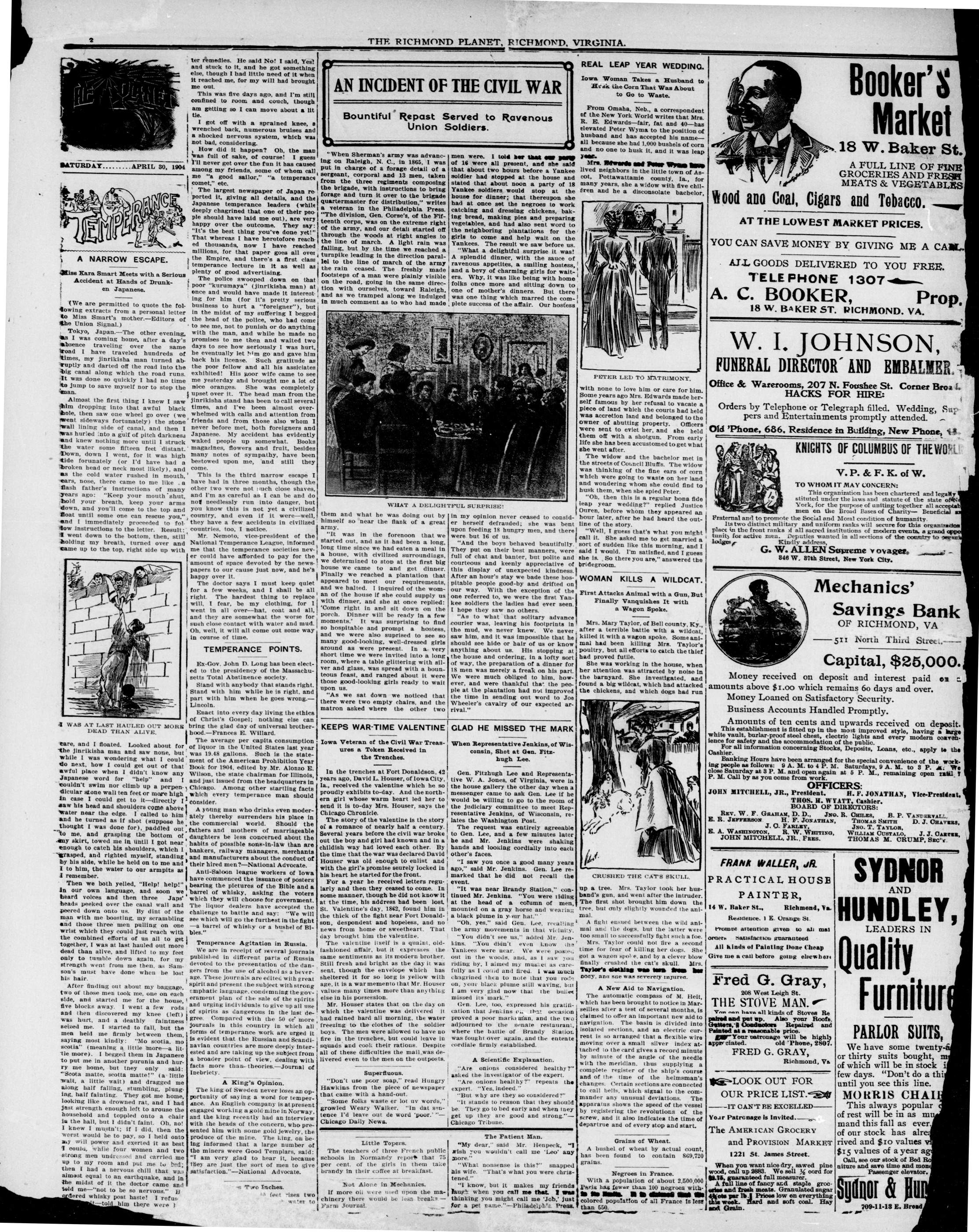
AN INCIDENT OF THE CIVIL WAR
Bountiful Repast Served to Ravenous Union Soldiers.
"When Sherman's army was advancing on Raleigh, N. C., in 1865, I was put in charge of a forage detail of a sergeant, corporal and 13 men, taken from the three regiments composing the brigade, with instructions to bring forage and turn it over to the brigade quartermaster for distribution," writes a veteran in the Philadelphia Press. "The division, Gen. Corse's, of the Fifteenth corps, was on the extreme right of the army, and our detail started off through the woods at right angles to the line of march. A light rain was falling, but by the time we reached a turniple leading in the direction parallel to the line of march of the army the rain ceased. The freshly made footsteps of a man were plainly visible on the road, going in the same direction with ourselves, toward Raleigh, and as we tramped along we indulged in much comment as to who had made
THE HISTORY OF THE HOLY CROSS
THE BROTHERS' MEAL
WHAT A DELIGHTFUL SURPRISE!
them and what he was doing out by himself so near the flank of a great army.
"It was in the forenoon that we started out, and as it had been a long, long time since we had eaten a meal in a house, with civilized surroundings, we determined to stop at the first big house we came to and get dinner. Finally we reached a plantation that appeared to meet our requirements, and we halted. I inquired of the woman of the house if she could supply us with dinner, and she at once replied: 'Come right in and sit down on the porch. Dinner will be ready in a few moments.' It was surprising to find so hospitable and prompt a hostess, and we were also suprised to see so many good-looking, well-dressed girls around as were present. In a very short time we were invited into a long room, where a table glittering with silver and glass, was spread with a bounteous feast, and ranged about it were those good-looking girls ready to wait upon us.
"As we sat down we noticed that there were two empty chairs, and the matron asked where the other two
KEEPS WAR-TIME VALENTINE
Iowa Veteran of the Civil War Treasures a Token Received in the Trenches.
In the trenches at Fort Donaldson, 42 years ago, David L. Houser, of Iowa City, Ia., received the valentine which he so proudly exhibits to-day. And the northern girl whose warm heart led her to send it is to-day Mrs. Houser, says the Chicago Chronicle.
The story of the valentine is the story of a romance of nearly half a century. Several years before the civil war broke out the boy and girl had known and in a childish way had loved each other. By the time that the war was declared David Houser was old enough to enlist and with the girl's promise seurely locked in his heart he started for the front.
For a year he received letters regularly and then they ceased to come. In some manner, though he did not know it at the time, his address had been lost. St. Valentine's day, 1862, found him in the thick of the fight near Fort Donaldson, despondent and hopeless, and no news from home or sweetheart. That day brought him the valentine. The valentine itself is a quaint, old-fashioned affair, but it expresses the same sentiments as its modern brother. Still fresh and bright as the day it was sent, though the envelope which has sheltered it for so long is yellow with age, it is a war memo that Mr. Houser values many times more than anything else in his possession.
Mr. Houser states that on the day on which the valentine was delivered it had rained hard all morning, the water freezing to the clothes of the soldier boys. The men were allowed to have no fire in the trenches, but could leave in squads and cook their rations. Despite all of these difficulties the mail was delivered even to the men on the outposts.
"Don't use poor soap," read Hungry Hawkins from the piece of newspaper that came with a hand-out.
"Some folks waste er lot uv words," growled Weary Walker. "In dat sentence I'd leave out de word 'poor.'"—Chicago Dally News.
The teachers of three French public schools in Normandy report that 75 per cent of the girls in them take brandy in their coffee at breakfast.
Not Alone in Mechanics.
If more oil were used upon the machinery there would be less breaks — Farm Journal.
Superfluous.
Little Topers.
men were. I told her that our party of 16 were all present, and she said that about two hours before a Yankee soldier had stopped at the house and stated that about noon a party of 18 Yankee soldiers would stop at the house for dinner; that thereupon she had at once set the negroes to work catching and dressing chickens, baking bread, making pies and preparing vegetables, and had also sent word to the neighboring plantations for the girls to come and help wait on the Yankees. The result we saw before us. "What a delightful surprise it was! A splendid dinner, with the sauce of ravenous appetites, a smiling hostess, and a bevy of charming girls for waiters. Why, it was like being with home folks once more and sitting down to one of mother's dinners. But there was one thing which marred the complete success of the affair. Our hostess
Our hostess
in my opinion never ceased to consider herself defrauded; she was bent upon feeding 18 hungry men, and there were but 16 of us.
"And the boys behaved beautifully. They put on their best manners, were full of chat and banter, but polite and courteous and keenly appreciative of this display of unexpected kindness. After an hour's stay we bade these hospitable people good-by and drifted on our way. With the exception of the one referred to, we were the first Yankee soldiers the ladies had ever seen. I hope they saw no others.
"As to what that solitary advance courier was, leaving his footprints in the mud, we never knew. We never saw him, and it was impossible that he should see hide or hair of us or know anything about us. His stopping at the house and ordering, in a lofty sort of way, the preparation of a dinner for 18 men was merely a freak on his part. We were much obliged to him, however, and were thankful that the people at the plantation had not improved the time in sending out word to Joe Wheeler's cavalry of our expected arrival."
GLAD HE MISSED THE MARK
When Representative Jenkins, of Wisconsin, Shot at Gen. Fitzhugh Lee.
Gen. Fitzhugh Lee and Representative W. A. Jones, of Virginia, were in the house gallery the other day when a messenger came to ask Gen. Lee if he would be willing to go to the room of the judiciary committee to meet Representative Jenkins, of Wisconsin, relates the Washington Post.
The request was entirely agreeable to Gen. Lee, and a few minutes later he and Mr. Jenkins were shaking hands and looking cordially into each other's faces.
"I saw you once a good many years ago," said Mr. Jenkins. Gen. Lee remarked that he did not recall the event.
"It was near Brandy Station," continued Mr. Jenkins. "You were riding at the head of a column of men, mounted on a gray horse and wearing a black plume in your hat."
"Oh, yes," said Gen. Lee, recalling the army movements in that vicinity. "You didn't see us," added Mr. Jenkins. "You didn't even know the Yankees were near. We were posted out in the woods, and, as I saw you riding by, I aimed my musket as carefully as I could and fired. I was much chagrined then to note that you rode on, your black plume still waving, but I am very glad now that the bullet missed its mark."
Gen. Lee, too, expressed his gratification that Jenkins on that occasion proved a poor markman, and the two adjourned to the somate restaurant, where the battle of Brandy Station was fought over again, and the entente cordiale firmly established.
A Scientific Explanation.
"Are onions considered healthy?" asked the investigator of the expert. "Are onions healthy?" repeats the expert. "Yes, indeed." "But why are they so considered?" "It stands to reason that they should be. They go to bed early and when they get up they are good and strong"—Chicago Tribune.
"My dear," said Mr. Henpeck, "I wish you wouldn't call me 'Leo' any more."
"What nonsense is this?" snapped his wife. "That's what you were christened."
"I know, but it makes my friends laugh when you call me that. I was thinking you might call me 'Job,' just for a pet name."—Philadelphia Press.
The Patient Man:
REAL LEAP YEAR WEDDING.
Iowa Woman Takes a Husband to
Husk the Corn That Was About
to Go to Waste.
From Omaha, Neb., a correspondent
of the New York World writes that Mrs.
R. E. Edwards—fair, fat and 40—has
elevated Peter Wyma to the position of
husband and has accepted his name—
all because she had 1,000 bushels of corn
and no one to husk it, and it was leap
year.
Mrs. Edwards and Peter Wyma have
lived neighbors in the little town of Ascot,
Pottawattamie county, fa., for many years, she a widow with five children and he a disconsolate bachelor
A
PETER LED TO MATRIMONY.
with none to love him or care for him.
Some years ago Mrs. Edwards made herself famous by her refusal to vacate a piece of land which the courts had held was accretion land and belonged to the owner of abutting property.
Officers were sent to evict her, and she held them off with a shotgun. From early life she has been accustomed to get what she went after.
The widow and the bachelor met in the streets of Council Bluffs. The widow was thinking of the fine ears of corn which were going to waste on her land and wondering whom she could find to husk them, when she spied Peter.
"Oh, then this is a regular bona fide leap year wedding?" replied Justice Ouren, before whom they appeared an hour later, after he had heard the outline of the story.
"Well, I guess that's what you might call it. She asked me to get married a sort of sudden like this morning, and I said I would. I would, I satisfied, and I guess she is. So there you are," answered the bridegroom.
WOMAN KILLS A WILDCAT.
First Attacks Animal with a Gun, But Finally Vanquishes It with a Wagon Spoke.
Mrs. Mary Taylor, of Bell county, Ky., after a terrible battle with a wildcat, killed it with a wagon spoke. Some animal had been killing Mrs. Taylor's poultry, but all efforts to catch the thief had proved futile.
She was working in the house, when her attention was attracted by noise in the barnyard. She investigated, and found a big wildcat, which had attacked the chickens, and which dogs had run
Victor
CRUSHED THE CAT'S SKULL.
up a tree. Mrs. Taylor took her husband's gun, and went after the intruder. The first shot brought him down the tree, but only slightly wounded the animal.
A fight ensued between the wild animal and the dogs, but the latter were too small to successfully fight such a foe.
Mrs. Taylor could not fire a second time for fear of killing her dogs. She got a wagon spoke, and by a clever blow finally crushed the cat's skull. Mrs. Taylor's clothing was torn from her body, and she was severely injured.
A New Aid to Navigation.
The automatic compass of M. Heit, which has been brought to notice in Marseilles after a test of several months, is claimed to offer an important new aid to navigation. The basin is divided into isolated sections, and an electric current is so arranged that a flexible wire moving over a small silver index attached to the card gives a record minute by minute of the angle of the needle with the meridian, thus supplying a complete register of the ship's course and of the time of the helmsman's changes. Certain sections are connected to call bells, which signal to the commander any unusual deviations. The apparatus shows the speed of the vessel by registering the revolutions of the screw, and it also indicates the time of departure and of every stop and start.
Grains of Wheat
A bushel of wheat by actual count, has been found to contain 869,720 grains.
Negroes in France.
With a population of about 2,500,000 Paris has fewer than 100 negroes with colored population of all France is less than 550.
J. H. H.
Wood and Coal, Cigars
AT THE LOWEST M
YOU CAN SAVE MONEY I
AJL GOODS DELIVER
TELEPHONE
A. C. BOOKER
18 W. BAKER ST.
W. I. JOE
FUNERAL DIRECTOR
Office & Warerooms, 207 N.
HACKS FO
Orders by Telephone or Tele-
pers and Entertainment
Old 'Phone, 686, Residence
GOAL, CIGARS and TEBAC
THE LOWEST MARKET PRICE
SAVE MONEY BY GIVING ME
GOODS DELIVERED TO YOU
ELEPHONE 1307
BOOKER,
B W. BAKER ST. RICHMOND.
E. I. JOHNSON
SAL DIRECTOR AND EMB
Varerooms, 207 N. Foushee St. Co
HACKS FOR HIRE:
Telephone or Telegraph filled. We
s and Entertainment promptly atten
, 686. Residence in Building, New
KNIGHTS OF COLUMBUS OR
AT THE LOWEST MARKET PRICES.
W. I. JOHNSON FUNERAL DIRECTOR AND EMBALMER
Office & Warerooms, 207 N. Foushee St. Corner Broad HACKS FOR HIRE: Orders by Telephone or Telegraph filled. Wedding, Suppers and Entertainments promptly attended. Old 'Phone, 686. Residence in Building, New Phone.
KNIGHTS OF COLUMBUS OF THE WORLD
TO WHOM IT MAY CONCERN:
This organization has been chartered under the laws and statute of York, for the purpose of uniting together men on the Broad Bases of Charity to promote the Social and Moral condition of humane conduct military and uniform ranks will secure for a certain ranks of all sacred institutions of modern ever men. Deputies wanted in all sections of the city Kindly address,
This organization has been chartered and legally
situated under the laws and statute of the state of New
York, for the purpose of uniting together all acceptab-
men on the Broad Bases of Charity—Beneficial
Fraternal and to promote the Social and Moral condition of humanity.
It is two distinct military and uniform ranks will secure for this organization
place in the front ranks of all sacred institutions of modern events, a grand oppo-
tunity for active men. Deputies wanted in all sections of the country to organ-
lodge
Kindly address,
G. W. ALLEN Supreme voyager
846 W. 87th Street, New York City.
TOMMY HENRY
Money received on deposit amounts above $1.00 which rent Money Loaned on Satisfaction Business Accounts Handle Amounts of ten cents and this establishment is fitted up in the white vault, burlar-proof steel chest, cleience for safety and the accommodation of For all information concerning Stock Cashier. Banking Hours have been arranged firing people as follows: 9 A. M. to 4 P. M. close Saturday at 3 P. M. and open again. P. M. Call by as you come from work. OFFIC JOHN MITCHELL, JR., President. THOS. M. WY BOARD OF I
received on deposit and interest
love $1.00 which remains 60 days and
Loaned on Satisfactory Security.
Less Accounts Handled Promptly.
lets of ten cents and upwards received
ishment is fitted up in the most improved style,
clear-proof steel chest, electric lights and every
and the accommodation of the public.
formation concerning Stocks, Deposits, Loans, etc.
ours have been arranged for the special convenienc
lows: 9 A. M. to 4 P. M. Saturdays, 9 A. M. t
t 3 P. M. and open again at 5 P. M., remaini
you come from work.
OFFICERS:
ELL, JR., President. H. F. JONATHAN,
THOS. H. WYATT, Cashier.
BOARD OF DIRECTORS:
Money received on deposit and interest paid on amounts above $1.00 which remains 60 days and over.
Money Loaned on Satisfactory Security.
Business Accounts Handled Promptly.
Amounts of ten cents and upwards received on deposit.
This establishment is fitted up in the most improved style, having a large white vault, burlar-proof steel chest, electric lights and every modern convenience for safety and the accommodation of the public.
For all information concerning Stocks, Deposits, Loans, etc., apply to the Cashier.
Banking Hours have been arranged for the special convenience of the working people as follows: 9 A. M. to 4 P. M. Saturday, 9 A. M. to 8 P. A. We close Saturday at 8 P. M. and open again at 5 P. M., remaining open until 7 P. M. Call by as you come from work.
OFFICERS:
JOHN MITCHELL, JR., President. H. F. JONATHAN, Vice-President.
THOS. H. WYATT, Cashier.
BOARD OF DIRECTORS:
REV. W. F. GRAHAM, D. D., JNO. R. CHILES, B. P. VANDERVALL,
E. R. JEFFERSON H. F. JONATHAN, THOMAS SMITH D. J. O'RAVERS,
J. O. FARLEY, JNO. T. TAYLOR,
E. A. WASHINGTON, R. W. WHITING, WILLIAM OUSTALO, J. J. OARTER,
JOHN MITCHELL, JR. FRES. THOMAS OUSTALO, J. J. OARTER,
FRANK WALLER, JR.
PRACTICAL HOUSE
14 W. Baker St., Richmond, Va.
Residence, 1 E. Orange St.
Prompt attention given to all mail
orders. Satisfaction guaranteed
Fred G. Gray,
You can have all kinds of Stoves Re
paired and put up. Also your Roofs,
Gutters, Conductors Repaired and
Painted at a reasonable price.
Your patronage will be highly
appreciated. Old Phone, 2807.
FRED G. GRAY,
Richmond, Va
LOOK OUT FOR
OUR PRICE LIST.
IT CAN'T BE EXCELLED
Your Patronage is Invited.
The AMERICAN GROCERY
and PROVISION MARKET
1221 St. James Street.
When you want nice dry, sawed pine wood, call up 2883. We sell $1 cord for $9.75, guaranteed full measurer.
A full line of fancy and staple groceries and fresh meats. Granulated sugar 4x4tec par lb. Prices low on everything this week. Hard and soft coal. Hay and Grain.
```markdown
```
Booker's Market
18 W. Baker St. A FULL LINE OF FINE GROCERIES AND FRESH MEATS & VEGETABLES
gars and Tebacco.
ST MARKET PRICES.
BY GIVING ME A CALL.
VERED TO YOU FREE.
NE 1307
ER, Prop.
ST. RICHMOND, VA.
JOHNSON,
ATOR AND EMBALMER.
7 N. Foushee St. Corner Broad.
FOR HIRE:
Telegraph filled. Wedding, Supp
ments promptly attended.
Place in Building, New Phone, 18
TS OF COLUMBUS OF THE WORLD
V. P. & F. K. of W.
OMIT MAY CONCERN:
an organization has been chartered and legally
under the laws and statute of the state of New
or the purpose of uniting together all acceptab
the Broad Bases of Charity—Beneficial and
Moral condition of humanity.
iform ranks will secure for this organization
institutions of modern events, a grand oppo
anted in all sections of the country to orga
nisms.
Mechanics' Savings Bank OF RICHMOND, VA 511 North Third Street.
Capital, $25,000.
deposit and interest paid on
it remains 60 days and over.
Misfactory Security.
Handled Promptly.
and upwards received on deposit.
In the most improved style, having a large
electric lights and every modern convention
of the public.
Stocks, Deposits, Loans, etc., apply to the
agged for the special convenience of the work-
P. M. Saturdays, 9 A. M. to 3 P. M. We gain at 5 P. M., remaining open until 7
k.
FICERS:
St. H. F. JONATHAN, Vice-President,
WYATT, Cashier.
OF DIRECTORS:
JNO. R. CHILES, B. P. VANDERVALL,
MAN, THOMAS SMITH D. J. CHAVERS,
JNO. T. TAYLOR,
ING, WILLIAM CUSTALO, J. J. CARTER
WILLIAM CUSTALO, J. J. CARTER,
THOMAS M. CRUMP, SECX.
SYDNOR
AND
HUNDLEY,
LEADERS IN
Quality
Furniture
PARLOR SUITS.
We have some twenty-four thirty suits bought, me of which will be in stock if few days. "Don't do a thirteen until you see this line.
MORRIS CHAIR
This always popular of rest will be in as much mand this fall as ever, of our stock has already rived and $10 values with $15 values of a year ago.
Call, see our stock of Bed Roof niture and save time and money.
Passenger elevator.
Sydnor & Hun
The Gentleman From Indiana
By BOOTH TARKINGTON
Copyright, 1899, by Doubleday @ McClare Co.
Copyright, 1902, by McClare, Phillips @ Co.
CHAPTER XII
A
N Indiana town may lie asleep a long while, but it always wakes up some time, and Platttville woke up in August, when the Herald became a daily. It was then that history began to be made. The Herald printed news. It had made a connection with the Associated Press, and it was sold every morning at stands in every town in that section of the state. Its circula-
tion tripled. Two new men were brought from Rouen for the editorial and reportorial staff, and Parker talked of new presses. During the first week of the daily venture Eph Watts struck off, and the Herald boomed the field. People swarmed into town; the hotel was crowded; strangers became no sensation whatever. A capitalist bought the whole north side of the square to erect new stores, and the Carlow bank began the construction of a new bank building of Bedford stone on the corner opposite the Herald. Then it was whispered, next affirmed, that Main street was to be asphalted. That was the end of the "old days" of Platttville. But the man who had laid the foundation upon which the new Platttville was to be built, he who through the quiet labor of years had stamped his spirit on the people, lay sick in his friend's house and did not care.
Tom Meredith had taken him from the hospital to his own home on a quiet street in Rouen, and John was well enough of his hurts to be taken abroad sometimes in a victoria, where he reclined, gray and thin, seemingly no more than a long afternoon shadow. But for days he would lie in a lethargy that made Tom despair. The soul of the country editor was sick inside of him; he was weary and worn, and pain had left him dulled, except when he thought of returning to Plattville; then he felt physical horror. The place did not need him, nor he the place. Fisbee had found a young relative to run the Herald, who signed his typewritten business letters "H. Fisbee" in a strapping hand that suggested six feet of muscle spattering ink on its shirt sleeves.
John wondered idly where old Fisbee had raked up a relative, and he thought it probable that H. Fisbee was a Yankee cousin of the old man, but he did not care much for that or for anything except to keep away from Carlow for the rest of his life, since he was to live. And there was no longer need to go there. He was glad to know that. H. Fisbee had written him before the oil bubbled in Eph's wells that to buy stock in Mr. Watts' company might be profitable, especially as the stock was then so low that it was almost imperceptible, and Harkless had a little money he had saved. He let Meredith arrange it for him, and a few days later the stock leaped cloudward. However, his modest riches interested him as little as did everything else. He left his bed less and less, took no more drives, and his lethargy deepened.
The only thing in which he showed interest was the congressional campaign of the district. It was far advanced before the Herald spoke of it at all, and Harkless saw that McCune had lifted his head.
One day Tom came in and found him writing on a pad on his knee.
Dear Mr. Fisher—Youra of the ls to hand. I entirely approve of you, and you have made. I think you understand that I wish you to regard everything as in your own hands. You are the editor of the Herald and have the sole responsibility for everything, including policy, until it is time to relieve you in person, if that even happens, but that time regard me as a mere spectator. I do not fear that you will make any mistakes. You have done very much better in all matters than I could have done myself. I present to you only one suggestion: I observe that Halloween is concerning Halloween's renaming are but a bakewarm. It is very important that he be renominated, not so much on account of assuring his return to Washington (for it is no Madison, I fear), but the fellow Medic must be beaten if we have to send him to the hospital issue to do it. The man is corrupt to the bone. He has been bought and sold, and I am glad the proofs of it are in your hands, as you tell me you found them, as in my desk. The papers you hold drove me to publication once by mere threat of publication, and have printed them last week, as I suggested. Do so at once; the time is short. The Herald is a little paper (not so little nowadays, after all, thanks to you), but honest one, and it isn't afraid of Red McCormick. Please let me see as hearty a word you give for Halloween also. You can write with ginger. Please let us have some in this matter. I am, very truly yours.
When the letter was concluded, he banded it to Meredith. "Please address that, put a 'special' on it and send it. Tom. It should go at once, so as to reach him tonight."
"H. Fisbee?"
"Yes-H. Fisbee."
"I believe it does you good to write, boy," said the other as he bent over him. "You look more chirrupy than you have for several days."
"It's that beast McCune. This young Fisbee is rather queer about it. I felt stirred up as I went along." But even before the sentence was finished the favor of age and utter weariness returned, and the dark lids closed over his eyes. They opened again slowly and he took the other's hand and looked up at him mournfully; but, as it were his soul shone forth in dumb and cloquent thanks.
"I-I'm giving you a jolly summer Tom," he said, with a quivering effort to smile. "Don't you think I am? I don't-I don't know what I should have done"— "You old Indian!" said Meredith ternely. Three days later Tom was rejoiced by symptoms of invigoration in his pa-
flent. A telegram came for Harkless, and Meredith, bringing it into the sick room, was surprised to find the occupant sitting straight up on his couch without the prop of pillows. He was reading the day's copy of the Herald, and his face was flushed and his brow stern.
"What's the matter, boy?"
"Mismanagement, I hope," said the other in a strange voice; "worse, perhaps. It's this young Fisbee. I can't think what's come over the fellow. I thought he was a treasure beyond dreams, and he's turning out bad. I'll swear it looks like they'd been—well, I won't say that yet, but he hasn't printed that McCune business I told you of, and he's had two days. There is less than a week before the convention, and—" He broke off, seeing the yellow envelope in Meredith's hand. "Is that a telegram for me?" His companion gave it to him. He tore it open and read the contents. They were brief and unhappy.
Can't you do something? Can't you come down? It begins to look the other way. K. H.
"Tom, give me that pad and pencil," said the sick man. He rapidly dashed off a note to H. Fisbee.
H. Fisbe, Editor Carlow Herald:
Dear Sir--You have not acknowledged my letter of the 2d of September by a note (which should have reached me the following morning) or by the alteration in my letter of the 2d of September in question, or by the publication of the McCune papers which I directed. In this I hold you grossly at fault. If you have a conscientious reason for refusing to carry out my request it should have been com-posed in the face, as should the fact—if such be the case, as personal (or impersonal, if you like) friend of Mr Rodney McCune. Whatever the motive which prevents you from operating my paper as I direct, I should have been in agreement with the interest of our community, and I hitherto shown yourself too alert in accepting my slightest suggestion for me to construe this failure as negligence. You will receive this letter by 7 this evening for delivery. You will print the facts concerning McCune in tomorrow's paper.
I am well aware of the obligations under which your extreme efficiency and your thoughtfulness in many matters you thoughtfulness in many matters you owe my unearned profit from the transaction in oil, and it is to you I owe the Herald's extraordinary present circulation, growth of power and influence. That power is still under my direction and is an essentialability which shall not be misapplied.
Are you sorry for McCune? I warned him long ago that the papers you hold would be published if he ever tried to return to political life, and he is deliberately lying on my physical weakness and absence of strength so weak as he thinks. I am sorry for him from the bottom of my heart, but the Herald is not.
You need not reply by letter. Tomorrow's issue answers for you. Until I have received a copy I will send you JOHN HARKLESS.
Tomorrow's issue—that fateful print on which depended John Harkless' opinion of H. Fisbee's integrity—contained an editorial addressed to the delegates of the convention, warning them to act for the vital interest of the community and declaring that the opportunity to be given them in the present convention was a rare one, a singular piece of good fortune indeed. They were to have a chance to vote for a man who had won the love and respect of every person in the district—one who had suffered for his championship of righteousness; one whom even his few political enemies confessed they held in personal affection and esteem; one who had been the inspiration of a new era; one whose life had been helpfulness, whose hand had reached out to every struggle and unfortunate; a man who had met and faced danger for the sake of others; one who lived under a threat for years, and who had been almost overborne in the fulfillment of that threat, but who would live to see the sun shine on his triumph, the tribute the convention would bring him as a gift from a community that loved him. His name needed not to be told. It was on every lip that morning and in every heart.
Tom was eagerly watching his companion as he read. Harkless fell back on the pillows with a drawn face, and for a moment he laid his thin hand over his eyes in a gesture of intense pain.
"What is it?" Meredith said quickly.
"Give me the pad, please."
"What is it, boy?"
The other's teeth snapped together.
"What is it?" he cried. "What is it? It's treachery, and the worst I ever knew. Not a word of the accusation I demanded—lying praises instead! Read that editorial—there, there!" He struck the page with the back of his hand and threw the paper to Meredith. "Read that miserable lie! One who has won the love and respect of every person in the district! 'One who has suffered for his championship of righteousness! Righteousness! Save the mark!'" "What does it mean?"
"Mean! It means McCune, Rod McCune, 'who has lived under a threat for years'—my threat. I swore I would print him out of Indiana if he ever raised his head again, and he knew I could. Almost overborne in the fulfillment of that threat—almost! It's a black scheme, and I see it now. This man came to Platville and went on the Herald for nothing in the world but this. It's McCune's hand all along. He daredn't name him even now, the coward! The trick lies between McCune and young Fisbee—the old man is innocent. Give me the pad. Not almost overborne. There are three good days to work in, and if Rod McCune sees congress it will be in his next incarnation."
He rapidly scribbled a few lines on the pad and threw the sheets to Meredith. "Get those telegrams to the Western Union office in a rush, please. Read them first."
THROUGH / SINIA
THE NEW YORK TIMES
"What is it?" he cried.
With wide eyes Tom read them. One was to Warren Smith:
Take possession Herald. Take to your authority. Publish McCune papers, so labeled, which H. Fisbee will hand you. Beat McCune. JOHN HARKLESS.
The second was addressed to H. Fisbee:
You are relieved from the cares of editorship. You will turn over the management of the Herald to Warren Smith. You will give him the McCune papers. If you do not or if you destroy them you cannot hide where I shall not find you. JOHN HARKLESS.
CHAPTER XIII
ERY early in the morning a messenger boy stumbled up the front steps of Meredith's house and handed the colored servant four yellow envelopes, night messages. The man carried them upstairs, left three with his master's guest, then knocked on Meredith's door till a response assured him that the occupant was awake and slid the fourth envelope under the door. Meredith lay quite without motion for several minutes, sleepy watching the yellow rhomboid in the crevice. It was a hateful looking thing to mix itself in with a pleasant dream and insist on being read, but after a while he climbed groaningly out of bed and perused the message with heavy eyes, still half asleep. He read it twice before it penetrated.
Suppress all newspapers today. Convention meets at it. If we succeed, a delegation will come to Rouen this afternoon. They will come.
HELEN.
Tom rubbed his sticky eyelids and shook his head violently in a Spartan effort to rouse himself, but what more effectively performed the task for him were certain sounds that issued from Harkless' room across the hall. For some minutes Meredith had been dully conscious of a room and ear in the twelfth room, and so began to realize that no mere tossing upon a bed would account for a noise that reached him across a wide hall and through two closed doors of thick walnut. Suddenly he heard a quick, heavy tread, shod, in Harkless' room, and a resounding bang as some heavy object struck the floor. The doctor was not to come till evening. The servant had gone downstairs. Who in the sick man's room wore shoes? He rushed across the hall in his pajamas and threw open the unlocked door.
The bed was disarranged and vacant. Harkless, fully dressed, was standing in the middle of the floor hurling garments at a small trunk. The horrified Meredith stood for a second bleached and speechless; then he rushed upon his friend and seized him with both hands.
"Mad, by heaven! Mad!"
"Let go of me, Tom!"
"Lunatic! Lunatic!"
"Don't stop me one instant!"
Meredith tried to force him toward the bed. "No: get back to bed. You're delirious, boy!"
"Delirious nothing! I'm a well man."
"Go to bed! Go to bed!"
Harkless set him out of the way with one arm. "To bed!" he cried. "I'm goimg to Plattyville!" Meredith wrung his hands. "The doctor"— "Doctor be hanged!" "What in the name of all that's terrible is the matter. John?" His companion slung a light overcoat, unfolded, on the overflowing, misshapen bundle of clothes that lay in the trunk, then he jumped on the lid with both feet and kicked the husp into the lock, while a very elegantly laundered cuff and shirt sleeve dangled out from under the fastened lid. "I haven't one second to talk, Tom; I have eighteen minutes to catch the express. It's more than a mile to the station, and the train leaves here at 9:02. I get there at 10:47. Telephone a cab for me, please, or tell me the number. I don't want to stop to hunt it up."
Meredith looked him in the eyes. In the pupils of Harkless flared a fierce light. His cheeks were reddened with an angry, healthy glow, and his teeth were clinched till the line of his jaw stood out like that of an embattled athlete. His brow was dark, his chest was thrown out, and he took deep, quick breaths. His shoulders were squared, and in spite of his thinness they looked massy. Lethargy or malaria, or both—whatever his aliment—it was gone. He was six feet of hot wrath and cold resolution.
Tom said, "You are going?" "Yes." he answered quietly, "I am going."
"Then I will go with you." "Thank you, Tom," said Harkless simply.
Meredith ran into his room, pressed an electric button and began to dive into his clothes with a panting rapidity astonishingly foreign to his desire. The colored man appeared in the doorway. "The cart, Jim!" shouted his master. "We want it like lightning Tell the cook to give Mr. Harkless his breakfast in a burry. Set a cup of coffee on the table by the front door for me. Run' We've got to catch a train. That will be quicker than any cab," he explained to Harkless. "We'll break the ordinance against fast driving getting down there."
Ten minutes later the cart swept away from the house at a gait that
THE FRENCH IN THE BATTLE OF BERLIN.
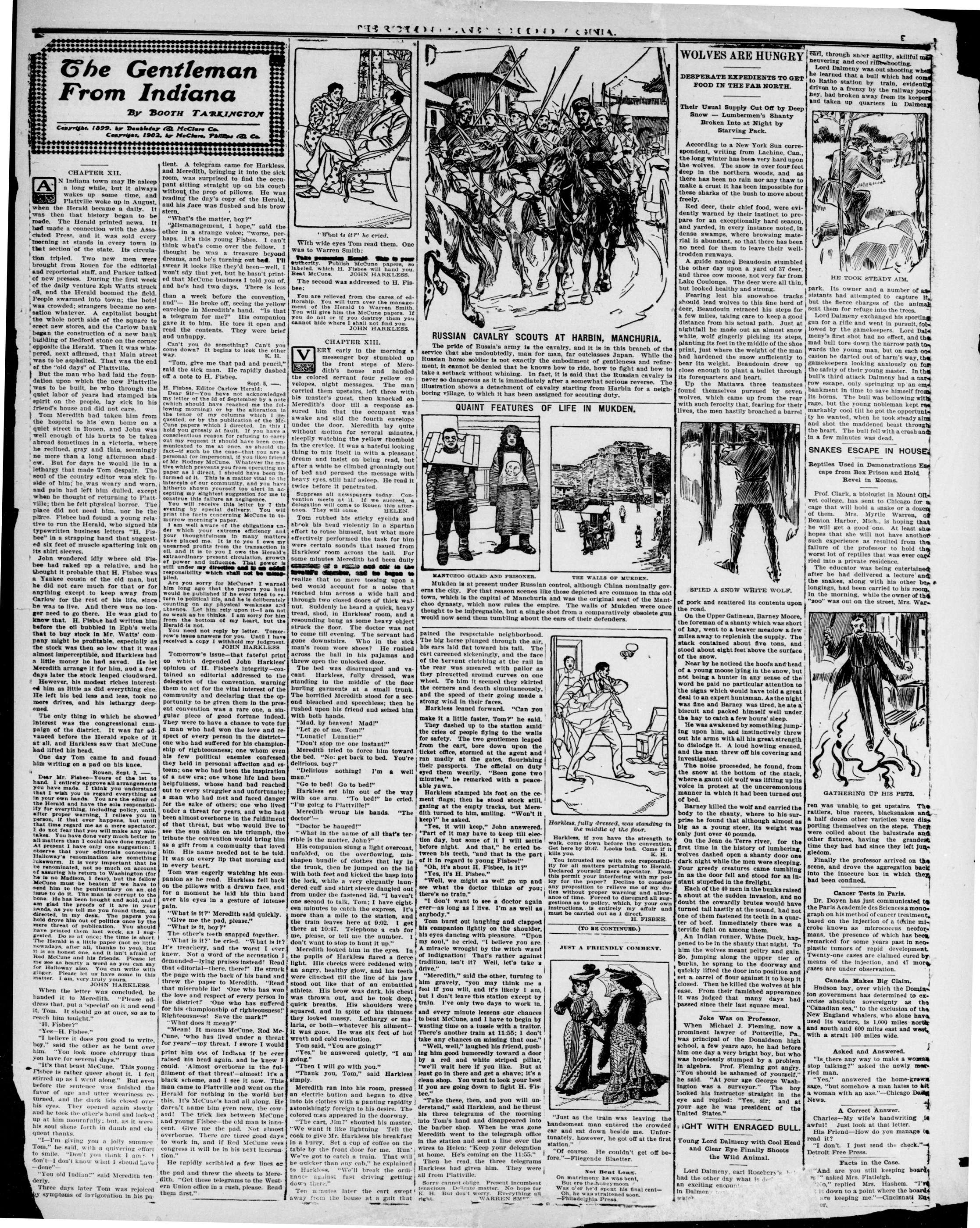
RUSSIAN CAVALRY SCOUTS AT HARBIN, MANCHURIA.
The pride of Russia's army is the cavalry, and it is in this branch of the service that she undoubtedly, man for man, far outclasses Japan. While the Russian horse soldier is not exactly the embodiment of gentleness and refinement, it cannot be denied that he knows how to ride, how to fight and how to take a setback without whining. In fact, it is said that the Russian cavalry is never so dangerous as it is immediately after a somewhat serious reverse. The illustration shows a detachment of cavalry starting from Harbin for a neighboring village, to which it has been assigned for scouting duty.
Mukden is at present under Russian control, although China nominally governs the city. For that reason scenes like those depicted are common in this old town, which is the capital of Manchuria and was the original seat of the Manchoo dynasty, which now rules the empire. The walls of Mukden were once thought to be impregnable, but a single shot from a comparatively obsolete gun would now send them tumbling about the ears of their defenders.
MANTCHOO GUARD AND PRISONER-
paired the respectable neighborhood. The big horse plunged through the air, his ears laid flat toward his tail. The cart careened sickeningly, and the face of the servant clutching at the rail in the rear was smeared with pallor as they prucured around curves on one wheel. To him it seemed they skirted the corners and death simultaneously, and the speed of their going made a strong wind in their faces.
Harkless leaned forward. "Can you make it a little faster, Tom?" he said. They dashed up to the station amid the cries of people flying to the walls for safety. The two gentlemen leaped from the cart, bore down upon the ticket office, stormed at the agent and ran madly at the gates, flourishing their passports. The official on duty eyed them wearily. "Been gone two minutes," he remarked with a peaceable yawn.
Harkless stamped his foot on the cement flags; then he stood stock still, gazing at the empty tracks, but Meredith turned to him, smiling. "Won't it keep?" he asked.
"Yes, it will keep," John answered.
"Part of it may have to keep till election day, but some of it I will settle before night. And that," he cried between his teeth, "and that is the part of it in regard to young Fisbee!"
"Oh, it's about H. Fisbee, is it?"
"Yes, it's H. Fisbee."
"Well, we might as well! go up and see what the doctor thinks of you; there's no train."
"I don't want to see a doctor again ever—as long as I live. I'm as well as anybody."
Tom burst out laughing and clapped his companion lightly on the shoulder, his eyes dancing with pleasure. "Upon my soul," he cried, "I believe you are. A miracle wrought by the witch wand of indignation! That's rather against tradition, isn't it? Well, let's take a drive."
"Meredith," said the other, turning to him gravely, "you may think me a fool if you will, and it's likely I am, but I don't leave this station except by train. I've only two days to work in, and every minute lessens our chances to beat McCune, and I have to begin by wasting time on a tussle with a traitor. There's another train at 11:55; I don't take any chances on missing that one." "Well, well," laughed his friend, pushing him good humoredly toward a door by a red and white striped pillar, "we'll wait here if you like. But at least go in there and get a shave; it's a clean shop. You want to look your best if you are going down to fight H. Fisbee."
"Take these, then, and you will understand," said Harkless, and he thrust his three telegrams of the morning into Tom's hand and disappeared into the barber shop. When he was gone Meredith went to the telegram office in the station and sent a line over the wires to Helen: "Keep your delegation at home. He's coming on the 11:55." Then he read the three telegrams Harkless had given him. They were all from Plattville.
Sorry cannot oblige. Present incumbent tenacious. Delicate matter. No hope for K. H. But don't worry. Everything all right. WARREN SMY
THE WALLS OF MUKDEN.
A man is being pushed down a flight of stairs. Another man is standing behind him, looking on. The floor is covered with debris.
Harkless, fully dressed, was standing in the middle of the floor.
Harkless, if you have the strength to walk, come down before the convention. Get here by 10:47. Looks bad. Come it kills you.
You intrusted me with sole responsibility for all matters pertaining to Herald. Declared yourself mere spectator. Does this permit your interfering with my policy for the paper? Decline to consider any proposition to relieve me of my duties without proper warning and allowance of your own suggestions as to policy, which, by your own instructions, is entirely my affair and must be carried out as I direct.
H. FISBEE
A
"Just as the train was leaving the handsomest man entered the crowded car and eat down beside me. Unfortunately, however, he got off at the first station."
"Of course. He couldn't get off before."—Fliegende Blaetter.
Not Bent Long.
On marathon, he was bent,
But ere the bony paws
Was o'er he'd spent his final cent—
Oh, he was straitened soon.
—Philadelphia Press.
WOLVES ARE HUNGRY
DESPERATE EXPEDIENTS TO GET FOOD IN THE FAR NORTH.
Their Usual Supply Cut Off by Deep Snow — Lumbermen's Shanty Broken Into at Night by Starving Pack.
According to a New York Sun correspondent, writing from Lachine, Can., the long winter has been very hard upon the wolves. The snow is over four feet deep in the northern woods, and as there has been no rain nor any thaw to make a crust it has been impossible for these sharks of the bush to move about freely.
Red deer, their chief food, were evidently warned by their instinct to prepare for an exceptionally hard season, and yarded, in every instance noted, in dense swamps, where browsing material is abundant, so that there has been no need for them to leave their well-trodden runways.
A guide named Beaudouin stumbled the other day upon a yard of 37 deer, and three cow moose, not very far from Lake Coulonge. The deer were all thin, but looked healthy and strong.
Fearing lest his snowshoe tracks should lead wolves to this fine herd of deer, Beaudouin retraced his steps for a few miles, taking care to keep a good distance from his actual path. Just at nightfall he made out an almost snow white wolf gingerly picking its steps, planting its feet in the middle of the shoe print, just where the weight of the man had hardened the snow sufficiently to bear its weight. Beaudouin drew up close enough to plant a bullet through its forequarters and heart.
Up the Mattawa three teamsters found themselves pursued by seven wolves, which came up from the rear with such ferocity that, fearing for their lives, the man hastily broached a barrel
SPIED A SNOW WHITE WOLF.
of pork and scattered its contents upon the road.
On the Upper Gatineau, Barney Moore, the foreman of a shanty which was short of hay, went to a beaver meadow a few miles away to replenish the supply. The stack contained about five tons, and stood about eight feet above the surface of the snow.
Near by he noticed the hoofs and head of a young moose lying in the snow, but not being a hunter in any sense of the word he paid no particular attention to the signs which would have told a great deal to an expert hunman. As the night was fine and Barney was tired, he ate a biscuit and packed himself well under the hay to catch a few hours' sleep.
He was awakened by something jumping upon him, and instinctively threw out his arms with all his great strength to dislodge it. A loud howling ensued, and the man threw off his covering and investigated.
The noise proceeded, he found, from the snow at the bottom of the stack, where a gaunt old wolf was lifting up its voice in protest at the unceremonious manner in which it had been turned out of bed.
Barney killed the wolf and carried the body to the shanty, where to his surprise he found that although almost as big as a young steer, its weight was only just over 40 pounds.
On the Jean de Terre river, for the first time in the history of lumbering, wolves dashed open a shanty door one dark night while the men were sleeping.
Four greedy creatures came tumbling in as the door fell and stood for an instant stupefied in the firelight.
Each of the 40 men in the bunks raised a shout at the sudden invasion, and no doubt the cowardly brutes would have turned tail hastily at the sound, had not one of them fastened its teeth in a quarter of beef. Immediately there was a terrific fight on among them.
An Indian runner, White Duck, happened to be in the shanty that night. To him the wolves meant peltry and gain. So, jumping along the upper tier of burks, he sprang to the doorway and quickly lifted the door into position and set a oarrel of flour against it to keep it closed. Then he killed the wolves at his ease. From their famished appearance it was judged that many days had passed since their last square meal.
Joke Was on Professor
When Michael J. Fleming, now a prominent lawyer of Pottsville, Pa., was principal of the Donaldson high school, a few years ago, he had before him one day a very bright boy, but who was hopelessly stumped by a problem in algebra. Prof. Fleming got angry, "You should be ashamed of yourself" he said. "At your age George Washington was a surveyor." The boy looked his instructor straight in the eye and replied: "Yes, sir; and at your age he was president of the United States."
RIGHT WITH ENRAGED BULLS
Young Lord Dalmeny with Cool Head and Clear Eye Finally Shoots the Wild Animal.
Lord Dalmeny, earl Rosebery's boy had the other day what is de an exciting encounter in Dalmeny
earl, through sneer agility, skillful mannevering and cool rifle shooting. Lord Dalmeny was out shooting when he learned that a bull which had come to Ratho station by train, evidently driven to a frenzy by the railway journey, had broken away from its keeper and taken up quarters in Dalmene
HE TOOK THE
HE TOOK STEADY AIM. park. Its owner and a number of assistants had attempted to capture it, but the fierce charges of the animal sent them for refuge into the trees. Lord Dalmeny exchanged his sporting gun for a rifle and went in pursuit, followed by the gamekeepers. Lord Dalmeny's first shot had no effect, and the mad bull tore down the narrow path towards the young man, but on each occasion he darted out of harm's way, the gamekeepers looking anxiously on for the safety of their young master. In the bull's third attack Dalmeny had a narrow escape, only springing up an embankment in time to save himself from its horns. The bull was bellowing with rage, but the young nobleman kept remarkably cool till he got the opportunity he wanted, when he took steady aim and shot the maddened beast through the heart. The bull fell with a crash and in a few minutes was dead.
SNAKES ESCAPE IN HOUSE
Reptiles Used in Demonstrations Escape from Box Prison and Hold Revel in Rooms.
Prof. Clark, a biologist in Mount Olivet college, has sent to Chicago for a cage that will hold a snake or a dozen of them. Mrs. Myrtle Warren, of Benton Harbor, Mich., is hoping that he will get a good one. At least she hopes that she will not have another such experience as resulted from the failure of the professor to hold the worst lot of reptiles that was ever carried into a private residence.
The educator was being entertained after he had delivered a lecture and the snakes, along with his other best longings, had been carried to his room. In the morning, while the owner of the "zoo" was out on the street, Mrs. War
A man in a suit leaping through a cloud of smoke.
GATHERING UP HIS PETS.
ren was unable to get upstairs. The rattlers, blue racers, blacksnakes and a half dozen other varieties were disporting themselves on the steps. They were coiled about the balustrade and other fixtures, having the grandest time they had had since they left jungledom.
Finally the professor arrived on the scene, and drove the aggregation back into the insecure box in which they had been confined.
Cancer Tests in Paris.
Dr. Doyen has just communicated to the Paris Academie des Sciences a monograph on his method of cancer treatment, based on the injection of a toxine microbe known as micrococcus neoformans, the presence of which has been remarked for some years past in neoplastic tumors of rapid development. Twenty-one cases are claimed cured by means of the injection, and 47 more cases are under observation.
Canada Makes Big Claim:
Hudson bay, over which the Dominion government has determined to exercise absolute sovereignty as the "Canadian sea," to the exclusion of the New England whalers, who alone have used its waters, is 1,000 miles north and south and 600 miles east and west, with a strait 100 miles wide.
Asked and Answered
"Is there any way to make a woman stop talking?" asked the newly married man.
"Yes," answered the home-grown sage, "but somehow a man hates to hit a woman with an axe."—Chicago Daily News.
A Correct Answer.
Charles—My wife's handwriting
awful! Just look at that letter.
His Friend—How do you manage
read it?
"I don't. I just send the check."
Detroit Free Press.
Facts in the Case.
"And are you still keeping board
we asked Mrs. Flatleigh.
o," replied Mrs. Hashem. "I
down to a point where the board
are keeping me."—Cincinnati En
published every Saturday by JOHN M. ROTH
at 311 North 4th Street Richmond Va
BEN MITCHELL, JR., - EDITOR
communications intended for publication
should be sent so as to reach us by Wednesda
TERMS IN ADVANCE
Copy, one year, - - - - $1.5
Copy, eight months, - - - - 1.0
Copy, six months, - - - - 8.0
Copy, four months, - - - - 5.0
Copy, three months, - - - - 4.0
Simple Copy, - - - - 6.0
ADVERTISING RATES
for one inch, one insertion, $ 8
for one inch, each subsequent insertion, $ 8
for two inches, six months, . . . 6.00
for two inches, six months, . . . 10.00
for two inches, nine months, . . . 14.00
for two inches, twelve months, . . . 20.00
Harrison and Funeral Notices, . . . 12
Handling and Transit Notices per line, . . . 12
POSTAGE STAMPS OF A HIGHER DE
NOMINATION THAN TWO CENTS NOT
RECEIVED ON SUBSCRIPTIONS.
THE PLANET is issued weekly. The subscri
nce price is $1.90 a year, in advance.
WE ARE FOUR WAYS by which money can be by mail at our risk: - In a Post Office Money Order, when none of these can be procured, in a Registered Letter. MONEY ORDERS - You can buy a Money Order your Post Office, payable at the Richmond, and we will be responsible for it on arrival. EXPRESS MONEY ORDERS can be or be called at any office of the American Express Co., the United States Express Co., and the Well Fare Company, and we are responsible for money sent by any of these companies. The Express Money Order is a safe convenient way for forwarding money. REGISTERED LETTER - If a Money Order you reach, your Postmaster will Register the letter you wish to send us on payment of ten cents. Then, if the letter is lost or stolen, you can send money in the manner at our risk. We cannot be responsible for money sent in letters in any other way than one of the four ways mentioned above. If you send your money in another way, you must do it at your risk.
REWARNS, ETC.—If you do not want The
NETT continued for a other year after your
subscription has run out, you then notify the
Card Instal to discontinue it. The courts have
sided that subscribers to newspapers who
order their paper discontinued at the ex-
ception time for which it has been paid
in lieu of otherwise for the payment of the subscription
to date when they order the paper discus-
sion.
COMUNICA—When writing to a
renew your subscription or to discontinue
your paper you should give your name and
otherwise we cannot find you our courses.
NAME OF ADDRESS—In order to can-
nage of a subscriber, we must be se-
tioned as well as the present address.
Entered in the Post Office at Richmond.
received class letter.
SATURDAY . APRIL 30, 1904
COLORED people are not complaining
much now. They are working.
THE Virginia cases were not given as much consideration as were the Alabama cases. The result was the same, however.
It takes the United States Senate two years to confirm a colored Collector, without finishing the job.
The death of Mr. WARREN C. COLLEMAN, founder of the Coleman Cotton Mills at Concord, N. C., is a racial calamity. He was one of the most progressive colored men in this country.
When the Negro goes to the United States Supreme Court that tribunal says, "Go to Congress." When he goes to Congress, he is told to go back to the United States Supreme Court.
This is enough to set any man to "cussing"
COLORED men, don't even look at a white woman, and if you see one pass ing in the same block and no one else is in sight, run as fast as you can to the other side of the street or turn a corner as soon as possible. If you see one on a street-car, that you are about to enter, get off at once and—walk, keep walking. These are life-saving directions, and the time may come when we can give the same advice to white men with preference to colored women.
"How would it do, Sir Mitchell, for the leading Negroes in Richmond and other "Jim Crow" street car cities to get together and buy one or two large automobiles and carry Negro passengers? No horses to feed, no barn to be kept up, etc. Try first at Richmond.—Cincinnati, O., BROTHERHOOD."
Our people have this matter under advisement and it may be that the automobile, for passengers may be tried first at Richmond.
WHILE the Negro-haters in this locality are putting in force proscriptive racial rules and regulations, a voice is heard from Texas, which tells of the kindness of a colored man to his white master, and the latter's appreciation of him. The Athen's Texas, REVIEW published the following:
Izadore Richardson to-day deeded charity acres of land to Allen Richardson (colored) as a gift for a home. The land is a fine piece near Mr. Richardson's switch, on the T. & N. O. The motive prompting the charitable deed was a token of his kind feelings, good-will and gratitude to the old Negro, who nursed Mr. Richardson when a boy.
At one time about the close of the civil war Izadore and a younger brother were the only white persons on the place, their parents being dead and the other children away in the army and school. This Negro and his mama
took care of the place and these two white children. Izadeore saved old Allen has carried him thousands of miles and that he has slept with him many a time. He says he wanted the old Negro to have a home of his own during his last days.
The Negro no doubt feels very grateful to the son of his old "massa" for this generous recognition of him. There has never been a closer friendship, where not interfered with, than that between the old slave and his old master and the latter's descendants. These Negroes know they can always depend upon being assisted by their former masters if they are deserving. They never fear to go to them for a favor, for they know they will not be turned away empty-handed.
---
THE Richmond correspondent of the Petersburg, Va., INDEX-APPEAL in writing about the street-car situation said:
"The conductors have more trouble with women than with men. When a number of persons get on, and while the conductor is helping on the last and signaling for the car to start the ladies have taken seats near the door, that part reserved for colored people and present the request to move. 'I shouldn't' is the oft reply, then when the conductor insists they want all the reasons why and finally move pouting and talking at and to the discomfort of the conductor as long as they remain on the car. A conductor is, indeed, a chastened individual these days in Richmond and his patience will no doubt be rewarded in another world."
"NEGROES AND STREET-CARS"
THE Richmond, Va., NEWS LEADER has been quite liberal in its views with reference to the citizen of color. Some of its utterances would have made good reading in the columns of some of our own journals. But evidently the Negro hating department was not working smoothly or the manager must have been away on his vacation and left no one in charge capable of vilifying and abusing us. Be that as it may, it is running all right now and its editorial utterances in its issue of the 20th inst. entitled "Negroes and Street-cars" would have done credit to the Richmond Dispatch during the palmist days of Readjuster Rule. It said:
"The conflict that has arisen here over the seating of the races in the street-cars is an illustration as vivid as we could find of the perpetual conflict we may look for while the experiment of keeping two distinct races of people on the same territory and in contact and competition with each other. The street railway company is subjected to tremendous pressure from the white people to take advantage of this new law and separate the races in the cars as far as possible. Obeying this strong public demand, it is confronted with the indignation and resistance of the Ne'groes and with an attempted boycott of it by all the representatives of that race in the city."
We have enquired carefully as to the source of this "tremendous pressure from the white people" and the street. railway officials admit that it is from people outside, rather than those inside of Richmond, and that this species of race legislation is confined to the legislature of Virginia.
There is no conflict between the white and colored people of this city. It seems however, that General Manager HUFF and his associates are trying to raise the issue and make such a conflict, but both races are objecting.
As to the extent of the disposition of the colored people to walk, a person has only to use his eyes and note the remarkable falling off in the patronage of the street-cars by the colored people of this city. They are staying off the cars and avoiding trouble, and as a result white people only are being carried to the Police Court and fined for violating street-car regulations.
Our people walked before the street-cars were established here. In fact they did most walking for the white folks whose servants they were. We certainly are able to walk now that we are, in a legal sense at least, our own masters.
When we get tired walking, we have our own 'bus lines, owned by Mr. A D. PRICE, Mr. W. ISAAC JOHNSON, Mr. A. HAYES and others while their carriages are among the best in the city. Hundreds of colored men have furniture wagons and drays and the hearses can be utilized with the side glasses taken out.
The NEWS-LEADER charges the trouble up to race antagonism and remarks:
"In that antagonism the matter of clothes or manners or comparative intelligence is not considered. The daintiest and most exclusive white woman has not the slightest objection to oumping a seat in a car with the humblest white man, provided he is reasonably cleanly, decent, sober and well-behaved. She does object and her friends object to her occupying a seat with the best dressed, best behaved and most intelligent Negro man in the city, and her feeling is shared all along the social scale down to the poorest and most obscure white woman."
From where did the white gentleman, who wrote that editorial come? Is it possible that he does not know that the antipathy to which he refers exists in only what is usually termed the "poor white trash?" People who came from nothing and are bound for the same station! If he did not know it, why is it that he does not go to Franklin street in this city in the afternoons and look at the most accomplished and beautiful white ladies in this country of charming manners and graceful mien sitting by the side of Negro drivers, who know their places and who never think for a moment of presuming that their presence is noticed otherwise than in a menial capacity.
What is true on the public streets is equally so in the homes.
Negro servants go to and fro knowing at the side of a person does disturb the social and
THE RICHMOND PLANET, RICHMOND, VIRGINIA
absurd reasoning further when it said: "From the standpoint of the well-dressed, well behaved, clean and intelligent Negro it is a hardship on him to recognize this prejudice and to say that he shall not have his choice where he shall sit in a public conveyance But the feeling exists, and in our opinion it is as necessary as it is natural. It is one of the safeguards against the breaking down of the barrier between the races and the amalgamation and mixing which is the worst horror Southern white people can imagine and would be the worst disaster that could befall both races in the country."
The intimation in the above declaration is as significant, from a white man's standpoint as it is horrible. He states plainly that the well-dressed, well behaved, clean and intelligent Negro who is permitted to ride undisturbed as to his place or seat in a street-car is liable to produce the amalgamation or mixing of the races. He therefore intimates that in as much as the consent of both parties is necessary in such cases that this consent can be obtained.
The person who wrote this editorial was evidently so permeated with race prejudice that he was slow to observe the reflection that he was casting upon the females of his own race.
White and colored people, male and female have been travelling upon the street-cars together for forty years. Has this transient acquaintanceship led to the amalgamation and mixing of the races? If it has, name an instance. If it has not, admit that this species of mischievous demagogism is a disgrace to modern journalism.
The public parks and thorough-fares are the places where the white men entice the colored females to deeds of evil and the houses of prostitution known to the police authorities are the places where the devilish bargains are carried out. These then are the places to be dealt with and not the street-cars. For our part, if the NEWS-LEADER is really opposed to this mixing let it begin the crusade against all places of evil and it shall have our cordial support:
"The best thing and the only thing for the Negro to do is to submit and make the best of it with good nature and patience, for he is in the presence of a race which he cannot fight or overcome, at the mercy of a force so far superior to his own that he cannot deal by process of law, by the influence of force, by the force, intellectual effort or by revolution. In this special case, no injustice is done. The place assigned him in the cars is as good as that given the whites."
The white man and not the Negro is the one who is making the trouble. The Negro, as a rule, is blessed with big feet and a determination to use them. He is trying to avoid trouble and is going his way in peace. He is not intruding upon the white people of this community, and recognizes a principle which is above the so-called equality of the privileges furnished. He is a citizen and he objects to being singled out from any other citizen. The NEWS LEADER continues:
"All he is asked to do is to keep to himself and allow the white people to do the same, so that intimate contact between the races shall be avoided as far as possible."
This is too what he is asking of you white people. An "an army" of your white men are constantly on picket duty in our localities making themselves familiar and "worrying" some of our blackest girls "to death." The result is very embarrassing for several of our colored people are as "mad as hornets," because they have been forced to ride with white people, the conductors insisting even in the face of their protests that they are white, when they know they are colored.
If you will authorize the colored men to arrest and land in jail all of the white men who refuse to sit by a Negro on a street-car in the day time and stay as close as they can get with the blackest of Negroes in the night-time, we will assure you that the true method of preventing this amalgamation and mixing has been found.
The writer then concludes his article as follows:
"The wise course for the colored people is to accept development as they come, but to keep in their minds that the only hope for the peace and comfort of both races is that they shall be separated finally, not by the distance between one seat in a street-car and another, but by miles of territory or ocean, so that the Negro may establish a civilization and government of his own and a country in which he shall stand on his merits and be equal with all the other people there."
Such peace and comfort will never come. On the contrary, in a few years, these same Negroes will note with pleasure the movement of your funeral procession towards the tomb, where all race prejudice and unreasoning argument is forgotten and where at the close of a ten thousand year day, the color is shown only by the tormenting flames of the Devil and the punishment for a life of abuse and misrepreentation continues from eternity to eternity and the sorrows of this life and that will never flee away.
ANOTHER DECISION AGAINST US.
THE Supreme Court of the United States has rendered another one of its ant-Negro decisions, and, as has been usual in such cases a Republican member was selected to render the opinion of that tribunal.
The cases were those from Virginia, known as JONES and others and SELDEN and others against the State Board of Canvassers. Mr. Justice BREWER said:
"The prayer of the petitioners specifically, is to restrain the canvass of the returns of the election of November 4, 1902. Even the general clause at the close of the prayer is for such other and further orders in the premises as shall and may make the prayer of your petitioners effectual," but as shown by
affidavit, and as, indeed, we might perhaps, take judicial notice by the presence in the House of Representatives of the individuals elected at that election from the various congressional districts of Virginia, the thing sought to be prohibited, has been done and cannot be undone by any order of court. The canvass has been made, certificates of election have been issued, the House of Representatives, which is the sole judge of the qualification of its members, has admitted the parties holding the certificates to seats in that body, and an adjudication, which this court might make would be only an ineffectual decision of the question or not, these petitioners were wronged by what has been fully accomplished. Under these circumstances, there is nothing but a moot case remaining, and the motion to dismiss must be sustained."
We called attention to the weakness of the cases selected, in that it was an effort to prevent a body from doing what it had already done.
But had it been stronger, the result would have been the same. The United States Supreme Court is anti-Negro, and a man must indeed be stone blind not to see it.
We do not note that a single judge dissented. The opinion was unanimous and the months of toil and expenditures of money go for naught.
We have taken the position that it was a hopeless case from the start and we did this at the risk of being misunderstood. Public sentiment is controlling every department of the government, and the judicial department of the nation is not outside the zone of its influence.
A change will come, and we must wait with patience for its appearance. This is the beginning of the age of conservatism, which means the sacrifice of principle temporarily for the accomplishment of a given purpose. It is the calm before the storm for, as a result of these surrenders, pent-up indignation breeds war and with it comes blood-shed. The colored people can afford to wait. A race of people that with-stood two hundred and fifty years of galling oppression can live in the midst of fifty years of "milk and water" freedom.
A WEEK'S NEWS CONDENSED
Emil Roeske, the last of the Chicago ear barn bandits, has been convicted of murder and sentenced to life imprisonment. The senate committee on foreign relations have authorized a favorable report on the extradition treaty between the United States and Cuba. The battleship Rhode Island will be launched at Quincy, Mass., April 30, and will be christened by Miss Maud Wetmore, daughter of Senator Wetmore. Baron Von Sternburg, the German ambassador, will deliver the commencement address at the University of the South, at Sewance, Tenn., on June 13.
Friday, April 22.
A force of 4500 workmen are working night and day to complete the St. Louis fair for the opening.
The Farmers' and Merchants' Bank of Clay City, Ind., was robbed of $6000 by burglar, who left no clue.
Over 300 members of the Pennsylvania Railroad Veteran Employees' Association held their annual reunion at Wilkesbarre, Pa.
Over 500 employees of the Norfolk and Western railroad shops at Portsmouth, O., went on strike against a change in working hours.
The postoffice department has ordered a rural free delivery service established May 16 at Houston Station, Kent county, Del., with one carrier.
Saturday, April 23.
Joseph E. Schwab, former president of the American Steel Foundries company, will erect a $700,000 steel plant at Chicago.
Senator Depew, of New York, celebrated his 70th birthday anniversary by a dinner and reception at his Washington home. President Roosevelt has nominated William M. Collier, of New York to be solicitor for the department of commerce and labor. According to a statement issued by St. Louis Fair officials, it will cost $20 for the total admissions to all attractions on the "Pike." Building No. 5 of the Pennsylvania Soap company, at Lancaster, Pa., was destroyed by a fire caused by a defective electric light wire. Loss, $27,000.
Monday, April 25.
Buffalo, N. Y., has awarded a contract for the erection of a McKinley monument of marble, to cost $33,890. W. E. Noxon, while visiting his brother on his yacht in Echo Bay, New Rochelle, N. Y., fell overboard and was drowned. A baker delivering bread at Schuylkill Haven, Pa., found Mrs. Michael Sauers dead of heart disease and lying across her stove. President Roosevelt selected for governor of Porto Rico, vice William Hunt, appointed federal judge, Judge Beakman Winthrop, of New York.
Tuesday, April 26.
Two soldiers were killed and 15 injured in a head-on collision on the Santa Fe railroad, near Hartown, Cal. Secretary of War Taft will represent President Roosevelt at the opening ceremonies of the Louisiana Purchase Exposition at St. Louis.
Prince Pu Lun, nephew to the emperor of China, and his personal representative to the St. Louis Exposition, was officially received by President Roosevelt at the White House. The Virginia cases involving the valiability of the suffrage provision of the new Virginia state constitution were dismissed by the United States supreme court on the ground that no relief was possible.
Wednesday, April 27.
All the union carpenters of Louis-
ville, Ky., will go on strike for a closed
shop and an eight-hour day.
A three-story building at Elgin, Ill.,
was wrecked by robbers blowing up
the safe of H. J. Schuett & Son. They
escaped with $2200.
M. Richard Strauss, the composer,
was received at the White House by
President and Mrs. Roosevelt, who
later attended his concert.
JAPS FOUGHT WAY ACROSS THE YALU
It is Believed Russian Fire Destroyed Floating Parts of Their Bridges.
Four Put Into Service to Aid In Defense of the Stronghold—Japanese Squadron to Attempt to Cut Off Vladivostok Fleet.
Liao Yang, April 27.—Between Monday night and yesterday morning the Japanese forced a passage of the Yalu, two companies crossing between Tchangdjilou and Siaopoussikhe. Heavy firing was heard near Tatung Kau, in which it is believed the Japanese made a feint in order to distract attention from the real point of passage. So far no bridge spans the river. It is believed the Russian fire succeeded in destroying the floating parts of the Japanese bridges.
On April 23 the Russians observed that the Japanese were making pre-
GENERAL INQUYE.
[Commander Twelfth division Japanese army, now on the Yalu!]
arations to cross the Yala river. On the night of April 25 two steamers and two torpedo boats were noticed at the mouth of the river. They approached the shore at daylight and the Japanese commenced to build a pontoon on the left tributary. A second pontoon was being prepared 10 miles up the stream.
At 3 o'clock the same afternoon the Japanese occupied the island of Samolindo, to which they carried pontoon boats, etc.
The night passed quietly, the torpedo boats maintaining a careful watch in case the troops ashore should be attacked, and examining the mouth of the river by means of searchlights.
At 3.40 next morning the Japanese crossed the river near the village of Tchindilagon (7) where, however, the Russian outposts commenced firing upon them. The Russian advance guards had been furnished with a small gun, and they succeeded in destroying the pontoon constructed near Wiju. The wrecked pontoon was carried away by the current, and further Japanese bridging operations ceased, but the Japanese continued to cross by another pontoon southward of Wiju.
A Japanese column, with a battery of artillery, approached Turenchen at midday, but the Russian skirmishers met them with sharp firing, evidently giving them trouble, as they retired with the battery, which made no attempt to answer the Russian fire.
Four Japanese Transports Sunk
Paris, April 27.—The St. Petersburg correspondent of the Matin says: "I learn from a sure source that the Vladivostok squadron yesterday sank four Japanese transports which were conveying 4000 men."
Not An Important Victory
St. Petersburg, April 27.—The censors committee did not give out the dispatches received regarding the movements of the Japanese across the Yalu river. It was intimated that information had been received that the Japanese had crossed the river, but this was accompanied by a statement that the success of the enemy should in no sense be regarded as an important victory, the Russians having no intention of vigorously contesting the passage, their plan being to annoy the enemy as much as possible.
It is evident from the dispatches received here that, in order to render a crossing feasible, the Japanese made a feint on Tatung Kau, while the troops actually crossed some miles up the river near Tchangdjou. Two companies were first thrown into Manchuria and unquestionably entrenched, and immediately under the cover of their guns reinforcements crossed.
It is regarded as probable that when these troops are in sufficient numbers they will march along the Manchurian bank of the Yalu in the direction of Antung, near which lies the road on which the advance can continue to Feng Hoang Tchang, where the first determined stand of the Russians will be made.
No report has been received here, official or otherwise, showing casualties on either side.
The entrance into the service of four submarine boats at Port Arthur means the addition of a new and formidable weapon for the defense of that stronghold. The dispatch of the boats in sections over the railroad has been shrouded in secrecy, and even today many in St. Petersburg are inclined to doubt the report by officials of their presence at Port Arthur or to accept the information as trustworthy.
Any effort now to close or blockade Port Arthur will be too dangerous, it is thought, for Vice Admiral Togo to attempt. The defenders of the port will be able to guard against Japanese submarine vessels entering the harbor and attacking the Russian ships at anchor. The officials here are not certain that the Japanese have submarine boats, as they possessed none before the war, but since the beginning of hostilities they undoubtedly have laid down a number of them. The Russian submarine boats may soon have an opportunity to demon-
strate the value of their type in war, as the Japanese fleet is reported at Chefoo, and the interval of time it is usually absent from Port Arthur has about expired.
Submarine Boats a Success.
Port Arthur, April 27.—The experiments with submarine boats here have been attended with brilliant success. All is quiet in the region of the fort.
VLADIVOSTOK FLEET OUT
After Long Period of Inactivity They
KRIE Long Period of Inactivity They Sink Jap Merchantman at Gensan.
Tokio, April 28—The Russian Vladivostok squadron, after a long period of inactivity, suddenly appeared off Gensan, on the east coast of Korea, and sank the Goyo Maru, a Japanese merchant steamer of 600 tons.
Latest reports from Gensan say that the Vladivostok squadron has disappeared.
The Vladivostok squadron consists of the cruisers Rossia, Gromobol, Rurik and Bogatrye. The last is a protected cruiser and the others are armored cruisers, the four being among the most powerful in the Russian navy.
The foreign military observers assigned to Japanese first army in Korea have been ordered to leave for the front next Saturday. In addition to attaches already mentioned the following will accompany the party: Captain Hoffman, of Germany; Captain Gymerma, of Austria; Captain Payeur of France; Major Cvigha, of Italy; Colonel Gertsch, of Switzerland, and Captain Herurid, of Sweden.
Togo Waiting For the Fleet.
London, April 27—No further news from the seat of war has reached London and there is no confirmation of the reported Japanese reverses on the Yalu. Stirring news, however, is now expected hourly both from the regions of the Yalu and Vladivostok. The general opinion that Vice Admiral Togo is waiting for the Vladivostok squadron is confirmed by the Daily Telegraph's Tokio correspondent, who says there is no doubt that the Japanese are taking steps to cut off the retreat of the Vladivostok warships.
SCRANTON COLLIERY BURNED
The 600 Men at Work In Mine Were
Gotten Out In Safety.
Scranton, Pa., April 27.—The Pine Brook breaker of the Scranton Coal company was almost completely destroyed by a fire. The loss is estimated at $60,000, and it is insured for 50 per cent. of its value.
All of the 600 men at work in the mine when the fire broke out, together with the mules, were gotten out in safety through secondary openings. It being the dinner hour, the breaker boys were at play in the breaker yard and were therefore in no danger.
The Pine Brook colliery is located just on the edge of the business district, and is in the heart of one of the principal manufacturing districts. The Allis-Chalmers Locomotive Works and a number of other structures were set afire by sparks, but the flames in each instance were easily extinguished.
The mine has been in operation 52 years, but is good for 20 more years. The breaker will be rebuilt at once. The company will provide places at other mines for as many of the 600 hands as can be accommodated. The others face a six months' idleness.
MRS. POWELL CONFESSED
Delaware Woman Admits She Killed Her Foster Daughter.
Her Foster Daughter.
Dover, Del, April 28—The grand jury of this county returned a true bill against Mary M. A. Powell. Mrs. Powell is charged with the killing of her foster daughter, Miss Estelle Albin, on February 9 last. The state in the effort to withhold its most damaging evidence, presented but few with nesses before the grand jury. State Detectives Ratledge and Francis, Sheriff Melvin and one witness, James Hollegen, a neighbor, were heard.
Attorney General Ward admitted that Mrs. Powell had confessed to the murder of Miss Albin.
Boy Set Asphalt Street on Fire
Boy Set Asphalt Street on Fire.
New York, April 25.—A spectacular fire was caused here by a boy who touched a lighted match to a leaking barrel of oil that fell from a wagon in First avenue between 29th and 30th streets. The barrel blazed up and the boy and his companions ran away. A moment later there was an explosion, and the ignited oil spread over the avenue and ran down the hill toward 30th street, filling the roadway with a mass of flames. The firemen had little trouble in putting the fire out, but nearly a block of the asphalt pavement was melted and will have to be relaid. The police are looking for the boy.
Twenty-three Bioters Killed
Budapest. April 25. A serious riot is reported to have taken place at the market town of Elesed, near Gross-Wardeln, resulting from a collision between meetings of the Socialist and independent parties. While order was being restored by the gendarmes a Socialist fired a revolver, killing the commander. The gendarmes thereupon fired a volley, killing 23 of the rioters and severely wounding 40. The military were summoned from Gross-Wardeln.
DEATH IN A TORNADO
Thirteen Persons Killed By Fierce Wind Storm In Southwest
Fairland, I. T., April 26—Half a dozen business blocks were destroyed by a tornado that swept through here killing seven persons outright and injuring a number of others. Three of the injured will die.
The dead—Mrs. Mary Lamar, Mrs. John Lemaster, Arthur Brought, a child of N. J. Houch, Ellijah Russell, his wife and child.
It is estimated that the tornado caused property damage to the extent of $100,000.
Four miles south of here the tornado was even more severe. Farm houses and barns were completely demolished and farm stock was killed.
Pryor Creek, I. T., April 26—Six persons were killed by a tornado which swept through the country about four miles south of here. Reports have
4
been received that a number of others were injured, but names of only two are known.
The storm started near Chouteau, on the Missouri, Kansas and Texas road, eight miles from here and awerved to the northeast, cutting a path from one-half to a mile wide and about 20 miles long.
The Abbott home was demolished and the four members of the family instantly killed. The storm then struck the Dealy home, blowing it to pieces, killing the young son and probably fatally injuring the father.
At Grand River, eight miles farther on, the Bitting house was demolished, the tornado killing Lucy Bitting and breaking both the legs of her father, Leopold Bitting, a farmer. The tornado then passed into the flint hills, east of the river and tore a strip through the woods as clean cut as though made by wood choppers.
NO PLOT AGAINST LOUBET
French President in Rome Denied.
Rome, April 26—The report sent from Rome to Berlin, printed in the Tageblatt of the capitol and circulated on the Bourse (and which was also circulated in the United States) that there was a plot against the life of President Loubet and that an attempt had been made to assassinate him is without foundation.
The report may perhaps have originated in the fact that a French priest went to the office of the Italia where, becoming excited he cried that he had come to Rome to kill President Loubet. The editor of the Italia sent for the police, but before they arrived the priest had disappeared. The police then arrested several priests, but in none of them could the staff of the Italia recognize the excited clergyman who had visited the office.
All search for this priest has proved unavailing. Nobody, however, attaches importance to the incident.
CANAL PAYMENT IN PARIS
Syndicate of French Bankers Will Advance the $40,000,000
Washington, April 27.—Payment by the United States for the Panama canal concessions and property will be made in a few days, perhaps before the end of this month. The subject was discussed at the meeting of the cabinet. It was expected that the payment for the canal property would be made to the new Panama Canal company through New York banks, but it has been decided that the payments shall be made in Paris. A syndicate of French bankers will advance the $40,000,000 necessary to liquidate the indebtedness of the United States to the canal company.
Girl Taunted to Horrible Death
Washington, April 25—Tainted with being the daughter of a murderer, Miss Rachel Machett, a girl 20 years old, threw herself under the wheels of a train at the 10th street and Marlard avenue railroad crossing, and was horribly injured before a horror sticker crowd, who shouted with tears running down their faces for the girl to save herself. Three canes had passed over her before the train could be stopped. She was still alive when reached, but died soon after at the emergency hospital. Less than two years ago the girl's father shot and killed an Italian, and is now in the St. Elizabeth's Insane Asylum. The girl had been of a melancholy disposition.
Harrisburg Station Damaged by Fire
Harrisburg, Pa., April 27. — The
Pennsylvania Railroad Union station
was damaged by fire to the extent of
$75,000 to $100,000. All the records of
the company, including highly valuable
blue prints, are included in the
loss. Traffic was delayed for about
three hours. The train dispatcher's
office was destroyed, and to facilitate
traffic temporary offices were
established at North street, this city,
a branch intersection. The fire is supposed to have originated from crossed electric wires in an elevator shaft on the third floor.
Confederate Memorial Day
Savannah, Ga. April 27. — Confederate Memorial Day was observed by a suspension of business and a parade of the societies of veterans and Sons of Veterans, escorted by the Savannah Volunteer Guards. The Confederate monument in Forsyth Park was decorated and flowers and wreaths were placed on the graves of the Confederate dead in Laurel Grove Cemetery.
Virginia Murderer Captured.
Niagara Falls, N. Y., April 27.—John W. Kennedy, under arrest here on suspicion, has admitted that he is wanted in Staunton, W. Va., for the wrecking of an express train and the killing of the engineer two years ago. Kennedy had been convicted and sentenced to be hanged on March 11. Two days before the time set for his execution he made his escape.
GENERAL MARKETS
Philadelphia, Pa., April 27. — Flour
steady; winter superfine. $2.50@3.75;
Penna, roller, clear, $4.40@4.70; city
mills, fancy, $3.55@5.50. Rye flour
quiet; per barrel, $4.30. Wheat firm;
No. 2红军新, new. $1.02@1.03;
Oats quiet; No. 2 white, clipped, $1.03;
lower grades, 44c. Hay steady; No. 1
timothy. $18@18.50, large bales. Pork
firm; family, $16.50. Beef stead; beef
hams, $20.50@21. Live poultry, hens,
13½c.; old roosters, 9½c. Dressed
poultry, choice fowls, 14c; old roosters,
10c. Butter stead; creamery, 26c;
New York and Penna, 17½c.
Potatoes stead; per bushel,
13.10@13.50.
Baltimore. Md., April 27. — Wheat dull; spot contract. 99@99%c; spot
No. 2 red. $1@1.00%; steamer No. 2 red. 94@94%c; southern, by sample.
93@99%c; do. of grade 99@99%c. Corn mixed, 84@84%c; southern white
corn, 46@55%c; do. yellow corn, 46@54%c. Oats dull; No. 2 white, 45%@46c; No. 2 mixed, 43%@44c. Rye dull; No. 2 uptown, 80@81c; No. 2 western, 82c Hay steady; No. 1 timothy, $17.50
No. 2 uptown, 80@81c; No. 2 western, 82c Hay steady; No. 1 timothy, $17.50
No. 2 uptown, 80@81c; No. 2 western, 82c Hay steady; fancy imitation, $19@20c; do. creamy, 24@25c; do. ladle,
17@18c. Egg firm, at 17@18c.
Live Stock Markets.
Union Stock Yards, Pittsburgh, Pa.
April 27,—Cattle steady; choice, $5.35
April 28,—Cattle steady; choice, $4.50
Hogs steady; prince heavy, $2.55
dumbs, $5.29; heavy Yorkers,
$5.25@5.30; light Yorkers, $5.15@5.25;
pigs, $4.90@5.25; roughs, $5.05; Sheep
common sheep, $2.59@3.56; choice lambs,
$6@7; veal calves, $4.75@5.
PLANET
SATURDAY ..... APRIL 30, 1904
THREE CHICAGO BANDITS HANGED
Leader Had to be Carried to Scaffold on a Chair.
COLLAPSED IN DEATH MARCH
Chicago, April 23.—Atheist to the last, but seemingly unnerved completely, Peter Neldermeyer, the leader of the car barn bandits, was hanged from a chair, contrasting with his companions in crime, Gustav Marx and Harvey Van Dine, who, standing erect, had an image of Christ and died out a tremor. The three execu- were separate, 20 minutes apart, same scaffold being used for all. the crime for which the three ban-
GUSTAVE MARX.
M. AN DINE. P. NIEDERMEYER.
orders which the three men are owed to have committed—that of Anchis W. Stewart, a clerk in the car arms of the Chicago City railway. Neidermeyer had boasted continually f his courage, but as the last moments approached he collapsed and was unable to take three consecutive teps of a march to the gallows. He was carried to the scaffold strapped to chair.
On the scaffold Miller Whitman, discom of asking if the omned man wished to say any immediately began adjusting the us. The shroud and blood were adjusted. The bandit apas in a stupor. A moment e trap fell, the chair being removed from behind as the ot downward. The shroud bearly disarranged, and the fearful struggles of the dying intuined for 15 minutes in view witnesses of the execution.
he opinion of some witnesses, the meier was half crazed when the warrant was read. He became and protested against execu- sying he did not wish to dis- sis family. ers," said the prisoner, "let me t that warrant." After excitedly g the paper, Neldermeler ner- folded it and started to put it pocket. a can't do that," said the chief . "I have to return that to the court." Neldermeler looked up quickly, and with a ghastly smile said: "I want to take this along with me to prove a case of murder. I may want to make a complaint to St. Peter." He also entered into a discussion with the deputy sheriff on murder.
The only requests that the other bandits, Marx and Van Dine, made were that they be allowed to bid one another good-bye, which was granted. They counseled each other to be brave and joined in hoping they would "meet again." The men had been bitter enemies until a few days before the execution, Van Dine being incensed at his companion for having made the concession which led to their capture. Marx showed no emotion while on the scaffold, and in a steady voice repeated a litany after the priests. His neck was broken.
The execution of Harvey Van Dine was varied by a curious incident. While he stood on the drop praying and waiting for his arms to be pin-toned and his legs secured, the noose fell from the cross piece of the gallows and dangled before the eyes of the bandit about to die. Disregarding the noose, the bandit continued praying steadily to the end. Death in his case, as in that of Marx, was instantaneously evident as not being due to strangulation, but to the fall.
Business Men Want Reciprocity
Boston. April 26.—A petition signed by 25,140 business men of Massachusetts, said to represent every branch of industry, and asking the Boston chamber of commerce to undertake an agitation for reciprocity, particularly with Canada and New Foundland, was received by the president of that body, Henry M. Whitney. The petition is the result of a canvass made by advocates of reciprocity.
Former President of B. & O. Dead.
Chicago. April 26.—John K. Cowan, former president of the Baltimore and Ohio railway, died at the residence of his sister, Mrs. A. H. Seeley, in this city. Mr. Cowan had been ill for over four months with heart trouble, and for some time his illness was expected to have a fatal termination, although he came suddenly.
BITTER DEBATE IN THE HOUSE
Mr. Cockran Denies He Was Paid For Supporting McKinley in 1896.
HE COURTS AN INVESTIGATION
Washington, April 27.—The "heavy weights" had another bout in the house, with Messrs. Dalzell and Cockran as the combatants. The speeches were a renewal of last Saturday's debate, but were more personal in their character. As on Saturday, the speakers were greeted with vociferous applause by their respective colleagues, and the bitterness of party feeling ran high. Mr. Dalzell had Mr. Cockran on the rack for nearly two hours, during which time he dealt largely with that gentleman's political history, which he said showed him to have been consecutively a greenbacker, a sound money man and a free silver man. He reverted to his statement of last Saturday that he had been informed that Mr. Cockran had accepted money to support the campaign of McKinley, and read extracts from several newspapers to show that was the general impression at the time. A man, he said, who would not have replied to Mr. Cockran as he did not Saturday would have been a poltroon and a coward.
Mr. Cockran, thoroughly indignant at times, denied the accusation of Mr. Dalzell, whom he arraigned for making statements which could not be substantiated. If what Mr. Dalzell had said were true, he declared, he was unworthy of membership. In emphatic and positive language Mr. Cockran denied that he had received money from the Palmer and Buckner campaign committee, or that he had ever received money for supporting McKinley in 1896. If Mr. Dalzell, he said, believed the charges against him, it was nothing but a confession of the Republican party's corruption and proof that the presidential election had been purchased.
max came when he offered a providing for the appointment on a select committee of five members of the house to investigate the charge which had been made against him by Mr. Dalzell. He and other Democrats, including Mr. Williams, the minority leader, demanded immediate consideration, but the speaker declined to pass on a point of order against the resolution until he had examined precedents.
When he introduced the resolution Mr. Cockran said: "It represents my attitude and the attitude of the honest man in the face of," pausing and measuring his words, "one that cannot be described in parliamentary language." The Democrats interrupted with applause, but Mr. Cockran continued: "One," he said, "whose character cannot be described because he has illustrated it by his performance." He then read his resolution, which was as follows:
"Whereas, the Hon. John Dalzell, a member of this house and of the committee of ways and means, charged on the floor that William Bourke Cockran, a representative from New York and a member of the same committee, has been paid money by a political party to support the candidate for the presidency nominated in opposition to the party with which the said William Bourke Cockran had theretofore been affiliated, and,
"Whereas, the charge, though attacked specifically on the floor by the said William Bourke Cockran, has not been withdrawn by the said John Dalzell, and,
"Whereas, said charge, if true, establishes such conduct as should unfit any man for membership in this house, and if false, should be so declared and its author censured severely; therefore,
"Resolved, that a select committee of five members be appointed by the chair to inquire into the truth of said charge and to report the testimony, with their conclusions thereon, to this house at its session beginning the first Monday of December next; be it further
"Resolved, that said committee be and it is hereby given full power and the production of such papers as the members thereof may deem necessary to the full and proper discharge of the duty hereby imposed on them."
Loud Democratic applause followed Mr. Cockran's reading of the resolution. He then resumed and said that when the resolution was adopted in all its terms, something more important than his conduct or the action of the member from Pennsylvania would be made clear.
"We will see," he said, "just how the election in 1896 was conducted, and we will see whether in fact the presidency was bought or purchased or whether it was won in honorable political conflict, or whether it represented, as the gentleman from Pennsylvania would have us believe, the skill in corruption which was possessed by the managers of the Republican organization. If it be true," he said, "that the campaign resulted in such use of money as had been described, there was but one possible safety for the republic."
Boy Dies of Beating.
Williamsport, Pa., April 26. — The Rev. Victor Garak, rector of the Polish Catholic church at Snowshoe, was arrested and taken to jail at Bellefonte. He is charged with having caused the death of Andrew Sosko, a 16-year-old boy, by beating him with a club on Wednesday last. It is alleged that the boy refused to attend church. A few hours before his death the boy made an ante-mortem statement to Dr. R. J. Young, declaring that Father Garak had beaten and kicked him.
Forty-three Dead In Mine Accident. Johannesburg, April 27. — The collapse of a cage in the Robinson mine precipitated 43 natives 2000 feet to the bottom. All were killed. The bottom of the shaft if a quagmire of human remains.
Subscribe to THE PLANET.
THE RICHMOND PLANET, RICHMOND, VIRGINIA.
SCIENCE IS PUZZLED.
REAL TRILBY CAUSES GENUINE SENSATION IN EUROPE.
She Is a Mysterious French Woman, Who, When Under the Influence of Hypnotism, Is Affected
Doctors, scientists and psychologists throughout Germany have been greatly perplexed in the last few days by the mysterious performances in Munich, Bavaria, of a French woman who goes by the name of "Mme. Madeleine G——" her surname having been kept a profound secret. She has been appearing before small private gatherings and doing the most astonishing things while in a somnambulistic trance.
This mysterious "Mme. Madeleine G——" is supposed to be the same woman who was mystifying artists and litterateurs a few weeks ago in Paris with her weird performances under a hypnotic influence. There she was hailed as a Trilby in real life. Not that she sang entrancing songs while under the hypnotic spell of a Svengall, but that she followed with her body in strange rhythm the strains of music and in perfect harmony with its spirit and mood.
Several rehearsals were given in private, and scientists had to admit that the woman undoubtedly was swayed by a mysterious influence and that it was not possible for her to simulate all the emotions she passed through in the hypnotic spell. After the rehearsals in Paris nothing was heard of the woman, and it is believed that she is the one who is now puzzling the scientists of Germany. She is a woman of great grace, but she has nowhere been regarded as attractive in person. Under the hypnotic influence, however, she appears to undergo a complete physical transformation. She becomes strangely composed and
C
SHE FOLLOWS EVERY NOTE.
moves with a grace that seems almost supernatural.
At these private rehearsals the woman is introduced by Dr. von Schrenck. Then Dr. Magnin, of Paris, places her under the hypnotic spell with a few passes in front of her eyes and a little hard staring. Within a few minutes she appears to fall into a soft sleep in an easy chair.
Then some one begins to play on a plano in the room and the subject forthwith shows that she has some somnambulistic knowledge of the music. She rises from the chair slowly, her eyes wide and staring, and follows every note with the most graceful and rhythmic motions with her hands and limbs. A waltz by Chopin was played, and the woman followed the voluptuous strains with the most graceful and sinuous motions of her hands, arms and body.
While she was deep in this performance the pianist suddenly began to play a fnuural march. "Mme. Madeleine" stopped and stalked across the little stage sadly and solemnly, her face downcast and pale as death. Gounod's impressive "Ave Maria" was played next, and the woman's face lighted up estatically. The transformation seemed instantaneous.
Then a chapter was read from a romance. In it was an interview between a woman character and man she loved. Mme. Madeleine followed in pantomime every emotion brought by the reading with the most remarkable accuracy. In her face were clearly depicted all the feelings aroused in the heart of the woman in the romance.
Selentists have taken the deepest interest in the performances given by "Mme. Madeleine," but do not venture to offer any explanation of them. They agree that simulation of all the emotions of the music is out of the question.
Dr. von Schrenck and the noted Prof. Angerer say they are convinced that the woman is in a hypnotic trance during the rehearsals.
Automatically Stops a Train
An engineer of Hanover, Germany, has recently designed an apparatus by which a train can be stopped without the aid of any of the train employees, and which at the same time notifies one or more of the nearest railway stations of the occurrence. It consists of a contact apparatus which is so placed between the rails that a plate, fastened to the lowest part of the air brake pipe, under the tender, is touched in passing over it. In consequence of this a valve is opened and the train is stopped through the air brake. The contact arrangement is also utilized to close an electric circuit leading into several of the signal towers or stations along the line, to indicate the stopping of the train and warn any train which may be following on the same track.
Hold Fast.
Conductor—All aboard! Please get aboard quickly, miss; the train is about to start.
Young Lady—But I wish to kiss my sister good-by.
Conductor—Get aboard, get aboard; I'll attend to that for you.—Yale Record.
Quite True.
"Woodby declares his grandfather descended from one of the greatest
excited the cupidity of the unprincipled, who, to get your money, are putting on the market vile nostrums, injurious to the hair and skin, and dangerous to health and life. Be warned; don't send your money to get only in return a mass of lard and tallow and animal fats, that injure your hair and cause it to fall out, destroy its growth, and cause you to become bald. Deal with a legitimate firm, who will treat you fairly and give you value for your money. We do solemnly swear that our remedies are true to all we claim for them; that they do not contain an animal fat or injurious drugs, and we will return the money for every case of dissatisfaction. We refer to Metropolitan Bank, Richmond, Va. or to the editor of this paper. The word OZONO and the cuts shown in this advertisement are registered as our trade-mark in U. S. Patent Office. Any infringement will be promptly prosecuted.
OZONO positively straightens knotties, knotties, knotties,
produce this effect. OZONO does the work alone, and the use does not have to be kept up after the hair becomes stright, and washing the hair hastens the treatment, good in every way. Cures Dandruff, Baldness, and all itching, running, scaly, humilating Scalp Diseases; causes the hair to grow long, straight, soft, fine, and beautiful as an April morning. Price, 50c. a box; 4 boxes does the work. OZONO cannot fail. Read our grand offer. ELECTRICAL SKIN REFINER, which makes rough skin soft and brightens up black skin several shades; also one bottle of SKIN FOOD.
which removes Wrinkles, Freckles, Moth Patches, Tan, Live
Spots, Small-Pox Pits, Birthmarks, & c. It makes the aged look young, and the young look younger. We will
also, to show our liberality, include a package of ANTIDOR which removes all smells and odors arising
from the human body—such as feet, arm-pits, & c.; cures Sore Throat, Womb Diseases, Sore and
Frosted Feet, & c. This grand combination, worth $3.50, we will send you on receipt of One Dollar, to
introduce honest goods. Parties sending us $3.00 will receive four lots. Register your letters.
AGENTS WANTED.
Houses in England."
"Ah! yes, I did hear a story about the old man falling off a roof he was repairing once for Lord Somebody or other."
—Philadelphia Press.
Generous Little Woman.
"That's the seventh time you've watered that plant to-day, Maria, and the florist said twice a week would be enough."
"Yes, I know, John; but I can't bear to be so stingy when water is so cheap."
—Chicago American.
How It Would Surprise Us.
"It would be funny if, as the poet suggests, we could 'see ourselves as others see us.'"
"Yes, but it wouldn't seem at all funny if we knew as much about ourselves as some of our neighbors know about us."
—Philadelphia Press.
Lost Cause.
Old Sixanaite—Why do you feel that your client will lose his case? Have you exhausted every means at your disposal to—
Young Briefly—No; but I have exhausted all the means at his disposal.—Tit-Bits.
A Worthy Motive
"You talk an awful lot about yourself, Catherine."
"Well, it keeps me from talking about other people."—Detroit Free Press.
Just Out!
If you have read the Pilgrims Progress by John Bunyan, you ought to be sure and read the
SEVEN SEALS
by Mrs. Lucinda Young. This Book sells for $1.00 and is meeting with great success all over the country. Truly a great book. Address all communications to
MRS. LUCINDA YOUNG,
Lambertville, N. J.,
AGENTS WANTED.
ap16-6m
Kin-Killa
A wonderful preparation for straight-
ening kinky hair. Compounded from a
physician's prescription, it is absolutely
harmless. Will positively render the
coarsest hair soft and wavy. Once
tried always called for. Large size bottles
50 cents, or sent prepaid by mail for
60 cents in stamps or money-order.
Send 10 cents in stamps for generous
sample to
Please mention this paper when ordering. RELIABLE AGENTS WANTED 4t
Go to Reformers' store for groceries: They give you quality besides saving you money.
FIRST CLASS Restaurant.
Barber Shop, Pool Room, Boarding House and Employment Office. CHARLES H. BAILEY, Proprietor and Manager. Center Ave., opposite R. R. Station. P. O. Box 219. 3mos Atlantic Highland, N. J. M. LAWSON & CO.
FRESH MEATS & GROCERIES.
All orders receive prompt atten-
tion.
619 Brook Ave. 'Phone 1580.
THE
FRISCO
SYSTEM
REACHES ALL POINTS IN
THE WEST AND SOUTHWEST.
HOMESEEKER round trip tickets on
sale 1st and 3rd TUESDAYS of each
month.
SPECIAL low round-trip rates to CAL-
IFORNIA points.
On sale in MAY and AUGUST. 10
DAYS STOP-OVERS AT ST. LOUIS.
Advertising matter forwarded and rates with full information given upon application to
W. T. SAUNDERS, D. P. A.,
1108 East Main St. Richmond, Va.
This is the smallest and lightest weight (about 61-2 pounds) repeating gun ever manufactured, and opens up many new possibilities to the up-to-date sportsman. It is not a 64 barrel one
12 action, but a new, well-balanced, properly-proportioned gun that, with modern smokeless powders, enables a shooter to use a powerful load in a small shell and reduce, materially, the weight of shells and gun to be carried. The small, light gun handles fast, results in close holding and increased accuracy. Full description in new Martin Catalog No. AS42, just out-Send three stamps for postage to the MARLIN FIREARMS CO., NEW HAVEN, CONN.
Health, Wealth, Love, Luck and Prosperity
Matters not who you are, or where you are, NOW IS YOUR
CHANCE TO RISE IN LIFE, GOD GAVE YOU THE
POWER, THESE WONDERFUL PEOPLE
TEACH YOU HOW TO USE IT.
Are the GREATEST, MOST MYSTERIOUS and MOST POWERFUL WORKERS and TEACHERS OF SPIRITUALISM and SECRET MAGIC in the World, with over TWENTY YEARS of PRACTICAL EXPERIENCE, Having Worked for and Read the Lives of more than a HALF MILLION PERSONS. They have also taught over ONE THOUSAND PERSONS throughout the Country to become wonderful CLAIRVOYANT MEDIUMS. TODAY THEY HAVE THE GREATEST SYSTEM OF TEACHING and the most COMPLETE CORRESPONDENCE SCHOOL in America.
SPIRITUALISM, HYPNOTISM, MAGNETIC AND MENTAL HEALING, MIND READING, WRITE, WHITE and BLACK ART, Calling up Spirits, LOCATING BURied TREASURES, WRITE, NATURAL and UNNATURAL DISEASES. They teach you how to DRAW to Yourself and NATURAL and UNNATURAL DISEASES. HUSBANDS or WIVES. How to place persons under your INCLUSION, how to REQUEST the QUARTER, how to REMOVE ALL EVIL INFLUENCES from Yourself and Others. Matters what your desires are or what you wish to learn, these wonderful MEDIUMS can TEACH you. Dr. WHITE are making you this offer and what you need. REMEMBER that Dr. T. H. and Mrs. Dr. WHITE are making you this offer and what you need. After you have graduated they will send you a DIPLOMA of highest honor, which enable you to work in any town or city in this country. Don't Remain Poor all Year Life, this great offer is for you. YOU CAN HAVE IT FOR THE ASKING.
FREE.
They positively give away free to every student, a Beautiful BREAST PLACE known as the GREAT CHARM of MYSTERIES, which is worn to give you LUCK, HEALTH, WEALTH and PROSPERITY. this is indeed one of the greatest charms on earth. Don't wait, write to them and send you full participants and also testimonials from people who are poor, downcast, independent and making thousands of dollars. You can do the same if you will allow them to use your wonderful power and place you on the HEAD TO PROSPERITY. it is yours for you. Please mention the name of this paper when you write. Address all letters to
They positively give away free to every student, a Beautiful BREAST PLATE known as the GREAT CHARM OF MYSTERIES, which is worn to give you LUCK, HEALTH, WEALTH and PROSPERITY. This is indeed one of the greatest charms on earth. Don't wait, write today for it. They will send you full partitions and also testimonials from people who are poor, downcast and helpless, but now independent and making thousands of dollars. You can do the same if you will allow them to TEACH you how to use your wonderful power and place you on the ROAD TO PROSPERITY. It is yours for the asking. Please mention the name of this paper when you write. Address all letters to
DR. T. H. and MRS. DR. WHITE,
School and Offices: 1917 E. PRATT ST., BALTIMORE, MD.
Offices: 1917 E. PRATT ST., BAI
School and Offices: 1917 E. PRATT ST., BALTIMORE, MD.
DENTISTRY
PAINLESS EXTRACTION
For beautiful Teeth, Comfort,
Pleasure and Health,
OFFICE HOURS: From 8 A. M. to 6 P.
M. Old Phone, 816.
DR. P. B. RAMSEY,
102 W. Leigh St., Richmond, Va.
Southern A
OF V
HOME OFFICE -- 504 N
One of the strongest and pr
fit Insurance Companies in
afford to be out of it and s
when our agents call on y
U-Auto-No
About the
King of
Them all.
Indian
Tonic
HONESTY T
A. WASHING
B. L. JORDAN,
JAMES T. C.
THOS. M. C
PHONE
A.
Nothing Like it Ever Before Seen.
Cures Dandruff 7 to 10 Days.
Stops Hair Falling Out 10 to 30 days.
Grows Hair on all Bald Spots if any
roots remain, in from 30 to 60 days.
Improves all kinds of hair, causing it to
grow long, straight and silken. If you wish
to keep it short, try it.
Small boxes 25c, 6 for $1.00
Large boxes 25c. 3 for $1.00
Large boxes 50c. 3 for $1.00
Send money with all orders. We pay
expense of delivering it to you.
Address all orders to
Bruno Mfg. Co.
235 Washington Street, - Boston
ACNTS WANTED.
212
fig. Co.
street, - Boston
ANTED.
OPEN ALL
MASSACHUSETTS
COUNTY OF BROOKLYN
BROOKLYN, N.Y.
fair dealings, together with the fact that OZONO uine Hair Grower and Hair Straightener in exist- race, we have met with grand success, which has your money, are putting on the market, sale.
Southern Aid Society OF VIRGINIA
One of the strongest and promptest paying Sick Benefit Insurance Companies in the State. You cannot afford to be out of it and should not hesitate to join when our agents call on you.
HCNESTY THE BEST POLICY is "OUR MOTTO"
OFFICERS AND BOARD.
A. WASHINGTON, PRESIDENT; EDWARD STEWARD, VICE-PRESIDENT;
WALTER E. BAKER, TREASURER;
B. L. JORDAN,
REV. SIDNEY B. STANTON,
HENRY B. BURWELK
JAMES T. CARTER,
A. D. PRICE.
THOS. M. CRUMP, SECRETARY & GENERAL MANAGER.
All orders promptly filled at short notice by telegraph or telephone. Halls rented for meetings and nice entertainments Plenty of room with all necessary conveniences. Large picnic or band wagons for hire at reasonable rates and nothing but first-class carriage, buggies, etc. Keeps constantly on hand fine Funeral Supplies.
OPEN ALL DAY & NIGHT--Man on Duty All Night
FREE
Wonder of the World
YOUR LIFE READ FROM THE CRADLE TO THE GRAVE
For the benefit of those who wish to have their life read by the world's greatest life reader, one that can tell you all that you wish to know, give you luck, change your life from evil to good, reunite the separated, restore a lost love, draw to you your sweetheart, husband or wife, make people do as you wish them
In fact this wonderful UOMAN is the Greatest on Earth.
Now if you want to find out what your future life will be and what your past has been, and want to have it changed from evil to good, send at once to this wonderful medium.
Send lock of hair, date of your birth and 25 cents in silver, and receive your life written from cradle to grave. Do not send postage stamps. Address all letters to Mrs. Dr. White
MRS. DR. WHITE
1917 E. Pratt St. Baltimore, Md.
Y Mail.
G MIND READ-
TING BURied
DISEASES. They
S. HUSBANDS or
GONZALES
The Greatest Clairvoyant & Fortune Teller the World Has Ever Known.
Unites Separated, Brings back the one you Love, Helps Quickly all in Trouble.
Removes Evil Influences, Cures Mysterious Diseases, Gives Luck and Success. Send Lock of Hair, Date of Birth and 12 cents. Ask three questions and receive Horoscope and Lucky Birthstone by mail. GONZALES, 236 Bergen St., Brooklyn, New York.
EERN AID ST
OF VIRGINIA
S - - 504 N 2nd St. R.
largest and promptest paying
companies in the State.
of it and should not h
is call on you.
BEST POLICY is "OUR
OFFICERS AND BOARD.
PRESIDENT; EDWARD STEWARD, V
WALTER E. BAKER, TREASURER;
REV. SIDNEY B. STANTON,
R.
IMP, SECRETARY & GENERAL
177. RICH
D. PRIC
DIRECTOR, EMBALMER
ply filled at short notice by telegraph
nice entertainments. Plenty of o
nicic or band wagons for hire at re
g. buggies, etc. Keeps constant
EAST LEIGH ST
Aid Society
VIRGINIA
2nd St. Richmond, Va.
omptest paying Sick Bene-
the State. You cannot
should not hesitate to join
you.
CITY is "OUH MOTTO"
AND BOARD.
WARD STEWARD, VICE-PRESIDENT;
ER, TREASURER;
B. STANTON,
HENRY B. BURWELL
B. D. PRICE.
BRY & GENERAL MANAGER.
RICHMOND. VA.
PRICE, •
MBALMER AND LIVERYMAN
notice by telegraph or telephone. Hal-
kents Plenty of room with all neces-
sary rooms for hire at reasonable rates and not-
keeps constantly on hand fine Funeral.
EIGH STREET. •
[Residence Next Door.]
Y & NIGHT--Man on
T--Man on Duty All Night
tl-8-13-6m
1
HE PLANET
A SUNSHINE SONG.
There's a sunshine of the heart that is stronger than the weather.
For it keeps the spirit blithe through the clouds may gather round;
There's a better feeling round us when we can together.
And our troubles partly vanish when companionship is found.
There's a sunshine of the heart that invites a neighbor's trusting.
He who sings about his work is not plotting his life.
Deeds of duty are not heavy if ambition be not lusting.
And the best of life's in helping and helping all the time.
There's a sunshine of the heart that will conquer every sorrow.
To see the silver lining is to roll away the dark.
He who makes each day more joyful shall not have a sad to-morrow.
And there never was a morning but some where sang a lark.
Then let this heart of sunshine rule the life of every lover.
And let there be a lover in the heart of every man.
For happy is the toiler who no evil can discover.
And gladness lies in kindness in a wise and holy plan.
Let your heart of sunshine help the poor, the sick, and needy.
Let your daily message with its light and love be free.
Shout out to the runners that the reign of heat be speedy.
And the gloom of melancholy forever cease to be.
-Charles W. Stevenson, in Indianapolis Journal.
THE END of
THE QUEST
By NELLIE CRAVEY GILLMORE
(Copyright, 1914, by Daily Story Pub. Co.)
CLAYTON rose from his desk with a yawn, indicative of physical exhaustion and mental relaxation. He had written for three steady hours, without intermission, save once to hastily sign for a pressing telegram, and to glance through its contents.
There had been a steady downpour of sleet and rain since early morning and the streets outside presented a forbidding aspect; a network of muddy rivers and slushy sidewalks. Still, it was with a feeling of positive delight that Clayton frown on his mackintosh, and slammed the office door behind him.
Outside, a violent gust of wind almost took him off his feet, and hailing a passing coupe, he was soon joining over the cobblestones to the big, comfortable house on — avenue, he called his home.
He paid his fare without a second's delay, and ran lightly up the short flight of stone steps. A servant answered his impatient ring immediately, and Clayton hurried at once to his dressing room. When he had completed his toilet for dinner, he went into his wife's boubour for a half hour's chat, according to custom, before the meal was served.
The room was deserted and he tapped softly on the door that joined it with her sleeping apartment. There was no response; he turned the knob and looked in. She was not there. A feeling of intense disappointment swept over him. It was the first time in the two years of their married life that she had not been waiting for him!
He walked about the room almlessly, staring at this and touching that with an absurd sense of unreality clinging to his mind. His head throbbed painfully
CLAYTON STARED AT THE WORDS
from the day's strain, and his eyes commenced to turn in an altogether ridiculous and confusing fashion. For some time he stood in front of a little steel engraving on the wall, the picture of a girl and some dogs, gazing at it intently. Then he laughed, rather foolishly, he thought, and crossed the room to his wife's writing table.
There was a decidedly unusual litter of papers over it—just as though she had been suddenly interrupted, and had not waited or come back to set it to rights. A discarded sheet of paper, slightly crumpled, lay on the floor beneath it. Clayton stooped mechanically and picked it up. He had no intention whatever of prying into his wife's private papers, but something—a word—on the paper he held in his hand, sent the blood racing from his cheeks.
"My darling," he read, "I will go with you at once, to night—if you wish it. Try as I will, I cannot see my way clear to leading this wretched sort of life a day longer. It is a hypocrisy; a lie, if you could only know—everything. Let me hear from you as soon as possible and I shall then arrange my plans accordingly. I—" Here it was torn off; probably she had thrown away this sheet, and rewritten the letter on another.
Clayton stared at the words, (undeniably in his wife's own characteristic
hand) like a crazy man. The paper slipped from his nerveless fingers and fell, unheeded, to the floor. For several moments he thought rapidly. His wife's feelings were a complete revelation to him. He had been living, then, in a fool's paradise all this time, while fancying himself the happiest and most beloved of men!
Well, he would go away. There was nothing else to be done. Who the man was that had robbed him of his wife's fidelity, he could not know—had no way of knowing or finding out. At least he would not stay to hear the story of her wretchedness banded from mouth to mouth. He would leave the house—and at once, taking the first steamer out of New York, forever afterward, would lose his old identity in a world across the ocean!
A year passed. Truly enough, Clayton had lost himself to his quondam world as surely as though the earth had swallowed him up. He lived in the closest retirement, amounting almost to hermitage, in one of the most obscure suburbs of London. Newspapers, he refused, lest some maddening allusion should find its way into their columns.
One day, he sat idly turning over the leaves of a magazine he had picked up at a little news stand. The illustrations amused him; one could easily recognize them from their total unsimilarity to the subjects they represented. He laughed a little at the idea, glancing carelessly at the long pages of printed stuff. They contained not the slightest appeal to his morose mind, and he was in the act of flinging the periodical away when something familiar caught his eyes.
"My darling," he read. "I will go with you at once, to-night—if you wish it. Try as I will, I cannot live this way a day longer. Let me hear from you as soon as possible, and I shall then arrange my plans accordingly. I shall be waiting here until eight o'clock for your answer. Hastily. Patricia." Clayton caught his breath chockingly. What did it mean? The veins beat and throbbed furiously in his neck. With shaking fingers, he slipped back the pages and ran his eye up and down in search of the title. Here it was at last: "The End of the Quest." by U. D. C. A sudden light flashed on his brain. Una Dering Clayton, his wife! It was nothing but the letter in a story then! And for that he had been led to play the part of a deserter, a fool, a rascal. If she had only trusted him with her little secrets! The following day, he went to Liverpool and engaged passage on the "Constania," bound for New York. The voyage seemed interminable. Surely it was the strangest home-coming a man ever had. He wondered how she would receive him—if she would receive him, and his explanation?
It was just such a day as the one on which he had left. As Clayton stepped from the gang-plank, he recognized, with a startled heart throb, the partner of his firm. He had left that faithful friend without a word of explanation, either at the time or thereafter. He pushed his way rapidly through the rain-coated and umbrellaed throng, keeping his head steadily averted. But to no avail. Kenner had already got sight of him, and was pursuing him zealously. "Clayton," he cried, extending his hand warmly.
"My dear fellow," the other returned, a bit unsteadily. And he could say no more.
"Where under the sun have you been?" Kenner went on, hooling his arm into that of his friend. "Where, why and—"
"That is a long story," replied Clayton, hurriedly. "But for God's sake, man, tell me something about my wife! Is she—is she well?"
"She is perfectly well: that is to say, as well as any miserable woman can be." "Poor little Una. What did she think? What must she have thought of it all?" "She has never said what she thought, Dick. But I'll tell you what I think she imagined." "Well?" Clayton regarded him with paling lips. "She would not believe you unfaithful; she positively refused to do that. From what I can glean—from what she says, she—" He paused, somewhat uncertain how to go on. Clayton looked at him beseechingly. "Don't hesitate," he said, quickly. "Well, in brief, I believe she considers that you were—must have been mentally unbalanced." Clayton started. A shiver ran over him from head to foot. But in a moment he had controlled himself and explained everything as they walked on together through the driving rain.
"That goes to show, then, why no amount of advertising could reach you. Together, we exhausted the whole catalogue in vain."
"You will come home, with me, will you not? I—I'm half afraid I haven't the strength—the courage—"
Kenner shook his head, smiling. "No," he said. "I am not coming home with you—this time. I see your heart is in the right place—if your head is not. I'll see you at the office to-morrow?"
Clayton nodded, shook hands and swung himself onto the next car. Inside of 15 minutes, he stood before the gate of his own home, trembling with a strange mixture of emotions. He hesitated just long enough to collect himself; then entered noiselessly, and tried the door. It was unlocked and yielded readily to his touch. Inside the hallway, he looked about him with eyes dazed by the very familiarity of the objects everywhere. He did not pause, but sprang up the steps, three at a time, crossing the corridor softly, to the door of his wife's boudolr. He knocked lightly; there was the sound of swift footsteps and the musical rustle of a woman's skirts. It was the half hour before dinner. Clayton remembered with a sudden sense of delinquency, that he had not dressed for the meal! The door opened quietly.
"Why Dick!" she cried joyfully, "I've been waiting for you. I knew you would come to-day; something told me. It—it is our anniversary."
Clayton opened his arms.
Bachelor's Notion
The Benedict—I suppose every man looks foolish when he proposes marriage to a girl?
The Bachelor—Well he is, isn't he?
—Yonkers Statesman.
A Difference.
There is a vast difference between planning and dreaming.—Farm Journal.
THE RICHMOND PLANET, RICHMOND, VIRGINIA
JOB DEPARTMEN
EXCURSION
We print Handbills, Quarter-Sheet posters, Tags, Tickets, Placard minutes, Visiting Cards, Mourning Stations
WE HAVE
Our St
OF THE LATE
WE CAN PRINT A BILL AS SMALL
A Three-Sheet
AS LARGE AS A FRO
Our street-entrance is retired and fastidious lady being able to enter w
EXCURSION WORK OF ALL DESCRIPTION.
We print Handbills, Quarter-Sheets, Half and Whole Sheet posters, Tags, Tickets, Placards, Society Cards, Minutes, Visiting Cards, Mourning Stationery.
OUR AIM is to please our patrons and to give them the best service at the lowest prices, consistent with satisfactory work.
We furnish "cuts" when desired and we will arrange complete special work in our line. When in need of any work in our line, call and see us and estimates will be furnished.
WE HAVE AN ELEGANT LINE OF SAMPLES
WHICH WE WILL SHOW ANY ONE DESIRING TO SEE THEM.
WE CAN PRINT A BILL AS SMALL AS A DODGER. A Three-Sheet Poster AS LARGE AS A FRONT DOOR. WE HAVE ONE OF THE LARGEST OF WOOD- Of Any Job Printing Establishment
Our street-entrance is retired and has no objectionable features, the most fastidious lady being able to enter without embarrassment or annoyance.
LONG DISTANCE TELEPHONE, 2213.
---
It is thoroughly equipped to do all kinds of printing on short notice. We make a specialty of Society printing and work for Insurance Companies, such as Financial
King Keeps Hotel.
The king of Wurttemburg is the only hotelkeeper who is a king. When Peter the Great was travelling incognito through Europe he refused to stay anywhere but at an inn. To circumvent this whim the then king of Wurttemburg put a tavern sign outside one of the royal palaces and, dressed as an innkeeper, himself welcomed the czar. That monarch's descendants have been in "the trade" ever since; and the present king owns two large hotels, from which he derives about $50,000 a year.
How Do You Laugh ?
A writer in a French review analyzes the various species of laughter. According to this ingenious analyst mankind laughs according to the sound of the five vowels, each kind corresponding to a peculiar moral temperament. Frank, hearty folks laugh in a phlegmatic chuckle in E, children and simple souls express their merriment in I; the bold and reckless laugh in O and the misanthropic in U.
He Was One.
"I'll sell you that property," said the real estate agent, "for $500 per square foot."
"Well, well!" remarked the investor, "you were born on the 2d of February, weren't you."
"Eh? No. Why?"
"Well, that's ground hog day, you know."—Cincinnati Times-Star.
Cotton Factories in India.
British Indian had in 1883 62 cotton factories, with 1,554,000 spindles and 15,000 looms. Now the number of factories is 201, of spindles 5,164,000, of looms nearly 44,000. The capital invested in these establishments is $60,000,000, and the number of persons employed in the industry is over 1,000,000.
Over a Century.
A grandfather's clock was brought to a watchmaker's shop in Petestern, N.Y., a few weeks ago for repairs, the first that have been made upon it since some trifling ones in 1778, which were due to the raid of the Indians under Brant and the Tory Butler at Cherry Valley, in November of that year.
The Dominant Sex.
No matter what may be the cause of the prominence now given to the fads and fallibilities of woman find, there can be no gainsaying that at the present moment woman is the dominant sex, and we begin to wonder how she ever came to be called the "weaker."—Court Journal.
For Sprains.
Beat the white of an egg with a piece of alum until it looks gelatinous and is stiff. Spread it on lint and lay on a sprain, changing as it becomes dry. Tender feet, after long walking, or stiffness of the joints, may be eased by the same application.
Icebergs in Arctic Seas.
Icebergs in the Arctic region are neither so large nor so numerous as those seen in the Antarctic seas, but
Cards, Policies, both straight life and benevolent, Physician's Certificates, Sick Cards, Application blanks, Agents Report Sheets, Rate Cards, etc.
SION WORK
arter-Sheets, Half and Whole
Placards, Society Cards, Min-
ing Stationery.
WE AN EL
WHICH WE WILL
Stock Roof
LATEST STYLE BOND, F
AS SMALL AS A DODGER
Sheet Poster
A FRONT DOOR.
OUR PRESENT CORP OF EMPLOYE
IS WITHIN EASY REACH OF
refired and has no objectionable
enter without embarrassment o
, 2213.
OUR PRESENT CORP OF EMPLOYEES ARE COMPETENT AND QUICK-WORKING. OUR OFFICE IS WITHIN EASY REACH OF THE PUCLIC, BEING WITHIN FIFTY YARDS OF BROAD ST.
they are usually loftier and more beautiful, with spires and domes. When the sun shines on them they look like a fairy city.
Cracks in Cooking Stove.
Cracks in a cooking stove can be satisfactorily filled by a paste made of six parts common wood ashes to one part table salt mixed with cold water. Properly mixed it will prove lasting and will take blacking.
Munching Parties
"Munching parties," the London Mail says, are the latest outcome of the new health fad. The guests at such meals are invited only on condition that each mouthful of food is chewed 32 times before swallowed.
A Physician's Claim
A French physician maintains that a child born of a tuberculous mother is refractory to phthisis through its whole life, and that the influence passes to its descendants.
His Habit.
Browne—I made a fool of myself again yesterday.
Mrs. Browne—Again? How many times have I asked you to avoid tautology?—N. Y. Times.
A Substitute.
New Boarder—No fish this morning? I'm very fond of fish.
Walter Girl—Try some of the butter, sir. That has a sort of fishy taste.—N. Y. Weekly.
MRS. P. G. EASLEY.
ICE CREAM, CONFECTIONARIES
' CAKES, ETC. |
Lawn and Pio-nio Parties, Fest
vals, Weddings etc., furnished with
the best high-grade Ice Cream o
the Shortest Notice.
Satisfication Guaranteed
6 7-8mcs.
BEFORE
MAKING
Your purchase you would do well
to call at the most reliable furniture
house in the city and see the fine
line of
Mattings, Oil-Gloths And in fact everything that is need ed in house furnishings.
Of every description; also the laest designs in ROCKERS and special OHAIRS. Our goods are the best for the price and the price is very low.
C. G. Jurgen's Son
421 EAST BROAD ST.,
between 4th and 5th Street
WORK OF ALL
OUR AIM
is to please our patrons and to
give them the best service at
the lowest prices, consistent
with satisfactory work.
LEGANT D
SHOW ANY ONE DESIRING
from Embrace
LINE WRITING—FLAT AND
LOVEES ARE COMPETENT AND QUI
OF THE PUCLIC, BEING WITHIN F
features, the most
or annoyance.
FOR FUR
Jol
P
MRS. MARTH, the world renowned and highly celebrated Business and Test Medium, reveals everything. No imposition. Can be life, business, love and marriage a speciality. Even vealed, also of absent deceased and living friends. Removes all trouble and estrangements, challenges any Mediums who can exert themselves upon the past, present, future events of one's life. Reason she will not for any price flatter you; you may rest assured you will gain facts without non-compliance upon all affairs of Life, Love, Courtship, Marriage with full description of your future companion. She is very accurate in describing missing friends, enemies etc., business, law suits and specifications. She is very accurate in describing the value and reliability. She is destiny—good or bad; she withholds nothing.
MRS. MARTH tell your entire life past and present, and TRANCE, has the power of any two Medics. In tests she tells your mother's full name before marriage, the names of all your family, their ages and description, the name and business of your parents, the name of your next if you are to have one, the name of your young man who now calls on you, the name of your future husband, and the day, month and year of your marriage, how many children you have or will have, the sweetheart will be true to you and 'he will marry you; if you have no sweetheart she will tell you when you will have one and his name, the future will be told in an honest, clear and plain manner and in a dead trance. Mothers should know the success of their husbands and know everything about their sweetheart or in any other way.
Do not keep company, marry or go into business with religious serpents prevent your consulting.
Madame is the only one in the world who can handle the only thing a husband with age and date of marry goes, tells which or the one you love is true or false. I believe that there is no truth to be gained from a medium, but such beliefs are contrary to the truth. It is only from the ask of discriminative judgement that we can learn that not every one who places himself or herself as a medium that can stand the test of what he and a person of an inquiring mind may ask the reason why. It is simply that these advertisers do not take the trouble to study human nature and learn the moment with acquiring the art of phrasology and kindred branches that will have a tendency to make the business of the business a matter of all obstacles. It is and undeniable fact that persons will come for advice in full knowledge of what they need, and a medium they try their utmost endover to dispel from their minds what they know so as to understand the gain control of the mind thereby is a matter of impossibility to most of them. And yet this can be done and by consulting the one that the seemingly mystery becomes a realization.
This subject has received no little attention by theologians. So proves conclusively that *s* should therefore are infringers in our midst with oily tones, perhaps the gates of wisdom have not been closed. It takes a great deal of study to become an accomplished medium and by a continuous and untiring effort, the key to the well of apprehension of theology by MRS. MARTH for the benefit of humanity.
ADVICE BY LETTER, $1.00.
HOURS FROM 10 A. M. TO 9 P. M.
MRS. M. B. MARTH,
246 W. 31st St. (Near 8th Avenue.)
NEW YORK CITY.
Enclose Stamp for reply
Please mention the PLANET.
We print Wedding. Invitations, and High Class Stationery for Balls, Parties, Picnics and all entertainments of a social nature.
ALL DESIGN
and to
service at
consistent
work.
We furnish "cuts" when de-
complete special work in our
in our line, call and see us an
ST LINE OF S
RESIRING TO SEE THEM.
races a full
T AND LINEN PAPER, ENVELOP
WE HAVE ONE OF THE
OF WOOD
Of Any Job Printing B
T AND QUICK-WORKING. OUR OFFICE
WITHIN FIFTY YARDS OF BROAD ST.
FOR FURTHER INFORMATION, AR
John Mitch
311 N. 4th St
W. S. SELDEN,
FUNERAL DIRECTOR
AND EMBALMER.
Warerooms:
1508 E. Broad Street,
OLD 'PHONE, 1484
FOR FURTHER INFORMATION, APPLY TO
John Mitchell, Jr.,
H. F. JONATHAN
Fish Oysters & Produce
self or her
test of what
d may ask
reason answer
body human
oughts for
New Phone, 473.
Reliable Prescription Drug Stores
724 North Second Street.
WE HAVE ONE OF THE LARGEST ASSORTMENT OF WOOD-TYPE Of Any Job Printing Establishment in the city.
311 N. 4th St., Richmond, Va
We print Church Envel-
RESIDENCE,
1308 E. Leigh St.
Richmond, Virginia.
506 E. BROAD STREET,
Richmond, Va.
DEALER IN
Fine Boots, Shoes,
and Ladies Gaiters,
All Kinds of Fine Footwear.
120 N. 17th St., RICHMOND, VA.
ALL ORDERS WILL RECEIVE
PROMPT ATTENTION.
Long Distance Phone, 752.
ROBT. S. FORRESTER
FLORIST
RICHMOND, VIRGINIA
Plant Decorations, Choice Rosebuds,
Cus Flowers, Funeral Designs, House
Decorations for wedding, Parties, &c.
a specialty. Give me s call.
When You Are Sick
Pure and Fresh Medicines only will cure you then purchase your Drugs and Medicine from;
Leonard's
opes, Note and Letter Bill-heads, Monthly Statements, Business Cards, Financial and Order Books, Circulars, Check-books, Pamphlets.
SCRIPTION.
issured and we will arrange to
line. When in need of any work
estimates will be furnished.
SAMPLES
Line
PES, ETC.
LARGEST ASSORTMENT
OD-TYPE
establishment in the city.
PLY TO
nell, Jr.,
Richmond, Va
'Phone, 1589. Residence No. 011. 32
ROBT. W. WILLIA
FUNERAL DIRECTOR
EMBALMER.
NO. 3019 P. STREET, BET
30TH AND 31ST STREET
RICHMOND, -
Special attention given to all
entrusted to me. Carriages for
als, receptions and marriages
hours. Satisfaction guaranteed
til6-20-'04
A. Haye
OFFICE AND WARE-ROOMS,
727 North Street, St
RESIDENCE, 725 N. 2nd St.
First-class Hacks and Cackets of
scriptures. I have a spare room for
when the family have not a suitable
place. All country orders are given
special attention. Your special attention
is called to the new style Oak Cackets.
Call and see me and you shall be waited
on kindly.
The Custalo House.
702 E. BROAD ST.
Having remodeled my bar, and having an up-to-date place, I am prepared to serve my friends and the profile of the same old stand.
Choice Wines, Liquors and Cigars.
FIRST CLASS RESTAURANT
Meals At All Hours.
Net Phone. 1261. Wm. Oustale, Puy
S. W. ROBINSON.
NO. 23 NORTH 18TH ST.
FINE WINES, LIQUORS,
CIGARS, &c.
All Stock Sold as Guaranteed.
*PROMPT ATTENTION.
Your patronage is respectfully solicited.
JOHN M. HIGGINS,
DEALER IN
CHOICE GROCERIES,
WINES LIQUORS,
AND CIGARS.
PURE GOODS, FULL, VALUE FOR
THE MONEY.
1610 East Franklin Street,
[Near Old Market.]
RICHMOND, VIAGRID
EAST LUNET
WAR
REMINISCENCES
Reminiscences of a Veteran Who Belonged to Well-Known Iowa First "Greyhounds."
I was a soldier in Missouri, a member of company C, First Iowa, known as the "iowa Greyhounds." I can never forget, says a writer in the American Tribune, the long marches, night and day, the hardships and deserate fighting that characterized campaigning in Missouri.
It has been said that the first enlistee represents largely the scum. I know that statement is true. The dream is the scum of the milk. That is the kind of scum that characterized the personnel of the First Iowa, with few exceptions. I have in mind one orag man just from college who paid in dollars to another volunteer for his
"YES, IT IS P. D. H!"
place in the ranks. We had a glee club, composed of Eugene Ware, present pension commissioner; Kilmartin, the noted fifer; Charley Fowler, and other musical and poetic members of the scum of society.
The march from Boonville, crossing the Osage river, en route, was long
the grey bounds in adie, folle, by the First Missouri, First and Second Kans. Totten's and Diibols' batteries. The Missouri miles were long—the longest I ever traveled. I never could tell just how far we had advanced. From the early start in the morning to the finish late at night was about the length of a Missouri mile. One day in the latter part of July, 1881, a German friend, whom I was visiting in Sigel's camp at Pond Springs, solemnly requested me to accompany him outside of the encampment. Stopping beside a newly-made grave, he said, in accents soft and tender: "Dis is his time. He fights till Sigel no more. He is deed alretty once."
The story of Wilson's creek is his history. I shall add very little to the story here. Capt. Mascn, of company C, was killed. I have never seen anything so white as his face, pale in death. I can see it now. Our gallant first sergeant held up the beautiful silk flag, golden fringed, and the Greyhounds stayed with it. Some of them are there yet, awaiting the final revelle. The forenoon was hot; so was the fight. Some careless Johnny spilled melted lead on my leg, and while I was examining the damage to my anatomy, the sergeant, Jim Grant, a soldier of four enlistments, Mexican service included, stood above me waving the flag. Mopping his face with the other hand, he looked down and said: "It's pretty — hot, ain't it?" Being still mad at the careless reb aforesaid, I curtly exclaimed: "Yes, it is p. d. h!"
Totten, whose battery had done effective work, remarked that the Iowa boys were all right, and permitted a number of the wounded, among them little Bob Armstrong, to ride back to Springfield on his limbers.
Do the boys remember the big colonel of one of Sigel's regiments? A man of his immense physique must have supreme courage to go fooling around where six-pound shells are out for business.
How the wounded endured the march back to Springfield and from there to Rolla and St. Louis passes my comprehension. A comrade of company H, show through the body, died by my side, on the night of our arrival at the arsenal in St. Louis. We certainly were hard to kill. The pension commissioner declares that only one man was discharged from the regiment for disability. I know that Commissioner Ware himself reenlisted, joining the Sixteenth Iowa.
A Brave Soldier Boy
A young soldier of the Sixty-ninth New York, in a desperately-wounded condition, was taken on to Washington a few days after the fight. His father got word of the boy's situation and hurried to Washington, reaching there a few days after his son was brought to the hospital. The hospital surgeon was just in the act of removing a bullet from the back of the wounded youth's shoulder, the sufferer lying with his face downward on the pallet. "Ah, my poor boy!" cried the father. "I am sorry to see you thus, but I would rather see you dead than to know you were shot in the back." The young soldier turned over.
bared his right breast, revealing a red bullet hole in front of the arm-pit, and then gasped with a brave glint in his fine gray eyes: "Father, there's where the ball went in."—American Tribune
THEY FACED BOTH WAYS.
Trouble Finding Out How Some Prominent Men Stood at Opening of Civil War.
At an informal meeting of several members of the Missouri Society of New York, at which the situation in the far east was discussed, says the Sun, this story was told by an ex-confederate:
"There is one advantage which each nation has," he said. "I reckon every Russian is for Russia, and every Jap will be for Japan.
"The trouble in this country on the eve of the civil war was to find out how prominent men in some sections stood. Many persons waited to see how these certain prominent men were going to jump.
"One of the most conspicuous cases of uncertainty in my state was the late Col. James N. Burnes, then of Platte county, afterward a millionaire, and later a congressman of more than average ability. He was an orator, a man of culture and a perfect cesterfield in his manner.
"He had married into one of the most exclusive families of the Platte purchase. Mrs. Burnes was as brilliant in her sphere as her husband in his.
"A few months before actual hostilities, when many were wavering, a meeting was held at the county seat of old Platte, to settle the question of union or secession. Several men whose names later became a part of the history of the conflict were present.
"The trend of opinion was soon found to be all one way—for secession. Col. Burnes was the last speaker. When he had finished everybody present actually believed that one southerer could lick six Yankees, and everybody expected to see Burnes raise and equip a regiment.
"He had told the meeting that he was not only willing to spend all of his money in behalf of the cause, but he pledged all of his wife's property as well. Both were rich.
"The war came and Platte county furnished more than her quota of volunteers, but James Burnes was not among those who went out to die. On the contrary a sort of dumb ague came upon the brilliant young lawyer, and for awhile his whereabouts was unknown.
"Not long after, when the union troops were in possession of the county, and meetings were held to induce those who had not gone out for the southern cause to rally round the flag, Col. Burnes showed up at one of these gatherings, at which union soldiers were on guard. The chairman of the meeting was a union captain. Col. Burnes was the principal speaker, and the way he expatiated on treason and the crime of secession was a caution.
"A short time after, a debate on the issues of the day took place in St. Joseph, the disputants being Judge Silas Woodson, afterward governor of the state, and Col. Burnes. Both were candidates for congress from that district.
"Woodson was a constitutional union man, which meant, in Missouri, the union with the negro left in slavery. He had, however, been accused at the start of being too much union. In his speech he referred to Burnes' offer to help the south with his and his wife's fortunes, and then quoted from Burnes' union speech.
"Burnes replied that it was better to start wrong and then get right, than to start right and then go wrong. The sentiment of the meeting was about
TO RALLY ROUND THE FLAG.
equally divided, and the speakers suggested that the crowd go into the courthouse yard, where a rope would be stretched, the Burnes following taking one side, the Woodson contingent taking the other.
"The following paired off, and the two sides were about equal. But the Burnes crowd were expert with the rope, and, throwing it over the Woodson crowd, pulled them over. A free fight ensued.
"It took nearly a year for some people in that section to know what side they were on, but after that the hatred became so intense that there was no middle of the road, and it stayed that way for 15 years."
A person present, not a Missourian, told a more singular case than that of Col. Burnes.
"I was living in Illinois," he said, "when the draft was ordered. I was the only son and my father did not fancy my going to war. My father, consequently, hired a substitute, paying him $200. Before the war was over we learned that the substitute had originally enlisted as a confederate and had deserted. He fought in the union army two years afterward."
Expensive Medicine
Mr. Grouch—Dr. Doce has sent me a bill for $250.
Mrs. Grouch—He must have been giving you radium pills.—Detroit Free Press.
In Japan there are no drug stores. The doctors dispense the medicines, and if the patients call on them they charge for the medicines only.
THE RICHMOND PLANET. RICHMOND VIRGINIA.
RECTOR IN TROUBLE
NEW JERSEY CLERGYMAN HAS ONLY ONE PARISHIONER.
In the wooded solitudes of northern New Jersey, far from the busy haunts of men, a drama is being played. Whether it is a comedy or a tragedy depends upon the point of view. No blare of boisterous trumpets accompanies it. Its only orchestra is the twirting of birds on bare branches, its only scenery the snow-clad hills and icy walks of that pastoral region. Norwood, a little village on the banks of the Hudson, is the place, and the chief actor is one Arthur Whittaker, an Episcopal clergyman with a church, but without a congregation, and even the church is so remote from every activity of the hamlet that it is not readily found except by those who know the way. Two persons only, perhaps, know not alone how to find it but how to love it. They are the clergyman and his wife.
The other day there came from some vague source the story that Rev. Mr. Whittaker was at war with his flock because of his ritualistic practices and that nearly all the members of the congregation had seceded and joined the Presbyterian church, which is represented there by a simple structure of frame on the border of the railroad.
After much search the church and the home of its flockless pastor were found. Norwood itself is one of those towns that lie concealed behind the little station house that does duty as a railroad station. It has not even the dignity of a town. Back in the hills lie a few houses, the country residences of New Yorkers for the most part, and the whole population of the place is not more than 300.
The church and the rectory stand al-
RECTOR AND CONGREGATION
most side by side, fringed by woods all around.
Questioned as to the report, Rev. Mr. Whittaker looked distressed. He took pains to deny that there had been any dissension in his congregation and said the stories of "ritualistic practices," as it had been phrased, were aBsurd. "They must have been started by some evil designed person," he said, and would say no more.
As a man of the cloth he did not feel not feel himself privileged to speak. But in the village the gossip was plentiful and so unanimous that it seemed as though it might contain truth. From this it appeared that Mr. Whittaker had accepted the charge there about ten years ago.
He was now a man of about 50, tall spare and ascetic looking. With him came his wife, who is about ten years his senior. She was a Miss Sanders, of Albany, and was very wealthy. Even now, it is said, she owns blocks of buildings in the capital city. For a time the rector had the support of some wealthy New Yorkers who made their country homes at Norwood. They maintained the church until, as the years passed, death took them one by one and left no to fill their places.
Meantime the younger element of the small population of the village learned that the church was the best place to meet one another and enjoy those few diversions that life in such a restricted community offers. Harmless as these trifling pleasures were, so the story goes, the rector objected to them as frivolities unbecoming a house of divine worship.
For awhile the situation remained as it was, his protests unheeded, but he was firm and the result was that of his congregation those who had not died quietly dropped away, until, as he himself admitted, only six were left and these do not often come to church. Afflicted as he was by the secession, the clergyman was true to his convictions. He would not compromise. He still had his church and no one could be more devoted to it than he and his wife. They found their consolations.
Mr. Whittaker is an organist and his wife, despite her age, has an unusually good soprano voice. Sunday after Sunday, as regularly as it rolls around, they step, arm in arm, from the veranda of their house, cross the field which lies between it and the church and hold their services alone.
Sometimes she will sing hymns as he plays and the resonance, made the greater by the surrounding emptiness, rolls out on the wintry winds and carries far across the hills. Often there is none else to hear, so secluded is the place, but should anyone happen to pass as the strains arise—whether it be one of the few loyal or one of the rebels—he or she will pause and listen silently until the song is ended.
Heating a Flat
Landlord—Most of those restrictions which I put into operation last fall can be removed now.
Janitor—Sure. I never cud see what good they did except to kape aL the tinners mad.
Landlord—That was the idea. By keeping them fuming at you, they did not notice how little heat there was in the steam pipes.—N. Y. Weekly.
Leave Richmond daily at 7 p.
m., stopping at Newport
News in both directions.
Daily except Sunday by O. & O. Railway,
9:00 a. m. 4 p. m. 9 a. m. and 8
p. m by N. & W. Railway; all lines
connect at Norfolk with direct steamers
for New York, sailing daily except
Sunday, 7 p. m.
Steamers sail from company's wharf
(foot of Ash Street) Rockets.
K. F. CHALKLER, City Ticket Agt.,
1212 E. Main St,
JOHN F. MAYER, Agt. Wharf Foot
of Ash St., Richmond, Va.
H. B. WALKER, V. P. & T. M., New
York.
Nov. 1st, 1903.
C & O
ROUTE.
CHESAPEAKE & OHIO
RAILWAY.
2 Hours and 25 Minutes to Norfolk.
9:00 a.m.-Daily-Limited-Arrives Williams
4:35 a.m. a.m. Newport News 10:30 a.m.
a.m. Old Point 11:30 a.m. Norfolk 11:25
a.m.
4:00 p.m.-Week days-Special-Arrives Williams
4:35 p.m. 4:35 p.m. Newport News 5:30
p.m. 6:00 p.m. p.w. Norfolk 6:25
p.m.
5;00 p. m.—Daily—Locals to Old Point.
MADLINE: WEEKEND
5:15 p. m. - Week days - Local to Fred's Hall
5:15 p. m. - Week days - Local to Cincinnati,
Louisville, St. Louis and Chicago.
JAMES RIVER LINE.
10:20 a. m. - St. Louis, Bourg, New
Castle, Clifton Forte and prince
stations except Sunday to Lexington.
5:15 p. m. - Trains ARIRE RICHMOND FROM
Norfolk and Old Point 10:55 a. m. daily. 11:45
a. m. - Trains ARIRE RICHMOND FROM
Newport News 8:00 p. m. daily.
From Cincinnati and West 7:45 a.m. m. daily
at 8:30 p.m. m. daily. Main Line Local from
Clifton to Cincinnati at 1:00 a.m. Ex. Sun.
Frederick's Hall Accommodation 8:10 a.m.
Ex. Sun.
Homes River Line Local from Clifton Forge
6:30 p.m. m. daily. Bremo Accommodation 8:30 a.m. Ex. Sun.
D. DOYLE, W. O. WARTHEN,
Gen'l Manager. Dist. Fass. Agt
SOUTHERN RAILWAY
SOUTHERN RAILWAY
Effective Jan. 10th, 1904.
TRAINS LEAVE RICHMOND.
7:00 p.m. to Charlotte.
12:30 p.m. to Daily. Limited Br. Fullman to Atlanta and Fu ningham, New Orleans, to South.
6:00 p.m. to Exc. 4:30 p.m. Keysville.
10:00 p. m.-Daily. Limited; Pullman ready
9:30 p. m. for all i's South.
10:30 p. m. for all i's North.
ONE
YORK RIVER LINE
The favorite to route Baltimore and eastern
points. Lake Richmond 4:30 p. m. Daily expe-
cst Sunday.
4:45 a.m.-Except Sunday. Local mixed for
West Point.
2:30 a.m.-On Wed. Fri Local for West Point.
4:30 a.m.-Except Sunday. For West Point,
connecting with steamers for Baltimore and
river landings. Mon. Wed. and Friday,
TRAINS/ABRIVE RICHMOND.
4:55 a.m. and 6:42 p. m.-From all the South.
4:55 a.m. and 6:42 p. m.-From all the South.
4:60 a.m.-From Keysville.
4:25 a.m.-Baltimore and West Point.
4:25 a.m.-Baltimore and West Point.
H. C. ACKER, M. S. H. HARDWICK, G. P. A.
C. W. WESTBURY, D. P. A. Richmond. Va.
ATLANTIC COAST-LINE
TRAINS LEAVE RICHMOND DAILY
BYRD STREET STATION.
8:30 a. m. To all points South.
9:00 a. m. Petersburg and Norfolk.
12:30 p. m. Petersburg and N. & W. West.
12:30 p. m. Petersburg and N. & W. West.
14:10 p. m. Goldsboro local.
5:56 p. m. Petersburg local.
5:56 p. m. To points South.
5:56 p. m. To points South.
11:30 p. m. Petersburg local.
TRAINS ARRIVE RICHMOND.
4:37 a. m. 7:35 a. m. 8:25 a. m. except Sunday
11:10 a. m. 11:42 a. m. 2:00 p. m. 6:50 p. m.
7:45 p. m. 8:45 p. m.
+Except Sunday
NORFOLK AND WESTERN R. R.
LEAVE RICHMOND (DAILY), BYRD
STREET STATION.
6:00 a. m. NORFOLK LIMITED. Arrives at
Waverly N. N. Stops only at Peersburg,
Waverly, and N. St.
9:00 A.M. CHICAGO EXPRESE Buffet Parlo Car Petersburg to Lynoburg and Rosنks Pullman Saeer Roanoke to Columbus and Blunfeld to Cincinnati also Roacke to Knoxville, and Knoxville to Chattanooga and Memphis.
12:20 p.m. Roanoke Express for Farville, Lynoburg and Roanoke.
3:00 P.M., Ocean Shores Limited Arrives Norfolk 5:20 P.M. Stops colls: Petersburg Waverly and Suffolk. Convenment with Steamers to Boston, Providence, M.W. Fork, Baltimore and Washington.
6:56 P.M., for Norlisk d all stations east of Petersburg.
9:25 P.M. NEW ORLEANS SHORT LINE Pullman Sleeper Richmond to Lynoburg, Petersburg to Roanoke; Lynchburg to Chattanooga. Memphis and New Orleans. Cafe Dining Car, Trains and Services from the west 7:35 a.m. 2 p.m. and 8:56 p.m. from Norfolk 11:10 a.m. 11:32 a.m. and 6:50 p.m.
Office Ng 833 East Main Street.
W. B. BEVILL. C.H. BOSLEY Gen. Pass. Art. Div. Pass Agent.
SEABOARD
AIR LINE RAILWAY
Short Line to Principal Cities of the South and South .est. Florida, Cuba, Texas and Mexico
Schedule in Effect Jan. 10th, 1904.
TRAINS LEAVE RICOMD—MAIN ST. STATION—DALLY
10:25 p. m. m." SEABAO FLORIDA LIMIT ED," composed exclusively of Pullman's most improved Dining Car, Compartment Dining Room, Sleeping Car, Compartment Car, and Obstacle Car, Southern Pines, Hamlet, Camden, Columbia, Savannah, Jacksonville and St Augustine.
2:15 p. m." SEABAO MAIL," composed of latest improved day coaches, Pullman State Car, and Raleigh Car, to Henderson, Raleigh, Southern Pines, Hamlet, Pinehurst, Atlanta, Camden, Columbia, Savannah, Jacksonville,
11:30 p. m. "SEABOARD EXPRESS," composed of day coaches, Pallman Cars to Atlanta, Jacksonville and Tampa Cars South of Hamlet. Pallman Sleeping Cars between Washington and Pinehurst; to Henderson, Raleigh, Southern Jacksonville, North Carolina, Dan, Columbia, Savannah, Jacksonville, St. Angusine, Tampa and New Orleans.
9:30 a. m.-local for Norlina, Hamlet and Charlotte.
TRAINS ARRIVE RICHMOND-DAILY.
6:45 a. m.-No. 34, from Florida.
5:45 a. m.-No. 50, from Florida, Atlanta and the South.
4:50 p. m.-No. 68, from Florida, Atlanta and the Southwest.
5:20 p. m.-No. 34, from Norlina and Local Points.
H. E. LEARD, Dia. Pae. Art.
M. E. 300 E Main St., Richmond, Va
The Greatest Offer Yet! JUST WHAT THE LADIES WANT. Send A Good Photograph.
WE WILL SEND YOU A HANDSOME GOLD-PLATED BREAST-PIN WITH YOUR PICTURE HANDSOMELY COLORED AND REPRODUCED THEREON FREE OF CHARGE.
They can be worn by either male or female, being called either Button or Medallions. We have made special arrangements with one of the largest concerns in the county to furnish all new subscribers, who pay $1.50 cash in advance for the PLANET one of these handsome Medallion free of charge. Fill out the Coupon and send it with $1.50 together with a good Photograph of the person whose features you desire reproduced in colors and we will send the button or medallion. All photographs will be returned. Enclose 5 cents extra to pay postage on the same. If you are not satisfied, your money will be refunded. Send us one yearly subscriber and we will send one Medallion. Two yearly subscribers, two Medallions.
Now is the time to take advantage of the offer. The Medallion alone is worth half the price of the subscription.
Hello! Call Phone No. 4432.
RICHMOND GROCERY CO.
NO. 430 N. 6TH STREET.
And order your high grade goods
BET AT LOW PRICES.
POLITE ATTENTION.
Prompt and free delivery to any part
of the City or Manchester.
E. F. LIGHTFOOT and
6mo R. D. GRANDERSON, Agts
ALPHEUS SCOTT,
CHURCH HILL
FUNERAL DIRECTOR
... AND ENBALMER,
Open Day and Night. Office and
Ware rooms 3006 P St., Church Hill
Orders By Telegraph and Telephone
promptly attended to. All business con-
fidential. Old Phone No. 3183.
WONDERFUL
DISCOVERY
Curly Hair Made Straight By
TL is wonderful hair pomade is the cily safe preparation in the world that makes kins or curly hair straights as shown above. It is not ishes the scalp, prevents the hair from falling out or breaking off, cures dandruff and makes the hair grow long and silky. Sold over forty years and used by thousands. Warranted harmless. It was the first preparation ever sold for straightening kiny hair. Beware of others. Over the Original Ozonized OX Marrow as the general never fails to keep the hair straight, soft and beautiful, giving it that healthy, life-like appearance so much desired. A toilet necessity for ladies, gentlemen and children. Elegantly perfumed. Owing to its superior and lasting qualities is the best and most economical. It is not possible for anybody to produce a prepara-
bottle. Only 50 cents of the druggists and dealers or send us 50 cents for the book tie or $1.40 for three bottles. We pay all expenses charges. Send postal or express money order. Please mention name of this paper when ordering. Write your name and address plainly to
OZONIZED OX MARROW CO.
76 Wabash Ave., Chicago, Illinois.
The
JUST
Actual Size.
Send A
WE WILL SEND YOU
YOUR PICTURE
THEREON FREE OF CHA
They can be worn by citi
lions. We have made special
to furnish all new subscriber
these handsome Medallion fro
This offer is, without the least doubt, the greatest value for the least money ever offered by any newspaper in the whole history of journalism.
FULL SIZE
3½ cts.
SHEET MUSIC
GOOD PAPER
a Copy
LARGE TYPE
UNABRIDGED
WE have made arrangements with one of the largest music houses of Boston to furnish readers with a sheet, full size, complacent, unabridged. Sheet Music for thirty-four. The quality of this sheet music is the very best. Unabridged music must be over the continent. None but high-priced copyright pieces or the most popular reprint printed on regular sheet-music paper, from new plates made from large, clear type, colored titles, and is in every way first-class, and worthy of your home. 2,000,000 copies are sold.
PRICE OF ABOVE PIECES.
Any 10 for 35 cents.
Any 21 for 65 cents.
Any 43 for $1.25.
Any 100 for $3.00.
Write your name, full address, and pieces wanted by the numbers; this, with stamps or silver, and mail to address given below, and the mail be sent direct from Boston, postage prepa
This offer holds good to any of our subscribers or to any person sendi much as 50 cents for a subscription to the PLANET.
Address, JOHN MITCHELL, JR.,
311 N.4th St., Richmond, Va.
HE PLANET
lives Just Cause Why Woman He Had Loved for Many Years Shouldn't Be Married.
It was in a little New England village, which the tide of progress and modernity had left high and dry among the hills, with all its customs and quaintnesses, still woollily its ears.
Weddings there are things of rarity and great solemnity, and the clause in the time-honored ceremony which challenges those present to show cause, if any exist, why the couple in question should not then and there be made one, as still followed by a grave and ominous cause, as in the days of the people of
THE CHURCH
SIGNIFIED HIS DISAPPROVAL
Plymouth Rock, the "beams" of whose time have become the scarcely discernible "motes" of the moment.
The New York Times reports that not long since a buxom Rachel of middle age, and a Reuben some years her junior, submitted themselves as candidates for this ordeal. The usual opportunity for dissent was given, and, to the consternation of the assembled countryside, the confirmed old bachelor of the community raised his hand and, shambling to his feet, signified his disapproval of the impending nuptials. The fact that he had long been known to cherish a secret affection for the bride, but had chronically lacked the courage to put his fate to the test, only increased the general amazement.
The clergyman, visibly perturbed, inquired if his objection were grave.
"And it is that, sir," quavered the octogenarian.
"Then perhaps it would better be stated in private," the former suggested. "No, sir," returned the other with sudden vehemence, "Tm a man, and I don't care who knows it. I had intended, sir, I had intended—Rachel for myself!"
TOO POOR FOR BANKRUPTCY
Distressing Plight of a Man Who Sought Relief from Debts by Legal Procedure.
Bankruptcy is a word that means the limit of financial misfortune to most business men, but it isn't the limit by any means. This truth was brought out most forcibly the other day in the office of Henry F. Cassin, United States commissioner at Louisville, Ky.
Mr. Cassin was approached by a man whose tailor-made garments had
TOO POOR TO BE A BANKBUFT
grown slippery in some spots and frazzled in others. He wore a careworn expression and the need of a haircut on his face.
"Is this the place to institute bankruptcy proceedings?" asked the man.
"It is," said Mr. Cassin.
"Well, I want to file a petition. I have been in business for several years and have made an awful mess of it."
"The proceedings will cost you about $5," said Mr. Cassin.
"I haven't got any $35 and can't get it," was the response.
"Sorry then, but we can't do anything for you," said the commissioner.
"I knew I was hard up, but blamed if I thought it was possible to be too blamed poor to become a bankrupt," said the applicant as he turned up his coat collar and made for the door.
His Opinion Changed?
"You say you think Shakespeare is a foolish and trivial writer!"
"I do," answered Mr. Meekton rather tremulously.
"But you used to be almost an idolatrous admirer of his works."
"Yes. But that was before Henrietta and I went to see 'The Taming of the Shrew.'"—Washington Star.
ALL ORDERS IN OR OUT OF TOWN GIVEN PROMPT ATTENTION
MASSILLON, OHIO.
ONE OF THE FINEST EQUIPPED
YOUNG LADIES IN THE NO.
Our building has been newly furnished.
Heated and Lighted by Natural Gas.
GIRLS ADMITTED IN
Special Preparatory course for those desi-
COURSES.
DRESS MAKING
Music (Instrumental and vocal.)
SPECIAL COURSES IN ALL BRAN
WRITE FOR
FRANCES A. RILEY,
Tuition.
Lodging.
Boarding in Institute
Our winter term opened January 12
Special Course for Teachers of Domestic
ONE OF THE FINEST EQUIPPED BOARDING SEMINARIES FOR YOUNG LADIES IN THE NORTH. COMPETENT FACULTY. Our building has been newly furnished throughout, modern conveniences Heated and Lighted by Natural Gas. GIRLS ADMITTED
FRANCES A. KILEY, PRESIDENT.
Tuition. $80.00 per year.
Lodging. $2.00 per month.
Boarding in Institute $9.00 per month.
Our winter term opened January 12, 1904. Summer course closes June 30.
Special Course for Teachers of Domestic Science beginning May 16, closes Sept. 1.
FROM WASHINGTON.
Rev. R. R. Jones Speaks
Washington, D. C., April 18th, 1904.—Mr. John Mitchell, Jr.,
Dear Sir:—
I have intended to write my friends through your paper but have not been able to do so until now. Please say to them I am in the city of Washington, among my brethren who are just as kind to me as they can be. I feel at home among them. I want to answer every reference made about me later. I have clipped them out and the Doctor will not refuse to take the medicine he gives. It will take six me months to answer them, but by the God that lives I will answer them.
I noticed a clipping from your paper on the subject of "Mob violence in Roanoke" and then I saw these words in reply "the article in question relates to the case of the notorious R. R. Jones." Who wrote these words? From whence he come? What has he done to build up and beautify the city? R. R. Jones has spent thousands and thousands of dollars in the city. R. R. Jones has had dealings with the best white citizens of Roanoke for 22 years. Where is the business man of Roar oke who will put himself on Record and say that in these 22 years I have been anything but an honest truthful man?
Let the writer of that article pull off his hat at the door and go into the office of such gentle men as the Farmers' Supply company, the First National and the National Exchange Banks, the Hobbie Music Co., W.K. Andrews Coal Company, Lynchburg Trust and Savings Bank, Engleby Bros., Lowe and Boon, H. O. Barnes, Judge King, Judge Roberson, Mercantile Clothing Co., People's Bank, 1. R. Tillett, Davis and lunfords Insurance Companies, J. W. Basewell, dealer, Jennings Mural Co., Central Manufacture Co., Mural Angel and Motley. When you get your testimony to go to Salem, VA, and call on the Messrs Boon Brothers and Thomas J. Preston, to whose uncle I belonged in the days of slavery.
Then go to Lynchburg and call up Adam Bros., and Payne, then stop in Bedford City, my adopted home. Call up the city and ask them whether I was a man of truth and honesty, then call on the white ladies who lived in my part of the city for 22 years, some of them almost alone and get their verdict, then call up the officers of my church and any one of those with whom I have had dealings, some for 22 years lacking 3 months and if any one of all I have mentioned will go against me let me know who it is and I will beg his pardon.
Let me say to the writer that I have never organized nor given my voice to a mob. I have never advised my people to mistreat the humblest white man or woman. I have never advised them to take up arms even in their own defense I taught them to serve God and he would fight their battles as he did in '61 and '65.
The writer seems to know how often the mob went to my house. I wonder why the Police and Mayor could not find it out. Did the mob come back and report to the writer? Why didn't he tell the officers? I have the clippings here to be used later on, of a mob of Roanoke church members going to prayer meeting a thousand strong to take one poor Negro, a thousand to take one preacher. It teaches us our strength. My wife said that the man who made her hold up her hands gave her the sign of the cross in the breast. To what tribe did he belong? Who will answer, he thought he was bowing to Saint Mary, but it was my wife, my friend. Let me close by asking the writer of the article what would you do if the Negroes of Roanoke would visit a white preacher's family and treat them as my wife was treated? Do you think you could catch them? Let them try it. Remember what you do to others will be done to you sooner or later. I have not been out of Washington city one minute since February 5th about 8 p.m.
ED BOARDING SEMINARIES FOR
EARTH. COMPETENT FACULTY.
hed throughout, modern conveniences—
FROM 14 YEARS UP.
going to become Domestic Science Teachers.
SPECIAL.
MILLINERY
Food Economics.
ANCHES OF DOMESTIC SCIENCE.
OR CATALOGUE.
PRESIDENT.
$50.00 per year
$2.00 per month
$9.00 per month
1904. Summer course closes June 30.
Science beginning May 16, closes Sept. 1.
The writer had me in Thaxtons and he says Hollens, Va Poor fellow, I will tell him that the war is over. Later I shall visit every white ministers' conference in the North and lay our claims before them which are many. A great duty is before me, but I shall undertake it.
Ranoke has some of the best white men as ever walked the streets of any city North or South, but that mob class of gentlemen going to prayer meeting with guns and pistols- my! my!
COLORED MEN WANTED.
FIVE INTELLIGENT, ENTERPRISEING,
RELIABLE COLORED MEN WANTED
TO MAKE COLLECTIONS AND ACT AS AGENTS.
NO CANVASNESS. LIBERAL SALARY, COM
MISSION AND TRAVELING EXPENSES TO
GOOD, STEADY AND INDUSTRIous MEN,
WHO WILL ATTEND STRICTLY TO BUSINESS.
FIRST CLASS REFERENCES AND
SECURITY REQUESTS. POSITIVELY
NO ATTENTION WILL REQUEST TO
APPLICANTS, WHO CANNOT COMPLY WITH
THE CASH SECURITY AND OTHER REQUIREMENTS.
Mention this paper.
Address, W., 9 Pine St., Room 517,
2t New York City.
Buy Your Goods From the AMERICAN GROCERY, 1221 St. James St.
They retail their goods at wholesale prices. They are also handling a nice line of fresh fish of all kinds at the lowest market prices. Wood and ice by the wholesale or in any quantity you want. We can assure you a better service now as we run two delivery wagons. We will give you a few of our prices to show you how much you can save by buying from us:
Best Granulated Sugar ..... 43%
Best Water-ground Meal, per pk ..... 20
Good Salt Pork, ..... per lb ..... 71%
Best Bri Rock ..... " " 10
California Ham ..... " " 94%
Snow drift Lard ..... " " 91%
Butchers' Lard ..... " " 11
Pork and Beef Steak ..... " " 11 12
Fresh & Corn Shoulders ..... " " 10
Link & Tray Sausage ..... " " 10
Smoked Joles ..... " " 7
Small Can Tomatos ..... " " 6
Large " " " 8
Can Corn ..... 9 10
Condensed Milk ..... 5 10
Large Can Salmon ..... 9
Large Can Beef ..... 121%
Dunlop & Obelisk Flour ..... per bag 35
Harter's A No. 1 ..... " " 36
Queen City or Snow Flake and
Good Luck Powders
TOBAUCO AND CIGARS
Green, Black or Mixed Tea 35-40
Fresh Roasted Coffee 10 g - 11 12 g
Octagon Soap per bar 4
Good Family Soap per box 20
Moon, Polio or Forest City 6 bars. 15
Nice Toilet Soaps
Fresh Candy & Cakes—DAILY
Large bunches of Fresh Fish.
Oroakers, Trout, Butter Fish,
Hickory, Shad and fresh Herrins
per bunch 10 25
Large Shad 20-25
Extracts of different Flavors. Fresh
Eggs and Butter, and fresh Country
Produce at extremely Low Prices.
Special offer to our friends and patrons, who purchase Two Dollars ($2.00)
worth of goods at our Store get a handsome Gold Plated Brooch Pin, with their own picture drawn on it, or any member of their family. They are the latest fad, everybody wears one. You should avail yourself of this valuable offer at once.
Call and see samples. Prices low on everything this week. Come early and avoid the rush. Orders promptly filled. PHONE: 2883
THE AMERICAN GROCERY
AND PROVISION MARKET,
1221 St. James St.
S. H. WILLIAMS, General Manager.
THE RICHMOND PLANET, RICHMOND, VIRGINIA
THE PLANET FOR 1904.
FOLLOWING LIBERAL OFFERS
To any person sending us a yearly subscription of $1.50 and the name of a friend or relative as a subscriber on the basis stated, we will send them, postage prepaid, a handsome gold-plated breast pin, with their photograph colored and placed therein. A handsome chromo, size 22x28 inches of the Battle of Shilch, the Battle of Fort Wagner, Fort Pillow Massacre, Fall of Petersburg, Battle of El Caney, Battle of Manila, Land Battle of Quasimas, showing charge of 9th and 10th Cavalry, charge of the 24th and 25th Infantry in rescue of the Rough Riders at San Juan Hill.
We will furnish pictures of the following: Abraham Lincoln, Frederick Douglass, Prof. Booker T. Washington, President Theodore Roosevelt, Gen. U.S. Grant, Family Record for colored people, containing space for photographs of parents and ten children, Autograph copy of the Declaration of Independence, with portraits of all the signers thereof, President McKinley and his Cabinet, Explosion of the U.S. Battleship Maine, Admiral Dewey's Great Naval Battle off Cavite, Spanish and American Peace Commissioners.
Anyone sending two yearly subscribers will be entitled to two of any one of these offers.
We will send the St. Louis, GLOBE-DEMOCRAT, semi-weekly edition, one of the leading Republican papers in the United States to any one sending two yearly subscribers. We will send this great Republican journal to any subscriber who will pay the advance rate of $2.00. This will give the PLANET for one year and the St. Louis GLOBE-DEMOCRAT for one year.
To any one sending 25 yearly subscribers we will send a Sewing.Machine. To any one sending Seventy-five Subscribers, we will give a free trip to the World's Fair at St. Louis.
These Offers are made in good faith and will be carried out to the letter. The Cosmopolitan will be sent one year and the PLANET one year for $2.00 for both
Good, Live, Active Agents Wanted
IN EVERY PART OF THE COUNTRY. WRITE TO US FOR TERMS. ADDRESS: JOHN MITCHELL, JR., Proprietor.
```markdown
```
FOLLOW
To any person sending on the basis stated, we will send and placed therein. A hands Pillow Massacre, Fall of Perch charge of 9th and 10th Cavalry Hill.
We will furnish picture President Theodore Roosevelt, parents and ten children, Autho President McKinley and his Cavite, Spanish and American.
Anyone sending two ye
We will send the St. Louis United States to any one send who will pay the advance rate one year.
To any one sending 250 scribers, we will give a free trip
These Offers are made and the PLANET one year for $
Good, Live
IN EVERY PART
JOHE
The Piedmont Mutual Association.
Everybody can be protected. How?
By joining the Piedmont Mutual Association. (Inc.) The object of this Association is to establish and carry on a mercantile and industrial business on a fraternal basis. And to establish the kind of business in every locality among the race as the occasion best dictates. Any gentleman may b come a member of this Association by paying the joining fee of One Dollar and Fifty cents ($1.50.)
All members will be entitled to all the rights and privileges accruing to members of this Association under and by virtue of its Constitution and By-laws, and shall be allowed to participate in the profits of the Association after payment of expenses, in proportion to the amount invested.
Persons wishing to represent us out of town can receive full information concerning our special arrangements with our special representatives by remitting to us $1.50 as above stated with two good references together with a 2ct postage stamp for reply.
Representatives wanted every where. Search diligently all history and it will be found that all great men and women, who did great and lasting work, and made on this world an undeleid impression, were God loving and praying men and women. All religions are founded and sustained by countless prayers. All great individuals, commonwealths and nations are founded and sustained by prayers to God. Be with me, O Lord as I am abandoned to myself I shall surely fall."
Address all Communications to the PRIEMDUM MUTUAL ASSOCIATION, Temporary office, 705 W. Leigh St., Richmond, Va.
WANTED—SEVERAL INDUSTRIous persons in each state to travel for house established eleven years and with a large capital, to call upon merchants and agents for successful and profitable line. Permanent engagement. Weekly cash salary of $24 and all traveling expenses and hotel bills advanced in cash each week. Experience not essential. Mention reference and enclose self-addressed envelope. THE NATIONAL, 13t 332 Dearborn St., Chicago
In order to promote circulation and to create additional interest, we have decided to make the
Knights of Pythias,
It pays an endowment and burial benefit of $200.00 for all ages. It pays $4.00 per week.sick dues. The badge, costing 75 cents each is the only absolutely necessary regalia. For information concerning the organization of lodges, apply at the main office.
a feature and persons cannot do better than to enter the little ones in this mystic circle. The expense is nominal and the benefits all they could be expected. It pays from $1.00 to $1.50 sick dues and death benefits or from 0.00 to $40.00. If you have no Pythian Lodge or Court or Band in your neighborhood, or qualify one. For all information concerning the Children's Department, address.
For all information concerning special rates of membership for new lodges and courts address.
KNIGHTS OF PYTHIAS
F.C.B.
311 North Fourth St., Richmond, Va.
N. A., S. A., E., A., A. AND A.
organization is one of the most power
has been phenomenal. The Grand
over all of the cities and counties is
used to organize a new lodge. The
largest features, but the principles
standed on Friendship, based on Ch
the respectable, upright people of
their heartiest support.
an endowment and burial benefit
to per week. sick dues. The badge
regalia. For information concerning
The Courts of
Male Department of the Order. It
cons to organize a court. Its mem
exercise Harmony and prove Love
ment and burial benefit of $150.00.
The only expense for regalia is the co
costing 25 cents for funeral occasion
OS OF CALANTHE or Children
do better than to enter the little
one benefits all those could be exp
benefits or from $0.00 to $40.00.
our neighborhood, organize one.
cerning the Children's Department,
This organization is one of the most powerful in the country and its progress has been phenomenal. The Grand Lodge of Virginia has jurisdiction over all of the cities and counties in this state. Thirty males are required to organize a new lodge. The benefits paid constitute one of its strongest features, but the principles are greater than anything else. Founded on Friendship, based on Charity and established on Benevolence, the respectable, upright people of the state will find it an order worthy of their heartiest support.
The Courts of Calanthe
The Courts of Calanthe
Is the Female Department of the Order. It requires a membership of thirty persons to organize a court. Its members are pledged to exhibit Fidelity, exercise Harmony and prove Love one for the other. It pays an endowment and burial benefit of $150.00. It pays $3.00 per week sick times. The only expense for regalia is the cost of the badge, 50 cents and a rosete, costing 25 cents for funeral occasions.
MRS. ANNA TAYLOR, W. M.,
120 W. Hill St., Richmond, Va.
merning special rates of JO
and courts address, 311
JOHN MITCHELL, JR. 311 N. 4th St., Richmond, Va.