Richmond Planet
Saturday, February 2, 1907
Richmond, Virginia
Page text (machine-generated)
THE RICHMOND PLANET
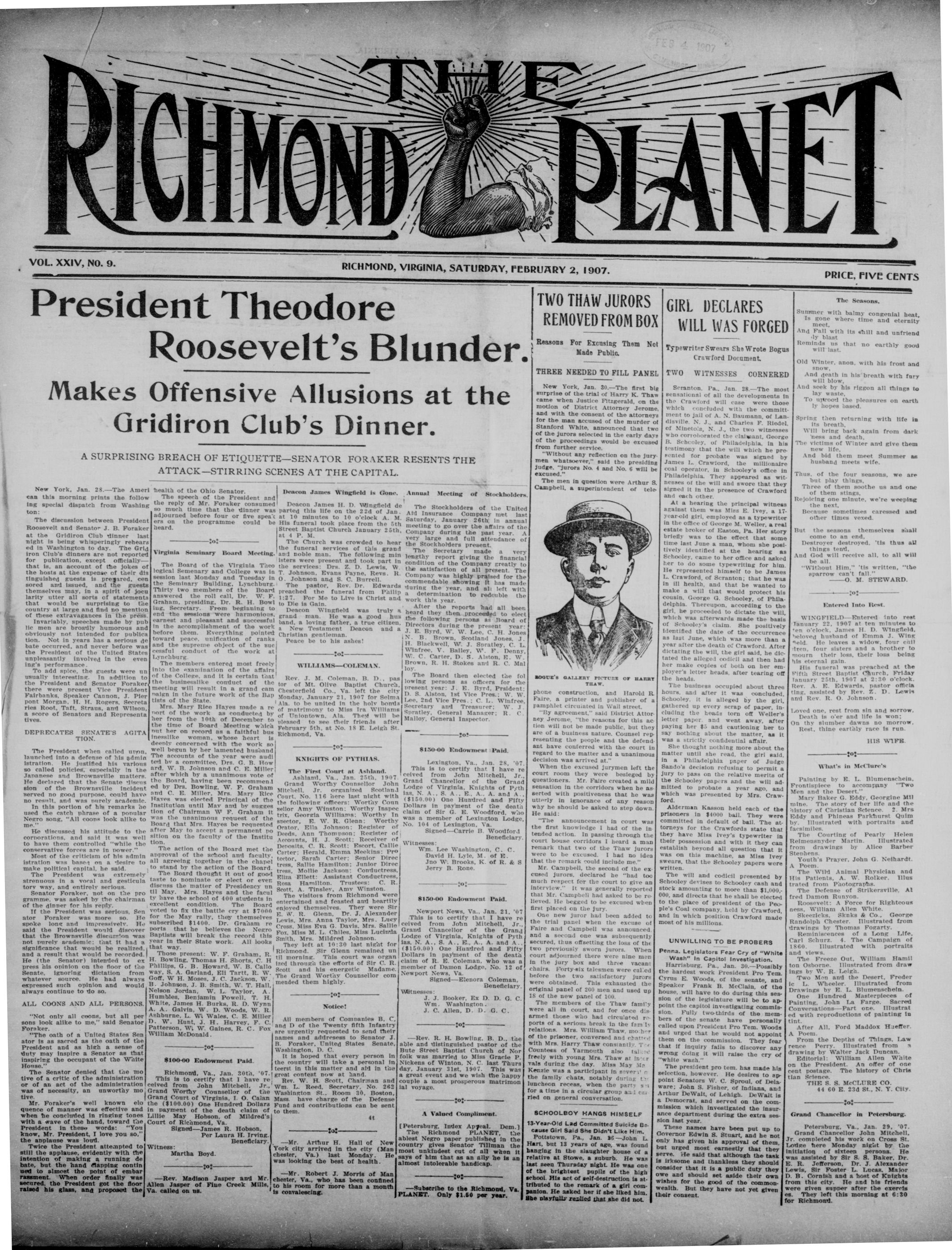
President Theodore Roosevelt's Blunder Makes Offensive Allusions at the Gridiron Club's Dinner.
A SURPRISING BREACH OF ETIQUETTE—SENATOR FORAKER RESENTS THE ATTACK—STIRRING SCENES AT THE CAPITAL.
VOL. XXIV, NO. 9.
Presid
Makes
Gr
A SURPRISING
New York, Jan. 28.—The Ameri can this morning prints the follow ing special dispatch from Washing ton:
The discussion between President Roosevelt and Senator J. B. Foraker at the Gridiron Club dinner last night is being whisperingly rehearsed in Washington to day. The Gridiron Club's dinners are not reported for publication, except officially—that is, an account of the jokes of the hosts at the expense of their tungishelguests is prepared, censored and issued, and the guests themselves may, in a spirit of jocularity utter all sorts of statements that would be surprising to the country at large and find no mention of these extravagances in the press. Invariably, speeches made by public men are broadly humorous and obviously not intended for publication. Not in years has a serious debate occurred, and never before was the President of the United States unpleasantly involved in the evening's performance.
To add spice, the guests were unusually interesting. In addition to the President and Senator Foraker there were present Vice President Fairbanks, Speaker Cannon, J. Pier pont Morgan, H. H. Rogers, Secreta ries Root, Taft, Straus, and Wilson, a score of Senators and Representa tives.
DEPRECATES SENATE'S AGITATION
The President when called upon, launched into a defense of his admin istation. He justified his various so called policies, especially in the Japanese and Brownsville matters. He declared that the Senate discussion of the Brownsville incident served no good purpose, could have no result, and was purely academic. In this portion of his remarks he used the catch phrase of a popular Negro song, "All coons look alike to me."
He discussed his attitude to the corporations, and said it was well to have them controlled "while the conservative forces are in power."
Most of the criticism of his admin istation was based on a desire to make political capital, he said.
The President was extremely strenuous in a vocal and gesticul tory way, and entirely serious.
Senator Foraker, not on the pro gramme, was asked by the chairman of the dinner for his reply.
If the President was serious, Senator Foraker was more so. He spoke long and impressively. He said the President would discover that the Brownsville discussion was not purely academic; that it had a significance that would be realized, and a result that would be recorded. He (the Senator) intended to ex press his opinion on the floor of the Senate, ignoring dictation from whatever source. He had always expressed such opinion and would always continue to do so.
ALL COONS AND ALL PERSONS
"Not only all coons, but all per sons look alike to me," said Senator Foraker.
"The oath of a United States Senator is as sacred as the oath of the President and as high a sense of duty may inspire a Senator as that inspiring the occupant of the White House."
The Senator denied that the motive of a critic of the administration or of an act of the administration was of necessity, an unworthy motive.
Mr. Foraker's well known eloquence of manner was effective and when he concluded in ringing tones with a wave of the hand, toward the President in these words: "You know, Mr. President, I love you so." the applause was loud.
Twice the President attempted to still the applause, evidently with the intention of making a running debate, but the hand clapping continued to almost the point of embarrassment. When order finally was secured, the President got the floor raised his glass, and proposed the
health of the Ohio Senator. The speech of the President and the reply of Mr. Foraker consumed so much time that the dinner was advenued before four or five speeches on the programme could be heard.
Virginia Seminary Board Meeting
The Board of the Virginia Theological Seminary and College was in session last Monday and Tuesday in the Seminary Building, Lynchburg. Thirty two members of the Board answered the roll call, Dr. W. F. Graham, presiding, Dr. R. H. Bowling, Secretary. From beginning to end the sessions were harmonious, earnest and pleasant and successful in the accomplishment of the work before them. Everything pointed toward peace, unification of ranks and the supreme object of the successful conduct of the work at Lynchburg. The members entered most freely in the examination of the affairs of the College, and it is certain that the businesslike conduct of the meeting will result in a grand camaign in the future work of the Baptists of the State.
Mrs. Mary Rice Hayes made a report of the work as conducted by her from the 10th of December to the time of Board Meeting which put her on record as a faithful businesslike woman, whose heart is deeply concerned with the work so well begun by her lamented husband. The accounts of the year were audited by a committee, Drs. G. B. Howard, W. B. Johnson and C. E. Miller after which by a unanimous vote of the Board, having been recommended by Drs. Bowling, W. F. Graham and C. E. Miller, Mrs. Mary Rice Hayes was elected Principal of the institution until May and by suggestions of Chairman W. F. Graham it was the unanimous request of the Board that Mrs. Hayes be requested after May to accept a permanent position on the faculty of the Institution.
The action of the Board met the approval of the school and faculty, all agreeing together in the channel to stand by the action of the Board. The Board thought it out of good taste to nominate or elect or even discuss the matter of Presidency until May. Mrs. Hayes and the faculty have the school of 400 students in excellent condition. The Board voted to fix the battle cry at $7000 for the May rally, they themselves subscribed $1400. Dr. Graham reports that he believes the Negro Baptists will break the record this year in their State work. All looks that way.
Those present: W. F. Graham, R. H. Bowling, Thomas H. Shorts, C. H. Phillips, G. B. Howard, W. B. Callo way, S. A. Garland, Ell Tartt, R. W. Goff, W. H. Moses, J. C. Jackson, W. B. Johnson, J. B. Smith, W. T. Hall, Nelson Jordan, W. L. Taylor, A. Humbles, Benjamin Powell, W. H. White, James H. Burks, R. D. Wyman A. A. Galvin, W. D. Woods, W. R. Ashburne, L. Wi Wales, C. E. Miller D. W. Hunt, J. H. Harvey, F. C. Patterson, W. W. Gaines, R. C. Fox William McDonald.
$100.00 Endowment Paid
Richmond, Va., Jan. 30th, '07.
This is to certify that I have received from John Mitchell, Jr.,
Grand Worthy Counsellor of the Grand Court of Virginia, I. O. Calan the ($100.00) One Hundred Dollars in payment of the death claim of Lillie May Hobson, of Mildred's Court of Richmond, Va.
Signed—James R. Hobson,
Per Laura H. Irving.
Beneficiary.
—Rev. Madison Jasper and Mr. Allen Jasper of Fine Creek Mills, Va. called on us.
RICHMOND, VIRGINIA, SATURDAY, FEBRUARY 2, 1907.
Deacon James H. D. Wingfield departed this life on the 22d of Jan. at 10 minutes to 10 o'clock A. M. His funeral took place from the 5th Street Baptist Church January 25th, at 4 P. M.
The Church was crowded to hear the funeral services of this grand and noble man. The following ministers were present and took part in the services: Drs. Z. D. Lewis, W. T. Johnson, Evans Payne, Revs. R. O. Johnson and S. C. Burrell.
The pastor, Rev. Dr. Edwards preached the funeral from Paulil 1:27. For Me to Live is Christ and to Die is Gain.
Deacon Wingfield was truly a grand man. He was a good husband, a loving father, a true citizen, a New Testament Deacon and a Christian gentleman.
Peace be to his ashes!
WILLIAMS—COLEMAN.
Rev. J. M. Coleman, B. D., pas-
tor of M. Olive Baptist Church,
Chesterfield Co., Va. left the city
Monday, January 21, 1907 for Selma
Ala. to be united in the holy bona-
fides of matrimony to Miss Ira Williams
of Uniontown, Ala. They will be
pleased to see their friends after
February 5th, at No. 18 E. Leigh St.
Richmond, Va.
KNIGHTS OF PYTHIAS.
The First Court at Ashland.
The First Court at Arundel.
Ashlain, Va., Jan. 25th, 1907.
Grand Worthy Counsellor John Mitchell, Jr. organized Scotland. Court. No. 116 here last night with the following officers: Worthy Counsellor Amy Winston; Worthy Counsellor Trix, Gorcey Innes; Worthy Insuctor, E. W. R. Glenn; Worthy Orator, Ella Johnson; Register of Deeds, Ann Thompson; Register of Accounts, H. J. Scott; Receiver of Denositis, C. R. Scott; Escort, Callie Carter; Herald, Emma Meekins; Protector, Sarah Carter; Senior Directress, Sallie Hamilton; Junior Directress, Mollie Jackson; Conductress, Ellie Ellett; Assistant Conductress, Rosg Hamilton; Trustees, C. R. Scott, A. Tinsley, Amv Winston.
The visitors from Richmond were entertained and feasted and heartily enjoyed themselves. They were Sir E. W. R. Glenn, Dr. J. Alexander Lewis, Mrs. Anna Taylor, Mrs. Lucy Cross, Miss Eva G. Davis, Mrs. Sallie Fox, Miss M. L. Chiles, Miss Lucinda Smith, Mrs. Mildred Johnson.
They left at 10:30 last night for Richmond. Sir Glenn remained until morning. This court was organized through the efforts of Sir C. R. Scott and his energetic Madame. The Grand Worthy Counsellor com-mended them highly.
Notice!
All members of Companies B, C, and D of the Twenty fifth Infantry are urgently requested to send their names and address to Senator J. B. Foraker, United States Senate, Washington, D. C.
It is hoped that every person in the country will take a personal in teerst in this matter and aid in the great contest now at hand.
Rev. W. H. Scott, Chairman and Wm. L. Reed, Secretary, No. 262 Washington St., Room 30, Boston. Mass. have charge of the Defense Fund and contributions can be sent to them.
Mr. Arthur H. Hall of New York city arrived in the city (Manchester, Va.) last Monday. He was looking the best of health.
Mr. Robert J. Morris of Manchester, Va., who has been confined to his room for more than a month is convalescing.
The Stockholders of the United Aid Insurance Company met last Saturday, January 26th in annual meeting to go over the affairs of the Company during the past year. A very large and full attendance of the Stockholders present.
The Secretary made a very lengthy report giving the financial condition of the Company greatly to the satisfaction of all present. The Company was highly praised for the commendable showing it has made during the year, and all left with a determination to redeem the work this year.
After the reports had all been heard they then proceeded to elect the following persons as Board of Directors during the present year: J. E. Byrd, W. W. Lee, C. H. Jones N. B. Brown, Scotland Jones, J. H. Blackwell, W. J. Spratley, C. L. Winfree, V. Bailey, W. F. Denny, W. C. Carter, D. S. Alston, E. W. Brown, R. H. Stokes and R. C. Maloy.
The Board then elected the following persons as officers for the present year: J. E. Byrd, President: D. S. Alston, 1st Vice Pres.; W. W. Lee, 2nd Vice Pres.; C. L. Winfree, Secretary and Treasurer; W. J. Spratley, General Manager; R. C. Malloy, General Inspector.
$150.00 Endowment Paid
Lexington, Va., Jan. 28, '07.
This is to certify that I have received from John Mitchell, Jr.
Grand Chancellor of the Grand Lodge of Virginia, Knights of Pythias, N. A., S. A., E. A. A. and A.,
($150.00) One Hundred and Fifty Dollars in payment of the death claim of Sir G. E. Woodford, who was a member of Lexington Lodge, No. 104 of Lexington, Va.
Signed—Carrie B. Woodford Beneficiary.
Witnesses:
Wm. Lee Washington, C. C.
David H. Lyle, M. of E.
Jno W. Brooks, K. of R. & S.
Jerry B. Rone.
$150.00 Endowment Paid.
Newport News, Va., Jan. 21, '07
This is to certify that I have reeived from John Mitchell, Jr., Grand Chancellor of the Grand Lodge of Virginia, Knights of Pythas, N. A., S. A., E., A., A and A. ($150.00) One Hundred and Fifty Dollars in payment of the death claim of R. E. Coleman, who was a member of Damon Lodge, No. 12 of Newport News, Va.
Signed—Elenora Coleman, Beneficiary.
Witnesses:
J. J. Booker, Ex D. D. G. C.
Wm. Washington.
J. C. Allen, D. D. G. C.
—Rev. R. H. Bowling, B. D., the able and distinguished pastor of the Bute Street Baptist Church of Nor folk was married to Miss Gracie P. Nickens of Winton, N. C. last Thursday, January 31st, 1907. This was a great event and we wish the happy couple a most prosperous matrimonial voyage.
A Valued Compliment.
[Petersburg, Index Appeal. Dem.]
The Richmond PLANET, the
ablest Negro paper published in the
country gives Senator Tillman the
most unkindest cut of all when it
says of him that as an ally he is an
almost tolerable handicap.
Subscribe to the Richmond, Va. PLANET. Only $1.50 per year.
TWO THAW JURORS REMOVED FROM BOX
Reasons For Excusing Them Not Made Public.
THREE NEEDED TO FILL PANEL
New York, Jan. 30.—The first big surprise of the trial of Harry K. Thaw came when Justice Fitzgerald, on the motion of District Attorney Jerome, and with the consent of the attorneys for the man accused of the murder of Stanford White, announced that two of the jurors selected in the early days of the proceedings would be excused from further service.
"Without any reflection on the jurymen whatsoever," said the presiding judge, "jurors No. 4 and No. 6 will be excused."
The men in question were Arthur S. Campbell, a superintendent of tele
BOOQUE'S GALLERY PICTURE OF HARRY THAW.
phone construction, and Harold R. Faire, a printer and publisher of a pamphlet circulated in Wall street.
"By agreement," said District Attorney Jerome, "the reasons for this action will not be made public, but they are of a business nature. Counsel representing the people and the defendant have conferred with the court in regard to the matter and a unanimous decision was arrived at."
When the excused jurymen left the court room they were besieged by questioners. Mr. Faire created a mild sensation in the corridors when he asserted with positiveness that he was utterly in ignorance of any reason why he should be asked to step down. He said:
"The announcement in court was the first knowledge I had of the intended action. In passing through the court house corridors I heard a man remark that two of the Thaw jurors were to be excused. I had no idea that the remark could include me."
Mr. Campbell, the second of the excused jurors, declared he "had too much respect for the court to give an interview." It was generally reported that Mr. Campbell had asked to be relieved. He begged to be excused when first placed on the jury.
One new juror had been added to the trial panel when the excuse of Faire and Campbell was announced, and a second one was subsequently secured, thus offsetting the loss of the two previously sworn jurors. When court adjourned there were nine men in the jury box and three vacant chairs. Forty-six talesmen were called before the two satisfactory jurors were obtained. This exhausted the original panel of 200 men and used up 18 of the new panel of 100.
The members of the Thaw family were all in court, and for once disarmed those who had circulated reports of a serious break in the family relations. Mrs. William Thaw, mother of the prisoner, conversed and chatted with Mrs. Harry Thaw constantly. The Countess of Yarmouth also tailed freely with young Mrs. Thaw at intervals during the day. Miss May Ma. Kenzie was a participant in several of the family chats, notably during the luncheon recess, when the party so for a time in a circular group and carried on general conversation.
SCHOOLBOY HANGS HIMSELE
13-Year-Old Lad Committed Suicide Because Girl Said She Didn't Like Him
Susan GIRL SARA She didn't Like Him. Pottownstown, Pa., Jan. 26—John L. Hart, but 13 years of age, was found hanging in the slaughter house of a relative at Stowe, a suburb. He was last seen Thursday night. He was one of the brightest pupils of the high school. His act of self-destruction is attributed to the remark of a girl companion. He asked her if she liked him. She playfully replied that she did not.
GIRL DECLARES WILL WAS FORGED
Typewriter Swears She Wrote Bogus
Crawford Document.
TWO WITNESSES CORNERED
Scranton, Pa., Jan. 28.—The most sensational of all the developments in the Crawford will case were those which concluded with the commitment to jail of A. N. Baumann, of Landisville, N. J., and Charles F. Riedel, of Minetolia, N. J., the two witnesses who corroborated the claimant, George B. Schoole, of Philadelphia, in his testimony that the will which he presented for probate was signed by James L. Crawford, the millionaire coal operator, in Schooley's office in Philadelphia. They appeared as witnesses of the will and swore that they signed it in the presence of Crawford and each other.
At a hearing the principal witness against them was Miss I. Ivey, a 17-year-old girl, employed as a typewriter in the office of George M. Weller, a real estate broker of Easton, Pa. Her story briefly was to the effect that some time last June a man, whom she positively identified at the hearing as Schooley, came to her office and asked her to do some typewriting for him. He represented himself to be James L. Crawford, of Scranton; that he was in ill health, and that he wanted to make a will that would protect his cousin, George G. Schooley, of Philadelphia. Thereupon, according to the girl, he proceeded to dictate the will, which was afterwards made the basis of Schooley's claim. She positively identified the date of the occurrence as last June, which was more than a year after the death of Crawford. After dictating the will, the girl said, he dictated the alleged codicil and then had her make copies of both on her employer's letter heads, after tearing off the heads.
The business occupied about three hours, and after it was concluded, Schooley, it is alleged by the girl, gathered up every scrap of paper, including the heads torn off Weller's letter paper, and went away, after paying her $5 and cautioning her to say nothing about the matter, as it was a strictly confidential affair.
She thought nothing more about the matter until she read, the girl said, in a Philadelphia paper of Judge Sando's decision refusing to permit a jury to pass on the relative merits of the Schooley papers and the will admitted to probate a year ago, and which was presented by Mrs. Crawford.
Alderman Kasson held each of the prisoners in $4000 bail. They were committed in default of bail. The attorneys for the Crawfords state that they have Miss Ivey's typewriter in their possession and with it they can establish beyond all question that it was on this machine, as Miss Ivey swears, that the Schooley papers were written.
The will and codicil presented by Schooley devises to Schooley cash and stock amounting to more than $1,000,000, and directs that he shall be elected to the place of president of the People's Coal company, held by Crawford, and in which position Crawford made most of his millions.
UNWILLING TO BE PROBERS
Penna. Legislators Fear Cry of "White Wash" In Capitol Investigation.
Harrisburg, Pa., Jan. 30.—Possibly the hardest work President Pro Tem. Cyrus E. Woods, of the senate, and Speaker Frank B. McClain, of the house, will have to do during this session of the legislature will be to appoint the capitol investigating commission. Fully two-thirds of the members of the senate have personally called upon President Pro Tem. Woods and urged that he would not appoint them on the commission. They fear that if inquiry fails to discover any wrong doing it will raise the cry of "white wash."
The president pro tem. has made his selection, however. He desires to appoint Senators W. C. Sproul, of Delaware; John S. Fisher, of Indiana, and Arthur DeWalt, of Lehigh. DeWalt is a Democrat, and served on the commission which investigated the insurance department during the extra session last year.
These names have been put up to Governor Edwin S. Stuart, and he not only has given his approval of them, but urged most earnestly that they serve. He said that although the task is irksome and thankless they should consider that it is a public duty they owe and should set aside their own wishes for the good of the commonwealth. But they have not yet given their consent.
PRICE, FIVE CENTS
The Seasons.
Summer with balmy congenial heat, Is gone where time and eternity meet.
And Fall with its chill and unfriend
ly blast
Reminds us that no earthly good will last.
Old Winter, anon, with his frost and snow,
And death in his breath with fury will blow.
And seek by his riggon all things to lay waste,
To utrood the pleasures on earth ly hopes based.
Spring then returning with life in its breath,
Will bring back again from dark ness and death.
The victims of Winter and give them new life,
And bid them meet Summer as husband meets wife.
Thus, of the four seasons, we are but play things.
Three of them soothe us and one of them stings.
Rejoicing one minute, we're weeping the next.
Because sometimes caressed and other times vexed.
But the seasons themselves shall come to an end.
Destroyer destroyed, 'tis thus all things tent.
And God will receive all, to all will be all.
"Without Him," 'tis written, "the sparrow can't fall."
O. M. STEWARD.
Entered Into Rest
WINGFIELD—Entered into rest
January 22, 1907 at ten minutes to
ten o'clock, James H. D. Wingfield,
beloved husband of Emma J. Wing
field. He leaves a widow, four earl
tren, four sisters and a brother to
mourn their loss, their loss being
his eternal gain.
His funeral was preached at the
Fifth Street Baptist Church, Friday
January 25th, 1907 at 2:30 o'clock.
Rev. A. E. Edwards, pastor officia
ting, assisted by Rev. Z. D. Lewis
and Rev. R. O. Johnson.
Loved one, rest from sin and sorrow.
Death is o'er and life is won;
On thy slumber dawns no morrow.
Rest, thine earlly race is run.
HIS WIFE.
HIS WIFE
What's in McClure's
Painting by E. L. Blumenschein,
Frontispiece to accompany "Two
Men and the Desert."
Mary Baker G. Eddy, Georgine Mil-
mine. The story of her life and the
history of Christian Science. 2. Mrs
Eddy and Phineas Parkhurst Quim-
by. Illustrated with portraits and
facsimiles.
The Courting of Pearly Helen
Reimensnyder Martin. Illustrated
from drawings by Alice Barber
Stephens.
Youth's Prayer, John G. Nelhardt.
A Poem.
The Wild Animal Physician and
His Patients, A. W. Rolker. Illus-
trated from Photographs.
The Defense of Strikersville, Al
fred Damon Runyon.
Roosevelt: A Force for Righteous
ness, William Allen White.
Skeeziicks, Sknks & Co., George Randolph Chester. Illustrated from drawings by Thomas Fogarty. Reminiscences of a Long Life, Carl Schurz. 4. The Campaign of 1860. Illustrated with portraits and views.
The Freeze Out, William Hamil ton Osborne. Illustrated from drawings by W. R. Leigh.
Two Men and the Desert, Frederic ic L. Wheeler. Illustrated from Drawings by E. L. Blumenschein.
One Hundred Masterpieces of Painting, John La Farge. Sacred Conversations—Part one. Illustrated ed with reproductions of painting in tint.
After All, Ford Maddox Hueffer. A Poem.
From the Depths of Things, Law rence Perry. Illustrated from a drawing by Walter Jack Duncan.
Editorial: William Allen White on the President. An offer of one cent postage. The history of Christian Science.
Grand Chancellor in Petersburg
Petersburg, Va., Jan. 29, '07. Grand Chancellor John Mitchell. Jr. completed his work on Cross St. Louise here Monday night by the initiation of sixteen persons. He was assisted by Sir S. S. Baker, Dr. E. R. Jefferson, Dr. J. Alexander Lewis, Sir Foster L. Lucas, Major D. B. Cornish and a host of Knights from this city. He and his friends were given supper after the exercises. They left this morning at 6:30 for Richmond.
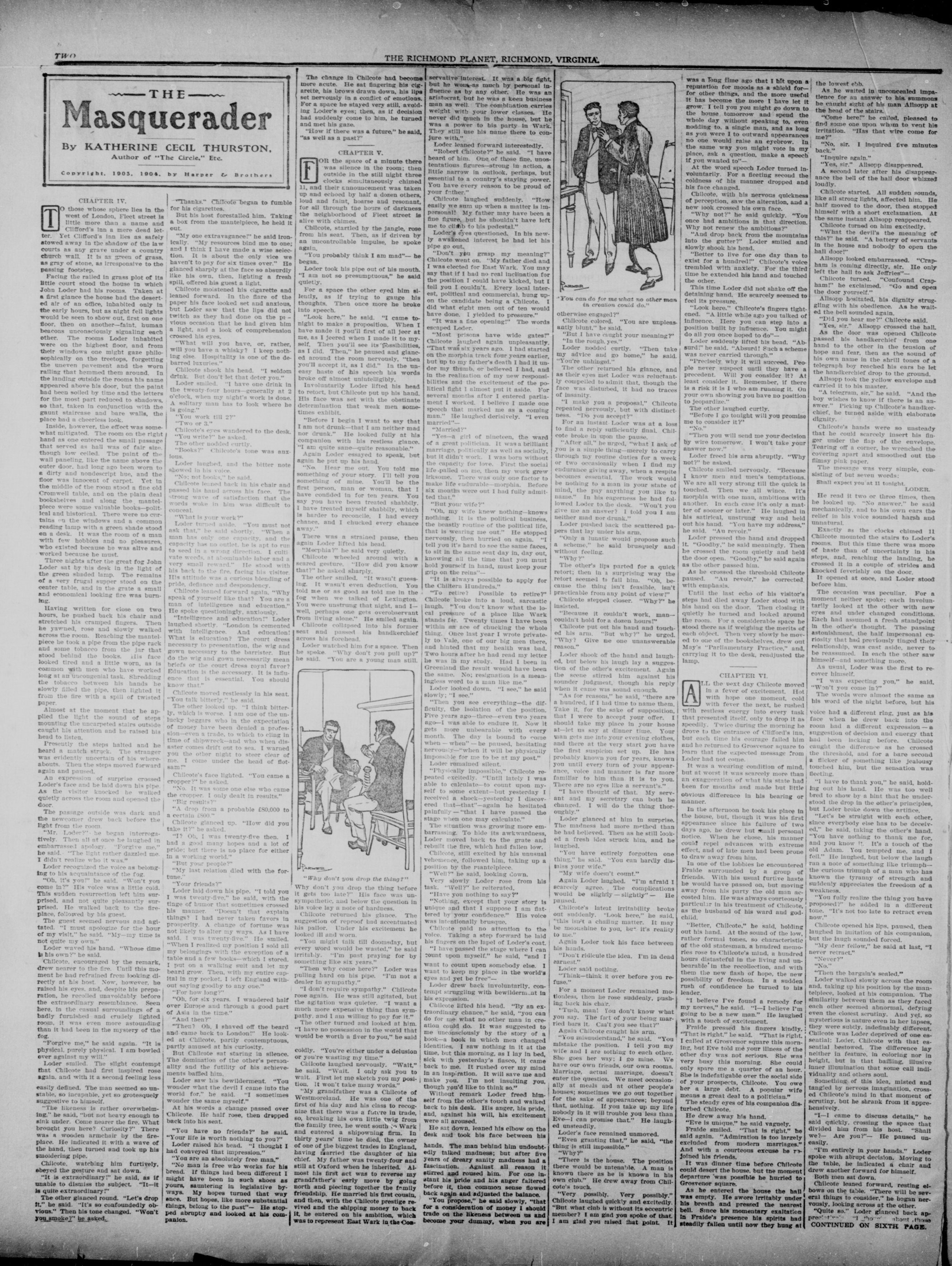
THE Masquerader
By KATHERINE CECIL THURSTON,
Author of "The Circle," Etc.
Copyright, 1905, 1904, by Harper & Brothers
CHAPTER IV.
To those whose sphere lies in the west of London, Fleet street is little more than a name and Clifford's inn a mere dead letter. Yet Clifford's inn lies as safely stowed away in the shadow of the law courts as any grave under a country church wall. It is as green of grass, as gray of stone, as irresponsive to the passing footstep.
Facing the railed in grass plot of its little court stood the house in which John Loder had his rooms. Taken at a first glance the house had the deserted air of an office, inhabited only in the early hours, but as night fell lights would be seen to show out, first on one floor, then on another—faint, human beacons unconsciously signalling each other. The rooms Loder inhabited were on the highest floor, and from their windows one might gaze philosophically on the treetops, forgetting the uneven pavement and the worn railing that hemmed them around. In the landing outside the rooms his name appeared above his door, but the paint had been solled by time and the letters for the most part reduced to shadows, so that, taken in conjunction with the gaunt staircase and bare walls, the place had a cheerless look.
Inside, however, the effect was somewhat mitigated. The room on the right hand as one entered the small passage that served as hall was of fair size though low ceiled. The paint of the wall panelling, like the name above the outer door, had long ago been worn to a dirty and nondescript hue, and the floor was innocent of carpet. Yet in the middle of the room stood a fine old Cromwell table, and on the plain deal bookshelves and along the mantelpiece were some valuable books—political and historical. There were no curtains on the windows and a common reading lamp with a green shade stood on a desk. It was the room of a man with few hobbies and no pleasures, who existed because he was alive and worked because he must.
Three nights after the great fog John Loder sat by his desk in the light of the green shaded lamp. The remains of a very frugal supper stood on the center table, and in the grate a small and economical looking fire was burning.
Having written for close on two hours, he pushed back his chair and stretched his cramped fingers. Then he yawned, rose and slowly walked across the room. Reaching the mantelpiece he took a pipe from the pipe rack and some tobacco from the jar that stood behind the books. His face looked tired and a little worn, as is common with men who have worked long at an uncongenial task. Shredding the tobacco between his hands he slowly filled the pipe, then lighted it from the fire with a spill of twisted paper.
Almost at the moment that he applied the light the sound of steps mounting the uncarpeted stairs outside caught his attention and he raised his head to listen.
Presently the steps halted and he heard a match struck. The stranger was evidently uncertain of his whereabouts. Then the steps moved forward again and paused.
An expression of surprise crossed Loder's face and he laid down his pipe. As the visitor knocked he walked quietly across the room and opened the door.
The passage outside was dark and the newcomer drew back before the light from the room.
"Mr. Loder?" he began interrogatively. Then all at once he laughed in embarrassed apology. "Forgive me," he said. "The light rather dazzled me. I didn't realize who it was."
Loder recognized the voice as belonging to his acquaintance of the fog.
"Oh, it's you!" he said. "Won't you come in?" His voice was a little cold. This sudden resurrection left him surprised, and not quite pleasantly surprised. He walked back to the fireplace, followed by his guest.
The guest seemed nervous and agitated. "I must apologize for the hour of my visit," he said. "My—my time is not quite my own."
Loder waved his hand. "Whose time is his own?" he said.
Chlotee, encouraged by the remark, drew nearer to the fire. Until this moment he had refrained from looking directly at his host. Now, however, he raised his eyes, and, despite his preparation, he recoiled unavoidably before the extraordinary resemblance. Seen here, in the casual surroundings of a badly furnished and crudely lighted room, it was even more astounding than it had been in the mystery of the fog.
"Forgive me," he said again. "It is physical, purely physical. I am bowled ever against my will."
Loder smiled. The slight contempt that Chilcote had first inspired rose again, and with it a second feeling less easily defined. The man seemed so unstable, so incapable, yet so grotesquely suggestive to himself.
"The likeness is rather overwhelming," he said, "but not heavy enough to sink under. Come nearer the fire. What brought you here? Curiosity?" There was a wooden armchair by the fireplace. He indicated it with a wave of the hand, then turned and took up his smoldering pipe.
Chilcote, watcheing him furtively, obeyed the gesture and sat down.
"It is extraordinary!" he said, as if unable to dismiss the subject. "It—it is quite extraordinary!"
The other glanced round. "Let's drop it" he said. "It's so confoundedly obvious." Then his tone changed. "Won't you smoke?" he asked.
But his host forestalled him. Taking a box from the mantelpiece, he held it out.
"My one extravagance!" he said ironically. "My resources bind me to one; and I think I have made a wise selection. It is about the only vice we haven't to pay for six times over." He glanced sharply at the face so absurdly like his own, then, lighting a fresh spill, offered his guest a light.
Chilcote moltened his cigarette and leaned forward. In the flare of the paper his face looked set and anxious, but Loder saw that the lips did not twitch as they had done on the previous occasion that he had given him a light, and a look of comprehension crossed his eyes.
"What will you have, or, rather, will you have a whisky? I keep nothing else. Hospitality is one of the debarred luxuries."
Chilcote shook his head. "I seldom drink. But don't let that deter you."
Loder smiled. "I have one drink in the twenty-four hours—generally at 2 o'clock, when my night's work is done. A solitary man has to look where he is going."
"You work till 2?"
"Two or 3."
Chicote's eyes wandered to the desk.
"You write?" he asked.
The other nodded curtly
"Books?" Chilcote's tone was anxious.
Loder laughed, and the bitter note showed in his voice.
"No; not books," he said.
Chilcote leaned back in his chair and passed his hand across his face. The strong wave of satisfaction that the words woke in him was difficult to conceal.
"What is your work?"
Loder turned aside. "You must not ask that," he said shortly. "When a man has only one capacity, and the capacity has no outlet, he is apt to run to seed in a wrong direction. I cultivate weeds, at abnormally labor and a very small reward." He stood with his back to the fire, facing his visitor. His attitude was a curious blending of pride, defiance and despondency.
Chilcote leaned forward again. "Why speak of yourself like that? You are a man of intelligence and education."
He spoke questioningly, anxiously.
"Intelligence and education!" Loder laughed shortly. "London is cemented with intelligence. And education! What is education? The court dress necessary to presentation, the wig and gown necessary to the barrister. But do the wig and gown necessarily mean briefs or the court dress royal favor? Education is the accessory. It is influence that is essential. You should know that."
Chilcote moved restlessly in his seat. "You talk bitterly," he said.
The other looked up. "I think bitterly, which is worse. I am one of the unlucky beggars who in the expectation of money have been denied a profession—even a trade, to which to cling in time of shipwreck—and who when disaster comes drift out to sea. I warned you the other night to steer clear of me. I come under the head of flotsam."
Chilcote's face lighted. "You came a cropper?" he asked.
"No. It was some one else who came the cropper. I only dealt in results."
"Big results?"
"A drop from a probable £80,000 to a certain £800."
Chilcote glanced up. "How did you take it?" he asked.
"I? Oh, I was twenty-five then. I had a good many hopes and a lot of pride; but there is no place for either in a working world."
"But your people?"
"My last relation dled with the fortune."
"Your friends?"
Loder laid down his pipe. "I told you I was twenty-five," he said, with the tinge of humor that sometimes crossed his manner. "Doesn't that explain things? I had never taken favors in prosperity. A change of fortune was not likely to alter my ways. As I have said, I was twenty-five." He smiled. "When I realized my position I sold all my belongings with the exception of a table and a few books—which I stored. I put on a walking suit and let my beard grow. Then, with my entire capital in my pocket, I left England without saying goodbye to any one."
"For how long?"
"Oh, for six years. I wandered half over Europe and through a good part of Asia in the time."
"And then?"
"Then? Oh, I shaved off the beard and came back to London." He looked at Chilcote, partly contemptuous, partly amused at his curiosity.
But Chilcote sat staring in silence. The domination of the other's personality and the futility of his achievements baffled him.
Loder saw his bewilderment. "You wonder what the devil I came into the world for," he said. "I sometimes wonder the same myself."
At his words a change passed over Chilcote. He half rose, then dropped back into his seat.
"You have no friends?" he said. "Your life is worth nothing to you?" Loder raised his head. "I thought I had conveyed that impression."
"You are an absolutely free man," "No man is free who works for his bread. If things had been different I might have been in such shoes as yours, saumerting in legislative byways. My hopes turned that way once. But hopes, like more substantial things, belong to the past"— He stopped abruptly and looked at his companion.
THE RICHMOND PLANET, RICHMOND, VIRGINIA.
The change in Chilcote had become more acute. He sat fingering his cigarette, his brows drawn down, his lips set nervously in a conflict of emotions. For a space he stayed very still, avoiding Loder's eyes; then, as if decision had suddenly come to him, he turned and met his gaze.
"How if there was a future," he said, "as well as a past?"
CHAPTER V.
FOR the space of a minute there was silence in the room; then outside in the still night three clocks simultaneously chimed 11, and their announcement was taken up and echoed by half a dozen others, loud and faint, hoarse and resonant, for all through the hours of darkness the neighborhood of Fleet street is alive with chimes.
Chilcote, startled by the jangle, rose from his seat. Then, as if driven by an uncontrollable impulse, he spoke again.
"You probably think I am mad"—he began.
Loder took his pipe out of his mouth. "I am not so presumptuous," he said quietly.
For a space the other eyed him silently, as if trying to gauge his thoughts. Then once more he broke into speech.
"Look here," he said. "I came tonight to make a proposition. When I have made it you'll first of all jeer at me, as I jeered when I made it to myself. Then you'll see its "bossibilities, as I did. Then, he paused and glanced around the room nervously, "then you'll accept it, as I did." In the uneasy haste of his speech his words broke off almost unintelligibly. In involuntarily Loder lifted his head to retort, but Chilcote put up his hand. His face was set with the obstinate determination that weak men sometimes exhibit.
"Before I begin I want to say that I am not drunk—that I am neither mad nor drunk." He looked fully at his companion with his restless glance. "I am quite sane—quite reasonable." Again Loder essayed to speak, but again he put up his hand.
"No. Hear me out. You told me something of your story. I'll tell you something of mine. You'll be the first person, man or woman, that I have confided in for ten years. You say you have been treated shabbiably. I have treated myself shabbiably, which is harder to reconcile. I had every chance, and I chucked every chance away."
There was a strained pause, then again Loder lifted his head. "Morphia?" he said very quietly. Chilcote wheeled around with a scared gesture. "How did you know that?" he asked sharply.
The other smiled. "It wasn't guessing. It wasn't even deduction. You told me or as good as told me in the fog when we talked of Lexington. You were unstrung that night, and I—well, perhaps one gets overobservant from living alone." He smiled again. Chilcote collapsed into his former seat and passed his handkerchief across his forehead.
Loder watched him for a space. Then he spoke. "Why don't you pull up?" he said. "You are a young man still
PARKER
"Why don't you drop the thing?" Why don't you drop the thing before it gets too late?" His face was unsympathetic, and below the question in his voice lay a note of hardness. Chilcote returned his glance. The suggestion of reproof had accentuated his pallor. Under his excitement he looked ill and worn. "You might talk till doomsday, but every word would be wasted," he said irritably. "I'm past praying for by something like six years." "Then why come here?" Loder was pulling hard on his pipe. "I'm not a dealer in sympathy." "I don't require sympathy." Chilcote rose again. He was still agitated, but the agitation was quieter. "I want a much more expensive thing than sympathy, and I am willing to pay for it." The other turned and looked at him. "I have no possession in the world that would be worth a fiver to you," he said
coldly. "You're either under a delusion or you're wasting my time." Chilcote laughed nervously. "Walt," he said. "Wait. I only ask you to wait. First let me sketch you my position. It won't take many words." "My grandfather was a Chilcote of Westmoreland. He was one of the first of his day and his class to recognize that there was a future in trade, so, breaking his own little twig from the family tree, he went south. Wark and entered a shipowning firm. In thirty years' time he died, the owner of one of the biggest trades in England, having married the daughter of his chief. My father was twenty-four and still at Oxford when he inherited. Almost his first act was to reverse my grandfather's early move by going north and piecing together the family friendship. He married his first cousin, and then, with the Chilcote prestige revived and the shipping money to back it, he entered on his ambition, which was to represent East Wark in the Con-
servative interest. It was a big fight, but he work as much by personal influence as by any other. He was an aristocrat, but he was a keen business man as well. The combination carries weight with your lower classes. He never did much in the house, but he was a power to his party in Wark. They still use his name there to conjure with." Loder leaned forward interestedly.
Loder leaned forward interestedly. "Robert Chilcote" he said. "I have heard of him. One of those fine, unnotentative figures—strong in action, a little narrow in outlook, perhaps, but essential to a country's staying power. You have every reason to be proud of your father." Chilcote laughed suddenly. "How easily we sum up when a matter is impersonal! My father may have been a fine figure, but he shouldn't have left me to climb to his pedestal." Loder's eyes questioned. In his newly awakened interest he had let his pipe go out. "Don't you grasp my meaning?" Chilcote went on. "My father died and I was elected for East Wark. You may say that if I had no real inclination for the position I could have kicked, but I tell you I couldn't. Every local interest, political and commercial, hung on the candidate being a Chilcote. I did what eight men out of ten would have done. I yielded to pressure."
"It was a fine opening." The words escaped Loder.
"Most prisons have wide gates!" Chilote laughed again unpleasantly. "That was six years ago. I had started on the morpha track four years earlier, but up to my father's death I had it under my thumb, or believed I had, and in the realization of my new responsibilities and the excitement of the political fight I almost put it aside. For several months after I entered parliament I worked. I believe I made one speech that marked me as a coming man." He laughed derisively. "I even married"—
"Yes—a girl of nineteen, the ward of a great politician. It was a brilliant marriage, politically as well as socially, but it didn't work. I was born without the capacity for love. First the social life-pulled on me, then my work grew lrksome. There was only one factor to make life endurable—morphia. Before six months were out I had fully admitted that."
"But your wife?"
"Oh, my wife knew nothing—knows nothing. It is the political business, the beastly routine of the political life, that is wearing me out." He stopped nervously, then hurried on again. "I tell you it's hard to see the same faces, to sit in the same seat day in, day out, knowing all the time that you must hold yourself in hand, must keep your grip on the reins"—
"It is always possible to apply for the Chiltern Hundreds."
"To retire? Possible to retire?" Chilcote broke into a loud, sarcastic laugh. "You don't know what the local pressure of a place like Wark stands for. Twenty times I have been within an ace of chucking the whole thing. Once last year I wrote privately to Vale, one of our big men there, and hinted that my health was bad. Two hours after he had read my letter he was in my study. Had I been in Greenland the result would have been the same. No; resignation is a meaningless word to a man like me." Loder looked down. "I see," he said slowly; "I see."
"Then you see everything—the difficulty, the isolation of the position. Five years ago—three—even two years ago—I was able to endure it. Now it gets more unbearable with every month. The day is bound to come when—when"—he paused, hesitating nervously—"when it will be physically impossible for me to be at my post." Loder remained silent.
"Physically impossible," Chilcote repeated excitedly. "Until lately I was able to calculate—to count upon myself to some extent—but yesterday I received a shock—yesterday I discovered that—that"—again he hesitated painfully—"that I have passed the stage when one may calculate."
The situation was growing more embarrassing. To hide its awkwardness, Loder moved back to the grate and rebuilt the fire, which had fallen low. Chilcote, still excited by his unusual vehemence, followed him, taking up a position by the ruantelpiece.
"Well?" he said, looking down. Very slowly Loder rose from his task. "Well?" he reiterated.
"Have you nothing to say?"
"Nothing, except that your story is unique and that I suppose I am flattered by your confidence." His voice was intentionally brusque.
Chilcote paid no attention to the voice. Taking a step forward he laid his fingers on the lapel of Loder's coat.
"I have passed the stage where I can count upon myself," he said, "and I want to count upon somebody else. I want to keep my place in the world's eyes and yet be free!"
Loder drew back involuntarily, contempt struggling with bewildermant in his expression.
Chilcote lifted his head. "By an extraordinary chance," he said, "you can do for me what no other man in creation could do. It was suggested to me unconsciously by the story of a book—a book in which men changed identities. I saw nothing in it at the time, but this morning, as I lay in bed, sick with yesterday's fasco, it came back to me. It rushed over my mind in an inspiration. It will save me and make you. I'm not insulting you, though you'd like to think so." Without remark Loder freed himself from the other's touch and walked back to his desk. His anger, his pride, and, against his will, his excitement were all aroused. He sat down, leaned his elbow on the desk and took his face between his
hands. The man behind him undoubtedly talked madness; but after five years of dreary sanity madness had a fascination. Against all reason it stirred and roused him. For one instant his pride and his anger faltered before it, then common sense flowed back again and adjusted the balance. "You propose," he said slowly, "that for a consideration of money I should trade on the likeness between us and become your dummy, when you are
PANMER
"You can do for me what no other man in creation could do."
"You can do for me what no other man in creation could do."
otherwise engaged?"
Chilcote colored. "You are unpleasantly blunt," he said.
"But I have caught your meaning?"
"In the rough, yes."
Loder nodded curly. "Then take my advice and go home," he said.
"You're unhinged."
The other returned his glance, and as their eyes met Loder was reluctantly compelled to admit that, though the face was disturbed, it had no traces of insanity.
"I make you a proposal," Chilcote repeated nervously, but with distinctness. "Do you accept?"
For an instant Loder was at a loss to find a reply sufficiently final. Chilcote broke in upon the pause.
"After all," he urged, "what I ask of you is a simple thing—merely to carry through my routine duties for a week or two occasionally when I find my endurance giving away, when a respite becomes essential. The work would be nothing to a man in your state of mind, the pay anything you like to name." In his eagerness he had followed Loder to the desk. "Won't you give me an answer? I told you I am neither mad nor drunk."
Loder pushed back the scattered papers that lay under his arm.
"Only a lunatic would propose such a scheme," he said brusquely and without feeling.
"Why?"
The other's lips parted for a quick retort; then in a surprising way the retort seemed to fail him. "Oh, because the thing isn't feasible, isn't practicable from any point of view!"
Chilcote stepped closer. "Why?" he insisted.
"Because it couldn't work, man couldn't hold for a dozen hours!" Chilcote put out his hand and touched his arm. "But why?" he urged. "Why? Give me one unanswerable reason." Loder shook off the hand and laughed, but below his laugly a suggestion of the other's excitement. Again the scene stirred him against his sounder judgment, though his reply when it came was sound enough.
"I have thought of that. My servant and my secretary can both be changed. I will do the thing thoroughly."
Loder glanced at him in surprise. The madness had more method than he had believed. Then as he still looked a fresh idea struck him, and he laughed.
"You have entirely forgotten one thing," he said. "You can hardly dismiss your wife."
"My wife doesn't count."
Again Loder laughed. "I'm afraid I scarcely agree. The complications would be slightly—slightly"—He paused.
Chilcote's latent irritability broke out suddenly. "Look here," he said, "this isn't a chailing matter. It may be moonshine to you, but it's reality to me."
Again Loder took his face between his hands.
"Don't ridicule the idea. I'm in dead earnest."
Loder said nothing.
"Think—think it over before you refuse."
For a moment Loder remained motionless, then he rose suddenly, pushing back his chair.
"Tush, man! You don't know what you say. The fact of your being married bars it. Can't you see that?"
"You misunderstand." he said. "You mistake the position. I tell you my wife and I are nothing to each other. She goes her way; I go mine. We have our own friends, our own rooms. Marriage, actual marriage, doesn't enter the question. We meet occasionally at meals and at other people's houses; sometimes we go out together for the sake of appearances; beyond that, nothing. If you take up my life nobody in it will trouble you less than Eve-1 can promise that." He laughed unsteadily. Loder's face remained unmoved.
"Even granting that," he said, "the thing is still impossible."
"Why?"
"There is the house. The position there would be untenable. A man is known there as he is known in his own club." He drew away from Chilcote's touch.
"Very possibly. Very possibly." Chilcote laughed quickly and excitedly. "But what club is without its eccentric member? I am glad you spoke of that. I am glad you raised that point. It
was a long fine ago that I hit upon a reputation for moods as a shield for—for other things, and the more useful it has become the more I have let it grow. I tell you you might go down to the house tomorrow and spend the whole day without speaking to, even nodding to, a single man, and as long as you were I to outward appearances no one would raise an eyebrow. In the same way you might vote in my place, ask a question, make a speech if you wanted to"—At the word speech Loder turned involuntarily. For a fieeting second the coldness of his manner dropped and his face changed. Chilcote, with his nervous quickness of perception, saw the alteration, and a new look crossed his own face. "Why not?" he said quickly. "You once had ambitions in that direction. Why not renew the ambitions?" "And drop back from the mountains into the gutter?" Loder smiled and slowly shook his head.
"Better to live for one day than to exist for a hundred!" Chilcote's voice trembled with anxiety. For the third time he extended his hand and touched the other.
This time Loder did not shake off the detaining hand. He scarcely seemed to feel its pressure.
"Look here." Chilcote's fingers tightened. "A little while ago you talked of influence. Here you can step into a position built by influence. You might do all you once hoped to do"—
Loder suddenly lifted his head. "Absurd!" he said. "Absurd! Such a scheme was never carried through."
"Precisely why it will succeed. People never suspect until they have a precedent. Will you consider it? At least consider it. Remember, if there is a risk it is I who am running it. On your own showing you have no position to jeopardize."
The other laughed curtly.
"Before I go tonight will you promise me to consider it?"
"Then you will send me my decision by wire tomorrow. I won't ask your answer now."
Loder freed his arm abruptly. "Why not?" he asked.
Chilcote smiled nervously. "Because I know men and men's temptations. We are all very strong till the quick is touched. Then we all wince. It's morphia with one man, ambitions with another. In each case it's only a matter of sooner or later." He laughed in his satirical, unstrung way and held out his hand. "You have my address," he said. "Au revolor."
Loder pressed the hand and dropped it. "Goodbye," he said meaningly. Then he crossed the room quietly and held the door open. "Goodbye," he said again as the other passed him.
As he crossed the threshold Chilcote paused. "Au revolor," he corrected, with emphasis.
Until the last echo of his visitor's steps had died away Loder stood with his hand on the door. Then closing it quietly he turned and looked around the room. For a considerable space he stood there as if weighing the merits of each object. Then very slowly he moved to one of the bookshelves, drew out May's "Parliamentary Practice," and, carrying it to the desk, readjusted the lamp.
CHAPTER VI
ALL the next day Chilicoe moved in a fever of excitement. Hot with hope one moment, cold with fever the next, he rushed with restless energy into every task that presented itself, only to drop it as speedily. Twice during the morning he drove to the entrance of Clifford's inn, but each time his courage failed him and he returned to Grosvenor square to learn that the expected message from Loder had not come.
It was a wearing condition of mind, but at worst it was scarcely more than an exaggeration of what his state had been for months and made but little obvious difference in his bearing or manner.
In the afternoon he took his place in the house, but, though it was his first appearance since his failure of two days ago, he drew but small personal notice. When he chose, his manner could repel advances with extreme effect, and of late men had been prone to draw away from him.
In one of the lobbies he encountered Fraidle surrounded by a group of friends. With his usual furtive haste he would have passed on, but moving away from his party the old man accosted him. He was always courtly especially particular in his treatment of Chilcote, as the husband of his ward and godchild.
"Better, Chilcote," he said, holding out his hand. At the sound of the low, rather formal tones, so characteristic of the old statesman, a hundred memories rose to Chilcote's mind, a hundred hours distasteful in the living and unbearable' in the recollection, and with them the new flash of hope, the new possibility of freedom. In a sudden rush of confidence he turned to his leader.
"I believe I've found a remedy for my nerves," he said. "I-I believe I'm going to be a new man." He laughed with a touch of excitement.
Fraude pressed his fingers kindly,
"That is right," he said. "That is right,
I called at Grosvenor square this morning,
but Eve told me your illness of the other day was not serious. She was very busy this morning. She could only spare me a quarter of an hour.
She is indefatigable over the social side of your prospects, Chilcote. You owe her a large debt. A popular wife means a great deal to a politician." The steady eyes of his companion dite.
The steady eyes of his companion disturbed Chilcote.
He drew away his hand.
"Eve is unique," he said vaguely.
Fraide smiled. "That is right," he said again. "Admiration is too largely excluded from modern marriages."
And with a courteous excuse he rejoined his friends.
It was dinner time before Chilcote could desert the house, but the moment departure was possible he hurried to Grosvenor square.
As he entered the house the hall was empty. He swore irritably under his breath and pressed the nearest bell. Since his momentary exaltation in Fraide's presence his spirits had steadily fallen until now he hung at
the lowest ebb.
As he waited in unconcealed impatience for an answer to his summons he caught sight of his man Allsopp at the head of the stairs.
"Come here!" he called, pleased to find some one upon whom to vent his irritation. "Has that wire come for me?"
"No, sir. I inquired five minutes back."
"Inquire again."
"Yes, sir." Allsopp disappeared.
A second later after his disappearance the bell of the hall door whizzed loudly.
Chilcote started. All sudden sounds, like all strong lights, affected him. He half moved to the door, then stopped himself with a short exclamation. At the same instant Allsopp reappeared.
Chilcote turned on him excitedly.
"What the devil's the meaning of this?" he said. "A battery of servants in the house and nobody to open the hall door!"
Allsopp looked embarrassed. "Crapham is coming directly, sir. He only left the hall to ask Jeffries"—
Chilcote turned. "Confound Crapham!" he exclaimed. "Go and open the door yourself."
Allsopp hostited, his dignity struggling with his obedience. As he waited the bell sounded again.
"Did you hear me?" Chilcote said.
"Yes, sir." Allsopp crossed the hall. As the door was opened Chilcote passed his handkerchief from one hand to the other in the tension of hope and fear, then as the sound of his own name in the shrill tones of a telegraph boy reached his ears he let the handkerchief drop to the ground. Allsopp took the yellow envelope and carried it to his master. "A telegram, sir," he said. "And the boy wishes to know if there is an answer." Picking up Chilcote's handkerchief, he turned aside with elaborate dignity. Chilcote's hands were so unsteady that he could scarcely insert his finger under the flap of the envelope. Tearing off a corner, he wrenched the covering apart and smoothed out the filmski plak paper. The message was very simple, consisting of but seven words:
He read it two or three times, then he looked up. "No answer," he said mechanically, and to his own ears the relief in his voice sounded harsh and unnatural.
Exactly as the clocks chimed 11 Chilcote mounted the stairs to Loder's rooms. But this time there was more of haste than of uncertainty in his steps, and, reaching the landing, he crossed it in a couple of strides and knocked feverishly on the door.
It opened at once, and Loder stood before him.
The occasion was peculiar. For a moment neither spoke; each involuntarily looked at the other with new eyes and under changed conditions. Each had assumed a fresh standpoint in the other's thought. The passing astonishment, the half impersonal curiosity that had previously tinged their relationship, was cast aside, never to be reassumed. In each the other saw himself—and something more
As usual, Loder was the first to recover himself.
"I was expecting you," he said, "Won't you come in?"
The words were almost the same as his word of the night before, but his voice had a different ring, just as his face when he drew back into the room had a different expression—a suggestion of decision and energy that had been lacking before. Chilicote caught the difference as he crossed the threshold, and for a bare second a flicker of something like jealousy touched him, but the sensation was fleeting.
"I have to thank you," he said, holding out his hand. He was too well bred to show by a hint that he understood the drop in the other's principles, but Loder broke down the artice.
"Let's be straight with each other, since everybody else has to be deceived," he said, taking the other's hand. "You have nothing to thank me for, and you know it." It's a touch of the old Adam. You tempted me, and I fell." He laughed, below the laugh ran a note of something like triumph—the curious triumph of a man who has known the tyranny of strength and suddenly appreciates the freedom of a weakness.
"You fully realize the thing you have proposed?" he added in a different tone. "It's not too late to retract even now."
Chilcote opened his lips, paused, then laughed in imitation of his companion, but the laugh sounded forced.
"My dear fellow," he said at last, "I never retract."
"Never?"
"No."
"Then the bargain's sealed."
Loder walked slowly across the room and, taking up his position by the mantelpiece, looked at his companion. The similarity between them as they faced each other seemed abnormal, defying even the closest scrutiny. And yet, so mysterious is nature even in her laps, they were subtly, indefinitely different. Chilcote was Loder deprived of one essential; Loder, Chilcote with that essential bestowed. The difference lay neither in feature, in coloring nor in height, but in that baffling, illusive inner illumination that some call individuality and others soul.
Something of this idea, misted and tangled by nervous imagination, crossed Chilcote's mind in that moment of scrutiny, but he shrank from it apprehensively.
"I-I came to discuss details," he said quickly, crossing the space that divided him from his host. "Shall we?— Are you?"— He paused unheely.
"I'm entirely in your hands." Loder spoke with abrupt decision. Moving to the table, he indicated a chair and drew another forward for himself. Both men sat down. Chilcite leaned forward, resting elbows on the table. "There will be several things to consider," he began nervously, looking across at the other. "Quite so." Loder glanced back apprehensively, "I think about these CONTINUED ON SIXTH RAGE
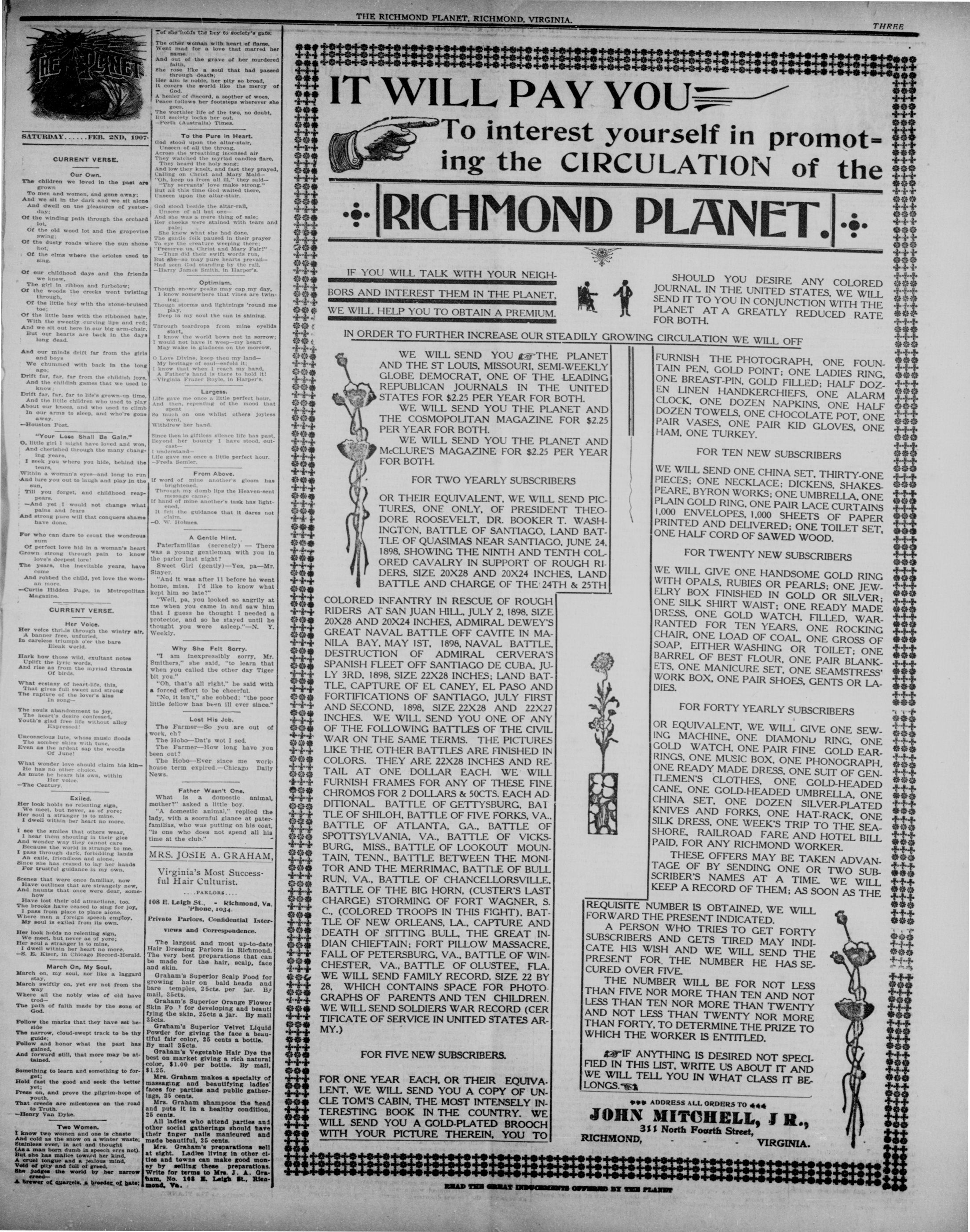
IT WILL PAY YOU To interest yourself in promot ing the CIRCULATION of the RICHMOND PLANET.
THE PLANET
CURRENT VERSE
The children we loved in the past are grown
To men and women, and gone away;
And we sit in the dark and we sit alone
And dwell on the pleasures of yester-
day;
Of the winding path through the orchard
hot,
Of the old wood lot and the grapevine
swing;
Of the dusty roads where the sun shone
hot,
Of the elms where the orioles used to
sing.
Of our childhood days and the friends
we knew.
Of the little boy with the stone-bruised toe;
Of the little lass with the ribboned hair,
With the sweetly curving lips and red;
And we sit out here in our big arm-chair,
But our hearts are back in the days long dead.
And our minds drift far from the girls and boys
We chummed with back in the long ago.
Drift far, far, far from the childish joys,
And the childish games that we used to know.
Drift far, far, far to life's grown-up time,
And the little children who used to play
About our knees, and who used to climb
In our arms to sleep, and who're gone away.
-Houston Post.
"Your Loss Shall Be Gain."
O, little girl I might have loved and won.
And cherished through the many chang-
ing years.
I seek you where you hide, behind the
tears.
Within a woman's eyes—and long to run
And lure you out to laugh and play in the
sun.
Till you forget, and childhood reap-
pears.
—And yet I would not change what
pains and fears
And strong pure will that conquers shame
have done.
For who can dare to count the wondrous
sum
Of perfect love hid in a woman's heart
Grown strong through pain to know
love's deepest lore!
The years, the inevitable years, have
come
And robbed the child, yet love the woman
an more.
—Curtis Hidden Page, in Metropolitan
Magazine.
CURRENT VERSE
Her Voice.
Her voice thrills through the wintry air,
A banner free, unfurled,
In careless triumph o'er the bare
Bleak world.
Hark how those wild, exultant notes
Uplift the lyric words,
And rise as from the myriad throats
Of birds.
What ecstasy of heart-life, this,
That gives full sweet and strong
The rapture of the lover's kiss
In song—
The souls abandonment to joy,
The heart's desire confessed,
Youth's glad free life without alloy
Expressed!
Unconscious lute, whose music floods
The somber skies with tune,
Even as the ardent sap the woods
Of June!
What wonder love should claim his kin—
He has no other choice.
As mute he hears his own, within
Her voice.
Exiled.
Her look holds no relienting sign,
We meet, but never, as of yore;
Her soul a stranger is to mine.
I dwell within her heart no more.
I see the smiles that others wear,
I hear them shouting in their glee
And wonder what they cannot care.
Because the world is strange to me.
I pass through dark, forbidding lands
An exile, friendless and alone.
Since she has ceased to lay her hands
For trustful guidance in my own.
Scenes that were once familiar, now
Have outlines that are strangely new,
And haunts that once were dear, somehow
Have lost their old attractions, too.
The brooks have ceased to sing for joy,
I pass from place to place alone.
Where men a foreign speech employ,
My soul is exiled from its own.
Her look holds no relienting sign,
We meet, but never as of yore;
Her soul a stranger is to mine.
I dwell within her heart no more.
-S. E. Kiser, in Chicago Record-Herald.
March On. My Soul.
March on, my soul, nor like a laggard stay,
March swiftly on, yet err not from the way
Where all the nobly wise of old have trod.
The path of faith made by the sons of God.
Follow the marks that they have set beside
The narrow, cloud-swept track to be thy guide;
Follow and honor what the past has guarded.
And forward still, that more may be attained.
Something to learn and something to forget;
Hold fast the good and seek the better yet;
Press on, and prove the pilgrim-hope of truth.
That creeds are milestones on the road to Truth.
-Henry Van Dyke.
Two Women
I know two women and one is chaste
And cold as the snow on a winter waste;
Stainless ever, in act and thought
(As a man born dumb in speech errs not).
But she has malice toward her kind,
A cruel tongue and a jealous mind.
Void of pity and full of grief.
She judges the world by her narrow
creed—
▲ brewer of quarrels, a breeder of hate;
WE WILL HELP YOU TO OBTAIN A PREMIUM.
COLORED INFANTRY IN RESCUE OF ROUGH RIDERS AT SAN JUAN HILL, JULY 2, 1898, SIZE 20X28 AND 20X24 INCHES, ADMIRAL DEWEY'S GREAT NAVAL BATTLE OFF CAVITE IN MANILA BAY, MAY 1ST, 1898, NAVAL BATTLE, DESTRUCTION OF ADMIRAL CERVERA'S SPANISH FLEET OFF SANTIAGO DE CUBA, JULY 3RD, 1898, SIZE 22X28 INCHES; LAND BATTLE, CAPTURE OF EL CANEY, EL PASO AND FORTIFICATIONS OF SANTIAGO, JULY FIRST AND SECOND, 1898, SIZE 22X28 AND 22X27 INCHES. WE WILL SEND YOU ONE OF ANY OF THE FOLLOWING BATTLES OF THE CIVIL WAR ON THE SAME TERMS. THE PICTURES LIKE THE OTHER BATTLES ARE FINISHED IN COLORS. THEY ARE 22X28 INCHES AND RETAIL AT ONE DOLLAR EACH. WE WILL FURNISH FRAMES FOR ANY OF THESE FINE CHROMOS FOR 2 DOLLARS & 50CTS. EACH ADDITIONAL. BATTLE OF GETTYSBURG, BATTLE OF SHILOH, BATTLE OF FIVE FORKS, VA., BATTLE OF ATLANTA, GA., BATTLE OF SPOTTSYLVANIA, VA., BATTLE OF VICKSBURG, MISS., BATTLE OF LOOKOUT MOUNTAIN, TENN., BATTLE BETWEEN THE MONITOR AND THE MERRIMAC, BATTLE OF BULL RUN, VA., BATTLE OF CHANCELLORSVILLE, BATTLE OF THE BIG HORN, (CUSTER'S LAST CHARGE) STORMING OF FORT WAGNER, S. C., (COLORED TROOPS IN THIS FIGHT), BATTLE OF NEW ORLEANS, LA., CAPTURE AND DEATH OF SITTING BULL, THE GREAT INDIAN CHIEFTAIN; FORT PILLOW MASSACRE, FALL OF PETERSBURG, VA., BATTLE OF WINCHESTER, VA., BATTLE OF OLUSTEE, FLA. WE WILL SEND FAMILY RECORD, SIZE 22 BY 28, WHICH CONTAINS SPACE FOR PHOTOGRAPHS OF PARENTS AND TEN CHILDREN. WE WILL SEND SOLDIERS WAR RECORD (CERTIFICATE OF SERVICE IN UNITED STATES ARMY.)
FOR ONE YEAR EACH, OR THEIR EQUIVALENT, WE WILL SEND YOU A COPY OF UNCLE TOM'S CABIN, THE MOST INTENSELY INTERESTING BOOK IN THE COUNTRY. WE WILL SEND YOU A GOLD-PLATED BROOCH WITH YOUR PICTURE THEREIN, YOU TO
Let she holds the key to society's gate.
The other woman with heart of flame.
Wet her hand for a love that marred her name.
And out of the grave of her murdered faith,
She rose like a soul that had passed through death;
Her aim is noble, her pity so broad,
It covers the world like the mercy of God.
A healer of discord, a soother of woes,
Peace follows her footsteps wherever she
The worthier life of the two, no doubt,
But society locks her out.
—Perth (Australia) Times.
To the Pure in Heart
God stood upon the altar-stair,
Unseen of all the throng,
Across the wreathing incensed air
Taken by varied handles flare.
They heard the holy song;
And low they knelt, and fast they prayed,
Calling on Christ and Mary Mald—
"Oh, keep us from all ill," they said—
"Thy servants' love make strong."
But all this time God waited there,
Unseen upon the altar-stair.
God stood beside the altar-rall,
Unseen of all but one—
And she was a mere thing of sale;
Her cheeks were stained with tears and
—Thus did their swift words run, But she—so may pure hearts prevail—Had seen God standing by the rail,—Harry James Smith, in Harper's.
Optimism.
Though snowy peaks may cap my day,
I know somewhere that vines are twin-
ing.
Though storms and lightnings 'round me
play,
Deep in my soul the sun is shining.
Through teardrops from mine eyelids
start,
I know the world bows not in sorrow;
I would not have it weep—my heart
May wake in gladness on the morrow.
O Love Divine, keep thou my land—
My heritage of soul—enfold it;
I know that when I reach my hand,
A Father's hand is there to hold it!
-Virginia Frazer Boyle, in Harper's.
Largess.
Life gave me once a little perfect hour,
And then, repenting of the mood that
spent
So much on one whilst others joyless
went,
Withdrew her hand.
Largess.
Since then in gifttess silence life has past,
Beyond her bounty I have stood, oute
cust—
I understand—
Life gave me once a little perfect hour.
-Freda Semier.
From Above
If word of mine another's gloom has brightened.
Through my dumb lips the Heaven-sent message came;
If hand of mine another's task has lightened.
It forfeits the guidance that it dares not claim.
-O. W. Holmes.
A Gentle Hint.
Paterfamilias (serenely) — There was a young gentleman with you in the parlor last night?
"And it was after 11 before he went home, miss. I'd like to know what kept him so late?" "Well, pa, you looked so angrily at me when you came in and saw him that I guess he thought I needed a protector, and so he stayed until he thought you were asleep."—N. Y. Weekly.
Why She Felt Sorry
"I am inexpressibly sorry, Mr. Smithers," she said, "to learn that when you called the other day Tiger bit you."
"Oh, that's all right," he said with a forced effort to be cheerful.
"No, it isn't," she sobbed; "the poor little fellow has been ill ever since."
Lost His Job
The Farmer—So you are out of work, eh?
The Hobo—Dat's wot I sed.
The Farmer—How long have you been out?
The Hobo—Ever since me workhouse term expired.—Chicago Daily News.
Father Wasn't One.
What is a domestic animal, mother?" asked a little boy.
"A domestic animal," replied the lady, with a scornful glance at paterfamilias, who was putting on his coat, "is one who does not spend all his time at the club."
MRS. JOSIE A. GRAHAM.
Virginia's Most Successful Hair Culturist.
.PARLOR$....
108 E. Leigh St., - Richmond, Va.
Phone, 1034.
Private Parlors, Confidential Interviews and Correspondence.
The largest and most up-to-date Hair Dressing Parlors in Richmond. The very best preparations that can be made for the hair, scalp, face and skin.
Graham's Superior Scalp Food for growing hair on bald heads and bare temples, 25cts. per jar. By mail, 35cts.
Graham's Superior Orange Flower Skin Fo' for developing and beautifying the skin, 25cts a jar. By mail 35cts.
Graham's Superior Velvet Liquid Powder for giving the face a beautiful fair color, 25 cents a bottle. By mail 35cts.
Graham's Vegetable Hair Dye the best on market giving a rich natural color, $1.00 per bottle. By mail, $1.25.
Mrs. Graham makes a specialty of massaging and beautifying ladies' faces for parties and public gatherings, 25 cents.
Mrs. Graham shampoos the head and puts it in a healthy condition, 25 cents.
All ladies who attend parties and other social gatherings should have their finger nails manicured and made beautiful, 25 cents.
Mrs. Graham's preparations sell at sight. Ladies living in other cities and towns can make good money by selling these preparations. Write for terms to Mrs. J. A. Graham, No. 108 E. Leigh St., Rienmond, Va.
IN ORDER TO FURTHER INCREASE OUR STEADILY GROWING CIRCULATION WE WILL OFF
WE WILL SEND YOU THE PLANET AND THE ST LOUIS, MISSOURI, SEMI-WEEKLY GLOBE DEMOCRAT, ONE OF THE LEADING REPUBLICAN JOURNALS IN THE UNITED STATES FOR $2.25 PER YEAR FOR BOTH. WE WILL SEND YOU THE PLANET AND THE COSMOPOLITAN MAGAZINE FOR $2.25 PER YEAR FOR BOTH. WE WILL SEND YOU THE PLANET AND McCLURE'S MAGAZINE FOR $2.25 PER YEAR FOR BOTH.
OR THEIR EQUIVALENT, WE WILL SEND PICTURES, ONE ONLY, OF PRESIDENT THEODORE ROOSEVELT, DR. BOOKER T. WASHINGTON, BATTLE OF SANTIAGO, LAND BATTLE OF QUASIMAS NEAR SANTIAGO, JUNE 24, 1898, SHOWING THE NINTH AND TENTH COLORED CAVALRY IN SUPPORT OF ROUGH RIDERS, SIZE 20X28 AND 20X24 INCHES, LAND BATTLE AND CHARGE OF THE 24TH & 25TH
READ THE GREAT INDUCEMENTS OVERWHEED BY THE PLANET
THE RICHMOND PLANET, RICHMOND, VIRGINIA
IF YOU WILL TALK WITH YOUR NEIGH-
```markdown
```
FOR TWO YEARLY SUBSCRIBERS
FOR FIVE NEW SUBSCRIBERS
REQUISITE NUMBER IS OBTAINED, WE WILL FORWARD THE PRESENT INDICATED.
A PERSON WHO TRIES TO GET FORTY SUBSCRIBERS AND GETS TIRED MAY INDICATE HIS WISH AND WE WILL SEND THE PRESENT FOR, THE NUMBER HE HAS SECURED OVER FIVE.
THE NUMBER WILL BE FOR NOT LESS THAN FIVE NOR MORE THAN TEN AND NOT LESS THAN TEN NOR MORE THAN TWENTY AND NOT LESS THAN TWENTY NOR MORE THAN FORTY, TO DETERMINE THE PRIZE TO WHICH THE WORKER IS ENTITLED.
IF ANYTHING IS DESIRED NOT SPECIFIED IN THIS LIST, WRITE US ABOUT IT AND WE WILL TELL YOU IN WHAT CLASS IT BELONGS.
A man sitting in a chair and a man standing in front of him.
DILY GROW
LANET
WEEKLY
READING
UNITED
H.
T AND
R $2.25
T AND
YEAR
ND PIC
THEO-
WASH-
D BAT-
JUNE 24,
H COL-
GH RI-
LAND
x 25TH
```markdown
```
REQUISIT FORWARD
SHOULD YOU DESIRE ANY COLORED JOURNAL IN THE UNITED STATES, WE WILL SEND IT TO YOU IN CONJUNCTION WITH THE PLANET AT A GREATLY REDUCED RATE FOR BOTH.
FURNISH THE PHOTOGRAPH, ONE FOUNTAIN PEN, GOLD POINT; ONE LADIES RING, ONE BREAST-PIN, GOLD FILLED; HALF DOZEN LINEN HANDKERCHIEFS, ONE ALARM CLOCK, ONE DOZEN NAPKINS, ONE HALF DOZEN TOWELS, ONE CHOCOLATE POT, ONE PAIR VASES, ONE PAIR KID GLOVES, ONE HAM, ONE TURKEY.
WE WILL SEND ONE CHINA SET, THIRTY-ONE PIECES; ONE NECKLACE; DICKENS, SHAKESPEARE, BYRON WORKS; ONE UMBRELLA, ONE PLAIN GOLD RING, ONE PAIR LACE CURTAINS 1,000 ENVELOPES, 1,000 SHEETS OF PAPER PRINTED AND DELIVERED; ONE TOILET SET, ONE HALF CORD OF SAWED WOOD
FOR TWENTY NEW SUBSCRIBERS
WE WILL GIVE ONE HANDSOME GOLD RING WITH OPALS, RUBIES OR PEARLS; ONE JEWELRY BOX FINISHED IN GOLD OR SILVER; ONE SILK SHIRT WAIST; ONE READY MADE DRESS, ONE GOLD WATCH, FILLED, WARRANTED FOR TEN YEARS, ONE ROCKING CHAIR, ONE LOAD OF COAL, ONE GROSS OF SOAP, EITHER WASHING OR TOILET; ONE BARREL OF BEST FLOUR, ONE PAIR BLANKETS, ONE MANICURE SET, ONE SEAMSTRESS' WORK BOX, ONE PAIR SHOES, GENTS OR LADIES.
FOR FORTY YEARLY SUBSCRIBERS
OR EQUIVALENT, WE WILL GIVE ONE SEWING MACHINE, ONE DIAMOND RING, ONE GOLD WATCH, ONE PAIR FINE GOLD EARRINGS, ONE MUSIC BOX, ONE PHONOGRAPH, ONE READY MADE DRESS, ONE SUIT OF GENTLEMEN'S CLOTHES, ONE GOLD-HEADED CANE, ONE GOLD-HEADED UMBRELLA, ONE CHINA SET, ONE DOZEN SILVER-PLATED KNIVES AND FORKS, ONE HAT-RACK, ONE SILK DRESS, ONE WEEK'S TRIP TO THE SEASHORE, RAILROAD FARE AND HOTEL BILL PAID, FOR ANY RICHMOND WORKER.
THESE OFFERS MAY BE TAKEN ADVANTAGE OF BY SENDING ONE OR TWO SUBSCRIBER'S NAMES AT A TIME. WE WILL KEEP A RECORD OF THEM; AS SOON AS THE
FOR TEN NEW SUBSCRIBERS
ALL SEND ONE CHINA SET, THIRD,
ONE NECKLACE; DICKENS, S.
BYRON WORKS; ONE UMBRELL,
GOLD RING, ONE PAIR LACE CU
ENVELOPES, 1,000 SHEETS OF
AND DELIVERED; ONE TOILET
LF CORD OF SAWED WOOD.
OR TWENTY NEW SUBSCRIBER.
ALL GIVE ONE HANDSOME GOL
PALS, RUBIES OR PEARLS; ONE
BOX FINISHED IN GOLD OR
SKIRT WAIST; ONE READY
ONE GOLD WATCH, FILLED
FOR TEN YEARS, ONE R
ONE LOAD OF COAL, ONE G
EITHER WASHING OR TOILE
OF BEST FLOUR, ONE PAIR
THE MANICURE SET, ONE SEAM
BOX, ONE PAIR SHOES, GENTS.
OR FORTY YEARLY SUBSCRIBER.
INVALENT, WE WILL GIVE ONE
MACHINE, ONE DIAMOND RING
WATCH, ONE PAIR FINE GOL
ONE MUSIC BOX, ONE PHONO
ADY MADE DRESS, ONE SUIT OF
CLOTHES, ONE GOLD-H
ONE GOLD-HEADED UMBRELL
SET, ONE DOZEN SILVER-
AND FORKS, ONE HAT-RAC
RESS, ONE WEEK'S TRIP TO THE
RAILROAD FARE AND HOT
OR ANY RICHMOND WORKER,
USE OFFERS MAY BE TAKEN A
BY SENDING ONE OR TW
NAMES AT A TIME. WE
RECORD OF THEM; AS SOON
AS OBTAINED, WE WILL
RENT INDICATED.
WE TRIES TO GET FORTY
SEETS TIRED MAY INDI
WE WILL SEND THE
NUMBER HE HAS SE-
WILL BE FOR NOT LESS
THAN TEN AND NOT
MORE THAN TWENTY
IN TWENTY NOR MORE
TERMINE THE PRIZE TO
R IS ENTITLED.
IS DESIRED NOT SPECI-
RITE US ABOUT IT AND
IN WHAT CLASS IT BE-
ALL ORDERS TO
SHELL, JR.,
Fourth Street,
VIRGINIA.
THREE
not= the
COLORED
SHEETS, WE WILL
WITH THE
PRICES RATE
ONE FOUN-
DIES RING,
HALF DOZ-
ONE ALARM
ONE HALF
THE POT, ONE
MOVES, ONE
BERS
THIRTY-ONE
SHEETS, SHAKES-
PELLA, ONE
CURTAINS
OF PAPER
TOILET SET,
AND
BERS
GOLD RING
ONE JEW-
DR SILVER;
ADAM MADE
MAILED, WAR-
ROCKING
GROSS OF
TOILET; ONE
AIR BLANK-
AMSTRESS'
ENTS OR LA-
BERS
ONE SEW-
RING, ONE
GOLD EAR-
NOGRAPH,
BIT OF GEN-
D-HEADED
PELLA, ONE
PER-PLATED
MACK, ONE
AND THE SEA-
HOTEL BILL
BER.
N ADVAN-
TWO SUB-
WE WILL
ON AS THE
```markdown
```
which fails
THE PLANET
Published every Saturday by JOHN MITCHELL
Jn., at El Norte 4th Street, Richmond Va.
would communications intended for publication
would be sent so as to reach us by Wednesday.
One Copy, one year. $1.50
One Copy, eight months 1.00
One Copy, six months 1.00
One Copy, three months 1.00
One Copy, three months 1.00
Single Copy $0.00
ADVERTISING RATES
For one inch, one insertion. For one inch, one subsequent insertion. For two inches, three months. $0.00
For two inches, six months. $0.00
For two inches, nine months. $0.00
For two inches, twelve months. $0.00
For two inches, twelve months. $0.00
Marriage and Prenatal Notices, one inch. $0.00
Standing and Transient Notices per line. $0.10
POSTAGE STAMPS OF A HIGHER DEMONINATION THAN TWO CENTS NOT RECEIVED ON SUBSCRIPTIONS.
THE PLANET is turned weekly. The subscription price is $1.50 per year in advance.
There are four ways by which money can be sent by mail at our risk.—In a Post Office Money is the only way that you can express Money Order, and when none of these is be procured, in a Registered Letter.
MONEY ORDERS—You can buy a Money Order at your Post Office, payable at the Richer or Low-Office, and we will be responsible for its sale at any time.
EXPRESS MONEY ORDERS can be obtained at any office of the American Express Co. the office of the American Express Co. and Co.'s Express Company. We will be responsible for money sent by any of these companies. The Express Money Order is a safe and secure money order. You can send money by Registered Letter. If a Registered Post-Office or an Express Office is not within your reach, your Postmaster will Register the Letter you wish to send on payment of sent money in any other way than one of the ways mentioned above. If you send your money in any other way, you must do it at your Renewal, Inc. If you do not want their PLANET continued for another year after your subscription has run out, you then notify us by Postal Card to discontinue it. The counts have not order their paper discontinued at the expiration of time for which it has been paid are held liable for the payment of the subscription date when they order the paper discontinued.
COMMUNICATIONS - When writing to us to request your subscription or to discontinue your payment, we are in full otherwise we cannot find your name on our books.
CHARGE OF ADDRESS - In order to change the form or as well as the present address, the former as well as the present address.
Entered at the Post-Office at Richmond. Va.
as second class matter.
SATURDAY..... FEB. 2ND, 1907
SENATOR TILLMAN AND THE RACE QUESTION-
That Senator Tilman's stock, so to speak has declined since his recent speech in the United States Senate hardly admits of a question. He made some assertions however in his previous declarations that are not only unjust to the President, but misleading as to the Negro. He said:
"The whole issue involved is one of race, and the President is primarily more responsible than any other man for the position of the Negroes in the South have taken on the question of Negro rights.
Any one reading the above would presume that the Negroes have just taken this position relative to his rights and that President Roosevelt was primarily responsible, when as a matter of fact this position has been taken for more than forty years. They were based upon the Negro's right to citizenship and were emphasized by the adoption of the 13th, 14th and 15th Amendments to the Constitution of the United States. It will be seen that Senator Tillman was "playing to the galleries" and that he let his prejudices as usual get the better of his judgment.
He continued;
"He gave recognition to Booker Washington in a social way. He tilt it knowing he was flying in the face of caste feeling among 17,000,000 of Southern white men and against the same feeling of two thirds or three fourths of the Northern people. He does not understand the Negro or the deep and vital character of the issue involved. He made a mess of it in the first instance and has made a worse mess of the last
The social recognition to Dr. Booker T. Washington did not in any measure affect the situation so far as the Negro was concerned. Any one listening to Senator Tillman would have presumed that such recognition had never been accorded a citizen of color before, when as a matter of fact, it has been a common occurrence in this country for more than forty years. Frederick Doug lass was thus honored; B. K. Bruce had enjoyed similar favors and there are other colored men, who have had social privileges at the White House, and there has been no comment relative to the same.
These social functions have at times been noticeable in the South land too and the political issue raised by this fiery South Carolinian is for the benefit of the "moss backs" at home, who never visited a President and who would not know how to find their way to the White House. In this respect, President Roose
velt has acted the part of the gentleman and not that of the villain or the reprobate and while we find Teddy's bears all over the country, we have no record of finding Teddy's children wandering over the Southland, being led about by Negro women, to whom they attach the tender name of mother. The honorable course is condemned by Senator Tillman and the dishonorable one passed by with the long look of embarrassment.
After appealing to the baser prejudices, he says:
"In six Southern States (South Carolina, Georgia, Florida, Alabama Mississippi and Louisiana) in the aggregate the Negroes outnumber the whites, and in two of them (South Carolina and Mississippi) the Negro preponderance is very heavy.
"Under the law these people possess every right that white men have as far as the Federal Constitution confers rights, and the fifteenth amendment expressly forbids the enactment of any law which 'shall discriminate in voting on account of race or color.' Large numbers of these Negroes are disfranchised at this time, but these laws are only temporary and work no cure, and in the near future enough Negroes will be able to vote to make inevitable the struggle for mastery between the races.
It seems to us that in Senator Tillman's case, "the wish is father to the thought." Ignorance will not control. It cannot do it. Intelligence will always find a way out, whether it exists in the brain of a Negro or in the mind of a white man. It does not assert itself along racial lines however Senator Tillman continued:
"Are men to be made over and the caste feeling and race antagonisms of centuries to disappear in the universal brotherhood of man? Are there any Senators in this audience who subscribe to this doctrine who would have the Caucasian, highest and noblest of the five races, as is attested by history, descend to the level of the others and share his birthright with them, with the inevitable result that pure white blood will disappear from the face of the earth and after the mixing of centuries, shall have completed the a-malgamation, have all men of one skin and one type?
Evidently, these assertions were made for the purpose of arousing race prejudice, to upset the minds of the tlistinguished white men, who were sitting in judgment. The premises, this fiery South Carolinaian had laid down were that social courtesies were the pathways that led to the amalgamation of the races. Let us see.
In Mr. Tillman's own state the intermarriage of the races is forbidden by statute. Charleston, South Carolina had a mulatto population in 1860 of 25.2 per cent of the total Negro population. The white men were not married to the Negro wo men, but they might as well have been.
It is further asserted that from 11 to 16 per cent of the Negro population of the United States have white blood in their veins. How did it get there, Senator Tillman and when the literate and the illiterate elements come together in wrong doing which is the most to blame?
Mr. Walter F. Wilcox of the United States Census Department, Bulletin 8, Page 11 says:
"The proportion of mulattoes to all Negroes is unusually higher in cities of the great cotton growing states than it is in the districts out side of the cities."
Where are the cotton growing states located, Senator Tillman and what are the laws there bearing on miscegenation? It would seem then that as the South is the place, and that no social functions are presumed to exist at all akin to that tolerated at the White House, such conditions would be impossible acording to Senator Tillman's logic. This census report shows some other things. Here they are:
"There are nearly four million, (3,992,337) Negroes in continental United States engaged in gainful ocupations. These persons, who may be called bread winners, constitute 45.2 per cent of the total Negro population, while for the total white population the per cent is 37.3, and for South ern whites. 34.2.
Negro bread winners constitute 62.2 per cent of all Negroes at least ten years of age. For whites the corresponding per cent is 48.6, and for Southern whites, *6.9.*
This shows a high percent of industry for the Negroes that Senator Tillman is constantly abusing and vilifying. There is more interesting information. Here it is from the same source:
"More than one fourth (26 per cent) of the Negro wives and two thirds (67 per cent) of the Negra widows report a gainful occupation and the proportions have increased from 1890 from 22.7 per cent for wives and 62.6 per cent for widows."
These are not the kind, Senator Tillman, that your South Carolina associates ruin and live in social and sexual luxury throughout the South land. They are not the ones that are causing "the pure white blood to disappear from the face of the earth."
Census Bulletin, No. 8 makes another exposure. Here it is:
"***before the Civil War, the field hands in the cotton growing regions of the South associated with
THE RICHMOND PLANET, RICHMOND, VIRGINIA
the whites much less intimately than the house servants, and the latter class much more frequently than the former included a perceptible strain of white blood. Away from the cotton growing area the difference was less, but in the border states no small proportion of the slaves in the cities, many of them belonging to the class of household slaves, were infused with white blood."
Senator Tillman has laid down the premises that social courtesies cause the missegenation of the races even when kept within the set rules of polite society. He also urges that President Roosevelt's action in inviting one distinguished Negro to lunch with him has upset the social universe and corrupted the Caucasian blood of the nation. We think that we have demonstrated by statistics the erroneous nature of this conclusion. He used the following sententious and highly insulting language:
"Is President Roosevelt ready to act up to his own theory and have his children marry men and women of the other races? Would he accept as a daughter-in-law a Chinese, a Malay, an Indian, or a Negro, in accord with the doctrine laid down in his message, which I have quoted? We all know he would not, and while "fine words butter no parsnips" words like these are a source of incalculable evils, coming from such high source.
The above words need no discussion. Marriage is a civil contract, binding only when it has the willing assent of two contracting parties. Men lunch with other men, who are not permitted to pay attentions to the female members of their families. ?
White men of low degree can lunch with Senator Tillman, but it would be absurd to say that because of this fact they would be permitted to lead any female member of the family of the well known South Carolinian to the altar. A Negro cannot marry a white woman with out her consent any more than a white man can marry a Negro woman without her consent. It is then descending to the level of the ward politician to even discuss this subject from Senator Tillman's stand point.
Moreover, Dr. Booker T. Wasington is already married and even if he lived in Utah, must now be the husband of only one wife. It is ridiculous to say then that he had any designs upon any members of the President's family. It was unfair, it was unmanly, it was a "blow be low the belt" for Senator Tillman to have made any reference what ever to the inner circle of President Roosevelt's home. It will not do, Senator Tillman, it will not do.
He continued:
"It is not possible for me to believe that the theorists and sentimentalists of the North who are responsible for the conditions existing will be allowed to pursue their policy of absolute recognition of race equality much further. The question is not a local one, or a sectional one, except so far as the Negroes are nearly all at the South while at the North there are comparatively few of them. It is high time something was being done to have this great and vital question brought before the country in some practicable and sensible way.
In using the above language, Senator Tillman attacks the bed rock principle of the government itself. He goes back to the primeval customs of the Old World, where royalty reigns and the caste system is supreme. When a man reaches that stage that he questions the civil and political equality of the Negro, he is but a step from the place where he will question the civil and political equality of the white man. It is needless to deny the fact that there are wealthy, educated white men, who question the wisdom of universal suffrage as vouchsafed the laboring white man.
Senator Tillman is a colleague and supporter of this class of theorists, even though he be unwilling to admit the soft impeachment.
The hollowness of Senator Till man's position was emphasized when Senator Beveridge asked him to suggest a remedy for existing conditions. He made an excuse and it was evident that he came to criticise and not to offer a solution. For thirty years, the South has had undisputed possession of this question and the North, upon its request has refused to interfere. The Supreme Court of the United States has permitted the Southerners to deal with the Negroes within its borders as it saw fit and to day, the South Carolina Senator confesses that the white minority is supreme.
"Let us alone" has been the cry, and they have been let alone. The land has been soaking with the blood of innocent Negroes and the gallows have been doing service with the guilty ones. Now comes this bourbon relic of by gone days and clamors for a race war.
In this he hears no response from the North and no approval from the better class of white people of the South. The day is breaking and across the horizon, we see the promise of a brighter morn.
Let the colored people of. the Southland labor on. "God reigns, and the government at Washington still lives."
"Fanaticism, soberly defined, Is the false fire of an o'er heated mind;
It views the truth with a distorted eye. And either warps, or lays it use less by:
Tis narrow, selfish, arrogant and draws
Its sordid nourishment from man's applause;
And while at heart, sin unrelinquish ed lites,
Presumes itself chief favorite of
Presumes itself chief favorite of the skies"—Cowper.
"THE PRESIDENT AND THE NE GRO SOLDIERS."
Harper's Weekly of January 26, 1907 in discussing "The President and the Negro Soldiers" says:
"The President has wisely concluded to withdraw part of the sentence which he pronounced against the colored soldiers of the Twenty-fifth Infantry. This part is that which prohibits the men from being employed hereafter in the civil service of the United States. Whether he is right in insisting that he has the power to dismiss "without non-or," in spite of the articles of war is the subject of discussion in the Senate, a discussion which we are not inclined to anticipate. But it has always been clear that his at tempt to deny to these Negroes the right of future public employment, at least in the civil service, was wholly unconstitutional and illegal.
And again:
In his haste, Mr. Roosevelt not only called all these Negroes criminals, but he usurped a power watch the Constitution reserves for the United States Senate, sitting as a court of impeachment to try a civil officer. It is perfectly fair to as sume that there is no presumption in favor of the legal decisions of one who frequently reverses himself on encountering criticism. A lawyer would have amended the President's now famous sentence if he had been consulted in advance, and doubtless that which is good in it would have stood. If this had been done at the proper time there might never have occurred the sharp quarrel accentuating the race issue of which Senator Tillman took significant advantage the moment the opportunity was of fered to him."
The above is a stinging rebuke at the hands of one of the most influential and conservative journals in this country. It voices the sentiment of the greater portion of the North and emphasizes in clarion tones the declaration, "Tell him! Tell him he! wrong!"
GIRL ASSAULTED BY BURGLARS
Found In Home In Dying Condition and
No Trace of Assailants
New Cumberland, W. Va., Jan. 30.—Unconscious, bound, gagged and tied to a chair, Nellie Campbell, chief operator at the local telephone exchange, was found nearly dead at her home. She has not yet rallied sufficiently to tell who her assaults were, and it is still doubtful whether she will recover. Miss Campbell lives with her widowed mother, Mrs. W. D. Campbell, and her sisters, and was alone in the house. Apparently the girl's assaults were burglaries, who after assaulting her, tied and gagged her and then ransacked the house, taking several articles of value.
KNELT BEFORE TRAIN
Woman, With Hands Upraised In
Praver, Met Death
Jackson, Mich., Jan. 30.—Kneeling on the track, with her hands upraised in prayer, Miss Harriet S. Bartlett, aged 35, was instantly killed by a Michigan Central passenger train half a mile west of this city. The young woman was, tossed 30 feet and her skull was fractured. With her trousewoman prepared, Miss Bartlett's marriage had been postponed several times, owing to her poor health, and it is thought that her troubles had unbalanced her mind.
REED KNOX MARRIES
Son of U. S. Senator and Miss McCook
Wed at Alexandria, Va.
Washington, Jan. 29.—Reed Knox,
son of United States Senator P. C.
Knox, of Pennsylvania, and Miss Elizabeth
R. McCook, an 18-year-old girl,
who lived with her grandmother, Mrs.
Elizabeth S. McCook, in the Sherman
apartment house in this city, were
married in Alexandria, Va.
Mr. Knox and Miss McCook made
the trip to Alexandria in an automobile car. They were accompanied by a number of their friends, and the bridal party returned to Washington.
Army Lieutenant Missing
Havana, Jan. 28 - Lieutenant Charles E. McCullough, of the 15th cavalry, was reported missing, and there are fears expressed that he has possibly met with foul play, as he was known to have had a considerable sum of money in his possession.
$1,000,000 FIRE IN PHILADELPHIA
Entire Section of Baldwin Locomotive Works Burned
Philadelphia, Jan. 30.—Fire which started with an explosion in the paint shop destroyed one entire section of the big Baldwin Locomotive works, entailing a loss of $1,000,000. The destroyed building is about 175 feet long by 150 feet deep, facing on Spring Garden street and immediately adjoining the main office at the corner of Broad and Spring Garden streets and the erecting shops, smith shops and foundries on the south.
The fire was discovered in the east end of the building, adjoining the main office building, when the workmen were preparing to leave and though the flames spread quickly all were able to get out of the building safely. Shortly after the fire started the upper portion of the wall on Spring Garden street fell into the street and one fireman and three workmen were caught by the falling bricks, but fortunately received only slight injuries. The firemen with the assistance of the fire patrol from the plant succeeded in getting the flames under control within an hour after the fire was discovered.
STANDARD OIL SECRETS EXPOSED
Monopoly's Policy is to Ruin Its Competitors.
BRIBED RAILROAD EMPLOYES
Washington, Jan. 29. — The interstate commerce commission sent to congress a report of the investigations made by it under the Tillman-Gillespie resolution approved March 7 last concerning the relations of common carriers by rail to the production and distribution of oil. The report covers the distribution of petroleum and its products east of the Mississippi river, and, incidentally, the Kansas and Texas fields.
It points out generally the methods by which the Standard Oil company "has built up and perpetuated its monopoly and the relations of transportation agencies to that monopoly." It is asserted that the "ruin of its competitors has been a distinct part of the policy of the Standard Oil company in the past, systematically and persistently pursued." Considerable of the ground covered has been gone into fully in the report on oil and its distribution made public by the bureau of corporations.
"No instance," the report says, "is found where any railway company has been interested in oil lands or in petroleum production, and only one instance is shown where officials of a railway company were interested in the production and sale of oil.
"The Standard Oil company largely monopolizes the handling of petroleum from the mouth of the well until it is sold to the retailer, and sometimes to the consumer, and under ordinary circumstances its margin of profits is very large. Estimates made in the report show a profit on refined oil from the Sugar Creek refinery at Kansas City of from five to eight cents per gallon. A much higher profit is indicated for gasoline. The sale of refined oil from the large Standard refinery at Whiting is correspondingly profitable.
"The evidence shows little basis for the contention that the enormous dividends of the Standard Oil company are the legitimate result of its economies. Except for its pipe lines, the Standard has but little legitimate advantage over the independent refiner.
"Ordinarily, it is said, the Standard has not received rebates in recent years, so far as has been discovered, but it nevertheless enjoyed secret rates possessing all of the elements of illegal rates, and the advantages so obtained over independent shippers have been of very great value to that company.
"The Standard has sold different grades of oil at different prices from the same barrel. It has paid employees of independent oil companies for information as to the business of those competitors and has paid employees of industrial companies to secure the adoption of its oil in preference to that of its competitors.
"It has followed every barrel of independent oil to destination. Its agents are instructed to secure customers at any sacrifice. It has tampered with the oil inspectors in different states. The laws of several states concerning the inspection of oil are singularly defective, and this has been turned to profit by the Standard.
"The commission's only knowledge of the competitive methods of the Standard Oil company is obtained from evidence taken under oath in this investigation. The Standard was given permission to explain or rebut the facts.
"This evidence, if true, demonstrates that the competitive methods of the company in the past have been unfair and disreputable."
STEPMOTHER BRANDED TOTS
Pressed Red Hot Stove Lifter On Their Hands For Making Noise.
New York, Jan. 28—Two little tots, Nellie, aged 7 years, and Jennie, two years younger, told Magistrate House in the Harlem police court, how their stepmother, Mrs. Kate Gravius, had branded them with a redhot stove litter when in play they had made too much noise. Twice during the recital the prisoner, a woman of intelligent and pleasing appearance, not more than 20 years of age, fainted. When restored the woman admitted that she had burned the children, but said that at the time she was possessed by an unaccountable mania. The two girls, she said, had been playing with their dolls until the noise and confusion robbed her of her reason and left a resistless impulse to punish the little ones. Selzing the stove litter, she pressed the glowing end upon the back of the right hand of each child, causing scars that the little ones will carry to their graves.
The prisoner was paroled in custody of her counsel pending a further hearing, and the children were given in care of the Children's Society, which brought the complaint.
Mother and Son Buried to Death.
Portsmouth, O., Jan. 28. - Rachel Pyles, aged 80, a soldier's widow, and her son, Jonathan, both deaf, were burned to death in a log cabin at Dixon's Mills.
Two Skaters Drowned
Portsmouth, O. Jan. 28. — Pearl Lowry and Forest Hyde, boys, were drowned, and George Lowry and Houston Rickey barely escaped a similar fate while skating.
Majer Gripp's Summer Home Burned. Altoona, Pa., Jan. 29.—Major H. A. Gripp's summer home, "Elkhurst," near Tyrone, one of the old landmarks of this section, was burned to the ground by a fire which started from an overheated furnace in the cellar. Gripp, who is the wealthy crayon artist, purchased the property some years ago and fitted it up with rich antique furniture. His loss is $25,000.
AWFUL MINE DISASTER
At Least Fifty Dead In Explosion In
West Virginia Colliery.
Charleston, W. Va., Jan. 30.—There are at least 50 or 69 persons dead as a result of an explosion in the Stuart mine, near Fayetteville, in Fayette county, according to the last reports received, and it is expected the number will reach 25 more.
The explosion was caused by dust in the mine. Every effort is being made to get to the men who are entombed, but there is little hope that any of them are alive.
At the time of the explosion there were about 200 men in the shaft, and there is grave apprehension that a great many of them were in the mine when the explosion occurred. A list of the dead is now being compiled, and it will include at least the number mentioned. Organized effort is being made to get to the men in the mine, and volunteers are plentiful. The scene about the mine is a pathetic one, men, women and children crying for their dear ones and imploring those on the ground to go to their rescue.
MANY PRUSSIAN MINERS KILLED
300 Men May Be Dead In Two Explosions In Prussian Colony
Saarbrueck, Rhenish Prussia, Jan. 9. —A fire damp explosion occurred in the Reden coal mine at St. Johann-On-Saar, opposite Saarbrueck, and caused a loss of from 150 to 200 lives. The Reden mine is owned by the Prussian government. Immediately after the explosion rescue workers were hurried from all the adjacent mines and boldly entered the Reden shaft in great numbers. The work of rescue has been greatly hampered by the poisonous gases resulting from the explosion and by a fierce fire that broke out immediately afterwards. During the afternoon the efforts at rescue had to be suspended for these reasons, and the rescue workers had to be ordered out of the mine.
After all the rescuers had reached daylight, according to one version, a second terrific detonation was heard underground. But according to another report, many of the rescuers were still below when the second explosion occurred, and it is estimated that the casualty list from the two explosions reaches a total of 300 men.
SWETTENHAM HAS RESIGNED
Governor of Jamaica Who Insulted Admiral Davis Will Retire
London, Jan. 26.—There is good reason to believe that Governor Swettenham, of Jamalca, has forwarded his resignation to the colonial office. The officials there say they are not prepared either to confirm or deny the report, but they admit having received telegrams of a confidential character from the governor. It has been fully expected here that a solution of the difficulty would be found in Swettenham's resignation, and the reply to inquiries received at the colonial office intended to confirm the report that the governor had intimated his willingness to retire from his post. It has been freely stated in the colonial and other government offices that it was quite impossible for Swettenham to continue in office, not only because of the incident involving the withdrawal of the American warships from Kingston, but also on account of the protests against his conduct received from the inhabitants of Kingston.
Swettenham Unequal to Task
Kingston, Jamaica, Jan. 26. — The lack of co-operation on the part of the central control here is greatly hampering the work of extending relief, providing shelter for the earthquake sufferers, pulling down the unsafe walls and repairing the damaged buildings, for which Governor Swettenham is severely condemned.
An instance of the governor's untimely, obstructive measures is the police enforcement of the regulation forbidding the re-erection of buildings, even wooden shacks, without the city surveyor's approval of the plans, and this is causing great delay and much dissatisfaction. The general opinion is that the governor has completely lost his head and is utterly unequal to the task of meeting the emergency.
FATAL STABBING IN RESTAURANT
Proprietor Claims to Be a Victim of "Black Hand" Plot
Philadelphia, Jan. 30.—Dying in the hospital from stab wounds, inflicted, it is alleged, by Frank Zugkgrw, of Chicago, Frank Marshill, a restaurant keeper, declared to the police that he was a victim of a "Black Hand" plot. Zugkgrw, with three other Italians, entered Marshill's restaurant, and after eating oysters complained of their bill, Marshill alleges, as a pretext for getting into an argument. Zugkgrw, he alleges, then set upon him. He was stabbed four times. Zugkgrw was arrested, but refused to make any statement. His companions escaped. Marshill says he has been threatened a number of times by the "Black Hand" society and has complained to the police. He told the authorities that he was convinced Zugkgrw was sent here by the "Black Hand."
Shot Wife Who Sought Divorce
Lived 105 Years
Easton, Pa., Jan. 28-Johann Arnold, who recently celebrated his 105th birthday, died at Cedarville, a suburb of this city. He was born in Germany.
Lost Life Trying to Save Valuables
Sunbury, Pa., Jan. 30.—Recounting
his burning home to save a deed, an
other valuable papers. Robert Fischel
aged 50 years, stationmaster for
Pennsylvania railroad at Northumberland
land, was overcome by smoke of
body burned to a crisp. A few
several children survived.
Subscribe to The PLANET.
A WEEK'S NEWS CORDENSED
The North Carolina legislature has re-elected F. M. Simmons, Democrat, to the United States senate. W. H. Horkescheimer, of Beverly, N. J., dropped dead from heart disease on a ferryboat at Camden, N. J. Major Frank B. Gordon, youngest son of the Confederate General John B. Gordon, died suddenly in Washington of pneumonia. Alfred B. Stoney, speaker of the New Jersey house in 1854, and well known in steamboat circles, died at his home in Keyport, N. J., aged 64 years. Walter McHenry, of Marion Centre, Pa., a student at the University of Pennsylvania, fell under a trolley car in Philadelphia and was so badly injured that his left leg had to be amputated.
Friday, January 25
The Academy of Music in Washington was gutted by fire, entailing a loss of $50,000.
Next year's live Convention of the American National Live Stock Association will be held in Denver, Colo.
Mrs. William Allen, of Lexington, Ky., died on a street car while satisfying her mania for riding on cars.
A freight train ran over an embankment at Longdale, near Parkersburg, W. Va., and three trainmen were killed and one fatally injured.
Mattle Merritt, aged 27 years; Vergle Taylor, aged 5 years, and Ethel King, aged 4 years, were burned to death in a fire which destroyed their home at Indianapolis.
Saturday. January 26.
Robert Curtis, of Wilkes-Barre, Pa., was sentenced to five years and six months imprisonment for forging judgments.
The second section of the first class of the Annapolis, Md., navel academy will be graduated on Monday, February 11.
Dr. E. W. Haines, the oldest practicing dentist in Delaware, died at his residence in Newark, Dell, aged 84 years.
Mrs. Isabella Beecher Hooker, sister of Henry Ward Beecher and Harriet Beecher Stowe, died at her home in Hartford, Conn., aged 85 years.
Monday, January 28.
There are 40 casee of smallpox in the territory within 10 miles of Richmond, Va.
The steel trust has bought 2500 acres more land for Gary, Ind., where it is building a model town.
Brakeman Edward Zuppert, of Reading, was killed in the Reading railway near Myerstown, Pa.
Miss Ellen D. Morris, former national treasurer of the W. C. T. U., died at Hastings, Neb.
Peter G. Albright has brought suit against the city of York, Pa., for $5000 damages for a broken leg, sustained on account of a bad pavement.
The New York state building at the Jamestown Exposition will be modeled after the congressional library at Washington and will cost $31,500.
Tuesday, January 29.
The United States supreme court will take a recess for three weeks, beginning next Monday.
Thirty to 35 degrees below zero was recorded by the thermometer at Superior, Wis., on Monday.
Jacob Well and wife were asphyxiated by gas escaping from a stove in their restaurant in Brooklyn.
Wilber S. Jackson, dean of the school of education at the University of Chicago, died after an illness of 24 hours.
A runaway trolley car at Richmond, Va., crashed into two wagons, wrecking them and injuring seven passengers, none seriously.
Wednesday, January 30.
Otis Eddy, aged 102 years, died at his home in Rockford, Ill.
Continued grief over the death of his wife caused John A. Britton to commiss suicide by shooting at his home in Brooklyn.
Tuesday was the 65th anniversary of the birth of William McKinley and the day was observed as "Carnation Day" in Washington.
The comptroller of the currency issued a call for a statement of the condition of all national banks at the close of business January 26.
In a collision between an express train and a freight on the Boston & Maine railroad, near the Burburne Falls, Mass., four trainmen were killed and several injured.
UNABLE TO BREAK DEADLOCK
Three Ballots Taken at Trenton For
Senator Without Result.
Trenton, N. J., Jan. 30—The New Jersey legislature met in joint session and took three ballots upon the United States senatorship. The ballots resulted as follows: Dryden (Rep.), 35; Griggs (Rep.), 6; Pitney (Rep.), 2; Stevens (Dem.), 16; Wilson (Dem.), 12; Martine, 9.
The indications here are that there will be no change in the voting among the Republicans until after the conference with Senator Dryden, which is to be held here next Monday afternoon. The conference is to be held at the request of Mr. Dryden.
Fought Duel With Shot Guns
Danville, Va., Jan. 30. — Walter B. Barksdale, a farmer about 35 years old, was mortally wounded, and Joe Echole, a young farmer, seriously injured in a duel fought near Danville with shot guns. The men quarried at the country store over a pack of cigarettes, and agreed to return to their homes, secure their weapons and fight the affair out. Barksdale arrived first, and when Echols came up, he opened fire without warning. A large hole was torn in the side of Barksdale and Echols' body was riddled with small shot.
Negro Hanged at Wilmington
Willington, Del., Jan. 26—Quickly, and without a hitch the execution of Lewis Johns, colored, murderer of his sweetheart, Arameda Jones, came off at the county workhouse. The man's neck was broken by the fall, and death ensued in 11 minutes. The body was allowed to hang for 25 minutes. Johns' crime was deliberate and revolting. Waiting for the woman on the street after a quarrel, he crept up to her and beet her to death with a stove leg.
HEY PLANET
SATURDAY.....FEB. 2ND. 1907
POULTRY AND BEES
THE BEES.
How the Eight-Frame Hives Can Be Made at Home.
If it is the intention to make hives of the capacity of the eight-frame dovetail frame hive, get some thoroughly dry pine boards planned on one or both sides, nine and a half inches in width.
Usually I get boards about ten inches wide, and plane them down to the right width after they have been sawed into pieces of the proper length, writes a New Jersey Bee Keeper, in Farm Journal.
The lengths are 20 inches for the sides, and 12½ inches for the end of the hives.
I rabbet these hive ends without the
Section of Hive.
use of any machinery or power except
a common hand-saw. Having the rab-
bet sawed out, the work of making a
hive body is almost done.
The nailing should be started upon
a perfectly flat surface.
It is best to have a kind of platform
a little larger than the hive (with a
cleat strongly nalled at one edge) for
a bumper to nail against; and another
cleat strongly nalled at one edge) for
angles to the first one.
The nailing can be finished by turning the hive on its side, and the hive corners can be kept at right angles by using a square. When the hive is nailed together, then put in the tin rabbets.
You need not gouge out any hard holes by which to lift the hives. It is easier to make cleats six or eight inches long, planed on their upper edges, and slanting outward and downward; with the ends whitted round so that they will shed water. One of these nailed on each end of the hive will make lifting the hive easy.
For cover and bottom boards I get lumber 14 inches in width, using the best for covers and the poorest for bottom boards. Sometimes I make the bottom of two pieces.
All of the covers and bottom are saewed exactly two feet long, and have cleats two inches square nalled under each end. The cleat at the back end of the bottom board is nalled about one-half inch from the end for convenience in lifting, and the cleat in the front is nalled flush with the end for the convenience of the bees. The cleats for the cover should be nalled so as to give a play of about one-eighth inch. Lath can generally be found of the right thickness to make the three-eighth inch bee space for the bottom board. If too thick it is not much work to reduce them with a plane. I have never adopted the cheaper way of making a hive cap of the same size as the body.
Our caps are all made larger than the bodies, and telescope on them in the old way. The hive is a little more expensive, but we have a better fit, and a much better protection against robbers, moths, cold, etc.
An open joint will do in the summer, but in other seasons, especially in spring, we want a well-covered cover. A slight variation in the width and depth of the hives is immaterial, provided, of course, that the frames do not come too close to the bottom of the hive. The important point is the inside length from the front to the back. This must be accurate or the frames will not fit. The two end pieces should come between the sides, and, if necessary, be placed a little in or out to secure exact length. The supers are constructed in a similar way.
The lumber for the hive frames should be bought in long strips; simply ripped out of some boards. This is much cheaper and is just as useful. Provide a mitre-box; fit it at the end of a bench and adjust a stopblock at the proper distance; take a few strips at a time, put them in the mitre-box, then push them until they reach the stop, and saw off. Keep on repeating until you have enough frames cut.
Cut the top and bottom pieces square, and these should come between the end pieces. It is necessary to make the frames of an exact size, so that they will be uniformly alike and can be changed from one hive to another.
Prevent Roup.
Roup should be prevented, for it is exceedingly difficult to cure. Moreover, many of the birds that are treated for roup never amount to anything afterwards, even if they are cured. To prevent roup keep the poultry house dry and segregate every bird that seems to be ailing from any cause. If a pane of glass is broken, see that it is mounted at
once, as otherwise it my be the means of starting roup in the flock. The farmer should be careful about introducing new blood in the flock, as this is often a means of bringing in the disease.
POULTRY HOUSE.
Description of One by a Practical Poultryman.
I believe in the tightly built house, but I do not believe in thick walls nor air-tight sleeping places for fowls, animals or human beings. Within a stone's throw from where I am writing there is a poultry house which is in use for the second winter. Three sides and the roof are made of ordinary rough lumber. Over these is a thick coating of building paper of the kind that stands exposure. The south side is simply thick muslin, tacked on two frames which are hinged at the top so they can be swung back and hooped to the roof in warm weather. Over the opening wire netting serves to keep the fowls in and the maudraers out. This house has been used as a residence for a flock of fowls which went through last winter, cold as it was, without a touch of frost.
The hens laid regularly last winter to the great profit of the owner, and this winter they do not seem to have discovered that winter has come at all. When it was built a curtain was put in to drop down in front of the perches during very cold weather, but it was found that it was not needed. This is just a bit of my experience.
The poultry instructor (in an eastern experiment station) told me that he built two houses exactly alike, with the exception that one had glass windows. He divided a flock of fowls and put half in each house. He found that the difference in inside temperature was only one degree, average, the cloth window house being the warmer of the two. He found that there was no dampness, or foul odors where the cloth windows were, while the glasswindow house smelt "stuffy" and the walls were damp. At the end of six weeks the fowls in the house with cloth windows were healthier and appeared thrifter in every way than those in the glass window house. His houses were built almost on the same plan as the one I can see from where I write this.
If a poultry house is built on dry ground it never gets damp from without. The dampness always originates in the house, being merely the condensed vapor from the breathing of the fowls. A cloth front (or cloth window) prevents this dampness from gathering, as there is always a current of air through the cloth, but it is such a gentle one that no drafts are formed. The cloth front or cloth window seems to have settled the question of ventilation perfectly. A house with a cloth front or cloth windows is never filled with foul air or unpleasant odors.—Miller Purvis in Breeders' Gazette
THE MELANCHOLY DAYS.
"Why do they call these melan
choly days?"
"Because they are the days when, just as you have finished paying up your debts for your summer vacation, you remember that you have to begin saving up for the holidays."—Cincinnati Enquirer
You can now obtain a large dollar size free package or Man Medicine—free on request.
Man Medicine has cured thousands and upon thousands of weak men. Man Medicine will cure you; restore you to full strength.
Man Medicine cures vital weakness, nervous debility, early decay, discouraged manhood, blood poison, brain fag, backache, prostatitis, kidney and bladder trouble and nervousness.
You can cure yourself at home by Man Medicine, and the full size dollar package will be delivered to you free, plain wrapper, with full directions how to use it. The full size dollar package free, no payments of any kind; no receipts; no promises; no papers to sign. It is free.
All we want to know is that you are not sending for it out of idle curiosity, but that you want to be well and become your strong, natural self once more. Man Medicine will do what you want it to do—make you a real man.
Your name and address will bring it; all you have to do is to send and get it. We send it free to every discouraged man. Interstate Remedy Company. 263 Luck Bldg., Detroit, Mich.
Mardi Gras, New Orleans, La., Mobile, Ala., and Pensacola Fla. Feb. 7-12, 1907.
Very low rates via Southern Railway from all points to the above points and return. Selling dates. February 6th to 11th, inclusive, return limit Feb. 16th with privilege of extension return limit to March 2nd, 1907. Buy deposit of ticket at destination and payment fee of fifty cents. These tickets embrace stop over privileges at many points. Two through schedules daily. Drawing room Pullmans, dining cars.
THE RICHMOND PLANET, RICHMOND, VIRGINIA
JOB DEPARTMENT
EXCURSION
We print Handbills, Quarter-Sheet posters, Tags, Tickets, Placard minutes, Visiting Cards, Mourning Stations
WE HAVE
Our St
OF THE LATE
WE CAN PRINT A BILL AS SMALL
A Three-Sheet
AS LARGE AS A FRO
OUR IS W
Our street-entrance is retired and fastidious lady being able to enter w
We print Handbills, Quarter-Sheets, Half and Whole Sheet posters, Tags, Tickets, Placards, Society Cards, Minutes, Visiting Cards, Mourning Stationery.
OUR AIM is to please our patrons and to give them the best service at the lowest prices, consistent with satisfactory work.
We furnish "cuts" when desired and we will arrange to complete special work in our line. When in need of any work in our line, call and see us and estimates will be furnished.
WE HAVE AN ELEGANT LINE OF SAMPLES
WHICH WE WILL SHOW ANY ONE DESIRING TO SEE THEM.
Our Stock Room Embraces a Full Line
OF THE LATEST STYLE BOND, FINE WRITING—FLAT AND LINEN PAPER, ENVELOPES, ETC.
WE CAN PRINT A BILL AS SMALL AS A DODGER A Three-Sheet Poster AS LARGE AS A FRONT DOOR.
Our street-entrance is retired and has no objectionable features, the most fastidious lady being able to enter without embarrassment or annoyance.
LONG DISTANCE TELEPHONE, 2213.
It is thoroughly equipped to do all kinds of printing on short notice. We make a specialty of Society printing and work for Insurance Companies, such as Financial
A CONSTANT WATER SUPPLY.
Convenient, Labor-Saving Device for the Stock and Poultry.
A constant supply of water can be maintained for hogs, sheep or poultry by devising a plan similar to the one illustrated herewith, devised on the plan of the siphon and printed some time ago in the Iowa Homestead. All is needed is a water-tight barrel, and a water-tight box with six or seven-inch sides. The barrel is filled with water and a hole bored through the side at a point just below the top of
Sliphon Water Trough.
the box. If the supply hole in the top is securely plugged and there is no other opening to admit air the water will flow from the barrel until it covers the vent, when further flow will cease until some water is removed from the tank. A level will be maintained as fast as the water can pass through the vent, or as long as there is any water in the barrel. In filling all that will be necessary will be to plug the vent until the barrel is again full.
POULTRY NOTES.
Unless chicks are wanted, males are useless.
Householders stop buying eggs when they lose confidence in them.
Leg weakness attacks cockeels more frequently than it does pullets.
In cold stormy weather is the time good shelter is appreciated by the fowls.
For best results, the food, care and conditions must be of the best quality.—Farm Journal.
Green cut-bone is a great egg producer and can be given to the hens two or three times a week.
Water fowls can be made both useful and ornamental, under the proper kind of environments.—Farmers' Review.
The hens should always have a dust bath handy, winter and summer. This will help keep the fowls free from lice.
Are your hens roosting in the treetops, on fences, old sheds and the like exposed places? If so, please don't expect many eggs this winter.
The noisy coop is where the egg laying business is going on. Cackling, crowing and singing indicate that the hens are healthy and happy. —Farm and Home.
We talk of idle curiosity. There is no such thing; curiosity is never idle.
Try to take things as they come, but at any rate grab them before they go.
Cards, Policies, both straight life and benevolent, Physician's Certificates, Sick Cards, Application blanks, Agents Report Sheets, Rate Cards, etc.
VISION WORK
Charter-Sheets, Half and Whole
Placards, Society Cards, Min-
ing Stationery.
WE AN ELSE
WHICH WE WILL
Stock Roof
LATEST STYLE BOND, F
AS SMALL AS A DODGER
Sheet Poster
A FRONT DOOR.
OUR PRESENT CORP OF EMPLOYE
IS WITHIN EASY REACH OF
ired and has no objectionable
center without embarrassment of
2213.
OUR PRESENT CORP OF EMPLOYEES ARE COMPETENT AND QUICK-WORKING. OUR OFFICE IS WITHIN EASY REACH OF THE PUBLIC, BEING WITHIN FIFTY YARDS OF BROAD ST.
TICKLED TO SLEEP;
SLUMBERS FOUR DAYS
Even Doctor Couldn't Awake Teamster Till He Tried Tickling Him Back to Consciousness.
Machias, Me.—An odd story, which is said to be true, comes from the Chase logging camp some miles northeast of here, where a teamster by the name of Blankburn is alleged to have been tickled to sleep and remained in an unconscious condition for four days.
Blankburn, according to the report, is an extremely nervous man and adverse to being tickled. The pointing of a finger at his ribs will set him gurgling with laughter and a delicate prod will send him into hysteries. This failing became known to the woodsmen, and one night they decid-
M.
They Tickled Him Into Unconsciousness.
ed to give their comrade a good tickling.
Five or six men got him in a corner and the tickling began. At first Blankburn laughed and yelled as he tried to break away, but suddenly he flopped over in what appeared to be a sound sleep. The men left him lying on a lounge, and when at nine o'clock, the camp bedtime, he had not awakened, they covered him up for the night.
Next morning when Blankburn could not be aroused the lumberman became frightened and sent several miles for a doctor. He had no success, although he tried all the means at his command. Hypodermics were administered, the man was pinched, slapped and cuffed, and finally strong ammonia was placed under his nostrils.
The fumes had no effect other than to make the sleeper cough, and in desperation the doctor tried tickling. Bearing Blankburn's feet, he took a hen-feather and applied it gently. The man half opened an eye and rolled over. This satisfied the physician that he could be awakened by the same encaps that put him to sleep
RK OF ALL
OUR AIM
is to please our patrons and to
give them the best service at
the lowest prices, consistent
with satisfactory work.
LEGANT I
SHOW ANY ONE DESIRING
from Embrace
NINE WRITING—FLAT AND
LOYEES ARE COMPETENT AND QUI
THE PUBLIC, BEING WITHIN F
features, the most
or annoyance.
FOR FUR
Jol
and he left the loggers to complete the job.
Little by little the tickling took effect and at the end of three more days Blankburn was able to sit up and eat a hearty meal. He appears to be none the worse for his extended sleep.
RATS FULL OF DYNAMITE
Rodents Eat Deadly Explosive and Now Terrorize Farmer.
Worcester, Mass.-Charles B. Dana, an Oxford farmer, would like some advice as to how to get rid of a family of rats fattened on a diet of dynamite.
Dana lives in mortal terror of the "animal bombs," as he calls them. His barn is full of them. He can't kill them, for fear they will explode while being assassinated. And if he lets them stay in the barn he is afraid one of them will commit suicide by falling from the haymow and distribute his barn, farm implements and live stock over the surrounding country.
Dana stored a box of dynamite in his barn for the winter. A few days ago he discovered that rats had eaten every bit of it. He said that since the dynamite disappeared he has seen more rats and larger ones than ever before in his life.
"I'm afraid to throw a brick at the pesky critters, for fear they will explode and blow up the barn," he says. "I can hardly sleep nights thinking that one of them may fall out of the hay mow to the barn floor and send my horses and cattle to kingdom come. "When I go out to feed the stock I handle the hay and bedding as gingerly as I'd handle eggs. What if one of those animal bombs should be in it? The shock I'd give him by throwing him about might blow up everything."
Dana is trying to entice a rat away from the barn for experimental purposes, but has had no success.
How Microbes Can Be Killed.
Microbes cannot be killed by great violence, as large animals can, and the blow of a hundred-ton steam hammer would not kill one of them. They are, however, subject to subtle forms of violence, such as rotary motion, tapping and vibration. Dr. Samuel J. Melzer placed bottles of germs in the vibratory machine of a soda water manufacturer, and found that they were killed by the motion. The apparatus produced vibration and a strong centrifugal tendency.
Husband—You are not economical. Wife—Well, if you don't call a woman economical who saves her wedding dress for a possible second marriage, I'd like to know what you think economy is.
"I understand your opponent isn't very popular," said the family friend. "You bet he isn't!" replied the candidate for office. "Why, that fellow couldn't even get a laudatory sentence on his tombstone!"—Chicago Daily News.
We print Wedding Invitations, and High Class Stationery for Balls, Parties, Picnics and all entertainments of a social nature. We print Church Envel-
ALL DESCRIBE
ions and to
service at
consistent
work.
We furnish "cuts" when de-
complete special work in our B
in our line, call and see us and
T LINE OF S
DESIRING TO SEE THEM.
braces a full
CAT AND LINEN PAPER, ENVELOP
WE HAVE ONE OF THE
OF WOOD
Of Any Job Printing E
NT AND QUICK-WORKING. OUR OFFICE
WITHIN FIFTY YARDS OF BROAD ST.
FOR FURTHER INFORMATION, AP
John Mitch
311 N. 4th St.
complete
IF AT ALL.
FOR FURTHER INFORMATION, APPLY TO
John Mitchell, Jr.,
The Annual Post.
Young Husband—after a year of unremitting interest in economy we have, I find needed in saving about $300. What shall we do with it?
Young Wife—Well, my dear, we both need rest. Let's do a pleasure resort for a week. Y. Weekly
Proof of Economy.
Rival Candidates.
WE HAVE ONE OF THE LARGEST ASSORTMENTS OF WOOD-TYPE Of Any Job Printing Establishment in the city.
311 N. 4th St., Richmond, Va.
IF AT ALL
Oh, little Afterthought, I wish
You had not come to me.
For with myself I otherwise
Quite satisfied should be.
You're excellent, but I deplore
That you should not have come before.
Why is it that you are not prompt,
But saunter in instead,
When all the things I've done are done,
And all I've said is said?
Of nuisances you are the worst;
Don't come unless you come at first!
An Artful Dodger.
Mr. Ketcham—How is your boy getting along at school?
Mr. Cheatem—Splendidly, splendidly! I tell you, my old friend, that boy of mine will make his way in the world, don't you fear. During the 40 years he's been going to school, have had 32 examinations, managed to do every one of them
Wife—That new door next door stood in her dress or half an hour to-day staircase or ours.
Husband—how do we?
"Why I happened to our front bedroom wet."
PLANET DEPOTS
NEW YORK CITY
P. Ritzhelman, 7 N. 134th St.
Greeo and Balley, 249 E. 127th St.
J. H. Parker, 144 W. 26th St.
Charles Devan, 1.1 W. 20th St.
W. J. Buckner, 150 W. 53rd St.
M. W. Slaughter, 312 W. 40th St.
W. W. Johnson, 247 W. 47th St.
H. Mitchell, 152 W. 27th St.
Turner R. Robinson, 12-6th Ave.
E. A. Williams, 200 W. 63rd St.
M. B. Walker, 309 W. 37th St.
J. H. Jarrett, 453-7th Ave.
Smith & Miles, 232 W. 41st St.
M. B. Wineyglass, 322 W. 59th ST.
PHILADELPHIA, PA.
M. Clay, 1840 Fitzwater St.
J. H. Gray, 1233 Pine St.
Bishop Robinson, 1234 Melon St.
E. P. Mackens, 1116 Pine St.
James E. Warwick, 254 S. 11th St.
Mrs. B. Homshur, 1040 Pine St.
William Parker, 631 Pine St.
Mrs. Lavinia Aidridge, 521 S. 12th.
Chas. A. George, 4063 Market St.
F. A. Stewart, 1730 Federal St.
PITTSBURG BRIDGE
PITTSBURG, PA.
Jos. Evans, care Jones & Laughlin.
E. K. Thumm., 1402 Wylie Ave.
BOSTON MASS.
Branum, 657 Shawmut Ave.
W. White, 832 Trenton St.
OPEOLLE.
John Debona, 610 Church St.
1 E. H. Faulkner, 3104 State St.
FIVE
opes, Note and Letter Paper
Bill-heads, Monthly Statements,
Business Cards, Financial and Order Books,
Circulars, Check-books, Pamphlets.
SCRIPTIONS
sired and we will arrange to
line. When in need of any work
estimates will be furnished.
SAMPLES
Line
PES, ETC.
LARGEST ASSORTMENTS
OD-TYPE
establishment in the city.
PLY TO
nell, Jr.,
Richmond, Va.
BROOKLYN, N. Y.,
Lee Ricks, 782 Fulton St.
William A Dabney, 3 Quincy St.
William Pope, 174 Myrtle Ave.
L. C. Barrar, 501 Brooks St.
ASTORIA, L. I.
Frank R. Wood, 144 Broadway,
ATLANTIC CITY, N. J.
Hursey Bros., 1217 Commerce Ave.
BRONX BOROUGH, N. Y.
J. H. Barrett, 603-162d St.
PLAINFIELD, N. J.
Thos. H. Bridges, 614 W. 4th St.
WASHINGTON, D. C.
L. H. Singleton, 20th and E 3ts.
Southwestern Drug Co.,
732-2J Street, ! W.
LAWRENCE, MASS.
A. E. Evans, 382 Essex St.
SPRINGFIELD, MASS.
W. H. Brown, 13 Stockbridge St.
COVINGTON, VA.
E. J. Jefferson, 1211-30th St.,
George T. Hall, 1332-30th St.
TARPORO, N. C.
V. E. Howard.
WILMINGTON, N. C.
William H. Moere.
STAUNTON, VA.
Wm. C. Johnston, 111 E. Main St.,
LYNCHBURG, VA.
Charles Morgan, 702 Taylor St.
HAMPTON, VA.
John M. Phillips.
DANVILLE, VA.
O. P. Clark, 233 N. Union St.,
PORTSMOUTH. VA.
H. S. Cooper, 1332 County St.,
JACKSONVILLE, FLA.
John H. Johnsea, 210 Bridge St.,
PROVIDENCE, R. I.
Douglass A. A. P. Agency,
DEMOPOLIS, ALA.
John W. Anderson.
MILWAUKEE, WIS.
E. P. Feagan.
BALTIMORH. MD.
Henry Albert, 208 Richmond St.
THE SPIRIT
SATURDAY.....FEB. 2ND. 1907
THE MASOVERADERS.
CONTINUED FROM SECOND PAGE
things the better part of last night. To begin with, I must study your handwriting. I guarantee to get it right, but it will take a month."
"A month!"
"Well, perhaps three weeks. We mustn't make a mess of things."
Chilote shifted his position.
"Three weeks!" he repeated. "Couldn't you?"—
"No, I couldn't." Loder spoke authoritatively. "I might never want to put pen to paper; but, on the other hand, I might have to sign a check one day." He laughed. "Have you ever thought of that—that I might have to, or want to, sign a check?"
"No. I contess that escaped me."
"You risk your fortune that you may keep the place it bought for you?"
Loder laughed again. "How do you know that I am not a blackguard?" he added. "How do you know that I won't clear out one day and leave you high and dry? What is to prevent John Chilcote from realizing £40,000 or £50,000 and then making himself scarcity?"
"You won't do that," Chilcote said, with unusual decision. "I told you your weakness last night, and it wasn't money. Money isn't the rock you'll split over."
"Then you think I'll split upon some rock? But that's beyond the question. To get to business again. You'll risk my studying your signature?"
Chilcote nodded.
"Right! Now item two." Loder counted on his fingers. "I must know the names and faces of your men friends as far as I can. Your woman friends don't count. While I'm you, you will be adamant." He laughed again pleasantly. "But the men are essential—the backbone of the whole business."
"I have no men friends. I don't trust the idea of friendship."
"Acquaintances, then."
Chlitec looked up sharply. "I think we score there," he said. "I have a reputation for absentmindedness that will carry you anywhere. They tell me I can look through the most substantial man in the house as if he were gossamer, though I may have lunched with him the same day."
Loder smiled. "By Jove!" he exclaimed. "Fate must have been constructing this before either of us was born. It dovetails ridiculously. But I must know your colleagues, even if it's only to cut them. You'll have to take me to the house."
"Iimpossible."
"Not at all!" Again the tone of authority fell to Loder. "I can pull my hat over my eyes and turn up my coat collar. Nobody will notice me. We can choose the fall of the afternoon. I promise you 'twill be all right."
"Suppose the likeness should leak out? It's a risk."
Loder laughed confidently. "Tush, man! Risk is the salt of life. I must see you at your post, and I must see the men you work with." He rose, walked across the room and took his pipe from the rack. "When I go in for a thing I like to go in over head
and ears," he added as he opened his tobacco jar.
His pipe filled, he resumed his seat resting his elbows on the table in unconscious imitation of Chilcote.
In response Chilcote drew his match box from his pocket and struck a light. As their hands touched an exclamation escaped him.
"By Jove!" he said, with a fretful mixture of disappointment and surprise. "I hadn't noticed that!" His eyes were fixed in annoyed interest on Loder's extended hand.
Loder, following his glance, smiled. "Odd that we should both have overlooked it! It clean escaped my mind. It's rather an ugly scar." He lifted his hand till the light fell more fully on it. Above the second joint of the third finger ran a jagged furrow, the reminder of a wound that had once laid bare the bone.
Chilcote leaned forward. "How did you come by it?" he asked.
The other shrugged his shoulders "Oh, that's ancient history."
"The results are present day enough. It's very awkward, very annoying."
Loder, still looking at his hand, didn't seem to hear. "There's only one thing to be done," he said. "Each wear two rings on the third finger of the left hand. Two rings ought to cover it." He made a speculative measurement with the stem of his pipe.
Chilcote looked irritable and disturbed. "I detest rings. I never wear rings."
Loder raised his eyes calmly. "Neither do I," he said, "but there's no reason for bigotry."
But Chilcote's irritability was started. He pushed back his chair. "I don't like the idea," he said.
The other eyed him amusedly. "What a queer beggar you are!" he said. "You wave the danger of a man signing your checks and shy at wearing a piece of jewelry. I have a fair share of individuality to study."
Chilcote moved restlessly. "Everybody knows I detest jewelry."
"Everybody knows you are capricious. It's got to be the rings or nothing, so far as I make out." Chilcote again altered his position, avoiding the other's eyes. At last, after a struggle with himself, he looked
"I suppose you're right!" he said. "Have it your own way." It was the first small, tangible concession to the stronger will. Loder took his victory quietly. "Good!" he said. "Then it's all straight sailing?" "Except for the matter of the—the remuneration." Chilcote hazarded the word uncertainly. There was a faint pause; then Loder laughed brusquely. "My pay?" The other was embarrassed. "I didn't want to put it quite like that." "But that was what you thought. Why are you never honest—even with yourself?" Chilcote drew his chair closer to the table. He did not attend to the other's remark, but his fingers strayed to his waistcoat pocket and fumbled there. Loder saw the gesture. "Look here," he said. "you are overtaxing yourself. The affair of the pay isn't pressing. We'll shelve it to another night. You look tired out."
Chilicote lifted his eyes with a relieved glance. "Thanks. I do feel a bit fagged. If I may, I'll have that whisky that I refused last night." "Why, certainly." Loder rose at once and crossed to a cupboard in the wall. In silence he brought out whisky, glasses, and a siphon of soda water. "Say when?" he said, lifting the whisky. "Now. And I will have plain water instead of soda, if it's all the same." "Oh, quite." Loder recrossed the room. Instantly his back was turned.
PARKER
"To the career of John Chilcote!" Chilcote drew a couple of tabloids from his pocket and dropped them into his glass. As the other came slowly back he laughed nervously.
"Thanks. See to your own drink now. I can manage this." He took the jug unceremoniously, and, carefully guarding his glass from the light, poured in the water with excited haste.
"What shall we drink to?" he said. Loder methodically mixed his own drink and lifted the glass. "Oh, to the career of John Chilcote!" he answered. For an instant the other hesitated. There was something prophetic in the sound of the toast. But he shook the feeling off and held up his glass.
"To the career of John Chilcote!" he said with another unsteady laugh.
TO BE CONTINUED.
Mrs. Lowe—I do wish I could get a good housemaid.
Mrs. Upp—You might interview mine. I think she'd be delighted to go to you.
"But why don't you keep her?" "Oh! she won't stay. She says she wants a place where she won't have so much silver to clean."
Napoleon's Advantage
"It is said that Napoleon was able to drop off to sleep whenever he happened to have a few moments of leisure."
"Yes. I suppose he must have got most of his rest that way while he was waiting for his wife."—Chicago Record-Herald.
PARTIALLY EQUIPPED
M. PICASSO
Stranger—That haughty young man must be one of our millionaires? Hostess—No, indeed. He has all the airs, but none of the millions. Cincinnati Enquirer.
They Will Peep Out
Full many a gem of purest ray serene
unfathomed, unfathomed caves of ocean
bear;
But dainty feet will manage to be seen
Despite the trailing skirts their owners
wear.
-Chicago Record-Herald.
Genuine Article
"Did you ever experience stage fright?" asked the new reporter.
"Only once," replied Mr. Stormington Barns, "and that was when the stage was held up by highwaymen during my tour of Arizona."—Chicago Daily News.
THE RICHMOND PLANET, RICHMOND, VIRGINIA
JOTTINGS.
Many faulty servants do good work; few waggon wheels are perfectly round.
Should a man's modesty be praised when there is nothing in him to justify pride?
Changes for the better are often resented. Old boots were once new—and hated.
There is no better training for uncommon opportunities than diligence in common affairs.
So strong is habit that when first a burden falls from our shoulders we feel discomfort in the loss.
The sun never sees the shadows it makes. A great soul arouses envy and hatred, and beholds them not.
A calculating engine is one of the most intricate forms of mechanism, a telegraph key one of the simplest. But compare their value.
Small differences divide good from evil. A fruitful island, for ages affording a harbor safe and sheltered, slowly sinks; a few feet of subsidence and it becomes a murderous reef.
There is one best path to the mountain crest; yet there are other paths, nearly as good. Let youth be assured that the streets of success have as many paths as there are stout-hearted climbers.-George Iles, in Montreal Herald.
THE BEAUTY SEEKERS
A bad-tempered woman can never be beautiful.
A well balanced admiration of one's self is a great beautifier.
Cultivate graciousness, for it is nature's greatest beautifier.
Daintiness has come to be the modern woman's chief charm.
Harmony in dress pleases more eyes than costly gewgaws.
If you have no thought for yourself, remember that others admire beauty.
Beauty may be only skin deep, but it has more value than most kinds of plating.
Things which beautify an old woman may detract from the appearance of the young girl.
French women never allow themselves nor anyone else to suggest that they are growing old.
Don't wait until to-morrow to think of the graceful form and comely face, for by that time middle age settles and formidable crow's feet will be with you to stay. Philadelphia Press
SUITABLE TIMBER.
For soulful works—the pine.
For seaside books—the beech.
For country yarns—the hickory.
For animal tales—the dogwood.
For books on style—the spruce.
For schoolboy stories—the birch.
For sporting articles—the boxwood.
For necrologies—the weeping willow.
For problem novels, knotty trees are most appropriate.
Wood pulp is made into paper, and so trees become books.
For joke book—the chestnut.—Boston Transcript.
THE DANVERS MAN
Where there's a will there's a wait
When you lay a wager you shouldn't brood over it.
Many persons who really have an aim in life are too lazy to shoot.
Where ignorance is bliss—having more money than you know what to do with.
The true philosopher is one who makes the best of it when he gets the worst of it.
Orpheus of old could make a tree or a stone move with his music; but we have players to-day who can make whole families move.—Boston Transcript.
PROVERBS AND PHRASES
Rank has its bores as well as plenures — Beaumont.
MICE IN THE ORCHARD
How They May Be Kept from Girdling the Trees.
The Minnesota experiment station says that some experienced tree growers recommend the following treatment as protection against rabbits and mice:
"Make a thick whitewash, about the consistency of cream, to which add enough blue vitriol to give 'robin's egg blue' color. Pass between two rows, and apply with a brush, coating that side of each row which is next to the operator."
Another remedy recommended is to make a poisonous solution, using one part of sulphate of strychnine, one-third of one part of borax, one part of white syrup, ten parts of water. This mixture is put into a large, wide-mouthed bottle and well shaken. Now put fresh twigs from the kind of trees that are being attacked and with a small brush paint them lightly with the poison, especially the terminal buds. These are said to kill mice and rabbits without endangering birds and
Knights of Pythias,
This organization is one of the most powerful in the country and its progress has been phenominal. The Grand Lodge of Virginia has jurisdiction over all of the cities and counties in this state. Thirty males are required to organize a new lodge. The benefits paid constitute one of its strongest features, but the principles are greater than anything else. Founded on Friendship, based on Charity and established on Benevolence, the respectable, upright people of the state will find it an order worthy of their heartiest support.
It pays an endowment and burial benefit of of $200.00 for all ages. It pays $4.00 per week sick dues. The hedge fund
pays quinto per week sick dues. The badge costing 75 cents each is the only absolutely necessary regalla. For information concerning the organization of lodges apply at the main office.
The Courts of Calanthe
Is the Female Department of the Order. It requires a membership of thirty persons to organize a court. Its members are pledged to exhibit Fidelity, exercise Harmony and prove Love one for the other. It pays an endowment and burial benefit of $150.00. It pays $3.00 per week sick dues. The only expense for regalia is the cost of the badge, 50 cents and a rosette, costing 25 cents for funeral occasions.
THE BANDS OF CALANTHE or Children's Department also constitutes a feature and persons cannot do better than to enter the little ones into this mystic circle. The expense is nominal and the benefits all that could be expected. It pays from $1.00 to $1.50 sick dues and death benefits of from $30.09 to $40.00. If you have no Pythian Lodge or Court or Band in your neighborhood, orgrize one.
For all information concerning the Children's Department address
For all information concerning special rates of membership in the lodges and courts, address JOHN MITCHELL, JR.,
other animals. Scatter in runways frequented by the rodents. Mice may also be killed with strychnine, powdered on corn meal mush. Wheat or corn may be soaked for 24 hours in a strychnine solution, made by boiling a teaspoonful of the crystals in two quarts of water, the grain, when dried, to be scattered at the bases of the trees.
A Young Financier
Little Isaac, who was barely six years old, was paid by his mother a penny per dozen for pins picked up from the carpet, to keep the baby from getting them.
"Nurse," said little Isaac, as his stock of pennies increased, "do you know what I am going to do when I have sixpence?"
"No," answered the nurse.
"I am going to buy a packet of pins and scatter them all over the floor, and then pick them up," replied the young financier.
Seat of Learning
Newrich—What is your object in wanting to visit the Chinese quarter? Mrs. Newrich—I'm anxious to see how a Chinaman handles his chopsticks. Newrich—Do you think it would afford you any amusement? Mrs. Newrich—Oh, no; but I want to learn to eat soup with a fork.—Chicago Daily News.
Perfectly Clear
His Coachman—Professor, why is it that the moon allus shows the same face?
The Professor—That is due to the circumstances that its revolution upon its axis is coincident with the revolution it makes in its orbit.
The Coachman—Thankee. I thorit it was somethin' like that—Chicago Tribune.
Evidently in Earnest
Gotham Dame—Do you think Mr. Nicefellow is in earnest?
Daughter—I guess so. He asked me last evening which one of your daughters was your pet, and I told him I thought if all three were married you would rather live with Clara or Dora than me.—N. Y. Weekly.
KNIGHTS OF PYTHIAST.
F.C.E.
only absolutely necessary regal apply at the main office.
The Court
Is the Female Department of the thirty persons to organize a court Fidelity, exercise Harmony and an endowment and burial benefits. The only expense for rea rosette, costing 25 cents for fu THE BANDS OF CALAN stitutes a feature and persons can circle. The expense is nominal $1.00 to $1.50 sick dues and dea Lodge or Court or Band in your For all information concerning
For all information concern membership in the lodges and c
Sometimes the rabble discovers what is right.—From the Latin.
Reforms are generally most unpopular where most needed.—Martin.
Truth Comes Out
The Hobo-Help de guy wot keeps de saloon on de corner to buy bread fer his family.-Chicago Daily News.
Science Always Ready
Caller—Doctor, Mr. Divine, the muscle reader, fell into a sort of trance a little while ago and we cannot arouse him. Is it catalepsy, or death?
Doctor (a great scientist)—Bring me his head and I'll soon tell you. N. Y. Weekly.
I CAN SELL
YOUR REAL ESTATE OR BUSINESS.....
No Matter Where Located.
Properties and Business of all kinds old quickly for cash in all parts of the United States. Don't wait. Write to day describing what you have to sell and give cash price oname.
If you want to buy any kind of business or Real Estate anywhere, it any price, write me your require nents. I can save you time and money.
DAVID P. TAFF, The Land Man.
415 Kansas Avenue,
Topeka, Kansas.
Mayme—One evening last week Jack Hugrins calmly informed me that he would kiss me or die in the attempt.
Edyth—My goodness! And did he kiss you?
Mayme—Well, you haven't heard of his demise, have you?—Chicago Dally News.
BEFORE MAKING
Your purchase you would do wait to call at the most reliable furniture house in the city and see the fine line of
Refrigerators,
Mattings, Oil-Cloths,
And in fact everything that is need-
ed in house furnishings.
RUGS AND CARPETS.
816 N. 2nd St., Richmond, Va.
RICHMOND MEDICAL COLLEGE
406 E. Baker Street,
Of every description; also the latest designs in ROOKERS and special OHAIRS. Our goods are the best for the price and the price is very low.
C. G. JURGEN's Son
421 EASI BROAD ST.,
between 4th and 5th Street
A. Hayes
First-class Hacks and Caskets of all de scriptions. I have a spare room for bodies when the family have not suitably place. All country orders are given special attention. Your special attention is called to the new style Oak Caskets Call and see me and you shall be waited or kindly.
'Phone, 2778.
Pythias,
A. AND A.
The most powerful in the country and its
The Grand Lodge of Virginia has jurisdiction
counties in this state. Thirty male
lodge. The benefits paid constitute one
the principles are greater than anything
based on Charity and established on Be-
ght people of the state will find it an order
trial. Material benefit of of $200.00 for all ages. It
The badge costing 75 cents each is the
concerning the organization of lodges
N. A., S. A., E. A., A. AND A.
organization is one of the most powerful has been phenomenal. The Grand Jury over all of the cities and counties in need to organize a new lodge. The biggest features, but the principles based on Friendship, based on Charity, the respectable, upright people of their heartiest support. An endowment and burial benefit of $5 per week sick dues. The badge of galla. For information concerning courts of Calantia.
in the Order. It requires a member court. Its members are pledged and prove Love one for the other. Benefit of $150.00. It pays $300 per megalia is the cost of the badge, 500 funeral occasions.
ANTHE or Children's Department cannot do better than to enter the final and the benefits all that could death benefits of from $30.09 to $40 your neighborhood, orgrize one.
During the Children's Department ad Mrs. ANNA TAY 120 W. H.
perning special rates of JOHN and courts, address 312
United Aid Insurance
HOME OFFICE, 312 East
Incorporated 1894 under the lawson Has written over Three Million business since organization.
Over sixty-five thousand p Over twenty-five Branches All claims paid to date.
Ten Thousand Dollars on Deposit w OFFICE
Department also con-
t to enter the little ones into this mystic
all that could be expected. It pays from
$30.09 to $40.00. If you have noPythian
grnize one.
Department address,
rs. ANNA TAYLOR, W. M.,
120 W. Hill St., Richmond, Va.
of JOHN MITCHELL, JR.,
311 N. 4th St., Richmond, Va.
Insurance Company,
312 East Broad St, Richmond, Va.
Under the lawsof Virginia. Capital Stock, $25,000.
Three Million ($3,000,000-00) Dollars worth a
station.
Five thousand policy holders.
Five-five Branches.
Paid to date.
Persons on Deposit with the Treasurer of Virginia.
OFFICERS.
United Aid Insurance Company.
Incorporated 1894 under the lawsof Virginia. Capital Stock. $25,000
Has written over Three Million ($3,000,000-00) Dollars worth a
business since organization.
J. E. Byrd, President.
W. W. Lee, 1st Vice President.
D. S. Alston, 2nd Vice President.
W. J. Spratley, Sect'y. and Gen'l. Manager.
R. L. Clay, Asst. Secretary.
R. H. Stokes, Cashier and Treasurer.
R. C. Malloy, General Inspector.
BOARD OF
J. E. Eyrld, W. J. pretley W. W. L.
Bailey, W. C. Carter, P. S. B.
Stokes, F. E
Reliable men can find employment and
Address,
THE PEOPLE'S REAL ESTATE
INVESTMENT COMP
WHY NOT CALL ON US?
REAL ESTATE AND ENT COMPANY.
J. J. CARTER, President.
W. F. DENNY, Secretary.
'Phone, 2778.
JOHN FOXEL.
Dealer in General Line of
FANCY AND STAPLE GROCERIES
NOTIONS, FRESH MEATS, CIGARS, TOBACCO, ICE,
WOOD, COAL, &c.
11 S. 41H ST., RICHMOND, VA
BOARDING & LODGING
Rates Reasonable. All the Comforts
of Home
Orders received by letter or telegraph
MRS. BOOKER LEFTWICH.
PROPRIETRESS
RICHMOND. VIRGINIA
Chartered June 14, 1905. Co-educational. The only Colored College in Virginia for a thorough course in Medicine, Denistry and Pharmacy. Session: 1905-1906 begins Oct. 2, 1905.
For further information, write,
J. ALEX. LEWIS, M. D.,
Secretary
9-23-3mos.
H F Jonathan
FISH, OYSTERS AND
PRODUCE.
120 N. 17TH St., RICHMOND, VA
ALL ORDERS WILL RECEIVE
PROMPT ATTENTION.
Long Distance Phone. 789.
M
UNITE. AID INSURANCE CO.
312 E. Broa St. , chmogl.
When renting,
When buying,
When lending money,
When borrowing money,
When you have Real Estate for sale
When you want an estate managed
Just call Phone 4854.
No. 717 B. 2nd St.
THE ECONOMY,
303-5 North Third St.
FINE
CLEANING, DYEING AND REPAIRING
CHITMAN M. WHITE,
PROPRIETOR.
NO. 23 NORTH 18TH ST.
FINE WINES, LIQUORS,
CIGARS, &c.
All Stock Sold as Guaranteed.
PROMPT ATTENTION.
Your patronage is respectfully solicited.
'Phone 2048 112 W. Leigh S
John H. Braxton
REAL ESTATE & LOANS
Private Banker and Broker,
Loans negotiated on Real Estate,
Interest allowed on Deposits,
Estates managed,
Rent collected and prompt returns
Special attention to repairs.
Notary With Seal
Established 1892.
SMITH'S BUSINESS COLLEGE
LYNCHBURG, VA.
COURSES:
Phonographic, Commercial, Penning
English, Electric wiring, Civil
Engineering.
No Vacation.
Instruction Thorough...Positions Secured.
Correspondence Solicited.
Send 2c for particulars. Address:
T. P. SMITH, A. B.
President
STRAUS' SPECIAL
Old Yacht Club.
Will Satisfy the lover of the right kind of stimulant. Special prices. We have all grades of good liquors, Cigars and Tobacco. Call and see us. ISAAC STRAUS & CO. 422 E. Broad St. Richmond, Virginia.
GEORGE O. BROWN.
PHOTOGRAPHER.
Fine Photographs. True to Life. High-class service. Latest Improvements in Photograph-ing. Executed. Reasonable Estimates and Promises. Images Enlarged from Old negatives or Photographs.
FORD'S
HAIR POMADE
Formerly known as
"OZONIZED OX MARROW"
so
STRAIGHTENS
KINKY or CURLY HAIR that it can be put
up in any style desired consistent with its
genius.
The Ozonized Ox Marrow Co.
(None genuine without my signature)
Charles Ford Park
78 Wabash Ave. Chicago, IL.
Areas granted everywhere.
Custalo House,
Having remodeled my BAR, and having an up-to-date place, I am prepared to serve my friends and the public at the same old stand.
CHOICE WINES, LIQUORS & CIGARS.
FIRST CLASS RESTAURANT,
MEALS AT ALL HOURS.
New 'Phone 1261,
WM. CUSTALO, - Prop.
—Bring or send us your JOB WORK; we do it nicely. We do it quickly.
THE PLANET
SATURDAY.....FEB. 2ND. 1907
THE DAIRY
FIXED CATTLE FEEDING RACKS.
Stockraiser Who Finds Them More Convenient and Economical.
The accompanying cut is an illustration of a plan of a correspondent
Permanent Cattle Feeding Racks. of the Prairie Farmer. The feature of this rack is that it is permanently located with corner-posts driven into the ground, to which the bottom sides of the rack are built. "Old Reader" says that he does his feeding each year in the same lot, and for this reason is able to use fixed feeding racks. He reports that they are more satisfactory to him than racks that are movable.
GERMS IN MILK.
How They May Be Kept Out by Reasonable Care.
Feeding hay and dry grain just before or at milking time fills the air of the stable with dust. This dust settles into the milk pall carrying bacteria with it, thus increasing the germ content of the milk. Feeding dry corn stover at milking time has the same effect as the feeding of hay and grain, only in a more marked degree, since corn stover usually contains more dust and bacteria than does hay and grain.
Wiping the flank and udder of the cow with a damp cloth just before milking will help reduce the number of bacteria which fall into the milk pall. The practice of brushing cows at milking time is undesirable. The hair and dust which are thus set free into the atmosphere settle into the milk pall during the process of milking and very materally aid in making it spoil.
Stripping a cow dry, says Farm and Home, tends to reduce the number of bacteria found in the milk at the next milking while leaving a small amount of strippings in the udder increases the number of bacteria at the next milking. This is probably due to the fact that the greater manipulation necessary to thoroughly strip the cow removes many bacteria which would otherwise remain in the udder to multiply during the time before the next milking.
Unfair Methods.
: Farmers are often called conservative but it needs a stronger word to describe the patrons of a cheese factory who vote to discontinue paying for milk on the basis of the butter-fat test. I have in mind a certain factory where milk had been paid for according to test for two or three seasons, conclusively proving to some of the patrons that their herds were a losing proposition, and to others that they were securing a good profit. Did the owners of the worthless cows dispose of them? Not at all. They voted to return to the old order of things and sell their milk by weight. In plain words, because they were in the majority they forced their more enlightened neighbors to give them alms, to share their profits to make up the deficiencies of the worthless cows. Unfortunately for the interests of good stock there are still too many factories that buy milk at so much a hundredweight. Needless to say they are not located in the best dairy sections.
Keeping the Cows Clean.
Cows can be kept clean in the stables by a little attention to the length of the standing doors and the height of same. If the place on which a cow stands is too long she will be come dirty and it will be practically impossible to keep her clean. If the length of the platform is just great enough so that the droppings will fall beyond it, the cow will be kept clean with ease. Cows differ in length, and this difference may be made up for by adjusting the tying arrangements of the cows to suit each case. It is a great thing to be able to keep the cows clean, through the entire winter, but this can easily be done.
DAIRY NOTES.
The quality of feed for farm animals is as important as quantity. Under salting butter is poor economy. Nothing is so apparent as the lack of salt in dairy products. Never closely cover milk still warm with animal heat. This will cause it to hold a fetid, cowy odor, and promotes the growth of bacteria that hasten souring.
The average size of the farm dairy herd is three or four cows. These can be made a source of great profit. Roots and silage are about equal in value for fattening wether lambs. If any difference it is in favor of the roots.
Larger Herds.
The urgent need of the dairy inter-
ests are larger herds, better care and feed, utmost cleanliness and application of practical business methods.Prof. C. D. Smith, Mich. Agricultural College.
THE JERSEY COW
How to Judge a Good Animal When Buying.
Appearance comes first, as being most readily judged of. Solid colored, or almost solid colored, animals are very generally preferred, as a matter of taste, but white markings of greater or lesser extent are no indication either of admixture of the blood of another breed or of dairy inferiority. The general health and apparent constitution of the cows are matters of prime importance to be looked into.
She should show good depth through the body when viewed from front or rear, with a capacious barrel, indicating a good feeder. The udder should be large and well rounded out, both in front and rear, with large and evenly placed teats. The milk veins should be prominent, the back level, the eye large and placid, the hide soft and pliable and of a yellow color. The scale of points drawn up and adopted by the American Jersey cattle club will prove an excellent and instructive guide in judging a Jersey cow.
The best way, however, of determining the merits of any dairy cow, says Farm and Home, is to use a pair of scales to ascertain the quantity of the milk and a Babcock tester to ascertain its quality, or percentage of fat. The ancestry of the cow is also well worthy of some attention; for if she comes of good dairy strains of blood, similar qualities are to be expected in her. As to the particular family to which she may belong, it is well to remember that there are good Jerseys to be found in all families.
NEW MILKING MACHINE.
Device That Is Winning Favor in New Zealand.
From New Zealand comes the report of a new milking machine that is being installed in one of the dairies. The new machine does not follow the pulsating method at all, but milks by the pressure of air bags on the teats. The process of milking is a silent one, and the milk is drawn thoroughly, according to witnesses of the operation of the new machine. It is planned to milk 12 cows at a time with this machine and with it little power is required. The owners of the new invention claim for it the following points:
(a) As campared with all suction machines:
1. The teat is not congested by the unnatural action of vacuum as a milk extractor. Hence the cow "lets down" freely instead of resisting, and therefore (a) there is no need for hand stripping; (b) the cow is not "dried off," and (c) no harm whatever is done if the machine is left on longer than needed.
2. Cleanliness—the milk does not pass through rubber tubing.
(b) As compared with all known attempts at non-suction machines:
1. Absolute softness of fluid pressure as contrasted with pressure of anything solid.
2. Absence of wheels, pistons or other mechanism in region of teat.
3. No harnessing around the cow's body is included in the attachment gear.
BUTTER PRICES.
Some Reasons Why They Are Maintained at High Figure.
Much speculation is indulged in about the fact that with all the supposed great increase in creameries the prices of butter still hold up. Those who speculate forget two or three things, says Hoard's Dalryman:
(1) That the cow is the source of the butter supply, not the creamy.
(2) That the more dense the cow population becomes in any section, the less proportion of heifer calves are raised.
(3) That the increase in milk consumption has been so great that a very large share of the cows of the country have been diverted from butter-making to that business.
(4) That the increase of cows in this country is only about five per cent yearly, so it takes about 20 years to double the cow population.
(5) That the progress of dairy ideas among farmers is teaching them to weed out the unprofitable cows, thus reducing very perceptibly the milk supply for unprofitable butter-making.
(6) That the percentage of increase of population is much greater than the percentage of increase in cows, while the consumption of milk and butter per capita has been steadily on the increase. All these things tend to strengthen the dairy business in all its parts and keep prices to a healthy grade.
Serviceable Milking Bench
This milking stool is one foot high at the rear and two feet at its longest length. The front end is raised by the crotch board five inches from the ground. The seat is four inches above
Handy Milking Bench.
the main platform of the bench. Braces are attached as shown in the illustration. If desired cleats can be fastened across the lower end of the bench to prevent the pail from slipping off. However, says Prairie Farmer, there is very little danger of this, inasmuch as the top of the bench is perfectly flat.
The cheesy taste in butter is largely due to the imperfect cleansing of buttermilk from the butter.
"And how did it end?"
"In the end—er—I was on them."
THE RICHMOND PLANET, RICHMOND, VIRGINIA
Everthing! Everthing!
IN FURNITURE AND
FLOOR COVERINGS
SYDNOR & HUNDLEY, INC.
Leaders.
CONFECTIONER Ice-Cream, Wholesale and Retail. Special Attention given to Festivals, Suppers etc Fruits and Delicacies. Tobacco and Cigars. OYSTERS IN EVERY STYLE. Prompt and polite service. 'Phone orders duly attended to.
MEALS at All Hours—Hot or Cold. Board by Day, Week or Month. SOFT DRINKS.
TO THE VETERANS OF THE G. A. R.
The following poem was written by the wife of a civil war veteran and sent to the National Tribune. The author, although nearly 71 years of age, and it is many years since the war, has not forgotten the thrills of the war. Twas easy to march in the morning. Heart-throbs and limbs were strong, When blast of life's bugle was calling, Like strains of beautiful song, When the drum taps called you to action, And comrades were by your side, So easy to march in a column, Each firm stepping side by side.
How bravely you entered the conflict, Cheers greeted each moment of time, And honor was crowning your efforts, When life seemed almost sublime, With friends standing by to support them, And lift their voices in praise, Your heart never tired, but only inspired
Your flag of success to raise.
When the work dragged on in the evening.
ing.
And the friends that cheered were gone.
And the praises of men were silent
That piped so loudly at morn,
And you missed the dear old companions
Who were with you.
You sady stood by the tattered Flag
Alone with the living few.
Twas hard to keep stepping in silence,
When your path had lonesome grown,
Life's bitter cup a soldier must drink,
When you are in a grum.
And this was the test of your courage,
A test that you dare not shirk.
In the bright days and the dark ones
You must faithfully do your work.
Yes, battle when plaudits may cheer you,
March when your comrades are gone,
Faithful and valiant forward press on,
And smile in spite of the wrong.
In the bright days and the dark ones,
Faithful, valiant and bright.
Ready for battle or marching on,
Out in the darkness of night.
Those only who march to the music,
But fall when the battle is on,
Are not the loyal, the true and brave
Who stand by the muffled drum.
It may be your march will be silent,
As you step to the taps of the drum.
When the battle of life is finished,
And your work as a soldier is done.
WITH GENERAL GRANT.
Reminiscence of Officer Who Served Under Him at Vicksburg.
Maj. Samuel C. Glover, a member of the Loyal Legion, was in a reminiscent mood the other night and among other stories related this one of Gen. Grant to a select few gathered around the open fire, says the Chicago Record-Herald. The question, "Did you ever meet Gen. Grant," brought this reply; "I remember well the first time I ever talked with Grant. It was at Vicksburg, and I was a mere boy in age, though I had seen many months of service, as I went straight from 'old Miami university when the call came.
"I had orders to go to Grant's headquarters on business pertaining to the commissary department, and instead of asking for the adjutant general, as would have been proper, and who would have given me the requisite information, I stepped up to the sentinel and asked for Gen. Grant. He pointed to a small tent, which I entered and found myself face to face with the head of the army and in his own private quarters. He was seated upon a wooden stool, both elbows resting on a table and his face was buried in his hands. A map was spread out before him, which he was evidently studying with keen interest when I 'broke in.' Glancing up and acknowledging the best salute I could offer he asked my errand. The information was given in the kindest possible manner, with no
hint that I could and should have gone elsewhere for instructions, no displeasure at being disturbed and I left with boyish convictions that our general was not only a great soldier but a most courteous gentleman.
"After that I saw him frequently riding over the 'works' at Vicksburg; one day he dismounted and stood on a spot which was exposed to the direct fire of the enemy. it was at a time when the sight of a head above the earthworks was enough to call forth a most vicious shower of shot and shell down on us, but there Grant stood apparently deep in thought. Finally a soldier called to him and he turned without a tremor in his voice, begged pardon for needlessly exposing the men, and walked to a more secluded part of the breastworks."
Playing Safe.
Policeman—Say, Pat, why is it I see you on the street so frequently of late?
Pat—Faith, an' it's mesilf that do be afraid t' stay at home.
Policeman—Why?
Pat—Ol'm afraid Ol'll be arristed for loiterin', b'gorry—Chicago Daily News.
Cause for Worry
"That poor woman is almost worrying herself to death."
"Why, what's the matter?"
"She's got a new cook who is really a good looking woman."
"What's that got to do with it?"
"Lots. Her husband likes good looking women."—Milwaukee Sentinel.
Already Blessed
"Ah, at last!" exclaimed Mrs. Stubb, with a smile of victory. "Here is where some great man says bachelors cannot reach heaven."
"Oh, that all right," replied Mr. Stubb, savagely. "They are satisfied, I am sure. They have heaven right here on earth." —Chicago Daily News.
Chagrin of the Prophet
Mahomet had just gone to the mountain.
"How out of date," they sneered.
"It woulds t R-e?Bp shrdlu hriuu
"It should have been the canal."
So all the pleasure was gone from bls trip.—N. Y. Sun.
POOR PAPA.
Little Jeanie—My mamma is always saying "Why did you do that?" and "Why didn't you do this?" and "Why in the world did you forget so-and-so?" Tommy—How awfully strict she must be! What an awfully bad time you must have! Little Jeanie—Oh, it isn't to me she says all that; it's to na
Cause Enough.
Askitt—Have you noticed what a miserable hang-dog look Brown has of late?
Noitt—Yes.
Askitt—Have you any idea what the trouble is?
Noitt—Yeg; he has three children of the school age, and they have begun to ask him to help them with their lessons—Chicago Daily News.
Hard on the Wife.
Philosopher—He who takes a wife
takes care, my friend.
Cynic—Perchus. But he who takes
Cryde—Pepchas. But he who takes
are does not take a wife.
Everthing!
MATURE AND
COVERINGS
UNDLEY, INC.
ders.
BROAD STREET.
INSTON,
TIONER
Retail. Special Attention
opers etc Fruits and
racco and Cigars.
STYLE. Prompt and polite
only attended to.
inston,
'Phone,'2253.
Restaurant,
Richmond, Va
For Cold. Board by Day, Week
FT DRINKS.
GIVE ME A CALL
MICHELL, Proprietress.
uniting the separated and bring back the lost one. Traces lost or stolen goods. Unearths hidden treasures. Removes evil influences Crosses, Spells, Ill Luck, cures tricks and Conjurations, gives Luck and Success in all you undertake. Cures the Tobacco and Liquor Habits. Allows the Captive to be set Free. He is the only one that will give a Written Guarantee to complete your business or refund your money Are you sick? Do you know what the trouble is with you? Come and Consult Nature's Docter. Rheumatism, Insomnia, Hysteria and all Diseases cured. Politis given on Horse Racing and all Games of Chance. No matter what ails you, come and see this wonderful man. Reader have you noticed that some people have a hard time to get along, no matter how they toll, while others have success. Many wealthy men and women owe their success to this wonderful man.
He will tell you whom you will marry. Will you be happy? He will tell you who your friends and enemies are. Can you tell? Don't take a leap in the dark, but be advised by this wonderful man. Greatest Prophet in existence.
He always Succeeds when others fail. This is the chance of a life time. Don't let it pass you.
Office hours: 9 A. M. to 9:30 P. M.
Sunday: 2:30 to 7:30 P. M.
N. B.—Our consultation Fee is 50 cents. Sittings, $1.00. All letters containing $1.00 will be answered in full.
MAIN OFFICE:
510 S. 8th St., Philadelphia, Pa.
—Now is the time. Send your advertisement to the PLANET and look pleasant.
Mechanics' Savings Bank
511 NORTH THIRD STREET
Capital, $25,000.
Money received on deposit and intem amounts above $1.00 which remains 60 day Money Loaned on Satisfactory Security
on deposit and interest paid on which remains 60 days and over. Satisfactory Security.
Money received on deposit and interest paid on amounts above $1.00 which remains 60 days and over.
Money Loaned on Satisfactory Security.
Business Accounts Handled Promptly.
Amounts of ten cents and upwards received on deposit.
This establishment is fitted up in the most improved style, having a large white vanit, burlar-proof steel chest, electric lights and every modern convenience for safety and the accommodation of the public.
For all information concerning Stocks, Deposits, Loans, etc., apply to the Cashier.
Banking Hours have been arranged for the special convenience of the working people as follows: 9 A.M. to 4 P.M. Saturday, 9 A.M. to 3 P.M. Close Saturday at 3 P.M. and open again at 5 P.M., remaining open until 9 P.M. Call by as you come from work.
uts and upwards received on deposit up in the most improved style, having a large chest, electric lights and every modern conveniodation of the public. ing Stocks, Deposits, Loans, etc., apply to the arranged for the special convenience of the work to 4 P. M. Saturdays, 9 A. M. to 8 P. W. pen again at 5 P. M., remaining open until work.
Amounts of ten cents and upwards received on deposit. This establishment is fitted up in the most improved style, having a large white vanit, burlar-proof steel chest, electric lights and every modern convenience for safety and the accommodation of the public. For all information concerning Stocks, Deposits, Loans, etc., apply to the Cashier.
Banking Hours have been arranged for the special convenience of the working people as follows: 9 A.M. to 4 P.M. Saturdays, 9 A.M. to 8 P.M. W close Saturday at 3 P.M. and open again at 5 P.M., remaining open until P.M. Call by as you come from work.
OFFICERS
JOHN MITCHELL, JR., President. H. F. JONAT
THON, H. WYATT, 'cashier.
BOARD OF DIRECTORS:
REV. W. F. GRAHAM, D. D., JNO. R. CHILES
Z. R. JEFFERSON H. F. JONATHAN, THOMAS SM
J. O. FARLEY, TAY
Ident. R. F. JONATHAN, Vice-Prestident
S. R. WYATT, Cashier.
RD OF DIRECTORS:
J. JNO. R CHILES B. P. VANDERVALL,
JONATHAN, THOMAS SMITH D. J. CHAVREI
J. JN. TAYLOR
JOHN MITCHELL, JR., President. H. F. JONATHAN, Vice-President
THON. H. WYATT, Cashier.
BOARD OF DIRECTORS:
REV. W. F. GRAHAM, D. D., JNO. R CHILES B. P. VANDERVALL,
E. R. JEFFERSON H. F. JONATHAN, THOMAS SMITH D. J. CHAVWRI
J. O. FARLEY, JN. TAYLOR
WIL. AM CUSTALO, J. J. CARTER
THOMAS M. M. ORUMP, SSC. 4
The J. V. Hawkin's HAIR RES
awkin's HAIR GROWER & RESTORER
The J. V. Hawkin's HAIR GROWER & RESTORER
The J. V. Hawkin's HAIR GROWER & RESTORER
[TRADE MARK REGISTERED.]
Has proved to be a fortune to many of the unfortunate, who are to-day delighted with its wonderful results. The merits of this great hair preparation naturally places it in a sphere all of its own, and the glowing terms in which our patrons speak of it reassures us of its satisfactory results. We can well boast of a large patronage throughout this and other States and also enjoys the commendation of the very best white and colored people in this immediate community. In order to convince the most skeptical readers of the merits and results of the J. V. Hawkins Hair Grower and Restorer, we will from time to time produce in print the photographs of those giving us permission to do so who have used our preparation and are to-day among the many hearing witness of its genuine qualities. We do not desire the correspondence of those expecting a miracle or any unreasonable. Our preparation is a natural and pure compound, the ingredients of which we would not hesitate to put in print. We will just here remind the public that the United States Government has placed national patent rights on our hair preparation by which it is protected and we are in turn responsible to the government for honest methods and square dealings.
It will positively remove Dandruff, Oure Scalp of all impurities, Restore Hair on Clean Temples or Eald Heads, where the roots are not dead.
PRICES:—25 cts. per box (local orders) 35 cts.
are to-day less of its genuine qualities. We do not desire the magi miracle or anything unreasonable. Our prepa pound, the ingredients of which we could not just here remind the public that the United national patent rights on cur hair preparation by in turn responsible to the government for honour. Cure Scalp Dudraff.
among the many bearing witness of its genuine qualities. We do not desire the correspondence of those expecting a miracle or anything unreasonable. Our preparation is a natural and pure compound, the ingredients of which we would not hesitate to put in print. We will just here remind the public that the United States Government has placed national patent rights on our hair preparation by which it is protected and we are in turn responsible to the government for honest methods and square dealings.
It will positively remove Dandruff, Oure Scalp of all impurities, Restore Hair on Olean Temples or Bald Heads, where the roots are not dead. 25 cts. per box (local orders) 35 cts. out city; eight boxes $2.00 express prepaid.
The Face Beautifier makes the use of powder entirely unnecessary, and is perfectly harmless. Sale prices: 25.50 cts. and $1.00.
Money can be sent by Post Office Money Order or Express Money Order A charge of 10cts, extra is imposed on all out of city orders. Address all communications to MME. J. V. HAWKINS, 612 N. First Street, Richmond, Va 'PHONE, 4601. Correspondence strictly confidential. 'Phone. 577. A. D. PRIC Funeral Director, Embalmer and
Money can be sent by Post Office Money Order or Express Money Order A charge of 10ets, extra is imposed on all out of city orders. Address all correspondence.
PRICE,
Embalmer and Liveryman.
It short notice by telegraph or telephone and nice entertainments. Plenty of room spaces. Large plasic or band wagons for nothing but first-class carriages, buggies and fine funeral supplies.
2 East Leigh Street.
Residence Next Door.
NIGHT.—Man on Duty All Night
A. D. PRICE.
All orders promptly filed at short notice by telegraph or telephone Halls rented for meetings and nice entertainments. Plenty of room with all necessary conveniences. Large pincir or band wagons for hire at reasonable rates and nothing but first-class carriages, buggies etc. Keeps constantly on hand fine funeral supplies.
OPEN ALL DAY & NIGHT.—Man on Duty All Night
W. I. JOHNSON, FUNERAL DIRECTOR AND EMBALMER.
Office & Warerooms, 207 N. Foushee St. Corner Broad HACKS FOR HIRE:
Odure by Telephone or Telegraph filled. Wedding, Suppers and Entertainments promptly attended.
Old Phone, 686, Residence in Building, New Phone, 48
M.
PROF. D. D. BRUCE. M. D.
Strange, Wonderful but True are the awe stricken tests given by The Great Austrianian Medium.
PROF. D. D. BRUCE. M. D.
the only Living Apostle of Science of the Mysteries.
$5000 in Gold to any one in the World to compete with him. Possessing more power than any four meidums combined.
No card, trance or hand humbug
Greatest Hindoo Medtum in the World.
SO GREAT IS HIS POWER that we can tell you while in a Clairvoyant state, all you wish to know with out a word being spoken. Come, all ye unbelievers, scoffers and jeers; bring all your skepticism with you—he will open your eyes to the private chamber mystery. Come all ye broken hearted wives, all with low spirits and let him lift the burden from your aching and jeous heart. He challenges the World to compete with him in causing a speedy marriage with the one you love:
M. C.
E. A. WASHINGTON, R. W. WRITING,
JOHN MITCHELL, JR. PRES.
1830
1900
Richmond, Va
SEVEN
SOUTHERN RAIL W Y
TEAINS LEAVE BICHOND
N.B.—Following schedule figures published
only as information, and are not guaranteed.
Hilma as—Daily Local for Charlotte
Buffet uman Atlanta and Birmingham Owens-
Michigan. Chattanooga and at the north.
Through coach for Chase City, Oxford, Durham and kaleigh.
sunday, Keysville Local
11:30 m.-Daily, full
ulman read
at 9:30 m., for all to south
Sunday, Sunday, No. 10. Local to
West Point Monday, No. 11. Local to
Except Sunday, No. 74. Local to
West Point.
m. N. Keysville and local stations
9 15 a.m. No 15. Baltimore and West
Point.
10 45 a. m. Wednesdays and Fridays No. 9.
5 15 a. m. From West Point and local
locations. 7 18 a. m. From West Point and
local locations. No 15 and No 16 stop Quinion, Tunstalls
White House and Lester Manor.
W WESTERSTEIN D. A.
H HACKERT. S. Main St. Richmond, Va.
C H. HACKERT. S. H. HARDWICK.
V. P. & Gen. MEM.
P. Pae. Traf M'gw.
W H. TELLOF. Q.
W WASHINGTON, D. A.
R. R & P. Richmond, Frederickburg, and Poto-
e to a m Delly, Main St Througe, all Pullman
Cars.
A p.m., Except Monday, Byrd st. Through
All Pall mans ears
7:30 p.m. Films, Eilee
modification
8 a.m. m., daily. Byrd st. Through.
8 40 a. m., daily. Byrd st. Through.
12 05 n. o., week days. Byrd st. Through.
4 30 p. m., week days. Byrd st. Frederick-
berg accommodation.
4 30 p. m., daily. Main st. Through.
6 30 p. m., week days. Elba. Aslain accom-
modation.
8 20 p. m., daily. Byrd st. Through.
8 20 p. m., daily. Elba. Aslain—southward.
6 a. m. m., week days. Elba Aslain accom-
modation
8 a. m. Daily. Byrd st. Through.
8 a. m. week days. Byrd st. Frederick-
berg accommodation.
11 50 a. m., week days. Byrd st. Through.
Local scope.
2 11 p. m., daily. Main st. Through.
3 30 p. m, week days. Elba Aslain accom-
modation.
3 30 p. m., daily. Main st. Through.
15 p. m., daily, lyrd St. Through.
30 p. m., daily, lyrd St. Through. Loc
open
9:30 p. m., daily, Main St. Through. All
upll an cars
10:40 p. Daily Main street. Through.
10:40 p. Every Days, Byrd at Through.
All alumnae can.
NOTE---Pulaski Sleeping or Parlor Cars on all above trains except train arriving Richmond 10:24 a. m. week days and local accommodations.
Time of arrivals and departures and connections not guaranteed.
W. D. DUKE. G. W. CULF. W. P. TAYLOR. Asst't to res.
Gen't Sup't Traf Mgr.
SCENIC ROUTE TO THE WEST
ROUTE
CINCINNATI, INDIANAPOLLIS, ST.
LOUIS CHICAGO, LOUISVILLE,
NASHVILLE, MEMPHIS, 2:15 p.
m. and 11:00 p. m. daily.
WESTBEST LOCAL TRAINS.
7:30 a. m. daily and 5:15 p. m. week days.
NEWPORT NEWS, NORFOLK AND
OLD POINT.
9 a. m. and 4 p. m. daily.
Local For Newport News and
10:35 a.m. daily; 5:35 p.m. daily.
Availain Line from West; 7:30 A. M.
Attractions M. 375 A. M. from
Essay M. 305 A. M. 114 A. M. 7:10 P. M.
*M. James River r;* 4:40 A. M. 9:35
P. M. (Daily) *Ex. bunday.*
OLD DOMINION
STEAMSHIP CO.
NIGHT LINE FOR NORFOLK
Leave Richmond every evening (food
sh街) at 7 P. M. stopping at Newport
news en route. Fare, 2$ on way, $4.50
each trip, in biding stateroom be th. meals
500 each trip, in stateroom's Wharf
FOR NEW
Via Night Line Steamers (except Saturday
shiping connection in Norfolk with Main Line-
shiping day at ? P M at n oo Norfolk and
Western Railway at ? P M at n oo Western and
Chicago peace & Ott. Rt at 9 M at n oo
linking on somerville daily (except Sunday) at
P M. Tickets: 8 O S. Main Line sailing at ? P
M.
Amherst River Bay Lint.
Stoner Mountain leaves Monday We
nesday and Friday in Norfolk Portsmouth, old Point, Newport Portsmouth, James River landings, and comm
ng at Old Point or Waingington, Baltimore or State room-reserved for t
night it to offer historic cars dire
to the wharf. Fare only Hidden. Norco
Freight received for a bowned car
all points in Eastern, Virginia and North Ca
oha a. **RIVER WINESIGEN, GEN' sgr**
SEABOARD
Schedule Effective, May 27, 1906.
Short Line to the principal Litters.
SOUTHBOUND TRAINS LEAVE RICHMOND DAILY
9 30 m. local, L. Fork RIVER, Durham, Kaleigh
8 30 m. local, H. Charlottesville
2 20 p. m. Fast train with Jacksonville and
to Kaleigh, Columbus, Jacksonville
and to Hale points, through sleeper to 7 1/2
Birmingham, making fastest time to
these points and the south-west.
10 00 p. m. Through Pulaski on south-
western Columbus, Savannah, Jacksonville
and also to Atlanta, Birmingham
ham am Memphis, in connection with the
Fresco System, making intermediate connec-
tion for all south-west pots.
Northbound Trains arrive Richmond Daily.
4 35 p. M 3-30 M
H S. LEARO, C T A.
W. D. TAYLOR, Richmond, V
830 East Main street, Richmond, V
Noriok and Western R. R.
LEAVE RICHMOND (DAILY), BYRD
SREET STATION.
* 40 A. m. NORFOLK LIMITED Arrives at
Norfolk II. 20 hours only at Penssburg,
Waverly and Rufolk.
9.00 A.M. , CHICAGO EXPRESS Buffet Par
Pier for Petersburg to Lynchburg and Roanok
Pier for Lynchburg to Ranokau to Columbus and
Bulletted to Cincinnati to Cincinnati and
Village and Knoxville to Cattailton and Mem
park. 12:00 P.M. Roanok Express for Fa-mville
Lynchburg and Roanok
Cincinnati Shore Limited Airlines
Norfolk 5.20 P.M. Suffolk Connects with srbg
Waverly and Suffolk Connects with Boston,
rovidence, New York, Baitim,
6.20 P.M. Norfolk and all stations.
6.20 . M., for Norfolk and all stations east of Petersburg.
M NEW ORLEANS SHORT LINE. Pulls Sleeper Richmond to Lynchburg, Petersburg to Roanoke; Lynchburg to Chattanooga; Memphis and New Orleans. Cafe Dining Car Trains arrives from the west 7:35 a.m., 2.05 p.m. and 50 p.m., from Norfolk 1140 a.m. Office Ng 88 East Main Street W. B. REVILI. C. H. BOSLEY Gen. Pass. Apt. Div. Pass Apt.
Trains leave Richmond daily;
for Florida and, outh, 9:45 A. M. 7:25 and
P. N. M.
for New York, 9:10 A. M. 3:00 P. M and
6:20 P.
for N. M. & W. Ry. West, 12:10 and 9:30 P.
for Potterburg 9:00 A. M. 12:10, 6:20, 6:20
P. M.
for Goldfors and, Fayetteville, "8:38 P. M.
Trains arrive Richmond daily, 8:18 "8:38
"10:15 and 11:40 A. M. "1:00, 6:30, 6:00 and
8:50.
* Except Sunday, " Sunday only.
C. S. CAMPRE' D. P. A.
THE PLANET
SATURDAY.....FEB. 2ND, 1907
BEES GUARD FURS OF THEIR OWNER
INSECTS ARE TRUE TO THEIR TRUST IN ABSENCE OF TRAPPER.
INTRUDER QUICKLY ROUTED
Trader Enters Cabin During Storm, but Unexpected Attack of Stingers Forces Him to Take Refuge in a Pond.
Ignace, Ont.-How Pete Mercer, a trapper from Lake St. Joseph, left some hives of bees to guard his furs while he came here to attend his sister's funeral has just become known through the arrival of Henry Routier, a trader, who had the misfortune to get mixed up with the bees.
Mercer had quite a stock of valuable furs on hand when he received by courier the news of his sister's death, and what to do with them he didn't know. His presence in Ignace was needed immediately, else it would have been an easy matter for him to take his treasure to the nearest friendly trapper for safe keeping. This being out of the question, he sought some other way.
Mercer has a sweet tooth, and, sweets being scarce in the woods, the trapper hit upon the idea some years ago of raising bees to satisfy his longing. He therefore imported several colonies, which he kept in hives near his shanty. They and their progeny became used to him, but on several occasions were known to attack visiting trappers. They even set upon the courier, and it was this incident which resulted in Mercer placing them on guard over his valuables.
Lugging the hives into the shanty, he bored a hole in the door, so that they could come and go at will, and then left, feeling reasonably sure that no one would make off with his furs. He was so certain, in fact, that he would find everything right upon his return that he didn't even worry.
It so happened that Routier had an order for the pelt of a fisher, and, hearing that Mercer had one, he went considerably off his route to make the purchase. He arrived at the cabin shortly after dusk, and, finding the door locked, sat down to wait. This was on the day of Mercer's departure, and when a storm came up Routier made bold to burst the latch and enter, thinking that he would make good the damage when the owner got back.
On entering the shanty in the dark the trader stumbled over a hive, upsetting it. The next instant thousands of bees were buzzing about his head, stinging him at all exposed points. The attack was unexpected, and in trying to fight off the insects Routier knocked over another hive. This increased the anger of the bees, and it
I
Thousands of Bees Buzzed About His Head.
would have gone hard with the trader if he hadn't promptly found the door. Being a good woodsman, the trader ran toward a small pond he had passed in reaching the shanty, and plunged in to his neck. With most of his body protected by water, he was able to fight off his tormentors, but not until he was so badly stung that he was almost crazed. Eventually he got to land, daubed mud on his swollen face, arms and legs, and dried out. Next day he was in a high fever, and headed for civilization. It was while hurrying along that he met Mercer, and mutual explanations were exchanged
Boy Lives Years as a Girl.
St. Louis,—Joseph Teddar, who admitted in court that he had lived five years in St. Louis, part of the time as a boy and part of the time as a girl, and who told of serving as a girl in the House of the Good Shepherd and house of refuge and invasiveness in the juvenile court as a girl, was discharged by Judge P. Bard because, three working girls who accused him of improper conduct were tried in substantiate
the specific charges on the stand. Miss Helmer, 16 years old, one of the complainants, was so incensed over Teddar's discharge that she struck him in the face as he was leaving the court down. Miss
"MAUD" AND SISTER
SAVED FROM CISTERN
"MAUD" AND SISTER
SAVED FROM CISTERN
Animals Are Rescued from Watery Grave by Firemen After Harrowing Experience.
Chicago.—Aided by the moral support of several hundred citizens who had no business of their own to attend to or who preferred not to attend to it if they had, the Oak Park fire department spent the other afternoon in hauling two half-drowned mules out of a cistern.
A ladder, a pulley, a handful of corn, a rope and also a team of horses hitched to a hose wagon, were the means by which the fire fighters struggled to save "Maud" and her sister, whose name is unknown.
When the mules fell into the cistern they were being driven through a
A
Maud Was Hoisted from the Well.
yard by their owner and manager, a
coal dealer. They stepped on rotten
planks covering the mouth of the cistern
and were thrown into the water.
Somebody telephoned to the Oak
Park fire department. As is the custom in emergencies in Oak Park, the fire department immediately responded. So also did several hundred uninvited guests. They passed the time pleasantly advising the firemen how to proceed.
Some engineering genius suggested a pulley. This was rigged to a tree. One end of it was tied to a hose wagon. The idea then was to tie the mules.
A fireman whose nerve is all right even though his judgment cannot be marked perfect, then volunteered to lower a ladder into the cistern and to climb down the ladder.
No objection being offered, he went right down, but turned around and came right up again. "Maud" and her sister had kicked him from the ladder into the water.
Some naturalists then suggested that, as mules eat corn, perhaps Maud and her sister had kicked the firemen from the ladder because they were hungry.
Another fireman borrowed a handful of corn. With this he descended the ladder. He bribed the mules with the corn and while he was in the cistern tying the rope around them they made their heels behave and he escaped unhurt.
Then, with the cooperation of the horses, hose wagon and the pulley the mules were taken from the cistern.
WOLF CUB AS PLAYMATE
Chicago Boy Has Half-Grown Animal for a Pet.
Chicago.—Russell Dyer, of Hyde Park, Chicago, has an odd pet in Force, the half-grown wolf cub, who plays with him like a puppy. Force came from the woods near Davis, Ind., where the boy's father, Dr. A. E. Dyer, annually shoots over the grounds of the Macsorber Hunting club. The club dogs seven weeks ago pursued the small fugitive into the club hog pen, and there made him a captive. The cub was old enough to "run" alone, but not old enough to have replaced his baby teeth by the long, sharp fangs that now would render his capture more difficult. Force bitterly resented imprisonment at first. And, though he spends most of his time peaceably in or near his kennel, he is quite sufficiently frisky to render his young master's daily task of giving him exercise no sinecure, while the neighborhood dogs have learned to keep well beyond the length of his chain.
"Force never tries to bite me," says young Russell, who handles his wolf chum precisely as he might a dog, and who hopes to retain his adult love and friendship; "but he'd bite any one else fast enough if he got a chance. He really belongs to my brother, but we've adopted each other, somehow, and I feed and take care of him always. A tamed wolf, I am told, always has to have one person for master, and Force seems to have decided that I'm the one."
It remains to be seen whether Force will be a good playfellow when he is grown. Naturalists say that the wolf is as hard to tame as the tiger. His instinct inclines him to treachery. He rarely feels or displays affection, and has no sense of humor like the dog.
After the Ice Man.
The great astrologer pointed to an ominous group of stars.
"They tell me that you will be robbed by a dark man before another moon," whispered the prophet. "Have you any idea who this dark man can be?"
The domestic man smiled sadly.
"The coal man, of course," he sighed—C. M. News.
THE RICHMOND PLANET, RICHMOND, VIRGINIA
14TH ANNUAL STATEMENT OF
The Southern Aid Society of Virginia Inc.,
HOME OFFICE: 504 N. 2nd ST., RICHMOND, VA.
Eastern District Office: 555-25th Street, Newport News, Va.
B. A. CEPHAS, Superintendent.
In rendering our 14th Annual Statement to the public, we take great pleasure in thanking our policy-holders and friends for their loyal support and patronage, for it is their patronage that makes it possible for us to publish this flattering statement, and having paid every claim promptly during the past year, we trust we merit and will receive a continuance of same.
During the past year the growth of our business exceeded all previous years, the largest business done in any one year in the history of the Corporation. More new fields opened, more money collected, more sick and accident claims paid, more death claims paid than in any previous year.
Business done in year 1906 compared with business done in year 1905.
Gro. Receipts Sick and accident clms. pd. Death clms. pd.
1905 $63,011.57 $25,000.00 $11,000.00
1906 $97,357.44 $37,897.93 $14,860.02
COURTENA AID DE WINE
These are the bases that su
AID SOCIETY OF VA. INC., in
in the payment of all claims; asio
economical management of the a
Join To=d
AGENTS WAN
Write
These are the bases that support every policy held against the SOUTHERN AID SOCIETY OF VA. INC., in addition to our system of prompt and fair dealing in the payment of all claims; aside from which you have the assurance of the most economical management of the affairs of the Corporation.
Join To=day.
AGENTS WANTED ALL OVER THE STATE. Write for Terms and Territory.
---
Officers and Board of Directors:
A. D. PRICE, President.
EDWARD STEWART, 1st Vice Pres.
JAS. T. CARTER, 2nd Vice Pres.
B. A. CEPHAS, 3rd Vice Pres.
THOMAS M. CRUMP, Secretary.
B. L. JORDAN, Auditor.
W. E. BAKER, Treasurer.
A. WASHINGTON, W. A. JORDAN,
CHAS. N. JACKSON, E. C. BROWN.
HER OFFENSE.
The despondent damsel had been apprehended in the very act of drinking carolic. The speedy work of skilled physicians saved her life. The physicians afterward admitted that they had saved it. An officious constable arrested her on the ground of attempted suicide. Then a wise man present interfered and said: "I object to this high-handed procedure. If this person is to be seized on any charge, it should be as a violator of the pure-food law." "How so?" exclaimed every one in unison. "Because she was putting acid inside er." Whereupon the crowd released the woman and with one accord hanged the author of the pun.—Judge.
WHAT INTERESTED HIM MOST.
A
Fair Girl—My father made his fortune while he was a young man. Wouldn't you like to know how he did it?
Youth—Well—or—no, but I'd like to know if he has still got it.
Progress.
He bought her candy every night
In five pound boxes, maybe;
Tim wasted and now his wealth he spends
In penny sticks for baby.
-N. X. Sun.
The Difference.
Small Boy--Pa, what is the difference between a pessimist and an optimist?
Pa—Well, let me see if I can illustrate. You know I am often discouraged, and things don't look to me as if they'd ever go right. Well, at such times I can be said to be a pessimist. But years ago, when I was a young man, everything looked bright and
Total claims paid to last statement, $204,000.00
Paid during year, 1906 . . . . . $52,757.95
Claims paid to Dec. 31, 1906 . . $256,757.95
The Corporation Invests its surplus funds in carefully selected Real Estate and other good securities. It owns more Real Estate than any other corporation engaged in the same business in this state.
$15,000.00
22,000.00
10,000.00
5,000.00
25,000.00
$77,000.00
Total
$77,000.00
licy held against the SOUTHERN system of prompt and fair dealing
you have the assurance of the most
corporation.
Cash . . . . . . . . . . . $15,000.00
Real Estate . . . . . . . . . . . 22,000.00
Bonds (deposited with State) . . . 10,000.00
Fixtures . . . . . . . . . . . . 5,000.00
Other good securities . . . . . . 25,000.00
Total $77,000.00
Sick and Accident Benefits,
$1.25 to $15.00 per week.
Death claims, $15.00 to $1.000.
rosy, and I was always hopeful. Then I was an optimist. Now, my son, can you understand the difference between a pessimist and an optimist? Small Boy—Oh, yes; one is married and the other isn't—N. Y. Weekly.
Deacon Smith—Well, what did you think of the new minister? Deacon Jones—he's all rigut. Not quite so long winded as the old one. Deacon Smith—That's as it should be. I prefer a doctor of divinity who administers homeopathic doses.—Chicago Daily News.
es Handled in Season.
Address all communications to
ELAM L. BANKS, 511 N. 3d St.
Residence: 1312 N. 26th St.
Sharpe—Have you read the new football rules?
Wise- No. How many players are they allowed to kill in a game now?—Cincinnati Enquirer
At the marriage alter they take each other for better or for worse. A little later he thinks it couldn't be worse and she thinks she might have done better.—Chicago Daily News.
Some men who lazed the summer through
Now have work by the batch.
For holding donned their union suits,
It's up to them to scratch.
-Houston Post
First Citizen—Why don't you get Doctor Brownstone for your son? He must be a good physician, for he has a large practice among the Four Hundred.
Second Citizen—Oh, he wouldn't do at all. I want a brain specialist.—N. Y. Weekly.
Sandy Plikes—Superstition tells us
dat it is unlucky to see a peacock on a
a lawn.
Gritty George—Not half as unlucky
as it is to see a bulldog on a lawn,
old pard.—Chicago Daily.News.
news.
---
Join Now
Satisfactory.
WANTED TO KNOW.
DONIL JOYCE
Their Woolens
Doctors and Doctors
Peacocks Have No Teeth
RESOURCES.
Resident Board, Danville, Va.
S. D. MILLS, Chairman.
PROF. THOS. A. LONG, Secretary.
LEVI W. HOLBROOK.
DR. A. L. WINSLOW.
REV. ROBERT G. ADAMS.
DANIEL P. LUCK.
CHARLES W. WEST.
C. E. X. BOISSEAU, Superintendent
JOSHUA BANKS & SONS
EVERY FACILITY CONSISTENT WITH FINE CATERING.
Special Attention Given to Balls,
Suppers, Installations and Smokers at the Shortest Notice
ers at the Shortest Notice.
Your Patronage Solicited.
Refreshment Cars and Boat Privilege
WANTED—All able bodied men who go North in need of work to call and consult me. I can at most any time and esp cially in the warm weather secure employment for several hundred. Address,
J. L. WALLACE, Agent.,
International Union of Pavers and Rammersmen.
456 W. 57th St.
New York, N. Y.
BLACKWELL & BRO
ONE OF THE LEADING PAINTERS Practical House and Sign Painters, Graining and General Contractors.
...Give us a trial, you will never regret it...
Address, Cor. Price and Jackson Sts
RICHMOND, VA.
Every Man to His Trade.
Jinks (at a variety entertainment)
—That fellow in front of us was about the only one who didn't applaud the good old song, "Don't Despise a Man Because He Wears a Ragged Coat." He must be a regular aristocrat. isn't he?
Blinks—Well, I dunno. Maybe he's a tailor.—N. Y. Weekly.
He Was Pleased.
Church—My wife hasn't spoken to me since I had that last picture taken
Down to have some more taken.—
Yonkers Statesman.
That Boy.
They were hurrying to catch a street car.
"You'll have to walk faster dear," said his mother.
"I can't, mamma!" breathlessly exclaimed little Willie. "It makes my legs so dizzy!"—Chicago Tribune.
Necks Should Be Slender.
THE LONG ARISTOCRATIC NECK
THE NECK SHOULD BE GLENDER
THE RATHER FULL FRENCH NECK
This is the day of long necked girl. Young women with crane necks who have been struggling for years with fate and the lack of opportunity should wake up and take notice. They are now considered beautiful.
All the fashions are designed for the girl with the long neck. This is the type of neck preferred by various well known artists. It is trying and it has its diawbacks.
According to the present standard the neck should be five inches long. This is measuring from the ear to the collarbone. In circumference it varies, being slightly different according to the size of the woman. Its size is indicated by the garter measurement. Your necklace and your garter should be alike.
The long neck should be very slight: There is not an ounce of fat upon it. To be extremely fashionable it must be bony to the extent of showing slight depressions along the bony lines.
It must not be thin enough to throw shadows, but it must be delicate in appearance. Upon the skin, which should be cream white, there must be soft traceries of blue veinings.
As to the double chin, there is no longer any such thing, according to the fashionable plan. The woman with two or three chins must get rid of one or two at once.
Banting alone will not reduce the chins. There must be other methods used, and the main one is exercise.
True German Style.
Again comes the request for something "German." The ideas are gladly given, but not the recipes for the cakes, as I have been unable to obtain them. However, very satisfactory substitutes may be made with coffee cake from an up-to date baker's shop for the beloved "German kuchen." If the baker will put sliced apples over the cake you will be in good German style when you serve it. Then they make a custard pie either individual or in a regular pie tin, with canned cherries stirred through the custard. Seed cakes and nut cookies are much in favor and at all times coffee, in fact, first, last and between times it is served. You may call the affair a "kaffee klatch," in other words, "coffee and chatter." Use the German flag and colors for decorations. The red, black and white are always effective and very pretty lanterns may be made from frames of wire on pasteboard bottoms and tops covered with alternating strips of red, white and black paper. Small steins filled with nuts or bonbons make appropriate souvenirs.
As this next request is pertinent to the season I give it in full.
Dear Madame Merri—I belong to a club composed of eight girls and I wish to give each one a small gift at Christmas. Will you please suggest something inexpensive.
A Reader of Your Department.
I presume you want to make these remembrances, as one's own handiwork is always appreciated and enhance the value of a gift tenfold.
There are any number of articles suitable for your purpose; in fact, there never was a time when things were so attractive. Hatpin holders made from long, straight bottles covered with ribbon to hang on the dressing table; cases for holding tooth and nail brushes, also wash cloth; slipper, fan and work bags (I never saw a girl yet with too many bags). The most stunning blotters are made from 12 scarlet blotters, one for each month, paste the calendar for a month on each one and tie all together with a bow of green ribbon. Calendars are always acceptable with a hand-written quotation or a snap shot of some familiar scene. Pin-cushions and hairpin boxes are staple gifts; there is nothing new about them only one's stock generally needs replenishing each year.
At a recent bazaar this daisy booth made a goodly sum for the treasury. The decorations were entirely of green crepe paper and daisies. Over the booth this huge sign was placed, "Let the Daisies Tell Your Fortunes." There was a "Vassar" daisy chain across the counter made from a procession of white dressed dolls carrying garlands of daisies. Then there were
$150 PER
SURE TO GOOD AGEN
greatest seller in America to-day. Nothin does the work. Sells at almost every hot on the dollar. Write to-day for full parti Address
$150 PER MONTH
SURE TO GOOD AGENTS, handling the world's greatest of greatest seller in America to-day. Nothing else like it. No long talk. My plan does the work. Sells at almost every home over and over again. $7 clear profit on the dollar. Write to-day for full particulars, with real chance of a lifetime. Address
J. F. CLARK, CONWAY, ARK.
Some Christmas Gifts
A Daisy Fortune Booth.
large daisies containing 150 petals; as t e bazaar lasted two days and evenings, many fortunes were prepared. A fortune was written on each petal with invisible ink; the petal was sold in this case was 10 cents, as it was in a wealthy community where 10 cents was no object when "fortunes" were concerned, but I think 5 cents would be a fairer sum to charge. Then the petal was ironed with an electric iron (a common everyday flat iron will answer the purpose) and the fate of the purchaser was herewith revealed. The attendants were gowned in white, with daisy wreaths in their hair. The background of the booth was made from dark green cheese cloth studded with white daisies.
Steady, widely open eyes that are not afraid to meet yours mean sincerity and honor. But the steady, glinting eyes that look through half-closed lids at you would rather indicate a cold and suspicious nature. Beware of the shifting, faltering eyes that always look away from you. Small eyes usually mean an alert mind. If they look straight out at you steady and bright, like a squirrel's you may expect the right sort of cleverness, a quick tongue and a gift for repartee. But if the small eyes are more dim and do not look straight into yours, you may look for the wrong kind of cleverness, for little dishonesties and equivocations and for a business sharpness that is willing to sacrifice too much for a little money.
Your large, tranquil "cowlike" eyes, on the other hand, are less responsive than the alert, bright, little beady eyes, but once stir them to their depths and they will look infinitely more intense and meaningful than the more impulsive eyes.
Round, protruding eyes show an ambitious nature and a love of action.
The longer eyes show more the temperament of the dreamer.
The most beautiful eyes in the world are very clear (that indicates good health) and are set widely apart and rather deep.
That width of setting always gives a certain expression of sweet spirituality.
Ropes of Pearls.
Strings of pearls are now considered a fashionable necessity and are worn with other jewels as well. Four and five strings of pearls—ropes, as they are termed—are worn with diamond collar and necklace and fall down over the front of the waist that may already be partly hidden under a blaze of diamonds and rubles in the corsage ornament. The clasp for the pearls should, however, correspond with the colored jewels set in the necklace and corsage ornaments.—Dress.
MONTH
TS, handling the world's greatest of ing like it. No long talk. My plan me over and over again. 77 clear profit callers, with real chance of a lifetime.
---
MADAME MERRI