Twin City Star
Saturday, June 22, 1918
Minneapolis, Minnesota
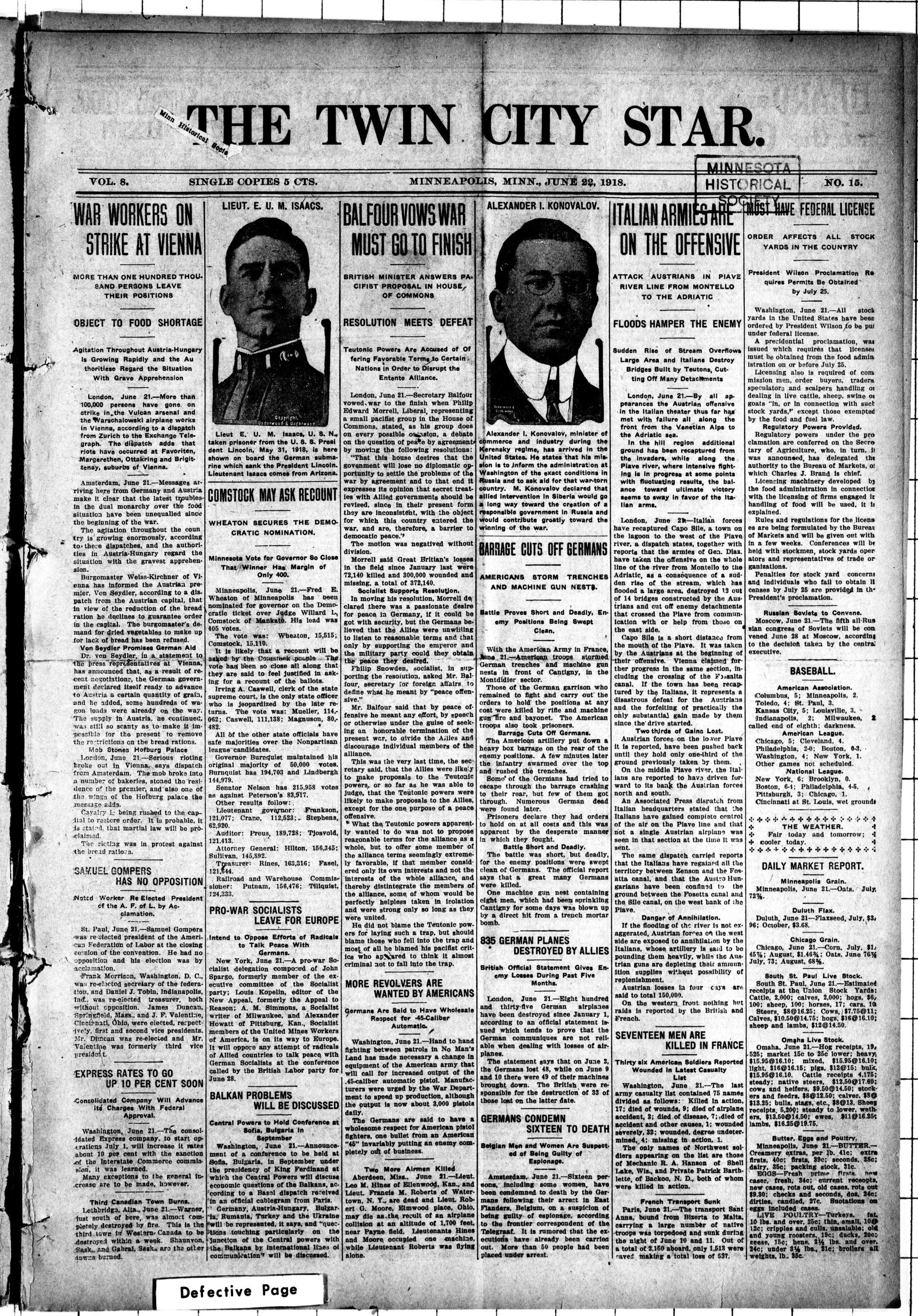
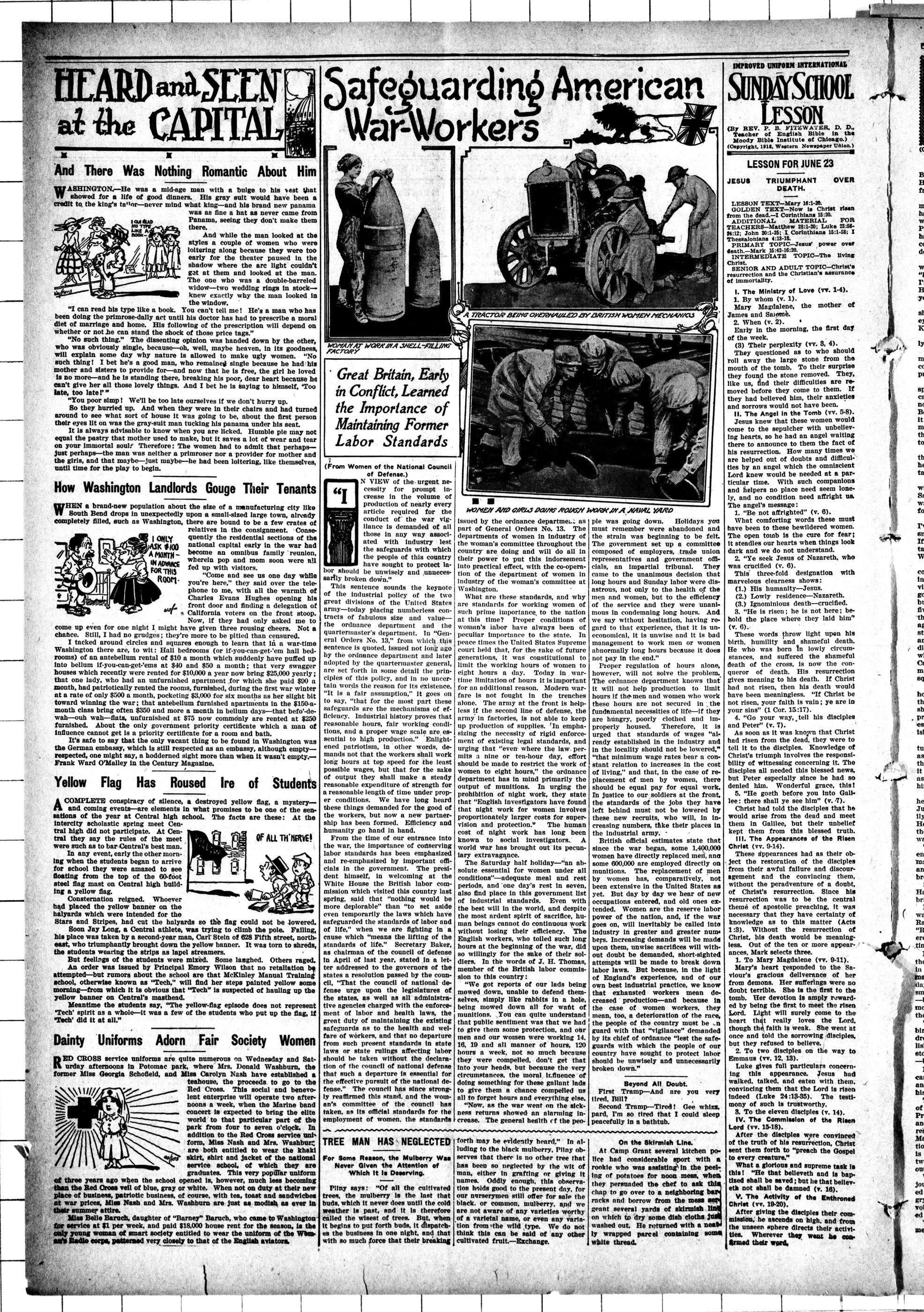
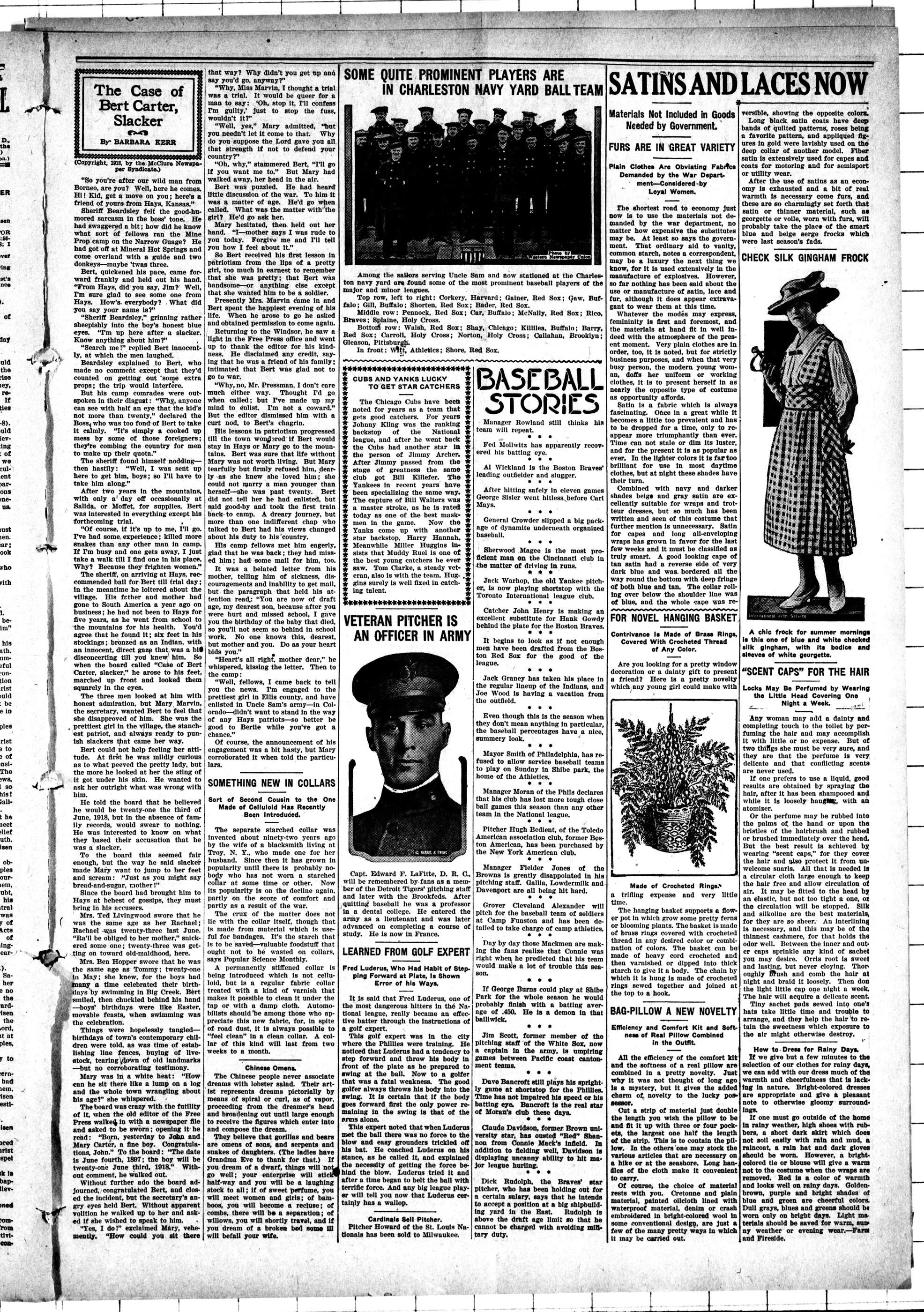
Page text (machine-generated)
THE TWIN CITY STAR.
WAR WORKERS ON STRIKE AT VIENNA
MORE THAN ONE HUNDRED THOU-
SAND PERSONS LEAVE
THEIR POSITIONS
OBJECT TO FOOD SHORTAGE
Agitation Throughout Austria-Hungary Is Growing Rapidly and the Au thoritiese Regard the Situation With Grave Apprehension
London, June 21.—More than 100,000 persons have gone on strike in the Vulcan arsenal and the Warschalowski airplane works in Vienna, according to a dispatch from Zurich to the Exchange Telegraph. The dispatch adds that riots have occurred at Favoriten, Margerethen, Ottakring and Brigittenay, suburbs of Vienna.
Amsterdam, June 21.—Messages arriving here from Germany and Austria make it clear that the latest troubles in the dual monarchy over the food situation have been unequalled since the beginning of the war.
The agitation throughout the country is growing enormously, according to these dispatches, and the authorities in Austria-Hungary regard the situation with the gravest apprehension.
Burgomaster Welss-Kirchner of Vienna has informed the Austrian premier, Von Seydler, according to a dispatch from the Austrian capital, that in view of the reduction of the bread ration he declines to guarantee order in the capital. The burgomaster's demand for dried vegetables to make up for lack of bread has been refused.
Von Seydler Promises German Aid Dr. von Seydler, in a statement to the press representatives at Vienna, has announced that, as a result of recent negotiations, the German government declared itself ready to advance to Austria a certain quantity of grain, and he added, some hundreds of wagon loads were already on the way. The supply in Austria, he continued, was still so scanty as to make it impossible for the present to remove the restrictions on the bread rations.
Mob Stones Hofburg Palace
London, June 21—Serious rioting broke out in Vienna, says dispatch from Amsterdam. The mob broke into a number of bakeries, stoned the residence of the premier, and also one of the wings of the Hofburg palace the message adds.
Cavalry is being rushed to the capital to restore order. It is probable, it is stated, that martial law will be proclaimed.
The rioting was in protest against the bread rations.
Noted Worker Re Elected President of the A. F. of L. by Ac-
St. Paul, June 21.—Samuel Gompers was re-elected president of the American Federation of Labor at the closing session of the convention. He had no opposition and his election was by acclamation.
Frank Morrison, Washington, D. C., was re-elected secretary of the federation, and Daniel J. Tobin, Indianapolis, Ind., was re-elected treasurer, both without opposition. James Duncan, Springfield, Mass., and J. F. Valentine, Cincinnati, Ohio, were elected, respectively, first and second vice presidents. Mr. Duncan was re-elected and Mr. Valentine was formerly third vice president.
EXPRESS RATES TO GO
UP 10 PER CENT SOON
Consolidated Company Will Advance Its Charges With Federal Approval.
Washington, June 21.—The consolidated Express company, to start operations July 1, will increase it rates about 10 per cent with the sanction of the Interstate Commerce commission, it was learned.
Many exceptions to the general increase are to be made, however.
Third Canadian Town Burns.
Lethbridge, Alta., June 21.—Warner, just south of here, was almost completely destroyed by fire. This is the third town in Western Canada to be destroyed within a week. Shaunvon, Sask., and Gabral, Sask., are the other towns burned.
Lleut E. U. M. Isaacs, U. S. N. taken prisoner from the U. S. S. President Lincoln, May 31, 1918, is here shown on board the German submarine which sank the President Lincoln. Lieutenant Isaacs comes from Arizona.
COMSTOCK MAY ASK RECOUNT
WHEATON SECURES THE DEMOCRATIC NOMINATION.
Minnesota Vote for Governor So Close
That Winner Has Margin of
Only 400.
Minneapolis, June 21.—Fred E. Wheaton of Minneapolis has been nominated for governor on the Democratic ticket over Judge Willard L. Comstock of Mankato. His lead was 405 votes.
The vote was: Wheaton, 15,515; Comstock, 15,110.
It is likely that a recount will be asked by the Comstock people. The vote has been so close all along that they are said to feel justified in asking for a recount of the ballots.
Irving A. Caswell, clerk of the state supreme court, is the only state officer who is jeopardized by the late returns. The vote was: Mueller, 114,062; Caswell, 111,138; Magnuson, 80,482.
All of the other state officials have safe majorities over the Nonpartisan league candidates.
Governor Burnquist maintained his original majority of 50,000 votes. Burnquist has 194,703 and Lindbergh 144,979.
Senator Nelson has 215,158 votes as against Peterson's 83,917.
Other results follow:
Lieutenant governor: Frankson, 121,077; Crane, 112,523; Stephens, 62,920.
Auditor: Preus, 189,728; Tjosvold,
121,413.
Attorney General: Hilton, 156,345;
Sullivan, 145,892.
Treasurer: Rines, 163,316; Fasel,
121,644.
Railroad and Warehouse Commission:
Putnam, 156,476; Tillquist,
124,332.
PRO-WAR SOCIALISTS LEAVE FOR EUROPE
Intend to Oppose Efforts of Radicals to Talk Peace With Germans.
New York, June 21.—A pro-war Socialist delegation composed of John Spargo, formerly member of the executive committee of the Socialist party; Louis Kopelin, editor of the New Appeal, formerly the Appeal to Reason; A. M. Simmons, a Socialist writer of Milwaukee, and Alexander Howatt of Pittsburg, Kan., Socialist members of the United Mines Workers of America, is on its way to Europe. It will oppose any attempt of radicals of Allied countries to talk peace with German Socialists at the conference called by the British Labor party for June 28.
BALKAN PROBLEMS
WILL BE DISCUSSED
Central Powers to Hold Conference at Sofia, Bulgaria in September
Washington, June 21.—Announcement of a conference to be held at Sofia, Bulgaria, in September under the presidency of King Ferdinand at which the Central Powers will discuss economic questions of the Balkans, according to a Bassil dispatch received in an official cablegram from Paris. Germany, Austria-Hungary, Bulgaria, Rumania, Turkey and the Ukraine will be represented, it says, and "questions touching particularly on the junction of the Central powers with the Balkans by international lines of communication" will be discussed.
Defective Page
MINNEAPOLIS, MINN., JUNE 22, 1918.
BALFOUR VOWS WAR MUST GO TO FINISH
BALFOUR VOWS WAR MUST GO TO FINISH
BRITISH MINISTER ANSWERS PA
CIFIST PROPOSAL IN HOUSE
OF COMMONS
RESOLUTION MEETS DEFEAT
Teutonic Powers Are Accused of Offering Favorable Terms to Certain Nations in Order to Disrupt the Entente Alliance.
London, June 21.—Secretary Balfour vowed, war to the finish when Philip Edward Morrell, Liberal, representing a small pacifist group in the House of Commons, stated, as his group does on every possible occasion, a debate on the question of peace by agreement by moving the following resolutions:
"That this house desires that the government will lose no diplomatic opportunity to settle the problems of the war by agreement and to that end it expresses its opinion that secret treaties with Allied governments should be revised, since in their present form they are inconsistent, with the object for which this country entered the war, and are, therefore, a barrier to democratic peace."
The motion was negatived without division.
Morrell said Great Britian's losses in the field since January last were 72,140 killed and 300,000 wounded and missing, a total of 372,140.
Socialist Supports Resolution.
In moving his resolution, Morrell declared there was a passionate desire for peace in Germany, if it could be got with security, but the Germans believed that the Allies were unwilling to listen to reasonable terms and that only by supporting the emperor and the military party could they obtain the peace they desired.
Philip Snowden, socialist, in supporting the resolution, asked Mr. Balfour, secretary for foreign affairs, to define what he meant by "peace offensive."
Mr. Balfour said that by peace offensive he meant any effort, by speech or otherwise under the guise of seeking an honorable termination of the present war, to divide the Allies and discourage individual members of the alliance.
This was the very last time, the secretary said, that the Allies were likely to make proposals to the Teutonic powers, or so far as he was able to judge, that the Teutonic powers were likely to make proposals to the Allies, except for the one purpose of a peace offensive.
What the Teutonic powers apparently wanted to do was not to propose reasonable terms for the alliance as a whole, but to offer some member of the alliance terms seemingly extremely favorable, if that member considered only its own interests and not the interests of the whole alliance, and thereby distintegrate the members of the alliance, some of whom would be perfectly helpless taken in isolation and were strong only so long as they were united.
He did not blame the Teutonic powers for laying such a trap, but should blame those who fell into the trap and most of all he blamed his pacifist critics who appeared to think it almost criminal not to fall into the trap.
MORE REVOLVERS ARE WANTED BY AMERICANS
Germans Are Said to Have Wholesale Respect for 45-Caliber Automatic.
Washington, June 21.—Hand to hand fighting between patrols in No Man's Land has made necessary a change in equipment of the American army that will call for increased output of the 45-caliber automatic pistol. Manufacturers were urged by the War Department to speed up production, although the output is now about 3,000 pistols daily.
The Germans are said to have a wholesome respect for American pistol fighters, one bullet from an American "45" invariably putting an enemy completely out of business.
Aberdeen, Miss., June 21.-Lieut. Leo M. Hines of Ellenwood, Kan., and Leut. Francis M. Roberts of Watertown, N. Y., are dead and Lieut. Robert G. Moore, Elmwood place, Ohio, may die as the result of an airplane collision at an altitude of 1,700 feet, near Payne field. Lieutenants Hines and Moore occupied one machine, while Lieutenant Roberts was flying alone.
ALEXANDER I. KONOVALOV.
MICHAEL E. C. CHAMBER
Alexander I. Konovalov, minister of commerce and industry during the Kerensky regime, has arrived in the United States. He states that his mission is to inform the administration at Washington of the exact conditions in Russia and to ask aid for that war-torn country. M. Konovalov declared that allied intervention in Siberia would go a long way toward the creation of a responsible government in Russia and would contribute greatly toward the winning of the war.
BARRAGE CUTS OFF GERMANS
AMERICANS STORM TRENCHES
AND MACHINE GUN NEST$.
Battle Proves Short and Deadly, Enemy Positions Being Swept Clean.
With the American Army in France, June 21.—American troops stormed German trenches and machine gun nests in front of Cantigny, in the Montdidier sector.
Those of the German garrison who remained to fight and carry out the orders to hold the positions at any cost were killed by rifle and machine gun fire and bayonet. The American troops also took prisoners.
Barrage Cuts Off Germans.
The American artillery put down a heavy box barrage on the rear of the enemy positions. A few minutes later the infantry swarmed over the top and rushed the trenches.
Some' of the Germians had tried to escape through the barrage crashing to their rear, but few of them got through. Numerous German dead were found later.
Prisoners declare they had orders to hold on at all costs and this was apparent by the desperate manner in which they fought.
Battle Short and Deadly.
The battle was short, but deadly, for the enemy positions were swept clean of Germans. The official report says that a great many Germans were killed.
One machine gun nest containing eight men, which had been sprinkling Cantigny for some days was blown up by a direct hit from a trench mortar bomb.
British Official Statement Gives Enemy Losses During Past Five Months.
London, June 21—Eight hundred and thirty-five German airplanes have been destroyed since January 1, according to an official statement issued which tends to prove that the German communiques are not reliable when dealing with losses of airplanes.
The statement says that on June 2, the Germans lost 48, while on June 9 and 10 there were 49 of their machines brought down. The British were responsible for the destruction of 33 of those lost on the latter date.
Belgian Men and Women Are Suspected of Being Guilty of Espionage.
Amsterdam, June 21.—Sixteen persons, including some women, have been condemned to death by the Germans following their arrest in East Flanders, Belgium, on a suspicion of being guilty of espionage, according to the frontier correspondent of the Telegraaf. It is rumored that the execution have already been carried out. More than 50 people had been placed under arrest.
MINNESOTA
HISTORICAL
ITALIAN ARMIES ARE ON THE OFFENSIVE
ATTACK AUSTRIANS IN PIAVE
RIVER LINE FROM MONTELLO
TO THE ADRIATIC
FLOODS HAMPER THE ENEMY
Sudden Rise of Stream Overflows
Large Area and Italians Destroy
Bridges Built by Teutons, Cutting Off Many Detachments
London, June 21.—By all appearances the Austrian offensive in the Italian theater thus far has met with failure all along the front from the Venetian Alps to the Adriatic sea.
In the hill region additional ground has been recaptured from the invaders, while along the Plave river, where intensive fighting is in progress at some points with fluctuating results, the balance toward ultimate victory seems to sway in favor of the Italian arms.
London, June 28—Italian forces have recaptured Capo Sile, a town on the lagoon to the west of the Plave river, a dispatch states, together with reports that the armies of Gen. Diaz. have taken the offensive on the whole line of the river from Montello to the Adriatic, as a consequence of a sudden rise of the stream, which has flooded a large area, destroyed 12 out of 14 bridges constructed by the Austrians and cut off enemy detachments that crossed the Plave from communication with or from those on the east side.
Capo Sile is a short distance from the mouth of the Plave. It was taken by the Austrians at the beginning of their offensive. Vienna claimed further progress in the same section, including the crossing of the Fossalia canal. If the town has been recaptured by the Italians, it represents a disastrous defeat for the Austrians and the forfeiting of practically the only substantial gain made by them since the drive started.
Two thirds of Gaira Lost.
Austrian forces on the lower Plave it is reported, have been pushed back until they hold only one-third of the ground previously taken by them.
On the middle Plave river, the Austrians are reported to have driven forward to its bank the Austrian forces north and south.
An Associated Press dispatch from Italian headquarters stated that the Italians have galned complete control of the air on the Plave line and that not a single Austrian airplane was seen in that section at the time it was sent.
The same dispatch carried reports that the Italians have regained all the territory between Zenson and the Fosatta canal, and that the Austro Hungarians have been confined to the ground between the Fosetta canal and the Sile canal, on the west bank of the Plave.
Danger of Annihilation.
If the flooding of the river is not exaggerated, Austrian forces on the west side are exposed to annihilation by the Italians, whose artillery is said to be pounding them heavily, while the Austrian guns are depleting their ammunition supplies without possibility of replenishment.
Austrian losses in four days are said to total 150,000.
On the western front nothing but raids is reported by the British and French.
SEVENTEEN MEN ARE
KILLED IN FRANCE
Thirty six American Soldiers Reported
Wounded in Latest Casualty
List
Washington, June 21.—The last
army casualty list contained 75 names
divided as follows: Killed in action,
17; died of wounds, 9; died of airplane
accident, 2; died of disease, 7; died of
accident and other causes, 1; wounded
severely, 32; wounded, degree undetermined,
4; missing in action, 1.
The only names of Northwest soldiers
appearing on the list are those of
Mechanic R. A. Hanson of Shell
Lake, Wis., and Private Patrick Barthlette, of Backoo, N. D., both of whom
were killed in action.
French Transport Sunk
Paris, June 21.—The transport Sant Anna, bound from Bizerta to Malta, carrying a large number of native troops was torpeded and sunk during the night of June 10 and 11. Out of a total of 2,150 aboard, only 1,513 were saved, making a total loss of 537.
MUST HAVE FEDERAL LICENSE
ORDER AFFECTS ALL STOCK
YARDS IN THE COUNTRY
President Wilson Proclamation Re
quires Permits Be Obtained
by July 25.
Washington, June 21.—All stock
yards in the United States have been
ordered by President Wilson to be put
under federal license.
A presidential proclamation, was
issued which requires that licenses
must be obtained from the food admin
istration on or before July 25.
Licensing also is required of com
mission men, order buyers, traders
speculators and scalpers handling or
dealing in live cattle, sheep, swine or
goats "in, or in connection with suct
stock yards," except those exempted
by the food and fuel law.
Regulatory Powers Provided.
Regulatory powers under the proclamation are conferred on the Secretary of Agriculture, who, in turn, it was announced, has delegated the authority to the Bureau of Markets, of which Charles J. Brand is chief.
Licensing machinery developed by the food administration in connection with the licensing of firms engaged in handling of food will be used, it is explained.
Rules and regulations for the licenses are being formulated by the Bureau of Markets and will be given out with in a few weeks. Conferences will be held with stockmen, stock yards operators and representatives of trade or organizations.
Penalties for stock yard concerns and individuals who fail to obtain 11 censes by July 25 are provided in the President's proclamation.
Russian Soviets to Convene.
Moscow, June 21—The fifth all-Russian congress of Soviets will be convened June 28 at Moscow, according to the decision taken by the central executive.
American Association.
Columbus, 5; Minneapolis, 2.
Toledo, 4; St. Paul, 3.
Kansas City, 5; Louisville, 3.
Indianapolis, 2; Milwaukee, 2
called end of eighth; darkness.
American League.
Chicago, 5; Cleveland, 4.
Philadelphia, 2-0; Boston, 0-3.
Washington, 4; New York, 1.
Other games not scheduled.
National League.
New York, 6; Brooklyn, 0.
Boston, 6-4; Philadelphia, 4-5.
Pittsburgh, 3; Chicago, 1.
Cincinnati at St. Louis, wet grounds
THE WEATHER.
Fair today and tomorrow;
cooler today.
DAILY MARKET REPORT.
Minneapolis Grain.
Minneapolis, June 21.—Oats, July,
72%.
Duluth Flax.
Duluth, June 21—Flaxseed, July, $3,
96; October, $3.68.
Chicago Grain.
Chicago, June 21—Corn, July, $1
45%; August, $1.46%; Oats, June 76%
July, 73; August, 68%.
South St. Paul Live Stock.
South St. Paul, June 21.—Estimated
receipts at the Union Stock Yards:
Cattle, 2,000; calves, 2,000; hogs, $6,
10; sheep, 100; horses, 17; cars, 10
Steers, $8@16.25; Cows, $7.75@11;
Calves, $10.50@14.75; hogs, $16.10;
sheep and lambs, $12@14.50.
Omaha Live Stock.
Omaha, June 21.—Hog receipts, 19,
525; market 15c to 25c lower; heavy,
$15.95@16.10; mixed, $15.95@16.10;
light, $16@16.15; plugs, $12@15; bulk,
$15.95@16.10. Cattle receipts 4.175;
steady; native steers, $12.50@17.60;
cows and heifers, $9.50@14.50; stockers
and feeders, $8@12.50; calves, $8@
12.25; bulls, stags, etc., $8@13. Sheep
receipts, 5.20; steady to lower, wethers,
$13.50@14.50; ewes, $11@16.25;
lambs, $16.25@19.75.
Butte Farm and Routt
Minneapolis, June 21.—BUTTER.—Creamery extras, per lb. 41c; extra firsts, 40c; firsts, 39c; seconds, 38c; dairy, 38c; packing stock, 31c.
EGGS—Fresh prime firsts, new cases, fresh, 34c; current reepsons, new cases, rots out, old cases, rots out $9.30; checks and seconds, dos, 24c; dirties, candled, 27c. Suctations on eggs included cases.
LIVE POULTRY—Turkeys, fat, 10 lbs. and over, 25c; thin, small, 10$^{12}$; cripples and culls, unsalable; old and young roosters, 19c; ducks, 20c; seese, 15c; hens, 3$^{12}$ lbs. and over, 24c; under 3$^{12}$ lbs., 21c; broilers all weights, lb. 35c.
BASEBALL.
Omaha Live Stock.
HEARD and SEEN at the CAPITAL
WASHINGTON.—He was a mid-age man with a bulge to his vest that showed for a life of good dinners. His gray suit would have been a credit to the king's ta'lor—never mind what king—and his brand new panama
"I can read his type like a book. You can't tell me! He's a man who has been doing the primrose-dally act until his doctor has had to prescribe a moral diet of marriage and home. His following of the prescription will depend on whether or not he can stand the shock of those price tags."
"No such thing." The dissenting opinion was handed down by the other, who was obviously single, because—oh, well, maybe heaven, in its goodness, will explain some day why nature is allowed to make ugly women. "No such thing! I bet he's a good man, who remained single because he had his mother and sisters to provide for—and now that he is free, the girl he loved is no more—and he is standing there, breaking his poor, dear heart because he can't give her all those lovely things. And I bet he is saying to himself, 'Too late, too late!'"
"You poor simp! We'll be too late ourselves if we don't hurry up.
So they hurried up. And when they were in their chairs and had turned around to see what sort of house it was going to be, about the first person their eyes lit on was the gray-suit man tucking his panama under his seat.
It is always advisable to know when you are licked. Humble pie may not equal the pastry that mother used to make, but it saves a lot of wear and tear on your immortal soul. Therefore: The women had to admit that perhaps—just perhaps—the man was neither a primroser nor a provider for mother and the girls, and that maybe—just maybe—he had been loitering, like themselves, until time for the play to begin.
How Washington Landlords Gouge Their Tenants
How Washington Landlords Gouge Their Tenants
WHEN a brand-new population about the size of a manufacturing city like South Bend drops in unexpectedly upon a small-sized large town, already completely filled, such as Washington, there are bound to be a few crates of
come up even for one night I might have given three rousing cheers. Not a chance. Still, I had no grudges; they're more to be pitted than censured.
I tacked around circles and squares enough to learn that in a war-time Washington there are, to wit: Hall bedrooms (or if-you-can-get'em hall bedrooms) of an antebellum rental of $10 a month which suddenly have puffed up into bellum if-you-can-get'em at $40 and $50 a month; that very swagger houses which recently were rented for $10,000 a year now bring $25,000 yearly; that one lady, who had an unfurnished apartment for which she paid $90 a month, had patriotically rented the rooms, furnished, during the first war winter at a rate of only $500 a month, pocketing $3,000 for six months as her slight bit toward winning the war; that antebellum furnished apartments in the $150-a-month class bring often $350 and more a month in bellum days—that befo'wah—ouh wah—flats, unfurnished at $75 now commonly are rented at $250 furnished. About the only government priority certificate which a man of influence cannot get is a priority certificate for a room and bath.
It's safe to say that the only vacant thing to be found in Washington was the German embassy, which is still respected as an embassy, although empty—respected, one might say, a hoddered sight more than when it wasn't empty.—Frank Ward O'Malley in the Century Magazine.
Yellow Flag Has Roused Ire of Students
A COMPLETE conspiracy of silence, a destroyed yellow flag, a mystery—and coming events—are elements in what promises to be one of the sensations of the year at Central high school. The facts are these: At the intercity scholastic spring meet Cen-
Stars and Stripes, had cut the halyards so the flag could not be lowered. Soon Jay Long, a Central athlete, was trying to climb the pole. Falling, his place was taken by a second-year man, Carl Stein of 628 Fifth street, northeast, who triumphantly brought down the yellow banner. It was torn to shreds, the students wearing the strips as lapel streamers.
But feelings of the students were mixed. Some langhed. Others raged. An order was issued by Principal Emory Wilson that no retaliation be attempted—but rumors about the school are that McKinley Manual Training school, otherwise known as "Tech," will find her steps painted yellow some morning—from which it is obvious that "Tech" is suspected of hauling up the yellow banner on Central's masthead.
Meantime the students say, "The yellow-flag episode does not represent 'Tech' spirit as a whole—it was a few of the students who put up the flag, if 'Tech' did it at all."
Dainty Uniforms Adorn Fair Society Women
RED CROSS service uniforms are quite numerous on Wednesday and Saturday afternoons in Potomac park, where Mrs. Donald Washburn, the former Miss Georgia Schofield, and Miss Carolyn Nash have established a
of three years ago when the school opened is, however, much less becoming than the Red Cross veil of blue, gray or white. When not on duty at their new place of business, patriotic business, of course, with tea, toast and sandwiches at war prices, Miss Nash and Mrs. Washburn are just as modish as ever in their summer attire.
Miss Belle Baruch, daughter of "Barney" Baruch, who came to Washington for service at $1 per week, and paid $18,000 house rent for the season, is the only young woman of smart society entitled to wear the uniform of the Woman's Radio corps, patterned very closely to that of the English aviators.
I CAN READ
NO TYPE
LIKE A
BOOK.
"I can read his type like a book. We been doing the primrose-dally act until diet of marriage and home. His follow whether or not he can stand the shock "No such thing." The dissenting who was obviously single, because—o will explain some day why nature is such thing! I bet he's a good man, w mother and sisters to provide for—and is no more—and he is standing there, can't give her all those lovely things. late, too late!" "You poor simp! We'll be too late. So they hurried up. And when the around to see what sort of house it their eyes lit on the gray-suit man. It is always advisable to know who equal the pastry that mother used to on your immortal soul! Therefore: The just perhaps—the man was neither a p the girls, and that maybe—just maybe until time for the play to begin.
How Washington Landlord
WHEN a brand-new population about South Bend drops in unexpectedly completely filled, such as Washington,
I ONLY
ASK $100
A MONTH-
IN ADVANCE
FOR THIS
ROOM.
come up even for one night I might be chance. Still, I had no grudges; they're I tacked around circles and squam Washington there are, to wilt: Hall rooms) of an antebellum rental of $10 into bellum if-you-can-get-ems at $40 houses which recently were rented for that one lady, who had an unfurnished month, had patriotically rented the room at a rate of only $500 a month, pocketkin toward winning the war; that antebellum month class bring often $350 and more wah—ouh wah—flats, unfurnished at furnished. About the only government influence cannot get is a priority certi It's safe to say that the only vacant the German embassy, which is still respected, one might say, a hooded Frank Ward O'Malley in the Century I
Yellow Flag Has Ro
A COMPLETE conspiracy of silence, and coming events—are elements of the year at Central high intercity scholastic spring meet Central high did not participate. At Central they say the rules of the meet were such as to har Central's best man
In any event, early the other morning when the students began to arrive for school they were amazed to see floating from the top of the 60-foot steel flag mast on Central high building a yellow flag. Consternation reigned. Whoever had placed the yellow banner on the halyards which were intended for the
Stars and Stripes, had cut the halys
Soon Jay Long, a Central athlete,
his place was taken by a second-year me
east, who triumphantly brought down t
the students wearing the strips as lap.
But feelings of the students were
An order was issued by Principal
attempted—but rumors about the sch
school, otherwise known as "Tech," w
morning—from which it is obvious that
yellow banner on Central's masthead
Meantime the students say, "The
'Tech' spirit as a whole—it was a few
'Tech' did it at all."
Dainty Uniforms Adorn
RED CROSS service uniforms are qu
urday afternoons in Potomac par
former Miss Georgia Schofield, and
miles
of three years ago when the school or then the Red Cross vell of blue, gray or place of business, patriotic business, or at war prices, Miss Nash and Mrs. W their summer attire.
Miss Belle Baruch, daughter of "B for service at $1 per week, and paid $ only young woman of smart society en an's Radio corps, patterned very closely
Safeguarding American War-Workers
A TRACTOR BEING OVERHAULED BY BRITISH WOMEN MECHANICS
You can't tell me! He's a man who has his doctor has had to prescribe a moral living of the prescription will depend on of those price tags." Opinion was handed down by the other, well, maybe heaven, in its goodness, is allowed to make ugly women. "No who remained single because he had his now that he is free, the girl he loved breaking his poor, dear heart because he And I bet he is saying to himself, 'Too ourselves if we don't hurry up. They were in their chairs and had turned was going to be, about the first person tucking his panama under his seat. When you are licked. Humble plea may not make, but it saves a lot of wear and tear the women had to admit that perhaps—rimroser nor a provider for mother and—he had been loitering, like themselves,
Words Gouge Their Tenants
(From Women of the National Council of Defense.)
N VIEW of the urgent necessity for prompt increase in the volume of production of nearly every article required for the conduct of the war vigilance is demanded of all those in any way associated with industry lest the safeguards with which the people of this country have sought to protect labor should be unwisely and unnecessarily broken down."
This sentence sounds the keynote of the industrial policy of the two great divisions of the United States army—today placing numberless contracts of fabulous size and value—the ordnance department and the quartermaster's department. In "General Orders No. 13," from which this sentence is quoted, issued not long ago by the ordnance department and later adopted by the quartermaster general, are set forth in some detail the principles of this policy, and in no uncertain words the reason for its existence, "It is a fair assumption," it goes on to say, "that for the most part these safeguards are the mechanisms of efficiency. Industrial history proves that reasonable hours, fair working conditions, and a proper wage scale are essential to high production." Enlightened patriotism, in other words, demands not that the workers shall work long hours at top speed for the least possible wages, but that for the sake of output they shall make a steady reasonable expenditure of strength for a reasonable length of time under proper conditions. We have long heard these things demanded for the good of the workers, but now a new partnership has been formed. Efficiency and humanity go hand in hand.
have given three rousing cheers. Not a
a more to be pitted than censured.
Does enough to learn that in a war-time
bedrooms (or if-you-can-get`em hall bed-
a month which suddenly have puffed up
and $50 a month; that very swagger
$10,000 a year now bring $25,000 yearly;
and apartment for which she paid $90 a
mas, furnished, during the first war winter
g $3,000 for six months as her slight bit
um furnished apartments in the $150-a
月 in bellum days—that befo`de-
$75 now commonly are rented at $250
at priority certificate which a man of
cate for a room and bath.
At thing to be found in Washington was
ejected as an embassy, although empty—
light more than when it wasn't empty.—
Magazine.
Used Ire of Students
In a destroyed yellow flag, a mystery—
in what promises to be one of the sen-
chool. The facts are these: At the
ordinary quartermaster
oral Order
sentence is by the order
adopted by
are set for cibles of the tain words
"It is a f a f to say, "it
safeguards ficiency. I
reasonable tions, and
sentinel to ened patri
mands not long hours
possible w of output
reasonable a reasonab
er condition these thing
the worker
ship has b
From the time of our entrance into the war, the importance of conserving labor standards has been emphasized and re-emphasized by important officials in the government. The president himself, in welcoming at the White House the British labor commission which visited this country last spring, said that "nothing would be more deplorable" than "to set aside even temporarily the laws which have safeguarded the standards of labor and of life," when we are fighting in a cause which "means the lifting of the standards of life." Secretary Baker, as chairman of the council of defense in April of last year, stated in a letter addressed to the governors of the states a resolution passed by the council, "That the council of national defense urge upon the legislatures of the states, as well as all administrative agencies charged with the enforcement of labor and health laws, the great duty of maintaining the existing safeguards as to the health and welfare of workers, and that no departure from such present standards in state laws or state rulings affecting labor should be taken without the declaration of the council of national defense that such a departure is essential for the effective pursuit of the national defense." The council has since strongly reaffirmed this stand, and the woman's committee of the council has taken, as its official standards for the employment of women, the standards
ards so the flag could not be lowered. was trying to climb the pole. Falling, man, Carl Stein of 628 Fifth street, north-nine yellow banner. It was torn to shreds, el streamers. mixed. Some laughed. Others raged. Emory Wilson that no retaliation be ool are that McKinley Manual Training will find her steps painted yellow some "Tech" is suspected of hauling up the yellow-flag episode does not represent of the students who put up the flag, if Fair Society Women quite numerous on Wednesday and Sat, where Mrs. Donald Washburn, the Miss Carolyn Nash have established a even temp safeguards of life," we cause while standards as chairmrs in April of ter address states a rea ction, "That fense urge the states, tive agen ment of great duty safeguards fare of woe from such laws or s should be be tion of the that such
For Some Reason, the Mulberry Was Never Given the Attention of Which It is Deserving.
opened is, however, much less becoming white. When not on duty at their new course, with tea, toast and sandwiches ashburn are just as modish as ever in Barney" Baruch, who came to Washington 18,000 house rent for the season, is theitled to wear the uniform of the Wem-to that of the English aviators.
Pliny saw trees, the buds, which weather is called the it begins to es the bush with so mu
Pliny says: "Of all the cultivated trees, the mulberry is the lust that buds, which it never does until the cold weather is past, and it is therefore called the wisest of trees. But, when it begins to put forth buds, it dispatches the business in one night, and that with so much force that their breaking
was as fine a hat as never came from Panama, seeing they don't make them there.
And while the man looked at the styles a couple of women who were loitering along because they were too early for the theater paused in the shadow where the arc light couldn't get at them and looked at the man. The one who was a double-barreled widow—two wedding rings in stock—knew exactly why the man looked in the window.
t the size of a manufacturing city like upon a small-sized large town, already there are bound to be a few crates of relatives in the consignment. Consequently the residential sections of the national capital early in the war had become an omnibus family reunion, wherein pop and mom soon were all fed up with visitors.
"Come and see us one day while you're here," they said over the telephone to me, with all the warmth of Charles Evans Hughes opening his front door and finding a delegation of California voters on the front stoop. Now, if they had only asked me to
OF ALL TH'NERVE!
teahouse, the proceeds to go to the Red Cross. This social and benevolent enterprise will operate two afternoons a week, when the Marine band concert is expected to bring the elite world to that particular part of the park from four to seven o'clock. In addition to the Red Cross service uniform, Miss Nash and Mrs. Washburg are both entitled to wear the khaki skirt, shirt and jacket of the national service school, of which they are graduates. This very popular uniform
Great Britain, Early in Conflict, Learned the Importance of Maintaining Former Labor Standards
N VIEW of the urgent necessity for prompt increase in the volume of production of nearly every article required for the conduct of the war vigilance is demanded of all those in any way associated with industry lest the safeguards with which the people of this country have sought to protect la-
THE
WOMEN AND GIRLS DOING ROUGH WORK IN A NAVAL YARD issued by the ordinance department as part of General Orders No. 13. The departments of women in industry of the woman's committee throughout the country are doing and will do all in their power to put this indorsement into practical effect, with the co-operation of the department of women in industry of the woman's committee at Washington. ple was going down. must remember were at the strain was beginnin The government set up composed of employers, representatives and政 ials, an impartial tril came to the unanimous long hours and Sunday in astrostr, not only to the
What are these standards, and why are standards for working women of such prime importance, to the nation at this time? Proper conditions of woman's labor have always been of peculiar importance to the state. In peace times the United States Supreme court held that, for the sake of future generations, it was constitutional to limit the working hours of women to eight hours a day. Today in wartime limitation of hours it is important for an additional reason. Modern warfare is not fought in the trenches alone. The army at the front is helpless if the second line of defense, the army in factories, is not able to keep up production of supplies. 'In emphasizing the necessity of rigid enforcement of existing legal standards, and urging that "even where the law permits a nine or ten-hour day, effort should be made to restrict the work of women to eight hours," the ordnance department has in mind primarily the output of munitions. In urging the prohibition of night work, they state that "English investigators have found that night work for women involves proportionately larger costs for supervision and protection." The human cost of night work has long been known to social investigators. A world war has brought out its peculiar extravagance.
The Saturday half holiday—"an absolute essential for women under all conditions"—adequate meal and rest periods, and one day's rest in seven, also find place in this government list of industrial standards. Even with the best will in the world, and despite the most ardent spirit of sacrifice, human belings cannot do continuous work without losing their efficiency. The English workers, who toiled such long hours at the beginning of the war, did so willingly for the sake of their soldiers. In the words of J. H. Thomas, member of the British labor commission to this country:
"We got reports of our lads being mowed down, unable to defend themselves, simply like rabbits in a hole, being mowed down all for want of munitions. You can quite understand that public sentiment was that we had to give them some protection, and our men and our women were working 14, 16, 19 and all manner of hours, 120 hours a week, not so much because they were compelled, don't get that into your heads, but because the very circumstances, the moral influence of doing something for these gallant lads to give them a chance compelled us all to forget hours and everything else.
"Now, as the war went on the sickness returns showed an alarming increase. The general health of the peo forth may be evidently heard." In alluding to the black mulberry, Pliny observes that there is no other tree that has been so neglected by the wit of man, either in grafting or giving it names. Oddly enough, this observation holds good to the present day, for our nurserymen still offer for sale the black, or common, mulberry, and we are not aware of any varieties worthy of a varietal name, or even any variation from the wild type. We do not think this can be said of any other cultivated fruit—Exchange.
ple was going down. Holidays you must remember were abandoned and the strain was beginning to be felt. The government set up a committee composed of employers, trade union representatives and government officials, an impartial tribunal. They came to the unanimous decision that long hours and Sunday labor were disastrous, not only to the health of the men and women, but to the efficiency of the service and they were unanimous in condemning long hours. And we say without hesitation, having regard to that experience, that it is uneconomical, it is unwise and it is bad management to work men or women abnormally long hours because it does not pay in the end."
Proper regulation of hours alone, however, will not solve the problem. The ordinance department knows that it will not help production to limit hours if the men and women who work these hours are not secured in the fundamental necessities of life—if they are hungry, poorly clothed and improperly housed. Therefore, it is urged that standards of wages "already established in the industry and in the locality should not be lowered," "that minimum wage rates bear a constant relation to increases in the cost of living," and that, in the case of replacement of men by women, there should be equal pay for equal work. In justice to our soldiers at the front, the standards of the jobs they have left behind must not be lowered by these new recruits, who will, in increasing numbers, take their places in the industrial army.
British official estimates state that since the war began, some 1,400,000 women have directly replaced men, and some 600,000 are employed directly on munitions. The replacement of men by women has, comparatively, not been extensive in the United States as yet. But day by day we hear of new occupations entered, and old ones extended. Women are the reserve labor power of the nation, and, if the war goes on, will inevitably be called into industry in greater and greater numbers. Increasing demands will be made upon them, unwise sacrifices will without doubt be demanded, short-sighted attempts will be made to break down labor laws. But because, in the light of England's experience, and of our own best industrial practice, we know that exhausted workers mean decreased production—and because in the case of women workers, they mean, too, a deterioration of the race, the people of the country must be guard with that "vigilance" demanded by its chief of ordinance "test the safeguards with which the people of our country have sought to protect labor should be unwisely and unnecessarily broken down."
Beyond All Doubt.
First Tramp—And are you very tired, Bill?
Second Tramp—Tired! Gee whizz, pard, I'm so tired that I could sleep peacefully in a bathtub.
At Camp Grant several kitchen police had considerable sport with a rookie who was assisting in the peeling of potatoes for noon mess, when they persuaded the chef to ask this chap to go over to a neighboring barracks and borrow from the mess segeant several yards of skirmish line on which to dry some dish clothes just washed out. He returned with a neatly wrapped parcel containing some white thread.
SUNDAY SCHOOL LESSON
(By REV. P. B. FITZWATER, D. D.
Teacher of English Bible in the
Moody Bible Institute of Chicago.)
(Copyright, 1918, Western Newspaper Union.)
LESSON FOR JUNE 23
LESSON TEXT—Mary 15:1-6:
GOLDEN TEXT—Now is Christ risen
from the dead.—I Corinthians 15:20:
ADDITIONAL MATERIAL
FOR TEACHERS
Matthew 21:1-20; Luke 23:56-
24:12; John 20:1-5; I Corinthians 15:1-58; I
Thessalonians 4:12-18;
MARY TOPIC—Jesus’ power over
death.—Mark 15:24-16:20:
INTERMEDIATE TOPIC—The living
SENIOR AND ADULT TOPIC-Christ's resurrection and the Christian's assurance of immortality.
1. The Ministry of Love (vv. 1-4).
1. By whom (v. 1).
Mary Magdalene, the mother of James and Saimee.
2. When (v. 2).
Early in the morning, the first day of the week.
(3) Their perplexity (vv. 3, 4).
They questioned as to who should roll away the large stone from the mouth of the tomb. To their surprise they found the stone removed. They like us, find their difficulties are removed before they come to them. If they had believed him, their anxieties and sorrows would not have been.
II. The Angel in the Tomb (vv. 5-8).
Jesus knew that these women would come to the sepulcher with unbelieving hearts, so he had an angel waiting there to announce to them the fact of his resurrection. How many times we are helped out of doubts and difficulties by an angel which the omniscient Lord knew would be needed at a particular time. With such companions and helpers no place need seem lonely, and no condition need affright us. The angel's message:
1. "Be not affrighted" (v. 6).
What comforting words these must have been to these bewildered women. The open tonb is the cure for fear; it steadles our hearts when things look dark and we do not understand.
2. "Ye seek Jesus of Nazareth, who was crucified (v. 6). This three-fold designation with marvelous clearness shows:
(1.) His humanity—Jesus.
(2.) Lowly residence—Nazareth.
(3.) Ignominious death—crucified.
"He is risen; he is not here; behold the place where they laid him" (v. 6).
These words throw light upon his birth, humility and shameful death. He who was born in lowly circumstances, and suffered the shameful death of the cross, is now the conqueror of death. His resurrection gives meaning to his death. If Christ had not risen, then his death would have been meaningless. "If Christ be not risen, your faith is vain; ye are in your sins" (1 Cor. 15:17).
4. "Go your way, tell his disciples and Peter" (v. 7).
As soon as it was known that Christ had risen from the dead, they were to tell it to the disciples. Knowledge of Christ's triumph involves the responsibility of witnessing concerning it. The disciples all needed this blessed news, but Peter especially since he had so denied him. Wonderful grace, this! 5. "He gooth before you into Galilee: there shall ye see him" (v. 7). Christ had told the disciples that he would arise from the dead and meet them in Galilee, but their unbelief kept them from this blessed truth. III. The Appearances of the Risen Christ (vv. 9-14).
These appearances had as their object the restoration of the disciples from their awful failure and discouragement and the convincing them, without the peradventure of a doubt, of Christ's resurrection. Since his resurrection was to be the central theme of apostolic preaching, it was necessary that they have certainty of knowledge as to this matter (Acts 1:3). Without the resurrection of Christ, his death would be meaningless. Out of the ten or more appearances, Mark selects three.
1. To Mary Magdalene (vv. 9-11).
Mary's heart responded to the Saviour's gracious deliverance of her from demons. Her sufferings were no doubt terrible. She is the first to the tomb. Her devotion is amply rewarded by being the first to meet the risen Lord. Light will surely come to the heart that really loves the Lord, though the faith is weak. She went at once and told the sorrowing disciples, but they refused to believe.
2. To two disciples on the way to Emmaus (vv. 12, 13).
Luke gives full particulars concerning this appearance. Jesus had walked, talked, and eaten with them, convincing them that the Lord is risen indeed (Luke 24:13-35). The testimony of such is trustworthy.
3. To the eleven disciples (v. 14).
IV. The Commission of the Risen Lord (vv. 15-18).
After the disciples were convinced of the truth of his resurrection, Christ sent them forth to "preach the Gospel to every creature."
What a glorious and supreme task is this! "He that believeth and is baptized shall be saved; but he that believeth not shall be damned (v. 16).
V. The Activity of the Enthroned Christ (vv. 19-20).
After giving the disciples their commission, he ascends on high, and from the unseen sphere directs their activities. Wherever they went he conferred their word.
The Case of Bert Carter, Slacker
By BARBARA KERR
(Copyright, 1918, by the McClure Newspaper Syndicate.)
"So you're after our wild man from Borneo, are you? Well, here he comes. Hi! Kid, get a move on you; here's a friend of yours from Hays, Kansas."
Sheriff Beardsley felt the good-humored sarcasm in the boss' tone. He had swaggered a bit; how did he know what sort of fellows ran the Mine Prop camp on the Narrow Guage? He had got off at Mineral Hot Springs and come overland with a guide and two donkeys—maybe 'twas three.
Bert, quickened his pace, came forward frankly and held out his hand. "From Hays, did you say, Jim? Well, I'm sure glad to see some one from Hays. How's everybody? What did you say your name is?
"Sheriff Beardsley," grinning rather sheepishly into the boy's honest blue eyes. "I'm up here after a slacker. Know anything about him?
"Search me!" replied Bert innocently, at which the men laughed.
Beardsley explained to Bert, who made no comment except that they'd counted on getting out 'some extra props; the trip would interfere.
But his camp comrades were outspoken in their disgust: "Why, anyone can see with half an eye that the kid's not more than twenty," declared the Boss, who was too fond of Bert to take it calmly. "It's simply a cooked up mess by some of those foreigners; they're combing the country for men to make up their quota."
The sheriff found himself nodding—then hastily: "Well, I was sent up here to get him, boys; so I'll have to take him along."
After two years in the mountains, with only a day off occasionally at Salida, or Moffet, for supplies, Bert was interested in everything except his forthcoming trial.
"Of course, if it's up to me, I'll go. I've had some experience; killed more snakes than any other man in camp. If I'm busy and one gets away, I just take a walk till I find one in his place. Why? Because they frighten women."
The sheriff, on arriving at Hays, recommended ball for Bert till trial in the meantime he loitered about the village. His father and mother had gone to South America a year ago on business; he had not been to Hays for five years, as he went from school to the mountains for his health. You'd agree that he found it; six feet in his stockings; bronzed as an Indian, with an innocent, direct gaze that was a big disconcerting till you knew him. So when the board called "Case of Bert Carter, slacker," he arose to his feet, marched up front and looked them squarely in the eyes.
The three men looked at him with honest admiration, but Mary Marvin, the secretary, wanted Bert to feel that she disapproved of him. She was the prettiest girl in the village, the stanchest patriot, and always ready to punish slackers that came her way.
Bert could not help feeling her attitude. At first he was mildly curious as to what peeved the pretty lady, but the more he looked at her the sting of it got under his skin. He wanted to ask her outright what was wrong with him.
He told the board that he believed he would be twenty-one the third of June, 1918, but in the absence of family records, would swear to nothing. He was interested to know on what they based their accusation that he was a slacker.
To the board this seemed fair enough, but the way he said slacker made Mary want to jump to her feet and scream: "Just as you might say bread-and-sugar, mother!"
Since the board had brought him to Hays at behest of gossips, they must bring in his accusers.
Mrs. Ted Livingwood swore that he was the same age as her Rachel; Rachael was twenty-three last June. "Ra'll be obliged to her mother," snuckered some one; twenty-three was getting on toward old-maldhood, here.
Mrs. Ben Hopper swore that he was the same age as Tommy; twenty-one in May; she knew, for the boys had many a time celebrated their birthdays by swimming in Big Creek. Bert smiled, then chuckled behind his hand—boys' birthdays were like Easter, movable feasts, when swimming was the celebration.
Things were hopelessly tangled—birthdays of town's contemporary children were told, as was time of establishing line fences, buying of livestock, tearing down of old landmarks—but no corroborating testimony.
Mary was in a white heat: "How can he sit there like a lump on a log and the whole town wrangling about his age?" she whispered. The board was crazy with the futility of it, when the old editor of the Free Press walked in with a newspaper file and asked to be sworn; opening it he read: "Born, yesterday to John and Mary Carter, a fine boy. Congratulations, John." To the board: "The date is June fourth, 1897; the boy will be twenty-one June third, 1918." Without comment, he walked out. Without further ado the board adjourned, congratulated Bert, and closed the incident, but the secretary's angry eyes held Bert. Without apparent volition he walked up to her and asked if she wished to speak to him. "Yes, I do!" exclaimed Mary, vehemently. "How could you sit there
that way? Why didn't you get up and say you'd go, anyway?
"Why, Miss Marvin, I thought a trial was a trial. It would be queer for a man to say: 'Oh, stop it, I'll confess I'm guilty,' just to stop the fuss, wouldn't it?"
"Well, yes," Mary admitted, "but you needn't let it come to that. Why do you suppose the Lord gave you all that strength if not to defend your country?"
"Oh, why," stammered Bert, "I'll go if you want me to." But Mary had walked away, her head in the air. Bert was puzzled. He had heard little discussion of the war. To him it was a matter of age. He'd go when called. What was the matter with the girl? He'd go ask her.
Mary hesitated, then held out her hand. "I—mother says I was rude to you today. Forgive me and I'll tell you how I feel about it."
So Bert received his first lesson in patriotism from the lips of a pretty girl, too much in earnest to remember that she was pretty; that Bert was handsome—or anything else except that she wanted him to be a soldier. Presently Mrs. Marvin came in and Bert spent the happiest evening of his life. When he arose to go he asked and obtained permission to come again. Returning to the Windsor, he saw a light in the Free Press office and went up to thank the editor for his kindness. He disclaimed any credit, saying that he was a friend of his family; intimated that Bert was glad not to go to war.
"Why, no, Mr. Pressman, I don't care much either way. Thought I'd go when called; but I've made up my mind to enlist. I'm not a coward." But the editor dismissed him with a curt nod, to Bert's chargin.
His lessons in patriotism progressed till the town wongered if Bert would stay in Hays or Mary go to the mountains. Bert was sure that life without Mary was not worth living. But Mary tearfully but firmly refused him, dearly as she knew she loved him; she could not marry a man younger than herself—she was past twenty. Bert did not tell her he had enlisted, but said good-by and took the first train back to camp. A dreary journey, but more than one indifferent chap who talked to Bert had his views changed about his duty to his country.
His camp fellows met him eagerly, glad that he was back; they had missed him; had some mall for him, too.
It was a belated letter from his mother, telling him of sickness, discouragements and inability to get mall, but the paragraph that held his attention read: "You are now of draft age, my dearest son, because after you were hurt and missed school, I gave you the birthday of the baby that died, so you not seem so behind in school work. No one knows this, dearest, but mother and you. Do as your heart bids you."
"Heart's all right, mother dear," he whispered, kissing the letter. Then to the camp:
"Well, fellows, I came back to tell you the news. I'm engaged to the prettiest girl in Ellis county, and have enlisted in Uncle Sam's army—in Colorado—didn't want to stand in the way of any Hays patrols—so better be good to Bertie while you've got a chance."
Of course, the announcement of his engagement was a bit hasty, but Mary corroborated it when told the particulars.
SOMETHING NEW IN COLLARS
Sort of Second Cousin to the One Made of Celluloid Has Recently Been Introduced.
The separate starched collar was invented about ninety-two years ago by the wife of a blacksmith living at Troy, N. Y., who made one for her husband. Since then it has grown in popularity until there is probably nobody who has not worn a starched collar at some time or other. Now its popularity is on the decline again, partly on the score of comfort and partly as a result of the war.
The crux of the matter does not lie with the collar itself, though that is made from material which is useful for bandages. It's the starch that is to be saved—valuable foodstuff that ought not to be wasted on collars, says Popular Science Monthly.
A permanently stiffened collar is being introduced which is not celluloid, but is a regular fabric collar treated with a kind of varnish that makes it possible to clean it under the tap or with a damp cloth. Automobilists should be among those who appreciate this new fabric, for, in spite of road dust, it is always possible to "feel clean" in a clean collar. A collar of this kind will last from two weeks to a month.
Chinese Omens
The Chinese people never associate dreams with lobster salad. Their artist represents dreams pictorially by means of spiral or curl, as of vapor, proceeding from the dreamer's head and broadening out until large enough to receive the figures which enter into and compose the dream.
They believe that gorillas and bears are omens of sons, and serpents and snakes of daughters. (The ladies have Grandma Eve to thank for that.) If you dream of a dwarf, things will not go well; your enterprise will stick half-way and you will be a laughing stock to all; if of sweet perfume, you will meet women and girls; of bamboos, you will become a reclusive; of combs, there will be a separation; of willows, you will shortly travel, and if you dream of a broken bed some ill will befail your wife.
SOME QUITE PROMINENT PLAYERS ARE IN CHARLESTON NAVY YARD BALL TEAM
Photo by
Western Newspaper Union
Among the sailors serving Uncle Sam and now stationed at the Charleston navy yard are found some of the most prominent baseball players of the major and minor leagues.
Top row, left to right: Corkery, Harvard, Gainer, Red Sox; Gaw, Buffalo; Gill, Buffalo; Shorten, Red Sox; Bader, Red Sox.
Middle row: Pennock, Red Sox; Car, Buffalo; McNally, Red Sox; Rico, Braves; Splaine, Holy Cross.
Bottom row: Walsh, Red Sox; Shay, Chicago; Killilea, Buffalo; Barry, Red Sox; Carroll, Holy Cross; Norton, Holy Cross; Callahan, Brooklyn; Gleason, Pittsburgh.
In front: Witt, Athletics; Shore, Red Sox.
CUBS AND YANKS LUCKY
TO GET STAR CATCHERS
The Chicago Cubs have been noted for years as a team that gets good catchers. For years Johnny Kling was the ranking backstop of the National league, and after he went back the Cubs had another star in the person of Jimmy Archer. After Jimmy passed from the stage of greatness the same club got Bill Killefer. The Yankees in recent years have been specializing the same way. The capture of Bill Walters was a master stroke, as he is rated today as one of the best maskmen in the game. Now the Yanks come up with another star backstop, Harry Hannah, meanwhile Miller Huggins insists that Muddy Ruel is one of the best young catchers he ever saw. Tom Clarke, a steady veteran, also is with the team. Huggins surely is well fixed in catching talent.
---
VETERAN PITCHER IS AN OFFICER IN ARMY
© HARBOR & ENWINS
Capt. Edward F. LaFitte, D. R. C. will be remembered by fans as a member of the Detroit Tigers' pitching staff and later with the Brookfeds. After quitting baseball he was a professor in a dental college. He entered the army as a lieutenant and was later advanced on completing a course of study. He is now in France.
LEARNED FROM GOLF EXPERT
Fred Luderus, Who Had Habit of Step ping Forward at Plate, Is Shown Error of his Ways.
It is said that Fred Luderus, one of the most dangerous hitters in the National league, really became an effective batter through the instructions of a golf expert.
This golf expert was in the city where the Phillies were training. He noticed that Luderus had a tendency to step forward and throw his body in front of the plate as he prepared to swing at the ball. Now to a golfer that was a fatal weakness. The good golfer always throws his body into the swing. It is certain that if the body goes forward first the only power remaining in the swing is that of the erus alone.
This expert noted that when Luderus met the ball there was no force to the blow and easy grounders trickled off his bat. He coached Luderus on his stance, as he called it, and explained the necessity of getting the force behind the blow. Luderus tried it and after a time began to belt the ball with terrific force. And any big league player will tell you now that Luderus certainly has a wallop.
Cardinals Sell Pitcher
Pitcher Howard of the St. Louis Nationals has been sold to Milwaukee.
BASEBALL STORIES
Manager Rowland still thinks his team will repeat.
* * * *
Fed Mollwitz has apparently recovered his batting eye.
* * * *
Al Wickland is the Boston Braves' leading outfielder and slugger.
* * * *
After hitting safely in eleven games George Sisler went hitless before Carl Mays.
* * * *
General Crowder slipped a big package of dynamite underneath organized baseball.
* * * *
Sherwood Magee is the most proficient man on the Cincinnati club in the matter of driving in runs.
* * * *
Jack Warhop, the old Yankee pitcher, is now playing shortstop with the Toronto International league club.
Catcher John Henry is making an excellent substitute for Hank Gowdy behind the plate for the Boston Braves.
* * * *
It begins to look as if not enough men have been drafted from the Boston Red Sox for the good of the league.
* * * *
Jack Graney has taken his place in the regular lineup of the Indians, and Joe Wood is having a vacation from the outfield.
* * * *
Even though this is the season when they don't mean anything in particular, the baseball percentages have a nice, summery look.
* * * *
Mayor Smith of Philadelphia, has refused to allow service baseball teams to play on Sunday in Shibe park, the home of the Athletics.
Manager Moran of the Philis declares that his club has lost more tough close ball games this season than any other team in the National league.
Pitcher Hugh Bedient, of the Toledo American association club, former Boston American, has been purchased by the New York American club.
Manager Fielder Jones of the Browns is greatly disappointed in his pitching staff. Gallia, Lowdermilk and Davenport are all being hit hard.
Grover Cleveland Alexander will pitch for the baseball team of soldiers at Camp Funston and has been detailed to take charge of camp athletics.
Day by day those Mackmen are making the fans realize that Connie was right when he predicted that his team would make a lot of trouble this season.
---
If George Burns could play at Shibe Park for the whole season he would probably finish with a batting average of .450. He is a demon in that balliwick.
* * *
Jim Scott, former member of the pitching staff of the White Sox, now a captain in the army, is umpluring games between Pacific coast cantonment teams.
* * *
Dave Bancroft still plays his sprightly game at shortstop for the Phillies. Time has not impaired his speed or his batting eye. Bancroft is the real star of Moran's club these days.
* * *
Claude Davidson, former Brown university star, has ousted "Red" Shannon from Connie Mack's infield. In addition to fielding well, Davidson is displaying uncanny ability to hit major league hurling.
Dick Rudolph, the Braves' star pitcher, who has been holding out for a certain salary, says that he intends to accept a position at a big shipbuilding yard in the East. Rudolph is above the draft age limit so that he cannot be charged with avoiding military duty.
SATINSANDLACESNOW
Materials Not Included in Goods Needed by Government.
FURS ARE IN GREAT VARIETY
Plain Clothes Are Obviating Fabrics Demanded by the War Department—Considered-by Loyal Women.
The shortest road to economy just now is to use the materials not demanded by the war department, no matter how expensive the substitutes may be. At least so says the government. That ordinary aid to vanity, common starch, notes a correspondent, may be a luxury the next thing we know, for it is used extensively in the manufacture of explosives. However, so far nothing has been said about the use or manufacture of satin, lace and fur, although it does appear extravagant to wear them at this time.
Whatever the modes may express, femininity is first and foremost, and the materials at hand fit in well indeed with the atmosphere of the present moment. Very plain clothes are in order, too, it is noted, but for strictly business purposes, and when that very busy person, the modern young woman, doffs her uniform or working clothes, it is to present herself in as nearly the opposite type of costume as opportunity affords.
Satin is a fabric which is always fascinating. Once in a great while it becomes a little too prevalent and has to be dropped for a time, only to reappear more triumphantly than ever. Time can not stale or dim its luster, and for the present it is as popular as ever. In the lighter colors it is far too brilliant for use in most daytime clothes, but at night these shades have their turn.
Combined with navy and darker shades beige and gray satin are excellently suitable for wraps and troteur dresses, but so much has been written and seen of this costume that further mention is unnecessary. Satin for capes and long all-enveloping wraps has grown in favor for the last few weeks and it must be classified as truly smart. A good looking cape of tan satin had a reverse side of very dark blue and was bordered all the way round the bottom with deep fringe of both blue and tan. The collar rolling over below the shoulder line was of blue, and the whole cape was re-
FOR NOVEL HANGING BASKET
Contrivance Is Made of Brass Rings. Covered With Crocheted Thread of Any Color.
Are you looking for a pretty window decoration or a dainty gift to present a friend? Here is a pretty novelty which any young girl could make with
```markdown
```
Made of Crocheted Rings
a trifling expense and very little time.
The hanging basket supports a flower pot in which grow some pretty ferns or blooming plants. The basket is made of brass rings covered with crocheted thread in any desired color or combination of colors. The basket can be made of heavy cord crocheted and then varnished or dipped into thick starch to give it a body. The chain by which it is hung is made of crocheted rings sewed together and joined at the top to a hook.
BAG-PILLOW A NEW NOVELTY
Efficiency and Comfort Kit and Softness of Real Pillow Combined in the Outfit.
All the efficiency of the comfort kit and the softness of a real pillow are combined in a pretty novelty. Just why it was not thought of long ago is a mystery, but it gives the added charm of novelty to the lucky possessor.
Cut a strip of material just double the length you wish the pillow to be and fit it up with three or four pockets, the largest one half the length of the strip. This is to contain the pillow. In the others one may stock the various articles that are necessary on a hike or at the seashore. Long handles of the cloth make it convenient to carry.
Of course, the choice of material rests with you. Cretonne and plain material, painted oilcloth lined with waterproof material, denim or crash embroidered in bright-colored wool in some conventional design, are just a few of the many pretty ways in which it may be carried out.
versible, showing the opposite colors. Long black satin coats have deep bands of quilted patterns, roses being a favorite pattern, and appliqued figures in gold were lavishly used on the deep collar of another model. Fiber satin is extensively used for capes and coats for motoring and for semisport or utility wear. After the use of satins as an economy is exhausted and a bit of real warmth is necessary come furs, and these are so charmingly set forth that satin or thinner material, such as georgette or volle, worn with furs, will probably take the place of the smart blue and beige serge frocks which were last season's fads.
CHECK SILK GINGHAM FROCK
International Film Service
A chic frock for summer mornings is this one of blue and white checked silk gingham, with its bodice and sleeves of white gorgette.
"SCENT CAPS" FOR THE HAIR
Locks May Be Perfumed by Wearing the Little Head Covering One Night a Week.
Any woman may add a dainty and completing touch to the toilet by perfuming the hair and may accomplish it with little or no expense. But of two things she must be very sure, and they are that the perfume is very delicate and that conflicting scents are never used.
If one prefers to use a liquid, good results are obtained by spraying the hair, after it has been shampooed and while it is loosely hanging, with an atomizer.
Or the perfume may be rubbed into the palms of the hand or upon the bristles of the hairbrush and rubbed or brushed immediately over the head. But the best result is achieved by wearing "scent caps," for they cover the hair and also protect it from unwelcome snarls. All that is needed is a circular cloth large enough to keep the hair free and allow circulation of air. It may be fitted to the head by an elastic, but not too tight a one, or the circulation will be stopped. Silk and silkoline are the best materials, for they are so sheer. An interlining is necessary, and this may be of the thinnest cashmere, for that holds the odor well. Between the inner and outer caps sprinkle any kind of sachet you may desire. Orris root is sweet and lasting, but never cloying. Thoroughly brush and comb the hair at night and braid it loosely. Then don the light little cap one night a week. The hair will acquire a delicate scent.
Tiny sachet pads sewed into one's hats take little time and trouble to arrange, and they help the hair to retain the sweetness which exposure to the air might otherwise destroy.
How to Dress for Rainy Days
If we give but a few minutes to the selection of our clothes for rainy days, we can add with our dress much of the warmth and cheerfulness that is lacking in nature. Bright-colored dresses are appropriate and give a pleasant note to otherwise gloomy surroundings.
If one must go outside of the home in rainy weather, high shoes with rubbers, a short dark skirt which does not soil easily with rain and mud, a raincoat, a rain hat and dark gloves should be worn. However, a bright-colored tie or blouse will give a warm not to the costume when the wraps are removed. Red is a color of warmth and looks well on rainy days. Golden-brown, purple and bright shades of blue and green are cheerful colors. Dull grays, blues and greens should be worn only on bright days. Light materials should be saved for warm, sunny weather or evening wear.—Farm and Flireside.
THIS FIRE SALE A SENSATION
Everyone Surprised at the Trifling Damage Still More Surprised at the Tempting Prices
BUY YOUR SUMMER OUTFIT NOW AT FIRE SALE SAVINGS
Dresses, Suits, Coats, Millinery, Gloves, Bathing Suits, Undermuslins, Blouses, Corsets, Underwear, Etc. A$94,000 Stock---Ladies' High Grade Ready to Wear SPECIAL BARGAINS EVERY DAY DURING SALE
PUBLSHED EVERY FRIDAY BY
CHARLES SUMNER SMITH,
Minneapolis, Minnesota.
Entered in the Post Office at Minneapolis as second class matter.
MEMBER
NATIONAL NEGRO PRESS
ASSOCIATION
Subscription by Mail, Postpaid.
ONE YEAR .....$2.00
SIX MONTHS .....$125
THREE MONTHS .....65
ADVERTISING RATES.
One Inch—1 Insertion—One Dollar.
Liberal discount given on 3, 6, 9,
Months, or 1 year contracts.
We do not run free ads, or over-run
the time contracted for by our ad-
vertisers. We respect their right to
advertise at intervals, and rather have
them do so, than to run continuously
an "adv." and an increasing account.
Write all Checks payable to
Call at 1317 6th Ave. N. on Wednesday to insure matter for publication. The Star's Phone, Hyland 1205. Send your subscription. Our prices have not changed because of the war. Let your dollar do its duty and The Star will reach a higher standard of service and better circulation.
ELECTION RESULTS.
The primary election returns were very satisfactory to most of the loyal voters of Minnesota. Gov. Burnquist and the state officials were nominated. The elimination of Congressman Lundeen by Hon. Walter Newton was the repudiation of Mr. Lundeen's affiliation with the Socialist and Non-Partisan parties, which endorsed him. Congressman Schall was a long-distance winner. The Advocate, a Negro weekly, was the only newspaper in the entire district which attacked his record. Hon. Frank M. Nye was nominated for the District Bench in this city. Atty. W. M. Nash will contend for county attorney and it looks like a victory for him at the general election. Former Police Chief Martinson led Sheriff Langum for that office and both left the Socialist candidate, Lynn Thompson, far behind. Hon. Thomas Kneeland, a true friend of the Negroes, was defeated for Senator from the Fifth and Sixth wards. Atty. Harry L. Scott, the Negro candidate for legislature, got on the ticket. He will have a hard fight at the general election, because of his defense of the primary law, upon which a fight is being made for its repeal. Joseph Dahl of the Sixth ward will try to succeed Albert Bastis, the present alderman, defeating Chris Anderson, a former alderman, who will unite with Dahl to defeat Mr. Bastis, the Socialist.
Mayor Van Lear and J. E. Meyers were nominated for mayor. Each received about one-third of the votes cast, and Conroy, Warham, Tift, Gulfford and Williams followed in respective order. The fall election will be a fierce contest. There is a probability that there will be other candidates by petition. The Non-Partisan and Townley element met utter defeat, carrying with them every hope of party power, which they expected to gain at next election.
Lindbergh, their candidate for governor, was eliminated, and Burnquist will be the next governor.
THE ADVOCATE ATTACKS SCHALL
The following clipping is from the Weekly Advocate, edited by ex-convict R. B. Montgomery and Phil F. Hale, who has been a candidate for Still water for several years. They maliciously tried to secure a few votes from the new arrivals who were not familiar with Congressman Schall's record for a few dollars. The Advocate has been boosting various city and state officials for police protection only. They have shown their standing as newspaper publishers, and it is the official organ of many evil influences. In these days, when clean journalism is an economic factor, there is no need for garbage barrel publications. Such highwaymen may hold up politicians for a while, but they are being found out.
The issue for Representative in Congress in 10th District is plain, every colored vote should be cast for Fred D. McMillan, 100 per cent American, a true representative of the Republican party. Schall has proved a traitor to the trust imposed in him. He has voted time after time for the Democratic party, a party that has always stood out against the Negro. Help save the party by nominating McMillan for Congress from the 10th District.—The Weekly Advocate.
Pres. B. S. Smith of the local branch of the National Association for the Advancement of Colored People (of which Mr. Schall is a member of the executive committee), has informed our Congressman that the Association resents this attack as a gross injustice from an ingrate.
The Twin City Star stands for equal rights for all American citizens.
AGAIN, IT IS GEORGIA.
The Negro Soldier in the Trenches—His Folks at Home in the "Black Belt."
"He gave a magnificent example of courage and energy," says a French General of Division of Private Henry Johnson, U. S. A., colored. "A good and brave soldier," he says of Needham Roberts, also colored, whose life Johnson saved. "Both men fought bravely," says General Pershing in his official communique. Together though both severely wounded, they beat off an attack by twenty Germans in a listening post, forcing them to flee. For their splendid initiative, valor and determination the Croix de Guerre has been awarded them; to Johnson the gold palm also.
Upon the same page of The World that described this feat of arms appeared a dispatch from Valdosta, Ga., telling how Mary Turner, colored, was hanged by a mob. For the crime of killing a white man and wounding his wife, two men had been lynched last week. Mrs. Turner was the fourth victim, her husband preceding her by a few hours. The murder plot was supposed to have been made in her home; she "was said to have had the dead farmer's watch" when captured. Legal evidence against her there was none; even the lynch-law testimony, not subject to cross-examination, was worthless and inconclusive.
In France two Negro volunteers, badly wounded, give an example of courage and energy in the defense of democracy which is deemed worthy of citation before a whole army division and by General Pershing. In one of the leading states of the South a negro woman is put to death by a mob, without companionship of her sex, without evidence or plea, in defiance of law and justice.
With tens of thousands of American Negroes fighting for civilization in France under the American flag, how much longer are the American people to tolerate Negro lynchings?—New York World.
ESTATE TOTALS $2,150,000
C. W. Fairbanks' Will Provides $50,000 for Welfare Work
Indianapolis, June 21.—A trust fund of $50,000 to be held for 500 years, the income from which is to be divided each 50 years and expended for social welfare work, is set aside from the estate of the late Charles W. Fairbanks, former vice president of the United States, as a memorial to his wife by his will, filed for probate here. The value of his estate is estimated at $2,150,000.
A number of charitable bequests are made in the will.
THE TWIN CITY STAR, MINNEAPOLIS, MINN.
ROOT & HAGEMAN
403-5-7 NICOLLET AVENUE
It is just this way—the stock received only a slight sprinkle of water, a puff of smoke, and all was over. The insurance companies have paid us liberally; enough so that we can now sell you a pretty dress or hat or blouse at ONE-FOURTH, ONE-THIRD, ONE-HALF regular prices. That's a big item in these times. Come.
The following clipping is from one of the leading papers of Western Canada.
WHY THIS OUTCRY AGAINST THE NEGRO?
Editor, The Herald:—
The attention of the readers of The Calgary Daily Herald, both broad and narrow thinkers within the city of Calgary and province of Alberta, is called to analyze the true conditions of the labor question, which is causing so much animosity by the colored men replacing the white ones in the dining car capacity.
One could readily believe more antagonistic remarks could not have been anticipated had the heretofore white crews been replaced by Huns themselves.
We seem to forget we are striving to maintain democracy. We also fail to view the fact that intelligence is the shaping of every man's destiny. Can we, within our hearts, deny these men who have proved themselves as loyal as any race, with such a catastrophe facing us, the rights to such an insignificant position as has caused this dispute, when we ourselves have closed the doors to him of more intelligent positions which he is capable of holding?
As true democrats let us for a moment remove the veil of prejudice and view him from an angle of his true worth; they have more than proven their loyalty to the U. S. A., under conditions I will not mention. France found in them such loyalty and patriotism that her standing army of 200,000 consisted of them. Has France had cause to regret it? No. Let us recall at the outbreak of the war his anxiety to prove his loyalty and patriotism to Canada. Our hearts were so against him, he was plainly told, "This is the white man's war." Since the adoption of the draft law, some of these very same men have been called to the colors. This same rejected man will, at present, and must in future prove himself capable of holding any position the white man holds if allowed the chance.
So let us as true democrats cease our hostilities towards him, which is based on account of his color; grant him what the future must give—the right of an equal chance.
SYMPATHIZER.
The Calgary Daily Herald.
CANNOT ESCAPE WAR TAXES
Washington, June 21.—Consideration in Germany of legislation to prevent emigration after the war to evade payment of the heavy taxes that must then be levied already is being considered, according to information reaching the State department.
Enactment of a law requiring persons liable to personal taxes to leave 20 per cent of their taxable property in Germany in event of emigration has been proposed.
A WOMAN'S SUCCESS IN RESEARCH WORK
Mrs. Lillian A. Turner of St. Paul, Minn., the only Negro student to receive a degree from the University of Minnesota this year, was one of the twenty-three students recently elected to Phi Beta Kappa, the honorary academic fraternity. This is the first time that this university has conferred such an honor on a student of our race, therefore this election marks the beginning of a new era for Negro students who may enroll in the university. They may always have hope that true merit will be recognized.
Mrs. Turner finished her academic work in three and a half years with the degree of Bachelor of Arts with honors, a degree requiring a higher general average and more intensive work than the straight Bachelor of Arts degree. On the basis of the excellency of her thesis Mrs. Turner was sent by the department of Anthropology and Sociology of the University to do research work at Wilberforce University. Since her return Mrs. Turner has been doing intensive work in the graduate school of the University of Minnesota.
DISGRACED AGAIN
There is never any excuse for lynching. The recent murderous outburst in Georgia against Negroes, rightly or wrongly suspected of crime, has disgraced our civilization and brought the blush of shame to national pride. So far as the facts have been brought to light, it appears to be one of the cases in which even the pretense of an excuse was lacking.
Americans who have any appreciation of what we are fighting Germany for in this great world war, are profoundly ashamed of those who were guilty of this crime. The splendid record our Negro soldiers are making in France adds greatly to our humiliation when we read of the brutal lynchings of their brothers at home. Sectional and national prejudices are being obliterated by the war, and the same ought to be true of race prejudices.—Minneapolis Journal.
We are living in an age and an epoch which is characterized by a growing and insistent demand for justice and democracy. The United States is sending men, money and munitions to the battle fields of Europe'as its demand for justice, freedom and equality of opportunity for all peoples, and it would be well for the Americans at this time to remember that here in our own country for the past fifty years since the abolition of slavery, is a race loyal, patriotic people who are not enjoying at the hands of this government here at home the principles of that democracy for which we are fighting to make the world safe, and in which light God helping us, we will be victorious.
YOU ARE INVITED TO THE
Ladies Minstrel Festival
FOR THE BENEFIT OF THE
Colored Y. M. C. A.
at Pillsbury Settlement House
15th Ave. S. and 4th St., Minneapolis
TUESDAY, JUNE 25, 1918.
UNDER AUSPICES OF THE BOARD OF CONTROL
Will S. Simmons, Chairman.
Osa A. Lawrence, Secretary.
COMMISSIONS NEGRO
MINNESOTA HOME GUARD
Commissions have been signed for the following Staff Officers: JOSE H. SHERWOOD—Major.
ROBERT L. ROBINSON—First Lieutenant and Adjutant.
tenant and Adjutant.
GEORGE L. HOAGE—First Lieutenant and Supply Officer.
ARTHUR J. TODD—First Lieutenant
and Ordnance Officer.
DR. VALDO TURNER—Captain, Medical Corps.
DR. JAMES H. REDD—First Lieutenant Medical Corps.
Major Sherwood has appointed Ira S. Ashe Battalion Sergeant Major.
Company "B" elected officers following Captain Sherwood's promotion to Major.
We have never known two injustices to make anything right. The Saturday News has prospered by being as just to the white man as it has ever been to the Negro. We have never gone off half-cocked upon any proposition. Whenever we grope, we are in search of the truth. We want to be right and avoid as nearly as possible being wrong. We are not for the Negro right or wrong. We want him to be right. We complain because a majority of white people will always side with a white man when a question arises between him and one of our color; still certain colored newspapers, without making any investigation whatsoever as to the evidence, would have the entire Negro race do identically what they condemn the white people for doing. Be cause the white people do wrong is no reason why the Negroes should do wrong. The best preparedness to receive justice is to be just yourself.—Hopkinsville (Ky.) Nows.
U. S. GUNS MAKE ENEMY FLEE
Yankees Gain Nearly Mile of Area In Heavy Cannonading.
With the Americans on the Marne, June 21.—The Americans squeezed the Germans out of a salient a kilometer (two-thirds of a mile) deep and the same distance in width, west of Torcy (six miles northwest of Chateau Thierry).
The Germans did not remain to fight after they were struck by a barrage, and when they the infantry went forward there was no one to oppose them.
German casualties in the fighting in this sector are now estimated at 800 killed and 5,000 wounded.
Private James A. Donohue, who was taken prisoner some days ago, escaped and rejoined his company. He declared other American prisoners are compelled by the foe to work in the front line. Donohue also said he saw Germans burying their dead, 20 to a grave, in crosswise layers.
COMPANY "D" DRILL.
The members of Company D. 16th Battailon, M. H. G., are ordered to report at headquarters in the city hall on Monday evening, beginning May 20th, and on each Monday thereafter until further notice, for company drill and instructions.
Charles Sumner Smith,
Captain Commanding Co. D.
Two Aviators Killed
Springfield, Ohio, June 21.—Leut. Frank Stewart Patterson of Dayton, Ohio, and Lieut. Deroy Swan, of Norwich, Conn., were instantly killed at the Wilbur Wright aviation field between this city and Dayton when their airplane collapsed in midair. At an altitude of about 10,000 feet the pilot, Patterson lost control of his machine after going into a swift dive.
"THE REPUBLICAN' PARTY IS THE SHIP; ALL ELSE IS THE SEA," said Frederick Douglass. Now is the most important time for Negroes to stand by the old party of Lincoln and Grant. Keep Minnesota a Republican State. LOCAL NEWS
IMPORTANT NOTICE
Unless notes are written plainly and properly arranged they will not be inserted. Many people send in notes regardless of names, initials or composition. Arrangement by the publisher will be charged for. Free notices must be correctly written.
THE WAY TO MAKE MONEY.
If you wish to add to your income, you can do so by accepting an agency for The Twin City Star. Good commission to competent agents. Use your spare time in soliciting ads and subscriptions. Only honest and intelligent agents wanted. Call Hyland 1205.
The Masonic Lodges will observe St. John's Day on Sunday, June 23rd, at Bethseda Baptist church. Rev. Beasley will preach the sermon.
Mr. John Cheatham is very sick at his residence, 3020 20th Ave. So.
Rev. H. P. Jones, former pastor of St. James A. M. E. church, St. Paul, is expected to visit the Twin Cities this month.
AMES LODGE ELECTS OFFICERS
AMES LODGE ELECTS OFFICERS
At the last regular meeting of Ames
Lodge No. 1, B. P. O. E. of W., held on
June 11, the following officers were
elected: Exalted ruler, Wm. Cratic;
E. L. K., Fuller Thompson; E. L. K.
Joseph Sizer; E. L. K. N. Stone; treasurer,
Wm. Stirman; financial secretary,
W. R. Morris; tilter, Ross Hamilton;
trustee, L. Tischner. Several new candidates for membership will be initiated at the next meeting on June 25th.
Mr. L. B. Greer, formerly of St.
Paul, now employed on a private car
of the U. S. Steel Corporation, was a
visitor in St. Paul last week for
medical treatment. He attended the election
at Gopher lodge, of which he is
a Past Exalted Ruler, and took an
active part for John F. Coquire, who
was elected Exalted Ruler.
Mr. F. L. Brown, labor agent at the Pennsylvania railroad in New York City, is visiting his sister, Mrs. Cora Currie, 849 Albemarie St., St. Paul. A reception was held in his honor at Union Hall on Wednesday night.
Mr. J. E. Perry, the printer, underwent a successful operation for appenditis at the City Hospital.
Mr. Harry Brown, of Chicago, brother of Mrs. C. H. Robinson, 225 W. 39th St., will spend the winter here to attend Central High school.
Mr. and Mrs. David R. Francis have moved to 511 Aldrich Ave. N.
Mrs. Martha Eaton, of Indianapolis, is visiting Mr. and Mrs. Arthur Todd of 56 W. Fourth St., St. Paul.
Police Officer J. Chas. Kelso is on his annual vacation. "Charlie" usually takes a trip in the country, where he can enjoy a good rest and a summer outing.
Mrs. Geo. P. Simms is at Annandale for the summer.
Mrs. Gladys Smith left Friday night for Leavenworth, Kan., to visit her aunt, Miss Jennie Hayden, who is very ill. Sergt. Roy Smith, her husband, sailed for France with the 366th Regiment last Saturday.
Mrs. Myrtle Claughton DeVaughn of Los Angeles, Cal., is visiting her aunt, Mrs. Belle Barnard, who is ill in Des Moines, Iowa. Mrs. DeVaughn expects to visit here before returning home.
Misses Jennie and Ovina Stone of Des Meines are visiting their uncle, Mr. Andy Claughton, and wife at 504 Fourth Ave. S.
EASTERN STAR.
Delegates to Grand Chapter.
Mrs. Luther Abbey; Mrs. Bettie Anderson, Mrs. Agnes Eddings, Mrs. Mattie Neal and Jno. N. Sellers are attending the Grand Chapter of Eastern Star, Iowa Jurisdiction, which is held at Waterloo, Iowa, this week. They represent Pride of the West Chapter of Minneapolis.
Miss Delphina Thompson, the daughter of Mr. and Mrs. Thompson of Clinton avenue south, who is attending Wilberforce university, is here spending the summer vacation with her parents.
A reception in honor of Mr. Arthur Jewell Wilson will be held June 28 at the residence of Mrs. Wilkins, 2044 Crystal Lake Ave. N. Mr. Wilson is a teacher in St. Peter's Sunday School and the faculty and members are expressing their appreciation of his services by a public reception from 4 p. m. to 10 p. m.
"ENLIST OR WORK" CAMPAIGN.
The military authorities intend to push the enlist or work campaign among the Negroes. There are many idlers who have no lawful means of support. They will be drafted into the industrial army. Get work, gentlemen of leisure, even if as a side line.
NEGRO DELEGATES TO LABOR CONVENTION
There were four delegates to the convention of the American Federation of Labor, held in St. Paul. They were: Geo. W. Millner, of Coal Trimmers' Local No. 15277, A. F. L., of Newport News, Va.; F. J. Chinn, representing the Central Labor Body, of New Orleans, La.; T. J. Woodland, of New Orleans, La., third vice president, International Longshoremen's Association; and B. F. Lancaster, of Mobile, Ala., representing the Labor and Helpers' Union of Shipyard Workers. Delegate Woodland is a member of the "Shorter Day" committee. These men are given every respect accorded others, and are in every way qualified to protect their race along labor lines.
M.
MRS. MARY B. TALBERT, PRESIDENT NATIONAL ASSOCIATION OF COLORED WOMEN'S CLUBS, BUFFALO, N. Y.
National President of the Women's Federated Clubs Visits Twin Cities.
Mrs. Mary E. Talbert, national president of the Afro-American Women's Federated Clubs, spoke at several meetings in the Twin Cities. She is on her way to Denver, Colo., where the annual meeting will be held. Mrs. Talbert is collecting money to clear the indebtedness on the home of Hon. Fred Douglass, which will be a historical museum for the Negro race. She has been well received during her stay in Minnesota and is doing what she can to harmonize the club workers. Mrs. Talbert is a woman of great personality and executive ability, a logical speaker and national organizer, Her lecture, "The Colored Woman's Part in the World War," should be heard by everyone. She describes the conditions in the Southland and the noble work among Negro women for national defense. The mortgage on the home of Douglass has been paid, and funds now collected are for the restoration and furnishing of the building and grounds, which are situated on Anacosta Heights, Washington, D. C. This will be the national headquarters for the Federated Afro-American Women's Clubs and the shrine of all tourists who wish to see the interesting relics of slavery days and will contain everything which goes to make complete the history of the American Negro. At the Denver gathering the burning of the mortgage will be one of the special features.
DEATH OF AN OLD RESIDENT
Mrs. Gibbs Pleasants died at her residence, 3028 Twenty-first Ave. S., on June 8. She was 61 years old. Funeral services were held in Lakewood Chapel on June 10. Rev. D. E. Beasley preached the sermon. She was born in Richmond, Va., and was formerly a member of Ebenezer Baptist church, was married 34 years ago to her husband, who survives her. They came to Minneapolis to reside 20 years ago, and were among the respected citizens of this city.
A CARD OF THANKS.
Minneapolis, Minn., June 13, 1918.
I wish to express my heartfelt thanks to my many friends for the kindness and sympathy shown me during the sickness and death of my beloved wife and also for the beautiful floral offerings.
GIBBS PLEASANTS,
3028 Twenty-first Ave. S.
DEATH OF IDA DORSEY.
Mrs. Ida Dorsey, who has been suffering several months from cancer, died at her residence on June 18th. Funeral services were held June 21 from Amors Parlors. Rev. Stovall officiated.
READ THIS CAREFULLY.
If you receive a newspaper by mail and do not wish to pay for it, just refuse it by informing your postman. Then it will be returned to the publisher and he will be notified to discontinue sending it. There is no reason why a person should pay for a paper forced on them, but every reason why it should be paid for when ordered and accepted.
Are you a delinquent subscriber?
If so, why not send your subscription?
THE TWIN CITY STAR, MINNEAPOLIS, MINN.
FIRST COLORED Y. M. C. A.
OPENED FOR INSPECTION
The home of the Colored Y. M. C. A., located at 1012 South Sixth St., was opened for inspection on Tuesday evening, June 18th. The ceremonies were simple, but impressive and inspiring. W. S. Simmons, chairman of the Board of Control, announced the speakers. He said that a committee of seven had arranged for the rent of the building, and for the opening. Encouraging speeches were made by Rev. T. B. Stovell, Presiding Elder Higgins, Mr. Homer Cannon, Editor Smith, and Attorneys Harry L. Scott and B. S. Smith, who was the principal speaker. Mr. Smith cautioned against solicitation for aid by questionable persons. There was a good attendance. Osa A. Lawrence, the secretary, asked for memberships, and donations of furnishings for the building. The Twin City Star headed the list of donors. Refreshments were served. The Y. M. C. A. is being started under the most favorable conditions. Let everyone be a booster.
HELP THE Y. M. C. A.
This Offer Expires August 1, 1918.
One dollar will be given to the Colored Y. M. C. A. in this city for every paid annual subscription to the Twin City Star. (Editor).
SUBSCRIBE NOW.
BATTALION PARADE AND
BALL A BIG SUCCESS
The splendid showing by the Minneapolis Companies-C and D of the Minnesota Home Guards in the Flag Bay parade, June 14th, was apparent by the generous applause received along the line of march. Major Jose H. Sherwood of St. Paul led the battalion, Adj. Robt. L. Robinson commanding. Mr. Solomon Saunders, who was to marshal the civic division, rode on a spirited charger and displayed remarkable horsemanship. The fraternities and civic organizations failed to respond to the invitation to participate. The Companies C and D were under command of Capt. Gale C. Hilyer and Chas. Sumner Smith. Many complimentary reports have been received on the appearance of the companies while passing the reviewing stand at the Parade grounds, on which were seated Gov. Burnquist and staff and Pres. Samuel Gompers and other noted persons, among them Ex-Govs. Samuel Van Sant and John Lind, and Billy Williams of the governor's office.
The Military Reception.
The military reception held in the evening was attended by many of the most respectable ladies, who were interested in the boys of the M. H. G. The Sixteenth Battalion band and orchestra furnished the music. Companies A and B of St. Paul sent detachments, and "Charley" Miller came over with his famous drum corps. They paraded to boost the ball. This was the most appreciative part of the affair—the good will shown by St. Paul for the benefit of the band which will be headquartered in this city. Captains Clarence W. Wiggington, Orli C. Hall, Dr. Valdo Turner; Lieutenants J. Homer Gains, Earl C. Webber, Thaddeus W. Stepp, Arthur G. Todd were among the visiting officers. Thos. N. Morgan came along to do his bit as a bandman. Billy Francis, Johnny Kelly and Ed Hall were among the drummer boys. The floor was managed by Lieuts. Dr. J. H. Reed, P. H. Southall and G. W. Holbert. The committee of arrangements was Sergeants Will S. Simmons, J. Ed. Stewart, Wm. R. Merris, James Eddings, Corporals B. M. McDew, G. E. Southall, Grey W. Hempill and W. M. Smith ably assisted Captains, Hilyer and Smith in making the ball a source of pleasure for everyone. Adjt. R. L. Robinson led the drum corps through the downtown district. The large attendance and financial success is a proof of the popularity of the boys of the 16th Battalion.
MURDERED MAN
NOT A PROWLER
False Report of Killing of Louis Watson in St. Paul.
Louis Watson, who was shot and killed by Mrs. Nell Dugan, 1731 Princeton Ave., St. Paul, was buried last week. It was reported in the newspapers that Watson was a prowler. Investigation has shown him to have had correspondence and social relations with Mrs. Dugan, who is a white woman. Watson was at one time the owner of a barber shop in that neighborhood. He is the brother of Mrs. Chas. Hardin, 17.0 Sixth Ave. N., Minneapolis. Mrs. Dugan is the wife of Lieut. Irvine Dugan of the railroad engineering corps, stationed at Camp Terry, Ohio, a former Great Northern railway official. Mrs. Dugan was released. Many are of the opinion that Watson was murdered in cold blood. Five shots entered his body.
CLARENCE BELL MOVES
INTO NEW QUARTERS
Having secured a more desirable building for my barber shop and pool hall, I have moved to 250 Third Ave. S. (same block), where everything will be complete for the accommodation and comfort of my patrons. Up-to-date service and courteous treatment extended to all. Public patronage solicited.
CLARENCE W. BELL.
(Advertisement.)
SMOKE THE RELIABLE
SIGHT DRAFT CIGAR
THAT'S ALL!
GO GO
Go!
to deposit your money in our Savings Department. Any time is a good time, but now is the best, in order to take advantage of the new interest period which closes July 10.
NORTHWESTERN NATIONAL BANK
Hennepin Lumber Co.
Office Phones—Main 2869; Auto 36774. Dining Room—Main 2831.
Twenty Elegant Steam-Heated and Electric Lighted Rooms.
A la Carte Meals at All Hours—Popular Prices.
Private Dining and Reception Room for Ladies. Special Temperance Beverages. Men's Buffet and Grill; Billiards; Barber Shop in Connection.
Ladies' Work Given Special Attention. Work Called for and Delivered to Any Part of the City. One Day Service.
JAMES E. COMBS BROS. HAROLD C.
TAILORS Our Motto: "PROMPTNESS"
French Dry Cleaning, Dyeing, Repairing and Pressing
High Grade Work a Specialty.
809 Fourth Ave. So. Minneapolis Minnesota.
A woman operating a machine.
Among the features of telephone operating, which have attracted and held so many bright young business women, are pleasant surroundings, good wages, opportunity for advancement and permanency of position.
Good health, good manners, a pleasant voice and a common school education are qualifications which every telephone operator must possess.
J.
HON. W. H. LEWIS,
Ex.-U. S. A. Stry. General.
1LEWIS SPEAKS AT
WILBERFORCE
Hon. W. H. Lewis delivered the commencement address at Wilberforce, Ohio. Attorney Lewis, one of the leading men of his race, is a graduate of Harvard College, ex-member of the Massachusetts legislature, former star athlete, and is now honorary football coach of Harvard, ex-United States district attorney for Massachusetts and ex-fourth assistant attorney general of the United States. He is a practicing lawyer of Boston, Mass., and was the leader in the legal fight against the extradition of Chas. Johnson to West Virginia, which was won in Boston.
CLASSIFIED ADVERTISEMENTS
SEE McDFW! for real estate.
EVERY DAY is BARGAIN DAY at the ROOT & HAGEMAN STORE, 407 Nicollet Ave.
FOUR UNFURNISHED ROOMS.
Four elegant unfurnished rooms, in absolutely modern home, near Lake St. residential section, near two car lines. Call at 3008 Bryant Ave. S.
FOR SALE—A BARGAIN.
RESTAURANT AND ROOMING HOUSE.
Located at 2010 Cedar ave. Minneapolis, near Milwaukee Shops and Sleeping Car Yards. Good business. Selling at a sacrifice on account of sickness. Established Business, respectable patronage. Will sell on terms. Apply Mrs. Rogers, 2010 Cedar Ave., or Phone So. 6399.
Two light housekeeping rooms for rent, near business district, on car line. Comfortably furnished. Also one single room for $2.00 per week. Call Drexel 3967.
FURNISHED ROOMS.
One or two furnished rooms, use of the house; all modern, gas and bath; respectable persons only; references, 820-3 36th St. Call A. D. Price, morning Nlc. 1888, afternoon Main 2511.
Furnished Rooms—Single, for ladies or gentlemen; modern, near two car lines. Apply to Mrs. D. W. Willis, 2020 Fifth Ave. So. or call So. 4034.
COAL IN SMALL QUANTITIES WITHER'S SMALL-ORDER SERVICE.
Hyland 2331. Hyland 4712.
Peoples Christian Assembly.
ELDER G. W. MITCHELL, Pastor.
Assisted by Mrs. G. W. Mitchell.
Comel and Serve the Lord.
1204 Washington Ave. So.
Services Sunday—11 A. M.
Sunday School—1:30 P. M.
Praise Meeting—3 P. M.
Preaching—8 P. M.
AGENTS WANTED—NOW!
Reliable and intelligent agents always wanted to solicit business for THE TWIN CITY STAR; also correspondents in principal cities. A chance to earn a good living. Write The Twin City Star, Minneapolis.
SUBSCRIBE FOR THE STAR.
Do not waste your time making promises to our agents. Send your money by Express or Post Office Order or in cash or postage stamps.
Secretaries of Lodges may send notices of their newly elected officers for free publication and office information.
UNITED STATES
BANK
OF
AMERICA
Do not forget to send the money to the Star which you owe for subscriptions.
Wanted—A live, honest, correspondent and agent. Apply to Twin City Star.
Now is the Time
your money in our Savings. Department. Any time is a but now is the best, in order to take advantage of the best period which closes July 10.
NORTHWESTERN NATIONAL BANK
PARQUETTE., AVE., BETWEEN 4TH AND 5TH.
RESOURCES $53,000,000
Annepin Lumber Co.
MARQUETTE., AVE., BETWEEN 4TH AND 5TH.
RESOURCES $53,000,000
226 Plymouth Building.
RETAIL LUMBER AND MILL WORK
We Finance Buildings.
Also all Kinds of Insurance through
ARTHUR P. SMITH CO.
Es—Main 2869; Auto 36774. Dining Room—Main 2831.
By Elegant Steam-Heated and Electric Lighted Rooms.
At A la Carte Meals at All Hours—Popular Prices.
EWART'S HOTEL
Stewart, Prop. Chas. Brody, Mgr.
-250 FOURTH AVE. S., MINNEAPOLIS, MINN.
Dining and Reception Room for Ladies. Special Temper-
ages. Men's Buffet and Grill; Billiards; Barber Shop in
5040 Auto. 37032
Work Given Special Attention. Work Called for and De-
ted to Any Part of the City. One Day Service.
COMBS BROS. HAROLD C.
TAILORS
Our Motto: "PROMPTNESS"
Dry Cleaning, Dyeing, Repairing and Pressing
High Grade Work a Specialty.
North Ave. So. Minneapolis Minnesota.
246-250 FOURTH AVE. S., MINNEAPOLIS, MINN.
Auto. 37032
The Pleasant Work of Telephone Operating
long the features of telephone operating, which attracted and held so many bright young business are pleasant surroundings, good wages, oppor- for advancement and permanency of position.
and health, good manners, a pleasant voice and a school education are qualifications which every one operator must possess.
NORTHWESTERN TELEPHONE EXCHANGE CO.
Save Food
Buy War Savings Stamps
and Liberty Bonds
---
Women Urged to Help On Farms
Assistant Secretary of Agriculture Says They Should Not Try the Heavier Tasks.
We have not yet reached the point where it is necessary for the women generally to undertake heavy work on the farms, but they can render important service in helping to produce big food crops this year, especially in connection with the lighter farm tasks. This was told by Clarence Ousley, assistant secretary of agriculture, in an address to the women's committee of the council of national defense, meeting in Washington.
"I can imagine no finer thing," said Mr. Ousley, "for a city woman to do in this war emergency than to go to the farm for the harvest or for some other period of labor strain to help her country sister bear the burdens of kitchen and farm.
"There are thousands of men in the towns and cities doing things that women can do as well. There are men cooks, men waiters, men clerks, men bookkeepers, whose places might well be filled by women.
"I will despise American manhood if the great body of our men permit our women to be drafted for the hard tasks of agriculture until we have sent every able-bodied creature in breeches to the trenches or driven him to the fields, but women are to be encouraged, so far as their physical condition will permit or the circumstances surrounding them will advise, to engage in the lighter tasks of the farm, particularly in dairy work, in vegetable cultivation and in fruit harvesting."
Mr. Ousley praised the services of the 1,700 women home-demonstration agents who are spreading the teachings of the department of agriculture and the co-operating state colleges, and paid tribute to the six or seven millions of farmers' wives who "are doing a man's share of agricultural production and conservation."
"I have seen them," he said, referring to the farmers' wives, "hoeing in the hot sun while their babies lay in the shade of near-by trees. They are truly, and to the limit of their strength and their marvelous patience, the help-meets of their husbands."
Helps to Make Up the Shortage Among the Allies
If any man has failed to see the reason why he should cut his plentiful apportionment of two spoonfuls of sugar to the one of war time, he can find it in a recent publication of the United States department of agriculture explaining the world-wide shortage—especially the shortage among the allies—in the supply of sweets.
Not only has the supply of sugar in some parts of the United States been short, but there has been an actual shortage of more than 2,000,000 tons annually in the world since the war began, and the shortage is likely to continue, the publication says, primarily because of the destruction of a large number of sugar mills and the devastation of a considerable area of sugar-producing lands in Europe.
Prior to the war practically all the belligerent countries, with the exception of the United Kingdom and Italy, exported sugar, the total amount being upward of 3,000,000 tons. War, however, has changed the sugar-production map and at the same time has shifted the channels of trade. In 1918 it is estimated that the allies must import a minimum of 1,200,000 tons of sugar.
Formerly the United Kingdom and France depended to a considerable extent upon Germany, Austria-Hungary, Belgium and Russia for sugar. These sources were shut off by the war. The United Kingdom alone thus lost the source of more than half of her normal supply of sugar and has turned to new as well as other old sources for her supply. The changes thus brought about have been largely a diversion of the product of Mauritius to the United Kingdom instead of to India, and an expansion of the imports of unrefined sugar from Cuba, the Philippines and Peru. For refined sugar she drew upon the United States and Java. However, the allies cannot turn to such exporting countries as Java and Mauritius without being forced to go to a much longer distance and over a more perilous route than across the Atlantic. If the allies are compelled to go to these countries it will require an extra amount of shipping which is needed for transportation of American soldiers and supplies to France and England.
Russia's exports practically ceased in 1914, and she is now reported as somewhat short of sugar. Italy's crop decreased last year and her imports have increased largely since the war began. Italy's consumption, however, is small and her deficit is not serious.
Science Notes.
A new lawn mower cuts grass with a circular blade that revolves horizontally.
Except along the Caspian sea coast, agriculture in Persia is dependent upon irrigation.
Europe's largest turbine is a 15,000 horse power affair installed by a Swiss hydroelectric plant.
A company is being formed in Sweden for the production of oil and by-products from native shale.
Potatoes Go Well With Meat.
Meat and potatoes are a good food combination, and may be a better diet than bread and meat, according to the United States department of agriculture. At this time when a plentiful supply of potatoes makes them cheap, and when wheat and flour should be saved, we should use potatoes instead of wheat. Potatoes at a dollar a bushel are as cheap as bread at ten cents for a pound loaf, even when the cost of cooking is added.
Tris Speaker, New Kind of Baseball Star—He Is One Without That Temperament
Tris Speaker, the outfielding star of the Cleveland Indians, has blossomed out as a new kind of star—one without temperament.
Lee Fohl, the boss of the Indians, declares Tris so be the best man—absolutely—that he ever worked with. Tris, according to Fohl, is there with everything—brains, batting, fielding and all the rest of it. In addition, the famous outfielder has a disposition that fits the temperament of every ball player with the Indians. He's the friend of everybody. The kids who hang around the ball park and who, like kids ever since baseball became a great game, idolize the stars, know Speaker as their pal—a good fellow and a cheerful friend.
When Speaker was touring the country with the White Sox as they started their trip around the world, someone
C. HARRIS & EWING
Tris Speaker.
wanted a photo of the famous outfielder, and he was requested to pose,
"Pose nothing," he growled. "Till stand right here just like I am, and
if you want to shoot, why, fire ahead." And he wouldn't budge. The snapshot was pulled off with Speaker leaning against the wall of a hotel building. His hat was pulled down over his eyes. He was reading a letter, and he was industriously puffing away at the short stub of a cigar. Little he cared whether he showed as a real star when the photographs gained circulation,
Spent Yeast From Breweries Made Into Useful Articles
The spent yeast which collects in breweries and distilleries is put through a process which turns it out in the form of buttons, doorbell plates and knife handles, according to the Popular Science Monthly. Formerly this left-over material was considered to be a bothersome waste; now it is utilized, every bit of it. As it is gathered from the vats the yeast is of a dirty, gray-brown color. The first operation is to dye it, and then to work it over until it assumes the form of powder and can be hot pressed into any form. In this stage it is called "ernolith." It may be sawed, scraped, fled, drilled, engraved, turned to an edge and "polished.
Birthplaces of Presidents.
Of twenty-eight presidents of the United States., from George Washington to Woodrow Wilson, eight were born in Virginia, viz., Washington, Jefferson, Madison, Monroe, William Henry Harrison, Tyler, Taylor and Wilson; three were born in North Carolina, viz., Andrew Jackson, James K. Polk and Andrew Johnson; two in Massachusetts, John Adams and John Quincy Adams; three in New York, Van Buren, Fillmore and Roosevelt; one in New Hampshire, Franklin Pierce; one in Pennsylvania, James Buchanan; one in Kentucky, Abraham Lincoln; six in Ohio, Grant, Hayes, Garfield, Benjamin Harrison, McKinley and Taft.
THE CUP OF LIFE
Of all the vintage in the world
One single cup of wine.
One cup of life, one cup of death,
One destiny is mine.
I'd not give up that special cup
My fates have poured for me.
For any other in all time,
Nor all eternity.
For in my time, and in my place
No foot has stood before.
My taste of fortune fine or base
No lips can know of, more.
So might I choose, I would not lose
For nectared draughts divine
This deep-spiced vintage here and now,
In mine own place and time.
Mine be the strength to lift it up
In pride; drink full and free.
And, standing, drain the mortal cup
My fates have poured for me.
—Edith Franklin Wyatt.
Cheaper Foods Are Made More Appetizing If Care Is Used in Preparation
Proper attention to cooking and seasoning will make appetizing dishes of the cheaper yet nutritious foods. According to the U. S. department of agriculture, it will increase greatly their consumption and thus reduce considerably the use of more expensive foods now eaten in place of them.
Many housewives who complain that children and adults will not eat breakfast cereals fail to realize that the cereals they serve may be undercooked, scorched, or improperly seasoned and thus made unpalatable. Most of the cheaper foods require careful seasoning and preparation to be fully appetizing.
Vegetables properly prepared tend to the appetite. When they are soggy or poorly seasoned, much of them will be left on the table.
The quality and flavor of meat or fish can be injured by overcooking or improper cooking. If fats are allowed to burn even a little, they develop unpleasant flavors; if this happens in making gravies and sauces or in frying, the food will usually not be eaten; burned meat is also disagreeable and so are burned vegetables.
Mother's Cook Book
No matter how beautiful the house, or how exquisite the furnishings, if pure air does not circulate in every room, the family suffers.
Let's Have a Picnic.
These people who think of the discomforts and inconveniences of a picnic which so overbalance the pleasure of getting out into the glorious woods, are better left at home for they do not make cheerful companions. Pick your picnic lovers so your joy may be unalloyed. Careful planning is necessary to eliminate unnecessary weight unless there be plenty of conveyances to share the burden. The fewer washable dishes will appeal to those who have this in charge, as important. Plates, cups, and napkins of paper may be obtained at small cost and they may be burned before leaving, as every true picnicker will see that he leaves no rubbish to annoy the next group who follows his party.
When a fire is to be built, which is half the fun of a picnic, a piece of sheet iron which may be used on four stones for a support, will make a fine stove, with the fire underneath.
Potatoes may be roasted, sweet corn and onions, if desired, all in the ashes. Do not peel the onions or husk the corn when roasting.
The salad and salad dressing may be carried in fruit jars. Stuffed eggs, wrapped in squares of tissue paper fringed on two ends, twisted to look like bonbons, are attractive.
Ferns and wild flowers are to be found to make pleasing centerpiece.
Lemonade, all sweetened ready to add the water may also be carried in a Mason jar.
If there is no place to build a fire, a few thermos bottles will carry the coffee. They are also useful to carry cold drinks.
Sandwiches, of course, will be provided in quantity, for the appetite is very elastic when out in the open. Fresh fruits of various kinds in season, with small cakes, make a dessert which is very satisfactory. A dessert which is not hard to provide and which is very delicious is this: Provide sufficient sponge cakes and carry a jar of whipped cream sweetened and flavored. Cut open the cakes, scoop out the centers and fill with the cream. There are never any left. In strawberry season a few mashed berries added to the cream is a pleasant change. The outing has lost its main object if any have been overburdened in its preparations.
Draft Riots of 1863.
The so-called "draft riots" occurred in New York city during the Civil war. In July, 1863, pursuant to orders by the national government, a general draft was begun to reinforce the army. At the commencement of proceedings a great riot broke out in New York city and for three or four days raged uncontrolled. Buildings were burned, stores and houses were looted, colored persons were killed on sight and anarchy prevailed until troops arrived and restored order. $ \triangle $ thousand persons were killed and injured.
FEEDING REFUGEES ON FRENCH TRAIN
HOMELESS LAUGH AND JOKE
No Bitterness, No Complaint, No Despair Among People, Many of Whom Were Refugees for Second and Third Time.
Parls.—"A thousand refugees from the east of Amiens will pass through Acheres at seven o'clock tonight. They will not have had any supper, some of them may not have had any lunch. There is no food there and no facilities for feeding them. Can you help us?"
That was the telephone message from the French minister of the interior which came to the American Red Cross at noon one day during the German drive on Amiens, and the answer was "Yes. Emergency messages are no surprise to us these days." The food was ordered out of the warehouses and a score of volunteers rounded up.
They started at six o'clock the same evening. One five-ton truck loaded with tinned beef and condensed milk, figs, prunes, chocolate and heaps of huge loaves of war bread; two carloads of midnight volunteers, stenographers, bureau chiefs, drivers and canteen workers set out on their way to bring help to the homeless refugees.
They rolled out through the residential district of Paris, out past the fortifications, bumped through grimy factory suburbs and on into the open country where the level plains stretch off into infinite distance, broken only by interminable rows of slim poplars.
Then suddenly without warning, there emerged from the forest into a black smudge of railway tracks, cinders, flat-cars, passenger cars, sheds, platforms, warehouses, cranes—Acheres. It was the junction point, where the thousands of refugees were to stop for half an hour.
Saluted With One Arm.
Lieutenant M—— met us there, saluted stiffly with his one arm, and did the honors of the station. A group of weary, muddy "permissionales," most of them over forty, just back from the Champagne front, were routed out
CAMOUFLAGED BIG GUN
THE CANNON
Mounted on a specially constructed railroad carriage this big French 400 millimeter gun is ready to bang away at the German forces. It is exceedingly well camouflaged to prevent detection by Boche aerial observers. Guns this size did good work by mowing down at long range the close-packed masses of Germans as they advanced in the latest offensive.
Out of Whole Army He Was Selected to Command Bodyguard of
Bangor, Me.-Among soldiers recently from European battlefields who passed through here was the officer who was selected to command the guard detailed to escort King Peter of Serbia to a place of safety when the Austrian bombardment made it necessary for the monarch to quit the royal palace in Belgrade. This officer is Leut. Javle Youannovitch, a man of stately figure and courtly manner, who wears upon his tunic the insignia of the Order of the White Eagle, which is equivalent to the British Distinguished Service Order, and Order of the White Star, which corresponds to
GERMANS GRAB ALSACE PLANTS
to help us establish our tables on the clinders between the tracks, and pile the food where it could conveniently be passed into the train.
They unloaded bread, scraped cheese, opened tins of "bully beef," knocked the tops off the boxes of figs and prunes and made plans to feed a thousand people in half an hour. But somewhere off in the silent country the train, packed full of exiles, was standing on a side track. It was after two in the morning when the long train with its 28 carriages filled with refugees came into Acheres.
A few windows were opened; tired faces looked out and voices asked, uninterestedly, "Where are we?" and were surprised to be told that they were near Paris. The train was on its way, they said to Tulle in the Correze department, in the south of France.
"Will they treat us well there?" an old woman asked and they, in the fullness of their ignorance, not daring to say otherwise, answered "Yes."
It was a short half hour. They carried them bread, they filled the old woman's apron with figs and prunes; they gave milk to the children, meat to the old men, cheese to everybody. They absorbed cakes of sweet chocolate in a rapid and mysterious manner. Some of them were the much be-petticated women of Picardy and
GERMANS ALSACI
Systematic Stripping of Industry Before the Day of Reckoning.
INDIGNATION IS WIDESPREAD
Even Officials Responsible to Kaiser's Government Forced by Public to Give Voice to Emphatic Protests.
Amsterdam.—German carpetbaggers are overrunning Alsace to grab all property confiscated by the state under various pretexts. Indignation among the people is wildspread, and even officials responsible to the kaiser's government are forced by public opinion to give voice to emphatic protests.
Alsace is a great industrial center and one of its principal industries is the manufacture of textiles. Most of the textile factories in Alsace were taken over by the state as a war measure. As some of the stockholders were Frenchmen, the mills, it was alleged, were partly enemy alien property. So the state took charge of the mills and prepared to liquidate them. This liquidation was carried out recently. Alsatian business men and capitalists had formed a corporation to buy the mills in an effort to keep them in Alsatian hands. Even city administrations, such as the municipality of Muhlahausen, where a number of factories are situated, bought stock in this corporation. The name of the corporation is the United Alsatian Textile Factories.
Forbidden by Berlin.
But it was decided in Berlin that the Alsatians should not be allowed to buy what was practically their own. Another concern, called the Bleichroeder group, was more successful. Their bid for the property was accepted by the government, while the Alsatian offer was rejected. It was announced the Bleichroeder bid was preferred because it accepted state supervision as one of the conditions of the sale. Baron von Stein, undersecretary of state, in defending the government's action before the main committee of the rechstag, said the Bleichroeder group had offered a million marks more than the Alsatian corporation. Besides, the Alsatians had refused to subscribe to the conditions, including state supervision of management.
Consternation and indignation reigned at the meeting of the city council of Muhlausen when the gov-
the Victoria Cross, besides several gold bars bestowed for service in the Balkan wars.
Lieutenant Yovanovitch's narrative of the country's sufferings and despair at the hands of the Teutonic hordes is dramatic and pitiful, a vivid word picture, in very good English, of the gallant fight of the Serbs against overwhelming force. When it became evident that Belgrade must fall preparations were made for safe conduct of King Peter out of the city, and out of the whole Serbian army Lieutenant Yovanovitch was selected to command the body guard, which was of his own choosing—veterans with whom he had been associated in the Balkan campaigns.
Austrian shells were craching and thundering in the outskirts of beautiful Belgrade as the guard of honor drew up at the palace gates, and already the enemy was posting machine guns on roofs within range of the, palace. As the king was escorted from the palace to his carriage a hall of bullets swept the plaza, and several of the guards were wounded, including
some were grizzied old farmers. Others were city folk, obviously not used to third class travel. There were families of three generations huddled together on their way—somewhere. Some clutched precious umbrellas, some carried bird cages, some alarm clocks. Some of them had dogs, some had cats. But the pathos of it all was not on the surface. Some of them quietly told that they were refugees for the second and third time and laughed and joked when they woke up. There was no bitterness, no complaint, no despair.
The huge pile of bread fell away, the fig boxes were emptied, the tins were all handed into the trains. The engine shrieked a shrill French whistle and the train pulled away. The rescues were in the silence of the night. One of many thousands of refugees had had one dreary midnight meal far from home—one lonely meal out of hundreds, perhaps thousands, before them.
A train load of wounded from the front jogged in ten minutes later. The men nurses carried water through the carriages swiftly and silently. Then the Americans handed out the remnants of their stores of figs and the train slipped away again. Behind them could be heard the dull booming of the barrage guns about Paris, and the visitors knew that another air raid was on. They waited until the barrage stopped, then they headed back through the defenses of the capital. There was a faint light as they rode back through the forest. They could see clumps of yellow daffodils utterly oblivious of war.
ernment's decision was made known by Mayor Zopfel. He said not only had the offer of the Alsatian corporation, of which the city of Muhlausen itself was a component part, been rejected by the government, but he also had been informed on good authority all the other Alsatian factors to be liquidated would be sold to "old-German" concerns beyond the Rhine.
Ruthlessness Condemned.
This attempt. to Germanize Alsace by ruthless industrial methods was condemned by several members of the city council. Councillor Emmel denounced as a subterfuge the statement of Undersecretary von Stein, who had said the Bleichroeder offer had been accepted because it was the more favorable one. The speaker saw in the government's action a systematic effort to take Alsatian property away from Alsatians.
The Bleichroeder group, the successful bidder, is headed by the banking house of Bleichroeder in Berlin. The original Bleichroeder was Prince Bismarck's financial man and his heirs are still in control of the banking house. Old Bleichroeder was not very scrupulous in his financial methods, but this did not prevent Bismarck from conferring the title of nobility upon his moneymaker. This was one of the greatest jokes perpetrated by Bismarck. However, Baron Bleichroeder's heirs are still barons and their influence in the highest circles is still formidable. It seems they had little trouble in obtaining the Alsatian properties at favorable terms—favorable to themselves, for to them state supervision means supervision by friends.
GAS MASK SQUAD FINDS
LEAK IN AMMONIA PIPE
Cincinnati—The first run made by the "ggs mask squad" of the local fire department was in response to an explosion in an ice plant. The firemen used their gas masks in locating a leak in an ammonia pipe. Not only had the fumes filled the plant, making it impossible for anyone to stay in the building without a gas mask, but patrons in a gas store across the street had to get out into the open air.
The tanning of ostrich skins is one of the new South African industries.
Lleutenant Yovannovitch, but the king escaped injury. When the party had reached a place of safety the king sent for the leutenant, who came, but fell, faint from the loss of blood, at the monarch's feet. Then, and there did King Peter bestow the orders that the veteran wears so proudly upon his breast. Lleutenant Yovannovitch will return to the battlefields.
Girls to Do Farm Work
Los Angeles, Cal.—An army of 1,985 high-school girls of this city have volunteered to harvest crops and will be ready for call by the Woman's Land Army of America after June 21, when the local schools close. By that time the high-school farmerettes expect to have at least 3,000 in their ranks.
Could Not Speak Khaki.
Greensburg, Pa.—"Khaki" proved too much for the crack spellers in Smithton school. Forty-nine of fifty words were spelled correctly by the whole class, but everyone misspelled the name of the doughboy's uniform.
The Breach
Mender
By ALICE KILLIAN
(Copyright, 1918, Western Newspaper Union).
Bobble Grant, road commissioner of Platte township—several years before he made the race for the Nebraska legislature—was out one July morning before sunrise, putting half a dozen new planks in the flooring of Long bridge. As he whistled and hammered, thinking what a glorious, comfortable beginning was allotted a most uncomfortable hot day, and wondering how he could manage to take a solid fusion delegation to the state convention, he caught the sound of hoof-beats on a distant span of the bridge. The commissioner paused, hammer uplifted.
"Who in Sam Hill," says he, "can it be, gallopin' over the bridge at sunup like a duke in a piece of poetry? "Walk your horses over the bridge," said the commissioner with a fine show of offended authority, to a 20-penny nail he was driving. Then, pricking up his ears again, "Why, damme, it's a pair." He then stood up and craned his neck for a glimpse of the riders, but the trees on the intervening islands cut off the view. Straightening and breathing deep of the tonic air, he glanced up and down the river along and over the green labyrinth of islands to the cornecovered ridges against the eastern skyline. "A fine mormin' for a ride—but I'll fine 'em." The approaching hoofbeats were twice silenced on the sands of the intervening islands, and when they sounded again Grant looked and saw the riders entering his span of the bridge.
"How now? By Billy—yes sir, sure's taxes, a woman. So! They see me now—that's right, whon, but you're too late." Bobbie went on nailing, and wondered what his lively couple would say, first, to a $5 fine each, and second, to a half-hour's wait while he got the torn-up planks replaced. The riders reined in upon discovering the commissioner, and drew their mounts side by side. On still nearer view they appeared to be talking in low voices, and the interested Bobbie could make out that the man seemed to be reassuring his companion, having reached and taken possession of her whip hand. This tender conjunction was dissolved, however, upon close approach to the
Walter
Watched the Runaways.
busy commissioner, who opened his eyes in surprise as he recognized the young fellow. He had been in his mind that same minute. "Here he is now," said he to himself; "think about the grasshopper and you hear the rustle of his wings. But I say if Dave and his gal's in a hurry, I can fix up that little split in the party right here this morning." He began to whistle and bent over his work.
"Why, hello Bob! What the dickens—have we got to wait?"
"Unless you can jump it, Dave," replied Bobble, with the convincing satisfaction of the cool observer in the presence of the furried. He looked from young Dave Morton to the girl at his side. "One o' the Bracken girls, ain't you?" said he. The girl blushed and hesitated. "Thought so," said the commissioner.
"Can't we get across, Mr. Grant?" asked the girl, finding her courage. Bobble looked up at her, down again to the gap in the bridge floor. He said nothing and began to whistle. In ordinary circumstances Bob's answer to a question was as quick and emphatic as the answer of gun-cap to trigger. The young couple noted this with a foreboding of trouble; such deliberation on Bobbli's part meant scheming of some sort. The horses champed their bits and stamped on the bridge impatiently.
"Yin a hurry to get to town?" asked Bobble significantly, jerking his long whiskers in the direction of Platteville. Dave was young, and thought best to steer round so inclusive a question.
"Oh, we're just taking a morning ride and want to get it over before the
sun comes up hot. Can't you lay 'em temp'rarly and let us over?" inquired the young gallant, with ill-feigned calmness.
Bob's answer was another question on quite a different subject. Back of his participation in the dialogue his simple mind had been busy with the affairs of the great political party of which he was a devoted member. The young man before him was the leader of a small but dangerous conservative faction in Vista county. This faction had made trouble in the past and were supposed to be concocting trouble for the county convention nearly at hand. If Vista's delegation to the state convention, to be chosen by this county convention, should be divided, it would mean danger to every plan and principle and candidate of the People's party all the way up the line in the county, state and nation.
"Dave," said Bobbie, cautiously, but looking squarely up in Dave's eyes, "what are you over-the-river fellows goin' to do at the convention next month? Slavin o' your township was in Saturday, and he talked as rambunxious as ever. Now I—"
"Christopher Moses, Bob! I've got no time to talk politics this morning. Can't you see?"
"Dave, you're wasin' your own val-able time. Now just you let me manage this confab and you and your lady'll be on the move in a minute, provided—"
"Oh, hush your 'provided,' Bob, let us over."
The lanky Populist raised his eyebrows and set another nail for driving. The girl turned in the direction they had come. The sun was lifting above the ridges, and through a gap where the road began its long winding descent to the river a third rider came into view. The girl uttered a little suppressed scream. "Father!" she gasped.
"Keep cool, my children, he's two miles away yet. Keep ca'm and trust to Bobbie Grant. Now, look here, you Dave, you're too darned good a fellow to be left kickin' against the counsels of the party. If you weren't such a bright, pop'l'ar chap, you couldn't do us any harm. But as she stands, my boy, if I help you out now, you've got to help me later, do you see?" Dave was desperate. "Well, anything, only hurry."
"There's no hurry. But what I was gettin' at was just this: you carry the votes o' three townships in your overalls' pocket." Bob began laying the boards loose over the repair gap. "Now, I want you fellows to behave when you come down here to this convention. 'Taint for my good—you can see that—it's for the party's good—" "Well, choke that stump speech, Bob, I can hear the old man on the far end of the bridge. He'll be up with us in half a gifty. Hurry up and get the last board laid!" "Now, Dave, don't get excited, and remember, this old bridge—built by our old party, and the bye—is a clean mile long. And there's just one other little matter. I'll have to fine you two for breaking the regulation about walking your horses over the bridge."
Dave protested.
"I've got to do it, my boy. When Bobbie Grant is road commissioner the regulations have got to be enforced, do you see? But you can pay the fine—$10—when you get back from the honeymoon—you'll need what you've got about you, Dave, for the preacher, I guess. Do you see?"
Young Morton groaned. "Fraid you've killed that part of it, Bob," said he, sullenly. "The old man's got us now, for certain."
"Never you worry about the old man. This bridge ain't fixed yet. I'll let him wait exactly one hour by the sun, and if you two ain't hitched by that time, you don't deserve to be, that's all."
"Oh, you beautiful man!" cried the young woman, beaming down upon Bob's rough face. "And if you will just convince him that it's all right, and that Dave is just the man for me, you'll be simply an angel."
Bobble cast his eye dellberately along the bridge, and adjusted the last board. "Clip-pit now!" he commanded, stepping to one side.
The riders were past him before the words were out of his mouth, and the same instant a white prairie orchid, tossed from somewhere, lodged in the folds of his crossed arms. In Nebraska the wild orchid is the bride's flower in its season. He took up the blossom and placed the stem between his lips, beginning to whistle "Cotton-Eyed Joe," and watched the runaways until they left the bridge at the townwards end and disappeared around the bend, behind a grove of cottonwoods. Then he heard hoof-beats behind him. Without looking in that direction, he stooped and began taking up the loose boards, at the same time changing his tune to "Hold the Fort for I Am Coming."
III-Tempered Baboons
In the course of his travels, the celebrated Gulliver came across a country where horses were the real people, the nearest representatives of humankind being a most degraded and bestial race called Yahooos.
Dean Swift, who wrote the story, got his data from what he had learned of the baboons of South Africa, which are great apes remarkably humanlike. They travel in bands of two score or more usually and at night post sentinels, whose cry of warning in case of danger is "Yah-hoo, yah-hoo!" The baboons are undoubtedly remote cousins of our own, but they do us little credit. Of all animals they are the ugliest tempered, and no amount of kindness will ever tame them or (in captivity) inspire in their minds the slightest affection for their keepers.
WHAT CAN WE DO?
And Now It's Coats and Breeches.
CARSON PIGE
SCOTT & CO.
The following article is quoted from the Red Cross organ, "A. R. C. Rays," published at Denver. Among the things we can do is to follow its advice.
"The following statement is authorized by the War Department:
"Recent reports from commanding generals of certain army divisions indicate that one of the fruitful causes of soldiers absenting themselves without leave is the discouraging letter from home. Such letters frequently give alarming and exaggerated reports of conditions surrounding the soldier's family, that some member is desperately ill, that all are starving or that they are being in some way harassed. In instances such letters have so preyed upon the minds of soldiers that they have absented themselves without leave to go home, only to find that conditions had been grossly exaggerated.
"Meanwhile the soldier has been absent without leave—a serious military offense. His problem then became one of facing the penalty or getting deeper in trouble by deserting. Sometimes a man's pride or fear has led him to desert.
"Every soldier wants to receive letters from home. They should be frequent, cheerful, hopeful and appreciative of the sacrifice that he is making for his country. They should be full of family incidents and cheerful home gossip. They should protect him from the trifling alarms and the small annoyances of everyday life. They should encourage him by giv-
And Now It's Co
CAROON PIGE
SCOTT & CO.
So fast our women are putting themselves into service suits and service garments that we have already come to the place where this new order of things in apparel is taken as a matter of course. Arrives a new outfit over the animated horizon of original things, and we discuss its points of advantage over other outfits—its trimness, its strength, its fitness for the purpose it is to fulfill or the emergency it meets—we have ceased to speak of it as a new departure; the novelty has passed and the service suit is established.
There is nothing simple and easily disposed of about the designing of these practical new clothes. They must be convenient, comfortable, durable and shapely. Specialists are giving them weeks of thought. Their last efforts proclaim that they have done wonders, for now we have the new coat and breeches suit as trim as a riding habit and as efficient as a soldier's uniform. In fact, the breeches are cut on lines much like those of the boys in khakl—except that they are cut in one with the
Suits of Georgette.
The word "suit" recalls to many minds the taillets of serge, tricotine, gabardine and the various heavy silks in dress and sport weaves. Any material so sheer as georgette does not seem feasible for such a garment, but a stunning example on tailored lines created of the heaviest quality of cream georgette allows this fabric to enter the lists as a fitting medium for suits, says the Dry Goods Economist. The finger-tip length coat is elaborately embroidered in navy silk. A few broad plaits give the necessary fullness in a skirt of this material, and they nicely correspond to those in the back of the coat that is belted at the normal waistline.
---
ing full confidence that his family and his friends stand behind him in the great enterprise he has undertaken.
"A division inspector submitted the following in this connection:
"While stationed at Columbus Barracks, Ohio, last year. I was a member of a general court-martial that tried approximately 100 enlisted men for desertion from national guard regiments stationed on the border. I believe I am safe in saying that at least 90 per cent of them gave as their reason for desertion the fact that they had received letters from home to the effect that a wife, sister or mother was either dying, very ill, or in destitute circumstances, and begged the man to come home at once. Many of the men admitted that when they arrived home they found that the writer of the letter had exaggerated conditions."
"Many young soldiers, fresh from home, suffer from homesickness, no matter how army officers may try to make their surroundings pleasant and comfortable and provide proper amusements. Extraordinary measures have been taken by the War Department during the past year to keep the young soldier actively engaged while in camp with sports, amusements and comforts that a wholesome psychology might be sustained. Still, a type of soldier will yearn for home and fall into a brooding mood. It is obvious how harmful to him and to the service a discontented letter from home might be."
ats and Breeches.
leggings which extend to the ankles and lace up.
The coat is cut on good lines, has a long skirt part, sets easily and is provided with a belt and four capacious and practical patch pockets.
Finally, a hat to match has a collapsible crown—and brim wide enough to shade the eyes. Can you imagine anything more comfortable and pleasing than this outfit? Two views of it are given in the picture, a photograph and a small drawing. On the farm, in the saddle, camping out, going fishing, driving a car, isn't it just the ideal garb for service? The blouse under the coat may be light or heavy as occasion requires.
As the left of the picture there is a sketch of a pair of overtresses for garden or house work—or other service. But they deserve more than mere mention and will be shown—together with another service suit—in a photograph at some other time.
Julia Butternly
Footing fits in so well with the very simple fashions of the season that it is no wonder this dalty trimming is in high favor this year. A lovely little frock recently over from Paris is made of fine white silk net in a design of artful simplicity. The gathered skirt is tucked in two-inch tucks set six inches apart and on the edge of each tuck is a two-inch band of black net footing. The sievees (just to the elbow) are edged with black footing and so is a deep, demure fichu drawn down over the shoulders into the sash. And the sash? It is of ciel blue fallle silk, with four bands of footing on each sash end.
---
TALES FROM BIG CITIES
NEW YORK.-Lleut. Joseph S. Smith, author of "Over There and Back" and "Trench Warfare," both written as the result of three years' experience with the Canadian and Scotch armies, has been in France for some time in
I bought four Thrift Stamps with it. Every copper saved is a shot at the kaiser (I hope). I read your book and enjoyed it greatly. I am recommending it every place I go.
"I wish you would write some outlines (not a story, as I wish to make my own story) about the tenderest thing you ever saw an ALLY soldier do. (The reason for underlining the word ally is because a German soldier never does anything tender. I guess you know that.) We are hearing good news about what the allies are doing to the Huns. I hope it is true. (We hear it daily in the newspapers.)"
"Another thing I wish to ask you. I have been reading about Charles Muev, eleven-year-old war hero, who has been in some of the biggest battles during the war. Also I have been reading about John Traverse Cornwell. Why do not true American boys have the same chance? Mother says I couldn't handle a gun. But did John Traverse Cornwell handle a gun?
"You might think I am silly, talking this way, but I mean it. This war stands for democracy and many other things. Why cannot people who want and stand for democracy and wish democracy to be the ruler, fight for it? Another thing, I fully realize that there are plenty of ways right here at home that I can do to help make the world safe for democracy, but other boys have actually fought for it, so why couldn't I? Think it over and then write and tell me what you think.
"Well, I hope you have barrels of luck, and send you barrels of love. Lovingly, your brother Paul."
Fortune's Favors Showered on Elderly Man
BALTIMORE.—There is in the Methodist Home for the Aged in this city a tall, slim, erect old gentleman, who dresses with extreme neatness in blue serge and has a merry twinkle in his blue eye, who hears that he may receive
from C. A. Kerr, a London attorney, to the effect that the English courts are at last ready to settle the estate.
It is time they were, if Mr. Fuller's story is correct. Here it is:
Mr. Fuller's mother told him that her father told her that her grandfather, Nathan Ireland, Mr. Fuller's great-grandfather, was the earl of Hadlaugh in England. He made his brother the successor to the title and married a lady of large fortune. They lived happily together for 20 years and then the lady died. There was difficulty about settling the estate.
Nathan Ireland came to this country, accompanied by his eighteen-year-old son. Both fought in the Revolutionary war. The son married a Miss Spear of Pennsylvania. They had three daughters, the eldest of whom, Eleanor, married George Fuller of Baltimore county, after whom Fuller was named. She was Mr. Fuller's mother.
Throughout her life and the lives of other heirs, says the elderly gentleman of the Methodist home, the legal fight for the estate was continued. Heirs in England fought for it, too. Now all have died except Mr. Ireland and Mr. Fuller, and Mr. Fuller had 13 brothers and sisters. He does not understand the legal technicalities which may be involved in the settlement of an estate which has been in dispute for 100 years, but is firm in saying that Attorney Kerr's letter informs him that settlement will be made.
New York Youngsters Have the Martial Spirit
New York Youngsters Have the Martial Spirit
NEW YORK.—Down in the heart of New York city's famous Ghetto 18 youths, all sons of enemy aliens, have formed a military company "to get the kaiser." No slister influence hovers above these boys. No stern visages
offimes disappears before she has the chance to use it in the mornings).
Morning hike at 9:30 o'clock (certain court-martial in case the hike is missed.) Immediately the alleys and vacant lots of the Ghetto take on imaginary topography of No Man's Land. Dirty gutters become evacuated German trenches; open sewers are occupied by helmeted Sammies (a tomato can and a rock and the tin hat is made); balloon observations are "made" by the use of a parachute fashioned out of a square bit of rag with the ends tied by strings to a rock—wadded and thrown into the air and the parachute descends gracefully to the ground.
Oh, yes; the enemy! The corner cop, the stingy iceman, the truck driver who doesn't like kids and the barkeep who gives small measure must bear the brunt of the "company attack."
Noon-time mess. Another uncertain meal and a most hazardous period for the vendors. Pretzels and crackers disappear from neighborhood bars, and lucky is the storekeeper who is not "nicked."
Tired, but happy, the Ghetto company is dismissed by Captain Pete and again the members are faced with life's more serious problem—that of getting a meal before turning in for the night.
Makers of Baby Vehicles Emit a Terrible Wail
ATLANTIC CITY.—The first thing happy young mothers know they will be trudling their babies in soap boxes or carrying them on their backs in Indian squaw fashion. Such, in effect, is the terrible warning uttered at a
edged "its magnitude and importance." It was pointed out that a baby who has to walk when it is very young will surely become bandy-legged and peevish, that bandy-legged young women are ungraceful, and that bandy-legged young men do not make good soldiers—except, perhaps, cavalrymen.
A pessimistic manufacturer spoke of the importance of child conservation during the war, and declared there will have to be fewer bables for, certainly, there will be fewer baby carriages.
"Trench Warfare," both written a with the Canadian and Scotch armies his American uniform. A few weeks ago he received a letter from his twelve-year-old brother Paul, which he inclosed in his last note to some friends in New York. "I think it is a pretty good letter to come spontaneously from a boy of his age. If that is the spirit of the American boy, then God help the Hun." The letter follows: "Dear Brother Joe: "I write to you especially to thank you for the dollar bill you sent by mother and to ask you some questions.
I bought four Thrift Stamps with it. E. (I hope). I read your book and enjoyed place I go.
"I wish you would write some outloud story) about the tenderest thing reason for underlining the word ally in anything tender. I guess you know what the allies are doing to the Huns. the newspapers.)
"Another thing I wish to ask you Muev, eleven-year-old war hero, who I during the war. Also I have been readle do not true American boys have the handle a gun. But did John Traverse.
"You might think I am silly, talk stands for democracy and many other and stand for democracy and wish den other thing, I fully realize that there that I can do to help make the world s actually fought for it, so why couldn't me what you think.
"Well, I hope you have barrels of l ingly, your brother Paul."
Fortune's Favors Show
BALTIMORE.—There is in the Metho tall, slim, erect old gentleman, who serge and has a merry twinkle in his b
THE PROSPECTS ARE GOOD —
2,250,000
from C. A. Kerr, a London attorney, to last ready to settle the estate.
It is time they were, if Mr. Fuller's
Mr. Fuller's mother told him that I Nathan Ireland, Mr. Fuller's great-grand England. He made his brother the son of large fortune. They lived happily died. There was difficulty about settling Nathan Ireland came to this county son. Both fought in the Revolutionary Pennsylvanian. They had three daughters George Fuller of Baltimore count was Mr. Fuller's mother.
Throughout her life and the lives man of the Methodist home, the legal fit in England fought for it, too. Now all Fuller, and Mr. Fuller had 13 brother the legal technicalities which may be which has been in dispute for 100 year Kerr's letter informs him that settler
New York Youngsters
NEW YORK.—Down in the heart of youths, all sons of enemy allens, h the kaiser." No sinister influence hove
of disgruntled parents frown on their military preparedness. They are permitted to have full sway in their daily preparation to "lick the kaiser." Their daily "camp routine," Sunday included, runs something like this:
Report to "Captain Pete" at eight o'clock (some of them often report on empty stomachs, as the fathers of these lads are not always steady providers).
Manual of "arms" and "gun" drill (mother's dilapidated so bole broom
offines disappears before she has the
Morning hike at 9:30 o'clock (ce
missed.) Immediately the alleys and
agnary topography of No Man's Land
man trenches; open sewers are occupi
and a rock and the t hat is made); use of a parachute fashioned out of a strings to a rock—wadded and thrown gracefully to the ground.
Oh, yes; the enemy! The corner who doesn't like kids and the barkeep brunt of the "company attack."
Noon-time mess. Another unceretail the vendors. Pretzels and crackers o lucky is the storekeeper who is not "ni
Tired, but happy, the Ghetto comp again the members are faced with life a meal before turning in for the night.
Makers of Baby Vehicle
ATLANTIC CITY.—The first thing has trundling their babies in soap box Indian squaw fashion. Such, in effect
I FEEL LIKE
AN INDIAN
SQUAW
WAW
waf
edged "its magnitude and importance." to walk when it is very young will sui that bandy-legged young women are u men do not make good soldiers—except A pessimistic manufacturer spoke during the war, and declared there will there will be fewer baby carriages.
I'D LIKE TO GET
A CRACK AT TIN
OLD HUN
every copper saved is a shot at the kaiser
it greatly. I am recommending it every
times (not a story, as I wish to make my
you ever saw an ALLY soldier do. (The
is because a German soldier never does
at.) We are hearing good news about
I hope it is true. (We hear it daily in
it. I have been reading about Charles
has been in some of the biggest battles
about John Traverse Cornwell. Why
same chance? Mother says I couldn't
Cornwell handle a gun?
ing this way, but I mean it. This war
things. Why cannot people who want
nocracy to be the ruler, fight for it? An-
er plenty of ways right here at home
safe for democracy, but other boys have
I? Think it over and then write and tell
uck, and send you barrels of love. Lov-
wered on Elderly Man
coldst Home for the Aged in this city a
dresses with extreme neatness in blue
blue eye, who hears that he may receive
a fortune of 540,000 pounds (about $2,250,000) from England.
B. Goffard Fuller is the man's name. He is eighty-two years old.
If the news he gets proves to be true, he may have to divide that sum with an uncle, Carroll Ireland, he says; but, in any event, he and that uncle are the only heirs. He says that the news which leads him to think he may get the money, although he smilingly confesses that he is not counting on it much, comes in the form of a letter
the effect that the English courts are at
his story is correct. Here it is:
her father told her that her grandfather,
and father, was the earl of Hadlaugh in
accessor to the title and married a lady
together for 20 years and then the lady
living the estate.
y, accompanied by his eighteen-year-old
war. The son married a Miss Spear of
ers, the eldest of whom, Eleanor, marry,
after whom Fuller was named. She
of other heirs, says the elderly gentle-
light for the estate was continued. Heirs
he will have died except Mr. Ireland and Mr.
ers and sisters. He does not understand
involved in the settlement of an estate
ers, but is firm in saying that Attorney
at will be made.
Have the Martial Spirit
Of New York city's famous Ghetto 18
he formed a military company "to get
ers above these boys. No stern visages
YA DIDN'T DIVVY!
chance to use it in the mornings). Certain court-martial in case the hike is invacant lots of the Ghetto to on im. Dirty gutters become evacuated Gered by helmeted Sammies (a tomato can balloon observations are "made" by the square bit of rag with the ends tied by into the air and the parachute descends.
cop, the stingy iceman, the truck driver who gives small measure must bear the meal and a most hazardous period for disappear from neighborhood bars, andacked." Many is dismissed by Captain Pete and is more serious problem—that of getting
es Emit a Terrible Wail
happy young mothers know they will beoes or carrying them on their backs in it, is the terrible warning uttered at a
war emergency conference held by the National Baby Vehicle Manufacturers association here.
The paternal United States government is using up all the materials that go to construct baby carriages—steel particularly.
One manufacturer asked, feelingly, if babies are not "essentials." All the perambulator makers expressed regret that the government has not recognized their product as among the essentials and has not acknowled-
It was pointed out that a baby who has
rely become bandy-legged and peevish,
angraceful, and that bandy-legged young
perhaps, cavalrymen.
Of the importance of child conservation
have to be fewer babies for, certainly.
TO SEE AND ENJOY THE TWIN CITIES Send for a copy of the unique Picture Map Folder "The Twin Cities Today"
Handsomest Booklet of Information About Mineapolis and St. Paul Published
Printed in four colors, on finest paper. Tells how to see and enjoy all the interesting sights in and about Minnesota's Two Great Cities, in the least possible time, at the least possible expense. Contains much information and many pictures as well as ten splendid colored maps of Twin City interest.
These ten colored maps show attractively Minnehaha Falls and Park, Como Park and Lake Como, Lake Minnetonka, White Bear Lake, the Central Portion of Minneapolis, the Chain of Lakes, Phalen Park and Lake, the University Campus and the Central Portion of St. Paul, while the largest map shows the Twin Cities and surrounding suburbs, a territory 16 miles by 48 miles, with their famous Lakes, Rivers and Parks. The folder is most instructive and entertaining.
A copy of this interesting publication will be mailed to any address on receipt of six cents in stamps.
A. W. Warnock, General Passenger Agent, Twin City Lines, Minneapolis.
IMPORTED AND DOMESTIC WOOLENS AT POPULAR PRICES Your Patronage Desired.
Drex 1269
Autor
J. & H. Wet Wash Laun
3753-55-57 Cedar Avenue
High Grade Specialists in Wet W
Dry Wash and Family Launder
OUR WORK IS OUR BEST ADVERTISEME
POPULAR PRICED SHOE REPAIRING.
SPECIAL SAMPLE SHOES
WE PIX 'EM WHILE YOU WAIT.
Men's Sewed Soles ..... $1.00
Ladies' Sewed Soles ..... .85
Men's Nailed Soles ..... .85
Rubber Heels ..... .40
Ladies' and Boy's Nailed Soles ..... .65
SEVEN CORNERS' SHOE REPAIR SHOP.
Wash Laundry
Kedar Avenue
Allists in Wet Wash
Family Laundering
TEST ADVERTISEMENT
High Grade Specialists in Wet Wash Dry Wash and Family Laundering OUR WORK IS OUR BEST ADVERTISEMENT
POPULAR PRICED SHOE REPAIRING.
SPECIAL SAMPLE SHOES
WE FIX 'EM WHILE YOU WAIT.
Men's Sewed Soles ..... $1.00
Ladies' Sewed Soles ..... .85
Men's Nailed Soles ..... .85
Rubber Heels ..... .40
Ladies' and Boy's Nailed Soles ..... .65
1424 Washington Ave. So., Minneapolis.
The Waiters' and Porters' Club
GLOVER SHULL, PRES.
311 HENNEPIN AVE. MINNEAPOLIS
EDDIE BOYD, SECV. LEE WHEELER, MANAGER
BELL'S BARBER SHOP
CLARENCE W. BELL, Proprietor.
BATHS, BARBER SHOP, POLITE BARBER,
POOL AND BILLIARD HALL
CIGARS, RACE PAPERS, SHOE SHINING
244 THIRD AVE. SOUTH ...MINNEAPOLIS,
Phone Northwestern, Main 2511.
South Side Barber S
'212 Eleventh Ave. S., Minneapolis
EXPERT BARBERS; UP TO THE MINU
CIGARS, POOL AND BILLIARD TABLES IN CONNE
RACE PAPERS—SHOES SHINED.
THOMPSON & CARVER, Props.
HARRY LEVITO
BARBER SHOP
BELL, Proprietor.
SHOP, POLITE BARBERS
MILLIARD HALL
ERS, SHOE SHINING
...MINNEAPOLIS, MINN.
Eastern, Main 2511.
Barber Shop
e. S., Minneapolis
; UP TO THE MINUTE.
D TABLES IN CONNECTION.
SHOES SHINED.
CARVER, Props.
LEVITON
BELL'S BARBER SHOP
CLARENCE W. BELL, Proprietor.
BATHS, BARBER SHOP, POLITE BARBERS
POOL AND BILLIARD HALL
CIGARS, RACE PAPERS, SHOE SHINING
244 THIRD AVE. SOUTH ..MINNEAPOLIS, MINN.
Phone Northwestern. Main 2811.
South Side Barber Shop
212 Eleventh Ave. S., Minneapolis EXPERT BARBERS; UP TO THE MINUTE. CIGARS, POOL AND BILLIARD TABLES IN CONNECTION. RACE PAPERS—SHOES SHINED. THOMPSON & CARVER, Props.
Practical Tailor
MEN'S SUITS AND OVERCOATS MADE TO ORIG
Dry Cleaning and Fancy Dyeing of Ladies' and Gent's Gar
Phone N. W. Hyland 2875 1317 No. 6th Ave., Mi
COATS MADE TO ORDER. of Ladies' and Gent's Garments. 1317 No. 6th Ave., Minneapolis.
MEN'S SUITS AND OVERCOATS MADE TO ORDER.
Dry Cleaning and Fancy Dyeing of Ladies' and Gent's Garments.
Phone N. W. Hyland 2875 1317 No. 6th Ave., Minneapolis.
AGENTS WANTED—NOW!
Reliable and intelligent agents always wanted to solicit business for THE TWIN CITY STAR; also correspondents in principal cities. A chance to earn a good living. Write The Twin City Star, Minneapolis.
Read the Negro Papers.
208. Read the Negro
---
Orex 1269
A
THE WAY TO MAKE MONEY.
If you wish to add to your income, you can do so by accepting an agency or The Twin City Star. Good commission to competent agents. Use your spare time in soliciting ads and subscriptions. Only honest and intelligent agents wanted. Call Hyland 212-655-1234.
Automatic 61809
1837
Handshake
THE TWIN CITY STAR, MINNEAPOLIS, MINN.
An
ment
chew
Extra Special
A fine assortment of Men's and Young Men's Serge and Worsted Suits. All the new, popular shades, mixtures and models. Actual values to $18. Saturday, very specially priced at $12.50 HATS
The newest shapes in Fine
Quality Panamas, $2.98
up from .....
Straw Hats, $78c
up from .....
Gordon Hats—We carry a
complete line of the famous
Gordon Hats, popu-
larly priced at $3.50
Men's Felt Hats—All the new-
est models in soft and stiff Hats
for men and young men. Expe-
ctionally fine values, $1.98
up from ....
THE FIREHOUSE
The following clipping is from one of the leading papers of Western Canada.
Editor, The Herald:—
The attention of the readers of The Calgary Dally Herald, both broad and narrow thinkers within the city of Calgary and province of Alberta, is called to analyze the true conditions of the labor question, which is causing so much animosity by the colored men replacing the white ones in the dining car capacity.
One could readily believe more antagonistic remarks could not have been anticipated had the heretofore white crews been replaced by Huns themselves.
We seem to forget we are striving to maintain democracy. We also fail to view the fact that intelligence is the shaping of every man's destiny.
Can we, within our hearts, deny these men who have proved themselves as loyal as any race, with such a catastrophe facing us, the rights to such an insignificant position as has caused this dispute, when we ourselves have closed the doors to him of more intelligent positions which he is capable of holding?
As true democrats let us for a moment remove the veil of prejudice and view him from an angle of his true worth; they have more than proven their loyalty to the U. S. A., under conditions I will not mention. France found in them such loyalty and patriotism that her standing army of 200,000 consisted of them. Has France had cause to regret it? No. Let us recall at the outbreak of the war his anxiety to prove his loyalty and patriotism to Canada. Our hearts were so against him, he was plainly told, "This is the white man's war."
Since the adoption of the draft law, some of these very same men have been called to the colors. This same rejected man will, at present, and must in future prove himself capable of holding any position—the white man holds if allowed the chance.
So let us as true democrats cease
Incomparable Values
In Suits and Furnishings for Men and Young Men at Minneapolis' Newest Popular Priced Store Saturday "WHERE YOUR DOLLAR DOES EXTRA DUTY"
Savings in Suits
CLOCKWIRE SUITS—One of the finest ready- merica. Known every- gualities, styles and del, specially priced at. $25 to $45
THE FAMOUS HIRSH-WICKWIRE SUITS—One of the finest ready-made brands of clothing in America. Known everywhere for their superior fitting qualities, styles and workmanship. Every new model, specially priced at.
Popular Priced MEN'S FURNISHINGS
SOCKS of excellent quality, 18c per pair
SILK HOSE, very fine quality, assorted shades, per pair 85c
FINE MADRAS SHIRTS,
only ..... 75c
MEN'S WASH TIES in silk fiber and
fancy silk, 75c values,
at ..... 48c
SOFT COLLARS,
up from ..... 20c
FREE—We give Merchants' and Bar
Checks free with all purchases.
2% on every purchase, and earn 4% on
for them.
Lit
Clothing
FONES
NICOLLET AVENUE
t's and Bankers' Savings
all purchases. Save a discount of
carn 4% on what you save. Ask
Linco
ing
VENUE
PROVESTY QUALITY SERVICE and T
FREE—We give Merchants' and Bankers' Savings Checks free with all purchases. Save a discount of 2% on every purchase, and earn 4% on what you save. Ask for them.
Lincoln Clothing Company
NICOLLET AVENUE
HONESTY QUALITY SERVICE and THIRD STREET
WORKING-MEN'S
SOCIAL CLUB
FOR MEN ONLY
Third Sunday Each Month. Bethesda Baptist Church 1122 8th St. So. The public always invited. Exercises begin at 3:30 p. m.
COAL IN SMALL QUANTITIES. WITHER'S SMALL-ORDER SERVICE. Quick and Convenient.
---
---
An unusually attractive assortment of Suits in fine worsteds and cheviots, in single and double breasted models—in all the popular styles for young men and more conservative styles for older men. Values to $22. at ... $17.50
ME
SOCK
per
SILK
ed
pai
NIGHT ROBES
$1.75 values
$1.75 FIBER SHIRTS, excellent quality in popular stripes and colors only...
$1.19
$1.19
our hostilities towards him, which is based on account of his color; grant him what the future must give—the right of an equal chance.
SYMPATHIZER.
The Calgary Daily Herald.
We are living in an age and an epoch which is characterized by a growing and insistent demand for justice and democracy. The United States is sending men, money and munitions to the battle fields of Europe as its demand for justice, freedom and equality of opportunity for all peoples, and it would be well for the Americans at this time to remember that here in our own country for the past fifty years since the abolition of slavery, is a race loyal, patriotic people who are not enjoying at the hands of this government here at home the principles of that democracy for which we are fighting to make the world safe, and in which light God helping us, we will be victorious.
THE SUNDAY FORUM
The regular meetings of the Minneapolis Sunday Forum are held bi-monthly as follows:
First Sunday Each Month.
St. Peter A. M. E. Church, 22d St.
between 9th and 10th Aves.
Hyland 2331. Hyland 4712.
SEE McDEW! for real estate.
Newest tweeds, cheviots and worsteds in all the popular models, including plain shades, stripes and fancy mixtures. Perfectly tailored of excellent fabrics that will look and wear well.
Actual values $22.50
to $30. at
ATHLETIC UN-
DERWEAR ..... 98c
REUNION SHIRTS, with. two
collars, specially priced $1.69
5c
or and
8c
0c
Peterson, The Druggist
1501 Washington Ave. So.
TOILET ARTICLES, DRUGS
PRESCRIPTIONS.
He Solicits Your Patronage.
T. S. Center 4639.
WALFRID WESTMAN
Photographer
1425 Washington Ave. So. Minn.
244 3RD AVE. S.
MINNEAPOLIS
SYLVESTER W. OLIVER &
BENJAMIN JONES
Managers
THE KEYSTONE BUFFET
(Formerly "Kid" Mitchell's)
Now under new management of
JIMMY SMITH
1313 Washington Ave So.
Main 2259 Minneapolis
Wanted—A live, honest, correspondent and agent. Apply to Twin City Star.
SUBSCRIBE FOR THE STAR
THE NEW YORK TIMES
Basement
Men's Sport Shirts, fine quality at ..... 65c
Men's Blue Chambray Shirts, specials at 69c and ..... 59c
Men's Balbriggan Underwear, per garment, at ..... 48c
Boys' Black Satin Blouses ..... 50c
Boys' Slipovers at ..... 39c
Boys' Blouses at ..... 59c
Children's Seasonable Summer Hats, in cloth and straw ..... 48c
VERY LOW PRICES ON TRAVELING BAGS AND TRUNKS.
SAVINGS CREEK
10
THE MASTER OF FIRST CREEK BANK
AUTHORIZED TO SELL AND CASH OUTSIDE
CONSTRUCTION AND THIS IS THE 10 CASH AND CASH OUTSIDE
STATE INSTITUTION FOR SAVINGS. Minn., Mo.
and Nebraska are required to sell and cash out
outside the institution to your creditors and to the
institution to your creditors and to the institution
(JOHN DOE.) Sale $530
Company THIRD STREET
Nothing Changed But the Price
Sight Drafts Still the Same Fine Old Cigar You've Always Liked
When your dealer asks you six cents apiece for your old friend Sight Draft, don't get the idea that he is trying to put something over on you.
The plain truth of the matter is that our labor and other manufacturing costs have increased so much that we had the choice of cutting down the size of the Sight Draft cigar, using inferior tobacco, or raising the price one cent.
We believed you would rather have the same old Sight Draft quality, the same old size, even if it cost you a penny more. So, from now on Sight Drafts will be six cents.
Try a Sight Draft today. It's worth six cents, and you experienced smokers KNOW it is. W. K. Gresh & Sons, makers. W. S. Conrad Co., St. Paul, wholesale distributors. — Advertisement
CHOICE CITY AND SUBURBAN PROPERTY FOR SALE ON SMALL MONTHLY PAYMENTS.
B. M. McDew
802 Sykes Block.
N. W. Nic. 621 Minneapolis
Office Hours: Sundays:
2 to 6 p. m. 10 to 1 p. m.
9:30 a. m. to 12:30 p. m.
R. S. BROWN, M. D.
Office 408-9 Tribune Annex
67 Fourth Street Soutr.
N. W. Main 2040. T. S. 38191
Res. 608 E. 14th St.
N. W. Main 2388 Minneapolis