Wisconsin Weekly Advocate
Thursday, March 21, 1901
Milwaukee, Wisconsin
Page text (machine-generated)
State Historical Society
WISCONSIN
WEEKLY
ADVOCATE
DEVOTED TO THE INTERESTS OF THE NEGRO RACE
A man in a suit stands before a table, holding a tray of grapes.
VOLUME III.
The image provided is too blurry to accurately recognize any text or details. It appears to be a black-and-white photograph of a table with decorative legs.
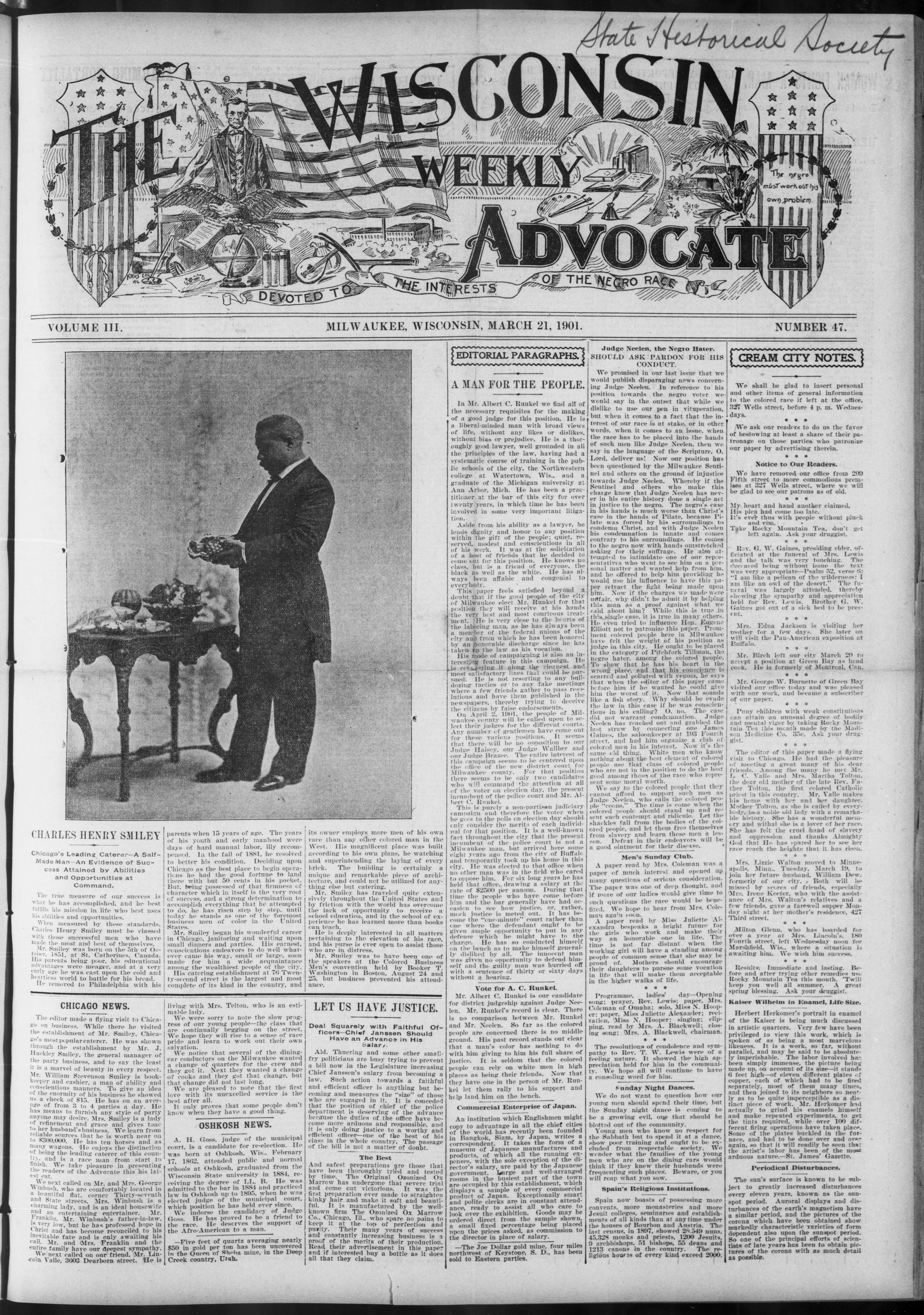
CHARLES HENRY SMILEY
Chicago's Leading Caterer—A Self-Made Man—An Evidence of Success Attained by Abilities and Opportunities at Command.
The true measure of our success is what he has accomplished, and he best fulfills his mission in life who best uses his abilities and opportunities.
When measured by these standards, Charles Henry Smiley must be classed with those successful men who have made the most and best of themselves.
Mr. Smiley was born on the 5th of October, 1851, at St. Catherines, Canada. His parents being poor, his educational advantages were meager, and at a very early age he was cast upon the cold and heartless world to battle for his bread. He removed to Philadelphia with his
CHICAGO NEWS.
The editor made a flying visit to Chicago on business. While there he visited the establishment of Mr. Smiley, Chicago's most popular caterer. He was shown through the establishment by Mr. J. Hackley Smiley, the general manager of the party business, and to say the least it is a marvel of beauty in every respect. Mr. William Stevenson Smiley is bookkeeper and cashier, a man of ability and conscientious manners. To give an idea of the enormity of his business he showed us a check of $15. He has on an average of from 3 to 4 parties a day. He has means to furnish any style of party anyone may desire. Mrs. Smiley is a lady of refinement and grace and gives tone to her husband's business. We learn from reliable sources that he is worth near on to $300,000. He has ten horses and as many wagons. He enjoys the distinction of being the leading caterer of this country, and is a race man from start to finish. We take pleasure in presenting the readers of the Advocate this his latest cut.
We next called on Mr. and Mrs. George Winbush, who are comfortably located in a beautiful flat, corner Thirty-seventh and State streets. Mrs. Winbush is a charming lady, and is an ideal housewife and an entertaining entertainer. Mr. Franklin, Mr. Winbush's father-in-law, is very low, but he has professed hope in Christ and has become reconciled to his inevitable fate and is only awaiting his call. Mr. and Mrs. Franklin and the entire family have our deepest sympathy. We next called on our friend, Mr. Lincoln Valle, 3603 Dearborn street. He is
parents when 15 years of age. The years of his youth and early manhood were days of hard manual labor, ill recompensed. In the fall of 1881, he resolved to better his condition. Deciding upon Chicago as the best place to begin operations he had the good fortune to land there with but 50 cents in his pocket. But, being possessed of that firmness of character which in itself is the very root of success, and a strong determination to accomplish everything that he attempted to do, he has risen step by step, until today he stands as one of the foremost business men of color in the United States.
Mr. Smiley began his wonderful career in Chicago, janitoring and waiting upon small dinners and parties. His earnest, conscientious endeavors to do well whatever came his way, small or large, soon made for him a wide acquaintance among the wealthiest people of the city. His catering establishment at 76 Twenty-second street is the largest and most complete of its kind in the country, and
living with Mrs. Telton, who is an estimable lady. We were sorry to note the slow progress of our young people—the class that are continually begging on the street. We hope they will rise to a sense of race pride and learn to work out their own salvation. We notice that several of the dining-car conductors on the Milwaukee wanted a change of quarters for the crew and they got it. Next they wanted a change of cooks and they got that change, but that change did not last long. We are pleased to note that the first love with its unexcelled service is the best after all. It only proves that some people don't know when they have a good thing.
OSHKOSH NEWS.
A. H. Goss, judge of the municipal court, is a candidate for re-election. He was born at Oshkosh, Wis., February 17, 1862, attended public and normal schools at Oshkosh, graduated from the Wisconsin State university in 1884, receiving the degree of LL. B. He was admitted to the bar in 1884 and practiced law in Oshkosh up to 1895, when he was elected judge of the municipal court, which position he has held ever since. We indorse the candidacy of Judge Goss. He has proved to be a friend to the race. He deserves the support of the Afro-American to a man.
—Five feet of quartz averaging nearly $50 in gold per ton has been uncovered in the Queen of Sheba mine, in the Deep Creek country, Utah.
its owner employs more men of his own race than any other colored man in the West. His magnificent place was built according to his own plans, he watching and superintending the laying of every brick. The building is certainly a unique and remarkable piece of architecture, and could not be utilized for anything else but catering. Mr. Smiley has traveled quite extensively throughout the United States and by friction with the world has overcome the lack of opportunity to receive a school education, and in the school of experience he has learned more than books can teach. He is deeply interested in all matters pertaining to the elevation of his race, and his purse is ever open to assist those who are in distress.
Mr. Smiley was to have been one of the speakers at the Colored Business Men's convention held by Booker T. Washington in Boston, August 24 and 25, but business prevented his attendance.
LET US HAVE JUSTICE.
LET US HAVE JUSTICE.
Deal Squarely with Faithful Officers-Chief Janssen Should Have an Advance in His Salary.
Ald. Thuering and some other smallfry politicians are busy trying to prevent a bill now in the Legislature increasing Chief Janssen's salary from becoming a law. Such action towards a faithful and efficient officer is anything but becoming and measures the "size" of those who are engaged in it. It is conceded that the position of chief of the police department is deserving of the advance because the duties of the office have become more arduous and responsible, and it is only doing justice to a worthy and efficient officer-one of the best of his class in the whole country. The passage of the bill is not a matter of doubt.
The Best
And safest preparations are those that have been thoroughly tried and tested by time. The Original Ozonized Ox Marrow has undergone that severe trial and come cut victorious. It was the first preparation ever made to straighten kinky hair and make it soft and beautiful. It is manufactured by the well-known firm The Ozonized Ox Marrow Co., Chicago, Ill., who spare no pains to keep it at the top of perfection and purity. Their many years of success and constantly increasing business is a proof of the merits of their production. Read their advertisement in this paper and if interested buy a bottle as it does all that they claim.
A MAN FOR THE PEOPLE.
In Mr. Albert C. Runkel we find all of the necessary requisites for the making of a good judge for this position. He is a liberal-minded man with broad views of life, without any likes or dislikes, without bias or prejudice. He is a thoroughly good lawyer, well grounded in all the principles of the law, having had a systematic course of training in the public schools of the city, the Northwestern college at Watertown, Wis., and a graduate of the Michigan university at Ann Arbor, Mich. He has been a practitioner at the bar of this city for over twenty years, in which time he has been involved in some very important litigation.
Aside from his ability as a lawyer, he lends dignity and honor to any position within the gift of the people; quiet, reserved, modest and conscientious in all of his work. It was at the solicitation of a host of friends that he decided to come out for this position. He knows no class, but is a friend of everyone, the black as well as the white. He has always been affable and congenial to everybody.
This paper feels satisfied beyond a doubt that if the good people of the city of Milwaukee elect Mr. Runkel for that position they will receive at his hands the very best and most courteous treatment. He is very close to the hearts of the laboring man, as he has always been a member of the federal unions of the city and from which he has been honored by an honorable discharge since he has taken up the law as his vocation. His mode of campaigning is also an interesting feature in this campaign. He is contesting it along the cleanest and most satisfactory lines that could be pursued. He is not resorting to any bulldozing tactics or to any fake meetings where a few friends gather to pass resolutions and have them published in the newspapers, thereby trying to deceive the citizens by false endorsements.
On April 2, 1901, the people of Milwaukee county will be called upon to select their judges for the different courts. Any number of gentlemen have come out for these various positions. It seems that there will be no opposition to our Judge Haisey, our Judge Wallber and our Judge Brazee. The entire interest of this campaign seems to be centered upon the office of the new district court for Milwaukee county. For that position there seems to be only two candidates who will command the attention at all of the voter on election day, the present incumbent of the police court and Mr. Albert C. Runkel.
This is purely a non-partisan judiciary campaign and therefore the voter when he goes to the polls on election day should only consider the merits of each individual for that position. It is a well-known fact throughout the city that the present incumbent of the police court is not a Milwaukee man, but arrived here some eight years ago from the city of Buffalo and temporarily took up his home in this city. He was elected to that office when no other man was in the field who cared to oppose him. For six long years he has held that office, drawing a salary at the rate of $2500 per annum. During that time the people who have come before him and the bar generally have had occasion to see how justice, or, rather, mock justice is meted out. It has become the "one-minute" court rather than one where the defendant ought to be given ample opportunity to put in any defense which he might have to the charge. He has so conducted himself on the bench as to make himself generally disliked by all. The innocent man was given no opportunity to defend himself and the guilty man was hurried off with a sentence of thirty or sixty days without a hearing.
Vote for A. C. Bunkel
Mr. Albert C. Runkel is our candidate for district judgeship against Judge Neelen. Mr. Runkel's record is clear. There is no comparison between Mr. Runkel and Mr. Neelen. So far as the colored people are concerned there is no middle ground. His past record stands out clear that a man's color has nothing to do with him giving to him his full share of justice. It is seldom that the colored people can rely on white men in high places as being their friends. Now that they have one in the person of Mr. Runkel let them rally to his support and help land him on the bench.
Commercial Enterprise of Japan.
An institution which Englishmen might copy to advantage in all the chief cities of the world has recently been founded in Bangkok, Siam, by Japan, writes a correspondent. It takes the form of a museum of Japanese manufactures and products, of which all the running expenses, with the sole exception of the director's salary, are paid by the Japanese government. Large and well-arranged rooms in the busiest part of the town are occupied by this establishment, which displays a sample of every commercial product of Japan. Exceptionally smart and polite clerks are in constant attendance, ready to assist all who care to look over the exhibition. Goods may be ordered direct from the sample shown, a small fixed percentage being placed upon the prices asked, as commission to the director in place of salary.
The Joe Dollar gold mine, four miles northwest of Keystone, S. D., has been sold to Eastern parties.
Judge Neelen, the Negro Hater. SHOULD ASK PARDON FOR HIS CONDUCT.
We promised in our last issue that we would publish disparaging news concerning Judge Neelen. In reference to his position towards the negro voter we would say in the outset that while we dislike to use our pen in vituperation, but when it comes to a fact that the interest of our race is at stake, or in other words, when it comes to an issue, when the race has to be placed into the hands of such men like Judge Neelen, then we say in the language of the Scripture, O. Lord, deliver us! Now our position has been questioned by the Milwaukee Sentinel and others on the ground of injustice towards Judge Neelen. Whereby if the Sentinel and others who make this charge knew that Judge Neelen has never in his entire history done a single act in justice to the negro. The negro's case in his hands is much worse than Christ's case in the hands of Pilate, because Pilate was forced by his surroundings to condemn Christ, and with Judge Neelen his condemnation is innate and comes contrary to his surroundings. He comes to the negro now with hands outstretched asking for their suffrage. He also attempted to intimidate one of our representatives who went to see him on a personal matter and wanted help from him, and he offered to help him providing he would use his influence to have this paper retract the fight being made upon him. Now if the charges we made were unfair, why didn't he admit it by helping this man as a proof against what we said about him? While this is true in this single case, it is true in many others. He even tried to influence Hon. Eugene Elliott not to patronize this paper. Prominent colored people here in Milwaukee have felt the weight of his position as judge in this city. He ought to be placed in the category of Pitchfork Tillman, the negro hater, among the colored people. To show that he has his heart in the wrong place, and that his conscience is scarred and polluted with venom, he says that when the editor of this paper came before him if he wanted he could give him the worst of it. Now that sounds like a fish story. Why should be evade the law in this case if he was conscientious in his calling? O. no. The case did not warrant condemnation. Judge Neelen has reached out and grabbed the last straw by connecting one James Gaines, the saloonkeeper at 193 Fourth street, and had him organize a club of colored men in his interest. Now it's the same old thing. White men who know nothing about the best element of colored people use that class of colored people who are not in the position to do the best good among those of the race who represent some moral worth.
We say to the colored people that they cannot afford to support such men as Judge Neelen, who calls the colored people "coons." The time is come when the colored people should stand up and resent such contempt and ridicule. Let the shackles fall from the bodies of the colored people, and let them free themselves from slavery and learn these men a lesson. Defeat in their endeavors will be a good ointment for their disease.
Men's Sunday Club.
A paper read by Mrs. Coleman was a paper of much interest and opened up many questions of serious consideration. The paper was one of deep thought, and if more of our ladies would give time to such questions the race would be benefited. We hope to hear from Mrs. Coleman again soon.
A paper read by Miss Juliette Alexandra bespeaks a bright future for the girls who work and make their way an honorable one in life. The time is not far distant when the working girl will have a standing among people of common sense that she may be proud of. Mothers should encourage their daughters to pursue some vocation in life that will make them acceptable in the higher walks of life.
* * *
Programme, ladies' day—Opening song; prayer, Rev. Lewis; paper, Mrs. Coleman of Omaha; solo, Miss N. Hooper; paper, Miss Juliette Alexander; recitation, Miss N. Hooper; singing; clipping, read by Mrs. A. Blackwell; closing song; Mrs. A. Blackwell, chairman.
* * *
The resolutions of condolence and sympathy to Rev. T. W. Lewis were of a feeling nature. It showed the high appreciation held for him in the community. We hope all will continue to have a consoling word for him.
Sunday Night Dances.
We do not want to question how our young men should spend their time, but the Sunday night dance is coming to be a growing evil, one that should be blotted out of the community. Young men who know no respect for the Sabbath but to spend it at a dance, show poor training and ought to be excluded from respectable society. We wonder what the families of the young men who are on the dining cars would think if they knew their husbands were frequenting such places. Beware, or you will reap what you sow.
Spain's Religious Institutions.
Spain now boasts of possessing more convents, more monasteries and more Jesuit colleges, seminaries and establishments of all kinds than at anytime under the houses of Bourbon and Austria. The last census, in 1897, showed 28,549 nuns, 45,328 monks and priests, 1200 Jesuits, 9 archbishops, 51 bishops, 55 deans and 1213 canons in the country. The religious houses of every kind exceed 2000.
CREAM CITY NOTES.
We shall be glad to insert personal and other items of general information to the colored race if left at the office, 327 Wells street, before 4 p. m. Wednesdays.
We ask our readers to do us the favor of bestowing at least a share of their patronage on those parties who patronize our paper by advertising therein.
Notice to Our Readers.
We have removed our office from 209 Fifth street to more commodious premises at 327 Wells street, where we will be glad to see our patrons as of old.
* * *
My heart and hand another claimed.
His plea had come too late.
It's ever thus with people without pluck and rim
Take Rocky Mountain Tea, don't get left again. Ask your druggist.
---
Rev. G. W. Gaines, presiding elder, officiated at the funeral of Mrs. Lewis and the talk was very touching. The deceased being without issue the text was very appropriate—Psalm 52, verse 6: "I am like a pelican of the wilderness; I am like an owl of the desert." The funeral was largely attended, thereby showing the sympathy and appreciation held for Rev. Lewis. Brother G. W. Gaines got out of a sick bed to be present.
Mrs. Edna Jackson is visiting her mother for a few days. She later on will visit the Pan-American exposition at Buffalo.
Mr. Birch left our city March 20 to accept a position at Green Bay as head cook. He is formerly of Montreal, Can.
Mr. George W. Burnette of Green Bay visited our office today and was pleased with our work, and became a subscriber of our paper.
Puny children with weak constitutions can attain an unusual degree of bodily and mental vigor by taking Rocky Mountain Tea this month made by the Madison Medicine Co. 35c. Ask your druggist.
***
The editor of this paper made a flying visit to Chicago. He had the pleasure of meeting a great many of his dear friends. Among the many he met Mr. L. C. Valle and Mrs. Martha Tolton, the dear old mother of the late Rev. Father Tolton, the first colored Catholic priest in this country. Mr. Valle makes his home with her and her daughter. Mother Tolton, as she is called by everybody, is a noble old lady with a remarkable history. She has a wonderful memory and withal she is a lover of her race. She has felt the cruel hand of slavery and oppression and thanks Almighty God that He has spared her to see her race reach the heights that it has risen.
Mrs. Lizzie Walton moved to Minneapolis, Minn., Tuesday, March 19, to join her future husband, William Dew, formerly of our city. Both will be missed by scores of friends, especially Mrs. Irene Keefer, who with the assistance of Mrs. Walton's relatives and a few friends, gave a farewell supper Monday night at her mother's residence, 427 Third street.
Milton Glenn, who has boarded for over a year at Mrs. Lincoln's, 180 Fourth street, left Wednesday noon for Marshfield, Wis., where a situation is awaiting him. We wish him success.
---
Results. Immediate and lasting. Before and after trying other remedies use Rocky Mountain Tea this month. 'Twill keep you well all summer. A great spring blessing. Ask your druggist.
Kaiser Wilhelm in Enamel, Life Size.
Herbert Herkomer's portrait in enamel of the Kaiser is being much discussed in artistic quarters. Very few have been privileged to view this work, which is spoken of as being a most marvelous likeness. It is a work, so far, without parallel, and may be said to be absolutely imperishable. The labor involved has been simply immense, the picture being made up, on account of its size—it stands 6 feet high—of eleven different plates of copper, each of which had to be fired separately, most of them many times, and then joined to its neighbors so neatly as to be quite imperceptible as a distinct piece of work. Mr. Herkomer had actually to grind his enamels himself and make repeated experiments, to get the tints required, while over 100 different firing operations have taken place. Some of the plates buckled in the furnace, and had to be done over and over again, so that it will readily be seen that the artist's labor has been of the most arduous nature.—St. James' Gazette.
Periodical Disturbances.
The sun's surface is known to be subject to greatly increased disturbances every eleven years, known as the sunspot period. Auroral displays and disturbances of the earth's magnetism have a similar period, and the pictures of the corona which have been obtained show markedly characteristic varieties of form dependent also upon the sunspot period. So one of the principal efforts of scientists of late years has been to obtain pictures of the corona with as much detail as possible.
WOMAN FIGHTS & MAN,
Kenosha Girl Has a Desperate
Struggle,
HER CRIES BRING HELP.
Miss Inger Arentzen Attacked on the
Oe eerae ce
Kenosha, Wis., March 21.—[Special.]
—A dastardly crime was committed on
Wednesday evening, near the corner of
‘Wisconsin and Congress streets. An un-
known man ee to make a criminal
assault on Miss Inger Arentzen, daugh-
ter of Mrs. Helen Harbert. Owing to
the pee of the young woman and the
timely arrival of a large crowd of people
the brute failed to accomplish his pur-
pose and Miss Arentzen escaped without
serious injury.
The assault occurred ey after 6
o'clock. Miss Arentzen is employed as a
stenographer in the office of Justice J.
. Slater and her duties had detained
her later than usual at the office, so that
it had begun to grow dark when she
started for her home. Shortly after she
had turned from Main to Wisconsin
street she heard someone approaching
‘behind her. She quickened her atep an
the man behind her quickened. When
the dark corner, near the Central
school, was reached, the man grabbed
the young woman in his arms and at-
tempted to put his hands over her mouth
to prevent an outcry. He attempted to
throw her to the pavement, but Miss
‘Arentzen made a terrible struggle and
managed to shout for ner and a_ large
crowd soon gathered. While a portion of
the crowd assisted Miss Arentzen to her
home a large number sneered in a
search for the man, but the fellow made
good his escape.
At 2 o'clock this morning John Smith.
a former police officer, was arrested
charged with the crime. Miss Arentzen
gave a description of her assailant and
it is claimed that Smith tallies to the
description. It is claimed that Smith
was intoxicated yesterday evening and
he was seen hanging round the spot
where the attempted ncsanit occurred.
OLD SETTLER DEAD.
David Puge, Who Went to Wau-
kesha Nany Years Ago,
Passes Away.
Waukesha, Wis. March 21.—[Sp>
cial.J—David Puch. a prominent farmer,
formerly residing in the town of Gene-
see, died here yesterday. Mr. Pugh was
a native of Wales and was born Febru-
ary 7, 1824. Both of his pone were
born in Cardiganshire, Wales. David's
father died when he was but 2 years of
age and the widow was required to sup-
port herself and three children. At the
early age of 9 years he was employed as
a herder, at which he continued until he
‘became 15 years of age. He then hired
out as a farmhand, working at that oc-
cupatién until his emigration to the Unit-
ed States. At the age of 24 years Mr.
‘Pugh married Margarette Jones, a na-
tive of Cardiganshire, and four
days after the marriage they
set sail for America on board a
‘sailing vessel. When they arrived on the
‘shores of this country they came to the
ie of Milwaukee by the great lakes,
‘and then by team to Waukesha county,
where they have resided ever since.
In_1859 the wife of Mr. Pugh died.
Mr. Pugh is survived by several children,
Evan of Minnesota, Thomas of Genesee,
Mrs. David E. Davis of Lake Crystal,
Minn.; Mrs. Andrew Johnson of Mil-
waukee and John of Minnesota. In poli-
tics Mr. Pugh was a Democrat, having
cast his Post persis! vote for James
Buchanan. ‘he funeral will be held on
Saturday at his former residence in the
town of Genesee.
Mary Ignatius Kennedy, Janesville.
Janesville, Wis., March 21.—[Special.]
—Mary Ignatius Kennedy,a Catholic Sis-
ter of Mercy, died of hemorrhage of the
brain. She was 51 years of age.
Henry Crumb, Janesville.
Janesville, Wis., March 21.—[Special.]
Henry Crumb, one of the pioneer set-
tlers of Rock county, died at Johnstown,
aged 82 years.
Thoroughgood Kimball, Janesville.
Janesville, Wis., March 21.—[Special.]
—Thoroughgood_ Kimball, grandson _ of
Former Mayor John Thoroughgood, died
of pneumonia.
Gustaf Knoespel, Kaukauna.
Kaukauna, Wis. March 21.—[Spe-
cial.]—Gustaf Knoespel, aged 71 years,
a prosperous farmer of the town of West
Holland.
Mrs. M, R. Kies, Green Bay.
Green Bay, Wis. March 21.—[Spe
cial. ]—Mrs. M. R. Kies, aged 82 years.
POISONED BY FISH
—_—_+_—_
Maninette Man and His Wife Near-
ly Die After Eating Canned
Mackerel.
Marinette, Wis., March 21.—[Special.]
~—John Scherer, foreman of the Sawyer-
Goodman company, and his wife had a
narrow ape from death, due to eating
canned mackerel yesterday. They were
both in convulsions for several hours
and physicians had hard work to save
them. "The poison was ptomaine.
OFFICERS ARE ELECTED.
Anuual Meetings of Boom and Lum-
ber Companies at Chippewa Falls,
Chippewa Falls, Wis., March 21.—
[Special.]—The following officers were
elected at the twentieth annual meeting
of the Chippewa Lumber and Boom com-
pany yesterday afternoon:
Directors—F. Weyerhaeuser, M. G. Nor-
ton, Artemus Lamb, O. H. Ingram, William
Irvine; F. Weyerhaeuser, president; Oo. Fi.
Ingram, vice-president; William ‘Irvine,
manager.
The Northern Lumber company, whose
mills are at Cloquet, Minn., and general
office is in this city, elected the follow-
ing officers:
Directors—F, Weyerhaeuser, F. C. A.
Denkmann, W. H. Laird, A. 'B. MeDonell,
Willlam Irvine; F. Weyerhaenser, presi:
dent; F. C. A.’ Denkmann, yice-preshtent:
William’ Irvine, secretary; R. M. Weyer.
haeuser, general manager.
TO BUILD BEET SUGAR PLANT.
Milwaukee Man May Establish Fac-
tory in Sheboygan County.
Sheboygan, Wis., March 21.—[Spe-
cial.J—John’ Kremers of Milwaukee, a
representative of the Wisconsin Sugar
Beet company, is canvassing Sheboygan
county with a view of establishing a fac-
tory at a_ location, to be decided upon
later, but in all probability at Plymouth.
A meeting of farmers will be held in
Plymouth March 31, when representa-
tives of the company wili be present. At
this time arrangements will be completed
for a mass meeting to be held in the early
part of April, to which a general invita-
tion to all farmers in the county will be
extended to attend. The only condition
that will be imposed in securins this
plant is the guarantee on the part of
the farmers of an acrefge of not less
than 3000 devoted to sugar beet plant-
ing.
LEPROSY REPORTED
IN THE PHILIPPINES.
Marine Hospital Service Reports as
Many as 20,000 Cases—At-
tempt at Isolation.
Washington, D. C., March 21.—Marine
Hospital Surgeon Perry, quarantine of-
ficer for the Philippines, has forwarded
here an official report on leprosy in the
Philippines. He says:
“Leprosy is widely prevalent over the
entire archipelago, but the greatest
number of cases exists in southern Luzon
and the southern islands. It is quite
prevalent in Cebu, the number of lepers
being estimated at 2000. The total
number of cases in the islands is estimat-
ed at 20,000, but the actual number is
not known and a census is diffieult on
account of the majority of cases being
in the rural districts.
“The cases in Manila and surrounding
country are isolated in a substantial hos-
pital under the auspices of the Manila
board of health. There is also a leper
hospital at Cebu.
“An attempt at segregation and isola-
tion of the lepers in the islands has been
made by the army officials, and several
months ago orders were issued from
headquarters directing that a hospital in
each district be set aside for the isola-
tion of the lepers that could be appre-
hended, and a board of army officers was
detailed recently to investigate several
islands for the purpose of selecting a
suitable one for a leper colony, the inten-
tion being to deport all cases of leprosy
to this place for segregation and isola-
étan
TROUBLE AVERTED.
ee
Russia and Great Britain Have
Agreed to Withdraw Troops
from Disputed Territory.
London, March 21.—4:51 p. m.—In the
House of Lords today the foreign
secretary, Lord Lansdowne, announced
that Russia and Great Britain had
agreed to withdraw their troops from the
disputed territory at Tien Tsin and re-
serve the question of title and proprie-
tary rights for subsequent examination.
Lord Lansdowne supplemented the an-
nouncement by explaining that the dis-
pute concerned an extensive area on the
left bank of Pei Ho mver, which the
Russians occupied in the autumn and
claimed by right of conquest. Subse-
sony. the government was informed
that China and Russia had reached an
agreement placing the area under Rus-
sian occupation. The area, however,
comprised plots belonging to the North-
ern Chinese railroad and was therefore
part of the security of the British bond-
holders.
Tien Tsin, March 21.—Afternoon.—
The situation here remains unchanged.
Both the British and Russians abstain
from any overt acts of hostility. There
are about 1000 white British troops in
the vicinity. The Russians are not nu-
merous.
It_is rumored that French detachments
at Yang Tsung and Lang Fang have
been warned that they may be wanted
at Tien Tsin.
Pekin. March 21.—Noon.—The situa-
tion at Tien Tsin is the same. A detach-
ment of British marines have replaced
the Sepoy troops on guard at the danger
point. The authorities do not anticipate
any trouble. The soldiers on both sides
are reliable and not likely to commit any
action which will involve the situation.
Noon—The ministers are working in
perfect harmony and everything is pro-
gressing satisfactorily. The questions re-
maining to be decided are the nature of
the guards along the line of communica-
tion with the sea and the raising of the
forts, which, being purely military mat-
ters, the generals will decide and will re-
port their decisions to the ministers.
Paris, March 24.—Cablegrams received
here from Pekin are very cheerful re-
garding the rapid progress of negotia-
tions there during the past week. The
American proposal to arrange for de-
manding joint damages from China is
being favorably discussed by the powers.
There appears to be a prospect for the
adoption of this proposition, although
with some modifications from its original
form.
Feeling in Paris favors an agreement
among the powers respecting the amount
each state shail demand and then the
presentation of these amourts to the Chl-
nese government us one sum. It is
thought the claims of individuals and
societies, however, should be adjudged by
commissions sitting in the respective le-
gations, and presented separately.
PROBABLY KIDNAPED.
eS U NSA LAs
Mr. Comstock Declares His Daugh-
* ter Had Positively No Reason
for Self-Destruction.
Chicago, Ill, March 21.—After a thor-
ough search with dragnets in Lake
Michigan at the foot of Sixty-third street,
the police today became inclined to be-
lieve that May Comstock, 17 years old,
daughter of a weaithy retired merchant,
residing at Benton Harbor, Mich., who
disappeared last evening, was kidhaped,
instead of having committed suicide as
at first believed.
Miss Comstock was studying music in
this city. She left her boarding house as
usual and later her hat and cioak were
found on the beach at Sixty-third strect.
Mr. Comstock insists, however, that his
daughter had positively no reason for
self-destrnetion and the police today felt
inclined to believe in the father’s theory
of kidueping._ iy
@r : .
TWO STEAMERS COLLIDE.
One of Them is Sunk and Thirteen
of the Crew Are
Drowned.
Antwerp, March 21.—The steamer
Chemnitz of the German-Australian
Steamship, company and the British
steamer Tay collided last night in the
Flushing roadstead. The Tay sank and
only two of her crew were saved. The
Tay had put into the Flushing roadstead
owing tc the prevailing storm. ‘The
Chemnitz sailed from Sydney, Australia,
for Hamburg on January 14. Thirteen
of the crew of the Tay perished.
A Curious Trade.
The custom abroad of placing fem:-
nine boots and shoes outside the be:l-
room for the porters tender ministra-
tion, so severely criticized by Americans.
who are accustomed to seeing much
smaller sizes on their women folks, has
led to a curious trade in Paris, by which
woman's vanity is quaintly illustrated.
It appears that ladies with large fect,
when staying at hotels nowadays, carry
with them a couple of pairs of tiny
shoes, which, instead of the ones they
wear, they place outside their doors for
the servants to take away and clean.
All the big boot shops in Paris now
make a specialty of these tiny footgear.
Eighteenth-Century Railroads.
There were primitive railroads in the
Eighteenth century, but it was after
1802 when Richard Trevithick took out
in England the first patent for a high-
pressure engine ae for motion on
roads, and in 1829 the “Rocket,” which
was built by Robert Stephenson, drew
forty-four tons at the rate of over twenty
miles an hour.
x,
NARROW ESCAPE.
ORME
Falis In Front of His Car but Sus-
tains No Injuries—Car
Ran Wild.
Appleton, Wis., March 21.—[Special.]
—A motorman of the Appleton-Neenah
interurban line was thrown from the
front end of his car while attempting to
clean the snow from the outside of the
front window, while the car was mid-
way between Appleton and Neenah and
going at the rate of twenty miles an
hour. He landed in the middle of the
track and the car passed over him with-
out inflicting any injury. It was stepped
by the conductor after running wild for
half a mile. ‘
7
WILD MAN EATS
DOGS AND CATS.
hale —t-
He is Caught, After a Hard Fight,
and Placed in Jail at
Kenosha.
Kenosha, Wis., March 21.—[Special.]
—Constable H. M. Truesdell this after-
noon captured an alleged wild man be
tween this city and Racine. The man
was bronght to this city after a terrific
fight. He was devoid of clothing and
had been roaming about the woods. He
devoured the bodies of a dog, three cats
and several rabbits, all raw. The man
was seen at the jail this afternoon and
seems to have been a negro. His face is
so covered with hair that it is almost im-
pene to tell that he is a human being.
e is supposed to be insane and is sup-
posed to have escaped from some asylum.
END OF SUCCESSFUL
LOGGING SEASON.
Larger Cut In Northern Wisconsin
This Winter than in Any
Previous Year.
Merrill, Wis., March 21.—[Special.]—
These, the last days of the winter log-
ging operations in northern Wisconsin,
mark the closing of one of the most suc-
cessful seasons in the history of the in-
dustry. The weather conditions have
been suitable for advantageous opera-
tions while men have been plenty and
not of the floating variety. The figures
given below are but a few representing a
portion of the work which has been ac-
complished during the winter by Merriil
firms alone:
John I. Day & Co., 16,000,000 feet, 1,000,-
000 of which wh! be shipped from Star
lake to Lac du Fiembeau, the remainder
to the firm of Martenson & Stone of Wau-
san.
Langley & Alderson, 31,000,000 feet, 6,000,-
000 for the Merrill Lumber company, 7,-
000,000 for the A. H. Stange company and
18,600,000 feet for the firm of Salsich & Wil-
son of Star Lake.
Elias Erickson, 1,000,000 feet for the A H.
Stange company of Merrill.
H. W. hae Lumber company, 12,000,-
000 feet for their mills at Merrill.
These figures represent the logs cut
near Star ‘Take only. These firms have
camps at Irma, Gilbert, Rhinelander,
Harshaw, Hazelhurst, Mercer and State-
line.
: _
ITS SCOPE WIDENED.
More Schools Invited to Participate
in Athletic Meet at Law-
rence University.
Appleton, Wis., March 21—[Special.]
—At a meeting of the invitation commit-
tee, appointed by the Lawrence Univer-
sity Athletic association to send out in-
vitations to high schols to compete 4sthe
interschool athletic meet to be held here
on May 18 under the auspices of the coi-
Jege athletic association. | poe pee of the
meet was somewhat widen in scope
and'more territory taken in. Invitations
are to be issued to twenty-five schools as
follows, and others may be added: Fond
du Lac, Oshkosh, Neenah, Menasha,
two at Appleton, Kaukauna, Depere,
two at Green Bay, Marinette, Oconto,
two at Manitowoc, Sheboygan, Stevens
Point, Wausau, Waupaca, New London,
Clintonville, Berlin, Ripon, Waupun. A
silver trophy cup worth $50 is to be pro-
vided by the Lawrence students and citi-
zens, which will become the property of
the school winning it three times.
n
RAILWAY IS TIED UP.
ee Se
Wisconsin Western Road Forced to
Give Up Service In the Kick-
apoo Valley.
Prairie du_ Chien, Wis., March 21.—
[Special.]—The Wisconsin Western rail-
way is tied up on account of rising
waters of the Kickapoo river and train
service will be abandoned for a few days.
The tracks are under two feet of water
near Steuben, but the cold snap of yes-
terday let it drop two inches since then.
_Blanchardville, Wis., March 21.—[Spe-
cial.]—The Pataconia river is the highest
it has been for years and a large area of
land is under water. The Illinois Cen-
tral railroad track is under water be-
tween here and the Milwaukee crossing
in several places, and there is a washout
below Dill.
v
FALLS ON THE ICE.
Aged Woman of Kaukauna Suffers
a Long Time Before Help Comes
to Her Relief.
_Kaukauna, Wis., March 21.—[Spe-
cial.]—Mrs. Frances Wolfinger, an aged
lady of the south side, fell on the ice
while after a Jie of water yesterday
and broke her hipbone. Mr. and Mrs.
Wolfinger live alone, and as her husband
was = in the house, she lay on the
icy ground a long time before her condi-
tion was discovered. It is feared that
her extreme age and the exposure she
suffered together with the accident may
result fatally.
ASSOCIATION FORMED.
A. Gray of Brown County Is Elected
President of Insane Asylum
Organization.
Chippewa Falls, Wis., March 21.—
{Special.]—The Association of Repre-
sentatives of Charitable institutions or-
ganized last night with representatives
pee from twelve counties. The fol-
lowing officers were elected:
President—A. Gray, Brown county.
Vice-President—F. M. Smith, Dunn.
Seeretary—R. C. Greignon. Outngaimte.
‘Treasurer—P. D. Wheeler, St. Croix.
ELKS AT WATERTOWN.
New Lodge to be Installed by the
Madison Chapter.
Madison, Wis., March 2&—[Special.]J—
A delegation of about fifty Madison Elks
will go to Watertown tomorrow to install
a new lodge of Elks there, of which
Lieut.-Goy. Stone will be the exalted ru-
ler. The lodge will start in with a char-
ter membership of forty-three. Delega-
tions will be present from Milwaukee,
Janesville, Racine, Waukesha and other
cities.
Menasha, Wis., March 21.—[Special.]
—A lodge of Elks was instituted here
last night with forty-seven members. Vis-
iting members from Appleton, Oshkosh,
Green Bay and Antigo were present.
THE LEGISLATURE.
Senate.
state and county courts shall constitute a
juvenile court to act upon all cases coming
under the provisions of the act. The bis
prohibiting the docking of horses, 293 S.,
was reported for passage by the committee
of state affairs. The committee on public
health and sanitation reported favorably
120 8., providing for the purchase of a
tract of land adjoining the siate reforma-
tory atGreen Bay. Therallway committee re-
pa for concurrence 159 A, to prevent the
ore counterfeiting of railroad tickets,
and Ae pat tg shooting on trains,
and reported’ for passage 262 8., amend:
Ing the statutes relative to increase of
capital stock of railroad companies. Six-
teen Assembly bills were concurred in.
Chairman Riordan of the joint apportion.
ment committee reported a bill fixing the
apportionment of Assembly districts. The
Sioseoerat stands as decided one by
the committee. Senator Miller's blll, au-
thorizing the governor to give professors of
military science in universities, colleges and
seminaries having 100 or more students the
title of colonel, was laid over. Adjourn-
ment was to 8:30 p. m. on the 18th.
In the Senate on the evening of the 18th
Senator Devos, as chairman of the com-
mittee on corporations, introduced a_ bill
which will make it necessary for a special
election fcr vacancies in the common coun-
ell to be held at thecoming judicial election.
‘The rules of the Senate were suspended and
the bill was ae under the suspension.
Among the bills which were passed was
that of Mr. Collins increasing the maxi-
mum penaity for all kinds of burglary from
five to twenty years. Another Important
bill which was passed was one introduced
by Mr. Stout providing that the parcos or
— of poy. child between the ages of
and 14 must give it at least twelve weeks
of schooling.
Senator Martin's bili providing for the
po ose eiged of a woman on the board of
university regents was passed by the Sen-
ate on the 19th without Seeottiae. Sen-
ator O'Neil’s bill making the same pro-
vision for the board of normal schools went
to third reading: 26 to 6. The Senate con-
curred in Mr. Hall’s memortal to Congress
favoring the passage of the Cullom bill.
The following bills were passed: Retating
to counterfeiting of labels and trademarks;
relating to municipal water and lighting
“works; relating to a dam across Little Wolt
river; ' directing commissioners of public
lands to convey certain lands; relating to
tore of city councils; rope to adimin-
istering oaths; relating ‘to board of regents
of university; relating to competency of
witnesses; making annotated statutes eyi-
dence in certain cases; relating to fees for
return of births; relating to firearms; relat-
‘ing to municipal court for county of Ke-
|Maunee. The bill apportioning Assembly
districts was on the calendar for third read-
ing. but on notion of Senator Riordan was
laid over.
The Senate had a short-calendar on the
20th. Several of the senators had spent the
greater part of the night in the Assembly
watching the primary election deadlock and
looked weary. Senator Jones’ bill prohibit.
ing the employnient of children under 14 In
bowling alleys, bar-rooms or beer gardens,
was reported favorably by the committee on
manufactures and labor. The bill provid-
ing for the examination and licensing of
stationary engineers was reported favorably
with an amendment by the committee on
state affairs. The judiciary committee re-
ported two Assembly bills for non-concur-
rence—398 A., relative to mortgaging and
sale of property of infants, and 410 A.,
relative to appeals. The committee also re-
ported adversely two Senate bills—147 S..
providing for Constructive possession of
vacant lands by tax-title claimants, and 148
§., relating to actions affecting ‘titles of
such lands. The bill, 343 8., ao the
statute requiring banks to pay the fees for
examination, was passed by a vote of 20 to
10. Two Assembly bills were concurred in:
105 A., providing for the eo assess-
ment of lands and the buildings and im-
Pie ee, thereon; 182 A., providing for a
widge across the at river at Du-
rand. Mr. Hall’s bill, 248 A., peerietee for
the loan of two flags to the Grant Monu-
mient association, was also advanced.
‘The good roads constitutional amend-
ment authorizing state aid in highway im-
provements was on the Senate calendar on
the 2ist, reported from committee without
recommendation, but was laid over. The
joint resolution for a constitutional amend-
ment providing for a joint government of
the clty and county of Milwaukee was also
laid over. Senator Roehr's bill, 231 8.,
changing the form of government of the
pn of Milwaukee, making the‘mayor the
chief executive officer, etc., was os
for indefinite postponement’ by the Senate
committee on corporations. The bill mak-
ing it an offense for fire insurance com-
— or their agents to combine to —
late rates, charges and methods of doing
business was reported for indefinate post-
sooner The same fate was recommend-
by the committee for 141 8., providing
for the effect of forfeitures on contracts of
Insurance and 293 §., relative to township
sehool boards. The committee on state
affairs reported for indefinite postpone-
ment 300 S., providing that the state shall
fill the outlet to Muskego lake in Waukesha
county. There was another discussion over
Senator Miller's bill giving the title of
“colonel’’ to professors of military science
in colleges, universities, ete. The bill was
killed—19 to 13. The following bills were
passed: Relating to boards of fire under-
writers and fire patrols; relative to collec-
tion of taxes; relative to levy of taxes;
authorizing the Jackson bank of Black Riy-
er Falls to reduce its capital stock to $25,-
000; relating to tax warrants; relating to
assessment and taxation of buildings on
leased lands. Two Assembly bills were
concurred in: Providing that the polling
places of the fourth class may be at the
city hail: providing for the loan of two
flags to the Grant Monument association.
Assembly.
The Assembly on the 15th had a fight ov-
er the matter of a Saturday session which
caused so much feeling that there were
everal wordy encounters after the session.
The majority of the members were appar-
ently in favor of a Saturday session, but
the opponents of the move succeeded in kill-
ing it. The Assembly killed Senator Devos"
bill relating to the exercise of eminent do-
main by street railway companies. Mr.
Frost’s bill for an amendment to the con-
‘stitution to permit of state aid in good
roadbullding, was on the calendar, but
was laid over. Mr. Collins’ bill forbidding
the manufacture and sale of beer and
liquor within a mile of the Soldiers’ home
was killed. Among the bills reported were
the barbers’ bill, which came in for in-
definite postponement from the committee
on public health and sanitation with one
members dissenting, andthe Milwaukee lake-
shore drive bill which the committee on
eitles reported for passage. Mr. Galaway’s
bill relating to electric light wire, Mr. Solt-
wedel’s bill relating to es detective
agencies, Mr. Spratt’s bill relating to the
— of members of fire and police
rees, laid over. Mr. Cady’s bill 2
vide for fishways in dams on Yellow river
was laid over, as was Mr. Miner's bill re-
lating to railroad transportation for em-
loyes of the Senate and Assembly. Ad-
Ferement was to 8:30 p. m. on the 18th.
The Devos «pecial election bill for Mil-
waukee was hurried over to the Assembly
on the evening of the 18th, where it was
referred to the committee on cities. The
committee will meet before the session on
the 19th and make a report. The rules
will be suspended and the measure yo
at the morning session. The bill will then
become a iaw. The Barber license bill was
saved from death in the Assembly. The
a eRe Cie ace ri eee Oi
See Pe ee, a ne Serer mere
assumed definite shape on the evening of
the 19th. The heres of the bill had
agg ig to order the bill to the third read-
ing by rush tactics and while they bad a
majority and Mage seamge ef could have car-
ried the day if they could have succeeded
in forcing u vote, the ee rallied un-
der leadership and completety blocked the
munevver of the administration. This “eat
was accomplished by a demand for a call
of the house which showed eight members
absent. Later three members were found,
but at 2 a. m. five were still missing. Of
these three had valid excuses and two
were absent without leave. Both were
known to be out of the city. At 3 a. m.
the Assembly was still in session under
call of the house and indications were that
there would be no. pilourament till physical
exhaustion compelled the leaders to’ seek
rest. Another eeeesene was made at 3:30
a. m. to raise.the call. It failed oy a vote
50 for, 45 against. As only a majority of
all members-elect is required to raise the
call the supporters of the primary bill need-
ed but one more vote to win. Assembly-
man Sturdevant, upon whom the friends of
the Stevens bill depended to raise the call
and pass the measure and for whose ar-
vival they eer. looked, reached Madi-
son at 4:30 a. m. He was met at the sta-
tion by the sergeant-at-arms and escorted
at once to the capitol. eae Over-
beck, as soon as his voice could be heard,
moved a suspension of process under
the cai! of the house. The roll was called.
Sturdevant voted “aye,” but Assemblyman
Thuerwoechter, who up to this time had
also yoted with the administration, changed
his vote to ‘no’ and the motion was lost
50 tu 46. With the changes noted above
the vote was identical with the previous
ballots on similar motions. Assemblyman
Siikworth then moved to adjourn and that
motion was lost 46 to 50,
After an all-night session the Assembly,
at 7a m. on the 20th, ordered the primary
election bill to third reading by a vote of
58 te 41.
It was almost § a. m. of the 20th when
the Assembly finished its all-night session
which ended gy passing the measure to its
third reading by a vote of 56 to 41. It
was a tired lot of members that sought
their homes for breakfast and rest, and
the decision to hold no session gion | the
day met with approval. The last and de-
cisive vote was on the engrossment of the
bill. When it was evident that the bill
was to be ordered to third reading Mr. Silk-
worth changed his vote from no to aye In
order to move a consideration. That made
the vote 56 to 41, as follows: Ayes—Alns-
worth, Anderson, Andrew, Babb, Brunson,
Cady, Clark, Coapman, Cook, Dahl, Duer-
waechter, Erickson, Evans David Jr, Fene-
lon, Frost, Galaway, Gilman, Haggerty,
Hail, Hanson, Henry, Hodgins, Holland,
Johnson F., Johnson H., Jones, Krumrey,
Lane, Lenroot, MeCormick, McGill, McMi!-
lan, Manuel, Middleton, Overbeck, Park,
Price, Rankl, Roe, Rogers, Root, Rossman,
Sarau, Silkworth, Smalley, Stelger, Stevens,
Sturdevant, Swenholt, Thomas, Valentine,
Whitson, Willott, Young, Zinn, Mr. Speak-
er—56. Noes—Barker, Barlow, Benson, Bur-
deau, Cleophas, Collins, Dodge, Dow,
Eager, Ela, Eline, Evans Evan W.. Fesen”
feld, Flaherty, Gagnon, Gawin, Hartung,
Jensen, Johnston, Karel, Katz, Keene,
Kern, McCabe, McComb, Meloney, Miller
Edwin, Miner, Norton, Orton, Owen, Pom-
rening, Rasmussen, ‘Schellenberg, ' Side,
Smith, Soltwedel, Po sat Thiessenhusen,
Williams E. A., Wiliams J. C.—41. Ab-
sent or not voting—Esau, Miller Herman,
Moldenhauer—3. Adjournment was to 8 p.
m.
There was a lively tilt in the Assembly
over the primary election bill at the even-
ing session on the 20th. An effort was
made to have the bill reported from the
committee on engrossment, to which it had
been referred, but the work was not com-
pleted until just before the evening session
and Chairman Barlow declined to let it
leave the committee before !t had been
given final comparison. When the evening
session opened Mr. Hall inquired whether
the bill had been reported and when in-
formed that it had not come from commit-
tee, he made a motion that the chairman
of the engrossment committee be ordered
to report the biil al once. A motion to table
Mr. Hall's motion resulted as follows: For
tabling, 47; against tabling, 48; absent or
not yeting, 5. There was much debate and
finally Mr. Hall said that rather than have
his action misunderstood he would with-
draw his motion, This was done and the
incident closed.
The Assembly on the 2ist ordered the
first of the apportionment bills to a third
reading. A motion to lay the bill over un-
til the. senatorial bill was reported was
killed by a vote of 28 to 66, and the bill
was then ordered engrossed by a vote of
86 to 9. The Owen Dill giving common
councils the right to amend franchises and
to alter rates was on the Assembly calen-
dar for engrossment, and it caused a de-
bate which was not concluded. Mr, Jones’
bill, providing for the admission of babies
to the Sparta home, over which there was
a bitter contest in the committee, was
assed without discussion, and the Smith
bin to establish a memorial hall for soldiers
and sailors in the capitol and requiring the
return of the battleflags from the historical
library building went through in the same
manner. The Assembly passed several bills
of more than ordinary importance. The
first was the Brunson bill, relating to the
sale of oleomargarine, It amends the pres-
ent law so as to forbid the solicitation of
orders to be filled by outside concerns, and
is designed to =< an evasion of the
law through which it is said a ae
amount of oleomargarine is brought into
the state. The Young bill, relating to ar-
mories for the National guard, was also
passed. In all there were aie bills
passed. An agreement has been reached by
which the primary election bill is to be on
the calendar on the 22d and is to be made
a special order for 10 o'clock. A long de-
bate over the Owen franchise bill took up
so much time that the Assembly took a re-
cess until evening without finishing Its
calendar.
Two important bills were killed by the
Assembly at the evening session on the
21st—the Owen franchise bill and Mr.
‘Phiessenhusen’s bill relating to moving the
Milwaukee isolation —, outside the
city limits. A vote on the amendment of
Mr. Owen was first taken and the amend-
ment was killed by a vote of 22 to 57. See-
ing that the bill had no chance for passage,
Mr. Owen gave up the fight and moved for
indeftuite postponement, which motion pre-
vailed.
There is a pessimism that shapes the
opinion of a certain section of the press
that continually juggles with figures to
exhivit Great Britain as an uncertain and
decaying quantity. Heaven knows that
agriculture is in a bad way, and that no-
body cares to help it. Even professed po-
litical economists seem to forget that it is
the nation’s greatest industry, and Radi-
cals as well as Conservatives are afraid
to tackle its disabilities with conviction
and courage. Corporations are helped
with money for sanitary and other pur-
poses, but agriculture, the backbone of
our prosperity, is left to bear its mani-
fold burdens and take care of itself as
best it may, The result is disastrous;
but the pessimist even leaves agriculture
alone. He is taken up with “the falling
away of British trade,” which is, really
not falling away, in spite of incidental
breaks that are to be accounted for by a
one-sided fiscal system humorously called
“free trade.’—Neweastle (Eng.) Chroni-
cle. a Soe
Tahiti a Land of Mystery.
To the antiquarian Tahiti ts as full of
fascinating mystery as Egypt, writes a
correspondent from the island. | It con-
tains monuments of a civilization past
modern comprehension. Picture a statue
measuring 35 feet from head to hivs,
and carved vut of a single stone, trans-
ported from a quarry three miles away.
On the head of the image place a crown
of red stone 10 feet im diameter. That
is the sort of mystery you encounter in
Tahiti, Everything there is strange,
everything entrancing. And now a line
of steamers has been started from San
Francisco, and before many years have
passed we may expect to see the beauties
of that land trampled out of existence
by tourists and traders, and its crystal
atmosphere polluted with the smoke of
factories.
Smail Chances.
The chances of two finger prints being
alike is not one in 64,000,000,000.
—The Missouri Senate has pees a
bill making kidnaping a capital offense.
A bill has been introduced which makes
chicken stealing a felony.
ALARMING MORTALITY
Noticeable Among the
Weak and Ailing.
Spring the Time Death Reaps
Its Largest Harvest.
There Is a Way of Eluding the
Grim Destroyer.
Every Spring it ts noticeable how many
people are taken away that we have been ac-
customed to see In our dally life.
Statistics show that at no other season of
the year does so many deaths occur.
Especially large is the mortality among
weak and sickly people.
The reason for this is apparent. The body
that is weakened by age or disease has much
to contend with during the Winter months.
Insufficient exercise frequently has been
taken. Too much starchy and fatty foods
have been eaten. The system has Deen al-
lowed to become run down, and when Spring
comes with its bright, sunshiny days, older
people will begin to realize that their vital-
ity has become very low. The same thing
is true of people whe are naturally sickly
and weak.
‘This 16 the season of the year when even a
strong person feels at his worst. That tired,
restless feeling is experienced by too many.
There need not be as =, deaths this
year as usually take place. A little care wil!
ward off many Spring funerals. If one is
weak or ailing ee should take time ay the
foreloeck and take Dr. Greene’é Nervura blood
and nerve remedy. This great medicine has
been in any cases, and will continue to be,
the means by which the black angel of
Death has been driven from the threshold.
It dispels the grim destroyer im a scientific
way, for it purifies the blood and gives
strength and vitality to the nerves. It tones
up and restores to a healthy condition all of
the great life-giving organs of the body.
Dr. Greene’s Nervura blood and nerve
remedy will enable those who take it to
throw off little ills that prove songerces
only when they attack a system already
wasted and weakened.
From many peopl. who have eer
benefit from this greatest of all life-length-
eners, comes the following from the famous
General Longstreet, of 1217 New Hampshire
Ave., Washington, D.C. He says:
“It gives me great pleasure to add my tes-
timony with many others for Dr. Greene's
Remedy, which I have used with highly ben-
eficial results, and I am able to recommend
its virtues from experience. I have used it
for catarrh and have derived help.”
Mr. Wellington Hayes, Elizabethtown, N.
Y., writes:
“I feel it my duty to tell how much good
Dr. Greene’s Nervura has done me. I was
so run down that I could not sleep at night
and everything worried me. I had no appe-
tite and could not work, my head ached all
the time and there was an all-gone feeling
in my stomach, and I was always looking
on the dark side of everything. I began to
take Dr. Greene’s Nervura blood and nerve
remedy and in less than three weeks | felt
like a new man. I can now do as much
work as is expected of a man my age. I ad-
vise anyone who is troubled to take Dr.
Greene's Neryura, Do not go to a doctor,
but get a bottle cf Dr, Greene’s Nervura. It
is cheaper than a doctor's bill.
The latter part of Mr. Hynes’ advice
might be Pn oe disregarded, however, if
you should feel you would like the advice of
a physician. You can have such advice and
have It free if you will write or call on the
reatest known blood and nerve specialist,
Greene, 35 W. 14th St., New York City.
Pittsburg Snow is Not Spotless.
Speaking about the art of imitating
nature on the stage a writer in the Cos-
mopolitan says that in a sore uae
play it was composed of salt. This re-
sembled the fine, dry snow that lends it-
self so readily to blizzards. It was not
dropped from above after the manuer of
the paper variety. but blown through
huge cylinders by means of electric fans,
which were placed high in the wings on
both sides of the stage. It takes twelve
men to manipulate one of these snow-
storms, four of them electricians, four
cue men and four “props.” ‘he salt
consumed at each performance would
put Lot’s wife to shame. It cannot be
used twice, except in Pittsburg and Chi-
cago, where the peculiar whiteness of
the snow in other cities is unknown.
Re Ready for Freckles.
The freckle is the bane of the summer
girl. Here is a remedy: Oil of sweet al-
monds, two ounces; fresh cucumber juice,
eight ounces; white castile soap, pow-
dered, one-fourth ounce; essence of cu-
cumbers, three ounces; tincture of ben-
zoin, fifteen drops. Get the juice by slic-
ing (without peeling) three good-sized cu-
cumbers and boiling in barely enough
water to keep from scorching. When
soft and pulpy. cool and strain through
muslin. Combine one and one-haif
ounces of ae with an equal amount
of alcohol. is is your three ounces of
cucumber essence. Next day dissolve the
soap in the essence, add juice, then al-
mond oil, very slowly, and een benzoin
ar by drop. Keep in a cool place.—
Pkiladelphia Telegraph.
Great Britain Neglects Science.
In an editorial in Feilden’s Magazine
we are reminded of the heavy price
which we are paying for our haying un-
derrated the importance of scientific Te-
search in the past, says the London Ex-
press. In purport of this statement the
author points out that while at the com-
mencement of the Nineteenth century our
makers of scientific instruments, together
with those of France, were ahead of all
the world, Germany has within the last
twenty-five years absorbed almost the
entire trade, and during the last ter
years her exports of scientific instru:
ments have increased from £200,000 ir
yalue to more than £700,000. Such facts
are more eloquent than words.
Catarrh Cannot Be Cured
With LOCAL APPLICATIONS, 28 "Ca-
cannot reach the seat of the disease. | Ca-
tarrh is a blood or constitutional disease,
and in order to cure it you must take In:
ternal remedies. Hall's Catarrh Cure ls
taken internally, and acts directly on the
blood and mucous surfaces. Hall's Catan:
Cure Is not a quack medicine. It was Pre
seribed by one of the best physicians in this
country for years, and is a regular pre
scription. It is composed of the best tonics
known, combined with the best blood puril-
ers, acting directly on the mucous surfaces.
The perfect combination of the two In
gredients Is what produces such wonderfol
results in curing xtarrh. Send for testl-
monials, free.
F. J. CHENEY & CO., Props.. Toledo, 0.
Sold by Druggists, price 75c.
Boer Colonies in Russia.
In the Grodzo and Volin districts ef
Russia there are about ten small Boer
farm colonies. pera Oe 400 to 500
inhabitants all told. ey were found-
ed in 1820 by emigrants from Holland,
and the method of living is precisely the
same as that of their relatives in South
Africa.
‘cae ane, Gavuee 26.0 Gate.
While cutting up a poplar at is 2°
mill in Lee county, Virginia, C. B. Kes
terton found an auger hole plugged by 4
= ‘On removing the pin he found in the
ole five $20, gold pieces bearing dates
between 1850 and 1860, The coins 47°
supposed to have been hid there for safe
keeping during the Civil war.
FARM AND GARDEN
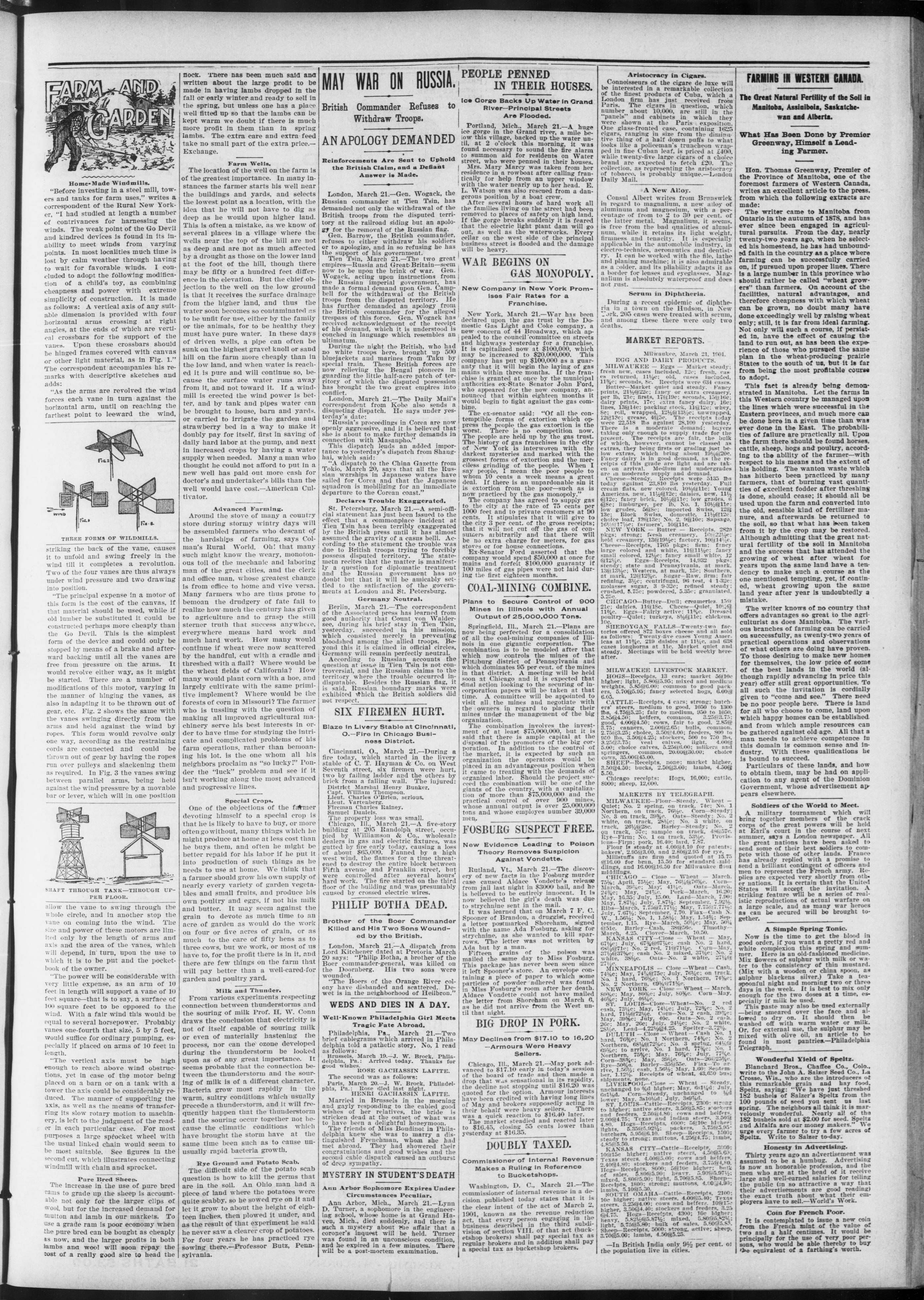
"Before investing in a steel mill, towers and tanks for farm uses," writes a correspondent of the Rural New Yorker, "I had studied at length a number of contrivances for harnessing the winds. The weak point of the Go Devil and kindred devices is found in its inability to meet winds from varying points. In most localities much time is lost by calm weather through having to wait for favorable winds. I concluded to adopt the following modification of a child's toy, as combining cheapness and power with extreme simplicity of construction. It is made as follows: A vertical axis of any suitable dimension is provided with four horizontal arms crossing at right angles, at the ends of which are vertical crossbars for the support of the vanes. Upon these crossbars should be hinged frames covered with canvas or other light material, as in Fig. 1." The correspondent accompanies his remarks with descriptive sketches and adds:
"As the arms are revolved the wind forces each vane in turn against the horizontal arm, until on reaching the farthest point to leeward the wind,
FIG. 2
WIND
FIG. 3
FIG. 8.
THREE FORMS OF WILDMILLS.
striking the back of the vane, causes it to unfold and swing freely in the wind till it completes a revolution. Two of the four vanes are thus always under wind pressure and two drawing into position.
"The principal expense in a motor of this form is the cost of the canvas, if that material should be used, while if old lumber be substituted it could be constructed perhaps more cheaply than the Go Devil. This is the simplest form of the device and could only be stopped by means of a brake and afterward backing until all the vanes are free from pressure on the arms. It would revolve either way, as it might be started. There are a number of modifications of this motor, varying in the manner of hinging the vanes, as also in adapting it to be thrown out of gear, etc. Fig. 2 shows the same with the vanes swinging directly from the arms and held against the wind by ropes. This form would revolve only one way, according as the restraining cords are connected and could be thrown out of gear by having the ropes run over pulleys and slackening them as required. In Fig. 3 the vanes swing between parallel arms, being held against the wind pressure by a movable bar or lever, which will in one position
SHAFT THROUGH TANK—THROUGH UP- PER FLOOR.
allow the vane to swing through the whole circle, and in another stop the vane on coming into the wind. The size and power of these motors are limited only by the length of arms and axis and the area of the vanes, which will depend, in turn, upon the use to which it is to be put and the pocketbook of the owner.
"The power will be considerable with very little expense, as an arm of 10 feet in length will support a vane of 10 feet square—that is to say, a surface of 100 square feet to be opposed to the wind. With a fair wind this would be equal to several horsepower. Probably vanes one-fourth that size, 5 by 5 feet, would suffice for ordinary pumping, especially if placed on arms of 10 feet in length.
"The vertical axis must be high enough to reach above wind obstructions, yet in case of the motor being placed on a barn or on a tank with a tower the axis could be considerably reduced. The manner of supporting the axis, as well as the means of transferring its slow rotary motion to machinery, is left to the judgment of the reader in each particular case. For most purposes a large sprocket wheel with the usual linked chain would seem to be most suitable. See figures in the second cut, which illustrates connecting windmill with chain and sprocket.
Pure Bred Sheep.
The increase in the use of pure bred rams to grade up the sheep is accountable not only for the larger clips of wool, but for the increased demand for mutton and lamb in our markets. To use a grade ram is poor economy when the pure bred can be bought as cheaply as now, and the larger profits in both lambs and wool will soon repay the cost of a really good sire to head the
nock. There has been much said and written about the large profit to be made in having lambs dropped in the fall or early winter and ready to sell in the spring, but unless one has a place well fitted up so that the lambs can be kept warm we doubt if there is much more profit in them than in spring lambs. The extra care and extra feed take no small part of the extra price. Exchange.
Farm Wells.
The location of the well on the farm is of the greatest importance. In many instances the farmer starts his well near the buildings and yards, and selects the lowest point as a location, with the idea that he will not have to dig as deep as he would upon higher land. This is often a mistake, as we know of several places in a village where the wells near the top of the hill are not as deep and are not as much affected by a drought as those on the lower land at the foot of the hill, though there may be fifty or a hundred feet difference in the elevation. But the chief objection to the well on the low ground is that it receives the surface drainage from the higher land, and thus the water soon becomes so contaminated as to be unfit for use, either by the family or the animals, for to be healthy they must have pure water. In these days of driven wells, a pipe can often be sunk on the highest gravel knoll or sand hill on the farm more cheaply than in the low land, and when water is reached it is pure and will continue so, because the surface water runs away from it, and not toward it. If a windmill is erected the wind power is better, and by tank and pipes water can be brought to house, barn and yards, or carried to irrigate the garden and strawberry bed in a way to make it doubly pay for itself, first in saving of daily hard labor at the pump, and next in increased crops by having a water supply when needed. Many a man who thought he could not afford to put in a new well has paid out more cash for doctor's and undertaker's bills than the well would have cost.—American Cultivator.
Advanced Farming.
Around the stove of many a country store during stormy wintry days will be assembled farmers who descant of the hardships of farming, says Colman's Rural World. Oh! that many such might know the weary, monotonous toil of the mechanic and laboring man of the great cities, and the clerk and office man, whose greatest change is from office to home and vive versa. Many farmers who are thus prone to bemoan the drudgery of fate fail to realize how much the century has given to agriculture and to grasp the still sterner truth that success anywhere, everywhere means hard work and much hard work. How many would continue if wheat were now scattered by the handful, cut with a cradle and threshed with a flail? Where would be the wheat fields of California? How many would plant corn with a hoe, and largely cultivate with the same primitive implement? Where would be the forests of corn in Missouri? The farmer who is tussling with the question of making all improved agricultural machinery serve his best interests in order to have time for studying the intricate and complicated problems of his farm operations, rather than bemoaning his lot. is the one whom all his neighbors proclaim as "so lucky!" Ponder the "luck" problem and see if it isn't working along the most advanced and progressive lines.
Special Crops.
One of the objections of the farmer devoting himself to a special crop is that he is likely to have to buy, or more often go without, many things which he might produce at home at less cost than he buys them, and often he might be better repaid for his labor if he put it into production of such things as he needs to use at home. We think that a farmer should grow his own supply of nearly every variety of garden vegetables and small fruits, and produce his own poultry and eggs, if not his milk and butter. It may seem against the grain to devote as much time to an acre of garden as would do the work on four or five acres of grain, or as much to the care of fifty hens as to three cows, but we work, or most of us have to, for the profit there is in it, and there are few things on the farm that will pay better than a well-cared-for garden and poultry yard.
Milk and Thunder.
From various experiments respecting connection between thunderstorms and the souring of milk Prof. H. W. Conn draws the conclusion that electricity is not of itself capable of souring milk or even of materially hastening the process, nor can the ozone developed during the thunderstorm be looked upon as of any great importance. It seems probable that the connection between the thunderstorm and the souring of milk is of a different character. Bacteria grow most rapidly in the warm, sultry conditions which usually precede a thunderstorm, and it will frequently happen that the thunderstorm and the souring occur together not because the climatic conditions which have brought the storm have at the same time been such as to cause unusually rapid bacteria growth.
Rye Ground and Potato Scab.
The difficult side of the potato scab question is how to kill the germs that are in the soil. An Ohio man had a piece of land where the potatoes were quite scabby, so he sowed rye on it and let it grow to about the height of eighteen inches, then plowed it under, and as the result of that experiment he said he never saw a clearer crop of potatoes. For four years he has practiced rye sowing there.—Professor Butz, Pennsylvania.
MAY WAR ON RUSSIA.
British Commander Refuses to Withdraw Troops.
AN APOLOGY DEMANDED
Reinforcements Are Sent to Uphold the British Claim, and a Defiant Answer is Made.
London, March 21.—Gen. Wogack, the Russian commander at Tien Tsin, has demanded not only the withdrawal of the British troops from the disputed territory at the railroad siding but an apology for the removal of the Russian flag. Gen. Barrow, the British commander, refuses to either withdraw his soldiers or to apologize, and in so refusing he has the support of his government.
Tien Tsin, March 21.—The two great empires—Russia and Great Britain—seem now to be upon the brink of war. Gen. Wogack, acting upon instructions from the Russian imperial government, has made a formal demand upon Gen. Campbell for the withdrawal of the British troops from the disputed territory. He has further demanded an apology from the British commander for the alleged trespass of this force. Gen. Wogack has received acknowledgment of the receipt of his demand, which it is understood is couched in language which resembles an ultimatum.
During the night the British, who had no white troops here, brought up 500 bluejackets and marines from Taku by special train. These British forces are now relieving the Bengal pioneers in guarding the little half-acre patch of territory of which the disputed possession has brought the two great empires into conflict. London, March 21.—The Daily Mail's correspondent from Kobe also sends a disqueting dispatch. He says under yesterday's date: "Russia's proceedings in Corea are now openly aggressive, and it is believed that she is about to make further demands in connection with Masanpho." This dispatch lends an added importance to yesterday's dispatch from Shanghai, which said:
"A dispatch to the China Gazette from Tokio, March 20, says that all the Russian warships in Japanese waters have sailed for Corea and that the Japanese squadron is mobilizing for an immediate departure to the Corean coast."
Declares Trouble Exaggerated.
St. Petersburg, March 21.—A semi-official statement has just been issued to the effect that a commonplace incident at Tien Tsin has been terribly exaggerated by the British press until it has almost assumed the gravity of a casus belli. According to the statement the trouble was due to British troops trying to forcibly possess disputed territory. The statement recites that the matter is manifestly a question for diplomatic treatment and the Russian government has no doubt but that it will be amicably settled to the satisfaction of the governments at London and St. Petersburg.
Germany Neutral.
Berlin, March 21.—The correspondent of the Associated press has learned from good authority that Count von Waldersee, during his brief stay in Tien Tsin, yesterday, succeeded in his mission, which consisted merely in preventing bloodshed among the allied troops. Beyond this it is claimed in official circles, Germany will remain perfectly neutral. According to Russian accounts the question at issue in Tien Tsin is not controversial, and the Russian claims to the territory where the trouble occurred indisputable. Besides the Russian flag, it is said, Russian boundary marks were exhibited which the British soldiers did not respect.
SIX FIREMEN HURT.
Blaze In Livery Stable at Cincinnati
O.-Fire in Chicago Business
District.
Cincinnati, O., March 21.—During a fire today, which started in the livery stable of C. T. Hayman & Co. on West Seventh street, six firemen were hurt, two by failing ladder and the others by brick from a falling wall. The injured: District Marshal Henry Bunker. Capt. William Thompson. Lleut. Charles O'Brien, serious. Lleut. Vartenberg. Fireman Charles Rainey. Samuel Daniels. The property loss was small.
Chicago, Ill., March 21.—A five-story building at 205 Randolph street, occupied by Williamson & Co., wholesale dealers in gas and electric fixtures, was gutted by fire early today, causing a loss of about $65,000. Fanned by a high west wind, the flames for a time threatened to destroy the entire block between Fifth avenue and Franklin street, but were controlled after several hours' hard work. The fire started on the third floor of the building and was presumably caused by crossed electric wires.
PHILIP BOTHA DEAD.
Brother of the Boer Commander Killed and His Two Sons Wounded by the British.
London, March 21.—A dispatch from Lord Kitchener dated at Pretoria March 20 says: "Philip Botha, a brother of the Boer commander-general, was killed on the Doornberg. His two sons were wounded.
"The Boers of the Orange River colony have disbanded and scattered. Dewet is in the neighborhood of Heilbron."
WEDS AND DIES IN A DAY.
Well-Known Philadelphia Girl Meets Tragic Fate Abroad.
Philadelphia, Pa., March 21.—Two brief cablegrams which arrived in Philadelphia told a pathetic story. No.1 read as follows:
Brussels, March 19.-J. W. Brock, Philadelphia, Pa.: Arrived today. Thanks for good wishes. ROSE GACHASSIN LAFITE. The second was as follows:
The second was as follows:
Paris, March 20.—J. W. Brock, Philadelphia, Pa.: Rose died last night.
HENRI GACHASSIN LAFITE.
Married in Brussels in the morning and gayly responding to the cabled good wishes of her relatives, the bride is stricken dead at the outset of what was to have been a delightful honeymoon.
The friends of Miss Boudinot in Philadelphia knew she was to marry a distinguished Frenchman, whom she had met abroad. They had showered their congratulations and good wishes and the second cable dispatch caused an outburst of deep sympathy.
MYSTERY IN STUDENT'S DEATH
Ann Arbor Sophomore Expires Under Circumstances Peculiar.
Ann Arbor, Mich., March 21.-Lynn D. Turner, a sophomore in the engineering school, whose home is at Grand Haven, Mich., died suddenly, and there is such a mystery about the affair that a coroner's inquest will be held. Turner was found in an unconscious condition, and he expired in a few minutes. There will be a post-mortem examination.
Ice Gorge Backs Up Water in Grand River-Principal Streets Are Flooded.
Portland, Mich.. March 21.—A huge ice gorge in the Grand river, a mile below this village, backed up the water until, at 2 o'clock this morning, it was found necessary to sound the fire alarm to summon aid for residents on Water street, who were penned in their houses. Mrs. Mary Marcy was taken from her residence in a rowboat after calling frantically for help from an upper window with the water nearly up to her head. E. L. Watson was also rescued from a dangerous position by a boat crew. After several hours of hard work all the families living on the street had been removed to places of safety on high land. If the gorge breaks suddenly it is feared that the electric light plant dam will go out, as well as the waterworks. Every cellar on the west side of the principal business street is flooded and the damage will be heavy.
WAR BEGINS ON GAS MONOPOLY.
New Company in New York Promises Fair Rates for a Franchise.
New York, March 21.—War has been declared upon the gas trust by the Domestic Gas Light and Coke company, a new concern of 44 Broadway, which appealed to the council committee on streets and highways yesterday for a franchise. It is capitalized now at $100,000, which may be increased to $20,000,000. This company has put up $100,000 as a guaranty that it will begin the laying of gas mains within three months. If the franchise is granted at once by the municipal authorities ex-State Senator John Ford, who appeared for the new company, announced that within eighteen months it would begin to fight against the gas combine.
The ex-senator said: "Of all the contemptible forms of extortion which oppress the people the gas extortion is the worst. There is no competition now. The people are held up by the gas trust. The history of gas franchises in the city of New York is interwoven with the darkest mysteries and marked with the grossest forms of extortion and the merciless grinding of the people. When I say people, I mean the poor people to whom 10 cents a week means a great deal. If there is an unpardonable sin it is extortion from the poor—such as is now practiced by the gas monopoly."
The company has agreed to supply gas to the city at the rate of 75 cents per 1000 feet and to private customers at 90 cents. It stipulates that it will give to the city 3 per cent. of the gross receipts; that it will not cut off the gas of consumers arbitrarily and that there will be no extra charge for meters, for gas stoves or for house connections. Ex-Senator Ford asserted that the company would spend $50,000 at once for mains and forfeit $100,000 guaranty if 100 miles of gas pipes were not laid during the first eighteen months.
COAL-MINING COMBINE.
Plans to Secure Control of 900 Mines in Illinois with Annual Output of 25,000,000 Tons. Springfield, Ill., March 21.—Plans are now being perfected for a consolidation of all the coal-mining companies of Illinois in one gigantic corporation. The combination is to be modeled after that which now controls the mines of the Pittsburgh district of Pennsylvania and which dominates 95 per cent. of the mines in that district. A meeting will be held soon at Chicago and it is expected that final action looking to the securing of incorporation papers will be taken at that time. A committee will be appointed to visit all the mines and negotiate with the owners in regard to placing their mines under the management of the big organization.
The combination involves the investment of at least $75,000,000, but it is said that there is ample capital at the disposal of the promoters of the big corporation. In addition to the control of the market, it is expected by such an organization the operators would be placed in an advantageous position when it came to treating with the demands of organized labor. Should the project succeed the combination will be one of the giants of the country, with a capitalization of more than $75,000,000 and the practical control of over 900 mines, whose annual output is over 25,000,000 tons and whose employees number 39,000 men.
FOSBURG SUSPECT FREE.
New Evidence Leading to Poison Theory Removes Suspicion Against Vondette.
Rutland, Vt., March 21.—The discovery of new facts in the Fosburg murder case caused Aldace Vondette's release from jail last night in $3000 bail, and he is believed to be entirely innocent. It is now believed the girl's death was due to strychnine sent in the mail.
It was learned that on March 7 F. C. Spooner of Brandon, a druggist, received a letter postmarked Shoreham, signed with the name Ada Fosburg, asking for strychnine, as she wanted to kill sparrows. The letter was not written by Ada but by a man.
Fifteen grains of the poison was mailed the same day to Miss Fosburg. This package has never been seen since it left Spooner's store. An envelope containing a piece of paper to which some particles of powder adhered was found in Miss Fosburg's room after her death. Aldace Vondette could not have mailed the letter from Shoreham on March 6, as he did not arrive from the West until that night.
BIG DROP IN PORK.
May Declines from $17.10 to 16.20
—Armours Were Heavy
Sellers.
Chicago, Ill., March 21.—May pork advanced to $17.10 early in today's session of the board of trade and then made a drop that was sensational in its rapidity, the decline not stopping until $16.20 was quoted for the option. Armour interests have been credited with having long lines of May and brokers supposedly acting in their behalf were heavy sellers. There was a quick reaction to $16.40 later.
The market steadied and reacted later
The market steadied and reacted later to $16.45, closing 55 cents lower than yesterday at $16.35.
DOUBLY TAXED.
Commissioner of Internal Revenue Makes a Ruling in Reference to Bucketshops.
Washington, D. C., March 21.—The commissioner of internal revenue in a decision published today states that it is the clear intent of the act of March 2, 1901, known as the revenue reduction act, that every person engaging in the business described in the third subdivision of section VIII. of that act (bucketshop brokers) shall pay special tax as regular brokers and in addition shall pay a special tax as bucketshop brokers.
Aristocracy in Cigars.
Connoisseurs of the cigare de luxe will be interested in a remarkable collection of the finest products of Cuba, which a London firm has just received from Paris. The cigars in question, which number about 10,000, are still in the "panels" and cabinets in which they were shown at the Paris exposition. One glass-fronted case, containing 1625 cigars, ranging in size from the diminutive thing of a half dozen puffs to what looks like a policeman's truncheon wrapped in fine Cuban leaf, is priced at £400, while twenty-five large cigars of a choice brand are expected to fetch £20. The collection, as representing the aristocracy of tobacco, is probably unique.—London Daily Mail.
A New Allor
Consul Albert writes from Brunswick in regard to magnalium, a new alloy of aluminum and magnesium, with a percentage of from to 2 to 30 per cent. of the latter metal. Magnalium, it seems, is free from the bad qualities of aluminium, while it retains its light weight, firmness and tenacity. It is especially applicable in the automobile industry, in electro-technics, aeronautics and dentistry. It can be worked with the file, lathe and planing machine; it is also admirable as a colder, and its pliability adapts it as a border for lenses and eyeglasses. Magnalium is absolutely waterproof and does not rust.
Serum in Diphtberia.
During a recent epidemic of diphtheria in a town on the Hudson, in New York, 205 cases were treated with serum, and among these there were only two deaths.
MARKET REPORTS
Milwaukee, March 21, 1901.
EGG AND DAIRY PRODUCTS.
MILWAUKEE — Eggs — Market steady: fresh new, cases included, 12c; fresh, cases returned, 11½c; old, cases included, 11½c; seconds, 8c. Receipts were 634 cases. Butter—Market quiet and steady. Fancy prints, 21½@22c; fancy or extra creamery, per lb, 21c; firsts, 17@19c; seconds, 15@16c; dairy prints, 17c; extra fancy dairy, 16c; lines, 13@14c; packing stock, 11@12c; whey, 8c; roll, wrapped, 12½@13½c; unwrapped, 12@13c; grease, 4@5c. The receipts today were 22,518 lbs against 28,100 yesterday. There is a moderate demand; buyers taking only enough to supply trade for the present. The receipts are fair, the bulk of which, however, cannot be classed as extras, they being firsts or grading just below extras, which bring about 19½@20c. Fancy dairy is in good demand, as the receipts of this grade are light and are taken on arrival. Medium and undergrades are in moderate supply and demand.
Cheese—Steady. Receipts were 5135 lbs today against 23,810 lbs yesterday. Full cream flats, new colored, 10%@11c; Young Americas, new, 11%@12c; daisies, new, 11%@12c; fancy brick, 10%@11c; low grades, 6@8c; limburger, per ib. No. 1, 10%@11c; low grades, 5@8c; imported Swiss, 12@13c; Block Swiss, domestic, 10%@12c; choice loaf, 13@13c; No. 2. 9%@10c; Sapsago, 10%@17%c; farmers', 10@11c.
NEW YORK — Butter — Receipts. 2829 pkgs; strong; fresh creamery, 16%@22%c; held creamery, 13%@19%c; factory, 10%@14%c. Cheese—Receipts. 1705 pkgs; firm; fancy large colored and white, 11%@11%c; fancy small colored, 12%c; fancy small white, 12%@12%c. Eggs—Receipts. 14,932 pkgs; steady; state and Pennsylvania, at mark, 13%@13%c; Western, at mark, 13c; Southern, at mark, 12%@12%c. Sugar—Raw, firm; fair refining, 3%c; centrifugal, 96 test, 4 1-32c; molasses sugar, 3 9-32c; refined steady; crushed, 5.75c; powdered, 5.35c; granulated, 5.25c.
CHICAGO—Butter—Dull; creameries. 15¢
21c; dalries. 11@18c. Cheese—Quiet. 10¢@11¢c. Eggs—Fairly active; 11¢¢c. Dressed poultry—Quiet; turkeys, 8½@11c; chickens, 10¢.
SHEBOYGAN FALLS—Twenty-two factories offered 872 boxes cheese and all sold as follows: Twenty-five cases Young Americas at 11¢¢c. 219 dalries at 11¢¢c. and 628 cases longhorns at 11c. Market quiet and steady. Meetings will be held weekly here after.
MILWAUKEE LIVESTOCK MARKET.
HOGS—Receipts, 13 cars; market 5@100
higher; light, 5.80@5.95; mixed and medium
weights, 5.85@6.00; common to good packers,
5.70@5.95; fancy selected hogs, 6.00@
6.05.
CATTLE—Receipts, 4 cars; strong; butchers'
steers, medium to good, 1050 to 1300
lbs, 4.75@5.25; fair to medium, 950 to 1050,
3.85@4.50; helfers, common, 3.25@3.75;
good, 4.00@4.50; cows, fair to good, 2.85@
3.75; canners, 2.00@2.65; bulls, common,
2.75@3.25; choice, 3.50@4.00; feeders, 800 to
950 lbs, 3.50@4.25; stockers, 500 to 750 lbs,
3.25@3.75; veal calves, light, 4.00@
5.00; choice calves, 5.25@6.00; milkers and
springers, common, 20.00@30.00; choice
cows, 35.00@45.00.
SHEEP—Receipts, none; market hlgher,
3.50@4.50; bucks, 2.50@3.00; lambs, 4.50@
5.50.
Chicago receipts: Hogs, 16,000; cattle,
8000; sheep, 12,000.
MARKETS BY TELEGRAPH.
MILWAUKEE—Flour—Steady. Wheat—
Quiet; No. 2 spring, on track, 74c; No. 1
Northern, on track, 76½c. Corn—Steady;
No. 3 on track, 39½c. Oats—Steady; No. 2
white, on track, 28½c; No. 3 white, on
track, 26½@28c. Barley—Steady; No. 2
on track, 57c; sample on track, 48@57c.
Rye—Firm; No. 1 on track, 53½c. Provisions—Firm; pork, 16.40; lard, 7.87.
Flour is steady at 4.00@4.10 for patients;
bakers', 2.95@3.00, and 2.80@2.95 for rye.
Millstuffs are firm and quoted at 15.75
@16.00 for bran, 15.50 for standard mild
dilings, and 16.00@16.50 for Milwaukee flour
mildlings.
CHICAGO — Close — Wheat — March,
75%; April, 75%;c May, 76%@76%c Corn—March, 39%;c May, 41%;c Oats—March, 24%;c May, 24%;c Pork—March, 16.20;
may, 16.33; July, 15.00. Lard—March, 7.90;
may, 7.87%; July, 7.87%; September, 7.92%;
Ribs—March, 7.75@7.77%; May, 7.75@7.77%;
July, 7.67%; September, 7.70. Flax—Cash N.
W., 1.56%; No. 1, 1.58%; May, 1.54%; Sept-
ptember, 1.15. Rye—March, 50%;c May, 50%@51c. Barley-Cash, 38@56c. Timothy—March, 4.25. Clover—March, 10.50.
KANSAS CITY — Close — Wheat — May,
67½¢; July, 67½¢@67½¢; cash No. 2 hard,
68½¢@71¢; No. 2 red, 71@71¢; Corn—May,
37½¢@37½¢; cash No. 2 mixed, 37½¢; No. 2
white, 38½¢; Oats—No. 2 white, 27½¢@
27½¢;
MINNEAPOLIS — Close — Wheat — Cash,
74½¢; May, 74½¢@75¢; July, 76½¢; on track,
No. 1 hard, 76½¢; No. 1 Northern, 74½¢;
No. 2 Northern, 69½¢@71½¢;
NEW YORK — Close — Wheat — March,
80½¢; May, 80½¢; July, 80½¢; Corn—May,
46½¢; July, 46½¢;
ST. LOUISE—Close—Wheat—No. 2 red cash, 73%c; May, 74%c; July, 72%c; No. 2 hard, 71%@72%c; Corn—No. 2 cash, 39%c; May, 39%c; July, 40c; Oats—No. 2 cash, 26c; May, 26c; July, 24%c; No. 2 white, 28%c; Lead, 4.22%@4.25. Spelter-3.72%c. DULUTH—Close—Wheat—Cash No. 1 hard, 76%c; No. 1 Northern, 74%c; No. 2 Northern, 68%@72%c; No. 3 spring, 64%@69%c; to arrive, No. 1 hard, 77%c; No. 1 Northern, 75%c; May, 76%c; July, 77%c. Corn—38%c; May, 39%c; Oats—26@25%c. Rye—50%c; Barley—35@50c. Flax—To arrive, 1.56%c; cash, 1.56%c; May, 1.60: September, 1.12%. Receipts of wheat, 43,630 bus; siblings, none.
LIVERPOOL - Close - Wheat - Steady,
unchanged to %d higher; May, 6s1¼d; July,
6s1½d. Corn - Steady unchanged to %d
lower; May, 3s10¼d; July, 3s9¼d.
ST. LOUIS - Cattle-Receipts, 2300; strong
to higher; native steers, 3.50@5.85; stockers
and feeders, 2.50@4.80; cows and heifers,
2.00@4.75; Texas and Indian steers, 3.50@
4.80. Hogs-Receipts, 6000; 5@10c higher;
lights, 5.35@5.92½; packers, 5.75@5.95
butchers, 5.95@6.10. Sheep-Receipts, 1500;
steady to strong; muttons, 4.25@4.75; lambs,
4.85@5.50.
KANSAS CITY - Cattle-Receipts, 3000;
10@15c higher; native steers, 4.50@5.60.
Texas steers, 4.00@5.00; cows and heifers,
2.40@4.80; stockers and feeders, 3.75@4.80.
Hogs-Receipts, 8000; 5@10c higher; bulk
of sales, 5.80@5.90; heavy, 5.90@5.91¹;
mixed, 5.80@5.90; light, 5.70@5.85. Sheep-
Receipts, 1800; strong; muttons, 4.00@4.90;
lambs, 5.10@5.30.
SOUTH OMAHA—Cattle-Receipts, 2100;
10c higher; native steers, 4.00@5.40; Texas
steers, 3.25@4.00; cows and heifers, 10@15.5
higher, 3.50@4.40; stockers and feeders, 3.25
@4.75; Hogs-Receipts, 4300; 10c higher;
heavy, 5.82%@5.87½; mixed, 5.80@5.82½;
light, 5.75%@5.80; bulk of sales, 5.80@5.85;
Sheep-Receipts, 5000; strong, active; sheep,
3.70@5.00; lambs, 4.50@5.25.
—In British India only 9½ per cent. of
the population live in cities.
The Great Natural Fertility of the Soil in Manitoba, Assiniboia, Saskatchewan and Alberta.
What Has Been Done by Premier Greenway, Himself a Leading Farmer.
Hon. Thomas Greenway, Premier of the Province of Manitoba, one of the foremost farmers of Western Canada, writes an excellent article to the press, from which the following extracts are made:
The writer came to Manitoba from Ontario in the autumn of 1878, and has ever since been engaged in agricultural pursuits. From the day, nearly twenty-two years ago, when he selected his homestead, he has had unbounded faith in the country as a place where farming can be successfully carried on, if pursued upon proper lines. There is a large number in this province who should rather be called "wheat growers" than farmers. On account of the facilities, natural advantages, and therefore cheapness with which wheat can be grown, no doubt many have done exceedingly well by raising wheat only; still, it is far from ideal farming. Not only will such a course, if persisted in, have the effect of causing the land to run out, as has been the experience of those who pursued the same plan in the wheat-producing prairie States to the south of us, but it is far from being the most profitable course to adopt.
This fact is already being demonstrated in Manitoba. Let the farms in this Western country be managed upon the lines which were successful in the Eastern provinces, and much more can be done here in a given time than was ever done in the East. The probabilities of failure are practically nil. Upon the farm there should be found horses, cattle, sheep, hogs and poultry, according to the ability of the farmer—with respect to his means and the extent of his holding. The wanton waste which has hitherto been practiced by many farmers, that of burning vast quantities of excellent fodder after threshing is done, should cease; it should all be used upon the farm and converted into the old, sensible kind of fertilizer manure, and afterwards be returned to the soil, so that what has been taken from it by the crop may be restored. Although admitting that the great natural fertility of the soil in Manitoba and the success that has attended the growing of wheat after wheat for years upon the same land have a tendency to make such a course as the one mentioned tempting, yet, if continued, wheat growing upon the same land year after year is undoubtedly a mistake.
The writer knows of no country that offers advantages so great to the agriculturist as does Manitoba. The various branches of farming can be carried on successfully, as twenty-two years of practical operations and observations of what others are doing have proven. To those desiring to make new homes for themselves, the low price of some of the best lands in the world (although rapidly advancing in price this year) offer still great opportunities. To all such the invitation is cordially given to "come and see." There need be no poor people here. There is land for all who choose to come, land upon which happy homes can be established, and from which ample resources can be gathered against old age. All that a man needs to achieve competence in this domain is common sense and industry. With these qualifications he is bound to succeed.
Particulars of these lands, and how to obtain them, may be had on application to any agent of the Dominion Government, whose advertisement appears elsewhere.
Soldiers of the World to Meet
A military tournament which will bring together members of the crack corps of the great powers will be held at Earl's court in the course of next summer, says a London newspaper. All the great nations have been asked to send some of their best soldiers to compete with those of other lands. France has already replied with a promise to send a brilliant contingent of officers and men to represent the French army. Replies are expected very shortly from other nations. It is certain that the United States will accept the invitation. A striking feature will be a series of realistic reproductions of actual warfare on a large scale, and as many war heroes as can be secured will be brought together.
A Simple Spring Tonic.
Now is the time to get the blood in good order, if you want a pretty red and white complexion this spring and summer. Here is an old-fashioned medicine. Mix flowers of sulphur with milk or water to the consistency of thin mustard. (Mix with a wooden or china spoon, as sulphur blackens silver.) Take a teaspoonful night and morning two or three days in the week. It is best to mix only enough for the two doses at a time, especially if milk be used.
This paste may also be used externally—being smeared over the face and allowed to dry on. It should then be washed off with warm water or milk. Or, for external use, the sulphur may be mixed with olive oil, an article to be found in most pantries.—Philadelphia Telegraph.
Wonderful Yield of Speltz.
Blanchard Bros., Chaffee Co., Colo., write to the John A. Salzer Seed Co., La Crosse, Wis., who are the introducers of this remarkable grain and hay food, Speltz, saying: "We have just threshed 182 bushels of Salzer's Speltz from the 100 pounds of seed you sent us last spring. The neighbors all think it is marvelously wonderful. Nearly all of the 182 bushels sold at $2.00 for seed. Speltz and Alfalfa are our money makers." We urge every farmer to try a few acres of Speltz. Write to Salzer to-day.
Honesty in Advertising.
Thirty years ago an advertisement was assumed to be a humbug. Advertising is now an honorable profession, and the men who are at the head of it receive large and well-earned salaries for telling the public (in so attractive a way that their advertisements are good reading) the exact truth about what their employers have to sell.—World's Work.
Coin for French Poor.
It is contemplated to issue a new coin from the French mint of the value of two and a half centimes. It would be principally for the use of very poor persons, who would be able thereby to buy the equivalent of a farthing's worth.
Printed in the Interests of the Negro Race,
MILWAUKEE, WIS.
Richard B. Montgomery.....
.....Editor and Proprietor
Office: 327 Wells Street.
Telephone Black No. 244.
SUBSCRIPTION RATES.
Any part of the United States and Canada,
postage paid.
One Year ..... $2.00
Six Months ..... 1.25
Three Months ..... ,75
Send money by Express Money Order, P. O.
Money Order or Registered Letter to the
Wisconsin Weekly Advocate.
ADVERTISING RATES.
One inch, single insertion.....25c
One inch, per year.....$9.00
Business locals 5c per line each insertion.
Apply for rates to the Advocate.
TO CONTRIBUTORS:
All communications must be sent with the name and address of the sender as an evidence of good faith, but not necessarily for publication. No manuscript returned if not accepted, unless accompanied by stamps.
All subscribers of the Advocate that fail to get their paper promptly will please notify us at once. The Advocate, at 327 Wells street.
The Wisconsin Weekly Advocate company wishes to notify the public that all contracts and business transactions with this company must have the company stamp, otherwise they will be void. Neither will this company be responsible for paid subscriptions unless given to duly-accredited agents, who, on request, will give the company's receipt for same. Subscribers failing to receive their papers regularly will kindly notify the general office. Address all business communications to the general manager, 327 Wells street.
Mr. Richard B. Montgomery.
Entered at the Milwaukee P. O. as second- c'ass matter.
The Helping Hand Colored Mission
incorporated under the laws of the State of Wisconsin has for its object the supplying of qualified colored help to those requiring the same. In order to be able to get servants from the mission it is necessary, that in order to partly cover expenses incurred, those parties desiring help should become subscribers for this paper. No actual charge is made. Parties who secure situations through this agency are also
expected to become subscribers. We have at present on our books: Cooks, General Servants, Waitresses, Laundresses, Nurses, Coachmen, Porters, Waiters. Office hours 9-12 and 1-4. R. B. MONTGOMERY, Mgr. 327 Wells St., Milwaukee.
The dressmakers of America have organized a protective association. Skirts may soon be high enough to keep them out of the dirt.
The French physician's reported discovery that appendicitis is due to the eating of meat won't force the Esquimau to change his diet.
When royalty gets it "in the jaw" there is far more excitement than can be accounted for by those who are used to the world's hard knocks.
If the idea of showing Niagara Falls in its own light could be given general application what a shaking of hidden skeletons there would be.
The Havanese will find that baseball is far more exciting than bull fights, if they permit the partisans of the bleachers to give advice to the umpire.
The Duisburg stationmaster who was degraded for hooting at King Edward might have been appropriately transferred to his new post on an owl car.
Capt. Dreyfus' long promised book may suffer from his failure to enter the market while the incident of which he was the central figure was the talk of the world.
Europe's reported red rain and brown and yellow snow suggests a rustiness of things that won't do in these days of sharp and growing competition by Uncle Sam.
The Lawson pink can convey no idea of the color of the Boston millionaire's mind when he is thinking of the latest phase of the coming international yachting contest.
The report that the new Shamrock looks very much like the challenger of two years ago is not surprising. Freak developments by the designers cannot go much further.
The big gun at Sandy Hook is not the only thing that his jumped from a carriage while being fired. Jumping is one of the natural incidents of "firing," as it is now understood.
The Chicago Tribune, describing the plans for the new Church of St. John the Baptist, at Pittsburg, says: "A striking feature will be the bell tower." This is not improbable.
Sir Thomas Cecil Brabazon-Ponsonby-Fane, who has received a historic cane from King Edward, will now be able to walk with more ease under the weight of his ponderous hyphenated name.
Despite the heavy cost of the South African war, the British naval estimate aggregates the enormous sum of $200,000,000. Peace that is maintained at that rate is almost as expensive as war.
The Milwaukee woman who discovered that she had married a Hebrew instead of an Irishman is matched by the New York woman who discovered that she had married a negro instead of a Hebrew. Love is blind.
Perhaps adulterators who put up articles of food and drink may abandon their wicked practices if a habit of suing for damages develops from the prosecution of the manufacturers who caused the cases of wood alcohol poisoning at Baltimore.
So long as William Waldorf Astor confines the manifestation of his prejudice against his native country to forbidding the publication of his books in the Unit-
ed States, American resentment against the wealthy author is unlikely to reach a serious pitch.
The shocking fatality consequent upon yesterday's boiler explosion in Chicago, following so soon upon the heels of a similar horror at the North-Western railroad depot in that city, tends to throw discredit upon the system of boiler-inspection in vogue there.
In sealing blocks to Sir Thomas Lipton for his new Shamrock the American manufacturers exhibit a spirit diametrically the reverse of that shown by the leading British sailmaker, who refused to do any work for the sloop Vigilant while she was racing in British waters.
Curious relics of Revolutionary days are being constantly turned up by men employed in excavating the new customhouse site at Bowling Green, New York. The other day two solid shot, fifteen inches in circumference and coated with rust, were unearthed. They were buried long before the days of Washington, according to several experts. Bowling Green is historic ground, and all sorts of queer things have been brought to light since work on the site of Steamship Row began.
Jean Vigne was the first white child born on Manhattan island, it is said, and he first saw the light of day in the year 1614. Dr. John T. Nagle, chief of the municipal statistics bureau, will make this prominent in his forthcoming annual report. Vigne's parents were from Valenciennes. They owned a farm at Wall and Pearl streets. The corroboration of this interesting historical episode comes from the memoirs of Jasper Danker and Peter Slyter, Labadist missionaries, who in 1679 visited Manhattan island, saw Vigne, then 65 years old, heard his story and satisfied themselves that it was true.
There are over forty steamers afloat whose sole work is the laying and maintenance of the world's vast system of telegraph cables. Seven of these belong to government administrations, and the remainder to manufacturing and cable operating companies. Ten of the cable-laying ships are owned by the three largest English cable manufacturers. One of the largest of these cable ships is of about 5000 tons displacement, with a carrying capacity of 8000 tons, and has carried 2500 nautical miles of deep sea cable in one trip.
A new type of apartment house is coming into vogue in Chicago. It provides a common kitchen for the building and provides a movable pantry, equipped with heat, so that the dishes can be served hot in the different apartments. This obviates the smell of cooking likely to pervade flats where there are independent kitchens. No cooking is allowed in the building except in the common kitchens. It is believed that both on the ground of economy, as well as convenience, and because of the better service possible, the plan will be a success.
New Haven, Connecticut, is to have drop-a-nickel-in-the-slot public telephones on the street corners. If the system proves a success, it will soon be established in every city in the United States. You meet Jones on the street, who invites you to dine with him at the club and talk over a matter of business. What a convenience to be able to stop a moment at the corner and telephone your wife not to delay the meal at home for you, as you will not be there. Divorce lawyers may experience a falling-off of business as a result of this Twentieth century utility, but for the majority of the population it will greatly enhance the comfort of living.
Inspector O. B. Sheppard of the Canadian department of fisheries says that unless something is done to prevent it, sturgeon soon will be practically extinct in the Lake Huron and Georgian Bay district. In the northern part of the district, especially in Lake Nipissing and rivers leading therefrom, they are still plentiful, but they are being slaughtered at a fearful rate, one firm having shipped 70,000 pounds of caviare in the season. As the roe is the part of the fish that is of the most value, and it is taken just before spawning, the sturgeon has no chance to reproduce itself, and the end must shortly come. Mr. Sheppard strongly advises drastic measures of protection for the fish for a few years.
The purpose of the National Zoological park at Washington is to preserve examples of North American animals, especially those threatened with extinction. To this end efforts have been made to secure a good colony of beavers, animals once so plentiful and characteristic of this continent. A paddock was assigned to them in Rock Creek, which runs through the grounds. Here they have developed wonderfully. They have built several dams, at least four feet high, as well as a number of houses. After working up all available wood, they proceeded to destroy the wire fence with their powerful teeth, and then to cut down trees in the vicinity. In order to prevent these depredations a strong steel fence had to be constructed.
Dr. C. M. Hall of Los Angeles, Cal.. has returned from an extended trip in Western Texas which resulted in the discovery of one of the most interesting relics that have thus far come to light of the early Spanish explorations in America. It consists of a stone bearing the inscription "Narvaez" and the figures "1526," part of the remains of the ill-fated Spanish expedition under the explorer of that name which left Tampa bay, Florida, in September, 1528, and was never seen again. While prospecting for quick silver in the Chico mountains, near the Rio Grande, seventy miles south of Alpine, Texas, a party of Americans discovered a large cave in which were the skeletons of twenty-six men, lying side by side. On exploring the cave further they found several copper kettles, two Spanish hatchets, three short swords with Spanish inscriptions, some stone utensils and crude mining tools. Deeply cut in one of the stone jars was the name "Narvaez" and below it the figures "1526.
A movement has been made in Cambridge, Mass., to preserve Fort Washington, the Revolutionary fortification which was erected during the siege of Boston. The fort stands at the foot of
TRADE MARK
REGISTERED 1892.
U.S.PATENT OFFICE
WASHINGTON, D.C.
BEFORE USING
HARTONA
AFTER USING
HARTONA
Hartona will make the hair grow long and soft, straight and beautiful. Makes the hair grow on bald and thin places. Restores GRAY HAIR to its original color. Hartona cures Dandruff, Baldness, falling out of the hair, itching, and all scalp diseases. Hartona does not have to be used all the time, as it straightens the hair and gives it fresh life and lustre, and the hair stays and grows naturally beautiful and straight after the use of Hartona. No hot irons necessary. No pasting the hair down with grease. Hartona is positively harmless—one box can be used by everyone in the family. Benefits and improves children's hair just the same as adults. To meet the popular and ever-increasing demand for Hartona Hair-Grower and Straightener, we have placed it on sale in 25c. and 50c. sizes, in our special round, patent box. See that the word Hartona is on every box.
Money positively refunded if you are not absolutely delighted with the Hartona remedies. Remember, we handle no fake goods, and you are positively protected by our $100.00 guarantee to any one proving otherwise. All our remedies are trade-marked, registered and copyrighted at United States Patent Office at Washington, D. C., in the years 1892 and 1900. We refer you, as to our responsibility, to the City Bank of Richmond, Va., Adams and Southern Express Companies, and to the editor of this paper.
We want lady and gentlemen agents, white or colored, in every city and town in the United States. Write to us to-day, no matter if you are employed or not, and we will show you how to make a splendid living, with easy and pleasant work, and no risk of losing your good money. Write to us and we will send you a book of over one hundred genuine testimonials in your own State of people who have used and are using Hartona remedies. Is this not fair and honest enough?
HARTONA FACE WASH.
Hartona Face Wash will gradually turn the skin of a black person five or six shades lighter, and will turn the skin of a mulatto person perfectly white. The skin remains soft and bright without continual use of the face wash. One bottle does the work. Hartona Face Wash will remove wrinkles, dark spots, pimples, blackheads, freckles, and all blemishes of the skin. You can regulate the shade of skin on neck, face and hands to any shade you wish. Full directions with each bottle. Hartona Face Wash is perfectly harmless, and is sent to any part of the United States on receipt of price, 50c. per bottle; securely sealed from observation. It is your duty to look as beautiful as possible. Thousands of delighted patrons send us testimonials every year. Please remember that your money is positively refunded if you are not perfectly satisfied and delighted with the Hartona remedies. We want agents in every city in the United States. Write to us, no matter if you are employed or not, and we will show you how to make money without risking any of your own money.
Hartona No-Smell will remove all smells and bad odors of the body; cures sore and aching feet, chafed limbs, etc. Hartona No-Smell is a God-send to all persons suffering from disagreeable odors caused by perspiration of the feet, arm-pits, etc. Sent anywhere on receipt of price, 10 cents and 25 cents a package. Address all orders to
Send us One Dollar, and mention this paper, and we will send you three large boxes of Hartona Hair-Grower and Straightener, two large bottles of Hartona Face Wash, and one large box of Hartona No-Smell. Goods will be sent securely sealed from observation.
Write your name and post-office and express-office address very plainly. Money can be sent by post-office money order, or enclosed in a registered letter, or by express. Address all Orders to
The Chicago Tribune is a newspaper for bright and intelligent people. It is made up to attract people who think Is not neutral or colorless, constantly trimming in an endeavor to please both sides, but it is independent in the best sense of the word. It has pronounced opinions and is fearless in expressing them, but it is always fair to its opponents.
Matters of national or vital public interest get more space in THE TRIBUNE than in any other paper in the West. For these reasons it is the newspaper you should read during the forthcoming political campaign. THE TRIBUNE'S financial columns never mislead the public. Its facilities for gathering news, both local and foreign, are far superior to those of any other newspaper in the West.
It presents the news in as fair a way as possible, and lets its readers form their opinions. While it publishes the most comprehensive articles on all news features, if you are busy the "Summary of THE DAILY TRIBUNE" published daily on the first page gives you briefly all the news of the day within one column. Its sporting news is always the best, and its Sunday Pink Sporting Section is better than any sporting paper in the country.
Allston street, Cambridgeport, in a place where few sightseers visit. The fort is not impressive in appearance, but lovers of things historical are anxious that it be not allowed to pass to decay for the want of attention. All that one may see there is an iron fence, broken in several places, enclosing three old guns. The parapet should be rebuilt, the petitioners say, and the guns need to be remounted. The petition is signed by Mrs. Annie M. Wentworth, the regent of Hannah Winthrop chapter of the D. A. R., by all the other members of the chapter and by many citizens of Cambridge. It is probable that something will be done next summer to preserve the fort, but it is recognized that if anything extensive is to be done in the way of improvement, a special appropriation will have to be made by the city council. At the present time, not even a stone tablet is at the fort to mark the spot suitably. The site of the old fort was originally cared for by the Dana family. In 1858 the fortification was restored to its original condition. It was then that the iron fence was constructed, and that the three cannon, the gift of the United States government, were remounted. The expense of the restoration was borne by the city of Cambridge and the commonwealth of Massachusetts.
HARTONA REMEDY CO., 909 E. Main St., Richmond, Va.
Sustaining Life
on the choice juicy meats served by us is just what our athletic, bicycle riding, tennis playing and golfing twentieth century men and women need. Pie days have gone with the spin ning wheel. Good bone, muscle and tissue is what is needed now. You can get them by patronizing the Chicago Market. Our meats are fresh, tempting and choice, and are sold at prices that will let you feast in comfort.
WILLIAM RASCH
GENEVA LAKE, WIS.
WHEN IN MADISON Call at the
Avenue Hotel...
M. J. REGAN, Prop.
$2.00 Rate . . . . .
Free 'Bus.
BayView Mission
OF
ST. JOHN'S E. M. E. CHURCH
310 SUPERIOR STREET.
Rev. JOSEPH A. JACKSON, Pastor.
Services at 11 a. m. and
7:30 p. m. Sundays.
Wednesday and Friday Evenings,
at 8:30 p. m.
WHEN IN KENOSHA
CALL ON
MATT GREENWALD
..HARTONA..
Preparations for the
arations for the
ons for the Hair
Preparations for the Hair!
The Original and Only Hartona.
atchless and Positive ening all Kinky, Harsh, C
beautiful. Makes the hair grow on be ing out of the hair, itching, and a nth life and lustre, and the hair stai ning the hair down with grease. Children's hair just the same as we have placed it on sale in 25c.
with the Hartona remedies. Remem ber otherwise. All our remedies are wears 1892 and 1900. We refer us, and to the editor of this paper, city and town in the United St adid living, with easy and please hundred genuine testimonials in through?
FACE WASH
on five or six shades lighter, and a dual use of the face wash. One b blackheads, freckles, and all ble Full directions with each bottle of the United States on receipt able. Thousands of delighted patte re not perfectly satisfied and de no matter if you are employed o
NO-SMEL
body; cures sore and aching feet, disagreeable odors caused by per- Address all orders to
ONA REMEDY CO., 909 E. AND OFFER.
ou three large boxes of Hartona Smell. Goods will be sent secu plainly. Money can be sent by
9 E. Main St.,
...UN
Laundry an
No. 432 S
GEO. W
...ALL WORK C
Lowest Prices and
JAMES T. B
and Positively Unequaled for
ing all Kinky, Knotty, Stubby
Harsh, Curly Hair.
Does the hair grow on bald and thin places. Re-
quire hair, itching, and all scalp diseases. Hair
stret, and the hair stays and grows naturally
down with grease. Hartona is positively l
air just the same as adults. To meet the
need it on sale in 25c. and 50c. sizes, in our
nea remedies. Remember, we handle no fake g
All our remedies are trade-marked, register
and 1900. We refer you, as to our respons
e editor of this paper.
own in the United States. Write to us to do
with easy and pleasant work, and no risk o
one testimonials in your own State of peo
E WASH.
Has shades lighter, and will turn the skin of a
face wash. One bottle does the work.
Freckles, and all blemishes of the skin. Y
ations with each bottle.
United States on receipt of price, 50c. per bot-
tles of delighted patrons send us testimoni
actly satisfied and delighted with the Hartona
if you are employed or not, and we will sho
-SMELL.
Store and aching feet, chafed limbs, etc.
Podors caused by perspiration of the feet, a
orders to
EDY CO., 909 E. Main St., Richmon
OFFER.
The boxes of Hartona Hair-Grower and Stra-
ods will be sent securely sealed from observa-
money can be sent by post-office money order
Main St., Richmon
...UNION...
andry and News
No. 432 State Street
GEO. W. SAYLES
WORK CAREFULLY D
lowest Prices and Satisfaction Guarantee
positively Unequaled for Straight, Stinky, Knotty, Stubborn, Wash, Curly Hair.
Now on bald and thin places. Restores GRAY, and all scalp diseases. Hartona does not hair stays and grows naturally beautiful and crease. Hartona is positively harmless—one same as adults. To meet the popular and in 25c. and 50c. sizes, in our special round,
Remember, we handle no fake goods, and you dies are trade-marked, registered and copy-We refer you, as to our responsibility, to the this paper.
United States. Write to us to-day, no matter and pleasant work, and no risk of losing yourials in your own State of people who have
WASH.
Perer, and will turn the skin of a mulatto per-One bottle does the work.
All blemishes of the skin. You can regu-ach bottle.
In receipt of price, 50c. per bottle; securely patrons send us testimonials every year.
And delighted with the Hartona remedies.
Employed or not, and we will show you how to
HELL.
G feet, chafed limbs, etc.
By perspiration of the feet, arm-pits, etc.
009 E. Main St., Richmond, Va.
HAR.
Hartona Hair-Grower and Straightener, two neat securely sealed from observation.
Present by post-office money order, or enclosed
St., Richmond, Va.
UNION...
New and News Co.
432 State Street
W. SAYLES
CAREFULLY DONE...
and Satisfaction Guaranteed.
BRETT & SON,
Matchless and Positively Unequaled for Straightening all Kinky, Knotty, Stubborn, Harsh, Curly Hair.
THE BAR
Laundry and News Co.
No. 432 State Street
GEO. W. SAYLES
...ALL WORK CAREFULLY DONE...
Lowest Prices and Satisfaction Guaranteed.
JAMES T. BRETT & SON,
M.
307 REED STREET and Always Open 410 GRAND AVENUE.
Telephones: South 122. Grand 2467. Milwaukee
Telephones: South 122. Grand 2467. Milwaukee, Wis. ES going to visit HotSprings, this winter, should pa the
PARTIES
intending to Ark., this w tronize the RAMMEL BATH HO MARK S
intending to visit HotSark., this winter, shou ronize the MMELSBERG TH HOUSE, MARK SARGENT, M
intending to visit HotSprings Ark., this winter, should patronize the
MARK SARGENT, Manager. 21 BATHS $3.00
EMBALMERS and FUNERAL DIRECTORS
MRS. JAMES T. BRETT,
Lady Undertaker.
WE TELL YOU ALL ABOUT IT IN
The BOOK OF THE New Century
The finest Catalogue ever issued is yours on request. If interested in typewriters, you ought to have it.
UNITED TYPEWRITER and SUPPLIES CO.
Agents for Wisconsin and Northern Michigan—414 Broadway, Milwaukee, Wis.
Northwestern House
Northwestern House
APPLETON, WIS.
JOHN A. BRILL, - Proprietor.
Terms $1.00 Per Day. accommodations the best in the State. When in Appleton stop at the
NORTHWESTERN TONEY THE ARTIST FINE ART Shining Parlor
2161 GRAND AVENUE
Opposite Flanner's Music Store
MILWAUKEE, WIS.
Money Loaned on Securities and Wages Collected
Notary Public and Real Estate Brokers.
Houses and Flats to Rent.
W.F. Hunter&Co.
Attorneys at Law,
Office, 3240 STATE STREET,
Chicago, Ill.
Office Hours 8 a. m. to 8:30 p. m. Telephone
1100 So. and 1008 So. Parties desiring to deal
in Real Estate or having any business such as
mentioned above, can not do better than place
their business with this firm.
MILWAUKEE...
GAS STOVE CO..
MANUFACTURERS OF
PEOFECTION
PERFECTION GAS RANGES
AND SPECIALTIES
Instantaneous Cleanable Star Burners,
Adjustable Needle Valve,
For Natural, Artificial or Gasoline Gas.
139 Burrell St., Milwaukee, Wis.
Do You Wish to be a
MASTER PAINTER
You know Good Painters make from $5.00 to
$10.00 a day easy.
OUR BOOK
is so explicit that even Boys can become Masters
of the trade.
PAINTING POINTERS
on Sign, House and Carriage Painting, Decorating, Graining, Gilding, Silvering and Calsomin-
ing. This Book will also teach you how to
CONTRACT FOR BUSINESS on profitable basis. It will teach you all we know after having spent a life time in the business, and will generally SAVE YOU MONEY. Mailed postpaid for only 50c. VAL. SCHREIER SIGN WORKS, Milwaukee, Wis.
MR.1.W. BARTO.
of 511 Wells Street. has opened up a new Bakery and Lunch. Has stocked his store with Choice Goods, Fresh Bread, Rolls, Pies, Cakes and Candies and Choice Family Groceries, Milk and Tobacco and Cigars.
511 WELLS ST.
Don't forget to give him a call. Phone 405 Black.
Before Starting on Your Travels
CALL ON
Geo. Burroughs & Sons
MANUFACTURERS OF
PREMIUM TRUNKS
424 & 426 East Water St., Milwaukee.
Use the ardent efforts of the most effusive man;
In these years she's tried to win me by the art that love displays.
She has no hesitation to embrace me or to kiss
Wouldn't take the trouble of this living but for me.
I ought to fall in love with her, and I'm certain that I would
My sweetheart is no other than that gen tle wife of mine. Denver News.
A Sentimental Journey.
T was about 4 o'clock one afternoon in February, and Hippesley was sitting on the veranda of the Cafe de Paris at Monte Carlo. He sat, deep in thought, his ears mechanically listening to the strains of the little Hungarian band a few yards away from him. He was thinking of the reason that had brought him to the place. He had been abroad for twelve years, yet, within a month of his return, he had left again and hurried to spend a few days on the Riviera before taking steamer at Marseilles
It was absurd, he knew it, but the longing to see her face again was irresistible. He would not seek an opportunity of speaking with her—the scheme on which their lives had been worked out made this impossible. He simply had an overwhelming desire to see her. Then he could go back to his lonely life, not happy—he could never be that, but with a fresh picture of the one woman he had ever loved.
He noticed a smart carriage draw up before the broad steps of the Casino, and, almost simultaneously, a man and a woman came out of the building. The man was middle-aged, a trifle heavy in build and faultlessly dressed. He handed the lady into her carriage. Hippesley, as he caught sight of her face, gave a start, and clutched hold of the table. She was a young Englishwoman, magnificently beautiful.
The color left his face, and he riveted his eyes on her. He watched her smilingly say "good-by" to the man on the steps, then the carriage turned and drove rapidly away. As it vanished from sight he sank back in his chair, his mouth twitching. His throat seemed dry and parched; he stretched forward and drank some tea at a gulp. Then the voices of two men talking just behind him reached his ears.
"That was the Princess Zandra—she is living at the villa Erondel, at Beaulieu."
"Enormously rich?"
"She was till a day or so ago." The man lowered his voice. Hippesley found himself straining for the next words. "I happen to know," came in almost a whisper, "that the late prince was sufficiently ill-advised to invest nearly all his money in an enterprise that has recently come to the ground with a crash, and the princess, who never had the slightest suspicion of her affairs not being in a satisfactory state, has suddenly been told that another year at her present rate of expenditure will leave her penniless."
"What will she do?"
"Go on living as she has done—and marry again! Women with such beauty can pick and choose—there are no hard places for them. Rumor says it will be the man who has just left her. He is not a good man, but he is passionately in love with her, and a millionaire twice over."
Hippesely rose from his seat, and, making his way round to the terrace, sank into a seat. He felt he could hear no more. It was all so curious, so startlingly strange. To think that the girl he had left living with her father on the outskirts of a quiet English country town should have developed into this wonderful Princess Zandra, whose beauty was known throughout Europe. And they had loved one another! He had gone abroad with the hope of making a name for himself, of being able to claim her. But ill-luck had dogged him, and the time had never come when he could write to her. He had left her free, and as the years went by, bringing nothing but persistent failure, he knew that it was not for him to possess the only thing he counted worth having. Occasionally scraps of intelligence as to the course her life had taken drifted to him. Her father had died, and she had gone to live with a wealthy aunt in London. From stray papers that reached him he learned that her beauty had caused quite a sensation in society. Then at last came the news that she had married a foreigner of great position, Prince Zandra.
He wondered if she ever thought of him—remembered the night he had confessed his love to her. Not a day had passed in those long years of failure but her image had been before him. Now, at length, when he had achieved some slight success, it was too late. All that was left for him was to take the absurd little journey of sentiment.
Early next morning he traveled to Beaulieu. He got out at the railway station and, following the path that led round to St. Jean, passed the fishing village, and gained the point. There he sank down on the ground, and gave
PUERTO
SAN JUAN
ST. THOMAS
ST. JOHN
RICO
ST. CROIX
The Danish West Indies, which Denmark has been notified must not be sold to any other power but the United States, are three little islands lying immediately east of Porto Rico at the gateway of the Caribbean Sea. Santa Cruz is the largest of the three, and contains seventy-four square miles of territory, more than five-sixths of which is under cultivation. Its total population is 20,000, most of which is of negro descent. St. Thomas is the second in size, and is the first in importance because of its situation and fine harbor. St. Thomas also contains the commercial metropolis of the islands, the town of Charlotte Amelia, which is better known as St. Thomas. Charlotte Amelia is a town of 12,000 inhabitants, and the total population of the island is only a few hundreds larger. St. Thomas contains but thirty-three square miles of territory, most of it too rocky for cultivation. The third island in the bunch for which the United States now proposes to pay $3,240,0000, is St. John, a little rocky islet on which less than a thousand people live. Altogether the purchase would add but 34,000 people and less than 110 square miles of territory to the United States.
In 1867 Secretary of State Seward made an attempt to buy these islands for $7,500,000. The Danish government agreed to make the sale, provided the people of the islands were agreeable to it. The Rev. Dr. Hawley, pastor of the church which the Secretary attended at Auburn, N. Y., was sent to St. Thomas to supervise an election held to give the people a chance to express their views. On all three islands but twenty-two votes were cast against the proposed union with the United States, several thousand being recorded in its favor. The sentiment of the people was almost unanimous. But the plan had many opponents in Congress. Chief among these was Senator Sumner, then the head of the committee on foreign relations. He pigeonholed the treaty and prevented its consideration for a long time.
A good many years later another attempt was made to buy out Denmark's possessions in the Caribbean. This time the price was fixed at less than $5,000,-000, but, in spite of the reduction, it came to nothing. Meanwhile King Christian and the Danish government have been growing increasingly anxious to sell. Denmark is not and is not likely to become a great naval power, and the chief value of the islands lies in the fact that St. Thomas has a good harbor and commands the gateway to the Caribbean Sea. Besides, the islands are not self-supporting.
Whatever the islands may lack in any other direction they are strong in historic and romantic interest. They were discovered by Columbus on his second voyage to America, in 1493. But Columbus was not looking for a few little scattered islands, and when he found how small they were he hoisted sail and went away after naming them the Virgin Islands. Then for more than 150 years they lay unvisited by white men. In 1657 some adventurous Dutchmen sailed into the splendid harbor of St. Thomas and started a little settlement there. That lasted for ten years. Then the Dutch gave up the attempt, and a few years later the Danes took their place. Since then the English, French and Spanish have alternated in the control of one or more of the islands, which finally passed under the permanent control of Denmark in 1815.
But the chief romantic interest which attaches to St. Thomas lies in the fact that it was for years one of the headquarters of the famous pirates and bucca-
himself up to his reflections. It was a perfect morning, a cloudless sky, the air soft and pregnant with the perfume of the roses that grew right to the edge of the tiny cliff. Some thirty feet below him was the sea, not a ripple on its smooth surface, the clear blue tints gleaming in the sunshine.
Presently he was aware of a woman gazing curiously at him. The next moment they had recognized one another. She went suddenly pale and her lips parted in wonder.
"Ralph!" she gasped.
He looked at her mutely. He was face to face with her at last, and the blood went throbbing through his veins.
"Yes—just Ralph!" he said mechanically.
She held out her hand, and he took it awkwardly.
"And to think it is you after all these years!" she said softly.
Hippesley did not speak. His thoughts had flown back a dozen years to the night when he had left her. An indefinable idea came to him that she, too, was thinking of the same thing.
"I won't lie!" he said, abruptly. "I am not here by chance. I heard you were on the Riviera, and, after all these years, I wanted to see you again—just to see you. I had no notion of speaking."
She gazed at him steadily, as if trying to read his thoughts.
"You have loved me all this time?" she asked, slowly.
He bowed his head. She turned away with a little sob.
"And you never wrote!" she cried. "Oh, why didn't you write?"
"I was a failure—such an utter failure I could not write to claim you," he said, hoarsely. "You did well; I wasn't worth waiting for."
neers who so long infested and ravaged the Spanish Main. Before steamships were invented St. Thomas was more than it is to-day, a roadhouse of the seas, a sort of ocean half-way house between the continents. Into its great harbor Spanish galleons and heavily laden slave ships ran for shelter, and the buccaneers hanging close about were certain of good picking. Sometimes the pirate ships even pursued their prey into the land-locked harbor, and under the eyes of the town captured it.
All three of the islands are thought to be the tops of what were once volcanic mountains. In appearance they are typically tropical. When a ship sails into the harbor of Charlotte Amelia, for instance, the passenger sees a fringe of low white houses along the shore, shining against a background of glossy green, while behind and above towers a line of stately hills, covered for most of their height with thick, tropical foliage. Almost all the houses have bright red roofs, and the whole landscape is a riot of vivid color. Charlotte Amelia is remarkable among tropical cities in that it is extremely clean—a fact which must be laid to the credit of the Danes. Its straight streets, lined on either side with two-story wooden houses, are paved with asphalt, with wide gutters on either side. When rain falls on the hills swift currents of water rush down through these streets, washing out the gutters and making it easier to keep the town clean. Almost every house has a balcony across the front of its second story.
One of the most picturesque sights to be seen at St. Thomas is the procession of coal carriers, which is ceaselessly passing from the docks down into the holds of vessels lying alongside. The coal carriers are all stalwart negro women, who carry great baskets filled with coal on their heads. They work in day and night shifts, and after darkness falls they sing weird songs as they work. In spite of the fact that the introduction of steam has taken much business away from St. Thomas, it is still a busy place, and as a result its people have little of the tropical lassitude and laziness about them. They do not even stop work to take a siesta in the middle of the day.
Prior to 1848 both St. Thomas and the larger Island of Santa Cruz produced large quantities of sugar. In that year Denmark freed all the slaves, and as a result most of the negroes left the plantations and gathered into the towns. The sugar planters could not get sufficient labor to work their plantations, and the industry almost disappeared. More recently it has been resumed on a considerable scale, particularly on Santa Cruz, where there is a great quantity of fertile land. On this island many of the former slaves have set up as the proprietors of small plantations, and its annual production of sugar is now 12,000 tons, a supply sufficient to supply the wants of the United States for two days.
The temperature of the Island of Santa Cruz ranges from 66 to 82 degrees. It has many magnificent driveways, leading through avenues of palms, tamarinds, and bananas. There are two towns on the island—Fredericksted and Christiansted. Neither is of any importance from a commercial standpoint. Practically all of the 20,000 inhabitants of the island speak English, and the only sign of their allegiance to Denmark is the flag and a little garrison of about 100 Danish soldiers. Fredericksted is a tumble-down town of stucco-covered, two-storied buildings, the fissures in the walls and the tumbling walls being a result of the sack of the city in 1878, when the negroes on the island revolted against the Danish government.
She looked at him, the tears glistening in her eyes.
"What a jumble Fate made of our lives!" she sighed.
"It did not matter; you are the Princess Zandra."
"Oh, I am tired, tired to death of it all!" she cried in a tone of weariness.
"To have to live in an artificial world, among people who are not my people—there is no one left to me now—and to have to begin it all over again," she added in a half-sorrowful, musing tone.
He understood. He remembered the words he had overheard at the cafe. It was all true then. She looked up at him quickly with a smile.
"But you, Ralph—what have you done?" she asked, gently.
"For years nothing. Now, at last, I've got a small estate in Ceylon. It's a fair living whilst I worked hard—not a bad life, too, for a man who has lost his ambitions."
"No, not a bad life," she repeated.
"A lonely one, though." She gave a little laugh; there was an infinite note of sadness in it. "As lonely as mine has been!"
She lifted her head, and their eyes met. He read something in her gaze—a something that sent him trembling from head to foot.
"My God, Esme!" he cried. "If-if you were not the Princess Zandra?"
He saw her eyes suddenly shine, the color rush to her cheeks.
"Remember only that I am a poor woman again!" she whispered. "That I've never forgotten, never could forget—" Her voice died away.
His brain was in a whirl—it seemed hardly possible.
"But the life!" he cried. "Think, after all, you've—"
"I only loved once—it was you I thought had forgotten—"
The low, soft voice came to a stop. They stood looking into one another's eyes. "Don't send me back to the old life again, Ralph," she murmured.—Gilbert Dayle, in Mainly About People.
LIMIT TO SIZE OF SHIPS.
Ee Long the Extreme Carrying Capacity of Vessels Will Be Reached.
Naval constructors and shipbuilders now agree that as to size and carrying capacity the limit of the ocean steamship is still a long way off. They predict that steamers 1,000 feet in length will be built in the near future. The Hamburg-American line has ordered a vessel to be launched in 1903 which will be 750 feet in length, forty-six feet longer than the Oceanic, and 76 feet beam, or eight feet wider, while the vessel building for the North German Lloyd at Stettin is 752 feet in length and is inofficially reported to have a correspondingly great beam. The old theory of two decades ago that the long steamer was in danger of being broken in two in a heavy seaway is now untenable. Improvements in marine architecture and science make the modern steamship's hull strong enough to resist any shock the sea may give it.
Coincident with this evolution in the size and capacity of the modern Atlantic passenger steamship speed has been increased. And the intense rivalry for public patronage has spurred the great companies concerned in the traffic to endeavor to excel in this respect. Each of the chief corporations engaged in trade strives to secure the record for the quickest passage from port to port, for its achievement is considered as an immense advertisement for the line holding it. A writer in Cassier's Magazine represents that some of these Atlantic greyhounds are run at an actual loss to the companies owning them, but it is borne for the sake of the advertising which their record as fast sailers secures. The difference between the record holding Deutschland and any one of the other four fastest vessels owned by other companies amounts to only a few hours in the ocean passage, but it has a commercial value in the trans-Atlantic trade of sufficient magnitude to cause each one to strain everything to exceed it. As a result of this keen competition the following highest daily runs have been obtained in knote: Oceanic, 524; St. Paul, 540; Lucania, 562; Kaiser Wihhelm der Gross, 580, and Deutschland, 584. But to maintain this speed it cost the St. Paul, with only half the displacement of the Deutschland, 300 tons of coal daily, and the latter, which is the largest coal consumer in the Atlantic trade, 570 tons. The Oceanic made her record of 524 knots with a coal consumption of 480 tons.—San Francisco Chronicle.
EAGLE FIGHTS A MAN.
Fierce Attack on a Maine Farmer by a Big Feathered Robber.
One of the fiercest battles between man and bird of which there is any record in Maine took place the other day in a Washington county barnyard. Rufus Berry, of East Machias, and an eagle of great size were the combatants. The eagle, whose wings measured eight feet from tip to tip, had previously visited the barnyard and carried off one of the farmer's sheep and had returned for more mutton when Berry happened to be around with a gun handy.
Berry's first shot knocked the big bird over and thinking the eagle was dead he ran to secure his prize. That was where Farmer Berry made a great mistake. No sooner had he touched the bird than it rose upon him, clawing and pecking fiercely at his eyes and face and finally sinking its talons deep into the flesh of his arm, so that, although more than willing to call it a draw, he could not get out of the ring.
For half an hour Berry stood the pecking and clawing and gouging and the fearful beating of the eagle's wings and then backing up to a fence he managed to get hold of a club with which he killed the bird.
The eagle was mounted by a Bangor taxidermist and sold to a Milwaukee man, who placed it in a museum. Eagles are common in the eastern and northern parts of Maine and when attacked are very fierce.
The Man with One Million.
"Do you subscribe to the assertion that a man with $1,000,000 can do whatever he chooses?"
"No," answered Senator Sorghum, "I do not. These days a man with $1,000,-000 wants to lie low and keep out of trouble or the first thing he knows two or three men with a billion apiece will take his money away from him."—Washington Star.
Ingenious.
An invention for polishing hard wood floors has been brought out in Europe. This new idea consists of a brush, called the sandal brush, which is made to fit on the shoe. It is fastened to the foot by straps of soft material. The polisher skates over the floor and is thus enabled to do his work better and quicker than by any other process.
A Philadelphia Charity
In Philadelphia a charitable society that has been in operation eighty-three years has given away every day for fourteen weeks during each cold season seventy-five gallons of soup and three hundred loaves of bread. The superintendent has been connected with the work sixty-four years.
There probably never was a woman who could pass a neighbor's wash hanging on the line without staring at it.
It is a terrible shock, but the truth is that our mothers and fathers married their ideals.
BLACK SKIN REMOVER.
REGISTERED
IN
PATENT OFFICE
U.S.
BEFORE AFTER
A Wonderful Face Bleach.
AND HAIR STRAIGHTENER
both in a box for $1, or three boxes for $2. Guaranteed to do what we say and to be the "best in the world." One box is all that is required if used directed.
A WONDERFUL FACE BLEACH.
A PEACH-LIKE complexion obtained if used as directed. Will turn the skin of a black or brown person four or five shades lighter, and a milatto person perfectly white. In forty-eight hours a shade or two lighter will be noticeable. It does not turn the skin in spots but bleaches out white, the skin remaining beautiful without continual use. Will remove wrinkles, freckles, dark spots, pimples or bumps or black heads, making the skin very soft and smooth. Small pox pits, tan, liver spots removed without harm to the skin. When you get the color you wish, stop using the preparation.
THE HAIR STRAIGHTENER
that goes in every one dollar box is enough to make anyone's hair grow long and straight, and keeps it from falling out. Highly perfumed and makes the hair soft and easy to comb. Many of our customers say one of our dollar boxes is worth ten dollars, yet we sell it for one dollar a box.
Any person sending us one dollar in a letter or Post-Office money order, express money order or registered letter, we will send it through the mail postage prepaid; or if you want it sent C. O. D., it will come by express, 35c. extra.
In any case where it fails to do what we claim, we will return the money or send a box free of charge. Packed so that no one will know contents except receiver.
THOS. B. CRANE,
122 West Broad St.,
RICHMOND, VA.
CURLY HAIR
MADE STRAIGHT
BY THE
TAKEN FROM LIFE.
BEFORE AND AFTER TREATMENT.
WONDERFUL DISCOVERY
ORIGINAL
OZONIZED OX MARROW
[COPYRIGHTED.]
Will straighten your hair, quickly and easily so that you can do it yourself at home no matter how kinky or curly it is. This wonderful hair pomade has been made and sold many years giving perfect satisfaction to everybody. It is the only safe preparation in the world that straightens pliking and hair as shown above. Now, it shines the scalp, cures dandruff, prevents falling, and makes the hair grow. Sold over forty years. Warranted harmless. Testimonials free on request. It was the first preparation ever sold for straightening kinky hair. Beware of imitations. Get the Original Ozonized Ox Marrow as the genuine never fails to keep the hair in shape and sound. Elegantly perfumed. Owing to its superior and lasting quality it is the most economical. It is not possible for anybody to produce a preparation equal to it. Full directions with every bottle. Only 50 cents. Sold by dealers or we will ship you express paid one bottle for 65 cents or the fee for 94, 40 cents. Our express money order, as we do not send goods C. O. D. Write your name and address plainly to OZONIZED OX MARROW CO., 76 Wabash Ave., Chicago, Ill.
For the Safest and Quickest Road between Milwaukee and Chicago Take the Chicago; Milwaukee & St. Paul Railway.
NORTHERN WISCONSIN RAILROAD LANDS
Are increasing in value from year to year. Railroads are the great civilizers, for they give the settler as well as the manufacturer equal opportunity to work in undeveloped fields, thereby rapidly settling the country and bringing forth its undiscovered riches. Northern Wisconsin is rich in iron ore, clay, kaolin, marl, timber and fine farm lands. It has made many a settler independent and added to the wealth of manufacturers who have sought this territory. Opportunities have not passed, as there is still a generous supply of land which can be obtained at low figures and on easy terms.
THE WISCONSIN CENTRAL RY.
Was one of the first roads to penetrate the vast Northern Wisconsin Wilderness which stretches across the State from east to west. It, also, has developed from year to year and today offers the best of transportation facilities, enabling all to ship the products of that section to any market in the world. Illustrated pamphlets and maps which are interesting as well as instructive can be obtained by addressing W. H. KILLEN, Land & Industrial Commissioner; Geo. T. Jarvis, Gen. Mgr.; Burton Johnson, G. F. A., or Jas. C. Pond, G. P. A., Colby & Abbot Building, Milwaukee, Wis.
Pabst
MaltExtract
The Best Tonic
Builds up both the body
and nerves; brings refresh-
ing sleep, insures a healthy
appetite, aids
digestion and
feeds blood,
brain and bone
It cannot fail
to benefit in
every case
where more
strength is re-
quired Once
tried, you will
never take a
substitute.
AT YOUR DRUGGIST
BODY IS LAID TO REST.
Remains of Mr. Harrison Interred in Crown Hill Cemetery.
MANY PEOPLE PRESENT
President McKinley Among the Mourners-Panegyric on the Dead Statesman.
Indianapolis, Ind., March 18.—In the presence of fully 15,000 of his fellow citizens the remains of Banjamin Harrison were yesterday afternoon interred in the family lot in Crown Hill cemetery. Close by the grave were the members of the family, President McKinley and other visitors of distinction, and the more intimate friends of Gen. Harrison.
It is doubtful if any public man, at least in this generation, was borne to his last resting place among so many manifestations of respect. The tributes came from all alike, from those of his own political faith and from those who differed with him; from men who had been his lifelong friends, and from those who knew him merely by sight and to whom he never spoke. It came from women and children, from white and black, from all conditions and kinds of people.
Brief Services in the House.
At the Harrison home, before the remains were taken to the First Presbyterian church, where the principal service was held, there were brief exercises for the members of the family and more immediate friends of Gen. Harrison. Possibly 150 persons were present. Mrs. Harrison did not appear, but remained in her room until it was time to leave for the church.
President McKinley, accompanied by Gov. Durbin, called about 1 o'clock. Shortly after came the members of the cabinet of Harrison when he was President and others continually arrived until the short services were over. Dr. Haines read a short passage from the scriptures and made a few remarks touching the life and character of Gen. Harrison, as did Dr. Niccols of St. Louis. After a brief prayer by Dr. Haines the services were over.
Word was sent to Mrs. Harrison that the time had come for the body to be removed to the church, and she at once made her way to the parlor. The honorary pallbearers, who were Gen. Benjamin F. Tracy of New York, John Wanamaker of Philadelphia, W. H. H. Miller of Indianapolis, John W. Noble of St. Louis, Charles Foster of Fostoria, O.; Gen. Lew Wallace of Indianapolis, Judson Harmon of Cincinnati and William A. Woods of Indianapolis came down the walk leading to the street at 2 o'clock. After them came the active pallbearers bearing the casket.
Mourners Follow in Carriages.
Mourners Follow in Carriages.
As soon as the hearse had moved from the front of the house the carriages came up rapidly and the family and visitors entered them. Behind the casket came Mrs. Harrison with her brother, Lieut-Commander Parker of the navy, and little Elizabeth Harrison. Then came Secretary Tibbett and Mrs. Tibbett, then Mr. and Mrs. McKee, Russell Harrison and Mrs. Russell Harrison, then the other relatives of the dead ex-President. Directly after the members of the family came President McKinley and Gov. Durbin, and following them the friends of the family. Twelve mounted policemen led the way and cleared the streets.
Two hours before the time set for the services the people had begun to gather about the church, and by the time the funeral procession arrived there was a solid mass of humanity stretching a block away on every sidewalk
While the carriages were discharging their occupants at the door of the church the wild clanging of a fire engine gong was heard, and down the street at top speed came dashing a fire truck. Its way lay through the crowd beyond where the police lines were formed, and for a brief space it seemed as though some accidents must result. The people made wild rushes in every direction to escape the threatened danger and the driver of the truck handling his horses skillfully all escaped without injury. President McKinley was half way between the sidewalk and the church when the confusion attracted his attention, and he stopped short with an expression of anxiety on his face until the truck had passed and done no harm, when he resumed his walk into the church.
Fresh Flowers Surround Casket.
At 2:20 the florist, with his men, came in, bearing many of the large floral pieces which had been around the casket in the statehouse. Most of the flowers had been renewed, and looked brighter and handsomer than before. President McKinley's great wreath of golden gate roses had, however, lost much of its beauty, but, for all that, it was one of the handsomest pieces present. There were baskets of roses of crimson, of yellow, and of white; there were violets, orchids, calla lilies, lilies of the valley, and many others, in so great profusion that there was no longer space on the floor for them, and many wreaths were hung over the sides of pews.
The florist had scarcely completed his work when the front doors were opened and the funeral party appeared. The honorary and actual pallbearers came up the north center aisle, filing into the seats at the side. The ushers, forming in column near the door, came up the south aisle, acting as an escort to the President, who was accompanied by Mrs. Durbin. As the President reached the pew set apart for him the ushers turned and faced him. He bowed his thanks for the honor, and then, ushering Mrs. Durbin into the pew, followed after. Gov. Durbin and Secretary Cortelyou filled up the pew.
Immediately in front of the casket, and behind the pallbearers, came Rev. M. L. Haines and Rev. Samuel J. Niccols of St. Louis.
Relatives Enter the Pews.
Following the casket were Lieutenant Commander Parker and Mrs. Harrison. They occupied the second pew from the front to the left of the north center aisle, corresponding to that of the President on the south aisle.
When all had taken their seats Mr. Haines advanced to the front of the pulpit platform and, resting his left hand upon the large church Bible, opened the service by saying:
"I am the resurrection and the life. He that believeth in me, though he were dead, yet shall he live, and he that liveth and believeth in me shall never die."
Mr. Niccols then read from I. Corinthians, xv., 35-38, inclusive, after which Mr. Haines offered prayer. The choir then sang the hymn, "Rock of Ages." This was Gen. Harrison's favorite hymn.
Pastor Pays a Final Tribute.
Following the hymn, Dr. Niccols read portions of Scripture from the 14th chapter of St. John and the 21st chapter of Revelations, after which Dr. Haines delivered the funeral address. He began with words of consolation for the family and friends of the dead man, and quoted from the Bible the words which give hope to those bereaved. Speaking of the personality of the departed statesman, Dr. Haines said:
We are all mourners here today. This is no gathering of strangers offering a perfunctorial tribute of grief. Some of us are comparative strangers to one another, but all of us, whether from distant cities and states or from this, his own commonwealth
and home city, are friends and neighbors who hold him in deserved personal esteem and honor. The story of his life, so strenuous in its endeaver, so high in its ideals, so persistent in its loyalty to rectitude and to country and to God, is a rich heritage. We will not be ashamed to open that page in our nation's annals, where his name has a foremost place.
After the address Dr. Niccols offered prayer. The services were closed with a baritone solo, "Hark! Hark! My Soul!" rendered by Edward Nell, the entire choir joining in the chorus.
The party left the church in the same order in which it entered.
order in which it entered. It was nearly 5 o'clock when the line of relatives and friends came up the graveled path to the tomb. The stillness of evening had come, there was hardly a sound in the air. On the arm of Lieutenant-Commander Parker, Mrs. Harrison took her place at the head of the coffin, which had been borne to the side of the grave. Through the heavy mourning veil which she wore there were visible marked signs of the grief through which she had passed. Her lips trembled continually, and it was evident that she kept her emotion under control by the greatest effort.
Near her on the left stood the general's son, Russell B. Harrison, with his wife and Mr. and Mrs. McKee. Col. Harrison kept his eyes fixed upon the casket, never turning them away from it during the service. Mrs. Russell Harrison and Mrs. McKee were composed, but now and then a little storm of emotion would shake them and their faces would be buried in their handkerchiefs. The brothers of Gen. Harrison, John Scott Harrison and Carter B. Harrison, stood close together, old men, with faces that revealed how deeply they felt their loss. Mrs. Newcomer and Mr. and Mrs. S. V. Morris were together at the side of the grave. The other relatives stood to the left and slightly below them in the circle which was formed for the service of burial.
Nation's Executive Shows Grief.
President McKinley came to the grave with Mrs. Durbin and stood with her during the brief service. When the prayer was offered the President was seemingly deep in thought and remained so with bowed head after the final word had been said. He stood with bared head immediately beside the stone monument of the Harrison family, and once, when the weariness of the day had touched him, seemingly he leaned against it for a moment. The air had become chilly and the wind began to blow cold, but while some others around the grave barely raised their hats the President kept his in his hands throughout the service.
Fifty yards from the circle of mourners and from the tomb were thousands who heard and watched the ceremony. Long ropes were stretched to give free access to the grave to the family and friends and to keep back the crowd.
The burial service was simple and brief. Rev. Mr. Niccols read the short committal and burial service, and Rev. Mr. Haines followed with a prayer. The silence was so deep that the words of the speakers pronounced in tones hardly above the ordinary could be distinctly heard beyond those immediately around the elevation on which the family and friends stood.
Instead of following the usual practice, which consists of dropping a few grains of dust on the coffin, three white carnations were placed upon the lid.
Coffin Lowered Into the Earth.
When the last word had been said and the service was over, the attendants lowered the coffin to its place. To the last it bore the wreath from Mrs. Harrison and the bouquet of lilies-of-the-valley from little Elizabeth. On the coffin was placed a heavy walnut protecting cover, and then the granite roof of the tomb was lowered and closed. The last resting place of ex-President Harrison is a tomb five feet deep, encased in granite four inches thick and covered with a granite top of the same thickness. On the reverse side of the cover is the simple inscription, "Benjamin Harrison, 1833-1901." The interior of the tomb was decorated with ferns so profusely that no sign of earth or stone was visible. Dozens of exquisitely-beautiful floral tributes were placed on the tomb and on the ground close by.
After the people had left carts of earth were unloaded at the graveside and the tomb filled and flowers placed over all. As the people slowly left the cemetery the distant boom of cannon, firing the national salute, came to their ears, and by the time the last gun was fired the night was down and the grave alone.
BOTH TO GET OUT.
Probable Solution of the Difficulty Between Russians and British at Tien Tsin.
London, March 18.—5:40 p. m.—On the highest official authority the Associated press is authorized to announce that the difficulty at Tien Tsin between the Russians and British over the construction of a railroad siding in territory claimed by both will probably be solved by the withdrawal of both the British and Russian troops from the ground in dispute. London, March 18.—There is a disposition here to think too much had been made of the Anglo-Russian incident at Tien Tsin, and a more hopeful view of the affair is taken today. This is aided by the statement contained in Dr. Morrison's dispatch from Pekin yesterday to the London Times, which is taken to mean that the combined efforts of the interested powers are having the effect of causing St. Petersburg to check any tendency to undue aggressiveness on the part of Russian representatives in China.
The officials of the British foreign office have not yet received official information of Russia's alleged backdown in regard to Manchuria, Turkestan and Mongolia and inquiries on the subject are now being made at St. Petersburg and Pekin. The British foreign office is not relaxing its efforts to secure a more satisfactory statement of the intentions of Russia, but the officials deprecate the British press agitation on the subject. On all sides it is officially and otherwise said that Great Britain has not the slightest contemplation of resorting to hostilities against Russia, whatever may be the outcome of the present negotiations.
Berlin, March 18.—A dispatch received here from Swatow says that on the demand of the German consul at Swatow the district governor of Hsi Ning (See Ning) will be dismissed on account of his anti-Christian attitude and his dilatoriness in dealing with German claims. Two Chinese participants in the anti-German riots have been beheaded at Ho Ping. Pekin, March 18.—The railroad between Pekin and Chan-Sing-Ou was opened Saturday in the presence of French and Belgian ministers. There was a review of the troops as a feature of the celebration. Tien Tsin, March 18.—1 p. m.—The Anglo-Russian dispute is unchanged. The French troops are quieter. Over forty arrests have been made.
London, March 18.—A dispatch from Shanghai announces the sailing today of United States Minister Conger. The condition of Li Hung Chang has improved.
TWO HURLEY MINES ARE SOLD
Carey and Superior Properties Disposed of to Cleveland Firm. Ironwood, Mich., March 18.—The Odanah Mining company, which owned the Carey and Superior mines, west of Hurley, has announced the sale of its property to Pickands, Mather & Co., of Cleveland. It is said that between $300,000 and $500,000 was paid for the property.
RUSSELL IS LEFT OUT.
Ex-President Disposes of an Estate
Worth $300,000 Out of Which
the Son Receives Nothing.
Indianapolis, Ind., March 20.—That the estrangement between Gen. Benjamin Harrison and his son Russell because of the marriage of the ex-President to Mary Lord Dimmick had not grown less in the passing of years was strongly brought out yesterday afternoon in the general's will. Of the estate of $300,000 not one penny is left to Russell. Down near the close of the document one share of the residue of the estate is bequeathed to Russell, but "in trust for his children, to be used for the support and education of such children." And note this cutting addition: "Such a portion as is not used before shall be turned over to each child on his becoming of age." The young man incurred a number of debts—including one of several thousand in running the Helena (Mont.) Journal, now defunct, back in the 80's—and these, the evidence of which were in the hands of the general at his death, he ordered canceled
Russell is given the portraits of the first Mrs. Harrison, the certificate of William Henry Harrison's election to the Presidency and minor presents, but the general gives his eldest this parting shot in item 16:
If another child should be born to me of my present marriage I give and bequeath to such child the sum of $10,000. If a boy shall be born to me he shall bear my name and my sword and sash shall be given to him instead of to my son Russell.
Mrs. Harrison Gets $125,000.
The will names the Union Trust company as trustee and executor of the estate. It was made April 20, 1899. It covers twelve typewritten pages and is drawn in the logical, careful manner characteristic of similar documents executed by him. The first bequest is that of $100,000 (increased to $125,000 by a codicil) to his widow, Mary Lord Harrison, to be invested and the interest to be paid to her during the term of her natural life, any loss from bad investments to be made good to her from the residuary estate. He also leaves $15,000 to his widow and $10,000 to his little daughter Elizabeth on the condition that if she die before becoming of age or marrying the unused balance is to go to her mother.
Gives to His Grandchildren.
Ten thousand dollars is to be invested until his grandson, Benjamin Harison McKee, familiarly known as "Baby McKee," shall become of age, when he shall have both the principal and the interest. This sum goes to the residuary estate if the grandson should die before reaching his majority. To each of his other grandchildren—Mary Lodge McKee, Marthena Harrison and William Henry Harrison—he leaves $2500. His sisters—Sarah H. Devin and Anna H. Morris—and his sister-in-law—Elizabeth Scott Parker—sister of his widow, each get $500. His sister—Betty H. Eaton—gets an annuity of $600. His nephew and namesake—Benjamin Harrison, Jr., son of his brother John—gets $500; E. F. Tibbott, his private secretary, gets $500 and the Indianapolis Orphan asylum and the Eleanor hospital each get $500. The freshair mission for sick children gets $100. To his daughter, Mary Harrison McKee, he leaves a portrait of her mother, portraits and family relics. To his daughter Elizabeth he leaves some family portraits, medals and relics, together with his gold watch chain, silver toilet set and all his souvenir spoons. To his grandson, Benjamin Harrison McKee, he leaves his watch and chain and his shotgun; to his brother his Loyal Legion badge and a cane, to be selected by his widow, and to his brother John his gold sleeve buttons and a cane.
Leaves Widow His Manuscripts.
The general said he had had it in mind to make a collection of his manuscripts, papers, badges, medals and other articles that might have a public value and present them to some historical society, but he had not found time to do so, so they are left to his widow and his children.
Russell B. Harrison, his son, is to get the gold menu card presented to him by the citizens of San Francisco, and the silver salver given to him on his visit to Utah. His widow gets all the portraits and photographs about the home, his library table, inkstand, shirtstuds and all other personal trinkets not otherwise disposed of. In the codicil of the will Gen. Harrison bequeaths $1000 to the building fund of the First Presbyterian church, of which he was a member. He also notes in the codicil, which was made in February of this year, that since the making of the will his property had increased. He therefore increases the bequest to his wife to $125,000 from $100,000.
Would Help Russell.
Although Russell B. Harrison is left no money, should he survive the widow, who is but a few years his senior, he would receive something, as the will says: "At my wife's death all personal property bequeathed to her is to be divided among my surviving children, the issue of any that may have died taking the parent's share." All the gifts received by his widow are confirmed to her; also silverware, cutlery, etc., belonging to the Harrison house, as are also all articles bought for the house within a period of six months prior to their marriage. She also gets the North Delaware street homestead, valued at probably $30,000, including all horses and vehicles and stable furnishings. Mrs. Harrison is required to file no inventory of property, nor is she required to give bond for its keeping or be liable for loss of the property. To Mrs. Harrison the general also left the summer cottage and grounds, embracing six lots in Herkimer county, New York, in the Adirondacks, where he says they have "spent many happy days together."
To his son Russell and to his daughter, Mrs. McKee, he gives all jewelry and trinkets that belonged to their mother; also all articles in the Harrison home that had been presented to her, not including, however, articles of furniture purchased by their mother for the home and paid for by him.
Residue Divided Into Shares.
All the rest of his estate is left as follows: It is to be divided into as many equal shares as he leaves children, and one additional share for the issue of any child that may have died leaving issue. One such share is given to his son Russell in trust for the children of Russell, to be used for the support and education of such children. Such portion as is not used before shall be turned over to the child on his becoming of age. In the event of the death of any such children, his share shall be divided among the surviving children. The second equal share is given to his daughter, Mary Harrison McKee, in fee simple. A third equal share is left in fea simple to his daughter Elizabeth.
If another child or children should have been born to him, each such child would have had one equal share. The will was drawn on April 20, 1899
and witnessed by W. H. H. Miller, Harry J. Milligan and Howard Cale.
Great Tribute to the Dead.
The University club of Indiana of this city, of which Gen. Harrison was president, met yesterday and adopted resolutions on his death. The resolutions close as follows:
"To those who come after us in this club we inscribe upon its records these words: 'Benjamin Harrison, the first president of the University club, was the greatest citizen of his state, the greatest lawyer of his time, the intellectual peer of any man who ever held the presidency of the United States, and one of the wisest and most conscientious statesmen of any age or country.'"
FOREIGN OFFICE IS NOT INFORMED.
Reported Outbreak of Hostilities Between Russians and British at Tien Tsin.
London, March 20.—4:50 p. m.—The officials of the foreign office here have received no information of an outbreak of Russian-British hostilities at Tien Tsin. Their latest advices thence say the position remains the same.
The rumor (credited by a news agency to the London Stock exchange and published in New York) that the British and Russians had fired at each other at Tien Tsin, has not even reached the leading stock exchange firms, nor have any declines occurred which the circulation of such a rumor would create.
SHOT FOR TREASON.
Three Men Are Punished by Lord Kitchener for Wrecking a Train.
Cape Town, March 20.—A dispatch from Cradock, Cape Colony, says Col. Gorringe's force engaged Kritzinger's force of Boers March 15. The latter lost nine men killed and had seven men wounded. The British loss was one man killed and ten men wounded.
Cape Town, March 20.—J. P. Minaber, S. Minaber and J. A. Neuwoudt were shot at De Aar last evening for treason and murder in pursuance of the sentence of a courtmartial. The death sentence was passed a week ago, in connection with the wrecking of a train near Taasbosch, by which five men were killed. Gen. Kitchener confirmed the verdict. The garrison was paraded and the prisoners were led out at sunset. Death was instantaneous. A Dutch minister and relatives remained with the prisoners till the end. Two others concerned in the train wrecking were sentenced to five years at penal servitude.
New York, March 20.—In making the announcement that the peace negotiations with Gen. Botha had been broken off, a dispatch from London to the Tribune says: Mr. Chamberlain spoke in a conversational tone, without accentuating the importance of it by tone or gesture. He also spoke guardedly and carefully, so that no false inferences could be drawn from his admission that the negotiations had failed. Lord Kitchener was credited with offering terms which Gen. Botha was not disposed to recommend to the other Boer leaders. The responsibility for the continuance of guerrilla warfare to the bitter end consequently rests with Gen. Botha and those whom he has consulted. This was the impression which Mr. Chamberlain clearly meant to convey.
The fact that he made the explanation proved that Sir Alfred Milner rather than Lord Kitchener has been attempting to negotiate with the Boer leaders, since otherwise Mr. Broderick would have been the one to announce the unpleasant news. The promptness with which the full details of the negotiations are promised indicates a desire on the part of the government that the terms offered to the Boers may be known for the moral effect here and in South Africa.
The Ministerialists accepted Gen. Botha's answer philosophically as a proof that the war must go on until the Boer leaders were captured, and that the chancellor of the exchequer might as well pigeon-hole his more favorable budget and warn taxpayers to prepare for the worst, the sugar duty as well as the increased income tax. The pro-Boer Liberals, who are looking for strange revelations from Holland, are predicting that Gen. Botha will have a version of the negotiations quite different from the one authorized by the colonial office.
CONVICTS SURRENDER.
Prison Guards Held as Hostages in Mine at Lansing, Kas., Are Given Up.
Leavenworth, Kas., March 20.—The insurrection of the convict miners in the state shaft at Lansing was brought to a close at 11:30 o'clock last night and the mutinous convicts who were holding the guards in the shaft as hostages are being placed in their cells at fast as they can be brought to the surface. The imprisoned guards have been released and are again above the surface.
Shortly after nightfall the warden and every available officer gathered around the mouth of the mine, each man heavily armed. Hunger had begun to tell on the mutinous convicts and they began to parley with the warden. They sent him word that if he would promise not to inflict punishment for their action they would surrender and come up. To this the warden would not consent, sending down word that the surrender must be unconditional, the question of punishment to be considered later.
As the night wore on the warden held a consultation with his officers and it was decided to attempt a rescue of the guards and also to overawe the convicts and force their surrender.
Selecting his men, the warden with seven or eight guards, heavily armed, entered the hoist and were soon speeding downward. When near the bottom of the pit a heavy fusillade was opened, the shots being fired toward the top of the shaft. This took the convicts by surprise, and, thinking that the shots were intended for them, they hastily fled, leaving the guards, who were soon joined by their comrades, after which they were sent to the top. The armed guards then started after the convicts and soon had the ringleaders under arrest, when the others gave in and surrendered.
A Family Hint.
When the children gather around your table for their meals do they hear growls about the dinner or gossip of the neighbors, or an intelligent discussion of current events? Every grown person remembers what his parents used to talk about; it is one of the indelible memories of his childhood. It is very important that children should not hear growling or gossip.—Atchison Globe.
Oldest Banker in Detroit Dead
Detroit, Mich., March 20.—Albert Ives, the oldest banker in Detroit, died at his residence here today, aged 91 years. In 1847 he established the private bank of A. Ives & Sons, which failed last fall.
Robbed a. Postoffice.
Oberlin, O., March 20.—Robbers today blew open the safe in the postoffice here and escaped with everything of value. The watchman was bound, gagged and drugged.
CATARRH THIRTY YEARS.
CONGRESSMAN MEEKISON GIVES PERUNA A HIGH ENDORSEMENT.
ENDORSEMENT.
CONGRESSMAN MEEKISON, OF OHIO.
Hon. David Meekison is well known, not only in his own State, but throughout America. He began his political career by serving four consecutive terms as Mayor of the town in which he lives, during which time he became widely known as the founder of the Meekison Bank of Napoleon, Ohio. He was elected to the Fifty-fifth Congress by a very large majority, and is the acknowledged leader of his party in his section of the State. lungs perfect, digest Hence the popular among the leading act of The reg in the pro act qu hea
Only one flaw marred the otherwise complete success of this rising statesman. Catarrh with its insidious approach and tenacious grasp, was his only unconquered foe. For thirty years he waged unsuccessful warfare against this personal enemy. At last Pe-ru-na came to the rescue, and he dictated the following letter to Dr. Hartman as the result:
"I have used several bottles of Pe-runa and feel greatly benefited thereby from my catarrh of the head. I feel encouraged to believe that if I use it a short time longer I will be able to fully eradicate the disease of thirty years' standing. Yours truly.
"DAVID MEEKISON."
Many people can tolerate slight catarrhal affections. A little hoarseness, a slight cough, a cold in the head, or a trifling derangement of the digestive organs, do not much disturb the average person in his business. But this is not true of the public speaker or stage artist. His voice must always be clear.
WINCHESTER
"NEW
FACTORY LO
No black powder shells on the market co-
formity and strong shooting qualities. Sure
WINCHESTER REPEATING ARMS CO.
WINCHESTER
"NEW RIVAL"
FACTORY LOADED SHOTGUN SHELLS
No black powder shells on the market compare with the "NEW RIVAL" in unil-
formity and strong shooting qualities. Sure fire and waterproof. Get the genuine.
WINCHESTER REPEATING ARMS CO. New Haven, Conn.
How Denmark Helps Her Farmers.
How Denmark Helps Her Farmers There are twelve agricultural schools and a royal agricultural college in Denmark, says a writer in the London Express. The state has also provided ten expert specialists to give personal advice to all who may ask on various subjects, such as disease of crops, agricultural machinery, breeding of stock, etc. Besides these there are two directors of field experiments and an agricultural commissioner in London and a veterinary commissioner in Hamburg, the total annual grant from the state paid in salaries being £8300. There are also twenty-seven experts appointed by various agricultural societies who are partly paid by the state.
If Coffee Poisons You.
ruins your digestion, makes you nervous and sallow complexion, keeps you awake nights and acts against your system genera, try Grain-O, the new food drink. It is made of pure selected grain and is healthful, nourishing and appetizing. It has none of the bad effects of coffee, yet it is just as pleasant to the taste, and when properly prepared can't be told from the finest coffees. Costs about $1/4 as much. It is a healthful table drink for the children and adults. Ask your grocer for Grain-O. 15 and 25c.
Colossal Ferry Bridge.
A colossal ferry bridge is to be erected over the river Tyne at the harbor mouth, connecting North with South Shields. The suspension bridge will be erected at a height of 270 feet and will have a clear span of 640 feet, so that even the largest vessels may be able to pass up and down the river with facility. From the bridge will depend a platform, suspended upon cables, which will have accommodation for tramcars, horses, vehicles and 200 passengers.
Lane's Family Medicine
Moves the bowels each day. In order to be healthy this is necessary. Acts gently on the liver and kidneys. Cures sick headache. Price 25 and 50c.
—Japan still has coins made of iron. They may be defined as the metallic shinplasters of the realm.
—In this country about 12,000 persons are engaged making lamp chimneys.
lungs perfect, digestion undisturbed. Hence the popularity of Pe-ru-na among the leading actors and actresses
of this country. They have come to regard Pe-ru-na as indispensable to their success. Their profession is so exacting that it requires perfect health in every particular. They regard Pe-ru-na as their friend and safeguard. Many letters are received
A
MISS CARRIE THOMAS. from this class of people. Miss Carrie Thomas, in speaking of Pe-ru-na, says: "I have used Peru-na with splendid results. Would not be without it. No money would hire me to have a settled cold or chronic cough, or hoarseness. Catarrh is the most dreadful thing that could happen to one of my profession. Pe-ru-na is my shield and protector against this most undesirable disease."—Carrie Thomas.
If you do not derive prompt and satisfactory results from the use of Peru-na, write at once to Dr. Hartman, giving a full statement of your case, and he will be pleased to give you his valuable advice gratis.
Address Dr. Hartman, President of The Hartman Sanitarium, Columbus, Ohio.
ABSOLUTE SECURITY.
Genuine Carter's Little Liver Pills.
Must Bear Signature of
See Fac-Simile Wrapper Below.
Very small and as easy to take as sugar.
CARTER'S LITTLE LIVER PILLS.
FOR HEADACHE.
FOR DIZZINESS.
FOR BILIOUSNESS.
FOR TORPID LIVER.
FOR CONSTIPATION.
FOR SALLOW SKIN.
FOR THE COMPLEXION
GENUINE MUST HAVE SIGNATURE:
Purely Vegetable.
CURE SICK HEADACHE.
RISO'S CURE FOR
CURES WHERE ALL ELSE FAILS.
Best Cough Syrup. Tastes Good. Use in time. Sold by truggists.
CONSUMPTION
Don't give them tea or coffee. Have you tried the new food drink called GRAIN-O? It is delicious and nourishing and takes the place of coffee. The more Grain-O you give the children the more health you distribute through their systems. Grain-O is made of pure grains, and when properly prepared tastes like the choice grades of coffee, but costs about 1/4 as much. All grocers sell it. 15c and 25c.
The friction of steel on ice is exactly half that of ice on ice, and one-tenth that of steel 6n steel.
For 14 Cents
We mail the following rare seed novelties.
1 pkg. Blue Blood Tomato Seed, .15
1 I 44 Northern Lemon Seed, .15
1 I 44 Mama's Favorite Onion Seed, .10
1 I 44 Emerald Green Cucumber Seed, .10
1 I 44 City Garden Best Seed, .10
1 I 44 18-Day Radish Seed, .10
1 I 44 Le X. Marvell Leuce Seed, .15
8 I 44 Brilliant Flower Seed, .15
Worth $1.00 for 14 Cents.
Above 10 packages rare novelties we will mail, so you won't want to miss great illustrated Seed Catalog, telling all about Salzer's Billion Dollar Grass
Also Choice Onion Seed, 60c. a lb.
Together with thousands of earliest vegetables and farm seeds, upon receipt of it, and this notice. When once you plant Salzer's Seeds you will never do without.
JOHN A. SALZER SEED CO., LaCrosse, WI.
Cure Diseases of the Prestate Gland (often mistaken for stricture, bladder and kidney troubles)—too frequent urination, pain and smarting, small twisted stream, difficulty in starting, dribbling of urine, inability to hold the water, ammoniacal urine, etc., especially in middle aged and elderly men. Speedy relief and medical cure is per box. MEN'S PROXY CLINIC, Milwaukee, WI.
ITCH
Burning
HUM
Complete Ex
Internal T
Cutic
THE SE
Consisting of CUTICURA
skin of crusts and scald
ened cuticle, CUTICURA
allay itching, irritation,
soothe and heal, and
to cool and cleanse the
germs. A SINGLE SET
the most torturing, dist
blood humors, rashes, i
with loss of hair, wh
and all other remedies
WONDERFUL CUR
As a sufferer for thirty year
asis, finally cured by
Ointment, I wish to tell
may benefit by it. I was so
matter that exuded from my
off, would cause my underclo
body. After remaining in
down, for an hour or two, the
would split, so thick and hard
The humiliation I experience
agony, was something frightf
fairly rain from my coat sleeve
testimonials that appear to re
But as to the cure. I comm
cura Soap suds night and m
Ointment, and then wrapped
weeks my skin was almost b
and without scales. Patches
to appear, and in less than a
passed forty years of age and
as a baby's. Hoping that oth
ence, and regretting that sens
closing my name.
CHING
ning Scaly
MORS
ate External and
mal Treatment
ticura
SET $1.25
CUTICURA SOAP to cleanse the
and scales, and soften the thick-
CUTICURA OINTMENT to instantly
irritation, and inflammation, and
al, and CUTICURA RESOLVENT
anse the blood, and expel humor
LE SET is often sufficient to cure
ing, disfiguring skin, scalp, and
rashes, itchings, and irritations,
air, when the best physicians,
remedies fail.
UL CURE OF PSORIASIS.
For thirty years from the worst form of Psori-
cured by Cuticura Soap and Cuticura
wish to tell you my experience, that others
I was so grievously afflicted that the
d from my pores after the scales had peeled
my underclothing to actually gum to my
raining in one position, sitting or lying
or two, the flesh on my elbows and knees
k and hard would the crusty scales become.
I experienced, to say nothing of physical
ning frightful. The detached scales would
my coat sleeves. I have read none of your
appear to represent a case so bad as mine.
I commenced bathing in hot Cuti-
ght and morning, applied the Cuticura
en wrapped myself in a sheet. In two
was almost blood red in color, but smooth.
Patches of natural colored skin began
less than a month I was cured. I am now
of age and have skin as soft and smooth
ing that others may benefit by my experi-
ing that sensitiveness forbids me from dis-
I am yours gratefully.
Complete External and Internal Treatment
Consisting of CUTICURA SOAP to cleanse the skin of crusts and scales, and soften the thickened cuticle, CUTICURA OINTMENT to instantly allay itching, irritation, and inflammation, and soothe and heal, and CUTICURA RESOLVENT to cool and cleanse the blood, and expel humor germs. A SINGLE SET is often sufficient to cure the most torturing, disfiguring skin, scalp, and blood humors, rashes, itchings, and irritations, with loss of hair, when the best physicians, and all other remedies fail.
WONDERFUL CURE OF PSORIASIS.
As a sufferer for thirty years from the worst form of Psoriasis, finally cured by Cuticura Soap and Cuticura Ointment, I wish to tell you my experience, that others may benefit by it. I was so grievously afflicted that the matter that exuded from my pores after the scales had peeled off, would cause my underclothing to actually gum to my body. After remaining in one position, sitting or lying down, for an hour or two, the flesh on my elbows and knees would split, so thick and hard would the crusty scales become. The humiliation I experienced, to say nothing of physical agony, was something frightful. The detached scales would fairly rain from my coat sleeves. I have read none of your testimonials that appear to represent a case so bad as mine. But as to the cure. I commenced bathing in hot Cuticura Soap suds night and morning, applied the Cuticura Ointment, and then wrapped myself in a sheet. In two weeks my skin was almost blood red in color, but smooth and without scales. Patches of natural colored skin began to appear, and in less than a month I was cured. I am now passed forty years of age and have skin as soft and smooth as a baby's. Hoping that others may benefit by my experience, and regretting that sensitiveness forbids me from disclosing my name, I am yours gratefully,
J. H. M., Boston, Mass., Sept. 30, 1900.
Millions of People
Assisted by Cuticura Ointment, the great beautifying the skin, for cleansing the scalp of falling hair, for softening, whitening baby rashes, itching, and chafings, and in nursery. Millions of Women use CUTICURA tions, inflammations, and excoriations, or to washes for ulcerative weaknesses, and for m suggest themselves to women, and especially emollient properties derived from CUTICURA cleansing ingredients, and the most refreshi can induce those who have once used these others, especially for preserving and purifi children. No other medicated soap is to be beautifying the skin, scalp, hair, and hand however expensive, is to be compared with nursery. Thus it combines in ONE SOAP a soap, and the BEST toilet and baby soap in t
People Use Cuticura Soap
ment, the great skin cure, for preserving, purifying, and
enlasing the scalp of crusts, scales, and dandruff, and the stop-
ening, whitening, and healing red, rough, and sore hands, for
machings, and for all the purposes of the toilet, bath, and
in use CUTICURA SOAP in the form of baths for annoying irrita-
poriations, or too free or offensive perspiration, in the form of
lesses, and for many sanitative antiseptic purposes which readily
en, and especially mothers. CUTICURA SOAP combines del-
vived from CUTICURA, the great skin cure, with the purest of
the most refreshing of flower odors. No amount of persuasion
once used these great skin purifiers and beautifiers to use any
living and purifying the skin, scalp, and hair of infants and
soap is to be compared with it for preserving, purifying, and
hair, and hands. No other foreign or domestic toilet soap,
compared with it for all the purposes of the toilet, bath, and
in ONE SOAP at ONE PRICE, the BEST skin and complexion
baby soap in the world. Sold by all druggists.
Millions of People Use Cuticura Soap
Assisted by Cuticura Ointment, the great skin cure, for preserving, purifying, and beautifying the skin, for cleansing the scalp of crusts, scales, and dandruff, and the stopping of falling hair, for softening, whitening, and healing red, rough, and sore hands, for baby rashes, itchings, and chafings, and for all the purposes of the toilet, bath, and nursery. Millions of Women use CUTICURA SOAP in the form of baths for annoying irritations, inflammations, and excoriations, or too free or offensive perspiration, in the form of washes for ulcerative weaknesses, and for many sanative antiseptic purposes which readily suggest themselves to women, and especially mothers. CUTICURA SOAP combines delicate ammonol properties derived from CUTICURA, the great skin cure, with the purest of cleansing ingredients, and the most refreshing of flower odors. No amount of persuasion can induce those who have once used these great skin purifiers and beautifiers to use any others, especially for preserving and purifying the skin, scalp, and hair of infants and children. No other medicated soap is to be compared with it for preserving, purifying, and beautifying the skin, scalp, hair, and hands. No other foreign or domestic toilet soap, however expensive, is to be compared with it for all the purposes of the toilet, bath, and nursery. Thus it combines in ONE SOAP at ONE PRICE, the BEST skin and complexion soap, and the BEST toilet and baby soap in the world. Sold by all druggists.
CONDENSED BEER.
The Genial Beverage in Form of Jelly Given to British Troops. A curious experiment was made during the campaign in South Africa with apparently successful results. Tommy Atkins loves his beer and would severely feel the deprivation if he could not get it. Some ingenious person in England conceived the idea of condensing beer and making a jelly of it. In this form a considerable quantity was sent to South Africa and distributed among the British troops.
All they had to do when they wished to wet their whistles was to add a sufficient quantity of water to a portion of jelly which dissolved and turned the liquid into very palatable beer. In fact Tommy declared that he could not detect the slightest difference between this beer and that found in the tap rooms he is accustomed to patronize. Perhaps something must be allowed for Tommy's imagination; but at any rate the British soldier is perfectly certain that condensed beer is a great deal better than no beer at all. It has, however, one little drawback. It costs more than ordinary beer and if it is not served to Mr. Atkins as a part of his rations it is likely to deplete his slender income.
Agricultural Schools in Denmark.
There are twelve agricultural schools and a royal agricultural college in Denmark. The state has also provided ten expert specialists to give personal advice to all who may ask on various subjects, such as disease of crops, agricultural machinery, breeding of stock, etc.
- Blanc-mange means literally white food; hence chocolate blanc-mange is something of a misnomer.
- The branches of the Mississippi have an aggregate length of 15,000 miles.
Horrid Brute—Ske—"Don't you agree with me that the romantic drama is preferable to tragedy?" He—"Oh, I don't know. I'll just as soon have snivel as drivel."—Indianapolis Press.
"Now, darling, I don't want you to give me anything for my birthday, except the promise you will be a good girl." "Oh, mamma, that's too bad, I've bought you somfin else."—Brooklyn Life.
An Iowa newspaper publishes this: "A folded newspaper placed under the coat in the small of the back is an excellent substitute for an overcoat. Now is the time to subscribe."
Toucher (after having watched the angler for a long time)—"Say, I just admire your wonderful patience. Wouldn't you like to lend me $5 a little while?"—Fliergonde Blaetter.
Caller—"Where is your mamma, Ethel?"
Ethel (who has been watching the preparation of cherry pie)—"Why, she's out in the kitchen unbuttoning a lot of cherries."—Philadelphia Press.
Howland Rantt—"You are a new member of our company. May I ask, sir, your role?"
The Other—"I am the advance agent."
Howland Rantt—"Indeed! Well, could you—er—advance me a fiver?"—Philadelphia Record.
He—"Look here, my dear. I cannot afford to entertain on such a scale as you have indulged in of late."
She—"John, I really believe you are just the kind of a man who would be perfectly happy if you lived within your income."—Life.
The teacher asked the class wherein lay the difference in meaning between the words "sufficient" and "enough." "Sufficient,'" answered Tommy, "is when mother thinks it's time to stop eating pudding; 'enough' is when I think it is."—Tit-Bits.
Bobbs—"Old Titewadd is about dead from insomnia. Says he is afraid to go to sleep."
Dobbs—"Does he fear burglars?"
Bobbs—"No; but the last time he slept he dreamed of giving money away."—Baltimore American.
Bachelor—"So you're married. eh? I suppose your wife saves you a great deal of trouble."
Benedick—"Well, she saves every little trouble that comes to her during the day so that she may bother me with it when I come home at night."—Philadelphia Press.
Son of a Mismated Parent—"Pa, have you ever been to sea?"
Parent—"I have, my son."
Son—"Is there much difference between life on sea and life on land?"
Parent—"Oh, yes, my boy; they do occasionally strike a calm at sea."—Richmond Dispatch.
Nell—"Why don't you marry him?"
Belle—"Why, he doesn't dance or do anything of that sort. I like an active, athletic man."
Nell—"But he's a splendid swimmer."
Belle—"Huh! I don't want a husband that I'd have to keep in an aquarium."—London Tit-Bits.
He—"Cissie, I've heard it said that a kiss without a mustache is like an egg without salt. Is that so?"
She—"Well, really, I don't know—I can't tell, for, you see, I've never—" He—"Ah! Now!"
She—"Never eaten an egg without salt."—Glasgow Times.
A Tramp's Work.—"Hello, Walker. What y' up to now'-days?" "Well, Lazy, I'm lookin' fer a chance t' work—" "Aw, come off! You don't expect me to believe that?" "Cert. It's de truth. I'm lookin' fer a chance t' work some soft guy fer the price of a drink."—Philadelphia Evening Bulletin.
"The safe have fell over, ma'am, on top of the new sample haht, and mashed it," said the apprentice, producing a jumbled mass of flattened millinery.
"Ah, now it is a perfect dream! Put a new card on it, 'Crushed shades; latest out. Price $99.99," said the delighted St. Catherine street milliner.—Montreal Star.
"Mamma, I wish you'd let cook put up my lunch instead of doing it yourself."
"It's no trouble, my dear."
"I know."
"Then why——"
"'Cause she's got a better appetite than you."—Moonshine.
Dear old Father Taylor made his meaning clear when he supplicated something after this fashion: "Lord, let those in authority over us be clean men, just men, godly men; but, O Lord, what is the use of beating about the bush; give us George N. Briggs for governor!"—Boston Christian Register.
A Washington newspaper has been scandalized at the sight of "a new but prominent Western politician" putting sugar and cream in a cup of bouillon served in a hotel. There is nothing wrong about this. Much of the hotel bouillon ought to be disguised in some way.—Chicago Inter Ocean. Uncle Geehaw (from Hay Corners, at grand opera)—"What's that man got over there?"
City Nephew—"Why, that is the score."
Uncle Geehaw (brightening up)—“The 'score?' Well, by gum! I wish you'd ask him who's ahead.”—Puck.
Off Again, On Again.—“Very well,” said she, in a huff, “all is over between us. I'll thank you to return my letters.”
“All right,” said he, “I'll send them to you the first thing in the morning.”
“Oh, there's no killing hurry. Suppose you—er—bring them with you when you call tomorrow evening.”—Philadelphia Press.
Placing the Blame.—“My dear,” said the meek Mr. Newliwe! “. don't like to complain, but this omelet you made—”
“What's the matter with it?” she inquired. “Well—er—it's rather hard to cut it, and—” “Gracious! I was afraid that man would send me tough eggs. I'll stop dealing with him.”—Philadelphia Press.
The bewitching actress wore a "Janice Meredith" curl which contrasted beautifully with the prepared chalk on her shoulder. Suddenly, the curl fell from her head and rested on her long skirt as she swept from the stage.
"Well," said a railroad man in the audience, "the train took the switch just in time."—Baltimore American.
Wall Street Man (11 a. m.)—"Never saw such luck. I'll have to sell my summer cottage and horses if this keeps on."
Same Man (2 p. m.)—"Hooray. I'll have a palace on the Hudson next summer and come to business on a steam yacht."
Same Man (4 p. m.)—"Say, old boy, lend me 5 cents to pay my street car fare, will you?"—New York Weekly.
Joy Enough—Mrs. Subbubs—"You didn't get much pleasure out of your walk, did you, dear?"
Mr. Subbubs (beamingly)—"Indeed, I did."
Mrs. Subbubs—"But that shower of rain See how wet you are."
Mr. Subbubs—"Oh! that doesn't matter. What do you think? I found a golf ball I lost last summer."—Philadelphia Press.
First boy—"Is that a good house dog?"
Second boy—"No."
CONSTIPATED OLD AGE
0,
PREVENTED BY
Cancarets
LIVER TONIC
BEST FOR THE BOWELS
10c.
25c. 50c.
NEVER
SOLD IN BULK.
CURE all bowel troubles, appendicitis, biliousness, bad breath, bad blood, wind on the stomach, bloated, bowels, foul mouth, headache, indigestion, pimples, pains after eating, liver trouble, sallow complexion and dizziness. When your bowels don't move regularly you are getting sick. Constipation kills more people than all other diseases together. It is a starter for the chronic ailments and long years of suffering that come afterwards. No matter what ails you, start taking CASCARETS to-day, for you will never get well and be well all the time until you put your bowels right. Take our advice; start with CASCARETS to-day, under an absolute guarantee to cure or money refunded.
SUGAR AND ALCOHOL.
Scientific Experiments Prove the Solid to be Better Nutriment.
The French physiologist, Chaveau, has recently been engaged in some most interesting experiments with a view of ascertaining the comparative merits of sugar and alcohol as nutriment. The said experiments were carried out upon a dog. For fifty-four days it was fed with one pound of flesh and half a pound of sugar. Although the animal was made to run fifteen miles a day, it had, at the end of the test period, increased in weight by one-fifteenth of its original weight. For the second test the sugar was replaced by alcohol. The dog immediately began to lose both in weight and strength perceptibly. In order to verify the foregoing results, alcohol and sugar were given in alternative weeks. The result was always the same; with sugar the weight increased, with alcohol it decreased.—Exchange.
MADAME BAVEAS TESTIFIES
A Distinguished Lady, After Traveling for Six Years in Search of Health, at Last Finds It in Dodd's Kidney Pills. Hot Springs, Ark., March 18. (Special.)—This popular resort numbers among its patrons many of the world's most distinguished men and women, but none more so than Madam Isabelle Ellen Baveas, Life Governor of the Free Masons Grand Lodge of England.
Madam Baveas, like most of the other visitors, came here in search of health. She was not disappointed, but her cure was not found in the virtue of the baths, but in a few boxes of Dodd's Kidney Pills, a remedy which she found on sale here, and which is being used and with wonderful success by a number of the visitors to Hot Springs. She says:—
"I traveled almost constantly for the past six years in the interests of my society, and my health gradually became broken down, through the change of food, water, climate, etc. The doctors told me I had diabetes, and advised me to go to the Springs, as they could do nothing for me. While there my attention was called to Dodd's Kidney Pills by a fellow sufferer, who had been greatly benefited by using them.
"I profited by her experience and bought a box, and then another, and so on until I had used seven boxes. It is with gratitude that I state that they cured me completely, and I am now able to take up the duties of life once more. I am very thankful for what Dodd's Kidney Pills have done for me and as a grateful woman shall never hesitate to recommend them to anyone suffering with Diabetes."
The very satisfactory experience of this distinguished woman, should be an encouragement to all similar sufferers. Dodd's Kidney Pills are 50c a box, six boxes for $2.50. Buy them from your local druggist if you can. If he cannot supply you, send to the Dodd's Medicine Co., Buffalo, N. Y.
Some French physicians have discovered what they call an anti-alcohol serum, which, they claim, has cured 60 per cent. of drunkards treated.
When You Buy Ink
get Carter's and you will get the best every time. "Inklings" free. Carter's Ink Co., Boston.
—In the pupa state the Hessian fly can scarcely be distinguished from a flax-seed.
If You Have Dyspepsia
Send no money, but write Dr. Shoop, Racine, Wis. Box 149, for six bottles of Dr. Shoop's Restorative; express paid. If cured, pay $5.50—if not, it is free.
—Great Britain's trade has multiplied twelve and one-half times since 1801.
Means misery on the eve of life. Nine out of ten old people are constipated because the muscles of their intestines have become weak, worn out and flabby. Constipation is the curse of old age, causes bile and acid poisons to remain in the blood, making the skin yellow and wrinkled, the eyes bleary and causing the "bones to ache." Keep the bowels strong, healthy and regular and old age loses all its terrors and weaknesses. No reason why grandpa and grandma shouldn't have bright eyes, and clear, ruddy skin and feel lively and active, if they will only keep their bowels open and vigorous with CASCARETS CANDY CATHARTIC, the greatest bowel tonic ever heard of. Try them to-day-a 50c box-a whole month's treatment—and find that the tortures of constipated old age are
KAISER TOOK OUR MEASURE.
He Early Saw the Part We Are to Play in the Politics of the World.
The German Emperor was one of the first European statesmen to recognize the importance of the new position of the United States brought about by the results of the war with Spain, says a writer in Harper's Weekly. He has keenly watched the growing strength of this country, he appreciates its tremendous material resources, and since it has commenced the creation of a modern navy he has seen that if it wants it can easily become one of the most important of the naval powers. He understands how great an influence the United States will in the future wield in international affairs. "The United States," I am credibly informed he said on one occasion, "must in the future be reckoned with in 'Weltpolitik.'" This was said after peace had been concluded with Spain, and he added that probably the people of the United States did not then realize how their position had changed, and in future international complications the voice of the United States would be as potent as that of any of the European powers.
It seems almost prophetic, read by the light of recent events in China, and perhaps it explains why the inspired press of Germany indulged in such savage criticisms of American diplomacy when the astuteness of Secretary Hay forced the other powers into rejecting the first German note and compelling the Emperor to modify his demand for revenge.
That Lovely Gorge.
Mr. and Mrs. Dawson held an "at home" at their home in Manchester on the occasion of their return from a winter tour on the continent. They were very proud of the trip, and Mrs. Dawson was continually asking her husband if he remembered this, that or the other glorious bit of scenery.
"And, oh, the gorge at Andermatt!" she exclaimed. "You haven't forgotten that lovely gorge, have you, Fred?"
"The gorge at the Grand hotel?" drawled Fred wearily. "By no means! I'll remember that gorge to my dying day. Why, bless me, it was the only square meal we got in Switzerland!"—London Answers.
Coughing Leads to Consumption.
Kemp's Balsam will stop the cough at once. Go to your druggist today and get a sample bottle free. Sold in 25 and 50 cent bottles. Go at once; delays are dangerous.
Nottingham is the richest town in England. It has established the only university college maintained by the municipality.
Piso's Cure cannot be too highly spoken of as a cough cure. J. W. O'Brien, 322 Third Ave., N. Minneapolis, Minn., Jan. 6, 1900.
Charleston, S. C., now sets herself up as the metropolis of the southeast, and claims to be enjoying a boom.
MRS. WINSLOW'S SOOTHING SYRUP for Children teething; softens the gums, reduces inflammation, allays pain, cures wind colic. 25 cents a bottle.
—Nearly one-half the persons in this country die when they are children.
FITS Permanently Cured. Noffits or nervousness after first day's use of Dr. Kline's Great Nerve Restorer. Send for FREE $2.00 trial bottle and treatise. DR. R. H. KLINE, Ltd., $91 Arch St., Philadelphia, Pa.
—The mica resources of Custer county, S. D., seem to be almost unlimited.
THE SPENCERIAN BUSINESS College. Milwaukee, is the oldest and best school of business and shorthand in Wisconsin. Circulars free.
—The first American telescope was put in position in Yale college in 1830.
PUTNAM FADELESS DYES are fast to sunlight, washing and rubbing.
—Waffle is from wafel, a word of Teutonic origin, meaning honeycomb.
E. W. BEEBE. M. D. Eye, Ear. Nose and Throat, 173 Wisconsin St. (opp, P. O.,) Milwaukee, Wis. Office hours from 10 to 12 and 3 to 5.
Heather grows in many parts of South Africa.
DO YOU
COUGH
DON'T DELAY
TAKE
KEMP'S
BALSAM
THE BEST COUGH CURE
R Cures Colds. Coughs, Sore Throat, Croup, Influenza. Whooping Cough, Bronchitis and Asthma. A certain cure for Consumption in first stages, and a sure relief in advanced stages. Use at once. You will see the excellent effect after taking the first dose. Sold by dealers everywhere. Large bottles 25 cents and 50 cents.
WET WEATHER WISDOM!
THE ORIGINAL
TOWER'S
TRADE
MARK
FISH BRAND
SLICKER
BLACK OR YELLOW
WILL KEEP YOU DRY
NOTHING ELSE WILL
TAKE NO SUBSTITUTES
CATALOGUES FREE
SHOWING FULL LINE OF GARMENTS AND HATS
CATALOGUES FREE
SHOWING FULL LINE OF GARMENTS AND HATS
A.J.TOWER CO., BOSTON, MASS.
THE
CLEANSING
AND HEALING
CURE FOR
CATARRH
is
Ely's Cream Balm
Easy and pleasant to
use. Contains no injurious drug.
It is quickly absorbed.
Gives Relief at once.
It Opens and Cleanses
CATARRH
ELY'S
CREAM BALM
CATARRH
ROSE-COLD
HAY-FEVER
CREAMNESS
HEADACHE
ELY BROS.
NEW YORK
Ely's Cream Balm
Easy and pleasant to use. Contains no injurious drug.
It is quickly absorbed,
Gives Relief at once.
It Opens and Cleanses
the Nasal Passages.
Allays Inflammation.
Heals and Protects the Membrane. Restores the
Senses of Taste and Smell. Large Size, 50 cents at
Druggists or by mail; Trial Size, 10 cents by mail.
ELY BROTHERS, 56 Warren Street, New York.
160 ACRE IN
FARMS
WESTERN
CANADA
FREE
EXCURSION RATES
to Western Canada and particul-
tials as to have recou-
100 acres of the best Whest
growing land on the Conti-
nent, can be secured on ap-
plication to the Superin-
tendent of Immigration,
Ottawa, Canada, or the un-
to Western Canada and particulars as to how to secure 100 acres of the best Wheat growing land on the Continent, can be secured on application to the Superintendent, the Superintendent, Ottawa, Canada, or the undersigned. Specially con-
duced excursions will leave St. Paul, Minn., on the 1st and 3d Tuesday in each month, and specially low rates on all lines of railway are being quoted for excursions leaving St. Paul on March 28th and April 4th, for Manitoba, Assiniboia, Saskatchewan and Alberta.
Write to F. Pedley, Supt. Immigration, Ottawa, Canada, or the undersigned, who will mail you at-lases, pamphlets, etc., tree: T. O. Currie, 1 New Insurance Building, Milwaukee, Wis., Agent for Government of Canada.
Special Excursions to Western Canada during March and April.
M. N. U..... No. 12, 1901
WHEN WRITING TO ADVERTISERS please say you saw the Advertisement in this paper.
ARTIFICIAL LIMBS.
Latest Patented Improved Legs.
Braces for All Deformities—Catalogue Free
The Doerflinger Artificial Limb Co. Milwaukee Wisconsin.
PERSON&RIEGELCO.
Bargain Business Bringing Items
A multitude of opportunities that a day at Person & Riegel's afford another day devoted to the selling of trustworthy merchandise at prices devoid of all profit.
A Shirt Waist Sale Calculated to surprise and outrival all former great bargain sales. Six grand lots of silk and flannel waists-silk ones corded, stitched and tucked taffeta, in up-to-date spring fashions, in every color known to the dyer, and in all sizes-flannel ones, tucked, plain and embroidered, some Persian trimmed. Do not mistake this great waist bargain event, and as the values are so unusual we sincerely advise you to come early.
Choice of our new 25c veilings—lace, mesh and chenile dot effects, new dotted sewing silk weaves 11c
For women—About 200 pairs of $3.00 and $3.50 vici kid and patent leather Shoes—all leather and cloth tops, hand turned and hand welt..... $1.95
Rubbers and Alaskas for women, misses and boys—storm and low cut, Boston and best "Wales Goodyear," worth 60c to 95c, the pair..... 39c
95c for $2.00 Flannel Waists, all colors.
$2.00 for $4.00 all-over tucked Taffeta Waists, all sizes.
New Veilings—
Choice of our new 25c veilings-
chenile dot effects, new dotted
silk weaves.....
Towels—
Another P. & R. Bargain Event,
that it's surprising even here
bordered and hemmed
huck towels.....
25c extra nice grade fast border
huck towels.....
Ammonia—
Here is a snap! We offer 10c qu
bottles Ammonia at....
Shoe Bargains
For women—About 200 pairs of vici kid and patent leather S and cloth tops, hand turned and hand welt.....
Rubbers and Alaskas for womboys—storm and low cut, I "Wales Goodyear," worth 60s to the pair.
FOND OF PUBLIC PAP.
FOND OF PUBLIC PAP.
For Seven Out of Ten Years Spent in Milwaukee Neelen Has Held Office.
NOW WANTS SIX YEARS MORE. Resolutions Adopted Endorsing Mr. Runkel-Mr. Donnelly Files His
Milwaukee has been afflicted with a large number of carpet-baggers in its time. Its own citizens, who were born and brought up here or who have lived here for a long time, have in general been shy about running for office, but the outsiders have unblushingly jumped into the breach and made a run for any office which might be available. Very often the nerve of the newcomer won out against the modesty of old residents. The result is that Milwaukee has supported many office-holders who have much less claim to the consideration of the local community than those who have remained quietly in private life. It is time that attention was called to this state of affairs. Milwaukee people ought not to be afraid to take part in the politics of their own town and Milwaukee voters ought to show some preference for their own sons.
Neelen as an Office-Holder.
Neele B. Neelen has been in Milwaukee about ten years. During seven of those ten years he has held public office. Now he wants another installment of six years. Mr. Neelen was born in Illinois in 1863. His education is said to have been attained at a German-English academy in Rochester, N. Y., and at the Buffalo law school, where he was a student in 1889. In 1892 Mr. Neelen was a resident of Illinois. The record of the clerk of the courts' office shows that he signed the roll of Milwaukee attorneys December 21, 1892. It was not long before he was in the field as a candidate for office, and in April, 1894, he was elected justice of the peace in the Second and Fifteenth wards. Before his term of office expired a chance came to run for police justice, a new court having been created. Mr. Neelen ran for this office and was elected. He then sent the following communication to the common council:
Milwaukee, Wis., April 15, 1895.—The Honorable the Mayor and Common Council of the City of Milwaukee—Gentlemen: I herewith tender and submit to you my resignation as justice of the peace of the Second judicial district, including the Second and Fifteenth wards of the city of Milwaukee, to take effect on the 29th day of April, 1895, owing to the fact that on the 6th day of May, 1895, I am to assume the duties of the office of justice of the police court in and for said city of Milwaukee, to which office I was recently elected. Dated April 15, 1895. I am yours truly, N. B. NEELEN. His time being up and another new court having been created Mr. Neelen wants office again and is in the field.
While it may be said with truth that Milwaukee welcomes new citizens from other states and is glad to have its population increased by such settlers, it is scarcely to be expected that it will continue to throw wide open the doors of its public buildings to give the newcomers honors and cash in the way of public offices. They might wait until they became a little seasoned to the town, at the very least.
A practice which has been followed by Justice Neelen since he has been upon the bench has been to continue to act as attorney for various parties. It is quite clear that the position of advocate and judge are in a measure incompatible and may lead to complications which are undesirable. Only last evening at a public meeting Justice Neelen was censured for this practice.
---
$2.75 for $5.50 fancy tucked and stitched Silk Waists.
New Ribbons
Friday's Ribbon Leader—one of the best ribbon bargains ever offered—20c, a'l-silk, soft taffeta ribbons, dots and Fleur de Lis. 14c
Shirting Prints—
One Case 6c Light Ground Shirting Prints 4c
—new patterns and tints.
Chambrays—
Shilling the yard grades of pink, blue and gray chambray, at. 6c
White Goods—
10c Checked and Striped Nainsooks—
one day only. 5c
Fancy Striped Apron Muslin—the 8c kind. 4c
Embroideries—
Cambric, Swiss and Nainsook Embroideries—inserting to match—worth 8c,
at. 4c
Underwear—
Women's Fleeced Springweight 20c Vests, 9c
ecru, all sizes.
Children's 35c Fleeced Union Suits, one day only. 15c
lace, mesh and sewing 11c
so extraordinary 20c large size 10c
12½c
art-size 3c
of $3.00 and $3.50 shoes—all leather $1.95
men, misses and Boston and best 95c, 39c
Friday's Ribbon bargains ever on ribbons, dots and Lis.
Shirting Pair One Case 6c Light—new patterns a
Chambray Shilling the yard and gray chambray
White Goo 10c Checked and one day only.
Fancy Striped A kind.
Embroider Cambric, Swiss an inserting to match at.
Underwear Women's Fleeceecru, all sizes.
Children's 35c F day only.
Friday's Ribbon Lead bargains ever offered ribbons, dots and F Lis.
Shirting Print
One Case 6c Light Grey—new patterns and tie
Chambrays—
Shilling the yard grad and gray chambray, a
White Goods—
10c Checked and Strip one day only.
Fancy Striped Apron kind.
Embroideries—
Cambric, Swiss and N inserting to match—wat.
Underwear—
Women's Fleeced Sprucru, all sizes.
Children's 35c Fleeced day only.
W. K. MEENY
ON TO MD.
Runkel Endorsed.
At a meeting held last evening at Third and Vliet streets, at the office of A. C. Runkel, there being representatives from every part of the city, the following resolutions were passed:
Whereas, it is of the greatest importance to the public at large to have only such images administering justice that are not only capable in every respect to do their duty to the fullest satisfaction but are also unhampered by every bias or prejudice, and Whereas, the office of judge of the new district court for Milwaukee county is rather the most important in its relation to the masses of the people, and
Whereas, A. C. Runkel, one of the candidates for said office, combines in himself all the faculties, abilities and characteristics as a lawyer, and the best commendable conduct as a life-long citizen of Milwaukee, and
Whereas, it is against the ethics of the profession of a judge to practice law at the same time, it being an interference against public justice, and
Whereas, Judge N. B. Neelen is practicing law in violation of such principle, be it Resolved, that we heartily endorse and recommend A. C. Runkel as an able, conscientious and in every way reliable, unbiased and unprejudiced judge for the new district court of Milwaukee county with the safest assurance that he will best comply with principles of justice to the satisfaction of the public.
All but three wards were represented, the total attendance being about fifty, and much enthusiasm for Mr. Runkel's candidacy was shown.
Donnelly's Nomination Papers.
This afternoon, Joseph G. Donnelly filed in the office of the county clerk his nomination papers as non-partisan candidate for the office of judge of the district court. The call upon Mr. Donnelly to become a candidate was signed by 700 citizens, irrespective of party, including many of the best-known residents of Milwaukee. Mr. Donnelly's letter of acceptance, which is characteristically brief and to the point, is as follows:
Milwaukee, March 20. 1901.—Messrs. George D. Van Dyke, S. H. Hoff, John P. Murphy, Henry Wallschlaeger, Jr., and Others—Gentlemen: I have received and this day filed my acceptance of your nomination for the office of district judge. For
---
$2.50 for very choice $5 embroidered Flannel Waists.
$4.25 for all those exquisite $8.50fancy silk waists. Evening shades and black.
Boons
Leader—one of the best ribbon
offerred—20c, a'l-silk, soft taffeta
and Fleur de
14c
Prints—
Right Ground Shirting Prints
and tints... 4c
WS—
Red grades of pink, blue
pray, at... 6c
Oods—
Red Stripe 1 Nainsooks—
5c
Apron Muslin—the 8c
4c
Ries—
and Nainsook Embroideries—
atch—worth 8c,
4c
Rur—
Red Springweight 20c Vests,
9c
Fleeced Union Suits, one
15c
```markdown
```
THE ZOO
SPECIAL
THE LOCKOS, Milwaukee's Favorite and the World's Greatest Bag Punchers, a tremendous hit last week—re-engaged for this week.
Come and see the daring "Animal Queen"
Princess Delaware, with her five performing Lions—the most wonderful Lion actors in the world.
The large consignment of new animals direct from Europe, also Rajah, the terrible man-eating Tiger from the Indianapolis Zoo, will arrive tomorrow.
Special — Engagement Extraordinary — CHIQUITA—the midget queen, the doll lady—the greatest attraction in the world, at the Zoo, commencing Saturday afternoon March 23, for Two Weeks Only. Prices as usual.
Free Candy and Pooporn Matinee to the Children Saturday
This Cup and 10c will admit any child between the hours of 1 and 5 p.m., and will be exchanged at the door for a ticket entitling the holder to 5c in trade at the candy stand. Remember Chiquita and new programme—
SATURDAY
Adults 25c. Children 15c
the honor thus conferred and your kindly assurances of support. I thank you. If elected it will be my endeavor to discharge the important duties of the position to the best of my ability. Very respectfully. JOSEPH G. DONNELLY.
Cards and Volunteers.
The demand for playing cards has slumped decidedly in the last two years. So say the stationers and druggists. And they blame the volunteer army's disbandment for this. The regular doesn't play cards very much; he has too many other duties. Few have any conception of the size of this falling off. When it is stated that one revenue district—Chicago—reported a drop of 500,000 packs in three months, some idea of it can be gained. St. Louis Republic.
10
N a new way and from a peculiar text Dr. Talmage discourses of good influences brought to bear for the world's improvement. The text is Ezekiel ix., 2, "And one man among them was clothed with linen, with a writer's inkhorn by his side."
The poem from which my text is taken is epic, lyric, dramatic, weird and overpowering. It is more than Homeric or Dantesque. No one ever had such divine dreams as Ezekiel. In a vision this prophet had seen wrathful angels, destroying angels, each with a sword, but in my text he sees a merciful angel with an inkhorn. The receptacle for the ink in olden time was made out of the horn of a cow or a ram or a roebuck, as now it is made out of metal or glass, and therefore was called the inkhorn, as now we say inkstand. We have all spoken of the power of the sword, of the power of wealth, of the power of office, of the power of social influence, but to-day I speak of the power for good or evil in the inkstand. It is upon your tables, holding a black or blue or red liquid. It is a fortress, an armory, a gateway, a ransom or a demolition. For practical, for moral, for religious, for eternal purposes, I speak of the mission of "the writer's inkhorn."
First, I mention that which is purely domestic. The inkstand is in every household. It awaits the opportunity to express affection or condolence or advice. Father uses it; mother uses it; the sons and daughters use it. It tells the home news; it announces the marriage, the birth, the departure, the accident, the last sickness, the death. That home inkstand, what a mission it has already executed, and what other missions will it yet fulfill! May it stand off from all insincerity and all querulousness. Let it tell only that which it would be well to read after the hand that wrote it and the hand that received it can write no more. Dip out of that inkstand only that which is paternal, maternal, filial, sisterly, brotherly. Sacred let it be not to what are sometimes called the "household gods," but to the one and the only God who "setteth the solitary in families." Dip out of it solace for parents on the descending grade of years and encouragement for those who are climbing the steeps.
Writing to Old Folks at Home.
Writing to Old Folks at Home.
O ye who have with recent years set up homes of your own, out of the new home inkstand write often to the old folks, if they be still living! A letter means more to them than to us, who are amid the activities of life and to whom postal correspondence is more than we can manage. They await the coming of the letter. Undertake no great thing in life without their advice. Old people for counsel; young people for action. Even though through decadence they may be incompetent to give valuable opinions on important affairs, compliment them by asking their counsel. It will do them good. It will make their last days exhilarant. Make that home inkstand a source of rejuvenescence to those who are near the terminus of the earthly journey. Domestic correspondence is not attended to as once. The newspaper, joining with the telegraph, bears the tidings of all the neighborhood, but swiftest revolving wheel of modern printing press and quickest flash along the electric wires can never do the sympathetic work of the home inkstand. As the merciful angel of my text appeared before the brazen altar with the inkhorn at his side in Ezekiel's vision, so let the angel of filial kindness appear at the altars of the old homestead.
Furthermore, the inkstand of the business man has its mission. Between now and the hour of your demise, O commercial man, O professional man, there will not be a day when you cannot dip from the inkhorn a message that will influence temporal and eternal destiny. There is a rash young man running into wild speculation, and with as much ink as you can put on the pen at one time you may save him from the Niagara rapids of a ruined life. On the next street there is a young man started in business who, through lack of patronage or mistake in purchase of goods or want of adaptation, is on the brink of collapse. One line of ink from your pen will save him from being an underling all his life and start him on a career that will win him a fortune which will enable him to become an endower of libraries, an opener of art galleries and builder of churches.
The Author's Responsibilities.
Furthermore, great are the responsibilities of the author's inkhorn. All the people, or nearly all the people, read, and that which they read decides their morals or immorals, their prosperity or failure, their faith or their unbelief, their purity or corruption, their heaven or hell. Show me any man's library, great or small, and after examining the books, finding those with leaves uncut, but displayed for sake of the binding, and those worn with frequent perusal, and without ever seeing the man or knowing his name, I will tell you his likes and his dislikes; his morals, good or bad or indifferent; his qualification for business or artistic or professional or mechanical life. The best index to any man's character is the book he prefers above all others. Oh, the power of a book for good or evil!
Abraham Lincoln in early life read Paine's "Age of Reason," and it so influenced him that he wrote an essay against Christianity, but afterward some Christian books came into his hands and gloriously changed his mind and made him a most ardent friend of the Bible and a man of prayer. A letter in Mr. Lincoln's own handwriting is in my house, the letter in response to some resolutions passed by a Methodist conference, saying: "In response to your address, allow me to attest the accuracy of its historical statements, indorse the sentiments it expresses and thank you in
the nation's name for the sure promise it gives. Nobly sustained as the government has been by all the churches, I would utter nothing which might in the least appear invidious against any. Yet without this it may fairly be said that the Methodist Episcopal Church, not less devoted than the best, is by its great numbers the most important of all. It is no fault in others that the Methodist Church sends more soldiers to the field, more nurses to the hospital and more prayers to heaven than any. God bless the Methodist Church—bless all the churches—and blessed be God who in this our great trial giveth us the churches."
What a great thing it was that the Christian books which Mr. Lincoln read obliterated from his mind the infidel literature! William Carey became a missionary by reading "The Voyages of Captain Cook." John Wesley's life was shaped by reading Jeremy Taylor's "Holy Living and Dying." There are books in your library or lying on your parlor table or secreted in some place by your child that will decide for two worlds, this and the next, the character of its reader.
While passing, as in parenthesis, I advise: Read books of poetry, that the bells in your soul may be set a-chiming. Read history, that you may know how wrong-doing in time comes to defeat and righteousness to victory. Read books of law, that you may see that anarchy has no right in a world so precisely governed. Read books of wit and humor, that you may experience the healthfulness of laughter. Read books of religion, that you may appreciate how small is the vestibule of time compared with the palaces of eternity.
The Influence of Books.
Through books we sit down and talk with the mightiest spirits of all the ages. Oh, the books! Thank God for the books, and thanks be to all the authors! May the inkhorn ever be under divine inspiration!
When a bad book is printed you do well to blame the publisher, but most of all blame the author. The malaria rose from his inkstand. The poison that caused the moral or spiritual death dropped in the fluid from the tip of his pen. The manufacturer of that ink could tell you that it is made of tannin and salt of iron and nutgalls and green vitriol, but many an author has dipped from his inkstand hypercriticism and malevolence and slander and salaciousness as from a fountain of death. But blessed be God for the author's inkstand in 10,000 studies which are dedicated to pure intelligence, highest inspiration and grandest purpose. They are the inkstands out of which will be dipped the redemption of the world. The destroying angels with their swords seen in Ezekiel's vision will be finally overcome by the merciful angel with the writer's inkhorn.
Among the most important are the editorial and reportorial inkstands. The thick ink on the printer's roller is different from the ink into which the writer dips his pen and is compounded of linseed oil and lampblack and made thick by boiling or burning. But the editorial and reportorial pens are responsible for that which the printer's ink roller impresses upon the flying sheets. Where one man reads a book 5,000 men read a newspaper. What change of opinion in regard to the printing press since the day when the great Addison wrote concerning it. "One cannot but be sorry that such a pernicious machine is erected among them," and when, under the reign of Charles II, only one newspaper, the London Gazette, was allowed to be printed, and that only on Mondays and Thursdays! Not until the judgment day, when the forces which have influenced the world shall be compared and announced, will be known the power of the modern newspaper. With its telephonic and telegraphic annexes, all the world twice a day passes in review. The manner in which continental and international events are put before us makes deep impression. We gaze on all the conflagrations and watch the pursuit of all the desperadoes and hear the crash of all the collisions and rejoice in all the discoveries and thank God for all the noble achievements. After the editor has corrected the last proof of his editorial and the reporter has put into form his last stenographic report of swift utterance or announced in best form some great munificence or sketched in most forceful style some brave rescue by firemen or lifeboat, he has a right to go home feeling that he has done something worth doing, something that his conscience will approve and God will bless.
Newspaper Impressions.
A wrong theory is abroad that the newspaper impression is ephemeral. Because we read and cast it aside in an hour and never see it again we are not to judge that we are parted from its influence. No volume of 500 pages makes such impression upon the people as the newspaper. It is not what we put away carefully upon the shelf and once in awhile refer to that has as close relation to our welfare as the story of what the world is now doing or has recently done. Yesterday has more to do with to-day than something occurring a century previous. The engineers who now guide the rail trains, the sea captains who now command the ships, the architects who now design the buildings, the batons that now control the orchestras, the legislators who now make the laws, the generals who now march the hosts, the rulers who now govern the nations, the inkhorns that now flood the world with intelligence—these are what we have most to do with.
You have all seen what is called indelible ink, which is a weak solution of silver nitrate, and that ink you cannot rub out or wash out. Put it there, and it stays. Well, the liquid of the editorial and reportorial inkstands is an indelible ink. It puts upon the souls of the passing generations characters of light or darkness that time cannot wash out and eternity cannot efface. Forever indelible. Be careful how you use it. The impression made with it will be resplendent or repulsive on the day for which all other days were made.
But how shall I speak of the inkhorn of the world's evangelization? Oh, how many loving and brilliant and glorious pens have been dipped into it! Thomas a Kempis dipped into it and brought up his "Imitation of Christ." Horace Bushnell dipped into it and brought up "Every Man's Life a Plan of God." Thomas Binney dipped into it and brought up
The Mother's Letters.
While you recognize the distinguished ones who have dipped into the inkstand of the world's evangelization do not forget that there are hundreds of thousands of unknown men and women who are engaged in inconspicuous ways doing the same thing! How many anxious mothers writing to the boys in town! How many sisters writing encouragement to brothers far away! How many invalids bolstered up in bed, the inkhorn on the stand at their side, writing letters of condolence to those worse off than themselves! They are flying all the time kind words, gospel words, helpful words, saving words. Call the evangelistic inkhorn into service in the early morning, when you feel well and you are grateful for the protection during your sleeping hours, and write before you retire at close of day to those who all night long will be saying, "Would to God it were morning!" How many bruised and disappointed and wronged souls of earth would be glad to get a letter from you! Stir up that consolatory inkhorn.
All Christendom has been waiting for great revivals of religion to start from the pulpits and prayer meetings. I now suggest that the greatest revival of all time may start a concerted and organized movement through the inkhorns of all Christendom, each writer dipping from the inkhorn nearest him a letter of gospel invitation, gospel hope, gospel warning, gospel instruction. The ink is all ready on a hundred thousand tables, and beside it are the implements with which to dip it out. Why not, through such process, have millions of souls brought to God before next summer? By letter you could make the invitation more effective than by word of mouth. The invitation from your lips may be argued back, may evoke querulous reply, may be answered by a joke, but a good, warm, gospel letter, written in prayer and started with prayer and followed by prayer, will be read over and over again and cannot be answered in a frivolous way. It will speak from the table by day and night or, if pettishly torn up, will, in its scattered fragments, speak louder than when it remained whole. Within arm's reach of where you sit there may be a fluid that you may put on wing with message of light and love. Oh, for the swift flying angel of mercy which Ezekiel saw in vision "with a writer's inkhorn by his side!"
The Inkhorn of God's Mercy.
The other angels spoken of in my text were destroying angels, and each had what the Bible calls a "slaughter weapon" in his hand. It was a lance or a battleax or a sword. God hasten the time when the last lance shall be shivered and the last battleax dulled and the last sword sheathed, never again to leave the scabbard, and the angel of the text, who, Matthew Henry says, was the Lord Jesus Christ, shall, from the full inkhorn of his mercy, give a saving call to all nations. That day may be far off, but it is helpful to think of its coming. As Dr. Raleigh declared, that when fifty miles at sea off the coast of New England the cattle on board the ship, as well as himself, scented the clover on the New England hills, so we, amid all the tossing waves of the world's controversies, inhale the redolence of the white lilies of universal peace. Is it not time that the boasted invention of new and more explosive and more widely devastating weapons of death be stopped forever and the gospel have a chance and the question be not asked. How many shots can be fired in a minute? but How many souls may be ransomed in a day? The world needs less powder and more grace, fewer fortresses and more churches, less power to destroy and more power to save. Oh, I am sick of the warcries and the extinguished eyesight and the splintered bones and the grave trenches and the widowhood and orphanage and childlessness which sob and groan and die in the wake of the armies on both sides of the sea! Oh, for less of the slaughter weapons and more of the evangelizing inkhorn!
If our Bible is true—and no other book that was ever printed is as true as that book, which Moses began and John finished—then the time will come when all the weapons of cruelty will stop and the inkhorns of evangelization will have their way. In the museums of the world the carbine and the cannon and the bomb will be kept as curiosities, and children will be incredulous as parents tell them that civilized nations once employed such instruments of death and more incredulous when told by their parents that the army that killed the most men was considered the most glorious army. The red horse of carnage that St. John saw in vision, and the black horse of famine, and the pale horse of death will be stabled, and the white horse of prosperity and peace, mounted by the King of Kings, will lead the great army with banners. Through the convicting, converting, sanctifying power of the Eternal Spirit may we all march in that procession! Hail, thou Mighty Rider of the white horse in the final triumph! Sweep down and sweep by, then Angel of the New Covenant, with the inkhorn of the world's evangelization! "The mountains and the hills shall break forth into singing, and all the trees of the field shall clap their hands. Instead of the thorn shall come up the fur tree, and instead of the brier shall come up the myrtle tree, and it shall be to the Lord for a name, for an everlasting sign that shall not be cut off."
The Law.—Jesus, with his own hands, put out the men and their fixtures from the temple in Jerusalem and yet Jesus remembered law. If Jesus Christ violated law to enforce law, when the officials failed to do so, is Mrs. Carrie Nation, of Kansas, such an awful criminal when she does the same thing? May it not be the beginning of the overthrow of the saloon in America?—Rev. N. B. Fisk, Methodist, Boston, Mass. A hit-or-miss policy usually has few striking features.