Wisconsin Weekly Advocate
Thursday, September 3, 1903
Milwaukee, Wisconsin
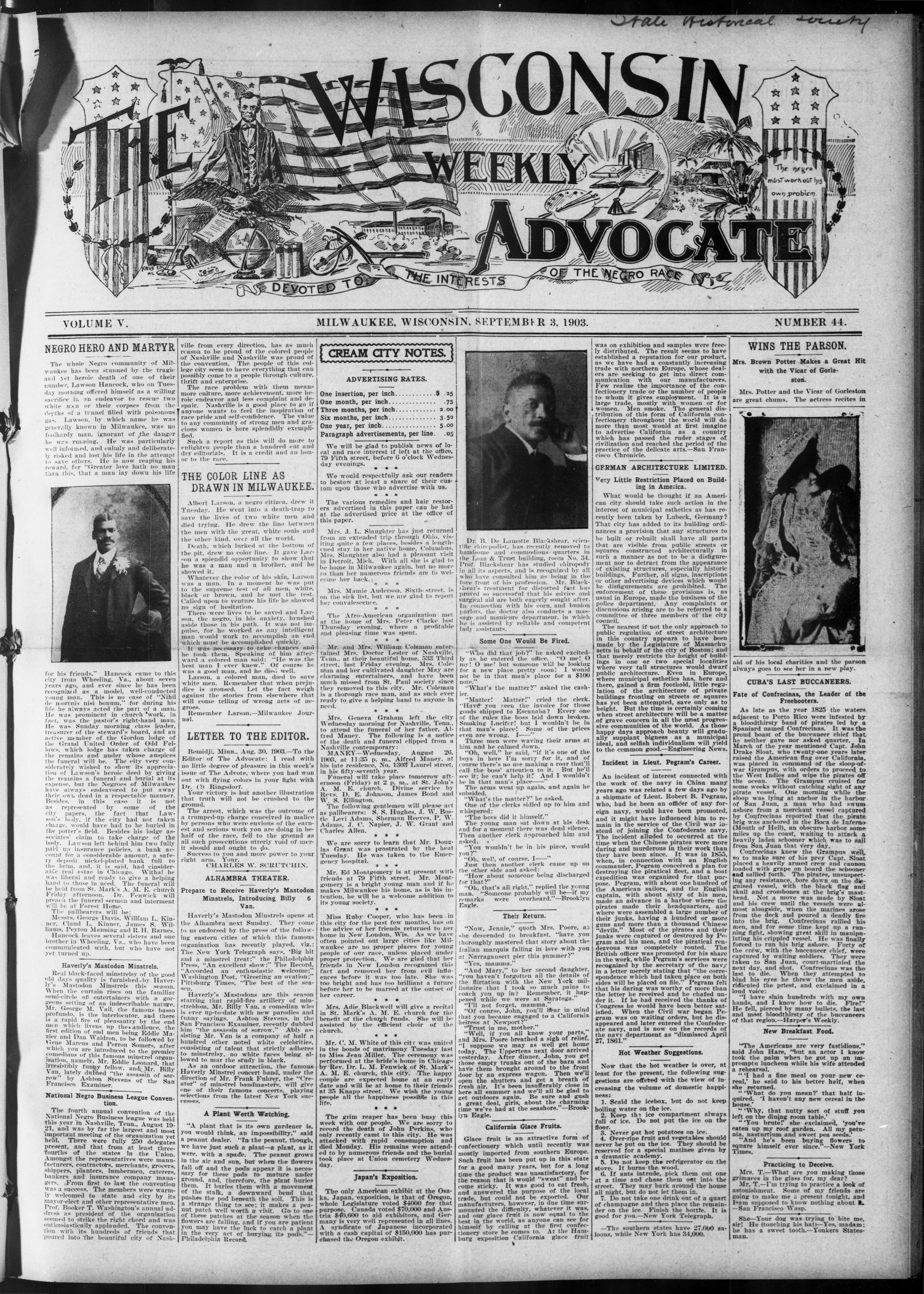
Page text (machine-generated)
WISCONSIN
WEEKLY
ADVOCATE
DEVOTED TO THE INTERESTS OF THE NEGRO RACE
VOLUME V.
NEGRO HERO AND MARTYR
The whole Negro community of Milwaukee has been stunned by the tragic and yet heroic death of one of their number, Lawson Hancock, who on Tuesday morning offered himself as a willing sacrifice in an endeavor to rescue two white men or their corpses from the depths of a trunnel filled with poisonous gas. Lawson, by which name he was generally known in Milwaukee, was no foolhardy man, ignorant of the danger he was running. He was particularly well informed, and calmly and deliberately risked and lost his life in the attempt to save others. He is now reaping his reward, for "Greater love hath no man than this, that a man lay down his life
M. B.
for his friends." Hancock came to this city from Wheeling, Va., about seven years ago, and ever since he has been recognized as a model, well-conducted young man. This is no case of "Nihil de mortuis nisi bonum," for during his life he always acted the part of a man. He was prominent in church work, in fact, was the pastor's right-hand man. He was Sunday morning class leader, treasurer of the steward's board, and an active member of the Gordon lodge of the Grand United Order of Odd Fellows, which lodge has taken charge of the remains and under whose auspices the funeral will be. The city very considerately wished to show its appreciation of Lawson's heroic deed by giving the remains a funeral and burial at its expense, but the Negroes of Milwaukee have always endeavored to put away their own dead in a respectable manner. Besides, in this case it is not as represented by some of the city papers, the fact that Lawson's body, if the city had not taken charge, would have had to be buried in the potter's field. Besides his lodge associates' claim to take charge of the body. Lawson left behind him two fully paid up insurance policies, a bank account for a considerable amount, a safety deposit nickel-plated bank full to the brim, and, it is said, had considerable real estate in Chicago. Withal he was liberal and ready to give a helping hand to those in need. The funeral will be held from St. Mark's A. M. E. church Friday afternoon. Dr. Fenwick will preach the funeral sermon and interment will be at Forest Home.
Messrs, George Davis, William L. Kinner, Claud L. Kinner, James S. Williams, Peyton Manning and R.H. Barnes. Hancock leaves several sisters and one brother in Wheeling, Va., who have been communicated with, but who have not yet turned up.
Haverly's Mastodon Minstrels
Real black-faced minstrelsy of the good old days quality is furnished by Haverly's Mastodon Minstrels this season. When the curtain rises on the familiar semi-circle of entertainers with a gorgeous setting of an indescribable nature, Mr. George M. Vail, the famous basso profundo, is the interlocutor, and there is a rapid fire of pleasantry by the end men which livens up the audience, the first edition of end men being Eddie Mazier and Dan Waldron, to be followed by Gene Mareus and Perron Somers, after which you are introduced to the premier comedians of this famous minstrel organization, namely, Mr. Eddie Leonard, that irresistibly funny fellow, and Mr. Billy Van, lately dubbed "the assassin of sorrow" by Ashton Stevens of the San Francisco Examiner.
National Negro Business League Convention.
The fourth annual convention of the National Negro Business league was held this year in Nashville, Tenn., August 19-21, and was by far the largest and most important meeting of the organization yet held. There were fully 250 delegates present, and that from at least three-fourths of the states in the Union. Amongst the representatives were manufacturers, contractors, merchants, grocers, shippers, planters, lumbermen, caterers, bankers and insurance company managers. From first to last the convention was a success. The members were warmly welcomed to state and city by its mayor-elect and other representative men. Prof. Booker T. Washington's annual address as president of the organization seemed to strike the right chord and was enthusiastically applauded. The convention with its hundreds of friends that poured into the beautiful city of Nash-
ville from every direction, has as much reason to be proud of the colored people of Nashville and Nashville was proud of the convention. The people of this college city seem to have everything that can possibly come to a people through culture, thrift and enterprise.
The race problem with them means more culture, more achievement, more heroic endeavor and less complaint and despair. Nashville is a good place to go if anyone wants to feel the inspiration of race pride and self-confidence. The value to any community of strong men and gracious women is here splendidly exemplified.
Such a report as this will do more to enlighten people than a hundred cut and dry editorials. It is a credit and an honor to the race.
THE COLOR LINE AS DRAWN IN MILWAUKEE.
Albert Larson, a negro citizen, drew it Tuesday. He went into a death-trap to save the lives of two white men and died trying. He drew the line between the men with the great, white souls and the other kind, over all the world. Death, which lurked at the bottom of the pit, drew no color line. It gave Larson a splendid opportunity to show that he was a man and a brother, and he showed it. Whatever the color of his skin, Larson was a man. In a moment he was put to the supreme test of all men, white, black or brown, and he met the test. Called upon to venture his life he showed no sign of hesitation.
There were lives to be saved and Larson, the negro, in his anxiety, brushed aside those in his path. It was not impulse, for he worked as any intelligent man would work to accomplish an end which must be accomplished quickly.
It was necessary to take chances and he took them. Speaking of him afterward a colored man said: "He was the best man I ever knew." Of course he was a good man, and he died well.
Larson, a colored man, died to save white men. Remember that when prejudice is aroused. Let the fact weigh against the stories from elsewhere that will come telling of wrong acts of negroes.
Remember Larson.—Milwaukee Journal.
LETTER TO THE EDITOR.
Bemidji, Minn., Aug. 30, 1903.—To the Editor of The Advocate: I read with no little degree of pleasure in this week's issue of The Advote, where you had won out with flying colors in your fight with Dr. (?) Ringsdorf.
Your victory is but another illustration that truth will not be crushed to the ground.
The arrest, which was the outcome of a trumped-up charge conceived in malice by persons who were envious of the earnest and serious work you are doing in behalf of the race, fell to the ground as all such prosecutions utterly void of merit should and ought to do.
Success to you and more power to your right arm. Your.
CHARLES W. SCRUTCHIN.
ALHAMBRA THEATER
Prepare to Receive Haverly's Mastodon Minstrels, Introducing Billy 6 Van
Haverly's Mastodon Minstrels opens at the Alhambra next Sunday. They come to us endorsed by the press of the following eastern cities of which this famous organization has recently played, viz.: The New York Telegraph says, 'Big hit and a minstrel treat;' the Philadelphia Press, "An excellent show;" The Record, "Accorded an enthusiastic welcome;" Washington Post, "Greeting an ovation;" Pittsburg Times, "The best of the season.
Haverly's Mastodons are this season starring that rapid-fire artillery of minstreldom, Mr. Billy Van, a comedian who is ever up-to-date with new parodies and funny sayings. Ashton Stevens, in the San Francisco Examiner, recently dubbed him "the assassin of sorrow." Ably assisting Mr. Van is a company of half a hundred other noted white celebrities, consisting of talent that strictly adheres to minstrelsy, no white faces being allowed to mar the study in black.
As an outdoor attraction, the famous Haverly Minstrel concert band, under the direction of Mr. Frank Fuhrer, the "Creator" of minstrel bandmasters, will give one of their famous concerts, playing selections from the latest New York successes.
A Plant Werth Watching
"A plant that is its own gardener is, you would think, an impossibility," said a peanut dealer. "In the peanut, though, we have just such a plant—a plant, as it were, with a spade. The peanut grows in the air and sun, but when the flowers fall off and the pods appear it is necessary for these pods to mature under ground, and, therefore, the plant buries them. It buries them with a movement of the stalk, a downward bend that pushes the pod beneath the soil. This is a strange thing to see; it makes a peanut patch well worth a visit. Go to one of these patches at the season when the flowers are falling, and if you are patient you may have the luck to catch a plant in the very act of burying its pods."—Philadelphia Record.
CREAM CITY NOTES.
ADVERTISING RATES.
One insertion, per inch..... $ .25
One month, per inch..... 75
Three months, per inch..... 2.00
Six months, per inch..... 3.50
One year, per inch..... 5.00
Paragraph advertisements, per line. .05
We will be glad to publish news of local and race interest if left at the office, 79 Fifth street, before 6 o'clock Wednesday evenings.
We would respectfully ask our readers to bestow at least a share of their custom upon those who advertise with us.
The various remedies and hair restorers advertised in this paper can be had at the advertised price at the office of this paper.
Mrs. J. L. Slaughter has just returned from an extended trip through Ohio, visiting quite a few places, besides a lengthened stay in her native home, Columbus, Mrs. Slaughter also had a pleasant visit in Detroit, Mich. With all she is glad to be home in Milwaukee again, but no more so than her numerous friends are to welcome her back.
☆ ☆ ☆
Mrs. Mamie Anderson, Sixth street, is on the sick list, but we are glad to report her convalescence.
* * *
The Afro-American organization met at the home of Mrs. Peter Clarke last Thursday evening, where a profitable and pleasing time was spent.
* * *
Mr. and Mrs. William Coleman entertained Mrs. Doctor Lester of Nashville, Tenn., at their beautiful home, 533 Third street, last Friday evening. Mrs. Coleman and her cultivated daughter May are charming entertainers, and have been much missed from St. Paul society since they removed to this city. Mr. Coleman is a thorough race man, and as such ever ready to give a helping hand to anyone in need.
* * *
Mrs. Geneva Graham left the city Wednesday morning for Nashville, Tenn.. to attend the funeral of her father, Alfred Maney. The following is a notice of the death and funeral clipped from a Nashville contemporary:
MANEY—Wednesday, August 26, 1903, at 11:35 p. m., Alfred Maney, at his late residence, No. 1303 Laurel street, in his fifty-seventh year.
Funeral will take place tomorrow afternoon (Friday) at 2 p. m., at St. John's A. M. E. church. Divine service by Revs. D. E. Johnson, James Bond and W. S. Ellington.
The following gentlemen will please act as pall bearers: S. S. Hughes, J. W. Bostic Levi Adams, Sherman Reeves, P. W. Adams, J. C. Napier, J. W. Grant and Charles Allen.
We are sorry to learn that Mr. Douglas Grant was prostrated by the heat Tuesday. He was taken to the Emergency hospital.
Mr. Ed Montgomery is at present with friends at 79 Fifth street. Mr. Montgomery is a bright young man and if he makes Milwaukee his home, as is his intention, he will be a welcome addition to its young society.
☆ ☆ ☆
Miss Ruby Cooper, who has been in this city for the past few months, has on the advice of her friends returned to her home in New London, Wis. As we have often pointed out large cities like Milwaukee are no proper places for young people of our race, unless placed under proper protection. We are glad that her friends in New London recognized this fact and removed her from evil influences before it was too late. She was too bright and has too brilliant a future before her to be marred at the outset of her career.
***
Mrs. Adie Blackwell will give a recital in St. Mark's A. M. E. church for the benefit of the church funds. She will be assisted by the efficient choir of the church.
***
Mr. C. M. White of this city was united in the bonds of matrimony Tuesday last to Miss Jean Miller. The ceremony was performed at the bride's home in Chicago by Rev. Dr. L. M. Fenwick of St. Mark's A. M. E. church, this city. The happy couple are expected home at an early date and will be at home to their friends at 35 Knapp street. We wish the young people all the happiness possible in this life.
* * *
The grim reaper has been busy this week with our people. We are sorry to record the death of John Perkins, who only recently came to this city. He was attacked with rapid consumption and died Monday. His remains were attended to by numerous friends and the burial took place at Union cemetery Wednesday.
Japan's Exposition.
The only American exhibit at the Osaka, Japan, exposition, is that of Oregon, whole Legislature voted $4000 for that purpose. Canada voted $70,000 and Austria $40,600 to aid exhibitors, and Germany is very well represented in all lines. A syndicate of Japanese incorporated with a cash capital of $150,000 has purchased the Oregon exhibit.
M.
Dr. B. De Lamotte Blackshear, scientific chiropodist, has recently removed to handsome and commodious quarters in the Loan & Trust building, room No. 34. Prof. Blackshear has studied chiropody in all its aspects, and is recognized by all who have consulted him as being in the fore front of his profession. Mr. Blackshear's treatment for distorted feet has proved so successful that his advice and surgical aid are both eagerly sought after. In connection with his corn, and bunion parlors, the doctor also conducts a massage and manicure department, in which he is assisted by reliable and competent lady assistants.
Some One Would Be Fired.
"Who did that job?" he asked excitedly as he entered the office. "O me! O my! O me! but someone will be looking for a new place pretty soon! I would not be in that man's place for a $100 note."
"What's the matter?" asked the cashier.
"Matter! Matter!" cried the clerk. "Have you seen the invoice for those goods shipped to Escanaba? Every one of the rules the boss laid down broken. Smoking Lucifer! but I wouldn't be in that man's place! Some of the prices even are wrong. I——"
Three men were waving their arms at him and he calmed down.
"Oh, well," he said, "if it's one of the boys in here I'm sorry for it, and of course there's no use making a roar that'll call the boss' attention to it. But he'll see it; he can't help it! And I wouldn't be in that man's place—"
The arms went up again, and again he subsided.
"What's the matter?" he asked.
One of the clerks sidled up to him and whispered:
"The boss did it himself."
The boss did it himself.
The young man sat down at his desk and for a moment there was dead silence. Then another clerk approached him and asked:
"You wouldn't be in his place, would you?"
"Oh, well, of course, I——"
Just then another clerk came up on the other side and asked:
the other side and that someone being discharged for that?" "Oh, that's all right," replied the young man. "Someone probably will be—if my remarks were overheard."—Brooklyn Eagle.
Their Return.
"Now, Jennie," quoth Mrs. Poore, as she descended to breakfast. "have you thoroughly mastered that story about the Italian marquis falling in love with you at Narragansett pier this summer?"
"Yes, mamma."
"And Mary," to her second daughter, "you haven't forgotten all the details of the flirtation with the New York millionaire that I took so much pains to coach you up in? Remember, it happened while we were at Saratoga."
"I'll not forget, mamma."
"Of course, John, you'll bear in mind that you became engaged to a California heirs at Newport?"
"Well, if you all know your parts," and Mrs. Poore breathed a sigh of relief. "I suppose we may as well get home today. The Uppertens next door arrived yesterday. After dinner, John, you get those empty trunks out of the barn and have them brought around to the front door by an express wagon. Then we'll open the shutters and get a breath of fresh air. It's been insufferably close in here all summer and we'll all be glad to get outdoors again. Be sure and gush a great deal, girls, about the charming time we've had at the seashore."—Brooklyn Eagle.
California Glace Fruits.
Glace fruit is an attractive form of confectionery which until recently was mostly imported from southern Europe. Such fruit has been put up in this state for a good many years, but for a long time the product was unsatisfactory, for the reason that it would "sweat" and become sticky. It was good to eat fresh, and answered the purpose of the local trade, but could not be exported. Our manufacturers, however, in due time surmounted the difficulty, whatever it was, and our glace fruit is now equal to the best in the world, as anyone can see for himself by calling at the first confectionery store he comes to. At the Hamburg exposition California glace fruit
was on exhibition and samples were freely distributed. The result seems to have established a reputation for our product, as we have had a constantly increasing trade with northern Europe, whose dealers are seeking to get into direct communication with our manufacturers. Few realize the importance of the confectionery trade or the number of people to whom it gives employment. It is a large trade, mostly with women or for women. Men smoke. The general distribution of this form of California confectionery throughout the world will do more than most would at first imagine to advertise California as a country which has passed the ruder stages of civilization and reached the period of the practice of the delicate arts.—San Francisco Chronicle.
GERMAN ARCHITECTURE LIMITED
Very Little Restriction Placed on Building in America.
What would be thought if an American city should take such action in the interest of municipal esthetics as has recently been taken by Lubeck, Germany? That city has added to its building ordinances a provision that any structures to be built or rebuilt shall have all parts that are visible from public streets or squares constructed architecturally in such a manner as not to be a disfigurement nor to detract from the appearance of existing structures, especially historic buildings. Further, all signs, inscriptions or other advertising devices which would be disfigurements are prohibited. The enforcement of these provisions is, as usual in Europe, made the business of the police department. Any complaints or discussions arising are to be referred to a committee of three members of the city council.
The nearest if not the only approach to public regulation of street architecture in this country appears to have been made by the Legislature of Massachusetts in behalf of the city of Boston; and that merely restricts the height of buildings in one or two special localities where very tall structures would dwarf public architecture. Even in Europe, where municipal esthetics has, here and there, gained a firm foothold, little regulation of the architecture of private buildings fronting on streets or squares has yet been attempted, save only as to height. But the time is certainly coming when street architecture will be a matter of grave concern in all the most progressive communities of the world. As those happy days approach beauty will gradually supplant bigness as a municipal ideal, and selfish individualism will yield to the common good.—Engineering News.
Incident in Lieut. Pegram's Career.
An incident of interest connected with the work of the navy in China many years ago was related a few days ago by a shipmate of Lieut. Robert B. Pegram, who, had he been an officer of any foreign navy, would have been promoted, and it might have influenced him to remain in the service of the Civil war instead of joining the Confederate navy. The incident alluded to occurred at the time when the Chinese pirates were more daring and murderous in their work than they have been since. It was in 1855, when, in connection with an English commander, Pegram conceived a plan for destroying the piratical fleet, and a boat expedition was organized for that purpose. Pegram, with about one hundred of the American sailors, and the English captain, with about sixty of his men, made an advance in a harbor where the pirates made their headquarters, and where were assembled a large number of their junks, having a hundred or more guns and more than a thousand Chinese "devils." Most of the pirates and their junks were captured or destroyed by Pegram and his men, and the piratical rendezvous was completely routed. The British officer was promoted for his share in the work, while Pegram's services were recognized by the secretary of the navy in a letter merely stating that "the correspondence which had taken place on both sides will be placed on file." Pegram felt that his daring was worthy of more than the letter he received and he chafed under it. If he had received the thanks of Congress he would have been better satisfied. When the Civil war began Pegram was on waiting orders, but he disappeared and later entered the Confederate navy, and is now on the records of the navy department as "dismissed April 27, 1861."
Hot Weather Suggestions.
Now that the hot weather is over, at least for the present, the following suggestions are offered with the view of increasing the volume of domestic happiness:
1. Scald the icebox, but do not keep boiling water on the ice.
2. Keep the ice compartment always full of ice. Do not put the ice on the floor.
3. Never put hot potatoes on ice.
3. Never put hot potatoes on ice.
4. Over-ripe fruit and vegetables should never be put on the ice. They should be reserved for a special matinee given by a dramatic academy.
5. Do not keep the refrigerator on the stove. It burns the wood.
6. If ants intrude, pick them out one at a time and chase them out into the street. They may bark around the house all night, but do not let them in.
7. Do not take one drink out of a quart of champagne and then place the remainder on the ice. Finish the bottle. It is good for you.—New York Telegraph.
—The southern states have 27,000 saloons, while New York has 34,000.
Mrs. Brown Potter Makes a Great Hit with the Vicar of Gorleston. Mrs. Potter and the Vicar of Gorleston are great chums. The actress recites in
THE MASTER
aid of his local charities and the parson always goes to see her in a new play.
aid of his local charities and the parson always goes to see her in a new play.
CUBA'S LAST BUCCANEERS.
Fate of Confrecinas, the Leader of the Freebooters.
As late as the year 1825 the waters adjacent to Porto Rico were infested by a bloodthirsty band of pirates led by a Spaniard named Confrecinas. It was the proud boast of the buccaneer chief that he neither gave nor asked quarter. In March of the year mentioned Capt. John Drake Sloat, who twenty-one years later raised the American flag over California, was placed in command of the sloop-of-war Grampus, with orders to proceed to the West Indies and wipe the pirates off the ocean. The Grampus cruised for some weeks without catching sight of any pirate vessel. One morning while the sloop was lying at anchor in the harbor of San Juan, a man who had swum ashore from a merchant vessel captured by Confrecinas reported that the pirate brig was anchored in the Boca de Inferno (Mouth of Hell), an obscure harbor some miles up the coast, waiting to attack a heavily laden schooner which was to sail from San Juan that very day.
Confrecinas knew the Grampus well, so to make sure of his prey Capt. Sloat placed a heavily armed crew and cannon loaded with grape on board the schooner and sallied forth. The pirates, unsuspecting any resistance, bore down on the disguised vessel, with the black flag and skull and crossbones at the brig's masthead. Not a move was made by Sloat and his crew until the vessels were almost alongside, when the marines arose from the deck and poured a deadly fire into the brig. Confrecinas rallied his men, and for some time kept up a running fight, showing great skill in manipulating his crippled vessel. He was finally forced to run his brig ashore. Forty of the crew, with the buccaneer chief, were captured by waiting soldiers. They were taken to San Juan, court-martialed the next day, and shot. Confrecinas was the last to die. When they attempted to bind his eyes he threw the men aside, ridiculed the priest, and exclaimed in a loud voice:
"I have slain hundreds with my own hands, and I know how to die. Fire!" He fell, pierced by many bullets, the last and most bloodthirsty of the buccaneers of that region.—Harper's Weekly.
New Breakfast Food.
"The Americans are very fastidious," said John Hare, "but an actor I know took the palm when he got up an impromptu luncheon while his wife attended a rehearsal.
"I had a fine meal on your new cereal,' he said to his better half, when she returned.
"What do you mean?' that half inquired. 'I haven't any new cereal in the house."
"Why, that nutty sort of stuff you left on the dining room table."
"You brute! she exclaimed, 'you've eaten up my roof garden. All my petunia, nasturtium and sweet pea seeds.'
"And he's been buying flowers to square himself ever since."—New York Times.
Practicing to Deceive
Mrs. T.—What are you making those grimaces in the glass for, my dear?
gribbles in the glass for, my dear:
Mr. T.—I'm trying to practice a look of astonishment. Some of my friends are going to make me a present tonight, and I am supposed to know nothing about —San Francisco Wasp.
She—Your dog was trying to bite me, sir! He (touching his hat)—Yes, madam; he has a sweet tooth.—Yonkers Statesman.
HE STOLE $100,000.
Henry Townsent Edson Robbad St. Michael's Episcopal Church in New York City.
FAMILY THINKS HIM INSANE
Through Forgeries and Misappropriations the Murderer and Suicide Secured Money.
CORONER MAINTAINS LOVE THEORY
New York, Sept. 4. More than $50,000 and perhaps $100,000 is lost to St. Michael's Protestant Episcopal church, according to The Herald, through forgeries and misappropriations by Henry T. Edson, who last Wednesday killed Mrs. Fannie Pullen and himself.
The vestry met last Monday to authorize an expert accountant to examine the books kept by Edson as controller of the church property. Edson was summoned from Maine and the threatened exposure is believed to have unbalanced his mind.
Although the investigation has only begun it is alleged to have been found that Edson discounted a note for $25,000 purporting to be signed by the treasurer of the church; that he cashed several forged checks, and that he appropriated to his own use rents and voluntary contributions.
The church, although it has few wealthy members, is heavily endowed and has properties which yield a large income. Relatives assert now that he was a maniac and that there was no love affair between him and Mrs. Pullen. Coroner Jackson is not satisfied that this view entirely covers the causes underlying the tragedy. After examining Edson's papers and hearing Dr. O'Hanlon's report that the nature of Mrs. Pullen's wounds indicated that Edson intended to kill her and no one else, the coroner concluded that the murder and suicide were premeditated.
"I canont speak of this matter now," he said. "There are indications of a love affair so involved and so deep that I consider it necessary to make a thorough investigation of it. It apparently extends through many years. This romance in his life seemed to depress him more, if anything, than his financial difficulty. The letters revealing it will be brought out at the inquest which I have arranged to be held next Tuesday."
Dr. Cyrus Edson says his brother was a maniac and that if the tragedy had not taken place he would have been placed in au asylum. The light that has been thrown on the recent life of Henry reveals the fact that he was probably insane for several weeks before he committed his dual crime, and the wonder is to the members of his family and his friends that any of the persons who were at the house when the tragedy occurred escaped alive.
Persons intimately acquainted with the Edson and Pullen families unite in declaring that the murderer's passion for Mrs. Pullen, which he expressed a moment before the shooting, was a surprise to Mrs. Pullen as well as to Mrs. Edson.
LOVE LETTER PROMPTS SUICIDE.
Scolded for Receiving the Missive, Illinois Girl Hangs Herself.
Lebanon, Ill., Sept. 4.—Elsie Ducket, a 16-year-old girl, hanged herself because her father, a stern, austere farmer, scolded her for receiving a letter from a neighbor boy, which closed with the following couplet:
As long as the vine runs round the stump I'll be your darling sugar lump.
William Croffley, the lad who wrote the letter, was one of the pallbearers at the funeral. He is overcome with grief that the farmless lines should have brought about the death of his playmate.
IS AFTER MITCHELL'S PLACE.
Rebellious Leader of Kansas Miners Seeks the Presidency.
Kansas City, Mo., Sept. 4. James Mooney, the district leader who is regarded as responsible for the Novinger coal strike, is asserted to be holding out against John Mitchell to further his alleged aspirations for the presidency of the United Mineworkers of America. Mr. Mooney has, it is said, worked at cross purposes with President Mitchell ever since the beginning of the Pittsburg (Kan.) conference two months ago, when Mitchell went so far as to tell Mooney to sit down and keep still.
TO MAKE NEGROES GOOD.
African Methodist Church Trying to Suppress Criminal Element
New York, Sept. 4.—A committee of representative clergymen appointed by Bishop William B. Derrick, from the A. M. E. conference of the states of New York, New Jersey, Pennsylvania, Delaware, Massachusetts, Rhode Island and Connecticut, for the purpose of urging colored people to follow President Roosevelt's advice and see that the criminal element of their race is suppressed, have recommended that all colored pastors shall deliver discourses on the subject.
JUSTICE OUT FOR BUSINESS
Will Marry First Couple Free and Give
Bride Bonbons.
Munising, Mich., Sept. 4. Justice Johnson has recently offered to marry free the first couple who applied to him. The proposition still stands with no takers, but the justice is not discouraged. He now announces that not only will he tie the knot free, but he will present the bride with a two-pound box of chocolates. The latest proposition is open for one month.
ROBBED OF THEIR JEWELS.
New York and Chicago Women Loss Gems at Alexandria Bay.
New York, Sept. 4.—Mrs. Weir Martin of New York and her aunt, Mrs. Hessing of Chicago, are reported to have been robbed of cash and jewelry amounting to more than $3000 at an Alexandria Bay, N. Y., summer hotel. The women were boating and left the valuables in their rooms. A female servant has disappeared.
Train Kills Three Women
Ligonier, Ind., Sept. 4.—A fast freight train on the Lake Shore railroad killed three women at Felton's Crossing, four miles east of here. They were walking on the tracks. The killed: Mrs. William Billman, Mrs. Ollie Peters and Miss Blanche Gill.
Offer to Sell Whole Town.
Seattle, Wash. Sept. 4.—It is said that an offer will be made to sell to the government the entire townsite of Bremerton, surrounding the Puget Sound navy- yard, for $350,000.
RELIANCE WINS CUP.
Reliance ..... 1:01:56
Shamrock ..... 1:02:00
New York, Sept. 3.—The Reliance wins by three miles.
New York, Sept. 3.—Figuring from official time, Reliance covered the fifteen-mile beat to windward in 2 hours 39 minutes and 39 seconds; Shamrock 2 hours 49 minutes and 45 seconds. Reliance thus beat Shamrock to the outer mark 10 minutes and 6 seconds, or deducting 1 minute and 57 seconds time allowance, 5 minutes and 9 seconds.
New York, Sept. 3.—With a fog heavier than on any previous morning, and but a five or six mile wind from the northward, the conditions early this morning for the fourth attempt this week to sail the third of the series of the international yacht races were far from ideal.
Wind Increasing.
At 1 p.m. the wind had increased to seven miles and as it was from the southeast the course was undoubtedly a 15-mile beat in that direction and a run home. The yachts maneuvered about the starting line until that time and at 1 o'clock, when the starting gun was fired, both boats headed for the line, with Reliance slightly in the lead.
Honors to Shamrock Skipper.
The start was a pretty one, four seconds only separating the boats as they crossed the line. Reliance ahead and Shamrock to windward. The official time was: Reliance, 1:01:56; Shamrock, 1:02:00.
The honors of the start were with Capt. Wringe, the skipper of the challenger. He not only took the windward berth, but he gauged the time to a nicety and crossed the line exactly at the expiration of the two minutes allowed before the handicap gun. Immediately after crossing the line the Britisher exercised good judgment and split tacks from port to starboard and before five minutes of the race had been sailed he was in the lead as well as to the windward.
Shamrock's advantage, however, was not long lived for Reliance, pointing higher, passed the Lipton boat and took the lead.
HE ROBBED AN ESTATE.
Baltimore Clubman Disappears After
Looting Mother's Property
of $560,000.
Baltimore, Md., Sept. 3. William T. Tucker, or "Willy" Tucker, as he is familiarly known by his friends, prominent in business and club circles, has disappeared after looting his mother's estate and squandering $560,000 of her money. He now is believed to be in Central America.
With his mother, young Tucker was a trustee of the estate of his father, the late Wesley A. Tucker. His mother has been abroad with one of her daughters.
When the other members of the family made the discoveries which brought the young man's defalcations to light, a cable message to Mrs. Tucker brought her home in haste.
On her arrival in Baltimore, Mrs. Tucker began an investigation of the contents of the safe deposit box in which the securities belonging to her husband's estate and her own were kept. It was then that she made the startling discovery of the defaulcation of $500,000, and that of all the property she left in the care of her son only $93,000 remained.
Mrs. Tucker had absolute faith in her son and refused to credit the stories of his dissipation.
When Mrs. Tucker desired to open the safe deposit box on Monday she did not have a key and it was necessary to break the door off.
Young Tucker is said to have been speculating heavily in stocks and to have been a high roller generally.
A breach of promise suit is now pending against Tucker, brought by Miss Sarah G. Morris of this city, who claims she leamed him $2400. The absconder is about 35 years old. His family has not yet indicated whether they will institute legal proceedings to secure his extradition.
GEN. KING IS ELECTED.
Milwaukeean Is Named President of the Society of the Army of the Philippines
St. Paul, Minn., Sept. 3. Gen. Charles King of Milwaukee was elected president of the Society of the Army of the Philippines. Other officers were named as follows:
First vice president, Col. J. W. Pope, Colorado; second vice president, Capt. C. E. Locke, Colorado; third vice president, F. M. Schutte, St. Paul; fourth vice president, Capt. H. A. Crowe, Pennsylvania; fifth vice president, Col. W. S. Metcalfe, Kansas; sixth vice president, Maj. D. S. Fairchild, Jr., Iowa; secretary, A. E. Fouts, Missouri; treasurer, J. E. White, Illinois.
At the meeting of the society last night Gen. Irving Hale made an address claiming that the conduct of the American soldiers in the Philippines has been vindicated and its traducers silenced.
TROOPS WILL BE SENT.
Soldiers to Be Ordered Out to Protect Life and Property in the Cripple Creek District in Colorado. Denver, Colo., Sept. 3.—Gov. Peabody has received telegrams from the mayor of Victor and others demanding that troops be sent to the Cripple Creek district for the protection of life and property. He says that he will call out the troops today. No violence has been reported since Tuesday night.
BURGLARS USE NITRO-GLYCERINE.
Robbers Secure $100 Cash and $4000
Paper at Seneca.
Marquette, Mich., Sept. 4. The general store of John Blair at Seneca was robbed last night. The safe was blown up with nitro-glycerine and all its contents. $100 cash and $4000 worth of negotiable paper, was taken. The explosion aroused the town, but the robbers made their escape.
Wild Beasts, as a Business.
The bringing of wild beasts from the jungle is an immense business and the demand greatly exceeds the supply. City zoological gardens, eccentric persons wanting cubs, millionaires and private parks are important markets for animals. The circuses alone, however, would gladly take all the jungle beasts which reach New York alive.
The leopard is the most cowardly of animals. This may account for his being almost universally used by female animal tamers.
SHAW IS OPTIMISTIC.
Secretary of Treasury Makes an Address Before National Association of Travelers.
Chicago, Ill., Sept. 3.—"If prosperity ceases and disaster comes it will be from causes psychological, but not logical," said Secretary of the Treasury Shaw at a banquet given by the members of the National Association of Merchants and Travelers at the Auditorium hotel last night.
"The microbe of panic if it exists is in the mind; it is not elsewhere. There exists today no one fact and no combination of facts the logical sequence of which suggests disaster." That was the tone of the secretary throughout.
"If disaster comes it will be because men lose their nerve," he declared. "I am told that an engineer on an express train is forced to lay off occasionally. The men above him say that he must do that to strengthen his nerve. The other day I heard of a railroad president who had use for 6000 freight cars. He refused to buy them. I heard of another who needed 2500 cars and he, too, refused to buy. That meant that the makers of those cars were forced to idleness. Those presidents should have been retired until they had regained their nerve. They are the people who will be responsible for disaster should it come. Only the lack of nerve will bring it about." Secretary Shaw gave his plan for elastic currency as follows:
"If I were given authority to formulate a measure that would provide the requisite elasticity to our present currency system, I think I should add an amendment permitting national banks, with the consent of the comptroller of the currency, to issue a volume of circulating notes equal to 50 per cent. of their bond-secured circulation, at a tax of 6 per cent., the same to be retired at will or by direction of the comptroller, by the deposit of an equal amount of lawful money with any subtreasury."
ASKS RECEIVER FOR THE ECUADOR COMPANY.
English Corporation Asserts That Firm
Has $3,600,000 Liabilities and
Only $10,000 Assets.
Trenton, N. J., Sept. 3.—Vice Chancellor Stevenson today granted an order to show cause why a receiver should not be appointed for the Ecuador company, a New Jersey corporation capitalized at $5,000,000. The application was made by the Ecuadorian association, limited of England. The complainant alleges that the Ecuador company's liabilities are $3,600,000, with assets of $10,000 The company was formed in February 1903, to construct a railroad in Ecuador
MURDERED BY A JEALOUS WOMAN.
Mrs. Kruse of Denver Called Away from Her Little Babe and Shot to Death by Mrs. Bernardine.
Denver, Colo., Sept. 3.—Mrs. Theodore Kruse, wife of a bookbinder, was shot and killed today at her home, 95 West avenue, by Mrs. Kate Bernardine. The woman was arrested. She declined to make any statement. The cause of the shooting is supposed to be jealousy Mrs. Kruse was attending her 8-month-old baby when called to the door by Mrs. Bernardine, who immediately fired through the wire netting.
SEVERAL DEATHS IN BAD TRAIN WRECK
Passenger Train on Southern Railway Falls Through Trestle—Some Killed, but No Particulars.
Charlotte, N. C., Sept. 3.—A passenger train on the Southern railway between Rockhill and Yorkville, S. C., went through a trestle this morning. Several deaths are reported, but no particulars available.
KILLING WAS ACCIDENTAL
Newark Street Railway Officials, Charged with Manslaughter of Nine Students, Are All Acquitted. Newark, N. J., Sept. 3.—In the trial of the directors and officials of the North Jersey Street Railway company on a charge of manslaughter for last February's crossing accident, the court today directed a verdict of acquittal of all the defendants.
FIVE HURT IN EXPLOSION.
Boiler in Chemical Works Blows Up and Several Men Are Injured—Building Is Demolished.
Newark, N. J., Sept. 3.—A boiler in the chemical establishment of the Hansen Van Kincle company exploded this afternoon, demolishing the building. Five men were injured by the shock of the explosion or by being buried beneath debris. They are: William Wickethousen, Joseph Winters, Charles Connellly and Howard Oliver.
RENT OF ONE DOLLAR.
Waukegah, Ill., Sept. 3.—[Special.]— Mayor Pearce received a letter from Government Engineer Warren at Milwaukee. It was a request for the city to remit by September 4 the sum of $1, the same being the yearly rental for the land occupied by the city dock. The authorities made haste to pay.
RUN NEGROES OUT OF TOWN.
Mob at Shawneetown, Ill., Fails to Lynch Prisoner.
Shawneetown, Ill., Sept. 3.—Fifty negroes have been driven out of town in the last forty-eight hours by whites. A mob, disappointed in its efforts to lynch John Griffin, a negro who had attacked a white woman, raided the negro quarters and stoned houses, resorts and dives where the colored people generally assembled. Many of the negroes, fearing for their lives, fled to the country, where they found refuge with friends of their race.
RACE IS FAR FROM SUICIDE.
Census Official Gives Statistics Showing Excess of Births-Over Deaths
Washington, D. C., Sept. 3.—Chief Statistician King of the census office ridicules the race-suicide scare. He says that before long this country will be confronted with the problem of what to do with the people. To prove his assertion Mr. King quotes from the census returns of 1900. In that year the enumerators found 2,049,132 children were born, and a record of 1,039,094 deaths, or an excess of births of 1,010,048.
New York, Sept. 4.—The American champion, Reliance, yesterday added another "spike" to those formerly driven to prevent the America cup from being "lifted" by British sailors. Bursting through a wall of fog that overlung the course down off Sandy Hook at half-past 5 o'clock in the afternoon, it crossed the finish line a winner by a wide margin of three straight races.
The same pall of fog mercifully covered up the ignominious defeat of Shamrock III., the worst beaten boat English yachtsmen have dispatched across the Atlantic to recover the cup in a score of years. Back in the heavy mist, Capt. Wringe and his crew groped about for the finish line. Shamrock missed it and passed by at a distance, and then returned from the opposite direction, but did not cross. This, however, was some time after the cheers for Reliance had died out.
"I don't care to discuss it any more," said Sir Thomas Lipton, after he had seen his third challenger humbled worse than either of its two predecessors. "The American boat was the better. That is all. Two weeks ago I was hopeful. Last week I knew I was doomed to defeat, and was disappointed. Today I am almost glad in my own defeat, this America has been such a thoroughly generous victor. I want again to thank the American people for their generosity to me in my defeat."
COMMISSION MAKES CONCESSIONS.
Northern Pacific to Run St. Paul-Duluth Trains Via Superior.
St. Paul, Minn., Sept. 4.—Permission to run four of its St. Paul-Duluth trains via Carleton and Superior was granted to the Northern Pacific by the Starr and Warchous commission. Two daily trains, however, must be run by way of the old St. Paul & Duluth line, which lies entirely within Minnesota.
The railroad, in accepting the commission's offer, agrees to consider all traffic on trains run between the two cities as state commerce and subject to state regulation. In addition to this, the Northern Pacific agrees to open the Duluth Twentieth avenue station and to give the people at West Duluth adequate train service by re-establishing a depot at Fifty-fifth avenue.
BARBAROSSA ARRIVES SAFELY.
Captain Tells of the Accident to the Big Ocean Liner.
New York, Sept. 4. The disabled steamer Barbarossa of the North German Lloyd line arrived in port today under her port engine. Capt. Mentz says that on Friday last, August 29, at 7 o'clock in the morning, the starboard engine became disabled and investigation showed that the tail shaft of the propeller was broken. The ship was stopped, the outboard section of the shaft was secured and the steamer proceeded. There was no excitement among the passengers as very few knew of the matter until afterwards.
VETERANS AT CLINTONVILLE.
Waupaca County Soldiers Hold Annual Gathering and Camp Fire.
Clintonville, Wis., Sept. 4.—[Special.] The Waupaca County Veterans' association assembled here for a two days' meeting. They were joined by the local German War veterans in a parade. After the parade they met at the opera house and listened to an address of welcome by Capt. F. M. Guernsey, followed by the address of the day by C. D. Cleaveland of Oshkosh. In the evening they had a campfire.
REPUDIATES HIS MARRIAGE.
Racine Man Claims Wedding Ceremony Was a Mock Affair.
Racine, Wis., Sept. 4.—[Special.]—Claiming that his marriage is void, Charles Roberts has applied to the courts for a separation. At his home in Franksville, Roberts met his wife, who was then Cora Hansen, and they were supposedly married by a justice of the peace. Roberts now claims that the ceremony was without witnesses and a mock affair.
STRAY BULLET RUINS EYES.
Ex-Sheriff of La Crosse County Injured While Hunting.
La Crosse, Wis., Sept. 4.—[Special.]—A stray bullet, shot from no one knows where, struck G. G. Lang, ex-sheriff of this county, in the eye while he was hunting near Pray, Wis., yesterday. He will probably recover, but will lose his eyesight. It is thought that the bullet was a stray one from some hunter's gun.
FORMER CLERK IS WANTED.
Authorities Are Looking for Albert J. March of Red Jacket.
Calumet, Mich., Sept. 4.—[Special.]— Albert J. March, former, y clerk and secretary of the water board of Red Jacket, is wanted by the local police on the charge of embezzlement. It is alleged that March has $1000 of the funds of the village.
Heavily Guarded Steamers Laden with Coin Sail for the Islands.
New York, Sept. 4. There will leave this port today on the steamers Nubia and Sagami for the Philippines 10,465,000 silver coins, aggregating in currency value $1,075,000. To guard against possible attack by pirates, both ships are equipped with six 4-pounders. There also is a heavy supply of small arms aboard and a special guard will watch the money.
F. R. COUDERT NEAR DEATH
Noted New York Lawyer Is Critically Ill with Heart Trouble.
New York, Sept. 4.-Frederic R. Coudert, the famous New York lawyer, is seriously ill at his home on Cove Neck, L. I. He is suffering from a heart affection.
One of the most prominent of oil magnates in Los Angeles is a woman, who is said to control about half of the whole product.
INTENDED TO MURDER.
Henry Weilbrenner Confesses That He Had Planned to Assassinate the President.
Oyster Bay, N. Y., Sept. 3.—That President Roosevelt had a narrow escape from assassination at the hands of a maniac was confirmed by later details of the attempt made by Henry Weilbrenner to get near the President Tuesday night. It was also discovered that Weilbrenner was driven insane by labor union strikes in New York city. His brother had lost his place in New York through continued strikes and had returned to his father's home with his wife and family to keep from starving. His father was a truck farmer at Syosset, five miles from Oyster Bay, but there was a mortgage on the farm. Henry was working with his father with might and main to clear off the mortgage. The troubles brought on the married brother, together with hard work and the farm indebtedness, so preyed on Henry's mind, that he broke down under the strain. About this time he began practicing with a revolver and became almost an expert marksman.
When Weilbrenner first arrived at the President's summer home Tuesday night the detectives on guard turned him away. Soon afterward Weilbrenner returned and again insisted that he be allowed to see the President, if only for a minute. This time he was ordered away and warned not to return. Just before 11 o'clock the man returned a third time and demanded of the officer that he should be permitted to see the President at once. According to a witness the President, evidently disturbed by argument outside, appeared on the porch. At that moment, it is said, Weilbrenner, who was still in the buggy, saw the President, and, whipping up his horse, tried to make a dash past the guard. He lenned forward in the vehicle and the weapon for a moment was visible in his hand. He was then less than 100 feet from the porch on which the President stood. Secret Service Officer Connell, without a moment's hesitation, grabbed the man by the collar of his coat and dragged him from the buggy.
After his arrest Weibrenner admitted that he had intended killing the President. Doctors last evening adjudged the man insane and he will be sent to an asylum.
WILL NOT GIVE IN.
The United States Reiterates Its Position in Regard to Panama Canal Treaty.
Washington, D. C., Sept. 3.—Additional instructions have been cabled Mr. Beaupre, the American minister at Bogota, reiterating the position of this government regarding the canal treaty. The state department assumes entire responsibility for every representation of Mr. Beaupre to the Bogota government concerning the treaty and his activity in this direction is heartily endorsed by the President and Secretary Hay. Minister Beaupre's latest instructions advise him that President Roosevelt will not enter into any engagement with the Colombian government which will hamper his scope of action under the canal law. This government will not indicate what its course of action will be in the event the treaty is rejected.
Dr. Herran, the Colombian charge, will be asked as to the truth of his reported criticism of Minister Beaupre's activity at Bogota. The alleged criticism by Mr. Herran was not well received at the state department.
Panama, Sept. 3.—No secret is made here of the purpose of the people of the isthmian states to secede from Colombia as soon as it is certain that Congress at Panama will do nothing to secure the ratification of a canal treaty.
Men of all nationalities and callings in business in Panama and Colon and in the twenty-one settlements along the line of the Panama railroad are practically a unit for the revolutionary movement, and are not afraid to say so openly. The definite failure of the canal treaty will be the signal for the perfection of the plans, and within a short time after it is definitely known that no relief is to be expected from Bogota the revolt will occur.
WILL NOT INCREASE BANK DEPOSITS.
Secretary of Treasury Shaw Says Only Applications for Small Amounts Are to Be Accepted.
Chicago, Ill., Sept. 3. The report that government deposits in national banks are to be materially increased is declared unfounded. Secretary Shaw today made the following statement: "For the present I am accepting only application for small amounts for deposit, applications that have been on file for several months, and I am confining these to agricultural districts."
KILLED WHILE WATCHING SHOW
Ball Cartridge Mixed with Blanks Used During Performance.
Birmingham, Ala., Sept. 3.—While the Star minstrel troupe of Birmingham was giving a performance in Library hall, Bessemer, last night, Edwin Neeley, 10 years old, was shot dead by accident. The people on the stage fired a volley of blank cartridges. One revolver was loaded with bullets. Wade La Salle of Birmingham, one of the minstrels, surrendered to the police, saying that after the shooting he discovered that the chambers of his revolver were loaded with ball cartridges.
CLASH ON BUSINESS LINES.
Waukegan and Zion City Merchants Retaliate Against Each Other.
Waukegan, Ill., Sept. 3.—[Special.]—The fight for the business of this region between Waukegan and Zion City is getting bitter. Yesterday city police stopped a Zion City wagon from delivering goods here. Dowie has ordered his people not to buy of Waukegan merchants, therefore retaliation is in order.
GASOLINE KILLS TWO WOMEN.
Explosion Follows Lighting Match— Children Narrowly Escape.
Cincinnati O., Sept. 3.-Mrs. John Henderson and Mrs. William Shaffer were burned to death and their children narrowly escaped, at Blue Ash, O. The boiling over of coffee extinguished the fire and the gasoline flowed unnoticed. An explosion followed the lighting of a match.
ASK COURT TO BALK MERGER.
Northwestern Life and Savings Policy Holders Object to Its Absorption.
Des Moines, In., Sept. 3.—Sixteen policy holders in the merged Northwestern Life and Savings society of Des Moines have asked the court for a mandatory injunction requiring the National Life of Minneapolis to return to Iowa all assets and books of the former which it recently purchased and restraining the merger of the two concerns.
JUSTICE IS DENIED
Officers Who Demanded Punishment of the Servian Regicdes Are Arrested.
They Demanded That the Murderers of Alexander and Draga Be Court Martialed.
Belgrade, Servia, Sept. 4.—A number of officials of the Nish and other garrisons in Servia have been arrested in connection with the issuance of the proclamation demanding the trial by court-martial of the conspirators who were concerned in the assassination of King Alexander, Queen Draga and their ministry, and threatening to resign their commissions if the demand was refused.
LATEST MARKET REPORTS.
MILWAUKEE, SEPTEMBER 3, 1903.
EGG AND DAIRY MARKETS
MILWAUKEE—Eggs—Market firm; strictly fresh laid, loss off, cases returned, 17c; cases included, do, 17 1/2c; at mark cases included, 15 1/2c@16 1/2c; cases returned, 15@ 15 1/2c; seconds, 12c; dirties, 12c; checks, 1No. There is a good local demand. The supply of fancy fresh eggs is very light. Receipts were 465 cases.
Butter—Firm; there is a good demand for creamery and fancy dairy; low grades of dairy are slow sale; creamery, extra per lb, 19c; prints 19 1/2c; firsts, 16@17c; seconds, 14@15c; dairy prints, 17c; fancy dairy, 16c; lines, 12@14c; packing stock, 12 1/2@13c; whey, 10c. Receipts were 16 700 lbs.
Cheese—Easy. The demand continues good; American full cream, twins, 11@11½c; daisies, 11@11½c; long horns, 11½@12c; low grades, 9@10c; limburger, per lb, old. No. 1, 10@10½c; low grades, 6@8c; new No. 1, 9@10c; off grades, 7@8c; fancy new brick, 9½@10c; low grades, 8@9c; imported Swiss, 25c; Block Swiss, domestic, 14@14c; fancy leaf, 15½@16c. No. 2, 13@14c; Sapsago, 20c. Receipts were 64,300 lbs.
CHICAGO—Butter—Steady: creameries, 14@19c; daisies, 13@17c. Eggs—Firm; at mark, cases included, 16½@17½c. Cheese—Steady; daisies, 10@10½c; twins, 9½@10c; Young Americas, 10@10½c. Iced poultry—Steady; tukkeys, 11c; chickens, 10½c; springs, 18c.
MILWAUKEE LIVE STOCK MARKET.
HOGS—Receipts, 10 cars; market strong; light, 180 to 175 lbs, 5.50@6.00; mixed, 180 to 250 lbs, 25.50@5.85; packers, 5.00@5.35; coarse heavy stags, 4.50@4.75.
CATTLE—Receipts, 5 cars; steady; calves steady; butchers' steers, medium to good, 1050 to 1300 lbs, 4.00@4.75; fair to medium, 950 to 1050 lbs, 3.40@3.85; heifers, common, 2.25@2.75; good, 3.25@4.09; cows, fair to good, 2.50@3.25; canners, 1.50@2.00; cutters, 2.25@2.40; bulls, common, 1.25@2.50; choice, 2.75@3.15; feeders, 800 to 950 lbs, 2.90@3.40; stockers, 500 to 750 lbs, 2.25@2.75; veal calves, common to choice, 5.50@7.25; Milkers, common, 18.00@25.00; choice, 30.00@45.00.
SHEEP—Receipts, 2 cars; steady, 2.75@3.50; bucks, 2.50@3.00; lambs, 4.00@5.25.
Chicago receipts: Hogs, 15,000; cattle, 8000; sheep, 18,000.
MILWAUKEE HAY MARKET.
Timothy lower; carlots, choice timothy, 11.50@12.00; No. 1 timothy, 11.00@11.50; No. 2 timothy, 9.00@11.00; clover and clover mixed, 8.00@8.50.
Prairie hay steady; choice Kansas, 12.00@12.25; No. 1 Kansas, 11.50@11.75; No. 2, 8.50@9.00.
Straw steady: rye, 7.50@7.75; oats, 4.75@
5.00; wheat, 4.00@4.50; packling hay, 6.50@
6.75.
MARKETS BY TELEGRAPH
MILWAUKEE—Flour—Frm. Wheat — Steady; No. 1 northern, on track, 89c; No. 2 northern, on track, 87½c. Corn—Frm; No. 3 on track, 55c. Oats—Higher; No. 2 white, on track, 38c; No. 3 white, on track, 35@ 36½c. Barley—Frm, fair demand; No. 2 on track, 65c; sample on track, 47@65c. Rye—Higher; No. 1 on track, 56c. Provisions—Frm; pork, 12.40; lard, 8.67. Flour market firm; hard spring wheat patent, in wood, 4.00@4.70; hard spring wheat straight, in wood, 4.45@4.55; export patent, in sacks, 3.90@4.00; first clear, in sacks, 3.50@3.60; low grade, in sacks, 2.55@2.05; rye flour, country pure, in sacks, 2.95@3.05; city pure, in wood, 3.15@3.25. Millstuffs are nrm, quoted at 14.50 for bran, 17.00@17.25 for standard middlings and 19.50 for Milwaukee flour middlings in 10-lb sacks; red dog, 22.00. Delivered at country points, 50c extra.
CHICAGO — Close — Wheat — September, 81%c; old, 81%c; December, 82%@82%c; old, 82%c; May, 84%c; Corn—September, 52%c; December, 51%c; May, 51%c; Oats—September, 30%c; December, 37%c; May, 39%c; Pork—September, 12.45; October, 12.67%c; May, 13.20; Lard—September, 8.62%c; October, 7.77%c; December, 7.25; January, 7.12%c; Ribs—September, 8.00; October, 7.95; January, 6.75@6.77%c; Rye—September, 55%c; December, 56%c; May, 58%c Flax—Cash northwest, 90c; southwest, 94c; September, 94c; October, 95c; May, 1.02 Timothy—Cash, 2.85@3.10; September, 3.15; October, 3.10; Clover—Cash, 9.30@9.35; October, 9.00; Barley—Cash, 45@59c.
KANSAS CITY—Close — Wheat—September, 71%c; December, 71%@71%c; cash No. 2 hard, 75@76%c; No. 3, 72@74c; No. 4, 68%c; rejected, 66@68c; No. 2 red, 79@80c; No. 3, 78c; Corn—September, 45%c; December, 44%c; cash No. 2 mixed, 47@47%c; No. 2 white, 47%c; No. 3, 46%c; Oats—No, 2 white, 38@40c; No. 2 mixed, 34%c
ST. LOUIS—Close —Wheat —Lower. No. 2 red cash elevator, 82%c; September, 82%c; December, 86%c@86%c; May, 88%c; No. 2 hard, 79%c; Corn—Steady. No. 2 cash, 47%c; December, 48c; May, 49%c; Outs—Higher. No. 2 cash, 34%c; September, 34c; December, 35%c; May, 38c; No. 2 white, 40c. Lead—Firm, 4.20; spelter, 5.60@5.70.
DULUTH—Close —Wheat—Old, in store, No. 1 hard and No. 1 northen, 86%c; new, to arrive, No. 1 hard, 84%c; No. 1 northern, 82%c; No. 2 northern, 81%c; new, on track, No. 1 northern, 84%c; No. 2, 82%c; September, 83%c; December, 80%c; May, 84c. Flax—In store to arrive, on track and September, 99%c; October, 99%c; November, 99%c; December, 99%c; May, 13%c; Oats—To arrive and on track, 36. Rye—On track and to arrive, 53%c; B. —40@57c. Receipts of wheat, 57,615 bus; shipments, 5000 bus.
NEW YORK—Close —Wheat —December, 88%c; May, 89%c; Corn—December, 58%c; May, 58c.
KANSAS CITY—Cattle—Recelpts, 8000;
market steady; beef steers, 4.00@5.40; Texans, 1.40@3.50; cows and heifers, 1.50@4.65; stockers and feeders, 2.25@4.25. Hogs—Recelpts, 5000; market opened strong, now weak; heavy, 5.30@5.42½; packers, 5.30@5.55; yorkers, 5.70@5.85; plugs, 5.00@5.85. Sheep—Recelpts, 10.000; market steady to 10c lower; sheep, 2.50@4.25; lambs, 2.50@5.30.
ST. LOUIS—Cattle—Recelpts, 4000; market steady; beef steers, 3.75@5.65; stockers and feeders, 2.55@3.90; cows and heifers, 2.25@4.50; Texas steers, 2.70@4.25. Hogs—Recelpts, 4000; market steady; pigs and lights, 5.30@6.05; packers, 5.45@5.85; butchers and best heavy, 5.45@6.00. Sheep—Recelpts, 2000; market strong; sheep, 3.25@3.75; lambs, 4.30@5.20.
SOUTH OMAHA—Cattle—Receipts, 3200;
market strong; beef steers, 4.00@5.75; cows
and heifers, 3.00@4.10; western steers, 3.00@
4.25; Texas steers, 2.75@3.65; western cows
and heifers, 2.25@3.50; stockers and feeders,
3.00@4.25. Hogs—Receipts, 5500; market 5c
higher; heavy, 5.15@5.25; plugs, 5.00@5.30.
Sheep—Receipts, 6500; market strong;
sheep, 2.00@3.60; lambs, 4.00@4.75.
—A collection of stams formed by G.
Owen Wheeler of the London Philatetic
society was sold by auction recently for
$5575.
FARMERS CORNER
No. "New-Fangled" Farming.
Now the farmer dons his go-to-meetin' suit
And he hies him to a grangers' institute,
There to hear, in learned lectures,
Agricultural conjectures
And to hark to professorial dispute.
Each with hoards of useful knowledge 'neath his pate,
And they tell the farmer how
He should milk the speckled cow
In the fashion most approved and up to date.
There are papers on "Rotation of the Crops."
Dissertations on "The Proper Poles for Hops,"
And a long, intense debate
On the question, grave and great,
"Should the Barn Be Cleansed with Pitchforks or with Mops?"
"How to Trace the Wily Weasels to Their Sources,"
"Helpful Hints on Painless Dentistry for Horses,"
"How to Build a Stack of Oats"
As a "Winter Shed for Goats"—
There are many more such edifying courses.
Now the farmer sagely nods at all they
And at sundown, having spent a pleasant day,
Homeward hastens to his toil
And proceeds to till the soil
In the very good old-fashioned Jersey way.
Newark News.
Wagon Loading Attachment. Farmers have a vast deal of hard lifting to do at best, and, therefore, should be quite willing to adopt any suggestions that are practical which will lighten their labors. One of the hard tasks on the farm is loading produce into the wagon. The illustration shows a plan whereby one can walk directly into the wagon with any basket one has in hand, and thus save the heavy lifting which would be necessary without this attachment. A board or boards the width of the wagon body are cut long enough to give the proper slope to make the ascent easy. Across the board cleats are nalled at proper distances, and in one end are bored two or three holes as shown in the illustration. In the wagon body hooks are fastened at distances to correspond with the holes in the board. When the board is in use
WAGON LOADING ATTACHMENT.
simply lift it so that the holes will come over the hooks and it is secure. The cost of making such an attachment to the wagon is small and after one has used it for a while he will wonder how he ever got along without it.-Indianapolis News.
Growing Potatoes.
The quantity of seed potatoes required for an acre will depend a great deal upon the size of the potatoes and the size of the pieces each seed potato is cut into at planting time. As a general rule it requires from ten to twelve bushels planted in rows three feet apart and eighteen inches apart in the row. This is supposing that the potatoes are of medium size and are cut so that each piece will have two or three eyes. The land should be rich. Loam, well fertilized with stable manure, is as good as any soil that can be had. If the potatoes can be planted on clover sod, so much the better. Prairie sod will grow good potatoes, provided the sod can be well cut up into a mellow seed bed. Ordinarily the second year after breaking the prairie is better than the first. Ground which had no crop last year and was covered with weeds will contain a great number of weed seeds, and much labor will be required to keep the potatoes clean. Orange Judd Farmer.
Whitewashing a Poultry House.
Whitewashing a Poultry House. Whitewash needs to be well made to do its work effectually; too often it comes off in flakes, once the house is dry, if the woodwork is touched. Finely slaked lime should be dissolved in hot water, making the lime as thick as possible; add a little soft soap and some paraffin, and we get a whitewash that will kill the lice and stick to the woodwork. It should be applied hot, the walls of the poultry house being first swept down to clean them of cobwebs and dirt, and the perches and nest boxes removed. Dabbing the walls with a thin mixture of lime and water does little or no good. The perches and nest boxes should also be treated to a coat of whitewash: the work should be done in the morning, so that by nightfall the house and perches and nest boxes are dry again.—Massachusetts Farmer.
Profitable Plums.
The Maryland plum specialist, J. W. Kerr, states that wherever the peach is entirely hardy it is a very satisfactory stock for plums and that root
grafting is incomparably superior to budding in propagating on this stock. The varieties Abundance and Chabot are considered the best of the Japanese or hybrid plums. Milton and Whitaker are considered the best among native plums. The author states that there is more profit in an acre of Milton plums than of any other variety.
A Handy Wagon Rack.
The ordinary rack, such as is used on a farm wagon, is very heavy, and while it may be necessary to have such weight when carting of large loads is done, a lighter rack readily handled by one man would be a convenience for field loading. In the upper part of the illustration the rack is shown in the wagon box, the latter being indicated by the dotted lines, the lower part of the illustration shows the details of each section of the rack. These sections are made of 2x2 material and held together where they lap with a bolt. Figures 1 on this section indicate where the side pieces are to be attached. Each side of the rack is placed in position in the wagon, as shown, and when not in use can be folded up, taken from the wagon and stored in any
A
HANDY WAGON BACK. convenient place. The cost of such a rack is very small and all of the work, with the possible exception of placing the bolts, can be done on the farm.
Care of Work Horses:
Food and care of work horses in warm weather is a subject that is worthy of extensive discussion. Ordinarily farm horses will do better if turned to grass at night than if kept on dry feed. It is much better for their feet, and the change from dry to green food is beneficial in every way. One of the most common mistakes made is that of overloading, making two horses do the work of three. This in the long run is not economy. The majority of teamsters injure their horses by feeding too much hay, while in the case of road animals mistakes are often made by driving too hard when starting out on a journey. One should start off at a slow jog, gradually increasing the speed, if this is necessary, after a mile or two has been covered. On the road or in the field, it is usually well to lessen the pace somewhat just before unhitching, as the animal will then get much more good from the food consumed. Horses should be watered as frequently as possible, and it is much better if they are made to take the bulk of their drink before meals rather than after. During warm weather the horses will do much more work if they are given water some time during the middle of the forenoon and afternoon. Iowa Homestead.
Grass for Reseeding.
In reseeding meadows and pastures, particularly the latter, orchard grass has a value that is not appreciated. While there may be some question as to its feeding value as compared to timothy, in reseeding one does not expect to obtain prime hay, the main object being to make the meadow longer lived. Orchard grass will stand hot and dry weather splendidly, seemingly doing its best when other grasses have burned out, growing and filling the spaces left in good shape. Horses like orchard grass fed just after cutting and do well on it, which is not the case with other grasses, as a rule. While seed may be sown alone at the rate of three bushels per acre, and will make good pasture, as a rule it is sown with clover and other seeds, using one-half to one bushel of the orchard grass. The writer has experimented with this grass for several years in connection with clover for reseeding pastures and has found it by far the cheapest seeding and the best results on light and rather sandy soil. It is well worth testing if you are not familiar with it.
Farm Notes.
The cow that is the best milker is the most nervous.
Is black water running away from the barnyard? Then there is a hole in your pocket.
The milking machine, the grain shocker and the field corn husker are machines that have not become an unqualified success.
Plan to attend your fair. It does no man any harm to see stock a little better than his own, and there are other things at the fair beside stock, too.
There is something more than feeding in the management of a cow. If the cow's food were turned immediately to milk any cow that is maltreated could be made to overflow the pail by simply giving her a balanced ration. A cow has nerves that have to be soothed in the business of caring for her.
Potatoes are ready for digging as soon as the tops fall down. It is best to dig them early in the day and allow them to remain on the ground for a few hours, when they should be taken to the farm and stored in a cool, dark, dry place; but it is not advisable to place too many in a single heap. All diseased or injured potatoes should be removed from the lot, or they will have more or less effect upon the whole, as they will be the first to decay. Potatoes may be stored in mounds during the winter, but are not easily utilized in that condition.
HOUSEHOLD TALKS
Stone a quart of plums, add a pint of sugar mixed with a rounding teaspoonful of flour, and put into a buttered granite pudding form. Sift together a pint of flour and a level tablespoonful of baking powder, and with the tips of the fingers work in a rounding tablespoonful of butter. To a well-beaten egg add two-thirds of a cup of milk and combine with the flour mixture. Pour this batter over the plums, cover closely and steam one hour. To turn out, put a large round pudding plate over the pan, invert them, and, as the pudding comes out, the crust will be underneath and the plums on top. Serve at once.—Good Housekeeping.
Microbes in Dish-Cloths
The dish-cloth in many homes is a breeding place for microbes, and contains more disease germs than almost anything else of the same size. Cheese-cloth bags in which salt and sugar come make good dish-cloths. It is a good plan to have two sets for constant use. They should be thoroughly washed every morning in hot water, to which has been added ammonia, soda or washing powder, then rinsed, and hung in the air to dry. Use them on alternate days. Besides this, it is well to rinse them each time after using, and boil them once a week. If they acquire an odor, burn them.
Pretty Peaches.
Serve as dessert fair, large peaches, one to each person, laid upon a vine leaf in the middle of a glass plate, and accompanied by a fruit knife, fruit napkin and glass nipple containing a sherry syrup. The peaches are to be pared, cut in delicate long slices, and either dipped into the syrup as eaten, or dropped in together, and eaten afterward. To make the sherry syrup, put a pound of best lump sugar and one dozen peach kernels in a glass jar, cover an inch deep with good sherry and set in the sun, stirring occasionally until the sugar dissolves.
Mincemeat.
Half a pound of finely chopped suet, half a pound of raisins, weighed after being stoned and chopped, half a pound of currants, one pound of chopped apples, three-quarters of a pound of mixed candied peel, finely chopped, three-quarters of a pound of sugar, spice to taste. Mix the ingredients thoroughly together, place them in a jar and then add two wineglassfuls of brandy. If the mincement is to be kept a long time more brandy must be added.
Lemon Butter.
Boil together a half-pound of brown sugar, a tablespoonful of vinegar and a gill of water for ten minutes and add a heaping tablespoonful of butter. Boil until the candy becomes brittle when dropped on cold water and take from the fire. Add to it the juice of a lemon and pour into greased pans. If my correspondent means "lemon honey" for cake filling instead of this recipe, will she let me know and I will print that.
Frozen Custard.
Heat a pint of milk to scalding, then pour gradually upon the yolks of four eggs that have been beaten light with a cup of sugar. Stir in a double boiler until the custard coats the spoon, remove from the fire and add the stiffened whites of the eggs and a cup of cream whipped stiff. Stir in vanilla flavoring to suit the taste, beat until cold and freeze.
Chicken Patties
Mince cold fowl with a little ham or tongue and add the chopped yolks of hard-boiled eggs. Rub together in a stewpan over the fire one tablespoonful of butter and one of flour; add three beaten eggs and one teacupful of milk, season with pepper and salt. Put in the minced chicken until it gets thoroughly hot, then serve in puff shells.
Rice Salid.
A cup of boiled rice, cooled. Four hard-boiled eggs and one head of lettuce. Arrange on a plattetr alternate layers of the rice, shredded lettuce leaves, slices of hard-boiled eggs and mayonnaise dressing. Over the top layer of dressing press yolk of egg through a sieve and garnish the edges of the platter with lettuce leaves.
Strawberry Syrup.
Take several boxes of fine ripe strawberries and press their juice through a cloth. To each pint of juice add a pint of simple syrup, and boil gently for an hour. Remove from the fire, and, when cool, bottle, sealing the corks. Serve, mixed with water to taste, in glasses half filled with crushed ice.
Sponge Molasses Candy.
Boil together a cup of molasses, one of brown sugar and a tablespoonful each of butter and vinegar. When a drop hardens in cold water remove from the fire, beat in a small teaspoonful of baking soda, beat hard as long as you can make the spoon move, then pour into a buttered pan.
Orangeade.
Mix together the juice of a dozen oranges and four lemons, and six cups of water, sweeten to taste and pour into glasses filled with crushed ice.
PROTECTS ALL RELIGIONS.
Agent of Macedonian Committee Arrested on a Charge of Extorting Subscriptions by Threats.
Constantinople, Sept. 3. On the anniversary of his accession Tuesday, the Sultan received in audience at the palace the heads of the religious communities and the Ecumenical patriarch made a speech of congratulations. In reply thereto, after thanking the patriarch and the others present for their good wishes, The Sultan, contrary to precedent, spoke at some length, as follows:
"All may desire is for the welfare of the population, without distinction of race or religion. As to the detestable and regrettable deeds to which the patriarch alluded, I am convinced that the movement does not proceed spontaneously from the population, but is instigated from abroad. I hope the measures taken will insure tranquillity. I call God to witness the sincerity of my declaration and that all my aspirations and work are for the welfare and prosperity of all my subjects."
"Turning then to the Bulgarian patriarch, the Sultan bade him communicate his words to his flock."
Next addressing the Greek patriarch, the Sultan said he regretted that the Greek population had also suffered from the recent troubles and declared he would be pleased to contribute to the subscription being raised in the patriarchate in behalf of the sufferers.
The Sultan further remarked that he was very sorry that some of the soldiers had been guilty of acts contrary to his orders and desires.
The Sultan personally assured Mgr. Ormanian, the Armenian patriarch, that his words applied to the Armenians as well as to the people of other nationalities.
The Portel's note of warning to the embassies and legations informing them that, according to police information, the Bulgarian agitators were projecting outrages against the embassies, legations and public buildings in Constantinople, saying the Ottoman government had taken precautions and requesting the heads of the foreign missions to do likewise, was issued in consequence of the receipts at the Russian embassy of an anonymous letter threatening outrages at the winter residences of the Russian ambassador and consul-general.
Macedonians Extort Monev.
Bucharest, Sept. 3.—M. Svetkoff, the agent here of the Macedonian committee, has been arrested for extorting by menace of death subscriptions to the funds of the revolutionists. The police discovered receipts signed by Boris Saraoff, the revolutionary leader, for sums aggregating $5000. Svetkoff had been in the habit of crossing the frontier to send the money to Saraoff.
The Bulgarians residing in Roumania continue to receive orders to return home in view of the possible mobilization of the Bulgarian forces.
The Roumanian government has orhered the frontier officials to register all the Bulgarians leaving Roumania and to prevent their return to this country.
Guard Troop Trains.
Sofia, Sept. 3.—The Sultan has ordered the vali of Salonica to see that all the troop trains are preceded by pilot engines. The Turkish railroad officials are said to have notified the Porte that the roads will not convey soldiers without prepayment of the cost of their transportation.
Austrian Steamer Destroyed.
Constantinople, Sept. 3.—The Austrian steamer Vaskapu in the Black sea was blown up yesterday and twenty-nine persons perished. The steamer caught fire and had to be beached. Ultimately it was destroyed.
It is openly charged that the steamer was destroyed by agents of the Macedonian revolutionary committee.
Vienna, Sept. 3.—It is stated here that Adriannople is still safe. The rumor that insurgents had fired the city is denied.
No Word from Turkish Minister.
Washington, D. C., Sept. 3.—For two days the state department has been without advices from Turkey. Pending the receipt of Minister Leishman's report on the situation there the state department will not ask the navy department to send additional instructions to Rear Admiral Cotton, commanding the European squadron. The position of the Washington government continues unchanged in regard to the Turkish question.
It is expected that the Brooklyn and San Francisco will arrive off Beirut tomorrow and the Machias off Port Said. Upon arrival their commanders will cable full reports about the situation. Upon the receipt of these advices and the expected report of Minister Leishman will depend the programme of the state department. As there is no intention on the part of this government to become involved in the eastern question, it is desired that the ships shall go their way as soon as their mission is fulfilled. The navy department officials also are anxious for the squadron to get to work on its target practice, which was scheduled to begin early in September.
STRYCHNINE IN COFFEE.
Clerk Dies Suddenly After Cup of Beverage—Doctor Says He Was Poisoned—$20 Misses.
Helena, Mont., Sept. 3.—E. McKelvey, a clerk in a local dry goods store, died suddenly at his home yesterday after drinking a cup of coffee. A coroner's jury was summoned to inquire into the manner of his death and a decided sensation was caused by the testimony of Dr. W. C. Riddell, who attended the man, and who announced that McKelvey had died from strychnine poison. Dr. Riddell said that during one of his lucid spells just before he died, McKelvey denied that he had taken anything. The man is known to have had $20 in his pockets when he left the store, but at the time of his death only 50 cents was found on his person.
SENDS OUT "UNFAIR LIST."
Brickmakers and Yard Owners Are at War—National Secretary of Alliance Issues Circular.
Chicago, Ill., Sept. 3.—Brickmakers and owners of brick yards are at war. Strikes have been ordered in more than fifty yards in Illinois, Pennsylvania, Kentucky, Indiana and Ohio. Circular letters are being sent out from the office of the national secretary of the Brick, Tile and Terra Cotta Workers' alliance, calling attention of all organized labor to a long list of manufacturers on the "unfair list" who, it is alleged, have refused to recognize union labor.
size union factor: _____
Jailer Faces Crowd and Prevents Negro from Being Hanged—Race War in Illinois Town.
Shawneetown, Ill., Sept. 2.—A mob attacked the Shawneetown jail-at 2 o'clock yesterday morning in an effort to lynch John Griffin, a negro, who made an attack on Mrs. Joseph Hobbs, a white woman. Jailer Calloway faced the mob alone and, although he was confronted by forty-five masked men, he held the crowd off until daylight, when it dispersed. The affair promises to develop into a race riot.
Indianola, Neb., Sept. 2.—Four masked men before daylight broke into the county jail here and attempted to blow off the locks of the steel cage occupied by Charles M. McMillen, slayer of Lee Jones, awaiting trial on a charge of murder. They succeeded in getting two of the locks off, but the noise aroused the jailer and the men fled.
COLLIDES WITH GUNBOAT.
Steamer Whitney and the Scorpion in Collision in East River at
New York, Sept. 2.—The Metropolitan line steamer Whitney, bound for Boston, was in collision in the East river today with the gunboat Scorpion. The two vessels struck at a point in the river well toward the Brooklyn shore. The Scorpion struck the Whitney on the starboard bow and drove two holes in the vessel, one about seven feet above the water line and the other about two feet above. The Whitney put back to her pier, where she discharged her freight and passengers. The Scorpion had a large hole stove in her bow. She proceeded to the navy yard, where she pumped out and laid up for repairs.
LEAVES PAULIST ORDER.
Father Murphy of New York Accused of Urging Relatives of Woman to Sue for Her Estate.
New York, Sept. 2.—Rev. Patrick J. Murphy, C. S. P., has resigned from the Paulist order in this city. Father Murphy has affiliated with the Davenport, Ia., diocese, and Bishop Cosgrove of the See has appointed him professor of history in his diocesan theological seminary. Father Murphy's resignation is the culmination of a controversy which has lasted more than a year. John Hughes, a nephew of Rev. John Hughes, assistant superior of the Paulist order, was alleged to have influenced June Morris to will $4000 to the order and Father Murphy is said to have been accused of urging the woman's relatives to bring a suit to recover the property.
BAD BLAZE IN CINCINNATI
Several Persons Are Injured, One Seriously, and the Loss Is Very Heavy.
Cincinnati ,O., Sept. 2.—Fire in the buildings, at 204 to 208 Walnut street, today, caused a large loss and the serious injury of Charles Regan, a fireman. It started from spontaneous combustion on the third floor of the Schoellkopf, Hartford & Hanna Co., chemicals and dye stuffs, whose loss was $15,000
The other losses were:
The J. C. McCullough Seed company, $50,000.
Herrlinger Paper company, $5000.
Selbert, Wuest & Co., $60,000.
C. B. Foote, on building, $15,000.
Several persons were slightly hurt.
CONFESSION IS A LIE.
Man Wanted to Take Blame for Street Car Murder in Chicago Told Falsehood.
Chicago, Ill., Sept. 2.—John Sluder's "confession" is a tissue of lies. After sixty-six hours of unremitting investigation, the Chicago police department had gathered sufficient evidence to prove that it was false from beginning to end. Late last night Sluder himself coolly declared that he had lied all the way through, and Chief O'Neill was forced to admit that his men are no nearer the capture of the gang that held up and murdered the Chicago City Railway company's employees Sunday morning than they have been since the deed was committed.
CHEERS FOR SAM PARKS.
New York, Sept. 2.—On the release of Sam Parks from Sing Sing on bail, pending his appeal, he was greeted with an ovation by his faithful followers. At the Grand Central station the crowds pressed around in such numbers that all traffic was blocked. He was cheered and hailed by the dense throng of men and women who regard him as a hero and a martyr to the cause of labor. The bail bonds, amounting to $16,000, were signed by John G. Byrne. Judge Sewell said that in his opinion Parks' conviction was illegal.
DESERTS BRIDE AT ALTAR.
Miss Edith Ganser's Fiance Says Loss of Fortune in Speculation Is Cause. Mishawaka, Ind., Sept. 2.—Miss Edith Catherine Ganser, daughter of this city's most prominent merchant, will not become a bride tonight, contrary to expectations. Her afflianced husband, Thomas W. Lally, son of a wealthy Michigan mill owner, sent her a letter by a special messenger stating that he had lost all his money in stock market operations and could not marry her on that account. The young woman is in a state of coma and it is feared the result of the shock will prove serious. Lally had a fortune a year ago.
STATE TROOPS TO BE READY.
Strike Situation at Cripple Creek Is Regarded as Dangerous. Denver, Colo., Sept. 2.-Adjt. Gen. Sherman Bell is quoted as saying that orders have been issued for the state troops to be ready to turn out on a moment's notice should the strike situation in the Cripple Creek district demand their presence.
WERE AGENTS FOR FRANCE.
German Soldiers Confess Having Acted for Rival Power.
Berlin, Sept. 2.—The sergeant and six privates who were recently arrested for treason at Metz have confessed that they stole two bombs, with the new secret fuses attached, for an agent of France.
HE MURDERS FOR LOVE.
New Yorker Kills Woman Who Refuses to Elope.
Henry Townsend Edson, Son of Former Mayor of Gotham, Slays Woman Who Spurned Him.
New York, N. Y., Sept. 2.—Henry Townsend Edson, aged 39 years, driven mad by his love for Mrs. Fannie Pullen, 33 years old, shot her today and then killed himself.
Mrs. Pullen died a few moment after she was shot.
The murderer and suicide was Henry Townsend Edson, aged 39 years, a son of former Mayor Franklin Edson. Edson is said to have been insanely jealous of the woman and wanted her to go away with him.
The shooting occurred at Edson's home in the presence of Dr. David O. Edson, the suicide's brother, his wife, Mrs. Henry L. Edson, and a baggage mover, Thomas Wood.
The families of Henry Townsend Edson and Dr. Edson have lived together in their house on Ninety-second street for a number of months. Today Henry T. Edson was to vacate and leave the city for a short time.
Begged Woman to Elope.
According to the police and Woods, the furniture man, Edson had begged Mrs. Pullen to elope with him. Dr. Edson told his brother that he should be ashamed to make such a proposal in the presence of his wife. Townsend Edson became wildly excited and could not be calmed. He kept entreating Mrs. Pullen to leave the house with him and go to another state, but she refused.
When Woods entered the house he says he say Townsend point his revolver toward Mrs. Pullen and heard him say to her:
"You must go with me. If you don't elope with me, I'll see that you go with me anyway."
Then Townsend fired two shots in quick succession. The first struck Mrs. Pullen in the forehead and the second in the cheek. Mrs. Pullen ran a few steps when she fell. Edson then turned the revolved on himself, firing two shots. The first shot went through his head, the second entered the left breast near the heart. He dropped to the floor, his head falling across the woman's feet. Both died almost instantly.
Quarreled with His Wife.
Recently Henry Townsend Edson had quarreled with his wife and finally decided that he would leave her. He had sent for Mrs. Pullen, who was a friend of the family, and she came to the house, not knowing what was wanted. Mrs. Pullen and Dr. Edson were seated about the dining room table. Edson is said to have told his wife he could not live with her any longer and said that it would be better if they separated. This request was refused by Mrs. Edson and the approaching trouble was quieted for the time. Suddenly, it is said, Edson turned to Mrs. Pullen, in the presence of his wife and his brother, and asked her to go away with him to some other state, where they could be happy.
Mrs. Pullen indignantly refused the proposal and turned away from Edson. Mr. Edson severely reprimanded his brother for making any such remarks, and then left the room with Mrs. Edson. Almost immediately afterwards the shooting occurred. Dr. Cyrus Edson of this city is also a brother of the suicide. Mrs. Pullen was the wife of John F. Pullen, an auditor at the Grand Central station. She had two children. Mrs. Pullen and Mrs. Edson had been intimate friends for eleven years.
Result of Love Affair.
Coroner Jackson, after an investigation, said:
"The evidence from my investigation shows that the murder and suicide was premeditated. I have found letters and others papers in Edson's possession in the house that show that he had a love affair."
When asked if the "love affair" was with Mrs. Pullen the coroner said he could not answer, but spoke as if it was not.
Stole Church Funds.
John F. Pullen, the husband of the murdered woman, in a statement says that Edson, as clerk of St. Michael's Protestant Episcopal church, had forged and defaulted. He declared that the furniture belonging to Edson was being packed up today to be sent to Rev. Dr. John C. Peters, rector of the church, "partly" to reimburse the church. The shooting, he said, was not premeditated. He declared that Edson attempted to shoot Mrs. Edson first, saying that he would end it all by killing his wife and himself, but accidentally shot Mrs. Pullen.
AMERICA HASSTRONG CASE
London, Sept. 2.—The arguments of the United States and Great Britain based on the cases and counter cases in the Alaskan boundary arbitration already filed were submitted today by counsel on the two governments to the Alaskan boundary commissioners. One of the Canadian counsel said after reading the American brief that it was a strong document, but he thought Great Britain had a fighting chance.
VETERANS FIGHT AN INCREASE.
Old Members of United Workmen May Appeal to Courts.
Buffalo, N. Y., Sept. 2.—An appeal to the courts will be made by the veteran members of the Ancient Order of United Workmen should the supreme lodge put into effect the new rates and plans of beneficiary assessment adopted at its session in St. Paul this year. The new rates heavily increase the assessments upon the members over 55 years old.
REV. J. J. CORNING DEAD.
Friend of Lincoln, Grant and Beecher Is No More.
New York, Sept. 2.—Rev. Dr. James Leonard Corning, the celebrated pulpit orator and historian and diplomat, is dead in Munich. He was at one time American consul at Munich. He was an intimate friend of President Lincoln, Gen. U. S. Grant and Henry Ward Beecher.
ESCAPES LEPROSY; DIES OF JOY.
Liberation of Suspected Patient at San Juan Results in Death.
San Juan, Porto Rico, Sept. 2.—Jose Marrero, liberated from the leper colony as a result of the recent investigation, died of heart disease, caused by joy at his release.
Telephone Black No. 244.
Any part of the United States and Canada,
postage paid.
One Year ..... $2.00
Six Months ..... 1.25
Three Months ..... .75
Send money by Express Money Order, P. O.
Money Order or Registered Letter to the
Wisconsin Weekly Advocate.
ADVERTISING. RATES.
One inch, single insertion ..... 25c
One inch, per year ..... $9.00
Business locals 5c per line each insertion.
Apply for rates to the Advocate.
TO CONTRIBUTORS:
All communications must be sent with the name and address of the sender as an evidence of good faith, but not necessarily for publication. No manuscript returned if not accepted, unless accompanied by stamps.
The Wisconsin Weekly Advocate company wishes to notify the public that all contracts and business transactions with this company must have the company stamp, otherwise they will be void. Neither will this company be responsible for paid subscriptions unless given to duly-accredited agents, who, on request, will give the company's receipt for sane. Subscribers falling to receive their papers regularly will kindly notify the general office. Address all business communications to the general manager, 79 Fifth street.
Entered in the Postoffice at Milwaukee as Second-class matter.
EDITORIAL PARAGRAPHS.
"I know of the bravery and character of the Negro soldier. He saved my life at Santiago, and I have had occasion to say so in many articles and speeches. The Rough Riders were in a bad position when the Ninth and Tenth cavalry came rushing up the hill carrying everything before them. The Negro soldier has the faculty of coming to the front when he is needed most. In the Civil war he came 400,000 strong, and I believe he saved the Union."—President Roosevelt.
When Prof. Langley's aerodrome starts, he hopes to be able to shout: "It floats!"
The success of the United States tailors' trust will depend upon the closeness of the fit of its prices.
Should either the German or the Japanese yachtsmen come for the cup, some of the outclassed cup-defenders might be "good enough" once more.
The well-worn play "Ten Nights in a Barroom" is to be altered with a hatchet so that Carrie Nation may have something more than a "speaking part" in it.
The killing of a girl by a flying golf ball at Philadelphia is a warning to spectators and players on public links. Players should wait until the coast is clear, and spectators should keep out of range of the balls, which sometimes go with the speed of a cannon shot.
The Children of Israel had a pretty uncomfortable experience the last time they settled in Africa, but perhaps near the other end of the continent they might fare differently. In the territory which Great Britain offers for their occupation, there is no Pharaoh and no Czar.
Dowie's success had caused him to imagine that he can convert all Mormons, singular as well as plural. But Salt Lake was a Zion city long before "Elijah II." conceived his real estate deal between Milwaukee and Chicago, and therefore John Alexander should beware the ancient wiles of Mormonism.
While the backwardness of the corn crop of 1903 is a subject of general remark, it is interesting to recall what happened in the case of corn in 1882. The government's July report in that year stated the midsummer situation as follows: "The condition of corn is marked low, from late planting, cold and wet weather, and replanting after floods." August and September, however, had many hot days, and killing frosts came later than usual that year. The result was that the early disadvantages of the crop were more than overcome, and the corn harvest of that year was, with a single exception—that of 1880—the largest which had up to that time been gathered in the United States.
A Contented Prisoner.
The Prussian prison authorities are perplexed what to do with a man named Michael Keller, whose sentence to death, passed upon him in 1853, was commuted to penal servitude for life. The prisoner is now an old man of 80, and, although he has been offered his liberty on more than one occasion, refuses to leave the prison. He declares that, after being in jail all these years for a crime of which he is innocent, he does not wish to be released in his old age to be miserable. The man's relatives have been traced, and are willing to look after him, but he will have nothing to do with them.—London Daily News.
ELK EXPRESS CO.
G. J. CHARLESTON, Mgr.
63 E. Sixth Street,
ST. PAUL, MINN.
Dixon's Place
Ladies' and Gents' Shining Parlor.
Cigars, Tobacco, all Negro Newspapers.
2638 State St., Chicago.
We keep for Sale: Wisconsin Advocate, Freeman, Conservator, New York Age, Atlanta Age, Northwestern Vine, Colored American, Cleveland Gazette, Dallas Express, Richmond Planet, True Reformer, Broad-Ax, Monitor, Detroit Informer, Christian Recorder, Voice of Missions, and all other Negro papers of the country.
MRS. LESLIE SCORES THE LONDON "SMART SET."
Plutocracy, She Says, the Only Recognized Aristocracy-Debutantes Talk Shockingly, and the Cake Walk is a Favorite in Society.
The Baroness de Bazus, more familiarly known to the general public as Mrs. Frank Leslie, is home from Europe and tells some interesting things about the "smart set" of London. She expresses decided disapproval of many of the features now existing in English society. Plutocracy, she asserts, is the only recognized aristocracy of England. The marriage game is played on a strictly financial basis, and settlements are talked about long before the betrothal of young persons for whose benefit the alliance is planned. American women who find it impossible to enter society in New York can obtain easy access to the London smart set if they only possess the necessary capital with which to lay siege to British royalty and nobility.
"My last trip abroad, from which I have just returned, has convinced me," she said, "American women who are perfectly proper at home frequently
M.
act in an utterly shameless manner when they discover an opportunity to sell themselves or their daughters to some nobleman or aristocratic Londoner. A million dollars is a mere bagatelle nowadays when it comes to purchasing an eligible life mate in the gay English capital. The more you pay the better the article. No small dowers are accepted. You don't have to be in the Queen's set to learn that.
"The English know how to appreciate our money bags as well as our beautiful women. London and Paris are filled to overflowing with Americans who are very popular just now because they have been approved by King Edward, who has always been an ardent admirer of American women.
"England may be Americanizing, but the habits and customs of the smart set across the Atlantic are revolting in the eyes of Americans of refinement. That disgusting travesty on dancing, known among us as the 'cake walk,' is danced every night by the aristocracy of England. I do not mean to intimate that the cake walk is not danced here in America, but it certainly is not now taken up as a fad among our select sets as it is in England.
"There seems to be no sense of the proprieties regarding the discussion of certain phases of society which are seldom spoken of among us, but which, in London, you may hear young debutantes discussing in the most candid way. Vice in the abstract is openly discussed, and frequently forms the sole topic of conversation at dinner parties where both men and women are present. The example is partly responsible for this state of affairs.
"Drinking is indulged in on a much more temperate scale in London than it is here, and in fact than it was there a few years ago. The nicest people imbibe only the light wines, and while you often see a dinner begin and end with champagne, almost never do you see a variety of wines, while liqueurs and cordials are seldom used and brandies and whiskies are absolutely tabooed in polite society. Of course, the men drink the stronger liquors after the women have left the table and sought the seclusion of the drawing-rooms.
"Much as I might say in honor of the beauty of the American woman, I must confess that the English matron outshines her in one respect. She maintains until she is long past middle life a most glorious complexion. I suppose the climate does a great deal toward improving her complexion, she is virtually steaming her face every day in the dense fogs and rains.
"Oh! I nearly forgot to tell you that King Edward is really in love with Queen Alexandra. He really cannot forget how attentive she was to him during his last illness, and, while he still admires Lily Langtry and occasionally puts his stamp of approval on another chosen one, his heart is safe in the keeping of that regal beauty, the Queen."
The title of Baroness de Bazus, which Mrs. Leslie says she has adopted for business reasons when she did not desire her name to appear before the public, is an hereditary one.
Recognized His Portrait
Miss Fanny, who had just taken hold of a room in an East Side school, says the New York Times, had been having short talks with her children on sub-
THE HAGUE
ROTTERDAM.
R. MAAS
NETHERLAND
ANTWERP
GERMANY
COLONNE
MAASTRICHT.
MORESNET.
BELGIUM
BRUSSELS
LIEBGE.
Moresnet, the little neutral district whose wickedness has caused its downfall, is an cdd patch in the map of Europe, at the junction of Prussia, Belgium and the Netherlands. It is about a mile and a half square, contains not more than 2,500 people, and until 1814 was a part of Austria. The reparceling of Europe after the downfall of Napoleon in 1815 resulted in an agreement to leave the little strip as neutral ground, upon which all the adjoining countries could meet. So the district has been practically a republic until a few days ago, when the letting of gambling privileges by the councilmen and the consequent debauching of young men from the surrounding country led to diplomatic "notes" between Germany and Belgium and the sale of Germany's claims to Belgium. It is said that Moresnet will now be disciplined, taxed, swallowed up by Belgium, and her men forced to military and other odious service.
jects which she thought would be at once interesting and instructive. One morning she told them about the "three kingdoms." the mineral, the vegetable and the animal, and explained as simply as she could the meaning of each. Then, naming a number of objects, she let the children tell to which kingdom each belonged. They greatly enjoyed the exercise. The next morning the talk was along the lines of simple natural history.
"Now, children," she said, "let us see what you remember about the animal kingdom and the domestic animals that belong to it. You have named all the domestic animals but one. Who can tell me what that one is? It has bristly hair, likes dirt, and is fond of getting into the mud."
Miss Fanny looked expectantly around the room. "Can't you think, Tommy?" she asked encouragingly.
"Yes'm," was the shamefaced reply. "It's me."
REMEMBERS WAR OF 1812;
IS PROUD OF HER ANCESTRY
The oldest "Daughter of the Revolution" is Mrs. Elizabeth Sumner Anderson, of Dover, Mass., formerly of Roxbury. Mrs. Anderson was born in 1808, and is one of the five members of the society living whose fathers fought in the revolution. Mrs. Anderson remembers the stirring times of 1812, although but 4 years of age at the time. The events were calculated to leave an impression in her childish mind. She relates stories of all the great battles of the revolution as they were told her by participants. She remembers her father and grandfather as they left home to join the continental troops that forced the British out of Boston. Mrs. Anderson is proud of her ancestors. Her father was Edward Sumner and her mother Johanna Sumner, daughter of Rev. Joseph Sumner, of Shrewsbury. Thus she traces her lineage through both of the famous
OLDEST DRAUGHTER OF THE
REVOLUTION
AND DISTINGUISHED
GRANDFATHER
W.M. SUMNER
families of Revolutionary fame. Her paternal grandfather, William Sumner, was a member of the committee of "correspondence and safety" of Roxbury and one of the Boston "Tea Party" on March 4, 1876. Mrs. Sumner is proud of the fact that her mother saw Gen. Washington. Through her father she is related to Governor Increase Sumner, and is herself a first cousin to Charles Sumner, Massachusetts' great anti-slavery representative in the United States Senate. The furniture in her home is of the troublous times, and every piece has a history of its own.
FISH CLIMB TO REACH WATER.
Old Angler Telle Story to Prove Piscatorial Reasoning Power.
"Fishes have more sense than they are credited with having," said an old angler, "and my experience has taught me not to put much faith in the statement that they only know things from the vibration due to concussion. I think they reason in some way or other. I don't know just how it is. I am satisfied that nature has not been particularly extravagant in the matter of giving fish intelligence. Besides, I know that their eyes are 'flat,' and they can see but very little. I sup-
pose the eye of the fish is worse, if anything, than the eye of the reptile. But taking all these things into consideration, I am convinced from little things I have observed that the fish is a pretty wise member and that he at least knows what is good for him when he is confronted by the blunt issue of surviving or not surviving. Why is it that a fish always flounders toward the water? That's the point I have in mind, and it is the one fact above all others that has convinced me that the fish has more sense than we think. I have never seen a fish that would not flounder toward the water.
"I know two answers will be made to this suggestion. One is that there is generally a slope toward the water, and that hence the force of gravity determines the direction of the fish's movement. And the other is a primary reason—the matter of instinct, as distinguished from reason. These explanations do not satisfy me. In the first place, I reject the theory which makes a difference between instinct and reason. I cannot tell the difference between the attributes, so much are they alike. In the second place, I want to tell you that I have seen fish floundering up hill. Why? Simply because they were forced to flounder up hill in order to get back into the water. Does a fish know anything about direction and distance? I thfnk so. I have seen them jump and flounder up hill, inch after inch, until they got back to the edge of the stream out of which they had been jerked. It may be what some of the writers call 'instinct,' but to save my soul I can't tell 'instinct' from what we are accustomed to regard as reason in higher forms of life."—New Orleans Times-Democrat.
THRIFTY GERMAN WOMAN.
She Makes the Government Castodian of Valuable Securities.
If women are not quite such good hands at making money as men, they at least take the palm in devising extraordinary means for saving it, says the London Telegraph. A curious case in point has recently come to the knowledge of a firm of bankers in Bunzlau, who, disgusted at the cleverness with which they had been deprived of their yearly fees, have made the matter public. In that city there is a wealthy woman who is wont to improve her mind by frequent travels and as she possesses a goodly collection of debentures, shares and other kinds of scrip she was accustomed to deposit them in a well-known bank there during her absence, paying a considerable sum for their safekeeping. Last March she hit upon a most ingenious way of cutting down this expense. She put all her scrip in capacious envelopes, had them duly registered and directed to a fictitious address in Berlin, writing on the envelope her own name as the sender, and requesting that they should be returned to her in case of nondelivery. And then she set out for her journey. The packets in due time found their way to the capital, where the post left nothing undone to discover the whereabouts of the mythical addressee. After having spent days and days in fruitless research the officials gave it up in despair and returned the packet to Bunzlau to be handed back to the sender. But as she was absent and as it is against the rules of the German post to give registered letters to any one but the person whose name is on the envelope the authorities were forced to take charge of the packets until the woman's return. The saving thus effected is said to be very considerable and the post and the bank are devising some method of check-mating the scheme in the future.
"If you'll notice," said Finnick, "the poets invariably say 'she' when referring to the earth. Why should the earth be considered feminine?" "Why not? Nobody knows just how old the earth is."—Philadelphia Public Ledger.
There are times when originality is impossible—in describing a wedding, and in saying good-by to the hostess at a party.
JOLLY JOKER
"Bixby's wife can converse in five languages." "Yes; and can't keep still in any one of them."—Judge.
She—What are you thinking of, dear? He—The dearest person on earth. She—You conceived old thing. —The Household Ledger.
He—I'd like to meet Miss Bond. She—Why? "I hear she has thirty thousand a year and no incumbrance." "Is she looking for one?"—Life.
"I told papa your poems were the children of your brain." "What did he say?" "Said they were bad enough to be put in the reform school."
"That," said Willie, as he launched a heavy volume at his little brother's head, "is the coming book. It's bound to make a hit."—Columbia Jester.
The Anxious Mother—Are you sure my son has appendicitis? The Emlent Specialist—We can tell you better, madam, after the operation.—Life.
Pat—How does yez loike codfish balls? Mike—Faith! an' I niver 'tended one; but it's big toimes I've had down at the fireman's hop.—Lippincott's.
Lord Littlecash (lovingly)—You are my soul. Edith—Yes; I told papa that. "Oh, what did he say?" "Said you didn't earn enough to keep your soul and body together."—Judge.
Patience—Before he married her he couldn't do too much for her, but now he wouldn't lift his hand to help her. Patrice—Well, you know she says she has made another man of him!
"Running an auto must be exciting," said the friend. "It is," said the owner. "Every time you stop you wonder if the machine will start again when you are ready."—Brooklyn Life.
Amelia—You don't seem interested in summer schools. Emily—Summer schools! Oh, gracious, in hot weather it is all I can do to hold on to the little I already know.—Detroit Free Press.
"Father, when I graduate I am going to follow my literary bent and write for money." "Humph! My son, you ought to be successful. That's all you did the four years you spent at college."
Ethel—I saw sister sitting on your lap last night and told mother. Young Man—What in the world did you do that for? Ethel—She told me to let her know when there was any good news.—Life.
"Ah," she signed, "the great men are all dead!" "But the beautiful women are not," he answered. Then she looked up into his eyes and told him she had said it just to be contrary and not because she thought it for a moment.
When some cavalrymen were going through a riding drill, one of the men's horses bolted with him and was making his way towards the stables when an officer met him. "Where are you going?" inquired the officer. "I don't know, sir," shouted the cavalryman, as he flew past. "Ask the horse!"
"Young man," said the stern parent to the applicant for a job as son-in-law, "I want you to know that I spent five thousand dollars on my daughter's education." "Thanks," rejoined the youth who was trying to break into the family circle; "then I won't have to send her to school again." Chicago Daily News.
While Arthur was spending a week at his aunt's he chanced one day to place his elbows on the table during dinner. "My dear boy," said his aunt, "don't you know that children of the first families must never put their elbows on the table?" "Oh, well," said Arthur, "that doesn't hit me for my father's been married twice, and I belong to the second family."
Officer, to new servant—Murphy, I have left my mess boots out this morning. I want them soled. Private Murphy—Very good sir. Officer later in the day—Did you take those boots, Murphy? Private Murphy, feeling in his pocket and putting on the table eighteenpence—Yes, sir; and that's all I could get for thim. The corporal who bought thim said he would have given two shillins if it had been payday!
Vanity: Mr. Potts (to his wife)—My dear, the air is chilly. Fermez la fenetre. The visitor (sotto voce)—Why do you ask your wife in French to shut the window? Mr. Potts (ditto)—Because you are here. If I asked her in English she wouldn't do it, as she won't take instructions from me before visitors. But if I say it in French she gets up and does it at once, so as to let you see that she understands the language.—Pick-Me-Up.
In Earnest Then.—"I have noticed," said the off-hand philosopher, "that a woman will get a golf-dress when she has no intention to play golf." "That's so," agreed the man with the incandescent whiskers. "And," continued the off-hand philosopher, "she will get a ball-gown when she cares nothing about dancing, and a tennis-dress when she wouldn't play tennis for fear she will freckle, and a bathing-suit when she has no thought of going into the water, and a riding-habit when the very thought of climbing on a horse gives her the chills, and —" "Yes," interrupted the man with the incandescent whiskers; "but when she gets a wedding-dress she means business. Ever notice that?"—Judge.
CHICAGO & NORTH-WESTERN RY.
Office 99 Wisconsin St. Station Foot of Wisconsin St.
MILWAUKEE.
Daily, 1st Sat, 2Mon. only.
fex. Sun. $199.00.
LEAVE
ARRIVE
*5:00 am
*7:15 am
*7:40 am
*9:00 am
*11:00 am
Chicago, Racine, Kenosha and 11:45 pm
Waukegan.....
*4:00 pm
*7:15 pm
*2:15 pm
*10:10 pm
Racine, Cudahr and South 12:20 am
Milwaukee Special.....
*7:45 am
*11:20 am
*11:35 am
*8:35 pm
*7:20 pm
*7:35 pm
Duluth and Superior.....
*8:00 pm
*9:00 pm
*10:10 pm
St. Paul, Minneapolis and the Northwest.....
*7:40 pm
*8:50 pm
*9:00 pm
*10:50 pm
Madison and Waukesha.....
*2:00 pm
*3:55 pm
*5:50 pm
Freeport,
Rockford,
Belief.....
*10:50 pm
*11:05 pm
Fond du Lac, Oshkosh, Neesah, Appleton and Green Bay .....
*11:05 pm
*12:00 pm
*12:15 pm
Appleton only via Fond du Lac and Oshkosh.....
*7:20 pm
*8:50 pm
*11:05 pm
Marinette and Menominee, Mick .....
*11:05 pm
*12:40 pm
Marquette, Houghton and Calumet.....
*10:15 pm
*12:40 am
*10:15 pm
Negasnee and Ishpeming.....
*10:15 pm
*10:50 pm
La Crosse, Winona, Minnesota and South Dakota .....
*10:50 pm
*11:05 pm
Ashland, Rhinelander, Ironwood and Hurley.....
*15:15 pm
*7:30 pm
Iron Mountain and Florence.....
*12:40 am
*15:15 pm
*15:45 pm
Port Washington, Shoboygan and Manitowoc.....
*10:50 pm
*11:05 pm
*11:45 pm
Ripon, Green Lake and Princeton.....
*15:50 pm
*16:00 pm
*16:20 pm
*16:40 pm
*16:50 pm
*17:00 pm
*17:35 pm
*17:50 pm
*18:00 pm
*18:35 pm
*18:50 pm
*19:00 pm
*19:35 pm
*20:00 pm
*20:35 pm
*21:00 pm
*21:35 pm
*22:00 pm
*22:35 pm
*23:00 pm
*23:35 pm
*24:00 pm
*24:35 pm
*25:00 pm
*25:35 pm
*26:00 pm
*26:35 pm
*27:00 pm
*27:35 pm
*28:00 pm
*28:35 pm
*29:00 pm
*29:35 pm
*30:00 pm
*30:35 pm
*31:00 pm
*31:35 pm
*32:00 pm
*32:35 pm
*33:00 pm
*33:35 pm
*34:00 pm
*34:35 pm
*35:00 pm
*35:35 pm
*36:00 pm
CHICAGO,MILWAUKEE& ST. PAULRY
*Dally. §Sun. only. †Ex. Sun. ‡Ex. Sat. ‡Ex. Mon. ‡Sat. only. ‡Mon. only.
| LEAVE | ARRIVE |
| :--- | :--- |
| *12:40 am* | *2:20 am* |
| *4:50 am* | *4:25 am* |
| *11:03 am* | *7:00 am* |
| *8:50 am* | *7:00 am* |
| *4:50 am* | *4:25 am* |
| *11:05 am* | *6:50 am* |
| *7:15 am* | *7:00 am* |
| *7:15 am* | *6:50 am* |
| *11:30 am* | *6:50 am* |
| *7:15 am* | *1:00 am* |
| *7:55 am* | *1:00 am* |
| *4:10 am* | *10:00 am* |
| *7:55 am* | *1:00 am* |
| *7:50 am* | *1:00 am* |
| *11:30 am* | *7:10 am* |
| *4:10 am* | *7:10 am* |
| *7:15 am* | *7:10 am* |
| *9:00 am* | *8:40 am* |
| *12:15 am* | *3:10 am* |
| *3:20 am* | *8:40 am* |
| *4:00 am* | *11:00 am* |
| *7:20 am* | *1:45 am* |
| *4:45 am* | *12:30 am* |
| *7:20 am* | *1:45 am* |
| *9:00 am* | *11:00 am* |
| *11:00 am* | *1:45 am* |
| *1:45 am* | *4:55 am* |
| *4:00 am* | *7:10 am* |
| *7:20 am* | *8:40 am* |
*Rac, & S. W. Div.*
*Council Bluffs, Omaha and Kansas City.*
*Chicago.*
*adison (via Watertown...*
"* (via Pr. du C. Div.)*
"* (via Pr. du C. Div.)*
"* (via Watertown).*
"* (via Pr. du C. Div.)*
"* (via Pr. du C. Div.)*)
*Northern Division.*
*Waukesha.*
*Oconomowoc and Watertown.*
*Green Bay.*
*Marquette, Houghton and Lake Superior Points.*
TICKET OFFICE, 400 EAST WATER ST. Tel. 624.
TO AND FROM LEAVE ARRIVE
St. Paul, Minneapolis, Iron Towns, Ashland, Superior, Duluth, Pacific Coast
*5:00 am *7:15 am
*8:45 pm *8:00 pm
*5:00 am *7:15 am
+12:01 pm *13:20 pm
*8:45 pm *8:00 pm
*5:00 am *7:15 am
*7:35 am *10:15 am
+12:01 pm *13:20 pm
*4:35 pm *0:15 pm
*8:45 pm *0:00 pm
Marshfield, Chippewa Falls, Eau Claire
Fond du Lac, Oshkosh, Neenah, Menasha
*Daily. †Daily except Sunday
Before Starting on Your Travels
CALL ON
Geo. Burroughs & Sons
MANUFACTURERS OF
PREMIUM TRUNKS
VALISES, SAMPLE CASES, Etc.
424 7 426 East Water St., Milwaukee
WONDERFUL
DISCOVERY
Curly Hair Made Straight By
```markdown
```
This wonderful hair pomade is the only safe preparation in the world that makes kinky hair straight as shown above. It nourishes the scalp prevents the hair from falling out and makes it grow. Sold over 40 years and used by thousands Warranted harmless. Testimonials free for request. It was the first pre-made hair straightener sold on the market. Beware of imitations. Original Ozonized Ox Marrow as the genuine never fails to keep the hair pliable and beautiful. A toilet necessity for ladies and gentlemen. Elegantly perfumed. The great advantage of this wonderful pomade is by use you can straighten your hair at home, making it easier to outfit quality it is deemed economical. It is not possible for anybody to produce a preparation equal to it. Full coverage with every bottle. It is only 50 cents. Sold by deniers or send us $1.40 Postal or Express Money Order for 3 bottles, expired paid. Write your name and address plainly to
AZONIZED OX MARROW CO.
76 Wabash Ave., Chicago, Ill.
---
FARM AND GARDEN
Model Poultry Coop.
It always pays to make coops substantial and keeping the comfort of the mother hen in view. To do this the coop should be of fairly good size, so that the old hen will have a chance to move about. The illustration shows a large coop built especially for a hen turkey and her brood, but quite suited to other kinds of poultry. The foundation of this coop was a dry goods box, the room was cut so that it slanted a little and was then covered with tar paper to shed the rain. A tight board floor should be made in the coop, and it should be slightly elevated, which will prevent dampness, always fatal to young turks and chicks. Ventilation is provided by a hole cut in the top front of the coop; this hole is covered, when desired, by a piece of board held in place by a screw. A novel fea-
```markdown
```
MODEL COOP FOR POULTRY.
ture of the coop consists of three removable doors, which are hinged to the coop as occasion requires, using the sort of hinges on which blinds are hung, so that one door may be taken off and another put on in a minute. For wet weather the glass door, made like a cellar window, is put in place (see cut) and keeps the brood warm and dry. For clear, cold days, but dry, the turks are kept in the coop by the wire door. At night all is made secure by the solid board door. When this door and the one of glass is used, the ventilator must be left wide open. Such a coop costs but little and is entirely satisfactory.—St. Paul Dispatch.
Loading Stock Made Easy.
Without railroads provide suitable inclosures and incline for loading animals, the stockman must either provide some arrangement for getting the animal aboard the car, or suffer great inconvenience. A substantial contrivance for loading animals is shown and described below. Two posts, $ 2 \times 4 \times 6 \frac{1}{2} $ feet, a a, two posts, $ 2 \times 4 \times 4 $ feet, b b, and two $ 2 \times 4 $ floor stringers, the necessary floor boards, four side boards, o o, and two braces, d d, are used. The length of the chute depends somewhat on material at hand, but 10
DEVICE FOR LOADING ANIMALS.
feet is a good length. Width of chute should be the same as wagon box. Bolts should be used at c c c, on both sides, as nails are almost certain to work loose, or tear the flesh of animals. Double cross pieces should be used under the floor at both ends, and near the center. Two men can carry such a chute and place it in a gate or doorway easily.—E. Hollenbeck in Farm and Home.
Easy Dehorning:
Dehorning calves is described as such a simple operation by the agricultural department bulletin on this subject that it is difficult to explain why it is ever postponed until the horns are fully grown and the necessity arises, if hornless cattle are wanted, for sawing them off. To dehor secure a pencil of caustic potash at a drug store. When the calf is three to four days old, throw it to the ground, locate the little knot which indicates the young horn, wet it well, and rub it with the pencil, held in a gloved hand. This is all there is to the operation. It constitutes but a few minutes' work and causes no pain to the animal. If after a couple of weeks any signs of growth appear, a second application will complete the job.
Fattening Stock for Market.
The main object of the farmer is fattening stock for market, and this weight is easiest obtained by feeding corn in order to produce fat. Farmers have long been taught by experience that fat is a desirable quality and that it adds to the attractiveness of a carcass on the stall. It has been demonstrated at the experiment stations, however, that the weight proportion of lean interspersed with the fat, by feeding a nitrogenous ration, which means that, in addition to a liberal supply of corn, an animal should receive a variety of food that is not so rich in oil, starch and sugar as corn. This fact is worthy of consideration.
Foot and Mouth Disease
In recent treatment of foot and mouth disease in France some good results were had with outside use of
sulphate of iron. It was found that the spread of the disease could be more effectively checked by this treatment than by any other method. The affected animals were sprayed with a 20 per cent solution of sulphate of iron. The mouth was washed with a 10 per cent solution of the same chemical, and in acute cases a 5 per cent solution was administered internally, to the amount of $1 \frac{1}{2}$ pints per day for adult animals and half that quantity of a 2 per cent solution for calves. Complete recovery was brought about, and the disease was prevented from spreading.—American Cultivator.
Effect of Cutting Clover.
It is found that red clover produces more aftermath if the first crop has not been cut too close, and especially so, if very sunny weather occurs when the crown of the root has recently been exposed. It is contended that red clover is most permanent, and the aftermath is better when the crop is cut by the scythe than where the mowing machine is employed. This result has been ascribed to the cut surface made by the scythe being somewhat oblique and so running off the rain, whereas the cut of the machine is perfectly horizontal, allowing the rain to enter and to rot the root, but it is probable that the greater length of the stubble generally left by the scythe is the true cause.—Massachusetts Ploughman.
Farm Notes.
If weeds do not gain the attention of the active farmer bugs will.
Not one potato grower in ten fully understands the possibilities of this plant.
To see how little one can do and how much he can get for it is not reducing the cost of production.
A nice bulletin board may be put on the same post above the rural mail box. The name of the farm can be at the top and one-half of the board given "for sale" and the other for "wanted."
The census reports show a great loss to the live stock industry of the country. On the range the loss is largely attributed to exposure and disease. On the farms the loss is trifling. The greatest loss is among flocks of sheep, next is that of hogs, and then cattle. There is one thing that prevents the farmer from adopting regular hours for beginning and ending his day's work. He has no roof over his fields and frequently rains interfere with the progress of his work. Since he cannot make it rain nights and Sundays he has to have more or less irregular hours.
Every grower of small grain has been subjected to all the vexations that go with threshing. He will stack or thresh from the shock as his experience teaches him. It very often occurs that a man will wish that he had done the opposite to what he has done. There is always a feeling that he might have done better.
There are many chances to ruin the corn crop ere corn husking time. Improper cultivation, adverse weather and a number of things will have their influences on the yield even after a good stand has been obtained. One of the greatest dangers comes from ruin by the speculator. These men often ruin a crop at will, but for some reason not known to them they do not always stay ruined.
Farmers would have been much better off if such a thing as a sweat pad had never been invented. There is a tendency to depend too much on the pad and not enough on fitting the collar to the shoulders of the horse. Many old pads should be burned. They are hard, filled with gum and dirt and occupy a space on the collar that is only cumbersome. Better have a canvas collar that will fit a particular horse than all the sweat pads that could be offered.
How many "Indian gifts" are there on your place? A little boy asked his father what an "Injun gift" was. His father told him it was "something that was given away and taken back again." Johnny then said: "Oh, like the runty calves you give me if I'll feed 'em and then you sell 'em when they get big and pocket the money." It is Johnny's calf and papa's steer. Treating a son in this manner will make him tired of farm life and he will leave the farm quick, and he ought to.
Hay stacks should never be used if the hay can be put under shelter. Hay sheds, which are simply roofs on poles, cost but little, and will save much valuable food in a year. Clover hay does not retain its quality when closely packed, being liable to heat, which is also an objection to baling it. The best prices for hay are obtained only when the hay is bright and clean, and when exposed to the weather it is liable to injury unless stacks are made by experts. The best hay is that which has received careful attention in both curing and storing.
Tarring is still a favorite means of protecting seed corn from crows. Soak seed in warm water 36 hours, roll in coal tar or tree ink and then in land plaster. Crows and blackbirds will let it alone, and the plan is easier and better than lines or scarecrows. Sweet corn is perhaps the most popular of garden vegetables and should be enjoyed as long as possible. By protecting the first plantings with straw and cutting the late crop and storing before frost, green corn may be had from the middle of July until a fortnight after the first killing frost. Crosby and Evergreen are two standard early and late kinds. Excelsior is one of the sweetest. All three are good general-purpose sorts.
MEMORIES
OF THE
WAR
"Those stories about Brough," said the Doctor, "reminded me of others. Going one day to consult the Governor, I met a lady prominent in society and in good work for the soldiers coming from an interview with Brough. She was excited and furious. She insisted that the Governor had treated her without consideration and almost insolently. Her grievance was that all through the interview the Governor had chewed tobacco and had used the cuspidor as freely as if he had been in a barroom or saloon. She had been Brough's friend all through his stormy administration, and she wished heartily she had never seen what she called his barroom manners.
"I knew the Governor was a free user of tobacco, but I had never noticed anything offensive in his way of using it. In fact, I didn't care anything about his tobacco or his way of using it. When I went to his office he always talked of big things, and his strength was so apparent in handling the great questions of the day that I had no place in my mind for trifles. I told the lady this and assured her that she must be mistaken as to any slight on the Governor's part. I went into Brough's office, however, and there sat the Governor of Ohio with a huge cuspidor at his side, sputtering and spitting like a gunboat under fire.
"There was trouble of the gravest import, and Brough had forgotten himself and the amenities of his office in rounding out a plan to help the national administration. He did help President Lincoln then and on other occasions, and without thought of himself or his political prospects. When the Governor had cooled down I told him of my conversation with the lady who had been disappointed in him, and in my hearing he dictated a note of apology as graceful as it was sincere. He said he did not want to be misunderstood by one who had done so much to help him and the soldiers in the field, and asked her for suggestions as to the controversy with the sanitary and Christian commissions in which he had become involved through the desire of the Ohio soldiers' aid societies to send their contributions direct to Ohio soldiers in the field.
"In this controversy the women of the aid societies were with the Governor, although he was misunderstood in other States and was represented as seeking a quarrel with the Christian commission. I happen to know that the lady who was so disappointed over Brough using tobacco did much to clear up the misunderstanding and to show that in his intructions to the State agents the Governor insisted the agents should avoid controversy and strife and yet do their full duty in looking after the sick, wounded and other soldiers of the State.
"Brough, it is true, was harsh in language and judgment, and his quarrels with officers were fought to the end with the bitterness of the time. But often he got as good as he sent. In several cases the officers under criticism wrote the Governor warning him to mind his own business, and in other cases his letters were returned with dignified but severe comment. Colonel Dan McCook wrote Brough a letter which the Governor regarded as insolent, and he wrote in reply a stinging rebuke, which Colonel Dan was smarting under when he led the assault at Kenesaw mountain. Brough probably regretted the letter, but McCook's friends never forgot it.
"Brough was a master in war affairs. It was on his suggestion that the Governors of Illinois, Indiana, Ohio and Iowa offered the government the 100-days men in 1864. And Brough, it must be remembered, had 30,000 National Guards, as he called them, in the field in sixteen days. His plan was that these short-term men should take the places of older troops guarding cities and railways, and that a veteran army at full strength should be hurled against Lee, and so end the war in a hundred days."
"I knew several of the war governors," said the Major, "and they all were fighters. Tod went into the Governor's office in Ohio in 1862, when the clouds of war were very dark and he was naturally impatient. At the time of the Kirby Smith raid toward Cincinnati he hurried raw troops pell-mell into Kentucky, and after asking for tents for them three times telegraphed Stanton at Washington to the effect that he didn't know who was to blame for not sending the tents, but he could whip the fellow, who ever he was. Again he telegraphed Washington, 'For God's sake furnish Ohio troops now in Kentucky with canteens.' All these things were irregular, but they made friends for Tod among soldiers everywhere.
"He was a wonderful mobilizer of troops. When Cincinnati was in danger in 1862 he ordered the farmers of certain counties to provide themselves with quilts or blankets, squirrel rifles and ammunition, and, after organization into companies, take the trains for Cincinnati. The farmers, old and young, did as requested, and in less than a week 15.000 men who knew how to shoot were at Cincinnati or in Kentucky ready to shoot. These were the famous 'squirrel hunters,' and Governor Tod always believed that they
and their squirrel rifles scared Kirby Smith and led to his retreat. Certainly the 'squirrel hunters' of Ohio in their ready response to the Governor's appeal demonstrated that Tod knew something of the men who had voted him into office."
"Governor Tod," said the Colonel, "organized as many new regiments in his two years of office as any other State executive. He contributed greatly to the good of the service by appointing to the new regiments officers who had seen service in older regiments. For example, Captain Opdycke of the Forty-first Ohio was made Colonel of the One Hundred and Twenty-fifth Ohio, which became known in our division as Opdycke's Tigers. And they were good fighters. That reminds me that one of the Tigers received what he called a jolt, that put him out of the Tiger business for half an hour.
"This was at Buzzard's Roost, May 11, 1864. The Tiger had just raised his Springfield rifle to his shoulder, and after taking aim was just ready to pull the trigger when a musket ball fired from a rebel gun entered the muzzle of his own rifle. The effect was to paralyze his arms and his rifle dropped to the ground. On the same day Julius Byers of Co. K. 52d Ohio, was struck by a musket ball which passed through both elbow joints, the shock to the brain produced instant death. The doctors regarded the case as one of the strangest in their experience."—Chicago Inter Ocean.
An Important Bouquet:
As we move along the street, a little girl, probably twelve years of age, ran up to my horse and handed me a large bouquet of flowers, in the center of which was a note in delicate handwriting, purporting to give the numbers and describe the position of the Union forces of Wrightsville, toward which I was advancing. I carefully read and reread this strange note. It bore no signature and contained no assurance of sympathy for the Southern cause, but it was so terse and explicit in its terms as to compel my confidence. The second day we were in front of Wrightsville, and from the high ridge, on which this note suggested that I halt to examine the position of the Union troops, I eagerly scanned the prospect with my field glasses in order to verify the truth of the mysterious communication or detect its misrepresentations. There, in full view before us, was the town, just as described, nestling on the banks of the Susquehanna. There was the blue line of soldiers guarding the approach, drawn up as indicated, along an intervening ridge and across the pike. There was the long bridge spanning the Susquehanna and connecting the town with Columbia on the other bank. Most important of all, there was the deep gorge or ravine running off to the right and extending around the left flank of the Federal line to the river below the bridge. Not an inaccurate detail in that note could be discovered. I did not hesitate, therefore, to adopt its suggestion of moving down' the gorge in order to throw my command on the flank, or possibly in the rear, of the Union troops and force them to a rapid retreat or surrender. The result of this movement vindicated the strategic wisdom of my unknown and
judging by the handwriting-female correspondent, whose note was none the less material because imbedded in roses, and whose evident genius for war, had occasion offered, might have made her a captain equal to Catherine. Gen. John B. Gordon, in Scribner's.
High Prices Prevailed.
"When I hear a friend of mine complain of prices on the bill of fare of any high-toned hotel restaurant I tell him he ought to have lived in the South during the closing days of the Civil War and taken his meals at any first-class restaurant, and then he would see that in comparison with the prices of to-day things to eat are almost given away," said T. J. Wilson of Virginia to a Washington Star man. "Why, during the days of '64 you had to carry a basketful of money to buy enough meats and vegetables for a family dinner. And it was the same way if you took your best girl to supper after the theater.
"In looking over some old documents the other day I came across a price list of articles served by the old Oriental Restaurant at Richmond. The prices that prevailed then seem worse than robbery now to those not acquainted with the then existing conditions. For instance, a plate of soup cost just $1.50. Think of that! And it wasn't green turtle soup. For an order of turkey or chicken you were taxed $3.50, while for roast beef you paid $3 for an order. If you had an appetite for rockfish you could get a plate of it for $5. Fried oysters also commanded the same price. Pure coffee was $3 a cup, pure tea $2, and fresh milk $2. Bread and butter was worth $1.50 an order. The cheapest articles on the list were cabbage and potatoes; an order of either cost $1. Ham and eggs was a popular dish at $3.50. A dozen on the half shell brought $5.
When you consider the service given by the leading hotels of the country and the amount of money invested by the companies that own them I think the prices of to-day are reasonable, and that it is not good form to register a kick every time the waiter hands you a check for a well-cooked meal."
Not Married Yet.
Ernie—I saw a girl in the circus jumping rings."
Ida—Well, I have jumped a few rings myself this summer."
Ernie—You have?"
Ida—Yes; engagement rings."
WE CONTINUE TO WARN THE BENEVOLENT PUBLIC AGAINST THE NUMEROUS BEGGARS FOR ALLEGED CHARITABLE INSTITUTIONS IN BEHALF OF THE NEGRO RACE. LOOK WELL TO THE CREDENTIALS OF SUCH MENDICANTS AND INQUIRE OF SOME REPUTABLE NEGRO CITIZEN REGARDING THE TRUTHFULNESS OF THEIR STATEMENTS.
The Turf Cafe
Game, Fish, Steaks, Chops and
Delicacy the Seasons Afford.
rooms for Dinner Parties, Etc. Cuisine Pa
Table D'Hote.
have neither private rooms, nor "private" people, but
general public.
DINNER FROM 5:30 TO 8:00; 35c.
J. L. SLAUGHTER, P
Street, Milwaukee, Wis.
e Bachelors' Hom
The Turf Cafe Oysters, Game, Fish, Steaks, Chops and Every Delicacy the Seasons Afford.
Banquet Rooms for Dinner Parties, Etc. Cuisine Par Excellent Table D'Hote.
NOTE-We have neither private rooms, nor "private" people, but cater to the general public.
DINNER FROM 5:30 TO 8:00; 35c.
194 Third Street, Milwaukee, Wis.
TURF EUROPEAN HOUSE A New and Modern Establishment for Gentlemen Only. Street, J. L. SLAUU Milwaukee.
Cafe in Connection: Prices Moderate and Consistent with Accommodations Furnished.
C. C. GITTINGS, Pres. E. E. BAILEY, Vice-Pres. W. G. GITTINGS, Sec.—Treas.
GOLD MEDAL
Folding Furniture
....MANUFACTURED BY....
Gold Medal Camp Furniture Mfg. Co.
Incorporated February, 1892.
RACINE, WIS., U. S. A.
SEE OUR BARGAINS!
Good Warm Clothes Are Cheaper Than Coal.
HERMANN NOLDE,
Merchant Tailor.
235 Third Street.
Milwaukee. - - - Wisconsin.
ZOMODONE, THE NEWEST AND MOST RAPID HAIR GROWER IN EXISTENCE.
AGENTS WANTED. Everything is in favor of the Agent. LIBERAL CREDIT EXTENDED. This is an unprecedented chance to make money. Write quick for territory and particulars. Address THE HELEN MARTIN TOILET CO., 910 E. Leigh St., Richmond, Va.
ELEGANT NEW
TONSORIAL PARLORS,
Second to None in the World.
Visitors to the city and those who appreciate
Cleanliness, Elegance and Comfort should
patronize
Slaughter's Turf Hotel Tonsorial Parlors,
217 Wells Street, Milwaukee.
Hot and Cold Baths in Connection. Franklin A. Hackley, Mgr.
17 Wells Street, Milwaukee
safe in Connect
with
C. C. GITTINGS, Pres.
Foldi
Gold Meda
Incorporated Feb
SEE C
GOO
C
HER
Milwaukee.
A.
Actual Results from Baldness After Only 4 Months' Use of ZOMODONE.
AGENTS w
to make money. Writ
THE HELEN MART
For Ladies and Gentlemen
of Cafe
breaks, Chops and Every
season Afford.
Etc. Cuisine Par Excellent.
ote.
"private" people, but cater to the
lic.
0 8:00; 35c.
GHTER, Prop.
Wis.
rs' Home"
Steam Heat. Electric Light. Telephone in Every Room.....
PEAN HOTEL...
J. L. SLAUGHTER, Prop. and Mgr.
Makes the Hair grow with lightning-like rapidity. No waiting for results. ZOMODONE prevents falling Hair, Grey Hair, Brittle Hair, Curly Hair, Harsh Hair, and Scurf. Cures Dandruff, Itch, Tetter, Eczema, and Ring-Worm. No more Bald Heads, Scanty Partings, Splitting Ends, and Bald Temples. ZOMODONE grows long, luxuriant, soft, fine, silky Hair. Makes the Hair grow down to and below the waist line in most every instance in which it is used. ZOMODONE is a direct Hair food, and softens and lengthens the Hair, so that it can be arranged in any style desired. Not a fraud or a fake, to get your money, but an honest remedy, tried and true. ZOMODONE acts quickly; results are seen at once. If you want Hair down to your waist, send in your order right now—do not delay. No free samples sent; a sample is not sufficient to do good. Send us only $1.00, and we will send promptly all of the following great remedies, worth at retail $4.50: 3 large jars of ZOMODONE, worth $3.00; 1 large package of ALBUNA (Egg Shampoo), worth $6.00, and 1 large package of CORALINE, the most exquisite and absolutely certain skin brightener and perfector known to science, worth $1.00. We will send four complete treatments for $3.00.
SHOT DURING A WEDDING
Brother of Kenosha Bride Tries to Kill Groom.
Friends Gathered to Witness Ceremony When Young Man Breaks in and Fires Wildly.
Kenosha, Wis., Sept. 2.—[Special.]—One of the most tragic events ever known in Kenosha occurred at the home of R. H. Marshall, in Pomeroy street, when a son, Earl Marshall, 20 years of age, fired two shots into a wedding party. It is supposed he intended to take the life of J. W. Roberts of Dudley, who had just been married to Marshall's sister.
In the confusion Marshall ran from the house and escaped.
Miss Nellie Marshall was the bride and about thirty friends and relatives of the family had gathered to witness the nuptial ceremony. The guests had gathered in the parlor of the house for the ceremony, but the face of young Marshall was missing. He had been asked to attend the ceremony, but on account of his opposition to the wedding had declined the invitation.
Just as the ceremony was concluded young Marshall entered and began firing. His shots went wild and no one was hurt. One of the bullets whizzed past the head of the groom, narrowly missing the minister, while the other passed over his father's head.
FOR MINING CONGRESS.
Gov. La Follette Names Delegates to Represent State at Deadwood, S. D., September 7.
Madison, Wis., Sept. 2.—Delegates, commissioned to attend the American mining congress to be held in Deadwood, S. D., September 7 to 12, were announced by Gov. La Follette as follows: James Dolan, Platteville, Grant county; Robert Young, Miflin. Iowa county; John Anthony, Arthus Grant and George Abel, Hurley, Iron county; Jefferson Crawford, Hazel Green, Grant county; Silas B. Crocker, Sheboygan; James Rowe, Iron Belt, Iron county; Robert King, Hurley, Iron county; Thomas Jesperson, Neenah, Winnebago county; Orln Thompson, Neenah; William H. Allen, Menomonie, Dunn county; A. V. Wells, Livingston, Grant county; Charles Wona, Miflin; Fred Krog, Platteville; George E. Rotph, Superior, Douglas county; Martin Pattison, Superior; J. A. Swenson, Madison, Dane county; Kirbry Thomas, Superior; Thomas Bardon, Ashland, Ashland county; Richard Kennedy, Highland, Iowa county; Charles McIlhon, Mineral Point, Iowa county; Phillip Allen, Mineral Point.
ARTHUR HAHN IS DEAD.
Whitewater Young Man, Well Known as Football Player—Recently Married to Milwaukee Girl.
Whitewater, Wis., Sept. 2.—[Special.]
—Prof. Arthur H. J. Hahn died of heart failure Tuesday afternoon. He was about 27 years old and had been married just a year. Prof. Hahn graduated from Whitewater normal school in 1900. The past year he was principal of the Wilmot high school. Prof. Hahn is an old football player, well known throughout Wisconsin as a member of the invincible Whitewater team of the fall of 1899. His wife, who is well known in Milwaukee circles as Miss Harriet Weyher, graduated from this high school in 1902, and they were married in the fall.
MEET ON BATTLE ISLAND.
Close of Black Hawk War Commemorated by Annual Celebration to Continue Through the Week.
La Crosse, Wis., Sept. 2.—[Special.]—The annual celebration in commemoration of the close of the Black Hawk war opened on Battle island and will continue through the week, closing on Sunday with religious services. Thursday will be fraternal benefit societies' day and addresses by members of the Woodmen, Foresters and Mystic Workers will be made, and there will be races and other sports. Friday will be woman's day, and Saturday Grand Army and Woman's Relief corps day.
SUNSTROKE IS FATAL.
John Jistner of Weston, Wis., Dies from Effects of Heat—Was Over-
Spring Valley, Wis., Sept. 2.—[Special.]—John Jistner of Weston, Wis., had a sunstroke Sunday, while at work in his field, and died that night.
FAIL WITH SUGAR BEETS
Crop Could Not Be Raised at Corliss Because of Rains.
Racine, Wis., Sept. 2.—[Special.]—The Menomonee Falls Beet Sugar company's attempt to raise a crop of sugar beets at Corliss in this county, has proven a dismal failure. The company has already lost in the neighborhood of about $2000. About 540 acres were leased at $5 per acre and 300 acres of this were well covered with weeds, making that a total loss. This has been because of the rains during the past several months and inability to secure labor to clear the fields and to take care of the plants. The lease was only take for one year and it is not expected that the land will be leased again.
FALSE ALARMS AT MARINETTE.
In Responding, Hose Wagon Wrecks Carriage—No One Injured.
Marineite, Wis., Sept. 2.—[Special.]—The fourth false fire alarm in ten days was turned in last night. Those wagon No. 3, in responding, struck a carriage in which were two women and two children. The carriage was completely wrecked and all the occupants thrown high in the air. Fortunately they all escaped serious injury. One of the children was only a year old. There is great indignation over the false alarm fiends who have been at work and several arrests will probably be made.
VOLUNTEERS HOLD REUNION.
Tenth Wisconsin Meets at Waupun— Dodge County Veterans Gather.
Waupun, Wis., Sept. 2.—The eighth annual reunion of the Tenth Wisconsin Volunteer Infantry association began today and will continue Thursday. At the same time the Dodge County Veterans' association is meeting. The address of welcome was responded to by J. A. Barney of Mayville. At the campfire this evening an address will be given by former Attorney General Emmet R. Hicks of Oshkosh on "Citizenship From the Standpoint of the Patriot." A visit to the state prison will be made.
FIND FOUR CASES OF DYNAMITE
Green Bay, Wis., Sept. 4.—[Special.]
Four cases of dynamite saturated in
kerosene and a long piece of fuse were
found in a box of empty beer bottles in
the warehouse of the North-Western
read. The case was shipped with four
others from Leone, Wis., to the Henry
Rohr Sons' Brewing company. How the
dynamite got into the cases is a mystery.
It was at first thought that an
infernal machine had been found.
BURGLARS FRIGHTENED AWAY.
Chippewa Falls, Wis., Sept. 4.—[Special.]—Robbers attempted to blow up the safe in Albert Mutscher's store at Boyd. Nitro-glycerine was used and the outside door was forced open, but the burglar were frightened away without getting any money. The safe contained about $4000.
CHARGED WITH ROBBING SALOON.
Kenosha, Wis., Sept. 4.—[Special.]—John Harkins and Charles Loescher were arrested on the charge of burglary. The saloon of Adolph Greger was closed by order of the chief of police, and it is alleged that Harkins and Loescher secured entrance, through a window and carried off cigars and liquor.
DALE EDITOR MARRIES.
Dale, Wis., Sept. 4.—[Special.]— Joseph Senftenberg, editor of the Dale Recorder, was married to Miss Roxana Prentice. Within a few weeks Mr. and Mrs. Senftenberg will locate at North Freedom, Sauk county, where Mr. Senftenberg has arranged to launch a new paper.
ON CHARGE OF EMBEZZLEMENT
Appleton, Wis., Sept. 4.—[Special.]— Charles E. Shaw of Kalamazoo, Mich., a labor organizer and walking delegate, was arrested in this city charged with embezzlement. It is stated that Shaw collected $110 at Kalamazoo, which he appropriated to his own use.
WOMAN FATALLY BURNED
Superior, Wis., Sept. 4.—[Special.]— Mrs. A. M. Lent received burns from which she is expected to one. A lamp exploded and her clothes were instantly aflame. She was rendered unconscious and it is not known how the accident happened.
SHE SUFFERS BLOOD POISONING.
La Crosse, Wis., Sept. 4.—[Special.]—Miss Minnie Olson, an Onalaska young woman, opened a small pimple on her forehead with her fingernail. Blood poisoning set in and she is now in a dangerous condition, with recovery doubtful.
ASHLAND BOY SHOT
Ashland, Wis., Sept. 4.—[Special.]— Henry Witzke, while out hunting, was accidentally shot by a boy companion. The charge of shot entered the face and chest of the young victim.
FORCE WORKING AT BIG BEND.
Big Bend, Wis., Sept. 4.—[Special.]— Kerlin Brothers, who purchased the pipe line from Hygeia spring to Chicago, have a force or men taking down the old pumping station.
INDIANS LEAVE RESERVATION.
Appleton, Wis., Sept. 4.—[Special.]— Sixty Indian boys and girls left the Oneida reservation and started for South Dakota, where they will enter a government school.
NOW WANT COUNTY ROADS
Farmers of Douglas County Will Bring Question Up Forcibly.
Superior, Wis., Sept. 4.—[Special.]—Farmers have been coming in to settle up Douglas county and now they are demanding that the county and the towns build them roads so that they can market the produce which they expect to be putting out within the next season or two. The county road proposition will be thus brought more forebly before the county board this fall than ever before.
OLD RESIDENT OF PACIFIC DIES.
Mrs. Marinda Calkins Coapman Came to Wisconsin in 1856.
Portage, Wis., Sept. 4.—[Special.]—Mrs. Marinda Calkins Coapman, one of the oldest residents of the town of Pacific, died Wednesday. Mrs. Coapman was born in Cataragua county, New York, and came to Wisconsin in 1856. She leaves two children. The funeral was held today.
GERMAN ASSOCIATION AT PORTAGE
Evangelical Society Meets for Four Days' Session—Good Attendance.
Portage, Wis., Sept. 4.—[Special.]—The annual meeting of the Portage German Evangelical association convened in this city yesterday afternoon. Twenty ministers of that organization are in attendance. The meetings will continue over Sunday.
HELPS TO CATCH SWINDLERS
Marinette Postmaster Is Complimented by New York Inspector.
Marinette, Wis., Sept. 4.—[Special.]—A telegram from the postoffice inspector at New York advises Postmaster L. S. Patrick that information he had given has enabled the authorities to apprehend a gang of green goods men. Patrick sent some decoy letters which were used in the capture of the swindlers.
RUNAWAY CROSSES TRESTLES
Horse Safely Traverses Railroad Spans in Frightened Flight.
La Crosse, Wis., Sept. 4.—[Special.]—A team belonging to H. Schmeckpepper, a farmer, became frightened at a locomotive in the Milwaukee yards here and ran up the track. It crossed over two long trestles before it stopped.
Boy Stuck in a Roof.
A small boy was watching workmen lay a composition roof on a new building in Columbia the other day, when his hat blew off. In trying to recover the hat, he stepped on the composition roof and his feet stuck. He struggled to get his feet out, lost his balance and fell forward and his hands stuck. He could then get neither feet nor hands loose and he had to stay on all fours until the workmen got turpentine and dissolved the tar and pulled him loose. He was scared half to death, but not much hurt.—Kansas City Journal.
Golden Wedding at Baraboo.
Baraboo. Wis., Sept. 4.—[Special.]— Judge and Mrs. Davis McCarn celebrated their golden wedding today. Judge and Mrs. McCarn were married in their native town, Newark, N. J., and came west soon after.
Co-operative Business.
In England alone the volume of co-operative business has grown, in the last forty years, more than forty times as fast as England's international trade, 100 times as fast as her manufactures, and 130 times as fast as the population.
Pewaukee Farmer Receives Letter Demanding Money or Life.
HIS HOUSE IS GUARDED.
Waukesha, Wis., Sept. 1.—[Special.]— Threatened with a violent death unless he should pay $1000 to an unknown party within a few days, William Smith, a rich cattle dealer in the town of Pewaukee, has appealed to Sheriff Scholl for protection and that official has appointed a special deputy to guard Mr. Smith's home day and night until he is satisfied that the threat will not be carried out. The demand for money was made by means of an anonymous letter which was left at the home of Mr. Smith during his temporary absence in Milwaukee two weeks ago.
Like Famous Cudahy Case.
The case is similar in many respects to the famous Cudahy kidnaping case, although instead of saying that the injury should come to members of the family if the money was not forthcoming, the writer promised to kill Mr. Smith within a month. The directions for giving the money were clear. Mr. Smith was instructed to take $1000 in greenbacks and place it under a large rock about two miles from the homestead, no one to be told of the affair in the meantime. Two nights after the epistle was received, the time specified for producing the money, Mr. Smith barricaded his home and locked himself and the members of the family inside and delegated another farmer to place a few small bills in the hiding place in the hollow rock. A deputy from Waukesha then concealed himself in the close vicinity, but if the perpetrators had intended coming and getting their booty, they probably "piped" the precautions which had been taken, for the place was not approached by anyone during the night. Although no statement to this effect has been secured it is understood that a second letter has been received and another, final, date set for the carrying out of the directions.
Guarding the House.
Elaborate precautions have been taken to guard the house against the expected attack. When visited yesterday all the windows were closed and the shutters barred and the doors were bolted and locked and a neighbor was spending the day as assistant watchman. A summons on the front door caused a scurrying inside, and soon Mr. Smith came cautiously around the side of the house from the rear. He was very reticent in regard to the affair, but acknowledged that a letter had been received and that the time limit mentioned in the communication had not yet expired.
"I can't give you any more information; you must go to headquarters," he said in regard to the matter upon a query. "I could not even say that such an affair had happened. When the letter come—if it did come—I was not here. I did not read it, however."
Mr. Smith acknowledged later that he could not read English script. While he was talking a woman within shouted in an excited voice, asking if anything was the matter. She was immediately reassured that the visitors were not enemies, and she retired behind the barricaded doors. He later explained the circumstances surrounding the receipt of the letter, but would not tell of its contents further than their general trend. Before condescending this information, however, he called his volunteer guard, H. Gerls of Butler, who remained as a witness to the conversation. They both said that they had been advised to make no statements regarding the details of the attempted extortion.
Find Threatening Letter.
On the evening of August 14, Mr. Smith started for Milwaukee with two cattle which he intended to sell in the city the next day. Before he arrived there he had some trouble with them and after spending the night with a friend, decided to come back home with the animals. When he arrived at noon he found his household in the utmost excitement. Early that morning his wife had discovered an envelope on the veranda and when it was opened it was found to contain a note addressed to Mr. Smith. It was short and the handwriting had evidently been disguised. It commanded him to take $1000, the denomination and number of the various bills desired being specified, and place them under a large boulder near the edge of the road north of his home.
"Unless this is done," it concluded, "your life will be forfeited." It then told the dates upon which the money must be forthcoming and when the time expired. Mr. Smith, upon his arrival, hurried to Waukesha had turned the letter over to Sheriff Scholl, who immediately appointed Patrick Houlahan a special deputy, and he was hurried to the place in the farmer's wagon. Mr. Houlahan up to Saturday had been watching the premises for thirteen days. When the money was to have been paid, another deputy was sent and he laid in a clump of bushes all night, but saw no one approach the boulder.
Smith Is a Rich Farmer.
William Smith is an old resident of the county, having been in the cattle buying business for eighteen years. His farm is located half a mile north of the village of Duplainville on the Sussex road and is in one of the richest farming sections of the county. He is known to have considerable money, although he says that he never keeps cash at his home, and this fact probably tempted the unknown parties to make their demands. Mr. Smith is a married man and has a family.
FREEMAN IN WASHINGTON
Madison Professor Who Resigned Consulate at Copenhagen, Denmark, Appears Before State Department.
Washington, D. C., Sept. 1.—[Special.]—John C. Freeman of Madison, who recently resigned his position as United States consul at Copenhagen, Denmark, is in Washington on business before the state department. Mr. Freeman resigned his consulate to accept the chair of English literature at the University of Wisconsin.
SAYS HE WAS ASSAULTED
Racine Contractor Says Street Car Conductor Kicked Him.
Racine, Wis., Sept. 1.—[Special.]—G. F. Holm, one of the leading contractors in this city, says that he was assaulted by a conductor on the Milwaukee, Racine & Kenosha car this morning, while on his way to the Racine college. Holm claims that he was kicked in the face and then thrown from the car into a pool of water. His lower lip was cut in two places, and he was otherwise injured. He is now seeking a warrant for the arrest of the conductor.
SHEBOYGAN WOMAN COMMITS SUICIDE.
Mrs. Martha Epping Found Dead—Hung Herself to a Rafter—Had Been Insane.
Sheboygan, Wis., Sept. 3.—[Special.]—Mrs. Martha Epping, aged 53 years, committed suicide last evening by hanging. She went to the basement and placing a washline about her neck mounted an earthen jar, which she kicked away after having fastened the line to a rafter. Her lifeless body was discovered by a neighbor, Charles Hoenke. She leaves a husband and three children, James and Gertrude of this city and Henry of Milwaukee.
Mrs. Epping had been an inmate of the northern asylum, having been committed a year ago this month, but was discharged as cured this spring. She had been in ill health ever since, and was very hypochondriac.
UPHOLDS LOST WILL.
Although Last Testament of William Johnson of Corliss Cannot Be Found Its Existence Is Proved.
Racine, Wis., Sept. 3.—[Special.]—In the county courts this morning it was decided that the will offered in probate, which was claimed to be the last will of the late William N. Johnson of Corliss, should be revoked because another will had been drawn up in 1897, seven years after the first will was made, and containing altogether different conditions. Although the second will has not been found the court decided that the conditions of the second will shall govern, and, that the estate, valued at $14,000, shall be given to Sarah Johnson, widow of the deceased. In the first will, which was found, it was stated that the wife, Sarah Johnson, should have the use of the entire estate during her life, and that after her death the estate should go to an adopted son, Norman Johnson. In the second will of 1897, which will has never been found, the entire estate is given to Sarah Johnson, excepting $500, which is given to Norman Johnson. It has also been found that William Johnson deeded a large portion of his estate to his wife after the will of 1897 had been signed.
NEARLY DESTROYS JAIL.
Appleton, Wis., Sept. 3.—[Special.]—Max Hoffman of Sheboygan, while working at New London, Tuesday, was taken violently insane, and it required seven men to place him in the lock-up there, which is so old and insecure that in his paroxysms he came near tearing it down. Yesterday he was brought to the county jail here, and this morning was declared insane. It took three officers to move him to and from the courtroom and control him while there, and he was taken to the northern hospital at Oshkosh today and confined in a straight jacket.
GOT A FLY IN HIS EYE.
Poisonous Insect Likely to Cost La Crosse Man His Sight—Has Already Cut Off a Finger.
La Crosse, Wis., Sept. 3.—[Special.]—A sportive little fly is the cause of W. Busha, an employee of the Burlington shops, nearly losing his eyesight and losing a portion of one finger. Last night while riding to work on his wheel the fly lodged in his eye. He did not get it out, and during the night while at work it pained him so that in using a tool for iron working he accidentally cut a portion of the finger off. His eyesight is endangered, as the fly was of a poisonous kind.
STATE BANKS COMBINE.
Meyer-Showalter and Grant County Institutions Merge as Union Bank of Lancaster.
Lancaster. Wis., Sept. 3.—The Meyer-Showalter State bank and the State bank of Grant county are now one institution and known as the Union bank of Lancaster. These two institutions had a combined deposit of over $1,000,000. The old officials of both banks will wind up all the business transacted before the merger. The officers are: President, R. B. Showalter; first vice president, John Schreiner; second vice president, Charles H. Baxter; first cashier, Joseph Bock; second cashier, Richard Meyer, Jr.; third cashier, Virgil Showalter.
KILL MANY INSURGENTS.
In Sharp Engagement in Province of Cavite Twenty Filipinos Are Slain —Reinforcements from Manila.
Manila, Sept. 3.—The Jolo constabulary have come in conflict with a body of insurgents in the province of Cavite near the Leguna de Bay and killed twenty of them during a sharp engagement. The constabulary had one man killed during the fight. Reinforcements have already left Manila for the scene of the disturbance to subdue the insurgents, who have taken up a strong position in the mountains which flank the Laguna.
HER JAW BROKEN.
Waukesha, Wis., Sept. 3,—[Special.]—Miss Alma Hansen was painfully injured during the afternoon ball game at Waukesha beach. She was standing near the catcher's box when she was struck in the face with a foul ball off the bat. The force of the blow fractured the jawbone. Medical attendance was summoned at once and Miss Hansen was removed to the house of a friend.
GAME WARDEN APPOINTED
La Crosse, Wis., Sept. 3.—[Special.]—George L. Kingsley, Jr., was today appointed as special deputy fish and game warden for this portion of the state, to succeed Henry G. Schultze, who handed in his resignation early in the summer. During the interim there has been no warden, with the result that there are no young ducks around here now.
LIFE SAVED BY OPERATION.
Incision in Throat to Remove Obstruction Rescues Pewaukee Woman.
Pewaukee, Wis., Sept. 3.—[Special.]—Mrs. Frank Bartlett nearly came to her death by choking at dinner. A piece of steak was lodged in her throat and was only removed by an operation. Dr. Partridge made an incision in the throat and took out the obstruction. As Mrs. Bartlett has been in poor health for some time, it is thought that the shock may cause her death.
SHE GETS CURRENCY WITH HER FISHLINE.
Young Lady Fishes Old Trousers from Water Near Racine and Finds $8.13 in Pockets.
Racine, Wis., Sept. 2.—Miss Lillian Bredritch of Chicago has the honors for the most remarkable catch, probably, that has been recorded in Wisconsin during the fishing season. In the neighborhood of Horlick's dam, in company with her father, she hooked what at first was supposed to be a fish of unusual size. When brought to the surface, however, it was found that she had pulled up a delapidated looking pair of men's trousers. Indications pointed to the fact that the trousers had been in the water for a long time. The pockets were searched and in them were found $8.13 in money. Miss Bredritch says it was the biggest catch—in the fish line—she ever made. There is no explanation of how the trousers got to the bottom of the river.
YOUNG SHERMAN IS HELD.
ansanity Will Probably Be Pleaded for Young Man Who Shot Former Employer at Superior.
Superior, Wis., Sept. 2.—[Special.]—Arthur Sherman, the 16-year-old slayer of H. C. Gilbert, has been bound over to the superior court for trial. He appeared in the municipal court with his attorney, Senator George B. Hudnall, but waived the preliminary examination. If any defense is made in the higher court it will be that of insanity. It is claimed that hereditary insanity can be proved. Young Sherman is still imperturbable and remains a marvel of coolness.
MANY SIGN AFFIDAVITS.
Beloit Machinists Recently Returned to Work for Berlin Company Swear They Have Left Union.
Beloit, Wis., Sept. 2.—Many of the striking machinists of the Berlin Machine works, who recently returned to work, have signed affidavits stating that they had left the union and that they will stay out while employed by the Berlin company. This means a signal victory over the union.
BOY SHOOTS COMRADE
Accidental Discharge of Revolver Causes Wound in Whitewater Lad's Leg —Bullet Not Found.
Whitewater, Wis., Sept. 2.—[Special.]
—Howard Larkin, 14 years of age, was accidentally shot by Fred Windorff, aged 13, through the fleshy part of the leg Sunday afternoon. Howard is the son of James Larkin, who resides about four miles east of this city. The doctors have been unable to locate the bullet as yet.
GIVEN THREE YEARS.
Sentences Imposed on Harry Stoker on Charge of Burglary of Hotel in Manitowoc.
Manitowoc, Wis., Sept. 2.—[Special.]—Harry Stoker, the Brooklyn (N. Y.) man captured in the act of burglarizing the Williams hotel, where he had formerly been employed as a clerk, was sentenced to three years' imprisonment at the Green Bay reformatory. Stoker pleaded guilty. He claims to have been intoxicated at the time of the robbery.
WEDS HIS FIRST LOVE.
Dr. Voorheis, Aged 60, Marries Childhood Sweetheart at Manitowoc—Came from Grand Rapids, Mich.
Manitowoc, Wis., Sept. 2.—[Special.]—Dr. Barnum D. Voorneis, aged 60, and Mrs. Lizzie Dunning, aged 40, of Grand Rapids, Mich., were married here today on a special dispensation and immediately departed for Chicago. The bride and groom were childhood sweethearts and came here to evade the opposition of their children.
NORMAL SCHOOLS OPEN.
Wood County Institution Begins Work Superior Term Starts.
Grand Rapids, Wis., Sept. 2.—[Special.]—The Wood county normal training school opened its first session today, with an enrollment of forty-nine students, which exceeds the number of students by twenty-nine of any other training school on its opening day. This school is one of seven that have been created by the Legislature of this state, and for the maintenance of which the state appropriates enough to beat one-half of the expense of operations and the county in which the school is located the other half.
The board of directors of the Wood county normal school are: E. P. Arpin of Grand Rapids, president; W. D. Conner of Marshfield, treasurer; Robert Morris of Arpin, secretary. Prof. M. H. Jackson, who has been principal of the Columbus schools for the past ten years, will be principal. Miss Etta Michaels of Berlin will be the assistant. She is a graduate of the Milwaukee normal school. Superior. Wis.. Sept. 2.—[Special.]—The Superior normal school opened this morning for regular class work. Every year so far there has been an increase in the attendance over the year before, and the outlook is for the biggest attendance ever this year. There is but one change in the faculty, Miss Lawton of Minneapolis taking the place of Miss Mary Morse, art teacher.
KORSE THIEVES HAVE BUSY DAY.
Take Horse from One and Appurtenances from Others at Albany.
Albany, Wis., Sept. 2.—[Special.]—Someone stole a valuable horse from Frank Stephenson, a rubber tired buggy from Charles Smiley, a robe from W. H. Hudson, a harness from William Smiley and another robe from Ulrich Boditcher, all farmers living within two miles of here. No trace of the thieves.
LOCKJAW CAUSED BY RUSTY NAIL.
La Crosse, Wis., Sept. 2.—[Special.]—Ole Erickson, a painter of Onalaska, a surburb of this city, is in bed with lock-jaw. He stepped on a rusty nail several days ago, and although it gave him some pain, thought nothing more of it. Little hope of his recovery is entertained.
BURGLARY AT MARINETTE.
Over a Hundred Dollars Taken from a Bed Where It Was Hidden.
Marinette, Wis., Sept. 2.—[Special.]—The home of William Brechtel, a well known resident, was burglarized last night and $127 in cash was taken from a bed in which it was hidden. The crime was committed early in the evening and there is no clue.
THREE DIE IN A MILWAUKEE TUNNEL.
Men Go Into Sewer to Make Examination, Are Overcome by Gas and Drown.
Milwaukee, Wis., Sept. 1.—[Special.]
—The insidious gases of a newly finished sewer tunnel in North avenue, near the North-Western railroad tracks, snuffed out the lives of three men at 9 o'clock this morning before those about them realized what had happened. The dead are:
SCHUNCK, LOUIS, superintendent of the meter department of the Milwaukee water works system.
HICKEY, R. J., JR., son of the contractor who built the tunnel.
Did Not Know of Danger.
The three men had gone into the sewer, which was built in preparation for track depression in the Eighteenth ward, to make an examination. They had neglected to lower a light into the manhole and they were unaware of the presence of poisonous gas in the sewer. When they failed to reappear or give sign to those who waited above a lartern was lowered into the tunnel. It flickered and went out. The awful truth burst upon the little group of workmen.
Nick Laflin a Hero.
Nick Laflin, a laborer volunteered to descend into the tunnel to rescue the men. A rope was placed about his waist and he slowly lowered himself into the black hole. He grasped the body of one of the men and gave the signal to those above to hoist.
He became unconscious and was brought to the surface half dead. No one else dared go down. Another lantern was lowered. It flickered and went out, but for a moment it revealed the bodies of those in the hole. They were in three feet of water, drowning. The gas had overpowered them and the water completed the work of death.
The sewer is thirty feet below the surface. It extends from a point about 200 feet east of the railroad crossing under the railroad tracks on toward the west.
Fire Department Called.
In the meantime John Hanert of Peter Schmidt & Co., stone contractors, had telephoned the coroner, the police and the city fire department. The first to arrive was the hook and ladder truck from engine company No. 5, Bartlett street and Irving place. The east side police patrol, the coroner's wagon and the Emergency hospital ambulance quickly followed. The police were armed with long grappling hooks, and after considerable effort managed to bring the bodies of Schunck and Hickey to the ground. The body of the negro, however, had drifted in the water some distance to the east of the opening shaft and it was necessary for someone to go down and bring it back.
Oscar Barecke, janitor of the central police station, volunteered and was lowered by the firemen with a rope. The air had cleared somewhat by this time and he was able to drag the body to the base of the shaft, where it was hooked to the top and taken to the morgue with the other two. The entire rescue took a little over an hour. The bodies of Louis Schunck and Albert Larson were taken to the morgue and that of Mr. Hickey directly to Peacock's undertaking rooms on Broadway.
WRITHING IN MID AIR.
Telephone Lineman Grips a Live Wire at Top of a Fifty-Foot Pole
Milwaukee, Wis., Sept. 1.—[Special.]
—Hanging fifty feet from the ground, his limbs smoking from contact with a live wire, the fingers of his hand gripping another wire, Mike Byer, a cable splicer in the employ of the Wisconsin Telephone company, waited for the fire department to rescue him from his terrible position.
Burned by Live Wire.
He was engaged in repairing a cable at the top of a pole at the corner of Third and Center streets, when he grasped a live wire. In his writhings his left teg came in contact with another wire and the thread of charged metal burned through the flesh to the bone.
Two fingers of his hand were burned off. He hung there helpless and apparently dead. No one dared to take him down. The fire department was notified and truck No. 10 stationed at the corner of Third street and Auer avenue responded. He was taken down and it was found that he was still breathing. He was hurried to Trinity hospital, where, at noon, he was still alive, but with slim chances of recovery. Mr. Byer resides at 308 Hamilton street. At 3 o'clock this afternoon it was thought at the hospital that Mr. Byer would recover.
LABOR LAWS COMPILED.
Commissioner Halford Will Send Copies to All Enquirers—Volume of
Madison, Wis., Sept. 1.—State Commissioner of Labor Statistics Halford Erickson has compiled and published a volume of labor laws, being the statutes of Wisconsin affecting and governing the employment of help in factories and other places. It is a volume of 127 pages. Copies will be distributed to the larger employers of help in the state and will be also sent to inquirers.
DR. MUGGLEY PAYS FINE.
Milwaukeean Mulcted at Oshkosh for Running Auto Faster Than Law Allows—$5 and Costs.
Oshkosh, Wis., Sept. 1.—Dr. H. H. Muggley of the Milwaukee Automobile company pleaded guilty in the municipal court to violating the speed ordinance of the city in running an automobile faster than eight miles an hour, and was fined $5 and costs. His automobile struck and killed A. L. Tuttle, an insurance man.
TRIED TO WRECK LIMITED.
Madison Boy Is Arrested for His Attempt at Revenge.
Chippewa Falls, Wis., Sept. 1.—[Special.]—At Minnetonka, Minn., Sheriff Ackley arrested Eddie Heff, age 17, whose home is at Madison. The charge upon which he is held is that of attempting to wreck the Wisconsin Central train at Albertsville about a month ago. He is said to have placed a rail on the track for the purpose of revenge for having been put off the train.
INJURED PASTOR RETURNS.
Rev. Turner Again in La Crosse After Breaking Leg at Mellen.
La Crosse, Wis., Sept. 1.—[Special.]—Rev. W. J. Turner, pastor of one of the Presbyterian churches, has been brought home from Mellen, Wis., where he broke a leg in jumping over a dog that was after his horse. They came to a ditch and he dismounted. The dog took after the horse and in avoiding being knocked down by the dog, the minister fell and was injured.
Cascarets
CANDY CATHARTIC
THEY WORK WHILE YOU SLEEP
ANNUAL SALE
10,000,000
BOXES
Greatest in the World
-German's new meat inspection laws have reduced the amount of meat imported by half.
SUFFERED FOR FIFTEEN YEARS.
Completely Restored to Health. Mrs. P. Brunzel, wife of P. Brunzel, stock dealer, residence 3111 Grand avenue, Everett, Wash., says: "For fifteen
years I suffered with terrible pain in my back. I experimented with doctors and medicines, but got little if any relief. I actually believe the aching in my back and through the groin became worse. I did not know what it was to enjoy a night's rest and arose in the morning feeling tired and unrefreshed. My suffering sometimes
```markdown
```
The University of Notre Dame,
NOTRE DAME, INDIANA.
The University of Notre Dame,
NOTRE DAME, INDIANA.
FULL COURSES IN Classics, Letters, Economics and History, Journalism, Art, Science, Pharmacy, Law, CivH, Mechanical and Electrical Engineering, Architecture.
Thorough Preparatory and Commercial Courses
BENEFIT FREE to all student, who have completed the studies required for admission into the Sophomore, Junior or Senior Year of any of the Collegiate Courses.
was simply indescribable. Finally I saw Doan's Kidney Pills advertised and got a box. After a few doses I told my husband that I was feeling much better and that the pills were doing me good. When I finished that box I felt like a different woman. I didn't stop at that, though. I continued the treatment until I had taken five boxes. There was no recurrence until a week ago, when I began to feel miserable again. I bought another box and three days' treatment restored me to health. Doan's Kidney Pills act very effectively, very promptly, relieve the aching pains and all other annoying difficulties. I have recommended them to many people and will do so when opportunities present themselves."
ROOMS TO RENT, moderate charge to students over seventeen preparing for Collegiate Courses. A limited number of Candidates for the Ecclesiastical state will be received at special rates. ST. EDWARD'S COLLEGE, for boys under 13 years, is unique to the completion of its equipment. 60th Year will one September 8, 1908. Catalogues Free. Address REV. A. MORRISSEY, C. S. President, Box 264.
DO YOU
COUGH
DON'T DELAY
TAKE
KEMP'S
BALSAM
THE BEST COUGH CURE
A FREE TRIAL of this great kidney medicine which cured Mrs. Brunzel will be mailed to any part of the United States on application. Address Foster Milburn Co., Buffalo, N. Y. For sale by all druggists, price 50 cents per box.
It Cures Colds; Coughs; Sore Throat; Group, Influenza, Whooping Cough, Bronchitis and Asthma. A certain cure for Consumption in first stages, and a sure relief in advanced-stages. Use at once. You will see the excellent effect after taking the first dose. Sold by dealers everywhere. Large bottles 25 cents and 50 cents.
A Phenomenal Memory.
Think of a man who has so memorized a book of twenty volumes that he can instantly tell you the first word on any page you may name, can repeat exactly all the words in any particular line on any page, can repeat the whole book from beginning to end, or take any chapter at random and do the same!
THE ORIGINAL
WATERPROOF
OILED CLOTHING
TOWER'S
FISH BRAND
Made in black or yellow for all kinds
of wet work. On sale everywhere.
Look for the Sign of the Fish, and
the name TOWER on the buttons.
A. J. TOWER CO. BOSTON, MASS. U.S.A.
TOWER CANADIAN CO. BOSTON, U.S.A.
Such a man is in Butte. His name is Rev. David Rosenfield, and he is from Minsk, Russia—a Jew who finds it healthier to live in the United States than in the land of Kishineeff massacres.
He came to this country five months ago, and after a short visit in Chicago went on to Seattle, where he has been visiting relatives. He is here today on the way east again. Rev. Harry Weiss, Jewish rabbi in this city, is entertaining him.
Roenfield has one of the most wonderful memories in the world. He is of short stature, with a large head, the forehead bulging prominently over the eyes—a characteristic of all those who have performed remarkable feats of memory. His beard is long and bushy, his eyes large and of kindly expression.
Rosenfield has completely mastered the whole of the Talmud, and most of his marvelous feats are performed in connection with that book. Butte Inter Mountain.
W. L. DOUGLAS
$3.50 & $3 SHOES UNION MADE
You can save from $3 to $5 yearly by
wearing W. L. Douglas $3.50 or $3 shoes.
$1.00 BIG 500-POUND STEEL
RANGE OFFER.
Westing W. L. Doug
They equal those that have been costing you from $4.00 to $5.00. The immense sale of W. L. Douglas shoes proves their superiority over all other makes.
If you can use the best big 500-pound steel range made in the world, and are willing to have it placed in your own home on three months' free trial, just cut this notice out and send it to SEARS, Roebuck & Co., Chicago, and you will receive free by return mail a big picture of the steel range and many other cooking and heating stoves, you will also receive the most wonderful $1.00 steel range offer, an offer that places the best steel range or heating stove in the home of any family, such an offer that no family in the land, no matter what their circumstances may be, or how small their income, need be without the best cooking or heating stove made.
A. B.
Sold by retail shoe dealers everywhere. Look for name and price on bottom. That Douglas uses Corona Colt proves there is value in Douglas shoes. Corona is the highest grade Pat.Leather made East Color Fetlock used
A Musical Centenary.
To the average American music lover the name of Adolphe Adam means little or nothing. His best known works, "Le Chalet" and "Le Postillion de Longjumeau," have practically vanished from modern repertories. Yet they were tremendously poular in their day. Adam was born 100 years ago and two weeks ago Longjumeau, the town he made famous, celebrated the centenary of his birth by dedicating a statue, with appropriate ceremonies. The principal guests were brought into town in an old-fashioned post-chaise drawn by five horses. A performance of the "Postillion" brought the day to an end.
Our $4 Gift Edge Line cannot be equalled at any price. Shoes by mail, 25 cents extra. Illustrated Catalog free. W. L. DOUGLAS, Brockton, Mass.
McDonald Business Institute
IF YOU ARE EAGER to add to your store of useful information, add a practical training for business, such as you can get at McDonald's, and you will have talent that cannot be denied admittance to the best business houses.
Learn bookkeeping, shorthand, typewriting, spelling, arithmetic and penmanship.
No vacations. You don't have to wait. Begin NOW.
Deafness Cannot Be Cured
by local applications, as they cannot reach the diseased portion of the ear. There is only one way to cure deafness, and that is by constitutional remedies. Deafness is caused by an inflamed condition of the mucous jining of the Eustachian Tube. When this tube is inflamed you have a rumbling sound or imperfect hearing, and when it is entirely closed, Deafness is the result, and unless the inflammation can be taken out and this tube restored to its normal condition, hearing will be destroyed forever; nine cases out of ten are caused by Catarrh, which is nothing but an inflamed condition of the mucous surfaces.
M'DONALD BUSINESS INSTITUTE,
Matthews Building, 307 Grand Avenue.
MILWAUKEE, WIS.
Send for catalogue.
DAY AND NIGHT SCHOOL ALL YEAR.
I Will Pay Good Prices for INDIAN
RELICS of Copper and Stone. Address
H. P. HAMILTON, Two Rivers, WI.
I WILL Pay Good Prices for INDIAN RELICS of Copper and Stone. Address H. P. HAMILTON, Two Rivers, Wis.
10 WA FARMS$4 PER CASH BALANCE CROPTIL PAID HOLLALL SINCE CITY.
MEN WANTED Machine hands, bench hands and cabin workers. Steady employment at good wages. The Hamilton Mfg. Co., Two Rivers, Wis.
We will give One Hundred Dollars for any case of Deafness (caused by catarrh) that cannot be cured by Hall's Catarrh Cure. Send for circulars, free.
F. J. CHENEY & CO., Toledo, O.
Sold by Druggists, 75c.
Hall's Family Pills are the best.
PISO'S CURE FOR
CURES WHERE ALL ELSE FAILS.
Best Cough Syrup. Tastes Good. Use
in time. Sold by druggists.
CONSUMPTION
The United States produces three-fourths of the cotton of the world.
Twenty-four persons living in County Tipperary, Ireland, are centenarians.
WISE WOMEN BROMO-SELTZER TAKE
TRIAL BOTTLE 10 CENTS.
OWOMENI
To prove the healing and cleansing power of Pax-tine Toilet Antiseptile we will mail a large trial package with book of instructions absolutely free. This is not a tiny sample, but a large package, enough to convince anyone of its value. Women all
SKIN DISEASES
PAXTINE
TOILET
ANTISEPTIC
Skin eruptions, no matter of what nature, are but outward indications of functional derangements. Taken in time serious results are often prevented. If you are afflicted, consult DR. F. S. McNAMARA, M. D., 580 Broadway, Milwaukee. Wis. (Est. 1861).
Keeping Eggs Fresh
ing Paxtine for what treatment of female mation and discharges, ing vaginal douche, for tarrh, as a mouth wash, and whiten the teeth. card will do.
German papers state that it is possible to keep eggs fresh for any length of time by simply immersing them in a 10 per cent. solution of silicate of soda, commonly called liquid glass. Eggs preserved in this way will hatch a year afterwards.
Sold by druggists or sent postpaid by us. $2
S. PAXTON CO., 216 Columbus Ave. Boston, Mass.
Great Things Are Expected of the Uralite.
A new building material which promises much for the future is called uralite. It is the invention of a Russian artillery officer and chemist, named Imschenetezky. Uralite is composed of asbestos fiber, with a proper proportion of silicate, bicarbonate of soda and chalk, and is absolutely fireproof. In a soft form a sheet of uralite is like an asbestos board; when hard it resembles finely sawn stone and has a metallic ring. Besides being a non-conductor of heat and electricity, it is practically waterproof (and may be made entirely by paint), and it is not affected either by atmospheric influences or by the acids contained in smoke, which rapidly destroy galvanized iron. It can be cut by the usual carpenter's or woodworker's tools; it can be veneered to form paneling for walls or partitions; it can be painted, grained, polished and glued together like wood; it is not affected when exposed to moisture or great changes of temperature, and it can be given any desired color either during the process of manufacture or afterward.
Staunton, Ark., Aug. 31.—News comes from Duff, Searcy Co., this State, that Mr. T. E. Reeves, a Justice of the Peace at that place, has written a letter recommending Dodd's Kidney Pills in which he says:
"I think Dodd's Kidney Pills can't be beat for Kidney Trouble, and I wish them every success."
The local J. P., Mr. E. B. Cox, agrees with his brother Justice on this point, for he says:
"I had a bad case of Kidney Trouble and was not able to do a day's work without great distress. I bought six boxes of Dodd's Kidney Pills and after I had used three boxes I was all right. I am as well as ever, and I cannot praise Dodd's Kidney Pills too highly.
"I have given the other three boxes to some friends of mine who had found out what it was that had cured me so satisfactorily and quickly, and they all speak highly of Dodd's Kidney Pills." No one disputes this unanimous verdict.
A clergyman who had neglected all knowledge of nautical affairs was asked to deliver an address before an audience of sailors. He was discoursing on the stormy passages of life. Thinking he could make his remarks more pertinent to his hearers by metaphorically using sea expressions, he said: "Now, friends, you know that when you are at sea in a storm the thing you do is to anchor." A half-concealed snicker spread over the room and the clergyman knew that he had made a mistake. After the services one of his listeners came to him and said: "Mr.——, have you ever been at sea?" The minister replied: "No, unless it was while I was delivering that address."
Drunkenness Cured at Home. Easily.
Write today, in full confidence, for particulars, facts and results regarding the successful cure of inebriety (the liquor habit) at home, at moderate expense, and with absolute permanency. Many have been cured by us, who tried other means and were sadly disappointed. All communications strictly confidential. Booklet sent in plain envelope. Write now, to the WELLINGTON HOME TREATMENT CO., Evening Wisconsin Bldg., Milwaukee, Wis.
Owing to the cool weather of July the death rate in the large cities is 10 to 16 per cent. less than the average for that month.
Have used Piso's Cure for Consumption nearly two years, and find nothing to compare with it.—Mrs. Morgan, Berkeley, Cal., Sept. 2, 1901.
A stalk of Indian corn uses up thirty-one pounds of water during its season.
FITS Permanently Cured. Nofts or nervousness after first day's use of Dr. Kline's Great Nerve Restorer. Send for FREE $2.00 trial bottle and treatise. DR. R. H. KLINE, Ltd., 931 Arch St., Philadelphia, Pa.
After Venice Berlin has more bridges than any other town in Europe.
A medicine to put your faith in. Bruder's "Botanical" Zentah Balsam. See ad this issue.
Automobile building gives employment to 20,000 persons in France.
MRS. WINSLOW'S SOOTHING SYRUP for Children teething; softens the gums, reduces inflammation; allays pain; cures wind collie. 25 cents a bottle.
A flock of ostriches at Phoenix, Ariz. now numbers more than 1000 birds.
PUTNAM FADELESS DYES are fast to light and washing.
More than 150 books on the war in South Africa have been published.
CASTORIA For Infants and Children. The Kind You Have Always Bought
Bears the Signature of
THE SORROWS OF HEAVEN
Some men are filled with discontent
To think that when they die
They cannot take a son or cent
To jingle in the sky.
Some other people must be blue,
As, gazing far away.
They wonder what they'll ever do
With no cards there to play.
—New York Herald.
FIRST CABLE STATION.
It is a curious coincidence that the first signal sent from the old world to the new by means of wireless telegraphy should have been received not far from where the first Atlantic cable message was also received. Signal Hill, which marks the entrance to the harbor of St. Johns, Newfoundland, was the site of the first Marconi station in this country. On the shore of Trinity bay on the northeastern coast of the same island is located a little village bearing the attractive name of Heart's Content. In it reside less than a thousand souls, and it differs little in appearance from other Newfoundland settlements, with the exception that the houses are somewhat pretentious and it does not contain as many flakes for drying codfish. This is because the town owes its existence to the fact that it is one of the terminal points for the cables which extend between the eastern and western hemisphere. Heart's Content might be called the birthplace of submarine communication, for in one of its buildings was received the first message sent under the seas—in which Queen Victoria congratulated the President of the United States upon this connection between the nations. The cablegram consisted of ninety words and required sixty-seven minutes to transmit, owing to the crudity and the imperfections of the apparatus. Shortly after being in operation the cable failed entirely as a means of communication. Seven years later the Great Eastern entered the harbor of Heart's Content, and another cable was completed, to be severed within a year. Again this famous steamship crossed the Atlantic with a third, cable, and her crew finally spliced the one laid in 1865, so that the Newfoundland operators could receive messages over two separate systems, the newer one containing no less than 4000 tons of wire and covering.
In the early days of the cable service the receipt of messages depended largely upon the operator's eyesight, as the words were indicated by electric flashes of different lengths, which appeared on the surface of a small mirror. Then came the invention of Lord Kelvin—the siphon recorder—which has been in service nearly thirty years, translating the breaks in the electric current sent under the sea into legible characters upon a roll of paper with which it is connected. So many communications are going to and fro between the two worlds that although other cables have been laid, a force of nearly thirty operators is required in this little town in the far north. They are divided into a night and day staff, and are in chage of a general superintendent—William Bellamy.
The cable office is the principal building in Heart's Content—a plain two-story structure of brick and stone. The principal apartment is the operating room, where are placed the siphon recorders and other instruments. Considerable space, however, is required for the battery, as a large quantity of chemicals are required to fill the several hundred cells used. These are placed in racks in the battery room, and the services of one man are continually required to clean and replenish the jars. The cables are laid to the operating room through an underground conduit which is walled with masonry. The shore section and that which extends into shallow water is considerably smaller than the deep-sea cable, as it requires less protection. The one which was last laid consists of eighteen strands, each strand composed of seven iron wires forming a metallic sheath for the copper wires which convey the electric current. The copper is embedded in gutta percha incased in hemp which is saturated with a combination consisting principally of beeswax, paraffine and oil; this casing is surrounded by the iron wire, which is also covered with a waterproof compound. Several coatings of the hemp covering are wound about the gutta percha, so that the coper wires of the deep-sea cable are really protected by five wrappings. The shore section differs from the deep-sea principally in the absence of the wiring on the outside.
The services of a repair ship are frequently needed, as the terminals of the cables are liable to be injured by the masses of ice drifting down from the Arctic regions throughout the summer, as well as by other causes, and a repair ship is stationed in Trinity bay ready for immediate service. The Minia is a schooner-rigged steamship carrying three masts, so that sail as well as steam can be employed when under way. The sails, however, are principally utilized in "lying to" when the vessel is making repairs where the water is too deep to permit anchorage. She carries lengths of extra cable coiled in tanks specially built for the purpose, and is provided with a set of steam winches and drums for hoisting and lowering. Her equipment also includes modern grappling appliances, electrical testing outfits, and in addition to the regular crew she carries several expert electricians and cable repairers.—Scientific American.
Humorous Experiences of an English Comic Artist
In my early days I once tried to engage as model a big negro, who made a living out of chewing glass in sundry barrooms for the entertainment of those gathered there.
"I want to paint you," I said, when he had taken round the hat after his performance.
"What cullah, boss?" he asked suspiciously.
"Why, natural color, of course," I replied. "I want to paint your face, you know." "Yah, I see not taking any, boss," he said firmly. "The cullah Ise got is good enough for this chile." I once nearly got hammered for making a colored sketch from life of a very respectable golf caddy in an attitude of ease, subsequently adding a street corner as a background and sending it to an exhibition under the title "A Loafer." The man came round to see me in a violent rage, said he was a bloomin', respectable high class golf caddy, and no loafer, and if I didn't alter the title of that dashed picture, he'd either put his solicitor on to me or jolly well bash me. Oh, yes, there's a lot of humor about if you only look for it in places where you don't expect to find it.—Tom Browne in Bookloyers' Magazine.
The Kind He Wanted
"Now, there is a carpet," said the lealer, "that can't be beaten."
"Just what I want," said the tired looking man, who had recently under one a little experience in his backyard. Send a man up to my house at once and measure every room."—New York Daily News
A MILLION AMERICAN BEAUTIES keep their blood pure, their complexion soft and clear, their breath sweet and their whole bodies active and healthy with CASCARETS Candy Cathartic. The quick effects of CASCARETS as system cleaners and blood purifiers; their promptness in curing pimples, boils, blotches, liver-spots, blackheads, and in sweetening a tainted breath, have become known through the kind words of ladies who have tried them. Hence the sale of nearly A MILLION BOXES A MONTH. The quickest, surest, way to beauty is to cleanse the blood, for Beauty's Blood Deep. The first rule for purifying the blood is to keep the bowels free, gently but positively. CASCARETS Candy Cathartic are the only medicine to do it. All druggists, 10c, 25c, 50c. Never sold in bulk. The genuine tablet stamped CCC Sample and booklet free. Address Sterling Remedy Co., Chicago or New York.
A NEW BUILDING MATERIAL
The J. P.'s Agree.
When to Anchor.
Health Of Women
Health and beauty are the glories of perfect womanhood. Women who suffer constantly with weakness peculiar to their sex cannot retain their beauty. Preservation of pretty features and rounded form is a duty women owe to themselves.
When women are troubled with irregular, suppressed or painful menstruation, weakness, leucorrhoea, displacement or ulceration of the womb, that bearing down feeling, inflammation of the ovaries, backache, bloating (or flatulence), general debility, indigestion, and nervous prostration, or are beset with such symptoms as dizziness, faintness, lassitude, excitability, irritability, nervousness, sleeplessness, melancholy, "all gone" and "want-to-be-left-alone" feelings, blues, and hopelessness, they should remember there is one tried and true remedy. Lydia E. Pinkham's Vegetable Compound removes such troubles.
Case of this Prominent Chicago Woman Should Give Everyone Confidence in Lydia E. Pinkham's Vegetable Compound.
"DEAR MRS. PINKHAM:—It affords me great pleasure, indeed, to add my testimonial to the great number who are today praising Lydia E. Pinkham's Vegetable Compound. Three years ago I broke down from excessive physical and mental strain. I was unable to secure proper rest, also lost my appetite, and I became so nervous and irritable too that my friends trembled, and I was unable to attend to my work. Our physician prescribed for me, but as I did not seem to improve, I was advised to go away. I could neither spare the time nor money, and was very much worried when, fortunately, one of my club friends called. She told me how she had been cured of ovarian troubles, and how like my symptoms were to hers, seven bottles of your medicine cured her, and she insisted that I take some
What is left for the women of America, after reading such letters as we publish, but to believe. Don't some of you who are sick and miserable feel how wicked you are to remain so, making life a burden for yourself and your friends, when a cure is easily and inexpensively obtained? Don't you think it would pay to drop some of your old prejudices and "Try Lydia E. Pinkham's Vegetable Compound, which is better than all the doctors for cures?" Surely the experience of hundreds of thousands of women, whom the Compound has cured, should convince all women.
Follow the record of this medicine, and remember that these cures of thousands of women whose letters are constantly printed in this paper were not brought about by "something else," but by Lydia E. Pinkham's Vegetable Compound, the great Woman's Remedy for Woman's Ills.
Those women who refuse to accept anything else are rewarded a hundred thousand times, for they get what they want—a cure. Moral—stick to the medicine that you know is the Best. Write to Mrs. Pinkham for advice.
FORFEIT If we cannot forthwith produce the original letter and signature of above testimonial, which will prove its absolute genuineness.
Lydia E. Pinkham Medicine Co., Lynn, Misc.
WE CHALLENGE THE WORLD
to produce a better pain reliever for internal or external use. than
Bruder's Botanical Zentah Balsam
Price Everywhere 75c
WILL CURE PAIN ANYWHERE
Every bottle guaranteed in such a manner that you will really get. LINIMENT IN your money back if not satisfied. THE WORLD
Will positively cure, under guarantee, any case of Cramps, Colic or Diarrhoea, also Colic in Horses, and Cholera in Chickens.
OUR CUSTOMERS ARE ALL SATISFIED ONES.
If your dealer cannot supply you we will send it direct.
Made only by The Botanical Drug Co. (Inc.) Mayville, Wis.
cessive p secure pr nervous I was un scribed for advised t money, a one of m been cur toms wen 270 Loomis St., Chicago, Ill. resters, Catholic.
What is left for the women of as we publish, but to believe. Don't able feel how wicked you are to yourself and your friends, when obtained? Don't you think it we prejudices and "Try Lydia E. Pinkham which is better than all the doctors of hundreds of thousands of women should convince all women.
Follow the record of this media of thousands of women whose leaf paper were not brought about by Pinkham's Vegetable Compound Woman's Ills.
Those women who refuse to hundred thousand times, for they get — stick to the medicine that your Pinkham for advice.
$5000 FORFEIT If we cannot forth above testimonial, which will pro Lydia
WE CHALLENGE to produce a better pain reliever
Bruder's Botanical Zentah
WILL CURE PAIN
Every bottle guaranteed in such a manner that you will really get your money back if not satisfied.
OUR CUSTOMERS ARE
If your dealer cannot supply
Made only by The Botanical
OUR FARMS in Marathon County are in the fine part of that county, as regards fertility of soil, fine crops, good roads and good markets. Rich soil, abundant and unfailing water. Churches, schools, creameries, near. Write to us for full descriptions. HILES & MYERS, G-14, Matthews bldg., Milwaukee, Wis.
PATENTS 48-page book free, highest references.
W. T. FITZGERALD & CO., Washington, D. C.
"I did so, and am glad that I followed her advice. Within six weeks I was a different woman, strong and robust in health, and have been so ever since.
"A number of my friends who have been troubled with ailments peculiar to our sex have taken your compound, and have also been greatly benefited." — Miss ELIZABETH DALEY, President of the St. Ruth's Court, Order of For-
men of America, after reading such letters. Don't some of you who are sick and miserable to remain so, making life a burden for you, when a cure is easily and inexpensively taken it would pay to drop some of your old Lady E. Pinkham's Vegetable Compound, doctors for cures?" Surely the experience of women, whom the Compound has cured, is medicine, and remember that these cures whose letters are constantly printed in this book by "something else," but by Lydia E. Compound, the great Woman's Remedy for use to accept anything else are rewarded a year they get what they want—a cure. Moral that you know is the Best. Write to Mrs. not forthwith produce the original letter and signature of which will prove its absolute genuineness.
Lydia E. Pinkham Medicine Co., Lynn, Mass.
CALLENGE THE WORLD
an reliever for internal or external use, than
Lady Balsam
Price Everywhere 75c
ARE PAIN ANYWHERE
THE BEST
LINIMENT IN
THE WORLD
Will positively cure, under guarantee, any case of Cramps, Colic or Diarrhoea, also Colic in Horses, and Cholera in Chickens.
IS ARE ALL SATISFIED ONES.
Cannot supply you we will send it direct.
Botanical Drug Co. (Inc.) Mayville, Wis.
PENSION
JOHN W. MORHIS
Washington, D.C.
Successfully Prosecutes Claims
Late Principal Examines U.S. Pension Bureau
3yrs in civil war, 15 adjudicating claims, atty since
WHEN WRITING TO ADVERTISERS please say you saw the Advertisement in this paper.
Beware of Impostors
ot different professions soliciting money in Wisconsin for purposes unknown to any person in that state and for use elsewhere. Driven out of other states they are overrunning this. We think it an imperative duty on us as being the only negro paper in the state, to protect its generous philanthropists. From now on, we shall warn the mayor and chief of police of every city in Wisconsin against such adventurers.
The Oliver Typewriter ..
The Standard Visible Writer
GOLD MEDALS AND FIRST AWARDS.
Philadelphia, 1899. Eurls Court, London, 1899. Omaha, 1899. Paris 1900
Venice, 1901. Lille (France), 1901
Buffalo, 1901.
It is displacing old style machines everywhere, and holds first place in the estimation of the majority of leading representative business and professional men. Write for Catalogue.
434-439 Broadway, Corner Mason Street
MILWAUKEE
BARGAIN HUNTERS
Clothing to fit without being measured for. Prices less than you ever bought them for. Our specialty is misfit and uncalled-for custom tailor made clothing. Tailors' prices for full dress or Tuxedo suits from $30 to $50; our price from $15 to $18. English walking or good business suits made to measure by best of tailors from $18.00 to $35.00. Our price $8.00 to $18.00. Every suit bears our guarantee label. All garments bought of us are kept repaired and pressed free of charge for one year. To be convinced see our window display.
MILLER BROS.
213-15-17 West Water St.
Milwaukee, Wis.
Open evenings till 9 p. m.; Sundays
fill 12 m.
William T. Green
Lawyer,
Notary Public
Rooms 216-217-218 Empire Bldg.,
14 Grand Avenue.
Office Telephone—Black, 8075
Residence " White 8553
MILWAUKEE.
While in city visit . . .
STEPHENS'
HOTEL and RESTAURANT
First-Class Accommodations Home Cooking a Specialty...
No. 2832 State St., CHICAGO, ILL.
Northwestern House
APPLETON, WIS.
JOHN A. BRILL, - Proprietor.
Terms $1.00 Per Day.
Accommodations the best in the State. When in Appleton stop at the
NORTHWESTERN
S. F. PEACOCK & SON
Funeral Directors
AND
EMBALMERS
431 Broadway, MILWAUKEE, WIS
THE PO
By Rev. Henry Olmstead.
Charity rejoiceth in the truth.—I
Cor. xiii. 6.
If we are convinced of the truth of a simple fact, such as the form of some object, then we believe it, but the conviction produces no effect upon our feelings. But there are truths which, when we are assured of them, either sadden or make us happy.
A friend comes to a mother and gently breaks the news that her child is drowned. But she cannot believe it. She will not believe it. Only an hour ago this dear little one was nestling to her bosom, full of the joy of life, and basking in the happiness of a mother's love. "My child cannot be dead," she cries. "I will not believe it." But at last when she sees the body of her little one borne in to her the dreadful truth is realized, and the pent up agony gives way to a flood of tears. Here indeed we have truth that may not be rejoiced over.
But, on the other hand, the news of a certain fact may bring with it a world of joy. The lost may be found. The son who had wandered away from his home and loving family, and who had spent his youth in riotous living, returns at last. His father runs to meet him, he recognizes him and his heart goes out to the son who was dead and is alive again, and was lost and is found. What a happy moment was that in the life of the aged patriarch Jacob, when his sons returned from Egypt with the news "Joseph is yet alive." At first he could not believe it, but when they had told him all their tale, and had showed him the wagons which Joseph had sent to carry him, the spirit of Jacob their father revived, and Israel said, "It is enough; Joseph, my son, is yet alive. I will go and see him before I die." Yes, it is indeed joy to be convinced of truth like this.
All these events, which affect more or less our human life, are of little consequence, however, compared with the greater truths concerning the universe and God himself. Under the former head we may consider scientific truths—truths which men have discovered and proved by profound study and research. They are the revelations of things which God meant for us to know. New facts are being discovered every day in the world of science, and in regard to these things it is our duty to receive them when we are convinced of their truth.
But belief is one thing and rejoicing in what we believe is altogether another. A scientist, a bacteriologist, a student of disease germs, is studying some painful and contagious disease. He thinks to himself: "Now, this disease must be propagated by some kind of germ. Let me try to discover the presence of such." With great pains he analyzes everything which may be the lurking place of such germs as he supposes exist. At last he is rewarded by finding the cause of the trouble, and perhaps also discovers some way of exterminating the bacteria. He has discovered the truth. He has convinced others of his profession that his conclusions are true, and he is very happy. Others who have been laboring to heal people of this disease without success read of his experiments, realize how great is the discovery, and rejoice with him.
Science deals only with the world and man's physical life. There is a still greater fund of truth which it cannot touch, the great facts about God and heaven and man's spiritual being and prospects. These we may call divine truths. We shall see that they are of the greatest interest not to a few people only, but to every child of man. Yes, they should interest him and make him rejoice.
It is not enough that I believe in the creed and in all the facts of our Lord's life. It is not enough to say I know, I believe, but rather, Praise the Lord, Oh my soul, rejoice and be exceeding glad, for thy God hath showed thee, O man, what is true. Rejoice, therefore, in the truth. If these things which I enumerate in my belief do not make me glad, then I must indeed be a bad man.
We say that we believe the Old and New Testaments to be the Word of God. We all know this fountain of truth, but does it make us glad? Do we take up the Bible, read it carelessly, and put it down again with a sigh of relief as if a disagreeable duty had been accomplished? We say that we fully believe what we have read, but what value is there in such belief? As well read some profound and abstract treatise on mathematics, which we know to be true, but which interests us not at all. Far better it would be, it seems to me, to read even skeptically, expecting to disbelieve, than to read carelessly. Better an honest doubter, than one who can read the glorious pages of God's work and not rejoice.
Then we say that we believe all the articles of the Christian faith as contained in the Creeds of the Church. But if our belief does not make us happy, our belief is vain. I believe
in the Fatherhood of God, and if I believe as a Christian should, I shall be indeed happy in God's family. God tries to make His children happy. They know their blessings, but they refuse to repay Him with one grateful prayer, with one smile of trusting love.
We believe that God sent His Son into the world to redeem mankind, but does the thought of the Incarnation at Christmas have as much to do with our happiness as the family reunion, the good dinner or the many gifts? The angels who came from the throne of God, from the delights of heavenly worship to bring the news to fallen man, thought well that his news would make them glad. Behold I bring you glad tidings of great joy. But many of us believe and yet do not rejoice. Oh, my people, why is it? Can we truly believe in all God's blessings, in the great truths which affect our eternal welfare, and not rejoice?
There can be no cold unfeeling belief in God's great truths. They are too vital, too essential, and if they do not make us happy, then our faith is as nothing. Believe in the truth. Yes, but believing, we must rejoice with joy unspeakable.
PARASITES ON RELIGION.
In the natural world we find plants, insects and animals leading a parasitic life. In the human world we find men, trades, institutions, creeds and churches depending upon another for food and shelter. Parasites are thieves, robbers and paupers. Some of them eat and destroy their own host. The naturalist describes parasites as ignoble and degraded creatures. They commit a crime against nature; they break the law of evolution, which involves struggle, development and perfection. They disregard the law of progress; they lead an indolent and backsliding life. They are guilty of a scientific sin, which results in loss of function and structure; making it forever impossible for them to attain to higher perfection. They quit work and sink into a degenerate condition.
The backslider from faith in God is guilty of this scientific sin. Such decadence of faith is marked in the structure of the soul. The organs of the spiritual nature atrophy and perish. The attempt to find spiritual safety without personal effort is injurious to moral character. The church that exists only to plunder the people is a parasitic institution. The minister who preaches for revenue only is a religious parasite. The individual who identifies himself with the church for the mere purposes of escape, shelter and food is guilty of the same sin. No institution, as such, can furnish moral security for men. True salvation is vital not mechanical, spiritual not external.
The weakness of our churches is due to the prevalence of this parasitic spirit. Deputy work and deputy worship are altogether too prevalent and too popular to develop strong faith, inspire deep devotion and beget persistent service. There are too many people who simply adhere to the church and too few who are fruit bearing branches. The hope of the church lies largely in the immediate application of vermifuge by which this moral and spiritual parasitic life shall be permanently and promptly destroyed.
NEEDS BOLDER CHRISTIANS.
God's heroes are not found among the great always. I would rather be a poor, reclaimed sinner, fighting hard life's battles, than a dead pope. God's heroes are most among the lowly. The high drift more easily with sins' tide. The poor struggle against it and win. What man needs is a holy boldness, not a bold holiness. God likes the violent in good things. We are not half violent enough. Sin destroys its thousands while the good are asleep. Vacations will slay their hundreds because we lack courage. The kingdom is to be taken by force too.
I believe if Christians would live and pray their convictions we could drive the devil out of Chicago in a hurry. We do it not. Good Lord and good devil is our mode. For shame! Let us up. We need men bold as Elijah, swift as Jehu, and daring as David. Moses pleaded till God had to listen. So ought we. Men, women, we are not half as daring in things of God as we ought to be. Heaven is ours. God is ours. All things are. To make a success of life demands equality with God.
"What was the mean temperature here last month?" asked the new arrival.
"We don't have any mean temperatures," replied the landlord of the summer hotel. "It is always good."
When you see a man with a great deal of religion displayed in his shop window, you may depend upon it he keeps a very small stock of it within. --Spurgeon.
The mind that is much elevated and insolent with prosperity, and cast down by adversity, is generally abject and base.—Epicurus.
The most amiable people are those who least wound the self-love of others.—Bruyere.
Self-respect is the corner stone of all virtue.—John Herschel.
THE LIQUOR TRAFFIC
SHORT, IMPRESSIVE TEMPERANCE SERMONS.
Dangers that Lurk in the Flowing Bowl-How Bright and Influential Men Have Been Dragged Down by the Demon Drink-Suppress the Traffic.
Maine committed to prohibition is without a brewery or a distillery. Ohio and Illinois, license States, are filled with distilleries, breweries and myriads of saloons. Maine challenges comparison of the prosperity of her common people with that of the common people of Ohio and Illinois. In population, indeed the latter States far outstrip her.
Population of Illinois, 3,826,351.
That is Ohio has five and one-half times, and Illinois five and four-fifth times the inhabitants of Maine. Nevertheless, Maine has far more savings banks deposits than either.
Savings banks deposits of Maine,
$53,397,590.
Savings banks deposits of Ohio, $34, 600,213.
Savings banks deposits of Illinois, $23,498,504.
Thus, though less than one-fifth in number, the people in Maine have more than half again as much laid up in the savings banks as the people in Ohio; and though little more than one-sixth in number, they far exceed twice the deposits of the people of Illinois. Or, to put the same facts in a different form, were the amounts deposited in the savings banks of Illinois divided equally among all the people of the State, each person would have but $6.14; by a similar division of the savings of Ohio among her people, each person would receive $9.42. But each inhabitant of the State of Maine would carry away $80.77, were each to receive an equal share of her deposits.
Less than a thirteenth per capita in Illinois, and less than an eighth in Ohio of the per capita savings in Maine. Pity "away down East" if you will, because the open saloon does not invite the workingmen to spend their wages for drink.—Royal Templar.
"Would I Had Signed."
I asked a boy of tender years
The Temperance pledge to sign,
He looked me in the face and said,
"My father gives me wine!"
Into youth the boy has grown;
Again I urged my plops.
Again I urged my plea;
He laughed and shook his curly head—
"No temperance pledge for me."
Again I meet him when a man;
"Pray, sir," I said, "sign now;"
A mocking laugh was all I heard,
While anger knit his brow.
Once more I saw him; now, alas!
His tottering form was bent;
His eyes were bleared, his face all
blotched,
His energies nigh spent.
With fears I pleaded, but in vain;
His body, mind and soul—
All he possessed—he'd sacrificed
To the Demon Alcohol!
"Begone—begone! Why trouble me?"
He hissed with fetid breath.
When next I saw the shrivelled form,
It silent lay in death!
But, ere he died, he raised his arm,
And shrieked in accents wild:
"Would I had signed the Temperan
pledge
When I was but a child!"
—National Advocate.
"No Drinks During Business."
The Semi-teetotal Association which has been organized in Great Britain has as its motto, "No drinks during business hours." Its members are pledged never to use intoxicants except at midday and evening meals. Lord Roberts, who is its promoter and president, recognizes the importance or sobriety for the business men as well as for the soldier, and his wide experience in army life prompts this new effort in the direction of temperance. It is going too far to suit the liquor seller, and while not far enough to suit the teetotaler, it may yet be regarded as an encouraging sign of the times. Railroad corporations and other employers of labor who now require total abstinence of their employees began by requiring abstinence while on duty only. The comment of an anti-prohibition paper is significant: "A clouded brain," it says, "cannot do safe work. Even semi-teetotalism is full of danger. * * * Not to drink to excess is commendable, not to drink between meals is a distinctive improvement over habitual drinking, but how much wiser and better not to touch alcoholic stimulants in any form at any time!" Every teetotaler will say amen to this sentiment.—Union Signal.
Sobriety and Heathenism.
While Christian nations force the liquor traffic upon heathen peoples, heathen nations prohibit it. While Christian nations legalize the sale of drink in heathen lands, heathen rulers prohibit their people entering the drink shop. Among the two hundred millions of the Islam faith, there is not a single brewery, distillery or drink shop owned or operated by a Moslem, while every drink shop under the shadow of the minarets of Constantinople is owned and its bar tended by a non-Moslem, for the most part professing some form of Christianity, and 90 percent of the intoxicated seen on the street confess allegiance to some Christian power.—Temperance News.
The reason why so few marriages are happy is because young ladies spend their time in making nets, not in making cages.—Swift.
FREE
Why Suffer for
Robinson's A
Positively cures Rheumatism, Liver and Kidney Troubles and eases. Send us your name and you absolutely free a ten days' ful medicine together with a Secure Perfect Physical Health
ALFALFA-NU
Room 8, 59 Dear
IT'S THE O
Just What You Have
Afro-American
3104 STAT
Here all the best and best magazines from all be found every week, in ard magazines, weekly Following is a list of the for sale:
Wisconsin Weekly Advocacy Richmond, Va.; Planet, Rio Journal, Philadelphia, Pa.; Atlanta Age, Atlanta, Ga field, Ill.; Cairo Standard, land, Ohio; Kentucky St Detroit Informer, Detroit can, Washington, D. C.; N City, N. Y.; Freeman, Ind Indianapolis, Ind.; Conse Ax, Chicago, Ill.
Positively cures Rheumatism, Locomotor-Ataxia, all Stomach, Liver and Kidney Troubles and all Nerve and Blood Diseases. Send us your name and address and we will mail you absolutely free a ten days' trial treatment of this wonderful medicine together with a scientific booklet, "How to Secure Perfect Physical Health." Address
ALFALFA-NUTRIENT CO.
Room 8, 59 Dearborn St., Chicago.
IT'S THE ONLY PLACE Just What You Have Been Looking For Afro-American News Office
Here all the best and leading weekly journals and magazines from all parts of the U. S. can be found every week, including all other standard magazines, weekly and daily publications. Following is a list of the leading weekly papers for sale:
Wisconsin Weekly Advocate, Milwaukee; Reformer, Richmond, Va.; Planet, Richmond, Va.; Odd Fellows Journal, Philadelphia, Pa.; Guardian, Boston, Mass.; Atlanta Age, Atlanta, Ga.; State Capitol, Springfield, Ill.; Cairo Standard, Cairo, Ill.; Gazette, Cleveland, Ohio; Kentucky Standard, Louisville, Ky.; Detroit Informer, Detroit, Mich.; Colored American, Washington, D. C.; New York Age, New York City, N. Y.; Freeman, Indianapolis, Ind.; Recorder, Indianapolis, Ind.; Conservator, Monitor, Broad Ax, Chicago, Ill.
Magazines Published Every Month:
The Colored American, Porters and Waiters Mag. also the Buffalo Tragedy. Oration, entitled: "Climb, Rugged," by Alton H. Blair
A Full Line of Stationers
Papers sent through the mail to a call and see for yourself. If we your order and we will get it for you
REMEMBER THE N
Afro-American
E. H. FAULKNER, Manager. 310
Colored American, Boston, Mass.; Times and Waiters Magazine, Philadelphia; The Buffalo Tragedy by King Jefferson, entitled: "Climb, 'Though the Roof,'" by Alton H. Blake (the Boy Orator)
Line of Stationery, Cigars and Wine
sent through the mail to any part of the country see for yourself. If we have not what you and we will get it for you.
MEMBER THE NAME AND PLACE
American News
KNER, Manager. 3104 STATE ST., C
The Colored American, Boston, Mass.; R. R. Porters and Waiters Magazine, Philadelphia, Pa.; also the Buffalo Tragedy by King Jefferson, and Oration, entitled: "Climb, 'Though the Rocks be Rugged," by Alton H. Blake (the Boy Orator:)
A Full Line of Stationery, Cigars and Tobacco
Papers sent through the mail to any part of the country. Give us a call and see for yourself. If we have not what you want, leave your order and we will get it for you.
WANTED--AGENTS
We want 100 agents in every city, town and hamlet in the U. S. for the Wisconsin Weekly Advocate. It will be devoted to the interest of the Negro race and will contain the news of their sayings and doings throughout the world.
50 Per Cent. Commission
ADDRESS
WISCONSIN WEEKLY ADVOCATE
MILWAUKEE, WIS.
MONON ROUTE
NORTH OR SOUTH
Always ask for tickets
via the
MONON ROUTE
THE SHORT LINE BETWEEN
Chicago,
Indianapolis,
---
A.
Boston, Mass.; R. R. Magazine, Philadelphia, Pa.; by King Jefferson, and Though the Rocks be (the Boy Orator.)
y, Cigars and Tobacco
any part of the country. Give us have not what you want, leave
AME AND PLACE
News Office
STATE ST., CHICAGO.
MILWAUKEE...
PROFESSION
AND SPECIALTIES
Instantaneous Cleanable Star Burners,
Adjustable Needle Valve,
Per Natural, Artificial or Gasoline Gas.
139 Burrell St., Milwaukee, WI.
50 YEARS
EXPERIENCE
PATENTS
TRADE MARKS
DESIGNS
COPYRIGHTS & C.
Anyone sending a sketch and description may quickly ascertain our opinion free whether an invention is probably patentable. Communications strictly confidential. Handbook on Patents sent free. Oldest agency for securing patents. Patents taken through Munn & Co. receive special notice, without charge, in the Scientific American.
A handsomej illustrated weekly. Largest circulation of any scientific journal. Terms, $3 a year. four months, $1. Sold by all newsdealers.
MUNN & Co. 361Broadway. New York
Branch Office, 625 F St., Washington, D. C.