Wisconsin Weekly Advocate
Thursday, September 17, 1903
Milwaukee, Wisconsin
Page text (machine-generated)
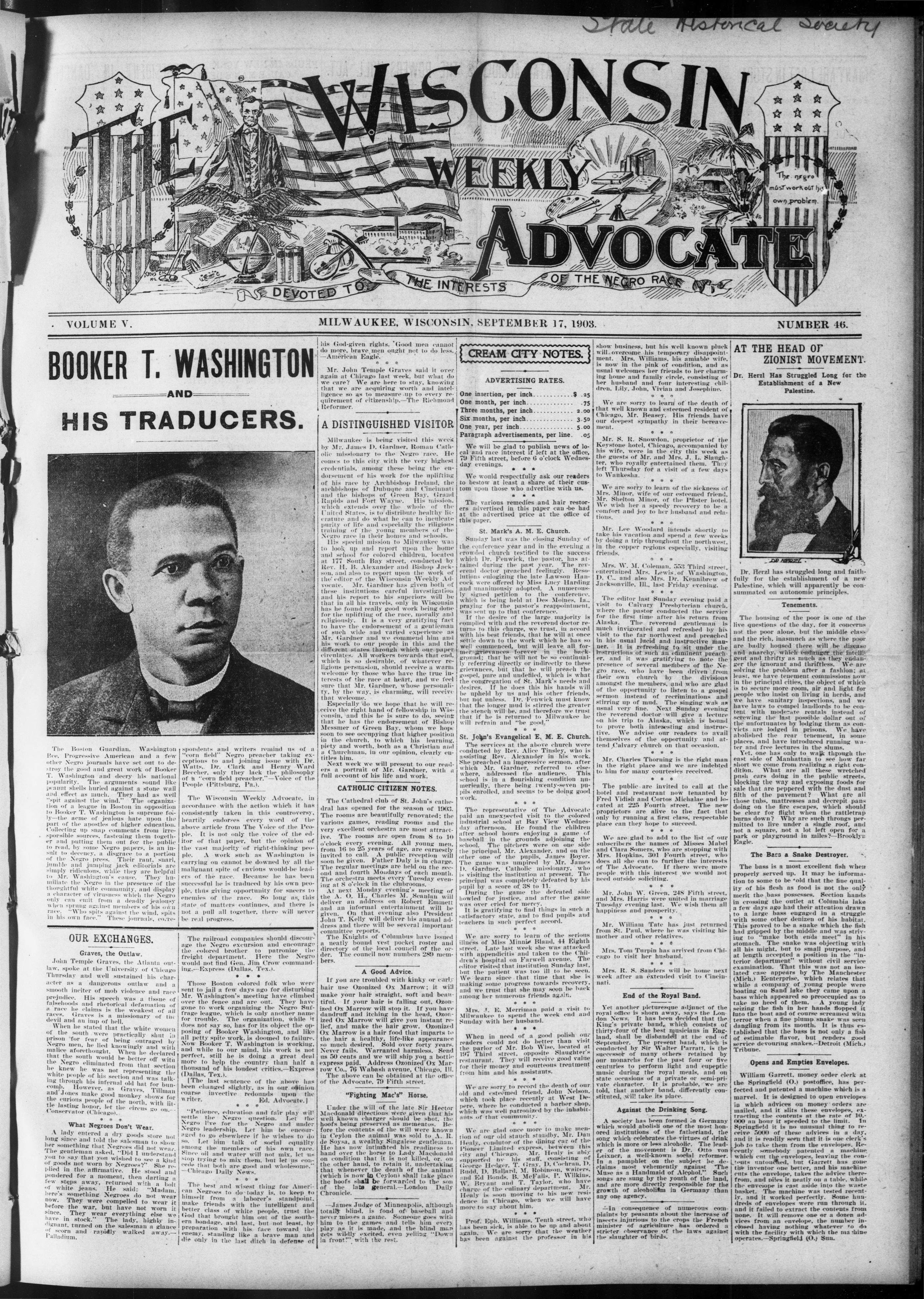
WISCONSIN
WEEKLY
ADVOCATE
DEVOTED TO THE INTERESTS OF THE NEGRO RACE
BOOKER T. WASHINGTON AND HIS TRADUCERS.
VOLUME V.
BOOKER T. HIS TRA
The Boston Guardian, Washington Bee. Progressive American and a few other Negro journals have set out to destroy the good and great work of Booker T. Washington and decry his national popularity. The arguments sound like peanut shells hurled against a stone wall and effect as much. They had as well "spit against the wind." The organization of a league in Boston in opposition to Booker T. Washington is supreme folly—the acme of jealous hate upon the part of the apostles of higher education. Collecting up snap comments from irresponsible sources, fastening them together and putting them out for the public to read, by some Negro papers, is an insult to decency, a disgrace to a portion of the Negro press. Their rant, snarl, jumble and jumping jack editorials are simply ridiculous, while they are helpful to Mr. Washington's cause. They humiliate the Negro in the presence of the thoughtful white community, and display a character of virusness which the Negro only can emit from a deadly jealousy when sprung against members of his own race. "Who spits against the wind, spits in his own face." These journals, coore-
OUR EXCHANGES
John Temple Graves, the Atlanta outlaw, spoke at the University of Chicago Thursday and well sustained his character as a dangerous outlaw and a smooth inciter of mob violence and race prejudice. His speech was a tissue of falsehoods and rhetorical defamation of a race he claims is the weakest of all races. Graves is a missionary of the devil and an imp of hell.
When he stated that the white women of the south were practically shut in prison for fear of being outraged by Negro men, he lied knowingly and with malice aforethought. When he declared that the south would be better off with the Negro eliminated from that section he knew he was not representing the white people of his section and was talking through his internal old hat for buncomb. However, as Graves, Tillman and Jones make good monkey shows for the curious people of the north, with little lasting honor, let the circus go on. Conservator (Chicago).
What Negroes Don't Wear
A lady entered a dry goods store not long since and told the salesman to show her something that Negroes did not wear. The gentleman asked, "Did I understand you to say that you wished to see a kind of goods not worn by Negroes?" She replied in the affirmative. He stood and pondered for a moment, then darting a few steps away, returned with a bolt of white jeans. He said: "Madam, here's something Negroes do not wear now. They were compelled to wear it before the war, but have not worn it since. They wear everything else we have in stock." The lady, highly indignant, turned on the salesman a glance of scorn and rapidly walked away—Palladium.
---
spondents and writers remind us of a "corn field" Negro preacher taking exceptions to and joining issue with Dr. Watts, Dr. Clark and Henry Ward Beecher, only they lack the philosophy of a "corn field preacher."—Voice of the People (Pittsburg, Pa.).
The Wisconsin Weekly Advocate, in accordance with the action which it has consistently taken in this controversy, heartily endorses every word of the above article from The Voice of the People. It is not only the voice of the editor of that paper, but the opinion of the vast majority of right-thinking people. A work such as Washington is carrying on cannot be downed by all the malignant spite of envious would-be leaders of the race. Because he has been successful he is traduced by his own people, this giving opportunity for sneers to enemies of the race. So long as this state of matters continues, and there is not a pull all together, there will never be real progress.
The railroad companies should discourage the Negro excursion and encourage the colored brother to patronize the freight department. Here the Negro would not find Gen. Jim Crow commanding.—Express (Dallas, Tex.).
* * *
Those Boston colored folk who were sent to jail a few days ago for disturbing Mr. Washington's meeting have climbed over the fence and are out. They have gone to work organizing the Negro Suffrage league, which is only another name for trouble. The organization, while it does not say so, has for its object the opposing of Booker Washington, and like all petty spite work, is doomed to failure. Now Booker T. Washington is working, and while to our mind, his work is not perfect, still he is doing a great deal more to help the country than half a thousand of his loudest critics.—Express (Dallas, Tex.).
[The last sentence of the above has been changed slightly, as in our opinion coarse invective redounds upon the writer. Ed. Advocate.]
"Patience, education and fair play will settle the Negro question. Let the Negro live for the Negro and under Negro leadership. Let him be encouraged to go elsewhere if he wishes to do so. Let him talk of social equality among the members of his own race. Since oil and water will not mix, let us stop trying to mix them, but let us concede that both are good and wholesome."—Chicago Daily News.
---
The best and wisest thing for American Negroes to do today is, to keep to himself from a laborer's standpoint, make friends with the intelligent and better class of white people, trust the God that brought him out of the southern bondage, and last, but not least, by preparation with his face toward the enemy, standing like a brave man and die only in the last ditch in defense of
MILWAUKEE, WISCONSIN, SEPTEMBER 17, 1903.
his God-given rights. Good men cannot do more, brave men ought not to do less. —American Eagle.
Mr. John Temple Graves said it over again at Chicago last week, but what do we care? We are here to stay, knowing that we are acquiring worth and intelligence so as to measure up to every requirement of citizenship.—The Richmond Reformer.
A DISTINGUISHED VISITOR
Milwaukee is being visited this week by Mr. James D. Gardner, Roman Catholic missionary to the Negro race. He comes to this city with the very highest credentials, among these being the endorsement of his work for the uplifting of his race by Archbishop Ireland, the archbishops of Dubuque and Cincinnati and the bishops of Green Bay, Grand Rapids and Fort Wayne. His mission, which extends over the whole of the United States, is to distribute healthy literature and do what he can to inculcate purity of life and especially the religious training of the young members of the Negro race in their homes and schools.
His special mission to Milwaukee was to look up and report upon the home and school for colored children, located at 177 South Bay street, conducted by Rev. H. B. Alexander and Bishop Jackson, and also to report upon the work of the editor of the Wisconsin Weekly Advocate. Mr. Gardner has given both of these institutions careful investigation and his report to his superiors will be that in all his travels, only in Wisconsin has he found really good work being done for the uplifting of the race, morally and religiously. It is a very gratifying fact to have the endorsement of a gentleman of such wide and varied experience as Mr. Gardner and we commend him and his work to our people in this and the different states through which our paper circulates. All workers towards that end, which is so desirable, of whatever religious persuasion, should receive a warm welcome by those who have the true interests of the race at heart, and we feel sure that Mr. Gardner, whose personality, by the way, is charming, will receive that welcome.
Especially do we hope that he will receive the right hand of fellowship in Wisconsin, and this he is sure to do, seeing that he has the endorsement of Bishop Messmer of Green Bay, whom we hope soon to see occupying that higher position in the church, to which his learning, piety and worth, both as a Christian and a Churchman, in our opinion, clearly entitles him. Next week we will present to our readers a portrait of Mr. Gardner, with a full account of his life and work.
CATHOLIC CITIZEN NOTES
The Cathedral club of St. John's cathedral has opened for the season of 1903. The rooms are beautifully renovated; the various games, reading rooms and the very excellent orchestra are most attractive. The rooms are open from 8 to 10 o'clock every evening. All young men from 16 to 25 years of age, are earnestly invited to call. A public reception will soon be given. Father Daly is in charge. The regular meetings are held on the second and fourth Moudays of each month. The orchestra meets every Tuesday evening at 8 o'clock in the clubrooms.
At next Monday evening's meeting of the A. O. H., Charles M. Scanlan will deliver an address on Robert Emmett and an informal entertainment will be given. On that evening also President John T. Kelly will deliver his annual address and there will be several important committee reports. The Knights of Columbus have issued a neatly bound vest pocket roster and directory of the local council of the order. The council now numbers 289 members.
A Good Advice.
If you are troubled with kinky or early hair use Ozonized Ox Marrow; it will make your hair straight, soft and beautiful. If your hair is falling out, Ozonized Ox Marrow will stop it. If you have dandruff and itching in the head, Ozonized Ox Marrow will give you instant relief, and make the hair grow. Ozonized Ox Marrow is a hair food that imparts to the hair a healthy, life-like appearance so much desired. Sold over forty years. Never fails. Warranted harmless. Send us 50 cents and we will ship you a bottle express paid. Address Ozonized Ox Marrow Co., 76 Wabash avenue, Chicago, Ill. The above can be obtained at the office of the Advocate, 79 Fifth street.
"Fighting Mac's" Horse.
Under the will of the late Sir Hector Macdonald directions were given that his well known charger should be shot, the hoofs being preserved as mementos. Before the contents of the will were known in Ceylon the animal was sold to A. R. de Soysa, a wealthy Singalese gentleman. He has now intimated his readiness to hand over the horse to Lady Macdonald on condition that it is not killed, or, on the other hand, to retain it, undertaking that whenever the death of the animal (which is now in Ceylon) shall take place the hoofs shall be forwarded to the son of the late general.—London Daily Chronicle.
James Judge of Minneapolis, although totally blind, is fond of baseball and never misses a game. Someone goes with him to the games and tells him every play as it is made, and the blind man gets wildly excited, even yelling "Down in front!" with the rest.
CREAM CITY NOTES.
ADVERTISING RATES.
One insertion, per inch..... $ .25
One month, per inch..... 75
Three months, per inch..... 2.00
Six months, per inch..... 3.50
One year, per inch..... 5.00
Paragraph advertisements, per line. .05
We will be glad to publish news of local and race interest if left at the office,
79 Fifth street, before 6 o'clock Wednesday evenings.
☆ ☆ ☆
We would respectfully ask our readers to bestow at least a share of their custom upon those who advertise with us.
The various remedies and hair restorers advertised in this paper can be had at the advertised price at the office of this paper.
St. Mark's A. M. E. Church.
Sunday last was the closing Sunday of the conference year and in the evening a crowded church testified to the success which Dr. Fenwick, the pastor, has attained during the past year. The reverend doctor preached feelingly. Resolutions eulogizing the late Lawson Hancock were offered by Miss Lucy Harding and unanimously adopted. A numerously signed petition to the conference, which is being held at Des Moines, Ia., praying for the pastor's reappointment, was sent up to that conference.
If the desire of the large majority is complied with and the reverend doctor returns to this charge, we trust, in accord with his best friends, that he will at once settle down to the work which he has so well commenced, but will leave all former grievances forever in the background; that he will not be so continually referring directly or indirectly to these grievances, but that he will preach the gospel, pure and undefiled, which is what the congregation of St. Mark's needs and desires. If he does this his hands will be upheld by us and his other friends, but not unless. Dr. Fenwick must know that the longer mud is stirred the greater the stench will be, and therefore we trust that if he is returned to Milwaukee he will refrain and "be good."
St. John's Evangelical E. M. E. Church.
The services at the above church were conducted by Rev. Alice Tinsley, who is assisting Rev. Alexander in his work. She preached an impressive sermon, after which Mr. Gardner, referred to elsewhere, addressed the audience. This school is in a flourishing condition numerically, there being twenty-seven pupils enrolled, and seems to be doing good work.
The representative of The Advocate paid an unexpected visit to the colored industrial school at Bay View Wednesday afternoon. He found the children after school hours enjoying a game of baseball in the grounds adjoining the school. The pitchers were on one side the principal, Mr. Alexander, and on the other one of the pupils, James Boyer. The game was umpired by Mr. James D. Gardner, Catholic missionary, who is visiting the institution at present. The principal was completely defeated by his pupil by a score of 38 to 11. During the game the defeated side howled for justice, and after the game was over cried for mercy. It is gratifying to find things in such a satisfactory state, and to find pupils and teachers in such perfect accord.
We are sorry to learn of the serious illness of Miss Minnie Bland, 44 Eighth street. Late last week she was attacked with appendicitis and taken to the Children's hospital on Farwell avenue. The editor visited that institution Sunday last, but the patient was too ill to be seen. We learn since that time that she is making some progress towards recovery, and we trust that she may soon be back among her numerous friends again.
☆ ☆ ☆
Mrs. J. E. Merriman paid a visit to Milwaukee to spend the week end and Sunday with her husband.
* * *
When in need of a good polish our readers could not do better than visit the parlor of Mr. Bob Wise, located at 197 Third street, opposite Slaughter's restaurant. They will receive good value for their money and courteous treatment from him and his assistants.
```markdown
```
We are sorry to record the death of our old and esteemed friend, John Nelson, which took place recently at West Depere, where he conducted a barber shop, which was well patronized by the inhabitants of that community.
```markdown
```
We are glad once more to make mention of our old stauch standby, Mr. Dan Healy, conductor of the dining car of the Pioneer Limited express, between this city and Chicago. Mr. Healy is ably supported by his staff, consisting of George Hedger, T. Gray, D. Cochran, D. Budd, D. Ballard, M. Robinson, writers, and Ed Bonds, B. McFalls, P. Wilkins, W. Bryant and T. Taylor, who have charge of the culinary department. Mr. Healy is soon moving to his new residence in Chicago, when we will have more to say about him.
* * *
Prof. Eph. Williams, Tenth street, who has been sick, is able to be up and about again. We are sorry that the weather has been against the professor in his
show business, but his well known pluck will overcome his temporary disappointment. Mrs. Williams, his amiable wife, is now in the pink of condition, and as usual welcomes her friends to her charming home and family circle, consisting of her husband and four interesting children. Lily, John, Vivian and Josephine.
We are sorry to learn of the death of that well known and esteemed resident of Chicago, Mr. Beasey. His friends have our deepest sympathy in their bereavement.
Mr. S. R. Snowdon, proprietor of the Keystone hotel, Chicago, accompanied by his wife, were in the city this week as the guests of Mr. and Mrs. J. L. Slaughter, who royally entertained them. They left Thursday for a visit of a few days to Waukesha.
We are sorry to learn of the sickness of Mrs. Minor, wife of our esteemed friend, Mr. Shelton Minor, of the Pfister hotel. We wish her a speedy recovery to be a comfort and joy to her husband and relations.
Mr. Lee Woodard intends shortly to take his vacation and spend a few weeks by doing a trip throughout the northwest, in the copper regions especially, visiting friends.
Mrs. W. M. Coleman, 553 Third street, entertained Mrs. Lewis, of Washington, D. C., and also Mrs. Dr. Kennibrew of Jacksonville, Ill., last Friday evening.
The editor last Sunday evening paid a visit to Calvary Presbyterian church, where the pastor conducted the service for the first time after his return from Alaska. The reverend gentleman is much invigorated and refreshed by his visit to the far northwest and preached in his usual lucid and instructive manner. It is refreshing to sit under the instructions of such an eminent preacher, and it was gratifying to note the presence of several members of the Negro race, who have been driven from their own church by the divisions amongst the members, and who are glad of the opportunity to listen to a gospel sermon instead of recriminations and stirring up of mud. The singing was as usual very fine. Next Sunday evening the reverend doctor will give a lecture on his trip to Alaska, which is bound to prove both interesting and instructive. We advise our readers to avail themselves of the opportunity and attend Calvary church on that occasion.
***
Mr. Charles Thorning is the right man in the right place and we are indebted to him for many courtesies received.
***
The public are invited to call at the hotel and restaurant now tenanted by Fred Vidish and Cortos Michalae and located at 225 Fourth street. The new proprietors are alive to the fact that only by running a first class, respectable place can they hope to succeed.
* * *
We are glad to add to the list of our subscribers the names of Misses Mabel and Clara Somers, who are stopping with Mrs. Hopkins, 301 Fourth street, who does all she can to further the interests of The Advocate. If there were more people with this interest we would not need outside soliciting.
```markdown
```
Mr. John W. Green, 248 Fifth street,
and Mrs. Harris were united in marriage
Tuesday evening last. We wish them all
happiness and prosperity.
* * *
Mr. William Tate has just returned
from St. Paul, where he was visiting
himother and other relatives.
* * *
Mrs. Tom Turpin has arrived from Chicago to visit her husband.
* * *
Mrs. R. S. Sanders will be home next
week after an extended visit to Cincinnati.
End of the Royal Band.
Yet another picturesque adjunct of the royal office is shorn away, says the London News. It has been decided that the King's private band, which consists of thirty-four of the best musicians in England, shall be disbanded at the end of September. The present band, which is conducted by Sir Walter Parratt, is the successor of many others retained by our monarchs for the past four or five centuries to perform light and eupeptic music during the royal meals, and on state occasions of a private or semi-private character. It is probable, we are told, that another band, differently constituted, will take its place.
Against the Drinking Song.
A society has been formed in Germany which would abolish one of the most honored institutions of the fatherland, the song which celebrates the virtues of drink which is more or less alcoholic. The leader of the movement is Dr. Otto von Leixner, a well-known social reformer. In a pamphlet on the subject he declaims most vehemently against 'The Muse as a Handmaid of Alcohol.' Such songs are sung by the youth of the land, and are more directly responsible for the growth of alcoholism in Germany than any one agency.
-In consequence of numerous complaints by peasants about the increase of insects injurious to the crops the French minister of agriculture has ordered a stricter observance of the laws against the slaughter of birds.
Dr. Herzl Has Struggled Long for the Establishment of a New Palestine.
DB. HARZL
Dr. Herzl has struggled long and faithfully for the establishment of a new Palestine, which will apparently be consummated on autonomic principles.
Tenements.
The housing of the poor is one of the live questions of the day, for it concerns not the poor alone, but the middle class and the rich, inasmuch as where the poor are badly housed there will be disease and anarchy, which endanger the intelligent and thrifty as much as they endanger the ignorant and thrifthless. We are solving the problem after a fashion; at least, we have tenement commissions now in the principal cities, the object of which is to secure more room, air and light for people who insist on living in herds, and we have sanitary inspections, and we have laws to compel landlords to be content with moderate rentals instead of screwing the last possible dollar out of the unfortunates by lodging them as convicts are lodged in prisons. We have abolished the rear tenement, in some places, and have introduced running water and free lectures in the slums.
Yet, one has only to walk through the east side of Manhattan to see how far short we come from realizing a right condition. What are all these wretched push cars doing in the public streets, blocking the way and exposing foods for sale that are peppered with the dust and filth of the pavement? What are all those tubs, mattresses and decrepit pans doing on the fire escapes, which should be clear for flight when the rattletrap burns down? Why are such throngs permitted to live under a single roof, and not a square, not a lot left open for a park or playground in miles?—Brooklyn Eagle.
The Bass a Snake Destroyer.
The bass is a most excellent fish when properly served up. It may be information to some to be *old* that the fine quality of his flesh as food is not the only merit the bass possesses. Section hands in crossing the outlet at Columbia lake a few days ago had their attention drawn to a large bass engaged in a struggle with some other denizen of his habitat. This proved to be a snake which the fish had gripped by the middle and was striving to "make both ends meet" in his stomach. The snake was objecting with all his might, but to small purpose, and at length accepted a position in the "interior department" without civil service examination. That this was not an isolated case appears by The Manchester (Mich.) Eenterprise, which relates that while a company of young people were boating on Sand lake they came upon a bass which appeared so preoccupied as to take no heed of them. A young lady seizing the fish in her hands flopped it into the boat and of course screamed with terror when a fine plump snake was seen dangling from its mouth. It is thus established that the bass is not only a fish of estimable flavor, but renders good service devouring snakes.--Detroit (Mich.) Tribune.
Opens and Empties Envelopes.
William Garrett, money order clerk at the Springfield (O.) postoffice, has perfected and patented a machine which is a marvel. It is designed to open envelopes in which advices on money orders are mailed, and it slits these envelopes, extracting the contents at the rate of 10.000 an hour it speeded to the limit. In Springfield it is no unusual thing to receive 5000 of these advices in a day, and it is readily seen that it is one clerk's job to take them from the envelopes. Recently somebody patented a machine which cut the envelopes, leaving the contents untouched, but Garrett has gone the inventor one better, and his machine cuts the envelope, takes the advice therefrom, and piles it neatly on a table, while the envelope is cast aside into the waste basket. The machine was tested recently, and it worked perfectly. Some hundreds of envelopes were run through it, and it failed to extract the contents from none. It will remove one or a dozen advices from an envelope, the number enclosed having nothing whatever to do with the facility with which the machine operates.—Springfield (O.) Sun.
MANY ARE LOST IN STORM
Forty Men Are Known to Have
Drowned Off Atlantic Coast.
AWFUL MARINE DISASTERS.
Mexicano cases ESE and Only
* One Man Escapes a Watery
: Grave.
been wrecked near this port. Twenty-
three of the crew are reported to be
drowned. Only one of the crew was
saved,
Twenty-two Perished.
Norfolk, Va., Sept. 17.—The British
steamship Roxby, Capt. Shields, which
urcived here this morning from Port
English, has on board Dommgo Balio
Keyarberay, the sole surviver of the crew
of twenty-two men on tie British steam-
ship Mexicano which foundered with all
ou board off the Florida coast Tuesday
aight. Reyarberay caught a piece of
wreckage and managed to keep up until
ie was seen yesterday morning by the
Roxby aud rescued.
The Spaniard, through an interpreter,
told of the Mexicano’s sinking. The
steamer was bound from ‘Tampico for
Vera Cruz with a cargo of petroleam in
bulk when the full foree of the hurricane
broke upon her. Mountainous — seas
broke constantly over the ship and finally
one gigantic wave erasied through the
decks. The fire room was flooded and
the Mexicano broke helpless. For a few
moments she wallowed in the trough of
the seas and then plunged to the bottom.
‘The rescued man says hundreds of gal-
lous of oil were poured over the ship's
side in a vain attempt to calm the sex
and, if possible, save the ship. When the
Mexicano went down the crew went with
her. All boats had Jong since been
crushed by the force of the waves and
the men were powerless to save them-
selves,
Saved by Meerest Chance.
Halio Reyarberay went under with the
vessel and by merest chance became en-
tangled in some loose rigging and spars.
The buoyancy of these brought him to
the surface and he made iimself fast ie
the largest spar. For seven hours he
floated in a turbulent sea until finally the
Roxby hove in sight. His resewe was «
daring one. The Mexicano sailed from
Tampico Monday. She was last reported
as being bound from Mareus Hook to
Tampico August 29. ‘The captain was
Ut. S. King and the King line, limited, of
Middlesborough, England, owned the lost
vessel.
Eighteen Die in Another Wreck.
Damariscotta, Me., Sept. 17.— Fifteen
men lost their lives in the violent gale
which raged off the coast during tie
night. The Gloucester mackerel seining
schooner George F. Edmunds, in com-
mand of Capt. Willard C. Poole, the
owner, struck on-the eastern side of
Pemaquid point and was smashed to
pieces. Fourteen of the crew of six-
teen men perished in the breakers.
The schooner Sadie and Lillian, Capt
Hardy of Prospect, bound from Prospect
Bay to Boston, struck on the western
side of Pemaquid point and had her bot-
‘om knocked out in the rocks. Capt.
Hardy was drowned, but his crew of twa
were resened. The Gloucester schooner,
whier had heen fishing off the coast,
missed her bearings and running too near
the point off Pemaquid. struck on the |
raistern side and was battered to pieces. |
Successive attempts were made to launch |.
He stall boats. ?
Several of the dories were smashed to | |
pieces or washed away. Finally tive |
meu successfully got a boat afloat and |,
climbed into it, hut before they could
veach land a tremendous sea overturned |
the frail craft. Three of the men were | ;
drowned, but a giant wave caught up
the other two men and swept them
ashore.
Of the entire crew of sixteen men these
hwo were the only survivors.
Norfolk. Vax. Sept. 17.—The Old Domin- | |
ion: liner Guyandotte is safe in port from |:
New York after a voyage down the coast |.
in the teeth of Wednesday morn’s harri-
cane, She came in about twerty hours |
late, being blowa far out of her course by |
the gale,
Her Canvas All Gone.
The morning reports from the Virginia
ond Carolina coast bring tidings of fur-
ther damage to shipping, though no seri-
ous loss is noted. The three-masted
<chooner Horace G. Morse passed in the
Capes, presumably for Norfolk, with al-
most every stitch of canvas gone and ap-
parently in very bad condition.
‘The steamer William P. Moody, which
anchored under the shelter of Cape Hat-
tevas Point with a three-masted barge.
cot under way this morning with her tow
sud preceeded south apparently unin-
jured. ‘The wind at. Hatteras is squally
with = 40-mile velocity.
An unknown. schooner is laboring off
Cape Henry with part of her foremast
scene. What seems to have been a de-
tuched section of Wednesday's storm
‘truck this region this morning and did
minor damage in the city and drove a
few sinall crafts ashore in the harbor.
Schooner Gov. Ames Sighted.
The five-musted schooner Gov. Ames,
with all sails carried away, was sighted
riding the gale with two anchors out,
fouricen miles northeast of Winter Quar-
ter lightship Wednesday morning. The
<chooner Sarah D. Fell, from Carthagena,
8. C., to Philadelphia. was reported fifty
tiles off the Virginin Capes yesterday
With sails damaged.
The Guyandotte arrived at anchor in
the harhor at 9:10 o'clock. The ship left
New York Tuesday night and ran into
ihe gale Wednesday morning. teu miies
of Atlantic City, The wind reached a
velocity of GO. miles an hour and the
Waves rose to an enormous height. For
six hours there were grave fears enter-
tained that she would not ride the storm
safely. The steamer carried no passen-
Sern,
Lest Off New York.
New York. Sept. 17.—The tug Sweep-
stukes arrived here today and reported
that the barges Elk Garden and Hamp-
shire, which was towing from New Bed-
ford to Philadelphia, were lost off Bar-
neat. ‘The captain of the Sweepstakes
did net know whether the crews were
drowned, :
One of the mosi thrilling stories of
disaster is that of the excursion and
freight steamer 8. KB. Spring, which was
driven ashore near the country mansion |.
of KE. Q. Benedict at Greenwich, Conn.
Capt. McDonald, his crew of seven men
und cleven passengers were —rescue@
largely through the aid of the Benedict
SOFVANES, > ak
Whe Spring was trying io put back 0
Stamford and the gale had reached a
velocity of eighty miles an hour when
‘he rudaer failed and the = steamer |.
SAVED BY CLOUDS.
2 FS
Corn and’ Other Crops Throughout the
# Country Escape the Predicted
Frost.
een
Washington, D. C., Sept. 17.—Cload-
acting as a huge blanket over almost
the entire western portion’ of the country
prevented milions of dollars in damage
by frost last night. The weather wie
cold and had there heen celar skies the
loss to farmers would hive been tremen-
dons.
. Theo os ps
Milwaukee, Wis. Sept. 17.—[Special.]
--Heavy clouds saved the corn and oth-
er crops throughout thé country from
total destruction by frost last night. A=
it was considerable damage was den
by the nuseasonable cold. %
On account of the clouds and the wind
there was no frost in this section of Wis
consin Weduesday night and only hiya
frosts anywhere in Wisconsin, but the
weather bureru expects a frost tonight
just the same. The area of high pres:
sure ix coming on from the west aad
south and has left a trail of cold througi-
oat Nebraska, Kansf&8 and Missouri. “The
temperature at Milwaukee this morning
was 41! degrees and it was likely three
or four degrees colder. out in the country
nearby.
Saved by the Clouds.
Kansas City, Me. Sept. 17.—The
clonds have saved mosi of Kansas. from
a killing frost so far, except in the north-
Western corner of the state, where 4
light frost fell last night. Low tempera-
tures still prevail througrout Kansas and
western Missouri and it is feared corn is
somewhat damaged in the districts wher
frost has fallen. Corn should have ac
least ten days more snushine.
Damage Very Slight.
St. Joseph. Mo. Sept. 17.—The mer-
cury went to 42 degrees above zero in
this lwenlity last night and there was
a light frost in the lowlinds, Farm-
ers and gardeners say the damage war
very slight. Corn was not injured at
all, bat tomatoes and late vegetables
were nipped. The bright weather of 1o-
day has broaght a feeling of relief to
all growers,
Rising Temperature.
Topeka. Kan., Sept. 17.—A rising tem-
perature over Shawnee county and this
section of Kansas last evening and night
prevented a killing frost. The weather
was clear, but the faintest touch of any
frost there may have been in the low-
lands was not serious enough to damage
late corn or vegetables. The government
weather buresu reports 2‘ ininimum tem-
perature of 41 ai 7 o'clock and no frosi.
Manhattan reports a temperature of 36
degrees without frost. Weather today
fair and warincr.
No Frost in Ilinois.
Spriugtield, I., Nept. 17.—No frost oe:
eurred in the immediate vicinity of
Springfield dast night. owing to cloadi-
nexs and a fresh breeze. ‘The minimum
temperature was 45 degrees at 6 o'clock
this morning, a fall of 6 degrees in twen-
ty-four hours.
lowa Has Escape.
Des Moines, Ia. Sept. 17 -Again the
clouds saved the corn crep of central
lowa. Frost failed to mike its appear-
ance in the centexl valleys of the state,
although predicted by the government.
The sky cleared up esrly in the evening
and continued remarkapiy clear wotil 1
o'clock when: the clouds rolled by. in
great profusion. A thorough examina |
tion of the fields this morning revents
that all that is needed is warm wee
to mature and harden the kernels, other
wise the cov ix in first-class shape, and
the yield fully So per cent.
Heavy Snow in North Dakota.
St. Paul, Mini. Sept. 17.—A special |
from Jamestown, N. te says a heavy.
fali of snow over the James river valley
vestorday adds greatly to the seriousness
of the crop sittation. Et is estimated
that the fall was three > incites deep.
Opinions differ as to the damage to the
ror crop, but authorities agree that- it
Will amount te a large sum. Wires on
the Northern Pacific railroad are down
in several plices,
Frost in ‘Wisconsin. |
Sparta, Wis. Sept. 17.—-[Special]—-
Light frost oecarred in this county. also |
Vernon conniy, last night, but’ it is
CLERGYMAN URGES
Members of Jury Which Convicted tho
Van Wormer Brothers Beg Gov-
ernor Not to Spare Their Lives.
Albany N. Y.. Sept. 17.—Unique in the
criminal history of ths state was the
hearing just hetd before Gov. Odell on
the application for commutation of the
death sentence in the case of the threg
brothers Van Wormer, awajting execu
tion for murdering their uncie, Petes
Haliepbeck, (wo years ago. The men
are all under 30 years of age,
Five jurors, representing clevem of the
men who convicted the Van Wormers,
appeared in opposition te the appeal and
a minister argued for the infliction of the
death penalty. A petinon signed by 268
resideuts of Columbia county urged that
the governor show no clemency. | ‘The
petition was taken under consideration,
FIRE RAGES NEAR POWDER
Steamer Alma and Freight House De-
stroyed at Elizabeth City, N. C—
Severai People Hurt.
Elizabeth City. N.C. Sept. 17.—Fire
ast night completely destroyed the steam-
or Alma and the freight depot of the
Norfolk & Southern railroad. causing a
loss of about $106,000, A deckhand is
reported missing An immense quantity
of freight wax destroyed and several peo-
ple were hurt through the explosion ef of!
and two kegs. of powder. The flames
parely missed a,baif tou of powder stored
wn the warchouse,
Serie,
Shuns the Gross.
Louise Allen, who is Mrs. William Col-
lier in private life, suffers from being the
wife of a wit. Mr. Collieris a master of
repartee, and Mrs. Collier's little jokes
are seldom noticed.
At a dinner last week, however, a
young woman who had recently left so-
ciety for the stage was recounting with
great glee the fine engagements she had
refused for the coming season.
“They wanted me to take Hattie Wil-
liams’ role in *Vivian’s Papas,’ she as-
serted unblushingly, “but 1 can't be
gross, i never can be gross, you know.’
“You will never be a star, then,” said
Mrs. Collier quietly.
“Why not, pray?’ asked the girl rath-
er pertly.
“Because you would find it so hard ic
accept your share of the gross receipts,’
said Miss Allen.
There was a general langh. and th
would-be actress subsided.—New Yori
Times.
cabs mines
—The streets of Tokio will soon har
trolley cars.
MANY FATAL ACCIDENTS,
os Financial Loss in
Great Storm.
‘NEW YORK HIT HARD.
Beet Steamers Have Thrilling Es-
| cape from Fearful Disasters—
Yachts Are Wrecked.
| New York, Sept. 17.—Theodore Grimes,
whose skull was fractured by a section
of iron blown by the wind from the
stables at Aqueduct race track in yes-
terday’s storm, is dead at a hospital.
While a freight train on the Long Is
land railroad was passing between
Minola and Hyde Park the roof of a box
ear was carried away by the gale, with
Walter Lewis and George B, Snyder,
two brakemen, clinging to it. The roof
was carried almost a hundred feet from
the track, where it collapsed by striking a
tree. Both men were fatally injured.
In Jamaica bay, Long Island, scores of
yachts were wrecked. Most of them
were torn from their anchorage — and
pounded to pieces on shore, but a good
many were caught while sailing in the
bay and those aboard had narrow es-
capes. The entire fleet of the Jamaic:
Bay Yacht club, comprising more than
thirty bouts, valued at sums up to $1000,
was destroyed. The beaches at New
Rochelle on Long Island sound and City
island are strewn with wreckage from
yachts, and it is estimated that not less
than $500,000 damage was done these
vessels alone,
Reliance Injured.
The cup defender Reliance is reported
to have been somewhat injured through
being rammed by a piledriver which
broke loose from its moorings and drifted
ou the Reliance’s stern, The racer was
heing prepared for winter quarters and
had been drawn partially up on ways.
Several plates were loosened, but” the
damage was not serious. A tug caught
the piledriver and towed it away.
To prevent the old defender Columbia
from being rammed by the schooner
yacht Hildegarde, which was dragging
her anchor, the Hildegarde was scuttled
when within a few feet of Columbia.
Her crew of seven men jumped over-
bourd and were saved. A. barge loaded
with 500 pounds of dynamite broke from
its moorings and drifted toward the
Larchmont Yacht —¢lubhouse. Many
yachts of wealthy New Yorkers have
been anchored im this harbor since the
races, and it was feared that the barge
would drift among them. Careening
about, the dynamite barge finally gronnd-
ed on the mud flats without doing any
damage.
Eighteen Lives Lost.
Rough estimates of the financial loss
due to the storm are $2,000,000 on and
around Manhattan island alone. So far
eighteen lives are known to have been
lest in the storm and it is believed this
pumber will be doubled when all reports
are in.
Steamers Caught by Hurricane.
Incoming vessels report rough expe-
riences with the hurricane at sea, The
Clyde line steamer Cherokee from San
Domingo was in the storm during the
entire voyage from Turks island to this
port. In the gulf stream its force was
terrific and yesterday the steamer was
hove to for four hours in an eighty-mile
wind, The Maraval from Trinidad, and
Grenada had a similar experience.
Wrecked Off Delaware Capes.
Philadelpbia, Pa. Sept. 17.—The
steamship Brookline, which arrived here
today from Bocas del Toro, had on board
Capt. Chandler and the mate of the tug
Spartan, who were picked up yesterday
off the Delaware Capes. en otliers of
the crew were rescued by the fishing boat
Irene and landed at Anglesea, N. J. Dur-
ing the gale yesterday the Spartan’s haw-
ser washed overboard and became entan-
gled in the wheel, causing the vessel to
eareen and fill with water. Three men
of the Snartan’s crew are atill miagine
LIPTON IS BETTER.
Sir Thomas Pee Quiet Night and Is
Doing Very Well This
Morning.
Chicago, UL, Sept. 17.—Sir Thomas
Lipton, who is ill of catarrhal appendi-
cits in his apartments at the Auditorium
Annex, passed a quiet night and is do-
ing well, according to a statement made
by Dr. Thomas this morning.
To Alexander H.! Revell, Sir.Thomas’
host, who was an early caller, — the
patient suid:
“Eve been an awfully sick man, but
Tm easier now.”
Mr. Revell said he considered the
patient’s condition very encouraging. Dr.
‘Thomas spent the night in a room of
the Lipton suite, but aside from ordi-
nary sick room duties there was no
urgent need for his services. A num-
ber of messages of sympathy from New
York friends were received during tie
night and read with pleasure by the
recipient when he awoke this morning.
At 8:30 a. m., the patient bad fallen
asleep again. Mr. Revell stated that
probably there would be no further for-
mal consultations “of the physicians un-
less the unexpected in the form of 2
change for the worse occurred.
It is still believed that an operation
will be unnecessary as no pus has
formed.
The condition of Sir Thomas continued
to improve during the forenoon. At noon
Dr. Homer ‘Thomas gave ont the follow-
ing statement:
“Sir Thomas is resting much easier this
morning and his condition is now perfect-
ly satisfactory.”
KILLED BY AUTO
AT COUNTY FAIR.
One Man Meets Death and Others In-
jured by Motor Plunging Over
High Embankment.
St. Johnsbury, Vt.. Sept. 17.—An au-
tomobile speeding at th® rate of fifty
miles an hour at the Caledonian county
fair. grounds, today, dashed over an em-
bankment fifteen feet nigh, causing the
death of Herbert Lampede. Dr. John
M. Allen, who was operating the ma-
chine, was severely injured and another
msn named Garrick was hurt.
—
SENATOR SCOTT IS SICK.
REST
West Virginian Is Very Ill in Denver
and Condition Serious—Wife
at His Bedside.
Denver, Colo., Sept. 17.—United States
Senator Scott of West Virginia, who has
been ill at the Brown Palace hotel for
the last few days, has taken an slarming
change for the worse and is now in a
most serious condition. Mrs. Elizabeth
N. Scott has arrived in Denver and is at
the senator's bedside,
His condition was slightly improved
this morning, —
THE POWERS WILL ACT.
Austria and Russia Will Take
Possession of Macedonia.
TO PREVENT A WAR.
ce and Bulgaria on Point of Fight-
| ing and Quick Move Is Neces-
sary.
Berlin, Sept. 17.—The military occupa-
tien of Macedonia by Russia and Aus-
tria is thought here to be the only ex-
pedient sufficient to prevent war between
Turkey and Bulgaria.
Sofia, Bulgaria, Sept. 17.—A dispatch
from Rila says the Turkish frontier
guards are lying in trenches, prepared to
meet an attack.
The Bulgarian reservists who have
been called out are proceeding to join
their respective regiments singing songs
and arousing great enthusiasm.
London, Sept. 17.—It is announced here
that Russia and Austria have made fresh
yjroposals to Great Britain, which, if
carried out, will, it is hoped, restore order
in Macedonia
Sofia, Bulgaria, Sept. 17.—The foreign
office here has received reliable informa-
tion that the’ Turks have destroyed the
town of Kastoria, thirty-six miles south
of Monastir, and have massacred the
population,
Porte Will Give In.
Washington, D. C., Sept. 17.—A long
cablegram from Minister Leishman from
Constantinople was received at the state
department today. lt was sent to the
President. While not made public, it is
stated that it indicates a disposition on
the part of the Sublime Porte to take up
for settlement questions in which this
government is interested, It is stated
further that the communication is not
sufficiently definite to show what prog-
ress is being made by the minister in
this direction and that no conclusions
were announced.
Cross the Frontier.
Constantinople, Sept. 17.—The Porte
has received confirmation of the reports
that large bands of Bulgarians and Mace-
donians, one ot them estimated to num-
ber 4000 men, have been preparing to
cross the frontier near Kostendil at for-
ty-three miles from Sofia.
Official circles here have been greatly
irritated by the representations made to
the Porte by the representatives of the
powers regarding the excesses cominitted
by Turkish troops. It is pointed out that
the powers themselves adyised Turkey to
suppress the insurrection energetically.
Robberies and Murders at Beirut.
Beirut, Syria, Sept. 1é.—BHusiness is
still. suspended notwithstanding the
change in the governorship and it will
take a long time to restore confidence.
Robberies and murders are the order of
the night, if not of the day and the feel-
ing of insecurity on the part of both Eu-
ropean and native residents is very great.
Some form of outrage against the for-
eign and Christian population occurs
daily. The Christian refugees in the
Lebanon mountains are returning very
slowly and in small numbers.
poi ce:
CHAMBERLAIN OUT.
Will Send in His Resignation as Colonial
Secretary of Great
Britain.
London, Sept. 17.—The Associated
Press learns that Colonial Secretary
Chamberlain has decided to resign from
the cabinet on the ground that Premier
Balfour's attitude on the fiscal question
is not sufficiently advanced to enable Mr.
Chamberlain to remain a member of
the government without the sacrifice of
his own views.
According to the information conveyed
to the Associated Press, the resignation
is quite likely to be announced within a
day or two, but niay be postponed until
Mr. Balfour has an opportunity to make
his promised public announcement on Oc-
tober 1. There is just a last chance that
the King, in his private capacity, may
avert what is now declared to be inevi-
table,
An Appeal to the Country.
Mr. Chamberlain's resignation is al-
most certain to cause an appeal to the
country, Mr. Balfour being thus left
without the support of either the protec-
tionists or the free traders.. Chancellor
of the Exchequer Ritchie and his follow-
ers are as openly opposed to any meas-
ure of retaliatory tariff as Mr. Chamber-
lain is convinced that the unity of em-
pire depends on preferential duties in
tayor of the colonies.
With the exception of a few Liberal
organs, which viewed Mr. Balfour's pam-
ee as a repudiation of Mr. Chamber-
gin’s policy, there has scarcely been a
setlotdly considered suggestion that Mr.
Chamberlain would retire from office.
But the generally accepted opinion. that
he would retain his portfolio is shattered
and the news when it becomes generally
known will come like a thunder clap, not
only to the supporters of the government,
but to all other political sections.
By Mr. Chamberlain's defection, prae-
tically all the existing party lines will be
swept away,and the construction must
jargely depend on Mr, Chamberlain's fu-
ture attitude,
Ally Himself with Another Party.
That he will be content to retire from
public life can scarcely be considered. It
is believed he will not ally himself with
either side, but will rally to the banner
of his preferential programme all the
support he can gather from every quar-
ter, Mr. Chamberlain can rely on the
almost solid Irish yote when he confines
himself to fiscal ideas,
The Associated Press learns definitely
that Mr. Chamberlain urged his col-
leagues to appeal to the country on the
preferential trade issue. He admitted
they would be defeated, but maintained
that six months of weak, liberal govern-
ment would put the party back in power
with an improved standing.
JETT WOULD CONFESS
foci
Cynthiana, Ky., Sept. 17.—Thomas
Cockrili, witness for the prosecution in
the case against Jett for killing his
brother, stated that Curtis Jett’s mother
had just appealed to him because the
friends of her son in former trials were
now deserting him. Cockrill says the
woman says her son will tell all, if he is
spared from the gallows. Cockrill says
he told her the case was now beyond his
contro! and then he learned that Jett
was with meal sore from mak-
ing.a confession t y involving promi-
nent people and that he had said he
would confess all tomorrow before he
would stand trial in the pending case,
and that the only chance now of pre-
venting a confession was a continuance
en ae a A ae
FEUDS IN NEW YORK
CAUSE MAN’S DEATH.
Shooting on the Bowery in Gotham Re-
sult Fatally to Michael Donovan—
Many Others Are Injured.
New York, Sept. 16.—Michael Dono-
yan, stevedore, was shot and killed; John
Carroll, a driver, probably was fatally
wounded, and several others were badly
hurt during a fierce fight early today
between the police and an east side gang
of toughs.
| Donovan was fojind dying in a Bow-
ery crag store by a policeman. On his
death he refused to reveal the name
of his assailant, saying that he would
“fix” him when he got out of the hospi-
tal. An hour later he died. Four men
were arrested and according to the po-
lice one of them is “Monk Eastman.”
They claim that it was a meeting of
members of the “Paul Kelly gang,” and
the “Monk Eastman gang” that started
the trouble, in which policemen were shot
at and for which the reserves of three
police stations had to be called out.
The police believe the trouble started
over the shooting of Dave Bernstein, an
east side saloon keeper, some months
ago. Several men were arrested for the
shooting at the time, but accused and
accuser were equally non-committal, all
saying that they would get “square” in
their own way at some future date.
A band of ruffians numbering about
thirty, known to the police on the east
side as the “Cherry Hill gang,” engaged
in a shooting affray early today at Riy-
ington and Eldridge streets. One man
was seriously wounded and his assailant,
pursued by policemen, did not halt until
he was brought to the ground by a bul-
let. A battle, according to the police,
was the result of an old feud between
two bands on the east side.
atti eitthk hemes kt aam ied onal
OATH CONTROVERSY
WON BY UNIONISTS.
inode
Bishop Scannel of Omaha Withdraws De-
mand, but Advises Change in Word-
ing in Obligation.
Omaha, Neb., Sept. 16.—The members
of the typographical union won in their
fight with Bishop Scannel of the Roman
Catholic church to have retained in the
constitution of the union an oath to
which the bishop took serious umbrage.
“You may retain the oath,” he said, ‘it
the officers believe it necessary. No
Catholic priest will refuse a member of
the union absolution on account of the
oath, but I seriously recommend that the
union with all possible dispatch change
the wording so that the meaning is less
ambiguous.”
aaa ace
CANAL REPORTS PASS
COLOMBIAN SENATE.
Beaupre Telegraphs That Executive Is
Restricted Absolutely to Terms of
the Proposed Law.
Washington, D. C., Sept. 16.—The fol-
lowing bulletin was posted today at the
state department:
Under date of the 14th ist, Mr. Beau-
pre telegraphs the department of state
that the report of the canal committee
passed the Senate unanimously on the
first reading. Senator Perez Sopo gave
notice of an amendment to restrict “the
executive absolutely to the terms of the
proposed law.”
——_—_——_—__—_—
The Sultan of Morocco Narrowly Escapes
Being Captured by the In-
surgents.
Madrid, Sept. 16.—Private dispatches
from Morocco say that Ben Jussi, com-
manding a detachment of the imperial
troops. and 600 of his men were killed
recently in an engagement with the in-
surgents. The Sultan is reported to have
narrowly escaped falling into the hands
of the enemy.
A dispatch recetved by the French for-
elgn office on August 29 from Morocco sald
that a large Imperial force, avhich was
gotng to the rellef of the troops command-
ed by the Sultan had been surprised and
almost annihilated by Insurgents.
Sees chases
—_+—__——_
Knight Templars Talk of Sending Armed
Regiments of Masons to Aid
of Bulgaria.
Chicago, Ill, Sept. 16.—A Twentieth
century crusade against their ancient en-
emy, the Turk, is being planned by
Knights Templar, in which they shall
protect Christians against the oppression
of the infidels. Prominent members of
the order are agitating the forming of a
leaghe to send regiments of fighters to
the aid of Bulgaria. An array of knights
from the United States and Europe may
be massed in Macedonia to fight the sol-
diery of the Padishah,
pase at is ae
Many Killed in Effort to Carry Head-
quarters of Constabulary in
Island of Luzon.
Manila, P. 1, Sept. 16.—G:30 p. m.—
One hundred fanatics attacked the head-
quarters of the constabulary at San Jose,
in the province of Nueva Icija, island of
Luzon, and attempted to take the place
by storm,
After a lively fight the attacking force
was repulsed with a loss of eight. The
constabulary lost five men in the fight.
—
KIDNAPS HER OWN CHILD.
Mrs. Jack Atkinson Takes Her Little
Girl from Officers and Escapes
to Marinette.
M@nominee, Mich., Sept. 16.—While
county officers were making out papers
to send the 6-year-old daughter of Jack
Atkinson, divorced, to the state institu-
tion at Coldwater, his wife came over
from Marinette, kidnaped the child and
escaped back to the Wisconsin shore. A
divorce was granted in Marinette in July,
leaving the custody of the child with the
father. Officers claim the child was left
in incompetent hands.
———_-—____—
SHOOTS DAUGHTER-IN-LAW.
Strange Jealousy Said to Be Cause of
Murder and Suicide.
Noblesville, Ind.. Sept. 16.—William
Howe shot and killed his daughter-in-law
at her home shortly after midnight. He
then refilled his pepestios rifle with
which he committed the murder, and an-
ee that he would kill anyone who
followed him, went to an old graveyard
west cf town and killed himself. The
victim was recently divorced from Howe’:
son. It is said Howe was jealous of her.
PRESIDENT IN DANGER,
Yacit Sylph Is icky Wrecked
While Going to New York.
RUNS INTO A STORM.
Atlantic City Is Wrecked by a Hurricane
and Philadelphia and New
York Suffer.
noon, On leaving Oyster Bay the skies
were very threatening and the Sylph ran
into a terrific storm. The rain came
down in torrents and the wind blew into
a gale. Off Willetts Point the vessel was
in serious danger.
_ On passing through Hell Gate the gale
increased in force and about a quarter of
a mile from. the Sylph a tug towing «
three-masted: schooner went down. It
could net be ascertained whether all of
the crew was saved owing to the intensity
of the storm, which forced all the pas-
sergers on the SylIph below deck.
On passing up the East river the Sylph
was hailed by the naval tug Powhattan,
Lieut.-Commander Poundstone, who told
Lieut. Preston that it would be impossi-
ble and foolhardy to attempt to follow
out the President’s plan of continuing to
Bilis Island,
After a’ consultation with Admiral
Rogers, they decided to go to Ellis Island,
and he started for there shortly after 2
e’clock, At that hour the storm had
abated considerably,
The Sylph arrived at Ellis Island at
2:25, At that time it was so rough that
2 landing could not be made.
Comes from the Gulf.
Philadelphia, Pa., Sept. 16.—A severt
storm from the Gulf region reached this
city about 5:30 o'clock this morning. The
rain fell in torrents and was driven by
a 38-mile gale, but by 8 o’clock the ve-
locity of the wind had receded to 24
miles an hour. Up to 8 a. m. one-tenth
of an inch of rain had fallen. _ The tem-
perature at that hour was 74 degrees
rendering the Scmeeppeee oppressive. The
telegraph and telephone service is badly
crippled and there is no communication
with Atlantic City. The superintendent
of the Delaware & Atlantic Telephone
company stated that 800 telephones are
out of service in Atlantic City.
Cottages Are Unroofed.
Passengers arriving from Atlantic City
say the storm there was very severe and
that the wind unroofed in the neighbor-
hood of fifty hotels and cottages.
A. C. MeCausland arrived from Cape
May at 9:30 o'clock and reported that
the fury of the storm there was unprece-
dented. A bank building was unroofed,
the Queen Anne railroad pier was partly
destroyed and a number of cottages were
damaged, All telegraph wires to the
coast resorts are down and some subur-
ban trolley lines are idle because of pros-
trated wires,
Fear for Safety of Ships.
The following message was brought te
this city today from Atlantic City by
train:
“A fierce ‘southeast storm swept the
New Jersey coast today and wrought
great damage. At 3 a.m. a wild wind
storm preceded a heavy downpour of rain
which lasted until 8 o'clock. This was
followed by another hurricane, the wind
reaching a velocity of seventy miles an
hour Fears are expressed for the safety
of vessels along the coast, but as the city
ix now completely cut off from tele-
graphic and telephonic communication.
no definite news can be obtained frou
the various maritime and lifesaving stu-
tions, In this city the damage wrought
by the gale will amount to many thou-
sands of dollars.
The Hotel Sttand is said to have been
damaged to the extent of $20,000. The
old Empire theater, the new Bartlett,
the Hotels Rudolph, Chelsea, Youngs,
Marlborough and Windsor were ail more
or less damaged.”
The summer residence of J. C. Adams
at Linwood was partially wrecked, as
well as many others on the mainland.
Awful Storm at Atlantic City.
Former Sheriff Richard F, Smith of
Camden, N. J., a cottager at Atlantic
City, on his arrival at Camden today
said the wind in Atlantic City blew with
such force that an omnibus was picked
up and turned over with its horse and
driver. Mr. Smith also said that awn-
ings in all sections of the city were
blown into shreds.
Up to 12 o'clock the Maritime exchange
had not succeeded in communicating with
its reporting stations along the coast.
Much damage to shipping is feared. -
Storm Strikes New York.
New York, Sept. 16.—Violent winds
accompanied by heavy rainfall prevailed
in this city today, the wind at noon huv-
ing a velocity of 54 miles an hour from
the east. The rain was driven through
the streets in sheets and the gauges at
the weather bureau registered = 1.5()
inches precipitation in two hours. ‘The
gale interfered considerably with tele
graphic service. The gale caused a heavy
sea to rise and forced vessels to lie tv
at their anchors,
In this city plate glass windows were
shattered by the wind, cabs and trucks
everturned, signs blown down and the
safety of church spires endangered. Fer-
ry services were interfered with by the
heavy seas and coast navigation made
extremely perilous. During the after-
noon the storm blew itself out and the
wind subsided to a gentle breeze.
Along the New Jersey Coast.
Along the New Jersey coast the storm
was expecially severe. ‘The seas washed
over bulkheads and piers and carried
away part of the bluff at Long Branch.
Hotels and ates at that place were iii
great danger. he storm is said to be
the worst in years. Similar =e came
from Asbury Park, Seabright, Monmouth
Beach and other prominent resorts on the
coast, where there are costly hotels and
cottages. :
Fishermen’s Huts Washed Away.
The fishermen hunts at Galilee and
other points along the coast were washed
away or wrecked, and the fishermen had
te take their families away in boats.
‘The wind attained a velocity of seventy
miles an hour, but in this city during the
afternoon it died down antl it became
nothing but a_ breeze.
At South Beach a small hotel was
blown down and all the other hotelx
there and at Midland beach were flooded
by the high seus, which damaged pier
and board walks severely.
Sterm Hits Georgia.
Augusta. Ga., Sept. 16.—Reports fron
the weather bureau show that the storm
which raged in Florida and Alabama dur
ing the past two days is now moving ove:
Suburban Traffic interrupted and Trains Running Slow—French Island People Are Seeking Safety.
La Crosse, Wis., Sept. 17.—[Special.]
—Weather Observer Grant of the local office is issuing warnings to all people in the lowlands about here to move, as a rise of from one to two feet more is to reach here inside of thirty-six hours. The entire police department is busy circulating the warning to those who live on the banks of the La Crosse river in the north end of town. The stage here now, in the Mississippi, is 11.5 feet and 12 is the danger point fixed by the government, although real havoc begins long before that point is reached. Telephone messages from points around here state that the crop damage is enormous, many farmers having already lost fully half their season's work. Street car traffic to Onalaska, a suburb, is stopped, as the water is eleven inches over the tracks, the water having risen that high over night. Railroads are running all trains slow to avoid accidents. At times the rise has been several inches an hour, and in the levee district wholesale house basements will be flooded before night, and people on French island are moving their cattle to the second stories of their barns.
Damage to Corn Irreparable.
Cumberland, Wis. Sept. 17.—[Special.]—The four days' incessant rain which prevailed in this locality did not do the damage to the crops that was first reported. A greater portion of the small grain here had been threshed while the balance was well stacked. Potatoes will suffer worse than any other crop, while the damage to corn is irreparable. However, owing to the late, cold spring, little corn was planted in this locality, and taking the good prices that are bound to prevail, Barron county is pretty well fixed on the crop situation.
Wisconsin Rising Rapidly.
Portage, Wis., Sept. 17.—[Special.] The Wisconsin river is rising rapidly at this point. The gauge at the government lock today registered 7.5 feet. Active preparations are being made in anticipation of a flood. Grain Damaged in Trempealeau County. Trempealeau, Wis., Sept. 17.—[Special.]—Owing to the constant rain there is grain in shock in this county a great deal of which is badly damaged.
CAN'T FOOL GAME WARDEN
It Is Suspected That Minnesota Hunters Will Try to Bag Game in Wisconsin Without Licenses.
Madison, Wis., Sept. 17.—[Special.]—There is a well-defined suspicion in the minds of the Wisconsin game wardens that several Minnesota hunters intend to hunt in this state this fall without the formality or expense of securing Wisconsin licenses, and in order to head them off several deputies are being sent into the section bordering on the Gopher state. The suspicion arises from the fact that only half as many Minnesota men have secured Wisconsin game licenses this year as last, and several of those who have procured licenses are new men, who did not get licenses last year. Owing to the fact that the Minnesota shore of the Mississippi is mainly composed of bluffs, while the Wisconsin shore is largely low and marshy ground, the duck hunting is all on the Wisconsin side, and the Minnesota hunters have to come across the river into Wisconsin to get the ducks.
More non-resident licenses have been issued this year than ever before, the total number to date being 174, for small game, as compared with 131 at the same date last year and 86 in 1901. Seventeen licenses which carry the right to shoot deer as well as small game have been issued to non-residents, as compared with 18 at the same time last year. Hoosiers appear to have a fondness for Wisconsin deer, as the greater part of the non-resident deer licenses go to Indiana men. One new sportsman in the state this year will be J. E. Low of Green Cove Springs, Fla. Mr. Low is 65 years old, has already secured his license, and will hunt in Marinette county.
Deputy Warden Nelson now believes that the number of resident licenses will be fully equal to that of last year. A new feature is the "settlers' license," to people who have become residents of the state within a year, of which 69 have been issued.
HIS CRIME FORGOTTEN.
Joe Phillips, Formerly a Resident of Chippewa Falls, Dies in Seattle
Chippewa Falls, Wis., Sept. 17.—[Special.]—Joe Phillips, who for many years was a resident of Chippewa Falls, died in St. John's hospital at Seattle, Wash., on Wednesday from cancer. His right name was Philip Josie, but upon arriving in this city twenty-eight years ago changed his name to that of Joe Phillips. For that number of years he has evaded the Canadian officers, but in the meantime he married and was the father of two children. Josie was arrested with another man at Ontario on the charge of having murdered a young girl, and was sentenced to life imprisonment. One night, in company with other prisoners, Josie escaped. The officers went in pursuit and followed the prisoners for two weeks. The boat in which they were attempting to cross the Ontario river capsized and by some means Josie managed to leave his companions with the belief that he was drowned, and the search for him was abandoned. He then came to Chippewa Falls. Only a few of his most intimate friends knew of his career and it was never discussed. When he became sick from the cancer and was preparing to die he made a full confession of the past. The girl's name whom he killed was Miss Annie Adams, his sweetheart.
Josie became quite popular here with owners of summer lodges on Long lake, having for many years been employed by the late Col. George C. Ginty at the "Saint's Rest."
MRS. GRINNELL IS DEAD.
Popular Beloit Public Speaker, and Past Department President of Woman's Relief Corps, Passes Away.
Beloit, Wis., Sept. 17.—[Special.] Mrs. W. H. Grinnell, past department president of the Women's Relief corps, died today of appendicitis. Mrs. Grinnell was a good public speaker, had traveled much, and was one of the most popular women in Beloit, especially in Grand Army circles.
POISONOUS SUBSTANCE FOUND IN MILK CANS.
Racine Officers Say That Certain Man Who Peddled in Afflicted District Seldom Washed Receptacles.
Racine, Wis., Sept. 17.—[Special.]— This morning there was another case of typhoid fever found in the city, and removed to the hospital. The patient was a farmhand named Christianson, who had been engaged by a milk dealer, and this dealer has been selling milk in the district where the many cases of typhoid are. The health officers visited this farmhouse and, it is said, found that the cans in which milk was kept were covered with a poisonous substance, showing that the cans had not been washed or boiled out for some time. Samples of water on the farm were also taken, and tests made of this water showing that it was very impure. The analysis of the milk sent to Milwaukee is expected here some time this afternoon, and if it is found to be impure a decided action will be taken by the board of health.
TROUBLE DESTROYS RACINE MAN'S MIND.
Chauncey A. Lathrop, an Old Resident and Prominent in Business, Mentally Unbalanced by Worry.
Racine, Wis., Sept. 17.—[Special.]—Chauncey A. Lathrop, one of the pioneer residents of Racine and one of the first members of the Racine board of trade, became insane at his home today on Lake avenue. Business worries and constant attendance on his wife, who has been a cripple for years, is supposed to be the cause. At noon he was removed to a hospital and his condition is very critical. Mr. Lathrop has been a resident of Racine since 1850, and for many years was financial agent in this city of the Bank of Glasgow, Scotland. For twenty years Mr. Lathrop was engaged in the grain business in this city, owning two warehouses and a fleet of vessels running between Racine and Buffalo, engaged in grain trade. For the past eight years Mr. Lathrop has not been engaged actively in any business.
POISONING CASE AT MARINETTE.
Harry Carter Irwin, Newspaper Man, Being Held Pending Coroner's Verdict in Death of Jeweler.
Marinette, Wis., Sept. 17.—Hairy Carter Irwin, reporter on a local newspaper, is under arrest to await the result of an inquest over the body of Charles Boynton, a jeweler. Irwin is charged with having administered several doses of morphine to Boynton last night while the latter was ill, from which he died. Irwin has worked on papers in New York, Washington and Boston. Boynton was advertising manager for the Square People's Furnishing company and died in Irwin's room at the Richards hotel. It is alleged Boynton persuaded Irwin to take him to his room and give him morphine. Irwin summoned a physician, who worked hours over the man, but without avail. Boynton leaves a wife and child.
TO HAVE FREE DELIVERY.
Menasha Postoffice Will Not Be Annexed to Neenah as Sub-station, Says Congressman Davidson.
Menasha, Wis., Sept. 17.—[Special.]— "The Menasha postoffice will never be a sub-station to Neenah and Menasha will soon have free delivery." Such were the words used by Congressman Davidson to a party of Menasha business men. Mr. Davidson came to this city to look over the postoffice and to see about larger quarters. The story started from Neenah last week, that Menasha, if she should get the free delivery service, would be made a sub-station of the Neenah office. Congressman Davidson stated that he could see no reason why Menasha was not ready for free delivery, and that she would certainly have it in the near future.
HAM POISONS SEVEN.
Meat.
Trempeauleau, Wis., Sept. 17.—[Special.]—On last Wednesday John Grover, a well-to-do farmer residing four miles north of here, purchased some prepared minced ham at Winona, where he had been with his family, and upon their arrival home and during the following day the family, consisting of Mr. and Mrs. Grover and their five children, ate the ham and were suddenly taken with cramps and vomiting. Dr. Jega of Galesville was called and he pronounced it a case of poisoning. One of the children, a 2-year-old girl, died from the effects. The rest of the family will probably recover.
EX-POLICE CAPTAIN HELD AT JANESVILLE.
Charles R. Hill, Formerly of Minneapolis, Is Arrested at Milton Junction on Bribery Charge.
Janesville, Wis., Sept. 17.—[Special.]
—Charles R. Hill, former captain of the Minneapolis police force during Ames' administration, was arrested at Milton Junction by Sheriff Appleby of Rock county and brought here on two warrants from Minneapolis. He has been living at Milton Junction since leaving Minneapolis. He is charged with having accepted bribes.
WILL TAKE LONG VOYAGE.
Manitowoc Lad, Machinist, in the Navy, Will Start on 16,000 Mile Cruise in October.
Manitowoc, Wis., Sept. 17.—[Special.]
—Fred Krainik of this city, chief machinist in the United States navy, has informed relatives of his departure early in October on a 16,000-mile sea voyage with the government fleet of torpedo destroyers. The trip will be to the Asiatic station via the Suez canal and thence to China. Krainik enlisted two years ago and in August was with the fleet for review by President Roosevelt at Oyster Bay. He is at present stationed at the navy yards at Norfolk, Va.
SHOT A YOUNG EAGLE.
Sheboygan, Wis. Sept. 17.—[Special.] Adolph Altenberger, while out duck hunting at the mouth of the Pigeon river, a few miles north of the city, shot a young eagle at an early morning hour measuring 7 feet from tip to tip. This bird being exceedingly scarce in this vicinity it is assumed that he must have strayed from his bevy on the migrating tour.
WISCONSIN STATE FAIR.
WISCONSIN STATE FAIR.
Fine, Displays of Products and Industries of a Great State.
HELD AT MILWAUKEE.
Secretary True Says the Receipts Will More Than Overbalance
Milwaukee, Wis., Sept. 12, 1903.—The Wisconsin state fair has been held here this week and for the most part was successfully conducted. Copious rains on Wednesday drenched the grounds and ruined the attendance for that day and made the race track heavy for the succeeding days, but the weather on Thursday was as fine as could be desired and there were large crowds in attendance. The features which had been liberally advertised were the automobile races and they had to be declared off until Friday on account of the rain and mud.
The exhibits in the several departments were better than usual and the display of fine stock in the barns was exceptionally good. In the machinery hall and the art hall and woman's building the exhibits from all parts of the state and from many other states surpassed those of former years.
The grounds have been improved and buildings repaired and presented an attractive appearance when the weather was good. A new cement walk from the main gate to the grandstand was the chief improvement and was greatly appreciated, although why it was not extended the full length of the grounds to the barns and main buildings could not be understood by the multitudes who were forced to flounder through the mud.
True Expects a Surplus.
The financial success of the fair is assured, according to Secretary True. "I believe," he said, "that the receipts of Friday and Saturday will be a surplus in our treasury. Thursday was a very good day, there being 19.201 paid admissions." The receipts for the week have been as follows: Tuesday, $1695.25; Wednesday, $4811.25; Thursday, $8836. The paid admissions were as follows: Monday, 2991; Wednesday, 9880; Thursday, 19,-201.
Able to Pay All Bills.
Secretary True made the statement on Friday that the state fair management would have a surplus at the end of the fair. The receipts for Friday and Saturday will be "velvet," as there is already money enough on hand to pay all the expenses of the show. The estimated expenses of the fair are $30,000. The receipts up to Friday morning were $20,-342.75. There was in the treasury when the fair opened a surplus from last year of $6000 and the state appropriation as a percentage on the premiums paid for exhibits is about $6500, thus giving the association now over $32,000 with which to meet the expenses. The receipts have been as follows:
Entrance fees and stall rent..... $2,000.00
Privileges ..... 3,500.00
Gate and grandstand receipts
Tuesday 1,695.25
Gate and grand stand receipts
Wednesday 4,811.25
Gate and grand stand receipts
Thursday 8,336.25
Total $20,342.75
"I look for a surplus in the treasury of
between $12,000 and $15,000," said Sec-
retary True Saturday. "The receipts
for Friday were $7179, making the total
receipts excluding those of today about
$27,500. There was a surplus at the be-
ginning of the year of $6500, and the ap-
propriation from the state will be a like
amount, so that we will have a nice little
nest egg to commence next year's negoti-
tions.
A Slight Falling Off.
The total arrivals on the Milwaukee road during Thursday were 1525 holders of excursion tickets, compared with 1663 on the same day last year. The North-Western brought in 1000 during the day, and several hundred on Friday. The total excursion arrivals during the week on the Milwaukee road up to last Thursday were 10,200, compared with 13,324 during fair week a year ago. The North-Western brought in for the week about 14,000 people, compared with 16,000 during the week a year ago.
The Midway Is Profitable.
The receipts from privileges this year are already in excess of any year in the history of the fair. In 1902 they were $2200. This year they are $3000 already, which figures does not include the percentages from the shows which have made that sort of an agreement with the management.
Good Dairy Exhibit.
The dairy building, which was dedicated this year, was filled with exhibits of the state dairy school and companies making dairy appliances and machinery. The state school displayed a cow and a milkmaid fashioned out of butter. These and many samples of the butter and cheese were kept cool in a glass-covered refrigerator. Two new dining halls were put into commission this year, making the total number easily capable of feeding the multitude which visited the grounds. They were managed largely by the women of the churches in the neighborhood or in from this city.
The Cattle Exhibit
Interest among the stock men and those interested in the cattle exhibit centered in particular in the splendid herds of Guernseys, Holsteins, brown Swiss, Herefords, Galloways, Jerseys and polled and short-horned cattle. Some of these herds have been and will be exhibited in the circuit of states surrounding Wisconsin. It was both the largest and most complete exhibit that the fair has had in some years. A string of brilliant blue, red, yellow, green and white ribbons ran along nearly every shed and the collections that here and there floated over a particular stall made it easy to determine the prize winners, while banners posted over each herd made it easy for those not well versed in cattle lore to distinguish the different breeds.
Big pigs, medium pigs and little bits of pigs, together with Angora goats, were attractions for the children in the sheep and swine sheds, but there were few to see them. There were several broods of pigs two days old that were fully as much of an attraction to the big folks as they were to the little ones. Down at the end of the stock row, nearest the track on the north side, were the barns filled with blooded horses. In addition to the heavy Percherons and draft horses is an excellent exhibit of speed horses, the largest the fair has had.
Miss Stone, Killed by Explosion in Chicago. Came From Wisconsin.
Apppleton, Wis., Sept. 15.—Miss Grace. Stone, who was burned to death by a gasoline explosion in Chicago, was a former Wisconsin girl, having been born and raised in Appleton, where she and her family lived until about seven years ago. Miss Stone was one of Appleton's most popular young women.
HOSPITALS ARE FILLED.
Epidemic of Typhoid at Racine Becomes Alarming—Many New Cases All in Same District.
Racine, Wis., Sept. 16.—[Special.]—The two local hospitals are now crowded because of the number of typhoid fever patients being taken there, and it is a question now as to what shall be done with others who are stricken with the disease. This morning four people were removed in the ambulance from one house and this house was in the same district as that in which fourteen cases of typhoid fever have already been reported. During the morning a half dozen more cases were reported to the board of health, nearly all being in the same district.
ENTERS INSANITY PLEASE
Effort to Free Arthur Sherman, Who Shot Former Employer in Cold Blood at Superior.
Superior, Wis., Sept. 16.—[Special.]—Insanity at the time of the shooting is the special plea entered on behalf of Arthur Sherman, the 16-year-old boy who shot H. C. Gilbert, his former employer, in cold blood on August 31. Young Sherman was arraigned in court and coolly pleaded not guilty. Senator George B. Hudnall, who defends him, stated that he would enter a special plea of insanity and asked a few weeks' time in which to prepare the case. The court allowed him until October 12.
FAVORS WHIPPING POST.
Madison Judge Says Wife-Beaters Ought to Be Lashed Until the Blood
Madison, Wis., Sept. 16.—[Special.]— In sentencing Matthew Knudson to sixty days in jail for wife beating, Judge Donovan in the municipal court said that he favored the whipping post for wife beaters. "A man who gets drunk and goes home and beats his wife should be taken out and lashed until the blood flows from his back." Knudson is a well-known business man of this city. He pleaded guilty to the charge of beating his wife.
GOOD TOBACCO CROPS.
Harvest Is Completed at Sun Prairie— Rain Retards Thresh- ing.
Sun Prairie, Wis., Sept. 16.—[Special.]
—The tobacco harvest is completed and the crop promises to be a very good one. The excessive rain has retarded the threshing and grain in many places is growing in the shock and stack.
NOTABLE CASE AT LA CROSSE.
Attorney's Fees Case Tried for Third Time—From Neillsville.
La Crosse, Wis., Sept. 16.—[Special.]—The case of Jesse Love versus Merritt C. Ring, both prominent in Clark county, is being tried from Neillsville before Judge Fruit. In the case are Attorney General L. M. Sturdevant and ex-Senator R. M. Bashford of Madison for the plaintiff and S. M. Marsh of Neillsville and James Wickham of Eau Claire for the defendant. It has been tried twice before, once by Judge Vinge and once by Judge Helms. As Judge O'Neil was at one time interested in the case as counsel it was not tried before him. The case is concerning five notes aggregating about $1700. One contention is that Mr. Ring, being president of the bank, ought not charge for legal services for the bank.
ASSEMBLYMAN MORRIS WEDS
Member from Bayfield County Has Elaborate Wedding at Stevens Point.
Stevens Point, Wis., Sept. 16.—[Special.]—Charles F. Morris of Iron River, member of the Assembly from Bayfield county, and Miss Alice Gross of this city were married here today. The wedding was the most elaborate seen here in years, guests being present from Fond du Lac, Ashland, Chippewa Falls, New York, and numerous other places. The young couple will live at Iron River, where the groom is a leading attorney. The bride is a prominent society woman and vocalist.
WISCONSIN NO LONGER RISES.
Alarming Condition Reported Along Mississippi—Farmers Move.
Wausau, Wis., Sept. 16.—[Special.]—The water in the Wisconsin river is no longer rising and trains are again running on schedule time.
La Crosse, Wis., Sept. 16.—[Special.]—The Mississippi rose two feet more during the night. Root river has inundated thousands of acres of corn and the dam at Lanesboro is in a very weak condition. Farmers are moving to the highlands.
GOOD ROADS MEETING AT TOMAH.
Advancement Association Plans Big Meeting for October 20.
Tomah, Wis., Sept. 16.—[Special.]—A big "good roads" meeting will be held in Tomah October 20. Congressman J. J. Esch of La Crosse, O. S. Smith of Delavan and others will make addresses. The Advancement association has elected the following new officers: President, Dr. C. E. Quigg; vice president, W. C. Fieting, Jr.; secretary, H. C. Spaulding; corresponding secretary, W. B. Naylor, Jr.; treasurer, Isaac Grossman.
ST JOHN'S ACADEMY OPENS
Wisconsin's Military Academy at Delafield Is Crowded—Football Schedule. Delafield, Wis., Sept. 16.—[Special.]—Wisconsin's military school, St. John's, Delafield, opened today. The capacity of the buildings is taxed, and arrangements have been made to take in one of the near-at-hand hotels. Football will begin in about a week. Games thus far scheduled include east division highs, Whitewater, Armour, Beloit academy and Northwestern academy of Evanston, Ill.
BOYS ENTER HARDWARE STORE.
Superior Building Burglarized and Revolvers and Knives Stolen.
Superior, Wis., Sept. 16.—[Special.]—The De Long hardware store was burglarized here last night. The place was entered through the back door, the window in it being broken. About $75 worth of revolvers, knives, tape measures and bicycle pumps was stolen. The police think the job looks like that of a couple of boys.
PRESIDENT VAN HISE RETURNS.
Visited Andrew Carnegie in Scotland and Toured Through Europe.
Madison, Wis., Sept. 16.—[Special.]—President Van Hise, with his wife and daughter, have returned from Europe. They visited Andrew Carnegie while in Scotland.
IDA ULLMAN ARRESTED.
She Must Answer Charge of Compounding a Felony.
PREFERS TO STAY IN JAIL.
Rather Than Furnish $250 Bond, She Remains in Lockup—Denies Settlement Story.
Juneau, Wis., Sept. 15.—[Special.]—Miss Ida Ullman of Alexandria, Minn., but late of the town of Lebanon, this county, is lodged here in the county jail, awaiting trial on a charge of compounding a felony. The case is an accessory to the Ullman cases, in which her father, Albert Ullman of Lebanon, is defendant, held under $10,000 bonds to answer to the charge of assault with intent to kill and in this the defendant in the first named case, Miss Ullman, is the complaining witness.
In August, 1902, Miss Ida Ullman was found in an unconscious condition on a lonely road near Neosha, suffering from a bullet wound, which was reported by her to have been fired from ambush. Later developments implicated her father and a warrant was issued for his arrest. The case is still pending. Miss Ullman instituted proceedings to recover $10,000 damages.
About a month ago Miss Ullman left for Alexandria, Minn., and rumors were current that she had entered into a compromise with her parent, whereby she was to receive $2500, on condition that she left the state.
District Attorney Husting has been working on the case, and after collecting sufficient evidence to warrant grounds for the charge, a complaint was issued. Sheriff Roeseler left last week and arrested Miss Ullman at Alexandria, Douglas county, Minn., where she was staying with her brother.
The sheriff arrived here with his charge and she appeared before Justice Clifford. The case was continued to September 25. Bail was fixed at $250, but the prisoner expressed her preference to remain in jail until the trial comes off.
Miss Ullman denies that she received any money for leaving the state.
WISCONSIN PENSIONS.
Washington, D. C., Sept. 15.—[Special.]
—The following pensions have been granted to Wisconsin people during the past week:
John C. Magill, $10; Charles L. Crossman, $14; William E. Reed, $12; Charles C. Brown, $8; Charles W. Hillaman, $10; Sylvester Sykes, $10; Jacob Ruff, $12; August Reeke, $10; Henry Delaney, $12; Ida L. Palmer, $8.
Thomas Pfium, $10; Charles H. Showard, $12; Marcus S. Johnson, $8; Frank Share, $10; Edward F. Growdy, $8; Hamline T. Hunt, $8; Oliver Smith, $12; Magdalena Starkweather, $8.
John B. Morton, $10; John W. Inchell, $12; George Westermeyer, $12; Levil S. Rowland, $12; Frederick Musback, $12; James F. Andrus, $10; Henry Meyer, $12; George A. Johnson, $8; Albert Turick, $12; John A. Powers, $8; Seymour Welch, $6; Martin Shield, $10; Emily Bullock, $12; Margaret H. Tschoene, $2.
John L. Sullivan, $24; Charles E. Chamberlain, $10; Richard Domsey, $8; Theo Nicolai, $14; William B. Lester, $10; John M. Hawkins, $14; Paul Kaas, $10; Hans George Theon, $8; August Bahn, $6; Sarah Melissa Hill, $12.
Enoch B. Johnson, $12; Jacob W. Phillips, $24; Judson W. Daniels, $10; Christopher Pletzke, $12; Sylvester Jones, $12; Dwight Weaver, $8; minors of James Lawler, $12; Jane Breneman, $8; Daniel Bollinger, $8; George L. Klinnear, $8; Ellen M. Huffman, $8; Marla H. Weed, $8.
KICKED MAN TO DEATH.
Row at Ashland Results Fatally—Park Falls Resident Arrested and Charged With Murder.
Ashland, Wis., Sept. 15.—[Special.]—In a row with Emmet Wilson of Park Falls, Charles Johnson of this city was killed. Wilson was standing on Main street when Johnson, coming up suddenly, is said to have struck him in the face, breaking his nose. Wilson hit Johnson and knocked him down, kicking him twice. Johnson suffered concussion of the brain and died within a few minutes. Wilson has been placed under arrest, charged with murder.
BRANDT HELD FOR TRIAL.
Alleged Murderer of Wife and Mother-in-Law Is Bound Over on Two Indictments.
Dodgeville, Wis., Sept. 15.—[Special.]
—The report recently published that George Brandt, the alleged murderer of his wife and mother-in-law last week near Spring Green, had committed suicide in the jail here, is unfounded. At a preliminary hearing Saturday Brandt was bound over to appear for trial at the next term of the circuit court under two indictments for murder.
STATE FAIR A SUCCESS.
Secretary True Says State Board of Agriculture Was Never in Better Condition Financially.
Madison. Wis., Sept. 15.—Secretary John M. True of the state board of agriculture said that, notwithstanding the adverse conditions with which the fair was attended, he did not remember of a year in which the society was in so good financial shape as now. The clerks in the office of the secretary are busy sending premium drafts to the successful exhibitors.
ATHLETES SOFT BRAINED
Marinette Preacher Denounces Modern Tendency in Colleges.
Marinette, Wis., Sept. 15.—[Special.]—In a sermon preached last Sunday at the Presbyterian church, Rev. T. S. Anderson is said to have expressed some radical views on the tendency of athletics in schools and colleges. He is reported to have said that strength is not a quality to be sought after by man, and that it is at best an attribute of beasts.
"The mind is the man," Rev. Anderson is quoted to have said, "and to spend time on strengthening or beautifying the body is only to lower yourself to the level of the beasts. Our college athletes are generally soft brained. It is only a half truth that a healthy mind needs a healthy body, for so many are the cases that it has almost become a rule that great minds inhabit weak, sickly bodies."
Appleton, Wis., Sept. 15. [Special.]
Rev. Benson, pastor of the Methodist church, in his sermon Sunday took occasion to speak, incidentally, of the value of athletic exercise in mental and moral training. Many Lawrence university students were present and were much pleased with the remarks. The minister told of his own practice of vigorous exercise daily.
LATEST MARKET REPORTS.
MILWAUKEE, SEPTEMBER 17, 1903.
EGG AND DAIRY MARKETS.
MILWAUKEE—Eggs—Market firm; strictly fresh laid, loss off, cases returned, 18c; cases included, do, 18½c; at mark, cases included, 16@16½c; cases returned, 15½@16c; seconds, 12c; dirties, 12c; checks, 10c. There is a good local demand. The supply of fancy eggs is very light. Receipts were 479 cases.
Butter—Firm; there is a good demand for creamery and fancy dairy; low grades of dairy are slow sale; creamy, extra, per lb, 20c; prints, 20½c; firsts, 17@18c; seconds, 15@16c; dairy prints, 18c; fancy dairy, 16c; lines, 13@16c; packing stock, 12½@13c; whey, 10c. Receipts were 34 365 lbs.
Cheese—Easy. The demand continues good; American full cream, twins, 10½@11c; Young Americas, 11@11½c; daisies, 11½c; long horns, 11½@12c; low grades, 9½@10c; limburger, per lb, old, No. 1, 10@10½c; low grades, 6@8c; new, No. 1, 9@10c; off grades, 7@8c; fancy new brick, 9½@10c; low grades, 8@9c; imported Swiss, 25c; Block Swiss, domestic, 14@14½c; fancy loaf, 15½@16c; No. 2, 13@14c; Sapsago, 20c. Receipts were 59,400 lbs.
PLYMOUTH—Twenty-two factories offered 2378 boxes cheese, all of which sold, as follows: 488 longhorns, 11½c; 1111 dales, 11½c; 96 twins, 10½c; 202 do, 10½c; 481 Young Americas, 11½c.
SHEBOYGAN FALLS—Nineteen factories offered 1654 boxes of cheese and all except 80 sold as follows: 94 Americas at 11½c, 38 at 11½c, 192 daisies at 11½c, 856 longhorns at 11½c, 38 at 11½c, and 10 at 11½c.
SHEBOYGAN—Offerings were 1626 cases,
sold as follows: 381 lbs, 11¼c; 181
dalses, 11¼c; 255 Young Americas, 11¼c;
238 Young Americas, 11¼c; 441 longhorns,
11¼c; 60, at 11¼c; 32, at 11¼c; 70, at 11¼c;
MANITOWOC—Cheese: 100 boxes twilu
at 10c; 1100 boxes Young Americas, 10¼c;
1550 boxes dalses, 10¼c.
CHICAGO—Butter—Steady; creameries,
15@20c; dairles, 13@17¼c. Cheese—Steady;
daises, 10@10¼c; twins, 10@10¼c; Young
Americas, 11@11¼c. Eggs—Steady; at
mark, cases included, 17@18c. Ice poultry
—Steady; turkeys, 12c; chickens, 11½@12c;
springs, 12@12¼c.
CUBA, N. Y.—Cheese: Six hundred sold,
11c; rest withdrawn.
MILWAUKEE LIVE STOCK MARKET.
HOGS—Recelpts, 12 cars; market lower;
light, 130 to 175 lbs, 5.70@6.15; mixed,
180 to 250 lbs, 5.70@6.05; packers, 5.25@
5.80; coarse heavy stags, 4.75@5.00.
CATTLE—Receipts, 3 cars; steady; calves steady; butchers' steers, medium to good, 1050 to 1300 lbs, 4.00@4.75; fair to medium, 950 to 1050 lbs, 3.40@3.85; helfers, common, 2.25@2.50; good, 3.00@3.75; cows, fair to good, 2.50@3.00; canners, 1.50@2.00; cutters, 2.25@2.40; bulls, common, 2.25@2.50; choice, 2.60@3.00; feeders, 800 to 950 lbs, 2.75@3.25; stockers, 500 to 750 lbs, 2.25@2.75; veal calves, heavy, 3.00@4.00; choice, 5.50@7.00. Milkers—Common, 18.00@25.00; choice, 30.00@50.00.
SHEEP—Receipts, 2 cars; higher, 2.75@6.50; bucks, 2.50@3.00; lambs, 3.75@5.00.
Chicago receipts: Hogs, 22,000 cattle, 11,000; sheep, 25,000.
MILWAUKEE HAY MARKET.
1. Timothy lower; carriots, choice timothy,
11.00@11.25; No. 1 timothy, 10.00@10.50; No.
2 timothy, 8.00@9.50; clover and clover
mixed, 7.50@8.00.
Prairie hay steady; choice Kansas, 10.50
@11.00; No. 1 Kansas, 10.25; No. 2, 8.50@
9.00.
6.00.
Straw steady; rye, 7.50@7.75; oats, 4.75@
5.00; wheat, 4.00@4.50; packling hay, 6.50@
6.75.
Wl consin prairie, 6.50@7.50.
MARKETS BY TELEGRAPH.
MILWAUKEE-Flour - Firm. Wheat
Lower; No. 1 northern, on track, 91½c; No.
2 northern, on track, 90c. Corn-Firm.
No. 3 on track, 54½c. Oats-Strong; No. 4
white, on track, 40c; No. 3 white, on track
38½c-39½c. Barley-Steady; No. 2 on track
66c; sample on track, 48@66c. Rye-Firm.
No. 1 on track, 58c. Provisions-Firm
pork, 13.60; lard, 9.35.
Flour market firm; hard spring wheat
patent, in wood, 4.75@4.85; hard spring
wheat straight, in wood, 4.60@4.70; export
patent, in sacks, 4.00@4.20; first clear, in
sacks, 3.75@3.85; low grades, in sacks, 3.50@
3.60; rye flour, country pure, in sacks, 2.90@
3.60; city pure, in wood, 3.10@3.20.
Millstuffs are firm, quoted at 16.00 for
bran, 18.00 for standard middlings and
21.00 for Milwaukee flour middlings in 10-11
sacks; red dog, 23.00. Delivered at country
points, 50c extra.
CHICAGO — Close — Wheat — September, 80@80½c; old, 80½c; December, 81½@81½c; old, 81½c; May, 83½c. Corn — September, 52½c; December, 51½c; May, 51½c. Oats — September, 37½@38c; December, 38½@39c; May, 40½@40½c. Pork — September, 13.50 October, 13.62½; January, 13.37½; May, 13.55. Lard — September, 9.30; October, 8.27½; December, 7.55; January, 7.32½ Rlbs — September, 8.90; October, 9.02½; January, 7.00. Rye — September, 56½c; December, 56½c; May, 58c. Flax — Cash north west, 1.05½; southwest, 1.00½; September, 1.00; October, 1.00; May, 1.06. Timothy — Cash, 3.20; September, 3.35; October, 3.25 January, 3.22½. Clover — Cash, 9.75; October, 9.75. Barley — Cash, 45@60c.
NEW YORK—Close — Wheat—December 87%c; May, 87%c; Corn—December, 57%c;
DULUTH—Close—Wheat—To arrive No. 1 hard, 85%c; No. 1 northern, 84%c; No. 1 northern, 81%c; on track, No. 1 northern 84%c; No. 2 northern, 81%c; September 84%c; December, 80%@80%c; May, 83%c Flax—On track, in store, to arrive and September, 1.06; October and November, 1.05%c; December, 1.04%c; May, 1.07. Oats—To arrive, 37%c; on track, 37%c. Rye—To arrive and on track, 54%c. Barley—40@570 Receipts—Wheat, 152,346; shipments, 141,462.
MINNEAPOLIS — Close — Wheat — December, 84%@84%c; May, 82%c; on track No. 1 hard, 86%c; No. 1 northern, 85%c No. 2 northern, 81%@82%c; No. 3 northern 81@82%c
ST. LOUIS—Close—Wheat-Lower. No. 1 red, elevator, 85%c; September, 82%c; December, 85%c; May, 87%c; No. 2 hard, 79%c@81c. Corn—Lower. No. 2 cash, 47%c; September, 47%c; December, 47%c. Oats—Strong. No. 2 cash, 37%c; September, 36c; December, 37c; May, 39%c; No. 2 white, 42%c. Lead—Quiet. 4.32%c@3.35. Speeter—Quiet. 5.60.
KANSAS CITY—Close—Wheat-September, 70%c; December, 71%c; cash No. 2 hard, 73@74c; No. 3, 71@72c; No. 4, 64@68c; rejected, 63@64c; No. 2 red, 81@82c; No. 3, 78@79c. Corn—September, 47%c; December, 44%c; cash No. 2 mixed, 46%c; No. 2 white, 46%c; No. 3, 46c. Oats—No. 2 white, 42c.
SOUTH OMAHA—Cattle—Receipts, 3000
market steady; native steers, 4.25@4.75
cows and heifers, 3.00@4.00; western steers
3.00@4.50; Texas steers, 2.75@3.85; range
cows and heifers, 2.25@3.25; canners, 1.50@
2.25; stockers and feeders, 2.75@4.20; calves
2.50@5.00; bulls, stings, etc., 2.00@4.00; Hogs
—Receipts, 7000; market 5c lower; heavy
5.50@5.60; mixed, 5.55@5.60; light, 5.65@
5.80; plgs, 5.00@5.60; bulk of sales, 5.60@
5.65; Sheep—Receipts, 2500; market steady
to higher; Western yearlings, 3.25@3.75
weathers, 3.00@3.60; ewes, 2.50@3.15; com
mon and stockers, 2.25@3.50; lambs, 3.60@
5.00.
ST. LOUIS—Cattle—Receipts, 5000, includ
ing 3000 Texans; market steady; beef steers
3.55@5.60; stockers and feeders, 2.25@3.00
cows and heifers, 2.00@4.25; Texas steers
2.30@4.00; Hogs—Receipts, 0000; market
steady; pigs and lights, 5.80@6.25; packers
5.55@6.00; butchers and best heavy, 5.70@
6.20; Sheep—Receipts, 1500; market steady
to strong; sheep, 3.00@3.90; lambs, 4.00@
5.50.
KANSAS CITY—Cattle-Receipts, 9000
including 1000 Texans; market weak to 100
lower; beef steers, 4.60@5.60; Texans, 1.50@
3.50; cows and heifers, 1.25@3.75; stockiers
and feeders: 2.25@4.25. Hogs—Receipts
9000; market 5.10@ lower; heavy, 5.85@
5.90; packers, 5.80@5.95; yorkers, 5.55@6.05;
pigs, 5.15@5.95. Sheep—Receipts, 4000; mark
market weak; sheep, 2.25@4.00; lambs, 2.90@
5.15.
A. Fruitless Quest.
"Could you do something for a poor old sailor?" asked a wanderer at the rear door of a Germantown house one morning last week. "Poor old sailor?" echoed the housewife, who had opened the door. "Yes'm, I followed the water for twenty years." "Well," said the lady, as she slammed the door in the face of her unwelcome visitor, "all I've got to say is you certainly don't look as though you had ever caught it."—Philadelphia Public Ledger.
—Some Chicago burglars used an acid test in order to take only real silver from a house they had broken into.
the high school graduates are girls, and the percentage of
women students in the colleges is inefeasing much more
rapidly than that of men students. This: means a_ still
larger body of women teachers, as most of these graduates
adopt tuis profession. Therefore the question is likely to
be one of even more importance in the future than in the
past.
- Teaching affords an especially fruitful field for women,
as the number of positions is almost endless, and they
carry at once a fixed salary without any contingencies.
While all employments practically are now open to women,
there are a few which offer to tife educated as good pay.
as permanent a position, as much hope of promotion, and
{hs Wisconsin Weekly vecdt:
I) 6
Printed in tha Interests of the Negre Bace,
MILWAUKEE, WIS.
SS
‘Telephone Black No. 244.
. SUBSC2IPTION RATES.
Any part of the United States and Canada,
postage pald.
Rix Months .......-eceeeeeeeeeeereee LZ
Three Months ......-+--+--+eeeeeeees «75
Send money by Express nero P.O.
Money Order or Registered ter to the
Wisconsin Weekly Advocate.
ADVERTISING RATES.
One inch, single insertion..........--.. 25¢
One inch, i FEAT. ...2.-..ceeceeees $9.00
Business locals Se per line each insertion.
Apply for rates to the Advocate.
TO CONTRIBUTORS:
~1I communications must be sent with the
eame and address of the sender as an evi-
dence of good faith, but not necessarily for
publication, No manuscript returaed If not
accepted, unless accompanicd by stamps.
The Wisconsin Weekly Advocate company
wishes to notify the public that all contracts
and business ‘transactions with this com-
pany must have the company stamp, other-
wise “hey will be void. Nejther. wilt this
company be responsible for -pald subserip-
tlons unless given to duly-aceredited agente,
who, on request, will give the company’s re-
ceipt for same. Subscribers fail ng, to, te
eelve thelr papers seuaier’, wil) kindly not!-
fy the general office. Address all business
rommunications to the general manager,
79 Fifth street.
Fe ker ee ¢
Eutered In the Postoffice at Milwaukee as
Second-class matter.
The new football headgear is a pneu-
matic affair that will-cause high bounds
aeross the gridiron whenever there are
head-on collisions in the interest of
fevremacy.
eee
fhe challenging habit may become
chronic with the Irish knight, and lead
him into jousts with “sticks” other than
those which serve as spats on racing
yachts—shillelahs, for instance.
When Andrew Carnegie predicted that
Great Britain and the United States
would some day combine governmentally,
he may have had an “inside tip” on the
Goelet-Roxburghe engagement.
Monroe, the Butte miner who has
signed for a fistie fight with Champion
Jeffries, is a Putte product who sprang
into notoriety quite as rapidly as did
Mary MacLane; and after the fight there
will be a questioning “Why?” as has been
the case with Mary.
The Maxim is the name of a new dance
which is expected to become popular next
season. Of course, every young lady
who is asked, ‘Dou you dance the Max-
im, Mum?” will say, “Yes; because ev-
ery young lady dances the maximum, if
she ean vet partners.
‘The Chicago boy who has won a prize
as a designer of women’s hats, may
have got his cue from observations as to
the e¢hanges in shape incident to “rough
house” treatment of hats that his chums
sat on. There ‘s nothing like accidental
art, especially in millinery.
With the greatest respect for the per-
sonality of the present bearer of the illus-
tricus name of John Quincy Adams, it
must be admitted that the proposition for
music in factories to lighten the burden
vf toil carries with it an irresistible sug-
gestion of comic opera farcicality.
The question which now engrosses
America is whether Mary McLane meant
to play Ladies’ Auxiliary to the fame of
John Townsend Trowbridge, or meant to
do him up. As the author of the Jack
Hazard stories, Trowbridge has a warm
place in the juvenile American heart.
An inventor is said to be hard at work
on a scheme to make the modern double
eenterboard and double rudder yacht
convertible into an ice boat by the screw-
ing on of runners. The inventor is not
sure that the yachts will be fast in this
form, but he is satisfied that they won't
leak. ¥
Emperor (Villiam’s rebuke at Berlin of
the uhlans who rode into a crowd that
was watching a review and created a
panic, is evidence of his thorough grasp
of the situation. The Emperor cannot
afford to permit the uhlans to kill the
“common people,” because he recruits his
army from among the latter.
An Indianapolis man has answered the
warning “hold-up” letter of a kidnaper
by double-shotting his guns and establish-
ing a dead line around his residence. This
is a rebuff that the letter-writer did not
expect; but if all kidnapers were received
at the muzzles of household artillery there
might be less of that sort of blackmailing.
Sir Thomas’ confession that the Sham-
rock’s fine sailing in her home waters
was done on a 92-foot water line confirms
the opinion that Mr. Fife, blundered in
his estimates as to the yacht’s buoyancy.
“Rule o’thumb” work of this kind can-
not win against scientifie designing and
building such as that of the Herreshoffs.
A Chieago newspaper offers a prize for
the best answer to the question of “What
topics most interest womankind?” One
woman answers: “Obesity, superfluous
hair, and wrinkles.” Another says: “Mon-
ey, men and pleasure.” There are wom-
en, it thus appears, who in the hope of
gaining a $10 prize, will libel their own
aie
The men most talked of during the in-
ternational yacht races were Capts. Barr
and Wringe, and C. Oliver Iselin and
Sir Thomas Lipton. Messrs. Barr and
Iselin deserve their prominence in the
defense of the cup, because the former is
one of the best skippers in the world, who
has steered the Columbia and the Re-
liance to vietory, and Mr. Iselin is prob-
ably without an equal as an amateur
sailor. But there were silent partners in
the defense who deserve well of their
countrymen—the men who put up the
money for the construction and main-
tenance of the Reliance. Their names
are William B, Leeds, Cornelius Vander-
bilt, Ronan ee William Rocke-
feller, Henry Valters, PL A. B.
Widener, Clement A. Griscom and Jemes
J. Hill. Three cheers for the bunch!
Fa aE ponder es a s . —_
By Lady Isabel Margesson.
Froebel has shown us in his kindergarten
methods one way of training the faculties of
little children. Plenty of modification and elas-
ticity can be used. No books or formal work
must be entertained until the child has had at
least two if not three years of kindergarten train-
ing, beginning by half an hour. A healthy nat-
ural selfishness is the child nature, and that the
child will-begin by first finding himself, and then
loving himself. It is when these first two steps nave Deen
taken that the ethical trainer comes in, bringing the child
to a recognition of the larger self—the me spelt with a
big M. .
The early religious training of children is not absolutely
essential, as it is largely mechanical and artificial. The
formation of such religious habits causes religion to be-
scomea°deadrthing to children. The life and meaning has
been iaken out of words by constant parrotlike use. Jean
Paul Richter has put. the matter clearly when he explains
that what is wanted to be reverenced and loved must not
be made famillar and automatic, applying this idea more
particularly to retigious observances demanded of children.
Closely linked with religious teaching should be the
teaching of purity. In old-fashioned days this was not
usual, and children had to satisfy as best they could their
natural curiosity on the facts of physical life. The whole
subject was left to the chance scraps of learning that
might be picked up in any undesirable form or place. Def-
inite. positive teaching of facts as matters of science and
knowledge, satisfying the child's natural curiosity with
simple explanations, is now seen to be the best and strong-
est safeguard. The skeleton of knowledge may be slightly
sketched at first. and only as much given as the child
needs. As his age increnses, the outline can be filled in,
and by the time he létayes his home he will be satistied
that h knows what he wanted to kuow; and a bond of
wonderful strength and confidence will be established be-
tween himself snd his parents.
Children are not sufficiently taught that they must con-
tinually use their own judgment, that life is made up of
choice, and that no one can ultimately choose or decide for
another. Teach him to sce that every mistake may help
his judgment; that the important matter lies in his vision--
his, inner, vision of right and wrong that according to his
power te see wiil be his power to aet.
CRICKET FIGHTING IS ‘A CHINESE SPORT.
Em ee me
Fouae ene ay |
eee, Pa 5} ae We ee Uy,
AG eh eh a oe
a Ml Nee }
Se SS, 5 eo ree Aree iS aa Wi, Ee a
fen Gj oe Dg: Ni 3 aes
= 7 Cue — : a aes
aoe ae:
oN og ee Bee =
The Chinese love of gambling finds vent in many strange ways, one of
the curious being combats between crickets, on which large sums of money
are staked and won or lost.
Before entering them for a fight their owners make the crickets undergo
a regular training. When caught, they are placed in a bamboo cage and
fed with rice and greenstuff. After a few days they are taught to fight by
measuring their strength with a veteran. After a number of trials the cham-
pions are selected for appearance in public, and the betting begins.
The-combatants are placed.facing each other, and.their trainers tickle
their heads with a straw until their anger ts thoroughly aroused, when they
make a dash at one another.
The victory is decided in the first round, the vanquished cricket, if still
alive’ crawling away quite dejected, whilst the victor struts about and cele-
brates his triumph. by chirruping. The illustration is from the London
Graphie.
in galleons, and which tempted the
raiders of the Spanish main to deeds
of violence in the interests of modern
historical novelists, soon spread
throughout Manayunk. In a short
time the laborers found it. difficult to
pursue their. task, being _ literally
crowded out by the amateur disman-
tlers.
Boys of tender age and men flocked
to this Eldorado. They helped tear up
the floors and elbowed workmen out
and sifted the debris like Nome min-
ers. Nearly every one of the busy
volunteers was rewarded by finding
various pieces of money, and, the day
being warm, the workmen were glad
to have their labor done vicariously.
The building is the old United States
Hotel, which was erected more than
seventy years ago. Only a part of it
is being torn down for the purpose of
making repairs. It was found neces-
sary to demolish the south part of the
tET CHILDREN HELP TRAIN THEMSELVES.
/
TEACHING AS A PROFESSION FOR WOMEN.
/
THE CAPTAIN’S AUTHORITY.
eee Se ee ee ee ee
of the Port Crew.
The captain's authority over an
ocean liner, and equally, of course, Lis
responsibility for her,. extends... only
over the time when she is crossing -the’
sea. Practically the responsibility
ceases when she approaches land on
either side, for the pilot assumes
charge of her navigation as soon as
he comes aboard. When the ship ar-
rives at her pier, or as soon, to be
exact, as she is within bailing dis-
tance, the captain is no longer in con-
trol, She is then under the authority
of the marine superintendent, who is
in command of the piers and tugs and
harbor frout equipment of the line,
and who takes charge of the docking
of all vessels. >
To bring a giant liner io rest at her
pier is a delicate operation. The fiow
of the tide, the headway imparted by
her engines before they stop, the depth
of the water, must all be tiken into
consideration, for the quarters are nar-
row, and if she were to ram the pier
it would mean a bad smash-up, But
with the skill of long experienee the
superiztendent, by voice and hand,
controls the great vessel perfectly, and
with tugs helping her and cables draw-
ing her she glides into her resting
place as quietly and easily as, a tired
_ child slips beneath the covers at night.
Practically from the moment when
the liner is made fast she is turned
. over to the crew that never sails. Her
| officers remain on duty, and their work
is as arduous and almost as incessant
in port as at sea. But the law re-
quires that the crew of each vessel
| shall be paid off and discharged at
the end of every voyage. In the case
| of the liner they are again signed im-
| mediately, but during the period while
the vessel lies in port they are not of-
- ficially connected with her, and the
work which. natyrally: would: fall to
their lot is performed by the port
crew.—-Earl Mayo in Leslie's Weekly.
SILVER HOARD IN OLD HOUSE,
Dismantiers Find Ancient Coins, Both
American and Foreign,
An old Spanish silver coin, with its
date worn off by a century or. more's
use, was found by workmen who were
tearing down an old building in Ma-
nayunk, and owing to that fact it is
probable that the expense of disman-
tling- the remainder of the structure
will be-nominal.
The news of the finding of the an-
cient doubloons, the kind that used to
be stowed away in great iron chests
the same gocial prestige as teaching. In addition are the
Saturday holidays and tbe two or ‘three months’ summer
-yacation, déarer even to a svoman than to a man. Then
there has been no great opposition to overcome, as this has
been considered distinctively woman's sphere. Indeed, its
only especial hardship has been. the. necessity of seeing
men better paid than women for the same work, but this
could be borne because their number was so small.
| Now is coming that reaction which is evident in so
‘many directions where women are concerned. This was
strongly expressed in the address of Dr. Earl Barnes in
the education conference held at Chautauqua, where he de-
clared the schools were being overfeminized, and urged
women themselves to demand more male teachers. In a
recent number of the Independent Sanford Bell, professor
of pedagogy in Mount Holyoke College, goes still further
and declares, as the result of his investigations, that 81
per cent of men and 50 per cent of women. testify that
they “received greater “moral uplift and ‘inspiration, in-
tellectual stimulus, spur to scholarship, and clutch upon
the vital issues of life’ from men than from women teach-
ers. The latter “had led only in personal kindness, self-
reliance, and social help.”
Prof. Sanford Bell employs several columns in what
ans is constrained to accept as the ex-parte evidence of a
| masculine teacher to prove the vast superiority of his sex
in the schoolroom, and from this he concludes that “women
teacher seem beste for the: period of childhood,” butvafter
that men are a necessity. The magazine declares edito-
ane however, that the profession has passed so gen-
erally into the hands of women that it is no longer a
Practical subject of discussion, Nevertheless it will con-
tinue to be discussed, although no one has yet offered a
reinedy. e
This agitation in the ranks of teaching is but one phase
of it. Meanwhile, apart from any consileration for the
welfare of the schools, it will be greatly to the interest of
women themselyes to prepare for some other vocation, one
‘fresher, less crowded, and less conventional.
SHORTCOMINGS OF ARBITRATION.
By Galusha A. Grow, Ex-Speaker ox Congress.
= Voluntary arbitration of disagreements be-
/ tween employer and employe, well enough in it-
self, only settles the existing dispute, which may
occur again in the same or a different form as
often as the old disagreement may have been
settled. There can be no war or even conflict
between capital and labor when their real inter-
yy ests are rightly understood and fully appreciated.
PRONE. They are mutually dependent on each other. and
/
neither can accomplish any great results without the other,
Of what use is labor, beyond the supplying of mere*physicat
wants by the cultivation of the soil, without capital to fur-
nish transportation to market for the products of labor
as well as for the development of all industries? And of
what use would capital be without labor? In the world’s
commerce the locomotive is of no use without ears filled
with the products of labor, and such cars would be of no
use without capital to build the railroad and buy the loco-
motive, |
The grievances of labor in free elective governments
like ours are to be removed In the same way as other griev-
ances—by an appeal to the intelligent judgment of. public
opinion. In free elective governments, with free speech,
free press and universal ballot, there can be no excuse for
a resort-to lawless violence. No matter what the grievance
complained of may be, a resort to lawless violence is
an attack onthe rights of every law abiding citizen and
upon organized society itself, and if successful it would be
the first step in the road that leads to anarchy.and national
ruin. An enlightened public opinion in a free government
will in the end correct all real grievances if peaceable
means only are emploved.
A CRICKET FIGHT IN CHINA.
ve of gambling finds vent in many stt
combats between crickets, on which lai
m or lost.
, them for a fight their owners make tl
« When caught, they are placed in a
greenstuff. After a few days they are
rength with a veteran. After a number
for appearance in public, and the betti
ts are placed.facing each other, and. t
straw antil their anger ts thoroughly ;
ve another.
decided in the first round, the vanquis
ay quite dejected, whilst the victor str
uk by chirruping. The illustration is
By Galusha A. Grow, Ex-Speaker or Congress.
hotel, in which end the ball-room was
located.
Both American and foreign pieces
of money were found. They -ranged
in value from one cent to twenty-five
cents. Constable Robert Gine was
among the most*fortunate finders. One
boy unedrthed sevebty-five' coins in a
short time. The coins are supposed
to have fallen through cracks in the
bar-room floor.
_ The building was at one time used
| as an Odd Fellows’ hall and a school-
| house. From the second story of its
large porch Governor Curtin addressed
an immense gathering in the Lincoln
and McClellan campaign, in 1864, and
at the close of his address kissed girls
who were seated on the balcony and
representing the States of the Union.
—Philadelphia , Ledger.
| A boy can't pass a mud puddle with.
out feeling a desire to play in it.
VISITORS TO CHICAGO
Could Not Better Themselves Than by Visiting
R. S. WINSTON & IRE Proprietors.
"Private Dining Rooms Upstairs — Open All Night
PHONE 2934 CALUMET
3027 STATE STREET - - CHICAGO.
Wonderful Sense oi Smeil.
How infinitely minute must be the par-
ticles that emanate from the object which
the dog is tracking? Yet matter is ex-
tremely divisible. The tenth part of a
grain of musk will continue for years to
fill_a reom with its odoriferous particles,
and at the end of that time will not be
appreciably diminished in weight by the
finest balance. A cuvic¢ inch of air rising
from the flame of a Bunsen burner has
been found to contain no fewer than 489,-
000,000. dust particles. A. drop of blood
which might-be-suspended from the point
of a needle contains about a iiiiion of red
flattened corpuscles, Still, though mat-
te: is so marvelously divisible, the olfac-
tory nerves are infinitely more sensitive.
Much has yet to be investigated with re-
gurd to the differentiation of the points
in these nerves so that they may diserim-
inate with such apparently miraculous
accuracy; yet even the results in the
scent of dogs show how marvelously fine
is their discriminating power. Our sense
of smell, tnless in the trained chemist, is.
hot ever so acute’ as ‘that of ‘the »semi-
savage, The aborigines of Peru can, in
the darkest night and in the thickest
weoas, distinguish respectively a white
man, a negro and one of their own race
by the smell. Much we have gained by
civilization; but net without some loss to
our bodily energies and senses, Man's
recuperative power after an injury is in
the inverse ratio to his social advance-
ment, Similarly he seems to become less
acute and delicate in the sense of smell as
he fares better and lives more comfort-
ably, The faithful dog puts !:im to
shame.--London Mail. ]
In the Shah’s Palace.
The palace of the Shah of Persia, ac-
cording to Donald Stuart, in “The Strug-
gles for Persia,” is an appalling com-
bination of dinginess and splendor, of
squalor and luxury. One of the most in-
teresting rooms is that filled with the por-
traits.of all the monarchs of Europe. Tn
the next room is his majesty’s writing
apparatus. Here stands a globe such as
may he seen in a schcolroom, except that
the continents are made with gems of
different color and all the names and riv-
ers are marked am diamonds.*° On the
walls a pinting by an old master is
framed next tea highly colored advertise-
ment of a dealer in fishhooks. The throne
itself is a sort of wooden bed, about 9x6
feet, the woodwork covered with, dia-
monds, emeralds, rubies and sapphires,
some an inch Jong, The value of the
whole is estimated roughly at $5,000,000
or $6,000,000, On the floor of the throne
is «a carpet so thick with pearls that the
texture of the cloth is hardly visible,
while a huge vase, set with tarquoises
and pearls, stands side by side with a
cheap painted urn, such as is sometimes
seen at country fairs.
Good Business Maxims.
The president of the London chamber
of commerce gives these twelve muaxims,
which he has tested through years of
Dusiness experience, and which he rec-
ommends as tending te insure success:
1. Have 2 definite aim.
2. Go straight for it.
3. Master all details.
4, Always know more than you are
expected to know,
5. Remember that difficulties are only
made to be overcome.
G. Treat failures as stepping stones to
further effort.
7. Never pat your band out farther
than you can draw it back.
8. At times be bold; always be pru-
dent.
9. The minority often beats the major-
ity in the end.
10. Make good use of other men’s
brains, :
11. Listen well. answer cautiously; de-
cide promptly. 7
12, Preserve, by all means in your
power. ‘a sound mind in a sound body.”
—Malun’s Magazine.
a When You Wanta
FIRST CLASS SHINE
——Call on——
BOB WISE
The Ladies’ and Gents’
Shining Parlor
197 THIRD ST., Near Wells
EW BORER WI
Bafore Starting on Your Travels
Geo. Burroughs & Sons
PREMIUM TRUNKS
VALISES, SAMPLE CASES, Etc.
424 1 426 East Water St., Milwankes
ee *
Dixon’s Place
Ladies’ and Gents’ Shining Parlor.
Cigars, Tobacco, all Negro Newspapers.
2638 State St., Chicago.
‘i + Phone,’ 235: Brown. |
We keep for Sale: Wisconsin Advo-
cate, Freeman, Conservator, New York
Age, Atlanta Age, Northwestern Vine,
Colored American, Cleveland Gazette,
Dallas Express, Richmond Planet, True
‘Reformer, Broad-Ax, Monitor, Detroit
‘Informer, Christian Recorder, Voice of
‘Missions, and all other Negro papers of
the country.
ELK EXPRESS 60.
G. J. CHARLESTON, Mgr. .
63 E. Sixth Street,
ST. PAUL, e - MINN.
RAILWAYS.
CHICAGO & NORTH-WESTERY RY.
Office 99 Wisconsin St. Station Foot of Wieconsis St
Daa fox. Bae Sioa only.
sun. only. Teave") annive
ee
5:00am} 45:00 nia
TES ain! g6:15 an
27:40 am| $9.43 am
90:00 am *3.4:00 am
~Cupege nates, Keades an6 22:00am) +1 :45 pin
seeceessecseesens || 11:45 0:0] $4730 bes
4:00 pm} $4259 n=
7:18pm) °7:15 pm
eos seeeeeee [#10210 pm
teesesesess (*12:30 am
Racine, Cdahr ant South 97:45am *11:20 am
‘Milwaukee Special......... 3/*11:95 am| *1:55 pm
*3:35pm| °5:35 pm
87:20pm) °7:35 am
Datatnand Seperior......{ 23:30pm] $7:50 am
8:00 pm| *8:50 am
®t, Paul, Minneapolis and the ¢| t9:40am) ¢7:50 am
NOrthWest....ceeceeseeeeees 37:20pm} 8:50 am
°8:00pm! °5:50 pm
74:55 am) 7:50 am
6:20 am} {8:03 am
:Madieon-and Wankesne. 00004 1955735 555 11050 ala
$5:200m/ 13:55 pm
$8200 pm} *8:50 pm
Freer anc cceesseee| PBR am! 13:66 pm
Rockford.” ‘Jansevilie” aud 4:55am {10:55 an
et ee | 73:55 pm
78:30pm}.
$5218 arm) "1:85 ain
Joba aes
Fond da Lae. Oshkows, Nee-| 141] :08 am) 1:25 pin
pah. Appleton and Green | [+2 1omm| *a:45 pm
Bay nevevee-ceeserevensenses |] | 5:00 p:R| 13:08 pr
910:15pm|e19:43 aa
[risdoam erererry
Appleton omy via Font auf 20.0200 22/ oc
eee. | 89:30 pin) *8:500m
Tocand Oskoat..-- | 57:90 pin, “e:33 am
Marinette and Aenominse, | /4f9:55am| 12:35 om
MICN .scorsererseneeeeeeess 4 | 45:00 pn (212:43 ome
210:15 pra|-...e-see--
12:40 ain
Marquette, Houghton and} /,/ 158M) 20S om
CAMDME..--eeeeeveeeereoes | FBst BRIN | M42BS AID
Regaunee and Ishpeming .... 1 s20:18 pin) 47:05 pin
LaCrosse, Winona, Minnesota } fodoam| t3:05pn
and Bouth Dakote.......... {| ¢3.00pin| 28:50 jm
#5:15am| 7:35 an.
Artoodng uamtanter, Ione] Ue:g0mm) 43:30 pm
Iron Mountain and Florence. j 1 pee: a treene
92:10 am 7:35 am
Port Washington, Shshoyaaa 256 am (t10:55 am
ahd MAAIOWOC. ....ceeee..) HO265 am? £3250 pm
\f1:50pm| 96:40 pm
#7:30pmi| t8:40 pm
Ripon. Grovn Lake ant “F755 win 10245 am
NOOR consasececacccees | #8:00 pin | 47:03 pin
if 2 .
UNMIGAGU, MILWAUACEX OL FAULAT
“Dally, San. onty. qx. Sun.) MILWAUKBE
ix. Sat, (Ex. Mon. as —
Sat. only. Mon. only. | Meave [oo
Piz :40 am'*,2:2 om
LaCrosse, Winona, st. Paul (017/39 sui 2:2. 0m
and Minneapolis........+-+- (|*11:09 nls 3:00 pin
~ThePioncer Limited”. .* et a Mit am
20 wel? 4.25 ain
Bou. Minn. Points........--+. ; Rae amie o:suem
7:16 pin} 720 am
Town and Dakota Potats......../f 7:15 )m/4 6:5u au
eed é@u_Chiea, lowe ot ie oor Tees
IDNEGOUR «. : ee eeenee eens 215 pinlt 1:00 pe
t Fddeuit lov pa
M.nerai Polut Lins........... {If Liveat taupe
‘[t 2:65 amje10:00 ant
| § 7:50 amjt 1:00 pry
Faneaville .eseseeeeeeeseseee 4 TLL IO an? 7210
lft adopmi 7:50 pw
US GaSpml......
(| 8:00 un! 4240 ane
Rac. & 8. W. Div........0.06 ? Mey ait ito
220 Vault bid pr
a ce Bluls, Omaha ane} i sae iu aa
ADSAR CIS .cecesenceveeeee Ue 4:20 mule Lids psy
= | e445 oi Passau usa
e780 aude 45 an
py fevy emle nto ma
PAL sou anpe Leah ns
GriCNGO.sesnnoreennssenerasnt Ht Leas pile ne jos oA
4:00 mle 710 pan
Vt 72) fit Bee pie
edison (via Watertown 1.....0!7 Fd whi U GC aim
(via Produ C. D'v.)000)§ 7800 mls 6 -as ani
” vieProau ©. Div)... Pui sty ai, o-Ge en
“ (via Witerrowny Formal sk pa
© (vie Pr. dag. Dally Fas eale Poa pia
= (via Pr. au. div.) frye ft bate pus
Northern Division...eegeene. 1G 2h ate tae
\t Tks nf Gen
lly Gan sh gadu aca
[FBEra naa Oe at
Wait 2 alt@sa aa
WADkenae seesssseeeeeeseeees eT wilt doa) pm
[i ocd sani ieee pon
lit genre | Ope
f ss0 "ual 225 and
Tt itoa aly Fo gue
1LOoan) stv ain
IP L:say ultiasoy ain
Oconomowoc ani Watertown t 245 brat 2s MM
Sige pet G5 pa
UP webu pile Zs00 >
Green Bay... nee eceveevsensennit 8 U8 jayyhtO2t3 4a
Marquess, “Houghton "and {praspen| 45a
Lake Superior Points...... it 7:ldan) 65500
WISCONSIN. CENTRAL RAILWAY,
TICKET OFFICE, 400 EAST WATER SI. Tel. 624.
“Fo axp Faow | ukave p asuien”
4, Peal, Dinnespolie. iron *5:00 am) “7 15a
rw perio, }| *8:48 pur] *8:00 pia
Sees
Marsnfeld, Chippewa Falls, §|433 01 mn) ihtdom
enaess._cotrpews. Yamm § a Bd ed
{ H:00 am| *7:15 408
Fond An Lac, Osbkoon, Nee-| | *7:35am 110-13 4a
Bab, Menasha..secescesceee 4 [t22:0L ma) Tove + 2
| | f4:35 pm) °6:14 pra
| Rasim! tec00
“SDaily. tally except Sunday.
W |
Curly Hair Made Straight By
MiGs, _
aA & =
q by Sak .
= i oe
= a
ALE, G
f \ QGo44?
Cay Dao
TAKES FROM LIFE: ‘
BEFORE AND AFTER TREATNENT.
THE ORIGINAL—COPYRIGHTED.
Thix wonderful hair pomade is the only rofe
preparation in the world that makes kinky hair
straight as shown above. It nourishes the cal)’
prevents the hair from falling out and makes \¢
low, Sold over 40 years ‘and used by thousand~.
arranted harmless. Testimonials free on re
Sraightening SOAR Rs wate of tanitation:.
Get the ‘Original Ozonized Ox Marrow,
as the genuine never fails to sone the hair pens
and beautiful. A toilet necessity for ladies and
gentlemen. Elegantly fumed. The great a.)
Santage of this wondertal pomade ix that by it=
use you can straighten your own hair at home.
Owing to its superior and lasting quality it is the
most economical, It is not possible for anybody
to produce a prey ition ores to it. Full direc-
fiohs with every bottle. Only BO cont» Bold by
Geators,or send Mig @i,AO Postal ‘or Express
oi r exp
your sme and adress plainly to
AZONIZED OX MARROW CO.,
. 76 Wabash Ave., Chicago, Ul. ©
FARMS AND FARMERS
If one has a pump located in or near the barn there is, of course, no difficulty in obtaining all the water needed for all purposes in the barns. If, however, it is necessary to carry water for the stock, then some plan should be put in operation whereby water may be obtained for other purposes, such as wagon washing and the cleaning of harnesses, without carrying it any great distance. The rainfall may be utilized by placing a barrel which is water-tight on a box or other platform and, by the use of a simple and cheap V-trough, carrying the water to the barrel from the eaves of the barn roof. A faucet should be placed in the bar-
TO SAVE RAIN WATER.
rel, as shown, so that the water may be drawn off readily when wanted. Over the top of the barrel is placed a frame, covered with the finest mesh wire obtainable. This will keep out vermin and small animals, and yet permit sufficient air to circulate over the water to prevent it from becoming stagnant. The illustration shows the plan, which is an excellent one and very inexpensive.
Loading Small Animals.
When one raises stock of any kind and is obliged to cart them to market there should be some device for loading the animals into the wagon without the exercise of too great labor. The loading crate shown in the illustration is one of the best appliances of the kind one can have. It should be made strong, yet light so that it can be easily handled. A frame is made of two by four material and the floor made of inch lumber with cleats nailed on eight inches apart. The upper end should be well braced and the incline should not be too sharp. With a load-
```markdown
```
A LOADING DEVICE.
ing rack of this kind little trouble will be had in handling sheep, swine or calves.
Salt Kills Weeds.
For the destruction of chickweed raking the lawns or sowing them with salt, or both methods combined, were found effective at the Vermont station. The application of two quarts of salt to the square rod, followed by thorough raking of the chickweed and a liberal sowing of grass seed, was completely successful in exterminating chickweed and in securing a full stand of grass. It is suggested that where salt is used on a lawn it should be done cautiously on a small scale, as the effects will vary in different soils and seasons. For the eradication of the crab grass the authors of a recent bulletin suggest care in selection of seed to avoid the introduction of this plant, which is an annual; the use of grass seed, fertilizer and water freely so as to keep the grass in vigorous growth; and the hand weeding of the crab grass if it should appear. American Cultivator.
A Land of Small Farmers.
From a recent report on agriculture in Germany, it appears that of the total agricultural area of 125,000,000 acres in Germany three-fourths are actually under the plow or in cultivation as meadows, pastures and hop gardens, and less than 1,000,000 acres are cultivated for market garden and vineyard produce. The area is divided into 5,500,000 holdings, and is principally in the hands of small peasants and farmers. These peasant holdings of from two and a half to five acres form the backbone of German agriculture.
Pinching Berry Bushes.
The ideal treatment for raspberries and blackberries is to pinch them back at intervals during the summer and thus secure strong, sturdy bushes three and one-half to four feet high, with laterals from one to one and one-half feet long, rather than to practice the severe heading back after the plants have become long and "leggy." If, however, as is frequently the case in the best managed gardens, the plants are at this season making vigorous growth which may not mature, they
should at once be cut back to the desired height and the canes will harden before cold weather. Many prefer to cut back the bushes in the spring. Thinning the canes, which should always be practiced, may be done time during the season. In general, one-half or more of the young canes which appear should be cut out. Blackberry and raspberry bushes may be transplanted in the fall, but better results are usually obtained from spring plantings.—Maine Experiment Station.
The Wonders of Modern Farming. All the great crops are now planted, and all except cotton are gathered by machinery. Let us follow a crop throughout a season's work and see the changes that have come in its treatment.
The plowman no longer trudges slowly and wearily back and forth across his field. He rides a sulky plow with a spring seat. There are special plows for every need—turf plows, stubble plows, subsoil plows, plows for heavy work, plows for light work, and gang plows turning three furrows at once. So simple are many of them that a boy may drive one. Plowing by steam is not commonly practiced in the Middle West, but out on the great wheat ranches of the Pacific coast it is common. On the tule lands of California a sixty-horse-power traction engine drawing twenty-one feet of disk plows will break the ground to a depth of ten inches at the rate of forty-five to sixty acres a day. With mold-board plows designed especially for this work a strip twenty-eight feet wide can be broken. This means that a man and a pair of horses with a single mold-board plow would have to cross a field twenty-eight times to do the same work that the traction engine does by one trip of its plows. A farmer in the Central West who uses a small traction engine and a gang of four fourteen-inch plows says that it costs him from 50 to 62 cents per acre to break his ground. He considers steam economical.
The land made ready for the reception of the seed, machinery still does the work that muscle used to do. The sower goes forth to sow, but not as he once did, dropping his seed into the soil, trudging backward and forward from dawn until twilight. His grass or his grain is broadcasted or drilled in with mechanical evenness, and the machine automatically registers the acreage sown. In like manner his corn is drilled in, listed or planted in hills, his potatoes are planted, and even his cabbage, his cauliflower and his tobacco plants from the seed beds are set out by machinery, and the work is done better than it could possibly be by hand—this, besides the saving of time and toil. Even in the vegetable garden seeders for all kinds of seeds are now extensively used. The machines are pushed in front of the operator, and they automatically drop and cover the seeds at the desired distances and depth, and at the same time mark off the next row.—W. B. Thornton, in World's Work.
Farm Notes
Corn may not be the whole thing, but it is the principal ration for fattening hogs.
The man or woman who does not know how to keep up a rotation in the garden crops is not up to present day privileges.
If there is anything that is better than another on a hot day it is water from a jug. One never knows when to let go. The feeling is that one would like to "freeze to it," and enjoy it forever.
Don't kick the hogs for rushing around you for their meals. It is your own fault. If you would feed them as you should, you would not be in such a hurry. If you must kick, give yourself a good big jolt for not feeding better. It is a very good plan to keep all grain sacks and similar property marked or branded. It is not a matter of proving dishonesty, but a matter of convenience to have them so marked. There are times when they will accidentally get lost.
The commercial fertilizer used annually in the United States amounts to between $40,000,000 and $50,000,000. Most of the States have provided for official inspection of fertilizer to protect the farmer from fraud. The heaviest applications are made in the Southern States. In some of the prairie States hardly any commercial fertilizers are sold.
The finest and softest wool is always on the shoulders of sheep. An expert in judging sheep always looks at the wool on the shoulders first. Assuming that the wool to be inspected is really fine, the shoulders are first examined as a part where the finest wool is to be found, which is taken as a standard, and is compared to the wool from the ribs, the thigh, the rump and the shoulder parts, and the nearer the wool from the various portions of the animal approaches the standard the better.
If a strip of light burlap is fastened around a milk cow's body loosely to keep the flies off in fly time she will give more milk, says an Indiana farmer, who adds: "I have noticed how cows stand and fight flies and eat little, but when thus protected they put in their time at eating. I milk with much more comfort since adopting this plan, which costs little."
SOLDIERS' STORIES.
ENTERTAINING REMINISCENCES OF THE WAR.
Graphic Account of Stirring Scenes Witnessed on the Battlefield and in Camp-Veterans of the Rebellion Recite Experiences of Thrilling Nature.
"Yes," said Peter Price of company H, One Hundred and Twenty-Fourth, Ohio, "I was a good jumper in the army, but I never said I jumped across a river, as the boys reported. I was one of Hazen's hellions, otherwise a member of Hazen's brigade of the Third division of the Fourth corps. At New Hope church, Georgia, May 27, 1864, Sherman sent Hazen against what he supposed was the left wing of Johnson's army in the air. Hazen struck, however, Johnson's right wing at a point where the line bent to conform to the hills along Pumpkin Vine creek. The rebel line was not in the air at all, as we soon found out, but was compact and ready for business.
"However, we marched to our left, came to contact with Claiborne's division, charged and drove the rebels into their main works, where they were re-enforced by Walker's division. We could go no farther, but we held our position until the two rebel divisions charged us. The brigade in retiring left our regiment in an exposed position on the extreme left, and we were soon cut off. The boys fought like furies, and, checking the rebel advance, made a dash for the rear, the enemy following close. I was late in starting and the rebel skirmishers were abreast of me when I reached Pumpkin Vine creek.
"As we came to the creek at a full run it seemed to some of the boys about sixty feet wide. To me it did not appear more than six feet wide, and I made the jump of my life, clearing the stream. Those who didn't jump were captured, but I went across with a good deal of company. Before this, in going down the hill I brought up against a log and fell, head first, over it. A rebel right at my heels struck at me with his musket and orderd me to surrender. But I kept up my rolling, tumbling performance until I regained my feet, jumped the creek and getting behind a tree, gave my pursuer as good as he sent.
"I never think of that scramble and jump but I am reminded of Sheridan's remarks about Rosser's rebel cavalry in the Shenandoah valley, in 1864. When they came down the valley after Sheridan, Rosser's men wore wreaths of laurel and ivy around their hats. After they found Sheridan and went scurrying up the valley, the farmers suggested that they wear pumpkin vines around their hats, because they were good runners. At Pumpkin Vine creek I was a good runner and a good jumper, and so I live to tell the tale of that hot fight."
"I made a pretty fair jump myself," said Comrade Murray. "That was at the second battle of Bull Run, and I was then in the Third Michigan. At first we were held in reserve, but later were in the very thickest of the fight and under the heaviest fire I ever experienced in the army. We stood it for a time and then the regiment melted away and I cut away on my own hook. Near us was the embankment of a railway from which the rails had been taken, and I made a dash for that in the belief that if I could get over I would find shelter from the murderous fire still raking the field. As I came to the embankment the problem of how to get over beset me, but just then a shell burst right behind me and propelled by the resulting commotion in the air I went over that embankment like a bird.
"But there was no depression on the other side, and I was as much exposed as ever. Then I made my way to the woods near, and there I found Captain Walters of our regiment, a man named Fish, and several others, and we put up a good sort of a fight. Pretty soon General Phil Kearney came riding down to that neck of woods to see what was the matter with his line. He rode right into our squad, and, reining back his horse, asked to what regiment we belonged. Walters told him and explained how we got there, and said he didn't know whether any others of the regiment got away or not. Kearney burst out with: 'You cowardly sons of guns, I never saw a Michigan man run before,' and rode away.
"As he left us, indignant over his rough speech, a shell struck Fish and he went down, terribly mangled. Walters and I carried him to an ambulance and I was detailed to go with him to the hospital, where Dr. D. W. Bliss, who afterward became famous, tried to save Fish by amputating a leg. He failed, but he held on to me, and all that night I served as the assistant of Dr. Bliss in a good many amputations. Kearney's rough words ringing in my ears. I remembered, however, Kearney in another incident, and I forgave him. At Harrison's Landing our company was on picket when Kearney rode down upon us. It was a warm day, and the boys were lying about in some disarray when we saw the general coming.
"We hustled into blouses and got into line by the time the general was ready for his salute. We expected a scoring, but Kearney, looking about, spied a man under guard, and asked why he was under guard at such a time. I replied that he was under arrest by orders of the Lieutenant commanding the post for fighting in quarters. 'Fighting hell,' said the general. 'Isn't that what he enlisted for.'
We want fighting men in front. Release him and send him to his quarters, or put him on duty.' Then he rode away. A few days after Bull Run. Kearney rode into the rebel lines at Chantilly and was shot.—Chicago Inter-Ocean.
Responsibility for Pickett's Charge. "General Gordon," said the doctor, "has written of Gettysburg in a generous, fair-minded spirit, but has given new life to old controversies. No man can write of Lee at Gettysburg without seeming to take sides for or against Longstreet, and to side with Longstreet on disputed points is to be against Lee. All Confederates who have written of Pickett's charge admit that, made as it was, late in the day, it was a mistake. Longstreet's friends insist that the responsibility for the mistake rests wholly with Lee, while Lee's champions contend that the mistake was Longstreet's, in that he did not make the charge early in the day, as planned by Lee, when it would have been part of a general movement, instead of an independent assault.
"I lived in Virginia for twenty-two years after the close of the war, and had as neighbors a good many men who were in the divisions of Pickett and Pettigrew at Gettysburg. They were in the habit of meeting for what they called graveyard talks—that is, for confidential conversations about the fighting at Gettysburg and of other battles and about the mistakes of the commanders under whom they served. Naturally the most of the Virginians were champions of Lee, but some of them stood by Longstreet in his contention that Pickett's charge should never have been made, and that Lee himself came to regard it as a blunder.
"As these graveyard talks were to be held sacred during the lifetime of the talkers, there was astonishing freedom in expressing opinions. As all the men, with one exception, are now dead, it seems not inappropriate to refer to the spirit of their conversations. Some of them insisted that Longstreet had a motive in carrying out Lee's order as to Pickett's charge. He knew it would fail, and he wanted to fix the responsibility of failure on Lee. One man told the story of how Longstreet hesitated at the last moment to order the men forward. Pickett rode to Longstreet and asked for instructions. Longstreet said not a word. Then Pickett asked: 'Has the time come to move forward?' And Longstreet, without speaking, bowed his head. Thereupon Pickett turned his horse, saluted, and, saying: 'I shall lead the division forward,' rode away.
"Another man who held an important command at Gettysburg said he was a witness to a scene not in keeping with the above. Pickett was lying down in a fence corner in the famous peach orchard when General Armistead, commanding one of his brigades, rode up, saluted and said: 'General, my brigade is formed ready for an advance. What are your orders?' Pickett raised his head, and resting on his right elbow, looked up into Armistead's face in a dazed way, but said nothing. Armistead waited a moment, and then, turning impatiently, said: 'I lead my men in the charge.'
"This officer left open the inference that Pickett, no more than Longstreet, approved the order to charge, and that, like Longstreet, he hesitated to speak the words that would send so many of his men to certain death. At all events, Armistead led the charge and rode squarely against the Union breastworks before he was killed. Pickett, according to his men, made no comment on the charge. Longstreet made no secret of his distress, and Lee said to Longstreet and to the men who were driven back that the fault was his. The Virginians claimed all the honors of the desperate, magnificent charge, while the Alabamaans and Tennesseeans insisted that they played as conspicuous a part in the charge as the Virginians. All the graveyard talkers inclined to the opinion that after the order for the charge had been issued no one cared to ask its suspension."—Chicago Inter Ocean.
Kentucky Soldiers.
"I remember how shocked some of the boys from Ohio were on one of our first scouting expeditions," says a veteran. "We were prowling along a ravine when the scouts or skirmishers reported armed men on the other side of the stream. There was some confusion, but before instructions could be given out our men fired at a man who had shown himself well up the hill and whose body a minute later came tumbling down toward us. Our scout had recognized a man who, as the leader of a guerrilla band, had burned the house of his father and driver the family from the neighborhood, and had shot him through the head. There upon the guerrillas scattered and our own men discussed the shooting with many expressions of disapproval.
"That night several Kentuckians disappeared from camp, and we learned later that they had joined some men of another regiment, pursued the rebel guerrillas and had killed three more of them. One day our company came suddenly on a superior force of the enemy and the order was to retreat Some of the men took to the woods, however, and rallying some of their old neighbors serving in other companies ambushed the rebels and drove them back. As they put it, they were in the service to fight the rebels, and if they couldn't do it one way they would another. Many men of this character were in Wolford's First Kentucky Cavalry, and were notorious for their disposition to scatter over the country on a march."
WE CONTINUE TO WARN THE BENEVOLENT PUBLIC AGAINST THE NUMEROUS BEGGARS FOR ALLEGED CHARITABLE INSTITUTIONS IN BEHALF OF THE NEGRO RACE. LOOK WELL TO THE CREDENTIALS OF SUCH MENDICANTS AND INQUIRE OF SOME REPUTABLE NEGRO CITIZEN REGARDING THE TRUTHFULNESS OF THEIR STATEMENTS.
The Turf Cafe
Game, Fish, Steaks, Chops and
Delicacy the Seasons Afford.
rooms for Dinner Parties, Etc. Cuisine Pa
Table D'Hote.
have neither private rooms, nor "private" people, bu
general public.
DINNER FROM 5:30 TO 8:00; 35c.
J. L. SLAUGHTER, P
Street, Milwaukee, Wis.
e Bachelors' Horn
The Turf Cafe Oysters, Game, Fish, Steaks, Chops and Every Delicacy the Seasons Afford.
Banquet Rooms for Dinner Parties, Etc. Cuisine Par Excellent. Table D'Hote.
J. L. SLAUGHTER, Prop. 194 Third Street, Milwaukee, Wis.
TURF EUROPEAN HOUSE
A New and Modern Establishment for
Gentlemen Only.
Street,
Milwaukee.
J. L. SLAU
Pro
Cafe in Connection: Prices Moderate and Consistent with Accommodations Furnished.
C. C. GITTINGS, Pres. E. E. BAILEY, Vice-Pres. W. G. GITTINGS, Sec.—Troas.
GOLD MEDAL
Folding Furniture
....MANUFACTURED BY....
Gold Medal Camp Furniture Mfg. Co.
Incorporated February, 1892. RACINE, WIS., U. S. A.
SEE OUR BARGAINS!
Good Warm Clothes Are Cheaper Than Coal.
HERMANN NOLDE,
Merchant Tailor.
235 Third Street.
Milwaukee. - - - Wisconsin.
AGENTS WANTED. Everything is in favor of the Agent. LIBERAL CREDIT EXTENDED. This is an unprecedented chance to make money. Write quick for territory and particulars. Address THE HELEN MARTIN TOILET CO., 910 E. Leigh St., Richmond, Va.
ELEGANT NEW
TONSORIAL PARLORS,
Second to None in the World.
Visitors to the city and those who appreciate
Cleanliness, Elegance and Comfort should
patronize
Slaughter's Turf Hotel Tonsorial Parlors,
217 Wells Street, Milwaukee.
Hot and Cold Baths in Connection. Franklin A. Hackley, N'gr.
17 Wells Street, Milwaukee
safe in Connec
with
C. C. GITTINGS, Pres.
Foldi
Gold Meda
Incorporated Feb
SEE C
Good C
HER
Milwaukee.
Actual Results from Baldness After Only 4 Months' Use of ZOMODONE.
AGENTS W
to make money. Writ
THE HELEN MART
For Ladies and Gentlemen
of Cafe
banks, Chops and Every
sons Afford.
Etc. Cuisine Par Excellent.
Note.
or "private" people, but cater to the
public.
08:00; 35c.
GHTER, Prop.
Wis.
ors' Home"
Steam Heat. Electric Light.
Telephone in Every Room.....
PEAN HOTEL...
J. L. SLAUGHTER, Prop. and Mgr.
Makes the Hair grow with lightning-like rapidity. No waiting for results. ZOMODONE prevents falling Hair, Grey Hair, Brittle Hair, Curly Hair, Harsh Hair, and Scurr. Cures Dandruff, Itch, Tetter, Eczema, and Ring-Worm. No more Bald Heads, Scanty Partings, Splitting Ends, and Bald Temples. ZOMODONE grows long, luxuriant, soft, fine, silky Hair. Makes the Hair grow down to and below the waist line in most every instance in which it is used. ZOMODONE is a direct Hair food, and softens and lengthens the Hair, so that it can be arranged in any style desired. Not a fraud or a fake, to get your money, but an honest remedy, tried and true. ZOMODONE acts quickly; results are seen at once. If you want Hair down to your waist, send in your order right now—do not delay. No free samples sent; a sample is not sufficient to do good. Send us only $1.00, and we will send promptly all of the following great remedies, worth at retail $4.50: 3 large jars of ZOMODONE, worth $3.00; 1 large package of ALBUNA (Egg Shampoo), worth 50c., and 1 large package of CORALINE, the most exquisite and absolutely certain skin brightener and perfector known to science, worth $1.00. We will send four complete treatments for $3.00.
AUTUMN ON tHE HUDSON.
Lo! Into an enchanted land
‘On wings of steam we fly,”
By lawns of vivid emerald,
Beneath a turquoise sky.
The Hudson flows, 2 silver flood,
Through hills of amethyst,
And ruby woods and topaz fields,
Half-velled in opal mist.
Here flashes past a waterfall,
Like pearls and diamonds bright:
‘There gleams a lake, the sapphire biue
Of summer sklex by night;
And gray with lichen-covered rocks,
And musical with streams,
‘The haunted Highlands guard a realm
Of legendary dreams.
—Minna Irving in Four-Track News.
| U :
& Scenes and Incidents of Everyday
Life in the Paris of America. #
A $20,000 French racing automobile
consigned to David Bishop of Lee,
Mass., has been destroyed by fire result-
ing from the explosion of the gasoline
tank, on a car float at the New York,
New Haven & Hartford railroad pier,
Last river.
For purely scientific purposes Stepney
G. Playsted of Brooklyn is attempting to
fast for forty days. He declares he has
already accompiisned two weeks of: thar
time and after an examination by physi-
cians, has been pronounced to be in ex-
cellent condition. His fast is to demon-
strate that a man living on one and a
half pints of water or less a day ean re-
tain all his physical strength and mental
forces and be able to so about his work
in the usual way.
Clarence H. Mackay, who received as
a wedding present a $2,000,000. estate
on Harbor Hills, Long Island, from his
father, has been made a member of the
Roslyn fire department in recognition
of his gift of a stenmer, hose carriages
and hose to the Rosiyn department. His
gift was prompted by the destruction of
the picturesque country home of Willian:
Cullen Bryant.
If society follows the decision of the
dancing masters the fashionable dances
of the coming season will be the old-fash-
joned three-step «waltz and the five-step
schottische. So determined the American
Society of Professors of Dancing, whose
convention las just tinished its work and
adjourned. . Lt was. decided to recom-
mepd the use of nine new dances for
class work. Secretary Carpenter said
he did not believe that the two-step could
De forced from the dance programmie,
but the intention is to keep it in its prop-
er place and not have it usurp waltz time
and favor.
The cld White Star line steamer Ger-
manic arrived from Liverpool — and
Queenstown on her last voyage of the sea-
sou, making the run in 7 days, 12 hours
and 24 minntes, The Germanic will re-
turn to Liverpool and lay up in reserve
to await the future disposition of the
yesseL Her sister ship, the Britannic,
was sold recently to be broken up. The
Germanic had been reeently overhauled
to mest the same fate, but she may be
held on reserve as extra ship or until she
enn he-aold.
Most Rev. J. J. Harty, archbishop of
Manila, arrived on the steamer La
‘Touraine from Havre.
The American line steamer St. Louis
mede the trip from Southampton in 6
days 7 hours and 49 minutes, breaking
her best previous record of 6 days 13
hours and 55 minutes, which she made
in 1899.
New York may be a bit shy on the
bones of extinct animals, but she boasts
of a fine collection of living monsters
that are very rare. There is now on ex-
Seliger ele) tia
hibition in the aquarium a sea cow Welgh-
ing 800 pounds. It was eaught in the
Indian river, about four miles from Rose-
land, Fla. The sea cow has the generat
appearance of a seal, except that it has
a beayer’s tail, is minus hind legs and
has a perfect cow's mouth. It is found
along the Atlantic coast of North, Cen-
tral and South America, and goes up the
Amazon to the border of Peru. Tt _gen-
erally lives in the lower parts of rivers
and brackish lagoons.
Capt. Patrick Hanbury of hook and
ladder company No. 4 died after a long
and severe illness, whieh resulted from
exposure at several big fires last winter.
Hanbury was known as the Samson of
the local fire department. being the most
powerful man who ever wore the blue
of the service. Among the Guelic schol-
ars of the eity Capt. Hanbury bore a
notable reputation. His love for and
mastery of the tongue was so great that
he instructed his wife and children in
the language and insisted on its being
used altogether in their home discourse.
Vane Carlton, a 17-year-old elevator
boy, and Mariellus Spencer were arrest-
ed on suspicion of having been concerned
in the robbery of $10,000 worth of jewels
from the apartments of Henry T. Herter
in the Antoinettes, in East Fifty-eighth
street.
William Deforest Manice. a well-
known millionaire of New York, is dead
at the Cammack cottage, Tuxedo, where
he had been spending the summer. Death
was due to heart disense. Mr. Manice
was a member of the Union League and
Metropolitan clubs. He was 73 years of
age.
ee ee ee ae ee
The apartment of Mr, and Mrs. Peter
J. Hester, in the Antoinette, a fashion-
ets hotel in Fifty-eighth street, was
robbed while the occupants were out for
a drive. Mrs. Hester's diamonds and
jewelry, including wedding gifts and
heirlooms, all valued at ray ee were
carried away. Mr. Hester is freasureér of
the Hester Realty company. His wife is
a niece of Justice Dugro of the supreme
court. A negro who was Mr. Hester's
valet disappeared when the jewels did.
There is a Sixth avenue shopkeeper
who has displayed in his window a
bundle of quill pens, a horse pistol, a pair
of roller skates and a safety bicycle. He
calls this job lot his museum of “has
beens.”
Motor cyclists to the number of eighty-
seven, representing almost every state in
the Union, have met at Manhattan
Beach, organized a national protective
association under the name of the Feder-
ation of American Moter Cyclists, and
named R. G. Betts of the New York’
Motor Cycle club as president. - The
from the restrictive automobile laws
which now apply to it in some states,
At last an excuse has been found for
the “souvenir” postal card, When the
stage manager at Daly's theater com-
menced to prepare his stage for the pro-
daction of “Three Little Muids” he found
himself quite without plans of the scen-
ery or pictures of the production to =P
him. As is not uncommon, the English
managers had failed to send over the nec-
essary data. Mr, Hawkes, Charles Froh-
man’s representative in New York, re-
membered, however, that, he had a souve-
nir postal card of the play, showing the
set for the first act. From this card the
entire preliminary — preparations — were
made, and the stage was ready for re-
hearsals when the company*arrived.
One of the meanest as well as the most
widespread swindles that ever fastened
itself upon x great city has finally been
stamped out in New York. This is the
so-called “game” of policy. The fact is
mentioned here because many of the old
policy grafters have lately been moving
westward with the idea of establishing
the game in other cities and reajing a
harvest before the police become active.
This money was thrown away when it
wis needed most. The volicy shops be-
fore the advent of the Anti-Policy society
were innumerable and generally mas
qaeraded under the respectable titie of
candy or grocery store and tobaces or
barber shop—the candy store for the
children, the grocery store for the women
and the tobacco shops and barber sheps
for the men. These places were fester
spots in the city, more vitiating in their
effect thau either saloon or pooiroom.
Shops continue to encroach on the resi-
dential district of upper Fifth avenue.
In the block between Thirty-first | and
Thirty-second streets not a single private
dwelling is left, and the movement pro-
gresses steadily northward. At the pres-
ent rate it will not be long before the
Vanderbilts, the Goulds, the Whitneys,
the Oelrichs, and others who own fine
mansions in the ten blocks this side of
Central park, will find themselves
hemmed in on all sides by shops. Of
course, they will be very fine ‘ones. but
they can hardly be considered desirable
neighbors. Russell Sage withstood the
siege for three years, but finally he
nioved when a candy shop squatted down
next «wer to him on the north. It
seems that the candy maker had a. huge
fan operating in the rear wall of his
place, and the odors were fairly hurled
into Mr. Sage’s kitchen, whence they
made their way all throigh the house.
This might have converted an ordinary
dwelling into a heaven if there were a
great number of children about, but Mr.
Saxe and his wife are no longer young
and they have no children. The house
is closed up now and waiting a tenant.
In view of the close proximity of the
candy shop and the sweet odors from the
fan it-ought to make a geod lecation for
a kindergarten,
Peter Cooper Hewitt, the son of
Abram 8. Hewitt, is an inventor, and he
spends eight or ten hours a day_in_ his
workshop away up in the Madison.
Square tower. Visitors to Coney Island
this summer may have noticed a remark-
able light which looks like a long tube
of iHuminated quicksilver. In it is the
North Pole exhibit. This light was in-
yented by Mr. Hewitt while Mr, Lehr
and Elisha Dwyer were leading cotillons.
Disposition of an estate inyolving a
large fortune depends on the date of
death of Arthur Beckwith, an artist who
belonged to a prominent family of. this
city. He disappeared trom the Sanford
Hall asylum at Flushing, L. 1., in 1804
and never has been heard of since. Ow-
ing to complications between the heirs’
and the state on the question of the
amount of the transfer tax, counsel has
instituted proceedings in the surrogate’s
court to have the date of death settled.
The controversy also involves the estate
of Leonard Forbes Beckwith, his brother.
at one time chief engineer of the subway
commission. Both men were declared to
be incompetent and left large property
interests. Each inherited estates of about
half a million dollars trom their father.
Leonard died intestate in 1895. Accord-
ing to the petition of the administrators
of the estate of Arthur Beekwith, he, in
1890, escaped from an asylum at Litch-
field, Conn., and was two years later dis-
covered in’ Havana, Cuba, living in
squalor. He was in 1893 placed in the
Senford Hall asylum at Flushing pend-
ing proceedings begun in January, 1894,
to have him adjudged incompetent. He
again escaped. In January, 1902, he was
declared legally dead. It is now sought
to have his death placed before that of
Leonard, in which ease the latter's heirs
will get most of both fortunes.
Newport society is stirred up by what
is regarded as a fine piece of irony on
the part of Mrs. O. H. P. Belmont, in
offering her $2,000,000 marble palace,
which was given her by her first: hus-
band, William K. Vanderbilt, Sr.. to the
latter's present’ wife, formerly Mrs.
Lewis M. Rutherford. Mrs. Belmont.
who has no love for the new Mrs. Van-
derbilt, says she never expects to use the
house. It is not thought Mrs. Vander-
but will accept the gift.
The Proadway shopping trade these
days is considerably enlivened by the
heayy infusion of “pewees” and “broil-
ers,” by which names the new type of
chorus gir) is known, The “broiler” is
the antithesis of the Junoesque showgirl
of last year. She is of the Anna Held
type, weighing not more than 110 pounds
and being particularly dainty around the
ankles. Besides the four musical come-
dies now running there are a dozen more
in rehearsal. Fully a thousand girls are
engaged in these pieces, and all of them
tind their way into Broadway in the early
afternoon hours. From outward appeat-
ances the expression “Broke as an actor
in August” does not anply te them, They
are all prettily dressed and seem to be
in the best of spirits,
While the guests at an outing at Rocky
Point for Miss May Goelet and her fiance,
the Duke of Roxburghe, were landing on
a launch from the yacht Narada, several
fg Ree AGA NR 2 tas Nate oli Sag dla} gs, tat Se |
While the guests at an outing at Rocky
Point for Miss May Goelet and her fiance,
the Duke of Roxburghe, were landing on
a launch from the yacht Narada, several
cameras were ready for instant action as
the duke and Miss Goelet started to climb
up to the landing. Harry Lehr was the
only one who was angered by sight of the
photographer. He tried in vain to arouse
the anger of other members of the party.
The only satisfaction he received was a
laughing remark from one, ‘That won't
hurt you, Harry; really I would like a
picture of yon myself.” The cameras did
their work unmolested. In addition to
shooting the chutes and riding on the
roller toboggan, which the members of
the party enjoyed until the thunder storm
caused them to scamper for shelter, Mr.
Lehr mounted a long-necked giraffe in
the menagerie, Standing on the sloping
back of the animal and supported by the
iron post, he executed a variety of dance
steps to the music of the merry-go-round,
which greatly amused the party.
Senator William A, Clark of Montaua
arrived from Europe on the steamer
Deutschland,
Clyde Fitch, William Gillette and some
other leading playwrights here and
abroad have agreed to write for Charles
Frohman and George Edwardes bur-
lesques on their own plays. The result
will certainly be interesting, even if it
should prove to be a bit rough on the
playwrights to have to “skit” themselves.
‘Charles Frohman and George Edwardes
will take over Daly’s theater next sea-
son for an English musical stock com-
pany and give as musical comedies the
“Authors’ Own” burlesques of their suc-
cessful pluys.
It is nothing unusual for an Atlantic
liner to go to sea with anywhere trom
$5000 to $10,000 worth of cut flowers cu
board as parting gifts. It all depends on
the prominence or popularity of the pas-
sengers. Like evefy other New York
luxury this one increases in proportion
every year. The chief steward on one
of the big White Star boats told how
such an enormous quantity of flowers ix
disposed of after the vessel gets past
Sandy Hook. They must be removed
from the saloon, of course, before the
first meal. An especially elaborate piece
is taken to the music reom for exhibi-
tion, but the majority of the thowers are
sent to the cabins of the persons for
whom they were intended. It oceasional-
ly happens that a lover who has some
bunch of flowers of sentimental signiii-
cance that he does not want the throng of
passengers to see has it sent to his lady
love's cabin, so that she will see it after
the last good-byes have been said. Bat
such cases are exceptional. Most of the
flowers are taken to the saloon.
Ee
co Bos at ye Peers
Wee eo.
5 Tacs
Rare
Gee f
Gey ae ‘ :
Gu oh .
iG ae ee s
ey Paes - 4
eg Ba = be
WB Raney ‘asics wee 4 a : ;
Lure 3 a) a
Se aes 4 s L, ae
3 eat “eee
: cee, : ‘ : Ce
: Be R oo
: poe
a : B oe:
: ei a ae
: i ee 3 A
eo = Bs % < ‘ 2
ae ‘ % = . es
oe A
Ve Se AS aaeaeY __ aS
A NEW GIANT FIGHTER.
Mr. Placke, who is the champion pugilist of Holland. since
dim Jeffries for the championship of the world Placke is a gi
build, measuring Gi feet 5% inches and weighing 226 pounds v
and is an all-round athlete.
ee
Mr. Placke, who is the champion pugilist of Holland. sincerely wants to fight
Jim Jeffries for the championship of the world Placke is a giant in stature and
build, measuring & feet 5%, inches and weighing 226 pounds when in condition,
and is an all-round athlete.
pe ee ce er A SE
AMBITION VERSUS ASPIRATION. : mislead them. Dr. H. Mantiegk
— has recently published in the ‘*Proceec
Lincoln Aspired to Save Republic and | ings of the Royal Scientitic Society o
Free Slaves, \ Bohemia” some remarkable observation
Cardinal Wolsey, in his fallen estate,
taught by bitter experience, says to his
follower:
Cromwell, I charge thee, fling away ambt-
tion,
By that sin fell the angels; how eau man,
then,
‘The image of his Maker, hope to win by it’
There are two kinds of ambition, a
higher and a tower. The higher is really
aspiration, They differ as does day from
night.
Ambition labors for self alone; aspira-
tion works for the good of all. Ambition
mikes a fortune for self-gratification, or
selfish enjoyment; if aspiration makes a
fortune it is to use for the world. Ambi-
tion seeks notoriety, or reputation; aspira-
tion, character and nobility. Ambition is
x mental quality; aspiration, a spiritual
quality. Ambition urges 2 man to use
his power to outdo his neighbor: aspira-
tion aims to help a neighbor along.
A man who is guided by a low ambi-
tion is cold, unsympathetic, and grasp-
ing. One who is led by aspiration is max-
nanimous, helpful and sympathetic. Am-
bition tends to deteriorate health and
morals: aspiration, to improve them, for
high ideals elevate everything above one.
‘They express themselves in the body as
surely as the thought of the artist ex-
presses itself on canvas. _Ambition de-
sires to have more; aspiration, to be
more, Arnbition often lures us, even to
our own destruction. Aspiration is the
ladder by which we climb to true great-
ness,
Lincoln aspired to save our republic
and to free its slaves, and his aspiration
was fulfilled. He had no thought for
self or fame, but his name is written for-
ever on the pages of history. Benedict
‘Arnold was ambitious, and his ambition
Jod him to betray his country. He
thought of self and power, and his name,
also, is written forever on the pages of
hictary —O & Marden in Success.
- An Interesting Hoard.
Some workmen recently engaged in
raising an enormeus slab of stone in an
old house in Audierne. (Finistere), France,
came upon over 2000 ancient coins,
weighing about 120 pounds. A few of
the coins are of the time of Louis STM.
The most ancient piece bears the “date
1643, and the most recent 1709, In the
latter year, in consequence of the terrible
famine which was raging, a royal order
was issued that the rich were to surren-
der their silver and forward it to. the
mint to be melted down. The King him-
self set the example, but .certain provin-
cial noblemen hid their fortunes, and the
coins Which have just been found (nearly
two hundred years later) are believed to
have formed part of the hidden treasure.
————
Horse and Zebra Crossed.
The horse crossed with the zebra is
said to produce a hybrid superior in ev-
ery way to the cross with the donkey, and
it is prophesied in Germany that this ze-
brula, as it is named, will supplant the
mule. The opening of East Africa has
shown fine zebras in large numbers. The
ie is 14 hands high and 63 inches in
girth.
THE COMPOSITE HOUSE.
| When Mr. Sabbubs built a nest
In which to house his bride,
| He borrowed from his friends the best
Ideas they had tried.
| He borrowed here, he borrowed there,—
Smith's frieze and Green's veneer:
| He borrowed Johnson's porte-cochere
_ And Cooper's chandelier,
| He borrowed Wilson's water-tank,
Park's pantry, Grady's grill:
| And then he borrowed from the bank
The cash to pay the bili.
(—Frank Roe Batchelder in Lippinecott's.
| LATEST ASOUT BRAINS.
Observations on the Relation of Skulls
to the Mental Powers.
Man's curiosity is naturally boundless
concerning iis brain, which is believed to
be the seat and the token ef that mental
power which makes him the undisputed
king of the earth. If the brain were really
such a box of drawers as some phrenolo-
gists have assumed, with everything in its
place and all possible faculties accounted
for, human heads could be classified as
readily as plants, and nobody could fail tu
distinguish between them any more than
one can fail to select roses from lilies.
One might predict absolutely from a
glance at his head that a given young
man must become a great financier or a
poet ov 2 philosopher with no more dan-
ger of a mistake than in asserting that
une tree will produce acorns and another
apples, But the shrewder sort of phren-
ologists see that this will not do, and so
they endeavor to modify the bases of
their science to suit the inflnitely varied
facts of Luman nature and development.
The deal progress in brain-study is
made by those who undertake the work.
as far as ‘possible, without any precon-
ceived and preperfected theory to lead
al
a. é ee is
Se
SS i es
8 ee
be. ge
a oe pie oe . .
ae eT
ee :
or mislead them. Dr. H. Mantiegka
has recently published in the “Proceed-
ings of the Royal Scientitic Society of
Bohemia” some remarkable observations
on the relations of the weight of the brain
and the size and the shape of the skull
to the mental powers of nan.
These investigations show the import
ance of good feeding to vrai develop
ment. The brain cannot do its work with
out an abundance of pure well-nourished
blood. Other things being equal, a heave
ier brain implies greater mental power,
and Dr, Mantiegka finds that persons eme
ployed in. industries where ite nourispe
ment of the body is apt to be insufliciem
and the museulay exercise slight, show,
as a rule, higher brains than do moré
favorably cirenmstanced persons.
Blacksmiths and metal workers ir
geveral have heavier brains than coach
men: but the latter exceed carpentert
in brain weight, and carpenters exceed
persous employed in clothing industries,
while at the bottom of his scale stand
those who are engaged in the manufac-
ture and sale of alcoholic drinks, who are
apt to do more or less drinking them-
selves.
It would also appear that the weight
of the brain may be increased by the di-
rest exercise of its own funetion, men of
mental training showing, as a rule,
greater brain’ weight than others, — It
should be remembered that the size of the
head cannot be taken as a trustworthy
index of the weight of the brain. The
organic quality is the main thing.—Lon-
Dea ee meg
Etiquette on the winks.
Not only ‘un the actual playing of golf,
but in the etiquette of the game. the
American players, or some of them,
might well learn something from the
visiting Englishmen. An observer of all
the games, and a participant in the prac-
tice rounds, states that there was a
marked difference between the Americans
and the Englishmen in their bearing to-
ward their caddies. The Americans, es-
pecially the college boys. were impatient
if the caddie did not at once find the
ball after the drive: The Englishmen
did not worry at all, They almost in-
variably said “Thank you,” when the
caddie did a serviee for which he was
being paid. They consulted with the
caddie and usually accepted his jnag-
ment as of value, even if it was some-
times in error, And they did not run.
One of the caddies was sent up the hill
at Myopia to indicate the direction of the
hole. He started to run up the hill with
his heavy bag of clubs, after a_ sharp
command from one of the college boys.
“Don’t ran, my lad,” called out the
Englishman for whom he was doing the
service, “we've got all the time that
there is.’"—RBoston Evening Trapscrint.
| The Way of the Good Woman,
| If women would only bear in mind
that they may need the world’s gool
word themselves some day they would be
more careful in whit they say and how
they say it. Charity is of thought as well
as deed, It is not restricted to the feed-
| ing of the hungry and the clothing of the
poor, It is as much needed among the
rich as among any other class. The
Soman who would be a pattern of her
sex will cultivate a still tongue; if she
Sr rad | aca
would be « blessing to humanity she will
temper justice with mercy, and, above
all, she ‘will keep her verdict to herself
when she sits in judgment on her friends.
--Philudelphia ‘Telegraph.
eta
THE ORIGIN OF COFFEE.
A Dervish Discovered Uses of the Plant
and Berry Centuries Ago.
As to the history of coffee, the legead
runs that it was first found growing wild
in Arabia. Hadji Omar, a dervish, dis-
covered it in 1285, 617 years ago. He
was dying of hunger in the wilderness,
when, finding some small round berries.
he tried to eat them, but they were bit-
ter, He tried roasting them, and these
he finally steeped in some water held in
the hollow of his hand, and found the
decoction as refreshing as if he had par-
taken of solid food. He hurried back to
Mocha, from which he had been ban-
| ished, and, inviting the wise men to par-
take of his discovers, they were so well
pleased with it that they made him a
saint.
_, The story is told that coffee was intre-
duced into the West Indies in 1723 by
Chirac, a French physician, who gave 4
Norman gentleman by the name of De
Clieux, a captain of infantry, on his way
to Martinique, a single plant. The sea
voyage was a stormy onc, the vessel was
driven out of her course, and dripking
water became so scarce that it was dis-
tributed in rations. De Clieux, with an
affection for his coffee plant, divided his
portion of water with it, and succeeded
in b ‘nviug it to Martinique, although
we: ., not in a hopeless condition, There
he planted it in his garden. protected it
with a fence of thorns, and watched it
daily until the end of the year, when he
gathered two pounds of coffee, whieh he
distributed among the inhabitants ef Us
island to be planted by them. Krom
Martinique coffee trees in turn were sept
to San Domingo, Guadaloupe and other
neighboring islands.
The coffee tree is an evergreen shrub,
growing in its natural state to a height
of 14 to 18 feet. [t is usually kept
trimmed, however, for convenience in
picking the berries, which grow along
the branches close to the leaves and re-
semble in shape and color ordinary cher-
ries. The tree cannot be grown above
the frost linc, neither can it be success-
fully grown in the tropics. The most
successful climate for production is that
found at an altitude of about 4000 feet.
Anything much above this is in danger
ot frost, which is fatal to the tree, and
when coffee is grown much below this it
requires artificial shade, which material-
ly increases the cost of production and
does not produce as marketable berries.
It is owing to this particular requirement
that coffee has never been successfully
produced in the United States.—Success.
oe
- HUMOROUS ITEMS. 3
Fe Bey pe ne a ct ee” Pe ee ee
‘happiness,’ says Brother Dickey, “en
| wren happiness slips in by, de back gate
dey's nobody ter open de do’ en let him
in!’—Atlanta Constitution.
The man who would not take advice
Met with a fate that's far from nice.
The man who tried to heed each friend
Was little better in the end,
Washington Star.
Miss Lingalong—-Proposed the first
time he met her? I'd like to see the
man I'd accept under such conditions!
He—Well, Nellie felt the same; it seems
ae said ‘yes.’ "—Life.
| “Your tickets were complimentary,
| were they not?”
| “Well.” replied the man, who had seep
a painfully amateur entertainment, “I
thought they were until I saw the show.”
—Tit-Bits.
“Waitah, waitah!” exclaimed the Brit-
ish tourist who was taking his first Sun-
day morning breakfast in Boston and
‘had been served, as a matter of course,
with a fishball, ‘something has died in
this bun!”
“You know Miss Golden?”
“Yes; the rich girl—" .
“The same. She's engaged to Jack
Cadiey.”
“Yes? The poor girl.”"—Philadeiphia
Public Ledger.
“Poor Giblets!”
“What now?"
“He's been off on a yacation for a
month, and the doctor has ordered him
Ito go back to werk for his health!”
Baltimore News. 4
“samy,
par parpumy oyoqej—szos pes oq
OL S31 NEN SuiMOgs urbaserp e eyRUT op
BOs Jaws | MOT f]RI JF | SAA—OH
| ~
|-S98 nos oY anes | cimosead Supyg
jano< aprur <puoae as. “SU M—aqs
| *‘yuesead AEPYLIG Lat oz oy"NT
os nok JBM T Surgpoulos sy LH
| asperr mydopriid—"vuEsng, wy reso
SUM Jf puLy sea] pres | ‘S[joExa Ion,
[eee 2) ete Pea ee eee ae
| 34m nos Yavuter NOX voy snl | IUpIC..
“paoi ay} Uf aoqystou sly pepuruop
| anoge WHA. “UF poddryo uvEL plo eqy
jc Ats “COUR 94 IethUMt nos yur J,
| -sapory BIydjepupyg—entos Zunrant joa
js ainsvatd oy] pak tsex ‘To AA—OJTAA
£18 ‘SpUeLy anos yo owos Auta
-it? JO ansveld oy} 40J JsnE—puvqsnzy
| “ha
[MANE Yo AALF pynoo J arayM aovjd 427
one OSAUl OTT V PRT on TSE [VITA
| STIL —"ISay SapITA AMOS TO YI
“yosanosk uyooy = adnoxs ‘ya oO} aIGD
-om1os pur AAT []9 oaks Jo [Tq Lav Avd or
Sulot WH] YUIYI NOX JT “atoq Yoor ‘Mon
—{SIOLOSIP [Bala ay} wos) weutopuery
“HIS ‘AAR JO [Iq OY} S,vaaFY—(parees
qsnf ‘<ajunos oy wory Sj1vd 07) 2o7TE AA
| Papa—Dear me, Mary, whatever are
}you going to do with all these trunks?
Two, four, six, twelve of them! You
can't fill more than one.
Mamma—lI know it, my dear; but we
must make a decent appearance on ar-
riving at the botel.—San Francisco
Wasp.
“This watch you sold me doesn’t keep
time,” protested the victim. “All the
time I was on my vacation it was slow
—— “Ah!” interrupted the fake dealer,
'“where did you spend your vacation?”
“At the seashore.” “That accounts for
it. This watch, you see, has a Swi
movement, especially designed for mouz
tain elimbing.”—Philadelphia Press. ae
Scotch Fish Story.
Eel stories seem to be numerous just now. A Glenquoich (Perthshire) man, when fishing recently, noticed a dead eel lying at the bottom of the lock a few paces from the bank. Being struck with its appearance, he hauled it ashore and found that instead of one he had two. The head of the one was about four inches down the throat of the other. The larger, which was about two feet in length, had tried to swallow the smaller one, which measured eighteen inches. The result was that it could neither swallow nor disgorge its intended victim, and that both succumbed. And here is a still more remarkable tale. A Caldwell angler had a remarkable catch the other day, catching an eel three feet in length, which was swallowed by one six feet long, the two being gobbled shortly after by a monster twelve feet long. Surely this is a record in eel catching.—Glasgow Herald.
—The Kongo state sells abroad annually over $13,000,000 worth and buys less than $5,000,000 worth.
W. L. DOUGLAS
$3.50 & $3 SHOES UNION MADE
You can save from $3 to $5 yearly by
wearing W. L. Douglas $3.50 or $3 shoes.
They equal those that have been costing you from $4.00 to $5.00. The immense sale of W. L. Douglas shoes proves their superiority over all other makes.
JOHN H. HARRIS
Sold by retail shoe dealers everywhere. Look for name and price on bottom.
That Douglas uses Corona Colt proves there is value in Douglas shoes. Corona is the highest grade Pat. Leather made. Fast Color Epheels used.
Our $4 Glit Edge Line cannot be equalled at any price. Shoes by mail. 25 cents extra. Illustrated Catalog free. W. L. DOUGLAS. Brockton, Mass.
"ALL SIGNS FAIL IN A DRY TIME THE SIGN OF THE FISH NEVER FAILS IN A WET TIME
Remember this when you buy Wet Weather Clothing and look for the name TOWER on the buttons. This sign and this name have stood for the BEST during sixty-seven years of increasing sales. If your dealer will not supply you write for free catalogue of black or yellow waterproof oiled coats, slickers, suits, hats, and horse goods for all kinds of wet work. A. J. TOWER CO. THE SIGN TOWER'S BOSTON, MASS. U.S.A. TOWER CANADIAN CO. FISH BRAND TORONTO, CAN. LIMITED,
AT
BED TIME
I TAKE
A
PLEASANT
HERB
DRINK
THE NEXT MORNING I FEEL BRIGHT AND NEW
AND MY COMPLEXION IS BETTER.
My doctor says it acts gently on the stomach, liver and kidneys and is a pleasant laxative. This drink is made from herbs, and is prepared for use as easily as tea. It is called "Lane's Tea" or
LANE'S FAMILY MEDICINE All druggists or by mail 25 cts, and 50 cts. Buy it to day. Lane's Family Medicine moves the bowels each day. In order to be healthy this necessary. Address Q. F. Woodward, Le Roy, N.Y.
BROMO-
SELTZER
CURES ALL
Headaches
10 CENTS--EVERYWHERE
KEEP IN the midst of business. Do not hide away. Be among those who work and those who succeed. Learn Bookkeeping, Shorthand, Type-
Learn Bookkeeping, Shorthand, Typewriting, Spelling, Arithmetic and Penmanship.
No exceptions.
No vacations. You don't have to wait. Begin at once.
McDONALD BUSINESS INSTITUTE
Matthews Bldg., 307 Grand Avenue.
MILWAUKEE, WIS.
Send for Cata'log Today.
FREETOWOMENI
To prove the healing and cleansing power of Paxtine Toilet Antiseptic we will mail a large trial package with book of instructions absolutely free. This is not a tiny sample, but a large package, enough to convince anyone of its value. Women all
PAXTINE
TOILET
ANTISEPTIC
To prove the healing and cleansing power of Paxtine Toilet Antiseptile we will mail a large trial package with book of instructions absolutely free. This is not a tiny sample, but a large package, enough to convince anyone of its value. Women all over the country are praising Paxtine for what it has done in local treatment of female ills, curing all inflammation and discharges, wonderful as a cleansing vaginal douche, for sore throat, nasal catarrh, as a mouth wash, and to remove tartar and whiten the teeth. Send to-day; a postal card will do.
Sold by druggists or sent postpaid by us, 50
cents large box. Satisfaction guaranteed.
R. PAXTON CO., 218 Columbus Ave. Boston, Mass.
Don't Be Weak
Do not let the last name
of your vitality flicker out.
Build up your tired, ex-
hausted, wasting body.
Become strong, mentally
and physically. Thousands
cured during 40 years of
uninterrupted practice in
Milwaukee. Consult con-
fidentially DR. McNAMARA,
580 Broadway.
Don't Be Weak
Do not let the last flame of your vitality flicks-out.
Build up your tired, exhausted, wasting body.
Become strong, mentally and physically. Thousands cured during 40 years of uninterrupted practice in Milwaukee. Consult confidentially DR. McNAMARA, 580 Broadway.
WHEN WRITING TO ADVERTISERS please say you saw the Advertisement in this paper.
LAND FRAUD CASES.
It is said that the secretary of the manner in which the funds received for handled. It is claimed by Secretary Hi curred through his office.
C.
It is said that the secretary of the interior's office may be criticised for the manner in which the funds received for land sites in Kiowa county have been handled. It is claimed by Secretary Hitchcock that nothing irregular has occurred through his office.
FACTS AND FANCIES.
He—Then you regret our engagement, do you? She—Oh, no; but I am glad it is no worse.—Smart Set.
Figg—You have seen Jones' wife; what is she like? Should you call her pretty? Fogg—I might if I were talking to Jones.—London Titbits.
"Although he's dull, he said last night. A real good thing," said Prue. "It simply filled me with delight; 'Twas 'Peach and bisque for two.'"
—Philadelphia Press.
The Teacher—What were Noah Webster's last words? The Scholar—I don't remember just what they were, but I know they all begin with a Z.—Yonkers Statesman.
Small Sunday School Pupil—It won't be wicked ter fly a kite on Sunday ef I make the kite out of Sunday school papers and use tracts fer a tail, will it?—Mail and Express.
"Dr. Wise calls his new yacht 'Paregoric,'" said the commodore. "Odd name. Why?' asked the captain. "Says it is so good in squalls," answered the commodore.—Judge.
O'Toole—Muldoon sthruck his woife yisthidy.
McKick—Is he in jail?
O'Toole—Naw; he's in th' harsepittle!—Baltimore American.
"He was hurt in an accident by an automobile, wasn't he?" "Yes, but he tries to give the impression that he was hurt in an automobile by an accident." —Philadelphia Ledger.
Little Elmer (who has an inquiring mind)—Papa, which bone was it that was taken from Adam to make a woman of?
Prof. Broadhead—The bone of contention, my son.—Town Topics.
A mewl may be blind in one eye, but I has allus noticed dat he kicks on dat side as quick as on de odder. In de case of mewls look out fur de hoofs as well as de eyes.—Detroit Free Press.
There was a young girl from Westchester Whose fellow stole up and caressed her.
But she blushed and denied,
And refused to begin till he pressed her.
—Columbia Jester.
Lawyer—I must know the whole truth before I can successfull defend you. Have you told me everything? Prisoner—Yes, everything, 'cept where I hid the money, and I want that for myself!—Glasgow Evening Times.
"Miss Goldrox," said Forchen Hunt. "I must confess that at last I have lost my heart, and you—"
"That's too bad," she interrupted. "It's so small you can never hope to find it again."—Philadelphia Public Ledger.
Miss Smythe—Oh, I had such a lovely time yesterday! I went to Celia's silver wedding and—
Miss Tomkyns—Why, she hasn't been married anything like twenty-five years.
Miss Smythe—No, dear, twenty-five times.—Smart Set.
"I heard today that your son was an undertaker. I thought you told me he was a physician." "Not at all." "I don't like to contradict, but I'm positive you did say so." "You misunderstood me. I said he followed the medical profession."—Philadelphia Press.
"My mamma belongs to eighteen societies."
"Well, my mamma belongs to nineteen."
"Yes, but three of the societies your mamma belongs to are for the s'pression of the same thing."—Life.
"Our front fence wants painting badly," said the head of the matrimonial combine. "I'll take a day off next week and paint it myself."
"Well," rejoined the other portion of the outfit, "I'm sure no one is capable of painting it worse."—Portland Express.
Ascum—I suppose you took in all the automobile exhibits while you were abroad? Skawcher—O, of course. Ascum—What's new in the way of autos over there? Skawcher—Nothing. Just the same old pedestrians, pigs, chickens and things that we have here.—Philadelphia Press.
Mahoole—Ain't yez th' wan that towld me niviver to dhrink wather widout boilin'?
Mahoole—Thin Oi hov a moind to murther ye. Oi dhrank boiled wather awn almost burned me mouth off.—Chicago Evening News.
The Professor—I see that the fluctuation of the light in Nova Geminorum is often as much as half a magnitude in twenty-four hours, like that of Nova Persei No. 2.
The Student—Well won't the gas com-
Physician—Yes. sir.
interior's office may be criticised for the land sites in Kiowa county have been checked that nothing irregular has oe-
pany take any steps to correct it?—Yonkers Statesman.
According to a Flint, Mich., paper, a new remedy for bugs has been discovered there. The paper says, solemnly:
"A man and his wife of Clio were made deathly sick a few days ago presumably by poison sprinkled on cabbage which they ate to drive away bugs."—Detroit Evening News.
Mrs. Patty—Do you really think Dr. Duckman is a skilful physician. Mrs. Giblin (the patient)—I don't know so much about that. But he has such a quieting way with him! When I said I hoped I shouldn't be buried alive, he said he'd look out for that. Wasn't that thoughtful of him?—Boston Transcript.
Towne (at the track)—Oh! I've got a dead sure thing for this race. I simply can't lose.
Browne—Indeed? Was that your rabbit's foot you just put away so carefully in your inside pocket?
Towne—Why—er—no, that was a nickel for car fare home.—Philadelphia Press.
Patsy—Mom, won't ye gimme, candy now?
Mrs. Casey—Didn't Oi tell ye Oi wouldn't give ye anny at all if ye didn't kape still?
Patsy—Yes'm, but—
Mrs. Casey—Well, the longer ye kape still the sooner ye'll git it.—Philadelphia Press.
Miss Yerner—Of course, when you were in Paris you visited the Louvre.
Miss Yerner—It must have been splendid.
Miss Giddle—Simply lovely. I found a quiet nook there and just sat and read novels by the hour.—Philadelphia Public Ledger.
Pa, where do the cows get the milk?" asked little Virgil Markham as he looked up from a foaming pan of milk which he had been intently regarding.
"Where do you get your tears from?" asked the author of "The Man with the Hoe."
"Oh, do the cows have to be whipped?" commented the youngster, after a thoughtful silence.—New York Times.
She had a string of diamonds,
A rope of pearls as well;
Tiaras, rings in quantities,
Far more than I can tell.
Yet all these gems are naught to her,
And hence her hunted look;
She never in her life possessed
Is the Turk invariably serious? We cull this particular yarn from among one "Thousand and One." The captain of a merchant vessel unloading at Constantinople feared to leave part of his cargo exposed during the night. "It will not rain," said a Mussulman. "But some one may steal it." "Oh, never fear," replied the Turk: "there is not a Christian within seven miles."—New York Times.
"Mr. Phamley," began the young man, "with Emma's consent I have come to say that I would like to take your daughter away from you next June, and—" "What?" shouted her father, starting up. "Why—er—I trust you have no objection. Surely you can't expect her to stay with you all the time—" "I didn't expect her to stay with me all the time till June. What's the matter with this October?" —Philadelphia Press.
"How do you like this weather?"
"Not much. I'm 'feared it's goin' to rain."
"Well, how's times with you?"
Sorter so-so—but they won't last."
"Folks all well?"
"Yes; but the measles is in the neighborhood."
"Well, you orter be thankful you're a livin'."
"Yes; but we've all got to die."—Atlanta Constitution.
When Chamberlain Was Silent.
Some fanciful stories are being circulated about Joseph Chamberlain and his oratorical powers as a youth, but from what a friend of his says concerning the great statesman's college days it is a mistake to say that young Chamberlain could speak well when at school. In fact, he could never be induced to speak, and in this he somewhat resembled the retiring Arthur Balfour.
One day one of the masters of the school which he was at asked Chamberlain to make the reply to a speech which had just been delivered by one of the elder students of the debating class. The hour came, and with a firm step Chamberlain mounted the platform. With perfect outward self-possession he faced the audience and made his bow—a low bow. Everyone waited expectantly. People became anxious when the young man again bowed but said nothing. Then a titter went round among the boys. Suddenly the coming colonial secretary, with a look of utter despair, sided off the platform with another bow, not having said one word!—London Answers.
.
The Rarest.
Cascarets
CANDY CATHARTIC
THEY WORK WHILE YOU SLEEP
ANNUAL SALE
10,000,000
BOXES
Greatest in the World
A MILLION GRANDMAS all over America point to CASCARETS Candy Cathartic as the most perfect family medicine ever discovered. Good, kindly, tender-hearted old soul-grandma tries to help others by telling of the good things she has learned through experience, and so the sale of CASCARETS is nearly A MILLION BOXES A MONTH. The wisdom of years of experience with her own health, and grandpa's and her children's, and her children's children's has taught grandma that in CASCARETS Candy Cathartic has been discovered THE ONLY PERFECT FAMILY MEDICINE for all bowel troubles, children's diseases, diseases of the stomach and liver, sick headaches, biliousness and bad blood. Best for the Bowels. All druggists, 10c, 25c, 50c. Never sold in bulk. The genuine tablet stamped CCC. Guaranteed to cure or your money back. Sample and booklet free. Address Sterling Reimedy Co., Chicago or New York. 584
DRAGON FLY A TREE BORER
Strange Insect with Two Tail Prongs Burrows Deep, in Solid Wood.
A peculiar specimen of the dragon fly family has appeared on a dead tree in the yard of the residence at 24 Grove street. Nicollet island. It was discovered by a tree trimmer working in the yard, who said that it had been there for two days. The fly's body is about an inch and a quarter long, has six legs varying from three-quarters of an inch to an inch in length, a head similar to that of a wasp's, and a single pair of wings, steel blue in color and spotted with brown. The most remarkable features, however, are the two long, wirelike hairs which trail behind the insect when it walks. These are about four inches long and resemble large stingers.
When the bug was watched yesterday it crawled about the tree apparently feeling for a suitable place in the bark through which to drill. After a few moments it stopped and, doubling up its body, brought the two long, wirelike hairs of its tail over its back and passed them, one on either side of its body, between the forward and middle pair of legs and forced them into the bark with their points together.
In this position the bug resembled a contortionist lying flat on his stomach, bringing his legs back over his shoulders and touching the floor with his feet on either side of his head.
Having accomplished this feat the two tail prongs were slowly forced into the tree, working alternately, until only two inches remained in view. The insect remained in this position for about half an hour, after which it withdrew the prongs, leaving a hole about as large in circumference as a hatpin.—Minneapolis Times.
A Boy's Victory.
Crossroads, Tenn., Sept. 14.—Orbra Young, the 10-year-old son of Lester Young, of this place, is a bright boy, and one who is very well liked by all who know him.
For some years Orbra has suffered a great deal with a form of Kidney Trouble which was very annoying, and which made him miserable all the time. He had to get up three or four times every night, almost all his life.
His father heard of a remedy called Dodd's Kidney Pills, and bought some for the little fellow, with the result that he is now completely cured of the old trouble. He says:
"Dodd's Kidney Pills soon gave me great relief, and now I can sleep all night without having to get up. We will always praise Dodd's Kidney Pills."
There are many children suffering from Kidney and Urinary troubles. These disorders should be promptly corrected. Dodd's Kidney Pills is a safe and sure remedy for all such derangements.
Master Orbra Young conquered his troubles and made a well boy of himself, by using Dodd's Kidney Pills, and any one may do the same by the same means.
Parents should see to it that their children are given a fair chance in life, and there is nothing that can undermine the health of a growing child as much as Kidney and Urinary derangements.
Menace of the Forest
The climatic history of the old world will repeat itself in America. If forest destruction, at its present rate of recklessness, should continue much longer, our continent will have to dry up. So will an orator who should venture to urge that fact upon a boodle Legislature, in this era of lumber trusts. But the fact remains, and its significance may be inferred from the experience of the Mediterranean coast lands, where thousands of god-gardens have been turned into Gehennas of wretchedness and desolation. By tree destruction alone a territory of 4,500,000 square miles has been withdrawn from the habitable area of our planet. The physical history of the eastern hemisphere is the history of a desert that originated somewhere near the cradle of the Caucasian race—in Bactria, perhaps, and, spreading westward and southward, has blighted the Edens of three continents like a devouring fire and is now scorching the west coast of Africa, and sending its warning sand clouds far out to seaward.—National Magazine.
Knew Their Tricks.
A certain corn chandler of London had just engaged an assistant who hailed from a little village near Leeds. This youth was remarkably "green," and apparently it had been impressed upon him by his friends in the village that the sharp London people would try to take a rise out of him. A customer entered the shop and when the youth appeared said: "I want some birdseed, please." "It's noa use, lad, tha kno's," answered the verdant one, knowingly, "tha cannot hev me. Birds groas from eggs, not seed!"—London Answers.
The medical schools of Nashville, Tenn., graduate more doctors than those of Berlin, Germany.
The importations of pig tin last year were 68,000,000 pounds, against 7,000,000 in 1890.
$1.00 BIG 500-POUND STEEL
RANGE OFFER.
If you can use the best big 500-pound steel range made in the world, and are willing to have it placed in your own home on three months' free trial, just cut this notice out and send it to SEARS, ROEBUCK & Co., Chicago, and you will receive free by return mail a big picture of the steel range and many other cooking and heating stoves, you will also receive the most wonderful $1.00 steel range offer, an offer that places the best steel range or heating stove in the home of any family, such an offer that no family in the land, no matter what their circumstances may be, or how small their income, need be without the best cooking or heating stove made.
2 Shipping men are much interested in a claim made by a writer in the July number of a New York magazine that the oldest ship in the world—the Vigilant, running into St. Croix, French West Indies—was built at Essex, Mass.
At the rooms of the board of trade this morning Secretary Love stated that the Vigilant was built in Baltimore.
"In order to make sure of it," said Col. Love, "I recently wrote to Lloyd's Register in London and received a reply stating that the Vigilant was built at Baltimore in 1790."
The Vigilant is a mail schooner of forty-five tons and was long under the Stars and Stripes—Baltimore American.
Catarrh Cannot Be Cured
with LOCAL APPLICATIONS, as they cannot reach the seat of the disease. Catarrh is a blood or constitutional disease, and in order to cure it you must take internal remedies. Hall's Catarrh Cure is taken internally, and acts directly on the blood and mucous surfaces. Hall's Catarrh Cure is not a quack medicine. It was prescribed by one of the best physicians in this country for years, and is a regular prescription. It is composed of the best tonies known, combined with the best blood purifiers, acting directly on the mucous surfaces. The perfect combination of the two ingredients is what produces such wonderful results in curing Catarrh. Send for testimonials, free.
F. J. CHENEY & CO., Props., Toledo, O.
Sold by Druggists, price 75c
Hall's Family Pills are the best
A recent census of China shows that that country, crowded with "teeming millions," has 103 to the square mile. Belgium has 220 to the square mile; Great Britain 130 and Germany 105.
We are never without a bottle of Piso's Cure for Consumption in our house.—Mrs. E. M. Swayze, Wakita, Okla., April 17, 1901.
—The greatest searchlight in the world is one just completed by Schickert of Nuremburg, Germany, which has 316,000,000 candle power.
FITS Permanently Cured. No fits or nervousness after first day's use of Dr. Kline's Great Nerve Restorer. Send for FREE $8.00 trial bottle and treatise. DR. K. H. KLINE, Ltd., 931 Arch St., Philadelphia, Pa.
Russia takes nearly half the agricultural machinery that the United States exports.
MRS. WINSLOW'S SOOTHING SYRUP for Children, teething; softens the gums, reduces inflammation, allays pain, cures wind colic, 25 cents a bottle.
The United States uses nearly a third more coffee than the rest of the world put together.
If you want Nature's medicine to cure your bodily iils, use Bruder's Red Clover Compound. See ad this issue.
The foreign holdings of American securities are now the smallest in many years.
PUTNAM FADELESS DYES color more goods, per package, than others.
The number of opium smokers in the United States is estimated at 1,000,000.
FALL KIDNEY CHILLS.
With the chilling air of fall comes an extra tax on weak kidneys.—It's the time Doan's Kidney Pills are needed—now recognized the world over as the chief Kidney and Bladder remedy. Aching backs are eased. Hip, back, and join pains overcome. Swelling of the
DOAN'S KIDNEY Pills.
PRICE 50 CENTS.
A SPECIFIC FOR
KIDNEY COMPLAINTS
For free trial box, mail this coupon to Forestum Co., Ruffalo, N.Y. If above space is insufficient, write address on separate slip.
It's Peculiar Because It Really Does You Good
IT IS A NATURAL PRODUCT OF NATURE—THE KING OF MEDICINES.
BRUDER'S BOTANICAL Red Clover Compound Price $1.00 Everywhere
THE MEDICINE WITH A GOOD REPUTATION.
Will Positively Cure All Blood and Nerve Diseases and Stomach Troubles.
OUR CUSTOMERS ARE ALL SATISFIED ONES.
Every claim of dissatisfaction or no cure will be and always has been promptly paid—we can afford it.
No More Rheumatism, Headache or Constipation. Nervousness; Positively Cured.
If your dealer cannot supply you, we will send it direct.
Made Only by the BOTANICAL DRUG CO. (Inc.), MAYVILLE, WIS.
An Ancient Schooner
China Not "Crowded."
DEERFIELD, IND.—"It was called rheumatism. I could get no relief from the doctors. I began to improve on taking Doan's sample and got two boxes at our drug-gists, and, although 68 years of age, I am almost a new man. I was troubled a good deal with my water—had to get up four and five times a night. That trouble is over with and once more I can rest the night through. My backache is all gone, and I thank you ever so much for the wonderful medicine, Doan's Kidney Pills."
JNO. H. HUBER,
President, Ridgeville,
Indiana, State Bank
How an choice in the Fallo-
How an abscess in the Panopian Tubes of Mrs. Hollinger was removed without a surgical operation.
"I had an abscess in my side in the fallopian tube (the fallopian tube is a connection of the ovaries). I suffered untold misery and was so weak I could scarcely get around. The sharp burning pains low down in my side were terrible. My physician said there was no help for me unless I would go to the hospital and be operated on. I thought before that I would try Lydia E. Pinkham's Vegetable Compound which, fortunately, I did, and it has made me a stout, healthy woman. My advice to all women who suffer with any kind of female trouble is to commence taking Lydia E. Pinkham's Vegetable Compound at once." —MRS. IRA S. HOLLINGER, Stilvideo, Ohio.—$5000 forfelt if original of above letter proing genuineness cannot be produced.
It would seem by this statement that women would save time and much sickness if they would get Lydia E. Pinkham's Vegetable Compound at once, and also write to Mrs. Pinkham at Lynn, Mass., for special advice. It is free and always helps. No other person can give such helpful advice as Mrs. Pinkham to women who are sick.
120 ACRE FARM in Clark County, Wisconsin, for sale. 24 acres under plow; 60 acres can be plowed; 50 acres hardwood timber. Good soil, excellent water. Crops, stock, machinery and tools, if desired. Write us for particulars. HILES & MYERS, G 14, Matthews building, Milwaukee, Wis.
PATENTS 48-page book free, highest references.
W. T. FITZGERALD & CO., Washington, D. C.
I WILL Pay Good Prices for INDIAN
RELICS of Copper and Stone. Address
H. P. HAMILTON, Two Rivers, Wis.
MEN WANTED Machine hands, bench hands and cab-
inet workers. Steady employment at
good wages. The Hamilton Mfg. Co., Two Rivers, Wis.
A curious kind of insurance has been started in Denmark. By paying down £44 at the birth of a daughter her parents insure for her an annuity of £5 if she should not be married at 30, of £10 at 40, of £12 at 50, and so on. If she, however, married before her thirtieth year, the whole £44 is paid over to her.—London Globe.
limbs and dropsy signs vanish. They correct urine with brick dust sediment, high colored, pain in passing, dribbling, frequency, bed wetting. Doan's Kidney Pills remove calculi and gravel. Relieve heart palpitation, sleeplessness, headache, nervousness dizziness.
Novel Insurance.
BAXTER SPRINGS, KANSAS.
"I received the free sample of Doan's Kidney Pills. For five years I have had much pain in my back, which physicians said arose from my kidneys. Four boxes of Doan's Kidney Pills have entirely cured the trouble. I think I owe my life to these pills, and I want others to know it." SADIE DAVIS, Baxter Springs, Kans.
FALMOUTH, VA.—"I suffered over twelve months with pain in the small of my back. Medicines and plasters gave only temporary relief. Doan's Kidney Pills cured me." F. S. BROWN, Falmouth, Va.
Beware of Impostors
of different professions soliciting money in Wisconsin for purposes unknown to any person in that state and for use elsewhere. Driven out of other states they are overrunning this. We think it an imperative duty on us as being the only negro paper in the state, to protect its generous philanthropists. From now on, we shall warn the mayor and chief of police of every city in Wisconsin against such adventurers.
The Oliver
Typewriter . .
The Standard Visible Writer
Philadelphia, 1899. Earls Court, London, 1899. Omaha, 1899. Paris 1900 Venice, 1901. Lille (France), 1901 Buffalo, 1901. It is displacing old style machines everywhere, and holds first place in the estimation of the majority of leading representative business and professional men. Write for Catalogue.
434-433 Broadway, Corner Mason Street
MILWAUKEE
BARGAIN HUNTERS
Clothing to fit without being measured for. Prices less than you ever bought them for. Our specialty is misfit and uncalled-for custom tailor made clothing. Tailors' prices for full dress or Tuxedo suits from $30 to $60; our price from $15 to $18. English walking or good business suits made to measure by best of tailors from $18.00 to $35.00. Our price $8.00 to $18.00. Every suit bears our guarantee label. All garments bought of us are kept repaired and pressed free of charge for one year. To be convinced see our window display.
MILLER BROS.
213-15-17 West Water St.
Milwaukee, Wis.
Open evenings till 9 p. m.; Sundays
till 12 m.
William T. Green
Lawyer,
Notary Public
Rooms 216-217-218 Empire Bldg.,
14 Grand Avenue.
Office Telephone—Black, 8075
Residence " White 8553
MILWAUKEE.
While in city visit . . .
STEPHENS'
HOTEL and RESTAURANT
First-Class Accommodations Home Cooking a Specialty...
No. 2832 State St., CHICAGO, ILL.
Northwestern House
APPLETON, WIS.
JOHN A. BRILL, - Proprietor.
Terms $1.00 Por Day.
Accommodations the best in the State. Who
in Appleton stop at the
NORTHWESTERN
S. F. PEACOCK & SON
Funeral Directors
AND
EMBALMERS
431 Broadway. MILWAUKEE, WIS
---
THE PO
By Rev. W. Everett Johnson. Hallowed be thy name.—Matt., vi., 9. The Lord's prayer is a volume of doctrine and ethics, basic and far-reaching. This first petition is the corner-stone of the whole structure and sets forth the same radical concept that St. Paul does in his treatise on charity. It creates the viewpoint of the religion of Jesus Christ. To make something holy is to develop the highest attitude of our nature, the result of the union of the mind and the heart.
There is a holiness that belongs to certain things aside from what we ordinarily call religion. The thing that has become holy to you may have little or no other value. An old book that your mother often read, that would not bring 5 cents in the market, is treasured as a holy thing by you, and perhaps by you alone; the old homestead is a holy place; a little half worn shoe is a holy thing to a saddened mother's heart. All because these things have been linked with the affections.
The giant locomotive has become a holy thing to the man that sits in the cab, the realization of the dream of years, the shrine of worshiping labor; there is no need to bid him to give it his best energies; they belong to it. A drop of stagnant water is a holy thing to the man of science who has devoted his mind to a study of its revelations, and through his microscope he enters it with such reverence as a worshiper does a temple. No need to bid him to prayer, for such it is; he kneels day after day waiting for the revelation of God.
The devoted son, the loving mother, the mechanic who gives honor to his work, and the student whose every thought is a prayer, are examples of the best things in this life of ours and the nearest to our loving Father, creating and working in his infinite wisdom, but as with all the noblest things in life they are the most dangerous. The son, the mother, the engineer, the student may become idolaters, and that which was holy degenerate into a selfish superstition, that which ought to be a motive to a broad and wealthy life become a positive hindrance to true growth.
Here, then, the far reaching opening words of our Lord's great prayer, May our Father's name be made holy? And what is our Father's name? Surely not only what we sound when we pronounce the words; surely not the name, as you or I have a name by which we are known among men, which pronounced gives no revelation of what we are.
Our Lord is doing more than bid us abstain from profanity and pronounce his Father's name with reverence in our speech. And what is the name of God? That by which he has revealed himself, that by which he is known. Not a name like Brown or Smith, which tells naught of what he who bears it is, but a name spoken in our ears in all our daily toil and hours at home, as varied as our lives, but ever revealing him; now his love, now his wisdom, now his mercy, now his justice.
It means for us to give to him our devotion that the seeming little things in life become as the treasured book of a mother's life or things rejected by men, as the little, worn out shoe, ever declaring the gracious blessing of a life not now seen. It means that our daily work is with holy things treated with loving care such as the engineer gives to his great instrument of modern life. It means that the most despised and scorned of things on earth may become a wealth of revelation, of divine wisdom, as does that dirty drop of water to the student's eager eye.
It means that all around so speaks of our Father's love and wisdom that the earth becomes a temple and our duties and our cares that by which we offer praise and worship to him who built it.
"Hallowed be thy name;" so teach me, Lord, to find in everything that greets my ear a name for thee, in everything that greets my eye thy autograph, that I may live in a holy place and offer continually the incense of my devotion.
Here, then, the viewpoint of our religion as taught by him who gave it: Reverence toward all his created work, and, above all, for every human life, all cleansed, nothing unclean, no life so low, so forsaken, that it shall not recall that holiest moment of his work when he, too, cried: "My God, my God, why hast thou forsaken me?" The utter darkness of the holy of holies in which he placed the light by which we might see the holiness of our God when the veil was rent in twain.
St. Paul calls this same great virtue charity, but whether charity or reverence, it is that spirit that never scorns, never despiseth, is never puffed up, seeketh not her own, thinketh no evil, hopeth all things, and without which we may give all our goods to the poor and our bodies to be burned and yet are but as sounding brass or a tinkling cymbal.
We can learn the holiness of God only by making holy all that he hath given us; we can have faith only as we make holy the name of our God.
HOW TO BRING MEN TO CHRIST.
By Rev. Hugh B. MacCaule.
1. The first difficulty is, "I am too great a sinner." But, I. Tim. i:15, says: "This is a faithful saying and worthy of all acceptance, that Christ Jesus came into the world to save sinners." See also Luke xix:19, "The son of man is come;" Rom. v:6-8, "When we were yet without strength;" Matt. ix:12, "They that be whole;" Rom. x:13, "Whosoever shall call;" Isa. i:18, "Though your sins be as scarlet;" Isa. xlii:25, "I, even I, am he that blotteth out;" I. Pet. il:24, "Who, his own self bare our sins." In explaining this subject make it plain that the vicarious atonement of Christ is the basis of the whole transaction. Don't minimize the sinner's debt. Make it large, but Christ's work as larger.
2. Others say, "I can't hold out." Answer with these: II. Tim. i:12, "He is able to keep;" John x:28, "They shall never perish;" I. Pet. i:5, "Who are kept by;" Isa. xli:10, "Fear thou not;" I. Cor. x:13, "There hath no temptation."
3. "I cannot give up my evil ways." Here the issue is plain. Give them up if you would have eternal life. Warning is in Gal. vi:7, 8. "God is not mocked," and encouragement in Phil. iv:13. "I can do all things."
4. Another class say variously, "I will be persecuted if I become a Christian." "It will hurt my business," "I am afraid of my ungodly friends." Here is another straight issue. No compromise should be suggested or allowed. Sacrifice is indeed the road to glory. The way of the Crown is the way of the Cross. See Matt. v:10-12, "Blessed are they;" II. Tim. ii:13, "If we suffer we shall also reign;" II. Tim. iii:12, "Yea, and all that will live godly;" Mark viii:35, "Whosoever will save his life;" Acts xiv:22, "We must through much tribulation." For privilege and victory, see I. Pet. ii:20, 21, "What glory is it, if when;" Acts v:41, "Rejoicing that they were counted worthy;" Heb. xii:23, "Looking unto Jesus." By all means show the blessedness of fidelity, as in Matt. vi:32, 33, "Your Heavenly Father knoweth;" Matt. xvi:26-27, "If any man will come after me;" Prov. xxix:25, "The fear of man bringeth;" Ps. i:1, "Blessed is the man;" I. John i:3, "Truly our fellowship is."
5. Similar to these are those who say, "The Christian life is too hard," "There is too much to give up." These, perhaps, outnumber all the others put together. They ought certainly to be shown that the Christian life does not mean giving up something. Some of the texts under No. 4 prove that. But the blessedness and satisfaction of the Christian life should be emphasized. So Phil. iii:7, 8, "What things were gain to me;" Ps. lxxxiv:11, "The Lord God is a sun and shield;" Rom. viii:32, "He that spared not;" I. John ii:17, "The world passeth away;" Matt. xi:30, "My yoke is easy;" I. John v:3, "This is the love of God." Compare Prov. xiii:15, "The way of the transgressor," and Prov. iii:17, "Her ways are ways of pleasantness."
Other classes of those who have difficulties say, "I have no feeling." "I am seeking but cannot find," "God will not receive me." Let the pastor suggest passages in answer to these difficulties.
If these studies are not followed by the young people they certainly ought to be presented to the church at some point. At least the elements of such knowledge should be explained to all. These studies may be used with profit in the church prayer meeting, and should be conducted by the pastor, who could add to them as he saw fit. Moreover, the exposition of these Scripture verses, that have been so blessed in evangelism, will make more clear the way of salvation to those already saved, tending to deepen gratitude as well as to cultivate skill.
SERMONETTES
Mastery of Self.—Begin at once to do the things, however trifling that seems to be given you to do. Thus you will find that mastery of self in conquest of life, that to obey Jesus is to become eternally a son of God.—Rev. F. M. North, Methodist, New York City.
Church Degeneracy.—The carelessness with which many attend religious services is one of the principal causes of church degeneracy. Every Christian, no matter where he happens to be on Sunday should make it the rule of his life to attend religious services at least once during the day.—Rev. G. F. Hall, Independent, Chicago, Ill.
Spiritual Salvation.—There is such a thing as spiritual salvation. There is such a thing as a man having in this world spiritual possessions as well as material possessions, and being thus possessed he can look through the shadow and see the substance, he can reach out and touch vanished hands, see the faces of those whom he has loved and lost awhile, can come into close fellowship with God and being pure in heart can see God.—Rev. P. G. Sears, Episcopalian, Meridian, Miss.
THE
HOUSEHOLD
Wipe the plums and prick each in several places to prevent bursting. To seven pounds of fruit allow three pounds of sugar, three pints of vinegar, a tablespoonful each of ground cinnamon, mace and allspice and a teaspoonful, each of cloves and celery seed, all well mixed and tled up in tiny bags of thin muslin. Put the sugar, vinegar and spices in the kettle to boil and when this sirup is scalding hot add the plums and stir until tender. Remove them to heated jars, take the spice bags from the sirup and fill the jars to overflowing with the boiling sirup.
Egg Jelly.
Required: twelve ounces of loaf sugar, four lemons, one pint of water or more, two ounces of gelatine and four eggs. Rub the rind off the lemons with lumps of sugar. Squeeze the juice into a basin, measure it, and add enough water to make one quart. Put it in a saucepan with the sugar and gelatine; stir over a fire until the gelatine is melted. Beat up the eggs. Cool the juice, etc., till well off boiling point, pour in the eggs. Then stir over the fire till nearly boiling; it must not quite boil or the eggs will curdle.
Broiled Frogs.
Select eighteen or twenty good-sized, fine, fresh frogs, pare off the feet neatly, then lay the frogs on a dish, and pour two tablespoonfuls of sweet oil over, season with a pinch of salt and a pinch of pepper, and squeeze in the juice of a fresh lemon. Roll them around several times in their seasoning, then place them nicely on the broiler, and broil them for four minutes on each side. Take them off, dress them on a hot dish, pouring a gill of maitre, d'hotel butter over, and send to the table.
To Kill the Carpet Bugs.
To exterminate carpet bugs take three ounces of common salt, one ounce of alum, one ounce of chloride of zinc. Make a solution with two quarts of water and let it stand one night in a covered vessel. Next morning pour the liquid off the drugs. Dilute with two quarts of water and sprinkle the edges of the carpet for a distance of ten or twelve inches from the wall. The bugs will leave and the carpet will not be injured.
To Preserve Pears.
Choose small pears, not too ripe; peel overnight to insure a good color, and leave the stalks on. To every peck of pears allow six pounds of loaf sugar, the juice and rind of two lemons, the latter chopped very fine. Boil all together gently until the pears are quite tender. Two hours is generally long enough. Let the syrup boil a little longer than the pears; then pour it over the fruit in the jars and tie down while hot.
Home-Made Potted Meat.
Cut two pounds of shin beef, one pound of lean ham, free from all fat, into small pieces, and mince through a mincing machine; then put into a stewpan; cover with water, and let it stew very gently until quite soft and pulpy. When done, stir the meat and gravy together, with a seasoning of pepper, salt and a little mace, then let it cool and stiffen, when it will be ready for use. Palatable either for breakfast or tea.
Royal Lemon Sauce.
In a granite saucepan mix half a cup of sugar, a level tablespoonful of cornstarch, a fourth of a cup of seeded raisins, a tablespoonful of shredded citron, and a dozen blanched and chopped almonds. Add gradually one and a quarter cups of boiling water and boil for five minutes, stirring constantly; then stir in a little of the grated rind and the juice of half a lemon. Good Housekeeping.
Finger Marks on Paint.
Finger marks on paint can be removed by rubbing with a lamp cloth dipped in prepared chalk. Never put soda in the water you use for washing paint. It injures delicate colors.
Steins on China.
Stains on china can be removed by rubbing with salt or powdered bathbrick. These remedies can also be used for cleaning an enameled saucepan that is stained or burnt.
Suggestions for the Housewife.
To make beets peel easily plunge in cold water as soon as they are boiled.
cold water as soon as they are boiled.
If one desires eggs to keep well, place them upright; otherwise the yolks will cling to the shell and spoil.
The heat of an oven is right for bread or cake if a piece of paper put into it quickly turns a dark yellow.
It is said that a pinch of saltpeter added to the water in which cut flowers stand will make them keep fresh much longer than otherwise.
To remove stains of paint or varnish use a fluid composed of five parts alcohol, three parts ammonia and one-quarter benzine. Do not use near lighted gas or lamp.
To open oyster shells easily just place the oysters on the warm kitchen stove for a second, then insert the knife between the thin portion of the shell and it will open easily. Bronze may be renovated and recolored thus: Mix one part of muriatic acid and two parts of water. Free the article from all grease and dust and apply the mixture with a cloth. When dry, polish with sweet oil.
Packing House & Freezers, Foot of N. Jefferson St.
FREE
Why Suffer for
Robinson's A
Positively cures Rheumatism, Liver and Kidney Troubles and eases. Send us your name you absolutely free a ten days' ful medicine together with Secure Perfect Physical Health
ALFALFA-NU
Room 8, 59 Dear
IT'S THE O
Just What You Have
Afro-American
3104 STAT
Here all the best and best magazines from all be found every week, including magazines, weekly Following is a list of the for sale:
Wisconsin Weekly Advocacy Richmond, Va.; Planet, Rick Journal, Philadelphia, Pa.; Atlanta Age, Atlanta, Ga. field, Ill.; Cairo Standard, Oland, Ohio; Kentucky State Detroit Informer, Detroit, can, Washington, D. C.; N. City, N. Y.; Freeman, Indianapolis, Ind.; Consec Ax, Chicago, Ill.
Why Suffer from Disease? Robinson's Alfalfa-Nutrient
Positively cures Rheumatism, Locomotor-Ataxia, all Stomach, Liver and Kidney Troubles and all Nerve and Blood Diseases. Send us your name and address and we will mail you absolutely free a ten days' trial treatment of this wonderful medicine together with a scientific booklet, "How to Secure Perfect Physical Health." Address
ALFALFA-NUTRIENT CO.
Room 8, 59 Dearborn St., Chicago.
IT'S THE ONLY PLACE Just What You Have Been Looking For Afro-American News Office
Here all the best and leading weekly journals and magazines from all parts of the U. S. can be found every week, including all other standard magazines, weekly and daily publications. Following is a list of the leading weekly papers for sale:
Wisconsin Weekly Advocate, Milwaukee; Reformer, Richmond, Va.; Planet, Richmond, Va.; Odd Fellows Journal, Philadelphia, Pa.; Guardian, Boston, Mass.; Atlanta Age, Atlanta, Ga.; State Capitol, Springfield, Ill.; Cairo Standard, Cairo, Ill.; Gazette, Cleveland, Ohio; Kentucky Standard, Louisville, Ky.; Detroit Informer, Detroit, Mich.; Colored American, Washington, D. C.; New York Age, New York City, N. Y.; Freeman, Indianapolis, Ind.; Recorder, Indianapolis, Ind.; Conservator, Monitor, Broad Ax. Chicago, Ill.
Magazines Published Every Month:
The Colored American, Porters and Waiters Magazin also the Buffalo Tragedy Oration, entitled: "Climb, Rugged," by Alton H. Blal
A Full Line of Stationers
Papers sent through the mail to a call and see for yourself. If we your order and we will get it for you
REMEMBER THE N
Afro-American
E. H. FAULKNER, Manager. 310
The Colored American, Boston, Mass.; R. R. Porters and Waiters Magazine, Philadelphia, Pa.; also the Buffalo Tragedy by King Jefferson, and Oration, entitled: "Climb. 'Though the Rocks be Rugged," by Alton H. Blake (the Boy Orator.)
A Full Line of Stationery, Cigars and Tobacco
Papers sent through the mail to any part of the country. Give us a call and see for yourself. If we have not what you want, leave your order and we will get it for you.
REMEMBER THE NAME AND PLACE
Afro-American News Office
E. H. FAULKNER, Manager. 3104 STATE ST., CHICAGO.
WANTED--AGENTS
We want 100 agents in every city, town and hamlet in the U. S. for the Wisconsin Weekly Advocate. It will be devoted to the interest of the Negro race and will contain the news of their sayings and doings throughout the world.
50 Per Cent. Commission
ADDRESS
WISCONSIN WEEKLY ADVOCATE
MILWAUKEE, WIS.
MONON ROUTE NORTH OR SOUTH Always ask for tickets via the
MONON ROUTE
THE SHORT LINE BETWEEN
Chicago,
Indianapolis,
Cincinnati,
Louisville
Six trains daily between Chicago and
the Ohio river.
For folders, rates, etc., call at any
Monon ticket office or address
FRANK J. REED,
Gen'l Pass. Agent, Chicago.
S. B. JONES,
C. P. Agent, 232 Clark St., Chicago.
---
A.
FROM Disease?
Malfalfa-Nutrient
Locomotor-Ataxia, all Stomach, and all Nerve and Blood Dis- and address and we will mail a trial treatment of this wonder- a scientific booklet, "How to." Address
NUTRIENT CO.
born St., Chicago.
ONLY PLACE
We Been Looking For
News Office
E STREET
leading weekly journals parts of the U. S. can including all other stand- and daily publications.
leading weekly papers
e, Milwaukee; Reformer,
Amond, Va.; Odd Fellows
Guardian, Boston, Mass.;
State Capitol, Spring-
Cairo, Ill.; Gazette, Cleve-
andard, Louisville, Ky.;
Mich.; Colored Ameri-
new York Age, New York
Manapolis, Ind.; Recorder,
Invator, Monitor, Broad
Boston, Mass.; R. R. Magazine, Philadelphia, Pa.; by King Jefferson, and Though the Rocks be (the Boy Orator.)
y, Cigars and Tobacco
any part of the country. Give us have not what you want, leave
AME AND PLACE
News Office
4 STATE ST., CHICAGO.
MILWAUKEE...
MANUFACTURERS OF
PERFECTION
PERFECTION GAS RANGES
AND SPECIALTIES
Instantaneous Cleanable Star Burners,
Adjustable Needle Valve,
For Natural, Artificial or Gasoline Gas.
139 Burrell St., Milwaukee, WI
50 YEARS' EXPERIENCE
PATENTS
TRADE MARKS
DESIGNS
COPYRIGHTS & C.
Anyone sending a sketch and description may quickly ascertain our opinion free whether an invention is probably patentable. Communications strictly confidential. Handbook on Patents sent free. Oldest agency for securing patents.
Patents taken through Munn & Co. receive special notice, without charge, in the Scientific American.
A handsomely illustrated weekly. Largest circulation of any scientific journal. Terms, $3 a year, four months, $1. Sold by all newsdealers.
MUNN & Co. 301 Broadway. New York
Branch Office. 622 F St., Washington, D. C.
Long Distance Phone 80