Wisconsin Weekly Advocate
Thursday, November 24, 1904
Milwaukee, Wisconsin
Page text (machine-generated)
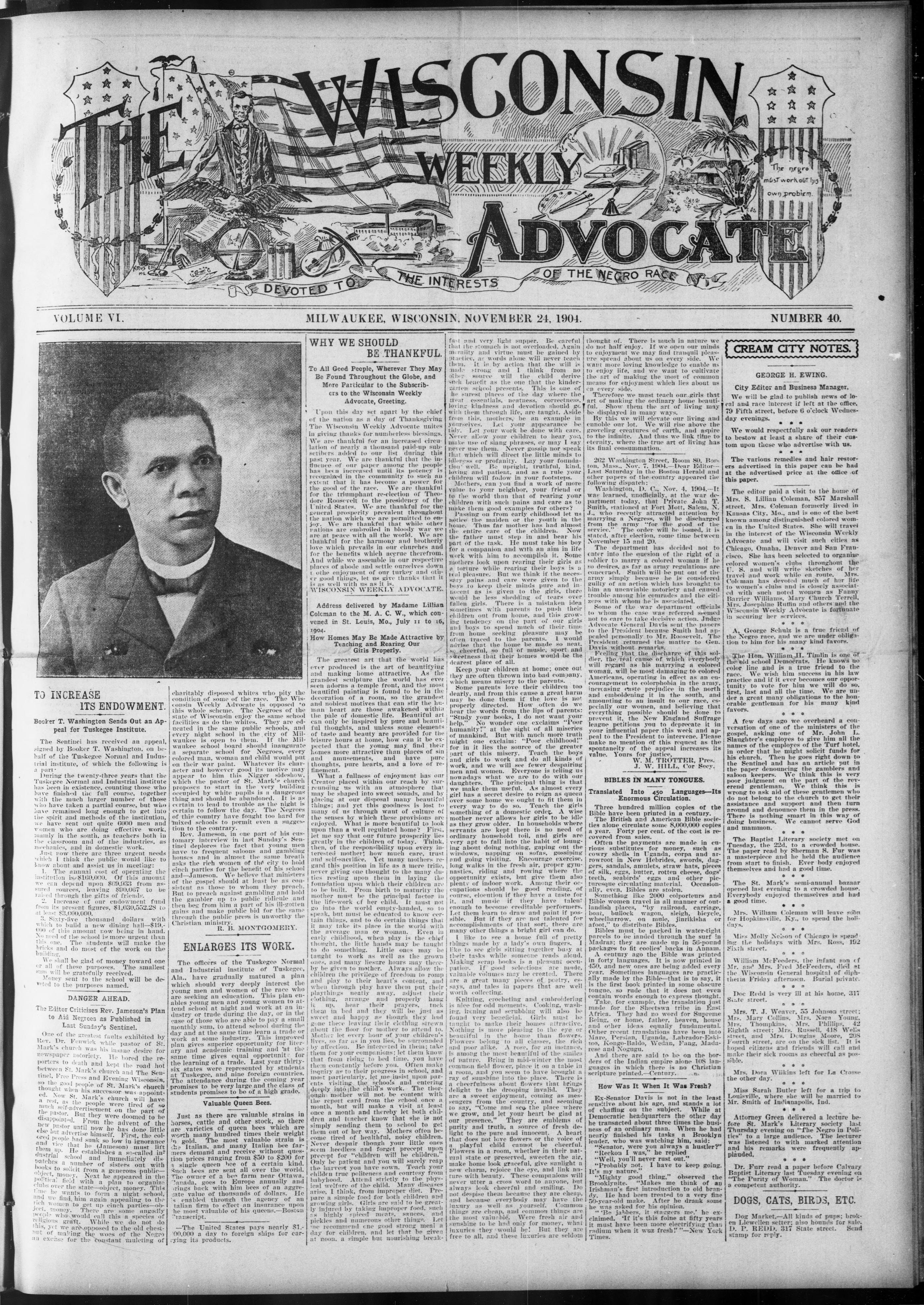
WISCONSIN
WEEKLY
The negro
must work out his
own problem.
ADVOCATE
DEVOTED TO THE INTERESTS OF THE NEGRO RACE
VOLUME VI
TO INCREASE
ITS ENDOWMENT.
Booker T. Washington Sends Out an Appeal for Tuskegee Institute.
The Sentinel has received an appeal, signed by Booker T. Washington, on behalf of the Tuskegee Normal and Industrial institute, of which the following is a part:
During the twenty-three years that the Tuskegee Normal and Industrial institute has been in existence, counting those who have finished the full course, together with the much larger number of those who have taken a partial course, but who have remained long enough to get into the spirit and methods of the institution, we have sent out quite 6000 men and women who are doing effective work, mainly in the south, as teachers both in the classroom and of the industries, as mechanics, and in domestic work.
Just now there are three urgent needs which I think the public would like to know about and assist us in meeting:
1. The annual cost of operating the institution is $160,000. Of this amount we can depend upon $69,933 from assured sources, leaving $90,067 to be raised through the gifts of friends.
2. Increase of our endowment fund from its present figures, $1,030,552.28 to at least $3,000,000.
3. Sixty-five thousand dollars with which to build a new dining hall—$19,000 of this amount now being in hand. No need of the school is more urgent than this one. The students will make the bricks and do most of the work on the building.
We shall be glad of money toward one or all of these purposes. The smallest sum will be gratefully received.
Money sent to the school will be devoted to the purposes named.
DANGER AHEAD.
The Editor Criticises Rev. Jameson's Plan to Aid Negroes as Published in Last Sunday's Sentinel.
One of the greatest faults exhibited by Rev. Dr. Fenwick while pastor of St. Mark's church was his insane desire for newspaper notoriety. He bored the reporters to death and kept the road hot between St. Mark's church and The Sentinel, Free Press and Evening Wisconsin, so the good people of St. Mark's church thought when his successor was appointed. Now St. Mark's church will have a rest, as the people were tired of so much self-advertisement on the part of the pastor. But they were doomed to be disappointed. From the advent of the new pastor until now he has done little else but advertise himself. First, the colored people had sunk so low in ignorance and vice that he (Jameson) must lift them up. He establishes a so-called industrial school and immediately dispatches a number of sisters out with books to solicit from a generous public—object, money. Next he appeared in the political field with a plan to organize clubs over the state—object, money. This time he wants to form a night school, and we find, him again appealing to the rich women to get up cinch parties—object, money. There are some anguously people who would call this a species of religious graft. While we do not do this, yet we are opposed to the old chestnut of making the woes of the Negro an excuse for the constant multing of
---
charitably disposed whites who pity the condition of some of the race. The Wisconsin Weekly Advocate is opposed to this whole scheme. The Negroes of the state of Wisconsin enjoy the same school facilities as do the whites. They are educated in the same public schools, and every night school in the city of Milwaukee is open to them. If the Milwaukee school board should inaugurate a separate school for Negroes, every colored man, woman and child would put on their war paint. Whatever its character and however good its motive may appear to him this Nigger sideshow, which the pastor of St. Mark's church proposes to start in the very building occupied by white pupils is a dangerous thing and should be abandoned. It is as certain to lead to trouble as the night is certain to follow the day. The Negroes of this country have fought too hard for mixed schools to permit even a suggestion to the contrary.
Rev. Jameson, in one part of his customary interview in last Sunday's Sentinel deplores the fact that young men have to frequent saloons and gambling houses and in almost the same breath asks the rich women of the city to hold cinch parties for the benefit of his school and—Jameson. We believe that ministers of the gospel should at least be as consistent as those to whom they preach. But to preach against gambling and hold the gambler up to public ridicule and then beg from him a part of his ill-gotten gains and make public bid for the same through the public press is unworthy the Christian ministry.
R. B. MONTGOMERY.
ENLARGES ITS WORK.
The officers of the Tuskegee Normal and Industrial institute of Tuskegee, Ala., have gradually matured a plan which should very deeply interest the young men and women of the race who are seeking an education. This plan enables young men and young women to attend school at night and work at an industry or trade during the day, or in the case of those who are able to pay a small monthly sum, to attend school during the day and at the same time learn a trade or work at some industry. This improved plan gives superior opportunity for literary and academic training and at the same time gives equal opportunity for the learning of a trade. Last year thirty-six states were represented by students at Tuskegee, and nine foreign countries. The attendance during the coming year promises to be very large and the class of students promises to be of a high grade.
Valuable Queen Bees.
Just as there are valuable strains in horses, cattle and other stock, so there are varieties of queen bees which are worth many hundred times their weight in gold. The most valuable strain is the Italian, and many Italian bee farmers demand and receive without question prices ranging from $50 to $200 for a single queen bee of a certain kind. Such bees are sent all over the world. The owner of a bee farm near Ottawa, Canada, goes to Europe annually and brings back with him bees of an aggregate value of thousands of dollars. He is enabled through the agency of an Italian firm to effect an insurance upon the most valuable of his queens.—Boston Transcript.
The United States pays nearly $1,00,000 a day to foreign ships for carrying its products.
MILWAUKEE, WISCONSIN, NOVEMBER 24, 1904
WHY WE SHOULD BE THANKFUL.
To All Good People, Wherever They May Be Found Throughout the Globe, and More Particular to the Subscribers to the Wisconsin Weekly Advocate, Greeting.
Upon this day set apart by the chief of the nation as a day of Thanksgiving The Wisconsin Weekly Advocate unites in giving thanks for numberless blessings. We are thankful for an increased circulation of nearly a thousand paid-up subscribers added to our list during this past year. We are thankful that the influence of our paper among the people has been increased until its potency is recognized in the community to such an extent that it has become a power for the good of the race. We are thankful for the triumphant re-election of Theodore Roosevelt to the presidency of the United States. We are thankful for the general prosperity prevalent throughout the nation which we are permitted to enjoy. We are thankful that while other nations are embroiled in bloody war we are at peace with all the world. We are thankful for the harmony and brotherly love which prevails in our churches and for the benefits which accrue therefrom. And while we assemble in our respective places of abode and settle ourselves down to the enjoyment of our turkey and other good things, let us give thanks that it is as well with us as it is. WISCONSIN WEEKLY ADVOCATE
WISCONSIN WEEKLY ADVOCATE.
Address delivered by Madame Lillian Coleman to the M. A. C. W., which convened in St. Louis, Mo., July 11 to 16, 1924.
How Homes May Be Made Attractive by Teaching and Rearing Our Girls Properly.
The greatest art that the world has ever produced is the art of beautifying and making home attractive. As the grandest sculpture the world has ever seen adorns a temple front, and the most beautiful painting is found to be in the decoration of a room, so the grandest and noblest motives that can stir the human heart are those awakened within the pale of domestic life. Beautiful art can only be inspired by pure and beautiful thoughts, and unless some elements of taste and beauty are provided for the leisure hours at home, how can it be expected that the young may find their homes more attractive than places of sin and amusements, and have pure thoughts, pure hearts, and a love of refinement.
What a fullness of enjoyment has our Creator placed within our reach by surrounding us with an atmosphere that may be shaped into sweet sounds, and by placing at our disposal many beautiful things; and yet this goodness is lost to many of us through want of culture of the senses by which these provisions are enjoyed. What is more beautiful to look upon than a well regulated home? First, let me say that our future prosperity lies greatly in the children of today. Think, then, of the responsibility upon every interested mother; how much care, trust and self-sacrifice. Yet many mothers regard this position in life as a mere trifle, never giving one thought to the many duties resting upon them in laying the foundation upon which their children are to be built. From birth to maturity the mother must be the principal factor in the life-work of her child. It must not go into the world empty-handed, so to speak, but must be educated to know certain things, and to do certain things that it may take its place in the world with the average man or woman. Even in early childhood, when play is the chief thought, the little hands may be taught to do something. Little ones may be taught to work as well as the grown ones, and many luresse hours may thereby be given to mother. Always allow the children the privilege of freedom to romp and play to their heart's content, and when through play have them put their playthings neatly away, adjust their clothing, arrange and properly hang it up, hear their prayers, tuck them in bed and they will be just as sweet and happy as though they had gone there leaving their clothing strewn about the floor for mother to attend to. Mother let every hour of your children's lives, so far as in you lies, be surrounded by affection. Be interested in them; take them for your companions; let them know that from rising to bed time, you have them constantly before you. Often make inquiry as to their progress in school, and most particularly, let me insist upon parents visiting the schools and entering deeply into the child's work. The thorough mother will not be content with the report card from the school once a month, but will make a visit at least once a month and thereby let both children and teacher know that she is not simply sending them to school to get them out of her way. Mothers often become tired of healthful, noisy children. Never despair though your little ones seem heedless and forget precept upon precept for "children will be children." Only be patient and you will surely reap the harvest you have sown. Teach your children true politeness and courtesy from babyhood. Attend strictly to the physical welfare of the child. Many diseases arise, I think, from improper diet. Prepare a simple food for both children and growing girls. Girls are said to be greatly injured by taking improper food, such as highly spiced meats, sauces, and pickles and numerous other things. Let me recommend one good strong meal a day for children, and let that be given at noon, a simple but nourishing break-
fast and very light supper. Be careful that the stomach is not overloaded. Again morality and virtue must be gained by practice, as words alone will never teach them. It is by action that the will is made strong and I think from no other source will the child derive such benefit as the one that the kindergarten school presents. This is one of the surest places of the day where the great essentials, neatness, correctness, loving kindness and devotion should go with them through life, are taught. Aside from this, mothers, be an example in yourselves. Let your appearance be tidy. Let your work be done with care. Never allow your children to hear you make use of slang phrases, or may I say never use them. Never gossip nor speak that which will direct the little minds to idleness or profanity. Lay your foundation well. Be upright, truthful, kind, loving and patient, and as a rule your children will follow in your footsteps.
Mothers, can you find a work of more value to your neighbor, your friend or to the world than that of rearing your children with such pains and care as to make them good examples for others?
Passing on from early childhood let us notice the maiden or the youth in the home. Thus far mother has had almost the entire care of the children. Now the father must step in and bear his part of the task. He must take his boy for a companion and with an aim in life work with him to accomplish it. Some mothers look upon rearing their girls as a torture while rearing their boys is a real pleasure. But we think if the necessary pains and care were given to the boys to keep their minds pure and innocent as is given to the girls, there would be less shedding of tears over fallen girls. There is a mistaken idea sometimes with parents to push their children out from home, and this growing tendency on the part of our girls and boys to spend much of their time from home seeking pleasure may be often traced to the parents. I would advise that the home be made so neat, so cheerful, so full of music, sport and sweetness that their homes would be the dearest place of all.
Keep your children at home; once out they are often thrown into bad company, which means misery to the parents.
Some parents love their children too dearly, and from this cause a great harm may be done them if the love is not properly directed. How often do we hear the words from the lips of parents: "Study your books, I do not want your help." No wonder one exclaims "Poor humanity!" at the sight of all miseries of mankind. But with much more truth might one exclaim: "Poor childhood!" for in it lies the source of the greater part of this misery. Teach the boys and girls to work and do all kinds of work, and we will see fewer despairing men and women. Everyone is telling us nowadays what we are to do with our daughters. The principal thing is that we make them useful. As almost every girl has a secret desire to reign as queen over some home we ought to fit them in every way to do so. Teach the girls something of a domestic order. A wise mother never allows her girls to be idle as they grow older. In households where servants are kept there is no need of ordinary household toil, and girls are very apt to fall into the habit of lounging about doing nothing, gaping out the windows, napping on sofas, gossiping and going visiting. Encourage exercise, long walks in the fresh air, proper gymnastics, riding and rowing where the opportunity exists, but give them also plenty of indoor work. Among their occupations should be good reading, of course, elocution if they have a taste for it, and music if they have talent enough to become creditable performers. Let them learn to draw and paint if possible. But if they are not talented for accomplishments of that sort, there are many other things a bright girl can do.
I like to see a home full of pretty things made by a lady's own fingers. I like to see girls sitting together busy at their tasks while someone reads aloud. Making scrap books is a pleasant occupation. If good selections are made, valuable volumes may be created. There are a great many pieces of poetry, essays, and tales in papers that are well worth collecting.
Knitting, crocheting and embroidering is nice for odd moments. Cooking, washing, ironing and scrubbing will also be found very beneficial. Girls must be taught to make their homes attractive. Nothing is more pleasing to the eye or beautiful in the home than flowers. Flowers belong to all classes, the rich and poor alike. A rose, for an instance, is among the most beautiful of the smiles of nature. Bring in mid-winter the most common field flower, place it on a table in a room, and you seem to have brought a ray of sunshine into the place. There is a cheerfulness about flowers that brings delight to the drooping invalid. They are a sweet enjoyment, coming as messengers from the country, and seeming to say, "Come and see the place where we grow, and let your heart be glad at our presence." They are emblems of purity and truth, a source of fresh delight to the pure and innocent. A heart that does not love flowers or the voice of a playful child cannot be cheerful. Flowers in a room, whether in their natural state or preserved, sweeten the air, make home look graceful, give sunlight a new charm, rejoice the eye, and link nature with beauty. These companions will never utter a cross word to anyone, but always look cheerful and smiling. Do not despise them because they are cheap, and because everybody may have the luxury as well as yourself. Common things are cheap, and common things are the most valuable. Were fresh air and sunshine to be had only for money, what luxuries they would be! But they are free to all, and these luxuries are seldom
thought of. There is much in nature we do not half enjoy. If we open our minds to enjoyment we may find tranquil pleasure spread about us on every side. We want more loving knowledge to enable us to enjoy life, and we want to cultivate the art of making the most of common means for enjoyment which lies about us on every side. Therefore we must teach our girls that art of making the ordinary home beautiful. Show them the art of living may be displayed in many ways. By this we will elevate our living and ennoble our lot. We will rise above the groveling creatures of earth, and aspire to the infinite. And thus we link ttime to eternity, where the true art of living has its final consummation.
262 Washington Street, Room 80, Boston, Mass., Nov. 7, 1904.-Dear Editor--Last Saturday in the Boston Herald and other papers of the country appeared the following dispatch:
Washington, D. C., Nov. 4, 1904.-It was learned, unofficially, at the war department today, that Private John T. Smith, stationed at Fort Mott, Salem, N. J., who recently attracted attention by marrying a Negress, will be discharged from the army "for the good of the service." The order will be issued, it is stated, after election, some time between November 15 and 20.
The department has decided not to enter into the question of the right of a soldier to marry a colored woman if he so desires, as far as army regulations are concerned. Smith will be put out of the army simply because he is considered guilty of an action which has brought to him an unenviable notoriety and caused trouble among his comrades and the citizens with whom he is associated.
Some of the war department officials to whom the case was referred seemed not to care to take decisive action. Judge Advocate General Davis sent the papers to the President because Smith had appealed personally to Mr. Roosevelt. The President returned the matter to Gen. Davis without remarks.
Feeling that the discharge of this soldier, the real cause of which everybody will regard as his marrying a colored woman, will be most damaging to colored Americans, operating in effect as an encouragement to colorphobia in the army, increasing caste prejudice in the north and emboldening it in the south, and amounting to an insult to our race, especially our women, and believing that everything possible should be done to prevent it, the New England Suffrage league petitions you to deprecate it in your influential paper this week and appeal to the President to intervene. Please make no mention of this request as the spontaneity of the appeal increases its value. Yours for justice.
W. M. TROTTER, Pres.
J. W. HILL, Cor Secy.
BIBLES IN MANY TONGUES.
Translated Into 450 Languages—Its Enormous Circulation.
Three hundred million copies of the Bible have been printed in a century. The British and American Bible societies alone circulate some 8,000,000 copies a year. Forty per cent. of the cost is recovered from sales. Often the payments are made in curious substitutes for money, such as cowry shells in Uganda, corpa and arrowroot in New Hebrides, swords, daggers, sandals, amulets, straw hats, pieces of silk, eggs, butter, rotten cheese, dogs' teeth, seabirds' eggs and other picturesque circulating material. Occasionally, even, Bibles are stolen. Something like 2000 colporteurs and Bible women travel in all manner of outlandish places, "by railroad, carriage, boat, bullock wagon, sleigh, bicycle, wheelbarrow, on mule, jinrikisha or afoot" to distribute Bibles.
Bibles must be packed in water-tight parcels to be iained through the surf in Madras; they are made up in 56-pound packages to fit coolies' backs in Annam. A century ago the Bible was printed in forty languages. It is now printed in 450, and new ones are being added every year. Sometimes languages are practically made by the Bible—that is to say, it is the first book printed in some obscure tongue, so rude that it does not even contain words enough to express thought. Take, for example, the translation just made for the Sheetswa tribe in East Africa. They had no word for Supreme Being, or home, father, heaven, house and other ideas equally fundamental. Other recent translations have been into Mare, Persian, Uganda, Labrador-Eskimo, Kongo-Baldo, Wedan, Fang, Madarese and Nogugu.
And there are said to be on the borders of the Indian empire alone 108 languages in which there is no Christian scripture printed.—Century.
How Was It When It Was Fresh?
Ex-Senator Davis is not in the least sensitive about his age, and stands a lot of chaffing on the subject. While at Democratic headquarters the other day he transacted about three times the business of an ordinary man. When he had nearly finished his tasks a Brooklyn leader, who was watching him, said:
"Senator, were you always a hustler?"
"Reckon I was," he replied
"Well, you'll never rust out."
"Probably not. I have to keep going.
It's my nature."
"Mighty good thing," observed the Brooklynite. "Makes me think of an Irishman's first introduction to old brandy. He had been treated to a very fine 50-year-old make. After he drank some he was asked for his opinion. 'Be jabbers, it staggers me,' he excclaimed. 'If it's this foeine at fifty years it must have been more electrifying than radium when it wuz fresh'"—New York Times.
GEORGE H. EWING
City Editor and Business Manager.
We will be glad to publish news of local and race interest if left at the office. 79 Fifth street, before 6 o'clock Wednesday evenings.
We would respectfully ask our readers to bestow at least a share of their custom upon those who advertise with us.
The various remedies and hair restorers advertised in this paper can be had at the advertised price at the office of this paper.
The editor paid a visit to the home of Mrs. S. Lillian Coleman, 857 Marshall street. Mrs. Coleman formerly lived in Kansas City, Mo., and is one of the best known among distinguished colored women in the United States. She will travel in the interest of the Wisconsin Weekly Advocate and will visit such cities as Chicago, Omaha, Denver and San Francisco. She has been selected to organize colored women's clubs throughout the U. S. and will write sketches of her travel and work while en route. Mrs. Coleman has devoted much of her life to women's clubs and is closely associated with such noted women as Fanny Barrier Williams, Mary Church Terrell, Mrs. Josephine Ruffin and others and the Wisconsin Weekly Advocate is fortunate in securing her services.
A. George Schulz is a true friend of the Negro race, and we are under obligation to him for his many kind favors.
* * *
The Hon. William H. Timlin is one of the old school Democrats. He knows no color line and is a true friend to the race. We wish him success in his law practice and if it ever becomes our opportunity to vote for him we will do so, first, last and all the time. We are under a great many obligations to the honorable gentleman for his many kind favors.
---
A few days ago we overheard a conversation of one of the ministers of the gospel, asking one of Mr. John L. Slaughter's employees to give him all the names of the employees of the Turf hotel, in order that he might solicit funds for his church. Then he goes right down to the Sentinel and has an article put in the paper denouncing the gamblers and saloon keepers. We think this is very poor judgment on the part of the reverend gentleman. We think this is wrong to ask aid of these gentlemen who do not belong to the church to get their assistance and support and then turn around and denounce them in the press. There is nothing smart in this way of doing business. We cannot serve God and mammon.
The Baptist Literary society met on Tuesday, the 22d, to a crowded house. The paper read by Sherman S. Fur was a masterpiece and he held the audience from start to finish. Ever body enjoyed themselves and had a good time.
```markdown
```
The St. Mark's semi-annual bazaar opened last evening to a crowded house. Everybody enjoyed themselves and had a good time.
Mrs. William Coleman will leave soon for Hopkinsville, Ky., to spend the holidays.
Miss Molly Nelson of Chicago is spending the holidays with Mrs. Ross, 192 Sixth street.
William McFeeders, the infant son of Mr. and Mrs. Fred McFeeders, died at the Wisconsin General hospital of diptheria Friday afternoon. Burial private.
Doc Redd is very ill at his home, 317 State street.
Mrs. T. J. Weaver, 55 Johnson street; Mrs. Mary Collins, Mrs. Nora Young, Mrs. Thompkins, Mrs. Phillips, 42 Eighth street; Mrs. Russell, 418 Welis street, and Mrs. Douglas Moore, 208 Fourth street, are on the sick list. It is hoped citizens and friends will call and make their sick rooms as cheerful as possible.
* * *
Mrs. Dora Wilkins left for La Crosse the other day.
* * *
Miss Sarah Butler left for a trip to Louisville, where she will be married to Mr. Smith of Indianapolis, Ind.
* * *
Attorney Green delivered a lecture before St. Mark's Literary society last Thursday evening on "The Negro in Politics" to a large audience. The lecturer was listened to with marked attention and his remarks were frequently applauded.
Dr. Furr read a paper before Calvary Baptist Literary last Tuesday evening on "The Purity of Woman." The doctor is a competent authority.
DOGS, CATS, BIRDS, ETC.
Dog Market.—All kinds of pups; broken Llewellen setter; also hounds for sale. D. P. REDD. 317 State street. Send stamp for reply.
Miscellaneous Items.
—In 1889 steps were first taken to establish a commercial high school at Kobe, Japan. It is to be completed by the end of 1904, and some instruction was begun March 15, 1903.
—Twenty thousand dollars to establish a home for drunkards' wives was one of the bequests of James Callanan, a philanthropic but eccentric millionaire, who died in Des Moines, Ia., lately.
—Not a bride was over 22 years old in the 346,590 marriages which, according to the last census, took place in Japan last year. Forty-two were only 15, 759 were 16, 5484 were 17, 17,406 were 19 and 16,100 were 20.
According to the report of the National Union of Teachers French is the most popular language among the students. In other subjects bookkeeping comes first in favor, followed by shorthand, arithmetic and typewriting.
It is interesting to note that of the 37,692 students enrolled in the German universities for the term now drawing to a close 3093 were foreigners, of whom 986 were Russians. Female students to the number of 1314 were enrolled for the term.
The latest fad in London is to hold paper chases in motor cars. One car is given a load of paper cut up into little pieces, and leaves a trail of paper as it whirls through the country. The other cars follow the train and try to catch the first car.
One of the new sports in England is falconry with motor cars. The sportsmen go out in their motors with falcons and goshawks on their wrists and await the advent of the game that is driven toward them from the coverts which the roads adjoin.
Runaway horses are unknown in Russia. No one drives there without having a thin cord with a running noose around the neck of the animal. When an animal starts the cord is pulled and the horse stops as soon as it feels the pressure on the windpipe.
The French government has authorized the French West African bank to increase its capital and to open a branch in Monrovia. Hitherto the finances of Liberia have been almost wholly in German hands, though there has been no bank in the republic.
The eldest children of two Japanese families cannot marry, for the eldest child must always live at home, and so keep the family home from passing into strange hands. If a man marries a Japanese heiress he has to take her family name if he is poor himself.
Under a new rule women inspectors visit the public schools of London and inspect the pupils. Those that are not clean are sent home. But already it has been found that some of the children smear themselves with mud before entering school in hope that an inspector will pay a visit.
Paying visits by airship is the latest fashionable novelty in Paris. There have been several instances of it recently, and lately three gentlemen left Paris by airship for a visit to the country house of Count Coutades. The wind was favorable and the distance of about twenty-three miles was covered in 45 minutes.
Crowds attend the Church of St. Aldan's, Boston, England, every Sunday to hear a musical contest between congregation and choir, the former insisting on singing against the wishes of the latter and the organist. The congregation usually succeeds in drowning out the choir and organ, finishing rather hoarse, however.
—On Monday morning, October 3, 2108 of the men employed at Harland & Wolff's shipbuilding yards, Belfast, absented themselves. When reporters asked the reason of this the manager said the number was rather greater than usual, but it is quite the rule for a large number of the men to absent themselves on Monday.
—Rather a quaint idea comes from France, where anglers are in some waters using a tiny mirror attached to the line near the baited hook. The idea is that the fish, seeing itself reflected, hastens to snatch the bait from its supposed rival. Very successful results have been obtained through the employment of this simple device.
The officers of the consolidated street car lines of Oakland, Cal., have fitted up a spacious and thoroughly equipped athletic and social club for their employees, including billiard, pool and card rooms, reading room, luncheon, gymnasium, bowling alley, shooting gallery and baths. The only expenses of the members will be for janitor and other service.
A. H. Liese of Fresno county put up his ranch for raffle. He sold tickets to the amount of $7500. W. C. Wilkinson held the winning number, but Liese refused to surrender the ranch, saying that Wilkinson had no rights in law, as raffling is gambling. But Wilkinson has found an old statute which provides for the confiscation of such property in the state.
The greatest of the world's manufactories of hairpins is at Painswick, a village in the Stroud valley, at the foot of the Cotswolds. There are now fewer than 300 persons employed in turning out these trifles of the boudoir, and hundreds of automatic machines are in constant operation transforming miles of wire into tons of finished pins.-London Engineer.
The German minister of commerce and sixty leading German merchants are about to visit the districts and towns tapped by the Anatolian Bagdad railway, which is entirely in German hands. The whole territory will be divided up among different merchants, and mercantile establishments will be opened everywhere, containing nothing but German goods.
—The trade with Brazil last year has never been surpassed, except in the three record years of 1890, 1891 and 1892. It was $5,950,000 higher than the average of the last ten years. This result is all the more important when one remembers that last year the average price of the most important export product of Brazil —coffee—was considerably lower than in 1902.
—The cotton used in the Russian factories during 1900 was from the following sources: America, $41,072,434; Egypt, $10,711,330; East India, $1,017,949; Persia, $2,843,984; Middle Asia, $27,865,156; Caucasia, $2,023,332; other sources, $2,507,329, making a total of $87,591,514. It is estimated that in 1903 there was consumed in the cotton mills cotton to the value of $97,850,000.
The First Artificial Lights.
"The first step in artificial illumination was the resinous knot, out of which men fashioned a torch," said C. S. Jones, one of the visiting gas light delegates. "When the Nineteenth century dawned the children of America were learning to read by the light of pine knots and the combustion of logs at an open fireplace. It is hard to think that the world groped on to the Thirteenth century without even discovering the tallow candle, yet so it was. During the early ages mankind was literally 'plunged in darkness.' When the Pilgrims landed in Plymouth the best they could do for light was to adopt the pine knot illumination methods of the red men. Eliot translated the Bible by a spluttering, smoky torch. Between this primitive plan and the electric searchlight of today there is a long step, but the path of progress has been one of slow gradation."—Washington Post.
A GOOD MOTTO.
Upon the door I saw a sign;
I cried, "A motto! And it's mine!"
A wiser thing I never saw—
No Median or Persian law
Should be more rigidly enforced
Than this, from verblage divorced;
Its logic's firm as any rock—
"Push—don't knock."
'Twas simply meant to guide the hand
Of those who wished to sit or stand
Within the unassuming door
This weight of sermony that bore.
'Twas never meant to teach or preach.
But just to place in easy reach
The ear of him who dealt in stock—
"Push—don't knock."
But what a guide for life was that—
Strong, philosophical and pat;
How safe a chart for you and me
While cruising o'er life's restless sea:
Push, always push, with goal in view;
Don't knock—avoid the hammer crew.
This rule will save you many a shock:
"Push—don't knock."
When on that door I see the sign.
I say, "Great motto, you are mine!"
No stronger sermon ever fell
From human lips; no sage could tell
The hothead youth more nearly how
To point always his vessel's prow;
There are no wiser words in stock:
"Push—don't knock."
—Baltimore American.
THE ROUSING OF MR. RUGBY.
Thomas Weatherford Rugby stood on the very edge of the breakwater, watching the schooner Lovely Mary beating into Gloucester harbor. Mrs. Rugby occupied a wicker rocking chair on the piazza of the Restful View, a hundred feet back from the wall that rose sheer above a narrow sandy beach. It was a clean drop of ten feet from the top of the wall, where Mr. Rugby balanced daringly on his toes, and Mrs. Rugby was viewing with increasing apprehension this new adventurous spirit in fat, placid Thomas Weatherford. Presently she called out to him, in a voice that carried up and down the narrow beach and caused a general turning of heads and some impertinent comment among the nurse maids sprawled in the sand:
"Thomas," she cried. "you must be careful out there. Mr. Hollis (the men called the proprietor of the Restful View 'Fussy' Hollis) said that yesterday a stone fell out of the wall up near the pond." Mr. Rugby stepped cautiously back to turn. His wife drew young Richard Rugby, aged 10, to her side, to wipe ten sticky fingers on her handkerchief, pull a flapping blue sailor blouse into place, kiss an unwilling mouth with vigor, and instruct a deaf young ear as follows:
"Richard, you must not go down to Andy's any more without first coming and asking me if you can go. You know very well that blackjack candy makes you ill. Now, go right down there and tell your father that Mr. Hollis says that Capt. Wicklin's boat can be hired for this afternoon, and that I want him to go over to the Laurel tavern and ask—well, now hurry, dear, and tell your father I want him."
Young Richard pulled away from an embrace that promised to become violent once more, and raced out to the lawn at the piazza end, where he began to yell frenzied commands to "Daw-rothee!" to come up from the sand and play with him. Mrs. Rugby lifted a rustling mass of skirts and, touching an iron-gray lock into place at the back of her bare head, went dignifiedly down the piazza steps to deliver in person the message that the boy had not deigned to bear. Mr. Rugby, ruddy-faced, with clean gray moustache and close cut gray hair showing below the rim of a youthful Panama, stepped forward as jauntily as 200 pounds of hampering flesh would permit.
"I was just watching that fishing schooner, Sarah," began Mr. Rugby. "I see she's a two-master, and probably just getting in from the Banks. She's tacking in, and I reckon she'll make the dock pretty soon." Mr. Rugby's nautical lore was limited—extremely limited—for all his four long summers of watching the sleek, swift black boats sail in as the glory of crimsoning sunsets flooded the western piazza of the Restful View.
Mr. Rugby was told, with customary emphasis, to go straight to Capt. Wicklin and engage the captain's stanch little boat, the Curlew, for an afternoon's sailing. Then he was to go to Laurel Tavern—the "swellest" of the group of hotels, which Mrs. Rugby would have patronized, only it was too noisy and distracting for the children—and insist upon getting Mr. and Mrs. McIntosh and "dear Harold" to join them. "And don't forget that Mildred is going with us. I think Dorothy and Richard had better stay and play with the Preston children. Now hurry up, Thomas dear!" Mrs. Rugby came up the steps dignifiedly, smiling sweetly at deaf old Mrs. Winters, who came up to shout a question, "Where was Mr. Rugby off to just now, moving so spry?"
Mrs. Rugby put her plump mouth close to Mrs. Winters' ear and shrilled: "We've invited the McIntoshes from Laurel Tavern to go sailing this afternoon—we've got Capt. Wicklin's boat!" "Oh, yes! going sailing are you!" roared Mrs. Winters. "Well, I shouldn't be surprised if the wind came up strong late in the afternoon," she added cheerfully.
In response to Mr. Rugby's invitation Mrs. McIntosh said that both Harold and herself would be charmed to join the sailing party, but that Mr. McInosh must be excused, for it was too unsettling to a man of his age who had never been a good sailor.
Mr. Rugby thought it unfortunate that he was to have no special companion on the sail, for he would be compelled either to listen with an assumption of interest to his wife and Mrs. McIntosh at their eternal chatter of marriages and dresses, or try to become interested in Capt. Wicklin, who had one long, familiar story about the part he took in a great naval battle of the Cival war. Mr. Rugby had thrilled at the tale four years before—now he knew exactly when Capt. Wicklin would put the tiller under his left arm to illustrate, with both hands free, the way he picked a sputtering bomb off the Mentor's deck, and heaved it overboard a quarter of a minute before it exploded.
But Mr. Rugby had a deep, full-fed philosophy that precluded sustained worry. He followed Mrs. Rugby and the laughing Mildred to the boat, his arms loaded with wraps and cushions.
Harold cut into the middle of his greeting with, "Hello, Mil, we're in for it again. Get jolly well soaked, if I can read the weather."
"Go on, Hal, fergit it," taunted Mildred, putting out her hand to be assisted into the boat.
"Mildred!" rebuked Mrs. Rugby. She had heard her daughter's Bowery intonation. "Children grow up nowadays with such wild notions of language," complained the mother to Mrs. McIntosh.
The Curlew beat up the harbor, with Mildred and Harold gazing attentively over the bow, with Mrs. McIntosh and Mrs. Rugby well wrapped in the tiny pit, settling in direct discourse the destinies of the Preston children, and every eligible maid on Eastern Point. Not with words, but with approving nods and occasional flutters of parental caution to the noisy pair forward, they blessed the two young hearts.
It was Mrs. McIntosh's firm conviction that Mr. Rugby was "close" with his money, that he might have summered at Laurel tavern just as well as at the tested on the government railway there.
Restful View, where the guests were well mixed. It made a sensation—no less—when a man brought his vailet to the Restful View, early in the season, whereas at Laurel tavern—Mildred would surely bring money to dear Harold, who was so extravagant. Mrs. Rugby knew to a penny what the McIntoshes' weekly bill at the tavern totaled.
Mr. Rugby listened patiently to Capt. Wicklin's Civil war story, heard the bomb hiss in the waters as it sank, read the thanks of Congress through the willing narrator's lips, and wished that the infernal northwest wind would not blow so keenly.
Off Norman's Woe, yielding with graceful reluctance to the combined persuasion of Mrs. McIntosh, Mrs. Rugby and Harold, Mildred recited "The Wreck of the Hesperus." Do you know," commented Mrs. McIntosh, "they say Longfellow never even saw the reef of Norman's Woe until long after he wrote that piece."
"It might have been high tide when Longfellow came down to see the Hesperus after she struck," ventured Mr. Rugby, with facetious intent. "Here at Gloucester, the sea has a rise and fall of nine feet, and the reef, you see, is pretty well covered up half of the time."
"Thomas, how can you talk so!" Mrs. Rugby was familiar with the wit that attempted to cheapen the accomplishment of any member of his family. Mildred's elocution had seemed so effective and appropriate just now. Mrs. McIntosh called Mrs. Rugby's attention to the "grand sweep" of the Magnolia shore coming into view, and Thomas Weatherford Rugby sighed. He settled back to pour his elementary, fatuous talk of fishermen and lighthouses and tides into Capt. Wicklin's ears, eliciting from that gray skipper occasional half-contemptuous grunts. Then he relapsed into silence, casting his weather eyes about the horizon of restless sea and far wooded hills for a subject that might serve to win him a part in the general conversation.
It came—an innocent, scarcely discernible flash of lightning in the northwest. Instantly Mr. Rugby's memory reverted to one of Proprietor Hollis' most exciting sea tales, which began: "Along this coast, whenever you see lightning in the northwest, you can begin to take in sail, for it's sure to blow a gale of wind in a mighty short time." And here was the Curlew scudding before that northwest breeze with topsail and two jibs, in addition to the mainsail bellying powerfully. Mr. Rugby called out:
"Captain, we're going to have a blow better haul down your tops'l and jibs." "Did ye get a report from the weather bureau?" inquired the captain, with a sarcastic intonation. "No, I didn't, but——" "The weather bureau is so unreliable, Thomas," cut in Mrs. Rugby, noting the rising spirit of assertiveness in her husband. "Don't you remember that we looked in the Boston papers the day before we planned to drive up to Newbury-port, and——" "Yes, I know, Sarah; but I never said anything about a weather report. I was think of what Mr. Hollis was saying about——" "Dear." impertinent Harold began to murmur: "Granny Hollis" came to tea,
Told wild tales of a stormy sea:
Said sweet Nel-ile to Mister 'Fussy'
Go right home, tell that to 'Pussy!'
Mildred laughed and supplied a second stanza descriptive of Pussy's alarm at hearing the sea tale. Mrs. Rugby and Mrs. McIntosh, after mildly chiding the irreverent young people, turned once more to the discussion of the Baxters of Marblehead Neck. Miss Baxter was to have all the money, it was reported, of that curious old Mr. Baxter, the uncle, who made sixty thousand a year out of a Boston spa! Really? That was news to Mrs. McIntosh.
Thomas Weatherford Rugby saw another glow of light in the almost cloudless northwest; he glanced anxiously towards Capt. Wicklin, who steered in a dogged, injured silence. The little boat was driving magnificently before the breeze—Mr. Rugby wished for his own selfish joy in the sail that he had not seen those lightning flashes. But he had seen them, and they had signaled to him a warning. What was the good, though, of speaking again? He would be met only by ridicule—and that treatment had not lost quite all of its bitterness. Mr. Rugby muttered an impious oath as he twisted round to face the northwest.
The little rags of clouds, out of wichch the lightning was occasionally flashing, drove straight on for Gloucester harbor. Mr. Rugby's anxious, watchful eye seemed to detect among the distant trees and housetops an unusual commotion. In fancy he could see the whipping of the branches, hear the wild shriek of the gale under the draughty eaves of the Restful View, and in the edge of the harbor he actually noted that the limp mainsail on Capt. Stewart's tub of a boat—The Bird—had suddenly come down. He touched Skipper Wicklin's arm, and told him these things.
"Stewart takes in sail when he sees the shadow of a gull on the harbor!" What was expressed underneath the words was the firm determination of Capt. Wicklin to take exactly the contrary course.
As Mr. Rugby loooked up again the two familiar lines of beeches that were silhouetted against the sky at the "neck" of Eastern point were writhing in the wind. They were perhaps three miles away, and the question in the watcher's mind was, how soon would that gale traverse the distance? Mr. Rugby had a vague notion that sixty miles an hour was not an unusual rate for gales to travel—and, if he had seen the wind's first attack on the trees, they might still have three minutes to haul down the sail and come about in the wind.
"Captain," began Mr. Rugby sternly, "we must pull down the sails—the blow's going to strike us in less than three minutes."
"Thomas, dear, you are really spoiling the sail for Mrs. McIntosh and the children." Mrs. Rugby spoke calmly, but no one would have said she spoke dispassionately. There was something in the tone that made the words seem final. Mildred, ignoring Harold's flippant warning to "ware your Pop," added her rebuke:
"Papa, I wish you would not insist upon having a storm. Think how troublesome one might be."
"The blow is almost upon us now——" Mr. Rugby turned square toward the Curlew's skipper as he spoke—"will you pull down those jibs and the topsails?" His voice rang out threateningly. Into his eyes there crept the light of battle, the rekindling spark of a youthful fire that should have died long ago. Under the fire the captain quailed just a little. He blustered, to cover his weakness:
"I'll put the Curlew about, sir, and run back to the landing, if that's what you want; but to take in sail on a day like this is a d—d feel thing that I won't do!"
Mr. Rugby sprang to his feet, his ruddy face flaming, and his eyes snapping with the spirit that had sent old Gen. Weatherford Rugby, his father, into the fiercest charge at Gettysburg, the beloved Confederate emblem fluttering in his own hand after the color-bearer had fallen. Pointing dramatically toward a fishing boat inside the breakwater, he shouted.
"Look there!" On the black craft swift work was going forward. Even as he spoke the last jib tumbled limp on the boom, and one of the two great mainsails fluttered a moment and then crashed toward the deck like a huge winged bird hard hit.
Capt. Wicklin saw the first rush of the
gale strike the fisherman, saw her careen as the remaining mainsail bellied suddenly and swing out with a jerk. But he was an obstinate man, and fishermen often beat into the inner harbor under only one mainsail. He turned to the women to explain that they need not be alarmed, shouting:
"Pull down the jibs and topsail, sir. I order you to do it." Skipper Wicklin retorted hotly:
"What do you know about sailing? I'd as soon think of taking orders from——"
"Then, d—n you, stand aside, sir, and I'll pull 'em down for you!" Mr. Rugby, thrusting the astonished mariner back to his seat beside the tiller from which he had risen, stumbled forward to the mast and began to pull frantically at the halyards clewed in an apparently hopeless tangle. Mildred, blushing with mortification, and angry beyond reason, left her seat to come up to her father.
"Papa, go back to your seat--you're making us all ridiculous!" Mr. Rugby turned from the ropes to seize his daughter's arm and turst her coward the snickering Harold. "Keep her there, sir," he commanded sternly, and young McIntosh suddenly became sober. Mrs. Rugby was disentangling herself from the wraps that bound her, an ominous, commanding light in her eyes. But she said nothing. Mr. Rugby tugged at the ropes, expecting at every moment her firm grip on his arm.
But before the wife could interfere Capt. Wicklin had brought the Curlew about, the quick change dumping both Mr. and Mrs. Rugby into the pit.
"Come aft and steer, sir." called the captain, alive at last to the danger. "Hold her steady as she runs." Mr. Rugby seized the tiller. The skipper had the topsail halyards loose in a jiffy. While he pulled at the jib fastenings the gale struck. The Curlew slewed half round, the tiller flying from Mr. Rugby's grip. Capt. Wicklin scrambled aft to recover it, deaf to the cries of the woman leaving the mainsail flapping wildly.
Seeing the tiller safe in the captain's hands, Mr. Rugby floundered forward, hearing in passing his wife's hysterical command to sit down and not fall out of the boat. Grasping the pitching mast firmly with one arm, he tore at the ropes again, but the mystery of their arrangement baffled him. He looked up from his work to see the pale-faced Harold scrambling into the cockpit, leaving Mildred hanging despairingly to the rail and in immediate danger of going overboard. With a daring lunge he seized his daughter and half flung her in with the two women. Then he turned to Harold.
"Your knife, sir, quick," he commanded. The young man fumbled awkwardly in his pockets, drawing forth a pretty, pearl-handled penknife.
"Open it, you fool," roared Mr. Rugby. With the knife, now thoroughly roused, and surprisingly agile, capable Mr. Rugby slashed at the halyards. But the knife was a toy, too light for the work. Flinging it from him, Mr. Rugby luckily released the ropes at a frantic pull, and and the Curlew's canvas was dragging in the choppy sea. The sails down, Capt. Wicklin let the boat run before the wind, and, lashing the tilier hurriedly, came forward to save the canvas.
The gale went as quickly as it came, and a soaking, chilling rain followed in its wake. Capt. Wicklin, bending on his mainsail for the run back to the landing, was very cordial in his talk with Mr. Rugby, who buzzed about in the belief that he was helping. In Mrs. Rugby's eyes appeared a new light—compounded of surprise at her husband's sudden effectiveness, of wonder at the fore-knowledge he had shown of the storm's approach, and of a wholly womanly pride in his renascent manliness. Mildred had seen and marveled, and glowed, too. When Harold McIntosh ventured the sotto voce comment, "Old Pop humped himself that time for fair!" Mildred turned upon him with the crushing rejoinder:
"May father saved your life, like a brave man. I'd like you to speak more respectfully of him if you've got to say something." Going aft, she cuddled close to Mr. Rugby, who was beginning vaguely to fear that he might come out of this a hero. Harold trailed his fingers in the water all the way from Norman's Woe to the Laurel tavern landing. Mrs. Rugby reflected upon the accident—once she turned away to whisper to herself: "It's been hard to remember some times, but I have got a man for a husband." Few at the hotel understood Mrs. Rugby's new devotion to her placid husband, but she was serenely, happily unconscious of their perplexity.—New York Evening Post
WARNING
It has come to the notice of the Directors of the Children's Free hospital of Milwaukee, that persons representing themselves as authorized solicitors of the hospital are soliciting and receiving donations in its behalf throughout the state. We desire to notify the people of the state, and particularly those of the northwestern section, where such frauds have been chiefly perpetrated, that the hospital has no authorized solicitors, and that any person representing himself as such and asking donations in its interest is an impostor. MRS. CHAS. CATLIN,
Secretary of the Children's Free Hospital of Milwaukee.
Historic Ships' Names.
At least four historic ships of our navy have been launched from Boston ways—the Constitution, the old Cumberland, the Hartford and the Merrimac. The old Cumberland, the ship of tragic glory, was launched more than sixty years ago. The Merrimac, which, converted into a Confederate ironclad and named Virginia, was to destroy the Cumberland, was put into the water in 1855. The Hartford was launched in 1856. The Cumberland, Merrimac and Hartford were all navy yard built. The new Cumberland is to be used as a training ship, and therefore her service will be of preparation rather than war. But it is well that training ships should bear heroic names, since the associations that cluster about them are inspirations to young tars. The training squadron of sailing vessels when completed will be made up of the Chesapeake, Cumberland, Intrepid and the brig Boxer. Of these, the Chesapeake repeats the name of a ship singularly unfortunate but whose final disaster was almost redeemed by the devotion of Lawrence; the original Intrepid perished in her duty, and Somers and her crew were great exemplars of supreme self-sacrifice. The Cumberland's heroic story will live forever. The Boxer alone carries in her name the association of victory.—Boston Transcript.
A Regular Sea Dog.
When "Abe" Gruber was up in the Adirondacks last summer he was compelled to put up for a few days at a boarding house. He was retailing his experiences there the other night.
"The landlady was what I call a pirate," he said.
"Why, how much did she rob you of, Mr. Gruber?" asked one of his auditors.
"Oh, it wasn't so much that," replied Mr. Gruber. "which makes me designate her thus. It was the way in which she repelled boarders."—New York Times.
SOME STRANGE ACCIDENTS.
People Have Been Injured at Odd Times in the Queerest Kind of Manner.
While carrying a keg of beer intended for a picnic in Reading, Pa., one day last week, Elmer Kerchoff stumbled over a wire. The keg slipped so suddenly that the jar dislocated his neck.
Only a short time ago Miss Carrie Hughin of Janesville, Wis., was so tightly hugged by her lover that two of her ribs became interlocked. After suffering severe pain the young woman confessed that strenuous love making was the cause of her distress.
Emmanuel Beveler of Sterling, Ill., cut his throat on his high collar. He was riding on a bicycle, and in trying to avoid a passing horse was thrown. In his fall his collar cut his throat.
Margaret Kirchbaum died of eating hot potatoes. She was in a hurry to go out and gulped down several hot potatoes. She died in great agony. The autopsy showed that her throat and the lining of her stomach had been so badly burned that the swelling had caused her to choke to death.
Jasper Gomers, while waiting for a car at midnight in St. Louis, sat down on a barrel of tar and fell asleep. When he awoke he found the tar had softened and he had slowly sunk down into the sticky stuff until his feet, arms and head only were outside. He was chopped out with an axe.
William P. Steele of Princeton, Md., died a few months ago while setting up a monument over his wife's grave. The stone fell, crushing his head and chest.
Francis J. Birdwell a Boston ornithologist, climbed high up in a tree at Rio Pecos, N. M., after a bird's nest. The rope he was using caught on a limb and, when he slipped and fell, a loop caught him around the neck and he was slowly strangled to death. His bride of a month stood at the foot of the tree, but was unable to help him.
A Jersey mosquito caused the death of a barber named Rosho Dorso at Harrison, N. J. The barber was shaving, and a mosquito lit on his nose. The razor was directly under the barber's chin, and in making a slap to drive away the mosquito he cut a deep gash in his throat. A physician arrived too late to save him.
A swordfish caused the death of Auguste Sylvia, about thirty-five miles out at sea. Sylvia was one of the crew on the fishing sloop Klondike, from Gloucester. A 2000 pound swordfish had been harpooned, and Sylvia entered a dory to make another line fast to the fish, which was only about two lengths away from the sloop. In its flurry the fish made a break for the dory and broke its sword by running it through the planking. The shock, when the fish struck the dory threw Sylvia overboard, and as he was in oilskins and rubber boots he was unable to swim and sank before assistance could reach him.
Paul Bowles, a 110-year-old son of a Bolivar (N. Y.) merchant lost his hair by fright. A runaway horse threw the boy into convulsions; which caused all the hair on his head to fall out.—St. Louis Globe-Democrat.
NERVY BLUFF.
Won in a Stiff Poker Game and Cost the Dealer $3500.
"I have been more or less a devotee of the great American game of draw poker for the last thirty years, but in all that time I never saw as curious a play as I witnessed in Seattle a few weeks ago," said Frank Gaither of that live western city, at the Raleigh.
"The play was this: A miner from the Klondike was trying to run everybody out of a big jackpot by shoving in a big stack of chips. The game was a fierce one, table stakes, and there was at least $3000 on the table. The Klondiker in reality did not have a very strong hand, only two pairs—kings up—but he raised that pot before the draw to the extent of $250, and everybody dropped out except an old California gambler, who had a pat hand, a small straight.
"The Californian hesitated a while, but shoved in the $250, which took about all the money he had in front of him. It so happened that he was dealing, and when he asked his antagonist from Alaska how many cards he wanted the answer was, 'Not any,' accompanied by an emphatic knock on the table, and the remark: 'I've got nothing here but a flush.' This statement was made in such a matter of fact tone that it impressed me, as well as every other man about the table, with its truth. It certainly made that impression on the Californian, for it caused him to drop the pack of cards and study his hand with careful scrutiny.
"I could have sworn that he, too, had a pat hand, which he did, but it was ranked by the supposed flush of the other man, and, consequently, in the holder's opinion, worthless. With this idea, what did he do but split his hand and draw two cards to an ace, king and queen of diamonds, taking a long chance of making a bigger flush than the Klendiker. Of course, he didn't make the flush, and the miner raked in the pot, although, as the other man was 'all in,' the hands had to be shown, and then it was that everybody got a jar when they beheld the sharp trick by which the pot was won.
Washington Post. Instead of the proclaimed pat flush, the winning hand was only two pairs.
"Everybody agreed that it was a scaly trick, and sympathy was entirely with the Californian. At the same time, he was to blame for taking the word of the other man, for, as every one knows, the truth is not held sacred where men congregate around the green cloth and try to annex the bank rolls of their fellow man."
Men's Earnings in Maine
It has been learned that the average income of a man in Massachusetts is $1.50 a day for 300 days in the year. This makes a gross revenue of $450 a year, out of which sum the earner must pay living expenses, taxes, and all bills as they come due, and in addition, perhaps, must care for and pay the expenses of supporting a family of three or four persons. From available statistics it is inferred that the earning of the Maine worker is somewhat below that of the Massachusetts citizen—perhaps as low as $400 a year. To offset this shrinkage, the Maine resident pays less rent, the land he buys is much cheaper by the acre, he can build his home more cheaply, he can furnish it for about the same amount of money, his taxes are lower, and while he has fewer luxuries than does his fellow in the Bay state, he has more room in which to turn around, and his general manner of life is more healthful and enjoyable. A large proportion of our citizens are farmers, and it has been found very hard to get the Maine farmers to make accurate statements as to what they earn. They are willing enough, but few take into account the vegetables, eggs, meat and fruits which are grown on the farm and eaten by the family. No account is made of the labors of the women and children who comprise the farmers' household. The cash transactions—the money paid out for help, supplies and machinery, and the money that comes in from sale of produce and stock—are known to a nicety, but the running cost, which makes up most of the expense of existence, is omitted from the bill when the farmer draws up his balance sheet. Hence the average farmer thinks he is working for very small pay, though, in fact, he is doing much better than is his neighbor, who works for day wages and who buys everything.—Bangor (Me.) News.
GIRLS RUN A RANCH.
Father Dies and His Daughters Don Trousers and Pay Off the Debt.
This is harvest time in Colorado, and the Denver Daily News prints a story of how the daughters of an old French ranchman near Gunnison went to work and paid off the mortgage on their fater's land.
This is the story;
Regis Vidal, a pioneer ranchman, died in 1901, leaving his property in bad shape and heavily mortgaged. One son and eight daughters survived him. John Steele was made administrator of the estate. Together they all set about to clear away the debt. Miss Dollie Vidal was made manager, and so faithfully have they all labored that in another three years, if things work as smoothly as in the past, they will have accomplished their object.
Miss Josie Vidal is the oldest girl in the family. She is also the only blonde. She is of very striking appearance, as, indeed, are all the girls. The family is French, and the conversation among themselves is carried on altogether in that language. They are a jolly crowd, and when haying time comes they put on overalls and run the mower, the rake, the go-devil and stacker, and take care of the hay crop from the 725-acre ranch. When it comes time to bale the hay for market they are again on hand. Their brother Bob is their only help.
All are sweet, modest girls and physically are fine specimens of womanhood. They think their work as good as play, and not one has ever been ill a day from it. In the winter Misses Tille, Josie, Pearl and Sophie find employment in Denver, where they have a host of friends. The younger girls, Bertha, Louine and Annetta, attend the Gunnison schools.
A dairy school has been opened in connection with the University of California.
And What They Mean.
When Old Mother Nature gives you a "whack" remember "there's a reason," so try and say "thank you;" then set about finding what you have done to demand the rebuke, and try and get back into line, for that's the happy place after all.
Curious how many highly organized people fail to appreciate and heed the first little, gentle "whacks" of the good old Dame, but go right along with the habit, whatever it may be, that causes her disapproval. Whiskey, Tobacco, Coffee, Tea or other unnatural treatment of the body, until serious illness sets in or some chronic disease.
Some people seem to get on very well with those things for a while, and Mother Nature apparently cares but little what they do.
Perhaps she has no particular plans for them and thinks it little use to waste time in their training.
There are people, however, who seem to be selected by Nature to "do things." The old Mother expects them to carry out some department of her great work. A portion of these selected ones oft and again seek to stimulate and then deaden the tool (the body) by some one or more of the drugs—Whiskey, Tobacco, Coffee, Tea, Morphine, etc.
You know all of these throw down the same class of alkaloids in chemical analysis. They stimulate and then depress. They take from man or woman the power to do his or her best work.
After these people have drugged for a time they get a hint or mild "whack" to remind them that they have work to do, a mission to perform, and should be about the business, but are loafing along the wayside and become unfitted for the fame and fortune that waits for them if they but stick to the course and keep the body clear of obstructions so it can carry out the behests of the mind.
Sickness is a call to "come up higher." These hints come in various forms. It may be stomach trouble or bowels, heart, eyes, kidneys or general nervous prostration. You may depend upon it when a "whack" comes it's a warning to quit some abuse and do the right and fair thing with the body. Perhaps it is coffee drinking that offends. That is one of the greatest causes of human disorder among Americans. Now then if Mother Nature is gentle with you and only gives light, little "whacks" at first to attract attention, don't abuse her consideration, or she will soon hit you harder, sure.
And you may also be sure she will hit you very, very hard if you insist on following the way you have been doing. It seems hard work to give up a habit, and we try all sorts of plans to charge our ill feelings to some other cause than the real one.
Coffee drinkers when ill will attribute the trouble to bad food, malaria, overwork and what not, but they keep on being sick and gradually getting worse until they are finally forced to quit entirely, even the "only one cup a day." Then they begin to get better, and unless they have gone long enough to set up some fixed organic disease, they generally get entirely well.
It is easy to quit coffee at once and for all, by having well made Postum, with its rich, deep, seal-brown color which comes to the beautiful golden brown when good cream is added, and the crisp snap of good, milu Java is there if the Postum has been boiled long enough to bring it out. It pays to be well and happy for good old Mother Nature then sends us her blessings of many and various kinds and helps us to gain fame and fortune.
Strip off the handicaps, leave out the deadening habits, heed Mother Nature's hints, quit being a loser and become a winner. She will help you sure if you cut out the things that keep you back.
"There's a reason" and a profound one.
Look in each package for a copy of the famous little book, "The Road to Wellyville."
GOSSIP FOR THE LADIES.
---
A Man's Woman
She is not sweet, the woman that I love.
Nor is she fair,
Nor wise in any lore that books can tell,
And yet she knows the secret of a spell
From feet to hair.
She is not fair, the woman that I love,
Nor is she wise,
Nor sweet, and yet she speaks from feet to
hair.
With turn of waist, or throat, and I am
there.
Held in her eyes.
Nor fair, nor sweet, nor wise is she I love
Beyond a name,
Incatnate mystery of negatives
Unsolved, unsolvable, a spell that lives:
Elusive flame.
That which she is, the woman that I love.
—Old English Focms.
House Plants in Winter.
For indoor growth during winter there is little beauty or satisfaction in small slips that are often seen in the only bright window in an ordinary home. Large, old plants have a dignity and beauty the small plant never has. One good-sized, healthy, well-cared-for plant with plenty of room and light, will give more pleasure than a window full of crowded, sickly looking plants or slips with not more than four or five leaves on each one. Crowded plants are sure to grow tall and spindling.
If fine plants are desired, cover the stand with moss or sand to keep them moist and shower the plants occasionally. They need a moist atmosphere, but do not make the mistake of keeping the soil in the flower pots constantly wet, never allowing it to dry out even a little on the surface. The soil in the pors should be given a chance to get nearly dry before watering. To keep plants in good condition they must be protected from sudden changes and drafts of cold air. Fresh air must be admitted when plants are kept in a living room to take the place of that whose vitality has been burned out. Like ourselves, they need healthy air to breathe. To keep in good form plants must be turned often and pruned. Arrange flowers in window garden with regard to contrast or harmony, but do not overlook the importance of placing the sun-loving plants very near the glass and those liking partial shade in the rear. Remember palms grow best out of the sunlight entirely. Another essential with palm culture is the best of drainage.—National Magazine.
Speaking of Cleanliness.
The thing to wish for is health. With that as your armor and your lance you can make the boogies of life skip in high order. Firm muscles, a healthy, glowing skin, eyes bright with energy and ambition—these make the foundation of the woman beautiful. Careful, sensible, becoming gowning plays a big part, so does the manner of hairdressing and the thousand and one details of grooming, but health is the first requisite and by far the most necessary one. Scrupulous cleanliness is as essential to health as it is to one's good looks. The body is constantly undergoing a system of decay and renewal. The skin flakes off in tiny particles, and bathing assists this process.
More than this, bathing and vigorous rubbing of the body is a sort of exercise, that is decidedly beneficial. The muscles are enlivened, the blood and the flesh glows and tingles, the result being a cleaner mind and a refreshed body.
Some women say that they have not the vitality to withstand a daily bath. That is usually the case when the bath is considered a bother and too much strength is expended in the scrubbing and the rubbing. The most beneficial bath is the quick one that is over within three minutes. Such a bath is a tonic. It is not necessary to get into the tub. Merely go over the body speedily, bathing away the dust and secretions of the skin, rinsing quickly and rubbing briskly until the skin fairly tingles. A hot bath is necessary not oftener than twice a week. If one is nerve tired, a hot bath just before going to bed will act as a soothing, restful comforter.—Record-Herald.
Cultivate Your Wife's Friendship.
There are few men so ignorant of the chances and turns in human life as not to realize that one of the most available assets of success is Friendship. Many a man has gone to the top through the countless little shoves upward he has received from a friend here and a friend there, hardly noticeable at the time. Yet many of these successful men are unhappy from the mere fact that, while having made hundreds and perhaps thousands of friends, he has never focused the glance of his friendship sufficiently near his own heart and hearth as to make a friend of his wife.
If a man has a good wife he has the best friend it is possible to have. "A man's best friend," says Bulwer Lytton, "is a wife of good sense and good heart, whom he loves, and who loves him. In woman there is at once a subtle delicacy of tact and a plain soundness of judgment which are rare, y combined to an equal degree in a man. A woman, if she be really your friend, will have a sensitive regard for your character, honor, repute. She will seldom counsel you to do a shabby thing, for a woman always desires to be proud of you. At the same time, her constitutional timidity makes her more cautious than your male friend. She, therefore, seldom counsels you to do an imprudent deed."
A wife best shows her friendship by clipping off from her husband's moral nature little twigs that are growing in the wrong direction. If he says anything silly she will affectionately tell him so. If he declares that he will do anything absurd, she will find means to prevent him doing so. If Dr. Johnson's wife had lived there would have been no hoarding up of orange peel, no touching all the posts in walking along the streets, no eating and drinking with disgusting voracity. If Goldsmith had been married he would never have worn that ridiculous and memorable coat. — Exchange.
For the Sportswoman
If a woman loves to wake in the morning at sunrise, with the farewell sound of hurrying wild geese in her ears; if she thrills at her first glance through an open tent flap with its vision of delicate frost sparkling on gorgeous autumn leaves; if she loves the splasa of ice cold water fresh from brook or pond on her face and neck and the crackling of the breakfast fire; if she exults over a triumphant climb or tough pull through underbrush; if the hushed sound of her canoe paddle at starlight and the long tragic call of the moose make her heart beat, then she has the true hunter's inheritance, and the discomforts are trifles at the time and forgotten at once.
Beautiful suits are now provided for sportswemen. Here is one of them. It is rough brown tweed mixture, with lines of rich red squaring off the brown shades. She thus harmonizes nicely with autumn frost colors and slips from one landscape into another without discord. First, her skirt is a full six inches from the ground. It is a good design, fitting without fullness about the waist and flaring at the hem wide enough to make climbing a stone wall easy. Over rail
fences she vaults as lightly as any man in the party. The skirt has a 4-inch hem stitched many times. With the skirt she wears brown silk, short knickers over a woolen union suit, and leggings of corduroy to the knee, with the stoutest low shoes, loose over the joint and snug at the instep, never high boots to bind the ankle, stop the circulation, and prevent any real freedom of the calf muscles. You can't be a true sportswoman in tight or uncomfortable boots! you are just a nervous, unhappy woman to be helped; and a guide becomes a cruel man, and a moose trail a snare leading far afield of comfort. Or else have tan shoes, made water-tight, and wear them a few weeks before starting.
With your tweed fisherman's blouse you have a wash silk waist and a sweater, this sweater for cold dawns and twilights, the wash silk waist because it's easily cleaned, hygienic and comfortable. And you turn in the neck of the waist, or you wear a loose riding stock. No corset, but a riding girdle, for a trim waistline, and pretty soft veldt hat that tips to your convenience and that looks like outdoors.—Daily Telegraph.
The Art of Saving
It may seem strange to those who do not approve of the babbling type of femininity that any public-spirited person should want to teach women to talk. "Far better to teach them how to listen," says the bumptious man. But the bumptious and the taciturn women seldom have the gift of saying things gracefully, whatever charms and graces they may possess. And anyone with social experience must acknowledge that to be able to say nothing charmingly with the proper inflection and the appropriate smile and pout certainly possesses a valuable accomplishment.
Conversation seems to be a dead art. So is letter writing. So are salons of the ancient regime. Yet, well-meaning persons still try to talk and need hints to help them out. The old-time writers gave lists of subjects to avoid. But a person may avoid pitfalls and yet be a dull, prosy companion.
Good talking implies more than the avoidance of long-winded stories, religious discussions and scandal. The easy conversationalist possesses the subtle wit that not only estimates her own strength but that of her companion. She knows that if she throws the ball too hard or too far out of a straight line and her companion misses it, the fault is her own.
She plays for the return and not entirely for her own score. The player who "scores off" another and wins the game has really spoiled everything, for it is the end and aim of conversation to keep the game going.
Say something. Anything is better than nothing at a dinner. Two strangers are introduced in a drawing room two minutes before dinner is announced. They know nothing of each other's tastes or characteristics. "I believe I am to have the pleasure of taking you in," says the man. "I believe so," murmurs the woman. That is the checkmate, it leads nowhere. And two souls, arm in arm, groping after each other in the dark, as it were, walk into torture.
The opening of a conversation may be quite ordinary; it need be no strain upon the feeblest intellect. If a man brilliantly observes "How very cold it is today," and his partner replies: "Oh, very," there is no conversation. The man, if ne be of the easily discouraged type, wilts, and the woman stammers a commonplace about it not being cold yesterday. On the other hand, if she answers "Yes, indeed, almost as cold as my native state, Oregon," there is something to talk about at once. Everybody knows about Oregon, if it is only the name. Thus two alien souls may become interested in the worn-out subject of the weather.
No hints or helps can make stupid people talk brightly, but a little common sense may go far toward abolishing those painful silences, the terrors of well-meaning hostesses, which cause shy girls and nervous men to wish they were dead and buried rather than the guests at a formal dinner.
Judicious chatter, after all, is the keynote to a woman's social success, but be careful of going to extremes. Just because your companion retains a gentlemanly silence it is no reason to suppose you are dazzling him by an unusual brilliancy. He may be wondering if you use nothing but talking cylinders and if monologues are your favorite pastime.
But there is one fault—nay, a crime—that one should flee as from the plague. An inane giggle, which presupposes a vacant mind. It is the death knell if your friends be seekers after intelligence. The sharp, weird cackle that accompanies every remark acts upon its hearers with the rasp and corrugation of a double-edged saw, and one longs to be up and doing deeds of violence to smooth off the edges of a tortured soul.—Philadelphia Inquirer.
Mothers Scathingly Criticised.
Mothers in general, and the mothers of her pupils in particular, received a savage overhauling at the hands of Miss Carr, head of a private school in Brooklyr, at the woman's conference at the Brooklyn institute on Thursday afternoon.
"I have almost lost my respect for mothers," said Miss Carr. "I have to work every way to get boys to do right without making them lose their respect for their mothers, when really their mothers don't deserve any respect.
"I wish mothers loved their children. They think they do, but they don't. They actually do not love their children. They are willing to let them do anything that pleases them for the moment, no matter how much it will injure them in the future."
Although Miss Carr devoted her seathing denunciations to mothers alone, the only special and particular incidents which she related concerned fathers.
"The father of one of my pupils came to me and told me he started to whip his boy. The boy turned on him and said, 'What do you whip me for? I mind Miss Carr, and she never whips me.'
"I was present once," continued the speaker, "when the mother of one of my pupils refused the child something she ought not to have. The father said, 'Why don't you let her have it? What are you always refusing her things for?' That's the way he's always doing, and the child actually adores him and almost dislikes her mother, although the mother is her only friend.
"I think when mothers, who should have the most control of any one in the world over their children, have to come to teachers, to old maids, to get their sons brought under control, it is a pretty state of affairs," said Miss Carr.
"I will say, though," she continued, with the air of making a handsome concession, "that the mothers are just lovely about one thing. When they realize that they can't control their own children they are very anxious to put them in the hands of a teacher who can."
But at this point Mrs. Franklin H. Hooper, who was conducting the conference, sailed gently, serenely, into the discussion.
"Oh, no, Miss Carr," said she. "It isn't that at all. It isn't that the teacher is necessarily better fitted to control the boy than his mother. The teacher might not do any better than the mother
if the boy were her own. It is that a boy is so constituted that, nine times out of ten, he will obey the teacher when he won't his mother. The very difference in the atmosphere of the school, the atmosphere of subjection, of discipline, of authority; the feeling that he is only one among many, all on an equal plane; and seeing so many children all in subjection to the teacher's authority, feeling that he is no more to the teacher than any of the rest—it all has a totally different effect upon him from the atmosphere of the home. What he would take as hardness and oppression from the mother he takes as a matter of course from the teacher. Why. I had a boy who had such a violent temper when he was a little fellow that when he got mad he would pick up anything he could get hold of and throw it at you like a flash. I took him to school with fear and trembling. I said to the teacher, 'I don't know what you'll do with him; he's a terror.' At the end of a week she came to and said, 'Why, that boy of yours is an angel.' He's in Cornell now, and I never had a bad report of him from school from that day to this."
The mothers heaved a sigh of relief, and the incident closed
"Prose Literature for Children" was the subject of the afternoon. "We hear occasionally of some child who will not tolerate anything but the truth in his stories," said Mrs. Hooper. "I never met one such, but I am not at liberty to doubt the word of mothers who have. One mother told me she had to abandon all fairy stories and Santa Claus literature because her boy would not have anything that he could not think was at least perhaps true. So we know of some children who read almost anything at a very early age. I saw a boy of 5 lying on the floor reading a history, and the book was of such a nature that he asked his mother to explain to him what 'impregnable fortress' meant. But such children are unusual children. We are speaking only of average children."—New York Tribune.
Why We Don't Marry.
I plan to answer the question, sometimes almost a taunt, that is put to us from the time we are twenty years old by uncles and aunts and elderly friends, "Why don't you marry?" My standpoint is that of a New York girl in the middle twenties, who is of neither the self-supporting class nor the "smart set;" a girl who has been well educated with no other aim than that of culture; who loves dancing and music and books, and sports of all sorts; who gives a share of her time to hospitals and mission schools, to sewing and to housekeeping—an average girl of the well-to-do class of a great city. Whether or not society was better, domestic life happier, when girls married at 18 and brought up eight or ten children, is a question beyond me. I promise only to give my reasons for not following the example.
There are three facts that tend to keep a Twentieth century girl from marrying young; the fullness of her time, the intimacy she is allowed with boys and men, and the many interests open in these days to a woman. Our grand-mothers finished their education at 16 and then what lay before most of them except domesticity? They expected and wished to have homes and families of their own, and they fell in love, or thought they did, with the first men of their own class with whom they came in contact, and married them when their relations were such as a modern girl would call a mere acquaintance.
Consider the life of the girl of today. Until she is 18, or, if we go to college, until we are 22, we don't stop long to contemplate marriage very seriously; we have no time! School takes our mornings, and the afternoons are never long enough for all that must be crowded into them. There is always a lesson in dancing or riding, in music or French, an appointment at the dentist's or the dressmaker's, some pictures that we must see or a concert that we ought to hear, and always a walk to be tucked in somewhere and preparation made for next day's recitations. Saturday mornings, if our mothers don't insist that duty points toward cooking lessons or some sort of charity work, we may get a chance at some longed-for book, or even a coveted hour of skating or coasting.
So the winters go by until we "come out." What of the summers? Life becomes an entirely different matter in the month of June. From the time we are 5 till we are 25 we spend the long days with our brothers and our cousins and our boy friends. From building sand forts we pass on to wading, fishing, damming brooks and sailing boats. At 15 are we gathered in to our mothers to "sit on a cushion and sew a fine seam?" Not we! Wet feet and sunburn have no terrors for us, and we go right on with the boys. We can shoot as straight, ride as well, swim as far as they. They find us no drawback to their fun and are urgent in their invitations to us to "come along." Our minds develop side by side with theirs. Each new impression, ideal, interest, is discussed as it comes up. No subject is closed to us. We hesitate at no question, no explanation. We learn to see from a man's standpoint as well as from our own, to understand his faults and his feelings, his impulses and his aspirations. We discover, in short, what companionship with a man can be, and nothing less than the best we have known will satisfy us when it comes to settling down with one man for all the years ahead.
Before she has got very far the clever girl knows one thing well—that sentiment and sensitiveness, too much indulged, soon spoil the charm of the free-and-easy relations she enjoys. After her first mistake she draws back and in her after friendships there is a freedom from emotion that constitutes her great safeguard. I have lately seen a note from a man to a girl whom he has known so intimately for many years that older people find it hard to believe that they are not in love with each other. He thanks her simply for a service she has done him, asks her to try his new car, and adds: "You're the best 'pal' a fellow ever had, and 'pal' is the best word in the English language." That sentence typifies our connection with most of the men we know well. A girl is satisfied with that much sentiment, delighted with that much praise. The man who finally wins her will have to give her the same sort of comradeship, with some unusual charm added to tip the balance in his favor.
Charm and fascination alone are not enough for us. We know of too many marriages, based on that alone, with no consideration for sympathy or even compatibility, that have turned out most unfortunately. I have heard it said that in these days young people speak overlightly of divorce. We speak as we hear our elders do, that they may not guess our real wonder and horror. I doubt if there is a girl of my class who doesn't suffer a shock that lasts for days when she first meets with a case of divorce within her own circle. She determines anew that her marriage shall be as near the ideal as possible, that she will make no mistake, that she will wait till she is sure; and wait she does!
Is it impatient waiting? By no means! There are too many enchanting paths stretching away before us. Interest and even action in affairs municipal and political are not denied us. The development of charities of all kinds has produced claims on one's time and energy that often prove very absorbing. A devotion to some particular sport can fill several months of the twelve. Travel easily occupies a year or two, while the many minor occupations, photography, wood-burning, leather-carving, embroid-
ery, bookbinding and the like, fill in the chinks. Often some one of these pastimes develops into a vocation. We seldom hear the word "old maid." We find our niches, after a time, and fill them with such enthusiasm and ability that the passerby forgets that we might have done anything different. My three reasons have naturally merged into one another because they are all parts of a whole; that whole being the modern system of education.
I want to draw two more reproaches from the heap that is piling up against us, since they bear immediately on the subject. We are blamed for frankly acknowledging that we don't care to have more than three or four children. Is it wonderful that in this age of specialties, when it is constantly impressed upon us that a man, to make a noteworthy success, must have the highest possible training for his career, that we should prefer to pass on all that has been given to us and all that we have attained, to one or two rather than to spread it in a thin layer over a dozen?
Again, it is said of us that we all want "to begin where our parents left off." That is not true of all of us—not even many of us.
Dear older people, you who have given us all our advantages, don't think so badly of your own work! We are slow to marry, not because we are more selfish, more luxury-loving, less womanly, but because you have trained us to think, to reason and to plan for ourselves. Be assured that there is not one of us who will not gaily and joyfully throw aside her silk stockings, dismiss her maid and give up her "bridge" when the right man holds out his hand.—American Girl, in Good Housekeeping.
HUMOROUS ITEMS.
Crawford-I heard you talking to your wife. Did you have a row?
Crabshaw-No. When there's a row she does all the talking.-Town Topics. Miss Passay-My fiance is so different from other men.
Miss Pert-Of course he is, since he proposed to you.-Philadelphia Ledger.
Song of the Sport
Broke, broke, broke
Through the blamed old nags, oh, gee!
And I would that my tongue could utter
The thoughts that arise in me.
—Town Topics.
She—I wonder why the baby doesn't
begin to talk, John?
He—Why, I guess, because you don't
give him a chance, dear.—Yonkers Statesman.
"Skeptical people in this world," remarked the Observer of Events and Things, "always look with suspicion on the given age of women and whisky."—Yonkers Statesman.
Masculine Theory.
Little grains of powder,
Little gobs of paint,
Make a girl's complexion
Look like what it ain't.
"The man who makes election speeches from his automobile," remarked the Observer of Events and Things, "has the opportunity of throwing mud two ways." —Yonkers Statesman.
"Is dey any mention of 'possum in de Bible?'"
"Go 'long, man! You don't s'pose dey had all de good things in dem days, does you?" —Atlanta Constitution.
"Is he a good artist?"
"I should say so."
"I don't like his pictures."
"No, but you ought to see the salary he draws." —Cleveland Plain Dealer.
Mrs. Bacon—Just think! My husband has eight pairs of suspenders!
Mrs. Egbert—Does he always use the same nail, or does he use a different nail for each pair. -Yonkers Statesman.
Timely Advice
The winter winds
Will shortly roar.
Get out your sign:
"Please shut the door!"
—Philadelphia Ledger.
"Bridget, you must be more careful with your dusting. I declare I could write my name upon the piano."
"Deed, ma'am, it's yersilf has the gran' eddycayshun!"—Town and Country.
Some people are so mean they would steal coppers from a dead man's eyes.
Or apples from a blind woman's fruit stand.
Or milk from a dumb-waiter.—Newark News.
An Atchison girl will carry a muff this winter that weighs ten pounds, getting in good training for the day when she will carry a heavy baby around the house and do work at the same time.— Atchison Globe.
A. Supreme Test.
In days of old those doughty knights
Were eager for all kinds of fights.
Yet who of them could rise to fame
In any modern football game?
—Washington Star.
Giffle (indignantly)—You want the earth, don't you?
Spinks (complacently)—Well, no. I don't believe I could do anything with the Sahara desert or the far Polar regions.—Louisville Courier.
Young—Wonder why it is they call the man who stands up with the groom the best man at a wedding?
Elder—It means that he is the best off; he's the one who isn't married, you know.—Boston Thanscript.
Tess—Young Dr. Sweet is practicing now, isn't he?
Jess (blushing)—Yes.
Tess—What are his hours?
Jess—From 8 to 10:30 usually, but when pa's out he stays later.—Philadelphia Press.
The Gum Struck Her.
There was an old maid of Great Britain Who frolicked about like a kitain; Her gum fell one day On a bit of crochet. And that's how she sticks to her knitain. —Baltimore American.
"I constructed a fire escape yesterday in about two minutes."
"Don't talk nonsense."
"Fact. I heard the boss say he was going to discharge me, so I wrote a letter of resignation and handed it in at once."—Philadelphia Ledger.
Tolman—In a sort of way. None of the family has ever spoken to me, but their dog always barks at me when I pass the house.—Boston Transcript.
True Love.
He clasped her to his manly breast And swore she was his guiding star. Although he knew the form he pressed Against the pocket of his vest Would crush his last cigar.
"Never let us hear from you again,"
YOUNG FOLKS' COLUMN.
"
Papa's Way of Spelling
I'm having such a dreadful time
At learning how to spell!
You see, I'm just a little girl
And can't do very well.
I've been to school for two months now.
And so some words I know;
For teacher writes it on the board
And says "g-o" spells "go."
I've learned that "r-a-t" spells "rat"
And "h-e-n" spells "hen."
That Rover is a "d-o-g"
And "B-e-n" is "Ben."
My teacher says she thinks that I
Am doing very well;
But papa spells a different way,
And says, "Sh! Don't you tell!"
You see, my names are Alice May.
And my last name is Hall.
I spelled them out for my papa,
And thought I had them right.
But papa said, "You're wrong, my pet;
For 'A-l-i-c-e'
Spells 'darling,' dear, and 'M-a-y'
Spells 'sweeheart'—don't you see?"
I told him what my teacher said,
But he declared: "Oh, no!
That's not the way your papa spells;
Your teacher doesn't know."
Dynamite.
Margaret's life seemed hedged around with "don'ts." If she sat on the stoop of the big apartment house where she lived in winter she was invited to get up. When she went to the park it was more restraint. "Keep off the grass, do not pick the flowers, and do not feed or annoy the animals," met her gaze at every corner, until Margaret felt a good deal like the discouraged little boy who said, "What's the use of anything? Nothing!"
Up in the Berkshires, where Margaret spent the summer, all was different. Grass seemed to be made to be rolled on; flowers fairly begged to be picked; while the pets haunted the little city girl in their efforts to be caressed and played with. Especially was this so of the dog, "Dynamite," a homely, illy-proportioned, hairless animal, who repelled rather than attracted the child. That is, until Mr. Bennet, the farmer, told her the story that made Dynamite famous.
Dynamite, when a little puppy, had been injured in an explosion where some blasting was in progress. No one knew just how far Dynamite was exploded, but late in the evening Mr. Bennet, who lived a mile away, found the dog, or what was left of him, whining piteously outside his door. He certainly was a sorry looking object, and Mr. Bennet's impulse was to drive him off. Mrs. Bennet encouraged her husband to get him away before their son Ira, aged 10, should see him, for Ira's heart was very tender toward all animal-kind.
Mrs. Bennet often said that her heart was nearly broken by Ira's pets, who were always in some state of dilapidation. Time and again she had declared, "I wouldn't mind a clean, whole dog or cat, but it worries the life out of me to see a lot of limping, blinking, tailless, mangy animals around." Once, when Mrs. Bennet came home in a driving rain, she missed the new rag carpet out of the kitchen. Where could it have gone? Certainly no ordinary thief would have cumbered himself with that. Glancing through the window, way down in a corner, fastened to the fence, was the missing carpet. It had been made into a tent, and Mrs. Bennet strongly suspected that Ira was at the bottom of the affair.
Calling the boy, he admitted he had taken the carpet to protect from the rain a sick pig, whom the boys were abusing in the road. Piggy looked very contented in his elegant house, but Mrs. Bennet's heart was not half so much exercised about piggy's comfort as she was about her gorgeous new carpet, which was removed to the kitchen with no unnecessary delay.
Remembering the pig episode, the night Dynamite came Mrs. Bennet called to her husband. "For goodness sake, get that forlorn-looking cur out of the way before Ira comes!"
Ira, however, hearing his name, suspected a secret. On coming to find out what it was he found the cause of all this discussion was a dog, or, rather, the remnants of what had once been a dog.
"Why, mother!" said Ira, with reproach in his voice. "It would be cruel to turn out that dog. Nobody would have him around, much less care for him. Besides, the boys would abuse him.
"It shall be as you desire," he answered.
A month later he was at the front as a war correspondent with the Japanese army.—New Orleans Times-Democrat.
"You told me that when we were married you would see that my every wish was gratified," remarked the bride of a few weeks.
"Well?" replied her husband, rather curtly.
"Well, I wish I was single again."—Philadelphia Press.
Towne—I thought your pastor was opposed to lotteries in the church.
Browne—So he is.
Towne—But I understand your church gave an oyster supper and that the one who got the oyster received a prize.
Browne—Of course. The oyster was the prize.—Philadelphia Press.
Kate—That young man from Baltimore is tiresome enough, heaven knows, but once or twice I have thought that, after all he isn't so stupid as he seems.
Mildred—Possibly he isn't. I have noticed myself that there have been times when he has shown almost human intelligence.—Somerville Journal.
Col. Ingraham's Great Record.
Here is the record of the late Col Prentiss Ingraham's literary output
Six hundred novels, averaging 10,000 words each—42,000,000 words.
Four hundred novellettes, averaging 10,000 words each—4,000,000 words.
Annual output, 1,353,944.
Daily output, 3708.
Hourly output, 154.07.
Capacity per minute, every hour of the day for twenty-four hours, 2.24.
This does not include Col. Ingraham's contributions in prose and verse to magazines and newspapers. This strenuous writer was also the author of several plays, one of which, "Montezuma," had a run of several years. His income at best was not more than $10,000 a year.—Critic.
The first dividend to the creditors of the Marquis of Anglesey will be paid on October 17. It will be one of 50 per cent. It is not improbable that the sale of the Marquis' property will pay his debts in full.
Please let me keep him just until he gets well or dies. I'll take him to the stable, and I'll cure him up, see if I don't."
Mrs. Bennet relented, and Ira matched off, carrying the grateful-looking doggy in his arms.
This was how Dynamite made his entrance into the Bennet family. He earned his right to stay in the following manner:
One bitterly cold day in winter Ira started to walk to the academy, four miles distant. It was snowing hard, but country boys are used to overcoming such obstacles. Ira's mother promised to send for him in the afternoon, as she always did, and, cheerfully calling, "Goodbye," Ira started on his long, cold walk.
Mr. Bennet soon after left for a distant barn to shear some sheep, taking his lunchon with him.
Mrs. Bennet, busy about her household work, did not notice the increasing storm, until it broke in the afternoon like a hurricane. She started for the barn to put "Kitty Wells" in the sleigh, expecting to bring Ira home, as she had promised. On her way there she slipped and sprained her ankle. She lay moaning with pain, unable to stir or make anyone hear her. Worse than her own suffering was the thought of Ira, miles distant, who, if he started to walk home in the storm, would be frozen to death.
She finally dragged herself to the house and tried to think of some way to get word to her husband. Without having much hope of the success of her plan, she wrote a note and tied it to Dynamite's neck.
"Take it to your master," she said "Go, Dynamite!" Patting his head, she opened the door, and pointed in the direction where Mr. Bennet was to be found. Dynamite flew to the barn, but the door was closed. He barked and scratched, but to no avail. The storm was raging with such violence that Mr. Bennet did not hear the dog's frantic attempts to attract his attention. Did Dynamite give up? Not a bit of it. He hadn't lived through an explosion to allow a failure to overcome him now.
Mr. Bennet saw at a glance that something unusual had occurred. He opened the window, read the note and started for home as quickly as he could, Dynamite running beside him all the way. When he learned of Mrs. Bennet's accident and of Ira's waiting n ithe storm, he hitched up the horse, brought a neighbor to care for Mrs. Bennet, went for the doctor and on through the storm for his boy. At the academy he was told that Ira had started for home two hours ago, expecting to meet his mother on the way. With fear and trembling in his heart, Mr. Bennet began his homeward journey.
The storm still raged, and the snow had so drifted that it was almost impossible to keep on the road. About a mile from home, Dynamite jumped out of the cutter, and running to a spot began barking and scratching as if saving people's lives was what he had been created for. Mr. Bennet quickly alighted, and found Ira, unconscious in a snow drift and almost frozen to death. He carried him to the sleigh, wrapped him in a fur robe, and placing him in the bottom bade Dynamite lie close beside him, to give the boy some of the warmth of his body. So the party arrived home where Mr. Malcomb was kept busy bringing both his patients around. Dynamite was praised and petted, and Mrs. Bennet declared she would never part from such a wise, faithful dog as he had proven himself to be.
After Margaret had been told this story of Dynamite, she was ashamed of herself for disliking the dog, just because he was not much to look at. She and Dynamite became great friends, and all during the summer, wherever one was, the other was sure to be near. When the time came for Margaret to go back to the city, she had her father bring a handsome collar for Dynamite.
"A collar makes such a difference in a dog's looks," Margaret said. "And when people read what is on it, instead of making fun of Dynamite's looks they will praise him. I am sure."
Margaret was right. Dynamite was very proud of his collar, and seemed ever so much less forlorn looking. He pranced proudly around, but when any one stopped to read the inscription on the plate, Dynamite would stand perfectly still, as if waiting for the word of praise or a pat of approval that was sure to follow.
The plate read:
"Dynamite," the property of Irn Bennet, Cannon, Corners, N. Y."
net, Canaan Four Corners, N. Y." And underneath in bigger letters were the words, "A Wise and Faithful Messenger."—M. S. Brady in Washington Stay.
Asbestos and Its Uses.
Asbestos, being one of the best fire-resisting materials known, is becoming of considerable importance in engineering work. This mineral is found in all quarters of the globe. The only kinds so far found possible for what may be termed universal commercial purposes are the Italian and Canadian varieties, although the Russian and the South African specimens have their uses in a more limited field of operation. The Italian and Canadian varieties contain about one-third magnesia and about 40 per cent. of silicia, the other constituents being iron, potash, soda and alumina. The peculiar characteristics of this material are that it is fibrous, fire-proof, an insulator and non-conductor of heat, and is also acid-resisting to a great degree. The blocks of fiber are crushed and opened in machines in such a way as not to destroy the fiber. They are then passed to shaking machines, where the long fiber suitable for spinning is separated from the short. The long fiber is then passed through the carding and condensing department, and from here on the treatment is similar to that followed in a textile factory, though the peculiar character of the material makes special machinery and treatment necessary. The shorter fiber, suitable for making millboard and paper, is beaten up in pulp machines and treated in much the same way as paper pulp—Electrical Review.
Missionaries Blamed for Drought
Mrs. H. T. Ford of the China Inland mission. Tai Kang. writes:
"I told you in my last letter about the country people blaming us for keeping the rain off. They were boiling little paste figures (of us) in a great pot on a fire in the street, old women saying over it: Four from seven homes and water from eight!
Firewood from nine homes, boll the foreign devils!
Press them down, and 10,000 will die;
Turn them over, and 1000 will die;
Throw them up, and all will die.
"(The words rhyme in Chinese, and sound very fine.) It is cheerful for us, isn't it? But now the rain has come I expect there will be a respite. Indeed, I heard yesterday that we were to be killed in three years!"—London Daily News.
—There are 30,000 dry goods stores in the United States.
THE WISCONSIN WEEKLY ADVOCATE
R. B. Montgomery, Editor and Publisher. George H. Ewing, Associate Editor and Business Manager.
The Wisconsin Weekly Advocate after three years' residence at 79 Fifth street, has moved its headquarters to 729 St. Paul Ave., where we will receive our guests and trans- act our business in future.
A Representative Journal Devoted to the Interest of All the People.
ADVERTISING RATES.
One inch, one year.....$15.00
Two inches, one year.....25.00
Three inches, one year.....35.00
Four inches, one year.....42.00
For larger space, special rates.
Locals, 10 cents per line.
TERMS OF SUBSCRIPTION.
One year ..... $2.00
Six months ..... 1.00
Three months ..... 50
Direct all communications to
R. B. MONTGOMERY.
79 Fifth Street.
HOW TO SEND MONEY.—Post Office
Order, Express Order, Draft or Registered
Letter, R. B. Montgomery will not be re-
sponsible for loss when sent in any other
way.
TO CONTRIBUTORS:
All communications must be sent with the name and address of the sender as an evidence of good faith, but not necessarily for publication. No manuscript returned if not accepted, unless accompanied by stamps.
EDITORIAL PARAGRAPHS.
"I know of the bravery and character of the Negro soldier. He saved my life at Santiago, and I have had occasion to say so in many articles and speeches. The Rough Riders were in a bad position when the Ninth and Tenth cavalry came rushing up the hill carrying everything before them. The Negro soldier has the faculty of coming to the front when he is needed most. In the Civil war he came 400,000. strong, and I believe he saved the Union."—President Roosevelt.
It is worthy of note that Mr. Baldwin, the owner of the California Arrow, took that airship back to his state by rail.
Hunters who return from deer stalking expeditions are fit subjects for congratulation, even though they get home empty-handed.
More than half of Russia's profits from exports come from the sale of grain. The value of exported butter is over $16,000,000 per year; of eggs over $26,000,000.
---
Tacoma stevedores, who believe they made record time, loaded the ship Peru last week with 124,857 bushels of wheat in 17 hours, an average of 7344 bushels an hour.
The Appleton man who shot at a deer and hit a house did better than a great many can who go out to hunt in the "north woods." Some hunters couldn't hit a house.
San Francisco has heard that at the St. Louis exposition California will be awarded 20 grand prizes, 140 gold medals, 100 silver and 40 bronze, thus leading all the states.
The Midland railway has placed steam motors on its line between Morecambe and Heysham. These motors, the chairman of the company reports, are bringing in a splendid revenue.
The French postoffice department is now operating twenty automobile postal routes in various sections of the country, and is extending the service as rapidly as the equipment can be completed.
The general tendency on transatlantic liners has been to make travel more expensive for the rich and cheaper for the poor. One of the Bremen steamers has a suite of rooms costing $2000 a passage.
The various railway companies of the Dominion of Canada have agreed among themselves, in response to a circular from the railway commission, to draft a set of rules, signals, etc., to govern the operation of trains.
There is more smoking of pipes done in cold weather than at any other time, and, excluding the vacation season, there are more pipes and smoking tobacco sold during the cold weather than during the temperate and heated spells.
---
Of the 4000 white settlers scattered among the total population of 200,000 in German Southwest Africa, not much more than 2000 are at present German, and these are very largely composed of the military and official element.
The San Francisco grand jury has instructed the foreman to request the presiding judge of the superior court to instruct the district attorney to commence proceedings to oust the election commissioners from office for dereliction of duty.
---
Illiteracy among negroes is about seven times as common as among whites, and this ratio between the races has not altered materially in the last ten years. Illiteracy among southern negroes is more than four times that among southern whites.
The Institute of Social Reforms of Spain has decided to ratify the absolute prohibition of bull fights on Sunday throughout Spain. This resolution is considered as the coup de grace to bull fighting, as bull fights on week days would not pay the promoters.
The Austrian ministry of the interior has deemed it worth while to issue a special warning against the numerous marriage bureaus which flourish particularly in Berlin, and which find their dupes wherever German is spoken. They supply circulars with numbered pictures of women. In return for cash, the address
of any one of these women is given, and if the writer receives no answer and sends a complaint to the agency, he is simply informed that the woman didn't care for him or had made another match.
---
Twelve million six hundred thousand is the estimate of the number of the famous Rocky Ford cantaloupes shipped from the Rocky Ford district, in Colorado, this season. Seven hundred cars were sent out, as against 592 carloads the previous year.
When a gasoline launch began to sink in the Russian river, California, on October 13, and two men were in danger of drowning, Robert Jordan, a telephone lineman at work on the banks, swam out with a wire to the launch, and a companion hauled the endangered men to shore.
Launeston, England, has an eccentric town clock. The other day at 11 a. m. it struck 24 times. At 4 p. m. it did better, with 100 times, and at 5 p. m. it was breaking the record, and had struck continuously for 15 minutes, when a mob of infuriated citizens took it in hand and stopped it.
What to do with the copper pennies taken in by street railway companies is getting to be more and more a problem in English cities. In London many of these coins are disposed of in five-shilling packages to hotels and other places where change is needed, but much remains to be disposed of otherwise.
A manufacturer of pyrotechnics in Nagasaki, Japan, makes a rocket from which, when it explodes in the air, there flies away a large bird which resembles a homing bird in its movements. It is said that the secret of this wonderful production has been in the possession of the eldest child of the family for more than 400 years.
There are 190,227 professional beggars in Spain, of whom 51,948 are women. In some of the cities beggars are licensed to carry on their trade. Seeking alms is recognized as a legitimate business, and the municipality demands a percentage upon the collections. Seville is the only city in the kingdom which forbids begging in the streets.
The successful test of wireless telegraphy from a balloon which ascended from the World's Fair at St. Louis is not surprising, in view of the success of telegraphing from point to point on terra firma, or over the sea. There is nothing to dispute the right of way with a message sent downward from cloudland, or upward to the clouds, from the earth.
In spite of the increase in the number of railroad trains throughout Germany the number of accidents which happened during the year 1902 was considerably smaller than in previous years. The casualties were about 40 per cent. less than last year, or about 2000. Railroad officials in that country are taught to value lives, even at the cost of running a train behind the schedule.
The Rothschilds still seem to live in fear of the old riotous days of the commune, and it is said that the houses of the family are full of secret safes and closets. Baron Alphonse has a big collection of art objects, and many of the specimens are kept in safes in the walls, which are opened occasionally to show their treasures, but always kept locked when some of the family are not in the house.
William H. Grenfell, M. P., now prominent as a tariff reformer, has played many parts, though still quite a young man. He is the beau ideal of British athleticism, having distinguished himself at cricket, as oarsman, as pedestrian, as mountain climber and as hunter of big game. He has climbed the Alps, shot in the Rockies and the Himalayas, swan twice across Niagara and was stroke of a racing eight that crossed the English channel.
Some astonishment is being expressed because the Czar, who so distrusts the Finns in their own country, appoints so many to responsible positions in the fighting service. His minister of marine, Admiral Avellan, is, of course, of Finnish origin. So is Admiral Wirenius, who was recently given an important command. Gen. Grippenberg, another Finn, who comes of a family that fought for Charles XII. and Gustavas III., is to be the colleague and equal of Kuropatkin if he does not supersede him.
TO KEEP OFF MOSQUITOES
Pyrethrum Powder Burned on Live Coal Is Effective.
Anyone who is ill with malaria or yellow fever should be carefully protected from mosquitoes, for, should a person be bitten by an anopheles, the malarial mosquito, or stegomyla fasciata, the yellow fever mosquito, at this time, there would be great danger that the insects might fly away and bite someone else and thus spread the diseases.
Screens for both doors and windows form the best protection against mosquitoes at all times; but it often happens that the insects get into our houses, even though they are thoroughly screened, generally through some door or window that has been left open by mistake, or they may gain an entrance by coming down an unused chimney if the flue is allowed to remain open during the summer time.
A house or a room may be cleared of mosquitoes by burning pyrethrum powder and allowing the smoke, which is not at all offensive to most people, thoroughly fill the room that is under treatment. This smoke kills or so stupefies the insects that they will not bite. Pyrethrum powder is a preparation of the plant pyrethrum roseum, and is sometimes sold as Persian insect powder or Dalmation powder; is can be bought at any drugstore for about 35 cents a pound. It is a very fine, light powder; and an ounce of it will go a long way, making a large volume of smoke.
A pyrethrum smudge or smoke may be started by covering a live coal, taken from the kitchen stove, with the powder, first placing the coal upon a small shovel, so that it may be moved about conveniently without danger of setting anything on fire. The pyrethrum will quickly begin to smolder and give off a dense smoke. All that is necessary is to add from time to time a pinch of the powder as occasion requires, merely keeping the smoldering ashes covered so that the smoke will continue.—Popular Science Monthly.
TEMPERANCE TALKS.
THE RUM TRAFFIC SHOULD BE SUPPRESSED.
Dangers that Always Lurk in the Flowing Bowl - How Bright and Influential Men Have Been Dragged Down by the Demon Drink.
At the recent meeting of the MedicoPsychological Association of Great Britain and Ireland Dr. W. C. Sullivan pointed out that chronic alcoholism and not simple drunkenness was the cause of most of the social suffering due to intemperance. Then he proceeded to point out the causes of the two forms of intemperance. The pertinent portions of his address are summarized by the New York Medical Record:
Drunkenness in its simple form was the result mainly of convivial drinking, of the drinking that went with conditions of relative luxury; it was generally intermittent and did not tend much toward chronic alcoholism. It was quite different with the sort of drinking which might be termed industrial drinking, the drinking that went with bad hygienic conditions, overcrowding, insufficient or unattractive food, overwork and so on. It was characteristic of this form of drinking that it went on during working hours and that it was more or less in substitution of food. It might not cause drunkenness except indirectly, but it inevitably led to chronic alcoholism. In the prosperous mining districts there was much drunkenness, but little alcoholism, and the same might be said to a lesser extent of the agricultural districts.
On the other hand, in the manufacturing towns, in which the industrial conditions were less favorable, there was much alcoholism, and in the seaports, in which these conditions were at their worst, alcoholism, alcoholic suicide and crime reached their highest development. In these towns the alcoholism was accompanied by much drunkenness, though the drunkenness was not the cause of the alcoholism, but both were effects of a common cause in the industrial conditions. Statistics of drunkenness, therefore, were of no value as a measure of alcoholism.
From a social point of view convivial drunkenness was at once much less important and much easier to check than was industrial alcoholism. The remedy for the latter form of drinking was to raise the standard of living, and something might also be done by restricting the facilities for obtaining alcohol during working hours, by providing hygienic substitutes and by sane and temperate teaching as to the proper use and limitations of alcohol.
Alcohol Gives No Strength.
In a discussion of the physiological bearing of the use of alcohol, G. Bunge, of Leipzig, after showing how this poison affects the system, calls attention to the fact that thousands of experiments in the case of soldiers show that in war, in peace, in all climates, all hardships of the most wearsome marches are best endured when the soldier abstains wholly from all alcoholic drinks. These facts were verified in the English armies in Africa, India and elsewhere. And additional verification is the fact that thousands of sailors are not allowed to touch a drop of alcohol on board, and this in tropical, temperate, and especially in polar regions. Most whale fishers are total abstainers. That which is true of bodily exertion is as true of mental. Alcohol strengthens no one: it simply benumbs the feeling of fatigue. The error of poor people in this regard is especially unfortunate, as they spend much for alcoholic drinks to strengthen them instead of buying rich and nourishing food. The advocate of beer claims that it is nutritious. True, beer contains a considerable quantity of hydro-carbons, dextrin and sugar. But there is a surplus of this in food already; and there is no reason also why it should be taken in a more costly form. It is claimed that beer and wine aid digestion, but many experiments have been made on animals and men, and especially on men, with the aid of the stomach pump, which show that moderate doses of beer and wine lengthen the time of digestion and disturb it.
A Genuine Saloon.
Thus the Philadelphia Public Ledger says:
"The Subway is a genuine saloon: the patrons will be able to buy a ginsling, a Martini cocktail, a 'horse's neck,' pig iron, velvet, eggnog, brandy, wine, whisky, beer, ale, and, in fact, everything which a first-class saloon can provide, and the directors promise to excel other saloons by giving the worth of the patron's money in good measure, prime quality and low cost." We can go to two or three "first-class" saloons in Broadway which are run practically according to the Bishop's ideas, except that the Broadway saloons are better. They do not admit women to drink beer-at least publicly.
Ha!—dash to the earth the poison bow
And seek it not again—
It hath a madness for the soul—
A scorching for the brain.
The curses and the plagues of hell
Are flashing on its brim—
Woe to the victim of its spell;
There is no hope for him.
—John G. Whittier.
Hotels and drug stores in Boston
selling liquor to women have suffered
the penalty of withdrawal of their li
censes.
WE CONTINUE TO WARN THE BENEVOLENT PUBLIC AGAINST THE NUMEROUS BEGGARS FOR ALLEGED CHARITABLE INSTITUTIONS IN BEHALF OF THE NEGRO RACE. LOOK WELL TO THE CREDENTIALS OF SUCH MENDICANTS AND INQUIRE OF SOME REPUTABLE NEGRO CITIZEN REGARDING THE TRUTHFULNESS OF THEIR STATEMENTS.
Open Day and Night.
The Tu
Oysters, Game, Fish, S
Delicacy the S
Banquet Rooms for Dinner Parti
Table
NOTE—We have neither private rooms
The Turf Cafe Oysters, Game, Fish, Steaks, Chops and Every Delicacy the Seasons Afford.
Banquet Rooms for Dinner Parties, Etc. Cuisine Par Excellent. Table D'Hote.
NOTE- We have neither private rooms, nor "private" people, but cater to the general public.
DINNER FROM 5:30 TO 8:00; 35c.
MONROE B
194 Third Street, Milwauk
If You Need Anything in
WM. L
Cash Feed
EXPRESSING
194 Third Street, Milwaukee, Wis.
If You Need Anything in Our Line Give Us a Call WM. LOGAN Cash Feed Store Coal, Wood and Ice EXPRESSING AND MOVING
PHONE GREEN 976.
PHONE G
LABOR LOST ON THIS FARM
Crops Are Raised and Harvested Never to Be Used or
The death not long ago of Isaac Sweigert, an aged resident of Lancaster county, Pa., brought to light one of the most remarkable cases of unnecessary thrift and saving on record.
Isaac Sweigert, with his two sisters, had for half a century or more been engaged in raising large and profitable crops from the fertile sixty acres which they jointly possessed, but, strange to say, none, or very few, of the farm's products was ever sold, says Farm and Fireside.
It cost the family but little to live, and after disposing of so much of a season's crops as would bring them in the necessary money to buy their provisions and clothing, the rest of the harvest would be laid aside as carefully as a miser puts by his board of gold.
The family is descended from thrifty German stock. Isaac Sweigert's parents were among the first who turned virgin forests of that section of Pennsylvania into productive farm land. The industry and the savings of the parents were apparently transmitted by heredity to the sons and daughters, who toiled for years early and late in the sowing, cultivation and reaping of their crops, but who failed, through neglect or indifference, to realize the commercial value of their labor.
No outside help was ever hired at the farm, the arduous work of sowing and reaping being performed by the odd trio; for the two sisters joined with their brother and turned to every form of labor in the fields. The brother and sisters allowed but little sunshine to brighten their lives. They rarely visited any of their neighbors and were seldom seen at any of the public gatherings. The only change in the even tenor of their simple lives was when the brother brought a wife to the old homestead, and the prattle of a child later lent a new and strange atmosphere to their cheerless home.
The family lived almost exclusively on the products of the farm, and were seldom seen making any purchases at the country stores. As years passed, the brother and sisters were reputed to have accumulated considerable wealth, but continued their hard toil and economical methods of living. Instead of disposing of their crops as formerly, they began stacking their grain at different points on the farm, where it was allowed to not by years of exposure to the elements.
Visitors to the premises will find about seventy-five of these stacks scattered all over the farm, between fifteen and twenty being located near the house. The loss from this source aggregates thousands of dollars. Of late the brothers and sisters were content with threshing and cleaning only enough of their crops for immediate wants, storing the surplus of grain each year in different rooms of their house. The house now contains great quantities of grain, especially the lower story, where its great weight has caused sagging of the floor, and the valuable product finds its way through cracks to the cellar beneath. The storing of this grain has proved a rich treat to countless hordes of rats and mice, which thrive and grow fat on it.
An examination of the numerous stacks of grain showed that the once valuable product is worthless either as food or bedding for the stock. The loss represented in these rotted stacks, including the immense quantities of grain stored in the house, and which is stated to have also become unfit for use, would, it is said, be sufficient for the purchase of one of the largest farms in Lancaster county.—New York Daily News.
Pius X. and Children.
Pius X., altbough benevolence and good will incarnate, has hitherto had little experience of children. He has just had his first lesson in their likes and dislikes and remained somewhat astonished. Some Lauretane nuns were received by him and took with them two children, about 4 and 5 years old. They dutifully knelt and kissed his hand and answered shyly the questions put by him. But this done, conversation became rather difficult, the holf father finding himself actually embarrassed before their timid reticence. Finally the nuns had the happy inspiration to make the little ones repeat the prayer for the Pope which they say every evening, and which touched the pontiff very much. "Good children," he said, "come here, I have something for you," and when the highly expectant youngsters came to his knee he presented each with a silver medal, and was much astonished when the effect was less joyful than he anticipated. "Is there anything the matter?" he asked helplessly of the anxious nuns
---
2807 State Street,
Sold.
For Ladies and Gentlemen.
urf Cafe
Steaks, Chops and Every
Seasons Afford.
ies, Etc. Cuisine Par Excellent.
D'Hote.
, nor "private" people, but cater to the
public.
ROS., Prop's.
kee, Wis.
In Our Line Give Us a Call
LOGAN
Store Coal, Wood and Ice
AND MOVING
"Don't they like them? Come here, little woman, and tell me what you would like best in the world." "A doll," answered the child promptly, "a big yellow-haired doll." "And that you shall have," replied the pontiff, immensely relieved, and, in fact, his sister went out the next day and got two of the best which money could buy, so that the children have cause to remember Pius X. After the audience, the Pope, speaking to his secretary, said that a royal audience is not half as fatiguing, and that he feels for fathers with large families.—Rome Correspondence in Pall Mall Gazette.
BROTHERS' STRANGE MEETING.
Two Young New Yorkers Who Fought on Opposite Sides in the Civil War.
"During the Civil war, while the Federaals were lined up on one side of the Rappahannock and the Johnnie Rebs on the other, in an interval of fighting there was some trading of tobacco for newspapers," said G. R. Tinton.
"The Yanks and Johnnies would alternately cross for the purpose of such barter, and there was no breach of the understanding that while the trading was going on the fighting should cease. I was in Co. G of the Seneytny-seventh New York, one that had been recruited from the young men of Saratoga Springs. We had in our company a lad named Thomas Matthews. This lad knew that an older brother of his, John by name, was fighting in the ranks of the Confederacy. John had left Saratoga, his native town, when a child, to go and live with his aunt, down in Macon, Ga., and as he grew up he naturally imbibed southern ideas and preindices.
"I effected a trade one day with a good looking young private on the other side, giving him a copy of a home paper for some tobacco. As soon as he looked at it he said: 'Good heavens! this paper is from my old home. I was born in Saratoga and have a brother living there. I am named John Matthews and my brother is named Thomas. Do you happen to know him?' Did I know Tommie Matthews! Well, I guess so! We had enlisted together and were especial chums. After telling all this, and finding out how eager the Confederate was to see the brother from whom he had been separated for ten years, I promised to arrange a meeting between them, if possible, that very night. A lot of the boys were told of the affair, and when Tommie Matthews himself heard of it he was almost crazy with joy at the thought of the reunion.
"That night the brothers were brought together, and a touching meeting it was. A number of the boys who had known John Matthews were witnesses, and they begged him to come back and join his old comrades who were fighting for the Union. 'No, boys,' he answered, 'I have cast my fate with the south, and shall stick by it. I am glad to have seen you, and maybe we shall be friends once more after the war is over.' I never knew what his fate was or whether the brothers were ever reunited."—Washington Post.
Colony of Owls of Southern California.
On the banks of the Santa Ana river, in southern California, is a queer colony. It is situated in the cliffs which rise above the surface of the river, and has a multitude of inhabitants. In passing along the river by daylight one would not imagine that the cliffs were inhabited, for the members of the colony are fast asleep in the chambers of the cliffs. But at dusk there is a change. At every one of the openings with which the cliffs are perforated appears a countenance so human-like in its expression that the beholder is apt to imagine that these must be the faces of the pixies and elves of whom he delighted to hear in his childhood days.
The tiny faces belong to a family having a name nearly as large as the individuals are small. It is the family of Strix pratincola, or monkey-faced owl. So much do their faces resemble those of human features that they are often called the human-faced owl. In the holes of the cliffs they pass their days and rear their young. At night they emerge in flocks and search the fields for mice, gophers and insects, upon which they live. This owl does not hoot, as do most owls, but butters a low, chuckling whistle as it flies about in search of prey. Farmers and fruit raisers in southern California are warm friends of the bird, for it destroys many of the pests which annoy them and injure their crops. The eggs of the little owl are white and five or six form a litter.—Los Angeles Times.
The police of Lancashire have presented to the townships over which they have jurisdiction forty-six handsome ambulances, many of them costing $500. The money was raised by means of football matches and other athletic sports.
CHICAGO, ILL.
Sliced Tomatoes, 10c. Radishes, 10c.
Cucumbers, 10c. Green Onions, 10c.
Lettuce, 10c.
BEAN SOUP.
Boiled Trout and Mint Sauce, 25c.
Boiled Leg of Mutton, Egg Sauce, 25c.
Roast Pork and Apple Sauce, 25c.
Short Ribs of Beef with Brown Potatoes, 25c.
Fricasseed Chicken, 25c.
ENTREES.
String Beans. Green Peas.
Boiled and Mashed Potatoes.
Apple and Lemon and Custard Pie.
Rice Pudding.
Coffee and Tea and Milk.
Anything ordered not mentioned on this bill will be charged for extra.
MONROE BROS., Prop's. 194 THIRD ST.
MONON ROUTE NORTH OR SOUTH
MONON ROUTE THE SHORT LINE BETWEEN Chicago.
Indianapolis,
Cincinnati,
Louisville
Six trains daily between Chicago and
the Ohio river.
For folders, rates, etc., call at any
Monon ticket office or address
FRANK J. REED,
Gen'l Pass. Agent, Chicago.
S. B. JONES,
C. P. Agent, 232 Clark St., Chicago.
MILWAUKEE...
GAS STOVE CO.,
MANUFACTURERS OF
PERFECTION
PERFECTION GAS RANGES
AND SPECIALTIES
Instantaneous Cleanable Star Burners,
Adjustable Needle Valve,
Per Natural, Artificial or Gasoline Gas.
139 Burrell St.. Milwaukee, Wis.
While in city visit . . .
STEPHENS'
HOTEL and RESTAURANT
First-Class Accommodations Home Cooking a Specialty...
No. 2832 State St.. CH'CAGD. ILL.
S. F. PEACOCK & SON
Funeral Directors
AND
EMBALMERS
431 Broadway. MILWAUKEE. WIS.
WONDERFUL
DISCOVERY
Curly Hair Made Straight By
TAKEN FROM LIFE
BEFORE AND AFTER TREATMENT.
ORIGINAL
OZONIZED OX MARROW
This wonderful hair pomade is the only safe preparation in the world that makes kinky or curly hair straight as shown above. It harms scalp, prevents the hair from falling out or breaking, deodorizes and makes the hair grow long and silky. Sold over forty-five years and used by thousands. Warranted harmless. It was the first preparation ever sold for straightening kinky hair. Beware of imitations. Remember that the Original Ozonized Ox Marrow is put up only in fifty cent size. Do not be mistaken as it works the good-built always insist upon getting the genuine, as it never fails to keep the hair straight, soft and beautiful, giving it that healthy, life-like appearance so much desired. A toilet necessity for ladies, gentlemen and children. Elegantly perfumed. Owing to its superior and fast qualities it is the best and most economical. It is not possible for an body to produce a haircut with any direct directions with every bottle. Only 50 cents. Sold by drugstores and dealers, or send us 50 cents for one bottle, postpaid, or $1.40 for three bottles, express paid. We pay all postage and express charges. Send postal or express money. Please mention name of the order in ordering. Write your name and address plainly to OZONIZED OX MARROW CO., 76 Wabash Ave., Chicago, Illinois. Agents wanted everywhere.
```markdown
```
PAPERS BY THE PEOPLE
By Rev. R. A. White, D. D., Chicago. Cultivate simplicity, live within your means, follow your own tastes, and act like sane human beings instead of the crazy, jaded, overworked, overplayed, overdressed set we are. The modern tendency is to become enmeshed in a complication of wants, necessities and confusions, like a fly in a web. The mere struggle for existence has become woefully complicated. Business has taken on such complexities as to rob it of pleasure and threaten it with constant uncertainty. Our pelasures are complex.
Simple entertainment no longer satisfies. The stage, the press, art, fiction, and music are all in a mad rush to create or find new sensations for restless, dissatisfied patronage, burdened with many cares and oppressed by an indescribable ennui.
Simple, tasteful dress scarcely exists; we are an overdressed people, ruled by the latest convention of clothesmakers. We are mad over superfluous wants. The people worry most over nonessential things. No one is any happier under these conditions. Everyone has a look of care. Our women are not rosy and contented looking. Our young men breed wrinkles early. Men and women who dress to suit themselves and be comfortable are freaks. To keep up appearances, people wear clothes which they have not paid for and cannot afford. To march with the procession, people eat food for which they have not paid the grocer, live in houses with rent in arrears, affect a style of life they have no visible means of supporting. Living at our present pace is responsible for most of our modern crime. From the snare of small debts, brought on by expensive living, many a man seeks to escape by certain speculations and finally by certain peculations.
clear clothes which they need. To march with the march they have not paid on arrears, affect a style of supporting. Living at our most of our modern debts, brought on by ex-escape by certain speculations.
E AFFAIRS.
By Helen Oldfield.
now it is the revolver, no longer has been cast aside for dangerous and even more rumors of poisoning care frequent. A few months and Mme. Massot, at Ming their husbands, and tried for having killed her. A poisoner has the most this difference, however, for others. She has visions of cruelty, this sort of malady like any others.
There is nothing in the conduct of life to which the trite old saying that "circumstances alter cases" applies more forcibly than to love affairs. No one is altogether sure of one's self, still less of another, and none can gauge correctly the depths of another's heart. They who ask advice concerning the course to be pursued in the dilemmas of love are usually ill advised. Such problems are of those with which no one
wishes to be told wheth- man who he is reasonably is not in love; a woman whom he cordially ap- stice to himself and to th. He only can judge that cordial liking for, her feverish existence, neither the time nor the a victim with the same o- ty. When a Parisienne body, she uses her revo- outings in her automo- Paris, even murder.
FRANCE. 755,757 tons. UNITED STATES GERMANY. 616,275 tons. 505,619 tons. 4
NAVIES OF WORLD COMPARED
should intermeddle. The man who wishes to be told whether he will be safe in marrying a woman who he is reasonably sure loves him, but with whom he is not in love; a woman whom he likes thoroughly and of whom he cordially approves; must in all kindness and justice to himself and to her decide the question for them both. He only can judge whether his temperament is such that cordial liking for,
CC
If All Ships Now Under Construction Were Completed.
To-day.
Tons.
Great Britain. 1,516,040
France . 576,168
Germany . 387,874
Russia . 360,391
United States. 294,405
Italy . 258,838
Japan . 222,329
If all Ships now Building were Completed.
Tons.
1. Great Britain. 1,867,250
2. France . 755,757
3. United States. 616,275
4. Germany . 505,619
5. Russia . 474,799
6. Italy . 329,259
7. Japan . 232,434
To-day. Tons.
1. Great Britain...1,516,040
2. France ..... 576,168
3. Germany ..... 887,874
4. Russia ..... 360,391
5. United States.. 294,405
6. Italy ..... 258,838
7. Japan ..... 222,339
If all Ships now Building were Completed. Tons.
1. Great Britain..1,867,250
2. France ..... 755,757
3. United States.. 616,275
4. Germany ..... 505,619
5. Russia ..... 474,799
6. Italy ..... 320,259
7. Japan ..... 232,434
to concert work. Although Bret Harte made large profits from his writings and won a success which seldom comes to a writer as early as it did to him, he left his family in very straitened circumstances, and if it were not for the many stanch friends in the American colony in London Mrs. Bret Harte would often find it difficult to make both ends meet. With her children she has made her home in Bayswater ever since Bret Harte's death. The family difficulties have been complicated by threatened loss of sight of one of the sons and he has been sent to Switzerland in the hope that a renewed oculist may perform a successful operation.
Miss Bret Harte has had a long uphill struggle in her work. She served a stage apprenticeship with George Edwards and D'Oyly Carte. She has a soprano voice of excellent range and sympathetic quality and her one desire is to bring it to greater perfection. Her capacity for work seems endless and her love of music is as much of an incentive as the money which she hopes to bring into the family purse. It is extremely difficult to get a hearing on the concert stage in London, where only the well-known artists are invited to sing, but through the influence of the friends of the American author his daughter will have every opportunity to make the success which her friends anticipate.
Watches Used in Old Days.
There is uncertainty as to when the portable watch, as we understand it to-day, came into use. It was probably at the close of the sixteenth century Queen Elizabeth owned a large number of watches. Mary Queen of Scots, was the possessor of a skull-shaped watch. In fact, the "death head" pattern was at that time much
PLEA FOR THE SIMPLE LIFE.
REX. R. A. WHITE
POWER OF CIRCUMSTANCE IN LOVE AFFAIRS.
```markdown
```
A few months ago the United States Bureau of Intelligence made some valuable comparisons, in one of which the navies were compared on the basis of the number and displacement of warships actually completed on Jan. 1, 1904, and the other on the basis of the number and displacement both of the warships actually completed and of those under construction at that date. It should be noted that in these estimates no account is taken of gunboats and other vessels of less than 1,000 tons displacement, nor do they include transports, dispatch vessels, converted merchant vessels
ORIGIN OF WORD PICNIC.
It Appeared in One of Lord Chesterfield's Letters.
"Whence the word "picnic?" asked a man who is fond of the study of the meaning and origin of words, in the New Orleans Times-Democrat. I do not know and have not been able to trace. My attention was directed to the matter by a recent article, in which it was stated that the derivation of the word picnic is uncertain. In London Notes and Queries of 1853 attempts were made to trace its origin. One correspondent says: 'Under a French form the word appears in a speech of Robespierre, "C'est ici qu'il doit ma'accuser, et non dans les piquesniques." An earlier instance occurs in one of Lord Chesterfield's letters, dated October, 1784.' Another writer of the same date tries to trace the word through France into Italy. Starting with the assumption that piquenique in French implies a party at which each guest provides some special duty, he finds the Italian expression nicchia (duty) and piccola (a trifling service), and from these he coins piccola nicchia (picnic). A French encyclopedia, 1843, has it that the word is compounded of the simple English pic (to choose) and nick (in the nick of time, on the spur of the moment). In France the term is also used for indoor picnics. In America the word picnic is confined to out-ofdoor affairs, and in the old-time meaning of the word it was a basket dinner in the woods. The word is given a broader meaning now and is frequently used to describe the annual celebration of certain organizations."
Author's Daughter Sings.
Miss Ethel Bret Harte, the daughter of the famous writer of early Californian life, has decided to devote herself
and a firm faith in, his wife can fill the place of genuine, permanent love, in case love declines to follow in their wake. He must take into consideration that sweetness is cloying when not desired, and question himself closely as to whether the demonstrations of a love which he does not share may not prove wearisome beyond his power to conceal that weariness.
There are not many women to whose hearts true and earnest love cannot find its way sooner or later; few who are proof against a loyal and loving lover. Which fact, in view of the insurmountable law that a woman cay not choose, except from among those who choose her, is undoubtedly a merciful dispensation of providence. The love which lasts must be founded upon the rock of mutual respect, else, when the storms of adversity come and the floods beat upon that love, it will fail and fall like the house in the parable which was builted upon sand.
WOMEN CRIMINALS WORSE THAN MEN.
I
Crime and criminal women have always been of the greatest interest to the vulgar herd. Last year it was the Humbert affair; this year it is Italy which, in the person of the Countess Bonmartin, runs in close rivalry to France. Certain crimes, which had grown rare of late years, have brusquely reappeared. Poison has become fashionable once more. For crime has its fashion;
now it is the revolver, now vitriol, no longer has been cast aside for a weapon and dangerous and even more dastardly rumors of poisoning cases are becoming frequent. A few months ago Mme. and Mme. Massot, at Marseilles, were ing their husbands, and at Rouen Mme. tried for having killed her husband in a poisoner has the maddened thirst this difference, however, that she poured for others. She has visibly her hysteria of cruelty, this sort of pernicious dainmalady like any others. In certain we will turn into a need of lying, of invitas. In others it becomes a passion of letters, often addressed to themselves the madness of crime, the impulsive, killing just for the pletasure of killing drawn in the agony of pain, the throes.
Now we are having a little epidemic a noticeable feature is this—all these the provinces. It would seem as if a her feverish existence, in her whirk neither the time nor the quiet mind nor a victim with the same cold slowness, the ty. When a Parisienne does revenge body, she uses her revolver, in between outings in her automobile. Everythi Paris, even murder.
UNITED STATES, GERMANY, RUSSIA.
3,275 tons. 505,619 tons. 474,799 tons. 329,800 tons.
RLD COMPARED
the revolver, now vitriol, now poison. The dag-
been cast aside for a weapon as unerring, but more
uses and even more dastardly—poison. And now
of poisoning cases are becoming more and more
A few months ago Mme. Galtie, at Lectoure,
Mme. Massot, at Marseilles, were accused of poison-
er husbands, and at Rouen Mme. Bonroy is being
having killed her husband in the same way.
Poisoner has the maddened thirst of a drunkard, with
reference, however, that she pours out her beverage
ers. She has visibly her hysteria. This refinement
y, this sort of pernicious daintiness in crime, is a
like any others. In certain women this hysteria
into a need of lying, of inventing extraordinary
others it becomes a passion for writing unsigned
often addressed to themselves; in other still, it is
ness of crime, the impulsive, irresistible need of
just for the pleasure of killing, to see the features
in the agony of pain, the throes of the dying.
We are having a little epidemic of poisoning. But
stable feature is this—all these crimes take place in
minces. It would seem as if a Parisian woman, in
arish existence, in her whirlwind of a life, has
the time nor the quiet mind necessary to set upon
with the same cold slowness, the same daily ferocien
a Parisienne does revenge herself upon some-
ne uses her revolver, in between two calls, or two
in her automobile. Everything goes quickly in
even murder.
now it is the revolver, now vitriol, now poison. The dagger has been cast aside for a weapon as unerring, but more dangerous and even more dastardly—poison. And now rumors of poisoning cases are becoming more and more frequent. A few months ago Mme. Galtie, at Lectoure, and Mme. Massot, at Marseilles, were accused of poisoning their husbands, and at Rouen Mme. Bonroy is being tried for having killed her husband in the same way.
A poisoner has the maddened thirst of a drunkard, with this difference, however, that she pours out her beverage for others. She has visibly her hysteria. This refinement of cruelty, this sort of pernicious daintiness in crime, is a malady like any others. In certain women this hysteria will turn into a need of lying, of inventing extraordinary tales. In others it becomes a passion for writing unsigned letters, often addressed to themselves; in others still, it is the madness of crime, the impulsive, irresistible need of killing just for the pletasure of killing, to see the features drawn in the agony of pain, the throes of the dying.
Now we are having a little epidemic of poisoning. But a noticeable feature is this—all these crimes take place in the provinces. It would seem as if a Parisian woman, in her feverish existence, in her whirlwind of a life, has neither the time nor the quiet mind necessary to set upon a victim with the same cold slowness, the same daily ferocity. When a Parisienne does revenge herself upon somebody, she uses her revolver, in between two calls, or two outings in her automobile. Everything goes quickly in Paris, even murder.
99 tons. 329,259 tons. 322,434 tons. or yachts, or obsolete cruisers. Vessels, moreover, that are authorized, but upon which no actual work of construction has been done, are excluded from the comparison. The figures of the department are given here after subtracting the tonnage of the vessels actually lost by Russia since Jan. 1 and the gains by Japanese of the two purchased cruisers and the losses sustained during the fighting off Port Arthur. It will be seen that Russia drops from her position of third before the war to fourth in the first list and fifth under the second heading.
If all Ships now Building were Completed.
Tons.
1. Great Britain..1,867,250
2. France ..... 755,757
3. United States.. 616,275
4. Germany ..... 505,619
5. Russia ..... 474,799
6. Italy ..... 329,259
7. Japan ..... 232,434
in vogue. Endless were the styles, for there were watches shaped like books, pears, butterflies and tulips. The Nuremburg egg was a special shape and was first made in 1600. Those queer shapes of watches prevented their finding a place in the pocket. When was the fob first used in the dress of man? The German fob is "fuppe" and it is believed that it came from Europe through the puritan, "whose dislike for display may have induced them to conceal their timekeepers from the public gaze."
This conjecture is strengthened by the fact that a short "fob" chain attached to a watch of Oliver Cromwell's in the British museum is, in point of date, the first appendage of the kind known. The watch is a small oval one in a silver case, and was made about 1625 by John Midnall of Fleet street.
France's Money Troubles
The French are having a hard time with their nickels. The old ones were so much like the silver franc piece that the people protested; they kept giving a piece worth 20 cents for one worth 5. At last they have changed the shape. The new nickel will be rounded with acute corners so that by the simple touch the difference will be perceptible. About twenty millions will, in a few days, be thrown into circulation.—Brooklyn Eagle.
Nothing Fast About Him.
Gladys (sighing)—Oh, dear, he hasn't proposed yet.
Ethel—Well, what can you expect of a chap who never runs his auto over ten miles an hour!—Puck.
Some men would have no excuse for living if their wives didn't take in boarders.
---
---
WAUSAU LUMBER AND COAL CO.
W. T. GREEN
LAWYER
NOTARY PUBLIC
Rooms 216=217=218 Empire Building
TELEPHONE BLACK 8633
14 Grand Ave., Milwaukee, Wis.
Positively cures Rheumatism, Locomotor-Ataxia, all Stomach, Liver and Kidney Troubles and all Nerve and Blood Diseases. Send us your name and address and we will mail you absolutely free a ten days' trial treatment of this wonderful medicine together with a scientific booklet, "How to Secure Perfect Physical Health." Address
HORSE
To preserve and beautify your home, of course.
But if the paint you use comes off, it affords no protection and the ugliness would appeal to a blind man.
Why not use paint that won't come off?
It's cheaper in the end, it certainly looks better, and the first cost is only a trifle more.
M. P. V. Paint Won't Come Off
Milwaukee Paint & Varnish Co.
A
FREE
ALFALFA-NUTRIENT CO.
Room 8, 59 Dearborn St., Chicago.
RONES OINTMENT
Cures Chronic Ulcers, Scrofulous Ulcers, Indolent Ulcers, Fever Sores, Piles, Cuts, Burns, Bruises and all old sores of long standing. No failures.
C. D. RONES
P. O. BOX 134 MILWAUKEE, WIS. PRICE 50c, SENT BY MAIL ON RECEIPT OF PRICE. PLEASE MENTION THIS PAPER.
Don't Trust to Luck
when you go to buy lumber and building material, but come where you know the grades and prices are right. AND COAL CO. North Milwaukee, Wis.
when you go to buy lumber and building material, but come where you know the grades and prices are right.
North Milwaukee, Wis.
The American Steam Laundry
173 SECOND STREET
HELLO, MAIN 1824.
Our wagons speed all over town,
All hours of every day,
Depositing and picking up
Big bundles on the way.
We've got the best machinery,
And expert help galore;
We make your linen glisten and gleam
Like sea-foam on the shore!
We do not slight an article,
However coarse or fine;
Oh, everything's immaculate
On The American Laundry Line.
And so we bid for patronage,
At least a wholesome share
Of collars, cuffs and shirts and gowbs,
And rumpled underwear.
We set the pace and from our point
Our banner shall not fall,
We fling it to the breeze and reach
Going higher than them all.
Laundry left before 8 a. m. can be
called for at 6:30 p. m. same
day, Saturdays excepted.
We Spend Money With Those Who Spend Money With Us.
L. DEUSTER & CO.
—DEALERS IN—
Fancy Groceries and Meats
GAME A SPECIALTY.
Tel. Black 8692 46 Martin Street.
50 YEARS
EXPERIENCE
PATENTS
TRADE MARKS
DESIGNS
COPYRIGHTS & C.
Anyone sending a sketch and description may quickly ascertain our opinion tree whether an invention is probably patentable. Commissions strictly confidential. Handbook on Patents sent free. Oldest agency for securing patents.
Patents taken through Munn & Co. receive special notice, without charge, in the Scientific American.
A handsomely illustrated weekly. Largest circulation of any scientific journal. Terms, $3 a year four months, $1. Sold by all newdealers.
MUNN & Co. 361 Broadway. New York.
Branch Office, 625 F St., Washington, D. C.
COAL! COAL! COAL!
Get Your Coal from
B. M. GLASPY,
2609—13 State St.,
CHICAGO.
Best in the City.
WANTED--AGENTS
We want 100 agents in every
city, town and hamlet in the
U. S. for the Wisconsin Week-
ly Advocate. It will be do-
voted to the interest of the
Negro race and will contain the
news of their sayings and
doings throughout the world.
50 Per Cent. Commission
ADDRESS
WISCONSIN WEEKLY ADVOCATE
MILWAUKEE, WIS.
Before Starting on Your Travels
CALL ON
Geo. Burroughs & Sons
MANUFACTURERS OF
PREMIUM TRUNKS
VALISES, SAMPLE CASES, Etc.
424 1 426 East Water St., Milwaukee
ELK EXPRESS CO.
G. J. CHARLESTON, Mgr.
63 E. Sixth Street,
ST. PAUL. MUNN.
Calvary Baptist Church
221 Seventh St., Milwaukee
Morning service, 11 a. m.; Sunday school, 1 p. m.; evening service, 7:45. B. P. Robinson, pastor. Luke 19:13—Be busy till I come.
WANTED—NURSE GIRL FOR FAMILY of two. Children attend kindergarten during the forenoon. Apply office of Advocate, 79 Fifth street.
Texas Man's Project to Establish It in Indian Territory.
South McAlester, Indian Territory, is soon to have an entirely new industry in the way of a bee farm. Four hundred and eighty acres of ground will be planted in white clover and other plants and flowers, suitable to bee raising and honey making. Col. Wiley Brock of Weatherford, Texas, will import his best strain of bees from Italy, and locate one of the most modern apiaries in the United States within five miles of the city. The colonel gave out the following information:
"I propose to establish just southeast of this city, on Peaceable creek, on lands I have acquired, and will use only the very highest grade of honey bees. My queens will all be imported from Italy. Some of my present stock came from Ottawa, Canada, and have cost me more than their weight in gold. Queens of the highest strain of bees cost from $25 to $100 each. These queens are very kind and gentle, but when they get mad one must look out."
When asked about the climate and other conditions here for bee farming Col. Brock replied: "I have made a careful study of the country hereabouts and am pleased with what I have seen. Wild flowers abound here during the greater part of the year, but I will depend mostly on white and red clover, alfalfa, and the Kansas sunflower. My purpose is to house and care for my bees as they should be, and to feed them as they do in Europe and Canada. This is a great bee country. In fact, I see no reason why it is not a great country for almost anything"—Kansas City (Mo.) Journal.
For the Cuckoo.
The aggressive man finished his story and regarded us with such a superior air that we trotted out the little anecdote about the cuckoo clock.
"Yes, sir," we concluded, "just as he shouted upstairs that it was 12 o'clock, the cuckoo clock cuckooed three times, and the man didn't have to do a thing but stand there on the stairs and cuckoo nine more to make twelve."
We laughed uproariously and congratulated ourselves that the traveler was effectually squelched.
"Well, go on," said he, with some impatience.
"On where?" we asked.
"On with the story," he replied.
"Why, man," we expostulated, "that is the story. Don't you see? Just as he shouted upstairs—"
"Oh, rats," said the man. "Next morning, when the man was going to work, his wife said: 'Tom, don't forget to bring home a seidlitz powder.' 'What for?' asked Thomas. 'Why, for our cuckoo,' said his wife. 'I noticed that he had the hiccoughs last night when he struck twelve.'"—Short Stories.
Good News for All.
Bradford, Tenn., Nov. 21.—(Special.)
—Scientific research shows Kidney Trouble to be the father of so many diseases that news of a discovery of a sure cure for it cannot fail to be welcomed all over the country. And according to Mr. J. A. Davis of this place just such a cure is found in Dodd's Kidney Pills. Mr. Davis says: "Dodd's Kidney Pills are all that is claimed them. They have done me more good than anything I have ever taken. I had Kidney Trouble very bad and after taking a few boxes of Dodd's Kidney Pills I am completely cured. I cannot praise them too much."
Kidney Complaint develops into Bright's Disease, Dropsy, Diabetes. Rheumatism and other painful and fatal diseases. The safeguard is to cure your kidneys with Dodd's Kidney Pills when they show the first symptom of disease.
One Way to Kill Mice.
United States Consul Jackson, in La Rochelle, France, reports that field mice are becoming a pest in that region. To destroy these pests people formerly resorted to asphyxiation by filling the burrows with smoke, or to drowning by pouring water into them, or to sowing poison about the fields. The latter method proved dangerous to domesticated animals.
At the present day another method is used—infection by a microbe which is deadly to rats and mice only. In 1893 Dr. Danysz, while studying the habits of field mice, observed that large numbers of mice died from disease. He collected virus, made cultures, and assured himself that these cultures produced the disease in healthy rats and mice. These experiments were made on a large area, nearly 200 acres, and seemed conclusive to the experts. This method of destruction has been recently commenced and carried out systematically on a surface of 2800 acres. The French Parliament appropriated 295,000 francs ($56,935) to be used for the destruction of the mice by virus.
Skunk Farms in Connecticut.
Readers of the Day will remember that the raising and tanning of skunks was an industry established in the northern part of the town of Stonington last year. Two farmers residing in that section engaged in the business at two different points and the venture proved a success. J. Calvin Wilcox is the most extensively engaged in the business of any person hereabout this year, as he already has his yard quite well stocksd. The animals are fed mainly on beef scraps, upon which they thrive rapidly. The skins and their oil is where the profit on the transaction comes from and this amounts to no inconsiderable sum.—New London Day.
$100 Reward. $100.
The readers of this paper will be pleased to learn that there is at least one dreaded disease that science has been able to cure in all its stages, and that is Catarrh. Hall's Catarrh Cure is the only positive cure known to the medical fraternity. Catarrh being a constitutional disease, requires a constitutional treatment. Hall's Catarrh Cure is taken internally, acting directly on the blood and mucous surfaces of the system, thereby destroying the foundation of the disease, and giving the patient strength by building up the constitution and assisting nature in doing its work. The proprietors have so much faith in its curative powers that they offer One Hundred Dollars for any case that it fails to cure. Send for list of testimonials.
Address. F. J. CHENEY & CO., Toledo, O. Solo by Druggists, 75c. Hall's Family Plims are the best.
How Insurance Has Grown
The "straight" life insurance companies of the United States are pledged to pay about $12,000,000,000 to several million policy holders during the next half century or so, and they are increasing this vast liability at the rate of $2,500,000,-000 a year; and, in addition, there are more than 800 fraternal orders, business associations, and the like, insuring the lives of their members and guaranteeing to pay out another $6,000,000,000. All these organizations collect, every year, says The World's Work, some $500,000,-000 from their policy holders, besides another $100,000,000 of interest and the like. In a word, their total income is a little larger than the income of all the railroads of this country, and their receipts for eighteen months would pay the United States national debt.
The steam tramway line of Tiel-Bu ven-Culemborg, Holland, is open for bids on rails, ties and other materials.
THE TRAGEDY OF THE NORTH SEA.
M. M.
BRITISH FISHING TRAWLERS FIRED UPON BY RUSSIAN WAR VESSELS.
"HOWDY."
"Kind o' like to hear 'em say it!—
'Howdy, howdy!'
Know who's who right there an' then,
That's the moral truth, now, men—
Put my trust right in him when
Man sez, 'Howdy!'
"Yes, sir, sounds like ol' times comin'—
'Howdy, howdy!'
Hez the heft, an' makes you feel
Like yore really in the deal,
An' yore friends kin sort o' 'spiel,'—
Sayin', 'Howdy!'
"Folks all say it in Mizzouree!—
'Wal, wal, howdy!'
Hearty, honest, homely, gruff,
Gentle, kindly, yard-wide stuff—
Man that sez it's good enuff—
'Ol' boy, howdy!"
"Yes, sir, like to hear 'em say it!
'Howdy, howdy!'
Hez a cheery, earnest ring,
No put-on, the A-1 thing,
Gives yore own good-will a swing,
'N you say, 'Howdy!'"
—Lippincott's Magazine.
HEROISM WINS REWARD.
BEAUTIFUL summer day was drawing to its close in the pretty City of B. The sun, as it slowly sank to rest, cast a rosy glow over the earth, while the clouds floating slowly overhead caught its radiant glory and shone so dazzlingly bright one would think heaven's own gates were open, disclosing a glimpse of its splendors.
Leaning on a gate of a modest cottage, apparently absorbed in the beautiful picture before her, was a fair young girl, with a face too sad and careworn for one so young. Suddenly a look of pain crossed her face, and her sweet lips trembled as the voice of her little brother reached her, saying in plaintive tones: "Mamma, does heaven look like that, and am I to go there soon?"
Forcing back the tears which would fill her eyes, she turned to the window where the little sufferer lay, and said in gentle voice: "What, Bertle, dear! Would you leave mamma and me all alone?" And the child, seeing the grieved look on his sister's face, smiled sweetly and answered:
"Oh, no, Lil; but it does look so pretty, and papa is there, you know."
And she knew that unless they could procure the necessary medicine for him he, too, would be there with papa.
Soon her thoughts went back sadly to the time, only a short year ago, when, surrounded by everything a father's loving care could suggest, she had not one thought or wish ungratified; then of the dark days which followed so swiftly on her father's death, and the struggle with poverty since; but she resolved that in some way she must save her brother's life. To resolve was to do with Lillian, and entering the room where her mother sat sewing, she said cheerfully:
"Mamma, I think I will take Mrs. Brown's dress home to-night, and if you do not object I will take my wheel and go for a spin afterward, may I?" "Certainly, dear; you are not looking well, and it may do you good. I can't have my little daughter ill," and she looked with love and anxiety at her daughter's pale face. Bending over, Lillie kissed her on both cheeks, and said laughingly: "Well, then, I will go, but do not worry if I am a little late."
And this is what she intended doing: Her father, just before his death, had given her a high grade bicycle, and, although she had wished to sell it, her mother absolutely refused to let her part with it. Now, however, she must sell it, she thought, even though it nearly broke her heart, for she was an expert wheelwoman, and it formed her sole enjoyment.
She delivered the dress, and was riding slowly along, wondering how she could dispose of her wheel to the best advantage, when a shrill scream startled her, and, glancing up, she saw a dainty child walking slowly along, while rushing down the street behind her was a huge black dog. The people were hurrying in every direction, and cries of "Mad dog" filled the air, but no one paused to help the little
one, who stood in helpless bewilderment.
With a cry of "Cowards!" Lillian turned and rode with all her might toward the spot. Would she get there first and could she save the child? were the thoughts that filled her mind, for the dog—as though divining her object—had sprung forward faster than ever. Now only a block remained between them. Could she do it in that space?
Gripping the handle bar firmly with one hand, she breathed a low "God help me," and sped on with all her strength, and, as though in answer to her prayer, the dog stumbled and fell; only for a moment, though, when on he came, flinging the foam from his gleaming teeth. But Lillian saw her advantage, and, setting her teeth hard, she reached out and grabbed the child by her dress as she dashed by. The pain in her arm was intense, and the shock almost unseated her, but, with a grim determination to do or die, on she sped.
She could hear the panting breath of the maddened brute behind her; she could almost feel his hot breath. And then, O heaven! with an ugly growl, he leaped forward and sank his teeth into the tire. Quick as thought, then, she jumped from the wheel, just as a quick shot rang out, and she saw the dog, with one convulsive shudder, drop dead.
The excitement proved too much for her, however, and she sank to the ground with a low moan. When she recovered kind faces were all around, and bending over her, gently bathing her sprained arm was a richly dressed lady, who, in answer to Lillian's faintly murmured "Is the child safe?" burst into tears and in a broken voice tried to thank her for her child's life.
Six months later there was a grand wedding. The bride was Lillian, and the gentleman standing beside her, looking so brave and handsome, was the little child's big uncle, who fairly worships the little heroine who saved his pet's life; and in the little page, looking so well and rosy, we recognize little Bertle. And so, to the chime of wedding bells, we leave them.—Boston Post.
JOGGING THE MEMORY.
Rough-and-Ready Devices to Assist the Recollection.
The frequent cases of weakness or loss of memory which threaten to make this age remarkable have given rise in Vienna to the establishment of a "Memento agency," whose function is to relieve of anxiety those people who cannot rely on their own recollection with regard to future engagements. The agency issues a double envelope to its clients. In one, on which you write you name, address and the date on which you wish to have your memory jogged, you inclose a note of the particular business of which you want reminding. You seal it up and send it, in the second envelope, to the agency, which returns you the inclosure exactly at the desired time. You are thus freed from all intermediate worry. There is only one possible flaw in this arrangement, but that is a fearful one. Who can guarantee that the employees of the agency will not also lapse into forgetfulness?
Rough and ready devices to refresh a jaded memory are numerous. Many men (implored by wives to post that letter without fail) tie a knot in their handkerchief; others submit to having a piece of string tied about a forefinger. But these are uncomfortable methods, and if the engagements are many the knots and the pieces of string would interfere with the use of the forefinger and the handkerchief. And if the engagements are far ahead well, one wants at least a change of handkerchiefs, and even if the knot be transferred, it must be translated from memory!—London Chronicle.
Novel Way to Give Notice.
It is interesting to learn just now, when there is so much being done to prevent the spread of tuberculosis by expectoration, that the Argentine health department has been working on different lines to accomplish the same end. Simple instructions explaining how to prevent the spread of tuberculosis have been printed on the labels of more than 8,000,000 match boxes sent out as an experiment.
After getting a new benzine buggy a man isn't satisfied until he gets it in the neck.
PISTOL AND PEN.
These Were Companion Pieces in the Career of Col D R Anthony.
Career of Col. D. R. Anthony.
Col. Daniel R. Anthony, who died
a short time ago at Leavenworth,
Kan., was a fighting editor of the old
school. He was
born in South
Adams, Mass.,
worked in a cotton
mill, clerked in a
store and taught
school. At 30 he
went to Kansas,
and was one of
the founders of
Lawrence. When
troubles came to
Kansas Anthony
school. He was born in South Adams, Mass., worked in a cotton mill, clerked in a store and taught school. At 30 he went to Kansas, and was one of the founders of Lawrence. When troubles came to Kansas Anthony
COL. D. R. ANTHONYimmersed himself in them. He had gone to the West on a peaceful mission, but the invitation to mix up in the turmoil of the days before the Civil War was irresistible.
In the war he was lieutenant colonel of a cavalry regiment. He was stationed in a camp in Tennessee, and slaves were constantly coming there after escaping from their masters. The Federal officers sent them back, whereupon Anthony issued an order that any officer or soldier arresting or delivering a fugitive to his master should be summarily dealt with, according to the laws for such crimes. There were no such laws and Anthony's superior officers told him so, but Anthony had his way.
In 1861 he founded the Leavenworth Conservative, which became the Leavenworth Times, and when he came back from the war he began a career of belligerent journalism. One night he made a speech to some border ruffians, some of whom shot at him three times as he was going to bed. He was impenetrable. One day he went to the office of Edmund G. Ross, once a Kansas Senator, who ran a rival sheet, and beat him with a cane. Shortly afterward he was accused of murdering Senator Jim Lane, but it was proved that Lane blew his own brains out. In 1875 he was shot by a printer named Embrey and he carried the ball to his grave. Four years later another printer, Tom Thurston, shot at him, and when Doc Jennison found himself criticised for running a gambling place he went over and put a bullet into some of the Times office furniture. Anthony returned the compliment, and being a better shot hit the gambler in the leg. A man named Satterlee, who ran a small paper, called Anthony a coward. The latter took a man named Hamer with him and went to Satterlee's office. On the way he met Satterlee and demanded a retraction. Both Satterlee and Anthony instantly drew guns. The first shot from Satterlee's gun wounded Hamer and the second just grazed Anthony's flesh. Anthony's shot took effect in the man's groin and he died within an hour. Anthony was acquitted. An attempt was made to prevent his carrying weapons. On one occasion he was accused of carrying concealed weapons and the two leading lawyers of the city spent two days in talking on the prosecution side. When it came to the defense Anthony unwrapped the package which was said to contain a pistol and revealed a piece of lead pipe in the shape of a pistol. His later years were more peaceable.
Col. Anthony was a brother of Miss Susan B. Anthony, the famous woman's rights advocate.
A Mild Adventure.
He was telling a thrilling story of his hair-breadth escape, says the Chicago News, and the young girl leaned forward and hung upon his words breathlessly.
"And they were so near," he said, "that we could see the dark muzzles of the wolves."
"Oh, how lucky!" she gasped. "How glad you must have been that they had their muzzles on!"
Not a Perfect Success.
Margaret—Hetty is happily married, is she not?
"Oh, I suppose so; but she says her husband has mistaken his calling.
Margaret—Yes?
Edith—A man who can tell such wonderful stories as he does when he has been out late at night ought, she says, to have been a novelist.—Boston Transcript.
Happiness is one thing a man continues to search for after he has found it.
PEARY'S NEW VESSEL.
Ship Which Will Sail in Quest of the North Pole
A vessel is being built in the old yard upon Verona Island, off the coast of Maine, which is not destined for purposes of trade. She is to force her way as far as possible into the ice covered seas of the far north, carrying Lieutenant-Commander Peary in order that he may make another dash for the pole. In the Peary ship, the stern, stern-post, keels, keelson and frames are of carefully selected white oak. The massive frames will be only two feet apart from center to center, and they will be enclosed in a cage of steel made of diagonal straps and covering the inner fabric of the ship from stem to stern. Over the straps will be a double course of five-inch planking of yellow pine and white oak, and between these two courses will be tarred hemp or tarred canvas.
A guard strake of white oak surrounds the vessel at the level of the main deck, projecting outward for such a distance that when the ice presses against her sides and is forced upward by the resistance, the ship will actually rest upon the guard strake. More than that, should she be frozen in, it would be possible to break
TO SAIL IN QUEST OF THE POLE.
the grip of the ice by the use of hydraulic jacks placed under the strake. Naturally, so important a part of the vessel's protection is securely fastened to the hull and in addition it is strengthened by an angle bar of steel on its under side.
The interior of the ship will be almost completely filled with heavy timbers. Starting at the center of the decks, these braces will extend diagonally downwards and outwards, the lower ends resting against the frames and helping them to withstand the pressure of the ice. With a hull thus filled with timbers, provision must be made for living quarters above decks and here there will be two houses, so constructed that they may be removed and set up on shore. For the rest, the vessel will be rigged as a three-masted schooner with an exceptionally large spread of canvas and will also be provided with steam power. She will be of about 1,500 tons and will be ready for service early next summer. It is the explorer's plan to go in the vessel to the northern shore of Grant land, winter there and make his dash for the pole during the following summer.
A MUNICIPAL CLOCK SERVICE.
THE CLOCK TOWER
THE MUNICIPAL CLOCK. Berlin has instituted a series of municipal clocks, seventeen in number, which give the official time in every part of the town. This is only another example of the socialism on municipal lines which is practiced throughout the Fatherland.
Where the Bad Eggs Go.
A poultry farm, whether ducks, geese, chickens or turkeys be the specialty, accumulates a large and malodorous surplus of eggs that refuse to develop into fowl. The average person would suppose that if there is anything on earth that is utterly worthless it is a rotten egg. Millions of stale eggs are used every year in preparing leather dressing for gloves and bookbinding—an industry that is largely carried on in the foreign tenement houses of New York and other large cities. They are also used in manufacturing disinfectants and in the preparation of shoe blacking, and even the shells are made into fertilizers. The eggs that have not yet lost their virtue also have other uses besides the more common ones for culinary purposes. It is estimated that fully 55,000,000 dozen are used by wine clarifiers, dye manufacturers and in the preparation of photographers' dry plates.—Brooklyn Eagle.
Irland's Bogs.
Sir Richard Sankel estimates that Ireland's bogs contain the equivalent of 5,000,000,000 tons of coal, and he advocates creating power for varied industries by converting the fuel into electricity on the spot.
If a girl has her eyes on a man, and a Hallowe'en charm says that he is to be her Very Own, he couldn't escape if Mercury loaned him his wings.
A LABOR PROBLEM
ORDERED OUT BY A POWERFUL COMBINATION.
A Kansas Woman Succeeds in Maintaining Her Right to Earn Her Living.
The walking delegate is not the only one who can order the employee to give up his job. Some irregularity in his health may force him from his work and render him incapable of improving the very finest opportunity in the world. A remedy that will restore health solves many labor difficulties at once and makes the path to success a smooth one. Miss Winnifred Ray, of No. 917 Water street, Wichita, Kansas, has passed happily through an experience which illustrates this point. She says:
"In 1901 I began to suffer from considerable disturbance of my health. There was derangement of stomach and bowels, as well as female troubles. My appetite became very feeble. Some days I had no desire for food at all and when I did take any it caused me great discomfort, particularly burning sensations. I also had palpitation of the heart and often a sense of being smothered, and I became so nervous I couldn't sleep. One doctor thought I had heart disease, another consumption, another a radical disorder of the liver. While I was not confined to my bed, I was so miserable that I really thought I must die.
"After suffering in this way for a year without finding any relief, I read about Dr. Williams' Pink Pills for Pale People in a book and got a box and began to use them. In a week I was better. In six or seven weeks I was well. My liver seemed to be stimulated at once and my complexion cleared up. The burning sensation left my stomach and I could eat nearly everything I wanted. I had no more pain in my abdomen and no more trouble with my heart. My whole system appeared to be regulated and the grave fears of the doctors were all banished. I have recovered my strength and cheerfulness and am able to do my regular daily work and to support myself again. The pills have done me great good and I believe they would help others equally if they would try them."
Dr. Williams' Pink Pills for Pale People are sold by all druggists, or direct by Dr. Williams Medicine Company, Scheectady, N. Y., 50 cents per box; six boxes for $2.50, postpaid.
Senator Blackburn's Tronsers
One of "Joe" Blackburn's friends tells a story which dates back to the time when that distinguished gentleman was rather a dandy in the fashion of a forgotten period. He ordered a pair of trousers from his tailor, and he expressly stipulated that they were to be skin tight. The trousers came home, and the captor tried them on. He went right to the tailor and opened fire on him.
"What in the Kentucky-synonyms-for-places-not-on-the-map do you mean by sending me trousers like that?" he shouted.
"Why, you said to make them skin tight," said the tailor.
"Skin tight!" yelled the senator. "Yes, by this-and-that, I said skin tight. I wanted them merely skin tight. I can sit down in my skin and I can't in these."
—Washington Post.
Then He Got His Coffee Cold
Senator Joe Blackburn of Kentucky is a gentleman of the old school, and his courtesy to women is never failing. Owing to this fact he recently had cold coffee served with his breakfast every morning for two weeks.
He was making a trip into the mountains in the eastern part of the state and made his stopping place a farm house at a remote point from the city. On the day of his arrival he was rather late for dinner and the lady of the house apologized for the coffee, which at that time was lukewarm.
"Oh, do not mind it in the least, madam," said Senator Blackburn. "I really prefer my coffee cold, you know."—Cleveland Plain Dealer.
Request for Lock of Ciergyman's Hair.
An aged clergyman with silvery hair was the recipient of several simultaneous requests from young ladies for a lock of his hair.
The requests were complied with, the clergyman being pleased to fulfil wishes which seemed founded on a sentiment of respect; and all went well until his wife received this note: "Dear Mrs. _____ Won't you please ask your husband to send me a little lock of his hair? We have all been taking lessons in making hair flowers. So many of the other girls asked him, and he sent it to them, that I thought I would rather ask you to get it for me. Won't you please do this for me? It is so hard to get white hair for illies of the valley."—London World.
-An Englishman has been sent to an insane asylum through too much study of newspaper puzzles.
DO YOU
COUGH
DON'T DELAY
TAKE
KEMP'S
BALSAM
THE BEST COUGH CURE
It Cures Cold, Coughs, Sore Throat, Croup, Influenza, Whooping Cough, Bronchitis and Asthma. A certain cure for Consumption in first stages, and a sure relief in advanced stages. Use at once. You will see the excellent effect after taking the first dose. Sold by dea'ers everywhere. Large bottles 25 cents and 50 cents.
"All Signs Fail in a Dry Time"
THE SIGN OF THE FISH
NEVER FAILS IN A WET TIME
In ordering Towne's Slickers,
a customer writes. "I know
they will be all right if they
have the 'Fish' on them."
This confidence is the out-
growth of sixty-nine years of
careful manufacturing.
Young women may avoid much sick
Young women may avoid much sickness and pain, says Miss Alma Pratt, if they will only have faith in the use of Lydia E. Pinkham's Vegetable Compound.
"DEAR MRS. PINKHAM:—I feel it my duty to tell all young women how much Lydia E. Pinkham's wonderful Vegetable Compound has done for me. I was completely run down, unable to attend school, and did not care for any kind of society, but now I feel like a new person, and have gained seven pounds of flesh in three months.
"I recommend it to all young women who suffer from female weakness."—Miss ALMA PRATT, Holly, Mich.
FREE MEDICAL ADVICE TO YOUNG GIRLS.
All young girls at this period of life are earnestly invited to write Mrs. Pinkham for advice; she has guided in a motherly way hundreds of young women; her advice is freely and cheerfully given, and her address is Lynn, Mass.
Judging from the letters she is receiving from so many young girls Mrs. Pinkham believes that our girls are often pushed altogether too near the limit of their endurance nowadays in our public schools and seminaries.
Nothing is allowed to interfere with studies, the girl must be pushed to the front and graduated with honor; often physical collapse follows, and it takes years to recover the lost vitality,—often it is never recovered.
A Young Chicago Girl Saved from Despair.
"DEAR MRS. PINKHAM: I wish to thank you for the help and benefit I have received through the use of Lydia E. Pinkham's Vegetable Compound and Liver Pills. When I was about seventeen
Lydia E. Pinkham's Vegetable Compound is the one sure remedy to be relied upon at this important period in a young girl's life; with it she can go through with courage and safety the work she must accomplish, and fortify her physical well being so that her future life may be insured against sickness and suffering.
$5000 FORFEIT if we cannot forthwith produce the original letters and signatures of above testimonials, which will prove their absolute genuineness.
Lydia E. Pinkham Medicine Co., Lynn, Mass.
WL DOUGLAS
$3.50 SHOES
THE SOUTH CLEARANCE MARKET
W. L. Douglas makes and sells more men's $3.50 shoes than any other manufacturer in the world.
The reason W. L. Douglas $3.50 shoes are the greatest sellers in the world is because of their excellent style, easy fitting and superior wearing qualities. If I could show you the difference between the shoes made in my factory and those of other makes and the high-grade leather used, you would understand why W. L. Douglas $3.50 shoes cost more to make, why they hold their shape, fit better, wear longer, and are of greater intrinsic value than any other $3.50 shoe on the market to-day, and why the sales for the year ending July 1, 1904, were $6,263,040.00.
W. L. Douglas guarantees their value by stamping his name and price on the bottom. Look for it—
Sale Ten Million Boxes a Year.
THE FAMILY'S FAVORITE MEDICINE
Cascarets
CANDY CATHARTIC
THEY WORK WHILE YOU SLEEP
10c.
25c. 50c.
All
Druggists
BEST FOR THE BOWELS
years old health
Lydia E. Pinkham's Vegetable edy to be relied upon at this in life; with it she can go through with she must accomplish, and fortify her future life may be insured against $5000 FORFEIT if we cannot forthw above testimonials, which will p
WL DOUGLAS
3,500 SHOES
W. L. Douglas makes and sells shoes than any other man.
The reason W. L. Douglas $4.50 shoes are the greatest grld, every fitting and superkn wearing quality shoes made in my factory and those of other makers should why W. L. Douglas $8.50 shoes cost more to longer, and are of greater intrinsic value than any sales for the year ending July 1, 1904, were $6,263. W. L. Douglas guarantees their value by stamp take no substitute. Sold by shoe dealers everywhere.
SUPERIOR IN FIT, GREAT
"I have worn W. L. Douglas $8.50 shoes satisfaction. I find them superior in fit, $6.00 to $7.00."—B. S. McCUE, Dept.
W. L. Douglas uses Corona Coltskin in his be the finest Patent Leather made.
W. L. DO
Sale Ten Million
THE FAMILY'S FA
CANDY CAKE
10c,
25c, 50c
THEY WORK WH
BEST FOR T
BECOME A TRAINED NURSE
The Milwaukee Co. Hospital Training School for Nurses (Incorporated under the laws of the State of Wisconsin) Offers a Superior Course of Training to bright, ambitious women who desire to enter the profession of Nursing; instruction in hospital wards (400 beds), lectures by eminent physicians. The nurses home building separated from the hospital is large, commodious and affords all modern sanitary improvements. Monthly Cash Allowance For budget and application write Secretary Milwaukee County Hospital Training School for Nurses, Wauwatonna, Wisconsin.
PENSION JOHN W. MORRIS,
Washington, D.C.
Successfully Prosecutes Claims.
John Principal, M.D., Judge U.S. Pension Bureau,
Jyrs in civil war. No adjudicating claims, city since
and vitality. Father said I studied too hard, but the doctor thought different and prescribed tonics, which I took by the quart without relief. Reading one day in the paper of Mrs. Pinkham's great cures, and finding the symptoms described answered mine, I decided I would give Lydia E. Pinkham's Vegetable Compound a trial. I did not say a word to the doctor; I bought it myself, and took it according to directions regularly for two months, and I found that I gradually improved, and that all pains left me, and I was my old self once more. LILLIE E. SINOLAIR, 17 E. 22d St., Chicago Ill."
Vegetable Compound is the one sure rem-
this important period in a young girl's
bough with courage and safety the work
fortify her physical well being so that
tried against sickness and suffering.
It forthwith produce the original letters and signatures of
will prove their absolute genuineness.
Lydia E. Pinkham Medicine Co., Lyan, Mass.
DUGLAS
and sells more men's $3.50
manufacturer in the world.
Use the greatest sellers in the world is because of their excel-
ing qualities. If I could show you the difference between the
mer makes and the high-grade leather used, you would under-
more to make, why they hold their shape, fit better, wear
than any other $3.50 shoe on the market to-day, and why the
$6,263,040.00.
By stamping his name and price on the bottom. Look for it—
everywhere.
T, COMFORT AND WEAR.
$3.50 shoes for the last twelve years with absolute
color in fit, comfort and wear to others costing from
$1, Dept. Coll., U. S. Int. Revenue, Richmond, Va.
In his $3.50 shoes. Corona Colt is conceded to
Fast Color Eyellets used exclusively.
L. DOUGLAS, Brockton, Massachusetts.
Million Boxes a Year.
S FAVORITE MEDICINE
CATHARTIC
W WHILE YOU SLEEP
ALL
Druggists
FOR THE BOWELS
Dazzling Gowns.
Jetted robes for evening wear are in black, pale and peacock blue and silver and gold. They are to be worn over rose pink, pale green and pale blue silk slips.—New York Globe.
I find Piso's Cure for Consumption the best medicine for croupy children.—Mrs. F. Cullahan, 114 Hall street, Parkersburg, W. Va., April 16, 1901.
The San Francisco police advocate the establishment of a public whipping post for footpads.
MRS. WINSLOW'S SOOTHING SYRUP for Children teething; softens the gums, reduces inflammation, allays pain, cures wind colic. 25 cents a bottle.
The Mexican dollar is disappearing from international circulation.
---
About ten minutes after nine Upon 'most any pleasant day. He leaves his desk to lean on mine,
He leaves his desk to lean on mine,
And tell me what I ought to play.
He knows because he heard Jones say
Smith got it from the trainer's lip;
He always learns in some such way—
The man who has the sure-thing tip.
Upon the car he's feeling fine
And willing all our fares to pay;
He even asks us all to dine
With him that night in full array.
The chance of losing does not weigh
Upon his mind. He sees his ship
Already sailing up the bay—
The man who has the sure-thing tip.
Before the race he seeks the line,
His weekly salary to lay;
It's evidently his design
To make the books for mercy pray;
For them he cannot see a ray
Of light. He has them on the hip.
He'll take the coin home in a dray—
The man who has the sure-thing tip.
MAY MEREDITH'S WAGER.
"I'll bet you six pairs of gloves, my dear, that I bring that scorner of women to my feet within six weeks!" exclaimed Miss May Meredith, as she sat chatting with a gay party of girls.
She was an acknowledged belle among them, and although the man in question, well adapted to win women's hearts that he was, was known rather to avoid the sex, or to waste upon them cynicisms of courteous sarcasms, there were none present who did not believe May Meredith had but to will and do.
None present? In a far-off corner of the luxuriously furnished room sat a girl, busily sewing. The shell-tinted ears could not fail to catch the conversation, and although the long lashes did not lift themselves from the great brown eyes, bent upon her work, a slightly contemptuous curve gathered about the well-cut lips, followed by a fortunately unseen shrug of the pretty rounded shoulders. It was only Miss Harlon, Mrs. Meredith's poor dependent. She was a distant relative of the family, but so distant that the relationship was lost sight of in the meager salary paid to her for supervising the large household, and taking the part somewhat of Cinderella for the young ladies.
What mattered it that, three years before, she had sung out her young heart, from morn till eve, in the pretty country parsonage in which her dear father had been rector? He had died and left her with the song unfinished on her lips. The blow had almost killed her; but a sweet hope in her heart of another strong arm ready to protect her, and fill, as best he might, her father's place, enabled her to live through it, until she learned, as she supposed, that all the world was false, and she gladfully, thankfully accepted Mrs. Meredith's final offer of a home and independence, however small.
"Bringing him to your feet, May, is rather ambiguous, is it not?" questioned one of the party. "What do you mean by the phrase?"
"I mean that within six weeks, if I so will it, I may become Mrs. Leigh Creighton."
The words were greeted with a laugh, but from the girl's hands in the corner the work had dropped, all trace of color had left the lovely face, the great brown eyes were open wide, even dilated, with a strange, frightened expression in their depths.
Leigh Creighton! Was it her own fancy which had imagined the words? No. They were all busy chatting now, and his name passed from lip to lip, while they told of his attractions, his handsome face, his remarkable grace, his long stay abroad, his return home, his strangely indifferent manner, until the color came slowly back into her cheeks, and her trembling hands steadied themselves while she stooped and regained possession of the fallen work.
A week later she sat in her own room, looking out into the dark night, while up through the closed door came sounds of music and laughter—it was one of Mrs. Meredith's "at homes"—when suddenly the door flew open, and May, without knocking, rushed into the room.
"Excuse me, Fanny," she exclaimed, "but mamma is in such a state of excitement. Miss Adams, the soprano, has disappointed her, and she says you must come down at once and sing."
"Oh, May, I cannot! Your mother must excuse me."
"My dear child, you must! I should not dare carry her such a message, and you know the music room is away from the rest, and I will see that no one disturbs you. Slip on your black silk, and pin this white rose in your hair. There!" she added a few moments later. "I shall have to keep you in the dark now, lest you eclipse us all."
"Oh, if I dared ask her if he is there!" thought Miss Harlon, as, seating herself at the piano, she caught a glimpse of the brilliant assemblage in the room beyond. A moment later every one turned to his neighbor in silenced amazement as the exquisitely clear, trilling notes thrilled through the room. As the song died away one man stepped from behind a curtain which had concealed him. His handsome face was very pale, and there was a look both of regret and anger in his eyes; but both gave place to a great tenderness as he stepped quietly to Miss Harlon's side.
"Fay!" he whispered. At the old name—the name only one had ever given her—the girl grew deathly white. "Fay!" he said again, "have you no welcome for me after all these years?" She opened her lips to answer, but the words of scorn she meant to utter refused to come. Pride struggled desperately with the suffocating feeling that was growing up about her heart, but in vain. A veil of darkness shut out from her Leigh Creighton's face, and she fell fainting in his arms.
The six weeks were drawing to a close, and May was growing uneasy on the subject of her wager. For the first time her carefully sharpened arrows had failed to hit the destined mark; and although her heart was not interested, her pride was, and she determined anew upon conquest. But with Fay the wager had been forgotten, as one afternoon she stole down to the music room. Every one was out. The house was deserted, as she sat down at the piano and let her hands play with the keys. Had her brain invoked the melody which followed, or was it the spirit of the past?
She had not played that air since she had left the little parlor at the parsonage, when another manly, strange voice
had mingled with hers. She began it now; but the sweeter, softer memories it brought were more than she could bear. She burst into bitter, choking sobs, and the keys seemed to wail in harmony as her head fell forward upon them.
But the sound did not die away. Another voice took it up and finished it to the close, while she sobbed on. She did not even wonder how he had come there—did not even think of escaping him. The misery of the present absorbed and overwhelmed her.
"Fay! little Fay!" he said, when silence, except for her sobs, had fallen. "Tell me what all this cruel misunderstanding has meant all these years. You used to love me in that far-off time. What has changed you?" "Used to love you!" the girl answered, her indignation calming her. "Do you dare boast of it? Yes, I loved you; and when my father died and I was left alone I looked for you to comfort me—looked in vain—until my heart almost broke. Then, picking up a newspaper one day, I read in it the news of your marriage, and I gladly escaped the scorn of my own soul by accepting Mrs. Meredith's offer. Has your wife been long dead, Mr. Creighton?"
"Married? My wife dead?" the man answered, aghast. "My darling, what a mistake it has all been! I have never married. It was some one who bore my name. I did not even know. I wrote you again and again; and as soon as possible tried to find you. All in vain. You had left no trace behind. I was wretched, and went abroad to try and forget you; but I shall not. Fay. I have found you now, never, never, to lose you again!"
But May, returning after her afternoon drive, and hearing voices in the music room, suddenly heard the last carefully prepared arrow in her quiver snap, as she discovered a picture older than any even of the oldest painters may have endeavored to transmit to canvas, and with the discovery she knew that she had lost her wager.—New York Daily News.
SOME FURS ARE CHEAPER
Lampson, London, Informs Hanson, Milwaukee, of Prices.
Hansen's Empire Fur factory has just received a report by cable from C. M. Lampson & Co., London, England, of the annual October sales. The report shows a decided decline in the market on a great number of furs. The figures are as follows:
Fox, silver, same as last March.
Fox, cross, 20 per cent. lower than last March.
Fox, white, 10 per cent. lower than last March.
Fox, grey, 15 per cent. lower than last March.
March.
Lynx, 25 per cent. lower than last March.
Otter, some as last March.
Mink, same as last March.
Marten, 25 per cent. higher than last March.
Wolf, 30 per cent. lower than last March. Chinchilla, real, same as last June.
Chinchilla, bastard, 25 per cent. higher than last June.
Raccoon, same as last March.
Muskrat, 20 per cent. lower than last March.
Skunk (quantity in sale too small to quote.
Opossum (quantity in sale too small to quote.
Cat. wild, 20 per cent lower than last March.
Cat. house, 20 per cent lower than last March.
Hair Seal, dry, same as last March.
Opossum, Australian, same as last June. Wombat, 40 per cent, higher than last June.
Wallaby, 15 per cent. higher than last June.
It Had Served Its Turn.
Mrs. John Lyon Gardner of Boston exhibited some beautiful asters at the recent show of the Massachusetts Horticultural society.
One evening some one narrated to Mrs. Gardner a humorous story of an exhibitor who had tried to bribe the judges of a flower show into giving him all the first prizes. She commented on the story thus:
"The man had probably heard of the cadi of Bagdad. This cadi had been in his youth a fisherman, and, to keep himself in mind of his humble origin, there was always spread upon his dinner table a huge fishing net.
"People admired the cadi for this exhibition of humility. He was rich, and his house was sumptuous. But, amid all that elegance, the net, the sign of the man's lowly birth, was always prominently displayed."
"The story of the net spread through the city, and finally reached the ears of the caliph. He, in due time, sent for the cadi, took him into his favor and made him his grand vizier.
"Thus,' said Haroun al Raschid, 'we reward humility.' "From the day of his appointment the grand vizier ceased to exhibit his fishing net. It disappeared, and it was never spoken of. "Once, though a visitor, a man of considerable impudence, said to the vizier: "Why is it, my lord, that your net is no longer spread upon your table?' "The vizier smiled and quietly replied: "It has caught the fish.'"—New York Mail.
The Fly in the Ointment
Gen. Horatio C. King, the army story writer, is also a good story teller. One of his characteristic yarns is something like this:
Pat, a big, burly fellow, had occasion to pay a visit to the good parish priest. The host brought forth a bottle of Benedictine and, filling a cordial glass, reminded his guest that the liquor was made by the holy monks. To get the full flavor, he said, it should not be swallowed at once, but sipped slowly. Pat caught up the tiny, glass, looked at it for a moment and then sipped the cordial as directed. When he had finished Pat placed the glass on the table as a look of satisfaction came over his features.
"And what do you think of Benedictine?" asked the good priest.
"God bless the holy monks who made that stuff, but to the divvil with the fellow who invented the glass," answered Pat.—Boston Traveler.
Censorship at the Front.
The military censorship in Manchuria is not insensitive to the domestic affections. An officer is permitted to send his love to his family, provided it be clearly understood that he does this by the grace of the authorities. A newspaper correspondent at the Russian headquarters suddenly remembered, in the midst of his arduous duties, that it was his wife's birthday. So he telegraphed to her in these terms: "Chere Marie, je t'embrasse avec tout mon coeur." His wife in St. Petersburg was delighted to receive this telegram, and still more delighted when she read at the foot of it: "By permission of the censor." Such benevolent condescension made her feel that she had received a chaste salute on her birthday from the Czar himself.—London Chronicle.
GOVERNOR OF OREGON
Uses Pe-ru-na In His Family
For Colds and Finds It an
Excellent Remedy.
The Magnificent State Capitol Building at Salem, Oregon.
PRAISE FROM THE EX-GOVERNOR OF OREGON.
PERUNA is known from the Atlantic to the Pacific. Letters of congratulation and commendation testifying to the merits of Peruna as a catarrh remedy are pouring in from every State of the Union.
Dr. Hartman is receiving hundreds of such letters daily. All classes write these letters, from the highest to the lowest.
The outdoor laborer, the indoor artisan, the clerk, the editor, the statesman, the preacher—all agree that Peruna is the catarrh remedy of the age.
The stage and rostrum, recognizing catarrh as their greatest enemy, are especially enthusiastic in their praise and testimony.
In a letter to The Peruna Co. he says:
STATE OF OREGON
EXECUTIVE DEPARTMENT
The Peruna Medicine Co., Colum
Dear Sirs---I have had occuse your Peruna medicine in aily for colds, and it proved to be cellent remedy. I have not casion to use it for other ailine.
Yours very truly,
W. M.
It will be noticed that the error says he has not had occuse Peruna for other ailment reason for this is, most other
Any man who wishes perfect health must be entirely free from catarrh. Catarrh is well-nigh universal; almost omnipresent. Peruna is the only absolute safeguard known. A cold is the beginning of catarrh. To prevent colds, to cure colds, is to cheat catarrh of its victims. Peruna not only cures catarrh, but prevents it. Every household should be supplied with this great remedy for coughs, colds and so forth. The Ex-Governor of Oregon is an ardent admirer of Peruna. He keeps it continually in the house.
I Will Give You 29c for Every 25c Package of MEADOWS' NASAL CREAM THAT DOES NOT GIVE ENTIRE SATISFACTION
```markdown
```
Mayer
Martha
Washington
Comfort Shoe
Rev. Madison C. Peters of New York suggests this as an improvement on Bishop Potter's subway saloon: "A gallon of whisky costs $3, and contains 65 15-cent drinks. Now, if men must drink, let them buy it by the gallon and make their wives, sisters or mothers the barkeepers. Pay them for the drink and when the gallon is gone they will have a net profit of $6.75 on every gallon. Let that money be put away and when the drinkers have become drunkards their wives, mothers and sisters will have money to keep them from want."
The attention of produce shippers is called to the character of the commercial reports published in the Evening Wisconsin. They embrace the complete Milwankee and Chicago quotations on produce, livestock and provisions and the closing figures on the New York stock exchange each day. In order to keep posted daily subscribe for the Evening Wisconsin. Terms, $1.00 for three months by mail.
THE EVENING WISCONSIN CO. Milwaukee. Wis.
Small Salaries for Priests.
The best-paid clergy in Siberia get about $600 a year, while the poorer ones have often to beg for their bread. All priests must fast 226 days in the year, and monastic priests are enjoined never to eat meat.
A perfect Germicide, containing no injurious drugs, such as Cocaine or Morphine, can be used regularly without the least hesitation.
Cold In Head and Calarrh.
A Temperance Scheme.
Country Shippers.
In a letter to The Peruna Medicine Co. he says:
STATE OF OREGON,
EXECUTIVE DEPARTMENT,
The Peruna Medicine Co., Columbus, O.
Dear Sirs----I have had occasion to use your Peruna medicine in my family for colds, and it proved to be an excellent remedy. I have not had occasion to use it for other ailments.
It will be noticed that the Ex-Governor says he has not had occasion to use Peruna for other ailments. The reason for this is, most other ailments begin with a cold.
Using Peruna to promptly cure colds, he protects his family against other ailments.
This is exactly what every other family in the United States should do—keep Peruna in the house. Use it for coughs, colds, la gripe and other climatic affections of winter, and there will be no other ailments in the house.
Such families should provide themselves with a copy of Dr. Hartman's free book, entitled, "Chronic Catarrh."
Address Dr. S. B. Hartman, President of The Hartman Sanitarium, Columbus, Ohio. All correspondence held strictly confidential.
Every 25c Package of ASAL CREAM ENTIRE SATISFACTION
but 25c and if it does not help you I will press plainly—postage stamps acceptable.
HEADOWS
ding, Milwaukee, Wis.
The Shoe Without Buttons or Laces.
A real shoe—Not a slipper
Made in lcw, medium and high styles. Most comfortable shoe ever worn. Fits like a glove; does not pinch or squeeze. Elastic at sides permits shoe to expand and contract with the natural motion of the foot. Easily put on, easily taken off; requires no breaking in. Made of extra high grade, specially tanned and finished Vici Kid, with patent leather trimmings and tough, flexible soles.
Your dealer has or can get Mayer "Martha Washington" shoes for you. Send us his name and receive descriptive Booklet No. 20. We also make "Western Lady" shoes. Our trade-mark is stamped on every sole.
P. MAYER BOOT & SHOE CO.
Milwaukee, Wis.
MEXICAN
Mustang Liniment
cures Cuts, Burns, Bruisea.
50 Years of Merit is the guarantee we give you that Lemke's Sabine Cough Balsam will stop your cough, and cure your cold. Get the right kind and the kind you have always had. For Sale by All Druggists F. A. SABINE MEDICINE CO.
FREE—DO YOU WANT A LIFE-SIZE PORTRAIT $ $ of yourself free? Send photo and ten names and addresses of people interested in portraits. No money—just the photo and names. THE GARTMAN STUDIO, Oshkosh, Wis. 206 Sixteenth street.
M. N. U. No. 48, 1904.
WHEN WRITING TO ADVERTISERS please say you saw the Advertisement in this paper.
PISO'S CURE FOR
CORES WHERE ALL ELSE FAILS.
Best Cough Syrup, Tastes Good. Use in time. Sold by druggists.
CONSUMPTION
---
Write at once for a package of Meadows' Nasal Cream Positively cures Cold in Head and Catarrh Use it daily, it may save large Doctor's bills.
KILWAUKEE
R
CUSTOM MOTOR
Beware of Impostors
of different professions soliciting money in Wisconsin for purposes unknown to any person in that state and for use elsewhere. Driven out of other states they are overrunning this. We think it an imperative duty on us as being the only negro paper in the state, to protect its generous philanthropists. From now on, we shall warn the mayor and chief of police of every city in Wisconsin against such adventurers.
The Oliver Typewriter . .
The Standard Visible Writer
GOLD MEDALS AND FIRST AWARDS.
Philadelphia, 1899. Euris Court, London, 1899. Omaha, 1899. Paris 1900 Venice, 1901. Lille (France), 1901 Buffalo, 1901.
It is displacing old style machines everywhere, and holds first place in the estimation of the majority of leading representative business and professional men. Write for Catalogue.
Wm. C. Kreul
434-436 Broadway. Corner Mason Street MILWAUKEE
THE POP
Watch ye, therefore. Mark xli., 35. Personality involves obligation, privilege measures responsibility, discipleship demands discrimination. Thence the summons of the Master: "Watch ye, therefore." This moral imperative is not without significance to the modern church. We have throughout many years become accustomed to the bells that call to worship, and the music chanted there, and the preachings and the prayers.
With many the habit of religion has become so strong, so constant, that earnest men ask at times: "Our religion, is it only a habit after all, and nothing more?" A hymn we sing, a prayer we say, a word we hear. A mechanical habit, lacking the dynamic of life and heart? A cloak, comely but external, a language, not a life? Think of the power of habit. Men grow accustomed to the grandest sights and take them all as commonplace.
The starlit heavens that cover with blue and gold our homes and speak of divine majesty and mercy—we seldom speak of. We see them not for the passing illumination of the streets. The lofty grandeur of the night is lost upon us while the crackling of a barrel burning in the street corner compels attention. Witness the fatal force of familiarity.
Thus is it with the holiest symbols of our blessed faith. Think of the cross of Jesus. We wear it on our bosoms, we breathe it in our devotions, we speak it softly in our prayers and around our children's beds, we gaze at it in our churches. We give it large room in art. We may, like the beautiful and lamented Scottish Mary, clasp its ivory form in the supreme hour of death, and yet, in thinking of all the beauty and emotion in which religious hearts tell forth their faith, let the power of habit never be forgotten, lest we forget, and, seeing the cross, forget the Christ, and, loving his church, forget his cause and the individual and practical work we must do in his name among men.
St. Peter understood this tendency and took strenuous measures against it, when he urged, "Yea, I think it meet, so long as I am in this tabernacle, to stir you up by putting you in remembrance."
You have been Christians so long that it may be you have fallen half asleep, and the songs that once inspired to healthful activity and holy daring have become lullabys soothing you to sleep.
To change the metaphor, the will and testament was drawn, and signed, and sealed, and tied around with a bit of tape. It was laid away long ago. Since then you have never examined it. The children have never given it a thought. To make my meaning plain, hear it in the words of John Stuart Mill:
"The fatal tendency of mankind to leave off thinking about a thing when it is no longer doubtful is the cause of half their errors."
Thus the author was trying in his own way to stir up the minds of his countrymen to thoughtfulness and summon them to the energy of watchfulness. Eternal vigilance is the price of safety—in the nation, in the church, and in the individual.
Hence the value of new policies, new theologies, new viewpoints of human obligation and duty. Not that, as they come to us rushing on the currents of modern thought, they necessarily bear to us better modes of government or of faith than those the old had given; but their boisterous floods startle the sleeping and indifferent into thoughtfulness.
This is the best gift they convey, for my people, saith Jehovah, perish for lack of thought.
Watch ve, therefore.
LOVING GOD.
By Rev. Charles M. Hall. Thou shalt love the Lord thy God with all thy heart and with all thy soul and with all thy mind. This is the first and great commandment. St. Matthew xxl. 37.
No man can truly love his neighbor as he loves himself until he has first learned to keep his first and great commandment. No easy task will this be, but that it is not an impossible one is testified by the lives of unnumbered thousands who have lived and in all ways done their best. "Fear God and keep His commandments, for this is the whole duty of man," was the text of the great preacher hundreds of years before Christ came. To-day we teach our children that they were made to know God, to love God and to serve God. It is true that "perfect love casteth out fear," but, as with the infant races in pre-Christian days, man had first to learn to fear God, so even to-day that element of fear is needed which is without apprehension, but full of reverential awe.
We cannot love God until we know Him. In our infancy we knew Him by faith. In manhood we enter upon a more intimate knowledge of Him in the daily school of experience. In mature years we say with certain confi-
dence: "We know Him in whom we have believed." We do this because He has made Himself known to us in a thousand loving ways. As father, mother, lover, husband, friend; as ruler of our destiny and guide of our devious pathway; as a shadow from the heat and a refuge from the storms which fret the days of our earthly sojourning.
The love of God is no passing passion, no variable emotion, but through all the ages God's paean rings out, "I have loved thee with an everlasting love." For our own good He chastens us, but His chastisements are those of one who knows our needs. Pain and sickness, poverty and suffering, are facts the existence of which Jesus Christ never denied. But in those words to the afflicted warrior, "My grace is sufficient for thee," He told of the means whereby all may be endured. "He suffered," we say in the common creed of Christendom, and as we say it we know Christ's sacred heart is beating in unison with the heart of humanity. In our High Priest, who ever liveth to make intercession for us, we have one who can be, and who is, "touched with the feeling of our infirmities." How wonderful and how beautiful! We think of the love of Jonathan and David and recall that it was "passing the love of women," but—
The love of Jesus—what it is
Nene but His loved ones know
Many waste years in the vain speculation as to God's revelation of Himself to us. With the Greeks of old, some say to Confucius and to Buddha and to Mohammend, "Show us the father and it sufficeth us." What is truth? some ask with Pilate, and like Pilate wait not for the answer. Yet to us to-day it is spoken the word of life by the eternal word Jesus Christ. "He that hath seen me hath seen the Father." And the clarion1voiced declaration, "I am the way, the truth and the life," "God so loved the world that He gave His only begotten son to the end that all that believe in Him should not perish, but have everlasting life." He gave the best, the dearest gift He had.
"For a good man one would dare to die, but while we were yet sinners Christ died for us." Is it any wonder that some say "We love Him because He first loved us?"
God made me; I come from God; I belong to God; I am going to God. All religions before Christ were shadows of the true, in so far as they taught truth, but with incarnation light came again. The incarnation was a new creation and the Holy Nativity a new birth as the second Adam came into the world. In Jesus Christ alone can be found the answer to every riddle asked by the sphinxes of all ages, "He is our God; we have waited for Him." Heart, mind and will must all be consecrated to Him in loving service.
In this faith many have lived and died. In this world they have lived, yet not of it. They have lived as "seeing Him who is invisible," but their visions were realities and their dreams the eternal truth. They have belonged to the true aristocracy of character. They overcame the world by the victory of faith, stupendous and impossible as the task must have seemed to them, as to-day oftentimes it seems to us.
So let us learn and labor daily to get our own living, doing our duty in that state of life unto which it has pleased God to call us. So let us school ourselves in loving gratitude to our God in whom we live and move and have our being, loving Him as He draws us on, worshiping Him, putting our whole trust in Him, honoring His holy name and His word and serving Him truly all the days of our life.
GREAT OPPORTUNITY OFFERED
By Rev. J. P. Brushingham, D. D. When Queen Esther found in the throne room of the tyrannical King Ashuerus mercy and life instead of condemnation and death there came to her a queenly opportunity for the nation's deliverance.
The verdict of a great free people, more potent than that of kingly favor, has just been rendered. The victory has been a sweeping one. What of the future? Will the dominant party be true to its best instincts? Will it accept its position of leadership as a sacred trust? Will it enter upon a new quadrennium in the fear of God? Will all its representatives, from the least to the greatest, be true to the principles of civil service reform and free from the "spoils system" of government? Let the Republicans of America take warning and not cherish the flattering unction of any perpetual prestige of power.
Red blood is always better than blue vision.
None are so poor as those who do not love people.
A poor man does not need to be a poor sort of a man.
Living for one's land is greater far than dying for it.
More enemies have been slain by mercy than by malice.
A man never gets much hold on heaven when he grasps humanity with just two fingers.
THE HOUSEHOLD
Mushroom Catsup.
Break into pieces the mushrooms and put them into a crock in alternate layers with salt sprinkled over each layer. Cover the crock, and put it down in the cellar, stirring the contents three times a day for three days. Now warm the mushrooms, mash them to a pulp, and strain through coarse netting, squeezing them to extract all juice. Put this juice on the range and boil for ten minutes, then measure. To each pint of juice allow a teaspoonful, each of whole peppers and allspice, a blade of mace, two slices of onion, a bay-leaf and a dash of paprika. Put all over the fire and boil until thick. Strain, cool, and fill bottles with the catsup. Seal tightly.
Salt-Rising Bread.
Into a pint of scalding water stir a half teaspoonful of salt and enough flour to make a soft dough. Beat hard for fifteen minutes, then cover and set in a warm room to rise for eight hours. Into a pint of lukewarm milk stir in a teaspoonful of salt and add enough flour to make a stiff batter. Work this into the risen dough. Mix well, cover again and set to rise until very light. Turn into a wooden bowl and knead in enough flour to make the batter of the consistency of ordinary bread dough. Make into loaves and set these to rise until light, then bake.
Marbled Chocolate Cake.
One and one-half cupfuls of white sugar, one-half cupful of butter, a generous half-cupful of milk, two and one-half cupfuls of flour, two teaspoonfuls of baking powder, beaten whites of four eggs. Flavor with vanilla. Take out one teacupful and add to it five tablespoonfuls of grated chocolate moistened with a little milk. Pour a layer of the white batter into the baking pan, then drop the chocolate batter with a spoon in spots and spread the rest of the white batter over it. Frost with chocolate frosting.
Potato Salad with Celery.
Six or eight cold boiled potatoes, one third the same bulk of celery, one egg, one teaspoonful of salt, one teaspoonful powdered sugar, one-half teaspoonful of white pepper, one scant teaspoonful dry mustard, two tablespoonfuls salad oil, four of vinegar; stir salt, sugar, pepper and mustard into the beaten yolk of the egg; add the oil a little at a time, then the vinegar, lastly the beaten white; cut the potatoes and celery into small bits, mix and pour the dressing over them. Garnish with parsley or celery tops.
Scalloped Oysters.
Butter the dish and sprinkle on the bottom a layer of bread crumbs; cover this with oysters and put bits of butter on the oysters and season as you like; then a layer of bread crumbs and oysters till the dish is filled, having the bread crumbs, seasoning and butter on the top; half a cupful of cream or milk to molsten improves them. Always use stale bread crumbs rather than cracker crumbs, as it will be found much nicer, and use them rather sparingly.
Oatmeal Wafers.
One cup of butter, one cup of lightbrown sugar, one cup of water, two cups of oatmeal, one tablespoonful of vanilla, one level teaspoonful of baking soda, one teaspoonful of salt, enough flour to mix to a dough. Roll out thin and cut into long, narrow strips. Bake until crisp. To keep the wafers crisp put into au air-tight tin. They will then be good for months.
Rice Cutlets.
Boll one cupful of rice till very soft; season with salt and pepper; mash perfectly smooth. Put several pieces of cold veal or chicken through a foodchopper; mix these with the rice, bind together with the beaten yelk of an egg, shape into cutlets, and fry. Garnish with sliced lemon and serve with gravy.
Canned Pumpkin.
Peel the pumpkin, cut into pieces and cover with boiling water. Stew until very tender, then rub through a colander. Return to the fire, bring to a hard boil, sweeten to taste, and, while boiling, fill to overflowing hot jars, and seal immediately.
Caramel Frosting:
One cupful of brown sugar, one-quarter of a cupful of milk; boil till it threads—about six minutes; add a piece of butter the size of a hickory nut. Flavor with vanilla. Stir till right thickness to spread.
Pumpkin Molasses. |
Cut sugar pumpkins into small pieces and place in a vessel and add water to nearly cover; then stew it until tender. Strain out all the juice and boil it down until it is thick enough.
Short Suggestions
Brooms will last longer if dipped occasionally into boiling suds.
At a smart dinner butter is not served. Those who insist should use bread and butter plates.
A little vaseline applied with a rag to an unruly glass stopper will prevent it from sticking in the bottle.
Starchy foods should always be cooked in boiling water which contains a little salt to render the food digestible.
When milk that is not perfectly fresh is used in a cream sauce or soup do not add salt until just before serving to prevent the milk curdling.
BARGAIN HUNTERS
BARGAIN HUNTERS
Clothing to fit without being measured for. Prices less than you ever bought them for. Our specialty is misfit and uncalled-for custom tailormade clothing. Tailors' prices for full dress or Tuxedo Suits from $30 to $50; our price from $15 to $18. English Walking or good Business Suits made to measure by best of tailors from $18.00 to $35.00. Our price $8.00 to $18.00. Every suit bears our guarantee label. All garments bought of us are kept repaired and pressed free of charge for one year. To be convinced see our window display.
MILLER BROS.
213-15-17 West Water St., Milwaukee, Wis. Open Evenings Till 9 P.M. Sundays Till 12 M.
One-Third Saving Sale
Warranted Watches, Jewelry, Silverware, Clocks, Opera Glasses, Cutlery, etc.
C. J. DEWEY. 234 WEST WATER ST.
A. CLARK. J. CLARK.
When You Need Anything in Our Line Call on
CLARK BROS.
DEALERS IN
GROCERIES, SALT MEATS,
FRESH EGGS AND BUTTER
Cigars, Tobacco and Candies.
Tel. Douglas 2474. 3233 STATE ST., CHICAGO.
Gents, in Need of First-Class Goods at a Reasonable Price Should Call on
PEOPLE'S TAILORING CO.
JOS. POLACHECK, Prop. Suits to Order $15.00 Leaders for This Week UNCALLED FOR SUITS AT HALF PRICE.
```markdown
```
A. CLARK.
When You Need Anything
GROCERIES
FRESH
Cigars,
Tel. Douglas 2474.
Not in a Trust
G. S.
Fish
Packing
Gents, in Need of
able Pr
LOUI
Men's Fur
Ha
Tel. Black 8974.
PEOPLE'S
JOS. I
Suits to
Leaders for T
UNCALLED F
M
TRADE MARK
MINNABUKEE, WIS
---
J. MUNKO
PRACTICAL SHOEMAKER
126 2nd Street, Milwaukee.
...REPAIRS NEATLY DONE...
Milwaukee
Rubber Heels 50c
a pair a Specialty.
Orders Promptly
Attended