Wisconsin Weekly Advocate
Thursday, April 6, 1905
Milwaukee, Wisconsin
Page text (machine-generated)
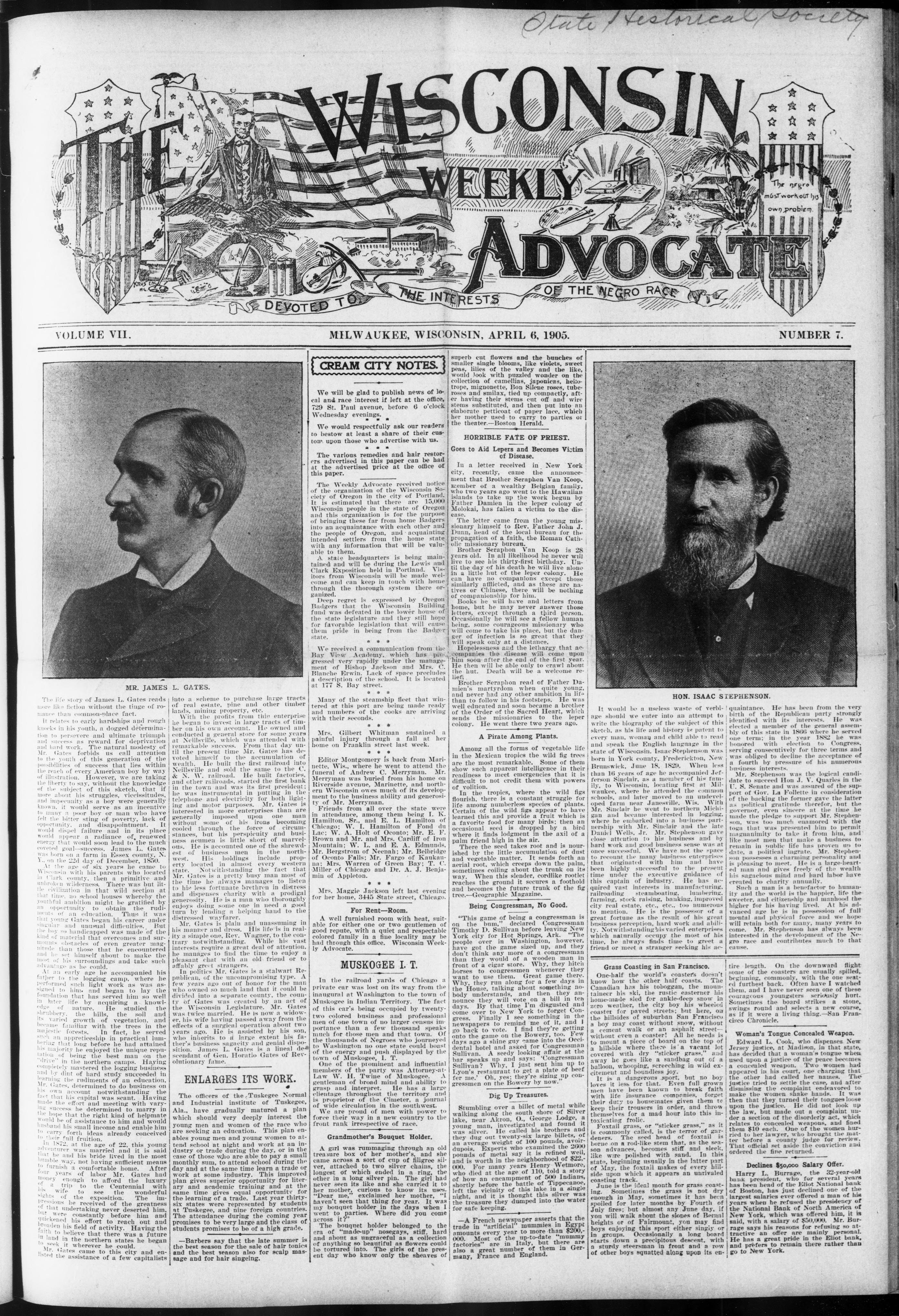
WISCONSIN
WEEKLY
ADVOCATE
DEVOTED TO THE INTERESTS OF THE NEGRO RACE
[Name]
[Name not visible in the image]
MR. JAMES L. GATES.
The life story of James L. Gates reads more like fiction without the tinge of romance than common-place fact.
It relates to early hardships and rough knocks in his youth, a dogged determination to persevere and ultimate triumph and success as reward for deprivation and hard work. The natural modesty of Mr. Gates forbids us call attention to the youth of this generation of the possibilities of success that lies within the reach of every American boy by way of illustration. However, we are taking the liberty to say, without the knowledge of the subject of this sketch, that if more about his struggles, viceissitudes, and impecunity as a boy were generally known, it would serve as an incentive to many a poor boy or man who have felt the bitter sting of poverty, lack of opportunity, and disappointment. It would dispel failure and in its place would appear a radiance of renewed energy that would soon lead to the much coveted goal—success. James L. Gates was born on a farm in Essex county, N. Y., on the 22d day of December, 1850.
At the age of six years he came to Wisconsin with his parents who located in Clark county, then a primitive and unbroken wilderness. There was but little civilization in that wild section at that time, no school houses whereby the youthful ambition might be gratified by an opportunity to obtain the rudiments of an education. Thus it was that young Gates began his career under singular and unusual difficulties. But the boy so handicapped was made of the kind of material that overcomes and surmounts obstacles of even greater magnitude than those that he encountered and he set himself about to make the most of his surroundings and take such advantage as he could.
At an early age he accompanied his father to the logging camp, where he performed such light work as was assigned to him, and began to lay the foundation that has served him so well in later life by acquiring a knowledge of nature. He studied the shrubbery, the hills, the soil and its varied growth of vegetation, and became familiar with the trees in the majestic forests. In fact, he served such an appreticeship in practical lumbering that long before he had attained his majority he enjoyed the unique reputation of being the best man on the "drive" in the northern camps. Having completely mastered the logging business and by dint of hard study succeeded in learning the rudiments of an education, Mr. Gates, determined to do business on his own account notwithstanding the fact that his capital was scant. Having made the effort and meeting with varying success he determined to marry in the hope that the right kind of helpmate would be of assistance to him and would husband his small income and enable him to carry forth ideas already conceived to their full fruition.
in 1872, at the age of 22, this young adventurer was married and it is said that he and his bride lived in the most humble way, not having sufficient means to furnish a comfortable home. After four years of labor Mr. Gates had money enough to afford the luxury of a trip to the Centennial with his wife to see the wonderful sights of the exposition. The impressions he received of the greatness of that undertaking never deserted him, but were constantly before him and quickened his effort to reach out and broaden his field of activity. Having the faith to believe that there was a future in land in the northern states he began to seek it wherever he could.
M.P. Gates came to this city and enlisted the assistance of a few capitalists
VOLUME VII.
into a scheme to purchase large tracts of real estate, pine and other timber lands, mining property, etc.
With the profits from this enterprise he began to invest in large tracts of timber on his own account. He owned and conducted a general store for some years at Neillsville, which was attended with remarkable success. From that day until the present time Mr. Gates has devoted himself to the accumulation of wealth. He built the first railroad into Neillsville and sold the same to the C. & N. W. railroad. He built factories, and other railroads, started the first bank in the town and was its first president; he was instrumental in putting in the telephone and electricity for both lighting and motor purposes. Mr. Gates is interested in more enterprises than are generally imposed upon one man without some of his irons becoming cooled through the force of circumstances, but his perspicuity and business acumen is little short of marvelous. He is accounted one of the shrewdest of business men in the northwest. His holdings include property located in almost every western state. Notwithstanding the fact that Mr. Gates is a pretty busy man most of the time he always manages to listen to his less fortunate brethren in distress and dispenses charity with a prodigal generosity. He is a man who thoroughly enjoys doing some one in need a good turn by lending a helping hand to the distressed wayfarer.
Mr. Gates is plain and unassuming in his manner and dress. His life is in reality a simple one, Rev. Wagner, to the contrary notwithstanding. While his vast interests require a great deal of attention, he manages to find the time to enjoy a pleasant chat with an old friend or to affably greet strangers.
In politics Mr. Gates is a stalwart Republican, of the uncompromising type. A few years ago out of honor for the man who owned so much land that it could be divided into a separate county, the county of Gates was created by an act of the Wisconsin Legislature. Mr. Gates was twice married. He is now a widower, his wife having passed away from the effects of a surgical operation about two years ago. He is assisted by his son, who inherits to a large extent his father's business sagacity and genial disposition. James L. Gates is a lineal descendant of Gen. Horatio Gates of Revolutionary fame.
ENLARGES ITS WORK.
The officers of the Tuskegee Normal and Industrial institute of Tuskegee, Ala., have gradually matured a plan which should very deeply interest the young men and women of the race who are seeking an education. This plan enables young men and young women to attend school at night and work at an industry or trade during the day, or in the case of those who are able to pay a small monthly sum, to attend school during the day and at the same time learn a trade or work at some industry. This improved plan gives superior opportunity for literary and academic training and at the same time gives equal opportunity for the learning of a trade. Last year thirty-six states were represented by students at Tuskegee, and nine foreign countries. The attendance during the coming year promises to be very large and the class of students promises to be of a high grade.
—Barbers say that the late summer is the best season for the sale of hair tonics and the best season also for scalp massage and for hair singeing.
MILWAUKEE, WISCONSIN, APRIL 6, 1905.
CREAM CITY NOTES.
We will be glad to publish news of local and race interest if left at the office, 729 St. Paul avenue, before 6 o'clock Wednesday evenings.
We would respectfully ask our readers to bestow at least a share of their custom upon those who advertise with us.
The various remedies and hair restorers advertised in this paper can be had at the advertised price at the office of this paper.
The Weekly Advocate received notice of the organization of the Wisconsin Society of Oregon in the city of Portland. It is estimated that there are 15,000 Wisconsin people in the state of Oregon and this organization is for the purpose of bringing these far from home Badgers into an acquaintance with each other and the people of Oregon, and acquaintin intended settlers from the home state with any information that will be valuable to them. A state headquarters is being maintained and will be during the Lewis and Clark Exposition held in Portland. Visitors from Wisconsin will be made welcome and can keep in touch with home through the thorough system there organized
Deep regret is expressed by Oregon Badgers that the Wisconsin Building fund was defeated in the lower house of the state legislature and they still hope for favorable legislation that will cause them pride in being from the Badger state.
\* \* \*
We received a communication from the Bay View Academy, which has progressed very rapidly under the management of Bishop Jackson and Mrs. C. Blanche Erwin. Lack of space precludes a description of the school. It is located at 177 S. Bay street.
* * *
Many of the steamship fleet that wintered at this port are being made ready and numbers of the cooks are arriving with their seconds.
\* \* \*
Mrs. Gilbert Whitman sustained a painful injury through a fall at her home on Franklin street last week.
* * *
Editor Montgomery is back from Mariette, Wis., where he went to attend the funeral of Andrew C. Merryman. Mr. Merryman was buried from his home on Riverside avenue, Marinette, and northern Wisconsin owes much of its development to the business ability and generosity of Mr. Merryman.
Friends from all over the state were in attendance, among them being I. K. Hamilton, Sr., and E. L. Hamilton of Chicago; W. I. Hamilton of Fond du Lac; W. A. Holt of Oconto; Mr. E. F. Brown and Mr. and Mrs. Cardiff of Iron Mountain; W. L. and E. A. Edmunds, Mr. Bergstrom of Neenah; Mr. Belbridge of Oconto Falls; Mr. Fargo of Kaukauna; Mrs. Warren of Green Bay; T. C. Miller of Chicago and Dr. A. J. Benjamin of Appleton.
* * *
Mrs. Maggie Jackson left last evening for her home, 3445 State street, Chicago.
For Rent—Room.
A well furnished room with heat, suitable for either one or two gentlemen of good repute, with a quiet and respectable colored family in a fine locality may be had through this office. Wisconsin Weekly Advocate.
MUSKOGEE I. T.
In the railroad yards of Chicago a private car was lost on its way from the inaugural at Washington to the town of Muskogee in Indian Territory. The fact of this car's being occupied by twenty-two colored business and professional men of one town of no larger census importance than a few thousand speaks much for those men and that town. Of the thousands of Negroes who journeyed to Washington no one state could boast of the energy and push displayed by the town of Muskogee, I. T.
One of the prominent and influential members of the party was Attorney-at-Law W. H. Twine of Muskogee. A gentleman of broad mind and ability to grasp and interpret. He has a large clientage throughout the territory and is proprietor of the Cimeter, a journal of wide circulation in the southwest. We are proud of men with power to force their way in a new country to the front rank irrespective of race.
Grandmother's Bouquet Holder.
A girl was rummaging through an old treasure box of her mother's, and she came across a sort of cup of filigree silver, attached to two silver chains, the longest of which ended in a ring, the other in a long silver pin. The girl had never seen its like and she carried it to her mother, curious to know its uses. "Dear me," exclaimed her mother, "I haven't seen that thing for year. It was my bouquet holder in the days when I went to parties. Where did you come across it?"
The bouquet holder belonged to the era of "made-up" nosegays, stiff, hard and about as ungraceful as a collection of anything so beautiful as flowers could be tortured into. The girls of the present day who know only the sheaves of
superb cut flowers and the bunches of smaller single blooms, like violets, sweet peas, lilies of the valley and the like, would look with puzzled wonder on the collection of camellias, japonicas, heliotrope, mignonette, Bon Silene roses, tuberoses and smilax, tied up compactly, after having their stems cut off and wire stems substituted, and then put into an elaborate petticoat of paper lace, which her mother used to carry to parties or the theater.—Boston Herald.
HORRIBLE FATE OF PRIEST
Goes to Aid Lepers and Becomes Victim of Disease.
In a letter received in New York city, recently, came the announcement that Brother Seraphon Van Koop, member of a wealthy Belgian family, who two years ago went to the Hawaiian islands to take up the work begun by Father Damien in the leper colony of Molokai, has fallen a victim to the disease. The letter came from the young missionary himself to Rev. Father John J. Dunn, head of the local bureau for the propagation of a faith, the Roman Catholic missionary bureau.
Brother Seraphon Van Koop is 28 years old. In all likelihood he never will live to see his thirty-first birthday. Until the day of his death he will live alone in a little hut of the leper colony. He can have no companions except those similarly afflicted, and as these are natives or Chinese, there will be nothing of companionship for him.
Books he will have and letters from home, but he may never answer those letters, except through a third person. Occasionally he will see a fellow human being, some courageous missionary who will come to take his place, but the danger of infection is so great that they will sneak only at a distance.
Hopelessness and the lethargy that accompanies the disease will come upon him soon after the end of the first year. He then will be able only to crawl about the hut. Death will be a welcome relief.
Brother Seraphon read of Father Damien's martyrdom when quite young, and never had any other ambition in life than to follow in his footsteps. He was well educated and soon became a brother of the Order of the Sacred Heart, which sends the missionaries to the leper colony. He went there two years ago.
A Pirate Among Plants.
Among all the forms of vegetable life in the Mexican tropics the wild fig trees are the most remarkable. Some of them show such apparent intelligence in their readiness to meet emergencies that it is difficult to not credit them with powers of volition. In the tropics, where the wild figs flourish, there is a constant struggle for life among numberless species of plants. Certain of the wild figs appear to have learned this and provide a fruit which is a favorite food for many birds; then an occasional seed is dropped by a bird where it finds lodgment in the axil of a palm friend high in the air.
There the seed takes root and is nourished by the little accumulation of dust and vegetable matter. It sends forth an aerial root, which creeps down the palm, sometimes coiling about the trunk on its way. When this slender, cordlike rootlet reaches the ground it secures a foothold and becomes the future trunk of the fig tree.—Geographic Magazine.
Being Congressman, No Good.
"This game of being a congressman is on the bum," declared Congressman Timothy D. Sullivan before leaving New York city for Hot Springs, Ark. "The people over in Washington, however, have got the game sized up, and they don't think any more of a congressman than they would of a wooden man in front of a cigar store. Why, they hitch horses to congressmen whenever they want to use them. Great game there. Why, they run along for a few days in the House, talking about something nobody understands, and then they announce they will vote on a bill in ten days. By that time I'm disgusted and come over to New York to forget Congress. Finally I see something in the newspapers to remind me of it, and I go back to vote. I find they're getting onto the game on the Bowery, too. Few days ago a shine guy came into the Occidental hotel and asked for Congressman Sullivan. A seedy looking affair at the bar speaks up and says: 'Congressman Sullivan? Why, I just sent him up to Lyon's restaurant to get a plate of beef fer me.' Oh, yes; they're sizing up congressmen on the Bowery by now."
Dig Up Treasures.
Stumbling over a billet of metal while walking along the south shore of Silver lake, near Akron, O., George Lodge, a young man, investigated and found it was silver. He called his brothers and they dug out twenty-six large billets, of an average weight of 100 pounds, avoirdupois. Experts who examined the 2600 pounds of metal say it is refined well, and is worth in the neighborhood of $22.000. For many years Henry Wetmore, who died at the age of 110, told a story of how an encampment of 500 Indians, shortly before the battle of Tippecanoe, left the vicinity of this lake in a single night, and it is thought this silver was the treasure they dumped into the water for safe keeping.
—A French newspaper asserts that the trade in "artificial" mummies in Egypt amounts every year to more than $200,000. Most of the up-to-date "mummy factories" are in Italy, but there are also a great number of them in Germany, France and England.
[Name not visible in the image]
HON. ISAAC STEPHENSON.
It would be a useless waste of verbiage should we enter into an attempt to write the biography of the subject of this sketch, as his life and history is patent to every man, woman and child able to read and speak the English language in the state of Wisconsin. Isaac Stephenson was born in York county, Frederickton, New Brunswick, June 18, 1829. When less than 16 years of age he accompanied Jefferson Sinclair, as a member of his family, to Wisconsin, locating first at Milwaukee, where he attended the common schools, and later moved to an undeveloped farm near Janesville, Wis. With Mr. Sinclair he went to northern Michigan and became interested in logging, where he embarked into a business partnership with Mr. Sinclair and the late Daniel Wells, Jr. Mr. Stephenson gave close attention to his business and by hard work and good business sense was at once successful. We have not the space to recount the many business enterprises that originated with him and have been highly successful to the present time under the executive guidance of this captain of industry. He has acquired vast interests in manufacturing, railroading, steamboating, lumbering, farming, stock raising, banking, improved city real estate, etc., etc., too numerous to mention. He is the possessor of a great fortune as the result of his great business perception, hard work and ability. Notwithstanding his varied enterprises which naturally occupy the most of his time, he always finds time to greet a friend or meet a stranger seeking his ac-
Grass Coasting in San Francisco.
One-half the world's coasters doesn't know how the other half coasts. The Canadian has his toboggan, the mountaineer his ski, the rustic easterner his home-made sled for ankle-deep snow in zero weather, the city boy his wheeied coaster for paved streets; but here, on the hillsides of suburban San Francisco a boy may coast without snow, without a cement walk or an asphalt street without even a coaster! All he needs is to mount a piece of board on the top of a hillside where there is a vacant lot covered with dry "sticker grass," and away he goes like a sandbag out of a balloon, whooping, screeching in wild excitement and boundless joy.
It is a dangerous sport, but no boy loves it less for that. Even full grown men have been known to break faith with life insurance companies, forget their duty to housemates given them to keep their trousers in order, and throw themselves for a mad hour into this intoxicating frolic. Foxtail grass, or "sticker grass," as it is commonly called, is the terror of gardeners. The seed head of foxtail is borne on a rod-like stem that, as the season advances, becomes stiff and sleek, like wire polished with sand. In this state, beginning usually in the latter part of May, the foxtail makes of every hillside upon which it appears an unrivaled coasting track.
June is the ideal month for grass coasting. Sometimes the grass is not dry enough in May, sometimes it has been spoiled for later months by Fourth of July fires; but almost any June day, if you will walk about the slopes of Bernal heights or of Fairmount, you may find boys enjoying this sport either singiy or in groups. Occasionally a long board starts down a precipitous descent, with a sturdy steersman in front and a row of other boys squatted along upon its en-
[Name]
quaintance. He has been from the very birth of the Republican party strongly identified with its interests. He was elected a member of the general assembly of this state in 1866 where he served one term; in the year 1882 he was honored with election to Congress, serving consecutively for three terms and was obliged to decline the acceptance of a fourth by pressure of his numerous business interests.
Mr. Stephenson was the logical candidate to succeed Hon J. V. Quarles in the U. S. Senate and was assured of the support of Gov. La Follette in consideration of the backing the former gave the latter as political gratitude therefor, but the governor, even sincere at the time he made the pledge to support Mr. Stephenson, was too much enamored with the toga that was presented him to permit magnanimity to take it from him, and like most men that make a business to remain in public life has proven up to date, a political ingrate. Mr. Stephenson possesses a charming personality and is pleasing to meet. He is a large-hearted man and gives freely of the wealth his sagacious mind and hard labor have created to charity annually.
Such a man is a benefactor to humanity and the world is the happier, life the sweeter, and citizenship and manhood the higher for his having lived. At his advanced age he is in possession of full mental and physical force and we hope will retain both for many, many years to come. Mr. Stephenson has always been interested in the development of the Negro race and contributes much to that cause.
tire length. On the downward flight some of the coasters are usually spilled, beginning, commonly, with the one seated furthest back. Often have I watched them, and I have never seen one of these courageous youngsters seriously hurt. Sometimes the board strikes a stone, swings round and selects a new course, as if it were a living thing.—San Francisco Chronicle.
Woman's Tongue Concealed Weapon
Edward L. Cook, who dispenses New Jersey justice, at Madison, in that state, has decided that a woman's tongue when used upon a justice of the peace becomes a concealed weapon. Two women had appeared in his court, one charging that the other had called her names. The justice tried to settle the case, and after dismissing the complaint endeavored to make the women shake hands. It was then that they turned their tongues loose upon the justice. He did not look up the law, but made out a complaint under a section of the disorderly act, which relates to concealed weapons, and fined them $10 each. One of the women hurried to her lawyer, who brought the matter before a county judge for review. That official set aside the conviction and ordered the fine returned.
Declines $50,000 Salary Offer.
Harry L. Burrage, the 32-year-old bank president, who for several years has been head of the Eliot National bank of Boston, has just declined one of the largest salaries ever offered a man of his years when he refused the presidency of the National Bank of North America of New York, which was offered him, it is said, with a salary of $50,000. Mr. Burrage says his reasons for refusing so attractive an offer are mainly personal. He has a great pride in the Eliot bank, and prefers to remain there rather than go to New York.
---
NUMBER 7.
Curious Condensations. Beer in the United Kingdom contains 8 per cent. of proof spirit, while the lager beer of the Continent contains only 4 per cent. Official statistics show that there are 17,000,000 children in Russia between the ages of 6 and 14 receiving absolutely no education.
In 1904 there were mined 9,650,000 tons of coal in Japan. Ten years ago the Japanese coal production did not exceed 3,000,000 tons. Six million pounds weight of adulterated and harmful foods were destroyed by the health department of New York during the last twelve months. Among female Moors birthday celebrations are unknown. A Moorish woman considers it a point of honor to be absolutely ignorant of her age. Statistics show that in fifty years the average height of British men has risen an inch. The present height for a man of 20 is 5 feet $ 8 \frac{1}{2} $ inches. It is said that the greatest delight the son of the Ameer of Afghanistan enjoyed on his recent visit to India was an evening at a circus in Calcutta.
Not long ago there was held a funeral service at Goeschenen, in Switzerland, over the remains of a man who had been engulfed eighteen years earlier in a glacier.
French submarines at Cherbourg have succeeded in diving while traveling at a speed of eight and a half knots, a result never before obtained by these craft.
A bill is before the California Legislature for the purchase by the state of Fort Humboldt, Humboldt county, where U. S. Grant was stationed in 1851. It is likely to pass.
Owls are not really wise, and the reason that they seem so is because they never move their eyes. This they cannot do, as their eyeballs are fixed immovably in the sockets.
In the reign of William Rufus of England, in the Eleventh century, a great "dude," "Robert the Horned," used shoes with sharp points, stuffed with tow and twisted like rams' horns.
Naples, says Consul General Neville-Rolfe, is now probably the best drained city in the world, and it certainly has a water supply which is surpassed by no other town, large or small.
The art treasures at Windsor castle are said to be worth over $60,000,000. The king has had them rearranged, but has not been able to insure them as yet, owing to their great value.
Falling into a drying kiln at the McAvoy Brewing company's brewery, Fritz Herstein, 35 years old, died of suffocation while employees of the brewery were endeavoring to pull him out.
Manuel Enriquez, one of the oldest pioneers of California and the last survivor of Gen. Fremont's battalion in the Mexican war, has just died at Los Angeles. He was born in Peru.
The corporation of Norwich, England, has reduced the cost of its electric light service about 10 per cent, and advertises in the local papers to wire premises free of initial cost to the consumer.
The eyes have to be given especial care in South Africa. The drying character of the air and desert wind, especially when laden with dust from cattle kraals, is extremely dangerous.
The Russian government has announced that after September 6, 1905, no freight consignments of foreign countries will be forwarded east of Tscheljabinsk, on the Siberian railroad.
The king of the gypsies in America, Joseph Buswell by name, died in a tent at Oakland, Cal., recently, at the age of 80. He had wandered over the United States for fifty years since his arrival from England, where he was born. He is supposed to have left a large fortune.
There are more than 1000 swans at Abbotsbury, in England, living a perfectly natural life, and none of them is pinioned. The visitor sees the largest birds in England in full flight, for the Abbotsbury birds use their wings for all journeys to and from the sea, or down the long lagoon, called the Fleet, that divides the shore from the beach.
Andrew Johnson's Work Bench.
A. Anderson, a tailor in this place, is now using one of the most historic tailor benches in Alabama, is not in America. It is a bench used by Andrew Johnson when he was a young man and worked in this county for a Mr. Sloss, who in that day was one of the leading tailors. Andy came here as a journeyman and spent some time working for Mr. Sloss, and the old tailor bench he used to sit upon has been preserved until this day. It was discovered in the country many years ago by the late Capt. R. B. Mason, who bought it as a relic and has kept it in his home until the recent fire destroyed the tailor shop of Mr. Anderson, when he was tendered the use of the table by Messrs. Greer and Robert Mason, sons of the late Capt. R. B. Mason, and he has it now in his shop.—Athens Cor. Nashville Banner.
Kitten Aroused Dog's Jealousy.
A curious instance of a dog's intelligent jealousy is reported from Llanishen. A happy family there consisted of a lady, a cat, a kitten, and a Yorkshire terrier. All four were on excellent terms until the terrier took umbrage at attentions which its mistress bestowed upon the kitten.
The terrier straightway began to dig a hole in the garden, and finished its task to its satisfaction in three days.
Then the kitten disappeared. A search was made, and as the terrier was seen patting down the earth over the hole which it had refilled, the soil was removed, and the kitten was found to have been buried alive.
The dog was punished, but it took the kitten to the grave again, and the following day took it to a ditch and left it there.—London Daily Express.
Found in Oak's Heart
A deed transferring twelve acres of land within the bounds of New York city, a marriage certificate and a will, both dated December, 1789, and other business papers running down to 1835, together with a silver tea service, knives, forks and spoons, six finger rings, a pair of diamond earrings and a pearl brooch, all encased in a stout tin box, were found in the heart of an old oak tree by one of a gang of woodsmen cutting timber north of Lincoln Park, N. J. Cari Gilkerson is the finder. The will is the last testament of Matthew Weathersby. No one in the neighborhood remembers the Weathersby family or their descendants.
Tennessee Names.
Some of the names of towns upon which Tennessee bases claims for prestige are these: Barefoot, Botts, Leap Year, Chimney Top, Chuckaluck, Half Pone, Hanging Limb, Ipe, Marrowbone, Mouse Tail, Oppossum, Parch Corn, Peanut, Rip Shin, Sweet Lips, Tom Brown, U Bet, Yum Yum, Buzzard Roost, Fits, Mashmead, Peeled Chestnut, Shoo Fly, Skull Bone, Snail-lops, Tiger Tail and Wahoo.
Suicide Cuts Off Insurance
The supreme court of Ohio has affirmed the validity of the suicide clause in an assessment insurance policy. The decision was given in the case of Perry P. Tisch against the Protected Home circle, an assessment insurance society. Tisch had his wife's life insured for $1000 and a short time later she killed herself. The company refused to pay the policy.
COME IN APRIL.
The wind is Winter, though the sun be Spring;
The ley rills have scarce begun to flow;
The birds unconfidently fly and sing;
As on the land once fell the northern foe,
Th' exhaustless mountains from the passes fling
Their vandal blasts upon the lake below.
Not ret the round clouds of the Maytime cling
Above the world's blue wonder's curving show. And tempt to linger with their lingering.
Yet doth each slope a vernal promise know: See, mounting yonder, white as angel's wing
A snow of bloom to meet the bloom of snow.
Love, need we more than our imagining To make the whole year May? What though The wind be Winter if the heart be Spring? -Robert Underwood Johnson in the Centrery.
A SMUGGLER.
The chief of the New York police was evidently in a bad temper.
"Remember, Curtis, this is absolutely your last chance."
"Yes, sir."
"You don't deserve another. You remember that I told you that if you missed catching Purvis on his last run with the diamonds that I should dismiss you. He did get the diamonds through the customs without paying any duty. We know that, but we don't know how he did it."
"This time I am going to send you over to Paris. You will there have plenty of opportunity to shadow him, and if you don't succeed in catching him, it will be your own fault."
"Yes, sir."
Inspector Curtis was not at all in love with his job. Much experience of defeats had made him hold Purvis in great respect, but he felt that now he must strain every effort to trip up his wily foe.
He booked his passage by the same liner. He flattered himself on his "makeup"—that of a benevolent-looking, white-haired old gentleman making his first trip to Europe. Purvis was not disguised, and it was not long before he made overtures to the inspector.
The inspector met his quarry's advances half way.
"My name is Silas Harper. I am retired on my means and before I die I am just making a trip to have a look at the old country," he said, in a friendly way.
"Indeed!"
"Yes, sir. And what may you be? I guess you are an American."
"I am a diamond merchant and a cosmopolitan."
"I don't quite know where that country is, sir, but you certainly speak like an American."
A twinkle of amusement appeared in Purvis' eyes.
"I guess the old chap will be pretty well done before he gets home again," he muttered to himself. But he took quite a fancy to old Harper, as he thought him, and they became the best of friends.
Purvis confided to him that he was going to Paris.
"Why don't you go?" he asked, abruptly.
"I rather think I will, but I don't speak the lingo. Do you?" he asked, abruptly.
"Didn't I tell you I was a cosmopolitan?"
"I didn't know they spoke French in that country."
Again Purvis smiled sweetly. "I wish you would take me with you, if it isn't asking too much," Harper suggested, diffidently. For a few moments Purvis appeared to be thinking deeply. "But I am coming back in a month," he said, doubtfully. "Let me come back with you, then. I am beginning to feel a bit lonesome now. If you were only with me the whole time, it would make all the difference." "You are asking a great deal." "Yes, I know; but—" "All right, I'll look after you. You had better hand me over a thousand dollars. I'll look after the paying for you."
The old man took out his wallet and counted out the notes, which Purvis immediately pocketed.
They had a pleasant trip to Paris. For the first week after their arrival Purvis took his pursuer round, showing him all the usual sights.
"Now, old man, I am going to do some business today. You must amuse your self," he said, when the month was nearly up.
The old man did amuse himself, for Inspector Curtis, without his white wig, was engaged in making small holes through the door leading from his bedroom to Purvis', through which he could get a good sight of the other's room.
He heard Purvis return, and his heart beat wildly when he saw him pour on the table six large diamonds. Then he noticed that he had taken up a book—an ordinary novel. When this was opened he saw that there was a cavity inside. The diamonds were wrapped in cotton wool and immediately concealed in the cavity. The book was shut up, and then, by some mechanism, it remained closed unless a secret spring was touched. Inspector Curtis felt that the game was his. All that remained was to see where the book was concealed.
He went to Purvis' door and knocked, entering almost immediately afterward. Purvis had placed the book on a piece of brown paper, and was making it up into a neat parcel. Next he took pen and ink and wrote an address. Curtis—we will drop the Harper cognomen—sidled up to the table, but he was unable to decipher the address. "I am going to the post," Purvis exclaimed. They made their way to the nearest bureau des postes, and Purvis handed the parcel to the clerk. "Registered—New York—please," he said, curtly.
He paid the fees and took away a receipt. In vain Curtis tried to get a glimpse of the address. His heart sank as they left, and he was about to go to the prefect of police and explain the matter to him, when, on going into Purvis' room, he saw the receipt lying on the table.
He quickly noted the address—"Miss Irwin, 27 Forty-second street, New York City." He felt that he had gained the day.
In the morning, when he awoke, he found a letter awaiting him. It was from Purvis.
"I did not care to disturb you, but I had to leave Paris for a few days."
Curtis went to the office and found
that a French liner was leaving Cherbourg that evening. He retained a berth in the name of Hiram Evans, packed his portmanteau and started.
When Hiram Evans, alias Inspector Curtis, left his reserved carriage at Cherbourg the white hair and whiskers had disappeared. In place of them was a spruce, dark mustache. Altogether his air was juvenile in the extreme.
"Got him!" he exclaimed in delight, when one of the first people he saw on the deck was Purvis.
The voyage was a quiet one. In accordance with his habit, Purvis made friends with every one, Mr. Evans among them. But this voyage Curtis had got what he wanted and kept to himself.
New York came in sight, and when they arrived at the customs Curtis left his luggage to take care of itself.
He watched Purvis pass his portmanteau and dressing case through, and order the same to be put on a cab.
"Waldorf Astoria," he said to the driver.
In a second Curtis had followed him.
"Central police station," he said, curtly.
"I am Inspector Curtis; drive there at once."
The black mustache and wig had disappeared.
When Curtis looked, he saw a revolver pointing at him.
"Better not, Purvis. The game is up," he said, lightly. "Smuggling doesn't mean hanging, you know."
With a laugh, Purvis put back his weapon.
"What's the charge?"
"Wait till you get to the station."
Purvis was locked up that night, and in the morning was taken before Capt. Byrnes, the chief of police.
"Caught at last!" the chief cried, as he fingered the packet. "We have long wanted you."
Purvis made no reply.
With nervous fingers the chief opened the parcel, disclosing the book.
Curtis looked on with a triumphant smile.
"Don't grin too soon, Harper, old fellow." Purvis exclaimed, serenely. A strong pull and the book opened, displaying the diamonds.
"They are fine," the chief finally remarked.
"Yes, fine paste, and of no value," kurvis replied, quietly. "You know I am a judge of diamonds."
His manner convinced the chief. A jeweler was hastily summoned, and gave the same opinion—excellent paste.
"Done again!" the chief cried, with an angry look at Curtis.
"We have all his luggage here," Curtis suggested.
A minute examination was made of all his baggage without success. He was stripped to the skin, but no diamond could be found.
His revolver, his boots were in turn scrutinized, but with a like result.
"I suppose I may go now," Purvis remarked, sweetly. "There is no charge against me."
"Discharge him," the chief said, abruptly.
That evening, with a glass of excellent champagne before him and a good cigar alight, Purvis related his adventures to his friend, the diamond merchant.
"I recognized Curtis the second day on board. I think the paste idea was splendid. I like to worry the poor devil."
"But where are the diamonds?"
"I gave him a ripping time in Paris. Next go. I'll——"
"But where are the diamonds?" the other demanded.
"You should have seen his face in the cab driving to the police station. Even this revolver"—as he spoke he drew the weapon from his hip pocket—"didn't frighten him."
"Where are the diamonds?" shrieked the merchant.
"They examined the revolver," Purvis continued, quietly, "but——"
As he was speaking he drew out the eight cartridges. Then with his knife he pried the bullet from one. A shake, and out rolled a diamond.
"Eight beauties!" he exclaimed, when he had finished the whole of them.
"My boy, you're a genius," the diamond merchant cried, enthusiastically. Illustrated Bits.
Woes of an Absent-Minded Man
During the rush home before dinner the other night a dignified man, deep in thought, smoking a cigar and carrying a handsomely bound book, boarded a Troost avenue car at the Eighth street viaduct.
The wind whistled in at the open door of the back platform, and it evidently occurred to him to go inside where it was warmer. Absently, with a quick, nervous gesture, he threw the book over the railing to the street below, thrust the lighted cigar into the outside pocket of his overcoat, and started up the crowded aisle. But there was no lack of alertness in his manner when the pocket began to smoke and he realized what he had done. He got off the car at Wall street and went back after the discarded volume.—Kansas City Journal.
Six Inches in Four Months.
F. W. Davis is dead at Morgantown, W. Va., and his case presented one of the most remarkable on medical records. He sustained an injury while playing ball, and although suffering excruciatingly and confined to his bed ever since, he grew in height six inches in four months. Davis was 18 years old and a well-known amateur ball player. He was struck on the head with a bat in a hotly contested game and seemed to be gravely injured, although at all times conscious. All that physicians could do for him was futile, and he died Wednesday. It was found that his height had increased just six inches from the time he was injured. Doctors can offer no explanation of the phenomenon.
Yawning for Health.
A German expert on gymnastics announces that one need not go to a well-equipped gymnasium in search of a course in health-giving exercises. Deep yawning practiced as a regular exercise is the cheapest and surest road to perfect health. We are still familiar with the theory that systematic deep breathing is an excellent thing for the lungs, and it is on similar grounds that yawning is recommended. The expansion of the breast bones and the stretching of the arms which accompany a whole-hearted yawn, together with the filling of the lungs, form a splendid daily exercise.—Chicago Journal.
Rope Steers from Automobile
Roping steers from an automobile was successfully accomplished at Fort Worth, Tex., at the contest of cowboys. W. Dillingham, in a machine driven by C. J. Corkhill, roped his animal in fifteen seconds. The steer was turned loose from the chute on a run, and Dillingham started after it from a standstill. His rope settled on the animal's horns, and the latter was thrown quickly.
James K. Hackett has secured a theater in New York. He will control the Savoy and present "The Walls of Jericho," the great London success.
Clinton B. Fisk, the editor, theatrical manager and author, was taken from the Majestic theater by detectives and brought as a patient to the psychopathic ward at Bellevue hospital.
The collection of early English and French portraits, and Barbizon and Dutch portraits belonging to David H. King, Jr., has been sold at auction. The total for seventy paintings in the collection was $201,035.
Immigration to this country, through the port of New York for the month of March, reached unprecedented figures, the total arrivals numbering 97,000. Last year for the same month the arrivals were only 47,877.
William Marconi and Mrs. Marconi arrived on the steamer Campania from Liverpool. Mrs. Marconi was the honorable Beatrice O'Brien, fifth daughter of Lady Inchiquin. The marriage took place in London on March 17.
Stricken with serious illness, a valuable dog owned by Reginald C. Vanderbilt is being treated by a veterinary surgeon at 900 Sixth avenue, New York city. The dog, which is said to be valued at $1000, was sent to the veterinary in the hope of saving its life. It is understood that the animal is suffering from pneumonia.
Mrs. Anna Weightman Walker of Philadelphia has taken a lease of the third floor apartment in the Fifth avenue Estates building, at Fifth avenue and Sixtieth street, New York City. The annual rent is $15,000. The apartment is one of the most expensive in this city.
A touch of bright color is to be added to the uniforms of the bicycle and mounted policemen for the summer months. They will all have to provide themselves with white duck hats and have white duck collars sewed upon their blue coats, with a liberal appliquing of gold braid to add a rich tone to the effect.
The albatross is in full competition with the stork these days. There have been sixteen births on the high seas recorded within the last month. When the Hamburg-American liner Pretoria came in her officers reported three births on board ship. All these interesting events occurred in the steerage. When the facts were made known to the immigration authorities these amiable gentlemen, in deference to the well-known prejudices of the President, allowed father, mother and children to pass without question.
They are always doing something in New York to amplify the already rich English language. The other day a police magistrate called a boy who had bought a $50 dinner and failed to pay for it "a full-jewelled, ball-bearing cad." On the same day of grace an unfortunate Bowery denizen was locked up for making irregular tracks toward a lodging house, and the prosecutor hired by the city to see that malefactors got their just dues gravely assured the magistrate that the man was picked up by the policeman because he had an "inquiangular walk." On this formidable charge the magistrate felt constrained to make an assessment against the culprit of $2.
Commander Miss Eva Booth presided at the celebration of the twenty-fifth anniversary of the establishment of the Salvation Army in the United States, held at Carnegie hall the other night. She was garbed in a robe of red with a white cross on the breast and a white sash over the left shoulder. "The paramount issue," she said, "is the elevation of mankind. During the last year there were more than 50,000 sinners who acknowledged God at our meetings, and there were held in the United States 7550 meetings a week." Following Miss Booth's address there was a parade of children, Miss Booth leading with a pet lamb and each of the children carrying a pet in the shape of a dog, a cat, or a rabbit.
一
By the systematic use of various forms of hot and cold baths, jet douches, vapor and hot air baths, the Manhattan State hospital on Ward's island has done away entirely with sedatives or mechanical restraint for the patients, even when violently demented or in strong delirium. The hospital is the first in the country to adopt the use of water as a part of its course of treatment. One form of "water treatment" is the "continuous bath" for patients in violent delirium. The patient is kept in a bathtub of water at blood heat, under observation by experienced nurses and the physicians, for hours—for days, if necessary—until the delirium has abated. In one case the patient was in the water fourteen days. She came out of the delirium, and under other branches of the treatment recovered from her dementia. The physicians believe their treatment will save the life of every patient under delirium unless some other form of insanity or physical disease sets in.
A cousin of Bishop Potter is one of the most ardent disciples of Hanish, the Chicago exponent of the new cult called the "Sun worshipers," which has been under investigation by the police recently. He is Louis Potter, the young sculptor, whose bas-relief of Persian worshipers on a hilltop hailing the rising sun was exhibited at the St. Louis exposition. Mr. Potter is a recent graduate of Trinity college. His studio is on East Eighteenth street. There, among pieces of sculpture, he spoke in defense of his teacher at whose seances he is one of the regular attendants.
"Dr. Hanish,' he said, "is teaching me the principles of eternal health. He is the most wonderful man I ever saw and he teaches absolute truth. Just look at Hanish. People think that he is 30 years old. He is 61. He has the secret of life and I am learning it. I believe in him absolutely."
The old Casino theater, New York City, which partly was destroyed by fire is to be reconstructed. A number of changes will be made to remove the principal objections of the authorities against the old playhouse. One of these will be the lowering of the parquette floor to the street level. The old wooden stairways will be replaced by those of fireproof construction. The Casino caught fire several weeks ago while a rehearsal of Lillian Russell's company was in progress. Several chorus girls were injured.
Stewart A. Felton, known to the sporting fraternity as "Big Frank," who has been in the Tombs prison for several months, charged with having killed Guy Roghe, a gambler, was released in $25,000 bail. In fixing bail, Justice Kenefick wrote: "After a careful review of the evidence and affidavits furnished me I am of the opinion that a conviction of the defendant of either degree of murder is improbable and his conviction of any offense whatever is doubtful."
The Greek-Russian cathedral is to be transferred from San Francisco to New York. It has been officially decided that in about six weeks the cathedral and staff of priests will come to the eastern
metropolis, henceforth the seat of the presiding bishop of the orthodox eastern church of North America. The cathedral staff to leave San Francisco will consist of Rev. Father Popoff, Nicanor Greevsky, Deacon Elias and other assistants. Father Dabovich will visit Kansas City, Pittsburg and Philadelphia in the service of the orthodox church.
Automobile 'buses thirty-eight feet long with the general appearance of trolley cars will begin operation on Fifth avenue on May 1, and as soon as the Fifts Avenue Coach company can obtain the big motors from the manufacturers the old historic stage coaches will be displaced. The body of the coach is twenty-five feet long, the extensions of the platform and seats making up the rest. They will be seventy inches from wheel to wheel in width and have a height of twelve feet. There will be no seats on top, as climbing down and off would upset the schedule, which. if carried out will give a service like that of a car line. Each car will accommodate thirty passengers. The seats will be transverse, with an aisle down the center. Big electric headlights will light the 'buses' way at night, and the interior will be equipped with incandescent lights.
Although he had resided in this country five years, owned the house in which he lived in New York city, and had taken out his first citizenship papers, Joseph Witous has been debarred from the country by the immigration authorities upon returning from a six months' visit to Europe. The medical officers at Ellis Island pronounced him insane. Witous is well to do, and for a number of years was a teacher in a parochial school here. He was returning from Bohemia, where he had gone to settle up an estate.
Oscar Hammerstein, theatrical manager, took the law into his own hands and personally served a summons on Isaac A. Hopper, superintendent of the building department, commanding Mr. Hopper to appear in court and swear to a charge of criminal libel. The action is based on Mr. Hopper's report to District Attorney Jerome, alleging that there were twenty-two violations of the building laws filed against the Lew Fields theater.
The North German Lloyd steamer Gneisenau, formerly in the China service of that line, came into New York direct from Bremen with 95 cabin, 2073 steerage passengers and a fourth class of wild beasts and reptiles, which will have to undergo quarantine. One compartment of the ship was entirely devoted to the animals—twenty cases of monkeys, eight elephants, four cages of leopards, one case of panthers, thirteen cases of serpents, including some giant cobras, and nine cages of birds. They are consigned to different parts of the country.
The Rowfant library, collected during many years by the late Frederick Locker-Lampson, the English poet and Shakespearean collector, has just been purchased by a New York publishing house. It is one of the most valuable private collections ever bought for America, and the price is known to have been many thousands of dollars. The library contains 1000 volumes and is known to book collectors and bibliophiles the world over. It was named from the Lampson estate in Rowfant, Sussex, and purchased from the collector's son, Godfrey Locker-Lampson, who married a daughter of Tennyson.
The engagement was announced of Miss Mary Welsh, who plays the role of Sallie Walters in "Babes in Toyland," to Lieut. Edward Ball Cole of the United States Marine corps, now attached to the United States steamer Yankee. Miss Welsh will remain with the "Babes in Toyland" company until the close of the season and then will join "Lew" Fields' company in "It Happened in Nordland" for a few weeks in Chicago. She will then leave the stage to become the wife of Lieut. Cole. Miss Welsh is a Philadelphia girl, her father being an architect and builder of that city. Lieut. Cole is a graduate of Harvard. He, too, is a Philadelphia.
To sell an elevated ticket with a newspaper to avoid the crowd at the ticket window is a trade-getting device long popular with newsdealers, but one downtown stand has gone further than that. Regular customers as they approach receive their favorite paper and a ticket and hurry along without stopping except on Saturday, when they settle for the six papers and tickets. The names and office addresses of these regulars are seldom known to the dealer, and yet 36 cents is the extent of his loss since he began the custom of extending credit three months ago. He found that even the slightest delay at the stand making change counted for much when a train was just pulling into the station. Under his credit system so largely increased has his business become that he now disposes of $5 or $6 worth of tickets every business day and has more than doubled his newspaper sales.
Mrs. Harriet J. Kochersperger of New York accompanied detectives about Philadelphia, Pa., and recovered, with the exception of one ring, all the jewelry and silverware stolen from her apartments at the Hotel Manhattan by William Ellison, the hotel thief now under arrest in New York. The discoveries made in that search led the police here to relinquish the idea of making another arrest in the case. Only about $5000 worth of jewelry out of $25,000 which Ellison says he sold here has been recovered as yet. Besides recovering the jewels for Mrs. Kochersperger, the detectives found one lot valued at about $600 at a pawn shop. The search is still on.
Plans were filed with the bureau of buildings recently by Charles A. Reed, architect, for a temporary passenger station for the New York Central railroad to be erected in the block bounded by Vanderbilt and Madison avenues, Forty-third and Forty-fourth streets, New York city. The structure is to cost $200,000, and it will be used while the big new Grand Central station is being erected on the old site. When the new station is ready for use the temporary building will be torn down. This sacrificial building will be of brick with ornamental stucco work and three stories high. It will have a frontage of 200.10 feet and will be 100 feet deep. The upper floors will contain the offices of the company. There will also be a railroad postoffice in the building. It will probably be in use three years at least, as the erection of the new permanent station will be a gigantic undertaking.
"The other day," said a Harlem real estate man, "I went out to show flats to a motherly woman. She finally decided on one, but she wanted some improvements I felt sure the owner wouldn't stand for, I told her so. 'Oh, that'll be all right,' she said. 'Where does the owner live? I'll see him myself.'
"The owner,' I answered, 'is Mr. So and So of No. Such and Such Columbus avenue.'
"What!" she screamed, 'You don't mean So and So, the tailor.'
"Yes, I do,' I said.
"Why,' she wailed. 'I thought he was so poor I've been giving him a quarter instead of 15 cents every time he presses my husband's trousers.'
" 'Well,' I said, 'he bought this house last week for $70,000.' "
Elephantine D. T.
Tody Hamilton tells this story of the late P. T. Barnum, with whom he was associated for many years. The great showman in his declining years was advised by his physicians to abstain from all spirituous liquors. He became a crank upon the subject of total abstinence, lecturing to many audiences upon this subject. A woman who heard him lecture afterward met him one day at his home in Bridgeport.
"Why do you preach total abstinence to humanity," she asked, "when it is well known that you allow your trainers to feed Jumbo four gallons of whisky a day and ten pounds of tobacco?"
"Never thought of that," said Mr. Barnum, and he almost ran to the telephone, calling up the winter quarters of the show, and in his squeaky voice gave the order, "Give Jumbo no more tobacco or whisky."
Next day he got the following message from the trainer: "Please build a padded cell for Jumbo, and send down at once 5000 grains of bromide. He's got D. T.'s on account of P. T., and has got the delusion that he is performing in Kentucky." Jumbo got his regular four gallons after that."—New York Times.
What Everybody Says:
Jamboree, Ky., April 3rd.—(Special.) "I suffered for years with my back," says Mr. J. M. Coleman, a well known resident of this place. "Then I used Dodd's Kidney Pills and I have not felt a pain since. My little girl complained of her back. She used about one-half box of Dodd's Kidney Pills and she is sound and well."
It is thousands of statements like the above that show Dodd's Kidney Pills to be the one cure for Backache or any other symptom of deranged kidneys. For Backache is simply a sign that the Kidneys need help.
Dodd's Kidney Pills always cure Backache. They also always cure Bright's Disease, Diabetes, Dropsy, Rheumatism, Bladder and Urinary Troubles and Heart Disease. These are more advanced stages of kidney disease. Cure your Backache with Dodd's Kidney Pills and you need never fear them.
Sun Latest Patent Medicine
It may be looking very far ahead, but the time when houses built on rotary platforms will be common is bound to arrive. This, at least, is the opinion of Dr. Darlington, health commissioner of New York. The experiment has already been made in France with success and only the cost prevents a general adoption of the idea. The rotary platform house is not a fad. Its primary purpose is to enable the sun to reach all rooms in the house and give the benefit of the sun's rays to everybody. The sun kills disease germs and its rays constitute the best disinfectant known. Hospital houses for consumptives built on rotary platforms would be the ideal domicile for those affected. Dr. Darlington is not the only physician in New York who thinks the sun is going to waste in quarters where it might be used with great benefit. He says the Aztecs were not such fools after all in worshiping the sun, for from that beneficent orb many curative properties are radiated. He points out the difference between the physical condition of night workers and that of their more lucky brethren who are permitted to do their work during the day. He attributes it to the sun in a large measure.—New York Letter.
Traits of the Indian
He believes when a man is so unfortunate as to lose an eye he is entitled to two wives, and he generally gets them. The wolf has a regular name and is never mentioned as a wolf, but is accredited with having a soul and is considered almost human. An Indian never goes on a hunt soon after attending a funeral, knowing that game will detect his whereabouts readily after being at a funeral.
The medicine man always takes charge of all in camp when on a hunt. He places his medicines in the ground with great pomp before building his camp fire. The fire is never removed while the hunt is in progress. Knowing that a shot through the melt of a deer is fatal, the Indian always roasts and eats this part before he eats his supper after bringing in the carcass. The Indian has not yet attained that degree of civilization necessary to kill, while in anger, his father, mother, brother, sister or child.—Kansas City Journal.
South Carolina First in the Corn Record.
South Carolina First in the Corn Record.
J. A. Drake, Drake postoffice, Marlboro county, S. C., made 255 bushels and three pecks of corn (the world's record) on one acre in 1890. Alfred Rose of Penn Yan, N. Y., was second, with 212 bushels. A Nebraska man third with 170 bushels. Mr. Snelling of Barnwell county, S. C., fourth, with 130 bushels.—Columbia State.
CHILDREN AFFECTED.
By Mother's Food and Drink. Many babies have been launched into life with constitutions weakened by disease taken in with their mother's milk. Mothers cannot be too careful as to the food they use while nursing their babes. The experience of a Kansas City mother is a case in point:
"I was a great coffee drinker from a child, and thought I could not eat a meal without it. But I found at last it was doing me harm. For years I had been troubled with dizziness, spots before my eyes and pain in my heart, to which was added, two years ago, a chronic sour stomach. The baby was born 7 months ago, and almost from the beginning, it, too, suffered from sour stomach. She was taking it from me!
"In my distress I consulted a friend of more experience than mine, and she told me to quit coffee, that coffee did not make good milk, I have since ascertained that it really dries up the milk.
"So, I quit coffee, and tried tea and at last cocoa. But they did not agree with me. Then I turned to Postum Coffee with the happiest results. It proved to be the very thing I needed. It not only agreed perfectly with baby and myself, but it increased the flow of my milk. My husband then quit coffee and used Postum, quickly got well of the dyspepsia with which he was troubled. I no longer suffer from the dizziness, blind spells, pain in my heart or sour stomach. Postum has cured them.
"Now we all drink Postum from my husband to my seven months' old baby. It has proved to be the best hot drink we have ever used. We would not give up Postum for the best coffee we ever drank." Name given by Postum Co., Battle Creek, Mich.
There's a reason.
Get the little book, "The Road to Wellville," in each pkg.
GOSSIP FOR THE LADIES.
```markdown
```
Forsotten.
Today I beard again an old love song:
(A common air, and rendered none too well);
But from it fell some piguant notes that long
Have silence kept, and now I can not tell
What time they would recall,—what other song.
Twas yesterday the fragrance of a flower,
I know not what nor now just where it last.
Impeded my heart with some mysterious power
To self-reproach. The passing of a day
Sufficed to leave it but an idle flower.
And once a sunset brought me near to tears.
It made me cold and cheerless while it stayed
And sadder still when it had gone. Long
years. Have since erased its memory, nor said What thing its picture held that favored tears. J. E. Breed in the Reader Magazine.
He Didn't Like Them
Perhaps we might get nearer the solving of the problem which is so interesting—what do men admire in women and why brainy men generally marry frivolous girls, etc.—by hearing from the reverse side of the question.
I remember hearing this anecdote of the late Dr. John Lord, author of "Beacon Lights of History."
Dr. Lord delivered a lecture in one of the historic towns of New Jersey. At dinner the hostess remarked: "I should like you to meet Miss —, a most charming woman, so cultured, so bright. I am sure you will find her most agreeable."
The doctor expressed his pleasure in anticipation
During the evening the presentation was accomplished and the hostess left the two intellects to find congenial subjects wherewith to refresh and brighten each other's ideas. When the company had departed and that restful moment attained—the half hour before bedtime, with easy chair, cigar and silence—the hostess, flitting through the room to say good night, inquired: "I hope you found Miss as agreeable as represented. Dr. Lord?"
The doctor removed his cigar, and, slowly blowing a cloud of smoke into the air, answered with smiling impressiveness: "A woman of opinions, madam, I do not like them."—New York Herald.
Little Foxes in the Home.
The bride's home these small foxes take particular delight in slipping into. You won't find them described in natural history books nor in "Wild Animals I Have Run From," but homekeepers of one and two years' standing know these small foxes only too well.
"John doesn't mean anything," the loyal bride says, "but if he only would come home at meal time instead of half an hour too early and then growl because supper's not ready, or else an hour late, and then growl because it's cold."
"Clara's a dear," admits a Benedict. "But why won't she keep the house tidy when she knows I so dislike disorder and confusion? It's such a little thing."
That's just it—the little things, the small foxes—so little they go unnoticed. But how they gnaw the heart, how sharp and cruel is that constant tiny bite! A man will work his fingers to the bone to save enough to get the sealskin his wife is longing to own. But he simply won't wipe his feet when he comes in the house, though he knows how it irritates and exasperates her to have mud tracked all over her clean floors. A woman will face poverty with a brave smile, but she won't see that her husband's rolls are hot in the morning, though she knows it spoils his breakfast to have cold bread. Little things, all of them, but in the long run they mean more to the happiness of the home than the big things. They fret and irritate, they exasperate, until their unhappy victims wonder if there is such thing as love, or if it is only an illusion. If these small foxes are in the home, or only beginning to show their noses through the cracks Indifference and Selfishness are making in the walls, chase them out instantly, as you value the future peace and happiness of the household.—Philadelphia Telegraph.
The Sin of Nerves.
When mingling with a crowd, did you ever notice how many people have unrest, discontent and unhappiness written on their faces in capital letters?
Occasionally one meets a middle-aged or elderly woman whose sunny, serene face proclaims to the world that its owner has reached the still waters and left the restless rapids far behind. But why so few of these blessed ones?
Some say, "Oh, I am so nervous I can't help worrying and fretting;" or "I am so nervous, the children annoy me so I can't help being cross and hateful."
Now, these are confessions of weakness, pure and simple.
To be sure there are cases of genuine nervousness, but the average nervous woman (or man) is merely suffering from lack of self-control and a neglected disposition.
Just think of the many children who are robbed of the glad spontaneity of youth, with its natural love of freedom and noise, because grandma, or somebody else, is nervous and must have quiet. Grandma is entitled to just consideration, but any middle-aged woman (or man) who continually binds and gags the children of the household with "nerves" is more than a highway robber, for she chills the very bud of joyous life and steals that which can never be replaced. No wonder so many young people leave home as early as possible.
Many a young girl has responded to the warmth and sympathy of doubtful companions because her mother was nervous and impatient; never in the mood to listen to confidences or give the warm affection every child craves so passionately.
Many a young lad spends his evenings on the street or in the cheerful saloon because somebody depresses the home atmosphere with continual complaints of nerves and demands for quiet.
And where lies the blame for these dwarfed young lives?
Not in the lack of moral training, for the children of faultlessly moral parents go astray quite as often as those of the less developed.
The real cause of moral shipwreck is too often a case of "nerves" in the home that drives the frail craft into the breakers with the relentless force of a December gale.
Let us form the habit of cheerfulness, overcome our lack of self-control, be ashamed of peace destroying nerves and obey nature's laws, that we may tread the pathway of peace instead of the wilderness of woe.
Then will our faces reflect the beauty of the divinity that lies within and be to others genuine "lights along the shore."—E. Bartlet in Madame.
How Women Starve for Affection.
One of the bitterest lessons a woman ever learns is the impossibility of reviving the ashes of a dead love into an ardent flame. She cannot realize the fact that when
a man has outgrown his love for her, that love is as dead as though it had never existed.
The fever has burned itself out; the ashes are cold, lifeless, and he feels naught save impatience for the woman who strives to rouse a spark from its dead embers.
When a woman's love dies it is because some man kills it; when a man's love dies it is because he kills it himself.
If a woman were given the choice between the man she loved and her personal ambition she would not hesitate for one instant in choosing the former, while a man almost invariably sacrifices his love to his ambition.
When a woman of 50 meets a man who loved her when she was 20, she feels a thrill of the old sweetness, and wonders if he remembers and hopes she is looking her best, and that he won't think she has changed much.
He may be fat and bald, surrounded by a wife and seven children, but she sees him as the slim, young lover of thirty years ago.
She remembers every incident of their love, but she makes a great mistake if she expects him to remember.
He mixes her up with half a dozen other bygone sweethearts.
He only sees in her a middle-aged woman, and doesn't care a pin whether she thinks him changed or not. A woman wants so much and has to be satisfied with so little.
satisfied with so little.
She wants love more than anything on earth, and she never gets quite as much as she wants. There is always a crumpled leaf in her rose.
It is curious that a woman who will show intense pride in most situations will be lacking in it when it comes to a question of her love for a man.
She will humble herself, put up with slights, neglect, ill-treatment even, covering all the man's brutalities with the charity of her pitiful woman's love.
More women starve for love than for bread.
A man may be an excellent husband as far as providing for all his wife's bodily comforts, may be generous, kind, good-natured, and yet the wife's heart may be siowly starving just for a little love.
A woman can't take love on faith; she must have constant proof that the love exists or she becomes a prey to doubt.
Unfortunately this longing on the woman's part is apt to prove too much of a strain on the man's love.
He thinks she should take her love for granted, and that she can never do, and so the trouble begins.
Surely nature was in her most contrary mood when she declared that man and woman, loving each other so much, should understand each other so little.—Philadelphia Evening Bulletin.
Not All Drudgery.
Amid all the fuss and worry of home-keeping one sometimes wonders if there are any housewives who, ever stop a moment to take time to be grateful.
"Grateful! For what?" some of them may ask. "For drudging all day and half the night just to keep the house in decent order, and the family fed?"
Oh, weary housemother! Is it, then, all drugery? Is it a mere routine of planning meals, cooking food, washing dishes, etc., etc., until the body, mind and soul is sick and tired of the whole combination?
It should not be so. The home should certainly embody something more than the manual labor that it demands, and there should always be something for which to be thankful. If a woman is determined to look upon the bright side of matters, she will always find that she has some blessings, and that her life, even bounded by the narrow confines of the home, is not all drudgery. "Cooking a drudgery?" cried one cheery woman. "Why, I'm glad to have plenty to cook."
There is logic in this remark. When one growls about having to prepare something like 365 meals a year she might find some comfort in fancying what would happen if the larder were empty, if the coal supply or the gas supply were cut short so that there would be no fuel to cook with, or if a famine overtook us. Of course these are extreme measures upon which to meditate, but some people need extreme measures to wake them up to a sense of what blessings they do enjoy.
Then there is the blessing of having one's family about them, all in health. None missing from the circle; no vacant chair at the table, no heartache because one dear one has gone. When the family circle is still complete there is certainly something for which to be grateful, something that takes the bitterness out of what has been called mere drudgery. If only the housemother will pause and think of it. Then there is the ability to work and keep the home in comfort. What if illness should overtake you, grumbling housekeeper, and you found yourself no longer able to do the work that you have despised and called drudgery. So many things might happen, and do happen around us every day, that ought to be lessons to those who grumble when they really have nothing to find fault with, only that they are bound to do so anyway.
Much of the discontent of women in the home arises from the mistaken idea that they possess minds so far superior to housework that they are literally wasting their time while engaged in home occupations. It is the broadest minded women who realize the vast importance of doing home work properly, and that to make home what a home should be requires a well balanced, well informed mind, as well as a pair of willing hands and a healthy body. And when one begins to belittle housework, let her pause a moment and ask herself what occupation there is that does not include a certain amount of so-called drudgery, which, after all, often means simply hard and patient labor, which is a necessary element in every vocation.—Detroit News Tribune.
Planning a Kitchen Garden.
A literary man, famous for his deep and erudite work, used to declare with great seriousness that his two favorite forms of light literature were cook books and seed catalogues! Whatever we may think of his first choice, we must all admit that just at this time the literature us by the seedsmen is most attractive, says Harper's Bazar. If it proves sufficiently seductive to induce the busy housewife to add gardening to her other cares, it will have done a good service. For tired nerves there is no better cure than gardening, and interest in the garden has reconciled many a woman to the loneliness of country life. For the beginner, not too much should be undertaken the first season. It is better to have a small plot which can be worked comfortably than to run the risk of discouragement if later on the plans have been too ample for the amount of time and strength that can be given. So harden your heart and in making your list from the seed catalogues take only vegetables you know about. Among these radishes and lettuce hold first place. There should be at least two varieties of lettuce. By the time the radishes have gone their space may be utilized for the lettuce, which requires to be transplanted in order to head up well. Parsley, beans, peas, parsnips and carrots are all very satisfactory as requiring comparatively little care and as giving delight to
the eyes as well as pleasure to the palate. Have all the beets for which you can afford space, in order that there may be plenty of sweet pickles for winter use. The monsters that frequent parsnips and carrots may be detected and disposed of at a comparatively unobjectable stage, which is not true of the tomato dragon. That hideous beast never shows until he is full grown and rears a crest like Seigfried's own property dragon. Yet tomatoes you must have, and some people don't mind dragons! Cucumbers generally do well and are appreciated in their season. Finally, by all means keep a corner for herbs—summer savory, thyme, sage, mint and at least one bush of tarragon.
The Friendly Relation
The average American town has no supply of "experienced girls," and it is barely possible that it lacks also experienced housewives. The untrainedness of the trainers is one factor in the complication of the problem. There are not many young women who at the time of their marriage can make a fire and prepare breakfast in an hour, cook a dinner from soup to coffee, saving time, temper and china all at the same time, and in general take one day of sheer kitchen and emerge at night with the shield and not upon it.
This is a necessary accomplishment for the woman who expects to hire and train and retain a good servant. So long as the supply of experienced maids is, as now, inadequate to the demand, and so long as women expect a peasant girl from Ireland or Poland or Sweden to do what they themselves are unable to achieve, just so long are we going to hear the wail about co-operative housekeeping and other ingenious devices for breaking up homes.
Granted that the woman understands her plain business and duty as a homemaker, what sort of material does she usually find to work upon? As a rule, only girls who cannot work in a mill or a shop, and always girls who expect good wages for poor service, but who very often put in the saving clause, "I'm willin' to learn." The absolute injustice of their proposition never occurs to them. They feel that being "willin' to learn," the lady is indeed unreasonable not to be equally "willin'" both to teach and to pay. All wrong, but so it stands, and in average homes this is the "condition," not the "theory."
Therefore, let us try one more method before we resort to the town-pump style of living, having previously put our babies in a day nursery. May it not be possible to establish what I shall call the Friendly Relation? Do not let us waste good time in talking about "dealing in a businesslike way with the problem as a man would." It cannot be done, because both are women; if one were a man, perhaps it might. You are a woman with good sense and ability, probably; with nerves and emotions, surely; your maid, green, possibly homesick and frightened, has the wrong half of the same equipment. Humiliating to look at matters in this way? Doubtless, but fair. Now let us establish the Friendly Relation. "Do you really want to learn, Jane? Then I will teach you, as slowly as is necessary, but in such a way that you will not forget. After a little I will let you do first one thing and then another alone; for the first few weeks (not days) I will be right here, and you need not feel disturbed or frightened."
That will sound more cheering to the ignorant beginner than to say: "Jane, here are pots and pans and a receipt book. Today we will have steak and mushrooms, and I will tell you at the end of the week if you will suit." Jane, overwhelmed, beats a hasty retreat before the dishes are washed, refusing to partake of the charred meat, and having hidden the broken platter and the tear-bedewed cook book.
The Friendly Relation precludes all that. At first James washes dishes, in which gentle art she doubtless thinks she needs no instruction, but to which the mistress is willing to give two solid days of precept and practice. "'Here a little and there a little,' is not all," said an old housekeeper to me in the very beginning; "it's here a little and there a good deal."
The next thing is breakfast, and it may take a week of early rising and patient reiteration to make breakfast "the opening note of the day's triumphal march." That was once said of sunrise; it applies equally well to breakfast. Next week, try supper or luncheon; in two weeks Janes will be wondering about dinner. If she isn't, the best plan would be to part with Jane and begin all over again with Mary or Eliza. Take time to these things, and in the meanwhile, someone will surely learn something; it may be you—or Jane; possibly both of you.
The Friendly Relation, having borne, with exemplary patience, various forms of "slackness" in personal attire, now turns its attention to aprons and collars, and the care of the pleasant and comfortable room upstairs. By this time it may be taxed by hearing about mother and father and the old country, but as the homesick heart blossoms out, the hands grow more willing and skillful and the Friendly Relation awakes on the other side.
This is not idle talk. In twelve years I have had three cooks (nurses and "second girls" are amenable to the same methods). Two of these cooks were very inexperienced, one somewhat less so. In all three cases by the end of a month they said "our tablecloths," and asked when "we" were going to "have company." They were not encouraging specimens at first, but we have comforted each other in grief and stood by each other in anxiety, and I am not ashamed to say that in moments of unbearable pain I have been glad of strong Irish arms and the bosom that holds the warmest heart that ever beat. Tears of loving pity are all too rare, and the Friendly Relation bade me take as well as give—not familiarity nor freedom, but that better something unimperiled by difference in social status—affection and confidence. Whatever you may think of this as a solution, let me say just one thing—it works. Grace Duffield Goodwin in Good Housekeeping.
Tons of Ready Frozen Fish
Provincetown's fleet of flounder dredges has been bringing up tobs of ready frozen fish from the bottom of Cape Cod Bay, all ready for shipment, except for the barrels. The fishermen are puzzled to account for this unusual phenomenon, as it is the first instance of the kind ever known there. Though the weather has been mild, and the surface water was of comparatively high temperature., the dredges brought to the surface flounders frozen solid. Crew members, astonished at the spectacle, cut through specimen after specimen, only to find them all frozen stiff.—New York Tribune.
Old Military Cemetery.
The establishment of new roads at Fort Ontario, New York, has led to a discovery of historical interest. The grading of the land some ten or twelve feet below the present surface unearthed an old cemetery. There were a few bones and some tombstones which will be removed to the new cemetery, and the tombstones will be put in place and preserved as far as possible. From these tombstones it appears that the bodies included those of officers and soldiers who died as early as 1759. It is believed by the army officers that the cemetery was established in the days of the original fort in 1755.
The Lost Baby
He's not in the toy-box,
Nor under the chair,
Nor hld in the curtain—
I've looked everywhere.
Where is my baby?
Does any one see?
Help me to find him;
Where can he be?
Just a moment ago
He was here, I know well.
Oh, where is my baby—
Can any one tell?
Dear me! Here he is!
Who'd have thought that behind
Those little plink fingers
A baby I'd find!
—A. B. Crandell in St. Nicholas.
White Rabbits as Pets.
"What do white rabbits most like to eat?" Almost everything. They are not in the least fussy as to diet. For that reason, and for their attractive appearance and playful ways, they make excellent pets. Always have an ample supply of good, clean hay and oats before them. Good green food once or twice a day, and only in quantities that will all be eaten. If at any feeding they do not eat all you give them, omit the next feeding, and then give less thereafter. They are fond of almost any kind of grain on vegetable—in fact, anything that a cow or a sheep will eat; and they will devour almost any wild plant, except poison-ivy or wild parsnip. Among the favorite delicacies of the summer are clover, dandelion, plantain, blackberry briers and blackberry leaves.
Give them water once or twice a day. Some dealers and breeders may tell you not to do this; but if you love your pets, pay not the slightest attention to such advice. It is cruel treatment. Hay should be kept in a rack on the side of the hutch; oats, in a "self-feeder" or in a firm dish that will not tip over easily. Clean the hutch frequently, and cover the floor with a light layer of sawdust or of fine shavings.—St. Nicholas.
The Little Old Story.
There was once a little old man and a little old woman, and they lived in a little old house on a little old farm. They had a little old cow and a little old horse and a little old dog and a little old cat.
One day the little old man dug him a load of potatoes and started off to the little old town to sell them. The little old woman took a little old bucket and went out to the little old barn to milk the little old cow. But no sooner had she begun her milking than the little old cow picked up her little old feet and kicked the little old woman over. She was so badly hurt that she could not get up, so she lay on the ground calling to the little old dog, "Tipsy, Tipsy, O Tipsy!"
The little old dog came and walked around the little old woman and knew not what to do. By and by she began saying, "Go for your master, Tipsy! Go for your master, Tipsy!" The little old dog, who was sitting looking at her with his little old tongue hanging out of his mouth, trotted off down the road to town. He found the little old man in a store, where he had just sold his potatoes and was putting his little old pocket book in his little old pocket. "Why, bless me, here's Tipsy!" the little old man cried when he saw the little old dog.
Tipsy took the little old man's coat edge between his teeth and pulled at it. "Tipsy, Tipsy! is there anything wrong at home?" the little old man asked him; and when the little old dog kept on pulling, the little old man ran out to the little old hitching rail, untied the little old horse, jumped in his little old wagon, and whipped up the little old horse to as fast a trot as he could travel. When he finally got to his little old house he saw no little old woman anywhere about, so he quickly drove back to the little old barn, and there she lay, still groaning on the ground.
The little old man picked up the little old woman in his arms and carried her into the little old house and laid her on the little old lounge. Then they sent for the little old doctor, and he came in in little old buggy with his little old fat gray horse and gave the little old woman a little old pill, so that she was soon well again.
But they all knew that if it had not been for the little old dog the little old woman might never have got well, so they gave him the best there was in the house to eat; but they sold that little old cow to the little old dairyman, who lived in a little old house back of a little old hill. And every day the little old dog Tipsy would trot down to make a visit to his friend the little old cow.—Grace MacGowan Cooke in St. Nicholas.
Young Italy's Philosophy
The glowing sun was streaming into my schoolroom one bright November morning in the year of grace 1902. The golden rays flooded the room, darkening the fire in the stove, but brightening the old desks and well-worn chairs and benches, and rested lovingly, caressingly, on the dusky heads of the dark-eyed sons of young Italy assembled in the room. Young Italy, truly, although many of them were New Yorkers by birth, their birthplaces being in the immediate neighborhood, Thompson or Sullivan street. In no class of children does the foreign parentage claim its own so markedly as in the descendants of southern Italy.
My class boys (young street arabs, there is no disguising that) were having their morning lesson in spelling. The word "coal" was given out, and they followed the usual exercise of giving sentences using the word just spelled. "Telling stories about the word" the children call this exercise. During this story-telling process, of course the subject of the coal strike inevitably came up for discussion. The boys came out strongly on that theme, telling me eagerly, in their picturesque newsboy jargon, the awful results which they knew would arise from the scarcity of coal. Pasquale informed me in solemn tones that he feared there would not be a fence left standing, adding in almost tearful earnestness: "Then, Miss Satterie, the theayters can't put up their posters." Exclamations or horror followed this statement.
Giovanni added his fears in a ghostly whisper: "If the strike keeps up we won't have any desks and benches left in the school rooms." This sad possibility was received with mitigated grief. Evidently the gamin group considered burning the desks and benches not nearly so great a calamity as destroying the fences, because there would be no posters worth speaking of. Antonio then suggested a probability that no one could wear shoes this winter, as we should be obliged to use all shoes for fuel.
Luigi, with a sorrowful shake of his head, broke the sad news to my listening ears that a "feller" had told him all the doors and the window frames and the entire inside of houses would be used in place of the much-wished-for coal. Luigi then sadly opined we would all be obliged to live in tents. A calm, meditative mood settled upon the boys for about five seconds. Then Francesco bent forward. His beautiful black eyes had lost all their wicked mischief, and in its place was a serious look that greatly enhanced their beauty. He
said: "Miss Satterie, I know just why we had this coal strike?"
Thinking I was going to hear the opinion of an embryo Anarchist, I said: "Well, Francesco, why did we have the strike?"
The boy's voice became almost sepulchral as he made the following astonishing statement: "The whole blame of the strike is on Adam and Eve, because, you see, if they hadn't gone wrong, everybody would have had everything for nothing. We would have had cakes and pies and shoes and clothes and books and desks and even coal, and not pay one cent for anything."
As I was as ignorant as the boys themselves were of the real reason of the coal strike, I allowed the blame to rest upon Adam and Eve.—Martha Griffith Satterie, in St. Nicholas.
Six Novel Ways of Cooking Eggs. Broiled Eggs.—Cut slices of bread, toast them lightly, trim the edges, and lay them on a dish before the fire, with some bits of butter placed on top. When this melts, break and spread carefully six or eight eggs on the toast. Have ready a salamander, or hot shovel, to brown the top, and, when the eggs are sufficiently done, squeeze an orange and grate some nutmeg over them.—Harper's Cook Book Encyclopaedia.
Eggs a la Creme.—Hard-boil twelve eggs; slice them thin in rings. In the bottom of a large baking-dish place a layer of grated breadcrumbs, then one of the eggs; cover with bits of butter, and sprinkle with pepper and salt. Continue thus to blend these ingredients until the dish is full; be sure, though, that the crumbs cover the eggs upon top. Over the whole pour a large teacupful of sweet cream, and brown nicely in a moderately heated over.—Harper's Cook Book Encyclopaedia.
Eggs a la Martin.—Have ready a dish that can be put into the oven and baked. It should be like a deep, ordinary soup plate, without the wide rim. It is easy enough to find plenty such at any store. Have it heated, but not too hot. Put into a small saucepan a teaspoonful of butter. Let it melt, but be careful that it does not brown. Then add a teaspoonful of flour (or more, if it is preferred thicker), and then very slowly, after the flour is well mingled, a cup of milk or cream. Then add four tablespoonfuls of grated cheese. Stir well, and when thoroughly heated pour into the dish you have ready, and with great care (so as to keep the shape) drop into the mixture four eggs. The ordinary dish will hold about four eggs and look well, but it may be possible to find larger ones. Put at once into the oven, and when the eggs are set serve at once. A few bits of parsley make the dish look more inviting.—Harper's Cook Book Encyclopaedia.
Egg Timbales.—Butter small tin moulds and dust them with powdered parsley; then an egg is dropped in each, and they are put in a pan of hot water and cooked in the oven for about ten minutes, when they may be turned out on a round platter, and a sauce made of a cup of thickened cream with chopped mushrooms in it, or a tomato sauce with the mushrooms may be poured around them. These timbales may be altered by lining the moulds with finely minced ham instead of the parsley, but it must be moistened with cream or egg to make it adhere to the tin. The egg is put in and the sauce used as before.—Harper's Cook Book Encyclo-jacedia.
Eggs a l'Italienne.—Break seven or eight eggs into a saucepan, with a bit of butter in it. Add the juice of a lemon, a glass of white wine, enough pounded sugar to make them, decidedly sweet, a pinch of salt, and any approved flavoring, as orange-flower water or caracao. Then proceed exactly as with scrambled eggs. When they are set without being hard, pile them on a hot dish, dust them well with sugar, and candy it a little either under a salamander or with a red-hot fire shovel.—Harper's Cook Book Encyclopaedia.
Egg Vcl-au-Vents.—Mince two truffles and put them into a stew pan with two tablespoonfuls of thick cream; add four eggs that have boiled twenty minutes; chop them small, season with salt, pepper, and nutmeg. Have ready some paste cases, and when the mixture has simmered five minutes fill them and serve hot. Sufficient for six cases.—Harper's Cook Book Encyclopaedia.
Wild Burros of California.
Large droves of wild burros have been discovered in the Slate range locality. These burros had their beginning from those which occasionally escaped from prospecting parties or whose owners perished in the desert. The animals collected about the Slate range and through long years have accumulated until now there are hundreds of them.
"Ed" Baker, an old desert teamster, visited the section, and in the vicinity of Lone Willow, one of the few watering places, got sight of several droves of these wild burros. In one drove he counted fifty-five, in another thirty and in another twenty-five. He thinks there were at least two hundred burros in sight when he entered the little valley.
The creatures were quietly browsing or resting here and there, but on sight of Baker the nearest droves were off up the valley. As they swept along they were joined by other droves, until the noise of their hoofs pounding on the earth as they flew along filled the valley with a continuous roar, which died away as the droves disappeared over the hills. Baker is organizing a party to undertake the capture of these burros. They live in an isolated section where there is little water, but among the canyons of the Slate range there is an abundance of feed.
It is proposed to surround the valley where they generally feed, after building a corral at one end, and gradually chase them into the enclosure, much after the tactics used in a rabbit drive, Baker believes that there are over one thousand burros in the vicinity. Los Angeles Times.
"Foul Ball" Causes Damage Suit
A foul ball knocked over the fence of the downtown ball park at St. Paul, Minn., on August 27 last in a game between St. Paul and Columbus has led to a $10,000 damage suit against the St. Paul Baseball club. The ball struck Cornelius Holland in the temple as he was crossing the street. He claims as a result of the blow he has been subject to temporary fits of insanity. The ball which struck him is alleged to have been batted by Eddie Wheeler, third baseman of the St. Paul team.
What the Goosebone Says.
The only genuine goosebone weather prophet in Kansas is Elias Hartz; 90 years old, living in Cimarron. "I recently made an examination of the breastbone of a goose hatched last spring," says Mr. Hartz. "I found that the bone is dark all the way through, and according to the discolorations the winter will be very severe, with great snowstorms."—Kansas City Journal.
WHEN THE GRASS BEGINS TO GROW
Here, up and down this wayside walk,
So many footsteps go—
Children, and maidens, arm in arm—
And young men, three in a row—
The one-legged sailor, thump on thump-
I wonder the grass can grow!
The lady flings back her well-lined hood,
And the sailor's gait is slow-
'Tis then maids saunter arm in arm,
And the young men—three in a row-
For love, like a south wind, steals on all.
When the grass begins to grow.
—James Herbert Morse in Reader Magazine.
A NEW LINCOLN STORY
Paymaster John Furey Tells How He
Christened a Photograph Gallery.
At the last meeting of the Loyal Legion Paymaster John Furey of the navy told a story of a personal experience in Washington with President Lincoln that seems to have so far escaped the notice of his biographers. "The treasury department," said Mr. Furey, "was experimenting with photography to see to what extent greenbacks might be reproduced through that means by counterfeiters. The experiments were conducted in a little temporary station erected on the white house grounds and were in charge of Brady, the famous Washington photographer, the actual work being done by an operator named Alexander Gardiner and an assistant, a red-headed Scotchman named Knox.
"Mr. Lincoln became very much interested in the experiments, and he and Mrs. Lincoln often visited the little shed to watch the operators, with whom he soon was familiar enough to call them 'Alecx' and 'Sandy' when he addressed them.
"After the experiments had shown that the colors of the greenbacks could not be reproduced by photography the station was abandoned, and Gardiner, whom I knew very well, determined to leave Brady's service and open a gallery for himself on the avenue. One Saturday after this I met him and he asked me to come around and see the new place on the following morning.
"We're all ready to open on Monday,' he added, 'and I'd like to know what you think of it. Get around about 9 o'clock, for I think the President is coming in.'
"So the next morning I was there on time and, sure enough, shortly after 9 o'clock in stalked Mr. Lincoln, wearing the tall chimney pot hat and the big cape overcoat that photography has made familiar to this generation.
"With a 'Morning, Aleck! Hello, Sandy!' he took a look around at everything fresh and new for the morrow's opening, and then said:
"'Well, all this looks very nice, Aleck. You must let me be the first picture you take."
"Gardiner said he had hoped for that honor and was ready whenever his visitor was."
"But Aleck.' interjected Mr. Lincoln, 'has the shop been christened yet?' and when Gardiner laughingly shook his head didn't that strange, lovable man, on whom, as it was then one of the gloomiest periods of the war, almost intolerable burdens were pressing, dive down into an inside pocket of his overcoat and pull out a bottle of whisky. He extracted the cork and walking around the four corners of the room sprinkled the liquor over the floor. Then turning to Gardiner, he exclaimed, with an indescribably comical chuckle:
"Now, go ahead with the shooting.'"
—New York Sun.
GREEN FOR MEN'S CLOTHES
London Tailors Say It Begins Man's Revolt Against Black.
Should the confident predictions of London tailors be realized, green will be the fashionable color for men's attire this summer, green in all shades, ranging between the aggressiveness of the cat's-eye and the subdued pallor of brussels sprouts.
The shops already indicate the change from the present somber black and brown, which even the smartest men affect.
Olive green Homburg hats and automobiling caps, even dark green bowler hats, confront one in the hatters' windows, and greenish tweeds and still more pronounced green flannels are to be seen at the most fashionable tailor establishments.
Mr. Vincent, the editor of The Tailor and Cutter, whose finger is ever on the pulse of the young man who seeks effect by his clothes, considers it a clever scheme on the part of the hatters. Trade has been so bad for some years that something had to be done, and the hatters did it, the tailors following suit, but with notable changes. The lounge coat is strengthening in a marked degree. The waist is to be so tight that the man who wishes to live up to his coat must model his figure by the advertisement columns in ladies' papers. Trousers, too, are to be much tighter. The general tendency is to make the thin man a green lamppost and the stout man an overgrown cabbage.
A fashionable tailor in the West End says men are becoming tired of black and grays. The colored coat is bound to come, for men's views are distinctly broadening on the matter of dress. For instance, the fashionable waist-coat or tie which is considered smart today would have been considered horribly vulgar last year. It only requires one or two to take the lead in a reform which most men are longing for. However, the green of this season is a step in that direction.—New York Herald.
How to Prune Trees.
We must prune young fruit trees before they are planted, cutting the top severely, to produce a balance between the top and the root, the latter having been greatly reduced in digging the tree from the nursery. We must cut out at this time any branches not needed for the formation of the head, and we may pare the ends of the roots smoothly, that were roughly cut with the spade in digging. We must watch the young tree during the growing season, and stop the growth of any shoots outgrowing their neighbors, and rub off any shoots not desired as soon as they are discovered.
We must prune out here and there, as the trees grow older, such shoots as are being smothered by branches above them, or that are being injured by others rubbing against them, and aim to give the tree a symmetrical low headed form. When the lower branches become weak, we must increase their vigor by cutting out branches from the top, thus forcing growth into them; and never, if it can be avoided, cut a large branch from the main trunk.—Suburban Life.
Fleas Carry Spotted Fever.
Prof. Addison E. Verrill, curator of the Yale zoological collection, in a public statement, advanced the theory that "spotted fever" is probably conveyed by the bites of fleas or similar insects. Prof. Verrill says: "It seems very probable that the spotted fever now prevalent in New Haven is caused by a minute blood parasite which may be conveyed to healthy persons by the bites of infected fleas."
THE WISCONSIN WEEKLY ADVOCATE.
R. B. Montgomery, Editor and Publisher.
The Wisconsin Weekly Advocate after three years' residence at 79 Fifth street, has moved its headquarters to 729 St. Paul Ave., where we will receive our guests and transact our business in future.
A Representative Journal Devoted to the Interest of All the People.
ADVERTISING RATES
One inch, one year..... $15.00
Two inches, one year..... 25.00
Three inches, one year..... 35.00
Four inches, one year..... 42.00
For larger space, special rates.
Locals, 10 cents per line.
TERMS OF SUBSCRIPTION.
One year $2.00
Six months 1.00
Three months .50
Direct all communications to
R. B. MONTGOMERY.
720 St. Paul Avenue.
HOW TO SEND MONEY.—Post Office
Order, Express Order, Draft or Registered
Letter. R. B. Montgomery will not be
responsible for loss when sent in any other
way.
TO CONTRIBUTORS:
All communications must be sent with the name and address of the sender as an evidence of good faith, but not necessarily for publication. No manuscript returned if not accepted, unless accompanied by stamps.
EDITORIAL PARAGRAPHS.
"I know of the bravery and character of the Negro soldier. He saved my life at Santiago, and I have had occasion to say so in many articles and speeches. The Rough Riders were in a bad position when the Ninth and Tenth cavalry came rushing up the hill carrying everything before them. The Negro soldier has the faculty of coming to the front when he is needed most. In the Civil war he came 400,000 strong, and I believe he saved the Union."—President Roosevelt.
WITH THE NEGRO PRESS
The Question of the Negro.
(Continued from Last Issue.) However, prejudice is one of the evils that have existed for all time, and we presume will continue to be a part of nature, in some degree or other, as long as life shall endure. Not only does it afflict the higher order of beings, but is found in all forms of the lower order, both animate and inanimate. It is, in fact, found in larger quantity among the latter class than the former. Students of natural history will readily recall the animosity of both wild and domestic animals toward one another of different species and the ferocious manner in which the stronger destroys the weaker. In the higher order of life the instinct of the lower is controlled by a sense of knowledge for right and wrong, and a general desire for justice and fair play.
The wider the range of intellect, the broader are the views of mankind, and the more tolerant toward those of other nationality than our own. The Caucasian and especially the type found in the United States, with all his ages of boasted civilization behind him, contains more of this sin than that of all the other nations of men combined. His case is the one exception to the above rule. And herein lies a problem that is all his own. The Negro in this respect is not altogether free from the taint, however. He has his prejudices; his likes and still stronger dislikes just the same as other members of the human family, but they have not as yet become a passion sufficient to impel the commitment of crime. No one ever hears of an organized mob of Negroes wreaking its hatred for a member of another race by the process of lynching. Comparison is always odious, but in this case theodium stygmatizes the race that boasts of its stenuries of civilized ancestry. Too much is perhaps expected of the American Negro, whose forefathers were not far removed from barbarism, with its ages of fetish superstition, when brought forcibly from the shores of their nativity to this country, and it may be that in many respects he has not measured up to the standard of his competitor—the white man—but the reason therefor is readily understood by all who are familiar with the true state of affairs with regard to the dominant race. They know, in their reflective mind, that the reason that the American Negro has not advanced more than he has is due to an unaccountable prejudice against him; that they are responsible for, if not to the race they have opposed then to their Maker, for some day will they be called upon to give an accounting. But, to the surprise of its enemies, the Negro race has made and continues to make rapid strides of material improvement. If there ever attached to it theories of a problematical nature it was in the beginning of the abolition of slavery movement in this country that were exploded successfully, if not altogether satisfactorily, by the great leaders in humanity's cause, long before the proclamation of Lincoln brought the blessing of freedom. The Calhouns, the Toombs, the Stephens, the Haines, and other self-constituted authorities upon the ethnology of the Negro have all passed away after a combined failure to prove a case, and lived to see, if not to hear, their hobbies of baseless prejudice shattered and scattered to pieces by the grand iloquence of Frederick Douglass. The matchless genius of Douglass—himself a fair representative of his race so far as birth was concerned—gave the lie to the theory that there existed any difference in either the physical or mental makeup of the two races. And yet there are still foolish adherents to the absurdities that existed fifty years ago that marvel in wonderment of the mental capacity of this "missing link" to the human family. So much then for the subject of prejudice.
[Name]
THE LATE ANDRE W. C. MERRYMAN.
A NOBLE SPIRIT AT REST.
In the death of Andrew C. Merryman of Marinette, the members of the colored race have cause to mourn with the entire north Wisconsin country. A friend has gone who in his straightforward sincerity and nobleness makes his loss keenly felt to all who came in the wide circle of his acquaintance or friendship.
One of the oldest residents of Marinette, one of the foremost in its development and the surrounding country. He gave much in his quiet way, never publishing his benefactions, and many a poor man and woman will miss the kindly, helping hand that came to their assistance.
Mr. Merryman, although connected with many enterprises, will be best known as the head of the Hamilton & Merryman company. For forty years
From this on we propose to indict the white race with the responsibility, primarily, for the lack of the more rapid general development of the Negro race in this country, which is plainly and inexcusably due to the prejudice of the former. We will next speak of the various kinds of prejudice as entertained by the white race, as a whole, toward the black. To do this it will be necessary to deal with conditions in each section of our country. To say that the relation of the better class of Southern white men toward the Negro is peculiar-if not ineteresting, is to say but little. And before we enter into further discussion of this peculiar condition we will pause long enough to say a good word in behalf of the better type of the Southern white man. For of all men in this country, aside from the Negro, he is least understood both among his own people (Southern folk) and at the North. He is best understood, however, by the better class of Negroes who come in contact with him daily: who have the opportunity to weigh his character and study his nature.
(To be continued.)
The London fashion note to the effect that men will next season wear green hats, increases the possibilities of St. Patrick's day parades.
The trustees of Tufts' college have decided that when the semi-centennial of the institution is celebrated next June, an LL. D. shall go to William L. Douglas, governor of Massachusetts.
James J. Jeffries declares that he will fight Marvin Hart if the press and the public decide that Hart is a suitable opponent for him. This is a display of deference that is unique in the annals of slugging.
Col. Fleischmann of Cincinnati, who announces that in the summer of 1906 he will make a dash for the north pole, seems to have overlooked the fact that Commander Peary is going to dash for it this summer. He evidently believes that polar honors are grab-bag achievements.
President Denny, of Washington and Lee university, Lexington, Va., authorizes the announcement that Andrew Carnegie has agreed to donate a $50,000 library to the university on condition that the university raise an endowment of $50,000 for maintaining the new library.
Prince Louis of Battenberg, who has left England in command of the Second Cruiser squadron, will be away for about two years, and he is to go all over the world. He is to visit certain United States, Canadian, West Indian, and Australian ports as the representative of the King.
The device of Maine statesmen to meet the emergency of a threatened lobster famine is this: The shipping of lobsters out of the state is to be prohibited between May and June. This is not the first time, it may be noted, that Maine has tried to save its lobsters by enacting a prohibition law.
Many pleasant things have been said about and done for Col. Carroll D. Wright, now president of Clark college at Worchester, since he dropped his work in Washington. A testimonial which arrived the other day was a mammoth silver fruit dish on a large silver tray, which bore the inscription: "To Carroll D. Wright, from his associates in the
---
---
---
```markdown
```
---
he has been interested in lumber interests and seldom missed a day in summer from his office.
For ten years he has been an active member of the board of education.
Mr. Merryman was a member of the board of trustees of his church. Flags were at half mast throughout the city of Marinette and factories and mills closed their doors that their employees might show their respect to one who has been so much to the welfare of their city.
The honorary pallbearers were Mr. Isaac Stephenson, S. M. Stephenson, William Holms, August Spies, Andrew Gram and L. K. Hamilton.
Rev. Frank A. Pease officiated. The editor of the Wisconsin Weekly Advocate is indebted to Mr. Merryman for many courtesies and favors and deeply regrets his loss and extends hearty sympathy to the home where he was husband and father.
department of labor." It evidenced the consideration which the recipient had displayed for the subordinate workers.
It is announced that Henry Pradford Loomis, now a resident of England, has given Yale a fund of $10,000 to establish a fellowship in chemistry, to bear the name of the donor. The fellowship is to be open to graduates of the scientific and the academical departments of the university, and to graduates of other universities who have spent at least one year in the study of chemistry at the graduate school of Yale. It will be awarded to the candidate who passes the best competitive examination in chemistry.
Marchioness Oyama, wife of the Japanese Napoleon, is the Mrs. Astor of Tokio. A precocious high school pupil when only ten years old, she won an American education at the expense of Japan. Coming here in her eleventh year, she was prepared for Vassar college in a Connecticut private school, at 21 was a Vassar graduate, at 22 the wife of Baron Oyama, and now in her forty-second year, is recognized as the most versatile woman in the empire. She won fame years ago as an expert fencer, swimmer and horsewoman. As a student of botany, zoology and foreign languages she is in the first rank. The marchioness is the foremost authority in her country on Shakespeare.
Bookworms Are Not Worms
The name bookworm is made to cover an army of little creatures of various sizes, shapes and kinds which can be found in books. Really no one of them is a worm, though perhaps the "fish moth," or "silver fish," comes nearer to it than any of the others. There are the book scorpions and mites, which are not insects, but are primarily carnivorous. Their presence in books may be due to the fact that they find there animal as well as vegetable food. This is certainly true of the scorpions, which feed on mites, book lice and other small insects. The book lice, cockroaches, "silver fish" and "fish moth" can have no reason for infesting books except their liking for farinaceous substances, such as are used in and about the labels and bindings of books. The damage done by them is largely confined to the exterior or interior of the bindings themselves. The "white ants" feed principally on wood, and in and about books there is more or less wood fibre, which is to the liking of these voracious feeders. The moths and beetles are the borers and burrowers. They seek retired places to lay their eggs, where the larvae will have plenty of food at hand when hatched. They will sometimes tunnel from one cover to the other.
Brothers Mustn't Fight in Mexico
Buckets of holy water were sprinkled about their homes yesterday by residents of Don Toribio street who saw two brothers fighting and believe that it portends the calamitous appearance of the Wandering Jew, who will come and bring misfortune to all unless scared away by the holy water. Whenever two brothers disagree and come to blows, it is said, the Wandering Jew shortly appears and asks for room and board in some family living on the street, always repaying his accommodations by causing the death of some members of the family.—Mexican Herald.
Dogs as Blacksmiths' Assistants
Dogs serving as a blacksmith's assistant, by blowing the bellows, is an odd sight in an eastside street of New York. The animals walk in a large wooden readwheel, and three of these at a cost of $2 a week each, save the wages of a $12 assistant.
HORSE
Phone North 69.
PORTRAYS MARY STUART
Rare Edition Printed in England—Contains Many Vital Historic Facts.
The most interesting of recent books to myself, and to some American enthusiasts also, no doubt, is J. J. Foster's "True Portraiture of Mary, Queen of Scots." There are only 220 copies on sale for England; forty-five of these, with twenty of the plates in colors, cost each 25 guineas; the rest, as more suitable to the indigent amateur, cost 10 guineas each.
The book is beautiful, and also instructive. None of Queen Mary's genuine and really authentic portraits, hitherto published, represents her as the beauty that, according to friends and enemies, she was. Not one of them, except Lord Morton's portrait (representing the Queen at the age of 36, and a captive), has any charm; and Mary had "some enchantment whereby men are bewitched," wrote Sir Francis Knollys, her first English jailer. The fact is that the French portrait painters of her age, with rare exceptions, could not make a pretty woman look pretty; they gave a dry mechanical rendering of the features, with the then fashionable bald, perhaps shaven, brow. Given a fringe, and Mary would have a better chance! The ordinary portrait in books and in country houses are not Mary at all, but are Eighteenth century reproductions of old portraits of other women, unknown.
Of things genuine, apart from a medal when the Queen was about 16, in 1558, there are some crayon sketches by Janet, of 1558-1561, with miniatures and paintings in oil copied from them not from the life. Between 1561, and 1578, no authentic portrait of Mary has hitherto been known. It is certain, from a letter of August, 1577, by her secretary, that a painting of Mary was then being done for her ambassador in France. Who the painter was, nobody knows. Probably the work was a miniature, or a small portable canvas. The Duke of Devonshire owns a portrait ("the Sheffield portrait") dated 1578, and signed "P. Oudry." It is on a panel 8 feet in length, is a dry mechanical work, obviously a copy, and passably hideous. The Queen is in deep mourning, with religious ornaments. A group of other portraits all allied with this, with variations, are gruesome indeed, and repreent Mary as a prisoner at Sheffield castle, under Lord Shrewsbury.
But there is another portrait allied to these, yet far better painted. There are no Catholic emblems—we may understand why, if the portrait was destined for Presbyterian Scotland! This piece, with its stately, melancholy Queen, belongs to the Earl of Morton, and probably descends to him from his collateral, the Regent Morton, who in 1577 was trying to make friends with Mary and promising to restore her jewels, or it comes through Mary's rescuer from Loch Leven Castle, and lifelong servant, George Douglas, also a collateral ancestor of the present Earl of Morton. This is the most plausible likeness of Mary at 36. Unluckily, Mr. Foster, and Mr. Lionel Curt, in "Authentic Portraits of Mary, Queen of Scots," publish, by some accident, not photographs of the Morton portrait, but of an inaccurate and dissimilar Nineteenth century copy of that work, useless for purposes of comparison. The Morton portrait is photographed from the original, in Mr. Caw's 'Scottish Portraits,' and in my 'Mystery of Mary Stuart.'
Next, there exists a portrait, hitherto, I believe, unpublished, in the collection of the Earl of Leven and Melville. Three of this peer's great-uncles, so to speak, in 1565-1587, were devoted servants of Queen Mary. But the heirlooms, early papers, and most of the property of the family have gone into the female line—the titles clinging to the male line
—so that this portrait is probably a purchase, perhaps made abroad, by an ancestor of Lord Leven and Melville who fought in the Peninsular war. That is a guess; the history of the portrait has not been ascertained. Now this is a unique piece of work. The Queen, in youth, has a great deal of demure charm; she is the "wise young white witch" of Mr. Hewlett's novel "The Queen's Quair." In this, and in no other portrait known to me, she wears a huge, richly jeweled winged collar (tour de cou in French), and her red dress is covered with pearls and other jewels. Now there exist, in print, two volumes of contemporary catalogues of Mary's jewels, several of them in French (1560-1567). These I consulted. I found that among fourteen jeweled tours de con, Mary possessed that which she wears in the portrait, with "thirty-three great pearls." Again, I found that she possessed a carcan, or jeweled necklet, containing alternately a large table ruby and two huge pearls, with a table diamond. In the Leven and Melville portrait this, or half of it, is worn across the bosom, stitched to the dress; in the Greystoke portrait, the subject wears it round the lower part of the neck, but, as a pendant, there hangs a cross of five large table diamonds, with a pear-shaped pearl. This jewel, or its twin brother, was a French crown jewel, and, I find, was returned by Mary, after her widowhood, to Charles IX. of France (February, 1561). Now, the point is that this Leven and Melville portrait, hitherto unknown to the learned, and marked as Mary's by her jewels, bears the closest resemblance possible (allowing for the effect of fifteen years and countless griefs) to the Morton portrait, and also to the portrait on the bridal medal of 1558. The man, on the other hand, who painted the Sheffield portrait, P. Oudry, was, I suppose, Pierre Oudry, not a painter, but the Queen's embroiderer, trying his hand at a new art, and not succeeding. My opinion will have to run the gauntlet of skeptical criticism; art critics are very skeptical persons indeed. None of them has plunged very deep into obscure but certain sources of information—records and unpublished letters (history, not art criticism)—into which I am still diving, hoping to bring up more pearls of facts.—Andrew Lang in New York Post.
Dr. Sophronia Fletcher, the first woman physician in Boston, is 99 years old, but is still wonderfully active. She graduated from Boston university in 1854. Her grandfather fought in the battle of Lexington.
Don't Trust to Luck
when you go to buy lumber and building material, but come where you know the grades and prices are right. AND COAL CO. North Milwaukee, Wis.
Grand Avenue
Ladies' and C
Cleaned, Presse
510 GRAND AVENUE,
TELEPHONE
venue Tailoring Co.
and Gents' Clothes
Pressed and Repaired
VENUE, MILWAUKEE.
ELEPHONE BLACK 8221.
Grand Avenue Tailoring Co.
Ladies' and Gents' Clothes Cleaned, Pressed and Repaired 510 GRAND AVENUE, MILWAUKEE. TELEPHONE BLACK 8221.
MR. C. C. THOMPSON, has rented the 8-room house, 223 Sixth St., beautifully furnished for roomers. all. Tel. White 9343
---
J. MUNKO
PRACTICAL SHOEMAKER
126 2nd Street, Milwaukee.
...REPAIRS NEATLY DONE...
Milwaukee
Rubber Heels 50c
a pair a Specialty.
Orders Promptly
Attended
OWARDS, 1622 Gay St., St. Louis,
to find his niece, MISS PHOEBE
belonged to Bob Thomas during slavery
a., Halifax county. The last account of
St. Louis, Mo., aad went west. Any
occurring her, please write to us
IN WEEKLY ADVOCATE
9 ST. PAUL AVENUE.
WEED.
on Upper Ar-
Colorado rub-
er, a Denver
it has been
alleys in this
rally covered
boundantly in
has been hith-
y residents of
pecimens can
in the vicin-
ver dreamed
c value, and
have, been
such a thing
of the state
Before Starting on Your Travels
CALL ON
Geo. Burroughs & Sons
MANUFACTURERS OF
PREMIUM TRUNKS
VALISES, SAMPLE CASES, Etc.
424 7 426 East Water St., Milwaukee.
MR. JAMES EDWARDS, Mo., would like to find H. THOMAS, who belonged to her in Lynchburg, Va., Halifax or her that she left St. Louis, information concerning her
WISCONSIN WEEK
729 ST. PAU
MR. JAMES EDWARDS, 1622 Gay St., St. Louis, Mo., would like to find his niece, MISS PHOEBE THOMAS, who belonged to Bob Thomas during slavery in Lynchburg, Va., Halifax county. The last account of her that she left St. Louis, Mo., aad went west. Any information concerning her, please write to us WISCONSIN WEEKLY ADVOCATE 729 ST. PAUL AVENUE.
Since the discovery of the Colorado rubber plant by C. M. Fueller, a Denver chemist, a few months ago, it has been found that the meses and valleys in this section of the state are literally covered with the weed. It grows aboundantly in the San Luis valley, and has been hitherto considered a nuisance by residents of that section. Numerous specimens can be found growing anywhere in the vicinity of Salida. No one had ever dreamed that it possessed any intrinsic value, and its extermination would have, been brought about long ago if such a thing had been possible.
Ranchmen in this section of the state say the plant is one of the most obnoxious weeds they have ever had to deal with in connection with sheep raising. When the tender plant springs up the sheep eat it, and death is invariably the result of digesting a quantity of rubber by even a sheep. The botanical name of the plant is the "Actenella Richardsoni," and it grows on the desert lands of Colorado. It has been recently ascertained that Salida and Saguache are in the midst of the greatest belt of the weed in this state.
Some of the plants grow to a height of six feet and thrive best where irrigation can be obtained. It seems to be of a sage brush nature, and has that peculiar taste. It is said that seven varieties grow in the state, and experiments are now under way to ascertain which of these would be the most valuable in connection with their cultivation for rubber production. The chemical process for extracting the gum is as follows: First crush or grind the root to a pulp, and then treat for about twenty-four hours in bisulphide of carbon, after which the solution is evaporated. The same result can be obtained by the use of benzine, which would probably be the more economical treatment, as the benzine can be cleaned and used again and again.
The plant here grows from the seed and bears a small yellow flower. It lasts through several seasons and is of a very hardy growth. The older plants have large roots, which are covered with a thick fiber to protect them from the rigors of winter. The younger plants are richer in rubber than the old. At this time the Para rubber plantations of South America cannot meet the demand for rubber in this country. Parties holding stocks in the rubber importing and manufacturing concerns are realizing enormous dividends. If the cultivation and manufacture of this plant becomes practicable it will add immeasurably to the commercial resources of Colorado.—Denver News.
The Californian who claims to have made an aeroplane fly prudently refrains from stating the direction. It probably flew downward.
---
ROOMS Give him a call.
M
TRADE MARK
MILWAUKEE, WIS
6
7
RUBBER PRODUCING WEED.
Primitive African Banking.
In many parts of Africa the system of banking is as yet very primitive. The natives of that part of South Africa which to a great extent is inhabited by bushmen and Hottentots have a peculiar system of banks. These Kaffirs, among whom this curious system of banking obtains, live near Kaffiraria, in the south of the Colony country. The natives come down south from their country to trade in the several villages and towns in large numbers, stay with the Boers for a time, then return to Kaffiraria. Their banking facilities are very primitive, and consist entirely of banks of deposit alone, without banks of discount or issue and they have no checks. But still they enjoy banking privileges such as they are. From those who trade, of their own number, they select one who for the occasion is to be their banker. He is converted into a bank of deposit by putting all the money of those whose banker he is into a bag and then they sally forth to the stores to buy whatever they want. When an article is purchased by any of those who are in this banking arrangement, the price of the article is taken by the banker from this deposit money bag, counted several times and then paid to the seller of the article, after which all the bank depositors cry out to the banker, in the presence of the two witnesses, selected, "You owe me so much." This is then repeated by the witnesses.
Land Donated for Parks.
More than 100 acres of land has been donated to the people of Three Oaks, Mich., for free parks in five townships in Berrien county by Edward K. Warren of that village. All of the land borders on Lake Michigan. Mr. Warren claims that the shore land of Michigan is being sought by keepers of summer resorts and that soon the people will have no free breathing place. The land he gives is to be set aside for parks by the Legislature for all time. A special bill has been introduced in the Michigan Legislature to enable it to accept the land on the conditions named. The sale of liquor in any of the parks is prohibited for all time.
SPECIAL NOTICE THE "TURF" CAFE
DINNER BILL
Regular Dinner 25c
Dinner 11:30 to 2 p. m. and 5 to 8 p. m.
Sliced Tomatoes, 10c. Radishes, 10c.
Cucumbers, 10c. Green Onions, 10c.
Lettuce, 10c.
BEAN SOUP.
Boiled Trout and Mint Sauce, 25c.
Boiled Leg of Mutton, Egg Sauce, 25c.
Roast Pork and Apple Sauce, 25c.
Short Ribs of Beef with Brown Potatoes, 25c.
Fricasseed Chicken, 25c.
ENTREES.
String Beans. Green Peas.
Boiled and Mashed Potatoes.
Apple and Lemon and Custard Pie.
Rice Pudding.
Coffee and Tea and Milk.
Anything ordered not mentioned on this bill will be charged for extra.
MONROE BROS., Prop's.
194 THIRD ST.
MONON ROUTE
NORTH OR SOUTH
Always ask for tickets
via the
MONON ROUTE
THE SHORT LINE BETWEEN
Chicago,
Indianapolis,
Cincinnati,
Louisville
Six trains daily between Chicago and
the Ohio river.
For folders, rates, etc., call at any
Monon ticket office or address
FRANK J. REED,
Gen'l Pass. Agent, Chicago.
S. B. JONES,
C. P. Agent, 232 Clark St., Chicago.
While in city visit . . .
STEPHENS'
HOTEL and RESTAURANT
No. 2832 State St., CHICAGO, ILL.
S. F. PEACOCK & SON
Funeral Directors
AND
431 Broadway. MILWAUKEE, WIS
WANTED--AGENTS
We want 100 agents in every city, town and hamlet in the U. S. for the Wisconsin Weekly Advocate. It will be devoted to the interest of the Negro race and will contain the news of their sayings and doings throughout the world.
50 Per Cent. Commission
ADDRESS
WISCONSIN WEEKLY ADVOCATE
MILWAUKEE, WIS.
ELK EXPRESS CO.
G. J. CHARLESTON, Mgr.
WONDERFUL DISCOVERY Curly Hair Made Straight By
TAKEN FROM LIFE
BEFORE AND AFTER TREATMENT.
FORD'S ORIGINAL
OZONIZED OX MARROW
(Copyright)
This wonderful hair pomade is the only safe preparation in the world that makes kinky or curly hair straight as shown above. It nourishes the scalp, prevents the hair from falling out or breaking up, cures dandruff and makes the hair grow long and silky. Sold over 45 years, and used by thousands Warranted harmless. It was the first preparation ever sold for straightening kinky hair imitations. Remember that Ford's Original Ozonized Ox Marrow is put up only in fifty cent size, made only in Chicago and by us. Note that "Ozonized Ox Marrow Co., Chicago, D. E. A." is printed on the package. Do not be misled by substitutes that claim to be just as good—but always insist upon getting the routine, as it never fails to keep the hair straight, soft and beautiful, giving it the healthy, life-like appearance so much desired. A toilet necessity for ladies, gentlemen and children. Elegantly perfumed. Owing to its superior and lasting qualities it is the best and most durable. It is not possible for anybody to produce a preparation equal to it. Full directions with every bottle. Only 50 cents. Sold by drugists and dealers, or send us 50 cents for one bottle, paid, or $1.40 for three bottles, express paid. Pay all postage and express charges. Send postal or express money order. Please mention name of this paper when ordering. Write your name and address plainly to
OZONIZED OX MARROW CO.
Charles Ford Prist
76 Wabash Ave., Chicago, Illinois.
Agents wanted everywhere.
First-Class Accommodations Home Cooking a Specialty...
EMBALMERS
63 E. Sixth Street.
```markdown
```
PAPERS BY THE PEOPLE
KIND OF WOMAN A MAN WORSHIPS.
Q
ever may be the particular charm which 'tis womanliness and the home-make hold it.
Wherever the true wife comes, says the atmosphere of home about her. "be over her head; the glow-worm in it may be the only fire at her foot; but he she is; and for a noble woman it stretter than ceiled with cedar, or pain shedding its quiet light far, for those wiles."
Is not this a thought for a woman she herself may be "home" to those without her presence therein the four would be just four walls, and her roter? Is she not fortunate that upon her of keeping the hearth fire lighted, so may gather round it, and renew each union and affection? Is she not blessed good she sets up in the windows of her shining out upon the darkness of the be a beacon to some tired traveler who
The sweetest love stories in the stories of happy married women. Of ever written, most tender, most triumph nets from the Portuguese," written by her husband with so great a love that seemed to her so near she could not. And of all the eulogies of wifehood that that description of Tennyson's wife is of tiful—"that she walked by his side five years, quickening his insight, strength the filling his every heart's desire."
ever may be the particular charm which wins a man's love, 'tis womanliness and the home-making virtues which hold it.
Wherever the true wife comes, says Ruskin, she carries the atmosphere of home about her. "The stars only may be over her head; the glow-worm in the night-cold grass may be the only fire at her foot; but home is yet wherever she is; and for a noble woman it stretches far round her, better than ceiled with cedar, or painted with vermilion, shedding its quiet light far, for those who else were homeless."
Is not this a thought for a woman to cherish, that she herself may be "home" to those who love her, that without her presence therein the four walls of her house would be just four walls, and her rooftree only a shelter? Is she not fortunate that upon her devolves the duty of keeping the hearth fire lighted, so that those she loves may gather round it, and renew each day their bond of union and affection? Is she not blessed that just by being good she sets up in the windows of her soul a light which, shining out upon the darkness of the world outside, may be a beacon to some tired traveler who has lost his way?
The sweetest love stories in the world are the love stories of happy married women. Of all the love poems ever written, most tender, most triumphant are "The Sonnets from the Portuguese," written by a woman who loved her husband with so great a love that in some moods he seemed to her so near she could not even think of him. And of all the eulogies of wifehood that were ever written, that description of Tennyson's wife is certainly most beautiful—"that she walked by his side for more than forty years, quickening his insight, strengthening his faith, fulfilling his every heart's desire."
ARE WE SPOILING OUR CHILDREN?
quill
age when they have the inclination to and make their mark somewhere reckled to see that home has the attractions pecensed premises, without some of the found there. No better way exists of be good-tempered; once a boy can lose of bagatelle with equanimity, he has b the road that leads to a sane disposition erally takes charge of his boy at 10, when the lad brings home serious ta regard to which the mother, goaded by and assistance, generally replies that o mothers about subjects which mother at school but have since forgotten are de regulation, from going to heaven. This father who knows his own children come Occasionally a fear is expressed by
age when they have the inclination to be desperate blades and make their mark somewhere recklessly, can be induced to see that home has the attractions possessed by fully licensed premises, without some of the drawbacks to be found there. No better way exists of training children to be good-tempered; once a boy can lose even a mere game of bagatelle with equanimity, he has been brought far on the road that leads to a sane disposition. The father generally takes charge of his boy at 10, that being the age when the lad brings home serious tasks from school in regard to which the mother, goaded by appeals for advice and assistance, generally replies that children who bother mothers about subjects which mothers learnt years ago at school but have since forgotten are debarred, by a special regulation, from going to heaven. This is where the wise father who knows his own children comes in.
Occasionally a fear is expressed by fathers that moth-
DEATH OF JULES VERNE.
Famous French Writer of Fiction Was a True Brochet.
Jules Verne died recently in the midst of a generation that scarcely knows him. As a novelist, once of world-wide popularity, he had outlived his day and his fame. Because the marvels that his inventive brain conceived and which fired the popular imagination thirty years ago have become everyday commonplace.
"Around the World in Eighty Days" appealed powerfully to the public in 1872 because of its monstrous improbability. But now that the globe may be circled in sixty days or less without particular hurry, the romance has died out of it as the dew-sparkles die in the full light of day.
"Twenty Thousand Leagues Under the Sea" forecast the submarine boat which has become a prosaic reality.
JULES VERNE.
The dirigible balloon has not yet come under the complete control that his imagination gave it, yet it has been removed from the realm of romance to that of science.
He was a great master of historical romance, though the history was before him, not behind him. His was true prophetic vision, and it was his misfortune to have seen his once delicious dreams merge into dull reality. Jules Verne, perhaps more than any other literary figure, marks the transition into the world's most wonderful period. So swiftly has his wild fiction changed into more wonderful fact that he was left as a forlorn minestone that is passed. He was only a story teller. But who
---
CO.
To-day the men of all civilized nations, under southern ahd under northern skies, worship not Venus, but Vesta. They like good women, and they like women who, like vestal fires, have the gracious gift of making a bare room look furnished just by being in it. Any man, wise or foolish, may fall in love with a pretty face; many a one declares in all sincerity that he most admires the intellectual type of woman; but, what-
What is the general spirit existing now between father and son? So far as I can see, it is one of increased comradeship; fathers are younger than ever and join in games in which sometimes the old boys win, and sometimes the old boys lose; to the good sportsman this matters little or nothing. There are indoor recreations nowadays in which all the family can join, and sons, who are growing up and approaching the
JULES VERNE.
By Dorothy Fenimore
which wins a man's love, making virtues which says Ruskin, she carries "The stars only may in the night-cold grass home is yet wherever petches far round her,印着germillion comes wrong and recognizing the def Brer Rabbit did af testing wildly again Some parents have as people shout to sary; children have good as they need
man to cherish, that
she who love her, that
our walls of her house
rooftree only a shel-
her devolves the duty
to that those she loves
each day their bond of
used that just by being
her soul a light which,
the world outside, may
who has lost his way?
The world are the love
Of all the love poems
amphant are "The Son-
y a woman who loved
that in some moods he
not even think of him.
What were ever written,
is certainly most beau-
for more than forty
thening his faith, ful-
-
Among
themselves
greater in
tion of pric
cies with
age pensions
cussed in
without a
that is, fr
ent abroad, and es
Wise in their d
insurance compulse
male and female, in
those whose income
join they may, only
not share its cost
insured are dealt w
$140, and $210, per
$500. The weekly
1½, 2, 2½ and 3 co-
own and supplement
that both their own
tually paid every w
After five years'
pension; and there
By W. Pett Ridge
possessed by fully li-
the drawbacks to be
of training children to
se even a mere game
been brought far on
tion. The father gen-
d, that being the age
tasks from school in
by appeals for advice
children who bother
ers learnt years ago
debarred, by a special
this is where the wise
comes in.
by fathers that moth-
Shipw
are the m
extravaga
want rat
along the
along the
Indiffie
soul, prec
matters,
ice, the descent on
The final act in
swept overboard by
indulgence and ete
heart and reproba
can doubt that his thrilling tales had tremendous psychic effect and imparted the spark of inspiration to calmer minds of mechanical genius? Even in the most material things dreams must go ahead of accomplishment. It is only the dreamers of unheard-of things who point out each step of human progress. But for imagination that dares to explore the untrod depths of mystery ahead, all advancement would cease.
The world needs its bold dreamers, with their far-flying fancies, as much as it needs the hard-headed, hardhanded ones who can catch these flying fancies and hitch them to the car of material progress. It can hardly be successfully denied that the amazing inventive genius of the present period is largely due to the fact that the youthful minds of the civilized world a third of a century ago were awakened to vist possibilities and quickened into marvelous effort by the wild dreams of Jules Verne.
The old man had long been blind and dying. He was that most forlorn of all human creatures, the prophet who has outlived the romance of his prophecies. He was like an old pioneer blockhouse that has been hemmed in by a bustling city. He was all but forgotten, while unromantic enterprise has caught his dreams and is turning them inside out for the sake of their golden lining.—Kansas City World.
JAPANESE SWORDMAKER.
Famous Swordsmiths of Nara Practice an Ancient Art.
The forge glowed at the back of the little open house, and the clank-clank of the nammer on the steel caught my quick attention, because I had read of the famous swordsmiths of Nara, and this might be one of them. I approached the entrance and sat down upon a little stool that stood on the ground below the raised platform that always serves for a "counter" in a Japanese shop. Immediately the smith forgot his work and set upon me with his stock of blades, although I think he rather scorned to show them to a mere woman who could not appreciate their perfections.
Over the forge was a sort of Shinto torii, on which were strung the usual Shinto prayer emblems of twisted rope and strips of paper, and, remembering the stories I have read about how the famous swords of Japan have been forged with solemn religious rites under just such a representation of the sacred gateway of the gods, I was fascinated.
I might even now, I thought, be looking upon a forge where some of
---
ers spoil an only child; the mothers always retort that is being done by the fathers. Certainly recital of the infant's repartees, description of his extreme goodness the first thing in the morning, account of his excellent behavior when no company is present—these are sometimes enough to turn heads and give a swollen idea of importance, but if this should be the case in early days, the impression is carefully removed so soon as the only child steps out into the world and meets his peers. I would rather this overpraise than encounter the perpetual nagging, the deeply rooted conviction that whatever the child desires to do becomes wrong and deserving of reproof. The artful child, recognizing the defects of this system, conducts himself as Brer Rabbit did after the struggle with the Tar Baby, protesting wildly against the thing that he desires to be done. Some parents have a special voice for their children, just as people shout to foreigners. I cannot think this necessary; children have powers of hearing that are quite as good as they need to be.
GERMÁNY SOLVES OLD AGE PENSIONS
Among the aspects of science which concern themselves with our social welfare none are of greater interest than those dealing with the question of provision for old age and for other exigencies with which our common life is beset. Old age pensions over and over again have been discussed in Great Britain and the United States, without any practical result being arrived at—that is, from the state point of view. It is differed, and especially in Germany.
|
in their day and generation, the Germans make the compulsory. After the age of 16 every worker, and female, is required to contribute to a fund. If those incomes exceed $500 per annum choose to pay may, only they pay the whole premium, and do take its cost with their employers. Four classes of care dealt with, the wages being respectively $90, and $210, per year, and above $210 but not exceeding the weekly payments for the four classes are about 1½ and 3 cents, but the employers contribute their supplementary share of the premiums. They see in their own and their employes' amounts are puncaid every week.
If five years' payments a worker is entitled to a sick and there is a liberal provision for those who are by which they can after one year's payment only pension. Servant girls or other female workers continue to pay premiums after marriage. A man's for his children, if under 15 years of age, may draw pension for which he subscribed. The great feature scheme is that it is not a charity but a true insur- would that some statesmen here could spare time in the German scheme and inaugurate one for our masses!
Wise in their day and generation, the Germans make insurance compulsory. After the age of 16 every worker, male and female, is required to contribute to a fund. If those whose incomes exceed $500 per annum choose to join they may, only they pay the whole premium, and do not share its cost with their employers. Four classes of insured are dealt with, the wages being respectively $90, $140, and $210, per year, and above $210 but not exceeding $500. The weekly payments for the four classes are about $1½, 2, $2½ and 3 cents, but the employers contribute their own and supplementary share of the premiums. They see that both their own and their employes' amounts are punctually paid every week.
After five years' payments a worker is entitled to a sick pension; and there is a liberal provision for those who are aged, by which they can after one year's payment only draw a pension. Servant girls or other female workers may continue to pay premiums after marriage. A man's widow, or his children, if under 15 years of age, may draw the pension for which he subscribed. The great feature of this scheme is that it is not a charity but a true insurance. Would that some statesmen here could spare time to study the German scheme and inaugurate one for our own masses!
THE TRAGEDY OF HUMAN SHIPWRECKS.
Shipwrecks are the worst of all wrecks, and are the result of indifference, carelessness and extravagance. They come from doing what we want rather than what we ought; from moving along the line of least resistance rather than along the line of conscientious duty.
!
Indifference to God's claims upon the human soul, preoccupancy with other but less important matters, is stepping upon the inclined plain of descent on which is both rapid and disastrous. final act in the drama of human wreckage is to be overboard by the oncoming sea of doubt and self-ce and eternal rest in the depths of hardness of reprobacy of mind.
The final act in the drama of human wreckage is to be swept overboard by the oncoming sea of doubt and self-indulgence and eternal rest in the depths of hardness of heart and reprobacy of mind.
---
the great swords of Japan's great history of swords were made in perfection under the guidance of the gods; for, like everything else in Japan, this honorable business descended from father to son through generations and honorable ages, and what could be more probable than that this old moss-covered house, almost in the shadow of one of the oldest Shinto temples in Japan, should have been the scene of some of these old fantastic rites? The little old man chatted away at me, but I understood so little of what he said that I couldn't talk with him; so I went on my way, after having purchased a beautiful dagger with which he cut a coin in two for me. Its blade is perfect and its handle and sheath, of polished cedar, are inlaid with bits of pearl, and he charged me only 1 yen 50 sen for it, 75 cents in American money.—Leslie's Weekly.
OLIVE PEST IN ITALY.
Fly Which Stings Fruit Does $25,000.000 Damage a Year.
Southern Italy, and especially Apulia, owes its income, beside from wine, to oil, the province of Lecce producing £2,800,000 worth yearly, that of Bari £1,800,000 worth, and that of Foggia £400,000 worth. All this, which represents a considerable fortune for those districts which are among the poorest of the peninsula, has been spoiled in these later years by an insect called the olive fly, which stings the young fruit, and has produced only in one year £5,000,000 damage.
It is an insect half the size of the house fly, rather attractive in appearance, having a gray body, orange head, green eyes, surmounted by two black spots, and irridescent wings, which, however, it does not use, as it hops instead of flies. The female alone does all the harm, as she is provided with a special sting, with which she perforates the olives, introducing into each an egg, and being able to produce from 300 to 400 one after the other. Thirty days are required for the incubation of the egg, and it is estimated that in one season each female is responsible for about 160,000,000 flies.
It seems that the first time that this scourge was recorded was in 1777, in the province of Genoa, and since then many systems have been studied to fight it, but with little success, inasmuch as the only means found of killing the fly also killed the fruit. Now the Government has sent Dr. De Cillis, who claims to have discovered a remedy, which will be a real blessing for the afflicted regions.—Philadelphia Ledger.
By Andrew Wilson.
WE CONTINUE TO WARN THE BENEVOLENT PUBLIC AGAINST THE NUMEROUS BEGGARS FOR ALLEGED CHARITABLE INSTITUTIONS IN BEHALF OF THE NEGRO RACE. LOOK WELL TO THE CREDENTIALS OF SUCH MENDICANTS AND INQUIRE OF SOME REPUTABLE NEGRO CITIZEN REGARDING THE TRUTHFULNESS OF THEIR STATEMENTS.
WANTED 500 FAMILIES TO COME WEST
To Illinois, Wisconsin, Minnesota, North and South Dakota, Montana, Idaho, Washington and Wyoming. By reading the Wisconsin Weekly Advocate you will find all the information needed. We Find Homes and Employment to All Our Subscribers Our paper has the largest circulation of any Negro Journal in the West. Address
WISCONSIN WEEKLY ADVOCATE 729 St. Paul Ave. Mi waukee, Wis.
The Place to Meet All Prominent Race Men When in Washington
Hair Cutting, Shaving, Sham=pooing and Massaging. In Porters' Exchange, 105 6th Street, N. W. Phone Main 4122-R Politeness. Attentiveness.
BARGAIN HUNTERS
Clothing to fit without being measured for. Prices less than you ever bought them for. Our specialty is misfit and uncalled-for custom tailormade clothing. Tailors' prices for full dress or Tuxedo Suits from $30 to $50; our price from $15 to $18. English Walking or good Business Suits made to measure by best of tailors from $18.00 to $35.00. Our price $8.00 to $18.00. Every suit bears our guarantee label. All garments bought of us are kept repaired and pressed free of charge for one year. To be convinced see our window display.
213-15-17 West Water St., Milwaukee, Wis. Open Evenings Till 9 P.M. Sundays Till 12 M.
One-Third Saving Sale
Warranted Watches, Jewelry, Silverware, Clocks, Opera Glasses, Cutlery, etc.
Warranted Watches, Jewelry, Silverware, Clocks, Opera Glasses, Cutlery, etc. C. J. DEWEY, 234 WEST WATER ST.
GROCERIES, SALT MEATS, FRESH EGGS AND BUTTER Cigars, Tobacco and Candies. Tel. Douglas 2474. 3233 STATE ST., CHICAGO.
PEOPLE'S TAILORING CO.
JOS. POLACHECK, Prop. Suits to Order $15.00 Leaders for This Week UNCALLED FOR SUITS AT HALF PRICE.
IN THE FIRELIGHT.
The fire upon the hearth is low,
And there is stillness everywhere,
And, like winged spirits, here and
there
The firelight shadows fluttering go.
And as the shadows round me creep,
A childish treble breaks the gloom,
And softly from a further room
Comes: "Now I lay me down to sleep."
And somehow, with that little prayer
And that sweet treble in my ears,
My thought goes back to distant years,
And lingers with a dear one there;
And as I hear my child's Amen,
My mother's faith comes back to me—
Crouched at her side I seem to be,
And mother holds my hands again.
Oh, for an hour in that dear place,
Oh, for the peace of that dear time
Oh, for the peace of that dear time,
Oh, for that childish trust sublime,
Oh, for a glimpse of mother's face!
Yet, as the shadows round me creep,
I do not seem to be alone—
Sweet magic of that treble tone
And "Now I lay me down to sleep."
—Eugene Field.
The Point of View.
ANYTHING the matter with you, Jim?" And Ruth surveyed her brother keenly.
A
"What's the use of fibbing to me?" she demanded with sisterly frankness. "Something's gone wrong, I can see that clearly enough. Any trouble at the office?" "No." "Well," impatiently, "what is it, then? You always tell me things in the end, so you might as well go ahead and save me the trouble of dragging it from you." Jim stared moodily out of the window and vouchsafed no reply. "You've not quarreled with Clarice, have you?"
A swift change in her brother's face told Ruth that she had touched on the truth, and she followed up her advantage promptly.
"That is it, I know. Now, what was the fuss about?"
"There was no fuss and no quarrel, my sapient sister, only——"
"Go on, do!"
"I made a trifling error when I supposed she cared for me, that was all."
"Are you crazy, Jim I am sure that Clarice cares for you. Don't jump at conclusions."
"I didn't jump at any conclusions, I assure you. I asked her to marry me and she flatly refused."
"But why? why? why?" Ruth asked in honest bewilderment. "I know something of girls and I am positive that Clarice cares for you."
"I had sometimes entertained such an idea myself, but you see that we both made a slight mistake."
"Don't be so maddening, Jim, dear; tell me all she said. I am awfully sorry for you, but I cannot help feeling that there is a mistake somewhere."
"Not much chance for it," Jim Rutherford said grimly; "She had fifty unanswerable arguments against marriage. She liked me, she was good enough to say, but she did not dare try the trials and tribulations of domestic life with any man. Servants were always leaving on a moment's notice, and generally, too, when the mistress was ill. She had seen so many men act like brutes on such occasions that she had not the courage to face it. I tried to laugh her out of the mood. I told her to ask you if I did not behave like an angel in all crises of that kind ____"
"You really do," Ruth interposed warmly. Jim nodded his thanks and then resumed his story with a discouraged air. "It was all no use, for Clarice said that she had observed that men's natures changed after marriage, and that some who had been models of courtesy to their mothers and sisters were the embodiments of selfishness and inconsiderateness toward their wives."
"Well, of all things!"
"Oh, there was lots more of it, too, and she was in deadly earnest. I never saw her in such a mood. I had a good business, but I was not rich, and I would probably expect her to run the house and dress herself, too, on about five dollars a week——Ruth, I say," breaking off suddenly with a pathetic appeal in his voice, "what do you suppose made her talk so?"
"I haven't the least idea. I've not seen Clarice for three or four days, but I cannot see how she could have altered so radically in such a short time. I'm going to see her, though, before I am an hour older and find out the truth."
"I don't suppose that there is anything to find out. She seemed to know her own mind," Jim returned gloomily.
"Now that is just what she didn't do. It is no use for us to argue, Jim, but if I can find a grain of comfort for you I will. The whole thing is beyond my comprehension."
When Ruth Rutherford (an alliterative name which the girl detested) was putting on her wraps preparatory to a belligerent call on her friend, she heard Clarice's voice in the hall below. She went down hurriedly to meet her.
"Come into the library," she said hastily, knowing perfectly well that Jim was in the room just beyond. "Now, I want you to give an account of yourself. What have you been doing to Jim? He is just about broken-hearted, for he believes all the nonsense that you were talking to him yesterday. What did you mean by it, Clarice? You know that you think that Jim is kind and lovable and brilliant——" "I don't——" Clarice flashed indig-
Amateur
Photography
Photography, like bicycling, jumped into popular favor with amazing rapidity. Every family has at least one member who takes an interest in photography. When first introduced a camera was a luxury, but now it is within the reach of everybody. To obtain good results a photographer must have a suitable dark room in which to develop his negatives. Few can obtain a room at home especially for this purpose, and to those who are so situated the portable dark room shown here will be of interest. Anyone could make one, as the parts are few, with no mechanical apparatus to worry about. It is really a frame cabinet, which can be made any size that would be most convenient, preferably like a small box, longer in length than it is in
width and height. Both ends of the frame are left open and free, the back end having a tight-fitting door and the front end having a doorway, with a door fitted to slide in guideways on the side. The entire frame is covered with a flexible material, openings being allowed in which to fit a sleeve on each side through which the operator passes his hands. The sliding door is fitted with a piece of red glass, so that operations within the cabinet can be observed by the user without the admission of actinic rays. This cabinet can be carried and placed in any place desired, the operator being able to see perfectly at all times what he is doing, with no danger of any light entering and spoiling his negatives. The inventor is Brady W. Stewart, of Pittsburg, Pa.
MAKES DEVELOPING EASY.
nantly, although her voice trembled a little, "he is not brilliant at all! He is the most stupid man that ever lived."
"Perhaps you will kindly explain," Ruth said coldly.
But this Clarice stubbornly refused to do, and it was not until Ruth put off her dignity and descended to tender coaxing that she drew the truth out of her friend.
"He—he came around yesterday morning—and I had been suffering for three days with an ulcerated tooth. I didn't have a wink of sleep during all of that time, and I was too great a coward to go to a dentist at first. Well, Jim came then, and of course my nerves were all on edge and the world loked blue and I was all unstrung, and I couldn't see anything in its proper perspective. Everything was distorted and out of proportion—oh, you understand how I felt—"
"Perfectly," said Ruth, with sympathetic comprehension.
"You called him brilliant just now, but it seems to me that even a man might have known better than to make a proposal of marriage at such a time. I thought at once of all the skeletons I had seen in married lives, and of every warning I had ever received from any one on the subject and—well—of course I would not listen."
"I should think not, indeed." Ruth said promptly. "I do not wonder that you called him stupid. I hope that tooth is all right now, Clarice; it has done mischief enough, I should say."
"The tooth has been pulled and I have had a night's sleep, thanks."
"Then perhaps you would not object to hearing the story over—Jim," raising her voice. "I think that you may come in now."
Jim came, obedient to the summons, and Ruth, after a murmured "Bless you, my children," had the good taste to leave the room hastily.—Waverley Magazine.
TROPICAL TREES LITTLE KNOWN
This Is a Much-Neglected Field of Botanical Study.
According to an expert in the bureau of forestry in the Department of Agriculture, there is, comparatively speaking, little known concerning tropical trees, and this, despite the fact that naturalists and botanists are constantly exploring the regions near the equator. Indeed, it is stated, says the Philadelphia Record, that there must be many hundreds of varieties that have been little known and that are unidentified by name.
This curious fact is due to the exceptional conditions of the tropical forests. In temperate zones forests are fairly open and, generally speaking, include trees of only a few varieties. Thus there are oak forests, hickory forests, etc., but rarely any forests where three or four kinds of trees exist in any number.
In the tropics, on the other hand, the case is exactly the opposite. Forests composed of one variety of tree, or even of only three or four kinds, are practically unknown. So many different sorts of trees grow closely together that frequently more than 100 varieties may be counted within a short radius. Moreover, all these grow together in great confusion. They tower to extraordinary heights, each tree, it would seem, striving its best to reach the sunlight. Consequently the trunks are extremely long and thin, because each tree is reaching to get higher than its neighbors, in order to escape the twilight of the primeval tropical forest. Leaves and branches are so confused that in many forests one can see neither sky nor sunlight for miles, the crowds of the trees interlacing and forming a thick, impenetrable roof.
To add to this confusion great vines and creepers and hundreds of varieties of vegetable parasites overgrow the trunks. It is said that it is well-nigh impossible to cut down any one tree for purposes of examination, for the reason that the forest is so dense that there is insufficient room for the tree to fall.
even after its trunk has been cut through. It would be necessary to clear a great space, and that is impracticable from the standpoint of the naturalist or botanist. Hence the world is still in comparative ignorance of the wonders of the tropic forest.
GILBERT STUART'S BIRTHPLACE
It Was Among a Lot of Rhode Island Towns with Indian Names. Many American geographical names, especially those of Indian origin, sound odd in English ears, and are a stumbling block indeed to English tongues. A little Yankee boy in England came home to his mother fairly tearful with wrath because his teacher in the geography lesson had compelled him to bound Massachusetts, with the accent on the second syllable, and would not accept his polite correction, thinking he was trying to play a joke upon her
His mother had to send a little note, calling attention to the gazetteer for confirmation, before the teacher could be brought to change her pronunciation.
A well-known story, not new but true, is that of the slow and stolid Briton, on the lookout everywhere for the American humor, of which he had heard so much, who fell into conversation shortly after his arrival in this country with three pleasant American gentlemen, of whom, after a time, he inquired whence they came.
"From Oshkosh," said the first. The Englishman smiled.
"From Kalamazoo," said the second. The smile broadened. "From Skowhegan," said the third. The Englishman laughed outright. "Oh, I say," he protested, "how you fellows do chaff! Really, where do you come from? I'd like to know, don't you know."
Older, better, equally true and less well known is a little anecdote of Gilbert Stuart, the famous painter of the best portrait of Washington, who spent much time in England. He was a Rhode Island man, and it was his delight to observe the bewildered incredulity of his English friends when, on being asked where he was born, he would reply glibly, and quite truthfully:
"In Narragansett, six miles from Pottawaone, ten miles from Papasquash, about four miles from Conanieut, and not far from the spot where the battle with the Pequots was fought."
A Useless Craft
"It does beat all, Michael, what they're teaching girls now in these city schools," said old Mrs. Millikin, laying down the advertising section of a big daily which she had been reading closely for the last half-hour. "Of course when Jamie went to the farm school and they gave him digging and chores and such, it seemed right enough, for he was a boy, and was fitting himself for making a living off the land.
"But what I can't make out is why ever city folks, and girls at that, and ones that don't need to be scratching to make ends meet, should be paying twenty-five dollars extra, as the paper here says, just to learn fencing."
"Does seem kind o' queer, ma, come to think of it," returned the old man, at the other end of the table, "but seems like of late I've been hearing a lot of talk 'bout nature studies and 'back to nature' and simple lifes and such, and maybe that's the city folks' way o' getting at those things, though it 'pears to me as if 'twould come handler for 'em to take a jaunt out in the country where real fences was, if they're so mighty anxious to be learned 'bout the building of 'em!"
Macaroni in America.
French and Italian parties contemplate manufacturing in Canada, on a large scale, all kinds of pastry food, but particularly macaroni. As the present output of macaroni in the United States consumes 3,000 barrels of flour daily, such a project should have the attention of those engaged in the milling industry.
POET OF CHILDHOOD'S HOUR.
Hans Christian Anderson, Danish Author of Wonderful Tales of Fairyland.
thor of Wonderful Tales of Fairyland. The world has recently observed the one hundredth anniversary of the birth of Hans Christian Andersen, author of those wonderful tales of fairyland which are so dear to the hearts of children, and in every schoolhouse in Denmark, where he was born, as well as in every part of the civilized world where little boys and girls dwell, the occasion will be remembered with song and music and gay, happy thoughts.
Poor, indeed, in memory and lacking in the fullness of childhood's ideals are the men and women of today who have grown up without some knowledge of Andersen's wonderful fairy fancies. His rhetoric often faulty, his syntax perceptibly bad in many ways. Andersen never fails to go straight to the heart of the imagination of a child. His judgment and beautiful simplicity not only in choice of subjects but in language reflect unerringly the thoughts of babyhood. Everything Andersen touches, whether it be an animate or inanimate object, becomes in the mind of the child at once alive. The broom and the doll are as much living creatures as the cat. The rag carpet is transformed into a thing of life, and not until long after the glamour of the baby dream has passed away do these inanimate
A.
HANS CHRISTIAN ANDERSEN.
things take their proper and prosaid places.
Andersen was born in the ancient city of Odense, Denmark, April 2, 1805. Nowhere in his earlier life had he any material surroundings that gave promise of the wonder-worker he was afterward to become. His parents were poor and shiftless people and the boy had little regular instruction and few child friends. Long before his fifteenth birthday he fell passionately in love with the stage, and the happiest and most hopeful hours of his early life were in his fourteenth year, when he started off for Copenhagen armed with a letter of introduction to a fair danseuse at the Royal Theater, given him by her father—an old shoe cobbler of her native village. When he introduced himself to the young woman and told her he had come to make himself a famous actor, she took him for a lunatic and showed him the door.
Then followed four years of hardship, during which time the boy traveled through many parts of Europe, working his way along from village to village and gradually gathering in his mind material for the beautiful descriptive volumes he was afterward to write about Spain, Italy and Germany —volumes that, owing to the wonderful popularity of his later child stories, are not as well known as they deserve to be.
Of all Andersen's works his "I Sverrig"—"In Sweden"—is his most beautiful story of travel. In this volume are found some of the most stirring, life-like descriptions of the habits of a people and the character of a country that have appeared in modern times. In 1835 came his wonder stories, containing the famous "Tinderbox" and "Big Claus" and "Little Calus." In 1847 he was the guest of Charles Dickens at Gadshill, and six years later he dedicated his "Poet's Day Dreams" to Dickens. "Improvisatore" was the result of a tour through Italy. It is full of exquisite descriptions of Italian life and scenery.
Andersen was the most ungainly figure of a man imaginable. He often said, himself, that he was the ugliest human being in Europe. What is probably the best known of all his fairy stories, "The Ugly Duckling," is really the disguised story of his own life. Long before his death, which occurred in 1875, his admirers had erected a statue in his honor, and the state gave him a magnificent funeral. But the monument to Andersen that will endure as long as civilization lasts is the love and affection of juveniles, bathed in the little storms of tears and laughter through which all modern babyhood passes as it reads his "Wonder Tales" and his "Picture Book Without Pictures."
The Professor's Function.
An Oxford professor, distinguished for scholarly habits of the most pronounced description, remarked to his companion at table that he had accepted the invitation of a well-known peer for a week's shooting in Scotland.
"Why, Prof. Blank," exclaimed his companion, "I didn't know you were a gun!"
"I'm not, my dear," said the professor. "I'm a knife and fork."
We claim that when the children have their noses flattened against the pane watching for father to come home, it is a good sign; he's good to them.
Cold facts often cause hot arguments.
WINCHESTER
'NEW RIVAL' BLACK POWDER SHELLS.
It's the thoroughly modern and scientific system of loading and the use of only the best materials which make Winchester Factory Loaded "New Rival" Shells give better pattern, penetration and more uniform results generally than any other shells. The special paper and the Winchester patent corrugated head used in making "New Rival" shells give them strength to withstand reloading.
BE SURE TO GET WINCHESTER MAKE OF SHELLS.
Mayer Working Shoes
Meet the special requirements of the Farmer, Miner, Lumberman and other working men who need strong, well made shoes.
Made from the best upper leather obtainable for the purpose and heavy tough soles. Will not grow hard or crack with ordinary care.
Ask for Mayer shoes and look for the trade-mark on the sole.
For a Sunday or dress shoe wear the "Honorbilt" for men.
F. MAYER BOOT & SHOE CO.
MILWAUKEE, WIS.
A White Porcupine.
A purely white porcupine is an extremely rare animal, and yet Henry Beal of Parkman has one in his possession, and the manner of its capture is worth relating. Mr. Beal discovered a pair of these animals in his pasture, one white and the other black, and he succeeded in driving them up a limber ash sapling. Through the agency of his wife he secured a barrel, which he placed under the sapling, and by bending the tree over and shaking it, his wife at the same time striking the toes of the white animal with a switch, succeeded in dropping him into the barrel. Mr. Beal has him caged at his place in Parkman, and he is attracting much attention. He is smart and lively and is apparently satisfied with his quarters.—Guilford Citizen.
THE STRAIN OF WORK.
Best of Backs Give Out Under the Burden of Daily Toil.
Lieutenant George G. Warren, of No. 3 Chemical, Washington, D. C., says: "It's an honest fact that Doan's Kidney Pills did me a great lot of good, and if it were not true I would not recommend them. It was the strain of lifting that brought on kidney trouble and weakened my
ney Pills did me a great lot of good, and if it were not true I would not recommend them. It was the strain of lifting that brought on kidney trouble and weakened my back, but since using Doan's Kidney Pills I have lifted 600 pounds and felt no bad effects. I have not felt the trouble come back since, although I had suffered for five or six years, and other remedies had not helped me at all."
For sale by all dealers. Price 50 cents. Foster-Milburn Co., Buffalo, N. Y.
Crusade Against Cigarette Smokers.
Members of the Newcastle (Pa.) Young Women's Christian Temperance union have started a crusade against cigarette smokers. Two hundred young women have pledged themselves to accept no theater engagements or chocolates from those who prefer cigarettes. The girls declare cigarettes cause more harm in Newcastle than liquor.
SCREAMED AT NIGHT.
Baby Scratched Until Face Was Raw and Bleeding - Eczema Cured by Cuticura.
"For over two years my little baby girl suffered with a raw, itching and painful eczema on her head and face, the pain causing her to scream day and night, and my wife could get no rest. We tried several doctors, but without success. Unless we kept her hands tied she would scratch until her face was like raw beef. One cake of Cuticura Soap and two boxes of Cuticura Ointment completely cured her, healing her face without mark or blemish. (Signed) W. J. Morgan, Orchard Town, New Lambton, New South Wales, Australia."
Japan's Christian Advance
The following is from an essay on the Japanese written in the recent grammar school examinations by a lower school boy: "Until recently the Japanese used to fight with bows and arrows, but now they are equipped with the complete arms of a Christian."—St. James' Gazette.
Mother Gray's Sweet Powders for Children.
Successfully used by Mother Gray, nurse in the Children's Home in New York, cure Constipation, Feverishness, Bad Stomach, Teething Disorders, move and regulate the Bowels and Destroy Worms. Over 30,000 testimonials. At all Druggists, 25c. Sample FREE. Address A. S. OLMSTED, LeRoy, N. Y.
Drink and Pauperism.
Gen. Booth of the Salvation army reports that not over 14 per cent. of the cases of pauperism in England are due to drink.
A GUARANTEED CURE FOR PILES. Itching, Blind, Bleeding or Protruding Piles. Your druggist will refund money if PAZO OINTMENT fails to cure you in 6 to 14 days. 500.
When an unmarried woman dies in Brazil, the coffin, hearse and livery of the coachman are all scarlet.
For the first time since 1672 the annual meeting of the Society of Friends will be held this year our of London. Leeds having been chosen for the assembly of the delegation.
ITS MERIT IS PROVED
RECORD OF A GREAT MEDICINE
A Prominent Cincinnati Woman Tells How Lydia E. Pinkham's Vegetable Compound Completely Cured Her. The great good Lydia E. Pinkham's Vegetable Compound is doing among the women of America is attracting the attention of many of our leading scientists, and thinking people generally.
Mrs. Sara Wilson
The following letter is only one of many thousands which are on file in the Pinkham office, and go to prove beyond question that Lydia E. Pinkham's Vegetable Compound must be a remedy of great merit, otherwise it could not produce such marvelous results among sick and ailing women. Dear Mrs. Pinkham:
"About nine months ago I was a great sufferer with womb trouble, which caused me severe pain extreme nervousness and frequent headaches, from which the doctor failed to relieve me. I tried Lydia E. Pinkham's Vegetable Compound, and within a short time felt better, and after taking five bottles of it I was entirely cured. I therefore heartily recommend your Compound as a splendid uterine tonic. It makes the monthly periods regular and without pain; and what a blessing it is to find such a remedy after so many doctors fail to help you. I am pleased to recommend it to all suffering women." Mrs. Sara Wilson, 31 East 3d Street, Cincinnati, Ohio.
If you have suppressed or painful menstruation, weakness of the stomach, indigestion, bloating, leucorrhoea, flooding, nervous prostration, dizziness, faintness, "don't-care" and "want-to-be-left-alone" feeling, excitability, backache or the blues, these are sure indications of female weakness, some derangement of the uterus or ovarian trouble. In such cases there is one tried and true remedy—Lydia E. Pinkham's Vegetable Compound.
SICK HEADACHE
Positively cured by these Little Pills. They also relieve Dizziness from Dyspepsia, Indigestion and Too Hearty Eating. A perfect remedy for Dizziness, Nausea, Drowsiness, Bad Taste in the Mouth, Coated Tongue, Pain in the Side, TORPID LIVER. They Purely Vegetable
CARTER'S
LITTLE
LIVER
PILLS.
CARTER'S
LITTLE
LIVER
PILLS.
Genuine Must Bear
Fac-Simile Signature
Brew Good
REFUSE SUBSTITUTES.
Worth a Thousand Times Its Cost.
THIS IS NO ORDINARY OFFER—Send
10 cents, today, before you forget it—we will
mail you, postpaid, the handsomest and most
valuable Booklet, ever published. Its pages shine
like diamonds and it may light your path to
riches. You cannot afford to be without one
money refunded if not perfectly satisfactory.
STANDARD TRADING CO.
39 West 21st St.
NEW YORK CITY.
A GREAT MEDICINE
BRINGS HEALTH IO THREE MEMBERS OF SAME FAMILY.
Cures a Wife's Debility After Malaria, a Husband's Rheumatism, a Daughter's Nervous Prostration.
"I have recommended Dr. Williams' Pink Pills to many people," said Mrs. Gossett, "because I have seen such good results, time after time, right in my own family. There are three of us who have no doubt about their merits. We do not need to take anybody's word on the subject for our own experience has taught us how well they deserve praise.
"It was just about ten years ago that I first read about Dr. Williams' Pink Pills, and bought my first box. I was at that time all run down, weak, nervous and without ambition. I had been doctoring all summer for malaria and stomach trouble. Everybody thought I was going into consumption, as my mother had died of that disease. "Thanks to Dr. Williams' Pink Pills, I am now alive and hearty. I began to improve as soon as I began to take them, and when I had taken three boxes I was a well woman. Everyone wonders how I keep so well and am able to care for my home and six children without help. Dr. Williams' Pink Pills explain it.
"My oldest girl's health began to fail when she was about fourteen. She was nervous, complained of sharp pains in her head, would get deathly sick and have to leave the school room to get fresh air to revive her. I gave some pills to her. She took only a few boxes, but they cured her troubles, and caused her to develop into a perfect picture of health. Then my husband took them for rheumatism and found that they would cure that too. So you see we have all got great good from using them, and that is why we recommend them to others."
Mrs. Minnie B. Gossett lives at Uhrichsville, Tuscarawas Co., Ohio, and is well known, as she has resided in the same neighborhood for more than thirteen years. Her story shows that a medicine which makes the blood sound and the nerves strong, overcomes a variety of diseases and should be found in every household. Dr. Williams' Pink Pills are sold by all druggists everywhere. They have cured anaemia, and all forms of weakness, also the most stubborn cases of dyspepsia and rheumatism. They are indispensable for growing girls.
The inventor of the tide table never saw the sea in his life.
AT BED TIME I TAKE A PLEASANT HERR DRINK
THE NEXT MORNING I FEEL BRIGHT AND NEW AND MY COMPLEXION IS BETTER.
My doctor says it acts gently on the stomach, liver and kidneys and is a pleasant laxative. This drink is made from herbs, and is prepared for use as easily as tea. It is called "Lane's Ten" or
LANE'S FAMILY MEDICINE
All druggists or by mail 25 cts. and 50 cts. Buy it to
day. Lane's Family Medicine moves the
bowels each day. In order to be healthy this is
necessary. Address, O. F. Woodward, Le Roy, N.Y.
Alabastine
Your
Walls
Simply brush it on. Any dealer or decorator can apply Alabastine, or any woman could apply it herself. Just mix it in cold water and brush it on. Choose the color you wish from the color card, which will be sent you free, and go to work.
The most beautiful, brilliant color effects are possible with ALABASTINE. ALABASTINE is susceptible of the most original treatment. With ALABASTINE the most beautiful tile effects can be produced, the most beautiful panel effects, the most beautiful waiscotings and friezes.
It won't rub on, nor dry out into a dull, dead color.
Buy ALABASTINE in original packages, never in bulk. The best dealers sell it. If yours doesn't, send us your name and we will see that you are supplied.
ALABASTINE COMPANY
Grand Av., Grand Rapids, Mich.
"I followed the trail from Texas to Montana with a FISH BRAND Slicker, used for an overcoat when cold, a wind coat
when windy, a rain coat when it rained,
and for a cover at night if we got to bed,
and I will say that I have gotten more
comfort out of your dicker than any other
one article that I ever owned."
(The name and address of the writer of this
unsolicited letter may be had on application.)
Wet Weather Garments for Riding, Walk-
ing, Working or Sporting.
HIGHEST AWARD WORLD'S FAIR, 1904.
A. J. TOWER CO.
BOSTON, U.S.A.
TOWER CANADIAN
CO., Limited
TORONTO, CANADA
The Sign of the Fish
TOWER'S
FISH BRAND
EXCURSIONS
TO THE
FREE GRANT LANDS
OF WESTERN CANADA
During the months of March and April, there will be Excursions on the various lines of railway to the Canadian West. Hundreds of thousands of the best Wheat and Grazing lands on the Continent free to the settler. Adjoining lands may be purchased from railway and land companies at reasonable prices, as to route, etc. Apply for information to Superintendent of Irrigation, the Ottawa, Canada, or to T. O. Currie, Room 12, B. Callahan Block, Milwaukee, Wis., Authorized Government Agents.
Please say where you saw this advertisement.
New York & Madison Line.
DE PAY-DAY GRIN.
De worl' is stuffed plum full ob work.
An' we each one has his share;
But dey's heaps ob ways ob doin' t'ings—
Dey's some folks dat don't care.
An' dey's some dat pesticates wid time
An' fools de days away,
An' dey's some dat neber t'inks ob work
When dey has a chanst ter play.
An' dey's some dat keeps a-puttin' off
Till dey finds dat dey's too late,
An' dey's some dat says no use ter work,
'Cuz eb'ryt'ing is fate.
But dey's some dat works wid patient han's
An' dos de bes' dey kin;
An' dem's de ones dat winds up wid
A pay-day grin. —Judge.
FACTS AND FANCIES.
The East Wind
A cat that hisses spleen and spite,
A vicious dog that springs.
A cuttle fish that grasps you tight,
A scorpion that stings!
New York Sun
An Easy One
"I don't like to say such long prayers," said a little girl the other night; "I want to say a nice short one like nursey does." "What kind does nursey say?" inquired her mother. "Oh, she just says, 'Oh, Lord, why do I have to get up!'"—Short Stories.
Willie.
Willie saw some dynamite,
Couldn't understand it quite;
Curiosity never pays;
It rained Willie seven days.
An Early Preference.
Teddy hated the dark, and his mother was trying to cure him of his fear.
"Now, Teddy," she said, as she tucked him in for the night, "you know who is always with you even in the dark."
"Well, I don't want a man, I want a woman," was his astonishing reply.—Lippincott's.
Fresh Paint
He kissed her on the cheek:
It seemed a harmless frolic;
He's been laid up a week—
They say, with painter's colic.
Ill Luck Averted.
"My dear," said Mrs. Spenders, by way of preliminary, "would you consider an opal unlucky?"
"I would if I got a bill for one and had to pay it," began her husband, sternly.
"Oh!" she interrupted, "I'm so glad I ordered a diamond instead."—Catholic Standard.
Just for Fun.
There was a man in Michigan
Who used to wish, and wichigan,
That spring would come,
So he could bome
And go away and wichigan.
—Chicago Chronicle.
He Knew the Rules.
Tommy—He called me a name agen, so I jist grabbed him round de neck wid me left arm an' soaked him good wid me right an'—
Mother—Oh, Tommy, Tommy! You mustn't fight like that. It isn't right—
Tommy—Aw! w'at do you know about it, mom? Hittin' in de clinches ain't barred.—Catholic Standard and Times.
Interrupted.
He told his love goodnight,
Goodnight, goodnight, goodnight:
He told his love goodnight, all repetition
scorning;
Goodnight, goodnight, goodnight:
Goodnight, goodnight, goodnight:
Goodnight, goodnight, goodnight:
Until the milkman came along and told
them both good morning.
Gomferd. Gazette
Yellow Art.
Ton.my Figgjam—Paw, whose picture is that feller there where you're readin'? Paw Figgjam—Why, that's a half-tone of a second cousin of the stepbrother of an aunt by marriage of the foster-sister of the chap who is suspected of being in possession of information as to who was an accomplice of the mysterious unknown who assisted in kidnapping Sloppy Sadie, the Sad-eyed Shop Girl.—Baltimore American.
Hummed Between the Acts
Oh, the night that I went to "Fantana"
I sat next to a dear little dame,
And she wanted to know
If the name of the show
Wasn't also the name of a game.
When the lovens embraced in "Fantana"
I notizied her blushing like sin
If 'Fantana's a game, dear, I win!"
The Decision.
Fuddy—You know that Miss Bonney threatened to bring suit for breach of promise against Tom Lollard and that they finally agreed to leave it to arbitration?
Duddy—Yes, I did hear something of the sort. How has it come out?
Fuddy—The arbitrators have unanimously decided that Miss Bonney ought to give Tom $10,000 for breaking his promise.—Boston Transcript.
The "Missus'" Low Taste.
"When Sir Henry Irving was in New York last year," said a press agent, "he had the same cabman to drive him to and from the theater every night.
"One night the coachman told Sir Henry that the next day was his day off. At this the actor put his hand in his pocket for some passes. He had no passes, he found, so he gave the man $3 instead.
"If you are off tomorrow night,' he said, 'come and see me—you and your wife. Come and see me in the "Merchant of Venice." It is considered one of my best parts."
"Oh, thank you, sir,' said the cabman. That will be a treat for me and her, won't it? Thank you from the bottom of my heart, sir."
"The next night, of course, Sir Henry did not see the cabman. But the night after he was at his post as usual, and Sir Henry said to him, as he prepared to enter the cab:
"Well, how did you and your wife like me as Shylock?"
"Why, the fact is, sir,' said the cabman. 'we didn't go.' "You didn't go? Why not?' said Sir Henry. "On account of the missus,' said the cabman, gently—the missus, sir, preferred the continuous.'"—New York Tribune.
About Honey.
Honey, if eaten regularly, is said to be not only nutritious and twice as valuable an article of diet, for instance, as pork; but an admirable antidote to diseases of the respiratory organs. It is also most beneficial for the skin and complexion, and an excellent cosmetic in cold, wintry esteemed and was highly priced as well. In the great forest charter the privilege of every man to be entitled to the honey found on his own ground was rigidly insisted upon. Irish honey is a particularly toothsome dainty especially the heather honey of the wee and many of the daughters of Irish peasant farmers find it a profitable, if modest, industry.—New York Globe.
```markdown
```
St. Jacobs Oil Known the world over as the Rheumatism and Neuralgia promptest, surest cure for
STYLES FOR DOGS.
Canines Must Have Kid Boots, Silk Laces and Motoring Outfits.
The coming season will emphasize the craze for miniature dogs in general, and Ekinese in particular.
The season't outfits for these pampered pets of society are now on view.
"There is a constant change in fashions for pet dogs," explained a London dog's outfitter. "This season the dog of smart society has its kid boots fastened with silk laces which match the color of its coat.
"There is an unusually large variety of dog coats, made in Scotch plaids for every-day wear, and in white cloth with the monogram of the owner embroidered in gold thread for smart occasions.
"Motoring outfits for dogs are another novelty. They include gaiters, a tiny pair of goggles and a coat. A gray flannel coat, finished with narrow blue ribbon braid and little brass buttons has, for instance, a high wired collar, which may be turned up to protect the back of the little dog's head."
Some of the newest dogs' coats are trimmed with soft kid, and have flat kid pockets to hold a canine handkerchief.
One of the latest dog collars is of kid with a heart shaped gold bangle, on which are engraved the names of the dog and its owner. Another pretty novelty is of soft green leather set with turquoises.
The Savings of the People.
The total deposits in all the savings banks in the world, according to the latest available statistics, amounted to $10,500,000,000, contributed by 82,640,000 depositors. Of this total the United States shows aggregate deposits of $3,060,179,000, credited to 7,305,000 depositors. These figures indicate that the United States, with less than $9 1/2 per cent. of the total population considered, contributes over 29 per cent. of the total savings deposits recorded.
These figures help to explain the remarkable manner in which the recent large bond issues have been absorbed. It has been estimated that more than $1,000,000,000 of bonds are annually purchased by the investing public in the United States. The savings banks and the insurance companies are the heaviest purchasers of bonds, but there are estimated to be nearly 1,000,000 persons in the United States who have an annual surplus to invest.—New York Commercial.
The Judge's Charge
A Missouri paper says that a new judge arose to charge the jury, and spoke as follows: "Gentlemen of the jury, charging a jury is a new business to me, as this is my first case. You have heard all the evidence as well as myself. You have heard what the learned counsel have said. If you believe what the counsel for the plaintiff have told you, your verdict would be for plaintiff; but if, on the other hand, you believe what the defendant's counsel has told you, then you will find a verdict for the defendant; but if you wore like me, and don't believe what either of them said, then I'll be d—d if I know what you'll do. Constable, take charge of the jury."
Largest White Sapphire
The largest white sapphire ever discovered has just been brought here by M. Hepmer, a German engineer, who has resided for many years in Brazil, where he possesses several mines. Before cutting the stone it weighed 1250 carats, but a flaw caused the clearage of a piece weighing 400 carats. This piece will produce a cut stone of 100 carats. That cut from the larger piece weighs 418 carats, is two inches in length and one inch and a half wide. The owner values the stone at 300,000 crowns.
Who Owns the Railroads.
H. T. Newcomb, of the District of Columbia bar, has compiled statistics showing that 5,174,718 depositors in savings banks of six Eastern States are directly interested in the joint ownership of $442,354,086 of steam railroad securities, that insurance companies doing business in Massachusetts hold $845,889,038 of steam railroad stocks and bonds, and 74 educational institutions depend on $47,468,-327 invested in similar securities for a portion of their income. Other fiduciary institutions own enough railroad securities to bring such holdings up to more than a billion and a half dollars, about one-sixth of the entire capital invested in railroad property. These investments represent the savings of the masses, there being twenty million holders of life insurance policies in the country, as many more of fire insurance policies, and an even greater number of depositors in banking and trust institutions, where investments are largely in railroad securities.
Record Breaking Kansas Officeholder.
E. W. Walker of St. George was reappointed a notary public by Gov. Hoch recently. In the application Mr. Walker stated that he had been a notary public since 1869. He was first appointed by Gov. Harvey. He has been in the same office since that time, and when he has served out his time he will have held the place for forty years. This is the record-breaking time for an officeholder in the state of Kansas. He has been appointed notary public by ten governors of the state.—Topeka Capital.
Salzer's Home Builder Corn.
So named because 50 acres produced so heavily, that its proceeds built a lovely home. See Salzer's catalog. Yielded in Ind. 157 bu., Ohio 160 bu., Tenn. 198 bu., and in Mich. 220 bu. per acre. You can beat this record in 1905.
WHAT DO YOU THINK OF THESE YIELDS?
120 bu. Beardless Barley per acre.
310 bu. Salzer's New National Oats per A.
80 bu. Salzer Speltz and Macaroni Wheat.
1.000 bu. Pedigree Potatoes per acre.
14 tons of rich Billion Dollar Grass Hay. 60,000 lbs. Victoria Rape for sheep—per A. 160,000 lbs. Teosinte, the fodder wonder. 54,000 lbs. Salzer's Superior Fodder Corn —rich, juicy fodder, per A. Now such yields you can have in 1905, if you will plant my seeds.
JUST SEND THIS NOTICE AND 100 in stamps to John A. Salzer Seed Co., La Crosse, Wis., and receive their great catalog and lots of farmseed samples. [C. N. U.]
—Soil brought up from a depth of 320 feet in one of the Belgian coal mines is said to have grown weeds unknown to botanists.
HOW TWO BEAUTIFUL WOMEN ESCAPED PELVIC CATARRH BY AID OF PE-RU-NA.
Female Weakness Is Usually Pelvic Catarrh. Pe=ru=na Cures Catarrh Wherever Located.
Mrs. Mable Bradford, 13 Church street, Burlington, Vt., Secretary Whittier Oratoria Society, writes:
"Peruna is certainly a wonderful medicine for the ills of women. I have heard it spoken of in the highest praise by many, and certainly my experience is well worthy of a good word.
"I began to have severe pains across my back about a year ago, brought on by a cold, and each subsequent month brought me pain and distress.
"Your remedy was prescribed, and the way it acted upon my system was almost too good to be true. I certainly have regained my health and strength, and I no longer suffer periodical pains and extreme lassitude."---Mable Bradford.
Thousands of Women Cured Every Year by Correspondence-This Is What Dr. Hartman Proposes to Do For You Without Charge.
Women who suffer should read the evidences presented here. We have thousands of letters from grateful friends who tell the same story.
Half the ills that are peculiarly woman's own are of a catarrhal character. Female weakness was not understood for many years.
Dr. Hartman deserves the credit of having determined its real character. He has made catarrh and catarrhal
Piece of Whip in Face.
James R. Shrout, a farmer living near Sharpsburg, Ky., while driving a team of horses cracked his whip at the team. Shrout felt a stinging sensation in his cheek, but paid no attention to it. Afterward he looked for the leather cracker on the whip, but it was missing. His cheek became sore and inflamed. It finally became so painful that he had a physician operate on the cheek. The physician removed a piece of the leather whip cracker over an inch long from the wound.
How's This?
We offer One Hundred Dollars Reward for any case of Catarrh that cannot be cured by Hall's Catarrh Cure.
F. J. CHENEY & CO., Toledo, O.
We the undersigned have known F. J. Cheney for the last 15 years, and believe him perfectly honorable in all business transactions and financially able to carry out any obligations made by their firm.
WEST & TRUAX, Wholesale Druggists, Toledo, O.
WALDING, KINNAN & MARVIN, Wholesale Druggists, Toledo, O.
Hall's Catarrh Cure is taken internally, acting directly upon the blood and mucous surfaces of the system. Price 75c. per bottle. Sold by all Druggists.
Hall's Family Pills are the best.
Plays "Hot Time" During Fire
The Westfield (Wis.) Union says that at the recent fire in that village a music box was being carried from one of the burning buildings, and in some way became jarred and began playing, "A Hot Time in This Old Town Tonight."
One Fir Tree Worth $1000.
A fir tree was cut in Oregon recently which made nine sawings averaging fourteen feet in length, scaling 21,483 feet board measure. The product of this one tree will bring more than $1000.
TO CURE A COLD IN ONE DAY
Take Laxative Bromo Quinine Tablets. All druggists refund the money if it fails to cure.
E. W. Grove's signature is on each box. 250.
Norwegian singing societies will have a special day at the Lewis and Clark centennial for a reunion of members and a contest for prizes.
I can recommend Piso's Cure for Consumption for Asthma. It has given me great relief.—W. L. Wood, Farmersburg, Ind., Sept. 8, 1901.
Germany exported 34,717 tons of toys, valued at £2,786,274, in 1903, says the London Board of Trade Journal.
"I Went Home to Die from Gravel Trouble. Doctors failed. Dr. David Kennedy's Favorite Remedy cured me." Mrs. C. W. Brown, Petersburg, N. Y.
Italy and Spain have fewer houses in proportion to their population than any countries in the world.
MRS. WINSLOW'S SOOTHING SYRUP for Children teething; softens the gums, reduces inflammation, allays pain, cures wind colic. 25 cents a bottle.
The United Kingdom exported last year coal to the value or nearly $62,000,-000.
Mrs. Lizzie Redding, 3134 B Clifton Place, St. Louis, Mo., writes:
"I found after trying many different medicines to restore me to health, that Peruna was the only thing which could be depended upon. I began taking it when I was in a decline, induced by female weakness and overwrought nerves.
"I began to feel stronger during the first week I took Peruna and my health improved daily until now I am in perfect health and enjoy life as I never did before."----Lizzie Redding.
MRS.
LIZZIE
REDDING.
Truths that Strike Home
Your grocer is honest and—if he cares to do so—can tell you that he knows very little about the bulk coffee he sells you. How can he know; where it originally came from,
In each package of LION COFFEE you get one full pound of Pure Coffee. Insist upon getting the genuine. (Lion head on every package.)
IT INSTANTLY STOPS THE PAIN. THINK WHAT THIS MEANS TO THE LITTLE ONES.
Rev. A. L. Tull, pastor M. E. church, Darlington, Wis., says, "Cole's Carbolisalve is invaluable for severe burns. It acts like magic, relieving the pain almost instantly, and it cures without scars" Don't wait until someone gets burned, but keep a box handy. 25c and 50c at druggists or by mail. Write for free sample to J. W. Cole & Co., Black River Falls, Wis.
Sale Ten Million Boxes a Year.
THE FAMILY'S FAVORITE MEDICINE
Cascarets
CANDY CATHARTIC
10c.
25c, 50c.
THEY WORK WHILE YOU SLEEP
All
Druggists
BEST FOR THE BOWELS
diseases, including pelvic catarrh, a lifelong study. Peruna cures catarrh, whether of the pelvic organs or any other organ of the human body.
Pe-ru-na. a Natural Beautifier.
Peruna produces clean, mucous membranes, the basis of facial symmetry and a perfect complexion. The women have not been slow to discover that a course of Peruna will do more toward restoring youthful beauty than all the devices known to science. Many a girl has regained her faded beauty, many a matron has lengthened the days of her comely appearance by using Peruna.
Truths that Your grocer is honest and you that he knows very litt sells you. How can he know
THE LION
In each package of LION pound of Pure Coffee. Insist (Lion head on every package.) (Save the Lion-heads f SOLD BY GROCER
In Peruna these women find a prompt and permanent cure.
Thousands of testimonials to this effect are received by Dr. Hartman every year. The good that Peruna has accomplished in this class of cases can scarcely be over-estimated.
If you do not derive prompt and satisfactory results from the use of Peruna, write at once to Dr. Hartman, giving a full statement of your case, and he will be pleased to give you his valuable advice gratis.
Address Dr. Hartman, President of The Hartman Sanitarium, Columbus, Ohio. All correspondence held strictly confidential.
at Strike Home and—if he cares to do so—can tell y little about the bulk coffee he know; where it originally came from, how it was blended—or with what or when roasted? If you buy your coffee loose by the pound, how can you expect purity and uniform quality?
LION COFFEE, the LEADER OF ALL PACKAGE COFFEES, is of necessity uniform in quality, strength and flavor. For OVER A QUARTER OF A CENTURY, LION COFFEE has been the standard coffee in millions of homes.
LION COFFEE is carefully packed at our factories, and until opened in your home, has no chance of being adulterated, or of coming in contact with dust, dirt, germs, or unclean hands.
MILION COFFEE you get one full
Insist upon getting the genuine.
age.)
heads for valuable premiums.)
OCERS EVERYWHERE
WOOLSON SPICE CO., Toledo, Ohio.
salve HEALS BURNS
WITHOUT SCARS.
THINK WHAT THIS MEANS TO THE LITTLE ONES.
Arch, Darlington, Wis., says, "Cole's Carbolisalve is in-
magic, relieving the pain almost instantly, and it cures
one gets burned, but keep a box handy. 25c and 50c at
ample to J. W. Cole & Co., Black River Falls, Wis.
Billion Boxes a Year.
Y'S FAVORITE MEDICINE
carets
BY CATHARTIC
K WHILE YOU SLEEP
FOR THE BOWELS
All
Druggists
If afflicted with
sore Fyes, use Thompson's Eye Water
M. N. U.....No. 14, 1905.
WHEN WRITING TO ADVERTISERS please say you saw the Advertisement in this paper.
PISO'S CURE FOR
CURES WHERE ALL ELSE FAILS.
Best Cough Syrup. Tastes Good. Use in time. Sold by druggists.
CONSUMPTION
```markdown
```