Wisconsin Weekly Advocate
Thursday, April 20, 1905
Milwaukee, Wisconsin
Page text (machine-generated)
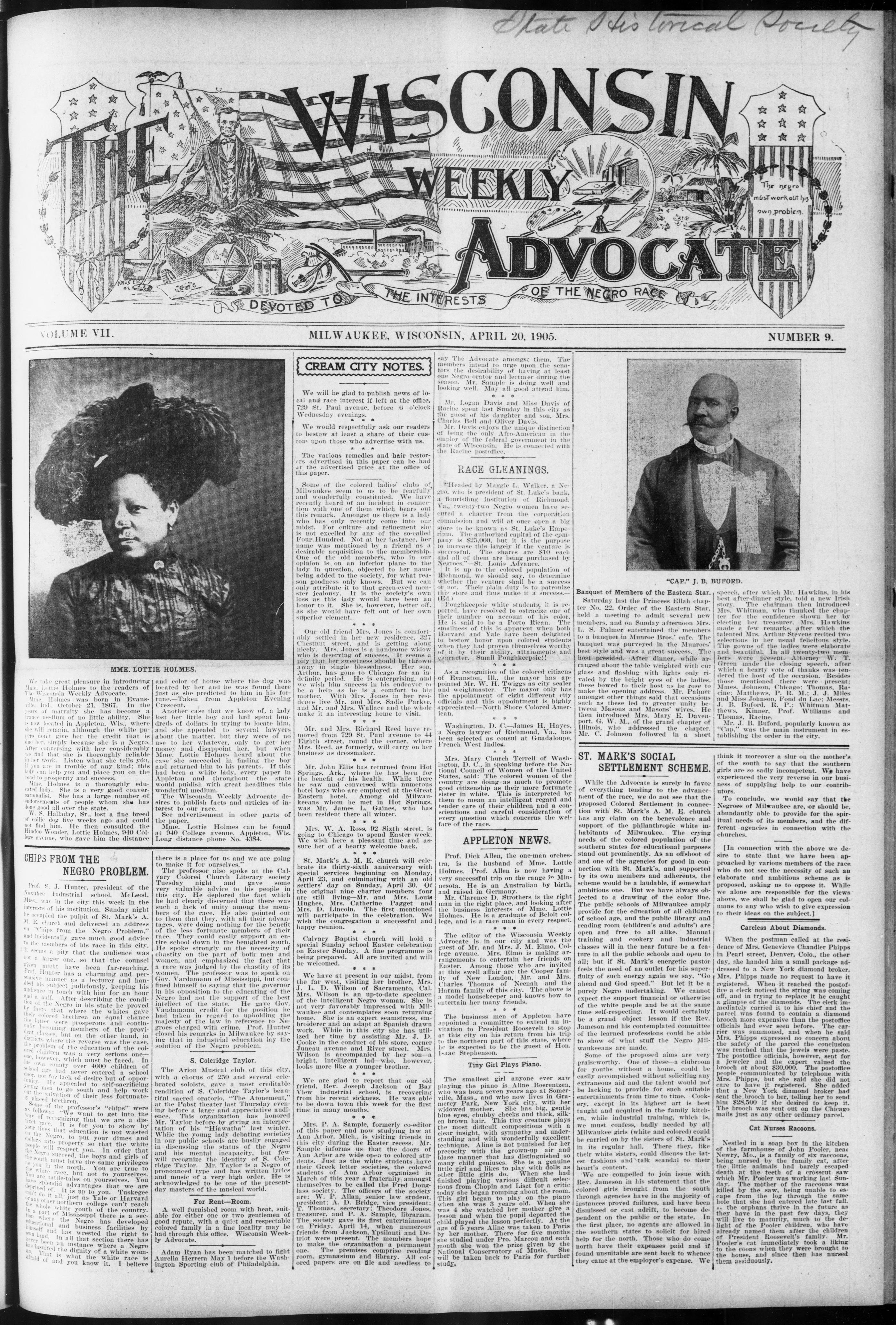
WISCONSIN
WEEKLY
ADVOCATE
DEVOTED TO THE INTERESTS OF THE NEGRO RACE
MME. LOTTIE HOLMES.
We take great pleasure in introducing Mine. Lattie Holmes to the readers of The Wisconsin Weekly Advocate. Mine. Holmes was born in Evansville, Ind., October 21, 1867. In the years of matruity she has become a trance medium of no little ability. She is now located in Appleton. Wis., where she will remain, although the white papers don't give her the credit that is due her, simply because she is a Negro. After conversing with her considerably we find that she is thoroughly reliable in her work. Listen what she tells you, if you are in trouble of any kind; this lady can help you and place you on the road to prosperity and success.
Mine. Holmes is a thoroughly educated lady. She is a very good conversationalist. She has a large number of endorsements of people whom she has done good all over the state. W. S. Halladay, Sr., lost a fine breed of collie dog five weeks ago and could not find him. He then consulted the Hindoo Wonder, Lottie Holmes, 940 College avenue, who gave him the distance
CHIPS FROM THE NEGRO PROBLEM.
CHIPS FROM THE NEGRO PROBLEM.
Prof. S. J. Hunter, president of the Noxubee Industrial school, McLeod, Miss., was in the city this week in the interests of his institution. Sunday night he occupied the pulpit of St. Mark's A. M. E. church and delivered an address on "Chips from the Negro Problem," and incidentally gave much good advice to the members of his race in this city. It seems a pity that the audience was not a larger one, so that the counsel given might have been far-reaching. Prof. Hunter has a charming and persuasive manner as a lecturer and handled his subject judiciously, keeping his audience in touch with him for an hour and a half. After describing the condition of the Negro in his state he proved by facts that where the whites gave their colored brethren an equal chance the latter were prosperous and continually becoming members of the provident classes, but on the other hand, in districts where the reverse was the case, the problem of the education of the colored children was a very serious one—one, however, which must be faced. In his own county over 4000 children of school age had never entered a school door, not for lack of desire but of opportunity. He appealed to self-sacrificing young men to go south and help work out the salvation of their less fortunately placed brethren.
Some of the professor's "chips" were as follows: "We want to get into the way of recognizing that we are a distinct race. It is for you to show by your lives that education is not wasted on the Negro, to put your dimes and dollars into property so that the white people will respect you. In order that the Negro succeed, the boys and girls of the south must have the same privileges as you in the north. You are true to the white race, but not to yourselves. You are tattle-tales on yourselves. You have splendid advantages that we are deprived of. It is up to you. Tuskegee can't do it all, just as Yale or Harvard or any other northern college can't reach the whole white youth of the country. In a part of Mississippi there is a section where the Negro has developed educational and business facilities by own land. In all that section there has never been an instance where a Negro has insulted the dignity of a white woman. That is what the white race is afraid of and you know it. I believe
---
VOLUME VII.
and color of house where the dog was located by her and he was found there just as she predicted to him in his fortune.—Taken from Appleton Evening Crescent.
Another case that we know of, a lady lost her little boy and had spent hundreds of dollars in trying to locate him, and she appealed to several lawyers about the matter, but they were of no use to her whatever, only to get her money and disappoint her, but when Mine. Lottie Holmes heard about the case she succeeded in finding the boy and returned him to his parents. If this had been a white lady, every paper in Appleton and throughout the state would publish with great headlines this wonderful medium.
The Wisconsin Weekly Advocate desires to publish facts and articles of interest to our race. See advertisement in other parts of the paper. Mme. Lottie Holmes can be found at 940 College avenue. Appleton, Wis. Long distance phone No. 4384.
there is a place for us and we are going to make it for ourselves."
The professor also spoke at the Calvary Colored Church Literary society Tuesday night and gave some very valuable advice to his people in this city. He deplored the fact which he had clearly discerned that there was such a lack of unity among the members of the race. He also pointed out to them that they, with all their advantages, were doing nothing for the benefit of the less fortunate members of their race. They could easily support an entire school down in the benighted south. He spoke strongly on the necessity of chastity on the part of both men and women, and emphasized the fact that a race was judged by the chastity of its women. The professor was to speak on Gov. Vardamann of Mississippi, but confined himself to saying that the governor in his opposition to the educating of the Negro had not the support of the best intellect of the state. He gave Gov. Vandamann credit for the position he had taken in regard to upholding the majesty of the law in reference to Negroes charged with crime. Prof. Hunter closed his remarks in Milwaukee by saying that in industrial education lay the solution of the Negro problem.
The Arion Musical club of this city, with a chorus of 250 and several celebrated soloists, gave a most creditable rendition of S. Coleridge Taylor's beautiful sacred oratorio. "The Atonement," at the Pabst theater last Thursday evening before a large and appreciative audience. This organization has honored Mr. Taylor before by giving an interpretation of his "Hiawatha" last winter. While the young lady debating societies in our public schools are busily engaged in discussing the status of the Negro and his mental incapacity, but few will recognize the identity of S. Coleridge Taylor. Mr. Taylor is a Negro of pronounced type and has written lyrics and music of a very high order. He is acknowledged to be one of the present-day masters of the musical world.
A well furnished room with heat, suitable for either one or two gentlemen of good repute, with a quiet and respectable colored family in a fine locality may be had through this office. Wisconsin Weekly Advocate.
Adam Ryan has been matched to fight Aurelia Herrera May 1 before the Washington Sporting club of Philadelphia.
S. Coleridge Tavlor.
For Rent—Room.
CREAM CITY NOTES.
---
We will be glad to publish news of local and race interest if left at the office, 729 St. Paul avenue, before 6 o'clock Wednesday evenings.
We would respectfully ask our readers to bestow at least a share of their custom upon those who advertise with us.
The various remedies and hair restorers advertised in this paper can be had at the advertised price at the office of this paper.
Some of the colored ladies' clubs of Milwaukee seem to us to be fearfully and wonderfully constituted. We have recently heard of an incident in connection with one of them which bears out this remark. Amongst us there is a lady who has only recently come into our midst. For culture and refinement she is not excelled by any of the so-called Four.Hundred. Not at her instance, her name was mentioned by a friend as a desirable acquisition to the membership. One of the old members, who in our opinion is on an inferior plane to the lady in question, objected to her name being added to the society, for what reason goodness only knows. But we can only attribute it to that green-eyed monster jealousy. It is the society's own loss as this lady would have been an honor to it. She is, however, better off, as she would have felt out of her own superior element.
* * *
Our old friend Mrs. Jones is comfortably settled in her new residence, 327 Chestnut street, and is getting along nicely. Mrs. Jones is a handsome widow who is deserving of success. It seems a pity that her sweetness should be thrown away in single blessedness. Her son, Arthur, has gone to Chicago for an indefinite period. He is enterprising, and we wish him success in his endeavor to be a help as he is a comfort to his mother. With Mrs. Jones in her residence live Mr. and Mrs. Sadie Parker, and Mr. and Mrs. Wallace and the whole make it an interesting home to visit.
* * *
Mr. and Mrs. Richard Reed have removed from 729 St. Paul avenue to 44 Eighth street, round the corner, where Mrs. Reed, as formerly, will carry on her business as dressmaker.
***
Mr. John Ellis has returned from Hot Springs, Ark., where he has been for the benefit of his health. While there he saw and conversed with numerous hotel boys who are employed at the Great Eastern hotel. Among old Milwaukeeans whom he met in Hot Springs, was Mr. James L. Gaines, who has been resident there all winter.
* * *
Mrs. W. A. Ross, 92 Sixth street, is going to Chicago to spend Easter week. We wish here a pleasant time and assure her of a hearty welcome back.
```markdown
```
St. Mark's A. M. E. church will celebrate its thirty-sixth anniversary with special services beginning on Monday, April 23, and culminating with an old settlers' day on Sunday, April 30. Of the original nine charter members four are still living—Mr. and Mrs. Louis Hughes, Mrs. Catherine Pagget and Mrs. D. Lincoln. The first mentioned will participate in the celebration. We wish the congregation a successful and happy reunion.
* * *
Calvary Baptist church will hold a special Sunday school Easter celebration on Easter Sunday. A fine programme is being prepared. All are invited and will be welcomed.
* * *
We have at present in our midst, from the far west, visiting her brother, Mrs. J. L. D. Wilson of Sacramento, Cal. Mrs. Wilson is an up-to-date specimen of the intelligent Negro woman. She is not very favorably impressed with Milwaukee and contemplates soon returning home. She is an expert seamstress, embroiderer and an adapt at Spanish drawn work. While in this city she has utilized her time by assisting Mr. J. D. Cooke in the conduct of his store, corner Juneau avenue and River street. Mrs. Wilson is accompanied by her son—a bright, intelligent lad—who, however, looks more like a younger brother.
***
We are glad to report that our old friend, Rev. Joseph Jackson of Bay View industrial school, is recovering from his recent sickness. He was able to be down town this week for the first time in many months.
* * *
Mrs. P. A. Sample, formerly co-editor of this paper and now studying law at Ann Arbor, Mich., is visiting friends in this city during the Easter recess. Mr. Sample informs us that the doors of Ann Arbor are wide open to colored students. Just as the white students have their Greek letter societies, the colored students of Ann Arbor organized in March of this year a fraternity amongst themselves to be called the Fred Douglass society. The officers of the society are: W. P. Allan, senior law student, president; A. D. Bridge, vice president; T. Thomas, secretary; Theodore Jones, treasurer, and P. A. Sample, librarian. The society gave its first entertainment on Friday, April 14, when numerous friends from Jackson, Ypsilanti and Detriot were present. The members hope to make the organization a permanent one. The premises comprise reading room, gymnasium and library. All colored papers are on file and needless to
say The Advocate amongst them. The members intend to urge upon the senators the desirability of having at least one Negro orator and lecturer during the season. Mr. Sample is doing well and looking well. May all good attend him.
Mr. Logan Davis and Miss Davis of Racine spent last Sunday in this city as the guest of his daughter and son. Mrs. Charles Bell and Oliver Davis.
Mr. Davis enjoys the unique distinction of being the only Afro-American in the employ of the federal government in the state of Wisconsin. He is connected with the Racine postoffice.
RACE GLEANINGS.
"Headed by Maggie L. Walker, a Negro, who is president of St. Luke's bank, a flourishing institution of Richmond. Va., twenty-two Negro women have secured a charter from the corporation commission and will at once open a big store to be known as St. Luke's Emporium. The authorized capital of the company is $25,000, but it is the purpose to increase this largely if the venture is successful. The shares are $10 each and all of them are being purchased by Negroes."—St. Louis Advance.
It is up to the colored population of Richmond, we should say, to determine whether the venture shall be a success or not. Their plain duty is to patronize this store and thus make it a success.—(Ed.)
Poughkeepsie white students, it is reported, have resolved to ostracize one of their number on account of his color. He is said to be a Porto Rican. The smallness of this is apparent when both Harvard and Yale have been delighted to bestow honor upon colored students when they had proven themselves worthy of it by their ability, attainments and character. Small Poughkeepsie!!
As a recognition of the colored citizens of Evanston, Ill., the mayor has appointed Mr. W. H. Twiggs as city sealer and weighmaster. The mayor only has the appointment of eight different city officials and this appointment is highly appreciated.—North Shore Colored American.
☆ ☆ ☆
Washington, D. C. James H. Hayes, a Negro lawyer of Richmond, Va., has been selected as consul at Guadaloupe, French West Indies.
☆ ☆ ☆
Mrs. Mary Church Terrell of Washington, D.C., in speaking before the National Council of Women of the United States, said: The colored women of the country are doing as much to promote good citizenship as their more fortunate sister in white. This is interpreted by them to mean an intelligent regard and tender care of their children and a conscientious and careful consideration of every question which concerns the welfare of the race.
APPLETON NEWS.
Prof. Dick Allen, the one-man orchestra, is the husband of Mme. Lottie Holmes. Prof. Allen is now having a very successful trip on the range in Minnesota. He is an Australian by birth, and raised in Germany. Mr. Clarence D. Strothers is the right man in the right place, and looking after the business interests of Mme. Lottie Holmes. He is a graduate of Beloit college, and is a race man in every respect.
The editor of the Wisconsin Weekly Advocate is in our city and was the guest of Mr. and Mrs. J. M. Elmo, College avenue. Mrs. Elmo is making arrangements to entertain her friends on Easter. Among those who are invited at this swell affair are the Cooper family of New London, Mr. and Mrs. Charles Thomas of Neenah and the Haram family of this city. The above is a model housekeeper and knows how to entertain her many friends.
☆ ☆ ☆
The business men of Appleton have appointed a committee to extend an invitation to President Roosevelt to stop at this city on his return from his trip to the northern part of this state, where he is expected to be the guest of Hon. Isaac Stephenson.
Tiny Girl Plays Piano.
The smallest girl anyone ever saw playing the piano is Aline Boerentzen, who was born seven years ago at Somerville, Mass., and who now lives in Gramercy Park, New York city, with her widowed mother. She has big, gentle blue eyes, chubby cheeks and thick, silken brown hair. This tiny creature plays the most difficult compositions with a clear insight, with sympathy and understanding and with wonderfully excellent technique. Aline is not punished for her precocity with the grown-up air and blase manner that has distinguished so many child geniuses. She is a genuine little girl and likes to play with dolls as other little girls do. When she had finished playing various difficult selections from Chopin and Liszt for a critic today she began romping about the room. This girl began to play on the piano when she was 3 years old. When she was 4 she watched her mother give a lesson and when the pupil departed the child played the lesson perfectly. At the age of 5 years Aline was taken to Paris by her mother. There for five months she studied under Pro. Marcou and each month she won the prize given by the National Conservatory of Music. She will be taken back to Paris for further study.
P.
"CAP." L. B. BUFORD.
Banquet of Members of the Eastern Star. Saturday last the Princess Ellah chapter No. 22, Order of the Eastern Star, held a meeting to admit several new members, and on Sunday afternoon Mrs. L. S. Palmer entertained the members to a banquet in Munroe Bros.' cafe. The banquet was purveyed in the Munroes' best style and was a great success. The host presided. After dinner, while arranged about the table weighted with cur glass and flashing with lights only rivaled by the bright eyes of the ladies, these bowed to their host as he rose to make the opening address. Mr. Palmer amongst other things said that occasions such as these led to greater unity between Masons and Masons' wives. He then introduced Mrs. Mary E. Davenport, G. W. M., of the grand chapter of Illinois, who addressed the chapter. Mr. C. Johnson followed in a short
ST. MARK'S SOCIAL SETTLEMENT SCHEME.
While the Advocate is surely in favor of everything tending to the advancement of the race, we do not see that the proposed Colored Settlement in connection with St. Mark's A. M. E. church has any claim on the benevolence and support of the philanthropic white inhabitants of Milwaukee. The crying needs of the colored population of the southern states for educational purposes stand out prominently. As an offshoot of and one of the agencies for good in connection with St. Mark's, and supported by its own members and adherents, the scheme would be a laudable, if somewhat ambitious one. But we have always objected to a drawing of the color line. The public schools of Milwaukee amply provide for the education of all children of school age, and the public library and reading room (children's and adults') are open and free to all alike. Manual training and cookery and industrial classes will in the near future be a feature in all the public schools and open to all; but if St. Mark's energetic pastor feels the need of an outlet for his superfluity of such energy again we say, "Go ahead and God speed." But let it be a purely Negro undertaking. We cannot expect the support financial or otherwise of the white people and be at the same time self-respecting. It would certainly be a grand object lesson if the Rev. Jameson and his contemplated committee of the learned professions could be able to show of what stuff the Negro Milwaukeeans are made.
Some of the proposed aims are very praiseworthy. One of these—a clubroom for youths without a home, could be easily accomplished without soliciting any extraneous aid and the talent would not be lacking to provide for such suitable entertainments from time to time. Cookery, except in its highest art is best taught and acquired in the family kitchen, while industrial training, which is, we must confess, badly needed by all Milwaukee girls (white and colored) could be carried on by the sisters of St. Mark's in its regular hall. There they, like their white sisters, could discuss the latest fashions and talk scandal to their heart's content.
We are compelled to join issue with Rev. Jameson in his statement that the colored girls brought from the south through agencies have in the majority of instances proved failures, and have been dismissed or cast adrift, to become dependent on the public or the state. In the first place, no agents are allowed in the southern states to solicit for hired help for the north. Those who do come north have their expenses paid and if found unsuitable are sent back to whence they came at the employer's expense. We
speech, after which Mr. Hawkins, in his best after-dinner style, told a new Irish story. The chairman then introduced Mrs. Whitman, who thanked the chapter for the confidence shown her by electing her treasurer. Mrs. Hawkins made a few remarks, after which the talented Mrs. Arthur Stevens recited two selections in her usual felicitous style. The gowns of the ladies were elaborate and beautiful. In all twenty-two members were present. Attorney W. T. Green made the closing speech, after which a hearty vote of thanks was tendered the host of the occasion. Besides those mentioned there were present: Mmes. Johnson, Chicago; Thomas, Racine; Matthews, P. R. M.; J. J. Miles and Miss Johnson, Fond du Lac; Messrs. J. B. Buford, R. P.; Whitman Matthews, Kinner, Prof. Williams and Thomas, Racine.
Mr. J. B. Buford, popularly known as "Cap," was the main instrument in establishing the order in the city.
think it moreover a slur on the mother's of the south to say that the southern girls are so sadly incompetent. We have experienced the very reverse in our business of supplying help to our contributors. To conclude, we would say that the Negroes of Milwaukee are, or should be, abundantly able to provide for the spiritual needs of its members, and the different agencies in connection with the churches.
[In connection with the above we desire to state that we have been approached by various members of the race who do not see the necessity of such an elaborate and ambitious scheme as is proposed, asking us to oppose it. While we alone are responsible for the views above, we shall be glad to open our columns to any who wish to give expression to their ideas on the subject.]
Careless About Diamonds.
When the postman called at the residence of Mrs. Genevieve Chandler Phipps in Pearl street, Denver, Colo., the other day, she handed him a small package addressed to a New York diamond broker. Mrs. Phipps made no request to have it registered. When it reached the postoffice a clerk noticed the string was coming off, and in trying to replace it he caught a glimpse of the diamonds. The clerk immediately carried it to his chief and the parcel was found to contain a diamond brooch more expensive than the postoffice officials had ever seen before. The carrier was summoned, and when he said Mrs. Phipps expressed no concern about the safety of the parcel the conclusion was reached that the jewels were paste. The postoffice officials, however, sent for a jeweler and the expert valued the brooch at about $30,000. The postoffice people communicated by telephone with Mrs. Phipps, but she said she did not care to have it registered. She added that a New York diamond broker had sent the brooch to her, telling her to send him $28,500 if she desired to keep it. The brooch was sent out on the Chicago mails just as any other ordinary parcel.
Cat Nurses Racoons.
Nestled in a soap box in the kitchen of the farmhouse of John Pooler, near Newry, Mo., is a family of six raccoons, being nursed by the family cat, after the little animals had barely escaped death at the teeth of a crosscut saw which Mr. Pooler was working last Sunday. The mother of the raccoons was killed by the saw, being unable to escape from the log through the same hole that she had entered late last fall. The orphans thrive in the future as they have in the past few days, they will live to maturity, much to the delight of the Pooler children, who have already named them after the children of President Roosevelt's family. Mr. Pooler's cat immediately took a liking to the coons when they were brought to the house, and since then has nursed them assiduously.
UNIQUE TESTAMENT.
Dying Man Scrawls Last Statement on a Piece of Birch Bark.
On a piece of birch bark, by the light of a tiny oil taper, Robert McNeill, who laid down his life in the quest for riches, scrawled a last message to his loved ones and bequeathed to them the wealth that was his. McNeill's death came while he was prospecting near the headwaters of the Stewart river. Viola and Freda Finn of Spokane, Wash., daughters of the deceased sister of McNeill, are the ones to whom the dying man left his property. They were notified by long-distance telephone recently by Henry J. Ross, the man who journeyed from the grave of their uncle, of the death of McNeill and of the existence of the will. Viola Finn is now the wife of James Barkley.
The birch bark statement is in the hands of William Rice, one of the prospectors still on the Stewart river, and is to be forwarded to the Finn girls as soon as Ross notifies him of their present address. Ross does not know the value of the McNeill estate. "It consists of valuable claims on the Stewart river," he said, "in an exceedingly rich locality, and may prove to be worth many thousands of dollars.
"About two months ago McNeill, William Rice and Donald McCollogan left Dawson for the headwaters of the Stewart. They staked out some promising claims and had begun work, when McNeill was taken sick. His condition became so alarming that his companions attempted to convey him to a settlement about seventy miles down the river. But the weather was extremely cold and there was no trail.
"I met the party camped in the snow. It was only a few hours before McNeill died. I had met him before and he asked me to hunt up his nieces. We had no paper, so the sick man wrote out his will on a piece of bark and we each signed it as witnesses.
"McNeill died that night, and we buried him in the snow. I came to Dawson and Rice and McCollogan turned back to their claims."—Seattle Post-Intelligence.
Osler Will Never Jest Again
Maj. Venable, a prominent lawyer of Baltimore, told his aged negro cook that he was going to reduce her wages. "What's dat for?" was the query of the old woman.
"Because Dr. Osler says that a person is no good after they are 40 years old," was the reply of Maj. Venable.
"Is dat so?" said "Aunty." "Well, dat doctah lied."
The anecdote was related by Maj. Venable at the banquet given by Mr. Marburg at the Maryland club, which was attended by Dr. Osler.
Since making the famous remark about man's utility, Dr. Osler has been preparing a scientific paper, and was dictating matter for it to an assistant. The question for the title of the paper came up, and when the young man asked Dr. Osler what he would name it, the latter gave a title that was unusual. The assistant said: "Doctor, are you joking?"
The doctor replied, solemnly: "I will never jest with my friends again."
The Modern Jester.
"A certain class of insane persons are remarkable for their ready and apt retorts," said Dr. George T. Winston, the criminologist. "The court fools whom monarchs and great nobles used to employ were all of this insane class. It would be possible now, if the court fool fashion were to be revived again, to get from our asylums excellent jesters.
"I have in mind a young man in a Boston retreat who would make a good jester for any monarch. This young man keeps his companions continually amused. The first time I ever saw him he sat on the floor swearing bitterly.
"'Tut, tut,' said I. 'Don't swear.'
'Why, not?' said he.
'Because,' said I, 'you won't go to heaven if you do.'
"Oh,' said the young man disdainfully. 'I'm not going to try to go to heaven. There's more trying now than'll get in.'"—Phelidalphia Bulletin.
Sun Parlor for Baby.
Sunning the baby is the latest thing in baby culture. No household is too poor to possess one of these patent adjustable sun parlors. They are made of some kind of hard wood and built by the carpenter to extend beyond the window. The top and sides of the little platform are covered with glass, and strips of carpet are laid on the floor to stop up any cracks there may be. No matter how fiercely the winds may blow or how low the thermometer may sink the sun parlor is always ready for the baby.
A pillow is placed on the carpeted floor, then the baby is warmly dressed and well covered for its morning or afternoon nap. Mothers who have tried this method of sunning the baby are boasting of the gain in weight and health and have the proud satisfaction of knowing they are strictly up to date.—Philadelphia Record.
How She Would Get to Paris
Charlemagne Tower, the American ambassador to Germany, spoke of the American's love of Paris at a dinner that he gave in Philadelphia, says the New York Tribune. A young American girl lived in a bleak western city. There were in those days no institutes for the treatment of rabies or threatened rabies, save in France. The young girl's life was monotonous, and one day she burst into a neighbor's house, almost beside herself with joyous excitement. Her dark eyes flashed. Her cheeks had a delicate rose flush. Panting a little, she cried in a tremendous voice:
"Thank goodness, we are going to Paris at last! Dad has been bitten by a mad dog."
Hemlock Cure for Meningitis
Edwin M. Shaw of Middleville, Mich.. sent the following communication to the New York Tribune:
"Will you announce to your readers that hemlock sweating, by using boughs or the oil, is a prompt and effective remedy for diseases of the meningitis character? Celerity in meeting first symptoms is of especial importance. My father, Dr. E. M. Shaw, an eminently successful physician, would snatch a burning stick from the fire, dampen, wrap it up, place it beside his patient, and thus, using what was called 'Shaw's sweat,' was marvelously successful in staying the force of pestilential, epidemic disease."
Difference Between Them
"I understand," said the tourist from the east, "there was some difference today between Big Bill and Red Hankins." "They's consid'ble difference," replied the native. "Bill's alive and Red's dead." "Yes, but what was the difference between them that led to the killing?"
Will Tax Church Members.
Indianapolis ministers have started a movement to have churches supported by a direct tax upon the membership, according to the amount of worldly goods they possess. The idea of the ministers is that the ability of a member to pay should be gauged by his property, as represented by the tax assessment books.
IN APRIL
Dearest, do you recall that April night?
Henceforth let time take from us what it
may
If but that dear and heavenly radiance
light
The torches of our way!
Held fast the city's mighty heart in thrall,
And down the streets in shadow, silence
streamed
A tender tide, that thus enveloped all
Who, like us, loved and dreamed.
Night's mystery enwrapped the fleeting
hours:
hours:
The spectre of a young moon dim and
far
Shone over the cathedral's lily-towers,
Each pointed by a star.
The city's lights, like phantoms, pale and
wan.—
As swift we passed close to the other pressed —
pressed.
Were ghosts to mock. We, heedless, hurried on,
So living—and so blessed!
Was it for us the very world was stilled
That each the other's heart's swift beat-
ing board?
For me it never can be far away:
One night you were beside me, and the
glow
Brings me again the heart of yesterday.
There is no long ago
For me! And, dearest, in the time's des-
pite.
When cold the wraths around your heartstone fall.
-Marie Van Vorst in Lippincott's Magazine
LOTTERY TICKET NO. 6,666
David Pommier, retired hussier, was leisurely sipping his coffee when Leontine, his maid, a young brunette, burst into the dining room; then, blushing and confused, she began to twist a corner of her apron, looking meanwhile at her master.
"Well, what is it, Tine?" M. Pommier had adopted this abbreviation to save time.
"I want—I want to beg you, monsieur, to advance me 20 frances on my wages."
"Twenty frances? And what for, if I may ask?"
"Certainly!" answered the young girl, reassured by the smile which appeared on M. Pommier's lips. "I want to buy a ticket in the Lottery de l'Hopital."
"That is a foolish idea! You might as well throw your 20 francs into the lake. Take my word for it, Tine, and leave your money where it is; you will find a better use for it. Do you think you are going to draw the 100,000-frane prize?" and the fat fellow began to laugh.
"Well, why not? I dreamed a number."
"Ah! A pretty story. You dreamed a number? Do you remember it?"
"Four sixes."
"Good! 6666."
"That is it."
"And so you believe such nonsense! You must be foolish, my poor girl."
"But after all, monsieur, if I wish to use these 20 francs—after all—"
"Well, after all?"
"It is my money."
"Ah! Well, then, you shall have it, mademoiselle." And rising quickly the old hussier opened a desk from which he took 20 francs and threw them on the table, crossly.
With a "merci" Leontine quickly pocketed the money and left the room.
"Heavens! What a fool, that girl," the good man muttered, while searching for his book of expenditures. "The government does wrong to license such schemes, even under the color of charity."
Then having discovered the book he wrote in a rage: "Advanced to that idiot Tine 20 francs for a ticket in the Lottery de l'Hopital, No. 6666." After this, his desk being open, the ex-hussier set himself to the examination of some bills of order, which were filed in a large case of black leather. A widower without children and having disposed of his office at a good price, M. Pommier began a banking business on a modest scale. He made loans to solvent persons who were temporarily embarrassed, and, whatever the sum, the interest was more than reasonable. In this way he entered a little into the lives of his customers.
This business brought him an income and occupied him. Besides, the persons whom he obliged, for the most part country people, often presented him in winter with a fat fowl or a quarter of pork, attentions which were justly appreciated by the old hussier, his love of gain being equal to his love of good cheer. And when his short figure, with its protuberant, drum-shaped stomach and apolectic neck, was seen trotting about town or into the country he was known to be on the scent of a profitable business transaction or a good dinner.
The mother of Tine, who had been for a long time in the service of the late Mine. Pommier, had retired to her native village on the death of that lady, leaving her daughter to fill her post. And it was thus that this young person, and a very pretty one, too; took charge, in all honor, of the widower's menage.
In the weeks that followed the conversation above related, Tine did not make any allusion to the lottery ticket, and neither did her master speak of it. But one beautiful day, while reading his newspaper, he bounced out of his chair, his face discomposed, and regarded the young maid in a strange manner. Tine, who was clearing the table with her usual placidity, observed his emotion.
"Are you ill, monsieur?" she asked anxiously.
"It is nothing—a cramp only," answered he. "Go, leave me to myself, my girl." Tine went out without a word.
Alone the ex-hussier, with the paper in his hand, paced the room quickly.
"She knows nothing about it—nothing at all," he added, crushing the innocent gazette. "And yet it is there, printed in staring characters, 'First Prize of 100,000 Franes, No. 6666.' We will go and verify the news."
After folding the paper carefully, which he put into his pocket, M. Pommier took a huge draught of water and proceeded to the Hotel de Ville. There the news was confirmed. And this giddy goose did not know it. She had not once thought of the ticket since its purchase. It was inconceivable, but it was true.
In the meantime a throng of banknotes danced gayly in the brain of the little man, who directed his steps toward a nearby street, shaded by chestnut trees, where he seated himself on a bench and gave himself up to profound meditation. The result of this meditation impelled him, before going home, to pass by the market, where he purchased a superb trout, forgetting, for the first time in his life, to haggie about the price. At home M. Pommier hastened to carry his purchase to the kitchen.
"Oh, the beautiful fish!" exclaimed Tine.
"Yes? It is a salmon. You will cook it carefully, Tine, and serve it in style."
"Monsieur is to have a guest at dinner?"
"Yes—guess who?"
"Sure! You shall know that I am to dine with Mille, Leontine Durut."
"Leontine Durut! Why, that is I!"
"Yes, in person."
"Monsieur, you wish to make a joke of me."
"Not in the least, my dear child. You will dine with me, and—we will have a confidential chat."
Although she was not aware of it herself, Leontine Durut was a fine, well-looking girl, of high principles and absolutely honest in every way. So M. Pomnier had reflected under the chestnuts, as if he had perceived for the first time the excellencies of Tine. In short, to come into possession of this 100,000 frames of the lottery the good man could find no way other than to marry his maid.
And why not, after all! he repeated several times, as if to strengthen his idea. She would make a very presentable Mme. Pommier—with this 100,000 franes! When Tine, very embarrassed, took a place at her master's table she could not overcome her surprise at her new position. But this was overshadowed by a more momentous surprise when monsieur, after having gallantly served her, and poured for her some of his best wine, began to speak of marriage.
"Eh! Why not, my girl?" repeated the wily old hussier; "I have learned to know you. I am still too young for a bachelor's life. Not quite 50, and with health to spare. And, see! Do you wish me to say it. I have thought of this for a long time."
And the honest man let fly this big lie with a conviction that did not fail to impress Tine. However, the thought of marriage with this fat little man, already old, did not please her. And at his suggestion she consulted with her mother, who, at the news, was almost suffocated with joy. Her daughter to be the second Mme. Pommier! A thousand times—one hundred thousand times yes! She must accept.
Thus urgently counseled Tine ended by giving her consent, and the arrangements did not lag. Ah! no, they did not lag. M. Pommier was a man who knew how to abridge formalities, and a fortnight later he conducted Leontine to the mayor and to the church. Before this double ceremony he had not failed to have a centrat drawn or the terms of which the two had equal share in their and truly touched the heart of the young girl, who viewed, not without some repugnance, this union with a man old enough to be her father.
For raisons de convenances, M. Pommier had invited only very few persons to his wedding, the necessary witnesses, the mother and the uncle of his betrothed, and an old comrade who was ordinarily his opponent at billiards. But if the guests were few the good feeling and the dinner at a fashionable restaurant left nothing to be desired.
At last the party dispersed, and the newly married pair drove toward the conjugal dwelling; she, timidly animated, but vaguely disquieted; he, shedding radiance. While in the carriage the exhaustion, whose deepened ruddiness of complexion was due to the old Ponard which had generously washed down various rich delicacies, prayed his young wife to loosen his cravat. And while so doing he kissed her on the forhead.
At this contact Tine shuddered—a sensation wholly alien to the delightful thrill the newly wedded experience on like occasions. In spite of the advantages she had gained by her marriage, she asked herself if she had done well to barter for that her youth and freedom. With their entrance into the well-known house, monsieur conducted madame into—his office. And there, before giving her time to remove her bonnet, he seated her, facing him.
"Now, Tine, my darling, let me tell you that you are a little giddy head. Go immediately and fetch me your ticket."
"What ticket?"
"What ticket! Parbleu! The lottery ticket, No. 6666."
"But I haven't it."
"What!" groaned the poor old man, whose crimson face became instantly a violet hue. "You did not buy a lottery ticket?"
"Indeed, no," answered the poor creature, trembling. "I thought you were right; that it was money thrown into the lake, and—with the 20 franes I bought myself six chemises."
"Six chem——"
Pommier did not say more; for with that breath he went to a better world, where he could cast off his surcharge of indignation.
By this catastrophe the pretty widow found herself in possession of a plump fortune.—Translated for New York Commercial Advertiser from the French of Henry Renou.
The Care of the Eyes
People who recognize the importance of taking care of their health often quite forget that if we want to preserve them it is just as necessary to take care of our eyes. First of all take care of your general health. Poor health often leads indirectly to various eye troubles. Then, remember that straining of the eyes is caused by a dazzling glare, or a bad light. Glare and gloom are equally bad to work in. You need not ask which is the worse for the eyes—one is as bad as the other.
The light should fall on book or work from behind us. The attitude while at work is of great importance. The head should, as far as possible, be kept erect. Stooping causes an increased flow of blood to the head and eyes—this is injurious to them. Don't read when traveling. Deny yourself this pleasure for the sake of your eyes.—Chicago Journal.
Wipe Your Eyeglasses.
A well-known oculist said recently: "Can't girls be persuaded to take better care of their glasses? I have many college girls coming to me. They are as fresh as a rose and neat as a pin, but seven times out of ten their glasses are in a disgraceful condition. Vanity alone should make them more careful," he continued. "Glasses at best are not becoming, and when clouded and neglected make a bad matter worse. Of course it is very bad for their eyes to wear glasses in such a state. Tell them to wash their glasses each night of their lives in warm soap and water and dry on an old, soft bit of linen." This is good advice and the pity is that it should be necessary.—Harner's Bazar.
NO LIBRARY.
I wish dat when some millionaire
Is passin' gif's aroun'
He'd stop an' pay attention where
A real need is foun'.
We don't want any buildin' tall
Wif statues on de stoop;
Our needs is urgent, but dey's small:
We wants a chicken coop.
The largest bequest ever made by a negro to Tuskegee institute, at Tuskegee, Ala., was recorded in New York city, when the will of Mary E. Shaw of Philadelphia bequeathed $38,000 to the institute, of which Booker T. Washington is president.
One of the highest prices ever brought by an autograph letter of Abraham Lincoln has just been recorded at an auction sale here. The relic brought $110. It was dedicated to a soldier who had deserted the colors and begged for reinstatement.
The first of a consignment of steel cars for the New York City Railway company have arrived in the Pennsylvania railroad yards. The cars have steel frames with inside trimmings of woodwork of electrically treated process. They are said to be fireproof.
Secretary Metcalf of the department of commerce and labor has awarded the contract for the construction of a new island, to be a part of the Ellis Island immigration station, in New York bay, to the New Jersey Dock and Bridge Building company of Elizabeth, N. J. The contract price is $119,000.
Col. Nicholas Pike, a naturalist, author of a "Life of George Washington" and many scientific works, is dead from paralysis. He was 87 years old. For many years he served as consul on the island of Mauritius and later was consul-general to Portugal. He was a relative of Capt. Pike, for whom Pike's peak was named.
Miss Christine Kunz of New York and Miss Mary Harris of Brooklyn have volunteered to go to Labrador and take up special educational work with Dr. Wilfred Grenfell among the northern trappers and fishermen. Miss Kunz and Miss Harris will go to Labrador in June, prepared to teach the natives how to weave blankets and do all kinds of handiwork.
Frank A. Magowan, once a power in the financial and political circles of New Jersey, who was thrown from his high position by family and business scandals, is dangerously ill at St. Francis' hospital, in Trenton, of which city he formerly was mayor. His condition was brought about by exposare and lack of proper nourishment. He had carefully kept out of the sight of his old friends. He was picked up in the street, where he had fainted.
Thomas Butler, born in Queenstown, Ireland, in 1800, is dead at his home here. He came to America when 12 years old and for eighty years was identified with wharves and shipping at Canal street. It is said Butler attended church every morning for sixty years and so regular were his habits that he was known in the neighborhood as "Old Clock." He used tobacco all his life, but had abstained from liquor since 1841. Of his seven children only two survive.
The constitution of the United States expressly forbids the giving of "titles of honor and distinction," else John Monaghan of the Bronx would be knighted by the President. Mr. Monaghan is building two new apartment houses, and no flat will be rented to a family without children. This is what the remarkable landlord says of his unusual course: "It may be a queer thing for a landlord to invite families with children into his houses, but that's what I am doing. Why, I have seen so much suffering from this inhuman prohibition against children in apartments that I think it is time for someone to take a hand in the matter."
Almost as brief as the meteoric courtship was the engagement of Andrew Freedman, millionaire baseball magnate and intimate friend of Richard Croker, and Miss Elsie Rothschild, daughter of Jacob Rothschild, who owns the Hotel Majestic. The engagement has been broken by the girl's family.
"My daughter feels that she could not be happy and that is the only reason I care to assign," said Mrs. Rothschild.
"We want to spare Mr. Freedman as much unpleasantness as possible. My daughter discovered her real inclinations in the nick of time."
May 25 had been selected as the day of the marriage and the wedding arrangements were almost completed.
Announcement is made that Miss May Leslie, until recently a member of the Lew Fields theatrical company, will soon become the wife of Charles Rogers of this city, son of the president of the Borden's Condensed Milk company, a $25,000,000 corporation. The young woman is, or soon will be, a divorcee, while her intended husband, by persisting, in his announced determination to make her his wife, has invited paternal displeasure to such an extent, it is said, that he has been made to understand he will be entirely dependent on his own resources if he contracts the proposed alliance. Miss Leslie is about 22 years old, tall, slender and fair. She played a small part in the performance of "It Happened in Nordland," appearing, with five other young women, in a striking costume of black tights, with silver embossings, which served to attract especial attention to the half dozen thus arrayed.
That Russell Sage is failing so rapidly in health that he is winding up his financial affairs, preparing for the worst, was shown by his having taken judgment for $54,951 on a note. It was against P. H. Flynn, ex-Senator M. J. Coffey, and H. W. Hedenberg. Ex-Senator Coffey said of the transaction: "The only reason for suing on the note at this time is that Mr. Sage is failing in health and arrangements are under way to wind up his affairs. I was notified of the action, but I decided not to put in an answer, knowing that my interests were fully protected. In fact, there is no disposition on Sage's part to take such judgment if the matter can be satisfactorily adjusted." The demand note was made December 24, 1902, by Flynn for $50,000. Flynn had deposited as collateral security $100,000 in bonds of the Cross Country railroad company, and the bonds afterwards sold for only $1946. Payment on the note was guaranteed by Coffey and Hedenberg.
Adele Ritchie had to speak to some people in a box at the "Florodora" Broadway theater to ask them to be quiet. In the party were six women
and six men. They had been talking and laughing all through the first act. At the end of the act Miss Ritchie sings "Tact." She was encored, and when she appeared for her encore she sang these improvised lines: Tact, tact, take it for a fact. You will surely know some people by the way they act.
The house applauded loudly and vigorously. The box party was quieter after the song, but in the second act began to talk again. Miss Ritchie at last walked over to the box and said in an undertone: "I have sent the price of your box to the business manager, and if you do not stop interrupting this performance I will ask the manager to refund your money and ask you to leave the theater." The twelve were quiet after Miss Ritchie's rebuke.
Hawk, Fox and Man Claim Quail.
Dr. William Rowland of Pasadena, who was up at Middle Rauch quail shooting a few days prior to the close of the season, had a most unique experience. He ran upon a covey of quail and, flushing them, dropped one with his left barrel, and then, at considerable of an angie, dropped another with the right barrel. Turning to his first bird he was just in time to see a fox snatch it up and start to run away with it. Quickly pumping another cartridge into his gun he let the fox have it, knocking him stiff. After renoitoering a minute and finding his first bird he was returning to pick up the second, when something shot down like an arrow from the skies in front of him, the object proving to be an osprey. The quail had been wounded, and its fluttering attracted the attention of the big hawk, which, while sailing through the ether, had an eye out for a quail dinner, and darting upon the wounded bird was about to cheat the hunter out of his quarry. Dr. Rowland, while amazed at the turn of events, did not propose to stand for such a play, and, training his ready gun on the bold robber, with a pull of the trigger put him out of commission and saved both his birds.—Avalon Cor. Los Angeles Times,
Iron Industry in Mexico
In spite of the fact that there is a heavy duty on imports of manufactured iron and steel into Mexico, that the government liberally subsidizes the establishment of industrial plants there and that there are great mineral deposits in the country, Mexico has quite an insignificant number of foundries. According to the latest returns only thirty-nine are actually in operation. There are a number of iron foundries projected, and American capitalists are proposing to establish a large steel plant at San Louis Potosi.—London Times.
Beaver for the Adirondacks
Seven live beavers, formerly a part of the Canadian government exhibit at the St. Louis exposition, have been purchased by the state of New York, and have reached Old Forge, N. Y., where they are being kept in a rearing pond at the state fish hatchery in care of Henry Davidson, foreman of the hatchery, and "Ned" Ball of the Browns' Tract Guide association. They will be liberated in the public forest in the spring. It is the intention of the state to entirely restock the Adirondacks with beavers.
An Explanation
Sir Robert Hall, the noted British astronomer, went to a remote town in Ireland to lecture on his favorite topic. Arriving at the station he looked for the expected conveyance, but found none. After all the other passengers had disappeared a man stepped up and said: "Maybe you're Sir Robert Ball?" After receiving an affirmative reply, the man hastily apologized, saying: "Sure, your honor, I'm sorry I kept you waiting, but I was told to look for an intellectual gentleman."—Cleveland Plain Dealer.
A Puzzler.
The following problem is said to have demoralized the railroad service of a large part of West Virginia, all the employees being so absorbed in working it out: "A train one mile long starts from the station of Glady. The engine leaves the station and the conductor waits until the caboose comes, when he jumps on the caboose and walks forward over the train. When the engine reaches the next station, Oxley, four miles distant from Glady, the conductor steps off the engine. How far does the conductor ride and how far does he walk?"
Believe World's End Near.
Adherents of the sect known as "The Israelites of the House of David" are making preparations to receive the leaders of the cult, "Mary and Benjamin," who have made a trip around the world. The sect sometimes is called "The Flying Rollers." They believe that the world will come to an abrupt termination in a few years, when the Lord will come down to earth and reign with his chosen people, the twelve tribes of Israel, and the total number of the saved shall be only 144,000.
Shooting at the Heavens.
The savage tribes of central Africa are desperately afraid of thunderstorms. Unfortunately for their peace of mind, very terrible electrical disturbances sometimes take place in their countries. The bravest of the natives then go forth in a body armed with bows and arrows. They shoot savagely at the heavens and are occasionally rewarded for their trouble by having the lightning attracted by their arrows. They are, of course, then killed on the spot.—Philadelphia Record.
Not Enough for Two.
The recent severance of a long existing friendship between two titled English women of no little social prominence, but with whose names Mrs. Grundy had been busy, is explained in this wise by Georage Grossmith. After they had both defied public opinion for some time, one said to the other: "Now, my dear, we must part forever, for you have no character left, and I have not enough for two."—Denver Republican.
Drank Rebel Chief's Blood
His excellence, the viceroy of the Two Kuang, at Kuelin, a short time ago, at the execution of a famous rebel chief, stepped forward and caught some of the blood and drank it. Whether he wished to become impregnated with the courage of the robber, or whether it was a feeling of revenge that prompted the act, can only be surmised. Canton Times.
Seven at a Birth.
Sofiya Pristavkin, the wife of a peasant of Troitzka, in Simbirsk, has just given birth to seven children—four girls and three boys, weighing from three-fourths to two and one-half pounds each. Three of the children are dead, but one girl and three boys survive. Doctors declare that this is a record birth, the previous greatest number having been six, in Germany.
To Keep Cake Fresh.
I have found that fresh bread in slices about one inch thick (renewed when it gets dry), of bulk about half the cake to be kept "fresh," put in the tin with the cake causes the cake to remain "fresh."—C. D. Field in Scientific American
EVERY ONE ASKS HIM
HOW HE GOT RID OF HIS OBSTINATE MUSCULAR RHEUMATISM.
Mr. Jones Tells of the Way by Which He Treated Himself Successfully When Doctors Failed
Six physicians, all of them good, one of them a specialist, had done their best for Mr. Jones at different times during three years, and still he suffered fearfully from the tortures of rheumatism. The rheumatism that had been dormant in his system was suddenly brought to an acute stage by exposure while he was drawing ice in February, 1901. From that time on for a period of more than three years he was a constant sufferer. He tried many kinds of treatment, but the rheumatism wouldn't budge. When regular doctors failed, and one remedy after another proved useless, many said: "I should think he would give it up and save his money."
Of his condition at this time, Mr. Jones says: "My rheumatism started in my right thigh, but in time it appeared in every muscle of my body. I lost the use of my left arm entirely and nearly lost the use of my right one. My feet were badly affected, especially the bottoms of the heels. When my right side was affected there was swelling, but the left side didn't swell when the disease settled there. The internal organs didn't seem to be involved at all. The trouble was all in the muscles and the nerves."
Among the few who still encouraged Mr. Jones to think that a cure might yet be found was a friend who had reason for great confidence in Dr. Williams' Pink Pills, and acting on her advice he bought a box of them in September, 1904. The story of what followed is brief, but nothing could be more satisfactory.
"When I was on the third box," says Mr. Jones, "I could realize a change for the better. I felt sure then that Dr. Williams' Pink Pills were the right medicine for my case. I kept on with them for several weeks longer and now I am entirely well, and everybody is asking what I took."
Mr. William Jones lives at Oxford, Mich. Dr. Williams' Pink Pills effect wonderful cures in rheumatism, because they work directly on the blood which is the seat of the disease. They are sold by every druggist.
HERBERT ROBBED OF GLORY.
Finds Others Paid More for Single Flower Than $250.
When Victor Herbert paid $250 for a carnation at Joe Holland's benefit night in New York city it was generally stated that this was the highest price ever paid for a single bud. It is too bad to rob Herbert of his glory, but the fact is that King Edward parted with £75 on one occasion for a single American Beauty rose. Joe Leiter paid $300 in Chicago for a carnation, and James H. Hyde cheerfully gave up the same amount at a recent charity entertainment for a bunch of violets. William E. Corey is said to have parted with a fifty spot for a single flower in a similar emergency, and Charles H. Schwab has also gone far above the market limit on special occasions. It is not so much the flower as the person who offers it for sale. It was Ada Rehan who sold the $250 carnation to Herbert. King Edward bought his American Beauty from Mary Anderson, and he had great satisfaction in thinking over the compliment he had paid to American girls. Herbert can afford to be royal these days. He is one of the idols in New York city, and managers lie in wait for him.
The Worst of All Adulterations.
Perhaps no species of villainy is more cruel and reprehensible than the adulteration of drugs used in disease, and which may murder the invalid they were supposed to benefit. It is fortunate that the Washington authorities have taken the work in hand and have succeeded in unearthing a gang of these scoundrels in Chicago, by making raids on the places where bogus drugs were made, confiscating four patrol wagon loads of "medicine" and arresting five persons for misusing the mails. It is stated that the evidence upon which the arrests were made was based upon a chemical analysis made by Dr. Virgil Coblentz of Columbia university. He found that a kind of triethylate, sold to druggists as a substitute for trional, a sleep producing medicine, acted as an irritant instead. This doctored drug was being disposed of at 25 cents an ounce, while the genuine article sold for $1.50 an ounce. An analysis of the alleged aristol, sold as a substitute for iodoform, showed that it contained 75 per cent. of fuller's earth colored with iron rust.—Leslie's Weekly.
HONEST CONFESSION.
A Doctor's Talk on Food.
There are no fairer set of men on earth than the doctors, and when they find they have been in error they are usually apt to make honest and manly confession of the fact.
A case in point is that of an eminent practitioner, one of the good old school, who lives in Texas. His plain, unvarnished tale needs no dressing up:
"I had always had an intense prejudice, which I can now see was unwarrantable and unreasonable, against all muchly advertised foods. Hence, I never read a line of the many 'ads.' of Grape-Nuts, nor tested the food till last winter.
"While in Corpus Christi for my health, and visiting my youngest son, who has four of the ruddiest, healthiest little boys I ever saw, I ate my first dish of Grape-Nuts food for supper with my little grandsons. I became exceedingly fond of it and have eaten a package of it every week since, and find it a delicious, refreshing and strengthening food, leaving no ill effects whatever, causing no eructations (with which I was formerly much troubled), no sense of fullness, nausea, nor distress of stomach in any way.
"There is no other food that agrees with me so well, or sits as lightly or pleasantly upon my stomach as this does. I am stronger and more active since I began the use of Grape-Nuts than I have been for ten years, and am no longer troubled with nausea and indigestion." Name given by Postum Co., Battle Creek, Mich.
There's a reason.
Look in each pkg. for the famous little book. "The Road to Wellville."
GOSSIP FOR THE LADIES.
Reliance.
Not to the swift, the race;
Not to the strong, the fight;
Not to the righteous, perfect grace;
Nor to the wise, the light.
But often faltering feet
Come surest to the goal;
And they who walk in the darkness meet
The sunrise of the soul.
A thousand times by night
The Syrian hosts have died;
A thousand times the vanquished right
Hath risen glorified.
The truth the wise men sought
Was spoken by a child;
The alabaster box was brought
In trembling hands defiled.
Not from my torch, the gleam,
But from my stars above;
Not from my heart life's crystal stream,
But from the depths of love.
—Harry Van Dyke.
The Sum of Life.
If you sum it all up you will surely decide that the whole trouble is that we expect too much of everything and everybody except ourselves, says an exchange. We are astonished because the weather gets the sulks. We are amazed that some member of the household is inconsiderate enough to have a headache. We rebel when the neighbor has a party and disturbs the night air with laughter. We wonder why the cook is criss-cross when denied her usual Thursday vacation of on hour or so.
Alas for human selfishness! What a power it is. And what a hold it has on most of us. How simple a matter to forget that we, too, have headaches, that we give parties and disturb others, that we rebel when deprived of a little pleasure—in fact, that we and our neighbor and the cook and everybody else are all more or less alike, being endowed so plentifully with that very unpleasant inheritance which we call human nature because we don't know what else to term it.
We fret and fume and lift our voices in lamentations and soak our handkerchiefs to the hem. And for what? For a lot of foolish trifles that are plainly the human lot of all, or for actual trials that are unavoidable and as sure to come to one as that the stars will fade at the coming of tomorrow's dawn.
Learn to take things as they are marked on the calendar of your life. Remember it is not tomorrow that you will live, but it is today that you are living. The affairs of yesterday are as dead as Julius Caesar, the affairs of tomorrow are mysteries which only tomorrow will unfold. Next week will be very much like this one, so let us not anticipate too much.
This day you are anxious about the health of a friend, tomorrow you are worried over a debt, the next day it is a disappointment, the next a new care, a storm, a quarrel, your own health, perhaps—but always something, for these things are sure to line up for you just as they do for others. Bear them bravely and smilingly, for you might as well, and you will wear a good deal longer and be a greater joy to yourself and your friends—Selected.
Restfulness.
A restful mother! What a peaceful idea this thought suggests. There is no greater service a mother can render her children in these rushing times, than to rear them free from nerve strain. And how can she do this if she is always wrought up to the highest pitch herself? Outside, in the busy world, there is always restlessness and hurry, anxiety and envyings. If only rest and peace can be kept in the home, it will have its peaceful influence upon the children growing up within its environments. And it is to the mother they look for their example. The mother who radiates rest and peace, also radiates power and strength. She shows that she can meet annoyances calmly, that it is quite needless to fly into a nervous state at the least provocation. And when the annoyances are met and overcome, there is not that evidence left of a storm in the household that appears in the home of a nerve-strained, hysterical woman under similar circumstances.
Mothers need not be dull and uninteresting to their children because they are calm and restful. Some of the brightest and most charming women are of this restful temperament. In their home is maintained the peace and serenity of a summer day. They are not stolid, dull, placid to exasperation. If they were, their charm would be gone, to both friends and family. They are simply even-tempered, strong and restful. Such a woman will not allow herself to be strung up to concert pitch, but just keeps herself in a quiet harmony with all the world. Such women may be rare in these restless days when women have so many interests outside the home; but there are some, proving that such an attitude of mind is not impossible. "But it is impossible for me," cries one. How do you know? Have you tried, with earnest desire, to surround yourself with this atmosphere of restfulness? Or do you live in constant expectation of meeting things wrong? Do you continually overtax yourself with unnecessary work, and thus keep your nerves on the rack? Do you worry over things that never happened, and thus instill into the minds of your children the worrying element by your very example? If so, try the restful attitude of mind, and see what it may bring to you and yours.—Detroit News-Tribune.
Freshness and Neatness.
Are imparted to the working girl's garb by the use of a livery, and this is the reason for the existence of the livery. Cap and apron and neatly fitted suit of gingham or black is no more a badge of servitude than is the policeman's uniform, the soldier's military trappings, or the trained nurse's striped frock and trim cap. These take pride in their liveries and so well may the housemaid.
When the maid is at work she should be dressed in a manner suitable to her employment. In the morning, when she is to be busy with her housework in and out of the kitchen, handling her broom and dust cloth, her dress should be a neat print. In houses where the mistress provides the working frocks of the maids, as is sometimes done, she can have these frocks made all of one piece, but in the majority of homes where but one or two maids are kept they dress themselves.
Under these circumstances they cannot be expected to conform to any especial style or color and probably will wear shirtwaists and skirts. It is a pity if the skirts are dark woolen goods, because these gather dust and retain the odors of cookery, but a large apron will protect the skirt and washing is saved to the maid if her whole gown is not of light material. She is wise if she wears a large sweeping cap in the morning when she is busy at work that is likely to make dust, but this can be exchanged for a smaller cap when the rougher parts of her labor are out of her way.
For the afternoon, when it is practicable, the maid should wear a black frock with white collar and cuffs and a white bib apron. The apron may be a little more elaborately trimmed than the morning apron. In fact, for the morning a simple, plain, large apron without bib is all that is needed. This applies to the
maid of all work as well as to the waitress and parlor maid, but when one maid has to do the cooking of the dinner before she serves it it is almost too much to expect her to be in her black suit all afternoon. She may look neat in her gingham waist and skirt and then when she gets everything in order for the dinner she may slip away to her room for a minute and get into the black waist. The waitress who has no kitchen work is usually expected to have on her black waist soon after luncheon so as to be ready to answer the door bell properly dressed. The strictly correct custom demands that she should be in the black before luncheon is served, but the rule is not followed in the average household. —Chicago Tribune.
A Daughter's Training.
It is a perplexing question, these days, to a mother how she may best prepare her daughter for a useful and happy life. Only the very wealthy feel, now, that they can keep their daughters at home in idleness and indeed in most cases the daughter herself is anxious to get out into the world and earn her living.
The old idea that a girl should remain at home and assist her mother with the housework until she married and went to a home of her own was too nearly ideal to be abandoned cheerfully by old-fashioned folk. They still insist that the world is topsy-turvy, that the modern independent woman is an abomination to her Maker and that a return to the old order of things is the only salvation. But, despite these protests, there is no way of going back, the evolution has been gradual and new conditions must be met and dealt with. Neither is there any use in whining over the inevitable or casting stones. Whether women rushed out into the business world or whether they were pushed, all amounts to the same thing in the end—they are there and they are there to stay. Parents realize this, as a rule, and many are trying to solve the problem of a daughter's education, says Mollie Morris, an eminent writer.
Shall the girl go to college? is one of the questions to be decided. Yes, if she possibly can, for the training she gets there is even more than in the case of a boy likely to fit her for taking care of herself, but on the other hand if she show the slightest taste for housework, for cooking and the domestic arts generally, do not treat that precious gift lightly, but cherish it as the heathen do the spurious tears of a war god. The girl is endowed more richly than if she possessed the genius of a Bernhardt. Help her to cultivate that talent and in this city there are excellent schools of domestic science where she may be instructed
The public schools can hardly find enough cooking teachers to fill the positions, and with women at the head of high-class cafes, women caterers, women demonstrators of food products, she will not find her field restricted if she chooses to be an expert cook. Also the woman who can sew will always be in demand, but it must be her calling if she is to be more than an underpaid drudge. Real hopelessness is for the girl who shows no particular aptitude for anything, and who drifts along, discontented because she has to help at home, and who renders that help in a half-hearted way, and who is not yet sufficiently self-reliant to seek for work outside; who waits for marriage as she would a reprieve if she were about to be hanged, and who promptly makes her partner in such a contract miserable as only an inefficient woman can.
Half the Sorrows of Women Come from Talking Too Much.
The best of us talk too much. "The essence of power is reserve," said a man who knew.
Many a reputation has been built on silence. Many a one is spoiled through rushing prematurely and volubly into speech.
Much of the happiness of life comes from knowing when to keep still.
from knowing when to keep still.
It is safe to be silent when your words would wound. "Faithful are the wounds of a friend," says the old proverb, but one wants to be mighty sure one's friend needs the wounding and that we are qualified to administer it.
Keep still when your words will discourage. It is infinitely better to be dumb forever than to make one fellow-being less able to cope with life.
Keep still when your words will incite to anger or discomfort. An incredible amount of breath is used in the evil practice of trying to make our friends dislike their friends.
Be silent when your words are the outcome of an idle curiosity.
Never speak when what you have to say is merely for the purpose of exalting yourself.
Nor when you are possessed by an amiable desire to falsely flatter another, because it is easiest or because you want him to "feel good," or because—oh, most despicable and familiar reason of all!—you want him to like you.
Shut your lips with a key when you are inspired to babble incontinently of yourself—your ailments, accomplishments, relations, loves, hatreds, hopes and desires. It is only to the choice, rare friend that one may speak of these things without becoming a fool.
Keep still when you know your words will be useless, by reason of their being neither understood, appreciated nor profited by.
Give no language to your suspicions. What is not true may become true if you talk about it.
Be still as the grave when selfishness or jealousy prompt you to speak. It is weakness to gratify self-seeking. It loses you both yourself and the thing you seek. Don't talk when there's nothing to talk about. "Converse," says the pertinent Fra Elburtus, "but eliminate the grabfest."
Words that arise from an intelligent interest in the subject discussed, from a sincere kindliness toward the person spoken to—these are safe words that enrich the world. Most of us would lose nothing if we kept silent on lesser occasions. And this is especially true of women. "Half the sorrows of women would be averted," says a wise writer, "if they could repress the speech they know to be useless."
Modish Woman Is Tall and Broad
The old-fashioned girl was short; she was thin; she was not robust; her hips were narrow and she had a neck like a pipe stem. That was the ideal girl in the days when Sir Joshua Reynolds painted girls and she was the ideal a great deal later. Even the Whistler girl, a creation of only ten years ago, is a wraith in figure, delicate, almost etheral, and wholly passive in manner. The Beardsley girls were almost spookish in figure.
But the girl of today is full and robust. One would almost call her heavy. She is a great, big girl. There is a new measurement for this big girl; and she must be built in proportion. It will not do to have her a big girl only. She must be a very well-shaped big girl. There are new proportions for her and she must conform to them or she will be grotesque.
Her height is just five feet eight inches. That is the height of the new woman. It is as tall as a man, and she
measures shoulder to shoulder with the average man. Her weight is about 140 pounds. The new woman can vary in weight from 135 pounds to 160. There is a difference in mortals, in the texture of the bone and muscle, the sinew and the hardness of the flesh, which will account for the difference in weight of different persons of the same size. There are girls who look apparently the same weight, yet who weigh vastly different. But it is safe to say that 140 pounds is about right for a woman of 5 feet 8 inches.
The bust measurement of this new ideal woman is 38 inches. This is the ideal bust measure, so shirtwaist makers tell one. Thirty-six is rather slight and 40 is much too large. But 38 strikes the happy medium. There is a small 38 waist which should just fit the woman of perfect measurement. A 38-inch bust measurement may seem rather large for the ideal figure, but the new Venus de Milo, if she were carved in marble and placed upon a pedestal, would measure just that number of inches. She would be full in the chest and her shoulders would be broad. There is no place in the canons of art for the slender shouldered girl of today.
If the Venus de Milo were to be carved over again, out of solid marble, by the greatest sculptor of 1905, she would stand very tall; she would be big, and her hips would be full. "There has been a great change in ideals," said an artist, "and no one recognizes this better than the artists."
The girl with a figure is to be congratulated. But there is some consolation for the girl whose figure is not so good. If she is willing to take the beauty stunts and the physical culture diet she can do a great deal to her figure. She can, for one thing, make herself in perfect proportion; and if a good figure be in good proportion there is a great victory gained.—Brooklyn Eagle.
Help for Housewives.
Those who have small kitchens will find a kitchen cabinet very convenient, and it can be made of an ordinary kitchen table. Get the husband, or some man who is handy with tools, to spend some rainy day at this work. The space below the top may be filled with drawers and shelves for holding the rolling pin, spice box, soda, salt, mixing spoons and various other things that you have been trying to find a place for. The shelves may be protected from the dust by a curtain or door. Now cover the top with zinc, and you will find it one of the most useful articles of kitchen furniture you ever had.
It is not necessary to raise a cloud of dust when a carpeted floor is swept. Dampen a cupful of coarse salt and scatter it over the carpet, then raise the windows and sween thoroughly. Most of the dust will cling to the salt, and the carpet will look cleaner and brighter than if swept in the ordinary way. Upholstered furniture should always be covered while the sweeping is done.
Floors that are stained and oiled are easily kept clean. The material costs very little, and anyone can apply it. For an oak stain, take raw sinna, add a little umber to it, and mix with half a pint of linseed oil and a quart of turpentine. A tablespoonful of Japan drier put in the turpentine will make it dry quickly. A cheap dark brown stain, which is better for old floors than a lighter color, is made by mixing one-fourth of a pound of permanganate of potash in one quart of water. Apply with an old paint brush and give the floor two coats if one does not make it dark enough. After the floor is stained give it a coat of boiled linseed oil. If the oiling is repeated every spring the floor will always look well.
Linoleum or oil cloth should never be washed with hot water. Make a good suds of soft, lukewarm water and ivory soap, and wash your oil cloth, changing the water frequently as it grows dark. Nothing causes oil cloth to look dull and grimy so quickly as cleaning with insufficient water or strong rosin soap. After going all over the surface with the suds, drying as the work proceeds, go over it a second time with a mixture of skimmed milk and water in equal parts. It makes the oil cloth look clear and bright, and is very little trouble to use. This is the best method for cleaning stained or painted floors also.
Cane and rattan chairs can be cleaned a few times by washing with strong salt water. After that, you can stain them with any kind of wood stain. Scrub them with hot soap suds, rinse well, and when nearly dry, apply the stain, boiling hot. Two coats will be needed to give a uniform color, then apply a coat of varnish, or they may be painted with enamel paint and will look well. E. J. C.
Betty's Twilight Chat
The latest beauty creed tells us to eat what we like to secure the best results from food, and while it is not advice to be taken without the proverbial grain of salt, still it contains much good, sound sense. Many a thin, impoverished looking woman is eating what she thinks is good for her rather than what she likes, and wondering why she does not become healthy and good-looking. I can tell her why—she hinders the working of her digestive organs because she forces herself to eat unpalatable food.
It is wise to make the diet as varied as possible, but if you want a particular kind of breakfast each morning, eat it, by al means, for it will agree with you without doubt. One of the strongest and hardest working women on the stage has not varied her breakfast for years, and she is one of the few who has never lost a day through illness. Three soft-boiled eggs, two toasted muffins and a cup of coffee form her morning meal, the only one she takes till five o'clock or a little later. I asked her if she never tired of the combination and she said no more than she tired of her bath or her bed.
I should have known better than to ask the question, for I made my luncheon on tomato soup and rolls and butter for eight months, and liked it better at the end than in the beginning. I eat a salad every day in the year, generally lettuce, and I do not tire of that. We eat bread all our lives and drink tea and coffee, meal after meal, so after all variety is not of so much consequence as a real enjoyment in the task of eating. When we can like many things and those that have real value as foods we are coming pretty near the doctor's ideas of living, however.
Fruit is more valuable to health than we are given to thinking. When eaten raw it is best in the morning, though apples are recommended as "night caps," aiding digestion and sweetening the mouth and stomach. Cooked fruit agrees better with delicate stomachs, and when sugar is sparingly used or altogether lacking, so much the better. I believe that if we lived where vegetables and fruit were good and cheap, we would almost become of the class that eschews meat. Eggs contain a large amount of nutriment in a compact, available form, and milk is not hard to digest when taken in sips.
The numerous food advertisements eternally confronting us in public places and newspapers work an amount of harm to imaginative persons. One setting forth the superiority of a cereal coffee so affected a man of my acquaintance that he had to give up his morning coffee, the old-fashioned brand, in which he had taken enjoyment for years. He read of the dreadful things coffee does, according to the advertisements, and immediately began to feel every symptom. Undoubtedly coffee affects some persons unpleasantly, but so does tea and cocoa, and everybody must find out these things by experience.
Good sense tells us to shun the things which prove harmful. Surely the list of foods is sufficiently long to prevent a few from being missed. The elimination of potatoes would be a hardship for me, yet if I wanted to lose flesh I would cut them entirely out of my bill of fare, with sugar, and butter, all things I like. I have a friend who possesses a theory that food is more important than we imagine. She is a brain-worker, and when she feels fagged and ideas come slowly she puts down her pen and goes out to tone up her energies with a nice little luncheon. She says it has never failed in results. When she fails to woo much-needed sleep at night she takes a bite or two or something light and invariably falls away to deep slumber.
Women are not good to themselves in the matter of coddling body and nerves. Men eat, drink and smoke when they feel like it and possess better health and stronger nerves than we do. We need to be educated up to a habit of treating ourselves to cups of tea, chocolate, beef tea, malted milk or hot milk, with buttered toast and juicy chops if the liquids are not sufficiently satisfying. When we run across a soda fountain in the store where we make our purchases we ought not to think twice, as we do, before spending a nickel for something nourishing and soothing to the stomach. The investment needs no deliberation—it is of the best. Fatigue of body often has its origin in an empty stomach with its restless, craving nerves.—Boston Traveler.
PREDICTS A WARM SUMMER
Astronomer Says the Dust from Mont Pelée Has Now Settled
"If it be true that dust diffused through the atmosphere of the earth by the Mont Pelee and other recent volcanic eruptions caused the cold weather conditions that have prevailed for the last two years, I think that the prospects are now for increasing warmth," said Prof. Jermain G. Porter, the astronomer whose home is in Cincinnati, O.
"It is certain that for the last two years we have had weather cooler than normal, and the theory has been advanced that the dust I speak of has prevented the sun radiation from reaching the earth as freely as it usually does.
"If this is the case, the dust being now about settled, I think normal weather conditions should be due.
"The sun spots, however, which have attracted so much attention from scientists of late may, by affecting the atmosphere of the sun, affect our weather conditions, and if such be the case the present conditions will continue.
"Just now we are passing through the maximum sun spot period and will continue so for two or three years.
"It is sometimes thought that these are the causes of the cool weather. None of these theories can be definitely proved, however, and the real cause may not be known.
"So you see that if the volcanic dust be the cause we will probably have a return of the weather to normal conditions, but if it is the sun spots that are the cause we will probably witness a continuance of the conditions that have prevailed for the last two years.
"At present it seems as if we were going to have a warm summer."
"Dip an' Done Wid It."
Bishop Wilmer of Alabama had baptized and confirmed an old negro as a member of the Episcopal church, South.
Several weeks later the bishop heard that he had resigned that membership and had been immersed, becoming a professor of the Baptist persuasion. When next the bishop met the old negro he asked:
"Anybody hurt your feelings there, or anything like that?"
"La, no, Marse Hooker! La, no! De 'Piscopals, dey is gem'men if dey ain't nottin' else. Dar ain't nobody hurt my feelin' No, suh. I lef dat chu'ch 'caze I could read in de book. Dey all reads an' ansahs back so cheeuhful lak, an' des 'caze I can't read I can't come in right, an' de folks look 'roun' when I ansahs wrong an' hearty. I bound ter leave dat chu'ch."
"And why did you leave the Methodist church so suddenly?"
"Well, you see, Marse Hooker, dem Mefodis' folks, dey is al'ays holdin' a 'quiry meetin'. Now, you know yo'se'f, Marse Hooker, cullud men can't stan' too much 'quirin' into. I 'bliged to quit that chu'ch."
"Do you think, Josiah, you can stick to the Baptist church?"
"La! yes, massa! 'Caze wid de Baptists hit's jes' dip an' done wid it!"—Atlanta Constitution.
Photographing an Owl
The great horned owl may also be fascinated by a dog. And the photographing of the great horned owl under these conditions is not difficult; wait until the owl seizes the fowl and stops to rest on the return to the woods; then let a dog be led to within twenty or thirty feet of the owl, and the bird will be all attention for the dog and take no apparent notice of the person leading it. The behavior of the owl at such times is very amusing. It stands motionless, gazing intently at the dog; but after a few minutes, if the dog remains quiet, the bird seems to become nervous, and steps first to one side and then to the other, hissing, snapping its beak and ruffling its feathers. After this the owl will usually try to make off with its prey; but if another halt is made the bird's actions show even more nervousness. While the owl's attention is thus attracted is the time to approach within "photo distance" to get the "snap shots."—St. Nicholas.
Only One That Kept Step.
Senator Gallinger was talking about certain shipping reforms that he has in mind.
"These reforms," he said, "would be made easily, would be made at once, were not human nature the same in shipping circles as it is all the world over.
"By that I mean that the people in the wrong always think themselves in the right. They always think the other side is in the wrong. They are like a Concord woman whose son enlisted for the Spanish-American war.
"Her son, a new recruit, was naturally awkward at first. He was, in fact, the most awkward youth in his squad. Nevertheless, his mother, regarding him as he marched away, amid music and waving flags, could hardly admire enough his military grace and skill.
"Oh,' she said, 'look, look! They're all out of step but our Jim.'"—Louisville Courier-Journal.
A New Play.
Isabel was a little girl of $2\frac{1}{2}$ years. She liked to have mamma tell her stories, especially this one in the old Mother Goose book:
"This Forehead Bolder.
This Eye Winker.
This Nose Dropper.
This Mouth Eater.
This Chin Chopper, Chin Chopper, Chin Chopper!"
In the winter they went into the country for a few days' visit. Isabel was not used to sleeping in a cold room; and, when she woke in the morning, before the fire was lighted, she sat up in bed to play. Soon her teeth began to chatter with cold, and she turned to her mother in great surprise and said:
"Why, mamma, I Chin Choppered all alone!"—Youth's Companion.
YOUNG FOLKS' COLUMN.
Homesick
Like mushrooms huddled close, the roofs
Lean o'er the narrow street.
Where loose-clad, swarthly throngs go by
With click of sandaled feet;
A bullock cart here scrapes the wall,
And there a palanquin
Goes bobbing by with lacquered sides
That hide a mandarin.
All day I've jostled mid the crowd,
All days, mine ears have heard
Babble of trade and mirth and hate,
And not one homelike word—
They look, they laugh, like humankind—
Here, too, are night and day.
Labor and love and life and joy—
But home's a world away!
What useless wares the peddlers cry,
What uncoath dainties rare
I see, and nameless, painted fruits
No other clime may share;
But oh! A winesap, rich and ripe,
From far Virginian trees—
What like it ever grew by all
These alien Eastern seas?
The winds of unknown odors breathe
Strange craft are on the stream;
I turn a wistful, doubling eye
Even on the ruddy gleam
The sunset wastes on dusky junks
And slant, outlandish sails—
Is this the gold the dying day
Pours on my native vales?
O ye who strain with leaping heart
Along the outward track,
God speed! But deeper, keener joy
Is his who turns him back!
What sun so e'er may snine above.
What stars or east or west.
The last low lights that guide us home
Outdazzle all the rest.
—William Hervey Woods in Youth's Companion.
Rescue of the Hawkeye.
There was no doubt that Robert Chesney Belden, better known as Dawdles, was lazy. This was a great trial to his mother, while his lack of courage was an equal cross to his father. If Mr. Belden tried to bribe him with a new wheel or a kodak to show a little boyish bravery Dawdles shook his head.
"It isn't because I don't want to, but because I really can't," he said sadly.
He was a sturdy, healthy boy of 12, yet he hated the vigorous games that most boys love.
He had knocked around with the boys at Beltenham school now for a year, and was as lazy and timid as ever. Yet he was popular. He was so good-natured and obliging and had such beautiful manners that every one loved him. The three boys who lounged on the fence in front of the drill hall shook their heads doubtfully as Dawdles entered slowly toward them.
"What do you think, boys," he said, holding a letter for them to see, "Uncle Jim is going to spend the summer in Montana and wants me to go with him."
"I wish I were in your shoes," said the captain.
"I wish I were not," said Dawdles, heartily. "It's tramp, tramp, tramp, all day, and slap, slap, slap mosquitoes all night. Uncle Jim is all right, but I would rather stay at home."
"What do you go for, then?" asked Phil.
"I have to. Father and mother are going to Europe. I would rather go to Montana than get seasick, as I always do."
"It will do you good," said the captain, sternly, "and I hope a bear gets after you. I would like to see you chased, Dawdles."
So Dawdles went to Beaver Lick, a beautiful place, half way up the fragrant pine trees. There he shivered as they sat about the camp fire and imagined he heard the howl of wolves and bears all around him. At such times he crept closer to Uncle Jim, who pretended not to see the nervous tremor, and talked of other things.
Dawdles found a companion in Hawkeye, the Indian boy, who sold wild berries at the camp. Hawkeye ran the errands, while Dawdles lounged around. Still, it made the white boy ashamed to hear the Indian's ambitions. Poor Hawkeye! His father rarely allowed him to go to the reservation boarding school, though the boy was quick and learned easily. His brown eyes beamed with delight when Dawdles offered to help him with his studies. The two spent many an evening over their books while Mr. Belden idly smoked and thought that the red boy would teach quite as much as he learned. "Uncle Jim," Dawdles demanded one morning, as he sat on a stump and watched Mr. Belden clean his gun, "the Indians used to own this country. The white men didn't buy it. How did they get it?"
"That's a hard question, my boy. Some people would say we stole it, others, that we took it by right of power."
Dawdles rubbed his back against the tree. "I think I'll give Hawkeye that bridle you let me have. He has a pony and no bridle, and I have a bridle and no pony. That is, if you don't mind," he added, hastily.
"I don't mind," and Mr. Belden never smiled at the boyish attempt to make up to Hawkeye for the injustice of the white man. "He's a nice boy."
"I wish Jack could have him on the
True. Then.
A bank president called one day on Gay, John G. McCullough of Vermont.
"He is a good man, eh?" the governor asked.
"He is one of the best of men." said the bank president, solemnly. "Moral, high-minded, generous to a fault"—— With a laugh the governor interrupted the bank president.
"This fervid praise," he said, "reminds me of a case wherein I appeared in San Francisco."
He laughed again. Then he went on:
"It was a will case. We were trying to break the will of an elderly man who, ignoring his relations, had left the buik of his property to a total stranger. It was part of our case to prove that the dead man had been eccentric, irregular, cruel and dissipated, and after we had proved this point the defense summoned a witness in rebuttal.
"The first question put to the defense's witness was: 'What do you know about the character of the deceased?' And the man answered, sir, in words like these:
"'He was a man without blame, beloved and respected of men, pure in all his thoughts, and'——
"But I interrupted the witness.
"Where,' I said, 'did you learn all that?"
"I got it,' the man answered, 'from the tombstone.'"—Salt Lake Tribune.
His Pride Was Humbled.
A young Baltimorean, who attended the inauguration of President Roosevelt, found two or three strangers matching dollars in a Washington hotel. He looked on for a time and, thinking it easy, asked if he could get in the game. Permission was readily granted, and within a short time his stranger friends had won his last dollar. Then they unceremoniously departed, saying they wanted to see the parade. When they had gone the young man told his woes to the barkeeper and asked
---
team. He runs like chain lightning, and is slippery as an eel. He would make a dandy tackle. Oh, dear, I wonder if I will ever be any good in this world!"
"Of course you will," said Mr. Belden, decidedly. "That is why the good Lord sent you into it. You are twice the boy you were when we came west."
Dawdles' face flushed with pleasure, but, boy like, he tried to conceal it.
"Yes. Reddy saw tracks of a mountain lion—pshaw, Dawdles, you needn't faint. The lion isn't here. I thought you were all over that nonsense. What are you and Hawkeye going to do?"
"Going down toward Buxton. There are some views over the valleys that I want to take for mother."
Mr. Belden's face brightened again. The Dawdles of a month ago would not have walked a mile for all the views in Montana.
"Take care of yourselves," he called back to them, "and be home before dark."
Hawkeye carried the camera and lunch basket, while over his shoulder was slung the new bridle, for he meant to stop and bring his pony back with him. They sauntered slowly down the trail that stretched straight as an arrow before them. When they were half way to Buxton Dawdles proposed that Hawkeye should go on and get the letters, and he would wait for him at the fork after taking the pictures. Hawkeye darted swiftly away.
The shadows were growing longer when Dawdles rubbed his heavy eyes after a nap and jumped up. Where was Hawkeye? He should have been here long ago. He looked down the deserted trail. Some way he seemed to feel that Hawkeye was in trouble; so he picked up his camera and started down the trail. As Dawdles neared the cut in the mountains he heard a murmur of angry voices. Quickening his steps, he came upon a group of wild, rough men, gathered threateningly about an Indian boy. It was Hawkeye.
"What's the matter?" asked Dawdies, as soon as he could speak.
"Horsethief," drawled the man beside him. "Two of Naughton's roses are gone and he thinks the Indian took 'em."
Dawdles' breath came in a great gasp. He knew how westerners punished horse thieves. A wild desire to run away almost overpowered him. Bat Hawkeye was his friend.
"It is a lie!" he shouted. "Hawkeye never touched his old horses."
Naughton stared at him. "Look here, my young tenderfoot," he said, with dangerous gentleness, "if you have any regard for that white skin of yours you'll take it back up trail."
Dawdles' eyes blazed, and without stopping to measure the distance between a grown man and a half-grown boy he pulled off his coat and squared his fists.
Naughton started forward, and then stopped with a coarse laugh. The other men, quick to follow his lead, laughed, too. Dawdles began to speak quickly, forcibly.
"You all know who I am, Rob Belden, from the camp up on the Lick. Let me take Hawkeye back with me, and my uncle and I will prove that he is innocent. Or else, let Hawkeye go, and I'll stay until he brings Uncle Jim."
A fierce scowl darkened Naughton's face. "Come on, boys," he called, "we have wasted time enough."
Naughton's whip quivered in the air.
"Touch him if you dare!" yelled Dawdles, frantically. "I'll see he has fair play. What proof have you that he has your horses? Come on, Hawkeye."
"Don't move a step," ordered Naughton, thoroughly aroused. Dawdles looked him steadily in the eye. He was not a bit afraid now.
"Excuse me," he said calmly, and with his hand on Hawkeye's shoulder he forced him past Naughton, through the crowd, out into the road. The men stood aside to let him pass. His courage won them. When he stood in the road where he fancied they were safer, he stopped to ask again, "What proof have you?"
"Proof," almost howled Naughton: "didn't we find him with this bridle, and isn't it the identical one that's hung in my barn for six weeks?"
Dawdles took the bridle. "No, it isn't," he said emphatically. "It's one I gave Hawkeye myself this morning. If you look you can see where I tried to mark it with a brand. Why didn't you tell them, Hawkeye?" "I did try, but they wouldn't believe me," said the boy, bitterly. "You ought to be ashamed, Mr. Naughton," said Dawdles. "You might be glad I came along." "That's so," asserted a voice, and some one raised a cheer.
Dawdles flushed. "I hope you will find your horses," he said politely.
It was Mr. Naughton who told Uncle Jim about it, and after he had gone Mr. Belden hunted up Dawdles.
"Rob," he said, and it was the first time in many years he had called him anything but Dawdles, "I'm proud of you!"
Rob's face quivered. "It wasn't anything," he stammered; "any one would have done it."—Washington Star.
for a drink. That individual provided him with all he needed and informed him that the game was a swindling one. When the barkeeper suggested that the young man go outside and view the parade he replied:
"Not on your life. I am too easy. If I go out there I might be run over by a baby carriage and killed."—Baltimore Sun.
Dr. Willard's Dry Feet
Some years ago Dr. Horace Mann Willard purchased the mansion house and grounds of Josiah Quincy at Wollaston, and after making many improvements established a first-class private school for young ladies. One unusually wet spring the doctor noticed quite an epidemic of coughs and colds, and found that many of the young ladies were taking their morning walks without rubbers and getting wet feet, and consequently coughs and colds.
At a convenient time the doctor gave the pupils a lecture on the folly and danger of wet feet, declaring it entirely uncalled for. "Look at me," he said, "I never have a cold, and I haven't wet my feet for more than twenty years."
There was an ominous silence, a giggle, and then a wave of tumultuous laughter swept over the school, and the doctor, realizing his mistake, joined in.—Boston Herald.
Killed a White Deer.
The white deer is quite as uncommon as a white blackbird. One was recently killed near Trout lake, Chippewa county, Mich., by George Kittelberger of Detroit. Mr. Kittelberger was stopping at J. H. Doan's camp, which was named Camp One Buck, but it will hereafter be known as Camp White Deer. It may be remarked that, there is something singular about albinos, which often appear after a biasus of several generations. In many cases the ancestry has been traced back and found in another of the same color.-Maine Woods.
THE WISCONSIN WEEKLY ADVOCATE.
R. B. Montgomery, Editor and Publisher.
The Wisconsin Weekly Advocate after three years' residence at 79 Fifth street, has moved its headquarters to 729 St. Paul Ave., where we will receive our guests and transact our business in future.
A Representative Journal Devoted to the Interest of All the People.
One inch, one year..... $15.00
Two inches, one year..... 25.00
Three inches, one year..... 35.00
Four inches, one year..... 42.00
For larger space, special rates
TERMS OF SUBSCRIPTION.
One year ..... $2.00
Six months ..... 1.60
Three months ..... .50
Direct all communications to
R. B. MONTGOMERY.
729 St. Paul Avenue.
HOW TO SEND MONEY.—Post Office
Order, Express Order, Draft or Registered
Letter. R. B. Montgomery will not be re-
sponsible for loss when sent in any other
way.
TO CONTRIBUTORS:
All communications must be sent with the name and address of the sender as an evidence of good faith, but not necessarily for publication. No manuscript returned if not accepted, unless accompanied by stamps.
EDITORIAL PARAGRAPHS.
"I know of the bravery and character of the Negro soldier. He saved my life at Santiago, and I have had occasion to say so in many articles and speeches. The Rough Riders were in a bad position when the Ninth and Tenth cavalry came rushing up the hill carrying everything before them. The Negro soldier has the faculty of coming to the front when he is needed most. In the Civil war he came 400,000 strong, and I believe he saved the Union."—President Roosevelt.
The Question of the Negro
(Continued from April 9th)
Previous to the emancipation of slavery in this country, there existed a peculiar social caste condition at the south among the whites. Aside from the aristocratic members of the slave oligarchy there was the middle or salaried class, who were literate and able to carry on the business of the master class, and the poorer, illiterate element, known as "po' white trash." The latter engaged in the commitment of crime, capturing runaway slaves, and things of a similar nature as equally despicable for a livelihood; while those who were energetic engaged in occupations as overseer or "slave drivers," as they were best known, and the punishment of slaves by the extortion of extreme brute force with the "cat-o-nine" tail whip. The poor white, consequently, lived principally by preying upon the commission of the unfortunate Negro before the war and found himself without occupation after the Negro attained his freedom. The years of benightment that followed the devastation of the south as a result of four years at arms in civil strife left its mark upon the inhabitants of that section. Under the former regime there had been no such thing as a public school system south of the Ohio river for the white child and but few private institutions of learning. However, such private schools were regarded as select, catering only to the wealthy class for patronage, and were few in number. With such a state of existing affairs there was but small wonder that there should have been bitter and harsh jealousy on the part of the poorer whites against the but recently liberated slave because of his elevation to a level with themselves of equal citizenship. The educated men of the south, those who had formerly owned large estates and numerous slaves, having lost everything through confiscation and otherwise, did not take kindly to this newly made citizen, and at once became resentful. They either connived at or led initiative attacks in company with the illiterate class upon the unprotected blacks and afflicted all manner of torture, theft, outrage, and murder, without the slightest pretense of excuse. This lawlessness became rampant, leading to various organizations of murderous clans, having for their purpose only the taking of revenge for the result of the war through shameless treatment of the Negro. But, it must be considered, by way of extenuation, that the system of human slavery had wholly debauched the south, while it disgraced the entire country, and these whites of strong prejudices and murderous instincts were of its creation, therefore, the individual was not alone accountable for his acts—the government that had legally tolerated for over two centuries and a half the institution of human slavery with its attendant horrors and demoralization was in the main the primary cause of a state of anarchy that will require fully as long to eradicate as it took to sow the thistles of hatred, nullification and rebellion that found expression in an attempt to throttle the federal government and establish in its stead an oligarchical form of government with the perpetuation of Negro slavery as its chief corner stone. This baneful condition has been responsible for all of the cruel persecution that the Negro race has been subjected to, physically and morally, and is strikingly manifested by such men who have achieved political prominence, by keeping alive the passion of animosity among their constituents for the black race, like Tillman, Vardaman, Bailey, Gorman, etc. With men who receive political honor through such shameless methods continually advocating the widening of the breach between the black and white races day in and day out, upon every conceivable occasion, fomenting antipathy in the breasts of both old and young, incalculable injustice and harm has been done and is continually being
done against the progress and wellfare, not alone of the black race, but the government of the United States, and is as criminal in its effects as the utterance of any other form of theoretical or practical anarchy. The good people of the north spend millions each year for the education and Christianization of the foreign heathen while the heathen at home are allowed to practice all kinds of heinous and fiendish depradations under their very nostrils, so to speak, go unnoticed. Is this statement not so, kind reader? Then where does the so-called problem of the Negro come in? Does not this state of affairs present a problem by far more enigmatical in our civilization for the white man's solution in his individual case than any that Booker Washington has been able to find among members of the black race? We rather think it does. We are of the opinion also that it is too grave a matter to charge the Negro race with every crime in the decalogue, holding every member thereof responsible for its lack of morality, and overlook the chief cause of whatever shortcoming the blacks may have. Slavery degraded both master and slave; blighting their moral sensibilities, and changed human beings into a condition of baseness worse than beasts. Yet those who assume to judge the Negro in this country in the majority of cases do so unjustly. The white people of the north refrain from passing judgment upon the white people of the south with whom they have been led to believe that the Negro presents an awful problem in the civilization of this government. But what are the facts? The south to a man cries to be left alone in the settlement of this bugbear—this terrible nightmare, and most northerners are ready to acquiesce in their contention. From the statement of our case will any fair-minded reader of this article agree that the south is capable of settling the Negro question and should be left alone. With a mote in their own eyes how is it possible for them to see the beam in the eye of others?
REVIEWS.
Of the many monthly magazines published in the United States. The Voice of the Negro, written, published and printed by Negroes at Atlanta, Ga., is entitled to take rank amongst the highest of its class. It is devoted to education, industry, art, science and religion. The April number, which is now before us, fully upholds the already high standard which it has attained. Its monthly review of current events is ably written and embraces all leading occurrences during that period. Other leading contributions are "The Stronger Nations Versus the Weaker Nations," by J. E. Bruce; "Southern Negro in Northern University," by William Pickens; "Thought Power in Education," by Josephine S. Yates, a leading colored lady educationist, and which is a masterly exposition of the subject; "Slavery in Greece and Rome," by Prof. Du Bois; "Doing Things at Tuskegee," by Co-Editor J. W. E. Bowen. The remainder of the magazine is taken up with poetry, science articles, book reviews and an installment of a charming serial story, "The Welding of the Link," by Gardner Goldsby. The "tout ensemble" makes up a really excellent number. The magazine is attractively gotten up, printed on good paper, and is well illustrated. In our opinion it has, however, one deficiency and that is the lack of one or two short stories. This is the age of such, and we are sure the material is not lacking. A hint to the wise is always sufficient. However, the success which the magazine has achieved shows what can be accomplished by the race when an equal chance is given and taken. This is the second year of its publication, and an indication of its success may be taken from the fact that its circulation, according to sworn statement, had increased from 3000 in January, 1904, to over 20,000 in December of the same year. Advertisers ought not to overlook this fact, and that there are over 11,000,000 Negro purchasers in this country, who must buy somewhere. We wish the magazine and its promoters continued success.
* * *
Something funny must have been a doin' in the printing office where the April number of McGirt's Magazine was produced. An excellent number has been literally spoiled by the foreman printer making "pie" of the different pages. Such mistakes may and do occur, but they should be noticed and rectified, at whatever expense, before issuing to the public, as they only give a handle to those inimical to the race to throw slurs upon it.
The literary matter seems to be of the usual high excellence which the magazine has attained, but our time is too limited to unravel knotted threads.
Bailey on Water Wagon
Frederick A. Bailey, better known as "Big Shang" Bailey, is on the water wagon and doing all within his power to help others to mount. His old-fashioned tavern and roadhouse at Johnston, R. I., a big building, has had for years prominently painted upon it the sign, "Big Shang Bailey's Place." The landlord stands six feet seven inches, tips the beam at more than 200 pounds, and for years traveled with the Barnum & Bailey circus as "Chang, the Original Chinese Giant." After sixty-three years as soldier, sailor, circus freak and tavern keeper, "Big Shang" has been converted. He has shoved his last bottle of whisky in the direction of a thirsty patron and taken over his bar the last nickel for a glass of beer. "I have given up my business and turned to the Lord," says "Shang." "I have not been a good man and have been in unlawful business for thirty years. I don't know that I have faith enough yet to be forgiven, but I shall do my best. I've a license to sell liquor, but I've sold my last fire-water. The bar is closed, the tap is out of the barrel and I'm out for straight, square living."
Hold-up Heroine Is Dead.
Miss May Blossom Blume, daughter of former Justice Jarvis Blume, Chicago, Ill., died at the Lakeside hospital in that city after an illness of one week. Miss Blume was 26 years old. She was the heroine of a hold-up in Chicago several years ago in which she and her father figured. One night while he was escorting her from a visit to friends, Mr. Blume was held up under the elevated road at Thirteenth street. One of the two robbers caught Mr. Blume around the throat. Calling to his daughter to run, he drew a revolver and fired over his shoulder. The man who tried to throttle him was instantly killed. The other man ran. Miss Blume ran to State street, where she met two policemen. She led them to where she thought her father had been killed, but instead she found him bending over the dead footpad.
MADAM
LOTTIE HOLMES
THE
HINDOO WONDER
And 7th Daughter Trance
Medium and Palmist
940 College Ave., Appleton, Wis.
L. D. Phone 4384
Mr. Oberhofer, a tremendous fellow in his loose white kitchen apparel, said at the Plankinton house kitchen the other day. "We have incorporated for $35,000. Attorney Zebulon Pheatt, in the Empire building, made out the papers and is our lawyer. We three expect a one-third interest for our experience and intend to sell stock for the other two-thirds. We have obtained subscriptions of between $8,000 and $9,000 already and hope to get our vessel off the middle of June.
"I have done this before. In 1805 I went with a schooner from New York to Central America. The trip cost $18,000 and we realized $40,000. I canned 38,000 cans. The best two-pound cans sold for $2 and from that down to $1. We hired natives to turn the turtles over on the beach and get them to the ship. Fifty cents was paid for turning and fifty for landing them. Each weighs two or three hundred pounds. The turtles go up on the low islands at night to lay their eggs. They are turned and in the morning six or eight of them are tied together and gotten into the water. They make their own way to the ship for they naturally try to get into deep water. Their location is kept by a little flag tied to them.
"We are going to New York to get our vessel. It will be some little Nova Scotia fishing schooner and will not cost over $6,000. Then we will have to have a cooking outfit, captain, a mate, three sailors and a tinner to solder the cans. Mr. Seymayr and I will go and Mr. Restle will stay here to look after this end of the business. Mr. Seymayr will attend to the boiler and steamer for the canning and I will make the soup. We will can 30 to 40 heads a day or 10,000 cans a day. We will can 200,000 cans altogether.
"In 1895 we had a little schooner 100 feet long that would carry 104 tons. The season lasts from the middle of July to the middle of September, when we will come home. I can't tell what I will do in the winter. I don't expect to have to do anything if this thing comes out as I expect it will. If you want to read about our expedition in 1895 get a copy of The Century for April or May, 1900, and you will see it written up with pictures and all."—Evening Wisconsin.
Before Starting on Your Travels
CALL ON
Geo. Burroughs & Sons
MANUFACTURERS OF
PREMIUM TRUNKS
VALISES, SAMPLE CASES, Etc.
424 Y 426 East Water St., Milwaukee.
Willard Hatch, a mining man of Denver, arrived at Goldfield and took along his dress suit. When he was invited to dinner one night he arrayed himself and set out on foot. He attracted a crowd at once, as his was the first dress suit seen in camp since the first tent was pitched. In front of a saloon he was kidnapped and taken to the back room, where he was placed on a dry goods box and exhibited at a half dollar a head as the wearer of the only dress suit in Goldfield. Hatch was angry at first, but the humorous side of the affair soon appealed to him, and when the function was ended the gate money was spent on champagne for Hatch and the crowd.
MR. C. C. THOMPSON, has rented the 8-room house, 223 Sixth St., beautifully furnished for roomers.
WARDS, 1622 Gay St., St. Louis, to find his niece, MISS PHOEBE belonged to Bob Thomas during slavery, Halifax county. The last account of St. Louis Mo. had went west. Any
MR. JAMES EDWARDS, 1622 Gay St., St. Louis, Mo., would like to find his niece, MISS PHOEBE THOMAS, who belonged to Bob Thomas during slavery in Lynchburg, Va., Halifax county. The last account of her that she left St. Louis, Mo., aad went west. Any information concerning her, please write to us
Two Milwaukee Men Plan Unique Trip to Central America.
CAN SOUP ON SHIPBOARD.
Will Bring Together the Demand for the Delectable Dish and the Supply of the Raw Material.
Milwaukee is to be made famous for other things than beautiful women and honest public officials. It will give to the world the unique institution of a floating cannery for the manufacture of green turtle soup.
First on the Menu Card.
Of all the tempting dishes that ever brought the water to the mouths of epicures there is nothing more delectable than green turtle soup. Unfortunately, however, the supply of green turtles is limited at those places where the watering mouths abound and in those communities where there are plenty of green turtles there is a woeful lack of appreciative palates. Two Milwaukee men have conceived the brilliant idea of bringing into close proximity through the agency of a floating cannery the abundant supply of green turtles of Central America, and the anxious people who delight in the flavors of that delicious concoction.
This is to be accomplished by means of a floating cannery, which will sail to Costa Rica under its own canvas, can a cargo of turtle soup and bring it back to the states.
The backers of the company who conceived the idea are Joseph Oberhofer, assistant chef at the Plankinton house in Milwaukee, whose duty is solely to prepare the soups at that big hotel; John B. Restle, second cook at the Plankinton house, and William Siegmeier, engineer at the Martin flats.
The floating cannery will preserve various kinds of turtle and terrapin, the promoters figuring on spending four months to get a cargo, in the West Indies and on the Central American coast. The green turtles will be captured when they come ashore on the reefs to lay their eggs, and some of the varieties of terrapin will be hunted in the creeks and streams of the Central and South American coast.
Capitalized at $35,000.
To Get Vessel in New York.
Dress Suit Considered Freak.
HORSE
Ball Game Results in Death.
Ball Game Results in Death.
F. W. Davis is dead at Morgantown, W. Va., and in his case was presented one of the most remarkable in medical records. He received an injury while playing ball four months ago, and although suffering excruciatingly and confined to his bed, has since grown in height six inches. Davis, was eighteen years old and an amateur ball player. He was struck on the head with a bat and seemed to be seriously injured, although at all times conscious. All the physicians could do for him was futile. It was found that his height had increased just six inches from the time he was injured. Doctors can offer no explanation of the phenomenon.
Lives After Death Seemed Certain.
Bernard Ruber, who was 10 years old, was buried from his father's home, Sheepshead Bay, N. Y. After a physician had pronounced the boy dead, for he was cold, rigid, pulseless, young Ruber recovered consciousness after several hours, spoke, grew better, was hopeful of his recovery, and lived from Friday until Tuesday. His father and mother believed a miracle had been wrought for them. But their son finally succumbed to cerebro-spinal meningitis, from which he suffered.
If you are in trouble of any kind, this lady can help you and place you on the road to prosperity and success.
Read What She Can Do for You
In matters concerning LOVE, MARRIAGE or DIVORCE, she can and will assist you. Also in regard to LAWSUITS.
Will describe your Enemies, or anyone whom you think is dealing falsely with you.
Will tell about your Travels, in the states or across the waters.
If you have Sickness, or Bodily Complaints, she will describe them to you without you telling her a word; or, if you are doctoring or not, whether you can be cured or not.
If you want to invest in real estate or in mines, or make a change in business, or join with some partner in business, she will tell you all.
Any questions you wish to ask the MADAM, after she is through working for you, write them down before you call. Don't fail to give her a call, as you will miss a rare treat in your future happiness.
She has no equal as a Trance Medium.
PRICES REASONABLE.
ER AND COAL
GOODS,
MILLIN
USEHOLD GOO
CLOAKS
MILLINERY, HOUSEHOLD GOODS, CLOAKS
HENRY GEHRIG, Mgr.
Cor. Thir
MILWAUK
Nobby
for
Up-to-Date,
THE FI
Opp
"We Have
Ready M
CLO
With the Broad Ex
Unbreakable
POP
THE FAULTL
411 GRAN
N. B. A Full Line of U
Grand Ave
Ladies' a
Cleaned, P
510 GRAND AVE
TEL
Third and Prairie
VAUKEE, - - -
Baby Spring
for Easter
to-Date, Ready-to-Wear Clos
E FITWELL
Opposite Plankinton.
We Have The
Ready Made or Made to Or
CLOTHING
Broad Extension Shoulder, Hand-
breakable Fronts in All of Our Garn
POPULAR PRICES AT
FAULTLESS CLOTHING
11 GRAND AVENUE, BETWEEN F
AND FIFTH ST
Full Line of Up-to-Date Furnishing Goods. 1/4 S
d Avenue Tailoring
Lies' and Gents' Clot
ined, Pressed and Rep
ND AVENUE, MILV
TELEPHONE BLACK 8221.
Cor. Third and Prairie Sts. MILWAUKEE, = = WIS.
Nobby Spring Suit for Easter
Up-to-Date, Ready-to-Wear Clothing
THE FITWELL 130 GRAND AVE.
Opposite Plankinton.
"We Have Them"
Ready Made or Made to Order
CLOTHING
With the Broad Extension Shoulder, Hand-Padded and
Unbreakable Fronts in All of Our Garments.
POPULAR PRICES AT
THE FAULTLESS CLOTHING HOUSE
411 GRAND AVENUE, BETWEEN FOURTH
AND FIFTH STS.
N. B. A Full Line of Up-to-Date Furnishing Goods. 1/4 Size Collars.
Grand Avenue Tailoring Co.
Ladies' and Gents' Clothes Cleaned, Pressed and Repaired 510 GRAND AVENUE. MILWAUKEE TELEPHONE BLACK 8221.
M
TEAM NAME
MILWAUKEE, WIS
6
7
---
---
Don't Trust to Luck
when you go to buy lumber and building material, but come where you know the grades and prices are right. AND COAL CO. North Milwaukee, Wis.
OODS,
MILLINERY,
EHOLD GOODS,
CLOAKS
Spring Suit for Easter
Ready-to-Wear Clothing
TITWELL 130 GRAND AVE.
opposite Plankinton.
Have Them"
Made or Made to Order
CLOTHING
Extension Shoulder, Hand-Padded and
Side Fronts in All of Our Garments.
POPULAR PRICES AT
TLESS CLOTHING HOUSE
BUND AVENUE, BETWEEN FOURTH
AND FIFTH STS.
Of Up-to-Date Furnishing Goods. 1/4 Size Collars.
venue Tailoring Co.
and Gents' Clothes
Pressed and Repaired
AVENUE, MILWAUKEE.
TELEPHONE BLACK 8221.
J. MUNKO
PRACTICAL SHOEMAKER
126 2nd Street, Milwaukee.
...REPAIRS NEATLY DONE...
Milwaukee
Rubber Heels 50c
a pair a Specialty.
Orders Promptly
Attended
---
The American Steam Laundry
173 SECOND STREET
HELLO, MAIN 1524.
Our wagons speed all over town,
All hours of every day,
Depositing and picking up
Big bundles on the way.
We've got the best machinery,
And expert help galore;
We make your linen glisten and gleam
Like sea-foam on the shore!
We do not slight an article,
However coarse or fine;
Oh, everything's immaculate
On The American Laundry Line.
And so we bid for patronage,
At least a wholesome share
Of collars, cuffs and shirts and gowns,
And rumpled underwear.
We set the pace and from our point
Our banner shall not fall,
We fling it to the breeze and reach
Going higher than them all.
Laundry left before 8 a. m. can be
called for at 6:30 p. m. same
day. Saturdays excepted.
Beware of Impostors
of different professions soliciting money in Wisconsin for purposes unknown to any person in that state and for use elsewhere. Driven out of other states they are overrunning this. We think it an imperative duty on us as being the only negro paper in the state, to protect its generous philanthropists. From now on, we shall warn the mayor and chief of police of every city in Wisconsin against such adventurers.
The Oliver
Typewriter . .
GOLD MEDALS AND FIRST AWARDS.
Philadelphia, 1899. Eurls Court, London, 1899. Omha, 1899. Paris 1900 Venice, 1901. Lille (France), 1901. Buffalo, 1901.
It is displacing old style machine everywhere, and holds first place in the estimation of the majority of leading representative business and professional men. Write for Catalogue.
Wm. C. Kreul
484-436 Broadway. Corner Mason Street
MILWAUKEE
COAL! COAL! COAL!
Get Your Coal from
B. M. GLASPY,
2609-13 State St.,
CHICAGO.
Best in the City.
We Spend Money With Those Who Spend Money With Us.
L. DEUSTER & CO.
—DEALERS IN—
Fancy Groceries and Meats
GAME A SPECIALTY.
Tel. Black 8692 46 Martin Street.
CHR. RITTER FRED. RITTER
Christian Ritter & Son
UNDERTAKERS
AND
EMBALMERS
276 Fifth St. Milwaukee, Wis.
Telephone 1631 Main.
50 YEARS EXPERIENCE
PATENTS
TRADE MARKS
DESIGNS
COPYRIGHTS & C.
Anyone sending a sketch and description may
quickly ascertain our opinion free whether an
invention is probably patentable. Commun-
tions strictly confidential. Handbook on Patents
sent free. Oldest agency for securing patents.
Patents taken through Munn & Co. receive
special notice, without charge, in the
Scientific American.
A handsomely illustrated weekly. Largest circulation of any scientific journal. Terms, $3 p. year, four months, $1. Sold by all newsdealers.
MUNN & Co. 361 Broadway. New York
Branch Office. 625 F St., Washington, D. C.
OLD SOLDIERS TALK OVER ARMY EXPERIENCES.
The Blue and the Gray Review Incidents of the Late War, and in a Graphic and Interesting Manner Tell of Camp, March and Battle.
The following was prepared to read at a meeting of the Seventh Michigan Association. Circumstances prevented my attendance:
About 9 o'clock in the evening, July 2, 1863, Colonel Steele told me that I was wanted at brigade headquarters on special service, probably for vidette duty. I asked him if he ordered me to go, and he said: "No; do as you like about it. If you go, you go as a volunteer." I went to Billy Towars and told him I would be away the rest of the night, and gave him some little commissions to perform in case I did not return. I reported at brigade headquarters, and from there one of the staff officers and myself went to division headquarters. After a short talk with Gibbon he said I would do. He told me I was to put on a rebel uniform and do my best to get into the rebel camp. We had taken a number of prisoners during the day, and among them was a Seventh Georgia fellow about my size. After a long talk with him in regard to the location of his regiment and company, names of their officers, etc., I changed suits with him, put a sheathknife and a revolver under my coat, and was ready for one of three things—to be shot, to be hung, or to succeed. Arrangements were made at the picket line for me to run the guard and get over into the rebel camp. They were to keep up a scattering fire from our side, so as to give me a good sendoff as a prisoner trying to escape. Everything worked as ordered until I had made a hundred rods, when a picket-post that was not in the deal opened up in good shape. I tumbled into the wheat and crawled on my supper for about eighty rods. When I was well out of range I got up and finished the distance without any trouble. A squad from the rebel lines met me and helped me over the remaining distance into the rebel camp. I had no trouble with this post, and stayed with them about a half hour. They told me where Ewell's corps was, and when I was well rested I started out to find my new regiment. The next half mile or more was mostly timber, and as the moon made the open fields as light as day, I did not try sneaking, but hustled along like one in a hurry, steering all the while for the main camp. There was where my trouble began. I was near enough to their camp to hear moving men and horses, and could see the camp lights to some extent, when a fellow stepped in front of me not more than ten feet away, and ordered me to halt. As he had his gun pointed in my direction, he did not have to repeat the order. I told him my story, and he seemed to believe it, but said I must go with him to Magruder's headquarters, as he had positive orders not to pass anyone. He said it was only a short distance, and was on my way to my own regiment. He was a fine-looking fellow, and talked straight from the shoulder, and I knew there was no way to avoid going with him; but I must watch my chance, which at that time looked very poor. He said I could go ahead and make for a certain open space where he said Magruder's headquarters were. He put me in a bad position, and I did not dare turn on him as long as he carried his gun at full cock and at ready. I stumbled a time or two, but every time I looked his way I looked into the muzzle of his gun. We were getting nearer the open, and I was getting very nervous, so much so that I am sure he noticed it. Soon we came into an open space, and his shadow showed plainly that he was in the act of shifting his gun from left to right. Here was my chance! My hand was on my knife, and I grappled him before he could bring his gun into position. I struck quick, and with all the force I could muster. I knew the knife had gone true to the mark by a shudder that went over him, and when he struck the ground I forced my elbow into his mouth—not a second too soon—to keep him from alarming the camp. He was game to the last, but it was soon over. I dragged the body back into the shadow and hid it the best I could under a fallen tree. I placed his gun alongside of him, and tried to make a prayer, but the words stuck and I could not even think them. For the next few hours I think I was insane to a certain extent. I don't remember feeling the least bit timid, but I used all caution in approaching the rebel camp. At one time I was within ten feet of a rebel, and it seemed to me that I must stab him, and laughed to myself to think how it would surprise him! Just then an officer came riding up, and asked to see Magruder. There was only one tent in sight, and the light in this was a guide I followed. I was close enough to hear the greater part of the conversation. It was to this effect: Lee had determined that on the following day he would force the main lines at the center, and it would be an easy matter, they said, to do this, as the Second corps was to move to the right, and the Pennsylvania State militia was to take their place. I still had that desire to stab some one; but this thought came to me—when I had gone some distance from Magruder's headquarters—the Second corps will soon be on the move. That is my corps,
and what a chance I will have to stab a few if I can get back in time to stop that move! I had become as sly as a cat; fear had left me. I stopped for a moment to consider, when I reached the rebel outposts, how could I pass their lines. I was within forty rods of their plickets, and I happened to think that our men, knowing I was in the rebel camp, would be on the alert, and my only chance was to run the rebel posts and make enough distance so that our fellows could at least secure my body in case I fell. Then I thought, what good would my body be if it could not talk? I searched myself for something to write on, and wondered where my pockets were, forgetting I had changed clothes and was now a Seventh Georgia rebel. What was to be done? Every moment lost might help to the destruction of our army. All I could think of was, no pen, no ink, no pencil, no paper. I even tried to write on the ground, and laughed to think I could not carry the earth with me. I grew desperate, but all at once everything became as plain as day. I took out my knife, cut off the top of my shoe, and with the sharp point wrote the following:
"Don't muv 2dc rebs will atac sentr muv to rit is bluf hurd um sa so with oun mouth."
I felt better then. I put my knife back, examined my revolver, and made for the picket line. I passed a short distance to the right of the sentinel, near enough to see others lying on the ground. I don't think he saw me until I was well by them; he made a quick shot and the other two sprang to their feet. It was at short range, and I turned far enough to fire and fired three shots, with what effect I could not tell, and then struck out for dear life and our lines. The other posts, on right and left, opened up, and the race commenced in good earnest. I strained every muscle and sinew in me. Then I saw a flash from our guns, and I knew that our men had seen me.
I tried to call: "Here comes your dispatch!" The squad that met me were from the First Minnesota, and they always made quick work of everything, for they were expert rifle shots. The race was over. I stumbled and fell a time or two, but held fast to my dispatch, and when the boys met me I was nearly all in. One of them said: "It is a Johnny!" Another said: "Pick him up and run; they are getting a battery into position." Sure enough, they were, for the next instant, crash! came a shell, and then they did hustle. I wasn't worried in the least, for I said to myself: "They can't hit a dispatch." I kept saying, "Gibbon," and the officer in charge ordered four of his men to carry me to division headquarters. I was temporarily paralyzed. I could not use my hands nor speak; but I could hear and see as well as ever. While they were making out my writings I thought: "You are awful poor scholars if you can't tell what m-u-v spells!" Everything was topsy-turvy. One aid was sent for Hancock, another for a doctor, and the old scratch was to pay. When the doctor came he looked me over and said: "He will be out of this very soon." He ordered me stripped and rubbed with spirits, forced a dose of something down my throat, and I soon began to realize where I was. Hancock came and could make out the dispatch off-hand. I thought to myself: "That man knows something." He said: "Hurry up, doctor, and get him talking as soon as possible; this is important." I tried to use my talking machinery, and did make a noise, and the doctor said: "He is coming around fast now." The next moment my head seemed to be on fire, and then my feet took me in the same way. I yelled like a Comanchie Indian, and for a few moments I kept the whole squad busy. The doctor continued to treat me, and after some time he inquired: "How do you feel now?" I said: "All right." "He can talk now, but go slow until he gets started," he said. I asked the doctor if I was stabbed; he said no, and then I told where I had been, described the fellows I had seen, gave their conversation to each other about forcing our center and about the State militia; how they would make as if they were trying to turn our right, and then charge our center. Hancock turned to Gibbon and said: "General, they will find the — lot of State militia they ever run up against," and the next day proved that Hancock was right.—Alex. Worden, Seventh Michigan, in National Tribune.
Passing of Civil War Veterans.
Passing of Civil War Veterans. Grant was a General; so were Hayes and Garfield and Harrison. McKinley was a major. Since Andrew Jackson, all the Presidents, except Arthur and Cleveland, down to Roosevelt, were soldiers of the civil war. McKinley was the last. The civil war veteran has passed from the President's office to return no more. Senator Bate was perhaps the last of the old Confederates in the Senate from Tennessee. He is also the last of the old school of Southern gentlemen who link the past with the present. Turney was the last Confederate to serve as Governor. It is doubtful whether another old Confederate will be elected Governor, Senator or Representative.—Nashville American.
The largest electrical sign in the world is on the North River in New York harbor, the individual letters being sixty-eight feet high, yet its operation for five hours a day only costs $3 for power. The lamps of which it is composed are of four-candle power.
Man is only miserable so far as he thinks himself so.—Sannazaro.
THE HOUSEHOLD
The idea that a sudden jar or rap on the oven door will cause cake to fall while baking is often scouted as "an old woman's notion," but evidence given by a correspondent of Good Housekeeping certainly goes to prove "there's something in it." She had a cake in the oven which was rising nicely when the groceryman dropped a barrel of flour in the kitchen. Next time she looked at her cake it was "flat as a pancake." It stands to reason that a heavy jar at a critical moment, when the dough is just at the stage where the small air bubbles that make it light are rising and expanding, will cause these bubbles to fall, and once fallen of course the dough, whether cake or bread, will be flat. After the baking has progressed to a point where the crust has formed the dough will not be so readily affected.
Bread Muffins.
Take four slices of baker's bread, and take off all the crust and lay them in a pan; pour boiling water over them—barely enough to soak them—and cover the pan. When the bread has stood for an hour drain it, and stir until it is a smooth mass; add two tablespoonfuls of sifted flour and half a pint of milk. Beat two eggs and stir them into the mixture gradually. Grease some muffin rings and place them on a hot griddle; fill them and bake brown. Serve hot. Tear the muffins open to butter.
German Scallop.
Boil a cabbage, then drain and chop fine. Make a white sauce by stirring into three tablespoonfuls of butter two of flour and adding a cupful of milk. Season with pepper and salt. Butter a baking dish, put in a layer of cabbage, turn some of the sauce over it, a few drops of lemon juice, and some grated cheese. Fill the dish in this manner, cover with a layer of cracker crumbs and drop on bits of butter and a sprinkle of cayenne. Bake and brown.
Green Mountain Buns.
Mix a stiff batter out of three cups of milk, one of sugar and the necessary amount of flour. Add a yeast cake. Let rise for half a day, then add one cupful of molasses, one cupful of currants, a teaspoonful of cinnamon, one of soda, one-half of cloves, and a full cup of melted butter; use sufficient flour to make a stiff batter again, allow it to rise over night and spread with raw egg when baked.
Grease on Kitchen Range.
If your kitchen range or stove has got spotted with grease while cooking, and you cannot get it to polish, a good way to remove it is as follows: Take a little hand-brush, preferably the one used for brushing the pans before putting them away, smear it well with soot from the fine, and rub it well over the greasy parts. Afterward blacklead as usual, and you will find the grease has disappeared, and a brilliant polish will be the result.
Pork Roll.
Take a piece of pickled side pork, fat and lean together, spread with a seasoning of powdered sage and a little pepper, roll up tightly, wind a cloth tightly around it and tie so the edges will not curl, boil tender in plenty of water; take from the liquor; when ready to serve remove the cloth and slice. Serve with tomato or currant catsup.
Lemon Wafers.
Cream together half a pound of butter and half a pound of sugar; add two well-beaten eggs, half a pound of flour sifted four times, and the grated rind and juice of a large lemon; when thoroughly beaten, press through a pastry bag into desired shapes and on buttered tins, and bake a light brown in a moderate oven.
Chinese Custard.
Wash very thoroughly in boiling water a cupful of rice, then allow it to stand in cold water for a few minutes; stir in a quarter of a cupful of sugar and two quarts of milk; pour the mixture into a deep baking dish and bake for an hour in a moderate oven; when done, spread butter over the top. Any desired flavor may be used.
Short Suggestions.
A paraffin tin should always be kept tightly corked. Unless this is done the oil will not yield such a good light as it ought to do.
Beef is the most nutritious of all animal foods, and can be eaten longer continuously than any other kind of meat.
The bars of a grate often get a red tinge and will not blacken. Paint them with a little lemon juice, let dry, and blacklead in the usual way.
When the asbestos in stoves and fireplaces becomes blackened, it may be cleaned by sprinkling it with salt and allowing the gas to burn for a while. A cement made by adding a teaspoonful of glycerin to a gill of glue is a great convenience in the kitchen, and is especially good for fastening leather, paper or wood to metal.
Embossed silver articles, which have been allowed to become very badly tarnished, can be cleaned to look like new by the use of alum. Dissolve one ounce in two quarts of hot soap suds and wash the article in it, using a brush for the carved parts. Rinse several times, dry carefully with a soft cloth and polish with chamols.
WE CONTINUE TO WARN THE BENEVOLENT PUBLIC AGAINST THE NUMEROUS BEGGARS FOR ALLEGED CHARITABLE INSTITUTIONS IN BEHALF OF THE NEGRO RACE. LOOK WELL TO THE CREDENTIALS OF SUCH MENDICANTS AND INQUIRE OF SOME REPUTABLE NEGRO CITIZEN REGARDING THE TRUTHFULNESS OF THEIR STATEMENTS.
WANTED 500 FAMILIES TO COME WEST
To Illinois, Wisconsin, Minnesota, North and South Dakota, Montana, Idaho, Washington and Wyoming. By reading the Wisconsin Weekly Advocate you will find all the information needed.
Our paper has the largest circulation of any Negro Journal in the West. Address
WISCONSIN WEEKLY ADVOCATE
729 St. Paul Ave. Mi waukee, Wis.
The Place to Meet All Prominent Race Men When in Washington
Hair Cutting, Shaving, Sham=pooing and Massaging. In Porters' Exchange, 105 6th Street, N. W. Phone Main 4122-R Politeness. Attentiveness.
BARGAIN HUNTERS
Clothing to fit without being measured for. Prices less than you ever bought them for. Our specialty is misfit and uncalled-for custom tailormade clothing. Tailors' prices for full dress or Tuxedo Suits from $30 to $50; our price from $15 to $18. English Walking or good Business Suits made to measure by best of tailors from $18.00 to $35.00. Our price $8.00 to $18.00. Every suit bears our guarantee label. All garments bought of us are kept repaired and pressed free of charge for one year. To be convinced see our window display.
213-15-17 West Water St., Milwaukee, Wis. Open Evenings Till 9 P.M. Sundays Till 12 M.
One-Third Saving Sale
Warranted Watches, Jewelry Silverware, Clocks, Opera Glasses Cutlery, etc.
C. J. DEWEY, 234 WEST WATER ST.
A. CLARK. J. CLARK.
When You Need Anything in Our Line Call on
CLARK BROS.
DEALERS IN
GROCERIES, SALT MEATS,
FRESH EGGS AND BUTTER
Cigars, Tobacco and Candies.
Tel. Douglas 2474. 3233 STATE ST., CHICAGO.
Suits to Order $15.00 Leaders for This Week UNCALLED FOR SUITS AT HALF PRICE.
"MY WIFE'S PEOPLE COMING."
"We Have Had a Splendid Winter" in Western Canada. Canada's inrush this year is wonderfully great and considerably ahead of any previous year. It is always interesting to those who contemplate moving to read expressions of opinion from those living in the country. It is therefore our pleasure to reproduce the following written to an Agent of the Government and forwarded to the Immigration Branch of the Department of the Interior at Ottawa:
Dear Sir:
I take pleasure in dropping you a few lines to let you know how we are getting along up here and how we like the place. We have been here close on to a year now and think the place is fine. We have been out every day this winter working in the bush getting out logs for buildings, etc., getting rails for fencing. We have not suffered with the cold as much as we did in Chicago. My little boys are out every day with their sleighs having a good time. The lowest the temperature has been this winter is 34 below and it is very still, no wind.
We had a splendid summer; we put up about 50 tons of hay and will have about 30 tons to sell; hay brings $8 per ton now and will be higher in the spring. We have 20 acres broke and ready for crop. We worked on the Can. Nor. Ry. for awhile this summer and am just 3 miles from the railroad and townsite. The steel is all laid to within 2 miles of the river and we often see the train bringtng supplies for the bridge.
My wife's people are coming up about May. I wish you would write them and if there should be anyone coming to Prince Albert that could do with a half a car let them know. The homesteads are all taken up within 12 miles of us. I often think if this land were only in the States what a rush there would be; it is the richest land and the most productive I ever saw, and the climate is OK.
I know that people back there that I write to do not believe me when I write them what a splendid winter we are having, they think we are all frozen up. We have only about 8 inches of snow, and there are cattle on the range that have not been rounded up this winter. Day after day the thermometer raises up to 50 and 60 and I don't believe we have had a day this winter that it has stayed at zero. My wife says that we used to think that zero was cold in Chicago. But we don't mind it one bit. Christmas night we went out and drove 5 miles with our three little boys; it was 20 below, and there was not a whimper from any one of them; I'd hate to do it in old Chicago.
Well, I guess I will close, and you can tell anyone in the U. S. that they cannot do better than come to the Prince Albert District. I remain, yours truly. (Signed) J. D. HEAD.
Skull for a Mandolin
A mandolin, the body of which is formed by a human skull, and a violin, the strings of which are silk and the keys ivory, were bought by Charles Holzer of Appleton, Wis., in Manila from an aged Spanish couple. Philip Laffey, violinist of Milwaukee, places its value at $300.
Are you satisfied with the appearance of your walls? Do they come up to your ideas? Are you putting on coat after coat of sticky, dirty wall paper, making a sandwich with sour paste between?
Alabastine is clean, hygienic and wholesome and more than that, it is beautiful. The most artistic effects can be produced with Alabastine.
The ALABASTINE Co. will furnish, without expense to you, color schemes and harmonies for your rooms. If you are building or remodeling, simply ask for color schemes, giving size, use and direction of light of rooms;
Buy Your ALABASTINE in original packages. Any decorator can apply it, or you can put it on yourself. Simply brush it on. It is a permanent, durable, wall finish. Outwears two walls done any other way.
The best dealers sell it. If yours doesn't, send us your name and we will see that you are supplied.
ALABASTINE COMPANY
Grand Av., Grand Rapids, Mich.
New York City
During the months of March and April, there will be Excursions on the various line of railway to the Canadian West. Hundreds of thousands of the best Wheat and Grazing lands on the Continent free to the settler. Adjoining lands may be purchased from railway and land companies at reasonable prices, as to route, etc. Apply for information to Superintendent of Immigration. Ottawa, Canada, or to T. O. Currie, Room 12, B. Callahan Block, Milwaukee, Wis., Authorized Government Agents.
Please say where you saw this advertisement.
Milwaukee Newsp Union & Madison Lists.
Write for full Particulars
SMOOTH
SOLID
STEEL
FRAME
Pat'd
Ask how to get one FREE
THE FARMER'S JOY
Sickle and Tool Grinder,
with Emery Dresser and
Wrench.
$3:45
Sharpens Mower Knives, all
Tools, Plow, Polnts, Shears,
etc. Guaranteed satisfactory
or money back. With all Steel
Foot Power Frame, and Poll-
shing, Diso Grinding and
Attachments, $3.00 extra.
Western Implement Co.
Bent 2 Port Washington, Wis.
PISO'S CURE FOR
CURES WHERE ALL ELSE FAILS.
Best Cough Syrup. Tastes Good. Use
in time. Sold by druggists.
CONSUMPTION
...
Half a battalion of Japanese infantry were advancing on a village when they were fired upon point blank by a battery of Russian guns. The Japanese advanced by short rushes, the ground affording good cover, especially as just in front of the guns there was a small ravine. On went the Japanese, firing between their rushes, till, when the final
THE ENGINE'S SONG.
Through city and forest and field and 'glen I rush with the roaring train; My strength is the strength of a thousand men
His pulses I feel through my frame of steel.
His courage and will are mine.
I hear, as I swerve on the upland curve,
The echoing hills rejoice
To answer the knell of my brazen bell,
The laugh of my giant voice.
And, white in the glare of the golden
ray
Or red in the furnace light,
My smoke is a pillar of cloud by day,
A pillar of flame by night.
—Four-Track News.
RE you quite sure? I did want them so badly."
The speaker paused. The listener on the other side of the thick privet hedge could almost fancy there were tears in her eyes. For the voice belonged to a woman of that fact Miles Cathcart was sure. And, moreover, the owner thereof must be a young woman; not that the point interested him much. He was above and beyond number during the past ten years. And he was thirty-four now; getting quite an old man—quite a confirmed hermit.
He looked around his beautiful garden, where the bees ran riot in the honeysuckles and the butterflies made free with the roses and tall virgin lllies. Quite a hermit.
He was standing between two rows of magnificent sweet peas. From a glorious deep purple to the faintest shade of pink they crept up, each in its allotted space, between the sheltering, helpful sticks.
The voice arrested his wandering attention once more.
"Are you sure you haven't any sweet peas? I am sure I smell them somewhere. And I did so want a bunch for aunty on her birthday; they are her favorite flowers."
There was no doubt about the chagrin; the tones of the voice dropped almost to a sob. Miles pictured a peevish face to himself.
"Shure, now, but I ain't got none such things! Them as you smells belongs next door to Mr. Cathcart—they does; and he wouldn't spare 'em for love or money," the old gardener who rented the garden next to Cathcart explained.
"Love or money! What had he to do with the former?" Miles asked himself bitterly. Of the latter he had enough and to spare, as his beloved flowers testified. Years ago—ten or twelve at least—he had thought that love and he had something in common; he had dreamed wild dreams and seen glorious visions; but neither the dreams nor the visions became realities. "She" went away with some one else, and he was left behind without a word, without a look, left to grow into a bitter, disappointed man—a hermit, who avoided all his fellow creatures, and gave the hulk of what remained of himself to his garden in the sunny southern fishing village to which he had drifted.
"Wouldn't—don't you think you could go in and ask Mr. Cathcart to spare you just a few? The fragrance is so—strong; he must have hundreds, and he can't want to keep them all to himself," the speaker went on, imploringly.
The gardener shook his head.
"Sakes alive, missy, I'll not be the one to ask him!" he answered hurriedly. "You can do it an' you please, if you wants sweet peas so much; but I can't see why them roses ain't good enough for any one. 'Tis all the same wi' visitors; they always wants what we haven't got—and that's straight."
charge came, it was seen that all the horses of the battery had been shot. The gunners, unable to get their guns away, had fought to the last, when surrender became inevitable. A Japanese soldier, outstripping his comrades, found himself alone in front of the guns, and the officer in command of the battery presenting his revolver as a sign of surrender.
DEFEATED, BUT NOT DISGRACED.
AN INCIDENT AT THE BATTLE OF SHAKHE.
Cathcart smiled to himself, on the other side of the hedge. He hadn't smiled for some months. So the owner of the voice was a visitor, was she? And she wanted what old Stephen Walker hadn't got, but what he—Miles Cathcart—had!
He held his breath as he waited for the answer.
"I think I will go and ask him, then," she said, in clear, cool tones. "He can't eat me, I suppose, and a cat may look at a king, mayn't it? You've heard of that old rhyme in Devonshire, haven't you?"
"Go to, missy, with your gamin' of me!" he answered peevishly. "If you gits them sweet peas from Mr. Cathcart—well, I'll think differently of the rest of your sex for ever and ever afterwards."
Miles heard the soft footfall on the path next door. The young lady was carying her threat into execution. By rights he ought to go indoors and not be seen, but he chose to remain where he was, standing between his tall rows of magnificent sweet peas and awaiting the coming of—
A tall, slender girl in white, with a big, shady hat almost hiding her flower-like face! Miles heard the soft frou-frou of her skirts; his ears half not heard the sound for ages. When he raised his dark gray eyes she was in front of him. He had been so hidden by his coveted flowers that she only caught sight of him then. A little sound—it might have been of fright, or surprise, or relief—broke from her lips.
"Please," she said, ever so gently, "would you let me have a few of your sweet peas for aunty's birthday? They are lovely, aren't they?" burying her small nose in the blossoms. "But Walker hasn't any, and aunty is so fond of them!"
"Who is aunty?" The question escaped his lips involuntarily; he had not the lease desire to be rude or inquisitive, and the girl seemed to understand.
"I mean Aunt Helen," she answered, with a slight air of dignity, which sat well upon her slender shoulders. "I have lived with her ever since mother died"— Miles Cathecart gripped the girl's muslin-clad shoulder. There was that in his handsome face which she hardly understood, but she did not shrink from him. "Helen who?" he almost commanded. "Tell me, quickly."
"Templeton," the girl answered, quietly, as her companion grew excited. "Aunt Helen Templeton, for she has never married, you know. I think once upon a time there was a man—" "There was a man, you are quite right; but there were two—"
"That is not true!" returned the girl, firmly, her mouth quivering at the implied slur upon one so beloved. "She helped mother out of a difficulty, for mother told me just before she died, and she said that I must always look after Aunt Helen, and I mean to. Come, will you give me the flowers—those lovely sweet peas? If you do, I will forgive you and all you have snipped off to-day."
In haste the man snipped off bloom after bloom. The girl watched him wonderingly as he despoiled the plants of every flower.
"Give them to you?" he asked, his face transfigured with a great joy, as he turned and faced her, his work of destruction done, and a big bunch of sweet peas in his hands, "no; but if you will take me, I will give them to her myself."
At a garden gate, a little farther down the road, a lady was standing, shading her eyes from the glare of the sun and watching the white, dusty roadway eagerly, as if in search of some one.
There was no need for words—one look was enough. Over her face the color swept and then receded, leaving it deathly pale. Miles laid the sweet peas aside and stretched out his empty arms, while Helen Templeton crept into them at last—her hungering heart satisfied.
Agatha turned away abruptly. She understood.
"It is all owing to a bunch of sweet
peas," Cathcart said, when at length he could speak. "But for that we might still have been apart." And Helen acquiesced joyfully. From thenceforth sweet peas were her favorite flower.
THEODORE P. SHONTS
Executive Head of the Panama Canal Commission. As chairman of the commission which is to have charge of digging the Panama canal, Theodore P. Shonts
becomes an important figure. He is to receive a salary of $35,000 per year, and his relation to the enterprise will be like that of a railroad president to his road. The general manager will be Chief Engineer Wallace. He will have absolute
M.
THEO. P. SHONTZ. Will have absolute charge of construction work, but Mr. Shonts will be the executive head and the direct representative of the President.
Theodore P. Shonts is a prominent railroad man, having long been president of the Toledo, Peoria & Western Road. He was born in Crawford County, Pa., fifty years ago, and graduated with the class of 1876 at Monmouth College. He was graduated with the degree of B. A., and three years after the degree of M. A. was conferred upon him by the same institution. In July, 1881, he became president of the Iowa Construction Company, which was then building a railroad, and a year later he was made general superintendent of the Indiana, Illinois & Iowa Railroad, which position he occupied for four years. In 1886 he became general manager of the same road, and in 1898 was made president. It was in the latter year that Mr. Shonts and Paul Morton secured practical control of the Three I's, as the Indiana, Illinois & Iowa Railroad is commonly called.
Later they sold to the Vanderbilt system and made a million each on the deal. He then went into the Clover Leaf Road, as the Toledo, Peoria & Western is known, and his executive ability was shown there. His income is $100,000 a year.
Toys Possess Real Value.
Miss Elizabeth Harrison, head of the kindergarten movement in this country, says: "Toys form a bridge between the great realities of life and the child's small capacity." If this is true then toys which bridge from nothing to nowhere are useless.
This was the case with the playthings of the second family of children with whom I lived in the capacity of nursery governess. They had no connection either with the present state of the children's minds or with any future stage of development. What possible pleasure or profit could children of two and four get out of a bagatelle board? They had not the mechanical strength nor skill to shoot the ball, still less the mental power to count the points, and least of all any care as to whether they won or not. They had various mechanical toys far beyond their power to manipulate or understand, and some Japanese things in jointed bamboo the object of which I was never able to discover. There were no blocks, no balls, nothing to minister to their instinct for construction, but their spirit of destruction was encouraged.
The possessions that seemed to please them most were a stick with a horse's head at one end, on which they could pretend to ride; a little iron wagon which they could drag around, some reins with which they could play horse and a mechanical pig whose internal organs were a coiled spring and a wheel or two. They saw horses and wagons in the real life around them and pigs were common objects in the landscape. These toys gave them a little world of their own suited to their capacity, to enjoy which they did not need the help of an adult. —Miss Martha B. Bensley in Everybody's.
FOR A KING'S FANCY.
Belgian Monarch Builds a Costly Japanese Pagoda. At Laeken, close to the royal palace, near Brussels, there is now being performed the finishing touches on a magnificent Japanese pagoda that has been erected to gratify King Leopold's fancy. It stands on the edge of a lake in the royal park, lending its air of Oriental mystery to Occidental surroundings.
While the illustration gives a good idea of the architectural beauties brought out in its design it fails, of course, to give even so much as a suggestion of the rich coloring that adds so much to the attractiveness of this unique structure. The pagoda is dark red, relieved with gold and black. From the corners of each successive roof or balcony there hangs electric lights and one can readily imagine the effect of all this when seen from across the lake at night.
It is on the inside, though, that its greatest beauty is to be seen. The woodwork is of a rich bright brown color and deeply carved. By way of further ornamentation it is touched with red and black in decorative effects, brightened here and there with gilding, and is studded with plaques of gilded bronze. Splendid as are the decorations, however, they are out-
金
金
金
TO GRATIFY KING'S FANCY. done by the richness of the stained glass windows. Experts consider them marvels of art in that line.
The main hall is the most beautiful of all the rooms. The floor is a marvel of lacquer and rich decorations. The pillars lining the walls and forming the corners are covered with gilded leather worked in rich designs and every bit of space is beautiful with incrusted lacquer, carving or gilded bronze. The ceiling is painted with flowers in rich shadings of high colors and the floor is covered with the finest of Japanese matting. The furnishings of this splendid building are in keeping with its great beauty, rare and priceless Japanese bronzes, screens and other decorative fancies having been provided so that it is a veritable treasure house.
SKIN BOATS MOST ANCIENT.
Primitive Craft Made of Hides Are Still Used in Egypt.
Babylonian and Egyptian sculptures show goat and cow skins, roughly made into boat shape and used for river craft. It is likely that this is the oldest and most primitive form of vessel in the world, says the Detroit Free Press, and it came into use as soon as man had advanced beyond the stage of ferrying himself across waterways on tree trunks.
In King Solomon's day the rivers Euphrates and Tigris were navigated almost entirely by means of such craft.
Old as this form of water transportation is, it has not disappeared by any means. Bible land still is full of inland sailors who paddle skin boats that are not a bit different from those that were used in the time of the Jewish kings. The river front of Bagdad to-day harbors great fleets of exactly the same kind of skin and rattan boats that used to ply there in the days of Haroun Al Raschid.
Even in Europe there are races that still use boats made of skins. These races live in Albania and other parts of the Balkan peninsula. The natives tie three or more goat skins together and stiffen the structure with a thin framework of rattan and tough grasses. Most of the boats are so small and weak that the passengers must lie flat on them, while the boatman buoys himself with a goat skin and swims along behind to shove the boat on. These boats look very funny, for the natives leave the heads and tails of the goats on the skins.
Judge Lueders—You are charged with loitering. What have you got to say for yourself?
The Hobo—Nawthin', Jedge, only I don't want youse ter be too bad on me. Dat's all.
Judge Lueders—Well, how will thirty days and a bath strike you?
The Hobo—Say, Jedge; can't youse make it sixty days an' cut out de wash?
Regretted Losing His Friend.
The Girl—What's up?
The Man—I introduced Vera, my fiancee, to Jack Smith. Now they're married! And only to think that Jack was my best friend, too!
The Girl—Oh, cheer up; there are plenty of good girls still in the world.
The Man—I know that, but friends are scarce!—Modern Society.
Guest (In cheap restaurant)—Here, waiter, this napkin is dirty.
Waiter—Beg pardon, sir; it merely got folded the wrong way, sir.
A husband should come home on pay day, be there nights to keep burglars away, and take all his meals out.
Death Reveals Romance
Death has revealed the romance in the life of one of the most beautiful and accomplished young society belles of Wabash, Ind. Suddenly stricken with appendicitis, she who was known as Miss Lutia Hutchins died at the home of her parents just before the arrival of C. L. Beyher of Garrett, Ind., to whom she had been secretly wedded in Detroit, Mich., last June. As she lay dying the young woman told her parents of her romantic wedding and pleaded to be allowed to see her husband before she passed away. He was accordingly telegraphed for. Mr. and Mrs. Beyher had kept their secret principally because she was so young that the wife feared her parents would object, and with the object, too, of awaiting the time when Mr. Beyher could have the home in Garrett, which he was building, completed for his bride.
A Wonderful Discovery
Broadlands, S. D., April 17.—Quite a sensation has been created here by the publication of the story of G. W. Gray, who after a special treatment for three months was prostrate and helpless and given up to die with Bright's disease. Bright's disease has always been considered incurable, but evidently from the story told by Mr. Gray, there is a remedy which will cure it, even in the most advanced stages. This is what he says:
"I was helpless as a little babe. My wife and I searched everything and read everything we could find about Bright's disease, hoping that I would be able to find a remedy. After many failures my wife insisted that I should try Dodd's Kidney Pills. I praise God for the day when I decided to do so, for this remedy met every phase of my case and in a short time I was able to get out of bed and after a few weeks' treatment I was a strong, well man. Dodd's Kidney Pills saved my life."
A remedy that will cure Bright's disease will cure any lesser Kidney disease. Dodd's Kidney Pills are certainly the most wonderful discovery which modern medical research has given to the world.
"Fondles Baby Tiger."
"May I hold that kitten a moment?" asked Mrs. Pat Campbell at the Zoo in Cincinnati, O., the other afternoon, referring to the baby tiger that is allowed to run around in an enclosure away from the other occupants of the carnivora. "You'll have to climb over the railing or crawl under it," said the attendant. The man turned away, there was a swish of skirts, and a moment later the visitor had the tiger kitten in her arms, fondling it.
Piso's Cure for Consumption promptly relieves my little 5-year-old sister of croup.—Miss L. A. Pearce, 23 Pilling street, Brooklyn, N. Y., Oct. 2, 1901.
Egg Inside of Egg.
Paul Scheuring bought a dozen eggs at Hopkins, Wis., recently, and on opening one found a perfect egg inside, shell and all. The inside egg was about three-fourths of an inch in diameter and five-eighths of an inch in length.
OPERATION AVOIDED
She Was Told That an Operation Was Inevitable. How She Escaped It
When a physician tells a woman suffering with ovarian or womb trouble that an operation is necessary, the very thought of the knife and the operating table strikes terror to her heart, and our hospitals are full of women coming for ovarian or womb operations.
Miss Margret Merkley
There are cases where an operation is the only resource, but when one considers the great number of cases of ovarian and womb trouble cured by Lydia E. Pinkham's Vegetable Compound after physicians have advised operations, no woman should submit to one without first trying the Vegetable Compound and writing Mrs. Pinkham, Lynn, Mass., for advice, which is free. Miss Margret Merkley of 275 Third Street, Milwaukee, Wis., writes:
"Loss of strength, extreme nervousness shooting pains through the pelvic organs, bearing down pains and cramps compelled me to seek medical advice. The doctor, after making an examination, said I had ovarian trouble and ulceration and advised an operation. To this I strongly objected and decided to try Lydia E. Pinkham's Vegetable Compound. The ulceration quickly healed, all the bad symptoms disappeared and I am once more strong, vigorous and well."
Qvarian and womb troubles are steadily on the increase among women. If the monthly periods are very painful, or too frequent and excessive—if you have pain or swelling low down in the left side, bearing down pains, leucorrhoea, don't neglect yourself: try Lydia E. Pinkham's Vegetable Compound.
THE FISH BRAND SLICKER
A VALUED FRIEND
"A good many years ago I bought a
FISH BRAND Slicker, and it has proven
a valued friend for many a stormy day, but
now it is getting old and I must have
another. Please send me a price-list."
(The name of this worthy doctor, obliged to be out in all
sorts of weather, will be given on application.)
HIGHEST AWARD WORLD'S FAIR, 1904.
A. J. TOWER CO.
Boston, U. S. A.
TOWER CANADIAN
COMPANY, Limited
Toronto, Canada
Wet Weather Clothing, Suits, and Hats for
all kinds of wet work or sport
QUEEN OF ACTRESSES PRAISES PE-RU-NA.
MISS JULIA MARLOWE
Say Plainly to Your Grocer
That you want LION COFFEE always, and he, being a square man, will not try to sell you anything else. You may not care for our opinion, but What About the United Judgment of Millions of housekeepers who have used LION COFFEE for over a quarter of a century? Is there any stronger proof of merit, than the
Sale Ten Million Boxes a Year.
THE FAMILY'S FAVORITE MEDICINE
Cascarets
CANDY CATHARTIC
10c.
25c, 50c.
THEY WORK WHILE YOU SLEEP
590
All
Druggists
BEST FOR THE BOWELS
Cole's Carbolisalve HEALS BURNS WITHOUT SCARS.
Rev. A. L. Tull, pastor M. E. church, Darlington, Wis., says, "Cole's Carbolisalve is invaluable for severe burns. It acts like magic, relieving the pain almost instantly, and it cures without scars" Don't wait until someone gets burned, but keep a box handy. 25c and 50c at druggists or by mail. Write for free sample to J. W. Cole & Co., Black River Falls, Wis.
In a recent letter to The Peruna Medicine Co., Miss Julia Marlowe, of New York City, writes the following:
"I am glad to write my endorsement of the great remedy, Peruna, as a nerve tonic. I do so most heartily."---Julia Marlowe.
Nervousness is very common among women. This condition is due to anemic nerve centers. The nerve centers are the reservoirs of nervous vitality. These centers become bloodless for want of proper nutrition.
This is especially true in the spring season. Every spring a host of invalids are produced as the direct result of weak nerves.
Say Plainly to
That you want LION C
being a square man, will
thing else. You may no
What About the United
of housekeepers who ha
for over a quarter
Is there any stronger p
VITAMIN
Lion-head on
Save these Lion-heads
SOLD BY GROCEL
Sale Ten Million
THE FAMILY'S FA
CANDY C
10c,
25c, 50c.
THEY WORK WH
BEST FOR T
Cole's Carbolisal
IT INSTANTLY STOPS THE PAIN. THINK
Rev. A. L. Tull, pastor M. E. church, Ds
valuable for severe burns. It acts like magick,
without scars" Don't walt until someone gets
druggists or by mail. Write for free sample to
AT
BED TIME
I TAKE
A
PLEASANT
HERB
DRINK
THE NEXT MORNING I FEEL BRIGHT AND NEW
AND MY COMPLEXION IS BETTER.
My doctor says it acts gently on the stomach, liver
and kidneys and is a pleasant laxative. This drink is
made from herbs, and is prepared for use as easily as
tea. It is called "Lane's Tea" or
All druggists or by mail 25 cts. and 50 cts. Buy it to day. Lane's Family Medicine moves the howels each day. In order to be healthy this is necessary. Address, O. F. Woodward, Le Roy, N.Y.
If afflicted with Thompson's Eye Water sore Eyes, use
This can be easily obviated by using Peruna. Peruna strikes at the root of the difficulty by correcting the digestion. Digestion furnishes nutrition for the nerve centers. Properly digested food furnishes these reservoirs of life with vitality which leads to strong, steady nerves and thus nourishes life. Peruna is in great favor among women, especially those who have vocations that are trying to the nerves.
Buy a bottle of Peruna today. If you do not receive all the benefits from Peruna that you expected, write to Dr. S. B. Hartman, Columbus, Ohio.
to Your Grocer
ON COFFEE always, and he,
will not try to sell you any-
y not care for our opinion, but
United Judgment of Millions
to have used LION COFFEE
er of a century?
longer proof of merit, than the
Confidence of the People
and ever increasing popularity? LION COFFEE is carefully selected at the plantation, shipped direct to our various factories, where it is skillfully roasted and carefully packed in sealed packages—unlike loose coffee, which is exposed to germs, dust, insects, etc. LION COFFEEreaches you as pure and clean as when it left the factory. Sold only in 1 lb. packages.
on every package.
leads for valuable premiums.
CERS EVERYWHERE
WOOLSON SPICE CO., Toledo, Ohio.
Million Boxes a Year.
IS FAVORITE MEDICINE
CATHARTIC
WHILE YOU SLEEP
ALL
Draggists
590
THE BOWELS
alve HEALS BURNS
WITHOUT SCARS.
THINK WHAT THIS MEANS TO THE LITTLE ONES.
h, Darlington, Wis., says, "Cole's Carbolissive is in-
gic, relieving the pain almost instantly, and it cures
gets burned, but keep a box handy. 25c and 50c at
apple to J. W. Cole & Co., Black River Falls, Wis.
Kills Man; Milk Safe.
R. Eli Mapes, proprietor of "The Oaks," a popular boarding house in Middleton, N. Y., was struck and killed instantly by an Ontario and Western railroad train. Mapes was carrying a pail of milk, and after the accident it was found upright near the body, with the milk still in it.
"Dr. David Kennedy's Favorite Remedy cured me of Bright's Disease and Gravel. Able physicians failed." Mrs E. P. Mizner, Burghill, O. $1.00 a bottle.
Will Fight Cordage Trust
The Legislature of Nebraska has appropriated $200,000 with which to fight the cordage trust. It is proposed to build a factory and manufacture binder twins at a price for which the trust cannot afford to make it.
MRS. WINSLOW'S SOOTHING SYRUP for Children teething; softens the gums, reduces inflammation, allays pain, cures wind colic. 25 cents a bottle.
—One of the first fruits of the clean heart will be clean hands.
---
TWO VOICES.
Out of my work and from the open air
There come two urgent voices, be the day
Never so glad of heart or sombre gray—
They call, and do not spare.
My pledge is given to Toll insatiate.
That chasteneth and may not let me by
Till I am callous grown of heart and eye.
And am content to wait.
But all the while that other brings me
news,
In secret ways, of a delightful round
Of old, dear miracles of sight and sound
Under the storms and dews.
And near a little window where I sit.
A courier sunbeam tells me how it goes
In the wood-stilliness and the garden-close,
Till in my heart 'tis wilt.
And 'mid the shrill and drone of toil I hear The utterance of glade and glen, and see The seasonable signs in bower and tree Through all the changing year.
Two call and call—but one may never know How artfully that other breaks these chains
And lures me out to find wide country lanes,
Free, where I will, to go.
—Frank Walcott Hutt in Lippincott's Magazine.
QUALITIES OF SAGE.
Savory and Salutary All the Year Round.
Nearly all our vegetables and herbs appear originally to have passed through some preliminary stage in the laboratory of the medical herbalist before being admitted to the full honors of the kitchen. The fact is not so strange as it might at first sight appear, and its results have certainly been to the general advantage of mankind, for, though for the most part the old herbalist's prescriptions were of a kind neither to kill nor cure, his investigations of the specific qualities of plants were often useful. The ancients seem to have regarded sage as a herb of first importance to the physician, and the many traditions concerning it refer almost entirely to this aspect of the plant. "Why should a man die who has sage in his garden?" was one of the maxims of the famous school of health at Salerno. The belief in its virtues survived through the middle ages and was handed down with unimpaired vitality to quite modern times. The writers of the Sixteenth and Seventeenth centuries were full of its praises and there was hardly an ailment of mind or body for which sage was not pronounced a cure or an alleviation. Thence sprung the idea that, as it was thus generally wholesome and recommended by the faculty, the housewife might prudently admit a dried winter supply to her storeroom. And so this "sovereign herb" gradually found its way into the kitchen, of which it has ever since remained an indispensable adjunct. Not that it at once lost all its medical attributes. "He that would live for aye must eat sage in May," runs the proverb. But the cooks soon began to take broader views. They pronounced sage to be equally savory and salutary all the year round, and of special and peculiar value at the season of Michaelmas.
But this is advancing matters. Even the best of things eatable have had to overcome prejudice and slowly make their way; and in the case of more concomitants some help from the encouraging hand of fashion has generally been necessary. The rather nauseous brew known as sage tea was so common a domestic medicine to our forefathers that they could not at once accept the herb in the character of a savory adjunct. But we live and learn; and the merits of sage as a modifier of certain rich viands began to be acknowledged. It seemed to have a kind of natural affinity with roast pork, goose and duck, and presently became the constant attendant of these dishes. Early in the Eighteenth century an acknowledged authority laid it down that "as to geese and ducks, cooks should stuff them with some sage, shred fine, and a little pepper and salt; and the same with a suckling pig." The alliance between sage and another high contracting power seems to have been adopted gradually, nor were its merits at once reeognized by all parties. It is to be regretted that the active agent in effecting this great partnership is unknown to fame; and, indeed, the principals seem to have drifted into the connection by a kind of accident. Each, of course, was well acquainted with the fine qualities of the other, and both sometimes met in the ordinary course of business. But these meetings were for some time characterized by a certain aloofness. Each confronted his neighbor politely, but with a distinct coolness which denoted the jealousy of rivals. Sage, in fact, had had such a large share in ruling the roast successfully that it might well resent the growing pretensions of the saucy onion, already treading on its heels. One of the earliest intimations of their approachment is found in a subsequent addition to the recipe above cited. "Serve a little onion in a boat, if liked." And liked it was by many, if not by all. Even fifty years later we find this rather tentative direction: "Stuff only one of your ducks with sage and onions; tastes must be consulted." But as to the result of this consultation there could be no doubt. The stuffed duck was invariably eaten before his vacuous brother, and the fame of the great English firm of Sage & Onions was thoroughly established.—London Globe.
How Mother Bear Spanks Her Cubs
"Last summer while I was up on the Kaweah river, I saw a small bear family that I'll never forget. There were three of them—a mother bear and two small cubs," said Mrs. Mary Trauger. "Those cubs were mightly cute; and the old brown bear was the most motherly old thing I ever saw. I was well hidden from them, and enjoyed watching them. The old bear seemed to be giving her cubs a lesson in climbing trees. She would take one, lead him up to a tree and encourage the cub to try to crawl up the trunk. If the little fellow was backward about making the attempt the old mother would actually spank him two or three times with her paw, for all the world as a mother might do a child. The other cub was put through the same course of training and spanking. When the lesson was finished the two tiny bears were allowed to go off and tumble and roll and play exactly like a couple of children after school is out.
"I was highly amused at the whole performance, and stole quietly away without disturbing them, although I had my rifle with me. I have seen a great many bears, but I never knew before that mother bears were in the habit of spanking their naughty cubs."—San Francisco Chronicle.
The Progeny of One Pound of Potatoes
The Progeny of One Pound of Potatoes.
Campbell Russell, the big cattle man from Hereford, has just finished planting twenty-five acres of potatoes, and says if they do as well as his small garden patch has done in recent years he will have potatoes for the entire Creek nation next year. Mr. Russell says: "Ten years ago I received through the United States mail one pound of seed potatoes, and haven't bought a potato since. Year by year I planted one acre in potatoes for my home use, and the following spring would have wagonloads of them for sale. Last year I planted my regulation acre and gathered in 380 bushels of potatoes. After using them all winter I sold what remained at a net profit of $200. So you see a one-acre farm is not so bad, and especially when I raised twenty crops in ten years."—Kansas City Journal.
Save the Babies.
INFANT MORTALITY is something frightful. We can hardly realize that of all the children born in civilized countries, twentytwo per cent., or nearly one-quarter, die before they reach one year; thirtyseven per cent., or more than one-third, before they are five, and one-half before they are fifteen!
We do not hesitate to say that a timely use of Castoria would save a majority of these precious lives. Neither do we hesitate to say that many of these infantile deaths are occasioned by the use of narcotic preparations. Drops, tinctures and soothing syrups sold for children's complaints contain more or less opium, or morphine. They are, in considerable quantities, deadly poisons. In any quantity they stupefy, retard circulation and lead to congestions, sickness, death. Castoria operates exactly the reverse, but you must see that it bears the signature of Chas. H. Fletcher. Castoria causes the blood to circulate properly, opens the pores of the skin and allays fever.
PUTNAM FADELESS DYES Color more goods brighter and faster colors than any other dye. One 10c package colors silk, wool and cotton equally well and is guaranteed to give perfect results. Ask dealer or wo will send post paid at 10c a package. Write, for free booklet--How to Dye, Bleach and Mix Colors. MONROE DRUG CO., Unionville, Missours
When Robins Come to New England.
Do you know that the date on which the robins are due has passed? A friend of mine, who has for years kept record of their coming, says that the day on which they should appear is the 12th, and that the years in which they do not come at that time are the exceptions.
Occasionally they are a day or two earlier, oftener they are a trifle later, but nearly always the 12th sees them in New England. Last year it was very late in the month before they came, and as yet no one has seen or heard them this year. But if other things may be trusted, such as the pussy willows, the bluejays, the golden pheasants, spring and the robins shouldn't be far away.—Boston Herald.
ALL BROKEN DOWN.
No Sleep--No Appetite--Just a Continual Backache. Joseph McCauley, of 144 Sholto street, Chicago, Sachem of Tecumseh Lodge, says: "Two years ago, mr
two years ago my health was completely broken down. My back ached and was so lame that at times I was hardly able to dress myself. I lost my appetite and was unable to sleep. There seemed to be no relief until I took Doan's Kidney Pills;
health was completely broken down. My back ached and was so lame that at times I was hardly able to dress myself. I lost my appetite and was unable to sleep. There seemed to be no relief until I took Doan's Kidney Pills; but four boxes of this remedy effected a complete and permanent cure. If suffering humanity knew the value of Doan's Kidney Pills they would use nothing else, as it is the only positive cure I know."
For sale by all dealers. Price 50 cents. Foster-Milburn Co., Buffalo, N. Y.
Whistling Away Dyspensia
It is said by some physicians that if when one feels bad effects from eating, whistling is resorted to, the trouble will soon right itself. Whistling drives away the blues and cheers one up, and thus assists the digestive organs. It is best to do this in the open air if possible, and it must be done with a will, making sounds long and loud and deep.
A Heavy Fine.
Under the Elkins law, any railroad company which pays rebates in any form, or any shipper who accepts them, is liable to a fine of from $1,000 to $20,000, upon conviction. It also prohibits the carrying of freight at less than the published tariffs. The InterState Commerce Commission is empowered to detect and prosecute violators of this statute. President Knapp of the Commission states that since this law was passed, rebate paying has been as rare as forgery.
Re-elected President of Village
On a platform stating that the United States government and not the village should be made to pay for the coal used in the Wakefield, Mich., postoffice, President Ole Alquist of the village defeated Postmaster James Bedell for the village presidency.
INFANT MORTALITY all the children born one-quarter, die before than one-third, before they We do not hesitate jority of these precious lives infantile deaths are occasion and soothing syrups sold for morphine. They are, in con they stupefy, retard circulates operates exactly the rever Chas. H. Fletcher. Castori pores of the skin and allay
900 DROPS
CASTORIA
A Vegetable Preparation for Assimilating the Food and Regulating the Stomachs and Bowels of
INFANTS CHILDREN
Promotes Digestion. Cheerfulness and Rest. Contains neither Opium, Morphine nor Mineral.
NOT NARCOTIC.
Recipe of Old Dr. SAMUEL PITCHER
Pumpkin Seed -
Aix Serrana +
Rochelle Salts -
Anise Seed +
Peppermint -
Bi Carbonate Soda +
Warm Seed -
Clarified Sugar -
Wintergreen Flavor
Aperfect Remedy for Constipation, Sour Stomach, Diarrhoea, Worms, Convulsions, Feverishness and LOSS OF SLEEP.
Fac Simile Signature of
Charles H. Fletcher.
NEW YORK.
At 6 months old
35 Doses - 35 CENTS
EXACT COPY OF WRAPPER.
PUTNAM
Color more goods brighter and faster colors than any
Ask dealer or wo will send post paid at 10c a package.
Letters from Prominent Physicians addressed to Chas. H. Fletcher.
Dr. E. Down, of Philadelphia, Pa., says: "I have prescribed your Castoria in my practice for many years with great satisfaction to myself and benefit to my patients."
Dr. J. E. Waggoner, of Chicago, Ill., says: "I can most heartily recommend your Castoria to the public as a remedy for children's complaints. I have tried it and found it of great value."
Dr. Edward Parrish, of Brooklyn, N. Y., says: "I have used your Castoria in my own household with good results, and have advised several patients to use it for its mild laxative effect and freedom from harm."
Dr. J. B. Elliott, of New York City, says: "Having during the past six years prescribed your Castoria for infantile stomach disorders, I most heartily commend its use. The formula contains nothing deleterious to the most delicate of children."
Dr. C. G. Sprague, of Omaha, Neb., says: "Your Castoria is an ideal medicine for children, and I frequently prescribe it. While I do not advocate the indiscriminate use of proprietary medicines, yet Castoria is an exception for conditions which arise in the care of children."
Dr. J. A. Parker, of Kansas City, Mo., says: "Your Castoria holds the esteem of the medical profession in a manner held by no other proprietary preparation. It is a sure and reliable medicine for infants and children. In fact, it is the universal household remedy for infantile ailments."
Dr. H. F. Merrill, of Augusta, Me., says: "Castoria is one of the very finest and most remarkable remedies for infants and children. In my opinion your Castoria has saved thousands from an early grave. I can furnish hundreds of testimonials from this locality as to its efficiency and merits."
Dr. Norman M. Geer, of Cleveland, Ohio, says: "During the last twelve years I have frequently recommended your Castoria as one of the best preparations of the kind, being safe in the hands of parents and very effective in relieving children's disorders, while the ease with which such a pleasant preparation can be administered is a great advantage."
Dr. F. H. Kyle, of St. Paul, Minn., says: "It affords me pleasure to add my name to the long list of those who have used and now endorse your Castoria. The fact of the ingredients being known through the printing of the formula on the wrapper is one good and sufficient reason for the recommendation of any physician. I know of its good qualities and recommend it cheerfully."
The Kind You Have Always Bought In Use For Over 30 Years. THE CENTAUR COMPANY, 77 MURRAY ST, NEW YORK CITY.
RESTORED HIS HAIR.
Scalp Humor Cured by Cuticura Soap and Ointment After All Else Had Failed.
"I was troubled with a severe scalp humor and loss of hair that gave me a great deal of annoyance and inconvenience. After unsuccessful efforts with many remedies and so-called hair tonics, a friend induced me to try Cuticura Soap and Ointment. The humor was cured in a short time, my hair was restored as healthy as ever, and I can gladly say I have since been entirely free from any further annoyance. I shall always use Cuticura Soap, and I keep the Ointment on hand to use as a dressing for the hair and scalp. (Signed) Fred'k Busche, 213 East 57th St., New York City."
College President's Son. Blacksmith.
Robert Schurman, son of President J. G. Schurman of Cornell university, is handling a sledge in the blacksmith shop of the Groton Bridge company at Groton, N. Y., for 75 cents a day. According to his story Schurman experienced some difficulty in passing his examinations at Cornell university, and his father determined he should be dealt with as the other students in similar circumstances. He was "busted," that is, expelled, and drifted to Groton, where he went to work
FRANK J. CHENEY makes oath that he is the senior partner of the firm of F. J. CHENEY&Co., doing business in the City of Toledo, County and State aforesaid, and that said firm will pay the sum of ONE HUNDRED DOLLARS for each and every case of CATARRH that cannot be cured by the use of HALL'S CATARRH CURE.
FRANK J. CHENEY.
Sworn to before me and subscribed in my presence, this 6th day of December, A. D. 1886.
Hall's Catarrh Cure is taken internally and acts directly on the blood and mucous surfaces of the system. Send for testimonials, free. E. L. CHENEN & CO. Telang, O.
F. J. CHENEY & CO., Toledo, O.
Sold by Drummond
Hall's Family, Fills are the best
Chicken Stealing Leopard.
Mr. Gilfillan, manager of the Golden Streams syndicate, Kangoon, has been badly mauled by a leopard at Myittsa, Tavoy.
Hearing some noise in his fowl house at night he went out to inquire, and on entering it was attacked by a leopard, which badly lacerated his face, head and body. When the last mail left Mr. Gilfillan was in a serious condition.—Lahore Tribune.
Many School Children Are Sickly.
Mother Gray's Sweet Powders for Children, used by Mother Gray, a nurse in Children's Home, New York, Break up Colds in 24 hours, cure Constipation, Feverishness, Headache, Stomach Troubles, Teething Disorders, move and regulate the bowels and Destroy Worms. Sold by all druggists or by mail. 25c. Sample mailed FREE Address ALLEN S. OLMSTED, Le Roy, N. Y.
Monster Bullfrog Caught.
A monster bullfrog, caught in the marshes at Little Suamico, Wis., has been given to the new Spies museum at Menominee, Mich. The frog measures 15 inches from the top of its head to the tip of its toes.
TRADE
MARK.
A Marvel of Relief
St.Jacobs Oil
Safe and sure for
Lumbago
and
Sciatica
It is the specific virtue of penetration in this remedy that carries it right to the pain spot and effects a prompt cure
SICK HEADACHE
CARTER'S LITTLE LIVER PILLS.
Positively cured by these Little Pills.
They also relieve Distress from Dyspepsia, Indigestion and Too Hearty Eating. A perfect remedy for Dizziness, Nausea, Drowsiness, Bad Taste in the Mouth, Coated Tongue, Pain in the Side, TORPID LIVER. They
CARTER'S
LITTLE
LIVER
PILLS.
CARTERS
LITTLE
LIVER
PILLS.
Genuine Must Bear
Fac-Simile Signature
Brew Good
REFUSE SUBSTITUTES.
A HIGHLY IMPROVED, HEAVY CLAY,
80-acre farm, 2½ miles from Weyauwega
and 1½ miles from Gill's Landing, one of
the finest fishing resorts in the Northwest;
50 acres under plow, balance woodlot and
pasture. Splendid large house, barns, gran-
ary, hog house, poultry house, etc. All
fenced, no stone. Neighborhood Americans
and Germans. One fountain spring near
house and one in pasture; pure, clear, run-
ning water all year. This farm is equal to
any $100-acre farm in state. Price for
farm complete $3500. This farm can bear
most careful inspection. Inquire of 8.
CORNELIUS, 730 Strongs Ave., Stevens
Point, Wis.
M. N. U. No. 16, 1905.
WHEN WRITING TO ADVERTISERS
please say you saw the Advertisement
in this paper.
ies. can hardly realize that of two per cent or nearly
Dinner 11:30 to 2 p. m. and 5 to 8 p. m.
Sliced Tomatoes, 10c. Radishes, 10c.
Cucumbers, 10c. Green Onions, 10c.
Lettuce, 10c.
BEAN SOUP.
Boiled Trout and Mint Sauce, 25c.
Boiled Leg of Mutton, Egg Sauce, 25c.
Roast Pork and Apple Sauce, 25c.
Short Ribs of Beef with Brown Potato
atoes, 25c.
Fricasseed Chicken, 25c.
ENTREES.
String Beans. Green Peas.
Boiled and Mashed Potatoes.
Apple and Lemon and Custard Pie.
Rice Pudding.
Coffee and Tea and Milk.
Anything ordered not mentioned on this
bill will be charged for extra.
MONROE BROS., Prop's.
194 THIRD ST.
MONON ROUTE
NORTH OR SOUTH
Always ask for tickets
via the
MONON ROUTE
THE SHORT LINE BETWEEN
Chicago,
Indianapolis,
Cincinnati,
Louisville
Six trains daily between Chicago and the Ohio river.
For folders, rates, etc., call at any Monon ticket office or address
FRANK J. REED,
Gen'l Pass. Agent, Chicago.
S. B. JONES,
C. P. Agent, 232 Clark St., Chicago.
While in city visit . . .
STEPHENS'
HOTEL and RESTAURANT
First-Class Accommodations
Home Cooking a Specialty...
No. 2832 State St., CHICAGO, ILL.
S. F. PEACOCK & SON
Funeral Directors
AND
EMBALMERS
131 Broadway. MILWAUKEE WI
WANTED--AGENTS
We want 100 agents in every city, town and hamlet in the U. S. for the Wisconsin Weekly Advocate. It will be devoted to the interest of the Negro race and will contain the news of their sayings and doings throughout the world. 50 Per Cent. Commission
ADDRESS
WISCONSIN WEEKLY ADVOCATE
MILWAUKEE, WIS.
ELK EXPRESS CO.
G. J. CHARLESTON, Mgr.
63 E. Sixth Street,
ST. PAUL. MINN
WONDERFUL
DISCOVERY
Curly Hair Made Straight By
TAKEN FROM LIFE
BEFORE AND AFTER TREATMENT.
FORD'S ORIGINAL
OZONIZED OX MARROW
(Copyrighted)
This wonderful hair remade is the only safe preparation in the world that makes kinky or early hair straight as shown above. It nourishes the scalp, prevents the hair from falling out or breaking off, cands dandruff and makes the hair grow long and silky. Sold over 45 years, and used by thousands Warranted harmless. It was the first preparation ever sold for straigtening kinky hair. Beware of imitations. Remember that Ford's Original Ozonized Ox Marrow is put up only in fifty cent cases in Illinois and byus. Sons of Ozonized Ox Marrow. U. S. A. "is printed on the package. Do not be misled by substitutes that claim to be just as good—but always insist upon getting the genuine, as it never fails to keep the hair straight, soft and beautiful, giving it that healthy, life-like appearance so much desired. A toilet necessity for ladies, gentlemen and children. Elegantly perfumed. Owing to its superior and lasting qualities it is an excellent and most useful. It is possible for anybody to produce a preparation equal to it. Full directions with every bottle. Only 50 cents. Sold by druggists and dealers, or send us 50 cents for one bottle, postpaid, or $1.40 for three bottles, express paid. We pay all postage and express charges. Send postal or express money order. Please mention name of this paper when ordering. Write your name and address plainly to
OZONIZED OX MARROW CO.,
Charlie Ford Prest
76 Wabash Ave., Chicago, Illinois.
Agents wanted everywhere.
THE PO
THE FOOL'S STATEMENT,
By Rev. John Reynolds Mackay, Ph. D.
"The fool hath said in his heart there is no God."—Psalm xiv. 1.
The first word we have to deal with is the word "Fool." When we speak of a man as a fool we refer to his intellectual condition—mentally he is a fool. The Bible thought is not that of intellect but moral. The Hebrew word, Nabal, refers to moral stupidity. The man is dull morally. Mentally he may be keen and quick, morally he is dull and obtuse. There has been a deficiency in his moral food or a poisoning of his moral atmosphere. His moral health is out of tone. The result is a moral perverseness, a moral obliquity, a moral obtuseness. He is a moral degenerate. He is like a person trying to look through smoked glass, like trying to look through a telescope with gauze over the lens. That is what the Bible means when it speaks about any man as being a "fool" who says "no God."
Our second thought is that it is "in the heart" he says so. He has not yet openly said so. No such words have yet crossed his lips. No ear has yet heard these words—they are secretly cherished. Mentally he has never faced the question. It is his moral nature that is perverted, for he does not wish to have any one rebuke the secrets of his moral life. And so he keeps up appearances before the public by not throwing off all restraint—but deep down in his heart he is wooing himself to ruin by cherishing the thought. "no God."
If there is no God then there is no fatherhood, and as a sequence there is no brotherhood. So that the very belief that there is a God is necessary as a social value. Wherever men persistently say there is no God and then logically live that out we have the most radical form of anarchy.
We cannot get along with each other without a standard for our life or form of living. We must have something that will give all our efforts a unity and thus give us confidence in each other. I want to know the principles that rule a man's life. I want to know what is the "Ought" by which he rules himself and in the light of which he asks me to know and trust him. I want to know what is the supreme standard he and I may both have that then we can trust each other's word, that I can bank on what he says, that I can cash his checks, that I can trust him with my honor, my good name, my very life. It is this standard God becomes to life. This is what is meant by the guidance of conscience.
Can you think of a world without God? Can you think of an individual life without God? Re-read Tennyson's "Holy Grail" and Van Dyke's "Blue Flower" for poetic attempts to picture the world and individuals without God. And for the most real picture we know of let us re-read Carlyle's "Bloody Days of the French Revolution and see the awful condition of a people logically trying to live without God. Think of this world a blank—no God! Think of man an orphan—no God!
Drifting is moral retrogression. A drifting ship is in danger and is a danger. A helmsman is needed, a master of the ship, a man on the bridge, a man who knows the chart, who knows the compass, who knows the destination and can guide the ship there. Human life needs a helmsman, it needs a moral dynamic within the life, it needs a reviewing spiritual energy—it needs a force to counteract the drift, it needs God and that is what God is. It is only the fool who says, "no God"—the wise man says, "Give me God, give me power, give me true life, give me what will produce the highest manhood."
FAILURE:
By Rev. Sylvester Horne, A. M. Text.—"I shall be satisfied when I awake in thy likeness."—Psalm 17:5.
There is a vast amount of pessimism abroad to-day. One man writes to say that the world is a failure. Another says that society is a failure. Another says civilization is a failure. Another says that your boasted progress is a failure. One says that the more good you try to do the more harm you do, and benevolent works are a failure. Here is a young politician who says democracy is a failure. Despotism, he says, even at its worst, could not be much worse than the democracy that we see to-day. And here is your Secularist, saying Christianity is a failure; Christianity is played out; the churches are a failure. Now, all these cries put together, I venture to say, are producing a certain effect. They are carrying us back from the optimism of Jesus Christ, and the words, "All things are possible to him that believeth," into the book of Ecclesiastes, and the preacher who sums it all up by saying, "Vanity of vanities, all is vanity." "Therefore," he says, "I hated life because of the work that is done under the sun. It was grievous to me. I went about to cause my heart to despair of all the labor that is done under the sun." Now, that sort of teaching is not old, merely. It not only spells religious decrepitude,
but if you don't mind, it is going to spell national decay. It will spell it for this reason, that it means cutting the nerve of progress. It means that you are giving up the big hopes, the big enthusiasm, the big ideals.
Give faith up, what have you got left? Spiritual bankruptcy. That is the failure I am afraid of. "Oh! Christ," I say, "pray with us and pray for us, for every young man and woman here, that their faith fail not." I have done. Let me bring you back at the close. Let me bring you back again to the two contrasted lives as we close this service. Don't be deceived by the merely worldly standards and the appearance of things in the estimate of the world. Look a little deeper. Look at Christ's pictures. There is your rich man, clothed in purple and fine linen. What a table he keeps, faring sumptuously every day, and the world says, "What a success he has made of it. Look at what he has got on. See how he has got up. He has got everything that heart can wish." There is your success. By his side is the poor beggar in his rags and sores, whose wounds the dogs lick. He is hungry for the crumbs which drop from the rich man's table, and the world says, "There's a failure. Look at him, what he has made of life. Could anything be lower, meaner, more miserable? Ah! but wait. Success? Failure? Now, let Jesus draw the veil. Is that all? Does it end there? Says the Lord Christ, "No." You will never know true success or failure, till you can see what is behind the veil as well as what is done here. Now, look, and there is one soul tormented in its remorse, and there is the other learning the secret of spiritual rest. Now, young man, which is success and which is failure? Let Christ teach you to look beneath the surface.
THE COMPANY JESUS KEPT.
By Rev. John A. B. Wilson, D. D.
Text.—"This man receiveth sinners and eateth with them."—Luke 15:2.
To be good and moral and upright is the objective point of the Bible and all gracious influence. But an inevitable inclination is to look down upon those who are less so and have not yet reached our stage of development. There were those in the Savior's day "who trusted in themselves that they were righteous and despised others."
All upright people, uncontrolled by divine grace, are Pharisees. The mission of our own goodness is not self-gratulation, but impartation. As salt of the earth, we are to mingle and commingle with the earth to be salted. As the light of the world, to shine into clouded minds and in dark places. We ought to be out associating with the unfortunate and desplsed, and here again is the evil trend that hovers ever upon the borders of good. There are two ways of associating with the vicious. One for companionship, the other for helpfulness. He who goes with the bad because he enjoys their company, goes to his own undoing. But he who seeks them that something of the good of his own life may be imparted, finds the companionship helpful to them and ennobling to him.
A brother said to me, "I never go to socials of any kind." Then why did God make you a social being? And why reproach the Savior for doing what you make a virtue of not doing? Yes, I know the danger of overdoing, and that is what you are to guard. That is a part of your discipline and of accountability; but social intercourse and relaxation has its place in the life of every human being, and you cannot ignore it and cultivate exclusively your "other worldliness" without departing from the Savior's example and running the risk of becoming a monomaniac and later a fool, and lastly, a consummate hypocrite. I know men of extreme devotion who are so exclusively developing this one side of their nature that they are growing unbalanced; and unless they take up and apply the Savior's own method as a corrective, will become maniacs. They are getting so out of touch with humanity that men are amused by, or afraid of, and avoid them. The people they ought to save are out of their reach and do not hear them gladly, or hear them at all.
If it was His way, then, to meet sinners on common ground, as the first step in leading them higher, it is the true method now. If He was no respecter of persons then, He is no respecter of persons now; and why should His followers give unto themselves airs which He never assumed? Is the man greater than His Master or the servant than His Lord? If He be willing to receive us, we must accept Him with His methods for others or reject Him for ourselves. Which have we done; which are we doing, and which are we going to do? If He will consent to receive and eat with us, shall we not consent to receive and eat with Him and with everybody who would be acceptable to Him, were he here in bodily presence?
There is no merit in a sullen sacrifice.
Love is as easy to give as it is to get.
The selfish church has no saving power.
SHORT TEMPERANCE SERMONS.
Some three months ago—three months next Friday—Judge Mack of the Juvenile Court was called upon to decide a peculiar case. Philip Gallagher, a laborer, was ordered to reform or lose all right to his family of five children. He had been charged with neglecting them and abusing his wife. Besides losing his family he was given the promise of a severe jail sentence. But, needless to say, he has reformed and next week his four children, who were taken from him and placed in a public institution, are to be restored to the father.
One can easily find the place. It's out on the West Side in quaint old Aberdeen street, and is just at the end of a row of tenement houses. The building itself is a two-story frame structure, which houses dozen of families. To enter this particular place, however, one must walk through a dirty alley, backed up to which are the familiar "Family Entrances." In the rear of the house he manages to get through a broken fence, jump a small pond of water, and if lucky alight upon the threshold of the door.
A light knock and the door opens to show one of the familiar homes of the poor. Everything is dirty, showing neglect and uncleanliness. A big stove is in the middle of the room, which, by the way, is less than eight feet square, a big basket of coal sits beside it. On one side of the room a table covered with unwashed dishes, even at 3 in the afternoon, is seen and over in one corner may be found a wash tub at which a good-natural woman is at work. In the other corner a baby, happy and contented, is perched in a high chair.
"Come in. How do you do? Won't you be seated?" said the woman almost in one breath. And in another moment the interviewer was comfortably seated on the one available chair of the room.
"Yes, I'm Mrs. Gallagher. I suppose you are a reporter, aren't you?" for the woman's quick perception had discovered that fact.
"Yes, I come just for the purpose of learning what the Juvenile court has done for you and your family. Has your husband obeyed Judge Mack's orders and made your home once more what it should be?"
"My husband is a new man. You would not know him for the same person as the one Judge Mack censured. He hasn't been drunk for two months and three weeks, since the day our children were taken from us and sent to the St. Vincent's infant asylum. He is working now, every day, and gets $2.40 each day and twice as much on Sunday. He says we will get the children home next week, and then we will all be together once more."
"Have you seen the children lately?" was asked.
"No, I have not seen the children since they were taken away. But their father has gone to them several times. Mary, the oldest, has just passed her 9th birthday. She has been sick, poor child. So have James and Willie, who are just past 5. But they have been in good care. Georgie, the little one of 2, has cried every day for his mamma, his father says, and the Lord only knows how I've cried for him and the rest of them."
"Do you think that your husband will treat them as he should if the judge allows them to come home?"
"Will he? Well I should say he would. Why, this has been an awful lesson for him, and I tell you he will never forget it. I never thought he was so fond of the children as he is. My, but won't he be a happy man when they come home."—Chicago Journal.
The Woman's Club of Dubuque, Ia., has joined forces with the teachers of the State in a crusade against cigarets.
The Indianapolis News says it is estimated that one-half of all saloons in that city are owned and controlled by breweries.
The organization of a W. C. T. U. at Athens, Greece, is reported. Purity, medal contest, mothers' meetings and scientific temperance instruction are the particular lines of work to which the union will give its efforts.
In the recent exposition at St. Louis a map of Belgian schools showed 103, 830 pupils in all, of whom more than 41,000 are pledged total abstainers! In 2,127 different schools these temperance circles are formed, and, during the brief time this plan has been in vogue, nearly 90,000 children have taken the life pledge!
Anyone Can Apply
TINTO
and get good results. Just mix it with cold water to the consistency of whitewash, and apply with any kind of a brush.
The colors are beautiful and durable and stay on the wall—not on your clothes.
A Package to a Room
35c Per Package
Milwaukee Paint & Varnish Co.
191-193 THIRD STREET.
SPECIAL NOTICE
MR. JAMES EDWARD would like to find his nie belonged to Bob. Thomas during slavery. The last Louis, Mo., and went will be rewarded. Please WISCONSIN 729 S
EDWARDS, of 1622 Gav St., St.
find his niece, MISS PHOEBE TH.
Bob. Thomas, of Lynchburg Va., Hall
y. The last account of her is that
and went west. Any information con-
dled. Please write us
WISCONSIN WEEKLY ADVOCA
729 ST. PAUL AVENUE.
FRE
any Suffer from Disease
Jason's Alfalfa-Nut
ies Rheumatism, Locomotor-Ataxia
dney Troubles and all Nerve a
us your name and address and
y free a ten days' trial treatment o
together with a scientific boo
t Physical Health." Address
ALFA-NUTRIENT
m 8, 59 Dearborn St., Chicago
MR. JAMES EDWARDS, of 1622 Gav St., St. Louis, Mo., would like to find his niece, MISS PHOEBE THOMAS, who belonged to Bob. Thomas, of Lynchburg Va., Halifax County, during slavery. The last account of her is that she left St. Louis, Mo., and went west. Any information concerning her will be rewarded. Please write us WISCONSIN WEEKLY ADVOCATE 729 ST. PAUL AVENUE.
FREE
Why Suff
Robinson's
Positively cures Rheum
Liver and Kidney Trou
eases. Send us your
you absolutely free a tess
ful medicine together
Secure Perfect Physical
ALFALFA
Room 8, 59
Positively cures Rheumatism, Locomotor-Ataxia, all Stomach, Liver and Kidney Troubles and all Nerve and Blood Diseases. Send us your name and address and we will mail you absolutely free a ten days' trial treatment of this wonderful medicine together with a scientific booklet, "How to Secure Perfect Physical Health." Address
ALFALFA-NUTRIENT CO.
Room 8, 59 Dearborn St., Chicago.
Open Day and Night.
he Turf Caf ame, Fish, Steaks, Chops
Oysters, Game, Fi
Banquet Rooms for Dinner Parties, Etc. Cuisine Par Excellent. Table D'Hote. NOTE-We have neither private rooms, nor "private" people, but cater to the general public.
194 Third Street, Milwaukee, Wis.
NOTICE!
We are making a specialty of hauling Trunks to and from all depots for 25c. Three trips daily, 9 A. M., 1 P. M. and 5 P. M. Special trips 35c.
We Also Handle All Kinds of HARD AND SOFT COAL Sold by the Ton or Basket.
WM. C. LOGAN
'PHONE GREEN 91
2807 STATE STREET.
226 E. 28th STREET.
W. T. GREEN
LAWYER
NOTARY PUBLIC
Rooms 216-217-218 Empire Building
TELEPHONE BLACK 8633
14 Grand Ave., Milwaukee, Wis.
A.
Gav St., St. Louis, Mo., PHOEBE THOMAS, who burg Va., Halifax County, of her is that she left St. information concerning her
LY ADVOCATE
VENUE.
REE
from Disease?
alfa-Nutrient
omotor-Ataxia, all Stomach, all Nerve and Blood Dis-address and we will mail actual treatment of this wonder-cientific booklet, "How to Address
NRIENT CO.
Earn St., Chicago.
Cafe ks, Chops and Every