Wisconsin Weekly Advocate
Thursday, June 15, 1905
Milwaukee, Wisconsin
Page text (machine-generated)
State Historical Society
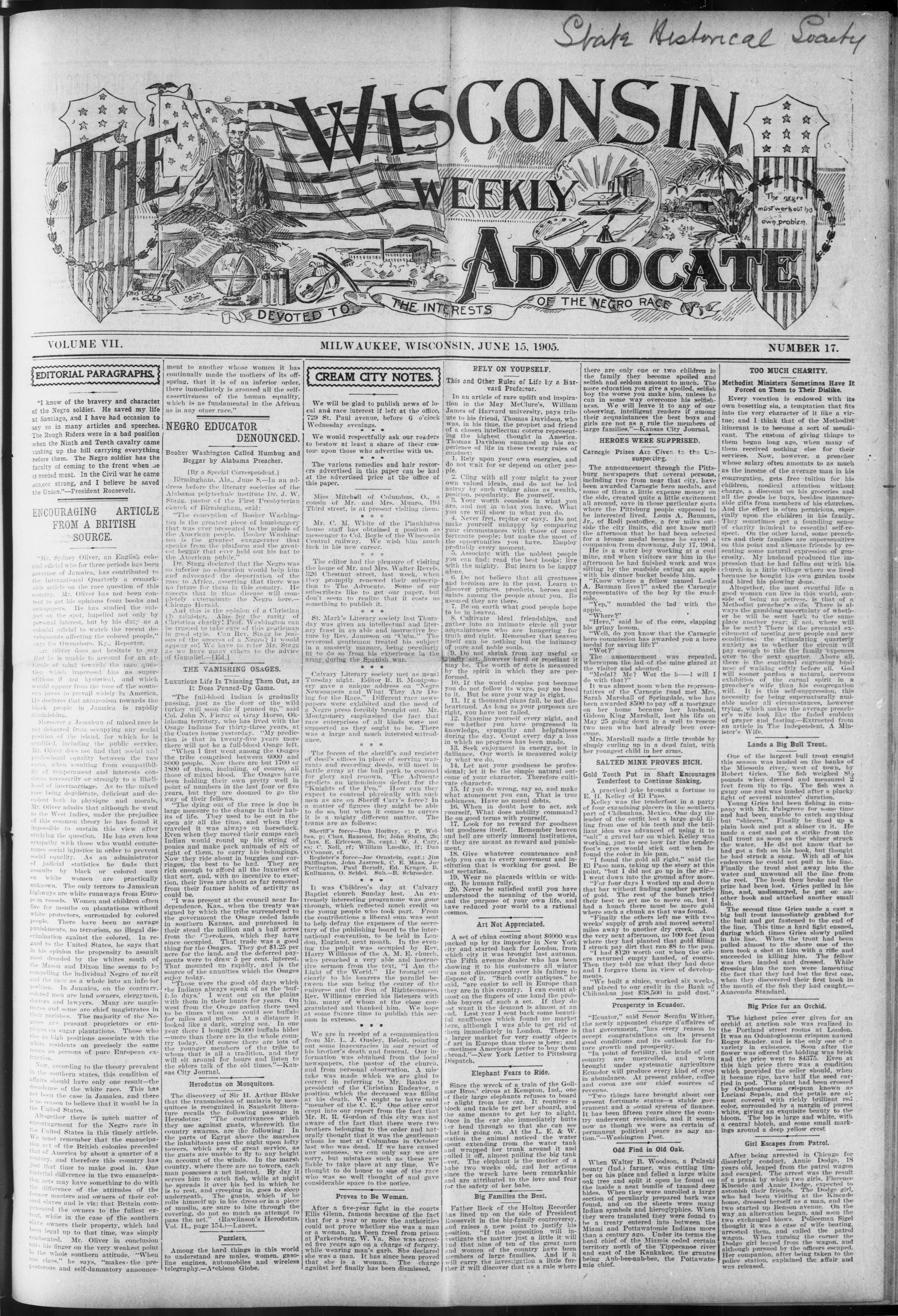
WISCONSIN
WEEKLY
ADVOCATE
DEVOTED TO THE INTERESTS OF THE NEGRO RACE
EDITORIAL PARAGRAPHS.
"I know of the bravery and character of the Negro soldier. He saved my life at Santiago, and I have had occasion to say so in many articles and speeches. The Rough Riders were in a bad position when the Ninth and Tenth cavalry came rushing up the hill carrying everything before them. The Negro soldier has the faculty of coming to the front when he is needed most. In the Civil war he came 400,000 strong, and I believe he saved the Union."—President Roosevelt.
ENCOURAGING ARTICLE FROM A BRITISH
"Mr. Sydney Oliver, an English colonial official who for three periods has been governor of Jamaica, has contributed to the International Quarterly a remarkable article on the race question of this country. Mr. Oliver has not been content to get his opinions from books and newspapers. He has studied the subject on the spot, impelled not only by personal interest, but by his duty as a colonial official to watch the recent developments affecting the colored people," says the Owensboro, Ky., Reporter.
Ar. Oliver does not hesitate to say that he is unable to account for an attitude of mind towards the race question which impressed him as superstitious if not hysterical, and which would appear from the tone of the southern press to prevail widely in America. He declares that antagonism towards the black people in Jamaica is rapidly diminishing.
Moreover a Jamaican of mixed race is not debarred from occupying any social position of the island, for which he is qualified, including the public service. Mr. Oliver does not find that social and professional equality between the two races, when resulting from compatibility of temperament and interests conduces necessarily or strongly to a likelihood of intermarriage. As to the mixed race being degenerate, deficient and decadent both in physique and morals, Mr. Oliver admits that although he went to the West Indies, under the prejudice of this common theory he has found it impossible to sustain this view after studying the question. He has even less sympathy with those who would countenance social injustice in order to prevent social equality. As an administrator of judicial statistics he finds that assaults by black or colored men on white women are practically unknown. The only terrors to Jamaican highways are white runaways from European vessels. Women and children often live for months on plantations without white protectors, surrounded by colored people. There have been no savage punishments, no terrorism, no illegal discrimination against the colored. In regard to the United States, he says that in his opinion the propensity to assault most dreaded by the whites south of the Mason and Dixon line seems to be compelling the individual Negro of merit and the race as a whole into an inferior position. In Jamaica, on the contrary, colored men are land owners, clergymen, doctors and lawyers. Many are magistrates and some are chief magistrates in their parishes. The majority of the Negroes are peasant proprietors or employees on sugar plantations. Those who rise to high positions associate with the white residents on precisely the same terms as persons of pure European extraction.
Now, according to the theory prevalent in the southern states, this condition of affairs should have only one result—the decadence of the white race. This has not been the case in Jamaica, and there is no reason to believe that it would be in the United States.
Altogether there is much matter of encouragement for the Negro race in the United States in this timely article. We must remember that the emancipation act of the British colonies preceded that of America by about a quarter of a century, and therefore this country has just that time to make good in. One material difference in the two emancipation acts may have something to do with the difference of the attitudes of the former masters and owners of their colored slaves and is viz: that Britain compensated the owners to the fullest extent, while in the case of the southern slave owners their property, which had been legal up to that time, was simply confiscated. Mr. Oliver in conclusion puts his finger on the very weakest point in the whole southern attitude. "When one class." he says, "makes the preposterous and self-damnatory announce-
ment to another whose women it has continually made the mothers of its offspring, that it is of an inferior order, there immediately is aroused all the selfassertiveness of the human equality, which is as fundamental in the African as in any other race."
NEGRO EDUCATOR
DENOUNCED.
Booker Washington Called Humbug and Beggar by Alabama Preacher.
[By a Special Correspondent.]
[By a Special Correspondent.]
Birmingham, Ala., June 8.—In an address before the literary societies of the Alabama polytechnic institute Dr. J. W. Stagg, pastor of the First Presbyterian church of Birmingham, said:
"The conception of Booker Washington is the greatest piece of humbuggery that was ever presented to/the minds of the American people. Booker Washington is the greatest exaggerator that speaks from the platform and the greatest beggar that ever held out his hat to the American public."
Dr. Stagg declared that the Negro was so inferior no education would help him and advocated the deportation of the race to Africa, asserting that there was no future for them in this country. He asserts that in time disease will completely exterminate the Negro here.—Chicago Herald.
And this is the opinion of a Christian (?) minister. Alas for the rarity of Christian charity! Prof. Washington can be trusted to take care of this gentleman in good style. Can Rev. Stagg be jealous of the success of a Negro? It would appear so! We have to refer Mr. Stagg as we have many others to the advice of Gamaliel.—[Ed.]
THE VANISHING OSAGES.
Luxurious Life Is Thinning Them Out, as It Does Penned-Up Game.
"The full-blood Indian is gradually passing, just as the deer or the wild turkey will soon die if penned up," said Col. John N. Florer of Gray Horse, Oklahoma territory, who has lived with the Osage Indians for thirty-three years, at the Coates house yesterday. "My prediction is that in twenty-five years more there will not be a full-blood Osage left. "When I first went among the Osages the tribe comprised between 6000 and 8000 people. Now there are but 1700 or 1800 of them, including, of course, all those of mixed blood. The Osages have been holding their own pretty well in point of numbers in the last four or five years, but they are doomed to go the way of their fellows.
"The dying out of the race is due in large measure to the change in their habits of life. They used to be out in the open air all the time, and when they traveled it was always on horseback. Even when they moved their camps each Indian would round up his string of ponies and make pack animals of six or eight of them, to carry his belongings. Now they ride about in buggies and carriages, the best to be had. They are rich enough to afford all the luxuries of that sort, and, with no incentive to exertion, their lives are about as far removed from their former habits of activity as could be.
"I was present at the council near Independence, Kas., when the treaty was signed by which the tribe surrendered to the government the Osage ceded lands in southern Kansas, and purchased in their stead the million and a half acres from the Cherokees, which they have since occupied. That trade was a good thing for the Osages. They got $1.25 per acre for the land, and the deferred payments were to draw 5 per cent. interest. That mounted up rapidly, and is the source of the annuities which the Osages enjoy today.
"Those were the good old days which the Indians always speak of as the 'buffalo days.' I went out on the plains with them in their hunts for years. On west from the Osage nation there used to be times when one could see buffalo for miles and miles. At a distance it looked like a dark, surging sea. In one year there I bought 28,000 buffalo hides—more than there are in the whole country today. Of course there are lots of the younger members of the tribe to whom that is all a tradition, and they will sit around for hours and listen to the elders talk of the old times."—Kansas City Journal.
Herodotus on Mosquitoes.
The discovery of Sir H. Arthur Blake that the transmission of malaria by mosquitoes is recognized in Sanskrit literature recalls the following passage in Herodotus: "The contrivances which they use against gnats, wherewith the country swarms, are the following: In the parts of Egypt above the marshes the inhabitants pass the night upon lofty towers, which are of great service, as the gnats are unable to fly to any height on account of the winds. In the marsh country, where there are no towers, each man possesses a net instead. By day it serves him to catch fish, while at night he spreads it over his bed in which he is to rest, and creeping in, goes to sleep underneath. The gnats, which if he rolls himself up in his dress or in a piece of muslin, are sure to bite through the covering, do not so much as attempt to pass the net." (Rawlinson's Herodotus, Vol. II., page 154.)—Lancet.
Puzzlers.
Among the hard things in this world to understand are mules, women, gasoline engines, automobiles and wireless telegraphy. Atchison Globe.
CREAM CITY NOTES.
We will be glad to publish news of local and race interest if left at the office, 729 St. Paul avenue, before G o'clock Wednesday evenings.
We would respectfully ask our readers to bestow at least a share of their custom upon those who advertise with us.
The various remedies and hair restorers advertised in this paper can be had at the advertised price at the office of this paper.
Miss Mitchell of Columbus, O., a cousin of Mr. and Mrs. Munro, 194 Third street, is at present visiting them.
Mr. C. M. White of the Plankinton house staff has obtained a position as messenger to Col. Boyle of the Wisconsin Central railway. We wish him much luck in his new career.
The editor had the pleasure of visiting the home of Mr. and Mrs. Walter Revels, 326 Chestnut street, last week, when they promptly renewed their subscription to The Advocate. Some of our subscribers like to get our paper, but don't seem to realize that it costs us something to publish it.
* * *
St. Mark's Literary society last Thursday was given an intellectual and literary feast in an able and instructive lecture by Rev. Jameson on "Cuba." The reverend gentleman treated his subject in a masterly manner, being peculiarly fit to do so from his experience in the army during the Spanish war.
* * *
Calvary Literary society met as usual Tuesday night. Editor R. B. Montgomery gave a unique address on "Negro Newspapers and What They Are Doing for the Race." Different race newspapers were exhibited and the need of a Negro press forcibly brought out. Mr. Montgomery emphasized the fact that race enterprises of all kinds were not supported as they ought to be. There was a large and much intersted attendance.
```markdown
```
The forces of the sheriff's and register of deed's offices in place of serving warrants and recording deeds, will meet in battle array at the ball park to contend for glory and renown. The Advocate predicts an ignominious defeat for the "Knights of the Pen." How can they expect to contend physically with such men as are on Sheriff Cary's force? In a matter of figures they might be able to do so, but when it comes to curves it is a mighty different matter. The teams are as follows:
Sheriff's force—Dan Horliyy, c; P. Welbes, p; Chas. Ramond, 1b; John Stoltz, 2b; Chas. E. Erlecson, 3b, capt.: W. J. Cary, ss; C. Noll, rf; William Luedke, lf; Dan O'Connor, cf.
Register's force—Joe Ornstein, capt.: Jim Skiffington, John Jastrock, C. E. Maas, Joe Portington, Paul Berndt, Ed. Kruger, B. Kullmann, O. Seldel, Sub.-B. Schroeder.
求求即
It was Children's day at Calvary Baptist church Sunday last. An extremely interesting programme was gone through, which reflected much credit on the young people who took part. From the contributions a liberal sum was sent to help defray the expenses of the secretary of the publishing board to the international convention, to be held in London, England, next month. In the evening the pulpit was occupied by Rev. Harry Williams of the A. M. E. church, who preached a very able and instructive sermon from the text, "I Am the Light of the World." He brought out clearly to his hearers the parallel between the sun being the center of the universe and the Son of Righteousness. Rev. Williams carried his listeners with him, many of whom at the close congratulated and thanked him. We hope at some future time to publish this sermon in extenso.
We are in receipt of a communication from Mr. L. J. Ousley, Beloit, pointing out some inaccuracies in our report of his brother's death and funeral. Our information was obtained from the local newspapers, the pastor of the church, and from personal observation. A mistake was made which we are glad to correct in referring to Mr. Banks as president of the Christian Endeavor, a position which the deceased was filling at his death. We ought to have said "member of the C. E." One other error crept into our report from the fact that Mr. R. R. Gordon of this city was not aware of the fact that there were two brothers belonging to the order and naturally thought that it was the gentleman whom he met at Columbus in October last who was dead. If we have caused any soreness, we can only say we are sorry, but mistakes such as these are liable to take place at any time. We thought to do honor to one of the race who was so well thought of and gave considerable space to the notice.
Proves to Be Woman.
After a five-year fight in the courts Ellis Glenn, famous because of the fact that for a year or more the authorities could not prove whether she was a man or a woman, has been freed from prison at Parkersburg, W. Va. She was arrested five years ago on a charge of forgery, while wearing man's garb. She declared she was a man. It has since been proved that she is a woman. The charge against her finally has been dismissed
RELY ON YOURSELF.
This and Other Rules of Life by a Harvard Professor.
In an article of rare uplift and inspiration in the May McClure's, William James of Harvard university, pays tribute to his friend, Thomas Davidson, who was, in his time, the prophet and friend of a chosen intellectual coterie representing the highest thought in America. Thomas Davidson summed up his experience of life in these twenty rules of conduct:
1. Rely upon your own energies, and do not wait for or depend on other people.
2. Cling with all your might to your own valued ideals, and do not be led astray by such vulgar aims as wealth, position, popularity. Be yourself.
3. Your worth consists in what you are, and not in what you have. What you are will show in what you do.
4. Never fret, repine or envy. Do not make yourself unhappy by comparing your circumstances with those of more fortunate people; but make the most of the opportunities you have. Employ profitably every moment.
5. Associate with the noblest people you can find; read the best books; live with the mighty. But learn to be happy alone.
6. Do not believe that all greatness and heroism are in the past. Learn to discover princes, prophets, heroes and saints among the people about you. Be assured they are there.
7. Be on earth what good people hope to be in heaven.
8. Cultivate ideal friendships, and gather into an intimate circle all your acquaintances who are hungering for truth and right. Remember that heaven itself can be nothing but the intimacy of pure and noble souls.
9. Do not shrink from any useful or kindly act, however hard or repellant it may be. The worth of acts is measured by the spirit in which they are performed.
10. If the world despise you because you do not follow its ways, pay no heed to it. But be sure your way is right.
11. If a thousand plans fail, be not disheartened. As long as your purposes are right, you have not failed.
12. Examine yourself every night, and see whether you have progressed in knowledge, sympathy and helpfulness during the day. Count every day a loss in which no progress has been made.
13. Seek enjoyment in energy, not in dalliance. Our worth is measured solely by what we do.
14. Let not your goodness be professional; let it be the simple natural outcome of your character. Therefore cultivate character.
15. If you do wrong, say so, and make what atonement you can. That is true nobleness. Have no moral debts.
16. When in doubt how to act, ask yourself. What does nobility command? Be on good terms with yourself.
17. Look for no reward for goodness but goodness itself. Remember heaven and hell are utterly immoral institutions, if they are meant as reward and punishment.
18. Give whatever countenance and help you can to every movement and institution that is working for good. Be not sectarian.
19. Wear no placards within or without. Be human fully.
20. Never be satisfied until you have understood the meaning of the world, and the purpose of your own life, and have reduced your world to a rational cosmos.
Art Not Appreciated.
A set of china costing about $6000 was packed up by its importer in New York city and started back for London, from which city it was brought last autumn. The Fifth avenue dealer who has been showing it to his customers all winter was not discouraged over his failure to dispose of it. "Such costly antiques," he said, "are easier to sell in Europe than they are in this country. I can count almost on the fingers of one hand the probable buyers of such a set. If they do not want it the demand is almost at an end. Last year I sent back some beautiful snuffboxes which found no market here, although I was able to get rid of them immediately in London. There is a larger market for very costly objects of art in Europe than there is here; and sometimes Americans prefer to buy them abroad."—New York Letter to Pittsburg Dispatch.
Elephant Fears to Ride
Since the wreck of a train of the Gollmar Bros.' circus at Kempton, Ind., one of their large elephants refuses to board or alight from her car. It requires a block and tackle to get her aboard, and the same means to get her to alight. Once in the car she immediately butts her head through so that she can see what is going on. At the L. E. & W. station the animal noticed the water spout extending from the water tank and wrapped her trunk around it and pulled it off, almost pulling the big tank over. The elephant is the mother of a babe two weeks old, and her actions since the wreck have been remarkable and are attributed to the love and fear for the safety of her babe.
Big Families the Best
Father Beck of the Holton Recorder has lined up on the side of President Roosevelt in the big-family controversy, and raises a new point to justify his position. "If the opposition will investigate the matter just a little it will find that nine of ten of the great men and women of the country have been members of large families. And if it will carry the investigation a little further it will discover that as a rule where
there are only one or two children in the family they become spoiled and selfish and seldom amount to much. The more education you give a spoiled, selfish boy the worse you make him, unless he can in some way overcome his selfishness. We will leave it to any of our observing, intelligent readers if among their acquaintances the best boys and girls are not as a rule the members of large families."—Kansas City Journal.
HEROES WERE SURPRISED
Carnegie Prizes Are Given to the Un suspecting.
The announcement through the Pittsburg newspapers that several persons, including two from near that city, have been awarded Carnegie hero medals, and some of them a little expense money on the side, created quite a little excitement all around, save in those particular spots where the Pittsburg people supposed to be interested lived. Louis A. Bauman, Jr., of Rodi postoffice, a few miles outside the city limits, did not know until the afternoon that he had been selected for a bronze medal because he saved a companion from drowning, July 17, 1904. He is a water boy working at a coal mine, and when visitors saw him in the afternoon he had finished work and was sitting by the roadside eating an apple with his dinner bucket beside him.
"Know where a fellow named Louis A. Bauman lives?" asked the Carnegie representative of the boy by the roadside.
"Yep," mumbled the lad with the apple.
"Where?"
"Here," said he of the core, slapping his grimy bosom.
"Well, do you know that the Carnegie hero commission has awarded you a hero medal for saving life?"
"Wot?"
The announcement was repeated, whereupon the lad of the mine glared at the visitor and shouted:
"Medal? Me? Wot the h-—l will I do with that?"
It was almost noon when the representatives of the Carnegie fund met Mrs. Sarah Marshall of Springdale, who has been awarded $500 to pay off a mortgage on her home because her husband, Gideon King Marshall, lost his life on May 25 going down in a well to rescue two men who had already been overcome. Mrs. Marshall made a little trouble by simply curling up in a dead faint, with her youngest child in her arms.
SALTED MINE PROVES RICH.
Gold Tooth Put in Shaft Encourages Tenderfoot to Continue Sinking.
A practical joke brought a fortune to E. H. Kelley of El Paso. Kelley was the tenderfoot in a party of four examining placers in the southern part of Chihuahua, Mexico. One day the leader of the outfit lost a large gold filling from one of his teeth and the brilliant idea was advanced of using it to "salt" a gravel bar on which Kelley was working, just to see how far the tenderfoot's eyes would stick out when he found the color in his pan.
"I found the gold all right," said the El Paso man, taking up the story at this point, "but I did not go up in the air—I went down into the ground after more.
"For four days I worked up and down that bar without finding another particle of gold. The rest of the bunch tried their best to get me to move on, but I had a hunch there must be more gold where such a chunk as that was found.
"Finally the others left me with two weeks' supply of grub and moved several miles away to another dry creek. And the very next afternoon, no 100 feet from where they had planted that gold filling I struck pay dirt that ran $8 to the pan.
"I had $120 worth out when the others returned empty handed, of course. Then they told me what they had done and I forgave them in view of developments.
"We built a sluice, worked six weeks, and placed to our credit in the Bank of Chihuahua just $38,500 in gold dust."
Prosperity in Ecuador.
"Ecuator," said Senor Serafin Wither, the newly appointed charge d'affaires of that government, "has every reason to accept congratulations on its present good conditions and its outlook for future growth and prosperity.
"In point of fertility, the lands of our country are unexcelled, and when brought under systematic agriculture Ecuador will produce every kind of crop in abundance. At present rubber, coffee and cocoa are our chief sources of revenue.
"Two things have brought about our present fortunate status—a stable government and a sound system of finance. It has been fifteen years since the country underwent revolution, and it seems now as though we were as certain of permanent political peace as any nation."—Washington Post.
Odd Find in Old Oak
When Walter B. Woodson, a Pulaski county (Ind.) farmer, was cutting timber on his place and felled a large white oak tree and split it open he found on the inside a neat bundle of tanned deer hides. When they were unrolled a large section of peculiarly prepared bark was found, and on the sheets were many Indian symbols and hieroglyphics. When they were translated they were found to be a treaty entered into between the Miami and Pottawatomie Indians more than a century ago. Under its terms the head chief of the Miamis ceded certain territory north of the Tippecanoe river and east of the Kankakee, the grantee being Aub-bee-nab-bee, the Pottawatomie chief.
NUMBER 17.
Methodist Ministers Sometimes Have It Forced on Them to Their Dislike.
Every vocation is endowed with its own besetting sin, a temptation that fits into the very character of it like a virtue; and I think that of the Methodist itinerant is to become a sort of mendicant. The custom of giving things to them began long ago, when many of them received nothing else for their services. Now, however, a preacher whose salary often amounts to as much as the income of the average man in his congregation, gets free tuition for his children, medical attention without charge, a discount on his groceries and all the goods he buys, besides innumerable gifts from members of his churches. And the effect is often pernicious, especially upon the children in his family. They sometimes get a foundling sense of charity inimical to essential self-respect. On the other hand, some preachers and their families are supersensitive on this point and alienate friends by resenting some natural expression of generosity. My husband produced the impression that he had fallen out with his church in a little village where we lived because he bought his own garden tools and hired his plowing done.
Altogether, the most eventful life a good woman can live in this world, outside of being an actress, is that of a Methodist preacher's wife. There is always the gambling uncertainty of whether he will be sent back to the same place another year; if not, where will he be sent? There is the preennial excitement of meeting new people and new conditions; the stimulating quarterly anxiety as to whether the circuit will pay enough to tide the family expenses over to the next quarter. Above all, there is the continual engrossing business of walking softly before all. God will sooner parlon a natural, nervous exhibition of the carnal spirit in a preacher's wife than his congregation will. It is this self-suppression, this necessity for being supernaturally amiable under all circumstances, however trying, which makes the average preacher's wife look like the faded emblem of prayer and fasting.—Extracted from an article in The Independent, A Minister's Wife.
Lands a Big Bull Trout.
One of the largest bull trout caught this season was landed on the banks of the Missoula river, west of town, by Robert Gries. The fish weighed 81 pounds when dressed and measured 2 feet from tip to tip. The fish was a gamy one and was landed after a plucky fight of several minutes' duration.
Young Gries had been fishing in company with Mr. Palsgrove for some time and had been unable to catch anything but "shiners." Finally he fixed up a plain hook and put a shiner on it. He made a cast and got a strike from the bull trout as soon as the shiner struck the water. He did not know that he had got a fish on his hook, but thought he had struck a snag. With all of his endeavors he could not pull in his line. Finally the trout shot away into the water and unwound all the line from the reel. The hook then broke and the prize had been lost. Gries pulled in his line, and, undismayed, he put on another hook and attached another small fish.
The second time Gries made a cast a big bull trout immediately grabbed for the bait and got fastened to the end of the line. This time a hard fight ensued, during which times Gries slowly pulled in his line. When the trout had been pulled almost to the shore one of the men took a shot at him with a rifle and succeeded in killing him. The fellow was then landed and dressed. While dressing him the men were lamenting the fact that they had lost the first one, when they discovered their first hook in the mouth of the fish they had caught.—Anaconda Standard.
Big Price for an Orchid.
The highest price ever given for an orchid at auction sale was realized in the Portland street rooms at London. It was an Odontoglossum crispum named Roger Sander, and is the only one of a variety in existence. Soon after the flower was offered the bidding was brisk and the price went to $4375. Even at this high price there was a condition which provided the seller should, when it became ripe, have half the seed carried in pod. The plant had been crossed by Odontoglossum crispum known as Luciani Sepals, and the petals are almost covered with richly brilliant red color, surrounded by a margin of purest white, giving an exquisite beauty to the bloom. The lop is large and white, with a central blotch, and some small markings around a deep yellow crest.
Girl Escapes from Patrol.
After being arrested in Chicago for disorderly conduct, Annie Dodge, 18 years old, leaped from the patrol wagon and escaped. The arrest was the result of a prank by which two girls, Florence Kincade and Annie Dodge, expected to astonish their friends. The Dodge girl, who had been visiting at the Kincade home, dressed herself as a man, and the two started up Benson avenue. On the way an altercation began, and soon the two exchanged blows. Policeman Sigel thought it was a case of wife beating, arrested them, and called the patrol wagon. When turning the corner the Dodge girl leaped from the wagon, and although pursued by the officers escaped. Her companion, after being taken to the police station, explained the affair and was released.
The Ruling Passion.
The ruling passion is often very strong in death. A senator from Tennessee discovered this some years ago. Among his constituents was a certain man who came to him regularly twice a year for the purpose of obtaining a pass to Baltimore. The man and his family had served the senator when he was first making his way up the ladder of politics, and as a result of this he always obliged him, and had, moreover, a soft place in his heart for the man. He obtained for him a position in one of the departments at Washington; but this did not seem to be enough, for regularly at the end of each six months he applied for his ticket to Baltimore. One day he sickened and was reported to be dying. The senator, very much grieved, immediately called upon him.
"Joe," he said, leaning over and speaking very softly, "is there anything I can do for you?" The sick man looked up with a flash of recognition, and instantly replied in a whisper, "Yes, senator; please get me a pass to Baltimore."—Harper's Weekly.
It Pays to Read Newspapers
Cox, Wls., June 12.—Frank M. Russell of this place had Kidney Disease so bad that he could not walk. He tried Doctors' treatment and many different remedies, but was getting worse. He was very low. He read in a newspaper how Dodd's Kidney Pills were curing cases of Kidney Trouble, Bright's Disease and Rheumatism, and thought he would try them. He took two boxes, and now he is quite well. He says: "I can now work all day, and not feel tired. Before using Dodd's Kidney Pills, I couldn't walk across the floor."
Mr. Russell's is the most wonderful case ever known in Chippewa county. This new remedy—Dodd's Kidney Pills is making some miraculous cures in Wisconsin.
ORIGINAL COMMISSION FOUND.
Copy of John Paul Jones' Appointment as Captain Discovered.
Secretary Morton recently received information that the original commission of John Paul Jones as a captain in the navy has been located in Philadelphia and he will initiate an effort to obtain it for the navy department. The commission, a copy of which was forwarded to Washington, D. C., reads:
John Paul Jones is appointed to be:
captain in the navy. By order of:
Congress.
JOHN HANCOCK, President.
Attest: Charles Thompson.
Philadelphia, Oct. 10, 1779.
According to the secretary's informant the commission has every appearance of being genuine. It is now in the possession of a prominent woman of Philadelphia, who received the document from her mother, into whose possession it had come from her father, Commodore Guiett Gansevoort, U. S. N., who in turn had received it from his father, Gen. Peter Gansevoort of revolutionary fame. If the document can be purchased from its present owner it will be carefully preserved and placed on exhibition in the navy department library.
Drink Sends Him Back.
Because he persists in getting drunk, Frank Cripe, after twelve years of freedom on parole, was returned from Goshen, Ind., to Michigan City prison this evening to serve the balance of his life in prison. Cripe was sent up for the murder of Michael Self, a night watch. Because he was drunk when he killed Self the jury fixed his punishment for life. That was twenty-two years ago. In 1893 Cripe was paroled upon his pledge to abstain from drinking. He was repeatedly arrested here for drunkenness, and upon his last arrest a few weeks ago and later indictment by the grand jury it was decided by Gov. Hanly to return the paroled man to prison. Every powerful influence was exerted to save the prisoner, and personal appeals were made to Gov. Hanly, but without avail.
Golfer Kills Bird.
F. M. Paul, a member of the Forest Hill Field club and a golf enthusiast, shattered one of the most stringent paragraphs in the New Jersey game law. Mr. Paul was playing with J. Howell. When they arrived at the home tee Mr. Paul began to practice driving. Making a terrific swing he sent the ball high into the air. It landed 200 yards away. Mr. Paul's caddie saw a bird fluttering, ran up and found a robin dying, struck by the ball.
FEED YOUNG GIRLS.
Must Have Right Food While Growing.
Great care should be taken at the critical period when the young girl is just merging into womanhood that the diet shall contain all that is upbuilding, and nothing harmful.
At that age the structure is being formed, and if formed of a healthy, sturdy character, health and happiness will follow; on the other hand, unhealthy cells may be built in and a sick condition slowly supervene which, if not checked, may ripen into a chronic disease and cause lifelong suffering.
A young lady says:
"Coffee began to have such an effect on my stomach a few years ago, that I was compelled to quit using it. It brought on headaches, pains in my muscles, and nervousness.
"I tried to use tea in its stead, but found its effects even worse than those I suffered from coffee. Then for a long time I drank milk alone at my meals, but it never helped me physically, and at last it palled on me. A friend came to the rescue with the suggestion that I try Postum Coffee.
"I did so, only to find at first, that I didn't fancy it. But I had heard of so many persons who had been benefited by its use that I persevered, and when I had it brewed right found it grateful in flavor and soothing and strengthening to my stomach. I can find no words to express my feeling of what I owe to Postum Food Coffee!
"In every respect it has worked a wonderful improvement—the headaches, nervousness, the pains in my side and back, all the distressing symptoms yielded to the magic power of Postum. My brain seems also to share in the betterment of my physical condition; it seems keener, more alert and brighter. I am, in short, in better health now than I ever was before, and I am sure I owe it to the use of your Postum Food Coffee." Name given by Postum Co., Battle Creek, Mich. There's a reason.
The Silent Rubinstein.
In a biography of Sir Herbert Oakley is told an anecdote showing Rubinstein's disinclination to talk. The incident happened in the smoking room of a Glasgow hotel in 1877, when the great pianist was making a Scottish tour. After waiting vainly for an hour for the great man to direct the conversation, Rubinstein's companion asked:
"Do you like Wagner?"
"He is not goot," responded the pianist succinctly.
Abashed, the other waited another half hour before daring to break the silence.
"How about Beethoven?"
"He is goot!"
Nearly an hour dragged along after this venturesome inquiry, and then the Scotchman, in desperation, said:
"I must be going to bed now!"
"Ton't go," said Rubinstein with evident sincerity, "I have so much enjoyed your gonversation!"—Everybody's.
Shooting a Tiger Wolf.
A gentleman residing at Glenconnor a few evenings ago took up a position in the bush in the hope of potting a "buck." and hid himself near a bush path on a hillside. Suddenly he heard a rustling noise in the bush, and, raising his head a few inches from the ground, he perceived a dark object stealthily approaching him from the direction of the hill. In order to be ready for all possible contingencies he drew and cocked his weapon. The dark object crept nearer and nearer, and as its shape grew more distinct the waiting sportsman saw that it was not that of a man, but of a wild beast.
When within half a dozen yards it sprang straight at him. The rifle flashed, and while the brute was yet in the air the bullet found its mark. The marauder proved to be a splendid specimen of the "tiger wolf," or spotted hyena, and measured 3 feet 6 inches without the tail.—Alice Times.
Sherman's Wounded Soldier
The late Gen. Sherman was one of the men who haunted the cloakrooms of the House and Senate, hungry for a good story of any kind. It is needless to say that he himself contributed largely to the general fund. One day he related the story of a soldier who had made a great ado concerning a slight wound. He was brought before the general, moaning and going on like a man who was on the brink of the grave. Sherman had the bandages removed from the wound and glancing at it in a skeptical manner, exclaimed, in his inimitable manner: "Why, captain, they came d—n near missing you!"—Harper's Weekly.
Wasted Energv.
Sometimes head and heels work well together, but it was not so in a case reported in the Yonkers Statesman. Sam, a colored man, was an hour late, and his employer asked him to explain.
"Yes, sah, I'll explain sah," Sam replied.
"Well, what excuse have you?"
"I was kicked by a mule on my way here, sah."
"That ought not to have detained you an hour, Sam, if you were able to come at all."
"Well, it wouldn't have if he'd only kicked me in dis direction. You see, boss, he kicked me de other way."
Nerve of Sparrows.
The nerve of the sparrow is well known, and their nests are often found in places which are much more exposed than spots other birds would select. The record in that respect seems to be held by a pair of sparrows who have built a nest in the side of a warehouse in Philadelphia. Less than 6 inches above the nest is the exhaust pipe from a gas engine, which bangs away several times each minute. Undisturbed by the racket, the female sparrow is rearing a brood of fledglings, while her mate faithfully attends to the supplying of food.
New Sounding Apparatus.
A leadless sounding apparatus has been invented by a Norwegian engineer named Bergraff. The underlying principle is one of acoustics, involving the propagation of a sound wave from the vessel to the bottom of the sea and back and the measurement of the time required for this. The progress is really the measurement of the time between the making of the sound and the receipt of the echo sent back from the ocean's floor. Both the sending of the sound and the registering of the receipt are done by electrical apparatus.
Chicken Has Four Legs.
Sergt. John Couch of the Memphis police department has a remarkable freak in the way of a chicken. The fowl is of the frying size and has four well developed legs and two tails. It was hatched at Rutherford, in Gibson county, Tenn., a few weeks ago. The rooster uses the two front legs in walking. The four legs begin at the body and are of the same size, but only the foremost two are used in walking. The two tails are both of the same size.
In Russia.
"Be very careful that you do not speak hastily," the Russian priest admonished a class of little boys, "you can seldom tell what will be the end of a word."
One small member looked disgusted and doubtful.
"As if," he afterward explained to his comrades, "you wouldn't know it nine cases out of ten the end of the word would be 'sky.'"—New Orleans Times-Democrat.
An Irish Bull.
One day an English gentleman met Pat and at once got into conversation with him. "Well, Pat," he said, "I have often heard of an 'Irish bull,' can you tell me what it is?" "Well, sir," replied Pat, "you see those seven cows standing up by that tree; well, the one lying down is an Oirish bull."—Glasgow Times.
Now. Did You Ever!
The old gentleman had just stepped into the crowded train and had accidentally trodden on Algy Fitzgerald's foot.
"Confound you, you careless old buffaw!" cried Algy. "You've crushed my foot to a jelly!"
"Ah!" said the old man calmly. "Calf's foot jelly, I suppose!"—London Tit-Bits.
True Hospitality.
An Atchison saloon keeper is well known for his politeness. It is said that two drunken men went into the saloon and got into a fight. The saloon keeper sent for the patrol wagon, and as the men were being loaded into the wagon the polite saloon keeper said: "Well, call again, boys."—Atchison Globe.
Korean Method of Reform
An aged Korean councillor of state, who is a strong reformer, Choi-Ik-yen has been sitting outside the palace gate for five days, and proposes to sit there until needed reforms are carried out. Shanghai Herald.
—Touched by the complaint that hundreds of geniuses are unable to get a chance on the stage, the manager of the Empire theater. Hackney, London, has offered to give anybody a show for five minutes on a set day. He has received hundreds of applications. The most interesting is from a man, who writes: "I wish you would let me try my great carbonic acid gas experiment upon the audience."
A NEW POET
And selling of the soul for phantom fame;
And reek of praises where there should be
blame;
A sound of singing in the air:
The love song of a man who loves his fellow
men;
Mother-love and country-love, and the love
of sea and fen;
They said there were no more singers,
But listen!—a master voice!
A voice of the true joy-bringers!
Now will ye heed and rejoice
Or pass on the other side,
And wait till the singer hath died,
Then weep o'er his voiceless clay?
Friends, beware!
A keen, new sound is in the air.—
And know a new poet's coming is the old
world's judgment day!
—Richard Watson Gilder in Atlantic.
A BLACK SHEEP.
"Jim, here's a visitor to see you," said the jailer. Jim Pitts sprang up and stared through the bars. The visitor grasped the prisoner's hands and exclaimed: "Oh, James, James!" Sorrow was written in every line of the visitor's face; the countenance of the one in the cell was sullen.
"Hello, Ab," said the prisoner. The men eyed each other a moment. The jailer felt that he must say something. "Any one would know you: were brothers," said he. "You are enough alike to be twins." The prisoner seemed embarrassed, coughed and replied: "Yes, we do resemble; the whole family does, but"—He looked at the floor. "But reckon I'm the black one of the flock." Then, turning to his brother, he asked: "How did you leave everybody at home, Ab?" The Rev. Abner Pitts was so overcome that he could not reply at first. He pressed a handkerchief to his eyes and leaned against the bar, sobbing. The jailer moved away.
"They are all heartbroken, but mother, and she—she doesn't—know, James," said the preacher, trying to suppress his emotion.
Tiger-like, Jim Pitts began to pace his cell. There was no sign of remorse on his face. Once he glanced at his brother with an expression of disdain, then he stopped and said:
"What did you come for?"
"I came to look after your soul's salvation, James," replied the other. "I came to pray with you and offer you the consolation of my religion."
"Why didn't you go to see the governor and ask him to commute my sentence? That's what I wrote you for; that's what I wanted you to do."
"That would have done no good, James," said the brother. "Your crime has put you beyond the pale of earthly clemency. James, you can only look to heaven now, and think of your immortal soul!" "You might have got a respite for me; that would have given me some chance to think about religion. It's only eight days now. Tomorrow night they will put on the—the death watch!" The word caused his brother to shudder; he lifted the handkerchief to his eyes again.
The jailer came and let Abner into the cell. It was night. The brothers, who had not seen each other before in years, sat close together talking in undertones. By the light that shone in from the corridor Abner read from his Bible. He sought out passages of Scripture that might have borne upon his wayward brother's life.
"But if any man walk in the night, he stumbleth, because there is no light in him."
Hours went by as they sat together. The jail was as quiet as a tomb. Abner knelt to pray, his brother beside him. The preacher poured out his anguish in an inspiring plea for the one who was in the shadow of the gallows. He prayed with a fervor that he had never felt before. He was led on by the force of his own eloquence; his mind transcended his surroundings; his voice fell to a whisper, and he pleaded on.
Suddenly Abner felt a rough hand on his shoulder. He opened his eyes, the prayer still on his lips. Jim was bending over him with a fiendish look on his face.
"Keep quiet or I'll strangle you!" muttered the prisoner.
Abner Pitts sank back speechless, his face deathly white.
Jim leaned close to him and said: "Do you want to save my soul?"
The preacher's lips were quivering, but he made no reply.
"I'm going out of this jail tonight, dead or alive," said Jim. "I don't want to kill you and I don't want to kill any of the guards if I can help it; but I'm going out, dead or alive. Ab, if you mean any of the things you have said to me tonight, and you want to save my soul, this is your chance. I've got two of those bars, sawed nearly in two, and it won't take me ten minutes to finish the job. I'm going out, I say, and if you want me to go free and start life over again, you go on praying and keep quiet!"
A thousand things passed through the preacher's mind, but he was helpless. He fell forward, burying his face in his hands, and went on praying.
Jim crawled across the floor, and taking a wire saw from his shoe began the task that he had labored at so hard for many nights. First the saw passed through the soap that hid the tiny crack in the bar, then with a stealthy sound, like the gnawing of a mouse, it ate into the hard metal. The desperate man's hand flew back and forth almost with the rapidity of lightning, while the sweat that streamed from his face glittered on the iron. With a click the saw passed through the bar, and the sound aroused the white faced man who was kneeling in the corner of the cell.
Abner raised his head and the gaze of the brothers met. The preacher started to get on his feet, but the murderer was at his side in an instant.
"Ab, I'll kill you like a dog if you move or make a noise!" Jim growled in a hoarse whisper. "Do you want them to hang me and send my soul to hell, or
do you want me to go out of here and live an honest life? You know I never had any show. I got started wrong. Everybody said I was the black one. Give me a show, Ab; if you don't, there will be murder at your own door!" Abner put his hand on his brother's arm and tried to draw him closer that he might plead with him, but Jim pushed him away.
Now the saw was plied vigorously to the other bar, and in a few minutes Jim Pitts began the final preparations for escape. With almost superhuman strength he bent the bars aside, leaving an opening that seemed scarcely large enough for a child to crawl through. Standing up, the murderer drew off his shirt and rubbed soap on his bare arms and shoulders. His muscular body glistened in he dim light that filtered into the cell.
As Abner stared up from the corner where he was kneeling, he saw his brother standing over him like some infernal apparition. He stood up and faced the desperate prisoner. They were breathing hard and glaring at each other. Abner was about to cry out when Jim caught him in a tight embrace. The murderer jerked the handkerchief from his brother's pocket and drew it tightly across his mouth; the preacher was gagged. In another minute Abner was stripped of his coat and his hands were bound behind him with a sheet from the cell bunk.
Now Abner lay upon the floor watching the movements of his brother. Jim crawled to the bars and listened, panting like a hunted animal. He thrust Abner's coat, hat and Bible out, then he slowly worked his body through the breach in the iron cage. Abner saw the crouching prisoner's shadow dimly outlined against the dark walls of the cell, then it vanished.
The preacher writhed upon the floor and struggled hard, but he could not free himself or cry out. His soul was filled with anguish, and the text, "But if any man walk in the night," ran through his mind. He closed his eyes in a torrent of tears and prayed in silence.
At dawn Jim Pitts walked past the guard at the prison door with a Bible in his hand.—Wade Mountfortt in Kansas City Star.
TIGERS A PUBLIC MENACE
Savage Beasts Kill People and Stock in Mexican Territory.
Tigers, driven from their mountain lairs in the territory of Tepic by the scarcity of food, continue to ravage the haciendas of the valleys. They are becoming such a general danger that the municipal authorities have offered a reward of $10 for every tiger's skin. For several months great numbers of the animals have swarmed through the marshes of the lowlands along the coast and in the valleys of the territory of Tepic, having been driven out of the states of Sinalos and Sonora by the floods and the extremely cold weather. The damage caused to the haciendasdos and the danger incurred by the presence of the animals was such that many of them offered rewards for the skins of the animals some time ago.
The tigers, however, seem to like the warm weather and the good food that they are getting in Tepic, and instead of decreasing their numbers have greatly increased within the last few weeks. Now the municipal authorities of the territory have also offered a reward for the skins of the animals. The tigers have become so bold that they will enter the houses on the plantations and help themselves to whatever comes in their path. Several deaths are reported in different parts of the territory. In many sections of the state it is necessary to have armed guards stationed at night, to insure the safety of the other people in the settlements.
Live stock is suffering more than anything else.* With the slight provisions that are necessary for the shelter of stock it leaves them in most cases without any protection at all from the beasts. Even the presence of numerous guards around a bunch of cattle is oftentimes insufficient to keep the tigers from getting away with an animal or two from along the edges of the herd.
Hunting for the animals has been greatly stimulated by the offer of the government and scores of hunters are scouring the country for them. The number of the skins that have been turned in thus far is large, and it is hoped that it will not be long before the animals are driven back to the seclusion of the mountains.—Mexican Herald.
And the Man Died.
A reader at the Bibliotheque Nationale has dug up the prescriptions for medicines which were ordered to Prince Conde in his last illness. A consultation of three physicians prescribed "a syrup made of rice, marshmallow roots and sugar candies," and a blister to be applied night and morning. The distinguished patient failed to improve and a fourth doctor was called in, who ordered "two ounces of a preparation of hyacinths to fortify the heart and repair the exhausted forces," followed by "poppy water," "syrup of stag horns," "ipecachuana," "liquorice" and "mistletoe roots." The prince lived through this treatment for six months, when he died, according to the death certificate, "of the malady from which he was suffering." It doesn't make any difference now, but it is natural to hope he didn't die of anything worse.
She Advocates Chinese Diet.
If the efforts of Miss Alice M. Fuller, lecturer on domestic science, are successful the principles of Chinese cookery will soon be introduced into American culinary art, and this nation rescued from the throes of dyspepsia. Miss Fuller recently gave to her pupils in the high schools in Union Hill, N. J., an illustration of the digestible character of mushroom chop suey, foo yan don and gem get at a banquet at a Chinatown restaurant. "Chinese dishes," said Miss Fuller to the New York Herald, "are combinations of the most digestible food put together so that all the nutritive properties are easily assimilated. Many vegetables used by the Chinese have been imported and are being grown on a great farm on Long Island owned by a Chinese company."
To Tall to Attend School
Lena Ober, 14 years old, was in the Essex Market court. New York city, to explain why she did not attend school as required by the rules of the board of education. She is 6 feet tall. When asked what she had to say Lena replied: "It am too tall, judge, your honor. The children in the fourth grammar grade class, in which I would be, are small, and they make fun of me. This humiliates me so I quit going to school. I can't help being tall." Even the magistrate smiled. "Well," said he, "I can only advise that you attend school in spite of your troubles. Make the best of it and forget your size, and all will come out right."
He was one of the brightest men and fiercest booze fighters that this community ever had.—Belleville Freeman.
GET BUSY.
There's a saying oft you've heard,
Get busy.
'Tis a good and timely word
Get busy.
Don't sit 'round and knock and pine
'Cause you fear you're not in line,
You can yet there, jes' by tryin',
Get busy.
Fate, you say, has been unkind,
Get busy.
This old dame leave far behind,
Get busy.
Life, my friend, is up to you,
Not what others say or do,
Jes' keep smilin', don't look blue,
Get busy.
Tricks are being won each day,
Get busy.
By the fellers who can "stay,"
Get busy.
Don't give up and cry "no show,"
'Cause the hand you hold is low,
Draw again, you'll make 'er go,
Get busy.
If the team is in bad luck,
Get busy.
If you knock you'll sure get stuck,
Get busy.
Hit 'er hard, you're bound to win,
Down the line with snap and vim,
Ginger up and get the tin.
Get busy.
If in business ply your trade,
Get busy.
Fortunes are not won, but made,
Get busy.
Let the trade know you're in town,
Always up and never down,
Why get sore and whine aroun',
Get busy.
Hardly matters what you're doin',
Get busy.
'Tis no use to keep a-stewin',
Get busy.
Have the grit and push and snap,
Fortunes will roll in your lap,
You will win while others nap,
Get busy.
—Des Moines Register and Lea
New York Every Day.
Joseph H. Choate, former ambassador to Great Britain, Mrs. Choate and Miss Choate were passengers on the steamer Caronia, which arrived from Liverpool.
Senator William B. Allison, Congressman Robert G. Cousins of Iowa and Mrs. Paul Morton, wife of the secretary of the navy, and Miss Morton, sailed for Europe on the steamer New York.
The Northern Indiana Baptist association voted down a resolution introduced by Rev. Mr. Wheeler of Elkhart, decrying the criticism of John D. Rockefeller and declaring that the oil king is highly moral.
Leo Fleischman, the navy boy from New York, who was discovered as an enlisted hospital apprentice at the Norfolk naval training station after his parents had spent over $10,000 in an unsuccessful effort to locate him, has been discharged from the navy.
Sarah Cowell Lemoyne, an actress, filed a petition in bankruptcy, with liabilities at $4662, and no available assets. She had a gold watch valued at $50 and a deposit of $8 in the Second National bank. Her debts were for costumes, photographs and household expenses.
A young woman whose name is believed to have been Leah Leitman, jumped to death from the Long Island Sound steamer Hartford, from Hartford, Conn., while the vessel was passing through Hell Gate, inward bound. No reason for the girl's suicide is known to her friends in Hartford.
The Herald says Richard Croker will return to New York early in September with Mrs. Croker and their three children who are now visiting him on his Irish estate near Dublin. The time of his arrival, which henceforth is to be his home for a part of each year, will be coincident with the real opening of the mayoralty campaign.
A will contest involving between $7,000,000 and $8,000,000 is said to be among the possibilities before the estate left by Mrs. Charity Hayward of California is settled. Mrs. Hayward, who died in Newark, was said to have made a will leaving all her property to her only child, Mrs. Emma Rose of New York city. It is now claimed that a new paper is in existence making great changes in the distribution of the estate.
Ernesto Biondi, the Italian sculptor, lost his suit against the trustees of the Metropolitan Museum of Art to recover $20,000 damages because of their refusal to exhibit his bronze group "The Saturnalia" in the museum. Biondi said Gen. Di Cesnola, curator of the museum, had agreed to its exhibition. The group was subjected to much criticism, some of the trustees declaring it to be morally unfit for public exhibition, and it was consigned to the cellar.
Subway traffic nowadays seems to be confined largely to those who come from out of town. The air in the shafts is positively putrid, and Mr. Belmont has given no promise that it will be improved by a system of ventilation. To stand near a subway entrance these days is to invite contagion. The air coming from the shafts is like unto that which is uttered from the drain pipes of a fertilizing plant over on the west coast of the Hudson river in darkest New Jersey.
The New York Telephone company's quarterly telephone directory, just issued, contains over 200,000 names, about 125,000 of which are of subscribers in Manhattan and the Bronx. This is a net gain of 15,000 within the last three months. The new directory represents thirty-one carloads of paper, about 500 tons, which was shipped to the printers in Philadelphia. After the books were printed, bound and packed it required twenty freight cars to bring them to New York.
Rear Admiral Colby N. Chester, superintendent of the naval observatory, hoisted his flag on the cruiser Minneapolis, which, with the gunboat Dixie and the collier Caesar, will be a part of the expedition which is to observe the eclipse of the sun on August 29 and 30 for the government. Stations will be established at Bona, Algieria, and Valencia, Spain. One of these will be in charge of Capt. John A. Morris and the other of Prof. Bigelow of the weather bureau.
A handsomely dressed woman, who said she was the niece of a prominent official, is under arrest, charged with grand larceny, it being claimed that she has stolen jewerly valued at $4000. The woman gave her name to the police as Miss Antoinette Cortelyou. At the same time she was arrested the detectives also placed under arrest her colored maid, Ruth Bundy. The complainant against the two women is Mrs. Dorothy Auerbach, who told the police that she called on Miss Cortelyou, whom she had known for five years, and that on returning home she found that jewelry valued at $4000 had been abstracted from her chatelaine bag, which she left in Miss Cortelyou's room while she went to ure a telephone.
NAMES BEST DOCTOR
MR. BAYSSON PUBLISHES RESULTS OF VALUABLE EXPERIENCE.
A Former Pronounced Dyspeptic He Now Rejoices in Perfect Freedom from Miseries of Indigestion.
Thousands of sufferers know that the reason why they are irritable and depressed and nervous and sleepless is because their food does not digest, but how to get rid of the difficulty is the pnzzling question.
Good digestion calls for strong digestive organs, and strength comes from a supply of good rich blood. For this reason Mr. Baysson took Dr. Williams' Pink Pills for the cure of indigestion.
"They have been my best doctor," he says. "I was suffering from dyspepsia. The pains in my stomach after meals were almost unbearable. My sleep was very irregular and my complexion was sallow. As the result of using eight boxes of Dr. Williams' Pink Pills, about the merits of which I learned from friends in France, I have escaped all these troubles, and am able again to take pleasure in eating."
A very simple story, but if it had not been for Dr. Williams' Pink Pills it might have been a tragic one. When discomfort begins with eating, fills up the intervals between meals with pain, and prevents sleep at night, there certainly cannot be much pleasure in living. A final general breaking down must be merely a question of time.
Mr. Joseph Baysson is a native of Aix-les-Bains, France, but now resides at No. 2439 Larkin street, San Francisco, Cal. He is one of a great number who can testify to the remarkable efficacy of Dr. Williams' Pink Pills in the treatment of obstinate disorders of the stomach.
If you would get rid of nausea, pain or burning in the stomach, vertigo, nervousness, insomnia, or any of the other miseries of a dyspeptic, get rid of the weakness of the digestive organs by the use of Dr. Williams' Pink Pills. They are sold by druggists everywhere. Proper diet is, of course, a great aid in forwarding recovery once begun, and a little book, "What to Eat and How to Eat," may be obtained by any one who makes a request for it by writing to the Dr. Williams Medical Co., Schenectady, N.Y. This valuable diet book contains an important chapter on the simplest means for the cure of constipation.
Gloves and Microbes
It was noticed in Paris when King Edward was there that he always appeared in public with his right hand gloved, but not his left. As it is a common practice to carry the right glove loose and not the left, much speculation has been excited by the King's reversal of the custom. One learned writer suggests that it is due to a sound perception of hygienic propriety. The object of a glove, he says, is not to adorn but to protect the hand. Which hand has the more constant employment and is therefore brought into closer contact with microbes? Why, the right hand. It follows that in keeping that hand gloved the King shows his unfailing sense. Vive le Roi!—London Chronicle.
Bailway Rate Legislation.
At the biennial convention of the Order of Railway Conductors, recently held at Portland, Ore., resolutions were unanimously adopted voicing their sentiments as to the effect of proposed railway rate legislation on the 1,300,000 railroad employes, whom they in past represented. These resolutions "indorse the attitude of President Roosevelt in condemning secret rebates and other illegalities, and commend the attitude of the heads of American railways, who, with practical unanimity, have joined with the President on this question." They then respectfully point out to Congress the "inadvisability of legislation vesting in the hands of a commission power over railway rates, now lower by far in the United States than in any other country," because such regulation would "result in litigation and confusion and inevitably tend to an enforced reduction in rates, irrespective of the question of the ability of the railroads to stand the reduction, especially in view of the increased cost of their supplies and materials." They further protested against such power being given to the present Interstate Commission because "the proposed legislation is not in harmony with our idea of American jurisprudence, inasmuch as it contemplates that a single body shall have the right to investigate, indict, try, condemn and then enforce its decisions at the cost of the carriers, pending appeal, which is manifestly inequitable."
The conductors base their demand for only such legislation, if any, as would "secure and insure justice and equity and preserve equal rights to all parties concerned" on the ground that the low cost of transportation "is the result of the efficiency of American railway management and operation which have built up the country through constant improvement and development of territory, while at the same time recognition has been given to the value of intelligence among employees in contrast to foreign methods, where high freight rates and lowest wages to employees obtain."
In pressing their claim against legislation adverse to their interests, they point out the fact that "the freight rates of this country average only 2 per cent of the cost of articles to the consumer, thus making the freight rate so insignificant a factor in the selling price that numerous standard articles are sold at the same price in all parts of the country."
Arson for Revenge
Because his wife had sued him for a divorce, John S. Vance of Cyanile, S. D., set fire to their little home, burning it to the ground, and then killed the family cow. Vance pleaded guilty to arson in the fourth degree and was given a year in prison. To the sheriff Vance admitted burning the house and said he killed the cow because it was the only eyewitness to the crime.
---
In Clad Weather.
I do not know what skies there were,
Nor if the wind was high or low;
I think I heard the branches stir
A little when we turned to go;
I think I saw the grasses sway
As if they tried to kiss your feet—
And yet it seems like yesterday,
That day together, sweet!
I think it must have been in May;
I think the sunlight must have shone;
I know a scent of springtime lay
Across the fields; we were alone.
We went together, you and I;
How could I look beyond your eyes?
If you were only standing by
I did not miss the skies!
I could not tell if evening glowed,
Or neonday heat lay white and still
Beyond the shadows of the road;
I only watched your face until
I knew it was the gladdest day,
The sweetest day that summer knew—
The time when we two stole away
And I saw only you!
Mothers' Mistakes.
Pure unselfishness in mother frequently develops great selfishness in their children. A pathetic example of this fact is given in a letter incorporated in an article written by Mrs. Theodore W. Birney for The Delineator. Mrs. Birney, as the honorary president of the National Congress of Mothers, receives many appeals from mothers. The one referred to is a woman who gave up all outside obligations and devoted herself entirely to her children in order to give the older ones the advantages of music, school, etc., only to find that after expending everything possible on the older ones, they developed great selfishness and left the younger ones to earn their own living, lacking education and opportunities for culture, two of the girls being forced into the vocation of clerking as early as 15 or 16 years of age. This woman writes that she has "lived more for the children than with them," and asks for some comment upon her mistakes.
Referring to this confession. Mrs. Birney says that in the phrase "I have lived more for the children than with them." the writer makes the strongest possible commentary of her "mistakes," and adds: "Had she lived with her children she would have had opportunities of noting and checking faults and tendencies which she either overlooked or took for granted in her manifold activities for their material welfare and encouragement
"One of the most touching things in life, and also one of the most inspiring, is the wonderfully developed quality of self-sacrifice in maternal love, and yet still finer and nobler is mother love tempered with justice. The latter kind of love may not at first appeal to our emotional nature, but its results surely command our admiration. To be just to children means not only that they shall be tenderly loved and wisely guided, but that they shall be allowed the opportunity to develop into strong and good men and women. They are hindred in such development if they are prevented through a mistaken sense of kindness co-operation with their parents, so far as is practicable, in all that goes toward the making of a happy home.
I have known whole families deprived of many legitimate little comforts and pleasures through the desire of a fond and ambitious mother to have her daughter study some accomplishment for which she had not the slightest degree of talent, but which the mother hoped might be the means of opening some social avenue for her. Only genius, or perseverance so marked as to be allied to genius, has a claim to such sacrifices. It is all very natural, this mistaken parental aspiration, but it is often pathetic in its manifestations and results.
"It is sight for every father and mother to wish for the success and happiness of their children, but in seeking this end they build upon sand unless they give character building precedence over mere material advancement. Perhaps, in the present instance, if undue sacrifices had not been made for the older children, it might not have been necessary for the two younger daughters to become bread winners as clerks before their physical development was complete and at an age when they needed the restraining influences of home life. The older sons and daughters, had they been taught to minister instead of being always ministered unto, would have shared in the responsibility of caring for their younger brothers and sisters.
"If I were that mother I should appeal with my whole heart and soul to the older children; I should tell them of the wrong unintentionally done them through my mistaken sacrifices, and ask them to help me right this wrong by doing everything in their power to help me with the other children. I should not demand anything of them, but I should talk with them as tenderly and lovingly as I could, praying always that my words might reach their inner spiritual consciousness. And then, dear mother, if the response be not all you hoped for, be not cast down; be brave; be of good cheer. You doubtless have many years of service before you, and this message, this warning you have uttered, since it goes literally to all parts of the earth, who can measure its power for good, its quickening effect upon the minds of young mothers?"
What Shall a Bride Have?
First and foremost, she should have a good supply of household linen, inclusive of sheets, pillow-slips and spreads, table cloths, napkins, doilies and towels. How much each bride shall have depends on the style of her future housekeeping. She must have changes for her beds, and enough over necessary weekly changes for the supply of her guest chamber, for illness and tor an untooreseen emergency. She can reckon up the number of sheets and spreads and pillow slips, and her mother's experience will be her guide. Fine cotton answers every purpose, and a bride need not spend her money on linen unless she greatly prefers it.
A grandmother with a feather bed is just now a boon, for though feather beds are out of fashion, pillows are not, and home-made pillows are very desirable. The rule of enough and just a little over applies to the table linen, too. A girl's friends often give her a linen shower before her marriage, or club together and present her with a chest full of dainty lingerie, part for her house and part for her personal use. No wedding gift is more welcome than this. For herself a bride does not require sheaves and stacks of clothing, as if she were emigrating to the land of no merchandise or the borders beyond civilization.
No bride should reach her wedding day weary and worn out with sewing and stitching, with fitting and trying on. Very few gowns are requisite, since fashions are continually in transition; and of these, some should be simple, for home wear, and some short, for street and the tramp over the country road. One really handsome costume besides the wedding dress and the going-away gown, with two or three wraps and jackets, fill every possible necessity. A bride who is to be much in society, receive and pay a great many visits, and attend a variety of functions, must be provided with more toilets than one who anticipates a retired life. Yet even she
need not be encumbered with superfluous clothing.
And the bride who will begin her new life in a village or small town, or in the country, where she will be much alone, is most unwise if she include in the list of her wearing apparel too great a number of things.
The groom's people assist him in his individual providing. The bride's people undertake the wedding expenses, and except for the ring and the bride's bouquet and the bridesmaids' flowers, the prospective husband has nothing to do with them. He must, of course, give the officiating clergyman a fee, and pay for the carriage in which he carries the bride away.
It behooves him not to be absent-minded in his new responsibility. I met a youthful husband once who admitted to me that on the wedding journey he wholly forgot at setting out that he must purchase tickets for two. And I have heard of one, just married within the hour, who, happening to meet a man he knew in the railway station, engaged him in a hot political discussion, and the train whirled away carrying a forlorn and forgotten bride, who had to be reassured by a telegram at the next station, and to wait there alone until her spouse could join her.—Woman's Home Companion.
Worth Knowing
What household has not at some time had a puppy and what woman has not been bothered by their chewing everything within reach? As soon as our puppies begin to want to chew anything, we furnish them with a chewing stick for the same reason that we give a baby a rubber ring. This stick is simply a part of a broom handle about ten inches in length. Every time he chews anything else he is punished and then given the stick and he soon learns to chew that and nothing else. We had one puppy who would even whine for it if it was where he could not get it.
Of course there are bound to be two or three accidents with sticky fly paper in the course of the season. But for such mishaps it is a comfort to know that where all varieties of soap and water, ammonia, alcohol and all cleaners fail, a liberal application of butter dissolves the sticky stuff at once, and it can be washed or wiped off without the slightest effort.
I wonder if every one knows that oxalis (sheep sorrel) will remove iron rust? A friend tells me that while visiting in the country she sent a beautiful hand-embroidered dress to the wash, and it came home covered with iron rust. She thought it hopeless, but a maid in the house said she could take it out. The girl gathered a quantity of oxalis and rubbed it over every particle of rust until the dress was covered with green stains. She then washed it in alcohol, which takes out grass stains, and finally gave it a good scrub in warm soap suds, and both stains disappeared without injury to the fabric.
A few weeks ago my baby was taken very ill with cholera infantum. The doctor called for three eggs and a glass of water. He took the whites of the eggs and with a sharp knife cut them into the water, a long process. He then gave baby a teaspoonful every fifteen minutes. After one more night of anxiety, baby began to grow better very rapidly. This simple remedy effected a cure. Philadelphia Telegraph.
Arrangement of Flowers.
Of the many lessons that may be learned of the astute Japanese none has taken so deep root with the American woman as the arrangement of her flowers. One sees the influence everywhere more this spring than ever. The close massing of flowers in bouquets which mothers suffered in their girlhood is frowned upon by the daughters of today. In fact, the use of a large number of flowers in a vase is getting to be unusual. To steal nature's effects and give the appearance of the flower as it grows is the effort of today. During the recent apple-blossom time, and now with the long sprays of flowering shrubs, it has come to be customary to arrange the long stalks in shallow bowls, the position being maintained by the little perforated leaden or bronze rests that come for the purpose.
While the American woman has not yet come to spending the best part of many months in studying the artistic arrangement of garden blooms as her Japanese sister does, she has learned to observe the flowering habit of her plants and to regard it in their arrangement in vases and other decorative uses. Conventionality has as little place as possible in floral plans of the day. A single rose well placed so that all its beauties of blossom, stem and foliage are brought into view is worth a dozen at any price massed together so that all individuality is lost. When a mass of color is desirable flowers that grow in masses usually fit the purpose best. Most flowers need a background of their own foliage. Sweet peas and chrysanthemums are, perhaps, the only two that are an exception to the rule.
are an exception.
The clear crystal vases and bowls that are plentiful at low prices are worth all the choiceest ware in the world for rose holders, since the beauty of the stems is preserved. The dark blue ginger jars are just the thing for yellow flowers. This is exemplified in a little tile-shaped oil painting on the wall of a well-known artist—the subject a ginger jar filled with cowslips. The gray vases that one finds in Japanese stores show off brilliant red flowers to advantage, and the pale yellow jars that hail from the same source are charming for violets. Lilacs and all heavy heads with woody stems need massive jugs and vases. For tradition's sake, in memory of a country grandmother, one family always uses an antique blue and white pitcher for lilacs, but the blend, from an artistic standpoint, could be improved. Many of the most attractive vases are the least useful for their legitimate office, being more at home empty than filled.
There is a traditional florist's rule that might be remembered to advantage. Flower stems should be once and a half the height of the vase.
"Do Noble Things.
Not Dream Them All Day Long."
Girls, the time has come to work. We have theorized; we have chosen our name; we have discussed our name; and now we must work. First, we must make those sub-clubs. You who are members I now appoint chairmen of new clubs, and I want each and all of you to collect fourteen other girls, make them members—send their names to me and I will enroll them—and settle down to the doing of the things we have planned. Neighborhoods differ, and right here I want to say that we have girls chairmen now—in almost every state and in Canada
You each know which of our aims is best adapted to your particular neighborhood. If it is to relieve the poor, write to me at once, and we will help you; if it is to see that literary work is made fine enough for practical use, write to me at once; if it is the brightening of the lives of invalides—making their sufferings lighter—write to me at once; if the development of household work, so that it is better paid, or so that you make a better home; or if the making of fancy work or home work is the aim, write to me, and I, in turn, will read your letters, think over your plan, try to suggest big-
ger ways of doing it. Write to me and I will lay your idea before the rest of the club, and we will make this the greatest organization of useful, helping girls in this big country.
You, Viola, who are trying to develop your art-I want you to tell me where you have studied, what your masters have said of your work, and send me samples of it. There's a great dearth of that kind of work for magazines and advertising purposes. If your fourteen girls who will be artists-or girls who want to be-will work, and work hard, I shall have fifteen of you doing good work within no time. But doing good work presupposes hard, patient labor. You who want to write, send in your manuscripts, and let us see if together we can't make them salable. You who want to work in your homes, send me word what work you can do, and what your fourteen other club members can do, and we'll solve your problem. We're no good if, in our thousands of members, we can't do it. But we can. And we must get at it.
Now, then, you whose names are here before me—my chairmen—I want to hear from right away. I want to get you each at the head of a useful little body of energetic, dauntless, helpful girls—fifteen of you in a bunch; and I shall keep the work sorted out—know what each of you is doing, and how you are doing it.
Tell your fourteen other girls the entire scheme of the club. If it's hard for you to take the chair yourself, remember how every purpose that is the least bit worth while is hard, and do your best. I shall be right back of you to help you remember that—and I will pay great attention to you—particularly if you need some special help over any difficulty.
But this is most important; that you write to me at once what your particular club is going to do. I will send you membership cards for your fourteen members. To you, Kathieen, who suggested a magazine, I want to say this: We have a plan where we can reach the girls all over the country through the newspapers. This is a far bigger way of circulating our news than our own magazine could be, and will make the organization grow far greater—for we want a big membership.
There are no limits to what we may accomplish; and you girls must help me change that "may" to "will." There are no bounds to membership. No girl is too young; none to old; too bright nor too stupid; my deaf girls have their own dear corner; and my little invalids—oh, girls, we have a great, big thing in Each and All!
Is each of us doing her part? Letter after letter of interesting suggestions—of downright help—pours in. But you girls who haven't written yet—I want your suggestions. I want all the help that all of you can give—and that means every single one of you.
If any of you know of work to do, pass it on to an "Each and All" girl. And keep your eyes open for opportunities, either for developing yourself on your "neighbor"—who may be a thousand miles off.
You girls who have already helped me, and who are now chairmen, I shall make charter members, and you will be to me just what the cabinet of the United States is to the President.
The way to go about all this is:
First, send me your own idea of what your particular club ought to be getting at—what your chief opportunity is.
Second, tell me the number you think you could be handle. Some of you may not know fourteen girls you want as members of your sub-club—send ten, then. Perhaps you can only send one—send her along. But the more the better.
Third, tell me in your letter just what help you need, and I will try my best to give it.
These three things I want to know first.
The individual questions I will answer in person—by letter—as soon as I hear from you.
Our emblem—a bee—means we must get to work; and every girl must try to live up to our emblem. Within a month we'll have thousands of members at work all over the country.
Don't let this plan get cold—"Strike while the iron's hot"and we will be selling all sorts of fancy work, pictures and literary work before we know it. Then we shall be getting you into bigger fields and making Each and All a national word, that will mean a help to those who need it and fine work of any kind to those who need that.-Detroit News Tribune.
To Acquire a Wide Chest
Try Deep Breathing and Exercise
"The prettiest chest in the world," said an artist who makes a study of the female form divine, "belongs to a little Scotch girl who makes her home in New York.
"If she lived in Paris," said this artist, "the students would go wild over her."
She has a system of physical culture that is all her own. She invented it; she practiced it; she improved upon it until it became perfection; and now she lives on it and up to it. This is her system as described by herself:
"Taking care of the figure is a subject for never ending study. I can tell by my gowns if I am gaining. The minute I notice that my necks hook harder, or that the back of my dress, or my waist-bands clasp tightly. I begin and bant. I actually starve myself."
"There is only one way to tell if you are getting fat. Weigh yourself. Choose the same scales every time and they will not deceive you. When I feel that my dress bands are tight I go and get weighed. If I have gained three ounces I take myself in hand. And this is what I do:
"In the morning at 7 I drink a glass of spring water. In an hour I follow it with the juice of an orange. And in another hour I take a glass of water. I follow this with more water and all day and all the evening I drink water. I take nothing else at all. I drink water from morning until night. I do not eat one monthful."
"My favorite time for doing this is over Sunday. I do not eat anything from Saturday night until Monday morning. In that time I lose about 5 pounds. It does me no harm at all to fast for I keep my stomach filled with fresh water and I feel better and sprightlier in every way.
"I keep off fat not by exercise, for I do not like very much to walk, and I have very little time for that kind of exertion, but I get thin by going without food. It is the greatest recipe in the world for losing your weight. Every meal you fast you will get thinner and thinner. Try it once."
"But of course I eat plenty. For breakfast I take a cereal with cream. I follow it with two fresh eggs. This I follow with coffee and fruit. I eat a great deal of fruit. I dine well and I take all the nourishment my system needs. I am never afraid of perishing from lack of food.
"The woman who wants a nice full chest development must not forget to throw out her chest. The flat chested woman is apt to stoop. She bends forward; she has a cough and she looks pale. She should straighten up, throw back her shoulders, breathe deeply and take the gymnastic exercises. It would do her good to bend backward and to sway from side to side."—Brooklyn Eagle.
Wedding Gifts from Pet Animals. Several of the spring brides have received very handsome presents from the
pet dogs and cats and other animals in the household of friends. Two pet dogs recently sent a bride asparagus tongs, the cats selected a cake basket of antique pattern and the canary bird made a happy choice of after-dinner coffee cups. So that when a whole battalion of animals are attached to a fashionable home, and something may be expected from each, it is really a matter of serious consideration.—Town and Country.
Is Woman the Equal to Man?
Dr. Lyman Abbott, in The World's Work says that doubtless the enlargement of woman's educational and industrial opportunities has been accompanied by some intellectual errors and some practical evils. The most serious of these errors is the opinion that equality of character involves identity of function; that because woman is the equal of man, therefore she is to do the same things which he does. Those of us who have been interested in claiming and pressing for woman this larger life, do not deny there are distinctive feminine and masculine spheres of activity, and that each sex renders the best service to society within its appropriate sphere. What we object to is the endeavor of the male philosopher to evolve woman's sphere out of his own consciousness, and shut her up within it; what we insist on is that both sexes shall have equal liberty and equal largeness of life, and that each shall find its appropriate sphere for itself.
HOW TO BUY PICTURES
Intellectual Conception Is Often Mis placed—Many Buy for Sake of Show.
Those who buy pictures because it is the correct thing to do or who fancy them only in the decorative sense, usually speak of pictures in terms of classification, denoting place, and the object of the picture as furnishings. The rooms of their houses are their customary guides in selecting, and a certain fitness is expected to be present in the pictures they intend to purchase for their rooms or halls. The walls of a drawing room or parlor, tor instance, in their eyes, require the adornment of showy pictures sumptuously framed, and so in framed gradations must they be for the living room, the library, dining room, smoking room and halls. All of these are to be distinguished by pictures having subjects in accord, and strongly suggestive of lounging, reading, eating and drinking, as well as smoking.
To such buyers of pictures there is never the faintest conception that pictures are to others, friends and companions intellectually as well as aesthetically. That pictures are bought to be lived with daily, to enter into the lives of their owners on the highest terms, to receive a place in their affections, to be inspiration for all that is noble in art, precious and beautiful in life, they have never dreamed of. The pictures on the walls of any dwelling house are not only the written records of the character and inclinations of their owners, but of their intellectual and moral natures as well. What they like, what they desire, what appeals to their taste, they have selected. Each individual makes his or her avowal of natural proclivities when they purchase a picture. There is also a record made in buying pictures, of growth, advancement and evolution of taste, when a man or woman has arrived at a point where the old pictures pall and grow hideous to their sight. When they get rid of the eyesores, and replace them with pictures that represent a higher state of art, finer and nobler thought, then are they on the road to a true understanding of the mission of pictures.
No one can fail to observe the trend of picture buying at the present day among rich Americans whose vast fortunes permit so many that enviable indulgence. Nor is it possible to be unaware of the burning enthusiasm that exists for the fine old English school of the Eighteenth century, starting with Hogarth, Sir Joshua Reynolds, Gainsborough, to Romney, Beechy, Raeburn, Opie and Lawrence. Untiring is the search for old portraits of this class to supply the demand over here. No private collection is thought up to the mark, lacking the great land and water-scapists of the same period, Crowe Cotman, Constable, Bonington.
For old engravings and prints, as well as modern reproductions, there is a craze for the same English school of portraits. Famous Eighteenth century beauties are in evidence wherever we visit in town or country houses, gracing the walls with an undeniable charm all their own. In boudoir or petit salon, the fad has sprung up for French court scenes. They have grown to be quite the rage, and charming are the Van Loos, Bouchers, Watteaux and Nattiers, disposed upon silk and satin wall panels of the Louis periods. Scenes from Moliere's plays belong to another print series which are also having a great vogue for decorating both salons and bed chambers. Several of the modern artists besides Rossi and Spiridon have contributed to some of this series their exquisite water color interpretations. "Les Femmes Savante," "L'Indiscret," and "Malade Imaginaire" are among Rossi's best.
For billiard rooms and sporting dens, the decorative "clou" is a representation of the noted French automobile racers. A single racer tearing along upon a long stretch of roadway is the subject of each picture. They are all signed by celebrated French poster artists, and are creating, as might be expected, quite a furor. Old colored prints of English stage coaches, inn yards and of country taveras in the Georgian days, as well as early Victorian county hunts, are in all their varieties still the favorite pictures for decorating the walls of simple country cottages. Cheery are they in their bright colors, and very enlivening to the spirit in their sporty vivacity of scene. As for the old school of tavern jollity, it serves as a precursor to the hospitality in store for the guests.—New York Sun.
Trousseau of a Bonfire.
Because his daughter had announced her determination to marry Norman McLeod. John Walton of Auburn, Miss., seized her trousseau and made a bonfire of it. Then he ordered her to marry Eugene Hudson, a politician of Terry. The daughter compiled with his request. The ceremony was performed at Jackson. This is the second time that Walton has shown his power in the domestic affairs of his daughter. About two months ago Miss Walton obtained a divorce from Eugene Brent, a merchant of Jackson, her maiden name being restored by the court. She married Brent against her father's will, and, although they seemed happy she obtained the divorce when the father commanded her to do so. Hudson had been rejected by the girl.
Swallows Live Rat; Dies.
As the result of swallowing a live rat while eating oats out of his trough, the noted trotting horse Corintho, son of Oratorio, 2:13, died in great agony at his stable in Louisville, Ky. While the horse was partaking of his feed, his groom noticed that he was acting queerly, but before medical aid could be summoned he began having convulsions and evidently suffered a horrible death. After an examination had been made by the veterinarians it was found that the windpipe of the horse had been lacerated by the rat in its efforts to gnaw its way out of the throat. Veterinarians who attended the animal say it is the first case on record, so far as they know, where a horse experienced such a peculiar death.
Young Folks' Column.
A Frolicsome Playfellow.
A playful little wind was out,
A roving, baby breeze, you know,
Not boisterous—like the boys who shout
When school is done, and homeward go—
Yet full of fun and mischief, too.
There at the entrance to the wood.
He shook the trees till rain-pearls new
As from a fount in merriest mood!
Then running through the fragrant grass,
He found a window opened wide,
Where Elsie sat, the studious lass,
With notes and drawings by her side.
Whiff!! How the rustling papers spread!
This fresh, sweet, unseen presence there
Put new thoughts in that curly head
While morning lessons claimed her care.
This baby breeze that none could hold,
To come again some sultry day
A welcome guest with gifts untold!
—George Bancroft Griffith in St. Nicholas.
When They Quarreled.
Alice and Bertha played in the same garden, because they were little sisters. They were always playing in the garden, and everybody who passed by would say, "Hello, Alice!" and "Hello Bertha!" and the little sisters would run to the fence and say: "Good morning! Good morning!"
But one day a very sad thing happened. Alice and Bertha had a quarrel. Alice wanted to play that her house was under the pink rosebush by the fountain. But Bertha wanted to play that her house was under the pink rosebush by the fountain. So she said that she wouldn't play at all. And Bertha said neither would she. They each walked around the garden alone. It was sad.
They thought the sun did not seem bright, and they thought the flowers were not pretty, and they did not like the little fountain, and they were very miserable and did not know what to do.
So Alice walked back to see what Bertha was doing. And what do you suppose that was?
Why, Bertha was walking back to see what Alice was doing.
Just then a little bird flew down and took a bath in the fountain. He splashed and splashed and splashed. Alice clapped her hands and laughed. And Bertha did, too.
Alice and Bertha looked at each other and kept right on laughing and laughing.
"You may have your house by the pink rosebush, Bertha," said Alice.
"Oh, no! You have yours there," said Bertha.
"I tell you what," Alice said. "We will have our house there together." The dreadful quarrel was over at last, and the two little sisters were happy again.—Stella George Stern in St. Nicholas.
Story of "Engine Pete."
"I see there is a new house going up here. Some newcomer settled among you?" I asked the livery man who was driving me through the hot July weather from Munden to Prairie Center. No new house had been built nor old one repaired in the ten years I had made that territory.
There was no enterprise in the sluggish veins of the inhabitants of that world forgotten region to inspire new buildings or works that would link to the living present a people adrift like the cottonwood seed in a sea of past memories and dreams. I thought some newcomer must have penetrated into Arcadia.
"No, that's old Pete Hanson's engine house. Haven't you heard that old Pete has sold his railroad at last?"
"Didn't know he had a railroad. What do you mean?"
do you mean: "Gee! I thought everybody had heard about Pete Hanson and his trackless railroad." "Ah, an inventor, eh?" My interest was aroused.
"I see I'll have to tell you. 'Bout thirty years ago this country was on a boom. Nothin' sleepy about it then. It was the liveliest section in the country. They were going to run a spur right through here to connect with the main line of the Union Pacific; condemned a piece of Pete's land. Pete was young then and had three little towheads and lived in a shanty. With the money he got for his land he was going to build a decent house. Well, the road was never built; scheme fell through and they never paid Pete for his land. Pete was bound to have his money. He went over to Prairie Center and got out a writ of attachment. Got the sheriff and a lot of logchains and swore he'd chain to the track and serve the writ on the next freight train that came along.
"The station agent wired down to the division superintendent what was up and they sent out the oldest and most useless engine you ever heard of. The sheriff pulled his gun and made the engineer run the engine on a siding. Pete chained her down and the writ was served. The company telegraphed to Pete that they guessed he had the right of it and the only way they could see it was that that engine was his huckelberry. So they gave him twenty-four hours to get it off their tracks. He hired half the men and horses in the county and lugged his engine home. It broke him and he never seemed to be able to get another start in life. People nearly guyed him to death. Called him 'Engine Pete' and 'Railroad Hanson' forever afterward.
"So there that old engine set out in his back yard. The hens hatched their chickens in the boiler and the children played summer house in the cab. As years went on the old engine rusted and sunk deeper in the earth. The children grew up and went away, but still Old Man Hanson stoutly maintained that he had done right and that some day he'd get the money from the railroad to build that new house which his wife and he had wanted when the children were babies.
"Well, the funny part of it is that last year he got a letter from the railroad company telling him that they had been tracing the whereabouts of the first engine that ever crossed the plains on the Union Pacific, which was the first road to span the continent and connect the two oceans with an iron highway. They wanted this engine for the Transportation building exhibit at the world's fair. Old Pete Hanson held out for $2000 and got it, and now him and his woman are getting the new house he had been promising all his life."—Kansas City Star
Fortunes Made in Oil.
The recent agitation against the Standard Oil company in several states, particularly in Kansas, has resulted in bringing the oil industry into prominence as a factor in our national affairs, and is creating a knowledge of the countless millions of money being made in producing and refining petroleum. In analyzing the oil industry the curious fact is revealed that the greatest oil-producing state is not an eastern state at all. The honor goes to far-away California. While California is known as the Golden State, it having produced more gold than any three other states, and more than twice as much as any other gold-bearing dis
trict in the world, it is also producing 50 per cent, more oil than any other state. The oil industry in California has had a rapid rise, and it has strewn profits with a lavish hand on those who have been instrumental in its development. One case noted is that of a brakeman on the Southern Pacific railroad, who bought a tract of land for $2.50 an acre, and when oil was discovered sold some of it for $4000 an acre, developed the balance, became a millionaire and now rides in his private car over the road where he was formerly employed.—Leslie's Weekly.
A Cynic on Human Nature
The late Emerson Bennett of Philadelphia was in his prime the most popular American author. He was the star of Robert Bonner's New York Ledger staff, and certain of his books—"The Prairie Flower" and "The Phantom of the Forest"—had a circulation that would be thought enormous even now.
Mr. Bennett was over 80 years old when he died. He was so unfortunate as to have outlived his fame. Nevertheless he continued cheerful to the end, and in the Masonic home where his last days were passed his humor was prized highly.
Mr. Bennett often used to talk about Robert Bonner at the home. This is one of the Bonner stories that he sometimes told:
Bonner one day was criticising human nature cynically. A clergyman took up the cudgel in human nature's defense.
"There is good in all of us," he said: "more good than bad. I believe that 90 per cent. of us have never done anything for which there is real cause to be ashamed."
"Nonsense," said Mr. Bonner. "Every man has a skeleton in his closet. You could shoot a gun anywhere and bring down a bad man.
"Why," he continued, warmly. "I once knew a bishop who was considered the holiest man in America. A friend of mine, by the way of a joke, telegraphed one night to this bishop:
"'All is discovered. Fly at once.'"
Mr. Bonner paused and chuckled.
"Well?" said the clergyman, impatiently. "Well, what happened?"
"By morning," said Mr. Bonner, "the bishop had disappeared, and he has never been heard of since."—New Orleans States.
Rare Flashes of Lightning.
Some rare flashes of lightning, especially very brilliant linear flashes, seem to persist for a time and fade gradually. On the background of the sky, in the place of the flash, one then sees a yellowish green or reddish image of the flash waning rapidly. Details can be distinguished in it which were visible in the principal flash. According to M. Touchet, this image is not merely in the retina, for he has experienced the retinal image, as well as the other. The retinal image moves with the eye, the other does not. This afterglow has been compared to the train of a meteor or a fuse, to an incandescent electric filament and to a phosphorescence. The successive discharges of electricity in a lightning flash are so near the limit of persistence of vision (about a tenth of an inch) that flashes appear to tremble, but the same fact does not, according to Touchet, explain the luminous furrow above described, which he refers to incandescence of the elements of the air carried to a high temperature by the electric discharge. To prove this he took a photograph of lightning during a thunder storm on April 12. It has the aspect of a "ribbon flash"—that is to say, a bright wavering edge—to a dim band, which, he thinks, represents the afterglow caused by incandescent gas.—London Globe.
The Ruling Passion.
The ruling passion is often very strong in death. A senator from Tennessee discovered this some years ago. Among his constituents was a certain man who came to him regularly twice a year for the purpose of obtaining a pass to Baltimore. The man and his family had served the senator when he was first making his way up the ladder of politics, and as a result of this he always obliged him, and had, moreover, a soft place in his heart for the man. He obtained for him a position in one of the departments at Washington, but this did not seem to be enough, for regularly at the end of each six months he applied for his ticket to Baltimore. One day he sickened and was reported to be dying. The senator, very much grieved, immediately called upon him.
"Joe," he said, leaning over and speaking very softly, "is there anything I can do for you?" The sick man looked up with a flash of recognition and instantly replied in a whisper: "Yes, senator: please get me a pass to Baltimore."—Harper's Weekly.
Floating Nests.
When mother grebe is ready to lay her eggs, she searches out some retired spot among the reeds and rushes of a lonely lake, and there scrapes and pushes together a low heap of mud and decayed reeds. Here on this water-logged islet—this merest semblance of a nest, she broods her eggs. A moose splashing among the nearby lily pads may send floods of water over the sitting bird, or the winds may disentangle the little raft of reeds, sending it scudding to the farther end of the lake, but the bright eyes of the mother bird never falter. She carefully covers her eggs with decayed leaves whenever hunger forces her to leave them. Although she does not weave the reeds, yet in some way they hold together until the last little grebe crawls to the edge and plunges off headfirst. Or he may leap upon his mother's back and thus ride proudly forth into the world, exchanging the soaked, decayed leaves of his cradle for her feathers.—Recreation.
A. Few Slight Corrections
Senator Dubois of Idaho, according to Collier's Weekly, tells of the case of a miner in that state who had been reported as dead in a number of the Idaho newspapers. It would appear that the miner had a keen sense of humor, for in reference to an obituary of himself which appeared in a Boise City paper the alleged dead man addressed the editor with a view of correcting certain misstatements in the said obituary. "My dear sir," wrote he, "relative to the obituary of myself appearing in your issue of the 22d ult., I beg leave to call your attention to several errors therein. In the first place, I was born in Massachusetts, not in Rhode Island; secondly, my retirement from the liquor business in the year 1899 was not due to ill health, but to the fact that I was unable to secure a renewal of my license, and thirdly the cause of my death was not heart disease."
A Sacrilege.
A suburban resident of C——was greatly annoyed by the raids of his neighbor's chickens. One Sunday morning he happened to be in the rear of his lot and saw his neighbor in her year entirely indifferent to the fact that her chickens were merrily digging up his very promising crop of young onions.
"See here, now, Mrs. Murphy," said Mr. C., "I can't stand this any longer. You must either keep your chickens at home, or else I'll cook them for my table. I'm tired of this!"
Mrs. Murphy regarded him for a moment.
"Well," she said, "one thing's certain. You ain't got the love of Jesus in your heart to let a little thing like that bother you on the blessed Sabbath day!"—Lippincott's.
THE WISCONSIN WEEKLY ADVOCATE.
R. B. Montgomery, Editor and Publisher.
The Wisconsin Weekly Advocate after three years' residence at 79 Fifth street, has moved its headquarters to 729 St. Paul Ave., where we will receive our guests and trans- act our business in future.
A Representative Journal Devoted to the Interest of All the People.
ADVERTISING RATES.
One inch, one year.....$15.00
Two inches, one year.....25.00
Three inches, one year.....35.00
Four inches, one year.....42.09
For larger space, special rates.
TERMS OF SUBSCRIPTION.
One year ..... $2.00
Six months ..... 1.00
Three months ..... .50
Direct all communications to
R. B. MONTGOMERY,
729 St. Paul Avenue.
HOW TO SEND MONEY.—Post Office
Order, Express Order, Draft or Registered
Letter. R. B. Montgomery will not be
responsible for loss when sent in any other
way.
TO CONTRIBUTORS:
All communications must be sent with the name and address of the sender as an evidence of good faith, but not necessarily for publication. No manuscript returned if not accepted, unless accompanied by stamps.
"Men as a rule cease to read books after the age of 40," says J. Pink, who has just completed his jubilee as librarian at the Cambridge (England) Free library.
```markdown
```
The London academy tells of an old women who walked into a shop and asked to buy a "circulating library." Inquiry revealed that she wanted a revolving bookcase.
```markdown
```
Having married a Sister of Mercy at Liao-Yang, says the London Mail, Lieut. Gen. Sakharoff, late chief staff of the Manchurian army, is returning to St. Petersburg.
Franklin Thomasson, a descendant of John Bright, will start a new penny daily newspaper in London to represent the Liberal party. The paper will be caller the Tribune.
Mrs. Mary S. Cobb of Northampton, Mass., has presented to Smith college her magnificent estate in the suburbs of that city for a sanitarium and house of rest for the students.
---
The first bullfight in Madrid after the repeal of the Sunday law was witnessed by 20,000 persons and 80,000 more waited outside the ring to get prompt news of the result.
The Duchess of Marlborough's particular fad is the collecting of artistically bound books. She is so wrapped up in that pursuit that she has forgotten her earlier fad of collecting miniatures.
---
The latest penny-in-the-slot machines in London represent a sort of savings bank. For each penny pushed in a receipt is returned, and sixty of these represent a 5-shilling deposit in a bank.
---
The young man of Erie who lost his vermiform appendix during an automobile tour, by the loosening of a watch fob in which he had it encased after receiving it from the hands of his surgeons, is setting a style in jewelry that will compel the goldsmiths to co-operate with the doctors.
A Japanese recently applied for leave to attend the meetings of the San Francisco Buildings Trades council. He said he wanted to listen to its deliberations and also wanted to ascertain how to proceed in order that his countrymen might be admitted to unions affiliated with the council. His request was promptly refused.
---
For the first time within living memory, says the London Mail, a child has been born in the curfew tower of Windsor castle. She is the daughter of Keeper Wellbelove. The tower was constructed by Henry III. in the Thirteenth century. Instruments of torture still remain there, but now the grim old prison is a nursery.
In her latest novel "Rita" drew a veiled portrait of the Countess of Warwick. At the New Vagabonds' dinner, in London, the other night, the two were brought face to face. Some expected Lady Warwick to cut "Rita," but she did nothing of the sort. On the contrary her ladyship was very gracious. "Rita" is Mrs. Desmond Humphreys.
---
Nearly 13 per cent. of all the gold of the country is held by the national banks of New York. It amounts to about 45 per cent. of all the gold in the national banks of the United States. New York's proportion of national bank loans on January 11 was nearly 20 per cent. and its proportion of national bank capital, surplus and undivided profits was 16 per cent.
Miss Maude Hixson of Indianapolis, who will within a short time become assistant to Rev. Dr. Robert M. Russell, pastor of the Sixth United Presbyterian church, Pittsburg, will be the first woman to engage in like work in that city. Miss Hixson has been assistant to Rev. Frank R. Ballard of the Memorial church, Indianapolis, for the last four years.
Lieut. Crispulo Patajo, who commanded the Philippino scouts on their visit to this country, said, just before he went on board the transport Thomas with his men, at San Francisco, that they had been treated "royally" in America. Asked whether he did not feel homesick for the Philippines he replied: "No, I rather feel homesick for the United States."
Schuyler F. Herron. who has been superintendent of public schools in
Northampton, Mass., has been called to the position of superintendent of the American School association of the City of Mexico. There are about 8000 American and British residents in the English-speaking colony, and this association has charge of the education of the children.
Oscar T. Schuck, a well known lawyer of pioneer days and later a compiler of many records of early California, is lead. In the '60s, in Virginia City, Nev., he was a law partner of ex-Senator Stewart. Among his best known works were "California Anthology," "History of the Bench and Bar of California," and "Representative Men of the Pacific."
The Empress Dowager of China is feeling the weight of her years, and is anxious to have her last resting place made ready before she is "invited to become a guest of heaven." The Shanghai North China Herald says that nearly $5,000,000 has already been spent on the proposed mausoleum, west of Peking, designed "the Happy Land of a Myriad Years."
Prof. R. H. Tucker, an astronomer of the Lick observatory, who has just returned from Samoa, says that Tutuila is the most beautiful tropical island he has ever seen. He warmly praises Capt. Moore, the present naval governor, who, he says, has shown good judgment in handling the natives. Prof. Tucker says they are very loyal to the United States government and are prosperous.
With May figured in, the 1905 fire loss in the United States and Canada foots up $81,322,100—a tremendous amount for five months in the course of which there has been no conflagration of historic importance. The fire loss for May, 1905, was $12,736,250, being smaller than the May loss in either of the two years last preceding. The loss for the first five months of 1904, swelled by the conflagrations at Baltimore and Toronto, was $161,887,750, and for the first five months of 1903, $69,070,600.
The question seems simple enough to answer in two seconds, yet it has occupied the supreme court of Victoria for two days. The factories act provides that no girl shall be employed for more than forty-eight hours "in any one week." A manufacturer was summoned for violating this provision, but he contended that the week should be reckoned, not by the calendar, but from pay day to pay day—that is, from Friday to Thursday inclusive. The magistrates decided that it was the correct interpretation, and the supreme court has endorsed their view.
One of the slowest of literary workers is J. M. Barrie, who likes to write for two hours a day, and no more. One of the fastest was the late Guy Boothby, who was able to dictate 5000 or 6000 words a day into a phonograph. Jerome K. Jerome works whenever he feels like it; sometimes he cannot write a word for days. S. R. Crockett's daily work on the typewriter was formerly a full 3000 words, but he now dictates. Frankfort Moore writes his books at a sprint and then goes for a long holiday, W. W. Jacobs considers 1000 words quite a good days work.
Nearly $2,000,000 for charity was left by Mrs. George P. Lord of Elgin, Ill. She left her husband $350,000 and considerable real estate, and to the town of Carpentersville, Ill., the place where she was born, $50,000. The Elgin academy at the Northwestern university received $50,000, and the various institutions of Elgin got from $5000 to $40,000. The Y. M. C. A. and the Y. W. C. A. of Elgin received $30,000 each. The board of foreign missions got $10,000. The First Congregational and First Methodist church of Elgin each received $40,000 and the Wheaton college $10,000.
Mexico's French Claret.
The Russian peasant is an admirer of bright colored clothes, and as a consequence for many years there has been an excellent market for logwood in Russia as a brilliant red dye is extracted from it. The market, however, for this dye wood has been very poor indeed during the last eight or ten months, on account of the war with Japan, which is making the people so poor that they are unable to wear as many or as brilliant clothe as formerly. The port of Bordeaux is also a good market for logwood where it helps to make "first-class, pure claret." One of the arguments of the temperance folks against wine drinking is that most of the red wines are dyed and adulterated with logwood. However, if anything, this is really an argument in favor of the wine, as the juice of logwood is a very excellent tonic and in the coast countries of Mexico logwood chips steeped in water, which is then made into a lemonade by the aid of lemon juice and sugar, is one of the standard tonic remedies for people who are run down from malaria, and besides being a tonic is a very pigasant drink. Probably from a health point of view the French claret would be better if made entirely out of logwood. In France one of the remedies used by physicians in cases of extreme debility is a bath in claret wine as in the same way in the hot countries of Mexico baths in an infusion of log wood are used.—Modern Mexico.
"Rotary" Lunch in Paris.
Some sporting men in Paris have been having a lunch party of a new kind, which can best be described as "rotary." They sat down round a table laid in car of the Big Wheel. The word "Go!" being given the wheel began to turn and the party fell to on the hors d'oeuvres. By the time the car had accomplished one revolution there were radishes, olives or shrimps left, and the chablis had run out. A halt of a few seconds sufficed for bringing on turbot and more chablis, and the wheel went round again. The lunch proceeded in this way to the end. The third revolution ushered in the third course, filet a la Richelieu and Macon. During the fourth duck and green peas were disposed of, with some Ponte-Canet. The first champagne cork was let go when the fifth round began and the entremets was served and champagne continued during the sixth with the dessert. When coffee and liqueurs came on the diners decided to go round no more, but to sit perfectly still on the solid earth for some minutes.—London Telegraph.
There are more railway tunnels, viaducts and railroad bridges in Switzerland than in any other country in the Old World.
25
MADAM
LOTTIE HOLMES
THE
HINDOO WONDER
And 7th Daughter Trance
Medium and Palmist
940 College Ave., Appleton, Wis.
L. D. Phone 4384
If you are in trouble of any kind, this lady can help you and place you on the road to prosperity and success.
Read What She Can Do for You
In matters concerning LOVE, MARRIAGE or DIVORCE, she can and will assist you. Also in regard to LAWSUITS.
Will describe your Enemies, or anyone whom you think is dealing falsely with you.
Will tell about your Travels, in the states or across the waters.
If you have Sickness, or Bodily Complaints, she will describe them to you without you telling her a word; or, if you are doctoring or not, whether you can be cured or not.
If you want to invest in real estate or in mines, or make a change in business, or join with some partner in business, she will tell you all.
Any questions you wish to ask the MADAM, after she is through working for you, write them down before you call. Don't fail to give her a call, as you will miss a rare treat in your future happiness. She has no equal as a Trance Medium, telling the truth—and nothing but the TRUTH.
PRICES REASONABLE.
Before Starting on Your Travals
CALL ON
Ceo. Burroughs & Sons
MANUFACTURERS OF
PREMIUM TRUNKS
VALISES, SAMPLE CASES, Etc.
424 7 426 East Water St., Milwaukee.
Wetmore's Improvement
A Tonic Made to Cure
The Safest and Clean
Earth. Buy It! Try
WETMORE'S LEMON
This combination has been
shampoo known for cleansing
the hair, making it soft and
It is the only and original
on the market today. 6 oz.
N. B.—Mr. "Barber," v.
that will interest you and pri-
mailed upon request.
FREDK. S. W.
Barbers' Supplies and
JANESVILLE, WIS
BUYERS PLEASE MENTION W
Wetmore's Improved Hair Tonic
This combination has been proven to be the greatest shampoo known for cleansing the scalp and beautifying the hair, making it soft and pliable.
N. B.—Mr. "Barber," we have a Supply Catalogue that will interest you and prices that will suit you. A copy mailed upon request.
Barbers' Supplies and High-Grade Furniture JANESVILLE, WISCONSIN, U. S. A. BUYERS PLEASE MENTION WISCONSIN WEEKLY ADVOCATE
SPECIAL NOTICE
MR. JAMES EDWARDS, of which would like to find his niece, MI belonged to Bob. Thomas, of Ly during slavery. The last account Louis, Mo., and went west. An will be rewarded. Please write WISCONSIN WEB 729 ST. PAU
WE CONTINUE TO WARN THE NUMEROUS BEGGARS FOR TIONS IN BEHALF OF THE NEGRO DENTIALS OF SUCH MENDICANT
MR. JAMES EDWARDS, of 1622 Gay St., St. Louis, Mo., would like to find his niece, MISS PHOEBE THOMAS, who belonged to Bob. Thomas, of Lynchburg Va., Halifax County, during slavery. The last account of her is that she left St. Louis, Mo., and went west. Any information concerning her will be rewarded. Please write us WISCONSIN WEEKLY ADVOCATE 729 ST. PAUL AVENUE.
WE CONTINUE TO WARN THE BENEVOLENT PUBLIC AGAINST THE NUMEROUS BEGGARS FOR ALLEGED CHARITABLE INSTITUTIONS IN BEHALF OF THE NEGRO RACE. LOOK WELL TO THE CREDENTIALS OF SUCH MENDICANTS AND INQUIRE OF SOME REPUTABLE NEGRO CITIZEN REGARDING THE TRUTHFULNESS OF THEIR STATEMENTS.
HORSE
WAUSAU LUMBER AND COAL CO.
DEMAND FOR ALLIGATOR SKINS.
Nearly 300,000 Saurian Hides Annually Tanned in the United States.
Occasionally attempts to utilize the coriaceous epidermis of alligators in leather manufacture have been made for over 100 years or more, but not with much success until 1855. when this novel leather became somewhat fashionable and a considerable demand developed. The market, however, was not long continued, and after a few thousand hides had been shipped from the gulf states the demand ended.
During the Civil war another raid was made upon these saurians to supply shoe material, and they were again slaughtered in thousands, but with the cessation of hostilities and the restoration of free commerce in shoe material, the alligators were again left to repose for a period.
This rest, however, was only temporary, for about 1869 fickle fashion again called for the leather for manufacturing into fancy slippers, boots, traveling bags, belts, cardcases, music rolls, and so forth. An immense demand was soon created for it, resulting in the slaughter of many thousands of the animals every year, giving employment to hundreds of men. The demand soon exhausted the productive capacity of our country, and large numbers of skins were imported from Mexico and Central America. The consumption of this leather is greater than ever before, and, owing to the large importations, the market price is somewhat less than a few years ago. The output of the tanneries of the United States approximates 280,000 skins annually, worth about $420,000. It is a characteristic of all aquatic leather—indeed of all leathers—that they are curiously checkered in oblong divisions, known as "scales" or "bosses," separated by intersecting grooves, and varying in size and character from the rough, horn-like scutes on the back to the smooth, pliable markings on other parts of the body, giving the skin that peculiar effect which makes it so popular for leather purposes.
There are several distinct varieties of alligator skins on the market, the most important being the Floridian, Louisiana and Mexican; each differs from the others in certain well defined characteristics, and owing to these differences each variety has its special uses. Of the 280,000 skins used each year in the United States, probably 56 per cent. are furnished by Mexico and Central America, 22 per cent. by Florida, 20 per cent. by Louisiana, and the remaining 2 per cent. by the other gulf states. The South American hides do not come on the market in the United States.
The quantity of alligators has greatly decreased in all the southern states, and it seems only a question of a few years when it will be impossible to obtain the hides at a price that will justify their general employment. Thousands of the animals have been slaughtered merely for sport, no use whatever being made of them. It is estimated that the number in Florida and Louisiana at present is less than 20 per cent. of what it was twenty years ago. This decrease is attributed largely to the shooting of them in wanton sport.-Scientific American.
Oved Hair Tonic
Cure and It Does It.
The easiest Hair Tonic on
y it! 4 oz. 50c
AND EGG SHAMPOO
proven to be the greatest
g the scalp and beautifying
bliable.
Natural Lemon and Egg Shampoo
50c.
We have a Supply Catalogue
ices that will suit you. A copy
WETMORE CO.
High-Grade Furniture
WISCONSIN, U. S. A.
WISCONSIN WEEKLY ADVOCATE
622 Gay St., St. Louis, Mo., SSS PHOEBE THOMAS, whoanchburg Va., Halifax County,nt of her is that she left St. ay information concerning her us KLY ADVOCATE L AVENUE.
Don't Trust to Luck
when you lumber and material, where you grades and pr
when you go to buy lumber and building material, but come where you know the grades and prices are right. AND COAL CO.
when you go to buy lumber and building material, but come where you know the grades and prices are right.
North Milwaukee, Wis.
THE FAULTLE
CLOTHING ST
411 GRAND AVEN
Sell the Greatest L
Men's Clothing in Mil-
SUITS $10 to
NOTICE
We are making a specialty of hau-
and from all depots for 25c. Thre-
D A. M., 1 P. M. and 5 P. M. Spe-
We Also Handle
All Kinds of
WM. C. LOGAN
'PHONE GREEN 91
A Good Place to Have Your
CHAS. L. WARR
PHOTOGRAP
623 Chestnut St. (Telephone) Milv
EXTERIORS AND INTERIORS OF RE
COMMERCIAL WORK IN ALL BRAN
FAULTLESS
WITHING STORE
GRAND AVENUE
The Greatest Line of
wothing in Milwaukee
$10 to $25
NOTICE!
For a specialty of hauling Trunks to
pots for 25c. Three trips daily,
and 5 P. M. Special trips 35c.
DRD AND SOFT COAL
Sold by
the Ton or
Basket.
LOGAN
'PHONE GREEN 91
2807 STATE STREET.
226 E. 28th STREET.
to Have Your Work Done Is
L. WARREN'S
PHOTOGRAPHER
St. (Telephone)
5 372 Main) Milwaukee, Wis.
S AND INTERIORS OF RESIDENCES
SIAL WORK IN ALL BRANCHES
THE FAULTLESS CLOTHING STORE
A man is seated at a table, drinking from a large bucket. In the background, three men in suits are standing and conversing. A woman is standing behind the table, holding a book.
Sell the Greatest Line of Men's Clothing in Milwaukee SUITS $10 to $25
NOTICE!
We are making a specialty of hauling Trunks to and from all depots for 25c. Three trips daily, 9 A. M., 1 P. M. and 5 P. M. Special trips 35c. We Also Handle All Kinds of HARD AND SOFT COAL Sold by the Ton or Pocket
623 Chestnut St. (Telephone) Milwaukee, Wis. EXTERIORS AND INTERIORS OF RESIDENCES COMMERCIAL WORK IN ALL BRANCHES
WITH J. GOELDNER, 33-35 ONE IDA STREET.
The Wisconsin Weekly is in a position to secure Desirable for trustworthy and competent Of both sexes, in Wisconsin, M neighboring states—more especially cities. Many such are constantly Applications are solicited from the
onsin Weekly Advocate to secure Desirable Situations many and competent Colored Help, in Wisconsin, Michigan, and states—more especially in the smaller such are constantly on its list. solicited from the rural districts
The Wisconsin Weekly Advocate
is in a position to secure Desirable Situations for trustworthy and competent Colored Help of both sexes, in Wisconsin, Michigan, and neighboring states—more especially in the smaller cities. Many such are constantly on its list. Applications are solicited from the rural districts and smaller cities of the southern states. Address Management, 729 St. Paul Avenue, Milwaukee, Wis.
Dinner 11:30 to 2 p. m. and 5 to 8 p. m.
Sliced Tomatoes, 10c. Radishes, 10c.
Cucumbers, 10c. Green Onions, 10c.
Lettuce, 10c.
BEAN SOUP.
Boiled Trout and Mint Sauce, 25c.
Boiled Leg of Mutton, Egg Sauce, 25c.
Roast Pork and Apple Sauce, 25c.
Short Ribs of Beef with Brown Potatoes, 25c.
Fricasseed Chicken, 25c.
ENTREES.
String Beans. Green Peas.
Boiled and Mashed Potatoes.
Apple and Lemon and Custard Pie.
Rice Pudding.
Coffee and Tea and Milk.
Anything ordered not mentioned on this bill will be charged for extra.
MONROE BROS., Prop's.
194 THIRD ST.
MONON ROUTE
NORTH OR SOUTH
Always ask for tickets
via the
MONON ROUTE
THE SHORT LINE BETWEEN
Chicago,
Indianapolis,
Cincinnati,
Louisville
Six trains daily between Chicago and the Ohio river.
For folders, rates, etc., call at any Monon ticket office or address
FRANK J. REED,
Gen'l Pass. Agent, Chicago.
S. E. JONES,
C. P. Agent, 232 Clark St., Chicago.
While in city visit .... STEPHENS' HOTEL and RESTAURANT First-Class Accommodations Home Cooking a Specialty...
No. 2832 State St., CHICAGO, ILL.
S. F. PEACOCK & SON
Funeral Directors
AND
EMBALMERS
WANTED--AGENTS
We want 100 agents in every city, town and hamlet in the U. S. for the Wisconsin Weekly Advocate. It will be devoted to the interest of the Negro race and will contain the news of their sayings and doings throughout the world.
60 Per Cent. Commission
ADDRESS
WISCONSIN WEEKLY ADVOCATE
MILWAUKEE, WIS.
ELK EXPRESS CO.
C. J. CHARLESTON, Mgr.
CO.
63 E. Sixth Street,
ST. PAUL. MINN.
WONDERFUL
DISCOVERY
Curly Hair Made Straight By
TAKEN FROM LIFE BEFORE AND AFTER TREATMENT.
FORD'S ORIGINAL OZONIZED OX MARROW
This wonderful hair pomade is the only safe preparation in the world that makes kinky or curly hair straight as shown above. It nourishes the scalp, prevents the hair from falling out or breaking off, cures daffault and scalpiness the hair grows out of kinky. Sold over 45 years, and used by thousands. Warranted harmless. It was the first preparation ever sold for straightening kinky hair. Beware of imitations. Remember that Ford's Original Ozonized Ox Marrow is put up only in fifty cent size, made only in Chicago and by us. See that "Ozonized Ox Marrow Co., Chicago, U.S. A." is printed on the package. Do not be misled by substitutes that claim to be just as good—but always insist upon setting the genuine, as it never fails to keep the hair straight, soft and beautiful, giving it that healthy, life-like appearance as much desired. A toilet necessity for ladies, stuntsmen and children. Elegantly perfumed. Diving to its superior and as good qualities it is the best and most economical. It is not possible for money to produce a preparation equal to it. Full directions with every bottle. Only 50 cents. Sold by druggists and dealers, or send us 50 cents for one bottle, postpaid, or $1.40 for three bottles, express paid. We pay all postage and express charges. Send postal or express money order. Please mention name of this paper when ordering. Write your name and address plainly to
OZONIZED OX MARROW CO.
Charles Ford Prest
76 Wabash Ave., Chicago, Illinois.
Agents wanted everywhere.
THE NEW TEACHER.
MOTHER EARTH
THE POST-GRADUATE COURSE
The Problem of Success.
EXPERIENCE
DIPLOMA
COLLEGE DIPLOMA.
The fireflies glitter and rush
In the dark of the summer mead;
Pale on the hawthorn bush,
Bright on the larkspur seed;
And long is heaven aflush
To give my rose godspeed
If she breathe a kiss, it will blush;
If she bruise a leaf, it will bleed.
To-day, in the rose, the rose,
For my love I have periled my heart;
Now ere the dying glows
AFTER TEN YEARS.
SHE was only a little girl a trifle younger than myself when I met her the first time near the playgrounds of the boarding school, where I had gone to seek some of my playmates, but found them all gone. Though I heartily despised girls as a most inferior class of beings, Julia, with her blue eyes, her dimple chin and golden hair, was better than no company at all, and was, I imagined, greatly flattered when I asked her if she would take a walk with me.
We went into the woods until we came to the old mill down across the river. It was a dangerous place to cross, and she was at first afraid to come with me until I dared her to do so.
She shrank back as I led her along. I determined that she should go to a point where the water poured over a portion of the dam lower than the rest. I turned my back to step up on the post. It was but a moment. I heard a cry and saw Julia in the flood. The expression that was in her eyes is to this day stamped clearly in my memory—an expression of mingled reproach and forgiveness.
I could scarcely swim a dozen strokes, but not a second had elapsed before I was in the water.
I swam and struggled and buffeted to reach her, all in vain. An eddy whirled me in a different direction. My strength was soon exhausted. I was borne down the river, sinking and rising, till I came to a place where I caught a glimpse as I rose to the surface of a man running along some planks extending into the river and raised above the water on posts. My feet became entangled in weeds. I sank. I heard a great roaring in my ears, then oblivion.
When I came to I was lying on my back. I remember the first thing I saw was a light cloud sailing over the clear blue. There was an air of quiet and peace in it that contrasted with my own sensations. Then I saw a man on his knees beside something he was rubbing. I turned my head aside and saw it was a little figure—a girl, Julia. She was cold and stark.
My agony was far greater than when I had plunged after her into the stream. Then I hoped and believed that if she were drowned I would be also. Now I saw ner beside me lifeless and I lived.
The next day my father came and took me home. I was ill after that, too ill to ask about Julia, but when I recovered what a load was taken from my mind to know that by dint of rubbing and rolling and a stimulant she had been brought to and had recovered. I also learned that the man who cared for us had seen Julia fall and had rescued her. When I saw him running along the planks it was to his boat chained to the end. * * *
Ten years passed, during which I was constantly haunted by one idea—that was to go back and find Julia and implore her forgiveness. The years that I must be a boy and dependent
seemed interminable. At last I came of age, and received a small fortune that had fallen to me, and as soon as the papers in the case were duly signed and sealed I started.
It was just about the same time of the year and the same hour of the afternoon as when I first saw Julia that I walked into the old school grounds.
I was standing at the school entrance with my hand on the bell when I heard a door in the next house open and then shut. From that moment, I could feel that Julia was near me.
She came out of the house, a slender, graceful girl of 19, and picking up a tennis bat, commenced to knock the balls about.
"I beg your pardon," I said, raising my hat, "can you tell me if the school is still there?"—pointing to the house.
"It was moved some years ago," she replied, regarding me with the old honest gaze.
"I was one of the scholars."
"Indeed!" She spoke without any further encouragement for me to go on. "I see the wood has not been cut away." I added, glancing toward it.
"And is that old dam still across the river?"
"I believe it is."
She looked at me curiously. I went on without waiting for a reply.
"Would you mind showing me the way to it?" It is a long while since I was there."
She drew herself up with a slight hauteur. Then thinking that, perhaps, I was unaccustomed to the conventional ways of civilized life, she said pleasantly:
"You have only to walk through the wood straight, at the back of the house, and you will come to it."
"Thank you," I replied; "but I hoped you would show me the way."
She looked puzzled.
"Miss Julia," I said, altering my tone, "I once met you when I was a boy here at school."
"I knew a number of scholars," she said, more interested; "whom may you be?"
I dreaded to tell her. "If you will pilot me to the dam," I said, "I will inform you."
She thought a moment, then turned and looked out at the wood. With the quick motion with which she had made the same move as a child she started forward.
We walked side by side to the wood, through it out to the river bank. There was the water and the dam: everything as it had been.
"Did you ever try to walk out there?" I asked.
"Once, when I was a child, I came here with a boy, and we walked to where the water pours over. I met with an accident. I fell in."
"The boy overpersuaded you, I suppose?"
It was difficult for me to conceal a certain trepidation at the mention of my fault.
"No. I went of my own accord."
"He certainly must have been to blame. He was older and stronger than you."
"On the contrary," she said, with a slight rising irritation, "he jumped after me like the noble little fellow that he was."
I turned away on pretense of examining a boat down the river.
"At any rate, he must have begged your forgiveness on his bended knees for permitting you to go into such danger."
"I never saw him again. He went away."
I fancied—at least, I hoped—I could detect a tinge of sadness in her voice. "I have often wished," she went on, "that he would come back, as the other scholars sometimes do, as you are now, and let me tell him how much I thank him for his noble effort."
"Julia!" I said, suddenly turning and facing her. "This is too much. I am that boy. I led you into the wood. I forced you to go on the dam with me. I permitted you to fall in."
"And you more than atoned for all by risking your life to save me!" Ab! that look of surprised delight
which accompanied her words. It was worth all my past years of suffering, of fancied blame; for in it I read how dearly she held the memory of the boy who had at least shared the danger for which he was responsible.
I do not remember if she grasped my hand or I grasped hers. At any rate, we stood hand in hand looking into each other's face.
We did not part after that for another ten years. Then she left me to go whence I can never recall her.
Yet there is a trysting place in the woods, through which we once passed as children and often afterward as lovers.
There I watch the flecked sunlight and mark the silence, and it seems to me that I can "hear it be still."
More than that, I know the pure soul looks at me through the honest eyes.— Indianapolis Sun.
MAY TRANSFORM CHINA.
Kang Yu Wei, Driven from Empire, Expects to Return.
The transfiguration of the Chinese dragon into the American eagle is the metaphoric problem which in its solution is destined to change the complexion of the world's powers, according to Kang Yu Wel, "the modern sage of the Flowery Kingdom."
Involving almost one-half of the population of the world in its scope.
and entirely revolutionizing the industrial, educational and political methods of a nation whose calendar is reckoned by the thousands of years, and whose territorial area is greater than the whole of Europe, this transformation growing day by day to a culmination which may mean a new and powerful nation in the Far East. China is to be awakened from its lethargy of centuries.
Driven from his country, with a price of $100,000 set upon his head by the Dowager Empress because of his reform doctrine, Kang Yu Wei, former prime minister and counselor to the Emperor, during his seven years of exile has been gathering a mighty force to hurl against the walls of stagnation and the temples of retrogression. Already he has builded a system of educational and military training among the Chinese in nearly every quarter of the globe, and the first steps of the reform advance have been taken.
Working under the name and inspiration of the Chinese Empire Reform Association, fully 90 per cent of the Chinese in America are devoting energy and money to the upbuilding of the educational and military society which is to be the prime factor in the redemption of the Flowery Kingdom. This alone represents about 100,000 Chinese, each being taught a new patriotism for a new China and broader ideas of civilization.
Fleeing for his own life from China seven years ago, Kang Yu Wei has accomplished this and much more during his tours of the world, with the ultimate view of going back to the service of the Emperor with material assistance to work out the problem of reformation of a land of nearly 500,000,000 souls.
World Uses Barrell for Mail. A barrel is nailed to a tree on a barren island in the Straits of Magellan on the southern coast of South America, and used as a postoffice. Ships passing there drop their mail in the barrel, and it is taken out and forwarded by the next ship which comes along bound in the direction of the letter's address. Sailors have found it a great convenience. It is international in character and all flags carry the mails from it free of charge. It is probably the only legitimate postoffice in the world without a postmaster.
Ever notice that the ugliest girl in a bunch of girls generally does the most talking?
WANTED 500 FAMILIES TO COME WEST
To Illinois, Wisconsin, Minnesota, North and South Dakota, Montana, Idaho, Washington and Wyoming. By reading the Wisconsin Weekly Advocate you will find all the information needed.
We Find Homes and Employment to All Our Subscribers
Our paper has the largest circulation of any Negro Journal in the West. Address
WISCONSIN WEEKLY ADVOCATE
729 St. Paul Ave. Mi waukee, Wis.
The Place to Meet All Prominent Race Men When in Washington
WILLIAMHILL TONSORIAL PARLOR
All the Latest That Can Be Obtained Hair Cutting, Shaving, Sham= pooing and Massaging. In Porters' Exchange, 105 6th Street, N. W. Phone Main 4122-R Politeness. Attentiveness.
BARGAIN HUNTERS
BARGAIN HUNTERS
Clothing to fit without being measured for. Prices less than you ever bought them for. Our specialty is misfit and uncalled-for custom tailormade clothing. Tailors' prices for full dress or Tuxedo Suits from $30 to $50; our price from $15 to $18. English Walking or good Business Suits made to measure by best of tailors from $18.00 to $35.00. Our price $8.00 to $18.00. Every suit bears our guarantee label. All garments bought of us are kept repaired and pressed free of charge for one year. To be convinced see our window display.
213-15-17 West Water St., Milwaukee, Wis. Open Evenings Till 9 P.M. Sundays Till 12 M.
One-Third Saving Sale
One-Third Saving Sale
C. J. DEWEY, 234 WEST WATER ST.
"We Have Them"
Ready Made or Made to Order
CLOTHING
With the Broad Extension Shoulder, Hand-Padded and Unbreakable Fronts in All of Our Garments.
POPULAR PRICES AT
THE FAULTLESS CLOTHING HOUSE
411 GRAND AVENUE, BETWEEN FOURTH AND FIFTH STS.
N. B. A Full Line of Up-to-Date Furnishing Goods. 1/4 Size Collars.
PEOPLE'S TAILORING CO.
B
Warranted Watches, Jewelry, Silverware, Clocks, Opera Glasses, Cutlery, etc.
JOS. POLACHECK, Prop.
THE BATTLE OF THE SEA OF JAPAN History's Greatest Naval Fight-
ADMIRAL TOGO
THE BATTLE OF THE SEA
RUSSIAN BALTIC SQUADRON WHICH WAS DESTROYED.
---
"The Battle of the Sea of Japan" is the name which Admiral Togo has given to the great naval fight in which Russia's sea power was destroyed. So complete was his victory and so firmly has he established Japanese naval power in Asiatic-Pacific waters that it may well be that never again will a sea fight of comparable magnitude be fought in the same sea and that this battle will indeed remain forever "the" battle of the Sea of Japan. Such an overwhelming victory for Togo no naval expert had dared predict. It will be the wonder and the study of coming generations of sailor men. Doubtless it has furnished material which will go far toward deciding the future of the battle ship and the torpedo boat.
The Russian Baltic fleet sailed from Madagascar March 16, ordered by the Czar to retrieve the disaster of Mukden by destroying the Japanese fleet and regaining control of the far eastern seas. The fleet was sighted twice on its way across the Indian Ocean. Rojestvensky passed Singapore April 8 and arrived at Kamranh Bay, on the French Indo-Chiaa coast, April 14. Here he recoaled his ships, overhauled them, and awaited the arrival of Rear Adbiral Nebogatoff with the third division of the fleet. Nebogatoff arrived May 8, and May 14 the united fleet sailed from the French coast. May 20 the fleet was sighted in the Bashee channel, south of Formosa. May 23 several of the Russian ships appeared
P.
VICE ADMIRAL ROJESTVENSKY. at Shanghai, and the whole fleet was reported at Saddle Islands, sixty-five miles away. On the night of May 25 Rojestvensky, with a fleet of thirty-six ships, including eight battleships, three coast defense ships, three armored cruisers, five protected cruisers, four hospital and repair ships, and thirteen destroyers, sailed from Saddle Islands. The morning of May 27 the entire fleet was sighted at the entrance of the Korean straits, steaming northward.
At noon May 27 the fleet was passing Tsushima Island, at the narrowest part of the straits, midway between Japan and Korea. There Togo gave battle. Togo's battle plan was as masterly as it was simple. He sent Kamimura with a comparatively weak squadron to the entrance of the Korean Strait.
LIANCOURT_ROCKS
RUSSIAN SHIPS
MAY 28
KOREA
FUSAN
MASAMPO
JAPANESE FLEET
TOGO'S BASE
OKI ISLANDS
WESTERN CHANNEL
TSU ISLANDS
MAY 27
EASTERN CHANNEL
KOREAN ST
RUSSIAN FLEET
IKI ISLANDS
FUKUOKA
HIRADO
JAPAN
SASEBO
WHERE RUSSIA'S FLEET WAS ANIHILATED BY TOGO'S WAR SHIPS.
Rojestvensky did not even fire a shot at it. Sweeping on to the northward the Russian fleet attempted to pass between Tsu Islands and the coast of Japan. His battle formation was childishly weak. His fleet extended in two long lines, the battleships in the eastern column, the cruisers and lighter craft in the western. As he passed Iki Island, southeast of the Tsu Islands, Uriu's squadron, which had been concealed in one of the deeply indented bays on the Japanese coast, dashed out to attack him. At the same instant a cruiser squadron and a torpedo flotilla appeared in his pathway, and Togo with his heavy battleships and armored cruisers appeared from behind the Tsu Island and attacked from the west, Kamimura, in the meantime, coming up from the south.
The Russian fleet was surrounded. Its battle formation was broken up. Of the thirty-six ships Rojestvensky took into battle one small cruiser and two destroyers have arrived at Vladivostok. A second cruiser escaped to the Siberian coast, but ran upon a reef and was blown up by its own commander. Three cruisers found shelter
at Manila, where they were interned. Togo sunk or captured twenty-five Russian warships. Only the little cruiser Almaz and a few destroyers escaped to Vladivostok. Vice Admiral Rojestvensky, seriously wounded, was taken prisoner, as was Rear Admiral Nebogatoff. Rear Admiral Voelkersam and Rear Admiral Enquist were killed. The loss of life was frightful. More than 5,000 Russian sailors were killed or drowned, and more than 3,000 were taken prisoners. Togo's battleships and cruisers escaped practically unscathed, and he lost only three destroyers in the battle. About 200 of his men were killed and wounded.
Togo's victory has made his country for the future securely immune from all danger of wanton aggression by occidental nations. There is no safer nation in the world to-day, unless it be the United States. Japan has no widespread colonies to defend as has England. It has no weak borders and hostile neighbors as have Germany and France. Only on the most serious provocations will any western nation quarrel with it, and then only perhaps if western nations are unani-
TOMORROW
THE MIKASA. ADMIRAL TOGO'S FLAGSHIP.
mous as to the rights and wrongs of the quarrel. Japan can easily use her power to her own ruin. That she will not go thus astray we may confidently be-
THE MIKASA, ADMIR
lieve, because of the wisdom she has shown in the recent years while she has been deciding upon her policy toward Russia and preparing to carry it into execution.
Something of what this victory has guaranteed to Japan it will also guarantee to China. That Japan will henceforth be the dominant spirit in Chinese affairs is as good as assured. The vivisection of the Chinese empire will no longer have ardent advocates among the nations. "Spheres of influence" are much more apt to decrease than to enlarge as the years go on.
ADMIRAL TOGO.
Personal Peculiarities of the Japanese "Tiger of the Sea."
Togo stands alone. There is none with which to compare him. Farragut, Decatur, Lawrence, Nelson—such famous sea fighters simply upheld the records of their race and added glory to the fame already possessed by the flags under which they fought. But Togo comes of a race with no naval record; his career and the rise of Japan as a sea power are one and indissolvable. He is the most brilliant example of what occidental means may accomplish when grafted upon oriental methods. If Japan has many men of his caliber to hurl into the marts of
---
peace as well as into the arena of war, then must the white men of the west look well to their laurels.
The persistence, the patience, the self-sacrifice, the bravery, the energy, the adaptability, the initiative, the accuracy of judgment, the power of discrimination—these traits of character displayed by Togo, by those whom he has directed and by those who have directed him, if turned into the channels of manufacture and trade as they have been utilized in war, will make of the despised yellow race of the east a competitor capable of rivaling if not excelling the best efforts of those races whose energy and ingenuity have been the drivewheels of progress and modern civilization. Japan has but just now discovered herself. She is in the self-asserting mood. She is the marvel of the present and the enigma of the future.
Of a family of the lesser nobility, he was sent to England at the time when Japan was waking from her long sleep. There he was educated. There he drank in the ways of the occident without losing in the smallest degree the nature of the orient. There he served on a training ship and spent years in a naval school. When still a lad, he went back to the Land of the Rising Sun prepared to do his full share in that marvelous transformation which has changed Japan from a sleeping land of romance to a place among the great powers in a modern and progressive world. He was placed in charge of the Japanese navy yard. He watched and directed every detail.
When the war with China broke out ten years ago he commanded a battle-ship and aided in bringing the Flowery Kingdom to her knees. He, like his race in general, accepted the victory as silently as was accepted the theft by Russia of the benefits of that war. The indigty forced upon Japan by Russia and the powers of the west at that time was met with scarcely a protest. Japan had not yet been awake long enough to stand upright and defiant in the face of her oppressors. But there would come a time.
Patiently Togo walted. Patiently the people of Japan waited. But while they waited they prepared. The time came. Russia, domineering, aggressive and false, pushed the yellow men too close to the wall. Then came the blow straight from the shoulder. The world woke up. It laughed, while it cheered the island nation in its defiance of the great Muscovite empire which stretched its huge bulk from the Baltic to the Pacific, all the way across Europe, all the way across Asia. It was the defiance of Lilliput to Brodignag. It was the coming out of David to meet the Goliath of nations.
From the moment of that first blow in the harbor of Chemulpo to the obliteration of the Russian fleet in the straits of Korea, from Port Arthur to Mukden, the yellow man has known nothing of anything but victory. Victory often hard won, but always victory.
Russia has been hurled from her place high up among the naval powers almost to the bottom of the list, while Japan assumes a position from which she may dictate, with a reasonable assurance of being listened to, for the
AL TOGO'S FLAGSHIP.
grim Togo is not a commander to be despised and the race from which he springs is not one to be affronted.
What the world knows of the Yellow Tiger of the Sea it has learned from his deeds. He is not a talking man. His dispatches to the Mikado have always been brief, to the point of terseness. There has been no boasting, no promising, and no "I regret to report." He has been his own war correspondent. No newspaper representatives has been permitted to interfere with his plans by publishing them to the world. All that we have known of Togo's doings is what he has done—not what he is going to do. He has acted and reported afterwards. And there has always been absolute truth in his reports. There has been no need for him to withdraw a statement once made.
Raising False Hopes
Mr. Close—About how much does an automobile outfit for a woman cost?
Mrs. Close (excited)—Oh, George, you're not going to buy an automobile, are you?
Mr. Close—I should say not! I'm merely trying to figure out how far beyond his income that man Brassey is living.—Brooklyn Life.
Heads of households are the bill-footers of their families.
---
On the List.
On one of the old turnpikes yet remaining in the south a big touring car had twice rushed through the gate without paying toll. The third time they made the attempt the negro toll-man shut his gate, and brought them to a stand. With indignation, the half-dozen occupants of the car declared they were entitled to ride free.
"Look at your own board," said the spokesman. "It says, 'Every carriage, cart, or wagon drawn by one beast, 2 cents; every additional beast, 2 cents.' We're not drawn by any beast at all."
"No; but here's where ye come in, sah," replied the darky, pointing to another clause, as follows, 'Every half-dozen hogs, 4 cents.' An' three times four is twelve," he added.
The 12 cents was paid.—Harper's Weekly.
THREE YEARS AFTER.
Eugene E. Lario, of 751 Avenue, ticket seller in the tion, Denver, Colo., says:
A
"You are at liberty to repeat what I first stated through our Denver papers about Doan's Kidney Pills in the summer of 1899, for I have had no reason in the interim to change my opinion of the remedy. I was subject to severe attacks of backache, always aggravated if I sat long at a desk. Doan's Kidney Pills absolutely stopped my backache. I have never had a pain or twinge since."
Foster-Milburn Co., Buffalo, N. Y. For sale by all druggists, price 50 cents per box.
How Names Are Made
The teacher was trying to make out the name of the new pupil, a shiny little negro boy.
"Joseph what?" she said.
"Joseph Propkins Juice, me'em."
"Joseph Propkins Juice!" repeated the teacher wonderingly.
A hand shot up from the other side of the room and a voice piped out:
the Room and a voice piped out. "Please, teacher, it's Joseph the Prophet, King of the Jews Tompkins, and he lives in our block. He can't talk plain yet."—Town Topics.
BY MR. S. B. HEGE.
B. & O. R. R. Passenger Agent, Washington, D. C., Tells of Wonderful Cure of Eczema by Cuticura. Mr. S. B. Hege, passenger agent of the Baltimore & Ohio Railroad in Washington, D. C., one of the well-known railroad men of the country, sends the following grateful letter in praise of the Cuticura Remedies:
"Thanks to the Cuticura Remedies, I am now rid of that fearful pest, weeping eczema, for the first time in three years. It first appeared on the back of my hand in the form of a little pimple, growing into several blotches, and then on my ears and ankles. They were exceedingly painful because of the itching and burning sensation, and always raw. After the first day's treatment with Cuticura Soap, Cointment and Pills, there was very little of the burning and itching and the cure now seems to be complete. I shall be glad to aid in relieving others suffering as I was, and you may use my letter as you wish. (Signed) S. B. Hege, Washington, D. C., June 9. '04."
—The sheep that has no wool comes from Barbados. How it got there nobody knows, but it is supposed to have come from Africa originally.
INTERESTINGLETTER
Mrs. Sarah Kellogg of Denver, Color Bearer of the Woman's Relief Corps, Sends Thanks to Mrs. Pinkham.
The following letter was written by Mrs. Kellogg, of 1628 Lincoln Ave., Denver, Colo., to Mrs. Pinkham, Lynn, Mass.: Dear Mrs. Pinkham: "For five years I was troubled with a tumor, which kept growing, causing me intense agony and
Mrs. Sarah Kellogg
A. H.
Mrs. Sarah Kellogg growing, causing me great mental depression. I was unable to attend to my house work, and life became a burden to me. I was confined for days to my bed, lost my appetite, my courage and all hope. "I could not bear to think of an operation, and in my distress I tried every remedy which I thought would be of any use to me, and reading of the value of Lydia E. Pinkham's Vegetable Compound to sick women decided to give it a trial. I felt so discouraged that I had little hope of recovery, and when I began to feel better, after the second week, thought it only meant temporary relief; but to my great surprise I found that I kept gaining, while the tumor lessened in size.
"The Compound continued to build up my general health and the tumor seemed to be absorbed, until, in seven months, the tumor was entirely gone and I a well woman. I am so thankful for my recovery that I ask you to publish my letter in newspapers, so other women may know of the wonderful curative powers of Lydia E. Pinkham's Vegetable Compound."
When women are troubled with irregular or painful menstruation, weakness, leucorrhoea, displacement or ulceration of the womb, that bearing-down feeling, inflammation of the ovaries, backache, flatulence, general debility, indigestion and nervous prostration, they should remember there is one tried and true remedy. Lydia E. Pinkham's Vegetable Compound at once removes such trouble.
No other medicine in the world has received such widespread and unqualified endorsement. No other medicine has such a record of cures of female troubles. Refuse to buy any other medicine: Mrs. Pinkham invites all sick women to write her for advice. She has guided thousands to health. Address, Lynn, Mass. Health is too valuable to risk in experiments with unknown and untried medicines or methods of treatment. Remember that it is Lydia E. Pinkham's Vegetable Compound that is curing women, and don't allow any druggist to sell you anything else in its place.
WILL ESTABLISH few intelligent ladies in permanent business. Particulars, catalogue free. Beautifully embroidered collar, cuff sets 15c. Saxo-American Embroidery Works. Dept. SS, 1 Madison avenue, New York. If afflicted with sore Eyes, use Thompson's Eye Water
```markdown
```
HON. JOHN TIGHE.
Assemblyman Tighe's letter should be read by every brain worker leading a strenuous life.
Hon. John Tighe, No. 98 Remsen St., Cohoes, N. Y., Member of Assembly from the Fourth district, Albany county, N. Y., writes as follows:
"Peruna has my hearty indorsement as a restorative tonic of superior merit. At times when I have been completely broken down from excess of work, so that my faculties seemed actually at a standstill. Peruna has acted as a healing restorer, starting the machinery of mind and body afresh with new life and
"I recommend it to a man tired in mind and body as a tonic superior to anything I know of and well worthy serious consideration."—J. Tighe.
Excess of work so common in our country causes impaired nerves, leading to catarrh and catarrhal nervousness—a disease that is responsible for half of all nervous troubles.
Peruna cures this trouble because it cures catarrh wherever located.
If you do not derive prompt and satisfactory results from the use of Peruna, write at once to Dr. Hartman, giving a full statement of your case, and he will be pleased to give you his valuable advice gratis.
Address Dr. Hartman, President of The Hartman Sanitarium, Columbus, O.
ForHotWeather
Mull's Grape Tonic
TO ANYONE WHO WILL WRITE FOR IT NOW
Have you Constipation, Stomach
Trouble, Indigestion, Dyspepsia,
Blood Poison, Skin Diseases, Sores
Sudden Bowel Trouble, Diarrhea,
Cholera, Etc?
vive and strengthen the bowels and intestines. We will prove to you that Mull's Grape Tonic cures Constipation and all these terrible Bowel troubles because it cleanses the Blood and makes the intestines practically new. It feeds the starved condition and brings them back to life—nothing else will. For hot weather ills it has no equal.
No one whose bowels are healthy and active contracts these complaints. Invariably they are the result of Constipation which means decayed, poisoned and dying bowels or intestines. Check diarrhea and you are liable to fatal blood poison—a physic makes you worse. There is only one right course and that is to treat the cause. Re-
FREE COUPON
Send this coupon with your name and address and your druggist's name, for a free bottle of Mull's Grape Tonic, Stomach Tonic and Constipation Cure.
Give Full Address and Write Plainly
The $1.00 bottle contains nearly three times
the 50c size. At drug stores.
The genuine has a date and number stamped
on the label—take no other from your druggist.
Your Children's Health
IS OF VITAL IMPORTANCE.
A large part of their time is spent in the schoolroom and it becomes the duty of every parent and good citizen to see to it that the schoolrooms are free from disease breeding germs. Decorate the walls with
Alabastine
THE SANITARY WALL COATING
Cleanly, sanitary, durable, artistic, and safeguards health.
A Rock Cement in white and delicate tints. Does not rub or scale. Destroys disease germs and vermin. No washing of walls after once applied. Any one can brush it on-mix with cold water. The delicate tints are non-poisonous and are made with special reference to the protection of pupils' eyes. Beware of paper and germ-absorbing and disease-breeding kalsomines bearing fanciful names and mixed with hot water. Buy Alabastine only in five pound packages, properly labeled. Tint card, pretty wall and ceiling design, "Hints on Decorating," and our artists' services in making color plans, free.
ALABASTINE CO.,
Grand Rapids, Mich., or 105 Water St., N. Y.
Positively cured by these Little Pills. They also relieve Dizziness from Dyspepsia, Indigestion and Too Hearty Eating. A perfect remedy for Dizziness, Nausea, Drowsiness, Bad Taste in the Mouth, Coated Tongue, Pain in the Side, TORPID LIVER. They
CARTERS
LITTLE
LIVER
PILLS.
Genuine Must Bear
Fac-Simile Signature
Brent Food
REFUSE SUBSTITUTES.
THE VESPER SPARROW.
My father did not guess its name,
Some common word was all he knew;
And yet its song was just the same
Sweet cadence of the falling dew.
How oft I've seen him linger, when,
His face turned towards the waiting gate,
He paused to hear in twilight then
The vesper calling to its mate.
A little trill in minor key,
A heart-break bursting into song;
The longing for the love to be,
The plaintive cry of hidden wrong.
The plaintive cry of hidden wrong.
My father loved the vesper bird.
His open heart thrilled through and
through;
Some secret word his spirit heard—
Some message that no other knew.
—Roscoe Brumbaugh in Lippincott's.
A MYSTERIOUS VOICE.
Henri Doran, director of the Symphony orchestra of Paris, is a young man, rich, full of talent and much loved by the artistic world of the French capital. The only thing wanting for his happiness is a wife. For a long time his celibacy has weighed upon him, and he has endeavored four times, in vain, to enter into the matrimonial state. Each time, at the moment when his fiancee was about to sign the marriage contract, she has been prevented by a mysterious power.
Four years ago M. Doran was betrothed to Antoinette Le Febre, daughter of a well known banker in the Rue de Paix. The girl had prepared her trousseau, all the preparations for the marriage were made and the day fixed for the civil ceremony, which always precedes the religious in France.
The guests and the witnesses were assembled and Mlle. Le Febre, after having heard read the contract of marriage, was about to sign, having the pen in her hand, when she heard behind her a voice, the voice of a woman, saying: "I pray for you not to marry Henri Doran; you will regret it all the days of your life."
The bride-elect paused and threw a glance behind her, asking herself if she was the victim of a hallucination. She saw that the only person near her was her father, smiling, but with his eyes full of tears. There was no woman in her immediate vicinity.
"You have not spoken, papa?" she asked of her father.
Upon the negative response of M. Le Febre she bent over the table upon which the contract lay. It was noticed that the expression of her face had changed, and that she seemed struck with terror. She was pale and trembling when she again took the pen to sign. The voice again murmured in her ear: "Do not do that; it is dishonor!"
She threw the pen from her, looked around in a frightened manner and fell unconscious upon the floor. The marriage was naturally postponed, but the girl would never consent again to fixing a time for its celebration. She refused even again to see her fiance, and finally the engagement was broken off at her request, she not wishing to make known the reason for her conduct.
Henri Doran was desperate. He was so unhappy and mentally disturbed that for three months he gave up the direction of his orchestra. At the end of eighteen months, however, he became engaged to Mlle. Doubigne, a pretty girl of 22 years, daughter of a distinguished musician. There was a new marriage contract, and after it was read Doran watched his fiancee with anxiety, and saw, when she began to sign her name, that she turned pale and stopped, gazing wildly upon those about her. She again essayed to write, but paused again, and, hiding her face in her hands, she began to sob.
She did not seek for consolation, neither from her father nor from her friends, and when her fiancee approached her she turned away from him as if very much frightened. Doran went out of the house of M. Doubigne and did not return.
After that episode the young man proposed marriage to a young English girl who was studying in Paris, Mlle. Millicent Angsley. She was an orphan, living with her aunt. A short time afterward the two engaged people, with their witnesses, entered the office of a notary for the purpose of complying with the civil law. Mlle. Angsley had scarcely seated herself at a table when she hastily arose, affrightened and trembling, saying: "I cannot; I dare not! Oh, Henri! what does it mean?" Doran could not reassure his fiancee, who sobbed and was affected with a violent nervous crisis, sometimes hanging upon his neck and sometimes repulsing him. Then she went out hurriedly, jumping into the carriage at the door and ordering it to be driven home. Doran did not see her again.
Then, some time later, the young musician made the acquaintance of an American, Harriet Mann, who had come to Paris to cultivate her voice. Before proposing to her Doran told her about his three attempts, without concealing the least detail. Mlle. Mann, upon hearing the story, consented to become his wife. But, like the others, she, when the time came to sign the marriage contract, exclaimed: "I am sorry, Henri, but I cannot." And she told him that when she was about to write her name she heard the agonizing voice of a woman murmur in her ear: "Do not marry that man, I beg of you; you will repent bitterly of it all your life."
"However," added the girl, "I shall go away for a month. If at the end of that time I do not see any reason for not marrying you I will sign the contract, despite all the mysterious voices of all the dead women since the creation of the world."
Harriet Mann made a visit to all three of the other women. All of them said they heard the mysterious voice at the moment when they were about to sign the contract of marriage.
Henri Doran is still awaiting his wife. —Translated from the French for the Pittsburg Dispatch.
A Dear Little Boy.
Archbishop Ryan, at a dinner that was given in his honor in Philadelphia, said, anent a man who had bought a salted mine:
"The gentleman's disappointment on discovery of the salt must have been great. It resembled a little, perhaps, the emotion of a certain Frankford man.
"This man had a small nephew of whom he was very fond. One night, in evening dress, he called at the youngster's house, and, taking him on his knee, gave a demonstration of an opera hat's mechanism. First he would crush his tall, black hat into a pancake. Then with a loud report, he would spring it back into its proper shape again.
"The little fellow was amused. He took the hat. He, too, found that he could crush it and open it again with
ease. He played with it for half an hour. He had a good time. The episode made an impression on him.
"The uncle called the next month on a Sunday afternoon. This time he wore a frock coat and a silk hat. He placed the silk hat on a table in the hall, entered the parlor, and began to converse with his brother.
"An hour passed. Then the little nephew entered, with something black and shapeless in his hand.
"'Uncle,' he said, 'this hat is harder than your other one. I've had to sit on it, but I can't get it more'n half shut.'"
—Buffalo Enquirer.
MILK BOTTLES OF PAPER.
Cheaper Than Glass and an Improvement in Cleanliness.
The many disadvantages of the glass milk bottle, as now almost universally employed, are well known. One of the most serious is the difficulty in securing proper cleansing before it is refilled, with the accompanying possibility of spreading infection. Efforts to secure improvement in this detail of milk service have heretofore been unsuccessful, mainly because of failure to obtain a satisfactory substitute. Recent investigations by Dr. A. H. Stewart of the bacteriologic department, Philadelphia bureau of health, indicates that at last a very acceptable container has been found in what he designates as a single-service paper milk bottle. It is made of heavy spruce wood fiber paper, conic in shape to facilitate nesting, and with an ingenious locking device to retain the bottom.
An important feature of the bottle is its saturation with paroffin by being dipped in that substance at 212 degrees Fahrenheit, and then baked. This sterilizes the bottle and prevents the milk coming in contact with the paper itself and adhering, as it does, to the glass bottle. For shipment the bottles are packed in nests of twenty, three nests being sealed in a sterile bag; the lids are also put up in sterile packages.
Bacteriologic tests with sample bottles were exceedingly satisfactory. As received from the manufactory, none were found to contain micro-organisms. Closed bottles were sent to several dairies near Philadelphia, a glass bottle and a paper bottle at each being filled from the same lot of milk. When received at the bureau the glass bottles invariably showed slight leakage around the caps, the paper bottles did not.
In every instance the milk in the paper bottle contained less bacteria than did that in the glass bottle, the average being a fourth as many as in the latter. Certified milk in the paper bottles kept sweet two days longer than that in the glass bottles. If these paper containers give such results in general use, the delivery of milk in cities bids fair to be revolutionized. They are light, tightly sealed, perfectly clean and sterile, and are to be used but once, thus doing away with all bottle-washing in private houses and in milk depots.
Their cost is such that they may be used without increasing the price of milk to the consumer. The subject is one that should at once be thoroughly investigated to determine if every-day use confirms these laboratory findings. If it does, a very great advance has been made.—American Medicine.
A. Great Convenience
Over Chatham way there is a farmer who was born with an affliction. One of his legs is longer than the other. A gentleman from Albany went over there last week to see about a summer boarding place for his family. The ruralite is very touchy concerning his legs, but the Albanian didn't know it. He met the farmer at the hotel one night. "Will you tell me, sir, how it happens that one of your legs is longer than the other?" he asked. "Met with an accident when you were young. I suppose."
"No, sir, 'twahnt no accident. They was made so at my request."
"Ha, ha. That's funny. Tell me about it."
"Well, sir, I wanted to be a farmer from the very day I was born. That right leg, the longest one, when I'm plowin', can go into the furrow, and the short one on top ground, by gosh, without bobbing up and down, like one of you ordinary city folks would do it. See?"—Albany Journal.
Funeral a Great Success.
No one ever understood the foibles of stage people better than did the late Kirke La Shelle, and of the ruling passion of actors he used to tell this story. I won't mention the actor's name, but he is a star of considerable reputation. Mr. La Shelle met him on the Rialto one day and noticed that he was wearing a mourning badge on his arm.
"It's for my father," the actor explained. "I've just come back from his funerai. It was a very sad affair."
Mr. La Shelle expressed his sincerest sympathy. The actor's grief was obviously very real and very great.
"A thing like this a man doesn't get over soon," he went on. "I attended to all the funeral arrangements. I did the best I could. We had everything just as father would have liked it."
"Many there?" asked Mr. La Shelle. "Many there?" cried the actor, changing from grief to animation. "Why, my boy, we turned 'em away."—Washington Post.
The Patriot.
A resident of Ava, N. Y., was talking about the late Hiram Cronk, the last survivor of the war of 1812.
"At the age of 100," said the Ava man, "Mr. Cronk still had his alert mind. Above all things he was a patriot. He believed firmly in the supremacy of our republic.
"An English traveler, out of curiosity, came to Ava to see Mr. Cronk one day. The old patriot praised America extravagantly and condemned England as an outworn and dying nation.
"The Englishman stood this talk as long as he could. Then he said, hotly:
"Suppose our superb fleet were to land 25,000 British marines in New York—what would you Yanks do then?" "Do?" said Mr. Cronk. 'Why, dern it, our police would arrest them.'"—New Orleans States
Whites Among Maoris
Prof. J. MacMillan Brown of Christ Church, New Zealand, recently paid a visit to the Maoris who live in the fastnesses of the great King country and Urewera country, in the heart of the north island of New Zealand. He went specially to visit the "Uru-Kehn," or red-headed Maoris, who are often seen in those districts. He had previously come to the conclusion that the Maoris' ancestors, in their migrations, crossed with a white race, and he informed a representative of the Lyttelton Times that his visit had strengthened his opinion. He states in one assembly at which he was present at least 25 percent. of the children had brown, or even flaxen, hair, a complexion which resembled that of the Italians and fine European features.
Good Sign.
"There's only one good thing about that young puppy that came to see you last night," said the irascible father "and that is he's healthy."
"I'm surprised to hear you admit that much," replied the dutiful daughter. "I wouldn't except for the fact that when you met him in the hall last night I heard you say, 'Oh, George, how cold your nose is!'"—London Tit-Bits.
Don't Poison Baby.
FORTY YEARS AGO almost every mother thought her child must have PAREGORIC or laudanum to make it sleep. These drugs will produce sleep, and A FEW DROPS TOO MANY will produce the SLEEP FROM WHICH THERE IS NO WAKING. Many are the children who have been killed or whose health has been ruined for life by paregoric, laudanum and morphine, each of which is a narcotic product of opium. Druggists are prohibited from selling either of the narcotics named to children at all, or to anybody without labelling them "poison." The definition of "narcotic" is: "A medicine which relieves pain and produces sleep, but which in poisonous doses produces stupor, coma, convulsions and death." The taste and smell of medicines containing opium are disguised, and sold under the names of "Drops," "Cordials," "Soothing Syrups," etc. You should not permit any medicine to be given to your children without you or your physician know of what it is composed. CASTORIA DOES NOT CONTAIN NARCOTICS, if it bears the signature of Chas. H. Fletcher.
900 DROPS
CASTORIA
A Vegetable Preparation for Assimilating the Food and Regulating the Stomachs and Bowels of
INFANTS & CHILDREN
Promotes Digestion. Cheerfulness and Rest. Contains neither Opnum, Morphine nor Mineral.
NOT NARCOTIC.
Recipe of Old Dr. SAMUEL PITCHER
Pumpkin Seed -
Alix Serrine -
Rochelle Salts -
Anne Seed -
Peppermint -
Pi Carbonate Salts -
Worm Seed -
Clarified Sugar -
Watergreen Flour.
Aperfect Remedy for Constipation, Sour Stomach, Diarrhoea, Worms, Convulsions, Feverishness and LOSS OF SLEEP.
Fac Simile Signature of
Charles H. Pitcher.
NEW YORK.
At 6 months old
35 Doses - 35 CENTS
EXACT COPY OF WRAPPER.
The organization in Sioux City of a Nan Patterson Dancing club by prominent young people has stirred up society and scandalized the community generally. The young people, however, think the name much more effective than "Florodora" or "Gentle Maiden" club, and declare their belief in the innocence of the woman thrice tried on the charge of murdering Caesar Young.
The Railway Interest.
In a recent issue of the Racine Times, President Earling of the Chicago, Milwaukee & St. Paul railway says: "It has not been shown, nor in the nature of things can it be shown, that the power to determine railway rates, given to a commission, would in any manner, or to any degree, mitigate any of the evils of the transportation business which have been made the subject of popular complaint. The railways have already joined hands with the people in correcting many of the evils and eliminating many of the abuses from which both the people and the railways have suffered. The testimony of the interstate commerce commission itself, unqualified by any limitations whatever, is that under the present law excessive rates have practically disappeared, unjust discriminations have been substantially eliminated and rebates have ceased to be a characteristic of the business and are rapidly being practically entirely suppressed.
In every consideration of this subject, either in public or in private, I desire to be fair. The interests of the communities and individuals along the lines of the railway which I represent are of necessity entirely in common with the interests of the company itself. No more senseless and absurd appeal to the prejudices of the people was ever made than an effort by a part of the public press to convince people that the interests of the railway are adverse to the interests of the shippers. I cannot see how the railways could obtain traffic out of business communities soaked and plundered by corporate greed as some of our newspaper friends and modern statesmen would have us believe. I had always supposed that the more prosperous a shipper was the more business he could do and the more business he did the more traffic the railway secured. For this season it has been, so far as I have any knowledge, the policy of the railway managers to develop the interests represented on their line."
The photography of objects moving at high speed, or what is the same thing, the taking of a photograph by exceedingly brief exposure—a thousandth of a second or less—is one of the most interesting achievements of modern science. This high speed work dates back scarcely ten years, yet pictures that involve it are passed by without special comment.
You Can Get Allen's Foot-Ease FREE.
Write to-day to Allen S. Olmsted, Le Roy, N. Y., for a FREE sample of Allen's Foot-Ease, a powder to shake into your shoes. It cures tired, sweating, hot, swollen, aching feet. It makes new or tight shoes easy. A certain cure for Corns and Bunions. All Druggists and Shoe stores sell it. 25c.
In Germany the number of servant girls who have savings banks accounts is nearly three times as large as that of shopgirls who have them.
Piso's Cure for Consumption always gives immediate relief in all throat troubles: F. E. Bierman, Leipsic, Ohio, Aug. 31, 1901.
Lawyers' practice in front of bars and barkeepers practice behind them.
Letters from Prominent Physicians addressed to Chas. H. Fletcher.
Dr. J. W. Dinsdale, of Chicago, Ill., says: "I use your Castoria and advise its use in all families where there are children."
Dr. Alexander E. Mintle, of Cleveland, Ohio, says: "I have frequently prescribed your Castoria and have found it a reliable and pleasant remedy for children."
Dr. J. S. Alexander, of Omaha, Neb., says: "A medicine so valuable and beneficial for children as your Castoria is, deserves the highest praise. I find it in use everywhere."
Dr. J. A. McClellan, of Buffalo, N. Y., says: "I have frequently prescribed your Castoria for children and always got good results. In fact I use Castoria for my own children."
Dr. J. W. Allen, of St. Louis, Mo., says: "I heartily endorse your Castoria. I have frequently prescribed it in my medical practice, and have always found it to do all that is claimed for it."
Dr. C. H. Glidden, of St. Paul, Minn., says: "My experience as a practitioner with your Castoria has been highly satisfactory, and I consider it an excellent remedy for the young."
Dr. H. D. Benner, of Philadelphia, Pa., says: "I have used your Castoria as a purgative in the cases of children for years past with the most happy effect, and fully endorse it as a safe remedy."
Dr. J. A. Boarman, of Kansas City, Mo., says: "Your Castoria is a splendid remedy for children, known the world over. I use it in my practice and have no hesitancy in recommending it for the complaints of infants and children."
Dr. J. J. Mackey, of Brooklyn, N. Y., says: "I consider your Castoria an excellent preparation for children, being composed of reliable medicines and pleasant to the taste. A good remedy for all disturbances of the digestive organs."
Dr. Howard James, of New York City, says: "It is with great pleasure that I desire to testify to the medicinal virtue of your Castoria. I have used it with marked benefit in the case of my own daughter, and have obtained excellent results from its administration to other children in my practice."
GENUINE CASTORIA ALWAYS
Bears the Signature of
Charles H. Hitchens.
The Kind You Have Always Bought
In Use For Over 30 Years.
THE CENTAUR COMPANY, 77 MURRAY ST, NEW YORK CITY.
Let Common Sense Decide
Do you honestly believe, that coffee sold loose (in bulk), exposed
Millions of American Homes welcome LION COFFEE daily. There is no stronger proof of merit than continued and increasing popularity. "Quality survives all opposition."
Sale Ten Million Boxes a Year.
THE FAMILY'S FAVORITE MEDICINE
CANDY CATHARTIC
10c.
25c. 50c.
THEY WORK WHILE YOU SLEEP
All
Druggists
BEST FOR THE BOWELS
HAPPY
This has made LION COFFEE
Millions of American Home
There is no stronger proof of m
ing popularity. "Quality surv
(Sold only in 1 lb. packages
(Save your Lion-head
SOLD BY GROC
Sale Ten Million
THE FAMILY'S FA
CANDY C
10c.
25c, 50c.
THEY WORK WH
BEST FOR T
In the Swedish chamber a government bill was introduced, fixing penalties for the declaration of strikes.
Dr. David Kennedy's Favorite Remedy is adapted to both sexes, all ages. Cures Kidney and Liver complaint, and purifies the blood. $1, all druggists.
Physicians in various parts of England are complaining that the competition of departments of hospitals is ruinously unfair.
MRS. WINSLOW'S SOOTHING SYRUP for Children teething; softens the gums, reduces inflammation, allays pain, cures wind colic. 25 cents a bottle.
Japan persists in its refusal to allow foreigners to secure any property, mines, mortgages or railways.
---
t coffee sold loose (in bulk), exposed to dust, germs and insects, passing through many hands (some of them not over-clean), "blended," you don't know how or by whom, is fit for your use? Of course you don't. But
LION COFFEE
is another story. The green berries, selected by keen judges at the plantation, are skillfully roasted at our factories, where precautions you would not dream of are taken to secure perfect cleanliness, flavor, strength and uniformity. From the time the coffee leaves the factory no hand touches it till it is opened in your kitchen.
BE THE LEADER OF ALL PACKAGE COFFEES.
Times welcome LION COFFEE daily.
Of merit than continued and increas-
survives all opposition."
Lions. Lion-head on every package.)
Beads for valuable premiums.)
CERS EVERYWHERE
WOOLSON SPICE CO., Toledo, Ohio.
Lion Boxes a Year.
FAVORITE MEDICINE
CATHARTIC
WHILE YOU SLEEP
500
ALL
Druggists
THE BOWELS
DON'T TELL YOUR TROUBLES TO A DOCTOR or does yourself with noxious drugs. Try Nature's way and use Banish Vegetable Compound. For the liver, kidney, and stomach. Purifies the blood and cures all blood diseases. Best spring tonic and health builder known. At all druggists or mailed post paid by C. T. NELSON, 4819 N. Clark Street, Chicago, Ill. 12 days' treatment 25 cents; one month's treatment 50 cents. Send for FREE Sample.
M. N. U. No. 24, 1905.
WHEN WRITING TO ADVERTISERS please say you saw the Advertisement in this paper.
PISO'S CURE FOR
CURES WHERE ALL ELSE FAILS.
Best Cough Syrup. Tastes Good. Use in time. Sold by druggists.
CONSUMPTION
```markdown
```
The American Steam Laundry
HELLO, MAIN 1524.
Our wagons speed all over town,
All hours of every day,
Depositing and picking up
Big bundles on the way.
We've got the best machinery,
And expert help galore;
We make your linen glisten and gleam
Like sea-foam on the shore!
We do not slight an article,
However coarse or fine;
Oh, everything's immaculate
On The American Laundry Line.
And so we bid for patronage,
At least a wholesome share
Of collars, cuffs and shirts and gowns,
And rumpled underwear.
We set the pace and from our point
Our banner shall not fall,
We fling it to the breeze and reach
Going higher than them all.
Laundry left before 8 a. m. can be
called for at 6:30 p. m. same
day, Saturdays excepted.
Beware of Impostors
of different professions soliciting money in Wisconsin for purposes unknown to any person in that state and for use elsewhere. Driven out of other states they are overrunning this. We think it an imperative duty on us' as being the only negro paper in the state, to protect its generous philanthropists. From now on, we shall warn the mayor and chief of police of every city in Wisconsin against such adventurers.
The Oliver Typewriter ..
The Standard Visible Writer
GOLD MEDALS AND FIRST AWARDS.
Philadelphia, 1899. Earls Court, London, 1899. Omaha, 1899. Paris 1900 Venice, 1901. Lille (France), 1901 Buffalo, 1901.
It is displacing old style machiner everywhere, and holds first place in the estimation of the majority of leading representative business and professional men. Write for Catalogue. Wm. C. Kreul 434-430 Broadway. Corner Mason Street MILWAUKEE
COAL! COAL! COAL!
Get Your Coal from
B. M. GLASPY,
2609-13 State St.,
CHICAGO.
CHICAGO.
Best in the City.
We Spend Money With Those Who Spend Money With Us.
L. DEUSTER & CO.
—DEALERS IN—
Fancy Groceries and Meats
GAME A SPECIALTY.
CHR. RITTER FRED. RITTER
Christian Ritter & Son
UNDERTAKERS
AND
EMBALMERS
276 Fifth St. Milwaukee, Wis.
Telephone 1631 Main.
50 YEARS
EXPERIENCE
PATENTS
TRADE MARKS
DESIGNS
COPYRIGHTS & C.
Anyone sending a sketch and description may
quickly ascertain our opinion free whether an
invention is probably patentable. Communications strictly confidential. Handbook on Patents sent free. Oldest agency for securing patents.
Patents taken through Munn & Co. receive special notice, without charge, in the
A handsomely illustrated weekly. Largest circulation of any scientific journal. Terms, $3 a year four months, $1. Sold by all newsdenlers. MUWN & Co. 361 Broadway. New York Branch Office. 625 F. St. Washington D. C.
THE PO
By Rev. Robert F. Horton.
Text—"Nation shall not lift up sword against nation, neither shall they learn war any more."—Isaiah 2:4.
In the second chapter of St. Luke we are told the angels sang at the birth of Jesus, "Peace on earth, and good will to men." There are things at the present moment which give us a glimpse of hope that these exquisite promises of Scripture may be approaching their fulfillment only a glimpse of hope, I grieve to say.
The real lessons of Port Arthur and Mukden are, that eventually it will be possible to make defensive weapons so commanding that a deadlock will inevitably be reached; a deadlock in which the armies and navies may exhaust themselves without reaching any decisive issue at all. And as that begins to dawn upon my mind there is not only the possibility, but the probability, that the common-sense of the world will begin to recognize that some other method must be found of settling international differences, some other method than war: the nations will learn war no more.
We want our artist, whilst he is painting war as it will be and must be in the future before the nation's eyes, to also paint us our picture of peace. And how shall he paint that picture? He must look into the eyes of Christ, and he must paint on the broad strong lines of humanity. He must be no sentimentalist, he must not paint Christ as the Virgin and the child, or as the Man of Sorrows merely. If he paints what the Prince of Peace wants painting he must show us man really manly because he has learned to love. Our artist must show us the dignity and novelty of nations and men that have found a better way than fighting. Our artist must show us how the nation will employ the wealth and resource which at present are wasted in war. He may show us our army still kept, but used for different purposes. Our armies may be life brigades. And our artist is to show us a great nation using the millions a year that it now spends upon its army and its navy, using it how? Using it in rearing noble hospitals for the suffering, in building in every city great civic buildings decorated with the noblest art, where the music soothes the nerves of the restless population, and the quiet converse becomes possible for the most crowded. With your millions to spend you can bring gardens into the cities that already exist. You need have no ugly buildings; every man, woman and child can be properly fed, and can live in decency and with every prospect of a noble manhood and womanhood. And if you want your army and your navy, our artist will show us a great nation despatching a naval force. What for? To fight and to destroy some other people? No, but to carry to some backward island, or some distressed nation, the resources of our civilization, the gifts and the blessings of our increased knowledge. And our navy sails into those distressed ports as the bringer of a nation's good will, as the giver of the thoughts and the truths which have made our nation great. You can carry the Gospel with your navy, and you can touch the nations of the world, not with guns and rum, but with love and truth of the God of justice and the Gospel of Jesus Christ.
SHADY SERVICE.
By Rev. Russell H. Conwell, D. D. Text.—"It was meet that we should make merry and be glad."—Luke 15:32.
Whatsoever it is our duty to do at all should be done cheerfully. There is no service of God that can be fully and perfectly performed without the spirit of gladness in its execution. Here was this boy, a younger son who had taken his portion of his father's goods, which in that land was but a small portion, as the elder son inherited the larger part and the name, who had taken his portion and spent it in a far country. This boy having lost all, in rags, in hunger, the opposite of what he was when he went forth from that home, came back spirit-crushed to his father.
He had composed a speech and had recited it among the hogs, and had said, "I will go to my father and say, I have sinned against heaven and before thee and am no more worthy to become thy son; make me as one of thy hired servants," and he had only gotten half way through it when his father broke in impatiently, "To the wings with thy speech; away with your recitations; get away from your formalities, my son." Then the father turns to the servants and says, "Bring forth the best robe, put a ring on his finger and shoes on his feet; bring hither the fatted calf and kill it."
But our lesson compels us to get a view of the scene from the father's side.
The father had reached a sanctified state of spirit which neither of his boys understood. The wicked sinner could not understand what it was to be upright and pure and faithful to his God. The other son had been too
plous, in the sense of formal plety, to understand.
It is true that he would have clothed his younger brother, he would have fed him, and done those things which were actually necessary, but he would not have enjoyed doing it. He would not have done it with the Christian—the highest Christian—spirit.
It is said that when a lady interested in the cause of the orphans went around to George Peabody, and called his attention to their dreadful suffering, to their sleeping out on the sidewalks in the cold and the fog of London, that Mr. Peabody said, "I am glad that you came. I wonder why no one came to me about this before. This is a magnificent opportunity." I heard Mr. Peabody refer to the establishment of the Peabody Institute in Danvers, Mass., as being one of the most blessed privileges of his life. It is not enough to give. Oh, no. Any ordinary, pious man, trying to live right, will give. But to get joy from it, to find in it the service of God delight, that is the sanctified position into which this father was striving to bring both of his sons.
THE WAR WITHIN.
By Rev. Alexander Hislop, D. D. Text.—"I find then a law, that when I would do good, evil is present with me."—Rom. 7:21.
A great French preacher was once asked how it was that he who never mingled with society, that he who lived the life of a recluse, knew so much of the life of the world, and so much of men. His reply was that he looked into his own heart and studied men there. That was a very wise and very true reply. For in describing his own experience, and failings, and doubts in full the apostle is reflecting very faithfully and very graphically your own experience. What a vivid portrayal of the deep secrets of many human hearts is contained in these words: "When I would do good evil is present with me."
We determine that we will live a humble life, and in a moment of careless self-confidence pride enters the life. We determine that we will keep our temper under control, but at some unexpected provocation hot anger surges in our hearts, and the hot and bitter word springs from our lips. This, indeed, is not a battle which we can fight and win all at once. Just when we think the battle won there often is one besetting sin more alive and alert than ever.
Men have often the defects of their good qualities. You often come across one of those severe earnest men whom you cannot help admiring for his moral hardihood, but whom you would find is difficult to love because of his very severity and harshness. Then you come across a kindly, genial man who glosses over any sin, and is ever ready to make apologies for any form of evil. Always in this world you find tares mixed with the wheat. Evil comes and stings and wounds the heel. If you read the story of your life you will find that since your childhood these two conflicting powers have been matched against each other, and you find how true is St. Paul's experience, when he says, "when I would do good evil is present with me."
If a man should say, "I have no beliefs to mourn over," "I know nothing of this struggle ever going on in the human heart"—is that a matter for congratulation? Does it not mean that sin in some form has become domesticated in that man's heart? Better, surely, to have this ceaseless strife within; better the sharp pain of curable disease than the presence of mortification!
In connection with all Christian work the explanation of our perpetual perplexity is that when we would do good evil is present with us. But the purpose of God cannot be baffled, and His purpose is simply this—"God sent not His Son into the world to condemn the world, but that the world through Him might be saved."
SHORT METER SERMONS.
Love leads to likeness.
The size of a saint does not depend on his sighs.
A brotherly religion will not have a sisterly sound.
Many follies are only refreshed by refutation.
Men judge deeds by their results, God by their roots.
It takes more than honey to mend the broken word.
A good shepherd does not need a crook in his character.
Angels envy us our nights because of the morns they bring.
Happiness would be bleak without sorrow for a background.
Always better is the thorn on the brow than the one in the heart.
Milliner made men do not add to the might of the church militant.
Many men try to find the deserving poor by looking in a mirror.
Keep yourself sunny and the Lord will take care of your saintliness.
Every cry of need is God's open door to some garden of paradise.
If words were wings heaven would have needed enlarging long ago.
TEMPERANCE TALKS.
THE RUM TRAFFIC SHOULD BE SUPPRESSED.
Dangers that Always Lurk in the Flowing Bowl—How Bright and Influential Men Have Been Dragged Down by the Demon Drink.
"I met a man the other day," said a well-known physician, "whom I had long thought dead.
"'Poor drunken fool!" a passer-by had said of him as he lay in the sun by the roadside. 'He won't live a month. I pity his mother.'
"Last week I saw him, strong and clear-eyed—a splendid specimen of manhood. He, too, had heard that verdict pronounced upon him. The words stung. He could not get them out of his mind. That night he went home to his mother. He had not been in the habit of going home, but she was waiting for him just the same.
"Did you ever think of the waiting women all over the world? The sacred vigils of the loving, longing hearts of mothers and wives, of sisters and daughters, night and day, over God's earth?
"The man's mother was waiting for him, and welcomed him as only a mother knows how. She made him a cup of hot coffee, and told him of little happenings in the neighborhood.
"'Mother,' he said, suddenly, 'if you will help me, I'll never drink another drop.'
"He heard her on ner knees all that night and many a night afterward. They were very poor, and he had difficulty in persuading any one who knew him that he was trustworthy. The first dollar he earned was by staying all night with a neighbor's little children while the mother went to visit an older daughter who was ill at a distance.
"'I don't know as I ought to trust them with you, Jim Lent,' the mother said, frankly, 'but, remember, I'll be praying for you all every minute I'm away—and don't you let the fires go down!"
"Well, if Mrs. Coles can trust him with her little ones,' another neighbor said, 'I guess he'll be safe with our team, and he may as well have that bit of hauling—they say his mother's pretty bad off.'
"So it went from one to another. Later he got steady employment. 'It's been hard,' he said to me, 'hard to keep away from the drink and hard to live down the reputation I'd been making for years. But when temptations come I think of those who have trusted me—who trust me now. I think of my mother and all the lonely nights she waited for me when I never came home. I tell you, doctor,' he said, 'stronger than any pledge—stronger than any threats or punishments, is just knowing that somebody believes in you—that your keeping straight means something to somebody that loves you. It's like a life-rope to keep your head above water when everything else's gone down.'"—Youth's Companion.
Morals and Money.
An extraordinary effort is being made in Maine to enforce more vigorously, equally, and impartially the prohibitory law. The last Legislature enacted a law providing for a commission to enforce the law, and all the ordinary power of administering criminal justice is given to the said commission. Hereafter enforcement will not depend upon the fidelity or otherwise of local authorities. For some years Maine and the cause of prohibition have been scandalized. Enforcement or non-enforcement has been made a political shibboleth, and men have been elected solely on the ground that they have shamelessly declared that they would not enforce the law. While in three-quarters of the State it was enforced, in the other quarter it was scandalously and corruptly unenforced. There is no moral difference between securing the non-enforcement of the law by bribes, and deliberately leaving it unenforced to secure political results. There are other kinds of pay than money. Up to April 9 more than five hundred thousand dollars had been lost in three weeks by the wholesale liquor dealers in Boston. This amount is divided among one hundred and fifty jobbers, who in order to get customers have been compelled to give credit. The enactment of the Sturgis law effectually closed what are known as "speak-easies" of the State, and they are unable or unwilling to pay these bills. One Boston dealer loses ten thousand dollars through a hotelkeeper in Portland.—Christian Advocate.
In Union Is Strength.
The temperance people of Massachusetts have shown what may be done by organization and unity of effort. Under the leadership of the Anti-Saloon League, churches, young people's societies and individuals by the thousands petitioned the State legislature against the bill allowing saloons to be open after midnight. As a result, the bill was defeated by an overwhelming vote, and temperance scored another victory.
Temperance Notes.
The Toledo Blade states that there are 750 saloons in that town, and that 95 per cent of them are owned by brewers who are responsible for the open violations of the laws concerning the sale of liquor. Dr. Clarke, of Rome, Italy, says that the vice of drunkenness is corrupting the Latin races. He said that 50 per cent of the applicants for service in the French army are rejected on account of physical disabilities caused by alcohol.
FREE
Why Suffer from Disease? Robinson's Alfalfa-Nutrient
Positively cures Rheumatism, Locomotor-Ataxia, all Stomach, Liver and Kidney Troubles and all Nerve and Blood Diseases. Send us your name and address and we will mail you absolutely free a ten days' trial treatment of this wonderful medicine together with a scientific booklet, "How to Secure Perfect Physical Health." Address
Room 8, 59 Dearborn St., Chicago.
Banquet Rooms for Dinner Parties, Etc. Cuisine Par Excellent. Table D'Hote. NOTE-We have neither private rooms, nor "private" people, but cater to the general public.
194 Third Street, Milwaukee, Wis.
MR. JAMES EDWARDS, 1622 Gay St., St. Louis, Mo., would like to find his niece, MISS PHOEBE THOMAS, who belonged to Bob Thomas during slavery in Lynchburg, Va., Halifax county. The last account of her that she left St. Louis, Mo., aad went west. Any information concerning her, please write to us WISCONSIN WEEKLY ADVOCATE 729 ST. PAUL AVENUE.
A. CLARK. J. CLARK.
When You Need Anything in Our Line Call on
CLARK BROS.
DEALERS IN
GROCERIES, SALT MEATS,
FRESH EGGS AND BUTTER
Cigars, Tobacco and Candies.
Tel. Douglas 2474. 3233 STATE ST., CHICAGO.
W. T. GREEN
LAWYER
NOTARY PUBLIC
Rooms 216-217-218 Empire Building
TELEPHONE BLACK 8633
14 Grand Ave., Milwaukee, Wis.
1
Why Suffice
Robinson's
Positively cures Rheumatism, Liver and Kidney Troubles. Send us your name you absolutely free a ten-fold medicine together Secure Perfect Physical
ALFALFA-
Room 8, 59
Open Day and Night.
The 7
Oysters, Game, Fish, Delicacy
Banquet Rooms for Dinner
NOTE—We have neither private
DINNER FOR
MONROE
194 Third Street, Mil
ROOMS
Give him a call.
MR. JAMES EDWARD
Mo., would like to
THOMAS, who belong
in Lynchburg, Va., H
her that she left St.
information concern
WISCONSIN
729 ST
A. CLARK.
When You Need Anyth
CLARK
GROCERIES
FRESH E
Cigars, T
Tel. Douglas 2474.
M
TRADE MARK
MILWAUKEE, WIS
6
7
W. T
NOTA
Rooms 216-2
TELE
MR. C. C. THOMPSON, has rented the 8-room house, 223 Sixth St., beautifully furnished for roomers. II. Tel. White 9343
AWARDS, 1622 Gay St., St. Louis,
to find his niece, MISS PHOEBE
congled to Bob Thomas during slavery
in Halifax county. The last account of
St. Louis, Mo., aad went west. Any
merring her, please write to us
IN WEEKLY ADVOCATE
ST. PAUL AVENUE.
J. CLARK.
thing in Our Line Call on
ARK BROS.
DEALERS IN
S, SALT MEATS,
EGGS AND BUTTER
Tobacco and Candies.
3233 STATE ST., CHICAGO.
J. MUNKO PRACTICAL SHOEMAKER
126 2nd Street, Milwaukee.
...REPAIRS NEATLY DONE...
Milwaukee
Rubber Heels 50c
a pair a Specialty. Orders Promptly
Attended