Wisconsin Weekly Advocate
Thursday, August 9, 1906
Milwaukee, Wisconsin
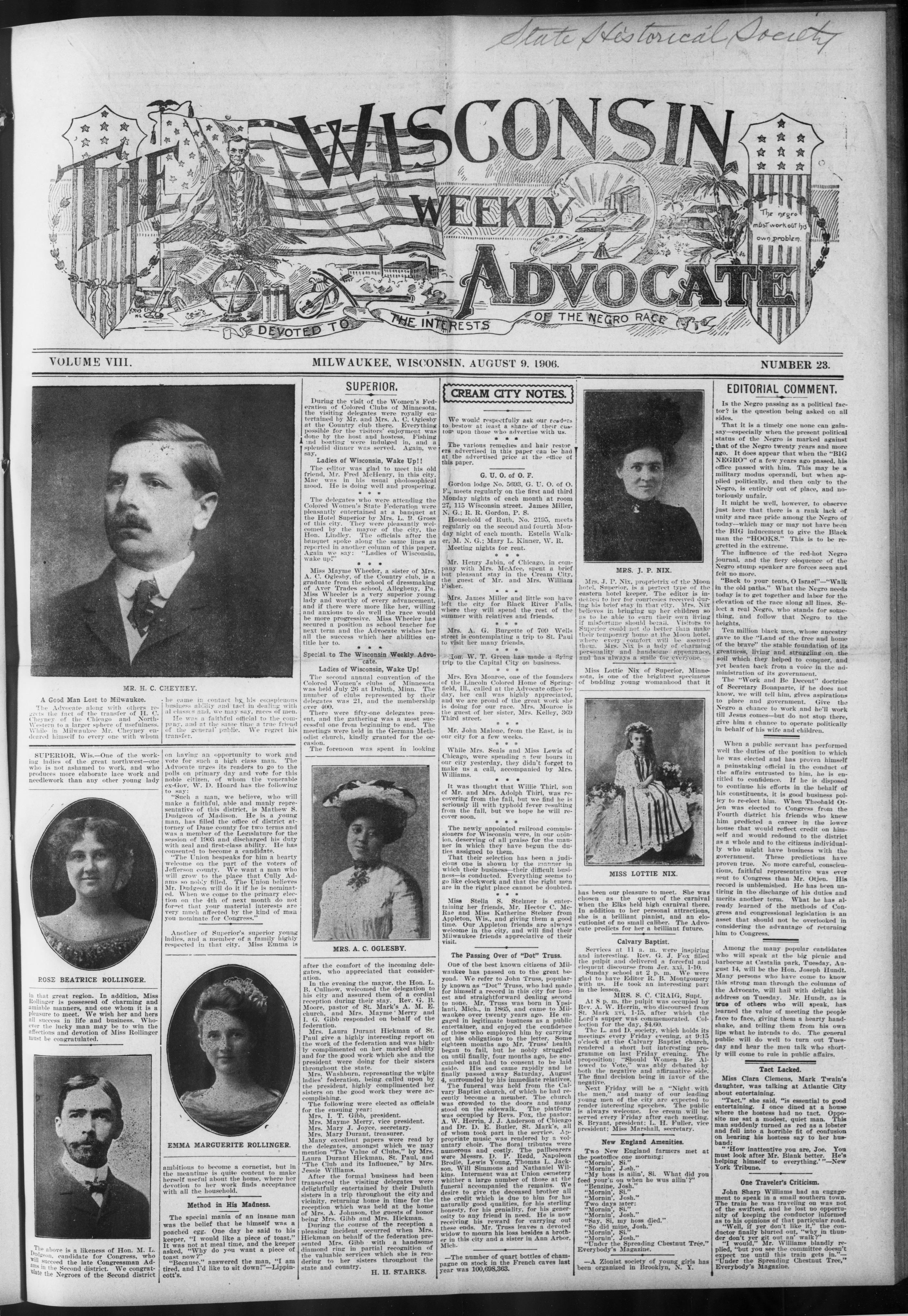
Page text (machine-generated)
State Historical Society
WISCONSIN
WEEKLY
ADVOCATE
DEVOTED TO THE INTERESTS OF THE WEGRO RACE
MR. H. C.
[Name not provided]
MR. H. C. CHEYNEY.
A Good Man Lost to Milwaukee.
The Advocate along with others regrets the fact of the transfer of H. C. Cheyney of the Chicago and North-Western to a larger sphere of usefulness. While in Milwaukee Mr. Cheyney endeard himself to every one with whom
SUPERIOR, Wis.—One of the working ladies of the great northwest—one who is not ashamed to work, and who produces more elaborate lace work and needlework than any other young lady
ROSE BEATRICE ROLLINGER
in that great region. In addition, Miss Rollinger is possessed of charming and amiable manners, and one whom it is a pleasure to meet. We wish her and hers all success in life and business. Whoever the lucky man may be to win the affections and devotion of Miss Rollinger must be congratulated.
[Name]
The above is a likeness of Hon. M. L. Dudgeon, candidate for Congress, who will succeed the late Congressman Adams in the Second district. We congratulate the Negroes of the Second district
VOLUME VIII.
he came in contact by his conspicuous business ability and tact in dealing with al classes and, we may say, races of men. He was a faithful official to the company, and at the same time a true friend of the general public. We regret his transfer.
on having an opportunity to work and vote for such a high class man. The Advocate urges its readers to go to the polls on primary day and vote for this noble citizen, of whom the venerable ex-Gov. W. D. Hoard has the following to say:
"Such a man, we believe, who will make a faithful, able and manly representative of this district, is Mathew S. Dudgeon of Madison. He is a young man, has filled the office of district attorney of Dane county for two terms and was a member of the Legislature for the session of 1903 and discharged his duty with zeal and first-class ability. He has consented to become a candidate.
"The Union bespeaks for him a hearty welcome on the part of the voters of Jefferson county. We want a man who will grow to the place that Cully Adams so nobly filled. The Union believes Mr. Dudgeon will do it if he is nominated. When we come to the primary election on the 4th of next month do not forget that your material interests are very much affected by the kind of man you nominate for Congress."
Another of Superior's superior young ladies, and a member of a family highly respected in that city. Miss Emma is
C.
EMMA MARGUERITE ROLLINGER.
ambitious to become a cornetist, but in the meantime is quite content to make herself useful about the home, where her devotion to her work finds acceptance with all the household.
The special mania of an insane man was the belief that he himself was a poached egg. One day he said to his keeper, "I would like a piece of toast." It was not at meal time, and the keeper asked, "Why do you want a piece of toast now?" "Because." answered the man, "I am tired, and I'd like to sit down!"—Lippincott's.
Method in His Madness.
MILWAUKEE, WISCONSIN, AUGUST 9, 1906.
SUPERIOR.
During the visit of the Women's Federation of Colored Clubs of Minnesota, the visiting delegates were royally entertained by Mr. and Mrs. A. C. Oglesby at the Country club there. Everything possible for the visitors' enjoyment was done by the host and hostess. Fishing and boating were indulged in, and a splendid dinner was served. Again, we say.
Ladies of Wisconsin. Wake Up!!
The editor was glad to meet his old friend, Mr. Fred McHenry, in this city. Mac was in his usual philosophical mood. He is doing well and prospering.
* * *
The delegates who were attending the Colored Women's State Federation were pleasantly entertained at a banquet at the Hotel Superior by Mrs. L. B. Gross of this city. They were pleasantly welcomed by the mayor of the city, the Hon. Lindley. The officials after the banquet spoke along the same lines as reported in another column of this paper. Again we say: "Ladies of Wisconsin, wake up!"
* * *
Miss Mayme Wheeler, a sister of Mrs. A. C. Oglesby, of the Country club, is a graduate from the school of dressmaking of Aver Trades school, Allegheny, Pa. Miss Wheeler is a very superior young lady and worthy of every advancement, and if there were more like her, willing and anxious to do well the race would be more progressive. Miss Wheeler has secured a position as school teacher for next term and the Advocate wishes her all the success which her abilities entitle her to.
Special to The Wisconsin Weekly Advocate
Ladies of Wisconsin. Wake Up!
The second annual convention of the Colored Women's clubs of Minnesota was held July 26 at Duluth, Minn. The number of clubs represented by their delegates was 21, and the membership over 400. There were fifty-one delegates present, and the gathering was a most successful one from beginning to end. The meetings were held in the German Methodist church, kindly granted for the occasion. The forenoon was spent in looking
Mary
MRS A. C. OGLESBY.
after the comfort of the incoming delegates, who appreciated that consideration. In the evening the mayor, the Hon. L. B. Cullnow, welcomed the delegation to his city and assured them of a cordial reception during their stay. Rev. G. B. Moore, pastor of St. Mark's A. M. E. church, and Mrs. Mayme' Merry and I. G. Gibb responded on behalf of the federation. Mrs. Laura Durant Hickman of St. Paul give a highly interesting report on the work of the federation and was highly complimented on her marked ability and for the good work which she and the president were doing for their sisters throughout the state.
Mrs. Washburn, representing the white ladies' federation, being called upon by the president, highly complimented her sisters on the good work they were accomplishing. The following were elected as officials for the ensuing year:
Mrs. I. T. Gibb, president. Mrs. Mayme Merry, vice president. Mrs. Mary J. Joyce, secretary. Mrs. Mary Durant, treasurer. Many excellent papers were read by the delegates, amongst which we may mention "The Value of Clubs," by Mrs. Laura Durant Hickman, St. Paul, and "The Club and its Influence," by Mrs. Jessie Williams. After the formal business had been transacted the visiting delegates were delightfully entertained by their Duluth sisters in a trip throughout the city and vicinity, returning home in time for the reception which was held at the home of Mrs. A. Johnson, the guests of honor being Mrs. Gibb and Mrs. Hickman.
During the course of the reception a pleasing incident occurred when Mrs. Hickman on behalf of the federation presented Mrs. Gibb with a handsome diamond ring in partial recognition of the valuable services which she is rendering to her sisters throughout the state and country. H. II. STARKS.
CREAM CITY NOTES.
---
We would respectfully ask our readers to bestow at least a share of their custom upon those who advertise with us.
The various remedies and hair restorers advertised in this paper can be had at the advertised price at the office of this paper.
G. H. Q. of Q. F.
Gordon lodge No. 5693, G. U. O. of O. F., meets regularly on the first and third Monday nights of each month at room 27, 115 Wisconsin street. James Miller, N. G.; R. R. Gordon, P. S. Household of Ruth, No. 2195, meets regularly on the second and fourth Monday night of each month. Estella Walker, M. N. G.; Mary L. Kinner, W. R.
Mr. Henry Jabin, of Chicago, in company with Mrs. McAfee, spent a brief but pleasant stay in the Cream City, the guest of Mr. and Mrs. William Fisher.
* * *
Mrs. James Miller and little son have left the city for Black River Falls, where they will spend the rest of the summer with relatives and friends.
* * *
Mrs. A. G. Burgette of 709 Wells street is contemplating a trip to St. Paul to visit her many friends.
* * *
Ion. W. T. Green has made a flying trip to the Capital City on business.
Mrs. Eva Monroe, one of the founders of the Lincoln Colored Home of Springfield, Ill., called at the Advocate office today, her call was highly appreciated, and we are proud of the great work she is doing for our race. Mrs. Monroe is the guest of her sister, Mrs. Kelley, 369 Third street.
* * *
Mr. John Malone, from the East, is in our city for a few weeks.
* * *
While Mrs. Seals and Miss Lewis of Chicago, were spending a few hours in our city yesterday, they didn't forget to make us a call, accompanied by Mrs. Williams.
It was thought that Willie Thirl, son of Mr. and Mrs. Adolph Thirl, was recovering from the fall, but we find he is seriously ill with typhoid fever resulting from the fall, but we hope he will recover soon.
* * *
The newly appointed railroad commissioners for Wisconsin were, in our opinion, deserving of all praise for the manner in which they have begun the duties assigned to them.
That their selection has been a judicious one is shown by the manner in which their business—their difficult business—is conducted. Everything seems to go like clockwork and that the right men are in the right place cannot be doubted.
Miss Stella S. Stelzner is entertaining her friends, Mr. Hector C. McRae and Miss Katherine Stelzer from Appleton, Wis., and giving them a good time. Our Appleton friends are always welcome in the city, and will find their Milwaukee friends appreciative of their visit.
The Passing Over of "Dot" Truss
One of the best known citizens of Milwaukee has passed on to the great beyond. We refer to John Truss, popularly known as "Dot" Truss, who had made for himself a record in this city for honest and straightforward dealing second to none. Mr. Truss was born in Ypsilanti, Mich., in 1865, and came to Milwaukee over twenty years ago. He engaged in legitimate business as a public entertainer, and enjoyed the confidence of those who employed him by carrying out his obligations to the letter. Some eighteen months ago Mr. Truss' health began to fail, but he nobly struggled on until finally, four months ago, he succumbed and had to consent to be laid aside. His end came rapidly and he finally passed away Saturday, August 4, surrounded by his immediate relatives.
The funeral was held from the Calvary Baptist church, of which he had recently become a member. The church was crowded to the doors and many stood on the sidewalk. The platform was occupied by Revs. Fox, the pastor; A. W. Herrin, J. J. Anderson of Chicago and Dr. D. E. Butler, St. Mark's, all of whom took part in the service. Appropriate music was rendered by a voluntary choir. The floral tributes were numerous and costly. The pallbearers were Messrs. D. P. Redd, Napoleon Brodie, Lewis Young, Thomas L. Jackson, Will Simmons and Nathaniel Wilkins. Interment was at Union cemetery whither a large number of those at the funeral accompanied the remains. We desire to give the deceased brother all the credit which is due to him for his naturally good qualities, for his sterling honesty, for his geniality, for his generosity to any friend in need. He is now receiving his reward for carrying out these ends. Mr. Truss leaves a devoted widow to mourn his loss besides a brother in this city and a sister in Ann Arbor, Mich.
The number of quart bottles of champagne on stock in the French caves last year was 100,698,363.
Mary
MRS. J. P. NIX.
Mrs. J. P. Nix, proprietrix of the Moon hotel, Superior, is a perfect type of the eastern hotel keeper. The editor is indebted to her for courtesies received during his brief stay in that city. Mrs. Nix believes in bringing up her children so as to be able to earn their own living if misfortune should berail. Visitors to Superior could not do better than make their temporary home at the Moon hotel, where every comfort will be assured them. Mrs. Nix is a lady of charming personality and handsome appearance, and has always a smile for everyone.
Miss Lottie Nix of Superior, Minnesota, is one of the brightest specimens of budding young womanhood that it
THE LADY OF THE ROSE
MISS LOTTIE NIX.
has been our pleasure to meet. She was chosen as the queen of the carnival when the Elks held high carnival there. In addition to her personal attractions, she is a brilliant pianist, and an elocationist of no small caliber. The Advocate predicts for her a brilliant future.
Calvary Baptist.
Services at 11 a. m. were inspiring and interesting. Rev. G. J. Fox filled the pulpit and delivered a forceful and elequent discourse from Jer. xxi. 1-10. Sunday school at 2 p. m. We were glad to have Editor R. B. Montgomery with us. He took an interesting part in the lesson. MRS. S. C. CRAIG, Supt. At 8 p. m. the pulpit was occupied by Rev. A. W. Herrin, who discoursed from St. Mark xvi, 1-15, after which the Lord's supper was commemorated. Collection for the day. $4.60.
The L. and D. society, which holds its meetings every Friday evening, at 9:15 o'clock at the Calvary Baptist church, rendered a short but interesting programme on last Friday evening. The proposition: "Should Women Be Allowed to Vote," was ably debated by both the negative and affirmative side. The final decision being in favor of the negative. Next Friday will be a "Night with the men," and many of our leading young men of the city are expected to render interesting speeches. The public is always welcome. Ice cream will be served every Friday after each meeting. S. Bryant, president; L. H. Fuller, vice president; Miss Marshall, secretary.
New England Amenities.
Two New England farmers met at the postoffice one morning:
"Mornin', Si."
"Mornin', Josh."
"My boss is ailin', Si. What did you feed your'n on when he wus ailin'?"
"Benzine, Josh."
"Mornin', Si."
"Mornin', Josh."
Two days later:
"Mornin', Si."
"Mornin', Josh."
"Say, Si, my boss died."
"So did mine, Josh."
"Mornin', Si."
"Mornin', Josh."
"Under the Spreading Chestnut Tree."
"Under the Spreading Chestnut Tree." Everybody's Magazine.
—A Zionist society of young girls has been organized in Brooklyn, N. Y.
EDITORIAL COMMENT.
Is the Negro passing as a political factor? is the question being asked on all sides.
That it is a timely one none can gain-say—especially when the present political status of the Negro is marked against that of the Negro twenty years and more ago. It does appear that when the "BIG NEGRO" of a few years ago passed, his office passed with him. This may be a military modus operandi, but when applied politically, and then only to the Negro, is entirely out of place, and notoriously unfair.
It might be well, however, to observe just here that there is a rank lack of unity and race pride among the Negro of today—which may or may not have been the BIG inducement to give the Black man the "HOOKS." This is to be regretted in the extreme.
The influence of the red-hot Negro journal, and the fiery eloquence of the Negro stump speaker are forces seen and felt no more.
"Back to your tents, O Israel"—"Walk in the old paths." What the Negro needs today is to get together and labor for the elevation of the race along all lines. Select a real Negro, who stands for something, and follow that Negro to the heights.
Ten million black men, whose ancestry gave to the "Land of the free and home of the brave" the stable foundation of its greatness, living and struggling on the soil which they helped to conquer, and yet beaten back from a voice in the administration of its government.
The "Work and Be Decent" doctrine of Secretary Bonaparte, if he does not know, we will tell him, gives aspirations to place and government. Give the Negro a chance to work and he'll work till Jesus comes—but do not stop there, give him a chance to operate politically in behalf of his wife and children.
---
When a public servant has performed well the duties of the position to which he was elected and has proven himself a painstaking official in the conduct of the affairs entrusted to him, he is entitled to confidence. If he is disposed to continue his efforts in the behalf of his constituents, it is good business policy to re-elect him. When Theobald Otjen was elected to Congress from the Fourth district his friends who knew him predicted a career in the lower house that would reflect credit on himself and would redound to the district as a whole and to the citizens individually who might have business with the government. These predictions have proven true. No more careful, conscientious, faithful representative was ever sent to Congress than Mr. Otjen. His record is unblemished. He has been untiring in the discharge of his duties and merits another term. What he has already learned of the methods of Congress and congressional legislation is an asset that should not be overlooked in considering the advantage of returning him to Congress.
Among the many popular candidates who will speak at the big picnic and barbecue at Castalia park, Tuesday, August 14, will be the Hon. Joseph Hundt. Many persons who have come to know this strong man through the columns of the Advocate, will hail with delight his address on Tuesday. Mr. Hundt, as is true of others who will speak, has learned the value of meeting the people face to face, giving them a hearty handshake, and telling them from his own lips what he intends to do. The general public will do well to turn out Tuesday and hear the men talk who shortly will come to rule in public affairs.
Tact Lacked.
Miss Clara Clemens, Mark Twain's daughter, was talking at Atlantic City about entertaining.
"Tact." she said, "is essential to good entertaining. I once dined at a house where the hostess had no tact. Opposite me sat a modest, quiet man. This man suddenly turned as red as a lobster and fell into a horrible fit of confusion on hearing his hostess say to her husband:
"How inattentive you are, Joe. You must look after Mr. Blank better. He's helping himself to everything."—New York Tribune.
One Traveler's Criticism
John Sharp Williams had an engagement to speak in a small southern town. The train he was traveling on was not of the swiftest, and he lost no opportunity of keeping the conductor informed as to his opinions of that particular road.
"Well, if yer don't like it," the conductor finally blurted out, "why in thunder don't yer git out an' walk?" "I would," Mr. Williams blandly replied, "but you see the committee doesn't expect me until this train gets in." "Under the Spreading Chestnut Tree," Everybody's Magazine.
THE WISGONSIN WEEKLY ADVOCATE.
R. B. MONTGOMERY, Editor and Proprietor.
Miscellaneous Items. There are 13,000 miles of new railroad lines under contract of construction at the present time in the United States. Doctors' coachmen in Berlin wear white hats so that a physician's carriage may be easily recognized in case of necessity. An association has been formed for the purpose of supplying, under certain conditions, spectacles to children in London elementary schools. In Russia an extensixe domestic industry consists of the manufacture of wooden spoons, of which as many as 20,000,000 are made annually. They are nearly all of birch wood.
Having supported himself as a peddler for seventy-five years, James O'Dwyer of Kilmihil, Ireland, who is now 102 years old, has, for the first time in his life, been compelled to ask for relief from the Kilrush Board of Guardians.
A citizen of Salisbury, Mo., who manufactures poisoned wheat for rodents, was awakened one night recently by a mouse biting him on the ear. The local paper says the rodent read his poisoned wheat advertisement and bit him for revenge.
Fifteen or twenty lions suddenly raided the town of Chorumo, in British Central Africa, the other evening at dusk and killed and ate eleven persons. The other inhabitants fled in their canoes and the lions prowled through deserted streets.
Bertha Fowler, a 12-year-old girl of Lewiston, Me., has been astonishing patrons of the fair grounds there by driving a big Hambletonian pacer in something under 2:30 on a half-mile track. She began handling the reins when she was half her present age.
A Pekin correspondent says: "It is no uncommon sight to see twelve or thirteen enormous fat pigs with their legs tied huddled close together having a ride in a Chinese cart with some sight of light cargo on top of them and a man sitting on the cargo.
A new steamship line has been established by the Netherland and Rotterdam Lloyd Steamship Navigation companies between the Dutch East Indies and British India, from Java to Calcutta, via Singapore, Sobang and Rangoon.
The evidence before the British Army Stores commissioners, as to graft during the Boer war, shows that there was only one regiment the contractors were unable to cheat. That proud distinction belongs to the Seventh Hussars. They weighed everything and checked the quality of everything supplied them.
-It is asserted by high authorities that neither great heat nor long maintenance of the requisite temperature is required to sterilize milk suspected of containing the germs of diseases, such as tuberculosis. The bacilli of that terrible disease are destroyed by a temperature of 145 degrees in five minutes. -Count Tolstoi lately added bookbinding to the numerous skilled trades which he already practices. He spent the first half of last winter in binding in leather a library of 400 paper bound volumes, doing everything, from the making of the covers to the gilding and lettering, with his own hands.
A great California industry is the manufacture of salt from sea water. In Alameda county 100,000 tons were produced last year. Only a few years ago the state imported all its salt. Now it produces enough for its own use—which is enormous, owing to the fisheries and packing houses—and exports large quantities as well.
The Prince of Monaco, acknowledged to be the greatest living authority on oceangraphy, has decided to establish in Paris an institution for seabed research, and will endow it with something like $1,000,000. He has spent a great deal of money in searching out the secrets of the sea. His splendid yacht Princess Alice is fitted up with fine laboratories and photographic rooms.
The young Duke of Saxe-Weimar, heir presumptive to the throne of Holland, is immensely wealthy and has more money invested in private business enterprises than any other royalty living. He has a million sterling in the Imperial bank, several other royalties being shareholders, and is interested in a lot of other paying concerns.
A meteorologist has undertaken the laborious task of measuring the dimensions of raindrops. He finds that the largest are about one-sixth of an inch and the smallest 1-700th of an inch in diameter. They are larger in summer than in winter and larger in hot than in cold climates. The size of the drop when it reaches the earth depends on the height from which it has fallen.
-It is said by some students of the origin of the great iron and steel industry that the Japanese many generations ago used to make steel in a curious manner which is not wholly understood. They forged iron into the shape desired and then buried it for eight or ten years in marshy ground. Through some process of nature, which may have been due to the presence of peculiar chemicals in the soil, it came out steel.
Insurance came from medieval Italy. It is believed to date from the sixteenth century, and at that time it was known in Florence. The Romans did not know insurance. The nearest they came to it was the practice of a company supplying the army to require a guarantee from the state against the loss of ships. But this was soon abandoned because damages had been collected for sunken ships too worthless to float.
The enormous salt deposit in Kansas, beginning in Ellsworth and Saline counties, extends south through the counties of Rice, McPherson, Sedgwick, Harper and Sumner. Salt wells are found outside of this district, but it is believed that their water is made salt by coming in contact with the salt bed within the counties named. A few years ago it was estimated that Kansas had twenty trillion barrels of salt and could alone supply the demand of the United States for more than a million years. The largest salt plant in the world is in Hutchinson, Kan.
-Is the earth made up of three concentric spheres? A physicist says that such is the case. The solid nucleus he suppose to be between 3000 and 7000 miles in diameter and this is surrounded by a liquid substratum, outside of which is the crust, variously estimated at 70 to 200 miles in thickness. More than two centuries ago a similar theory, including the slow rotation of the inner solid sphere on a different axis from that of the entire globe, was held by Dr. Edmund Halley to account for the changes in the earth's magnetism. The axis of the nucleus was thought to have been originally that of the entire globe and to the change of its course was attributed the deluge. The earth's internal heat, it is now pointed out, may be accounted for by the friction of the differently rotating bodies.
THE FORTUNE TELLER.
Turning the secrets from her pack of cards,
Warning of sickness, tracing out a theft,
Guarding from danger as an omen guards,
Her hand grew withered as it grew more
deft.
Till in the stuffy parlor where she lies,
Now to these clients, neighbors, debtors,
friends,
Truest is proven of her prophecies—
"I shall be dead before December ends."
That old man, facing us, who many years
Boasted the subtle wonders of her art,
Now hear him, how he tells us with his
tears
The simplier, larger wisdom of her heart.
For she was quick to share the good that
came.
So that pale mothers turned at last and
slept,
And loafers gruffly reverenced her name. * *
Yet more than all she gave away, she kept!
Kept red geraniums on her window sill.
Kept a gay garden in that narrow plot
Fenced in behind the house--you'll find there still
Her hoe, her rake, her rusty watering pot!
Bright, in the midst of all these dingy words
yards,
Her roses, hollyhocks and pansies grew;
As though some happy jester in the cards
Whispered the sweetest secret that he
knew.
—Witter Bynner in Metropolitan Magazine.
THE RING AVAILETH.
She knew that everybody at the hotel was sure she was engaged. She felt them observe her subtle ways of expressing the open secret of her heart. She was aware that they noticed her anxiety about the mails going out and her eagerness about the mails coming in. She would affect that tender glance at the ring when she really knew that everyone was looking.
She would hurry into the dining room a half-minute late folding a letter and crushing it into the front of her shirt waist. She would stand before the long windows in the palmroom or sit silently in one of the huge rattan rockers on the porch and gazze absently across the links.
When the boys asked for a set of tennis she would look at once startled and pleased and hesitatingly would say: "Tennis! Way, I would dearly love to, but——" And she would turn inquiringly to her aunt with an expression by which most girls would mean, "Do you think it is all right?" but by which she seemed to mean, "Do you think that he would think it is all right?" The more she declined the more persistent they became, tin at length she was the center of all social activities.
"It is not because of myself. Men always are silly about engaged girls." This was her secret thought.
She enjoyed it immensely, however, and the other girls envied and gossiped.
One afternoon a young college man was presented to her. "Do you know," said he, "I've been dying to meet you—that is, ever since I heard—er—you were engaged."
"Is it such a dreadful tning to be engaged?" she exclaimed. "I know men just simply despise engaged girls."
"Oh, no, we don't—that is, some of us don't. You are all so different from other girls, you know."
They took a short walk, and ended by sitting on a bench in the arbor.
"Oh, yes, it's much cooler here," she was saying, as she toyed with the leaves and twigs. They talked and talked and got to know each other far better than even she could have expected.
The boys said "Whew!" and asked her no more to play tennis. The girls ceased to envy, but continued, however, to whisper. The boys joined them and whispered, too.
The next morning when the crowd went over to the links, he carried her sticks. She did not usually play golf in the mornings, but on this particular morning she was among the first to go over. She knew he would walk with her. She thought he liked her, at least for the moment; and, knowing the fickle frame of men, she realized the critical situation. They played a few holes, but lost their last ball, and rested by the brook.
"I'm sorry you learned I am engaged," she was saying.
"Sorry? Why, you needn't be," he rejoined frankly. "Do you know, I'm deucedly fond of engaged girls."
you fellows were rather afraid of them.
"Afraid of them! Nonsense." His boyish nature was growing enthusiastic. It's the other kind that I'm afraid of—not engaged girls. Why, a fellow like me could go with a girl like you all summer and—er—she would never expect—that is——"
The girl had lowered her head and was gazing intently into the brook.
"You see, my friends tell me I am susceptible," and he softened his voice to an extremely confidential tone. "That's why I'm glad you are engaged. You see, there's no chance for me to fall in love this summer."
She was not quite so sure about it, and was thinking to herself what a fine beginning it all was.
"Hadn't we better try and find the ball?" she broke in, but made no effort to go. In fact, they did not go. The lazy morning slipped by, leaving them at the brook. They came in late to luncheon, and she knew what all the girls were saying. It rained torrents during the two days following, and he taught her to play chess. "The object is to checkmate the King;" he told her. "Yes, I see," and she wondered if it were not equally commendable to be able to checkmate a "Jack."
As soon as the sun shone they were out of doors again. They didn't play tennis as much as golf, and seemed to enjoy paddling a canoe better than either. There wasn't so much to do in the canoe and they could talk volumes. He told her of his work at college, and, boylike, built for her castles of future success. She appeared to be most interested and asked him so many questions that he began to think his plans were worth something after all. She was the only one who had ever spoken encouragingly of them. "I shall be so anxious to learn in after years of the name you surely will have made for yourself," she said to him one evening as he bade her good night.
He looked longingly into her eyes as the elevator boy waited in a "going-up" attitude.
"By Jove," he ejaculated, "if I only had a sister like you!"
"I suppose she'd get you to quit smoking cigarettes." And she laughed out of his head—once and for always—that bothersome, sisterly idea.
That night she wrote in her dairy some-think like this:
"Every morning—3 hours.
Every afternoon—3 hours.
Every evening—2 hours.
Total, 8 hours every day.
Eight hours a day for two weeks would be equivalent in point of time to a series of weekly calls spread out through a period of over two years—and besides he has greater efficiency for speed than most men."
A summer is not a lifetime, but is long enough—at least she thought it would be long enough. She was to remain through the month of October; he was to leave the last of September. Time passed more rapidly and more happily than ever before. They were having the sweetest experiences of their lives.
"He cares for me," she thought over and over again. "He likes me, but why doesn't he——?"
She began to realize that his "efficiency for speed" was not so great.
"My engagement attracted him, and yet my engagement holds him off," she concluded. She knew it—his every word an act proved it. He need not speak; and yet he ought to.
At length the days of field and wood were over. Their evening strolls were at an end. Even summer-end "good-bys" are sad, and there is no use repeating them. All were said—that is, all "good-bys" were said—but nothing more. He went to pack his grip. She retired to her room to weep, to dry her eyes and to weep some more. For a long time she la yon her bed, face down, and the pillow was tear-stained.
"It's all over now." she was thinking.
"It's all over now," she was thinking. Then she walked to the window and nervously tied the shade string in ever so many little bows and knots. She was looking at the two-carat stone on her engagement finger. "My ring attracted him—and alas! my ring is driving him away." And she tied more knots in the window shade string. "I have it!" she cried, and in a burst of enthusiasm she jerked the string and snapped the shade to the top of the window. Her tears burned dry and eyes beamed with determination and glowed with anticipated success. It took only a few minutes to pull the ring from her finger, seal an envelope and wrap up a small, dark-green box about an inch square.
Every evening at 5 o'clock the stage drove to town—not to return before the following morning. When she came down on the porch the horses were waiting and he was about to step up into the stage.
"Will you mail these in town for me?" she asked, as with her left hand she gave him the letter and the package. He glanced from the package to the hand and back again to the package. It was addressed to a man in Colorado. The letter was directed to the same man.
"Good-bye," he said; "I'll mail them." She was expecting him to say more, when suddenly all the guests came hurrying out of the hotel. They crowded around him and bade him a most demonstrative adieu.
"Oh, pshaw!" she said, as the stage swept round the bend. "I didn't think the whole house would be here!"
She ate no dinner that evening and sat alone on the porch till it was very late. The west wing was deserted save for her. She was watching down the dry, dusty road over which he had driven. At length some one came trudging around the bend. It was a man with a grip. It was he—he was coming back.
"Hello!" she called in a vain attempt to be cheerful. "Did you miss your train?"
"No, I didn't miss the train," he replied as he came up on the porch. His voice was as hoarse as his clothes were dusty. "No, I didn't miss my train, but I drove clear into town before I understood what it all meant. I registered that package and sent it special delivery, too." He was sitting close enough to whisper. "And I walked back over six of the roughest miles I ever traveled just to ask you if I couldn't put another ring where the old one used to be." The moon rolled back of a kindly cloud, casting an impervious shadow over it all and even the omnipotent story-teller couldn't see.
Late that night, sitting on the floor in her room, she held a diamond ring between her fingers and contemplated it. It was the same ring she had worn all summer, the same ring that made the people talk, the same ring that attracted him.
With an air of satisfaction she returned it to her jewel case.
"And what would dear old papa think," she was musing, "if he only knew I can never wear his present again."—Marshall Robie in the Columbia Monthly.
WISDOM OF AN EMPIRICIST
If everything were right, it would be an awfully tiresome world.
It is pretty hard to keep up with the times, even when they are out of joint.
The trouble with sin is that you have to commit it to find out why you shouldn't.
The admonition to love our neighbors was written before the invention of the phonograph.
But who wants to go around carrying a bird in the hand? Better put it in a safety deposit vault.
The modern version: "'Tis not for mortals to command success; but we'll do more—we'll stifle competition.
People must take soup in the summer time because they think it is good for them. There is no other reason.
Having a reputation for wealth enables a man to "stand-off" his bills for a much longer time than a poor one can.
A good way to keep from being bored is to get acquainted with the new kind of microbes that the doctors find every day.
When reformers agree, then will come the millennium. But the earth will probably be destroyed within a million years.
Lots of people take comfort from the axiom. "Speak no evil of the dead." It seems to justify them in being careless of their living reputations.
In the sweat of thy face shalt thou eat bread, but if you enlarge the menu there is no telling what you'll get in your food.—St. Louis Globe-Democrat.
Asbestos stockings are now being manufactured for use by workmen in boiler rooms and foundries. In these and other situations the floor often becomes uncomfortably hot, though not hot enough to burn through the soles of shoes. The workmen in these positions suffer tortures from their feet, and it is declare that the non-conducting properties of asbestos enables them to withstand higher temperatures with absolute comfort.
The March of Progress.
When we have drained Niagara dry,
And cut the redwoods down,
We'll plat the Garden of the Gods,
And start a booming town.
I think the geysers might be made
To run a monster mill—
Think how the dollars would pile up
In that concession till.
We'll blast the canon walls that hem
The Colorado in,
No doubt that tinted stone would bring
A fair amount of tin;
Think what a show we might arrange
From every famous scene,
If sentimentalists were not
Allowed to intervene.
The cities all would rush to buy
The tickets that could tell:
"These are the very rocks o'er which
The Bridal Veil once fell."
When on these famous sites arise
Skyscrapers huge and tall,
Perhaps Carnegie will donate
Their pictures to some hall.
There sentimentalists may gaze,
And of their glories sing,
While we go out and make our pile,
"Developing" the thing!
Ninette M. Lowater in New York Sun.
New York Every Day.
"It used to be that New York women were known by the shine on their complexions," said a modiste," and scorned girls for using powder. It is very different these days. They don't do a thing now but paint and powder and doctor their eyelashes to make them look long. Why, you even find the rouge and the rabbit's foot you put it on with in the dressing rooms of the New York theaters."
No one knows exactly how many barbers there are in New York. The official record of "certified barbers" puts the number at 20,000. "Bos" barbers are sure that the actual number of those in the barbering profession (judging from the applications made for employment) cannot be less than 100,000. Persons who have been shaved in strange barber shops sometimes incline to the belief that the number of real, "practical" barbers is limited.
Mabelle Gilman is not to become the wife of William Ellis Corey. This statement was made unequivocally by Edgar Atchison Ely, one of the closest friends of the actress, who has been in constant communication with her since she sailed from America nearly two years ago. Less than a week ago Ely received a letter from the young woman. She is in Paris with her sister, Cornelia, and her mother, where the trio for several weeks have been awaiting the return of Jean de Reszke from a vacation in the south of France.
Thomas T. M. Anderson of Sewickley sent a colored porter of the Navarre hotel to get him a ticket for champagne." "Yes, sah," replied the brass-buttoned lackey as he took a yellow bill. "Right away, sah." A minute later the telephone bell in Mr. Anderson's room rang. "What brand will you have?" came from the other end. "The boy is new and he forgot to ask." Then the guest explained that he had failed to preface the champagne with Mamselle. He wanted to go to the Madison Square Roof garden theater.
There is an independent girl in New York who has adopted a new way of trying to keep cool this summer and all her feminine friends know it. Whether the knowledge will spread beyond her own sex is a matter of conjecture, as it would depend chiefly on the state of the wind and the girl's position at the critical moment. "We have eliminated collars and cuffs," she declares, "and I can't see why mere men and babes should enjoy all the advantages to be derived from socks."
"Git-ep" and "Clucb-cluck" don't go with the horses any more. The drivers here now simply say "skidoo" and Maud starts off about her business. The word seems to have a magic effect, and drivers and horses alike have taken kindly to it. Every week brings out some new "pome" in hats for the horses, but the skidoo hat of crepe paper is now the vogue. The nut of every equine attached to a cab or express wagon supports one of the new bonnets, which are being sold on the streets by fakirs at 5 cents.
The investigation of the naturalization papers of foreign born policemen now is fairly under way at New York. All papers of the naturalized bluecoats from the First Inspection district have been sent to United States District Attorney Henry L. Stimson, where they now are being gone over by secret service agents. Sufficient indication of fraud in procuring certificates of citizenship already has been found, it is said, to warrant the belief that a large fraction will be found defective. Whenever this is the case the papers will be canceled, their holders being deprived of their citizenship and jobs. They also will be liable to prosecution for fraud.
Woman is gradually beginning to take herself more seriously and is resuming her proper place in skirtdom. The tomboy kind lasted for a while, but according to the present dictates of fashion the masculine woman is now a dead un. Milady of culture and refined tastes now eschews the swaggering walk or anything that savors of mannishness. Three years ago it was overlooked when a woman whistled at a New York cab driver with her fingers in her mouth. These self-same women have cut it out and have again taken up her delicate parasol and lovely manners. A woman with mannish tendencies is now stared at on Fifth avenue or Broadway. There are a few of this type left, but they will soon come around.
"I wonder," said the old-time Bohemian, "if New Yorkers ever dine at home on Saturday nights and Sundays. I took my best girl under my arm last Saturday night and went out on a still hunt for a place to dine. We walked from place to place until we were worn out, until from sheer fatigue we lost the desire to dine. At each cafe there stood crowds waiting meekly for tables, patiently enduring the hustling of waiters and the lordly frown of the proprietor, who made his appearance at regular intervals with the news that there would perhaps be vacant tables in an hour or so. And that wasn't the worst of it," he concluded sadly, "at each of these little Bohemian tables d'hote there had been tacked a blazing card which bore the legend that the price of the dinner had been raised for these two nights from 40 to 60 and 70 cents. At one," more sadly still, "it was raised to 75."
"Yes, it is true that the sight of so many old maids hastened my marriage. Such a state is so dreadful!" The above declaration, made by Miss Edith Wilson shortly before she became the bride of George White, chief engineer of the Edison company, will doubtless not be especially relished by the many women patrons of the Martha Washington hotel, a strictly anti-masculine establishment in New York.
The bride, who is 17 years old, has been for some time the captain of the bell girls in the hotel, and, as she frank-
ly admits, her experiences with so much well matured femininity have been of such a nature as to hasten her desire to quit the spinster estate. Married, the young woman nevertheless believes she will be able better to stand the strain at the woman's hotel, for on her return from her two weeks' honeymoon trip she expects to resume her duties there.
Trowmart inn for working girls in department stores was opened in New York with eighty registered guests. It is situated at Hudson and West Twelfth streets, just opposite Abingdon square, not many blocks from most of the large department stores where guests of the inn are likely to be employed. The inn will accommodate about 300 guests, who by the regulations must be between 15 and 35 years of age and must work in the city. The charges are small, $5 a week for girls living alone and 50 cents each less for two girls rooming together. This includes breakfasts and dinners. The girls can get luncheens at 15 cents each on Sundays and holidays. The equipment is complete and well up to the standard of high class hotels. W. R. H. Martin built the hotel at a cost of $300,000. It is a broad, philanthropy built on a business basis.
There are a lot of "Johnnies on the spit" in New York. The roof garden tragedy was hardly known before the moving picture artists were at work doping out how it happened. Now you can see the "moider" by dropping a penny in the slot machines and turning the crank. It was a foregone conclusion that phases of the Thaw-White tragedy would find their way into the saffron plays that pass for drama where both prices and foreheads are low. One drama-while-youwait producer got right to work, and before Thaw reached his cell his scenario was completed. He has beaten six other competitors who thought they were it by announcing an early production of "The Millionaire's Revenge." He is, by the way, the author of "A Desperate Chance," the play written around the Biddle brothers, who escaped from the Pittsburg jail. In his opinion, "The Millionaire's Revenge" beats the Biddles by the length of the street.
Passengers who arrived in New York on the Clyde line steamship Arapahoe from Charleston and Jacksonville told a tale of a floating island. The yarn is partly borne out by the ship's log. The Arapahoe was a day out of Charleston, on July 31, and on the edge of the gulf stream, about twenty miles southwest by south of Diamond shoals' lightship, when, at 8:30 o'clock in the morning, the officer in charge of the deck saw a group of about a dozen trees on the starboard bow. They were about a mile away and appeared to be of a variety of bamboo. They stood out of the water for twenty feet. Capt. Kemole di not alter the vessel's course so as to pass near the trees, though all on board were interested to know just what made them float as they did. The theory was that the roots of the trees were intertwined and that they had been dislodged by a storm and sent adrift.
On sale in John street, New York, is a perfect pearl weighing sixty-eight grains, white and rounded, for which the asking price is $15,000. The man who found it in a mussel shell on the Wisconsin bank of the Mississippi river only a few weeks ago, sold it for 75 cents. The pearl came in a shell the size of a silver dollar. Another pearl from the American fisheries in the middle western waters, offered now for $5000 in the Maiden Lane district, is of ninety-nine grains and is a pear-shaped drop of pink tint. As a result of the increased success of the western pearl fisheries and of the heavy demand for the gems, buyers of practically every large house in New York have been sent recently to the points where the pearls can be had at first hand from their finders. Tinted gems of this variety weighing up to 100 grains have also reached the local market lately and added to the anxiety of dealers to be represented on the ground, Vincennes, Ind., and Prairie du Chien, Wis., being principal points of the industry.
Dr. Adolf Jacobsen, chief veterinary inspector of the city of Christiania, Norway, who has been inspecting the American packing houses on behalf of the Norwegian government, sailed from New York for Christiania. He inspected the packing plants at Chicago, Kansas City and New York and visited Washington while the applicants for the new meat inspectorships were being examined.
"The big plants which I inspected were most cleanly and satisfactory in their manner of operation," said Dr. Jacobsen, speaking of his investigation in Chicago. "This applies particularly to the killing methods. It was quite different from what we had been led to expect after reading what had been published abroad. The sanitary conditions were excellent and there appeared to be plenty of inspectors to see that they were kept so." Dr. Jacobsen remarked that if his home government acted upon his recommendations there will be much more American canned meat and barreled beef bought in his country than has been heretofore.
A young man and a young woman, manacled, entered the Brooklyn police headquarters at about 2 o'clock in the morning in a great state of perturbation. Somebody had slipped a pair of handcuffs on them. It had been a joke at the outset. A first the pair sat tied together, wondering when the man would come and release them. Hours sped on, but the joker did not appear, and everybody in the house became tired. The twain, still manacled, then left the house and walked around to the police headquarters.
"We have come here," said the young man, "to be released. A fool person at a party we attended slapped these handcuffs on us and then ran away with the key. Haven't you a key here that will fit them?"
"No." said Sergt. Lindsay. "You may go over to the Adams street police station and I have no doubt the sergeant there will be able to accommodate you." The young woman and her escort walked to Adams street. The sergeant turned them over to Detective Walter Robinson, who had a pair of handcuffs and a key that fitted.
You will find, as a rule, that the person who says one-half the world is down on the bubble wagon and that the other half is under it has either been "biffed" by a scarlet devil or hasn't the price. There are innumerable clam diggers and persons who are fond of hay rides living in or near New York who, in the garb of autoists, are audaciously ever ready to give the car which plays shuttlecock with your wagon a kick. It's a common thing to hear men and women dressed in leather trying to convert the auto car into junk with harsh language, but they will persist in wearing a chauffeur's cap and a French kid tie to match. It was explained to me today by a woman who is a foe of the auto why she sometimes wears cowhide. "You see," she said, "an auto outfit is always presentable, and the more dirt you have on the better, because then everyone takes it for granted that you have just returned from a spin. With an auto cap, a light blue veil and a battered-up raincoat a woman can go to the theater or anywhere, and she always looks well. She never needs to go home to change."
Reliable Recipes.
Sweet Apple Pudding.—Mix one cup of molasses with two cups of scalded milk and add a pinch of salt. Stir in one cup of cornmeal and one dozen sweet apples pared and chopped fine. Bake three hours.
Baked Beets.—Wash a dozen medium sized young beets and bake until tender and the skins will slip off. Peel, cut in halves and lay in a dish. —at butter and lemon juice on each and get in the oven for a few minutes. Serve hot.
Carrot Salad.—Scrape and boil high-colored carrots until tender, cut in very thin slices and sprinkle with powdered sugar, lemon juice and olive oil. Arrange lettuce leaves in a dish, put in the carrots and garnish with thin slices of onion.
Orange Jelly—Grate the yellow rind from one lemon and four oranges, add the juice and one cup of sugar in which a rounding tablespoon of cornstarch is mixed. Pour one-half cup of boiling water on and cook five minutes. Cool and spread between the cakes.
Orange Cake—Cream one cup of butter, add three cups of sugar and then six unbeaten eggs, one at a time, and beat well after each addition; add one cup of milk, then four and one-half cups of flour, sifted with five level teaspoons of baking powder. Bake in layer tins.
Crullers.—Mix one-half cup of butter and one cup of sugar until creamy, add one beaten egg, one cup of buttermilk and one-half level teaspoon of soda, sifted in two cups of flour. Roll out thin, cut in shape and fry in deep fat. Roll in powdered sugar while warm.
Arrowroot Custard.—Heat four cups of milk and stir in two rounding tablespoons of arrowroot, made smooth in a little cold water. Cook ten minutes; add two well-beaten eggs and three rounding tablespoons of sugar. Cook until the egg thickens and flavor with vanilla.
Cream Cake.—Beat one cup of butter to a cream, add three cups of sugar, two well-beaten eggs, one cup of sour cream, four cups of flour and one level teaspoon of soda sifted in it three times. Add a little grated nutmeg, and bake in shallow pans. Sprinkle grated cocoanut thickly over the top.
Ginger Cake.—Beat two eggs light, and to one cup of sugar and one-half cup of butter creamed together, one-half cup of buttermilk, three tablespoons of molasses, one level tablespoon of ginger, one-half level teaspoon of soda, dissolved in half a tablespoon of water, and two and one-half cups of flour.
Grated Ham Sandwich.—Grate lean boiled ham and season with a little cayenne and a few gratings of nutmeg. Roll puff paste thin and cut in two pieces of equal size. Prick in several places, bake, and when just cool spread one thinly with butter, then with the ham, and lay the other on. Cut into small sandwiches with a sharp knife.
Sponge Cake.—This is a genuine sponge made light with eggs. Weigh six eggs, then take the weight of the eggs in sugar and the weight of three eggs in flour. Beat the yolks of the eggs until very light, add the sugar and beat; then the rind and juice of one lemon and then the flour which has been sifted three times. Last add the stiffly beaten whites of the eggs and bake in a round pan with a tube.
Pigeon Stew.—Clean the pigeons and truss by tying with narrow strips of cloth. Lay thin slices of bacon in the bottom of the kettle, put in the pigeons and lay on a sliced carrot, an onion with a clove in it and two sprigs of parsley. Pour some boiling hot stock to cover and then put on the cover of the kettle closely. Simmer the pigeons until tender and be sure that they are very tender. Serve each pigeon on a thin slice of buttered toast with a border of spinach.
Nursery Notes.
Sterilized Milk.—When staying in a country place where it is difficult to get sterilized milk for little children, the milk may be filtered through a thin layer or wad of absorbent cotton. The cotton is best put in a glass funnel and the milk filtered into a glass jar, both of which are perfectly clean and sterile. The jar should be one that has a close-fitting cover that will exclude the air. Neither the nutritive value nor the taste of milk is changed by this process.
Vegetables for Children.—Vegetables for children should be given very sparingly until the age of three is reached—an exception being made in favor of baked potatoes. After this age they may have spinach boiled in its own juice young peas, tender beans well prepared, cabbage that has not been boiled longer than half an hour, cauliflower delicately cooked, and stewed celery.
Paddling.—Half the joy of a seaside visit is taken away if the chicks aren't allowed to paddle; but paddling must be done with discretion. The indiscriminate wetting of the feet is a habit that cannot be too strongly condemned, and a great many childish stomach troubles arise from the fact that the chicks are allowed to dabble in the water, the sun pouring down on their heads, just after a heavy meal. Don't let them paddle until two hours have elapsed after eating, and see that their little heads are thoroughly wet before they enter the water. Sea water won't hurt their hair a bit; on the contrary, it will strengthen the growth and improve the color wonderfully.
Baby's Sleep.—Never allow a baby to be aroused from its sleep even to see the most important of visitors. Remember that it is often politeness and not affection which makes people ask to see the baby, and do not let the little one be aroused from its slumber. When it has rested long enough it will wake naturally, but to be suddenly roused often causes a considerable shock to its nerves and injury to its health.
To Give Medicine.—It is often an extremely difficult task to give little children medicine. A trained nurse of long experience says that the best way to give a child castor oil if it is not able to swallow the capsules filled with the oil, is to fill a winglass half full of orange juice and pour in the oil, with more juice on top. The oil forms a ball in the middle of the juice and is swallowed without being tasted.—New York Mail.
—A camel begins work at 4 years old and frequently continues in use for over half a century. It will carry 1000 pounds on its back, while few horses can carry more than 250 pounds.
Advertise in Your Home Paper.
GOSSIP FOR THE LADIES.
The Best Will Come Back to You.
There are loyal hearts, there are spirits brave.
There are souls that are pure and true;
Then give to the world the best you have,
And the best shall come back to you.
Give love, and love to your heart will flow, strength in your utmost need:
For life is the mirror of king and slave,
Tis just what you are and do;
Then give to the world the best you have,
And the best will come back to you.
The Perfect Hostess.
You know her as soon as you step over the sill.
She has diffused an atmosphere of welcome over the entire house. You feel at home in every room, even though left alone. And you are left alone sometimes. For the perfect hostess doesn't dog your footsteps every minute.
your footsteps every minute.
She knows that you will want to write letters, and nap, and read.
She gives you the house to entertain yourself in, and you can have her, too, whenever you want her.
She does not wear you out with too many entertainments, or too many persons.
She doesn't make you feel that you've got to "pay for your keep" by doing chores.
Neither does she refuse to let you help her, if she sees it would make you happiest.
She gives you the impression it's a joy just to have you in the house.
The Marriageable Age.
It is rather difficult to fix arbitrarily the best age for marrying, and yet this is what a fair correspondent asks us to do. "Is a girl an old maid necessarily at thirty?" she wants to know, and "Is not eighteen too young for marrying?"
A generation ago these questions might have been answered promptly and positively. Then a girl was considered a "spinster" at thirty, and eighteen was not considered far from the average age for marrying. In those days spinsterhood was regarded as a condition to be avoided at almost any cost. Parents and daughters alike planned for early marriages. When fathers and mothers succeeded in "marrying off" a family of daughters they received the hearty congratulations of the community. Today neither the girls nor the parents seem to consider matrimony the end and aim of earthly existence. There are no "old maids" any more. The opinion appears to prevail that woman may reign single, with honor, just as well as man. The explanation for this changed condition is, of course, to be found in woman's invasion of the business world. The bachelor girl, independent, respected, admired, is a natural consequence of society's changed attitude toward women who earn their own living.
For a decade the tendency has been to advance the marriageable age of both men and women. The average parties to this most solemn of all contracts have had time to develop mentally and physically. This must have a natural result on the well-being of their offspring.
No one can say just what is the best age for marrying. It is risky to generalize. The age of discretion varies in individuals. In whatever term of years it is expressed, that is the age at which one should enter upon the solemn and happy estate of matrimony.—The House-keeper.
The Wife's Rival.
There is one question that should come to every wife who sees her husband attracted by another woman: "Where does she charm where I do not? Does she try to please him more than I have done? Is the suggestion immoral only? What is the unconscious need back of this outcome of it, the thing that I have unconsciously failed in? Why should any one have more attraction for him, more power over him, than his own wife?"
And one thing is certain—if his regard is failing you under the conditions of life that you are now both living under, change them—never keep on under any conditions that are futile of result. By some means, in some way, get out of the rut. Give him some other interest, other company, a fad, anything to take up the mind or his attention so that this other hurtful interest may be crowded out. Plan for it as you never planned before. A fishing trip will cut out the dawning passion for almost any woman. Even figuring over an impossible canoe or an impossible sailboat with a yachting magazine and a couple of enthusiastic nautical friends will supply a counter attraction through many winter evenings.
The woman who seeks to charm in your place may be stimulatingly intelligent or a jolly good fellow or honestly sympathetic, or she may be bold and wholly reprehensible. But she doesn't complain, she doesn't scold, she isn't self-absorbed, she doesn't talk about money all the time to him; she enjoys his society without always thinking of something for him to do. Perhaps there is something to learn from her, if one only thought so. Is it beneath a wife to plan how to keep her husband's love in little ways as well as big ways? Is it better to just lose it, if the wind sets that way? Some of the dearest, the highest marriages have been those where love on either side continually repaired mistakes. There is a deep, deep feeling of the soul in any man towards the woman who has helped him to be good. He never really wanted to be anything else. But then she must never have put him in the wrong before the world.—Mary Stewart Cutting in Harper's Bazar.
Warm Weather Don'ts for Women.
"A few dont's for warm weather should be borne in the mind of every housekeeper during the summer," was the recent assertion of a physician connected with one of the women's hospitals of the city, "and one of the most important of these is, don't worry. For once a woman begins to fret and fume she exhausts nervous and physical energy and reduces her vitality until she is a prey to both mental and physical ailments. It is then that little inconveniences in the housework that once would have made no impression assume the aspect of real tragedies and she generally ends up in bed, the victim of a sick headache, if nothing more serious.
"In the matter of summer undergarments, those of stockinette, I think, are the best, for the reason that they absorb the perspiration, and are so sheer that they retain but little of the heat of the body. Light colors should always be worn in preference to black, as the latter absorbs the heat.
"I tell my patients to be late in keeping an engagement rather than hurry, and to take time in doing their housework during the hot days of summer. Another dangerous practice in summer is the drinking of many iced drinks, which chill the stomach, and along the same line I say, don't overeat. for an overloaded stomach means an attack of indigestion and a subsequent illness. Dispense with meats as much as possi-
ble and take eggs, fruits, chickens, fish, sea foods, salads and cold meats. "I firmly believe if women would go to bed early on hot night and lie there with their eyes closed, even though they cannot sleep, that fewer of them would be listless during the day and they would certainly have more strength to withstand the enervating effect of hot weather. Sitting up late at night is one of the worst ways of exhausting nervous energy, and the pernicious results of the practice are every day in evidence in summer by the dull, weary eyes and the lack of ambition and interest noticed among women in everyday affairs. Lying down in the middle of the afternoon is also a habit to be adopted.
"After removing the clothing preparatory to a nap, rub the body off with a coarse towel to dry it, and if it is not too expensive an alcohol bath should be of benefit at such a time. If a bath is desired one may be taken in tepid water, just a trifle warmer than the body—never in cold when perspiring, for like the iced drinks, it checks the natural perspiration and is a shock to the body that might result in congestion."
Don't Give the Gossipers a Chance.
You can't afford to disregard public opinion.
It is all very well to feel impatient of the restrictions of conventionality, but those restrictions are necessary to keep us in order and from overstepping the bounds of law and propriety.
We all like to be well thought of, but we can't have the good opinion of our fellow-beings unless we earn it, and the only way to earn it is through good behavior.
Every young woman should bear in mind the fact that one of the most important things she has to attend to is the keeping of her name free from slander and gossip.
She must be just as particular in choosing her girl friends as her men friends.
A girl is judged by the company she affects, and no matter how modest and well-behaved she may be, if she goes about with noisy, badly-behaved companions she will be considered as bad as they. As far as her friendship with men goes, a girl has nothing to gain and much to lose by going with a dissipated man.
A friendship with a nice, honest young fellow is a good thing for any girl.
They can have no end of good times together, even if there is nothing but simple friendliness between them.
But a girl's reputation always suffers from a friendship with a man who is wild. He has had no concern for his own good name; he will have none for hers.
Of course, young girls are apt to make mistakes in choosing their friends, but experience is a good teacher, and a girl soon learns to distinguish between the good and bad types she meets.
There is one friendship that absolutely never does a girl any good, and that is a flirtation with a married man.
The very moment a married man begins to show a girl more than the most ordinary courtesy she should be on her guard.
In the first place he is another woman's husband, and she has no right to him.
Secondly, he is never in earnest—how can he be?—and is only flirting with her as a pastime.
He keeps eligible men away from her and invariably makes her the victim of n. unkind gossip.
There is nothing so hard to live down, girls, as a blot on your fair name.
A young girl always stands in a bright light—people expect a great deal of her and are shocked and disappointed if she does not live up to their expectations.
Keep yourselves above suspicion; do nothing that will give people a chance to criticise you unkindly; never forget that your most precious possession is your good name.—Philadelphia Bulletin.
Getting Rid of Gas Bills.
"Gas bills, my dear," said a Chicago man, whose wife fretted to him about them, "are always excessive, inopportune, annoying. They may best be treated by the forgetfulness method. There is actual redress."
The plucky little wife, however, distressed by her gas-bill wrongs, real or fancied, scorned to accept this attitude of meek resignation. In the soft light of lamps and candles she found both redress and pleasure. Now no smallest gas bill—save only that of the kitchen range—ever darkens her doors or countenance. The only wonder is that so many people have not followed her example long ago.
It is difficult indeed in this connection to imagine why human beings, otherwise courageous, ingenious, determined, should meekly and weakly—and weekly—lie down beneath the gas-bill horror and incubus, making no slightest effort. beyond grumbling perennial or perpetual, to mend matters. There are so few good reasons, all things considered, to offer in support of the gas. Convenient? Yes, but so are thick, stuffy, dusty carpets, stoves, registers, radiators, "modern" city apartments. Yet what ensouled creature would not decide in favor of hardwood floors, the rugs that may be frequently shaken, the open, alluring fire, the summer cottage bereft of all but the simple—and frequently unattainable—necessities of life?
Lamps and candles are, perhaps, a little inconvenient to care for; but so are flowers, books, pictures, laces, antiques, curios, children, any or all of the "unnecessary" trifles that make life worth living. The sole advantage of convenience put aside—and it is not really difficult or disagreeable to pour oil from one receptacle to another upon occasion, to polish a candlestick now and then or snuff a candle—what more may be said in favor of the gas? The electric light, cleaner than gas truly, and non-odorous, but twice as glaring, and even more expensive, may be placed in the same class.
To go into details is unnecessary, but a couple of mental pictures may clear the case somewhat. Think of a pleasant room, filled with pleasant people, pleasantly conversing; consider these pleasant suggestions in the soft light of lamps or candles. Extinguish these soft lights, light the gas, press the electric button—what happens? Wonderful light has been thrown on all the visible and imaginable defects and imperfections of people, furniture, and general surroundings; and on the frequent declaration of our fathers that women used to be prettier than they now are—that is all.
For picture number two, think of a snowy dining-table, long, square, or round, as fancied; flowers in the center, lovely silver, china, and glass to reflect soft lighting, the sheen of unshaded or daintily clad candles gleaming lovingly over it all. Again perform the lamplighter's magic, and watch all the poetry and romance disappear.
Call up the pretty custom of the gallants lighting the bed-time candles for the ladies. Figure to yourself these same gallants turning the electric switch
for their sweethearts or igniting the hall gas? For the sternly practical side of the lamp and candle revival, the greatly decreased cost is undoubted. Beautiful lamps cost less than elaborate gas or electric fixtures; properly cared for they may become heirlooms. Candlesticks may be as plain or as elaborate as fancied, some of the most inexpensive being also the most lovely. The plain brass, silver, crystal or porcelain candlesticks show rare beauty. Shaded or unshaded, they are always enchanting. Lamps of rare metals, of opalescent, shell-like glass—of real shells, for that matter—may now be bead for the asking.
Only, for the inevitable word of caution, do remember to handle the lamp and candle problem with intelligence. If other members of the family, non-payers of gas bills perhaps, at all events addicted to non-artistic conveniences, deprecate certain changes, make these changes slowly, and if for any reason you decide in favor of a continuation of gas or electric light, use these frankly. Do not, for the sake of the eternal verities and your own conscience and character, compromise on the awful electric fixtures that purport to be candles, or the unspeakable gas lamps that profess to be other than they really are.—Ethel M. Colson in House Beautiful.
Women as Imitators of Men
Surely we are all familiar by this time with the claims to admiration of the new woman; the beauty and energy and keen mother wit which, as Americans believe, set her apart from the women of other nations and make her unique, as was once the huntress Diana among the gods.
She never tires of counting over her recent successes, from the marvelous costumes that she wears to her achievements in biology, in cookery or in founding new religions. The woman of the last generation walked in a narrow path; in her life, as in a Chinese song, there were but three notes—love, marriage and motherhood.
But this queen of the present hour has a thousand parts to play. You never know where to find her. She may be driving a four-in-hand in Broadway or looking for the North pole in the Arctic seas or nursing some poor beggar in the slums, or, most likely, of all, she may be settling herself comfortably for life as duchess or princess in some old English or Italian family.
We all look on with pride, and wonder complacently what she will do next.
The chief difference between her and her grandmother—and it is a very curious difference—is that the older woman regarded herself simply as part of the human race. The man was its head, its spokesman. She thought of herself as his child, his wife or his mother.
The woman of today is not only his equal but his antagonist. She talks not of humanity, but womanity.
Every village has its club of woman who urge each other into new professions, work or studies which have hitherto been considered the business of men only.
Every newspaper has a woman's department in which the successes of the sex in wresting trades and handicrafts from their brothers and husbands are daily noted.
I saw today the announcement that a woman was now filling a place as brakeman on a Western railway. This fact is told with a hysterical sob of triumph, as though when this energetic young person laid her hand on the brake she had dealt a fatal blow at the foe of her sex and had made for herself a long stride upward in the scale of being.
In our national exhibitions, too, there is always a woman's department where statues, pictures, soaps, confectionery, etc., made by our sex are exhibited apart to prove that women are as skillful with their nugers as men.
I confess I do not understand this belligerent attitude in the modern woman nor her vanity. Is she not human, like the man? Has she not the same fingers, eyes and tongue? She is not a monkey nor a freak that her cleverness should be trumpeted and paraded as abnormal in the public eye.
A man when he invents a new plow or paints a picture does not shout out: "A man—a man has done this! Not a woman! See how superior the male of the race is to the female!"
But we American women of late years never weary of boasting of the doings of our sex, and especially on the ground that they are so much like the doings of men!
It is true that at the close of the Civil war our women were forced to compete with men for work and wages in every part of the field of labor. They had to make a place for themselves then as wage-earners or starve. It was no wonder that they were aggressive and sharp during that time.
But why squabble and fight now? The whole field is open to them. All of the fences are down. There is not now, I believe, a single honest occupation by which a living can be earned which is not open to a capable, decent woman to try for it. Men give her a fair field and much favor. Whether she chooses to drive a garbage cart or write a historic novel, they invariably are kinder to her endeavors, and applaud her more loudly than if she wer a man. Why, then, this incessant, defiant assertion of woman's achievements and possibilities? This constant noisy boasting seems to be akin to the loud cackling in the barnyard of a hen over each new-laid egg, as if an egg never had been laid before.
Another mistake, it seems to me, is made by my energetic young sister when she thinks that her chief errand into life is the work which she does to keep herself alive. She sings such energetic paeans over herself as a doctor or china painter or sales-woman—she is naturally in her need of money so thankful to have work to do and so glad that she can do it—that she begins to think that when she was sent into the world, to work was to be her highest occupation. It is not true. There is not a fiber in her body nor an impulse in her nature which does not show that the real primary business in life is to be a homemaker, the comrade of a man and the mother of his children.
God in his wisdom may have denied her that highest and best work, but whatever else she may do, she knows in her heart that it is the highest and best.
A "Southern woman" the other day rated her sisters of the South sharply because they "took it for granted that no woman is a wage-earner except from necessity, and that when the necessity is removed she would gladly return to her old vocation—that of the lily of the field."
And why not?
The vocation of the lily of the field is to be fair and sweet, to make one little place on God's earth brighter and fitter for his sight and to reproduce its kind to do the same work when it is dead.
The woman who makes her home a center of help and intelligence and high endeavor, who brings forth children and fits them in that home for their future life, has done enough. She does not need to earn a single dollar in any way to justify her right to live.—Rebecca Harding Davis in New Orleans Picayune.
—The Dublin corporation has decided to have all the municipal carts lettered in Erse characters.
YOUNG FOLKS' COLUMN.
```markdown
```
Massasoit and His Crows
A long time ago there lived in a beautiful country, where there were dark thick woods, an excellent, good Indian named Massasoit. He was very clever and kindly. A path went through the woods to a valley, where he had his camp, and this path was his front door. If anyone came to see him and took another path they might be shot with an arrow, the same as a man would be shot with a pistol who went into your house through a window instead of your front door.
Massasoit liked to be dressed up. He wore a row of feathers in his back hair that came up on top of his head, and great, round moon earrings were in his ears. A wide, handsome belt made of beads and embroidered with birds and flowers wound round his waist. He often painted birds on his face, and his shawl was a red and yellow blanket. He walked very straight with his head erect, as though he owned all the land where he lived, and indeed he did; he was very rich in land. As Grandma said this she, too, straightened up and shook her head and rememberered they used to tell the children in her day to walk "straight as an Indian."
Little Eunice, with her sparkling black eyes, said: "Tell more about good Massa. grandma."
"One day in late summer some white folks who had heard of Massasoit's beautiful country fixed up some baskets of luncheon and went out to his land. As they had also heard that he was sociable and would shake hands they expected to have a very nice time. They walked until they were tired and hungry and then sat down in a meadow by a brook. When they drank the water they exclaimed: 'What sweet water, and so clear.' One said this might truly be called 'Clearrun brook,' and that is the name it is known by to this day. So they ate and drank and were very happy.
"As they rested they talked about the country and they all agreed that if they could buy some of the land they would come here to live; so they started up all together and went to find Massasoit and ask him to sell them some land.
"They walked a long way, but at last came to the wood and to his path and called out, 'Howdydo, Massasoit?' He heard them and called out 'Hoo-oh.' "Then he came out and shook hands, but he did not speak much of the English language. So they had a cane and they marked off a large square on the ground and made motions with their fingers that they wished to buy land; but as he never had sold any land he could not make out what they meant by the square place on the ground.
"There was in the camp at this time an Indian named Susamen, who was called 'the praying Indian,' because he had been with Dr. Elliot, the missionary, and he talked English very well. So Massasoit went a little way into the wood and called him up. Then he came out and shook hands all round and was very glad to see the white folks in Massasoit's country.
"After Susamen understood the square of ground he explained to Massasoit that if the white folks could buy land of him to plant on they would come there and live. Massasoit was pleased and smiled ever so much all over his face, and said they might take a patch just as well as not, and he was going to make them a present of it. But Susamen told him as winter would soon be here he should have some pay. So the white folks asked for a plot of eight miles square, and they gave him ten strings of white beads in a basket and he told Susamen that 'he was well satisfied,' but thought he should have 'a coat more.' These beads were regular Indian money and were called 'ten fathome of wamnum.'
"In a few days after this land trade, the white folks' minister came to see Massasoit's country, and he said 'how broad, how grand,' and when they told him how much of his country they had bought, he said, 'we will name it from the Bible and call it Rehoboth and make wide streets the same as they had in the Bible Rehoboth. And we will have large farms, but upon the plain we will build houses near together and have them set in the shape of a half moon. We will build a church in the center and have a "moon house" for the people. I will preach morning and afternoon and they must go to the "moon house" for their dinner.'
"A small river flowed through the land from end to end and they all went for a walk along its course. The meadows were green and refreshing and a bright red flower, called cardinal flower, sprung up all along in damp places.
"The big green, gaping, wide-mouth frogs were sunning themselves on the river bank with their fingers all spread out on the ground as they sat squat watching for insects that they could pull in with their long tongues, winking their gold eyes in the meantime. When they heard a noise they sprang for the water. 'Ker chunk' they said as they went under and made large circles.
"The little pickerel fish, always in for fun, played 'ring around a rosy' in the circles. There were gnats and skeeters, and the great blue dragon flies, called 'darning needles.'"
"What a funny name," said Eunice.
"Yes," said Grandma, "so it is, for nobody ever saw them darn a stocking.
"A bird in the bush nearby kept singing to the minister 'Whip poor Will.'
'Why,' said he, 'what has he done? I don't want to whip him.' Then another bird said, 'Feeweet.' 'Oh,' said Mr. Newman, 'he got his feet wet, did he? Well, I won't whip Will for that; he must dry them in the sun.'
"A good many birds were around with elegant red vests. They hung their nests on the very top limbs of the elm trees and shaped them like a balloon. A hole was made on one side where the oriole went in to her birdies, and at night, when the wind blew, it rocked them to sleep on the treetop."
"Oh, my," said Eunice, "wasn't it pretty, Grandma?" "But of social birds the crows beat all; they were big and black and covered the trees, they were so thick. Massasoit said they had come out of the woods to say 'Howoh' to the white folks and that they were thieves. Then the ladies clapped their hands over their ears, for all of them wore
Then the ladies clapped their hands over their ears, for all of them wore long gold earrings.
"Of course, Grandma," said Jerome, "thieves always laugh at anybody when they steal things. When Sam Evans took my jackknife he laughed as he ran away."
"But." said Grandma, "the crows were not laughing; they were talking caw caw."
"I thought," said Jerome, "that Massasoit's crows laughed.
"Well." said Grandma, "I think they will by and by, if you listen to what Grandma has to tell you about them.
"Some time in November a thick, white blanket was unrolled and covered up the whole brush; it must have been pinned down at the corners of Rehoboth as if laid there all winter and did not blow up. It was a warm blanket for the grass and flowers and roots of the trees and kept the sap that had gone down from the limbs of the trees all warm until spring should come again, and the sun bring it up to make new leaves. Wonderful, isn't it?"
"Why, Grandma? What is sap?" exclaimed Jerome, excitedly. "The very maple syrup you eat on
your cakes this morning was boiled sap of the sweet maple," said Grandma.
"How do they catch it?"
"They work lively, for it runs fast like little boys. They cut a gash in the trees and fasten on a pail, and when that is full they hang on another; then they have a fire and boil it until it is thick as you ate it this morning.
"This white blanket that was so protecting for grass and flowers and roots, was cold and hard on the top and shone like glass. The old people did not dare step upon it for fear of falling, but the young folks, didn't they have a good time sliding and slipping around! The men went to work and built a monstrous sled of logs and put it on runners like your sled, only it was so very big; it was called the 'Sung' and it was used to carry wood from the forests to the house after the trees were cut down and the branches cut off.
When the snow blanket was about worn out and used up, they took out their plows to get the fields ready to plant. The horses were used to make deep ridges in the soil quite close together for planting corn. After it was ready it was left awhile to air and sun before they put in the corn. They took the seed corn in baskets and went up and down, up and down the field, taking handfuls of the corn and scattering it along in the ridges until all the seed corn was planted; then they took hoes and covered it up.
"Farmers always get up early in the morning; these farmers sung merry songs as they worked, and even the boys would rattle off a glee."
"I wish I knew what they sung," said Jerome. Grandma remembered only one verse:
farmer's life is the life for me,
And every season full of glee
This song must be sung very loud and with a ringing sound about 4 o'clock in the morning. You might try and see how your father likes it at that time; it is an easy one to learn. Goodness me! if you could have heard the crows caw. The trees were more than full, all watching the white folk. Massasoit must have had stacks of them in his woods. Mr. Newman, the minister, looked and said; "There will not be corn grown on that land if you do not put up scarecrows."'
The children became restive at this point in Grandma's talk; they had often heard of bugaboos, and been scared, but here now was a new scare, so they asked Grandma. "What are scarecrows?"
"Oh, only poles and old clothes," said Grandma. "The clothes flop in the wind and the crows think they are men saying 'Shoo, shoo, crow! Don't you pull up my corn.' After a few days they took Mr. Newman's advice, and put up poles in the shape of crosses and had the arms of the crosses go through the sleeves of the coats, and put a hat on the top of the cross. They looked like men standing up with arms stretched out, and they put up a good many so as to be sure and scare the crows.
"The Indians watched the scarecrows for several days and as nothing seemed to happen to them, and they did not know why they were put up, they went into the field and took them all down and carried the clothes into their camp through the path in the woods, down in the valley. Massasoit looked at the clothes and made up his mind that the Indians should not have taken them down, even if they did think they were hung up for them, and he sent Susamen to inquire of the white folks, why they were hung in the field.
"After it was explained to Susamen, they told him that if the Indians wanted those clothes, and would fix up the poles with some of their old clothes that they did not want, they might have the old ones they had taken. So Susamen went back to camp and told Massasoit all about it. Massasoit listened to all that was told him and said to the Indians, 'You must go and fix up the poles with straw and rags, if you keep the white man's coat, because if he come he no come, but if he no come he come.' The Indians understood what Massasoit meant and they fixed up those poles pretty quick. The Indians danced round them with a war whoop. Mr. Newman said, 'I believe the crows are laughing; do hear them haw! haw! They bend over backward and open their mouths; they will fall off the trees if they have not got a tight clutch with their claws.' So he went out to see what this last commotion was about, and he caught sight of the Indians' scarecrows and he laughed, too, and said, 'They must have cleaned out their camps and hung the rubbish on the poles.'
"To this day at corn-planting time the crows have an anniversary time of laughing."
"Oh," said Jerome, "that's what they laugh about, is it?"
"Yes," said grandma.
"The Indians' scarecrows did the work and the cornstalks grew and grew and bloomed out nice purple tassels, and the ears of corn had silk blankets and laid very snug in the husk cradles, until it was ripe, and they (the farmers) had a great yield of corn to pay them for all their hard work; then they had a husking bee."
"What kind of a bee is that, grandma?" asked the children.
"It is a party where they go to a large barn and pile the corn in a heap on the floor and then all the young folks pull off the husks and throw the ears of corn in one heap and the husks in another heap-great fun." MRS M. E. BLAISDELL.
A Poor Argument
Lawrence Waterbury, the racquet expert, got out of a hansom before the white, imposing buildings of the Boston Racquet club.
"Then, if you play this way," began his companion; but Mr. Waterbury, laughing, interrupted.
"If I play this way," he said, "it will be 'heads I win, tails you lose.' You argue like the man who ran the raffle."
"The man who ran the raffle?"
"Yes. There was a man running a raffle for a clock. The tickets were a quarter apiece. The man approached an Irishman and said:
"Let me sell you a ticket for a raffle."
"And what is being raffled, friend?' the Irishman asked.
"A clock,' said the other.
"A clock, is it? Then count me out,' said the Irishman. 'I have no use for a clock, and I wouldn't know what to do with it if I had it.' "Oh, never mind; take a chance. You may not get it,' said the raffler."—Philadelphia Press.
A Tribute to Advertising
Mark Twain, in the midst of a panegyric on advertising, told a remarkable story.
"There was a man," he said, "back in Iowa, who was so pleased with an advertisement in the local paper that he wrote the following testimonial letter to the editor:
"Mr. Editor: Sir—After selling all I could, giving barrels away, and stuf-
fing my hogs till they would eat no more, I still had, last fall, about 200 tons of big, juicy, fine-flavored apples left on my hands. I inserted in your valuable paper an ad, that I was willing to send free a barrel of picked fruit, freight paid in advance my me, to anyone who would apply, there being, of course, no charge for the barrel. You will hardly credit it, but that little 40-cent ad. cleared out my whole stock of apples, and I could have disposed of five times the quantity on the same terms.'
Weeding Out Cupboards
Many housekeepers have altogether too many things to work with, and at the same time really lack some essential utensils. Their cupboards are lumbered up with pots and pans that they seldom use or are not fit to use, because the thrifty woman cannot bear to throw them away. And having these disabled veterans she does not try to get something better adapted to her work. It makes work hard to cull over, four or five times a day, a lot of leaky stew pans, cracked cups, grease-soaked plates or things that "won't work." It makes housecleaning hard to set these things in order, and they are decidedly unprofitable stock for the housekeeper to carry over from one year to another.
After a glimpse into some kitchens and cupboards I have thought that it would be a good idea if the owners were compelled to move, if only out into the back yard and back again. There would be such a weeding out of useless collections and so much more space in the working department of the house made available. The outfit of a professional cook and the kitchen of a dining car are good object lessons in arranging the cooking machinery.
Molasses Cake—This is a good cake for a large family as it makes one large or two small loaves. Divide the quantities for one loaf. Put one cup of butter, one cup of molasses, two cups of sugar, one level teaspoon each of cloves and ginger together, and beat well; stir in one cup of sour milk, in which is dissolved one level teaspoon of soda, four and one-half cups of pastry flour and, last, three eggs beaten very light. Bake in a moderate oven.
Sponge Cream—Soak one-quarter box of gelatine in three cups of milk for one half hour. Heat slowly in a double boiler. Beat the yolks of three eggs, add three tablespoons of sugar and a pinch of salt. Pour on the hot milk, cook until the egg thickens, strain and add the stiffly beaten whites of three eggs. Add a teaspoon of vanilla. Pour into molds and let become firm.
Cake Filling—This rule makes an economical filling for cakes to be eaten fresh, like tea cakes. Stew apples until soft and strain to make smooth. Add the yolk of one egg to one-half cup of sugar, and then as much apple as it will make very sweet. Add the juice and grated yellow rind of one lemon and cook three or four minutes. Spread between the cakes while warm.
Picnic Eggs—Cook eggs twenty minutes in boiling water, drop into cold water and take off the shells, cut in halves and take out the yolks. Rub them into a powder with salt and pepper and a few grains of mustard to season. Fill the halves of the eggs and press together. When taken in a lunch basket it is best to twist a bit of tissue paper around each egg.
Fried TomatoesWith Cream Gravy—Wash and wipe large ripe tomatoes and cut them in slices half an inch thick. Season with salt and pepper and fry them in butter in a frying pan. When they are done, pour into the pan half a cup or more of cream and stir in a teaspoon of flour to thicken. Cook a few minutes and pour over the tomatoes.
Lemon Cream Pie—Grate the yellow rind from one lemon, add the juice, two level tablespoons of butter, one beaten egg, one cup of sugar with two level tablespoons of cornstarch stirred in it and one cup of boiling water. Cook five minutes and cool to use as a filling for a shell baked on a plate and removed to a larger plate for serving.
Ham Toast—Heat two cups of milk, add a heaping teaspoon of flour made smooth in a little cold milk and cook five minutes in the double boiler. Add a pinch of salt and one well-beaten egg; when the egg thickens stir in one-half cup of cold chopped ham, and when it is hot pour over slices of toast arranged on a platter.
Fried Luncheon Cakes.—Roll some raised bread dough rather thin and cut in strips. Twist these and form into double twists or into circles. Fry in hot fat and dip into melted maple sugar, kept hot in a dish set in another of hot water. This will give a sweet glaze to the cakes.
A SOLDIER'S MEMORIAL
His Comrades Remember Him and the Cause of His Death.
The grim humor of soldiers is not often displayed on tombstones, but here is an inscription from the cemetery at Winchester, revealed on a walking tour in those parts:
"In memory of Thomas Thetcher, a grenadier in the North Regiment of Hants Militia, who died of a violent fever contracted by drinking small beer when hot, the 12th of May, 1764, aged 26 years.
"In grateful remembrance of whose universal good will toward his comrades this Stone is placed here at their expence as a small testimony of their regard and concern.
"Here sleeps in peace a Hampshire grenadier,
Who caught his death by drinking cold small beer.
Soldiers, be wise from his untimely fall. And when ye're hot drink Strong or none at all.
"This memorial being decayed, was restor'd by the Officers of the Garrison A. D. 1781.
"An honest soldier never is forgot,
Whether he died by Musket or by Pot.
"This Stone was placed by the North Hants Militia when disembodied at Winchester on 26 April, 1802, in consequence of the original stone being destroyed."—London Tribune.
Mysterious Shower of Pennies.
London street and Norfolk square, Paddington, are agitated over the doings of a mysterious person—whether man or woman is not known—who every morning scatters a shower of pennies on the roadway.
Shopboys and school children, naturally, are delighted. Small bullets, or swan shot, three-eighths of an inch in diameter and of quite a respectable weight, have been mixed with the money. A peculiarity of the mystery is that each coin bears a strange indentation, as though it had been hit by a trigger. All the efforts to discover the person have failed.—London Evening Standard.
The women of Chili maintain a high average of beauty. They are well featured and have beautiful complexions.
THE WISCONSIN WEEKLY ADVOCATE.
R. B. MONTGOMERY, Editor and Proprietor.
The Wisconsin Weekly Advocate after three years' residence at 70 Fifth street, has moved its headquarters to 430 Cedar St., where we will receive our guests and trans-act our business in future.
A Representative Journal Devoted to the Interest of All the People.
ADVERTISING RATES.
One inch, one year.....$15.00
Two inches, one year.....25.00
Three inches, one year.....35.00
Four inches, one year.....42.00
For larger space, special rates.
Locals, 10 cents per line.
TERMS OF SUBSCRIPTION.
One year .....$2.00
Six months .....1.00
Three months ......50
Direct all communications to
R. B. MONTGOMERY.
430 Cedar Street.
HOW TO SEND MONEY.—Post Office Order, Express Order, Draft or Registered Letter. R. B. Montgomery will not be responsible for loss when sent in any other way.
All communications must be sent with the name and address of the sender as an evidence of good faith, but not necessarily for publication. No manuscript returned if not accepted, unless accompanied by stamps.
FREEDMEN'S FRATERNAL FEDERATION.
Headquarters, 430 Cedar Street.
Phone, Grand 3785.
Summer Activities.
Home and Field Missionary.
Reading Room.
Circulating Library.
Boys' Club.
Business League.
Plain Sewing.
Truant Committee.
Employment Bureau.
Persons wishing to speak with
Rev. G. A. Oglesby
and
Rev. L. E. Butler
will call up Grand 3785.
ALLIED PRINTING
TRADES UNION LABEL COUNCIL
MILWAUKEE, WIS.
This Label is a guarantee that the
printing bearing it is the product of
Union Labor.
EDITORIAL PARAGRAPHS.
"I know of the bravery and character of the Negro soldier. He saved my life at Santiago, and I have had occasion to say so in many articles and speeches. The Rough Riders were in a bad position when the Ninth and Tenth cavalry came rushing up the hill carrying everything before them. The Negro soldier has the faculty of coming to the front when he is needed most. In the Civil war he came 400,000 strong, and I believe he saved the Union."—President Roosevelt.
Prince August Wilhelm, fourth son of Emperor William, it is said, will visit this country at the end of a thorough university career in Germany.
Joseph Hatton, novelist, journalist, dramatist and editor, is writing a new book of his personal reminiscences of Sir Henry Irving.
Prof. Thomas H. Teegan of the Central Training school, Dublin, Ireland, has just arrived in America to obtain objects of historical interest for the international exhibition to be held in Dublin in 1907.
---
George A. Gleason, of Colebrook, N. H., is probably the pioneer of all living singers in the choirs of the granite state. For fifty-nine years he has sung in the choir of the Congregational church at Colebrook, beginning when but a boy of sixteen.
---
Prince Ferdinand of Bulgaria is a very distinguished ornithologist and his knowledge of the science of birds is equaled by very few in Europe. He devotes a good deal of time to the subject and is a member of the Ornithological Society of Vienna.
Nathan Hawk, a veteran of the Mexican war and the man who in 1848 first brought east news of the California gold discoveries, is a hale and hearty citizen of Folsom, Cal. He lives a few miles from the spot where James Marshall dug up the first gold found in the state.
Westchester county, N. Y., has two women deputy sheriffs-Miss Jessie Long of White Plains and Miss Agnes Kennedy of Peekskill. Both are charity workers and have often been employed by the counties to investigate homes where it was proposed to place State wards.
---
George Shaw LeFevre, who was recently elevated to the English House of Lords on King Edward's birthday, made his maiden speech in the House of Commons in connection with the escape of the Confederate cruiser Alabama from the Mersey. He was vigorous in denouncing the gross carelessness of the officials entrusted with the duty of detaining the Confederate cruiser, and predicted that sooner or later Great Britain would have to pay heavily for the neglect.
---
[Name not provided]
Candidate for the Nomination of County Clerk of Milwaukee County on the Republican Ticket. Primary Election Tuesday, September 4, 1906.
JUST A WORD FROM
JUST A WORD FROM
To the Republican Voters of Wisconsin: The manner in which my candidacy for state treasurer has been received throughout the state has been very gratifying to me. It confirms anew my faith in the beneficent law which guarantees equality of political opportunity to all men; which guarantees to every man the opportunity for political preferment independent of alliances with wealth or combinations. The first demonstration of the law, will, in my opinion, be an emphatic refutation of the argument that it effectually bars the poor man from office.
The press of the state has been more than generous in according publicity to my candidacy and I appreciate the hesitancy to ally itself, editorially, with the political fortunes of any one of several men aspiring to the same office and all of whom may be comparatively unknown to the editor. I take the liberty of appending a few clippings, indicating, partially, the extent of the gratuitous publicity which has been so kindly accorded.
Owing to the great responsibility vested in every party nominee, under the present laws, by making him a part of the people's collective voice in framing a party platform, it is fitting that I should give expression to my attitude on certain public questions at this time. I cannot do better than invite the closest scrutiny of my personal course during the past eight years. I have unswervingly supported the reform taxation, transportation and suffrage measures in the belief that they would result in great benefits to the people and my personal efforts will henceforth be directed to aiding in their enforcement and to securing such further legislation as is needed to make them effective. I say my future efforts will be so directed, whether in a private or an official capacity.
At the risk of making myself obnoxious to certain interests, I cannot refrain from saying that I am deeply interested in the subject of fraternal insurance, believing it to be the greatest boon to the people of limited means of this day and generation, that class which someone has called the "common people." If I am permitted to have a voice in the framing of the next state platform of the Republican party I shall endeavor to pledge the party to legislation looking to a protection of the fraternal insurance organizations against the encroachments of the powerful old line organizations which have and which even now are wielding such influence in the administration of government affairs.
Finally, I invite the closest scrutiny of my private and official life. I cannot meet all the Republican voters of the state, personally, before the September primaries, but if you have a friend or acquaintance in my home county on whose judgment you rely, ask him his opinion as to my fitness or as to the
Utilizing Waste Gases
In Germany a revolution is in progress in the direction of the replacing of steam driven machinery by gas engines, which consume the gases escaping from blast furnaces and coke ovens, such utilization of power having already been applied to about one-half the coke producing capacity of Germany.
The economy which is being so generally practiced in Germany is almost unknown in this country, as it is in Great Britain, but the British having begun economy in Wales, it is to be presumed that the coal and coke plants of the United States will not lag behind in this progressive movement. The utilization of the enormous horse-power now going to waste in this country would add much to the national wealth and cheapen one of the most generally used products of the country. Mr. Rossi, an American engineer, has estimated that the power which could be saved in the metallurgic industries of the United States must amount to some millions of horse power, and he believes that an output of fully one million horse-power could be maintained continuously.
In converting the millions of tons of coal turned annually into coke in this country one-fifth of the weight goes off in the form of escaping gases, of which experiments have shown that about one-fourth could be used in gas engines. In the operation of blast furnaces Mr. Rossi calculates that from thirty to thirty-five horsepower could be obtained from the gases which escape in the manufacture of a single ton of pig iron, and when either of these figures is multiplied by the tonnage of pig iron annually manufactured in this country it will be seen that the waste is enormous.—New Orleans Times-Democrat.
—In the light of last year's campaign against the yellow fever, Memphis, Tenn., has begun a rigorous campaign
justice of my claim to your suffrages. If you have accorded me the courtesy of reading this, I thank you. Very sincerely, JULIUS HOWLAND. Stanley, Wis., June 20, '06.
What the Press Says About Him.
Fond du Lac Commonwealth—Now that the municipal elections are out of the way, a new crop of candidates for state offices is coming along. One of the first men to get his literature in the mails, after this spring election recess, is Julius Howland of Chippewa Falls, who has announced his candidacy for state treasurer. Mr. Howland enjoys one distinction, at least, in this contest. He is not at the present time holding any state office. Whether this is to prove a handicap, or an advantage, will probably be learned later in the campaign.
Green Bay Gazette-Julius Howland, a Norwegian resident of Chippewa Falls, announces himself for the position of state treasurer. Although practically unknown throughout the state he has one qualification which recommends him strongly for the place. He is after the position of his own free will and not because his friends have forced him into it.
Hudson Star-Times-This is Julius Howland of Stanley, Wis., treasurer of Chippewa county, who is a candidate for the Republican nomination for state treasurer. Men in this city who know him speak very highly of his ability and character, and say that he is a worthy candidate for the office he seeks. His nomination papers have been circulated in this city by his friend, Nels J. Jenson, and others, and have been signed by many, indicating that his vote here will be large.
The Antigo Republican—Mr. Howland, whose face appears on the front page as a candidate for state treasurer, was born in Norway thirty-seven years ago. His home is in Stanley, Chippewa county, where he has been active in local affairs, and where his standing is of the best. He is serving his second term as county treasurer of Chippewa county.
The Stanley Republican—Mr. Howland wears well. The more the people know of him the better they like him. He has nothing to apologize for. His career, like his personality, is characterized by rugged common honesty. Such a candidate has everything to gain and nothing to fear from publicity. There has been and will be nothing said against Mr. Howland. He is identified with no clique or combination. He is playing a lone hard. He is not a candidate of any nationality. He is a just commoner seeking this political preference as any American citizen of the state has a right to do. We believe he will win. He deserves to.
against mosquitoes, Dr. Rogers, President of the board of health, with the help of the sanitary police, will see to it that all open cisterns are screened at once, ponds drained, and places where water stagnates, filled. The ambition of the Memphis authorities is to have the cleanest and healthiest city of the south.
King of Gum Corner.
Way up in northern Oxford county, Me., along the route of the P. & R. F. railway at the entrance of the Rangeley Lake region, is a prosperous little settlement known all over the state as Gum Corner. Byron is the township and the station, but from the time A. O. Reed made the little village synonymous with spruce gum it became Gum Corner, and the shrewd Yankee the gum king, and such they remain today. Mr. Reed collected gum for twenty-five years. For three or four years previously he dug the gum himself, bringing in from fifty to seventy-five pounds every good day. On rainy days he cleaned and marketed gum.
"After three years," said Mr. Reed, "I struck in on a larger scale and bought gum of other diggers as far north as the Magalloway region. They brought it along in fourhorse loads. For twenty-five years I bought on an average of forty tons a year. The clear lumps I sold around the state for $1 a pound; the rough gum I shipped to Elgin. Ill., where I received 50 cents a pound for it. Success? Well, it built the little house you see under the elms here, and I look pretty healthy myself."—Boston Globe.
—A candidate for Parliament from Bodmin, England, a fishing town, is canvassing some of his constituents at sea in a steam launch.
IN THE BUSINESS TO STAY!
JOHN L. SLAUGHTER
Desires to inform his friends and the public generally that he sold out his interest in the coal and wood business on the east side to his brother and has opened a yard for the sale of
in the rear of his premises, 217 WELLS STREET, where he has large and small teams to deliver orders in any quantity promptly.
THE "TURF" CAFE
DINNER BILL
Regular Dinner 25c
Dinner 11:30 to 2 p. m. and 5 to 8 p. m.
Sliced Tomatoes, 10c. Radishes, 10c.
Cucumbers, 10c. Green Onions, 10c.
Lettuce, 10c.
BEAN SOUP.
Boiled Trout and Mint Sauce, 25c.
Boiled Leg of Mutton, Egg Sauce, 25c.
Roast Pork and Apple Sauce, 25c.
Short Ribs of Beef with Brown Potatoes, 25c.
Fricasseed Chicken, 25c.
ENTREES.
String Beans. Green Peas.
Boiled and Mashed Potatoes.
Apple and Lemon and Custard Pie.
Rice Pudding.
Coffee and Tea and Milk.
Anything ordered not mentioned on this bill will be charged for extra.
MONROE BROS., Prop's.
194 THIRD ST.
Beware of Impostors
of different professions soliciting money in Wisconsin for purposes unknown to any person in that state and for use elsewhere. Driven out of other states they are overrunning this. We think it an imperative duty on us as being the only negro paper in the state, to protect its generous philanthropists. From now on, we shall warn the mayor and chief of police of every city in Wisconsin against such adventurers.
MONON ROUTE
NORTH OR SOUTH Always ask for tickets via the
MONON ROUTE
THE SHORT LINE BETWEEN Chicago,
Indianapolis,
Cincinnati,
Louisville
Six trains daily between Chicago and
the Ohio river.
For folders, rates, etc., call at any
Monon ticket office or address
FRANK J. REED,
Gen'l Pasa. Agent, Chicago.
S. B. JONES,
C. P. Agent, 232 Clark St., Chicago.
S. F. PEACOCK & SON
Funeral Directors
AND
EMBALMERS
$31 Broadway. MILWAUKEE, WIS.
Full Line of Staple and Fancy
GROCERIES
Confections and Fruits
GOOD GOODS LOW PRICES
JOS. ZAITOON & SONS
Phone Grand 1327 231 5th Street.
MILWAUKEE, WIS.
STAEDTLER & DICK
(Successors to Wm. O'Conner Milk Depot)
MILK DEPOT
Dealers in FANCY AND CREAMERY BUTTER
STRICTLY FRESH EGGS
Marine Orders Served on Short Notice
Tel. Main 1094
516 Grand Avenue, Milwaukee, Wis.
CO-OPERATIVE EXPRESS CO.
Office 115 Sycamore St.
Office Phone Main 526
MILWAUKEE
After 6 P. M. Ring Up Residence Phone.
FREE BOOK
OF
MONEY RAISEING
PLANS
"HOW TO RAISE MONEY"
is the title of a valuable, instructive book just published, explaining many new and successful plans for raising sums of money from $8.00 to $200.00, quickly and easily without investment, for churches, schools, and societies, charity or any other purpose.
This bank is not absolutely free, postage paid, to interested persons. Address Wescombe Mtg. Co., Dep't 200, Wescombe, Md.
SEND
FOR IT
TODAY.
When writing to advertisers please mention the Wisconsin Weekly Advocate
While in Chicago Stop at MRS. THOMAS TURPIN'S 92 THIRTY-THIRD STREET Prices Reasonable. Tel. 8281 Douglas
PEOPLE'S TAILORING CO.
JOS. POLACHECK, Prop. Suits to Order $15.00 Leaders for This Week UNCALLED FOR SUITS AT HALF PRICE.
P. CANAR. G. CANAR.
CANAR BROS.
LAUNDRY
522 State St. Telephone Main 357 Milwaukee.
NOTARY PUBLIC Rooms 216-217-218 Empire Building TEL. GRAND 2235. 14 Grand Avenue, Milwaukee, Wis.
COAL! COAL! COAL!
210 FIFTH STREET (Near Wells)
Is prepared to supply the public with coal by basket or ton,
and wood by basket or cord. Prompt delivery guaranteed.
Large Moving Vans Rapid Express
Telephone White 9341.
WE CONTINUE TO WARN THE BENEVOLENT PUBLIC AGAINST THE NUMEROUS BEGGARS FOR ALLEGED CHARITABLE INSTITUTIONS IN BEHALF OF THE NEGRO RACE. LOOK WELL TO THE CREDENTIALS OF SUCH MENDICANTS AND INQUIRE OF SOME REPUTABLE NEGRO CITIZEN REGARDING THE TRUTHFULNESS OF THEIR STATEMENTS.
A grand opportunity is now open to one who wishes to go into the hotel business. First class hotel and bar fixtures, a model and up-to-date rooming house, steam heat, electric lights and bath in connection. Any one desiring any information will please communicate with MRS. PAULUS Fox House EAU CLAIRE, WIS.
When in
GHIPPEWA FALLS
Call and See the
Bargains at the
STAR
CLOTHING STORE
13 SPRING ST.
They have the best line of
Clothing and Gents' Furnishings in the state, and are strictly up to date as they handle nothing but the best.
COAL! COAL! COAL!
Get Your Coal from
B. M. GLASPY,
?609-13 State St.,
CHICAGO.
Best in the City.
If You Want a
FURNISHED ROOM
GO TO
MRS. C. C. THOMPSON
223 Sixth Street
She has a 12-room flat, finely
furnished for roomers.
Telephone White 8575
ELK EXPRESS CO.
G. J. CHARLESTON, Mgr.
63 E. Sixth Street,
ST. PAUL, MINN.
Army Secret Service.
Toward the end of the Civil war the value of a well organized scout service came to be fully appreciated by the leaders of both armies. Perhaps no commanders of modern times were better served in this respect than Gen. Grant and Gen. Lee. Both were kept informed daily as to nearly everything that went on within the enemy's lines. Gen. Gordon relates that one morning toward the end of the long conflict, when the Confederates, officers and men alike, were reduced to unpleasant straits for food, a captain from the Union headquarters went, under a flag of truce, with a communication to Gen. Lee concerning the exchange of prisoners.
"Gen. Lee," said the captain, with a smile, after delivering his message, "Gen. Grant sends you his personal compliments, and bids me assure you that he knows exactly what you had for breakfast this morning."
"Gen. Grant must be misinformed as to this," replied Gen. Lee, surveying the message bearer with a sad smile. "Gen. Grant is a generous man; and if he had known with what a breakfast I had to content myself he would certainly have sent me half of his. Give him my compliments," he continued, with a sudden twinkle; "and say that although I do not know as to his breakfast, I have full particulars concerning his dinner last night."—Youth's Companion.
Handy Telephone.
The team of a farmer near Sherwood sank in a mire on his farm and the horses were slowly going under when he thought of his telephone. Soon he had a gang of a dozen phone wire stretchers, with implements, on a race for the farm. Their arrival was timely, the breathing apparatus of the animals being still above ground. By using the stretching machinery the horses were dragged from the bog. The rural telephone is itself a great thing for the farmers, but this being provided with a troop of roustabouts for emergencies, all for the low price of the phone, is worth taking into the equation.—Detroit News.
Caught Salmon with Her Hands.
One of the most notable feats to be accomplished by any of the young lady bathers of Long Beach so far this season was that of Miss May Simmons, of this place, who captured a real live chinook salmon in the surf. The young lady was out bathing in the ocean when she noticed the salmon swimming close to her. How she succeeded in getting a hand hold on the fish is the wonder, but she did, and after a lively struggle, in which she was nearly submerged in water at times by the flopping of the fish, succeeded in getting it ashore.—Ilwaco Journal.
---
THE PO
MERGENARY RELIGION.
By Rev. Olin Scott Roche.
Thus answered Peter and said unto Him: "Behold, we have forsaken all and followed thee; what shall we have therefore?"—St. Matthew 19:27.
We would imagine that the man who uttered such words as these must have made some notable sacrifice—must have abandoned a splendid home and jewels and estates or at least great wealth at the feet of Jesus.
Who would believe that a dilapidated fishing boat and its mended nets were the "all" of which he speaks? Yet this is frequently the way in which men magnify their renunciations for religion, and then they go on to ask the selfish question, "What shall we have therefore?" After performing some paltry duty they seem to expect and demand immediate payment.
It is as though they supposed that religion itself could be made to further a man's temporal interests; that by serving God they could advance their worldly enterprises; that for every dollar given to the church or in the cause of humanity, they ought to receive ten in return.
Men brought offerings of honey and flowers and lambs to the temples of the fates and of fortune in the ancient cities of Greece and Italy to propitiate those deities and induce them to bestow long life and prosperous careers. When their prayers were unheeded they destroyed the altars and battered down the temples.
Persons who are serving God with any such idea are just as likely to meet with disappointment. A poor, weak woman, who called herself a Christian, once said that she had prayed for a certain blessing for six weeks and had not received it; therefore, she was done with religion forever. Such a declaration appears very childish, but are there not multitudes who want to be paid for everything? Certainly there is a general complaint to that effect. The rich parent says, I will be very happy to attend church and give something for its support and to missions and to charities, if I can get acquainted with other wealthy people—the best people—and find cultured and desirable society for my family. And the poor parent says, I will come if the church will support me or find me easy employment or take care of my children or send them on a vacation. "What shall I have therefore?"
Such questionings certainly display a selfish and sordid disposition, though they undeniably echo the bargaining spirit of the day. It ought to shame us to be forever calling merit and demanding reward in holy things as if the Most High were our debtor, as if He were actually enriched by a few indifferent prayers or an occasional act of self-denial.
We are told that when Leonardo Da Vinci was about to draw the head of the Lord Jesus in his wonderful picture of "The Last Supper" his hand trembled violently lest he should fail to do justice to the work he had undertaken. So we should feel that even our best works are little enough and poor enough for God to accept, and we should strive for the highest and holiest achievement.
When a man comes to love God the Divine commands are no longer a stern task to be carried out with bare literalism, but become the plan of which the heart approves and toward which the soul struggles. When a man comes to love God he is transformed from the willful plunderer who pillages life's treasures for self into the feudal soldier who places himself absolutely at the disposal of his lord. When a man comes to love God he longs to serve Him, and his gratitude and obedience and sacrifice are as irrepressible as the waters that gush from the spring on the mountainside.
By and by St. Peter came to love God with all his soul and all his strength; he came to realize his own imperfect labors, his former presumption and his need for forgiveness; he came to understand that true happiness consists in Christlike living without ever a thought of payment or reward.
FIRST REQUISITE OF VIRTUE.
By Rev. Dr. Falk Vidaver.
Know thou the God of thy fathers and serve Him with an entire heart and with a willing soul.—Chronicles xxll.. 9.
From a scriptural point of view, knowledge of God is the greatest and sublimest virtue that man should strive to possess.
Prophet Isaiah looked forward to that glorious time "When the earth will be full of the knowledge of the Lord as the waters cover the sea."
Prophet Hosea, expostulating with his people, said to them: "Hear the word of the Lord. * * * for the Lord has controversy with the inhabitants of the land, because there is no truth nor kindness nor knowledge of God in the lands."
All the ancient prophets from Moses to Malachi made strenuous efforts to impress their people with the necessity of acquiring knowledge of God because
such a knowledge is the fountain from which flows the highest attainments which make up the sum and substance of man's spiritual life.
A wise son who knows his father's integrity, his good nature and character, his self-sacrificing devotion to his family, will never tire in the fulfillment of his filial duties; will prove his affection to his father by respecting, revering and obeying him and by acting up to his wishes and desires. So will he who knows his heavenly Father contemplate His wonderful works and the ways of His merciful providence, the care and watchfulness which He has always exercised in behalf of His children, and, above all, the perfect good qualities which constitute the essence of His being, never cease to venerate and adore Him, to love truth, justice and kindness and to live up to the teachings which He has revealed to us through His great and distinguished men.
The knowledge of God as father of mankind necessarily must lead to humanity and quality. Hence, when Moses addressed King Pharaoh in the name of the Lord to set the children of Israel free from bondage, he arrogantly replied: "Who is the Lord that I should obey his voice? I know not the Lord."
It is a truism which cannot be gainsaid that those individuals as well as nations who know not the Almighty, yes, who form a wrong and erroneous conception of Him, are never exempt from prejudice, barbarism and tyranny.
King David, therefore, very opportunely at the time when his son Solomon was about to succeed him as ruler of Israel, brought home to his heart a wholesome lesson in the words: "Know thou the God of thy father and serve Him."
The God of thy father is the Creator of all human beings, hence thou must not lift up thyself in pride and vanity above thy fellow men. The God of thy father loves all his children, so must thou treat all thy subjects alike. The God of thy father is the source of truth, justice and mercy, so must thou endeavor to be just, truthful and gracious and by so doing thou will serve and worship Him faithfully and loyally.
MAN'S DESTINY.
By Rev. A. H. Harnly.
A restored earth is to be the eternal home for redeemed men and the only heaven we will ever see will be right here on this material earth.. I would not be so presumptuous as to suppose that the boundless universe of matter—the unnumbered suns and earths of the heavens were spoken into being for man," he said. "But I am sure that infinitesimal part of creation we call earth was made for man: And, so far as I have discovered, it is the only place in the universe of God that was made for man. Before the fall the perfect earth was a perfect home for perfect man and will I shock you overmuch when I suggest that a restored earth is to be the eternal home of redeemed man; that our heaven, the only heaven we will ever have, is to be right here.
Heaven will be a perfected earth; a place where weeds will cease to grow; a perfect Eden peopled by perfect men and women; a place where dishonesty, lawlessness and graft would cease. "The righteous shall inherit the land and dwell therein forever." That is still prophecy; it will become history wher Christ has returned and established the eternal reign upon earth. The paradise will be a perfected nature with all its natural beauties and a perfected man and not a city with golden pavements and dazzling brightness.
Heroic hearts come from hard places.
Little sine open the doors to large ones.
Activity is the best amen to any prayer.
Things unreal are foes to righteousness.
Our love marks the level of our lives.
Failure is fortune if it cures flabbiness.
Saints are more than sapless sinners.
The best way to win men to God is to be a man.
The currency of kindness is cash in any country.
Suspicion is the substitute of the slothful for vigilance.
An optimist is a man who never stops to open a sandwich.
Many a heavenly tune has been spoiled by a holy tone.
The heart of the world's hunger is hunger of the heart.
Theology is no more religion than an inventory is a stock.
He who does not fear the judge within must face the judge without.
The good will of the good is not gained by ignoring the will of God.
You cannot nourish a beast in the heart and have beauty in the face.
You cannot prevent the pieces from flying by praying over the boiler.
The sorrow of to-day is often but the shadow of to-morrow's shining.
The average advance notice of heaven keeps lots of people away from it.
THE characteristics that have made Blatz Beers worldfamed are an invariable feature of each brand. Whether your dealer offers you Blatz "Wiener," "Private Stock," "Export" or "Muenchener," you will be sure of a beer that's brewed for quality along either Bohemian or Bavarian lines by the Blatz Process.
And it's this very process that's the answer to the much talked of Blatz Character—that "peculiarly good taste." All of the fundamental and essential elements of honest brewing are only the "setting" on which is built Blatz Individuality. If you're a lover of draught beer—keg beer—you should cultivate the "Blatz Sign habit."
Bottled Blatz is available, or should be, in most first-class places. Ask for Blatz Private Stock.
Telephone Bottling Department, Main 2400, or send postal card for a case delivered home.
The celebrated brands—Private Stock, Wiener, Muenchener and Export—are
The American Steam Laundry
173 SECOND STREET
HELLO, MAIN 1524.
Our wagons speed all over town,
All hours of every day,
Depositing and picking up
Big bundles on the way.
We've got the best machinery,
And expert help galore;
We make your linen glisten and gleam
Like sea-foam on the shore!
We do not alight an article,
However coarse or fine;
Oh, everything's immaculate
On The American Laundry Line.
And so we bid for patronage,
At least a wholesome share
Of collars, cuffs and shirts and gowns,
And rumpled underwear.
We set the pace and from our point
Our banner shall not fall,
We filing it to the breeze and reach
Going higher than them all.
Laundry left before 8 a. m. can be
called for at 6:30 p. m. same
day, Saturdays excepted.
WANTED--AGENTS
We want 100 agents in every city, town and hamlet in the U. S. for the Wisconsin Weekly Advocate. It will be devoted to the interest of the Negro race and will contain the news of their sayings and doings throughout the world.
50 Per Cent. Commission
ADDRESS
WISCONSIN WEEKLY ADVOCATE
MILWAUKEE, WIS.
Before Starting on Your Travels
CALL ON
Ceo. Burroughs & Sons MANUFACTURERS OF PREMIUM TRUNKS VALISES, SAMPLE CASES, Etc. 424 Y 426 East Water St., Milwaukee
FORD'S
HAIR POMADE
Formerly known as
"OZONIZED OX MARROW"
so
The Ozonized Ox Marrow Co.
(None genuine without my signature)
Charles Ford Press
76 Wabash Ave., Chicago, Ill.
Agents wanted everywhere.
WANTED 500 FAMILIES TO COME WEST
To Illinois, Wisconsin, Minnesota, North and South Dakota, Montana, Idaho. Washington and Wyoming. By reading the Wisconsin Weekly Advocate you will find all the information needed.
We Find Homes and Employment to All Our Subscribers
Our paper has the largest circulation of any Negro Journal in the West. Address
WISCONSIN WEEKLY ADVOCATE 729 St. Paul Ave. Mi waukee, Wis.
THE TURF HOTEL BARBER SHOP
317 WELLS STREET
Is Again Open for Business Under the Management of
ELIA LOGAN
Hot and Cold Water Baths Best of Work Guaranteed
NOTHING in a business letter stands out like a word printed in red. You get such emphasis in your letters if written on
The New Tri-Chrome Smith Premier Typewriter
Simply moving a small lever in front of the machine instantly changes the writing from black or purple to red.
This machine permits not only the use of a three-color ribbon, but also of a two-color or single-color ribbon. No extra cost for this new model.
THE SMITH PREMIER TYPEWRITER CO.,
Telephone or Address Plankinton House, Time Office.
Salmon Rivers in Norway.
"It is fashionable," said a rich man, "to spend the summer in Norway. The Norwegian climate is superb, the scenery is grand and the living is cheap-$1 a day at the hotels and carriage at half a dollar a day.
"One fine thing about Norway is that in the summer the night only lasts a couple of hours, and if you go as far as the North Cape there is no night at all, but the sun circles round and round the horizon, and never sinks below."
"The Norwegian rivers abound in fsh, and any one is free to angle for trout in
WIENEI
Blatz
MILWAUKEE
DO FAMILIES
THE WEST
Minnesota, North and South
Washington and Wyoming.
Weekly Advocate you will
ind Employment to
subscribers
circulation of any Negro
press
EKLY ADVOCATE
Mi waukee, Wis.
CARBER SHOP
STREET
Under the Management of
LOGAN
Best of Work Guaranteed
Smith Premier No. 2.
Letter stands out like a word
get such emphasis in your let-
Tri-Chrome
Typewriter
in front of the machine
from black or purple to red.
of a three-color ribbon, but also of a two-
to extra cost for this new model.
EW WRITER CO.,
W. MURPHY
And Ingrowing Nails
WITHOUT PAIN
Plankinton House,
Office.
them. The salmon rivers, though, are strictly preserved. Some of the salmon rivers are very fine, and rent for as much as $2000 a year. I know a man who has a river only two miles long that he pays $1800 for. He often gets fish of 60 or 70 pounds. The day I called on him last year his wife came in with a 40 pounder, a 22 pounder and a 51 pounder that she had caught herself within three hours."—Philauelpnia Bulletin.
—Electric light has been introduced into the Beauchamps tower (the old state prison) in the tower of London.
---
vy a. ) PA an .
GEANISTANDSTOR. DAZE
There is nothing so fascinating to
fhe man in whom there lingers some
thing of the romantic aspirations ac-
qired by an early perusal of “Robin-
jon Crusoe” as the possession of an
island. To be, like Alexander Selkirk.
monarch of all he surveys” has its
ittractions to the person who longs for
jome olden-time adventure. Already
there are several “Island Monarchs” in
the world, who tind the life not only
Jelightful but even profitable, and oth-
irs now have a similar opportunity to
yecome emperors on a small scale.
Three Islands, which are “in the
market,” are Melville Island, a sat-
Hite of Australia, lying about twenty
ae northeast of Port Darwin; Wash-
gton Island, lying in the Pacific a
few degrees north of the Equator, and
Lundy Island, which is in the Bristol
Channel. Fanning Island, which is
near Washington, has just been sold in
London to a man named Greig.
If one desires rest and quiet, he
would probably choose to make himself
ting of either Fanning or Washington
{sland, but he would have to take his
mubjects with him, for, apart from some
officials and some imported South Sea
islanders on Fanning Island, the two
‘sles are uninhabited. If, on the other
hand, the aspirant for kingship wants
teal adventure, Melville Island will
probably fill the bill. There the new
“king” will find a hardy race of sav-
age blacks and a land overrrun with
vig game, Including 10,000 buffalo. The
strenuous life Is the only one that has
1 foothold there, and an energetie con-
queror can find “something doing” ev-
try minute.
Although Fanning and Washington
islands grere discovered by Captain
Gdmund Fanning, an American sailor,
THE WIND.
I saw you toss the kites on high
And blow the birfs about the sky;
And all around I heard you pass,
Like ladies’ skirts across the grass—
O wind, a-blowing all day long,
O wind, that sings so loud a song!
I saw the different things you did,
But always you yourself you hid.
1 felt you push, I heard you call,
I could not see yourself at all—
O wind, a-blowing all day long,
O wind, that sings so loud a song!
O you that are so strong and cold,
O blower, are you young or old?
Are you a beast of field and tree,
Or just a‘stronger child than me?
O wind, adlowing all day long,
O wind, that sings so loud a song!
—Robert Lowis Stevenson.
THE ONLY WAY
aAAAAA.Aa
F course it was planned before-
© hand, he knew who would do it
best, I’m sure, and perhaps if the
giris had known what the prize was
to be, they would have tried harder for
it, although I think none of us would
have gotten that one.
It came about this way: Ten of us
girls have a sewing club and meet once
a week. We do not accomplish much,
Ned says, because we do too much gos-
sipping, but then, Ned is horrid, any-
way.
Right across the way young Dr.
Thornton has his office, and on a warm
day when the windows were open, he
could hear everything we said, but we
did not realize that until afterward.
We were all slightly acquainted with
him and were dying to know him bet-
ter—he is awfully good-looking, you
know, but all taken up with his work,
which made him even more attractive
to us.
One day we were busy as bees—if
not with fingers, with our chattering—
when the door opened, and In walked
Dr. Thornton. He held a bundle in his
hand, and after greeting us, he walked
up to Maude, who is our president (al-
though how he knew I didn’t find out
untij later), and said: “Miss Williams,
I have rather a peculiar request to
make, but perhaps you will overlook
its peculiarity, as you know I am a
‘lone bachelor.’ I am in an eyen more
Jonely state than usual, as my house-
keeper Is away, and there is no one to
do my mending for me. Th® bundle
contains ten pairs of socks which need
nee Soe awfully (the girls looked
scandal! ), and it struck mé to-day
that possibly as yours wes a ‘Ing
club, you would take pity on cor eae
bachelor’ and each darn a palr for me,
perhaps one pair each will not be too
much of a tax on you, and I shail not
need them until next week.”
Of course we could not refuse, for his
lonetiness and (apparent) helplessness
appealed to us.
The doctor stayed long enough for
us to feel that he was not so
oe he had seemed. I t
membered afterward that he never
once looked toward Claire or spoke to
her during his stay. Claire is our shy
one, with the great brown eyes and
dusky hair with a touch of sunshine
in it—we call her our wood anemone—
the most domestic of us all.
PACIFIC PEARLS WITH
GOOD WILL AND FIX’
THROW? ON THE MARKET~
OPPORTUNITIES TOGET INTO
“KING BUSINESS”
they are British possessions. Unless
the demand for coral necklaces be-
comes more insistent than It has been
for a hundred years or so, the islands
will have little value so far as their
natural production is concerned, so
whether the Union Jack or the Stars
and Stripes float over these micronesia
is a matter of no serious importance.
It must be admitted, however, that
they have some strategic value, for
they lie almost on the course of steam-
ships from Hawali to New Zealand,
and Fanning Island is at present a sta-
tion of one of the “all-British” cables.
This fact has caused some _heart-
burnings among patriots in Australia
and Great Britain. They have sounded
an alarm. They have written to their
newspapers, and have described the
sale as “amazing.” At this stage, the
High Commissioner of the Western Pa-
elfie relieved all the agitated minds by
declaring the purchaser of the islands
must hold them subject to the rights
of the British Crown and the terri-
torial rights of the Pacific Cable Board.
Fanmng Island, the most important
of the Fanning group, which also in-
cludes Palmyra, Washington and
Christmas Islands, was discovered by
Captain Fanning in 1798. The same
year he saw Washington Island for
the first time, and named it for the
American general and patriet. Christ-
mas Island, the most southerly and
easterly of the group, was discovered
by the English navigator, Captain
Cook. Fanning and Washington Islands
were afterward occupied by Gregg and
The doctor started to go, but turned
back and said, as in after-thougkt, “I
never thought about payment.” We all
protested, horrified at his wishing to
pay for what we “considered a pleas-
ure.” “Well,” sald he, “since you re
fuse payment, I will let you do the
work @n one condition—that the one
who darns her pair the neatest shall
accept a prize, and will take whatever
I offer for a prize—of whatever value.”
We agreed to this, and he said, laugh-
ing, “Will you consider this promise
binding?” We promised solemnly that
we would, laughing all the while, as
we thought it all an excellent joke.
The next week when we met we com-
pared our work, and Claire’s mending,
a8 we expected, was so daintily done
that you could hardly tell where the
darns were.
Then the doctor came in, and when
we showed him the socks he declated
Claire’s the best, and said that the
prize was not quite ready, but begged
to be allowed to call on Miss Claire
that evening to bestow it upon her. She
reluctantly said that he might, and the
doctor suggested a meeting next day,
in order that we might (his eyes
twinkling wickedly) see how we liked
the prize. So next day we met, all
we] re 7B
f Mi i |
re ah | a
|| eames
(oes pe me
A ee by a gas
tay ~ SS "f re a
Ve ia ai =
= H Ww
PERSUADED CLAIRE TO ACCEPT THE PRIZE.
eager to see what the mysterious prize
was to be,
In about half an hour the door open-
ed and the doctor and Claire came in
together, he looking very happy and
Claire blushing divinely, but looking
‘not less happy, and what do you sup-
pose?
‘Bhe doctor sald: “Last night I went
to Miss Olaire’s home with the prize,
intending to bestow it upon her, but
when she saw what # was she very
ngly A@clined to take it. I used all
s: of persuasions, teiling her that
she had promised faithfully to take
whatever was offered, of whatever
valu@ At first she sald she htid not
‘said a word of promise, but I held, and
you will all agree with me I know,
that the class had promised for her
as well ag for themselves. Last even-
Ing I had to give up in despair, but
asked her to sleep on it, and I should
robert tk’ the teneotie to) dan ite
Aid not think it would be better to ac-
cept the prize after ail, saying also that
we hid promised to show it to the class
this afternoon, and must not disappoint
them.
“It took a long time, but I have final-
ly persuaded Claire to accept this very
poor prize—myself—but perhaps she
Bignall, two adventurers, who claimed
possession by occupation, At the time
of the laying of the British Pacific
eable an agreement was reached be
tween the British and American gov-
ernments by which the former ac-
quired the sovereignty.
The Fanning group is of coral foun-
dation, being the caps of peaks of a
submarine range of mountains, haying
a general direction of from northwest
to southeast. Fanning Island is really
composed of three islands grouped
around a lagoon. Its general shape is
that of an oyster. English Harbvor is
at the western end of the southermost
island. Here is located the cable sta-
tion and the settlement. Melville Island
has an area of more than 7,000 square
miles. At its greatest breadth it is
about 110 miles across, and Its greatest
length is about the same.
Antécosti Island, at the mouth of the
St. Lawrence River, which was pur-
chased for $125,000 by M. Henri Men-
fer, the ‘chocolate king,” a few years
ago, is about half the size of Melville
Island. M. Menier soon found that he
was not “king” in his island, for the
British government interfered when he
attempted to raise the French ftag and
give the Impression that !t was the
territory of the French Republic. It
remains, however, that as owner of the
island he has sufficient power to gov-
ern it very much as he chooses.
_ Although the proprietor of Anticosti
has already spent almost $5,000,000 on
his improvements, It is admitted he has
a bargain. The lobster fisheries are
considered of great valye; the enor-
mous forests of spruce trees are alone
worth the money, ahd in addition to
this he has a fine game _ preserve,
which, with a party of friends, he vis-
its every year.—Montreal Star.
can utilize it in some way, or make it
over.”
We girls were breathless, as we
never even suspected that they were
more than acquaintances, but ft tafrned
out that the doctor had loved Claire
for ever so long, but she had held bim
at a distance, so that he never get a
chance to tell of his love. One day the
doctor had been stantling at the win-
dow, and overheard the girls talking
about the neatness of Clatre’s work,
when she was menting a tear in
Louise's gown. He decided to take ad-
vantage of this knewledge, and took
this way te get a chance to offer him-
self to Claire—you see, he was pretty
‘sure who would get the prize. It was
very clever of him, I think.
| That is all. The wedding Is to be
the first of next month, and the doctor
insists that the girls shall all be brides-
maids, but I cannot, because, you see,
Ned wants me to make it next month,
so it may be a double wedding.—Bos-
ton Post.
SECRET OF THE PYRAMIDS.
American Engineer Says the Tools
Found Explain Construction.
A Brooklyn engineer of note who spent
several years in Egyptian exploration is
of opinion that the mystery of the pyra-
mids has been solved. The most ex-
traordinary pictures showing 200,000
men hauling on a rope to raise a 200,-
000-pound stone into its proper niche
near the pinnacle of old Cheops is fa-
miliar to all of us. Theories as to the
mode of construction art legion. But
ail the engineering logic and experi-
ence of to-day and for the last 100 years
have failed to cast more than a shadow
over the mystery. Pazzi Smith thought
he knew all about it, but nothing of a
practical nature has come of his re-
searches.
It is singular that our wise men did
not think of examining with critical eye
the tools found in the catacombs. The
old saw—a workman is kno’ by his
tools. Our Brooklynite sya tim the
tools are not those of rock masons nor
mere plasterers’ implements for filling
the cracks betfveen stones, but are
plainly the crude Egyptian plant of op-
eratives engaged in mixing and laying
cement. What a splendjd patch of sand
they had as a foundation for thele ce-
‘ment !
Cement is the coming building mate-
rial. Railroads are renewing thetr steci,
iron and stone piers, abutments, cul-
verts, ete., with it, and it ts expected
‘to last forever. No great skill is re-
‘quired in mamMpulating . There are
‘ne chiseling, hammering, doweling, no
beavy lifting with derricks, no misfits
‘The industry has already grown to
je soon pr®portions, Drop a sack
of cement to the bottom of a river
and in a few minutes you will Imye a
‘solid stone that will never wear away.
Drop 1,000 sacks on top of it ax rount
‘it and presentiy you will have a feun-
dation that will sustain fer ali time a
mifllon-tor! bridge—New York Press.
A Mistake.
“The mills of the gods grind slow?y.”
“Not on your life If they are gallery
fights.”"—Baltimore American.
fii oan acca
The average girl’s nose suits her un-
til she reaches the day when she must
wear glasses, and finds that nose
glasses wiil not stay on.
A mgn's wife may be his better half,
but he usually does all the betting.
1 Sr EN
iG GEO.” )
(ea ierae a
Chessy
Rhubarb Cream Pie.
Chop enough fhubarb fine to make i
cup. Add 1 cup of sugar, a pinch of
salt and a grating or two of yellow
lemon peel. Dissolve 1 rounding table-
spoon of cornstarch in 2 tablespoons of
cold water in a cup; fill the cup with
boiling water and stir well. Beat the
yolks of 3 eggs light; add to the rhu-
barb, then the cornstarch and water.
Line a plate with good paste, pour in
the filling and bake in a moderate
oven. Cool and cover with a meringue
made with the stiffly beaten whites of
3 eggs and one-half cup of powdered
sugar. Set in the oven to color lightly.
Tripe With Cream Sauce.
Cut cooked tripe into pieces about an
inch square, and dry them on a nap-
kin. Melt a tablespoonful of butter in
@ saucepan, and put it in one and a
half pints of cut tripe; stir gently, and
fry for five minutes, then cover it and
set it on the side of the range to keep
warm. Melt, in another saucepan, one
tablespoonful of butter, adding a
heaped tablespoonful of flour, stir and
cook for two minutes, add one pint of
illk, half a teaspoonful of salt, then
stir, and cook it to a smooth sauce.
Drain the tripe, add it and serve.
The Secret of Bollinc Water.
To boil anything well it is not nee-
essary to boil it hard. The average
kitchen servant thinks that the more
cofimotion in the water the hotter it
is, and in order to produce this she
burns a great deal of fuel and ruins the
stove by keeping it red hot. Water
placed in a stewpan directly over a red
hot lid will, of course, boil more ve
hemently, yet it will not cook meat or
potatoes any quicker, and not so well
as water that just keeps at the boil-
ing peint and quietly simmers.
Cheese Cutlets.
Put two tablespoonfuls of butter in
a sRucepan, and, while melting, add
four level tablespoonfuls of cornstarch,
a saltspoonful of salt and a dash of
white pepper or paprika. When blend-
ed add one cup of rich milk; stir until
smooth, then add one cup mild Ameri-
can cheese, cut into small pieces, and a
half cup grated Parmesan. Mix thor-
oughly, spread in buttered cutlet molds
or pat into shape with the hands, and,
whea stiff, agg, crumb and fry in deep
fat.
Smothered Potatoes.
Pawe the potatoes and cut into small
cubes, Put them into cold water for a
few minutes, then iato boiling water
and let them boil about ten minutes.
Then drain off all the water and put
the potatoes into a double boiler,
dredge them with a tablespoonful of
flour, add about the same amount of
butter and two cupfuls of milk. Cover
them, and cook gently for twenty min-
utes. Season with salt, pepper and
celery salt. Serve in a hot dish.
Plain Gake.
Cream one-half cupful butter; add to
it one cupful sugar and beat well, then
the yolks of two eggs, with one tea-
spoonful any flavor. Add one-half cup-
ful milk alternately with two cupsful
flour in which has been mixed one tea-
spoonful baking powder, and last of all
add the whites of the eggs beaten to a
suff froth. Bake one hour,
Sasck Statiow- Cake.
A most deliclous cake {s a marsh-
maliow cake, and it is as tempting to
the ee as It is to the bik Two
cupfuls Of sugar, one cupful of butter,
one cupful of milk, yolks of four eggs
and whites of three, four cupfuls of
flour, two large teaspoonfuls of bak!ng
powder. Bake in four long layers.
Ontmeal Rolls.
To a vegetable dish of cold oatmeal
left from breakfast, add one table-
spoonful of melted butter, .one egg,
one pint of hot milk, two tea-
spoonfuls of baking powder, and flour
to make a stiff batter. Bake in gem
irons or muflin rings in a brisk oven.
Catsup Without Seeds,
Boil half an hour briskly the juice
expressed from five pounds of un-
stemmed currants, three pounds of
brown sugar, a pitt of vinegar, a table-
spoonful each of allspice, cloves, pepper,
and a half of cinnamon, a tablespoonful
of salt, with one nutmeg grated.
Spice Cake.
Two cupéuls of brown sugar, one-half
cupful ef butter, two and one-half cup-
fuls of flovr, one cupful of sour milk,
one teaspoonful of soda, one teaspoonful
of groumd cloves, one-half teaspoonful
each of grouta allspice and mustard,
two teaspoonfuls of cinnamon.
Sauce Tartare for Fish.
Make a cup of mayonnaise dressing
and beat gradually into it a teaspoon-
ful each of French mustard, chopped
picklés and minced capers, a dozen
drops of onion juice and a tablespoon-
ful of minced parsley. Beat hard aud
serve.
Hints for the Housewife.
Teast can be made over a gas stove
without scor¢hing and blackening by
putting a thin piece of sheet fron or
tin over the burner. When it is hot
boRi the breafi over it in a bread
toaster.
By cutting old potatoes into small
bails, allowing them to soak fer three
or four hours in cold water, then boil
int, in cold salted water and serving
with cream sauce, a good substitute for
new pothtoes is obtained. ‘
2 es
A Little Lesson
In Patriotism
DEPSPSSSSSSSSSSS
When Pierre Gustave Toutant Beaure-
zard graduated from the United States
Military Academy at West Point in the
class of 1555 he was
immediately asslgn-
ed to duty in the
United States army,
first in the artillery
and then with the
engineers. It was in
the engineering ser-
vice that he fought
through the Mexi-
can War. He was
twice wounded at
the siege of the City
of Mexico, Mobile
fe (a
ey By
us
Ge SY
Vy ae)
WY)
?. G. T. BEAUBEGABD. And New Urieals.
At the outbreak of the secession de-
mands General Beauregard was one of
the first men to resign his position in
the United States army in order to be
tree to offer his services to the Confed-
aracy. Few of those who are not aware
of the conditions of the time can real-
ize what the self-sacrifice in his act
really meant. He was giving up not
merely his old associations in the army
tn whith he had been for over twenty
years, but he was also giving up a cer-
tainty for an uncertainty. Knowing as
he did the resources of the Federal gov-
arnment Beauregard could have hardly
been hopeful of the ultimate success of
the Confederacy.
Immediately after his resignation he
was placed in command of the defenses
of the harbor of Charféston. Beaure-
gard it was who opened the Civil War
by his attack upon Fort Sumter, and
his conduct throughout the war indl-
cated the same impetuous bravery he
exhibited on that occasion.
WHERE PRESIDENTS REST.
What to Do with Bodies of Chief
Executives Is a Question.
The proposal af the descendants of
Andrew Johnson that the Federal gov-
ernment should take his last resting
place as a national cemetery ¥ the
fourth class suggests a new obligation
to our Presidents. What shall we do
with our ex-Presidents has long been
a familiar topic of after-dinner discus-
sion wherever any surviving members
of the craft have gathered, says the
‘Boston Trans@ript. What to do with
the bodies of our Presidents has not
‘before become a national quéstion. A
wholesome sentiment directs that their
graves should not be neglected. The
efforts which are expended abroad
upon memorials to distinguished rulers,
notably the Albert memorial in London,
the grave of Napoleon in Paris, the
Pantheon in Rome, to say nothing of
the pyramids, contrast noticeably with
the democratic simplicity which has
allowed so many of our Presidents to
He in the country graveyards where
the “fathers of the hamlet sleep.”
Three stages are already apparent
in American practice regarding the last
resting places of our Presidents. Seven
of them lie in what was originally pri-
yate grounds of their old-fashioned
estates, in accordance with the custom
of their time. These are: Washington
at Mount Vernon, which is visited by
thousands of tourists annually; Jeffer-
son at Monticello, Jackson on a part
of the Hermitage hear Nashville; Polk
in the garden of his home near the
same city; Taylor in the Taylor fam-
ily cemetery, five miles from Louis-
ville, Ky., which Is a part of the old
farm where he was born, and Andérew
Jackson, whose remains haye rested on
Monument hill near Greenville, Tenn.,
where the monument is pointed out
from the windows of passing trains.
Manners and Times Had Changed
It wa sin Malta harbor on a sultry
day, says the Liverpool Post, that a
four-foot-high midshipman came to
join his first sea-golng ship. Having
duly reported himself to the captain—
an officer of some six foot two Inches—
the latter, literally looking down upon
the boy, said: “Well, youngster, so
you've come to join, eh?” “Yes, if you
please, sir,” replied the midshipmite.
“What is it, same old yarn, sent the
fool of the family to sea, eh?” “No,
sir,” ingeniously replied the midship-
man; “oh, no,@things have altered
since your @me, sir.” “Go away!”
roared the captein, and the-middy flew
as fast as his little legs would take
him. <
Dead Secrest.
Last time Consul Genera] Wynne
came over from London a fellow-pas-
senger was a former Senator who was
terribly seasick. He suffered for ser
eral days.
“One morning,” said Wymne, "the
Senator came out of his stateroom and
ran into a lady who was coming along
the p@ssageway ctad in the scantiest
raiment. She screamed and sought a
place of refuge.
“Don’t be alarmed,’ the seasick
statesman sati ‘Don’t be alarmed,
madam; I shall never live to tell of
it’ "—New York Worl.
Well Trafned.
Lady (at servants’ registry office) —
You see, I'm extremely eyo amd,
therefore, I want a girl that @pes not
answer ba@®. ©
Glerk—I have the very person you
want, mafam. She was a telephone
girl only two days ago.—Sourire.
A country womin’s idea of shiftless-
ness is to see a man doing nothing dur-
ing harvest time.
ma i
Most veople who are satisfied with
themselves don’t want much.
Black Art :n Another Form.
A German gentleman and bis youn:
som, Fritz, were on an express “tr.,)
bound for the seashore.
While Fritz was snoozing, his farther,
who occupied the window seat, suate)«j
his cap and seemingly threw it out of the
open window.
“Aha,” the joking father said, “your
cap is on de outside. Never mind, i'rir-
zy. I'll vistle und it will come on de
instde again mit quickness.”
The father whistled and, at the same
moment, deftly placed the cap on his
attentive son’s head. Fritz was speec!)-
less. He pulled off his head-covering ang
azed at it in wonder and at his pater-
familias in deep admiration for several
minutes. :
As the train neared a bridge the little
chap was inspired. Leaning far out of
the open evindow he dropped the cap, and
turning to his dad confidently, said,
“Vistle, fadder.”—Lippincott's.
EAS SSYEX cy
PL He oi Oe PE a, :
BAY Dey)
fe eae ae
Z KIDNEY?
Na ‘PELE a
ed Fb Ee LAW:
NY i tt a Wri
Mechta ge
ee,
hao mae ep Od la
baits oa
Have Died but for Cuticura.”
“My little son, when about a year
and a half old, began to have sores
come out on his face. I had a phy-
sician treat him, but the sores grew
worse. Then they began to come on
his arms, t#en on other parts of his
body, and then one came on his chest,
worse than the others. Then I called
another physician. Still he grew worse.
At the end of about a year and a half
of suffering he grew so bad I had to
tie his hands in cloths at night to keep
bim from scratching the sores and tear-
ing the flesh. He got to be a mere
skeleton, and was hardly able to walk.
My Aunt advised me to try Cuticura
Soap and Ointment. I sent to the drug
store and got a cake of Soap and a box
of the Ointment, and at the end of
about two months the sores were all
well. He has never had any sores of
any kind since. He is now strong and
healtby, and I gan sincerely say that
only fof your most wonderful remedies
my precious child would have died
from those terrible sores. Mrs. Es-
bert Sheldon, R. F. D. No. 1, Wood-
ville, Conn., April 22, 1905.”
Modern Ingenuity.
The manufacturers of glucose honey
show as much ingenuity in putting the
corpse of a bee in each jar as is shown
by the canners of catfish in putting bits
of salmon backbone in the cans.—QAt-
lanta Constitution.
—_—____—
In a Pinch, Use Allen’s Foot-Ease.
A powder to shake Into your shoes. It rests
the feet, Cures Corns, Bunions, Swollen,
Sore, Hot, Callous, Aching, Sweating feet
and Ingrowing Nails. Allen's Foot-Eas«
makes new or t@@ht shoes easy. Sold by al!
Druggists and Shoe Stores, @5c. Sampi-
mailed FREE. Address Allen S. Olmstea,
Le Roy, N. Y.
—The women of Bosnia have their
arnts and necks tattooed.
RECORD OF A GREAT MEDICINE
A Prominent Cincinnati Woman Tells
How Lydia E. Pinkham’s Vegetable
Compound Completely Cured Her.
The great good Lydw E. Pinkham's
Vegetable Compound is doing among
the women of America is attracting
the attention of many of our leading
scientists, and thinking people genct-
ally.
XA ee Pas MG
> eee i
ee ee ee
paper: —¢
Re se
PA fe
py ne, EPO
Mrs. Jara Wilson
The following letter is only one of
pre: Bac etrem which are on file in
the Pinkham office, and go to prove
beyond question that Lydia E. Pink-
ham’s Vegetable Compound must be *
remedy of great merit, otherwise }t
could not produce such marvelous
results among sick and ailing women.
Bear Mrs, Pinkham:—
“About nine months ago I was @ great sv!-
ferer with female troulie, which caused nw
severe pain, extreme mervousness and fr
= headaches, from which the doctor
ham’s Wascabie Cormac oat phkin =
within
short time felt better, and after taking five
ae es ee . Itherefore
Treoommend your Compound as &
splendid female tonic,” een ist
poe ithou in; wha
8 blessing it is to fir such aremedy sfter so
many doctors fail to help you. ¥ am please!
Sorocertmneigoe al Rast Bd Broce Cincio
Sincine
nati, Ohio,
If you have suppressed or painful
epee weakness of the stomach,
digestion, bloating, pelvic catarrh,
nervous p ieseictetcer a} Gizziness, faint
ness, ‘* "teare” and “ want-to-be-
left-alone” feeling, excitability, back-
ache or the blues, these are sure indi-
cations of female weakness, or some
derangement of the organs. In such
cases there is one tried and true remedy
—Lydia E, Pinkham’s Vegetable Com
pound.
WHEAT, 60 bushels per nore
Catalogme ahd sam pies PREZ “Salzgr
Beed Co., bex @, Lacrosst, We
HON. W. H. KELBAUGH OF WEST VIRGINIA PRAISES PE-RU-NA.
M. M. M.
Hon. W. H. Kelbaugh.
A Cold at Any Time of the Year, Especially in Hot Weather, is Very Depressing to the System. Pe-ru-na is an Unequaled Tonic for Such Cases. Read What People Say About It.
Hon. W. H. Kelbaugh, Ex-Member W. Va. Legislature, 204 9th street, N. E., Washington, D. C., writes:
"You can use my name and word at all times for Peruna as a medicine and tonic unequaled. I have tried it for a stubborn cold and badly run down system. I tried all sorts of other medicines and paid several expensive doctor bills. Peruna cured me, strengthened me more than ever, and saved me money."
Mrs. Clara Litterst, Seafield, Ind., says: "Last fall I took a severe cold. I took Peruna, began to improve and kept on so until I was able to do my work."
FOR A TWITCHING HAND.
It's Said That the Grapple Swing Will Cure the Trouble.
Hand trembling, an affliction akin to "writers' cramp," is apt to result from the long continued exercise of certain muscles and the neglect of others.
The worst feature of the trouble, according to Health-Culture, is its trick of coming on at the very time when steadiness of hand would be most desirable. The twitch of a map finisher's muscles may throw a national frontier 100 miles out of treaty lines; type words may get glued together like the nouns of the Volapuk craze.
Hot baths afford only temporary relief; drugs might as well be prescribed to a stutterer; but there is one never failing mechanical specific—the grapple swing cure.
Procure a couple of iron rings—say, five inches in diameter—and fasten them high enough to keep an experimenter's feet off the ground when he attempts to dangle by one hand for a second or two. Practice will raise his score to half a minute, and by that time the tremors will have vanished for the next half year.
Flag Butler Sized at New Orleans
Stowed away in the musty basement vault of city hall is the rebel flag that floated over the New Orleans city hall when that city was captured by Gen. Benjamin F. Butler and the naval forces under Admiral Farragut in April, 1862. The flag must have been a beautiful silk banner when Gen. Butler hauled it down from the top of the New Orleans city hall. Time, however, has played havoc with it, and it is now torn and tattered. The red, white and blue colors are much faded, but the gold stars on the upper right hand corner are still bright, and stand out in bold relief on the blue ground.
Councilman Thomas F. Doherty of East Boston says that it is his intention to introduce an order at the next meeting of the common council, authorizing Mayor Fitzgerald to return the old flag to the city authorities of New Orleans. "I believe that it would be a graceful thing to return the old flag to the authorities of New Orleans," said Councilman Doherty this morning. "It would be in keeping with the spirit of the times, and demonstrate that all animosities of the Civil war are gone forever."—Boston Globe.
Professional Begging-Letter Writers.
Imposture is carried to such extremes that professional begging letter writers exist in the east end, who scribble appeals to the charitable at twooence or threepence apiece, with the result that well known philanthropists receive letters from numerous people in distress all written in the same hand.—London Jewish Chronicle.
"NO TROUBLE"
To Change from Coffee to Postum.
"Postum has done a world of good for me," writes an Illinois man.
"I've had indigestion nearly all my life, but never dreamed coffee was the cause of my trouble until last spring I got so bad I was in misery all the time.
"A coffee drinker for thirty years, it irritated my stomach and nerves, yet I was just crazy for it. After drinking it with my meals, I would leave the table, go out and lose my meal and the coffee too. Then I'd be as hungry as ever.
"A friend advised me to quit coffee and use Postum—said it cured him. Since taking his advice I retain my food and get all the good out of it, and don't have those awful hungry spells.
"I changed from coffee to Postum without any trouble whatever, felt better from the first day I drank it. I am well now and give the credit to Postum." Name given by Postum Co., Battle Creek, Mich. Read the little book, "The Road to Wellville," in pkgs. "There's a reason."
THE FISHER'S COTTAGE.
We sat by the fisher's cottage,
And looked at the stormy tide;
The evening mist came rising,
And floating far and wide.
One by one in the lighthouse
The lamps shone out on high;
And far on the dim horizon
A ship went sailing by.
We spoke of storm and shipwreck—
Of sailors, and how they live;
Of journeys 'twixt sky and water,
And the sorrows and joys they give.
We spoke of distant countries,
In regions strange and fair,
And of the wondrous beings
And curious customs there;
Of perfumed lamps on the Ganges,
Which are launched in the twilight hour;
And the dark and silent Brahmins,
Who worship the lotus flower.
Of the wretched dwarfs of Lapland— Broad-headed, wide-mouthed, and small— Who crouch round their oil fires, cooking, And chatter and scream and bawl.
And the maldens earnestly listened, Till at last we spoke no more; The ship like a shadow had vanished, And darkness fell deep on the shore.
AFTER HOPE WAS DEAD.
"But you are such a slip of a girl; what could you do on a farm?" "But I am 16 years old."
"But I am 16 years old."
"Oh, are you? I would not have imagined it."
Bruce Conklin's attention had been distracted, but he now took a good look at the girl standing before him, with downcast eyes and crimson cheeks. Her dress first claimed his attention. It was a faded print, darned in many places and was evidently the best she had. From the garment his eyes wandered to the curly brown head, which just reached to his breast, shifting and resting finally on her sweet and pretty face. Her features were regular and delicate. The little nose was straight, and eyes large, and the mouth--when had he seen such a mouth? Its expression when she smiled begot in him an almost irresistible desire to stoop and press his lip to it.
"I'm afraid, I'm afraid!" he said at length, as the girl modestly turned her face away from his searching scrutiny; "I'm afraid you are too little and too delicate."
"Oh, but I am not, indeed. I can work. You will see that I can."
"But your weight would not hold you down to such work as you would have to do here. It's one everlasting grind at this farm, let me tell you. I am sorry to say it, but it is true. There doesn't seem to be any end to the work. The last girl we had wisely threw up her job and decamped. I didn't blame her. But, somehow, things keep cropping up all around you that must be done, and there must be some one to do it. If it is allowed to accumulate it simply swamps us. You are too little. You couldn't stand that sort of drudgery."
"But, since you want a girl, would you at least give me a chance to try?"
"Well, yes, I might do that, but I would first have to consult my aunt. She's housekeeper and queen regent just at present, and it wouldn't do to take any steps where the household affairs are concerned without first consulting her. Supposing we go to the house and see what she says about it. Of course you are from the village, but tell me your name."
"My name is Sallie Meadows." the girl answered, and once more she blushed beneath the searching scrutiny of his eyes, and her own fell. Modest in the extreme, her flushed and heated face bore evidence of the ordeal she was undergoing of which Bruce was eventually aware. He did not suspect, little as she was, that there was a woman's heart beating beneath her shabby garment, and that it was his handsome face which had deprived her of her self-possession.
Owing to the unceremonious departure of their late domestic, who could not become reconciled to a life of drudgery on the farm, the need of some sort of help was urgent, and Miss Collins, the aunt in question, concluded to give Sallie a trial. She had her misgivings, as she looked at her delicate little hands, but even these hands would be better than none at all. This decision having been reached, Bruce hitched up the buggy and took Sallie home, engaging to come for herself and her belongings the next day.
As might be supposed, Sallie's belongings did not materially tax the carrying capacity of Bruce's buggy, and a feeling of pity surged to his heart as he noted the extent of her wardrobe, deposited, as it was, in a receptacle no larger than an ordinary bandbox. It was but natural that she should be fond of pretty clothes, but those little hands of hers would first have to earn the wherewithal to get them, and to earn it on a farm—Bruce knew what that meant.
The week which followed was one of surprises to Aunt Jane and Bruce. More especially to Aunt Jane, for that the village, the brazen and frivolous girls of which she had always held in supreme contempt, should have held such a little jewel as Sallie she would not have thought possible Mild, gentle and affectionate, an industrious and competent little worker, that was what the week had disclosed of the new acquisition to the household. But the surprises were not confined to Miss Collins and Bruce; Sallie had also been agreeably undeceived. Her first impression of Bruce's aunt was not flattering, and that she should prove anything but the exacting taskmistress she had thought to find her was a revelation. She knew now that she would be able to hold her situation, and dearly loving her surroundings, this thought occasionally brought the fragrance of a song from her lips. There was yet another thought, later on, that stirred her heart into giving vent to these little melodies which occasionally caught Bruce's ear. He invariably stopped to listen when he heard her sing, for these outbursts were trilled by a voice that was soft and inexpressibly sweet.
It was not long before Miss Collins began to suspect the possible source of the inspiration that had come into the girl's life, rendering her impervious to fatigue. She was such a little thing that Bruce had been treating her very much as he might have treated a child, it was so natural to catch her, in passing, and press his lips to hers, or rub his face for an instant on her soft cheek, as he might have rubbed it on that of an infant. Sallie took it all in good part, so what was the difference? But Miss Collins thought differently as this state of affairs finally came to her knowledge. Bruce was engaged. Engaged to a fashionable city butterfly who would make but an indifferent farmer's wife
compared to the jewel he would have had in his little Sallie; but since he was no longer free she would see to it that these attentions to Sallie would cease. As a result of this determination on the part of the aunt, Sallie now became conscious of a change in Bruce, and, like a thunderbelt from a clear sky, came at last the announcement of his approaching marriage. Not from Bruce himself, nor from his aunt, did she gain this knowledge, but through a chance remark she had heard at the village.
Bruce must not know, neither must his aunt, nor her mother, nor any one else. She was thankful now that she had never expressed her admiration for him to any of her friends. She would brace herself for the ordeal, and remain till after the marriage, for to leave suddenly now, when it was known how clearly she loved the place, must inevitably betray her secret. She would not have them say she had gone to the farm expressly to throw herself at Bruce Conkiin's head. Yes, she was a slip of a girl, as he said, e. silly little thing to believe that he could have meant anything by his endearments and his kisses. She was but a child in spite of her sixteen years: it was but natural that a man should be deceived by her appearance and take the liberty to caress her whenever he chose as he might caress a baby in its mother's arms. When would it be, she wondered?
A month passed, and, as yet, there were no preparations in evidence for the important event. What mystified her was a sudden and great change that had taken place in Bruce. He scarcely spoke to her now, or to his aunt, either. Something had happened to cast a gloom over the home, but, whatever it was, it was clear that they did not intend to confide in her.
"How does he take it?"
It was at the postoffice, while waiting for the mail to be distributed, that she overheard the remark. Two young men just behind her were conversing in a low tone of voice.
"Rather hard, I believe. But Bruce is a sensible fellow and I think a little reasoning will convince him that it was for the best. He could never have lived happily with that sort of girl. I feel sorry for him, though. To learn, without a moment's warning, that your sweetheart has become the wife of some other man must be painful beyond conception."
The window opened at this juncture, and, but for the rush that followed, Sallie felt that those nearest her must have heard the beating of her heart. Could she be glad, now that she knew the nature of the trouble which had been evident to her for some time? And yet, in her self-reproach, how could she stifle this great joy which was thrilling every fiber of her being?
Two years had passed. They had restored Bruce to a semblance of his former self again and had added a little to Sallie's stature.
"My hand right here." he said, indicating the spot on his breast, "was just level with the top of your head, and now see how much I must raise it." He threw out his arms as he ceased speaking, encircling her neck, and drew her close to him.
"Sallie, I love you. You don't know how dearly. Let me present you to my aunt as the future mistress of my home. May I?"
Sallie's brown eyes opened wide as she raised them searchingly to his own.
"Bruce, do you mean it?" "Do I mean it?"
"But I'm so little. I'm such a slip of a girl. What would your aunt say?"
"But you are 18."
"Am I? I would not have imagined it."
Both laughed.
"How well you remember."—The Ploughman.
THE CYNIC PHILOSOPHER.
The test of fame is the parody.
A fellow never knows he is in love till the girl tells him.
There are no return tickets issued from the frying pan into the fire.
It's our charity that always covers a multitude of other people's sins.
Some girls seem to think that every man is a man after her own heart.
The height of realism is to sing coon songs till you are black in the face.
Making a mountain out of a molehill appeals to the real estate speculator.
The fellow who is looking for trouble frequently overestimates his capacity.
The people who write articles on how to succeed are not always able to sell them.
One-half the world is down on automobiles, and the other half is down under them.
A man never hears the best things that are said about him, because he is dead then.
Married life may be one grand, sweet song, but the average man's voice isn't educated up to it.
If we all loved our neighbors as we love ourselves the world would become a mutual admiration society.
Feminine bathing suits are higher this year. In fact, most of them are several feet above the level of the sea.
Only a few of us can have our faces on banknotes. Most of us would prefer to have our hands on them, anyway.
It is true that a woman promises to live, honor, and obey, but a man promises to endow her with all his earthly goods, so it's an even break.
When a man's estate is valued at $100,000 and "upward" it doesn't necessarily imply that he has taken any of it with him.—New York Times.
His Bargain.
"My dear," says the thoughtful husband, entering the house with a huge package in his arms, "you remember last week when you secured such a wonderful bargain in shirts at 48 cents and neckties at three for a quarter for me?"
"Yes, love," says the fond wife.
"Well, don't think I didn't appreciate your thoughtfulness. See, I have bought something for you. I noticed some beautiful green and yellow plaid goods in a show window on my way home, and bought you eighty yards of it at 4 cents a yard. The clerk said it was a great bargain, and it will make enough dresses to last you two years. Why she has fainted!"—Kinsley Mercury.
It Pays to Advertise.
AVegetable Preparation for Assimilating the Food and Regulating the Stomachs and Bowels of
Promotes Digestion, Cheerfulness and Rest. Contains neither Opium, Morphine nor Mineral. NOT NARCOTIC.
Recipe of Old Dr. SAVVEL PITCHER
Pumpkin Seed -
Alx. Sanna +
Karhelle Salts -
Anise Seed +
Pepermint -
Bi Carbonate Soda +
Worm Seed -
Quartilid Sugar
Wintergreen Flavor.
Aperfect Remedy for Constipation, Sour Stomach, Diarrhoea Worms, Convulsions, Feverishness and LOSS OF SLEEP.
Fac Simile Signature of
Chapl H. Pitcher
NEW YORK.
At 6 months old
35 DOSES - 35 CENTS
EXACT COPY OF WRAPPER.
Market for Sunflower Seeds.
F. D. Coburn, secretary of the board of agriculture, has found a new product of Kansas soil and is thinking of issuing a bulletin advising the Kansas farmers to devote a little ground and a little time to the culture of the Russian sunflower.
Mr. Coburn has found that there is a good market in England and other countries of Europe for the sunflower seeds, which when ground and crushed produce an oil that is used in the manufacture of the finest toilet soaps. Mr. Coburn learned of this through a letter from H. A. W. Corfield of London, who asked that the names of farmers who produce sunflower seeds be sent to him. -Topeka Cor. Kansas City Star.
DAZED WITH PAIN.
The Sufferings of a Citizen of Olympia, Wash.
L. S. Gorham, of 516 East 4th St., Olympia, Wash., says: "Six years ago I got wet and took cold, and was soon flat in bed, suffering tortures with my back. Every movement caused an agonizing pain, and the persistency of it exhausted me, so that for a time I was dazed and stupid. On the advice of a friend I began using Doan's Kidney Pills, and soon noticed a change for
PETER H. BURKE
the better. The kidney secretions had been disordered and irregular, and contained a heavy sediment, but in a week's time the urine was clear and natural again and the passages regular. Gradually the aching and soreness left my back and then the lameness. I used six boxes to make sure of a cure, and the trouble has never returned." Sold by all dealers. 50 cents a box. Foster-Milburn Co., Buffalo, N. Y.
Who'll Show Missouri.
A St. Joe woman had a husband who was good to her, but there was another man she knew who wrote poetry. Her husband found this poem the poet wrote his wife and promptly killed the woman and himself; the poet, however, escaped: Give me a kiss, add to that kiss a score; Then to that twenty add a hundred more; A thousand to that hundred, so kiss on, To make that thousand up a million; Treble that million, and when that is done, Let's kiss afresl as when we fire begun.
Now what is there in that to make a woman turn down a good husband?—Atchison Globe.
Fall Excursions to Milwaukee.
The Jobbers and Manufacturers' association has arranged for three Merchants' Excursions to Milwaukee during August and September. Any merchant in the northwest is entitled to a rate of one and one-fifth fare for the round trip, not alone for himself and wife but for anyone actively interested in his business. You can buy tickets to Milwaukee as follows:
First Excursion, August 4 to 12 and return home August 6 to 22.
Second Excursion, August 18 to 26 and return home August 20 to September 5.
Third Excursion, September 1 to 9 and return home September 3 to 19.
Ask for ticket to Milwaukee at full fare and for a certificate (not a receipt) for fare paid. This certificate will entitle you to one-fifth fare to return home if validated at the Secretary's Office, 45 University Bldg., at any time within the dates fixed.
Get the low rate and visit Milwaukee, the most beautiful city in America.
Collar Supporters.
An improvement in the rather clumsy gold collar supporters are slides of silver as thin as featherbones. These, too, are topped by pearls or rhine stones.
MRS. WINSLOW'S SOOTHING SYRUP for Children teething; softens the gums, reduces inflammation, allays pain, cures wind colic. 25 cents a bottle.
—Honduras has large tracts of pine lands, which will ere long lead to the building of railroads.
DROPSY NEW DISCOVERY; gives quick relief and cures worst cases. Book of testimonials and 10 Days' treatment Free. Dr.H.H. GREEN'S SONS, Box U, Atlanta, Ga
If afflicted with sore Eyes, use Thompson's Eye Water
---
The Kind You Have Always Bought, and which has been in use for over 30 years, has borne the signature of and has been made under his personal supervision since its infancy. Allow no one to deceive you in this. All Counterfeits, Imitations and "Just-as-good" are but Experiments that trifle with and endanger the health of Infants and Children—Experience against Experiment.
What is CASTORIA
Castoria is a harmless substitute for Castor Oil, Paregoric, Drops and Soothing Syrups. It is Pleasant. It contains neither Opium, Morphine nor other Narcotic substance. Its age is its guarantee. It destroys Worms and allays Feverishness. It cures Diarrhoea and Wind Colic. It relieves Teething Troubles, cures Constipation and Flatulency. It assimilates the Food, regulates the Stomach and Bowels, giving healthy and natural sleep. The Children's Panacea—The Mother's Friend.
WINCHESTER
The superiority of Winchester Smokeless Powder Shells is undisputed. Among intelligent shooters they stand first in popularity, records and shooting qualities. Always use them For Field or Trap Shooting.
Million Boxes a Year.
FAMILY'S FAVORITE MEDICINE
carets
BY CATHARTIC
WORK WHILE YOU SLEEP
All
Druggists
FOR THE BOWELS
ACHE
by cured by
little Pills.
also relieve Dis-
Dyspepsia, In-
YOU CANNOT
CURE
Sale Ten Million
THE FAMILY'S FA
CANDY CA
10c.
25c, 50c.
THEY WORK WH
BEST FOR T
Sale Ten Million Boxes a Year.
THE FAMILY'S FAVORITE MEDICINE
Cascarets
CANDY CATHARTIC
10c.
25c, 50c.
THEY WORK WHILE YOU SLEEP
All
Druggists
BEST FOR THE BOWELS
SICK HEADACHE
Positively curate by these Little Pills. They also relieve Dissress from Dyspepsia, Indigestion and Too Hearty Eating. A perfect remedy for Dizziness, Nausea, Drowsiness, Bad Taste in the Mouth, Coated Tongue, Pain in the Side, TORPID LIVER. They Purely Vegetable.
CARTERS
LITTLE
LIVER
PILLS.
Genuine Must Bear
Fac-Simile Signature
Brewkood
REFUSE SUBSTITUTES.
A Skin of Beauty is a Joy Forever.
R. T. Felix Gouraud's Oriental
Cream or Medical Beautifier
FURRIES beautifies well the skin. No other cosmetic will do it.
Remove: Tan, Pimple, Freckles, Moth Patches, Rash, and Skin Diseases, and every blemish on beauty, and defies detection. It has stood the test of 57 years, and is so harmless we taste it to besurel is properly made. Accept no counterfeit of similar name. Dr. L. A. Sayre said to a lady of the hautton (a patient) "As you ladies will use them, I recommend 'Gouraud's Cream' as the least harmful of all the skin preparations." For sale by all druggists and Fancy-Goods Dealers in the United States, Canada and Europe.
FERD. T. HOPKINS, Prop., 37 Great Jones Street, New York.
Members Milwaukee Chamber of Commerce.
E. G. HADDEN CO.
COMMISSION MERCHANTS
Grain, Provisions, Stocks and Bonds
PHONE MAIN 379
COMMISSION ON GRAIN ONE-EIGHTH
Market letter sent upon application.
14 Chamber of Commerce. MILWAUKEE, WIS.
---
```markdown
```
CARTER'S LITTLE LIVER PILLS.
Ask Your Dealer For Them.
all inflamed, ulcerated and catarrhal conditions of the mucous membrane such as nasal catarrh, uterine catarrh caused by feminine ills, sore throat, sore mouth or inflamed eyes by simply dosing the stomach. But you surely can cure these stubborn affections by local treatment with Paxtine Toilet Antiseptic which destroys the disease germs, checks discharges, stops pain, and heals the inflammation and soreness. Paxtine represents the most successful local treatment for feminine ills ever produced. Thousands of women testify to this fact. 50 cents at druggists.
Send for Free Trial Box THE R. PAXTON CO., Boston, Mass.
Libby's
Food Products
All are selected meats, prepared for
your table in a kitchen as clean as your
own.
Ready to serve any time—fit to serve
anywhere.
All are economical—and all are good.
Whether your taste be for Boneless
Chicken, Veal Loaf, Ox Tongue, Potted
Ham, Dried Beef, there is no way you can
gratify it so well as by asking for Libby's.
Try Libby's delicious cooked Ox Tongue
for sandwiches or sliced cold.
Booklet free, "How to Make
Good Things to Eat." Write
Libby, McNeill & Libby, Chicago.
Republican Candidate for Clerk of Circuit Court.
1910
Mr. Fred W. Cordes, who will succeed A. A. Wieber as clerk of the circuit court, is succeeding remarkably well in his campaign. Every day adds to his strength and hundreds of lawyers and other professional and business men are pledging him their support.
Health officers at Forth Worth, Tex., have stopped the importation from Mexico of a large shipment of human bones to be used as fertilizer.
The Memphis election commissioners plan to have clergymen for officials at the county election and to open the polls with prayer as a means of securing a fair vote.
Pettit's hotel, at Jamaica, L. I., which in its day sheltered George Washington and other noted men, has been sold and is to be torn down to make way for business buildings.
One hundred and fifty men arrested at New Orleans, La., on Sunday in an effort to enforce the blue laws were fined 10 cents each in the local courts. The Sunday closing movement is regarded as a farce.
Mrs. J. W. Bergen of Petersburg, Ind., had her pet dog interred in the cemetery. People protested so strongly that the sexton took up the remains of the dog and buried them in the woods near its former burial place.
Three American women touring Japan were arrested in Ino province and released after their cameras were destroyed because they had made photographs of Japanese women bathing at a public bathing house.
James Lauterdale, 70, and Varrissa L. C. Chinn, 60. owners of 300 acres of land lying side by side, were married at Booneville, Ind. Lauterdale told a neighbor that he needed a cook, and Mrs. Chinn proposed to him.
The authorities of Millerton, N. Y., have appointed Col. Card, editor of the Millerton Telegram, a policeman. His subscribers are anticipating hot news in The Telegram, as they think he is now in a position to make it.
Because her husband would not buy her an automobile and spend more time entertaining her, Mrs. Frank H. Kirby of Meriden, Conn., attempted suicide by taking carbolic acid. She will recover and her husband will buy the desired auto.
Settlers of the Shoshone Indian reservation, soon to be opened, are perturbed over announcement that the Holy Rollers of Michigan and Beilhart's Spirit Fruit followers are seeking to establish towns in the new country. Trouble is feared should the attempt be made.
Because David Tent, a 17-year-old boy of Kansas City, has a mania for kissing pretty girls on the street, he is to be sent out of that city. The boy came here recently from Beatrice, Neb., where he had been attending a school for the feeble-minded. He has been arrested several times.
Gibson D. Packer, of Pittsburg, Pa., former counsel for the Carnegie Steel company, has paid Mrs. Mary I. Vetter, a pretty young widow, who sued him for breach of promise, $25,000 in settlement of all claims. She sued for $100,000. Mrs. Vetter asserted that she frequently accompanied Packer on business trips east.
Seeing nothing ahead but a life of drudgery and desiring one good time before they died, Warren Greenstreet and Miss Maggie Downhour of Kokomo, Ind., who were engaged to be married, made a proposition to sell their bodies to physicians, spend the money obtained in a grand final celebration and then commit suicide. They were arrested.
After securing a special marriage license and Rev. Philip Solamoni, a specially imported Syrian priest, was robed for the ceremony, pretty, whimsical Mary Schafe, fiancee of J. F. Joseph, changed her mind at the altar in La Crosse, and will not wed until the Christmas holidays. "Let her have her own way," says Joseph; "she's worth waiting for."
While a trial was in progress in the court of Magistrate McKane at East St. Louis, the magistrate became annoyed by the conduct of Silas P. Chapin and Alexander Flannigan, who were murmuring a tune together. He called the offending songsters before the bar and made them sing the long meter doxology, while the spectators grinned. Then they were ordered out of the courtroom.
Persons who went to the office of Village Assessor Frank Fenner of South Orange, N. J., with complaints that their property was assessed at too high a figure, and that they would sell it for less than the amount of the assessment, were told by the assessor, as he flashed a big roll: "I'll buy your property at your figure." Every complaining property owner withdrew his objection when the money was displayed.
John Moffatt of Laurens, N. Y., went fishing for bank notes. His pool was the cashier's desk of the First National bank in Oneonta. While the cashier wasn't looking Moffatt cast his bent pin hook into a school of "toadskins." Just as he was landing a "ten speck" beauty the cashier turned around. Moffatt fled to the hills. He was arrested about two hours later at his home. The bank officials say his day's angling netted him little.
OLD SOLDIERS TALK OVER ARMY EXPERIENCES.
The Blue and the Gray Review Incidents of the Late War, and in a Graphic and Interesting Manner Tell of Camp, March and Battle.
About March 1, 1862, the Fourth Wisconsin, Sixth Michigan and Twenty-first Indiana and a battery were all crowded onto and into the Pacific Mall Steamship Constitution, then claimed to be the next largest ship to the Great Eastern. We boarded her at Newport News two days before the great naval battle between the Merrimac and Monitor. The men were so crowded that it took me half a day to go from the cabin to the hold, where part of my company had been stowed, and get back to the cabin. We were to be landed on Ship Island, about 100 miles east of New Orleans, and about fourteen miles south of the Mississippi coast. As the steamer came to Newport News, she had to pass within one and a half miles of the rebel rifled battery on Sewell's Point, on the south side of the James River. This battery took several shots at the steamer on her way to the landing and got her range.
As we started for sea we all knew we would be shot at again, with a strong probability that some of us would be hit. But our pilot played it on the Johnnies thus: He took up a moderate, steady speed, so the Johnnies would make their calculations for their aim on our speed. But steam was up as strong as the boilers would bear, and the instant the smoke was seen to leave the gun all the steam was let into the engines, which in a minute nearly doubled our speed. This threw their calculations out of joint, and all the second and third loading and firing fell behind the ship; but the first shot passed over Col. Payne's (Fourth Wisconsin) head, who was standing on the bridge between the wheelhouses. The second shot struck about 300 yards before reaching the ship, and the ricochet sent the ball over the deck. Gen. Phelps (the old Connecticut Abolitionist) said if the muzzle of the first gun had been depressed the eighth of an inch the ball would have struck ship at the water line. The second gun was depressed a trifle too much. So we got out of the James with only a scare. But I here remark that it took more nerve to look out of my state-room window through a good fieldglass, by means of which I could see the season cracks in the flagstaff and the rope, and into the dark hole in the muzzle of the cannon, and see it belch out the great cloud of white smoke, thereby knowing the ball was coming for us, than it did later to stand in line of the enemy's fire at much shorter range.
Our next trouble was seasickness. The men in the hold were as helpless as babies, and were desperately seasick for a day and a half. We passed through a gale off Cape Hatteras, where the ship was lost after the war. When we got near Florida the heat became oppressive, and the men below would climb to the deck and up into the rigging. As the boilers consumed fifty tons of coal each day, our ballast grew so light that the ship would rock till the mast seemed to lean half way to the water at times. After we passed Key West the ship rocked over a wave and tilted so far that most of us on deck were thrown on our knees. I was standing within ten feet of the captain, and I never heard a man squall as he did. He was generally a mild-mannered man, but he then looked like a hungry lion let out of his cage. He ordered the men down out of the rigging and below, with a voice that made them all skin down like so many scared cats. Then he sent a man to the cabin to tell Gen. Williams to come on deck at once. The General was a stiff West Pointer, and resented the impertinence, as he thought it. Being in the cabin, he had not realized the danger. He replied: "Tell Capt. if he wants to see me to come to the cabin." The Captain sent word back: "Tell Gen. Williams to report to me on deck at once or I'll put him in irons." Williams came on deck looking like a thundercloud, and demanded of the Captain: "What do you mean, sir? I am in command of this expedition." "Yes, sir," said the Captain. "You are in command of this expedition. You can order me to any port in the world and I will go, but you can't tell me how to trim my ship while I am going. In that I outrank you, sir. Now, put your men below at once."
One of the staff, who had been on deck and knew the danger, stepped up and told the General the danger, and he somewhat reluctantly allowed the Captain to outrank him. The men went below. Then the Captain called all the company officers together and made this little speech: "Gentlemen, we are in great danger of capsizing, and in a rough sea we could not avoid it. My coal is well consumed, which makes me short of ballast. Should this ship be disabled, no ten ships in the world, if they should all appear at once, could relieve it. As the blockade has driven off the ships, it is not likely we would see a ship in six months. In case of disaster, I and my sailors will take to the rowboats, while you all go down with the ship. Now, you must keep your men below till we land."
Then some company captain spoke up, saying it would kill the men to confine them below, and that there must be some relief, or the ship might as well sink. The ship's captain said: "Pass down this rear stairway; stay as long
as you can; then go up the forward stairway and pass over the deck back to the rear." This was done, and there was a solid stream of men thus passing till we landed on the island next forenoon.
When we landed we found the Twenty-sixth Massachusetts, who had been on the island several weeks, and had been on half rations for the last seven days; but they were so glad to see us they divided rations with us. Before our rations could be got to shore there came up a terrible storm, which kept the sea so rough for two days that nothing could be taken off. That made three days' fasting for me, for the ship didn't feed us after they got in sight of the landing. Hunger was no name for us. The storm was in the night, and I thought the waves would sweep us from the island, which is a turtleback of sand. I stood out in the rain and braced against my tent to hold it against the wind. Tents were down everywhere, and we could see the men by the lightning's flashes working to save and to mend the situation. Our Lieutenant Colonel came along and asked me in an excited voice: "Captain, what do you think of this storm?" "I think it is a darned big one," said I, holding onto my tent post. "Captain, this is a serious matter, and I don't want an impertinent answer. I want to know what to do with my men." "Dam-fi-no," said I, still bucking against the wind. It seemed as if the wind would never stop. That night the Colonel, the Captain and "Big Sam," all of the Twenty-first Indiana, went on board of one of the ships to get a good supper. The storm caught them, and in attempting to reach the shore they were obliged to climb into an old river steamer called The Lewis, which had been captured and recaptured so many times that the deck was splintered by shots. It was the only craft they could climb into without help from the deck. Being top-heavy, it rocked like an overcrowded baby cradle. All the ships about a dozen—dragged their anchors and bumped against each other and broke great holes in their sides.
"Big Sam" was a bully, and whipped all the men in the regiment who did not run from him or beg his mercy; but he could not stand in line and take the enemy's fire. He was a physical coward, in short. He only of the three could row the boat, and he jumped into the yawl to get to shore. The Colonel cocked his revolver, and with vehement oaths ordered him to come back to the steamer. The Chaplain, with hat in hand raised toward the clouds, prayed as never a preacher prayed as a mere formality. "Big Sam" returned for them. It was fun to hear of this affair as related by the sailors after the danger was over. The Colonel's swearing and the Chaplain's praying were heard above the noise and roar of the wind, waves and thunder. Wren asked about it weeks afterward the Chaplain got up and walked off without answering.
The Fourteenth Maine had some dozen men confined in the guard tent. Lightning struck the center pole, and killed seven of them and injured the others. The guard was pacing back and forth before the tent, holding his gun at a shoulder arms. The lightning stroke bent his gun barrel into an oxbow or capital U and threw it twenty feet away, but did no damage to the guard except to numb his right arm for a few hours.
It was hard to drive tent pins in this sand, as it would compact under the blow like stone, yet the flutter of the tent fly would loosen them, pull them out and flip them clear over the tent. We had to take down and reset our tents day and night when it was windy. I have found it blown through the keyhole into my trunk till it was piled from the bottom up to the keyhole, often containing over a quart of sand. In cooking and eating so much sand would get into our grub that we got enough into our craws to take New Orleans. Graves that yesterday were ten feet deep to-day would show the top of the coffin box. It was tiresome drilling in such sand, and we were kept at it. Gen. Butler was called "the Old Picayune" by the troops, because some rebel papers captured from the coast steamers called him "Picayune Butler," after the negro song. When we later occupied New Orleans the bands played "Picayune Butler" at every dress parade for a month.—Captain John T. Campbell, Soldiers' Home, Lafayette, Ind., in National Tribune.
Couldn't Wait for the Pictures.
General Grant records a good story, that used to amuse him greatly, of a certain rough carpenter who accompanied "Stonewall" Jackson in many of his marches. Once when the general was making a rapid movement, he came to a deep stream; the bridge had been burned, and it was necessary it should be restored as soon as possible. Jackson sent for his engineers and the carpenter, telling them what was required, and the engineers retired to their tents to prepare their plans. Two hours later the carpenter reported: "General, that bridge is finished, but them picters ain't come yet."
It happened several times, while we were on the march in the South, that we came upon bands of negroes who believed, because we were Lincoln's soldiers, that Lincoln was himself with us.
Upon one such occasion I remember that, upon hearing such an inquiry, we pointed to a tall, good-natured soldier as President Lincoln. To see those poor fellows gather about him and excitedly ask him questions, admiration expressed in every feature while they called God's blessing upon Massa Lincoln, was too much. We could scarcely keep our eyes dry.
HOMES ARE RUINED BY STRONG DRINK.
Thousands of Lives, Characters and Fortunes Are Annually Wrecked Along the Gilded Pathway, Having Its Beginning in Wine Room.
"In no other matter is self-control more required by Irishmen than in the matter of intoxicating drink," writes the Bishop of Ross in his annual pastoral. "Drink is the most inveterate and the most powerful foe of the Irish people. The drink habit has hung like a pall of gloom darkening the fair face of the Island of Saints. The population decreased year after year, but the tide of porter rose higher and higher, and threatened to submerge the country. But, thank God, the turning point has been reached—the rushing tide has begun to ebb. In the year 1904 the drink bill of Ireland was £494,000—roundly, half a million pounds—less than in the previous year. There was a decrease in the expenditure, both in whisky and porter; but the decrease on porter was far the larger. The figures for 1905 are not yet available, but it is known that the consumption has fallen much below that of 1904. There has also been a decrease in the number of public houses. These facts are encouraging; but we must remember that the cost of drink to the Irish people still reaches the appalling amount of thirteen million pounds. We must, therefore, by every means, strengthen our virtue of self-control. Now that the enemy has begun to waver and retreat, we must attack him with redoubled courage and bravery until we have achieved a complete victory of a sober Ireland."
Under the above heading the following, by Rev. John F. Hill, D. D., appears in the editorial columns of the Kansas City World:
The young man who drinks strong liquor is like the commander of a fortified city who deliberately admits a known enemy within its walls.
Drink is more hostile and more deadly than any army. It has sent more men to destruction and death than have all the armies of the world.
There is nothing in it. You cannot gain by it; you may lose everything, health, position, reputation, self-respect, manhood, soul.
The first drink admits a demon that every successive drink strengthens until some day it may be strong enough to dominate and glut its ravenous appetite with our brain and blood.
Don't deceive yourself about your strength. You know nothing about that until the test comes, and then it often is too late. You may never be sure you have the strength to resist until you have asserted that strength by resistance.
To resist once or twice, or a dozen times does not prove a strength to resist always. It can be proved only by constant and unfailing resistance. Any man can resist sometimes. The only man who can have absolute confidence in his power to resist is he who never drinks at all. If you have the strength use it. Assert it now. One drink more may be too much. Be strong right now. It is your best chance.
Strong young man! If you can today mock at the assertion that one drink is too much, some day you may think the same of ten drinks, and later of twenty. And when that day comes the strength that could not resist one drink, before appetite was formed, will be as a straw in a whirlwind.
If you have not the strength and sense to stop drinking right now, when will you have it? Will continued yielding give you added strength or better sense?
When the raveled nerves of a disordered stomach, and the flaccid tissues of a softening brain demand whiskey, will you, who could not resist when strength and sense were whole and craving was unknown—will you be better able to resist then?
It is not an abstruse question of piety, or ethics, or morality; it is a simple question of common sense and health.
One does not need to become a drunkard in the gutter to be injured by whisky. It is poison even in small quantities.
The Belgian parliament has almost unanimously approved the law forbidding the sale and manufacture of absinthe in Belgium. A movement has also been started in France to introduce a similar law there.
Hydrate of chloral has been recognized as the very common drug used in saloons for the purpose of rendering the drinkers unconscious. Different forms of opium are also used, but they are not so easily concealed as the former, and sometimes are followed by the death of the person.
Arthur Sherwell, in his "Drink Peril in Scotland," has a chapter on the growth of alcoholic insanity in Scotland. Having traced this growth of insanity to alcoholism, he produces the terrific figures that, while the population has increased since 1858 but 40 per cent, insanity has increased 180 per cent.
The Amalgamated Association of Iron and Steel Workers have done a good work for temperance by refusing to sanction a strike of three hundred skilled men on account of the discharge of a puddler for going into a saloon during working hours. This holds up the hands of employers in their efforts to repress drinking by their employees.
THE LITTLE SAVOY BUFFET
Banquet Rooms for Dinner Parties, Etc. Cuisine Par Excellent. Table D'Hote.
W. J. CANNON
DEALER IN
New and
Second-Hand HOUSEHOLD GOODS
Storage For Household Goods
JANESVILLE, WISCONSIN
TO ALL actual settlers who buy a quarter section of land from us during the next six months: Come to our cattle ranch at Long Lake, Chippewa county, Wisconsin, and get a young cow and calf free. Two head of blooded stock given away with 160 acres of choice land, either in Chippewa or Gates counties, the best clover belt of the United States. Terms of payment for the land, one-quarter down, balance on long time at 6 per cent. interest. Address,
The largest land owners in the state. We have about 600 head of blooded Polled Angus, Herefords and Durhams.
One-Third Saving Sale
C. J. DEWEY, 234 WEST WATER ST.
The Wisconsin Weekly Advocate
is in a position to secure Desirable Situations for trustworthy and competent Colored Help of both sexes, in Wisconsin, Michigan, and neighboring states—more especially in the smaller cities. Many such are constantly on its list. Applications are solicited from the rural districts and smaller cities of the southern states. Address Management, 729 St. Paul Avenue, Milwaukee, Wis.
R. E. AIKENS.
THE L
Telephone S
GUS. C. SCHM
Nor
139-141 Wa
Open Day and
THE
Oysters, Ga
Banquet Rooms
NOTE—We have n
MO
194 Third St
New and
Second-Hand
S
JANESVIL
TO ALL actu
during the
Lake, Chippewaukee
Two head of
either in Chippewaukee
States. Terms
long time at 6
J. L. GAT
Dated March
The largest
blooded Polled
One-
```markdown
```
The W is in a pos for trust
SAVOY BUFFET lines and Liquors 2634 STATE STREET
SCHMIDT JOY
When Marketing Call at
North Side Meat Mark
SCHMIDT & WAAL, Prop's.
Successors to C. A. Waal.
Telephone 196
Washington St. Manist
JOSEPH WAAL
Marketing Call at
Meat Market
K WAAL, Prop's.
rts to C. A. Waal.
phone 196
Manistee, Mich.
For Ladies and Gentlemen.
The Turf Cafe
Game, Fish, Steaks, Chops
Delicacy the Seasons Afford.
Rums for Dinner Parties, Etc. Cuisine
Table D'Hote.
We neither private rooms, nor "private" people,
general public.
DINNER FROM 5:30 TO 8:00; 35c.
MONROE BROS., Prop
Street, Milwaukee, Wis.
=W. J. CANNON=
DEALER IN
and HOUSEHOLD GO
Storage For Household Goods
VILLE, - - - WIS
urf Cafe
Steaks, Chops and Every
Seasons Afford.
rtles, Etc. Cuisine Par Excellent.
le D'Hote.
omes, nor "private" people, but cater to the
general public.
5:30 TO 8:00; 35c.
BROS., Prop's.
Mukee, Wis.
CANNON
ALER IN
EHOLD GOODS
Household Goods
WISCONSIN
NOTICE
an actual settlers who buy a quarter section of land, lag the next six months: Come to our cattle ran- opewa county, Wisconsin, and get a young cow and aid of blooded stock given away with 160 acres of ipewa or Gates counties, the best clover belt or arms of payment for the land, one-quarter down, at 6 per cent. interest. Address,
ATES LAND CO., Milwaukee
March 1, 1905.
best land owners in the state. We have about- led Angus, Herefords and Durhams.
buy a quarter section of land from us
s: Come to our cattle ranch at Long
in, and get a young cow and calf free.
then away with 160 acres of choice land,
ties, the best clover belt of the United
the land, one-quarter down, balance on
Address,
CO., Milwaukee, Wis.
e state. We have about 600 head of
and Durhams.
Warranted Watches, Jewelry, Silverware, Clocks, Opera Glasses, Cutlery, etc.
W. B. FLOWERS.
CHICAGO